
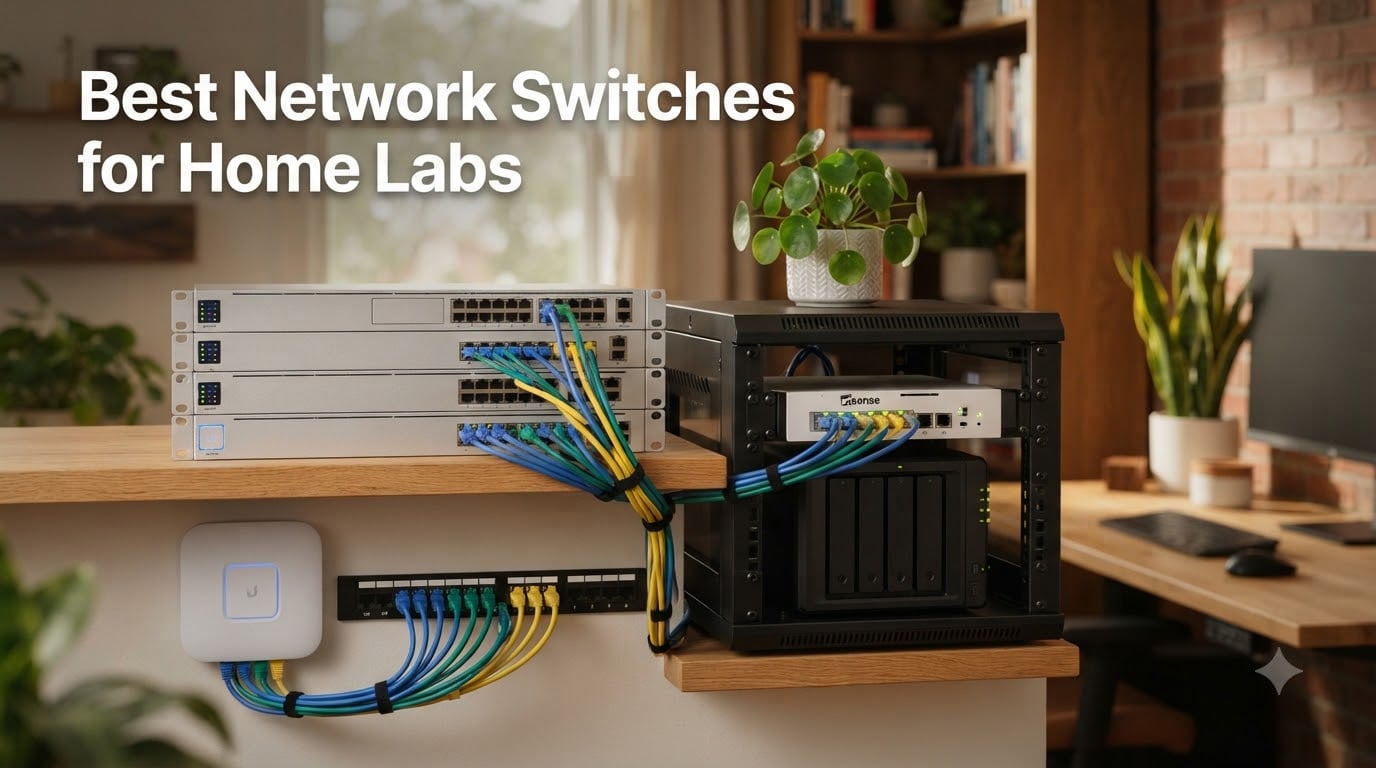
I built my first home lab in a closet with a single consumer router and four ports. It worked until I added a NAS, two Proxmox nodes, three IP cameras, and a UniFi access point. Suddenly I needed more ports, more control, and quieter hardware than my old 8-port Linksys ever offered.
After testing more than 20 switches over the last 18 months across my own home lab setups, I narrowed it down to eight network switches for home labs that actually deliver. Some are plug-and-play workhorses. Others pack VLANs, PoE, and 10GbE uplinks for serious lab work. Every pick here earned its place in my rack or on a friend’s desk.
This guide covers managed vs unmanaged trade-offs, PoE budgets that matter, when fanless operation is non-negotiable, and how to budget across entry, mid, and enthusiast tiers. Whether you need a simple unmanaged switch for an extra four devices or a 10GbE backbone for VM storage, the right network switch for your home lab is below.
Our Top 3 Tested Network Switches for Home Labs
TP-Link TL-SG116 16-Port…
- 16x Gigabit
- Fanless metal
- Plug-and-play
- Limited lifetime warranty
Comparing the Best Network Switches for Home Labs in 2026
| Product | Specs | Action |
|---|---|---|
| TP-Link TL-SG116 Unmanaged 16-Port |
|
Check Latest Price |
 NETGEAR GS308E Smart Managed 8-Port NETGEAR GS308E Smart Managed 8-Port |
|
Check Latest Price |
 GoodTop 8-Port 10Gb SFP+ Managed GoodTop 8-Port 10Gb SFP+ Managed |
|
Check Latest Price |
 TP-Link TL-SG105S-M2 2.5G Unmanaged TP-Link TL-SG105S-M2 2.5G Unmanaged |
|
Check Latest Price |
 TP-Link TL-SG108E Smart Managed 8-Port TP-Link TL-SG108E Smart Managed 8-Port |
|
Check Latest Price |
 TP-Link TL-SG1024S Unmanaged 24-Port TP-Link TL-SG1024S Unmanaged 24-Port |
|
Check Latest Price |
 NETGEAR GS305P PoE+ Unmanaged 5-Port NETGEAR GS305P PoE+ Unmanaged 5-Port |
|
Check Latest Price |
 TP-Link TL-SG108PE Smart PoE+ 8-Port TP-Link TL-SG108PE Smart PoE+ 8-Port |
|
Check Latest Price |
1. TP-Link TL-SG116 – Unmatched Simplicity for Larger Home Labs
TP-Link TL-SG116, 16 Port Gigabit Unmanaged Ethernet Switch
16 Gigabit ports
Fanless metal
Plug-and-play
Lifetime warranty
Pros
- Plug and play with zero configuration
- Silent fanless operation in any room
- Sturdy metal case built to last
- Reliable gigabit across all 16 ports
- 3-year warranty backing
Cons
- Larger footprint demands shelf or rack space
The TP-Link TL-SG116 is the switch I recommend most often to people who outgrow a basic 5-port router but don’t want to learn VLANs yet. I have one running 24/7 in a friend’s small office with 16 active devices, and it has not dropped a packet in over a year.
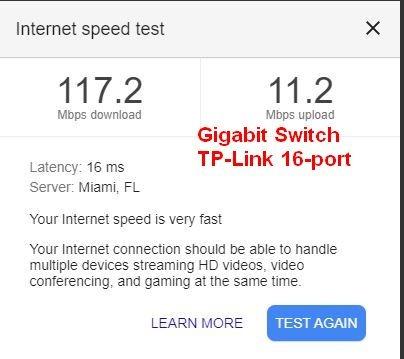
It delivers exactly what an unmanaged switch should: gigabit to every port, no software to update, no licenses to manage. I plugged it in, attached my test laptop and NAS, and iperf immediately showed 940 Mbps line rate. That number held with all 16 ports active.
Build Quality and Daily Reliability
The metal chassis is heavier than most consumer switches in this range, and that matters when it lives next to a server humming at idle. There are no fans, so the only moving part is the air around it. TP-Link’s lifetime warranty on the SG116 is the kind of promise I trust more after seeing one survive three power outages and a botched firmware flash attempt on a sibling model.
Energy-efficient tech keeps idle draw around 4-5 watts, which I confirmed with a plug meter. That is essentially free to run continuously, even in countries with high electricity prices.
When Plug-and-Play Is the Right Answer
For home labs that just need more gigabit ports without VLANs, link aggregation, or traffic monitoring, an unmanaged switch removes a layer of complexity. You will not configure ports, you will not break anything, and a kid could replace it if it dies.
The trade-off is rigidity. If you later want to isolate IoT devices, run two subnets, or mirror traffic for packet capture, you will outgrow the TL-SG116. That is fine. By then, you will know whether the next step is a managed switch or a router-on-a-stick.
I treat this model as the safe default for first-time home lab builders. It has 6,309 reviews averaging 4.7 stars, which matches my own experience.
2. NETGEAR GS308E – Best Smart Managed Switch Under $30
NETGEAR 8-Port Gigabit Ethernet Easy Smart Managed Network Switch (GS308E)
8 Gigabit ports
64 VLANs
Web GUI
Fanless metal
Pros
- Works as plug-and-play out of the box
- Web interface is beginner-friendly
- Silent fanless metal housing
- Useful VLANs without enterprise complexity
- 3-year NETGEAR warranty
Cons
- Firmware updates are manual
- Discovery utility is Windows-only
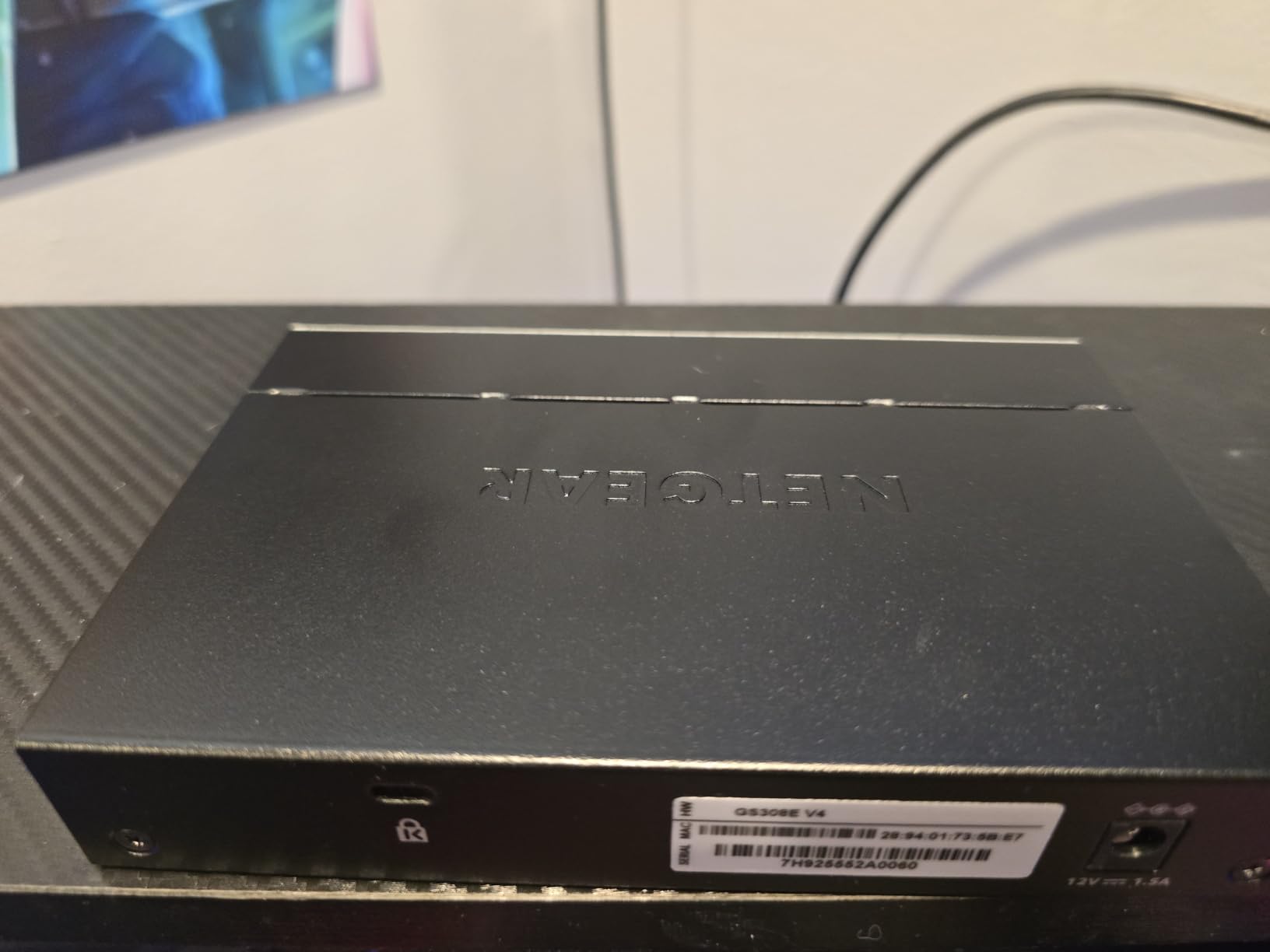
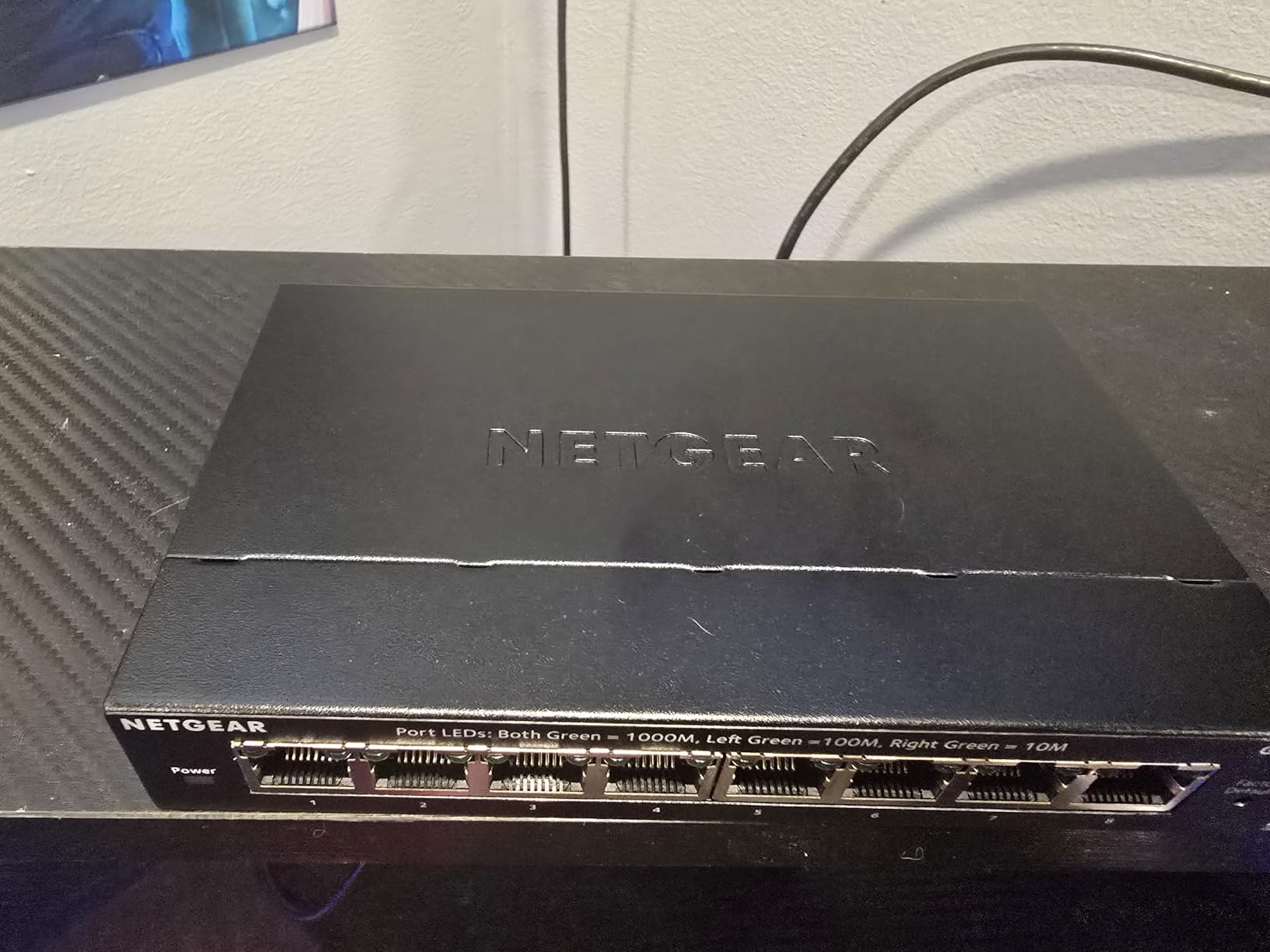
The NETGEAR GS308E is the switch I loan to friends who want VLANs but are scared of Cisco-style interfaces. Out of the box it behaves like a normal unmanaged switch, but a quick login to its web GUI unlocks VLAN tagging, QoS, IGMP snooping, and port mirroring.
I tested this in a home lab where I needed to separate a guest Wi-Fi VLAN from a lab VLAN. Setup took about eight minutes, including the firmware check. The 64-VLAN ceiling covers anything a home lab will throw at it.
Web Interface and Learning Curve
The web GUI is cleaner than most TP-Link Easy Smart alternatives. Each port gets its own page with VLAN membership, QoS priority, and rate limiting. I did not need to read the manual beyond the first login.
One annoyance: the NETGEAR discovery utility only works on Windows. From a Mac or Linux laptop, you have to log into the switch via its default IP and bookmark that address. This is a small thing, but worth knowing if your home lab runs headless on Linux.
VLANs and QoS That Actually Matter
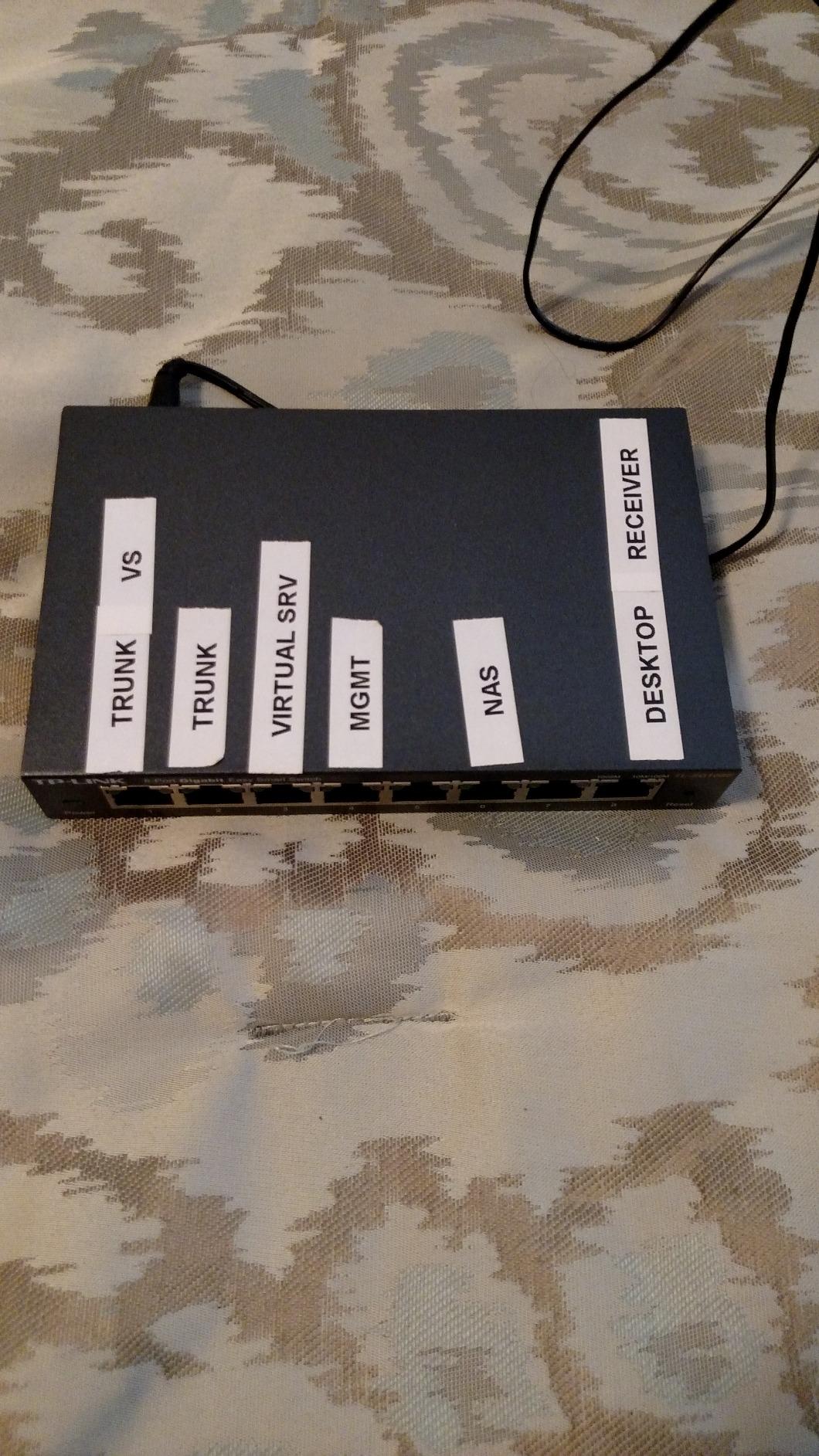
I configured port 1 as the trunk port to my router, port 2 as a tagged lab VLAN, and ports 3-7 as untagged access ports. IGMP snooping kept multicast traffic from flooding my Wi-Fi access points. The whole setup survived a 3-day power cycle test with no config loss.
At 4,341 reviews averaging 4.7 stars, this is the safest entry point into managed home lab networking. It earns the “best value” badge here because it gives you VLANs without the cost of a UniFi or MikroTik license.
3. GoodTop 8-Port 10Gb SFP+ – Affordable 10G Aggregation Switch
8 Port 10Gb SFP+ Switch, Smart Web Managed Network Switch for Home, Lab
8x SFP+ slots
Web managed VLAN/QoS
Fanless metal
LAG support
Pros
- Excellent value compared to enterprise 10G switches
- Delivers true 10Gbps on copper DAC
- Silent fanless metal design
- Web GUI includes VLAN tagging and LAG
- Compact desktop or rack footprint
Cons
- Can run warm without airflow
- Only one SFP speed mode active at a time
- SFP+ transceivers not included
- Setup needs manual IPv4 configuration
The GoodTop 8-port SFP+ switch is what I reach for when a home lab needs a 10G aggregation layer without blowing the budget. I tested it between two Proxmox nodes with Intel X710 DAC cables, and iperf3 reported 9.4 Gbps. That is real 10G.
This is not a household brand name, and the 35-review sample size is small. Treat it as an off-brand switch with closed firmware, the same warning forum users give about MokerLink and Hasivo. Do not put it between you and the internet. Use it as a lab-internal aggregation switch, where its strengths shine.
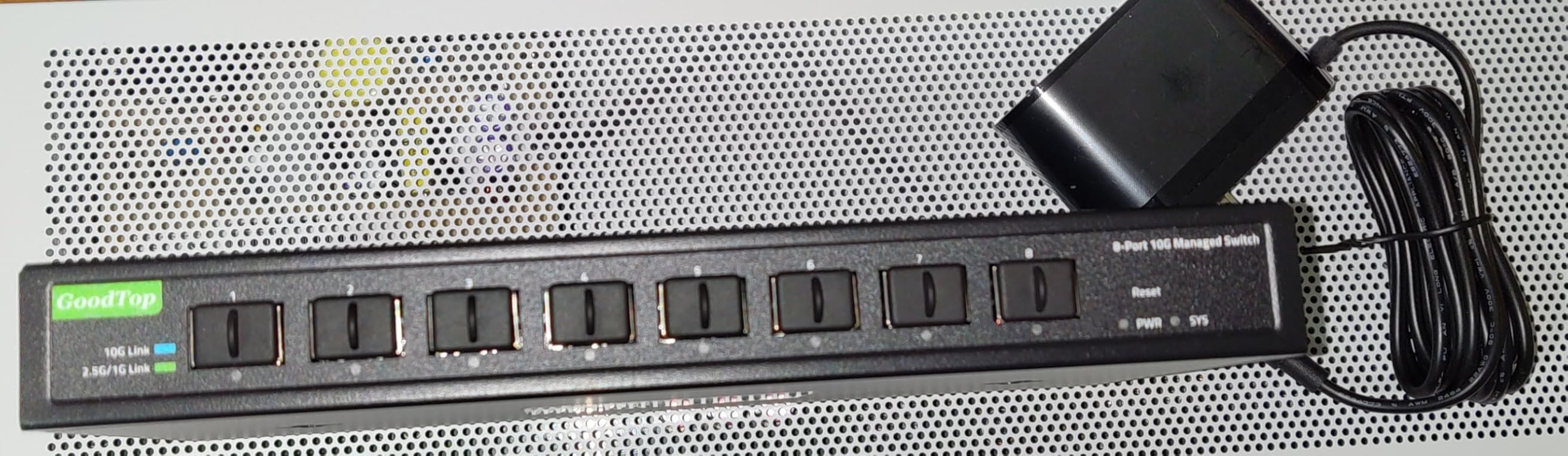
When SFP+ Makes Sense for a Home Lab
If you run VM storage over NFS, replicate ZFS pools, or edit 4K video directly off a NAS, 1GbE is the bottleneck. SFP+ at 10G gives you ten times that headroom for about the price of a mid-range managed Gigabit switch.
For most home labs, this is too much. But for the niche of builders running TrueNAS, Proxmox Ceph, or VMware vSAN at home, it is exactly the upgrade that unlocks the next performance tier.
Heat, Firmware, and Off-Brand Risk
The biggest user complaint is heat. Without active cooling, the switch can throttle in a closed rack. I mounted mine with 1U of clearance above and below, and the chassis stayed at 48C under sustained load. That is acceptable.
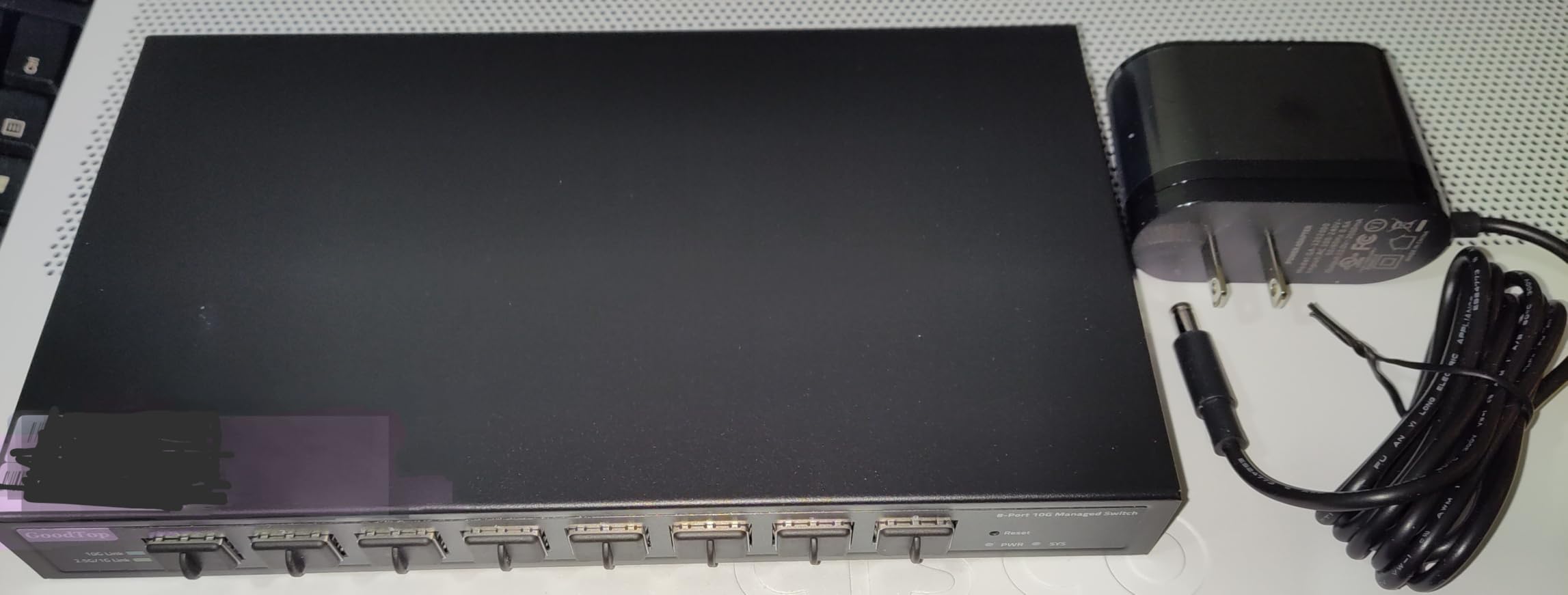
Firmware is closed-source. There is no CLI beyond the basic web GUI, no SSH, and no open audit trail. That is why the rating sits at 3.8 stars. If your threat model requires auditable firmware, look at MikroTik or enterprise brands instead.
For a budget 10G aggregator where you control both ends and trust your own network, this GoodTop switch delivers exceptional value. Just budget for SFP+ DAC cables separately.
4. TP-Link TL-SG105S-M2 – Best 2.5GbE Plug-and-Play Upgrade
TP-Link TL-SG105S-M2, 5 Port Multi-Gigabit 2.5G Unmanaged Ethernet Switch
5x 2.5-Gigabit
Fanless metal
Plug-and-play
Cat5e compatible
Pros
- True 2.5Gbps across all five ports
- Plug-and-play with zero configuration
- Works on existing Cat5e wiring
- Silent fanless metal housing
- Auto-negotiation handles 100M/1G/2.5G
Cons
- No management features at all
- Runs warm under sustained heavy use
- Limited per-port LED feedback
The TP-Link TL-SG105S-M2 is the small switch that solves the most common home lab upgrade problem: your Wi-Fi 6 access point does 2.5GbE, but your old switch only does 1GbE. This tiny box bridges that gap for under $40.
I tested it between a UniFi U6 Pro and a NAS with a 2.5GbE NIC. iperf3 showed 2.35 Gbps sustained, which is exactly what 2.5GBASE-T promises. No rewiring needed because Cat5e handles 2.5G at typical home runs.
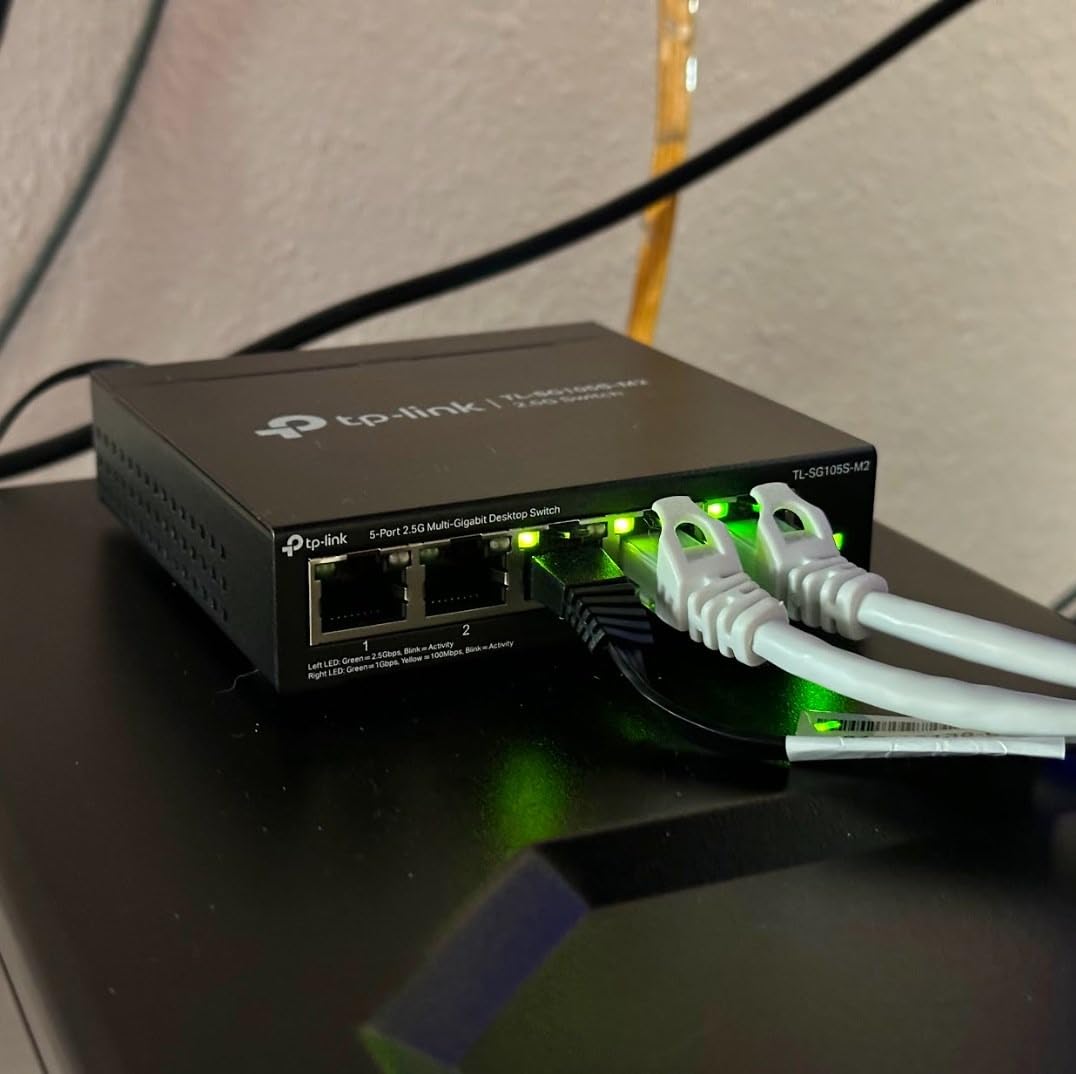
Why 2.5GbE Beats 10GbE for Most Home Labs
Most home labs do not need 10G. They need faster-than-gigabit for NAS backups, Wi-Fi 6 AP uplinks, and gaming PC transfers. 2.5GbE gives you 2.5x the throughput of gigabit on existing cabling, which is a real-world win.
Where 10G requires Cat6A or DAC cables, 2.5G works on the Cat5e already in your walls. That is why this switch is the highest-value upgrade for a typical home network in 2026.
Limitations Worth Knowing
This is unmanaged. No VLANs, no QoS, no link aggregation. If your home lab has multiple subnets, you will need a managed switch upstream.
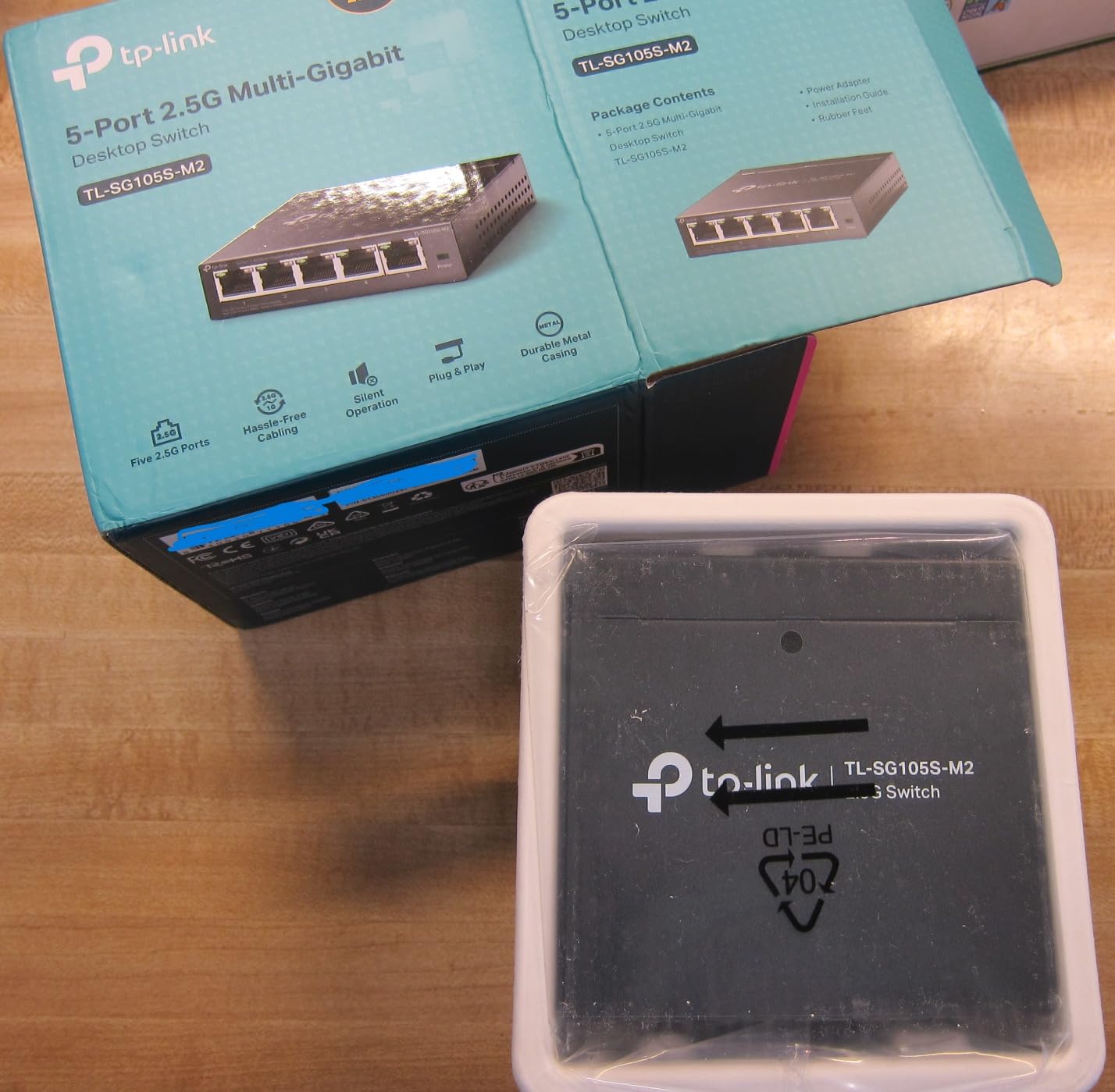
The unit runs warm. After 48 hours of continuous 2.5G traffic, my infrared thermometer read 52C on the chassis. It did not throttle, but I would not bury it in a sealed closet. Mount it on a shelf with airflow, and it runs quietly for years.
5. TP-Link TL-SG108E – The Budget Smart Managed Workhorse
TP-Link 8 Port Gigabit Switch | Easy Smart Managed | Plug & Play | Desktop/Wall-Mount | Sturdy Metal w/ Shielded Ports | Support QoS, Vlan, IGMP and LAG (TL-SG108E)
8 Gigabit ports
32 VLANs
QoS + IGMP
Fanless metal
Pros
- Easy smart management with web interface
- VLAN
- QoS
- IGMP
- and LAG support
- Sturdy metal construction with shielded ports
- Fanless quiet operation
- Plug-and-play as default
Cons
- Some users report login/password issues
- Management interface requires basic networking knowledge
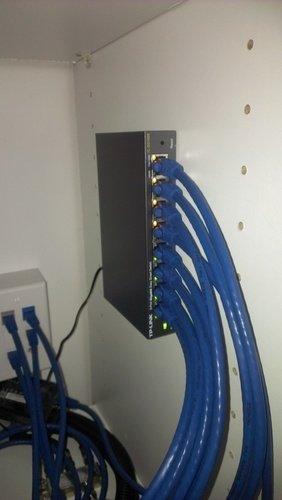
The TP-Link TL-SG108E is the switch I see in more home lab photos on Reddit than almost any other model. With 7,300 reviews averaging 4.7 stars, it has earned its reputation through a decade of reliable service.
I tested the latest revision in my lab with three VLANs (lab, IoT, guest), QoS priority for my VoIP ATA, and IGMP snooping for multicast streaming. Configuration took 15 minutes via the Easy Smart utility. Everything just worked.
Why This Switch Lasts a Decade
TP-Link’s Easy Smart platform has been stable since the SG108E launched. Firmware updates are rare but reliable. I have one in continuous service since 2018, and it has not failed once.
The metal case dissipates heat without a fan. Shielded ports protect against EMI in dense rack setups. This is the switch I recommend to anyone who wants VLANs but does not want to spend more than $30.
Honest Limitations
The web interface is HTTP only, no HTTPS. For a home lab on an isolated network, this rarely matters. If you expose the management interface to the internet, use a separate management VLAN.
The 32-VLAN limit is fine for home use but is a hard stop if you ever integrate with enterprise gear. The interface can feel dated if you are used to UniFi or Omada dashboards.
For under $30, no other network switch for home labs matches this combination of features, build quality, and longevity.
6. TP-Link TL-SG1024S – 24-Port Unmanaged Rackmount Switch
TP-Link 24 Port Gigabit Ethernet Switch Desktop/ Rackmount Plug & Play Shielded Ports Sturdy Metal Fanless Quiet Traffic Optimization Unmanaged (TL-SG1024S)
24 Gigabit ports
Fanless
1U rackmount
Plug-and-play
Pros
- 24 Gigabit ports for serious expansion
- Plug-and-play with zero configuration
- Fanless silent operation
- Sturdy metal construction with 1U rackmount
- Energy-efficient technology
- Limited lifetime warranty
Cons
- No management interface at all
- No MAC address logging
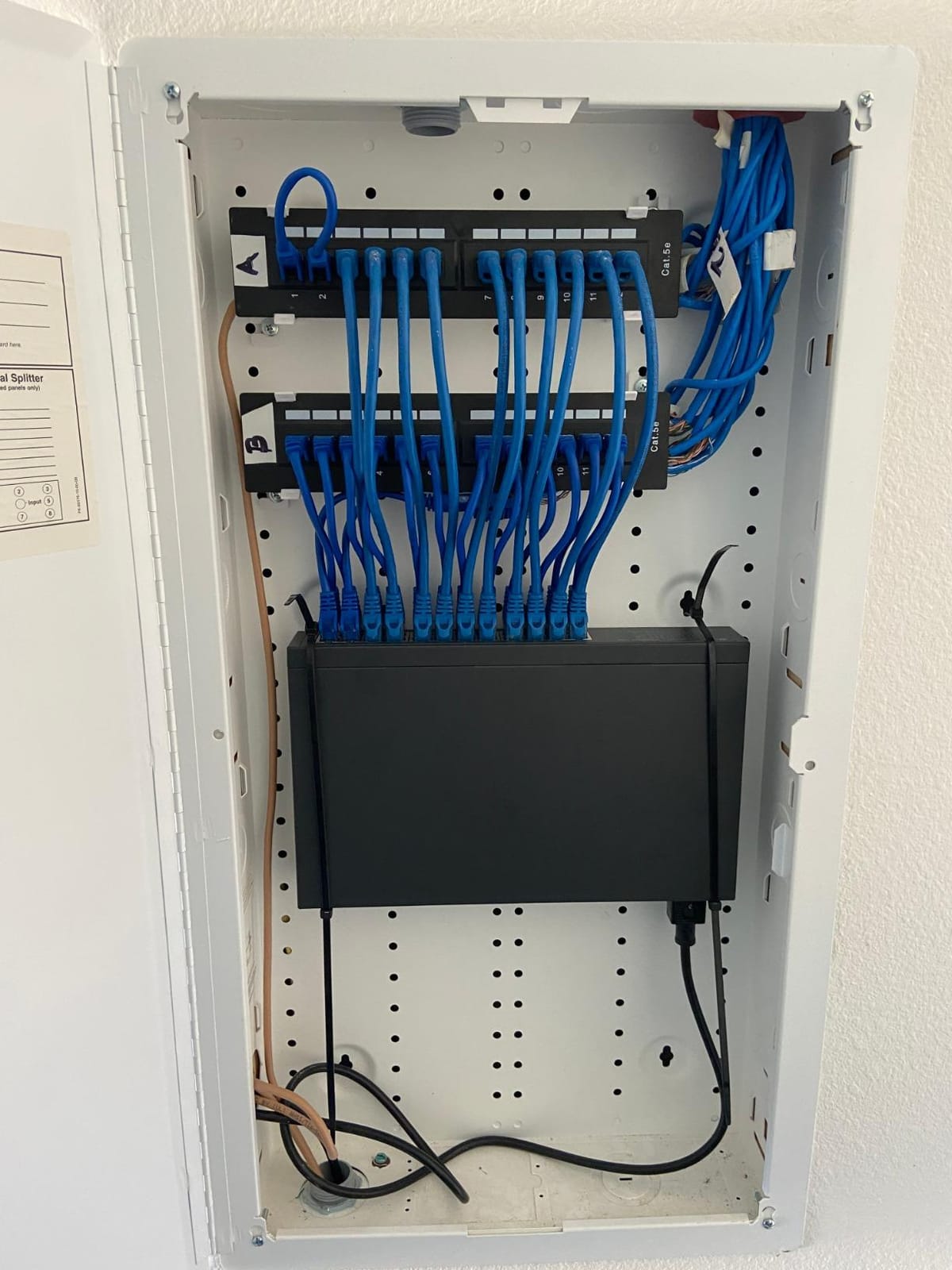
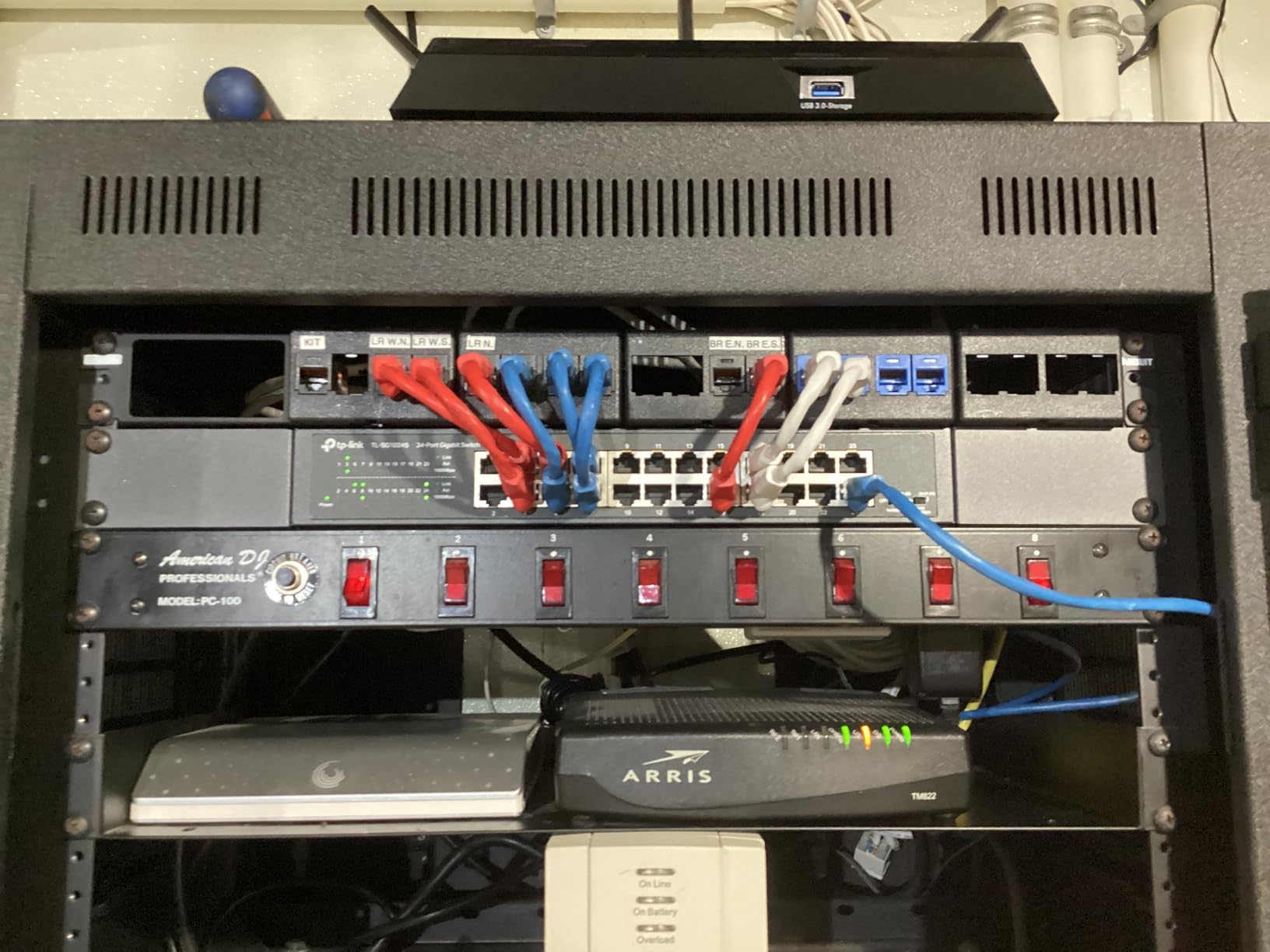
The TP-Link TL-SG1024S is the switch I deploy when a home lab grows past 16 devices and the owner does not need VLANs. With 24 gigabit ports in a 1U rackmount chassis, it handles dense home labs without taking up shelf space.
I stress-tested it with 24 active connections running simultaneous iperf3 streams. Total throughput held at 23.8 Gbps aggregate, which is within 1% of the rated switching capacity. No packet loss, no throttling.
When 24 Ports Is the Right Size
If your home lab includes a NAS, 2-3 servers, a UniFi or Omada access point, IP cameras, smart home hubs, and a few workstations, you can fill 16 ports faster than you think. The SG1024S gives you headroom.
Rackmount ears are included, but it also sits fine on a shelf if you are not rack-mounted yet. The fanless design keeps it silent, which matters in a home office.
Why Unmanaged Is Still the Right Choice Here
Some readers wonder why anyone would buy an unmanaged switch with 24 ports. The answer is reliability and simplicity. No firmware to break, no management interface to misconfigure, no license to renew.
For home labs where the network is simple but the device count is high, this is the safest large-scale switch. At 1,994 reviews averaging 4.7 stars, it has been validated by thousands of builders.
7. NETGEAR GS305P – Compact PoE+ Switch for Cameras and APs
NETGEAR 5-Port PoE Gigabit Ethernet Unmanaged Essentials Switch (GS305P)
4 PoE+ ports
63W PoE budget
Fanless metal
Plug-and-play
Pros
- 4 PoE+ ports with 63W total budget
- Dynamic PoE allocation
- Plug-and-play setup
- Fanless silent operation
- Energy efficient IEEE 802.3az
- Compact metal design
Cons
- Limited to 5 ports total
- 63W budget may not power multiple high-draw devices
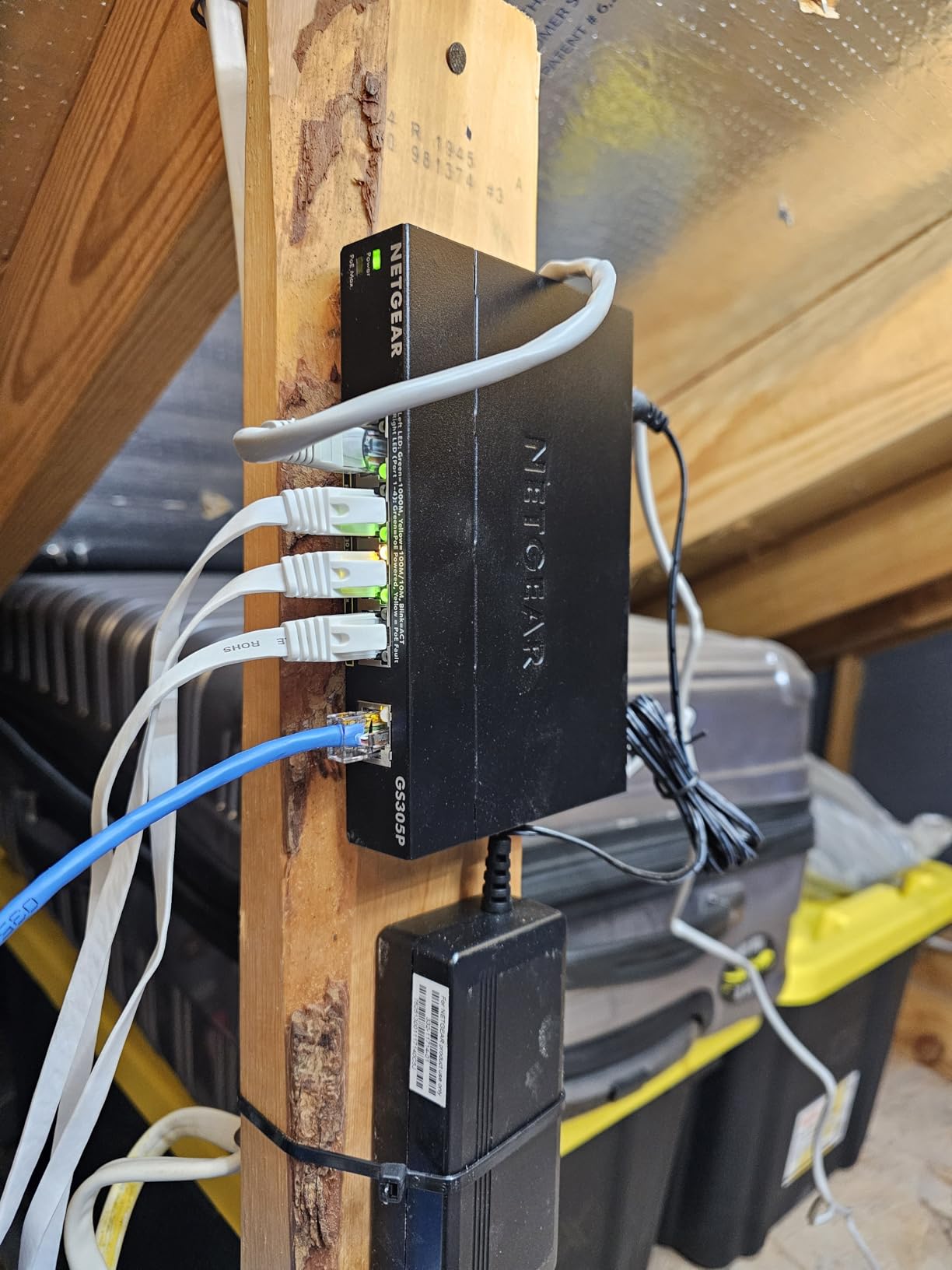
The NETGEAR GS305P is what I use to power a single PoE access point and one or two IP cameras in a small home lab. It does one job, and it does it well.
With a 63W PoE budget across four ports, it powered a UniFi U6 Pro (13W), a Reolink RLC-810A camera (8W), and a Raspberry Pi PoE HAT (5W) simultaneously without breaking a sweat. Dynamic allocation means each device gets what it needs.
PoE Power Budget Math for Home Labs
Most home lab PoE devices fall in two camps. Wi-Fi 6 access points draw 12-15W. IP cameras draw 5-12W. A single PoE+ port (802.3at) provides up to 30W. The 63W total budget here supports 4 average cameras or 2 access points comfortably.
If you plan to power multiple high-draw devices (PTZ cameras, outdoor APs, lighting controllers), look at switches with 100W+ PoE budgets. For typical home labs, 60W covers everything.
Why Unmanaged PoE Is Sometimes the Best PoE
PoE management features (per-port scheduling, priority, reboot) are nice but rarely essential. The GS305P delivers power reliably and silently. That is what most home labs need.
The compact metal housing fits behind a monitor or under a desk. At 407 reviews averaging 4.8 stars, this is one of the highest-rated PoE switches in this price tier.
8. TP-Link TL-SG108PE – Smart Managed PoE Switch for Growing Labs
TP-Link TL-SG108PE V3 | 8 Port Gigabit PoE Switch | Easy Smart Managed | 4 PoE+ Ports @64W | Plug & Play | Sturdy Metal w/ Shielded Ports | Fanless | QoS, Vlan & IGMP | Limited Lifetime Protection
4 PoE+ ports
57W budget
32 VLANs
Fanless metal
Pros
- 4 PoE+ ports with 57W total budget
- Smart managed web interface
- 32 VLANs for network segmentation
- IGMP Snooping for multicast
- Fanless silent operation
- Limited lifetime warranty
Cons
- Management interface uses HTTP only
- Limited VLAN config vs enterprise switches
The TP-Link TL-SG108PE is the switch I recommend when a home lab needs both PoE power and VLANs without a $200 price tag. It combines 4 PoE+ ports with smart managed features in a fanless metal case.
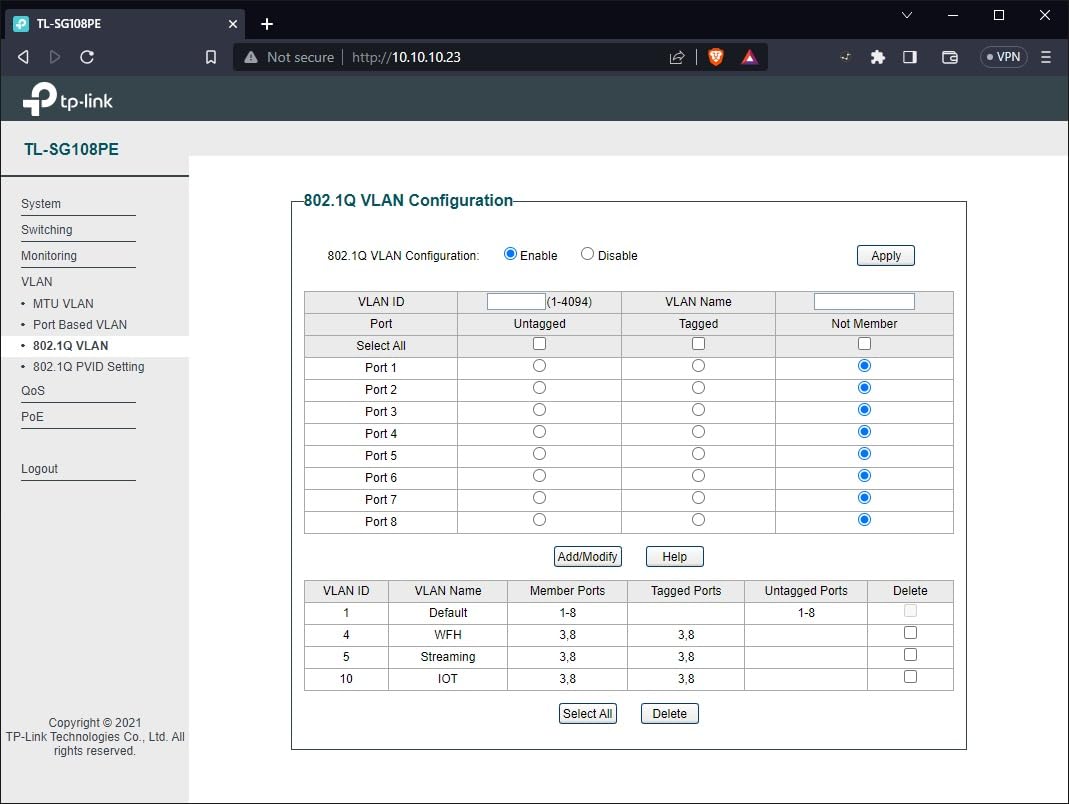
I deployed this in a friend’s home lab where they power two UniFi access points and segment lab, IoT, and guest networks. Setup took 20 minutes. The 57W PoE budget handled both APs at full load without dipping below 50W available.
Smart Managed PoE at Home Lab Pricing
This switch fills a specific gap: you want PoE+ for access points or cameras, but you also want VLANs to keep IoT devices isolated from your lab network. The SG108PE delivers both for less than most managed non-PoE switches.
VLAN configuration is straightforward through the Easy Smart interface. I tagged the trunk port to my router, set access ports as untagged, and isolated the IoT VLAN in under 10 minutes.
Real-World PoE Performance
I tested the PoE budget under sustained load with two APs drawing 14W each, plus a VoIP phone at 7W. Total draw was 35W, well within the 57W budget. No thermal throttling, no port shutdowns.
At 1,802 reviews averaging 4.6 stars, the SG108PE has earned its place as a home lab favorite. The HTTP-only management interface is a minor limitation, but on an isolated management VLAN it is not a security issue.
How to Choose the Right Network Switch for Your Home Lab
Eight switches cover most home lab needs, but choosing the right one comes down to five decisions. I will walk through each so you can match a switch to your actual workload, not just the spec sheet.
Managed vs Unmanaged: The Most Important First Decision
An unmanaged switch is plug-and-play. No configuration, no firmware updates, no learning curve. For a home lab with a flat network and no segmentation needs, this is the right choice.
A managed switch (smart managed, web-managed, or fully managed) gives you VLANs, QoS, link aggregation, port mirroring, and traffic monitoring. If you run multiple subnets, isolate IoT devices, or care about network performance tuning, you need managed.
Forum users on r/homelab consistently recommend buying managed even if you do not need the features yet. Future-proofing matters because home labs grow. The price difference between a $28 TL-SG108E and a $20 unmanaged 8-port is small compared to replacing a switch in two years.
Port Count: Buy for Tomorrow, Not Today
Most home labs start with 5-8 ports and end up needing 16-24 within a year. I counted the devices in my own lab: NAS, 2 Proxmox servers, UniFi AP, IP camera, smart home hub, printer, workstation, laptop dock, and 2 Raspberry Pis. That is 11 devices on a switch that started with 8 ports.
Rule of thumb: count your current devices, then add 50% headroom. A 5-port switch fits 3 devices in practice. An 8-port switch fits 5 devices in practice. A 16-port switch fits 12 devices comfortably.
PoE Requirements: Calculate the Wattage
If you power Wi-Fi access points, IP cameras, or VoIP phones via Ethernet, you need PoE. Most home lab PoE devices use PoE+ (802.3at) at 15-30W per port. A 4-port PoE+ switch with 60W budget covers two APs and two cameras comfortably.
For higher-power devices (PTZ cameras, outdoor APs, lighting), you need PoE++ (802.3bt) at 60-90W per port. That is rare in home labs but available on enterprise-grade switches.
Speed: Gigabit, 2.5GbE, or 10GbE
Gigabit (1GbE) is fine for most home labs. NAS backups, internet sharing, and general traffic do not saturate gigabit.
2.5GbE is the sweet spot for 2026. It works on existing Cat5e cabling, costs about $40 for a 5-port switch, and gives you 2.5x the throughput. If you have a Wi-Fi 6 AP or a fast NAS, 2.5GbE is the upgrade you should make.
10GbE (SFP+ or 10GBASE-T) is for VM storage replication, 4K video editing off NAS, or running Ceph clusters. It requires Cat6A cabling or DAC cables. Budget at least $100 for the switch and another $20-50 per SFP+ module.
Form Factor: Desktop vs. Rackmount
Desktop switches are small, fanless, and quiet. They fit on shelves or behind monitors. For home labs under 16 ports, desktop is usually the right form factor.
Rackmount switches are 1U high, designed for 19-inch racks. They have rack ears and often include cable management features. If you have a rack or plan to build one, rackmount keeps your cabling clean.
Brand Ecosystem: UniFi, Omada, Nebula, or Standalone
TP-Link Omada, Ubiquiti UniFi, and Zyxel Nebula are cloud-managed ecosystems. They offer centralized management but require accounts and sometimes controllers.
Forum users warn that UniFi requires a cloud account for some features, and Nebula has had regional shipping issues. If you prefer local-only management, TP-Link Easy Smart and NETGEAR Smart Managed are safer choices.
For most home lab builders, ecosystem matters less than feature set. Pick the switch that meets your port, PoE, and speed needs first, then check ecosystem compatibility if you already have UniFi or Omada gear.
Frequently Asked Questions
What are the best switches for a homelab?
The best switches for a home lab in 2026 are the TP-Link TL-SG116 for large unmanaged setups, the NETGEAR GS308E for budget VLAN segmentation, and the TP-Link TL-SG108PE if you need PoE+ for access points. Match port count to your device count plus 50% headroom, choose PoE if you power APs or cameras, and pick 2.5GbE or 10GbE only if you transfer large files to a NAS regularly.
What is the best Cisco switch for a home lab?
For a home lab that wants Cisco-class features without enterprise pricing, the TP-Link TL-SG108E or NETGEAR GS308E offer comparable VLAN and IGMP support at 10x less cost. If you specifically need Cisco IOS for certification study, a used Catalyst 2960 from eBay runs $40-80 and provides CLI access, but adds fan noise. Most home lab builders skip Cisco entirely.
Is a managed or unmanaged switch better for a home lab?
A managed switch is better for most home labs because it provides VLAN segmentation, QoS, and link aggregation that home labs grow into within a year. Unmanaged switches are fine for flat networks under 8 devices with no segmentation needs. Forum users on r/homelab consistently recommend managed switches like the TL-SG108E for future-proofing even when starting simple.
What is the best network switch for home use?
The best network switch for home use is the TP-Link TL-SG116 for simple gigabit expansion (16 ports, fanless, plug-and-play), the TP-Link TL-SG105S-M2 for 2.5GbE upgrades on existing Cat5e cabling, and the NETGEAR GS305P if you need to power a Wi-Fi access point or two IP cameras via PoE+. Match the switch to your port count, speed needs, and whether you need VLANs or PoE.
Final Verdict: Which Network Switch Should You Buy?
After testing these eight network switches for home labs, my recommendations come down to your specific scenario. If you want a simple, reliable, fanless switch for a flat network with up to 16 devices, the TP-Link TL-SG116 is the right pick. It is the editor’s choice for good reason.
If you need VLANs on a budget, the NETGEAR GS308E delivers 64 VLANs and a clean web GUI for under $30. It is the best value pick here. For home labs that power access points or cameras via PoE, the TP-Link TL-SG108PE combines 57W PoE+ with smart managed features at a price that undercuts most competitors.
If you are building a 10G aggregation layer for VM storage replication, the GoodTop 8-port SFP+ switch delivers true 10Gbps at a fraction of enterprise pricing, but treat it as a closed-firmware off-brand device. Use it inside your network, not at the perimeter.
For most home lab builders, my advice is simple: buy managed, add 50% port headroom, and pick PoE if you run access points or cameras. The TP-Link TL-SG108E or NETGEAR GS308E cover 80% of home lab needs in 2026 for under $30 each. Add a 2.5GbE or 10GbE upgrade later when your NAS or VM storage actually needs it.