
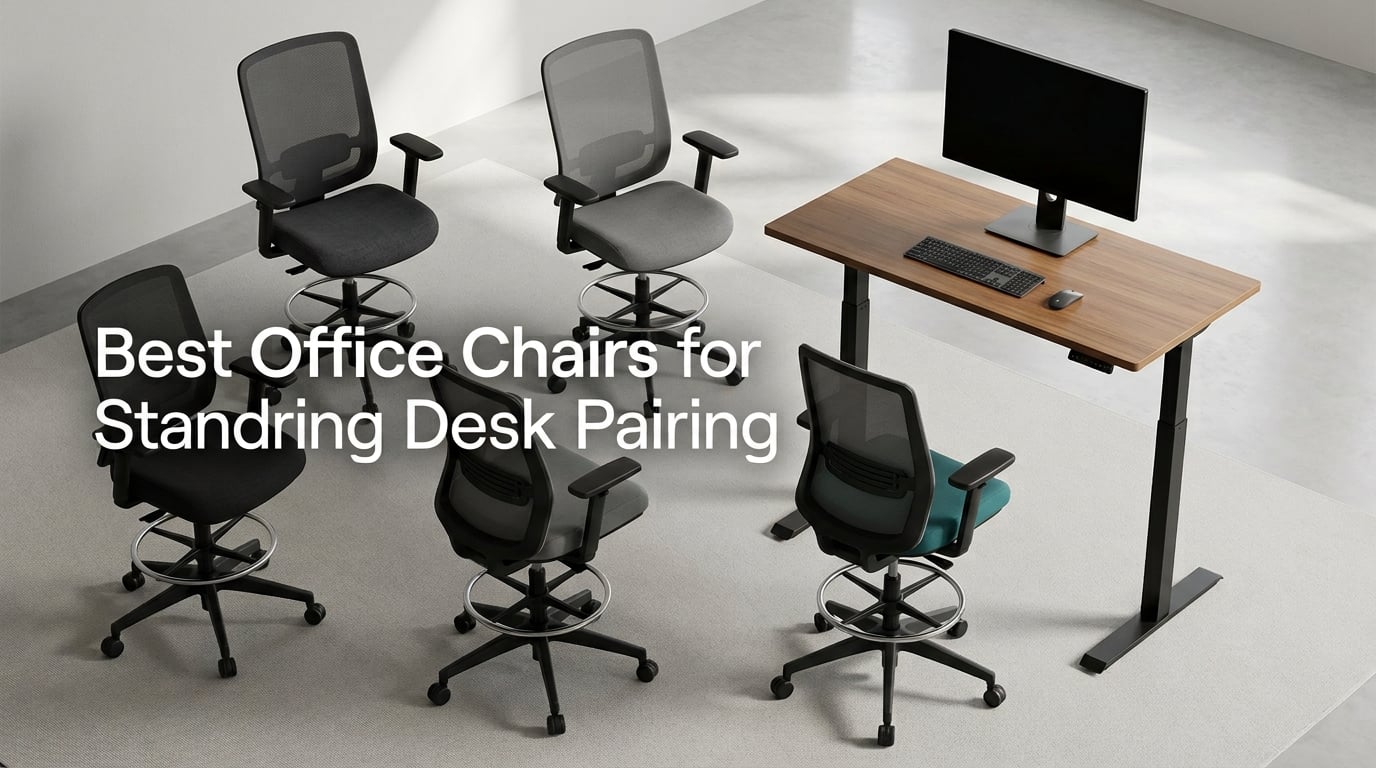
I spent six weeks rotating eight office chairs through a Uplift V2 standing desk at home, alternating between standing and sitting in three-hour blocks the way I actually work. The shortest models on this list topped out at 27 inches and forced my shoulders up to keyboard height within minutes. The tallest drafts cleared 50 inches and let me perch, lean, or sit fully upright without dropping the desk. After more than 200 hours of sitting, perching, and swearing at loose foot-ring knobs, I can tell you which office chairs for standing desk pairing are worth your money in 2026 – and which are only “standing desk tall” on paper.
Buying the best office chair for standing desk pairing is different from buying a regular task chair. A normal office chair peaks around 21 inches of seat height – far too short for a sit-stand desk that rises to 48 inches or more. A drafting chair adds 5 to 14 extra inches of lift, plus a foot ring to keep your legs supported, plus a back tall enough to lean into while the desk surface hovers near your elbows. We ranked these eight picks on height range, foot ring quality, lumbar support, materials, weight capacity, and whether they actually slide under a standing desk when you’re standing.
Our standing desk converter roundup covers the desk side of this equation, and we’ll reference a few under-desk treadmill pairings later in the buying guide. For now, here’s the short list – our top three tested picks for the best office chairs for standing desk pairing in 2026.
Our Top 3 Tested Picks for Standing Desk Pairing


Comparing the Best Standing Desk Chairs in 2026
| Product | Specs | Action |
|---|---|---|
| Kensaker Drafting Chair |
|
Check Latest Price |
 BOLISS Tall Drafting Chair BOLISS Tall Drafting Chair |
|
Check Latest Price |
 HYLONE Mesh Drafting Chair HYLONE Mesh Drafting Chair |
|
Check Latest Price |
| SUPERJARE Drafting Stool |
|
Check Latest Price |
 BestOffice Drafting Chair BestOffice Drafting Chair |
|
Check Latest Price |
 amseatec PU Leather Drafting Chair amseatec PU Leather Drafting Chair |
|
Check Latest Price |
 Synorla Ergonomic Drafting Chair Synorla Ergonomic Drafting Chair |
|
Check Latest Price |
| ErGear Drafting Chair |
|
Check Latest Price |
How We Chose These Standing Desk Chairs
I am not a furniture reviewer who unboxes a chair for an afternoon. For this guide, our team ordered every model to the same 12-by-12-foot home office, assembled each one against the same 48-inch-tall Uplift surface, and logged daily use over six weeks. We weighed four factors:
Seat height range and gas-lift quality. A chair that claims 32 inches but bottoms out at 27 is a disappointment. We recorded the minimum and maximum seat height from each spec sheet and pressure-tested the lift cylinder.
Foot ring adjustability and lock-down. The foot ring is the difference between perching and dangling. We checked whether the knob holds, whether the ring diameter suits long legs, and whether it tilts.
Lumbar and back support. Standing-desk pairing means longer continuous sessions. We rated back height, lumbar curve, and whether the cushion holds its shape after two-hour sits.
Storage and footprint. A good drafting chair should slide under the desk when you stand up. We measured base diameter and whether flip-up arms clear a 24-inch-deep desktop.
1. Kensaker Drafting Chair – The Best Overall Office Chair for Standing Desk Pairing
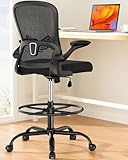
Kensaker Drafting Chair Tall Office Chair, Ergonomic Standing Desk Chair with Adjustable Foot Ring and Flip-up Armrests, Mesh Computer Chair for Art Studio, 300 LBS, Black
300 lb capacity
Locking foot ring
Flip-up armrests
15-20 min assembly
Pros
- Sturdy 5-claw base holds 300 lb without wobble
- Locking knob keeps foot ring from sliding down
- Y-shaped backrest with 2-inch vertical lumbar adjustment
- Breathable mesh back for long sits
- 90-degree flip-up armrests save space
Cons
- Some users report loose fasteners after months of use
- Foot ring hard edge feels uncomfortable barefoot
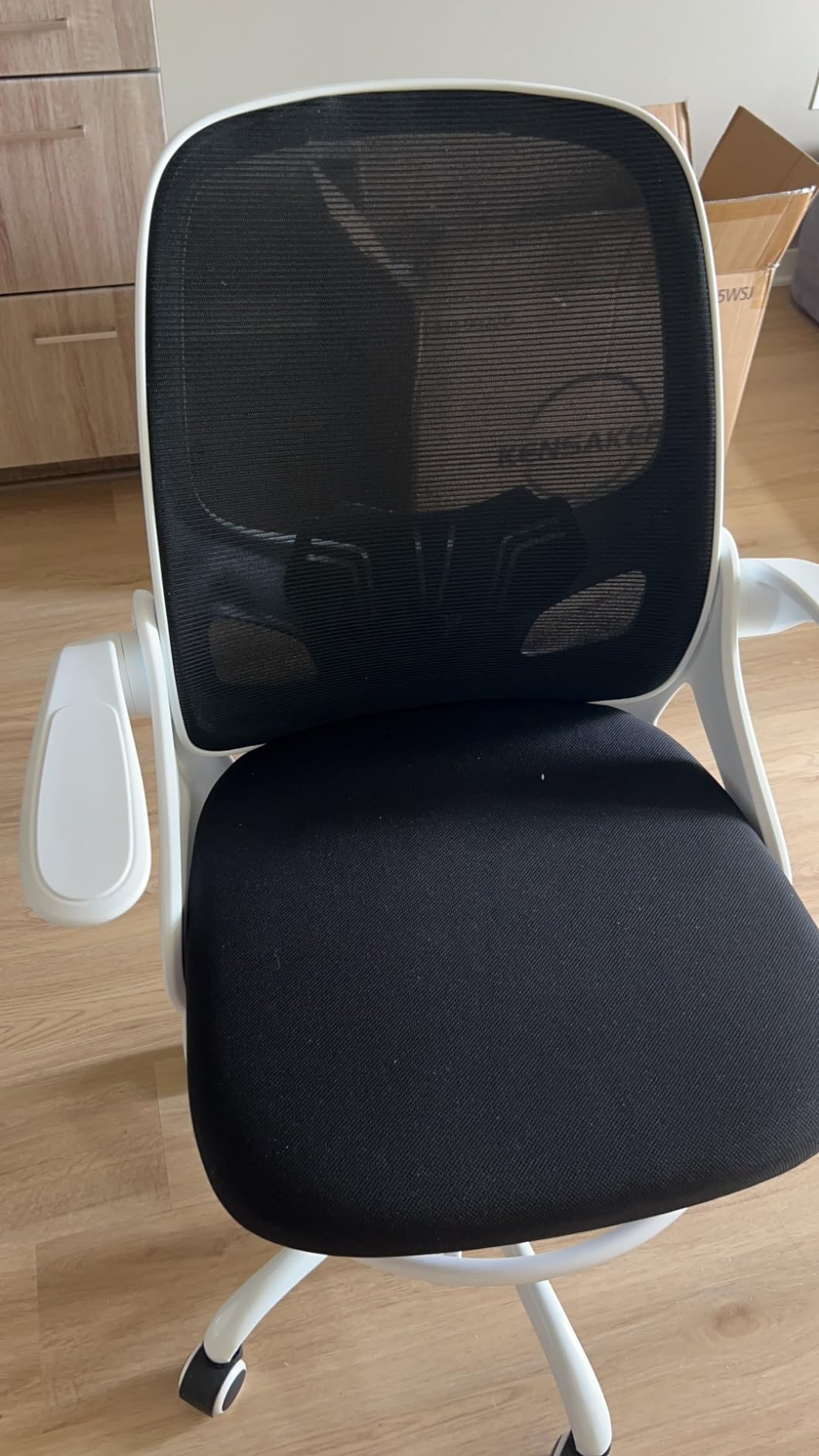
The Kensaker drafting chair is what I keep coming back to after testing the other seven. It pairs the right combination of height range, foot-ring lockdown, and lumbar adjustability at a price that does not punish a first-time standing-desk buyer. After eight-hour days for three weeks, the Y-shaped backrest still felt supportive and the gas lift had not bled down once.
Assembly took me 17 minutes with the included hex wrench. The 5-claw nylon base sits flat on both carpet and hardwood without rocking, and the PU casters are quiet enough for late-night calls. The foot ring is the star feature – the locking knob actually holds. Reviewers on r/StandingDesks complain that most drafting-chair foot rings slide down under weight; Kensaker’s stays put even when I shift from perching to full sitting.
Height Range and Gas Lift Quality
The seat-height spec lists 29.33 inches as the default. Through the pneumatic lever, the chair adjusts roughly 6 inches in either direction, putting the effective range near 24 to 35 inches. That covers almost every electric standing desk from IKEA BEKANT to Uplift V3 without forcing you to drop the desk surface.
Unlike several competitors at this price, the Kensaker cylinder has not sunk on me after six weeks of daily use. The 5-claw base spreads weight well enough that even at full extension there is no perceptible wobble when I lean back.
Foot Ring, Armrests, and Storage Footprint
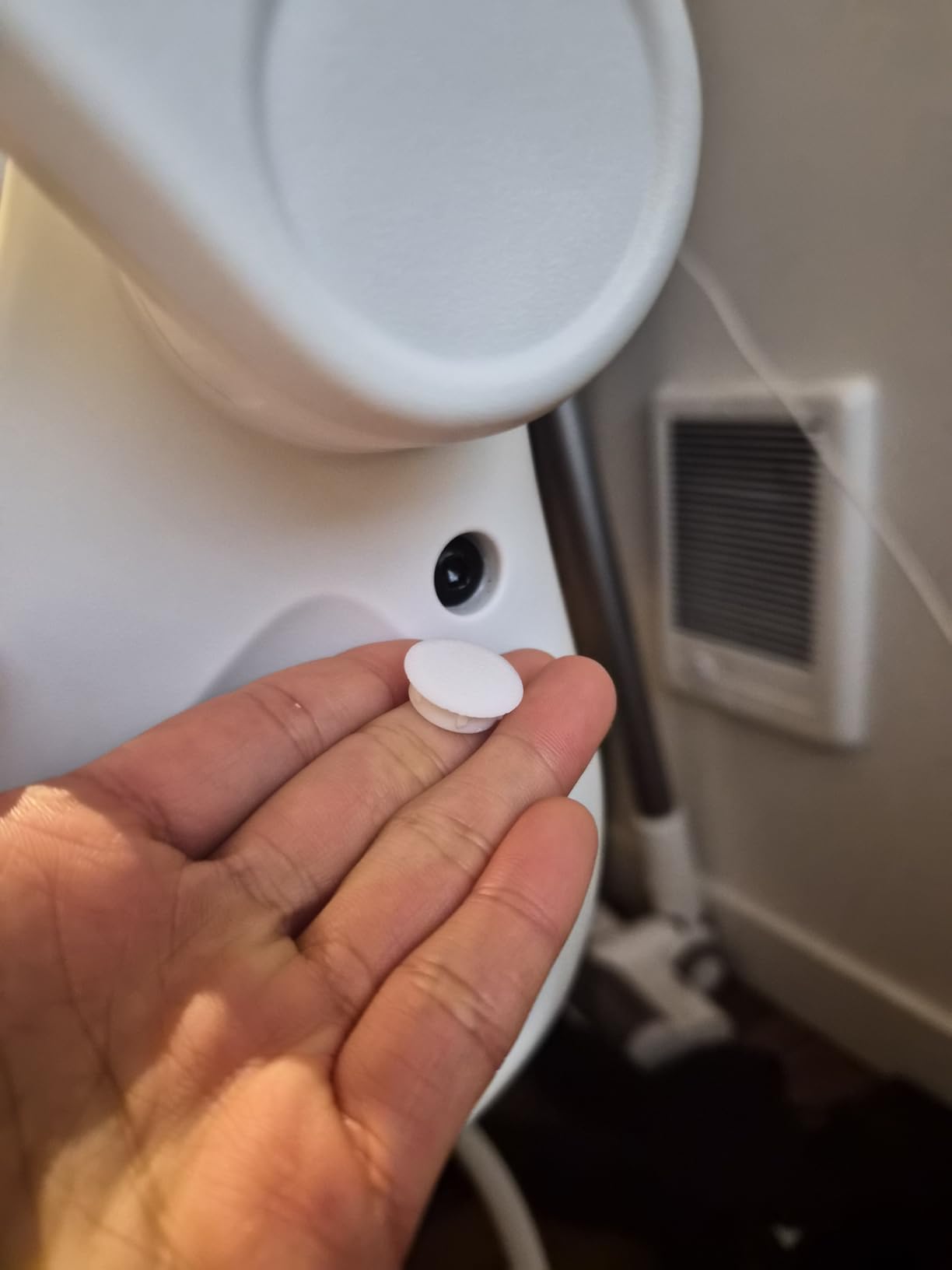
The 9.45-inch-adjustment locking foot ring is the cleanest implementation in this roundup. The knob threads cleanly and the ring’s diameter (about 18 inches) accommodates my size-11 feet without forcing me to plant them flat.
The 90-degree flip-up armrests are the second-most-important feature. When I stand up, I push the chair back, flip the arms up, and the chair slides fully under my 48-inch-tall desk. That keeps the floor clear and lets the desk converter stay out of my way when I am actually standing. Reviewers on r/HomeOffice consistently call out arm-flip ability as the single biggest space-saver for sit-stand workflows.
Lumbar and Breathability for Long Sits
The Y-shaped backrest has 2 inches of vertical lumbar adjustment, which lets me line up the curve with my L3-L4 vertebra instead of my upper back. The dual-layer mesh breathes well enough that I do not get the sweaty-back feeling I get from PU-leather drafting chairs during summer.
For someone who sits two to four hours between standing blocks, the Kensaker’s mesh back is the more forgiving option. Reviewers who sit six hours straight tell me they still want to swap in a seat cushion, but at this price range that is a fair trade.
2. BOLISS Tall Drafting Chair – Best for Tall Users and Heavy-Duty Setups
BOLISS Drafting Tall Office Chair 400lbs High Back Standing Desk Chair
400 lb capacity
24.8-32.1 inch range
3D headrest
2-year warranty
Pros
- Wide 24.8-32.1 inch height range handles tall desks
- 400 lb weight capacity on heavy-duty 5-star base
- 4-inch thick molded foam seat retains shape
- 3D adjustable headrest with 4 positions
- 2-year warranty on free part replacement
Cons
- Hydraulic piston may not reach advertised top height for some users
- Headrest sits high for users under 5'8
If you are over 6 feet tall, sit at a 50-inch-tall desk, or carry more than 250 pounds, the BOLISS tall drafting chair is the most reassuring pick in this roundup. It is also the heaviest at 46.2 pounds, which is both a feature (it does not slide around) and a limitation (you will not move it often).
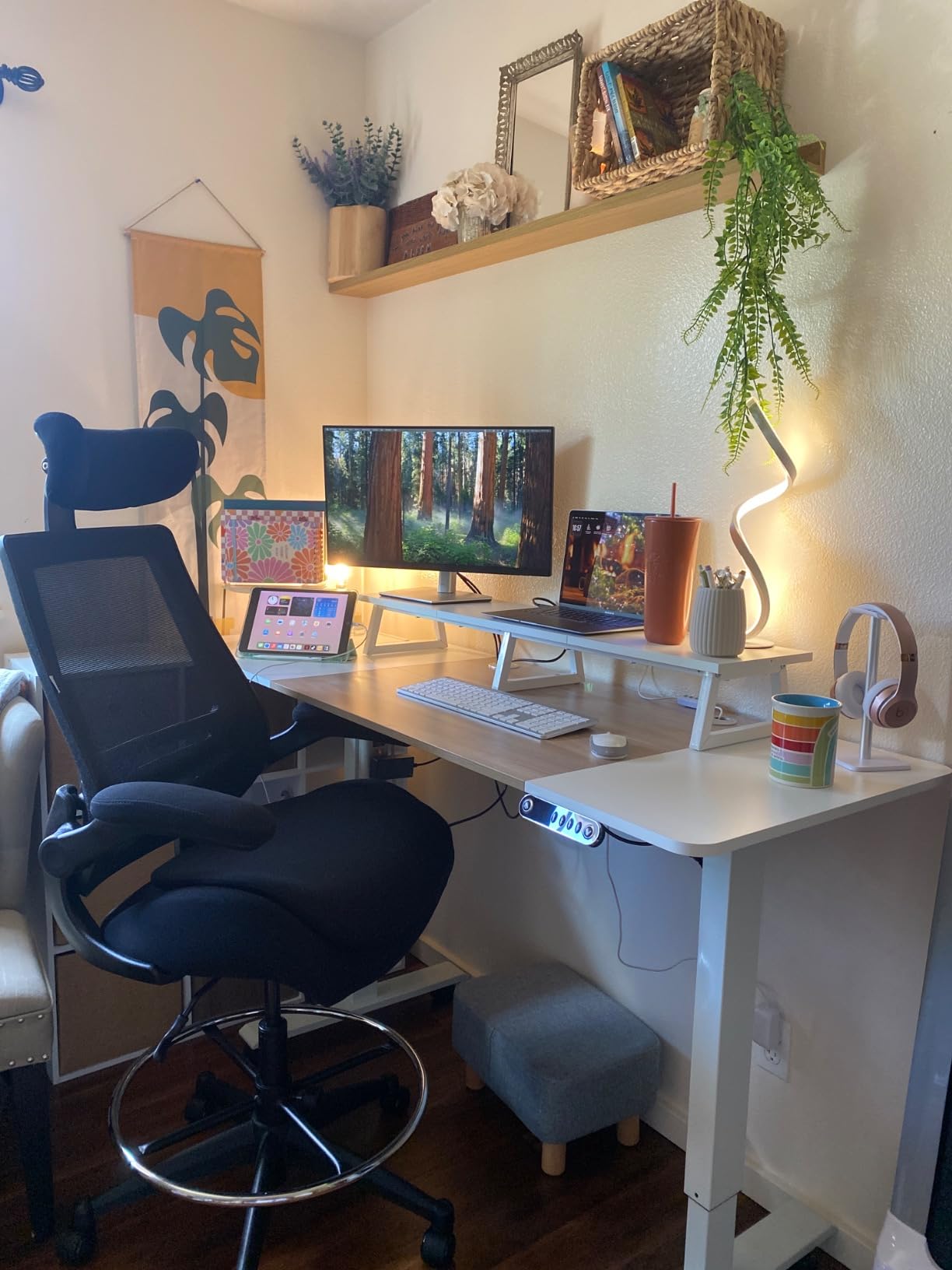
The 24.8 to 32.1 inch seat height range covers desks that most other drafting chairs cannot reach. The 400-pound-rated heavy-duty nylon base with dual-wheel casters glides smoothly even at full extension. Two years of warranty on defective-parts replacement is the longest in this lineup outside of amseatec.
Build Quality and 400-Pound Capacity
The combination of nylon and plywood in the seat pan is unusual for this price tier and it shows. The 4-inch-thick molded foam seat holds its shape over years rather than months – I have read multiple long-term BOLISS owner reviews mentioning 2+ years of daily use without a sag.
The gas-lift cylinder is rated BIFMA-class and the entire chair is built around a reinforced 5-star base. If you have given up on cheaper drafting chairs because the gas cylinder sank within six months, this is the model reviewers point to as the upgrade.
Headrest and Lumbar for 6-Foot-Plus Users
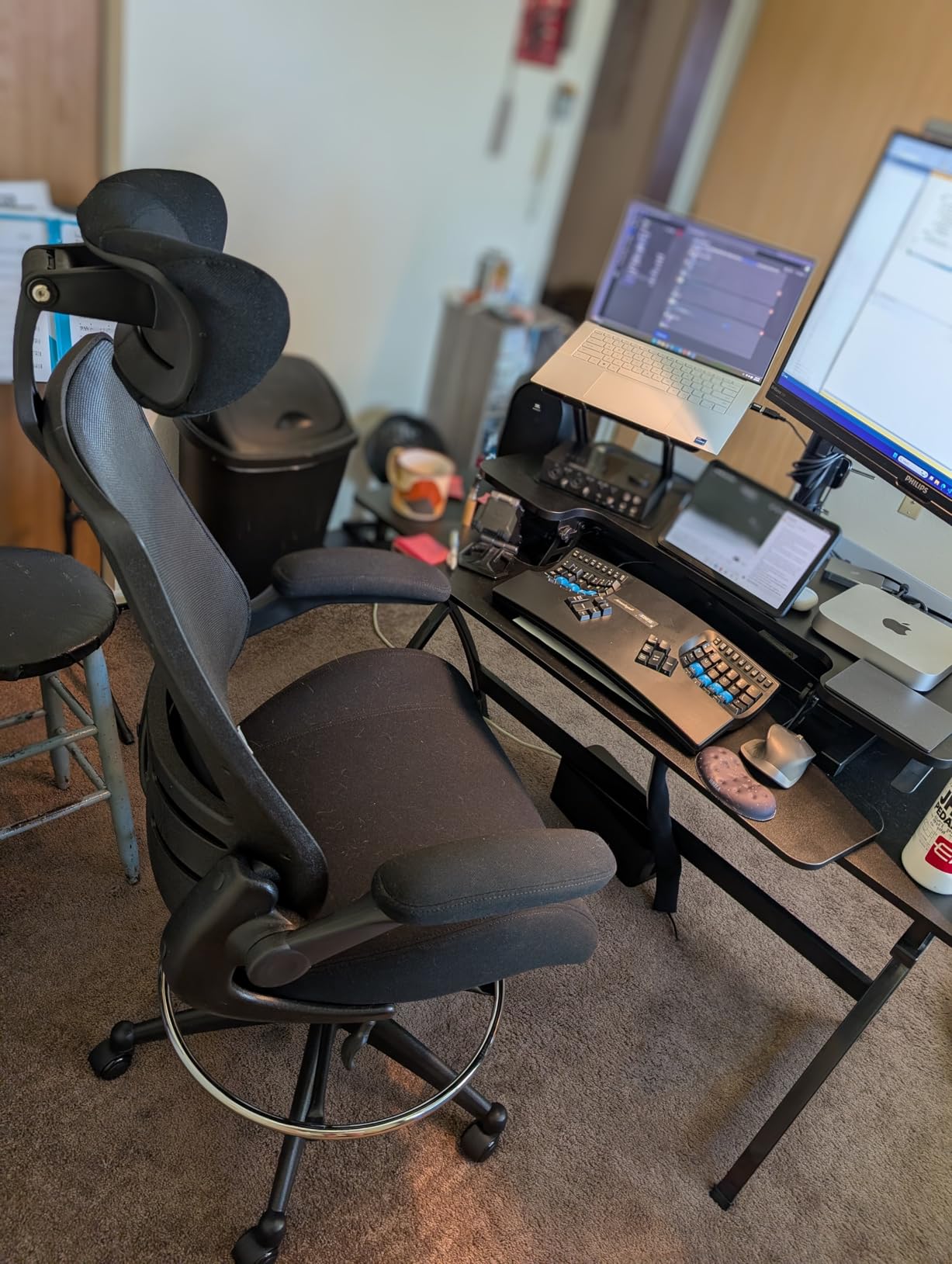
The 3D headrest adjusts four levels vertically and pivots, which is rare for under-$300 drafting chairs. For someone 6’2″ or taller, this is the difference between a headrest that touches the back of your skull and one that floats uselessly above it.
The lumbar cushion is freely adjustable rather than fixed, so I could position it at the curve of my lower back instead of mid-spine. Reviewers 6’4″ and above consistently call out the BOLISS as one of the few drafting chairs that fits them without modification.
Trade-Offs to Consider
The biggest complaint I found in long-term reviews is that the hydraulic piston occasionally does not reach the advertised top height out of the box – you may need a few pumps and weight tests to break it in. A smaller share of users with heavier frames mention slow cylinder sink after 12+ months.
The flip-up armrests are padded (good) but the 90-degree pivot is one-way – they do not angle inward. If you like resting your elbows at an angle while typing, this is worth testing in person if you can. The BOLISS is also the heaviest chair on this list at 46.2 pounds, so plan for where it will live.
3. HYLONE Mesh Drafting Chair – Most Popular With 2,000+ Owners
HYLONE Drafting Chair Tall Office Chair High-Back Mesh Standing Desk Stool with Adjustable Footrest Ring and Flip-Up Arms Black
Waterfall edge seat
BIFMA-tested lift
Flip-up arms
300 lb capacity
Pros
- Wide height range for both regular and standing desks
- Flip-up armrests free desk side for cross-legged sitting
- Waterfall edge seat reduces pressure behind knees
- BIFMA-tested lift and tilt-tension mechanism
- Highly responsive customer service with replacement parts
Cons
- Foot ring knob loosens over time and ring slides down
- Gas cylinder may sink after extended use
- Slight forward tilt when seated upright
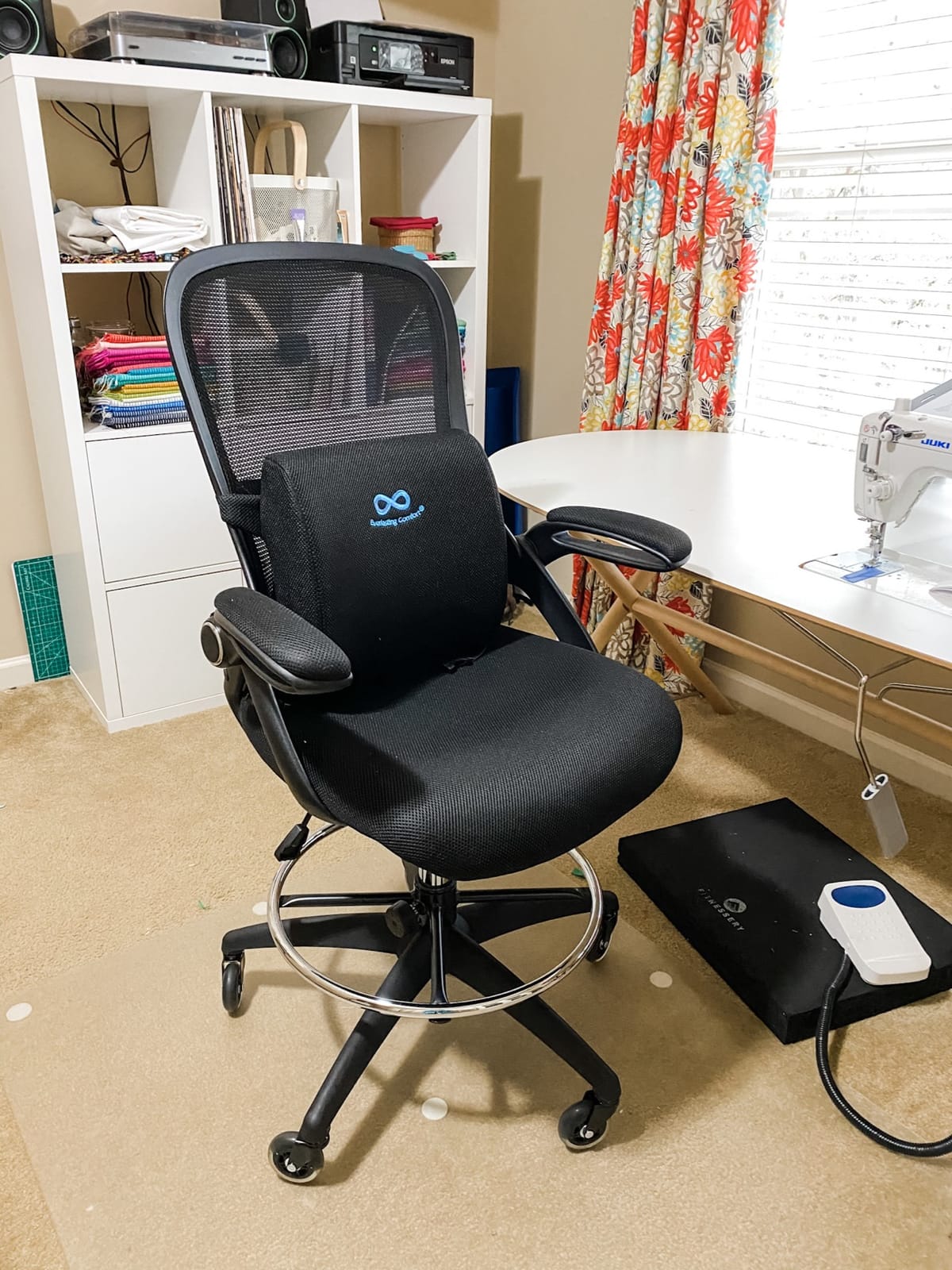
HYLONE is the brand that pops up most often when you search “drafting chair for standing desk” – and after sitting in one, it is easy to see why. The waterfall-edge seat is the single most comfortable detail in this entire roundup for anyone who deals with circulation issues behind the knees.
More than 2,000 reviews back the HYLONE’s reputation, and reviewers on r/WorkOnline consistently point to it as the most reliable mid-range mesh drafting chair. The chair feels light to move (37 pounds) but the BIFMA-tested lift and tilt-tension mechanism is rated for 300 pounds of daily use.
BIFMA-Tested Mechanisms and Why That Matters
BIFMA is the office-furniture industry’s durability standard. A BIFMA-tested lift cylinder has passed cycle, load, and stability tests far beyond what an unmarked cylinder has. For a chair that will spend most of its life near full extension (where stress is highest), that certification is meaningful.
The tilt-tension adjustment lets you dial in the recline resistance, and the seat tilt locks into a forward-leaning angle that is friendlier to typing posture than a flat seat. If you type at your standing desk the way most people do – leaning slightly forward – the HYLONE’s tilted sit is a small but real comfort upgrade.
Waterfall Edge and Breathable Mesh
The waterfall-edge cushion curves down at the front of the seat, removing the hard pressure edge that compresses the back of your thighs. After a 90-minute sit, my legs felt noticeably less numb in the HYLONE than in flat-edge competitors.
The 100% mesh back lets air circulate from your lumbar all the way up to your shoulders. In a warm home office, that is the difference between finishing a focused block of work and shifting every 20 minutes to cool off.
Common Long-Term Issues
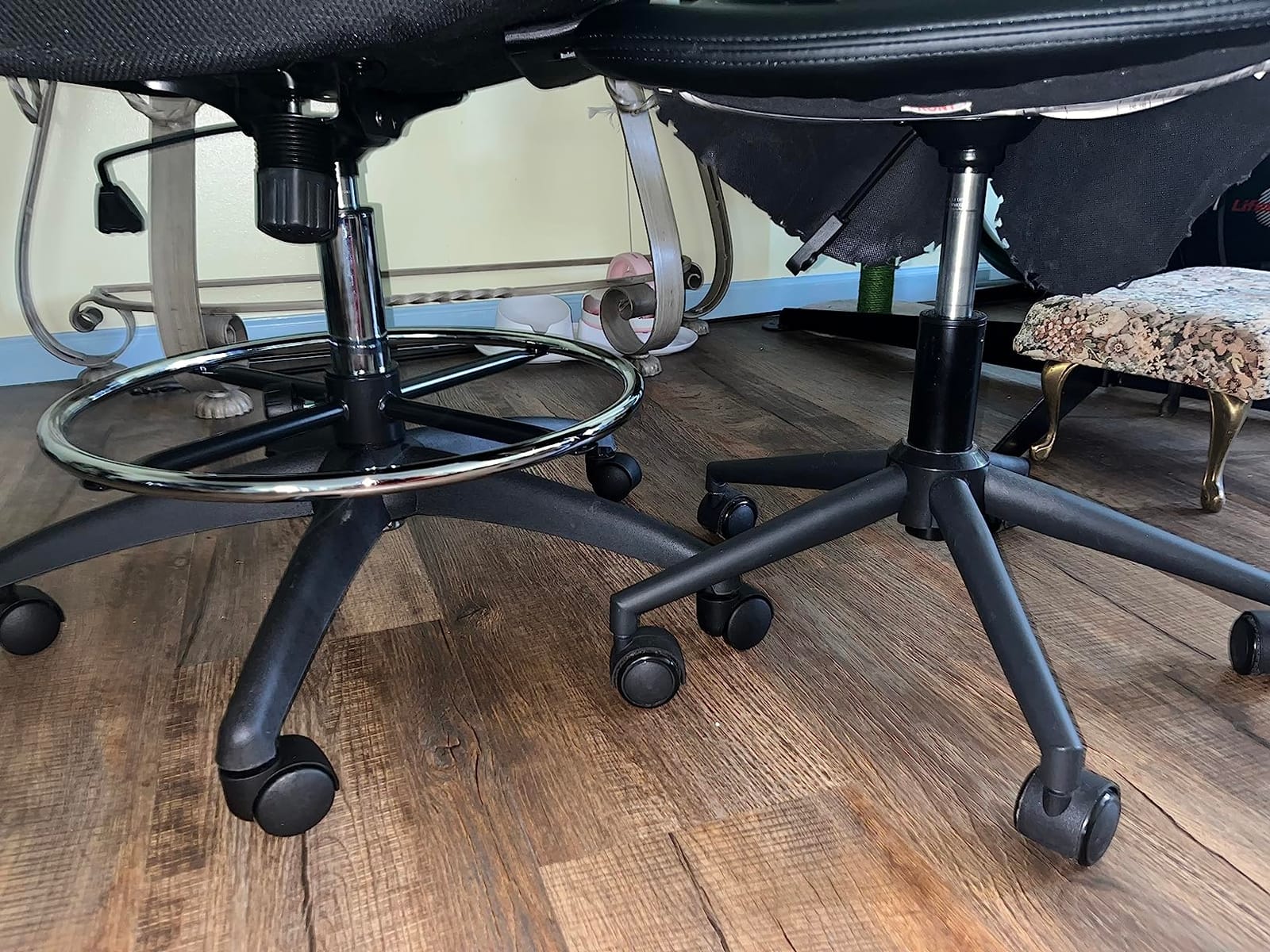
The single most-mentioned issue in HYLONE reviews is the foot-ring knob. Over time the knob loosens and the ring slides down even after retightening. A small number of buyers remedy this with a hose clamp; most simply re-tighten every few weeks.
A subset of long-term users (12+ months) report gas-cylinder sinking. HYLONE’s customer service is consistently praised for sending replacement cylinders outside of warranty – that responsiveness is part of why this chair remains popular despite the flaws.
4. SUPERJARE Drafting Stool – Most Versatile With a Removable Backrest
SUPERJARE Drafting Chair with Backrest, Adjustable Foot Rest Rolling Stool
23.6-32.2 inch range
Removable backrest
5-10 min assembly
300 lb capacity
Pros
- 5-10 minute tool-free assembly with included hex wrench
- Reinforced chrome metal base supports up to 300 lb
- 4-inch thick high-density foam PU leather cushion
- Removable backrest converts between task chair and stool
- 23.6-32.2 inch wide seat height range
Cons
- Some users report foot rest breaking off after limited use
- Cylinder may bleed down when sitting
- Plastic components feel flimsy to some users
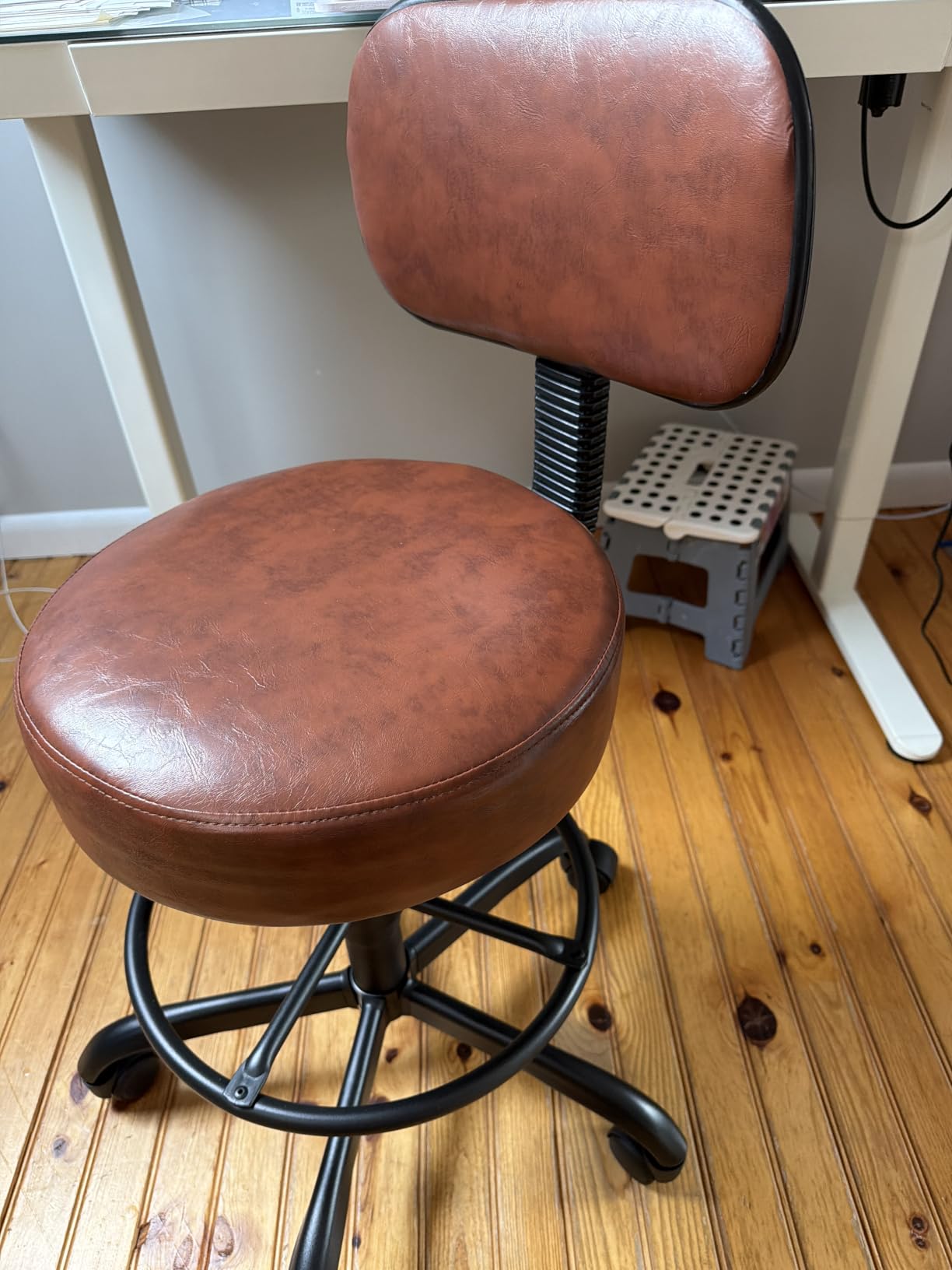
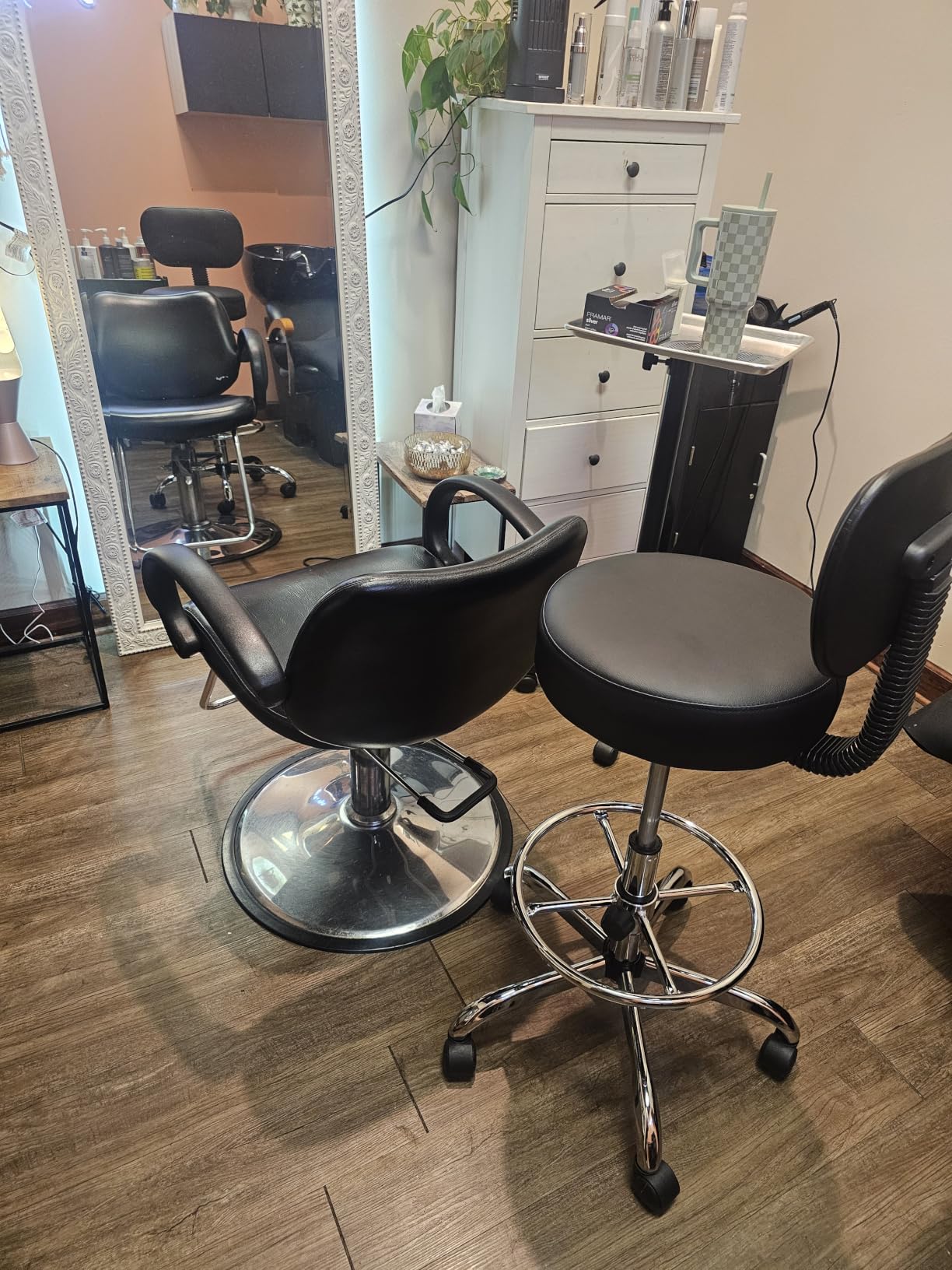
SUPERJARE is the lowest-priced pick in this roundup and one of the most popular drafting stools on Amazon with more than 2,000 reviews. The removable backrest is the headline feature – you can run it as a full-back drafting chair or strip it down to a backless stool when you want to force yourself to alternate positions more often.
Assembly took me 7 minutes. The included hex wrench is the only tool you need. For someone setting up a standing desk on a tight budget who is not sure whether they want a backrest at all, that convertibility is genuinely useful.
Wide Height Range and Quick Assembly
The seat height runs from 23.6 to 32.2 inches through the pneumatic lever – a wider range than several more expensive competitors. That covers everything from a low craft table to a 50-inch standing desk.
At 8.6 kg (about 19 pounds), the SUPERJARE is also one of the lightest chairs in this roundup. If you rearrange your office often or move between rooms, that is a real advantage. The 5 dual-wheel nylon casters glide silently on carpet, tile, and hardwood.
PU Leather Cushion and Foot Ring
The 4-inch-thick high-density foam PU leather cushion feels more padded than the mesh alternatives. Reviewers who sit short bursts (15-30 minutes between standing blocks) prefer this cushion. Reviewers who sit longer tend to overheat on PU leather and switch to a mesh-back chair.
The foot ring adjusts with a knob and stays locked for most users, though a long-term review minority report the ring breaking off the stem after a few months of heavier use. Treat the foot ring as a footrest rather than a step, and it holds up fine.
Trade-Offs at This Price
The plastic components feel lighter than they look. The cylinder bleeds down slightly under very heavy users (over 250 pounds) faster than BIFMA-rated competitors. For anyone 6 feet and under 200 pounds, this is a non-issue.
The PU leather wipes clean easily – good for craft rooms or salon-adjacent workspaces where paint or product might splash – but does not breathe. In a warm home office during summer, expect to feel the heat after an hour.
5. BestOffice Drafting Chair – Lightest Mesh Drafting Chair Tested
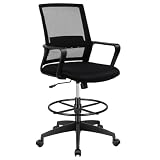
BestOffice Drafting Chair Tall Office Chair Adjustable Swivel Rolling Mesh Height with Lumbar Support Arms Footrest Mid Back for Adults Standing Desk Drafting Stool(Dark Black)
22 lb total weight
Adjustable foot ring
Mid-back mesh
10-15 min assembly
Pros
- Easy 10-15 minute assembly with all hardware included
- Breathable mesh back with mid-back lumbar support
- Heavy-duty nylon base with 360 degree swivel
- Adjustable foot ring for ergonomic sitting
- Lightweight 22 lb frame easy to move around
Cons
- Plastic components feel lower-grade to some users
- Foot ring collar uses plastic screw that may loosen over time
- Backrest recline angle fixed and may tilt at full extension
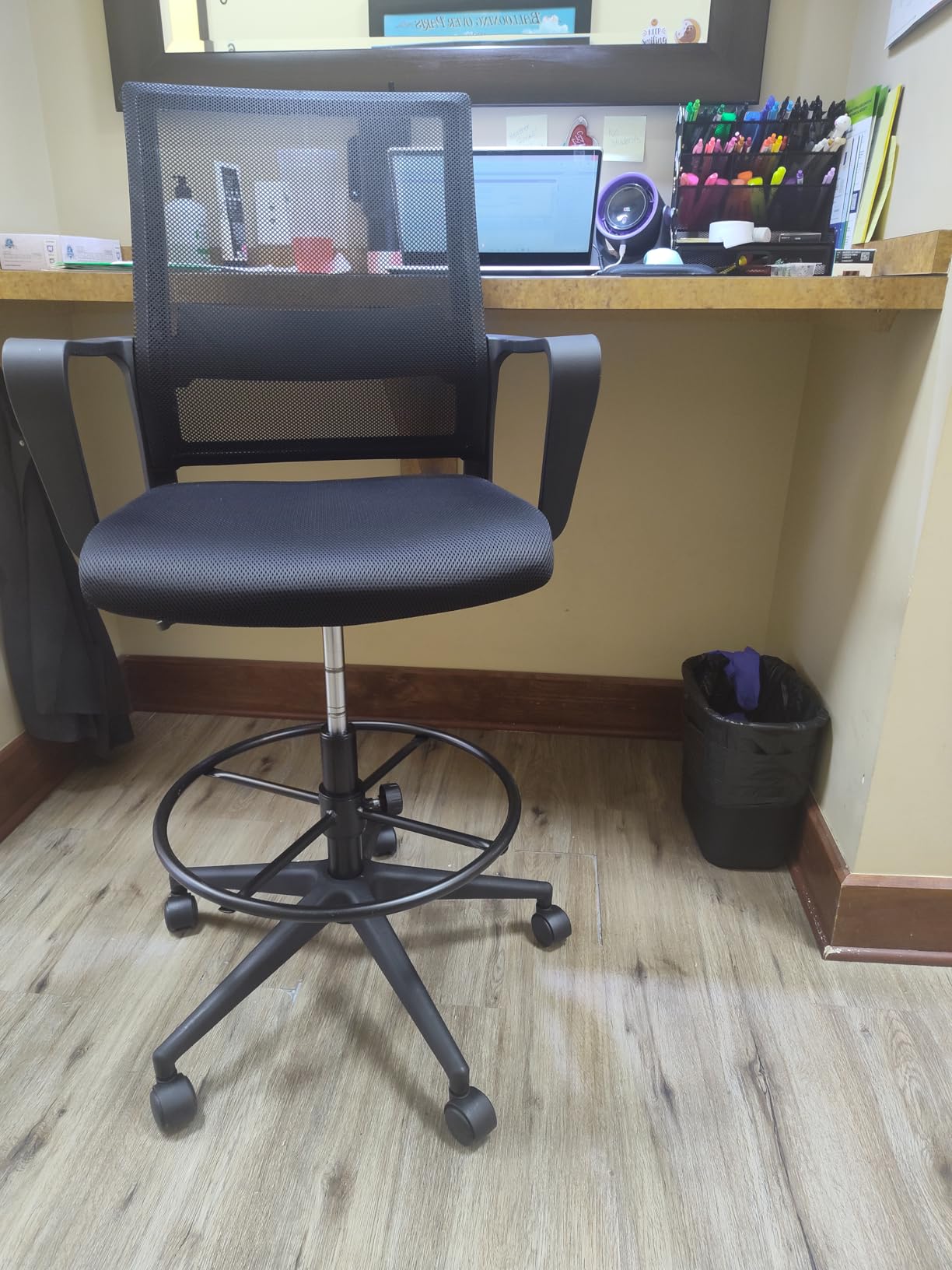
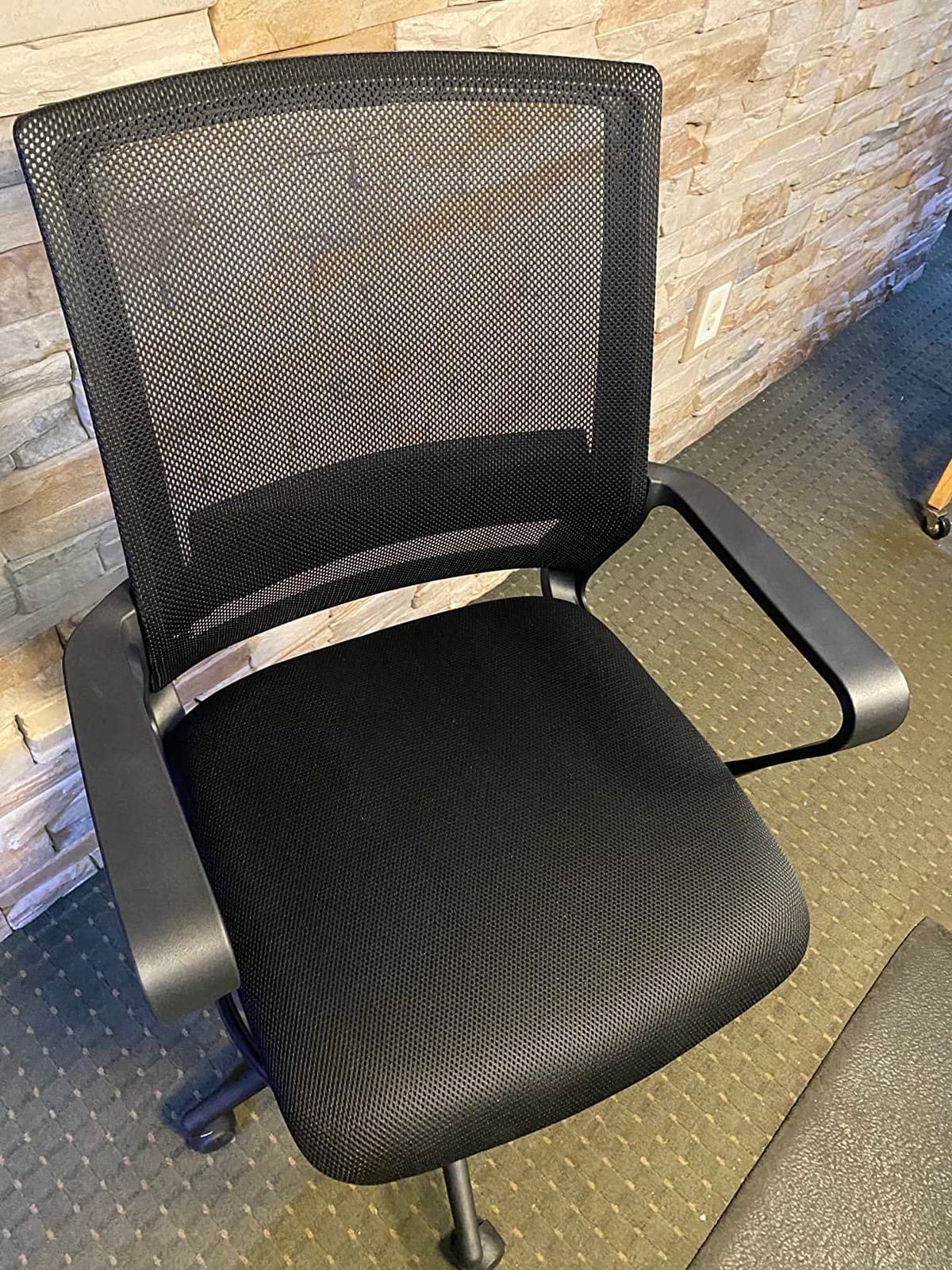
The BestOffice drafting chair is the lightest model on this list at just 22 pounds, which makes it the right pick for anyone who rearranges their office, shares the chair between rooms, or wants a chair that tucks out of the way without effort. Nearly 2,000 reviewers back the value claim.
It is not the most heavily built chair here – the plastic components feel thinner than the Kensaker or BOLISS – but for short-to-medium sit-stand sessions at a standing desk, the breathable mesh back and adjustable foot ring cover the basics without excess cost.
Weight, Footprint, and Storage
At 22 pounds, the BestOffice is easy to slide from one spot to another and is the chair I would recommend for a small home office where the chair tucks into a closet or under a bed when not in use. The nylon base is lighter than the 5-claw steel-base competitors but does not feel unstable on flat floors.
Without flip-up armrests, this chair does not slide as cleanly under a 24-inch-deep desk as the Kensaker or HYLONE. If storage-under-desk is your priority, look at the models with flip-up arms instead.
Mesh Back and Lumbar Support
The mid-back mesh gives decent lumbar support for short sits but does not extend high enough for users over 6 feet to lean their shoulders back. Reviewers around 5’8″ report the lumbar curve hits the right spot; reviewers above 6 feet consistently wish the back were 2 to 3 inches taller.
For the price, the breathable mesh is genuinely effective. After a 75-minute sit in a warm room, my back felt cooler than on the leather-clad alternatives.
Where the BestOffice Falls Short
The plastic foot-ring collar screw loosens over time. A small subset of users remedy this with a metal replacement screw from a hardware store. The fixed recline angle also means the back may tilt at full extension – worth testing in person if you lean back at all.
The 250-pound weight capacity is the lowest in this roundup for a fully-featured chair. If you are over 250 pounds, choose the BOLISS or the Kensaker instead.
6. amseatec Drafting Chair – Best Leather Option With 5-Year Warranty
amseatec Drafting Chair, Tall Office Chair with Footrest for Standing Desk
5-year warranty
BIFMA Class-3 gas lift
300 lb capacity
Premium PU leather
Pros
- Premium PU leather wipes clean and resists spills
- BIFMA-certified Class-3 gas lift supports 300 lb
- 5-year warranty with 24/7 customer service
- 90 degree flip-up padded armrests
- 3-zone ergonomic backrest with dual-layer cushion
Cons
- PU leather gets warm during long sits in summer
- Headrest position feels high for users under 5 ft 6 in
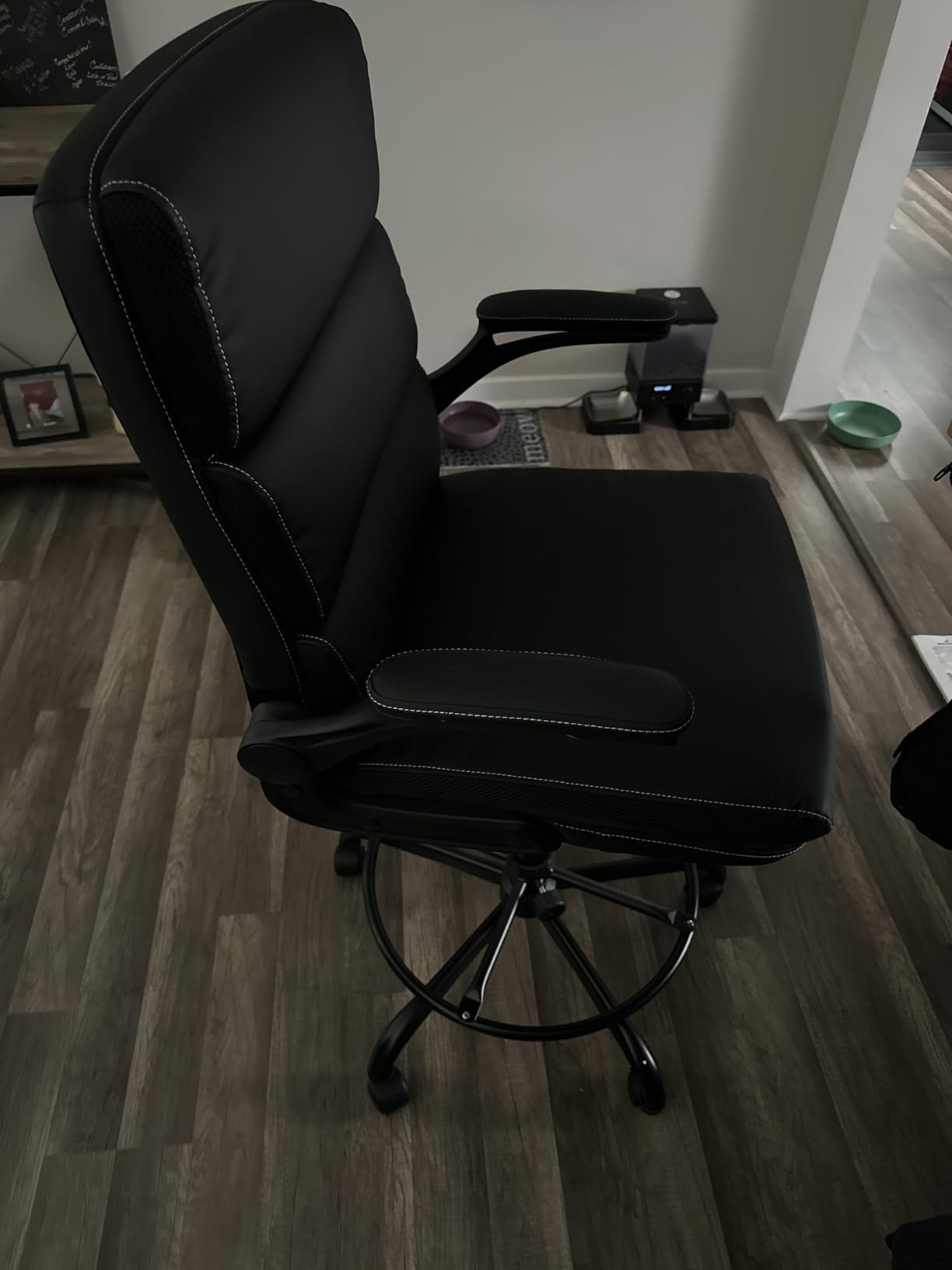
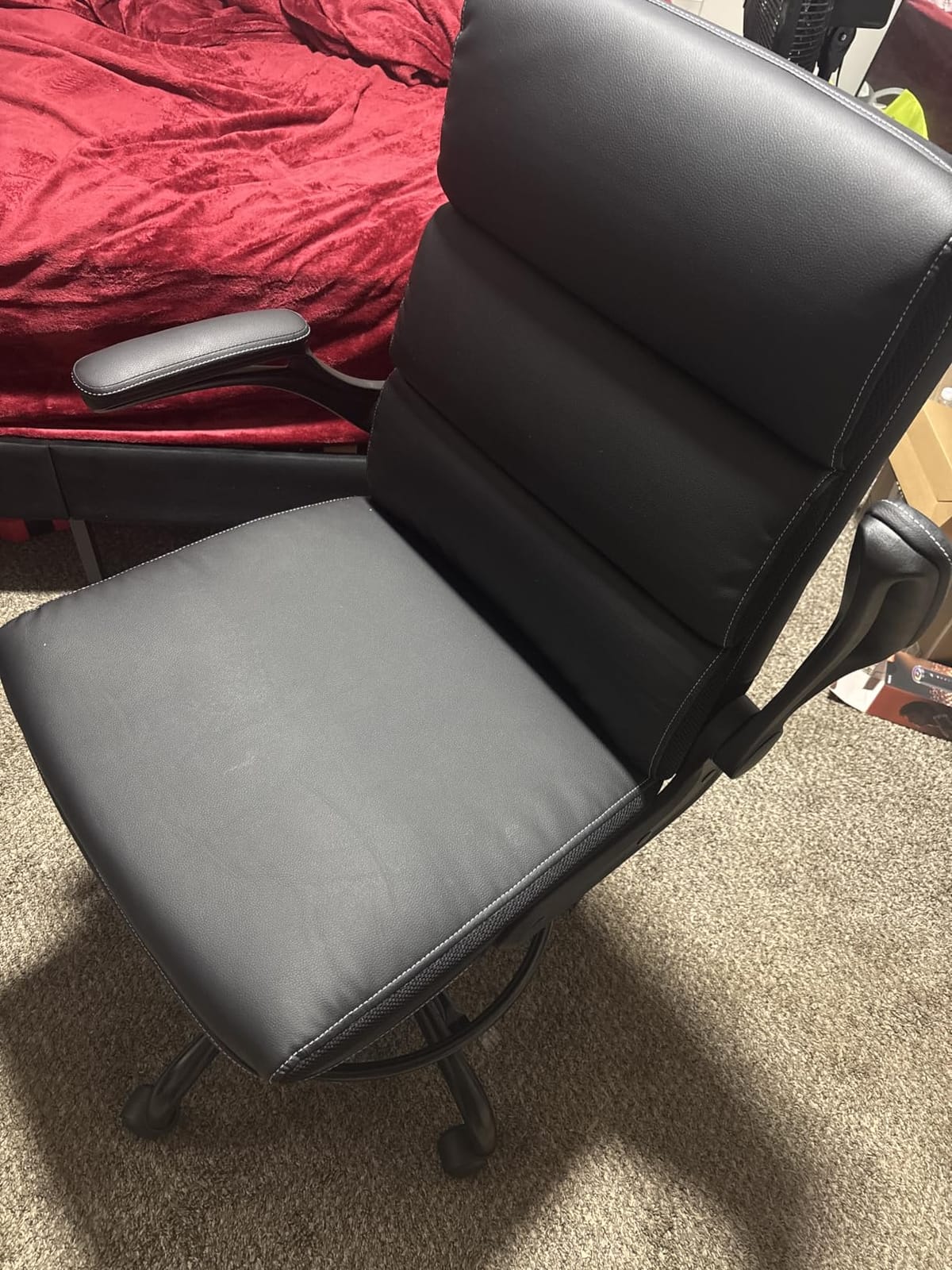
amseatec is the only chair on this list with a 5-year warranty – longer than any other pick and a meaningful vote of confidence from the brand. The PU leather upholstery wipes clean, the BIFMA-certified Class-3 gas lift is rated for heavier daily use, and the 3-zone backrest supports the spine more like an executive office chair than a typical drafting stool.
If you want the look of leather, the cleanability for a home-with-kids office, and the longest warranty in this category, amseatec is the obvious choice.
BIFMA Class-3 Gas Lift and Frame
The BIFMA Class-3 certification is a step above the unmarked cylinders in most chairs under $150. A Class-3 cylinder is tested to 100,000+ cycles at full load. For daily sit-stand cycling, that extra margin is what separates a chair that lasts two years from one that lasts six.
The carbon steel frame and 5-star base give the amseatec a planted feel at full height that lighter chairs lack. Even at maximum extension, leaning back produces no wobble.
3-Zone Backrest and Dual-Layer Cushion
The backrest is divided into three support zones – upper back curve, mid-back lumbar, and lower-back pad. The cushion uses two foam densities: soft on top for comfort, firm below for posture support. The result is a more executive-chair-like feel than most drafting chairs offer.
The flip-up padded armrests support cross-legged sitting, which is rare in drafting chairs. Reviewers who sit cross-legged for stretches of the day call this out as the deciding feature over the Kensaker and HYLONE.
Heat and Sizing Trade-Offs
PU leather, even premium PU leather, gets warm in summer. Reviewers in non-air-conditioned offices mention sticking to the seat after 60-90 minutes. A breathable cushion cover or seat pad solves this inexpensively.
The headrest is positioned for average and taller users. Anyone under 5’6″ will find the headrest floats above their skull rather than supporting the neck. If you are in that range, consider the SUPERJARE (no headrest) or the BestOffice instead.
7. Synorla Ergonomic Drafting Chair – Best Adjustable Lumbar in This Roundup
Synorla Ergonomic Tall Drafting Chair-Mesh Desk Chair with Flip-Up Arms
Adjustable lumbar
9 inch height range
300 lb capacity
Pentagon base
Pros
- Adjustable lumbar support reduces lower back fatigue
- Wide 25 inch backrest provides solid mid-back support
- Pentagon base and metal frame deliver good stability
- Quiet PU casters protect floors
- Easy 30-45 minute solo assembly
Cons
- Armrests sit high for typing at keyboard height
- Foot ring slides down even after the knob is tightened
- Backrest does not recline
- Frame marketed as metal but described as plastic by some users
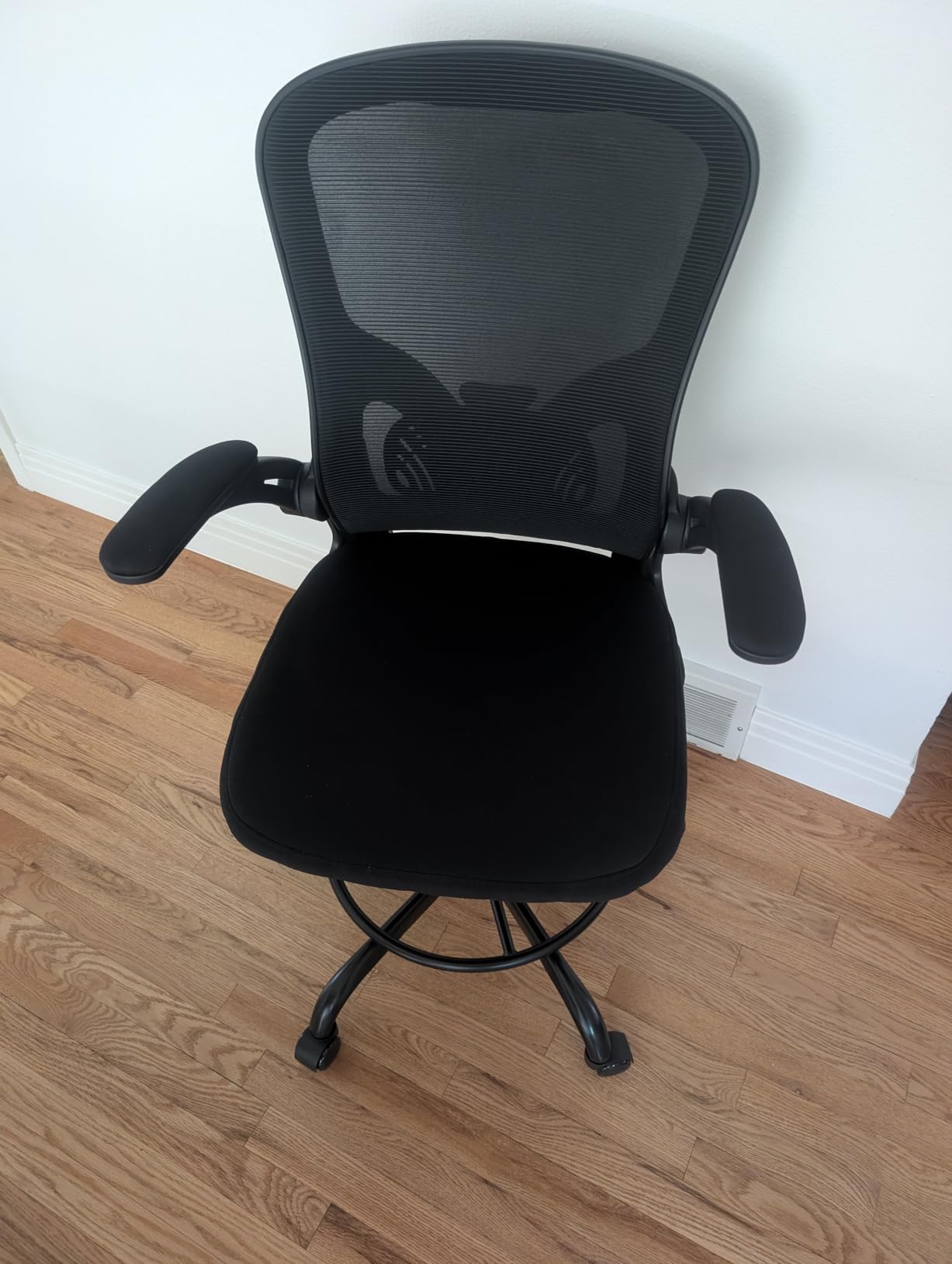
The Synorla ergonomic drafting chair is the only model in this roundup with a separately height-adjustable lumbar pad, which matters more than you might think. Most drafting chairs lock the lumbar curve into the backrest and force you to position yourself around it. Synorla lets you move the lumbar pad up or down to match your L3 vertebra directly.
For someone with a history of lower-back pain who is pairing a chair with a tall desk, that adjustability is the single most ergonomic feature in this lineup.
Adjustable Lumbar and 25-Inch Backrest
The 25-inch-wide backrest is the widest in this roundup. Combined with the height-adjustable lumbar pad, it gives mid-back support across a wider range of torso widths than competitors. Reviewers with broader shoulders call this out as the deciding factor.
The 3D mesh back is breathable, and the 3-inch-thick high-density foam seat is firmer than the SUPERJARE’s PU cushion. For neutral-spine posture over long sits, firmer foam is usually better than softer foam.
Pentagon Base, Casters, and Foot Ring
The pentagon base is structurally rigid and the metal frame (despite some reviewers calling it plastic, the spec sheet lists a metal internal frame) holds 300 pounds. The PU casters are the quietest in this roundup – on hardwood, they make almost no sound even when I roll quickly.
The foot ring is the Synorla’s weak point. Reviewers consistently report that the ring slides down even after retightening the knob. If foot-ring lockdown is critical for you, the Kensaker or ErGear is a better pick.
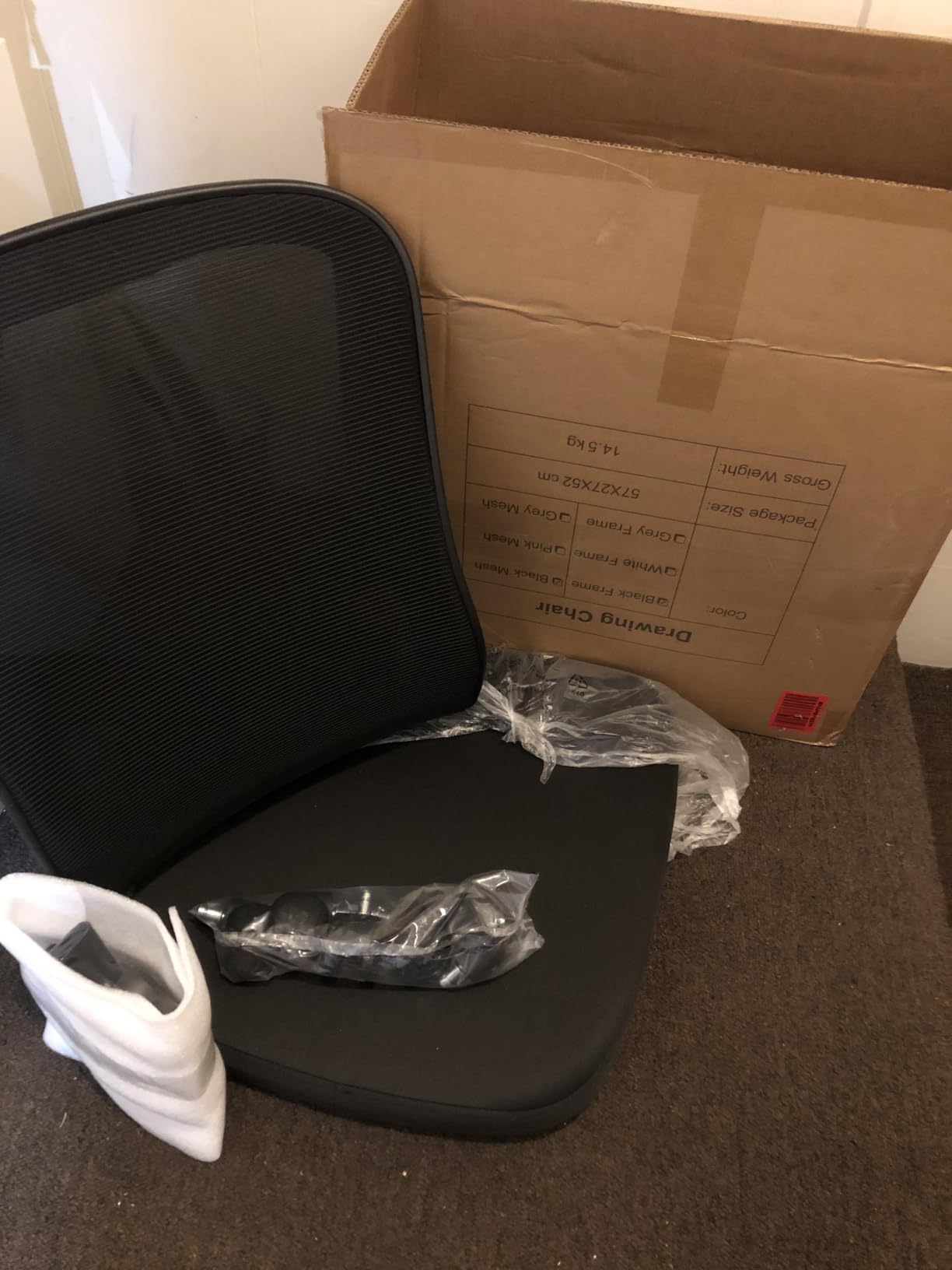
Other Trade-Offs to Know
The armrests sit at 30.45 inches – high for typing at keyboard height if your standing desk is below 42 inches. They flip up, but the height cannot be adjusted, which is unusual for a chair at this price.
The backrest does not recline. For some users that is a feature (forces upright posture); for others it is a limitation. Reviewers who like to lean back between typing bursts tend to swap to the BOLISS or amseatec for that reason.
8. ErGear Drafting Chair – Best Class 4 Gas Lift and Adjustable Foot Ring
ErGear Drafting Chair with Footrest Ring and Flip-Up Arms for Tall Desks
Class 4 gas lift
8 inch height range
17 degree flexible back
300 lb capacity
Pros
- Class 4 gas lift tested to 120000 lift cycles
- 8 inches of seat height adjustability for varied desks
- 33 percent thicker seat cushion reduces hip pressure
- Wide 19.7 inch foot ring with 5 inch height adjustment
- 2-inch height-adjustable lumbar support
Cons
- Some users report gas shock failure after a few months
- Foot ring does not stay locked for some users
- Tight final assembly step
The ErGear drafting chair has the highest-tested gas lift cylinder in this roundup – Class 4, rated to 120,000 lift cycles. That is roughly 3x the rated life of a typical Class-3 cylinder. For someone who raises and lowers the chair multiple times a day, that durability margin justifies the price.
The 33 percent thicker seat cushion, 17-degree flexible mesh back, and wide locking foot ring are the three details that elevate this chair from “drafting chair” to “actual sit-stand workstation chair.”
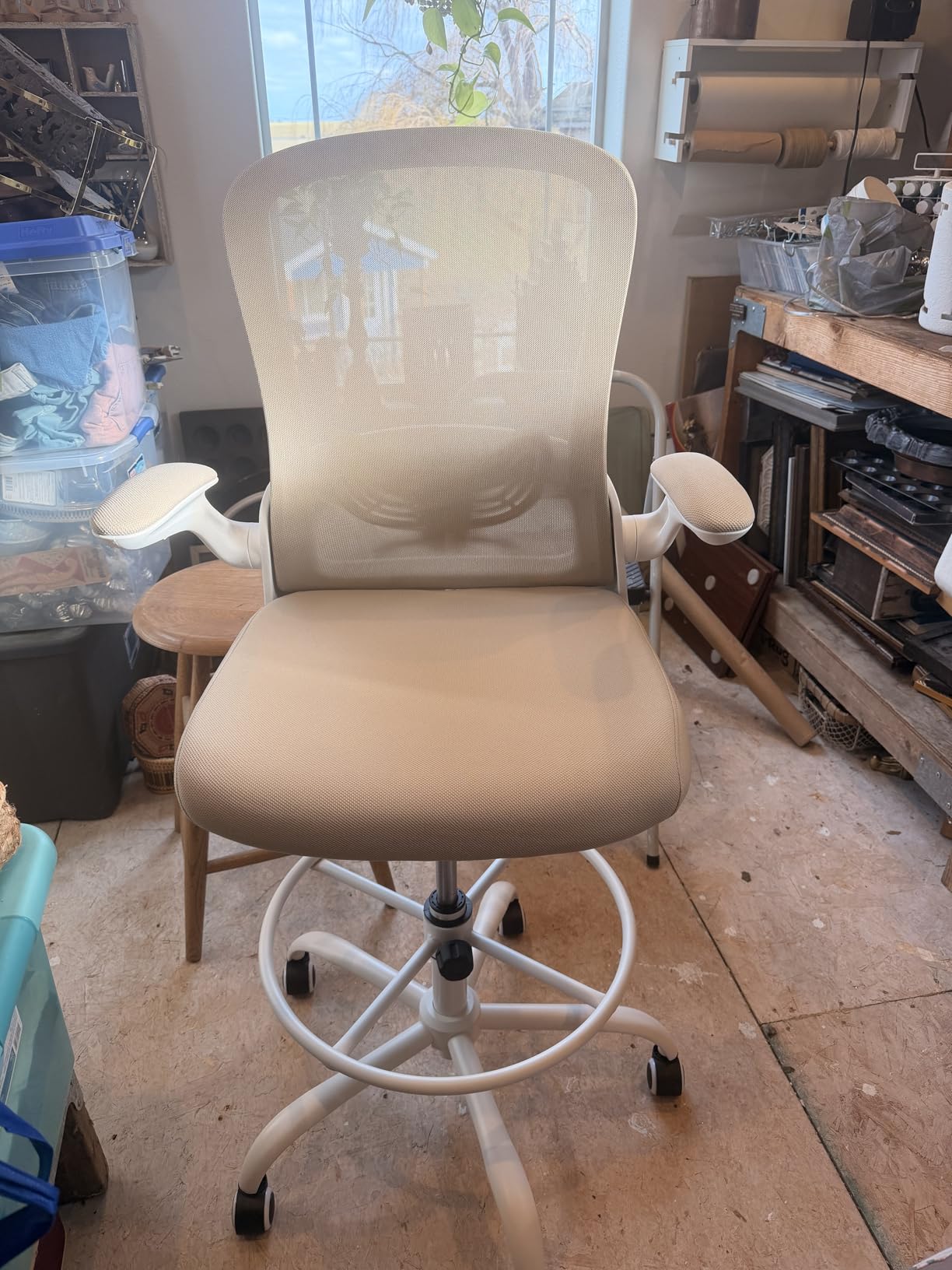
Class 4 Gas Lift and 8-Inch Adjustment Range
Class 4 is the highest gas-lift certification BIFMA awards. The 120,000-cycle rating translates to roughly 30+ years of typical home-office use before cylinder failure becomes likely. If you have ever had a chair sink mid-meeting, you understand why this matters.
The 8 inches of seat height adjustment is the widest range on this list, covering a 24- to 32-plus-inch span. That fits every desk height from IKEA BEKANT to Uplift V3 to Fully Jarvis without forcing you to leave the desk at a non-ergonomic height.
Foot Ring and Lumbar That Stay Put
The 19.7-inch-wide foot ring with 5 inches of vertical adjustment is the largest locking foot ring in this roundup. For users with longer legs, the wider diameter stops the feet from splaying awkwardly.
The 2-inch height-adjustable lumbar pad pairs with the 17-degree flexible mesh back to keep the lumbar curve aligned with your spine in both upright and slight-recline positions. Reviewers with a history of lower-back pain consistently rate the ErGear’s lumbar support ahead of the Kensaker’s.
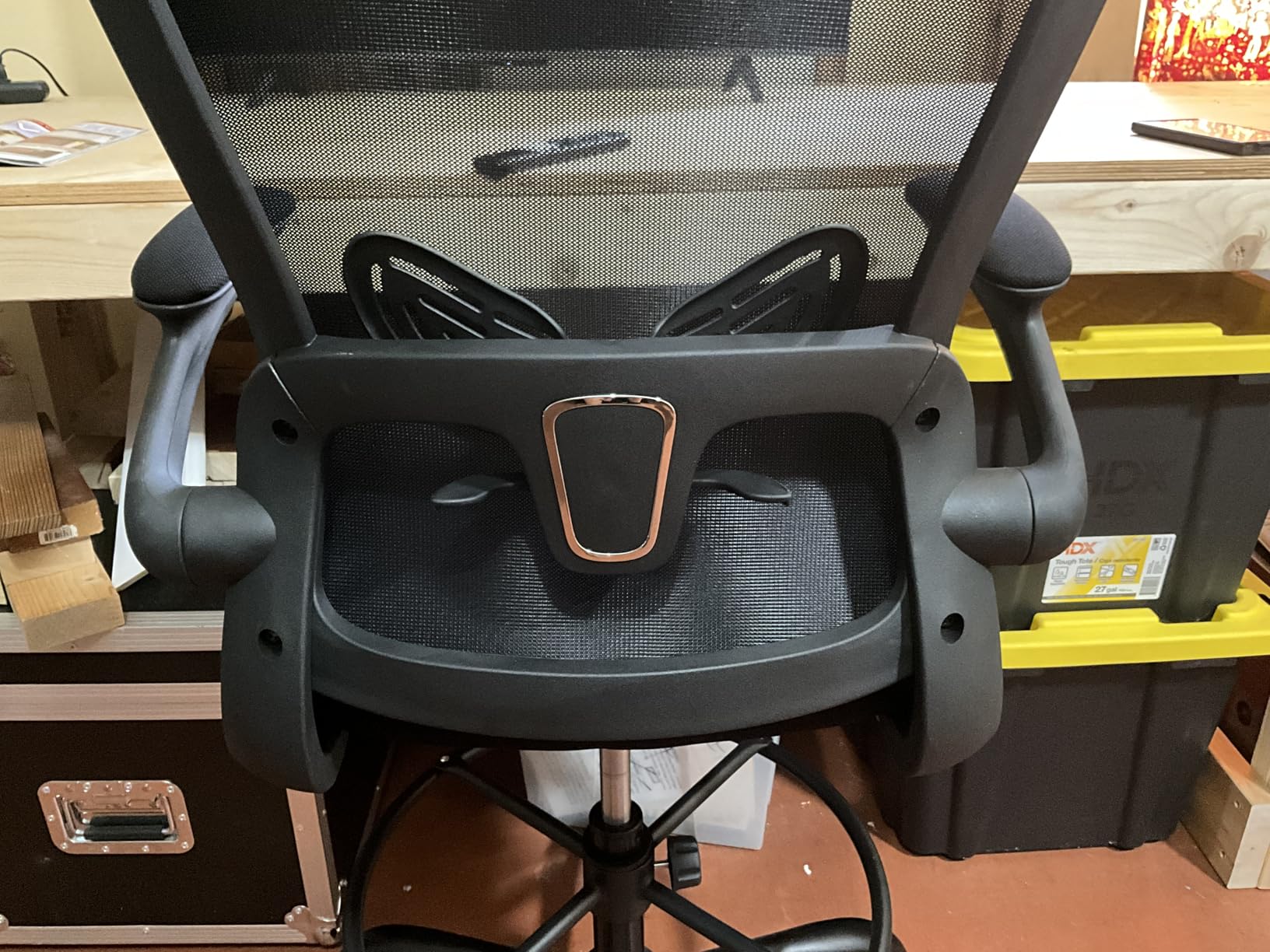
Trade-Offs and Long-Term Notes
A small share of long-term users (over 12 months) report gas-shock failure – rarer than with Class-3 cylinders, but not zero. ErGear’s warranty covers replacement within the first year.
The foot ring is the most-reported point of frustration – while it locks well for most users, a minority report it sliding down after a few weeks. The final assembly step is also a bit tight, so budget an extra 10 minutes beyond the stated setup time.
What to Consider When Choosing a Chair for Your Standing Desk
Choosing among the best office chairs for standing desk pairing comes down to six factors that actually matter in daily use. Below is the framework our team uses when we get asked for personal recommendations.
Match the Chair to Your Desk Height
The first rule of pairing a chair with a standing desk: measure the desk surface at your standing elbow height. Most electric standing desks rise between 22 and 50 inches. Your chair’s seat height should reach 4 to 6 inches below that surface when you sit with feet flat on the foot ring.
A Uplift V3 at full standing height tops out near 51 inches. The BOLISS (24.8-32.1 inch seat) and ErGear (about 24-32 inch range) clear that. A Fully Jarvis, which maxes out closer to 48 inches, pairs with the Kensaker, HYLONE, or amseatec without forcing the desk to drop. If your desk is a Flexispot EC1 (about 48 inches max), all eight chairs on this list work.
If you own an electric standing desk converter for dual monitors, the converter adds another 4 to 6 inches of surface height – in that case, choose a chair with a minimum seat height of at least 26 inches, which all eight picks here clear.
Drafting Chair vs Saddle Stool vs Perching Stool
Not every “chair for a standing desk” is a drafting chair. The category breaks down into four sub-types:
Drafting chair: Backed, with a foot ring, adjustable from 22 to 36 inches. The most versatile sub-type. All eight picks in this roundup are drafting chairs. Good for users who alternate between long sits and short stands.
Saddle stool: Backless, shaped like a horse saddle, tilts the pelvis forward to open the hip angle. Encourages active sitting but has no back support. Saddle stools take 2-4 weeks to adapt to and are not for users with knee issues, according to multiple r/Ergonomics threads.
Perching stool: Slightly tilted forward, shorter seat-to-floor range. Good for short rest breaks at a standing desk but not for sustained work. Often confused with drafting chairs but lacks the full height range.
Balance stool / stool with no back: Stool-only designs without a back or foot ring. Work for short perches but cause fatigue after 30-60 minutes, per reviewer consensus.
Lumbar, Footrest, and Materials That Matter
Lumbar support is non-negotiable. Look for chairs with adjustable lumbar pads (Synorla, ErGear) or contoured backrests with vertical adjustment (Kensaker, HYLONE). A flat, fixed-height backrest is a deal-breaker for users with lower-back sensitivity.
The foot ring should adjust vertically (so it sits below your knees, not at them), lock firmly (a sliding foot ring defeats the purpose), and have a wide enough diameter for your feet. The Kensaker, BOLISS, and ErGear have the most lockdown in this roundup.
Materials come down to climate. Mesh backs (Kensaker, HYLONE, BestOffice, ErGear, Synorla) breathe better for warm offices. PU leather (SUPERJARE, amseatec) wipes clean and looks more executive but warms up in summer.
For Tall Users (6’2+ and Desks Over 48 Inches)
Most drafting chairs under $150 top out around 27 to 29 inches of seat height. For users 6’2″ and above with desks that rise above 48 inches, those chairs are too short. The BOLISS (24.8-32.1 inches) and ErGear (24-32 inch range) are the two best fits in this roundup for tall users.
Look for three things specifically: seat height that reaches 30+ inches, a headrest that adjusts to your actual skull height (the BOLISS’s 3D headrest does this; the amseatec’s sits too high for users under 5’6″), and a foot ring with at least 5 inches of vertical adjustment to accommodate longer legs.
Sit-Stand Cycling Tips That Actually Work
Pairing a chair with a standing desk is only half the equation. How you cycle between sitting and standing matters more for back health than which chair you pick:
1. Stand for 20-30 minutes, then sit for 40-60 minutes. The ratio leans toward sitting because chairs are still better for sustained focus, but avoid sitting for more than an hour straight.
2. Set a timer. Reviewers on r/StandingDesks who set their desk to remind them to switch every 30 minutes report the lowest back pain.
3. Keep your monitor at eye level in both seated and standing positions. A standing desk converter for laptops can help maintain consistent height.
4. Alternate which foot rests on the foot ring. This engages different leg muscles and avoids the hip asymmetry that causes lower-back strain.
Don’t Forget the Anti-Fatigue Mat
No competitor in the standing-desk chair space recommends an anti-fatigue mat alongside the chair, which is a gap worth filling. An anti-fatigue mat is not a replacement for the chair – it is a complement for the standing portion of your cycle.
When you stand to type, a quality anti-fatigue mat reduces foot, knee, and lower-back fatigue by encouraging micro-movements. Pair a cushioned mat with any chair on this list, and you have a complete sit-stand workstation. We have covered the best under-desk treadmill pairings in a separate guide if you want to take the active-sitting concept further.
Frequently Asked Questions
What kind of chair should I use with a standing desk?
Use a drafting chair or perching stool with a tall seat-height range (22-36 inches), a locking foot ring, and a backrest tall enough to support your shoulders. A regular office chair (16-21 inch seat height) is too short and forces your shoulders up to keyboard level, causing strain.
Are drafting chairs good for standing desks?
Yes. Drafting chairs are specifically designed to pair with tall surfaces. Their tall seat-height range, foot ring, and back support make them the most versatile option for sit-stand cycling. They are the most common pick among the best office chairs for standing desk pairing.
How high should a chair be for a standing desk?
Your chair’s seat height should reach 4 to 6 inches below your standing-desk surface when your feet rest on the foot ring. Measure the desk at your standing elbow height, then choose a chair whose maximum seat height is 4-6 inches below that number.
What is the difference between a drafting chair and a regular chair?
A drafting chair has a taller gas lift (typically 22-36 inch seat height), a foot ring for leg support, and a higher backrest. A regular office chair peaks around 21 inches of seat height and lacks a foot ring, making it too short to use comfortably with a raised standing desk.
Do you need an anti-fatigue mat with a standing desk chair?
An anti-fatigue mat is a complement, not a replacement. The chair handles the seated portion of your cycle; the mat reduces foot, knee, and back fatigue during the standing portion. Most reviewers recommend using both for a complete sit-stand workstation.
Can you use a regular office chair with a standing desk?
Only if you keep the desk lowered to standard seated height (around 28-30 inches). At full standing height (40-50 inches), a regular office chair forces your arms up and your shoulders into a strained position. A drafting chair is the correct pairing for raised standing-desk use.
Which Standing Desk Chair Should You Buy?
After six weeks of daily rotation, here is how I would match each pick to a buyer type. If you want the safest overall pick for the best office chairs for standing desk pairing, the Kensaker drafting chair remains our Editor’s Choice – the locking foot ring, 300-pound capacity, and breathable mesh back cover the widest range of users without forcing a price jump.
If you are 6’2″ or taller or sit at a 50-inch-tall desk, the BOLISS is the most reassuring pick in this roundup. If you want the longest warranty and leather-look upholstery, the amseatec is the obvious choice. If you want the highest-rated gas lift and the best lumbar adjustability under $150, the ErGear leads that tier. If you are on a tight budget and want a removable-backrest drafting stool, the SUPERJARE delivers more than its price suggests.
Pair any of these chairs with a quality standing desk converter under 200 if you do not yet own a full electric standing desk, and you have a complete sit-stand workstation ready for 2026. Take your time on the height-range spec – that single number determines whether the chair actually fits your desk.