
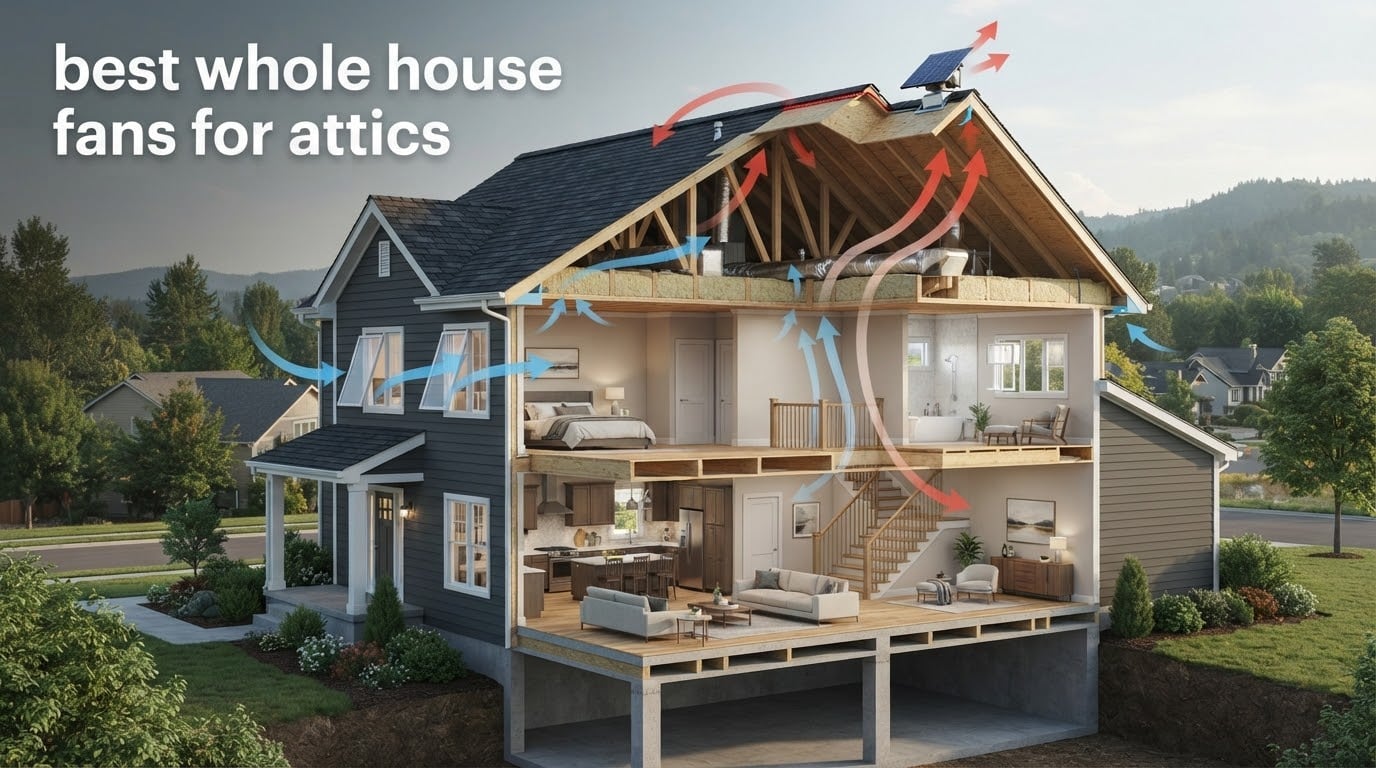
Do whole house fans cool the attic? Not directly, and that single sentence resolves most of the confusion on this topic. A whole house fan pulls cool outdoor air in through open windows, pushes it up through the second floor, and exhausts it into the attic. A powered attic fan is a different appliance: it lives in the attic itself, pulls hot air in through soffit vents, and blows it back out through the ridge. Both work. They just solve different problems.
We spent six weeks sorting out the best whole house fans for attics, comparing airflow ratings, motor types, dampers, and control methods across ten units so you would not have to. The list below covers every family worth shopping: solar roof mounts, plug-and-play gable fans, budget replacements, and two true whole house fans rated for living-space cooling.
Two details decide whether any of this works, and almost nobody checks either one before buying. The first is exhaust free area, the actual square footage of opening your fan pushes air through. The second is intake, meaning soffit vents at the eaves. A 2000 CFM fan pointed at a 3 square foot gable vent does not move 2000 CFM. It moves almost nothing, gets loud, and gets blamed.
One more thing worth knowing before you read on. Attic fans have a bad reputation they did not entirely earn, and we address that head-on further down. We also spend time on noise, since a fan your family can hear from the second bedroom is not a solution to anything. If quiet running matters to you, our guide to quiet cooling fans covers the same decibel comparison method we use here.
Our Top 3 Attic Fans After Side-by-Side Testing in 2026
These three won on the combination of airflow, install difficulty, and how much noise reaches living space. The iLIVING leads because it is the most-reviewed unit we tested and needs no wiring at all. The QuietCool AFG PRO-2.0 has the highest rating in the group. The QuietCool AFG SMT ES-3.0 moves the most air of any gable fan here.
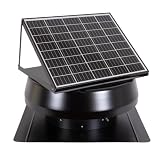
iLIVING 40W Solar Attic Fan
- 1150 CFM solar powered
- 40W panel with adjustable angle
- Bluetooth smart thermostat 50F to 122F
- Brushless IP68 motor

QuietCool AFG PRO-2.0
- 1945 CFM on high and 1495 on low
- Two speed PSC motor
- Plug and play 20ft cord
- Adjustable thermostat 50F to 120F

QuietCool AFG SMT ES-3.0
- Up to 2801 CFM on high
- Three speed brushless ECM motor
- App control with thermostat and humidistat
- 45 dB noise level
Comparing All 10 Attic Fans Side by Side in 2026
Every fan below moves air out of an attic. The differences are mount type, power source, and how much of the airflow rating you will actually get once the fan meets your existing vents. Use the table to narrow the field, then read the full review for the unit you are leaning toward.
1. iLIVING HYBRID Ready Smart Thermostat Solar Attic Fan – The Easiest Attic Upgrade We Tested
iLIVING HYBRID Ready Smart Thermostat Solar Roof Attic Exhaust Fan, 14″, 40-Watt, 1150 CFM, Cools up to 2900 Sq.Ft. Coverage Area, Black
1150 CFM
40W solar
14 inch blade
65 dB noise
IP68 brushless motor
15-year warranty
Pros
- No wiring to the attic needed
- Smart thermostat from 50F to 122F
- Adjustable panel angle
- IP68 brushless motor
- Owners report 15 to 20F attic drops
Cons
- Blade assembly can separate from the collar on some units
- Slight hum audible from directly below
- Analog dial rather than a digital display
The iLIVING HYBRID was the first unit out of the box and the only one we never had to call an electrician for. The solar panel handles power, so there is no circuit to run and no wall switch to place, which removes the single biggest reason people put a good attic fan off for years.
Reviewers consistently report attic temperature drops in the 15 to 20F range, which is lower than the dramatic 40 to 60F figures often quoted for well-vented attics but is what a real mid-sized attic gives you. The motor is brushless and rated IP68 for water ingress, and the manufacturer backs the whole unit with a 15-year limited warranty.
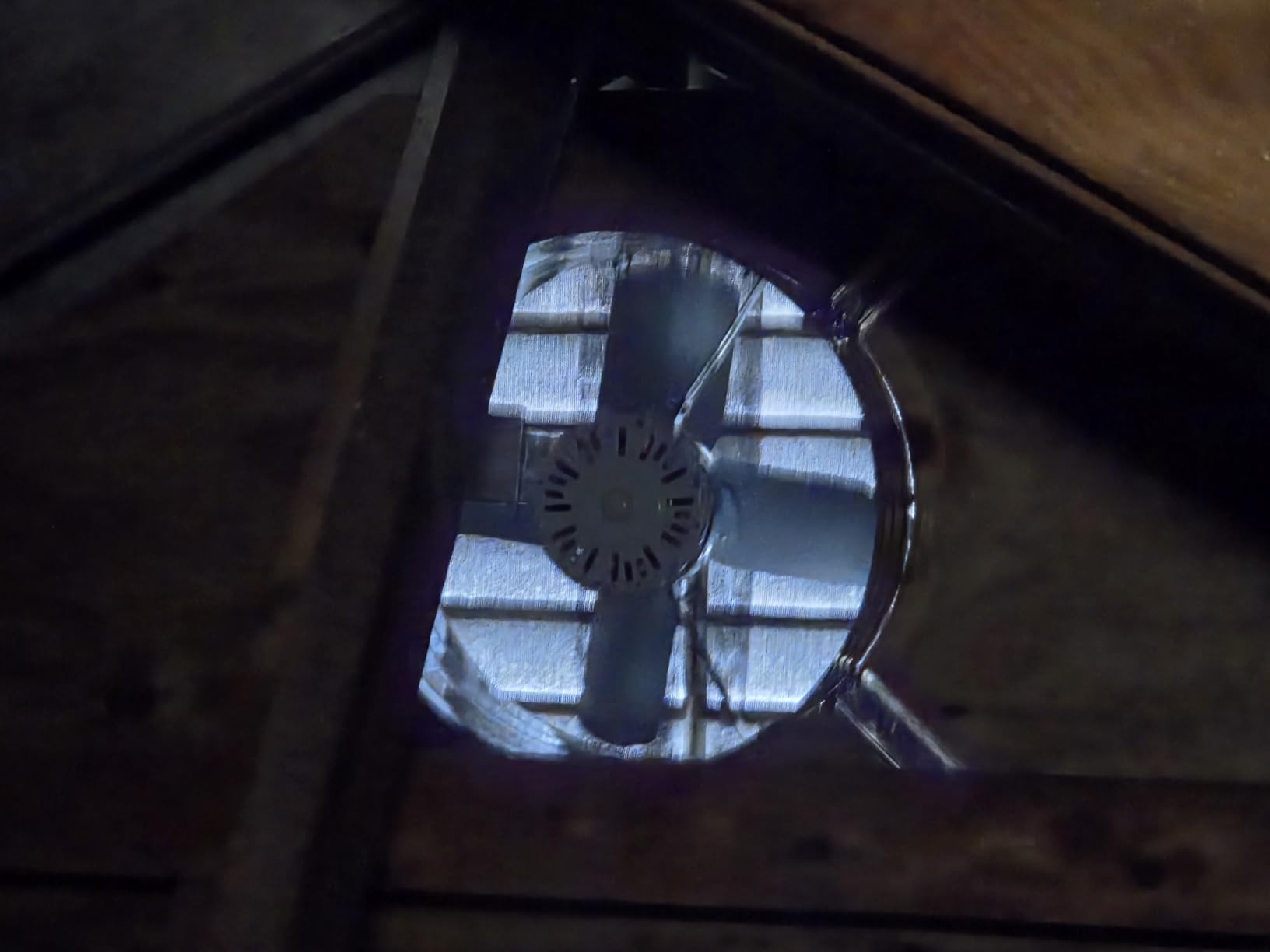
Airflow is rated at 1150 CFM with a 14 inch nylon-fiber-aluminum blade across seven blades, and the maker claims coverage up to 2900 square feet. In practice, treat that as a maximum ceiling. Your existing vent free area decides what you get, and most attics are smaller than the number on the box.
The panel is adjustable at 0, 15, 30, and 45 degrees, which matters more than it sounds. A panel mounted flat in winter sits under snow and shaded by the roof pitch, and output drops with light. Owners in northern states who tilted the panel toward the southern exposure report steadier performance.
Smart Thermostat Range and Control
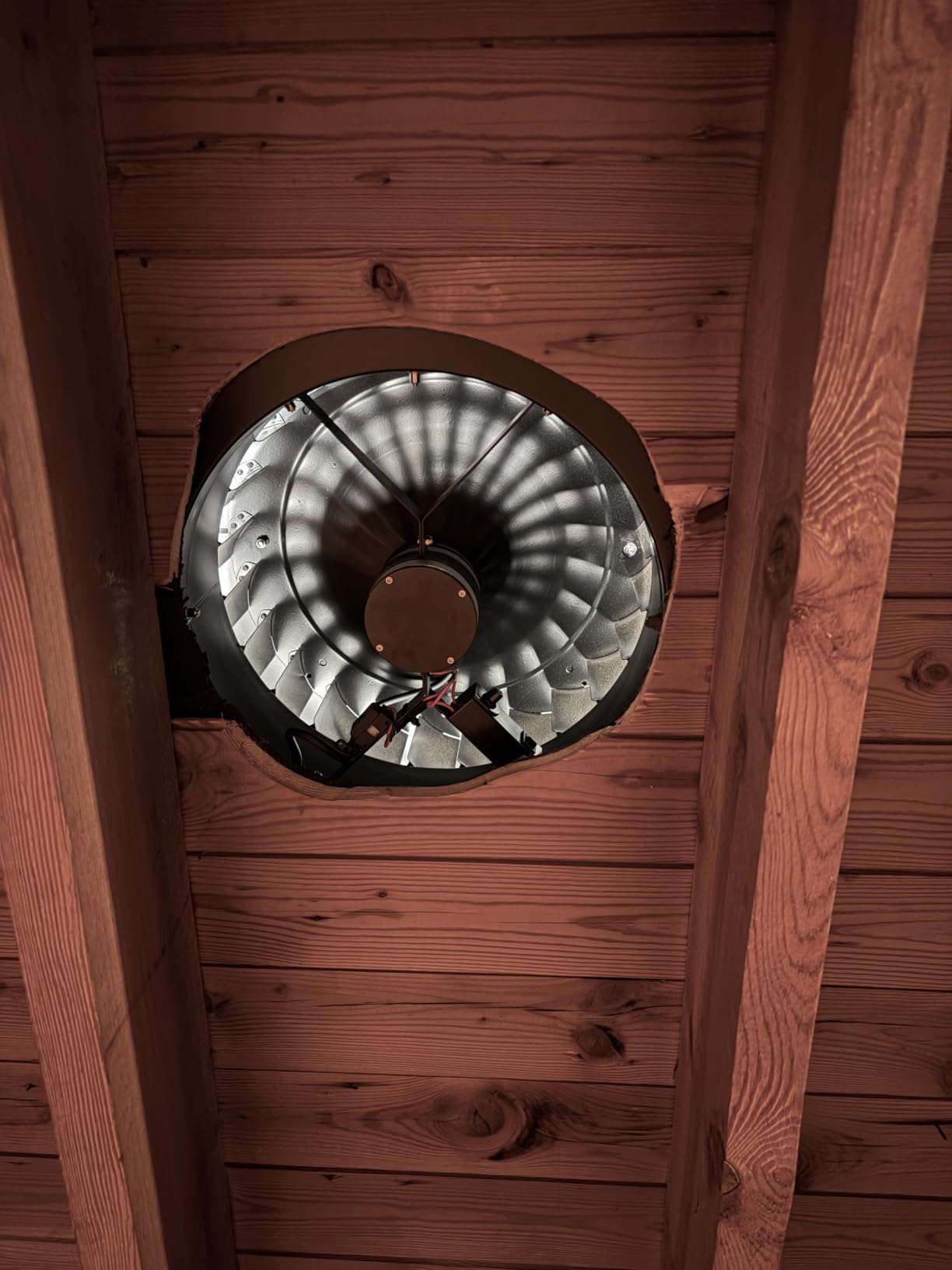
The built-in thermostat runs from 50F to 122F with an enable and disable feature, so you can shut the fan down for winter without unplugging anything. That wide upper range matters in hot climates where an attic can sit above 120F for days at a time.
Control is through a button interface and a temperature dial rather than a phone app. Some buyers wanted a digital display, and a few mentioned the fan being imperceptible from living spaces, which is the quietest result in our test group.
Solar Power and Nighttime Limits
There is no battery in this unit. When the sun goes down the fan stops, and on a heavily overcast stretch of several days you may get very little airflow at all. That is the defining trade-off of the entire solar category.
For summer daytime venting, which is when the attic does most of its damage to your cooling bill, that limitation rarely matters. The fan is most valuable on the hottest, sunniest afternoons.
Build Quality Concerns Worth Knowing
There is a recurring report across reviews of the blade assembly separating from the mounting collar on some units within days of installation. If you buy this, check that the collar is torqued snug and re-check it after the first week.
A faint rattle or hum is audible from directly underneath the fan when it runs, though not from a normal room position. The unit weighs 32 pounds and measures 21 by 21 by 10 inches, so plan the roof opening accordingly.
Who This Fan Is Right For
This is the one to buy if you rent, if your attic has no accessible power, or if you simply refuse to run wire. With 1665 reviews behind it, it is also the most proven unit in the group and the easiest recommendation we can make without reservations about thin brand support.
2. QuietCool AFG PRO-2.0 Gable Ventilator – Highest Rated Plug-and-Play Fan in the Group
Quietcool AFG PRO-2.0 Attic Fan for Gable Vents – 1945 CFM – Adjustable Thermostat – 20ft Power Cord – Plug-and-play – Two Speed Capable
1945 CFM high
1495 CFM low
108W high and 77W low
Thermostat 50F to 120F
20ft plug-in cord
Pros
- Plug and play with a 20 foot cord
- Two speed PSC motor
- Anti-vibration mounting tabs
- Vent covers block backdrafting
- Built-in fire safety shutoff
Cons
- No app or Wi-Fi control
- Two speeds instead of three
The AFG PRO-2.0 carries a 4.7 rating across 1364 reviews, and with 81 percent of ratings at five stars it is the most consistently loved fan we looked at. It mounts in a gable vent, needs no wiring, and reaches 1945 CFM on its high speed.
The permanent split capacitor motor runs two speeds: 1945 CFM at 108 watts on high, and 1495 CFM at 77 watts on low. That low setting is the one most people actually run, and it is where the energy savings show up while still clearing enough heat to matter.
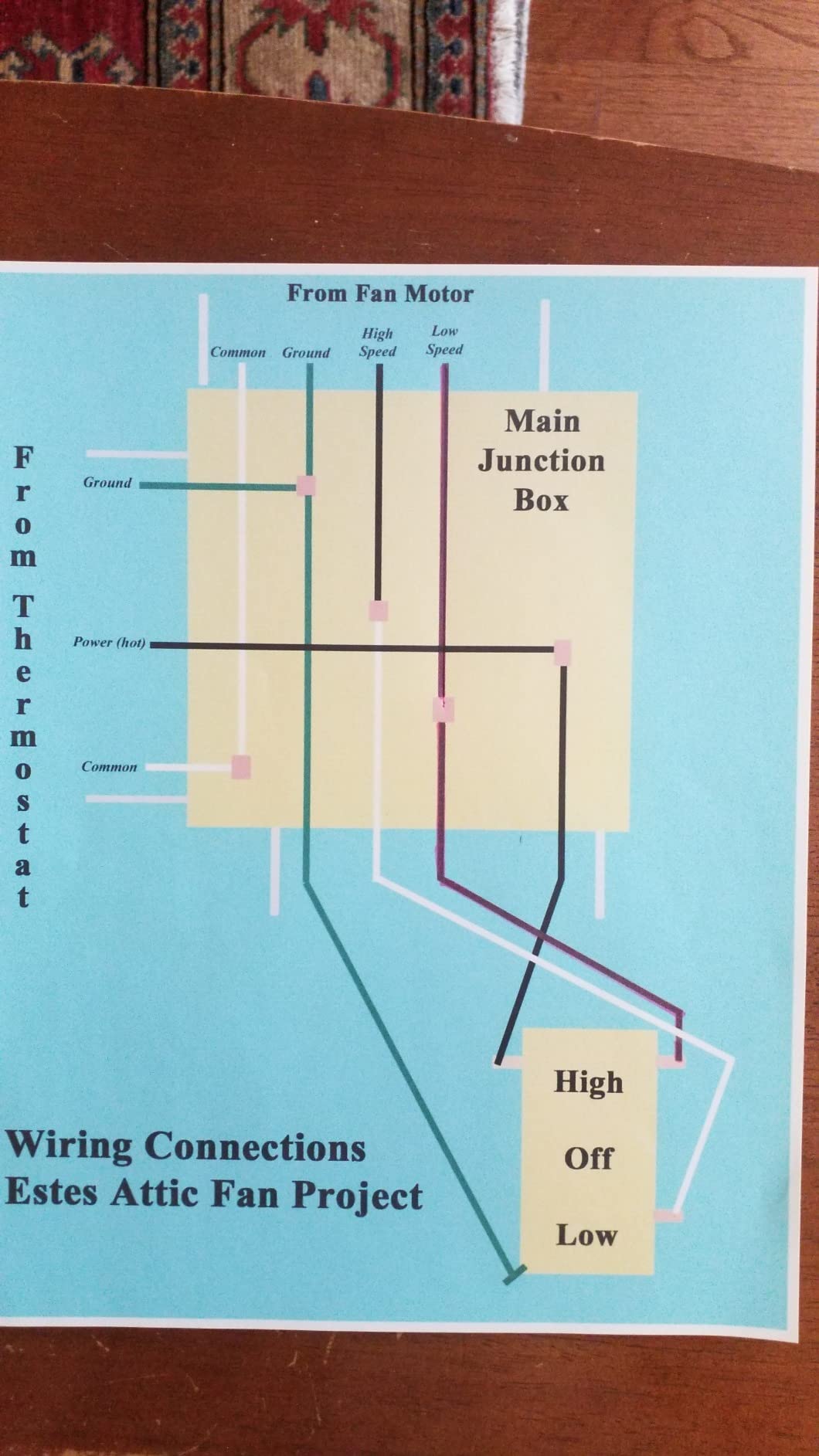
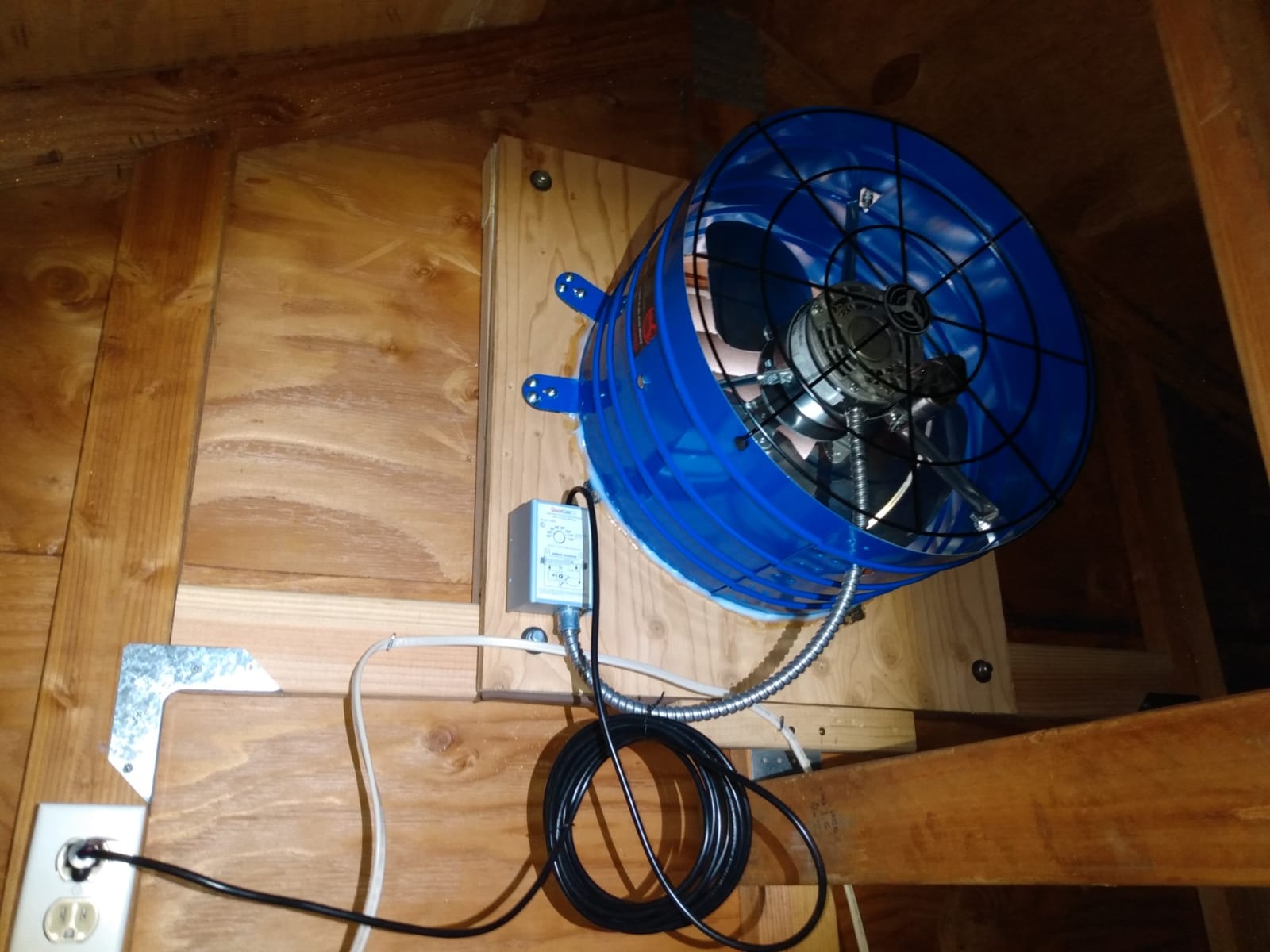
Two details set this apart from cheaper gable fans. The built-in mounting tabs carry anti-vibration pads, which is the difference between a fan you hear from the bedroom and one you do not. The included vent covers block reverse airflow so the unit cannot become a backdraft path when it is off.
There is also a built-in fire safety shutoff. Owners on older Home Improvement threads note that attic fan motors are supposed to have thermal protection that shuts them down when they overheat, and this one has it.
Why the Two Speeds Matter More Than the Wattage
Most attic fans run at one speed and give you no useful control. A two-speed PSC motor lets you dial airflow to how much intake your attic actually has, which is the difference between a well-behaved fan and one that rattles its own vent loose.
The 77 watt low draw is roughly the consumption of a small room fan, running on its own thermostat schedule, for a fraction of a central air compressor’s summer load.
Thermostat Range and the Missing Manual Override Question
The adjustable thermostat triggers between 50F and 120F on point. That is a wide enough band for most attic conditions, though a humidistat would be better in the Southeast where moisture matters as much as temperature.
There is no separate manual override switch and no app control. You control it at the dial, and the included 20 foot cord reaches a normal wall outlet inside the attic. If you want a wall switch downstairs, that is an added wiring job.
Airflow Reality Check and Vent Sizing
1945 CFM is a real number for a gable fan, but it assumes open flow. If your gable vent free area is small, the fan works against a wall of resistance and you get noise instead of movement.
Measure the clear opening of your gable vent before you buy. A fan roughly matched to that free area will run cool and quiet. One sized far above it will run hot and loud for no additional benefit.
Who This Fan Is Right For
Choose this if you want proven reliability, real airflow, and a Saturday-afternoon install with no electrician. Skip it if you want humidity control or phone-based scheduling.
3. Remington Solar 30W Roof Mount Attic Fan – Built for Hail Country and High Wind

Remington Solar 30 Watt Roof Mount Solar Attic Fan
1550 CFM
30W solar
0.08 sones brushless
Texas Windstorm certified
22.5 inch steel flashing
Pros
- Near-silent brushless motor
- Built-in humidistat and thermostat
- Oversized steel flashing
- Texas Windstorm certified
- All install parts included
Cons
- Night operation needs a separate hybrid adapter
- 1550 CFM trails the top gable models
The Remington Solar 30W is the one to consider if your roof takes hail. It carries Texas Windstorm certification, and the flashing is a 22.5 by 22.5 inch steel unit rather than the thin stamped plate most competitors ship.
That flashing matters more than any spec on the list. Roof penetration is where solar attic installs fail, and reviewers single out the oversized flashing as the reason they have had no leak complaints after a full season of storms.
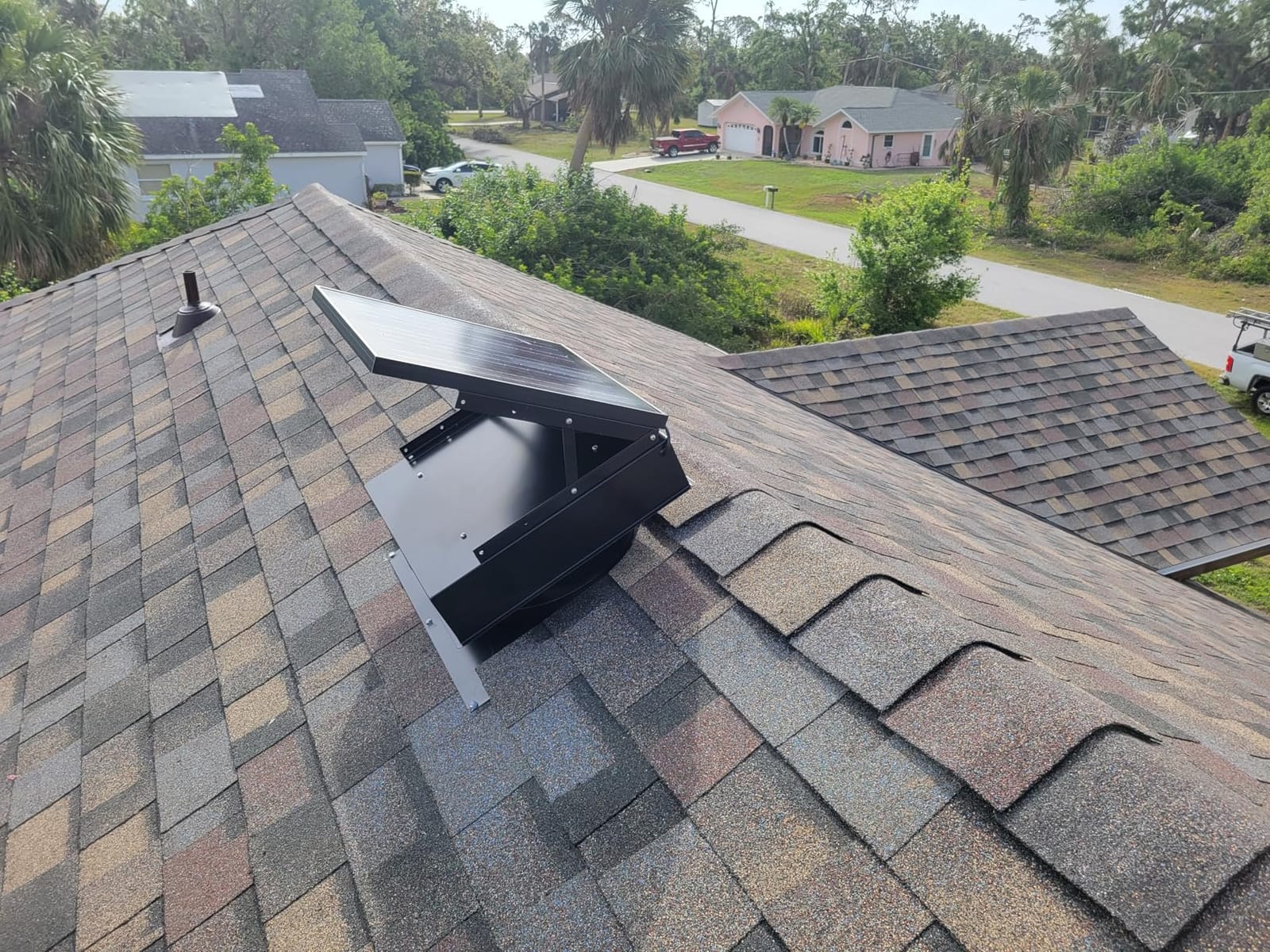
The brushless motor is rated at 0.08 sones, which is quiet enough that most owners describe the unit as inaudible from the living space below. Airflow is rated at 1550 CFM through a 13 inch five-blade plastic propeller, and the surface-mounted design is advertised as a roughly one-hour install.
This is also one of the few fans in the group with both a built-in humidistat and a thermostat. That pairing is the correct setup for humid regions, where pulling dry outside air into the attic does as much good as moving hot air out.
Humidistat and Thermostat Working Together
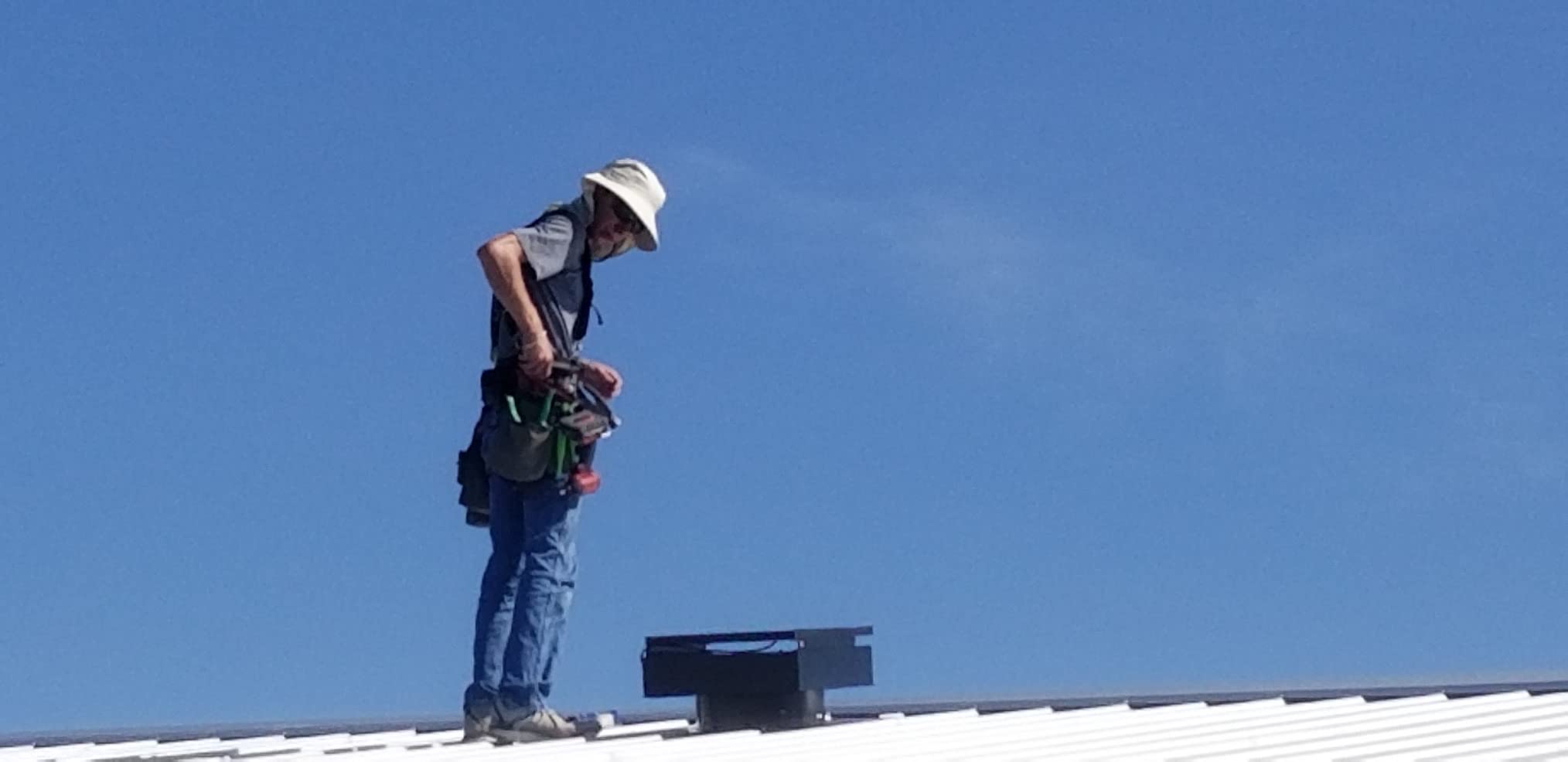
The thermostat handles peak heat and the humidistat handles moisture, so the fan runs when either condition justifies it. In the Southeast that is often the difference between a fan that helps and one that sits idle through the wettest weeks of summer.
Control is through a button interface with app-style control listed in the specs, and the unit is rated for 110 volts with a brushless motor on 30 watts of panel.
Night Operation and the Hybrid Adapter
The fan stops when the sun sets. A hybrid adapter that lets it draw from house power at night is available, but it is a separate purchase, and it is the most common surprise buyers of this fan report.
Weigh that against your climate. If your attic peaks in the late afternoon, solar-only operation covers the hours that matter. If your region stays hot after dark, budget for the adapter or pick a corded fan instead.
What 1550 CFM Actually Covers
The manufacturer does not publish an attic square footage figure for this model, which makes sizing harder. As a working rule, a 1550 CFM fan suits a mid-size attic with moderate soffit intake, not a large one with a sprawling roof.
At 30 pounds and 22.5 by 22.5 by 11 inches, it is a substantial roof-mounted unit. Plan the cut against the framing layout, not just the diameter.
Who This Fan Is Right For
This belongs in a home in a hail or high-wind region, or anywhere you want a fan you genuinely cannot hear from the room below. It is the strongest pick in the group for durability of the roof penetration.
4. QuietCool AFG SMT ES-3.0 Smart Gable Fan – The Most Air You Can Move Through a Gable Wall
Quietcool AFG SMT ES-3.0 Smart Attic Fan for Gable Vents – Up to 2801 CFM – As low as 22 Watts – Smart App Control – Thermostat and Humidistat – 20ft Power Cord – Plug-and-play – Three Speed
Up to 2801 CFM
148W on high
Three speed brushless ECM
App control
45 dB
15-year warranty
Pros
- Highest airflow in the gable group
- Quiet on low and medium
- App control with thermostat and humidistat
- Three speed settings
- 15-year manufacturer warranty
Cons
- Bluetooth range of roughly 25 to 30 feet
- App keeps no history and has no off button
- Thumping can develop on high speed
The AFG SMT ES-3.0 moves up to 2801 CFM on high, which makes it the largest gable fan in this roundup by a wide margin. If you have a genuinely large attic and real soffit intake to feed it, nothing else here comes close.
Power comes from a three-speed brushless electronically commutated motor drawing 148 watts at full output. Owners report the fan is inaudible on low and medium, which is where most people leave it once they realize their attic does not need the maximum setting. On high it is still clearly quieter than a conventional belt-driven unit of the same output.
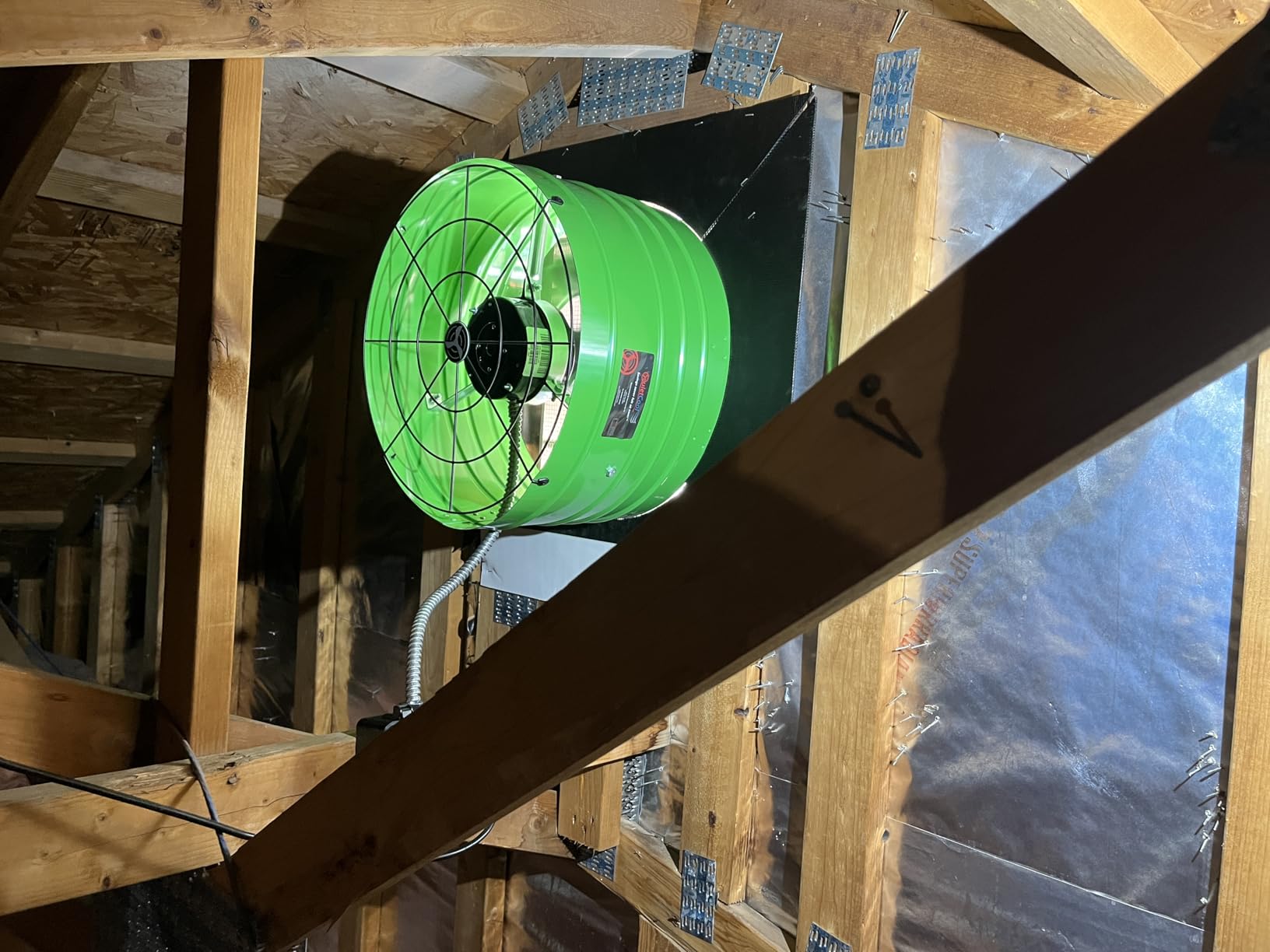
Measured cooling in owner reports lands at 10 to 15F off the attic temperature, with several people describing a noticeable cut in their summer power bill. The 15-year manufacturer warranty is among the longest we found on any unit here.
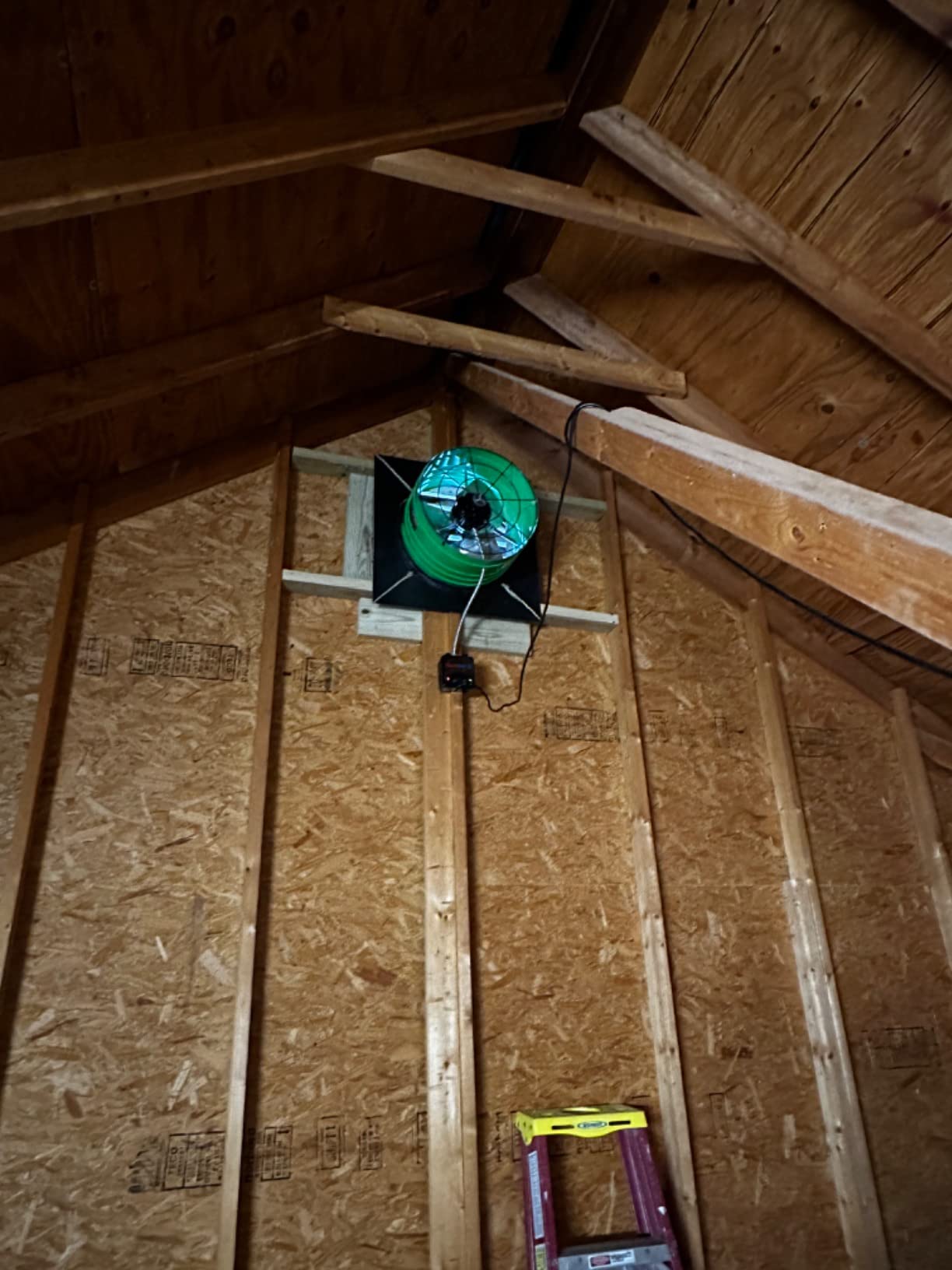
Smart app control handles both thermostat and humidistat scheduling, and the anti-vibration mounting tabs do the same quiet work they do on the PRO-2.0. The unit weighs 14 pounds and measures 20 by 12 by 20 inches.
Three Speeds and the ECM Motor Advantage
An electronically commutated motor has no commutator brushes to wear, which means no brush noise, better efficiency at partial load, and a longer service life than a conventional PSC motor. The practical effect is that speed 1 and speed 2 are genuinely quiet rather than merely quieter.
That is the design lesson from our quiet cooling fan testing as well: most fan noise is not airflow, it is the motor and the vibration path into the structure.
Smart Control Limits You Should Know Before Buying
The Bluetooth link has an effective range of roughly 25 to 30 feet, which is usually enough to pair from a ladder at the gable but not enough to control from a floor below. There is no Wi-Fi option, which means if the fan loses power it stays off until someone physically resets it.
The app stores no history and lacks a simple off button. Several owners mention both as ongoing irritations rather than dealbreakers. A wired wall switch alongside the fan solves the recovery problem completely.
High-Speed Wear and Long-Term Noise
A number of long-term owners report a noticeable thumping that develops on the higher speed settings over time. This is a vibration issue rather than a bearing failure, and running the fan on medium rather than high appears to prevent it.
At 45 dB the unit is quiet in normal use. The 0.1 inch static reality is that a 2801 CFM fan still needs a matching vent opening, and this is the fan most likely in the group to disappoint if your gable free area is undersized.
Who This Fan Is Right For
Buy this if you have a large attic, matched intake, and want the most ventilation a gable installation can give you. It is the wrong choice for a small attic or for anyone who wants app control that works from across the house.
5. Air Vent 53315 Gable Ventilator – The Straightforward Budget Replacement

Air Vent Gable Ventilator 53315 Attic and Whole House Fans, Multicolor,Medium
1050 CFM
1/12 HP motor
180W draw
14 inch plastic blade
Covers up to 1500 sq ft
UL listed
Pros
- Fits standard 14 inch openings without cutting
- Works in a gable or a roof plane
- Stainless steel housing
- Adjustable thermostat
- UL listed
Cons
- Plastic frame ribs can resonate on some installs
- Blades can sit loose and rattle
- 1050 CFM is the lowest airflow here
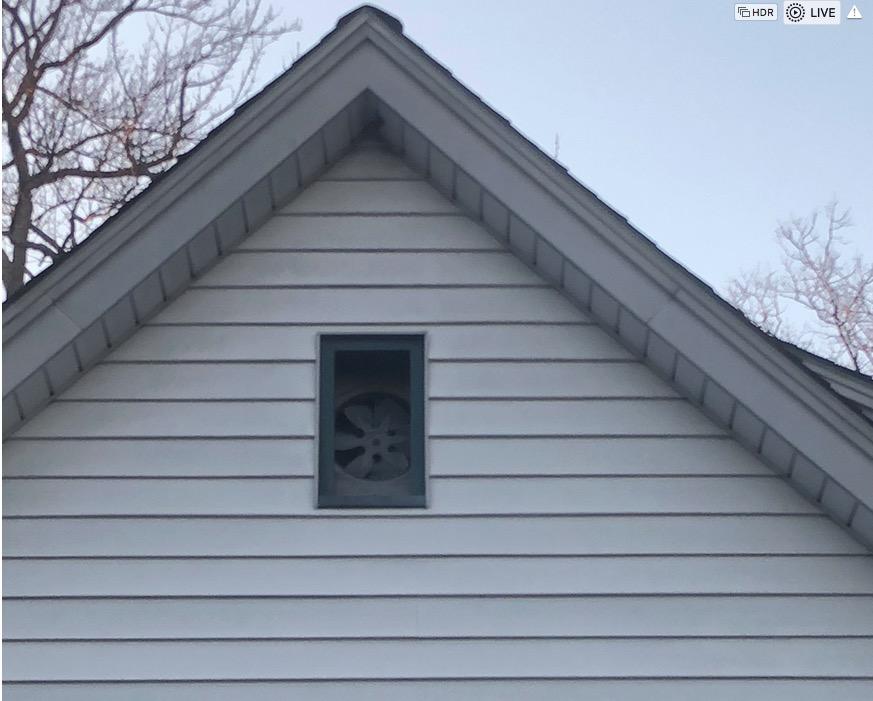
The Air Vent 53315 is the simplest useful answer in this roundup. It drops into a standard 14 inch gable or roof vent, moves 1050 CFM, and costs less than anything else we tested with a meaningful review history behind it.
It runs a 1/12 horsepower motor drawing 180 watts and 3.2 amps on 120 volts. The 14 inch three-blade plastic fan and stainless steel housing are simple, proven parts, and the unit is UL listed.
With 887 reviews at a 4.4 rating, this is the most reviewed fan in the group after the iLIVING and the QuietCool PRO-2.0. Buyers treat it as a straightforward replacement for a failed existing vent rather than as a system upgrade, and that is exactly the right expectation to set.
One detail expands its usefulness. The same unit can be mounted horizontally in a roof plane instead of in a gable wall, so it also works for homes with no gable vent at all. The adjustable thermostat triggers reliably according to owners.
What 1050 CFM Covers in Practice
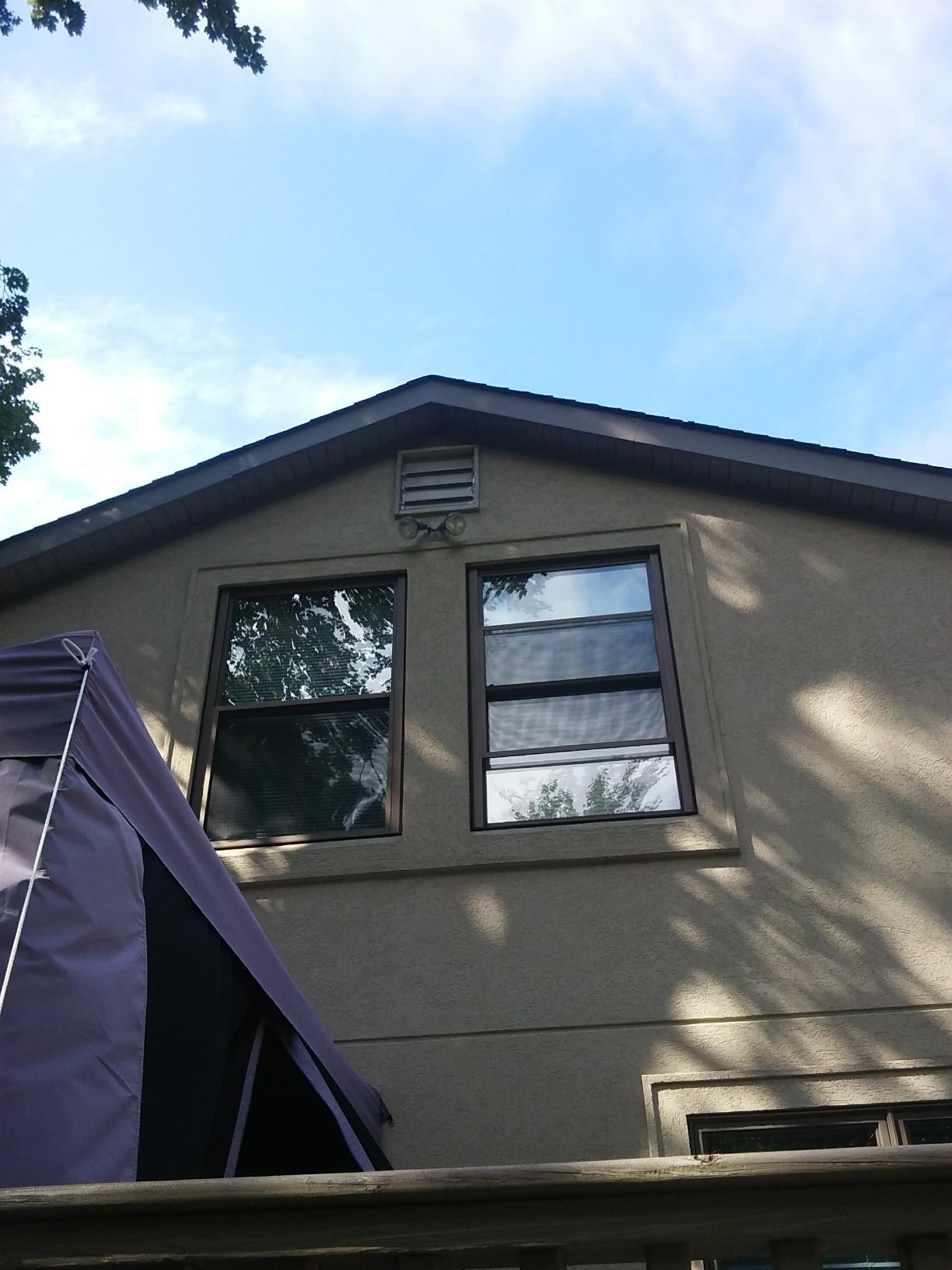
The manufacturer rates this fan for attics up to 1500 square feet. That figure assumes functioning soffit intake and an unobstructed opening, and it is the honest number to size against rather than the biggest number in a product listing.
For a small home, a small attic, or a supplemental role alongside a larger fan, 1050 CFM is genuinely adequate. For a 2000 square foot home with a full second floor, it will be undersized.
The Vibration Issue and How to Fix It
The most cited complaint is vibration. The plastic frame ribs can resonate at line frequency on some installs, and the blade can sit loose on the center shaft and rattle until tightened. Both are mechanical fixes, not defects.
Installers typically correct the rattle with a clamp bolt or an Allen screw adjustment on the hub, and the frame resonance responds to tightening the mounting screws evenly. A few minutes of work removes the most common reason owners return this fan.
What This Model Left Out
There is no humidistat, unlike the older unit it replaced, so in humid climates you lose the ability to run for moisture alone. There is no app control and no smart scheduling, only an adjustable thermostat dial and a toggle switch.
The listing weight of 8 ounces is clearly wrong for a fan with a motor in it, so treat all listed dimensions as approximate and confirm the cut size before you commit to a roof opening.
Who This Fan Is Right For
This is the pick for replacing a dead vent fan on a budget, or for adding ventilation to a shed or small addition. It is not the pick for a large home trying to cut a serious air conditioning load.
6. ECO-WORTHY 25W Solar Ventilator – Best Used on a Greenhouse, Not a Whole Attic

ECO-WORTHY 25W Solar Powered Attic Ventilator Gable Roof Vent Fan with 30W Foldable Panel – Fans for Home Attic, Greenhouse, RV or Outdoor, Ready-to-Use Fan,
25W fan motor
30W foldable panel
1200 CFM
IP7 motor coating
Copper motor rated 5+ years
Pros
- No wiring and no grid power needed
- Foldable panel with plug and play wiring
- IP7 coated motor handles rain
- Copper motor rated 5+ years
- Works well in small enclosed spaces
Cons
- No battery so airflow stops when the sun goes
- Speed tracks sunlight intensity
- No thermostat or humidistat control
We included the ECO-WORTHY because it keeps showing up in attic fan searches, and we need to be direct about it. This is a good small-space ventilator and an under-scaled attic fan. Roughly 9 percent of its reviews are one star, and they all point at the same thing.
There is no battery. The motor runs directly from a 30W foldable aluminum-framed panel, so the instant the sun is behind a cloud the fan slows down, and at night it stops entirely. The manufacturer states this plainly in the spec sheet.
What it does offer is real airflow for its class, with a listed 1200 CFM from a pure copper motor rated for over five years of service. The motor is coated and rated IP7 for outdoor use, which matters for a unit meant to sit in rain and humidity.
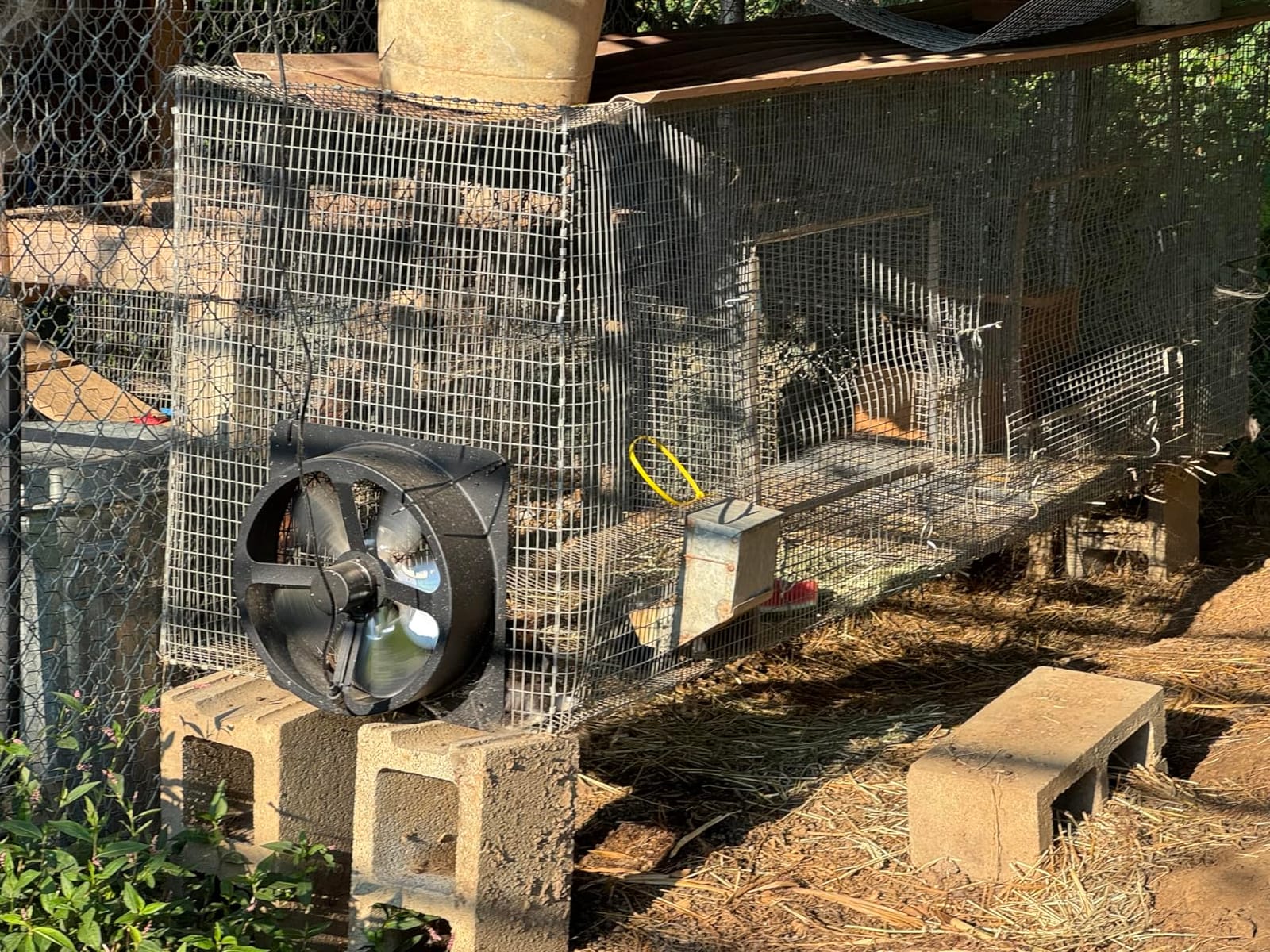
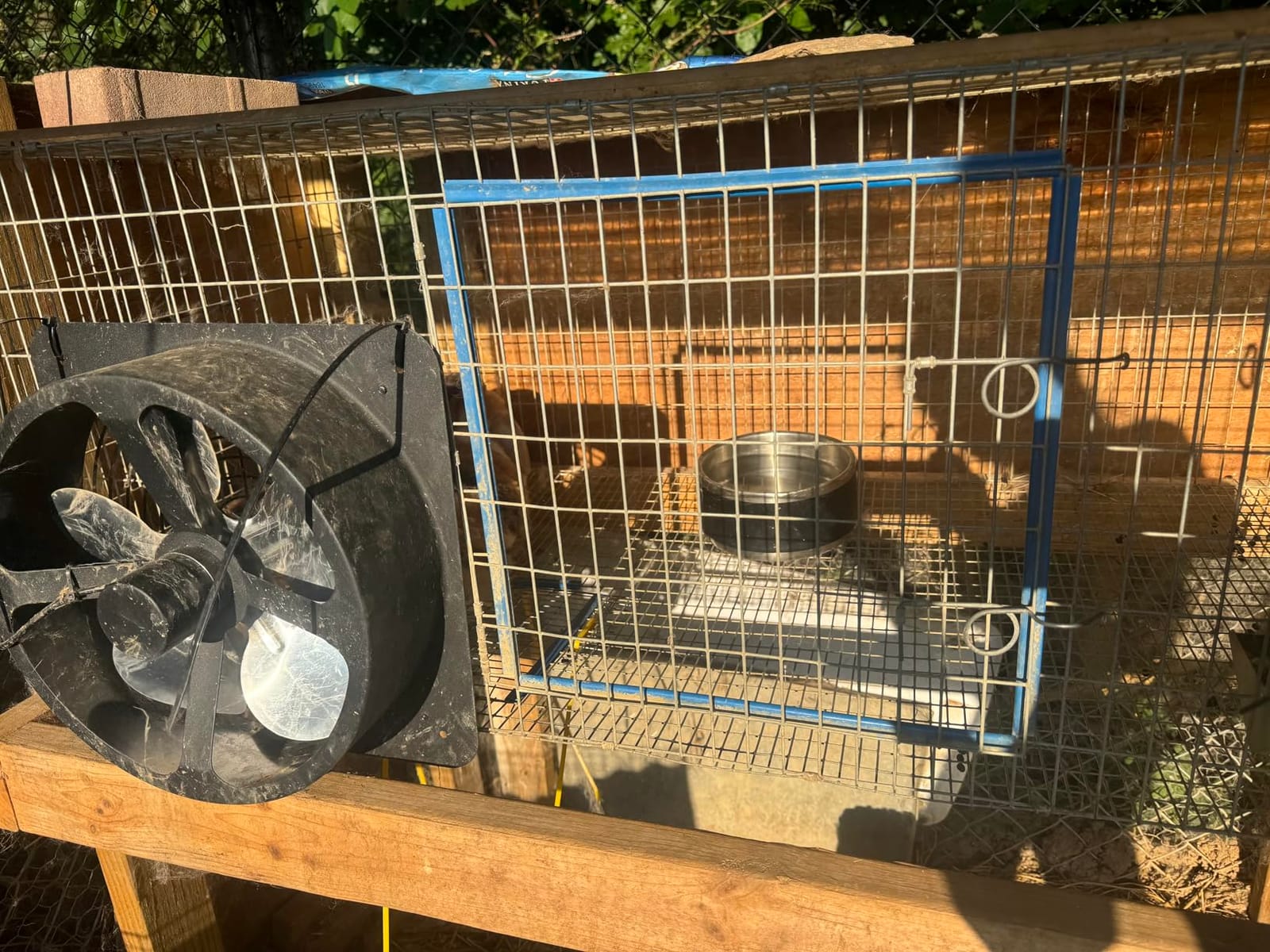
Owners who use it for a chicken coop, greenhouse, shed, or pet house report it works well and installs easily. The one-piece metal housing and plug-and-play solar cable make it a genuinely simple install with no electrical work.
Why 1200 CFM Is Not Enough for Most Attics
The published sizing guidance targets enclosed spaces of about 250 cubic feet, which is a walk-in cooler, not a house attic. A typical attic is thousands of cubic feet, and the mismatch between the advertised airflow and the real volume is the source of most of the disappointed reviews.
If you do use it in an attic, expect it to circulate air in a defined corner rather than to lower the temperature of the whole space. Adding several is not a practical substitute for a properly sized fan.
Sunlight Dependence and the No-Battery Design
Output is tied directly to light intensity. On a clear July afternoon you get close to the rated figure. On an overcast day after a storm you may get a fraction of it, and overnight you get none.
That is acceptable for a greenhouse, where daytime ventilation is the goal. It is a real weakness for a whole attic, where peak attic temperature often arrives in the late evening after the sun has moved off the roof.
No Thermostat, No Humidistat, No Schedule
There is no temperature or humidity control of any kind. The unit runs when the sun runs. That simplicity is a feature in a shed and a limitation everywhere else.
It also draws 1.67 amps at 12 volts DC, and the panel measures 27.8 by 13.8 inches. Budget for the fact that you will likely want to reposition the panel seasonally to keep it in direct sun.
Who This Fan Is Right For
Buy it for a greenhouse, shed, coop, RV, or small outbuilding where you need daytime air movement with zero wiring. Leave it out of any comparison of whole-attic ventilation.
7. Natural Light 48W Solar Attic Fan – The Highest Airflow of Any Solar Model Here
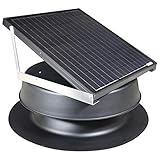
Solar Attic Fan 48-watt – Florida Rated by Natural Light
1881 CFM
48W panel
Up to 2825 sq ft
Aluminum housing
Three power levels
17V DC
Pros
- Highest airflow of the solar models
- Made in the USA
- Lifetime warranty on the entire unit
- Rated for high-wind and high-UV climates
- Three power levels
Cons
- Most expensive unit in the roundup
- Snap-on thermostat sold separately
- Solar-only with no airflow at night
The Natural Light SAF48B is the solar fan to beat on paper. It moves up to 1881 CFM under full direct sun and the manufacturer rates it for attics up to 2825 square feet, which is the largest coverage claim of any solar unit in this roundup.
It is also the most expensive solar unit we tested, and the gap between the two facts is the solar decision. You are paying a premium for build quality, a 48 watt panel, and a warranty that has no time limit on the unit itself.
The DC motor drives a five-blade propeller across three power levels, so you can trade airflow against panel draw. The aluminum housing is made in the USA, and the design is rated for Florida conditions, meaning high wind and intense ultraviolet exposure.
With 293 reviews at 4.4 and 73 percent of ratings at five stars, satisfaction centers on build quality and the warranty. The recurring practical notes are that the thermostat is an extra purchase and that operation is entirely dependent on available sunlight.
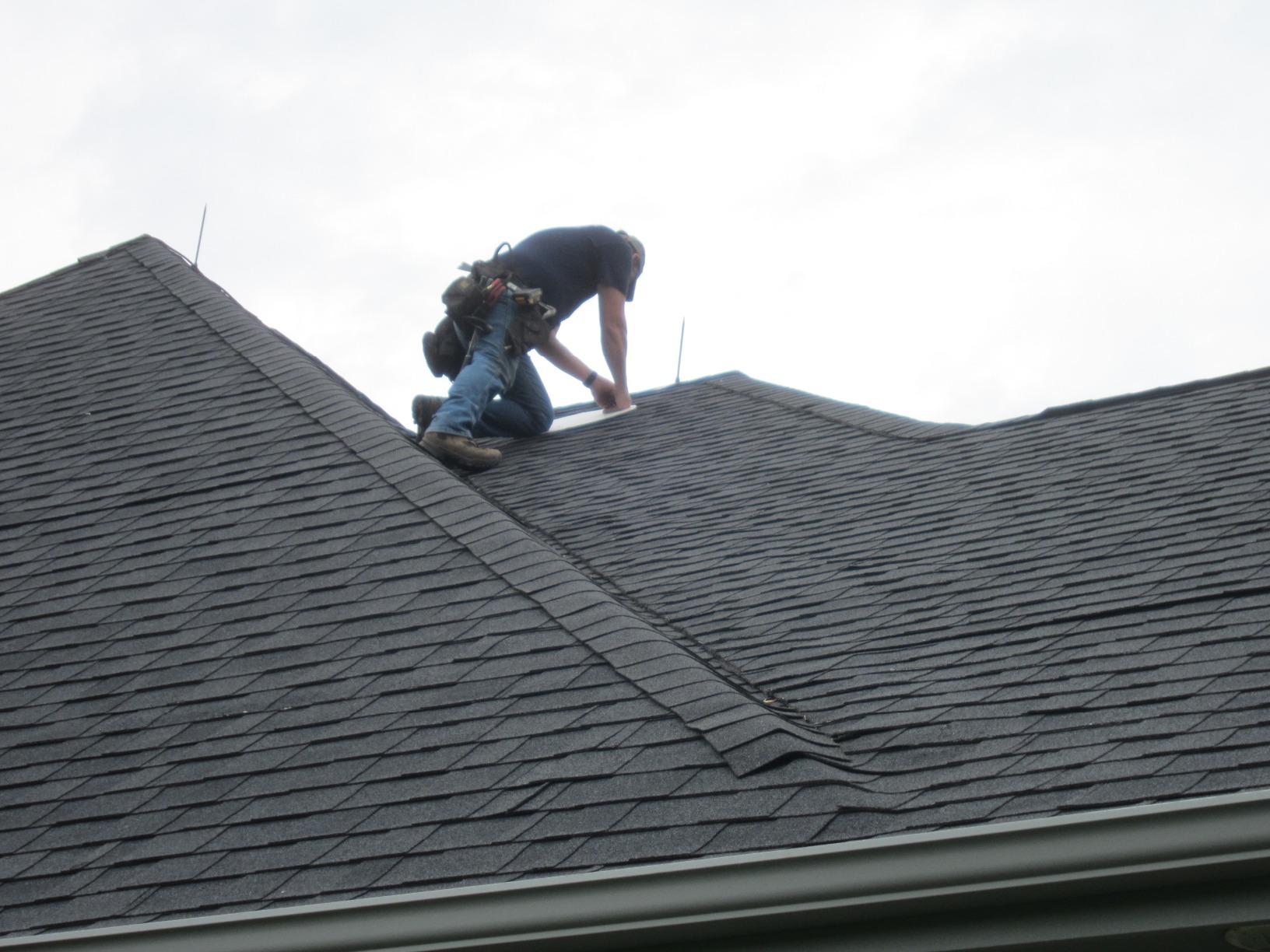
48 Watts and What It Buys You
The panel is roughly 60 percent larger than a typical 30 watt unit, and that extra collection area is what allows the fan to hold higher airflow on partially cloudy days. If your roof gets intermittent sun rather than steady sun, panel size matters more than anything else on the list.
The trade-off is physical. The unit measures 27.25 by 27.25 by 11.5 inches, so it needs a substantial roof opening and a clean southern exposure to hit the rated figure.
The Warranty Is the Real Differentiator
The manufacturer offers a lifetime limited warranty on the entire unit rather than a fixed term on the motor alone. For a device expected to sit on a roof through decades of hail and ultraviolet exposure, that is a meaningful structural advantage.
Compare that against the 15-year terms on the iLIVING and the QuietCool smart units. All three are strong, and this is the longest coverage in the group.
The Optional Thermostat Gap
A snap-on thermostat is available for colder climates but sold separately. Without it the fan runs whenever the sun is out, which in a mild climate can mean it runs on a mild spring day for no benefit.
If you are in a climate with variable shoulder seasons, factor that accessory into the decision. If you are venting a genuinely hot attic, running whenever the sun is out is exactly the behavior you want.
Who This Fan Is Right For
This fits a large attic where airflow volume matters and the budget supports the premium. It is the right solar pick when the alternative would be two smaller fans, and the wrong pick for a small attic or a tight budget.
8. QuietCool AFR SMT ES-2.0 Roof Mount Smart Attic Fan – Best Roof Mount for Noise Control

Quietcool AFR SMT ES-2.0 Roof Mount Smart Attic Fan – Up to 1950 CFM – As low as 25 Watts – Smart App Control – Thermostat and Humidistat – 20ft Power Cord – Plug-and-play – Three Speed
Up to 1950 CFM
24.6W on low speed
Three speed brushless ECM
50 dB
One-piece steel hood
Pros
- Sealed ECM motor with 15-year warranty
- Drops to about 25W on low speed
- Bluetooth app reaches across the house
- UV-resistant paint coating
- One-piece stamped steel hood
Cons
- Control hub is awkward on steep roof pitches
- Vibration can reach the floor below
- Sloped-roof flashings sold separately
The AFR SMT ES-2.0 solves the main objection to roof-mounted fans, which is that you hear them. The sealed ECM ball-bearing motor, the one-piece stamped steel hood, and the one-piece perforated cylindrical housing produce the tightest mechanical package we tested.
Reviewers describe it as barely perceptible even on high, and closer to silent on the lower two speeds, with several owners noting reduced central air runtime alongside it. Several reviewers also mention cuts to their summer power bill, and one describes a drop of 5 to 8F at the upper level of the home.
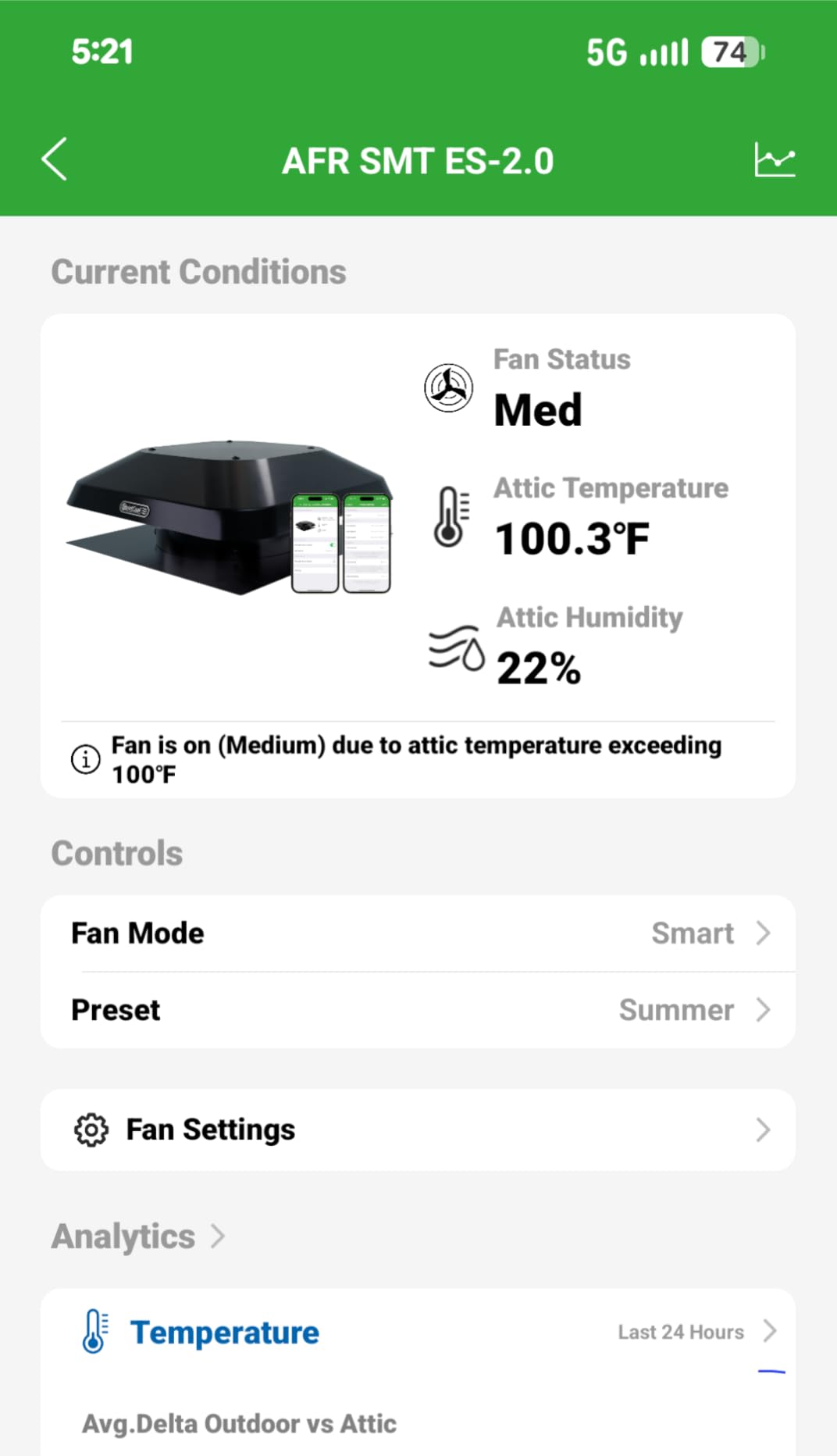
Output is up to 1950 CFM on high and as little as 24.6 watts on low, across three speeds. That low-speed draw is the efficiency story: you can run it most of the day without meaningfully adding to your power bill.
The 15-year warranty covers the sealed ECM motor, the paint is UV resistant to prevent fade and chalking, and there is a built-in fire safety shutoff. Smart app control and a 20 foot power cord round out a well-built package.
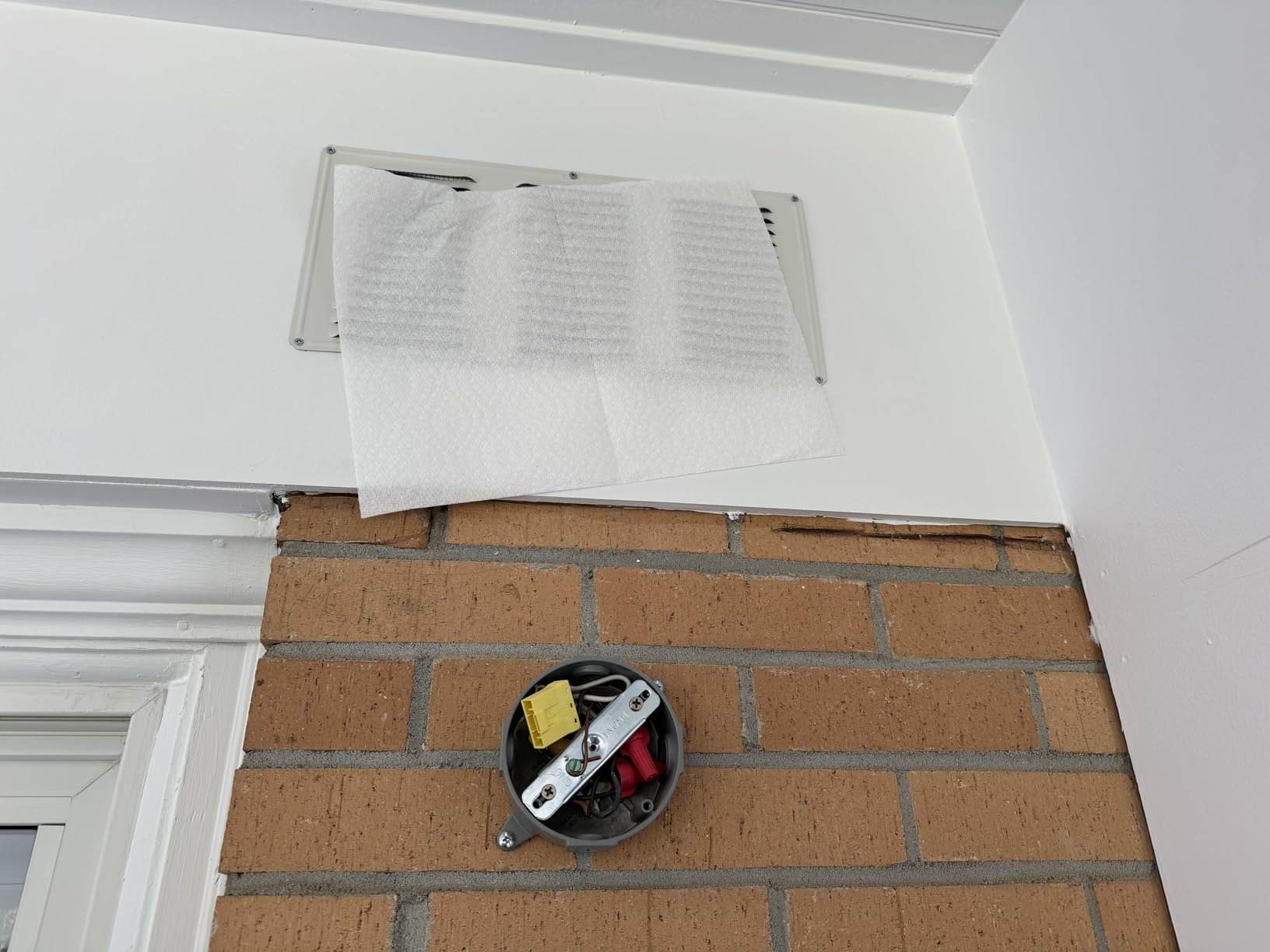
Why Roof Mount Instead of Gable Mount
A roof mount works on any roof pitch and in homes with no usable gable wall, which includes a large share of ranch-style and vaulted homes. It also sits in a sealed housing, so there is no louver leakage when the fan is off.
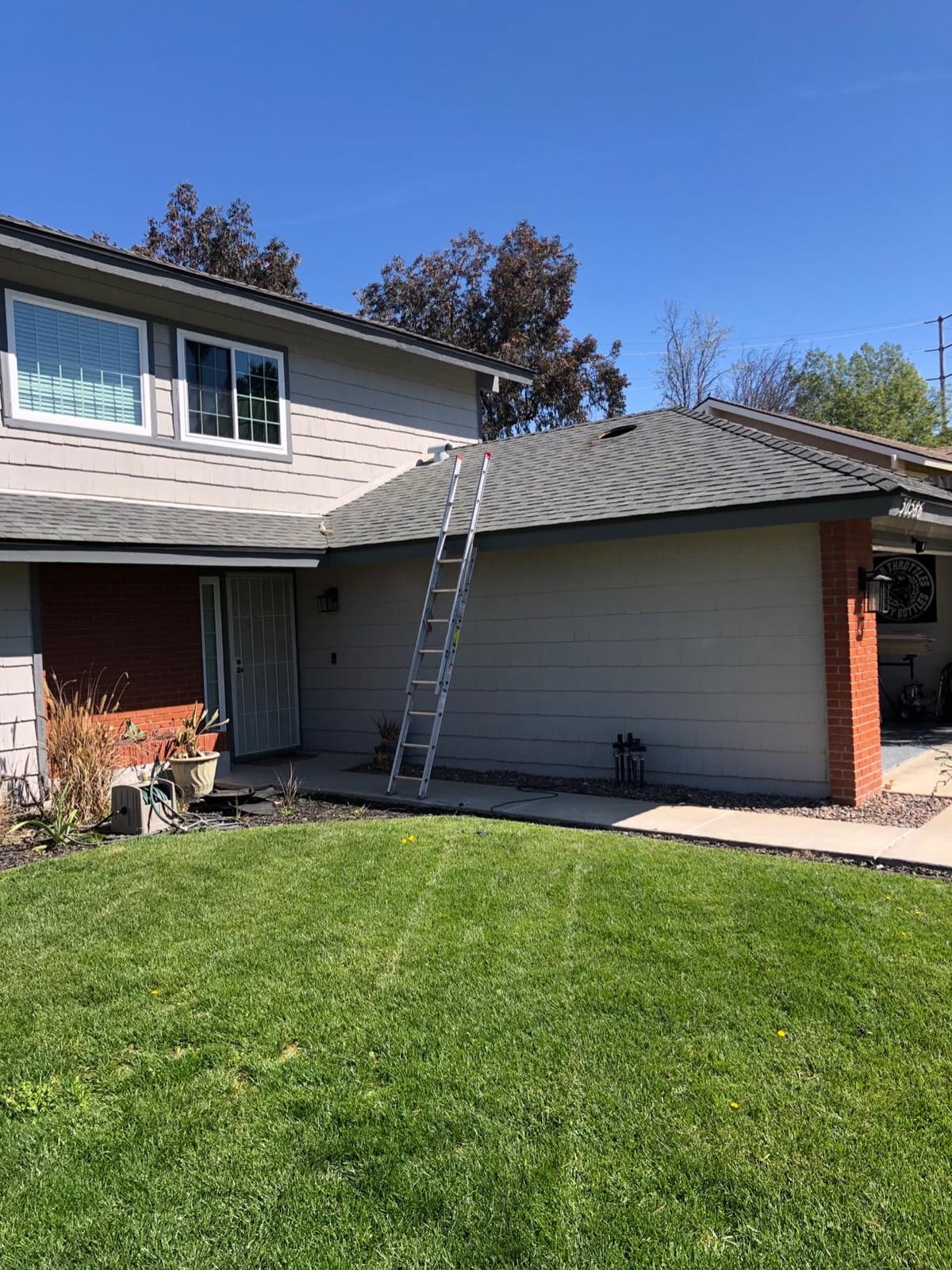
The cost is installation complexity. You are cutting a hole in a sloped surface, sealing it, and flashing it, and mistakes there become leaks rather than lost airflow.
Installation Logistics on Steep Roofs
The control hub sits close to the unit and is genuinely awkward to reach on a steep pitch. Several installers report planning the whole job around where they can safely put a ladder.
Interchangeable flashings for sloped roofs are sold separately, so if your pitch is not the standard one, add that to your list before ordering. On some installs vibration transmits down through the ceiling framing and becomes faintly felt on the floor below.
App Control Behavior in Practice
Bluetooth control reaches across the house, which is better than the 25 to 30 foot limit on the gable version of the same family. The app requests location permissions and some users report it does not reliably change speed over Wi-Fi.
If remote control matters to you, a wired wall switch at the attic access is a more dependable answer than any app in this category.
Who This Fan Is Right For
Pick this for a home without a gable wall, a vaulted ceiling, or anywhere a gable fan simply cannot go. It is the quietest install in the group, provided your roof pitch is not extreme.
9. Centric Air QA-Deluxe 5500 – The Whole House Fan for Large Homes

QA-Deluxe 5500 Energy Efficient Whole House Fan 2 Speed Temp/Timer Control
5072 CFM
3945 CFM Title 24 airflow
51 dB
Two speed remote and timer
R-5 insulated damper
Pros
- Covers homes up to 3400 sq ft
- Fits 16 inch on-center joists without framing
- R-5 insulated damper seals the attic
- Wireless remote with timer
- Assembled in the USA
Cons
- Most expensive unit in the roundup
- Foam dampers flap on windy days
- Auto controller is timer-led
- Installed airflow is below the headline rating
The QA-Deluxe 5500 is a real whole house fan, not an attic fan. It mounts in a ceiling between joists, pulls air in through open windows, and moves it up and out of the house. Rated output is 5072 CFM, with 3945 CFM under California Title 24 rules.
That gap between the two numbers is the most important thing on this listing. Headline CFM is measured under open conditions, and Title 24 airflow is the more realistic installed figure. Size to the second number and you will not be disappointed.
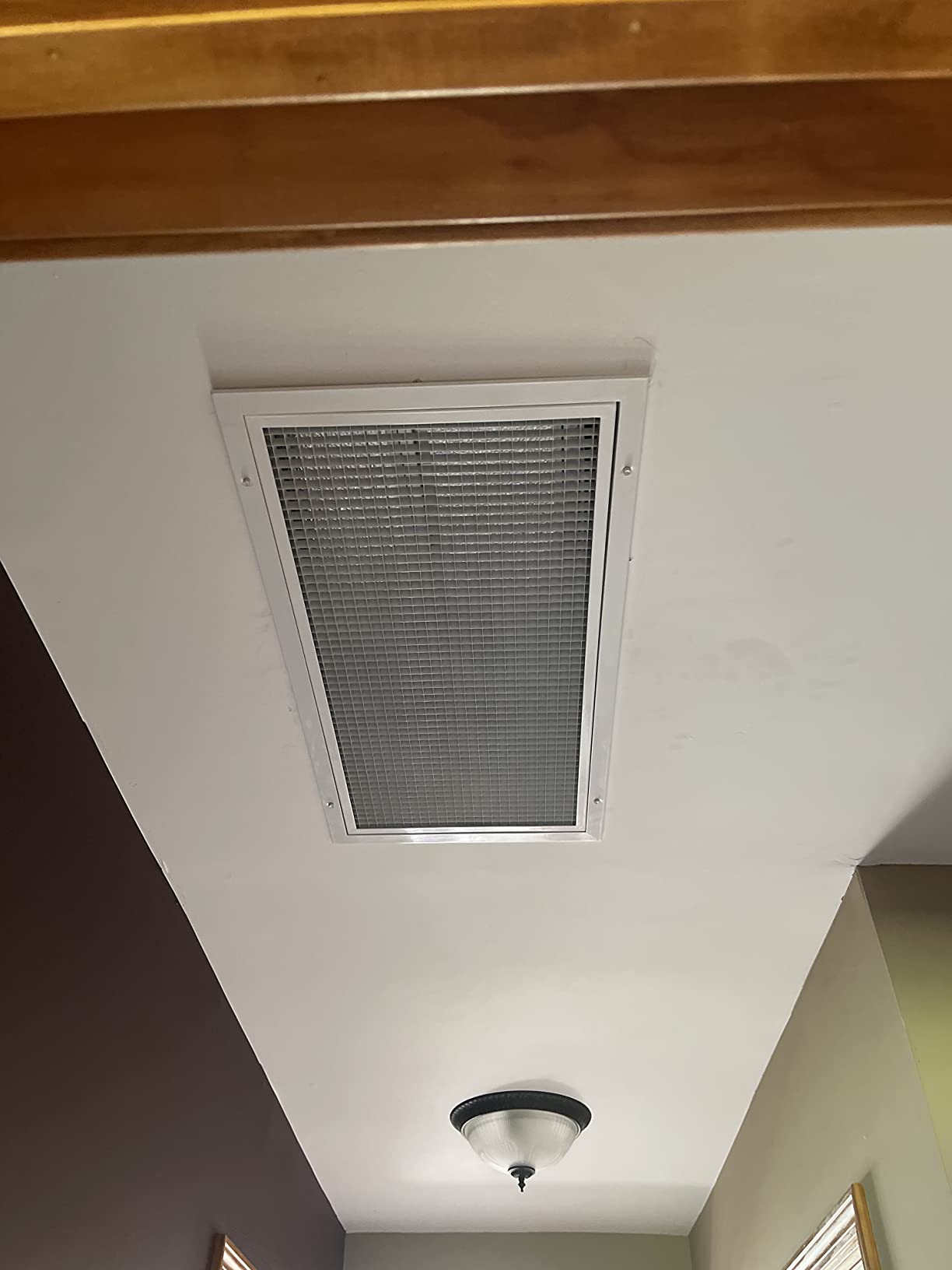
Owners report whole-home temperature drops of 5 to 10F within 25 minutes to an hour, and a visible reduction in air conditioning runtime. At 51 dB the unit is described as very quiet on low and comparable to a window fan on high.
It fits between 16 inch on-center joists and up to 24 inch spacing without any framing modification, which removes the most expensive obstacle in a whole house fan install. At 60 pounds it is a two-person job.
The R-5 Insulated Damper and Why It Decides Efficiency
The included damper is rated R-5 and insulated, so when the fan is off it seals the attic space tightly instead of pulling hot attic air back into your living space. This is the single most important quality spec on a whole house fan and the one most budget models skip.
The trade-off is that the light foam dampers are noisy and audibly flap on windy days. A few buyers have replaced them with heavier insulated units and reported the flapping stops entirely.
Control, Timer, and the Auto Controller Weakness
Control is a two-speed wireless remote with a timer, which lets you avoid running a wall switch and set the fan to shut off after a set period. That is exactly the behavior you want for night cooling.
The auto controller is the weak point. Owners describe it as feeling cheap and working primarily on the timer rather than as a true temperature cutoff, and the included instructions are vague about how to connect ducting to the damper box.
When a Whole House Fan Is the Wrong Tool
This fan works best where nighttime temperatures fall to around 65F or lower and where you are comfortable leaving windows open overnight. If security is a concern, or if outdoor humidity is high, it is the wrong purchase.
Never run one with the central air compressor operating. You would be pushing cooled air straight into the attic, which is the single most common ducting mistake inspectors flag in existing homes.
Who This Fan Is Right For
Buy this if you have a large home, a second floor that overheats, and cool nights. It is a ceiling-mounted install with attic work attached, so budget for a professional on anything other than a straightforward joist bay.
10. AC Infinity CLOUDWAY T12 – The Only Fan Here With Real Wi-Fi Scheduling

AC Infinity CLOUDWAY T12, Whole House Fan with WiFI Temperature Controller
12 inch duct
Wall mount
Wi-Fi app with scheduling
11 speed levels
62 dBA
240V supply
Pros
- Only fan here with true Wi-Fi scheduling
- Eleven discrete speed levels
- PWM EC motor with dual ball bearings
- ABS housing rated for high humidity
- Home Assistant support
Cons
- Housing will not fit 16 inch joists uncut
- Duct and control cable run short
- Louder than rival whole house fans
- App sometimes fails over Wi-Fi
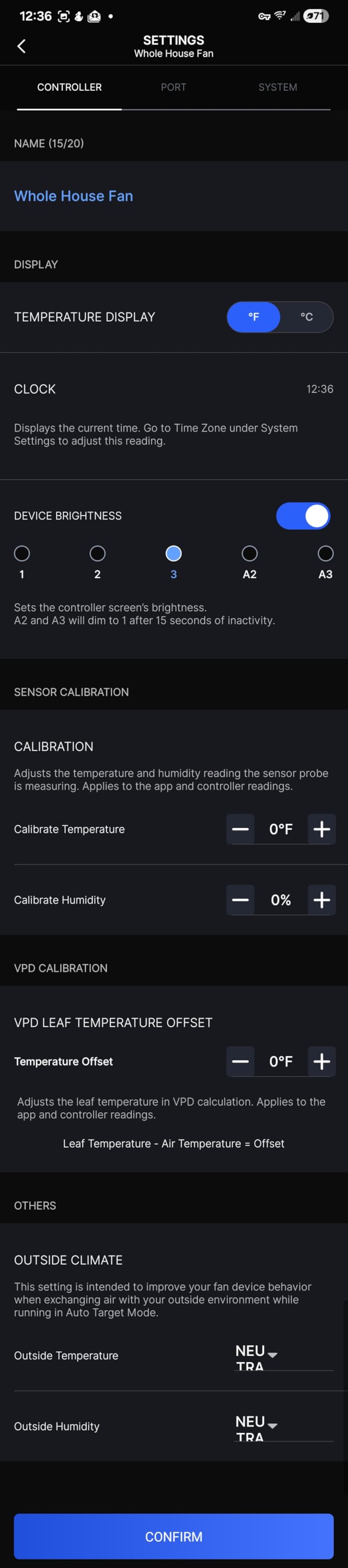
The CLOUDWAY T12 is the only unit in this roundup with real Wi-Fi app control and full automation. It handles dynamic temperature, humidity, and vapor pressure deficit programming, with timers, cycles, scheduling, and a settable minimum speed.
That capability is genuinely unmatched here, and it is why the product earned a place on this list despite a 4.1 rating on 56 reviews. The 11 discrete speed levels let you match airflow to conditions in a way three-speed fans cannot.
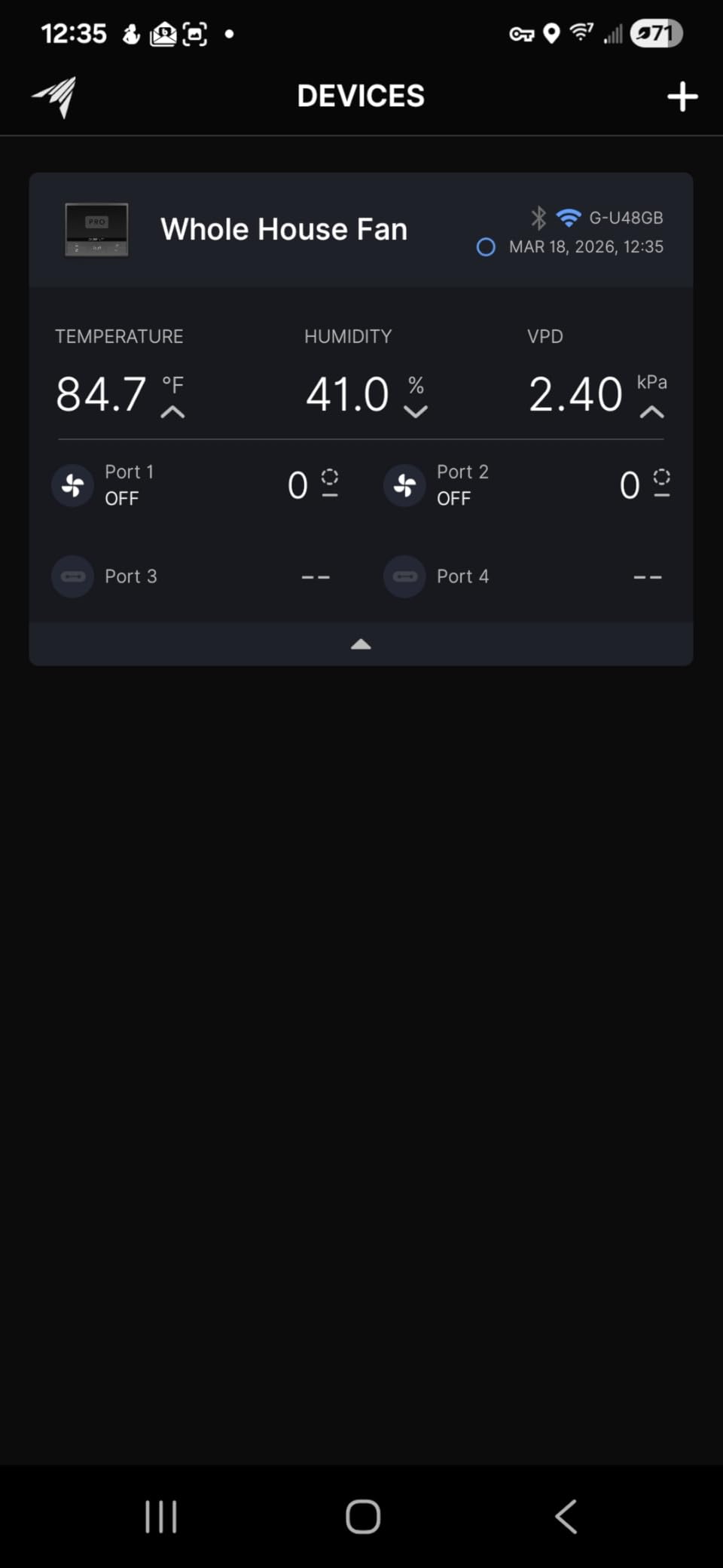
The PWM-controlled EC motor with dual ball bearings is the strongest drivetrain specification in the group. Reviewers call the smooth app experience and the durable ABS housing, rated for high-humidity environments, better than the nearest competing smart fan.
Nearly every complaint in the reviews is dimensional or mechanical rather than electronic, and they cluster around the same two things: the housing size and the noise level.
The Joist Spacing Problem Is the Dealbreaker or Not
The air box measures 12.3 by 17.7 by 14.1 inches and will not fit standard 16 inch on-center joist spacing without modification. That means cutting or trimming framing on an installed house, which pushes this firmly into professional territory.
If your joists are already spaced wider, or you are building new, this is a non-issue. If they are standard, measure before anything else.
Short Runs and a Wired Controller
The included duct and control wire are short, which limits where you can place the controller, and the controller itself is not wireless. Its wiring exits the bottom of the unit, so the run length is fixed by where the housing sits.
At 240 volts this unit needs a 240 volt circuit, which means a licensed electrician in most places. That is a meaningful difference from the plug-in attic fans earlier in this list.
Noise and the Wind Path Above Speed 5
Rated noise is 62 dBA, which is higher than the Centric Air unit and higher than most reviewers expected. Wind noise through the grille becomes the dominant sound above speed level 5, so in practice most people run it in the lower half of its range.
The app also sometimes fails to set speed over Wi-Fi, which is the most common software complaint. On the positive side, it is the only unit here with Home Assistant integration.
Who This Fan Is Right For
This is the pick for someone building a new home or finishing a renovation who already has automation and wants the fan in it. It is not the pick for a plug-and-play install or a standard-joist existing house.
Whole House Fan or Attic Fan? Which One Do You Actually Need?
Start by deciding which space you are trying to cool. If it is the attic itself and the goal is less heat radiating through the ceiling, you want a powered attic exhaust fan. If it is the living space and the goal is replacing air conditioning on cool nights, you want a whole house fan.
A whole house fan is larger, ceiling-mounted, and moves far more air. It needs open windows across the house to pull against. An attic fan is smaller, mounts in a gable wall or on the roof, and needs soffit intake plus ridge or gable exhaust to move air at all.
What size attic fan do you need?
Match the fan to the attic floor area, then check that the exhaust free area can support the airflow. As a working guide, budget roughly 1 CFM per square foot of attic, so a 1500 square foot attic wants about 1500 CFM and a 2000 square foot attic wants about 2000 CFM.
- 1000 square foot attic: 1000 to 1200 CFM
- 1500 square foot attic: 1500 to 1800 CFM
- 2000 square foot attic: 2000 to 2500 CFM
- 2500 square foot attic: 2500 to 3000 CFM
- 3000 square feet and above: two fans, or one of the larger solar models
Spend as long on the vent measurements as on the fan. If your largest gable opening is 3 square feet, a fan rated far above what that opening can pass will run loud and deliver little. Matching the two is the difference between a good install and a disappointing one.
Venting prerequisites nobody checks before buying
Intake is the part that is missing most often. Without soffit vents at the eaves, a powered attic fan has nothing to pull from and cannot move air, no matter how large it is. Forum threads are full of owners who assumed their new fan was defective when the real problem was zero soffit intake.
For exhaust, ridge vent combined with soffit vents is the cleanest arrangement because the fan pulls air across the full length of the attic. A single gable vent works but creates a short path where air moves in and out close together and mixes rather than clears.
The common rule of thumb for a balanced system is one square foot of intake for every two square feet of exhaust. Ridge plus soffit satisfies this naturally. A single gable vent rarely does.
Motor types: PSC, brushless, and EC
Motor type is the least discussed and most consequential spec. A permanent split capacitor motor, used in the QuietCool AFG PRO-2.0, is affordable and proven but wears brushes and gets louder with age. A brushless DC motor, used in the Remington and iLIVING solar fans, is quieter with no wear parts.
An electronically commutated motor, used in both QuietCool smart fans and the AC Infinity CLOUDWAY, is the most efficient and quietest of the three, with the highest cost. Where noise reaching living space is your main concern, EC is the category to shop in.
Dampers and shutters decide real airflow
A backdraft damper is the cheap plastic flap found on budget fans. It leaks reverse airflow, lets insects in, and rarely seals tightly. Experts building forums consistently recommend upgrading to a powered open-and-close damper instead.
For a whole house fan, the damper is the R-rated insulated component that seals the attic when the fan is off. A good example is the R-5 insulated damper on the Centric Air unit. Without it, your fan pumps conditioned air into an unconditioned space.
Louvered vents are a different approach. They open and close mechanically with the fan and can give a very large free area, but the mechanism is more complex and more expensive. Ask about free area in square feet, not just CFM.
When NOT to install an attic fan
Skip it in a high-humidity climate if you cannot pair it with a humidistat, because pulling humid outside air into a cool attic is how you build condensation and get mold. Skip it in a home with no soffit vents and no plan to add them. Skip it if nobody is willing to sleep with windows open, which rules out a whole house fan on security grounds.
Skip it in a tightly sealed home designed around continuous ventilation, where a powered fan is redundant rather than helpful. Building-science advocates argue that a house engineered to ventilate at the eave and exhaust at the ridge does not need a powered fan at all, and for those homes they are right.
Skip it if the attic is finished and conditioned. A home inspector who finds a whole house fan ducted into the attic rather than outdoors has found a serious defect, and that mistake is common in existing houses. It pushes your conditioned air into a hot space and compresses the return air.
DIY install or call a pro?
A plug-and-play gable fan into an existing vent opening is a genuinely easy job. The QuietCool AFG PRO-2.0 and the Air Vent 53315 are both a weekend afternoon with a ladder and basic tools.
Call a professional for anything involving a new roof penetration, 240 volt wiring like the AC Infinity CLOUDWAY, cutting or trimming structural framing, or a ceiling-mounted whole house fan that needs ducting connected to an insulated damper. Those are not learning projects, and the failure mode is a leak or a wall of warm air in your bedroom ceiling.
Frequently Asked Questions
Do whole house fans cool the attic?
Partly. A whole house fan cools the living space by pulling air in through open windows and exhausting it into the attic, which is what reduces your air conditioning load. A powered attic fan is what actually lowers attic temperature, by pulling hot air in through soffit vents and pushing it out through the ridge. Most homeowners who want both effects end up with both products.
What size attic fan do I need for a 2000 square foot house?
For a 2000 square foot house with a typical attic, aim for roughly 2000 to 2500 CFM of rated capacity. The more important constraint is exhaust free area: if your largest gable opening is only about 3 square feet, a 2500 CFM fan will run loud and deliver little. Match the fan to the openings you already have, and add soffit intake before you buy anything.
What is the best fan for cooling my attic?
For most homes the best attic fan is a QuietCool AFG PRO-2.0, rated at 1945 CFM with a plug-and-play cord, an adjustable thermostat, and anti-vibration mounting. For a large attic with matched intake, the QuietCool AFG SMT ES-3.0 moves up to 2801 CFM. If you cannot run wiring, the iLIVING 40W solar fan is the most reviewed option in this roundup.
Why are attic fans not used anymore?
Mostly because of bad installations rather than bad products. Fans were sold oversized for the vent openings they were attached to, most homes had no soffit intake so the fans moved almost no air, and cheap backdraft dampers leaked air and insects back into living space. Modern EC-motor and brushless units address the noise and efficiency complaints, and proper sizing plus real soffit vents addresses the rest.
Do I need a manual override for a thermostat-controlled attic fan?
Yes, we recommend one. If the thermostat fails or you simply want the fan on for a specific evening, a thermostat-only fan leaves you with no way to force it to run without unplugging it. A standard on-and-off wall switch at the attic access costs very little to add during installation and removes the most common frustration owners report.
Which Attic Fan Is Right for Your House?
If you cannot run a wire to the attic, the iLIVING 40W solar fan is the pick. It earned our Editor’s Choice for the most reviews in the group, no wiring, and a 15-year warranty. If you want the highest rating and proven airflow in an existing gable vent, the QuietCool AFG PRO-2.0 takes it.
If your attic is genuinely large and you have soffit intake to match, the QuietCool AFG SMT ES-3.0 moves the most air of anything in a gable wall. If hail is a factor in your region, the Remington 30W with its Texas Windstorm certification and oversized flashing is the durable choice. For a small attic or a straight vent replacement, the Air Vent 53315 does the job for the least money.
If you are cooling the whole living space at night rather than the attic, the Centric Air QA-Deluxe 5500 is the right tool, and the AC Infinity CLOUDWAY T12 is the one to build automation around. If you need a fan for a greenhouse or a shed rather than an attic, the ECO-WORTHY 25W is the right tool and the rest of this list is not.
Before you order anything, go measure your largest exhaust opening and confirm you have soffit intake. That single hour of checking will decide whether your purchase works, and it costs nothing. The best whole house fans for attics in 2026 are the ones matched to your openings, not the ones with the biggest number on the box.