
A prepared microscope slide set is a box of pre-mounted specimens — plant tissue, insect parts, human and animal tissue, bacteria, fungi — sealed under a coverslip in a permanent mounting medium, so a student loads a slide and starts observing instead of spending an hour sectioning and staining a specimen. That convenience is exactly why microscope slide sets for students dominate school supply lists and homeschool science shelves, and why picking the wrong one wastes a whole term of lab time.
Our team compared twelve sets across glass versus plastic, standard versus non-standard slide dimensions, specimen range, labeling systems and case durability. We read the buyer reviews closely, because the complaints that actually cost classroom time are rarely the ones printed on the box: slides that arrive empty, labels that do not match the specimen list, and cases so tight that students lever glass out with their fingernails. A few families also asked us how slides pair with the hardware they already own, so we covered student-friendly setups in our student printing guide for labeled lab reports, our portable printer picks for printing specimen cards at home, and our laptop picks for capturing microscope photos into a digital notebook.
Two rules shaped every pick. First, the slide must physically fit the microscope stage — standard 1 x 3 inch (25mm x 75mm) slides clamp into almost anything, while a pocket-sized 60mm x 21mm slide will not. Second, the material has to match the student’s age and hands: shatter-safe plastic below about age 8, optical glass from roughly age 8 upward.
Our Top 3 Microscope Slide Sets for Students in 2026
These three carry the picks for most families. The first is the safest starter set for a young child, the second is the dependable classroom default, and the third wins on rating and specimen range for a middle school reference shelf.
DIY-Science 48 Prepared Plastic Slides
- 48 shatter-safe plastic slides
- Pre-cleaned with smooth edges
- Color-coded and labeled specimens
AmScope PS25P Prepared Slides
- 25 prepared slides at standard 1 x 3 inch
- Sample name marked on each slide
- Includes plastic storage case

DIY-Science 60 Lab-Grade Glass Slides
- 60 glass slides with color-coded labels
- Identification chart with magnification data
- NGSS-aligned K-12 content
Comparing 12 Microscope Slide Sets Side by Side in 2026
Slide count tells you how long a set lasts, but material and slide dimensions tell you whether it will work at all. Every row below fits a standard stage unless the notes say otherwise.
| Product | Specs | Action |
|---|---|---|
| DIY-Science 48 Prepared Plastic Slides |
|
Check Latest Price |
| AmScope PS25P Prepared Slides |
|
Check Latest Price |
 Jiusion 60Pcs Prepared Slides Jiusion 60Pcs Prepared Slides |
|
Check Latest Price |
 LAKWAR 30 Prepared Glass Slides LAKWAR 30 Prepared Glass Slides |
|
Check Latest Price |
 AmScope SP-14 Slide Preparation Kit AmScope SP-14 Slide Preparation Kit |
|
Check Latest Price |
 Rs’ Science All-in-One Kit Rs’ Science All-in-One Kit |
|
Check Latest Price |
 USCAMEL 100 Prepared Slides USCAMEL 100 Prepared Slides |
|
Check Latest Price |
 OOZSTAR 120 Microscope Slides OOZSTAR 120 Microscope Slides |
|
Check Latest Price |
 PALOBIL 60 Prepared Glass Slides PALOBIL 60 Prepared Glass Slides |
|
Check Latest Price |
 Prolee 200 Packs Microscope Slides Prolee 200 Packs Microscope Slides |
|
Check Latest Price |
 BoliOptics 25 Human Biology Slides BoliOptics 25 Human Biology Slides |
|
Check Latest Price |
| DIY-Science 60 Lab-Grade Glass Slides |
|
Check Latest Price |
What the Slide Abbreviations Actually Mean
Manufacturers shorten specimen names to fit a label, and those abbreviations are where most beginner confusion starts. Decode them once and every prepared set becomes readable.
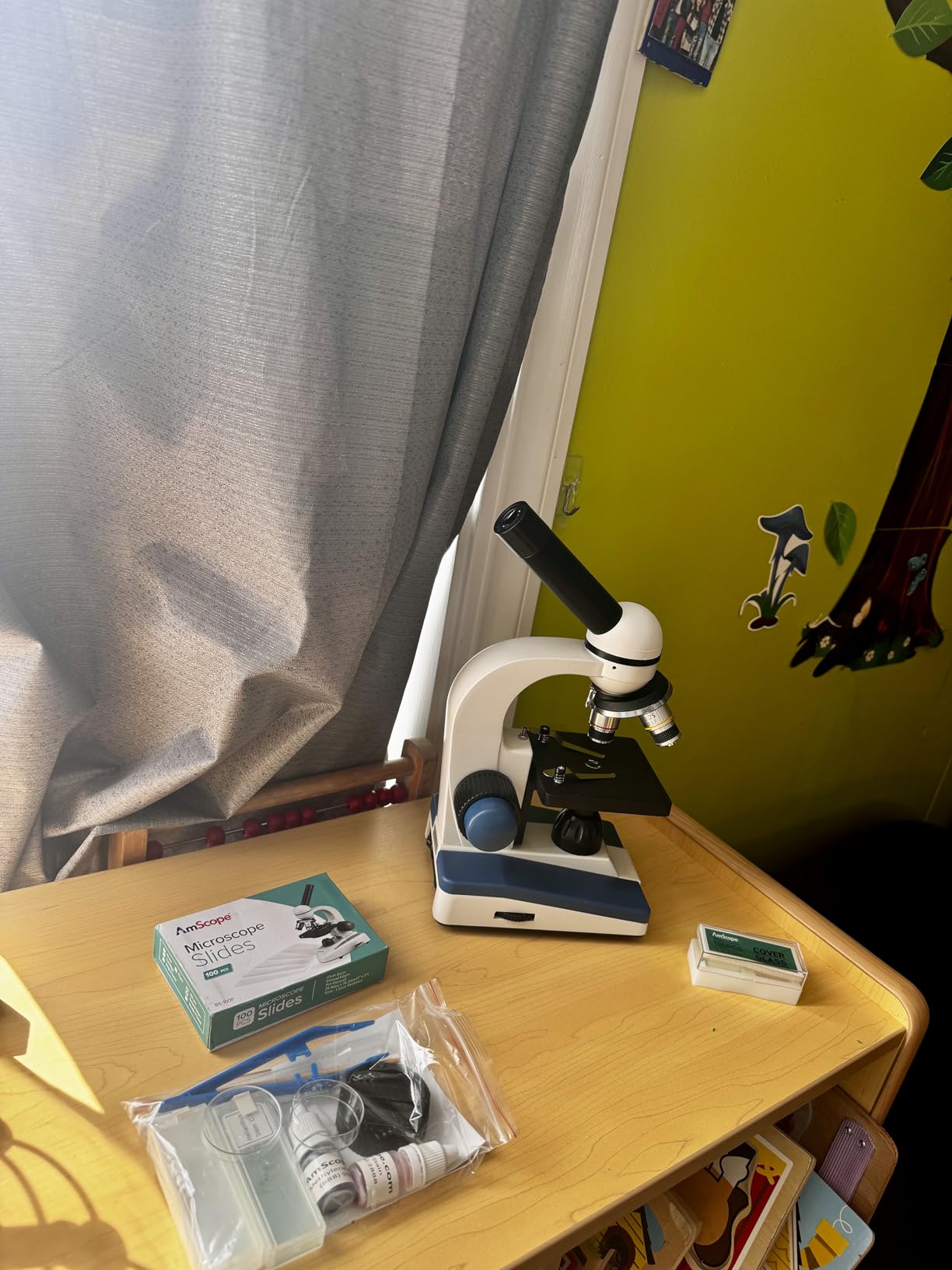
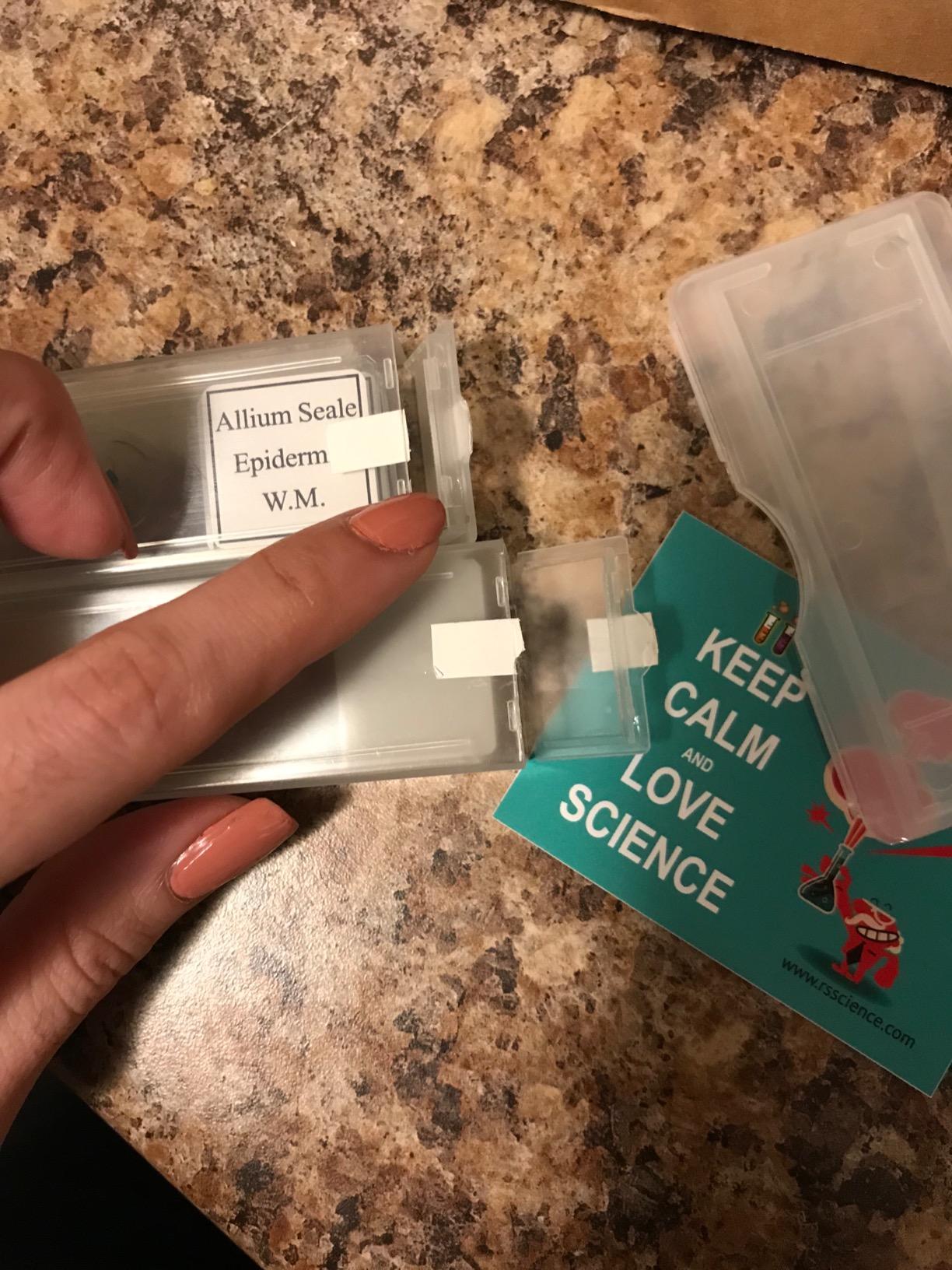
W.M. means whole mount — the entire small organism or structure mounted intact, such as a tiny insect or an onion tip. L.S. means longitudinal section, a cut lengthwise down the length of a specimen, which is how you read a root tip or a stem. C.S. means cross section, a cut across the width. T.S. means transverse section, the same idea as a cross section but usually used for stems and plant organs, where a true circular cut matters. Sm. means smear, a specimen spread thinly across the slide rather than cut — human blood smears and cheek cells are the classic examples.
Sec on a label simply means section, used when a maker wants to avoid committing to cross or longitudinal. If a label also carries a magnification number, that is the objective magnification at which the specimen is worth looking at, not the total magnification of your scope.
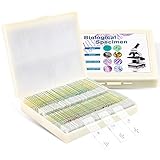
1. DIY-Science 48 Prepared Plastic Slides – Best Overall for Young Students
48 Prepared Microscope Slides Set of Animals Insects Plants Flowers, Biological Learning Resource Specimens for Kids Beginner Classroom Basic Science Education
48 slides
High transparency plastic
Smooth non-toxic edges
Color-coded labels
Pros
- Shatter-safe plastic with smooth edges for young children
- Every slide labeled and paired with a reference picture
- Covers plants insects animals and flowers in one box
- Color coding makes sorting and storage easy
Cons
- Plastic looks blurrier than glass past 400x
- Specimens are small and sometimes lack fine detail
- Cardboard tray tears and will not reclose
This is the set we hand to a child meeting a microscope for the first time. The slides are pre-cleaned high transparency plastic with smooth edges, so there is no cutting risk and no sting from handling a bare slide. Across 5447 reviews the average rating holds at 4.6, and the most common reaction is that adults end up as fascinated as the kids.
Labeling is the quiet strength here. Every slide carries the specimen name and is color-coded, with a matching reference picture, so a first-timer can hold the slide up, match it to a chart, and then find the same thing in the eyepiece. That one extra step is the difference between a fun hour and a lesson.
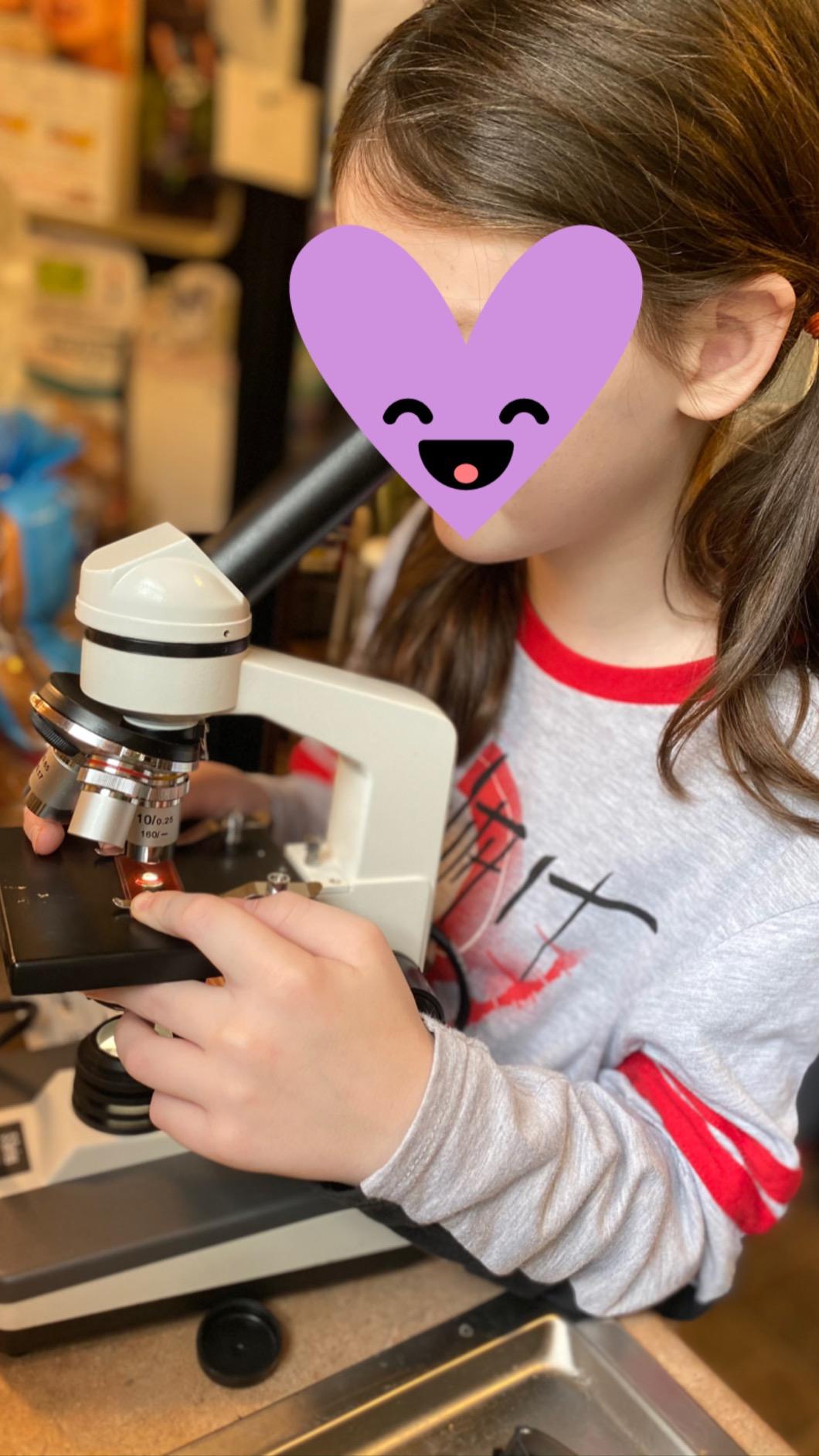
The tradeoff is optical, not structural. Plastic has a lower refractive quality than glass, and past 400x the image softens noticeably — you can see individual plant cells, but not fine internal detail. Specimens are also small, so a beginner may need to hunt for the actual subject on the slide.
Why the plastic choice works under age 10
Safety settles the material debate for young students. A dropped glass slide on a classroom floor is a broken slide, a cut finger and a substitution. The non-toxic, pre-cleaned surface and rounded edges remove the two most common reasons prepared slides get handled roughly.
For students who are still developing fine motor control, the 48-slide count also matters. It lasts a full school year of one slide a week, which is long enough to build a memory shelf rather than a single memorable afternoon.
Where it falls short for older students
Once a curriculum turns to cell division or human histology, plastic resolution becomes the limiting factor. I would start a student on this set for confidence and then move them to a glass set rather than expecting one box to cover a whole biology course.
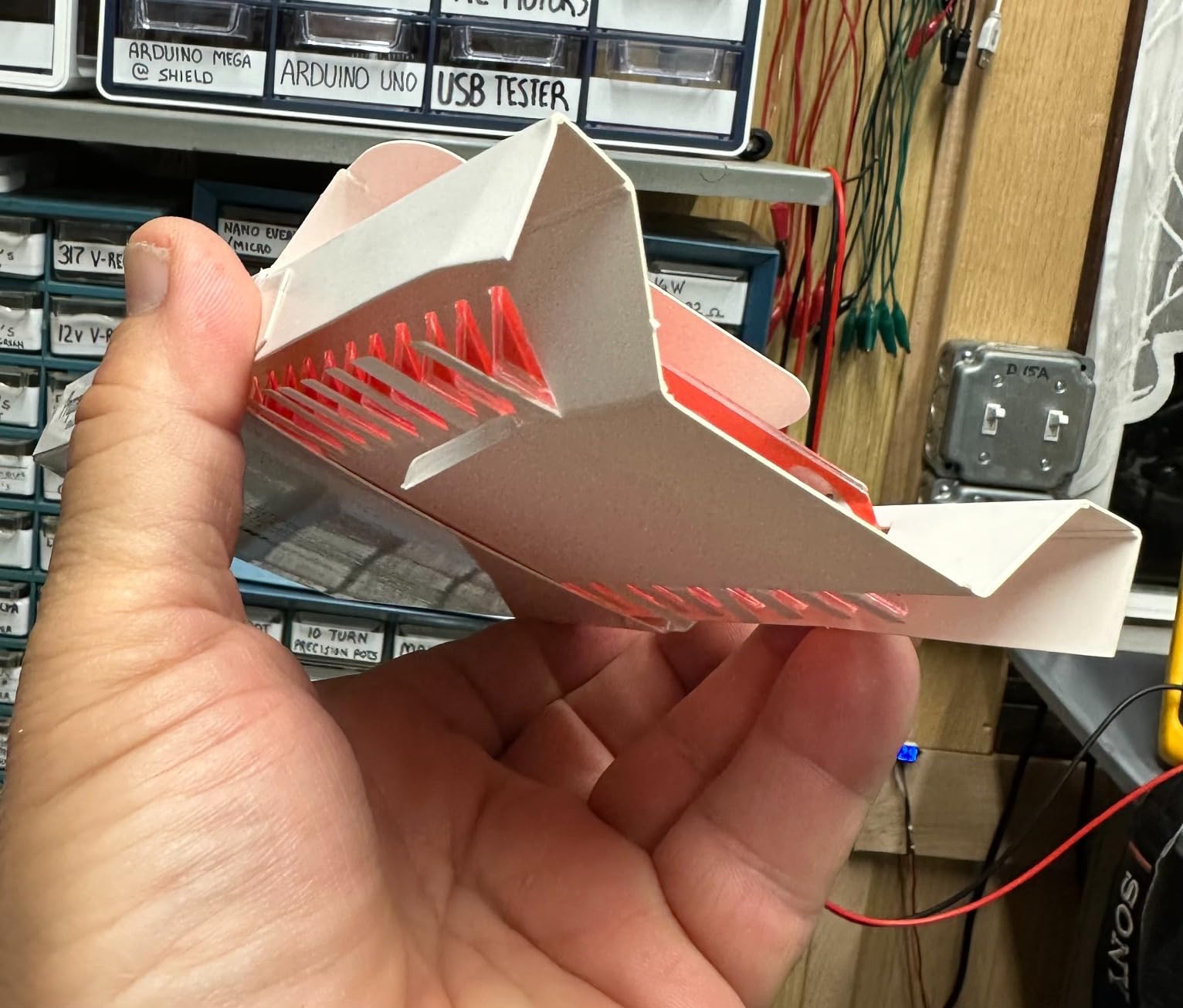
The storage tray is the other weak point. Owners report the cardboard tray tearing and not reclosing, so slides end up loose in a shoebox. Budget for a proper slotted case or a small plastic organizer if you want the set to survive a term.
2. AmScope PS25P Prepared Slides – Best Value for First-Time Buyers
AmScope PS25P Prepared Microscope Slides, Plastic Case, 25pc
25 slides
Standard 1 x 3 inch
Specimen name on each slide
Plastic case included
Pros
- Standard 1 x 3 inch slides fit virtually any student microscope
- Sample name marked clearly on every slide
- Includes a plastic storage box
- Backed by a specialist optics maker using ISO 9001 quality control
Cons
- Only 25 slides
- which runs out inside a term
- Basic plastic case with no individual slots
With 9327 reviews at a 4.6 average, this is the most widely used prepared slide set in the student category, and forum regulars treat AmScope as the benchmark other sets are measured against. It covers plants, fungi, insects and animal tissues in a compact 25-slide box.
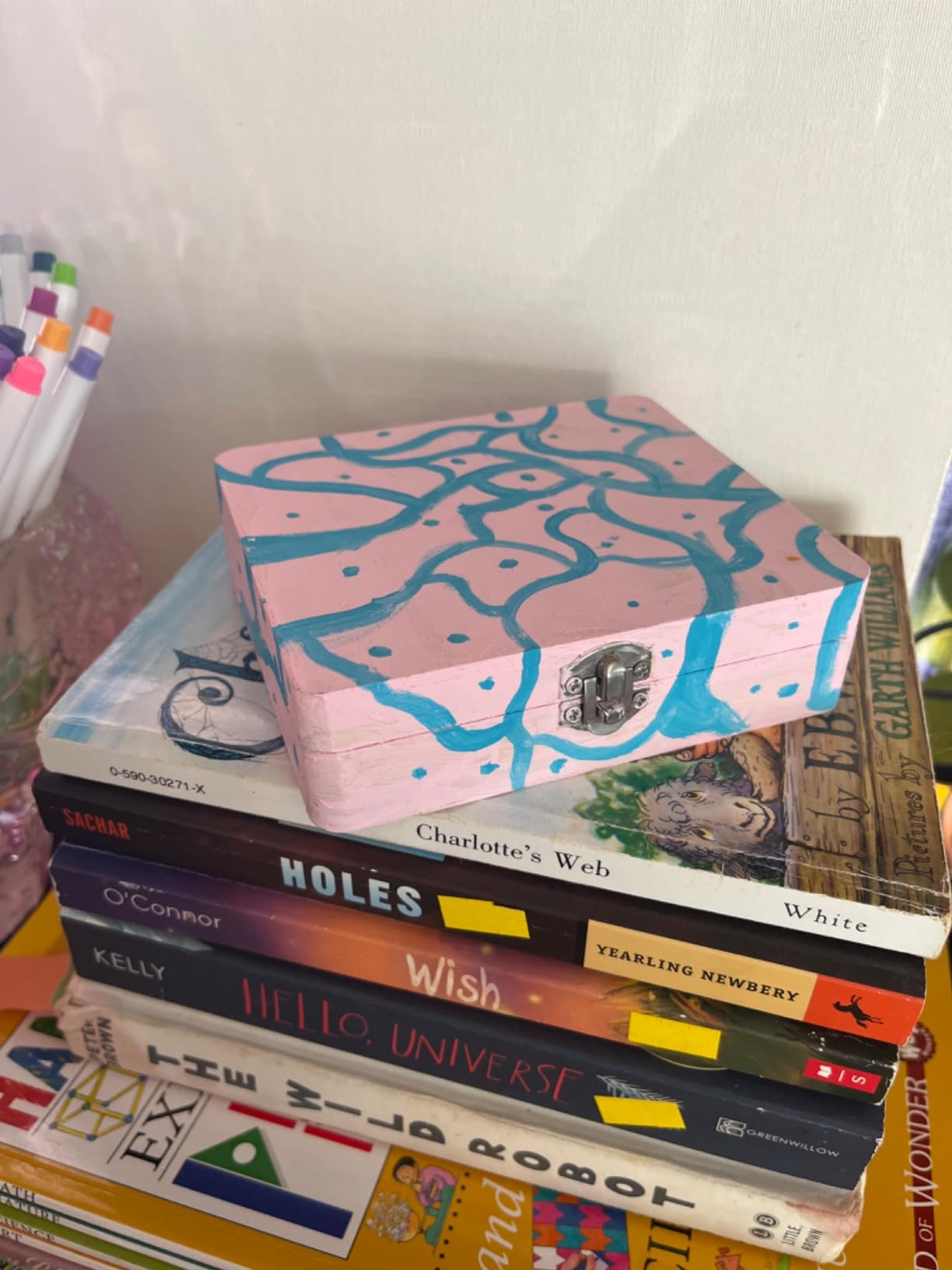
What makes it durable as a purchase is the boring stuff: standard 1 x 3 inch (25mm x 75mm) dimensions, a sample name marked on each slide, and a plastic case that keeps dust off. Nothing about it is exotic, and that is precisely why it works in a mixed-ability classroom.
Standard sizing is the feature that matters most
Every school microscope stage is built around the 1 x 3 inch slide. Because this set uses that exact dimension, slides from different sets, different years and different suppliers all stay interchangeable — a practical win when a shared shelf collects specimens over time.
The sample names printed on the slides also let a teacher build vocabulary drills straight from the box, asking students to name ten specimens from memory rather than reading the label first.
Where 25 slides runs out fast
Twenty-five slides is roughly a term for one student working alone, and a single lesson for a class of twenty. If the set is going into a shared STEM club or a homeschool co-op, plan on buying a second box or pairing it with a larger set from this list.
The included case has no individual slots, so slides lean against each other and pick up smudges. It is fine for transport, less good for long-term storage.
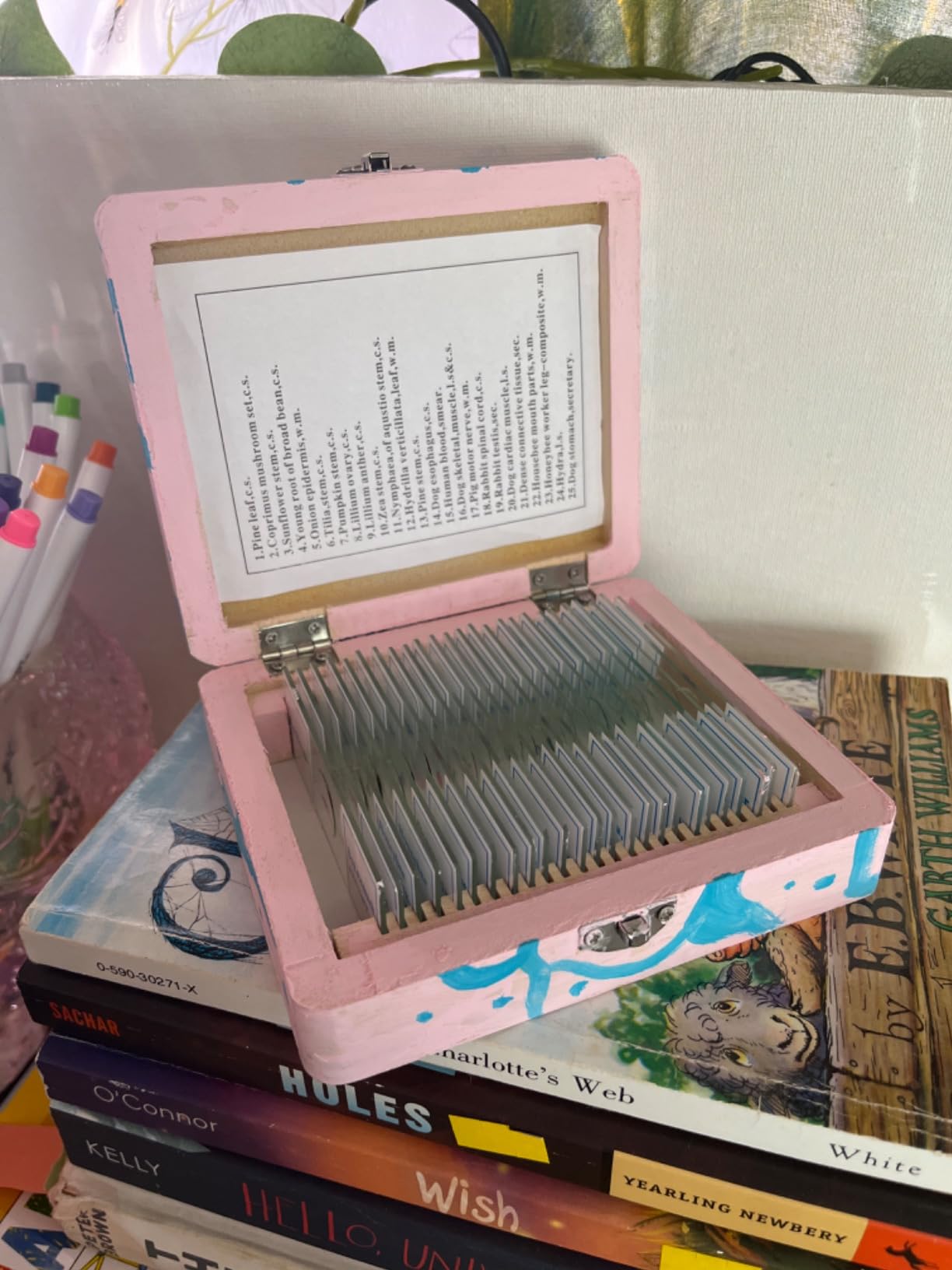
3. Jiusion 60Pcs Prepared Microscope Slides – Best for Pocket and Stereo Microscopes
Jiusion 60Pcs Prepared Microscope Slides Specimen Set for Stereo Microscope
60 slides
60mm x 21mm compact size
Plastic
Five color-coded boxes
Pros
- Five color-coded boxes of 12 slides make sorting easy
- Safe plastic construction avoids breakage for children
- Good variety of plant insect and animal specimens
- Large slide count for the format
Cons
- Slides are smaller than standard and will not fit a standard slide box
- Some samples are hard to see through inexpensive scopes
- Occasional reports of low specimen quality
Sixty slides in five color-coded boxes of twelve is a genuinely good organizational idea, and parents pairing this with a budget or pocket microscope tend to be happy with it. The 4.5 average across 4315 reviews reflects broad satisfaction with variety and organization, minus one recurring complaint.
That complaint is size. Each slide measures 60mm x 21mm rather than the standard 1 x 3 inch, a compact format designed for stereo, pocket and travel scopes. It will not sit on a standard classroom stage without an adapter, and it will not drop into a standard slide box.

Why the compact size is an advantage, not a defect
If your microscope is a handheld or tabletop stereo model with a small stage, these slides are the correct choice and standard ones would overhang. For families starting out with a cheap scope, that is a real match rather than a compromise.
Pre-cleaned plastic with smooth, non-sharp edges keeps the set appropriate for children, and the color-coded boxes make it easy to give each sibling their own group of specimens.
Check your stage before you buy
Before buying, measure the stage plate on your scope or look up its slide size in the manual. If it accepts 1 x 3 inch slides, this set will sit awkwardly; if the scope advertises small or short slides, it is ideal. We have seen the mistake in both directions on classroom shelves.
Sample quality varies a little slide to slide, and inexpensive scopes struggle to resolve the smaller specimens, so check a few slides on arrival before committing the whole set to a unit of study.
4. LAKWAR 30 Prepared Glass Slides – Top Rated for Standard Glass Clarity
30 Microscope Slides with Specimens for Kids, Prepared Microscope Slides for Kids Microbiology, Glass Slides for Microscope, Biology Gifts for Adults Kids
30 slides
Standard 1 x 3 inch glass
Sorting table included
1 year warranty
Pros
- Highest average rating in the group at 4.7 with a wide five-star share
- Standard 25mm x 75mm glass works with any student microscope
- Sorting table turns the set into a classification exercise
- Broad coverage of bacteria fungi plant organs and mammal tissue
Cons
- Only 30 slides
- smaller than the 60 and 120 piece options
- Glass needs careful handling around younger children
Among all twelve sets we looked at, this one carries the highest average rating at 4.7 with 1775 reviews and very few complaints raised. It is the set we recommend for a student moving from plastic to glass, because it keeps the topic range broad while the material steps up.
Thirty prepared glass slides at standard 1 x 3 inch dimensions cover bacteria, fungi, plant organs, mammal animal tissue, cells and insect parts. Each slide is marked with the specimen name, and a printed table is attached so the set doubles as a classification exercise rather than a box of anonymous glass.
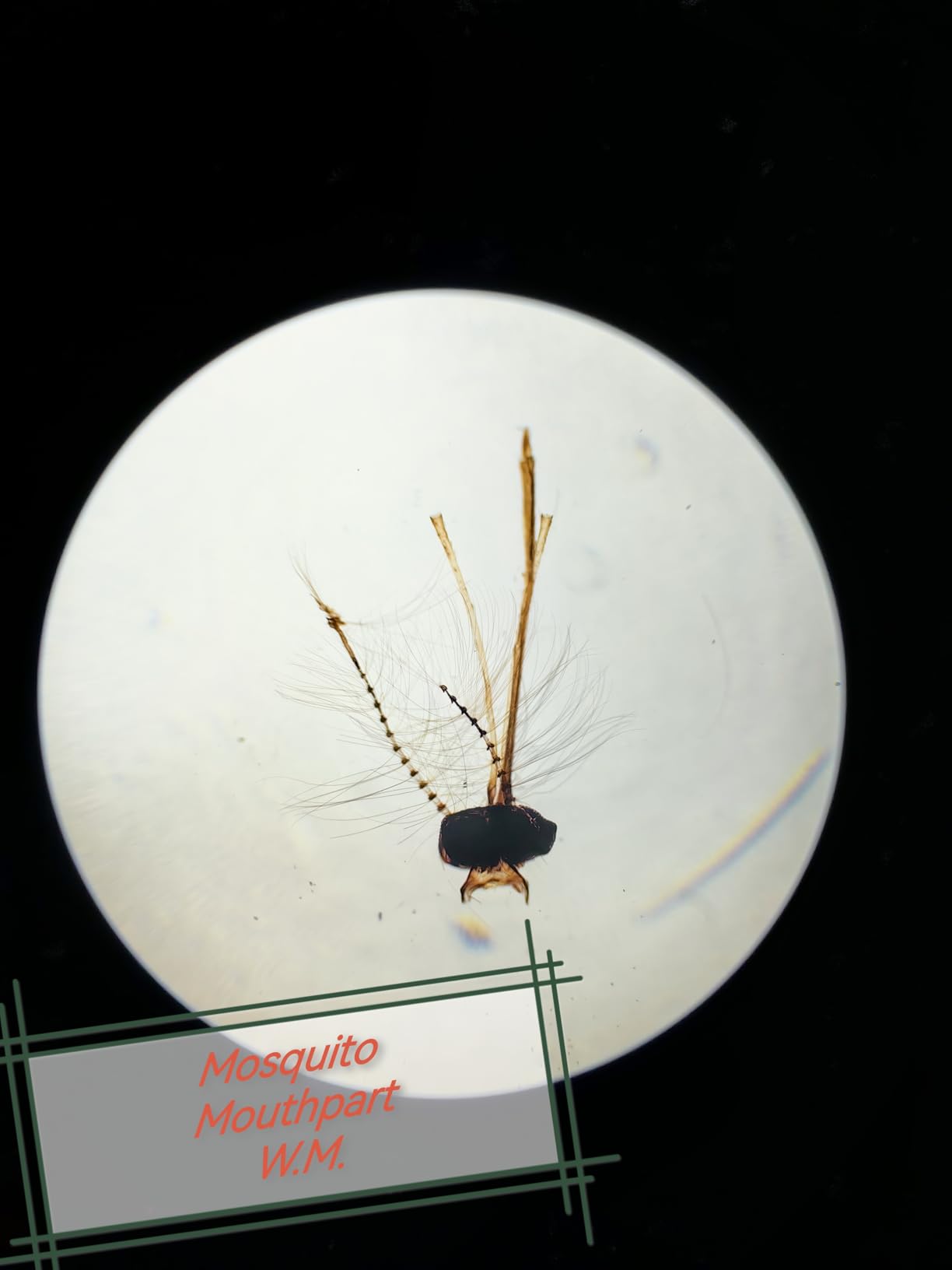
Glass resolution at 400x and beyond
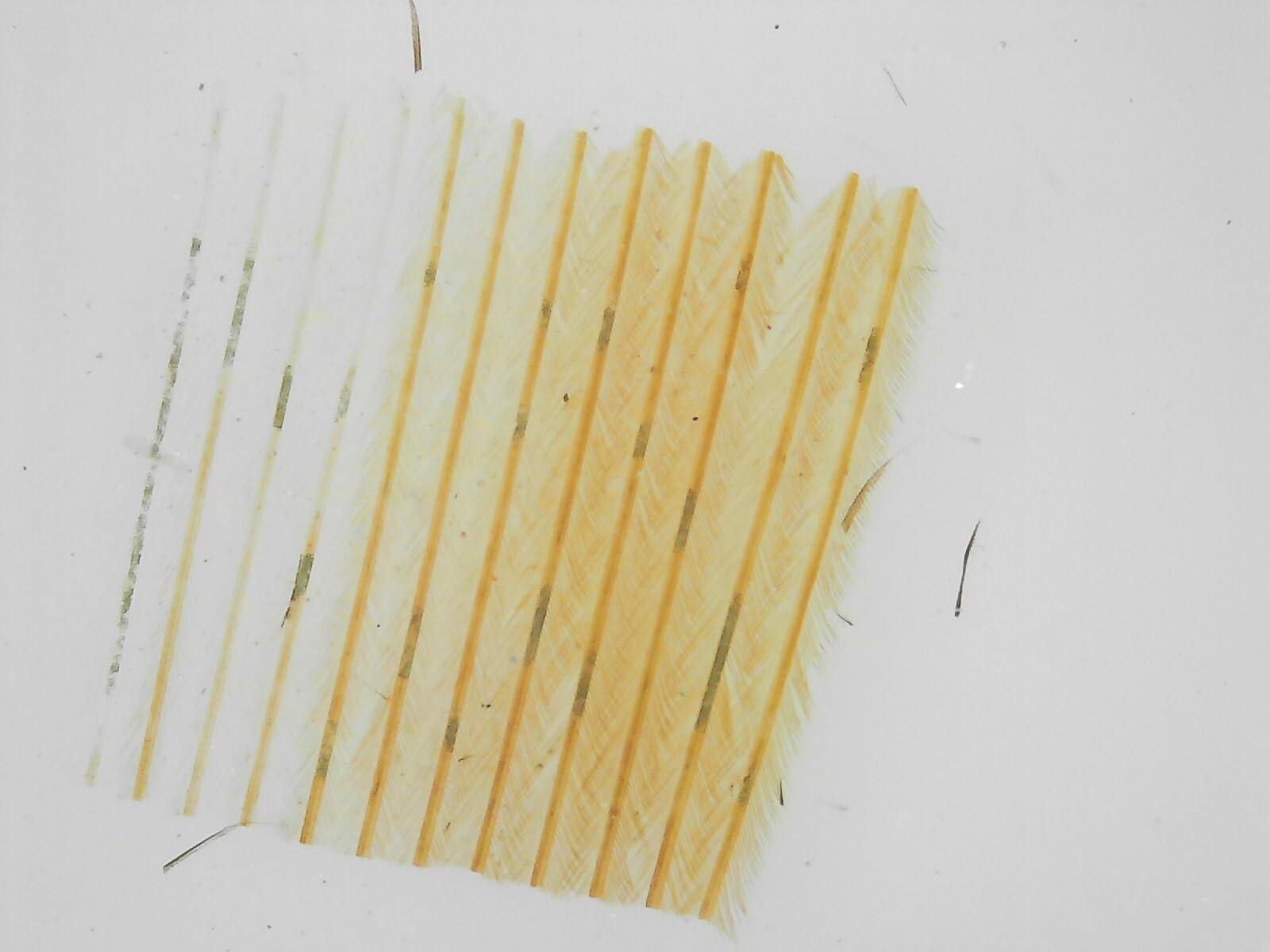
Optical glass gives a sharper, higher-contrast image than plastic, and at 400x the difference is obvious on cell walls, feathers and thin plant tissue. Students doing detailed work like counting stomata or examining blood smears get far more usable detail on this material.
The slides also arrive in a proper case with a specimen list and a cleaning cloth, which sounds minor until you try to reorganize sixty loose glass rectangles on a kitchen table.
Handling guidance for a shared set
Glass changes the supervision conversation. A one-year warranty covers manufacturing defects, but it does not cover a slide dropped by a seven-year-old, so this set is a better fit from about age 8 upward. Teach the two-hand grip — slide in one hand, forceps in the other — before the first lab session.
Thirty slides is also a smaller box than some competitors, so check how many labs per term you need. Two slides per session covers about a full term of weekly work.
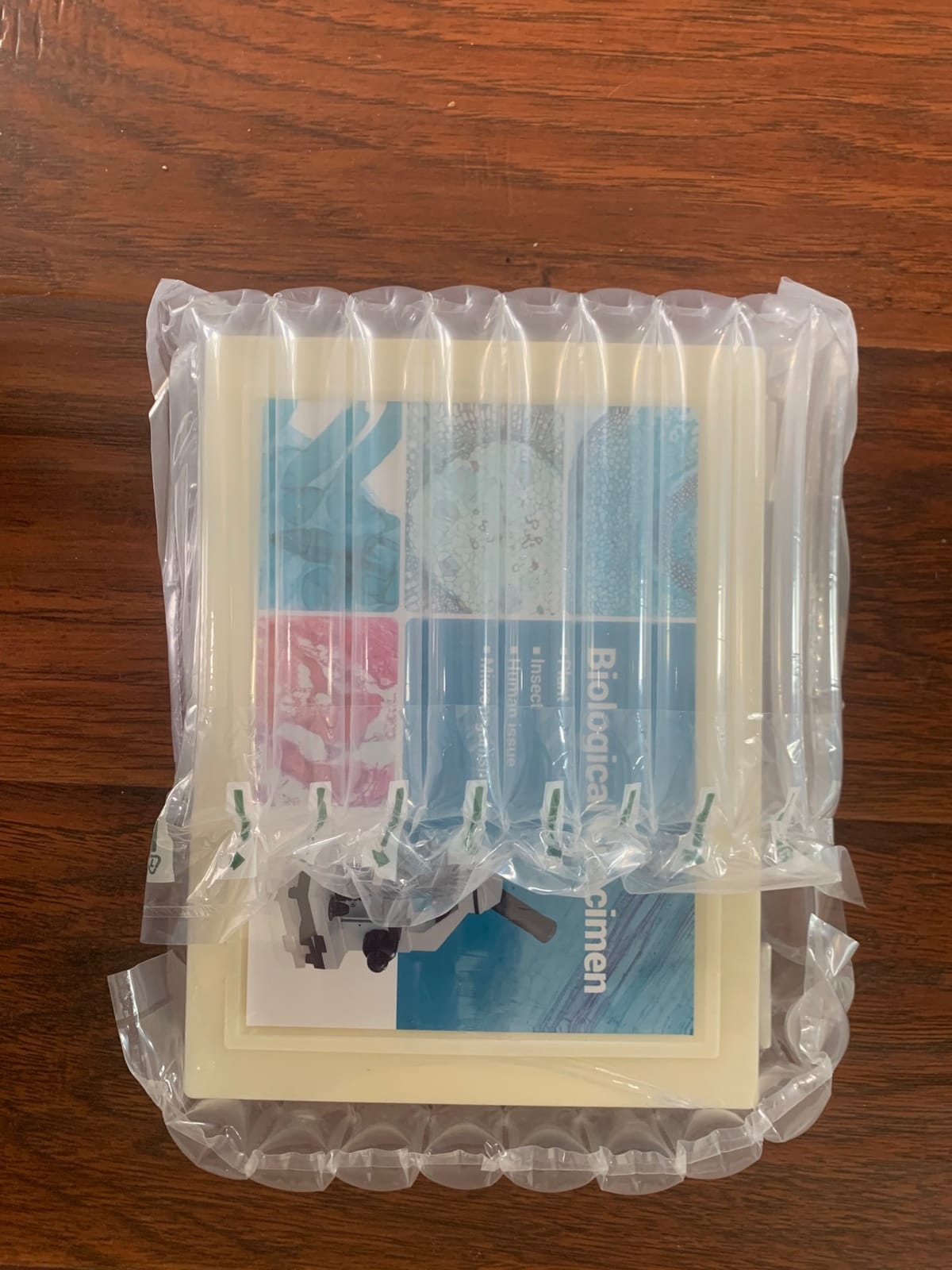
5. AmScope SP-14 Slide Preparation Kit – Best for Making Your Own Slides
AmScope SP-14 Microscope Slide Preparation Kit – Includes Blank
22-piece kit
Eosin red and methylene blue
Blank slides and cover slips
Five reference slides
Pros
- Both eosin red and methylene blue stain powders included
- Complete tool set with tweezers swabs and droppers
- Five prepared slides for comparing against your own
- Well suited to classroom demonstration
Cons
- Stain powders arrive clumped and are hard to mix
- Cover slips sometimes stick together and leave residue
- No instructions on how much liquid to add to the powders
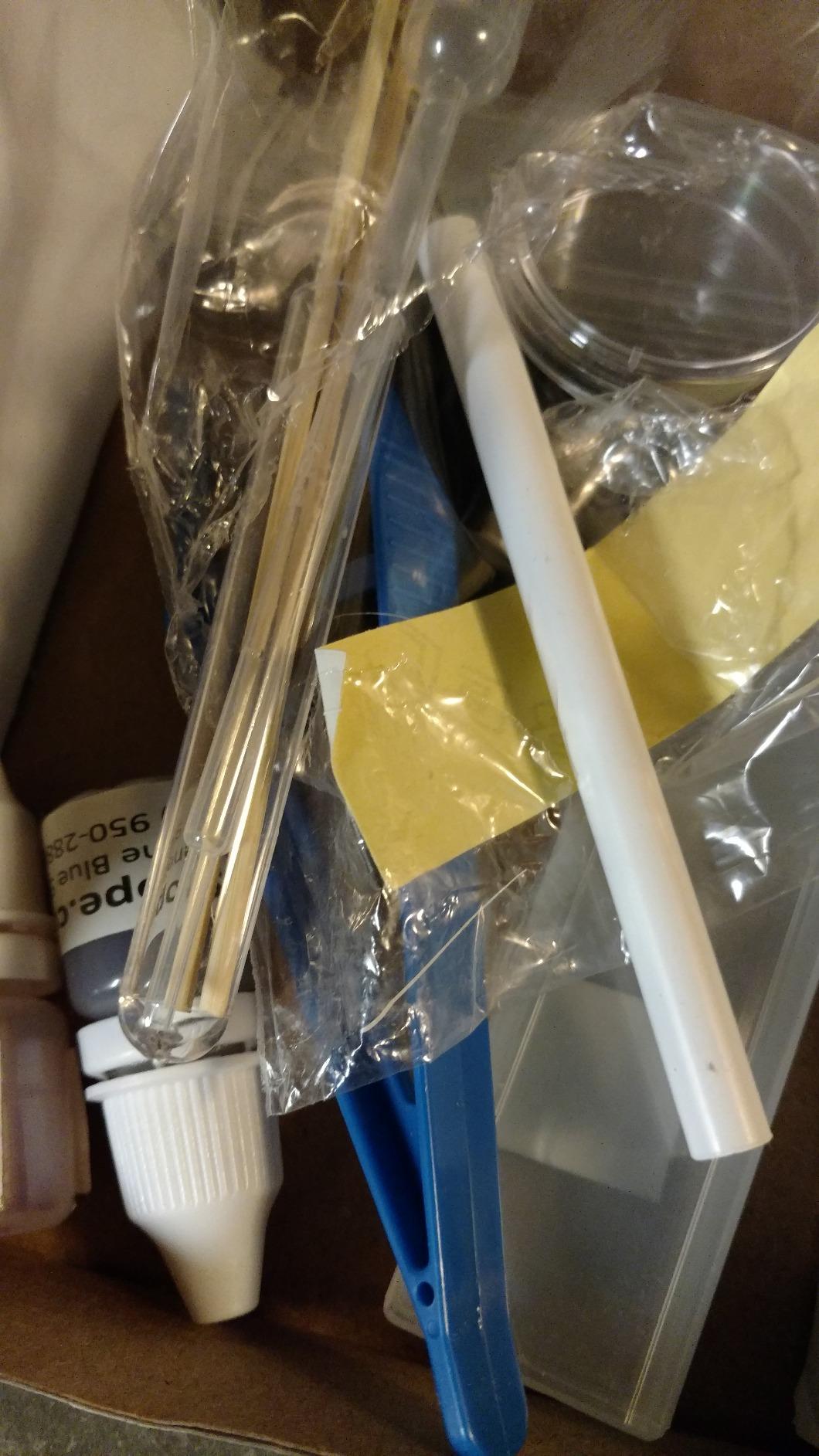
Prepared slides teach recognition; a preparation kit teaches technique. This 22-piece AmScope kit is the second half of a proper lab setup, holding eosin red and methylene blue stain powders, tweezers, a swab, five blank slides, cover slips, ID stickers, droppers and five prepared slides for reference.
That last detail matters. Having five professionally prepared slides next to your own wet mounts lets a student compare a homemade cheek cell or onion skin against a known-good example, which is how you find out whether the problem is the specimen or the technique.
Working with eosin and methylene blue
Methylene blue stains nuclei and bacteria clearly, which is why it is the first stain most teachers hand out. Eosin red brings out cytoplasm and connective tissue detail, and pairing the two on cheek cells gives instantly recognizable results under a classroom scope.
One practical warning: the powders arrive clumped, and a certified histology reviewer we consulted called that the kit’s main quality miss. Break the clumps with the tip of a clean tool before mixing, and label the bottle the moment you mix it.
What the kit does not tell you
There are no instructions on how much liquid to add to the powders, so a first-time mixer will either under-dilute and stain everything black or over-dilute and see nothing. Write the ratios on the bottle lid and keep them for the next student.
Cover slips can arrive stuck together and leave residue on the slide, so separate them gently before class. This kit complements a prepared set rather than replacing one.
6. Rs’ Science All-in-One Slide Preparation Kit – Best for Building Real Lab Technique
Rs’ Science All-in-One Microscope Slide Preparation Kit, 40 Pieces
40+ pieces
Pre-mixed stains in dropper bottles
Handheld microtome
Lens papers and gloves
Pros
- Ready-to-use liquid stains instead of powders to mix
- Handheld microtome and dissecting needle teach real technique
- Manual includes a color guide and ten mini-projects
- Works for elementary classrooms and homeschool families
Cons
- Plastic pipettes and cover slips are flimsy
- Plastic cover slips absorb stain and are hard to reuse
- Some orders arrived with items missing
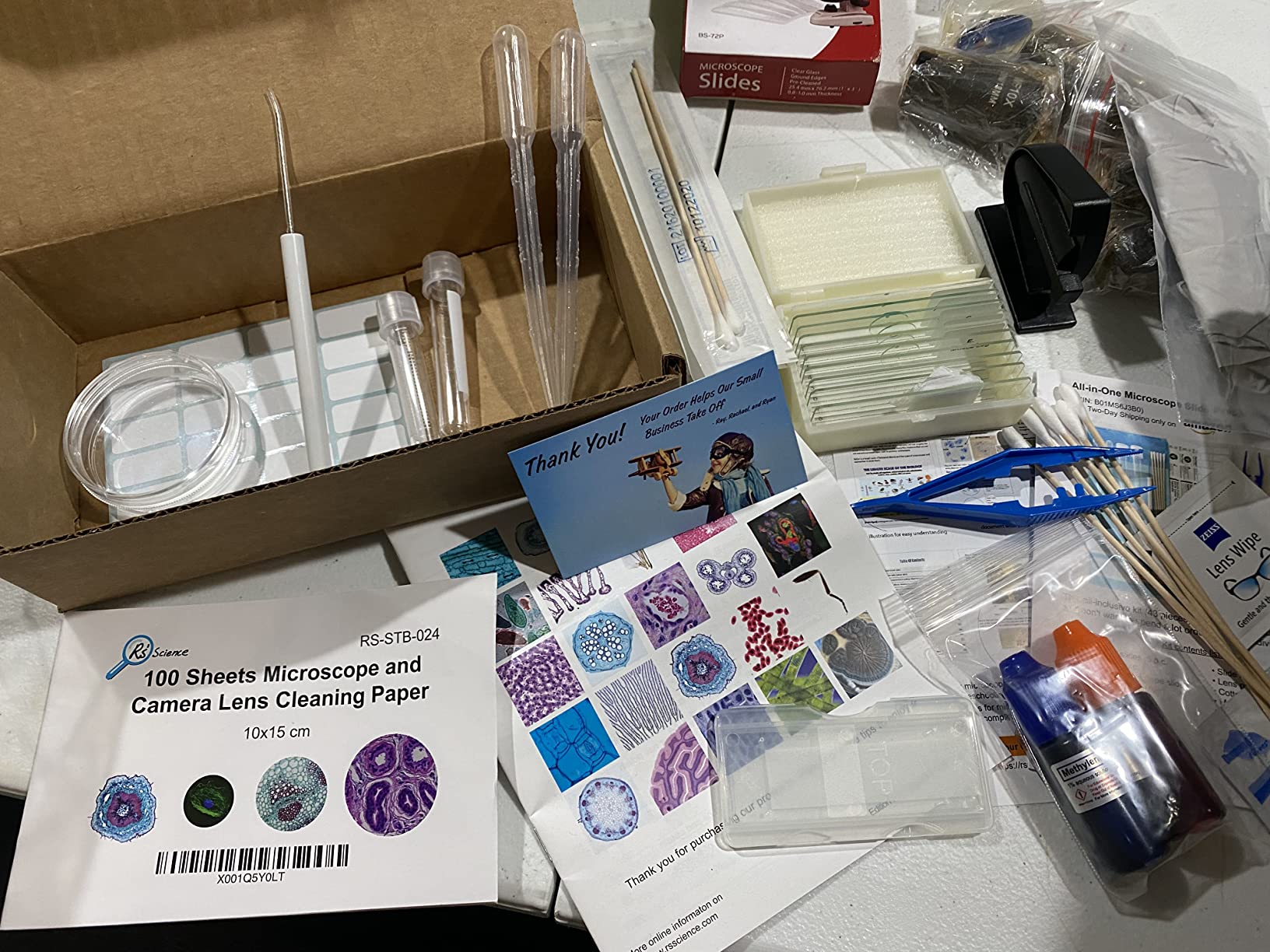
Where the AmScope kit hands you powders, this one hands you ready-to-use stains. Methylene blue and eosin Y arrive in squeezable dropper bottles, which removes the single hardest step for a student: mixing a stain correctly. Educators describe the kit as thorough and genuinely instructive rather than an accessory bundle.
It also carries a handheld microtome and a dissecting needle, real technique-building tools. A student who can cut a thin section has learned something a prepared slide can never teach, and the included manual adds a step-by-step color guide and ten mini-projects.
Why the microtome changes what a student can do
A microtome is a small plastic device that slices a specimen into thin sections you can mount and view. It is how a student sees a plant stem cross section they cut themselves, which is the single most cited success story among teachers using this kit, often with a pond water sample once methylene blue goes on.
That combination — pre-mixed dye plus a cutter — is why we would build a full middle school lab around this kit rather than assembling tools individually.
Support accessories and known weak points
The kit includes an absorbent pad, petri dish, lens papers, cotton-tipped applicators and gloves, which is unusually complete for a school budget. The remaining weak points are mechanical: flimsy plastic pipettes and cover slips, and plastic cover slips that permanently absorb stain and are hard to reuse. Some orders also arrive with items missing, so inventory the kit on day one.
7. USCAMEL 100 Prepared Microscope Slides – Best for Cell Division and Mitosis Work
100 Prepared Microscope Slides with Specimens for Kids Adults – Bacterium, Fungus, Human Tissues, Mitosis, Plants, Insects, Animals Cells Samples for Biological Science Lab, School Students
100 slides
Optical glass
Includes mitosis and meiosis
Numbered holder slots
Pros
- 100 specimens spanning bacteria fungi human tissue and animal cells
- Includes mitotic and meiotic cell division stages
- Samples are numbered and matched to holder slots
- Bubble wrap and foam packaging prevents transit breakage
Cons
- Some slides arrive empty or poorly made
- Some slides show smudging
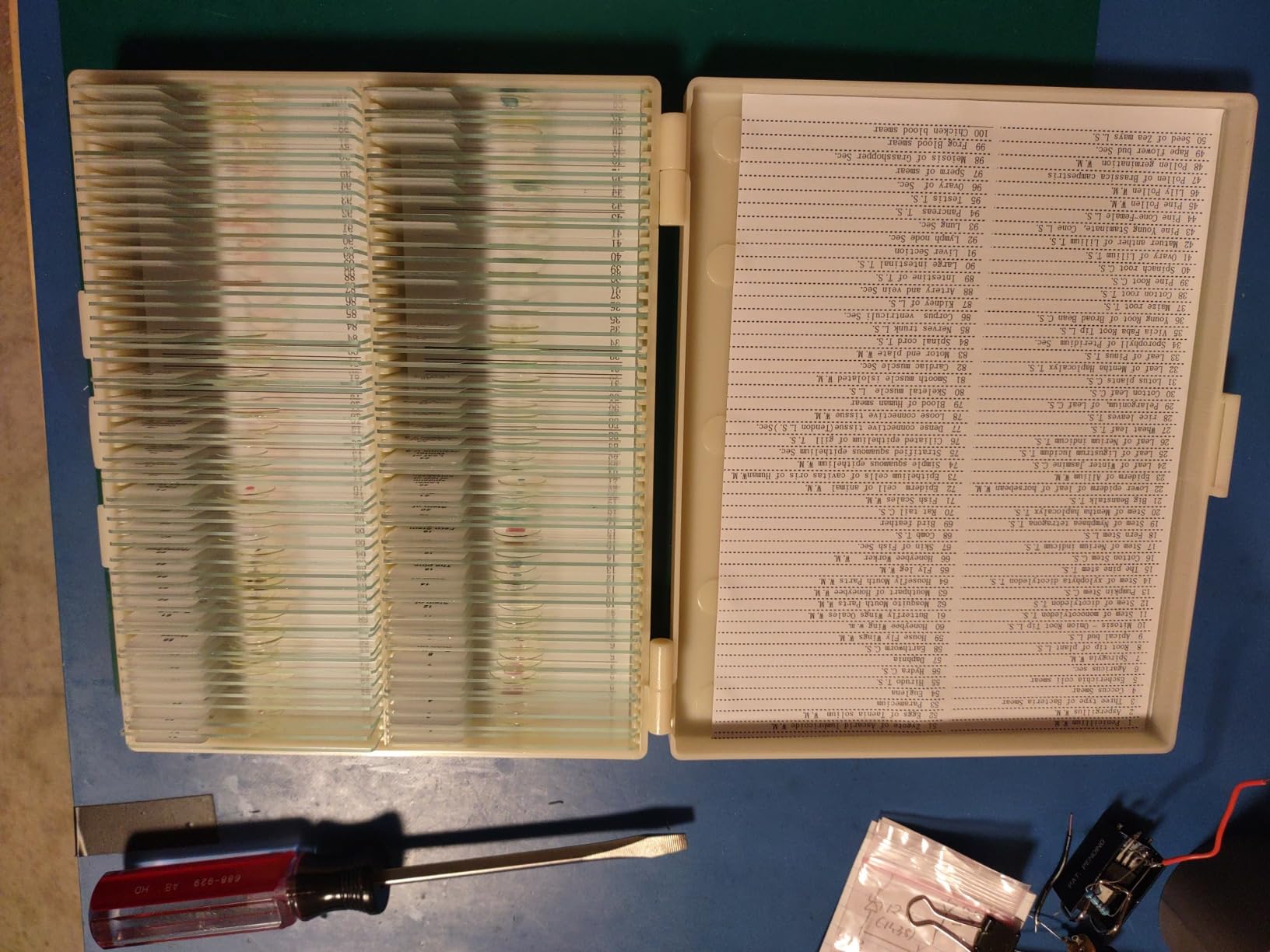
- Box clasp is difficult to open without a screwdriver
Most sets in this category are built for recognition, not for a specific unit. This one is different: it includes mitotic and meiotic cell division stages, which are the slides a high school biology curriculum actually asks a student to find and label. That single feature separates it from everything else on this list.
One hundred prepared optical glass slides cover bacterium, fungus, human tissues, plant structures, insect anatomy and animal cells, with a reference catalog to identify each specimen. Slides and holder slots are numbered, so a lab can assign slide 47 to student 3 without shuffling glass around.
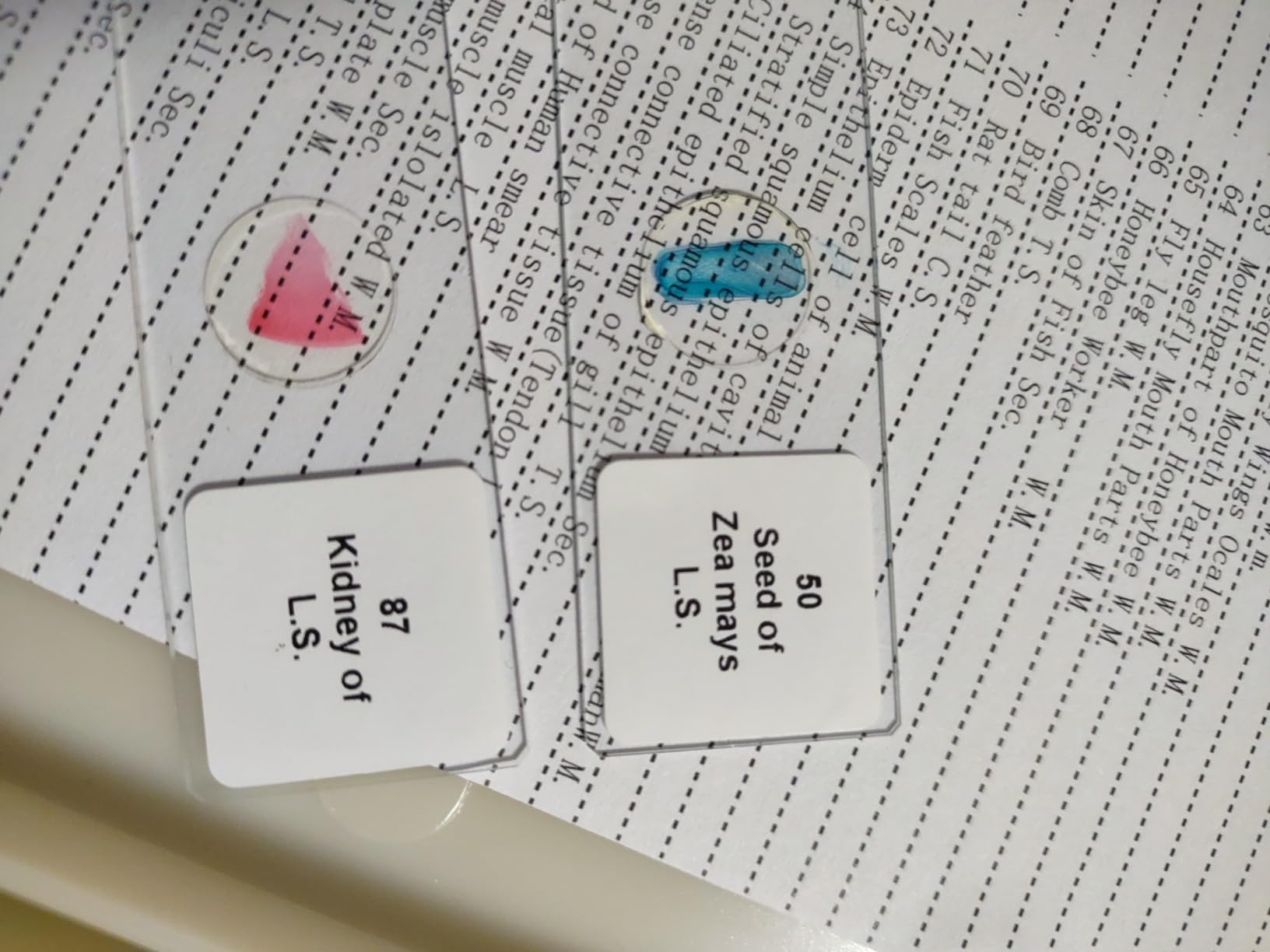
Magnification for cell division stages
Cell division stages need real resolution. Under 100x a mitotic cell is a smudge; at 400x you can see chromosomes beginning to separate, which is the moment the unit clicks. Optical glass is what makes that magnification worth doing, since plastic softens the edges of the condensed chromosomes.
Homeschool families and photographers rate the set highly for variety and value, describing it as classroom quality.
Inspect every slide in week one
The most repeated negative theme is inconsistent quality within the set: some slides arrive empty or smudged. This is exactly the case where arrival inspection pays off. Lay out all 100 slides, check each against the catalog, and photograph any defects in the first week so a replacement claim has evidence behind it — a good reason to keep an inexpensive camera body on hand, as covered in our student DSLR camera guide.
Also plan a tool for the box clasp, which several owners report needs a screwdriver, and keep a lens wipe on hand because slides can arrive dusty from the foam packaging.
8. OOZSTAR 120 Microscope Slides – Best Specimen Variety for Long Study Sessions
OOZSTAR 120 Microscope Slides with Specimens, Plant, Insect, Animal, Algae Slide Set for Biological Science Laboratory Basic Biological Science Education
120 slides
Standard 25mm x 75mm glass
Polished rounded edges
Over 30 specimen types
Pros
- Very large specimen count with clearly labeled slides
- High transparency glass with rounded non-sharp edges
- Algae and mammalian tissue included beyond typical student sets
- Reviewers report it sustains hours of exploration
Cons
- Slides sit very close together so tweezers are needed
- Some slides show fingerprints
- Slide abbreviations are not explained without outside lookup
At 4.7 average, this is one of the highest-rated sets in the group, and reviewers describe it as excellent value for the number of specimens. More than 30 specimen types cover plants, algae, mammalian tissues, cells and insect parts — algae and mammalian tissue together are unusual in a student set at this level.
The slides are standard 25mm x 75mm and described as sturdy and thick, so they fit a standard stage and survive being handled repeatedly. Edges are carefully polished rather than sharp, which reduces the cut risk that normally comes with glass.
Algae and mammalian tissue widen the curriculum reach
Algae samples give you filamentous and colonial forms that school botany units ask for and that most student sets skip entirely. Mammalian tissue sections let a middle schooler move from plant cells to animal cells on the same shelf, which keeps a growing student from needing a second set mid-year.
At 120 slides, this is a set that supports a whole year of weekly observation without repeating a specimen.
Tight case spacing and unexplained labels
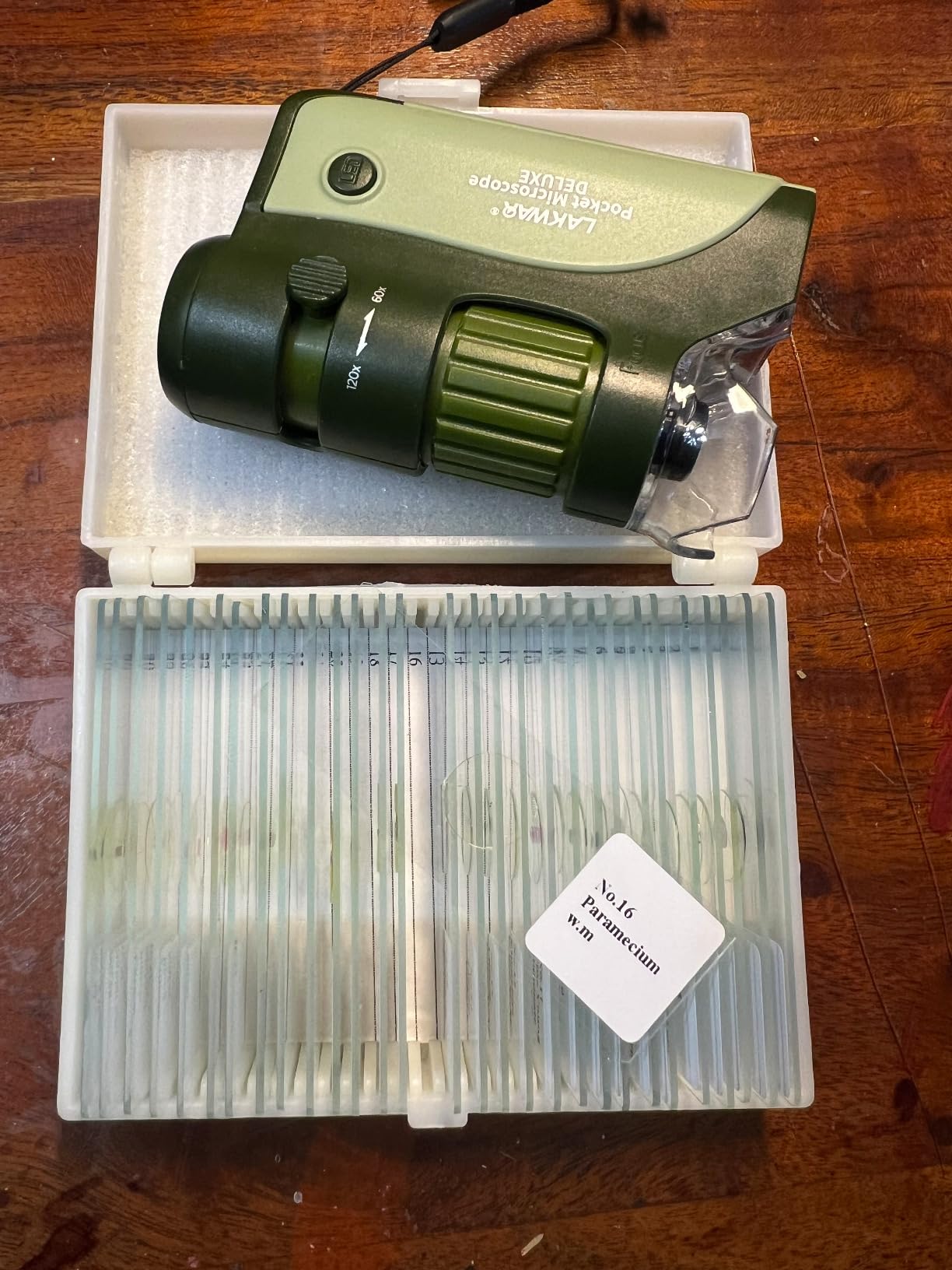
Two practical notes from owners. First, the slides sit very close together in the case, so a pair of plastic tweezers is effectively required — students should never try to lever glass out with a fingernail, which is the most common breakage cause we hear about. Second, some slide abbreviations are not explained in the box, so pair this set with the glossary above.
Some slides also arrive with fingerprints, so wipe the slide and the lens before the first look.
9. PALOBIL 60 Prepared Glass Slides – Best for Middle School Classrooms
60 Microscope Slides with Specimens,Prepared Microscope Slides for Kids,Glass Slides for Microscope,Prepared Slides for Kids Microscope,Microscope Slide Preparation Kit for Biology Science Classes
60 slides
Standard 1 x 3 inch glass
Catalog-matched labels
Chamfered edges
Pros
- Sturdy glass slides that survive being dropped
- Polished non-sharp edges make them safe to handle
- Teachers report students can pick their own specimens
- Double-layer bubble wrap protects against transit breakage
Cons
- Slides are packed very tight with no visible numbering
- Some specimens are poorly prepared or missing
- Small specimen diameter limits some subjects
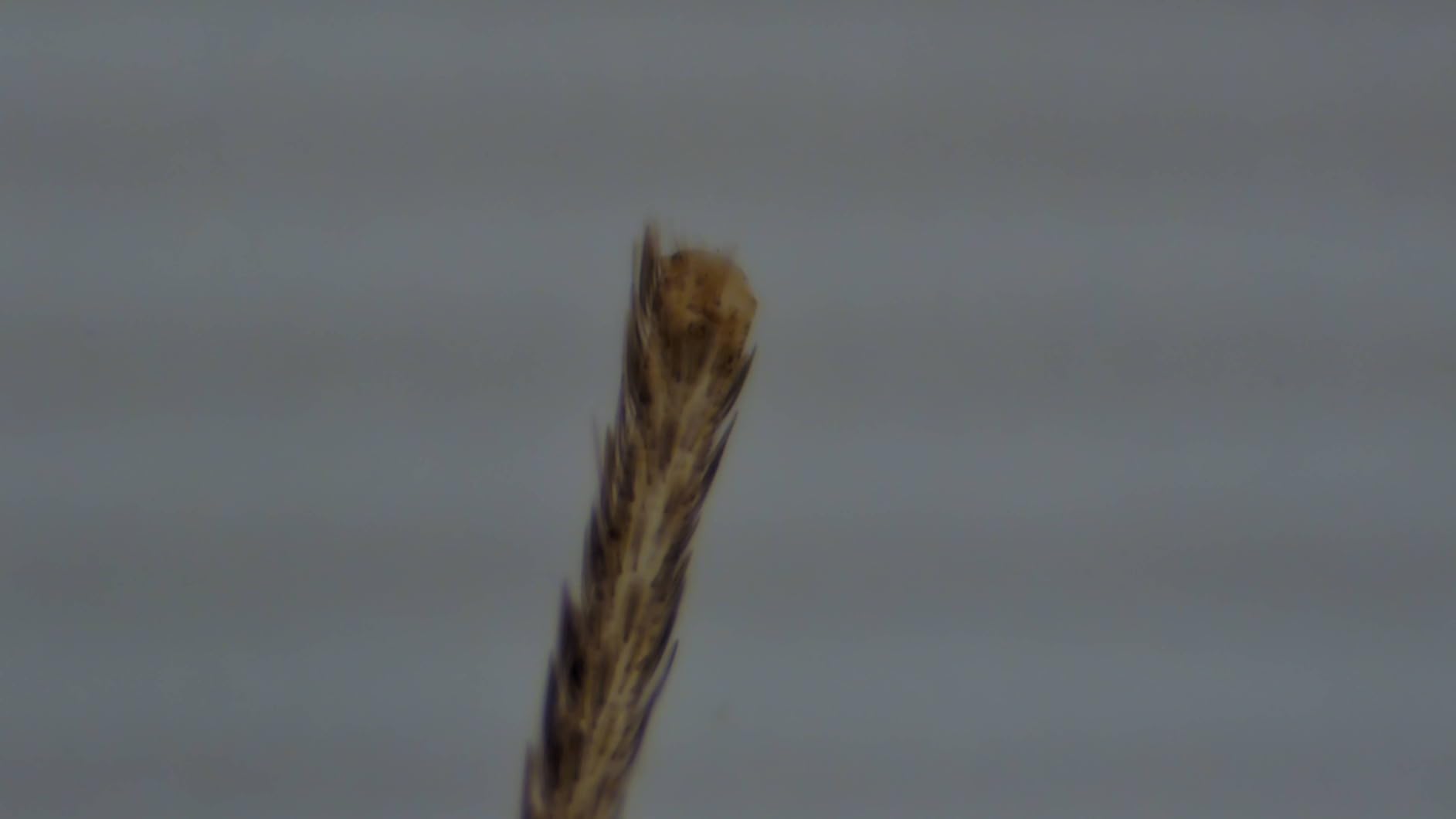
Sixty standard 1 x 3 inch optical glass slides covering bacteria, fungi, algae, plant organs, mammal animal tissue, cells and insect parts. Each slide is labeled and matched one-to-one to an attached catalog, and the edges are chamfered and polished so they are not sharp.
Durability is where this set earns its classroom reputation. Reviewers report the slides surviving a drop onto concrete, and the double-layer bubble wrap packaging protects them in transit. For a room of twenty students pulling glass in and out all term, that resilience matters more than a higher resolution image.
Free-choice specimen selection works for exploratory labs
Classroom teachers using this set report that students can choose their own specimens, which turns a lecture-driven microscopy lab into an inquiry one. The catalog makes that possible: a student can read the list, pick a target, and find it in the box without an adult fetching it.
Sixty slides is a sensible class quantity — three per student for a group of twenty, or one per student across two terms with a partner.
Finding a specific specimen takes time
The most repeated complaint is packing. The slides sit very tight in the case with no visible numbering, so locating a specific specimen means going through all sixty. If your lab requires a particular slide on a particular day, pull it in advance rather than on the clock.
Occasionally specimens are poorly prepared or missing, and the small slide diameter limits some subjects. Note the choking hazard notice for small parts and keep the set away from children under 3.
10. Prolee 200 Packs Microscope Slides – Best for Shared Shelves and Long Seasons
Prolee 200 Packs Microscope Slides, 100 Plants & 100 Animal Tissues Includes Labels and Case for Biological Science Education
200 slides
100 plant and 100 animal
Optical glass at 1 x 3 inch
3.63 pounds
Pros
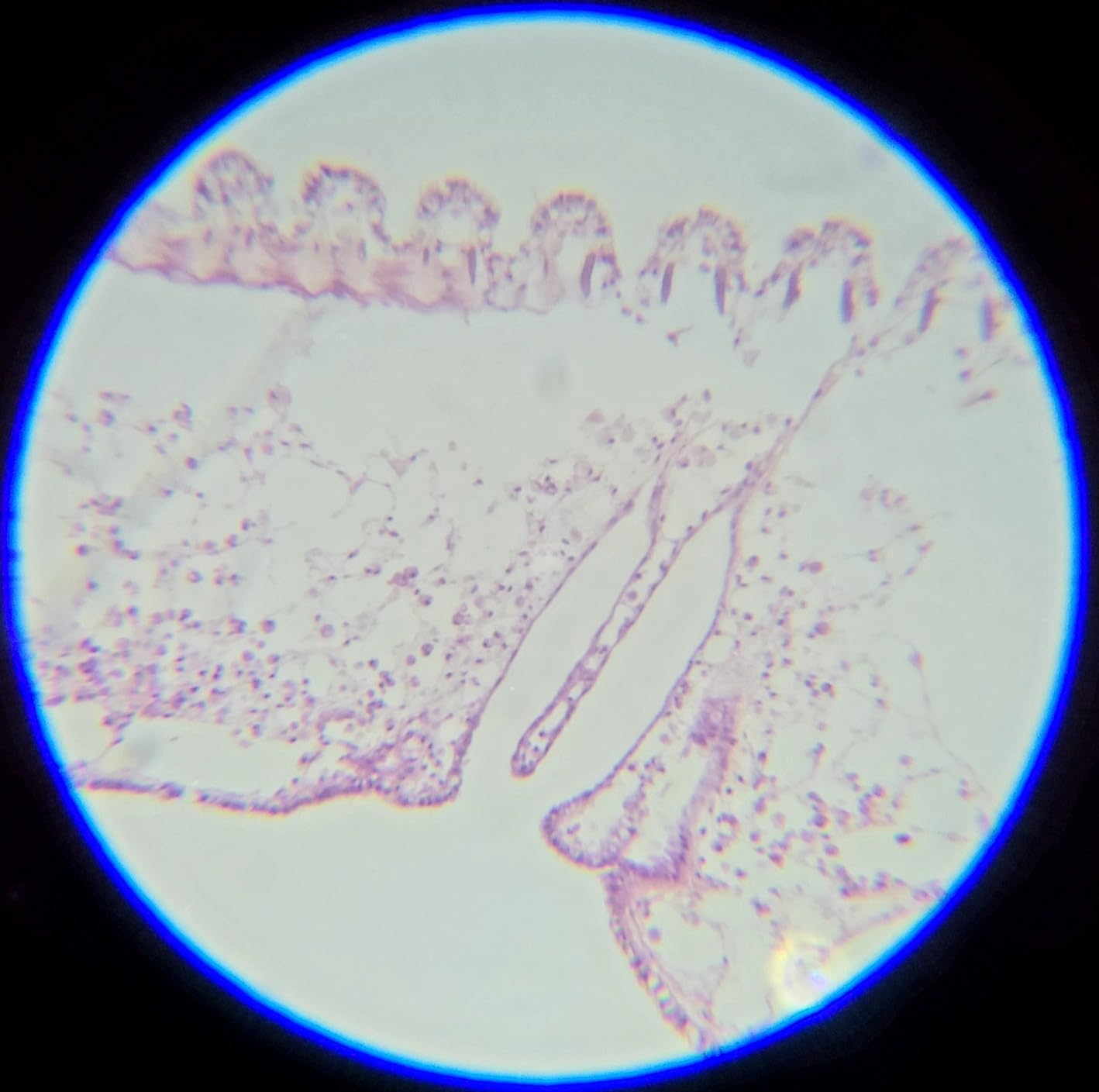
- Largest specimen count in the student slide category
- Balanced split between plant and animal tissue slides
- Multi-layer sponge and box packaging resists shattering
- Specimen list and labels make slides searchable
Cons
- Bulky and heavy package at 3.63 pounds
- Shortest review history among the top-rated sets
Two hundred prepared slides is a different order of purchase. This is a set for a classroom, a lab or a homeschool family with several students, where one slide per person per week is the usage pattern. The 4.7 average comes from a smaller review pool, so treat it as promising rather than proven.
The structure is the point: 100 plant structure slides and 100 animal tissue and insect slides, in highly transparent optical glass at standard 1 x 3 inch dimensions with rounded edges. A specimen list and labels keep the collection searchable, which is what makes a set this large usable rather than overwhelming.
When a 200-slide set pays for itself
The maths is simple. A 30-slide set lasts one student about a term; a 200-slide set covers a class, or four students for a full year, or one family for several years with room to pass it down. Buying once and storing flat beats replacing two smaller sets every term.
Because the split is plant versus animal, it maps cleanly onto a standard biology year: botany and cell structure first, then zoology and tissue systems.
Storage, weight and what to expect
At 3.63 pounds and 9.72 x 8.54 x 3.9 inches, this is a bulky package — plan shelf space before ordering, and store it flat rather than on its side. The multi-layer sponge, plastic box and cardboard tray packaging is designed to survive handling, which matters for a set that will be opened and closed all year.
Standard sizing means every slide clamps into a standard compound, stereo or digital microscope without an adapter.
11. BoliOptics 25 Human Biology Slides – Best for Human Anatomy Study
BoliOptics 25 Prepared Microscope Slides Human Biology Specimen Set Human Anatomy Organ Tissue Cells for Students Hobbyists Beginners Kids Homeschool Medical School, SL39901005
25 slides
Optical glass
Human anatomy and tissue
Each slide labeled
Pros
- Focuses entirely on human anatomy and tissue specimens
- Optical glass with coverslips sealing samples against contamination
- Every slide individually labeled for anatomy identification
- Suitable for medical school and anatomy class reference
Cons
- Only 25 slides with no plant or insect content
- Narrow scope means it pairs with a general set
Almost every set on this list is general biology by design, which leaves a gap when a student needs depth in one area. This set fills it: 25 prepared slides dedicated to human anatomy, organ and tissue specimens, each individually labeled for identification.
It is built in optical glass, with specimens secured under coverslips to prevent contamination — a durability detail that matters for a reference shelf a student returns to for a whole anatomy course. Buyers use it for anatomy study, medical school review or as a supplement to a general prepared set.
Why coverslip-sealed human tissue lasts
Human tissue slides are the ones most likely to degrade if the seal fails, because soft tissue is prone to drying and clouding. Coverslip sealing keeps the mount stable, so these slides stay readable across a semester rather than a few weeks.
Labeled specimens also make self-quizzing easy: cover the label, name the tissue, then check.
Where the narrow scope shows
Twenty-five slides, all human biology, means this set cannot stand alone for a general science course — there is no plant or insect content at all. It is a supplement, and it works best paired with a broad set such as the 60-slide PALOBIL or the 120-slide OOZSTAR.
The review pool is also the smallest here at 77, so the 4.5 average carries less weight than a five-figure review count would.
12. DIY-Science 60 Lab-Grade Glass Slides – Best for NGSS-Aligned Curriculum
Microscope Slides with Specimens for Kids, 60 Lab-Grade Prepared Microscope Slides, Animal/Plant/Microbe/Tissue Samples, STEM Biology Kit for Homeschool, Classroom Labs & Science Education
60 slides
Lab-grade glass
Color-coded course labels
Identification chart
Pros
- Highest average rating in the guide at 4.8 with 84 percent five-star
- Color-coded labels plus a chart show more than names alone
- Specimen range covers plant animal microbe bacteria fungi and histology
- Sturdy case works with compound stereo digital and pocket scopes
Cons
- Glass needs supervision for the 8-12 ages it targets
- Small review pool at 65 ratings
This is the newest set we tested and the cleanest rated one, with a 4.8 average and 84 percent five-star ratings and no one-star reviews among 65 ratings. It is the set we would pick for a structured curriculum rather than casual exploration.
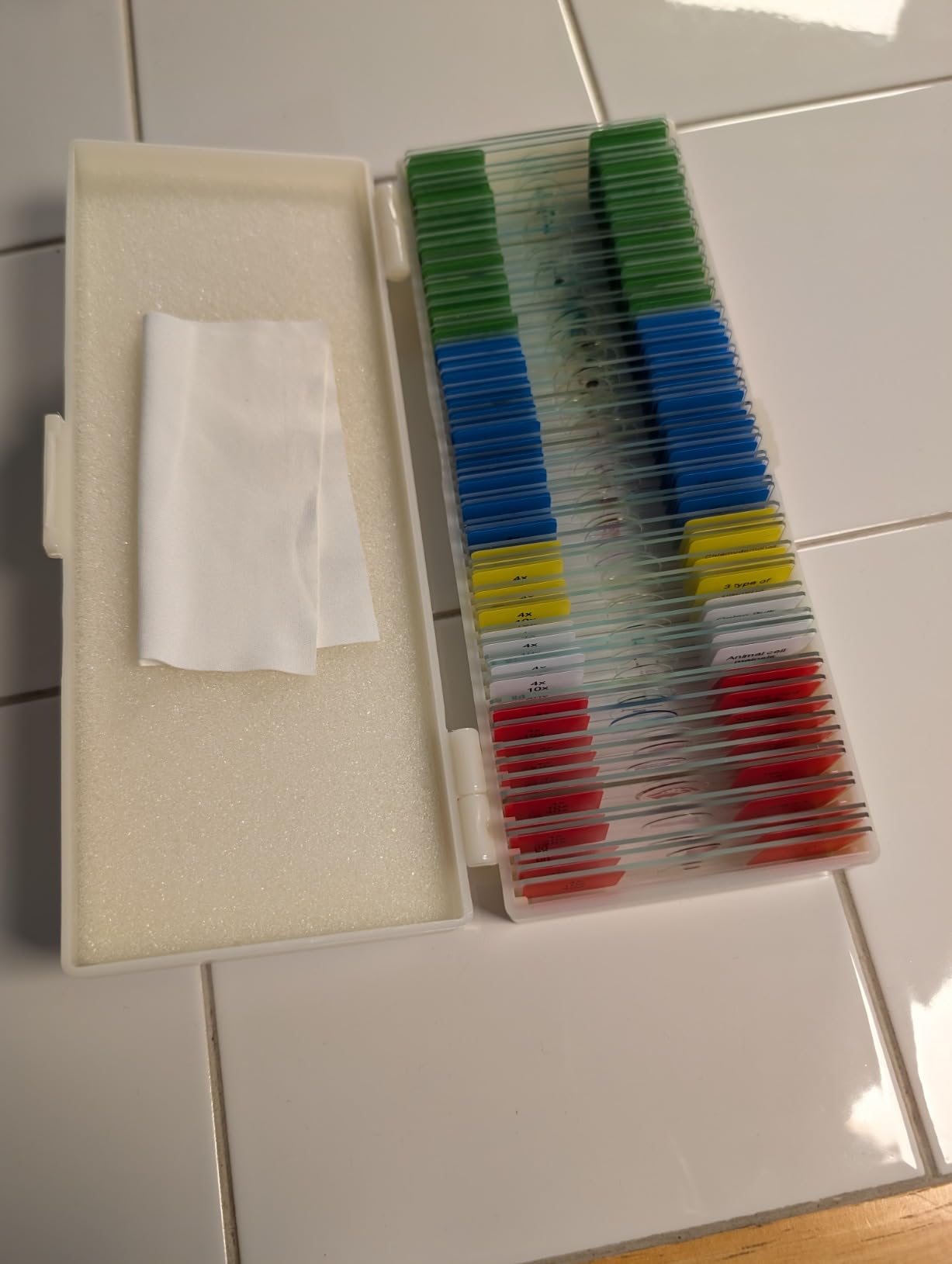
Sixty lab-grade glass slides are sorted with color-coded labels by course, marked with specimen name and recommended magnification, and shipped with an identification chart. The manufacturer aligns the content to NGSS standards for K-12, and the case is compatible with compound, stereo, digital and pocket microscopes.
Magnification guidance printed on each slide
Printing the recommended magnification on the label is a small feature that saves real lab time. A student who knows slide 22 is meant for 400x stops hunting at 100x and resents the scope, which is a common way young students conclude that microscopy is boring.
The identification chart also lets a class self-check answers, which frees a teacher to move around the room instead of confirming every specimen by hand.
Supervision and evidence to weigh
Because it is glass, this set suits ages 8 to 12 with supervision rather than independent use by a first-grader. The trade-off is transparency: at 65 ratings, the record is cleaner than almost anything else here but much thinner, so the rating is a signal worth watching rather than a settled verdict. Double bubble wrap packaging protects the slides in transit.
Broadly, it covers plant, animal, microbiology, tissue, cells, bacteria, fungi and histology samples, which is the widest single-box curriculum coverage in the guide.
How to Choose a Microscope Slide Set for Students
Ask these seven questions in order and the right set falls out of the answers. Start with the student, not the specimen list — the best slide set in the world is the wrong purchase if it will not fit the scope, or if the glass ends up on a floor in week two.
1. What age is the student, and can they handle glass?
Under about age 8, use shatter-safe plastic with smooth edges. Between 8 and 11, plastic is still reasonable if the child is careful. From about 11 or 12 upward, optical glass is worth the difference in resolution because the student can manage the handling. These thresholds are the clearest rule of thumb in this category.
2. Glass or plastic?
Optical glass gives sharper, higher-contrast images, holds focus better and stays clear under cedar wood oil or resin mounts. Plastic is safer and cheaper per slide but looks blurrier, and the softness becomes obvious past 400x. Choose glass for anything involving cell division, histology or blood smears.
3. What size slide fits the stage?
Standard slides measure 1 x 3 inch (25mm x 75mm) and clamp into virtually every classroom compound microscope. Compact 60mm x 21mm slides suit pocket and stereo scopes only. Check the manual or measure the stage plate before ordering — this is the single most common reason a set ends up unusable.
4. Does the specimen range match the unit being taught?
Match the box to the curriculum, not to the slide count. Cell division and mitosis units need staged cell division slides. Anatomy units need human tissue slides. Botany units need plant organs, algae and stem sections. Microbiology units need bacteria and fungi. A general set is fine for a first exposure but will not carry a full year.
5. Magnification: what the material can actually resolve
Use this rule: at 100x both glass and plastic work for large specimens; at 400x glass is clearly better for cells and tissue; at 1000x with an oil immersion lens you need good optical glass, because plastic simply will not hold detail. If your student only owns a stereo scope at 40x, a larger plastic set is the sensible spend.
6. Case, labels and arrival condition
Prefer a case with individual slots and numbered positions, plus a specimen list matched to the slide labels. Cheap cardboard trays tear and do not reclose, and tight cases invite students to lever glass out with their fingernails. On arrival, lay out every slide, check it against the list, and photograph any dust, smudging, bubbles or empty slides during the first week so a replacement claim has evidence.
7. Making your own slides alongside a prepared set
Prepared slides teach recognition, but students learn technique by mounting their own. To make a wet mount: place a drop of water on a clean slide, add a small sample such as cheek cells or onion skin, add a drop of stain such as methylene blue, lower a coverslip at an angle to push out air bubbles, and wait a minute before viewing. Keep stains away from eyes and hands, wash up afterwards, and never collect or prepare specimens from unknown sources or from anyone who is unwell.
For storage, keep cases flat and closed, return a cold case to room temperature before opening it, and always use a lens wipe on the glass before the first look — a fingerprint is the difference between a clear image and a blurred one.
Frequently Asked Questions
Are plastic or glass microscope slides better for kids?
For children under about 8, shatter-safe plastic with smooth edges is the safer choice. Glass gives sharper, higher-contrast images and is worth it from roughly age 8 or older, especially past 400x magnification. Choose plastic only when breakage risk outweighs image quality.
What size microscope slides fit a student microscope?
Standard microscope slides measure 1 x 3 inch (25mm x 75mm) and clamp into virtually every classroom compound, stereo and digital microscope. Compact 60mm x 21mm slides only fit pocket and some stereo scopes, so check the manual or measure the stage plate first.
What do WM, LS, CS, TS and Sm. mean on microscope slides?
W.M. is whole mount, the entire organism or structure mounted intact. L.S. is longitudinal section, cut along the length. C.S. is cross section and T.S. is transverse section, both cut across a specimen. Sm. is a smear, a sample spread thinly, such as a human blood or cheek cell smear.
How many microscope slides does a student need?
One student working alone needs roughly 25 to 30 slides per term. A class of 20 needs at least one slide per student per lesson, so a 60-slide box suits a single session for a whole class. Larger 100 to 200 slide sets suit labs, co-ops and families with several students.
Can prepared microscope slides expire?
Properly mounted slides in cedar wood oil or resin can stay usable for years if the case is kept flat, closed and stored at a stable temperature. Clouding comes from a broken coverslip seal or humidity, not from a printed expiry date. Check for clouding and discoloration before each term.
How can I make my own microscope slides?
Place a drop of water on a clean slide, add a small sample such as cheek cells, onion skin or pond water, add a drop of methylene blue or eosin, then lower a coverslip at an angle to push out air bubbles. Wait a minute, place the slide on the stage, focus and view at low power first.
What can I use instead of microscope slides?
A clear plastic petri dish, a coverslip, clear packing tape pressed flat, or even a small drop of pond water in a plastic dish all work for quick observations. These are substitutes for a first look, though only a proper slide with a coverslip holds a specimen steady at higher magnification.
What age should a child use a microscope?
Around 5 to 7 for a first look with a plastic set and heavy supervision, 8 to 11 with a glass set once a child can handle slides carefully, and 12 and up for full lab work including cell division slides and stain work. Always supervise handling of glass and stain.
Which Microscope Slide Set Should You Buy?
Match the set to the age and the unit. Under about age 8, start with the DIY-Science 48 plastic slides — shatter-safe, labeled and color-coded, so nothing gets broken in the first month. For a first real microscope and standard glass, the LAKWAR 30 set is our top-rated pick, while the AmScope PS25P is the dependable default for classrooms that need standard sizing at low cost.
For middle school, the PALOBIL 60 and the DIY-Science 60 lab-grade sets cover a full term and both use standard 1 x 3 inch glass. For cell division and mitosis units, the USCAMEL 100 set is the only one here that includes mitotic and meiotic stages. For a lab, a co-op shelf or several children, the Prolee 200 slides give the depth to stop restocking. And if the goal is technique rather than recognition, pair any prepared set with a preparation kit — the Rs’ Science kit for real sectioning with pre-mixed stains, or the AmScope kit for stain work with fewer tools.
Whatever you choose, check the slide size against your microscope first, and inspect every slide in the week it arrives.