
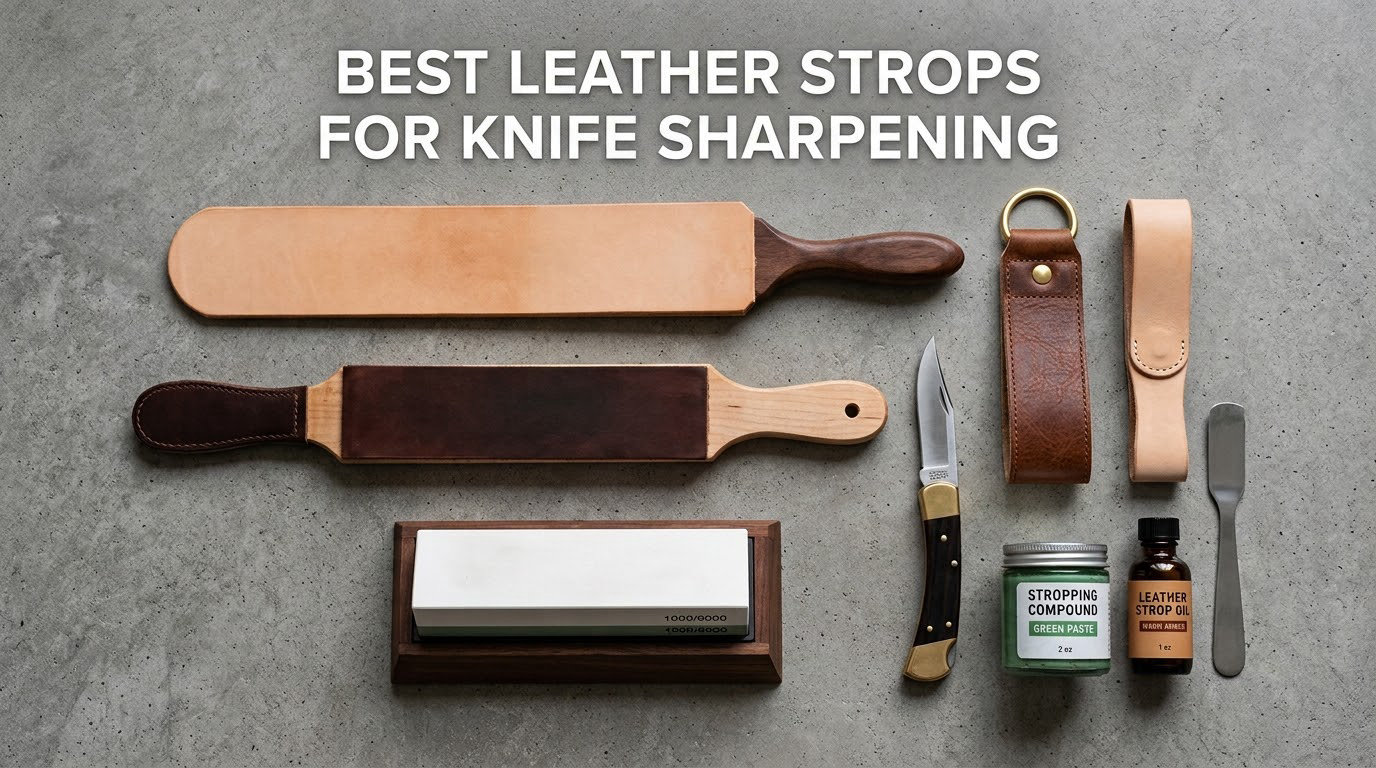
A strop is the cheapest tool in any sharpening kit and the one people argue about most on r/sharpening. It costs almost nothing, takes thirty seconds to use, and it is the step that decides whether your knife feels razor-sharp or merely sharp.
When we started tracking down the best leather strops for knife sharpening, we were not looking for the biggest catalog. We wanted the strop that sits correctly at the end of a sharpening session, whether that session ends at a whetstone, a diamond plate, or a guided sharpener. So we lined up twelve candidates and read every owner report we could find, then sorted them by the things that actually change how an edge behaves: how firm the hide is, how wide the runway is, how thick it is, what compound comes with it, and whether the surfaces are labelled in a way a beginner can follow.
This is a guide built from owner data rather than bench measurements in a lab, and we say so up front. Everything below is drawn from what buyers report after months of use, cross-checked against the physical specifications of each strop. If a claim is in this article, it is in the reviews or on the spec sheet.
Before the picks, one correction that matters more than any product choice. A leather strop does not sharpen your knife. It removes the burr that stones leave behind and aligns the apex so the two bevels meet cleanly. If your knife has lost its angle entirely, no amount of stropping will bring it back, and we will point you toward the right tool instead.
What a Leather Strop Actually Does (and Does Not Do)
A leather strop aligns the edge apex and removes the microscopic burr left by sharpening stones, then polishes the apex so it feels sharper immediately and holds that sharpness longer. It does not remove steel, set a new bevel, or rescue a dull knife. That distinction is the single biggest source of confusion among new knife owners, and it is worth being blunt about it.
When a stone grinds away metal, it leaves two things behind. The first is a new set of bevels meeting at an apex. The second is a burr, a wire edge of loose steel curling off one side of that apex, usually on the side where more metal was removed. That burr is why a freshly sharpened knife can still catch on skin or a page of paper.
Dragging the blade backwards across firm leather loaded with compound pulls that wire edge straight and folds it into the apex. The compound burnsishes the metal at the same time, so the edge closes instead of sitting with a rough seam. Owners on r/sharpening frequently describe the result as an edge that feels noticeably keener without any measurable change in the angle.
What that buys you is retention. A burr-lined edge dulls quickly because it is effectively damaged steel at the tip. Once it is folded over and polished, the cutting surface is continuous and typically stays keen far longer between full sharpening sessions. Several owners in our review set made exactly this point: the felt difference from adding a strop showed up over days and weeks, not in the first minute after sharpening.
Here is where a strop sits in a full sequence. Coarse work first to fix the geometry, then medium and fine stones to establish the apex, then the strop to remove the burr and polish, and only then a final pass on clean, unloaded leather if you want maximum shine. If you skip the stones and go straight to leather, you are polishing a bevel that is already wrong.
Key Features to Look For in a Leather Strop
Five things decide whether a leather strop will sharpen your practice or just sit on your bench. Check these before you buy anything.
- Firm, vegetable-tanned hide: bark-tanned or heavily oiled cowhide holds a flat face. Soft chrome-tanned or unlabelled genuine leather lets the blade sink and round the edge you just set.
- A working width that matches your knives: a 3-inch face lines up with the standard 8×3 bench stone size, and 2 inches or less is workable for pocket knives but tight for a 10-inch chef’s knife.
- Dual surfaces you can tell apart: a rough or suede face for the first finishing step and a smooth face for the final polish make the sequence obvious without instructions.
- Thickness of 3 mm or more: thinner hide flexes under the blade, and a flexing strop cannot hold an angle consistently.
- Compound you can replace: pre-loaded is convenient, but a strop with no way to renew or change the abrasive is a dead end once it glazes over.
Backing material matters too, though it is second-order. Solid beech, ash, or a dense hardwood paddle stays dead flat; MDF and lightweight composites do the job but feel different in the hand. If you carve, a drilled handle lets you hold the paddle in the air instead of balancing it on a bench.
Our Top 3 Leather Strops for 2026
Twelve products made the cut. Three stood out for different reasons, and those three are the ones we would put on a bench first.

Bacher Bark-Tanned Cowhide Strop
- 3 mm full-grain bark-tanned cowhide
- FSC Carpathian beech paddle
- Four graded compounds plus leather balm

Hutsuls Buffalo Paddle Strop
- Organic buffalo hide on solid ashwood
- 14 x 2.4 inch paddle
- Green compound included

BeaverCraft LS2P1 Portable Strop
- Bare 3 x 8 inch vegetable-tanned hide
- Compound bar included
- Smooth and rough faces
The Bacher is the one we keep coming back to because the hide is unusually thick for the money and comes with a real step-down compound ladder. The Hutsuls buffalo paddle is the pick if you sharpen long blades and want a wide runway with a handle. The BeaverCraft LS2P1 is the recommendation we make to anyone who strop a folding knife and nothing else.
Comparing All 12 Leather Strops Side by Side
Every pick in this roundup, with the specifications that matter for edge work. Use the labels in the last column to jump straight to the review.
| Product | Specs | Action |
|---|---|---|
| Bacher Bark-Tanned Cowhide Strop |
|
Check Latest Price |
| Hutsuls Buffalo Paddle Strop |
|
Check Latest Price |
 KNIVES PLUS Pre-Loaded 8 Inch Strop KNIVES PLUS Pre-Loaded 8 Inch Strop |
|
Check Latest Price |
 BeaverCraft 15.2 Inch Paddle Strop BeaverCraft 15.2 Inch Paddle Strop |
|
Check Latest Price |
 BeaverCraft LS6P1 14.6 Inch Strop BeaverCraft LS6P1 14.6 Inch Strop |
|
Check Latest Price |
 Angerstone 14 Inch Cowhide Strop Angerstone 14 Inch Cowhide Strop |
|
Check Latest Price |
 Tumbler 9.8 Inch Beech Strop Tumbler 9.8 Inch Beech Strop |
|
Check Latest Price |
 Hutsuls 3 x 8 Inch Buffalo Strop Hutsuls 3 x 8 Inch Buffalo Strop |
|
Check Latest Price |
| BeaverCraft LS2P1 3 x 8 Inch Strop |
|
Check Latest Price |
 LAVODA 3 x 8 Inch Vegetable-Tanned Strop LAVODA 3 x 8 Inch Vegetable-Tanned Strop |
|
Check Latest Price |
 Hutsuls Pocket Strop Kit Hutsuls Pocket Strop Kit |
|
Check Latest Price |
 LAVODA 14 Inch Black Paddle Strop LAVODA 14 Inch Black Paddle Strop |
|
Check Latest Price |
Quick picks by use case: Bacher for the best all-round bench strop. Hutsuls 14-inch buffalo paddle for long blades and Japanese kitchen knives. BeaverCraft LS6P1 for a beginner kit with a handle. Angerstone for the most compounds in the box. Hutsuls 3×8 for a portable strop on a budget. BeaverCraft LS2P1 for pocket-knife maintenance in a tool bag. KNIVES PLUS for a block that is ready to use the moment it arrives. Hutsuls Pocket Kit for the smallest carry option. Tumbler if you already own the matching rolling sharpener.
1. Bacher Leather Strop – Thick Bark-Tanned Hide and a Full Compound Ladder
Bacher Leather Strop – 12.6 in, Knife Sharpening Kit, 4 Compounds & Balm
3 mm bark-tanned cowhide
FSC beech paddle
320 x 60 mm
Four grits plus balm
Pros
- 3 mm hide holds a flat face instead of sinking
- Beech paddle takes plane irons on a 56 mm face
- Four graded compounds let you step down through grits
- Lanolin pastes keep the hide supple
- Broad tool coverage from razors to axes
Cons
- Needs topping up every 30 to 50 sharpenings
- Sand back to bare leather after 300 to 500 uses
- Compound loading is a manual step
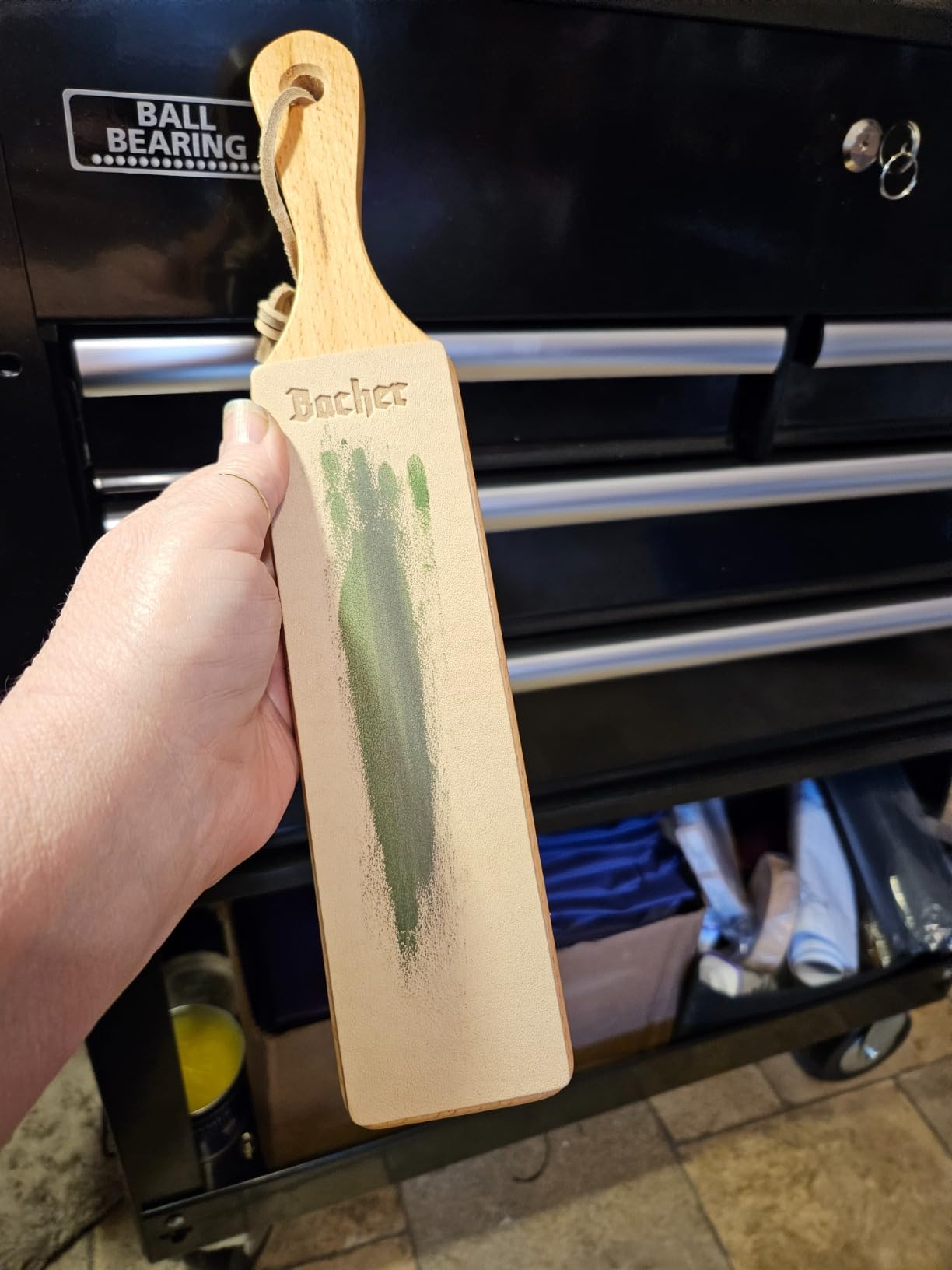
This is the strop we put on the bench first. The hide is 3 mm thick full-grain cowhide, tree-bark tanned, which is why it refuses to flex under a blade. Owners consistently credit that firmness with the difference between refining an edge and quietly rounding it.
The compound set is what separates it from cheaper kits. Four graded pastes from Red 2000 down to Black 12000 let you treat the strop as a finishing ladder rather than a single abrasive step, and each paste carries lanolin and beeswax so the leather is fed as you work.
Why 3 mm Bark-Tanned Hide Changes the Result
Bark-tanned hide is dense and slow to break in, which is exactly what you want at the apex. Soft leather lets the blade sink a few degrees deeper on every pass, and a few degrees is the difference between a keen edge and a rounded one.
The trade-off is patience. This strop asks more of you early on than a soft leather strip does. Owners put the maintenance interval at topping up roughly every 30 to 50 sharpening sessions, and sanding back to bare hide somewhere around 300 to 500 uses.
The Working Face and What It Handles
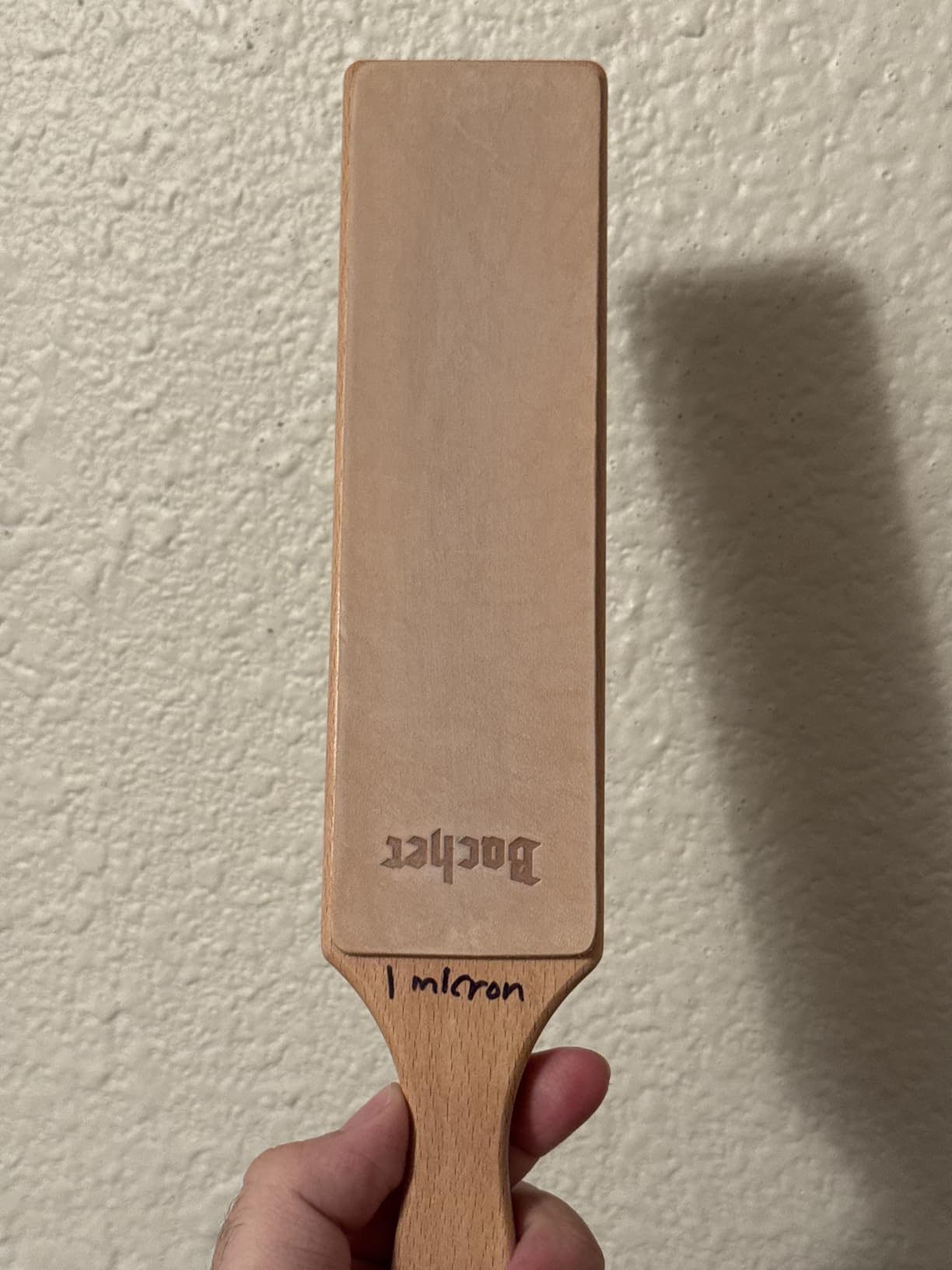
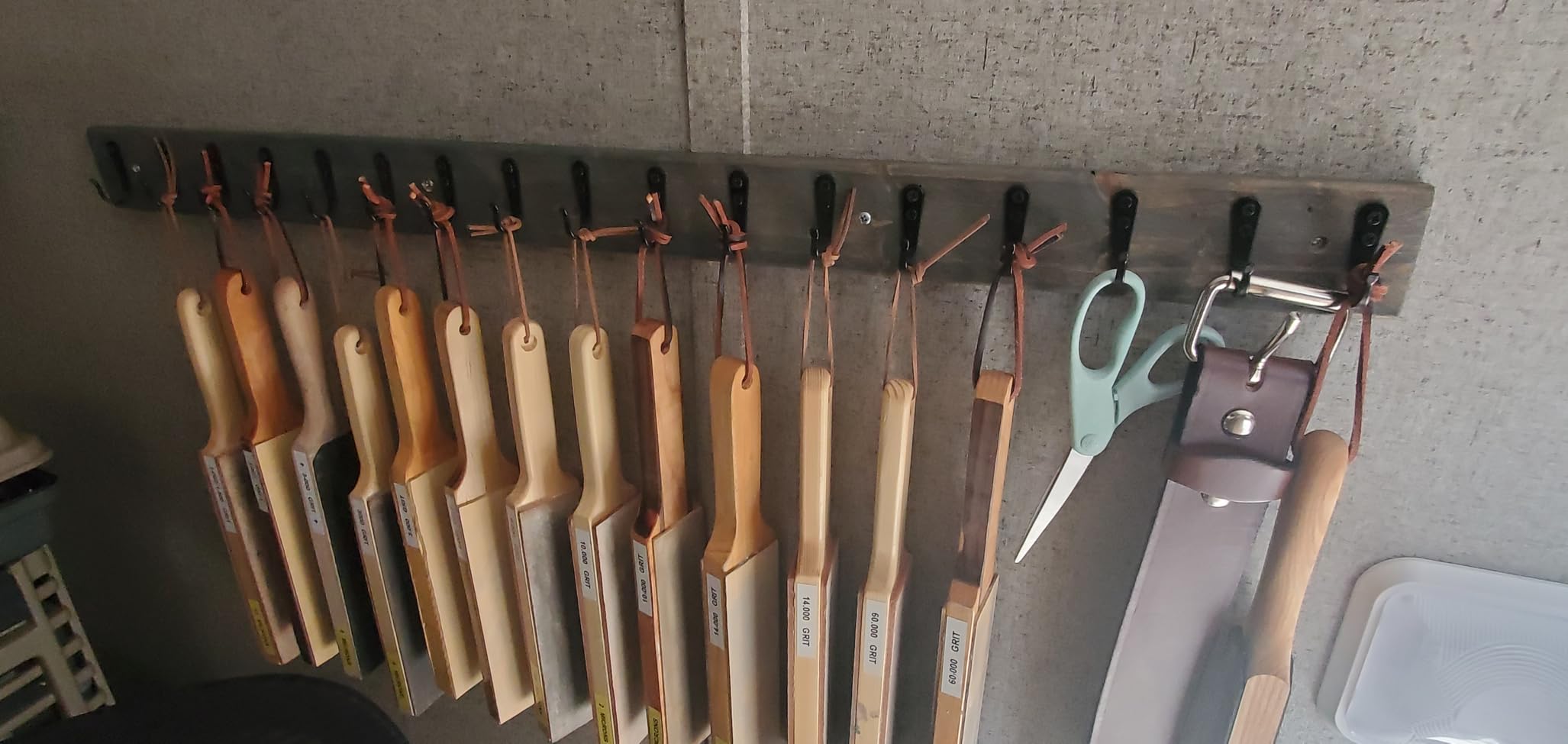
The paddle measures 320 x 60 mm overall with a 206 x 56 mm working area, mounted on 20 mm FSC-certified Carpathian beech. That face is narrow enough for a straight razor and wide enough for a chef’s knife, and owners mention plane irons and chisels directly.
A drilled handle runs the length of the paddle, which means you can hold it in the air for carving tools or hang it over a bench edge. Five wooden applicators come in the box, and about 1 g of compound covers one side.
Which Compound Goes Where
The rough face takes the coarser work and the smooth face is reserved for the final strokes. Bacher’s own guidance is White 5000 on the rough side and Green 8000 on the smooth side, with one side kept bare for the last pass.
Ten to twenty light passes after a fine stone is the reported working range. That is a tiny amount of abrasion, which is the point: the strop should leave the bevel alone and fix the burr.
Best For and Not Ideal For
Best for anyone who sharpens regularly on stones and wants a strop that will outlive several sharpening systems. The four-grit ladder makes it a good first serious strop as well as a last one.
Not ideal if you want zero setup. Nothing here is pre-loaded, and the maintenance routine is real work that some people never get around to.
2. Hutsuls Double Sided Buffalo Paddle Strop – Wide Runway for Long Blades
Hutsuls Double Sided Leather Strop Paddle Kit – Get Razor-Sharp Edges, Ergonomic Handle, Quality Honing Leather, and Step-by-Step Guide
Organic buffalo hide on ashwood
14 x 2.4 inch
One smooth and one rough face
Green compound included
Pros
- Solid ashwood paddle with straight grain
- Leather glued with no gaps
- Black hide hides metal staining
- 14 inch face covers paring to Japanese knives
- Green compound is roughly 0.5 microns
Cons
- Hide is 3 to 4 oz; some prefer 5 to 6 oz for a crisper edge
- Compound must be warmed and applied sparingly
- Buffalo behaves differently from smooth cowhide
If your blades include a gyuto or a long fillet knife, stroke length matters more than most buyers realise. A short strop forces a segmented draw, and that is exactly the problem r/sharpening users flag when they reject pocket-sized strops for long blades. The 14-inch face here solves it.
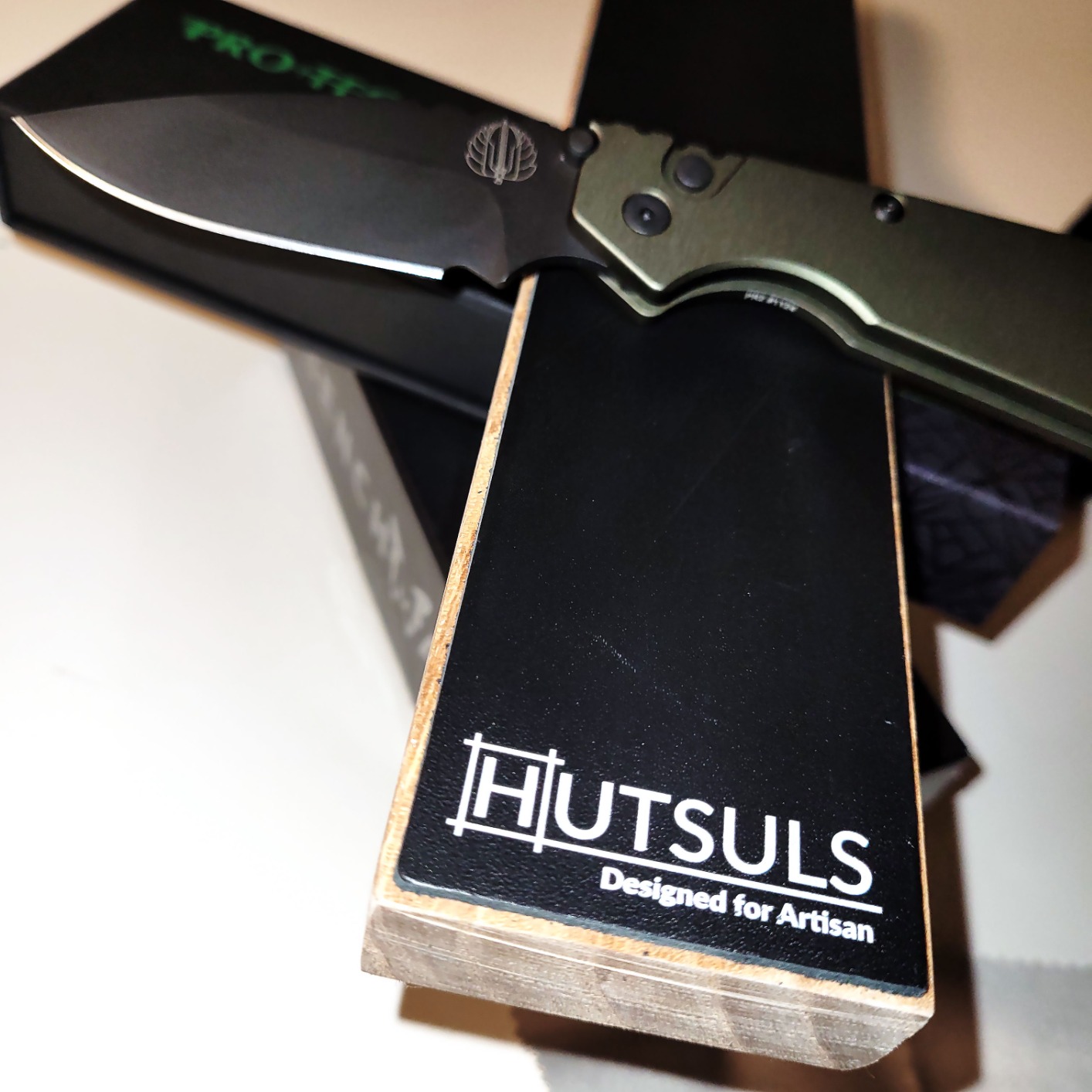
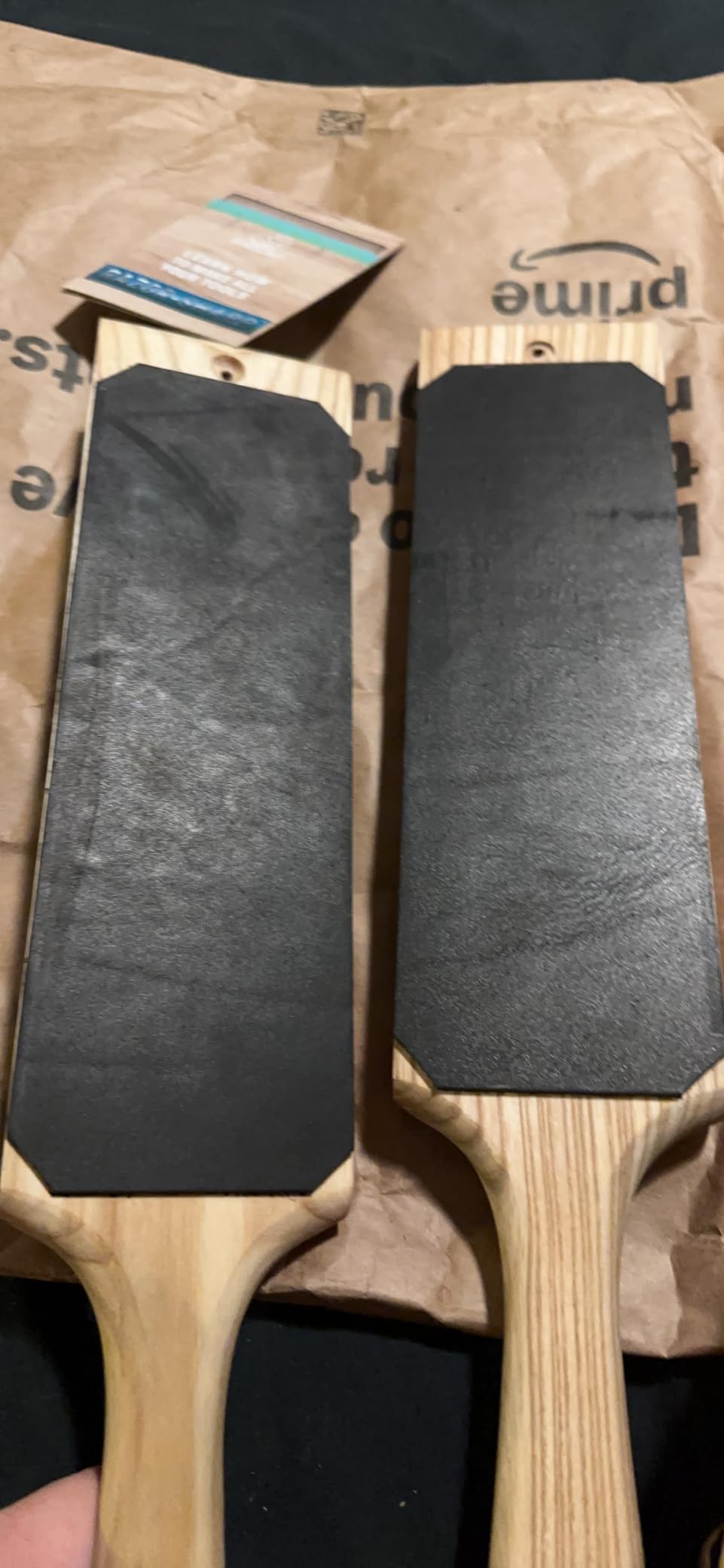
The hide is organic buffalo on a solid ashwood paddle, finished with attention to straight grain and glued without gaps. Owners with decades of sharpening report that it makes deburring dramatically easier, and the dual-face construction lets you choose your finishing stage rather than being locked into one.
Buffalo Leather Versus Smooth Cowhide
Buffalo is thicker, more fibrous, and slightly more aggressive than smooth cowhide. The r/sharpening debate is genuinely split on whether that is better; plenty of regulars report switching from generic leather with green compound to buffalo with micron diamond and being happy with both.
What the reviews here say is that this hide is in the 3 to 4 oz range, and a few owners prefer 5 to 6 oz for a crisper apex. If you like a glassy finish on hard steel, the firmer hide is worth the extra few passes.
Stroke Length and the Long-Blade Problem
A segmented stroke means the blade is not being drawn in one continuous motion, so different sections of the cutting edge get different treatment. On a 10-inch blade that shows up as a keen tip and a dull heel.
The 14 x 2.4 inch format covers everything from a paring knife to a Japanese chef’s knife in one unbroken pull. The paddle handle is comfortable enough for the long sessions this size invites.
The Green Compound and Its One Catch
The included green compound is roughly 0.5 microns, fine enough for most knives. That is unusually fine for a bundled bar and it explains why owners report a mirror-like finish out of the box.
The catch is application. Owners repeatedly advise warming the compound and applying it sparingly, otherwise it clings to the blade and drags. Black leather is also offered, which hides metal staining far better than the tan version.
Best For and Not Ideal For
Best for long blades, Japanese kitchen knives, and anyone who dislikes reloading a small strop every few passes. The green compound is fine enough to finish without a second purchase.
Not ideal if you are after a feather-light mirror finish on hard steel and expect a soft hide to deliver it. Buffalo at this weight refines rather than glazes.
3. KNIVES PLUS Strop Block – Pre-Loaded and Ready in Texas
Knives Plus Strop Strop Block, Leather Sharpening Strop, 8 long”
8 x 2.5 inch working surface
Pre-loaded high-chrome rouge
Chap leather on MDF
Hand-made in Amarillo
Pros
- Arrives pre-loaded and usable immediately
- Hand-made start to finish in Texas
- Virtually maintenance free
- Compact bench footprint
- Rated 4.8 stars across its reviews
Cons
- Short block suits smaller knives better than chef's knives
- Single pre-loaded compound limits the grit ladder
- MDF base lacks the mass of a hardwood paddle
This is the only pick in the roundup with a 4.8 average, and the reason is simple: nothing about it needs your attention. The compound is already rubbed into the leather by hand while it was still warm, so you can strop a knife minutes after opening the box.
It is hand-made start to finish in Amarillo, Texas, with a chap leather face on an MDF base and an 8 x 2.5 inch working surface. Owners call it virtually maintenance free, which for a first strop is a genuine advantage over paste-and-buffer setups.
What Pre-Loaded Rouge Does and Does Not Give You
High-chrome rouge is a finishing abrasive rather than a full grit ladder. It will clean up a burr and produce a bright finish, which is all a strop is supposed to do in the final stage.
The limitation is range. If you want to step through coarser refining stages on the same tool, you need a separate bar. Most owners pair this block with whatever compound they already own rather than relying on the factory load.
Size and Handling: A Bench Block, Not a Paddle
At 8 x 2.5 inches, this is a compact hand-held block. Owners consistently praise it for pocket knives, razors, and small sharpening jobs, where the short runway is not a disadvantage.
For a full-size chef’s knife the picture changes. A rigid block this size works, but you are repositioning the blade more often than you would on a 14-inch paddle, and the MDF base does not have the mass to stay put on a wet bench.
Best For and Not Ideal For
Best for a first strop, for anyone who strop straight razors, and for buyers who would rather not learn compound loading before they learn stroke technique. The 84 percent five-star share is the strongest in the set.
Not ideal if you want one tool to cover a full grit ladder, or if you maintain several long kitchen knives and want a long uninterrupted draw.
4. BeaverCraft 15.2 Inch Paddle Strop – Long Runway for Carvers
BeaverCraft Leather Strop Kit for Knife Sharpening 15.2″ – Leather Knife Strop with Polishing Compound – Stropping Kit Double Sided LS1P1, Razor Sharpener for Knives, Chisels – eBook Guide Included
15.2 inch overall length
3.02 inch width
Ashwood handle
Double-sided leather
Pros
- Very long face gives an even draw across wide blades
- Ergonomic ash handle makes long sessions comfortable
- Polishing compound included
- Double-sided for deburring and finishing
- Carver-focused eBooks add real value
Cons
- 3 inch width is narrower than the headline number implies
- Included compound is not ideal for every grit step
- One listed width figure is hard to reconcile
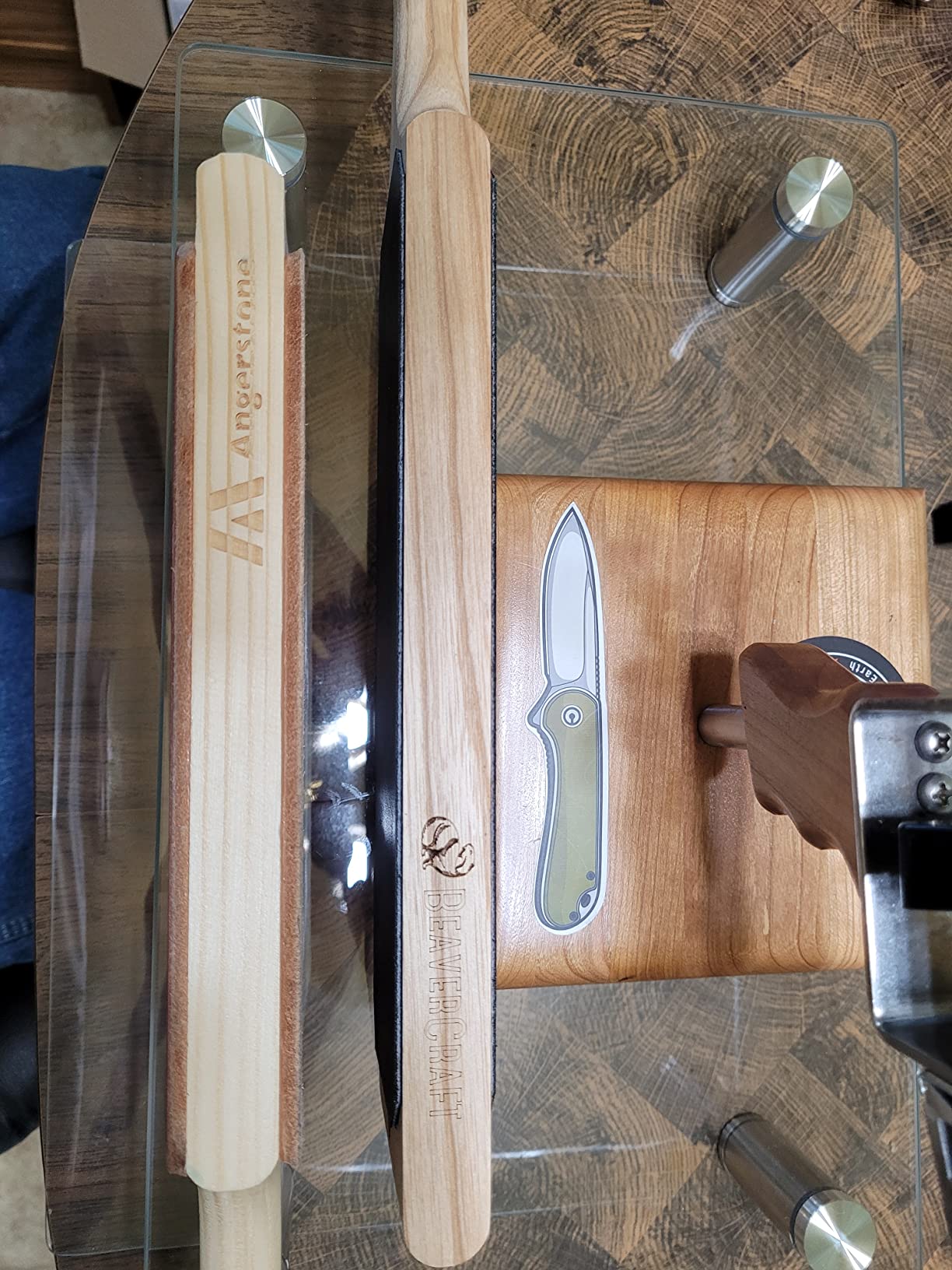
Length is the entire argument for this strop. At 15.2 inches overall it gives you the longest continuous working runway here, and buyers consistently say that is what keeps the draw consistent across wide blades and carving tools.
It is an ashwood paddle with an ergonomic handle, double-sided leather, and it is made in BeaverCraft’s own factory in Ukraine. Two eBooks come with it, covering whittling knife sharpening and the five steps to sharpening a hook knife, which is a nice touch for anyone who carves.
Length Versus Width: The Trade Nobody Explains
A long strop fixes stroke continuity. A wide strop fixes coverage. You cannot always get both, and this one leans hard on length with a 3.02 inch listed width.
A small minority of buyers feel the face is narrower than they expected from the headline number. For a hook knife or a long carving blade that does not matter. For a wide chef’s knife the narrowness means slightly more repositioning.
Handle Comfort and In-the-Use Angles
The handle is what makes a strop this long usable. Without somewhere to grip, a 15-inch paddle is awkward; with the ash shaft, owners report being able to hold it comfortably for long two-sided sessions, ambidextrously.
Because it is a paddle rather than a fixed block, it works on a table, in your lap, or held in the air, depending on the tool. That flexibility is why it appears in both kitchen and carving workflows.
The Included Compound Reality
Polishing compound is included so you can start immediately, which suits a beginner. A few users prefer their own paste, and the included bar is not positioned as a full ladder.
Treat it as a finishing step and pair it with a separate bar if you want to control the micron. The leather itself works fine bare on the rough face, which owners do use as a quick touch-up between compounds.
Best For and Not Ideal For
Best for carvers and whittlers who need a long, uninterrupted stroke on wide blades, and for anyone who strop gouges and hook knives rather than only kitchen steel.
Not ideal if your bench is tight on space or if you want a wide face for very broad blades. The length is exceptional; the width is ordinary.
5. BeaverCraft LS6P1 Double-Sided Strop – The Starter Paddle With a Handle
BeaverCraft Leather Strop for Knife Sharpening – Double-Sided Knife Strop & Stropping Compound Kit – Honing Strop Block 14″ for Woodcarving Tools, Chisel Knife Sharpening Kit Leather Sharpener LS6P1
14.6 inch overall length
2 inch working width
Ashwood shaft with handle
7 micron green bar included
Pros
- Handle lets you hold the paddle in the air for carving
- Leather firms up with use
- Green 3000 grit bar effective for mirror finishing
- Fits both kitchen and carving knives
- Strong demand in sharpening stones
Cons
- 2 inch face is narrow for wide chef's knives
- Included green paste tends to smear
- Only one compound bar so no coarser step
This is the BeaverCraft paddle most owners in our review set recommend to newcomers, and it is the one we would hand someone who wants a handle without paying for a premium hide. It ranks consistently high in demand, which usually means it just works.
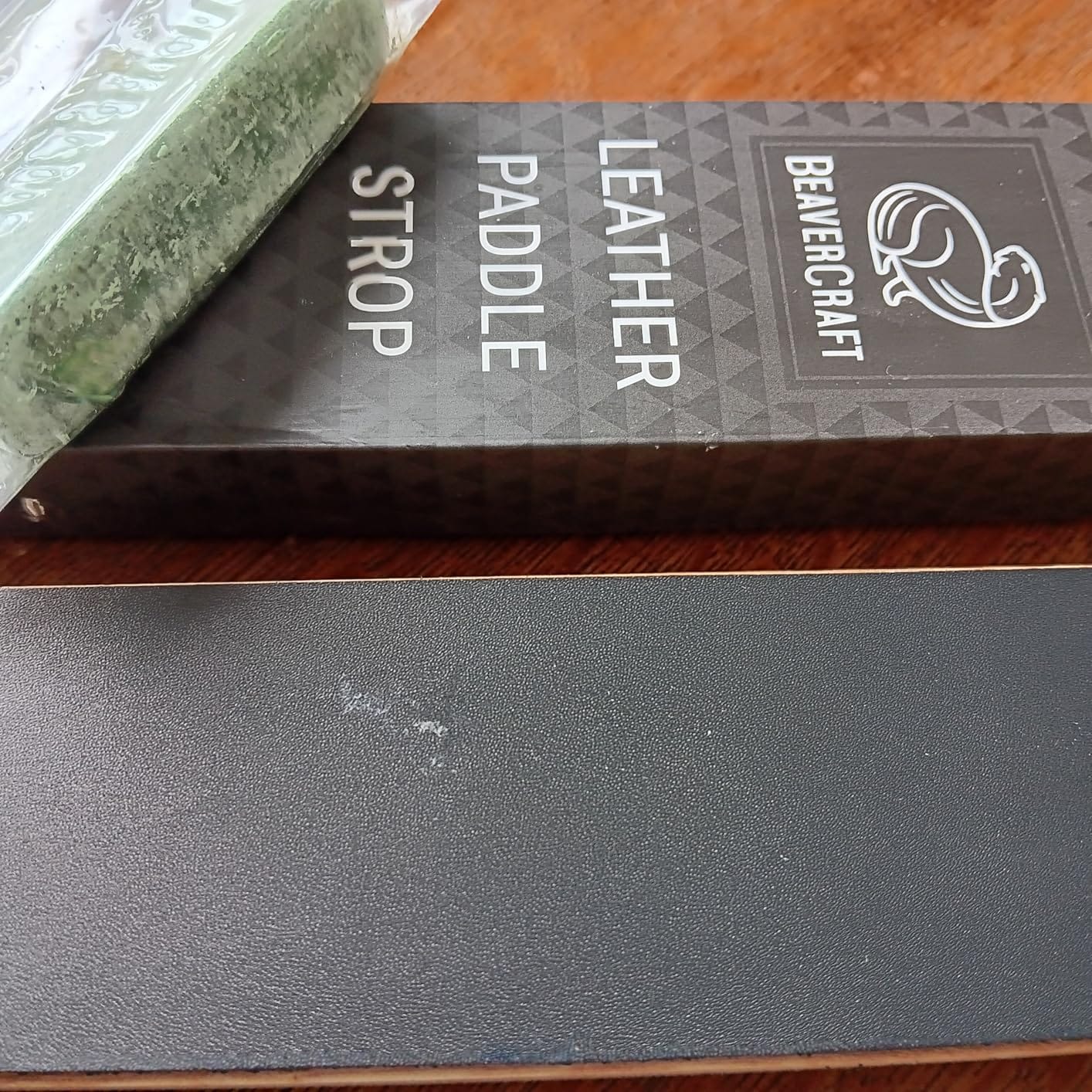
The build is an ashwood shaft with an ergonomic handle, one very smooth face and one more porous face, and a 7 micron green bar that is roughly equivalent to 3000 grit. Reviewers report it removing burrs and refining edges after a Lansky block or a wet stone.
Two Faces With Genuinely Different Jobs
The smooth face and the porous face are not the same leather twice. The porous face holds abrasive and cuts faster; the smooth face burnishes and polishes. Owners use the pair as a two-stage finishing sequence rather than picking one and staying there.
Leather quality draws mixed feedback at first: several buyers describe a soft hand initially and note it firms up with use. That break-in is normal for this weight of hide and not a defect.
The Included Green Bar and Why Some Buyers Swap It
Several German and Spanish buyers in the reviews say the green paste lubricates too much and should be replaced with their own. That is a fair criticism of bundled compounds generally, and it is easy to address with a separate bar.
What the bar does well is mirror finishing straight after stones. At 7 micron it sits between a medium and a fine stone, which is a sensible place to start the stropping stage.
Working Width: The Honest Weak Spot
Two inches is the number to think about. It handles pocket knives, carving tools, and standard kitchen blades without trouble, and a few buyers simply wish it were wider for chef’s knives.
At 14.6 inches overall you still get a long stroke, so the limitation is coverage across the blade rather than continuity along it. For most home kitchens that is an acceptable trade.
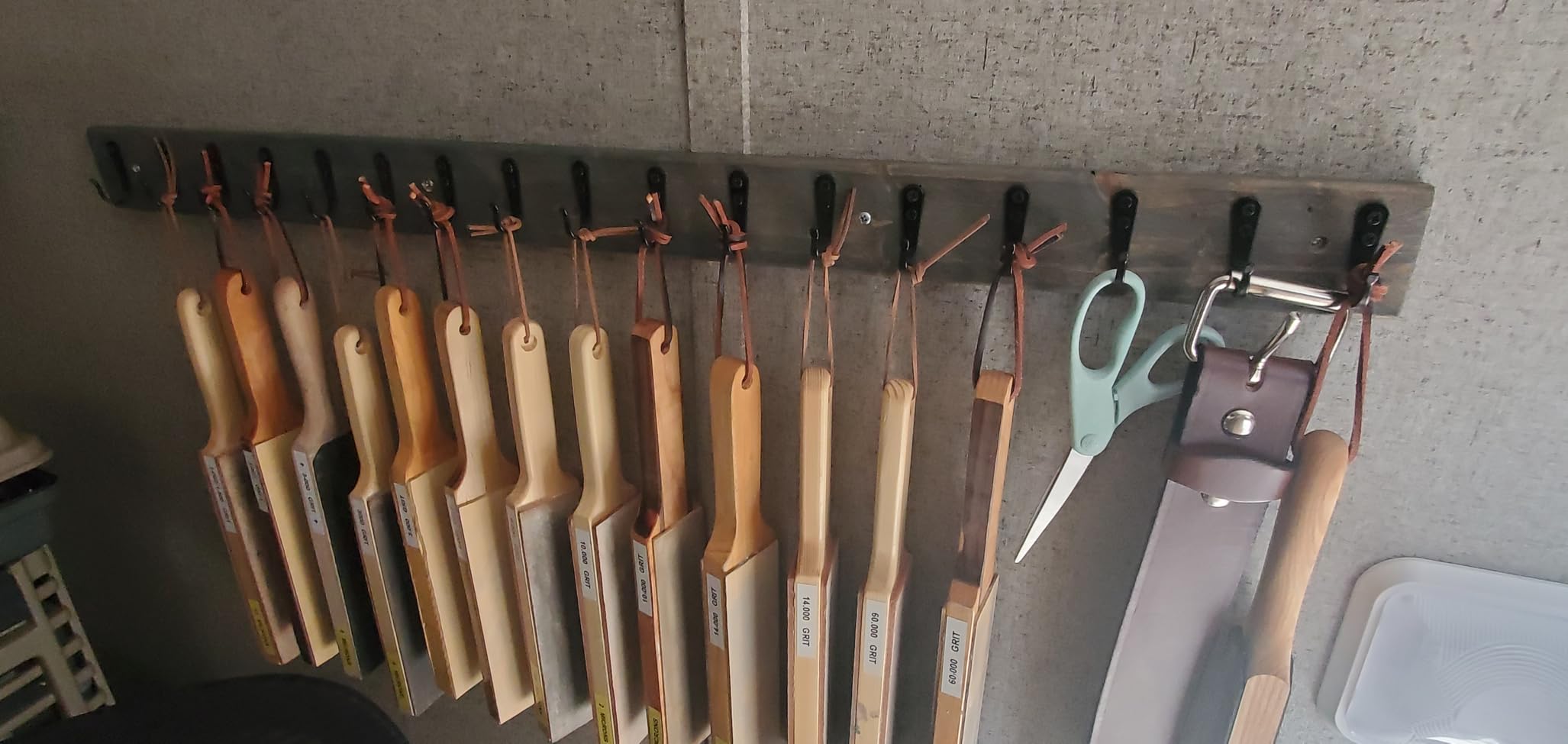
Best For and Not Ideal For
Best for beginners who want a handled, double-sided paddle that includes compound and works on both kitchen and carving tools.
Not ideal if you want to run a full compound ladder on one strop, or if you need a wide face for broad blades. One bar and two inches of width is a starter configuration.
6. Angerstone 14 Inch Cowhide Strop – Most Compounds in the Box
ANGERSTONE Double Side Leather Strop for Knife Sharpening – 14″x 2″ Stropping Block Kit with Polishing Compound, Knife Strop with Ergonomic Handle for Honing Knives, Woodworking Chisels
14 x 2 inch working format
Vegetable-tanned cowhide
Green white and red compounds
Guide included
Pros
- Three compounds cover rough fine and mirror stages
- Vegetable-tanned cowhide rated durable over years
- Clear rough and smooth side split
- 14 inch face suits chisels and standard knives
- Best compound variety per dollar
Cons
- 2 inch width is narrow for wide chef's knives
- Sticker-heavy packaging and generic guide
- 19 percent four-star band hints at finish quality reservations
Angerstone is the kit answer. Three compounds come in the box, so you can work from a rough stage through a fine stage to a mirror stage without buying anything else, and the leather is vegetable-tanned rather than the unlabelled genuine hide that spoils cheaper kits.
The build is a 14 x 2 inch paddle with an ergonomic handle and a clear split between a rough face and a smooth face. Buyers call that split intuitive, which matters more than it sounds for anyone learning the sequence on their own.
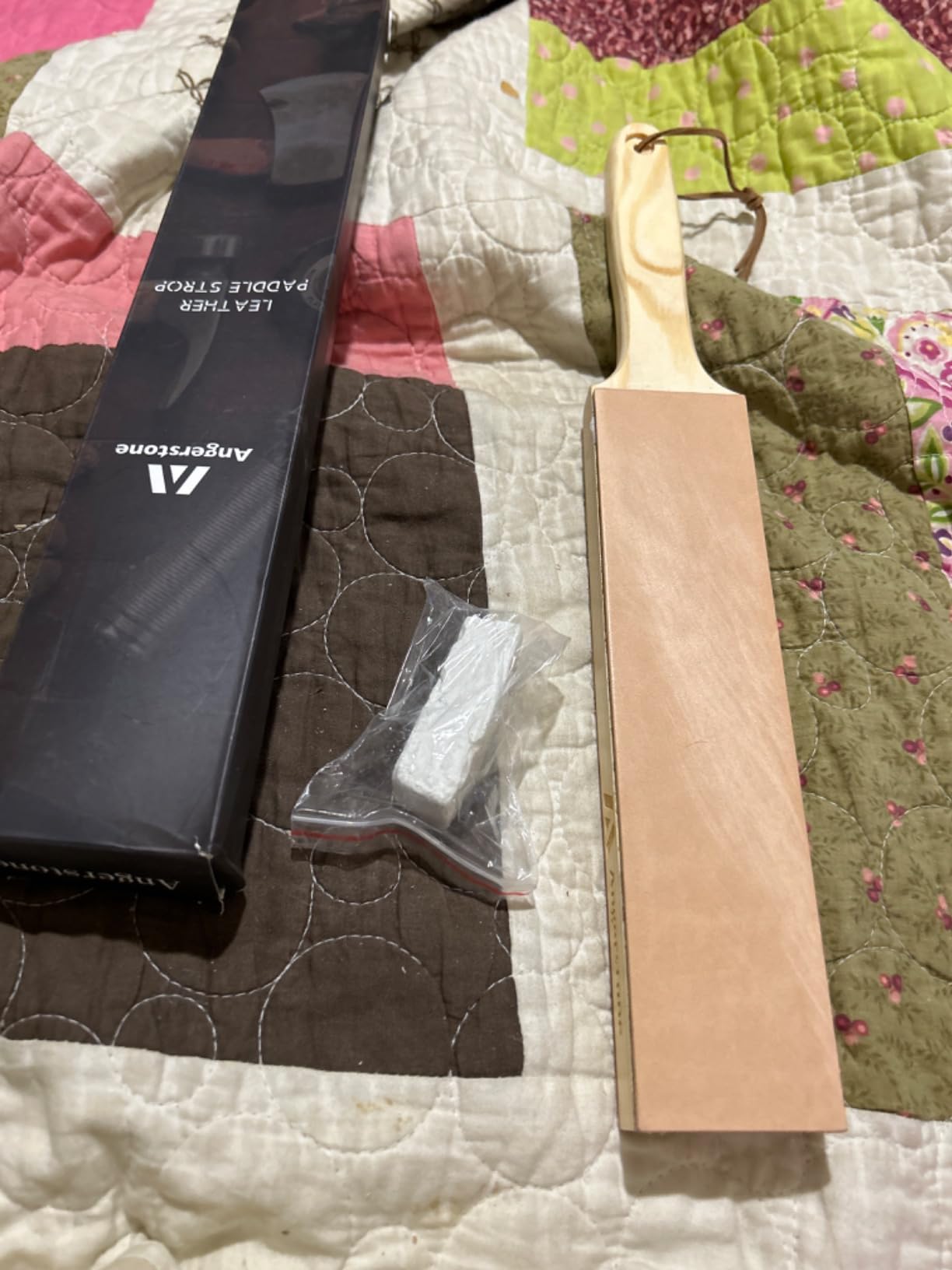
Green, White, and Red: A Working Three-Step Ladder
Green is chromium oxide and does the refining. White is aluminium oxide and is finer. Red is the polishing compound that closes out the sequence. That is a complete progression in three bars, which is more than most competitors include.
The vegetable tanning process is the detail worth knowing. Chrome-tanned leather is fast and cheap but soft; vegetable-tanned hide is slower and firmer, and owners here describe it as durable across many years.
Coverage Across Tools
The manufacturer lists hunting knives, pocket knives, fillet and kitchen knives, chef’s knives, chisels, carving knives, plane blades, straight razors, and axes on the same strop. We are not endorsing that blanket claim, but the 14-inch face is wide enough to make most of it plausible.
The 2-inch width is the limiting factor for broad chef’s knives. Chisels, plane blades, and pocket knives are all comfortable.
Build Quality and Packaging Expectations
This one draws a higher four-star band than most picks here, and the reservations cluster around finish rather than function. Owners mention sticker-heavy packaging and a generic guide rather than a well-produced technique booklet.
The leather itself is not the complaint. If you judge a kit on what performs, the compound variety is the reason to pick this one.
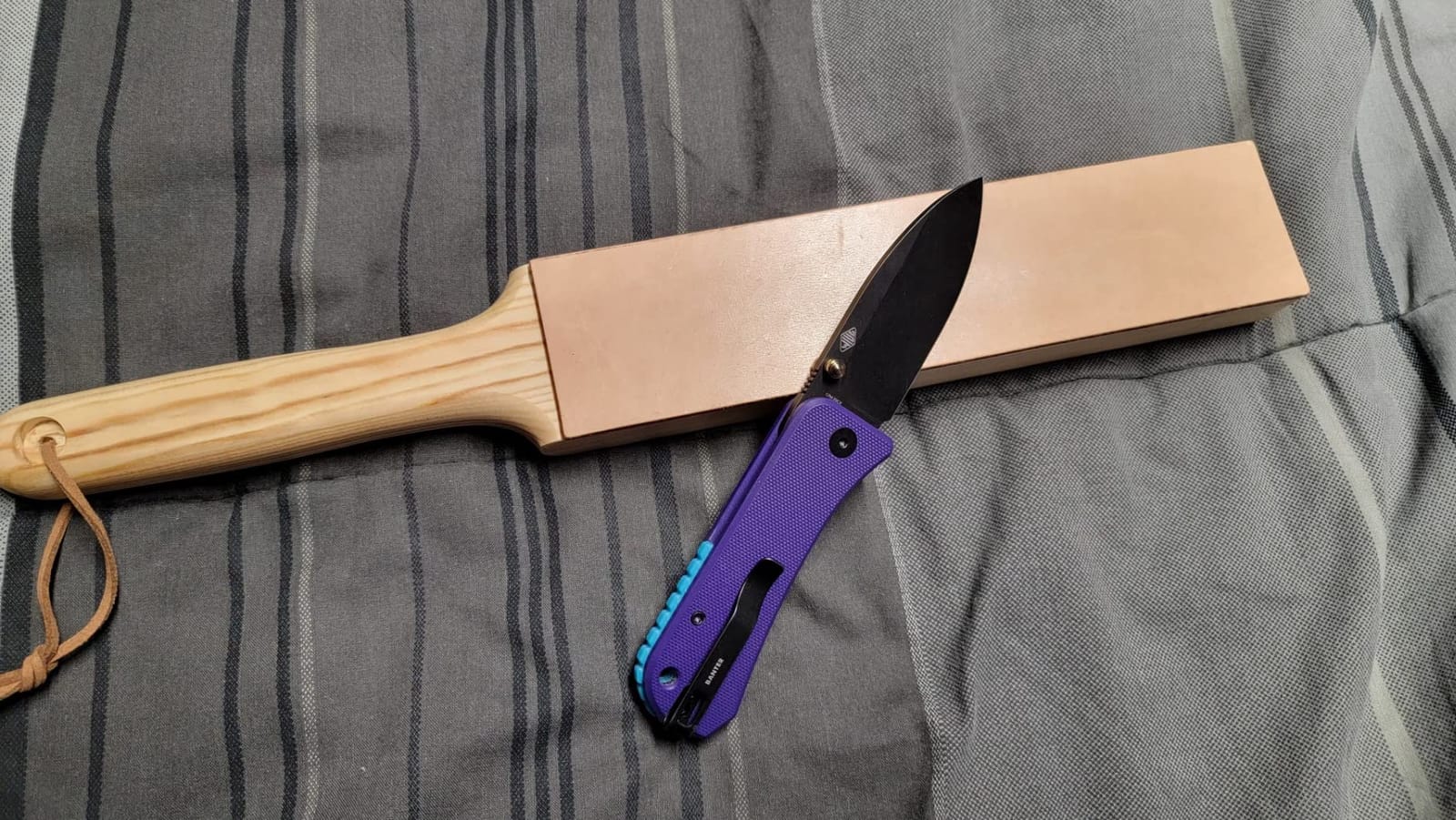
Best For and Not Ideal For
Best for anyone who wants to experiment with different finishing stages without buying compounds separately, and for beginners who benefit from a clearly labelled rough and smooth pair.
Not ideal if presentation and packaging matter to you, or if you need a wide face for very broad kitchen blades.
7. Tumbler Leather Strop – Built for the Rolling Sharpener Bench
Tumbler Leather Strop for Knife Sharpening
Solid beech with veg-tan cowhide
9.8 x 2.2 inch
Designed system component
No compound included
Pros
- Vegetable-tanned cowhide on solid beech pairs premium materials
- Designed as a coherent bench system rather than a generic block
- Realigns the edge and removes leftover metal
- Compact footprint suits a kitchen counter
- 80 percent five-star owner satisfaction
Cons
- No stropping compound included so you need a paste
- 2.2 inch face suits kitchen knives only
- Warranty covers kitchen knife use
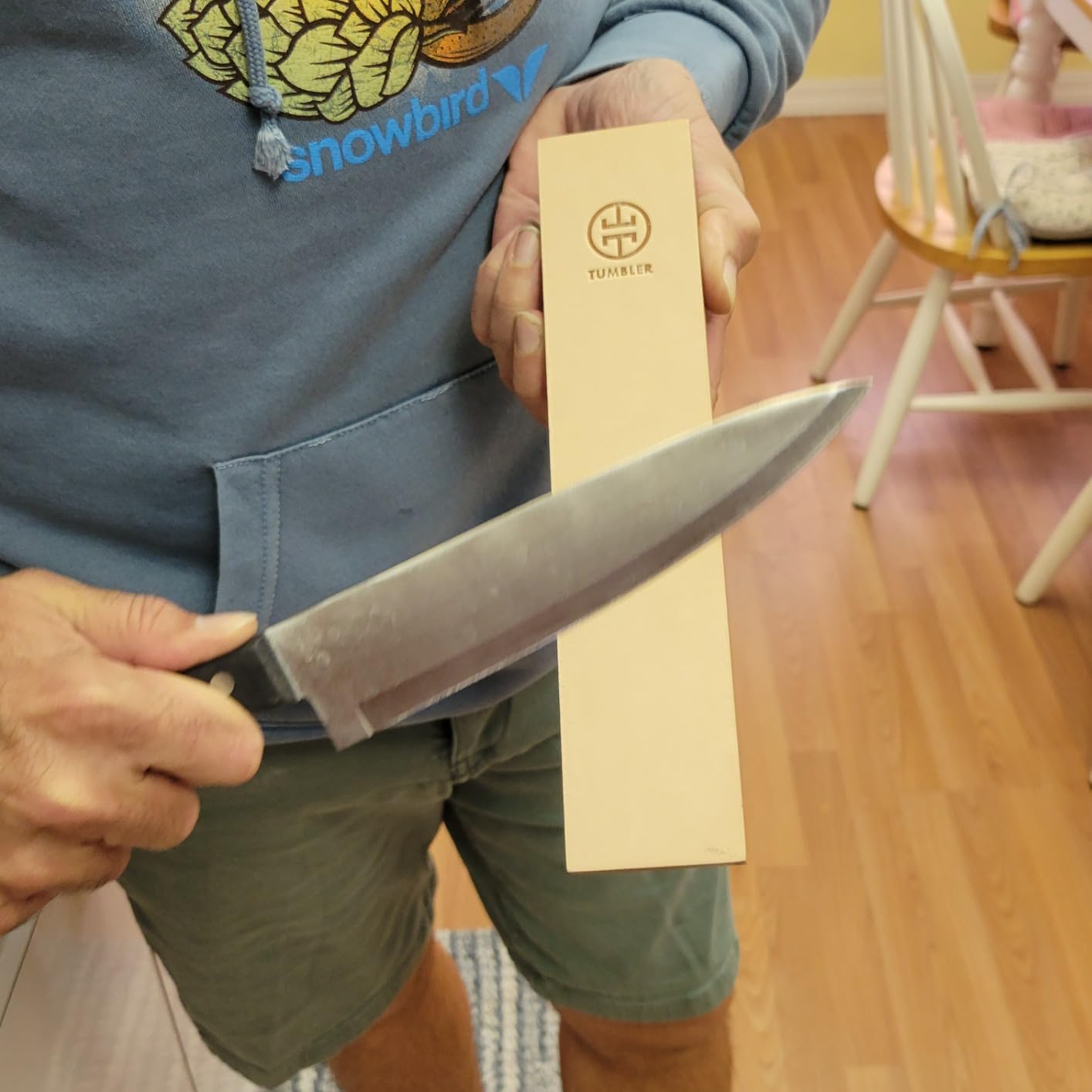
Tumbler is a system, not a standalone block. This strop is a component in the rolling sharpener ecosystem, which uses a magnetic holder, and buyers judge it as the finishing accessory for a setup they already own.
The materials are the draw: solid beech with vegetable-tanned cowhide, at 9.8 x 2.2 inches. It is positioned as the final step in a sharpening process, realigning the cutting edge and removing leftover metal for paper-thin cuts.
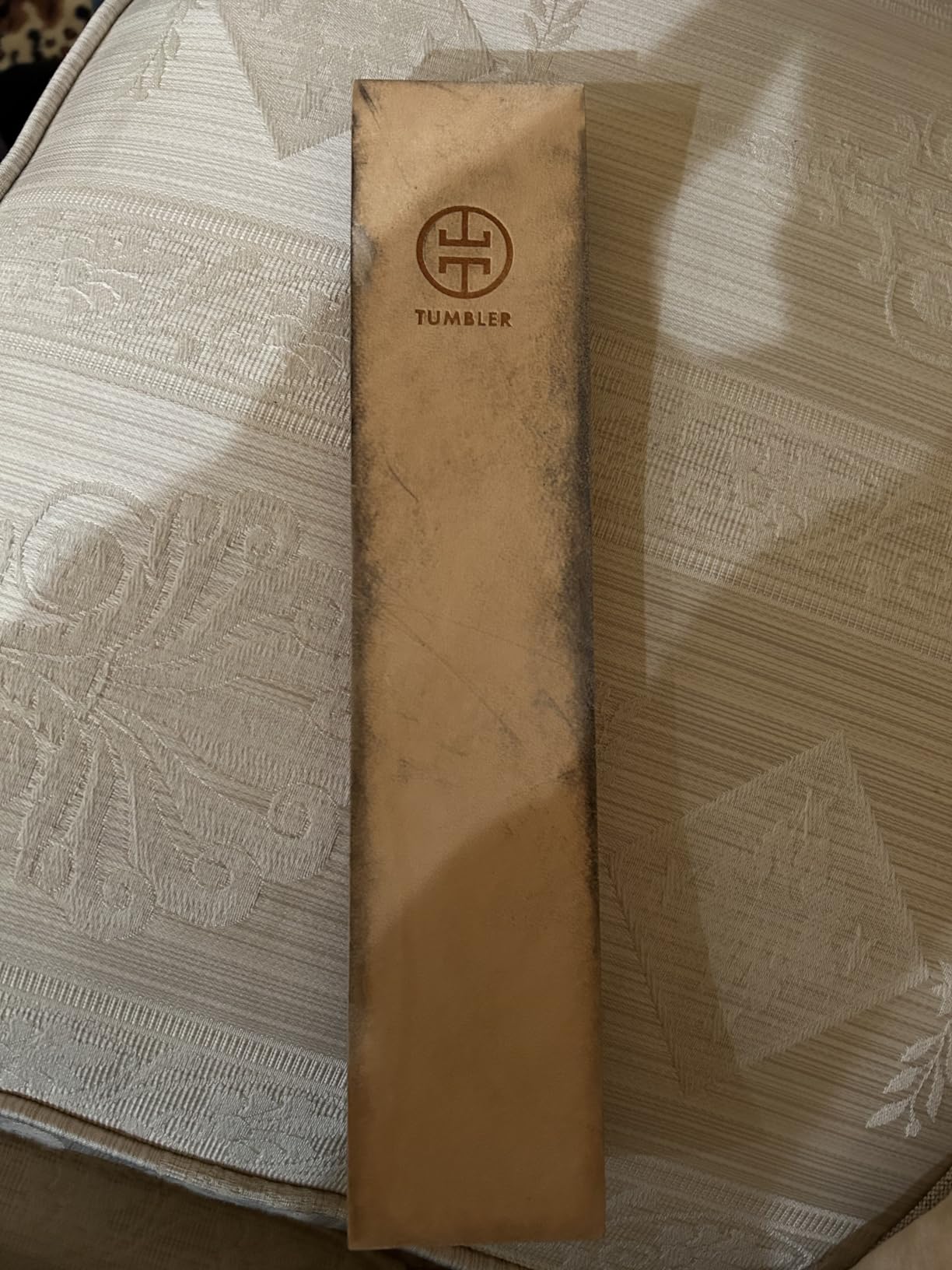
Why a System Component Costs More
You are buying a designed pairing, not just hide on wood. The dimensions, the base, and the magnetic holder compatibility are all chosen to work with the rolling sharpener rather than to be a generic paddle.
That logic disappears if you do not own the rest of the system. Owners treat it as an addition to an existing setup and judge it on build quality, which is where the 80 percent five-star share comes from.
No Compound: What That Changes
Nothing is included, so you need a separate paste or you work bare leather. Bare leather still realigns an edge and takes a fine polish, it just removes less material.
For most buyers who already run a sharpening routine, bringing your own compound is the point. It means you control the micron and can use what your stones and your steel actually need.
Size and Warranty Limits
The 2.2 inch face is sized for kitchen knives, chef’s knives, and paring blades. It is not an axe, chisel, or machete tool, and treating it as one is where people get disappointed.
The warranty is also kitchen-specific by the manufacturer’s terms, which is worth reading before you use it on anything else.
Best For and Not Ideal For
Best for home cooks who have already committed to the Tumbler rolling sharpener and want the finishing step that matches it.
Not ideal for anyone buying their first strop. Without the rest of the system and without compound, it asks more of you than the price suggests.
8. Hutsuls 3 x 8 Inch Buffalo Strop – Flat-Pack and Genuinely Portable
Hutsuls Brown Leather Strop with Compound – Get Razor-Sharp Edges with Stropping Kit, Green Honing Compound & Vegetable Tanned Two Sided Knife Sharpener Step-by-Step Guide Included
3 x 8 inch buffalo hide
4.0 mm thick
Vegetable tanned
Green compound bar included
Pros
- 4.0 mm hide is thicker than most budget strops and measures true
- Works as a genuinely portable strop for campsite sharpening
- Green bar on the rough face plus bare smooth face
- About 20 strokes per side to paper-cutting sharpness
- Brown and black variants
Cons
- Loose leather with no backing needs a flat surface
- 3 inch width is short for a 10 inch chef's knife
- Black variant costs more than brown for a perceived brand reason
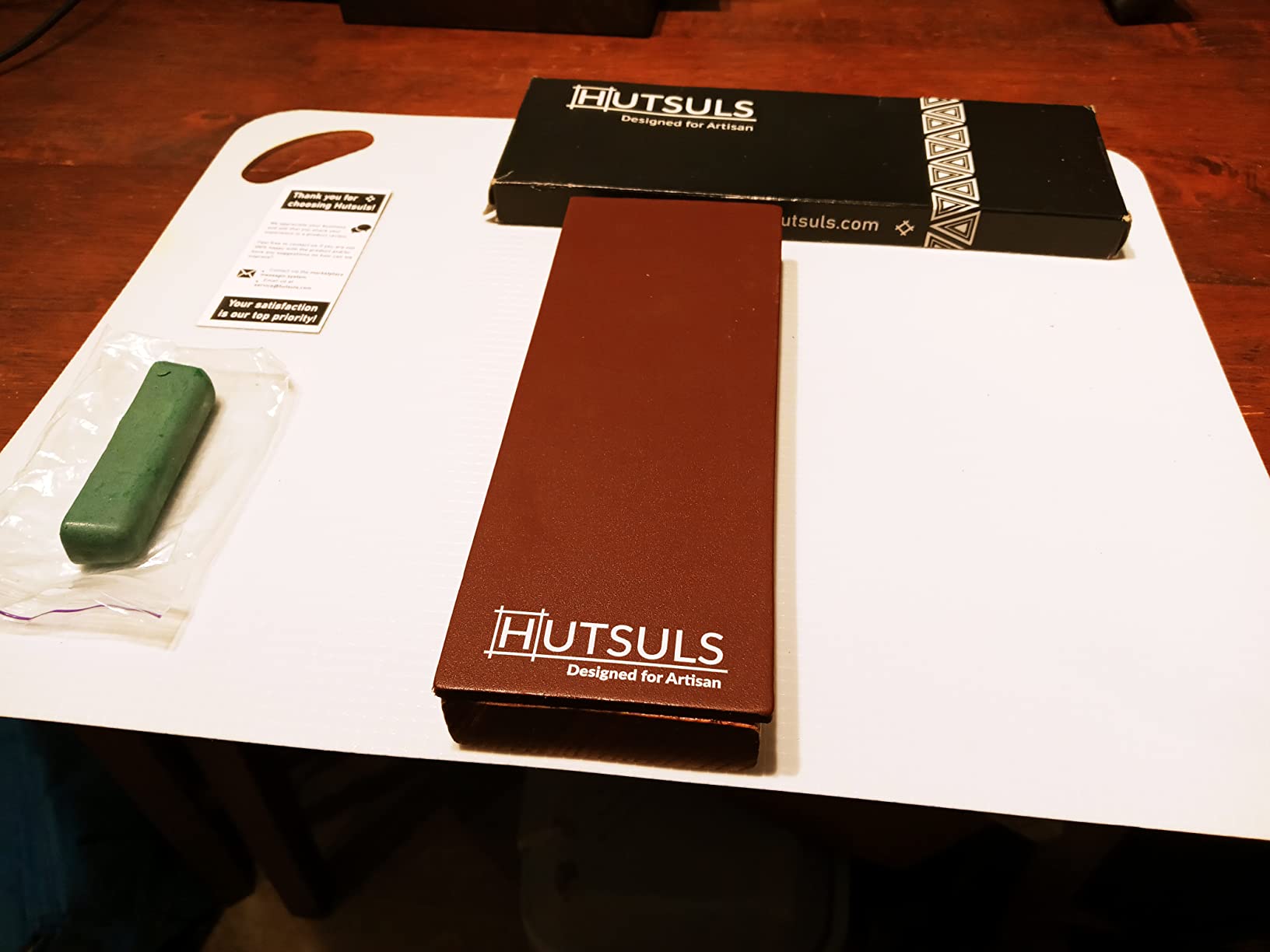
This strop arrives as loose hide, not a mounted paddle, and that is the whole point. You roll it, put it in a bag, and sharpen at a campsite or a hotel sink. Several owners describe exactly that workflow.
The leather is 4.0 mm vegetable-tanned genuine buffalo, which is thicker than most budget strops and measures true to spec. Users report taking a stoned knife to paper-cutting sharpness in about 20 strokes per side, with harder steels such as D2 needing more passes than soft ones.
Bare Hide Versus a Mounted Paddle
With no backing, the leather has to lie flat on a table or be held with a light, controlled hand. Owners who get this wrong round the edge they just sharpened, which is the most common complaint about unmounted strops in general.
In exchange you get a strop that weighs nothing, folds flat, and survives a bag better than any wooden paddle. For knives, razors, and small tools that is a straight trade.
Two Faces, Two Stages
One smooth side and one rougher side, both usable for honing. The natural workflow is green compound on the rough face for refining and a bare pass on the smooth face to finish.
That bare final pass is what produces the shine owners report, and it costs nothing but a clean section of leather.
Break-In and Longevity Reports
The review base is deep, which means the long-term picture is well documented. Owners who replaced an old soaked strop report getting the same result from this one, and several mention the company writing a handwritten letter of support after purchase.
Black and brown variants exist. Buyers who upgraded to black generally did it for stain hiding rather than performance.
Best For and Not Ideal For
Best for portable sharpening, for EDC maintenance away from a bench, and for anyone who wants a thick, honest hide without a paddle.
Not ideal for long kitchen knives. Three inches of width and no rigid backing make a 10-inch blade more work than it should be.
9. BeaverCraft LS2P1 3 x 8 Inch Strop – The Portable Favourite
BeaverCraft Stropping Leather Strop for Knife Sharpening Strop LS2P1 – Knife Stropping Kit 3 x 8 IN – Knives Sharpener with Honing Strop Polishing Compound Set – Double Sided
3 x 8 inch bare vegetable-tanned hide
Smooth face for compound
Rough face works bare
Compound bar included
Pros
- Best documented strop in the set across thousands of reviews
- Compound performs well with 0.5 micron diamond emulsion
- Rolls into the same box as a sharpening stone
- Supple but structured hide needing only a light touch
- Consistent results across DC53 and 14C28N steels
Cons
- Bare leather needs a flat surface and a light touch
- 1.57 inch working width is short for a 10 inch chef's knife
- Hide is graded average by people who work in leather
- One owner questions whether both faces are genuine leather
This is the pick r/sharpening users name most often as a favourite pre-made leather strop, and it is the one we recommend to anyone whose sharpening life is one folding knife and a small jar of compound. At 3 x 8 inches it is a maintenance strop, not a workshop tool.
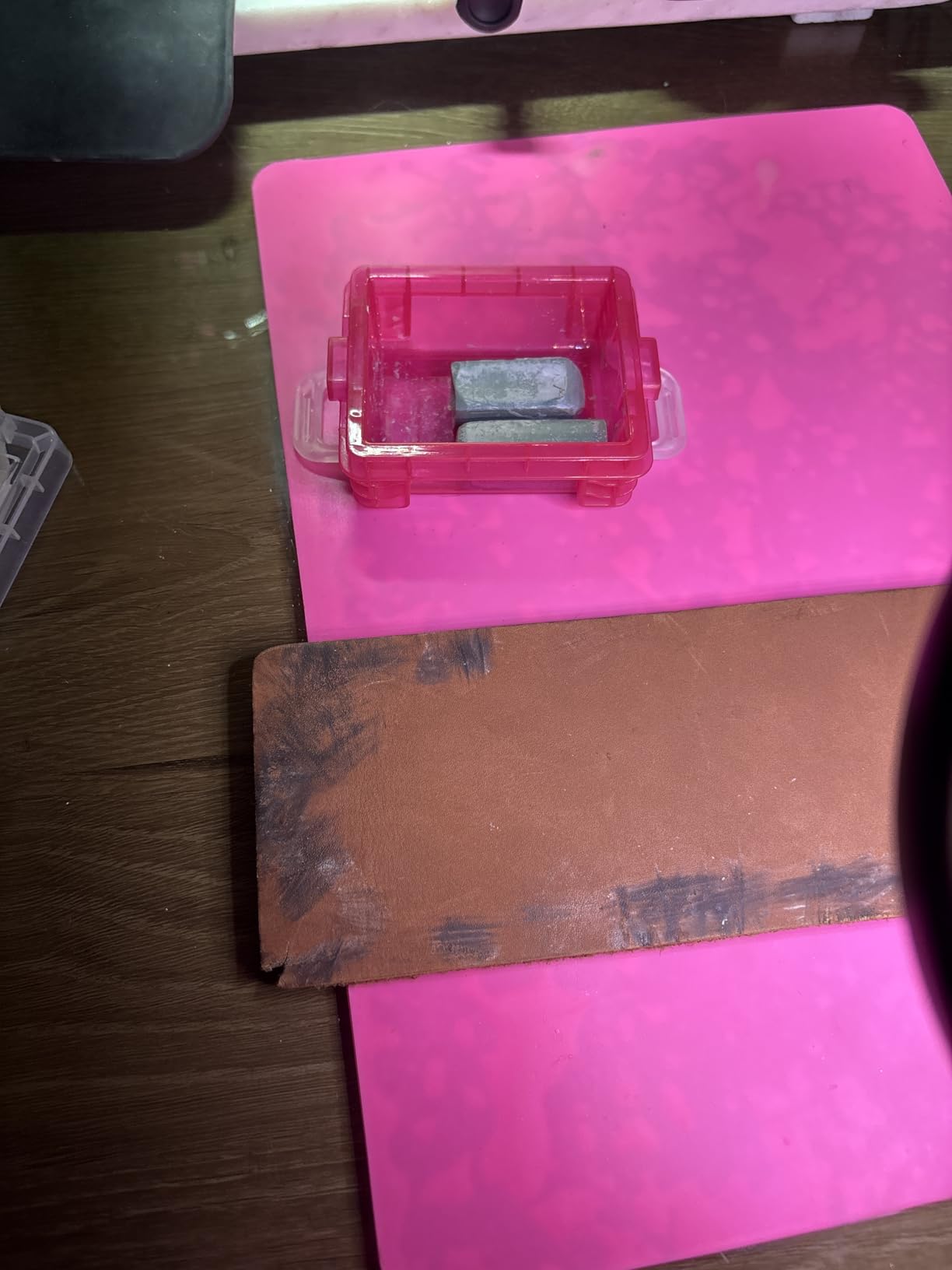
It is bare vegetable-tanned hide with no rigid backing, one smooth face for use with compound and one rough face that works bare. The reviews are unusually candid for a product this size, which is why we trust the picture they paint.
What Thousands of Reviews Actually Say
Experienced leatherworkers rate the hide as average grade but excellent for stropping, while hobbyists simply call it good value. That is a useful distinction: you are buying function, not a showpiece hide.
The star distribution has a larger three-star band than any other pick here, and the recurring cause is size rather than quality. One owner also questioned whether both faces are mounted to the same synthetic material, which is worth a glance when the hide arrives.
Performance Across Steels
Owners report consistent behaviour across DC53, 14C28N, and common stainless kitchen steel, and the supplied compound bar works well for a mirror finish when paired with 0.5 micron diamond emulsion.
That pairing matters. The bundled bar is adequate; adding a fine emulsion is what pushes the finish.
The Portability Advantage
It rolls flat into the same box as a sharpening stone, which is the ideal arrangement for stropping in the woods or anywhere away from a workbench. It suits kitchen knives, pocket knives, secateurs, razors, and small carving tools.
Supple but structured is the description owners keep using. It needs only a light, controlled touch, and it rewards that touch with a consistent draw.
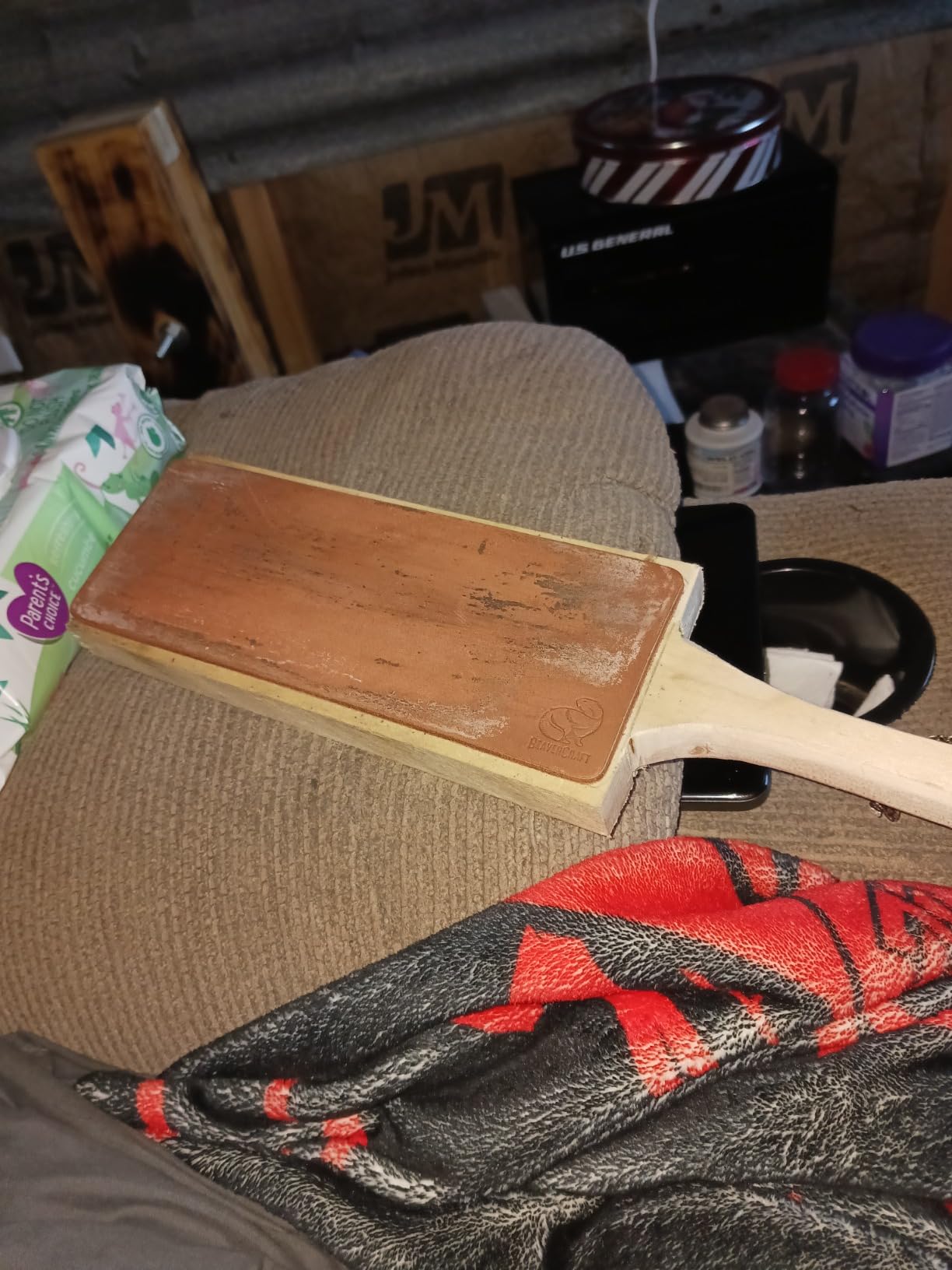
Best For and Not Ideal For
Best for pocket knives, EDC maintenance, straight razors, and anyone who wants a strop that fits in an existing stone kit without adding a paddle.
Not ideal for long blades. The short runway is the single most common complaint across thousands of reviews.
10. LAVODA 3 x 8 Inch Vegetable-Tanned Strop – The Most Instructive Budget Buy
LAVODA Leather Honing Strop for Knife Sharpening with Polishing Compound Double Sided (3 Inch by 8 Inch)
3 x 8 inch vegetable-tanned leather
1/8 inch thick
Green and white bars included
Mount it yourself
Pros
- Deep review history with full method write-ups
- Green bar for suede face and white bar for smooth face
- Owners report taking an old Wusthof from 5 inches to a 12 inch paper cut
- Cheap enough to dedicate one strop per compound
- Consistently described as high-grade leather for the price
Cons
- Leather arrives very stiff and must be worked back by hand
- 8 inch length is short
- Directions are scant
- Occasional knife slash marks on the suede side
What makes this strop interesting is the review section rather than the product. Multiple owners publish complete sharpening workflows, angle advice, and paper-test protocols, and they report real before-and-after results on Wusthof, Condor, and Case knives plus chisels and plane irons.
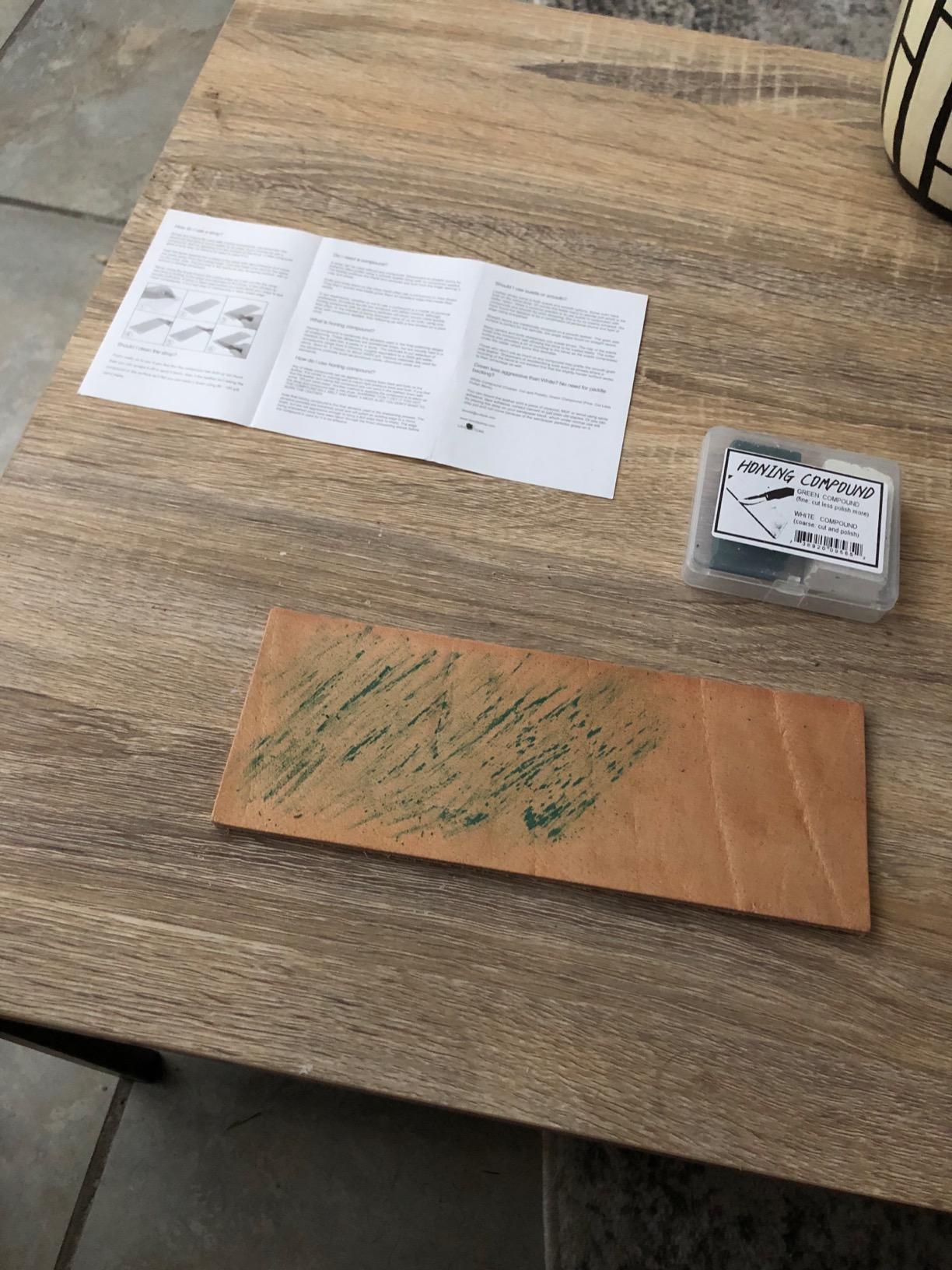
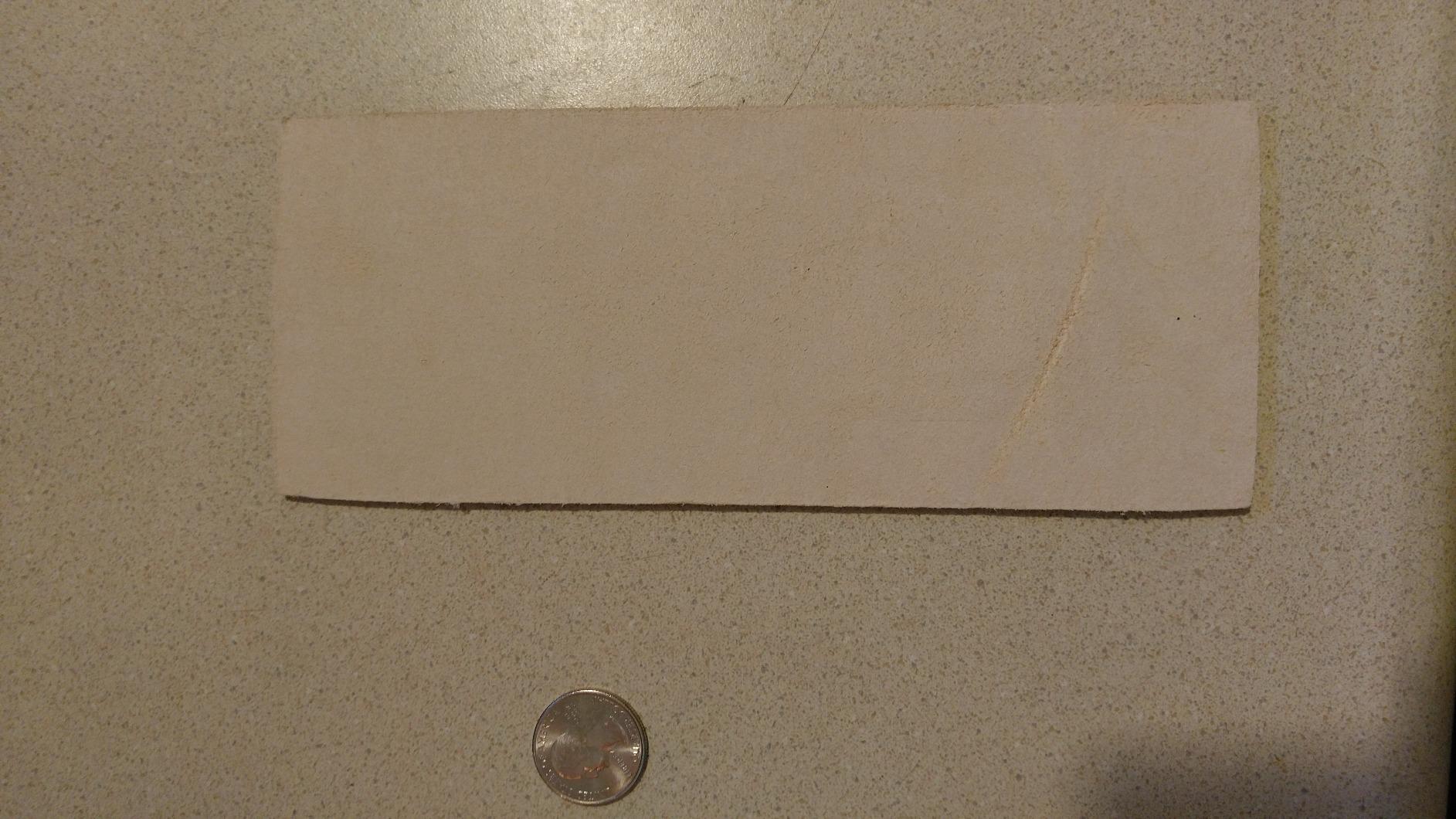
One owner describes taking a decade-old Wusthof chef’s knife from a 5-inch cut into paper to a full 12-inch cut. The leather is vegetable-tanned at 3 x 8 inches and 1/8 inch thick, and it arrives loose rather than mounted.
The Stiffness Problem and Its Fix
The top complaint is that the leather arrives nearly cardboard-stiff. Owners resolve it the same way: work it back and forth by hand for a few minutes until it flexes.
That is a five-minute task, not a flaw, and doing it produces a strop that conforms slightly to your stroke without folding under the blade.
A Two-Stage System for Very Little
Green bar for the suede face, white bar for the smooth face, and about 2 oz of compound in the box. Several owners buy two or three of these so each compound grit has a dedicated surface, which is the cheapest way to keep compounds separated.
The surface is prepared for easy compound application, which sounds minor and matters in practice. Uneven loading is the fastest way to make a strop drag.
Owner’s Choice Versus a Finished Product
Because it is sold as loose leather, owners commonly mount it on MDF or a scrap length of 2×4. That is a genuine advantage if you enjoy a bit of assembly, and a genuine inconvenience if you do not.
One reviewer dislikes the rough underside for ultra-sharp edges, and occasional knife slash marks on the suede side have been reported. Guard the surface and it is not an issue.
Best For and Not Ideal For
Best for budget buyers who want vegetable-tanned leather, a complete two-stage compound set, and the option to mount it themselves.
Not ideal if you want something usable straight from the packaging, or if you need a stiff, self-supporting block. Plan ten minutes of hand work before the first stroke.
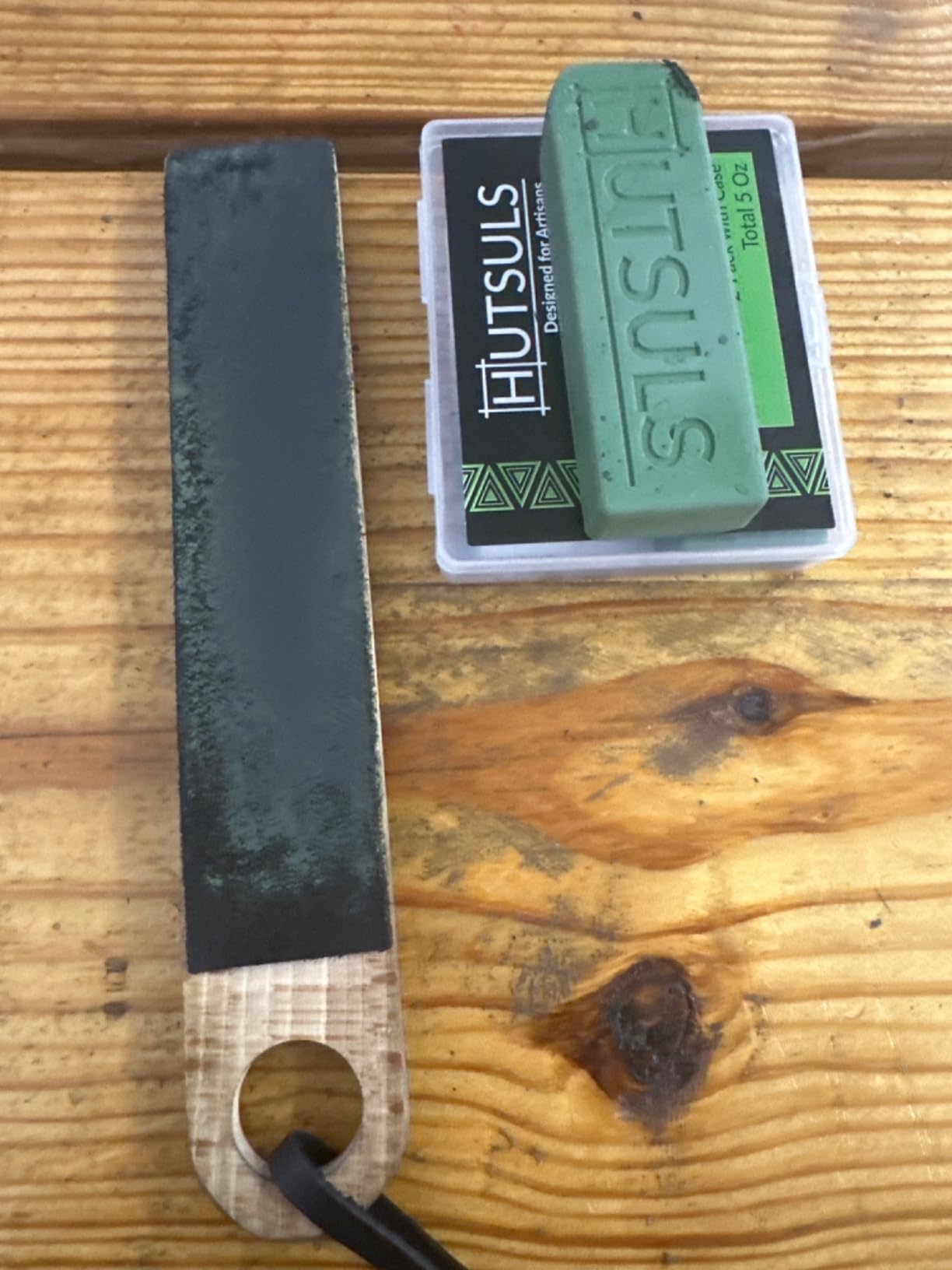
11. Hutsuls Pocket Knife Strop Kit – The Smallest Carry Option
Hutsuls Pocket Knife Strop Kit – Get Razor-Sharp Edges with Pocket Leather Strop for Knife Sharpening, Easy to Use Knife Stropping Kit with Stropping Compound, Stropping Leather Sharpening Strop Block
7.67 x 1.33 inch format
3.2 ounces
Double-sided genuine leather
Compound bar included
Pros
- Genuinely pocket sized at 7.67 by 1.33 inches and 3.2 ounces
- Black leather hides staining and reads well against the bar
- Rough and smooth faces suit deburring and finishing
- Sized for axes broadheads and bushcraft tools
- Strongest sentiment in the set with almost no negatives
Cons
- 1.33 inch width is the narrowest here so it suits pocket and survival blades
- No rigid backing so it needs a flat surface or two hands
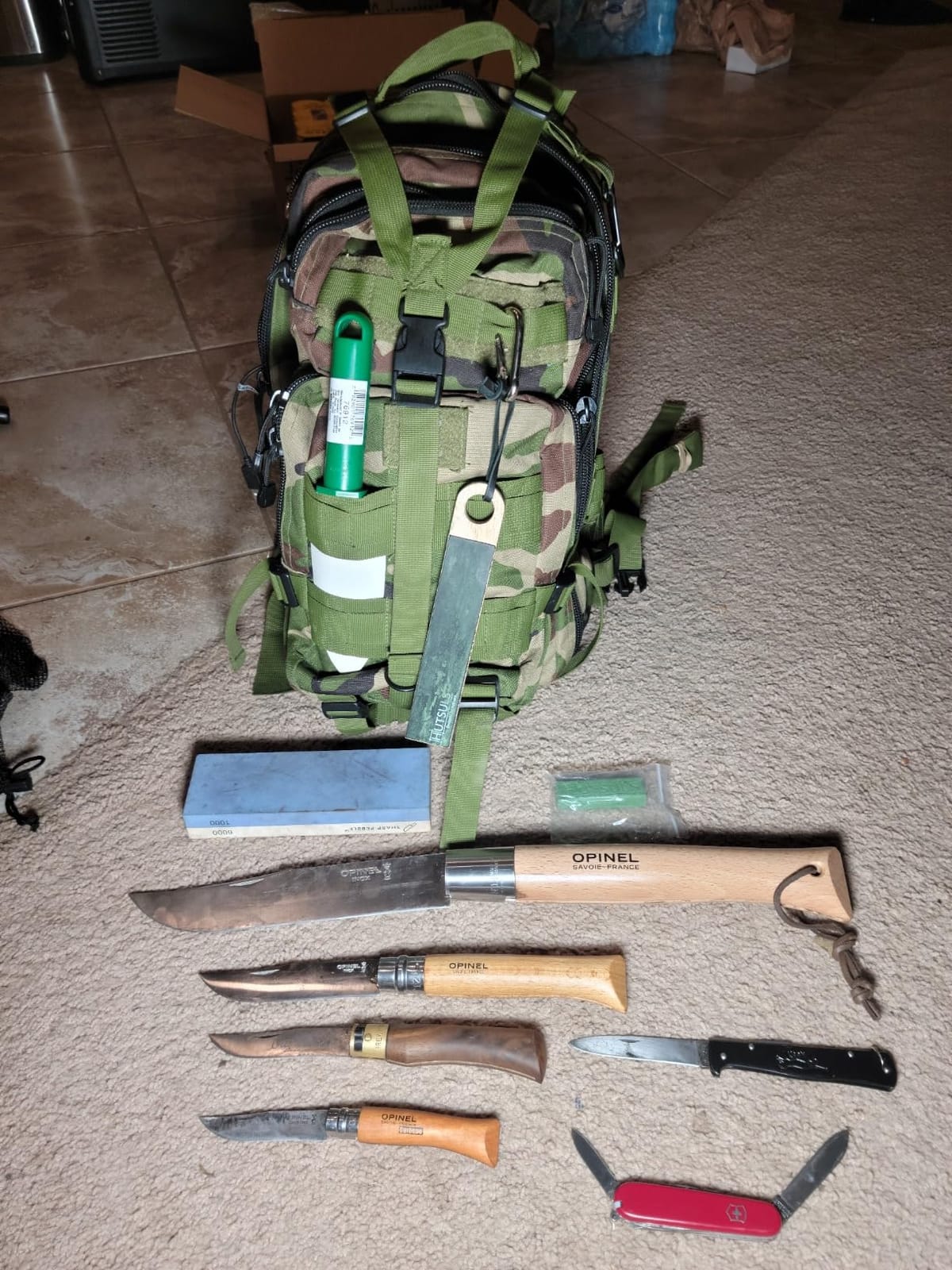
This is the one to put in a survival or bushcraft kit. At 7.67 x 1.33 inches and 3.2 ounces it is genuinely pocketable, and the double-sided genuine leather with a rough face and a smooth face covers deburring through finishing.
Review volume is the lowest in the set, but sentiment is the strongest: 78 percent five-star and 16 percent four-star with essentially no negatives. Buyers frame it as survival or EDC kit rather than a bench tool, and value the compact footprint plus the included compound.
Where the Narrow Width Starts to Matter
At 1.33 inches, the working surface is the narrowest here. For a folding knife, a small hunting blade, or a broadhead, that is a good match. For a chef’s knife it is not, and trying to use it on one produces the segmented-stroke problem.
If your maintenance routine is entirely pocket knives, this width is a feature. It concentrates the compound where you need it.
Compound and Surfaces in a Small Package
The included bar carries abrasive particles fine enough for finishing, and the double-sided layout lets you refine on the rough face and polish on the smooth one without carrying two tools.
Black leather is a practical choice at this size, since it hides metal staining and makes the amount of applied compound visible against it.
Handling Without a Backing
There is no rigid backing, so it needs a flat surface or two-handed control. On a tree stump or a tailgate that is fine. Trying to hold it one-handed in mid-air is not.
The included step-by-step leather strap guide covers the technique, which matters more at this size than on a full paddle.
Best For and Not Ideal For
Best for folding knives, survival kits, and anyone maintaining a single EDC blade away from a workbench.
Not ideal if you own only kitchen knives. The width makes it the wrong tool for that job.
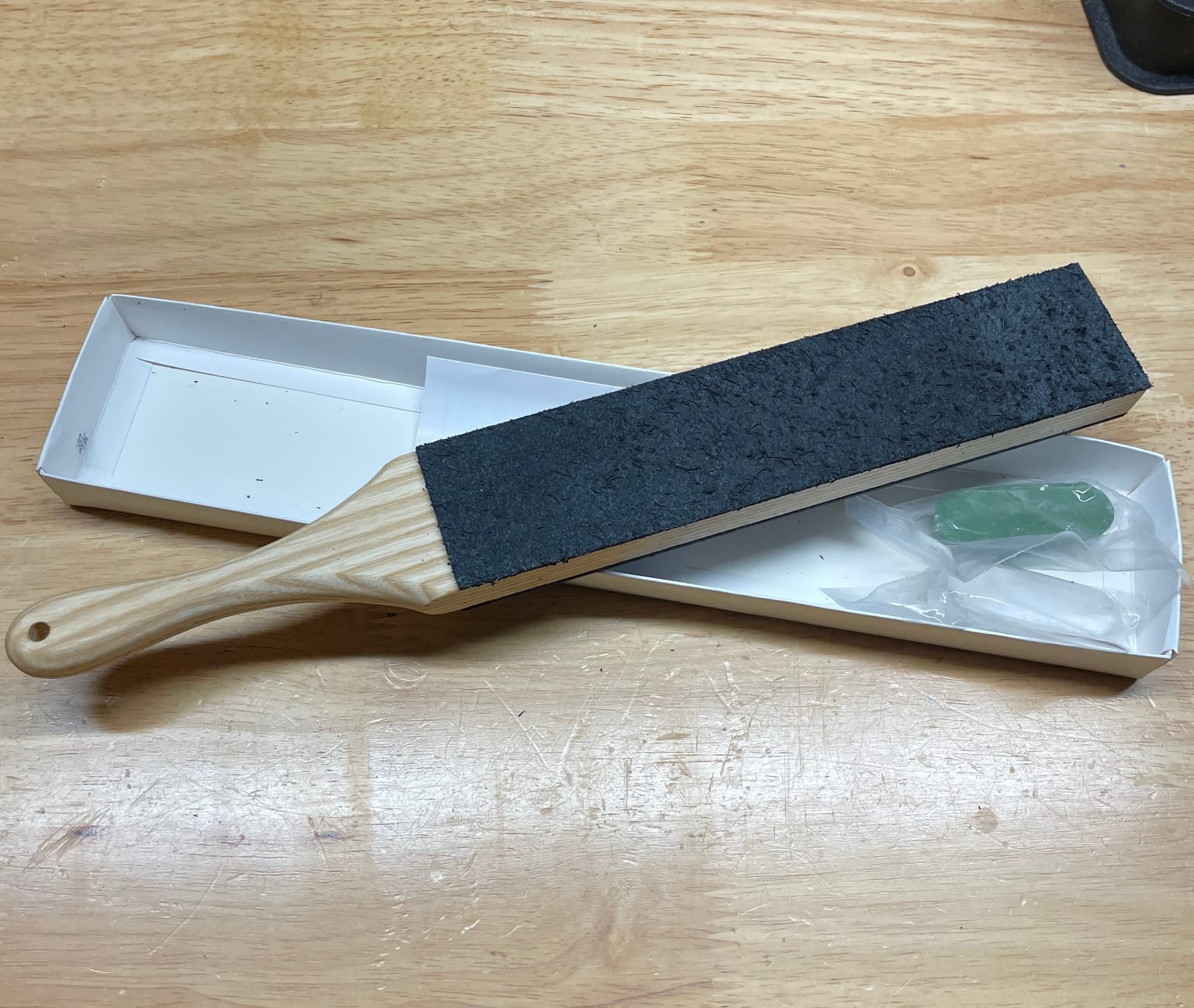
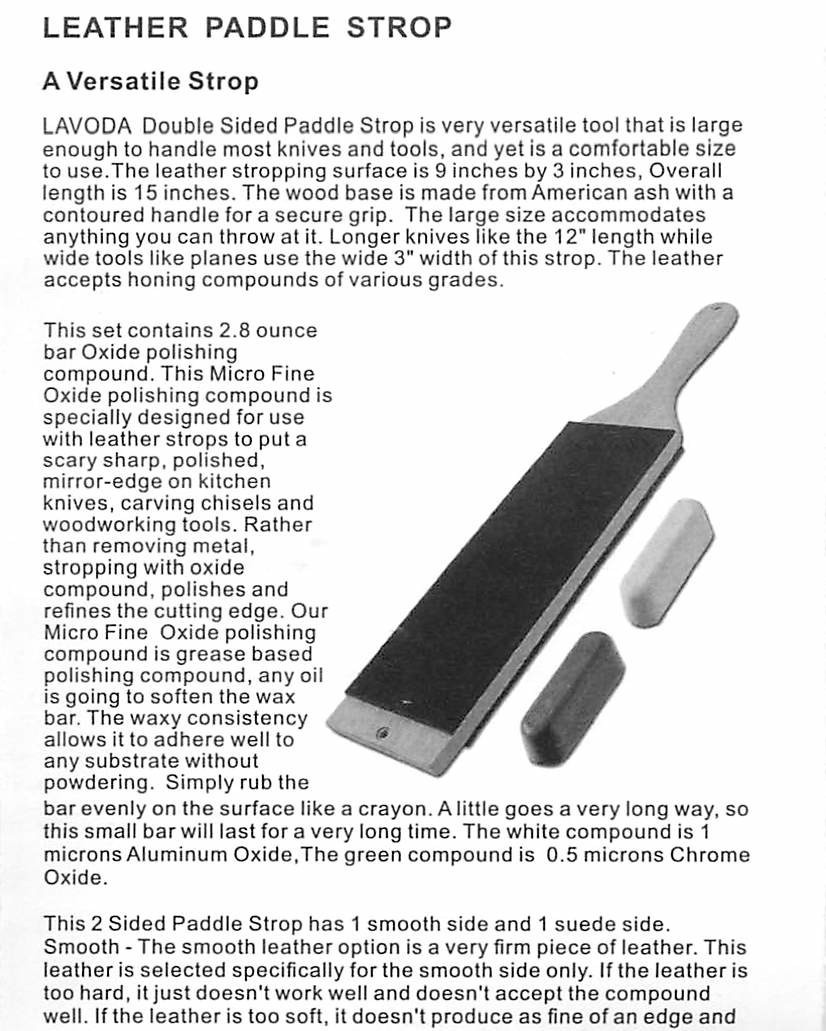
12. LAVODA 14 Inch Black Leather Paddle Strop – Two Grades on a Hardwood Handle
LAVODA Leather Strop Kit with Polishing Compound, Knife Stropping Block for Sharpening & Honing Knives Tools (Black Leather, 2 Inch by 14 Inch)
2 x 14 inch paddle on ash wood
Smooth and suede cowhide faces
Green and white compounds included
15.7 inch overall
Pros
- Paddle rests on a table or lap or works as a file-motion stroke
- Two distinct faces for separate polishing grades
- Thick leather strips fixed firmly to solid hardwood
- Black leather stays clean and shows compound amount
- Reported to hold an edge through heavy woodworking
Cons
- One reviewer received two green bars instead of green and white
- At least one buyer calls the hide thin versus the listing
- Rough side is not considered good for stropping
The feature that separates this paddle is the handle arrangement. Owners report resting it on a table or their lap for a controlled bench stroke, or gripping it for a file-motion stroke, which gives you two ways to hold the same edge.
It is a 2 x 14 inch paddle on high quality ash wood with cowhide leather, one smooth face and one suede face, and green and white compounds in the box. Measured overall including the handle it comes to 15.7 x 3 x 1 inches.
Two Faces, Two Polishing Grades
The smooth face and the suede face are intended as separate polishing grades rather than interchangeable duplicates. Compound bars for burr removal and polish are included, so the pair works as a complete system.
Black leather is a quiet but real benefit. It stays looking clean, and it makes the amount of compound you have applied visible, which helps you avoid overloading.
Solidity of the Build
Owners like the solid hardwood and its finish, and report thick leather strips fixed firmly to the wood. Several note it extends how long an edge holds after a fixed-angle diamond system, and one describes it as rivalling more expensive strops.
The structural complaint we found concerns the suede face rather than the mount. At least one buyer considers the rough side unsuited to stropping, with or without compound.
Contents and Consistency Caveat
One reviewer received two green bars instead of the advertised green and white pair. That is a fulfilment issue rather than a product flaw, but it is the kind of thing worth checking on arrival.
Another buyer describes the hide as thin versus what the listing implies, so if leather thickness matters to you, inspect it before committing to a full finishing routine.
Best For and Not Ideal For
Best for woodworkers finishing chisels, plane blades, and gouges, and for anyone who prefers black leather that hides compound staining.
Not ideal if you want one dependable suede face for final deburring. Several owners work only on the smooth side and ignore the rough one.
How to Use a Leather Strop in Five Steps
Stropping technique is where most of the disappointing results come from, and it is a five-step process that takes under a minute once you have it. Forum threads on this query are full of people pressing far too hard, which rounds the edge they just spent an hour sharpening.
- Clean the blade first. Wipe away stone slurry and metal dust with a dry cloth or a few pulls on clean newspaper. Compound applied over grit does not behave predictably.
- Load the compound. Warm a small amount of green compound or diamond paste between your fingers and rub it across the leather in thin, even strokes. Less is more. A well-loaded strop needs refreshing only every few sessions.
- Lay the spine down. Place the spine of the blade on the leather near the far end, with the edge trailing. This is the single most important habit in stropping.
- Draw backwards with light pressure. Pull the blade toward you, spine leading, at your sharpening angle or slightly shallower. Light pressure means the weight of the knife, nothing more. Use six to ten strokes per side.
- Finish on clean leather. One side of a good strop should stay unloaded. Three or four strokes there remove any compound residue and leave a brighter finish.
Push strokes are the wrong way round for most steels. Pulling spine-first keeps the burr folding forward into the apex instead of being dragged back across the bevel.
Where this sits in a full sequence: coarse stones fix the geometry, medium and fine stones set the apex, the strop removes the burr and polishes, and clean leather closes out the finish. Skipping to leather from a dull knife just polishes a bad angle.
How to Care for, Clean and Revive a Leather Strop
The most common forum question about strops is what to do when they stop working. The answer is usually that the surface has glazed over: the pores have filled with metal and compound, the leather has gone shiny, and it stopped cutting long ago without anyone noticing.
- Strip it when it glazes. Run a handful of coarse salt across the surface with a little oil, then wipe firmly with a cloth. The salt lifts metal particles out of the pores.
- Sand back to bare hide. For a serious refresh, take the surface down with 120 to 220 grit sandpaper until fresh leather appears. This also flattens a face that has developed a dip.
- Condition the leather. Work in a small amount of leather balm, neatsfoot oil, or the lanolin paste that comes with kits like the Bacher. Dry leather cracks; conditioned leather stays supple.
- Store it flat and clean. Keep it away from heat and sunlight, and clean the knife after every session so you are not stropping debris back into the hide.
The Bacher maintenance interval is a useful benchmark: top up every 30 to 50 sharpenings, and expect to sand back to bare leather somewhere around 300 to 500 uses. Cheaper hides glaze sooner.
Green compound does transfer. Users on r/sharpening describe residue on the blade, the backing, and their hands, which is why owners of brown and tan leather often upgrade to black purely to hide the staining.
How to Choose a Leather Strop
Vegetable-Tanned or Chrome-Tanned?
Vegetable-tanned hide is firmer, slower to break in, and holds an angle. Chrome-tanned leather is soft, fast, and rounds edges. Unlabelled genuine leather is a warning sign in this category, so treat any strop that will not name its tannage as soft by default.
Buffalo leather sits in between: thicker and more fibrous than smooth cowhide, which some owners prefer for carbon steels and hand-finishing work.
Size, Shape, and Where Stropping Happens
Match the working width to your longest blade. Three inches lines up with the standard 8×3 bench stone, which is exactly why forum users keep recommending that size. Two inches or less suits pocket knives and razors but makes a 10-inch chef’s knife more work.
Shape follows habit. A paddle with a handle gives you control and lets you hold it in the air for carving. A bare strip rolls into a bag for field use. A fixed block like the KNIVES PLUS sits on a bench and suits small steady jobs.
Single or Double-Sided?
A double-sided strop is worth the extra cost in almost every case, because it lets you refine on the rough face and polish on the smooth one without keeping two tools. The single exception is if you only ever strop a folding knife and want the simplest possible object.
Check that the two faces are clearly labelled. Several owners call an obvious rough and smooth split intuitive, and that matters for beginners learning the sequence alone.
Compounds: Green, White, Red, and Diamond
Green chromium oxide is the general-purpose workhorse and the most common inclusion. White aluminium oxide is finer. Red is a polishing bar for the last pass. Diamond paste and emulsion give you a specific micron, and experienced users frequently report preferring 0.5 to 1 micron over a bundled green bar.
The open debate on r/sharpening is whether diamond is worth the extra cost over green. The consensus in practice is that both work; several regulars report switching to buffalo leather with micron diamond and being equally happy on carbon steel.
One common error is putting the same compound on both sides, then transferring residue as you flip between them. If you own two bars, keep them on separate faces or separate strops.
What Professionals Actually Use
Chefs on r/TrueChefKnives tend toward a wide paddle strop with green compound, often adding separately purchased diamond paste or keeping a plain raw leather face for a final polish. Straight-razor users favour a firm, smooth face with light pressure and long strokes. Woodworkers finish chisels and gouges on a smooth face after a fixed-angle diamond system, and they prioritise compound transfer over any strop-specific gimmick.
Chefs also reach for knives we wrote about in our leather feel guide less for technique than for surface comparison. The principle is the same: a firm, finished surface changes how a material feels under load.
Your First Strop: A Simple Decision Path
If you sharpen mostly pocket knives and travel, start with a bare strip such as the BeaverCraft LS2P1 or the Hutsuls pocket kit. If you own a full kitchen set, start with a paddle such as the BeaverCraft LS6P1 or the Hutsuls 14-inch buffalo model. If you already own stones and want a proper bench workflow with a full compound ladder, the Bacher is the one most likely to grow with you.
Whichever you pick, the useful habit is the one described on the desk mat guide for keeping a work surface in good order: a clean, flat, well-kept tool area is what makes a thirty-second job repeatable. A strop that is maintained is worth more than a better strop that is ignored.
If your interest runs to how leather itself ages, our leather band care guide covers conditioning and break-in in more detail than we repeat here.
Frequently Asked Questions
Are leather strops good for sharpening knives?
A leather strop is excellent at removing the burr left by stones and aligning the edge apex, but it does not remove steel or set a new bevel. Think of it as the finishing step after sharpening, not a replacement for it. If your knife still feels dull after twenty light passes, the angle is wrong and you need a stone or a guided sharpener, not more stropping.
Which strop is better for stropping, smooth or suede?
The smooth face is for finishing and the suede face is for refining. Use the rougher face first to remove the burr and do the lighter work, then finish on the smooth face, ideally unloaded, for a brighter result. A double-sided strop lets you do both on one tool, which is why most of the picks in this roundup have two faces.
What do professionals use to sharpen their knives?
Chefs tend to work with a wide paddle strop loaded with green compound, often adding separately purchased diamond paste or keeping a raw leather face for a final polish. Straight-razor users favour a firm smooth face with light pressure and long strokes. Woodworkers finish chisels and gouges on a smooth face after a fixed-angle diamond system. The common thread is a firm vegetable-tanned surface and very light pressure.
Which strop is high quality and very expensive?
In this roundup the premium picks are the Bacher with 3 mm bark-tanned full-grain cowhide on an FSC beech paddle and a four-grit compound set, and the Tumbler strop built for the rolling sharpener system. Premium does not automatically mean better for you; match the hide thickness and working width to your longest blade instead of paying for features you will not use.
How often should I replace a leather strop, and can a glazed one be revived?
A well-kept vegetable-tanned strop can run for years. The Bacher maintenance guidance is a useful benchmark: top up every 30 to 50 sharpenings and expect to sand back to bare leather around 300 to 500 uses. A strop that has gone shiny and stopped cutting can usually be revived by scrubbing coarse salt and oil across the surface, then sanding it back to fresh hide and reconditioning with balm.
The Bottom Line
If you want one strop that handles knives, razors, chisels, and axes for years without going soft, take the Bacher with its 3 mm bark-tanned hide and four-grit compound ladder. If you maintain long kitchen blades, the Hutsuls 14-inch buffalo paddle gives you the continuous stroke that short strips cannot.
If your routine is a single folding knife away from a workbench, the BeaverCraft LS2P1 or the Hutsuls pocket kit is the right call. For a handled starter kit with compound included, the BeaverCraft LS6P1 covers most needs. The Angerstone wins on compound variety, the KNIVES PLUS block wins on being ready to use immediately, and the Tumbler strop belongs beside an existing rolling sharpener.
Whichever one you choose, the technique matters more than the tool. Light pressure, spine first, a dozen strokes, and a clean final pass on bare leather will outperform a premium strop used heavily.
Our picks were last reviewed in 2026, and every rating and review count in this guide comes directly from the owner feedback published with each product.