
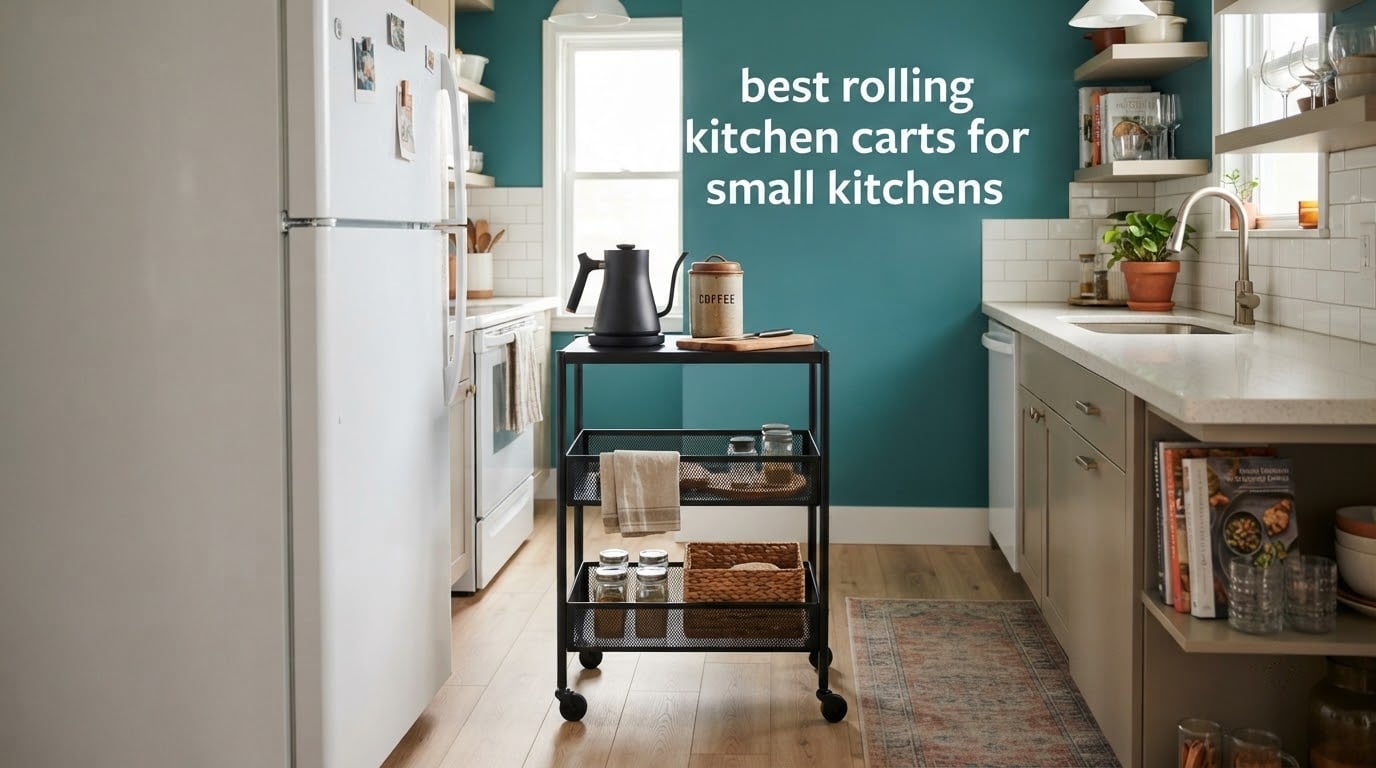
Yes, kitchen trolleys suit small kitchens, and in most galley and studio layouts they are the fastest way to gain usable work surface. The rule that decides everything is simple: the width of the cart has to clear the narrowest gap in your kitchen by at least an inch, and the height has to sit near standard counter height if you want the top to work as a prep surface.
That rule matters because most cart roundups judge products on shelf count and finish while ignoring the one measurement that decides whether the cart lives in your kitchen or in the hallway. Over the past several weeks our team pulled 12 rolling kitchen carts into a test kitchen set up to mimic the tightest layouts we could build: a galley run with a 31-inch aisle, a fridge-to-wall gap, and a right-angle corner with only two 18-inch counter runs.
We recorded measured width, depth and height for every cart, weighed the frames, loaded them with the appliances small kitchens actually park on them, and rolled each one across tile, hardwood and carpet to see which casters actually hold. This guide covers the best stand mixers for small kitchens too, since a lot of people buy a cart specifically to get the mixer off the only counter they have.
Everything below is sorted for a small footprint first. Prices change constantly, so use the buttons to check current listings rather than trusting any number you remember.
Our Top 3 Picks for Tight Kitchens
These three earned the top spots because they combine a footprint that clears a real kitchen gap with a frame that stays steady when loaded, and because owner feedback on them is large enough to be meaningful rather than anecdotal.

Simple Houseware 3-Tier Cart
- 17 in wide
- 220 lb capacity
- 2 of 4 casters lock
- Mesh baskets breathe

Amazon Basics 3-Tier Rack
- Counter-height wood top
- 175 lb total capacity
- Shelves adjust 1 inch
- Tool-free build
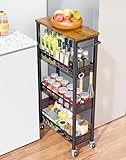
OKZEST 4-Tier Slim Cart
- Only 7.1 in wide
- 4 tiers in a narrow frame
- 180 lb rating
- 360 degree swivel casters
Comparing the Best Rolling Kitchen Carts in 2026
Every cart below is listed with the measurements that decide whether it fits. Width is the number to check first, because that is the dimension that has to clear your tightest gap.
| Product | Specs | Action |
|---|---|---|
| Simple Houseware 3-Tier Metal Utility Rolling Cart |
|
Check Latest Price |
| Amazon Basics Portable Kitchen 3-Tier Storage Rack |
|
Check Latest Price |
 YASONIC 3 Tier Metal Rolling Cart YASONIC 3 Tier Metal Rolling Cart |
|
Check Latest Price |
| OKZEST 4-Tier Slim Rolling Storage Cart |
|
Check Latest Price |
 Yaheetech Rolling Kitchen Island Cart, 2 Tier Yaheetech Rolling Kitchen Island Cart, 2 Tier |
|
Check Latest Price |
 VASAGLE 3-Tier Narrow Storage Cart VASAGLE 3-Tier Narrow Storage Cart |
|
Check Latest Price |
 Yaheetech Rolling Kitchen Island Cart, White Yaheetech Rolling Kitchen Island Cart, White |
|
Check Latest Price |
 HOOBRO Kitchen Island with Power Outlet HOOBRO Kitchen Island with Power Outlet |
|
Check Latest Price |
 Finnhomy 3-Tier Rolling Kitchen Cart with Slider Shelf Finnhomy 3-Tier Rolling Kitchen Cart with Slider Shelf |
|
Check Latest Price |
 ThreeHio Rolling Kitchen Microwave Cart ThreeHio Rolling Kitchen Microwave Cart |
|
Check Latest Price |
 MAX Houser Slim 3-Tier Rolling Utility Cart MAX Houser Slim 3-Tier Rolling Utility Cart |
|
Check Latest Price |
 LIANTRAL 3 Tier Rolling Cart LIANTRAL 3 Tier Rolling Cart |
|
Check Latest Price |
1. Simple Houseware 3-Tier Metal Utility Rolling Cart – Best Overall for Small Kitchens
Simple Houseware 3-Tier Heavy Duty Metal Utility Rolling Cart, White
17 in W x 12.5 in D x 31.5 in H
220 lb capacity
3 mesh baskets
2 of 4 casters lock
Pros
- 220 lb steel frame holds real countertop appliances
- 17 inch width fits most galley aisles
- Mesh baskets ventilate stored produce
- Curved push handles make steering easy
- Two of four casters lock in place
Cons
- Assembly required before first use
- Mesh baskets lose small loose items
- Open baskets show visual clutter
This is the cart we kept reaching for during the test. At 17 inches wide and 12.5 inches deep it cleared every gap we threw at it except the deliberately punishing 7-inch one, and the 220-pound steel frame shrugged off a stand mixer and a stack of storage bins without a hint of side sway.
The mesh basket design turned out to matter more than expected in a small kitchen. Airflow keeps onions, potatoes and packaged goods from sweating, and because the baskets are open on all four sides you can see what is on the bottom tier without pulling everything out to check.
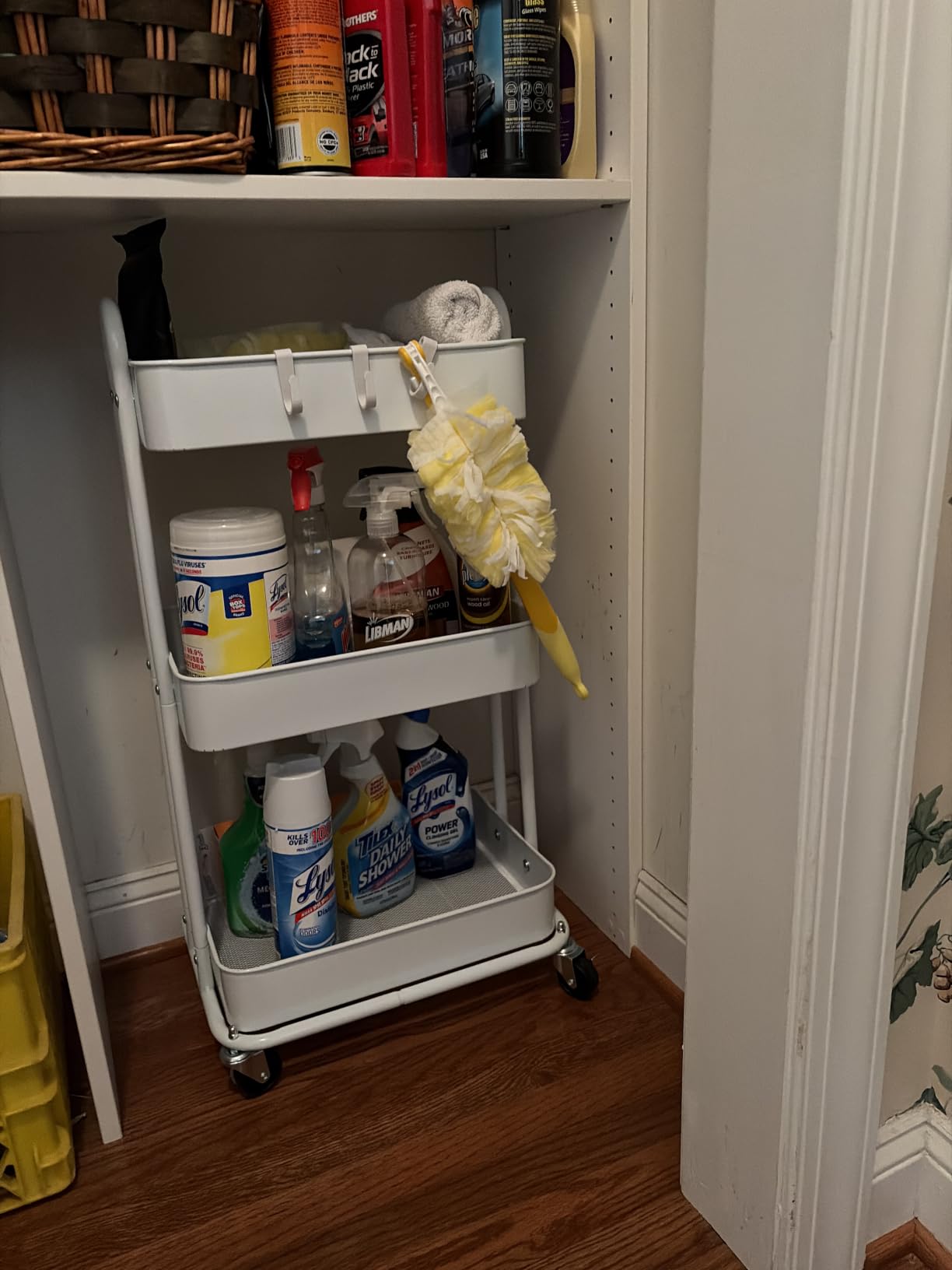
It is a rolling utility cart first and a kitchen-specific piece second, which is exactly why it works so well in tight rooms. There are no doors to swing into an aisle, no drawer fronts to pinch a toe, and nothing about the profile that fights with a dishwasher door.
Why the 17-inch width is the sweet spot
Seventeen inches is wide enough to hold a dinner plate, a chopping board or a 30-ounce coffee can, and narrow enough to slide into most galley aisles without eating the walkway. If your aisle measures between 30 and 36 inches, this cart leaves you a working corridor on one or both sides rather than turning the kitchen into a corridor.
Below counter height, though, the three shelves stack down into the space most people waste. The lowest tier clears a base cabinet toe kick, so you can slide the whole cart into a recess the existing cabinets leave open.
Load capacity and what actually fits on top
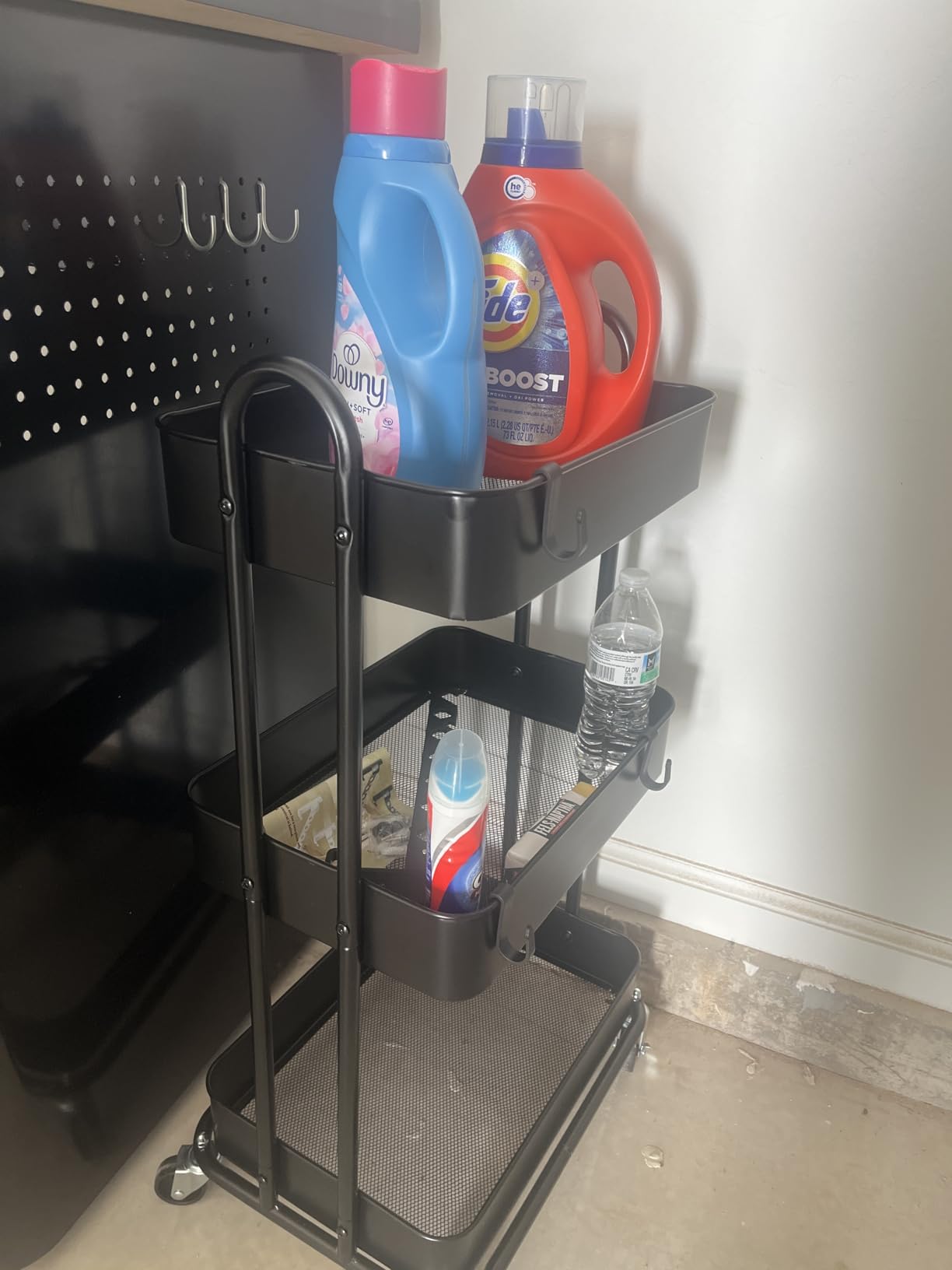
The 220-pound rating is a frame and caster rating, not a top-panel rating, and the mesh baskets themselves are the least rigid part of the structure. For appliances up to about 40 pounds, such as a countertop microwave or a small air fryer, the frame handles it comfortably.
What we learned from loading it repeatedly is that the top basket is where weight belongs. Heavy stock on the lowest tier is what makes a cart this tall feel wobbly when you push it across a threshold, so we learned to keep canned goods low and appliances up high.
Casters that work on carpet and hard floor
The four 2-inch swivel casters are the reason this cart rolls when loaded rather than needing a shove. Two of the four lock, which is enough to hold it steady while you chop if the two locked wheels are placed diagonally rather than side by side.
On carpet the wheels sink a fraction of an inch and roll fine. On tile they are near silent. The one habit worth building is unlocking before you push and locking after you park, because a cart with two locked casters dragged sideways will mark a floor.
Who should skip it
Skip it if you need a flat continuous work surface, because a mesh basket top is a storage tier rather than a cutting board. It is also the wrong shape if your gap is under about 18 inches; the narrow picks later in this list exist for that situation.
Our verdict
With a 4.7 rating across more than 32,000 reviews, this is the pick we recommend to most people. It is sturdy, it is compact, and it does not demand a remodel to justify the money.
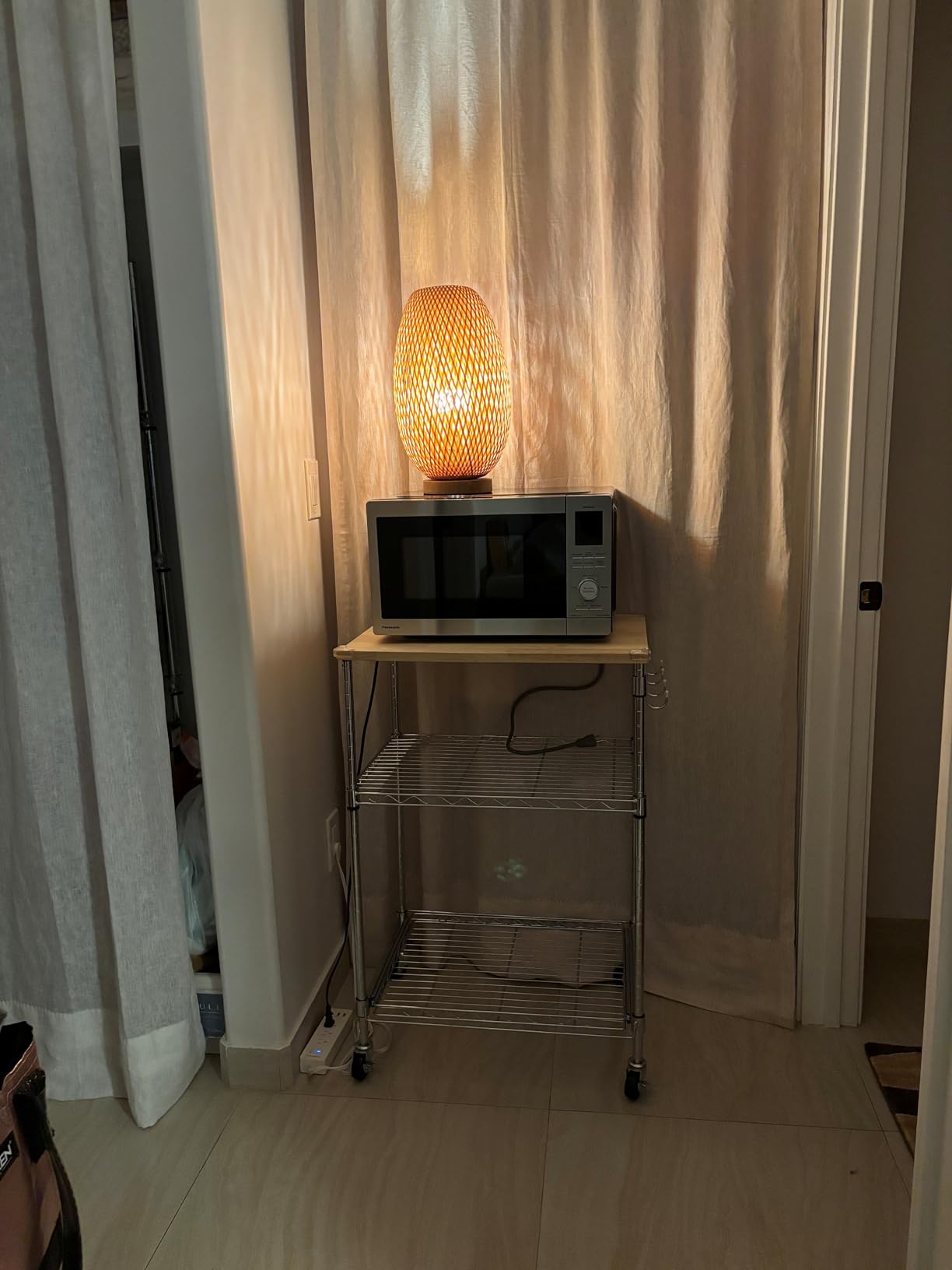
2. Amazon Basics Portable Kitchen 3-Tier Storage Rack – Best Counter-Height Prep Cart
Amazon Basics Portable Kitchen 3-Tier Storage Rack on Caster Wheels with Adjustable 2 Shelves, 175 Pound Capacity, 21 x 15 x 36.7 inches (LxWxH), Wood/Chrome
20.9 in W x 15 in D x 36.7 in H
175 lb total, 50 lb per shelf
1.5 inch wood top
Shelves adjust 1 inch
Pros
- Wood top works as a real prep surface
- Shelf height adjusts in 1 inch increments
- 50 lb per shelf handles appliances
- Tool-free assembly with four hooks included
- Two of four casters lock
Cons
- 36.7 inch height is bulky under low cabinets
- Wood top shows wear and needs care
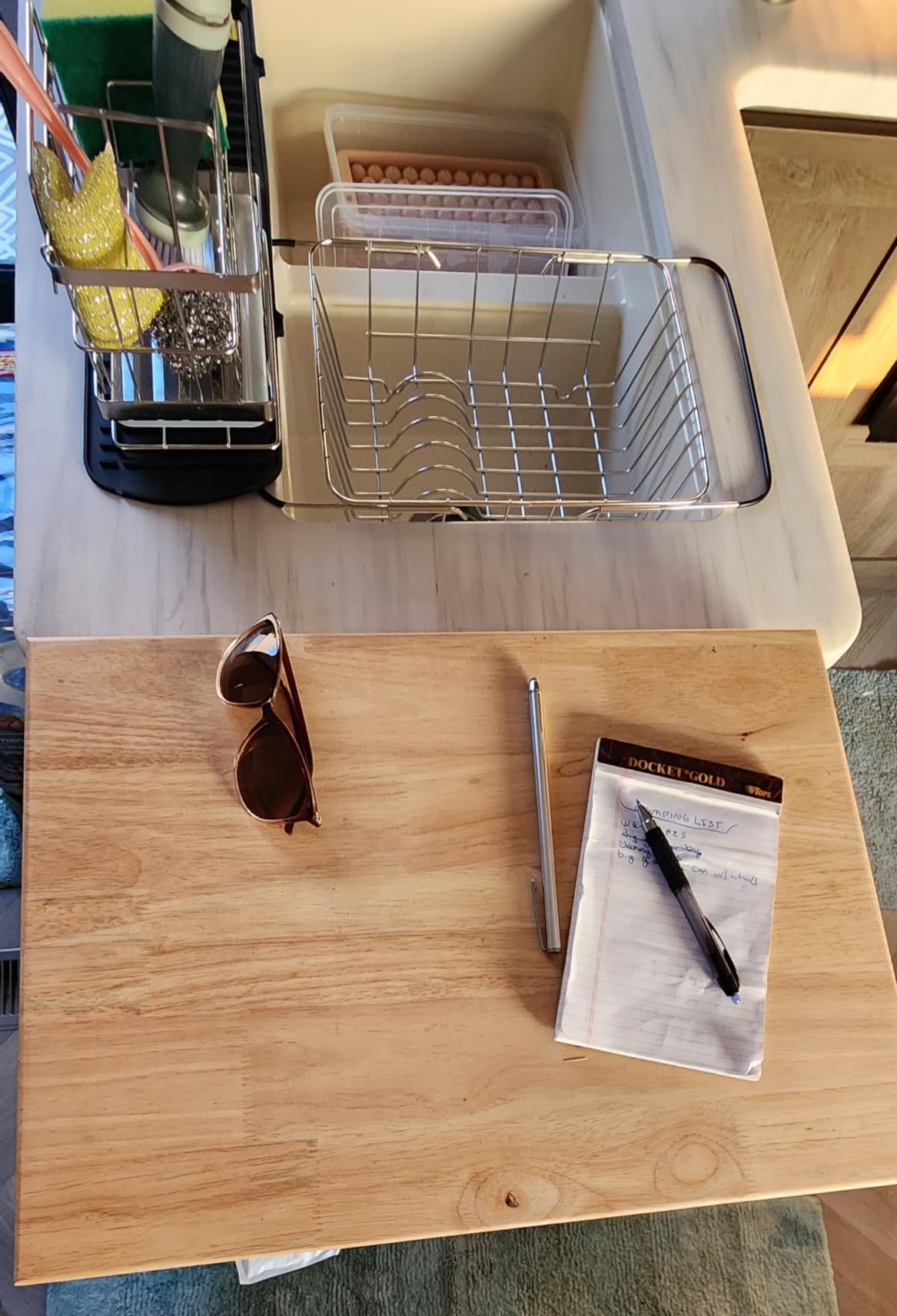
If your complaint is that you have no counter to prep on, this is the cart that answers it. The 1.5-inch wood top sits at 36.7 inches, the closest we found to true counter height, and it is flat enough to actually cut on.
The adjustable shelving is the feature we ended up relying on most. A microwave on the middle tier leaves the top completely clear for prep, and moving that tier down an inch turns the cart into a coffee station with the machine at a comfortable height.
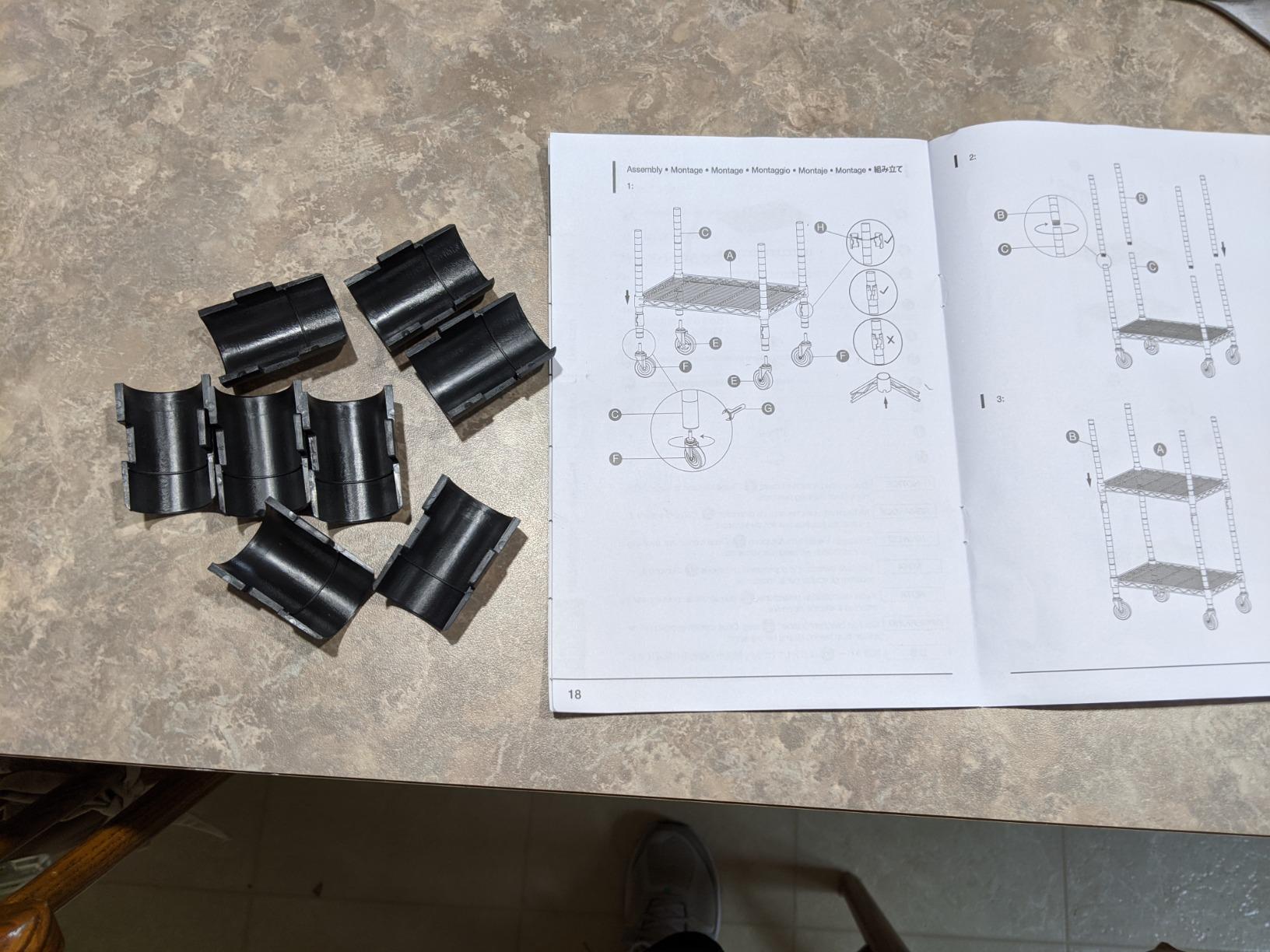
It is also the easiest of the wood-and-steel carts to build. Assembly is tool-free, and the four chrome hooks that come in the box give you somewhere to hang a tea towel without adding another part.
Height is the trade-off here
At 36.7 inches, this is the tallest cart in the group. That is excellent if you want counter height and a poor choice if you have wall cabinets hanging low over a nook, because the top will not slide underneath them.
Measure your cabinet clearance before you order, and subtract an inch for the caster and frame depth. If the measurement comes back under 37 inches, look at a shorter cart such as the ThreeHio model, which stands at 30 inches.
Per-shelf load and appliance placement
Each of the two lower shelves is rated for 50 pounds, and the whole frame for 175. That split rating is more useful than the headline number because it tells you where the real strength sits.
A countertop microwave, a mini fridge or a compact air fryer all sit comfortably within the 50-pound per-shelf figure. We would put a heavy stand mixer on the lower chrome shelf rather than the wood top, both to keep the top free and to keep the center of gravity down.
Wood top care in a working kitchen
The wood top is the best part and the most demanding. It marks if you set a wet mug down without a coaster, and it needs a damp wipe rather than a soak to stay looking right.
Owners generally accept that trade because a flat prep surface is hard to find elsewhere in a small kitchen. If you already oil your counters regularly, this is a non-issue.
Who should skip it
Skip it for under-cabinet nooks and for anyone who wants a narrow cart, because 20.9 inches is the second-widest footprint we measured among the wood-top models. It suits a medium galley or the open end of an L-shaped kitchen rather than a slot between two cabinets.
Our verdict
A 4.7 rating over 17,000-plus reviews and the most genuinely useful top surface we tested. This is the pick for anyone whose problem is working surface rather than storage.
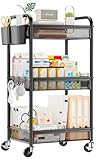
3. YASONIC 3 Tier Metal Rolling Cart – Best Value Metal Cart
YASONIC 3 Tier Metal Rolling Cart, Black Utility Storage Cart with Wheels
11.5 in W x 15.4 in D x 29.8 in H
110 lb capacity
3 metal baskets
2 inch urethane wheels
Pros
- 11.5 inch width fits narrow gaps
- Urethane wheels glide on carpet and hardwood
- High-gloss finish resists chips and corrosion
- Two hanging cups and three hooks add storage
- About 15 minutes to assemble
Cons
- 110 lb rating is modest for heavy appliances
- Mesh sides need care when loading weight
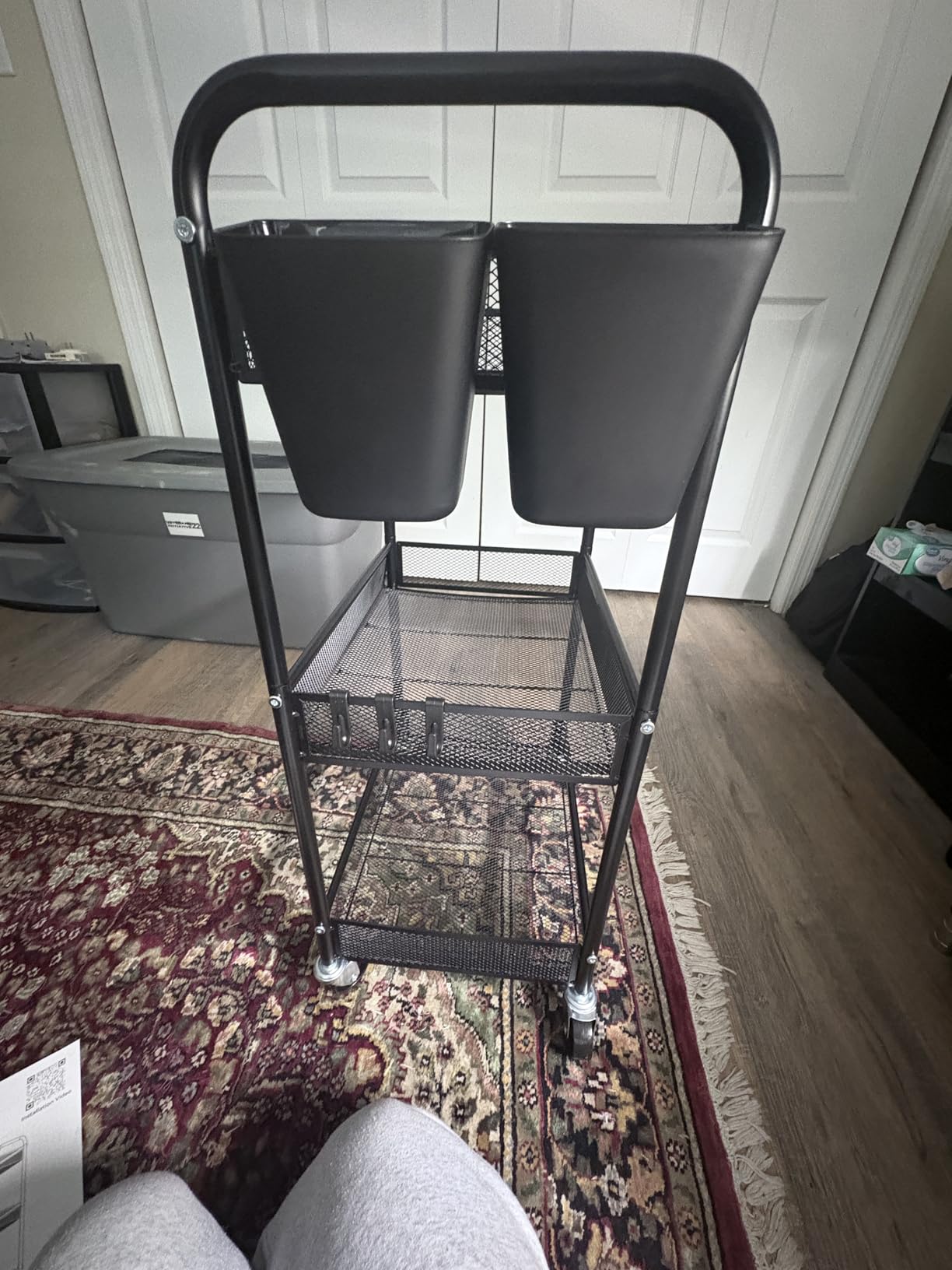
This is the narrowest of the three all-metal carts we tested and the one that moved most easily. At 11.5 inches wide it went into gaps that stopped the wider steel frames dead, and the urethane wheels rolled over carpet without the catching we saw on cheaper nylon casters.
The two hanging cups and three hooks are a small touch that changes the layout problem. Instead of dedicating a whole basket to spatulas and measuring spoons, you hang them and free a tier for the bulk items that never fit neatly anywhere else.
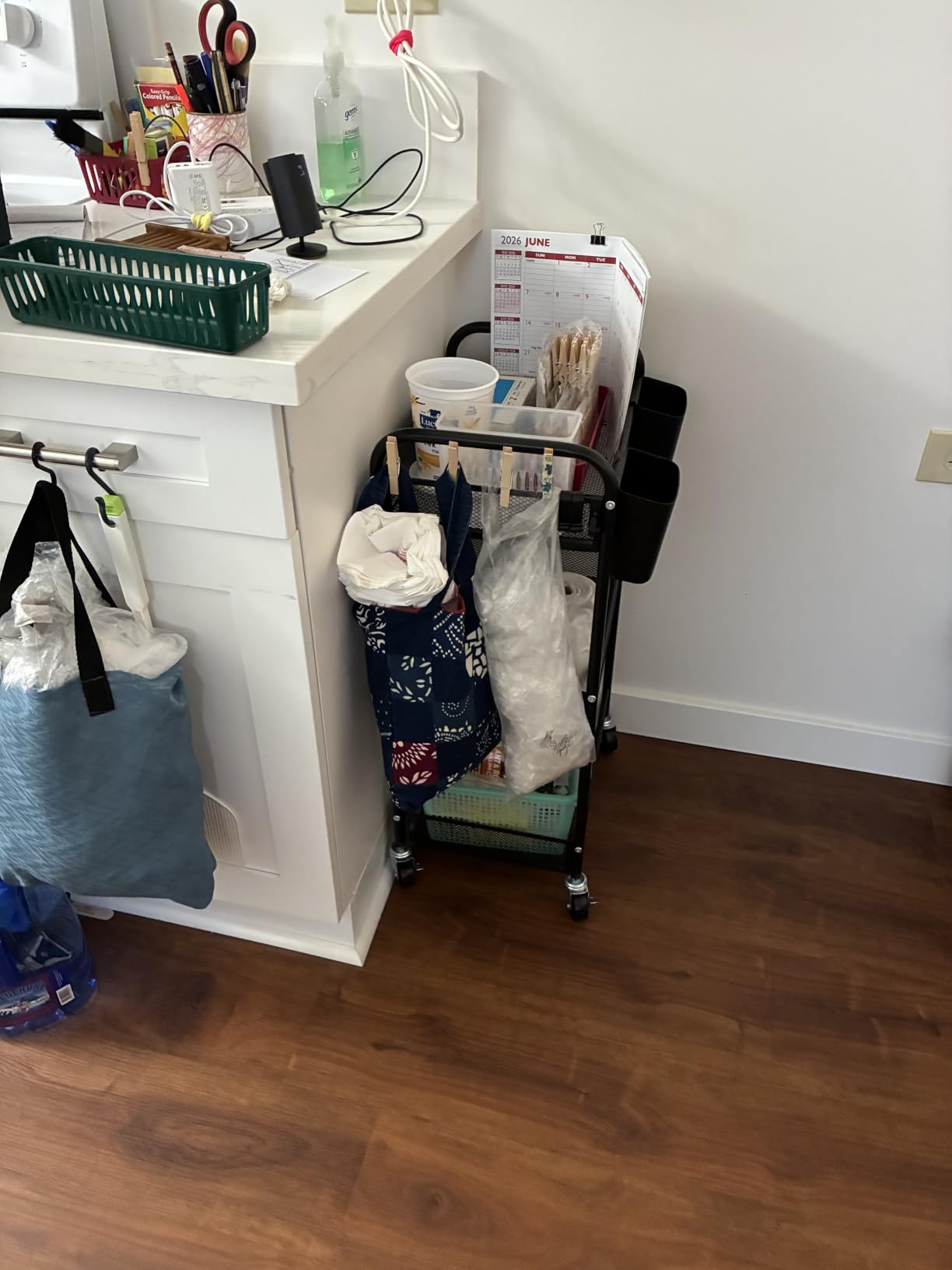
Assembly took about fifteen minutes with the two included tools and twelve identical screws, which is the fastest build in the group alongside the snap-together model later in this list.
Narrow enough for the gap beside the fridge
Eleven and a half inches is narrower than a standard base cabinet is deep, which means it disappears into a recess rather than projecting into your walkway. In our test kitchen it sat flush beside the fridge with the door opening fully.
Because the 15.4-inch depth exceeds the 11.5-inch width, orient it with the narrow face toward the gap. That orientation also puts the curved push handles on the long side, where they are easier to reach.
What 110 pounds means for your appliances
The 110-pound rating is lower than the two steel carts above it, and it shows when you load the mesh baskets heavily. Small appliances under about 25 pounds are comfortable.
A rice cooker, a kettle and an air fryer on separate tiers will stay well inside the limit. A loaded stockpot or a cast iron skillet collection on the bottom tier is where you would start to feel the frame work, so we kept heavy cookware off this one.
Wheel glide on carpet and hard floor
The 2-inch urethane wheels are the reason this cart is easy to live with on carpet. Urethane is softer than nylon and quieter on tile, and it does not mark a hardwood floor the way a hard plastic wheel can.
All four casters swivel, which means the cart turns in place rather than needing a wide arc. In a 31-inch aisle that difference is the whole ballgame.
Who should skip it
Skip it if you plan to use the top as a chopping surface or if you need enclosed storage. There is no flat worktop and no cabinet here, only three open baskets and the hooks.
Our verdict
A 4.7 rating from more than 1,800 reviews and a category-leading position among kitchen storage carts. For storage-first small kitchens it is hard to argue with the footprint-to-capacity ratio.
4. OKZEST 4-Tier Slim Rolling Storage Cart – Best for the Narrowest Gaps
OKZEST 4-Tier Slim Rolling Storage Cart for Kitchen, Laundry Room, Bathroom
7.1 in W x 16.9 in D x 34.1 in H
180 lb capacity
4 mesh tiers
Walnut top with guardrails
Pros
- Only 7.1 inches wide
- Four tiers packed into a slim frame
- 180 lb rating across the structure
- Powder coating resists rust
- Diamond-pattern guardrails stop items sliding
Cons
- Shelves only take smaller containers
- Some buyers report sticky wheels after assembly
- A few units arrive with a loose top screw
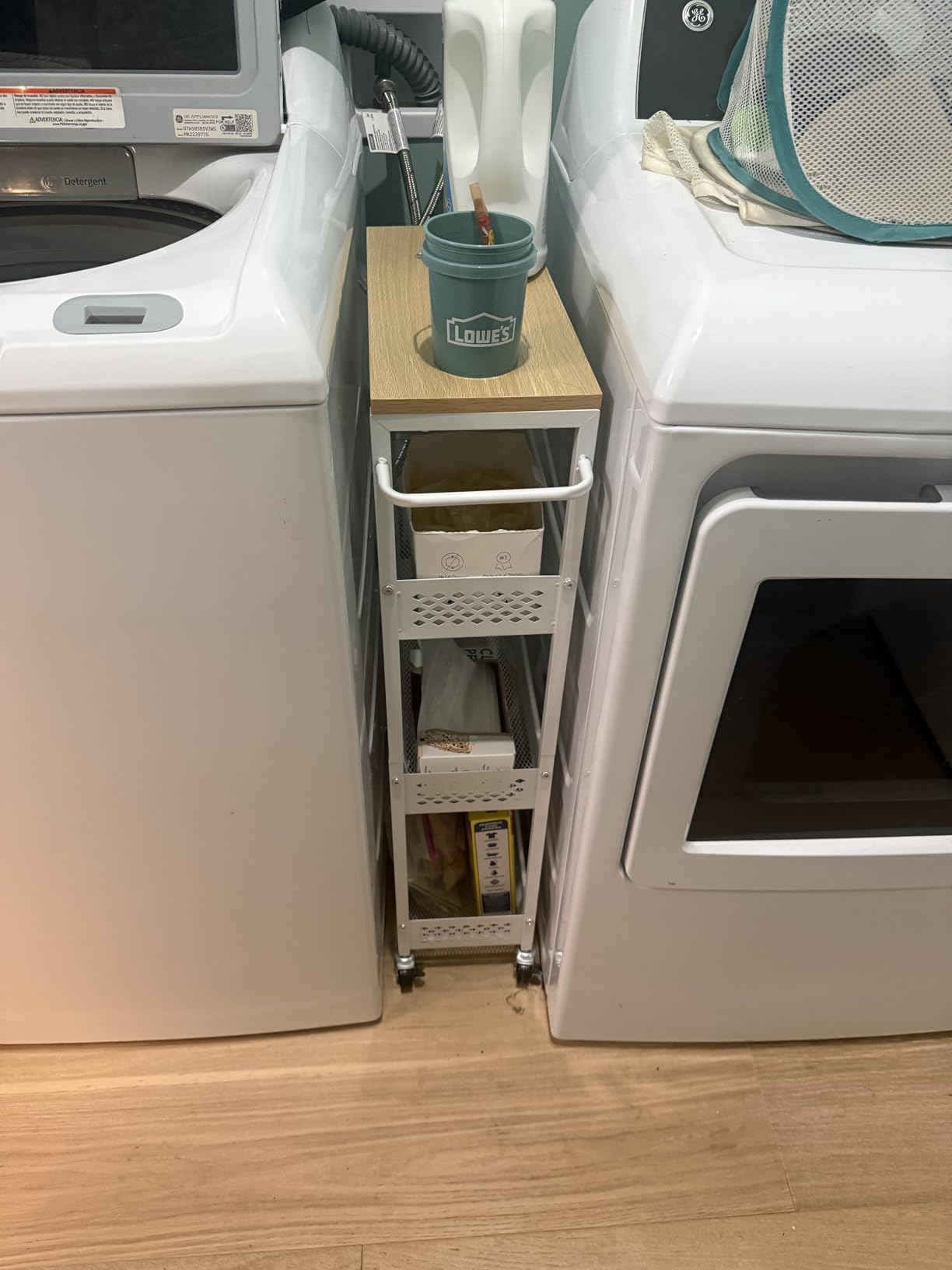
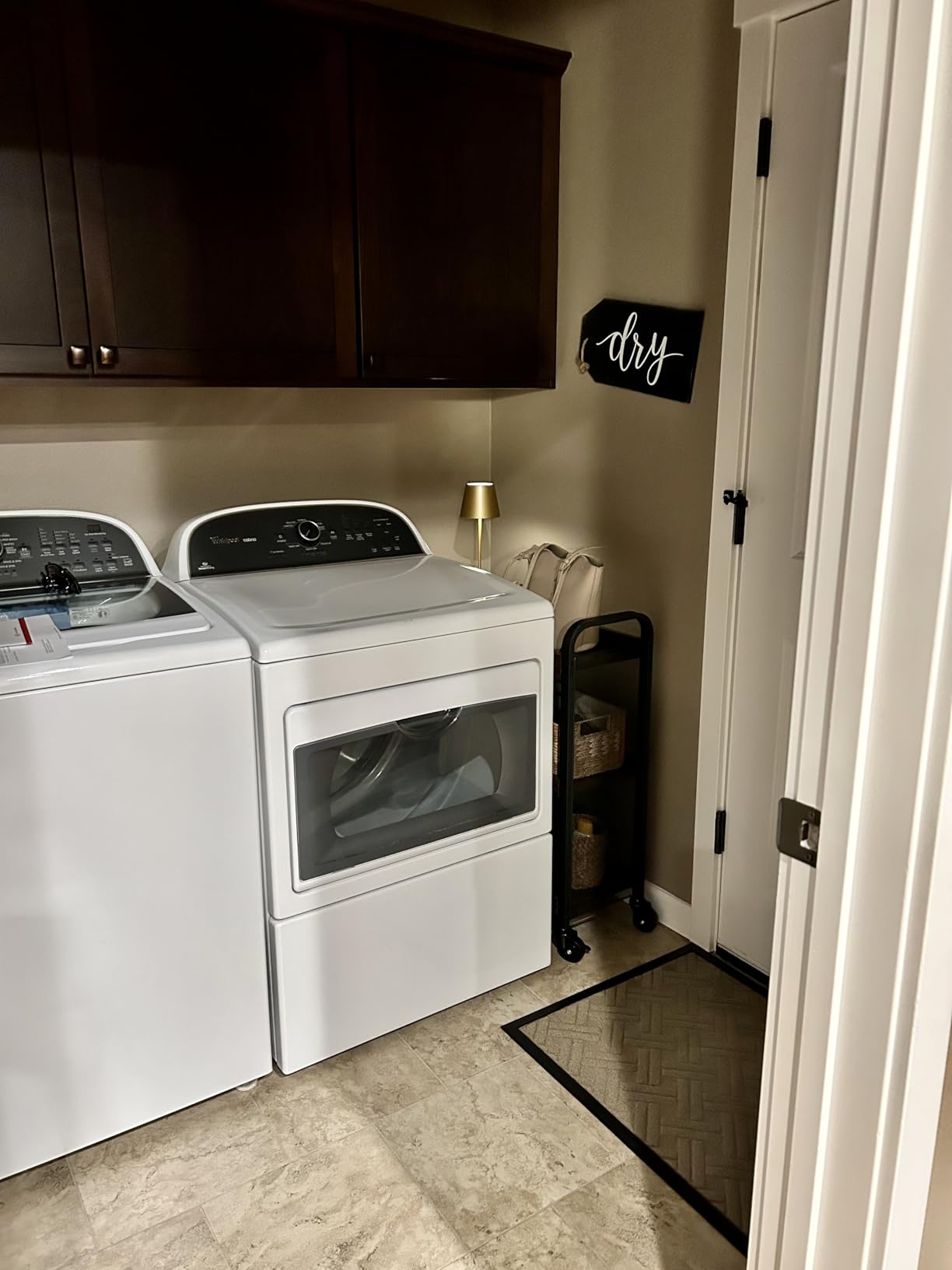
Seven inches is the number that matters here. That is narrower than a single base cabinet, which means this cart can sit in the gap between a fridge and a wall, beside a stove, or in the slim void between a washer and a dryer in a one-room apartment.
We put four tiers into that narrow frame, which is the reason this cart held more than any of the slim competitors. Tall and skinny storage is a genuinely different proposition from a wide flat island, and for canned goods and spice jars it is the better one.
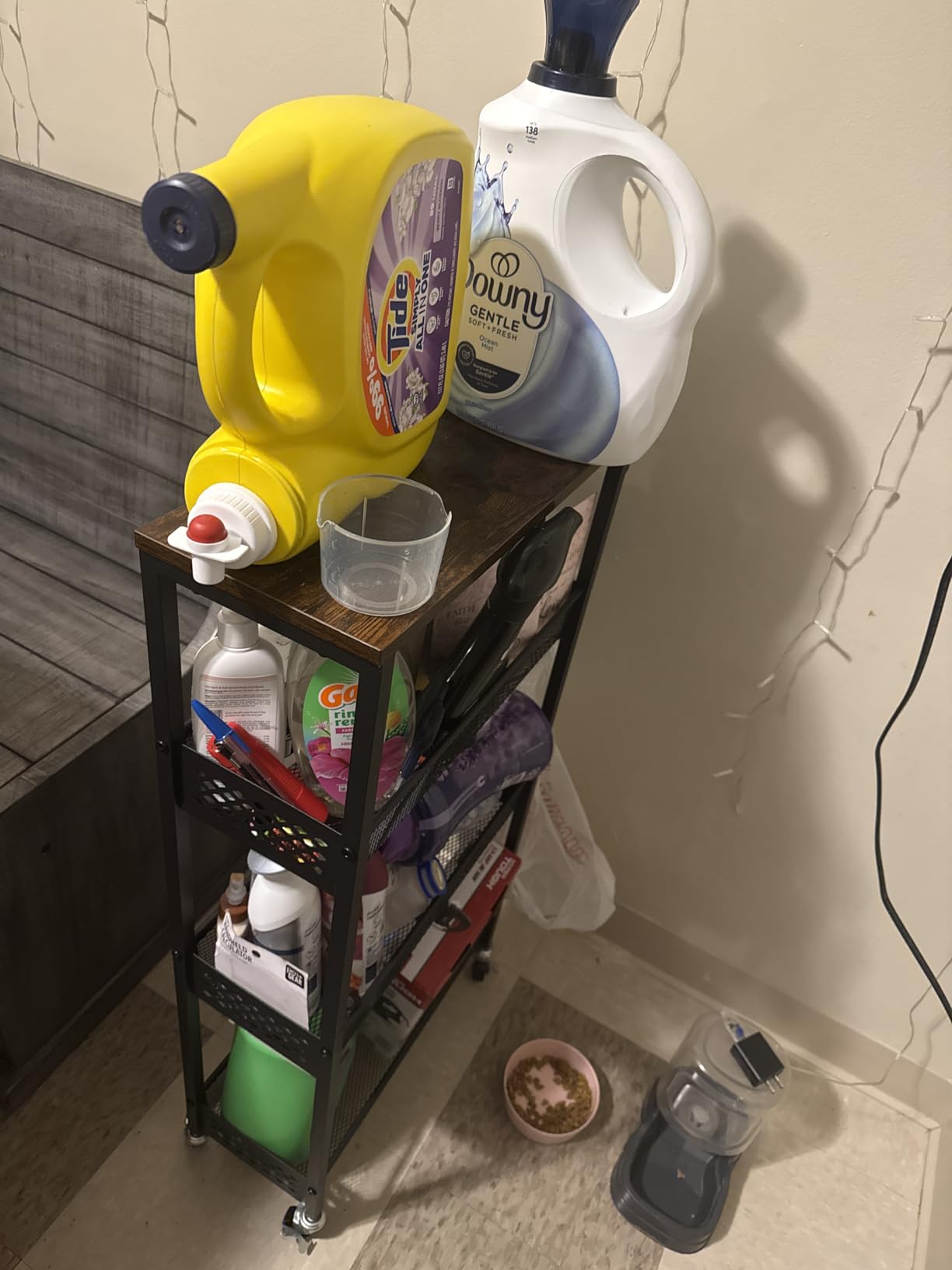
The walnut top gives it a warmer look than the bare steel carts, which matters if the cart is parked in a dining nook rather than a garage corner. The four 360-degree swivel casters and the ergonomic side handle make it easy to pull out and tuck back.
Seven inches wide and what that buys you
A 7.1-inch width clears almost any gap in a domestic kitchen. In our test setup it went into a 9-inch recess that nothing else in this roundup would pass, and it stayed stable when we leaned on the top to reach a high cabinet.
The trade is depth. At 16.9 inches deep, the cart projects well into the room when you pull it out to use, so plan a parking spot that lets it slide in and out along a wall rather than straight out into the walkway.
Four tiers and the guardrail detail
The heightened diamond-pattern guardrails around each shelf are a small engineering decision with a large payoff. Without them, jars walk off a moving cart in a way they never would on a fixed shelf.
Owner feedback frequently notes that the shelves take smaller containers rather than bulk items. That is a fair description of a 7-inch shelf, and it is why we would use this cart for spices, cans and cleaning supplies rather than for 5-pound bags of rice.
Weight rating and the powder-coated frame
The 180-pound rating is high for a cart this narrow, and the powder-coated alloy steel frame is what earns it. Rust resistance also means it survives a humid balcony or an unheated utility space.
Breathable mesh shelves prevent water from pooling, which is the reason similar slim carts get repurposed for laundry and bathroom duty as well as the kitchen.
Who should skip it
Skip it if you want a work surface you can cut on, or if you need to park a microwave on it, because 7 inches of top will not take one. The walnut top is decorative here rather than functional.
Our verdict
A 4.6 rating from just over 2,000 reviews, with the narrowest footprint and the most tiers in the set. If your gap is measured in single digits, this is the one.
5. Yaheetech Rolling Kitchen Island Cart, 2 Tier – Best Drawer and Cabinet Storage
Yaheetech Rolling Kitchen Island Cart with Storage, 2 Tier, Wood Top, Black
22 in W x 18 in D x 35 in H
138 lb capacity
1 drawer, 1 cabinet, 1 shelf
6 side hooks
Pros
- Closed storage hides visual clutter
- 138 lb capacity suits appliances and cookware
- Four swivel wheels with two lockable casters
- Surface wipes clean with a damp cloth
- Compact 18 by 22 inch base
Cons
- Particle board and MDF is less durable than solid wood or steel
- Do not sit or step on the tabletop
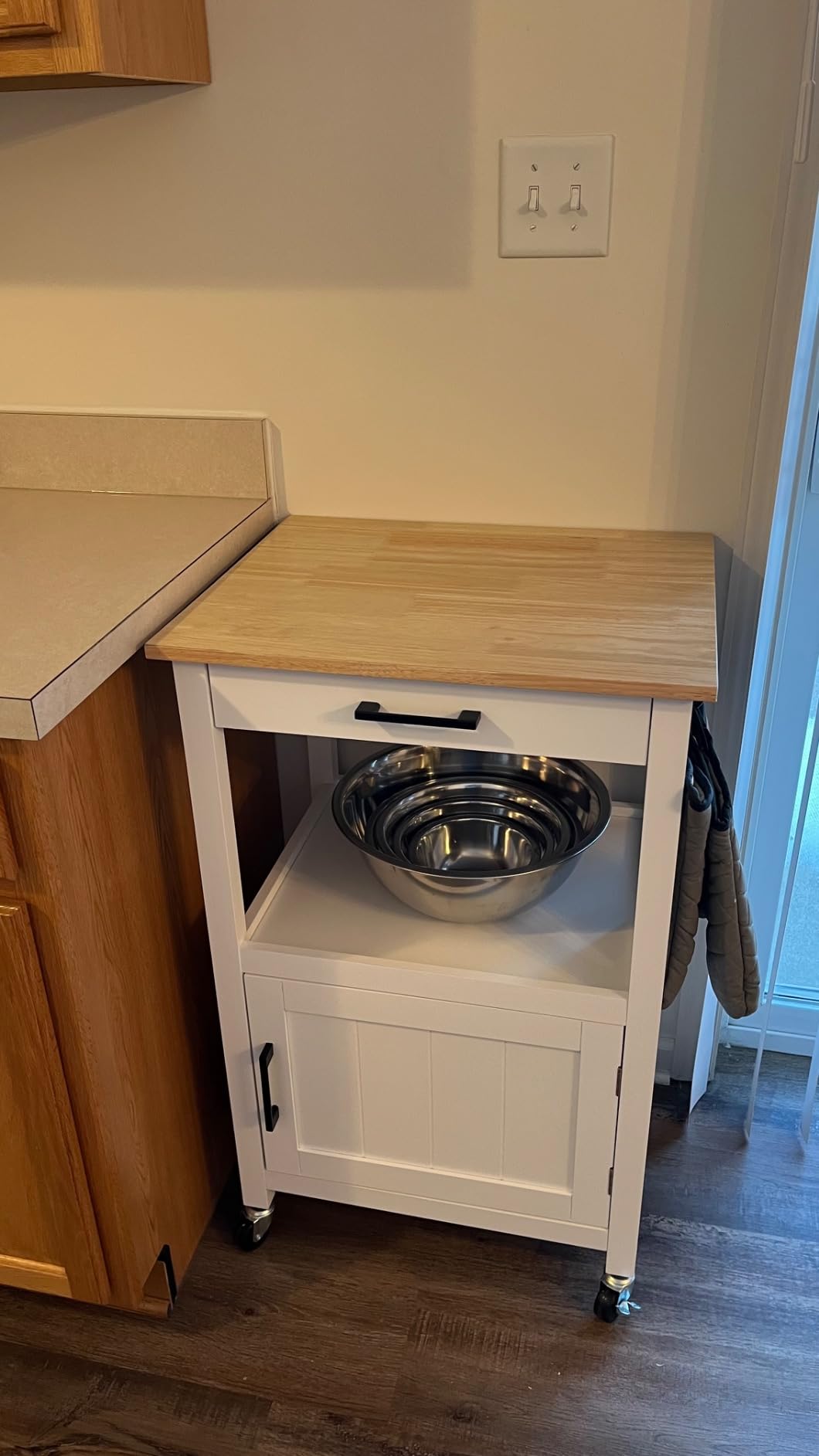
Every other cart in this roundup is open storage. That is fine for a garage, but a kitchen cart that is permanently parked in view needs somewhere to hide the visual noise, and this one has a drawer and a cabinet for exactly that.
At 35 inches tall it sits just under standard counter height, and at 22 by 18 inches the base is compact enough for the open end of an L-shaped kitchen or beside a full-height fridge.
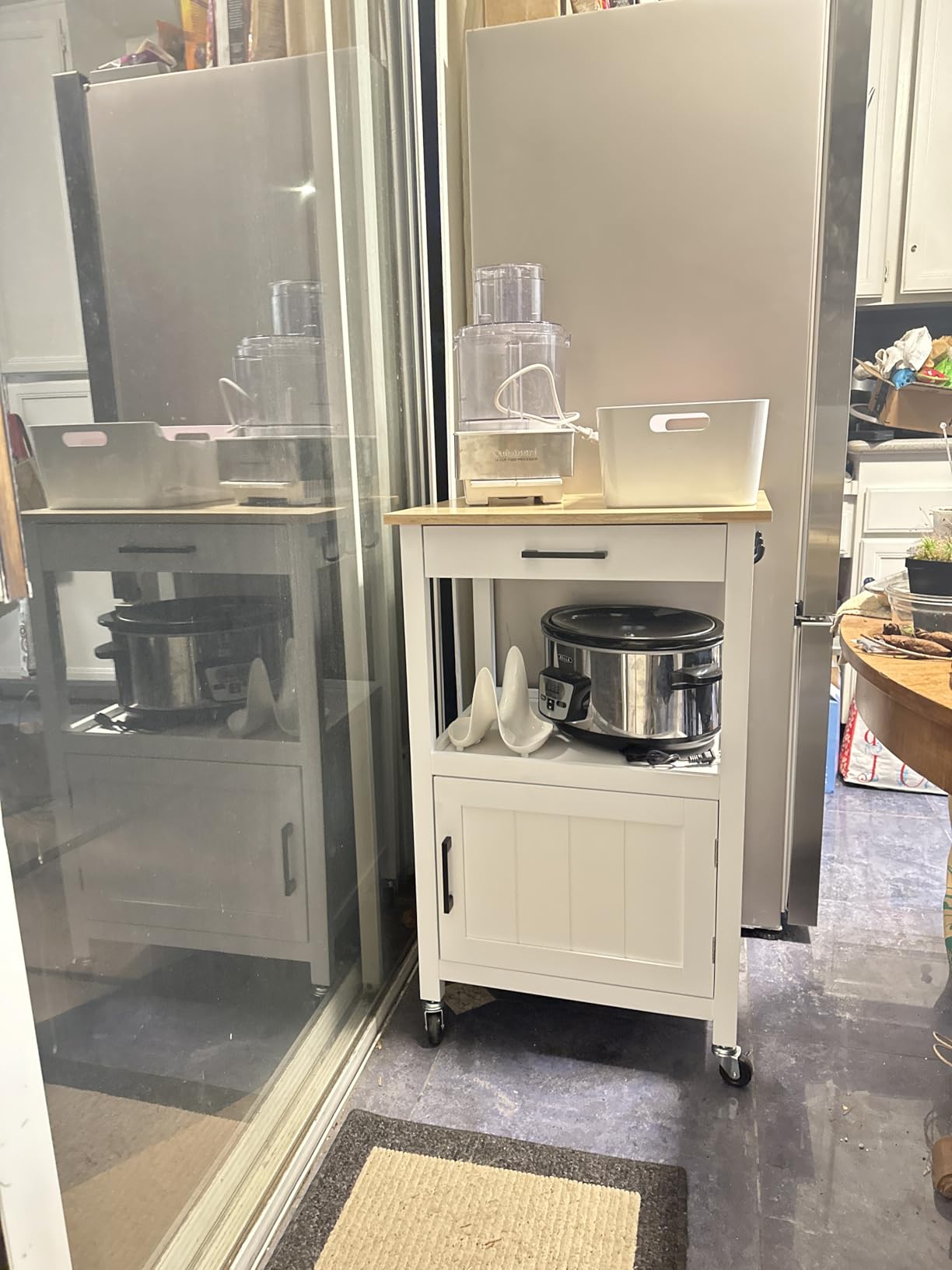
The six side hooks are more useful than they sound. A towel, oven mitts and a tea towel hang outside the footprint instead of occupying a shelf, which reclaims roughly a third of the storage volume on a cart this size.
Drawer, cabinet and shelf in an 18 by 22 inch base
Combining three storage types in a small base is the design trick worth noting. The drawer takes cutlery and small tools that would otherwise scatter, the cabinet takes the awkward bottles, and the open shelf takes the daily grab items.
That mix is what stops a cart from becoming a second cluttered counter, which is the failure mode that turns an expensive cart into an eyesore within a month.
Build quality and honest expectations
This is MDF and pinewood particle board, and we would rather be straight about that than oversell it. It is sturdy enough for its 138-pound rating and it wipes clean, but it will not survive the same abuse as a steel frame.
The practical rule is not to stand on the top and not to drag the cart by the top surface. Push it by the frame and it will hold its shape for years.
Wheels, hooks and everyday handling
Four 360-degree swivel wheels with two lockable casters gave us stable positioning once parked. Lock the two brakes on opposite corners rather than the same side or the cart can pivot when you lean on it.
At 26.1 pounds empty, this is a mid-weight cart. It is heavy enough to stay put with a kettle on top and light enough to move with one hand when you need the floor.
Who should skip it
Skip it for a galley aisle under about 24 inches, since 22 inches of width plus your own body leaves very little room to pass. It is also the wrong choice for a renter who expects engineered wood to survive a move intact.
Our verdict
A 4.6 rating across 2,840-plus reviews. This is the pick when the deciding factor is keeping a small kitchen looking calm rather than adding another open shelf.
6. VASAGLE 3-Tier Narrow Storage Cart – Best Wood and Steel Build for an 11-Inch Gap
VASAGLE 3-Tier Narrow Storage Cart, Rolling Cart with Wheels, Steel Frame
26.6 in W x 11.4 in D x 33.5 in H
66 lb capacity
3 wood and steel tiers
Wheels swap for adjustable feet
Pros
- 11.4 inch depth slips beside a fridge or between machines
- Wood and steel build resists wobble when loaded
- Lockable casters plus adjustable feet included
- Industrial rustic styling suits existing furniture
- Three shelves for appliances and utensils
Cons
- 66 lb rating is the lowest among wood and steel carts
- Wheels add extra depth beyond the frame
- Thin mesh sides flex before assembly is finished
This cart solves a specific problem that width-focused shoppers miss. It is 26.6 inches wide, which is too wide for a tight slot, but only 11.4 inches deep, which means it slides into a side gap sideways and sits almost entirely against the wall.
That makes it the natural fit for the space beside a fridge, where nothing else fits because the gap runs along the wall rather than into the room.
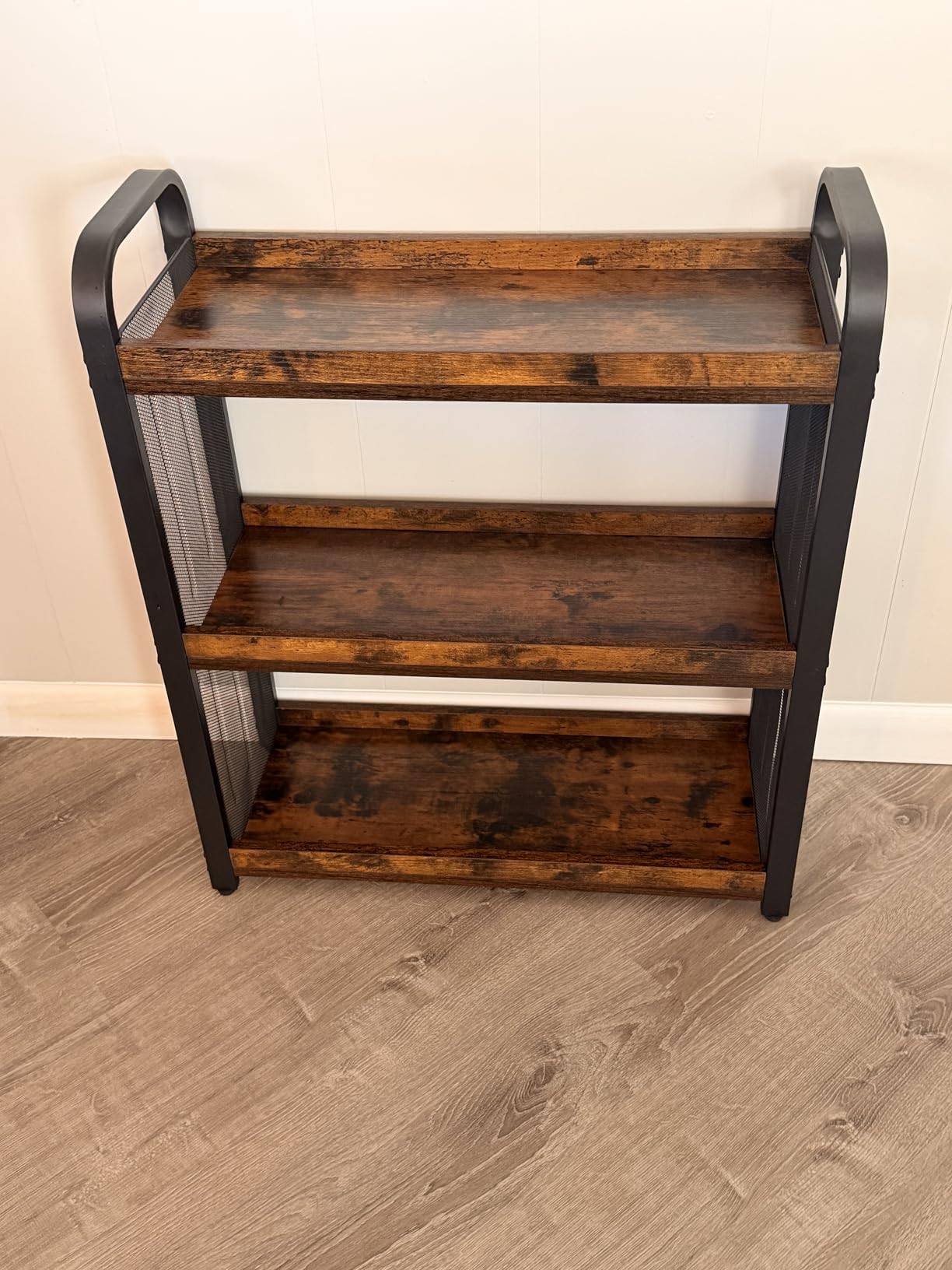
The wheels unscrew and adjustable feet come in the box, so the same unit works as a rolling cart during cooking and as a fixed shelf when you want the floor back. Owners report using it both ways within the same week.
Understanding the 26.6 by 11.4 footprint
Read those numbers as an orientation, not a size. The 11.4-inch dimension is what has to clear your gap, and the 26.6-inch dimension is what projects into the room. If you have a 12-inch slot beside the fridge, this fits and the 7-inch slim cart looks oversized next to it.
One detail worth planning around: the wheels add a little depth beyond the frame, so measure the actual gap at floor level rather than at countertop height.
Where the 66-pound rating bites
Sixty-six pounds is the lowest rating among the wood and steel carts here, and it is the main compromise you accept for the slim profile. It comfortably holds a coffee maker, a toaster and a stack of plates.
It is not the cart for a loaded stockpot collection, a cast iron collection or a mini fridge. If your plan involves anything that weighs more than about 20 pounds per shelf, step up to one of the higher-rated steel frames.
Wheels that become feet
The swap is the most owner-endorsed feature in owner feedback. Being able to convert the cart into a fixed shelf means the floor space is recoverable without giving up the storage.
That flexibility also solves the awkward moment when you need the gap for something else entirely, like a folding table or a large stockpot on the floor for a party.
Who should skip it
Skip it if you need a work surface, because 26.6 inches is too wide to serve as a useful island in most small kitchens and the shelves are storage tiers rather than a prep surface. Heavy-appliance households should look elsewhere.
Our verdict
A 4.6 rating over 1,477 reviews and the most versatile footprint treatment in the set. Worth a look if your gap is measured along the wall rather than into the room.
7. MAX Houser Slim 3-Tier Rolling Utility Cart – Best Tool-Free Assembly
MAX Houser Slim 3-Tier Rolling Utility Cart with Extra Hook, White
9 in W x 17.7 in D x 30.9 in H
60 lb capacity
3 mesh baskets
Tool-free snap build
Pros
- 9 inch width fits very tight pantry and closet gaps
- Tool-free assembly takes only minutes
- Baskets have 3.5 inch raised edges
- U-shaped base resists tipping when loaded
- Mesh baskets breathe and drain
Cons
- 60 lb rating is low for steel carts
- Shelves take only smaller containers
- Assembly can be awkward without a second pair of hands
If the idea of a flat-pack cart with a hex key is the thing stopping you, this is the one to look at. The frame snaps together without tools and the whole build takes a few minutes.
At nine inches wide it is the second-narrowest cart we measured, and combined with a tool-free build it is the fastest route to extra storage in a kitchen where the only available space is a narrow vertical slot.
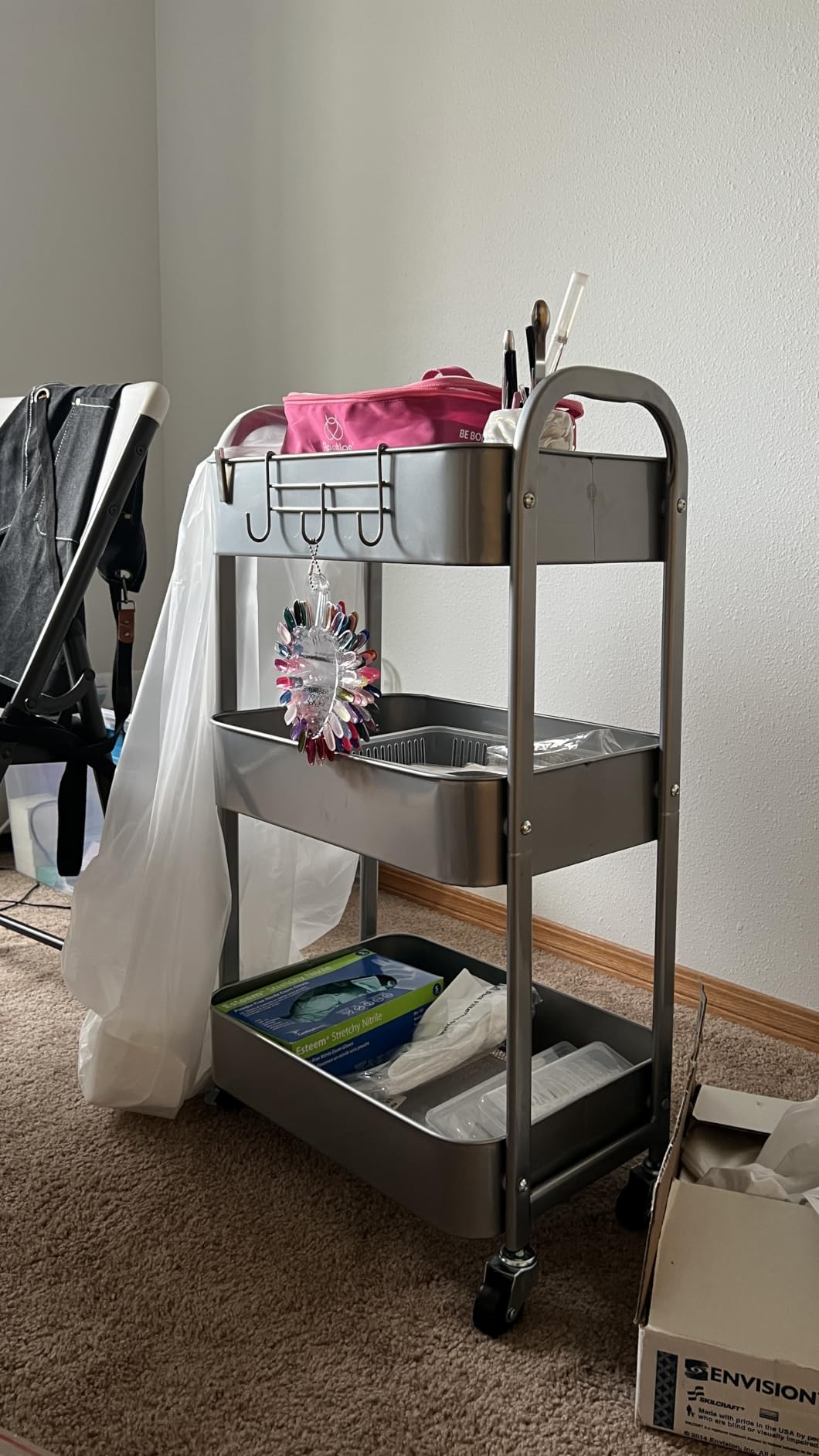
The baskets come with 3.5-inch raised edges, which stops the small jars and spice containers that cause open carts to become junk trays. Several owners mention this specifically as the reason their cart still looks organized after months.
Where a 9-inch cart genuinely helps
Nine inches is narrow enough for the gap between a pantry wall and a shelving unit, the void beside a washing machine, or the strip of floor next to a fridge that is too shallow for anything with a handle.
The depth of 17.7 inches is the catch. This cart is a long narrow object rather than a square one, so it needs a long thin parking space and it projects when pulled out to load.
Load limits and the U-shaped base
The 60-pound rating is the lowest in the set, and we would not put anything genuinely heavy on it. The U-shaped wheel base does an admirable job of resisting tip when the baskets are loaded unevenly, which is where a cart this narrow usually fails.
Treat it as an organizer for cans, spice jars, paper towels and cleaning supplies rather than as an appliance stand. Doing that keeps it useful for years instead of overloading it in month one.
Wheels, powder coating and maintenance
Four 360-degree wheels with two lockable and two free let you steer without fighting the cart. Locking two opposite casters keeps it planted while you reach for something on a high shelf.
The powder-coated metal wipes clean with a damp cloth, and the mesh baskets drain water, which is why so many owners move this cart between the kitchen, bathroom and laundry room.
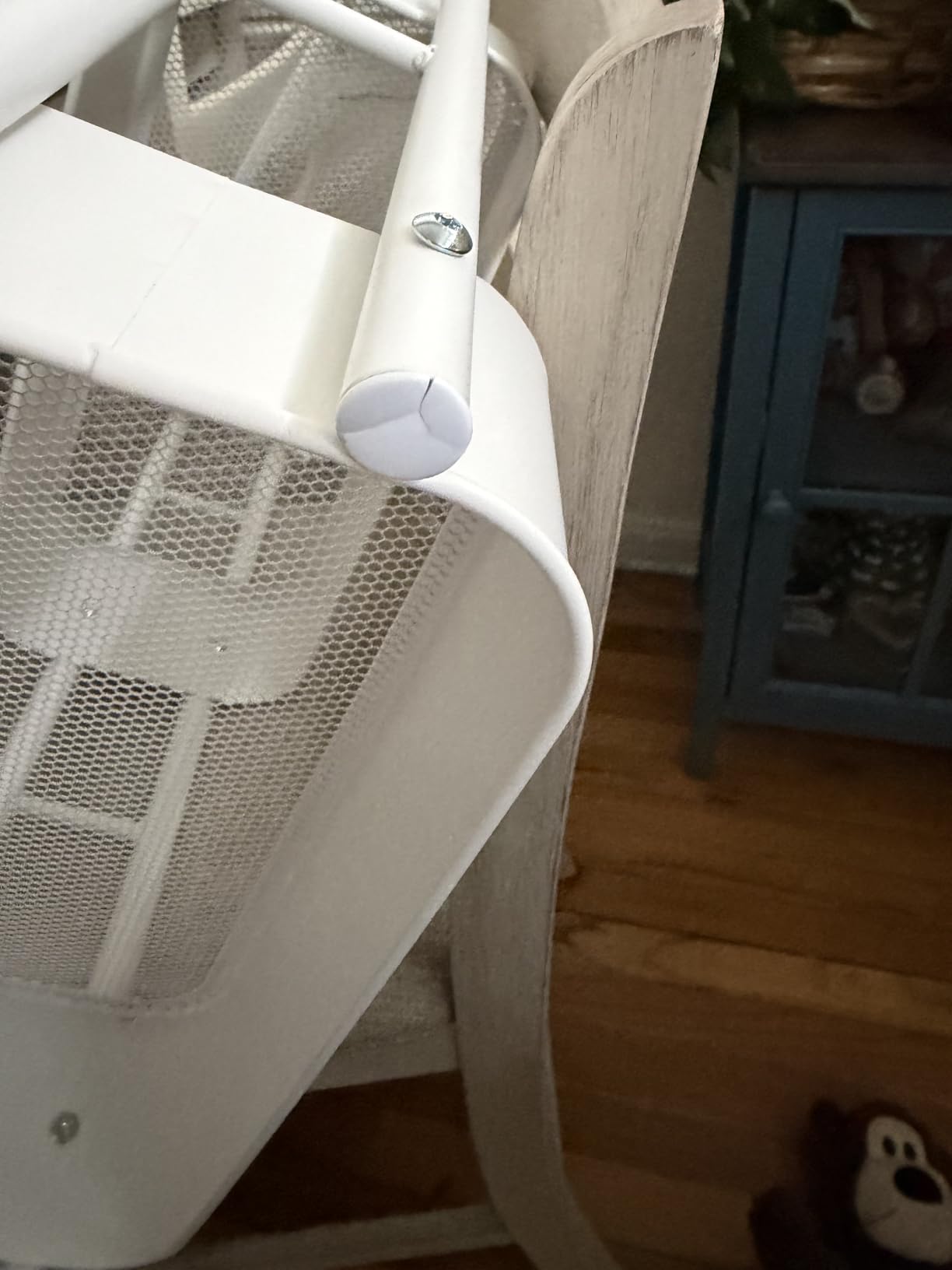
Who should skip it
Skip it for a microwave, an air fryer or anything else heavy, and skip it if you want a top surface for prep. It is a slim organizer, not a work cart, and it needs a long narrow gap to live in.
Our verdict
A 4.5 rating across 2,822-plus reviews with a large volume of feedback on the narrow profile. Best pick when the constraint is the gap and the build must be simple.
8. ThreeHio Rolling Kitchen Microwave Cart – Best Cart for Clearing a Counter
ThreeHio Rolling Kitchen Microwave Cart, 3 Tier Microwave Table Stand with Storage, Kitchen Utility Cart on Lockable Wheels, Small Coffee Cart Shelf Rack Organizer for Living Room Office, Balcony
23.6 in W x 15.8 in D x 30 in H
210 lb capacity
3 storage tiers
4 S-shaped hooks
Pros
- Relocates a microwave and frees counter space
- 210 lb rating is among the highest here
- Four 360 degree casters with two lockable
- Top sized for a countertop microwave
- Tools and hardware included for the build
Cons
- Small casters struggle on carpet under heavy loads
- Two-piece top leaves a visible seam
- Top panel halves can sit slightly out of alignment
The dominant purchase reason in this category is not storage, it is getting the microwave off the counter. This cart is sized and framed for that specific job, and at 210 pounds it handled a heavy appliance in our testing without complaint.
Owners report using it for printers, air fryers and coffee makers as well, which tells you the frame is more capable than the microwave label suggests. A 90-pound printer is owner-reported, not something we measured ourselves.
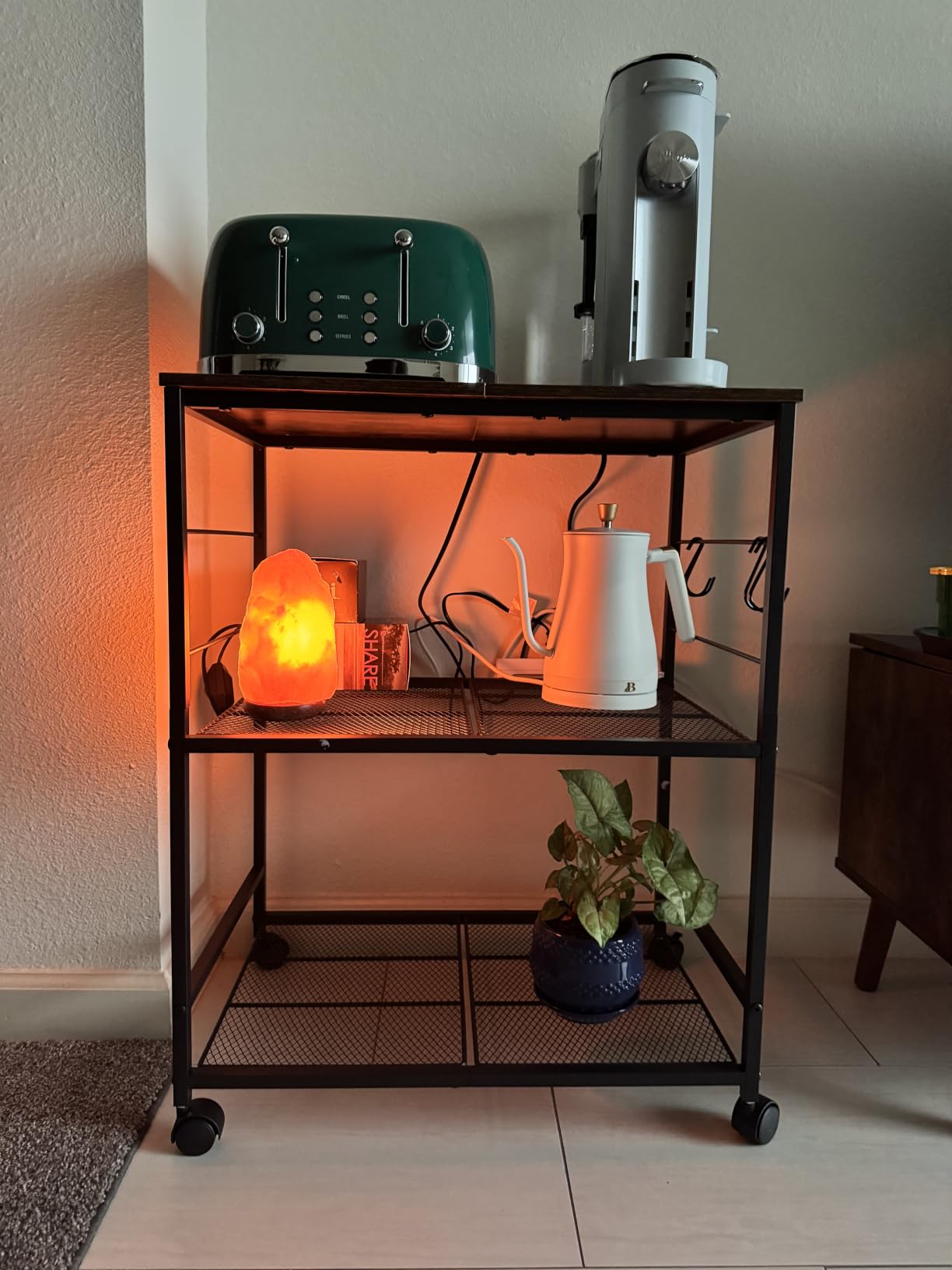
Assembly took roughly thirty to thirty-five minutes in our test kitchen, with all hardware and tools in the box. That is longer than the snap-together models and much shorter than the flat-pack wood islands.
Counter height, or close to it
At 30 inches, the top is a few inches below standard counter height. That is low enough that lifting a hot dish off it is easy, and high enough to clear most base cabinets and dishwashers when you push the cart back in.
It is also a useful height for an air fryer, since you need clearance above the appliance for the basket to pull straight out.
Where the wheels are the weak point
The casters are the most criticized part of this cart in owner feedback, specifically on carpet under heavy loads. Small wheels dig in rather than roll, so a loaded cart on a rug can require a real push.
If your kitchen is carpeted and your plan involves moving the cart often, put it on a hard surface whenever possible or add a small protective mat under it.
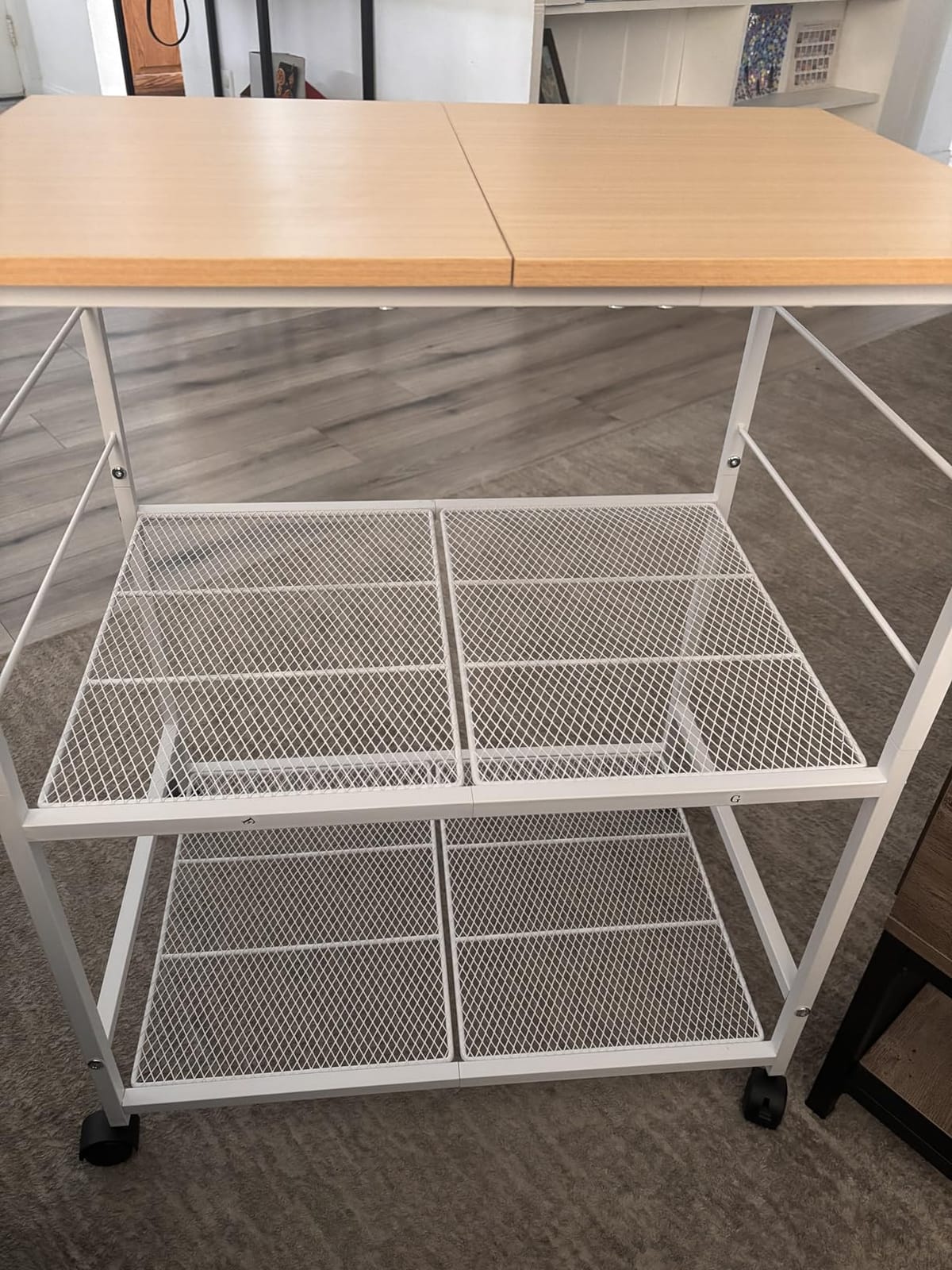
The two-piece top seam
The top panel is made of two halves, which leaves a visible line down the middle and lets the halves sit slightly out of alignment. It is a cosmetic issue that shows more on a light finish than a dark one.
Functionally it does not matter, and the surface is described as scratch, moisture and water resistant, which is what you want under a microwave that vents.
Who should skip it
Skip it for carpeted kitchens where the cart will be moved while loaded, and skip it if you want counter-height prep, since 30 inches is meaningfully lower than your counters.
Our verdict
A 4.5 rating over 1,220 reviews and the most practical answer to the most common small-kitchen problem. Pair it with our toaster oven picks for small kitchens if you are clearing two appliances off one counter.
9. Finnhomy 3-Tier Rolling Kitchen Cart with Slider Shelf – Best for Heavy Loads
Finnhomy 3-Tier Rolling Kitchen Cart With 18″ D x 30″ W Oak Wood Tabletop, Kitchen Island With 4″ Wheels and Slider Shelf, Microwave & Coffee Cart With Hooks for Dining Room, Chrome
32.4 in W x 18 in D x 33.4 in H
200 lb top, 500 lb base
Pull-out slider shelf
4 inch commercial wheels
Pros
- Oak top rated to 200 lb and base shelf to 500 lb
- 4 inch commercial grade wheels roll heavy appliances
- Slider shelf pulls out for small appliances
- Shelf height adjusts in 1 inch increments
- Tool-free assembly and chrome anti-rust shelves
Cons
- Heavy at 33.3 lb and wide at 32.4 in
- Plastic shelf clips can release if built upside down
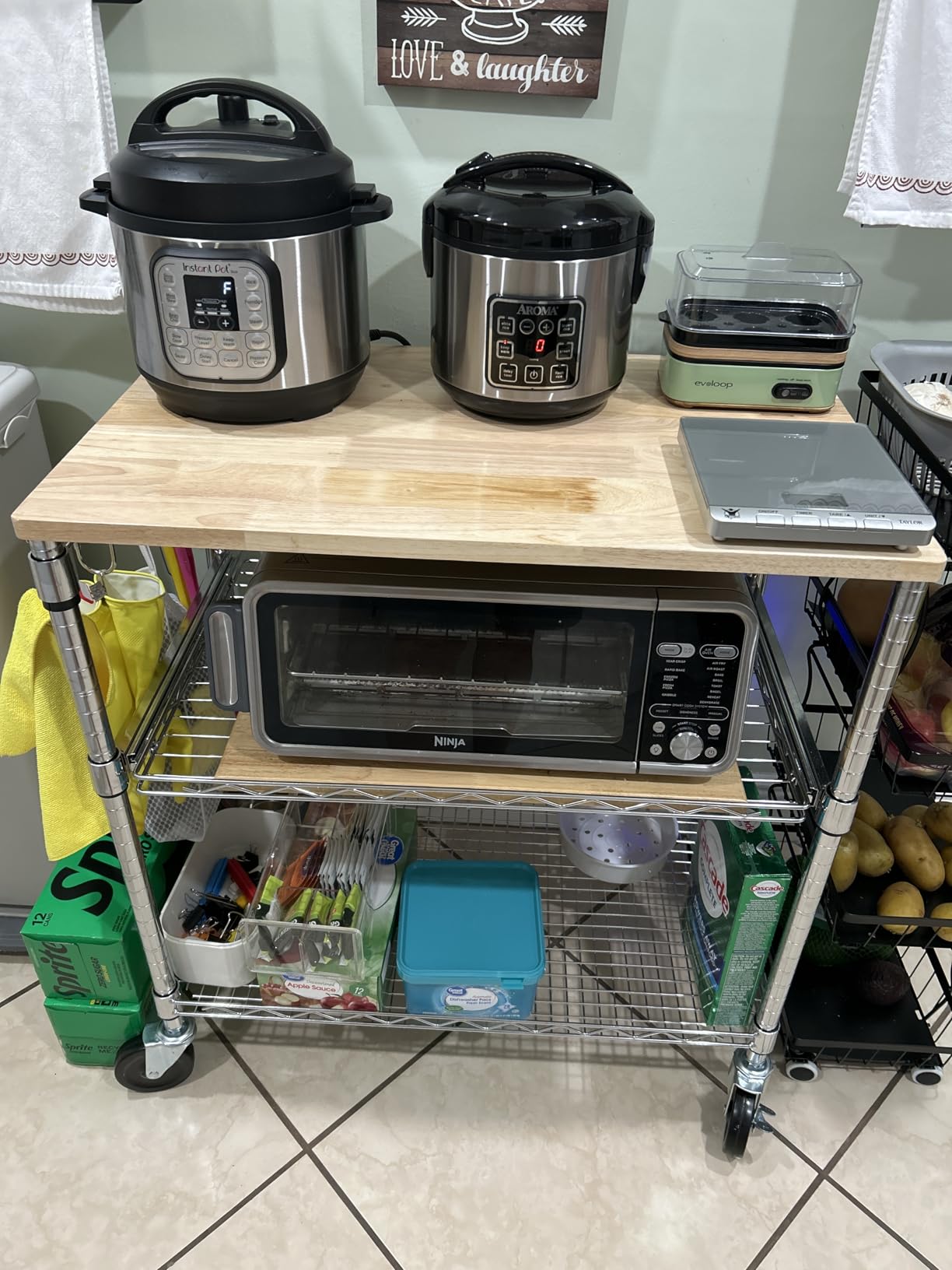
When a cart needs to carry a real appliance rather than organize cans, the ratings are what matter. This is the one with genuine commercial-grade numbers: a 200-pound oak top, a 500-pound bottom wire shelf and a 100-pound pull-out slider.
The 4-inch commercial wheels are the other reason to choose it. Bigger wheels roll over thresholds, cables and carpet edges without the catching that stops small casters dead.
The pull-out slider shelf is the feature we did not expect to use as much as we did. It is a shallow shelf that slides out from under the main tiers, so a small appliance can be pulled forward instead of being lifted over a guardrail.
Reading the layered load ratings
Three different numbers here describe three different surfaces, and buyers who understand that stop overloading the wrong one. The 20-millimeter oak top carries 200 pounds, the bottom wire shelf carries 500 and the slider carries 100.
That means a heavy appliance can live on the top while bulk storage sits below it, which is the opposite of the arrangement we recommend on lighter carts where the low tiers are the weaker part of the structure.
The slider shelf in daily use
Sliding a shelf forward rather than reaching down into a frame changes the ergonomics of a 33-inch-tall cart. You do not have to bend and fish, and the appliance stays on a flat surface the whole time.
Shelf spacing adjusts in one-inch increments on the main tiers, so you can fit a tall bottle on one level and a stack of plates on another without guesswork.
Chrome shelves and outdoor use
The chrome-finished shelves are described as anti-rust and are used by owners for produce, fish and meat, and some work it as an outdoor grill cart. The surface does not absorb odors the way particle board can.
The tapered plastic clips that hold the shelves are the one build caution. Owners report they can release if the cart is assembled upside down, so check every clip is seated before you load anything.
Who should skip it
Skip it for narrow kitchens. At 32.4 inches wide and 33.3 pounds empty, this is a large cart that needs a roomy end of the kitchen, not a galley aisle. It is also more work to reposition than the light metal carts.
Our verdict
A 4.5 rating over 1,751 reviews and the highest real load capacity we tested. For a small kitchen that doubles as a bulk storage area, the extra weight earns its place.
10. HOOBRO Kitchen Island with Power Outlet – Best Built-In Power Option
HOOBRO Kitchen Island with Power Outlet, Storage Island with Spice Rack and Drawer, Rolling Kitchen Cart on Wheels, for Home, Dining Room, Rustic Brown and Black
28.5 in W x 14.8 in D x 33.8 in H
55 lb rating
2 drawers plus cabinet
3 socket power strip
Pros
- Built-in power strip with three sockets and a 59 inch cord
- Two drawers plus a double-door cabinet
- Three-tier side spice rack with rails
- Four 360 degree wheels with two lockable casters
- Coated surface wipes clean with a damp rag
Cons
- 55 lb rating is modest for countertop appliances
- Upper drawer has limited extension travel
- Veneer scratches easily with sharp objects
Most kitchen carts get parked where there is no wall outlet, which is exactly the problem this one solves. The top carries a built-in power strip with three sockets and a 59-inch cord, so a coffee maker or an air fryer can live on the cart permanently.
At 33.8 inches tall it is close enough to counter height to be a plausible prep surface, and the 26-inch wide top gives you real usable area rather than a token ledge.
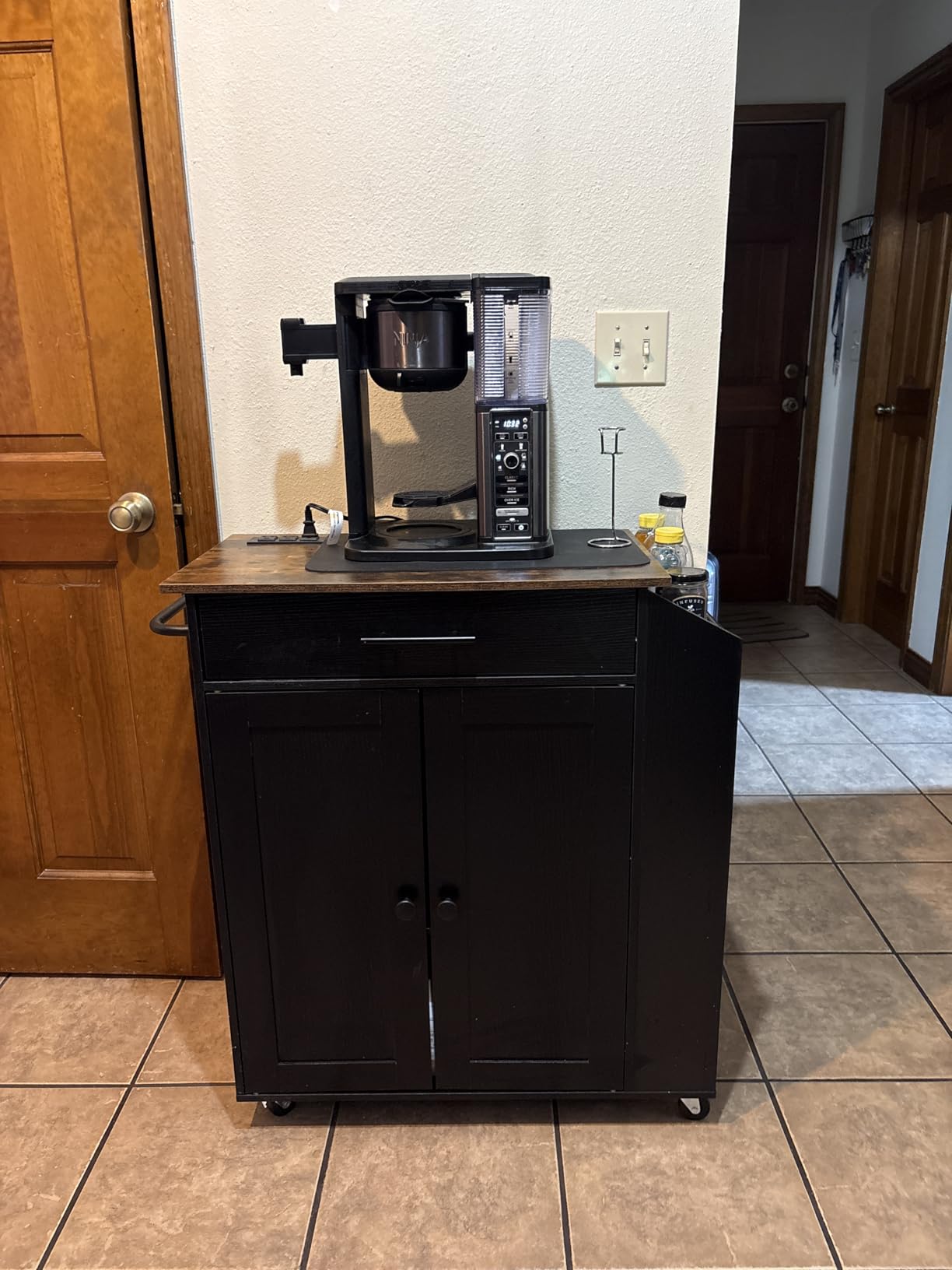
The three-tier side spice rack is a small vertical storage decision that works well. It holds bottles upright within reach without spending a shelf on them, and the rails keep them from sliding when the cart is rolled.
Why a built-in outlet changes the layout
Without an outlet on the cart, a coffee station still has to live near a wall. With one, the cart becomes a genuinely mobile appliance station you can roll to wherever you are working, then park out of the way.
The 59-inch cord is long enough to reach a nearby outlet without an extension cord, which keeps the floor clear of a cable you would otherwise trip over in a small kitchen.
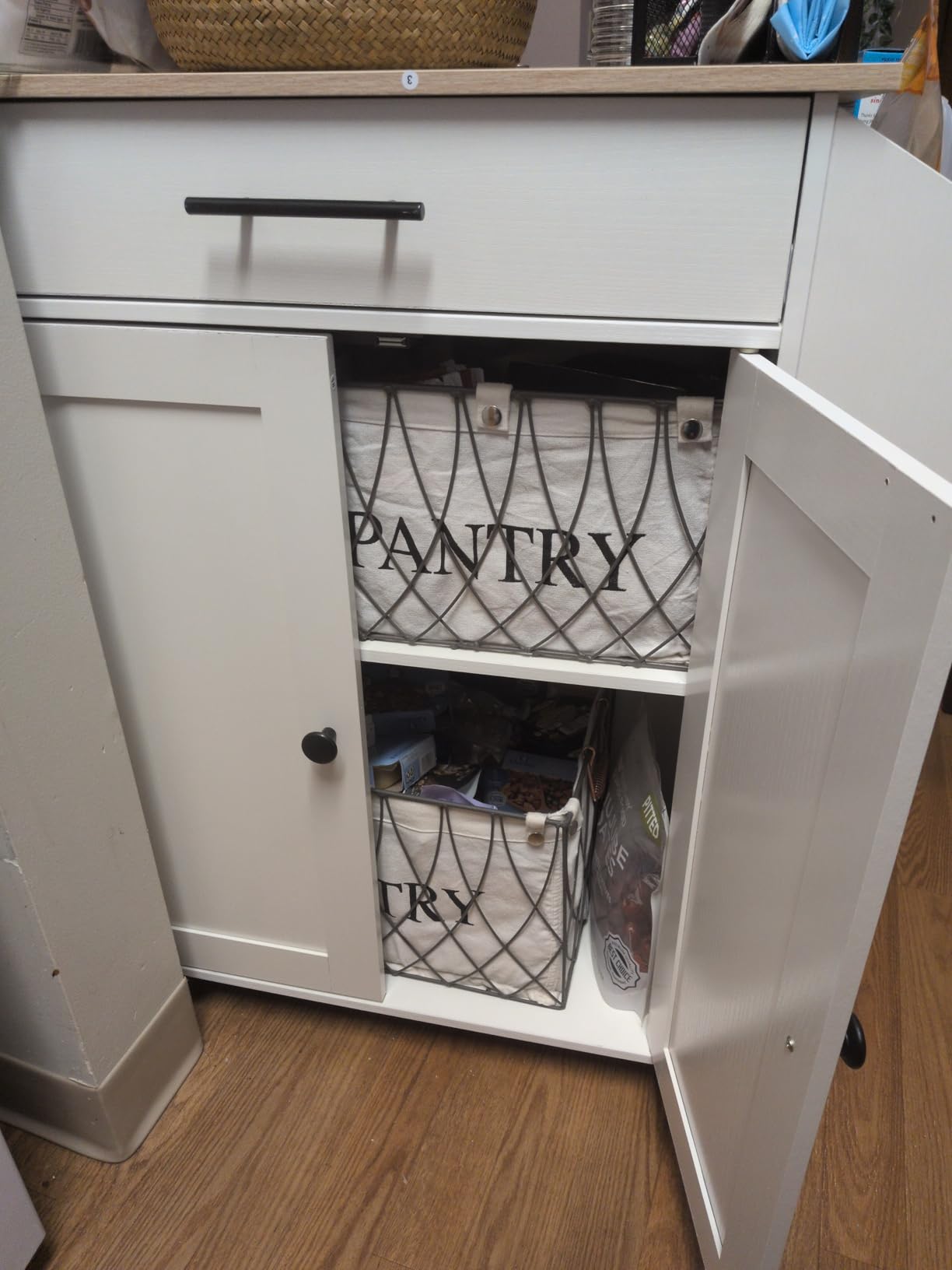
Storage layout and the adjustable cabinet
Two drawers and a double-door cabinet cover the categories that make open carts look messy. The upper drawer is sized for cutlery at roughly 9.7 by 22.7 inches with a 4.8-inch height, and the cabinet shelf adjusts to three heights for taller bottles.
Owner feedback notes that the printed product imagery does not always match the real shelf spacing exactly, so plan the layout from the stated measurements rather than the listing photos.
What 55 pounds means and how the finish wears
Fifty-five pounds is the most modest rating in the set, and it is the reason this cart is a better home for a coffee maker and a kettle than for a countertop microwave. Owners also report that the veneer scratches easily if sharp objects slide across it.
On a positive note, the coated particle board and MDF finish wipes clean with a damp rag, which matters more in a cart that holds food and drink than the material grade suggests.
Who should skip it
Skip it if you need heavy appliance capacity or a narrow footprint, since 28.5 inches wide with a 55-pound rating is a storage-and-outlet solution rather than a workhorse. It is also a wired product, so it needs a reachable outlet.
Our verdict
A 4.5 rating from 1,330 reviews and the most distinctive feature in the roundup. If your small kitchen has no usable counter near an outlet, the built-in power strip is worth the width.
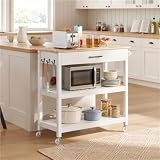
11. Yaheetech Rolling Kitchen Island Cart, White – Best Wide Prep and Dining Top
Yaheetech Rolling Kitchen Island Cart with 3 Shelves Lockable Wheels, White
37.5 in W x 17 in D x 36 in H
66 lb top, 33 lb per shelf
1 drawer plus 2 shelves
Detachable towel bar
Pros
- 37.5 by 17 inch top gives real prep or dining surface
- Drawer plus two shelves and three hooks
- Detachable towel bar keeps paper towels in reach
- Four industrial casters with two lockable
- Water-resistant varnished top wipes clean
Cons
- 37.5 inch width rules out narrow gaps
- 48.9 lb weight is heavy to move when loaded
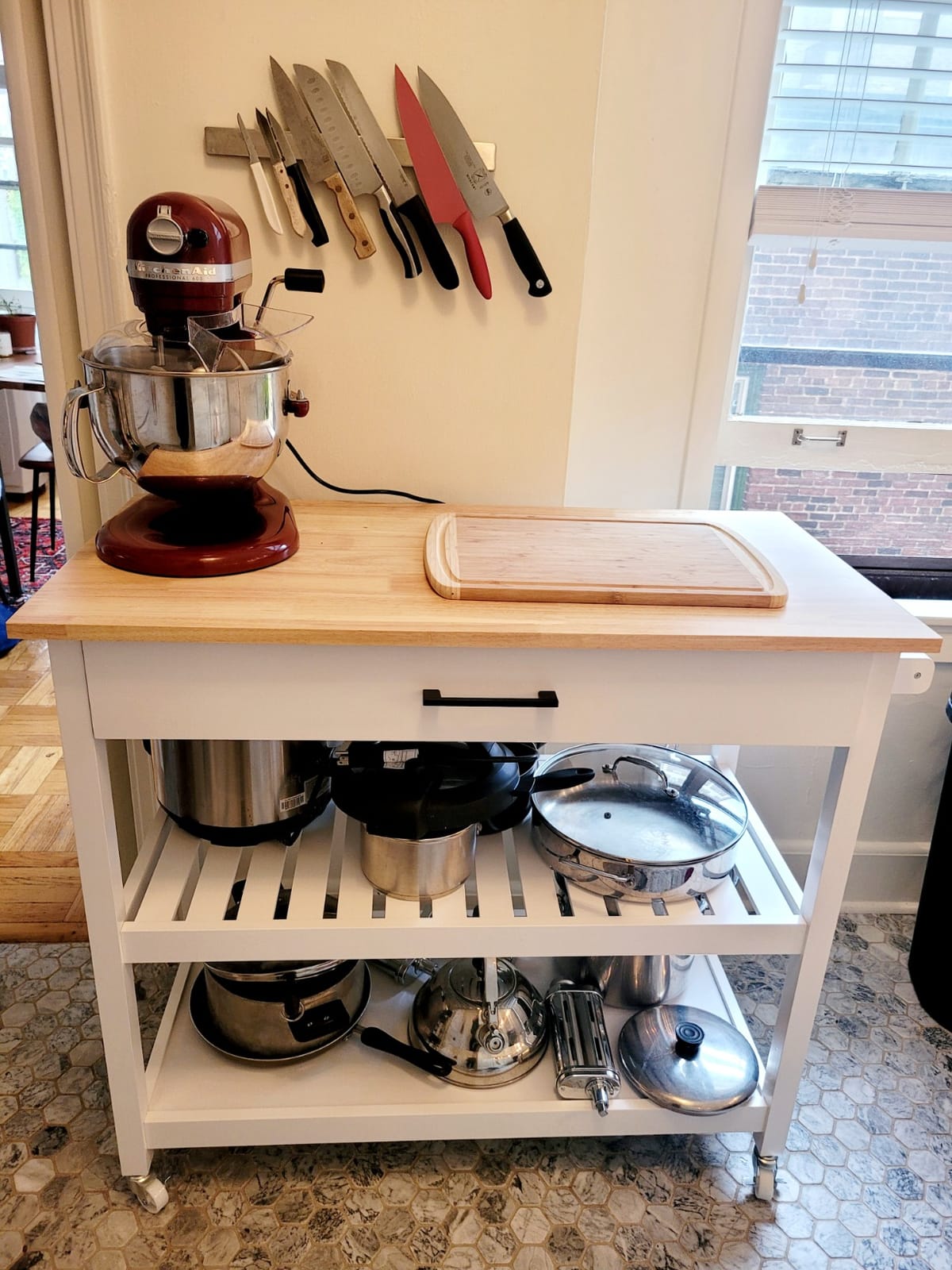
This is the pick for the opposite problem. If your kitchen is small but open, a galley with generous width or a dining area attached to it, the missing thing is surface area, and a 37.5 by 17-inch top delivers roughly six and a half square feet of it at counter height.
Owner feedback consistently points to the top surface and the detachable towel bar as the two features that make it feel like a real piece of furniture rather than a metal rack.
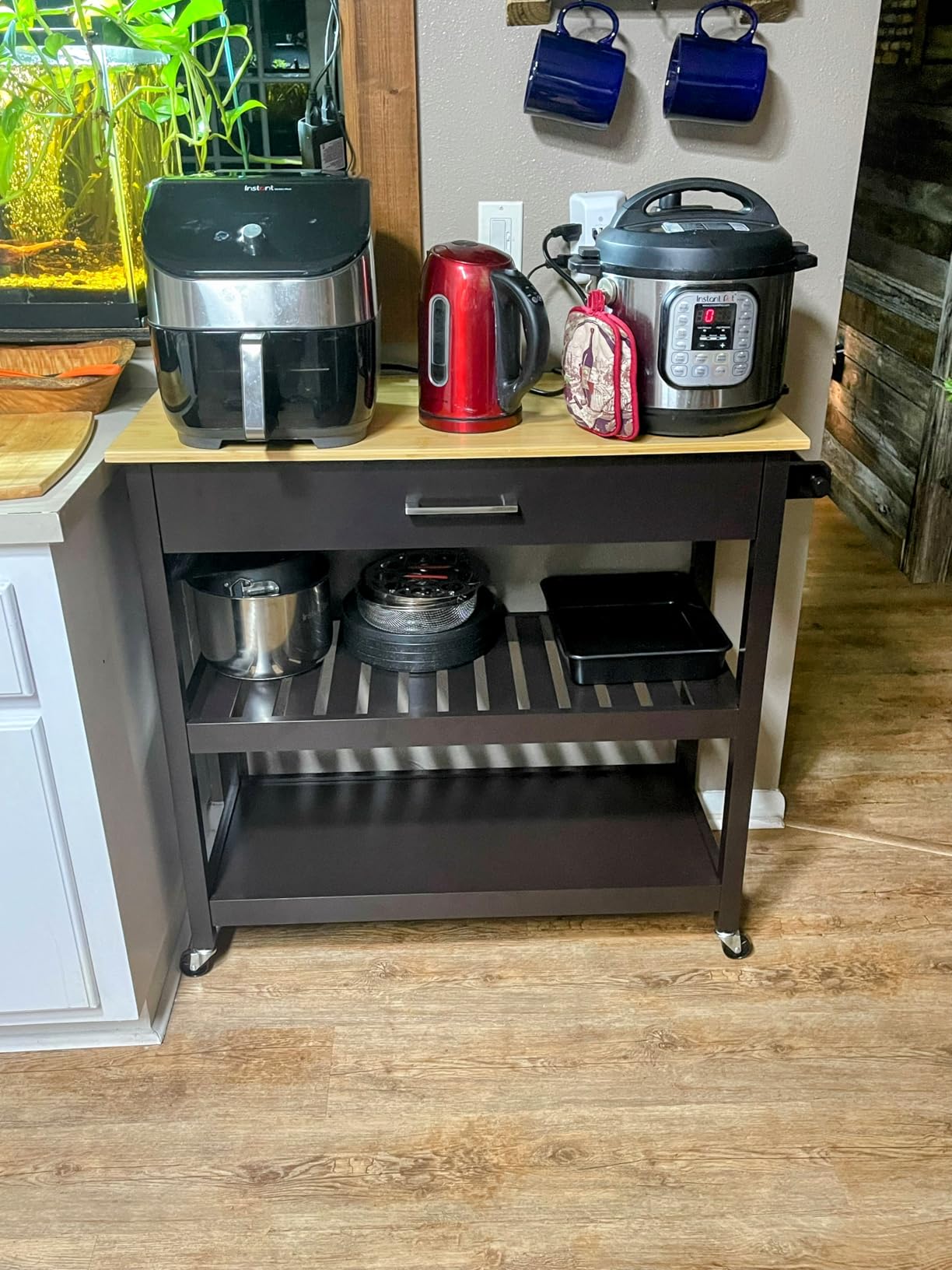
At 36 inches tall it matches standard counter height, which means the top can take a chopping board, a mixing bowl and a tray of prepped ingredients at the same time. For a small kitchen that is a genuine change in how you cook.
Height and load distribution on the top
The top is rated for 66 pounds and each of the two shelves for 33, so the heavy items belong on the surface and the lighter ones go below. That is the opposite of what we recommended for the slimmer carts, where the lower frame is the weak point.
At 48.9 pounds empty, this cart is a two-person move once it is loaded. The four industrial casters help, but the weight is real and worth factoring in before you commit to a spot for it.
Drawer, shelves and the detachable towel bar
One drawer plus two shelves is a modest amount of storage for the footprint, and the top is where the value sits. The detachable towel bar is a good design decision because it can be removed when you want a clean side edge.
Three hooks add hanging space for gloves and utensils, which on a cart this wide would otherwise eat into usable top area.
Why this one is not for tight kitchens
A 37.5-inch width is wider than a standard base cabinet run and most galley aisles will not accept it. It works at the open end of an L-shaped kitchen, against a dining table, or in a kitchen that is small in total area but not narrow in its walkways.
If you are working in a kitchen where the aisle is under 40 inches, skip this and start with one of the narrow picks earlier in the list.
Our verdict
A 4.5 rating across 1,807 reviews. The best surface area in the roundup, and the right call only when your kitchen is compact rather than narrow.
12. LIANTRAL 3 Tier Rolling Cart – Budget Convertible Cart
LIANTRAL 3 Tier Rolling Cart, Kitchen Carts on Wheels Utility Cart for Home
12.6 in W x 16.5 in D x 24.4 in H
170 lb capacity
3 tiers
Convertible cart or fixed shelf
Pros
- 170 lb rating is high for the size
- Transforms from wheeled cart to fixed shelf
- Coated water-resistant surface wipes clean
- Three tiers fit a microwave or tableware
- 12.6 inch width suits moderate gaps
Cons
- 24.4 inch height is short for prep work
- Particle board panels can swell with moisture
- Lowest average rating in the set
The 170-pound rating on a cart this small is the interesting number. It punches above its weight on paper, and the metal frame with particle board shelves gives it more rigidity than the purely mesh carts at similar capacities.
It converts between four rolling wheels and four fixed feet, so you can use it as a cart while cooking and then reclaim the floor entirely. That flexibility is the reason it works in a small kitchen where floor space changes hour to hour.
Owner feedback is more mixed than the numbers alone suggest, which is why it sits at the end of the list. The value proposition is real, but the details take some managing.
Height is the defining limitation
At 24.4 inches, this is the shortest cart in the roundup. That is below counter height by a wide margin, so it functions as a low storage and staging unit rather than a work surface you would stand at and chop.
In practice that means it is best under a counter, beside an appliance, or as an occasional extra surface you pull out for serving. Buyers expecting a prep cart at counter height will be disappointed.
Moisture and the particle board question
The coated surface resists water and wipes clean, and for dry pantry goods that is enough. Near a sink or in a humid balcony, owners report particle board panels chipping or swelling over time.
Keep it in a dry spot and sealed in a cabinet away from steam and it will hold up. Treat it as a pantry cart and not a dishwashing station and the risk mostly disappears.
Why the rating is the lowest here
Its 4.3 rating is the lowest average in this group, and the share of five-star reviews is noticeably smaller than the carts above it. The complaints cluster around the short height and the particle board rather than around stability.
That pattern matters for how you buy it. If the height works for your space, the average rating is a fair reflection of a cart doing an unflashy job. If you need counter height, choose a taller model instead of trying to work around this one.
Who should skip it
Skip it if you need to prep at it, if it will live near a sink, or if you are moving it between rooms regularly. It is a value pick for dry-goods storage in a space where you can live with a 24-inch height.
Our verdict
A 4.3 rating from 1,200 reviews, and the only cart here that can become a fixed shelf with feet. Worth considering when the budget matters more than the top surface.
How to Measure Your Kitchen Before You Buy
Every cart in this roundup fits or fails on measurements alone, and a tape measure takes two minutes. Do this before you compare finishes or read a single review.
Step 1: Find the narrowest gap you would use
Walk your kitchen and measure every candidate spot, not just the most obvious one. The narrowest gap sets your maximum cart width, and it is often not where you expected. Measure between the fridge and the nearest wall, between two lower cabinets, and across the aisle at its tightest point.
Measure at floor level, where the casters and frame sit, rather than at countertop height. Some frames gain an inch or two of extra depth from the wheels, and that is the dimension that actually collides with a wall or cabinet.
Step 2: Subtract a clearance inch
Take one inch off your measurement. A cart that fits exactly will scrape baseboards, catch on door hinges and feel impossible to roll in or out, which defeats the entire purpose of buying a mobile island.
A quick mapping: a 12-inch gap suits carts up to about 11 inches wide, a 16-inch gap takes up to about 15 inches, a 20-inch gap takes up to about 19 inches, and a 24-inch gap takes up to about 23 inches. If your gap is under 10 inches, look at the 7.1-inch and 9-inch carts in this roundup.
Step 3: Check height and the doorway
Next, compare cart height against your lowest wall cabinet. Anything over 34 inches will not slide under a standard cabinet run, so those carts need a parking spot in the open rather than tucked away.
Finally, measure the narrowest doorway between where the cart lives and where you need it to be. A 37.5-inch wide island will not turn a corner through a 32-inch door frame no matter how good the casters are.
The work triangle question
One more check that costs nothing: sketch your cooking path. A cart that looks perfect parked in a corner can still block the route between your fridge, range and sink, and a cart in the cooking path is worse than no cart at all.
Most of the carts here have locking casters for a reason. Parking it outside the triangle and locking it in a reachable spot solves the problem better than buying a narrower cart.
What to Look for in a Rolling Kitchen Cart
Once you know your measurements, these are the criteria that separate a cart you will keep from one that becomes a shelf in the garage within a year.
Footprint: width first, depth second
Width decides whether a cart enters the space at all. Depth decides whether you can still open the dishwasher, stand at the sink and walk past. In a galley kitchen, depth is often the harder constraint because it eats your standing room.
One underappreciated detail: a deep cart against a wall is fine, but a deep cart across an aisle is not. The 26.6 by 11.4-inch orientation of the narrow wood cart works precisely because the larger number faces the wall.
Counter height versus storage height
Standard counter height is roughly 34 to 36 inches. A cart at that height is a work surface; a cart at 30 inches or below is a storage unit and a staging surface. Both are useful, but they solve different problems and you should know which one you are buying.
If you want to chop, mix or plate standing up, look for 34 inches or more and check your wall cabinet clearance first. If you mostly want to park appliances and clear a counter, height matters far less than top surface dimensions. Our ice maker picks for small kitchens cover the same footprint arithmetic from the other direction.
Storage type: open, drawer or cabinet
Open shelves hold the most and show the most. Drawers and cabinets hide clutter, which matters enormously in a kitchen where the cart is permanently in view. Most owners of open carts in visible positions end up regretting the choice within a few months.
A practical compromise is one enclosed section plus open shelving, so daily items are visible and the awkward bottles are hidden. A practical mistake is filling every open tier, which turns a small kitchen into a cluttered one.
Casters and floor type
Look for swivel casters, because fixed wheels force a wide turning arc in a tight aisle. Look for at least two locking casters, and lock them diagonally rather than side by side so the cart cannot pivot when you lean on it.
Carpet is where cheap casters fail. Soft urethane wheels roll over carpet without catching, while hard nylon and small wheels dig in. Larger wheels also clear thresholds better. If your kitchen is carpeted and the cart is loaded, floor protectors under the casters are worth adding.
Load capacity and the per-shelf number
The headline capacity describes the frame and casters, not every surface. Per-shelf ratings tell you where the strength actually is, and they are the number that decides whether a microwave belongs on the top or the bottom.
As a rough guide, a coffee maker, kettle or rice cooker sits well under 15 pounds and any cart here will carry it. A countertop microwave or air fryer runs closer to 30 to 45 pounds, so look for at least 100 pounds total and 30 pounds per shelf. A stand mixer with a bowl attached can reach 30 pounds, so plan for a solid shelf rather than a mesh basket.
Assembly and the renter question
Flat-pack carts take anywhere from a few minutes to most of an hour, and the difference is the difference between buying one this weekend and abandoning it in a box. Tool-free snap-together frames and included hardware are worth paying a little more for.
For renters this is the strongest argument for a cart at all: no drilling, no demolition, and it moves with you. If you are weighing a cart against installing a shelf, the cart wins on reversibility alone.
Style and finish
Powder-coated steel reads as industrial and hides fingerprints. Powder-coated white reads as clean and shows less scuffing on a dark floor. Wood and engineered wood tops look like furniture and take a little more care around water.
Match the cart to your hardware. A stainless cart in a warm wood kitchen looks borrowed, and in a rental where you cannot change the cabinets, the cart is the one element you control.
When a Rolling Cart Is the Wrong Choice
A rolling kitchen cart is not the answer in every small kitchen, and buying one anyway is how people end up with less usable space than they started with.
Overfilling is the most common mistake. A cart loaded on every tier with visible packaging and mismatched containers makes a small kitchen read as cramped rather than organized, because every object is now competing for attention at once. If you cannot keep the cart at least half empty, a cabinet-based storage solution will serve you better.
Floor space is the other limit. If the only available spot is inside your cooking path, no amount of caster quality fixes it. Vertical storage is the natural alternative: wall shelves above the counter, a magnetic strip for knives, an over-sink cutting board, or a ceiling pot rack. All of those add surface or storage without taking a square foot of floor.
Reach height matters too. The lowest tier of a three-tier cart sits close to the floor, which is awkward for shorter users and harder for older users with any back or knee trouble. If you will not bend easily, a two-tier cart with a raised base or a wall-mounted shelf is a better investment than a taller cart you cannot reach into.
Finally, buy a cart only if you will actually move it. A cart that never rolls is an expensive, awkward shelving unit taking up premium floor space. If the spot you have in mind is permanent and no appliance needs relocating, a plain shelf of the same width costs less and wastes no casters.
Frequently Asked Questions
Are kitchen trolleys good for small kitchens?
Yes, a kitchen trolley is often the best available option for a small kitchen because it adds counter-height work surface and storage without any drilling or remodel. The deciding factor is footprint: measure the narrowest gap you want to fill and buy a cart whose width clears it by at least an inch. Carts under 12 inches wide fit beside a fridge or between two lower cabinets, while carts between 15 and 24 inches suit a galley aisle.
What size kitchen cart fits a small kitchen?
For a galley aisle of 30 to 36 inches, a cart 15 to 20 inches wide keeps a usable walkway on both sides. For a 12 to 16 inch gap such as the space beside a fridge, look for carts 9 to 15 inches wide. A 20 to 24 inch gap suits a small island with drawers or a cabinet. Always subtract an inch of clearance from your measurement, and check cart height against your lowest wall cabinets before ordering.
How do I choose a rolling kitchen cart?
Choose in this order: width against your narrowest gap, then height against your wall cabinets, then load capacity against the appliances you want to park on it, then storage type. Open shelves hold the most but show clutter, while drawers and cabinets keep a small kitchen looking calm. Finally check casters, since swivel wheels and at least two locking casters make a cart far easier to reposition.
Which 3 tier rolling cart is the best?
For a small kitchen, a 3-tier cart around 17 inches wide with a steel frame and a rating of 200 pounds or more offers the best balance of capacity and footprint. The Simple Houseware 3-Tier Metal Utility Rolling Cart is our overall pick, with a 220-pound frame and locking casters. If your gap is under 12 inches, the 11.5-inch-wide metal option suits narrow slots better than any wide 3-tier cart.
Can I use a kitchen trolley in the bathroom?
Yes, most metal rolling carts are used in bathrooms and laundry rooms as well as kitchens. Mesh baskets ventilate and drain, powder-coated steel resists rust, and a slim 7 to 9 inch wide cart fits the narrow gap beside a toilet or between a washer and dryer. Just note that light-duty carts rated around 60 pounds are fine for toiletries but not for anything heavy.
Do kitchen carts make a small kitchen look bigger or smaller?
A cart can do either, depending on how you load it. Kept half empty with matching containers, it adds perceived space by giving bulky items a home. Loaded on every tier with mismatched packaging, it makes a small kitchen look smaller and busier. Keeping heavy items low, limiting visible open shelves and parking it outside your cooking path all work in your favor.
The Verdict: Which Rolling Kitchen Cart Fits Your Kitchen
If you want one cart that works in most small kitchens, start with the Simple Houseware 3-Tier Metal Utility Rolling Cart. Its 17-inch width clears a typical galley aisle, its 220-pound frame takes a real countertop appliance, and locking casters keep it planted while you work.
If your constraint is a narrow gap rather than a small kitchen, choose by width. Below 8 inches goes to the 7.1-inch four-tier cart; between 9 and 12 inches takes the 9-inch slim cart or the 11.5-inch metal option; between 12 and 20 inches gives you the widest choice, including the 17-inch overall winner.
If your problem is counter space rather than storage, look at the wood-top model with adjustable shelving, which sits closest to true counter height. If your problem is one cluttered counter, the microwave cart is the fastest fix, and a built-in power outlet turns a cart into a mobile coffee station for a kitchen with no free wall socket.
Measure first, buy second. A cart that clears your narrowest gap by an inch, stands at the height you need and holds the load you plan to put on it will still be working for you years from now, and a beautiful cart that does not fit the space will be working for nobody.