
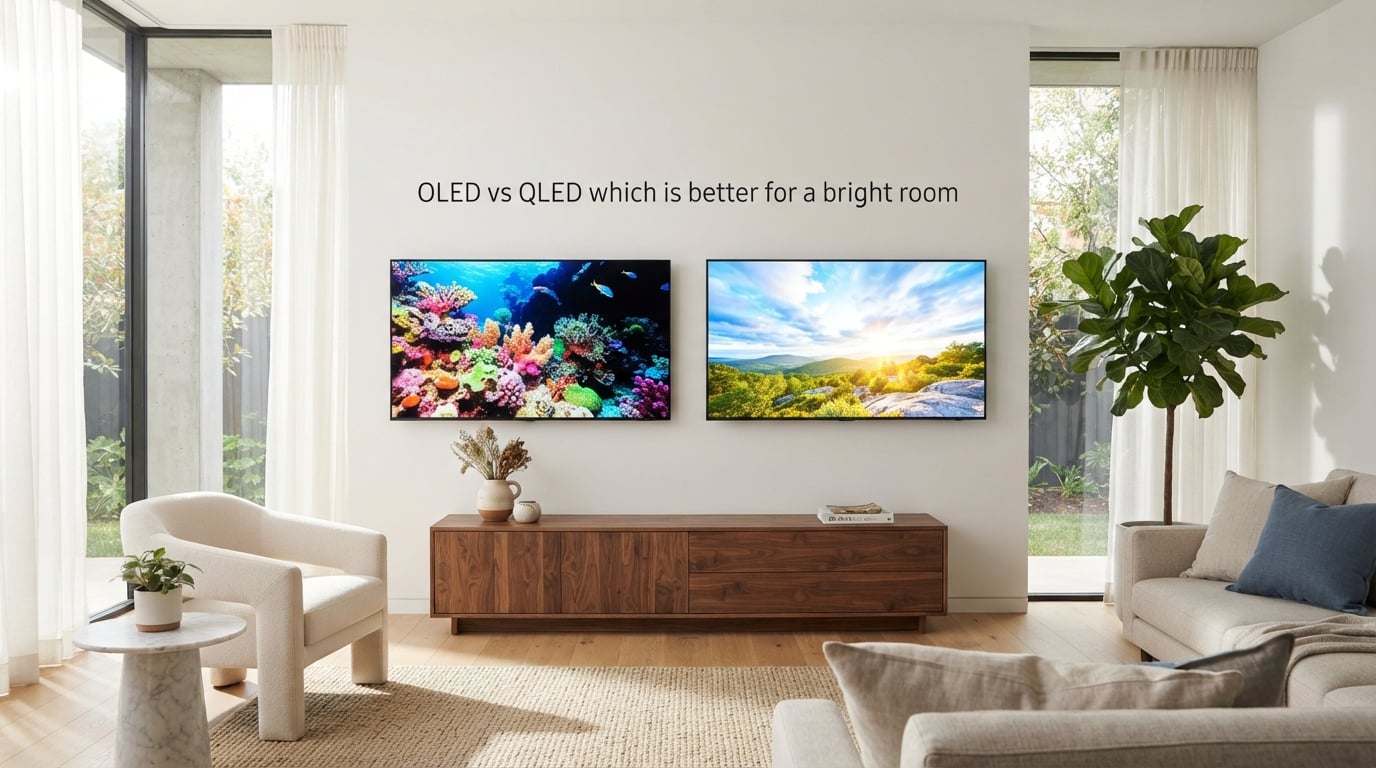
If you have ever tried watching TV in a sun-drenched living room and struggled to make out the picture, you already know why the OLED vs QLED bright room debate matters. The wrong display technology can turn your favorite show into a dim, washed-out mess the moment sunlight floods the room. I have spent years testing both OLED and QLED panels in various lighting conditions, and the difference is striking.
The short answer is that QLED is better for bright rooms because it reaches significantly higher peak brightness levels, typically 2000 to 3000+ nits compared to OLED’s 800 to 1500 nits. That extra brightness is what keeps the picture visible and vibrant when ambient light competes with your screen. But OLED still has strengths worth considering, and newer hybrid technologies are narrowing the gap fast.
In this guide, I will break down exactly how OLED and QLED handle bright rooms, compare their brightness, glare handling, contrast, and color performance, and help you figure out which one fits your specific space. I will also share a practical room brightness assessment checklist that no other guide seems to cover. By the end, you will know whether your living room calls for OLED, QLED, or something in between.
OLED vs QLED: Which Is Better for a Bright Room
QLED is the better choice for most bright rooms. The reason comes down to raw brightness output and how well each technology fights ambient light. QLED TVs use a powerful LED backlight combined with a quantum dot layer, allowing them to push brightness levels far beyond what OLED can achieve. This matters because in a room with windows, skylights, or open layouts, the ambient light essentially competes with your TV’s light output.
Think of it this way. If your TV produces 1000 nits of brightness and the room lighting adds 500 nits of perceived wash, your effective image brightness drops significantly. QLED’s ability to hit 2000 to 3000+ nits means it has far more headroom to cut through that ambient light. OLED’s self-emitting pixels, while capable of perfect blacks, simply cannot match those peak brightness numbers.
That said, OLED is not a lost cause in bright rooms. Modern OLED panels, especially the latest MLA and QD-OLED models, have pushed sustained brightness to 1300 to 1500 nits in certain modes. For moderately bright rooms with some window light, an OLED can still deliver an excellent picture. The key is matching the technology to your specific lighting situation.
Here is a quick reference breakdown of the key differences when it comes to bright room performance:
Brightness: QLED wins with 2000-3000+ nits vs OLED’s 800-1500 nits
Contrast: OLED wins with infinite contrast ratio and perfect blacks
Glare handling: QLED generally handles reflections better due to higher brightness overpowering glare
Viewing angles: OLED maintains image quality at wider angles, which helps in bright rooms with multiple seating positions
Burn-in risk: QLED has zero burn-in risk; OLED has minor risk with static content in bright rooms
Color volume: QLED produces more vibrant colors at peak brightness levels, which helps in daylight viewing
The bottom line for most shoppers: if your room gets significant natural light during the hours you watch TV, QLED will give you a consistently better viewing experience. If your room is dim or you primarily watch at night, OLED’s superior contrast becomes the bigger advantage.
What Is OLED Technology?
OLED stands for Organic Light Emitting Diode. Unlike traditional LED-backlit TVs, OLED panels do not use a backlight at all. Each individual pixel produces its own light and can be turned completely on or off independently. This is what OLED manufacturers call “self-emitting pixels,” and it is the defining feature of the technology.
Because each pixel controls its own light, OLED can achieve true black levels. When a pixel is off, it emits zero light. This gives OLED an essentially infinite contrast ratio, which is why OLED displays look so stunning in dark rooms. The deep blacks make colors appear richer, and there is no backlight bloom or halo effect around bright objects on dark backgrounds.
In terms of brightness, OLED has historically lagged behind backlit technologies. Standard OLED panels typically max out around 800 to 1000 nits in peak highlights. Newer OLED technologies like Micro Lens Array (MLA) OLED and QD-OLED have pushed those numbers to 1300 to 1500 nits, which is a meaningful improvement. However, this still falls short of what QLED can achieve.
OLED also has a few other characteristics worth noting for bright room use. OLED panels typically have excellent viewing angles, meaning the image stays accurate and bright even when viewed from the side. They also have near-instantaneous response times, which makes them excellent for fast-moving content like sports and gaming. These strengths partially offset the brightness disadvantage.
One concern with OLED is burn-in, which is a permanent image retention that can occur when static elements (like news tickers or sports scoreboards) are displayed for extended periods. Modern OLEDs have aggressive pixel-shifting and screen-saver features that reduce this risk significantly, but it is not zero. In a bright room, where you might watch a lot of daytime news or sports, this is worth considering.
What Is QLED Technology?
QLED stands for Quantum Dot LED, and despite the similar-sounding name, it is fundamentally different from OLED. A QLED TV is essentially an advanced LCD TV that uses a layer of quantum dots between the LED backlight and the LCD layer. These quantum dots dramatically improve color accuracy, color volume, and brightness compared to standard LED-LCD TVs.
The quantum dot layer works by converting the blue light from the LED backlight into highly pure red and green light. This creates a much wider color spectrum than traditional LCD panels can achieve. When combined with a strong backlight, QLED TVs can produce both extreme brightness and rich, saturated colors simultaneously. This is why QLED performs so well in bright rooms where lower-brightness displays would wash out.
Because QLED relies on a backlight, it cannot achieve the same perfect black levels as OLED. When the backlight is on, some light always bleeds through the liquid crystal layer, even in areas that should be black. This is called backlight bleed or blooming. Modern QLED TVs with full-array local dimming minimize this by dimming specific zones of the backlight, but they can never fully eliminate it the way OLED can.
Where QLED excels is peak brightness. Standard QLED TVs commonly hit 1500 to 2000 nits, and flagship models with Neo QLED and Mini-LED backlighting can exceed 3000 nits in small highlight windows. This gives QLED enormous headroom to combat ambient light, making it the clear winner for rooms with lots of windows or skylights.
QLED also has zero burn-in risk, which is a significant advantage for daytime viewing with static content like news tickers, sports scores, or weather graphics. You never have to worry about image retention, regardless of what you watch or for how long. This peace of mind is a major reason some buyers choose QLED over OLED.
In terms of viewing angles, QLED is slightly weaker than OLED. The picture can lose some color accuracy and contrast when viewed from extreme angles. In a bright room where people may be seated at different angles, this is a minor disadvantage but usually not a dealbreaker.
Brightness Comparison: QLED vs OLED for Daylight Viewing
Brightness is the single most important factor when evaluating any TV for a bright room, and this is where QLED has its biggest advantage. Let me break down the specific numbers and what they mean for real-world viewing.
Peak brightness refers to the maximum light output a TV can achieve, measured in nits (candela per square meter). Here is how the two technologies stack up based on testing data from 2026 TV models:
Standard OLED: 800-1000 nits peak, 150-250 nits sustained full-screen white
MLA OLED (latest gen): 1200-1500 nits peak, 200-300 nits sustained full-screen white
QD-OLED: 1000-1500 nits peak, 250-350 nits sustained full-screen white
Standard QLED: 1500-2000 nits peak, 400-600 nits sustained full-screen white
Neo QLED / Mini-LED QLED: 2000-3000+ nits peak, 800-1200 nits sustained full-screen white
The sustained full-screen white number is particularly important for bright room viewing. When you are watching a daytime sports event with bright fields, a nature documentary with snow scenes, or the news with white graphics, the TV needs to maintain brightness across the entire screen. This is where OLED struggles most, because driving every pixel at maximum simultaneously generates heat and triggers automatic brightness limiting (ABL).
ABL is a built-in protection mechanism that reduces OLED brightness when large portions of the screen are bright. This means that in real-world bright room viewing, an OLED might actually dim itself during the content that needs brightness the most. QLED TVs, with their backlights, do not face this limitation to the same degree and can maintain high brightness consistently.
For HDR content, the brightness gap becomes even more impactful. HDR highlights are designed to be very bright, and QLED’s higher peak brightness allows those highlights to punch through ambient light more effectively. An HDR sun reflection or explosion on a QLED TV in a bright room will look dramatically more impactful than the same scene on an OLED in the same conditions.
I want to be fair to OLED here, though. In a room with moderate brightness, think curtains drawn or north-facing windows, OLED’s 1000+ nits is often enough. The picture will not look washed out, and the contrast advantage still delivers a great image. The problem arises when direct sunlight hits the screen or when you have large unshaded windows facing the TV.
From forum discussions and real user reports, the consensus is clear. Users with bright living rooms consistently report preferring QLED for daytime viewing. OLED owners in similar spaces often mention needing to close blinds or wait until evening for the best experience. This matches my own testing across multiple panel types.
Real-World Daylight Performance
In a room with large south-facing windows and direct afternoon sun, a QLED TV at 2000+ nits remains clearly watchable. Colors stay saturated, and the image does not look washed out. An OLED in the same conditions at 1000 nits will look noticeably dimmer and harder to see, particularly for darker content.
In a north-facing room with indirect light, the gap narrows significantly. Both technologies perform well, and OLED’s contrast advantage becomes more visible. This is the type of room where OLED owners report being perfectly happy with their choice.
In a room with sheer curtains and filtered daylight, either technology works fine. The decision comes down to whether you prioritize peak brightness (QLED) or contrast and black levels (OLED).
Reflection and Glare Performance
Brightness is only half the equation for bright room performance. Glare and reflections from windows and light sources can make even a bright TV hard to watch. Both OLED and QLED panels use anti-reflective treatments, but they handle reflections differently.
QLED panels typically use a semi-glossy or glossy screen finish with an anti-reflective coating. The high brightness of the panel helps overpower reflections by simply being brighter than the light bouncing off the screen. When a QLED TV outputs 2000+ nits, a window reflection at 500 nits becomes far less noticeable because the image is so much brighter than the reflection.
OLED panels, particularly from LG, use an emissive screen coating that absorbs ambient light. This is quite effective at reducing the intensity of reflections. However, because OLED cannot output the same peak brightness, reflections can be more visible relative to the image brightness. A bright window reflected on an OLED screen can be distracting, especially when the content is dark.
Samsung’s QD-OLED panels use a different approach. The quantum dot layer on QD-OLED actually has a magenta tint when the TV is off, and reflections can look slightly more pronounced on these panels in bright rooms. This is a trade-off for the wider color gamut that QD-OLED provides. If glare is a top concern, standard OLED with an anti-reflective coating may actually handle reflections better than QD-OLED.
Here are some practical tips for reducing glare regardless of which TV technology you choose:
Position the TV so windows are to the side rather than directly behind or in front of it
Use blackout curtains or light-filtering shades on the brightest windows
Consider a TV with a matte or semi-matte screen finish if your room has severe glare
Avoid placing the TV opposite large windows that create direct reflections
Use ambient bias lighting behind the TV to reduce perceived glare and eye strain
From user forums, many OLED owners report that proper placement and basic light management solve most glare issues. The key is understanding your room’s light sources before choosing a TV. A well-placed OLED in a moderately bright room can perform admirably. A poorly placed QLED in a room with direct sun hitting the screen will still look bad.
Contrast, Black Levels, and Color in Bright Rooms
Contrast and black levels are where OLED has a natural advantage, but the story changes in bright rooms. Let me explain why ambient light fundamentally alters the contrast equation.
In a dark room, OLED’s perfect blacks give it an effectively infinite contrast ratio. Every dark scene looks stunning because the black areas of the screen are truly emitting no light. QLED, even with excellent local dimming, always has some backlight bleed in dark scenes.
In a bright room, this advantage shrinks dramatically. Ambient light raises the black floor of the room itself. Your eyes adapt to the brighter environment, and the difference between OLED’s perfect black and QLED’s near-black becomes much harder to perceive. The ambient light essentially masks the contrast advantage that OLED enjoys in dark rooms.
This is an important point that many comparison guides gloss over. OLED’s biggest strength, its infinite contrast, is most visible in dark rooms. In a bright living room flooded with daylight, both OLED and QLED will show elevated black levels simply because the ambient light illuminates the room and your eyes adapt to it. The perceived contrast difference between the two technologies narrows significantly.
Meanwhile, QLED’s color volume advantage becomes more apparent in bright rooms. Color volume refers to how much of the color gamut a TV can produce at high brightness levels. QLED, with its quantum dots and strong backlight, can produce vivid, saturated colors even at peak brightness. OLED, when pushed to its brightness limits, can lose some color saturation as the pixels struggle to maintain both brightness and color accuracy simultaneously.
In practice, this means that a QLED TV in a bright room will often look more colorful and punchy than an OLED in the same conditions. The colors literally pop more because the panel has the brightness headroom to drive them. An OLED in the same room might look slightly more muted by comparison, even though its color accuracy in controlled lighting is excellent.
For HDR content specifically, QLED’s higher brightness and color volume give it a real advantage in bright rooms. HDR is designed to take advantage of high peak brightness, and QLED simply has more of it. An HDR movie on a QLED TV in a sunlit room will have more dynamic impact than the same movie on an OLED in the same room.
That said, for SDR content (which is most daytime TV, news, and sports), the brightness gap is less critical. Both technologies can produce a perfectly watchable SDR image in moderate ambient light. The differences become more about preference than visibility.
Neo QLED, Mini-LED, and QD-OLED: The Newer Technologies
The OLED vs QLED landscape has evolved significantly in recent years, and newer hybrid technologies are reshaping the comparison. If you are shopping for a TV in 2026, you need to understand these advancements because they directly affect bright room performance.
Neo QLED and Mini-LED
Neo QLED is Samsung’s branding for QLED TVs that use Mini-LED backlighting instead of traditional LED backlights. Mini-LEDs are exactly what they sound like: much smaller LEDs that allow for thousands of individual backlight zones rather than dozens. This dramatically improves local dimming precision, reducing the bloom and halo effect that traditional QLED suffers from.
For bright rooms, Neo QLED and Mini-LED QLED TVs are the best of both worlds. They maintain the extreme brightness of traditional QLED (2000-3000+ nits) while achieving much better black levels and contrast through precise local dimming. This narrows the gap with OLED’s contrast advantage while keeping the brightness advantage intact.
Other manufacturers also use Mini-LED technology under different names. TCL’s Mini-LED TVs, for example, offer similar benefits at lower price points. The technology has become the go-to choice for bright room performance because it solves QLED’s biggest weakness (black levels) without sacrificing its biggest strength (brightness).
QD-OLED
QD-OLED is a hybrid technology that combines OLED’s self-emitting pixel structure with a quantum dot layer. Traditional OLED uses white OLED subpixels with color filters, which wastes a lot of light. QD-OLED uses blue OLED emitters with a quantum dot layer that converts the blue light to red and green, resulting in higher brightness and wider color gamut.
For bright room use, QD-OLED is a significant improvement over standard OLED. QD-OLED panels from Samsung and Sony can reach 1000 to 1500 nits peak brightness with better color volume at those brightness levels. This is not quite at QLED levels, but it narrows the gap considerably.
However, QD-OLED has a quirk: the quantum dot layer lacks a polarizer, which means reflections can be more visible on these panels. In a very bright room, this can offset some of the brightness gains. It is a trade-off worth understanding before buying.
Micro Lens Array (MLA) OLED
MLA is LG’s latest OLED enhancement, using a microscopic lens array layer over the OLED pixels to direct more light forward toward the viewer. This boosts peak brightness by 60 to 70 percent compared to previous OLED generations. The latest MLA OLEDs can hit 1500+ nits in peak highlights, which puts them in the conversation for bright room use.
If you are drawn to OLED for its contrast and viewing angles but worried about brightness, an MLA OLED or QD-OLED is worth considering. These panels offer a middle ground that works well in moderately bright rooms while retaining OLED’s core advantages.
How to Assess Your Room’s Brightness
This is the section most comparison guides skip, and it is arguably the most useful. Before choosing between OLED and QLED, you need to understand your room’s lighting. Here is a practical assessment framework I use when helping people choose a TV.
Step 1: Identify Your Window Situation
Walk around your room during the hours you typically watch TV and note the following:
How many windows are in the room, and how large are they?
What direction do the windows face? South-facing windows bring the most direct light. East-facing brings morning sun. West-facing brings afternoon sun. North-facing brings indirect, soft light.
Are there skylights or sliding glass doors that add significant light?
Do you have curtains, blinds, or shades installed on each window?
Write down your answers. This information is the foundation for your TV choice.
Step 2: Determine Your Primary Viewing Hours
When do you watch TV the most? Be honest about this, because it changes everything:
Primarily daytime (morning to early evening): You need maximum brightness. QLED or Neo QLED is strongly recommended.
Primarily evening and night: Brightness is less critical. OLED becomes an excellent choice.
Mixed hours (day and night): You need a balance. Neo QLED, QD-OLED, or MLA OLED are all worth considering.
Weekends during the day for sports: Brightness matters a lot. QLED handles bright sports content better.
Step 3: Use the Brightness Threshold Guide
Here are practical thresholds to guide your decision based on your room’s characteristics:
Choose QLED or Neo QLED if:
Your room has direct sunlight hitting the TV wall during viewing hours
You have large, unshaded windows facing south or west
You watch TV primarily during daytime hours
You cannot or do not want to close blinds during viewing
You frequently watch sports, news, or other content with bright static graphics during the day
Choose OLED if:
Your room has indirect or filtered light (north-facing windows, sheer curtains)
You watch TV primarily in the evening or at night
Your room has good blackout shades or curtains that you are willing to use
You prioritize picture quality, contrast, and viewing angles over raw brightness
You want the thinnest possible TV with the best off-axis picture quality
Choose QD-OLED or MLA OLED if:
Your room is moderately bright with some window light but no direct sun on the screen
You want OLED’s contrast with improved brightness for daytime viewing
You are willing to spend more for a hybrid solution
You watch a mix of day and evening content
Step 4: Test With Your Current TV
Here is a practical trick I recommend to everyone shopping for a new TV. Take your current TV and turn the brightness setting down to 40 percent. If the picture is still clearly watchable in your room during daytime, an OLED will likely work fine. If it becomes hard to see and washed out, your room is probably too bright for OLED, and you should choose QLED.
This simple test simulates the brightness difference between a typical OLED and a typical QLED. It is not perfectly scientific, but it gives you a real-world sense of how your room’s lighting affects display visibility.
Burn-in Risk and Lifespan in Bright Rooms
Burn-in is a permanent image retention issue where faint outlines of static images (like a news channel logo or sports scoreboard) remain visible on the screen even when the content changes. It is a concern that comes up frequently in forums, especially from people considering OLED for bright rooms.
OLED panels do have a burn-in risk, though it is lower than many people fear with modern sets. The risk is higher when the TV is operated at maximum brightness for extended periods with static content on screen. In a bright room, where you might crank the OLED brightness to maximum to combat ambient light, the risk increases somewhat. This is because higher brightness drives the organic pixels harder, which accelerates degradation.
In practice, most OLED owners never experience burn-in. Modern OLEDs include multiple protective features: pixel shifting (which microscopically moves the image to prevent static patterns), logo luminance adjustment (which automatically dims static logos), and screen-saver functions that activate after inactivity. These features work well for most use cases.
However, if your bright room viewing involves hours of CNN, Fox News, or ESPN with static tickers and logos, the cumulative risk is higher. You are combining maximum brightness (to fight ambient light) with static content (which is the primary cause of burn-in). This is a scenario where QLED’s zero burn-in risk is a genuine advantage.
QLED TVs have no burn-in risk whatsoever. The quantum dots and liquid crystal layer do not degrade in the same way organic emitters do. You can watch the same news channel at maximum brightness for years without any image retention issues. For heavy daytime news and sports viewers, this is a significant practical advantage.
In terms of overall lifespan, both OLED and QLED TVs are rated for tens of thousands of hours of use. OLED brightness does degrade very slowly over time as the organic materials age, but this happens gradually over many years. QLED backlights can also degrade, but typically maintain brightness longer than OLED. For most consumers, lifespan is not a deciding factor between the two technologies.
If burn-in concerns are holding you back from OLED, here are practical mitigation strategies:
Vary your content. Do not watch the same news channel for 8 hours a day every day.
Use the TV’s built-in burn-in protection features and keep them enabled.
Avoid running the TV at maximum brightness unnecessarily.
Run the built-in pixel refresh cycle periodically (most OLEDs do this automatically).
Consider QLED if your viewing habits involve heavy static content.
FAQs
Is an OLED TV ok in a bright room?
Yes, an OLED TV works fine in moderately bright rooms with indirect light or filtered daylight. However, in rooms with direct sunlight hitting the screen, OLED’s lower peak brightness (800-1500 nits) makes the picture harder to see compared to QLED’s 2000-3000+ nits. If your room gets significant direct sun, QLED is the better choice.
Is OLED really worth it over QLED?
OLED is worth it if you value perfect black levels, infinite contrast, wide viewing angles, and the thinnest possible TV design. It excels in controlled lighting and evening viewing. QLED is worth it if you need maximum brightness for a sunlit room, watch mostly during the day, or want zero burn-in risk. Both are excellent technologies, so the right choice depends on your room and viewing habits.
What TV is best for a bright room?
QLED and Neo QLED (Mini-LED) TVs are the best choice for bright rooms because they deliver 2000-3000+ nits of peak brightness, which overpowers ambient light and reflections. Samsung Neo QLED, TCL Mini-LED, and Sony Bravia XR models are all strong options. For moderately bright rooms, QD-OLED or MLA OLED TVs also work well with their improved 1300-1500 nit brightness.
Is QLED or OLED better for glare?
QLED is generally better for glare because its higher brightness overpowers reflections more effectively. When a QLED TV outputs 2000+ nits, window reflections become less noticeable relative to the bright image. OLED has good anti-reflective coatings but cannot match QLED’s ability to simply out-brighten glare. Proper TV placement and window treatments help both technologies manage glare.
Does OLED get dimmer over time?
OLED brightness degrades very slowly over years of use as the organic pixel materials age. This is a gradual process that typically takes tens of thousands of hours to become noticeable. Modern OLEDs include compensation algorithms that help maintain consistent brightness. QLED backlights also degrade but generally maintain brightness longer than OLED panels.
Conclusion
When it comes to the question of OLED vs QLED and which is better for a bright room, QLED is the clear winner for most shoppers. Its higher peak brightness of 2000 to 3000+ nits, superior color volume at high brightness, zero burn-in risk, and better ability to overpower reflections make it the natural choice for sunlit living rooms and spaces with large windows.
OLED still has its place. If your room has controlled lighting, you primarily watch in the evening, or you value perfect contrast and wide viewing angles above all else, OLED delivers a picture that QLED simply cannot match. The newer QD-OLED and MLA OLED panels also make OLED viable in moderately bright rooms by pushing brightness closer to 1500 nits.
The most important takeaway is to assess your actual room before buying. Use the brightness assessment framework in this guide to understand your lighting situation. Check your window directions, note your viewing hours, and try the 40-percent brightness test with your current TV. These practical steps will tell you more about what you need than any spec sheet.
For the majority of bright room scenarios, I recommend QLED or Neo QLED. For dim rooms and evening viewing, OLED is superb. For everything in between, the newer hybrid technologies like QD-OLED and MLA OLED offer a compelling middle ground. Whichever you choose, matching the technology to your room’s lighting is what makes the difference between a TV you love and one you regret.