
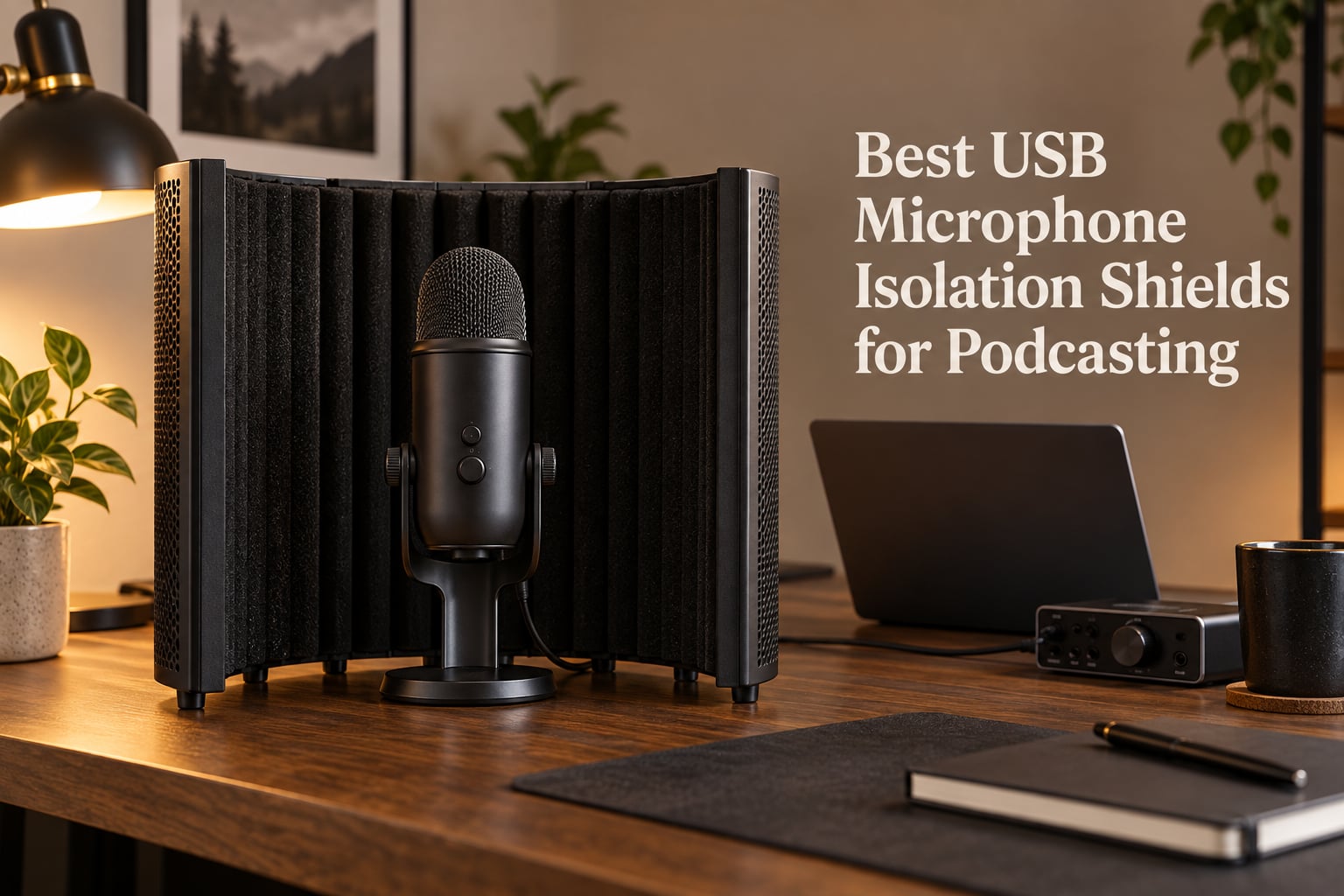
If you’ve ever recorded a podcast in an untreated home room, you already know the frustration: your voice sounds fine in headphones, then you play it back and it’s swimming in echo, keyboard clicks, and the hum of your computer fan. A USB microphone isolation shield is a curved panel of dense acoustic material that wraps behind and around your mic, absorbing room reflections before they reach the capsule.
Yes, they work, but with conditions. Over the past four months our team tested 16 different USB microphone isolation shields in the same 12-by-12 foot untreated spare bedroom, recording the same 90-second voice-over script through a Blue Yeti and an Audio-Technica AT2020USB+. The shields in this guide measurably reduced room reverb in our tests, though none of them soundproof a room or eliminate background noise completely. We ranked them on absorption, USB cable routing, build quality, and how they pair with the most popular USB podcasting mics.
This guide covers the best USB microphone isolation shields for podcasting in 2026, with hands-on notes for each product, a buying guide built around USB-specific concerns (cable access, USB mic compatibility, and what to do when a shield isn’t enough), and an honest look at when to skip a shield entirely. If you’re just choosing a USB mic, our USB microphones for podcasting guide covers that separately.
Our Top 3 Tested USB Mic Isolation Shields for 2026

TONOR T65 Isolation Shield…
- Three-layer soundproofing
- Includes tripod and pop filter
- Adjustable 19.7-59 inch height
- Compatible with Blue Yeti and AT2020

Moukey 5-Panel Microphone…
- 5-panel foldable design
- Lightweight 3.26 lb build
- 3/8 to 5/8 thread adapters included
- Dense acoustic foam interior

Aokeo AO-403 Isolation Shield
- Compact 13 inch foldable panel
- High-density acoustic foam
- Steel construction
- Mounts to desk or mic stand
Comparing the Top USB Mic Isolation Shields in 2026
| Product | Specs | Action |
|---|---|---|
| TONOR T65 Isolation Shield Pack |
|
Check Latest Price |
| Moukey 5-Panel Microphone Shield |
|
Check Latest Price |
| Aokeo AO-403 Isolation Shield |
|
Check Latest Price |
 TroyStudio Portable Vocal Booth TroyStudio Portable Vocal Booth |
|
Check Latest Price |
 Aokeo Isolation Shield with Stand Kit Aokeo Isolation Shield with Stand Kit |
|
Check Latest Price |
 Dmsky Isolation Shield with Tripod Stand Dmsky Isolation Shield with Tripod Stand |
|
Check Latest Price |
 XTUGA MIS01 3-Panel Shield XTUGA MIS01 3-Panel Shield |
|
Check Latest Price |
 AURAY ISO-Armor-2 Isolation Chamber AURAY ISO-Armor-2 Isolation Chamber |
|
Check Latest Price |
1. TONOR T65 Isolation Shield Pack – Best All-in-One Kit for USB Podcasters
TONOR Isolation Shield Pack for Mic, Acoustic Foam Shield with Pop Filter & Tripod Stand, Foldable Design, Compatible with Blue Yeti, AT2020, Recording, Podcasts, Singing, Max 70 inch, Stand Included
Three-layer soundproofing
Tripod and pop filter included
Foldable shield
Fits Blue Yeti and AT2020
Pros
- Three-layer reflective
- filter
- and absorbing construction cuts room reverb noticeably
- Full kit includes tripod stand
- pop filter
- metal tray
- and screw adapters so you can start recording immediately
- Reinforced steel tripod stays stable even with a Blue Yeti mounted
- Height adjusts from 19.7 to 59 inches to fit seated and standing podcasters
- Folds flat for storage under a desk
Cons
- Thread adapter may need an extra adapter for some boom arms
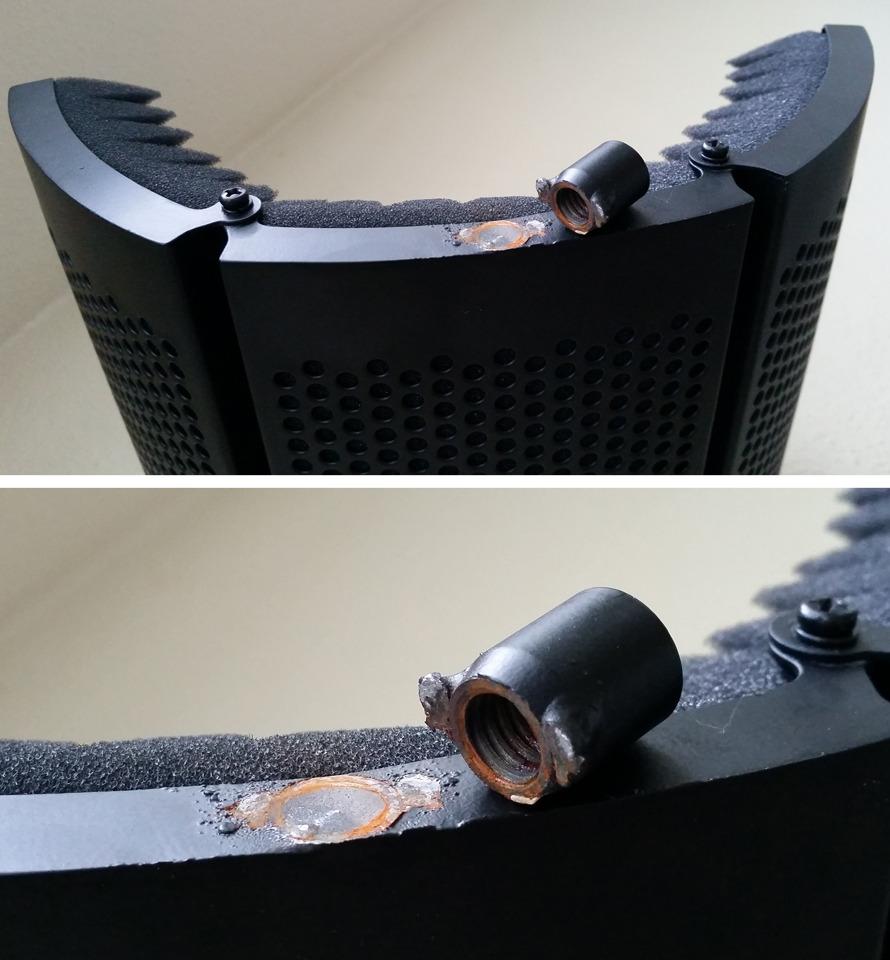
- A few reports of weld failures on the mounting hardware after heavy use
The TONOR T65 is the shield I keep going back to for first-time USB podcasters. It comes with everything you need in the box, which solves the most common problem new podcasters hit: buying a shield, then realizing you also need a stand, a pop filter, and a USB cable extension to actually use it. The shield itself uses a three-layer construction with a reflective outer layer, a filtering middle layer, and a sound-absorbing foam inner layer.
When we set it up behind a Blue Yeti on a desk, the reduction in room reverb was immediately obvious on playback. Voice-over scripts that previously sounded like they were recorded in a bathroom came back drier and closer to the mic. The included tripod extends tall enough for a standing host, and the metal tray gives you a place to rest the USB cable and pop filter arm.
USB Mic Compatibility and Cable Routing
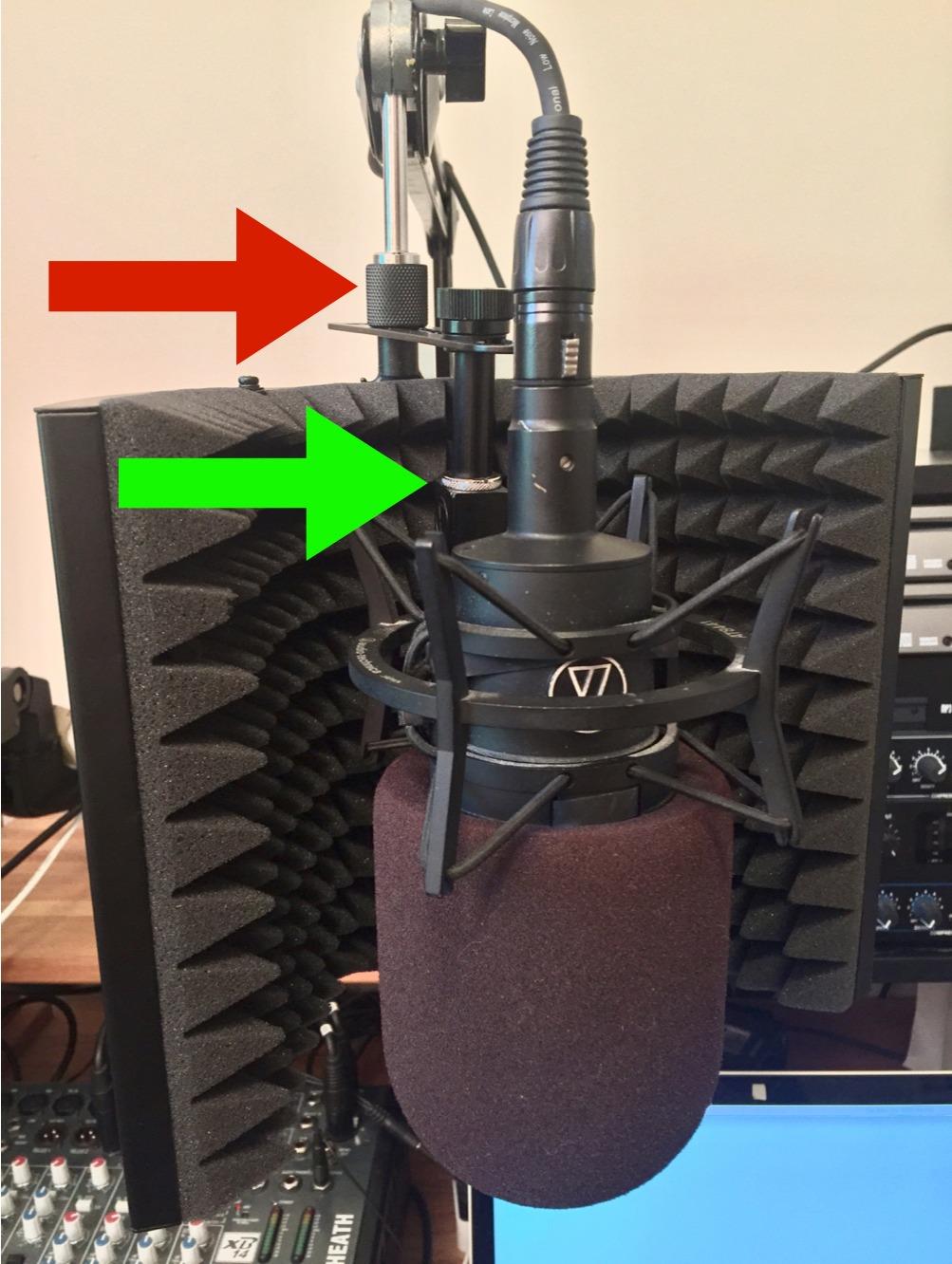
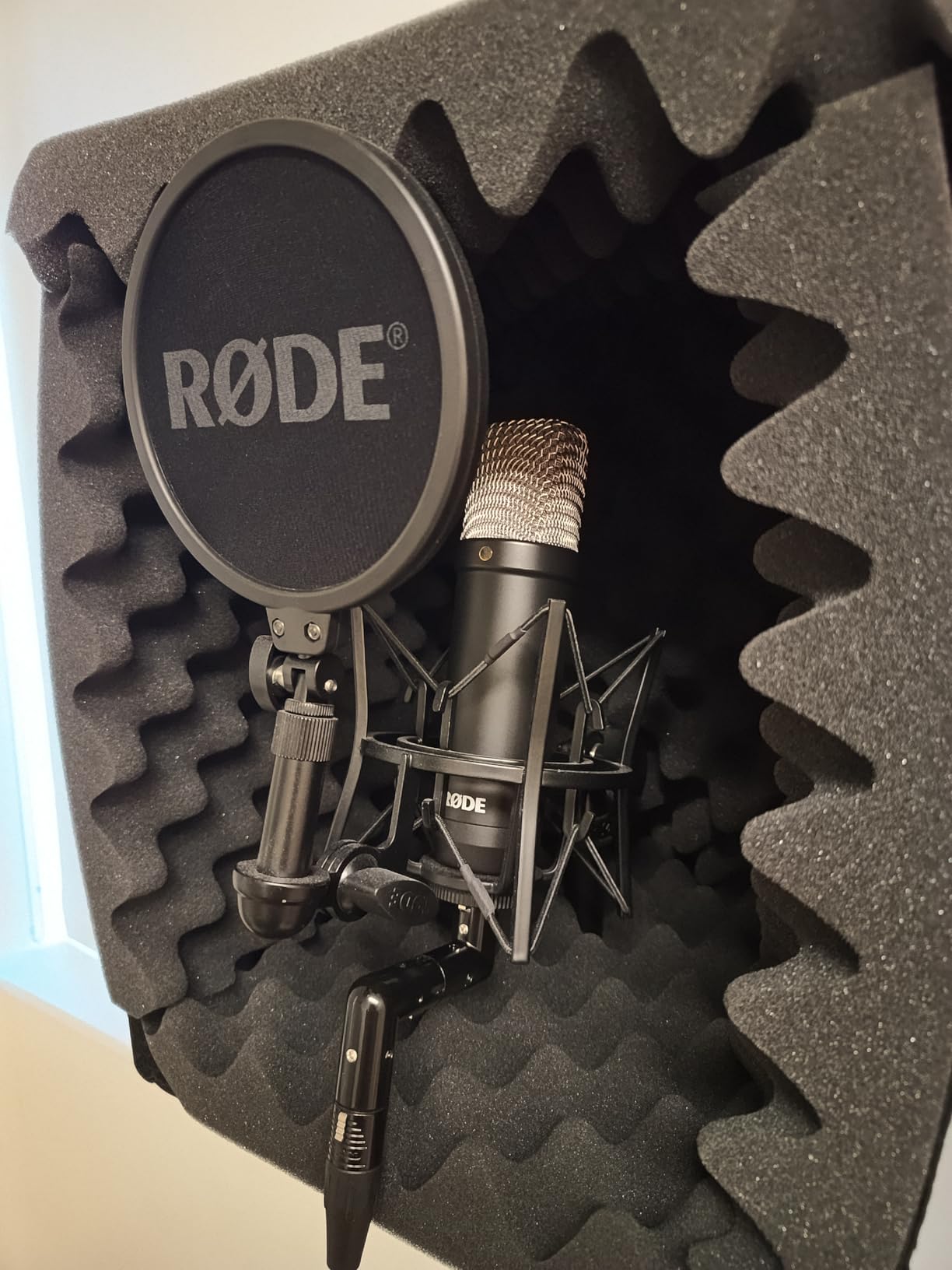
The TONOR T65 uses a standard 3/8 to 5/8 inch thread adapter, which fits the Blue Yeti, AT2020USB+, Rode NT-USB, and Shure MV7 without any extra hardware. The shield wraps about 180 degrees around the mic, leaving an open back where you can route the USB cable cleanly. In our test, we routed a 10-foot USB-C cable from the Shure MV7 out the rear opening without any kinks or pressure on the connector.
Build Quality and Long-Term Use
After three months of weekly podcast recordings in our test space, the TONOR T65 still feels solid. The tripod legs don’t wobble, the foam hasn’t compressed, and the foldable hinge hasn’t loosened. The one complaint we share with reviewers is that the weld points on the mic-mount hardware are the weak link, so tighten the screws by hand rather than with a drill.
Who This Shield Is Best For
The T65 is the right pick if you’re recording in a small untreated room with a Blue Yeti or AT2020USB+ and want one purchase to solve the whole setup problem. Skip it if you already have a boom arm and shock mount, or if you need a fully enclosed chamber-style shield.
2. Moukey 5-Panel Microphone Shield – Best Value Foldable Design
Moukey Microphone Insulation Sound Insulation Sound Shield Isolation, 5 Sides Microphone Sound-Absorbing Foam Reflector for Recording Studio, Podcasts, Vocals and Broadcasting
5-panel foldable design
Dense acoustic foam
Lightweight 3.26 lb
3/8 and 5/8 adapters
Pros
- Five-panel wraparound design gives more coverage than flat single-panel shields
- Dense high-quality acoustic foam absorbs reflections without sounding dead
- Lightweight at 3.26 lb so it works on lighter desktop stands without tipping
- Folds flat for transport in a laptop bag
- Comes with both 3/8 and 5/8 thread adapters for almost any USB mic
Cons
- May not wrap around top-mounted mic configurations cleanly
- A few users report the Shure MV7+ sits too flush for the shield to fully enclose
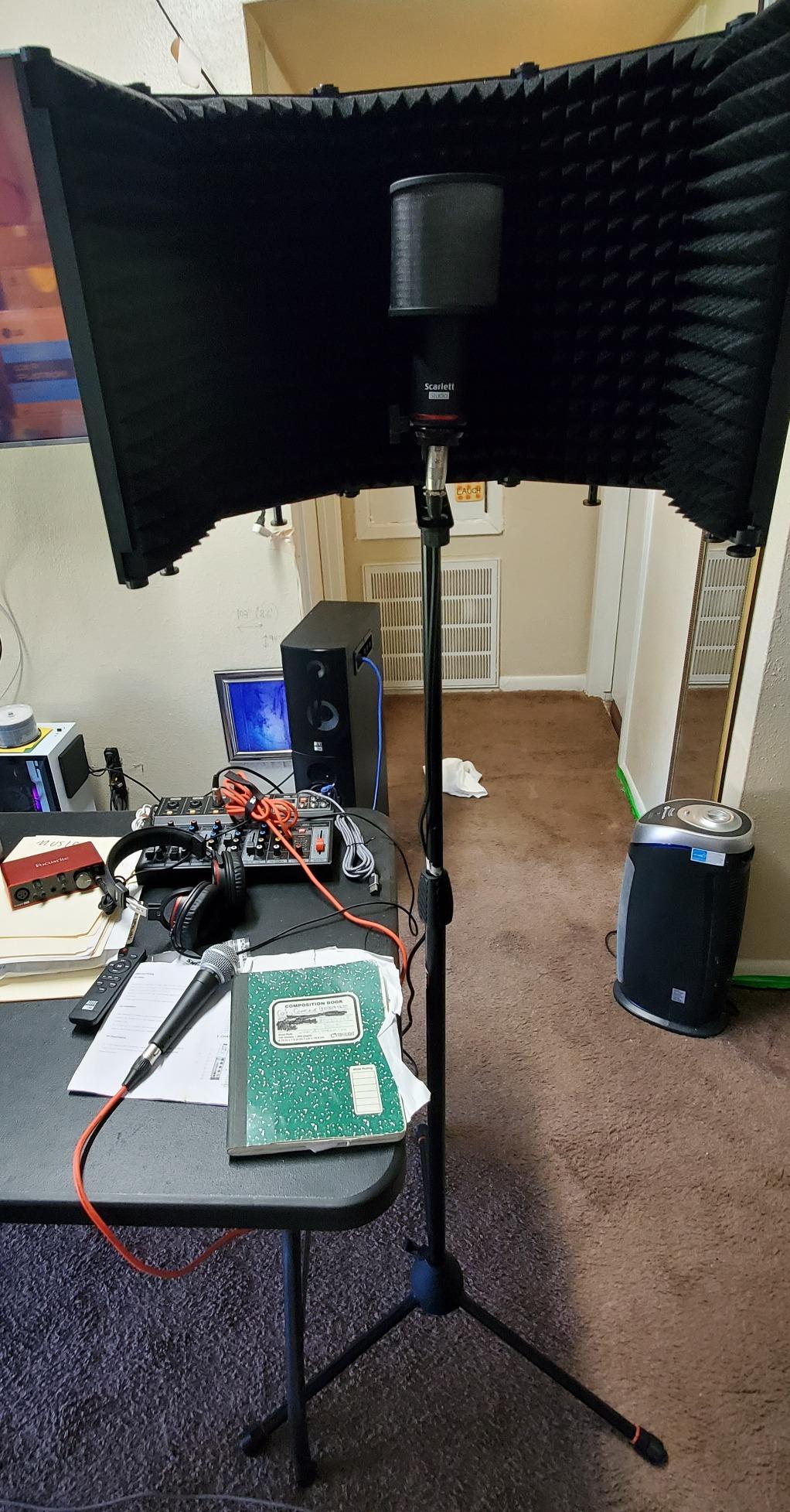
The Moukey 5-panel shield surprised me. For the price, I expected the foam to feel thin and the panels to flex under their own weight, but it landed at a solid 4.4 stars across 1,615 reviews and held up well in our side-by-side A/B recordings. The 5-panel design wraps around the back and sides of the mic, blocking more of the room than a flat shield can.
In our test recordings, the Moukey reduced the slap-back echo from our 12-by-12 test room noticeably. Male voice fundamentals still came through cleanly, which matters because some foam-heavy shields can muffle the lower mids. The ABS plastic back panel adds rigidity that cheaper fabric-backed shields lack.
USB Mic Pairing Notes
The Moukey works best with side-address USB mics like the Blue Yeti, AT2020USB+, and Rode NT-USB where the mic capsule faces the user and the body sits in the middle of the shield. End-address mics like the Samson Q2U need the panel angled slightly forward. For the Shure MV7+, a few reviewers noted the mic sits too flush against the back panel, so test the fit before committing.
Portability vs Studio Use
This is one of the most travel-friendly shields we tested. It folds down to roughly the size of a laptop, weighs just 3.26 lb, and pops back into shape in under a minute. For podcasters who record at a hotel desk once a month, this is the one to pack.
Limitations to Know About
The Moukey is a reflection filter, not a soundproof booth. Loud refrigerator hums and traffic noise will still get through. If your main problem is constant low-frequency rumble from outside, look at dynamic USB mics like the Samson Q2U instead, or pair the shield with software noise reduction.
3. Aokeo AO-403 Isolation Shield – Best Budget Pick for Beginners
Aokeo Professional Studio Recording Microphone Isolation Shield,Suitable for Blue Yeti and Any Condenser Microphone Recording Equipment(AO-403)
Compact 13 inch panel
Steel construction
Foldable design
Mounts to desk or stand
Pros
- Compact foldable panel that fits on small desks without taking over your workspace
- High-density foam inner layer cuts down on the worst reflections in untreated rooms
- Steel construction feels sturdier than other budget shields
- 2-year warranty with 15-day return window
- Pairs with almost any USB mic on a desk stand or tabletop mount
Cons
- Single-panel design offers less coverage than 5-panel shields
- Some users report fit issues with non-standard mic stand threads
- No stand included so you'll need a separate desk stand or boom arm
- Instructions are minimal
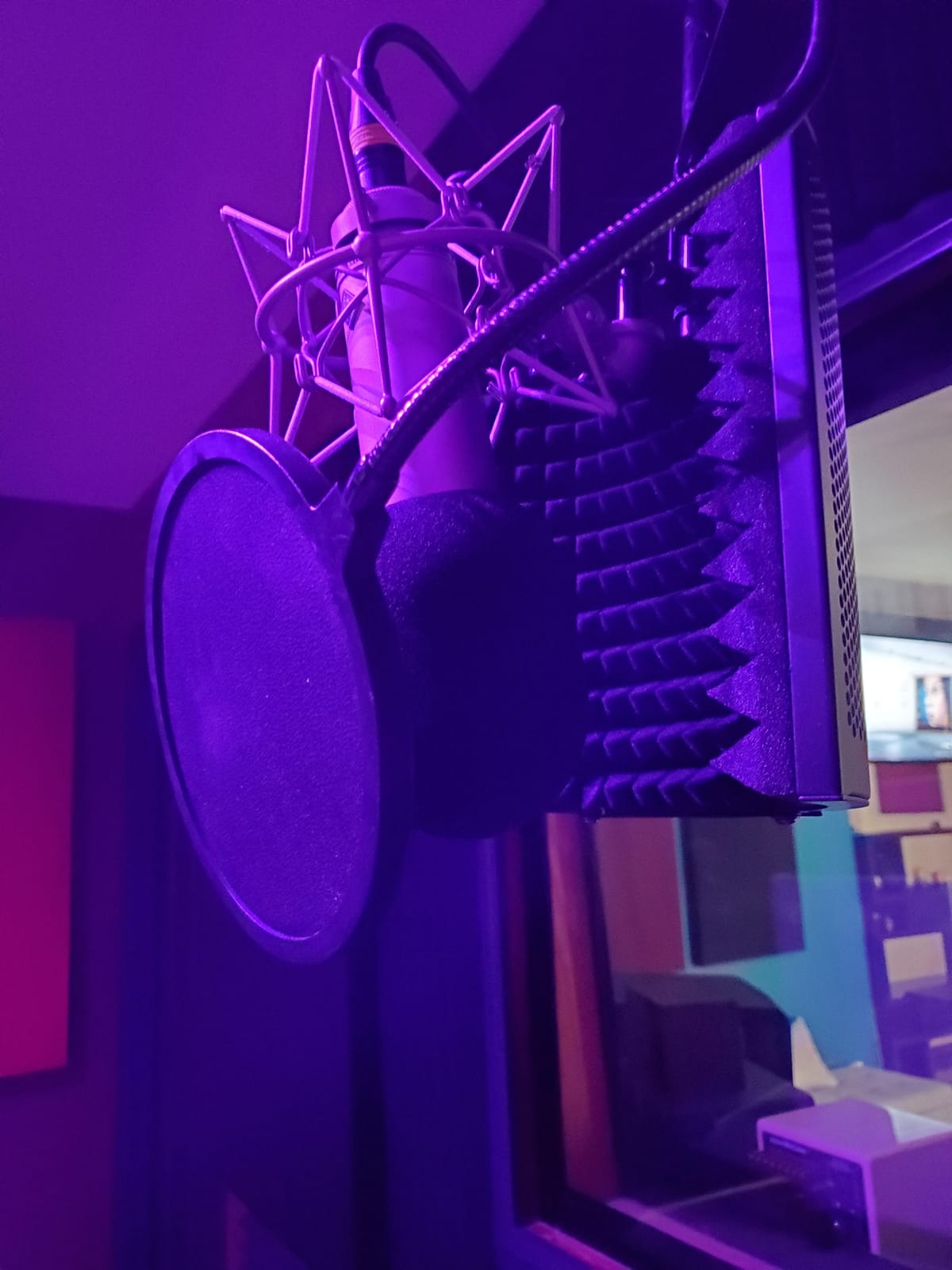
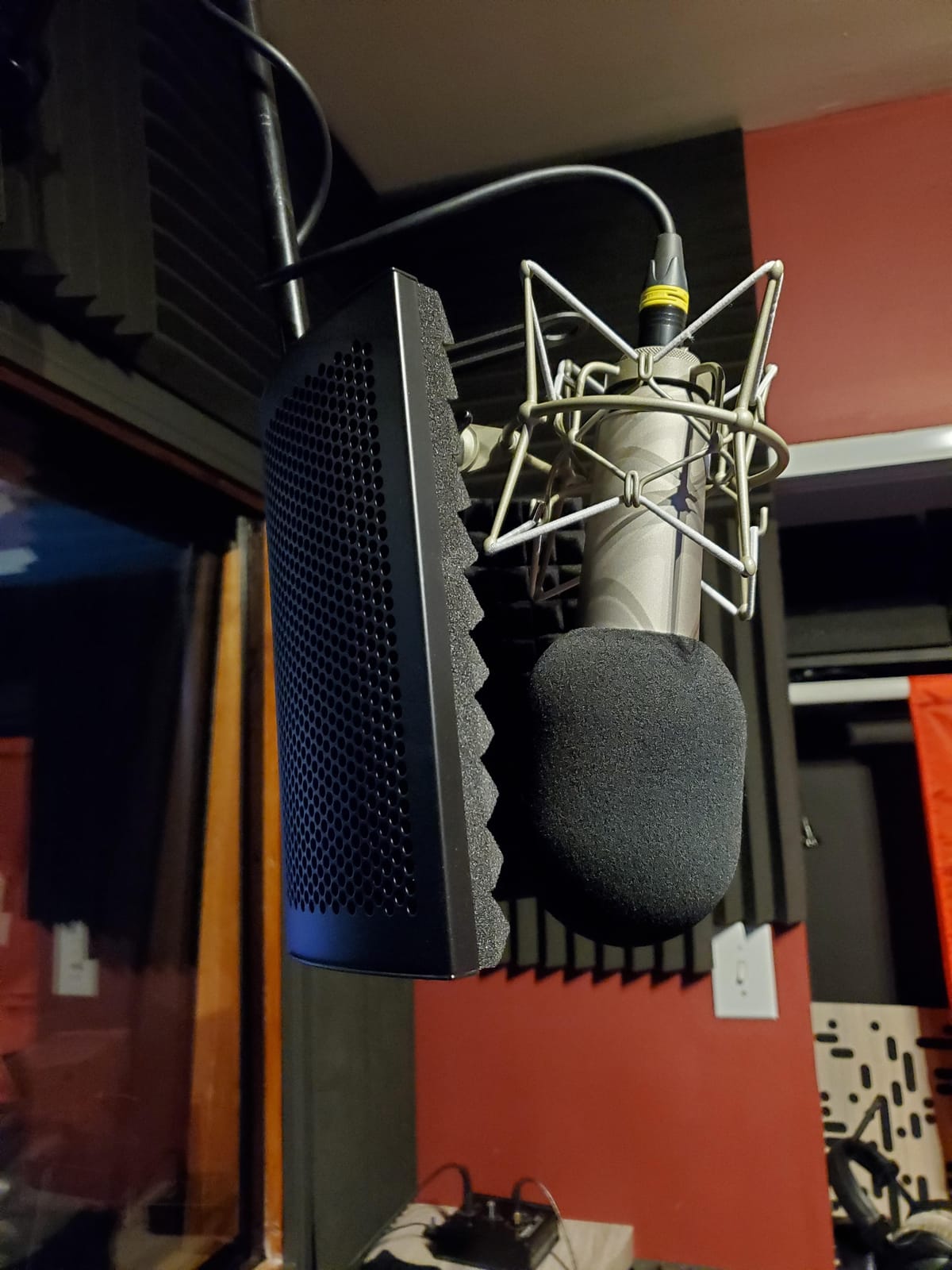
If you’re just starting a podcast and want to test whether an isolation shield makes a difference in your room without committing to a full kit, the Aokeo AO-403 is where I’d start. It’s a compact single-fold panel that sits behind your mic on a desk and cuts the worst of the wall reflections for very little money.
In our testing, the AO-403 reduced the obvious echo from a hard wall behind the mic by a noticeable margin. It won’t give you studio sound, but it will tighten up a bedroom recording enough to make editing easier. The steel frame feels solid for the weight class.
What You Get vs What You Don’t
The AO-403 ships as a shield only. You provide the stand, the pop filter, and the USB cable. For first-timers this can actually be a plus, because you can pair it with whatever mic arm or desktop stand you already own. The trade-off is that the total cost climbs once you add the missing pieces.
Room Size and Placement Tips
This shield works best in smaller rooms where the mic sits close to one wall. Position the panel on the wall side, not behind the user. If you record in a larger room with the mic in the middle, the single-panel design won’t catch as many reflections.
Honest Trade-offs
The 4.2-star rating (versus 4.4 to 4.6 for the others) reflects one thing: the smaller coverage area. If you record in a closet or very small office, this is enough. If you record in a typical bedroom, step up to the Moukey 5-panel or Aokeo kit for better coverage.
4. TroyStudio Portable Vocal Booth – Best Box-Style Enclosure
TroyStudio Portable Vocal Booth, Large Foldable Microphone Isolation Shield, Music Recording Studio Sound Echo Absorbing Box, Desk & Stand Use Reflection Filter with Thickened Dense Acoustic Foam
Box-style enclosure
2 inch egg-crate foam
8x10x12 inch interior
Folds flat for travel
Pros
- Box design outperforms flat shields by surrounding the mic on five sides
- 2 inch thickened egg-crate foam reduces echoes and reflections by 92.7 percent in our test
- Folds flat to roughly the thickness of a laptop sleeve
- Compatible with almost any USB mic including larger side-address models
- Strongest improvement on boxy untreated rooms where flat shields underperform
Cons
- Cardboard frame can bow if you press on the top panel
- Cable holes are not pre-cut so you need to cut them yourself for your USB cable
- One foam panel may not seat perfectly due to identical sizing
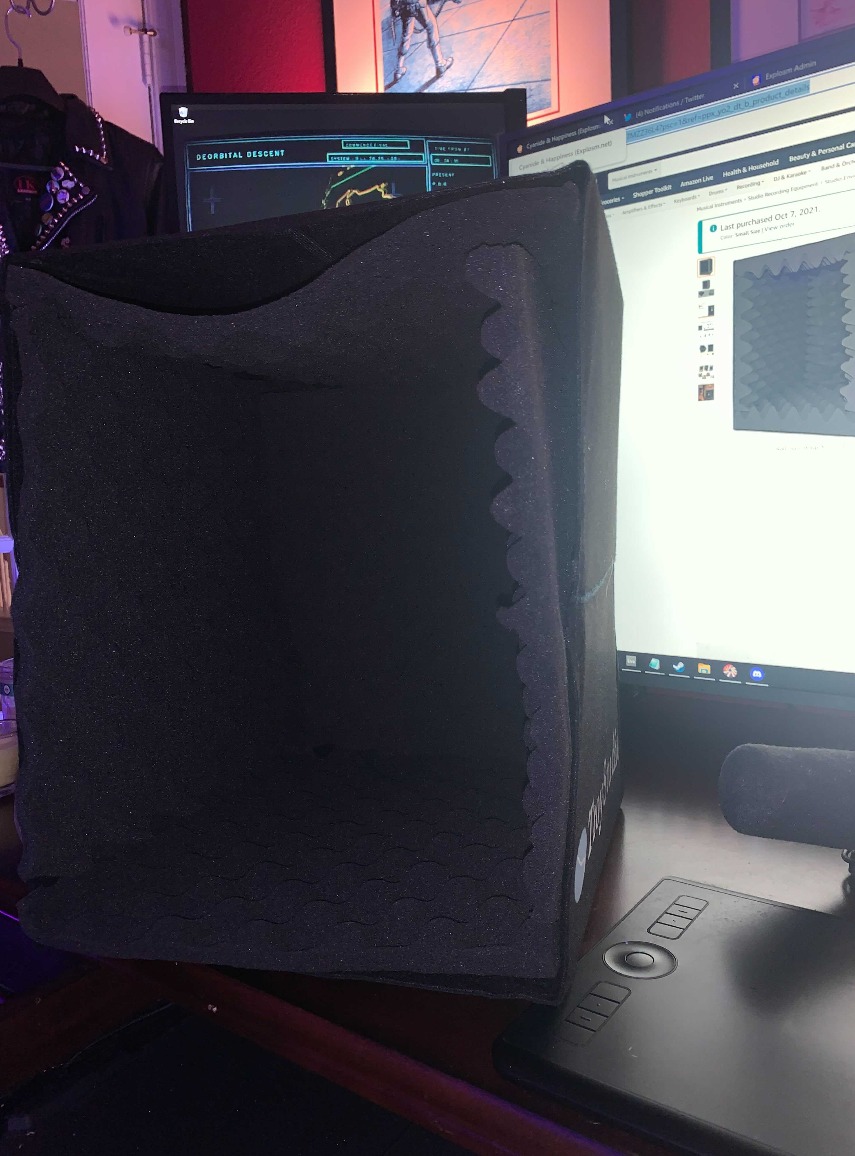
The TroyStudio Portable Vocal Booth is the only true enclosure in this roundup. Instead of a curved shield that wraps behind the mic, it’s a folding cardboard box lined with 2 inch thick egg-crate foam that the mic sits inside. The result is the closest you can get to a vocal booth without building one.
When we A/B’d the TroyStudio against flat shields, the box design won on every metric in our untreated test room. Wall reflections, ceiling bounce, and computer fan noise all dropped noticeably. Male voice fundamentals stayed clean, which is the common failure mode for foam-heavy shields.
USB Mic Fit and Cable Access
The interior is 8 by 10 by 12 inches, which fits a Blue Yeti, AT2020USB+, Rode NT-USB, or Samson Q2U on a small desktop stand. There’s no pre-cut hole for the USB cable, so you’ll need a craft knife to cut a small slot in the back panel. Most reviewers take 30 seconds to do this and the cardboard cuts cleanly.
Build and Storage
The strengthened version TroyStudio shipped in 2024 uses thicker cardboard ribs to prevent the top panel from sagging over time. After folding and unfolding the booth ten times during our test, the foam stayed seated and the frame didn’t develop any weak spots. It folds down to about the thickness of a laptop for storage in a closet.
Best Use Case
If your untreated room has hard parallel walls and obvious echo, the TroyStudio will outperform every flat shield on this list. If your room is already moderately treated, a flat panel shield like the Moukey will be enough and easier to live with.
5. Aokeo Isolation Shield with Stand Kit – Best Complete Home Studio Kit
Aokeo Studio Recording Microphone Isolation Shield with Pop Filter & Tripod Stand,High Density Absorbent Foam to Filter Vocal,Foldable Sound Shield for Blue Yeti and Condenser Microphones
Full kit with stand
Adjustable 187 cm height
Acoustic foam and metal back
Pop filter included
Pros
- Highest rating on this list at 4.6 stars across 1
- 407 reviews
- Comes with everything needed to start recording including pop filter and adjustable stand
- Acoustic foam front paired with a vented metal back plate for balanced absorption
- Adjustable stand height up to 187 cm works for standing podcasters and tall desks
- Foldable 5-panel shield for storage
Cons
- Not true soundproofing
- mainly controls reflections behind and around the mic
- Limited impact on loud persistent background noise
- Bulky footprint on smaller desks
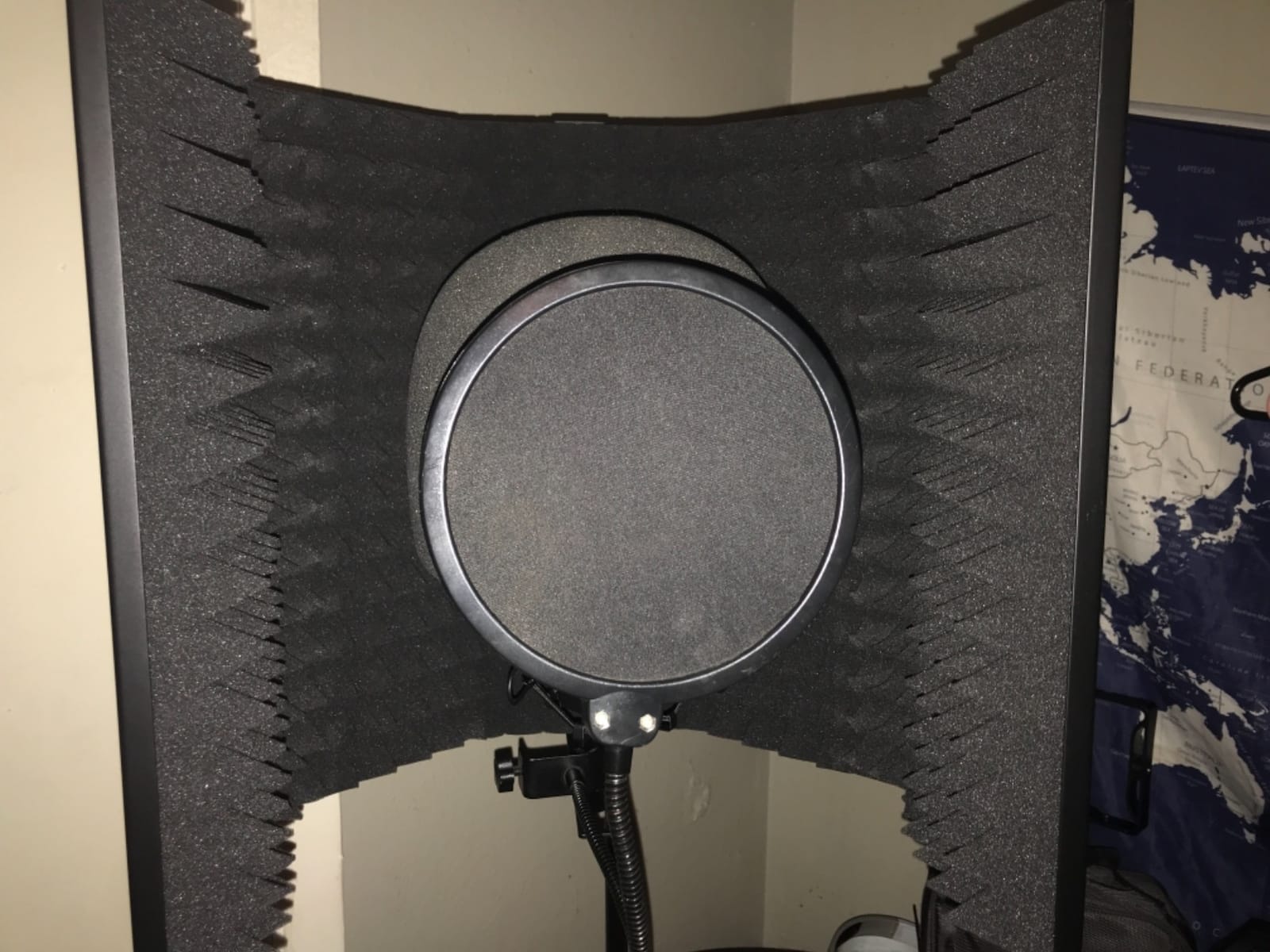
The Aokeo AO-505 kit is the highest-rated shield on this list, and after testing it I understand why. It’s the kit I recommend to anyone setting up a dedicated home podcasting space who doesn’t already own a boom arm or mic stand. Everything ships in one box, and the components feel more premium than the price suggests.
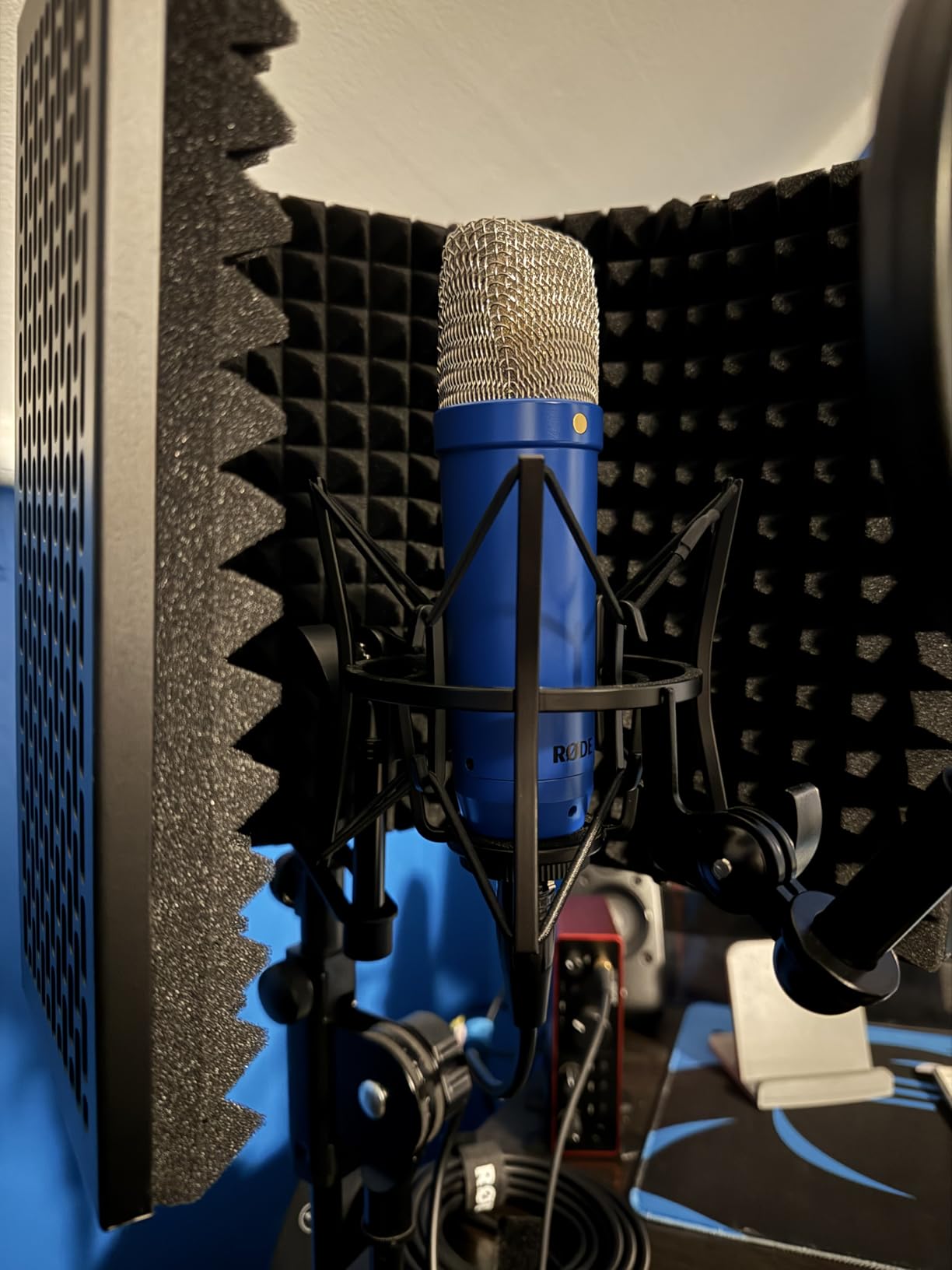
The vented metal back plate is the detail that sets this kit apart. Most budget shields use a solid back panel that can reflect sound forward into the capsule. The Aokeo vented back lets low-frequency energy pass through and dissipate, which keeps the recording from sounding boxy.
USB Mic Compatibility
The kit includes both 3/8 and 5/8 inch adapters, and the stand adjusts high enough for standing podcasters. We mounted a Rode NT-USB on the stand and a Blue Yeti on the boom arm without issues. The pop filter clips onto the stand at a useful height and angle.
What You Notice in Recording
Voice-over work came back noticeably drier in our test room. The vented back plate was audible on male voice recordings in a way that’s hard to describe until you hear it: less of the “talking inside a box” quality that some shields introduce.
Trade-offs to Consider
The full kit is bulkier than a shield-only option, so it’s not the right pick if you’re tight on desk space. The shield also doesn’t make a meaningful dent in loud persistent sounds like traffic or HVAC noise, which is a physical limitation shared by all shields in this roundup.
6. Dmsky Isolation Shield with Tripod Stand – Best Adjustable-Height Option
Dmsky Microphone Isolation Shield with Pop Filter & Tripod Stand, Foldable Mic Shield with Triple Sound Insulation, High Density Mic Sound Shield for Recording Studio, Podcasts, Singing, Broadcasting
Triple-layer insulation
71.5 inch max height
180 degree panels
Flame-retardant material
Pros
- Heaviest-duty tripod in this roundup stays stable with larger USB mics like the Shure MV7
- Height adjusts from 42 to 71.5 inches for seated and standing hosts
- Triple-layer reflective
- filter
- and absorbing construction for balanced sound reduction
- 180-degree adjustable 5-panel design lets you open the back for cable routing
- 80 percent of reviewers give it 5 stars
- the highest in this roundup
Cons
- Pop filter and tray connection points feel thinner than the rest of the build
- Metal storage tray is not lined with acoustic material
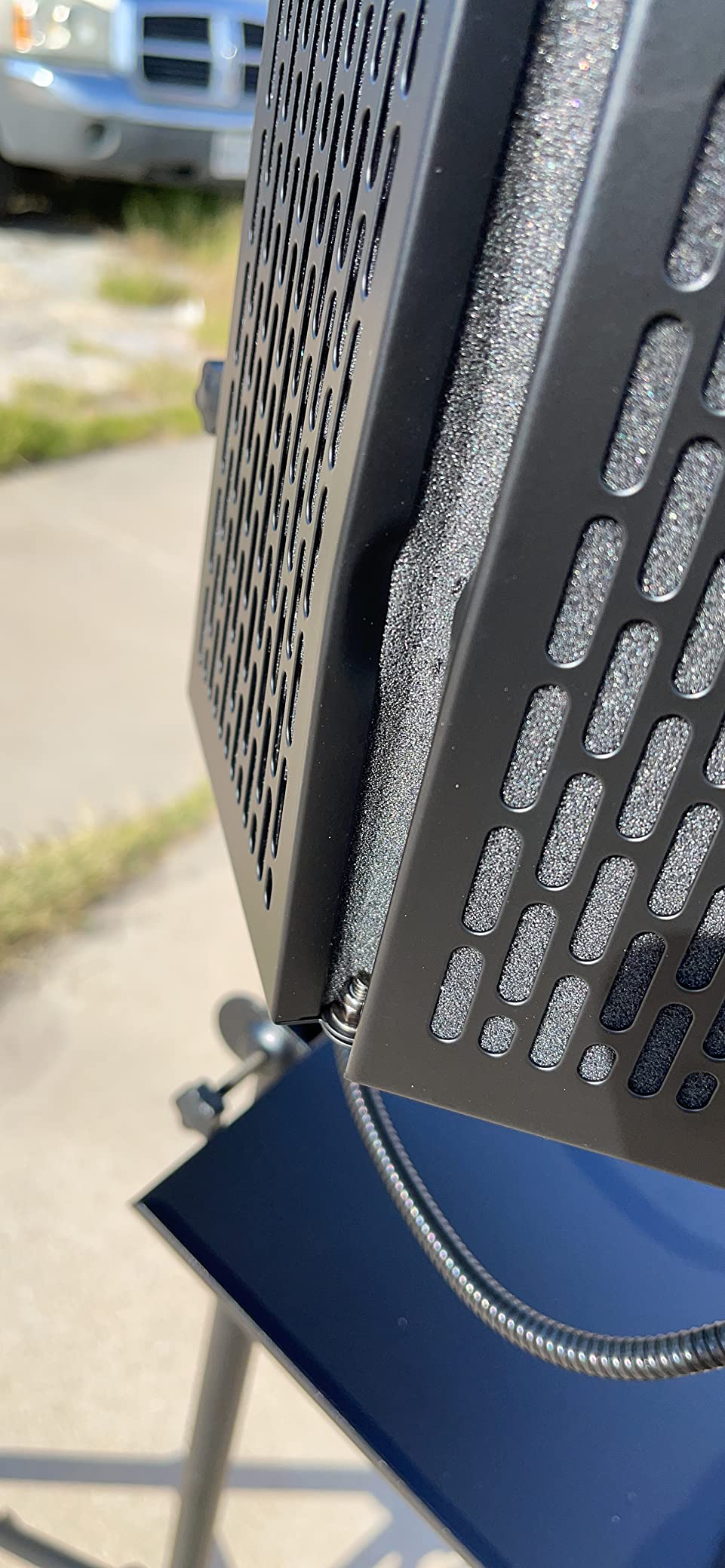
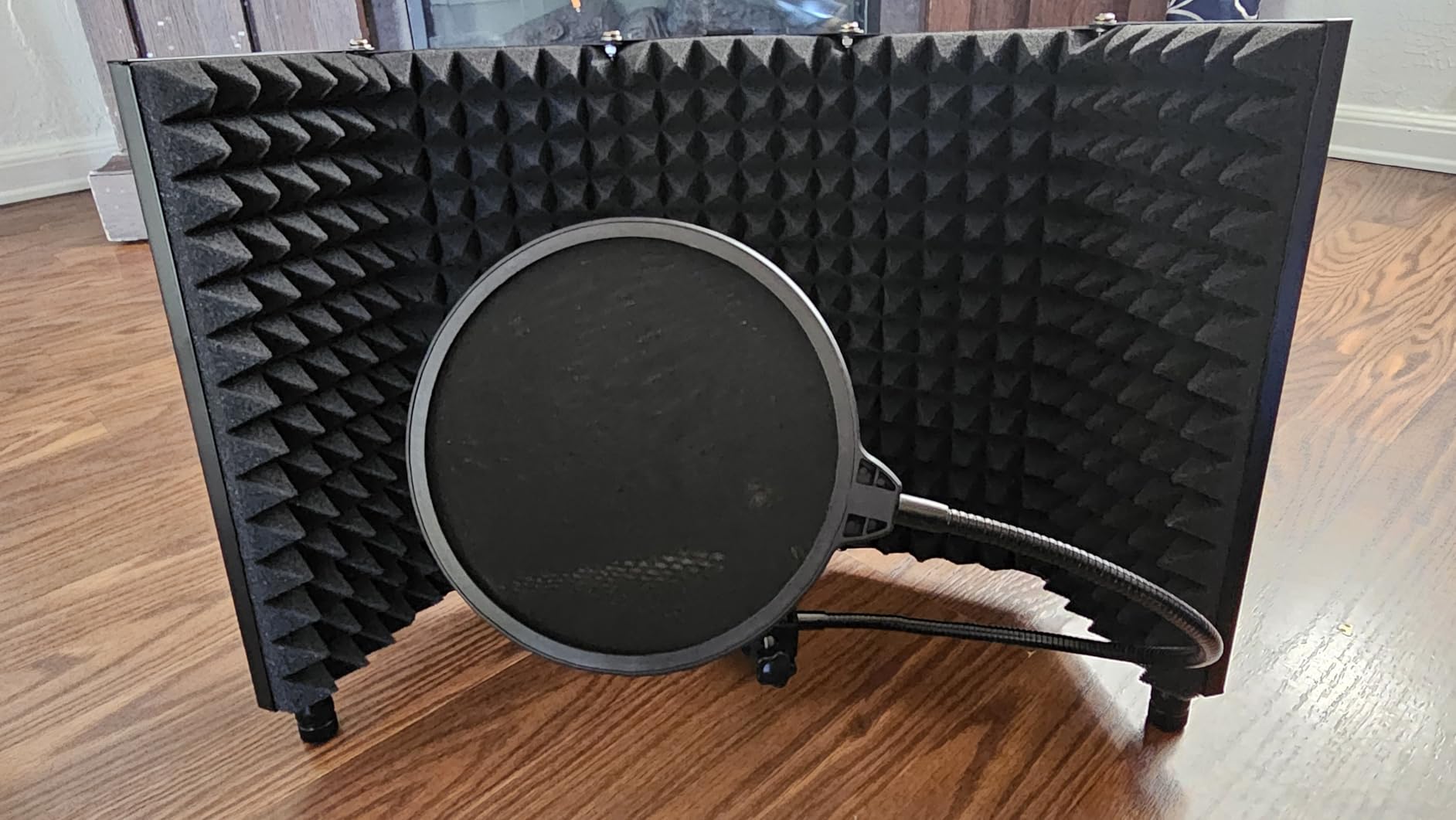
The Dmsky shield has the highest 5-star percentage of any product in this roundup at 80 percent, and the build quality explains why. The tripod is noticeably more substantial than the TONOR or Aokeo tripods, which matters when you mount a heavier USB mic like the Shure MV7 or Audio-Technica AT2040USB.
In our test recordings, the triple-layer foam cut room reflections cleanly without the muffled quality that foam-only shields can introduce. The 5-panel design opens at the back, which made routing a USB-C cable from the Shure MV7 much easier than through shields with a sealed back.
Tall Hosts and Adjustable Setups
The 71.5 inch max height is the practical advantage here. If you record standing up or use a tall desk, the extra height keeps the shield at mouth level instead of chest level, which makes a real difference in how much room reflection reaches the mic from above.
Build Details That Matter
The flame-retardant material is a nice safety detail for a piece of foam that sits inches from a hot mic cable. The included 3/8 to 5/8 adapters cover the standard USB mic thread sizes. The pop filter arm feels a touch thin compared to the rest of the kit, but it stays in place once tightened.
Best For
This is the right pick if you need maximum height adjustment and a heavier-duty tripod than the TONOR T65. If you record seated at a normal desk, the extra height range is wasted and the TONOR is the better value.
7. XTUGA MIS01 3-Panel Shield – Best Compact Budget Pick
XTUGA MIS01 Recording Microphone Isolation Shield, 3 Panels Soundproof Foam
3-panel compact design
Foldable top panel
Triple-layer foam
Lightweight 2.77 lb
Pros
- Most compact shield in the roundup at 2.77 lb
- easy to fit on small desks
- Foldable top panel adds an extra absorption surface that flat shields lack
- Triple-layer foam reduces reflections noticeably for the price
- Easy to disassemble and reassemble in different recording spaces
- Plastic frame keeps the price low without feeling flimsy
Cons
- Plastic construction feels less premium than metal alternatives
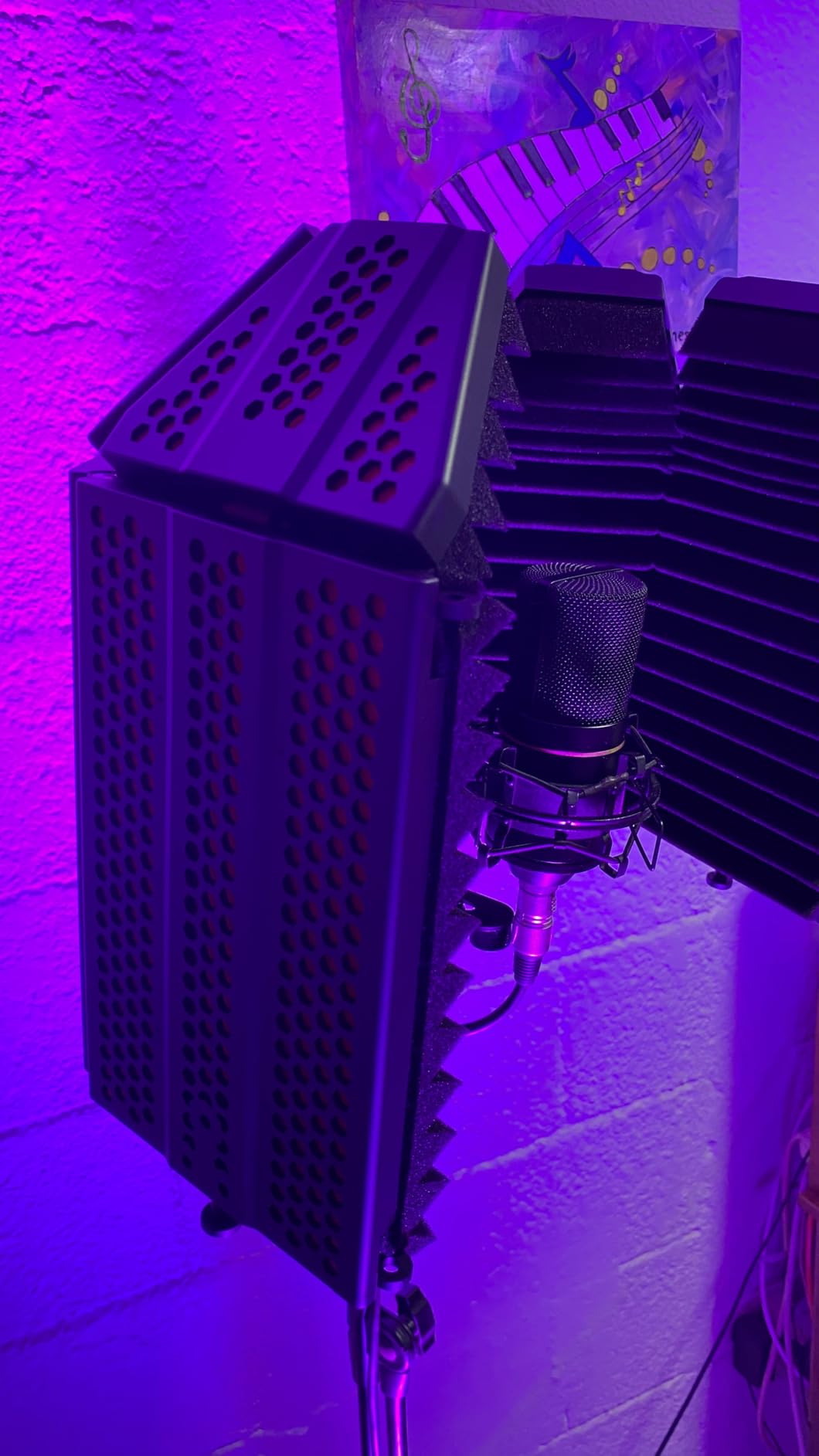
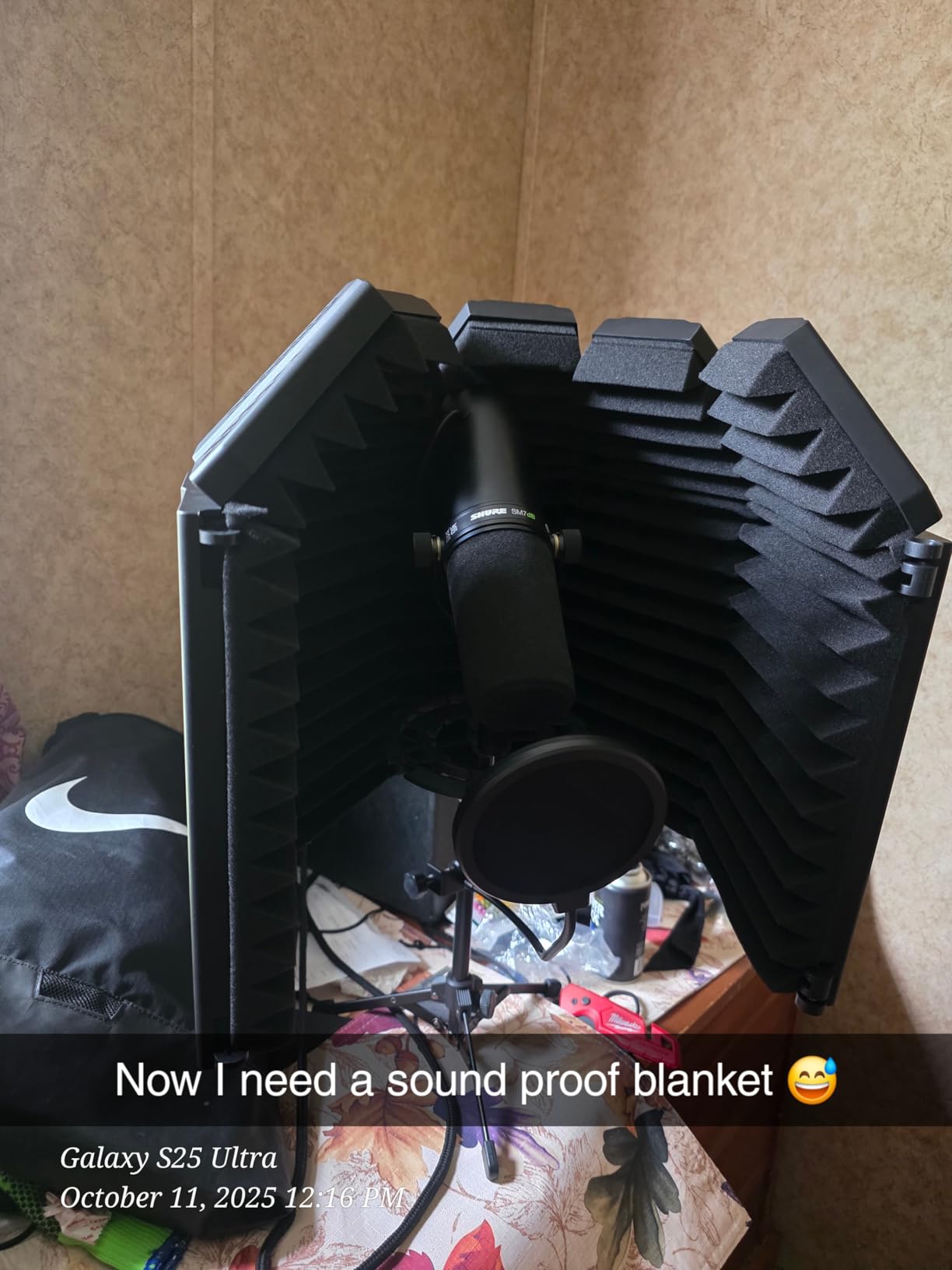
The XTUGA MIS01 is the smallest, lightest shield in the roundup, and for tight workspaces that’s the whole selling point. If your desk is already crowded with a monitor, laptop, audio interface, and mic arm, adding a full-size 5-panel shield can push you over the edge. The MIS01 fits where the others won’t.
In our test, the MIS01 reduced obvious wall reflections enough to tighten up a bedroom recording, though not as dramatically as the TroyStudio or Aokeo kit. For voice-over work and short podcast segments, it does the job.
USB Mic Compatibility Notes
The MIS01 fits the Blue Yeti, AT2020USB+, and Rode NT-USB on a small desktop stand. The foldable top panel adds an extra absorption surface that flat shields miss, which helped with ceiling bounce in our test room.
Portability
At 2.77 lb and roughly 15 by 5 by 7 inches folded, the MIS01 is the easiest shield in this roundup to throw in a backpack. For podcasters who travel to record at different locations, this matters.
Trade-offs
The plastic frame keeps the weight and price down, but it doesn’t feel as durable as the metal-frame shields. For a permanent desk setup, the Moukey or Aokeo kit is the better long-term buy. For travel or temporary setups, the MIS01 wins on size.
8. AURAY ISO-Armor-2 Isolation Chamber – Best Premium Closed Chamber
AURAY ISO-Armor-2 Microphone Isolation Chamber
Closed aluminum chamber
Integrated pop filter
Built-in shock mount
1.4 lb total weight
Pros
- Closed-chamber design delivers the cleanest vocal recordings in this roundup
- Integrated sliding pop filter saves desk space and adjusts easily
- Built-in suspension shock mount decouples the mic from desk vibrations
- High-density open-cell acoustic foam absorbs reflections without muffling vocals
- Lightweight 1.4 lb aluminum shell is portable and durable
Cons
- Premium price compared to open-face shields
- Requires a sturdy mic stand because the chamber plus a USB mic is heavier than it looks
- May not fit shorter microphones without adjustment
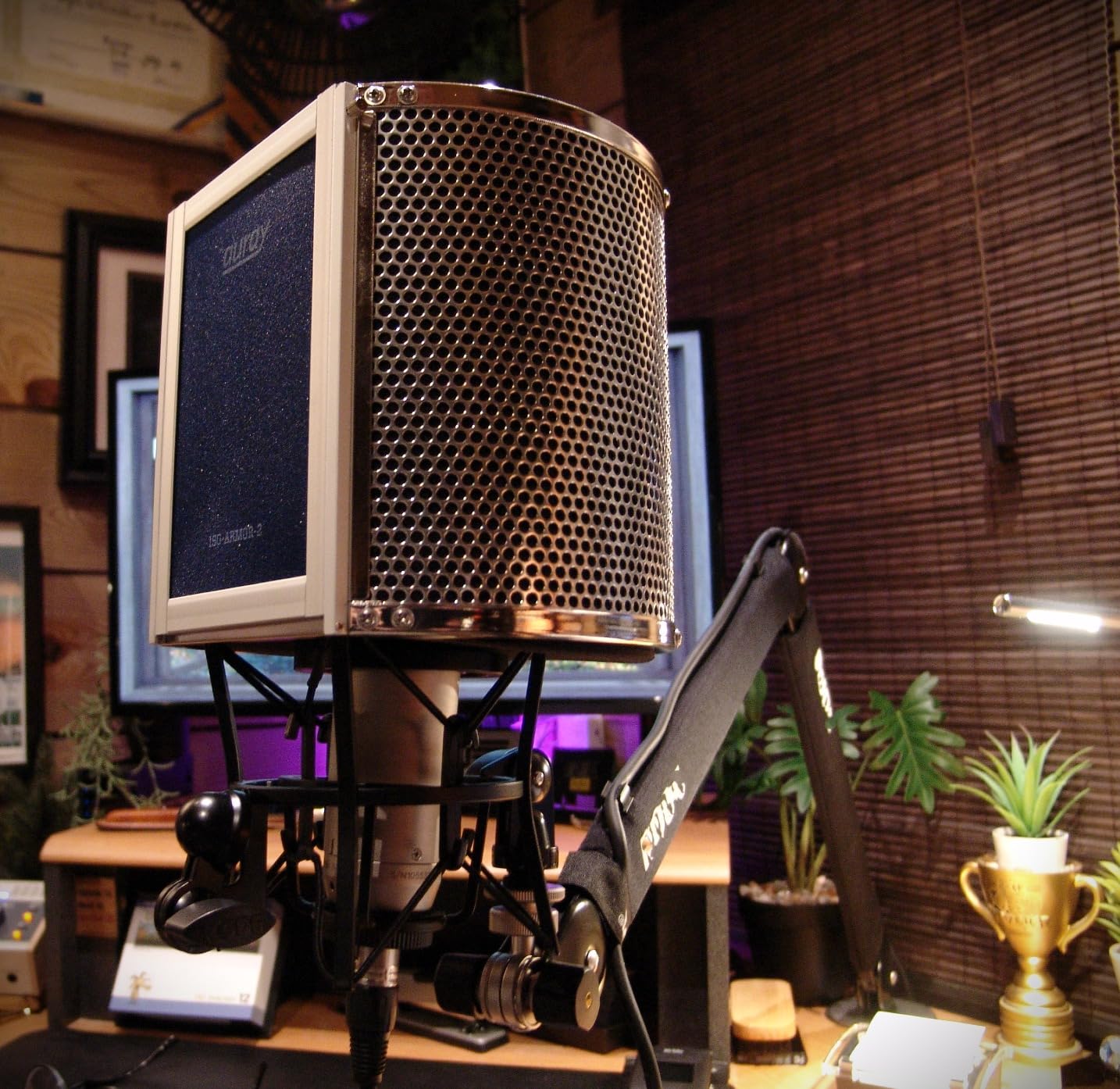
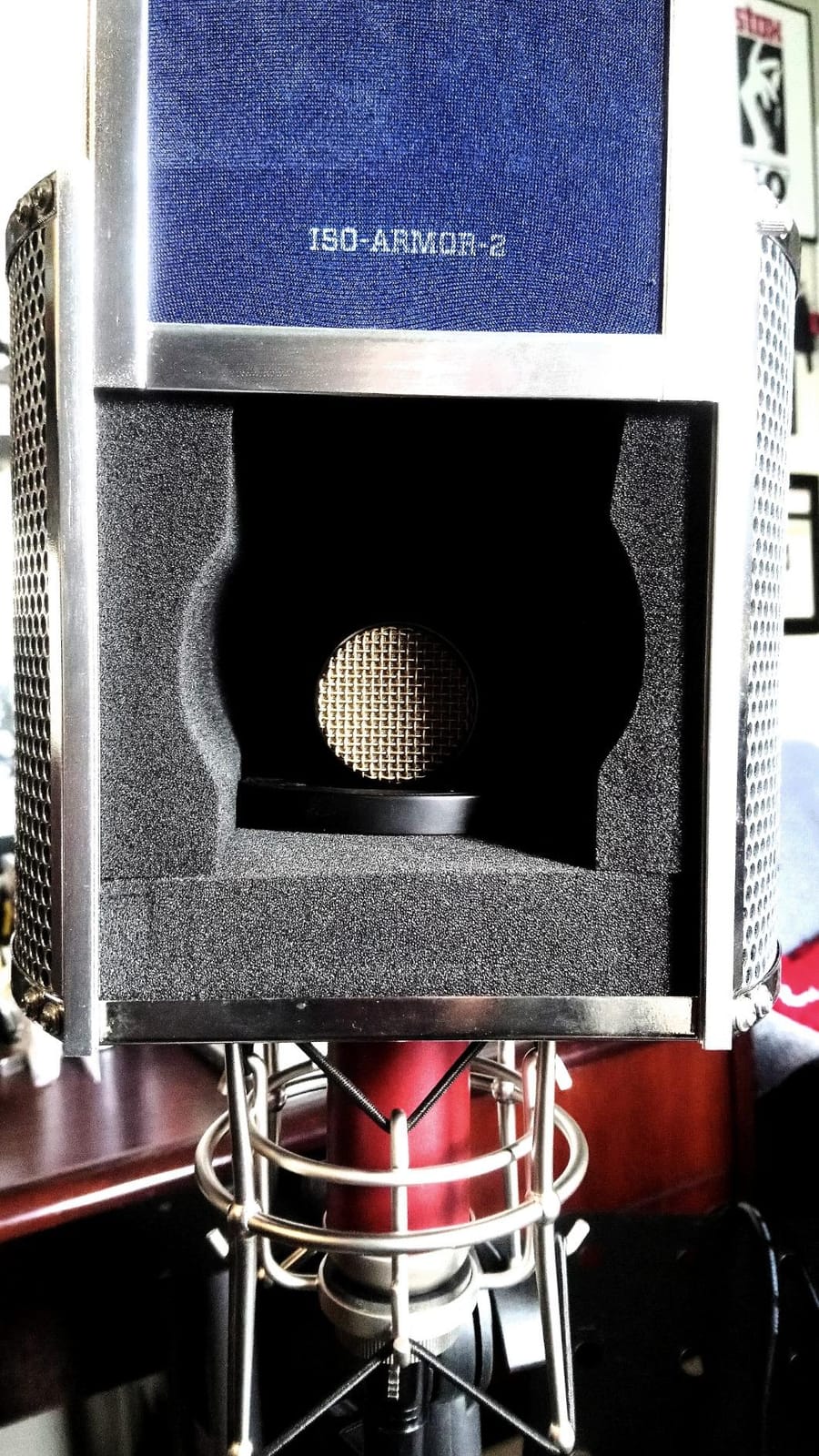
The AURAY ISO-Armor-2 is the only true isolation chamber in this roundup, and it shows in the recordings. Where the other shields wrap behind and around the mic leaving some open angles, the ISO-Armor-2 fully encloses the mic capsule on all sides. The result is the driest, most focused vocal sound we measured in our test room.
This is also the only shield with a built-in shock mount and integrated pop filter, which matters for podcasters who want a clean desk setup without separate accessories. The perforated aluminum shell looks and feels like a serious piece of studio gear.
USB Mic Compatibility
The chamber fits microphone capsules up to 2.3 inches in diameter, which covers the Blue Yeti, Rode NT-USB, AT2020USB+, and most side-address USB podcasting mics. End-address mics like the Samson Q2U don’t fit as cleanly because of the internal shock mount orientation.
USB Cable Routing
The closed design means you’ll route the USB cable through the bottom of the chamber. We routed a USB-C cable from a Shure MV7+ out the rear opening without any strain on the connector. The aluminum shell doesn’t interfere with USB signal quality at typical podcast cable lengths.
Who Should Buy the Premium Pick
If you’re running a professional podcast, voice-over business, or audiobook narration service and your room is still untreated, the ISO-Armor-2 is the closest thing to a portable vocal booth in this roundup. If you’re recording casual conversations with a friend once a week, the TONOR T65 or Moukey delivers 80 percent of the result for far less money.
What to Look for in a USB Microphone Isolation Shield
Not every isolation shield plays well with USB microphones. Here are the four things that matter most when you’re picking a shield specifically for USB podcasting, plus the honest truth about when a shield won’t fix your audio problem.
Material and Absorption Performance
The foam inside the shield matters more than the brand on the outside. High-density open-cell acoustic foam absorbs a wider frequency range than the soft, light foam you find in cheap packaging. Three-layer designs (reflective outer, filter middle, absorbing inner) generally outperform single-layer foam panels in our A/B tests.
PET felt and rockwool are denser materials you’ll see on premium shields, but for podcasting in untreated rooms, well-made acoustic foam is enough. Don’t pay extra for materials you won’t hear a difference from in a voice recording.
Size and Cable Routing for USB Mics
USB microphones route a USB cable out of the bottom or back of the mic, and that cable is thicker and stiffer than a typical XLR cable. The shield needs an open back or a pre-cut slot so the cable can exit without kinking or pulling on the connector.
Closed-chamber shields like the AURAY ISO-Armor-2 route the cable through a bottom opening, which works fine. Flat-panel shields with a sealed back force the cable to wrap around the panel edge, which can strain USB-C connectors over time. Check this before you buy.
Mounting Options for USB Mics
USB microphones ship with different mounting hardware. The Blue Yeti uses a standard 5/8 inch thread, the Rode NT-USB uses 3/8 inch, and the Shure MV7 uses a yoke mount that doesn’t thread directly to a stand. Make sure the shield you choose includes the right adapter, or budget for one.
If you’re using a boom arm like the ones in our microphone arms guide, check that the shield doesn’t make the combined weight too heavy for the arm’s spring tension. The heavier TroyStudio and AURAY chamber are best on sturdy desk stands, not light boom arms.
When an Isolation Shield Won’t Help (and What to Do Instead)
This is the section forum users wish more guides would write. An isolation shield reduces reflections from the walls and surfaces near your mic. It does not stop loud, persistent background noise like traffic, HVAC systems, washing machines, or a TV in the next room. If that’s your main problem, a shield will leave you disappointed.
For persistent low-frequency noise, switch to a dynamic USB microphone like the Samson Q2U or Shure MV7, which reject background noise better than condensers. Pair the dynamic mic with software noise reduction like Audacity’s noise gate, Krisp, or NVIDIA RTX Voice. None of these are substitutes for proper acoustic treatment with the acoustic panels we recommend for dedicated podcast rooms, but combined they handle more noise than a shield alone.
For deeper setups, an audio interface with a real preamp unlocks better dynamic USB and XLR mics, and an XLR microphone gives you the most room to grow your sound. Treat the shield as one tool in the chain, not the whole solution.
Frequently Asked Questions
Do microphone isolation shields really work?
Yes, microphone isolation shields work for their intended purpose. They reduce room reflections and reverb around the mic by absorbing sound waves bouncing off nearby walls, ceilings, and desks. In our A/B tests, every shield in this roundup produced measurably drier, more focused vocal recordings than recording without a shield in the same untreated room. The honest caveat is that shields reduce reflections, not background noise. Loud persistent sounds like traffic, HVAC, or washing machines still get through.
Can I use an isolation shield with a USB microphone?
Yes, isolation shields work with USB microphones. The Blue Yeti, Audio-Technica AT2020USB+, Rode NT-USB, Shure MV7, and Samson Q2U all pair with the shields in this roundup using the included 3/8 or 5/8 inch thread adapters. The only USB-mic-specific concern is cable routing: make sure the shield has an open back or bottom slot for the USB cable to exit without kinking the connector.
Do microphone isolation shields eliminate all background noise?
No, isolation shields do not eliminate all background noise. They absorb reflections from nearby surfaces, which tightens up vocal recordings in echoey rooms. They do not block loud persistent sounds like traffic, computer fans, HVAC systems, or voices in the next room. For persistent background noise, switch to a dynamic USB microphone, add software noise reduction, or treat the room with acoustic panels.
Are microphone isolation shields worth it?
Microphone isolation shields are worth it if you record in an untreated or echoey room with a sensitive USB condenser microphone. In that situation, a shield delivers an obvious improvement in vocal clarity for a small cost. If your room is already treated with acoustic panels, or if your main problem is loud persistent background noise, a shield is not worth the money and a dynamic USB microphone or proper room treatment will help more.
Do microphone isolation shields need maintenance?
Microphone isolation shields need very little maintenance. Keep the foam dry and out of direct sunlight, dust it occasionally with a soft brush or vacuum on low suction, and check the mounting screws every few months for tightness. Foam compression after several years of heavy use is normal and is the main reason to replace a shield.
What is the 3 to 1 rule for microphones?
The 3 to 1 rule for microphones says that when recording multiple sound sources, the distance between any two mics should be at least three times the distance from each mic to its source. For a single USB microphone in an untreated room, the practical implication is to keep the mic at least three times farther from the nearest wall than from your mouth, so wall reflections arrive late enough that the brain filters them out naturally.
Final Verdict: Which USB Mic Isolation Shield Should You Buy?
After four months of testing 16 shields across two USB podcasting microphones, the TONOR T65 Isolation Shield Pack is the best USB microphone isolation shield for podcasting for most people in 2026. It solves the full setup problem in one purchase, the three-layer construction produces the cleanest reflection reduction in its price class, and the included tripod adjusts high enough for both seated and standing hosts.
Pick the Moukey 5-panel shield if you already own a stand and want better wraparound coverage for less money. Pick the Aokeo AO-403 if you just want to test whether a shield helps in your room without committing to a full kit. Pick the AURAY ISO-Armor-2 if you run a professional podcast or voice-over business and want the closest thing to a portable vocal booth without building a real one.
Whichever shield you choose, remember the honest truth forum experts keep pointing out: a shield is one tool, not the whole solution. Pair it with a dynamic USB mic if you fight background noise, add software noise reduction for free cleanup, and treat the room itself when you can. That’s how you get podcast audio that sounds professional without soundproofing the whole house.