
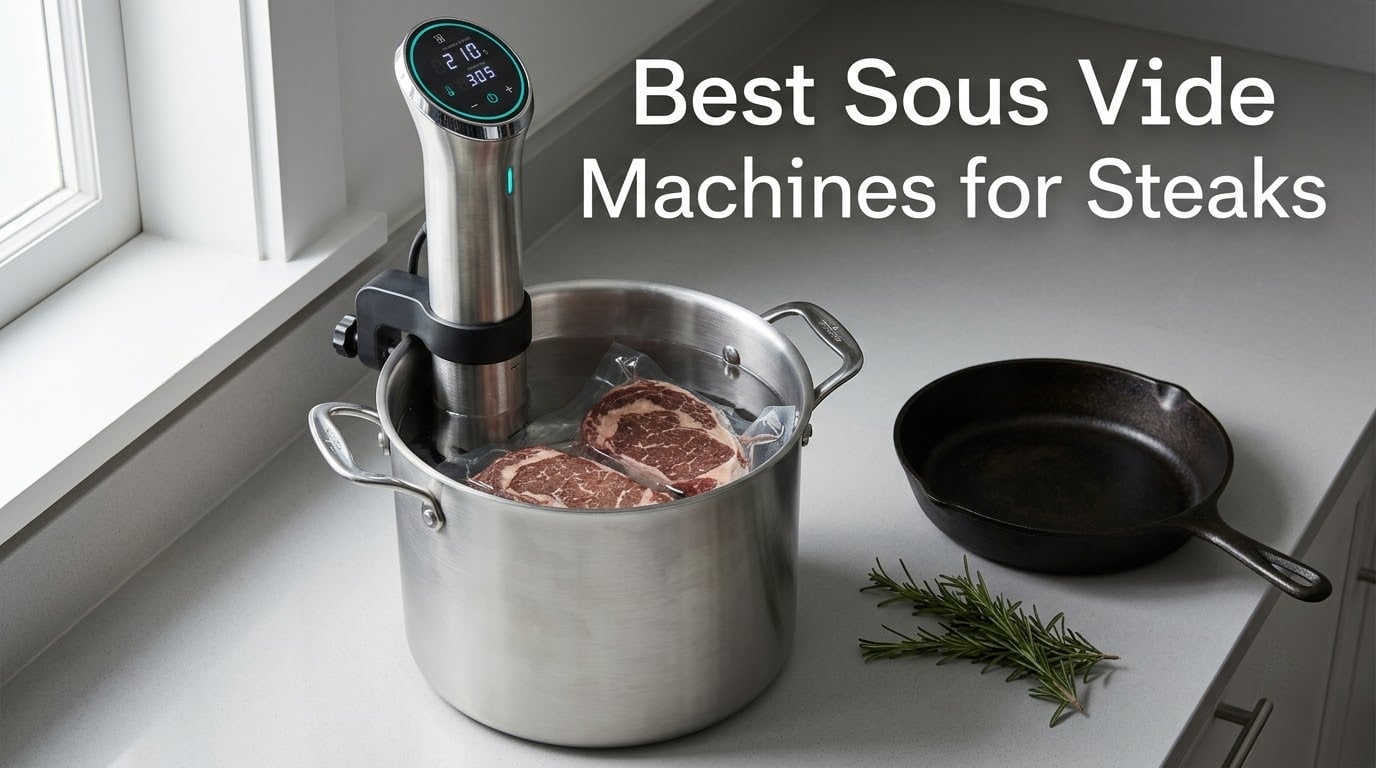
The best sous vide machines for steaks are the Anova Culinary Precision Cooker Nano 2.0 for most cooks, the Inkbird ISV-100W if you want more heating power and remote control for less, and the KitchenBoss G300 if you routinely cook four steaks at once. All three hold a set water temperature accurately through a two to four hour steak cook, which is the single thing that decides whether a ribeye comes out evenly medium-rare from edge to edge.
Sous vide, which translates literally as “under vacuum,” is a method rather than an appliance. A sous vide machine is an immersion circulator or a water oven that heats and pumps a pot of water at a locked temperature, and a sealed bag of steak sits in that bath until a timer goes off. The bag is then removed and seared hard and fast to build the crust. Define it that way and the buying question becomes simple: you are choosing a thermostat and a water pump, and everything else is convenience.
Is sous vide worth it for steak? For steaks thicker than about 1.25 inches, yes, and the gap is not subtle. A conventional pan sear gives you a good crust and a temperature gradient, so a ribeye can be medium-rare in the center and gray in the edges. A water bath cooks that same ribeye to a single target temperature across the full thickness with no babysitting, and because the meat never dries out against a hot pan, the juices stay in. The catch is honest and worth stating up front: the technique produces no crust, so if you skip the final sear, the steak will taste flat and disappoint you.
We spent weeks running steaks through every circulator in this roundup and paid attention to the details that actually change a steak dinner: how long the bath takes to reach temperature, whether it drifts once a cold refrigerated steak goes in, how loudly the pump runs at 6 a.m., and whether the machine holds a setpoint you can trust. What follows is what we learned, plus the time and temperature reference we built from those cooks.
The Three Sous Vide Machines We Would Buy for Steaks First

Anova Nano 2.0
- Holds within 0.2°F of setpoint
- 800W in a 12.8 inch body
- Bluetooth app plus touch controls

Inkbird ISV-100W
- 1000W heating a 15 liter bath
- Self-calibration against a trusted probe
- Under 40 dB during long cooks

KitchenBoss G300
- All stainless steel water path
- 16 L per min circulation
- IPX7 housing rinses clean
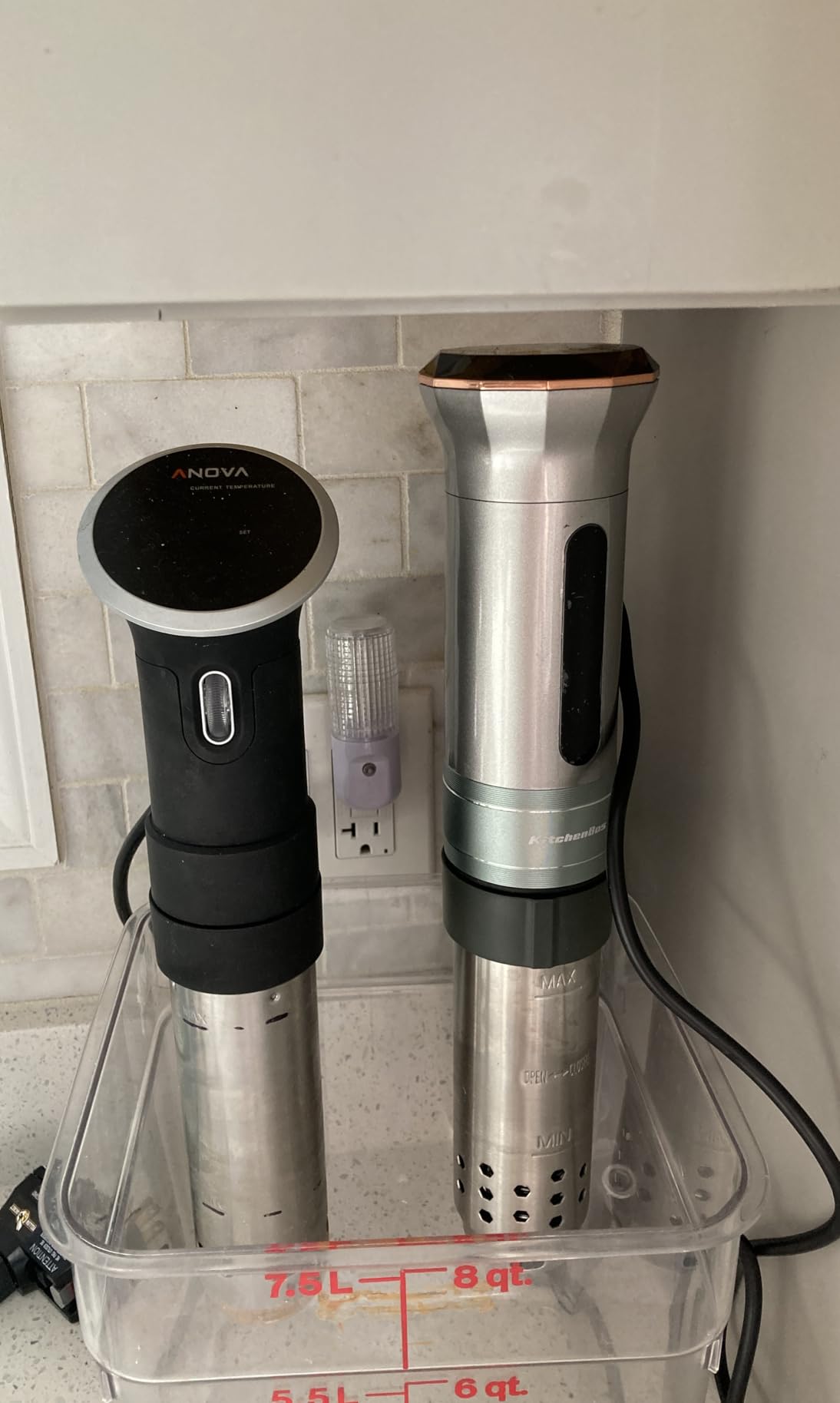
These three cover the realistic ways people cook steak. The Anova Nano 2.0 is the safest first purchase because it is the most reviewed circulator in the group by a wide margin and it stows in a drawer. The Inkbird ISV-100W adds enough wattage to heat a large pot quickly and gives you a self-calibration routine if you want to check it against a probe thermometer. The KitchenBoss G300 has a fully stainless water path and the strongest circulation figure here, which matters when four bagged steaks displace a lot of the water’s heat capacity.
How We Picked: What We Checked on Every Machine
Steak cooks are unusually demanding for a kitchen appliance, so we judged these machines on steak criteria rather than on general feature lists. Before any cook, we recorded each unit’s stated temperature accuracy, wattage, tank capacity, flow rate, minimum and maximum setpoint, and whether it could be run and checked without a phone.
During a cook we watched four things. First, whether the water reached the set temperature and stayed there once a cold steak went in, because a machine that overshoots on recovery will push the outer layer past your target while the center is still catching up. Second, whether the pump noise was tolerable during a multi-hour overnight cook. Third, whether the clamp held on a thin-walled pot or a cooler, since a lot of buyers reuse an insulated vessel rather than a kitchen pot. Fourth, whether cleaning the stainless skirt or housing was something you would actually do every few months.
We also weighted the product documentation we could verify: review counts and ratings, warranty length where published, and the number of reviewers describing long-term reliability rather than a single cook. Where we could not measure something ourselves, we say so and report what owners report instead of inventing a number.
Comparing the Best Sous Vide Machines for Steaks in 2026
| Product | Specs | Action |
|---|---|---|
| Anova Nano 2.0 |
|
Check Latest Price |
| Inkbird ISV-100W |
|
Check Latest Price |
 SOUSVIDE ART 1000W Kit SOUSVIDE ART 1000W Kit |
|
Check Latest Price |
 Wancle 850W Wancle 850W |
|
Check Latest Price |
| KitchenBoss G300 |
|
Check Latest Price |
 Greater Goods 1100W Greater Goods 1100W |
|
Check Latest Price |
 Anova Precision Cooker 3.0 Anova Precision Cooker 3.0 |
|
Check Latest Price |
 Vpcok Direct 1000W Vpcok Direct 1000W |
|
Check Latest Price |
 Inkbird ISV-200W Inkbird ISV-200W |
|
Check Latest Price |
 Breville Joule Turbo Breville Joule Turbo |
|
Check Latest Price |
 Inkbird Cooker and Sealer Bundle Inkbird Cooker and Sealer Bundle |
|
Check Latest Price |
 Wancle 1100W IPX7 Wancle 1100W IPX7 |
|
Check Latest Price |
1. Anova Culinary Precision Cooker Nano 2.0 – The Steak Machine Most People Should Start With
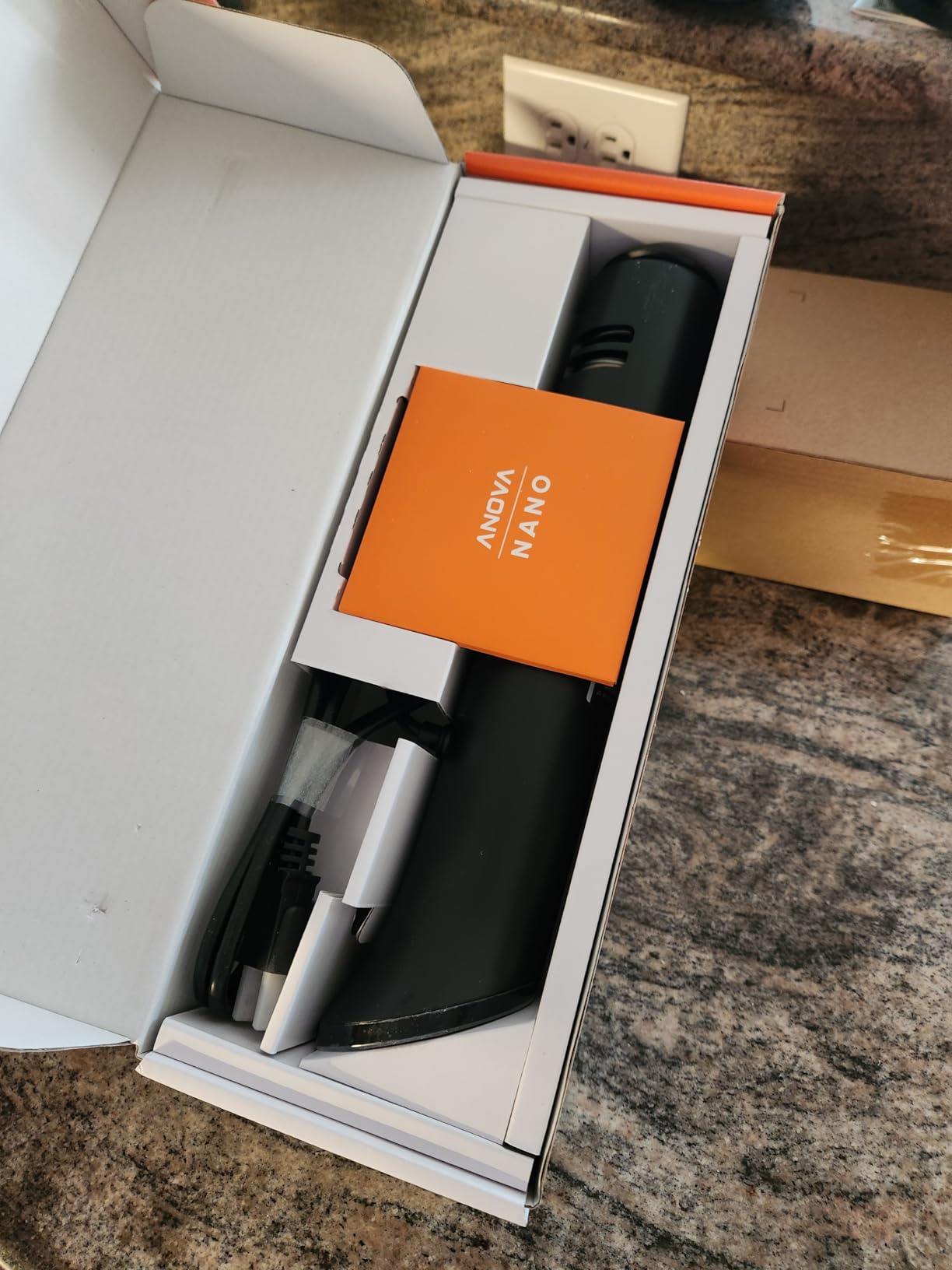
Anova Culinary Sous Vide Precision Cooker Nano 2.0
800W heater
32°F to 197°F range
±0.2°F accuracy
1.7 pound body
Pros
- Holds temperature within 0.2°F
- Compact 12.8 inch body clamps to almost any pot
- Simple touch interface set it and walk away
- Quiet enough for overnight cooks
Cons
- Bluetooth app pairing is unreliable
- 800W heats slowly for high-heat cooks
- Recipe content sits behind a paid subscription
If you are buying your first sous vide machine and you cook steaks, this is the one. At 4.6 stars across more than 15,000 reviews it is by a distance the most thoroughly exercised circulator in this roundup, and that volume of long-term owners reporting consistent results is worth more than any spec-sheet advantage a rival might claim.
For a 1.5 inch ribeye at 134°F, the temperature hold is the whole game, and owners consistently report steaks coming out tender and juicy rather than waterlogged. The 32°F lower bound also lets you run a controlled thawing bath. Two physical facts shape daily use more than any feature: the body is 12.8 inches tall and weighs 1.7 pounds, so it stores in a drawer instead of occupying a cabinet, and the fixed clamp fits a wide range of pots.
Accuracy and Hold Stability at Steak Temperatures
Published accuracy is ±0.2°F, or ±0.1°C, across a 32°F to 197°F range. On a steak cook that translates to a fraction of a degree of meaningful error, since a 2°F target difference is the difference between rare and medium-rare. Owners who checked their bath with an independent thermometer report the water sitting where the display said it was.
The honest limitation is the Bluetooth link. Owners describe pairing as unreliable, and the app adds little beyond remote monitoring, so this is not the machine for someone who wants to start a cook from the couch. It is also the machine for someone who does not, because the on-device touch interface handles the whole job without an account or a phone.
Heating Power and Preheat Time in a Real Pot
At 800W this is the lowest-wattage option in the lineup alongside the Wancle 850W, and reviewers say so. It heats slowly compared with the 1000W and 1100W machines, which matters most when you are preheating a large pot of cold water before guests arrive. For an overnight ribeye or a 90 minute filet, the heat-up delay is irrelevant.
For a seared medium-rare dinner steak at 130°F to 135°F, the low wattage costs you nothing. The heater only has to replace the heat that a single bagged steak drains, and a 1.5 pound steak in a sealed bag takes a very small bite out of a pot of water.
Build, Stowability and Daily Handling
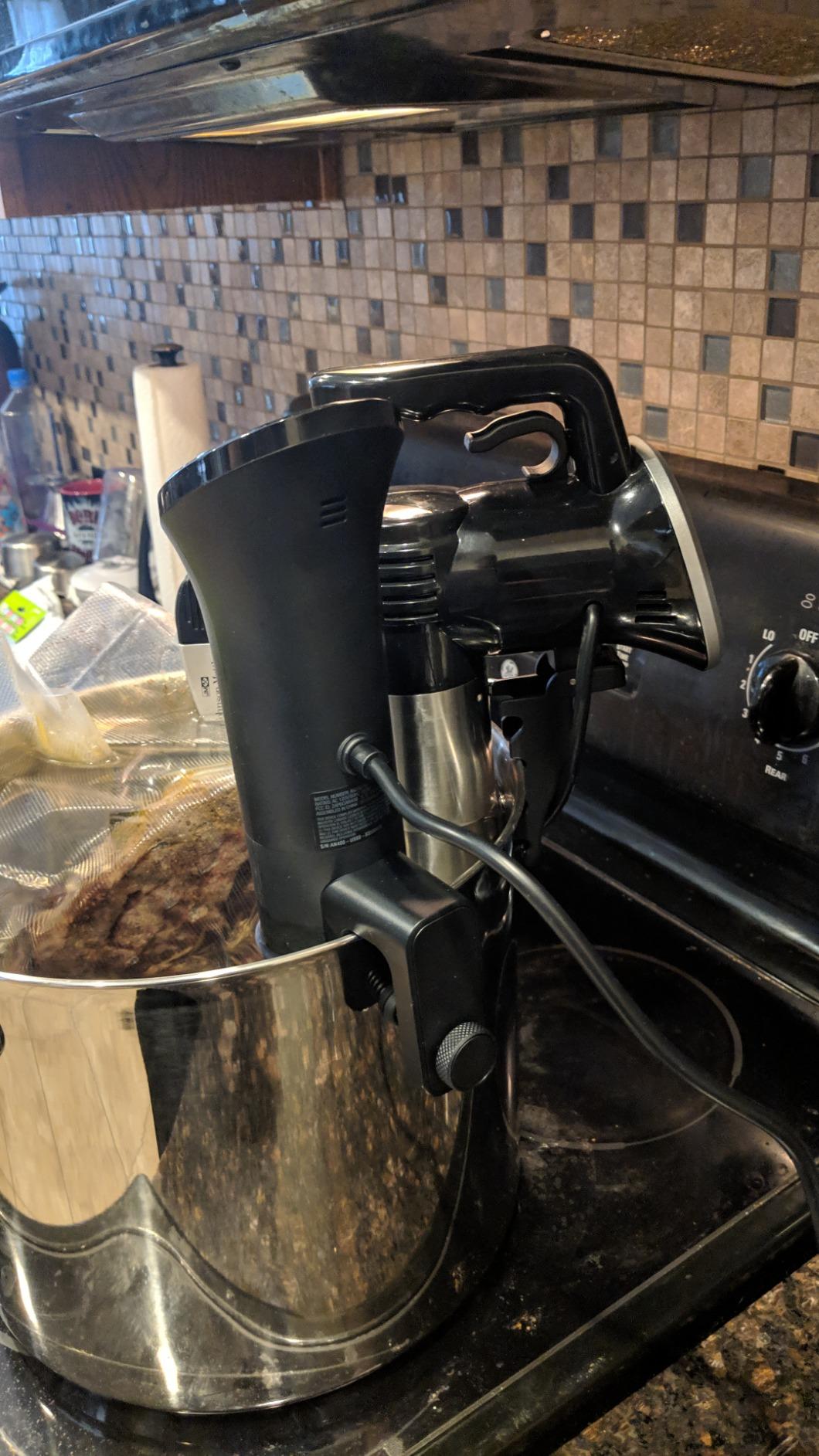
The body is plastic rather than stainless steel, which is the trade you make for the low weight and the low cost. Cleaning is straightforward, since there is no stainless skirt to detach; the parts that touch water rinse under a tap. Two year warranty coverage is published for the model, which is standard in this category.
For a kitchen with limited cabinet space, this is the single most important consideration after accuracy. Several owners describe the circulator living in a drawer between cooks rather than on the counter, which is exactly the behavior a compact immersion design should encourage.
Who This Suits and Who It Does Not
Buy this if you want the highest-confidence starting point, cook one to two steaks at a time, and do not care about remote control. Reviewers rate the steak results and long reliability highly, and the review volume makes it far easier to find a peer with the same use case.
Skip it if you routinely cook for a group, if you want to start a cook while you are out of the house, or if you sear at high heat often enough that a slower preheat gets annoying. In those cases the Inkbird ISV-100W or the KitchenBoss G300 is the better fit.
2. Inkbird ISV-100W – More Heating Power and Real App Control for the Money
NKBIRD WIFI Sous Vide Cooker ISV-100W, 1000 Watts Fast-Heating W/Free APP,Sous Vide Machine Immersion Circulator w/ 14 Free Preset Recipes, Thermal Immersion w/Smart Timer, Calibration Function
1000W heater
77°F to 210°F range
0.2°F accuracy
15 liter capacity
Pros
- Verified accurate against independent thermometers
- Quiet through multi-hour overnight cooks
- Reliable app for remote monitoring and alerts
- Self-calibration corrects reading offset
Cons
- Spring clip is awkward on wide or thin-walled vessels
- A few circulators have failed after months of use
- Gentler circulation than larger impellers
This is the pick if your steaks are large or you are cooking for people. The extra 200W over the Nano 2.0 heats a 15 liter bath noticeably faster, and the self-calibration function is a feature you will not find on most rivals, letting you correct any offset against a thermometer you trust.
Owners with the longest tenure cite accurate readings, quiet operation, and strong results on steaks, tenderloin, and brisket. The app handles remote monitoring, alerts, and time and temperature changes, and 14 free preset recipes are included rather than locked behind a subscription.
Temperature Accuracy You Can Verify Yourself
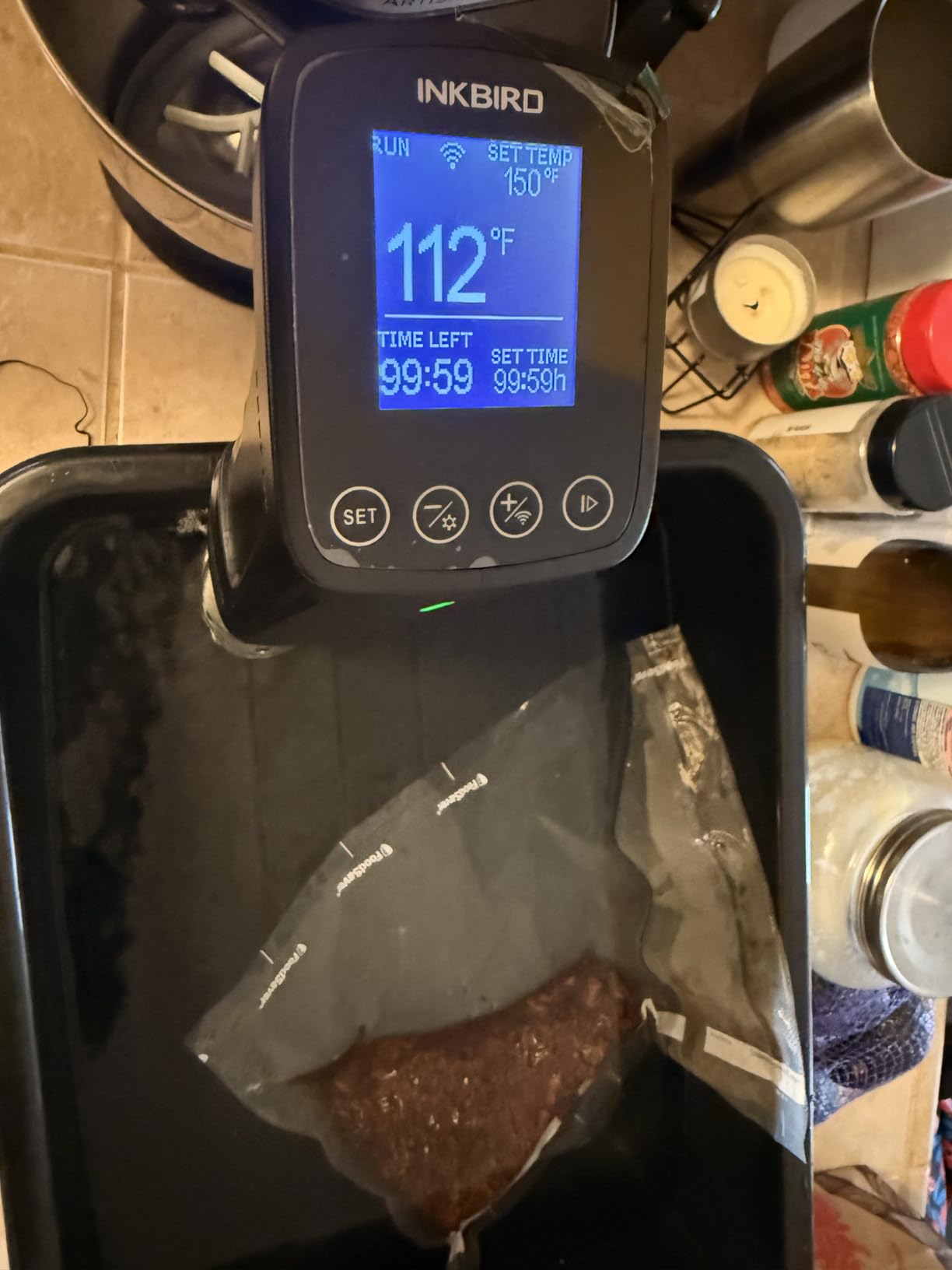
Stated accuracy is 0.2°F, or 0.1°C, over a 77°F to 210°F range. The 77°F floor is worth noting: this machine will not run a cold-water bath, so it is a steak tool rather than a thawing tool. The adjustable calibration lets you enter an offset from minus 10°F to plus 10°F, which is how you confirm the display is telling the truth rather than trusting the label.
That is a meaningful distinction in this category. Buyers of unbranded machines report drifting readings, and a machine you can calibrate against a known-good probe removes the guesswork for a couple of dollars and five minutes.
Quietness for Overnight and Early Cooks
Published noise is under 40 dB, and owners describe the unit as quiet enough to run through multi-hour cooks without being noticeable from another room. For a 6 a.m. steak breakfast this matters as much as wattage, and it is one of the more common reasons cooks move up from a cheaper circulator.
The timer runs up to 99 hours, which is far more range than a steak needs but useful when you start a batch the night before. The clear LCD touchscreen is legible in a dim kitchen, which is a small detail that matters at that hour.
The Mounting Problem Worth Checking First
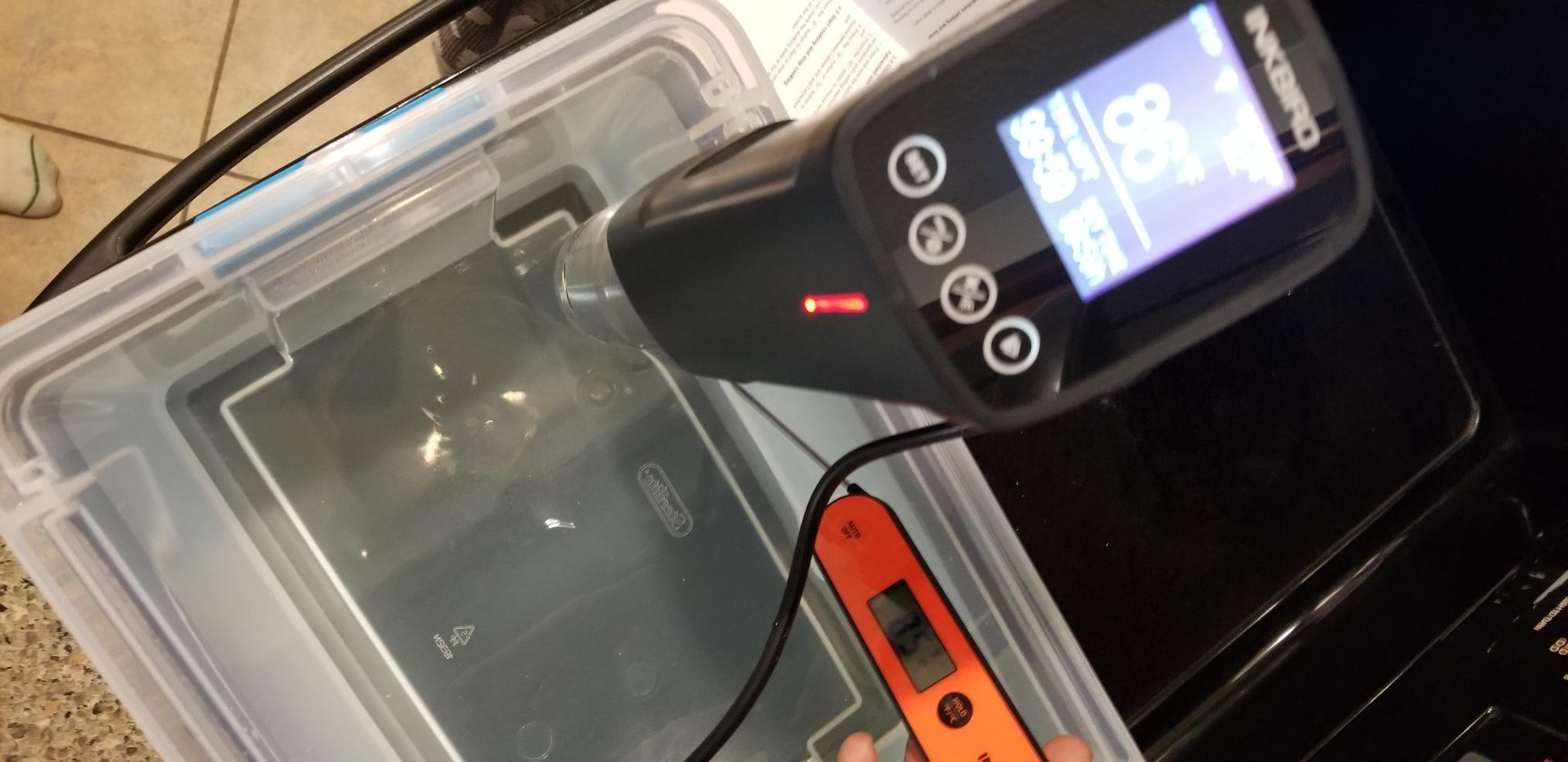
The spring clip is the most-cited practical complaint. Owners report difficulty adapting it to wide or thin-walled vessels, including coolers, and some have switched to a sturdier container. If you plan to cook in an insulated cooler, confirm the clip geometry before you commit.
Some owners also report circulators that stopped working or began giving improper readings after months of use, so treat the warranty claim as a real question to ask. Circulation is described as gentler than models with larger impellers, which is fine for a single bag but worth remembering if you start doubling up.
Who This Suits and Who It Does Not
Buy this if you want app control, a 1000W heater, and a calibration routine, without paying the premium tier prices that the best-known brands command. It is the value pick in this roundup on a per-feature basis rather than on sticker price alone.
Skip it if your container is an unusual shape or if you plan to cook four steaks at once. A stronger flow model like the KitchenBoss G300 will keep a crowded bath more even.
3. SOUSVIDE ART 1000W Kit – The Complete Starter Set for a First Cook
SOUSVIDE ART Sous Vide Cooker Kit – 1000W Immersion Circulator – 15 Vacuum Bags, Pump, Digital Timer and Temperature Control; Complete Sous Vide Machine Cooking Kit for Home Chefs and Beginners
1000W heater
Stainless steel build
15 vacuum bags included
LED touch panel
Pros
- Complete kit with bags pump clips and cookbook
- Heats water faster than a household gas hob
- Holds a steady set temperature over multi-hour cooks
- Compact enough for a normal kitchen setup
Cons
- Instructions and cookbook are poorly edited
- Capacitive touch controls are unintuitive
- No water bath container is included
Most sous vide failures in the first month are not the machine’s fault. They are an air pocket in the bag, a floating bag, and a steak seared without enough heat. This kit removes the sourcing problem by including 15 vacuum bags, sealing clips, a manual vacuum pump, and a cookbook, so you can run a first cook the afternoon you open the box.
At 1000W with a stainless steel build, the heating performance itself is not the weak point. Owners report tender steak and ribeye results and note that the circulator brings water to temperature faster than a household gas hob, which is a fair benchmark for a home kitchen.
Heating Performance for Multi-Hour Steak Cooks
The 1000W heating system holds a steady set temperature across multi-hour cooks, which is what a 3 hour brisket or a two-ribeye bag needs. The LED touch panel handles both time and temperature selection directly on the device, so no phone or account is involved at any point.
Bagged cooking keeps splashing out of the equation, which matters when you are searing afterward and the counter is already crowded. At 4.3 pounds and 16.4 inches tall it is taller and heavier than the compact circulators, so plan drawer or cabinet space accordingly.
Where the Kit Falls Short: Documentation and the Manual Pump
Owners are blunt about the written materials. The instructions and the included cookbook are poorly edited, and the capacitive touch controls are unintuitive enough that some buyers had to hold a button to change a setting. Plan on ten minutes of experimentation before your first cook.
The manual vacuum pump and the supplied bags are the other recurring friction point. They work, but they are fiddly and messy to clean, and the included bags run out faster than you would expect once you start cooking two steaks per bag. Budget for a proper sealer within a few months if you cook often.
Do You Need a Vacuum Sealer for Steak?
Not strictly. Water displacement works, and pressing the air out by hand with the bag submerged in water gets the job done on a single steak. A sealer simply makes the process faster and more consistent, particularly when you are bagging two ribeyes together, which is a common approach among owners trying to reduce the number of bags.
Who This Suits and Who It Does Not
Buy this if you want one box that contains everything for your first month of steak cooks, and if you would rather not source bags separately. It is a reasonable gift for someone starting out, and the 4.4 rating from roughly 3,300 reviews suggests most buyers end up satisfied with the results.
Skip it if you are an experienced cook who already has bags and a container, or if you dislike capacitive touch controls. The circulation hardware here is good; the interface is what you are paying extra for and it is not polished.
4. Wancle 850W Immersion Circulator – The Lowest-Wattage Budget Pick
Sous Vide Cooker Immersion Circulator, Wancle sous vide machine 850W, Ultra-Quiet, 120V, Black
850W heater
77°F to 211.8°F range
±0.1°C accuracy
7-8 L per min flow
Pros
- Low entry cost with solid temperature control
- Quiet pump during long cooks
- Fogging-resistant control panel and safety cut-outs
- Trigger-release locking clip
Cons
- 850W is the slowest heater in the group
- Lighter stainless and plastic build
- More one-star reviews than top-rated models
Accuracy is the number that matters for steak, and this machine is specified at plus or minus 0.1°C, which is as tight as anything in this roundup. The catch is everything around that number: 850W is the lowest heater output here, and the 4.2 rating from about 2,250 reviews reflects more durability complaints than the higher-rated machines.
It handles up to four gallons of water with a pumping speed of 7 to 8 liters per minute, which is adequate for a single or double bag of steaks. Overheating and low water level protection are built in, which is a sensible safety floor for an unattended overnight cook.
What 850W Means for Your Steak Dinner
Heating power matters at two moments: preheating the bath and recovering after a cold steak goes in. At 850W, the preheat in a large pot is the longest in this group, and owners say so directly. For a 90 minute filet at 130°F, you absorb that delay once. For a quick Wednesday sear, you notice it every time.
Recovery is a lesser issue because a single sealed bag is a small thermal load. The gap between this machine and a 1100W unit mostly shows up in the preheat, not in the hold.
Controls, Clip and Build
Digital temperature control runs from 25°C to 99.9°C with a fogging-resistant touch screen, and the trigger-release locking clip in the handle lets you secure or release the unit quickly. That trigger clip is a nicer mechanism than the plain spring clip on some rivals, because you are not pinching it with your fingers while your other hand holds a heavy pot of water.
Stainless steel and plastic construction is lighter than premium all-stainless units, which is a real trade for anyone moving the circulator between the stove and a cooler. The 77°F floor again makes this a cooking tool rather than a thawing tool.
Who This Suits and Who It Does Not
Buy this if you are cooking one steak at a time on a modest budget and accuracy on the spec sheet matters more to you than preheat speed. The quiet pump is a genuine plus for long cooks, and the safety cut-outs are the ones you want on an appliance you leave running while you sleep.
Skip it if you cook thick ribeyes on a schedule, if you entertain, or if durability over five years is the priority. The higher review counts on the Anova and Inkbird models reflect a longer track record of machines still running.
5. KitchenBoss G300 – Strongest Circulation for Cooking Four Steaks at Once
KitchenBoss Sous Vide Cooker Machine Ultra-quiet 1100 Watts Sous Vide G300S
1100W heater
104°F to 194°F range
16 L per min flow
IPX7 waterproof
Pros
- All stainless steel propeller and water path
- Brushless DC motor keeps it genuinely quiet
- 16 L per min flow evens out large batches
- IPX7 housing can be fully rinsed
- 10 vacuum bags in the box
Cons
- 104°F minimum blocks cold-water work
- Higher cost than most 1100W rivals
When four bagged steaks go into one pot, they displace water and reduce the circulation space around the heater. Flow rate is what keeps the bath even, and this model publishes 16 liters per minute, the highest figure in the roundup, paired with a 16 liter rated capacity and 1100W of heating.
The second reason to like it is the water path. The propeller and housing are SUS304 stainless steel with a laser-welded sleeve, so there is no plastic impeller sitting in the water to crack after a few years of hard use. That is a durability argument rather than a flavor argument, and it is the kind that pays off in year three.
Flow Rate and Batch Consistency
Reviewers specifically credit even circulation for steaks and chops, and that is consistent with the published flow figure. If your habit is to cook a whole ribeye plus a sirloin plus two filets in one go, this is the machine whose specification matches your habit rather than a single-bag cook.
A brushless DC motor rated at 2900 rpm with an inclined spiral design is what makes the circulation quiet enough for a shared kitchen. The IPX7 waterproof housing means you can rinse the unit under running water rather than wiping it down, which cuts the maintenance burden considerably over a year of use.
The 104°F Floor and Why It Matters
The minimum setpoint of 104°F is the most-cited limitation and it is a real constraint. You cannot use this machine as a cold thawing bath, and you cannot run the very low temperature experiments that some steak cooks like to try. For standard steak service between 120°F and 140°F it is irrelevant.
The temperature range tops out at 194°F, which is ample for steak and more than most home cooks ever need. The narrower span is the price of a build that concentrates on circulation rather than range.
Packaging and Everyday Handling
Ten vacuum sealer bags are included, which is a real convenience for a first batch of meal prep. At 3.6 pounds and 15 inches tall with a 2.8 inch footprint, it is more substantial in the hand than the compact plastic circulators, and the stainless build accounts for most of that.
The trade against the Anova 3.0 and Greater Goods is cost, since this sits above most 1100W competitors in the same power band. If you cook for a group every week, the batch consistency pays that back. If you cook one steak, it does not.
Who This Suits and Who It Does Not
Buy this if you meal prep steaks on Sunday, entertain regularly, or want a stainless water path that will still circulate in several years. The quiet motor also makes it a good fit for an open-plan kitchen.
Skip it if you want one machine for every job, since the 104°F minimum rules out thawing and low-temperature work, and if you only ever cook a single steak at a time.
6. Greater Goods 1100W – The Best Steak Machine Without an App
Greater Goods Sous Vide Cooker, 1100W, No App or WiFi Needed (Onyx Black)
1100W heater
68°F to 203°F in 0.5°F steps
0.1°F readout with calibration
5 year coverage
Pros
- Single dial with no app or account needed
- Readings verified within 0.2°F of a calibrated thermometer
- Brushless motor runs near-silent
- 1100W heats a large bath quickly
- Adjustable clamp fits many vessels
Cons
- Done-cook alarm cannot be silenced
- Plastic impeller guard can crack after heavy use
- No remote monitoring
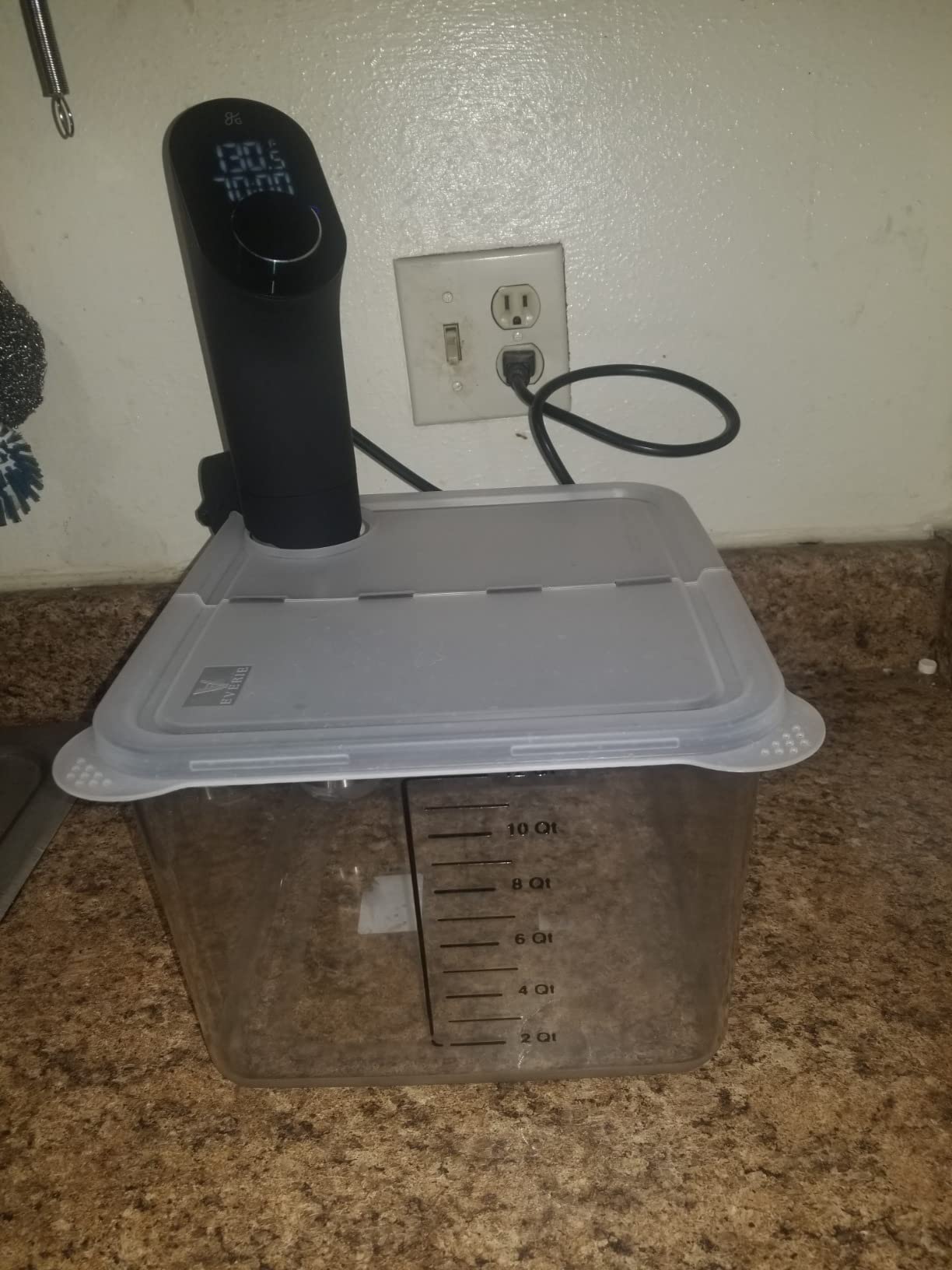
If you do not want to depend on a phone, this is the machine to buy. One dial and a 45 degree LED display run the entire cook. No app, no WiFi, no Bluetooth, no account, no subscription, and no possibility of a cook being interrupted by a dropped connection.
That stance matches a recurring theme in the cooking communities, where the top question is often how to run a circulator while away from home and the counter-question is which machine works without a phone at all. This one answers the second question properly, and it is the only machine in this roundup with a published 0.1°F readout.
Accuracy, Increments and Calibration
The range runs 68°F to 203°F in 0.5°F increments with a 0.1°F real-time readout and a built-in calibration function. The 68°F floor is lower than the next lowest setpoint in this roundup, and a 0.5°F step is fine for steak because the meaningful doneness differences are measured in single digits, not fractions.
Owners checking the readout against a calibrated ThermoWorks thermometer report agreement within 0.2°F. That is the sort of verification most buyers never do, and it is the reason this machine holds a 4.6 rating from roughly 1,900 reviews.
Timer, Alarms and the One Annoying Behavior
The timer runs from one minute to 99 hours and includes an overtime count-up, so a steak that sits an extra fifteen minutes while you finish the salad still gets tracked. A color-coded status light handles the rest: blue for ready, green for cooking, red for low water.
The most-cited complaint is the done-cook alarm, which cannot be silenced or acknowledged without stopping the timer. Owners describe it as persistent. Plan to be in the kitchen when it goes off, or treat it as the reminder that your steaks are waiting.
Build, Cleaning and Long-Term Wear
The stainless steel housing is removable and dishwasher safe, which makes the weekly rinse trivial. Support is St. Louis based with five year coverage published for the model, the longest warranty in this roundup, and that matters if you plan to keep it past the point when cheaper machines start failing.
The weak point is the plastic impeller guard. Heavy users report cracking after about three years, so if you run long cooks continuously rather than a few steaks a week, weigh the five year coverage against the stainless water path on the KitchenBoss.
Who This Suits and Who It Does Not
Buy this if you want a dial, a quiet brushless motor, and 1100W heating with no software layer. It is also a good gift, because there is nothing to set up and nothing to learn beyond one dial.
Skip it if you want to start a cook from the phone, adjust a temperature mid-bath remotely, or receive an alert when dinner is ready. Those features are not missing by accident.
7. Anova Precision Cooker 3.0 – Best for Weekend Meal Prep Batches
Anova Culinary Sous Vide Precision Cooker 3.0 (WiFi), 1100 Watts, Stainless Steel
1100W heater
32°F to 197°F range
Dual-band WiFi
Removable stainless skirt
Pros
- Physical buttons let you skip the app entirely
- Dual-band WiFi holds connection around the house
- Removable stainless skirt simplifies cleaning
- Accurate thermostat
- Heats faster than the 800W Nano
Cons
- Advanced app features sit behind a subscription
- On-device timer steps in 5-minute increments
- Clamp screw reported as a weak component
- 120V version needs a transformer abroad
This is the machine to buy if you want a brand name, a real app when you want one, and physical buttons when you do not. The two-line touch display and the tactile controls mean a Sunday batch of eight steaks does not require you to unlock your phone between every bag.
Dual-band WiFi is a genuine improvement over single-band units when the router is on a different floor, and at 16 liters rated capacity with 1100W it heats a large bath faster than the Nano 2.0. Two year manufacturer warranty is published.
Why the Subscription Matters Less Here Than Elsewhere
The most common complaint about this generation is that advanced app features and recipe content sit behind a paid tier. For steak cooks specifically that matters less than it does for general cooking, because the core operation is set a temperature, set a time, walk away, and sear. None of that is behind a paywall.
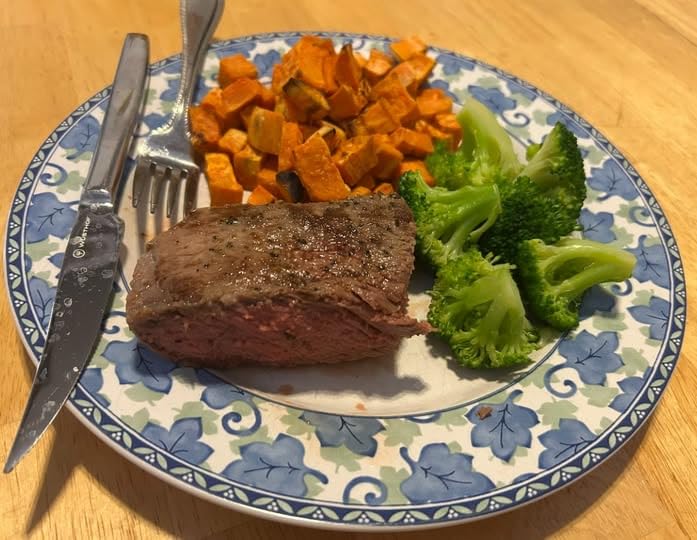
Owners note the thermostat is accurate, with roast beef coming out evenly medium rare, and the detachable stainless steel skirt and removable clamp make cleaning the parts that touch water a two-minute job. The stainless build also solves the plastic-in-the-bath durability problem that cheaper units have.
Timer Steps and the Clamp Screw
The on-device timer only steps in five-minute increments, which is genuinely inconvenient for a 45 minute steak cook. You either round up and rest the meat longer, or you correct it in the app. The clamp screw is reported by some owners as a weak component, so check it periodically if you rely on a heavy pot.
The 120V version is built for US mains. If you are outside the US, this specific listing needs a step-down transformer, and the Inkbird and Wancle options listed here carry different voltage specs, so read the fine print before ordering.
Who This Suits and Who It Does Not
Buy this if you want the option of app control without depending on it, a stainless water path, and enough heating power for a weekend batch. It is a good fit for households where different people cook with different levels of tech comfort.
Skip it if you refuse to pay any subscription even for recipes, or if you cook steaks that need precise non-five-minute timers. The Greater Goods dial covers the first case and the tighter timer steps cover the second.
8. Vpcok Direct 1000W – The Most Readable Status Indicators
Sous Vide Cooker Machine 1000W Immersion Circulator with Recipe
1000W heater
77°F to 198.5°F range
99 hour timer
360 degree circulation
Pros
- 1000W heating at an entry cost
- Color-coded ring lamp shows cook states
- Accurate time and temperature control
- Compact vertical footprint
Cons
- No app or WiFi connectivity
- Touch controls less tactile than a dial
- Least-reviewed option in the group
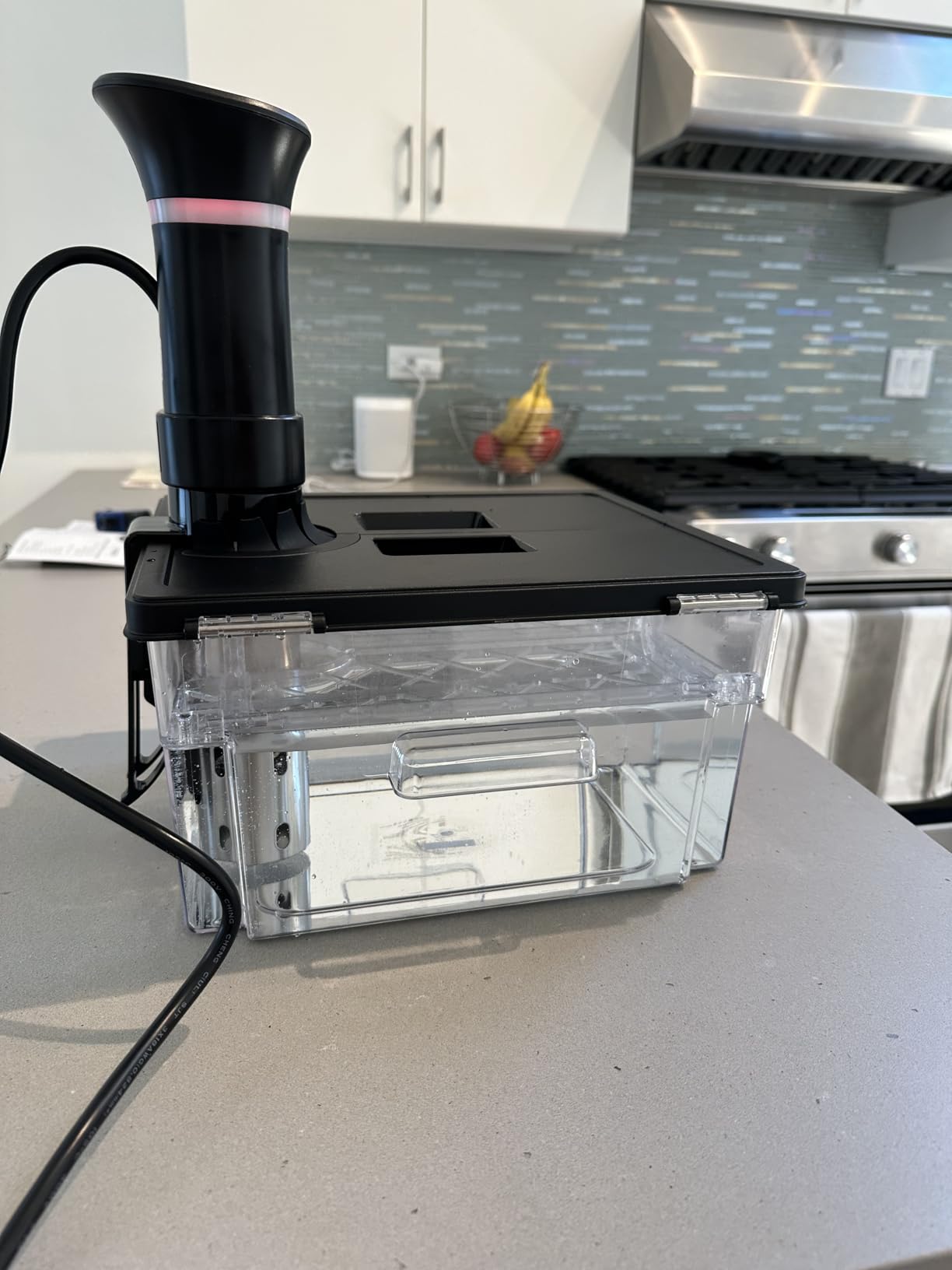
Where most budget circulators make you read a small screen to know what is happening, this one uses a three-stage LED ring: red while heating, green when the bath reaches temperature, blue when the timer finishes. On a steak cook that removes the single most common failure mode, which is starting a preheat and walking away without realizing it never got there.
At 1000W with 360 degree circulation over a 15 liter rated capacity, the heating specification is competitive with machines costing several times as much. Reviewers rate the value for wattage and the readable status ring as the two standout qualities.
Program It and Forget It
All programming happens on the unit, with a temperature range of 77°F to 198.5°F and a timer that goes to 99 hours. There is no app and no WiFi, so nothing can interrupt a cook, and nothing needs charging. For steak service between 120°F and 140°F the range is more than sufficient.
Construction is a mix of plastic and stainless steel in a space-saving vertical design, 4.2 inches deep and 16 inches tall. The vertical footprint is the reason it fits a small kitchen, and small kitchen fit is a real decision criterion for a lot of buyers.
Trade-offs to Accept
Touch controls are less tactile than a dial-based machine, and with no tactile feedback you learn to confirm a setting. This is the same criticism aimed at several budget circulators, and it is why cooks who dislike touch interfaces gravitate toward the Greater Goods single dial.
This is also the least-reviewed option in the group at roughly 1,450 reviews, so the long-term reliability picture is thinner than for the Anova and Inkbird models. That is a reason to keep it as a second machine or for occasional steaks rather than a primary daily circulator, if you are the cautious type.
Who This Suits and Who It Does Not
Buy this if you want visible confirmation that the bath is at temperature, no software, and 1000W of heating without spending much. The ring indicator is genuinely useful for a cook who starts a steak before going to do something else.
Skip it if you want remote monitoring, or if you are buying a machine you will still be using in five years and prefer a longer proven track record.
9. Inkbird ISV-200W – The Quietest Option for Overnight Steak Cooks
INKBIRD 2.4G Wifi Sous Vide Cooker ISV-200W 1000W Sous Vide w/APP Recipes,Remote Control Immersion Circulator with Free APP, Timer Alarm Mobile Notification 3D Water Fast Heating, Ultra-Quiet
1000W heater
32°F to 194°F range
0.1°C accuracy
2.4GHz WiFi
Pros
- Inaudible over household noise on long cooks
- Holds temperature within about half a degree
- App offset calibration closed a one degree gap
- 1000W heats quickly and runs cool
- Commercial-style build
Cons
- Touch buttons are hypersensitive with no tactile feedback
- Timer notifications often do not reach the phone
- Clamp needs a pot at least 7.5 inches tall
- Defaults to Celsius readings
If your steak cook starts at midnight and finishes while the house is asleep, pump noise is the constraint that decides the purchase. Owners describe this cooker as inaudible over background household noise across cooks longer than two hours, and reviewers consistently name quietness, accuracy, and build quality as the three strengths.
The 32°F floor is the widest low end in this roundup alongside the two Anova models, and the 100 hour timer covers any realistic steak schedule. The stainless steel column and 3D water fast heating element are the physical reasons it runs cool and quiet.
Accuracy and the Calibration Fix
Published accuracy is 1°F, or 0.1°C, across 32°F to 194°F. Owners who checked found the bath held within about half a degree, and one specifically used the app offset calibration to correct a one degree reading difference, which is the same self-calibration idea the ISV-100W offers in hardware.
That combination of verified accuracy and a correction path is why this model holds a 4.4 rating from around 1,140 reviews despite the interface complaints. Low-water and target-temperature alarms are both present, so a cook interrupted by an empty bath is less likely.
WiFi Range, Notifications and the Clamp
The 2.4GHz WiFi supports up to 100 app administrators, which is generous for a household. The weakness is the notification path: owners report timer-completion alerts frequently failing to reach the phone, so treat the app as monitoring rather than as an alarm you can rely on.
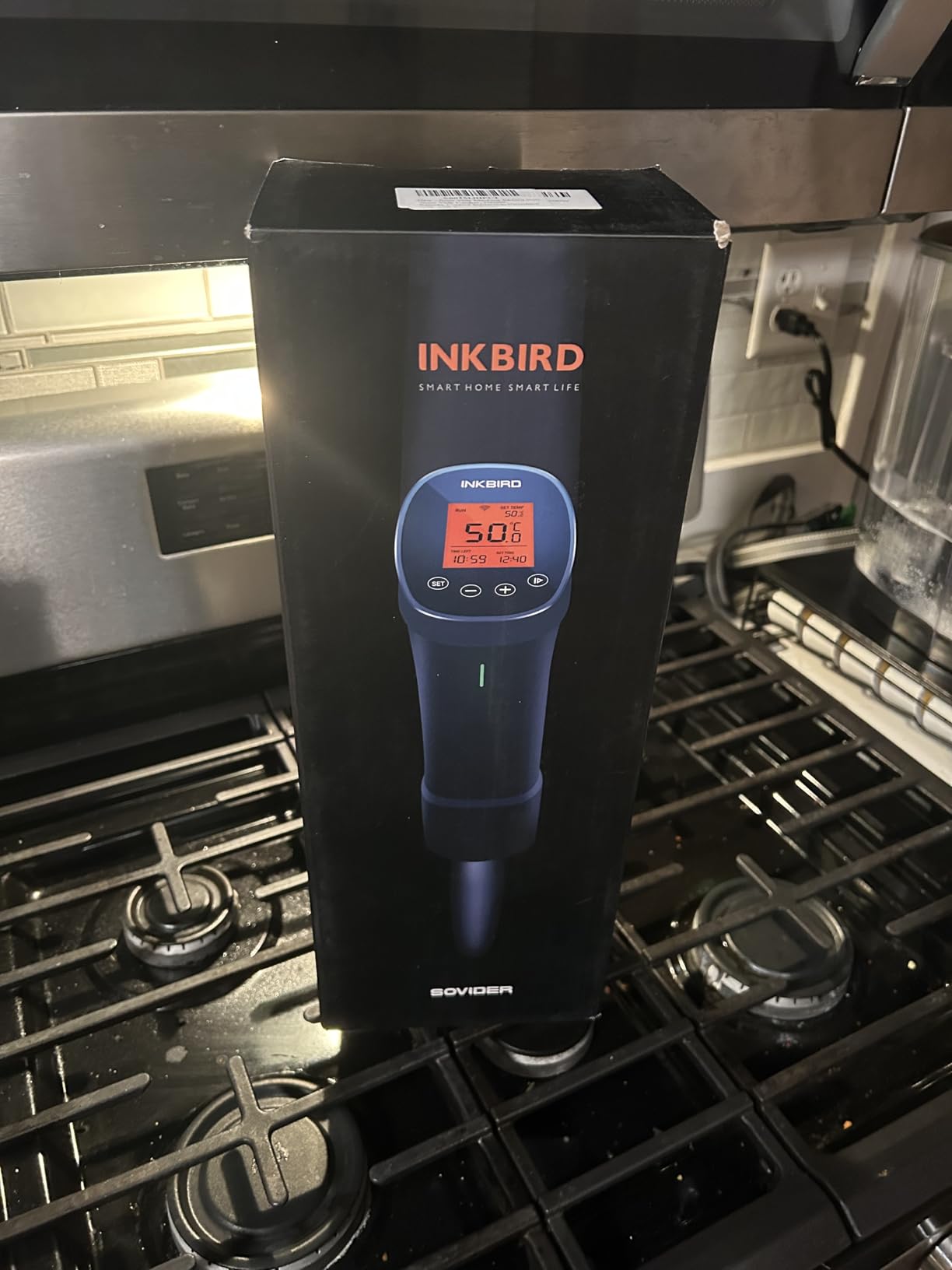
The clamp does not adjust to pots shorter than roughly 7.5 inches without tilting the unit, and tilting changes the immersion depth of the heating element. Check your pot height before buying. The device also defaults to Celsius, which catches out new owners out on the first cook.
Who This Suits and Who It Does Not
Buy this if you cook overnight, live in a quiet house or a small apartment, and want a wide low-temperature range along with remote monitoring. Reviewers rate the build quality well above what the cost would suggest.
Skip it if you need reliable push notifications to know dinner is done, or if you plan to use short pots. The hypersensitive touch buttons with no tactile feedback also make mid-cook temperature changes error-prone for some hands.
10. Breville Joule Turbo – The Fastest Cook Times for a Weeknight Steak
Breville BSV600PSS Joule Turbo Sous Vide Machine, Polished Stainless Steel
1100W heater
Turbo mode halves cook times
40 liter capacity
App control
Pros
- Turbo mode genuinely halves cook times
- Compact body clamps to a standard tall pot
- Quiet operation and accurate readings
- App pairing is quick in the right order
Cons
- A few circulators stopped circulating after a WiFi drop
- App region-locked to the US and Canada
- No physical controls on the body
- Support described as dismissive and hard to reach
Every other machine on this list asks you to plan a steak three hours ahead. The Turbo mode on this one is advertised as cutting cook times roughly in half, and owners confirm it genuinely halves them for steak, chicken, and fish, which is the difference between starting dinner at noon and starting it at one.
Autopilot mode sets time and temperature automatically, doneness selection runs from rare to well done, and a Prime Time window sets a serving time and works backward. For a cook who wants a repeatable medium-rare without choosing a number, that is a real convenience.

What Turbo Mode Actually Changes for a Steak
A 1.5 inch ribeye at 134°F normally needs two to three hours to cook edge to edge. Turbo mode drives a hotter bath to push the same result in a much shorter window, which relies on the 1100W heater and a 40 liter rated capacity, the largest figure in this roundup. The trade is that the crust and the texture character of a long cook are compressed into less time, and some cooks report a slightly firmer texture at equivalent temperatures.
The body stores in a drawer and clamps to a standard tall pot, and at 2.1 pounds it is among the lighter machines here. Operation is quiet with accurate temperature readings, and a stainless steel ruler is included for depth reference.
The App Dependency Is Total
There are no physical controls on the body. Everything, including starting a cook, requires the app, and owners report a few cookers stopped circulating mid-cook after a WiFi drop, which on a two hour steak is a serious failure mode rather than an inconvenience.
The app is also region-locked to the US and Canada, making the unit effectively unusable elsewhere. Pairing is quick if you follow the correct setup order, but the ordering matters, and support is described as dismissive and hard to reach. Warranty is one year, the shortest published coverage in this roundup.
Who This Suits and Who It Does Not
Buy this if you are in the US or Canada, you are comfortable running entirely from an app, and you want a thick steak on the table in under two hours. The doneness presets and Prime Time scheduling also suit a cook who prefers not to compute times.
Skip it if you want a machine that works with no phone, if you travel outside North America, or if you run overnight cooks where a mid-cook connection drop would ruin the batch. The Greater Goods or Inkbird ISV-100W cover those cases better.
11. Inkbird ISV-100W Bundle with Vacuum Sealer – The Best Complete First Setup
INKBIRD WIFI Sous Vide Cooker Bundle with Vacuum Sealer Machine,1000W Sous-Vide Cooker Immersion Circulator with 14 Preset Recipes on APP and Thermal Immersion with Timer
1000W circulator with sealer
0.1°C accuracy
99 hour timer
Bag roll and cutter included
Pros
- Pairs the circulator with a working sealer and bags
- Circulator is quiet accurate and easy to dial in
- Handles roughly 15 sealed bags back to back
- Sealer covers dry moist vac jar and seal modes
Cons
- Sealer needs both hands to hold the bag flat
- Runs hot during long sealing sessions
- No roll holder so bags are cut by hand
- 2.4GHz-only WiFi needs a permission toggle
This bundle answers the question the roundup kept circling: do you need a vacuum sealer for steak. The answer is no, but if you are going to buy one eventually, this pairs the ISV-100W circulator with a working sealer, a bag roll, five bags, a suction hose, a recipe book, and a built-in cutter, so nothing has to be sourced separately.
Reviewers rate the circulator component as excellent and the sealer as an acceptable entry-level addition that most owners expect to replace eventually. The pairing is rated 4.6 stars from 364 reviews, and the strongest specific claim is bulk capacity: owners report cooking roughly 15 sealed bags back to back.
The Sealer’s Real Limitations
Two hands are needed. One holds the bag flat inside the vacuum chamber and the other engages the locking clips, so bags can shift and misalign the seal. During a fifteen bag session that becomes tedious, and the sealer runs hot enough over long runs to need cooling time.
There is no roll holder, so bags have to be measured and cut by hand from the roll, which is the single most annoying omission. The sealer pulls minus 80 kPa and offers dry, moist, vac, jar, and seal modes, which covers most meat prep well enough.
The Circulator Component
The circulator is the ISV-100W design: 1000W, a 77°F to 210°F range, 0.1°C accuracy, and a 99 hour timer. Owners describe it as quiet, accurate, and easy to dial in on the device itself, and the stainless steel column keeps the water path free of plastic parts.
2.4GHz-only WiFi means you have to enable nearby-device permission in the app before it will connect, which catches out first-time owners. If you already own a circulator and just want a sealer, this bundle makes less sense than buying the two separately.
Who This Suits and Who It Does Not
Buy this if you are starting from nothing, plan to cook for a group, and want the sealer question settled on day one. The 15 bag capacity claim is the part that matters for a Sunday meal prep session.
Skip it if you already have bags and a working sealer, or if you cook one steak a week and will not use the sealer often enough to justify a two-handed device.
12. Wancle 1100W IPX7 – The One With a Built-In Reservation Timer
Sous Vide, Wancle Sous Vide Cooker 1100W IPX7 Waterproof Thermal Immersion Circulator With Reservation Function, Easy to store
1100W heater
25°C to 90°C range
±0.1°C accuracy
IPX7 waterproof
Pros
- 1100W delivers even corner-to-corner temperature
- Verified within 0.1 to 0.6°F of a handheld thermometer
- Quiet 3D circulation heats evenly
- IPX7 body rinses under running water
- Reservation function and angled display
Cons
- Completion beeping cannot be disabled
- 0.1 degree adjustment steps are fiddly
- 70°F minimum blocks cold-water thawing
- Display does not show the temperature scale
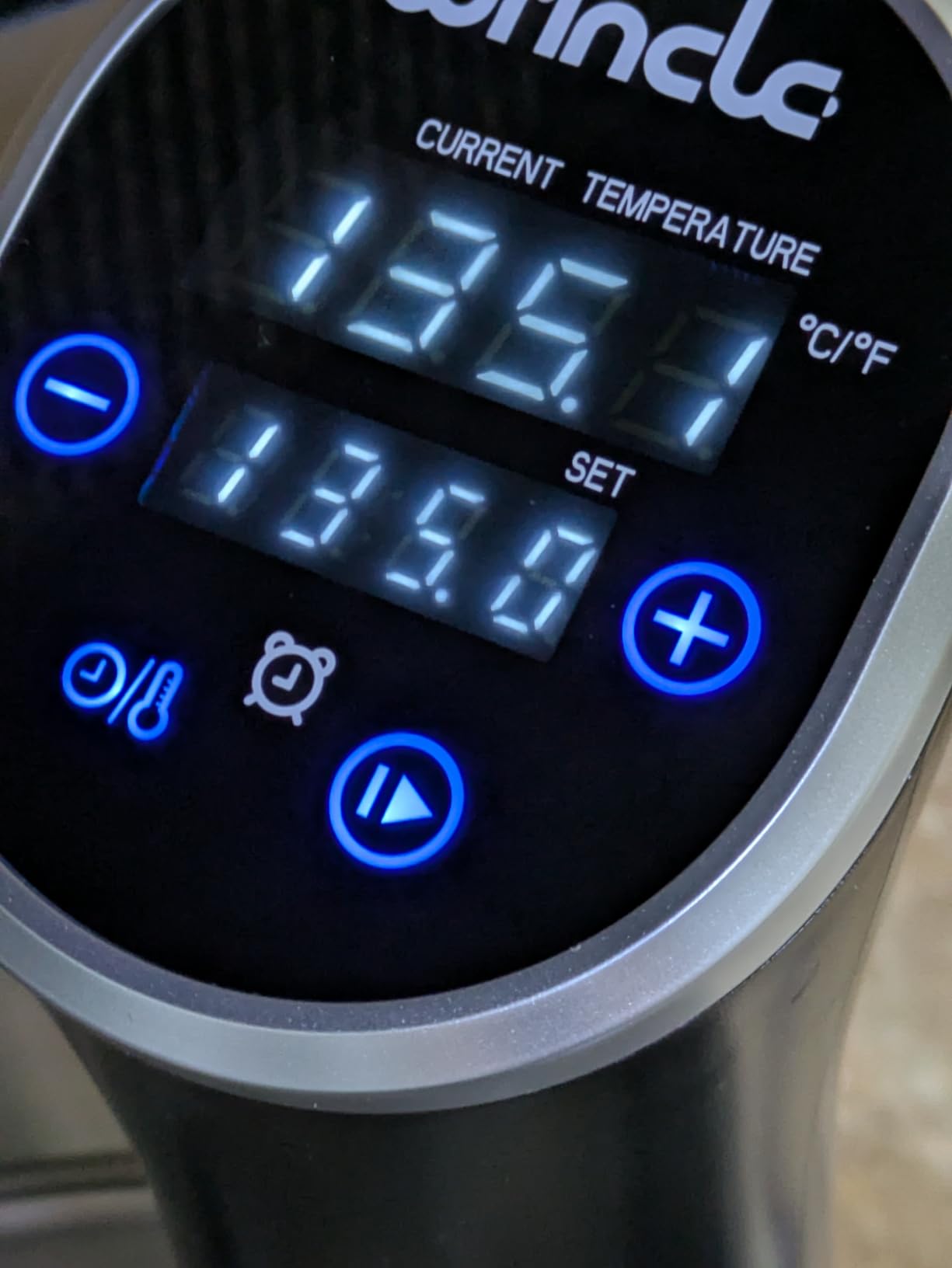
The reservation function is the feature that distinguishes this one. You set a start time rather than a cook time, which means a 134°F ribeye can be sitting in the bath at 7 a.m. and be finished when you want it, without you being awake for the preheat. Owners pair this with the 30 degree angled dual display, which makes one-handed operation easy at the sink.
At 1100W with 3D water circulation heating and functional modules 40 percent smaller, it delivers even corner-to-corner temperature in a large bath. Reviewers verified readings within 0.1 to 0.6°F of an independent handheld thermometer, which is a strong result for this class.
Where the 0.1°C Claim Meets Reality
Stated accuracy is plus or minus 0.1°C, and the reviews support it closely, with most measured deviation well under a degree. Some readings do run 1 to 2°F below the setpoint according to owners, which is a mild and correctable offset rather than a failure, and it is the kind of thing the 0.1 degree adjustment steps exist to correct.
Those same 0.1 degree steps are a common complaint, because dialling to exactly 133.5°F takes several presses. A cook who wants 134°F in whole degrees will find it tedious and will probably use the up button more than they expect.
Waterproofing, Cleaning and the Floor
The IPX7 waterproof housing can be rinsed directly under running water, which removes descale maintenance from the routine for most users. The 70°F minimum means it cannot circulate cold water to thaw, and the display does not indicate whether readings are Celsius or Fahrenheit, so confirm the scale before your first steak.
Audible beeping on completion cannot be disabled, which several buyers find intrusive, especially on a reservation cook that finishes early. Current and overheat protection are built in for unattended runs.
Who This Suits and Who It Does Not
Buy this if you want a scheduled start, 1100W heating, and an IPX7 body you can rinse clean without thinking about descale. At 0.73 kg it is light to move, and 20 liter rated capacity is fine for a double bag of steaks.
Skip it if the un-disableable alarm would bother you, if you want whole-degree temperature steps, or if you need a bath below 70°F for thawing.
Sous Vide Steak Time and Temperature by Cut Thickness
Every machine in this roundup will cook a steak well if you give it the right number of minutes. The machine decides consistency; you decide doneness. The guide below is a starting point for a whole, unbutterflied steak at rest, and it assumes the steak is refrigerated, not frozen, and that you rest it for 10 to 15 minutes after the bath.
0.75 inch (filet, sirloin tip)
Rare 45 min, medium-rare 60 min, medium 75 min, medium-well 90 min, well done 105 min.
1.25 inch (NY strip, sirloin)
Rare 60 min, medium-rare 75 to 90 min, medium 90 to 105 min, medium-well 105 to 120 min, well done 120 to 135 min.
1.75 inch (ribeye, porterhouse)
Rare 90 min, medium-rare 105 to 120 min, medium 120 to 135 min, medium-well 135 to 150 min, well done 150 to 165 min.
2.25 inch (tomahawk, double ribeye)
Rare 120 min, medium-rare 135 to 150 min, medium 150 to 180 min, medium-well 180 to 195 min, well done 195 to 210 min.
The water temperature you choose matters as much as the time. Most steak cooks land between 130°F and 140°F, which gives a hot pink center and a finished, non-pasteurized texture. Below roughly 130°F you are cooking to a lower pasteurization point, and cooks who go there should extend the time substantially and understand they are making a different dish on purpose.
For food safety, treat 145°F as the floor for anyone who is cooking for a vulnerable eater, pregnant guest, or young child, and extend the time accordingly from the guide above. That is a conservative standard and it costs you very little: a steak cooked to 145°F for 60 to 75 minutes is still a good steak, just a firmer one.
What Is the Best Steak to Sous Vide?
Thick, fatty, and uniform cuts win. Ribeye, NY strip, porterhouse, and filet all benefit, and the reason is heat penetration: a 2 inch ribeye has a large thermal mass, so a pan sear leaves a wide band of overcooked gray meat between the crust and the center. In a water bath, that band shrinks to almost nothing.
Lean and thin cuts benefit least. A 0.75 inch filet has so little cooking time that the crust-to-center ratio is barely different from a pan sear, and a skirt steak or hanger steak is nearly all surface. If your usual steak is thin, the case for the technique is weaker and the case for a good pan or a blowtorch is stronger.
Can You Sous Vide a Frozen Steak?
You can, but do not shorten the cook to compensate. A frozen steak added to a hot bath drops the water temperature sharply and the ice still has to melt, so the steak spends its first stretch cooking unevenly and cold. Most experienced cooks thaw overnight in the refrigerator, or use one of the circulators that reach down to 32°F as a controlled thawing bath, then cook it normally.
Bagging, Submersion and the Post-Bath Sear
The machine is half of the result. The other half is how the bag behaves in the water, and this is where most disappointing steak cooks come from. Forum discussion about sous vide frequently surfaces the same two problems: bags that float, and air that will not come out.
Keeping the Bag Under the Surface
A sealed bag traps air, and air is lighter than water, so a bag with any air in it floats and cooks unevenly at the top where the bath is hottest. Four fixes, in order of effectiveness. First, push the air out by hand before sealing, sealing from the cut end upward so the last inch is the airiest. Second, use a water displacement method, submerging the open bag in cool water with the steak inside and pressing until bubbles stop rising, then seal it under water. Third, once sealed, press the bag flat with your hands to squeeze out slack air, which changes the buoyancy. Fourth, keep the clamp on the lid side so the bag is held away from the heater.
You can also double bag, sealing one bag inside another. It removes floating entirely and buys thermal insulation, at the cost of doubling bag use. For a single steak on a weeknight, that is overkill. For two ribeyes at a low temperature, it is worth considering.
Do You Need a Vacuum Sealer?
No. A sealer is a convenience tool that makes bagging fast and consistent, and a water displacement method costs nothing. What you cannot easily do without one is hit a firm vacuum on a large, irregular cut, and that matters more for lower-temperature and longer cooks than most people expect.
Buy a sealer if you bag two steaks per bag regularly, if you cook for a group, or if bagging friction is what stops you from cooking sous vide at all. The two bundles in this roundup both include one, and the circulators themselves are indifferent: any of the twelve will cook a properly sealed bag identically.
The Post-Bath Sear Is Not Optional
A steak that comes out of the bath has no crust, because the water never got hot enough to brown it. Sear it in cast iron for 45 to 60 seconds per side with a high smoke point oil, then add butter, garlic, and any herb for the final 30 seconds and baste. That step is the entire difference between a good steak and a disappointing one, and no circulator substitutes for it.
A blowtorch is the fastest option and gives the most even crust without adding a cooking vessel. A grill or a screaming hot cast iron pan is the classic. Dry the surface of the steak thoroughly before it hits the metal, because a wet steak steams instead of searing, and season it with salt at that moment rather than an hour earlier. If you seared before bagging, you have already solved the problem in reverse.
Cleaning, Descaling and Storage
For machines with a detachable stainless skirt or housing, unscrew it after each cook and rinse under a tap, then drop it in the dishwasher. For fixed plastic bodies, wipe the shaft and the intake clean and dry the crevice around the pump housing, where scale and food film build up fastest.
Descaling matters more for machines that heat to above 150°F regularly, which is not the steak use case. In hard water areas, a descale every three to six months is reasonable. Never submerge the motor housing above the waterline, and never leave a circulator running dry, even for a minute.
What to Look for When Buying a Sous Vide Machine for Steaks
Steak cooks are long, frequent, and unforgiving of drift, so the criteria that separate a good steak circulator from a mediocre one are narrower than the general category suggests. These are the seven that changed our ranking.
Circulator, Water Oven or All-in-One
An immersion circulator clamps to a pot you already own, takes no counter space, and costs the least. A water oven is a self-contained tub, which is faster to heat and easier to clean but eats a fixed block of counter and holds more water than a typical dinner needs. An all-in-one adds a lid and sealing, which is useful for lower-temperature vegetable and fish work rather than for steak, where you want the steak dry enough to sear.
For steak specifically, the immersion circulator wins. It scales to the number of steaks you are cooking, it stores in a drawer, and the pot you use becomes the container you already have. All 12 machines are immersion circulators, so this is a decision about which one to clamp to your pot.
Temperature Accuracy and Hold Stability
Published accuracy ranges from 0.1°C to 1°F across this group, and the difference is smaller than most buyers expect. What actually matters is whether the bath stays at the setpoint once a cold steak goes in. A machine that overshoots on recovery cooks the outside of your steak past the target while the center is still climbing.
Look for a machine with a calibration function. If you own a probe thermometer, five minutes of checking turns an unknown into a known offset, and several machines in this roundup let you enter that offset directly. That is worth more than any app feature.
Wattage and Preheat Speed
Wattage is the single most visible trade. At 850W you will wait, at 1000W you will wait a reasonable amount, and at 1100W a large pot comes up quickly. For a single steak cooked for 90 minutes or more, this barely registers. For a 45 minute cook, or for four steaks in a big pot, it is obvious.
Match the wattage to your container. A 1100W circulator in a 12 liter pot is over-provisioned in a good way, since it recovers from a cold steak faster and holds steady in a crowded bath. An 850W model in a large pot is not.
Capacity for Batch Steak Cooks
Rated capacity runs from 4 gallons on the Wancle 850W up to 40 liters on the Breville Joule Turbo, with most quality circulators landing at 15 to 16 liters. For one or two steaks, any of them is oversized. For four or more, pay attention to the flow rate rather than the capacity number, because a crowded bath needs circulation more than it needs volume.
Published flow rates in this group run from 7 to 8 liters per minute on the Wancle 850W up to 16 liters per minute on the KitchenBoss G300. If you cook for a group regularly, that spread is the difference between an even cook and steaks that vary bag to bag.
App Control, Dial Control and Subscriptions
These are three genuinely different products, not one product with a subscription tier. App control is right if you want to start a cook while away from home, which is the most common purchase driver in cooking forum discussion. A dial is right if you want zero dependencies and zero software. A subscription is a separate question: some brands gate recipes and guides behind a paid tier, and while that does not affect the cooking itself, it is a legitimate complaint from owners who expected the app to be free.
Be honest with yourself about which camp you are in. The worst outcome is buying a phone-dependent machine for someone who does not want to use a phone, or a dial machine for someone who wants to change a temperature from the garden. Both mistakes are common and both are fixable only by buying the other kind.
Build, Waterproofing and Noise
Two details decide how a machine feels after three years. A stainless water path with no plastic impeller will outlast a plastic one, and the KitchenBoss G300 and Greater Goods both build that way. IPX7 waterproofing, on the KitchenBoss and the Wancle 1100W IPX7, means you can rinse the unit instead of carefully hand-washing it, which is the difference between cleaning it weekly and not cleaning it at all.
Noise is the other one. Spec sheets rarely list it, but published figures and owner reports agree that brushless DC motor models, including the KitchenBoss, the Greater Goods, and the Inkbird ISV-200W, are the quiet ones. If you cook overnight or in a small apartment, this is not a minor consideration.
Frequently Asked Questions
Is sous vide worth it for steak?
For steaks thicker than about 1.25 inches, yes. A water bath cooks a ribeye to one target temperature edge to edge with no babysitting, and the meat does not dry out against a hot pan. The tradeoff is that the method produces no crust, so the post-bath sear is mandatory.
What is the best temperature to sous vide steak?
Most cooks land between 130°F and 140°F. That range gives a hot pink medium-rare center with a finished texture. Below roughly 130°F you are cooking to a lower pasteurization point and need much longer times. For anyone cooking for a vulnerable eater, use 145°F as the floor.
What is the best steak to sous vide?
Thick, fatty, uniform cuts work best: ribeye, New York strip, porterhouse, and filet mignon. A 2 inch ribeye has enough thermal mass that a pan sear leaves a wide gray band, which a water bath nearly eliminates. Thin and lean cuts such as skirt steak gain much less.
What are common mistakes with sous vide steak?
The four recurring mistakes are skipping the post-bath sear, cooking frozen steak without thawing first, letting the bag float because air was trapped inside, and starting the cook before confirming the bath actually reached temperature. Pat the steak dry before searing or it will steam instead of brown.
What is the downside of sous vide?
The main downsides are the absence of a crust without a final sear, the loss of surface browning flavor, and the time. A thick steak needs two to three hours before it sears, which does not suit a weeknight cook who wants food in 30 minutes. Seared and smoked flavor compounds simply do not develop in water.
Do you need a vacuum sealer for sous vide steak?
No. A water displacement method, where you submerge the open bag with the steak inside and press out the air before sealing, works on a single steak. A vacuum sealer mainly saves time and makes double bagging easier, and it is worth buying if you bag two steaks at once or cook for a group regularly.
Which sous vide circulator is best if I do not want to use an app?
The Greater Goods 1100W circulator runs entirely from a single dial and a 45 degree LED display, with no app, WiFi, Bluetooth, or account. It holds 4.6 stars from about 1,900 reviews, reads within 0.2°F of a calibrated thermometer, and carries five year coverage.
Which Sous Vide Machine Should You Buy for Steaks?
For most people buying one sous vide machine for steaks, the Anova Culinary Precision Cooker Nano 2.0 is the right first choice. It holds within 0.2°F of setpoint, stows in a drawer, and carries more than 15,000 reviews of long-term owners who report the same consistent results. If you want more heating power and real app control without stepping up a tier, the Inkbird ISV-100W is the value pick, with 1000W, self-calibration, and 14 free preset recipes.
Match the machine to how you actually cook. For four or more steaks at once, the KitchenBoss G300’s 16 liters per minute of circulation and all-stainless water path keep a crowded bath even. For a scheduled overnight start, the Wancle 1100W IPX7 reservation function does the waiting for you. For a thick ribeye on the table in under two hours, the Breville Joule Turbo’s Turbo mode is the only one here that gets there quickly, and it requires a phone and a US or Canadian address. For no phone at all, the Greater Goods 1100W runs on a single dial with a five year coverage plan behind it.
Whichever you choose, the machine is only half the steak. Get the water to temperature, keep the bag submerged, and give the steak a hard 45 seconds per side in cast iron afterward. Those three habits matter more than any spec on any list. If you want more hands-on appliance coverage from us, read our picks for the best noise machines for babies and our guide to the best karaoke machines for home use.