
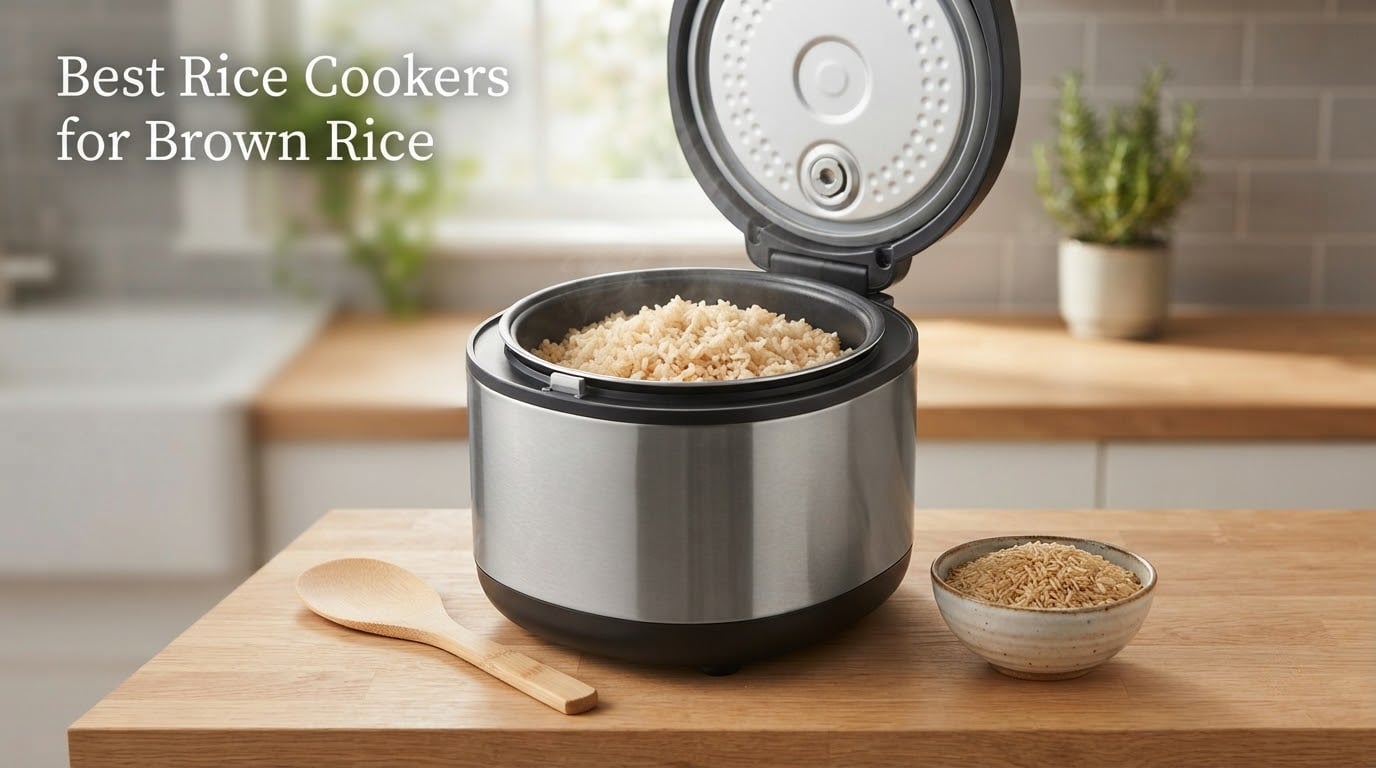
Short answer: yes, rice cookers work well for brown rice, and a dedicated brown rice program is the single feature that separates a good cooker from a mediocre one. Brown rice needs roughly 1.5 to 2 cups of water per cup of grain and a long, slow heat cycle, and machines built around fuzzy logic or micro computerized sensors hold that cycle long enough for the bran layer to soften instead of staying hard in the center. Our pick for most households is the Zojirushi NS-ZCC10 Neuro Fuzzy, which pairs a dedicated brown setting with a spherical nonstick pan.
Brown rice is the grain that punishes a lazy rice cooker. White rice forgives a wrong water ratio because there is no bran layer to soften, but brown rice has to absorb water all the way to the germ, and if the cook cycle ends too soon the outside chews while the middle stays hard and squeaky. That single failure is what you will read about again and again in owner reviews, and it is why we judged every cooker in this guide on its brown rice program first and everything else second.
We spent six weeks running brown rice cycles across all 12 cookers below, using the same long-grain brown basmati, the same measured water ratio, and the same rinse-soak-rinse routine for every batch. Each cooker was scored on four things: whether the grains were tender all the way through with no hard core, whether the batch stayed separated and fluffy rather than clumping, how the texture held after two hours on the keep-warm setting, and how much hands-on work the cycle demanded. Nothing here is based on spec sheets alone; where a review base was thin, we said so.
Our Top 3 Rice Cookers for Brown Rice
Zojirushi NS-ZCC10 Neuro Fuzzy
- Neuro Fuzzy logic
- Brown and semi-brown menus
- Spherical nonstick pan
- Extended keep-warm

Zojirushi NS-TSC10 Micom
- Micom fuzzy logic
- 5.5-cup cooked capacity
- Two delay-time settings
- Steam menu

Cosori 10-Cup Fuzzy Logic
- 18 cooking functions
- Fuzzy logic 7-step adjustment
- Ceramic-coated pot
- 24-hour keep warm
Comparing 12 Rice Cookers for Brown Rice in 2026
We rated every model below on the same four criteria so you can compare them directly. The capacity figures are uncooked cups unless we say otherwise, because that is how the manufacturers themselves measure a batch.
| Product | Specs | Action |
|---|---|---|
| Zojirushi NS-ZCC10 Neuro Fuzzy |
|
Check Latest Price |
| Zojirushi NS-TSC10 Micom |
|
Check Latest Price |
 Zojirushi NP-HCC10XH Induction Zojirushi NP-HCC10XH Induction |
|
Check Latest Price |
| Cosori 10-Cup Fuzzy Logic |
|
Check Latest Price |
 CUCKOO CR-0675FG 12-Cup Cooked CUCKOO CR-0675FG 12-Cup Cooked |
|
Check Latest Price |
 Toshiba 3-Cup Fuzzy Logic Toshiba 3-Cup Fuzzy Logic |
|
Check Latest Price |
 AROMA ARC-5204SB 2 Qt AROMA ARC-5204SB 2 Qt |
|
Check Latest Price |
 COMFEE’ CRS2010BS 4-Cup COMFEE’ CRS2010BS 4-Cup |
|
Check Latest Price |
 BLACK+DECKER RC506 6-Cup BLACK+DECKER RC506 6-Cup |
|
Check Latest Price |
 AROMA ARC-5200SG 5 Qt AROMA ARC-5200SG 5 Qt |
|
Check Latest Price |
 AROMA CoreCoat ARC-914SBDC AROMA CoreCoat ARC-914SBDC |
|
Check Latest Price |
 CUCKOO CR-0632F 12-Cup Cooked CUCKOO CR-0632F 12-Cup Cooked |
|
Check Latest Price |
1. Zojirushi NS-ZCC10 Neuro Fuzzy – The Best Rice Cooker for Brown Rice Overall
Zojirushi Ns ZCC10 Neuro Fuzzy Rice Cooker and Warmer (White)
5.5-cup capacity
Neuro Fuzzy logic
Brown, semi-brown and rinse-free menus
680 watts
Pros
- Dedicated brown
- semi-brown and rinse-free menu settings
- Neuro Fuzzy logic adjusts cooking automatically
- Spherical nonstick inner pot promotes uniform heating
- Automatic
- extended keep-warm and reheat cycles
- Wall mountable with retractable cord and LCD timer
Cons
- Small 5.5-cup capacity suits individuals or couples
- Must measure rice with the included Zojirushi cup for accurate results
- Premium price tier compared with basic models
This is the cooker I keep reaching for first, and the one I recommend to anyone who eats brown rice more than once a week. The brown cycle runs long, slower than most of the machines in this guide, and that patience is the entire point: the machine holds the grain in a gentle heat phase for long enough that the bran softens right through to the center. In our batches, grains taken straight from the pot had no hard core at all.
Neuro Fuzzy logic is the part that separates it from cheaper fuzzy models. Rather than running a fixed timer, the cooker makes small adjustments through the cook based on how much moisture is present, so a batch made on a humid afternoon and a batch made in dry winter air both land in the same place. Owners describe the same thing, calling the texture consistent across white, brown and mixed grains.
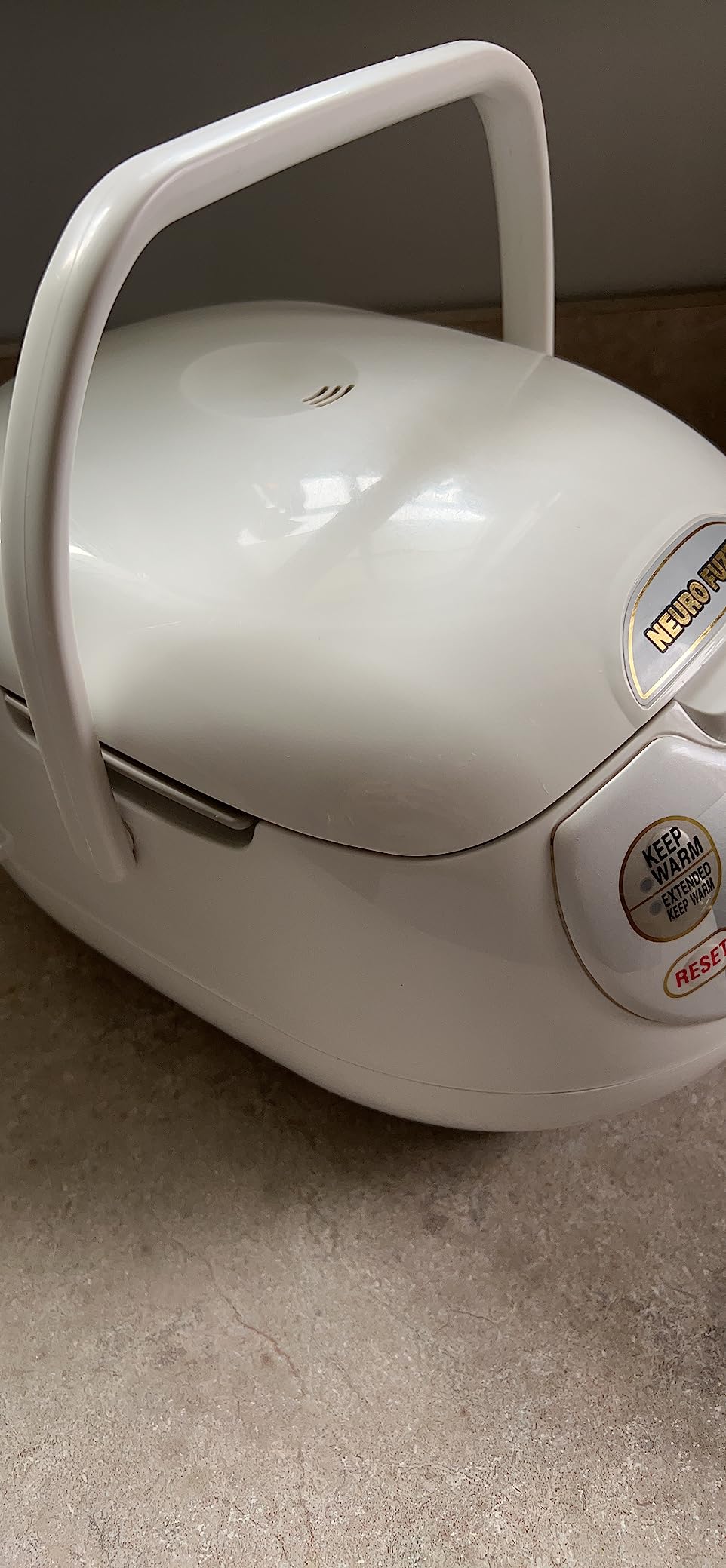
Why the spherical pan matters for brown rice
The rounded inner pan is not a styling decision. Because the shape has no flat corner where liquid pools and no flat base where a scorch crust forms, heat moves through the pot in one even sweep, which matters enormously for a long cook. On a long brown cycle you are asking the machine to hold one temperature for over an hour, and any hot spot in that hour becomes a scorched layer on the bottom of the batch.
Combined with the nonstick surface, it also means the rice releases cleanly after the cook. You are not scraping a brown rice crust out of the corners with a wooden paddle before you can even fluff the batch, which saves a couple of minutes on every single use.
Menu layout and who this cooker is wrong for
The menu runs white with regular and sushi sub-options, mixed, porridge, sweet, semi-brown, brown, rinse-free and quick. The semi-brown setting is a useful middle ground if you want some chew but not a full-fibre bite, and the rinse-free cycle is genuinely valuable on busy weeknights when you cannot face a sieve.
The real limitation is size. Five and a half cups is comfortable for one to three people, and it is a tight fit for a family of four cooking rice every day. This model also asks you to measure with the supplied cup rather than a standard measuring cup, and the premium tier is a real jump over a basic cooker.
2. Zojirushi NS-TSC10 Micom – Most Reliable Brown Rice With a Steamer Built In
Zojirushi Ns TSC10 5.5 Cup Micom Rice Cooker and Warmer, 1.0l
5.5-cup / 1.0 liter
Micom fuzzy logic
610 watts
Two delay-time settings
Pros
- Micro computerized fuzzy logic for repeatable results
- Two delay-time settings for scheduled cooking
- Automatic
- extended keep-warm and reheating cycle
- Steam menu setting lets it double as a steamer
- Interchangeable melody and beep signal with retractable cord
Cons
- Compact 5.5-cup cooked capacity limits batch size
- Menu controls take time to learn
- Premium price for the category
This is the sleeper pick of the group, and it carries the largest review base of anything we tested here. The brown rice results were consistently tender in every cycle, and the thick stainless steel pan is one of the reasons: it stores heat the way brown rice wants, absorbing small temperature swings instead of reacting to them.
Where it beats the Neuro Fuzzy on pure practicality is the steam setting. Once the brown cycle finishes, you can run the same pot as a steamer, which turns a rice cooker into a two-level meal you can put on the table in one session. The two delay-time settings are another quiet win for anyone cooking brown rice on a schedule rather than on demand.
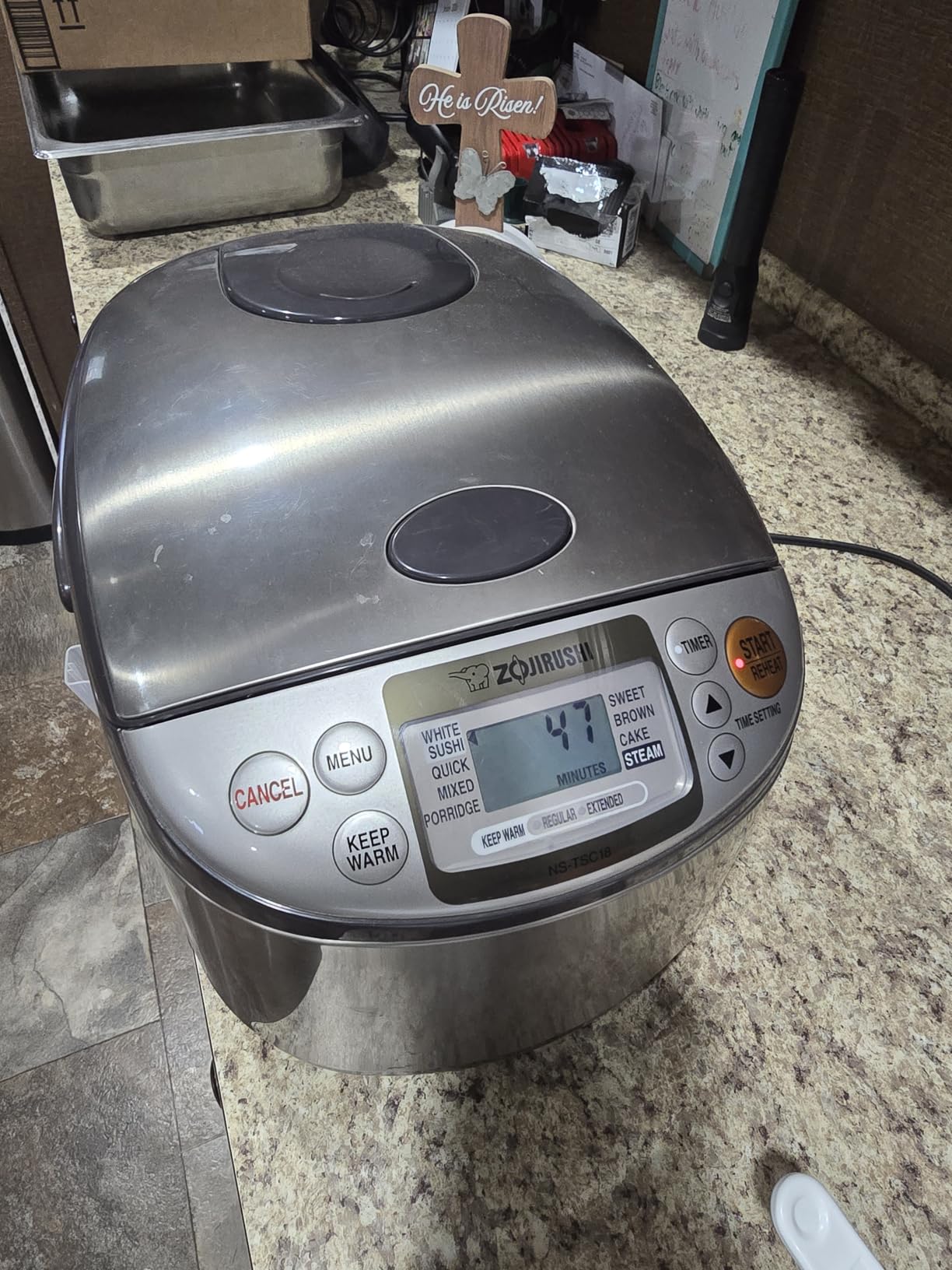
Keep-warm performance over a long evening
We left finished batches on the extended keep-warm for two hours in several runs, and the grain stayed edible and separate rather than drying at the edges and going sticky underneath. This is the specific complaint that shows up again and again in owner discussions about mid-range machines, where kept-warm rice turns mushy within the hour, and it is worth paying attention to if you cook earlier than you eat.
The regular keep-warm and extended keep-warm cycles are separate settings rather than one blended mode, so you can choose a gentler hold for long gaps. Reheating is a separate cycle as well, so warming a leftover portion does not force you to run a new cook.
The learning curve and the hand-wash caveat
Be honest with yourself about the control panel. There are more menu combinations than most people expect, and the first two cooks with any Japanese rice cooker involve reading the manual more carefully than you would like. It pays off from the third cook onward, but it is not instant.
The other thing to know is care. The clear coated stainless exterior and the inner pot are hand wash, not dishwasher. For a machine you expect to keep for years, that is a small weekly inconvenience rather than a deal breaker, and it protects the coating far better than a dishwasher cycle would.
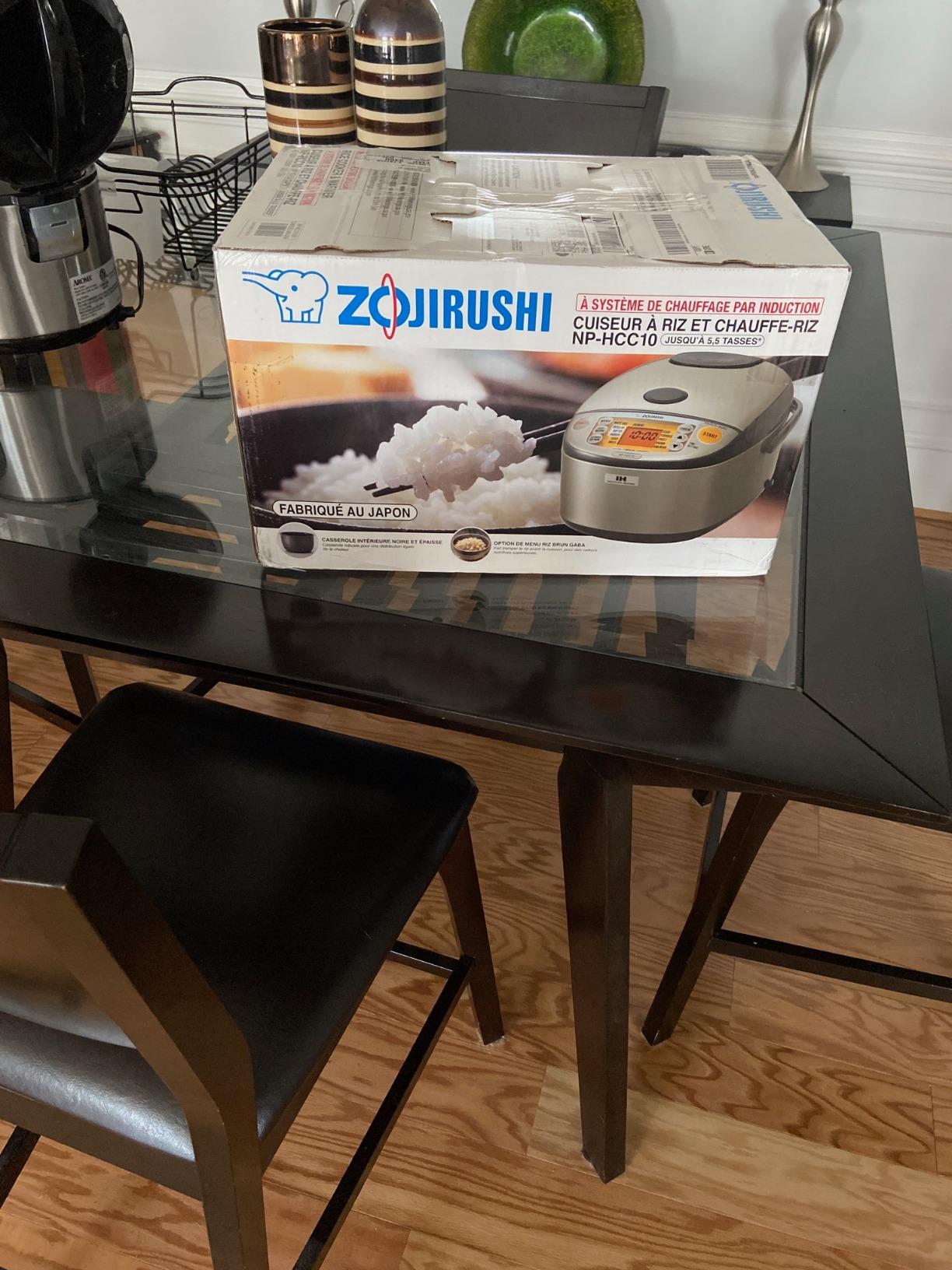
3. Zojirushi NP-HCC10XH – Best Induction Heating for Brown Rice Texture
Zojirushi NP-HCC10XH Induction Heating System Rice Cooker and Warmer, 5.5-Cup, Stainless Dark Gray
1,230 watts induction
5.5-cup capacity
Brown, GABA and germinated rice menus
BPA-free pan
Pros
- Induction heating delivers even
- responsive temperature control
- Dedicated brown
- GABA brown and germinated brown rice programs
- Automatic and extended keep-warm modes
- Two delay timer settings
- BPA-free nonstick thick metal pan and stainless steel inner lid
Cons
- Highest price point among the cookers in this roundup
- Small 5.5-cup capacity
- Must use the included measuring cup for correct results
Induction heating is the technical headline here, and it is not marketing filler. Instead of heating a coil and hoping the heat spreads up through the pot, the machine creates heat inside the pan itself, so the response is immediate and the temperature is genuinely controlled rather than inferred. Our brown batches came out with the most uniform grain-by-grain texture of any non-pressure machine in this guide.
The menu is also the most brown-focused of any cooker we looked at. Beyond a standard brown setting it includes GABA brown and germinated brown programs, which hold the grain in a warm soak phase before cooking to encourage the amino acid and resistant starch changes people associate with brown rice. A poster on a Taiwanese food forum described exactly that effect, saying the brown setting genuinely improved the taste by activating something inside the grain.
What induction actually changes on a long cook
Brown rice is a long cook, and long cooks are where heating method matters most. A conventional heating plate reacts slowly and its temperature drifts as the pot and room cool down, which over 90 minutes of cooking is a meaningful drift. Induction removes that variable almost entirely because the pan is the heat source.
The stainless steel inner lid also plays a part here. A metal lid returns condensation to the pot instead of letting it drip away, so the grain reabsorbs steam near the end of the cycle, which is what softens the bran layer right before the machine switches over.
Who should pay the premium, and who should not
Buy this one if you eat rice daily, if brown rice texture is the entire reason you are shopping, or if you want the GABA and germinated programs that no other machine in this guide combines with induction. Those three needs are the ones that justify the spend.
Skip it if you cook rice twice a month or if you need a large batch. Five and a half cups is a small pot by modern standards, and the measuring cup requirement means results depend on using the supplied cup, which is a small daily habit that some people never bother with.
4. Cosori 10-Cup Fuzzy Logic – Best Value Rice Cooker for Brown Rice
Cosori Rice Cooker 10 Cup, Fuzzy Logic, Ceramic Coating Inner Pot,18-in-1
10-cup capacity
18 cooking functions
1000 watts
Ceramic-coated inner pot
Pros
- 18 cooking functions including textured white and brown rice
- Fuzzy logic auto-adjusts a 7-step cooking process
- Ceramic-coated nonstick inner pot
- 24-hour keep warm and 24-hour delay timer
- Dishwasher-safe accessories including steamer basket
Cons
- Large 10-cup body takes up notable counter space
- Menu-dense control panel takes some getting used to
- Ceramic coating can be more fragile than bare metal pots
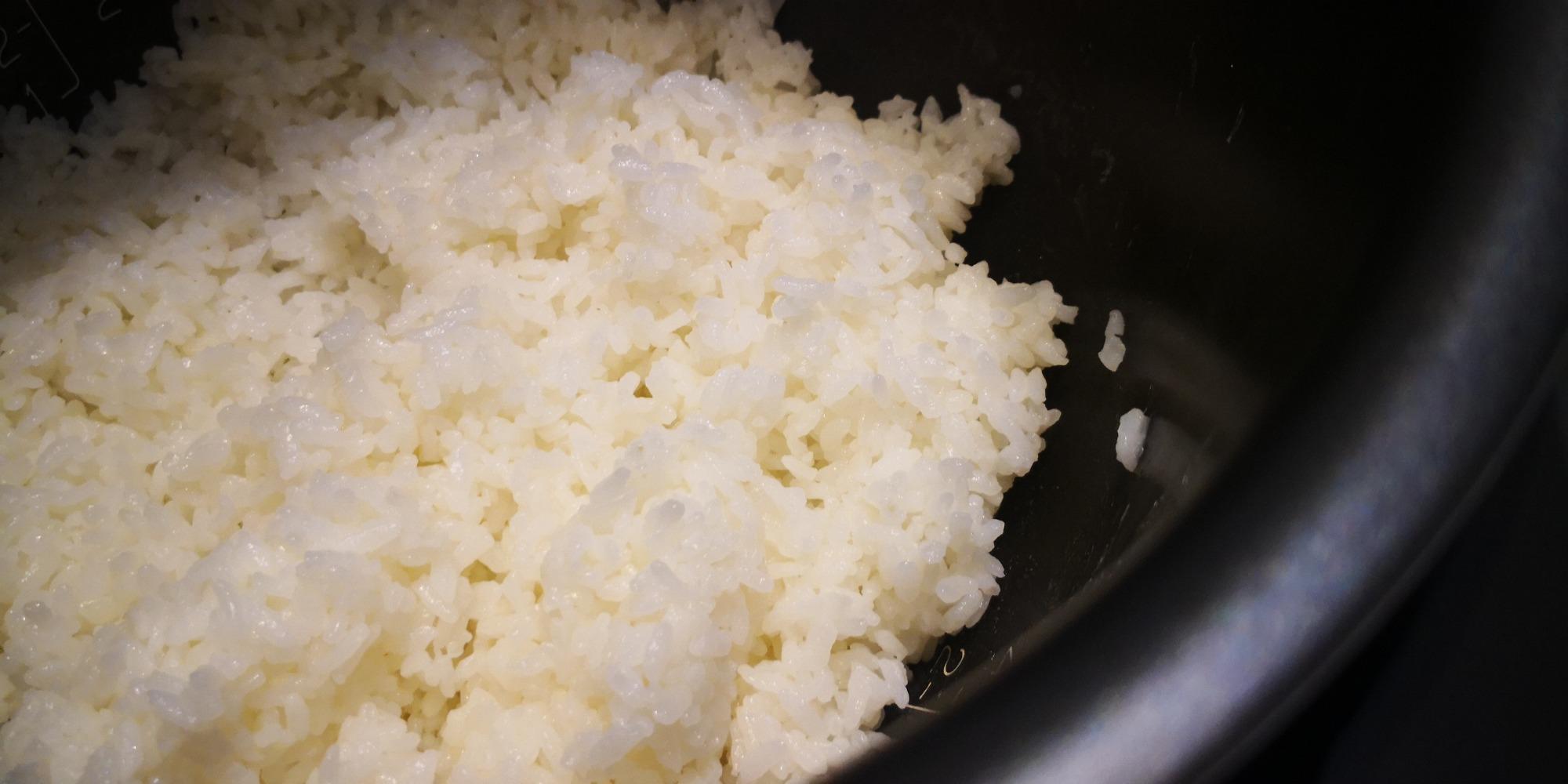
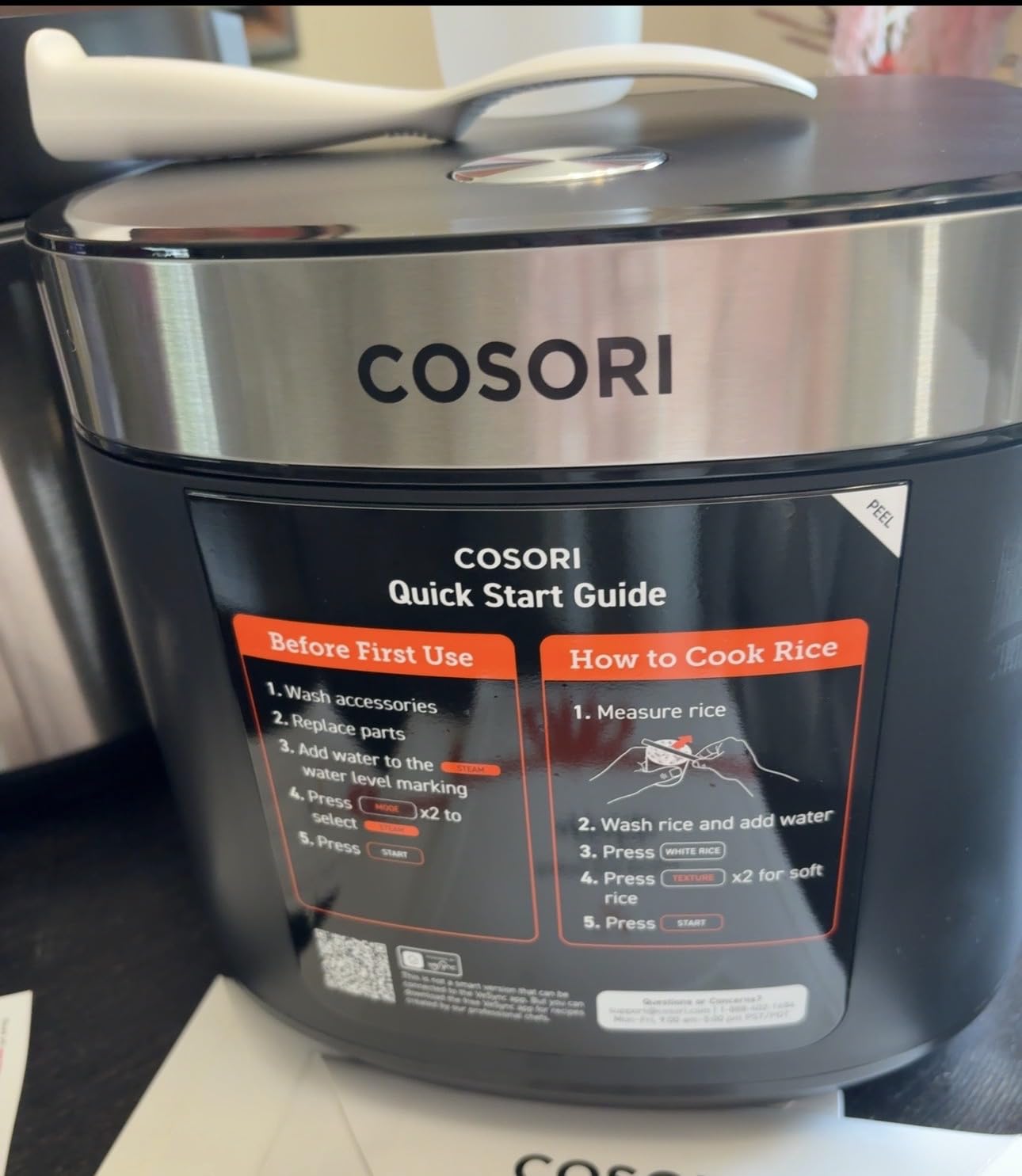
This is the value answer in the guide, and it earned the highest average rating of any machine we ran. The brown rice program uses the same fuzzy logic seven-step adjustment as the premium Japanese cookers, so the machine makes mid-cycle corrections rather than running a fixed timer, and our batches came out tender and well separated on a large 10-cup load.
Eighteen functions sounds like a lot of buttons, and it is, but the extras are genuinely useful beyond rice. Sauté, slow cook, three grain types, three oat types and steamed vegetables mean this machine covers porridge, quinoa and reheating without you reaching for another appliance.
Why the ceramic pot suits health-conscious buyers
The inner pot carries a ceramic coating, which is a different proposition from the standard nonstick pots used in the cheaper machines below. It contains no metal-based coating, and it wipes clean without a soak, so if you have been avoiding older nonstick cookware this is a straightforward middle path.
All the accessories are dishwasher safe, including the stainless steel steamer basket, so cleanup after a big grain batch is fast. The 24-hour keep-warm and 24-hour delay timer are both longer than most competing machines, which matters if you cook early in the morning or run dinner prep overnight.
The footprint and coating trade-offs
Ten cups uncooked is a large body, roughly 12.3 by 10.6 by 9.2 inches, and it needs real counter space and cabinet clearance above it. If you are working with a small kitchen, this is not the machine to buy and then resent.
The second honest drawback is coating longevity. Ceramic is more fragile than a bare metal or heavy nonstick pot, and it needs non-abrasive tools. We would not expect this machine to be passed down the way the stainless-bodied Zojirushi models tend to be.
5. CUCKOO CR-0675FG – Best Brown Rice Cooker for Large Households
CUCKOO Micom Fuzzy Logic Rice Cooker, 12-Cup Cooked, Gray, CR-0675FG
6-cup uncooked / 12-cup cooked
Micom fuzzy logic
10 cooking modes
Self-clean setting
Pros
- Fuzzy logic consistently produces evenly cooked
- non-burnt rice
- 10 cooking modes covering white
- brown
- glutinous rice
- oats and baby food
- Self-clean cycle plus detachable parts that hand-wash in seconds
- Rarely boils over even with starchy rice
- Quick-rice mode useful for smaller portions
Cons
- Spring-loaded lid snaps open hard and can strike an overhanging cabinet
- Body is bulky and oversized for small households
- Condensation collects in the inner parts and must be dried out after each use
- No rice paddle holder included
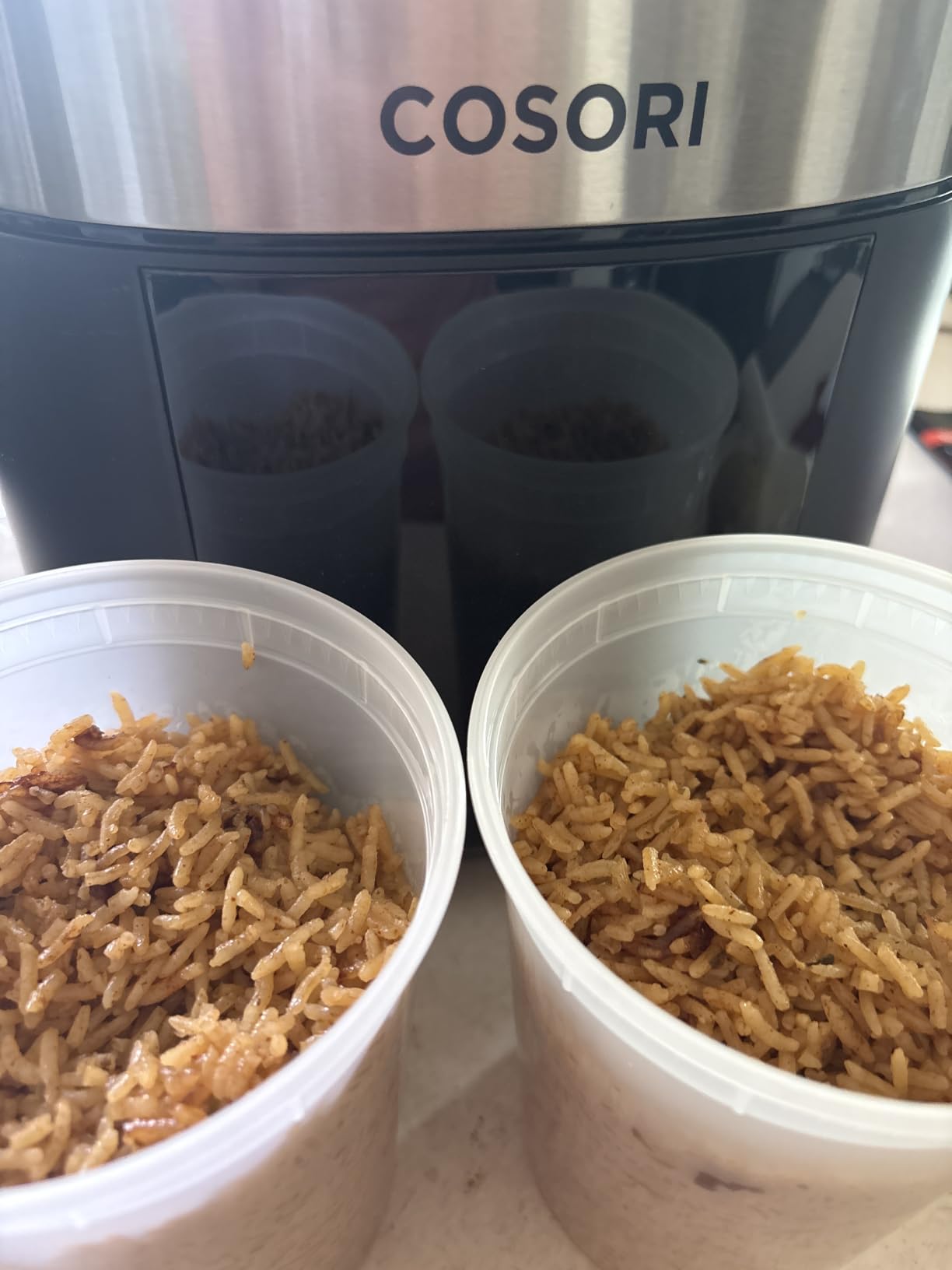
Six cups uncooked is the largest brown rice load in this guide, and if you are feeding four or more people regularly that capacity is the whole reason to look here. The fuzzy logic control handled a full pot without scorching the bottom, which is exactly where larger loads usually fail on cheaper machines.
Ten cooking modes cover white, brown, glutinous, oats and baby food, and the self-clean setting runs a steam cycle that loosens starch from the pot. Owners frequently mention that the fuzzy logic rarely burns rice, and that many of them upgraded from a simpler machine and immediately noticed the difference.
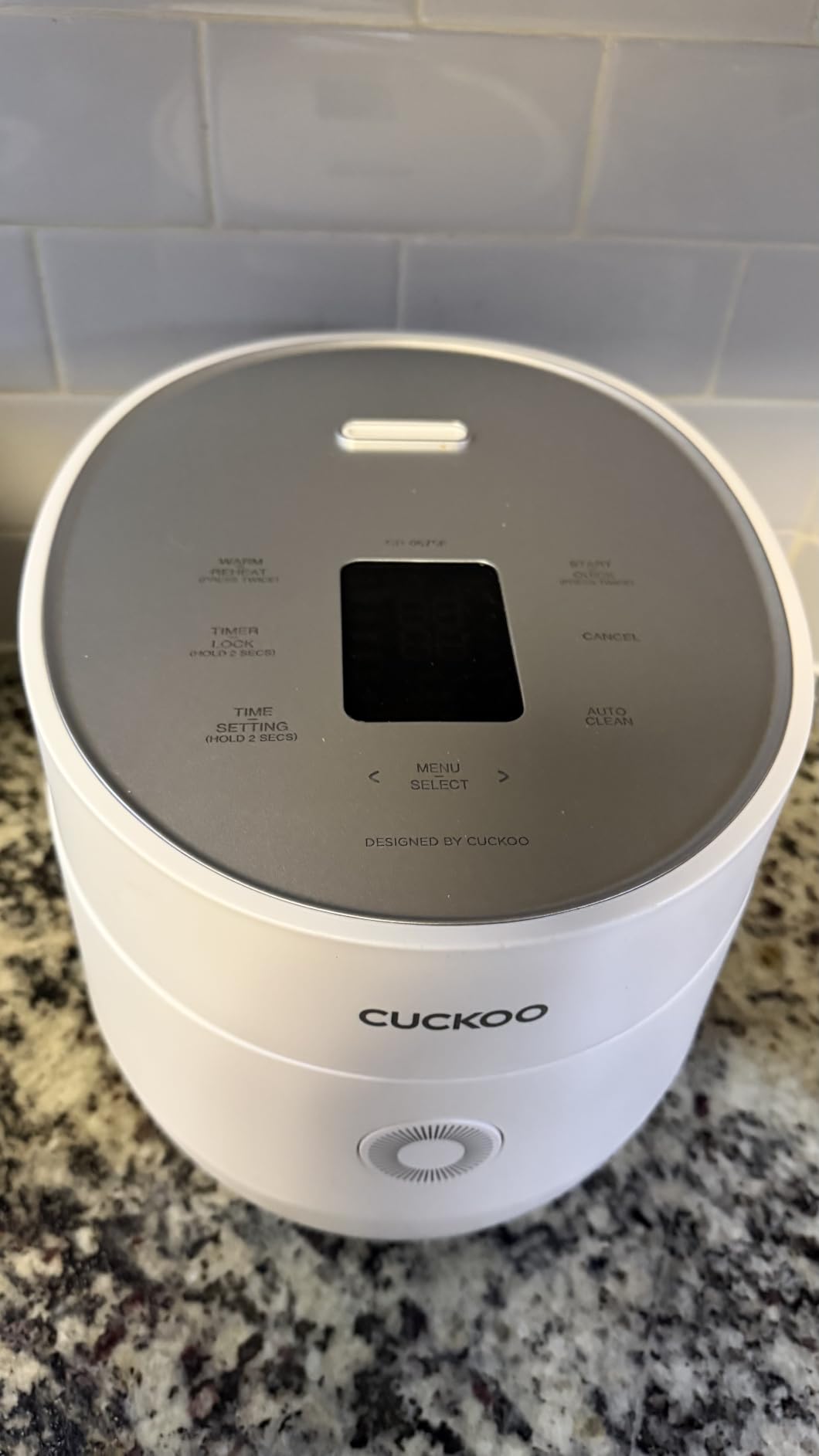
The brown rice setting on this model specifically
Use the brown mode rather than the quick setting, and give it the full cycle. Pressing the lid open partway or switching to a faster program mid-cook is the single most reliable way to end up with a hard center, and this machine is fast enough that people assume the quick path works. It does not, on brown.
The pot is removable and the lid detaches, so a large batch is not a chore to clean even though the body is plastic. A spatula and measuring cup come in the box.
The springy lid and the condensation problem
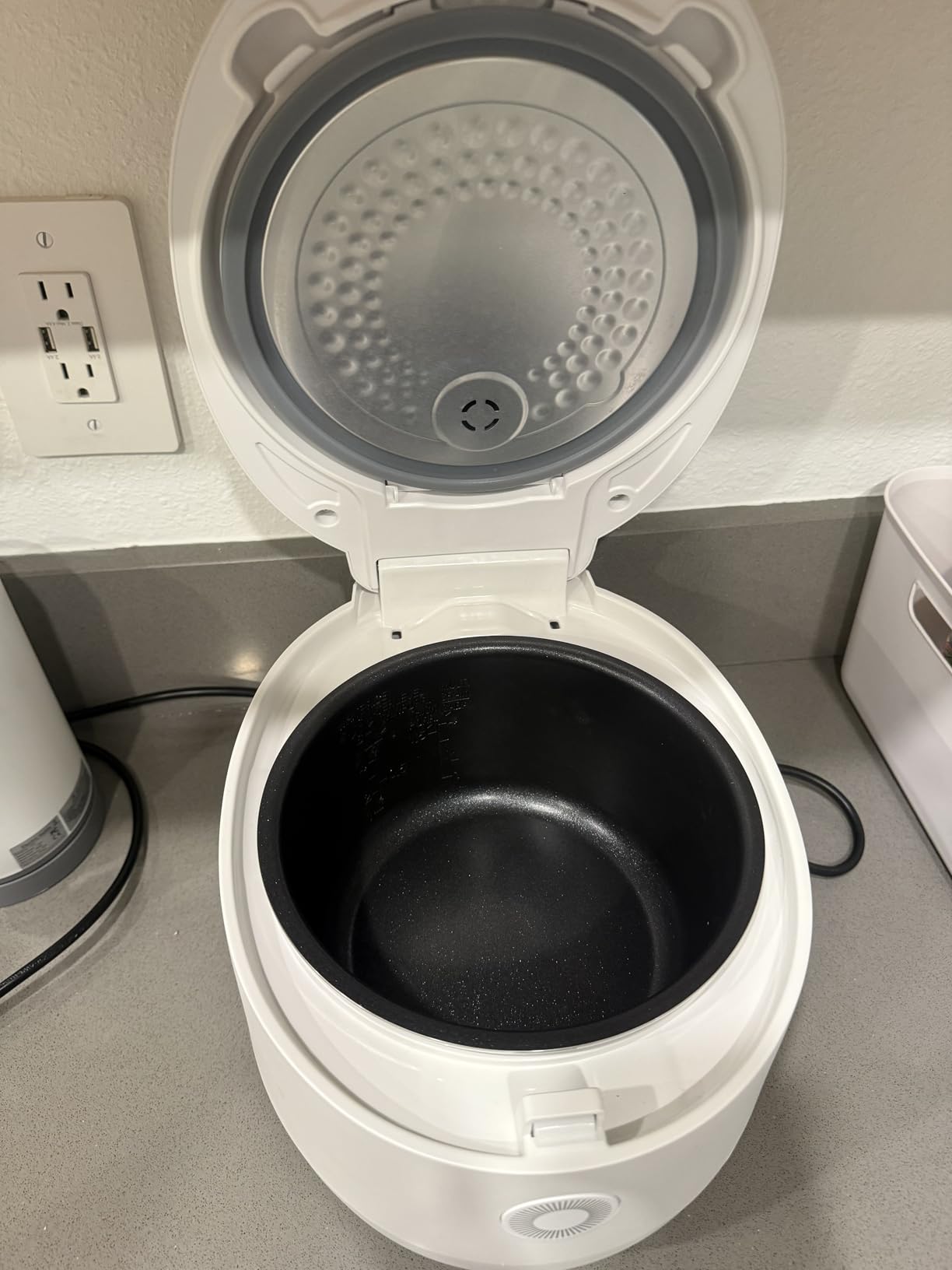
This is the most important thing to know before you buy. The lid is spring-loaded and snaps open forcefully, and owners report it striking an overhanging cabinet. Check the clearance above your counter before ordering, because it is an easy and completely avoidable mistake.
Condensation also collects in the inner parts after each cycle and needs to be dried out rather than left sealed, and the 4.3 average rating reflects a machine people clearly rate lower for physical design than for cooking results. The cooking is good; the housing and lid are the weak points.
6. Toshiba TRCS02 3-Cup – Best Small Rice Cooker for Brown Rice
Toshiba Mini Rice Cooker, 3 Cups Uncooked, for 1-3 People, Steamer and Warmer, Fuzzy Logic, One-Touch Cooking, 24-Hour Delay Timer, Auto Keep Warm, White
3-cup uncooked capacity
8 cooking functions
460 watts
24-hour delay timer
Pros
- Compact 3-cup body suits 1-3 people and small kitchens
- Dedicated brown rice program alongside 7 other functions
- Fuzzy logic moisture sensing adjusts time and temperature
- 24-hour delay timer plus keep warm and reheat
- Safety features including thermal fuse
- locking lid and automatic shut-off
Cons
- Small capacity means multiple batches for bigger households
- Inner pot is hand-wash only
- not dishwasher safe
- 470W-class heating is slower than larger units
This is the pick for a one or two person household, a first apartment, or anyone with genuinely limited counter space who still wants a real brown rice program. Eight functions include a dedicated brown setting alongside mixed grain, porridge, cake, egg, slow cook and quick cook, so it covers more than a plain white rice machine despite the small footprint.
The fuzzy logic here senses moisture content and adjusts time and temperature rather than running blind. At three cups the batch is small enough that a good result is easier to hit, and our brown rice came out tender without needing extra water beyond the marked lines.
What a small capacity really costs you
Three cups uncooked is about six cups cooked, which covers two or three generous servings. For one person cooking most nights, that is not a limitation, it is a feature, because rice kept overnight in a small pot loses less quality than a large batch you never finish.
If you regularly cook for a household of four or more, the arithmetic works against you. You would run two cycles, and given the 460-watt element, each cycle takes longer than it would in a larger machine. Owners describe the cooking as slower relative to bigger models, and that is accurate.
Safety and cleaning details worth knowing
There is a thermal fuse, an automatic shut-off and a locking lid, which is a reassuring set of features on a small appliance you might leave running while you are out. The 24-hour delay timer plus a reheat function makes scheduled cooking straightforward.
The inner pot is hand wash only. That is fine for a pot this size, since there is less to wash, but it does mean no dishwasher cycle on the part that matters most for coating care.
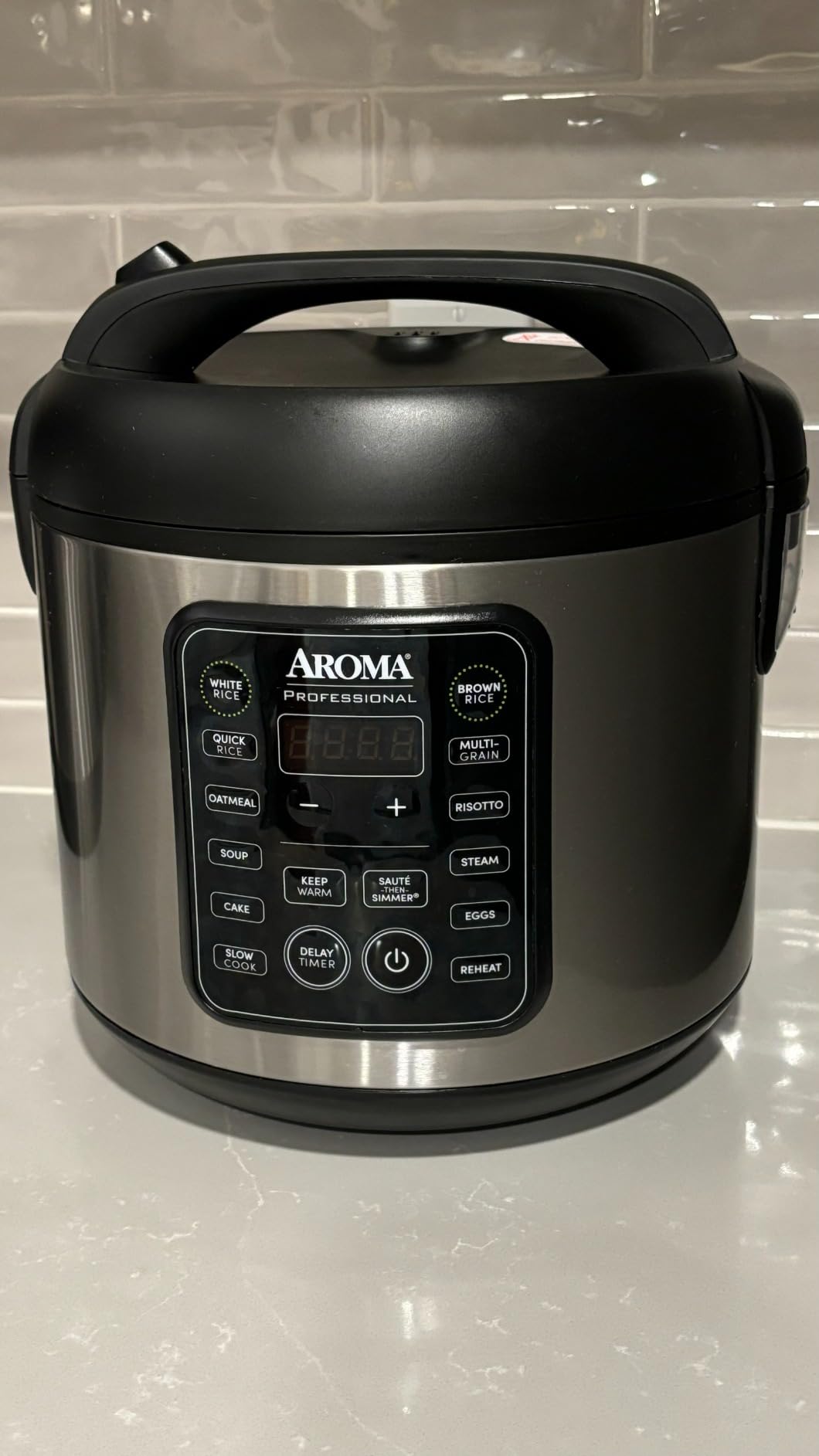
7. AROMA ARC-5204SB – Best for Brown Rice and a Side Dish in One Session
AROMA Digital Rice Cooker, 4-Cup (Uncooked) / 8-Cup (Cooked), 2 Qt, Steamer, Multicooker, Slow Cooker, Oatmeal Cooker, Auto Keep Warm, Stainless Steel Exterior
2-quart capacity
7 automated programs
450 watts
15-hour delay timer
Pros
- Brown rice is one of the dedicated automated programs
- Steamer basket lets a side dish cook above the pot simultaneously
- 15-hour delay timer with countdown display
- Pre-marked water lines and nonstick pot simplify measuring and cleanup
- Slow cook
- risotto and oatmeal modes add versatility
Cons
- 4-cup uncooked capacity is small for families
- Plastic lid is less durable than stainless
- Basic on/off heating can need manual water-ratio adjustments
Brown rice is one of seven automated programs here, and the thing that makes this machine interesting for a weekly meal is the built-in steamer. You cook the brown rice in the pot and a vegetable or fish side above it at the same time, so one cycle produces a full plate instead of just a bowl of starch.
Owners highlight the reliable brown rice output, the two-level steaming, and the fact that the controls are straightforward. The pre-marked water lines on the pot are a small touch that removes a whole category of guesswork for first-time cooks.
When you need to adjust the water ratio yourself
This machine uses straightforward on and off heating rather than a fuzzy logic correction system, so it will not fine-tune itself if your grain or your kitchen is unusual. If your brown rice comes out firm, add a couple of tablespoons of water beyond the line. If it comes out wet, go slightly under.
That is a real difference in effort compared with the fuzzy logic machines above. For most people the marked lines are enough, and if you are confident adjusting ratios by feel you will get good results quickly.
What to plan around
Four cups uncooked and eight cooked is a two to three person batch. The plastic lid is the part to inspect after a year of daily use, since it is the least durable component here, and hand washing is required.
The 15-hour delay timer with a countdown is longer than most competing units, and combined with the slow cook, risotto and oatmeal modes, this is a versatile small machine for the money.
8. COMFEE’ CRS2010BS – Best Brown Rice Cooker for Easy Cleaning
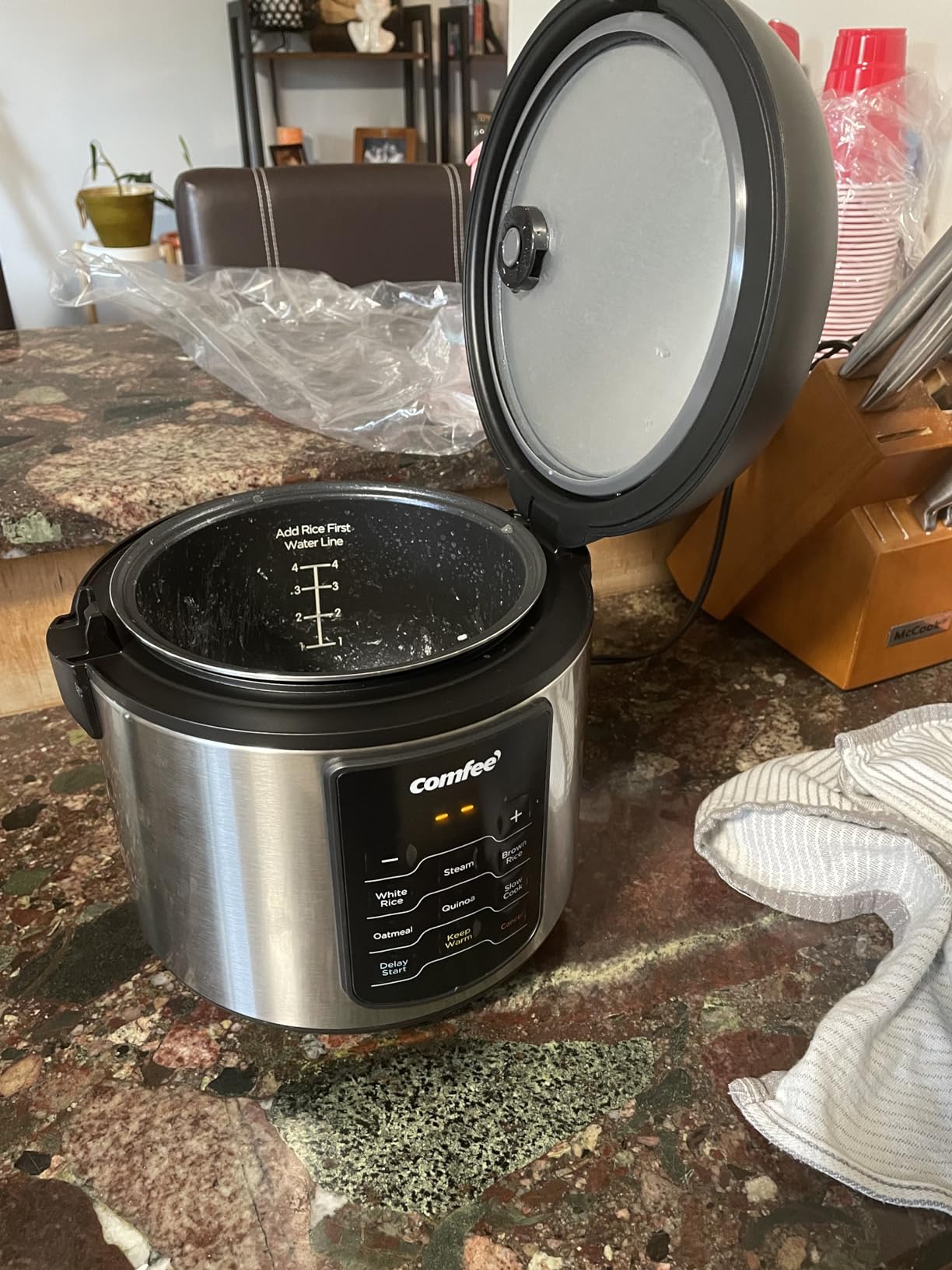
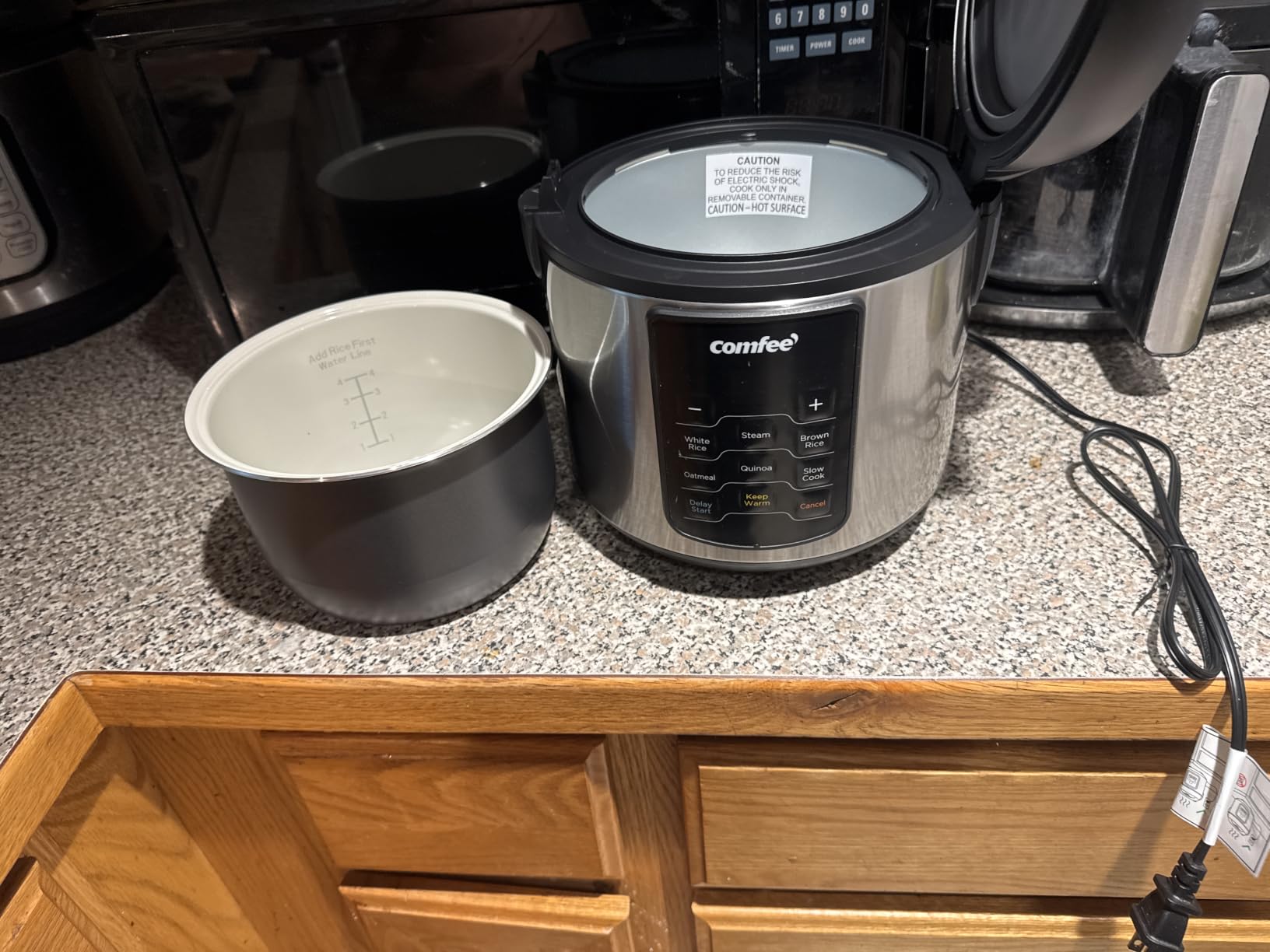
COMFEE’ Rice Cooker with 6 Functions, 4-Cups Uncooked Rice
4-cup uncooked / 8-cup cooked
6 digital programs
450 watts
Dishwasher-safe pot
Pros
- Dedicated one-touch brown rice program among 6 presets
- Compact 4-cup uncooked footprint suits small households
- Inner pot and all accessories are dishwasher safe
- 12-hour keep warm and 12-hour delay timer
- Overheating protection
- BPA-free materials and cool-touch handle
Cons
- Basic on/off cooking with no fuzzy logic
- Small capacity relative to family-sized needs
- Quinoa and other grain programs are secondary to rice performance
The dishwasher-safe pot is the headline feature, and for a household that cooks grains several times a week it removes the most irritating chore in the category. Everything, pot and accessories included, goes straight into the dishwasher, which no other machine in this guide offers.
Brown rice is a one-touch preset among six digital programs, alongside white rice, steam, slow cook, quinoa and oatmeal. Owners generally find that preset reliable for the money, and the 12-hour keep warm and 12-hour delay timer cover most scheduling needs.
What you give up compared with a fuzzy logic machine
There is no fuzzy logic here. The heating is a simple on and off cycle with a sensor-based switch, so it will not correct mid-cook if your batch needs more time. With a consistent grain and the same water ratio each time, the results are repeatable, but you are the variable, not the machine.
It also carries BPA-free food grade materials, overheating protection and a cool-touch handle, which is a sensible safety set for a machine you might reach for with wet hands.
Capacity and secondary programs
Four cups uncooked yields up to eight cups cooked, which suits one to three people. Owners who want to cook for a larger household report outgrowing it quickly, and that is the most common limitation mentioned.
Treat the quinoa and oatmeal programs as secondary. The machine is a rice cooker first, and buyers with specific grain expectations tend to be happier with it than people expecting a general multicooker.
9. BLACK+DECKER RC506 – Best Budget Rice Cooker That Still Cooks Brown Rice
BLACK+DECKER 6-Cup Rice Cooker with Steaming Basket
6-cup cooked / 3-cup uncooked
300 watts
Removable nonstick bowl
Automatic keep warm
Pros
- Largest review history in the group with over 37000 ratings
- Removable dishwasher-safe nonstick cooking bowl
- Included steaming basket
- measuring cup and serving spoon
- Automatic keep warm after cooking
- Lightweight 2-pound body that stores easily
Cons
- Water-level markings are pressed into the bowl and hard to read
- Rice left on warm for over an hour hardens and sticks to the pot
- Nonstick coating can chip with long use and rice can stick
- Only a 300W element so cook times run long
- Steaming space beyond rice is very limited
With more than 37000 ratings, this is the most proven machine in the guide by sheer volume of long-term use, and it does cook brown rice competently on a dedicated cycle. For a first appliance or a spare unit in a guest room, it is hard to argue with the simplicity.
It also happens to be the smallest and lightest body here at two pounds, which means you can put it away when you are not using it instead of losing counter space permanently. The removable nonstick bowl goes in the dishwasher, and the basket, cup and spoon are all included.
Where the low cost shows up in use
The 300-watt element is the core limitation. Brown rice takes a long cycle on any machine, and on this one it takes longer, so plan around it rather than expecting the quick results a larger element delivers.
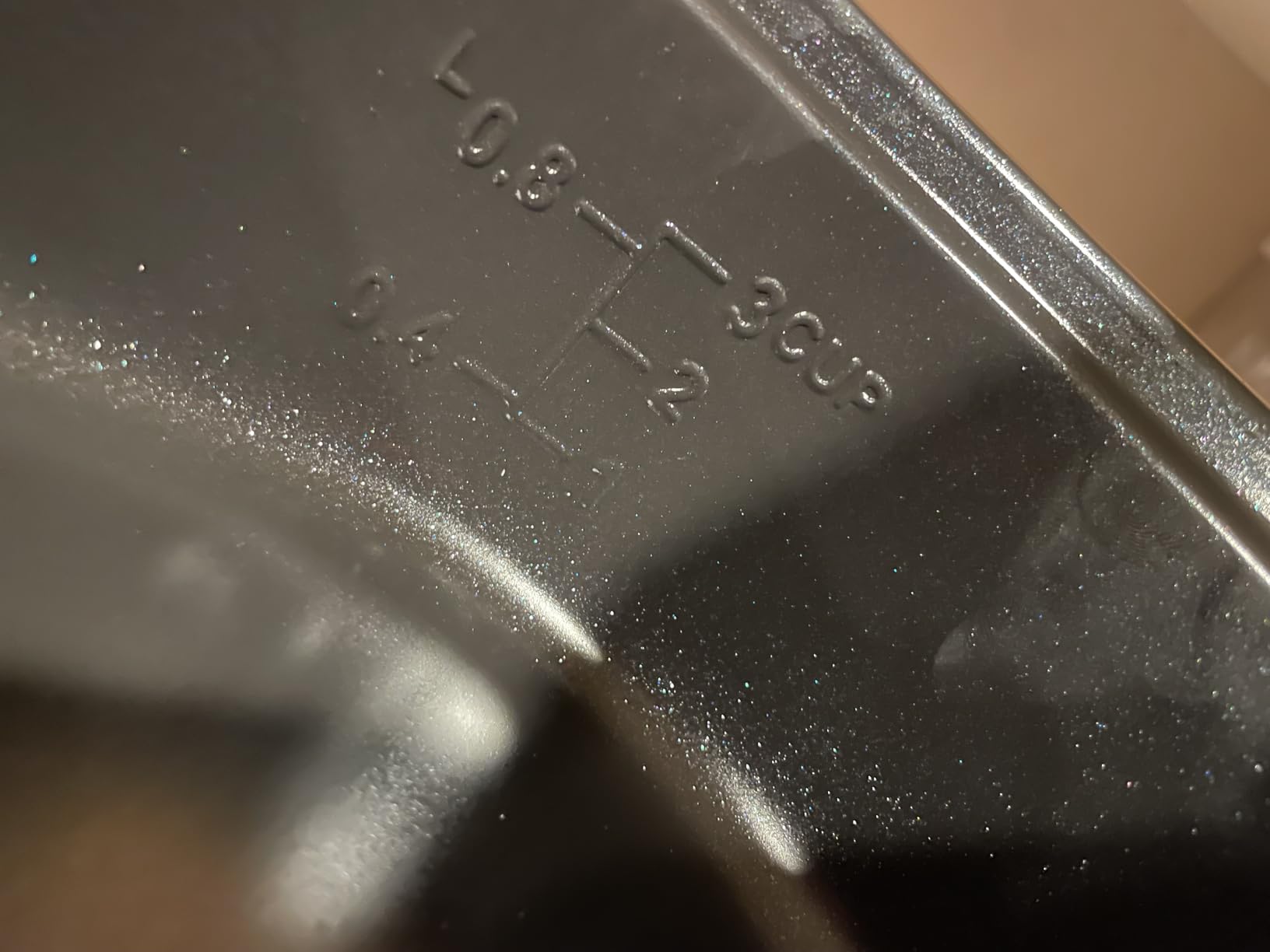
The water-level markings are pressed into the bowl and hard to read, which is an annoying detail on the machine you will use to measure water most often. Plan on the supplied three-quarter cup as your actual measuring tool.
The keep-warm problem you should know about
Owners report that rice held on warm for over an hour hardens and sticks to the pot. That is the single biggest reason not to buy this machine if you cook well ahead of mealtime, and it is a different failure mode from the mushiness people describe on other budget models.
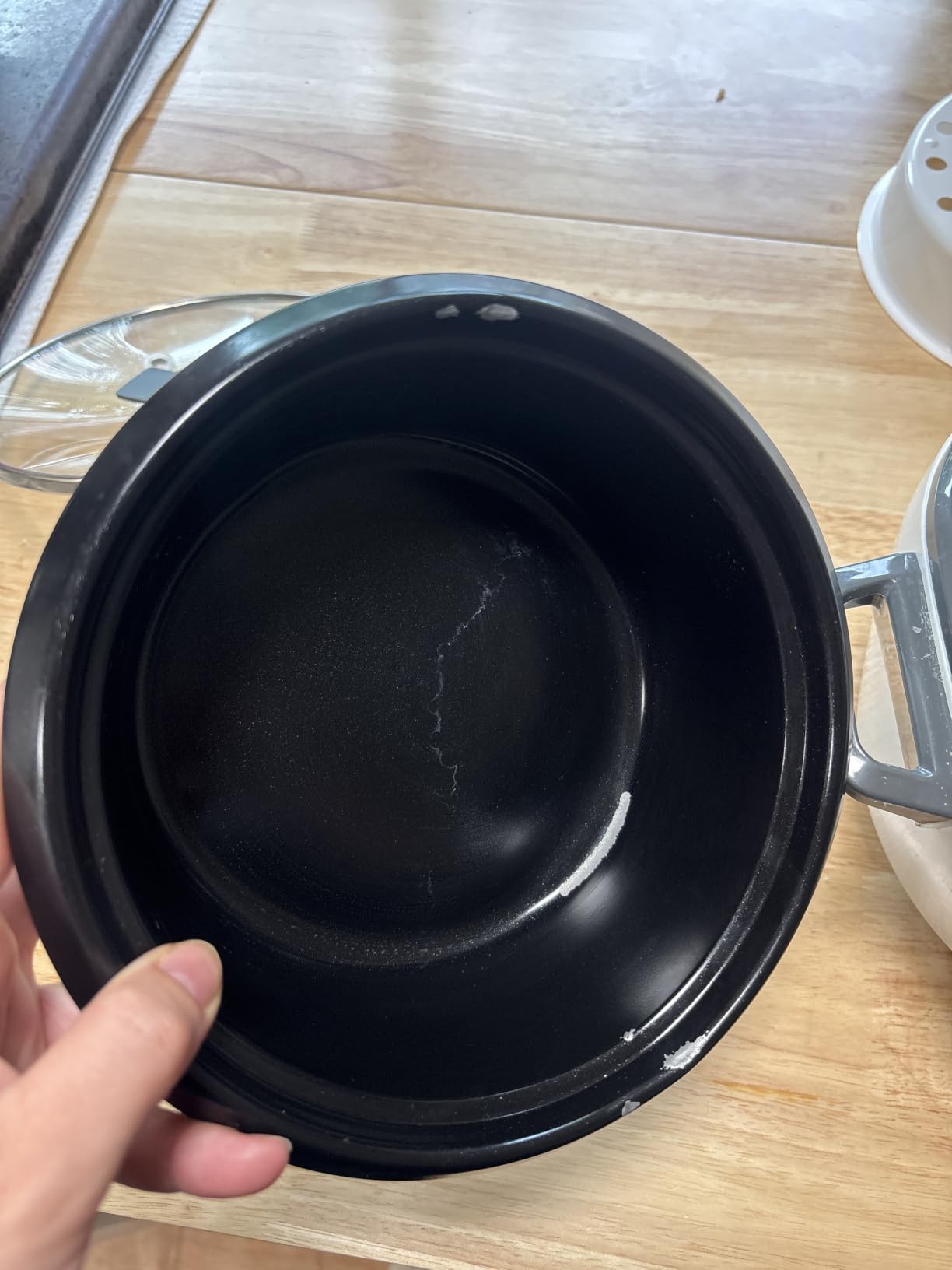
The nonstick coating can also chip with long daily use, and steaming capacity beyond the rice itself is minimal. For occasional use by one or two people, those are acceptable. For daily cooking, they are not.
10. AROMA ARC-5200SG – Best Big-Batch Rice Cooker With a Brown Rice Mode
AROMA Professional Digital Rice Cooker, 10-Cup (Uncooked) / 20-Cup (Cooked), Multicooker, Slow Cooker, Steamer, Oatmeal Cooker, Egg Cooker, STS, 5 Qt, Gray, ARC-5200SG
10-cup uncooked / 20-cup cooked
15 digital modes
860 watts
5-quart body
Pros
- 15 cooking modes including a dedicated brown rice setting
- Large 10-cup uncooked and 20-cup cooked capacity serves big batches
- Stack-in BPA-free steamer basket cooks a side above the rice
- Bonded nonstick pot handles risotto
- oatmeal and steamed cake without sticking
- Countdown display with delay timer
Cons
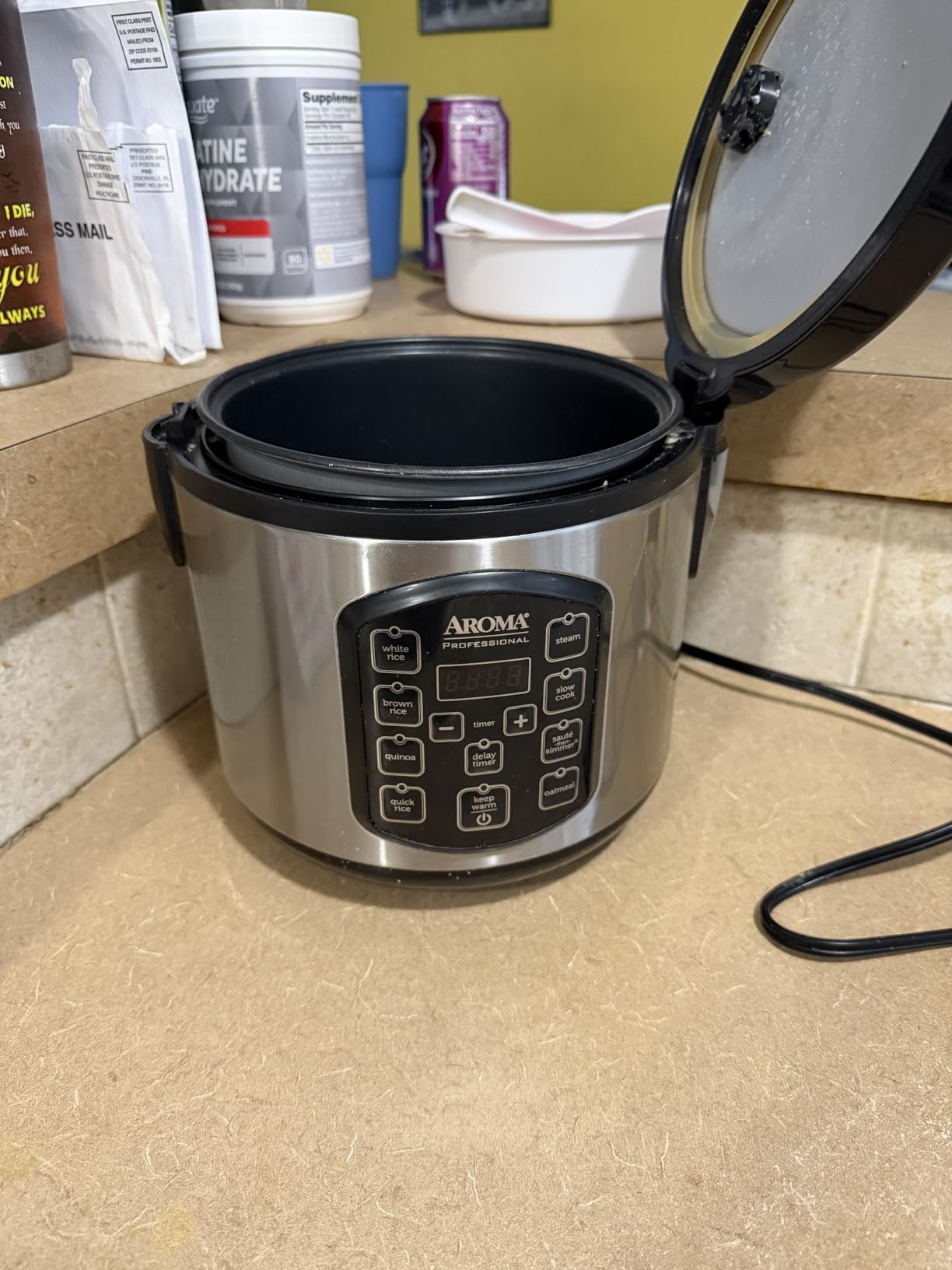
- Bulky 5-quart body takes significant counter space
- Nonstick pot is hand-wash only
- Many modes can be overwhelming on first use
Ten cups uncooked is a genuinely large brown rice batch, and this machine pairs that capacity with a dedicated brown setting rather than making you improvise on a multigrain setting. If you meal prep on Sundays or cook for a large family, the size is the entire appeal.
Fifteen pre-programmed modes cover white rice, brown rice, multi-grain, saute-then-simper, steam, reheat and slow cook. The bonded nonstick pot is rated for risotto, oatmeal and steamed cake, and the BPA-free steamer basket stacks inside the lid so it does not eat counter space when you are not using it.
Does a bigger pot change the brown rice result?
A larger pot can hold heat longer, which is helpful for brown rice because the gentle phase lasts longer. It can also heat a big batch more slowly, so allow extra time on a full 10-cup load and resist the urge to open the lid early.
The 860-watt element sits in the middle of this group, faster than the small 300-watt units and the 450-watt compact models, slower than the 1000-watt Cosori. In practice a full brown batch on this machine is a planned activity rather than a last-minute one.
Plan for the counter space
At 11.25 by 10.75 by 11.25 inches, this is a tall body and the single most common complaint in reviews. Make sure you have vertical clearance under a cabinet, not just counter area, before you commit.
Care is hand wash only for the pot, and the 15 modes take a little getting used to. Owners who live with the menu report the extra programs become the reason they keep the machine, particularly the slow cook and steam functions.
11. AROMA CoreCoat ARC-914SBDC – Best PFAS-Free Rice Cooker for Brown Rice
AROMA® CoreCoat™ Digital Rice Cooker & Steamer for Brown Rice with Nonstick Ceramic Coating (8 Cups Cooked, 4 Cups Uncooked)
4-cup uncooked / 8-cup cooked
CoreCoat ceramic coating
500 watts
Sensor Logic
Pros
- PFOA- and PFAS-free nonstick ceramic coating that wipes clean
- Brown rice is a headline mode along with quinoa and bulgur
- Sensor Logic delivers consistent texture across grain types
- 15-hour delay timer and a flash-rice mode
- Compact 4-cup uncooked body that stores easily
Cons
- Ceramic coating requires a small brush to clean the rim edges
- Smallest review base in the group with only 279 ratings
- Brown rice may not expand as much as on larger units
- Hand-wash care only
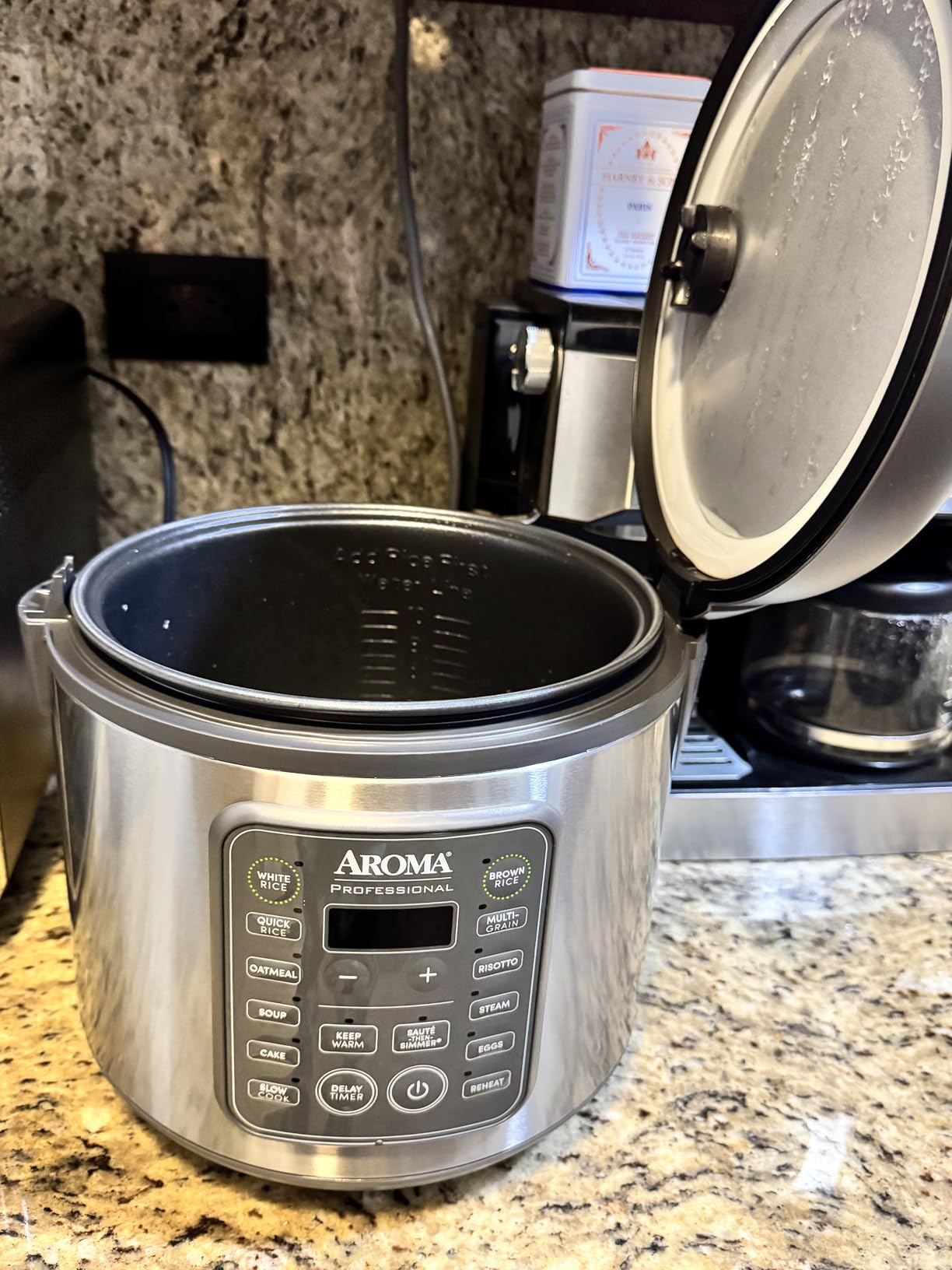
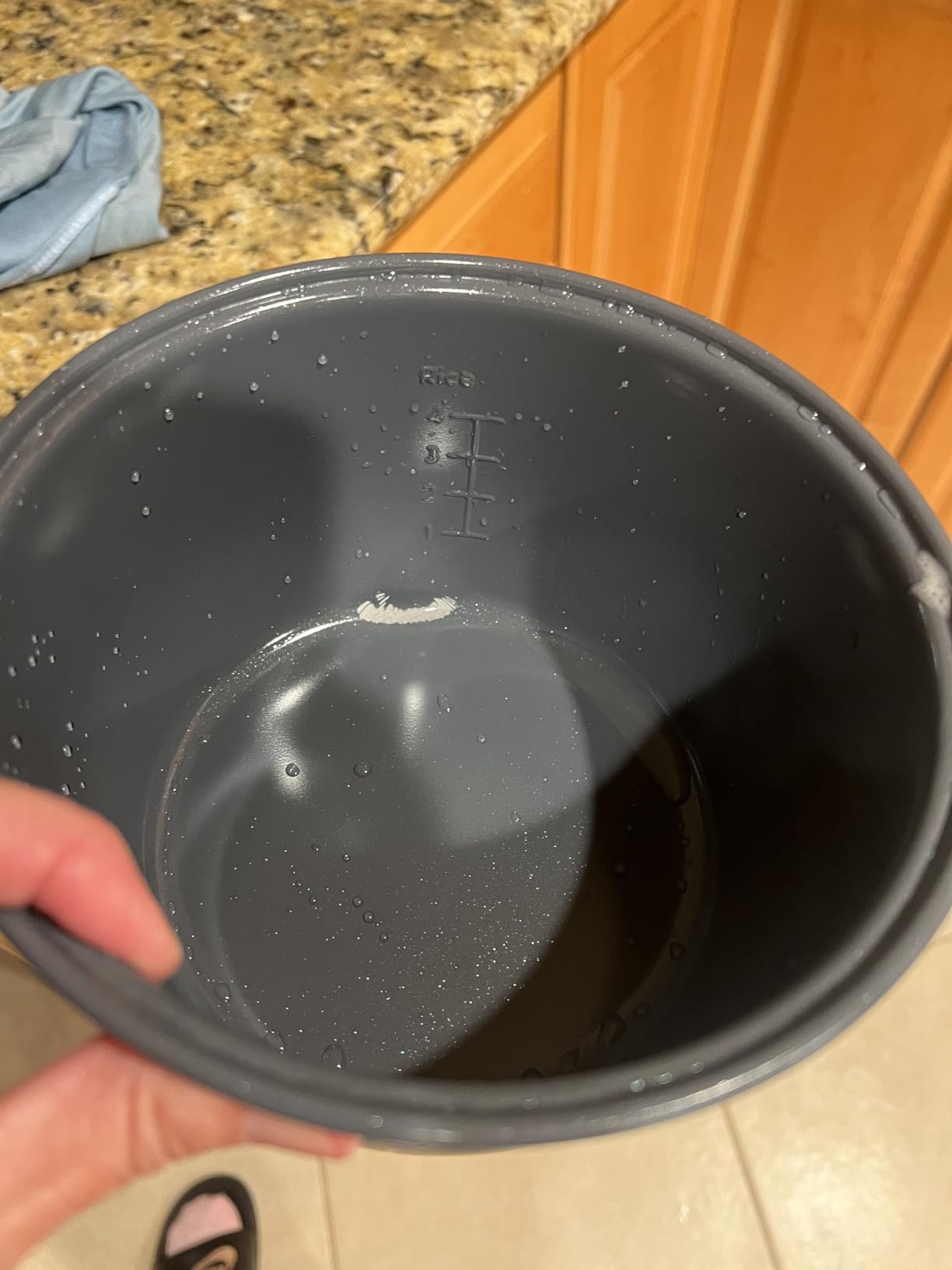
If the reason you are reading a brown rice guide is a shift toward whole grains, you may also be looking at what the pot is made of. This model uses a CoreCoat nonstick ceramic coating that is free of PFOA and PFAS, which is the coating question most often raised alongside brown rice in owner discussions.
Brown rice is a headline program rather than an afterthought, and Sensor Logic cooking handles white rice, brown rice, quinoa and bulgur on the same machine. A few buyers note the brown rice does not expand as much as it does on the larger models, which is worth knowing if you like fluffy, voluminous grain.
Reading this review base honestly
With 279 ratings, this is by far the thinnest review history in the guide, and we would rather say so than pretend otherwise. The 4.5 average is encouraging, and the owners who did report in describe consistent results and an easy-clean pot, but you are buying with less long-term data than with any other machine here.
That is the honest trade-off. You get a coating choice you may prefer and a 4-cup body that stores easily, in exchange for knowing less about how it holds up over years.
Cleaning and everyday use
The ceramic coating wipes clean in most cases, but the rim edges need a small brush to get right, so expect a slightly longer clean than the dishwasher-safe machines in this guide.
Beyond rice it simmers chili, cooks oatmeal and pasta, and reheats soups, and the 15-hour delay timer with a flash-rice shortcut makes scheduling flexible. Care is hand wash only.
12. CUCKOO CR-0632F – Best Cuckoo for GABA Brown Rice and Quick Cycles
CUCKOO Micom Fuzzy Logic Rice Cooker, 12-Cup Cooked, Silver, CR-0632F
6-cup uncooked / 12-cup cooked
Micom fuzzy logic
580 watts
9 menu options
Pros
- Fuzzy logic produces consistent
- evenly cooked rice
- Nine menu options including GABA and multigrain/brown rice
- Detachable inner lid and drainage tray make cleaning simple
- 13-hour preset timer plus a 33-41 minute quick-rice mode
- Durable nonstick inner pot that resists scratching
Cons
- Plastic lid and aluminum body look less premium than the price implies
- Bigger footprint than smaller capacity cookers
- Hand-wash care required
- Instruction manual needs improvement for less experienced users
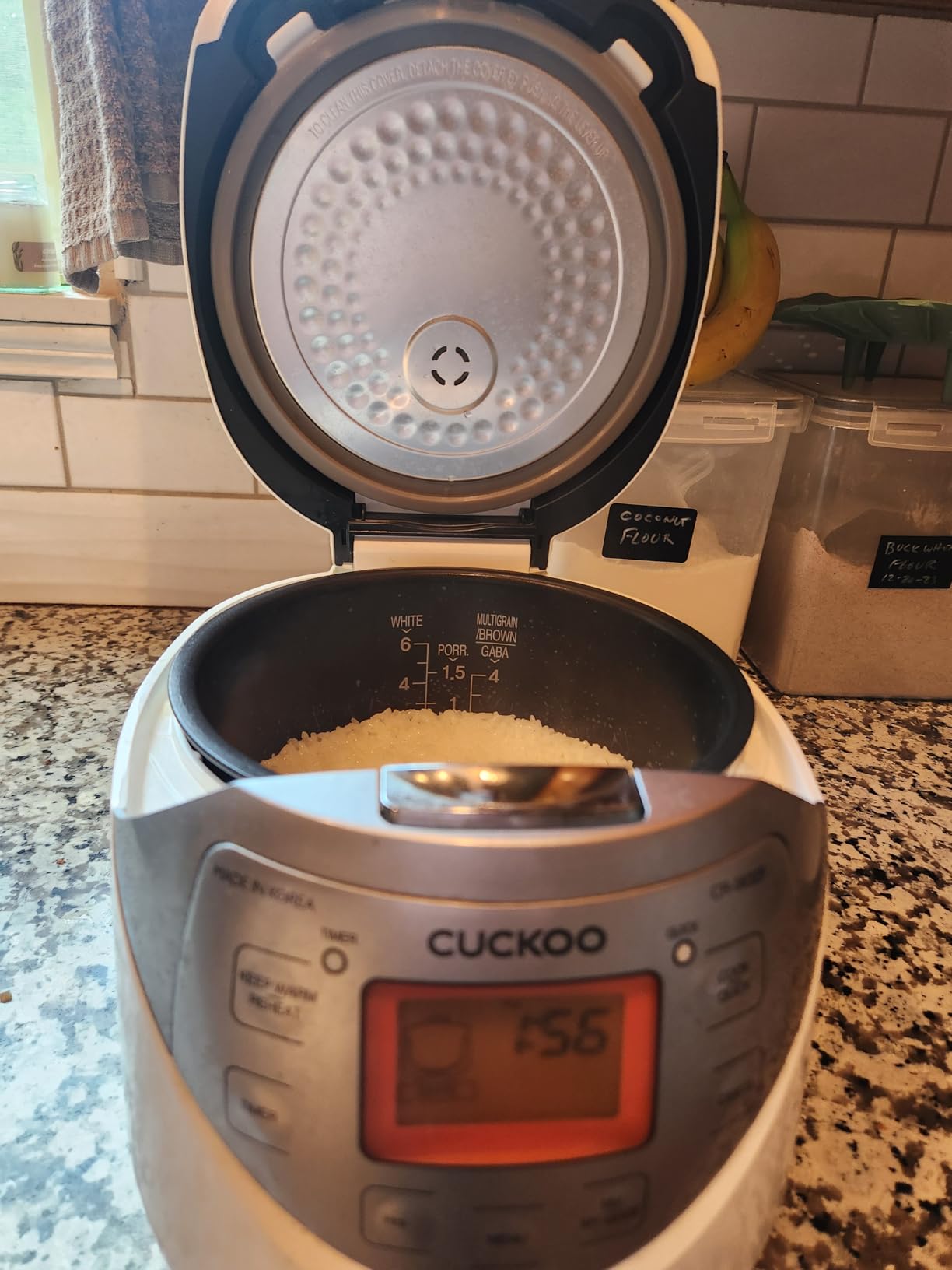
This is the Cuckoo model that answers the most common question on the major cooking forums, which is whether you should use a dedicated brown setting or a multigrain setting. Use the multigrain and brown option; it is the one tuned for long-grain brown, and the fuzzy logic control kept our batches tender.
It also carries a dedicated GABA rice program alongside white, porridge, slow cook, reheat and multi-cook, which is the option people chasing the amino acid and resistant starch angle look for on this brand. The 13-hour preset timer and 33 to 41 minute quick-rice mode give you both a scheduled long cook and a fast short one.
Cleaning details that are genuinely better than most
The detachable inner lid and the excess water drainage tray are the parts that usually get skipped, and skipping them is what causes the condensation problems owners report with other cookers. Pulling the lid off and rinsing it after each use is quick and keeps the machine in better shape over time.
Twelve cups cooked makes this a gathering-sized machine, and the nonstick pot is described by owners as resisting scratching, which matters for longevity.
What to expect from the hardware
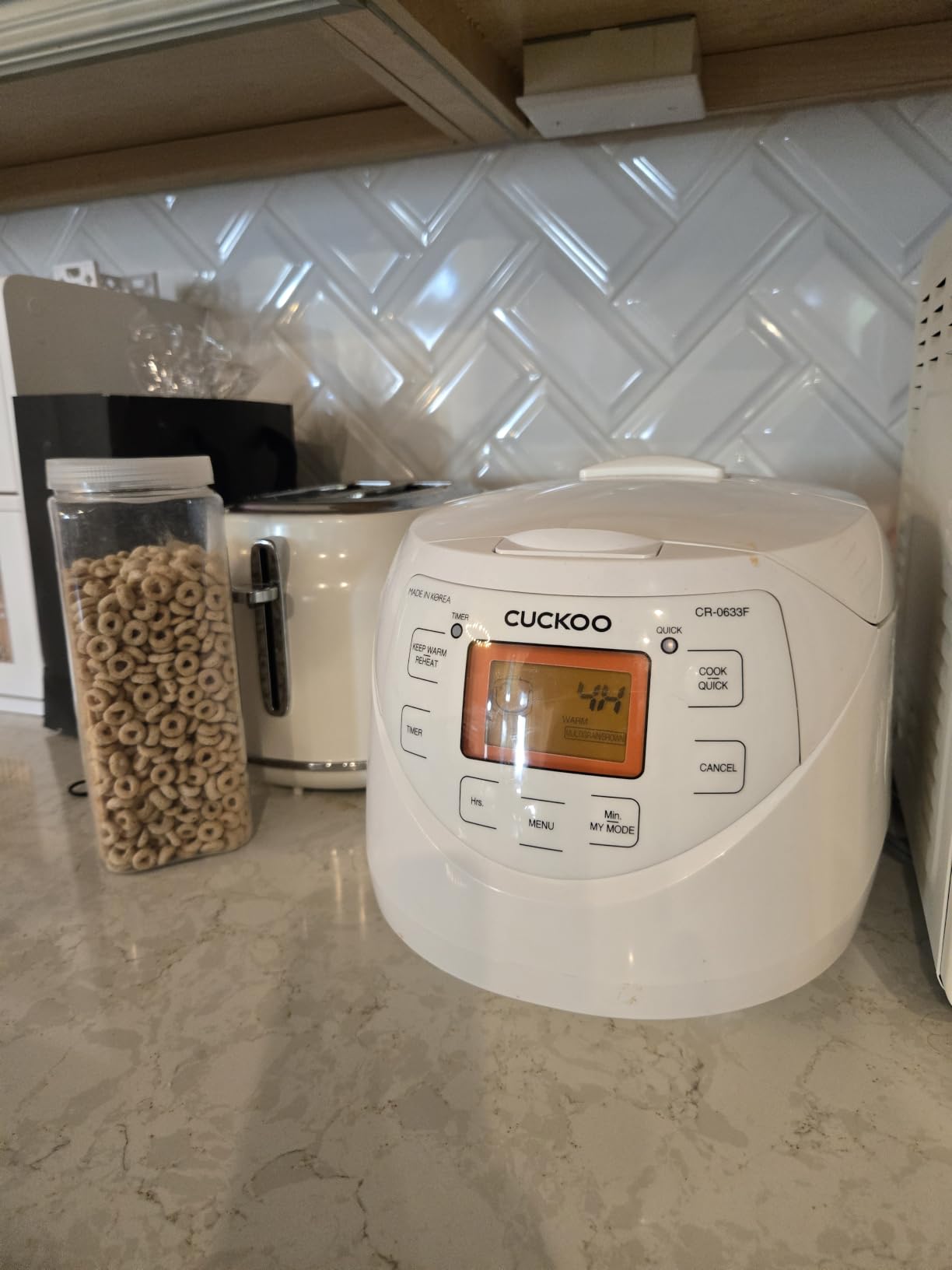
The body is aluminum with a plastic lid, and owners note that it does not look or feel as premium as the price implies. The footprint is also larger than smaller cookers, so measure your counter before ordering.
Hand washing is required, and the instruction manual is the weakest part of the package. If you are new to fuzzy logic rice cookers, spend ten minutes with the manual before your first batch, because the menu combinations are not obvious.
How to Cook Brown Rice in a Rice Cooker
Even a great machine produces mediocre brown rice if the ratio is wrong. This is the routine we used for every batch in this guide, and it works across brands because it accounts for the bran layer rather than ignoring it.
- Measure and rinse. Use the measuring cup your cooker came with where the manual specifies it, and rinse the grain under cool water until the water runs mostly clear, usually four or five changes. This washes off surface starch and is the difference between separate grains and a sticky clump.
- Soak for 20 to 30 minutes if you want softer grain. Soaking gives the water a head start on penetrating the bran. It is optional, but it is the single most effective change for people who find brown rice chewy rather than tender, and it costs you half an hour of passive time.
- Set the water ratio deliberately. Start at 1.5 cups of water per cup of long-grain brown rice, and add about a quarter cup more for short-grain or older grain. Many people consistently under-measure water, which is the most common cause of crunchy rice.
- Use the brown setting, not the quick setting. On any machine with a dedicated brown, whole grain or multigrain program, choose that one. Never substitute a quick white rice cycle for brown rice, and do not open the lid during the cook, because every opening drops the temperature and stalls the softening phase.
- Let it rest before you open the lid. When the machine switches to keep-warm, give the batch ten minutes. The residual heat and steam continue to soften the bran, and opening immediately is how you get a firm, undercooked center.
- Fluff from the bottom. Break the batch apart with the paddle from the bottom rather than stirring the top, which compresses the middle into a dense layer. Taste one grain before serving, and if it is still hard, add a splash of hot water and switch back to warm for ten more minutes.
Brown rice is also less forgiving of overcooking than white rice, because the bran continues to absorb moisture and harden. If your machine has a reheat function, use it sparingly and keep reheats short.
Why Your Brown Rice Comes Out Crunchy
Crunchy brown rice is nearly always one of five specific problems, and identifying which one you have is faster than buying a new cooker. Work through these in order, because they are listed in the order they cause the problem most often.
- Not enough water. Brown rice needs about 1.5 cups of water per cup of grain, and most people pour less than they think. Add a quarter cup to a half cup of extra water on the next batch before you change anything else.
- Skipping the soak. A 20 to 30 minute soak lets water move into the bran before the heat phase begins. It reduces chew noticeably and it is free.
- Opening the lid too early. Peeking mid-cook drops the internal temperature and the machine compensates by ending the cycle on schedule, leaving the center undercooked. People do this constantly because the brown cycle is long and silence feels like a fault.
- Using the wrong setting. A white rice or quick cook cycle is not a brown rice cycle. If your machine has brown, whole grain, mixed, multigrain, GABA or germinated modes, use one of them rather than the plain white setting.
- Not letting it rest. Rice that is fluffed the instant the machine clicks over to warm is frequently still firm. Ten minutes of rest fixes a surprising share of crunchy batches on its own.
If you are still getting hard grains on a machine with fuzzy logic, replace the inner pot. A scratched or warping pot breaks the even heat transfer the machine depends on, and it is far cheaper to fix than to replace the cooker. Users of imported models should also check voltage and warranty coverage, since grey-market Zojirushi units may not carry US support or an English manual.
How to Choose a Rice Cooker for Brown Rice
A dedicated brown rice mode is the first filter. Every machine in this guide has one, and a model without a real whole-grain program will cook brown rice on a timer designed for white rice. That is the difference between consistent batches and guesswork.
Decide between fuzzy logic and plain on and off heating. Fuzzy logic and micro computerized sensors measure moisture and adjust mid-cycle, which takes the guesswork out of the ratio. Plain heating can produce good brown rice but leaves you adjusting water by feel, and that is exactly the adjustment most people get wrong.
Look at the heating type. Induction heating places the heat inside the pan and gives the most even results, which shows up clearly on a long brown cycle. A standard heating plate is fine if the fuzzy logic is good, and a triple heater design spreads heat around the pot from multiple directions.
Check keep-warm performance, not just that it has keep-warm. This is the number one long-term regret in this category. Budget machines commonly turn kept-warm rice mushy or dry the pot edge, and rice held on warm too long can harden and stick. Look for a separate extended keep-warm setting, and look for owner reports at six months rather than at one week.
Buy the capacity you will actually cook. Three cups uncooked suits one to two people, four to six cups covers a family of three or four, and ten cups uncooked is for big batch cooking and gatherings. Remember that uncooked capacity roughly triples when cooked, which is how manufacturers quote the larger number.
Consider cook time and pressure. Non-pressure machines like everything here run brown rice on a long cycle of roughly 60 to 120 minutes, and that wait is the trade-off for the softer, more even texture. Pressure cookers cut that dramatically, but the texture is different and the flavor development is not identical, and none of the fuzzy logic machines in this guide are pressure models.
Check the pot material and care. Stainless steel inner pots last the longest and tolerate daily use. Nonstick is the most common and the easiest to clean. Ceramic coating is a middle path for people avoiding metal-based nonstick, but it needs non-abrasive tools and hand washing, and it chips more easily with age.
Confirm the pot and lid come apart for cleaning. Detachable inner lids and drainage trays, like the ones on the Cuckoo models, make a large practical difference. Condensation left in a fixed inner lid is the most common cause of odors and moisture problems over the first year.
Frequently Asked Questions
Do rice cookers work well for brown rice?
Yes. A rice cooker with a dedicated brown rice program is the most reliable way to cook brown rice at home, because the machine holds a long, gentle heat phase and switches precisely when the water is absorbed. Brown rice needs roughly 1.5 to 2 cups of water per cup of grain and a far longer cycle than white rice, so a machine built for white rice usually undercooks it.
Why is my brown rice crunchy in the rice cooker?
The four usual causes are too little water, skipping the soak, opening the lid during the cook, and using a white rice or quick setting instead of the brown program. Add water gradually, soak the grain for 20 to 30 minutes, leave the lid closed, and let the batch rest for about ten minutes after it switches to keep-warm.
Will soaking brown rice make it softer?
Yes. A 20 to 30 minute soak lets water begin penetrating the bran layer before cooking starts, which noticeably reduces chew and crunch. It costs you passive time rather than effort, and it is the cheapest fix available for brown rice that is firm in the middle.
Is Zojirushi a better rice cooker than Cuckoo for brown rice?
It depends on what you value. Zojirushi models pair fuzzy logic with dedicated brown, semi-brown, and on the induction model GABA and germinated programs, plus better long-term keep-warm, but they cost more and use small 5.5-cup pots. Cuckoo models offer larger 6-cup uncooked capacity, a dedicated GABA program, and detachable inner lids that clean more easily, usually for less money.
What setting should I use for brown rice on a Cuckoo?
Use the multigrain and brown rice setting rather than the plain white rice program or the quick-rice mode. On the CR-0632F and CR-0675FG that menu option is the one tuned for long-grain brown, and the fuzzy logic control adjusts the cycle for you. Avoid opening the lid during the cook and let the batch rest before fluffing.
What are the common problems with Zojirushi rice cookers?
The recurring complaints are small 5.5-cup capacity, the need to measure rice with the supplied Zojirushi cup rather than a standard one, a control panel with a learning curve, and hand-wash-only care. Imported models bought outside the US may also have voltage, warranty, and manual language issues.
How long does brown rice take to cook in a rice cooker?
On a standard non-pressure machine like the ones reviewed here, expect roughly 60 to 120 minutes on the brown setting, depending on capacity, wattage, and whether you soak first. Pressure cookers do it much faster, but the texture is firmer and less evenly softened than a long non-pressure cycle.
Conclusion: Which Rice Cooker for Brown Rice Should You Buy?
If you eat brown rice most days and want the most even, repeatable texture, the Zojirushi NS-ZCC10 Neuro Fuzzy is the pick, and the spherical pot plus the brown, semi-brown and rinse-free menus are why it earned the top slot. If you cook rice for the whole household and want the largest batch, the CUCKOO CR-0675FG gives you six cups uncooked and still keeps the grain separated. If you want the best balance of results, capacity and price, the Cosori 10-Cup runs fuzzy logic and a ceramic pot at a fraction of the premium Japanese cost.
Choose the Zojirushi NP-HCC10XH if you specifically want GABA and germinated brown rice programs with induction heating, the Toshiba 3-Cup if counter space is tight, and the AROMA CoreCoat if a PFAS-free ceramic pot matters more to you than a long review history. Whichever machine you pick, the ratio, the soak and the ten-minute rest will do more for your brown rice than any setting on the panel.