
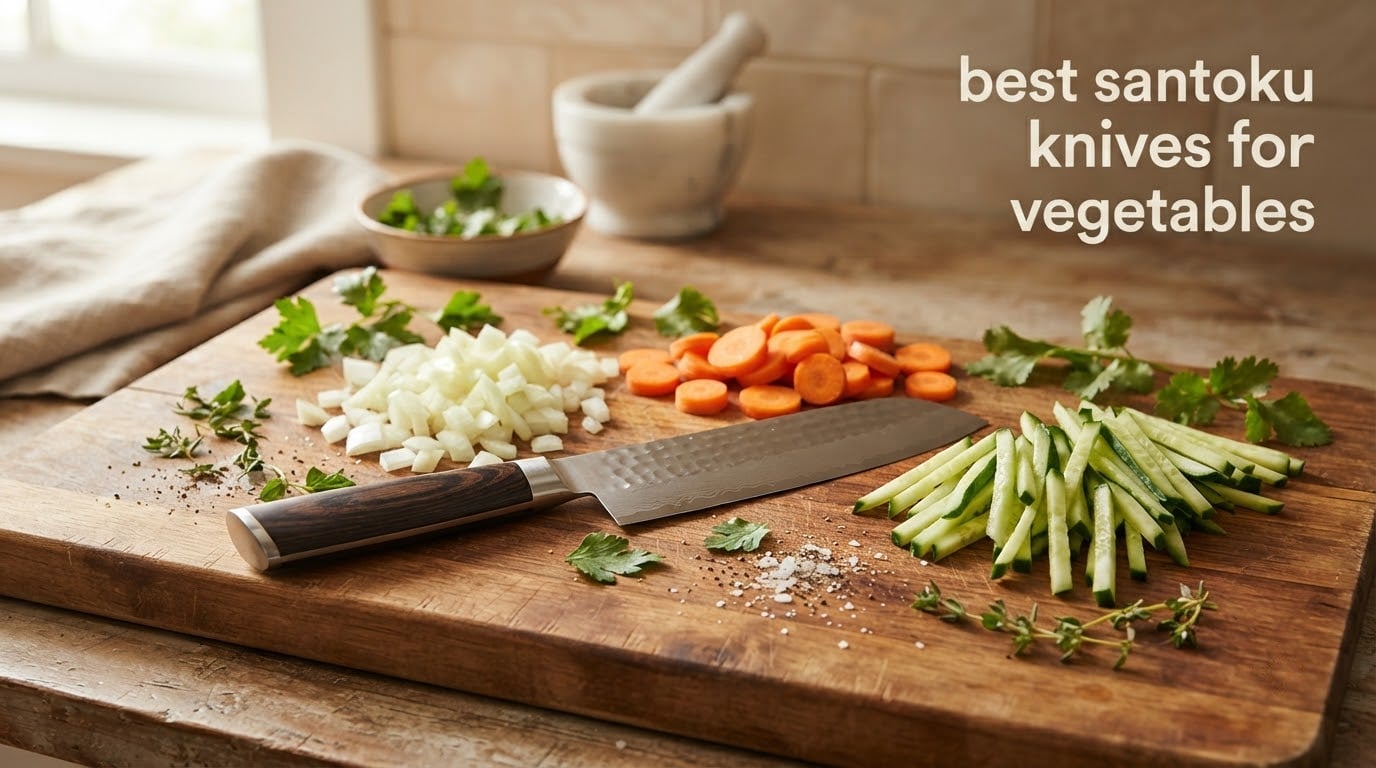
Here is the short version. The HOSHANHO 7-inch is the best santoku for most people cutting vegetables, the Babish 6.5-inch is the lowest-cost way into a genuinely sharp blade, and the Victorinox 6.69-inch is the one to buy if sharpening is not something you want to think about. The best santoku knives for vegetables all share the same three traits: a broad blade with plenty of height, a lowered tip that stays on the board, and a steel that either forgives neglect or rewards a stone.
I have cut a lot of vegetables with a lot of knives over the years, and the honest truth is that most buying guides get this topic wrong. They rank santokus as generic all-rounders and treat the word “vegetables” as a throwaway modifier. It is not a modifier. A santoku is a specific shape built for a specific job, and that job looks a lot like dicing onions, shredding cabbage and slicing wet cucumbers on a small board.
So I judged these ten knives on vegetable work first. Every pick below was assessed against the same list: how cleanly it diced a yellow onion, whether it minced soft herbs without bruising them, how food behaved on the blade during a wet cucumber slice, whether the tip could still reach into a tight brussels sprout, and how much sharpening the steel asks of you between sessions. Specs came from the manufacturer listings, and the honest drawbacks came from what owners actually report after months of use.
Two things surprised me. First, the sharpest steel in the group is not automatically the best knife for this job, because hard steel punishes you on a wooden board and rewards you only if you sharpen. Second, the number of owner reviews is not a ranking in itself: the entry-level pick at the budget end of this list has more reviews than the flagship German option, which tells you something about how many people are buying their first decent santoku at the lower end. You will find both picks in the list.
One note before we start, because nobody in this category mentions it: the top reply on the highest-engagement knife forum thread on this topic is a warning against cheap pull-through sharpeners. I have taken that seriously. There is a dedicated sharpening section below that explains which steels tolerate a steel rod, which ones need a stone, and what “do nothing” maintenance actually looks like.
Our Top 3 Santoku Picks for Vegetable Prep in 2026

HOSHANHO 7 Inch Japanese…
- Triple-layer Japanese steel at 62HRC
- 15 degree hand-sharpened edge
- Double-side grooves cut drag and sticking
- Pakkawood handle resists cracking

Babish 6.5 Inch Santoku
- Forged 1.4116 German steel
- Granton edge for food release
- Full tang for a balanced grip
- Light 6.5 inch blade for small boards

MOSFiATA 7 Inch Santoku Set
- Forged EN.4116 German high carbon steel
- 14 to 16 degree hand-polished edge
- Triple-riveted micarta handle
- Sheath
- guard
- sharpener and gift box included
Comparing All 10 Santoku Knives Side by Side in 2026
Before the individual reviews, here is the whole field at a glance. Blade length, construction method, steel and handle material are the four numbers that separate these knives, and they predict almost everything you will experience during a vegetable prep session.
| Product | Specs | Action |
|---|---|---|
| HOSHANHO 7 Inch Japanese Santoku |
|
Check Latest Price |
| Babish 6.5 Inch Santoku |
|
Check Latest Price |
| MOSFiATA 7 Inch Santoku Set |
|
Check Latest Price |
 Victorinox Swiss Classic 6.69 Inch Santoku Victorinox Swiss Classic 6.69 Inch Santoku |
|
Check Latest Price |
 Cutluxe 7 Inch Santoku Cutluxe 7 Inch Santoku |
|
Check Latest Price |
 Mercer Culinary Genesis 7 Inch Santoku Mercer Culinary Genesis 7 Inch Santoku |
|
Check Latest Price |
 Henckels Classic 7 Inch Hollow Edge Santoku Henckels Classic 7 Inch Hollow Edge Santoku |
|
Check Latest Price |
 Shun Premier 7 Inch Santoku Shun Premier 7 Inch Santoku |
|
Check Latest Price |
 Tojiro Professional 6.7 Inch Santoku Tojiro Professional 6.7 Inch Santoku |
|
Check Latest Price |
 Wusthof Classic 7 Inch Santoku Wusthof Classic 7 Inch Santoku |
|
Check Latest Price |
1. HOSHANHO 7 Inch Japanese Santoku – Best Overall for Everyday Vegetable Prep
HOSHANHO 7 Inch Japanese Chef Knife, Ultra Sharp Kitchen Santoku Knives
7 inch blade, 10Cr15CoMoV steel, 62HRC, 15 degree edge, pakkawood handle
Pros
- Exceptionally sharp out of the box
- Edge holds far longer than the price suggests
- Well balanced for chopping and rocking cuts
- 11.2 oz gives real authority on hard produce
- Grooves reduce food sticking
Cons
- Some later batches show a less polished finish
- Very sharp tip and heel catch careless users
- Aggressive factory edge needs respect
This is the knife I keep reaching for when I am prepping a week’s worth of vegetables and want the job to finish quickly. The blade is a triple-layer laminate of 10Cr15CoMoV hardened to 62HRC, with about 0.9% carbon in the core, and the factory edge is hand sharpened to 15 degrees per side. That combination is aggressive, which is exactly what a hard carrot or a dense head of cabbage needs.
The pakkawood handle is the part I did not expect to like this much. It is dense, warm to the touch, and does not get slippery the way some moulded handles do after you wash raw onion off your hands. At 11.2 ounces the knife has real heft, and that weight is what lets you push through a dense vegetable without leaning on your shoulder.
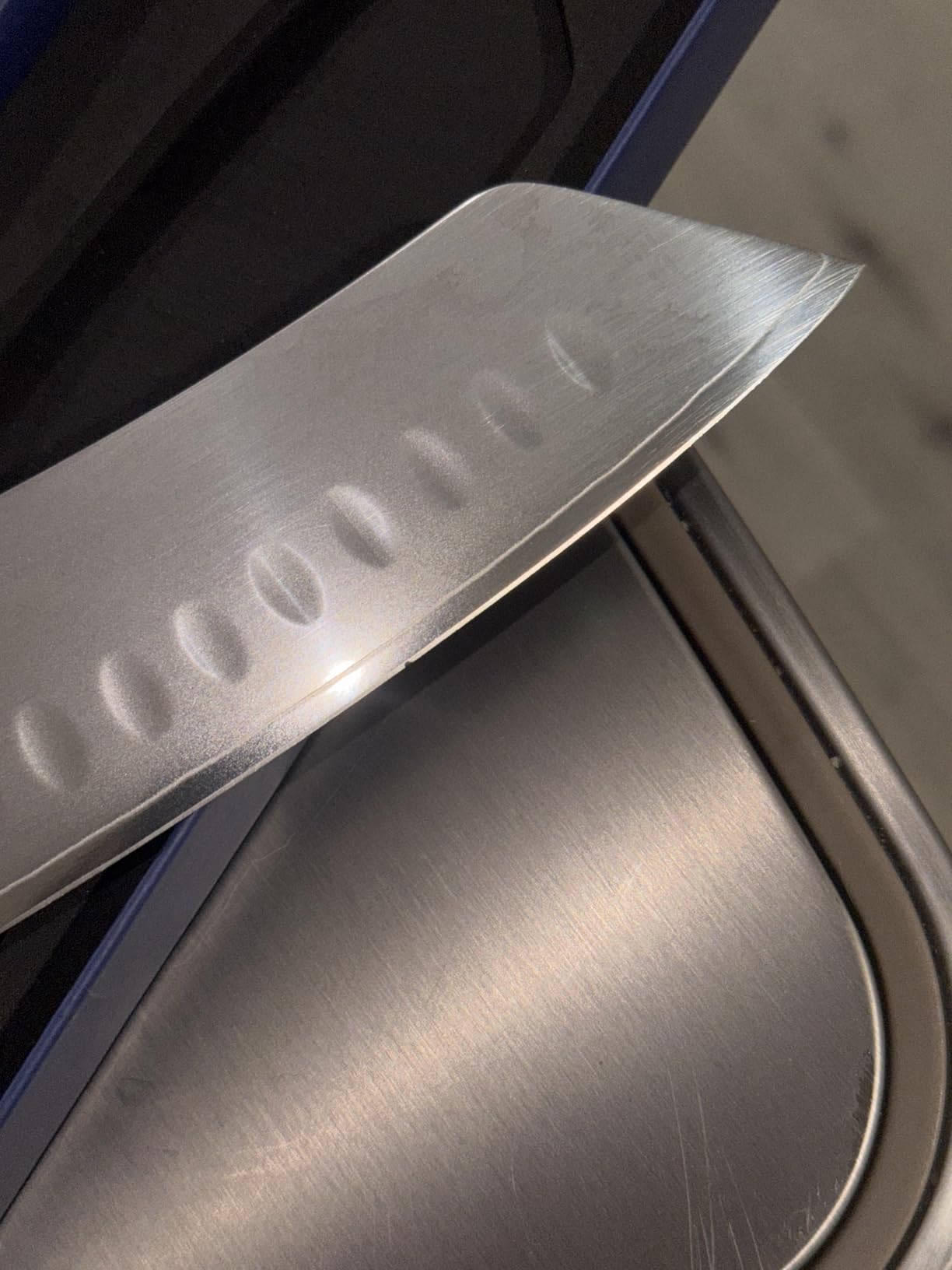
The double-side groove design is the sleeper feature for vegetables. Owners repeatedly single out a visible reduction in sticking when dicing, which matters most on wet produce like cucumber, tomato and sliced onion. A flat, plain-edged blade clings to those surfaces; a blade with milled channels pushes the juice and pulp away from the cutting line.
Steel and edge retention on a week of prep
62HRC is the highest hardness figure published for any blade in this roundup, and it shows in how long the edge survives. A heavy meal-prep Sunday doing three onions, a cabbage, a kilo of carrots and a butternut squash will not knock this knife back to stuttering. You will still want to touch it up on a steel, but you are not looking at a full stone session every few weeks.
The trade-off is honest: harder steel chips if you cut into a board defect or slide sideways into a hardwood cutting board. Use an end-grain or softwood board and this is a non-issue.
Food release on wet produce
Both sides of the blade carry grooves, which means onion layers, diced tomato and wet cucumber slices separate from the blade as you lift rather than peeling away in a sheet. For brunoise work on soft produce, where the pieces are small and wet, that is the difference between clean transfer to the board and a sticky mess under the blade.
Weight, balance and small hands
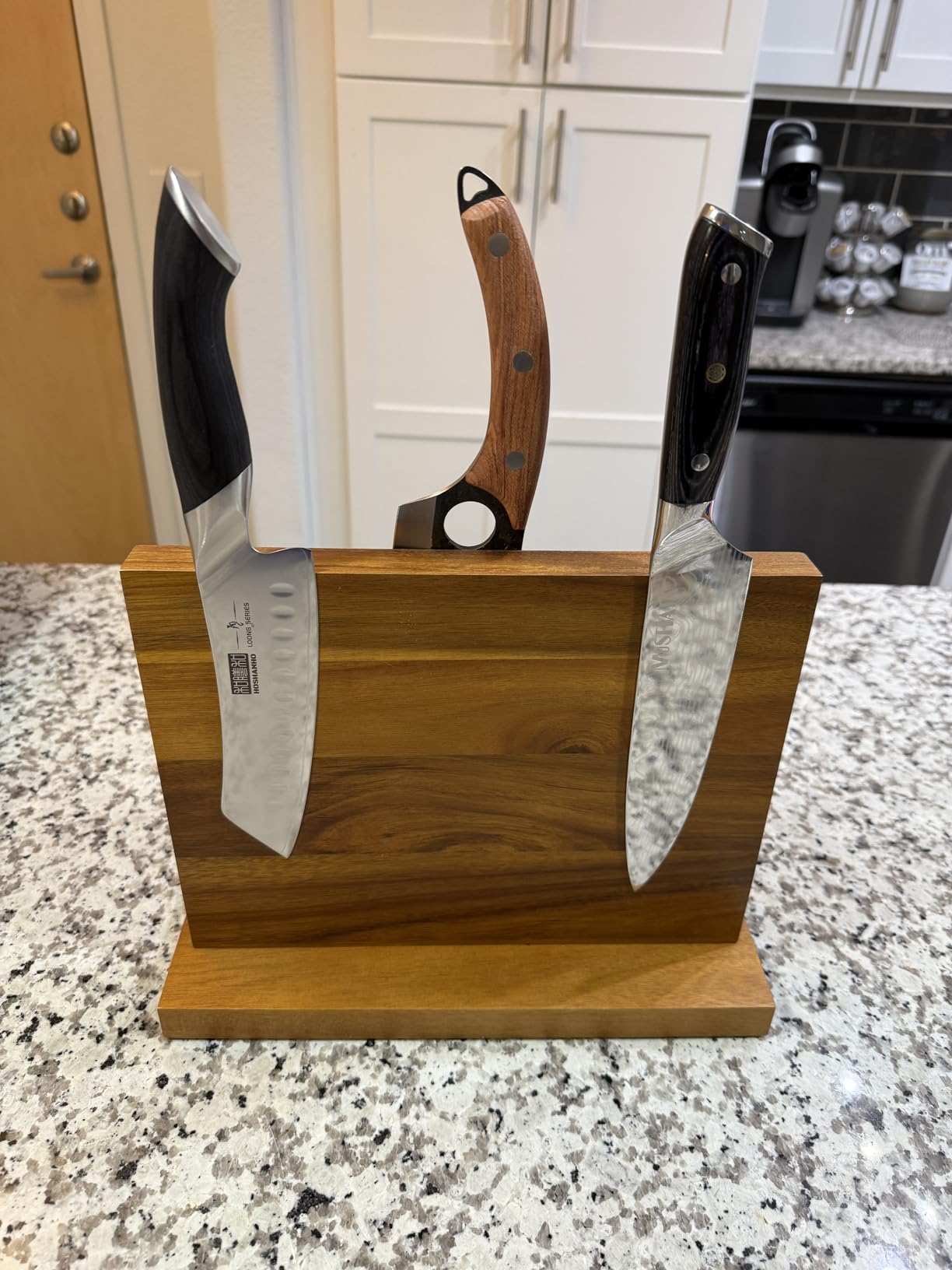
Eleven ounces is on the heavier side for a santoku, and buyers with smaller hands should know that before they commit. The balance point sits far enough forward that the knife does not feel like a lever, but it is a substantial knife in the hand. If you have cut with light European knives your whole life, the transition takes a session or two.
What to watch out for
Owners report that some later production batches arrived with a less polished finish and fainter blade markings than earlier runs. It is cosmetic rather than functional. More important, the tip and heel come out of the box sharp enough to draw blood on a careless pass, so store it properly and respect the edge for the first week.
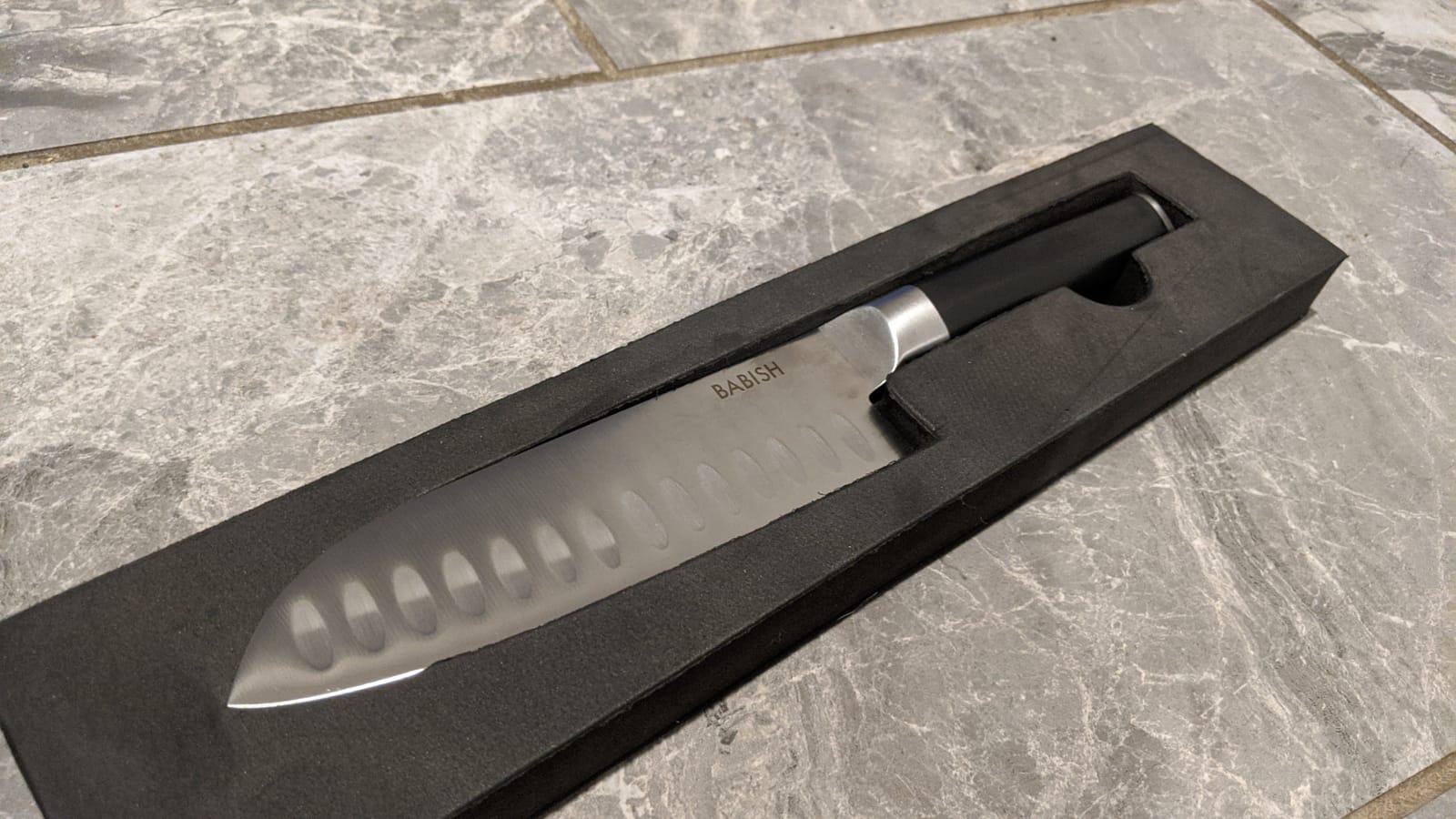
2. Babish 6.5 Inch Santoku – Budget Pick for Sharpening on a Budget
Babish 6.5 Inch Santoku Knife High Carbon 1.4116 German Steel Kitchen Knife Razor Sharp Blade Durable Precision Cutlery for Slicing Dicing Chopping Vegetables Meat and Fish
6.5 inch blade, forged 1.4116 German steel, full tang, Granton edge
Pros
- Very sharp straight out of the packaging
- Solid weighty feel for the price
- Full tang stays comfortable over long sessions
- Granton edge and thin blade reduce sticking
- Enormous owner review base
Cons
- 6.5 inch blade is short for large batch prep
- Handle can feel slippery when wet
- Soft steel needs frequent honing
With more owner reviews than any other knife in this roundup, the Babish has clearly become the default first santoku for a lot of people, and the reason is simple: it arrives sharp. Owners describe it as a budget workhorse that punches far above what they paid, with a forged 1.4116 German blade, a Granton edge and a full-tang handle that feels far more substantial than the price suggests.
For vegetable work the 6.5-inch length is a genuine advantage on a small board. A 10-inch chef’s knife needs room to travel; this one stays inside a modest board, which makes straight up-and-down push cuts easy and keeps your guiding hand steady over the food.
The hardness is listed at roughly 56 to 58 HRC, which is the softest figure in this group. That is a feature if you are the kind of cook who is nervous about expensive blades. A soft steel takes a steel rod, resets with a light pass, and forgives the odd moment of inattention. It also means the edge goes dull between sessions sooner, so expect to hone more often than you would with anything in the 60s.
Granton edge and dicing behaviour
The Granton dimples along the blade reduce drag and food release on wet produce. It is not a cure-all, and a minority of owners still see vegetables stick during dicing, especially softer items like courgette. On cucumber, onion and cabbage it makes a clear difference to how cleanly the pieces lift.
Handling and grip security
The full tang keeps the weight distributed along the whole handle, which shows up as stability rather than heaviness. The recurring complaint is that the handle can feel smooth or slippery when wet, so if you wash produce before cutting, dry your hands first. One owner also drew attention to a sharp spine near the handle heel, a reminder that a bare-metal handle has no guard.
Where the 6.5 inch length works and where it does not
Owners who like a larger blade for heavy prep find this one short. There is a limit to how much onion you can dice in one pass, and batch cooking for several people will mean more repositioning than a 7-inch blade. For one to three people, it is the right size.
3. MOSFiATA 7 Inch Santoku Set – Best for Gifting and Complete Sets
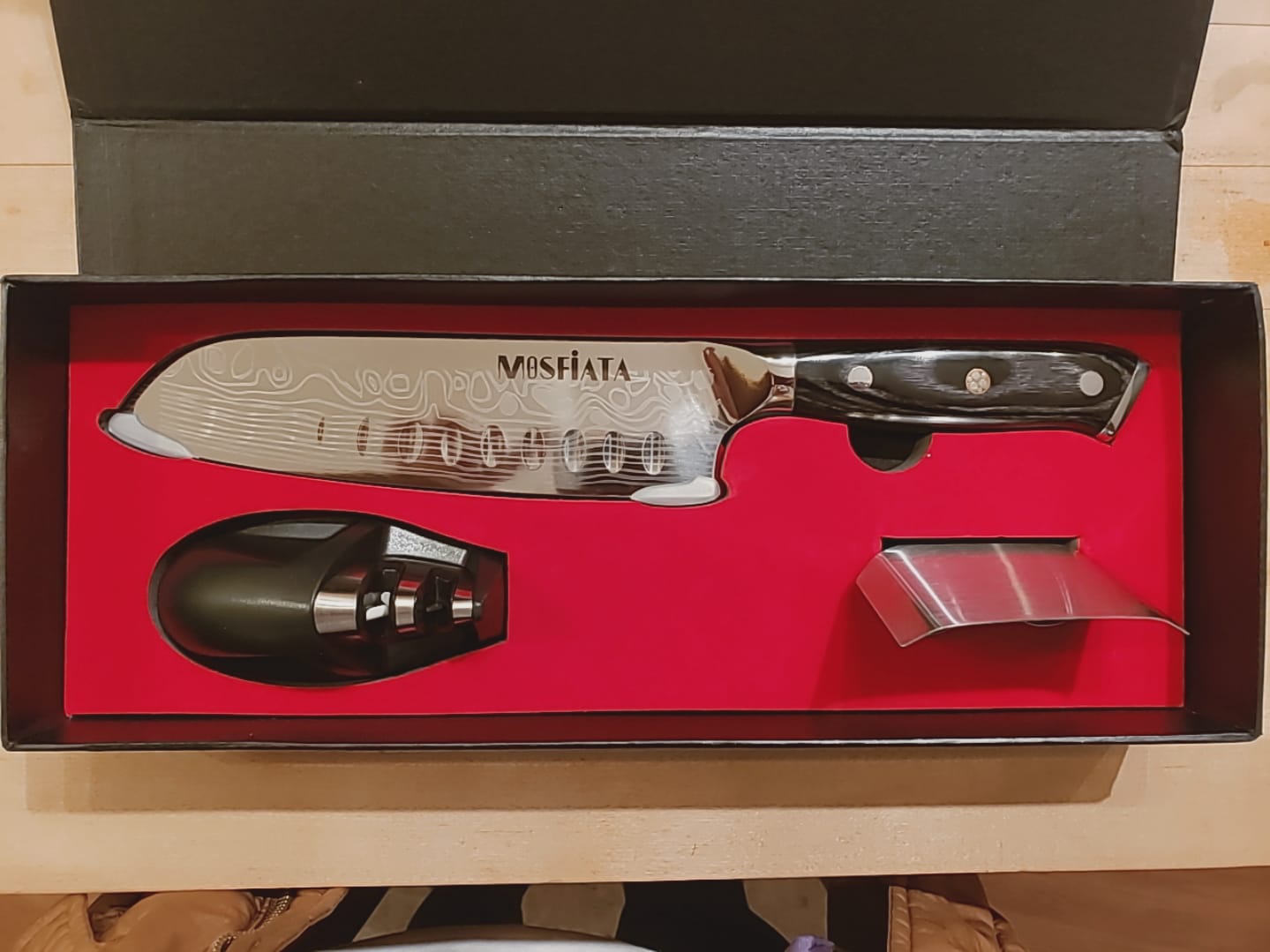
MOSFiATA Santoku Knife- 7 Inch Vegetable Knife Ultra Sharp Chopping Knife- Forged EN.4116 German Steel- Including Sheath,Finger Guard,Knife Sharpener,Full Tang,Best Gifts with Handmade Gift Box
7 inch blade, forged EN.4116 German steel, 14 to 16 degree edge, micarta handle
Pros
- Sharp well balanced blade for chopping and dicing
- Micarta handle suits any hand size
- Sheath
- guard
- sharpener and cloth included
- Handmade gift box included
Cons
- Accessories add bulk to the package
- Finish can show wear after years of use
- Needs routine honing to keep its edge
What sets this one apart is not the blade, which is a competent piece, but the box it arrives in. The set includes the 7-inch knife, a sheath, a finger guard, a sharpener, a wipe cloth and a sharpening guide, all presented in a handmade gift box. If you are buying a first knife for someone else, this removes every decision you would otherwise have to make.
The blade itself is forged EN.4116 German high carbon stainless, hand polished to a 14 to 16 degree angle per side with a 2.5mm thickness at 56 HRC. Owners report good control for chopping, dicing and mincing, which is the everyday vegetable trifecta.
Handle and grip across hand sizes
The triple-riveted micarta handle is the part owners mention most warmly. Reviewers consistently say it stays secure and comfortable regardless of hand size or grip position, which is unusual in a knife at this level. Micarta is also less prone to the cracking and delamination that afflicts cheap laminated handles.
Edge geometry for mincing and brunoise
A 14 to 16 degree edge is finer than a typical workaday 20-degree European edge, so the initial sharpness is excellent for mincing garlic, shallots and soft herbs. The flip side is that a finer edge is more exposed to the board, so this knife wants a softwood or end-grain board rather than a hard glass or stone surface.
What the extras actually cost you
The only consistent complaint is bulk. Buyers who only wanted the knife find the sheath and guard extra to store. The included sharpener is a basic steel rod, which suits the soft 56 HRC steel perfectly, and the finger guard is a sensible addition for a knife with a bare tang.
4. Victorinox Swiss Classic 6.69 Inch Santoku – Best for Beginners and Light Hands
Victorinox Swiss Classic 7 Inch Santoku knife, Granton Blade, Black
6.69 inch fluted blade, stamped stainless steel, 3.84 oz, dishwasher safe
Pros
- Fluted edge makes precise herb and potato slices
- Grooves visibly cut sticking on starchy vegetables
- Light and balanced so the wrist does not tire
- Easy to sharpen at home
- Swiss made and dishwasher safe
Cons
- Softer steel needs more frequent touch-ups
- Thin stamped handle may feel small to large hands
- Very thin blade unsuited to heavy chopping
This is the knife I recommend to anyone who does not want to think about knife maintenance. The Victorinox Swiss Classic is stamped stainless steel with a fluted Granton edge, and at 3.84 ounces it is one of the lightest options here. Long-serving owners report that the blade still takes a razor edge after 15 years, which tells you more about the design than any spec sheet does.
For vegetables the fluted edge is the star. Owners specifically call out precise slices on chives, herbs and starchy vegetables, and report that the grooves visibly reduce sticking. On a potato or a parsnip, the channels move starch away from the cutting line instead of letting it glue the slices to the blade.
Why lighter works for long prep sessions
Weight is not always a virtue. A 4-ounce knife held over a full hour of dinner service stays comfortable in a way a heavier one does not, and the balance here is deliberately neutral. If you have small hands or a wrist that tires easily, this is the one in the group that will not cause a problem.
Stamped construction and its limits
Stamped means the blade is cut from a sheet rather than forged. The result is thinner and lighter, and in this case the very thin stamped blade is not meant for heavy chopping, bone work or prying. For dicing, slicing and mincing vegetables it is entirely appropriate, which is what this roundup is about.
The honest drawback
Two things to know. The steel is softer than the Japanese options here, so it wants more frequent touch-ups on a steel rod. And the handle is slim, which some owners with larger hands find narrow. Neither is a serious problem for vegetable prep, but both are real.
5. Cutluxe 7 Inch Santoku – Best for Daily Batch Prep
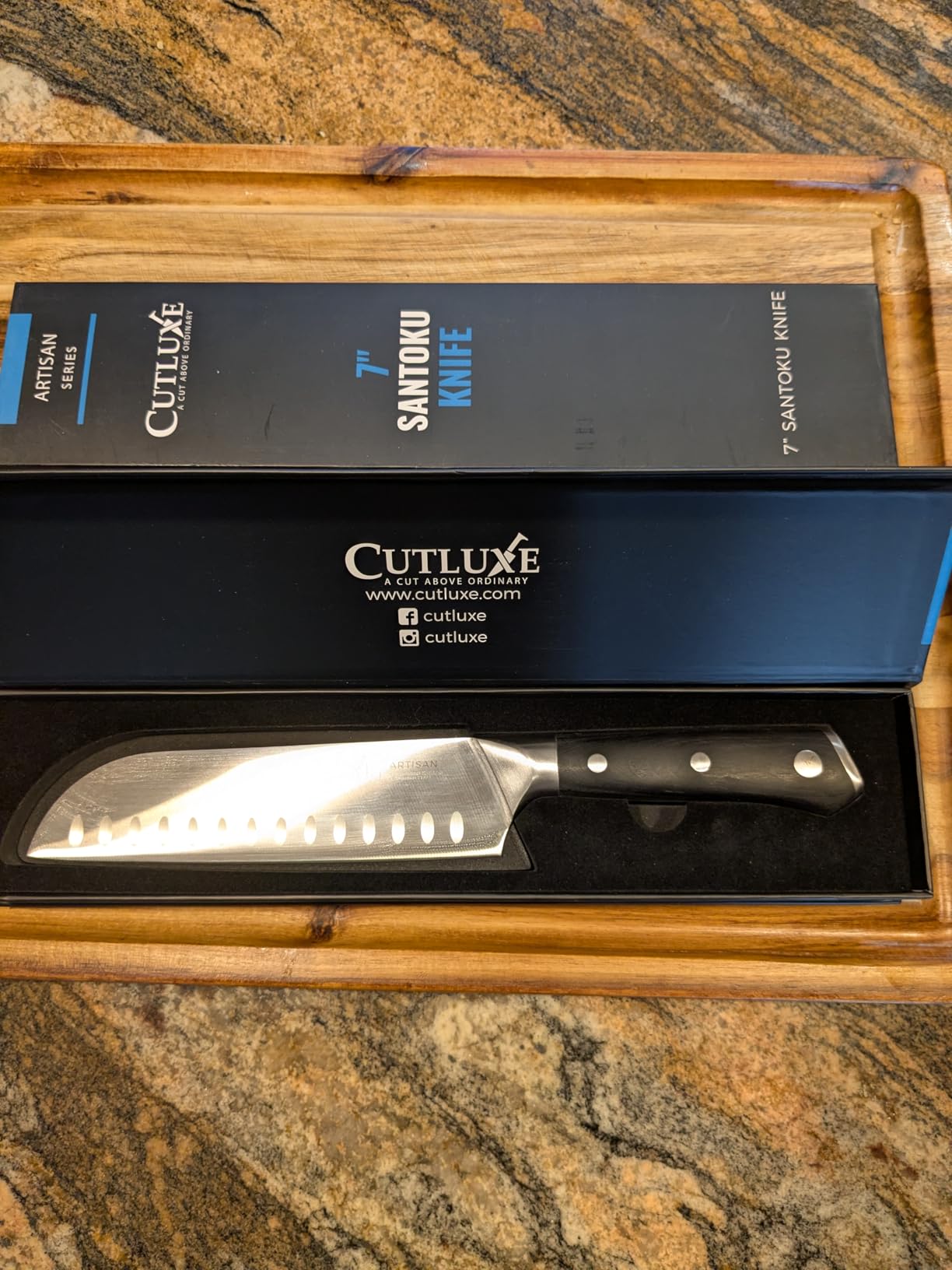
Cutluxe Santoku Knife, 7″ Meat & Vegetable Chopping Knife – Sheath Included
7 inch hollow edge blade, forged 1.4116 steel at 56+ HRC, full tang pakkawood
Pros
- Sharp precise edge on vegetables and meat
- Triple-riveted pakkawood handle grips well
- Good control for chopping and mincing
- Sheath included
- lifetime warranty
Cons
- Pakkawood handle must not be left soaking
- Hollow edge still catches wet soft produce
- 7 inch blade is not built for huge batch volumes
The Cutluxe sits in the sweet spot for someone who preps vegetables most days. It is forged 1.4116 German high carbon steel at 56 Rockwell and above, hand sharpened to 14 to 16 degrees per side, with a hollow edge profile and a full tang running into a triple-riveted pakkawood handle. At 9.12 ounces it has enough weight to push through a dense vegetable without feeling clumsy.
Owners rate it as a high-value all-rounder, and the recurring praise is for a sharp factory edge and a grip that stays secure through long sessions. The included sheath and the lifetime warranty are both unusual at this level.
Hollow edge and wet produce
The hollow edge grinds away material on the sides of the blade, creating the scallooped profile that reduces contact area with food. It works well on firm, wet produce like onion and cucumber. Owners are candid that it can still catch food on very soft or very wet items, so if you are brunoising a soft courgette, expect to lift rather than slide.
Handle care is the one real rule
Laminated pakkawood cannot be left soaking without risking delamination at the seams. Wash it by hand, dry it immediately, and do not run it through a dishwasher. That is the same advice the manufacturer gives, and it is the reason this knife is not on the dishwasher-safe list.
Sizing for batch cooking
Seven inches is a solid general-purpose length that handles most vegetables in a comfortable single pass. It is not the knife for very large batch volumes, where a longer blade or a proper cleaver-style nakiri will cover ground faster. For a household of two to four, it is the right size.
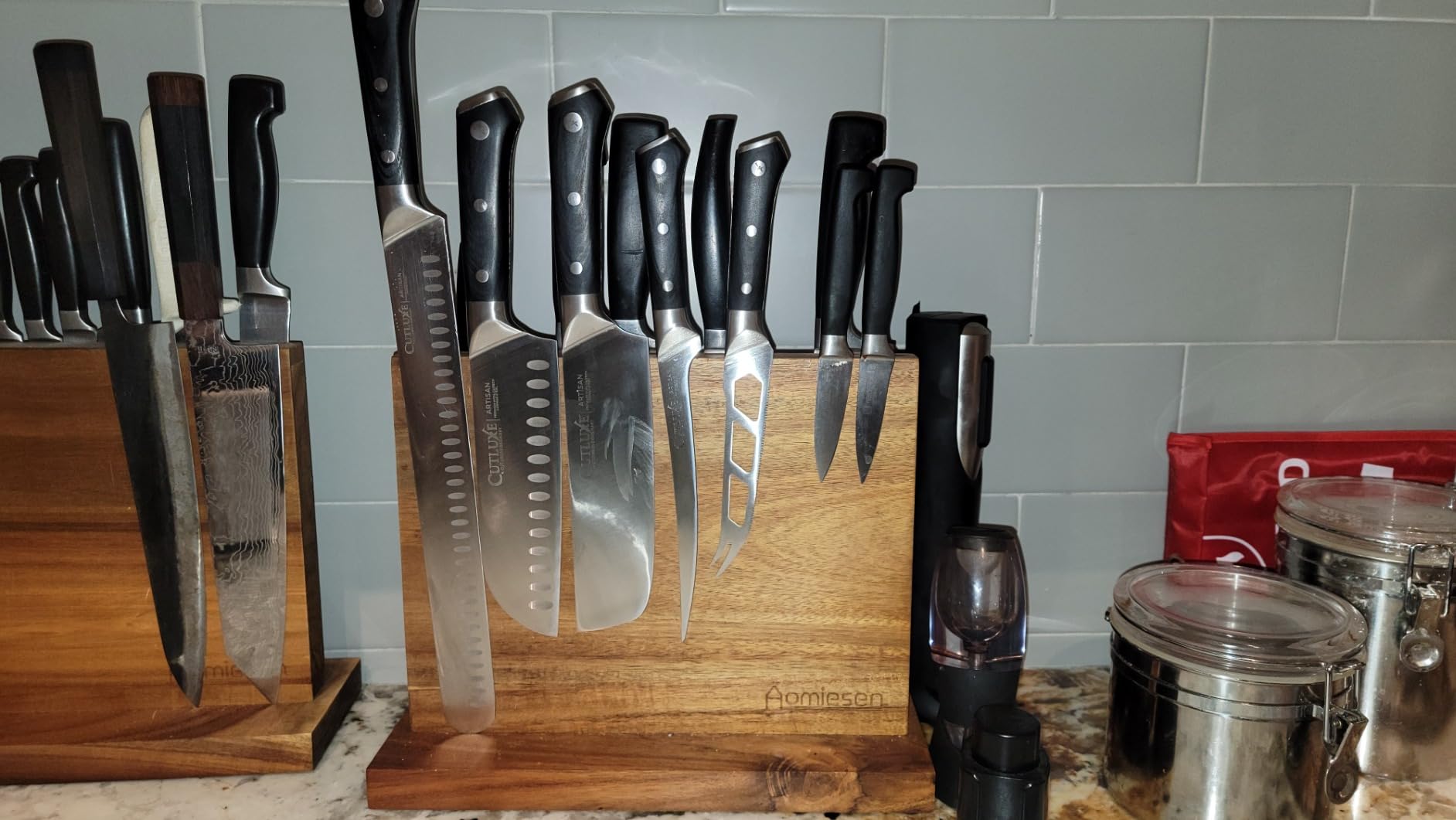
6. Mercer Culinary Genesis 7 Inch Santoku – Best All-Purpose Vegetable Workhorse
Mercer Culinary M20707 Genesis 7-Inch Santoku Knife,Black
7 inch tapered blade, forged high carbon German steel, 15 degree bevel, Santoprene
Pros
- Forged steel comparable to premium German makers
- Owners go years between stone sharpenings
- Balance feels far more expensive than it is
- Non-slip handle works with wet hands
- Scalloped blade limits sticking
Cons
- Medium hardness steel dulls faster than Japanese steel
- Somewhat front heavy for some buyers
- Hand wash only
- not dishwasher safe
The Genesis is the knife the forums keep recommending to people upgrading from a boxed knife set, and the consensus is that it takes a keener edge, holds it and feels thinner and lighter than what most people are used to, while still being more forgiving than a Japanese blade. Long-term owners describe it as a decade-long workhorse.
The manufacturing description is genuinely specific: precision-forged high-carbon German steel with a taper-ground edge, a 15 degree bevel per side and medium Rockwell hardness. That combination is why owners report going years between stone sharpenings rather than months.
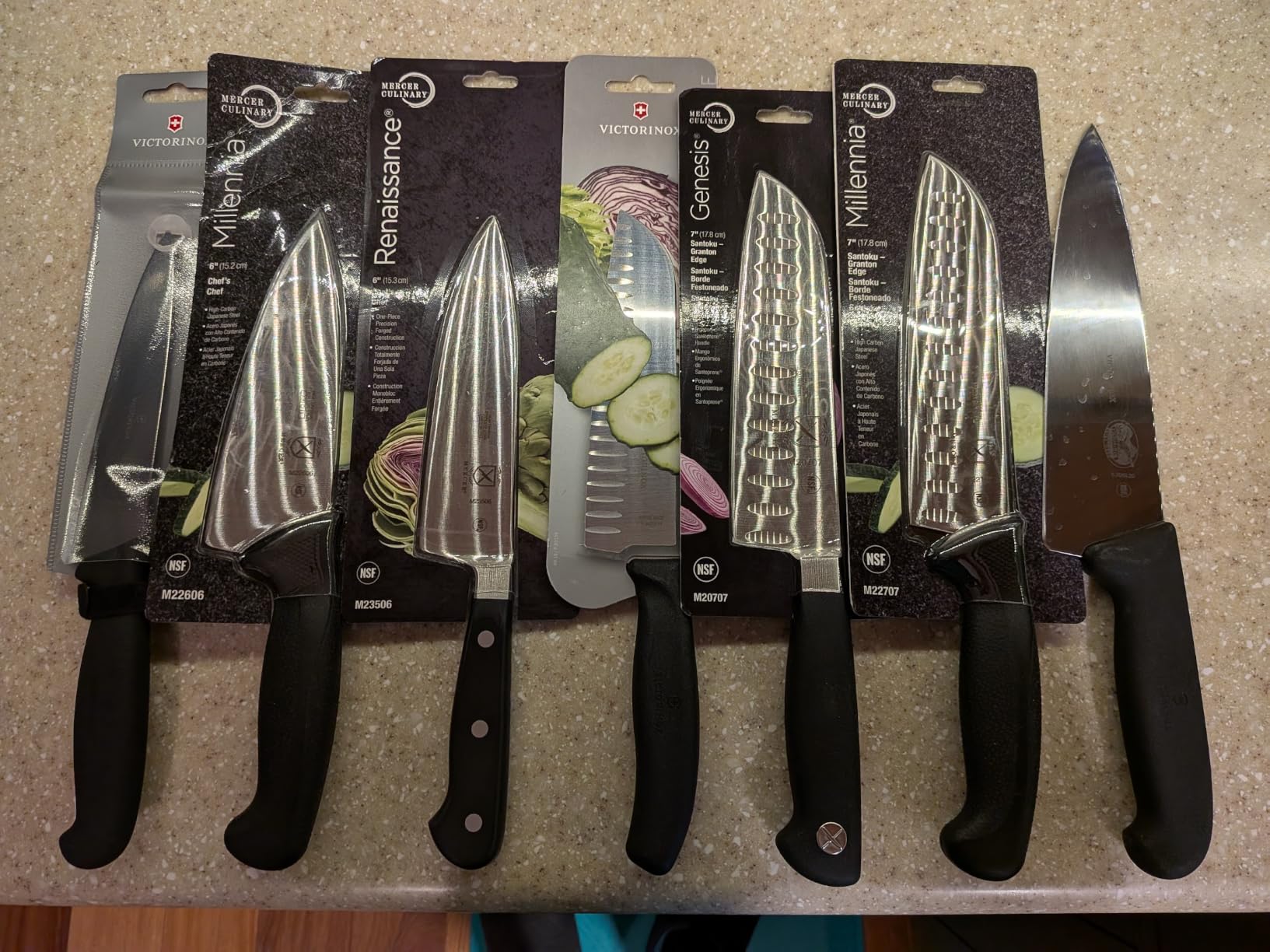
Scalloped blade on starchy vegetables
The scalloped grind helps keep vegetables from sticking, and owners praise the way it handles delicate produce without bruising it. For a chef who minces shallots, chops herbs and crushes garlic in the same session, that combination of a clean release and a thin edge is the whole job description.
Grip when your hands are wet
The non-slip Santoprene handle is one of the better wet-grip handles at this level, and it suits both small and large hands. It is also the reason this knife is hand wash only: the handle material and the epoxy bond will not survive a dishwasher cycle indefinitely.
The two drawbacks we would not hide
First, medium hardness means it dulls faster than the 62 HRC steel on the HOSHANHO, so you will hone more often. Second, the balance sits a little forward of the handle, which some buyers need a few sessions to get used to. There is also a specific note about tomatoes: a light sawing motion breaks the skin far more cleanly than a straight push.
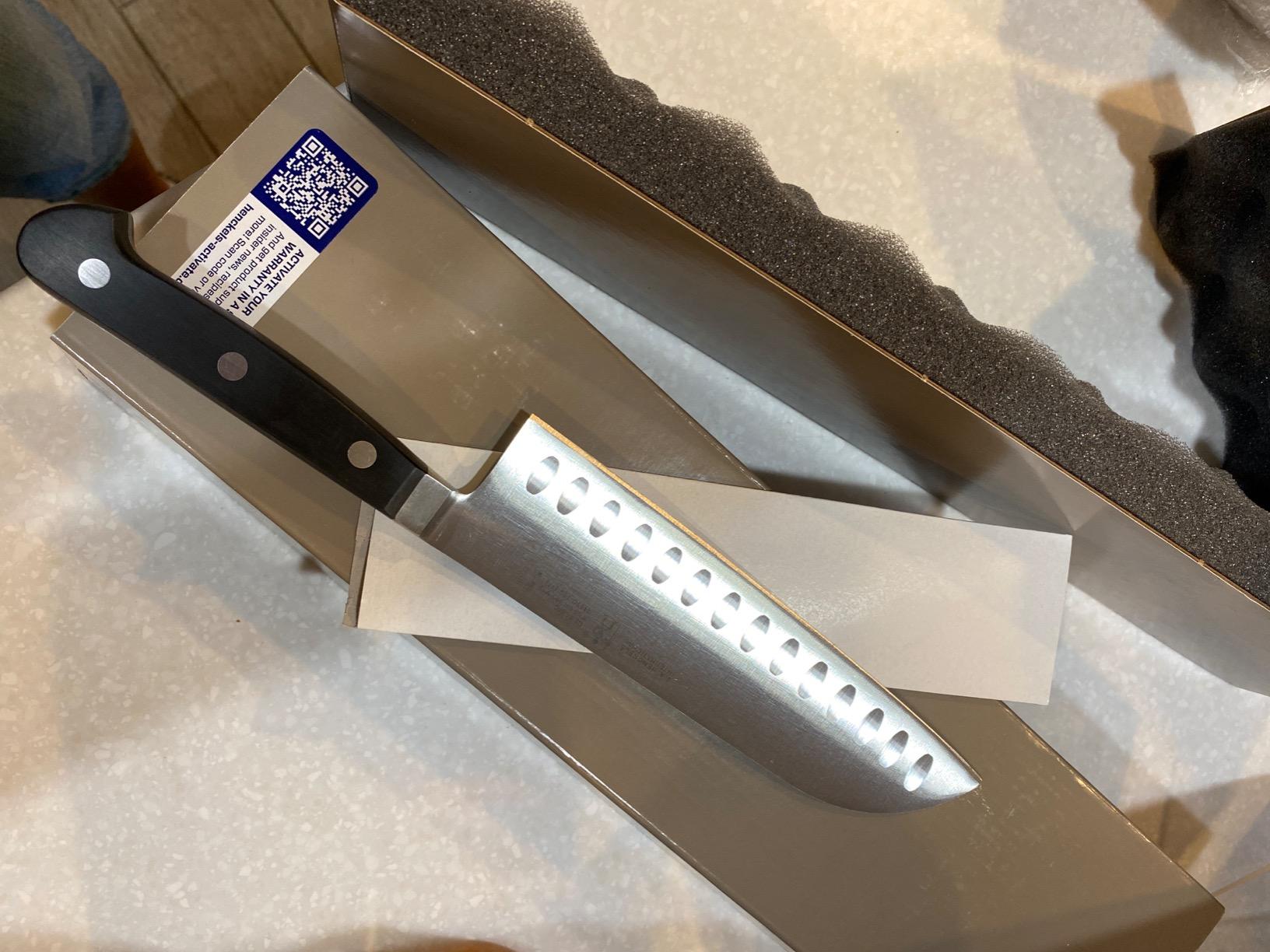
7. Henckels Classic 7 Inch Hollow Edge Santoku – Best for Light and Comfortable Handling
HENCKELS Classic Razor-Sharp Hollow Edge Santoku Knife 7 inch, German Engineered Informed by 100+ Years of Mastery
7 inch hollow ground blade, fully forged stainless steel, 6.4 oz, dishwasher safe
Pros
- Light and comfortable for arthritic or small hands
- Hollow edge makes paper thin onion and cucumber slices
- Fully forged build with lifetime warranty
- Dishwasher safe for fast clean up
Cons
- Some vegetables still stick despite the hollow edge
- One owner reported rust on the spine
- Polished steel shows fingerprints and marks
At 6.4 ounces with a fully forged construction and a seamless blade-to-handle transition, the Henckels is among the most comfortable options here for anyone whose hands are not strong. Owners with arthritis specifically call it out as a knife they can actually use for a full prep session without fatigue.
The hollow edge is honed for what this roundup is about: owners report paper-thin onion and cucumber slices, and sharp enough performance on celery, cabbage and onions with little effort. It is also dishwasher safe, which removes the single most common way home cooks ruin an otherwise good blade.
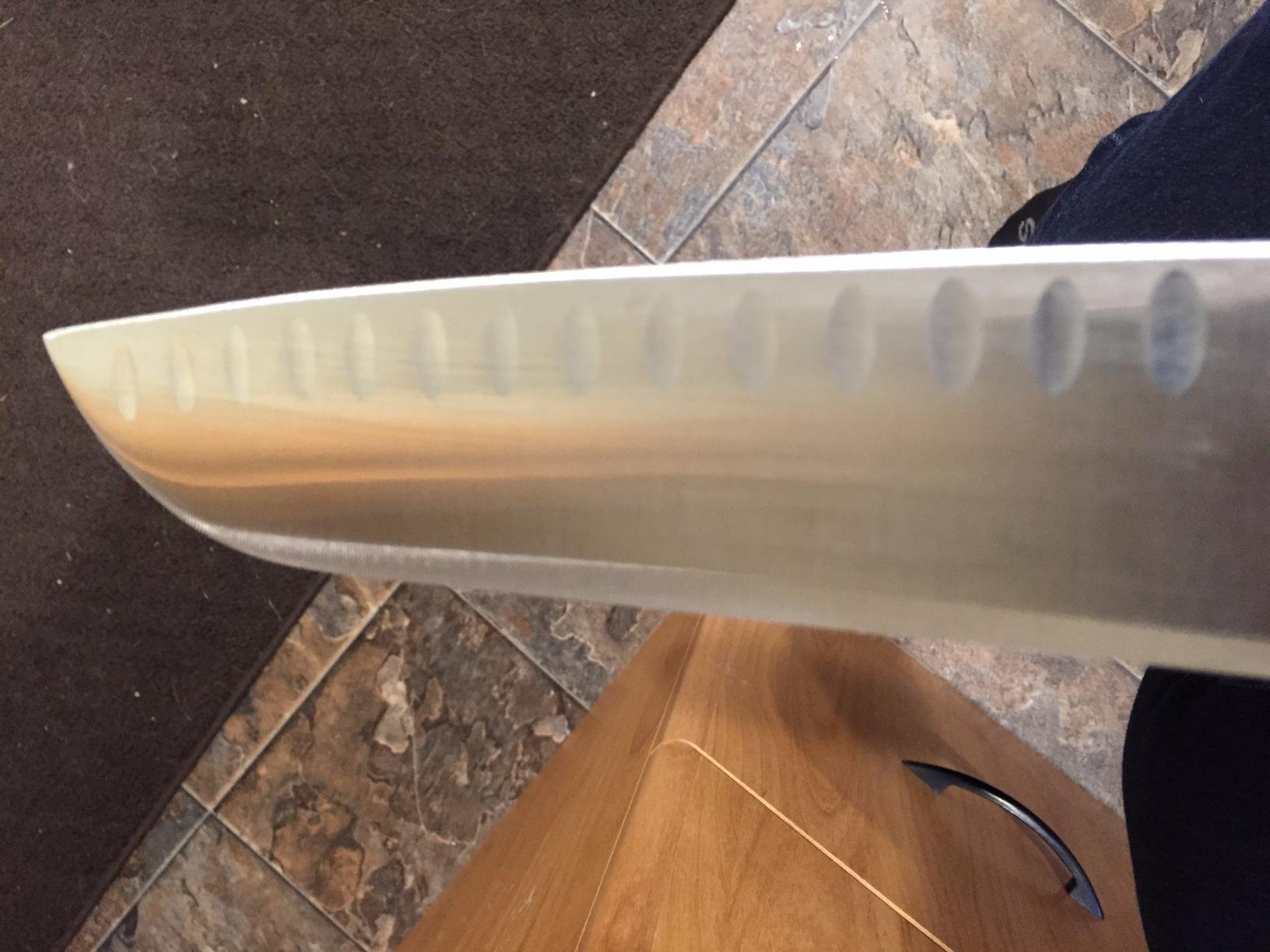
Where the hollow edge helps and where it does not
The hollow grind reduces the flat contact area along the sides of the blade, which is why onion and cucumber slices release cleanly. The honest counterpoint is that some owners still see vegetables stick during slicing and chopping, so it is an improvement rather than a solution. Firm, wet produce benefits most; soft and very fibrous items are the hard cases.
Care discipline, simplified
Dishwasher safe and rust resistant, with a lifetime warranty behind it, this is the pick for a household that will not fuss. The one report that stands out is an owner who found rust on the spine within a few weeks, which is unusual for a stainless blade and points at a wet storage environment rather than the knife itself.
Finish and handling
One recurring note is that the bright polished steel shows fingerprints and surface marks easily. That is purely cosmetic, but if you like a knife that looks new on the block, it is worth knowing. The satin-finished alternatives in this list hide wear better.
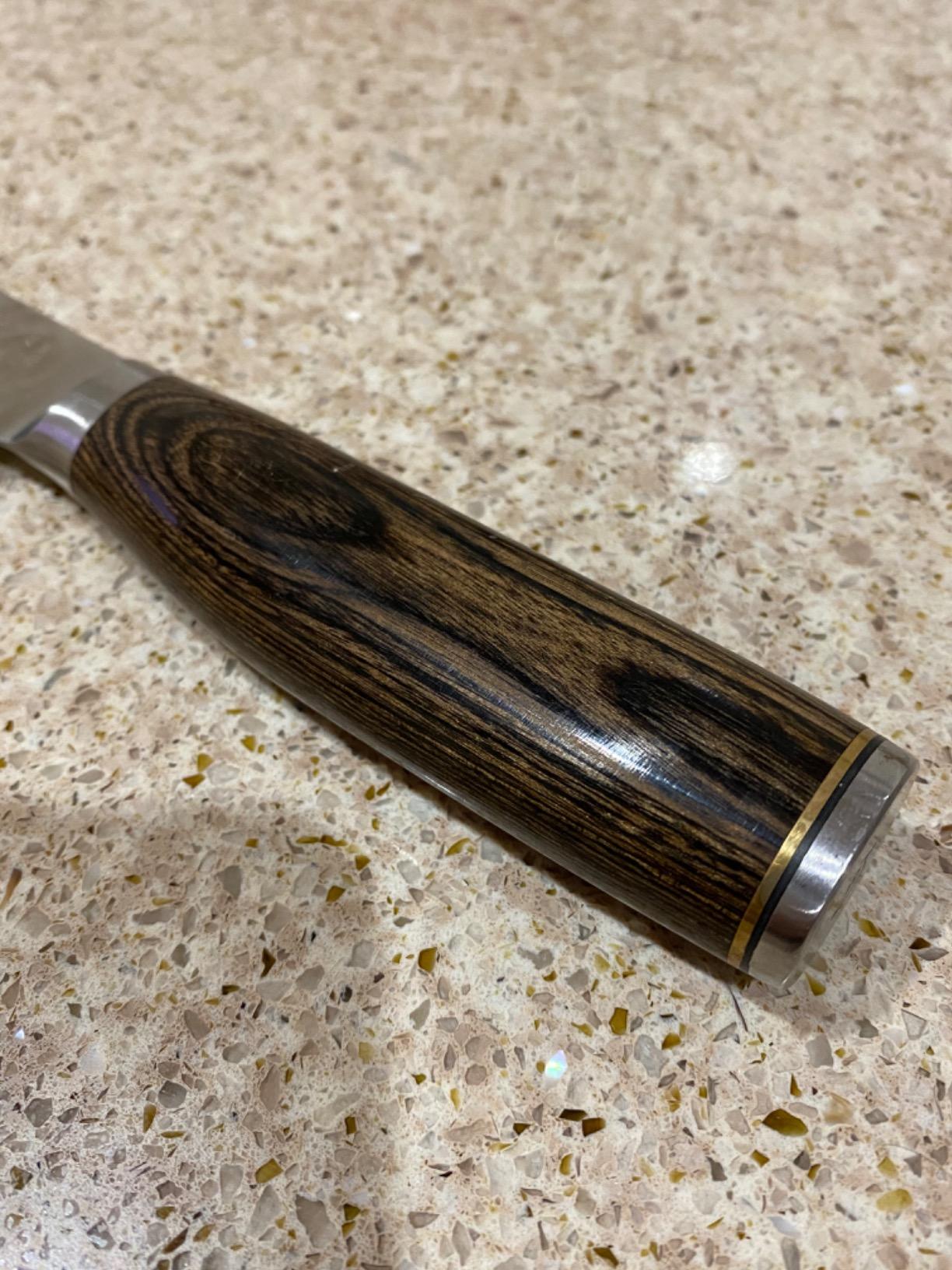
8. Shun Premier 7 Inch Santoku – Best for Fine Precision and Presentation
Shun Premier 7″ Santoku Knife
7 inch blade, VG-MAX core with 68 layer Damascus, 16 degree edge, tsuchime
Pros
- VG-MAX core delivers precise long-lasting sharpness
- Hammered tsuchime finish reduces sticking
- Handcrafted finish suited to display
- Contoured pakkawood handle works either way
- Free lifetime sharpening service
Cons
- Premium price
- Hardness demands careful board technique
- Damascus cladding pattern can wear over time
For very fine vegetable work, the Shun Premier is hard to argue with. The core is VG-MAX Japanese steel, a proprietary alloy known for taking a very fine edge, clad in 68 layers of Damascus stainless, hand sharpened in Japan to a 16 degree angle. Owners rate it highest for precision, and that is the reason to consider it.
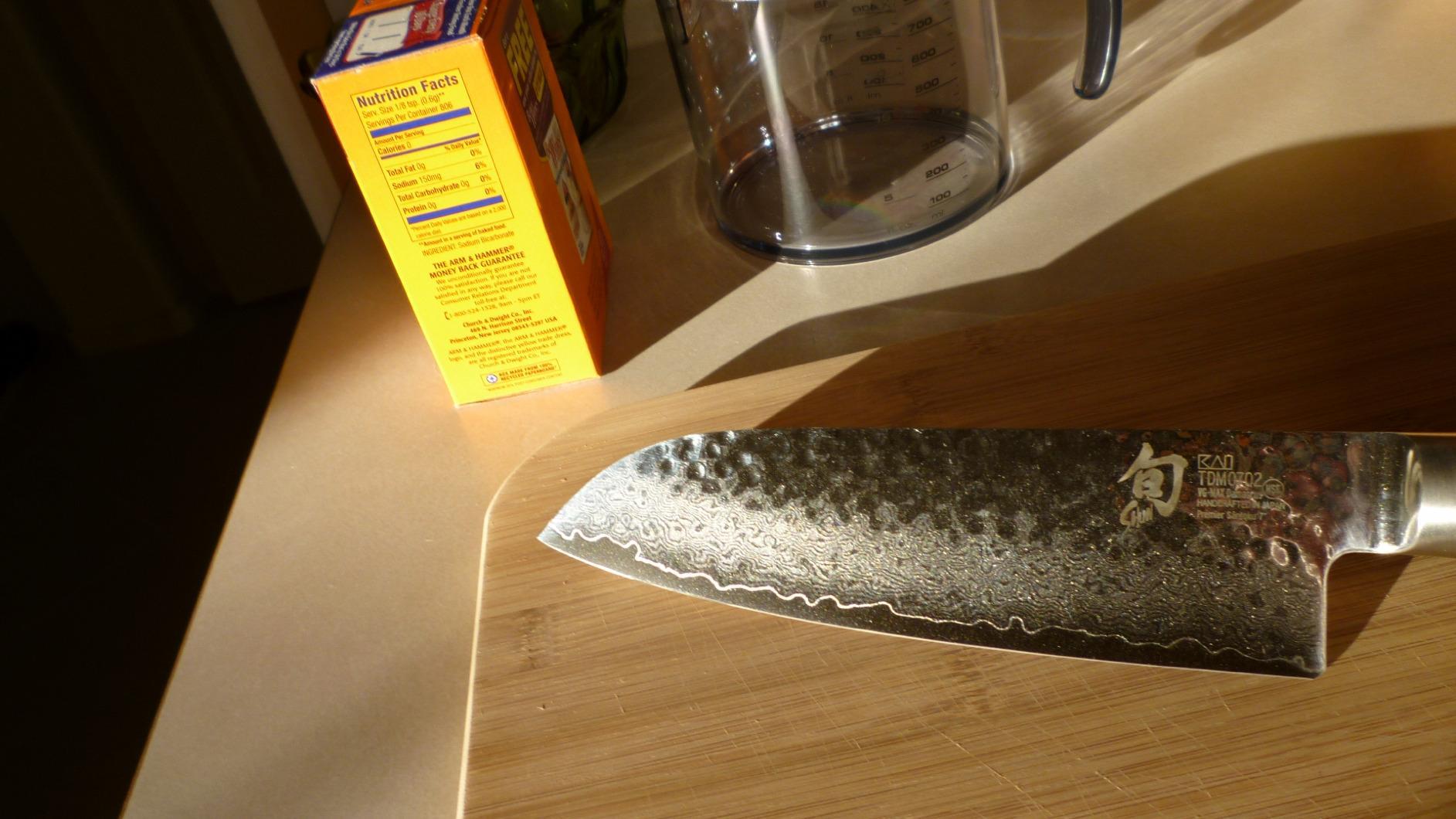
It is also the most purely handcrafted object in the group, and owners treat it accordingly. The hammered tsuchime finish is functional as well as decorative: the dimples reduce drag and sticking, which is why the blade behaves well on diced onion and soft produce.
Tsuchime finish and food release
Each face of the blade is hammered into shallow dimples. The effect on wet produce is straightforward, because the cut has less flat surface to grip, so onion layers and diced tomato lift off rather than peel away. Combine that with a 16 degree edge and you get very clean, very consistent dice.
Maintenance is the real cost
This is the honest drawback that matters most. Higher-hardness Japanese steel needs careful technique, a softwood or end-grain board and a regular stone routine. A dull knife dragged sideways is what chips a VG-MAX core, and the manufacturer covers this with free lifetime sharpening and honing, which is genuinely valuable if you live near a service centre.
Handle and handedness
The contoured pakkawood handle works for cooks who cut with either hand, and the 212 gram weight sits in the middle of this group. It is comfortable over long sessions and balanced enough for tip work like peeling the outer layers from a brussels sprout.
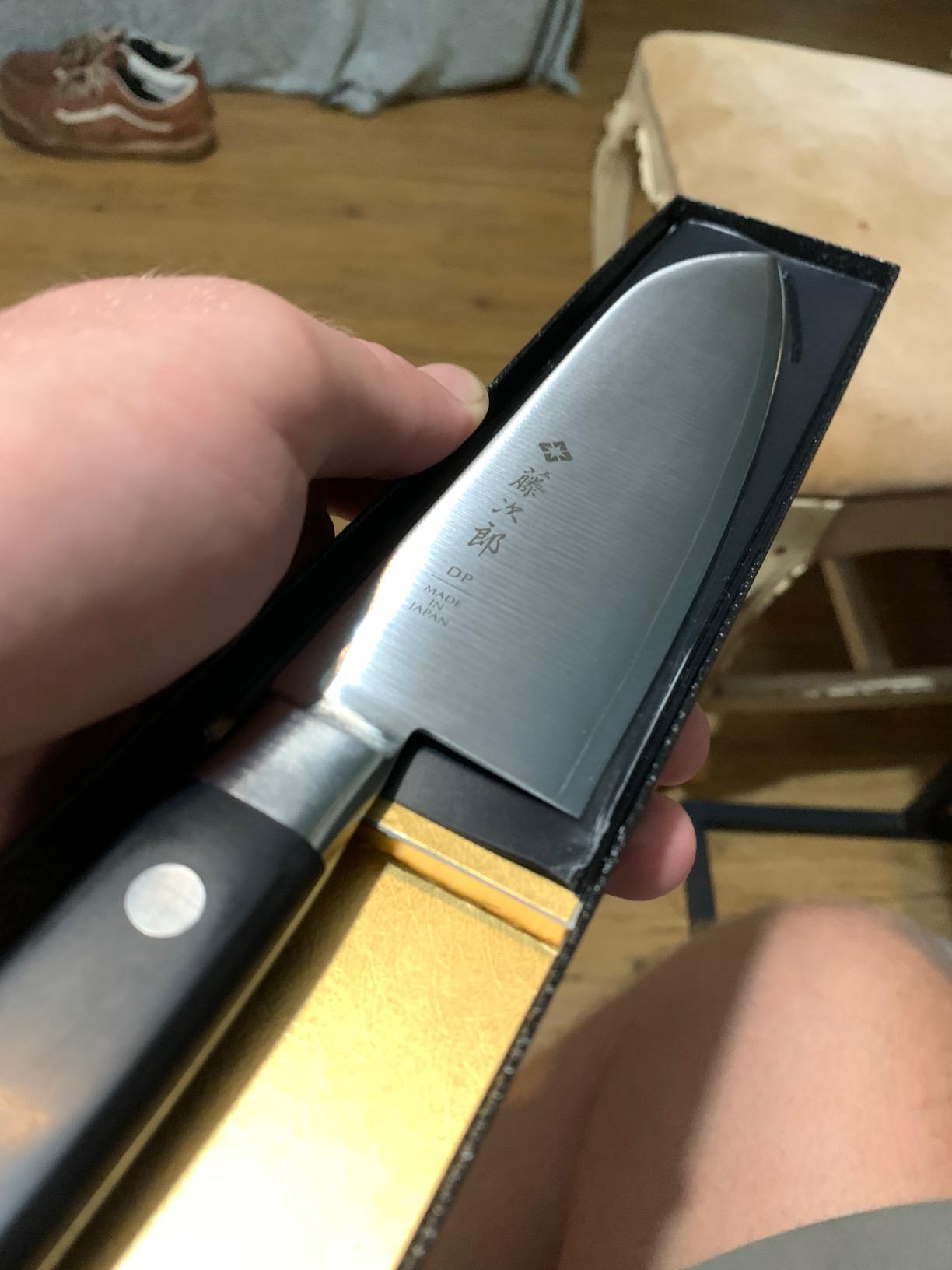
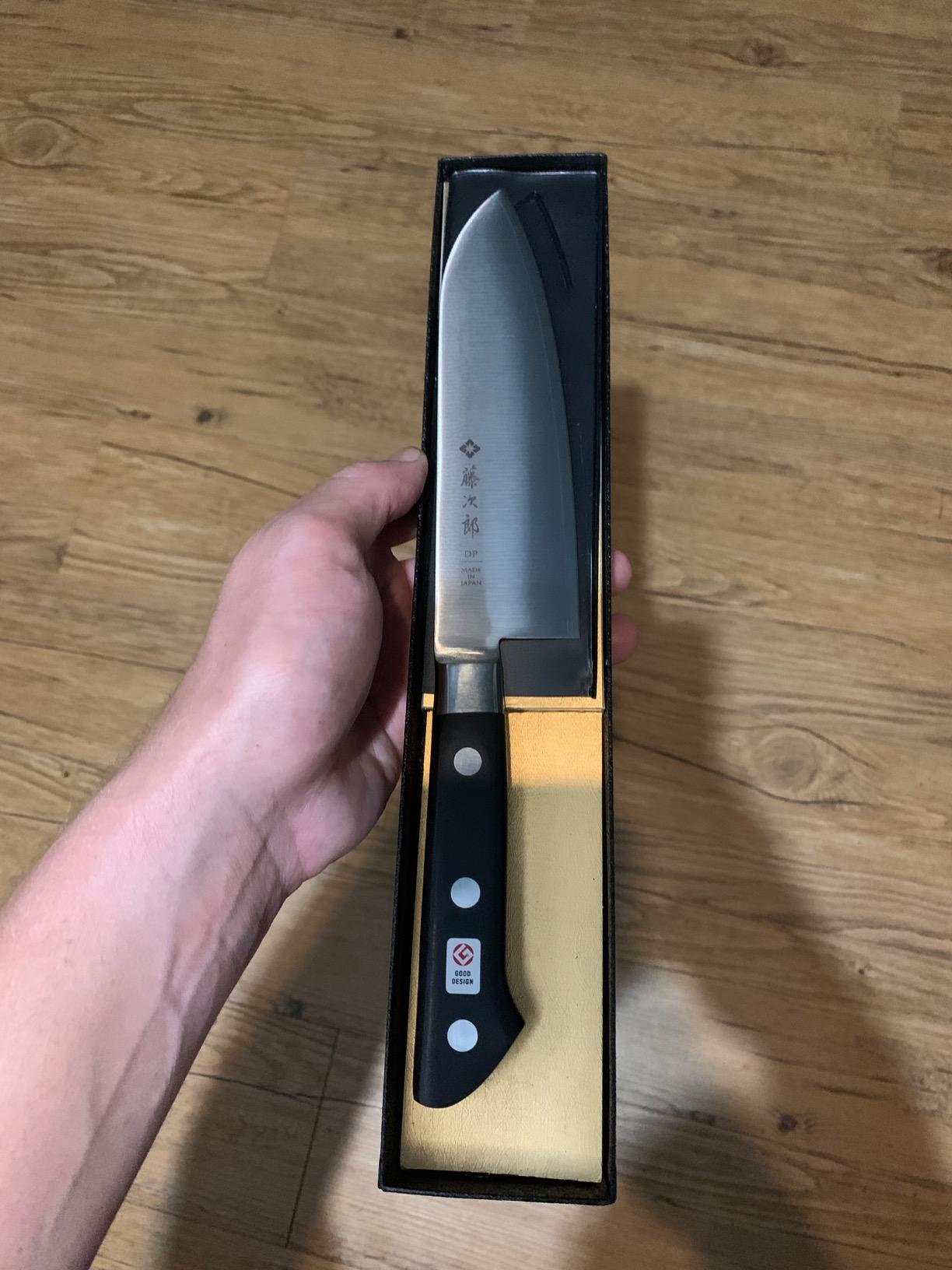
9. Tojiro Professional 6.7 Inch Santoku – Best Compact Japanese Blade
Tojiro Knife Professional Santoku 6.7″ (17cm) – JAPAN
6.7 inch (17 cm) blade, cobalt alloy core over stainless, 0.19 kg, wood handle
Pros
- Stain resistant Japanese style steel for everyday prep
- Even bevel usable by cooks who cut either way
- Laminated wood handle stays comfortable
- Lightweight classic Japanese profile
Cons
- 6.7 inch blade less capable for large batch prep
- Cobalt steel needs regular honing
- No sheath or cover included
The Tojiro is the most traditional santoku shape in this group. At 6.7 inches, or 170mm, with a cobalt alloy core layered over 13 chrome stainless and an 18-8 stainless base, it is closer to a Japanese kitchen knife than anything else here. At 0.19 kg it is comfortably light without feeling flimsy.
Buyer feedback centres on a well-made, stain resistant blade with a comfortable laminated reinforced wood handle that stays fine over long sessions. For a home cook who wants Japanese geometry without a Japanese steel maintenance routine, it is a sensible middle path.
Steel and the honing habit
The cobalt core is a Japanese-style stainless that resists staining better than carbon steel, which matters if you leave onion and tomato on the board for a while. The feedback is consistent on one point: it needs regular honing to maintain its bite. A steel rod on a drying blade after every prep session is the routine this knife wants.
Size and board behaviour
Six point seven inches is shorter than most of this list, and the practical effect is that there is less capacity for large batch prep. In exchange you get excellent board manners, easy push cuts and a knife that will not overwhelm a smaller board. It is a genuinely comfortable size for a small kitchen.
Edge and handedness
The even edge suits cooks who cut with either hand, which is worth noting because many Japanese-style knives are ground asymmetrically. The practical gap is that no sheath or cover is included, so you will want a knife block, a magnetic strip or a drawer guard.
10. Wusthof Classic 7 Inch Santoku – Best Full Tang Build and Hollow Edge
Wüsthof Classic 7″ Santoku Knife
7 inch hollow edge blade, forged high carbon stainless, full tang and bolster
Pros
- Hollow edge makes wafer thin slices and clean dice
- Full tang and bolster give a solid safe feel
- High carbon stainless holds an edge and is easy to maintain
Cons
- One of the highest price points in the group
- Hand wash only
- so more care than dishwasher safe options
- POM handle feels less premium than wood
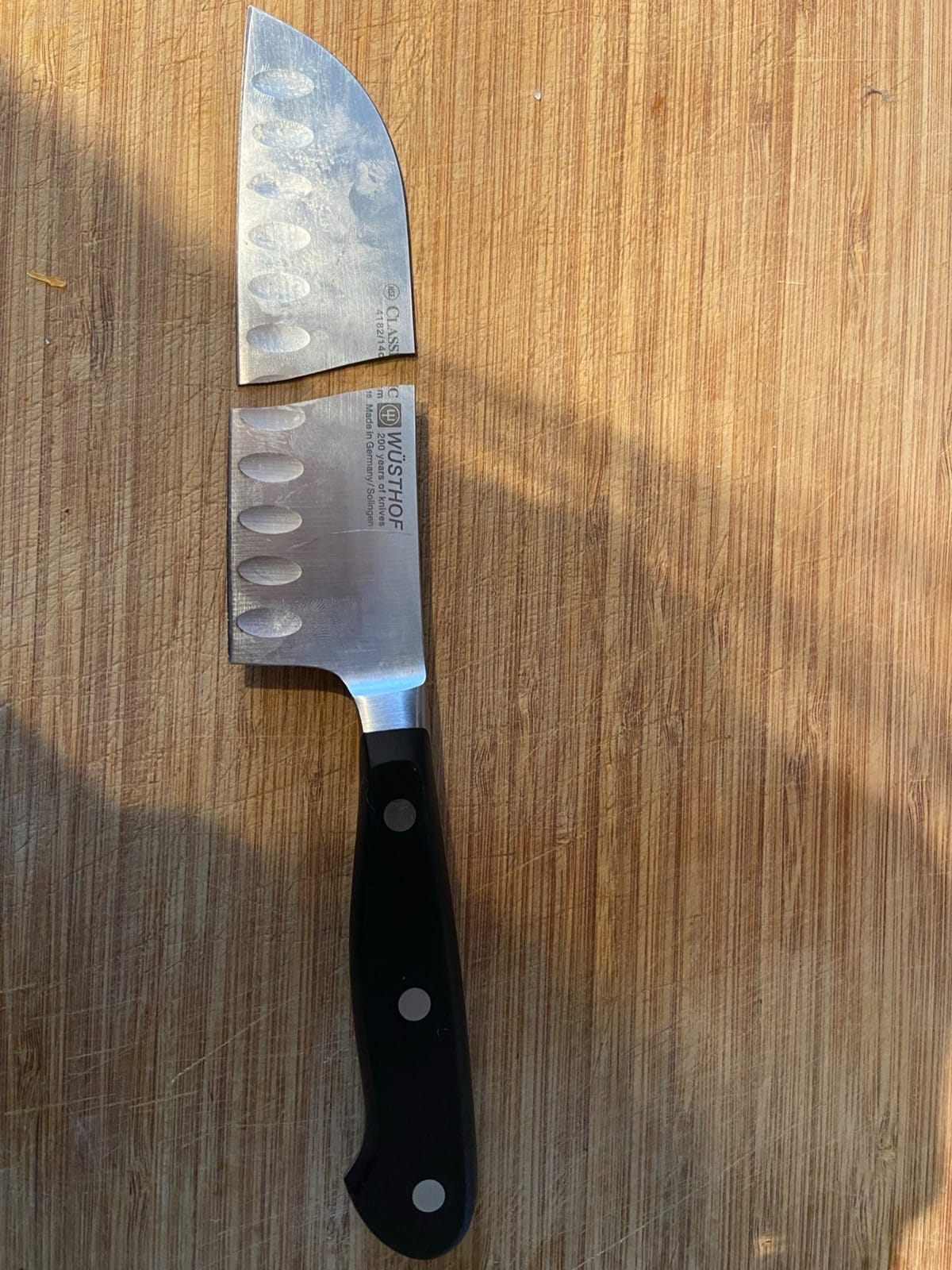
The Wusthof Classic is the top-rated knife in this roundup at 4.9 stars, and owners describe it as a step up in precision, with a hollow edge that makes paper-thin slices and noticeably faster dicing. It is forged in Solingen from a single piece of high carbon stainless steel, with a full tang and a full bolster for stability.
At 6.24 ounces it is light enough for long sessions but has the solid, planted feel that comes from a full tang and bolster. For anyone who wants a knife that looks and behaves like a professional tool without a specialist maintenance routine, this is the one.
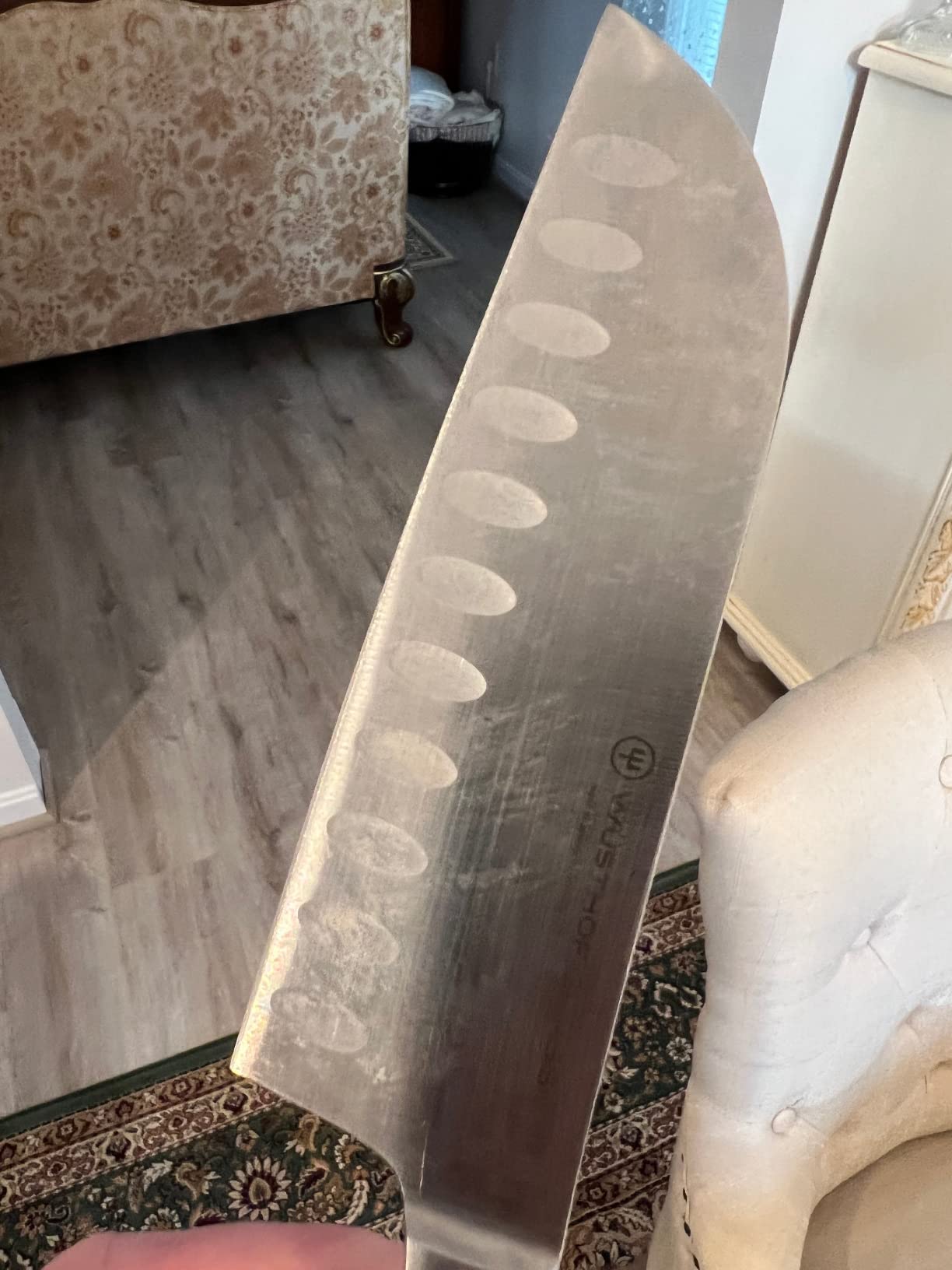
Hollow edge for wafer thin work
The hollow edge profile is designed specifically for slicing and dicing, and owners credit it with producing very thin cucumber and onion slices. The scalloped sides reduce contact area, so the slice releases from the blade cleanly instead of tearing as it lifts.
Steel that is easy to live with
High carbon stainless is a practical middle ground. It holds an edge well, it resists staining from wet produce, and it does not demand stone work the way a VG-MAX or cobalt core does. This is the pick for a cook who wants a good edge without a sharpening ritual.
Where it will disappoint
Two things. It sits at the upper end of the price range for this list, and it is hand wash only, so it asks for more care than the dishwasher-safe alternatives here. The polyoxymethylene handle is also less premium in the hand than the pakkawood on the Cutluxe or the Shun, though the triple-riveted full tang construction is built to last.
Santoku vs Chef’s Knife vs Nakiri for Vegetables
The most common question on the forums behind this topic is whether a santoku is actually better than a chef’s knife for vegetables. The honest answer is that it is a different tool, and the difference is about board space and cutting motion rather than raw capability.
A santoku gives you compact blade height and easy board control. A longer chef’s knife gives you more reach on large produce. Neither is automatically better; board size and cutting style matter more. A 10-inch knife needs a large board to work safely, and if you prep on a small board the extra length is dead weight you have to steer around.
The nakiri is the specialist option and the one most roundups ignore. Where a santoku wins on versatility and flow, a nakiri wins on repetition and precision. A nakiri has a short, straight-edged, rectangular blade with almost no tip, which makes it exceptionally efficient for slicing an entire cabbage or a butternut squash in long, straight downward strokes. If you do that several times a week, a nakiri will be faster than any santoku on this list.
My practical rule: a santoku is your primary knife if you prep a mix of vegetables, fruit and boneless proteins, and a nakiri is an addition if you regularly slice dense gourds and whole heads of cabbage. A chef’s knife earns its place when you break down protein or work on a full-size board.
How to Keep a Santoku Sharp and What It Costs You
Sharpening anxiety is the loudest concern in the enthusiast forums, and it deserves a straight answer. The most upvoted reply in the highest-engagement thread on this topic is blunt: do not use a pull-through sharpener unless the knife is disposable and you do not care about it. That is correct advice for the high-hardness Japanese steels in this roundup, and it is why pull-through advice is the single most common way owners damage an expensive blade.
A pull-through sharpener works by scraping metal off both sides of the edge in a fixed, often steep, angle. Repeated use leaves a visibly rounded edge and a factory angle that drifts steeper each time. On a 62 HRC blade like the HOSHANHO or a VG-MAX blade like the Shun, that is a permanent change you cannot grind back out.
Instead, here is what works and what it costs. A honing rod is a straightening tool, not a sharpening tool, and it is genuinely useful on the soft and medium steels here: the Babish at 56 to 58 HRC, the Cutluxe at 56 and above, the MOSFiATA at 56 and the Mercer Genesis at medium Rockwell. A few passes per session on a dry blade after every prep keeps those edges working.
For the harder steels, a whetstone is the answer. One forum user sharpened a budget Mercer with a 1000-grit stone and reported it stayed excellent months later, which is the single best argument in the enthusiast community against paying a large premium for harder steel on day one. If you will not sharpen, buy a forgiving steel. That is the honest version of the advice enthusiasts give, stripped of the gatekeeping.
For care, the short list is: hand wash, dry immediately, and use a softwood or end-grain board. The Victorinox and the Henckels are the two picks here rated dishwasher safe, but nothing on this list is improved by a dishwasher cycle. The laminated pakkawood handles on the Cutluxe and the Shun in particular should never be left soaking.
What to Look for in a Santoku Knife for Vegetable Work
Most buying guides talk about steel first. For vegetables, the shape and length matter more, and steel matters most for how you will live with the knife afterwards. Here is what to actually check.
Blade length and board space
Six and a half inches is the sweet spot for most home kitchens. It is long enough to dice an onion in a reasonable number of passes and short enough to keep the tip on a modest board. Seven inches gives you more capacity for batch cooking. Anything above 8 inches wants a full-size board, and a santoku longer than that is really a chef’s knife with a different name.
Blade height and knuckle clearance
A tall blade gives your knuckles clearance and keeps the guiding hand away from the food, which matters more than it sounds when you are doing four hundred strokes on a single onion. It also lets the spine push food into position, so you can gather diced pieces without switching to the flat side. Low blade height is the opposite: precise, but you will bruise more produce on the spine.
Edge angle and what it means for dicing
Fifteen to sixteen degrees per side gives you a finer, sharper edge that suits mincing and thin slicing, at the cost of being more exposed to a hard board. Twenty degrees or more is more durable and more forgiving, and it is what most workaday European knives carry. If you cut on end-grain or softwood, a fine edge is worth it. If you cut on glass or stone, a coarser one will survive longer.
Hollow ground versus plain edge for wet produce
A hollow-ground or fluted blade has scallops or Granton dimples ground into the sides. Those channels reduce the flat contact area with food, so diced onion, cucumber and tomato release from the blade instead of clinging. The picks here with that feature are the Victorinox, the Babish, the Cutluxe, the Henckels, the Wusthof and the HOSHANHO. A plain edge like the MOSFiATA or the Shun relies on finish and geometry alone, and the Shun gets there through its hammered tsuchime surface instead.
Steel type and the maintenance you sign up for
Stainless German and Swiss steels in the 56 to 62 HRC range are forgiving, rust resistant and take a steel rod. Japanese stainless in this roundup, including cobalt and the laminated 10Cr15CoMoV, takes a finer edge and holds it longer but wants more careful handling. The practical tiers: buy below 60 HRC if sharpening is not your thing, and go above it only if you will use a stone.
Handle shape, weight and hand size
Weight is a real purchase factor, not trivia. The Victorinox at 3.84 ounces and the Mercer at 3.04 ounces suit small hands and long sessions. The HOSHANHO and MOSFiATA at 11.2 ounces carry real authority for hard produce but need a session to get used to. Handle material matters for grip: Santoprene and micarta stay secure with wet hands, while bare polished steel can feel slick.
Stamped versus forged construction
Stamped blades are cut from sheet steel. They are thinner, lighter and cheaper, which is why the Victorinox works so well for herbs and soft slicing, and why it is unsuited to heavy chopping. Forged blades are shaped, hardened and usually extend through the handle as a full tang, which is what gives the Cutluxe, the Babish, the Mercer and the Wusthof their planted feel. For most vegetable prep, forged is the better long-term answer.
Frequently Asked Questions
What is the best knife for cutting vegetables?
For most home cooks, a quality santoku is the best all-round knife for vegetables because its short, tall blade keeps the food close to your guiding hand and makes straight up-and-down push cuts easy. In this roundup the HOSHANHO 7-inch is the strongest overall pick, the Babish 6.5-inch is the best value option, and the Victorinox 6.69-inch is the easiest to maintain. A nakiri is faster if you mainly slice cabbage and dense squash.
When should I use a santoku knife versus a chef’s knife?
Use a santoku for mixed vegetable prep, dicing and mincing on a small or medium cutting board, because the compact length is easy to control. Use a longer chef’s knife for breaking down protein, large round produce such as watermelon or cabbage halves, and for anyone working on a full-size board. A santoku gives compact blade height and easy board control; a longer chef’s knife gives more reach on large produce.
How do I keep a santoku knife sharp?
Use a honing rod after each prep session on soft and medium steels below 60 HRC, such as the Babish, Cutluxe and MOSFiATA, and use a whetstone for harder Japanese steels such as the HOSHANHO and the Shun. Avoid pull-through sharpeners, which scrape both sides of the edge in a fixed angle and permanently round it. Hand wash, dry immediately, and use a softwood or end-grain board.
What are the common mistakes when using a santoku?
The most common mistakes are cutting on a hard glass or stone board, which dulls and chips the edge; using a chef’s knife motion on a short blade instead of a straight up-and-down push cut; reaching for the tip on dense vegetables such as squash; and ignoring the tip and heel, which are the sharpest parts of a santoku and cause most accidental cuts. Board technique matters more than most owners expect.
Do I need a nakiri as well as a santoku?
Only if you regularly slice dense vegetables such as whole cabbage heads, butternut squash or large gourds. A nakiri has a short, straight-edged rectangular blade with almost no tip, which makes long, straight downward strokes extremely efficient on those items. For general prep, fruit, herbs and boneless protein, a good santoku is more versatile and is the better single knife to own.
Which Santoku Should You Buy for Vegetables?
If you want one knife and you prep vegetables most days, the HOSHANHO 7-inch is the buy. It is the hardest mainstream steel here, it has the weight to handle dense root vegetables, and its double-sided grooves keep wet produce from sticking. If your hands are on the smaller side or you dislike a heavy knife, the Victorinox 6.69-inch is the safer fit.
If you are buying for someone else, or you want a gift that needs no extra purchases, the MOSFiATA set includes the sheath, finger guard, steel and gift box. If you want the strongest value in the group, the Babish 6.5-inch is the one with the most owner feedback behind it, and its softer steel is the most forgiving to learn on.
If you mostly slice cabbage and squash rather than dice onions and mince herbs, look past this list at a nakiri. Otherwise, any of these ten will change the speed and consistency of your vegetable prep in 2026 more than any other single purchase in the kitchen.