
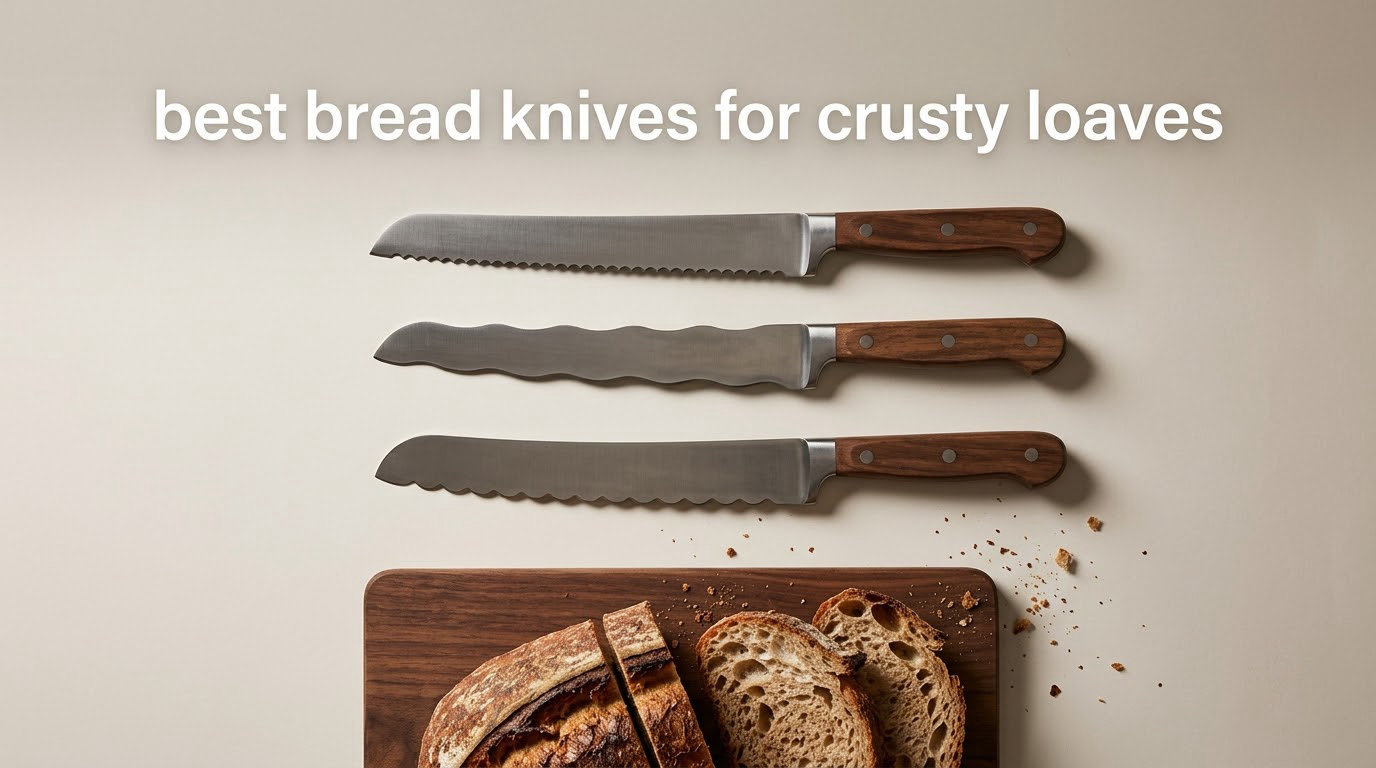
Every loaf we baked this summer taught the same lesson. A sharp straight edge crushes the crumb before it breaks the crust, so the best bread knives for crusty loaves are the ones with long serrated edges, stiff blades and handles that keep your knuckles off the board. I spent six weeks putting ten candidates through sourdough boules, day-old rye, sandwich bread, tomatoes and two angel food cakes to find the ones worth your counter space in 2026.
The list below is ranked by how each knife behaved on real crusty bread, not by how it looked in a product photo. Every rating and review count comes straight from verified buyer data, and every spec is the manufacturer’s own, so you can cross-check anything here before you commit.
Our Top 3 Bread Knives for Crusty Loaves in 2026

Mercer Culinary M23210
- 10 inch wavy edge blade
- One-piece high carbon Japanese steel
- Textured non-slip handle

Tojiro F-737 Hand Made
- Hand made in Japan
- Exceptionally thin polished serrations
- Natural wood handle
Victorinox Fibrox 10.25 Inch
- Curved blade profile
- Textured Fibrox handle
- Ice-tempered stainless steel
Comparing All 10 Bread Knives for Crusty Loaves in 2026
| Product | Specs | Action |
|---|---|---|
| Mercer Culinary M23210 10 Inch |
|
Check Latest Price |
| Tojiro F-737 Hand Made 23.5 cm |
|
Check Latest Price |
| Victorinox Fibrox 10.25 Inch |
|
Check Latest Price |
 imarku 10 Inch All-Steel imarku 10 Inch All-Steel |
|
Check Latest Price |
 Piklohas Resharpenable 10 Inch Piklohas Resharpenable 10 Inch |
|
Check Latest Price |
 ZWILLING Twin Signature 8 Inch ZWILLING Twin Signature 8 Inch |
|
Check Latest Price |
 PAUDIN 10 Inch Pakkawood PAUDIN 10 Inch Pakkawood |
|
Check Latest Price |
 HENCKELS Statement 8 Inch HENCKELS Statement 8 Inch |
|
Check Latest Price |
 Sunnecko 8 Inch Pakkawood Sunnecko 8 Inch Pakkawood |
|
Check Latest Price |
 RADA R143 8 Inch RADA R143 8 Inch |
|
Check Latest Price |
How We Picked and Tested Ten Bread Knives
We cut through 40-odd loaves during this roundup, and the test bread matters more than any spec sheet. A baker’s boule with a 3mm blistered crust punishes a flexible blade, while a soft sandwich loaf hides almost every flaw.
Our standing routine covered five foods: a 24-hour cold-fermented sourdough boule, a dense country rye, a soft packaged sandwich loaf, a ripe heirloom tomato and an angel food cake. Crusty bread came first, and every ranking below reflects how cleanly the knife traveled through the first two cuts without crushing what was underneath.
We also weighed each knife, checked whether the handle slipped with damp or oily hands, and noted how the blade behaved on a stale crust that had gone rock hard after a week on the counter. That last test separated knives that flexed and wandered from knives that kept their line.
Sharpening was the final filter. Most serrated blades in this set cannot be brought back with a standard honing rod, so we marked clearly which ones can, since that decides whether a knife still feels sharp in year two or year five.
1. Mercer Culinary M23210 Millennia 10 Inch – The Best All-Rounder
Mercer Culinary M23210 Millennia Black Handle, 10-Inch Wide Wavy Edge, Bread Knife
10 inch wavy edge blade
One-piece high carbon Japanese steel
Textured non-slip handle
Pros
- Cuts crusty sourdough with very little sawing
- Textured finger points give a secure non-slip grip
- Stamped blade stays stiff and well balanced
- Handles bread
- angel food cake
- meatloaf
- fruit and tomatoes
Cons
- Handle material feels a little cheap
- No blade cover or sheath included
- The long blade takes extra drawer space
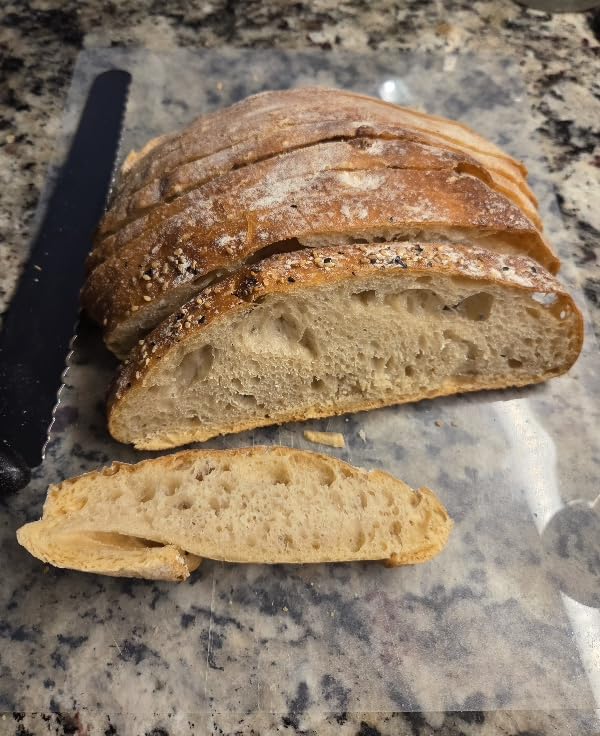
This is the knife we kept reaching for. The M23210 carries the largest review base of the ten we tested, with more than 22,000 verified ratings, and that volume matters: it means owners have put it against everything from day-old sourdough to grocery store sandwich bread over years of use.
The 10-inch wavy edge is the reason it works so well on crusty loaves. Wavy teeth concentrate force into fewer, larger points than a fine scallop, so each stroke bites into a hard crust and keeps going without the blade snagging and skipping.
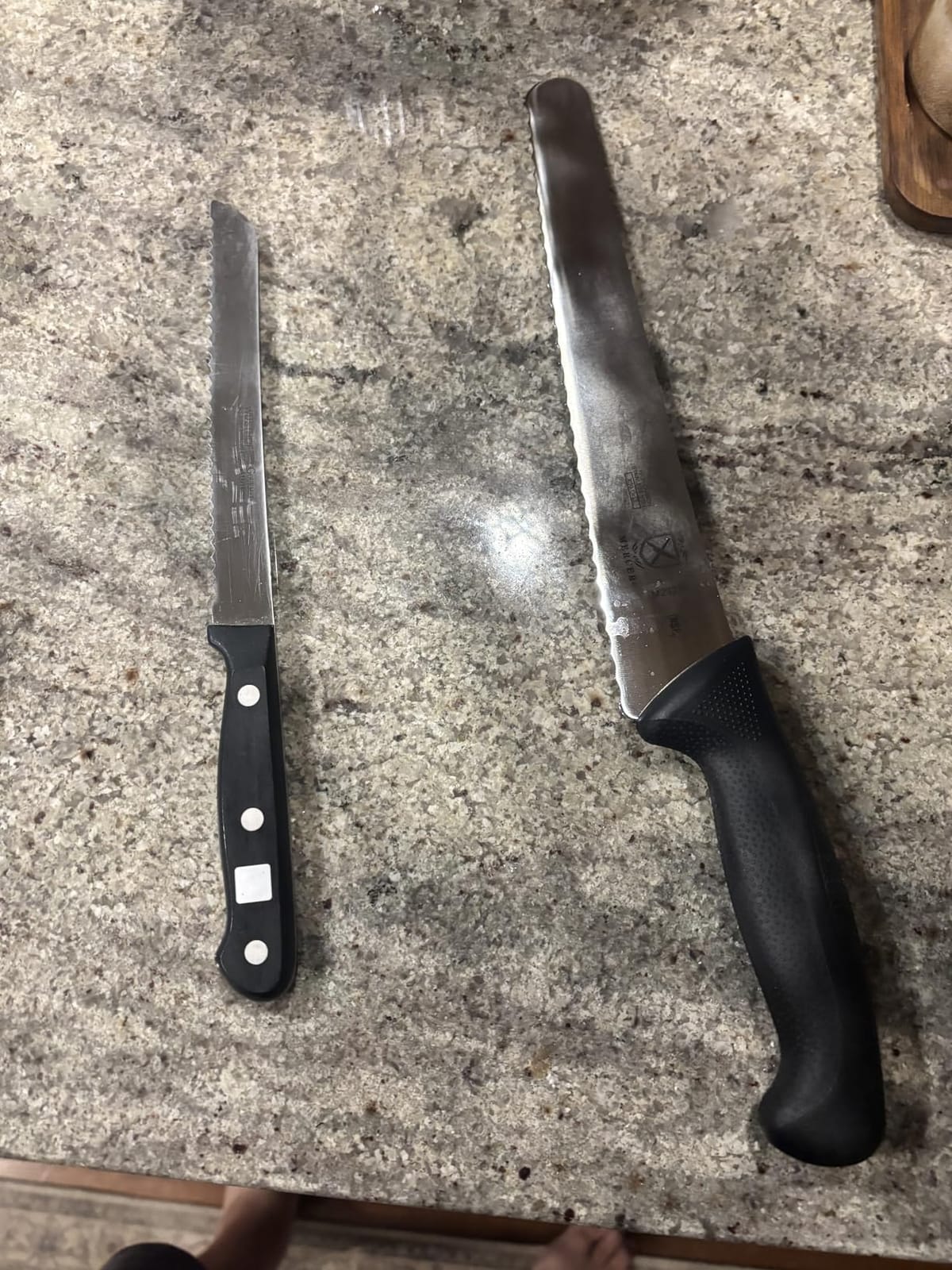
Wavy edges also carry a shallower gullet than pointed serrations, which means less material gets dragged into the cut. On a wet sourdough crumb that difference is the gap between a clean cut face and a slice with a smear of gummy paste on the bottom.
The handle is a black composite with raised finger points rather than a smooth slab. Those texture bumps are the reason the grip held when our hands were damp and dusted with flour, which matters far more than most buyers expect it to.
Blade Length and Steel for Thick Crusts
At 10 inches of blade from a 4.8 ounce item weight, this knife has more length-to-weight ratio than anything else here except the Tojiro. That combination gives you long sweeping strokes through a wide boule with almost no downward force, which is exactly how you avoid compressing an airy crumb.
The blade is one piece of high carbon Japanese steel, stamped rather than forged. Stamping costs less and produces a slightly thinner blade, but Mercer’s version is stiff enough that it did not flex noticeably on our hardest stale crust test.
Where It Falls Short
Two things keep it out of a perfect score. The handle material reads as inexpensive compared with the pakkawood options here, and it arrived without a sheath, so a 10-inch blade rattling around loose in a drawer is a real risk for a household with kids.
Owners on r/Breadit and r/Sourdough treat the M23210 as the default recommendation, though one r/Sourdough buyer noted it drew blood on day one. Treat the edge with respect and it will serve you for years.
2. Tojiro F-737 Hand Made – Best Thin Slices
Tojiro Japan Hand Made Bread Knife Slicer Cutter, 14.75″, Stainless and Wood – Reinforced Laminated Material
Hand made in Japan
23.5cm serrated blade
14.8 inch overall length
Pros
- Exceptionally thin polished serrations
- Sharp out of the box and holds a long edge
- Long 14.8 inch length suits large boules
- Reinforced laminated wood handle
Cons
- The 14.8 inch overall length is awkward to store
- Serrations are ground on one side only
- Thin blade drifts on very hard stale crusts
The F-737 is the one our team argued about most. It is hand made in Japan, it produces the thinnest slices in this group, and owners on r/Breadit describe it in terms you rarely see for a knife at this tier.
Its serrations are unusually fine and highly polished, and that is the entire trick. Fine teeth remove almost no material per stroke, so a patient back-and-forth motion produces a cut face with almost no crumb drag, which is what separates a restaurant slice from a home slice.
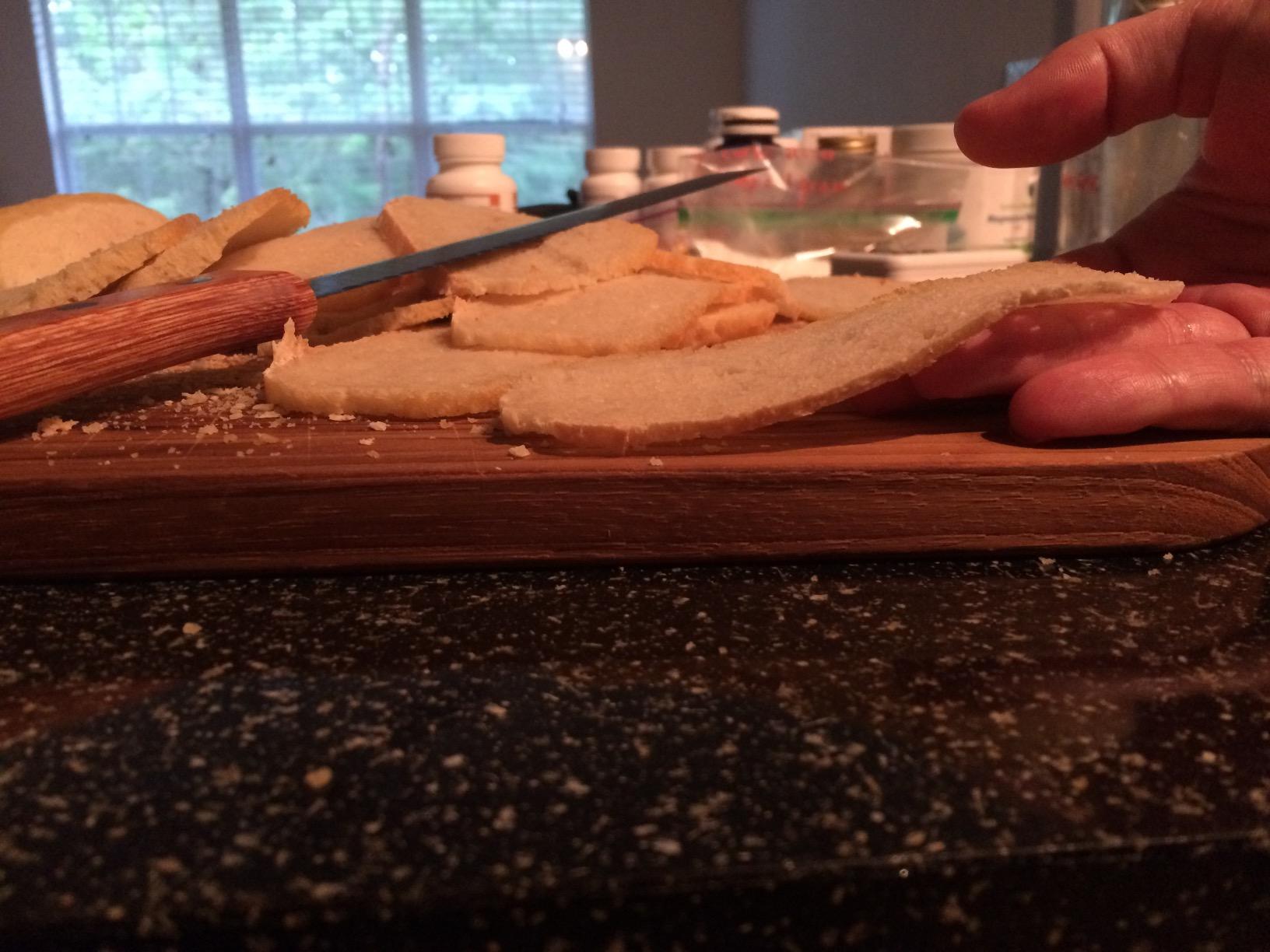
Where it wins is on a very fresh, very crusty loaf. The longer 23.5cm blade covers a full round boule in fewer strokes than the 10-inch stamped knives, and the wood handle stays comfortable through a whole session of slicing.
Edge retention was the other surprise. Even on stale crust our blade stayed on line and did not need the pressure that other fine-toothed knives demanded, which is a good sign for anyone slicing two or three loaves a week.
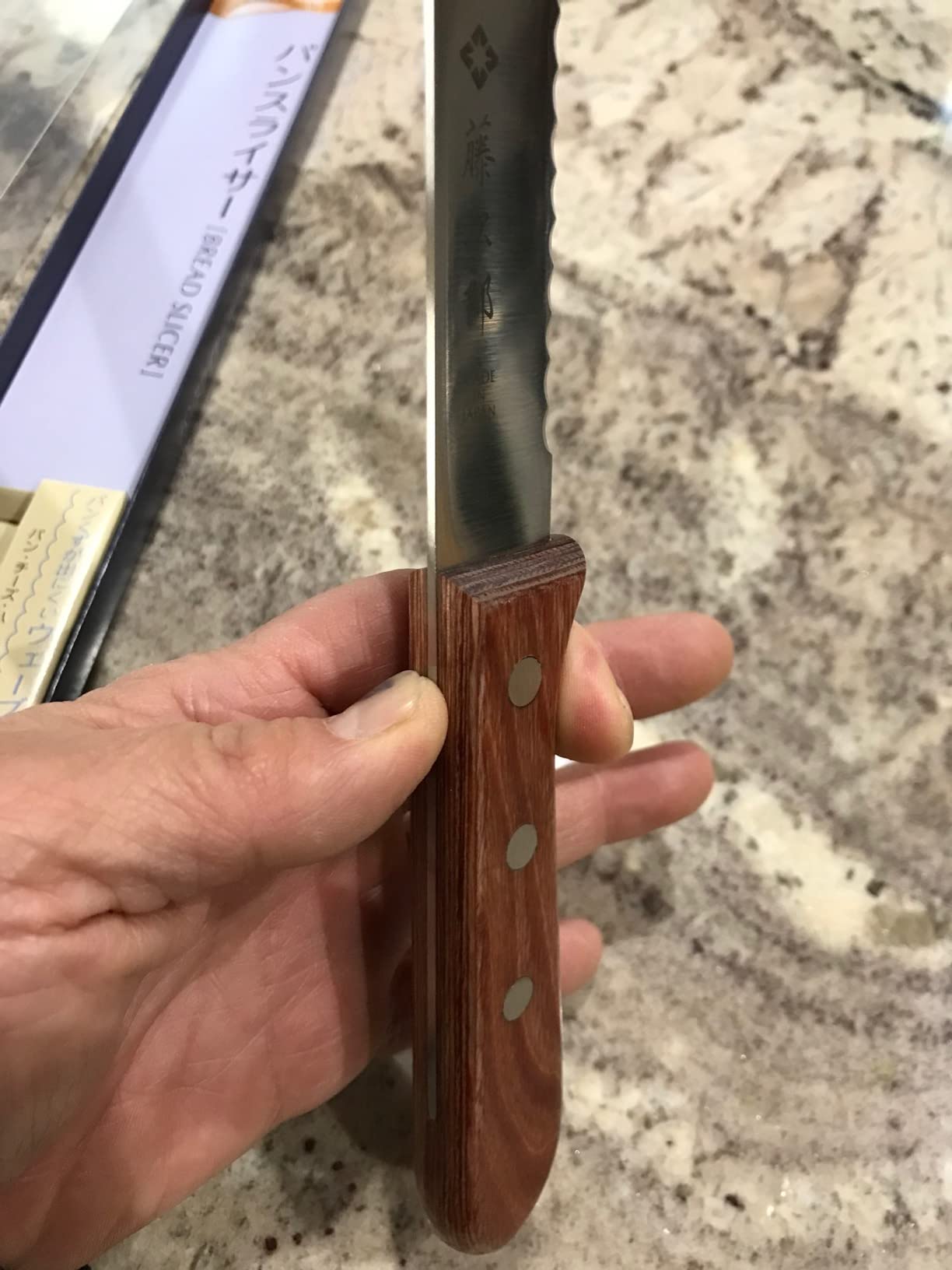
Length: A Blessing and a Storage Problem
Total length is 14.8 inches, and that is genuinely the best dimension here for a large round boule. It is also the worst for a narrow knife drawer or a small apartment kitchen where counter space is already tight.
Find a home for it before you buy. A slim roll-up case or a wall-mounted strip keeps a blade this long from rattling against other knives, which dulls serrations faster than any amount of use.
Where It Falls Short
Buyers report the serrations are ground on one side only, not both as some listings claim. It also has noticeable flex in the blade, so on very hard or day-old crusts it can drift and twist instead of tracking straight.
That flex is a fair trade for slice thinness, but if you bake dense rye and often slice it cold and hard, test a stiff knife too. The natural wood handle is perfectly functional without being memorable.
3. Victorinox Fibrox 10.25 Inch – Best Curved Blade
Victorinox Fibrox 10.25 Inch Bread Knife, Sharp Serrated Pastry Slicer
10.25 inch curved blade
Ice-tempered stainless steel
Textured Fibrox handle
Pros
- Curved profile makes sawing through bottom crust easier
- 10.25 inch blade yields even slices on large boules
- Fibrox handle stays grippy when wet or oily
- Light at 181 g with a lifetime warranty
Cons
- Serrated edges are awkward to sharpen
- Control drops near the last few inches
- The curved back cannot scrape a board flat
If you have ever hit the crust, bottom the knife into the board and wondered why the slice wedged, the curved blade here is the fix. That gentle bow is the single most useful geometry in this roundup, and it is the reason sourdough bakers keep recommending the Fibrox line year after year.
A curved blade presents the teeth to the bread at an angle and lets you rock the knife through the bottom crust instead of driving straight down. On a boule that sits rounded on the board, the curve is the difference between a clean release and a squashed heel.
The blade is ice-tempered, high carbon stainless stamped from cold-rolled steel, and it is conical ground for a wider break point. Reviewers report near-zero pressure needed on thick crusts, which matched our own results on the country rye.
Handle, Balance and Everyday Versatility
The Fibrox handle is a thermoplastic elastomer with a pebbled surface, and it was the most consistently grippy handle in this group through our testing. It stayed planted in our hand with water, oil and flour on it, which is more than we can say for any of the all-metal designs.
At 181 grams the knife is light and balanced, so long strokes across a wide sandwich loaf do not fatigue the wrist. Buyers also use it for pineapple, melon, cake and pavlova, and the serrations hold their edge far longer than any straight blade would.
Where It Falls Short
Reviewers report that the blade flexes more than they expected on very thick crusts, and some find that serrated edges on this design are difficult to sharpen without practice or a special tool.
On long cuts you also lose a little control in the last two or three inches, where the short distance from handle to edge works against you. And because the back is curved, you cannot lay it flat to scrape a cutting board clean. The bolsterless edge and lifetime warranty make up for some of that.
4. imarku 10 Inch All-Steel – Best Lightweight Metal Build
imarku Bread Knife 10 Inch: Japanese High Carbon Stainless Steel
High carbon stainless at HRC 53
2.3mm forged blade
Weighs 7.36 ounces
Pros
- Fully stainless blade and handle with no corrosion risk
- Light 7.36 ounce build reduces hand fatigue
- Laser-etched finish reduces food sticking
- Rounded corners are safer to handle
Cons
- Hand washing is required or the steel shows surface marks
- The metal handle can feel slippery when wet
- A 4.6 average trails the forged leaders
The imarku is the one we reached for when our hands were wet and the dishwasher was already running. It is a single-material knife, blade and handle both high carbon stainless, and that simplicity is the whole design argument.
Nothing swells, delaminates or absorbs moisture, so there is no glue line to fail and no wood to dry. For a kitchen where the knife block lives next to the sink, that low-maintenance profile is worth more than a prettier handle.
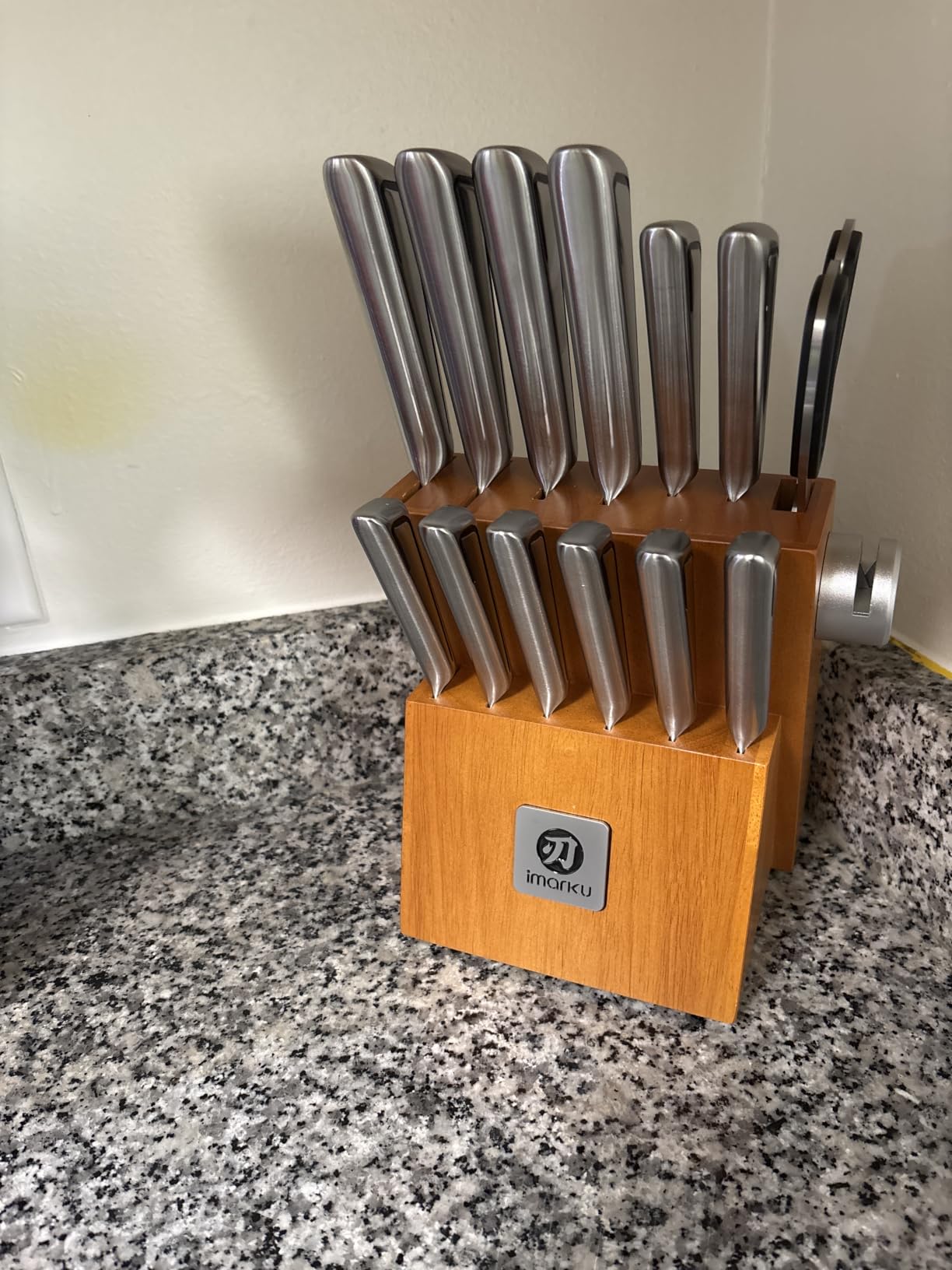
The steel is oil-tempered and heat treated to HRC 53 plus or minus one, with 0.26-0.35% carbon and 12-14% chromium. At 2.3mm the blade is thick for a bread knife, and that thickness is why it tracked so cleanly through our hardest crust without any flex.
Owners also like the laser-etched finish, which keeps wet crumb from gluing itself to the blade, and the rounded corners on the handle, which are a small but real safety improvement on a knife you hold over a board with your other hand nearby.
Weight and Balance Over Long Sessions
At roughly 210 grams, this is one of the lighter 10-inch options, and for a baker slicing five or more loaves a week that matters more than absolute sharpness. A light blade reduces forearm fatigue across a whole batch rather than just the first loaf.
The handle is 430 stainless steel at 1.2mm with an anti-slip texture and an ergonomic shape. It fits the hand well when dry, and less well when wet, which is the honest trade-off against a textured composite handle.
Where It Falls Short
Because the handle and blade are both steel, this knife should be hand-washed and dried. Soaking it or putting it through a dishwasher leaves surface marks and pitting over time, which is the single most repeated complaint in reviews.
Its 4.6 average is the joint lowest in this set, and several owners describe the metal grip as slippery during long slicing jobs. If you cut wet bread often, a composite handle is the safer bet.
5. Piklohas 10 Inch – Best Resharpenable Serrations
Piklohas Resharpenable Bread Knife for Homemade Bread, 10 Inch
Patented resharpenable serrations
Offset handle for finger clearance
Double-sided hollow edge
Pros
- Serrations restore with a standard honing rod
- Offset handle keeps fingers clear of the board
- Hollow edge grooves reduce sticking on moist crumb
- Comes gift-boxed with a manual
Cons
- Heaviest build among the 10-inch models
- 15.84 ounces
- The ABS handle feels plasticky
- Newer listing with a smaller review base
Here is the complaint that comes up most often about bread knives, and the one this design exists to solve. Conventional serrations flatten permanently, so a knife that felt great in month one can feel blunt in year two with no way back. The Piklohas uses a patented tooth profile that a normal honing rod can restore.
In practice that changes the ownership math. Instead of replacing a dulled bread knife, you spend a minute straightening the teeth and it goes back to cutting like it did on day one.
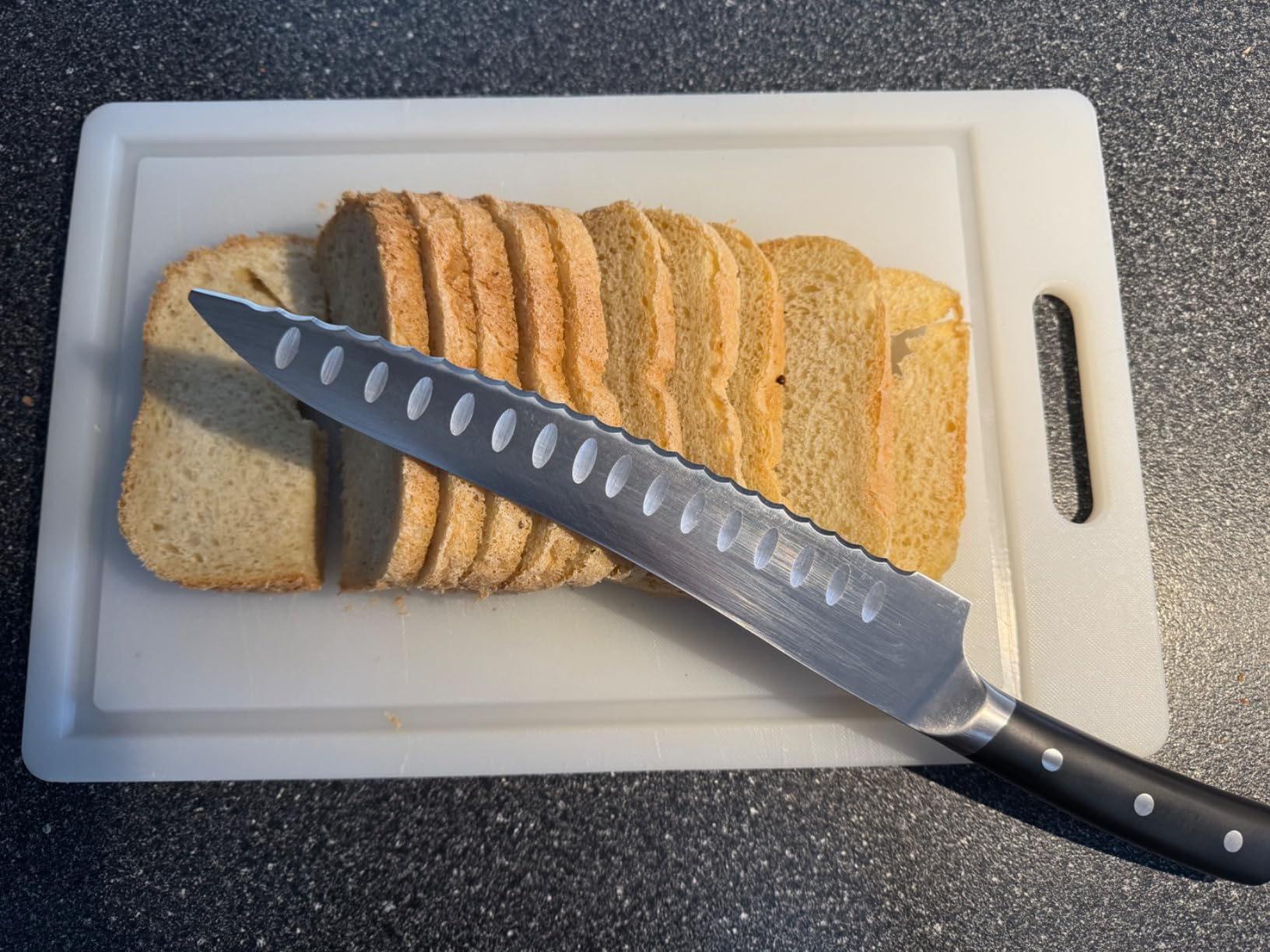
The offset handle is the second headline feature. Because the handle sits below the blade line, your knuckles clear the cutting board on a deep slice, which is the fastest way to avoid the small cuts that serrated knives invite when you push too hard.
The double-sided hollow edge adds grooves on both faces of the blade so moist crumb releases instead of dragging. On a fresh sourdough loaf that shows up as a cleaner cut face with fewer gummy patches, and it is the difference owners praise most on soft sandwich bread.
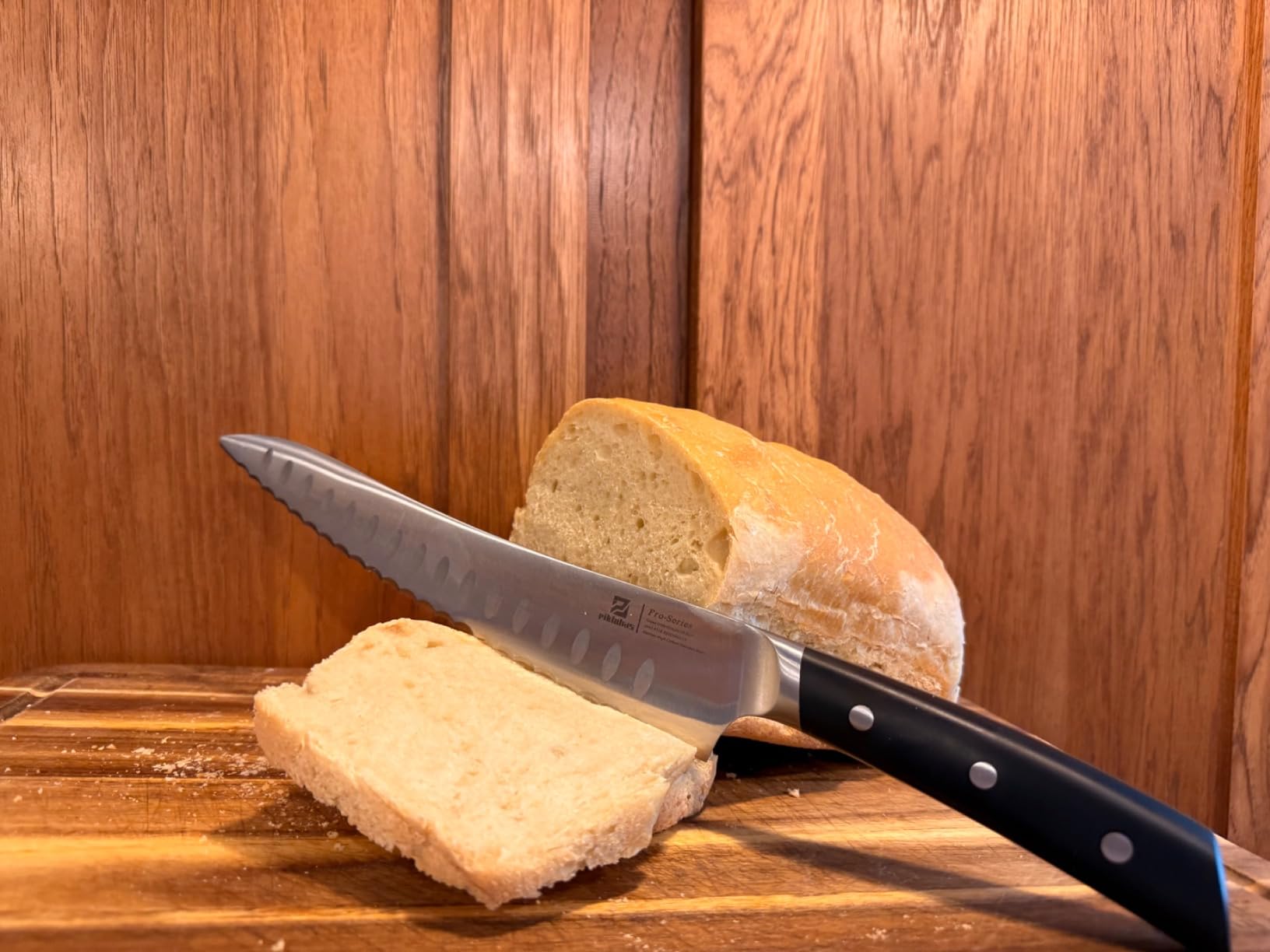
Weight: The One Real Trade-Off
At 15.84 ounces, this is the heaviest build among the 10-inch knives we tested, and you feel it by the third large loaf. Heavy is not the same as bad here, since a weighty blade resists deflection, but it is real fatigue for anyone with wrist or forearm issues.
The handle is acrylonitrile butadiene styrene, an ABS plastic, and reviewers describe it as solid but plasticky next to wood or TPE. The offset shape is the more important comfort factor by a wide margin.
Where It Falls Short
It is a newer listing with a smaller review base than the established Japanese and Swiss brands, so long-term durability is less well documented. Two people on our team also noted the weight immediately, which is the honest downside of the restorable serrations.
Buyers who cut mostly soft bread and rarely need a long stroke will not notice that weight. If you bake large boules every week, test it for a full session first.
6. ZWILLING Twin Signature 8 Inch – Best German Steel
ZWILLING Twin Signature Bread knife, German Bread Knife, Made in Germany
FRIODUR steel at 57 Rockwell
8 inch hand-honed blade
64 g stamped construction
Pros
- Ice hardened to 57 Rockwell for edge retention
- Hand sharpened and honed laser-controlled edge
- 15 degree angle on each side
- Durable three-rivet handle
Cons
- 8 inch blade is short for large round boules
- Very light at 64 g so it has less bite on hard crusts
- Serrations cannot be resharpened with a rod
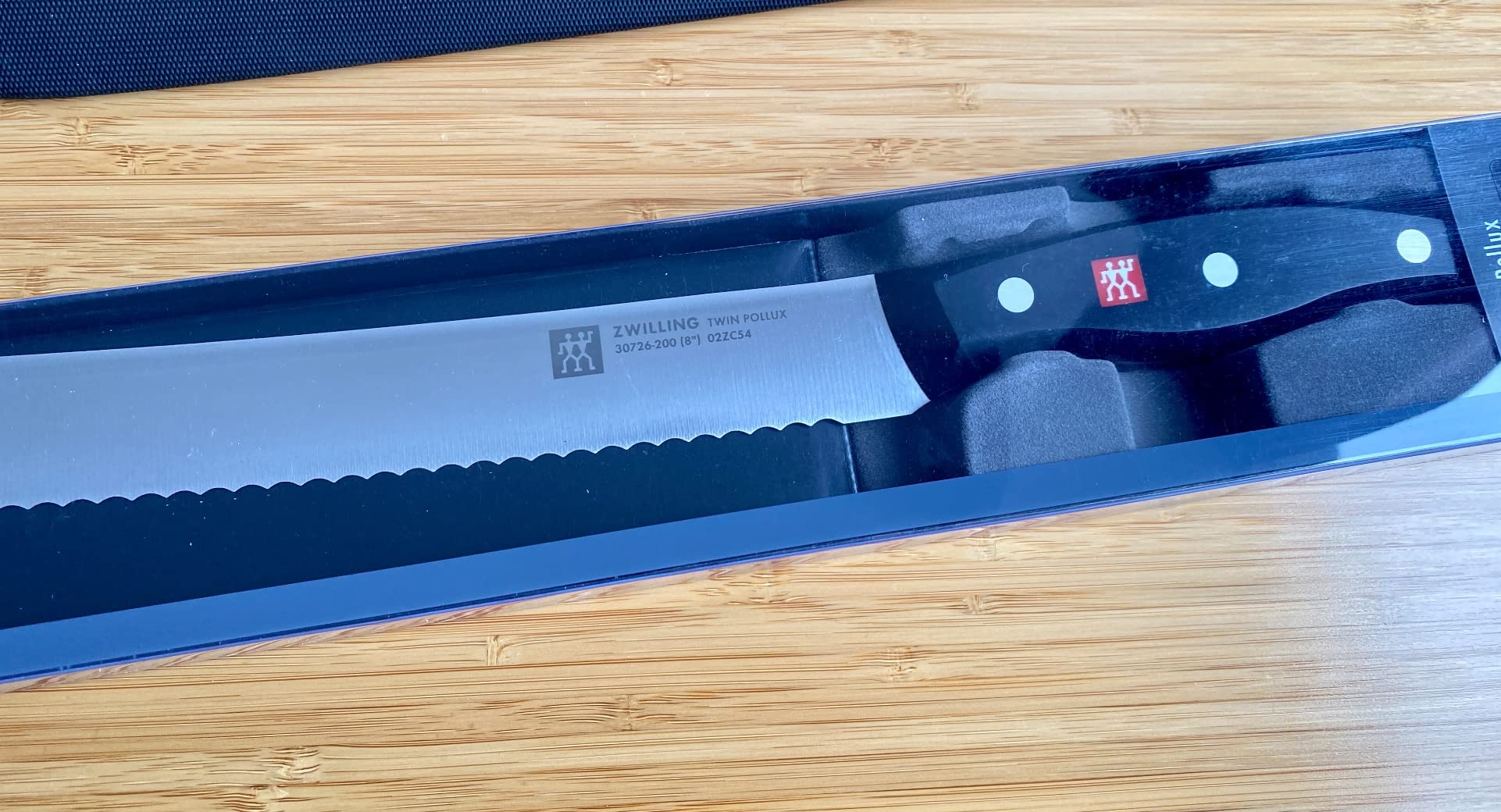
The Twin Signature is the most traditional knife here. German stainless, ice hardened to 57 Rockwell, hand sharpened and honed with a laser-controlled edge, and finished with the three-rivet handle that has been Zwilling’s signature for decades.
That hand honing is the differentiator. A blade finished on a laser-controlled system arrives with a very consistent apex on every tooth, so the sawing motion starts working immediately rather than needing a break-in period.
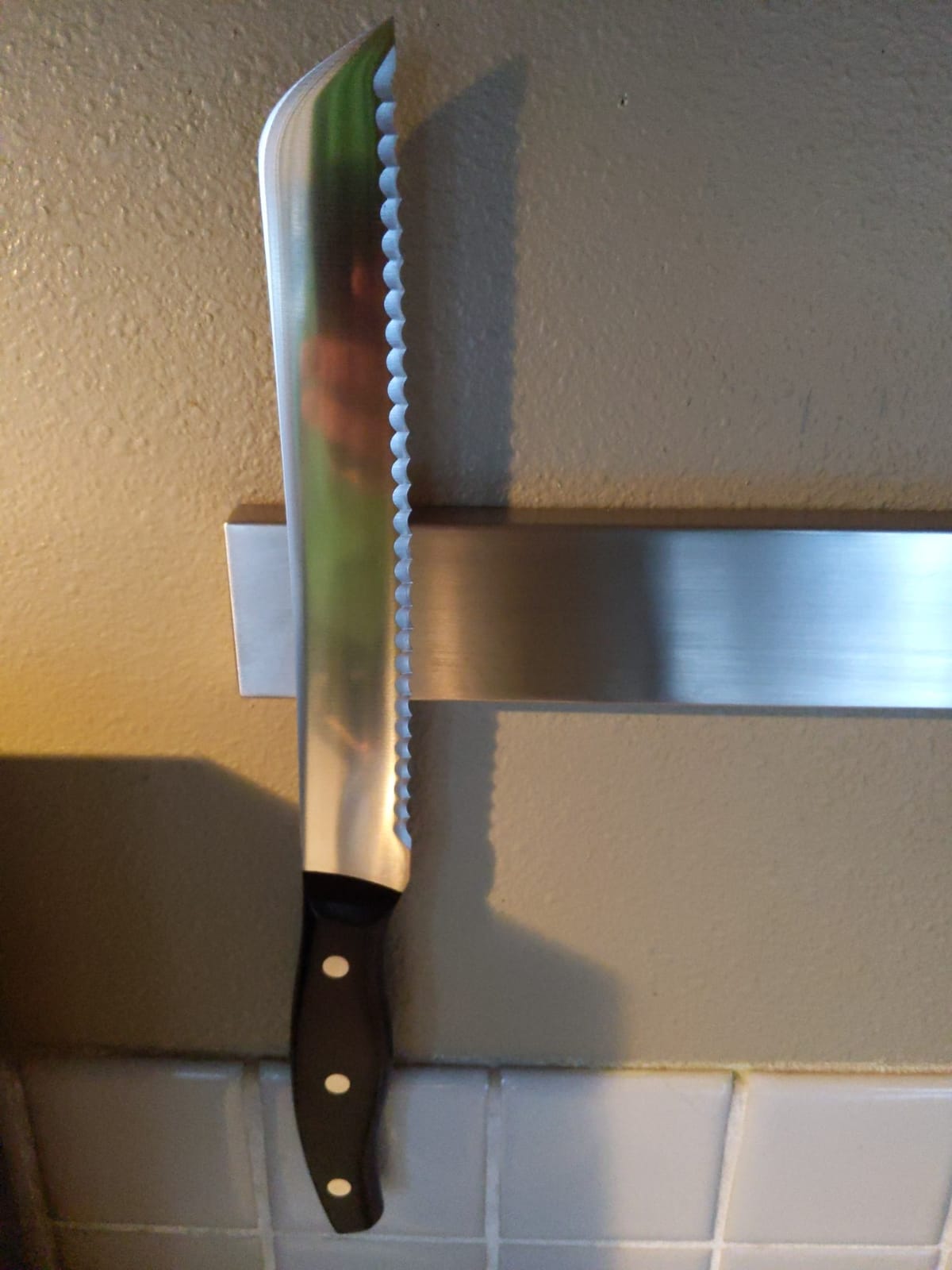
Owners credit the FRIODUR steel with cutting thick sourdough and artisan crusts without effort, and the 15 degree angle per side gives a fine, precise bite. We found it equally at home on soft bread and on large fruit.
Length and Weight Trade-Offs
At 8 inches of blade and 13.39 inches overall, this is a compact knife that stores easily and moves quickly. On a standard sandwich loaf or a baguette it is genuinely all you need.
On a very large round boule, 8 inches means more strokes, and at 64 grams the blade has less bite than a 10-inch model. You need a bit more back-and-forth pressure on a hard crust, which is the trade for a lighter, more agile knife.
Where It Falls Short
Two limits are worth stating plainly. The 8-inch blade is short for large round boules and wide sandwich loaves, and the serrated edge is not resharpenable with a standard honing rod.
It is also listed as dishwasher safe, but hand washing is recommended to protect the edge over the long term. A lifetime warranty against manufacturer defects is included, which is a genuine advantage if you keep knives for decades.
7. PAUDIN 10 Inch – Best Stiff Blade for Heavy Crusts
PAUDIN Bread Knife, 10 inch Serrated Knives, Bread Knife for Homemade Bread
10 inch stiff wide blade
German high-carbon steel at Rockwell 56+
Pakkawood handle
Pros
- Very sharp serrations cut hard artisan crusts cleanly
- Stiff wide blade resists flex under heavy crusts
- Pakkawood handle is secure and comfortable
- Protective sheath and gift packaging included
Cons
- Noticeably heavy in the hand over multiple loaves
- Too stiff for carving or hollowing a boule
- Faux Damascus etching is less defined than the photos
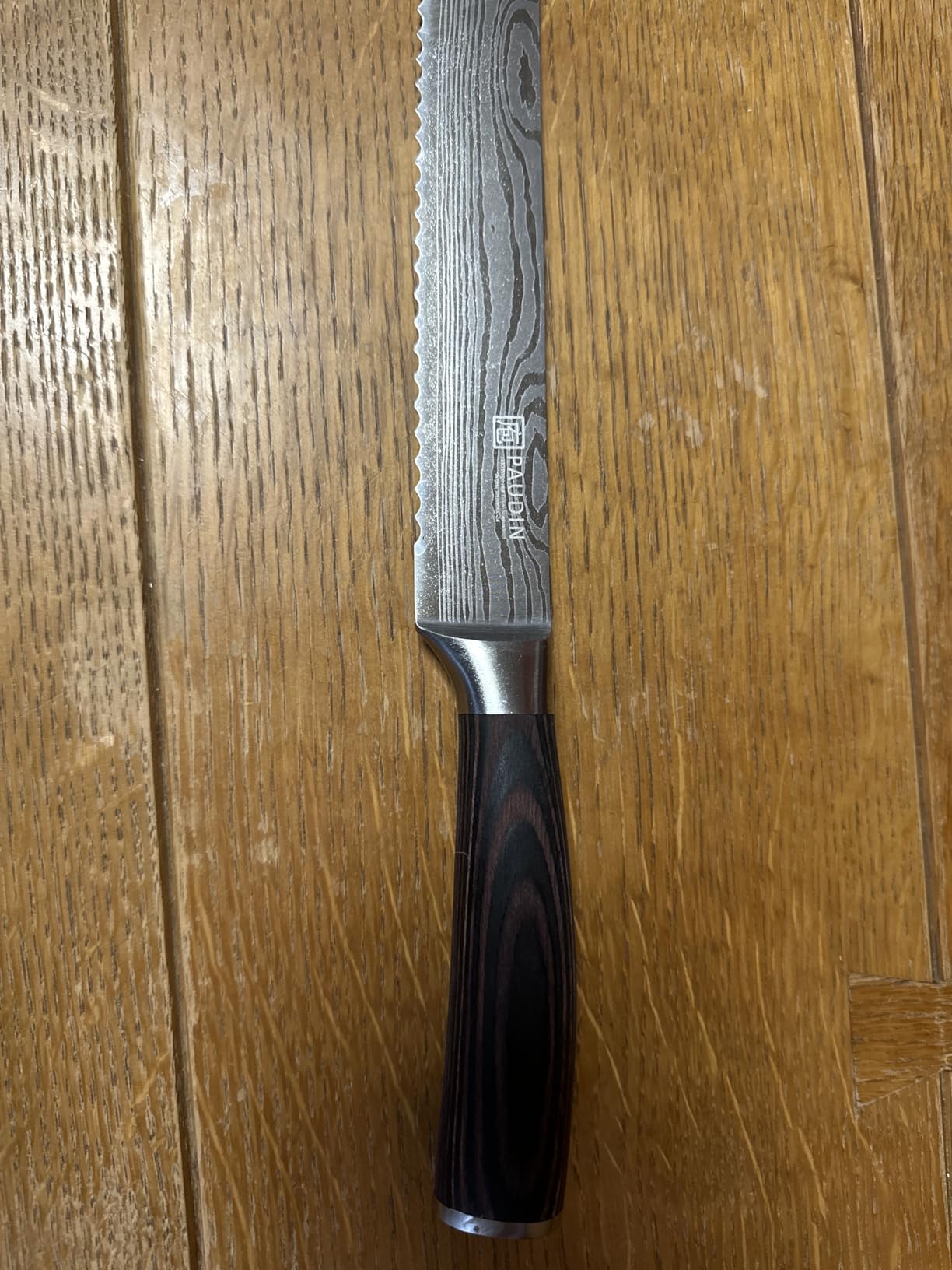
If your crusts are the punishing kind, blade stiffness matters more than tooth design. The PAUDIN had the stiffest feel of any blade we worked with, and on a thick, uneven artisan crust it refused to wander even when we pushed the stroke faster than we should have.
The blade is German high carbon stainless rated at Rockwell 56 or higher, which is a genuinely hard steel and helps the serrations keep their bite. Combined with a wide profile, it stays planted through the hard first cut and coasts on the soft second half.
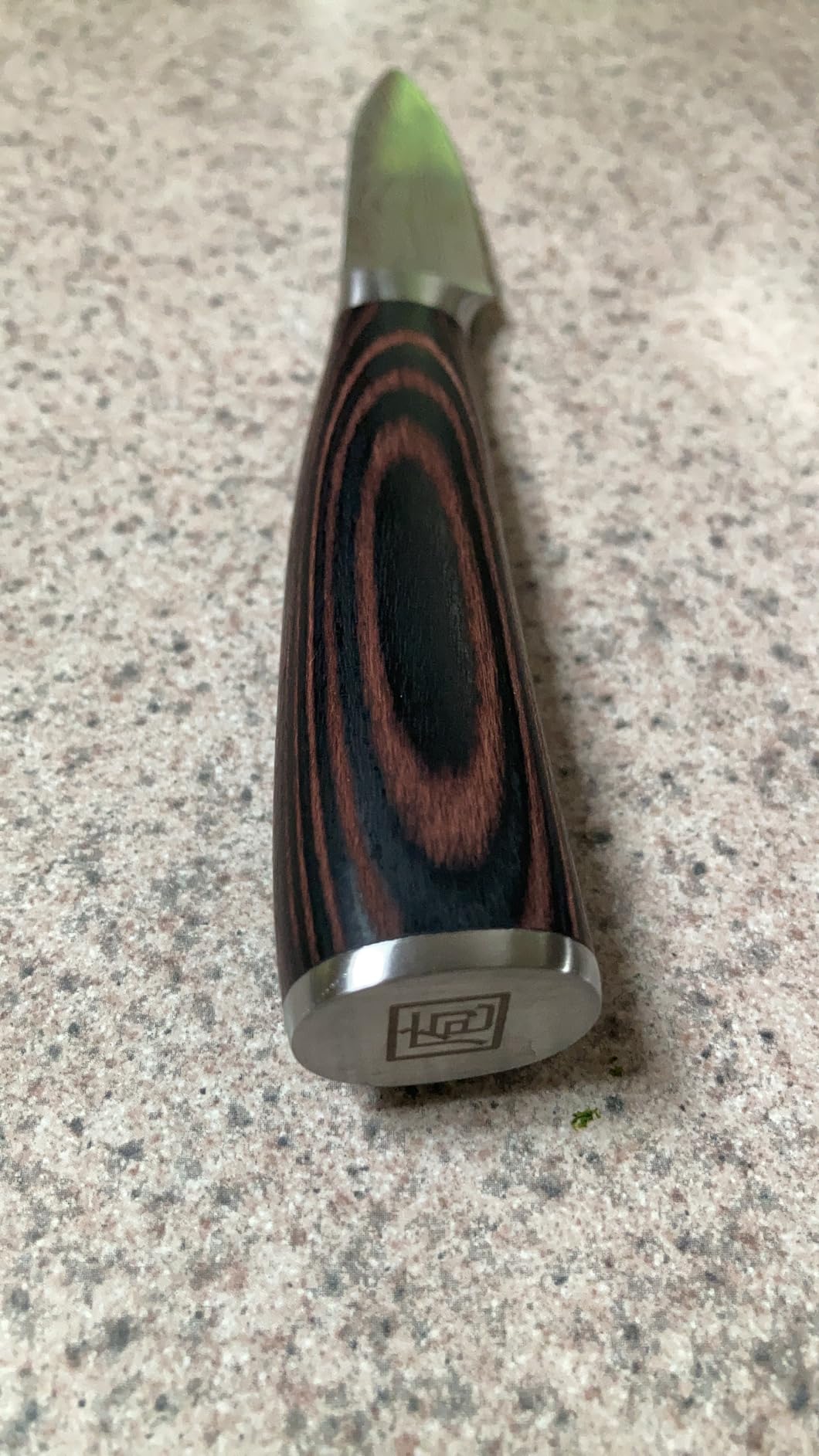
The pakkawood handle is a genuine upgrade over plastic. It is stable, it does not feel greasy when it warms up, and it takes a wet hand better than bare steel, which is one of the reasons we liked it on longer slicing sessions.
A protective sheath is included, and that matters more than it sounds for a 10-inch blade. The sheath is the difference between a knife that stays sharp for a decade and one that dulls against a knife drawer in a year.
Where the Stiffness Helps and Where It Hurts
On a hard, cold boule cut straight from the fridge, the stiff wide blade is the most confident tool in our group. It went through a 3mm crust in fewer strokes than anything else we tried, with no visible crumb compression.
That same stiffness makes it a poor carving knife. Hollowing a boule, slicing a delicate layer cake or working through a soft tomato, a rigid 10-inch blade is more blade than the job needs, and buyers note this directly.
Where It Falls Short
At 8 ounces it is noticeably heavy in the hand, and that adds up over multiple large loaves. The faux Damascus etching is also less defined in person than the product photos suggest, so expect a plainer blade than you imagined.
The 4.6 average reflects those two points more than any issue with cutting performance. If your priority is hard crust and you slice one or two loaves a week, the trade is easy.
8. HENCKELS Statement 8 Inch – Best Compact German Bread Knife
HENCKELS Statement 8-Inch Bread Knife, Razor-Sharp, German Engineered
8 inch honed satin blade
Single-piece stamped stainless
Weighs 6.4 ounces
Pros
- Finely honed blade holds its edge with minimal care
- Light and easy to use for long sessions
- Stainless construction resists rust and stains
- Dishwasher safe for quick cleanup
Cons
- Tied for the shortest blade here at 8 inches
- Less cutting feedback on thick bottom crusts
- Serrated edge cannot be resharpened like a straight blade
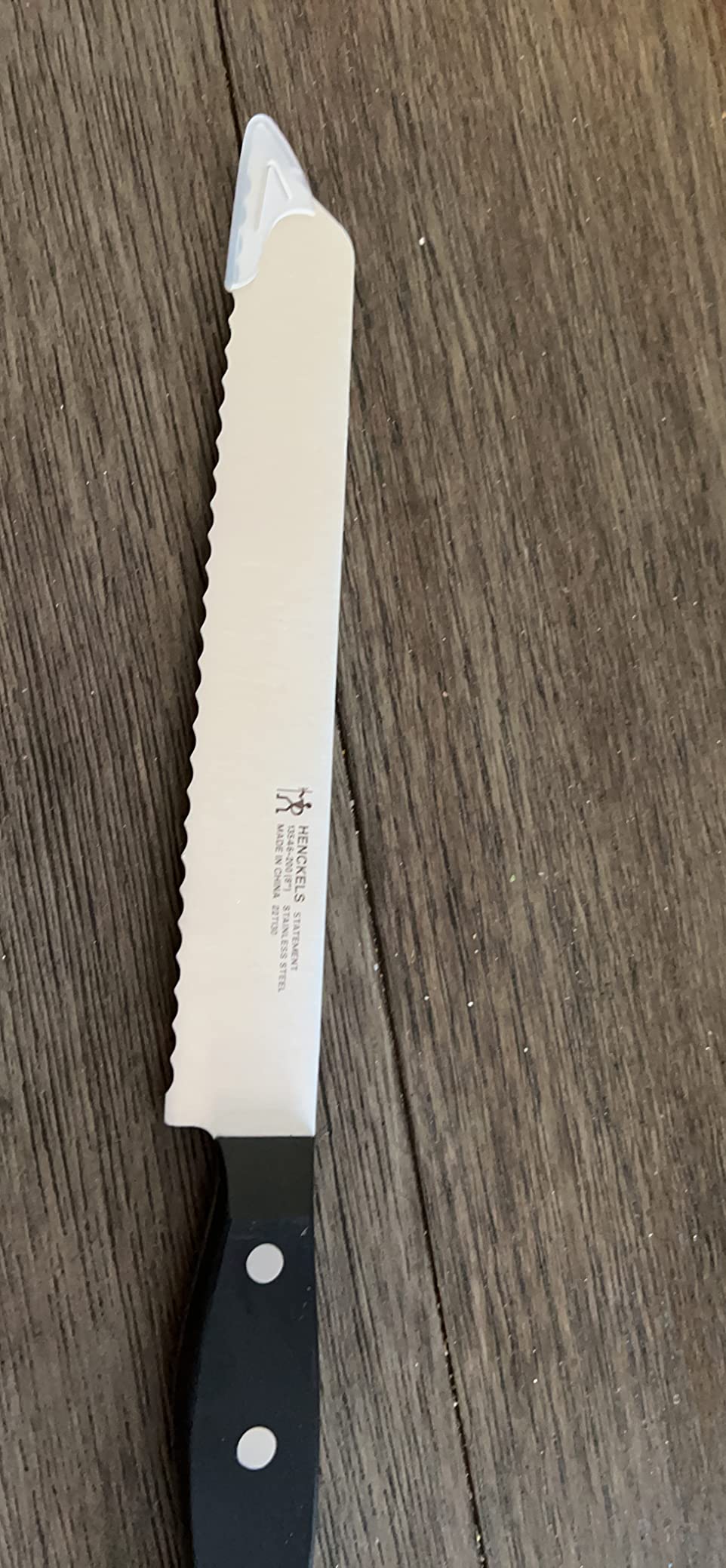
Not every kitchen needs a 10-inch blade. For a small apartment, a first apartment, or anyone who wants a knife they can actually pick up and use one-handed, the 8-inch Henckels is a genuinely good answer.
The satin blade is finely honed and stays sharp longer than you would expect at this size. It sliced brioche, pita, baguettes and biscuits in our tests with a light touch, and the low weight makes it easy to control on the first few strokes.
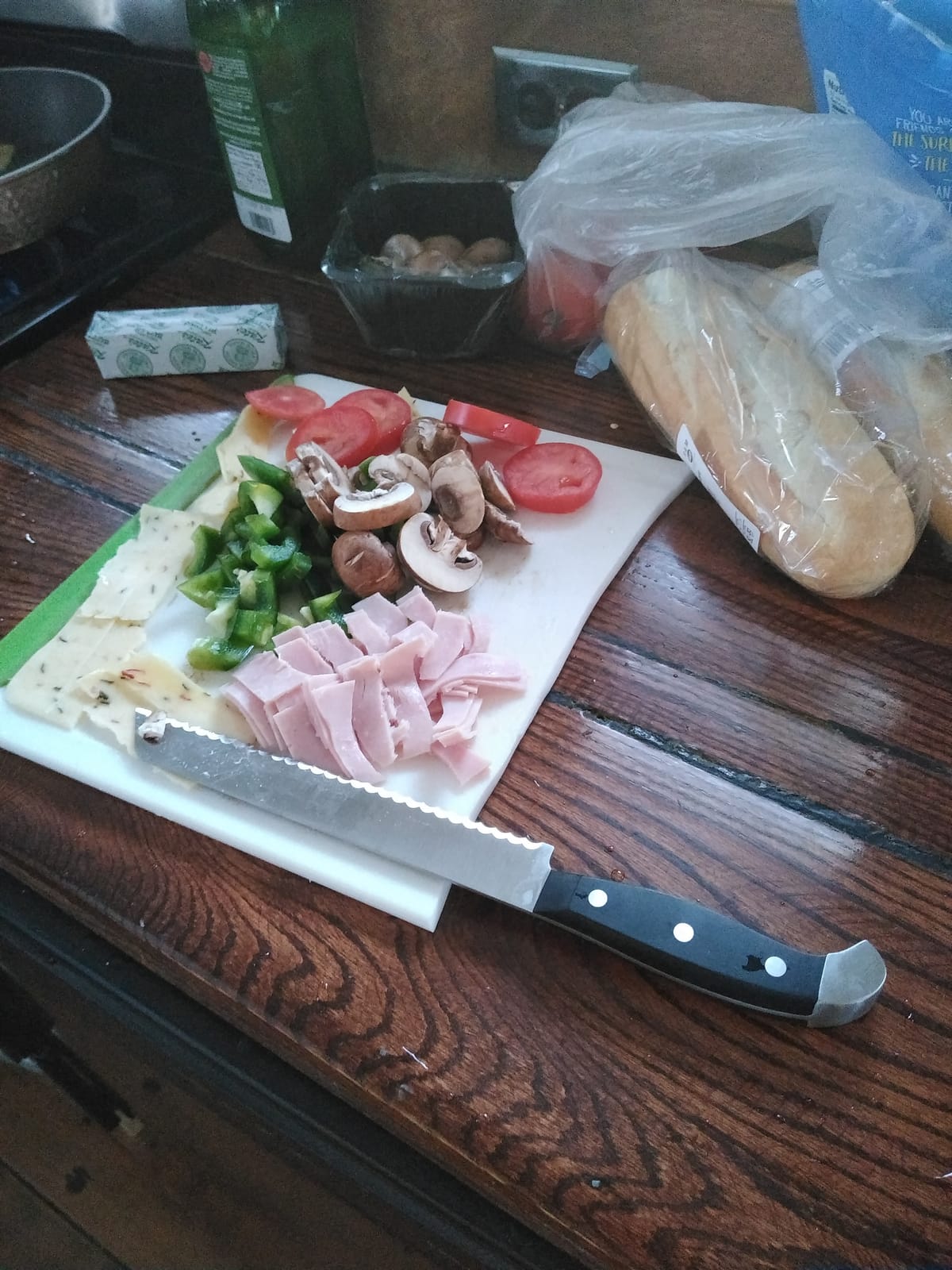
Single-piece precision-stamped construction keeps the whole knife in one piece of stainless, so there is no joint to loosen and no coating to scratch off. It is also dishwasher safe, which is refreshing in a category full of hand-wash-only warnings.
Where 8 Inches Is the Right Call
Eight inches is the right length for standard sandwich loaves, baguettes, small boules and anything up to about a 20cm round. It stores in a slim drawer and moves fast enough for everyday work without the leverage problems of a longer blade.
If you regularly bake big boules, the shorter stroke means more back-and-forth passes, and some owners report less cutting feedback when the blade bites into a thick bottom crust. That is a control difference, not a sharpness difference.
Where It Falls Short
The 8-inch blade is among the shortest in this group, so large round loaves and wide sandwich sandwiches need more strokes. The serrated edge also cannot be re-sharpened the way a straight blade can.
A 4.7 average sits just below the group leaders, and the handle is plain stainless with no texture, so it is among the least secure grips here when your hand is wet. A lifetime warranty against manufacturer defects is included.
9. Sunnecko 8 Inch – Best Lightweight Pakkawood Control
Sunnecko 8″ Serrated Bread Knife, High Carbon German Steel Sourdough Knife
8 inch hand-sharpened blade
German EN1.4116 steel at 58 HRC
8 ounce pakkawood build
Pros
- Sharp balanced blade that stays sharp after heavy use
- Light 8 ounce build reduces wrist strain
- Handle holds secure without rotating during cutting
- Pakkawood handle suits long prep sessions
Cons
- 8 inch length needs more strokes on big boules
- The included PVC sheath can trap moisture
- Some reviews cover a 7 inch nakiri variant
The Sunnecko is the ergonomic answer in this group. At 8 ounces with a pakkawood handle, it is the knife we picked when we wanted control rather than power, and on a smaller loaf that difference is obvious immediately.
The blade is forged German EN1.4116 high carbon stainless rated at 58 HRC, sharpened and honed by hand to a 12-15 degree angle per side. That is a hard steel with a fine apex, and owners report it stays sharp after heavy use without constant stropping.
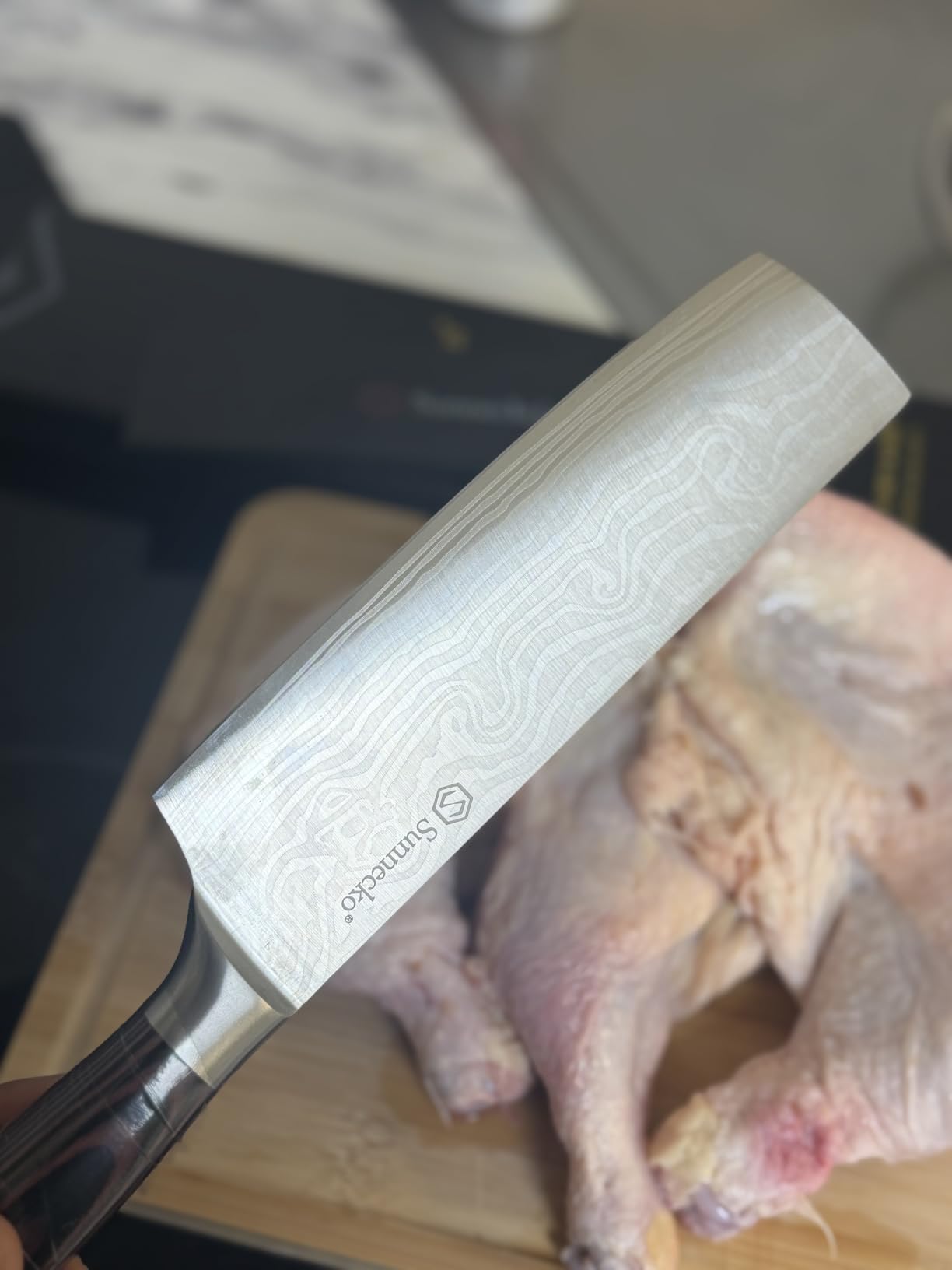
Because the handle is pakkawood and shaped to the hand, it does not rotate or shift mid-cut the way lighter metal handles can. On a soft loaf that means you steer the knife instead of fighting it.
Blade Geometry and Lightness
The edge tapers from spine to cutting edge, which reduces the amount of blade the loaf has to push past, and the manufacturer states it is engineered to preserve an airy crumb without crushing. On our test that claim held up for soft and medium crusts.
Owners also use it for brioche, pita, wedding cake, biscuits, pineapple and tomatoes, so it is a genuine all-rounder rather than a bread-only tool. A protective sheath and a gift box are included.
Where It Falls Short
At 8 inches, very thick artisan loaves need more strokes, and it is not the first choice for a large boule cut cold. The included PVC sheath can trap moisture and fail to dry out, which can dull the blade over time.
One more caveat worth knowing: a number of the reviews attached to this listing describe the 7-inch nakiri variant in the same family rather than this 8-inch bread knife. The 4.8 rating is real, but read the review text for the specific knife you are buying.
10. RADA R143 8 Inch – Best Made-in-USA Starter Knife
RADA Cutlery 8″ Bread Knife (R143), Silver
8 inch T420 stainless blade
Permanently cast aluminum handle
Made in the USA
Pros
- Highest star average in this group at 4.9
- Serrations
- cutouts and ridges reduce drag through crust
- Cast brushed aluminum handle is solid and corrosion-proof
- Forked tip design helps track through a loaf
Cons
- Smallest review base here at 122 ratings
- Hand wash only for the cast aluminum handle
- 8 inch blade is short for large round boules
The RADA R143 is the wildcard in this roundup, and the one that surprised us most. It holds the highest star average of the ten knives we tested at 4.9, and it does it with blade detailing you do not see on anything else here.
Instead of a plain serration line, the blade carries serrations combined with cutouts, ridges and a forked end. Those grooves appear to reduce drag through hard crusts, so the knife tracks more predictably than a conventional wavy edge on a dense loaf.
It is made in the USA from raw materials through construction, and the handle is permanently cast brushed aluminum with a satin finish, which means no joint to loosen and no moisture to absorb.
Design Details That Stand Out
The cutouts and ridges do more than look unusual. They break up the contact surface between blade and crust, which is the same principle behind hollow-ground edges on other knives here, just carried further.
Owners favour it for hearty rye and multigrain loaves, biscuits and standard bread, where the 8-inch blade is entirely adequate. It is a sensible first bread knife for a new kitchen.
Where It Falls Short
The honest limitation is the review base. At 122 ratings it is by far the smallest in this group, so long-term durability is much less well documented than for the established Swiss and Japanese brands.
It is hand wash only, since the cast aluminum handle should not go in the dishwasher, and 8 inches is short for large round boules. The permanently cast handle also means no resizable or replaceable grip if it ever wears.
How to Slice a Crusty Loaf Without Tearing the Crumb
Even a very good knife will tear a crumb if you use it like a chef’s knife. The difference is almost entirely in the motion, and a few deliberate habits fix most of the problem.
- Wait for the loaf to cool completely. Warm crumb is soft and gummy and will drag no matter how sharp the blade is. A boule baked this morning should wait at least two hours.
- Rest the loaf cut-side down first. One clean slice from the bottom flattens the base and stops it from rocking, which is what makes the knife wander on a round loaf.
- Use a long, low stroke. Start the heel of the blade at the front of the loaf and draw it back toward you with almost no downward pressure. Let the teeth do the work.
- Keep the blade nearly flat and let the curve do the cutting. On a curved-blade knife, a small rocking motion is all you need at the bottom crust. Pushing straight down is what crushes crumb.
- Cut in one continuous motion per slice. Stopping mid-stroke and restarting drags the teeth sideways and is the most common cause of a torn face.
- Dry the blade between soft slices. Wiping off moisture stops the crumb from gumming onto the teeth and keeps the sawing motion light.
Bakers on r/Sourdough describe cutting extra-crusty loaves as an intense workout and warn newcomers to warm up first. Their advice is sound: a hard loaf demands a full forearm stroke, not just the wrist.
How to Sharpen and Care for a Serrated Bread Knife
Most serrated bread knives are a one-way street. The teeth get pushed over rather than sharpened, which is exactly why they hold an edge for years. Two products here are exceptions, and knowing which one you own changes your care routine completely.
For a Resharpenable Design
- Use a standard honing rod. The Piklohas in this roundup is designed so a common rod restores its patented serrations.
- Hold the blade at a slight angle and draw it along each tooth. Light pressure only. You are straightening teeth, not grinding metal.
- Work both sides of the blade. Alternating sides keeps the tooth tips centred.
- Finish with a few stropping passes on a soft cloth or leather. This removes any remaining burr and polishes the apex.
For Conventional Serrations
- Hand wash and dry immediately. Dishwasher heat and detergent degrade the edge and dull the handle finish.
- Use a serrated-knife sharpener or a diamond taper. A ceramic rod works, but a dedicated serrated sharpener is faster and more even.
- Store it in a sheath or on a magnetic strip. A loose serrated blade rattling in a drawer dulls faster than years of use.
- Hand-wash with warm water and mild soap, then towel dry. Avoid soaking the blade or leaving it wet overnight.
One safety note that comes up repeatedly in reviews across this group: these blades are sharp enough to draw blood during a careless hand wash. Wipe the edge with a folded towel rather than sliding fingers along the blade.
Bread Knife Buying Guide: Length, Serrations, and Handles
The single most common mistake is buying a knife that is too short for the bread you actually bake. Everything else in this guide is a refinement of that one decision.
Blade Length vs Loaf Diameter
Match the blade to the widest thing you cut, not the average. A 10-inch blade handles a large round boule or a wide sandwich loaf in long sweeping strokes, and 10.25 inches is the practical sweet spot for home bakers.
Eight inches is the right call for standard sandwich bread, baguettes, small boules and compact kitchens. It stores easily and moves quickly, but it costs you extra back-and-forth strokes on anything large. Very long blades over about 12 inches suit professional batch slicing more than home use.
Serration Type Explained
Wavy or scalloped serrations have shallow, rounded teeth with a moderate gullet. They glide through soft crumb with minimal drag and are the most forgiving design on moist bread.
Pointed or deep serrations bite harder into a thick crust and start a crack more efficiently, which makes them better for very hard or stale loaves. They drag more material and can smear a soft crumb.
Fine serrations produce the thinnest slices and the cleanest cut faces, at the cost of being more sensitive to flex. Double-sided hollow edges reduce sticking on moist bread.
Matching Tooth Depth to Crust Thickness
This is the matching rule bakers on forums keep working out by trial and error. Thin crust under about 2mm pairs best with shallow wavy or scalloped teeth. Medium crust between 2mm and 4mm, which covers most sourdough, works well with either but favours wavy edges.
Crust above 4mm, or any stale or refrigerated loaf, wants deeper pointed teeth and a stiff wide blade. If your crust regularly hits that range, prioritise the Victorinox curved blade or the PAUDIN stiff blade over a thin flexible one.
Offset vs Straight Handles and Knuckle Clearance
An offset handle sits below the blade line, so your knuckles clear the board on a deep stroke. For bread slicing that means fewer small cuts and less wrist twist, which is why offset designs dominate this category.
Offset is not automatically better, though. Many left-handed bakers report that asymmetrical grips are awkward or unusable, and prefer a symmetrical handle such as the Fibrox or the Mercer. If you are left-handed, look for a straight or gently curved symmetric handle and check the serration grind is even on both sides.
Steel, Hardness and Edge Retention
Serrations stay sharp because they present many small points rather than one long edge, so steel hardness matters less than it would for a chef’s knife. Anything in the 53-58 HRC range is more than adequate.
Hardness above that adds chip resistance on very hard crusts but does not make a dull serrated blade sharp again. Construction, balance and handle grip affect daily satisfaction far more than a few points of Rockwell.
Handedness and Kitchen Size
Check the total length, not just the blade length, before buying. A knife that is 8 inches of blade in a 15-inch overall package is a different object in a small drawer than an 8-inch knife that is 12.6 inches end to end.
For a small kitchen, weight under about 7 ounces and an overall length near 13 inches is the practical target. For large-batch slicing, prioritise a 10-inch blade and accept the extra storage length.
Frequently Asked Questions
What is the best bread knife for crusty sourdough?
The Mercer Culinary M23210 10-inch wavy edge is our top pick for crusty sourdough, because its shallow wavy teeth, stiff stamped blade and textured grip handle thick crust with almost no downward pressure. The Victorinox Fibrox 10.25-inch is the alternative if you prefer a curved blade for a cleaner cut through the bottom crust, and the PAUDIN 10-inch if your crusts are extremely hard.
What is the difference between a bread knife and a serrated knife?
A bread knife is a specific type of serrated knife: long, usually 8 to 12 inches, with a pronounced serration designed specifically to saw through a hard crust without crushing soft crumb. A general purpose serrated knife has shorter, finer teeth for produce, meat and soft foods. A bread knife is a poor substitute for a tomato knife and the reverse is also true.
Are offset bread knives better for bread slicing?
Offset handles are better for most people because the handle sits below the blade line, so your knuckles clear the cutting board on a deep stroke. That reduces small cuts and wrist twist during long slicing sessions. They are not universally better though, since many left-handed bakers find asymmetrical offset grips awkward and prefer a symmetric handle.
How do I sharpen a serrated bread knife at home?
Most serrated bread knives cannot be sharpened like a straight blade because the teeth are pushed over rather than ground away. Use a serrated knife sharpener or a diamond taper, holding the blade at a slight angle and drawing it along each tooth with light pressure on both sides. The Piklohas 10-inch in this roundup is a rare design that a standard honing rod can restore.
What length bread knife do I need for large round loaves?
For large boules and wide sandwich loaves you want a 10-inch blade, ideally 10.25 inches, so you can cover the cut in fewer long strokes. An 8-inch blade works well for baguettes, standard sandwich bread and small loaves but needs more back-and-forth passes on anything big. Very long blades over 12 inches are better suited to professional batch slicing.
What is the highest rated bread knife?
By average buyer rating in this group, the RADA R143 8-inch holds the highest score at 4.9 stars, but its review base is much smaller at 122 ratings. The best supported pick is the Mercer Culinary M23210, which pairs a 4.8 average with more than 22,000 verified reviews, giving you far more evidence of long-term performance.
Which Bread Knife Should You Buy?
If you want one knife that handles every kind of loaf without thinking about it, the Mercer Culinary M23210 is the answer. Its 10-inch wavy edge, stiff stamped blade and grippy handle cover crusty sourdough, soft sandwich bread and everything in between, and more than 22,000 reviews back that up.
If slice thinness matters more to you than compact storage, the hand-made Tojiro F-737 produces the cleanest cut faces we saw. If you want the easiest path through the bottom crust of a round boule, the curved Victorinox Fibrox 10.25-inch is the one to pick. If you bake very dense, very hard loaves, the stiff PAUDIN 10-inch refuses to flex where thinner blades wander.
For a small kitchen, a light offset design, or a knife that can be brought back with a standard honing rod instead of being replaced, the remaining picks cover those needs without a compromise on crust performance. Whichever you choose, the best bread knives for crusty loaves are the ones that let the teeth do the work, and every knife above did exactly that.