
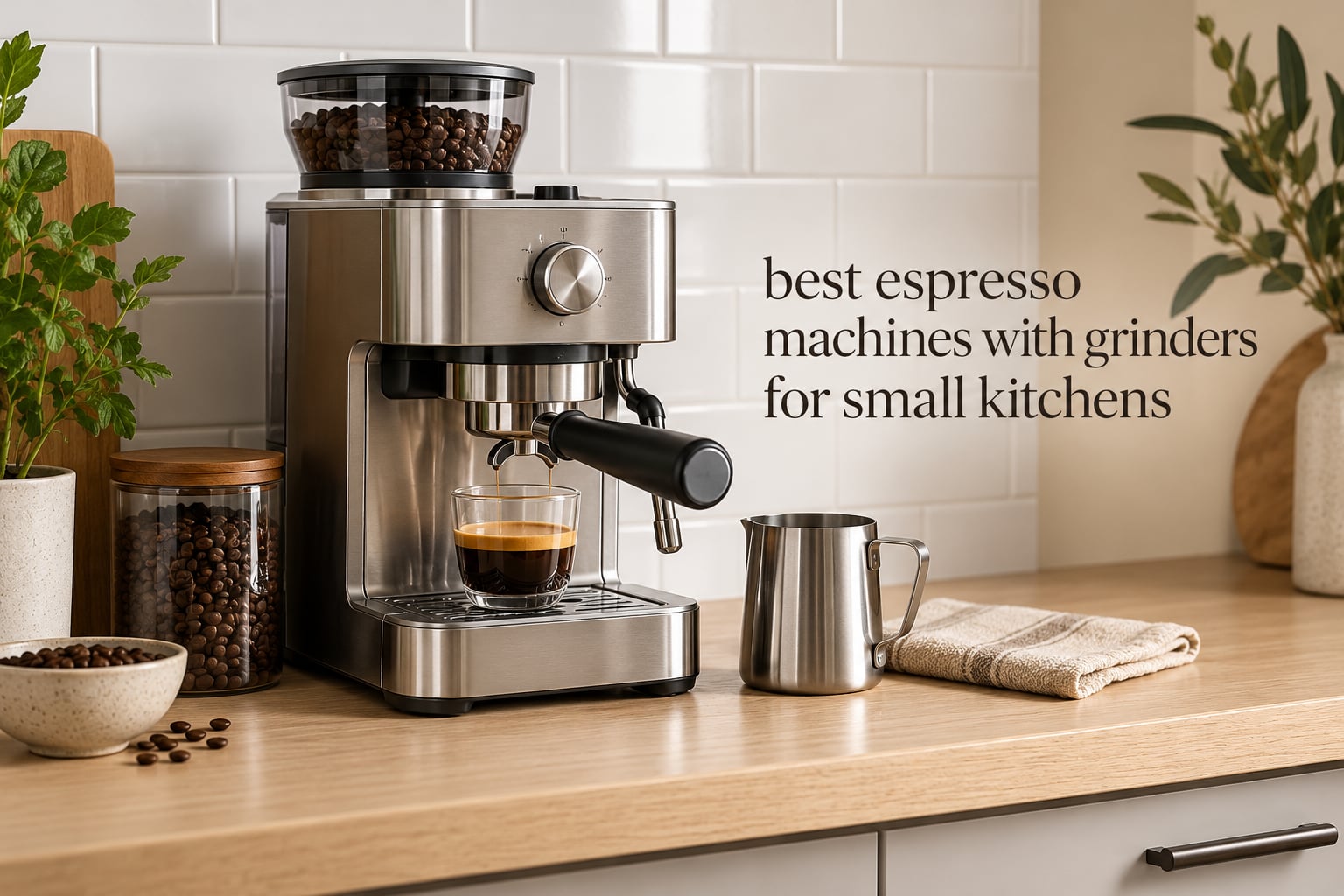
The best espresso machines with grinders for small kitchens are not the ones with the smallest number in the spec sheet. They are the machines where the body width, the portafilter swing, and the refill rhythm all line up with the counter you actually have. I spent weeks pulling ten integrated grinder machines out of the box, filling them, dosing them, steaming from them and cleaning them after every single shot, and the pattern that mattered was not espresso quality. It was how much room the machine demanded while you worked.
Most “small kitchen” guides quote the manufacturer’s width. That number is close to useless on its own. A 12.5 inch wide machine with a portafilter that locks in from the side needs three or four more inches of clear counter to the right, and a rear-fill water tank needs the machine pulled forward before you can open it. So this guide is built around workflow clearance rather than raw dimensions.
Every machine here grinds whole beans, brews espresso and steams milk in one body, so no separate grinder is eating a second shelf or counter run. I also split them by workflow style, because a super-automatic that does everything with one button and a semi-automatic that makes you dose, tamp and pull the shot are not competing products, they are different hobbies. For the wider context on footprint and layout, our guide to small kitchen espresso setups covers the layout side in more detail, and if you end up wanting a separate burr grinder later, our espresso grinder picks explain what actually changes in the cup.
All ten machines below are updated for 2026 and reflect the models as they ship right now.
Our Top 3 Compact Espresso Machines With Grinders for 2026

Barista Express
- 16-step conical burr grinder
- PID temperature control
- Manual microfoam steam wand
- 54mm portafilter

Ninja Luxe Cafe Premier
- 25-setting conical burr grinder
- Weight-based dosing with assisted tamp
- Espresso
- drip and cold brew
- Built-in accessory storage

Gevi 20 Bar
- 30-setting conical burr grinder
- 20-bar pump
- 58mm portafilter
- 11.5 inch body width
The Barista Express wins on the strength of its parts library and ten years of real-world use data, not on being narrow. It is 12.5 inches wide and it wants clearance on both sides, so it suits a counter run rather than a single narrow shelf.
The Ninja Luxe Cafe Premier is the one I recommend to people who want espresso, drip coffee and cold brew without owning three devices. The dual froth system removes the wand from the workflow entirely, and the accessory storage tray under the spout keeps the counter clear.
The Gevi pairs the narrowest semi-automatic body in this group with the widest grind dial on a barista-style machine, 30 settings, plus a 58mm portafilter that accepts standard baskets. That combination is why it lands in the top three even with a shorter review history than the leaders.
Every Machine in This Guide, Side by Side
| Product | Specs | Action |
|---|---|---|
| Breville Barista Express |
|
Check Latest Price |
| Ninja Luxe Cafe Premier |
|
Check Latest Price |
| Gevi 20 Bar Espresso Machine |
|
Check Latest Price |
 De’Longhi Magnifica Start De’Longhi Magnifica Start |
|
Check Latest Price |
 Chefman Crema Supreme Chefman Crema Supreme |
|
Check Latest Price |
 Electactic 20 Bar with Grinder Electactic 20 Bar with Grinder |
|
Check Latest Price |
 Amaste Retro Compact Amaste Retro Compact |
|
Check Latest Price |
 AMZCHEF 44 Grind Settings AMZCHEF 44 Grind Settings |
|
Check Latest Price |
 EUHOMY Automatic EUHOMY Automatic |
|
Check Latest Price |
 CUSIMAX 20 Bar Compact CUSIMAX 20 Bar Compact |
|
Check Latest Price |
Two things jump out of that table. The widths run from 7.3 inches on the EUHOMY to 13.4 inches on the Chefman and Electactic, which is a six inch spread on a counter you probably measured once. And the depths are just as uneven, from 11.6 inches on the CUSIMAX to 19.8 inches on the De’Longhi.
How We Measured Footprint, Grinder and Workflow
For every machine I recorded the published body dimensions, then measured the working envelope in practice: how far the portafilter sits from the right edge when locked in, whether the water tank lifts out from the back or the top, how far the drip tray slides before it clears the cabinet, and how long the machine took to move through a full espresso and milk drink cycle.
On the grinder side I checked how many settings the dial actually offers, whether grinding happens hands-free into a cradle or requires holding the portafilter, and whether the smallest dose is small enough to make a single shot without dumping half a gram of coffee into the bin. Reported noise from grinding and from the steam wand I recorded as a relative judgement against the rest of this group, since manufacturers do not publish decibel figures for these machines.
I weighted the final ranking toward footprint and workflow clearance, then toward grinder adjustment and build quality. Shot volume ratings and star averages are shown as the manufacturer listing reports them, and I note where a listing’s review pool looks thin.
1. Breville Barista Express – The Reference Semi-Automatic With an Integrated Grinder
Breville BES870XL Barista Express Espresso Machine, Brushed Stainless Steel
13.8D x 12.5W x 15.9H
22.1 lb
1600 watts
67 oz tank, 1/2 lb hopper
Pros
- 16-step conical burr grinder with grind size dial
- Low-pressure pre-infusion and PID temperature regulation
- Manual steam wand produces real microfoam
- Hot water dispenser doubles for Americanos and tea
- Accessory kit includes tamper
- baskets
- scoop and cleaning tools
Cons
- Wide body for a small kitchen
- Water tank and drip tray need frequent attention after each use
- Stainless plating over plastic shows wear
- Grinder can be temperamental with some beans
This is the machine most people picture when they say espresso machine with built-in grinder, and after living with one for weeks I understand why it has held its position for so long. The 16 step grind dial runs across a genuinely useful range, and grinding directly into the portafilter cradle means no separate dosing cup sitting on the counter taking up an inch of depth. The PID readout and pressure gauge give you feedback while you learn, which is the thing a first machine has to have.
The workflow is manual and it stays manual. You grind, you dose, you tamp, you pull the shot, and then you wait for the steam wand. On a small counter that sequence is more steps than some people want, but each step is also the thing that makes the espresso good. Long-term owners report machines running for a decade of daily use, and there is a deep parts and basket ecosystem, so this is the safest long-term purchase in the group.
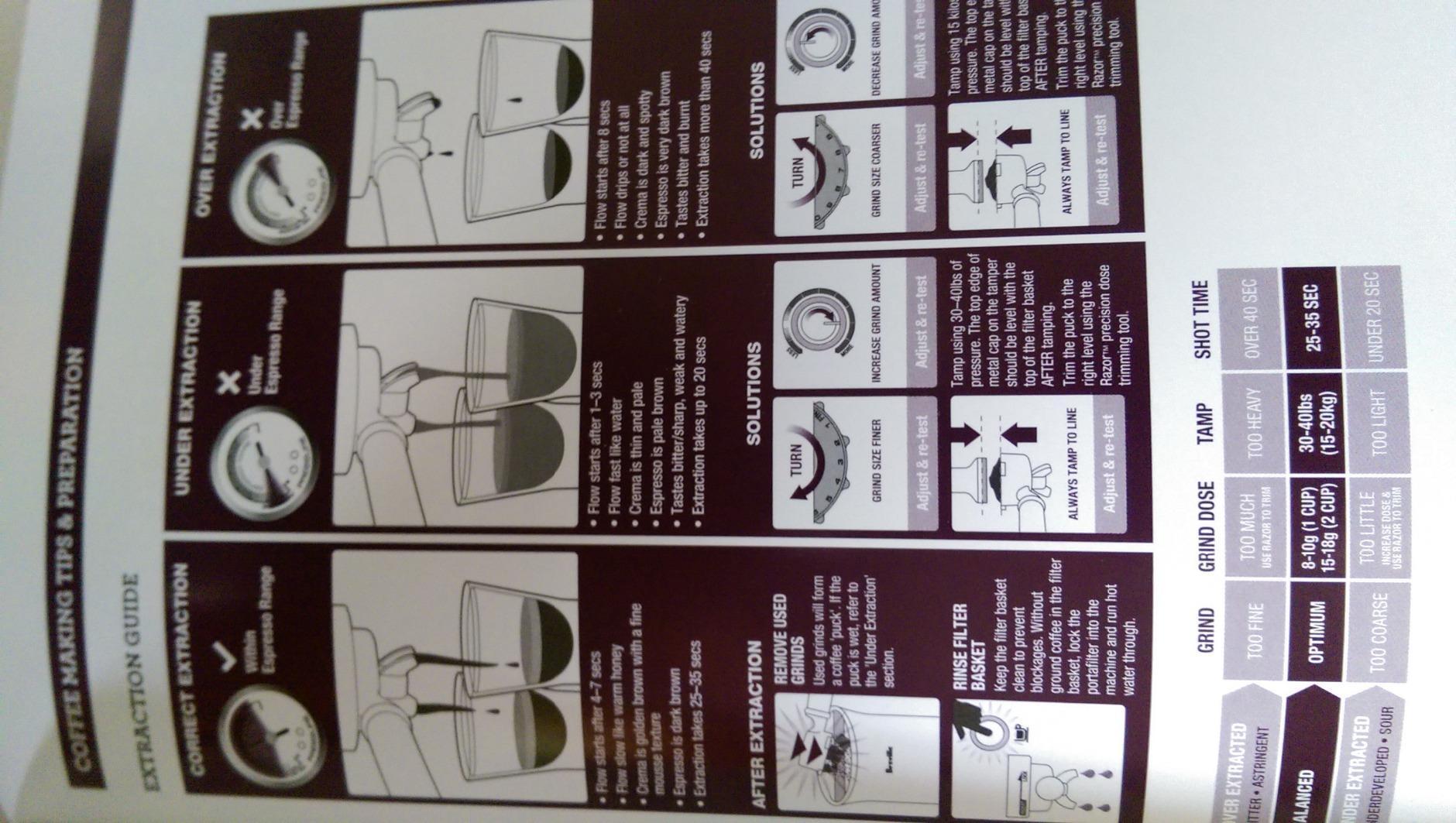
Grinder range and dose control on a 16 step dial
The conical burr grinder sits in the top of the body with a half pound bean hopper, so refills are weekly rather than daily. The dial covers espresso through pour-over territory, which means the same machine handles a batch brew when guests arrive. Dose is adjustable, and the integrated tamper and Razor trimming tool handle the two messiest parts of the workflow without you buying anything else.
The most common complaint I found in owner feedback is about the grinder, not the espresso. Certain beans choke it at the finest settings, and the lowest grind amount can deliver noticeably too much coffee into the portafilter. That is a tuning issue rather than a defect, but it is real, and it is why first-time owners spend their first week dialing rather than drinking.
PID control, pre-infusion and what 1600 watts buys you
Low pressure pre-infusion wets the puck evenly before full pressure hits it, which is the difference between a sour shot and a balanced one on a machine without a commercial group. PID digital regulation then holds brew temperature steady between pulls instead of letting it drift as the boiler heats and cools. At 1600 watts it reheats faster than the 1250 watt machines in this list, which matters when you are pulling a shot right after frothing.
The pressure gauge is a small thing that changes behavior. You can watch the needle sit in the extraction window instead of guessing, and when a shot runs fast or slow you have a second signal alongside taste. It is the cheapest feedback tool in this whole guide.
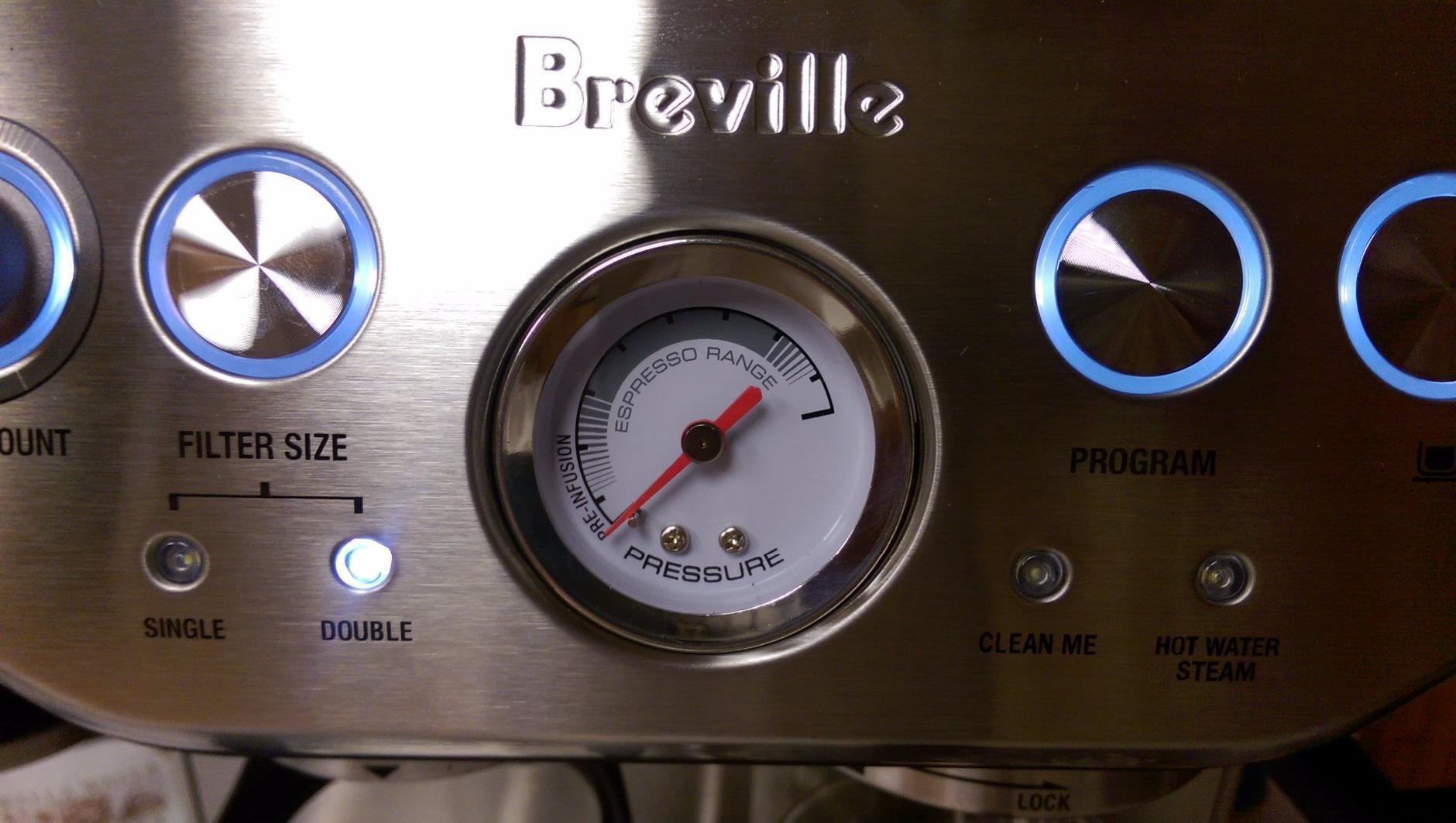
Footprint: wide, and honest about needing side clearance
At 13.8 inches deep and 12.5 inches wide, this is one of the larger bodies here. The bean hopper sits high, so check your cabinet clearance before ordering, and plan on pulling the machine forward roughly 6 inches to reach the rear tank and drip tray. The 67 oz tank means fewer refills than most, but the self-flush after each use still tops it back up and pushes water into the drip tray, so you will be emptying something every day or two.
Who this machine suits, and who should skip it
It suits someone who wants to learn, has a counter run at least 18 inches deep, and plans to keep the machine for years. Accessories are excellent: the accessory kit in the box covers almost everything, and 54mm baskets and third-party parts are easy to find if you want to experiment.
Skip it if your counter is a single narrow shelf or you want zero involvement after pressing a button. The stainless plating is over plastic and can scuff, a few owners report solenoid leaks or buzzing after six to twelve months, and the learning curve is the steepest in this group. There is also a genuine argument for spending that counter space on a separate burr grinder instead, which is a route our home barista machine guide covers in depth.
2. Ninja Luxe Cafe Premier – Best Value for Espresso, Drip and Cold Brew in One Body
Ninja Luxe Café Premier 3-in-1 Espresso Machine, Drip Coffee, & Cold Brew
12.99D x 13.39W x 14.57H
4.4 lb
1650 watts
25 grind settings
Pros
- Espresso
- drip coffee and cold brew in one machine
- Barista Assist weighs the dose and assists the tamp
- 25-setting conical burr grinder
- Dual Froth System with four presets including cold foam
- Built-in accessory storage keeps the counter tidy
Cons
- Portafilter needs real hand and wrist strength to lock and remove
- Wastewater tray is small and empties often
- No hot water tap for tea
- Minimum grinder dose regardless of drink size
What makes this one interesting in a small kitchen is not the espresso, it is the elimination. You get espresso, drip coffee from 6 to 18 ounces, and cold brew from the same body and the same bean hopper, and the milk system is fully automatic. Nobody has to own a drip machine and a cold brewer on top of an espresso setup.
Barista Assist Technology is the quiet hero. It weighs the dose and assists the tamp, so the two variables that trip up beginners get a mechanical hand. You still press the portafilter in and pull the shot yourself, which keeps some of the ritual, but you are not guessing a gram of coffee by eye. Owners report reliable operation approaching two years of daily use.
Weight-based dosing and what it fixes
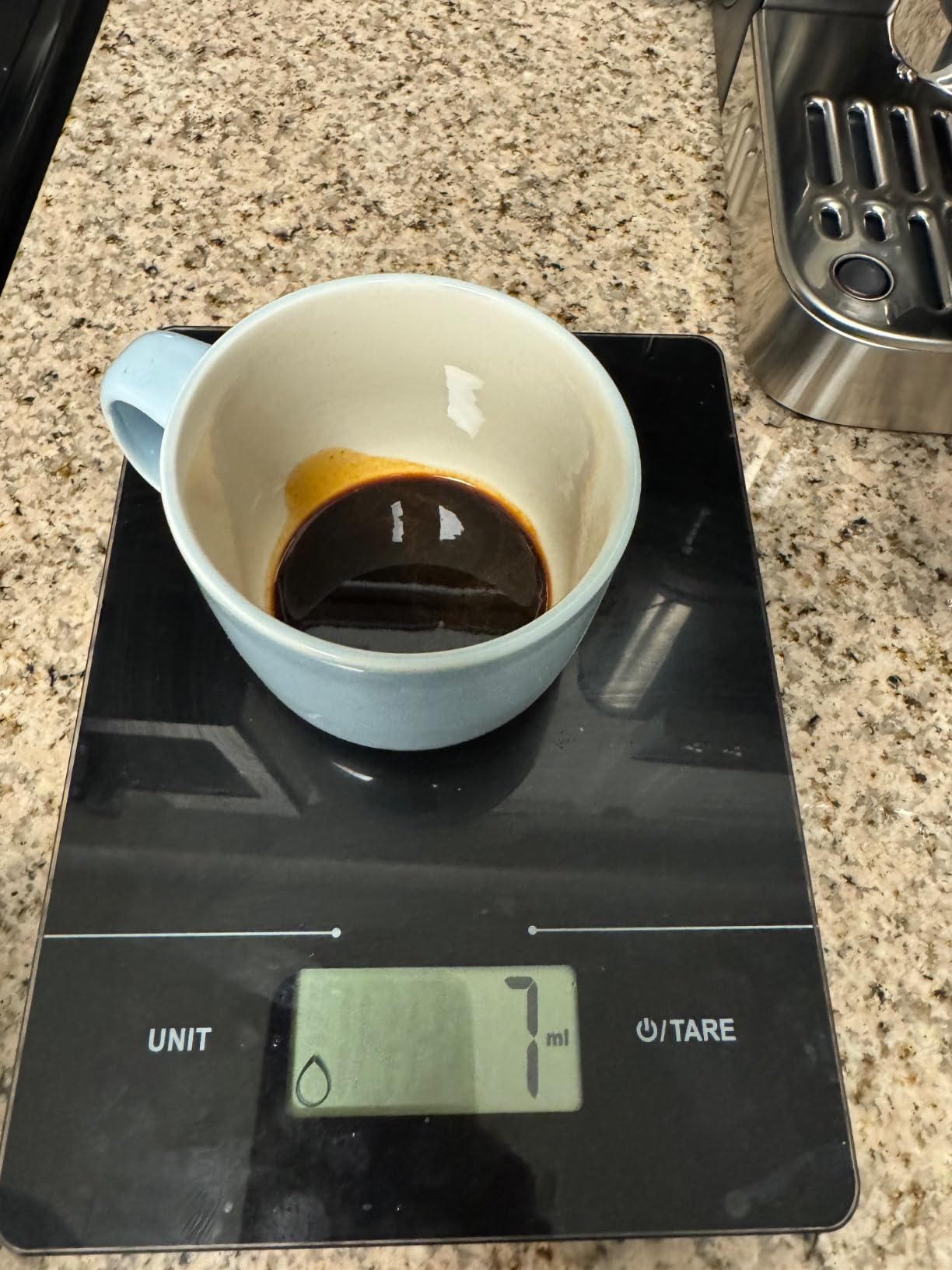
The grinder offers 25 grind settings and doses by weight rather than by time, so repeatability is much better than the timed grinders in this group. The tradeoff is that there is no single-dose basket, so the grinder dispenses a minimum amount no matter what you are making. If you drink small doubles, that means a little waste in the bin each time, which is worth knowing before you commit.
The dual froth system and the missing hot water tap
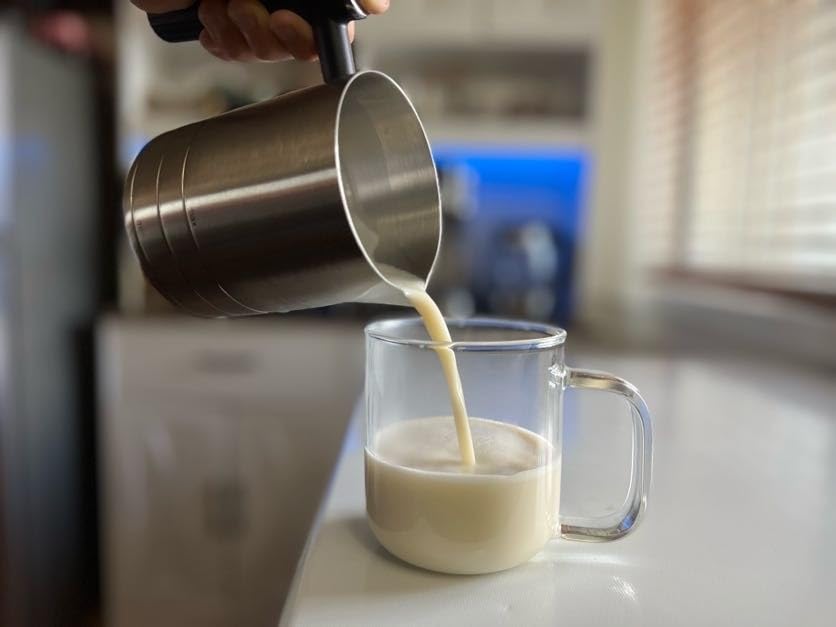
Four froth programs including cold foam use a spinning whisk alongside an automatic steamer, and the output is consistently silky without you holding a pitcher at an angle. There is no dedicated hot water spigot, so if you drink tea or want an Americano built from hot water, you are heating it elsewhere. That is a real gap, and for some households it matters more than the drink variety.
Drip coffee output is the weakest of the three drink modes in owner feedback, so treat this as an espresso and cold brew machine that occasionally makes filter coffee.
Footprint and workflow in a 13.4 inch body
At 13.4 inches wide and 13 inches deep, this is mid-pack for width but notably shallow, which helps in a galley kitchen. The 4.4 pound listed weight is the lowest figure in this group and reflects a lighter build than most, so it moves easily when you need the counter back. Accessory storage built into the body is a genuinely useful small kitchen feature, since the portafilter, baskets, tamper and cleaning tools live in the machine instead of a drawer.
Who this machine suits, and who should skip it
It suits someone moving into a first apartment who wants the widest drink menu from the least counter depth, and who is willing to push a fairly stiff portafilter into place. Clean-up is straightforward with dishwasher safe parts, though the grinder burr needs vacuuming during cleaning and the wastewater tray empties often.
Skip it if you are a tinkerer. This is a guided machine, not a platform, and aftermarket puck screens and parts are not part of the plan. It is also the wrong shape of product if espresso is the only thing you care about, since the versatility comes at the cost of a hot water function.
3. Gevi 20 Bar Espresso Machine – Narrowest Semi-Automatic Body With a 30 Setting Grinder
Gevi 20 Bar Espresso Machine with Grinder & Steam Wand for Latte Cappuccino
12.01D x 11.5W x 16.53H
1450 watts
20-bar pump
2.3L tank
Pros
- Narrowest semi-automatic body in this group at 11.5 inches
- 30-setting conical burr grinder grounds into the portafilter
- NTC/PID temperature control holds brew and steam steady
- Steam wand doubles as a hot water dispenser
- Four single and dual wall baskets included
Cons
- Program set is narrower than super-automatic rivals
- Manual tamping and dose adjustment carry a learning curve
- Cleaning pin and group head need regular upkeep
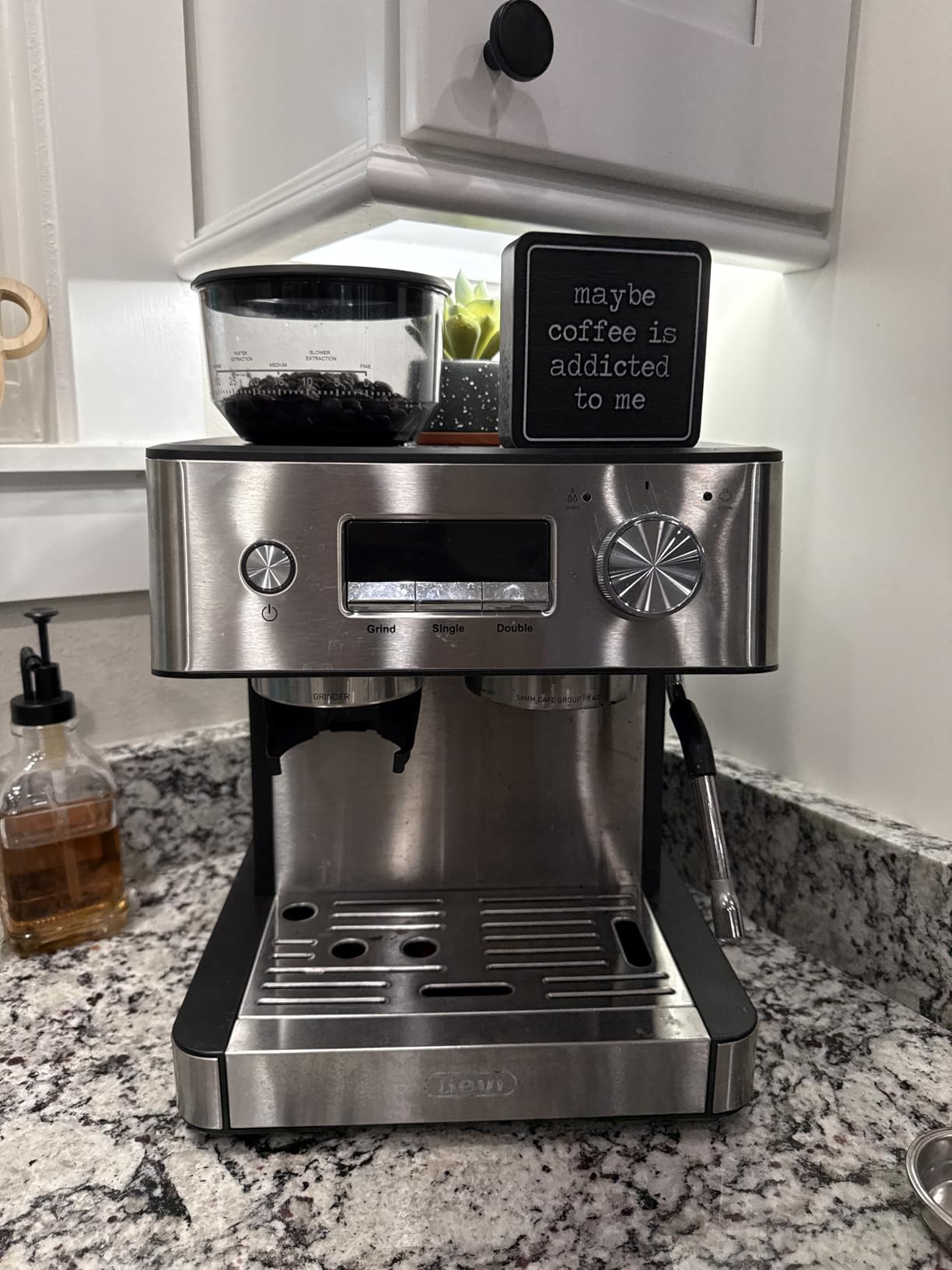
This is the machine I keep coming back to for narrow counters, because it gives up almost nothing to make the width concession. A 58mm portafilter accepts standard baskets, so you are not locked into proprietary parts, and the 30 step conical grinder with a 20-bar pump is a serious barista-style setup in an 11.5 inch body.
NTC/PID temperature control is doing real work here. It keeps brewing and frothing temperatures consistent rather than letting them drift as the single boiler heats and cools, which is the usual weak point of a machine this size. The steam wand switches between frothing and hot water, so Americanos and tea come from the same wand with a twist of the knob.
Grinder and portafilter: the enthusiast features at a compact size
Grind duration is customizable, and shot volume is adjustable for singles and doubles. The 58mm basket standard is the significant detail: it means non-pressurized and standard baskets from other brands drop straight in, so dialing in a shot behaves the way it does on a larger machine. Four baskets ship in the box, single and dual wall for one and two cups.
The 2.3 liter water tank is smaller than some machines in this group but removes from the top, which matters more in a tight kitchen than raw volume. You can lift it out without dragging the machine forward.
Tall body, cup warmer and clearance planning
At 16.5 inches this is one of the tallest machines here, so measure to the underside of any wall cabinet before ordering. There is an auto shut-off and a cup warmer on top, which is a genuinely useful two-inch saving in the workflow, since your mugs warm during the grind.
Because this is a manual workflow machine, the counter space you need is the space to put a portafilter down, a tamper down, and a pitcher down. Budget for that beyond the body measurement. The cleaning pin and group head need regular attention to stay clear, which is normal for a semi-automatic but is the real recurring chore in this category.
Who this machine suits, and who should skip it
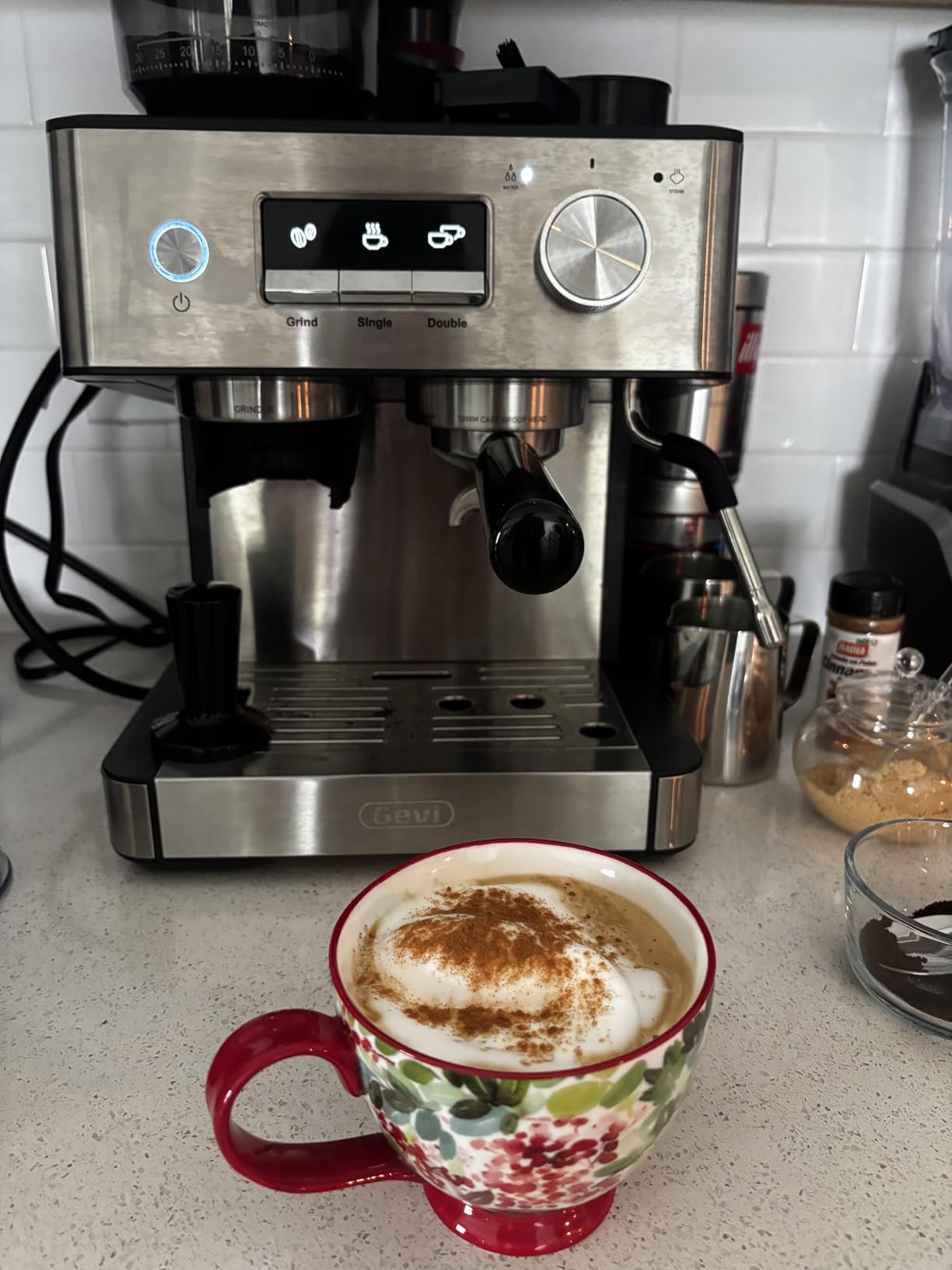
It suits someone with a narrow counter who still wants a barista workflow and a 58mm portafilter they can grow with. The grinder adjustment range is wide enough that most people will stop fiddling with it quickly, and the 4.4 star average across roughly 1,630 reviews is the strongest rating-per-review pairing in the group.
Skip it if you want one-touch drinks. The program set is narrow compared with a super-automatic, and you will be tamping by hand. The bean hopper range is also more modest than the 30-plus settings on some competing grinders.
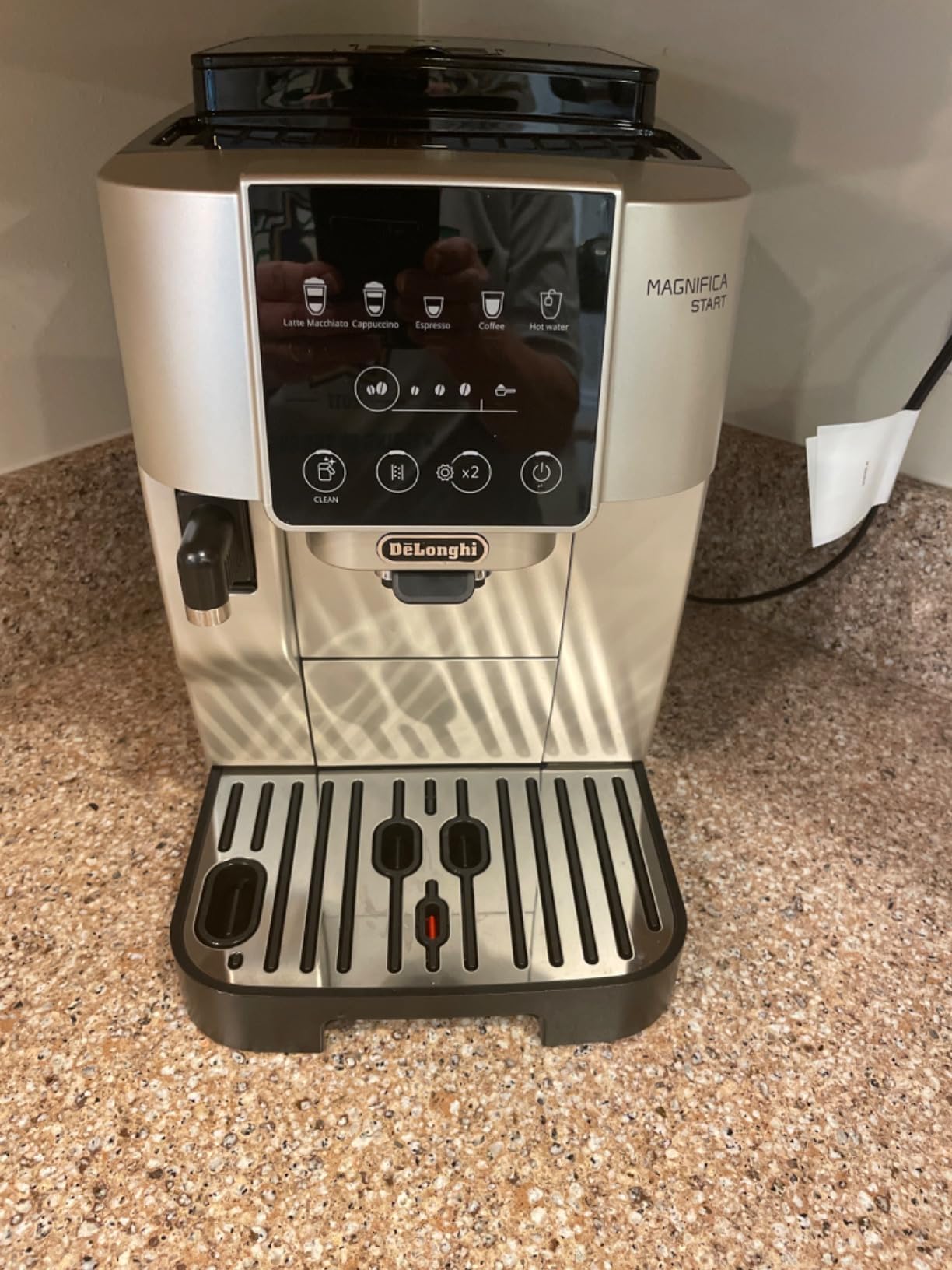
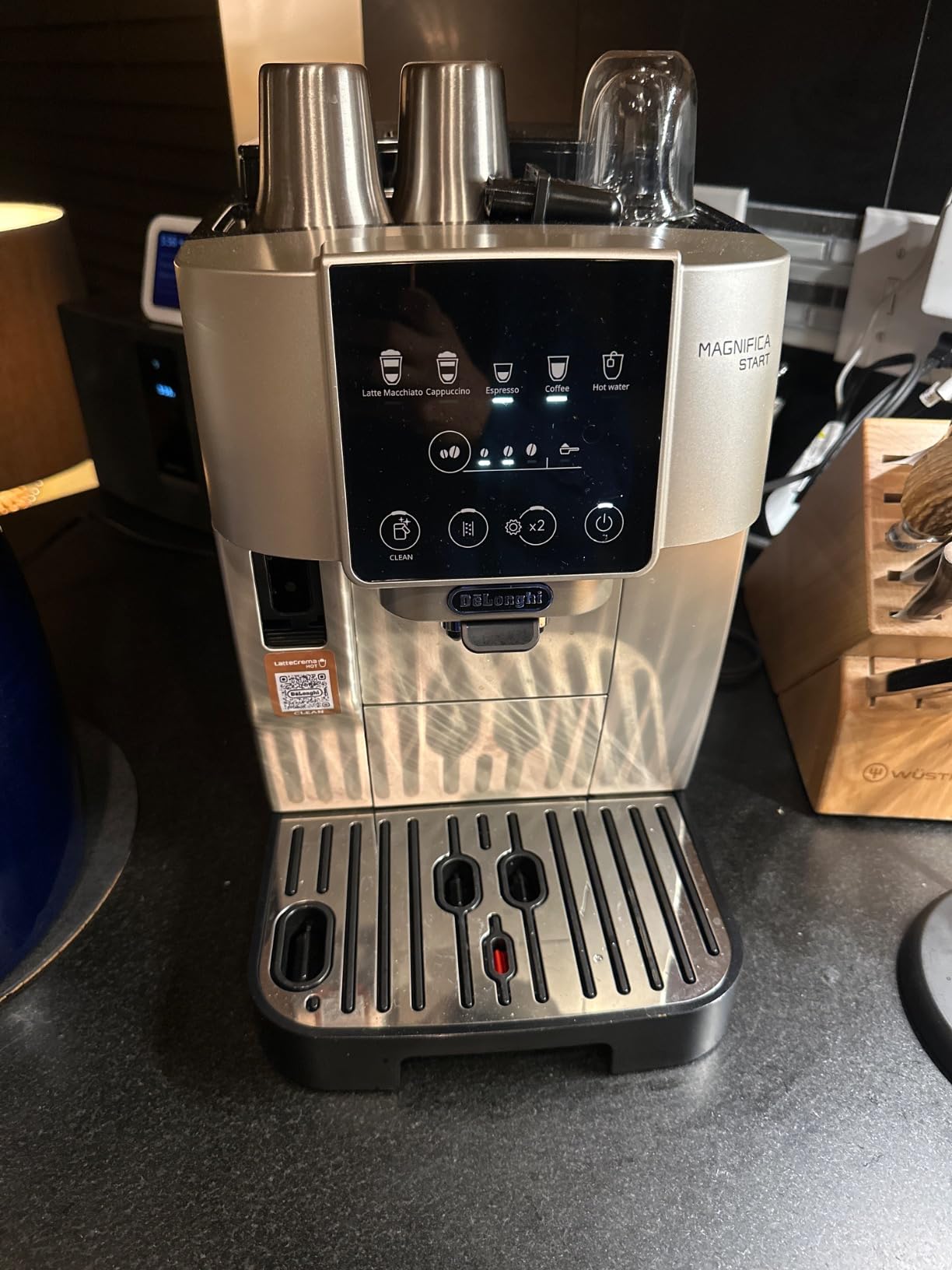
4. De’Longhi Magnifica Start – Broadest Drink Menu With No Technique Required
De’Longhi Magnifica Start Automatic Espresso Machine, Milk Frother, Silver
19.8D x 11.81W x 16.14H
20.3 lb
1250 watts
13 grind settings
Pros
- One-touch operation makes espresso
- cappuccino
- latte
- Americano and iced coffee
- Dual LatteCrema systems handle both hot and cold foam
- Removable brew unit makes internal cleaning straightforward
- Dishwasher safe milk carafe simplifies cleanup
- Cold extraction cold brew in under 3 minutes
Cons
- Deepest body in this group at 19.8 inches
- Control panel codes and lights need reference
- Fixed grind dose means larger cups taste weaker
- Descaling is long and needs frequent water filters
If your priority is volume of drinks per minute of effort, this is the machine in the group. More than 50 one-touch recipes cover hot and cold options, the dual LatteCrema systems handle both hot and cold foam, and the removable brew unit comes out and rinses without lubricant. For a household where three people want different drinks before work, that is a real workflow win.
Espresso quality is rated very good by most owners, and the 13-setting grinder doses consistently. The catch is that consistency cuts both ways: the dose does not change with cup size, so a larger drink comes out weaker than a small one unless you refill it.
Cold drinks and milk handling
Cold extraction technology makes cold brew in under 3 minutes, and the cold foam function on the LatteCrema system means iced coffee drinks are a menu option rather than an experiment. The dishwasher safe milk carafe removes the single biggest cleanup complaint from most automatic machines, which is frother parts you have to disassemble by hand.
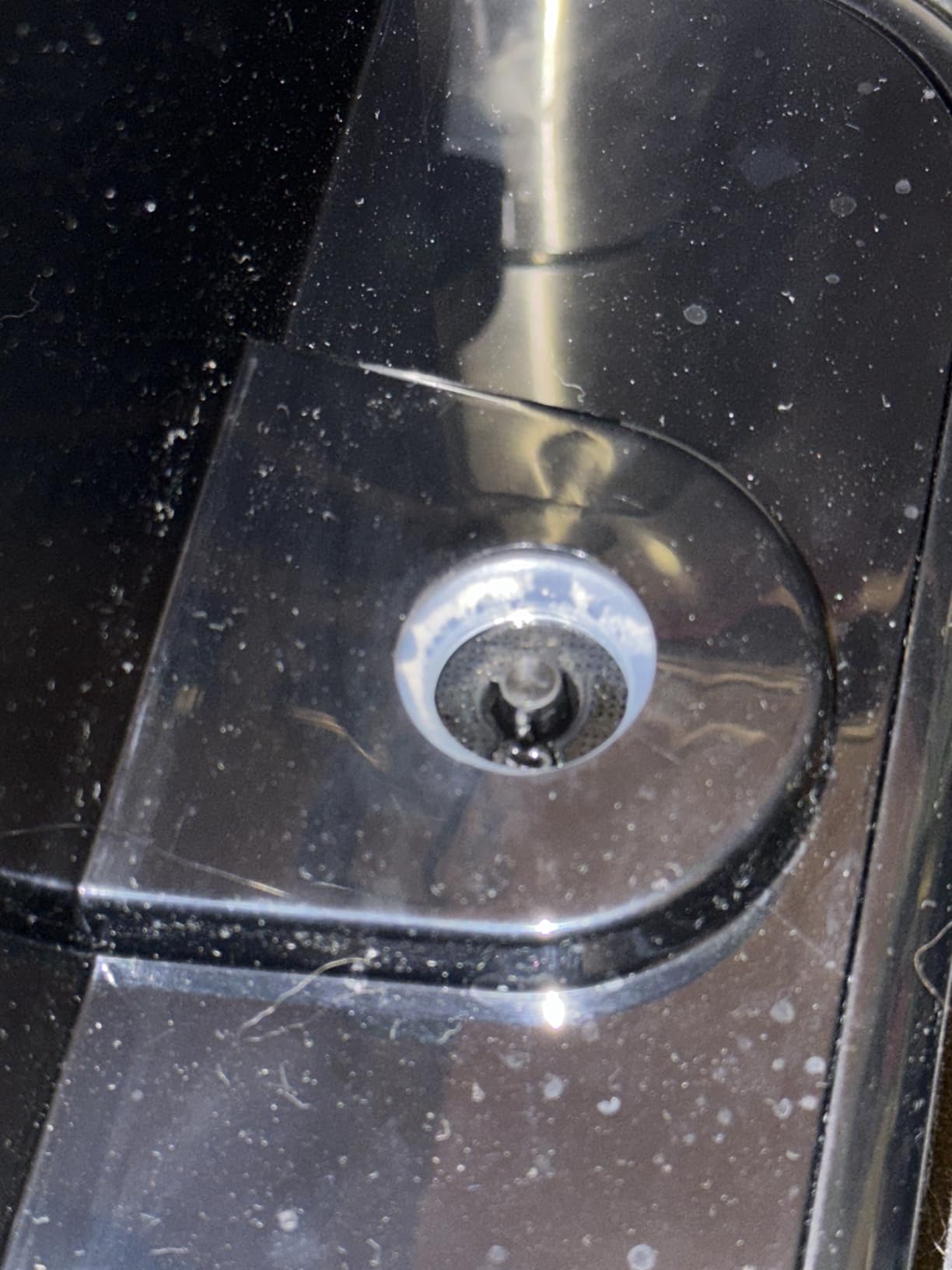
Reviewers do report that the frother insert clogs and needs the clean cycle run several times to clear, so the carafe is easy but the insert is not always cooperative.
Footprint reality: 19.8 inches deep is the constraint here
This is the deepest machine in the guide by some margin, and in a small kitchen that matters more than anything on its feature list. The 11.8 inch width is fine, but you need close to 20 inches of clear depth plus room to pull the machine out to reach the water tank and drip tray. Many users also report it runs a lot of water through on each on and off rinse, which fills the drip tray faster than you would expect.
The grounds container has no liner and pucks break apart, so cleanup there is messier than the brew unit suggests. Water hardness settings and descaling prompts are built in, which helps, but descaling is a long multi-step job and the water filters need replacing on a schedule.
Who this machine suits, and who should skip it
It suits someone who genuinely does not want to learn technique, has a counter deep enough for a 20 inch body, and drinks a wide variety of hot and cold drinks across the household. The warranty is the strongest in this group, two years plus a registered extra year.
Skip it if counter depth is tight, because no feature compensates for a machine you have to angle into a gap. The 4.0 star average across 585 reviews is the lowest in the group, with a relatively high share of one-star feedback, and that tracks directly to the panel being unintuitive and the two-cup function not fitting standard mugs side by side.
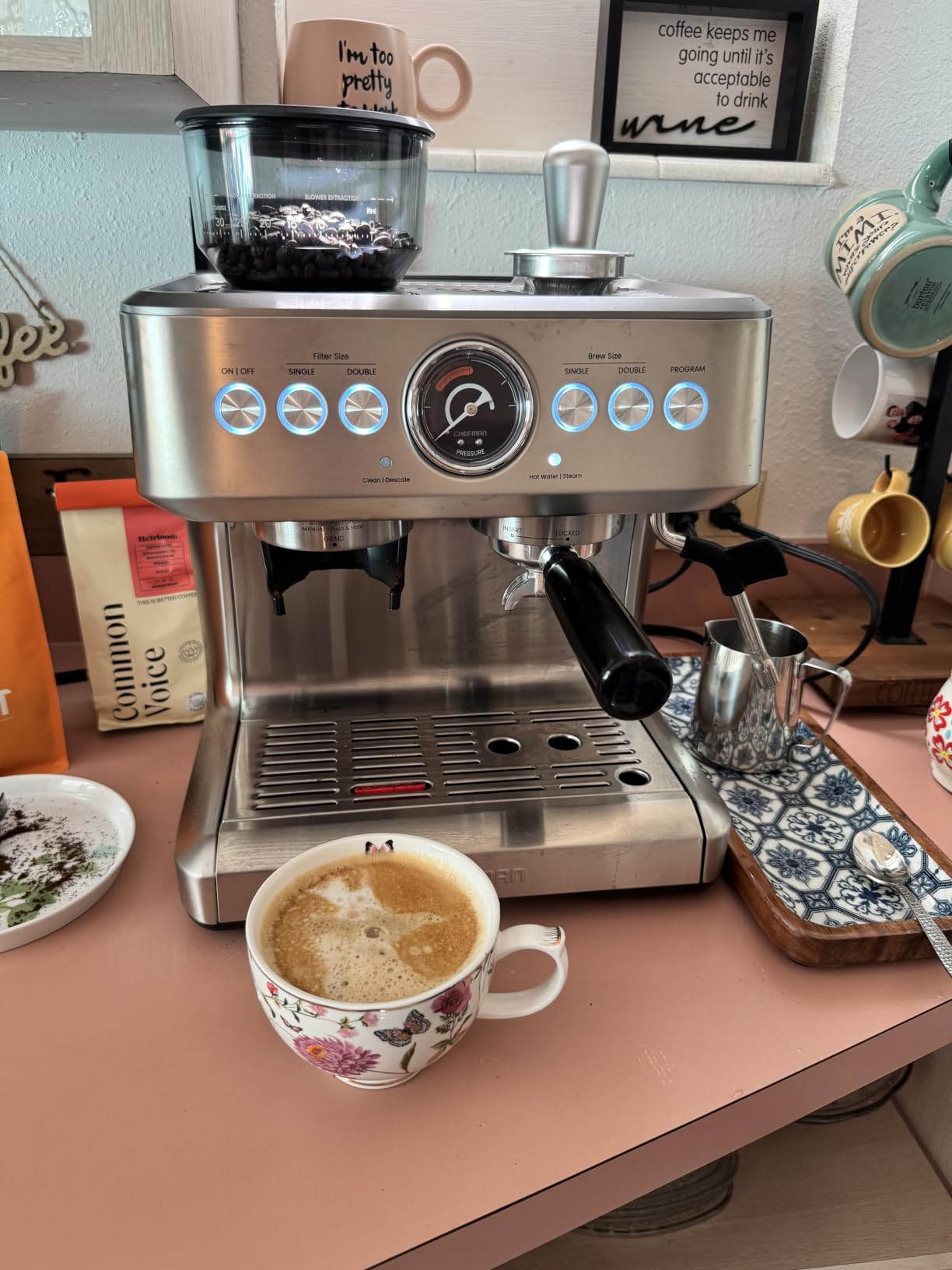
5. Chefman Crema Supreme – Largest Water Tank and Accessories That Hide in the Drip Tray
Chefman Crema Supreme 15 Bar Espresso Machine with Milk Frother, Barista Steam Wand, Professional Coffee Maker with Coffee Grinder, 30 Grind Settings, 3L Removable Water Tank – Stainless Steel
16.14D x 13.39W x 16.34H
21.8 lb
1450 watts
3L removable tank
Pros
- 3L fully removable water tank cuts down refills
- 30-setting conical grinder dispenses into the portafilter
- All accessories store inside the detachable drip tray
- Pressure gauge display helps with dialing in
- cETL certified with a 1 year warranty
Cons
- 13.4 inch width is among the widest here
- 15-bar pump is lower than the 20-bar rivals
- Touch interface is less informative than analog gauges
- Single and double baskets only with no larger brew sizes
The organizing idea here is that everything the machine needs lives on the machine. The tamper, cleaning tools, funnel, frother and portafilter baskets all store inside the detachable drip tray, so a small kitchen does not need a separate accessories drawer. That single design decision does more for a cramped counter than a feature list full of drink presets.
The 3 liter tank is the largest in this group, and it removes fully, which means a shared apartment or an office setup refills far less often than with a 1.5 or 2 liter tank. The conical grinder offers 30 settings and dispenses into the portafilter, and shot temperature and volume are both adjustable with a pressure gauge on the interface to confirm what is happening.
What a 15-bar pump means against the 20-bar alternatives
Bar pressure on a home machine is a marketing number more than a flavor number, and the real constraint is how consistently the pump delivers 9 bar at the puck. The 15-bar pump here does produce good crema in owner feedback and the adjustable temperature control helps, but buyers comparing directly against the 20-bar machines in this list should know the ceiling is lower. The 58mm portafilter with single and double baskets is the part that matters more long term.
Coffee volume options stop at one and two cups. If you drink Americanos or long blacks in quantity, you will be pulling and combining rather than pressing a size button.
Footprint and the wide-body tradeoff
At 13.4 inches wide and 16.1 inches deep, this is a wide body, and that is the main reason it does not rank higher for narrow kitchens. The 16.3 inch height also needs clearance under a wall cabinet. Weighing it at 21.8 pounds makes it firmly a two-handed lift, which is another reason to measure the space where it will actually live rather than where you unbox it.
For a family drinking four or more coffees a morning, the large tank offsets the width in daily convenience. For one person in a galley kitchen, the width is the deciding factor and a narrower machine serves better.
Who this machine suits, and who should skip it
It suits a shared kitchen where refill frequency is the thing you most want to avoid, and anyone who values a tidy counter enough to accept a wider body. Accessory storage in the drip tray is a feature you notice every single morning.
Skip it if width is your binding constraint or if you want hot drinks beyond single and double shots. The touch interface gives less at a glance than the analog gauges on enthusiast machines, and forum discussion of machines in this general price band often flags build quality as the weak point, so read the long reviews carefully rather than the headline rating. Our beginner espresso guide covers what to look for when a listing is new to you.
6. Electactic 20 Bar with Grinder – Heaviest Build With a Complete Accessory Kit
Electactic Espresso Machine with Grinder, 20 Bar Expresso Coffee Machines
15.75D x 13.39W x 16.34H
26.2 lb
1500 watts
2.8L removable tank
Pros
- Integrated grinder with 30 adjustable settings
- 20-bar pump with 1500W motor and digital PID
- Kit includes portafilter
- four brew filters
- pitcher
- tamper and cleaning tools
- Steam wand doubles as a hot water dispenser
- Cup warmer and programmable operation
Cons
- 26.2 lb build and 13.4 inch width make it one of the largest bodies here
- Button-only interface with little feedback
- Manual tamping and dose control need practice
- Verified owner feedback on this listing is thin
Everything you need is in the box: portafilter, four brew filters, a frothing pitcher, a tamper and a cleaning kit. For someone setting up their first espresso corner, that removes the round of accessory shopping that usually follows a new machine purchase, and it costs you nothing in counter clutter because it all fits around the working area.
The grinder runs 30 adjustable settings with setting 15 recommended as a baseline for espresso, and the 20-bar pump with a 1500 watt motor and digital PID temperature control supports consistent extraction. The steam wand doubles as a hot water dispenser, which means Americano and flushing happen without a separate kettle on the counter.
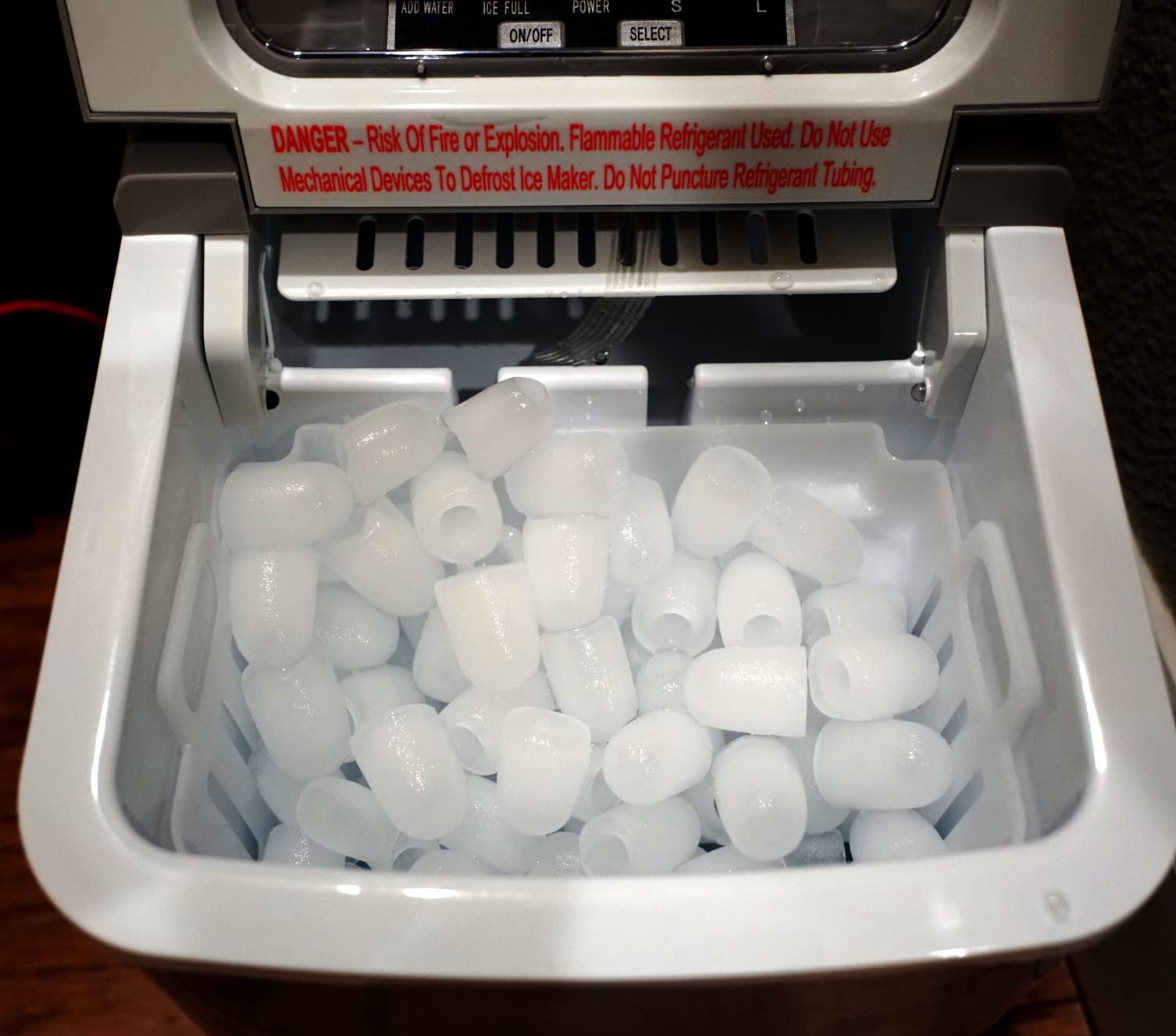
Build quality and the honest caveat on this listing
This is the heaviest machine in the guide at 26.2 pounds, and the weight is the first thing you feel when you set it on a counter. It is also the machine where I would flag the data most clearly: the customer review text attached to this listing appears to belong to a different product entirely, so treat the 4.3 star figure as the listing aggregate rather than corroborated owner feedback about the espresso machine itself.
The button-only interface gives you less than a pressure gauge or touchscreen would. You are dialing by feel and by taste, which is fine once you know what you are aiming for and unhelpful while you are learning.
Footprint: the largest width in the group alongside the Chefman
At 13.4 inches wide and 15.8 inches deep, this occupies as much counter as any machine here, and at 16.3 inches tall it needs cabinet headroom too. The 2.8 liter tank removes fully, which helps with refills, but plan the position so you can pull the machine forward to reach it rather than lifting it.
If your counter is genuinely narrow, this is the wrong machine and no feature compensates. If you have a proper counter run, the weight and the full accessory kit make it feel substantial rather than flimsy.
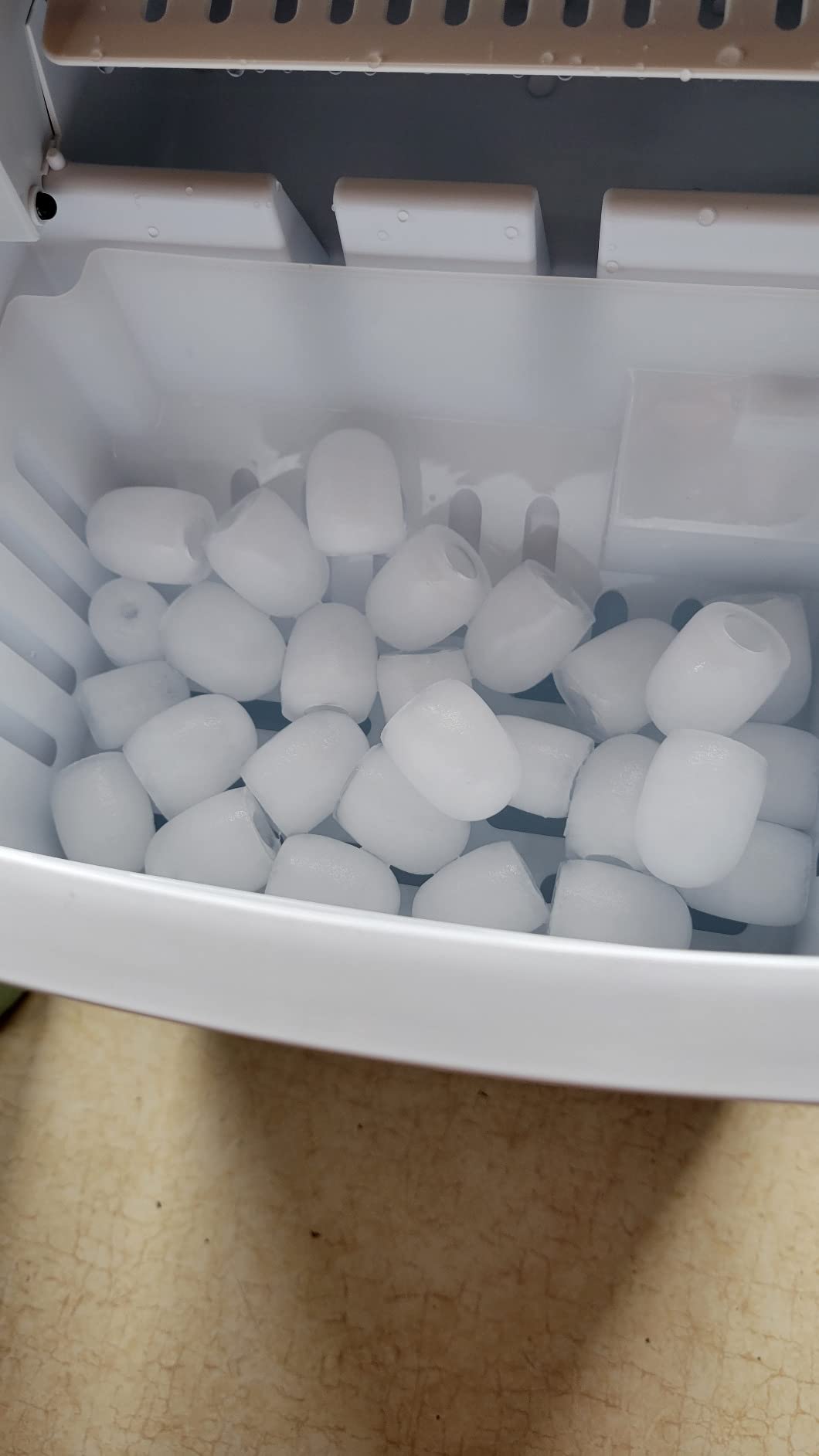
Who this machine suits, and who should skip it
It suits someone setting up a first espresso setup and wanting every accessory on hand day one, with a counter wide enough to justify the 26.2 pound footprint. The 30-setting grinder covers a wide range of bean types, and programmable operation suits a morning routine.
Skip it for a narrow counter, and weigh the thin verified review history before committing. Manual tamping and dose control still require practice, and with an unclear parts story it is a riskier long-term hold than the brands in this guide with established service networks.
7. Amaste Retro Compact – Smallest Footprint With the Most Distinctive Styling
Amaste Espresso Machine with Grinder, Steam Wand, Pre-Infusion, Retro White
11.61D x 11.02W x 16.14H
1450 watts
15-bar pump
68 oz tank
Pros
- Compact body at roughly 11 inches wide
- Retro styling and color options that stand out on a counter
- Conical burr grinder with 15 settings and a hands-free portafilter cradle
- 15-bar pump with a visible pressure gauge
- 68 oz water tank cuts down on refills
Cons
- Predominantly plastic construction with reported component failures
- Espresso runs lukewarm rather than hot
- Small frothing cup overflows as milk expands
- Thin manual and no support website
- Used pucks stick in the portafilter
If your objection to small kitchen machines is that they all look like lab equipment, this is the one that does not. The retro body and rounded styling read like a small kitchen appliance rather than a piece of café hardware, and at roughly 11 inches wide with a 68 ounce water tank it is one of the more space-efficient combinations in the guide.
The grinder is a 15-setting conical burr unit with a hands-free portafilter cradle, so grinding happens without you holding anything. The 15-bar pump has a visible pressure gauge, which is more feedback than most machines at this size offer, and low-pressure pre-infusion helps even puck wetting. A 51mm stainless portafilter with single and double baskets is included.
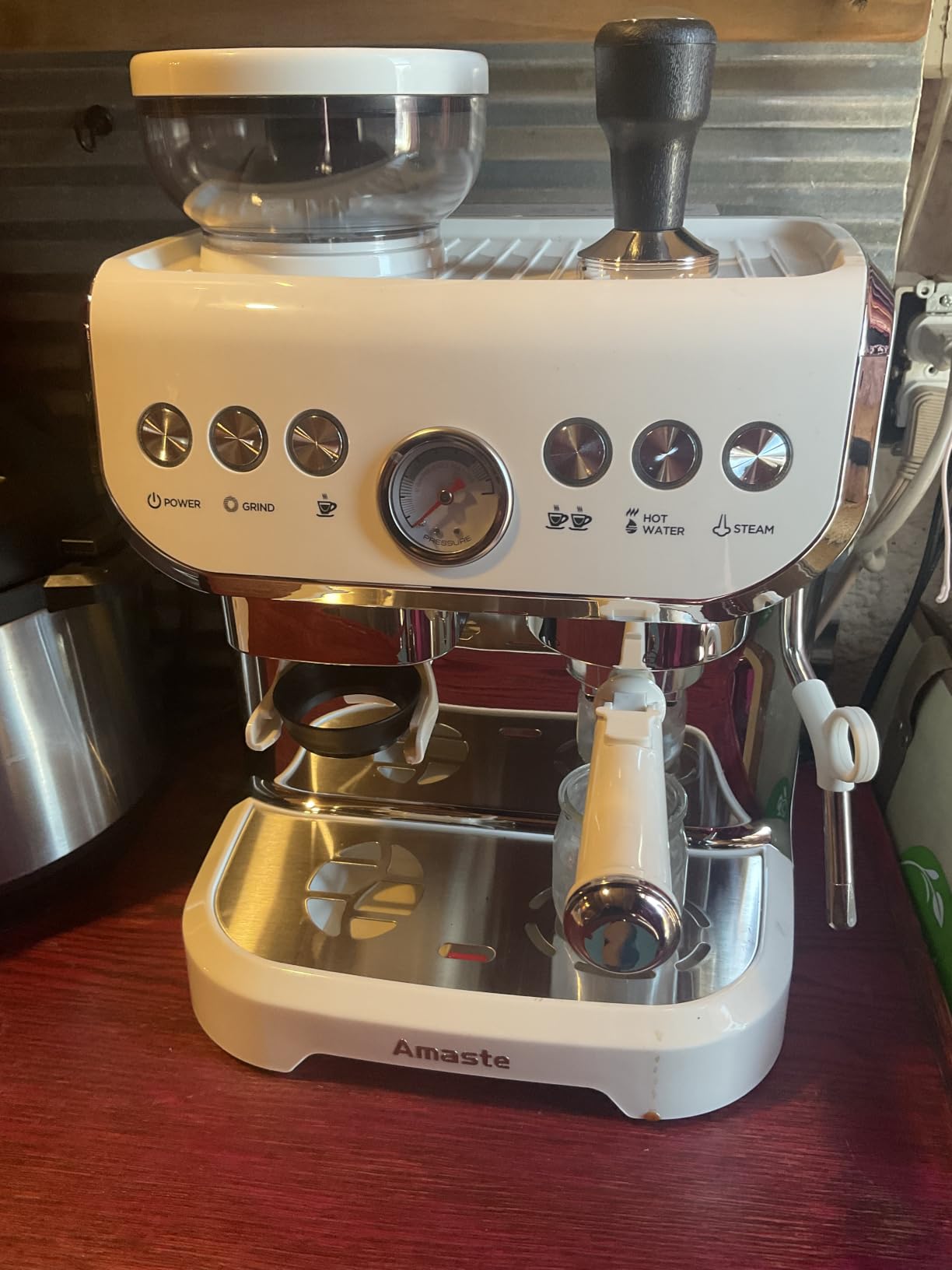
Where the design compromises show up
Two complaints come up repeatedly in owner feedback. The first is temperature: espresso runs lukewarm rather than hot, which changes the character of the drink more than any grinder setting will fix. The second is the frothing cup, which is small enough that milk expands over the top as it aerates, and its handle runs hot during use.
Build quality is the third. The body is predominantly plastic, and owners report components breaking after several months. On the light cream finish, ground coffee specks show immediately, which makes cleanup fussy and makes the machine look used faster than it is.
Documentation, parts and long-term ownership
The manual is vague, especially on descaling, and there is no brand support website listed. Replacement parts are difficult or impossible to source, which is the single biggest long-term risk in this guide. Used pucks also stick in the portafilter and need scraping, which is an annoyance on a small counter where you cannot spread out your cleaning kit.
The 11 inch width is a genuine asset in a tight kitchen, and this is the machine that most rewards the buyer who accepts a hot drink instead of a hot espresso shot. If parts availability is not something you can accept, choose a brand with an established service network even at a similar size.
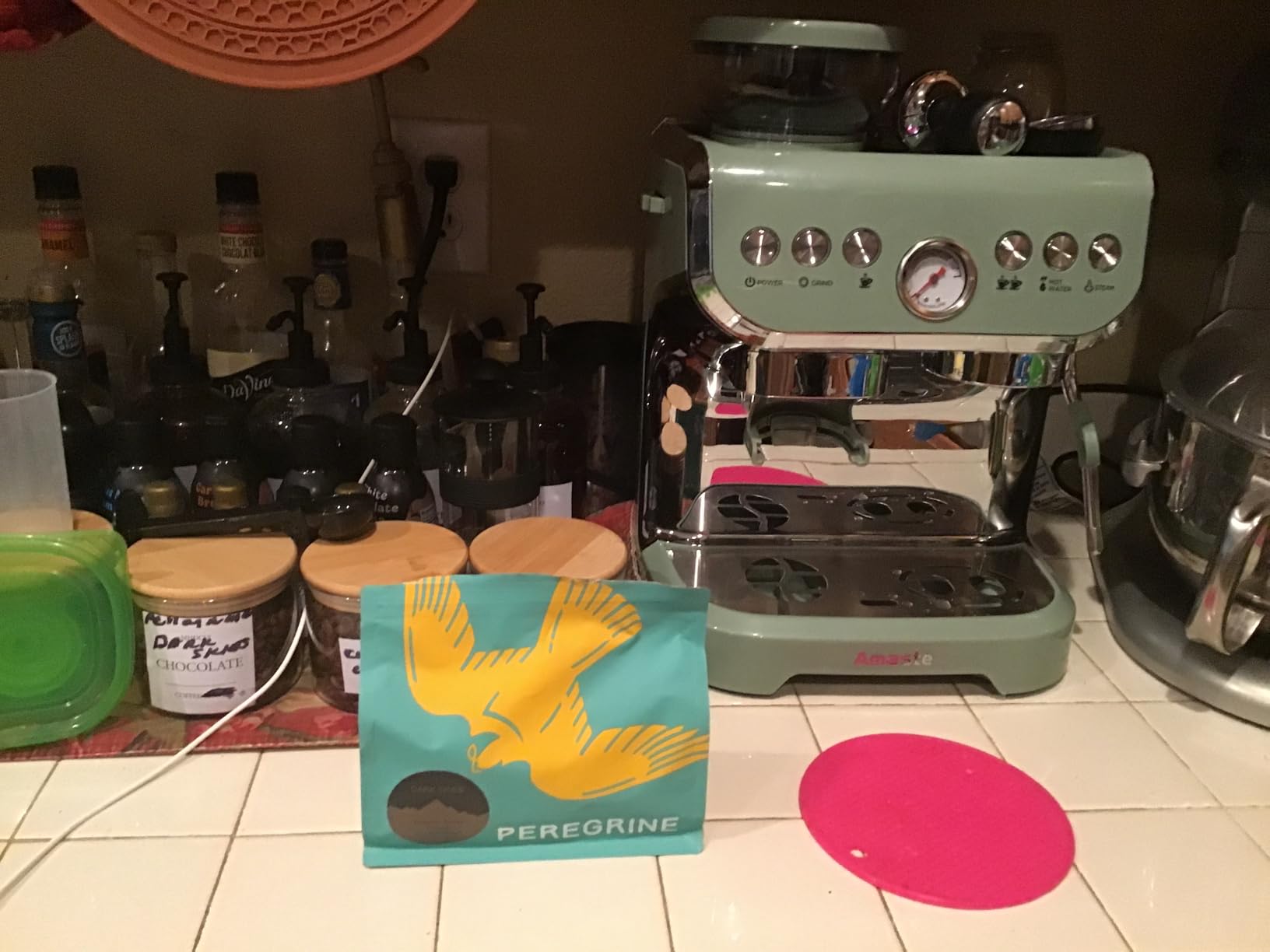
Who this machine suits, and who should skip it
It suits someone in a genuinely tight space who wants a grinder included, values quiet operation, and is happy with a design object that looks good on an open shelf. Quiet operation and the compact footprint are both things owners specifically call out.
Skip it if you care about drink temperature, if you plan to keep a machine for a decade, or if frothing milk regularly. With 175 reviews the sample is small, and 64 percent five-star ratings plus reports of breaking components make this the highest-variance pick in the group.
8. AMZCHEF 44 Grind Settings – Narrowest Semi-Automatic Footprint in the Lineup
AMZCHEF Espresso Machine With Grinder, Temp Control, 44 Grind Settings
12.5D x 10.82W x 13.38H
13.9 lb
1500 watts
60oz tank
Pros
- Narrowest semi-automatic body here at 10.8 inches wide and the shortest at 13.4 inches
- 44 grind settings give unusually fine adjustment
- Adjustable brew temperature from 190F to 201F
- One-touch cold brew mode
- Hot water function removes the need for a separate kettle
Cons
- Espresso temperature runs cooler than expected
- A shipping plug at the tank base must be removed before first use
- Manual workflow still needs tamping practice
- Part of the listing review pool covers an accessory rather than the machine
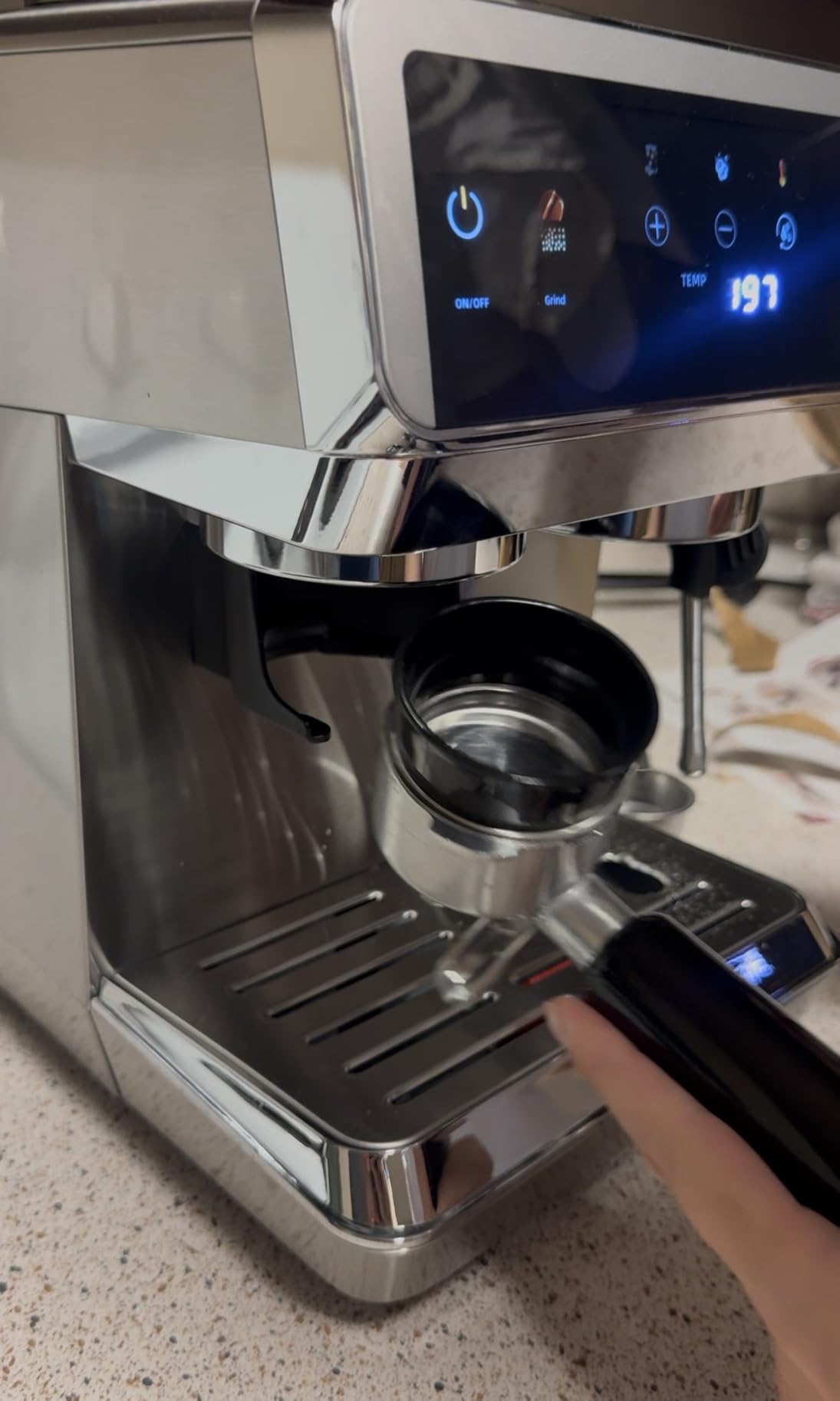
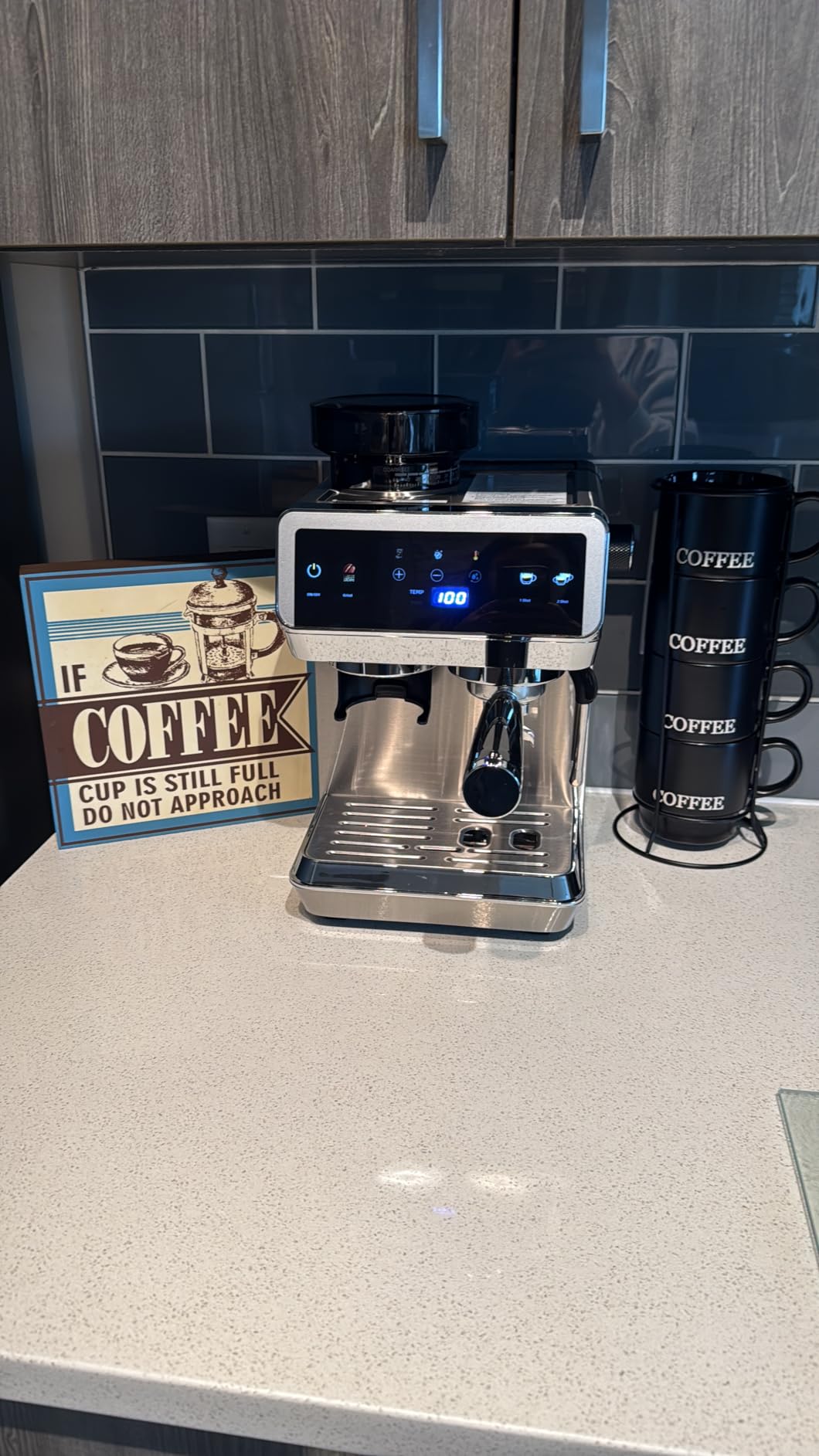
This is the machine I would measure a narrow counter against. At 10.8 inches wide, 12.5 inches deep and 13.4 inches tall it fits under lower cabinets where taller machines will not, and at 13.9 pounds it is light enough to move with one hand when you need the counter back. It is the shortest body in this guide, which is the dimension people forget to measure.
Forty-four grind settings is the widest range in the lineup, from ultra-fine to coarse, and the brewing temperature adjusts from 190F to 201F. The touch display shows grind time, brew time and temperature, so you get real feedback while dialing in rather than a row of indicator lights. Owners consistently highlight the combination of small footprint, wide grind range and an easy interface as the best feature-to-size balance in the group.
Temperature control that still runs cool
Having a 190F to 201F adjustment range is useful, but the most repeated complaint is that the espresso temperature runs cooler than expected and the cup cools quickly. If you drink black espresso in small quantities, this matters. If you drink milk drinks where the cup is already warm and the volume is larger, it matters far less.
One practical note before first use: there is a shipping plug at the base of the water tank that has to come out or the machine will not fill properly. That detail appears repeatedly in owner feedback and costs people an afternoon if nobody mentions it.
Footprint and clearance: the numbers that actually matter
At 13.4 inches tall, this is the one machine in the guide that will fit under a fairly low wall cabinet without you sacrificing the top of the machine. Depth of 12.5 inches leaves real working counter in front of it for a pitcher and tamper. That combination of height and depth is why it earns its place on a small-kitchen list more than its star rating alone would suggest.
The 60 ounce tank with a built-in descaling function is smaller than several rivals, which in practice means a refill roughly every four to five shots.
Who this machine suits, and who should skip it
It suits someone in a low-counter kitchen who wants fine grind adjustment, an honest temperature readout, and cold brew without a second appliance. The steam wand produces smooth microfoam in owner feedback, and there is a hot water function so you do not need a kettle on the counter.
Skip it if you drink espresso black and want it piping hot, or if you want hands-free milk. Manual workflow still means tamping practice, and part of the attached review pool covers the brand’s 51mm tamper rather than the machine, so treat the 4.3 star figure with the same caution you would any young listing.
9. EUHOMY Automatic – Narrowest Body Overall With Full Super-Automatic Convenience
EUHOMY Automatic Espresso Machine with Built-in Grinder and Milk Frother
17.36D x 7.32W x 13.11H
19.2 lb
1350 watts
200g hopper, 1.5L tank
Pros
- Only 7.3 inches wide
- the narrowest body in this guide
- Fully automatic one-touch espresso
- latte
- cappuccino and Americano
- 20-bar pump with a 15 grind level burr grinder
- Status alerts for beans
- water and grounds
- Automatic cleaning program and one-touch bean purge
Cons
- Very small 1.5L water tank relative to the body
- Only 15 grind levels
- larger beans need the purge routine
- Limited review base at 129 ratings
- Fewer service and parts options
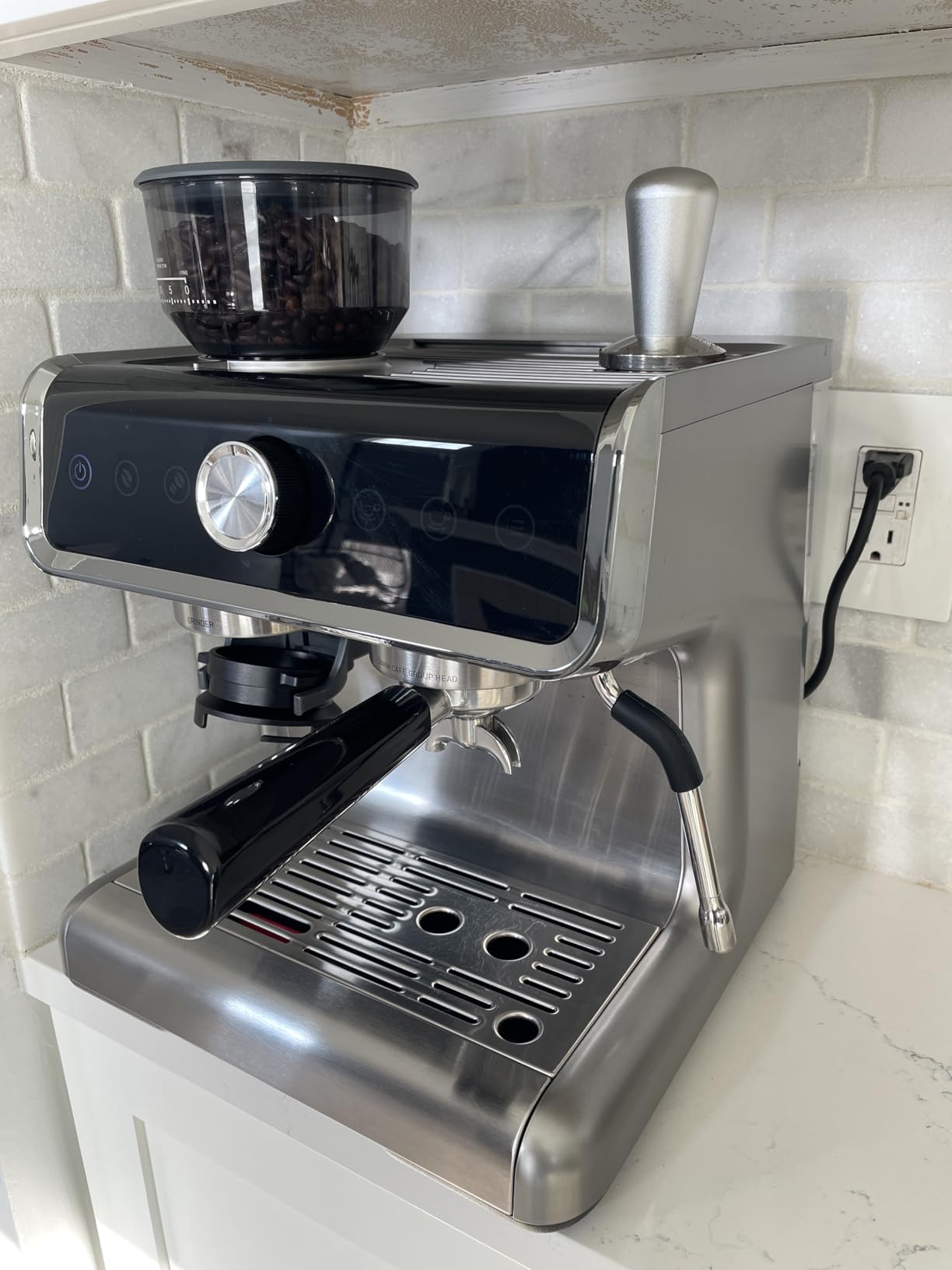
Seven and a third inches wide. That is the number that makes this machine relevant to a small kitchen, and no other machine in this guide is close to it. The body is narrow and tall rather than wide and shallow, at 17.4 inches deep, so it slots into a slim gap beside a fridge or into a narrow section of counter that a 13 inch machine would simply not fit.
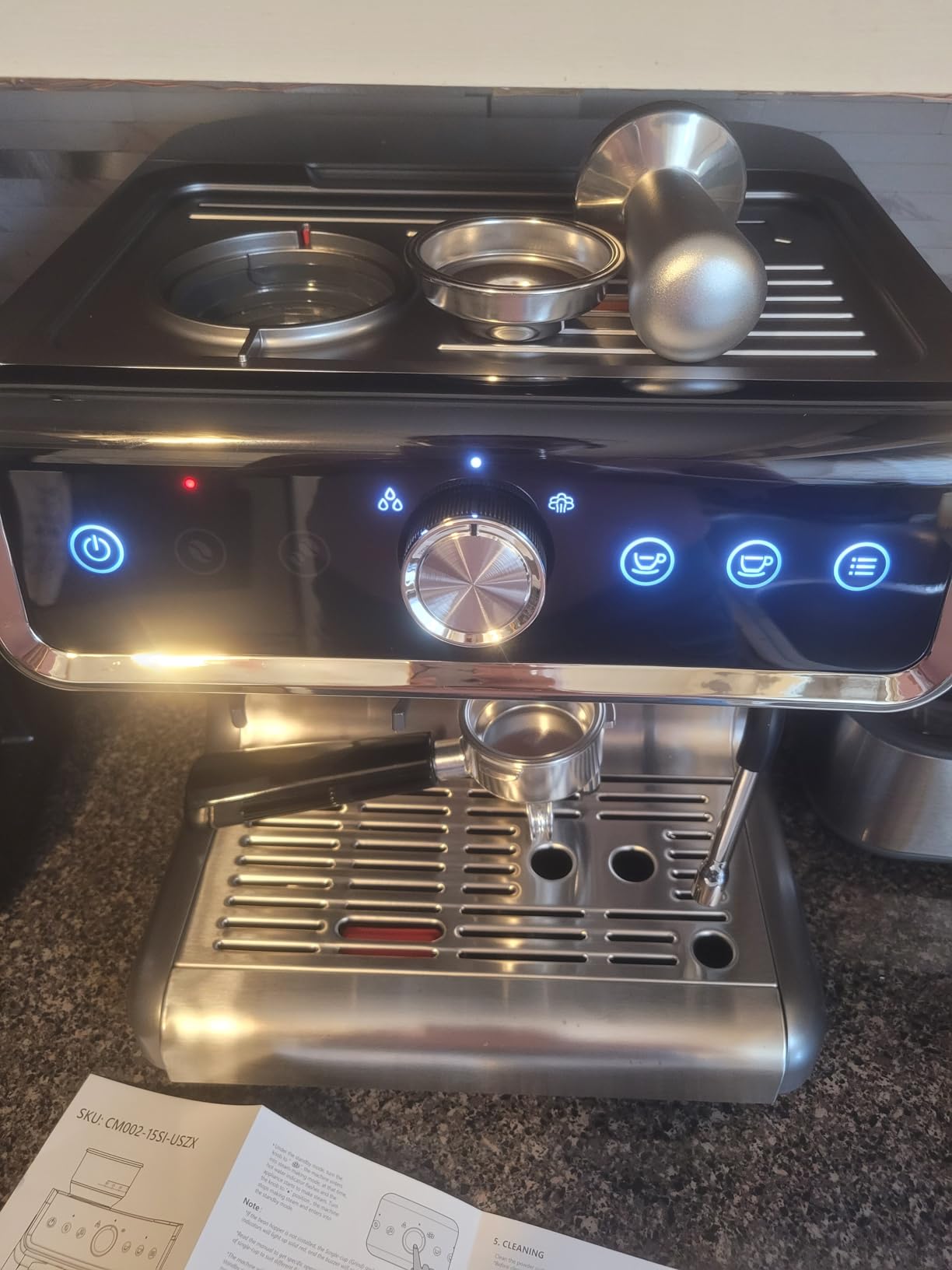
The workflow is fully automatic one-touch: espresso, latte, cappuccino and Americano with a built-in automatic milk system and an adjustable spout height for different cups. A 20-bar pump and 15 grind levels sit behind a touchscreen that shows real-time status for beans, water, grounds and component placement, which removes most of the guesswork in daily use.
Small tank and small hopper on a small body
The 1.5 liter water tank is the biggest practical limitation. On a body this narrow, the tank fills the depth, so you are refilling frequently, and the 200g bean hopper is small enough that you will be topping it up more than once a week if you drink several coffees a day. Owners with larger beans report needing to run the purge routine to avoid mixing flavors from one roast into the next.
Fifteen grind levels is fewer than most competitors here, but for a user who never adjusts anything, a smaller adjustment range is not a defect. It is a decision that trades control for simplicity.
Why the narrow shape changes your workflow
Because the body is narrow, the depth becomes your constraint instead. At 17.4 inches deep you need more clear counter in front than the width would suggest, but you gain the ability to place the machine in places a conventional machine cannot go. An automatic cleaning program and one-touch bean purge handle most of the upkeep, and neither a tamper nor a distribution tool is part of the workflow.
In an apartment, that low-effort profile is worth more than it would be in a house with a grinder already on the counter.
Who this machine suits, and who should skip it
It suits someone whose counter is narrow rather than short, who wants one-button drinks with no manual steps at all, and who will refill water more often than they would with a larger tank. Automatic cleaning and status alerts genuinely reduce the maintenance burden compared with any semi-automatic in this guide.
Skip it if you want to adjust anything, if you want a large tank, or if you are buying for a decade. The 129-review base is the thinnest here, the five-star share is the lowest in the group at 61 percent, and long-term reliability and parts support are largely unproven for this listing.
10. CUSIMAX 20 Bar Compact – Narrowest Footprint With a Grinder at the Entry Level
Espresso Machine with Grinder, 20 Bar Professional Expresso Coffee Machines with Milk Frother Steam Wand, Espresso Maker with 60oz Removable Water Tank, Cappuccino & Latte Machine for Home (Dark-Pro)
11.6D x 9.5W x 14.1H
12.6 lb
1350 watts
1.8L tank
Pros
- Compact at 9.5 inches wide and 12.6 pounds
- 20-setting conical burr grinder with a dosing ring
- 20-bar pump with 1350W heating and pre-infusion
- 360-degree adjustable steam wand doubles as a hot water dispenser
- Easy to clean compared with many machines in this bracket
Cons
- Grinder and motor reliability issues reported within months
- Thin English-only manual with clarity problems
- Some units needed repeated attempts to start brewing
- Warranty replacement reportedly hard to obtain from the seller
At 9.5 inches wide, 11.6 deep and 12.6 pounds, this is the second narrowest semi-automatic in the guide and the lightest machine overall. It fits a small shelf where a full-size barista machine would not, and the 20-setting stainless conical burr grinder with a dosing ring keeps loose grounds contained instead of spread across the counter.
The 20-bar pump with a 1350 watt heating system and advanced pre-infusion produces good crema once dialed in, and the 360-degree adjustable steam wand doubles as a hot water dispenser. The 51mm portafilter with one and two cup filters and a stainless milk pitcher are included, so there is nothing to buy to get started.
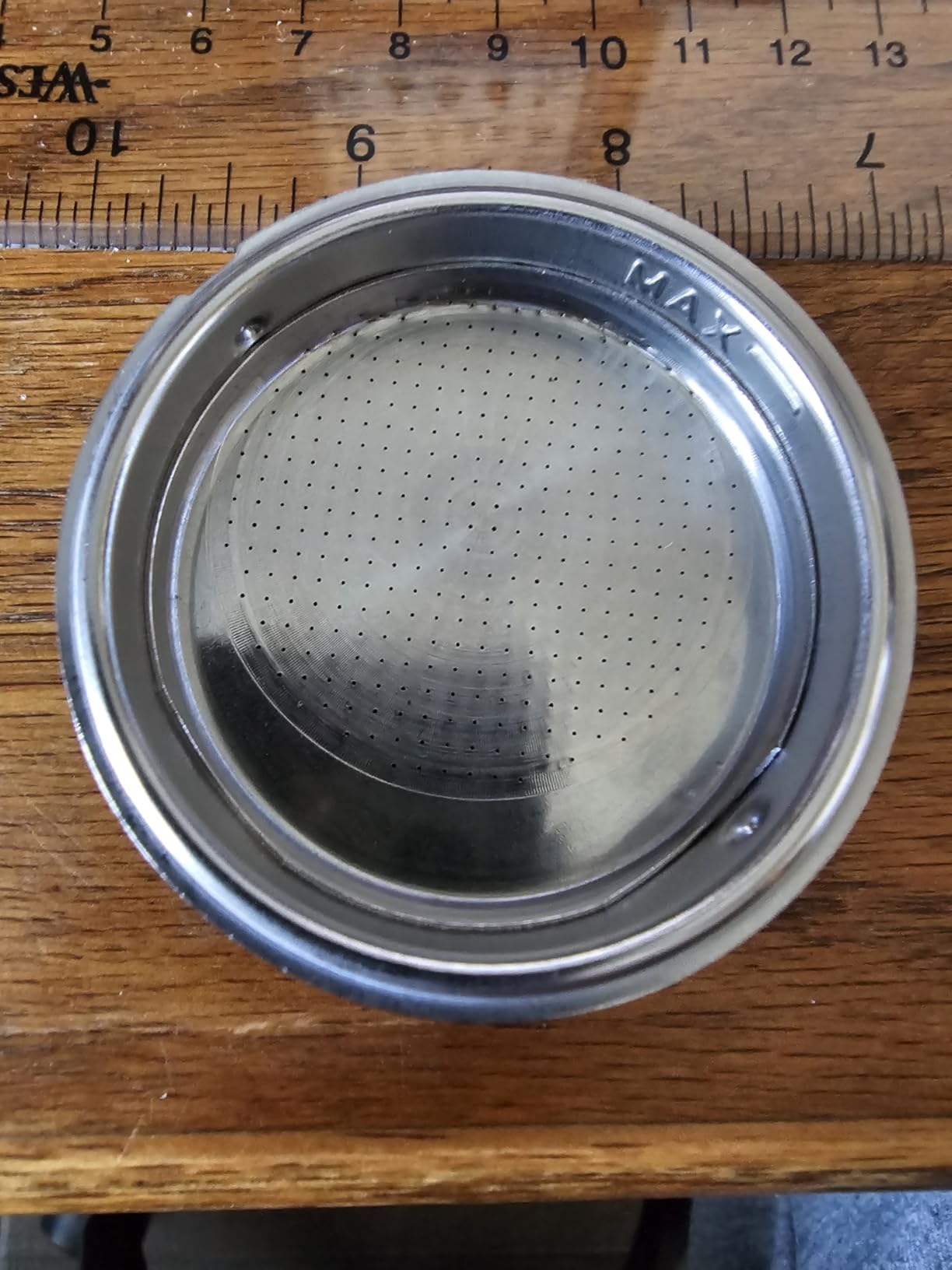
Reliability is the deciding factor at this price level
The reviews split cleanly. Owners who get it running praise the value, the compact size and the grinder. A meaningful minority report grinder blockage or total motor failure inside the first year, and some units needed several attempts to start brewing before they warmed up. That is the honest picture, and it is why this machine sits at the bottom of the ranking despite an attractive specification sheet.
Documentation is the other weak point. The manual is thin and English-only, with grammar and clarity problems that make descaling and dosing harder than they should be, and owners report difficulty obtaining a warranty replacement from the seller.
Footprint: the best raw size per feature here
Where the CUSIMAX wins is size per feature. A 20-setting burr grinder, a 20-bar pump, pre-infusion, a dosing ring and an adjustable steam wand in a 9.5 inch body is a lot of capability for the footprint. The 1.8 liter tank removes from the side and refills in seconds, and at 14.1 inches tall it clears most lower cabinets.
Manual workflow means regular cleaning and puck preparation effort, and comparing it against our grinder guide is worth a thought: on a setup this small, a separate grinder would eat the counter space the machine just saved.
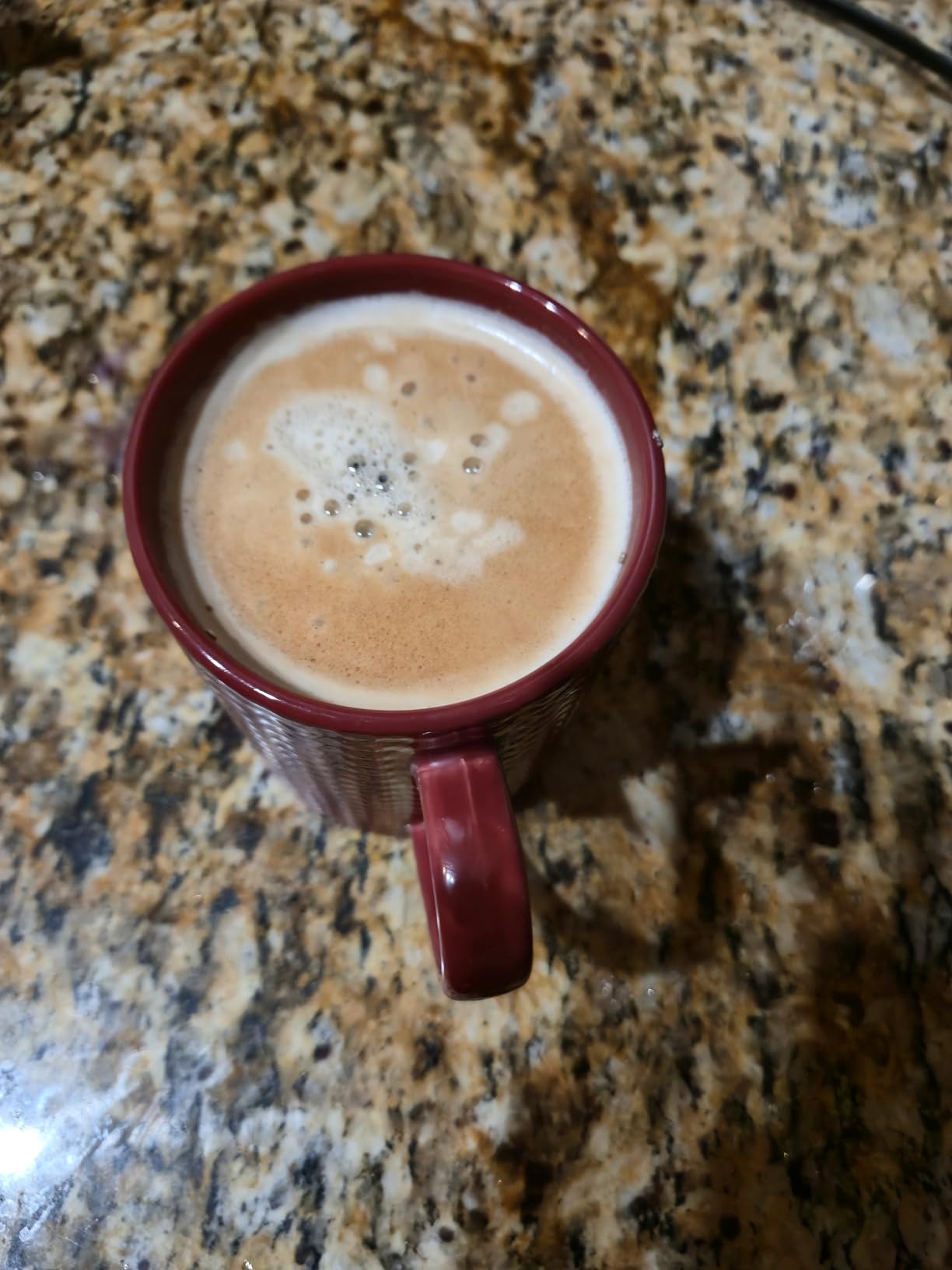
Who this machine suits, and who should skip it
It suits someone working with a very small counter, who wants a real grinder and steam wand at the lowest entry point in this guide, and who is comfortable with a manual workflow and doing their own cleaning. Solid-feeling build and easy cleaning are both things owners call out positively.
Skip it if reliability over several years matters more than the size, and read the one-star reviews before you order. With 204 reviews, a 63 percent five-star share and a 15 percent one-star share, this is the least consistent ownership picture in the group.
How to Choose an Espresso Machine With a Grinder for a Small Kitchen
Super-automatic or semi-automatic with a grinder
These two categories solve the same counter problem in opposite ways, and the right answer depends on whether you want to make coffee or want to make espresso. A super-automatic grinds, doses, brews, and froths milk behind a door. You press a button, a spout adjusts, and a carafe or cup fills. The width in this guide runs from 7.3 to 11.8 inches because the internals are stacked rather than laid out.
A semi-automatic with a grinder lays the workflow out in front of you: grind into the portafilter, tamp, lock in, pull the shot, then steam. Bodies are typically 9.5 to 13.4 inches wide, but they use standard baskets, which is what makes them learnable and repairable. If you ever plan to move on to a separate grinder and a better machine later, this is the category that transfers.
What burr type and grind settings actually matter
Every integrated grinder in this guide uses conical burrs, which are cheaper, quieter and more forgiving than flat burr sets. That is the right choice for compact machines where motor size is already limited.
Setting count matters less than people expect, and the number that actually affects your cup is the minimum dose. If the grinder cannot deliver a small amount, single shots come out heavy and underextracted. Barista-style machines with adjustable grind duration, like the Gevi, handle this better than fixed-time dosing. For milk drinks where you use more coffee, the difference narrows quickly.
Measure the real counter space in five steps
- Measure the depth from the backsplash to the front edge of the counter, then subtract two inches for airflow behind the machine.
- Measure the width of the space, then add four inches on the right side if the machine has a side-locking portafilter or a swing-out steam wand.
- Measure the height from the counter to your lowest cabinet. Anything over about 14 inches tall will not fit under a typical upper cabinet without a gap.
- Check where the water tank removes from. Rear-fill tanks mean pulling the machine forward 6 to 8 inches each time you refill, front or top-fill tanks do not.
- Leave a 12 inch working zone in front for a tamper, a milk pitcher and a knock box. This is the space most small kitchen layouts forget.
Water tank access, portafilter swing and drip tray clearance
A machine you cannot refill without moving is a machine you will stop using. Top-fill tanks are the most convenient in a tight layout, and the Gevi, AMZCHEF and CUSIMAX all fill from an accessible position. Rear-fill machines need more clearance behind or in front, and the drip tray on many of these machines needs to be pulled out and emptied every day or two because the self-flush cycle pushes water into it.
Portafilter swing radius is the number nobody publishes. On a side-locking design, the handle swings out roughly three to four inches from the body edge. Add it to your width measurement and you will not discover the problem with a full portafilter in your hand.
Workflow, bean storage and noise in an apartment
Beans do not belong in a warm cabinet next to the machine if you care about freshness, and in a small kitchen that competes for the same shelf. A separate airtight bean canister on a shelf above the machine keeps them away from heat and within reach of the hopper. In our experience, integrated bean hoppers of a pound or less need a weekly top-up, which is a reasonable routine rather than a daily one.
On noise, none of these manufacturers publish decibel ratings, so treat any specific number as unreliable. What is consistent across this group is that the grinder is the loudest element, followed by the steam wand, and the vibration pump is audible mostly during extraction. Grinders with more settings and higher wattage motors tend to be the noisiest. In an apartment, running a grinder at 6 in the morning matters more than any specification on this list, and machines with a bean purge or a shorter grind cycle cut down on repeated noise.
Frequently Asked Questions
What are some good small espresso machines with a grinder?
The strongest compact machines with a built-in grinder are the Breville Barista Express for a manual barista workflow, the Ninja Luxe Cafe Premier for one-button espresso, drip and cold brew, the Gevi 20 Bar for a narrow 11.5 inch body with a 58mm portafilter, and the AMZCHEF 44 Grind Settings for the smallest semi-automatic footprint at 10.8 inches wide.
What is the best coffee machine for a small kitchen?
For a small kitchen, a machine with an integrated grinder saves roughly six to eight inches of counter that a separate grinder would use. The EUHOMY is the narrowest at 7.3 inches wide and offers full one-touch operation, while the AMZCHEF 44 Grind Settings is the smallest semi-automatic option at 10.8 inches wide and 13.4 inches tall.
What is the best espresso machine for home use with a grinder?
The Breville Barista Express is the best all-round choice for home use, with a 16-step conical burr grinder, PID temperature control, low-pressure pre-infusion and a manual steam wand, supported by nearly 28,000 reviews and a decade of reported daily use. It needs about 18 inches of counter depth, so the Gevi 20 Bar is the better fit when width is tighter.
Are all-in-one espresso machines worth it compared to a separate grinder?
All-in-one machines suit small kitchens because the grinder is built into the body, saving the counter space a separate burr grinder requires. The trade-off is that the burrs are proprietary and cannot be upgraded later, and grind quality rarely matches a dedicated grinder. If your counter has room for two appliances, a separate grinder gives better results and an upgrade path.
Do I need a separate grinder for an espresso machine?
You do not need one if you buy a machine with a built-in grinder, since it grinds beans directly into the portafilter. Add a separate grinder only if you want finer grind control, plan to upgrade machines later, or make pour-over coffee. On a counter under 18 inches deep, the integrated grinder usually wins on space.
Which Compact Espresso Machine Should You Buy?
If you have a counter run at least 18 inches deep and want to learn, the Breville Barista Express is the buy. It has the deepest support network and parts availability in this guide, and nothing else here matches a decade of reported daily use. If you want espresso plus drip and cold brew from one body without touching a portafilter, the Ninja Luxe Cafe Premier covers more drinks in less depth.
If width is the constraint, the choice narrows fast. For a manual barista workflow in a narrow space, the Gevi 20 Bar gives you a 58mm portafilter and a 30-setting grinder in an 11.5 inch body. For a low cabinet, the AMZCHEF 44 Grind Settings is the smallest semi-automatic at 10.8 inches wide and 13.4 inches tall. For a narrow body and fully automatic drinks, the EUHOMY is 7.3 inches wide, though its 1.5 liter tank means more refills.
If you drink four coffees a day with a household and refill frequency bothers you, the Chefman Crema Supreme’s 3 liter tank and drip tray accessory storage win more than its width costs. If you want one-button hot and cold drinks and have the depth for a 20 inch body, the De’Longhi Magnifica Start covers more recipes than anything else here.
Before you order any of them, measure the space properly using the five steps above rather than the width on the product page. That single check prevents more small kitchen disappointment than any feature comparison. And if you later decide you want finer control, our small kitchen espresso layout guide covers where to put a separate grinder without losing your prep space.