
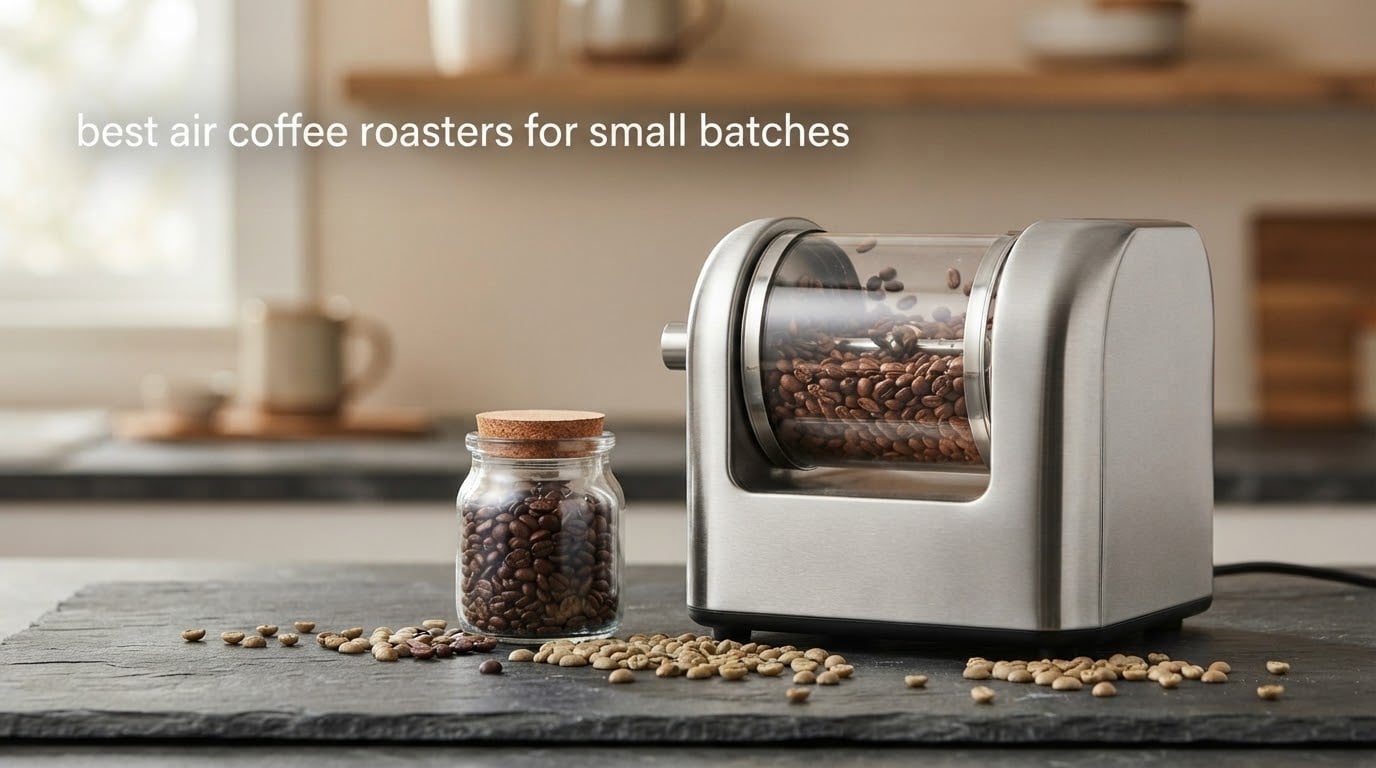
If you drink two cups a day, a 500 g drum roaster is the wrong machine for you. It would roast several weeks of coffee in one go, and the tail end of that batch will be stale before you reach it. The best air coffee roasters for small batches solve that exact problem: they take a few dozen grams of green beans, finish the batch in minutes, and let you drink all of it while it is still fresh.
I’ve been roasting on countertop machines for years, mostly 100 to 250 g at a time, and the difference between a machine that suits this hobby and one that fights it comes down to numbers most listings bury. The important spec is not the advertised maximum batch size. It’s the minimum batch size, the real useful range, and whether the machine can hold temperature well enough to give you the same cup twice.
What follows is a spec-first comparison of ten countertop roasters, ranked for the small-batch buyer rather than for the biggest drum available. Every capacity figure, wattage, temperature range and batch recommendation below comes from the manufacturer listing and the customer review record, not from marketing copy alone. Where reviewers disagree with the spec sheet, I flagged it, because that gap is exactly where small-batch roasters tend to disappoint.
Two definitions up front, since they shape everything else. An air roaster tumbles beans in a rotating or vibrating drum and heats them with forced hot air rather than radiant heat from a metal wall. Chaff is the papery skin that lifts off green beans during roasting; a smaller batch produces less of it, which is one of the quiet advantages of roasting small.
If you want to skip straight to the picks, the short version is in the next section. If you want to understand how to grind and brew the output, our beginner coffee grinder guide covers the pairing. For cold-brew versions of the same small-batch problem, see cold brew makers for small batches.
Our Top 3 Air Coffee Roasters for Small Batches in 2026


The SR800 takes the top slot because it pairs a 226 g batch with manual control over heat, fan and time on a single knob, and it carries enough reviews to make that judgement meaningful rather than anecdotal. The SR540 earns its place as the most-proven unit here, with the largest review base of the ten. The Roma Pro is the one to buy if you have never roasted a single bean and want a machine that will not require a tutorial to operate.
Every Roaster We Compared, Side by Side in 2026
| Product | Specs | Action |
|---|---|---|
| Fresh Roast SR800 |
|
Check Latest Price |
 Fresh Roast SR540 Fresh Roast SR540 |
|
Check Latest Price |
| Roma Pro Smart Roaster |
|
Check Latest Price |
 NIASIA 500g Automatic Roaster NIASIA 500g Automatic Roaster |
|
Check Latest Price |
 WINB 750g Roaster WINB 750g Roaster |
|
Check Latest Price |
 JIAWANSHUN 1.1lb Roaster JIAWANSHUN 1.1lb Roaster |
|
Check Latest Price |
 GIVEROO 500g Roaster GIVEROO 500g Roaster |
|
Check Latest Price |
 LUEUR Electric Roaster LUEUR Electric Roaster |
|
Check Latest Price |
 ZEVELOO 750g Roaster ZEVELOO 750g Roaster |
|
Check Latest Price |
 LATIJISHI 750g Roaster LATIJISHI 750g Roaster |
|
Check Latest Price |
Read that table as two groups. The Fresh Roast machines and the Roma Pro are true air roasters built for small loads, with capacities that land between 80 g and 300 g. The remaining seven are electric drum roasters with 750 to 800 g tanks and recommended batches between 300 g and 500 g, which suits a household of several coffee drinkers but sits well above the small-batch range this article is about. Several of those still work well in a small home, provided you stay near their recommended load.
1. Fresh Roast SR800 – The Best Overall Small Batch Air Roaster
Fresh Roast SR800 Coffee Roaster – Roast Coffee at Home – Variable Heat and Fan Control – Digital Display – Roasts 6–8 oz (170–226g) Per Batch – Easy to Use – Fast Roast Time
Up to 226 g per batch
Push-and-turn knob for heat, fan, time
Real-time temperature display
Pros
- 226 g batch suits a two-cup-a-day household
- Improved control board with editable start settings
- Even roasting across bean varieties
- Fast relative to batch size
- Simple enough for beginners
Cons
- Manual profiling takes trial and error to dial in
- Control board changes need patience to learn
This is the machine I keep coming back to for 100 to 200 g batches. At up to 226 g per batch it covers roughly a month of coffee for two cups a day, and the fluid-motion roasting system keeps the bed moving so colour comes out even rather than blotchy. A full load also finishes in under ten minutes, which is the part that makes it easy to keep a small habit going. The specs put that at 14 to 28 cups per batch.
The single detail that separates it from the smaller Fresh Roast is the control board. Earlier designs force you through the same start sequence every time; this one lets you change the default start settings so the machine begins where your last roast ended. Repeatability is the whole game when you are roasting small, because you are chasing the same cup rather than a varied one.
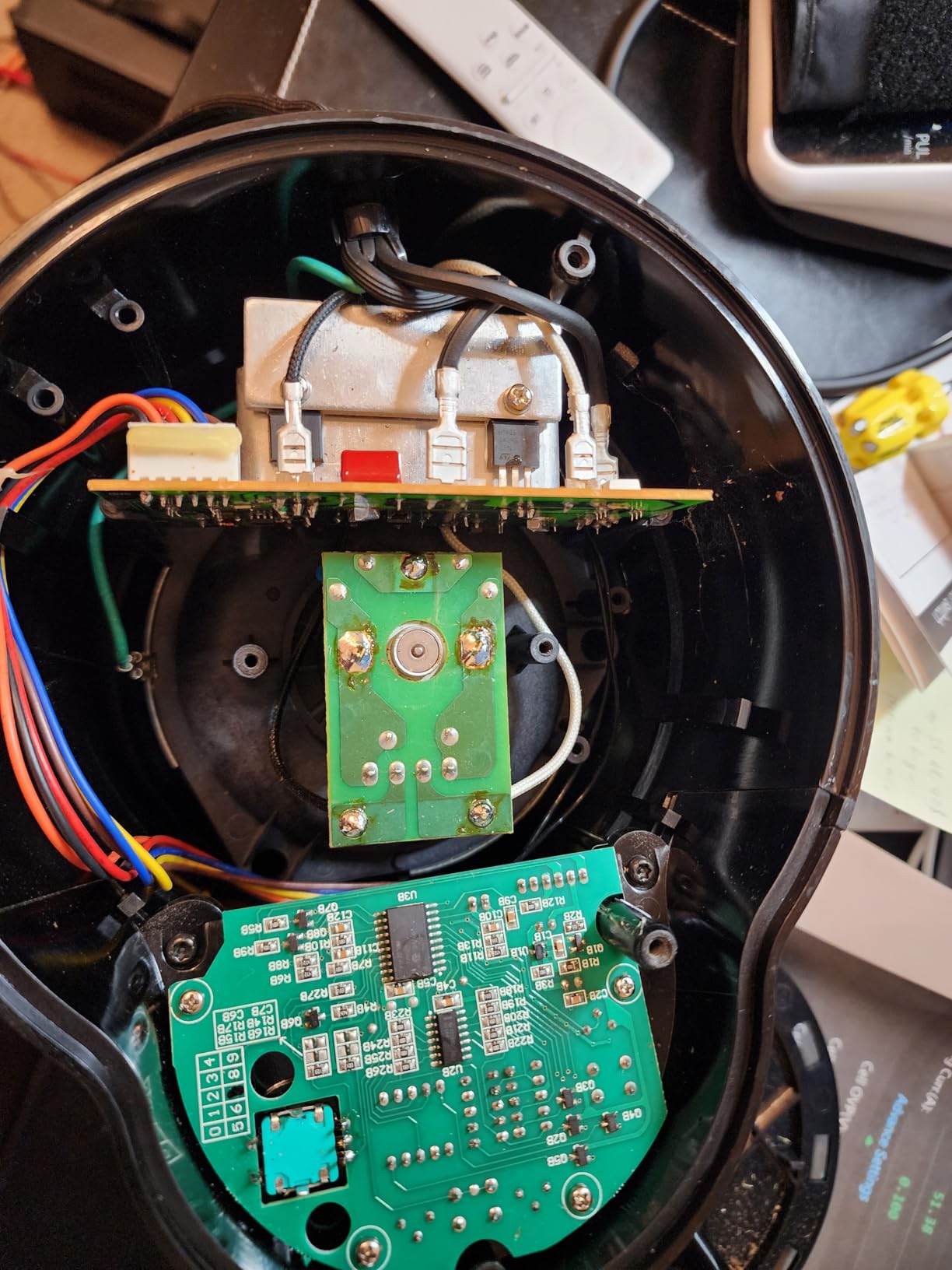
Control is entirely manual through a single push-and-turn knob governing heat, fan and time, with a live temperature readout on top. That sounds limited next to a machine with nine stored profiles, but for a roaster learning to read a curve it is better, because every variable stays visible to you instead of disappearing into a preset.
Batch size and what it means for a two-cup household
At 170 to 226 g per batch, one roast covers roughly 16 to 22 cups, or about ten days for two cups a day. That is the sweet spot of the whole small-batch category: enough coffee to feel like a real batch, small enough that the last cup is still fresh when you get to it.
The machine handles partial loads well, which matters if you are working through a split purchase of two different origins. Reviewers report even results when they reduce from the 226 g maximum, though they consistently advise staying above roughly 150 g.
Heat and fan control for repeatability
Nine power settings on heat plus continuous fan adjustment give you a workable range from light to medium-dark profiles. Fan speed matters more than most buyers expect, because airflow drives the rate at which moisture leaves the bean and controls how far past first crack you can push before risking a scorched edge.
What you will not get is a true dark or French roast. The unit runs out of headroom before it reaches those temperatures, so if your usual order is a heavy espresso or an Italian-dark filter, this is not the machine for you.
Chaff, smoke and where to put it
Roasting coffee produces chaff, the light papery skin shed from the beans, plus a fair amount of smoke toward the end of a darker profile. Both are easier to manage at small batch sizes, and reviewers note the cooling cycle brings the beans down quickly enough to stop the roast where you want it.
For kitchen use, put it under a range hood or roast on a balcony or covered porch. A countertop in an open-plan flat is a poor spot for a monthly roast, no matter which machine you buy. Our guide to air fryers for small kitchens covers the same ventilation logic for a different appliance.
Who should skip the SR800
Skip it if you roast more than 250 g at a time, if you want to reach second crack on a schedule, or if you would rather press one button than adjust three dials. It is a manual machine, and manual means the first ten batches are an experiment you pay for in burnt beans.
2. Fresh Roast SR540 – The Most Proven Machine in This Roundup
Fresh Roast SR540 Automatic Coffee Bean Roaster | Roast Coffee At Home | Variable Heat Settings | Convection Fan Control | Digital Status Display | Speed Roasting System | The Freshest Roast On Earth
Up to 120 g per batch
Nine power settings
Variable fan speed
Temperature display
Pros
- 688 reviews across multi-year use
- Consistent repeatable results across bean types
- Compact footprint with cleanable glass chamber
- Chaff basket captures most debris
- Responsive manufacturer support
Cons
- Analog control dial can degrade over time
- No programmable profiles so every batch is manual
- Heavy smoke output
- Will not reach true dark roast temperatures
- Weak documentation for beginners
Out of 688 reviews, the recurring theme is durability rather than excitement. Owners describe multi-year daily use with hundreds of batches behind them, and they keep roasting because the output tastes better than anything they can buy roasted. That is the honest headline for this machine: it is the one people stick with.
At up to 120 g per load, it is half the SR800’s capacity, and that is the real trade. A single batch covers 7 to 14 cups in under ten minutes, which suits someone drinking one to two cups daily and finishing a roast inside a week. If you want to roast once and drink for a month, you will be running this machine twice as often.
Nine heat levels and a live temperature readout
Control comes from a fan dial, a heat dial and a time dial, backed by a real-time temperature display on the body of the machine. That combination is simple to explain and simple to learn: pick a heat level, set fan speed, watch the temperature, drop the beans when you see the colour you want.
The variable convection fan is the underrated part. Cranking fan speed strips moisture out faster and cools the beans, which lets you extend the roast without the surface cooking. Turning it down keeps heat on the bean bed for a slower, sweeter profile. Once you own a machine with a real fan control, going back to a fixed-speed roaster feels like a downgrade.
The dial is the weak point, and there is no workaround
The most common long-term complaint is durability of the analog control dial. Owners several years in report that fan or heat control becomes unreliable and that the failure is not repairable with standard tools. That is a genuine limitation, not a minor annoyance, and it is worth pricing into your decision before anything else.
The second limitation is the lack of memory. There is no way to save a profile, so the sequence of settings that produced last month’s good cup has to be re-entered by hand. For many owners that is not a problem, because they settle on one combination and never change it.
Glass chamber, chaff basket and cleaning
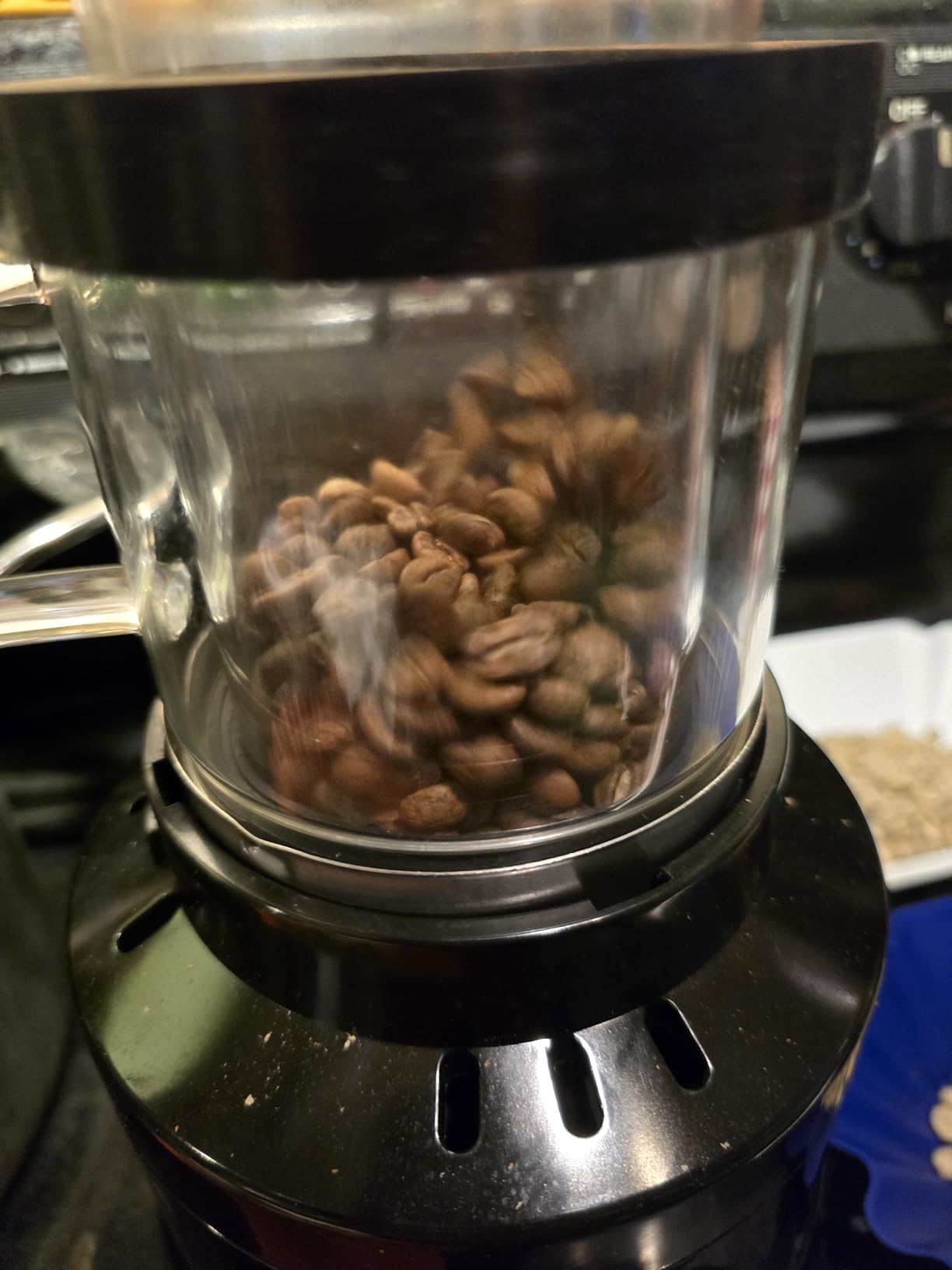
The roasting chamber is glass, which means you can see the beans without opening anything, and it wipes clean rather than holding onto oil the way coated metal does. A chaff basket sits below the drum and captures the bulk of the papery debris, so cleanup after a batch is a quick dump and a wipe.
Owners frequently pair the machine with an external probe thermometer, since the built-in display reads the air temperature in the chamber rather than the temperature inside the bean mass.
Who should skip the SR540
Skip it if you want stored roast profiles, if you roast dark, or if you need anything closer to 200 g per batch. And weigh it carefully if you already own a lot of small appliances with mechanical dials, because the control dial is the part most likely to disappoint you.
3. Roma Pro Smart Home Roaster – The Easiest Machine to Learn On
MAGO MAGA Roma Pro Smart Home Coffee Bean Roaster, 120V
80-300 g, best at 80-150 g
Auto and manual modes
Glass viewing window
One-button cooling
Pros
- Hands-off automatic cycle covering roast and cooling
- Uniform colour at 80-150 g
- Responsive replacement-part support
- Compact vertical footprint
- Low smoke output with integrated chaff collection
Cons
- Poor results at the advertised 300 g maximum
- Some manual-mode units fail to reach temperature
- No way to save or name profiles
- Glass tubes are fragile
This is the machine I hand to friends who want to try roasting without committing to a hobby. It runs a genuinely hands-off automatic cycle: load the beans, press the button, and the machine handles the roast, the cooling, the chaff separation and the discharge. For a beginner, that removes every part of the process that normally sends people back to buying bags of roasted coffee.
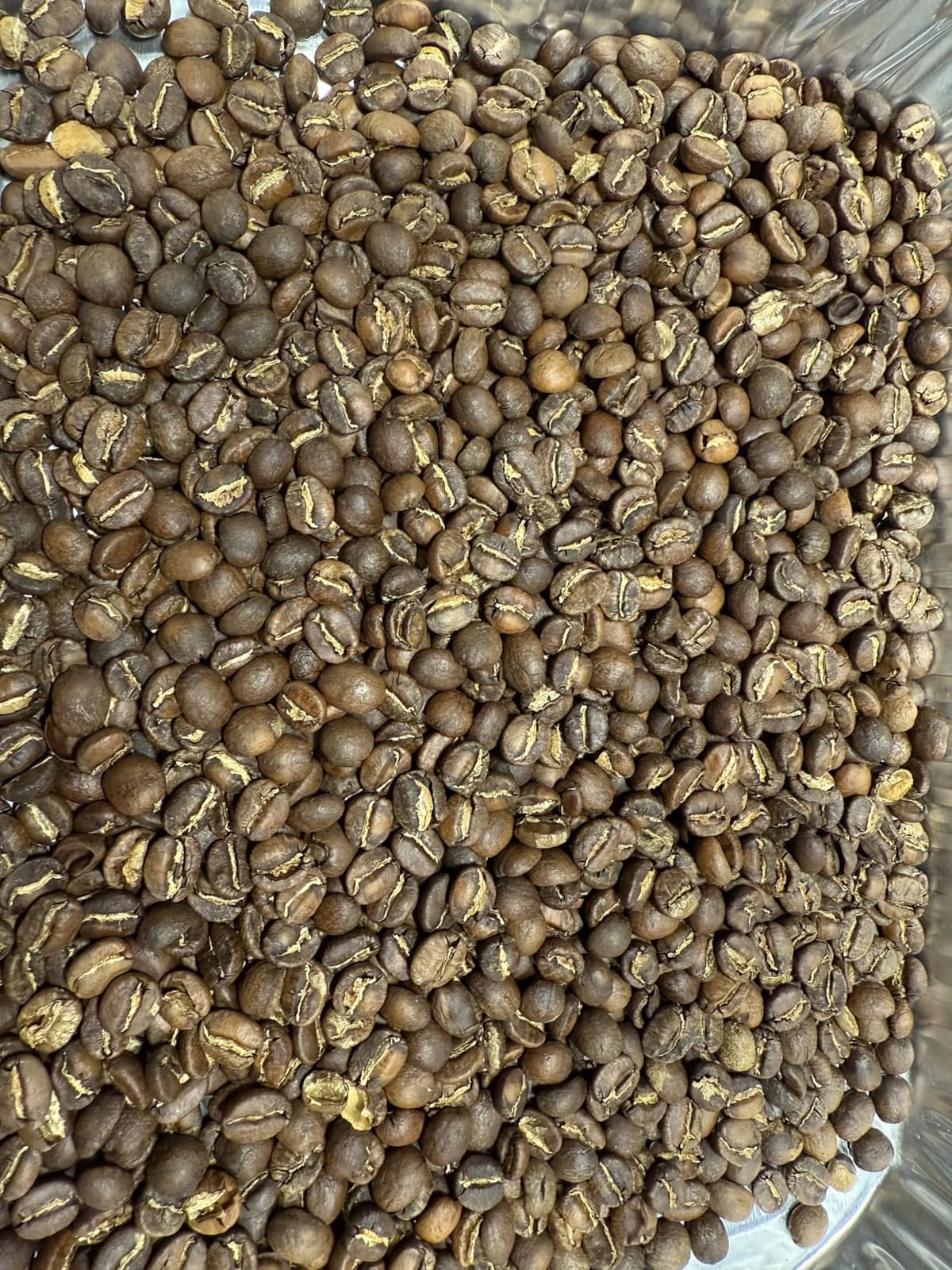
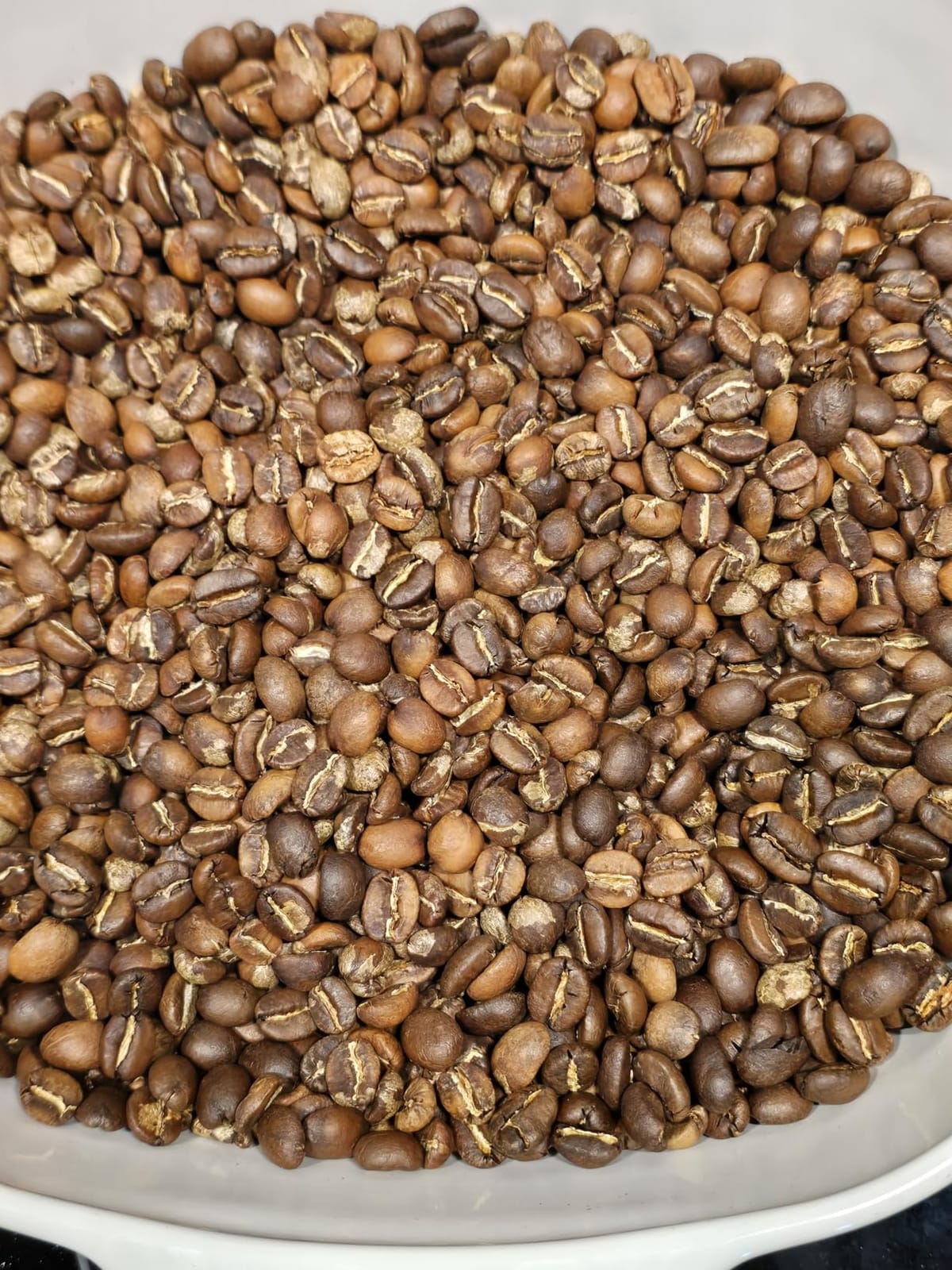
At 80 to 150 g it produces what reviewers consistently describe as even medium roasts with uniform colour. A 120 g batch is a little over 12 cups, which is about a week for a two-cup household, and the double-layer glass window lets you watch the whole thing without opening the chamber.
The 300 g claim is the thing to be careful about
Multiple owners report badly uneven batches at the advertised 300 g maximum, with raw and burnt beans in the same load. This is the clearest example in the whole roundup of why a maximum capacity figure tells you almost nothing useful. Judge this machine at 80 to 150 g and it performs well; push it toward its ceiling and it will not.
That is not a disqualifier for small-batch roasting. It is practically the definition of the use case, since anyone buying a 300 g air roaster is almost certainly not consuming 300 g of fresh coffee in a week.
Automatic mode for regular beans, manual mode for decaf
The auto profile is tuned for standard green beans and does a credible job. Manual mode exists for decaf and for anyone who wants to start adjusting, and the digital display carries a timer plus a Celsius and Fahrenheit toggle, which matters if you are following temperature targets from a book written outside the US.
Manual mode is where some units underperform. Reviewers report machines failing to reach roasting temperature before shutting down in manual, which suggests the element is stretched near the top of its range. If decaf is your primary interest, this is not the machine to learn on.
Support, awards and build quality
The manufacturer sends replacement glass tubes and replaces defective units, which owners rate as fast and responsive. That matters more than it sounds for a machine whose main weakness is a fragile glass component.
It also won the SCA Best New Product Award, and the machine carries CE and ETL certification. A later hardware revision reinforced the bean bin door switch, which addresses an early failure point.
Who should skip the Roma Pro
Skip it if you want to log and repeat profiles, if you plan to roast above 200 g, or if you are chasing filter-profile control rather than a dependable medium roast. With 41 reviews, its evidence base is also the thinnest here, so budget for that uncertainty.
4. NIASIA 500g Automatic Roaster – Most Automation With Real Smoke Handling
500g Automatic Coffee Roaster Machine for Home Use Wth Smoke Filter(Suitable for Light Roasting), The Smoke Pipes (Suitable for Medium and Dark Roasting) and Chaff Collector
Up to 500 g, 350-400 g suggested
Nine auto roast profiles
Smoke purifier plus exhaust pipes
Pros
- Nine automatic profiles suit first-time roasters
- Large stainless drum with partial batches supported
- Smoke purifier and exhaust pipes handle dark roasts
- Fast dedicated cooling fan
- Integrated chaff collector
Cons
- Defective or undersized beans can jam the drum
- Manual mode needs strict airflow discipline
- Heavy cycling shortens component life
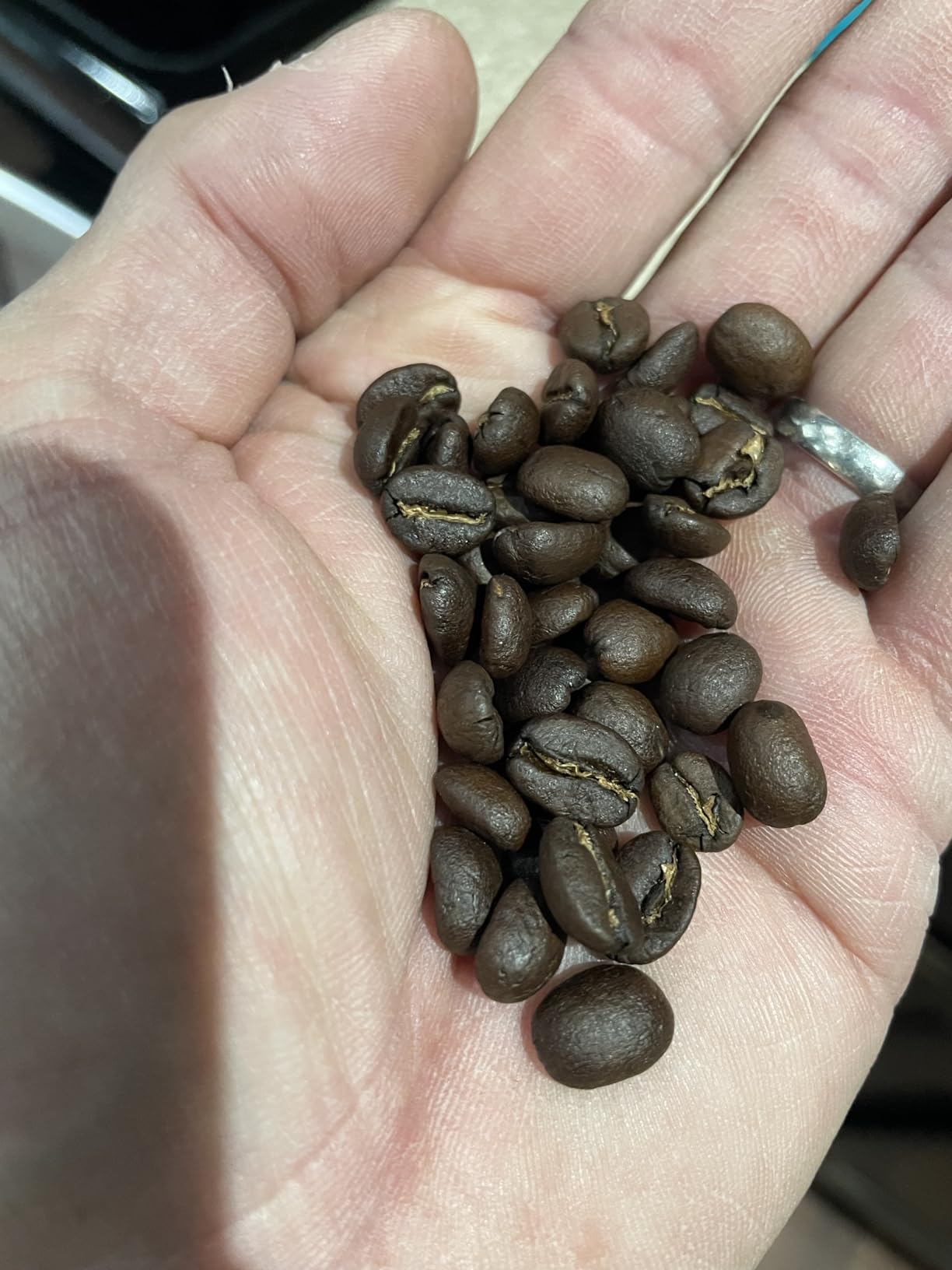
The pitch here is volume plus automation. Nine built-in profiles cover light, medium, dark, sun-dried, washed and honey process beans, and you can pick one and let the machine run. For someone who wants to roast two or three different origins a week without learning to read a curve yet, that is a real shortcut.
The capacity is 500 g maximum with 350 to 400 g recommended, so this belongs in the larger-batch group rather than the micro-batch one. It makes sense if you share a roaster with a partner or household, or if you roast once every two weeks and drink 20 cups a day between you.
Smoke purifier and exhaust pipes are the differentiator
Almost every other enclosed roaster in this roundup needs a range hood or an outdoor spot. This one includes a smoke purifier for light roasts and two aluminium alloy exhaust pipes for medium and dark, which is the only venting setup in the group designed to exhaust smoke rather than merely tolerate it.
That makes it the most practical indoor dark-roasting option here, since dark profiles produce the most smoke. It is also the only machine in this group that comes with a stated dark-roast ventilation setup rather than leaving you to find one.
Automatic profiles and manual mode
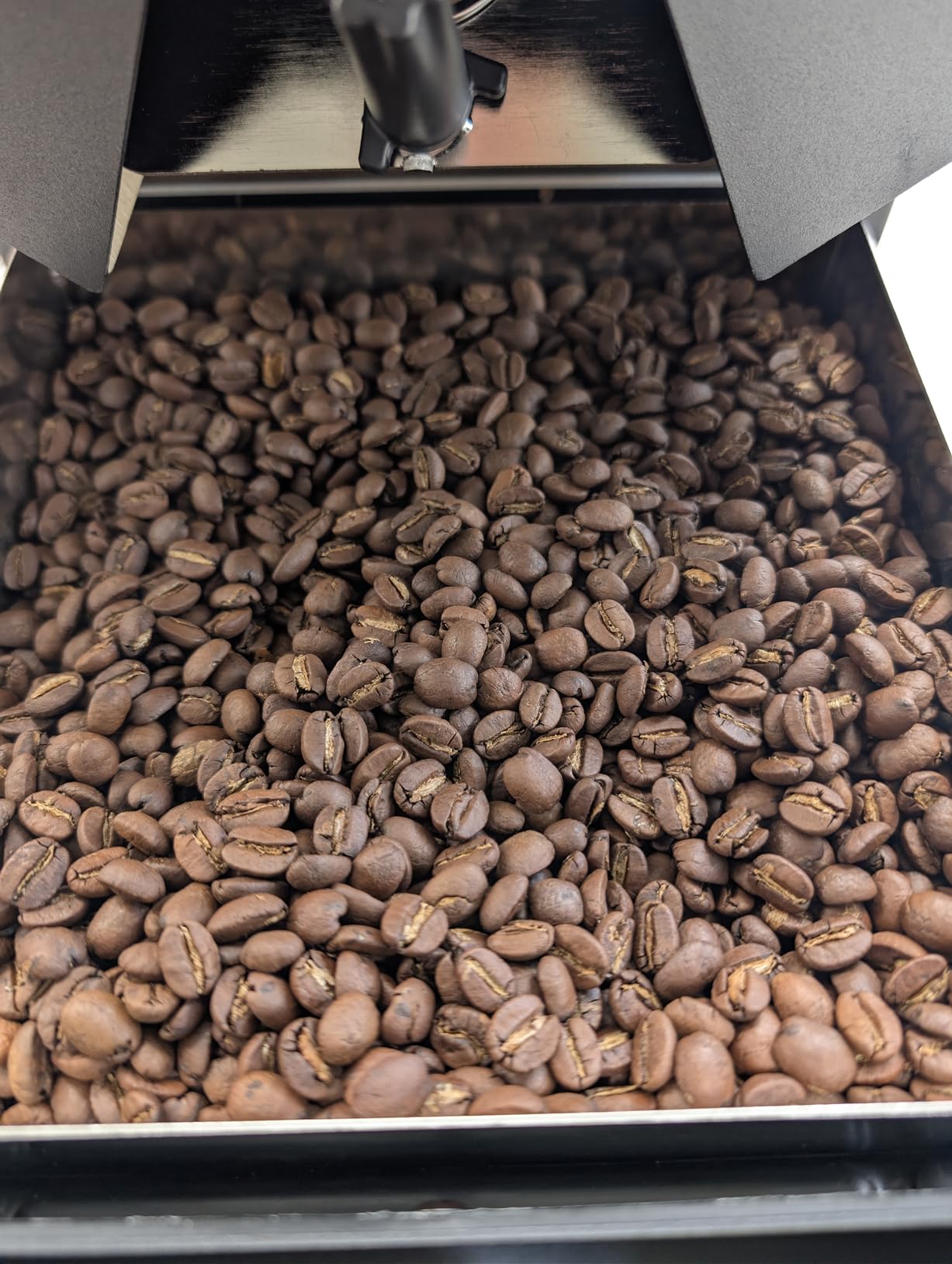
The automatic mode uses the nine profiles; the manual mode hands you control through an intelligent temperature controller with a precision probe. Reviewers advise keeping airflow at or above the first-crack threshold once manual, since letting airflow sag is what burns small beans in a big drum.
A high-speed cooling fan and a separate cooling tray lock in the roast at the end. On a 400 g batch that matters, because beans keep cooking from residual heat long after the drum stops if you do not pull the heat out quickly.
Bean quality decides how this behaves
The most repeated warning is about the beans themselves. Defective, broken or undersized green beans jam the drum, and the stirrer is the component that fails. Sifting your green beans before loading takes two minutes and prevents most of the reported failures.
The second warning is about frequency. Reviewers describe it as unsuitable for commercial-frequency roasting, because cycling it hard every day shortens component life. Once or twice a week is the realistic cadence.
Who should skip the NIASIA
Skip it if you roast under 300 g, since a 500 g drum roasts a tiny load unevenly, and skip it if counter space is tight. At 16 inches deep by 12 wide by 20 high it is the tallest machine here and needs a genuine corner of the kitchen.
5. WINB 750g Roaster – Built-In Timer With Constant-Temperature Heating
WINB Coffee Roaster Machine for Home Use, 110V Household Electric Coffee Bean Roaster with Timer Roasting Machine Peanut Bean Home Coffee Roaster
750 g tank, 300-500 g recommended
Built-in 0-60 minute timer
100-240C thermostat, 1200 W
Pros
- Built-in timer removes the external timer purchase
- Constant-temperature thermostat gives repeatable results
- Rotating rod distributes beans evenly
- Ventilated lid that stands upright
- Teflon interior cleans quickly
Cons
- Stirring motor noise masks the sound of first crack
- Even roasting still depends on staying near recommended load
Everything a small-batch roaster needs and nothing it does not, in a machine rated at 4.3 stars across 50 reviews. The 0-60 minute built-in timer is the feature that separates it from cheaper flat-pan designs, where you are expected to supply your own timer and guess.
Recommended batch is 300 to 500 g in a 750 g tank, so treat this as a small household machine rather than a micro-batch one. A 300 g load is roughly 28 cups, which is about two weeks for a two-cup-a-day drinker.
Why a thermostat beats a dial
The 100-240°C range is held by an automatic constant-temperature heating system rather than a simple dial. In practice that means the drum returns to set temperature after you add cold beans, which is the difference between a roast that follows your settings and one that drifts downward and stalls.
That repeatability is why owners report even, repeatable roasts. A 1200 W element with a thermostat is also enough wattage to reach dark profiles, though they take noticeably longer than light ones.
The noise problem and what to do about it
The rotating rod is loud enough to obscure the audio cue that roasters listen for. First crack, the point where beans start popping audibly and where most light and medium roasts are dropped, becomes hard to hear over the motor.
The workaround is to roast by sight and temperature instead. The transparent lid with air holes, which also stands upright so you are not crouching over steam, lets you watch colour develop directly. If you prefer acoustic cues, this is the wrong machine.
Beyond coffee
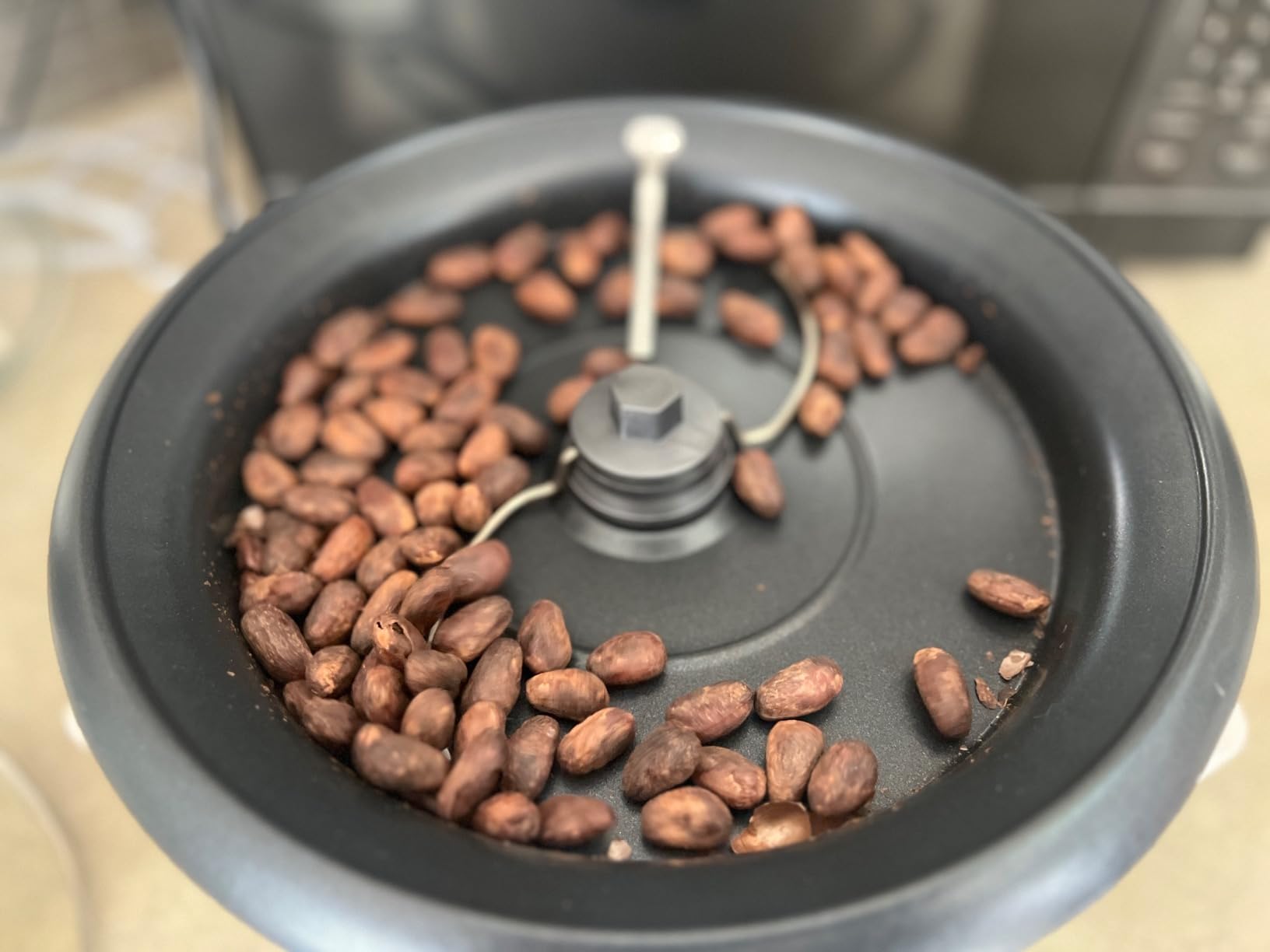
The Teflon honeycomb interior, which wipes clean with soap and water, handles peanuts, chestnuts, barley, dried fruit and popcorn. That is not niche: many home roasters use the same machine to roast nuts for baking, which roughly doubles its usefulness.
Who should skip the WINB
Skip it if you roast under 300 g, because evenness drops sharply below the recommended load, and skip it if you rely on hearing first crack to time your drops. For a genuine 100 g weekend batch, look at one of the air roasters earlier in this list.
6. JIAWANSHUN 1.1lb Roaster – The Best-Evidenced Affordable Drum
JIAWANSHUN Electric Coffee Bean Roaster Machine for Home Use,1.1lb Capacity
800 g tank, 300-500 g recommended
100-240C control
Automatic stirrer, 1200 W
Pros
- 408 reviews document the failure modes clearly
- Rotating stirrer roasts more evenly than a flat pan
- Full 100-240C range covers light through dark
- Non-stick bowl cleans with a damp cloth
- Vented glass lid lets you watch and smell the roast
Cons
- Uneven results below the 300 g recommended minimum
- Stirring rod jams on defective beans
- Thin printed instructions
- More smoke than enclosed air roasters
With 408 reviews at 4.1 stars, this is the best-evidenced affordable drum roaster in the group, and the rating split tells the story: 59% five stars and 20% four stars against a long tail of people who loaded it with too few beans.
That tail is entirely predictable. The manufacturer recommends 300 to 500 g in an 800 g tank, and reviewers consistently say results go uneven below 300 g. If you only need 100 g, this machine will disappoint you, and its 300 g floor will not move.
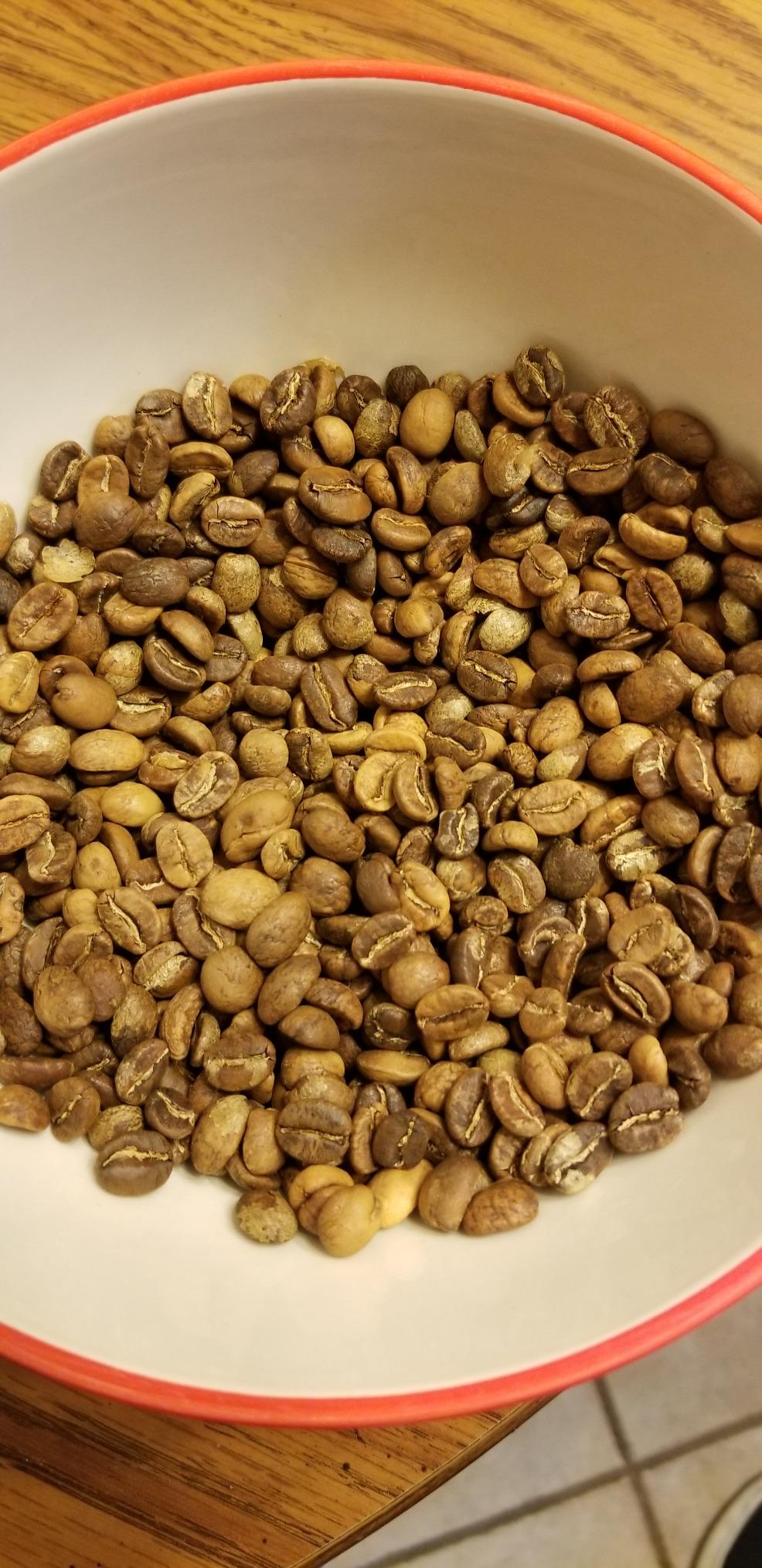
The stirrer is what separates it from a pan roaster
A stovetop pan roaster depends on you shaking the pan every thirty seconds, and that is why so many people find home roasting frustrating. The automatic mixing stirrer rotates the beans continuously, which produces noticeably more even heating with far less attention from you.
The 1200 W element and the 100-240°C control range cover everything from light to dark, with dark profiles taking noticeably longer. The transparent glass lid with four ventilation holes lets you watch colour and smell the roast without breaking the heat.
Cleaning and the multi-use angle
The honeycomb non-stick interior wipes clean with a damp cloth. There is no dishwasher cycle and none is needed, which matters for a machine that sits on your main work surface.
It also roasts sunflower seeds, peanuts and popcorn, so for anyone who wants a single countertop appliance for snacks and coffee, that flexibility carries real weight.
Documentation is the weak spot
The single most common piece of advice from owners is to research the craft outside the manual, because the printed instructions are thin and assume you already understand charge temperature, development time and drop temperature. Plan to spend an afternoon learning before your first batch rather than during it.
Who should skip the JIAWANSHUN
Skip it if you roast small quantities, if smoke in your kitchen is a problem, or if you want fine control over development. It is a capable machine for its class, but the class requires 300 g or more to work as designed.
7. GIVEROO 500g Roaster – Continuous Auger Agitation and Low Noise
GIVEROO 500g Coffee Bean Roaster Machine with Timer, 110V
800 g tank, 400-500 g recommended
Automatic auger
0-240C with built-in timer
Pros
- Automatic auger beats stir-rod designs on consistency
- Built-in timer and wide temperature range
- Quiet running relative to similar drum roasters
- 45-degree angled scope improves heat distribution
- Smoke reduction system
Cons
- Manufacturer states roasts below 400 g are uneven
- Small or rotten beans can jam the auger
- Deep bean bed shows uneven colour at the bottom
The difference between an auger and a stirring rod is the whole reason this machine is worth a separate section. A stirring rod sweeps beans past the element in a repeating pattern; a continuously turning auger moves the whole bed in one direction, so no bean sits in a dead spot for long.
Note that no written customer review text came back with this listing, so what follows rests on the specification set and the 4.2-star average across 237 reviews rather than on quotes. I would treat the noise claim as promising but unverified.
The 400 g floor is the number to remember
The manufacturer states plainly that roasting below 400 g leads to uneven results. That is the highest minimum in this roundup, and it makes this a large-batch machine no matter how the capacity is labelled.
At 400 to 500 g you are looking at 40 to 50 cups per batch, or about a month for a two-cup household. That is a good cadence for someone who wants volume, and a poor fit for someone who wants to taste four origins in a weekend.
Quiet operation and smoke reduction
Owners and the spec sheet both point to quieter running than comparable drum roasters, along with a smoke reduction system. In a shared wall or an apartment, that difference is felt more than the temperature range is.
The 45-degree angled roasting scope is a smaller but real advantage: it changes the angle beans fall onto the element, which improves heat distribution across the bed rather than only at the centre.
Jam prevention and the bean bed depth
Small, rotten or undersized beans can jam the auger and need to be cleared by hand. Sifting green beans before loading is not optional advice here; it is the difference between a clean roast and an interrupted one.
The wide bean bed also shows occasional uneven colour at the bottom of the pan. That is inherent to a deep bed in an 800 g tank and another reason the 400 g floor exists.
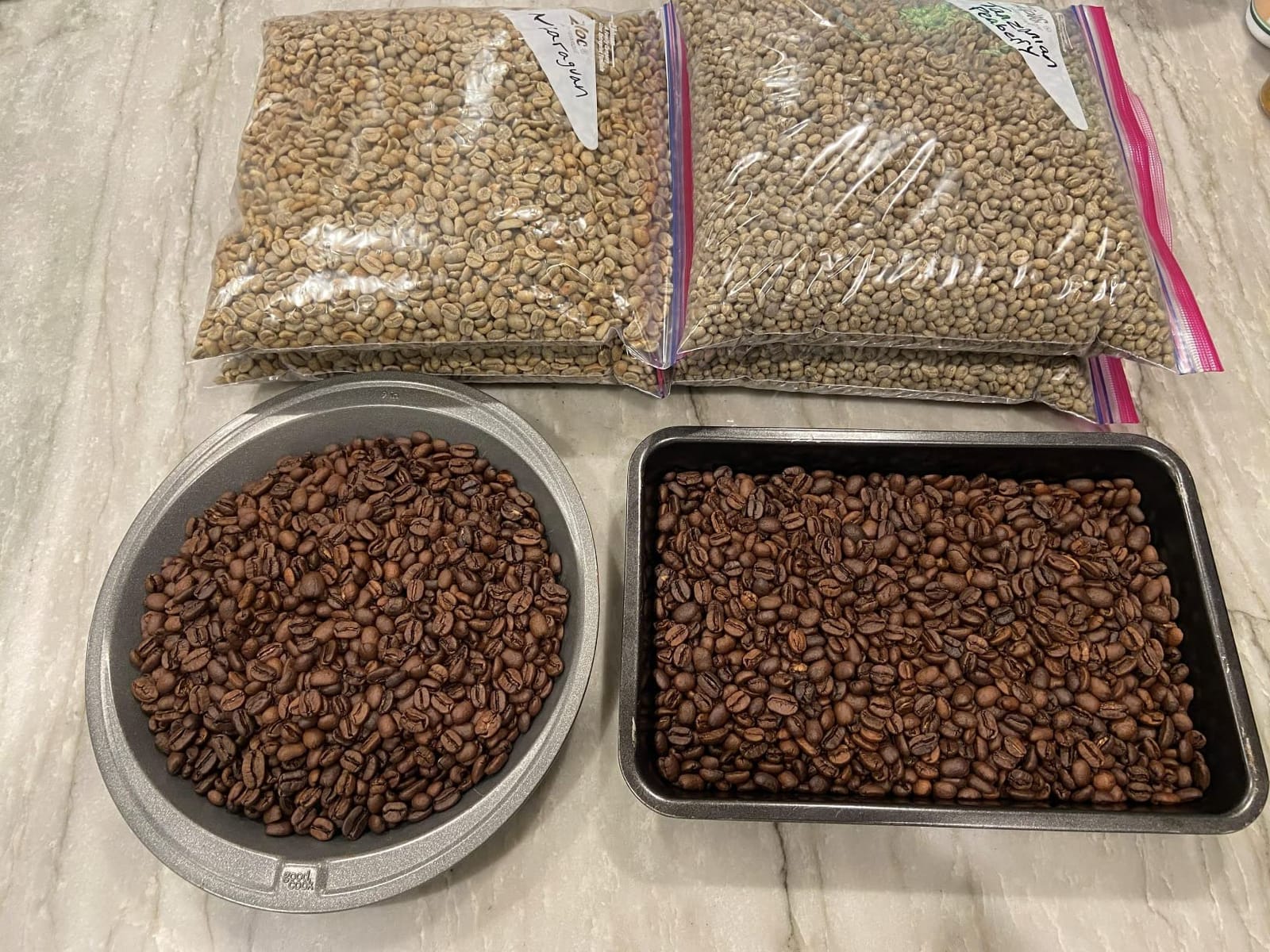
Who should skip the GIVEROO
Skip it for anything approaching small-batch roasting, since 400 g is a hard floor, and skip it if you need a documented record of owner experience. For weekend tasting sessions across several origins, this is the wrong tool.
8. LUEUR Electric Roaster – A Straightforward Stirring-Rod Drum
LUEUR Electric Coffee Roasters For Home Use,Coffee Bean Roaster Machine Coffee Bean Roaster For Stovetop, Countertop, Commercial Coffee Bean Roasting Machine 110V
800 g tank, 300-500 g recommended
Constant-temperature thermostat
Stirring rod, 800 W
Pros
- Stirring rod and thermostat at an entry-level price point
- Constant-temperature heating aids repeatability
- Honeycomb Teflon is easy to clean and heats evenly
- Vented transparent cover for monitoring
- Handles nuts
- grains and popcorn
Cons
- Stirring rod is weaker than continuous auger designs
- Evenness drops below the 300 g minimum
A 4.1-star average across 179 reviews, and the rating distribution is honest about the ceiling: 62% five stars, 14% four, then a 10% tail of one-star reviews that mostly reflects expectation mismatch rather than failure.
Recommended batch is 300 to 500 g in an 800 g tank. Like the JIAWANSHUN, it wants a real load to work properly, and anyone planning 100 g batches should look further up this list instead.
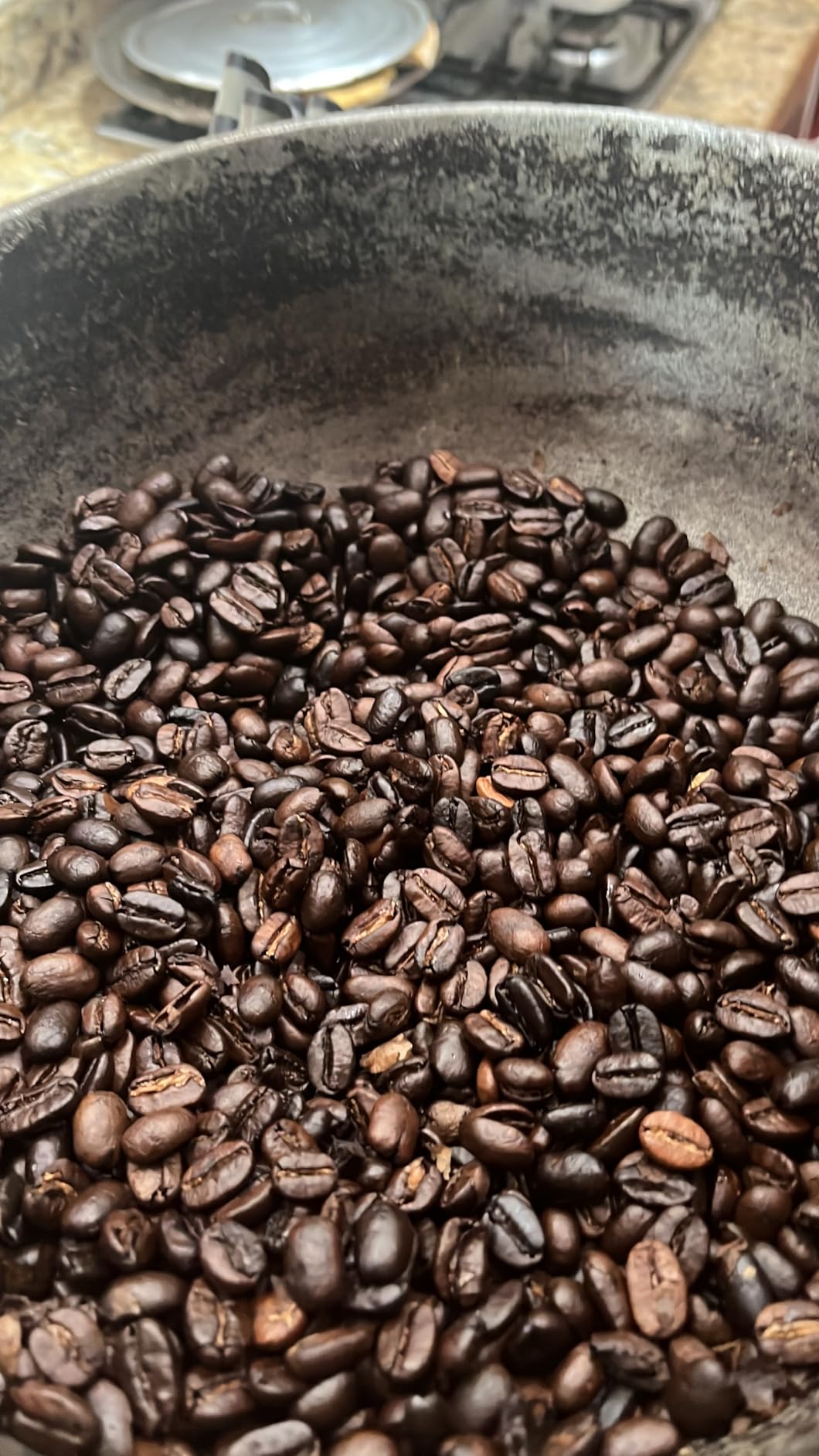
Thermostat-controlled heating on a budget
The professional thermostat with automatic constant-temperature heating is the meaningful upgrade over flat-pan designs at this tier. The drum recovers to set temperature after loading cold beans rather than settling slowly, which is what makes roasts repeatable batch to batch.
At 800 W it is tied for the lowest-wattage machine in this group, so expect a slower roast than the 1200 W drum units. Slower is not worse, but plan for it and do not assume a 10-minute roast.
Honeycomb Teflon and the vented cover
The honeycomb food-grade Teflon coating gives more even contact with the element and wipes clean. The heat-resistant transparent cover has four ventilation holes, which lets you watch and smell the roast while letting moisture escape.
It also handles peanuts, chestnuts, barley, dried fruit and popcorn, so the same machine covers nut roasting for baking as well as coffee.
Where it sits against the other budget drums
Against the JIAWANSHUN, the LUEUR trades element wattage for a thermostat. Against the GIVEROO, it trades the auger for a stirring rod. Neither gap matters much if you stay near 300 to 500 g and roast once a week.
Who should skip the LUEUR
Skip it for micro-batches, for heavy weekly use where a 800 W element will be strained, or if you want continuous bean movement. It is a sensible entry machine, not a roaster you will profile.
9. ZEVELOO 750g Roaster – Lower Smoke, Higher Manual Burden
ZEVELOO 750g Electric Coffee Roaster Machine Home Coffee Roaster Coffee Bean Roaster for Home Use 110V
750 g, 300-500 g recommended
100-240C settable
Flat stirring design, 800 W
Pros
- Flat design produces less smoke than air popper style roasters
- Owners report coffee that beats store-roasted
- Easy to clean and maintain
- Wide temperature range can reach dark given time
- Good platform for logging roasts with an external probe
Cons
- Flat chamber roasts unevenly unless shaken every 30 seconds
- No built-in timer and the dial misreads actual temperature
- Instructions are effectively unusable
- Some units failed after only a few uses
This is the odd one out in the roundup, and worth including precisely because of it. Instead of a drum, it uses a flat stirring arrangement, which cuts smoke output substantially compared with air-popper style machines while keeping automatic agitation.
Owners who buy green beans and roast on a schedule report coffee that beats what they can buy roasted. The catch is that it demands attention: the flat chamber roasts unevenly unless you shake the unit every thirty seconds, which caps practical quality at roughly a quarter pound regardless of the 750 g label.
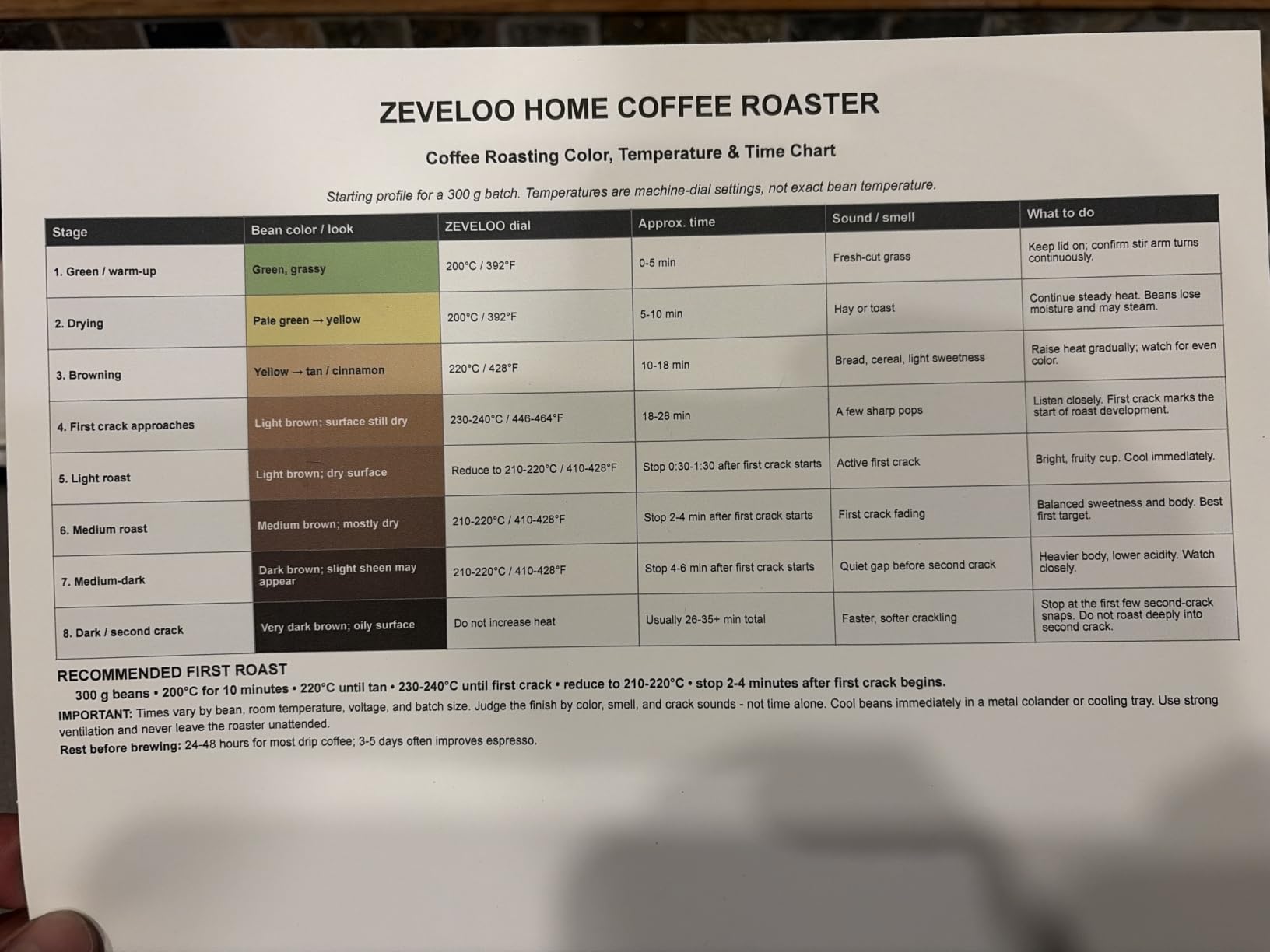
The 750 g label versus the real 120 g ceiling
This is the clearest case of misleading capacity in the group. Reviewers put the practical limit at about a quarter pound, not three quarters, because the flat chamber has no depth to tumble beans through. Judge it on 100 to 150 g loads and it works; load it to the label and it will not.
That said, a 120 g batch is 12 cups, which is a very reasonable week of coffee for one or two drinkers. As a small-batch machine with lower expectations about automation, it is more usable than its bare specification suggests.
No timer, and a dial that lies
There is no built-in timer, so you need a separate kitchen timer, and reviewers report that the dial indicator does not match actual internal temperature. The practical answer is an external probe thermometer, which several owners use to build their own chart of times and temperatures.
That is a real commitment for a beginner. It also means this machine suits someone who enjoys logging data more than someone who wants results on the first attempt.
Durability and the missing manual
Some owners report units failing after only five or six uses, which is one of the most serious reliability signals anywhere in this roundup. Against that, 58% of reviews are five stars, so failures are real but not typical.
Documentation is widely criticised as inadequate. Budget time to learn the craft from other sources before your first batch, and check the warranty terms carefully given the early-failure reports.
Who should skip the ZEVELOO
Skip it if you want a hands-off cycle, if you need to roast more than 150 g at a time, or if you dislike maintaining your own temperature records. Its low smoke output is genuine and appreciated; the manual burden is equally genuine.
10. LATIJISHI 750g Roaster – Simple Controls With a Long Roast Time
Upgraded Coffee Roaster, Electric Coffee Bean Roaster Machine for Home
Up to 750 g per batch
0-60 minute timer
100-240C control, automatic stirring
Pros
- Timer and temperature control in a single unit
- Automatic stirring gives even results at entry settings
- Easy cleanup on the glass top and tray
- Glass lid lets you run light and dark profiles back to back
Cons
- Reaching correct temperatures takes 30-45 minutes
- Cranking heat to shorten roasts causes burnt and light beans mixed
- Stirring noise masks the first crack
- No operator manual included
A 4.0-star average across 40 reviews, and the split is informative: 58% five stars against 11% one-star, with a notable concentration of complaints about roast duration rather than build quality.
Setup is about as simple as these machines get. A 0-60 minute timer and a 100-240°C dial on a Teflon-coated chamber with continuous automatic stirring, and an LED display for reference. There is nothing to program and nothing to learn beyond watching colour change through the glass lid.
The 30 to 45 minute roast problem
Follow the specified temperatures and you are waiting 30 to 45 minutes, which owners describe as far too long. The obvious response is to push the heat up to shorten it, and that is exactly what produces scorched batches with burnt and light beans mixed together.
So the realistic workflow is a long, gentle roast on a schedule rather than a fast one on demand. Plan batches around when you will be home, not around when you decide you want coffee.
Noise, documentation and early failures
The stirring motor is loud enough to obscure the first crack, so like the WINB, you will roast by sight and temperature. Documentation is thin to the point of absence, with several owners reporting no operator manual in the box at all.
One owner reported a dead heating element on a brand-new unit. With 40 reviews, a single failure carries more weight here than it would in a listing with hundreds, so inspect the machine on arrival and test it before committing a bag of green beans.
Beyond coffee
It also handles peanuts, sunflower seeds, popcorn, soybeans and chestnuts. The Teflon-coated tray and glass top clean with soap and water, which is what makes it practical as a general-purpose appliance rather than a dedicated roaster.
Who should skip the LATIJISHI
Skip it if you want fast roasts, if you rely on the sound of first crack, or if you need documentation to get started. It is a capable starter machine with a real patience requirement built into how it works.
How to Choose an Air Coffee Roaster for Small Batches
The core mistake in this category is treating maximum batch capacity as the deciding number. A machine that roasts 750 g is not better at roasting 100 g, and often it is worse, because a deep bean bed has no room for the heat and air to reach every bean. Judge every machine on three numbers instead: its minimum, its recommended range, and its tested performance inside that range.
Minimum batch size matters more than maximum batch size
Here are the real floors from this roundup, and the spread is wide. The Roma Pro performs well from 80 to 150 g. The Fresh Roast machines handle 120 to 226 g. The JIAWANSHUN, WINB and LUEUR want 300 g or more, the GIVEROO wants 400 g, and the ZEVELOO advertises 750 g while owners put the usable ceiling nearer a quarter pound.
Two cups a day of 15 g per cup is about 900 g a month, or roughly 450 g a week, which points you at a 300 to 500 g machine. If you drink three cups a day and roast for espresso, a small air roaster serving 120 to 226 g is the better fit and you will roast twice as often.
Roaster type comparison: air, drum, pan and fluid bed
An air roaster uses forced hot air to heat a rotating or vibrating drum holding the beans, with no direct contact between bean and element. That is what the Fresh Roast machines and the Roma Pro do.
A drum roaster applies radiant heat from a metal wall to beans tumbling inside, either by motorised agitation or by hand. It reaches higher temperatures and darker profiles, produces more smoke, and demands a real batch to roast evenly. Most of this roundup falls here.
A pan roaster heats beans in a shallow pan on a hob or burner. It is the cheapest approach and the least consistent, because even heating depends entirely on you moving the beans. A fluid bed roaster suspends beans in a column of hot air with no moving parts at all; it roasts evenly and fast, but it is an industrial design priced well beyond countertop home use.
Control granularity: dials, knobs and auto profiles
For a beginner, an automatic profile that runs the full cycle is worth more than precise manual control. The Roma Pro and the NIASIA both offer preset or automatic modes, and both let a first-time roaster get a usable batch without understanding development time.
For anyone past the first ten batches, the order of preference is manual control with a live temperature display, then manual dials, then auto profiles with no manual override. What you cannot do on any machine here is save a named profile and reload it, so keep your own written log of heat, fan and time settings. That log matters more than any built-in feature once you are past a month of roasting.
Chaff, smoke and kitchen-counter venting
Chaff is the light papery skin shed from beans as they roast, and it is the mess every home roaster deals with. Small batches produce less of it, and an integrated chaff collector makes cleanup a quick job. Every machine in this roundup has one or a basket of some kind.
Smoke is the harder problem. Light roasts on the Fresh Roast machines produce manageable output; anything approaching dark needs a range hood, a covered porch, or a machine with a real extraction path. The NIASIA is the only unit here built for indoor dark roasting, with a smoke purifier and two exhaust pipes. If your kitchen is open-plan, budget for that before you buy anything.
Build a small-batch roasting workflow you can repeat
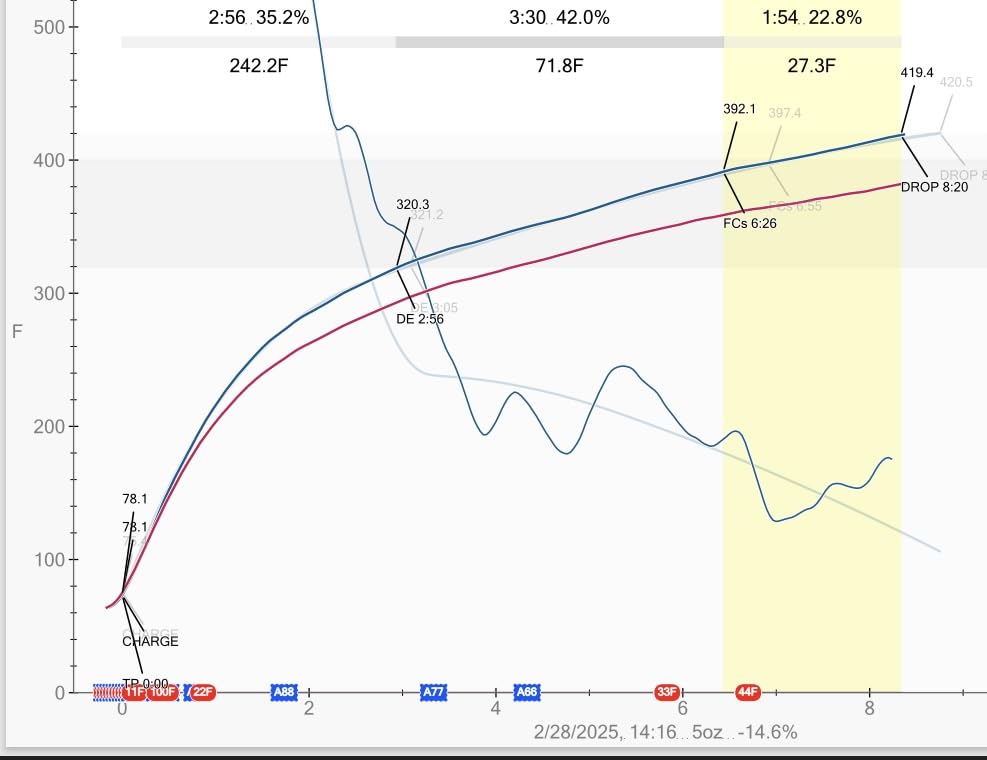
Charge temperature is where the roast starts, and it is the first number to record for any new bean. Then note the time to turning point, the time to first crack, and the development time between first crack and the drop. Development time is what separates a light, sour-leaning filter roast from a balanced one, and it is the single most useful variable to track.
Write all four numbers down for every batch. When a cup tastes good, you will have the settings that produced it, and when it tastes bad you will know which variable moved. Roasters who keep notes improve in weeks; roasters who do not usually plateau after a month. If you brew the results at home, our home cold brew guide and grinders for espresso both help you taste the differences you are trying to create.
Who should skip an air roaster entirely
Skip an air roaster if you want a dark Italian or French roast, since the countertop air designs here cannot reach those temperatures. Skip it if you drink more than about 30 cups a day, because you will be running a home machine far past the cadence its components are designed for. Skip it if you have no venting option at all.
And skip it if you want logged roast curves. None of these machines record a profile or export data, so advanced profile work means pairing a machine with external temperature logging, which is a separate project.
Frequently Asked Questions
How many beans can an air roaster roast at once?
Between 80 g and 226 g for the true air roasters in this roundup, with 120 g being a common one-cup-a-day working batch. The electric drum roasters here take 300 to 500 g, and one 500 g load is roughly 50 cups.
What is the minimum batch size for an air roaster?
About 80 g on the Roma Pro, and 120 g on the Fresh Roast SR540. Below roughly 100 g the bean bed becomes too thin to heat evenly, so a true micro-lot under 50 g is better roasted in a pan roaster.
Is an air roaster better than a drum roaster for home use?
For small batches, yes. Air roasters heat beans with forced hot air and no direct contact with the element, so they produce less smoke and need less attention at 80 to 226 g. Drum roasters reach darker profiles and hold more volume but need 300 g or more to roast evenly.
How long does it take to air roast a small batch of coffee?
About 10 minutes for a full Fresh Roast batch of 120 to 226 g. Budget 12 to 20 minutes on the NIASIA and 30 to 45 minutes on gentler drum settings, where pushing the heat higher shortens the time but burns the beans unevenly.
Are air coffee roasters worth it for beginners?
Yes, if you start on an automatic mode. The Roma Pro runs roast, cooling, chaff separation and discharge hands-off, which gets a first-time roaster to a drinkable cup without learning to read a roast curve.
What is chaff and how do I reduce it when roasting at home?
Chaff is the light papery skin shed from beans during roasting, and it flies out of the drum as the beans move. Roast smaller batches, use a machine with an integrated chaff collector, and vent outdoors or under a range hood to stop it settling on your counters.
The Verdict for Small Batch Roasting in 2026
If you drink two cups a day and want real control, buy the Fresh Roast SR800 and its 226 g drum. If you want the machine with the longest track record behind it and a smaller footprint, take the SR540 at 120 g. If you have never roasted before, start on the Roma Pro’s automatic mode and stay inside its 80 to 150 g range.
If you drink four cups a day or share a roaster, the shortlist changes entirely. The WINB gives you a timer and a thermostat at 300 to 500 g, the JIAWANSHUN has the most reviews at that size, and the NIASIA is the one to buy if you intend to roast dark indoors. Whatever you choose, buy green beans in quantities you can finish inside a month, and keep notes on every roast.
Those few minutes of note-taking are what turn the best air coffee roasters for small batches from appliances into a hobby that actually gets better. Start with one bag, roast it twice, and change one variable at a time.