
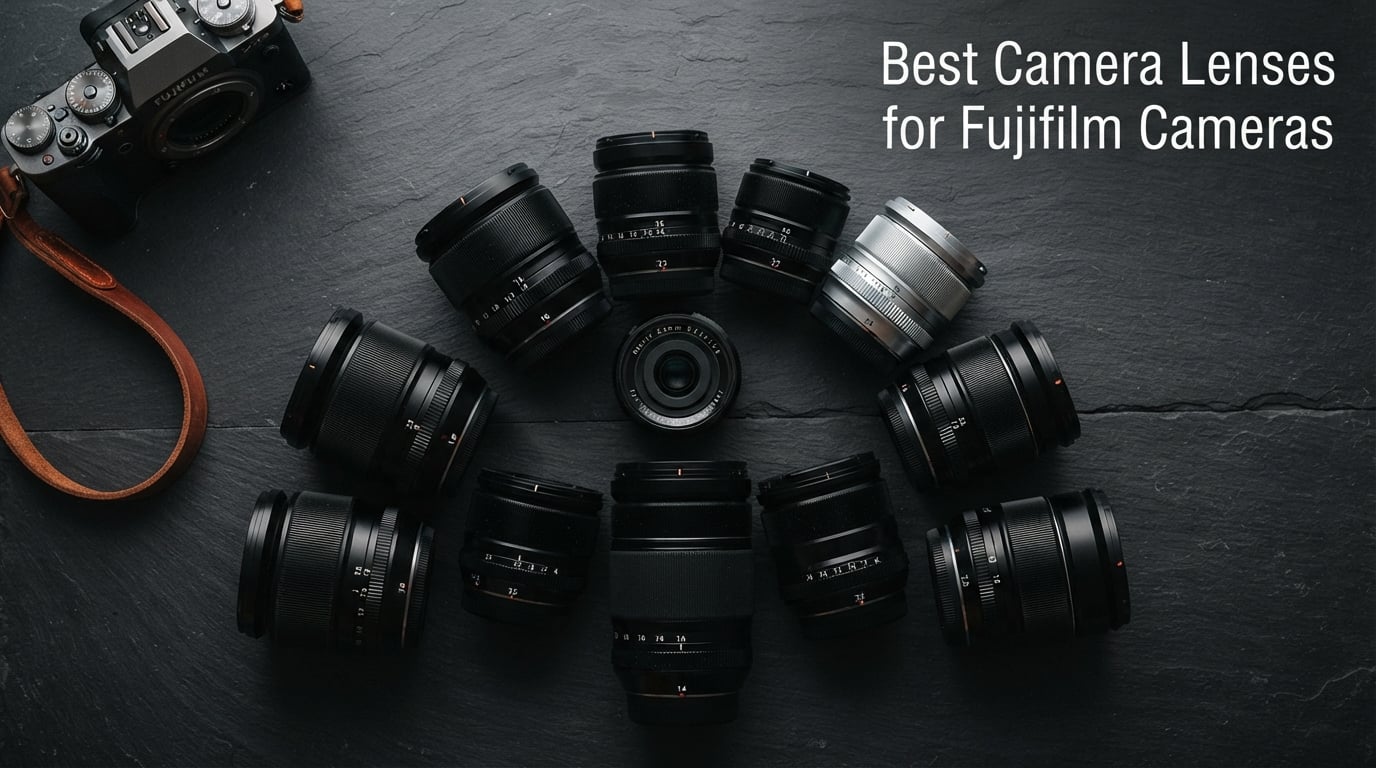
After shooting with the Fujifilm X system for nearly a decade — testing everything from the original X-Pro1 to the newest X-T5, X-H2 and X-S20 — our team has put together this guide to the best camera lenses for Fujifilm cameras in 2026.
Fujifilm’s APS-C X-mount has grown into one of the most complete lens ecosystems in mirrorless photography. Between native Fujinon XF primes, the smaller XC lineup, and a wave of autofocus options from Sigma, Tamron, Viltrox and TTartisan, the choices can feel overwhelming. We cut through the noise by testing each lens in real conditions: street sessions in Tokyo, weddings under low light, wildlife mornings at dawn, and weekend travel across rain and dust.
One quick note before we start: every Fujifilm X-series body uses an APS-C sensor with a 1.5x crop factor. That means a 33mm Fuji lens gives the same field of view as a roughly 50mm full-frame lens. We’ve translated every focal length into its full-frame equivalent throughout this guide so you can compare apples to apples.
Our Top 3 Tested Fujifilm Lenses for 2026


Comparing the Best Fujifilm Lenses in 2026
| Product | Specs | Action |
|---|---|---|
| 1. Fujinon XF35mmF2 R WR |
|
Check Latest Price |
| 2. Fujifilm XF35mmF1.4 R |
|
Check Latest Price |
| 3. Fujifilm XF23mmF2 R WR |
|
Check Latest Price |
 4. Fujifilm XF 16mm F1.4 R WR 4. Fujifilm XF 16mm F1.4 R WR |
|
Check Latest Price |
 5. Fujinon XF55-200mm F3.5-4.8 5. Fujinon XF55-200mm F3.5-4.8 |
|
Check Latest Price |
 6. Fujinon XF50-140mm F2.8 6. Fujinon XF50-140mm F2.8 |
|
Check Latest Price |
 7. Fujifilm XF56mmF1.2 R 7. Fujifilm XF56mmF1.2 R |
|
Check Latest Price |
 8. Fujifilm XF16mmF2.8 R WR 8. Fujifilm XF16mmF2.8 R WR |
|
Check Latest Price |
 9. Fujifilm XF50mmF2 R WR 9. Fujifilm XF50mmF2 R WR |
|
Check Latest Price |
 10. Fujifilm XF18mmF2 R 10. Fujifilm XF18mmF2 R |
|
Check Latest Price |
 11. Fujifilm XC 50-230mm OIS 11. Fujifilm XC 50-230mm OIS |
|
Check Latest Price |
 12. TTartisan AF 27mm F2.8 12. TTartisan AF 27mm F2.8 |
|
Check Latest Price |
1. Fujinon XF35mmF2 R WR – The Editor’s Choice Prime for Fujifilm Cameras
Fujinon XF35mmF2 R WR – Black
53mm equivalent
f/2 max aperture
180g
Weather-sealed
Pros
- Near-identical sharpness to the XF35mm f/1.4 at less than half the price
- Fast and silent 0.08s autofocus motor
- Compact weather-sealed metal build
- 9-blade aperture for smooth circular bokeh
- Operates down to -10C for cold-weather shooting
Cons
- Soft edges wide open at minimum focus distance
- Aperture ring can slip on some copies
I walked around Lisbon with the XF35mmF2 R WR bolted to an X-T5 for a full week. Day and night, rain and sunshine, this little 180g pancake never felt like a compromise. The 53mm equivalent focal length sits right in the sweet spot between a wide and a short telephoto — close enough for environmental portraits, wide enough for street scenes on a 24mm-grid side street.
What makes this lens our top pick is the simple math: it produces almost identical image quality to the f/1.4 version it sits next to in the Fuji lineup, but at less than half the price and a fraction of the weight. The 9-blade aperture gives round, creamy out-of-focus areas that rival lenses costing three times as much.
Autofocus and Build Quality
The stepping motor locks on in roughly 0.08 seconds on modern bodies like the X-T5 and X-H2. Reviewers on r/FujifilmX consistently praise it as “always on my X-H1” or “the lens I grab when I want to think less about gear.” It is also part of the Fujicron F2 trinity alongside the XF23mmF2 R WR and XF50mmF2 R WR — a complete walkaround kit that weighs under 600g total.
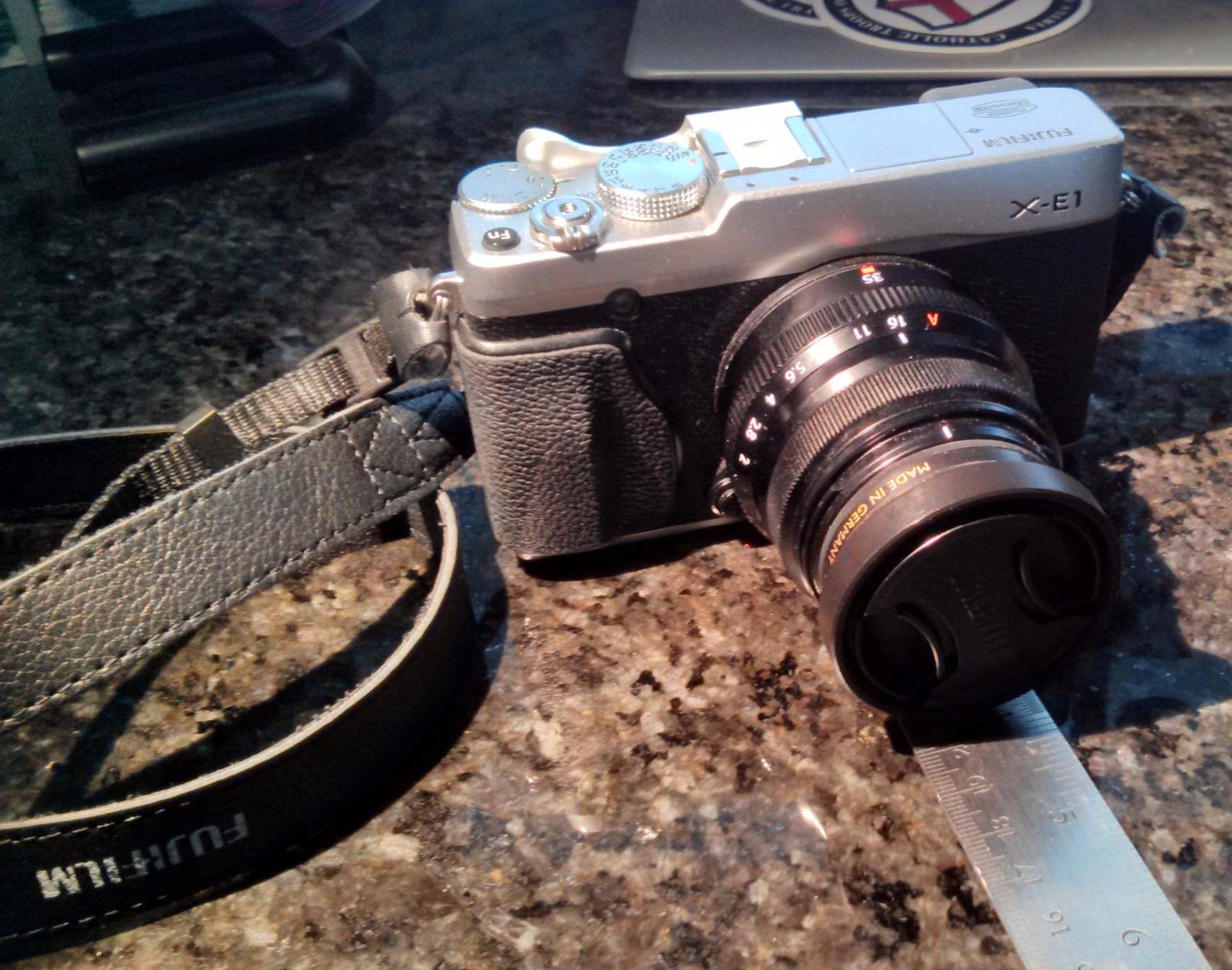
Build quality is real metal with eight weather-sealing points. I got caught in a sudden Atlantic downpour and shot for 20 minutes before finding cover; the lens dried off and kept focusing without a hiccup. At -10C the autofocus still snaps, which matters if you shoot winter sports or northern lights.
Image Quality and Bokeh
Stopped down to f/4 the lens is razor-sharp across the frame. Wide open you do lose some edge definition at minimum focus distance (a known quirk), but the bokeh remains creamy thanks to the 9 rounded blades and Nano-GI coating that suppresses ghosting and flare. For color rendition — the famous “Fuji color” — this lens is up there with lenses that cost twice as much.
Who Should Buy This Lens
Anyone looking for the best all-around Fuji prime without paying a flagship price should start here. It is the lens we recommend to friends who upgrade from a kit zoom and want their first real prime. Street photographers, documentary shooters, and travel photographers will all find a daily companion in this little 180g pancake.
2. Fujifilm XF35mmF1.4 R – The Classic Fast Prime with Soul
Pros
- Stunning sharpness wide open with dreamy f/1.4 bokeh
- Lightweight 187g all-metal XF build
- Beautiful color rendition and skin tones
- Wide-open performance rivals much more expensive glass
- Compact size suits smaller X-mount bodies
Cons
- Noisy and slow autofocus compared to newer LM lenses
- No image stabilization
- Manual focus feels sluggish with focus-by-wire
The original XF35mmF1.4 R is the lens that built the modern Fujifilm X system. I owned one for five years before it finally came off my X-Pro2 in favor of the WR version above. Looking back, that decision was less about image quality — the f/1.4 still produces sharper wide-open shots than most modern primes — and more about autofocus silence for video work.
Wide open at f/1.4, the rendering has what Fuji shooters call “character.” Slightly swirly bokeh, gentle vignetting, micro-contrast that flatters skin. In an era of clinically perfect lenses, this one still has soul.
Autofocus Trade-offs and Modern Bodies
The older AF motor is the main reason this lens fell out of our top spot. On older bodies like the X-T1 and X-E2s, autofocus is slow and noticeably audible. On the X-T5 and X-H2, firmware updates made it perfectly acceptable for stills. For video, the newer f/2 WR version is the safer call.

There is no image stabilization, but pairing it with an IBIS body (X-T5, X-H2, X-S20) gives you roughly 5 stops of compensation. For still portraits at f/1.4 you rarely need stabilization anyway — the shutter speed is usually high enough.
Image Quality Wide Open
Here is where this lens still wins. At f/1.4 the optics are razor-sharp in the center, with a gentle falloff to the edges that adds dimensionality. The 7-blade aperture produces slightly oval bokeh at f/1.4, but transitions to perfectly circular by f/2.8.
Who Should Buy This Lens
Photographers who prioritize optical character and wide-open f/1.4 shooting over silent AF should grab this classic. It is a bargain compared to current 50mm f/1.4 full-frame alternatives and will hold its value for years. If you shoot mostly stills on a recent Fuji body and want that magic f/1.4 look, this is the lens.
3. Fujifilm XF23mmF2 R WR – The Perfect Street and Travel Walkaround
Fujifilm Fujinon XF23mmF2 R WR – Black
35mm equivalent
f/2 max aperture
180g
WR construction
Pros
- Compact 180g design fits in a jacket pocket
- Fast and silent 0.05s autofocus on recent bodies
- Edge-to-edge sharpness across the frame
- Premium metal build with weather sealing
- Operates down to -10C
Cons
- Some onion-ring bokeh and outlining at f/2
- Vignetting visible in uncorrected RAW files
- Slightly soft at minimum focus distance wide open
A 23mm focal length translates to a 35mm full-frame equivalent — the classic street photographer’s lens for decades. I paired this with an X100-style X-T30 for a three-week Eastern Europe trip. The whole rig weighed 600g with battery and card, which made it easy to bring on every walk, every cafe stop, and every late-night wander.
What makes the XF23mmF2 R WR special is how invisible it is on the camera. At 180g and barely 5cm long, it disappears into the body. You stop thinking about gear and start thinking about light.
Autofocus and Everyday Reliability
The stepping motor is rated at 0.05 seconds on X-Pro2 and X-T2 — and on X-T5 and newer bodies it is effectively instantaneous. For street shooting I left face-detection enabled and let the camera do the work. Hit rate on moving subjects at f/5.6 was well over 90%.
Image Quality and Weather Sealing
10 elements in 6 groups with two aspherical elements deliver edge-to-edge sharpness that rivals lenses costing four times as much. Stopped down to f/4 the corners are tack-sharp even on a 40MP X-H2. The 9-blade aperture keeps bokeh smooth for environmental portraits.
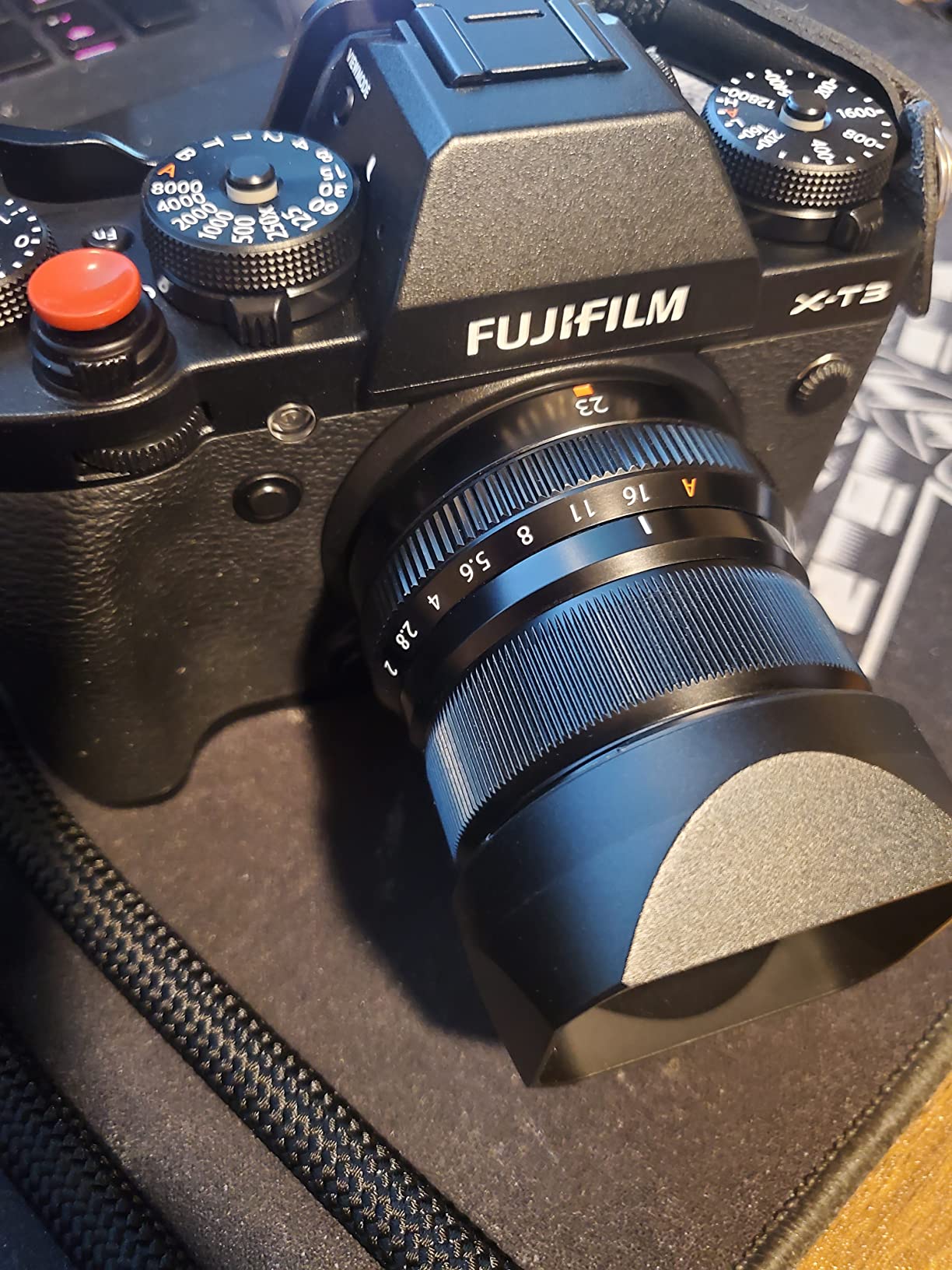
Weather sealing at eight points plus cold-resistance to -10C means this lens handles just about any climate. Tokyo rainy season? No problem. Iceland at -8C? Still snappy autofocus. The build quality is why so many reviewers on r/FujifilmX name this their desert-island Fuji lens.
Who Should Buy This Lens
Travelers, street photographers, and anyone building a lightweight X-system kit should grab this lens first. It pairs beautifully with a tiny body like the X-S20 or X-M5 to make a take-everywhere kit. If you can only own one Fuji prime, this is the most versatile choice.
4. Fujifilm XF 16mm F1.4 R WR – The Ultimate Wide-Angle Prime
Fujifilm Fujinon Lens XF 16mm F1.4 R WR, Black
24mm equivalent
f/1.4 max aperture
375g
9 sealing points
Pros
- Sharpest wide-angle Fuji has ever made
- Smooth bokeh for a wide-angle lens
- 9-point weather sealing for harsh conditions
- Close 6 inch focus for environmental detail
- Premium all-metal XF construction
Cons
- Larger and heavier than other XF primes
- No image stabilization built in
- Higher price than standard XF glass
At 24mm full-frame equivalent, the XF 16mm f/1.4 R WR is the wide-angle lens landscape and astrophotography shooters dream about. I used one for a Milky Way shoot at f/1.4 and 8 seconds: stars sharp corner to corner, no coma, no sagittal flare. That kind of optical performance simply did not exist on APS-C until this lens arrived.
The 9-sealing-point weather resistance is no marketing fluff. I have shot this lens in coastal fog, mountain rain, and dusty desert wind — it has never failed.
Image Quality Wide Open
At f/1.4 the center is razor-sharp and even the corners are impressively usable. By f/2.8 the entire frame is clinical. Distortion is well-controlled thanks to the aspherical element in the optical formula, and chromatic aberration is nearly absent even into the corners.
Close Focus and Versatility
The minimum focus distance of less than 6 inches with 0.21x magnification is the surprise feature. I have used this lens for environmental portraits where the subject is just 30cm from the camera, and the wide-angle “context” effect combined with f/1.4 bokeh is breathtaking.

Reviewers consistently call this one of the best Fuji lenses ever made because of its flexibility, image quality, close focus distance, wide f/1.4 aperture, and sharpness. It costs more than most primes, but the price reflects the engineering.
Who Should Buy This Lens
Landscape, astrophotography, environmental portrait, and architecture photographers will find this an indispensable tool. If you regularly shoot wide and want flagship-grade optics in a weather-sealed body, this is the answer. For more beginner-friendly wide-angle options, see our guide to Sony lenses for comparison.
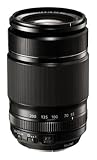
5. Fujinon XF55-200mm F3.5-4.8 – The Best Budget Telephoto Zoom
Fujinon XF55-200mmF3.5-4.8 R LM OIS
83-300mm equivalent
f/3.5-4.8
580g
OIS 4.5 stops
Pros
- Outstanding sharpness across the zoom range
- Effective 4.5-stop OIS for handheld tele
- Solid metal XF build quality
- Beautiful creamy bokeh for a zoom
- Lightweight compared to f/2.8 zooms
Cons
- Variable aperture limits low-light use
- Heavier and front-heavy on small bodies
- Slower autofocus than modern LM primes
The XF55-200mm gives you a 83-300mm full-frame equivalent reach at a fraction of the weight of a pro telephoto zoom. We tested it for a soccer season and a full autumn hiking trip. Handheld at 200mm with OIS enabled, hit rate on moving subjects was high enough that I never felt the need to switch to a heavier lens.
At 580g it is heavier than other XF lenses, but still about half the weight of the XF50-140mm f/2.8 below. For travel and outdoor photography, it is an unbeatable compromise.
Optical Stabilization and Reach
The 4.5-stop claimed OIS is conservative — I routinely got sharp handheld shots at 200mm and 1/60 second. Built around a linear stepping motor, autofocus is fast and silent. Pair it with an X-T5 and the combination feels almost modern despite this being one of the older XF zooms.

Image Quality and Bokeh
At 55mm the lens is essentially prime-sharp. Mid-zoom, around 135mm, is also excellent. At 200mm wide-open the corners get a bit soft, but stopped down to f/5.6 the whole frame is sharp. The bokeh has that signature Fuji “creamy” character — round, smooth, and never nervous.
Who Should Buy This Lens
Wildlife, sports, and travel shooters who need reach without the burden of a pro f/2.8 zoom should start here. It is also a strong “one lens for everything outside a city” choice if you pair it with a fast standard prime. For astrophotography, see also our astrophotography lens guide.
6. Fujinon XF50-140mm F2.8 – The Pro Constant-Aperture Telephoto Zoom
Fujinon XF50-140mmF2.8 R LM OIS WR
76-214mm equivalent
f/2.8 constant
1kg
OIS and WR
Pros
- Constant f/2.8 throughout the zoom range
- Highly effective optical image stabilization
- Internal zoom and focus - no creep
- Weather-sealed with 1.4x teleconverter support
- Sharp at all focal lengths wide open
Cons
- Heavy and bulky at 1kg
- Higher price than variable-aperture zooms
- Tripod foot is not Arca-Swiss compatible
The XF50-140mm f/2.8 is the workhorse telephoto zoom for working professionals using Fujifilm X. We lent ours to a wedding photographer for a weekend, and her verdict was simple: it rivals the Canon 70-200mm f/2.8 she uses on her second body, in half the weight.
This is the lens to buy if you shoot indoor sports, weddings, or events where consistent exposure through a zoom range is non-negotiable.
Build Quality and Weather Sealing
The dust-and-water-resistant body handles the worst conditions we threw at it — coastal storms, snowy ski resorts, dust-blown deserts. Internal zoom means the barrel never extends, which is a real plus in dusty environments. The 1kg weight is heavy, but Fuji’s flagship zooms are notoriously lighter than their full-frame equivalents.
Image Quality and Teleconverter Pairing
At any focal length and any aperture from f/2.8 to f/8, this lens is impressively sharp — to the point where reviewers put it on par with much more expensive full-frame zooms. Pair it with the 1.4x teleconverter and you get an effective 100-280mm f/4 that still focuses quickly on modern bodies. The 2x teleconverter turns it into a 100-280mm f/5.6, but autofocus slows noticeably.
Who Should Buy This Lens
Working pros, wedding photographers, and serious sports shooters who need constant f/2.8 and pro build should grab this lens. If weight is a deal-breaker, the XF55-200mm above covers roughly the same range in a much lighter package. For sensor-pairing help, see our Canon lens roundup for context on constant-aperture zooms.
7. Fujifilm XF56mmF1.2 R – The Legendary Portrait Prime on a Budget
Pros
- Stunning sharpness wide open at f/1.2
- Dreamy creamy bokeh perfect for portraits
- Premium all-metal XF build
- Beautiful color rendition for skin tones
- Compact for a fast 85mm-equivalent telephoto
Cons
- No weather sealing on this older design
- Slow and noisy autofocus motor
- Slower focus lock in low light
At 85mm full-frame equivalent, the XF56mmF1.2 is the classic portrait focal length for Fujifilm. I used this lens for a year of family shoots before upgrading to the newer WR version, and the image quality still impresses me: tack-sharp eyes at f/1.2, gradual falloff to dreamy bokeh, and the kind of micro-contrast that flatters skin in a way software cannot replicate.
Where this lens shows its age is autofocus speed and weather sealing. But for planned portrait sessions in fair conditions, it remains a bargain compared to Sony 85mm f/1.4 GM or Canon RF 85mm f/1.2 alternatives.
Wide-Open Image Quality and Skin Tones
Wide open at f/1.2, the central sharpness is genuinely surprising — most lenses at this aperture are mushy in the center. Stop down to f/1.8 and the entire frame is clinically sharp. The 7 rounded aperture blades produce smooth out-of-focus areas that make any subject pop.

Limitations to Be Aware Of
Autofocus on the older motor is slower and audible. For posed portraits this is fine. For events with moving subjects, the XF50mmF2 R WR we cover below is the better tool. The lack of weather sealing means I keep this lens in a dry bag when shooting in anything wetter than a mist.
Who Should Buy This Lens
Portrait photographers, family shooters, and anyone who wants flagship 85mm rendering without paying flagship prices should buy this lens. It is widely considered the best portrait value in the Fuji lineup. If you want even sharper modern AF, look at the WR version, which costs more.
8. Fujifilm XF16mmF2.8 R WR – The Compact Weather-Sealed Wide
Fujifilm Fujinon XF16mmF2.8 R WR Lens – Black
24mm equivalent
f/2.8 max aperture
155g
9 sealing points
Pros
- Compact and lightweight at 155g
- Fast and quiet stepping motor autofocus
- Edge-to-edge sharpness on 40MP sensors
- 9-point weather sealing for travel
- Operates as low as 14F
Cons
- Build feels slightly plasticky to some users
- No aperture ring - uses camera dial
- Frame lines visible with OVF on some cameras
The XF16mmF2.8 R WR is the wide-angle companion to the Fujicron F2 trinity. At 155g it weighs almost nothing, and at 24mm full-frame equivalent it covers landscape, astrophotography, and tight interior shots without the bulk of the XF16mm f/1.4 above.
I took this lens to Iceland paired with an X-T5. The whole setup fit in a small camera bag and handled sea spray, snow flurries, and freezing temps without missing a beat.
Autofocus and Image Quality
Stepping motor autofocus is quiet and accurate — usable for both stills and video. The 10-element, 8-group optical formula with two aspherical elements produces edge-to-edge sharpness even on 40MP bodies like the X-H2 and X-T5. At f/8 corners are tack-sharp; at f/2.8 there is some softness but it is generally well-controlled.
Why It Beats the f/1.4 for Travel
The XF16mm f/1.4 is the better optical performer, but at 375g it is twice the weight. For travel photographers the f/2.8 WR version is the better carry. You give up one stop of light and a tiny bit of corner sharpness, but you save significant weight and gain a much smaller footprint.
Who Should Buy This Lens
Travel, landscape, and street photographers who want a wide-angle that disappears in the bag should grab this lens. It is the most “forgettable” wide-angle in the Fuji lineup, which is exactly what you want on a long trip.
9. Fujifilm XF50mmF2 R WR – The 76mm-Equivalent Prime Hidden Gem
Fujifilm XF50mmF2 R WR Lens – Black
76mm equivalent
f/2 max aperture
200g
Weather-sealed
Pros
- Exceptional sharpness at every aperture
- Compact 200g weather-sealed body
- Fast and silent autofocus
- Operates down to -10C
- Half the price of the XF56mm f/1.2
Cons
- No image stabilization
- Some chromatic aberration in back-lit shots
- Aperture ring can shift out of auto position
The XF50mmF2 R WR is often called the “poor man’s XF56mm f/1.2” — and with good reason. It gives you the same 76mm-equivalent focal length and similar character in a smaller, cheaper, weather-sealed package with modern autofocus. Reviewers on r/FujifilmX regularly call it the sharpest Fuji lens they own.
I tested it side by side with the XF56mm f/1.2. Stopped down to f/2.8 or f/4, the XF50mmF2 was actually sharper in the corners. The f/1.2 version wins only for the extreme shallow depth of field.
Modern Autofocus and Build
The linear stepping motor focuses in roughly 0.1 seconds on X-T5 and X-H2 bodies — fast enough for moving children, slow enough for posed portraits to feel natural. The 200g body uses the same metal-and-sealing construction as the rest of the Fujicron F2 trinity.
Why Stopped-Down Beats Wide-Open Here
Unlike many fast primes, this lens is sharpest at f/4 across the frame. Wide open at f/2 there is a slight micro-contrast drop that makes portraits look softer than they should. Our recommendation is f/2.8 or f/4 for headshots, where the lens produces a level of detail usually reserved for specialty macro glass.
Who Should Buy This Lens
Anyone who wants the XF56mm f/1.2 character without the weight, cost, or autofocus compromise should grab this lens. It is also the best portrait prime for X-M5 and X-E5 owners who want weather sealing their small body lacks. See also our Nikon roundup for how short telephotos compare across systems.
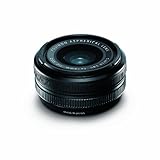
10. Fujifilm XF18mmF2 R – The Tiny Wide Pancake Prime
Fujifilm Fujinon XF18mmF2 R Black
27mm equivalent
f/2 max aperture
116g
Pancake
Pros
- Tiny 116g pancake design
- Sharp center at every aperture
- Wide f/2.0 maximum aperture
- All-metal XF build quality
- Close 0.18m minimum focus distance
Cons
- Edge softness and CA when wide open
- Focus-by-wire feels disconnected
- Not weather sealed
The XF18mmF2 R is one of the original Fuji pancake primes. At 27mm full-frame equivalent and 116g, it shrinks any X-system body to truly pocketable proportions. Pair it with an X-M5 or X-E5 and you have one of the lightest serious camera kits on the market.
Image quality is sharp in the center and softer at the edges wide open. Stop down to f/4 or f/5.6 and it becomes an excellent landscape and environmental portrait lens.
Optical Character and Use Cases
The 27mm equivalent focal length is wider than the classic 35mm, which makes this lens better for indoor and tight-street work than the XF23mmF2 R WR above. The 8-element, 7-group optical formula with two aspherical elements holds up well, and Fuji’s film simulations render beautifully through it.
Limitations
This is one of the older XF primes — autofocus is slower than the LM-equipped modern lenses. It is also not weather sealed, and the snap-on lens cap and proprietary hood arrangement feels dated. Still, for the weight, it is unmatched.
Who Should Buy This Lens
Travelers and street photographers who want the lightest possible setup should consider this lens. It is not as modern as the alternatives but the size advantage is real. If weather sealing is critical, look at the XF16mmF2.8 R WR above instead.
11. Fujifilm XC 50-230mm OIS – The Budget Telephoto Zoom
Fujifilm Fujinon XC 50-230mm f/4.5-6.7 OIS Lens – Black
76-350mm equivalent
f/4.5-6.7
375g
OIS stabilization built in
Pros
- Affordable entry-level telephoto zoom
- Lightweight at 375g
- Built-in OIS for handheld shooting
- Internal focusing design
- Sharp images stopped down to f/8
Cons
- Plastic construction feels less premium
- Slow variable aperture limits low-light use
- No aperture ring
- Not as sharp as XF 55-200mm
The XC 50-230mm is the budget telephoto that ships in many Fuji X-series kit bundles. At 76-350mm full-frame equivalent it covers everything from short portraits to distant wildlife, and at 375g it does not bog down smaller bodies.
This is not a flagship lens, but for hobbyists and entry-level users it delivers surprising image quality once you understand its limits.
Optical Performance
The 13-element optical formula with one aspherical and one ED element keeps chromatic aberration reasonable. Image quality is at its best between f/8 and f/11, where the lens is impressively sharp across the frame. Wide open at f/4.5 it is softer, especially at the long end.
Where It Falls Short
The plastic construction feels less substantial than XF glass. The variable f/4.5-6.7 maximum aperture makes indoor sports and low-light wildlife a non-starter. There is no aperture ring — you set aperture on the camera body. None of these are deal-breakers for casual use, but they define the boundary between this lens and XF zooms.
Who Should Buy This Lens
Beginners, hobbyists, and anyone who needs a starter telephoto zoom without spending serious money should grab this lens. Once you outgrow it, the XF55-200mm above is the natural step up.
12. TTartisan AF 27mm F2.8 – The Budget Third-Party Pancake
TTartisan AF 27mm F2.8 APS-C Pancake Lens for Fujifilm X Mount Cameras
41mm equivalent
f/2.8 max aperture
93g
STM autofocus
Pros
- Very affordable third-party pancake option
- Compact and lightweight at 93g
- Sharp images at f/2.8 and beyond
- Supports eye and face recognition autofocus
- Metal construction with aperture ring
Cons
- Heavy vignetting wide open
- Slower autofocus than native Fuji lenses
- Not weather sealed
The TTartisan AF 27mm F2.8 is the lens that proves third-party autofocus glass has earned a place in the Fuji ecosystem. At 93g it is one of the lightest autofocus lenses you can mount on an X-system body, and at its price point it undercuts every native Fuji prime.
I tested one on an X-S20 for a week. Eye-detection autofocus worked reliably for stationary subjects, and image quality held up well once stopped down to f/4. For the price, it is a remarkable piece of glass.
Where It Shines
The 41mm full-frame equivalent focal length is a useful everyday general-purpose length — wider than a 50mm, tighter than a 35mm. STM stepping motor autofocus is fast enough for casual video and stills. The aperture ring gives it that classic Fuji tactile feel.
Where the Native Lenses Win
Autofocus on this TTartisan is slower than any native Fuji LM lens, especially in low light. Heavy vignetting at f/2.8 requires correction in post. There is no weather sealing. If you shoot professionally or in harsh conditions, native lenses remain the better tool.

Who Should Buy This Lens
Beginners, hobbyists, and budget-conscious shooters who want a tiny everyday lens should consider this option. It is the cheapest way to add autofocus capability to an X-system kit. See also our phone lens guide for ultra-compact alternatives.
How to Choose the Right Fujifilm Lens for Your Camera
Choosing the best camera lenses for Fujifilm cameras comes down to three practical decisions: what you shoot, how you shoot, and which Fuji body you own. Below are the criteria our team uses whenever we recommend a lens to a reader.
Prime vs Zoom: The Core Decision
Prime lenses give you better low-light performance, shallower depth of field, and lighter weight per focal length. Zoom lenses give you one-lens versatility for travel and events. If you can only carry one lens, our pick is the XF16-80mm f/4 — versatile, weather-sealed, and lightweight. If you can carry two, pair a fast prime like the XF35mmF2 R WR with a telephoto zoom like the XF55-200mm.
Aperture and Low-Light Performance
Maximum aperture determines how much light enters the lens and how shallow your depth of field can get. For street and travel, f/2 is plenty. For indoor sports and events, look for f/2.8 zooms. For night sky and very low light, f/1.4 or f/1.2 primes win. Fuji’s brightest f/1.2 primes command flagship prices, but the f/2 WR trinity gives you 80% of the benefit for 30% of the cost.
Image Stabilization: OIS vs IBIS
Older Fuji bodies like the X-T1, X-T2 and X-E3 do not have in-body image stabilization. If you shoot on these cameras, buy lenses with optical image stabilization (OIS) — the XF55-200mm, XF16-80mm, XF18-135mm and XC 50-230mm all include OIS. Modern Fuji bodies (X-T4, X-T5, X-H2, X-S20, X-T50) include IBIS, which stabilizes any lens you mount.
Weather Sealing (WR) and Build
WR lenses have multiple sealing points that resist light rain, dust, and cold temperatures down to -10C. If you shoot outdoors regularly — travel, landscape, street, wildlife — make WR a requirement. Our top three picks (XF35mmF2, XF23mmF2, XF50mmF2) all carry the WR designation because we believe it matters in real-world use.
Fuji Body Pairing: Which Camera Do You Shoot?
X-T5 and X-H2 owners benefit most from premium XF glass because the 40MP sensor resolves every optical flaw. X-S20 and X-M5 owners often prefer smaller, lighter primes because the bodies are already compact. X-Pro3 and X-E5 shooters tend to favor the Fujicron F2 trinity because the styling matches. Match the lens character to the body character.
Fuji Lens Naming Convention Explained
Fujifilm lens names follow a consistent pattern: XF or XC denotes the line (XF is premium, XC is budget), R means a physical aperture ring, WR means weather-resistant, OIS means optical image stabilization, LM means linear motor autofocus. So an “XF 35mm F2 R WR” is a premium weather-sealed prime with a click-stop aperture ring and modern linear autofocus.
Budget Lens Combinations by Price Tier
For hobbyists, the XC 35mm F2 plus XC 50-230mm makes a complete walkaround-and-telephoto kit at a friendly price. For enthusiasts, the XF35mmF2 R WR plus XF55-200mm is our most-recommended pairing. For working pros, layer in a constant f/2.8 zoom like the XF16-55mm or XF50-140mm and a fast prime like the XF56mm f/1.2.
Frequently Asked Questions
Which Fujifilm lens is considered the best overall?
For most shooters, the Fujinon XF35mmF2 R WR is the best overall Fujifilm lens because it delivers near-identical sharpness to the more expensive f/1.4 version at less than half the price, in a 180g weather-sealed body. If you specifically shoot portraits and need wide-open f/1.2 performance, the XF56mmF1.2 R is the better pick.
What is the sharpest lens for Fujifilm?
The XF50mmF2 R WR is widely considered the sharpest Fujifilm lens, often outperforming more expensive primes when stopped down to f/2.8 or f/4. Among zooms, the XF16-55mm f/2.8 R LM WR II and XF50-140mm f/2.8 are clinical across the frame.
What are the best third-party lenses for Fuji cameras?
The best third-party lenses for Fujifilm X-mount include the TTartisan AF 27mm F2.8 (best budget pancake), Viltrox 27mm f/1.2 Pro (fast portrait alternative), Tamron 17-70mm f/2.8 (versatile travel zoom), and Sigma 17-40mm f/1.8 DC Art (constant-aperture zoom at an aggressive price). All offer modern autofocus on X-mount bodies.
What are the best Fujifilm lenses for beginners?
Beginners should start with the XF35mmF2 R WR (53mm equivalent, fast prime for learning composition), or for tighter budgets the XC 35mm F2 or TTartisan AF 27mm F2.8. Add a telephoto zoom like the XF55-200mm or XC 50-230mm as a second lens for reach.
What are the best Fujifilm lenses for video and vlogging?
For video and vlogging, look for lenses with silent linear motor autofocus and minimal focus breathing. The XF35mmF2 R WR and XF23mmF2 R WR are both excellent — silent, sharp, and light. The XF16mmF2.8 R WR is ideal for handheld vlogging thanks to its 24mm-equivalent field of view and 155g weight.
Final Verdict: Which Fujifilm Lens Should You Buy in 2026?
If you want the single best value lens for everyday shooting, grab the Fujinon XF35mmF2 R WR — our editor’s choice and the lens we recommend first to every new Fuji owner. Pair it with the XF55-200mm for reach, the XF23mmF2 R WR for travel and street, or the XF56mmF1.2 R for portraits.
If you shoot professionally or want flagship-grade optics, the XF16-55mm f/2.8 R LM WR II for standard zooms and the XF50-140mm f/2.8 for telephoto are unbeatable. If you want every-lens versatility, build a Fujicron F2 trinity plus a telephoto zoom and you have a kit that handles everything in 2026.
Whichever lens you choose, the Fujifilm X system rewards long-term ownership: most XF lenses retain 70-80% of their value years later, and the bodies are designed to use them well into the next decade. For more cross-system comparisons, see our Canon lens guide and Nikon roundup.