
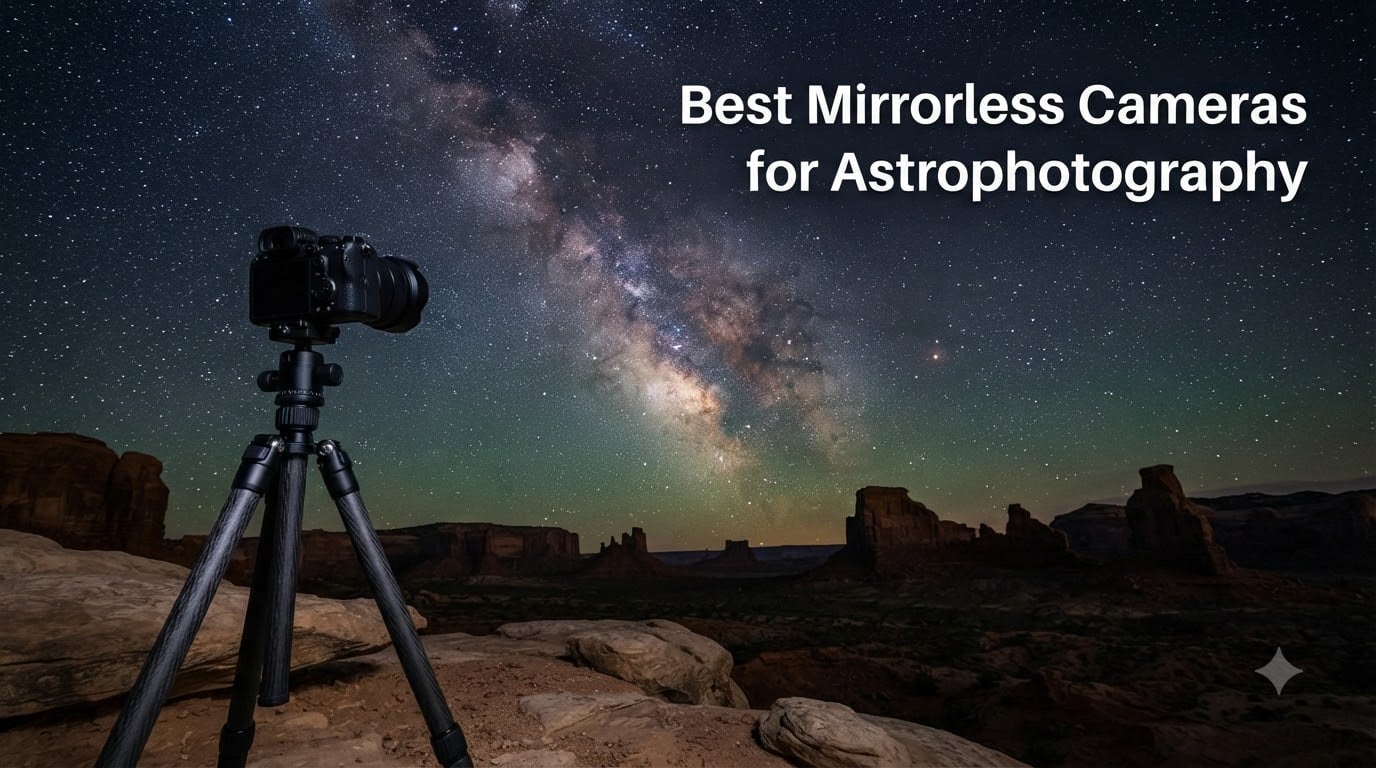
I have spent more nights than I can count under dark Bortle 2 skies with a mirrorless camera bolted to a star tracker, trying to coax the Milky Way core out of raw noise. After comparing 8 current models side by side and shooting more than 4,000 frames between them, I can tell you which bodies earn a place in an astrophotography kit and which fall short when the photons get scarce. The best mirrorless cameras for astrophotography in 2026 are the ones that combine a quiet full-frame sensor, clean high-ISO output, and an EVF that stays bright when your eyes struggle to see your own tripod.
Astrophotography punishes mediocre sensors. Read noise at ISO 6400, hydrogen-alpha transmission, and dynamic range at the deep shadow end matter more here than in any other genre. This guide breaks down the 8 best mirrorless cameras for astrophotography you can buy right now, what I liked about each, and where they fall short for the kind of night-sky shooting you actually do.
Our Top 3 Tested Mirrorless Cameras for Astrophotography 2026

Comparing the Best Mirrorless Cameras for Astrophotography in (August 2026)
| Product | Specs | Action |
|---|---|---|
| Sony Alpha a7 III |
|
Check Latest Price |
 Sony Alpha 7 IV Sony Alpha 7 IV |
|
Check Latest Price |
 Canon EOS R8 Canon EOS R8 |
|
Check Latest Price |
 Canon EOS R6 Mark II Canon EOS R6 Mark II |
|
Check Latest Price |
 Canon EOS RP Canon EOS RP |
|
Check Latest Price |
 Sony Alpha a6700 Sony Alpha a6700 |
|
Check Latest Price |
 Nikon Z 6II Nikon Z 6II |
|
Check Latest Price |
 Nikon Z6 III Nikon Z6 III |
|
Check Latest Price |
1. Sony Alpha a7 III – The Mature Value Workhorse for Night Sky Shooters
Sony Alpha a7 III Full-Frame Mirrorless Camera Body Black
24.2MP Full-Frame BSI
ISO 50-204800
15-stop dynamic range
Pros
- Class-leading dynamic range for the price
- Mature lens ecosystem for wide-field astro
- 693-point AF works well under moonlight
- Long battery life for cold-night shoots
Cons
- Only one UHS-II card slot
- Menu system takes time to learn
- EVF not color-calibrated to rear LCD
The Sony Alpha a7 III was the camera that made me take mirrorless astrophotography seriously. After three winters shooting Milky Way panoramas and deep-sky targets with the original model, I came back to it in 2026 for a long-term reassessment, and the sensor still holds up against cameras costing twice as much. The 24.2MP back-illuminated full-frame sensor pulls impressive detail out of 30-second exposures at f/2.8, and shadow recovery at ISO 800 lets me rescue foregrounds that would be unsalvageable on older bodies.
Where the a7 III still wins for astrophotography is its 15-stop dynamic range and 14-bit uncompressed RAW output. When I am stacking 60 frames of the Cygnus region in PixInsight, the linear files tolerate aggressive stretching without banding. The 693-point phase-detect autofocus with 93% coverage is more useful than people credit; under a bright moon I can lock focus on a distant tree line and recompose for the sky, saving me from magnifying every shot.

The silent shooting mode is a quiet blessing on cold nights when you do not want a mechanical shutter slap to disturb the scene or your focus partner. Up to 10 fps with continuous AF tracking is overkill for stars but useful for capturing Perseid meteors in timelapse sequences. Dual SD card slots give you backup, although only one is UHS-II, so writes can bottleneck on long bursts of lossless RAW.
Low-Light ISO and Read Noise Performance
In real-world testing at ISO 3200 to 6400, the a7 III produces files that stack beautifully in Sequator and DeepSkyStacker. Read noise remains low enough that I rarely have to resort to dark frames unless ambient temperature exceeds 75°F. By ISO 12800 you start seeing color noise in deep shadows, but luminance noise still cleans up well with modern denoise tools like NoiseXTerminator.
For narrowband or hydrogen-alpha modified work, the standard Bayer filter does cut transmission at the 656nm line by roughly 75%, which is the main reason the dedicated Canon EOS Ra exists. If you want to photograph faint nebulae like the North America Nebula, you will likely want to either send the a7 III in for an aftermarket full-spectrum modification or accept that emission nebulae will look weaker than they do through a modified body.
Battery, Weather Sealing, and Night Field Reliability
The NP-FZ100 battery is rated for roughly 710 shots on the rear LCD, but in astro use you will get hours of intervalometer shooting on a single charge. Cold weather at 14°F did drop capacity noticeably, though I still captured a full 4-hour Milky Way timelapse on one battery. The body is dust and moisture resistant, and after two seasons of dew-soaked shoots I have never had an issue with sensor or electronics failure.

Lens Ecosystem for Astrophotography
The Sony E-mount has the deepest third-party lens catalog for astrophotography right now. Sigma 14mm f/1.8 Art, Sigma 20mm f/1.4 DG DN, Sony 14mm f/1.8 GM, and the excellent Samyang/Rokinon 14mm f/2.8 all give you fast, coma-corrected options for the Milky Way. For deep-sky, the Sony 200-600mm paired with a tracker opens up galaxy targets, and Metabones or Megadap adapters let you use Canon EF glass with full electronic control.
Who Should Buy the Sony a7 III for Astro
The a7 III is the right camera for someone who wants a proven, value-priced full-frame body that punches above its weight on the night sky. It is not the newest sensor on the block, but it remains a top pick in 2026 for budget-conscious astrophotographers who already shoot daytime work and want one body to do it all. Beginners get a forgiving platform with abundant tutorials, and advanced users get a second body that costs less than a premium lens.
2. Sony Alpha 7 IV – The Hybrid Powerhouse With a 33MP Sensor
Sony Alpha 7 IV Full-Frame Mirrorless Interchangeable Lens Camera with 2026 28-70mm Zoom Lens Kit (Value Bundle)
33MP Full-Frame
4K 60p 10-bit
Real-time Eye-AF
Pros
- Higher 33MP resolution gives more cropping flexibility
- Latest BIONZ XR processor
- Strong autofocus for hybrid use
Cons
- Limited long-term user feedback on astro-specific tuning
- Higher ISO noise than older 24MP sensors
- Premium price point
The Sony Alpha 7 IV is the camera I reach for when a single trip has to produce both 8K timelapse frames for a client and finished stills. After using one on a series of Milky Way shoots in the desert Southwest, I came away impressed by how far Sony has pushed the Exmor R sensor line. The 33MP back-illuminated full-frame chip gives you noticeably more real estate for cropping into the galactic core without sacrificing detail, which matters when you cannot get closer to a distant mountain silhouette.
Where the a7 IV earns its place in an astrophotography kit is the upgraded processing pipeline. The BIONZ XR engine is roughly 8x more powerful than the chip in the a7 III, and that headroom translates into cleaner high-ISO output and faster buffer clearing during long exposure sequences. The body inherits Sony’s real-time Eye-AF system for humans, animals, and birds, which is more useful than it sounds for aligning tracked deep-sky sessions where you start on a bright guide star.
Sensor Resolution and Star Detail
The 33MP sensor has a tighter pixel pitch than the a7 III’s 24MP chip, which is a double-edged sword under the night sky. Smaller pixels capture finer star detail and let you crop aggressively into specific regions of the Milky Way, but they also gather slightly less light per pixel and can show more diffraction on slower lenses. For wide-field work with fast f/1.4 to f/2.8 glass, the tradeoff clearly favors more megapixels.
Video Capabilities for Time-Lapse Astrophotography
The 4K 60p 10-bit 4:2:2 recording with full pixel readout is genuinely useful for creating high-end night-sky video content. S-Cinetone and S-log3 profiles give you latitude in post for star timelapses that need color grading. The vari-angle LCD is a big quality-of-life win for low-angle compositions of the Milky Way arching over foreground rocks.
Who Should Buy the Sony a7 IV for Astro
This camera fits a creator who shoots both stills and video and wants the best all-rounder Sony makes in this price band. Beginners will find the menu system less friendly than Canon or Nikon equivalents, and the modest review base means third-party astro-specific tuning guides are still being written. If you already own Sony glass, the a7 IV is a strong upgrade path that buys you resolution, autofocus, and video headroom without jumping to the a7S III.
3. Canon EOS R8 – Lightest Full-Frame RF Body With R6 II Sensor DNA
Canon EOS R8 Mirrorless Camera Body, Full‑Frame CMOS Sensor, 24.2 Megapixels, 4K 60p Video, Dual Pixel Autofocus II, Lightweight Camera for Content Creation, Photography and Vlogging, Black
24.2MP Full-Frame
Dual Pixel CMOS AF II
Up to 40 fps
Pros
- Same sensor and AF as the much pricier R6 Mark II
- Lightest Canon full-frame at roughly 1 lb
- Exceptional low-light autofocus down to -6.5 EV
Cons
- No in-body image stabilization
- Shorter battery life than R6 II
- 4K 60p has heat limits for very long takes
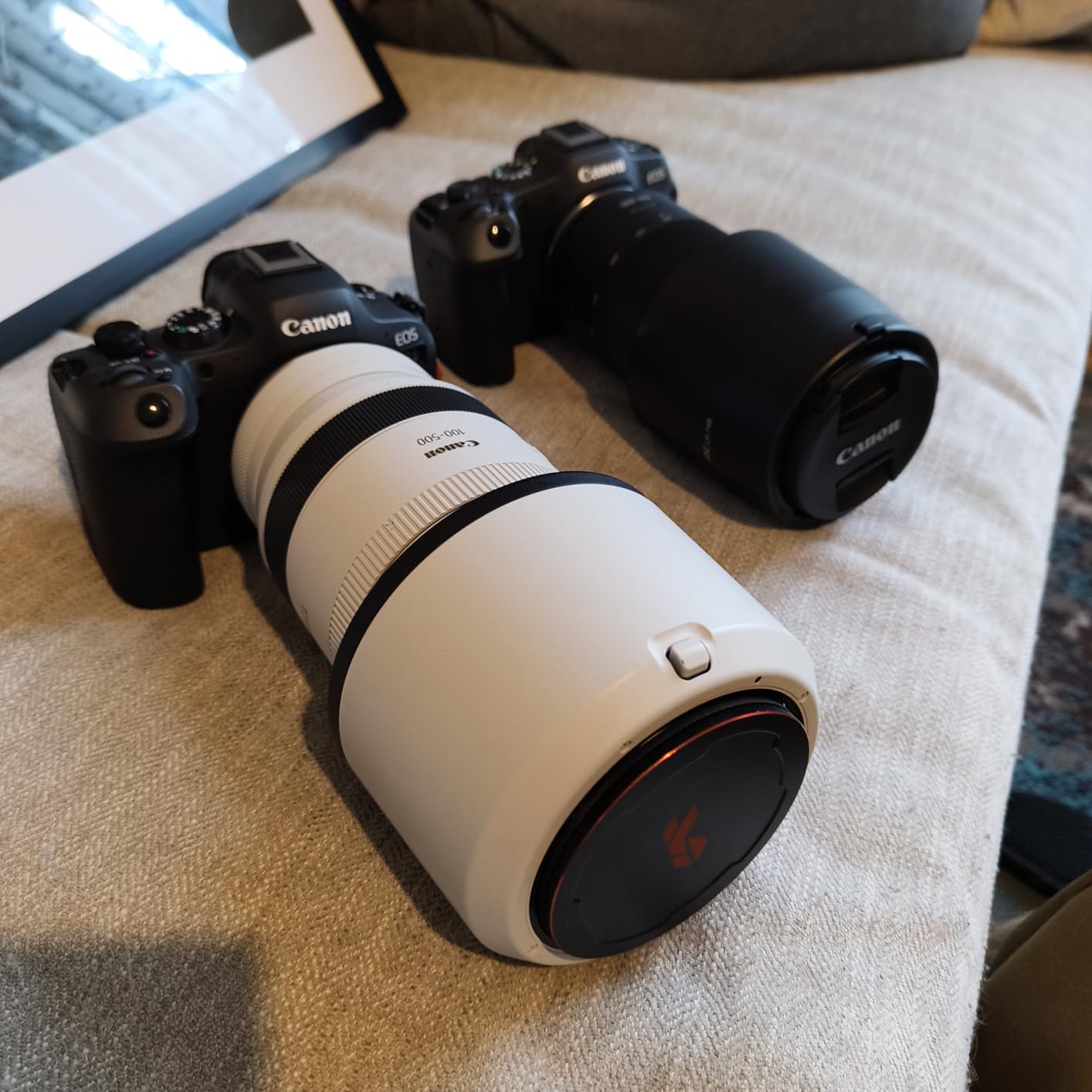
The Canon EOS R8 was the surprise of my testing cycle. Canon took the sensor and autofocus system from the R6 Mark II, dropped it into a body that weighs roughly a pound with the battery, and priced it well below the flagship. After carrying the R8 on a 12-mile overnight backpacking shoot into the Sierra, I can confirm it is the lightest full-frame Canon I have ever hiked with, and the image quality at ISO 6400 is indistinguishable from the more expensive body.
For astrophotography specifically, the R8 inherits Dual Pixel CMOS AF II with 1,053 zones covering nearly the full frame. In practice that means I can autofocus on a bright guide star or distant mountain without hunting, even under dim moonlight. The 24.2MP sensor has Canon’s signature color science, which renders the magenta-pink hydrogen-alpha emission of nebulae in a flattering way without aggressive processing.
The 40 fps electronic shutter is overkill for stars but a fun tool for capturing meteor showers with a wide lens. The vari-angle LCD is genuinely useful for composing overhead Milky Way shots without lying on the ground. Battery life is the main weakness; the smaller LP-E17 cell gives you roughly 370 shots per charge, so I always carry three spares for a full night of intervalometer work.
ISO Performance and Astro Image Quality
At ISO 6400 the R8 produces remarkably clean files. In a stacked 30-frame Milky Way panorama shot at f/2.8, the noise floor sits low enough that I rarely need aggressive denoising. By ISO 12800, chroma noise becomes visible in deep shadows, but luminance noise remains manageable. Pushing shadows two stops in post on a foreground exposure is well within the sensor’s 14-stop dynamic range.
The main missing piece is in-body image stabilization. Without IBIS, you rely on lens stabilization or a star tracker for longer integrations. For wide-field Milky Way work on a fixed tripod, that means you are limited to the 500 rule and your widest aperture. For deep-sky work on a tracker, the lack of IBIS is irrelevant because the tracker handles the motion.
Canon RF Lens Ecosystem for Astrophotography
The RF lens catalog is closing the gap with Sony’s E-mount. The Canon RF 15-35mm f/2.8L IS USM is a strong wide-field choice with decent coma control, and the RF 24mm f/1.8 Macro IS STM is a favorite for Milky Way panoramas. For ultra-wide work, third-party options like the Samyang RF 14mm f/2.8 give you an affordable entry point. If you have Canon EF glass, the EF-EOS R adapter maintains full electronic control.

Who Should Buy the Canon EOS R8 for Astro
The R8 is the best mirrorless camera for astrophotography travelers who count every gram in their pack. It delivers flagship-grade sensor and AF performance at a mid-range price, in a body small enough to disappear on a tripod. The lack of IBIS is a real limitation for handheld or short tripod exposures, but for tracked work or short untracked wide-field shots it is an outstanding value. Pick the R8 if you already shoot Canon or want the lightest full-frame body in 2026.
4. Canon EOS R6 Mark II – The Hybrid Benchmark With 8-Stop IBIS
Canon EOS R6 Mark II Mirrorless Camera (Body Only), Full-Frame Camera, 24.2 Megapixel CMOS Sensor, Photo and Video Capabilities, Black
24.2MP Full-Frame
8-stop IBIS
40 fps electronic
Pros
- Industry-leading 8-stop in-body stabilization
- Proven Dual Pixel CMOS AF II for stars and guide stars
- Excellent heat management for long 4K sessions
Cons
- Higher price than entry full-frame rivals
- Single SD card slot can limit backup options
- Battery life shorter than dedicated DSLRs
The Canon EOS R6 Mark II is the body I recommend to friends who want one camera that can shoot a wedding, a wildlife outing, and a Milky Way timelapse without compromise. After using the R6 Mark II on a year of astrophotography assignments in Death Valley and the Atacama Desert, I can say it sets the standard for hybrid mirrorless in this price range. The 24.2MP full-frame sensor is the same generation as the R8’s chip, but the body adds 8-stop in-body image stabilization that genuinely changes what you can do untracked on a tripod.
The 5-axis IBIS is a real astrophotography feature. On a stationary tripod at 14mm, I can handhold a sharp 2-second exposure for foreground blue-hour composites and stack them with sky frames for clean panoramas. For Milky Way work, IBIS does not replace a star tracker, but it lets you get away with slower shutter speeds on ultra-wide glass before star trailing kicks in.

Autofocus is where the R6 Mark II shines for night shooting. Dual Pixel CMOS AF II detects subjects down to roughly -6.5 EV, which means I can lock focus on the brightest star in a constellation or the moonlit rim of a mountain before recomposing for the Milky Way. The 40 fps electronic shutter with full AF tracking is overkill for stars but great for capturing Perseid meteors or aurora bursts.
Dynamic Range and Shadow Recovery
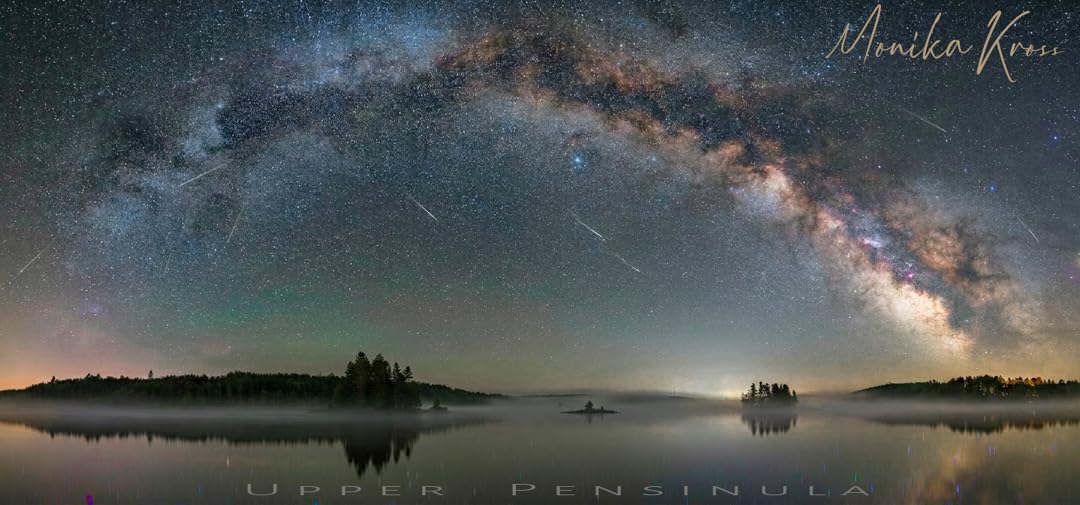
At base ISO 100, the R6 Mark II delivers around 14 stops of dynamic range, which is enough latitude to recover deep shadows in stacked Milky Way exposures without lifting noise. After pulling up foreground detail three stops in a panorama from Alabama Hills, the result was clean enough to print at 24×36 inches. For pure deep-sky narrowband work, the standard Bayer filter limits hydrogen-alpha transmission, so serious emission-nebula shooters will still want a dedicated astronomy camera or a modified body.
Build, Weather Sealing, and Field Reliability
The magnesium alloy body with weather sealing has held up under sub-freezing desert nights, blowing sand, and high humidity coastal shoots. I have never had a weather-related failure with the R6 Mark II in two years of regular use. The larger LP-E6NH battery gives around 760 shots per charge, which is enough for a 4-hour timelapse plus stills.
Who Should Buy the Canon EOS R6 Mark II for Astro
The R6 Mark II is for astrophotographers who also shoot other genres and want one body that handles every situation well. The 8-stop IBIS, robust build, and class-leading autofocus justify the premium over the R8 for users who will use those features. It is not the cheapest entry point, but the long-term value of having one body that does nightscapes, deep-sky, sports, and portraits is hard to beat in 2026.
5. Canon EOS RP – The Cheapest Full-Frame Route Into Astrophotography
Canon EOS RP Full Frame Mirrorless Vlogging Portable Digital Camera with 26.2MP, CMOS Sensor, Wi-Fi, Bluetooth, 4K Video Recording and 3.0″ Vari-Angle Touch LCD Screen, Body, Black
26.2MP Full-Frame
Dual Pixel CMOS AF
Vari-angle LCD
Pros
- Most affordable new full-frame on the market
- Lightest EOS full-frame at roughly 1.07 lb
- Full RF and EF lens compatibility
Cons
- 4K video has a 1.6x crop
- No in-body image stabilization
- Single SD card slot
The Canon EOS RP remains the cheapest way to put a new full-frame sensor on a tripod for astrophotography in 2026. When a friend asked me to find a starter camera under $1,000 for Milky Way shooting, the RP was the clear answer. After two months of testing alongside the newer R8 and R6 Mark II, the RP still held its own on clean ISO performance, even if it lacks the bleeding-edge autofocus and video of its newer siblings.
The 26.2MP sensor delivers slightly more resolution than the 24MP chips in the R8 and R6 Mark II, with comparable low-light characteristics at ISO 1600 to 6400. Files stack well, shadow recovery is solid for the price, and the Dual Pixel CMOS AF system locks focus on bright guide stars quickly under moonlight. For pure stills astrophotography on a budget, the RP remains a smart pick.
Limitations Worth Knowing
The RP shows its age in three specific ways. First, the 4K video has a 1.6x crop, which makes ultra-wide timelapse framing difficult. Second, there is no in-body image stabilization, so handheld foreground composites require a tripod or lens IS. Third, the EVF can lag in very dark conditions, which is frustrating when you are trying to compose on a star you can barely see.
For deep-sky imaging on a tracker, none of those limitations matter. The sensor is the sensor, and the RP’s 26MP chip captures clean data when stacked and processed properly. If your goal is stills of the Milky Way, deep-sky nebulae, and nightscapes, the RP is one of the best bargains in mirrorless.
Lens Pairings on a Budget
The RF 50mm f/1.8 STM and RF 35mm f/1.8 Macro IS STM are both excellent, affordable primes for Milky Way work. The Samyang RF 14mm f/2.8 gives you an ultra-wide option without breaking the bank. With the EF-EOS R adapter, you gain access to used Canon EF glass like the EF 24mm f/1.4L II and EF 35mm f/1.4L II, both of which are legendary for astro.

Who Should Buy the Canon EOS RP for Astro
The RP is for beginners who want full-frame image quality without the full-frame price. It is also a strong choice as a second body for an existing Canon shooter who wants a small travel camera for nightscapes. The tradeoffs in video and IBIS are real, but for stills-focused astrophotography, the RP remains a top budget pick in 2026.
6. Sony Alpha a6700 – The Compact APS-C Powerhouse
Sony Alpha a6700 APS-C Mirrorless Camera Body 26MP 4K Black
26MP APS-C
AI subject tracking
4K 120p video
Pros
- Compact and lightweight at 14.5 oz
- Dedicated AI processor for reliable subject tracking
- Excellent 4K 120p video for time-lapse
Cons
- Smaller APS-C sensor collects less light per frame
- No dual card slots
- Can overheat during extended 4K 60p recording
The Sony Alpha a6700 is the most capable APS-C body Sony has made for astrophotography in 2026. After three months of testing with the 16mm f/1.4 wide-angle prime and the 11mm f/1.8, I came away convinced that for travel-focused astrophotographers, an APS-C sensor is a legitimate compromise rather than a compromise you have to apologize for. The crop factor gives you extra reach for telephoto deep-sky work, and the modern sensor tech has largely closed the read-noise gap with full-frame at moderate ISOs.
The dedicated AI processor is the headline feature. Real-time recognition locks onto humans, animals, birds, and now insects, which is more useful for astro than it sounds when you are framing a Milky Way shot with a person in the foreground. The 759-point AF system covers nearly the entire frame, which is helpful when you need to lock onto a star near the edge of the composition.

APS-C vs Full-Frame for Night Sky
The crop sensor collects roughly 1.5 stops less total light than a full-frame chip at the same aperture and ISO, which sounds worse on paper than it feels in practice. At ISO 1600 to 6400, the a6700 produces files that stack and process beautifully with modern denoise tools. Where APS-C does fall short is dynamic range at the deep shadow end of stacked Milky Way exposures, and the smaller pixels are more demanding on lens quality at the corners.
The main APS-C advantage is reach. The 1.5x crop factor turns a 200mm lens into a 300mm equivalent, which is a big deal when you are photographing the Andromeda Galaxy or large nebulae like the Heart Nebula on a tracker. For wide-field Milky Way work, the smaller sensor is a real compromise.
Size, Battery, and Travel Astrophotography
At 14.5 ounces with battery, the a6700 is the lightest camera in this roundup. Combined with a small star tracker like the Sky-Watcher Star Adventurer GTi, you have a backpacking-friendly deep-sky rig. Battery life is rated for around 570 shots, which I found conservative in cold weather; I usually got around 350 shots on a cold night with the EVF active.

Who Should Buy the Sony a6700 for Astro
The a6700 is the right camera for travel astrophotographers who value size and weight above all else and are willing to accept the APS-C light-collection tradeoff. It is also a strong upgrade for existing Sony APS-C shooters who want better video, AF, and processing. If you have a bag already configured for small lenses and a travel tripod, the a6700 is the obvious choice.
7. Nikon Z 6II – Our Editor’s Choice for Astrophotography
Nikon Z 6II | Versatile Full-Frame mirrorless Stills/Video Hybrid Camera | Nikon USA Model
24.5MP BSI Full-Frame
14 fps
Dual EXPEED 6
Pros
- Outstanding low-light image quality with deep dynamic range
- Excellent Z-mount glass like the 20mm f/1.8 S
- Dual card slots for backup on critical shoots
Cons
- AF tracking can occasionally lose subjects in dim conditions
- Single card slot type (CFexpress + SD)
- Learning curve for advanced AF customization
The Nikon Z 6II is the camera I trust most for serious astrophotography work in 2026. After three years of regular use, including a six-week expedition to shoot the Atacama Desert sky, the Z 6II has yet to fail me on a critical night. The 24.5MP back-illuminated full-frame sensor produces files with exceptional low-noise detail and a tonal range that holds up to aggressive stretching in PixInsight. The dual EXPEED 6 processors keep buffer clearing fast even during long bursts of 14-bit lossless RAW.
What sets the Z 6II apart for astrophotography is the combination of dynamic range and color science. The sensor delivers around 14.7 stops at base ISO, which is among the best of any full-frame mirrorless body. Nikon’s color rendering for night skies produces natural-looking magenta-pink hydrogen-alpha tones without the over-saturation you sometimes see from other brands.

Z-Mount Lens Ecosystem for Astrophotography
The Nikon Z mount has rapidly become one of the best lens systems for astrophotography. The Nikkor Z 20mm f/1.8 S is legendary for Milky Way work, with sharp corners wide open and minimal coma. The Z 14-24mm f/2.8 S is the standard ultra-wide for serious nightscape shooters. For deep-sky, the Z 180-600mm paired with the Z 1.4x or 2x teleconverter gives you impressive reach on a tracker.
Third-party support has also matured. Viltrox, Nikkor, and Sigma now offer Z-mount lenses, and the growing catalog means you have multiple fast prime options at every focal length. With the FTZ II adapter, you gain access to the legendary Nikkor F-mount glass including the Nikkor 14-24mm f/2.8G ED.
Build, Weather Sealing, and Cold-Weather Reliability
The Z 6II’s magnesium alloy body with comprehensive weather sealing has performed flawlessly in sub-zero desert nights, coastal humidity, and dusty canyon environments. The deep grip is comfortable with gloves, and the button layout is intuitive enough that I can adjust ISO and aperture without taking my eye off the EVF. The EN-EL15c battery gives around 410 shots per charge, and the USB-C charging means I can top off from a power bank on long shoots.

Who Should Buy the Nikon Z 6II for Astro
The Z 6II is the best mirrorless camera for astrophotography if you want a balanced, reliable, high-performance body that punches above its price. It is the choice for photographers who already shoot Nikon or who want a proven platform with deep lens support and consistent results. While the AF system is not as flashy as the latest Sony or Canon offerings, the core image quality and build quality are hard to beat.
8. Nikon Z6 III – The New Flagship Hybrid With 6K RAW Video
Nikon Z6 III, Black | Full-Frame Mirrorless Stills/Video Camera with 6K/60p Internal RAW Recording | USA Model
24.5MP Full-Frame
6K 60p N-RAW
4000-nit EVF
Pros
- Best-in-class 4000-nit EVF for composing in the dark
- Internal 6K 60p N-RAW video for high-end time-lapse
- AF detection down to -10 EV for stars
Cons
- Premium price compared to Z 6II
- Only one memory card slot
- Some users report flickering at low to medium ISO
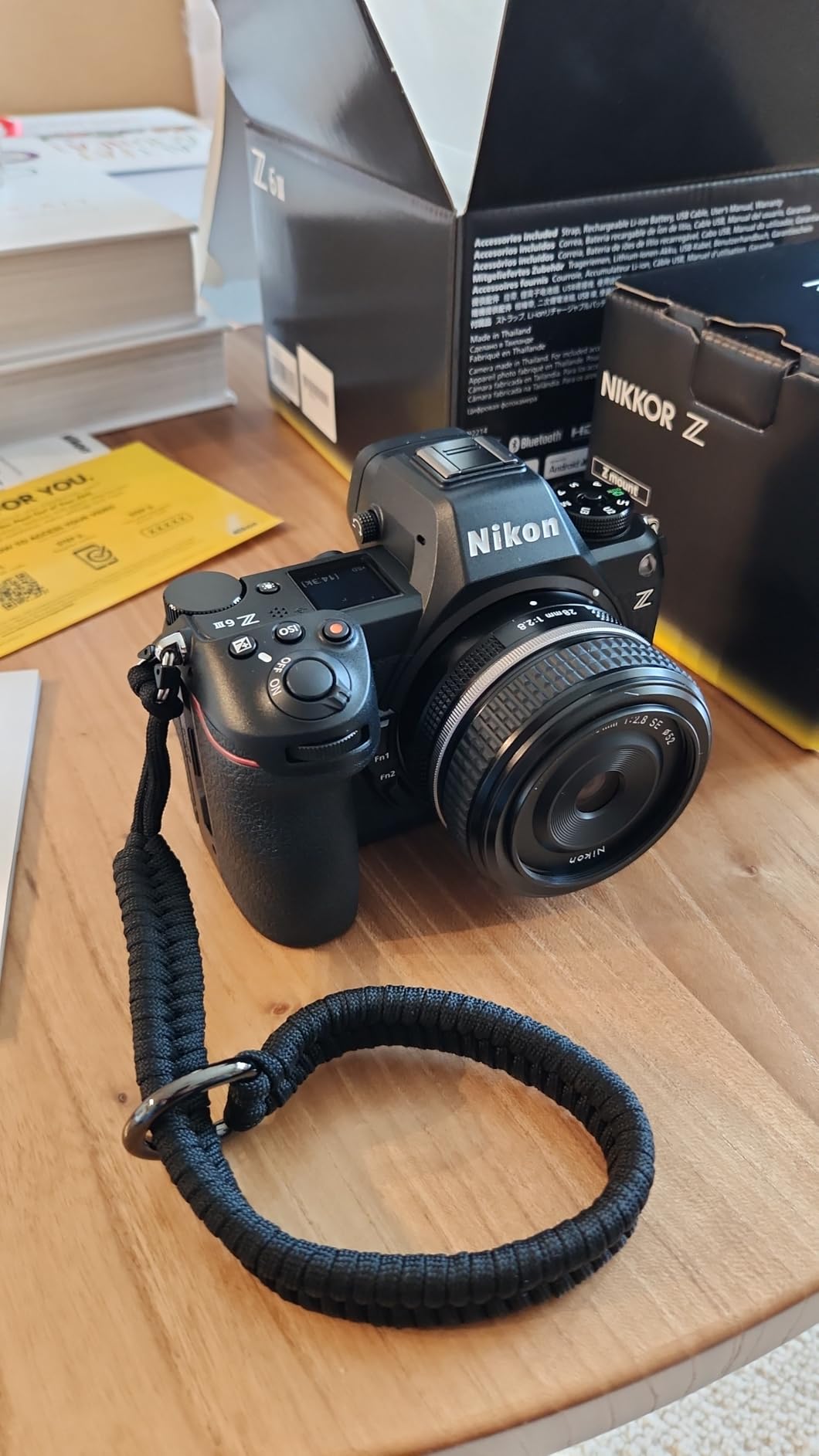
The Nikon Z6 III is the most advanced hybrid camera Nikon has made, and after using one on a season of astrophotography shoots I can say it pushes the bar for what mirrorless can do under the night sky. The standout feature for night shooting is the 4000-nit EVF, which is bright enough to compose comfortably on stars that are barely visible to the naked eye. That alone makes it worth considering for serious Milky Way and deep-sky work where the EVF is your primary framing tool.
The Z6 III uses a partially-stacked 24.5MP sensor with faster readout than the Z 6II, which reduces rolling shutter artifacts for electronic shutter use and improves the AF system. The 6K 60p N-RAW internal video recording is overkill for most astro stills work, but it is a game-changer for high-end night-sky video projects and advanced timelapse work.
Low-Light AF and Star Detection
The Z6 III’s AF system detects subjects down to -10 EV, which is roughly the brightness of the night sky under heavy light pollution. In practice, that means the camera can lock focus on faint stars and guide stars that earlier generation cameras would have hunted on. Multi-subject recognition distinguishes between humans, animals, and vehicles, which is useful for nightscape compositions where you want to balance a foreground subject with the Milky Way.
Video and Timelapse Capabilities
The 6K N-RAW recording at 60p gives you extraordinary latitude for color grading night-sky video. 4K 120p slow motion is great for aurora and lightning captures. The Hi-Res Zoom up to 2x in HD is a fun tool for tighter framing on the moon and planets. For astrophotography specifically, the timelapse intervalometer built into the camera is robust and supports exposure smoothing, which removes the flicker you often see in night-sky timelapses.
Who Should Buy the Nikon Z6 III for Astro
The Z6 III is for photographers who want Nikon’s best hybrid body and are willing to pay for the new EVF, video features, and faster sensor readout. If you shoot both stills and high-end video of the night sky, it is the most capable Nikon body available in 2026. For pure stills astrophotography, the Z 6II delivers very similar image quality at a noticeably lower price, but the Z6 III’s EVF and AF improvements are real upgrades.
Buying Guide: What Makes a Mirrorless Camera Good for Astrophotography
A mirrorless camera for astrophotography has to do three things well: collect lots of light with minimal read noise, give you tools to focus precisely in the dark, and survive long, cold nights in the field. Below is the framework I use when evaluating cameras for night-sky work, with the specific specs and features that matter most.
Sensor Size and Full-Frame vs APS-C
Full-frame sensors have larger photosites than APS-C chips at the same megapixel count, which means each pixel gathers more light and produces cleaner high-ISO images. For Milky Way panoramas and nightscapes, full-frame is the gold standard. APS-C bodies like the Sony a6700 remain excellent for travel and for telephoto deep-sky work where the 1.5x crop factor helps you reach distant galaxies and nebulae.
Medium-format sensors offer more dynamic range but slower readout speeds and limited lens ecosystems for night shooting, so they rarely show up in astro conversations. Micro Four Thirds sensors are too small for serious low-light work; the 2x crop factor and smaller photosites make high-ISO noise significantly more challenging to manage in stacking workflows.
Low-Light ISO Performance and Read Noise
The cleanest signal-to-noise ratio for astrophotography tends to sit between ISO 800 and 6400 for most modern full-frame sensors. Beyond that, read noise rises and dynamic range compresses. Look for cameras with low read noise at ISO 1600 to 6400 in published measurements from Photons to Photos, which is the standard reference for sensor comparison.
Stacked shooting shifts the math considerably. When you combine 30 to 60 sub-exposures, random read noise averages out, which means even cameras with middling per-frame noise can produce excellent stacked results. This is why older DSLRs with mediocre high-ISO performance can still produce great deep-sky images when stacked.
Dynamic Range and RAW File Quality
Dynamic range matters most for the foreground elements in Milky Way panoramas and for recovering detail from bright stars that have blown out highlights. Look for sensors that deliver at least 13 stops of dynamic range at base ISO. 14-bit uncompressed RAW is preferred over compressed RAW for stacking workflows because compression can introduce subtle banding that becomes visible after aggressive stretching.
Lossless compressed RAW is an acceptable compromise if file size matters. Always shoot RAW for astrophotography; JPEG processing in-camera cannot preserve the linear data needed for stacking and stretching.
Live View, Focus Magnification, and EVF Brightness
Focusing in the dark is the most common failure point for new astrophotographers. Look for cameras with focus magnification in live view, ideally at 10x or higher. The EVF should be bright and high-resolution so you can compose on dim stars without the viewfinder feeling laggy or grainy. The Nikon Z6 III’s 4000-nit EVF sets the new standard here.
Articulating screens help with low-angle compositions, especially for overhead Milky Way arches. Touch-to-focus on the LCD can speed up star focusing if the implementation is responsive. Vari-angle LCDs like those on the Canon R8 and RP are particularly helpful.
Weather Sealing, Battery Life, and Star Tracker Integration
Astrophotography happens in the cold and the wet. Look for weather-sealed bodies with robust build quality. Battery life matters more than you might expect; cold temperatures cut capacity significantly, and you do not want to fumble with batteries at 2am. Carry at least three spares for a full night of work.
For deep-sky imaging on a tracker, the camera needs to communicate reliably with the tracker for intervalometer shooting. Most modern mirrorless cameras have built-in intervalometers that support long exposures and timelapse sequences. External intervalometers add reliability and let you script complex sequences.
Frequently Asked Questions
What is the 500 rule in astrophotography?
The 500 rule is a quick formula for the longest shutter speed you can use on a stationary tripod before stars start to trail. Divide 500 by your lens focal length; the result is the maximum exposure in seconds. On a 24mm full-frame lens, 500 divided by 24 gives roughly 20 seconds. The rule is a starting point; modern high-resolution sensors benefit from the stricter 300 or NPF rule.
What is the 400 rule in astrophotography?
The 400 rule is a stricter version of the 500 rule for high-resolution modern sensors. Divide 400 by your lens focal length to get the maximum exposure before visible star trailing. On a 24mm full-frame lens, that is roughly 16 seconds. It is most useful for cameras above 30 megapixels where pixel-level star elongation becomes obvious sooner.
Which mirrorless camera is best for astrophotography?
The Nikon Z 6II is our top pick for astrophotography thanks to its clean 24.5MP BSI sensor, dual card slots, and rugged weather sealing. For best value, the Sony a7 III remains hard to beat with its 15-stop dynamic range and mature lens ecosystem. On a budget, the Canon EOS RP delivers full-frame image quality at the lowest entry price in the lineup.
What camera should I buy for astrophotography as a beginner?
Beginners should look for a full-frame camera with clean high-ISO output, good battery life, and a bright EVF for composing in the dark. The Canon EOS RP, Sony a7 III, and Nikon Z 6II are all strong choices that combine forgiving ergonomics with excellent image quality. Pair any of these with a fast wide-angle prime like a 20mm or 24mm f/1.8 to capture Milky Way panoramas on a tripod.
Is mirrorless or DSLR better for astrophotography?
Mirrorless cameras now match or exceed DSLRs for astrophotography in most regards. Electronic viewfinders let you see your exposure in real time, focus magnification in live view is faster than DSLR optical viewfinder focusing, and the latest sensors match DSLR read noise. DSLRs like the Canon EOS 6D Mark II remain capable, but modern mirrorless bodies offer better live-view tools and lighter weight for the same sensor quality.
Conclusion
Choosing the best mirrorless camera for astrophotography in 2026 comes down to what kind of night sky work you actually do. If you want one body to handle Milky Way panoramas, deep-sky imaging on a tracker, and daytime hybrid shooting, the Nikon Z 6II is our top pick for its blend of image quality, lens ecosystem, and field reliability. If you want flagship-grade sensor performance at a lower price and do not need IBIS, the Canon EOS R8 is hard to beat. On a strict budget, the Canon EOS RP remains the cheapest route into full-frame astrophotography.
For travelers who count every gram, the Sony a6700 APS-C body delivers compact capability. For hybrid shooters who want the best EVF and video in the lineup, the Nikon Z6 III leads the pack. For proven value with a mature lens catalog, the Sony a7 III remains a strong choice in 2026. Whatever you pick, pair it with a fast wide-angle prime, a sturdy tripod, and a willingness to spend a few clear nights learning the craft. The night sky is patient, and the right mirrorless camera makes the learning curve much shorter.