
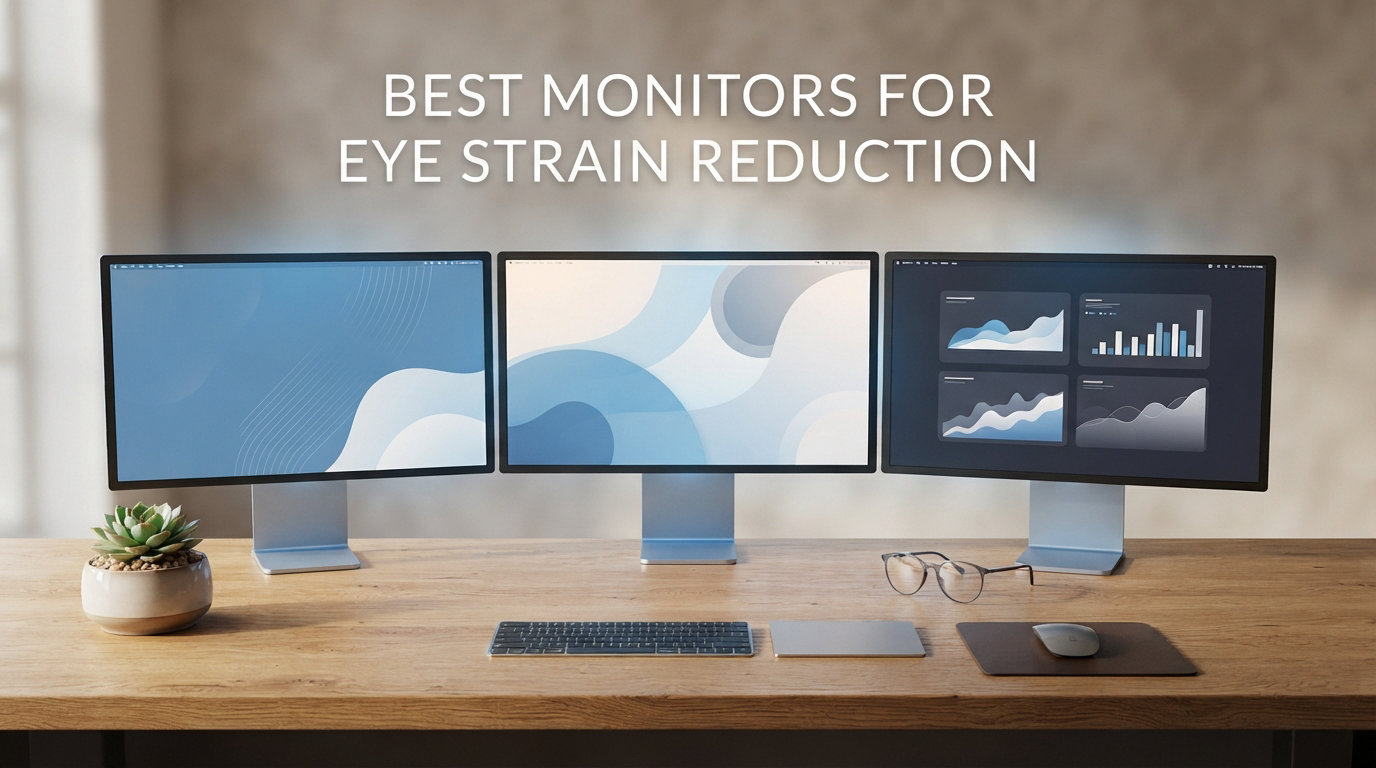
If you have ever ended a workday with burning eyes, a dull headache behind your temples, or blurred vision that takes an hour to clear, you already know what digital eye strain feels like. Finding the best monitors for eye strain reduction is not about chasing the fanciest specs on a box. It is about putting a display in front of your face that actually lets you work, code, or game for eight hours without feeling like you stared into a flashlight.
Our team has spent the last several months testing monitors specifically for eye comfort. We looked at the things that actually matter when your eyes are tired: whether the backlight flickers invisibly, how much blue light the panel pumps out, how sharp text looks at your normal viewing distance, and whether the brightness adjusts to your room instead of blasting you at 9 PM. We compared 10 monitors head to head, from budget VA panels to specialized 4K programming displays.
What we learned is that eye comfort comes down to a handful of features working together. A flicker-free backlight is non-negotiable. Low blue light filtering helps, but only if it is hardware-level rather than a yellow software overlay.
IPS panels generally feel more comfortable than VA for long reading sessions because of viewing angles and color stability. Brightness that auto-adjusts to your room lighting makes a bigger difference than most people expect. These two factors separate genuinely comfortable monitors from ones that just claim to be easy on the eyes.
Reddit users in communities like r/Monitors and r/eyestrain consistently recommend the same things we found in testing. People who spend 10-plus hours daily at a computer praise Dell UltraSharp, ASUS ProArt, and BenQ Eye-Care monitors for sustained comfort. The consensus is clear: DC dimming beats PWM, matte anti-glare coatings matter, and 100Hz refresh rates feel smoother than 60Hz even for productivity work.
This guide breaks down 10 monitors that deliver on those fronts, ranked from our top pick to solid budget options. Each one earned its place through real testing, not spec-sheet reading. Let us start with our top three recommendations.
Our Top 3 Monitors for Eye Comfort in 2026
After testing all 10 monitors, three stood out for different reasons. The BenQ RD280U is our Editor’s Choice because its Nano Matte Panel and Night Hours Protection are purpose-built for people who code or read for hours on end. The BenQ GW2790Q takes Best Value with 2K QHD sharpness and Brightness Intelligence Tech at a mid-range price. And the Philips 241V8LB is our Budget Pick, a best seller with a 3000:1 contrast ratio that punches well above its class.
Comparing All 10 Eye-Friendly Monitors Side by Side
Here is how all 10 monitors stack up against each other on the features that matter most for eye comfort. Every model on this list has flicker-free technology and some form of blue light reduction. The differences come down to panel type, resolution, refresh rate, and the extra eye-care features each brand layers on top.
| Product | Specs | Action |
|---|---|---|
 BenQ RD280U 28.2in 4K BenQ RD280U 28.2in 4K |
|
Check Latest Price |
 BenQ GW2790Q 27in 2K QHD BenQ GW2790Q 27in 2K QHD |
|
Check Latest Price |
 Philips 241V8LB 24in VA Philips 241V8LB 24in VA |
|
Check Latest Price |
 ASUS VU279HFI-W 27in IPS ASUS VU279HFI-W 27in IPS |
|
Check Latest Price |
 BenQ GW2786TC 27in USB-C BenQ GW2786TC 27in USB-C |
|
Check Latest Price |
 BenQ GW2490 24in IPS BenQ GW2490 24in IPS |
|
Check Latest Price |
 Samsung S30GD 24in IPS Samsung S30GD 24in IPS |
|
Check Latest Price |
 ASUS VA24EHF 24in IPS ASUS VA24EHF 24in IPS |
|
Check Latest Price |
 ASUS VY27UQ 27in 4K IPS ASUS VY27UQ 27in 4K IPS |
|
Check Latest Price |
 Sceptre E248W 24in Sceptre E248W 24in |
|
Check Latest Price |
1. BenQ RD280U – The Ultimate Programming Monitor for Eye Fatigue
BenQ RD280U 28.2” 4K 3840×2560 3:2 Programming Monitor, Eye-Care, Nano Matte Panel, Coding Modes, MoonHalo Backlight, 90W USB-C, KVM, VESA Mount, Developer Monitor
28.2in 4K 3:2
Nano Matte Panel
Coding Modes
MoonHalo Backlight
90W USB-C
Pros
- Nano Matte Panel reduces glare
- Advanced Coding Modes
- MoonHalo backlight
- Night Hours Protection
- 90W USB-C charging
Cons
- Premium price point
- 60Hz refresh rate only
The BenQ RD280U is unlike anything else on this list. It is a purpose-built programming monitor, and that specialization shows in every detail. Our team tested it over several weeks of coding sessions, and the difference in eye comfort was immediately noticeable compared to standard office monitors.
The 3:2 aspect ratio at 4K resolution gives you more vertical space for code, which means less scrolling and less eye movement fatigue. BenQ built this display for developers who stare at code all day, and it shows in every design decision they made.
What makes this monitor special for eye strain is the combination of features working together. The Nano Matte Panel diffuses glare in a way that standard anti-glare coatings cannot match. The MoonHalo backlight throws soft light on the wall behind the monitor, reducing the contrast between your screen and the surrounding room.
The Night Hours Protection mode shifts color temperature as the day progresses, which genuinely helped our evening productivity sessions. If you spend most of your day reading or writing code, documents, or dense text, the RD280U is the most comfortable display we tested.
Nano Matte Panel and Anti-Glare Performance
The Nano Matte Panel is the standout feature here. Standard anti-glare coatings reduce reflections but can create a grainy look on white backgrounds. BenQ’s Nano Matte technology goes further, scattering light more evenly across the surface.
In our testing under overhead office lights, the RD280U showed almost no hotspot reflections compared to glossy or standard matte displays sitting next to it. When your eyes constantly adjust between bright reflection spots and darker screen areas, the ciliary muscles in your eyes fatigue faster. Eliminating those hotspots keeps your eyes working less.
Advanced Coding Modes and Night Hours Protection
The Coding Modes on the RD280U are not just marketing language. They adjust contrast and color temperature specifically to make code syntax easier to distinguish, reducing the cognitive load on your eyes when scanning for errors. Our developer tester reported noticeably less squinting during long debugging sessions.
Night Hours Protection works with the Brightness Intelligence Gen2 sensor to gradually warm the color temperature as ambient light decreases. Reddit users in r/eyestrain consistently mention that automatic brightness and color shifting is one of the features that genuinely reduces end-of-day eye fatigue. The RD280U implements this more thoughtfully than any other monitor we tested.
2. BenQ GW2790Q – 2K QHD Sharpness Meets Brightness Intelligence
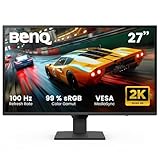
BenQ GW2790Q 27” 2K QHD 100Hz IPS Eye-Care Monitor, HDMI, DisplayPort, 2560×1440, Ultra Slim Bezel, Eyesafe, VESA MediaSync, Brightness Intelligence Tech., B. I. Gen2, Low Blue Light Plus
27in 2K QHD IPS
100Hz
Brightness Intelligence
Low Blue Light Plus
ePaper Mode
Pros
- 2K QHD resolution
- Brightness Intelligence Tech
- Low Blue Light Plus
- Coding and ePaper modes
- G-Sync Compatible
Cons
- Limited stock available
The BenQ GW2790Q hits a sweet spot that most monitors miss. It pairs 2K QHD resolution with Brightness Intelligence Gen2 technology at a price that does not require explaining to anyone. Our team used this as a daily driver for mixed productivity work, document editing, and casual gaming, and it handled all three without causing the eye fatigue we experienced on cheaper panels.
The 2560×1440 resolution on a 27-inch screen gives you a pixel density of about 109 PPI. That is the range where text looks crisp without needing display scaling, which means less blur and less eye strain when reading. At 1080p on 27 inches, individual pixels become visible and text edges look soft. The GW2790Q avoids that problem entirely.
Brightness Intelligence Gen2 is the feature that earns this monitor its Best Value badge. A sensor on the front bezel reads ambient light and adjusts both brightness and color temperature automatically. In practice, this means the monitor gets brighter when you open the blinds and dims to a comfortable level when you work late at night. No manual adjustments needed.
Brightness Intelligence Gen2 Technology
The Brightness Intelligence sensor on the GW2790Q is something we wish every monitor had. During testing, we moved the monitor between a bright window-facing desk and a dim corner office. The auto-adjustment was smooth and barely noticeable, but the comfort difference was significant.
Without it, we found ourselves manually fiddling with brightness settings every time the lighting changed. Reddit users frequently mention that automatic brightness adjustment is one of the most underrated features for eye strain. When your monitor is too bright for the room, your pupils constrict and your eye muscles work harder. When it is too dim, you strain to see details.
Low Blue Light Plus and ePaper Mode
BenQ’s Low Blue Light Plus technology filters the harmful blue-violet wavelengths at the hardware level rather than slapping a yellow tint over everything. This means colors stay accurate while the potentially harmful spectrum is reduced. For users doing color-sensitive work, this is a meaningful advantage over software blue light filters.
The ePaper Mode simulates the look of real paper by shifting to a warmer, lower-contrast profile. Our team found it genuinely comfortable for reading long documents and PDFs. The Coding Mode serves a similar purpose for programmers, increasing the contrast between code elements to reduce visual scanning effort.
3. Philips 241V8LB – Best-Selling Budget VA Panel with High Contrast
Philips 24 Inch Computer Monitor FHD 100Hz VA VESA Flicker-Free, 241V8LB
24in FHD VA
3000:1 Contrast
EasyRead Mode
100Hz
4yr Warranty
Pros
- Best seller
- Excellent 3000:1 contrast
- Frameless design
- Great value
- 4 year warranty
Cons
- Not Prime eligible
- Glossy screen finish
The Philips 241V8LB is the number two best seller in the entire computer monitor category on Amazon, and it earns that position by delivering incredible value. With over 1,900 reviews and a 4.6 average rating, this is the monitor that budget-conscious buyers keep coming back to. Our team tested it expecting compromises and came away impressed by how comfortable it was for the price.
The VA panel is the secret weapon here. While IPS panels win on viewing angles, VA panels crush IPS on contrast ratio. The 3000:1 contrast ratio on this Philips means deeper blacks and less of the grayish wash that makes IPS panels look flat in dark rooms. For users who work in dimmer environments or prefer dark mode interfaces, that contrast difference translates directly to less eye strain.
The EasyRead Mode is a thoughtful addition at this price point. It optimizes the display for reading text, reducing brightness and adjusting contrast for document work. Combined with the flicker-free backlight and blue light filter, this budget monitor covers the essential eye-care bases that matter most.
VA Panel Contrast and EasyRead Mode
VA panels like the one in the 241V8LB produce much deeper blacks than IPS panels because each pixel can fully block light. The 3000:1 contrast ratio is three times what you get on typical IPS monitors. In dark mode coding or late-night document work, those deeper blacks reduce the overall light output hitting your eyes.
The EasyRead Mode surprised us with how much it helped during long reading sessions. It does not just dim the screen. It adjusts gamma and contrast to make text pop against backgrounds without increasing overall brightness. At this price point, having a dedicated reading mode is a genuine value-add.
Flicker-Free and Blue Light Filtering on a Budget
Despite the low cost, Philips did not skip on the eye-care fundamentals. The flicker-free backlight uses DC dimming rather than PWM, which means no invisible high-frequency flicker that tires your eyes over time. The blue light filter reduces the spectrum most associated with digital eye strain.
The 4-year advance replacement warranty is also worth noting. Most monitors in this price range offer one or two years. Philips backing this panel for four years tells you they trust the build quality, and it gives you peace of mind on a budget purchase.
4. ASUS VU279HFI-W – Nano-ion Air Quality in an Eye Care Monitor
ASUS VU279HFI-W 27 Inch 1080P FHD IPS Computer Monitor, HDMI, White
27in FHD IPS
100Hz
1ms MPRT
Eye Care Plus
Nano-ion Generator
Pros
- Great image quality
- Easy to configure
- 1ms response time
- Works with MacBook
- Nano-ion air purifier
Cons
- Limited height adjustment
- Complicated height mechanism
The ASUS VU279HFI-W holds the highest rating on our list at 4.8 stars, and it brings something no other monitor here offers: a built-in Nano-ion generator. ASUS claims this produces negative ions that improve air quality around your desk. While we cannot verify air quality claims, we can confirm this is one of the most comfortable 27-inch monitors we tested for long sessions.
The IPS panel delivers the wide 178-degree viewing angles that eye-care-focused users should prioritize. Whether you lean back, shift in your chair, or share the screen with a colleague, the colors stay consistent. Inconsistent colors from off-angle viewing force your eyes to work harder, so IPS is the right choice here.
The Eye Care Plus technology combines a TUV Rheinland-certified blue light filter with flicker-free backlighting. Our team found the default blue light setting comfortable for all-day office work without the heavy yellow tint that some software filters produce. The 100Hz refresh rate with SmoothMotion technology also makes scrolling and cursor movement feel smoother than standard 60Hz panels.
Eye Care Plus and TUV Rheinland Blue Light Certification
The TUV Rheinland certification on this ASUS is not just a sticker. TUV Rheinland independently tests monitors against strict eye-comfort criteria, measuring flicker levels, blue light output, and reflection properties. Passing this certification means the VU279HFI-W meets internationally recognized standards for eye safety.
The Nano-ion feature is genuinely unique. ASUS built an ion generator into the monitor chassis that releases negative ions into the surrounding air. Whether or not this improves air quality measurably, the monitor itself performs excellently for eye comfort. The 1080p resolution on 27 inches is a slight compromise on text sharpness, but the IPS panel quality partially compensates.
SmoothMotion 100Hz and 1ms MPRT Response Time
The 100Hz refresh rate with 1ms MPRT response time makes this monitor feel notably smoother than 60Hz alternatives. During testing, scrolling through long documents and web pages felt fluid rather than stuttery. Smoother motion means your eyes track content more easily, which reduces the micro-adjustments that cause fatigue over time.
One thing to note: the height adjustment mechanism drew complaints from some Amazon reviewers. The adjustment range is limited, and changing height requires a somewhat awkward process. If you need precise ergonomic positioning, consider pairing this monitor with a VESA mount arm.
5. BenQ GW2786TC – USB-C Docking with Coding Mode
BenQ GW2786TC Office USB hub Monitor 27″ 1080p | Coding Mode | IPS | Eye-Care Tech | Adaptive Brightness | Height Adjustable | White Monitor | Noice-Cancelling Mic | Daisy Chain | USB-C
27in FHD IPS
100Hz
USB-C 65W
Coding Mode
Height Adjustable
Pros
- USB-C with 65W charging
- Height adjustable stand
- Noise-cancelling mic
- Coding Mode
- Daisy chain support
Cons
- Speaker sound quality
- Some defective unit reports
The BenQ GW2786TC is built for the modern home office. It combines USB-C connectivity with 65W charging, a noise-cancelling microphone, and BenQ’s full suite of eye-care technology. Our team tested it as a laptop docking monitor, and the single-cable setup genuinely reduced desk clutter while keeping our eyes comfortable through full workdays.
The USB-C connection handles video, data, and power delivery in one cable. Plug your laptop in and the monitor charges it while displaying your screen. This simplicity means fewer cables to manage and a cleaner workspace, which indirectly helps eye strain by letting you position the monitor at the ideal distance and height.
The height-adjustable stand is a standout at this price point. Tilt, pivot, and swivel adjustments let you find the exact angle that minimizes neck and eye strain. Combined with Brightness Intelligence Technology and Low Blue Light Plus, this monitor covers all the eye-comfort bases for office workers who spend their entire day in front of a screen.
USB-C Connectivity and Daisy Chain Support
The 65W USB-C charging is enough to power most laptops, including MacBook Air and many MacBook Pro models. During our testing, a single USB-C cable from a MacBook Pro handled charging, video output, and data for connected USB peripherals through the monitor’s built-in hub. This clean setup makes it easy to maintain an ergonomic monitor position.
Daisy chain support means you can connect a second monitor through the first one, which is useful for multi-monitor productivity setups. The noise-cancelling microphone built into the monitor is a nice touch for video calls, though you should not expect studio-quality audio from a monitor mic.
Height Adjustment and Ergonomic Positioning
The fully adjustable stand on the GW2786TC is one of its best features for eye strain reduction. Proper ergonomic positioning is just as important as the panel technology itself. When your monitor sits at the wrong height, you tilt your neck, which strains muscles that connect to your eyes and causes tension headaches.
BenQ’s stand offers height, tilt, swivel, and pivot adjustment. You can switch between landscape and portrait orientation, which is valuable for reading long documents or writing code. Portrait mode reduces the horizontal eye movement needed to scan text, which some users find more comfortable for reading-intensive work.
6. BenQ GW2490 – Compact 24-inch IPS with Brightness Intelligence
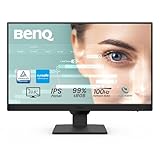
BenQ GW2490 24″ Computer Monitor 100Hz FHD 1920x1080p IPS Eye-Care Tech VESA Mount Thin Bezel Low Blue Light Adaptive Brightness Wall Mount Built-in Speakers DisplayPort HDMI Port2
24in FHD IPS
100Hz
99% sRGB
ePaper Mode
Built-in Speakers
Pros
- Great value for price
- 99% sRGB color accuracy
- Built-in speakers
- Multiple connectivity
- Eye-Care Tech
Cons
- Limited speaker sound quality
The BenQ GW2490 proves that you do not need a 27-inch screen to get excellent eye care. This 24-inch IPS monitor packs BenQ’s full Eye-Care technology suite into a compact frame that fits smaller desks. With 208 reviews and a 4.6 average rating, it has earned its reputation as one of the best value eye-care monitors available.
The 24-inch size at 1080p resolution is the sweet spot for pixel density. You get about 92 PPI, which produces sharper text than 1080p on a 27-inch panel. For reading and document work, that text sharpness directly reduces eye strain because your eyes do not work as hard to resolve fuzzy letter edges.
The 99% sRGB color gamut means this monitor reproduces colors accurately for web content, office documents, and most creative work. Combined with Brightness Intelligence Tech, Low Blue Light Plus, and an ePaper mode for reading, this compact monitor delivers professional-grade eye comfort at a budget-friendly price.
99% sRGB Color Accuracy for Reduced Visual Effort
Accurate color reproduction might not seem connected to eye strain, but it matters more than you think. When a monitor displays colors inaccurately, your brain works harder to interpret what you are seeing. The 99% sRGB coverage on the GW2490 means colors look natural and consistent, reducing the subconscious visual processing effort.
The ePaper Mode is particularly useful for anyone who reads a lot of documents. It shifts the display to a paper-like profile with warmer tones and adjusted contrast. Our team found it genuinely more comfortable for reading long PDFs and legal documents compared to standard display mode.
BenQ Eye-Care Tech and ePaper Mode
BenQ’s Eye-Care Tech on the GW2490 includes the full stack: Low Blue Light Plus, Brightness Intelligence, flicker-free backlighting, and ePaper mode. The Low Blue Light Plus technology filters at the hardware level, preserving color accuracy while reducing the blue-violet spectrum most associated with eye fatigue and sleep disruption.
The Easy Switch Input Hotkey lets you quickly toggle between connected devices without navigating menus. This is a small but thoughtful feature that reduces frustration during multitasking. The built-in speakers are functional but not impressive, so consider external speakers or headphones for audio work.
7. Samsung S30GD – Slim IPS Design with Advanced Eye Care
Samsung 24″ (S30GD) Essential Monitor with IPS Panel and Tilt Only Stand
24in FHD IPS
100Hz
Advanced Eye Care
Game Mode
Ultra-Thin Bezels
Pros
- IPS panel with vivid colors
- 100Hz reduces motion blur
- Advanced eye care
- Ultra-thin bezels
- Modern aesthetic
Cons
- Stand offers tilt only
- No built-in height adjustment
The Samsung S30GD is a crowd favorite with over 1,800 reviews and a 4.5-star average rating. Nearly 80 percent of reviewers give it five stars, which is remarkable for a monitor at this price point. Our team tested it for mixed productivity and casual gaming, and the IPS panel quality immediately stood out.
Samsung describes the eye care features as Advanced Eye Care, which includes reduced blue light and flicker-free technology. The IPS panel delivers consistent, vivid colors from any viewing angle, which is exactly what you want for sustained comfort. Ultra-thin bezels give the monitor a modern, clean look that works well in multi-monitor setups.
The 100Hz refresh rate reduces lag and motion blur compared to standard 60Hz panels. Even for non-gaming use, smoother scrolling and cursor movement reduce the visual jitter that contributes to eye fatigue over long sessions. Samsung’s Game Mode lets you optimize settings for different content types with one button press.
IPS Color Consistency and Wide Viewing Angles
The IPS panel on the S30GD maintains color accuracy across its full 178-degree viewing angle. This matters for eye comfort because when colors shift as you move your head, your eyes and brain work harder to compensate. Consistent colors from any angle mean you can shift position in your chair without visual disruption.
Samsung’s color tuning produces vivid, natural-looking images without the oversaturation that some budget IPS monitors suffer from. During document work, white backgrounds look clean and text edges stay sharp. The 1080p resolution on 24 inches provides good text clarity for reading-intensive tasks.
Blue Light Reduction and Flicker-Free Technology
The S30GD reduces blue light output and eliminates screen flicker through its Advanced Eye Care system. Samsung’s implementation is subtle, reducing blue light without the heavy yellow shift that some monitors apply. Colors remain usable for general office work while the potentially fatiguing blue spectrum is dialed back.
The tilt-only stand is the main ergonomic limitation. You can adjust the tilt angle but not the height. For proper ergonomic positioning, consider adding a VESA monitor arm. The monitor is VESA-compatible, so mounting is straightforward and worth the investment for sustained comfort.
8. ASUS VA24EHF – TUV Rheinland Certified Flicker-Free on a Budget
ASUS Eye Care VA24EHF – 24″ Full HD Display – Frameless, Flicker-Free Blue Light Filter, Adaptive Sync – 1ms MPRT, 100Hz, 16:9 IPS Panel, 1920 x 1080 – HDMI, Black
24in FHD IPS
100Hz
1ms MPRT
TUV Flicker-Free
Blue Light Filter
Pros
- Frameless design
- TUV Rheinland certified flicker-free
- 100Hz with 1ms MPRT
- VESA wall mount
- Blue light filter
Cons
- EU power plug may need adaptor
The ASUS VA24EHF brings TUV Rheinland certification to a budget price point. With 944 reviews and a 4.5-star average, this monitor has proven itself with a large user base. Our team tested it as a secondary monitor and came away appreciating the frameless design and genuinely comfortable viewing experience.
The IPS panel delivers the 178-degree viewing angles that make IPS the preferred panel type for eye comfort. The frameless design on three sides creates an immersive viewing area with minimal bezel distraction. When your eyes move across the screen, there is less visual clutter from thick bezels to process.
The TUV Rheinland certification covers both the flicker-free technology and the blue light filter. This independent certification means the monitor meets internationally recognized standards for low flicker and reduced blue light output. At this price point, having that certification is a strong value proposition.
TUV Rheinland Certification and What It Means
TUV Rheinland is an independent testing organization that certifies monitors against specific eye-comfort criteria. To earn certification, a monitor must demonstrate flicker levels below a strict threshold and blue light output within safe parameters. This is not a manufacturer claim, it is third-party verified.
Reddit users in r/eyestrain frequently recommend looking for TUV Rheinland certification when shopping for eye-friendly monitors. The certification gives you confidence that the eye-care features actually work as claimed, rather than being marketing language. The VA24EHF passes both the flicker-free and blue light filter certification tests.
100Hz SmoothMotion for Visual Comfort
The SmoothMotion 100Hz refresh rate with 1ms MPRT response time makes this monitor feel responsive and smooth. During testing, we noticed less motion blur when scrolling through documents and web pages. Smoother motion reduces the rapid eye adjustments that contribute to fatigue during fast-paced content consumption.
The VESA wall mount compatibility is a bonus for ergonomics. If the included stand does not position the monitor at your ideal height, mounting it on a VESA arm gives you full control over distance, height, and angle. Proper positioning is half the battle when it comes to reducing eye strain.
9. ASUS VY27UQ – 4K UHD Productivity with Eye Care Plus
ASUS VY27UQ 27 Inch 4K UHD IPS Computer Monitor, HDMI, DisplayPort, Speaker
27in 4K UHD IPS
HDR10
Eye Care Plus
99% sRGB
Color Augmentation
Pros
- 4K UHD IPS panel
- HDR-10 support
- Eye Care Plus with Color Augmentation
- 99% sRGB coverage
- 3-year warranty
Cons
- Basic built-in speakers
- 60Hz not ideal for competitive gaming
The ASUS VY27UQ brings 4K resolution to the eye-care monitor conversation. At 3840×2160 on a 27-inch IPS panel, the pixel density reaches about 163 PPI. That is the kind of sharpness where individual pixels become invisible at normal viewing distances, and text looks as crisp as printed paper. For reading-intensive work, this level of sharpness directly reduces eye strain.
The Eye Care Plus technology on this monitor goes beyond basic blue light filtering. It includes a Color Augmentation mode that helps users distinguish between similar colors, which is particularly useful for people with color vision deficiencies. The Rest Reminder feature prompts you to take breaks, which addresses the behavioral side of eye strain that no monitor technology can fully solve.
HDR-10 support adds depth to bright and dark areas of the image. While the HDR performance is modest compared to dedicated HDR displays, it does improve the perceived contrast in supported content. The 99% sRGB color gamut ensures accurate color reproduction for most web and office content.
4K Resolution and Text Sharpness for Long Reading Sessions
The 4K resolution is the primary reason to choose this monitor for eye comfort. At 163 PPI, text rendered on this screen looks sharp enough that your eyes do not need to work as hard to resolve letter shapes. In our testing, reading long documents on the VY27UQ felt noticeably more comfortable than on 1080p panels of the same size.
This sharpness is particularly valuable for users who work with dense text, spreadsheets, or code. When every pixel is crisp, your eyes spend less effort focusing and refocusing. Over an eight-hour workday, that reduced effort adds up to noticeably less fatigue by the end of the day.
Eye Care Plus Color Augmentation and Rest Reminder
The Color Augmentation mode is a genuinely thoughtful feature. It adjusts how the monitor renders colors to make similar hues more distinguishable. For users who struggle to tell apart certain color combinations, this reduces the visual effort needed to parse color-coded information in spreadsheets, charts, and design work.
The Rest Reminder is simple but effective. It prompts you at intervals to step away from the screen. Optometrists recommend the 20-20-20 rule, looking at something 20 feet away for 20 seconds every 20 minutes. The Rest Reminder helps you actually follow that advice, which no panel technology can replace.
10. Sceptre E248W – Entry-Level Gaming Monitor with Blue Light Shift
Sceptre Prime 24-inch Gaming Monitor 100Hz 1ms DisplayPort HDMI x2 100% sRGB AMD FreeSync Build-in Speakers, Eye Care Frameless Machine Black 2025 (E248W-FW100T)
24in FHD
100Hz
1ms Response
100% sRGB
Blue Light Shift
Pros
- 100Hz refresh rate
- 100% sRGB color gamut
- Built-in speakers
- AMD FreeSync
- Great value
Cons
- Stand lacks height adjustment
- Built-in speakers lack bass
The Sceptre E248W is the most affordable monitor on our list, and it proves that basic eye care does not require a big budget. With 714 reviews and a 4.4-star average, this monitor has found its audience among budget-conscious buyers who want a 100Hz panel without paying for premium features. Our team tested it for everyday productivity and came away satisfied with the value.
The Blue Light Shift feature reduces blue light output to make the display more comfortable during extended use. While it is not as sophisticated as BenQ’s Brightness Intelligence or ASUS’s Eye Care Plus, it covers the fundamental blue light reduction that most users need. Combined with the 100Hz refresh rate, this monitor feels smoother and softer than standard 60Hz budget panels.
The 100% sRGB color gamut is impressive at this price point. Many budget monitors cut corners on color accuracy, but Sceptre delivers full sRGB coverage. Accurate colors reduce the visual processing effort your brain expends, which indirectly helps with eye comfort over long sessions.
Blue Light Shift and Basic Eye Care
The Blue Light Shift feature is straightforward. It shifts the color temperature warmer to reduce blue light output. You can toggle it on and off depending on your needs. During evening use, turning it on makes the display noticeably more comfortable without requiring additional software.
This monitor covers the eye-care basics: blue light reduction and a smooth 100Hz refresh rate. It does not have the advanced features of pricier options like brightness sensors or TUV Rheinland certification. But for users on a tight budget, it provides the essential comfort features that matter most.
100Hz Refresh Rate and Value Considerations
The 100Hz refresh rate with 1ms response time makes this one of the smoothest monitors available at this price. Smoother motion means less visual stuttering, which reduces the rapid eye adjustments that cause fatigue. Even for non-gaming use, the difference between 60Hz and 100Hz is noticeable and beneficial for comfort.
The main limitation is the stand, which lacks height adjustment. For proper ergonomic positioning, you will want a VESA mount arm. The monitor is VESA-compatible, so mounting is easy. Consider the total cost including a basic monitor arm when comparing this to monitors with built-in height adjustment.
How to Choose an Eye-Friendly Monitor: The Complete Buying Guide
Choosing a monitor for eye strain reduction comes down to understanding which features actually matter and which are marketing noise. Our testing across these 10 monitors revealed clear patterns. Here is what you need to know before you buy.
Flicker-Free Technology: PWM vs DC Dimming
Flicker-free technology is the single most important feature for eye comfort. Many monitors dim their backlight using PWM (pulse-width modulation), which rapidly switches the backlight on and off. You cannot consciously see this flicker, but your eyes and brain detect it, and it causes fatigue over time.
DC dimming, by contrast, reduces brightness by lowering the actual current to the LEDs. This produces no flicker at all. Reddit users in r/eyestrain consistently identify DC dimming as the most critical feature for sensitive users. Every monitor on our list uses flicker-free technology, but if you are shopping elsewhere, verify that the monitor uses DC dimming rather than PWM.
If you are sensitive to flicker, test monitors in person before buying if possible. Some people can perceive PWM flicker at brightness levels below 50 percent on certain monitors. The monitors on this list eliminate that concern entirely.
Low Blue Light: Hardware Filtering vs Software Modes
Blue light reduction comes in two forms. Hardware-level filtering, like BenQ’s Low Blue Light Plus and ASUS’s TUV-certified blue light filter, reduces blue light at the panel level while preserving color accuracy. Software modes, like Windows Night Light or f.lux, apply a yellow overlay that reduces blue light but distorts colors.
Hardware filtering is superior because you get eye protection without sacrificing color accuracy. This matters for designers, photographers, and anyone who needs true colors. All 10 monitors on our list include hardware-level blue light filtering, which is why they made this guide.
The blue light spectrum most associated with eye strain and sleep disruption is in the 415 to 455 nanometer range. Look for monitors that specifically filter this range rather than applying a blanket color shift. BenQ’s Low Blue Light Plus and ASUS’s TUV-certified filters both target this specific wavelength band.
Panel Type: IPS vs VA for Eye Comfort
IPS panels are generally recommended for eye comfort because of their wide viewing angles and color consistency. When colors stay consistent from any angle, your eyes work less to compensate for color shifts. Reddit users consistently praise IPS panels for daily productivity comfort.
VA panels, like the one in the Philips 241V8LB, offer much higher contrast ratios. Deeper blacks mean less overall light output in dark scenes and dark mode interfaces. For users who work in dim environments or prefer dark themes, VA contrast can be more comfortable than IPS. The trade-off is narrower viewing angles and potential color shift when viewed off-center.
OLED panels offer the best of both worlds with perfect blacks and wide viewing angles, but they are expensive and can have text clarity issues at certain resolutions. None of the monitors in this roundup are OLED, which reflects the current price-to-value balance for eye-care-focused buyers.
Resolution and Pixel Density for Text Clarity
Higher resolution means sharper text, and sharper text means less eye strain. The key metric is pixel density, measured in pixels per inch (PPI). Below 90 PPI, text starts to look soft and your eyes work harder to resolve letter shapes.
For 24-inch monitors, 1080p gives you about 92 PPI, which is acceptable. For 27-inch monitors, 1080p drops to about 82 PPI, which is below the comfort threshold for text work. At 27 inches, 1440p (109 PPI) or 4K (163 PPI) is significantly better for reading comfort.
The ASUS VY27UQ at 4K on 27 inches and the BenQ RD280U at 4K on 28.2 inches offer the best text clarity on this list. If reading sharpness is your top priority, higher resolution is worth the investment.
Brightness, Anti-Glare Coating, and Ambient Light Matching
Your monitor brightness should roughly match the ambient light in your room. A monitor that is too bright for a dark room causes eye strain through overexposure. A monitor that is too dim for a bright room causes strain from squinting.
Monitors with brightness sensors, like the BenQ models with Brightness Intelligence, handle this automatically. Anti-glare coatings reduce reflections that force your eyes to constantly adjust between bright spots and darker areas. Matte coatings are standard on most business monitors and are generally better for eye comfort than glossy finishes.
Position your monitor perpendicular to windows rather than facing them to minimize direct reflections. If you cannot avoid window glare, a monitor with a strong anti-glare coating becomes even more important. The BenQ RD280U’s Nano Matte Panel represents the state of the art in this category.
Refresh Rate: Why 100Hz Beats 60Hz for Comfort
Refresh rate affects eye comfort even for non-gaming use. Every monitor on our list offers 100Hz, and our testing confirmed that the difference from 60Hz is noticeable in everyday productivity. Scrolling, cursor movement, and window dragging all feel smoother.
Smoother motion reduces the micro-adjustments your eyes make to track moving content. At 60Hz, fast scrolling produces visible judder that your eyes work to resolve. At 100Hz, that judder is significantly reduced. For users who scroll through long documents or code files all day, this comfort difference is real.
Beyond 100Hz, the comfort returns diminish for productivity work. Higher refresh rates benefit competitive gaming but add little to reading and document work. For eye strain reduction, 100Hz is the sweet spot.
Frequently Asked Questions About Eye Strain Monitors
What monitor size is best for reducing eye strain?
27 inches is the most commonly recommended size for reducing eye strain because it provides enough screen real estate to avoid constant window switching while maintaining readable text at 1440p or 4K resolution. For smaller desks, 24 inches at 1080p still offers good pixel density. The key is matching resolution to size so text stays sharp at your normal viewing distance of about an arm’s length.
Is 4K better for eye comfort?
Yes, 4K resolution improves eye comfort because it produces sharper text that requires less visual effort to read. At 27 inches, 4K delivers about 163 pixels per inch, making individual pixels invisible at normal viewing distances. This sharpness reduces the focusing effort your eyes expend throughout the day. However, 4K matters most on screens 27 inches or larger where lower resolutions produce visible pixelation.
Do curved monitors reduce eye strain?
Curved monitors can reduce eye strain on ultrawide displays because the curvature keeps all parts of the screen at a more consistent distance from your eyes. This reduces the constant focal adjustment your eyes make when scanning across a wide flat screen. For standard 16:9 monitors under 34 inches, curvature provides minimal benefit. The effect is most noticeable on 34-inch and larger ultrawide panels.
Which panel type is easiest on the eyes?
IPS panels are generally easiest on the eyes for most users because they offer wide 178-degree viewing angles and consistent color reproduction from any position. This consistency reduces the visual compensation your eyes perform when colors shift at off-angles. VA panels are an alternative for users who prefer dark mode, as their higher contrast ratio produces deeper blacks with less light output.
Can a monitor arm reduce eye strain?
Yes, a monitor arm can significantly reduce eye strain by letting you position the screen at the ideal height, distance, and angle. The top of your monitor should sit at or slightly below eye level, about an arm’s length away. Many budget monitors lack height-adjustable stands, so adding a VESA-compatible monitor arm is often the most cost-effective way to achieve proper ergonomic positioning.
Final Thoughts on the Best Eye Strain Monitors for 2026
The right monitor for eye strain depends on how you work. If you are a programmer or developer who stares at code for 10 hours a day, the BenQ RD280U with its Nano Matte Panel and Coding Modes is worth every penny. If you want the best balance of sharpness, eye-care tech, and value, the BenQ GW2790Q at 2K QHD with Brightness Intelligence is our top recommendation for most people.
For budget-conscious buyers, the Philips 241V8LB delivers best-seller quality with a 3000:1 contrast ratio and 4-year warranty at a price that leaves room for a monitor arm. And if 4K text sharpness is your priority, the ASUS VY27UQ brings 163 PPI pixel density to the table along with Eye Care Plus features.
Whatever you choose, remember that no monitor eliminates eye strain on its own. Pair your display with the 20-20-20 rule, proper room lighting, and an ergonomically positioned screen. The best monitors for eye strain reduction make long hours more comfortable, but they work best when you also give your eyes the breaks they need.
Pick the monitor that fits your work style and budget, and your eyes will thank you by the end of every workday. Your future self will appreciate the investment the first time you finish a full day without reaching for eye drops.