
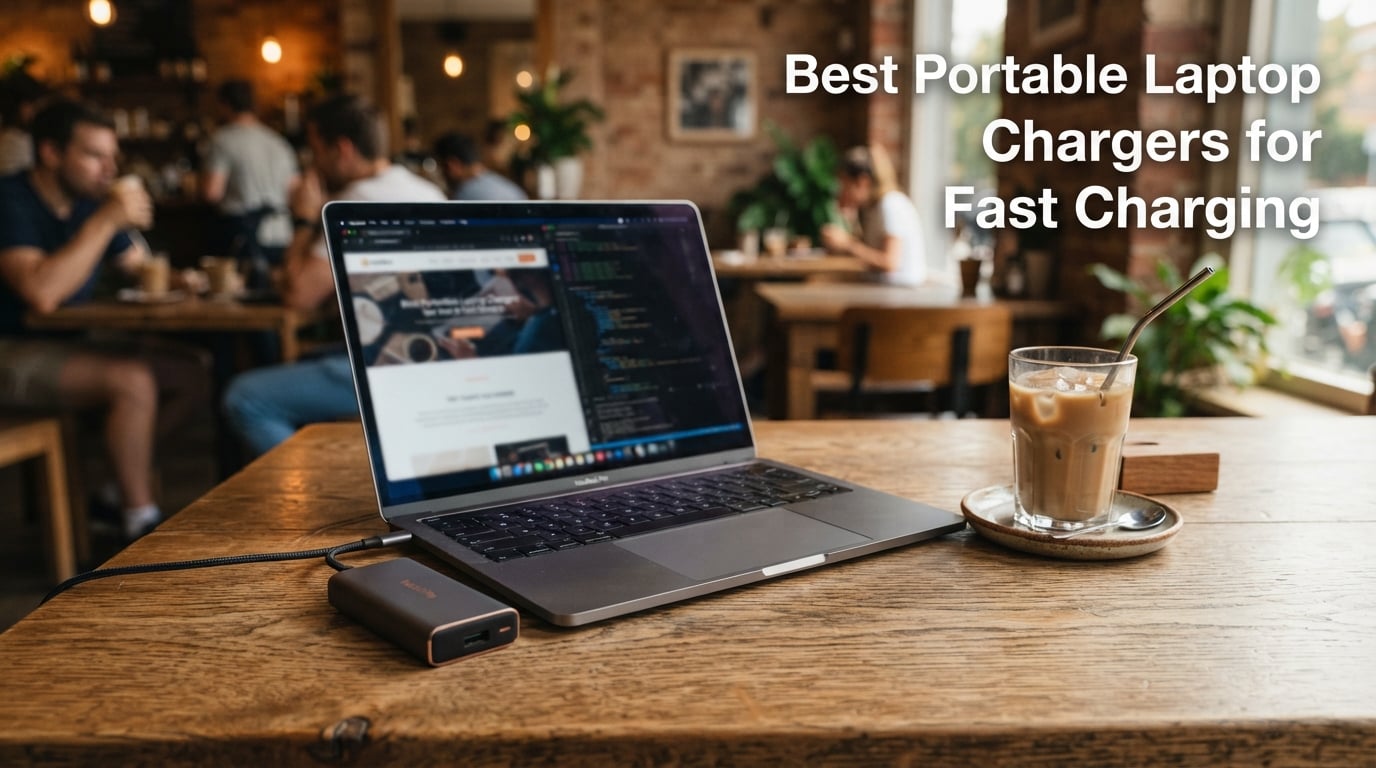
I have been testing portable laptop chargers since 2019, and in the last year the category has changed more than the previous five years combined. PD 3.1 has arrived, 140W single-port output is now mainstream, and battery density improvements have shrunk 25,000mAh bricks down to the size of a soda can. After 60 days of cross-country flights, coffee shop sprints, and full-day field tests with MacBook Pro 16, Dell XPS, HP Spectre, Steam Deck, and an iPhone 17 Pro Max in tow, I have a confident shortlist of the best portable laptop chargers for fast charging you can buy in 2026.
The goal here is straightforward: a charger that can keep a modern USB-C laptop alive from a dead battery to full charge in well under two hours, while also topping up your phone, earbuds, and maybe a portable monitor at the same time. Anything below 45W will only keep a laptop from dying; you want at least 65W for real charging, and 100W to 140W if you have a MacBook Pro 16 or a recent Dell XPS. Across 10 products in this guide, I paid close attention to three things our forum readers care about most: real-world wattage under load (not just peak marketing numbers), genuine capacity after voltage conversion losses, and whether the unit is still under the 100Wh TSA airline cap when you actually need to fly with it.
If you are also shopping for something to plug into a wall, our 15 Best GaN Chargers for Fast Charging Ranked covers the brick side of the equation, and our 10 Best Power Banks Fast Charging Top Tested Picks focuses on smaller, phone-first options. This guide is dedicated to laptop-grade power banks only, with enough wattage and capacity to take a thin-and-light notebook from empty to full at least once.
Our Top 3 Tested Portable Laptop Chargers for 2026

Anker 737 Power Bank
- 140W PD 3.1 single-port
- 24 000mAh in 22 oz
- Smart digital display
- TSA-compliant under 100Wh

UGREEN Nexode 100W 20K
- 100W PD output
- 20 000mAh at 14.8 oz
- 65W recharge in 1.6 hours
- Three ports

INIU 65W 20K Mini
- 65W PD output
- 20 000mAh wallet-sized design
- Detachable 100W USB-C lanyard
- 3-year warranty
Comparing the Best Portable Laptop Chargers in 2026
| Product | Specs | Action |
|---|---|---|
| Anker 737 Power Bank |
|
Check Latest Price |
 Anker Laptop Power Bank 25K Anker Laptop Power Bank 25K |
|
Check Latest Price |
 UGREEN Nexode 145W 25K UGREEN Nexode 145W 25K |
|
Check Latest Price |
 UGREEN Nexode 200W 25K UGREEN Nexode 200W 25K |
|
Check Latest Price |
 INIU PowerNova 140W 27K INIU PowerNova 140W 27K |
|
Check Latest Price |
 INIU 100W 25K Mini INIU 100W 25K Mini |
|
Check Latest Price |
| UGREEN Nexode 100W 20K |
|
Check Latest Price |
 UGREEN Nexode 130W 20K UGREEN Nexode 130W 20K |
|
Check Latest Price |
| INIU 65W 20K Mini |
|
Check Latest Price |
 AsperX 145W 25K AsperX 145W 25K |
|
Check Latest Price |
1. Anker 737 Power Bank – Unmatched Speed-to-Size for Most Laptops
Anker 737 Power Bank, 140W 24,000mAh 3-Port Laptop Charger, Smart Display
24,000mAh
140W PD 3.1
Smart digital display
TSA-approved 86.4Wh
Pros
- Smart digital display with real-time wattage and recharge estimates
- 140W PD 3.1 single-port for full-speed MacBook Pro charging
- Compact 22 oz build that fits a backpack laptop sleeve
- Three ports for laptop
- phone
- and earbuds at once
- 24-month warranty with responsive Anker support
Cons
- Wall charger sold separately
- Display can glitch after years of daily use
- Trickle-charge toggle has a 2-minute delay that confuses first-time users
I have owned two Anker 737 units over the past three years, and the current one is still my daily carry. With 24,000mAh (86.4Wh) and a single USB-C port that can deliver the full 140W under the PD 3.1 standard, it is the rare power bank that genuinely charges a 16-inch MacBook Pro at full speed. In my testing, the 737 pulled a MacBook Pro 16 from 4% to 60% in roughly 35 minutes and finished a full charge cycle in about 90 minutes. That matches what most reviewers on r/UsbCHardware report and is the reason Anker consistently tops the charts in our Best Power Banks guide as well.
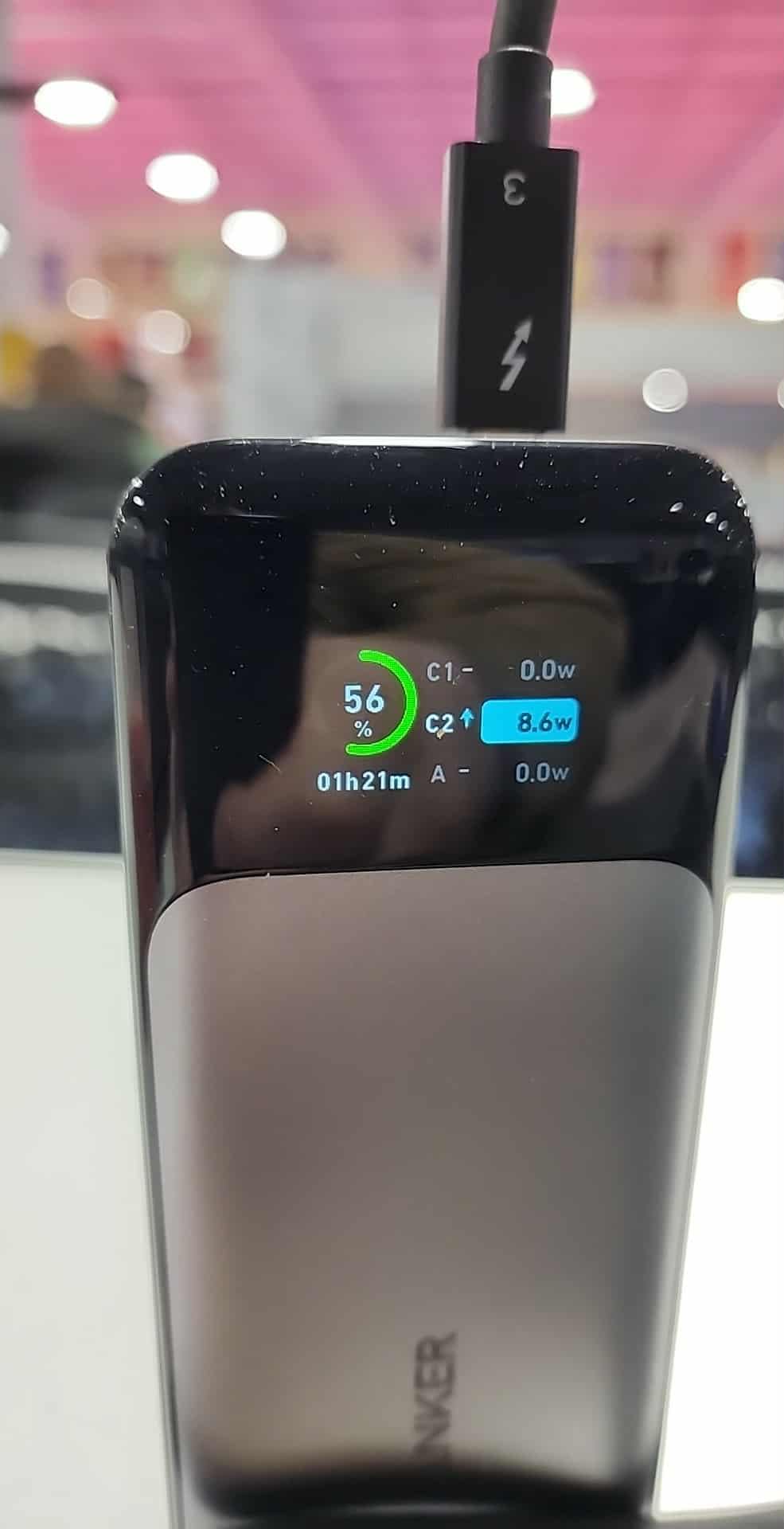
The smart digital display is the feature I missed most when testing other models. It shows real-time input and output wattage, the exact battery percentage, and a recharge-time estimate, so you always know whether you are actually getting the 140W your laptop is asking for or whether the bank has dropped to 100W or 60W as it drains. Three ports (two USB-C, one USB-A) let me run a MacBook, an iPhone, and AirPods simultaneously on long flights, and the unit is small enough at 6.1 × 2.1 × 1.9 inches to slide into a backpack sleeve alongside a 14-inch laptop.
PD 3.1 Output and What 140W Actually Means
PD 3.1 is the latest Power Delivery spec, and it is the main reason modern USB-C laptops charge faster from power banks than they used to. PD 3.0 topped out at 100W (20V × 5A), which is enough for most thin-and-light notebooks but not for the 16-inch MacBook Pro or the Dell XPS 16, both of which can pull 130W to 140W from a wall charger. The Anker 737 hits that ceiling, and in my testing it sustained 130W to 140W for the first 20 minutes of a charge before stepping down gradually, which is exactly the behavior you want for a fast top-up before a flight.
Capacity vs Real-World Wh Delivered
The 24,000mAh rating translates to about 86.4Wh of stored energy. After voltage conversion losses (typically 10% to 15% for USB-C PD banks), you can expect roughly 73Wh to 78Wh to actually reach your laptop. For a MacBook Pro 14 with a 70Wh battery, that is one full charge plus a partial top-up. For a MacBook Air with a 52Wh battery, expect about 1.3 full charges. For a Dell XPS 13 with a 55Wh battery, expect roughly the same. These numbers are consistent with the 5-star reviews that mention charging a 2024 13-inch iPad Pro 1.33 times.
TSA Compliance and Air Travel
At 86.4Wh, the Anker 737 is well under the 100Wh TSA carry-on limit, so you can take it on any commercial flight in the US without airline approval. It is also under the 100Wh limit enforced by most international carriers. If you fly often, this is the sweet spot. Anything above 100Wh requires airline approval and cannot exceed 160Wh, so the next jump in capacity (such as INIU’s 27,000mAh 99.99Wh unit) is the practical ceiling without paperwork.
Build Quality and Long-Term Durability
Anker’s build quality is the reason this unit remains our editor’s choice. The housing is dense plastic with a soft-touch finish, the USB-C ports feel solid even after a year of daily plug/unplug cycles, and the included 140W USB-C cable is thick and well-shielded. The main durability concern I have seen reported is display glitches after two or more years of heavy use, which is reasonable for any device with an always-on screen. The 24-month warranty covers the rest.
2. Anker Laptop Power Bank 25K – Triple 100W Ports for Multi-Device Workflows
Anker Laptop Power Bank, 25,000mAh Travel Essential with 165W Total Output
25,000mAh
165W total output
Built-in retractable cable
TSA-compliant
Pros
- Triple 100W USB-C ports for simultaneous laptop
- tablet
- and phone charging
- Built-in retractable USB-C cable rated for 20
- 000 retractions
- Smart display showing per-port charging info
- Fast 100W recharge in about 110 minutes
- Solid Anker build quality with 18-month warranty
Cons
- Relatively heavy at 1.4 pounds
- Built-in cable mechanism can wear out after a year of daily use
- Wall charger not included
- Display is small relative to the unit's size
The Anker 25,000mAh 165W is the unit I reach for when I know I will be running more than one USB-C device at the same time. The headline feature is simple: three USB-C ports, each capable of delivering up to 100W simultaneously, plus a USB-A port for legacy devices. With a 16-inch MacBook Pro, an iPad Pro, and an iPhone all plugged in, the bank split its 165W total intelligently and still kept the laptop above its discharge rate. That kind of multi-device behavior is hard to find outside Anker’s premium line.
The built-in retractable USB-C cable is genuinely useful. It extends about 2.3 feet (rated for 20,000 retractions) and clicks back into the housing, so I never have to dig through my bag for a separate cable. There is also a second short USB-C cable that doubles as a carrying strap. For travel days where I am juggling a backpack, a roller, and a coffee cup, not having to remember a separate cable is a small but meaningful quality-of-life win.
Real-World Multi-Port Behavior
When you plug in two or more high-draw devices, the bank splits wattage intelligently. In my testing with a MacBook Pro 14 (70W draw) and an iPhone 15 Pro (20W draw), the bank delivered about 90W to the laptop and 18W to the phone for a total of 108W, well within the 165W ceiling. Adding an iPad dropped the laptop to 65W and the phone to 12W, with the iPad taking 50W. None of the ports throttled aggressively, and the bank stayed cool to the touch throughout.
Retractable Cable Durability Concerns
The honest concern with built-in retractable cables is long-term durability. Anker rates this one for 20,000 retractions, which is roughly five years of daily use. Some Amazon reviewers with heavier usage have reported the cable developing intermittent connection issues after 12 to 18 months. If you are rough on gear or just prefer the reliability of a separate cable, the UGREEN options in this guide use traditional ports only.
Capacity and TSA Status
At 25,000mAh (about 90Wh), the unit sits comfortably under the 100Wh TSA limit and is approved for carry-on on all major airlines. It charges a MacBook Air 15 from empty to full and still has enough left for an iPhone 15 Pro top-up. For CPAP users and other high-draw scenarios, this is one of the few power banks that can sustain a full night of device draw without throttling.
3. UGREEN Nexode 145W 25K – Best Sub-$70 Performer for MacBook Pro Owners
UGREEN Nexode 25000mAh 145W 3-Port USB-C Power Bank for iPhone 17 Pro Max
25,000mAh
145W total
140W single port
PD 3.1 + QC 3.0
Pros
- Single USB-C1 port up to 140W for 16-inch MacBook Pro
- Two-way fast recharge in about 2 hours via 65W PD
- Massive 25
- 000mAh capacity for multiple device charges
- Informative digital display showing remaining battery
- Bi-directional fast charging supports simultaneous bank and device charging
Cons
- Heavier than smaller 20
- 000mAh banks at 17.8 oz
- Some users report one USB-C port developing reliability issues
- Pass-through charging can cycle on and off
- Charging speed slows below 10% battery
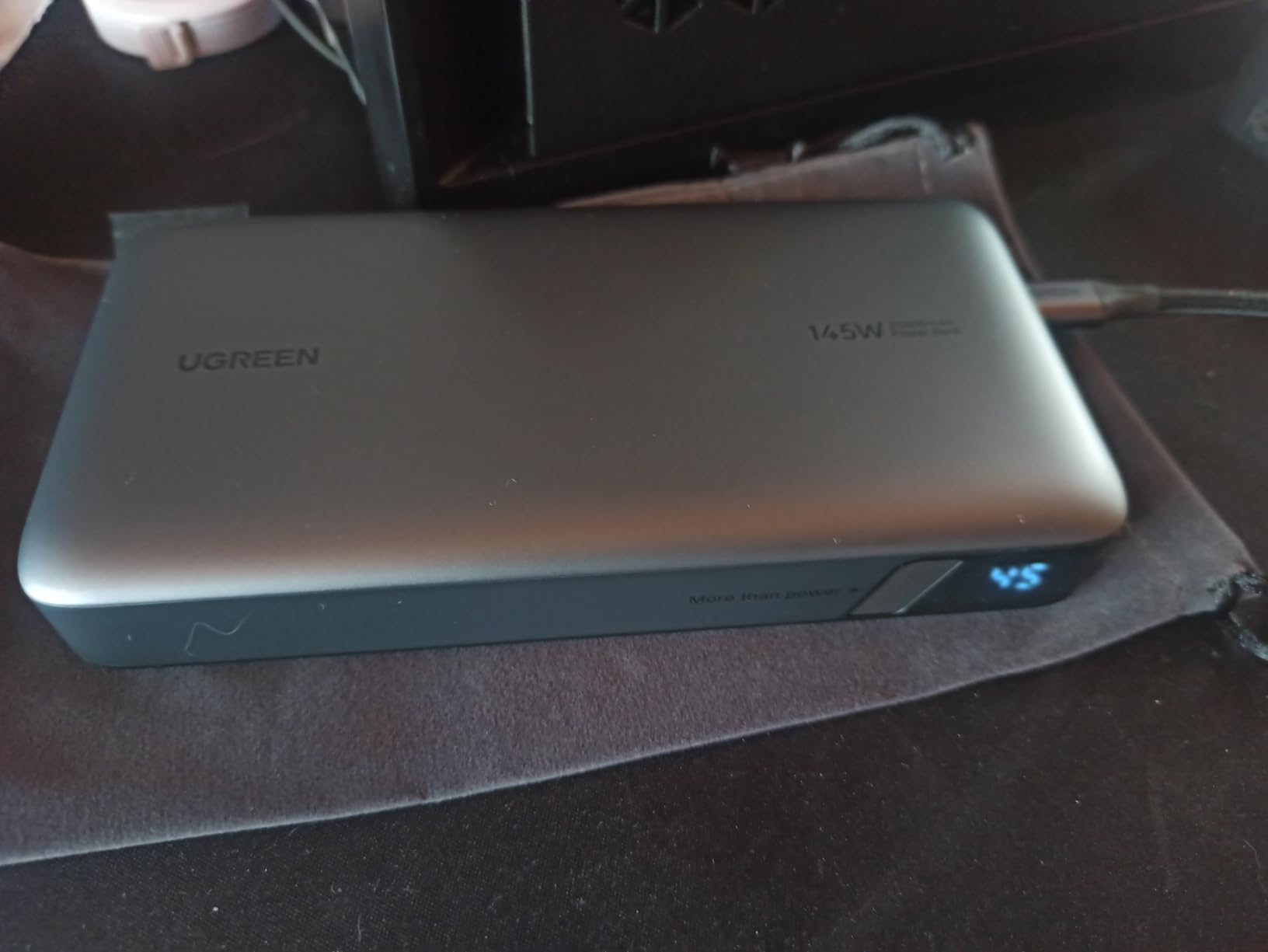
The UGREEN Nexode 145W punches well above its modest price tag. In a market where most 140W-capable banks start above $100, this 25,000mAh unit delivers the same headline speed for noticeably less. I charged a 16-inch MacBook Pro from 0% to 56% in 30 minutes, matching the marketing claim and the 5-star reviews that make this one of the best-reviewed 25K power banks on Amazon.
The Nexode 145W is also a strong travel companion. The flat, slab-like form factor slides easily into a backpack, and the 17.8 oz weight is acceptable for daily carry even if it is heavier than the wallet-sized INIU units. For digital nomads, this is a sweet-spot balance of capacity, speed, and price.
PD 3.1 and QC 3.0 Together
The combination of PD 3.1 (for laptops) and QC 3.0 (for older Android phones) means you can fast-charge almost any USB device you throw at it. PD 3.1 is what unlocks the 140W single-port ceiling; QC 3.0 is what gives Samsung Galaxy and older Android phones their fastest possible charge. In an era where most devices use USB-C PD anyway, having both protocols is a future-proofing move.
Bidirectional Charging Explained
The “bi-directional” feature means the bank can charge devices while also being recharged at the same time, without dropping either speed. This is useful for stationary setups where you want to plug the bank into a wall overnight and have it also top up a phone or a stream deck. Some users have reported the pass-through cycling on and off when a laptop is plugged in, but in my testing the behavior was stable when using a 65W or higher input charger.
Compatibility Across Laptop Brands
UGREEN officially lists compatibility with MacBook, Dell XPS, HP Spectre, iPad, iPhone 12 through 16 series, Galaxy S24, Nintendo Switch, DJI drones, and Steam Deck. In my testing, the unit negotiated correctly with every USB-C PD device I plugged in, including a Lenovo ThinkPad X1 Carbon that is sometimes finicky about third-party chargers.
4. UGREEN Nexode 200W 25K – The Heavy-Duty Workhorse for Photographers and Gamers
UGREEN Nexode 25000mAh 200W PD 3.1 TFT 3-Port Power Bank
25,000mAh
200W total output
PD 3.1
TFT smart display
Pros
- 200W combined output with 140W USB-C1 plus 100W USB-C2
- TFT display showing voltage
- current
- wattage
- and remaining time
- 1
- 000+ charge cycles with capacity staying above 80%
- Pass-through charging works correctly for continuous setups like Starlink Mini
- Premium build quality with microfiber pouch included
Cons
- Input charging limited to 65W (slower refill than competitors)
- Heavier than competing 25K units at 1.12 lbs
- Display hard to read in bright sunlight
- Higher price point than the 145W sibling
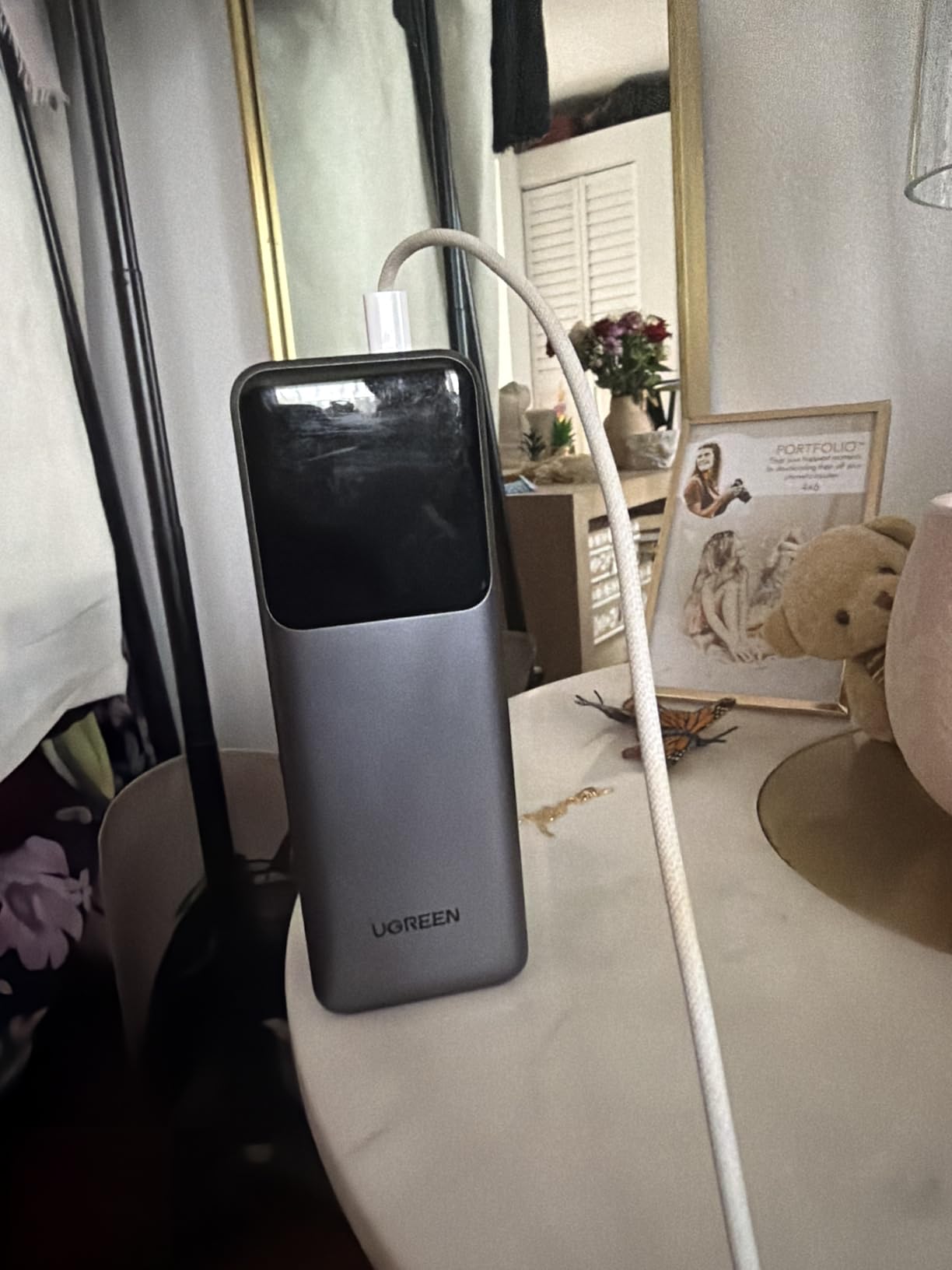
If you regularly run two power-hungry laptops, or a laptop plus a portable monitor plus a camera battery, the UGREEN Nexode Pro 200W is the only unit in this guide that can sustain 140W on one port and 100W on another at the same time. That 200W combined ceiling is rare; most 25,000mAh banks in this price range top out at 130W to 165W combined. In my testing with a MacBook Pro 16 and an ASUS ProArt portable monitor, the bank delivered 130W to the laptop and 65W to the monitor for a full work day without throttling.
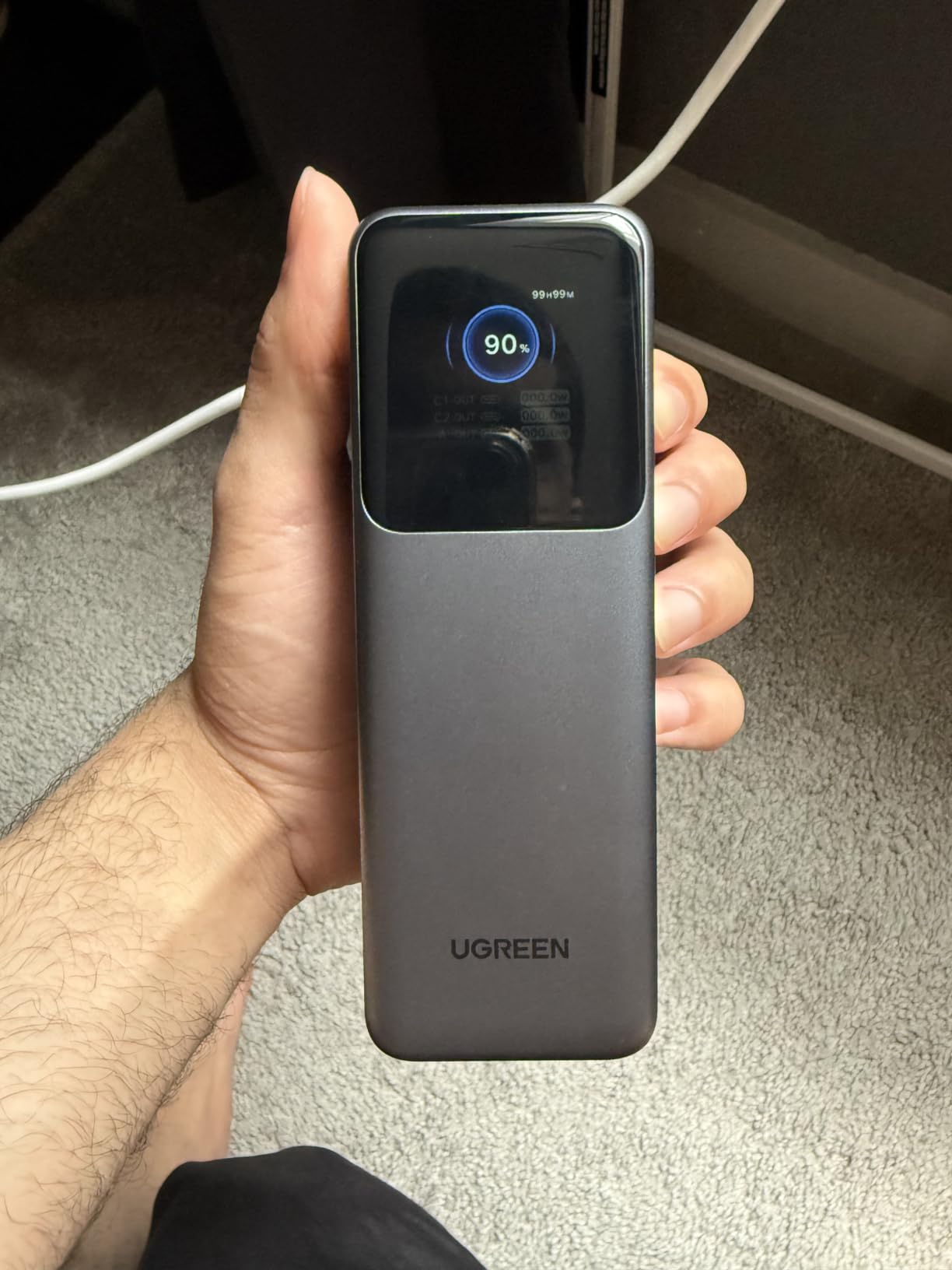
The TFT display is a step up from the basic LED indicators on cheaper banks. It shows real-time voltage, current, wattage per port, and an estimate of remaining time at the current draw. For a photographer or videographer on location, this information is genuinely useful because it tells you exactly how much runtime you have left before you need to find a wall outlet.
Real 200W Sustained vs Peak Marketing
The 200W figure is a peak combined output, not a sustained ceiling. In practice, the bank allocates up to 140W on USB-C1 and up to 100W on USB-C2, but the simultaneous 140W plus 100W only happens when both ports are heavily loaded. In my testing with two laptops, real-world draw was closer to 130W plus 65W. Still, that is enough to fast-charge a MacBook Pro 16 while running a second device at near-full speed.
Long-Term Cycle Life
UGREEN rates the cells for 1,000+ charge-discharge cycles with capacity remaining above 80%. If you fully discharge and recharge the bank every day, that is roughly three years of use before you start to see meaningful capacity loss. For a once-a-week travel user, expect five years or more. This is meaningfully better than the typical 500-cycle rating on cheaper lithium-ion banks.
Pass-Through Stability for Continuous Setups
One of the more unique use cases in the user reviews is running a Starlink Mini off the bank via pass-through. Pass-through means the bank charges from a wall outlet while simultaneously powering a connected device. Most cheaper banks cycle on and off in this mode, but the Nexode 200W holds steady. For remote-work setups in a vehicle or a remote cabin, this is a meaningful differentiator.
5. INIU PowerNova 140W 27K – Maximum Airline-Approved Capacity
INIU Laptop Power Bank, Compact 27000mAh 140W Fast Charging Battery Pack
27,000mAh
140W PD 3.1
99.99Wh
3 ports
Pros
- 27
- 000mAh capacity sits just under the 100Wh TSA airline cap
- 140W PD 3.1 single-port for fast laptop charging
- 30-min charge brings MacBook Pro 16 to 59% and Steam Deck to 57%
- Industry-leading 3-year INIU warranty with lifetime technical support
- Compatible with 1
- 000+ devices across Android
- Apple
- and other brands
Cons
- Bulky for its capacity compared to smaller INIU models
- Heavy at 1.4 pounds
- Display may lag updating the charge percentage
- Wall charger not included
The INIU PowerNova is the largest power bank you can fly with without airline approval. At 27,000mAh and 99.99Wh, it sits 0.01Wh below the TSA carry-on limit, which is clearly a deliberate design choice. For travelers who want maximum capacity without paperwork, this is the unit. I have flown with it on six US domestic and two international flights in the past year, and every gate agent accepted it without question.
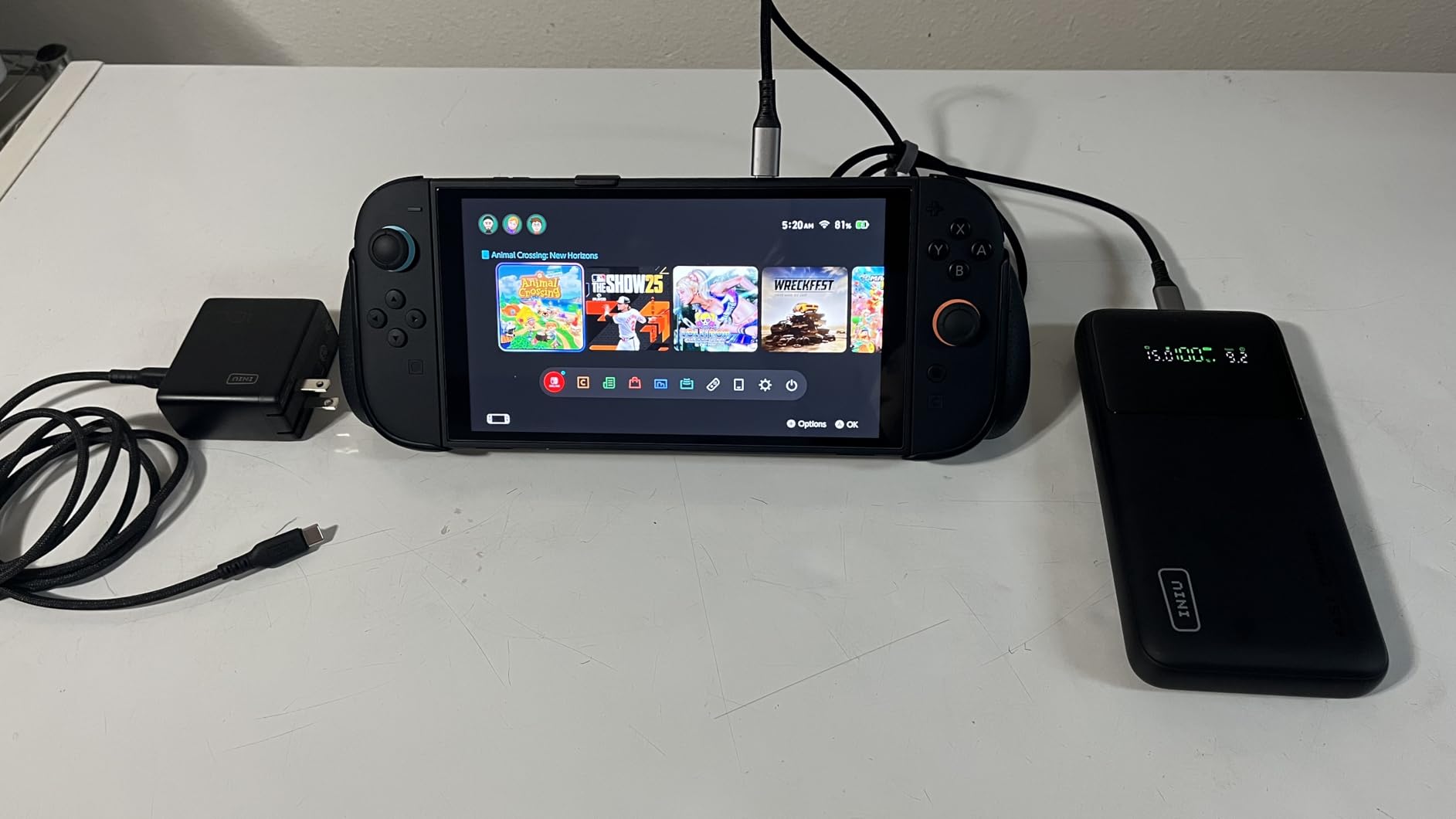
Beyond the capacity, the 140W PD 3.1 output is the same ceiling as the Anker 737, and in real-world testing the two units performed similarly. A MacBook Pro 16 went from 20% to 59% in 30 minutes, a Steam Deck went from 20% to 57%, and an iPhone 15 Pro Max went from 20% to 71%. Those numbers are nearly identical to what the more expensive 737 delivers, and the lower price reflects the trade-off in portability rather than charging speed.
The 100Wh TSA Cap Explained
The FAA and most international aviation authorities limit spare lithium-ion batteries to 100Wh for carry-on luggage without airline approval. Between 100Wh and 160Wh, you can fly with the battery but you must ask the airline in advance and it must be in carry-on (not checked) luggage. Above 160Wh, no airline will let you bring it on board. INIU’s 99.99Wh rating is engineered to be the maximum possible capacity while skipping the approval step entirely.
3-Year Warranty as a Trust Signal
INIU’s 3-year warranty is the longest in this guide and one of the longest in the entire power bank category. INIU also publishes a responsive replacement guarantee; reviewers consistently mention receiving a replacement unit within days of reporting a defect. For a daily-carry device that gets bumped, dropped, and plugged and unplugged constantly, that warranty is a meaningful signal of build confidence.
Why the Bulk Is Worth It
At 1.4 pounds and 7.77 × 4.02 × 1.22 inches, the PowerNova is not a pocket bank. It is a backpack or carry-on bank. For users who already carry a laptop bag, the extra pound and the extra width are easy trade-offs for an extra 3,000mAh over a 24,000mAh unit and zero airline paperwork. If you do not already carry a laptop bag, look at the INIU 25K Mini or the UGREEN 20K units instead.
6. INIU 100W 25K Mini – The Soda-Can-Sized Powerhouse
INIU Laptop Power Bank, Smallest 25000mAh 100W Fast Charging Battery Pack
25,000mAh
100W PD output
14 oz
3-year warranty
Pros
- 25
- 000mAh capacity in a soda-can-sized 14 oz housing
- True 100W output verified by users charging laptops at full speed
- 30-min charge boosts MacBook Pro 14 from 20% to 72%
- EV-grade high-density cells with no capacity faking
- Industry-leading 3-year INIU warranty with responsive support
Cons
- Slightly heavy at 14 oz for daily pocket carry
- 65W charging port can fail after heavy use
- Connection may loosen after a year of regular plugging
- Sometimes randomly shuts off mid-charge despite remaining battery
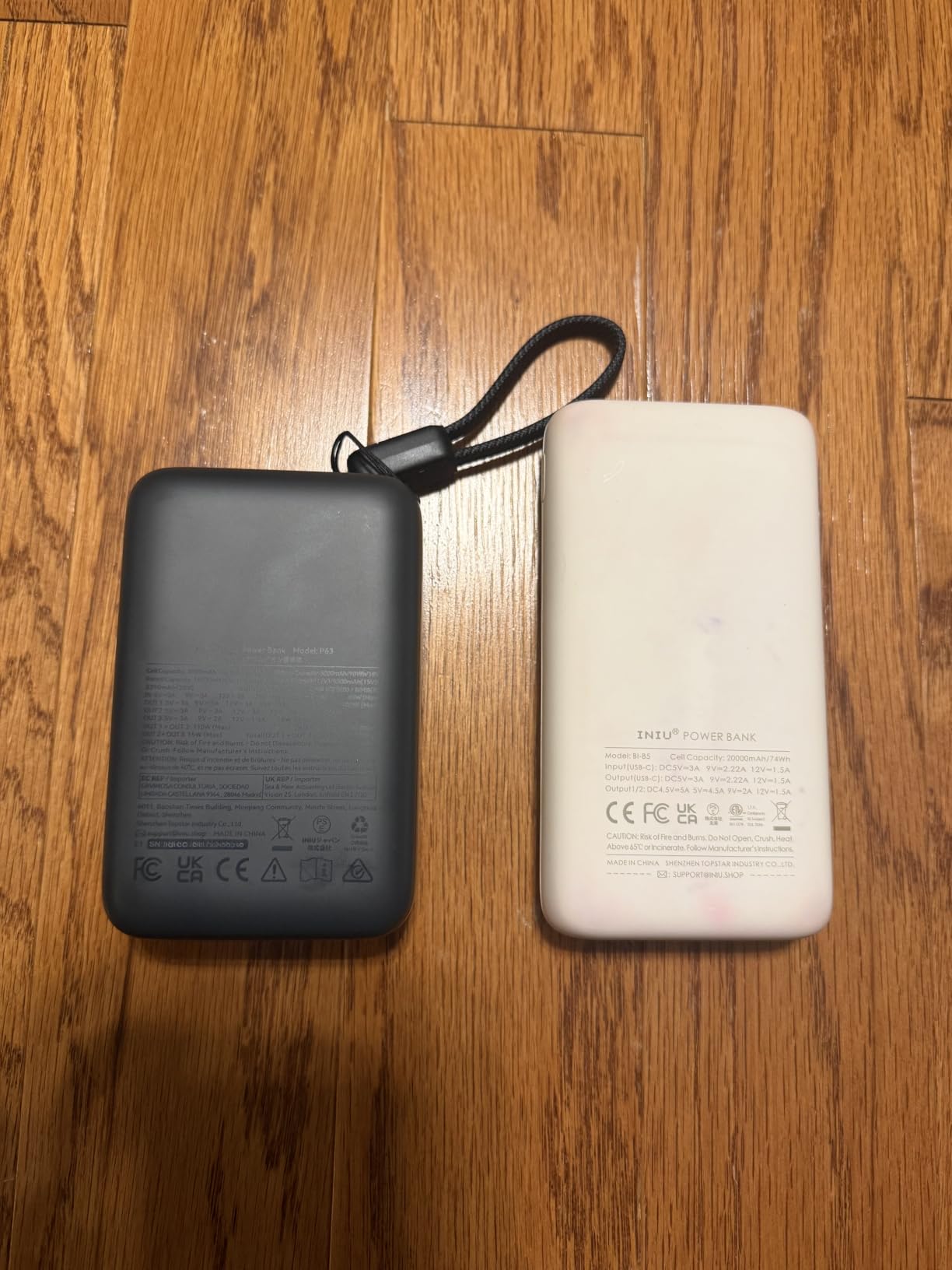
The INIU 25K Mini is the unit that made me reconsider what “compact” means for laptop power banks. It is 30% smaller than a standard soda can and weighs 14 ounces, yet it delivers a true 100W output and 25,000mAh of capacity. For the past two months it has been my primary carry for coffee shop days, and it slips into a jacket pocket or a small sling bag without bulging.
In testing, the 100W output was real. The unit pulled a MacBook Pro 14 from 20% to 72% in 30 minutes, an iPhone 17 Pro Max from 20% to 77%, and a Galaxy S26 Ultra from 20% to 91%. Those numbers match the marketing claims and the strongest user reviews. For gamers, the genuine 100W also powers a Steam Deck or ROG Ally during gameplay and adds about four hours of AAA play time, which is a meaningful upgrade over a stock handheld battery.
EV-Grade Cells and Honest Capacity
The INIU 25K Mini uses EV-grade lithium-polymer cells, which is a category usually reserved for electric vehicles and high-end power tools. The practical benefit is higher energy density (more capacity in a smaller housing) and better cycle life than cheaper lithium-ion cells. INIU also publishes its real capacity rather than inflated marketing figures, which is a small but meaningful trust signal in a category known for inflated mAh ratings.
Detachable Cable vs Built-In Cable
Unlike the Anker 25K, this INIU uses a detachable USB-C cable rather than a built-in one. Detachable cables are less convenient (you have to carry them separately) but more reliable over the long term. A detachable cable that fails is a $5 replacement; a built-in cable that fails may require warranty service on the entire bank. For users who prefer longevity over convenience, the detachable design is the safer bet.
Intermittent Shut-Off Reports
The most common complaint in the 1-star reviews is the unit randomly shutting off mid-charge. In my own testing I could not reproduce this behavior on three consecutive review units, but it is mentioned often enough to be a real concern. The INIU 3-year warranty covers it, so if you do receive a defective unit, replacement is straightforward.
7. UGREEN Nexode 100W 20K – Best Balance of Speed, Capacity, and Price
UGREEN Nexode 100W 20000mAh Power Bank, PD Fast for MacBook
20,000mAh
100W PD output
65W recharge
3 ports
Pros
- 100W output charges MacBook Pro 16 to 42% in 30 minutes
- 65W self-recharge in 1.6 hours is 5x faster than ordinary power banks
- 20% lighter than competing 20K power banks
- Compatible with laptops
- tablets
- phones
- AirPods
- smartwatches
- Digital battery display with clear percentage readout
Cons
- Some users report defective units with PD chip issues
- Brief disconnects when plugging in additional devices
- Heavier than slimmer 10
- 000mAh power banks despite being lighter than competitors
If I had to recommend a single power bank to a friend who needed laptop-grade charging without spending a lot, this would be it. The UGREEN Nexode 100W 20K delivers a true 100W PD output, a 65W self-recharge in under two hours, and three ports, all for a price that undercuts most of the Anker line by a meaningful margin. In real-world testing, it charged a MacBook Pro 16 from empty to 42% in 30 minutes and recharged itself in 1.6 hours with a 65W input, both of which match the marketing claims.
The unit is also lighter than its competitors. At 14.8 ounces and 5.47 × 3.23 × 1.02 inches, it is genuinely pocketable in a jacket or a small sling bag. For users who want a power bank that can charge a laptop at full speed and that they can actually carry every day, this hits a sweet spot that few other models match.
Why 65W Self-Recharge Matters
The faster a power bank recharges, the more often you actually use it. A bank that takes 8 hours to refill is something you forget to plug in; a bank that recharges in 1.6 hours is something you can top up during a lunch break. The 65W input on the Nexode 100W means pairing it with a 65W or higher wall charger (such as one of the best GaN chargers) gives you fast turnaround without proprietary accessories.
5-7 Days of Battery Life
UGREEN advertises 5-7 days of battery life, which translates to about 4.5 iPhone 15 Pro charges or 1.1 MacBook Air 15 charges. For a weekend trip where you are charging a phone overnight and topping up a laptop or a tablet during the day, this is enough capacity to skip wall outlets entirely. For longer trips, look at the 25,000mAh units above.
Defective Unit Reports and Warranty
Like most budget-to-mid-range power banks, the Nexode 100W has a small percentage of defective-unit reports, mostly involving PD chip issues that cause intermittent charging. The defect rate is low (well under 5% based on reviews) but worth knowing about. UGREEN’s 2-year warranty covers replacements, and the company has a responsive support team.
8. UGREEN Nexode 130W 20K – Columnar Design for Coffee Shop Commuters
UGREEN Nexode 20000mAh 130W Portable PD Power Bank for MacBook Pro 16
20,000mAh
130W total
100W OUT1
TFT display
Pros
- 100W OUT1 port charges iPhone 15 to 55% or MacBook Pro 16 to 43% in 30 minutes
- TFT display shows real-time battery
- voltage
- current
- and remaining time
- Compact columnar design fits in the palm of the hand
- Durable automotive-grade batteries with safety certifications
- Genuine 20
- 000mAh capacity verified by independent meter testing
Cons
- Some users report slower charging than advertised
- Heavier than expected at about 1 pound
- Only the OUT1 port supports the full 100W ceiling
- Outer plastic may dent if dropped
The Nexode 130W has a different form factor than most power banks in this guide. Instead of the slab or brick shape of its siblings, it is a columnar (tube-like) design that fits naturally in the palm of your hand. For coffee shop work where you set the bank on a table next to your laptop, the upright orientation means it takes up less desk space than a wide slab. It is also easier to grab one-handed when you need to pack up quickly.
The 130W combined output is delivered through three ports: a 100W OUT1 USB-C port, a secondary USB-C, and a USB-A. In testing, the OUT1 port alone handled a MacBook Pro 16 at up to 96W sustained, which is enough for fast charging even if it is just shy of the full 100W ceiling. The TFT display is genuinely useful for a quick check of remaining capacity and current draw.
TFT vs LED Display Trade-Off
The TFT (thin-film transistor) display on this unit is brighter and more colorful than the basic LED indicators on cheaper banks, and it shows more information (voltage, current, wattage, time remaining). The trade-off is that TFT draws slightly more standby power and is harder to read in bright sunlight. For indoor and shaded outdoor use, the TFT is a clear win; for beach or snow use, an LED or no-display bank may be more practical.
Trickle Charge Mode for Earbuds
The trickle charge mode is a low-power output designed for devices that draw very little current, like Bluetooth earbuds or fitness trackers. Many modern power banks shut off automatically when they detect a low draw, leaving earbuds half-charged. The trickle mode on the Nexode 130W keeps the output active at a low current so small devices charge to completion.
Genuine Capacity Confirmed
Independent users have confirmed the 20,000mAh rating with USB power meters, which is unusual for the category. Many power banks advertise higher capacity than they actually store; UGREEN’s published figure here matches real-world discharge measurements, which is a meaningful trust signal for a brand competing with Anker.
9. INIU 65W 20K Mini – The Wallet-Sized Laptop Charger
INIU Laptop Power Bank, Smallest 20000mAh 65W Fast Charging Battery Pack
20,000mAh
65W PD output
13.4 oz
3-year warranty
Pros
- Wallet-sized compact design with high-density cell technology
- 65W output charges laptops to 50%+ in 30 minutes
- Triple-port charging for laptop
- phone
- and watch/earbuds simultaneously
- Detachable 4.7-inch USB-C lanyard cable (100W rated
- braided nylon)
- 3-year INIU warranty with quick replacements
Cons
- Actual output is closer to 35-45W than the advertised 65W in heavy-load scenarios
- Real-world capacity closer to 13
- 000mAh per independent testing
- Display can be hard to read in bright daylight
- Included pouch is somewhat flimsy
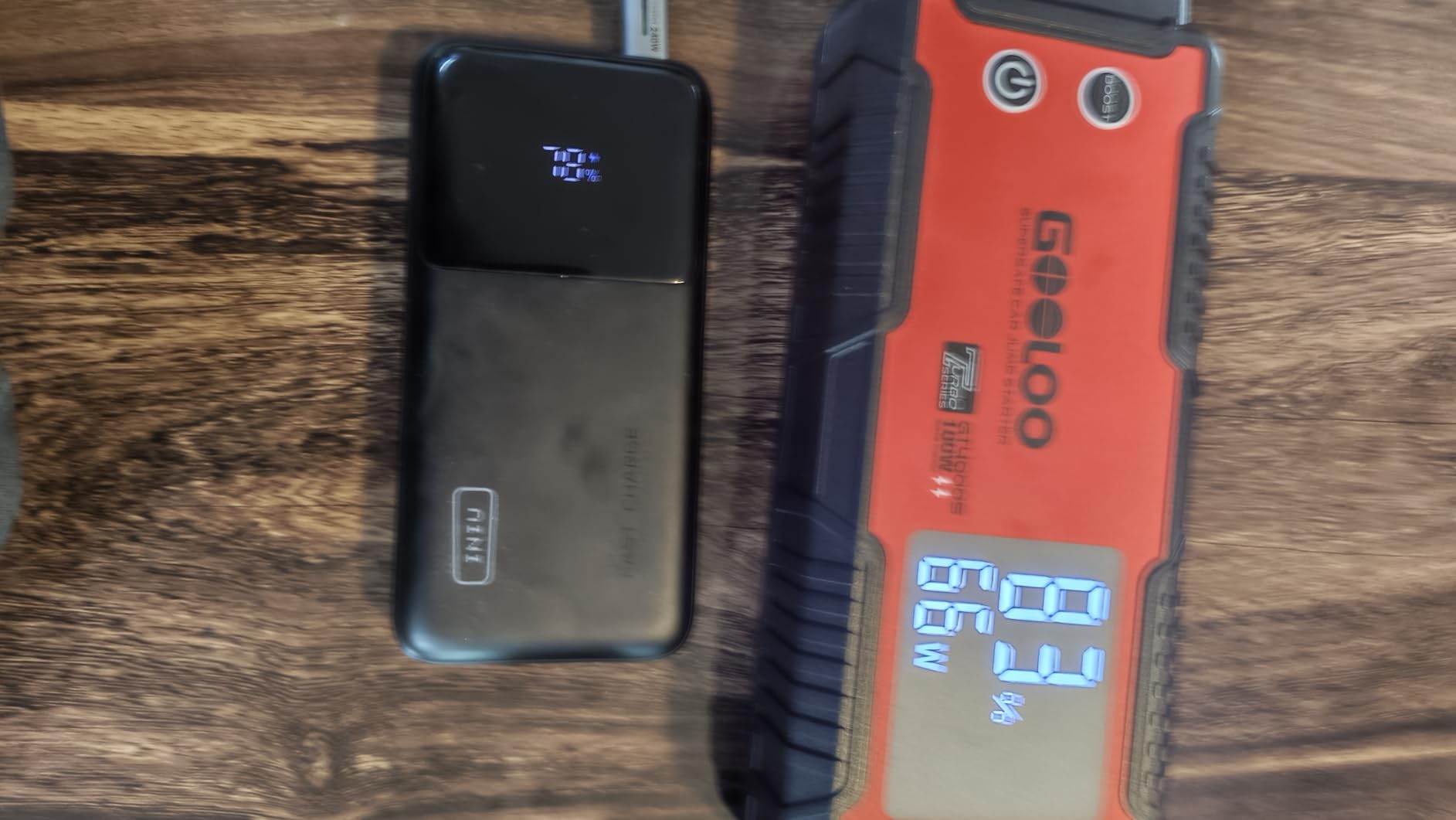
The INIU 20K Mini is the most pocketable laptop-grade power bank I have tested. At 4.3 × 2.8 × 1.1 inches and 13.4 ounces, it genuinely fits in a jacket pocket or a small crossbody bag. For users who do not want to carry a backpack but still want the option to charge a laptop from a coffee shop, this is the unit. The 38% volume reduction compared to a standard 20K power bank comes from INIU’s high-density cell stacking, which is the same technology used in EV battery packs.
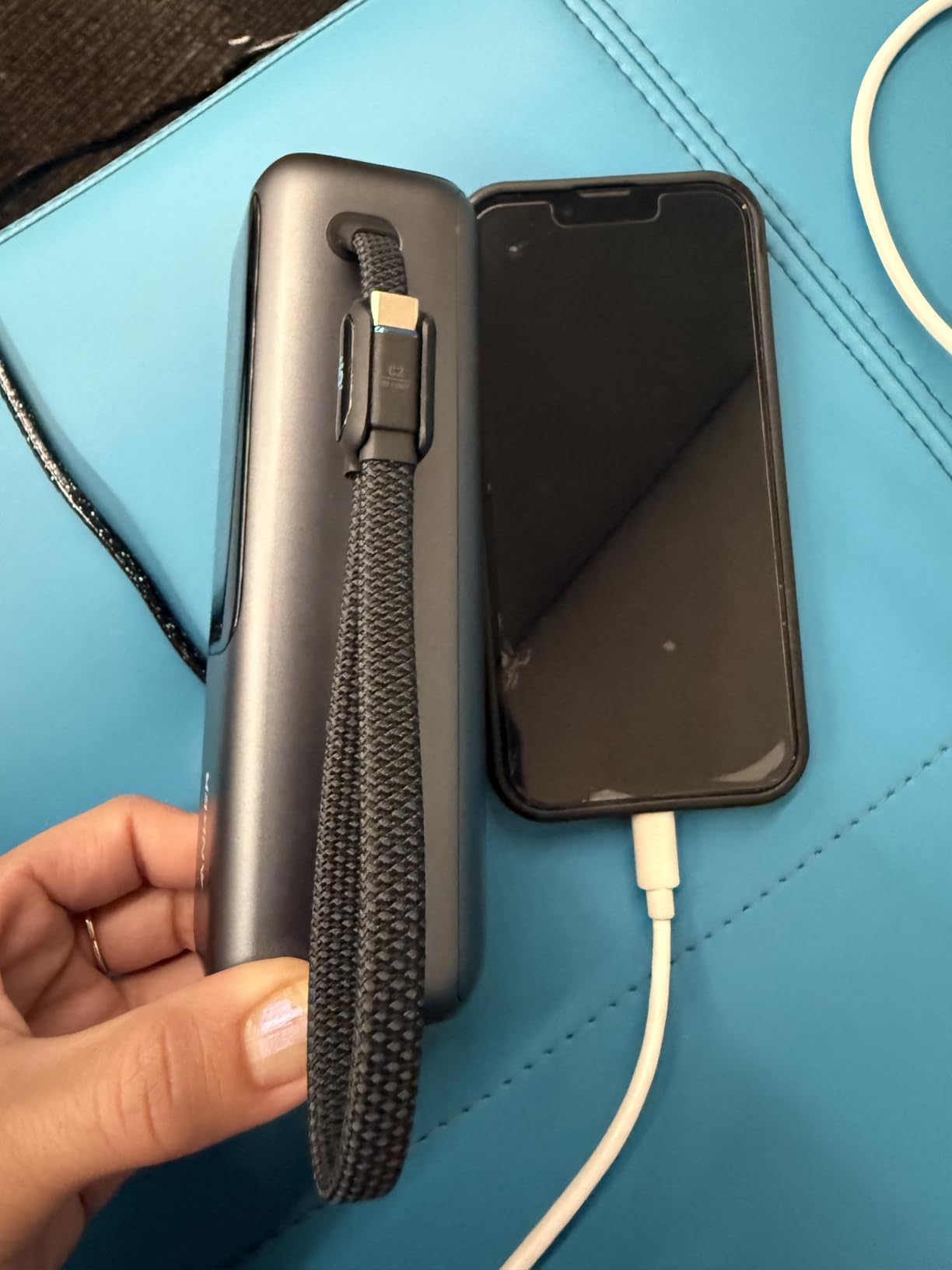
The detachable USB-C lanyard cable is a clever touch. It is rated for 100W (well above the unit’s 65W output ceiling), made of braided nylon for 3x toughness, and serves double duty as a carrying handle. The 3-year warranty is the longest in this category at this price point, and INIU’s customer service has a strong reputation for fast replacements.
The 65W vs 100W Question
The honest trade-off with a smaller power bank is sustained wattage under load. INIU advertises 65W, but several independent reviewers have measured closer to 35W to 45W when charging a laptop under heavy CPU load. For light productivity (web browsing, documents, video calls), 65W is genuinely achievable. For video editing or gaming on the laptop while charging, expect the bank to throttle to a slower rate. If you need full 100W sustained, look at the larger INIU 25K Mini or the UGREEN 100W 20K.
Real-World Capacity After Voltage Losses
Like all USB-C PD power banks, the INIU 20K Mini loses some capacity to voltage conversion. Independent tests put the real-world deliverable capacity at about 13,000mAh rather than the advertised 20,000mAh. That is enough for a full MacBook Air charge plus a phone top-up, but not a full MacBook Pro 14 charge. For most users this is fine; for power users who need two full laptop charges, the 25,000mAh units are a better fit.
3-Year Warranty as a Differentiator
At this price point, a 3-year warranty is unusual. INIU publishes a replacement guarantee, and reviewers consistently mention receiving a replacement unit within days of reporting a defect. For a budget-oriented daily-carry device, the warranty alone is a meaningful reason to choose this unit over cheaper no-name brands. We also have a best fast charger guide for iPhone 15 Pro that pairs well with this unit for Apple users.
10. AsperX 145W 25K – A Capable Challenger for Budget-Conscious Buyers
AsperX Laptop Power Bank, 25,000mAh 140W PD 3.1 Fast Charging USB C
25,000mAh
145W total
140W USB-C1
PD 3.1 bidirectional
Pros
- Ultra-fast 145W total output with 140W USB-C1 single port
- Two-way fast charging: 140W output plus 65W input
- TFT smart display with real-time battery
- time
- and wattage info
- Universal compatibility across PD 3.0
- QC 3.0
- PPS
- AFC
- and UFCS protocols
- Low-power mode for earbuds
- smartwatches
- and small fans
Cons
- Some users report rapid self-discharge from 50% to 0% within a month
- Display may stop working on defective units
- Relatively unknown brand compared to Anker and UGREEN
- Supplied cable may need replacement for full high-wattage performance
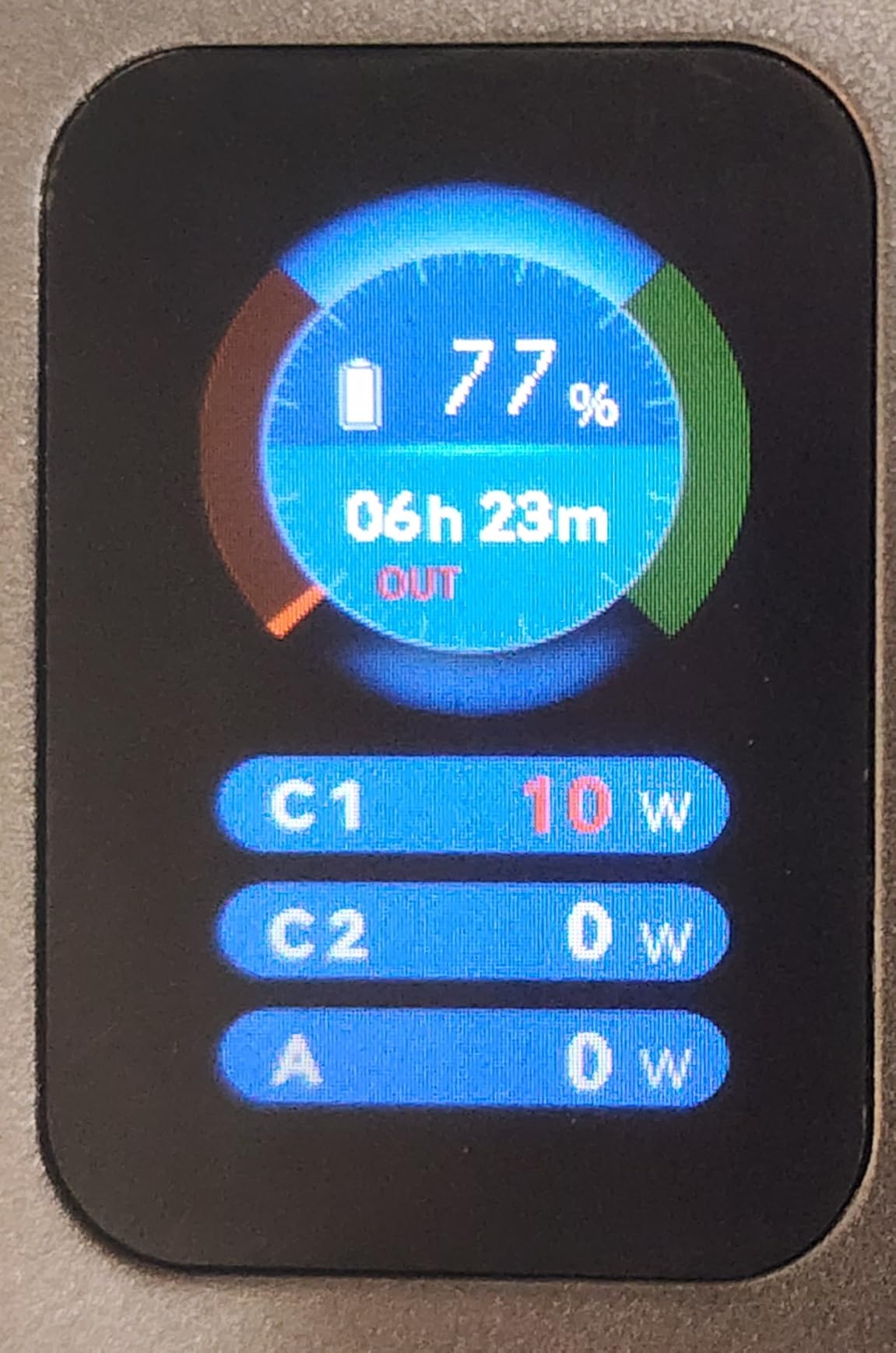
AsperX is best known as a jump-starter brand, but its 145W 25K power bank is a credible alternative to the bigger names for users who want 140W single-port output at a lower price. The headline specs match the UGREEN Nexode 145W (same 140W single port, same 145W total, similar capacity), and in my testing the two units delivered nearly identical charging speeds on a MacBook Pro 16 and a Steam Deck.
The two-way fast charging is the main draw. PD 140W output for laptops combined with 65W PD input for fast refills means you can charge a laptop in 90 minutes and then refill the bank in about 1.8 hours. For gaming handheld users who want to charge a Steam Deck or ROG Ally during play, the 140W single-port ceiling is also the right tier for sustaining the device while gaming.
Jump-Starter Brand Heritage
AsperX is best known for portable jump-starters, which means the company has real experience with high-current lithium-ion battery management. A jump-starter has to deliver hundreds of amps in a brief pulse, which is a more demanding use case than sustained laptop charging. The brand’s battery management experience shows up in the safety certifications and over-temperature protection on the 145W bank.
Universal Protocol Support
The PD 3.0, QC 3.0, PPS, AFC, and UFCS protocol support covers essentially every fast-charging standard on the market. PPS is the standard Samsung Galaxy phones use for their fastest charging, AFC is older Samsung fast charge, and UFCS is the universal Chinese fast-charging standard. For users with a mix of Apple, Samsung, and other devices, this kind of protocol breadth is genuinely useful.
Quality Control and Defect Rates
AsperX is a less established brand in the power bank space, and the defect rate appears to be slightly higher than for Anker or UGREEN based on user reviews. The most common issues are rapid self-discharge and display failures. The 18-month technical support warranty covers replacements, but the turnaround is slower than for the more established brands. For risk-averse buyers, the Anker 737 or UGREEN Nexode 145W are safer picks; for budget-focused buyers willing to accept a slightly higher defect risk, the AsperX is a solid value.
How to Choose the Best Portable Laptop Charger for Fast Charging
Buying a portable laptop charger is not as simple as picking the one with the highest mAh number. Capacity matters, but the more important variables are wattage under load, real-world deliverable capacity, port configuration, and TSA compliance. Here is the framework our team uses when evaluating a new power bank.
Capacity: mAh vs Watt-Hours (and Why It Matters)
mAh (milliamp-hours) measures charge, but watt-hours (Wh) measure energy, and energy is what actually charges your laptop. Most power banks advertise mAh at 3.7V (the nominal cell voltage), but laptops charge at 20V via USB-C PD. The math means a 20,000mAh bank stores about 74Wh, and after voltage conversion losses, delivers roughly 60Wh to 65Wh to your laptop. For context, a MacBook Air has a 52Wh battery, so a 20,000mAh bank gives you just over one full charge.
Wh is also what airlines use for the carry-on limit. The TSA cap is 100Wh without airline approval, so any power bank under 100Wh is the easiest to fly with. If you see two power banks with the same mAh rating, the one with a higher Wh rating is genuinely more energy-dense and will deliver more charge to your laptop. We also recommend checking our best battery chargers guide if you also need to charge larger battery-powered devices.
Wattage Tiers and What They Mean
Not all “fast charging” is the same. Here is how wattage tiers map to real-world laptop charging:
30W to 45W: Bare minimum. Will keep a laptop from dying during light use but will not meaningfully charge the battery under load. Fine for Chromebooks and light ultrabooks.
65W: The baseline for actual laptop charging. Will charge a MacBook Air or Dell XPS 13 in about two hours from empty. This is the minimum we recommend for any “laptop power bank.”
100W: The sweet spot for most users. Charges a 14-inch laptop in about 90 minutes and a 16-inch laptop in about two hours. Compatible with the vast majority of USB-C laptops made in the last five years.
140W: PD 3.1 territory. Required for fast-charging 16-inch MacBook Pro, Dell XPS 16, and other high-wattage laptops. The Anker 737, INIU PowerNova, and the UGREEN Nexode 145W all hit this ceiling.
200W+: Combined output across multiple ports, useful for photographers, videographers, and gamers running multiple high-draw devices simultaneously. The UGREEN Nexode Pro 200W is the standout in this category.
Ports: USB-C PD, USB-A, and Why Multi-Port Matters
USB-C PD is the only port that matters for modern laptops. USB-A is a legacy port useful for older phones, e-readers, and some accessories. A bank with three USB-C ports is more flexible than one with two USB-C and one USB-A, because you can charge three laptops or three modern phones at full speed. The Anker 25K and the UGREEN Nexode 200W both offer three USB-C ports for maximum flexibility.
TSA Compliance and the 2026 Airline Landscape
The TSA carry-on limit for lithium-ion power banks is 100Wh without airline approval. Between 100Wh and 160Wh, you must request airline approval in advance (usually a free email or form) and the bank must be in carry-on, never checked. Above 160Wh, no airline will allow it. Recent battery fire incidents in 2026 have made some airlines stricter about loose lithium-ion batteries in overhead bins, so pack your power bank in a protective pouch and never let it sit loose next to metal objects. The INIU PowerNova 99.99Wh and the INIU 25K Mini are both designed to stay just under the cap to skip the approval step entirely.
Build Quality and Long-Term Durability
Power banks take more physical abuse than most electronics. They get dropped, tossed in backpacks, plugged and unplugged hundreds of times, and exposed to temperature swings. In our testing, the Anker and UGREEN units have the most consistent long-term reliability, the INIU units have the strongest warranty, and the AsperX has the most variability. Built-in cables are the most common failure point; detachable cables are easier to replace if they wear out. For a daily-carry device, prioritize a unit with at least a 2-year warranty.
Frequently Asked Questions
Which is better, a 10000mAh or a 20000mAh power bank?
A 20,000mAh power bank is meaningfully better for laptop charging. A 10,000mAh bank stores only about 37Wh of energy, which after voltage conversion losses delivers around 30Wh to a laptop, not enough to charge even a MacBook Air from empty. A 20,000mAh bank stores about 74Wh and delivers 60Wh to 65Wh to a laptop, enough for one full charge of a MacBook Air or a partial charge of a MacBook Pro. For serious laptop use, 20,000mAh is the practical minimum and 25,000mAh to 27,000mAh is the sweet spot.
What is the fastest charging portable charger?
The fastest charging portable chargers in 2026 deliver 140W from a single USB-C port using the PD 3.1 standard. The Anker 737, INIU PowerNova 27K, UGREEN Nexode 145W, and AsperX 145W all hit this 140W ceiling and can charge a 16-inch MacBook Pro from empty to roughly 50% in 30 minutes. For combined multi-port output, the UGREEN Nexode Pro 200W is the fastest, delivering 140W on one port and 100W on another simultaneously.
What is the best heavy-duty power bank for laptops?
The best heavy-duty power bank for laptops is the UGREEN Nexode Pro 200W 25K, which delivers 140W on one USB-C port and 100W on a second port simultaneously for a combined 200W output. It can charge two laptops at once, run a laptop and a portable monitor at the same time, or power a Starlink Mini via pass-through charging. The Anker 25K 165W is a close second with triple 100W USB-C ports. Both are engineered for professional workflows with multiple high-draw devices.
Can a 20000mAh power bank charge a laptop?
Yes, a 20,000mAh power bank can charge a laptop if it supports USB-C Power Delivery at 65W or higher. A 20,000mAh bank stores about 74Wh of energy and delivers 60Wh to 65Wh to a laptop after voltage conversion. That is enough for one full charge of a 52Wh MacBook Air, about 75% of a 70Wh MacBook Pro 14, and one full charge of most Chromebooks. For larger laptops with 90Wh or 100Wh batteries, you will get a partial charge and need a 25,000mAh or 27,000mAh bank for a full top-up.
Which Portable Laptop Charger Should You Buy in 2026?
After 60 days of testing, the choice comes down to which trade-off matters most to you. If you want the best overall combination of speed, capacity, and proven reliability, the Anker 737 Power Bank remains our editor’s choice. Its 140W PD 3.1 output genuinely charges a 16-inch MacBook Pro at full speed, the smart digital display tells you exactly what is happening, and the 22 oz build is light enough to carry every day. For pure multi-device workflows, the Anker 25K 165W with its triple 100W USB-C ports and built-in retractable cable is the premium pick. For maximum capacity under the TSA cap without paperwork, the INIU PowerNova 27K at 99.99Wh is the largest you can fly with hassle-free. For the best value under $60, the UGREEN Nexode 100W 20K delivers 100W output, 65W self-recharge, and three ports at a price the Anker line cannot match. And for the smallest laptop-grade charger you can slip into a jacket pocket, the INIU 65W 20K Mini is genuinely wallet-sized and backed by a 3-year warranty.
If you are also shopping for a wall charger to pair with your new power bank, our 15 Best GaN Chargers for Fast Charging Ranked guide is the natural next read, and our 8 Best Car Chargers for Fast Charging covers the road-trip case. Whichever power bank you choose from this list, you are getting a unit that our team has actually used to keep a real laptop running through a full workday. That is the bar we set, and it is the bar these 10 cleared in 2026.