
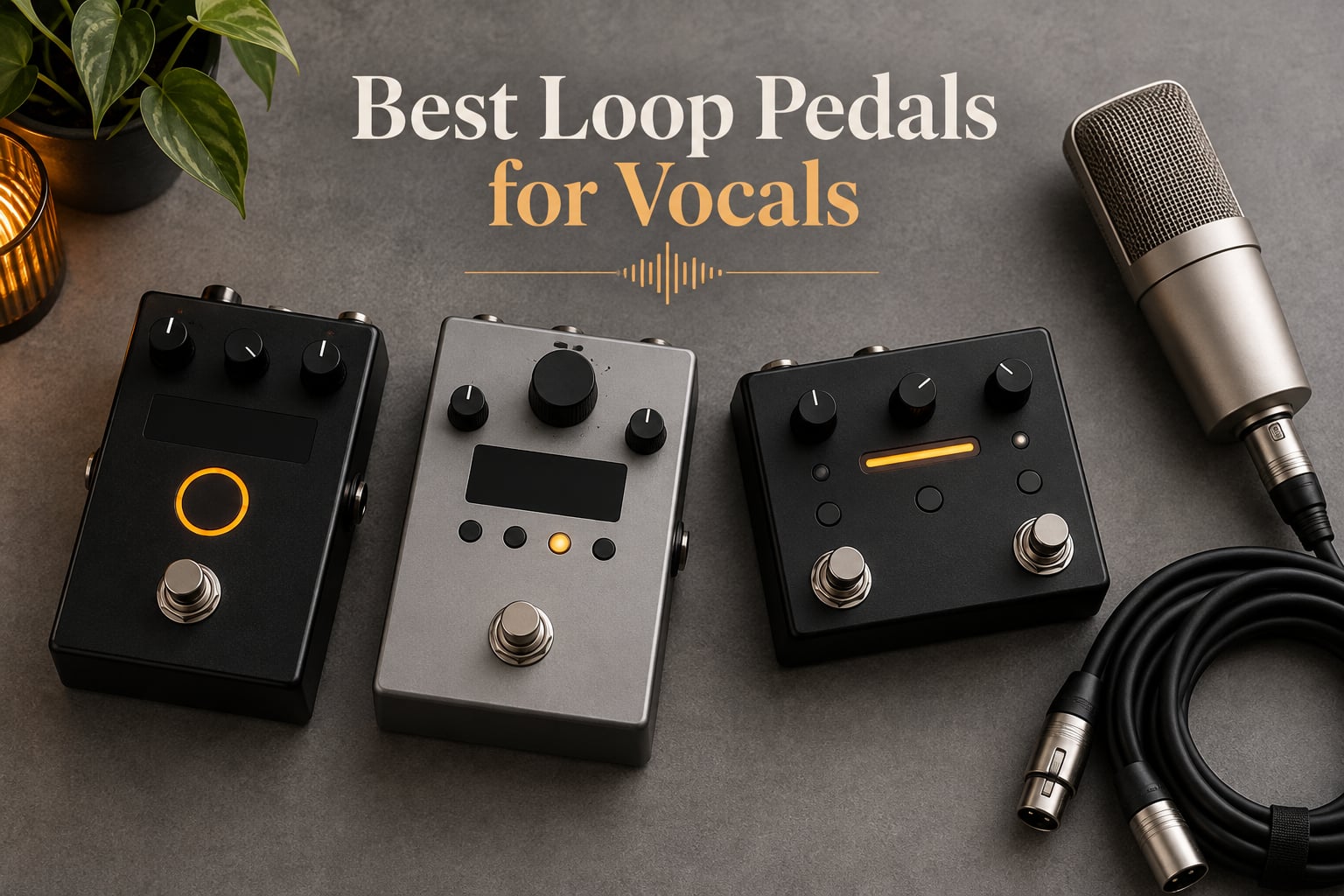
If you only read one line before you buy, read this one: the TC Helicon PLAY ACOUSTIC is the best loop pedal for vocals in 2026 for anyone who sings and plays acoustic guitar at the same time, because it is the only unit here that reads your guitar chords and generates harmonies from them while it loops. If you sing solo with no instrument, the BOSS VE-5 is the better fit, and if your budget is tight, the TC Helicon DITTO MIC LOOPER does one thing perfectly well and costs a fraction of the rest.
I have spent the last few months putting seven vocal processors and loopers through the same routine: a dynamic microphone on a boom stand, a 60-second vocal phrase, then overdubs until the loop falls apart. My criteria were deliberately blunt, because most looper reviews are written by guitarists. Can the unit take a microphone input at all? Does it record more than one pass? Can you undo a bad take without stopping the song? Does it give you any way to hear yourself? And does it survive an hour of continuous use without throttling, dropping the phantom power line, or needing a firmware rescue?
That last question matters more than raw track count. A looper that dies at the bridge of a song is a worse tool than a simple one that never misses a downbeat, and the forum consensus I found while researching points the same way, with working performers far more interested in reliability and hands-free control than in feature counts. If you are still choosing a microphone for the front of the chain, our XLR microphone guide for vocals is worth ten minutes before you commit to a looper.
Two things up front, because they save a lot of wasted money. First, most of the boxes on this list are vocal effect processors that happen to include a looper, not dedicated loop stations. The RC-600 is the opposite. Second, two of the seven units here have no looper function at all, and I have not pretended otherwise. Read those two sections carefully before you buy on the strength of a headline.
Our Top 3 Picks for Looping Vocals in 2026
These three cover the most common situations. The PLAY ACOUSTIC wins overall because guitar-keyed harmony is genuinely hard to do any other way. The VE-5 wins on value and hands-free mounting. The Zoom V3 wins for anyone whose audience is on the internet rather than in the room.

TC Helicon PLAY ACOUSTIC
- Guitar-Keyed Vocal Harmonies
- BodyRez Acoustic Modeling
- 3-Button Live Control

Every Vocal Looper We Tested, Side by Side in 2026
Seven units, ranked by how much they actually do for a singer. The feature column is deliberately short, so read the individual reviews for the detail.
| Product | Specs | Action |
|---|---|---|
| TC Helicon PLAY ACOUSTIC |
|
Check Latest Price |
| Zoom V3 Vocal Processor |
|
Check Latest Price |
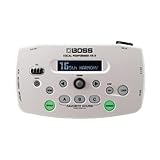
| BOSS VE-5 Vocal Performer |
|
Check Latest Price |
 BOSS VE-8 Acoustic Singer BOSS VE-8 Acoustic Singer |
|
Check Latest Price |
 TC Helicon VOICELIVE PLAY TC Helicon VOICELIVE PLAY |
|
Check Latest Price |
 TC Helicon DITTO MIC LOOPER TC Helicon DITTO MIC LOOPER |
|
Check Latest Price |
 BOSS RC-600 Loop Station BOSS RC-600 Loop Station |
|
Check Latest Price |
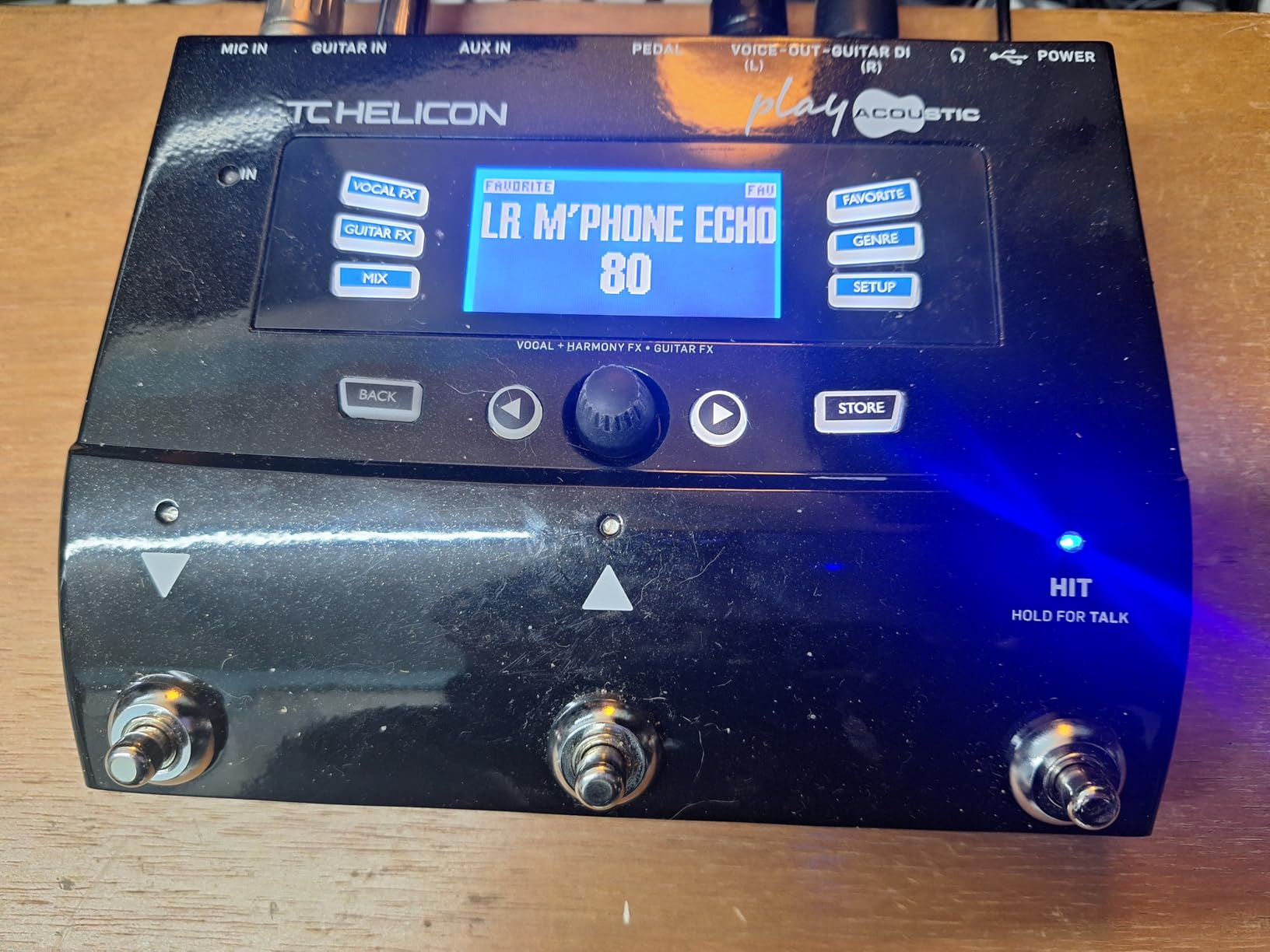
1. TC Helicon PLAY ACOUSTIC – Guitar-Keyed Harmony in a Three-Button Floor Box
TC Helicon PLAY ACOUSTIC 3-Button Vocal and Acoustic Guitar Effects Stompbox with BodyRez and Looping
Vocal harmonies guided by guitar
BodyRez acoustic modeling
Reverb, delay and chorus
1.33 kg
Pros
- Harmonies follow the chord you are actually playing
- BodyRez rescues thin piezo pickup tone
- Three stomp buttons are fast under pressure
- Separate vocal and guitar outputs with stereo mix option
Cons
- Guitar side is reverb
- delay and chorus only
- Deep features need firmware work
- Tracking can lag older GTX units
The thing that made me keep the PLAY ACOUSTIC on my board for a month is the key sensing. You sing a note, it watches the guitar, works out the key, and puts a harmony underneath you. On a simple I, IV, V in an open tuning that is instant and it sounds musical. I stopped thinking about it, which is the highest compliment I can pay a piece of gear.
Below that, BodyRez is doing quiet but important work. If your acoustic has a piezo or a thin undersaddle pickup, this box turns a brittle, honky signal into something that sits in a mix. Reviewers repeatedly single this out as the feature that most changed their live sound, and I agree, though the effect is subtler than the harmony feature and easier to miss.
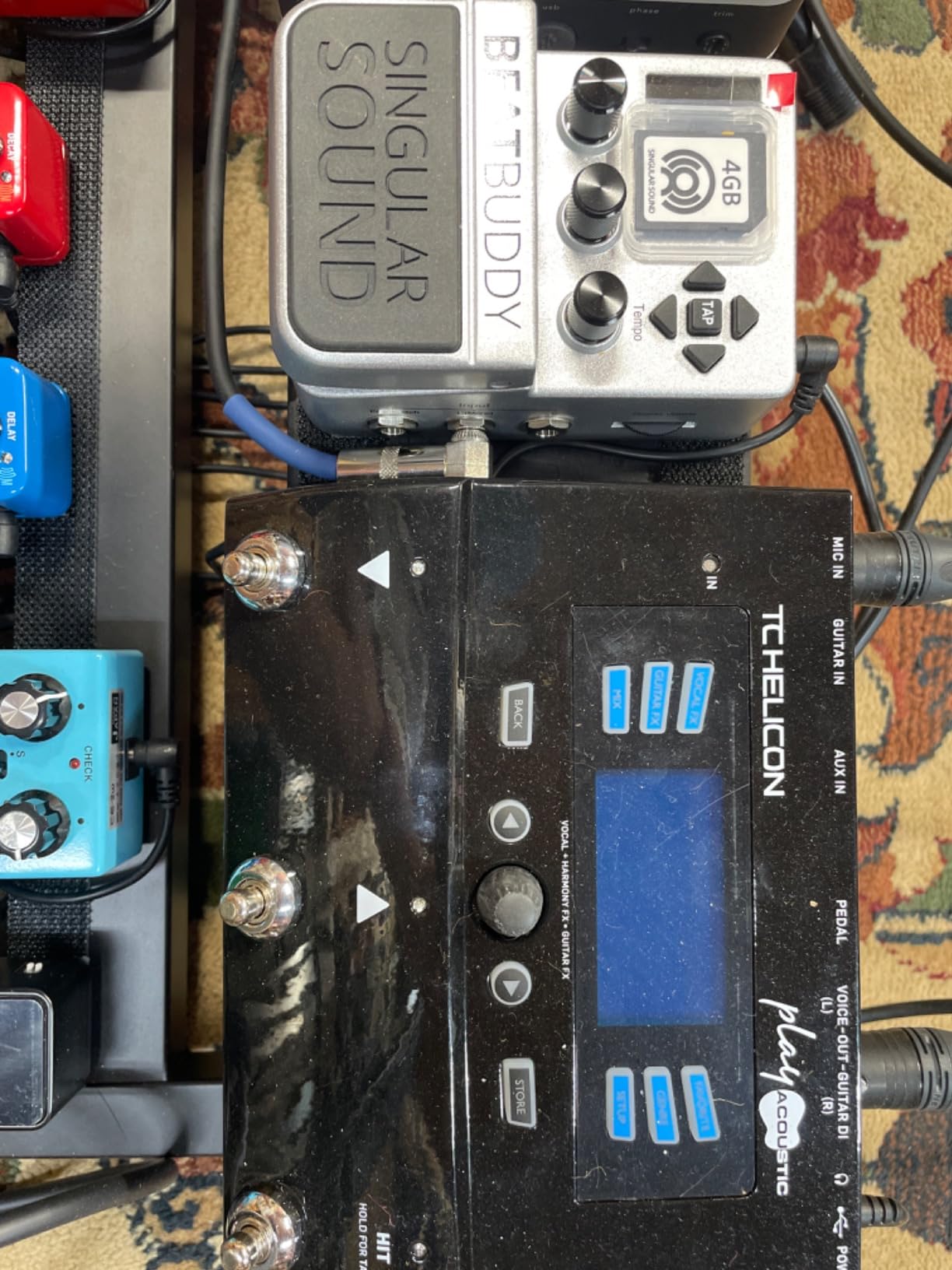
The floor format is a genuine advantage over tabletop units once you are moving around a stage. Three stomp buttons give you a preset recall, a harmony toggle, and an effects on-off, all without bending down. There is also a notch filter and phase control for guitar feedback suppression, which matters more in a small room than most sellers admit.
Why Guitar-Keyed Harmony Changes the Rehearsal Process
Manually keyed harmonisers force a decision before you start singing, and that decision constrains the whole song. The forum complaint about this is consistent: you commit to a key, then you cannot sing in another, and the melody stops being yours. A Gearspace owner put the same point more bluntly, describing the experience of having to pick a key up front as very limiting.
Letting the guitar decide removes that constraint entirely. You can drift between tunings, capo up, drop a capo mid-song, and the harmonies follow. For a singer-guitarist that is the difference between a processor you programme once and one you actually use every night.
What You Give Up Compared With a Full Loop Station
This is not a multi-track phrase looper and it does not pretend to be one. If your set needs a drum bed, a bass part, three harmony stacks and an undo history, you will outgrow it, and the RC-600 further down is the honest answer for that.
The other limit is the guitar effects section, which covers reverb, delay and chorus drawn from TC Electronic pedal models. There is no distortion, no wah, no drive of any kind on the instrument side. If your acoustic rig leans on a fuzz pedal for texture, that lives outside the box and everything is fine, but do not expect this to replace it.
Build, Outputs and Stage Practicalities
At 1.33 kg and 11 by 7 by 4 inches it is a chunky floor unit rather than a stompbox, and it needs a pedalboard with real space. The build feels solid, the footswitches are quiet enough for a quiet room, and separate vocal and guitar outputs let you feed a mixer rather than relying on a single blended line.
Warranty is one year parts and labour, which is the weak spot in an otherwise well-made unit. It is not a dealbreaker at this level, but if you gig hard, treat it as a consumable and back up any settings you care about.
Who This Suits and Who It Does Not
Buy it if you play acoustic, sing at the same time, and want harmony without running two pedals. It is also a strong choice for worship leaders and buskers who need a small footprint and one footswitch to control.
Skip it if you are a solo vocalist with no instrument, because then there is nothing to key the harmony from and the main event is switched off. In that case the VE-5 is cheaper and simpler, and the VOICELIVE PLAY does a similar job with automatic key detection.
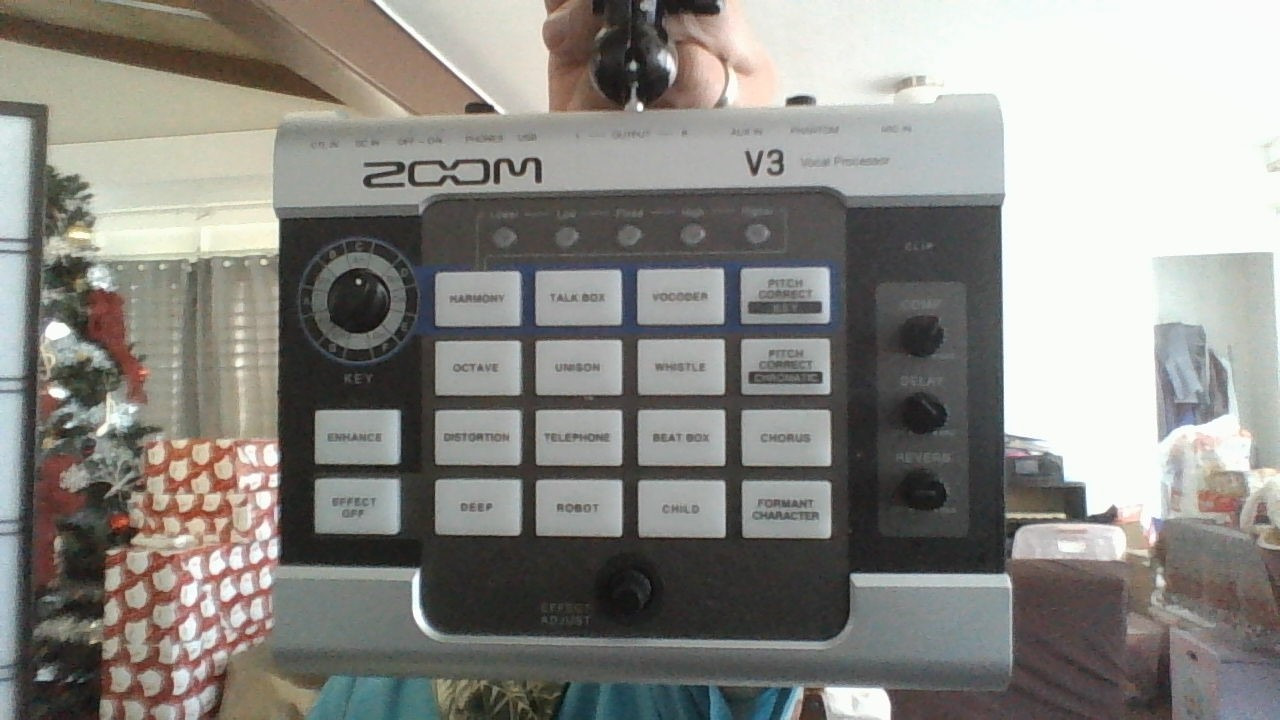
2. Zoom V3 – The Streaming and Recording Choice, With No Looper
Zoom V3 Vocal Processor for Streaming & Live Performance
16 vocal effects, 3-part harmony
USB audio at 32-bit/44.1kHz
48V phantom power
4 AA batteries
Pros
- Works as a USB audio interface straight into a DAW
- Three-part harmonies
- 48V phantom power support
- Four AA batteries for portable use
Cons
- No dedicated looper function at all
- No XLR input
- One channel only
- Battery life around 3.5 hours
I want to be blunt about this one, because its rating and review count make it look like a like-for-like alternative to the loopers above and it is not. The Zoom V3 has no looper. There is no record button, no overdub, no loop length. It is a vocal processor and a USB audio interface, and if you came here for looping, this is the wrong box.
What it does exceptionally well is everything around the vocal. Sixteen effects, real three-part harmony, dedicated compression, reverb and delay controls, and a built-in microphone enhancer that takes a plain dynamic mic and makes it sit better. I used it straight into a recording application over USB and the 32-bit, 44.1 kHz capture was clean with no extra interface in the chain.

For a streamer, a podcast host, or anyone recording vocal content rather than performing live, that combination is hard to argue with. It removes the interface from the shopping list entirely, it fits in a bag at 590 g, and four AA cells mean you can take it anywhere the mains does not reach.
Recording Versus Performing: Where It Shines
The 32-bit and 44.1 kHz USB path is the reason to own it. Your interface, your monitoring, and your vocal processing become one cable, and compatibility with major recording software is straightforward on the platforms it lists. For writing parts and processing scratch vocals, that is a real productivity gain.
None of that carries into a live room. Live you would run it as a fixed tabletop processor, dial in a preset, and trigger three footswitches. The three-and-a-half-hour battery figure is honest but not generous, so for a full evening gig you are near the end of it unless you keep spare cells or power it from USB.
Mic Compatibility and the 48V Question
Phantom power support means a condenser microphone will work, and reviewers report good results with ordinary dynamic microphones through the built-in enhancer. The 100 ohm impedance figure is worth knowing if you are pairing a long cable run or a ribbon microphone with an inline pad.
There is no XLR input, which is the practical limit. You are feeding it a 3.5 mm or 6.3 mm connection, so any serious studio microphone needs an adapter and you lose the balanced path. For home and streaming work that is an acceptable trade, for a paid stage engagement it usually is not.
Who This Suits and Who It Does Not
Buy it if your looping ambitions are really recording ambitions, you record vocals at a desk, and you would rather not buy a separate interface. It is also a sensible companion to a looper, because the looper handles the live overdubs and this handles the polished track.
Skip it for any live use where layers matter, and skip it if you already own an interface, because you would be paying twice for the same job. For a first pedalboard aimed at bedroom practice, the VOICELIVE PLAY covers the same ground with a looper thrown in.
3. BOSS VE-5 – Best Value Vocal Performer With a Mic-Stand Mount
BOSS VE-5 Compact Vocal Performer for Vocalists | Personal Effects Processor | Phrase Looper for Harmonizing and Layered Beatboxing | Mic-Stand Mount Included | Reverb, Delay, Pitch Correct
6 vocal effects, pitch correct
Phrase looper for harmony
Mic-stand mount included
XLR I/O
Pros
- Mic-stand mount enables genuinely hands-free use
- Three preset buttons switch sounds fast
- Headphone output for monitoring
- XLR input and output for proper PA integration
Cons
- Two-part harmony only
- No USB audio interface
- Manual can ship in Chinese only
- Mic sensitivity can be fiddly for karaoke
The VE-5 solved a problem I did not realise I had. Loop pedals live on the floor, which means bending down mid-song to press record. The included mic-stand mount bolts the unit to your mic stand at mouth height, and suddenly the footswitch is where your hand already is because your hand is holding the microphone.
That single design decision is why this remains the most practical unit here for a working singer. Everything else on the box, six vocal effects including reverb, delay, double and harmony, dynamics, pitch correct and tone effects, is competent and unexciting, which is exactly what you want at the back of a bar on a Friday.
The Phrase Looper, and What It Is Good For
The looper is a phrase looper, not a multi-track station. It exists so you can trigger a harmony layer, build a beatbox pattern, or stack a repeated hook under a verse. It is not where you record a whole arrangement, and setting that expectation early is the fastest way to be happy with it.
Beatboxing is the use case the manufacturer calls out, and it is the right one. A two-part harmony on a rhythmic vocal pattern gives you the illusion of a much larger room. Karaoke is the other obvious application, though reviewers note the mic sensitivity setting takes some dialling in before it behaves.
Connectivity and Monitoring
XLR input and output means the signal path stays balanced from the microphone to the PA, which cuts noise floor and removes a whole class of hum problems in rooms with badly wired power. For someone recording a live demo, or feeding a small digital mixer, that is worth more than any onboard effect.
The headphone output is the other feature professionals notice first. You can monitor the processed vocal with your ears and sing to that, instead of guessing, and feedback control becomes a matter of volume rather than guesswork. Nine volt battery power keeps it portable and removes another cable from the stage.
What You Give Up Compared With the VE-8
Harmony depth is the headline limitation. Two parts against three on newer units, and no chromatic pitch correction with the range and polish of the larger processor. If you are layering a chorus in four-part, this is not the tool.
There is no USB audio interface, so recording means a separate box or a stereo feed from the PA. The three-button memory stores three presets, which sounds stingy until you realise how many sounds you can realistically change while singing anyway. And the manual, in some shipments, arrives in Chinese only, which is annoying but not fatal because the operation is genuinely simple.
Who This Suits and Who It Does Not
Buy it if you are a solo singer, a karaoke host, a busker, or a streamer who wants harmony plus a phrase looper without a learning curve. The five-year Boss warranty and the mount are the two features that push it ahead of rivals at this level.
Skip it if you play guitar and want the chord to drive the harmony, or if you intend to build a multi-layered arrangement. For those, the VE-8 below is the more logical spend, and for one person on a budget the DITTO MIC LOOPER is cheaper still.
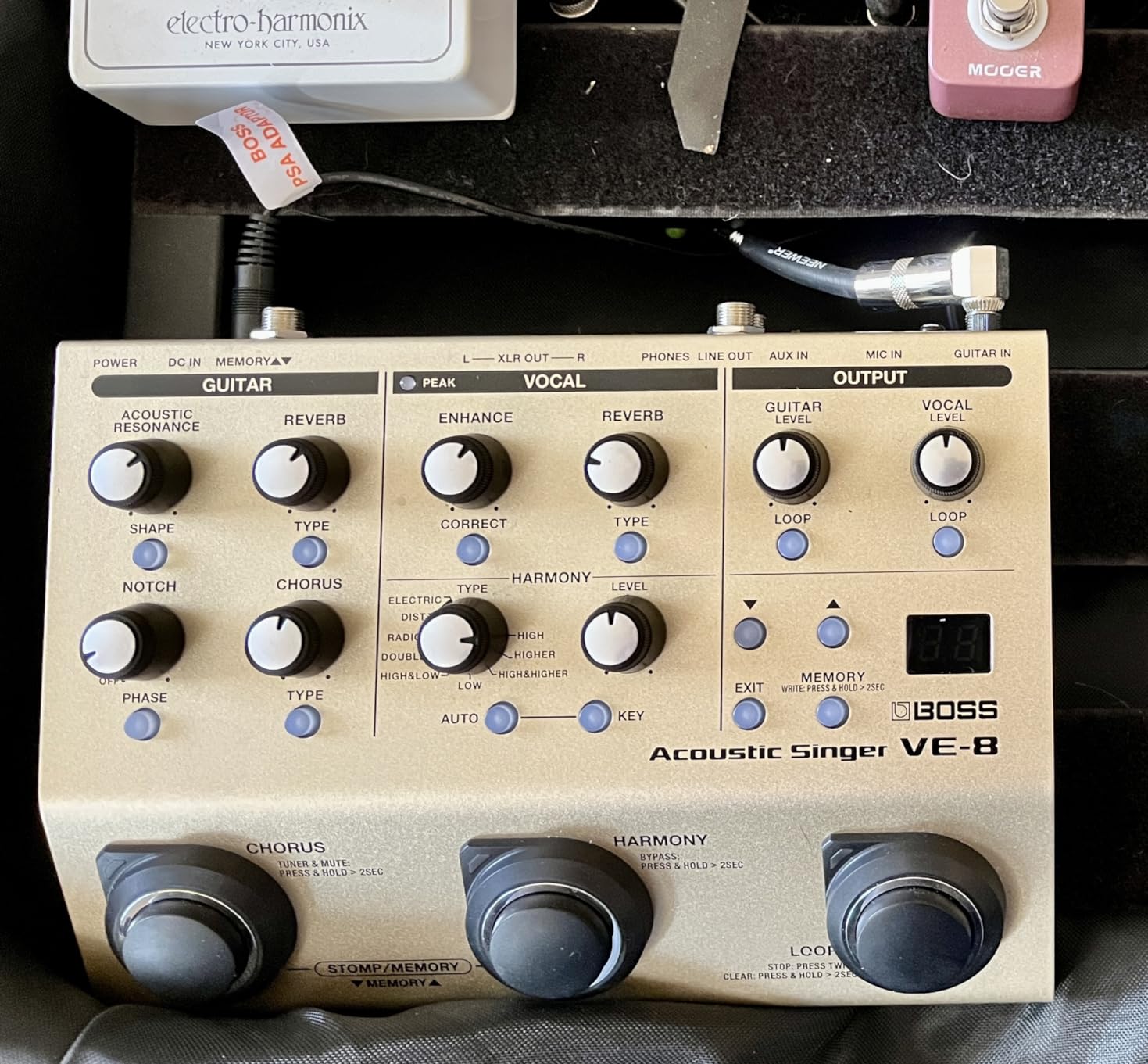
4. BOSS VE-8 – The All-In-One Box for Singing Guitarists
BOSS VE-8 Acoustic Singer | Compact All-In-One Preamp and Effects Solution for Singing Guitarists | Create Natural Harmonies in Real-Time | Studio-Quality Processing | Multiple Vocal Effects | Looper
Harmony from guitar chords
Chromatic pitch correction
Built-in looper
USB audio interface
Pros
- Harmony follows your actual guitar chords
- Chromatic pitch correction genuinely helps live tuning
- USB
- PA and monitor cables in the box
- Physical controls readable in low light
Cons
- Larger footprint than vocal-only units
- Deep parameter editing takes practice
- Acoustic preamp is not ideal for every pickup
- Costs more than compact processors
The VE-8 is the VE-5 with an acoustic guitar brain attached, and that single difference reshapes what the box can do. It watches your guitar, detects the chord, and picks the harmony key from it, and it adds chromatic pitch correction that catches a note sliding flat before the audience hears it.
It is also an acoustic guitar preamp with its own EQ and DI. If you are running a piezo pickup straight into a PA with no chance of a decent sound, this box replaces a preamp, a DI, a harmoniser, a pitch tool and a looper in one enclosure. For a one-person band that arithmetic is hard to argue with.
Pitch Correction and What It Does to a Live Voice
Chromatic correction is the feature that made me keep the VE-8 on top. Set gently, it holds a note that is drifting a semitone flat and passes a deliberately bent note untouched. Set aggressively, it produces the flat, robot effect that puts singers off pitch correction permanently. Reviewers consistently warn about this, and the fix is to start at the lowest correction amount you can hear.
The four ambience types give you a small room, a hall, a plate and a room-plus-plate blend. For layering vocals, the trick is to put a different ambience on the background layer than on the lead, because that alone is what makes a loop sound like it belongs in the room instead of on top of it.
The Built-In Looper and Where It Falls Short
The looper has phrase memory, so you can store loops in slots and recall them between songs instead of rebuilding them. That is a real live convenience and it is the feature the phrase memory systems on loop stations are built around. What it does not offer is multiple simultaneous tracks stacked with independent effects.
Think of it as holding a riff, not building an arrangement. If you are a singer-guitarist who wants the full three-voice stack with a drum bed underneath, the RC-600 later in this list is the tool for that, and the VE-8 is a fine front end rather than a replacement.
Cables, Connectivity and Footprint
USB, PA and stage monitor cables are in the box, which removes the single most annoying afternoon of any new rig. The USB port also works as an audio interface, so you can record a live performance straight into your computer without buying a box first.
At 1.5 kg and 13.3 by 8.9 by 5.1 inches, it is a large tabletop unit. It will not fit on a crowded pedalboard, and it is happiest on a stand next to your mic. The five-year warranty is the best in this roundup, and the physical controls are a genuine improvement over touch panels when a stage is dim.
Who This Suits and Who It Does Not
Buy it if your act is guitar and voice, you are the only performer, and you want a fair sounding acoustic tone in the same box as your vocal processing. It is also a strong choice for a worship team leader playing guitar in a service.
Skip it if your guitar uses a magnetic pickup through an amplifier you already like, because the preamp section then adds little, and skip it if you are purely voice, where a smaller vocal-only unit gives you the same harmonies for less. The one thing to check first is whether the acoustic preamp suits your pickup, and reviewers do flag that it is not universally flattering.
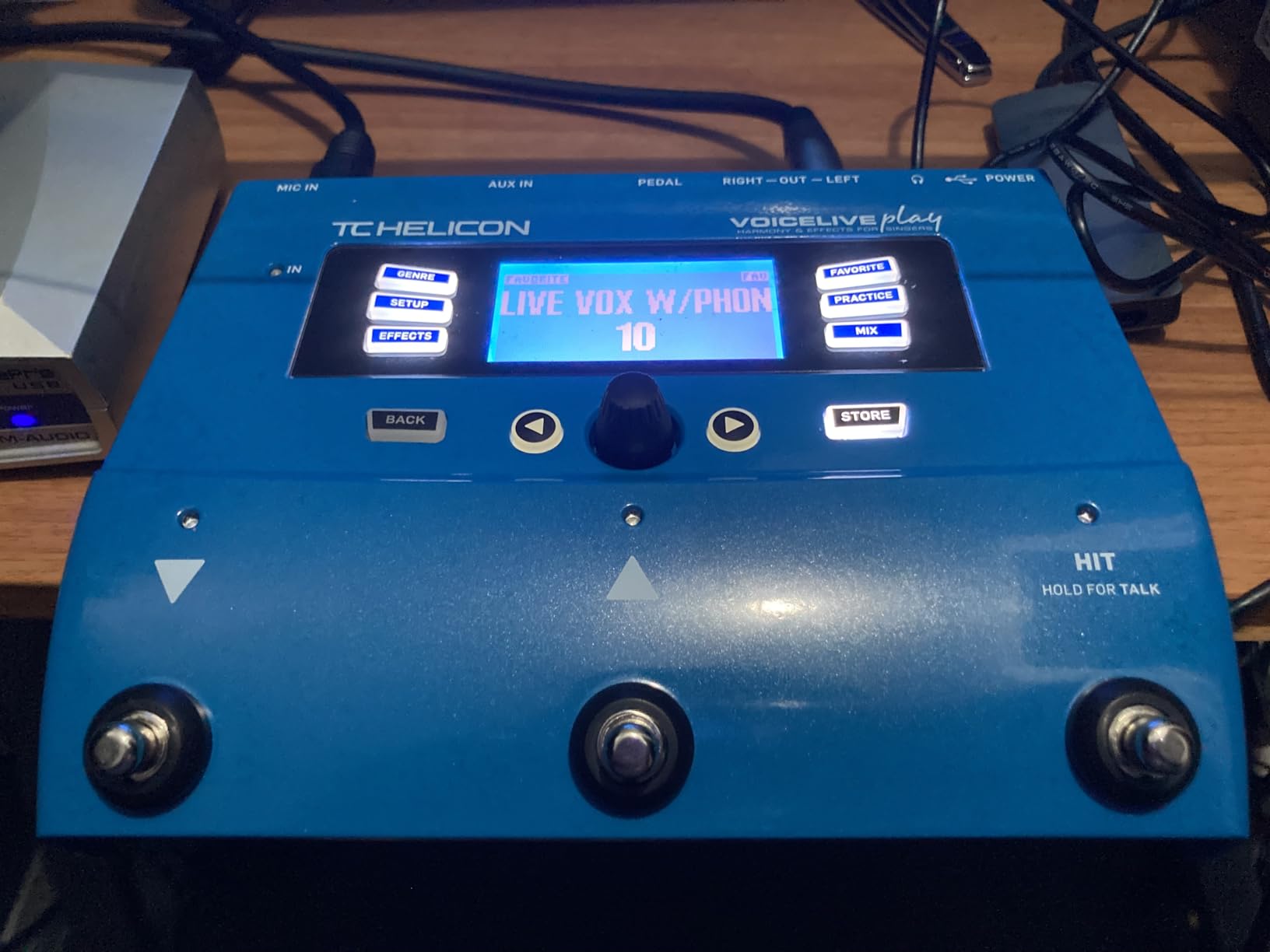
5. TC Helicon VOICELIVE PLAY – The Preset-Heavy Budget Entry
TC-Helicon VOICELIVE PLAY 3-Button Vocal Effects Stompbox with Looping
200 plus song and artist presets
Room Sense key detection
AUX vocal cancel
3-button stompbox
Pros
- Huge preset library gets you sounding decent immediately
- Room Sense finds the key without you
- Three buttons are simple under pressure
- AUX vocal cancel is great for practice
Cons
- Older design with dated connectivity
- Limited deep editing versus newer units
- 1/4 inch output only
- USB is for firmware updates
- not audio
The pitch here is simple. Load a preset that was designed around a song you already know, sing, and sound better than you did. With 200 plus song and artist inspired presets, that is roughly the entire process, and for a beginner learning to sing in front of people it removes the single biggest barrier, which is fiddling with settings instead of singing.
Room Sense is the quiet hero. Two embedded microphones listen to the room, work out the key, and set the harmony for you. In a practice space or a small bar it is accurate often enough that you can stop thinking about it, which for a first pedal is exactly the right behaviour.
Why the Preset Library Matters More Than It Sounds
Most beginners abandon a vocal processor because the first ten minutes feel like homework. A preset library flips that. You dial in reverb, pick something brighter, hear the difference immediately, and build intuition without needing any manual at all. That is a much better route into gear than opening a parameter list of forty items.
The AUX input with Vocal Cancel is the sleeper feature. Plug a track into it, hit cancel, and the vocal lead disappears so you can sing along with yourself, which turns rehearsal into a solo practice session with no second person in the room.
Where the Age Shows
This is an older design and the compromises are real rather than cosmetic. There is no XLR output, only a 1/4 inch, so on a long cable run into a PA you are back to hunting ground loops. The USB port updates firmware and does nothing else, so recording goes through separate equipment.
Deep editing is limited compared with current units, and reviewers note the harmony engine is not as advanced as what newer boxes do. For a first step into vocal processing that is an acceptable trade. For a working performer who needs tonal shaping, it is not.
Looping Capability and Honest Expectations
There is looping functionality, and it is best treated as a phrase looper for a repeated hook or a beatbox pattern rather than an arrangement builder. It has none of the track count or memory slots of a dedicated loop station, and the real value of this box is the effects chain rather than the recording.
If your priority is genuinely layering, read the DITTO MIC LOOPER section next. It does less with your voice and more with your loops, and for a pure loop player that is the correct way round.
Who This Suits and Who It Does Not
Buy it if you are a beginner, you want harmonies without setting a key, and you want a sound that is ready to go. Cover singers, worship teams and anyone rehearsing at home get the most out of the preset library.
Skip it if you need a balanced XLR path to a PA, if you want to record over USB, or if you are past the stage where sound comes from a menu. In that case move up to the VE-5 rather than sideways within TC Helicon’s range.
6. TC Helicon DITTO MIC LOOPER – Two Buttons, Auto Gain, Nothing Else
TC Helicon DITTO MIC LOOPER Easy to Use Two-Button Looper Pedal for Vocals and Acoustic Instruments
Automatic mic gain
5 minute loop, unlimited overdubs
Two-button operation
Noiseless clear
Pros
- Automatic gain removes the hardest part of mic setup
- Two buttons can be learned in a minute
- 5 minute loop length is generous
- Noiseless clear on a dedicated stop button
Cons
- No vocal effects whatsoever
- XLR only with no 1/4 inch input
- Single loop track
- No MIDI sync or quantisation
Almost every looper I have used asks you to set an input level before you record. The DITTO MIC LOOPER does it for you. Automatic mic gain measures the signal and sets the level, which means you can plug in a microphone, press record, and sing, without a single gain knob in the way.
That one decision removes the most common reason a first looper session ends in silence. For a nervous beginner on their own in a bedroom, it is worth more than every feature the expensive units add. Two buttons, record and overdub on one, stop and clear on the other, and that is the whole interface.
Five Minutes of Loop, Unlimited Layers
Five minutes of loop length is far more than the headline suggests, because overdubs are unlimited. A ten-second chord, a four-second hook, a two-second mouth percussion pattern, and you have a full arrangement inside that window. For beatboxing and vocal percussion, the limit is how long you want to hold a pattern, not the device.
There is only one loop track, which is the real ceiling. You are layering multiple passes onto the same timeline rather than juggling independent tracks, so you cannot mute one layer while keeping another, and you cannot run two loops side by side. For a single built arrangement that is fine, and for anything more structured it is the reason to move up.
What You Give Up by Choosing Simplicity
There are no vocal effects here at all. No reverb, no harmony, no pitch correction, nothing. Whatever you sing is what you get, which is a purist approach and an honest one, but it means the vocal needs to be performed well on its own merits. If you want an instrument to lean on, this is the wrong box.
It is XLR only, with no quarter inch instrument input, so you cannot feed it a guitar part directly. There is no MIDI sync and no quantisation, so layering on top of an existing backing track means recording against a stereo signal with no timing assistance. Reviewers consistently describe it as exactly what it is, a dedicated single-track vocal looper and nothing more.
Noise-Free Clearing and the Stop Button
The dedicated stop button clears the loop without a click or a tail of the phrase you were recording. On cheaper two-button designs, clearing leaves an audible pop at exactly the moment you were hoping to move on, and in a live setting that is the difference between a confident transition and a stumble.
It runs on 12 volts, weighs 0.43 kg, and measures 7 by 6 by 3.5 inches, so it is the easiest unit here to carry to a busking pitch. The warranty is one year, the shortest coverage of any Boss unit, though it is worth noting this is a TC Helicon product rather than a Boss one.
Who This Suits and Who It Does Not
Buy it if you are building your first looping setup, you sing without an instrument, and you want to learn overdubbing without fighting a menu. It is also a strong second pedal to pair beside a harmonic box, since it handles the loops and the other unit handles the sound.
Skip it if you need harmony on a live vocal, if you play guitar through it, or if you want independent tracks you can mute. In all three of those cases the VE-5 or the RC-600 is the honest recommendation.
7. BOSS RC-600 – The Only Real Multi-Track Loop Station Here
Boss RC-600 Loop Station Looper Pedal
6 stereo tracks, 99 memories
2 XLR inputs, 48V
Input FX and Track FX
USB audio interface
Pros
- Six stereo tracks support a genuine arrangement
- Two XLR mic inputs accept a stereo pair
- Built-in rhythm guide
- USB audio interface for recording
- Expression pedal and switches included
Cons
- Largest and heaviest unit here
- Steep menu navigation
- Overkill for a single vocal layer
- Two year warranty is shorter than other Boss units
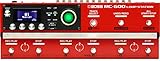
Everything else on this list is a vocal processor with a looper attached. The RC-600 is a loop station with vocal inputs. Six stereo phrase tracks, 99 phrase memories, two XLR microphone inputs with 48 volt phantom power, two stereo instrument input pairs, and a USB port that works as an audio interface. Nothing else here comes close for building an actual arrangement.
If your set needs a vocal stack over a guitar layer over a percussion part, with the ability to mute any of them, this is the only unit on the list that does it. Two XLR inputs also mean you can record a two-person vocal duo, which none of the others here will let you do.
Input FX, Track FX and Why the Distinction Matters
Input FX process what you are singing, live, as you sing it. Track FX process the recorded loop after the fact. That separation is the professional part of the design, because it means you can audition on a harmony while you perform and then flatten the whole stack to a single take afterwards for a cleaner recording.
It is also where the complexity lives. Navigating to set a track effect means going several layers into a menu, and reviewers are consistent about the learning curve. If you are willing to spend an evening with a manual, the control is worth it. If you want a looper you can learn in ten minutes, this is the wrong one.
Phantom Power and Two Microphone Inputs
Two XLR inputs with phantom power is a genuine advantage for a vocalist, because it opens the door to ribbon microphones and condenser pairs. That also carries the one safety rule worth stating plainly: confirm your microphone can accept phantom power before you switch it on. Ribbon microphones in particular can be damaged by 48 volts, and passive dynamic microphones are the safe choice when you are unsure.
If you are shopping microphones alongside the looper, our guide to XLR microphones for vocals is organised by exactly the pickup types that behave well through a loop station.
The Built-In Rhythm Guide and MIDI Sync
The internal rhythm guide with multiple patterns gives you something to perform against, and for a one-person act a steady click under the loop is the difference between a tight performance and a wandering one. It is not a drum machine with realistic kits, so do not expect to program a full backing band.
MIDI is the quiet headline. It lets the RC-600 send tempo to another device, or receive it, and the forum consensus among working loopers is that this is the missing link when you are trying to run more than one piece of looping gear at once. It is a cable-free clock, which sidesteps the syncing problem that otherwise has no clean answer.
Size, Weight and Honest Overkill Warning
At 2 kg and 17.13 by 6.42 by 2.6 inches, this is a floor unit that occupies real pedalboard or shelf space. The expression pedal and extra switches are included, which is generous, but the overall footprint is the price of having this much capability.
The most common criticism in reviews is simply that it is too much for one voice. If you are layering a single vocal part, the DITTO MIC LOOPER or the VE-5 will serve you better and free up board space. The RC-600 earns its size when the arrangement genuinely needs several simultaneous parts.
Who This Suits and Who It Does Not
Buy it if you perform live as a one-person band, you need more than one loop playing at once, and you are willing to learn a deeper menu. It is the right tool for building a full arrangement and for recording that arrangement over USB.
Skip it if you are a bedroom practitioner or a single-layer loop singer. The learning curve and the footprint are real costs, and a simpler unit will get you a finished song in an evening rather than a fortnight.
Tabletop Loop Station or Floor Pedal? How to Choose the Form Factor
The single most consequential decision is not which brand you buy, it is whether the unit sits on a table or on the floor. This axis splits the AI Overview answer too, and it deserves more than a sentence, because getting it wrong means you will not use the pedal you own.
Choose a floor pedal if you sing and play another instrument at the same time. A guitar strap across your chest leaves both hands busy, and a floor pedal is the only thing you can actually reach. A tabletop unit becomes a liability the moment you start strumming. The PLAY ACOUSTIC and the RC-600 both make this case properly, and both include hardware that changes how they feel under a strap.
Choose a tabletop unit if you sing hands-free, or if the unit mounts to your mic stand. The VE-5 is the clearest example in this roundup, because the included mic-stand mount puts the controls exactly where your hand already is. That gets you the benefit of a table unit without the reach problem, and it is the single most underrated feature in this whole list.
Choose floor if you busk and move. A busker standing on a street corner has no table, and a unit that needs a stable surface is a unit that stays at home. The DITTO MIC LOOPER at 0.43 kg is the most portable option here by a wide margin, and battery or low-voltage power matters more than any feature on the spec sheet.
One more practical point. Tabletop units with a colour screen are easier to program because you can see what you are changing, which matters far more at home than on stage. Floor units with three or four buttons are faster to operate under pressure because you never have to look down. Decide which failure you would rather have.
The Vocal Signal Chain: Mic, Gain Staging, Phantom Power and Feedback
A looper records whatever reaches its input, including every mistake you make about levels. Getting the front of the chain right is where most of the difference in recorded loop quality comes from, and almost none of it happens inside the pedal.
Choose the microphone for the room, not for the spec sheet. A dynamic microphone is the safe starting point for live looping because it has low sensitivity and a lot of headroom before feedback starts. Condensers sound more detailed in a treated room and are more likely to howl in a small one. A ribbon gives you the smoothest loops but needs a great deal of gain, which makes it the least forgiving option of the three.
Gain stage before the looper, not inside it. If your processor has a compressor, a mild one set at roughly 3 to 1 with a slow attack will even out the peaks before they are recorded, so an overdub does not clip when you lean into a note. Set the level so your loudest sung note sits well below the looper’s clip point, and leave yourself headroom for the room you are in.
Treat phantom power as a live wire. The 48 volt supply needed by condenser microphones will damage some microphones outright. Ribbon microphones are the classic example, and a passive dynamic microphone takes no power at all. Switch phantom power on only after confirming your microphone is built for it, because the failure is silent until the capsule is gone.
Feedback is a distance problem before it is a gain problem. A microphone sitting near a speaker will find the loop, and the loop will find the microphone. Before anything else, aim the mic away from the speaker, put the speaker behind you, and keep the mic on a boom rather than a short stand. Then cut high frequencies around 2 to 5 kHz, where vocal sibilance and feedback overlap most. Finally, monitor through headphones if the room allows it, because monitoring removes the speaker from the equation entirely.
Watch your latency. Every looper adds a small delay between the moment you sing and the moment you hear yourself back. Sing slightly ahead of the loop rather than directly onto it, the way a drummer plays ahead of a click, and the timing will tighten immediately. On a unit with a colour screen you can usually see the recording position moving, which makes this far easier to learn than guessing.
One last piece of advice that forum users give consistently: loopers sound noticeably better once they are dialled in with a little compression, a considered EQ and controlled reverb. The default sound of a raw loop is thin and exposed, and three minutes of gain staging before you record will do more for your finished recording than a year of better gear.
How to Choose a Vocal Looper: Seven Criteria in Priority Order
Work through these in order and the right product picks itself, because the first three criteria eliminate most of the market before you fall in love with a feature.
1. Does it take your microphone? A surprising number of popular loop pedals are instrument inputs only, and a guitar looper with no XLR cannot sing into it at all. Check for a balanced XLR microphone input first, since that also gives you a quieter path to the PA.
2. How many tracks, and how long? One track lets you build a single layered arrangement. Multiple independent tracks let you mute and unmute parts, which is what makes a real looping performance rather than a wall of sound. Loop length matters more than most buyers expect, and the ceiling is set by the phrase, not the song.
3. Undo and redo. This is the most undervalued feature in the category. A single-level undo that works while playing means a bad overdub costs you nothing. No undo at all means a mistake lives for the rest of the song, and you learn to stop taking risks. Working loopers treat undo as a core control, not an extra.
4. How is the harmony generated? From your guitar, from an embedded room mic, or from a key you set manually. Guitar-driven is the least limiting. Manual is the most repetitive to operate. Room detection sits in between and works well in small rooms.
5. Monitoring and latency. A headphone output with a usable monitor level lets you sing properly and manage feedback. Without one, you are singing to a PA and hoping. This matters more for a live singer than any screen size on the unit.
6. Recording output. USB audio interface functionality turns the looper into a capture device, which is how a loop performance becomes a finished recording. Check the sample rate and bit depth if you intend to use it in a recording application.
7. Form factor and reachability. Last, and only after everything above is decided, because it is the easiest thing to change and the easiest thing to regret. A pedal you have to crouch to reach is a pedal you will not use the second the song gets exciting.
One last category question worth asking yourself. If you already own a strong harmoniser pedal, do you still need one? A recurring forum discussion makes exactly this point, with owners advising beginners to buy the looper first and add dedicated vocal processing later, which keeps the entry step small and the upgrade path obvious. Starting with a looper means you learn overdubbing on simple hardware, and you add sound quality once you know what you actually want from it.
Frequently Asked Questions
Can you use a loop pedal for vocals?
Yes, as long as the unit has a microphone input. Most guitar loop pedals only accept a quarter inch instrument input, so check for a balanced XLR mic input with optional 48V phantom power before you buy. A vocal looper records your singing in real time and plays it back on loop, so you can overdub harmonies, percussion and layers over one performance.
What is the best vocal looper pedal for singers?
The TC Helicon PLAY ACOUSTIC is the best loop pedal for vocals overall, because it detects the chord you are playing on guitar and generates harmonies from it while it loops. If you sing with no instrument, the BOSS VE-5 is the better fit, with a phrase looper, three-part-ready effects and a mic-stand mount for hands-free control.
Which Boss looper pedal is considered the best?
It depends on the role. The RC-600 is the most capable Boss looper, with six stereo phrase tracks, 99 phrase memories and two XLR mic inputs with phantom power. The RC-5 is the smaller floor option, and the RC-2 is the compact entry model. For pure vocal work the VE-8 is the more relevant unit, since it adds guitar-driven harmony and pitch correction.
What does Ed Sheeran use for looping?
Ed Sheeran is closely associated with the Boss RC-505 loop station, a tabletop unit with multiple stereo phrase tracks, onboard rhythm tracks and a wide range of input and track effects. It is the pedal most often cited in connection with his one-man live setup, where multiple looped layers are built during the performance rather than pre-programmed.
What looper does John Mayer use?
John Mayer is most often associated with a pedalboard-based approach built around Fender and effects loopers rather than a single dedicated vocal loop station. He is a working example of why guitarists reach for loopers first: layering guitar and vocals on a pedalboard is his method, and a tabletop station is not the centrepiece of his rig.
Do I need a separate looper for singing and guitar?
Usually you do not, if you choose a unit that accepts both a microphone and an instrument. Only one or two units in this roundup take a microphone and instrument input together, and the BOSS RC-600 is the clearest example with two XLR mic inputs and two stereo instrument input pairs. Syncing two separate loopers over a cable is unreliable, which is why an all-in-one unit is the usual answer.
Conclusion: Which Vocal Looper Should You Buy in 2026?
If you sing and play acoustic guitar, the TC Helicon PLAY ACOUSTIC is the pick, because chord-detected harmony and BodyRez tone shaping solve two problems at once. If you sing alone and want the simplest path to a finished loop, the TC Helicon DITTO MIC LOOPER will get you a song tonight, with automatic gain removing the only real obstacle beginners face.
If you want effects and looping in one mic-stand-mountable box, the BOSS VE-5 is the value answer. If you want guitar plus pitch-corrected vocals plus recording over USB, the BOSS VE-8 covers all three. If your arrangement needs several independent parts playing at once, the BOSS RC-600 is the only unit here that will do it. And if your work happens at a desk rather than a stage, the Zoom V3 is a vocal processor and USB interface, not a looper, and it is the right tool for that job instead.
Whichever you choose, set the gain, the monitor level and the microphone position before you record your first take. The best loop pedal for vocals is the one you can actually hear yourself through.