
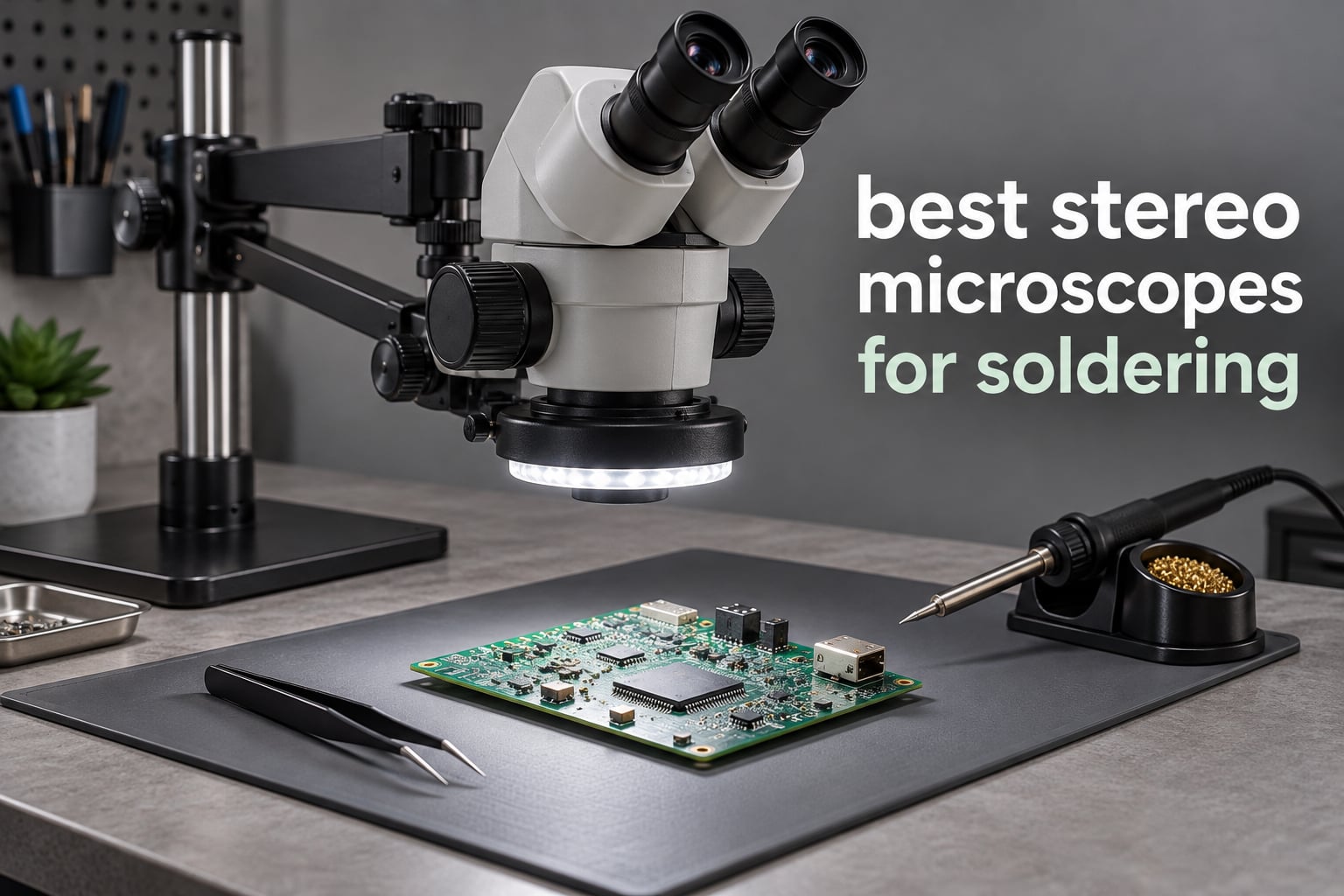
Choosing the best stereo microscopes for soldering is not about chasing the biggest magnification number on a listing. It is about putting a real three-dimensional image in front of your eyes while both hands stay free, with enough clearance underneath for a soldering iron, a hot air nozzle and a pair of tweezers. My team has spent the last few months putting eight optical stereo scopes through PCB rework, QFN pad alignment and 0402 placement to find out which ones actually earn a permanent spot on a crowded bench.
All eight picks below are true optical binocular or trinocular microscopes. We excluded the flood of digital USB and HDMI camera scopes on purpose. They are useful for filming, and reviewers on r/PCB and r/soldering repeatedly report that flat two-dimensional video with a little lag makes delicate hand-guided work harder rather than easier.
The number that matters more than any spec on the box is working distance, measured from the front of the objective to your board. Get that wrong and your iron tip physically collides with the lens housing. The other number that gets misread constantly is magnification: a scope claiming 1000x is almost always interpolating a digital image, while the honest optical ceiling for soldering work sits around 45x.
What Is a Stereo Soldering Microscope?
A stereo soldering microscope is an optical binocular or trinocular microscope that sends two slightly different light paths to your left and right eye, so your brain fuses them into a true 3D image of the board with zero video lag. A ring or directional LED lights the work, a 0.7x-4.5x zoom objective paired with 10x eyepieces gives roughly 7x-45x, and you judge solder joint depth, lead alignment and wetting in real time while your hands work.
Here is the arithmetic that trips people up. A 0.7x objective with 10x eyepieces gives 7x. Crank the objective to 4.5x and you get 45x. Drop a 0.5x Barlow lens in front and that 45x becomes 22.5x, and the working distance roughly doubles. That combination is why the enthusiast recommendation on eevblog and r/soldering keeps landing on the same spec: a 0.7x-4.5x body with 10x eyepieces and a 0.5x reducer, because the useful working range while an iron is in your hand is roughly 5x to 20x, not 45x.
Our Top 3 Picks for Soldering Benches in 2026
The three below stood out for optical clarity, usable working distance and how little they get in the way of a hot air gun. Each one keeps real stereo vision while you work, which is the whole point of this list.

Comparing the Best Stereo Microscopes for Soldering in 2026
All eight scopes below are complete systems with a head, a stand and built-in illumination. Two of them omit a 0.5x Barlow or a ring light from the box, and we call that out in each review because missing accessories are a recurring source of buyer regret in this category.
| Product | Specs | Action |
|---|---|---|
| AmScope SE306R-PZ |
|
Check Latest Price |
 SWIFT S41-20 SWIFT S41-20 |
|
Check Latest Price |
 AmScope SM-4NTP AmScope SM-4NTP |
|
Check Latest Price |
 DZQ ZQ-1 DZQ ZQ-1 |
|
Check Latest Price |
 AmScope SE508 AmScope SE508 |
|
Check Latest Price |
 SWIFT Trinocular S7 SWIFT Trinocular S7 |
|
Check Latest Price |
 ZTEEERS ZS-07050 ZTEEERS ZS-07050 |
|
Check Latest Price |
 SWIFT S306S-20-2L SWIFT S306S-20-2L |
|
Check Latest Price |
1. AmScope SE306R-PZ – The All-Rounder With the Deepest Owner History
AmScope SE306R-PZ Forward Binocular Stereo Microscope, WF10x and WF20x
20X-40X-80X stereo steps
WF10x and WF20x eyepieces
All metal pillar stand
Top and bottom halogen
Pros
- Sharp distortion-free image with no noticeable chromatic aberration
- Heavy all metal frame that resists sliding or tipping
- Forward head keeps hands under the objective
- Switches between top and bottom light
- 5 year manufacturer warranty
Cons
- Halogen bulbs run hot and the housing gets warm to graze
- Narrow field of view at the higher eyepiece powers
- No continuous zoom
- No eye cups
This is the scope I put on my own bench first, and after a season of through-hole rework, connector work and the occasional 0805 placement it has stayed there. The optical quality is genuinely good for a pillar-stand unit: the image is flat edge to edge and free of the colour fringing that cheaper glass gives you, and the depth perception is immediate. That third dimension is what makes drag soldering on a through-hole row feel controlled instead of lucky.
The forward-mounted binocular head is the feature I did not expect to care about as much as I do. Because the eyepieces sit in front of the objective rather than above it, your hands and iron come in from underneath the lens instead of around it. At 13.6 by 11 by 6.6 inches there is not a lot of room to work around, so that orientation quietly makes every job easier.

Halogen Lighting Is the One Weak Spot
The built-in illumination runs a top incident light and a bottom transmitted light, and switching between them is genuinely useful for inspecting a solder bridge from underneath the board. The problem is the source. Halogen elements throw a warmer, slightly harsher light than modern LEDs, and buyers report that the bulb housing gets hot enough to graze your knuckles when you swing the head in close.
Several owners have replaced the dim halogen elements with LED inserts and report a cleaner, cooler image. Treat the lighting as serviceable rather than a dealbreaker, but do not park a hot halogen housing against your wrist during long sessions.
20X, 40X and 80X Without a Zoom Ring
Magnification steps through 20X, 40X and 80X by swapping between the WF10x and WF20x eyepieces and the 2x and 4x objectives. That is a real limitation rather than a nitpick, because discrete steps mean you cannot settle at 30x when a joint sits awkwardly at the edge of the 40x field. You choose the step below and live with a tighter view of more of the board than you need.
At the higher eyepiece power the field of view narrows noticeably and the depth of field gets tight, so the top of a tall component can fall out of focus while its pads stay sharp. For 0402 and larger work, 20X is the sweet spot and the image is excellent there. At 80X you will spend more time refocusing than inspecting.
Who the SE306R-PZ Suits
This is the one to buy if you do through-hole, leaded and connector work, want a single dependable instrument, and want a large body of long-term owner history to lean on. With 319 ratings averaging 4.5 stars and a 5 year manufacturer warranty, it is the natural first choice for anyone mixing through-hole and SMD work on one bench.
Skip it if you work 0201 parts or fine-pitch leadless packages daily, where you will want continuous zoom and a real 0.5x reduction, or if you need to record your work. The forward pillar format is compact, not flexible, so large or awkward assemblies are not its strength.

2. SWIFT S41-20 – Best Dedicated Scope for PCB Assembly Work
Swift S41-20 Professional Dissecting Binocular Stereo Microscope, WF10x WF20x Eyepieces, 10X 20X Magnification, 1X Objective, LED Lighting, Boom-Arm Stand
10X-20X stereo magnification
Dual goose-neck LED lights
12 inch swinging boom arm
45 degree binocular head
Pros
- Two independently aimable goose-neck LED lights with high output
- Heavy metal base and cast optical head feel industrial
- Swinging boom arm frees both hands
- Flat distortion-free field for surface mount assembly
- Accepts a USB camera sold separately
Cons
- No continuous zoom at all
- 10X eyepieces give a narrow field
- No brightness adjustment on the LEDs
- Base can tip when the arm swings fully out
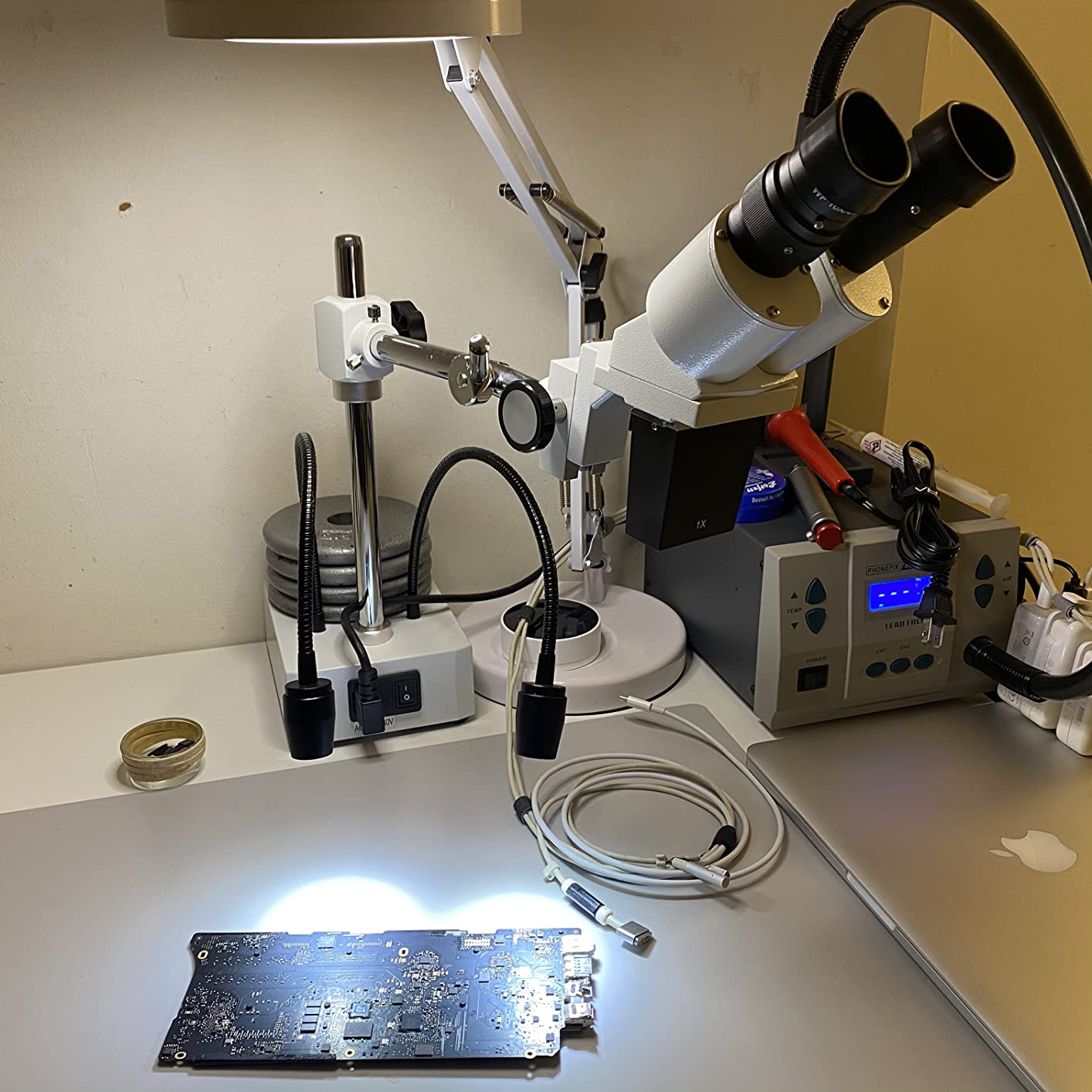
Two goose-neck LED illuminators emerging from a heavy metal base is a design that ages well, and it is why this scope comes up often in micro-soldering recommendations. Because the two light sources aim independently, you can rake one across a shiny solder fillet to reveal a texture that a flat ring light washes out, then swing the second in to fill the shadow. That control matters more than raw brightness on reflective joints.
The 12 inch swinging boom arm is the other reason assembly work feels good here. You pull the head out of the way to load a board, then let it back over the work, and roughly nine inches of clearance opens up underneath. The 45 degree head angle keeps your neck closer to neutral than a flat top-down posture, which is a quiet win across a full afternoon of rework.
Fixed 10X and 20X Means Choosing Eyepieces, Not Magnification
There is no zoom objective in this head. You get 10X or 20X by swapping eyepieces, and several owners have gone further and fitted 5X wide-field eyepieces because the 10X field feels cramped when you are used to scanning a whole connector block. At 5X you can orient yourself on the board quickly, then switch up to 10X or 20X for the joint itself.
That is a workable system, but it is a system rather than a continuum. Anyone whose work involves many package sizes in one sitting will find the constant eyepiece swapping tiresome, and some owners return this scope purely because they wanted variable magnification.
Boom Clearance, Base Balance and Bench Footprint
Two goose-necks plus an arm make this a tall, wide arrangement at 15 by 8 by 16 inches and 5.5 kg. On a proper bench that is fine. On a small desk it stands out immediately, and users working in tight spaces on r/soldering often wish they had picked a compact pillar scope instead.
The base is heavy and the head is cast metal with heavy-duty locking rings, which gives the whole thing an industrial feel. It is not perfectly balanced though, and owners report it can tip when the arm swings fully out with a board on the stage. Load the workpiece before you extend the arm rather than after.
Who Should Buy the S41-20
Pick this one if you are doing continuous PCB assembly, phone or laptop board work where the job is mostly surface mount, and you want the flexibility of a movable head with strong directional lighting. Users report using it for logic board work in particular, and the ability to bolt a USB camera on later means you can start recording without replacing the scope.
Pass on it if your workload is dominated by very small parts where you need to zoom smoothly between overview and detail, or if you wear single-vision or bifocal glasses and need per-eye diopter rings. The included eyepieces use set screws and only one pair of rubber eye cups is supplied, so comfort is a fair question to ask the seller.
3. AmScope SM-4NTP – Premium Simul-Focal Zoom for Serious Daily Rework
AmScope SM-4NTP 45X Simul-Focal Stereo Lockable Zoom Microscope on Dual
7X-45X simul-focal zoom
4 inch working distance
3D boom stand
Simultaneous camera view
Pros
- Simul-focal design keeps eyepiece and camera views live together
- Continuous 7X-45X zoom with useful 22.5X via the 0.5X Barlow
- Counter-balanced boom arm gives long reach and swings clear
- Very solid base with smooth pan tilt and focus
- 5 year manufacturer warranty
Cons
- Barlow lens and LED ring light sold separately
- Out of the box zoom is too strong for SMD work
- Instruction manual does not match the model
- Set-screw height stem can dent over time
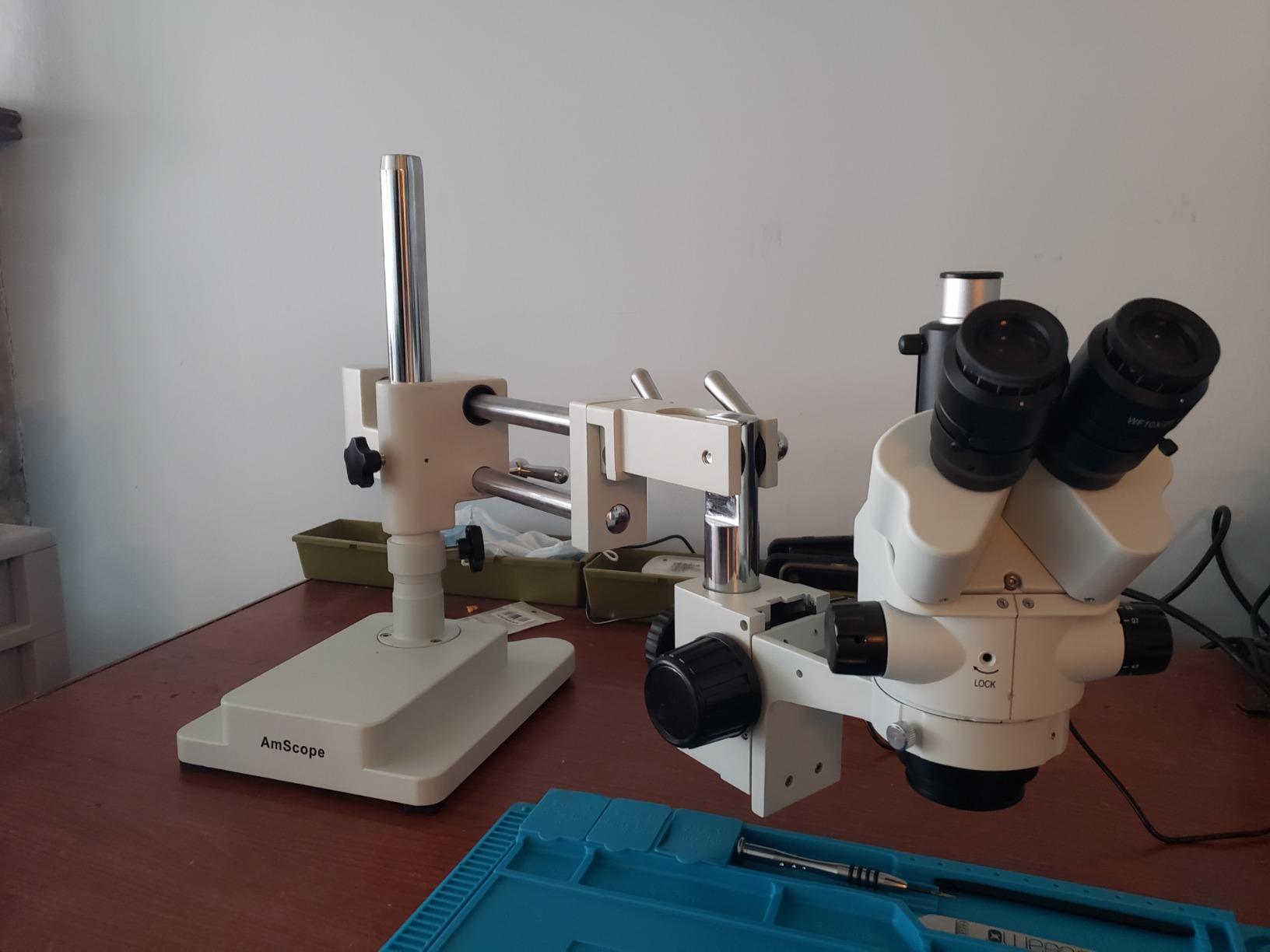
Owners describe this as the instrument that changed how their bench works, and the simul-focal design is the headline: a trinocular port and the two eyepieces stay live at the same time, so you keep full stereo vision through the eyepieces while a camera records everything you do. For phone mainboard work or a repair business where you need before and after documentation, keeping both views live is what separates this from a switchover trinocular.
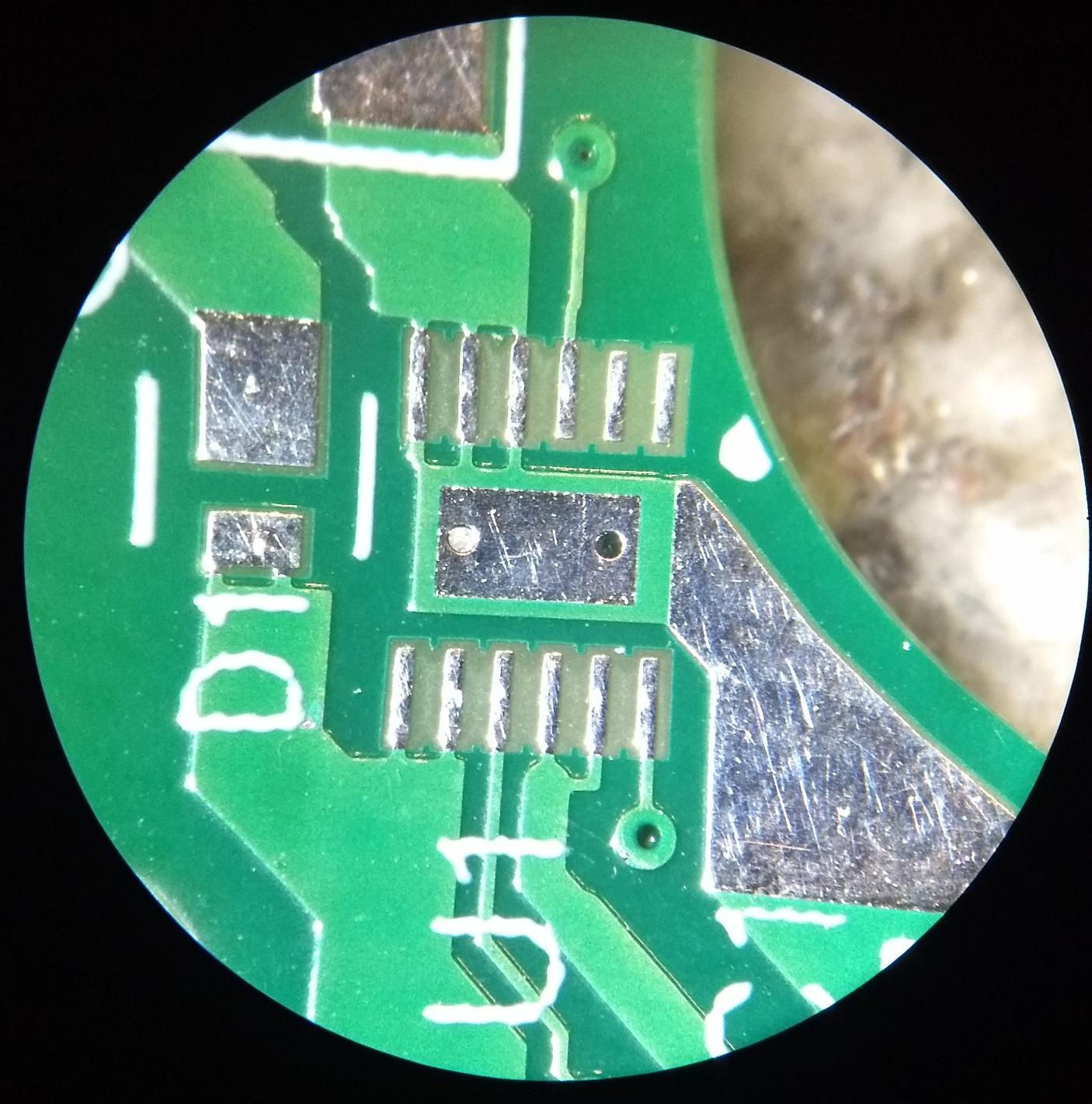
Optical clarity is the other reason it lands here. The 0.7x-4.5x zoom objective combined with super wide field optics resolves defects that a 5X lighted magnifier simply cannot show, and the 4 inch working distance gives genuine room to bring an iron tip in from the side without touching the objective housing.
Simul-Focal Versus a Dedicated Trinocular Port
Plenty of trinocular scopes send light to the camera port or the eyepieces, but not both, and the moment you look through the camera you lose the 3D image. Simul-focal splits the light so both paths stay active, which is exactly what the eevblog crowd recommends for anyone soldering beyond the occasional joint. You glance up at the screen without lifting your focus, and you can film a whole session while working in stereo the entire time.
That is the difference between this and the dedicated-port scopes further down. It is also why a camera is not included. You add a C-mount or USB microscope camera yourself, and you add the ring light, and both are sold separately.
Working Distance and the Barlow Question
Out of the box, this scope is simply too strong for SMD work. Owners report that the minimum zoom setting is already uncomfortable for placing a small part, and the answer is the 0.5x Barlow lens, which they routinely add. That drops the top of the range to 22.5x and roughly doubles your working distance, which is precisely the working band most people solder in.
Budget for the extra lens. Skipping it is how people end up disappointed with a scope that is otherwise excellent. The 1-1/4 inch super wide field of view is a genuine bonus at the lower magnifications, giving you context around the joint instead of a tiny postage stamp.
The Reality of a 3D Boom Stand
At 25.38 kg and 22 by 20 by 21 inches, this is a serious instrument, not a desktop accessory. The counter-balanced 3D boom arm rotates the head through any direction and swings clear of the bench when you are not using it, which is what makes a heavy unit this size workable on a crowded desk.
Two smaller frictions are worth knowing. The rear height stem uses simple set-screw mechanics that can dent over time if you overtighten them, and the manual that shipped with our unit did not match the model and contained translation errors. AmScope customer support is praised for replacing a mismatched head, but read the manual carefully rather than trusting it.
Who Should Buy the SM-4NTP
This is the pick for someone soldering every day, doing fine-pitch and leadless work, or running a repair bench where recorded documentation matters. If you already own a decent boom stand and a ring light, this head is the upgrade that changes your workflow rather than a starting point.
It is not the choice for a hobbyist who solder twice a month, or for anyone on a small desk with no room for a 3D boom. And if you buy it, buy the 0.5x Barlow in the same order.
4. DZQ ZQ-1 – Best Value Zoom With the Working Distance Already Built In
DZQ ZQ-1 Multi-Directional Microscope 7X-45X Magnification 0.5X Barlow Lens
7X-45X continuous zoom
95-300mm working distance
Dimmable 60-LED ring
0.5X Barlow lens included
Pros
- Wide 7X-45X zoom with generous clearance for hand tools
- Dimmable 60-LED ring light gives even illumination
- Spring bracket repositions the head quickly
- Adjustable headrest and smooth focus reduce fatigue
- Barlow lens supplied in the box
Cons
- Bulky footprint takes more bench space than a pillar stand
- Binocular only with no trinocular port for a camera
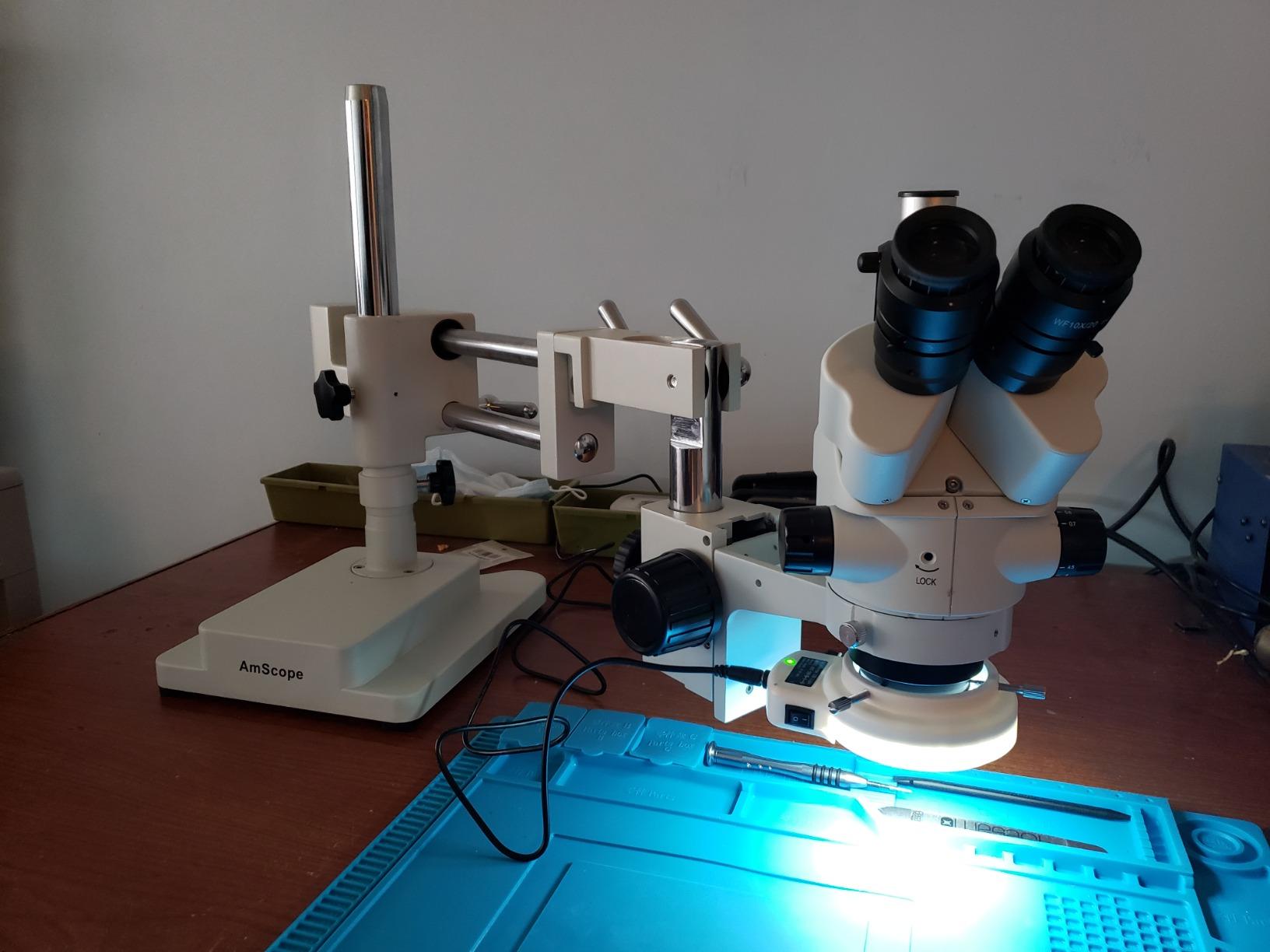
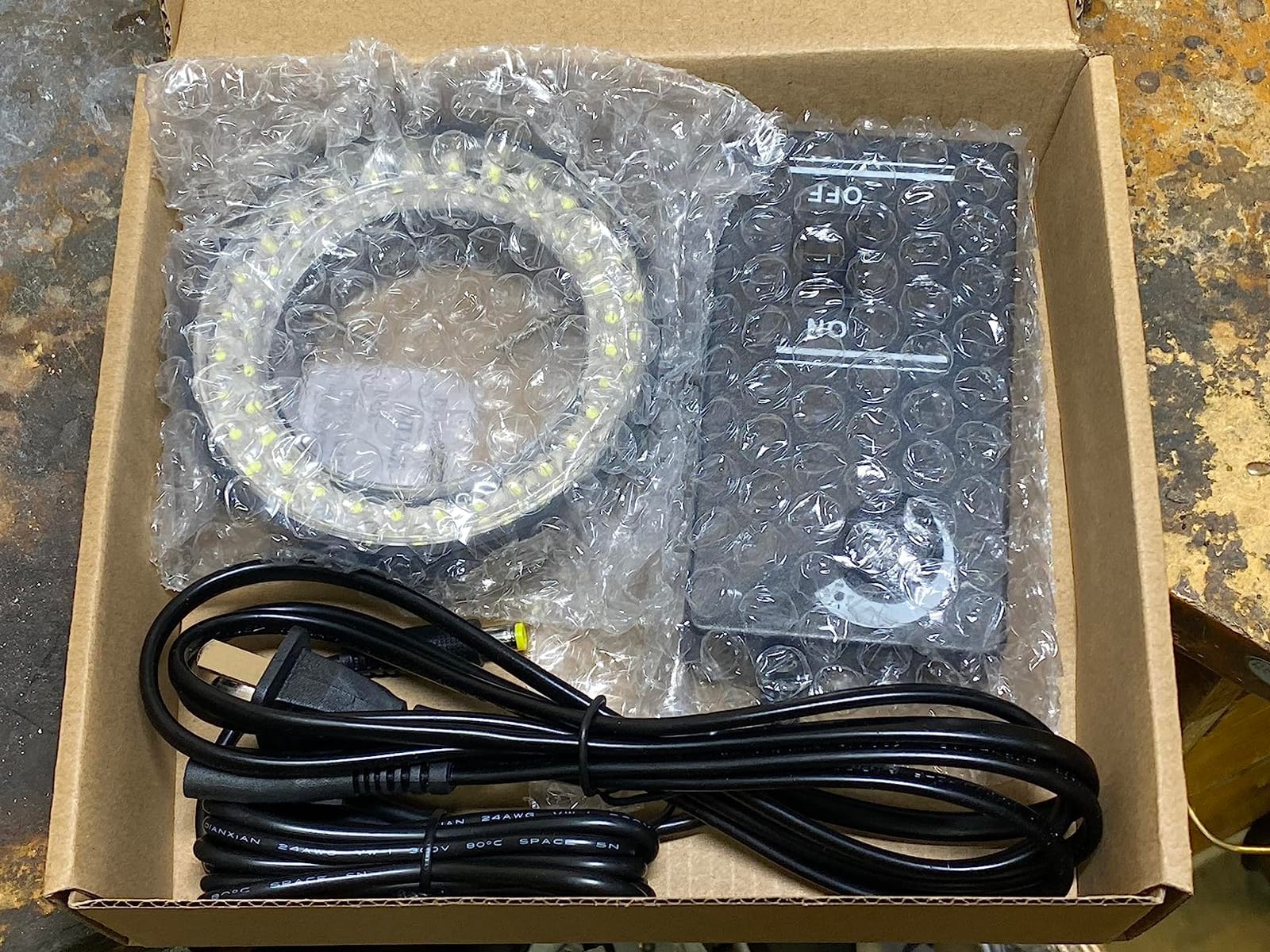
This is the scope that changed my mind about buying a complete zoom system rather than assembling one from parts. The 0.5x Barlow lens is in the box and the dimmable 60-LED ring light is built in, so nothing is missing and the scope works the day it arrives instead of after a week of hunting down accessories.
That completeness is exactly what the buying guide sections of competitor roundups skip. The same head often appears at a much higher total once you add a stand, a base and a light, and buyers regularly report that the accessories can cost as much as the scope itself. This one sidesteps the entire trap.
Working Distance Tied to Tool Clearance
Across its 95-300mm specified range, that clearance is the number that tells you whether your tools fit. A hot air nozzle, a pair of tweezers and an iron tip all need to come in under the objective without touching it, and scopes with 4 inch or 100mm clearance leave you a workable margin rather than a knife edge.
Here is the rule of thumb we use when mapping components to magnification. 0201 and 0402 parts want roughly 20x-30x. SOIC and TSSOP fine pitch work sits comfortably at 10x-20x. QFN pad alignment and BGA inspection push you toward 30x-45x, and that is exactly where the 0.5x Barlow earns its place, because at 22.5x you get most of that resolution with twice the room under the lens.
Dimmable Ring Light and What It Does to Shiny Joints
A 60-LED ring around the objective gives even, near shadow-free illumination, and having it dimmable is not a gimmick. Solder is specular: at full brightness a fresh fillet becomes a white blob, and dimming the ring lets you pick out the fillet boundary and judge whether the joint has actually wetted the pad. The dimmer runs from 0-100 percent, so you can stop down the output without unplugging anything.
The lens-mounting uses metal screws rather than plastic, which matters on a unit that gets adjusted constantly. Glare and hot spots are the usual complaints about lighting on entry-level scopes, and a ring of this size is the antidote.
Ergonomics Over a Long Afternoon
The spring-mounted support and adjustable headrest are unusual at this level, and they earn their place. A spring bracket lets you push the head out of the way with one hand and have it hold position when it comes back, and the headrest keeps your forehead at a consistent distance so you are not constantly refocusing by leaning in and out.
The trade-off is bench space. At 24 by 17 by 9 inches and 11.1 kg this is a wide, heavy arrangement, and owners consistently note the larger footprint compared with a compact pillar stand. If your desk already holds a hot air station and fume extraction, measure before you order.
Who Should Buy the ZQ-1
Choose it if you want continuous zoom, real working distance and complete illumination out of one box without researching accessories, and if you would also like to record occasionally. The spring bracket also makes it a good match for anyone who finds repositioning a rigid boom frustrating.
Pass if you need a trinocular port for permanent camera capture, or if your bench is genuinely small. For pure imaging of your work, the simul-focal head further up this list is the better instrument.
5. AmScope SE508 – Budget Pick With Genuinely Sharp Optics
AmScope – 8X Magnification Binocular Stereo Microscope w/ 360 Revolve – Dental, Lab, Electronic Repair, Soldering, Shop Gooseneck Illuminator – SE508
Fixed 8X magnification
95mm working distance
12 inch gooseneck arm
360 degree rotating head
Pros
- Sharp optics for an entry level instrument
- Small footprint leaves real bench space free
- Gooseneck holds position and lets you sit upright
- Weighted metal base stays steady
- Well suited to SMT and motherboard inspection
Cons
- Fixed 8X with no zoom option
- Narrow depth of field makes flat work awkward
- No focus knob so focusing means moving the arm or the part
- Included instructions are a single poorly printed sheet
Optically this is a genuine surprise. At a fixed 8X with a 25mm field of view and 95mm of working distance, the SE508 shows sharp, low-distortion detail on through-hole joints, connector pins and motherboard components, and owners in phone repair describe it as more than sufficient for SMT soldering and board-level inspection without the outlay of a zoom system.
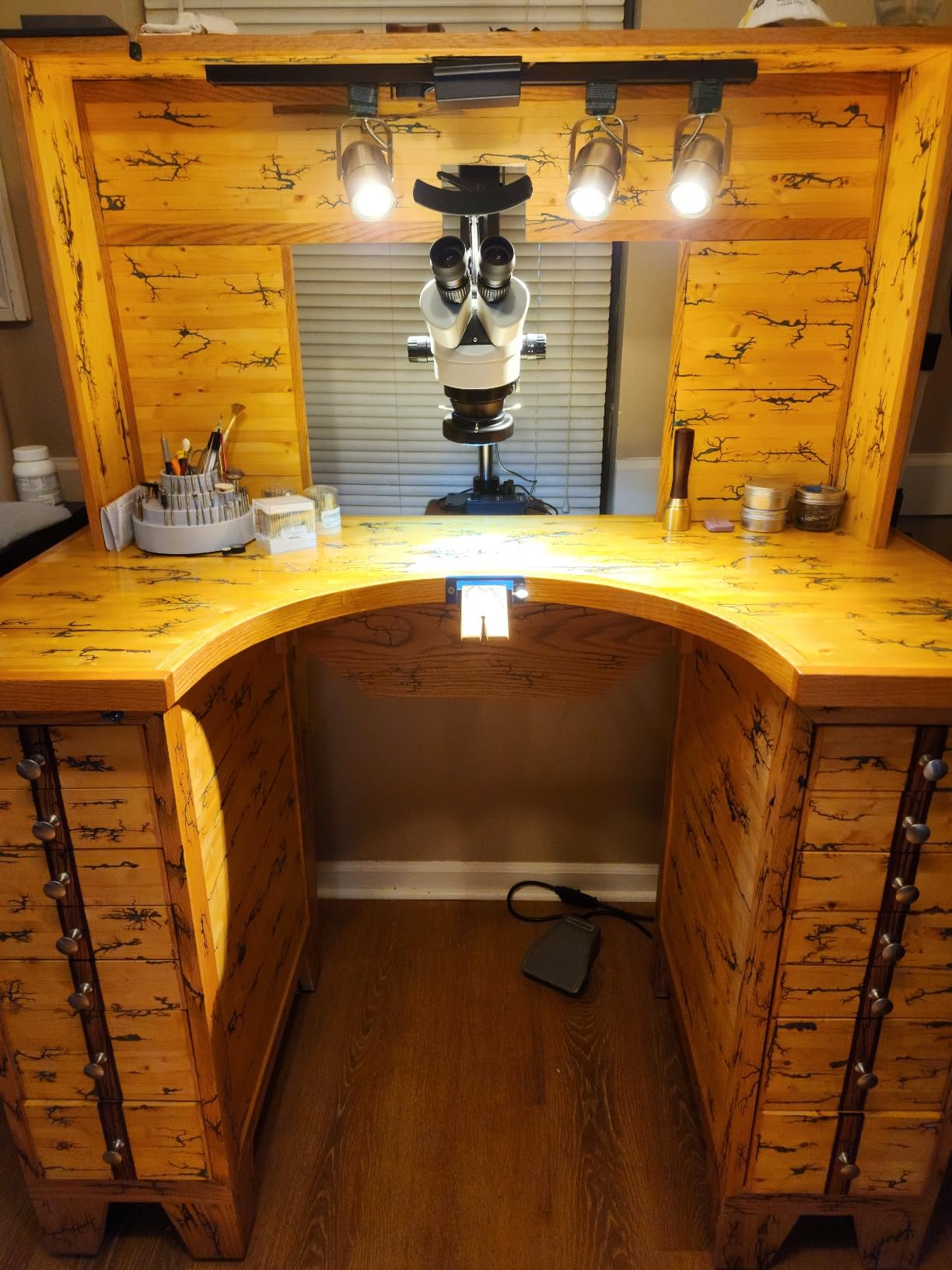
The gooseneck design is what makes it comfortable rather than merely cheap. A 12 inch flexible arm holds wherever you push it, and because the head can rotate through 360 degrees and adjust in height, you end up sitting upright at the bench instead of hunched over a fixed pillar. The weighted metal base holds steady during inspection.
What Fixed 8X Can and Cannot Do
Eight times is enough to inspect a solder bridge, spot a cold joint, check a cracked trace and confirm pad alignment on 0805 and 1206 work. It is genuinely limiting for 0402 and finer placement, because there is no zoom ring and no objective swap, so you cannot move from overview to detail without physically changing where you sit or where the board sits.
Depth of field is the other real constraint. Reviewers report that the narrow depth makes it hard to keep a component and the lens mutually parallel, which on flat benchtop work means constant small adjustments. This is a scope for inspection and general soldering, not for the demanding alignment stage of fine-pitch rework.
Why There Is No Focus Knob
Focusing on this unit is done by bending the gooseneck or moving the part under the lens. That sounds awkward and it is, though in practice the arm holds a set position well enough that you set focus once for a given working height and then work at that height. It simply means you commit to a working distance before you start, which is a constraint on tall components.
The included documentation is a single sheet that is poorly reproduced, so plan ten minutes of setup. For a first microscope on a learning bench, that is a fair trade for a footprint small enough to slide under a desk when you are not using it.
Who Should Buy the SE508
Buy it as a first microscope, a teaching and student scope, or a portable inspection tool for a cramped bench. It gives real stereo vision at an entry outlay, which is exactly what a cheap digital scope cannot give you, and its small footprint is a real advantage in a shared workspace.
Move up if you find yourself doing fine-pitch or leadless work, because you will outgrow 8X quickly. If you want a bigger step up for the same category of money, the DZQ ZQ-1 gives you continuous zoom and a ring light instead.
6. SWIFT Trinocular S7 – Best for Semiconductor and Inspection Work
SWIFT Trinocular Stereo Zoom Microscope with 56-Bulb LED Ring Light,3.5X-90X Magnification,WF10X Eyepieces,0.7X-4.5X Zoom Objective, 0.5X 2.0X Additional Objectives,Table Pillar Stand
3.5X-90X total magnification
100mm working distance
56-bulb LED ring light
360 degree rotating head
Pros
- 7X-45X zoom with 4 inch working distance for hand tools
- Bright low-heat 56-bulb ring light with no shadows
- 45 degree head rotates 360 degrees and suits eyeglass wearers
- 0.5X and 2.0X auxiliary objectives included
- Solid metal base and stand for stable precision work
Cons
- Table pillar stand is far less flexible than a boom arm
- Trinocular port needs a separately purchased camera
- Limited detailed owner feedback at this review count
Built for semiconductor, electronics and inspection work rather than dissection, this trinocular combines a 0.7x-4.5x zoom objective with 10x super wide field eyepieces for a 7X-45X native range, and the supplied 0.5X and 2.0X auxiliary objectives stretch that to 3.5X-90X. The 6.4:1 zoom ratio means you can sweep from a whole-IC overview down to a single bond pad without touching a focus knob in between.
The 56-bulb LED ring light is what sets the working image apart. It is bright, cool-running and effectively shadow-free, because light arrives from every direction at once rather than from one lamp. On a matte board that is simply pleasant, and on a shiny solder fillet it removes the hard specular blob that a single directional source produces.

Working Distance and the 4 Inch Clearance
One hundred millimetres of working distance, roughly 4 inches, is the sweet spot for hand-tool soldering. It is enough clearance to slide a chisel tip or a hot air nozzle under the objective without contact, and the wide field means you can keep a whole component in frame while you are still orienting yourself.
The auxiliary objectives change that geometry as you use them, so check clearance at your usual working magnification rather than assuming. The 2.0X lens in particular pulls the focal plane much closer to the objective, and on tight assemblies that is the difference between comfortable and cramped.
Trinocular Head, Rotation and Eyeglass Wearers
The head is inclined 45 degrees and rotates a full 360 degrees, which means a second person can step up and look through it without you moving anything. That matters more in a repair shop or a classroom than it does at a single home bench, where it simply means you can find a viewing angle that does not hurt your neck.
The vertical trinocular port doubles as a photo port, so a camera can be fitted when you need documentation. The optical path is a dedicated trinocular design rather than a simul-focal one, so confirm with the seller whether eyepiece and camera views stay live together before you commit to recording through this head.
Pillar Stand Versus Boom Arm
Here is the practical weakness. A table pillar stand is stable and compact, but it is a fixed post. You move the board, not the head, which is fine for flat boards and awkward for anything tall, curved or enclosed. If your work includes chassis assemblies, stacked boards or phone frames rather than bare PCBs, a boom arm is worth the extra footprint.
Review volume on this listing is modest, so treat the specification set as the reliable part and long-term owner reports as still building. The 360 degree rotation, ring light and long working distance are the reasons it earns its place here.
Who Should Buy the S7
It fits inspection and analysis work on semiconductors, soldered assemblies and precision parts, plus anyone who needs a trinocular port but does not need a heavy boom. The included 0.5X and 2.0X objectives make it a complete magnification package out of the box.
Choose the simul-focal AmScope instead if simultaneous eyepiece and camera viewing is your priority, and choose a boom-stand model if your workpieces will not lie flat.
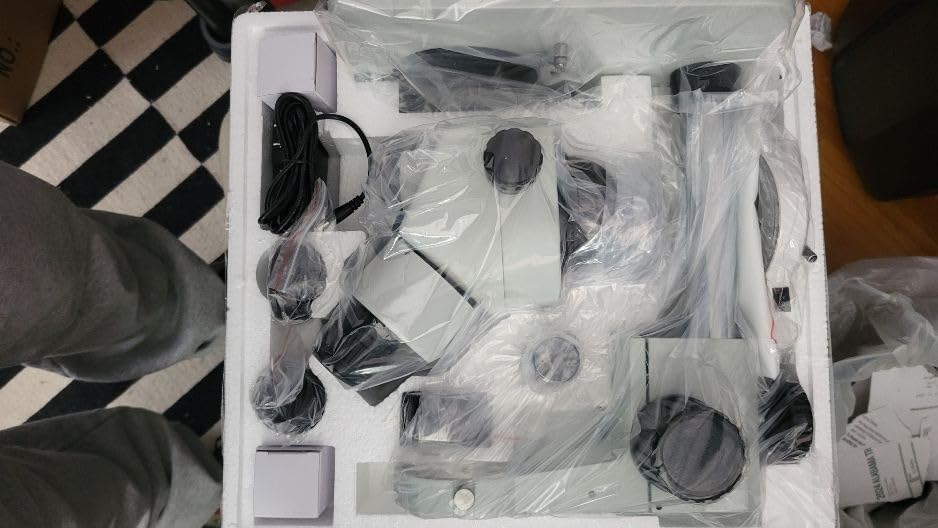
7. ZTEEERS ZS-07050 – Best for Phone Repair With a Full Kit in the Box
ZTEEERS Professional Trinocular Stereo Zoom Microscope, 3.5X-90X Magnification,WF10X Eyepieces, 0.7X-4.5X Zoom,0.5X & 2.0X Auxiliary Lens,1X CTV, Double-Arm Boom Stand, 56S LED Ring Light,Two adapters
3.5X-90X with auxiliary lenses
18lb steel base
10 inch under-head clearance
Simultaneous camera viewing
Pros
- Barlow lenses and LED ring light both included in the box
- Per-eye diopter adjustment for differing eye strength
- About 10 inches of clearance under the head for tools
- Heavy steel base and ball-bearing arm stay put
- Reviewers compare it favourably to the AmScope SM-4NTP
Cons
- Very heavy and bulky with a larger footprint than the listing suggests
- Poor instructions so setup often relies on online videos
- One owner reports tip risk with arms extended and bolted the base down
- Only 37 ratings so long-term history is limited
This is the complete package pick, and the reason is simple: the 0.5X and 2X auxiliary lenses and the dimmable 56S LED ring light are both in the box. On a scope that also offers simultaneous binocular and camera observation through an upgraded optical channel, plus per-eye plus or minus 6 diopter adjustment on each tube, it covers the things enthusiasts usually have to buy separately.
Reviewers repeatedly compare it favourably to the AmScope SM-4NTP on optical performance and function for a lower outlay, and that comparison is the most useful thing in the 37 ratings on this listing. If you have been reading forum threads and keep hearing the AmScope name, this is an alternative that arrives complete.
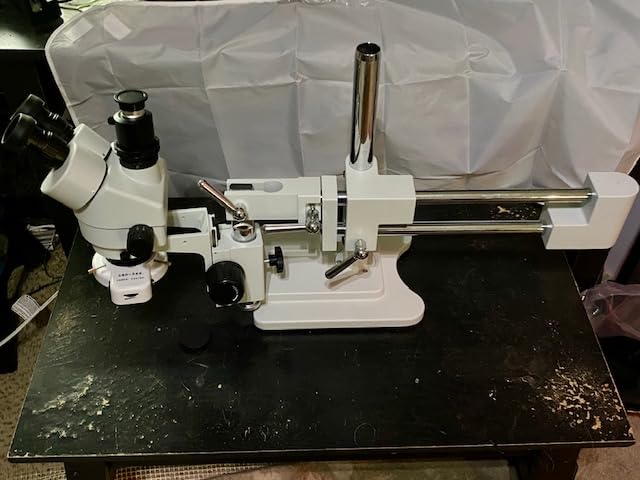
Ten Inches of Under-Head Clearance
Roughly 20cm of clearance under the head is the most practically important number here. Phone mainboard work means a hot air station, a spudger, tweezers and a probe all converging on one small area, and any scope that forces you to work around a lens housing turns a clean reball into a two-hour job. The ball-bearing boom arm holds a position and swings out of the way when you are doing preheating or inspection instead.
The 18 pound solid steel rectangular base is what keeps that arm from wandering, and it also means this unit does not move when you lean in. On a cart-mounted bench that weight is a genuine asset, and one owner who experienced tip risk with the arms extended solved it by bolting the base down, which tells you the mass is real in both directions.
Diopter Adjustment and Eyeglass Wearers
Per-eye plus or minus 6 diopter adjustment is not standard at this level, and it matters for anyone whose eyes are not matched. A user with one stronger eye can dial that tube in rather than adapting to a blurry view all session. Combined with a 48-75mm interpupillary range and a 45 degree inclined head that rotates 360 degrees, it stays usable with glasses on.
That is worth a longer look in a category where eye strain is a frequent long-term complaint. A four-hour phone repair session with one eye out of focus is a four-hour session with more mistakes.
Two Adapters, One Camera Question
The trinocular port ships with two adapter configurations, one for electronic eyepieces and one for digital cameras, so the head can feed a consumer monitor, a capture card or a computer without a specific extra part. The upgraded optical channel keeps binocular and camera observation synchronous, which puts it in the same functional class as a simul-focal head rather than a switchover port.
No camera is included. Budget for one, and confirm the mount type you actually own before ordering an adapter.
Who Should Buy the ZTEEERS
It is built for phone and laptop board repair, component-level reworking, and anyone who wants a trinocular with a ring light and both auxiliary lenses in a single purchase. The lighting, the clearance and the diopter adjustment all point the same direction, which is a refreshing change in a category full of feature checklists that do not work together.
Hold off if your bench is a desk. At 19.5 by 11.5 by 19.5 inches with a steel base, it is a serious footprint, and the weak instructions mean budget an evening for assembly and setup.
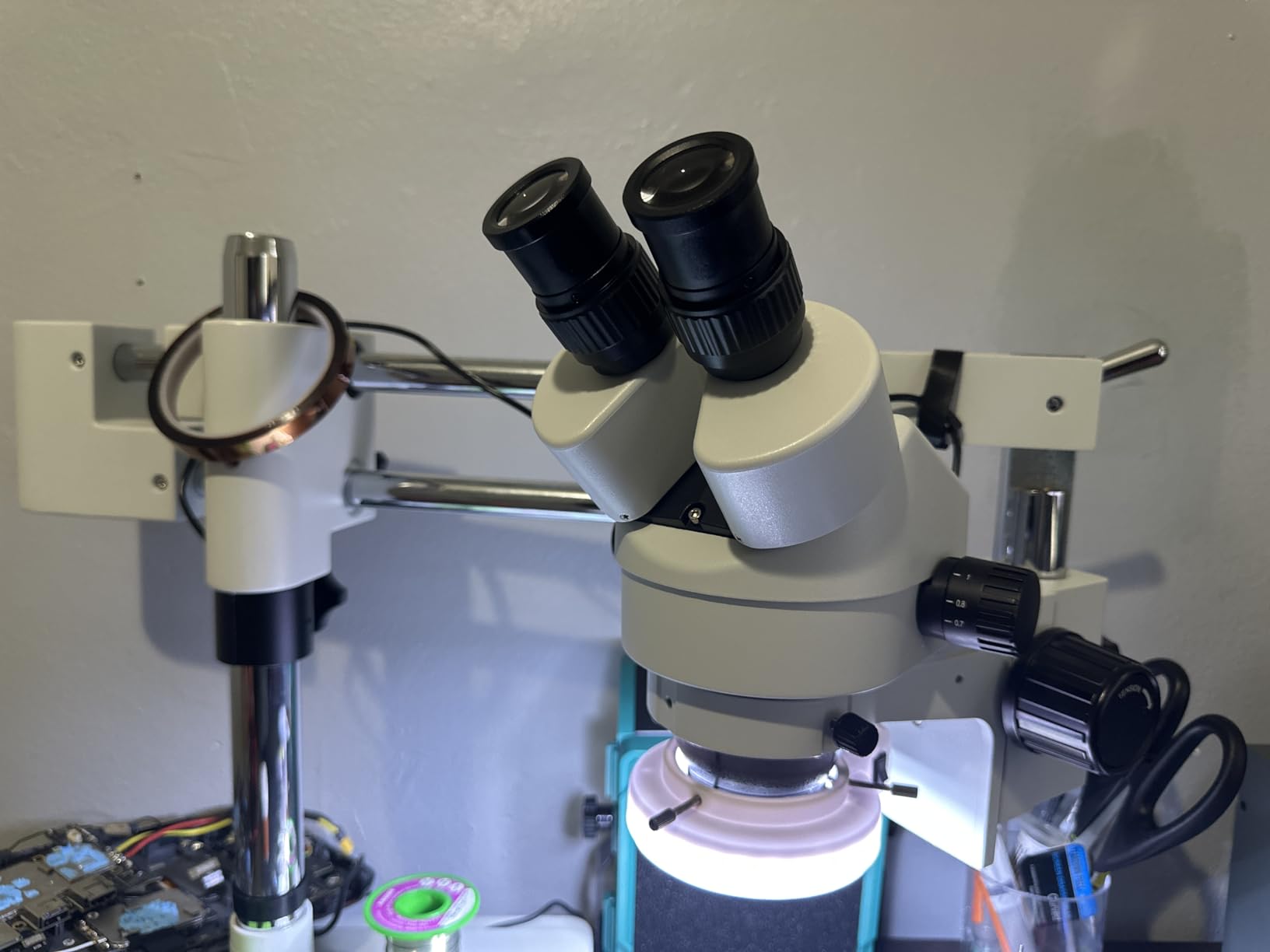
8. SWIFT S306S-20-2L – Best for Students and Learning a New Board Level Skill
Swift S306S-20-2L Binocular Stereo Microscope, 20X/40X/80X Magnification, 360° Rotatable Forward-Mounted Head, Wide-Field 10X/20X Eyepieces, Upper & Lower LED Lights, Reversible Stage Plate
20X-40X-80X magnification
Upper and lower LED lighting
Reversible black and white stage
360 degree rotating head
Pros
- Solid optics and quality gearing in the head for the money
- Dimmable upper and lower LED for incident or transmitted work
- Reversible black and white stage plate adds contrast options
- 360 degree head suits shared viewing
- Compact size that suits a home bench
Cons
- No continuous zoom
- 80X view is dim without an added light source
- Build quality reads as adequate rather than premium
- Limited long-term owner history at 22 ratings
The flip-in black and white stage plate is the feature I would point a first-time buyer toward. Switching between a black background with a bright, well-lit component and a white background with dark leads makes fine features like hairline cracks and incomplete wetting far easier to see, and it costs nothing to use. Pair that with dimmable upper and lower LED illumination and you can inspect a joint from above or hold it up to transmitted light for a through-board look.
At 20X, 40X and 80X through interchangeable 10x and 20x eyepieces plus 2x and 4x objectives, the optics are honest and the gearing in the head feels solid. For learning to inspect joints, read a board and see what a bridging failure actually looks like, that is more than enough capability.
Where the 80X Setting Falls Short
At the top of the range the image dims noticeably, and owners report that it benefits from an additional light source. That is a real limitation if you plan to inspect 0201 parts or hairline fractures at 80X, and it is a good reminder that the highest magnification number is rarely the useful one for soldering.
As with the other fixed-step scopes in this list, there is no continuous zoom. You move between 20X, 40X and 80X rather than anywhere in between, so a job that sits awkwardly at the edge of a field means settling for a tighter view of more than you need.
Why the 360 Degree Head Helps in a Classroom
Rotating the head fully lets a second person look through it without displacing the first, which makes it a genuinely useful teaching scope as well as a personal one. Combined with the compact size and a 3.04 kg weight, it moves between benches easily and does not dominate a shared work surface.
Build quality is the note of caution. Reviewers describe it as adequate rather than premium, and some mention a plastic feel, which is a fair description of a scope at this level. The 45 degree head with interpupillary adjustment does keep the viewing posture reasonable, so it stays comfortable longer than a flat-top design would.
Who Should Buy the S306S-20-2L
Buy it for a student bench, a first microscope in a classroom, or a home setup for learning board-level work where the stage plate and dual lighting matter more than maximum magnification. It covers through-hole, leaded and 0805 inspection comfortably.
If you are already comfortable with a scope and moving into fine-pitch or leadless work, choose one with continuous zoom instead. This is a teaching and inspection instrument that happens to be a competent soldering scope, not the other way round.

How to Choose a Stereo Soldering Microscope
Most buying guides on this topic lead with magnification and wrap up with a list of small features. That is backwards. Work through working distance, head type, lighting and stand type first, because those four decisions determine whether the scope suits your bench, and magnification is the one variable you will almost certainly over-buy.
Magnification Is Not Resolution
Optical resolution is set by the objective lens quality and the light, not by the number printed on the box. A digital scope that advertises 1000x is interpolating pixels into an image it captured at a fraction of that, and reviewers describe those inflated numbers as actively misleading. The honest optical ceiling for soldering work is around 45x, and the useful working band while an iron is in your hand is roughly 5x to 20x.
- 0201 and 0402 placement: 20x-30x. Above about 30x the field gets too tight to orient the part.
- SOIC and TSSOP fine pitch: 10x-20x. Enough to see lead spacing clearly with room around the package.
- QFN pad alignment: 20x-30x with a 0.5x Barlow fitted, because you need room to bring two tools in.
- BGA and fine-pitch inspection: 30x-45x, mostly for inspection rather than placement.
- Through-hole and leaded work: 7x-15x, where a wide field saves constant refocusing.
A 0.5x Barlow lens changes more about how a scope feels than any other accessory. It halves the zoom range and roughly doubles working distance, which on a powerful head is the difference between a comfortable 22.5x working point and an unusable one. If a listing does not include one, treat that as part of the purchase, not an extra.
Working Distance Is the Number That Decides Everything
Working distance is measured from the front of the objective to the top of your workpiece. Anything under about 75mm is tight for soldering, because a chisel tip, a hot air nozzle and tweezers all need to enter the space under the head. Somewhere between 95mm and 130mm is the comfortable band, and 4 inch or 100mm is the figure to look for in a spec sheet.
Test it against your actual tools, not against a number. Bring the hot air nozzle you use most and check that it can sit at an angle without touching the housing. Scopes with short working distance are a recurring source of the regret that shows up in soldering forums, and no amount of magnification compensates for a nozzle parked against your objective.
Binocular, Trinocular or Simul-Focal
A binocular head sends light to your two eyes and nothing else. A trinocular head adds a third port that takes a camera, which is how you get photos and video. A simul-focal trinocular keeps all three paths live at the same time, so you keep full stereo vision through the eyepieces while a camera records.
Simul-focal is the enthusiast recommendation and the standard on the eevblog forum for anyone soldering regularly, because recording does not cost you the 3D view. A dedicated trinocular port that takes the eyepieces offline costs less, and it is fine if you only need the occasional photograph. If you are filming a repair channel or building before-and-after documentation for customers, simul-focal is the design that gives you both at once.
Lighting: Ring Versus Directional
A ring light surrounds the objective and lights the work from every direction at once, which eliminates shadows under tall components and gives even brightness across the field. A directional or goose-neck light can be aimed, which lets you rake light across a surface to reveal texture that flat even lighting washes out.
Solder is highly specular, so it reflects whatever source you give it. A single bright directional light creates a hard white blob on a fresh fillet and hides the very boundary you are trying to judge. A dimmable ring light lets you reduce intensity until the fillet stops glaring, and a two-light setup gives you both even coverage and the ability to create contrast on demand. Either way, brightness control is worth paying for.
Stand Type Decides How You Work
A pillar stand is a fixed vertical post with a stage plate. It is compact and stable, and it works well for bare PCBs lying flat. It cannot get out of the way, and it cannot accommodate a tall or awkward assembly.
A single-arm or dual-arm boom stand swings the head across the bench and rotates it through any angle. It costs more bench space and more money, and it is the difference between repositioning the head and repositioning the board every time you change task. For a repair bench with a hot air station, a boom is worth the footprint. For a study desk with one small board, a pillar or gooseneck is the sensible call.
Parfocal Imaging and Eye Strain Over Long Sessions
One technique matters more here than any accessory, and few buying guides cover it. Look into both eyepieces at the same time, adjust the interpupillary distance and the diopter until the two images merge into one, then keep both eyes open and work with your hands. Your brain holds the fused 3D image while you solder, and you stop flinching every time you refocus with one eye closed.
For glasses wearers, look for a head with per-eye diopter adjustment and enough eye relief that you can work with frames on. Also take the viewing angle seriously: a 45 degree inclined head lets you sit upright, while a flat top-down head forces a neck position that becomes painful after a few hours. Combined with a fume extractor near the head and a heat-resistant stage surface, a comfortable scope setup is the difference between a hobby that lasts and a hobby you abandon.
Head-Only Versus Complete System
This is the trap that drives a lot of disappointment in this category. Many heads are sold in three forms: a bare head, a head on a simple stand, and a head on a boom stand with full illumination. The same optics can appear at dramatically different totals depending on which one you choose, and the accessories are frequently not included at all.
Before you buy, confirm three things in the listing: whether the package includes a stand and base, whether it includes a ring light or goose-neck illuminator, and whether it includes a 0.5x Barlow. Two of the eight scopes in this roundup omit one of those, which is why we name it in each review. If you are adding a camera, confirm whether the trinocular port is simul-focal or a switchover type.
When a Digital Microscope Is the Right Call
There are fair reasons to skip every scope on this page. If your bench has no room for a stand and you need to share one screen between microscope and test gear, an all-in-one digital unit is simpler. If you want to make content, a digital scope with clean HDMI output or a USB camera on a separate arm gives you a far better recorded image than a C-mount camera on a budget trinocular.
What you give up is depth perception and lag. Hand-guided fine work goes from controlled to estimated, and the flat image removes exactly the depth cues your hands need. Buy digital for filming and convenience. Buy stereo for the soldering itself.
Frequently Asked Questions
What is a stereo soldering microscope?
A stereo soldering microscope is an optical binocular or trinocular scope that sends two slightly different light paths to each eye, producing a true 3D view of the board with no video lag. A ring or directional LED lights the work, a 0.7x-4.5x zoom objective with 10x eyepieces gives roughly 7x-45x, and you judge solder joint depth, lead alignment and wetting in real time while your hands work.
What is the best type of microscope for soldering?
For hand-guided soldering, a stereo microscope is the best type. Two optical paths give true depth perception, which is what lets you align fine-pitch leads and judge whether a joint has wetted the pad. A digital USB or HDMI scope gives a flat 2D image with video lag, so it works well for filming but makes delicate real-time work harder. Choose binocular for pure work, trinocular if you need photos.
What magnification is good for soldering?
Roughly 5x to 20x effective is the useful working range, achieved with a 0.7x-4.5x zoom objective and 10x eyepieces, which gives 7x-45x optical. 20x-30x suits 0201 and 0402 placement, 10x-20x covers SOIC and TSSOP fine pitch, and 30x-45x is for QFN and BGA inspection. Ignore 1000x claims on digital scopes; those are interpolated, not resolved.
Do I need a trinocular microscope for soldering?
Only if you want to photograph or record your work. A trinocular head adds a third port for a camera, and a simul-focal model keeps the eyepieces and camera view live at the same time so you keep stereo vision while filming. If you solder and never document, a binocular head does the job at a lower outlay and with one less thing to set up.
What are the downsides of using a stereomicroscope?
The main drawbacks are bulk, fixed posture and brightness at high power. Boom stands occupy real bench space next to a hot air station and fume extractor. Working for hours at a fixed 45 degree angle causes neck and eye strain, which parfocal imaging and an adjustable headrest reduce. Very high magnification runs bright and the depth of field gets thin. Some models also omit a 0.5x Barlow or a ring light from the box, so check the contents.
Which Stereo Soldering Microscope Should You Buy in 2026?
If you want one instrument that handles mixed bench work with the deepest pool of long-term owner history behind it, the AmScope SE306R-PZ is the pick. Its forward head keeps your hands under the objective and the metal pillar frame does not move, while the main compromise, hot halogen lighting, is a quick fix for anyone who cares.
If your work is continuous surface mount and phone or laptop board repair, take the SWIFT S41-20 for its boom arm clearance and dual goose-neck lighting, or the ZTEEERS ZS-07050 if you want a trinocular with a ring light and both auxiliary lenses already in the box and roughly 10 inches under the head.
If you solder every day, need real zoom and want to film while you work, the AmScope SM-4NTP is the right instrument, and buy the 0.5x Barlow at the same time or it will be too strong for SMD work out of the box. If you want continuous zoom and generous clearance without hunting for accessories, the DZQ ZQ-1 gives you both out of the box.
For a first microscope, a student bench or a small desk, the AmScope SE508 gives real stereo vision in a compact footprint. For teaching and shared viewing, the SWIFT S306S-20-2L adds a flip-in stage plate and dual lighting. And if you only ever solder through-hole, leaded and 0805 parts, any of the fixed-step scopes will do the job well.
Whichever one you pick, check what is actually in the box before you order, set up parfocal imaging on day one, and give yourself 100mm of working distance as a minimum. That last habit, keeping both eyes open and your hands working inside the fused 3D image, will do more for your soldering than any upgrade you add later.