
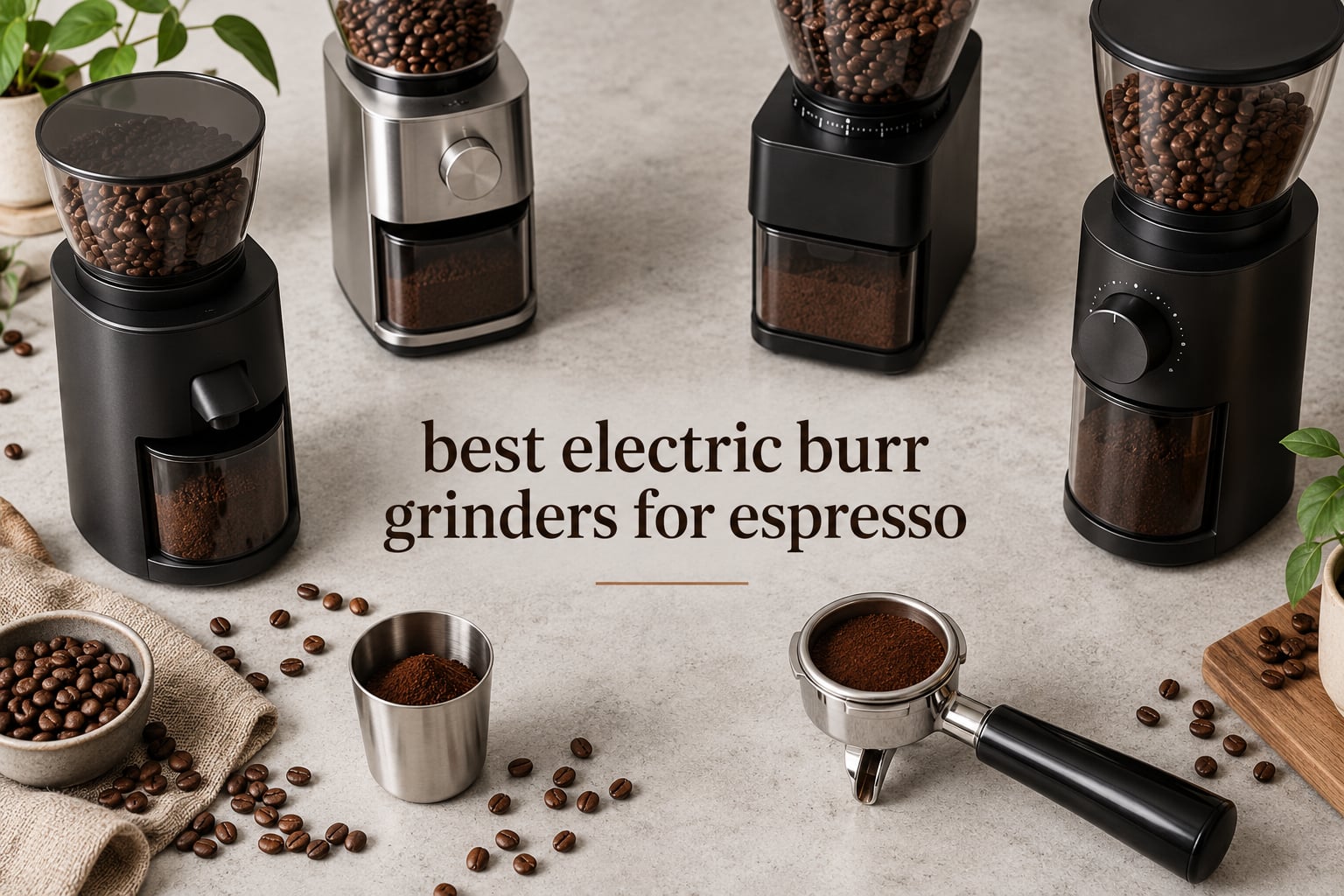
An electric steel burr grinder with micro-adjustment or stepless settings is the right machine for espresso, and that is the screen we applied to every grinder in this roundup of the best electric burr grinders for espresso. Blade grinders, filter-only machines and anything that cannot hold a steady grind fine enough to survive a 9-bar shot were excluded before we started ranking.
I have run espresso setups for more than a decade, first with the grinder built into a basic machine and then with electric burr models across three price tiers. The single biggest change in cup quality was never the machine; it was the grinder. That is the consensus repeated across r/espresso, r/coffee and Home-Barista threads, and it is why this list is filtered by espresso capability rather than by general coffee-grinding ability.
Below I compare ten electric burr grinders on the things that decide an espresso shot: burr shape and diameter, whether adjustment is stepped or stepless, retention, dose repeatability, and which portafilter size the dosing hardware accepts. Retention numbers appear only where a manufacturer or owner measurement supports them, because vague low-retention claims are worthless when you are weighing out 18 grams of expensive single-origin beans.
If you are still building out your setup, our guide to the best espresso machines for home baristas covers the machine side, and our beginner grinder guide is a better read if you are still on a blade grinder.
Why Burr Grinders Matter for Espresso
Espresso needs a narrow particle size distribution, not just fine grounds. When a shot tastes sour and bitter at the same time, the cause is almost always inconsistent grind size, which lets water blast through some channels while barely touching others. Burrs fix that because the beans are crushed between two hardened surfaces set at a fixed distance, not chopped by spinning blades.
- Burrs versus blades: blades slice and heat beans unevenly, producing dust and boulders in the same dose. Burrs set particle size by geometry, so the result is repeatable shot to shot.
- Steel versus ceramic: hardened steel burrs resist chipping at fine espresso settings and are the standard across every grinder in this list. Ceramic burrs run faster and quieter but chip under load and cost more to replace.
- Grind consistency: particle size distribution is the measurable version of the same idea, and it is the specification that separates a shot that is balanced from one that is not.
- Micro-adjustment and stepless settings: espresso lives in a narrow band of the grind range. A stepped dial with 20 espresso-usable steps is far easier to dial in than one coarse step spanning Turkish and filter.
- Portafilter fit: a grinder whose dosing cup and cradle do not match your 54mm or 58mm basket adds a transfer step where coffee oils and fines get lost.
Our methodology: every grinder below was assessed on published burr diameter and material, the espresso range of its adjustment system, its dosing workflow, verified purchaser review volume, and long-term ownership patterns in espresso communities. We weighted grind consistency first, retention second, noise third, and design preference last, which is the same ordering the buying public uses when they talk about upgrades.
Our Top 3 Tested Espresso Grinders
These three cover the realistic home range: a feature-rich benchmark, the community default, and a step-up for people chasing café-level adjustability.
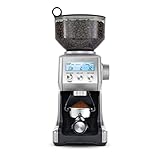
Breville Smart Grinder Pro
- 60 programmable grind settings
- Dosing IQ timer in 0.2 second steps
- Doses into 50mm and 58mm cradles

Baratza Encore ESP
- Micro steps 1-20 for espresso
- 40mm alloy steel burrs
- Tool free burr removal

Baratza Sette 270
- 270 macro and micro settings
- Three dosing buttons to 0.1 second
- Straight through path up to 5g per second
Comparing the Best Electric Burr Grinders for Espresso in 2026
Every model below passes the espresso-capability screen. The burr and adjustment details are the ones that matter when you are dialing in a shot rather than brewing a batch filter coffee. If you want a shorter version of this list, our best coffee grinders for espresso roundup focuses on the same espresso-capability screen at a different price spread.
| Product | Specs | Action |
|---|---|---|
| Breville Smart Grinder Pro |
|
Check Latest Price |
| Baratza Encore ESP |
|
Check Latest Price |
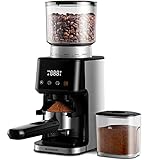 SHARDOR Conical Burr Espresso Grinder SHARDOR Conical Burr Espresso Grinder |
|
Check Latest Price |
| Baratza Sette 270 |
|
Check Latest Price |
 Homtone Conical Burr Espresso Grinder Homtone Conical Burr Espresso Grinder |
|
Check Latest Price |
 MOKKOM 64mm Flat Burr Grinder MOKKOM 64mm Flat Burr Grinder |
|
Check Latest Price |
 Neretva Stainless Steel Espresso Grinder Neretva Stainless Steel Espresso Grinder |
|
Check Latest Price |
 MiiCoffee DF64 II Single Dosing MiiCoffee DF64 II Single Dosing |
|
Check Latest Price |
 Viesimple Gen 4 Single Dose Grinder Viesimple Gen 4 Single Dose Grinder |
|
Check Latest Price |
 AMZCHEF 64mm Flat Burr Grinder AMZCHEF 64mm Flat Burr Grinder |
|
Check Latest Price |
1. Breville Smart Grinder Pro – The Benchmark With the Widest Espresso Range
Breville BCG820BSS Smart Grinder Pro, Brushed Stainless Steel
60 grind settings
Dosing IQ timer in 0.2 second steps
50mm and 58mm cradles
6.4 pounds
Pros
- Widest espresso range on the list with 60 programmable settings
- Digital dose timer adjustable in 0.2 second increments
- Doses straight into the portafilter or an airtight container
- Backed by a 2 year limited warranty
Cons
- Large countertop footprint compared with single dose models
- Programmable timer still needs a scale check on dose weight
- 18oz hopper is small for large batch grinding
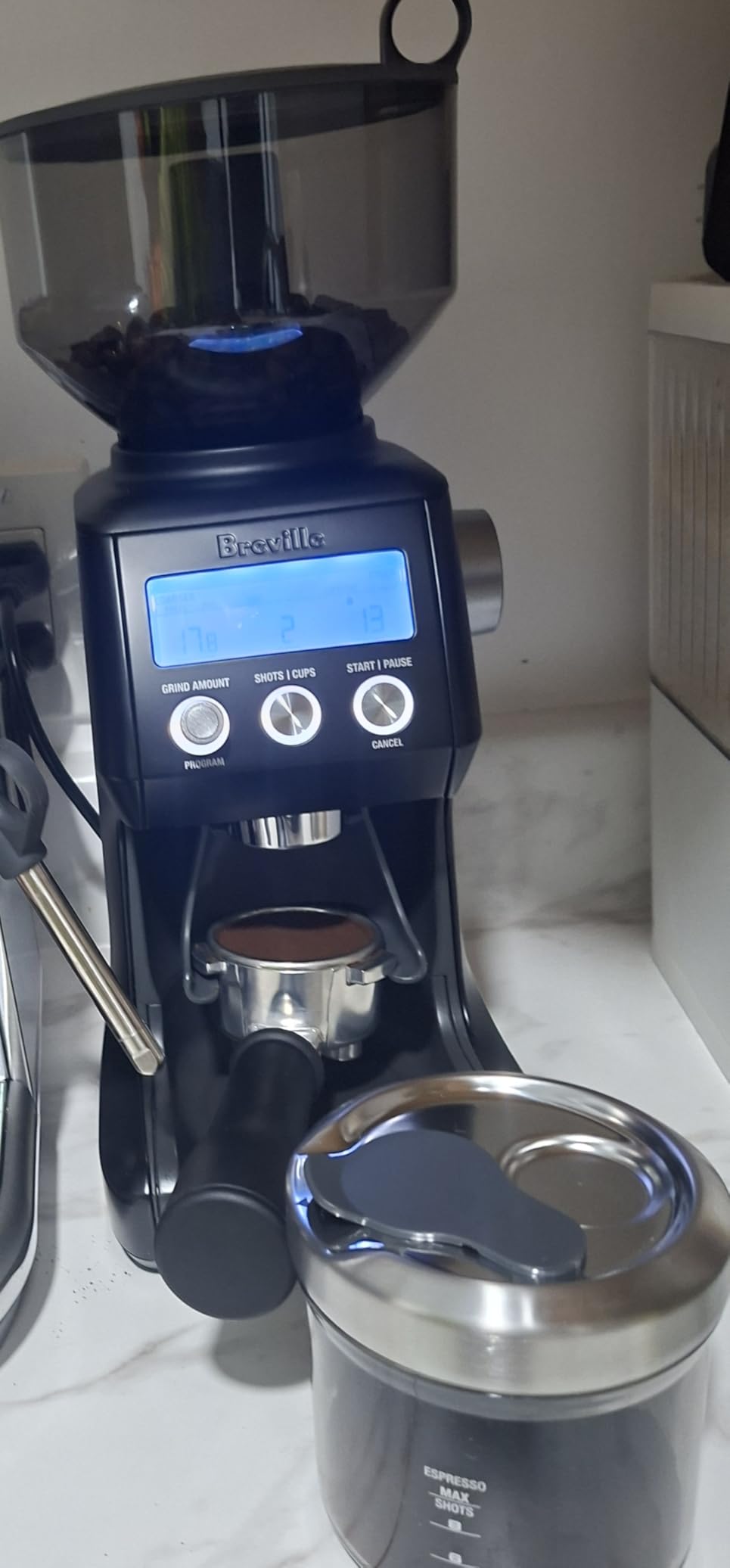
The Smart Grinder Pro has been the espresso benchmark for years, and with 7003 verified reviews at a 4.5 average it has the deepest ownership history of anything on this list. That matters in a category where a grinder is a ten-year purchase and support matters more than launch-day features.
What set it apart from the start was the Dosing IQ timer, programmable in 0.2 second increments across three dose buttons. You program a time, the grinder runs for it, and the same time produces nearly the same dose every morning. Owners on r/espresso describe it as the grinder they hand to guests who already know what they are doing.
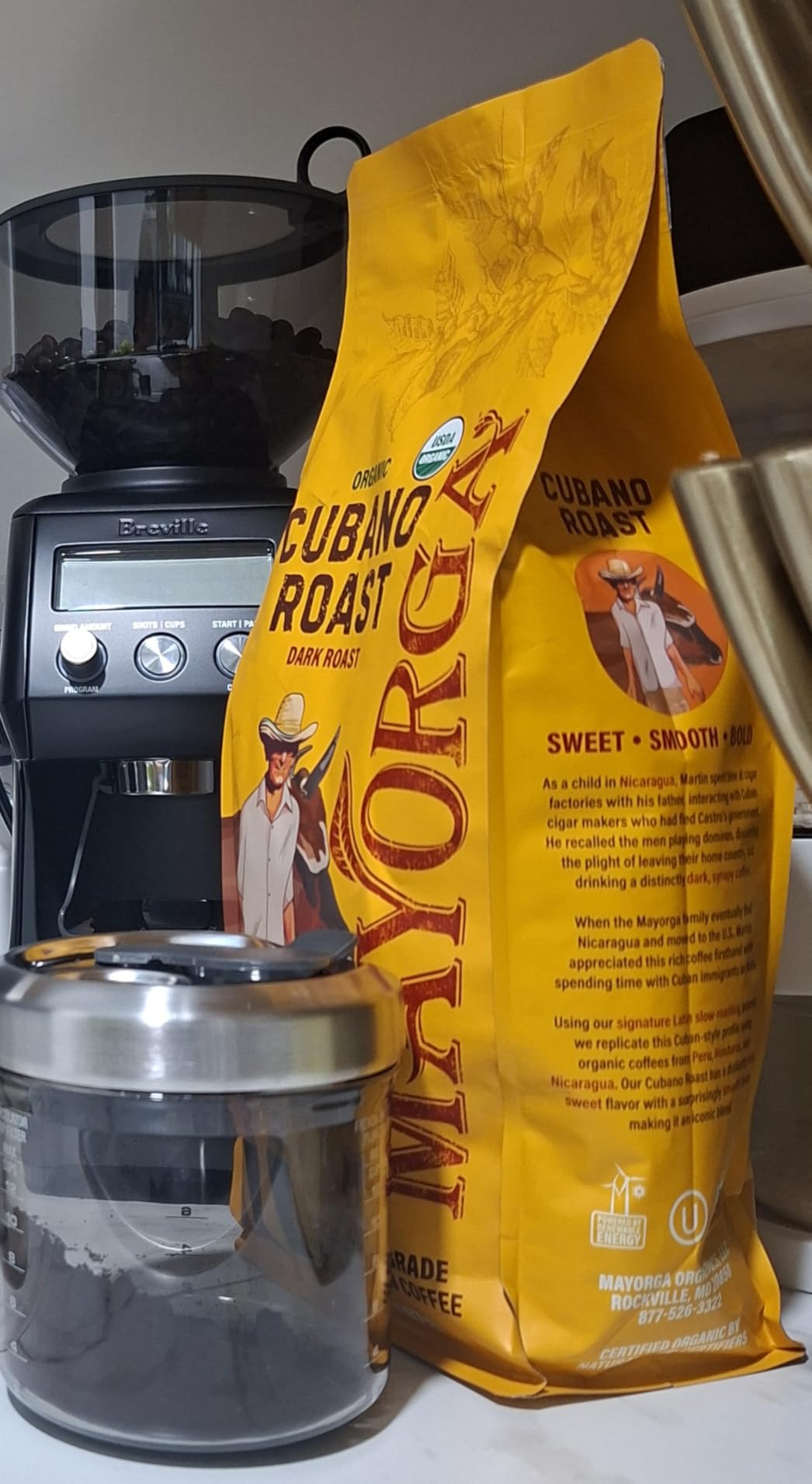
Burr design and espresso fineness
The conical burr is driven by a 165 watt motor and steps through 60 numbered settings, with a dedicated espresso program that starts coarser than most people expect. The adjustment ring is a step design rather than stepless, but the density of those steps inside the espresso band is what makes it usable, not the raw number.
Because a step dial can only land on discrete numbers, the fine work happens at the grinder rather than in the cup. Tapering, distribution and a steady 25 to 30 second shot are all still your job.
Dosing IQ and dose repeatability
The 0.2 second increment is the spec to understand. At espresso speeds, a tenth of a second is a meaningful fraction of a 20 second dose, so the timer resolution is tight enough that switching between a single and a double is a button press rather than a guess.
Reviewers still recommend a scale alongside it. Timed dosing assumes a consistent bean density, and a washed Ethiopia and a dense natural will not run the same number of seconds for the same weight.
Portafilter compatibility and footprint
It ships with both 50mm and 58mm cradles, which makes it one of the few grinders here that pairs cleanly with a 54mm basket, since the 50mm cradle sits under a 54mm portafilter. That flexibility is a genuine advantage over grinders built for 58mm only.
At 6.4 pounds and 15.33 inches tall it is the tallest unit in this roundup. Budget the counter depth, and note the 18oz hopper means frequent refills if you drink several espresso drinks a day.
Who it suits and who should skip it
Buy it if you want a single grinder for espresso and filter, already own a Breville or Sage machine with a 54mm basket, and prefer button-driven dosing over mechanical dials. The warranty and the sheer review volume mean replacement parts and advice are easy to find.
Skip it if counter space is tight, if you are after the very low retention of a single-dose machine, or if you prefer to dial grind size by hand while looking at the burrs.
2. Baratza Encore ESP – The Community Default for First Espresso Machines
Baratza Encore ESP Coffee Grinder ZCG495BLK, Black
40mm hardened alloy steel burrs
Micro steps 1-20 for espresso
5.6 pounds
120g hopper
Pros
- Dual range adjustment with 20 espresso micro steps
- Mechanical controls with no electronics to fail
- Quick release tool free burr removal
- Grind consistency owners credit with better shots
Cons
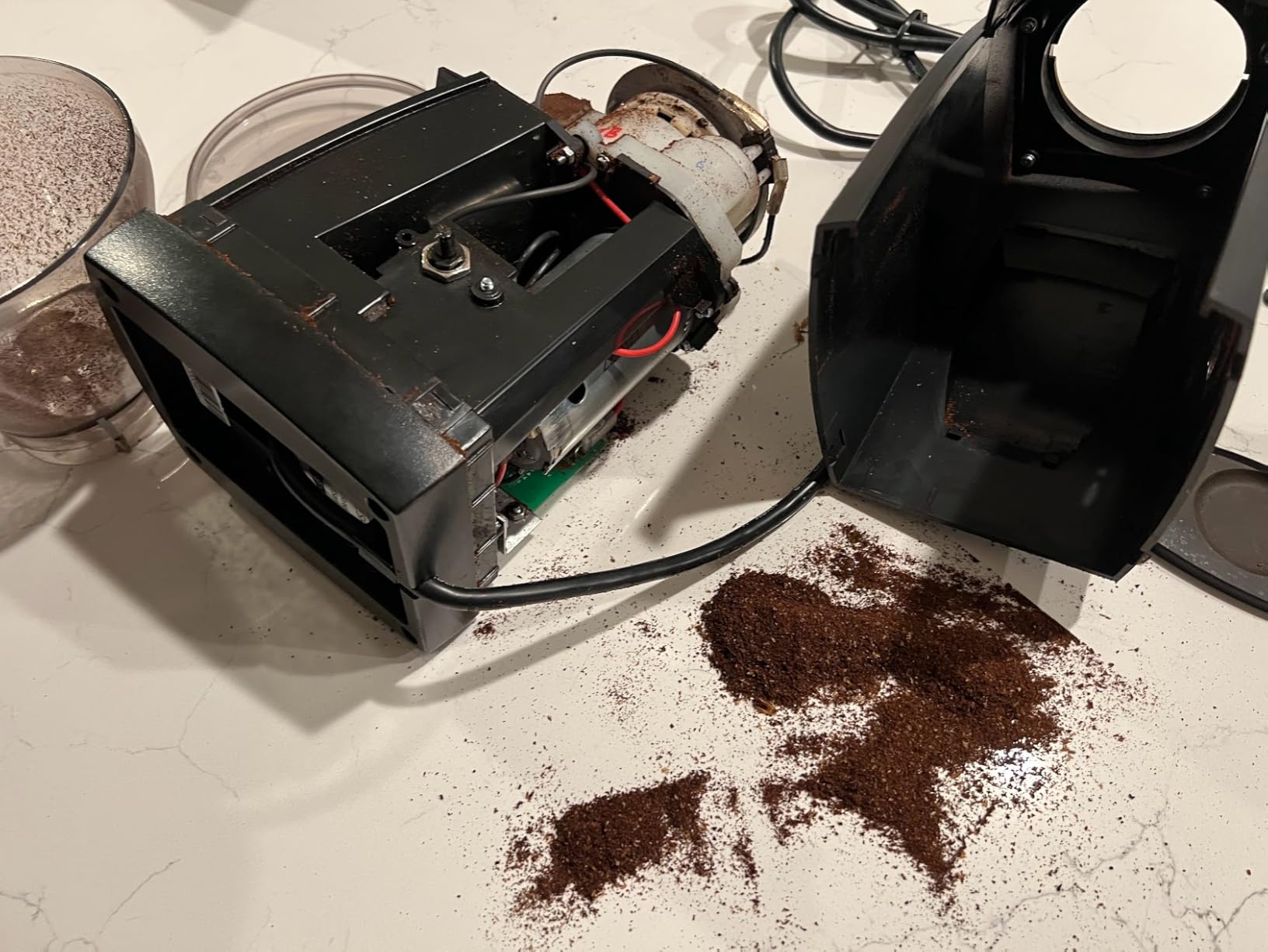
- Plastic burr holder collar is a recurring failure report
- Anti static hopper can shift while grinding
- No timed dosing built in
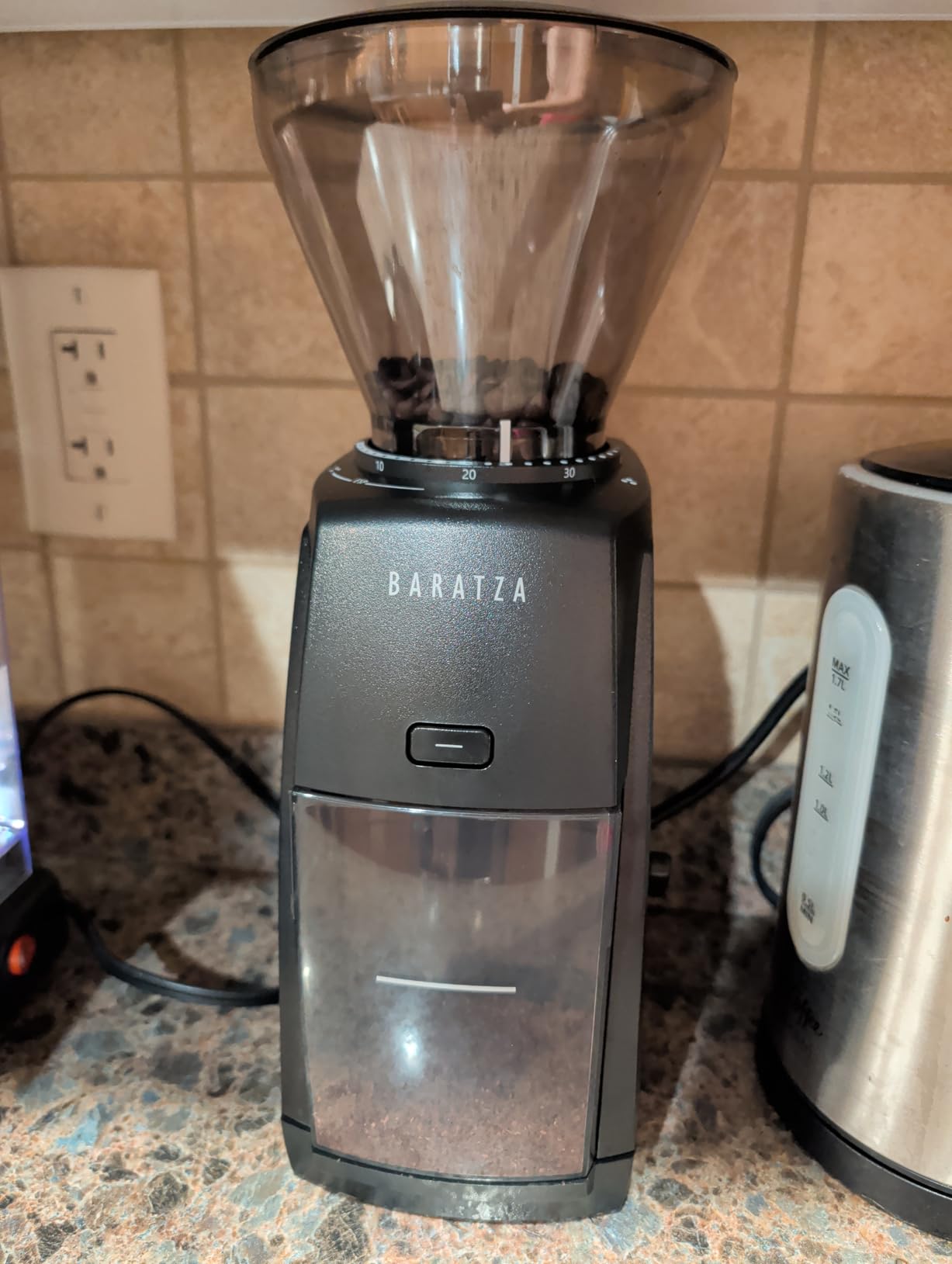
The Encore ESP is the machine most home baristas mean when they say start with a Baratza. It is also the one that turned the 4.0 average, because the complaints cluster around a plastic collar rather than around grind quality. Owners whose collar cracked report Baratza support replacing the part quickly, which is why it still makes sense as a first espresso grinder.
The design choice that matters most is the dual range adjustment. Settings 1 to 20 are micro steps sized for espresso, and 21 to 40 are macro steps for filter. That split is the reason this grinder shows up in so many dial-in tutorials.
Why the split adjustment system matters
On a single-range stepped grinder, the espresso band can occupy only a handful of numbers squeezed between a coarser filter range. Twenty dedicated micro steps means each click moves the grind a smaller distance, so a 0.5 gram dose weight change is a fraction of one step rather than a jump you have to taste around.
Adjustment happens by twisting the hopper body with one hand while the other hand keeps the dosing cup steady. It is unusual the first time and obvious after ten shots.
Burr quality and grind consistency
The 40mm hardened alloy steel burrs are manufactured in Liechtenstein and driven by a 150 watt DC motor. The burrs release from the housing without tools, which matters more than it sounds: cleaning a conical set weekly is how you keep fines out of the grind, and tool-free removal is the difference between doing it and putting it off.
Owners consistently report a uniform grind that improved shot stability over cheaper burr machines. The motor runs cool enough that heat is not a factor.
No timer, and what that means for dose weight
There is no timed dosing here. You hold the pulse button, watch the scale, and stop. Newcomers find this slower, but it is also the most direct dose control available, and it removes the failure mode where a timer set on one bean runs long on the next.
For single-origin work, dosing by weight with the pulse button is the most repeatable method on this list.
Who it suits and who should skip it
Buy it if you are building a first espresso setup, want a grinder you can open and service yourself, and plan to keep it a long time. Replacement parts for Baratza gear are the reason these grinders tend to outlive their owners’ enthusiasm for the next upgrade.
Skip it if you want hands-free dosing, if you are rough with equipment and the plastic collar worries you, or if you expect a quiet morning operation.
3. SHARDOR Conical Burr Espresso Grinder – Low-Cost Entry With a Genuine Steel Burr Set
SHARDOR Conical Burr Espresso Coffee Grinder Electric with Precision Timer 2.0, Touchscreen Adjustable Burr Mill with 51 Precise Settings for Home Use, Anti-static, Stainless Steel
40mm stainless steel conical burrs
51 grind settings
Timer to 60 seconds at 0.1 second steps
6.2 pounds
Pros
- 40mm stainless steel conical burrs limit heat and protect oils
- 51 settings spanning espresso to French press
- Timer adjustable to 0.1 second increments
- Includes a portafilter cradle and residual cleaner
Cons
- Screen controls are less precise than mechanical dials
- Time based dosing drifts when bean density changes
- Lightweight plastic housing
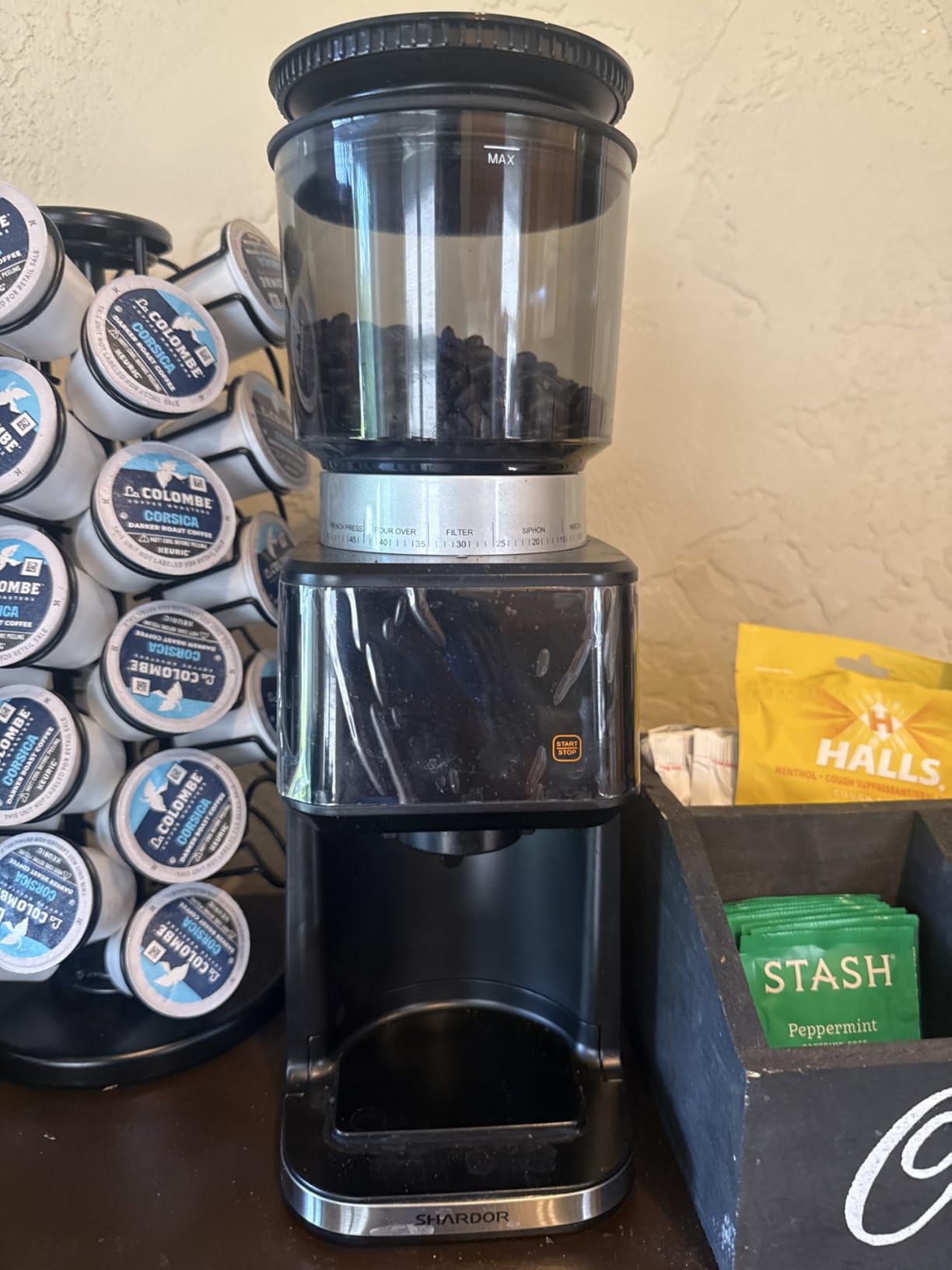
This is the grinder to consider when the budget is the deciding factor and the alternative is a machine with a plastic blade burr built in. A 4.4 average across 925 reviews says the burr set and the adjustment range are genuinely capable, even though the interface is not the most refined.
The 40mm stainless steel conical burrs are the headline. Steel burrs of that diameter are the working standard in dedicated espresso grinders, so at this money you are buying real grinding hardware rather than a marketing term.
51 settings and where the espresso actually sits
Of the 51 settings, the espresso range is a slice in the middle-lower portion of the dial. Because the differences between adjacent steps are small, this behaves more like a fine adjustment than the setting count alone suggests.
That said, the control is a touchscreen, not a mechanical ring. Touch controls cannot be adjusted by feel in the dark the way a barrel collar can, so you are always reading the number rather than knowing where you are.
Timer dosing and its one weakness
The electronic timer runs to 60 seconds in 0.1 second increments, and that resolution is more than adequate for a 15 to 20 second shot. Cup selection from 1 to 12 cups is a filter convenience rather than an espresso one.
The weakness is density drift. A timer programmed on a dense natural and used on a light washed roast will not land on the same dose weight, and reviewers report both over- and under-dosing as a result. Dosing into the portafilter cradle with a scale beside you solves it.
Anti-static design and the mess factor
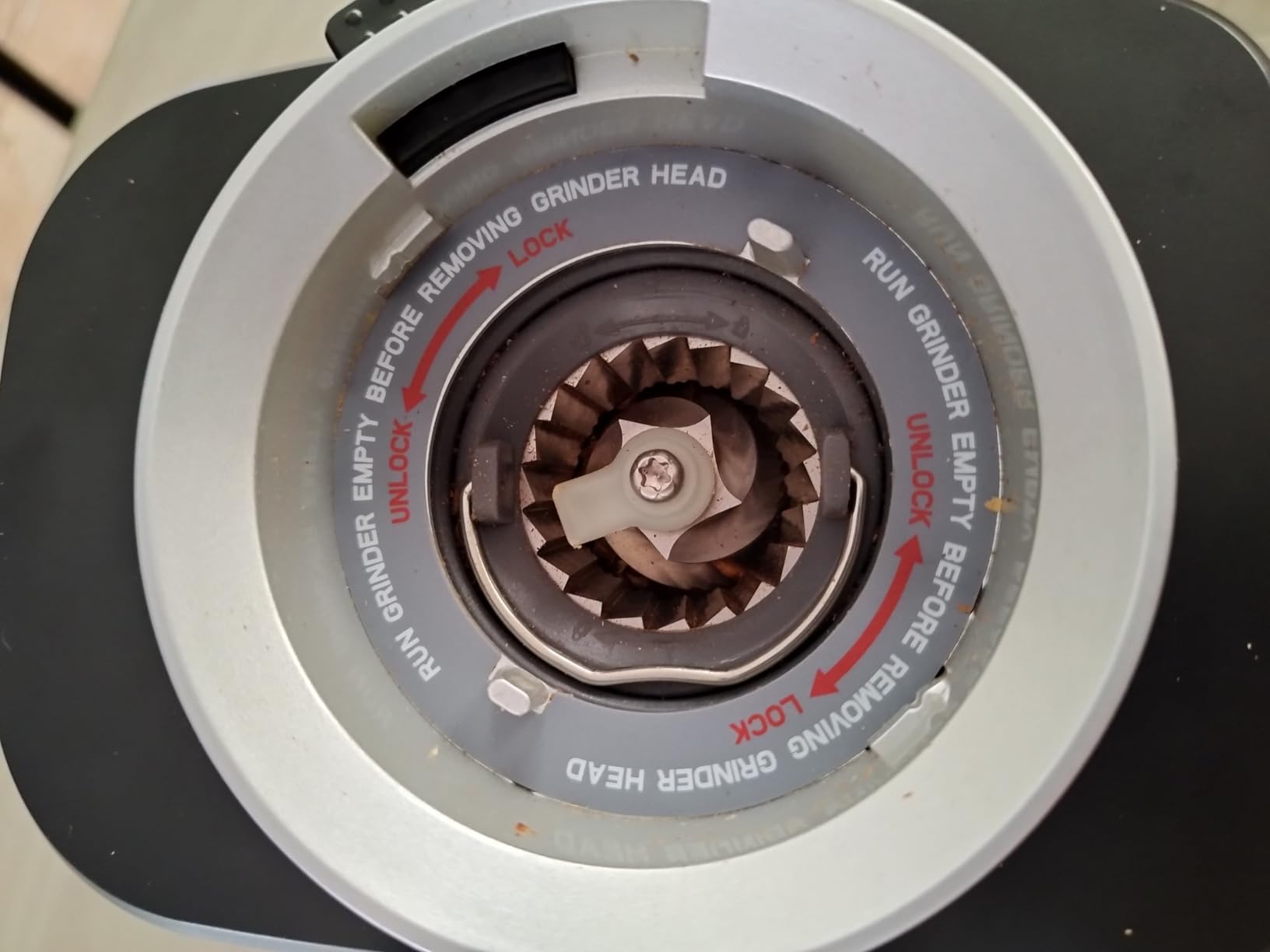
The anti-static chamber is a real feature at this tier. Static cling is what makes conical burr grounds clump in a catch cup and scatter on the counter, and the included grounds residual cleaner helps keep the exit path clear.
It weighs 6.2 pounds with a 7.4 by 4.9 by 13.5 inch footprint, so it is tall but not deep. The lightweight plastic housing is the part to treat gently.
Who it suits and who should skip it
Buy it if you are replacing a blade grinder with the smallest meaningful step up, or if you want one machine that handles espresso and French press on the same dial. At 925 reviews there is enough owner history to judge it fairly.
Skip it if you dose by weight and want the grinder to do it for you, or if you plan to hand the machine to several people. Anyone sensitive to dose drift will notice the timer behaviour.
4. Baratza Sette 270 – Adjustability for Chasing Cafe-Level Shots
Baratza Sette 270 Conical Burr Coffee Grinder
270 macro and micro settings
Three dosing buttons accurate to 0.1 second
409 watts
3.2 kg
Pros
- 270 macro and micro settings allow very fine espresso dialing in
- Three programmable dosing buttons to a tenth of a second
- Straight through grind path rated to 5g per second
- Included shims allow grinding finer for prosumer machines
Cons
- Very loud
- owners describe it as wake the house loud
- Some units arrived with a wiring fault needing case opening
- Time based dosing is not as accurate as an integrated scale
The Sette 270 is the step-up people buy once an entry grinder stops being the limiting factor. Users report cafe-quality espresso once it is dialed in, and the 270-setting macro and micro system is the reason: it is the densest espresso adjustment range of any conical machine here.
It is also the loudest in this roundup by a wide margin, and that deserves more weight than most roundups give it. If anyone in your home is asleep at 6am, read that section twice.
270 settings and what the micro steps buy you
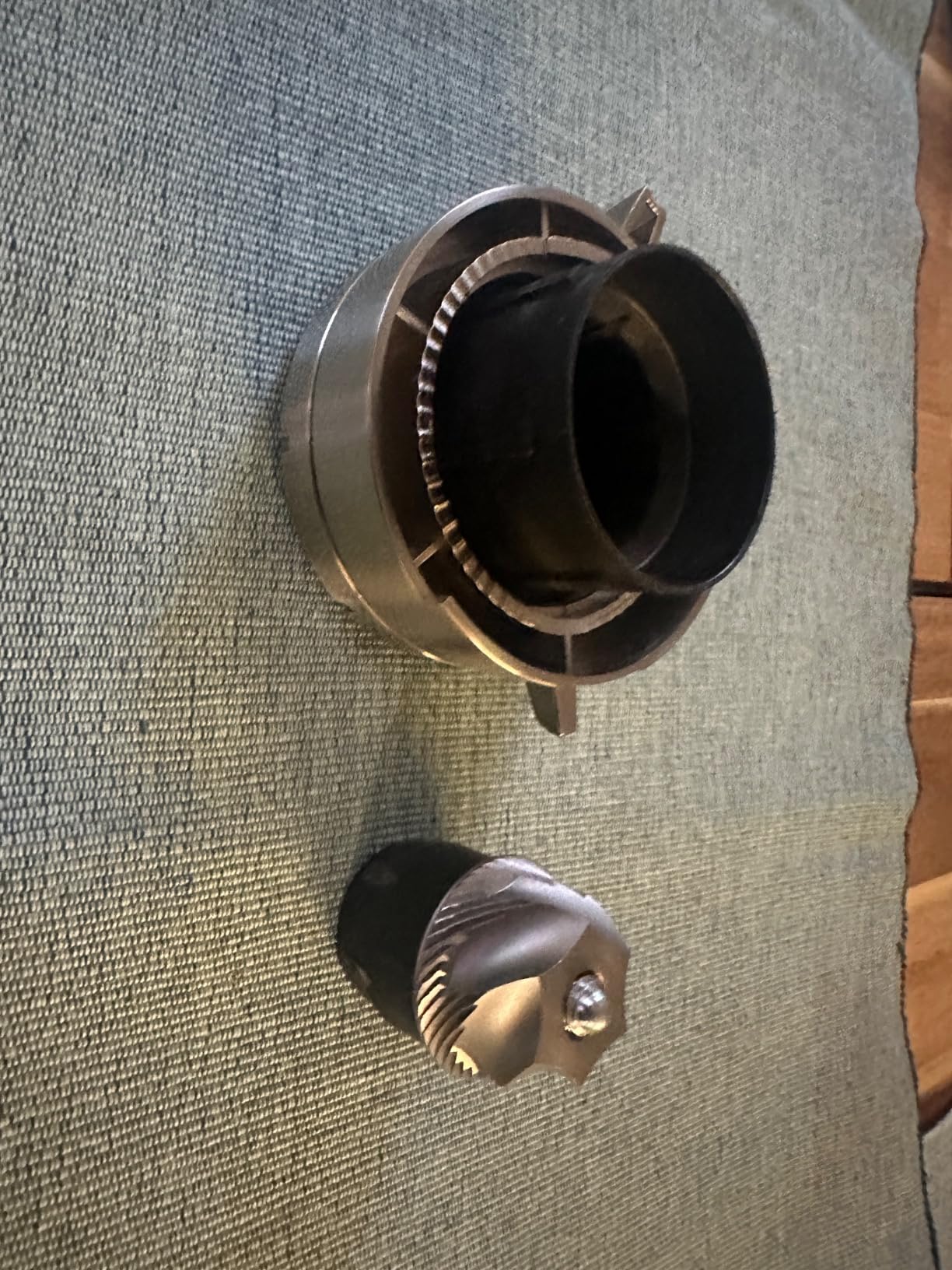
Macro steps handle the broad moves between espresso and filter, and micro steps subdivide the espresso band between them. For someone chasing a 5 to 10 second change in shot time, a micro step is the difference between a targeted adjustment and a full re-dial.
The included shims matter too. They let the inner burr sit closer to the outer burr, which is what makes prosumer espresso machines reachable out of the box rather than a future modification.
Straight-through grinding and the 5g per second path
The Sette grinds on a straight path from burr to outlet rather than through an auger. Less redirection means less chance for fines to build up in a corner and change the grind between doses, and the motor is rated to move up to 5g per second.
The tradeoff is the 409 watt motor, and that is where the noise comes from. Owners describe the start-up as the loudest moment, which is a planning consideration for early mornings.
Dosing buttons without a scale
Three programmable buttons dose to a tenth of a second into either the portafilter or the grounds bin. That is fast and repeatable for a fixed bean, but it is still time-based dosing, and the same density drift described on the entry models applies.
Some early units shipped with a disconnected motor wire or reversed DC motor leads that required opening the case. It is a known batch issue rather than a design flaw, and it is worth checking the unit on arrival.
Serviceability as the durability argument
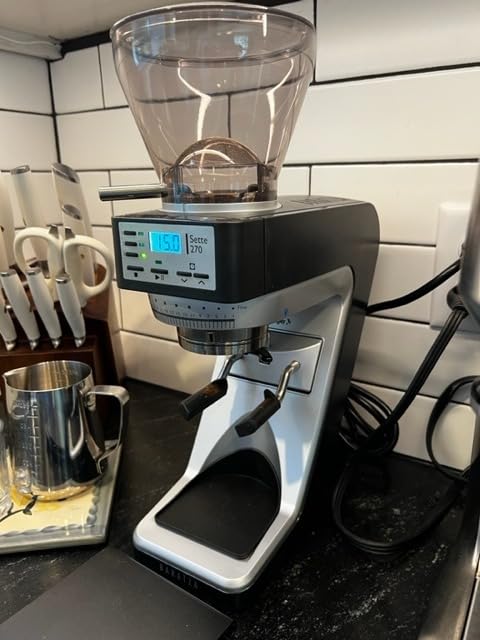
The modular design with easily replaceable parts is the reason this grinder is often described as a ten-year purchase. Burrs, motor and electronics are all replaceable, and that is a stronger durability signal than any material claim.
The plastic hopper is the part reviewers criticise, along with static scattering grounds in larger doses. For single shots the dose is small enough that it rarely shows.
Who it suits and who should skip it
Buy it if you are already pulling daily espresso and your shots need finer incremental control, or if you have a prosumer machine that benefits from the shims. It is a genuine upgrade in adjustability, not in noise.
Skip it if you live in a small apartment, if a child sleeps near the kitchen, or if you are still learning to dial in. The adjustment range is an asset once you know what to do with it.
5. Homtone Conical Burr Espresso Grinder – Hands-Free Dosing on a Budget
Homtone Conical Burr Espresso Coffee Grinder, 51 Precise Settings, Electric Mill with Portafilter Holder, 2-12 Cups Adjustable, Anti-static, Stainless Steel, 120V
40mm stainless steel conical burrs
51 grind settings
Hands free dosing for 51mm to 58mm
6.5 pounds
Pros
- Automatic dosing starts and stops when the portafilter is inserted or removed
- 40mm steel conical burrs described as quiet and low heat
- 51 settings from espresso to French press
- Easy to disassemble with little residual left behind
Cons
- Minimum timed grind is 5 seconds
- which nearly fills a double basket
- Holds the grind button as the power control
- Portafilter cradle aligns poorly with the auto grind button
Owners of this grinder repeatedly compare it favourably to machines costing more than twice as much, specifically on grind quality, quietness and how little grounds it leaves behind. Those three things are usually the most expensive to fix in a cheap grinder, so the comparison is not as far-fetched as it sounds.
The defining feature is hands-free dosing. Insert a 51mm to 58mm portafilter and the grinder starts, remove it and the grinder stops. There is no button to hold and no timer to program.
Hands-free dosing and the 5 second floor
Auto-dosing is genuinely convenient for milk drinks, where you are grinding while the milk steams. The catch is the five second minimum, which nearly fills a double-shot basket and makes true single shots impossible on the timer.
If you mostly drink doubles andAmericano, that is a fair trade. If you pull single shots, dose into a cup with the button instead.
Burr set, quietness and cleanability
The 40mm stainless steel conical burrs are described by owners as quiet and low heat, with a 6.5 pound body and a 275g capacity hopper. Low heat matters at espresso settings because heat drives off aromatics before they reach the cup.
Cleaning is the underrated strength here. Owners report easy disassembly with very little residual in the chamber, and low retention through simple geometry is easier to maintain than a complex chute.
Interface quirks worth knowing
Three practical issues recur. The grind button doubles as the on and off control, so start-up wastes grounds. There is no true power switch, leaving a bright status light on in standby. And the portafilter cradle is flimsy and does not align well with the auto-grind button, which undercuts the hands-free idea.
None of these affect the grind. All of them affect how the machine feels to use daily.
Who it suits and who should skip it
Buy it if your budget is tight, you drink doubles, and you value a quiet operation with simple cleaning over precise mechanical adjustment. The 51 settings plus steel burrs cover espresso through French press.
Skip it if you pull single shots routinely, if you want portafilter hardware that seats properly, or if you need dosing accurate to a fraction of a gram without a scale.
6. MOKKOM 64mm Flat Burr Grinder – Flat Burr Uniformity Without the Premium Price
MOKKOM 64mm Flat Burr Coffee Grinder, Espresso Grinder,100 Grind Settings
64mm stainless steel flat burrs
100 grind settings
350g hopper plus single dose bellow
260 watts
Pros
- 64mm stainless steel flat burrs for uniform particle size
- 100 settings from Turkish to French press
- Plasma generator in the exit chute reduces static
- Two hoppers including a bellow single dose
Cons
- Requires an external AC adapter power brick
- Heavier and taller body than compact conical units
- 100 step scale still needs tasting when switching beans
Flat burrs produce the tightest particle size distribution of any burr shape, and 64mm is a diameter normally reserved for machines costing several times more. Getting that combination here is the reason this grinder earned a place in a roundup otherwise full of 40mm conical units.
At a 4.5 average across 324 reviews, with 77 percent five-star ratings, the owner feedback concentrates on the same three strengths: burr uniformity, the anti-static plasma generator, and the flexibility of the two hoppers.
Flat burrs and what uniformity buys the shot
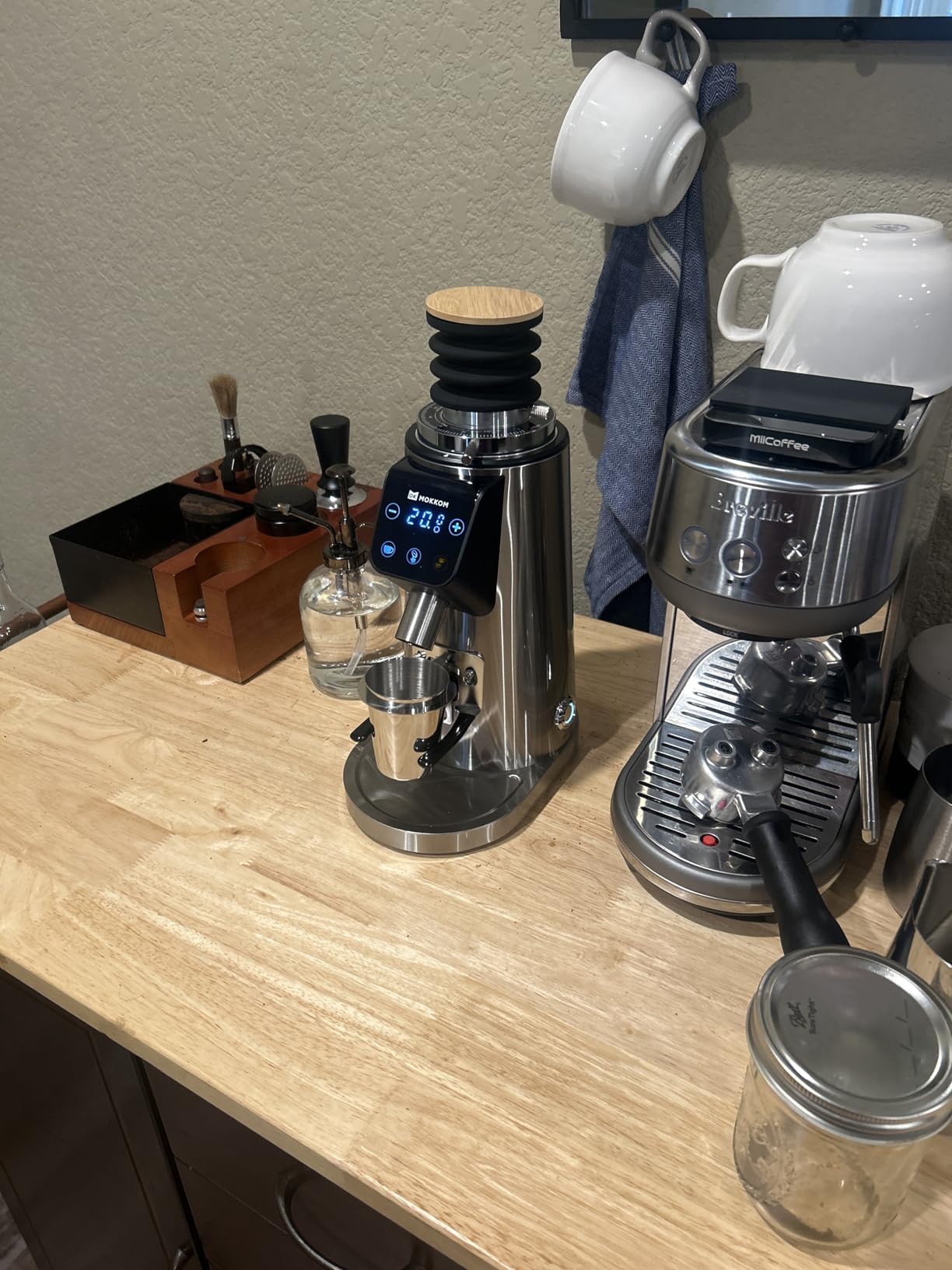
Flat burr sets act on every particle at once rather than progressively, so grounds come out narrower in size distribution. Narrower distribution is what reduces channeling through the puck, which is why flat burr grinders tend to produce more forgiving shots.
The 64mm diameter also means slower tip speed than a small conical set at the same motor speed, which supports cooler grinding and less static. The full stainless body, aluminum chamber and brass adjustment ring add mass that damps vibration.
The 100 step scale and its practical limit
One hundred settings sounds excessive until you switch beans, at which point most of the scale is untested territory and you are tasting to find the right step. Treat the high count as range rather than precision.
The LED display with a 0.1 second precision timer covers single, double, top-up and continuous modes, so dose timing is handled on-machine for the filter side of the workflow.
Static control and two-hopper flexibility
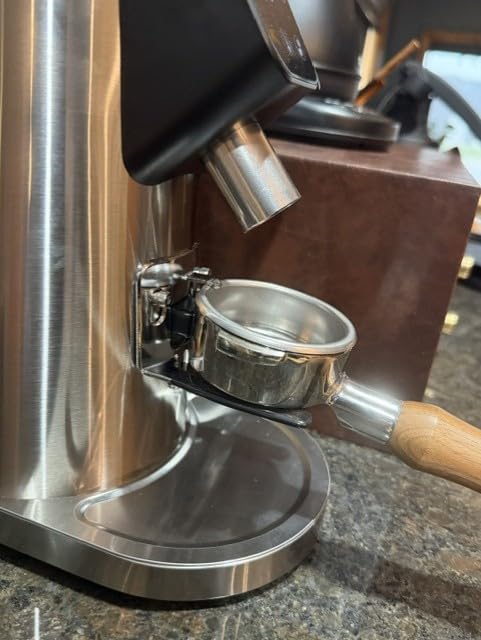
The built-in plasma generator in the exit chute reduces static and grounds scatter, which matters most with fine espresso particles. The two-hopper setup, a 350g bulk hopper and a silicone bellow single-dose hopper, lets you switch between filter batches and single shots without a separate accessory.
The catch is the external AC adapter power brick, which adds a box to your counter and a second cable to manage.
Who it suits and who should skip it
Buy it if you want flat burr behaviour and espresso fineness without stepping up to prosumer pricing, and if you alternate between espresso and pour-over across the week. Static-prone fine grounds are the specific case this handles best.
Skip it if counter height is limited, if you refuse a separate power brick, or if you want mechanical adjustment you can feel with your fingers rather than a stepped scale.
7. Neretva Stainless Steel Espresso Grinder – Compact Body With an Angled Outlet
Neretva Stainless Steel Espresso Grinder with Portafilter Holder, Silver
3.0 stainless steel conical burr
30 grind settings
Timer from 1 to 25 seconds at 0.1 second steps
3.17 kg
Pros
- Upgraded 3.0 steel conical burr with fines under 15 percent
- Portafilter holder fits 51mm and 58mm two and three ear baskets
- Plasma generator and 20 degree angled outlet reduce static
- Comparatively quiet and compact for the class
Cons
- Only 30 grind settings and coarse to fine steps can feel indistinct
- Grounds can scatter around the machine during grinding
- Portafilter is not included
The Neretva is aimed at unpressurized espresso baskets, which is an honest description of what a 30-step conical grinder at this level can deliver. Owners report it works for non-pressurized baskets and pour-over, with good consistency and low noise for the class.
Its distinguishing feature is the outlet geometry. A 20 degree angled powder outlet combined with a plasma generator is a specific answer to the static and clumping complaints that dominate reviews of cheap conical grinders.
What 30 settings really means for espresso
Thirty settings is a narrower espresso band than most grinders here, and reviewers note that consecutive coarse-to-fine steps can feel indistinct. In practice this means your dial-in moves are larger, so expect to taste between adjustments more often.
The burr itself is the compensation. Fines under 15 percent is a meaningful consistency claim, and it is what makes a modest step count workable at espresso fineness.
Portafilter fit and the missing basket
The holder fits 51mm and 58mm two-ear and three-ear portafilters, which covers most home baskets including a 54mm. The portafilter itself is not included, so plan for that purchase separately if you do not already have a compatible one.
Because it takes a 58mm basket, this grinder suits anyone whose machine uses the wider basket, and the angled outlet aims grounds toward the basket rather than across the counter.
Anti-static design and the scatter problem
The plasma generator and angled outlet are the anti-static system, and they are aimed at reducing clumping and residue. Despite that, some owners still report grounds scattering around the machine, and a minority report the coarseness adjustment eventually failing to produce genuinely coarse grinds.
At 4.92 by 8.07 by 13.03 inches and 3.17 kg, it is one of the smaller footprints here, which is the reason it earns the compact-counters badge.
Who it suits and who should skip it
Buy it if counter space is the binding constraint, you use unpressurized baskets, and you want a wider 58mm portafilter option at a low price. The angled outlet genuinely helps with mess control during single shots.
Skip it if you need wide adjustment latitude for dialing in, if you drink Turkish coffee with this machine, or if you want the portafilter included.
8. MiiCoffee DF64 II – Single Dosing With Under 0.1g Retention
MiiCoffee DF64 II Single Dosing Coffee Grinder (Black)
64mm stainless steel flat burrs
Stepless chrome dial
Under 0.1 gram retention
15 pounds
Pros
- Custom 64mm stainless steel flat burrs upgradeable to SSP
- true zero retention under 0.1 gram
- Stepless dial for precise espresso adjustment
- Plasma generator and anti popcorn disc reduce bean jump and static
Cons
- Heaviest unit in the group at 15 pounds
- Single dose only with no bulk hopper
- Best results come from the supplied dosing cup rather than a portafilter
The DF64 II is the retention answer in this roundup. Owners measure true zero retention under 0.1 gram, and the community threshold for a quality single-dose machine is roughly 0.2 grams, so this sits well under the line where wasted coffee becomes noticeable.
Retention matters most when single dosing expensive beans, where every gram left in the chute is a gram of the expensive stuff you already paid for. At under 0.1 grams the difference is mostly theoretical for an 18 gram dose.
Stepless adjustment and the espresso dial
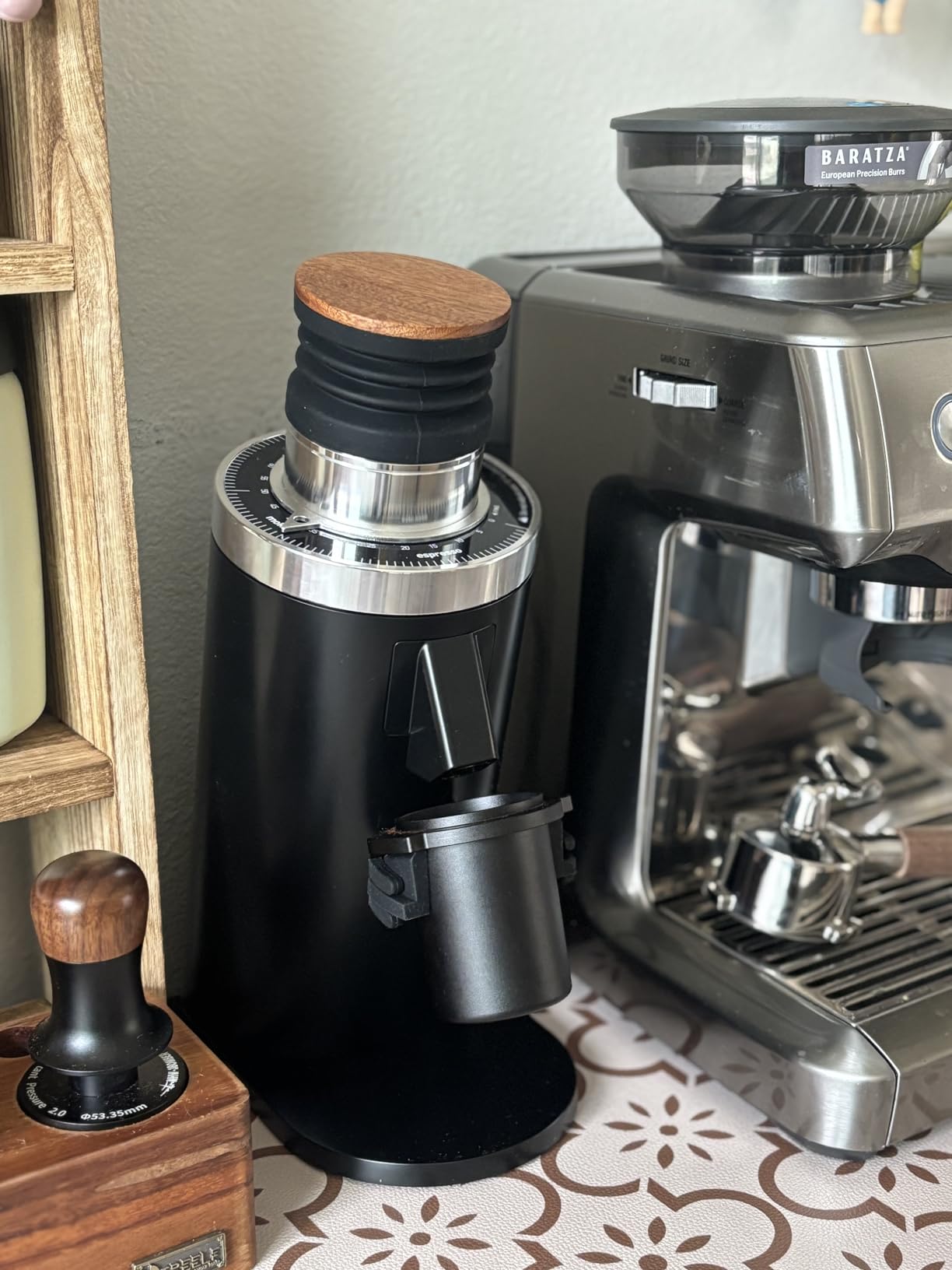
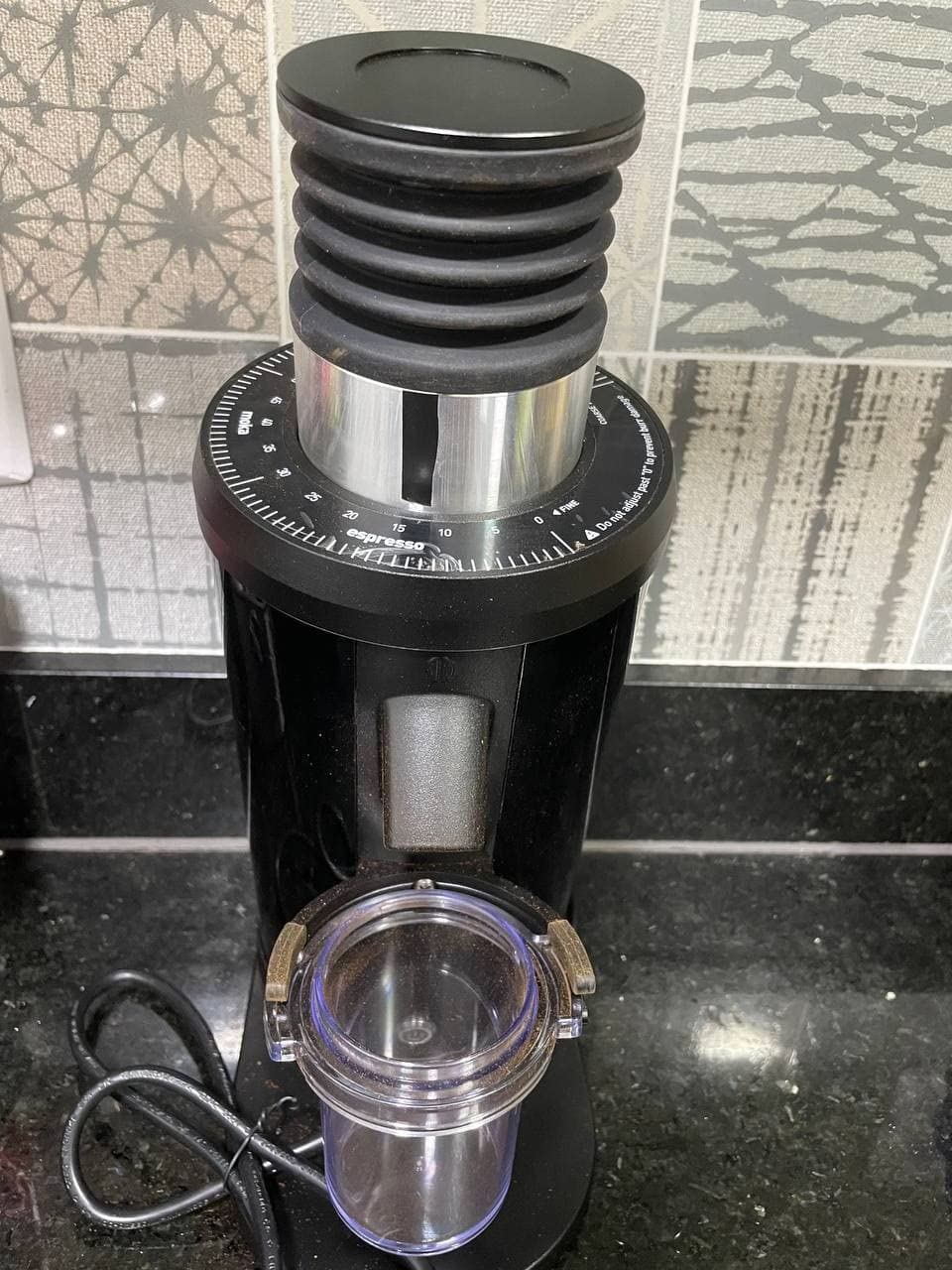
The chrome-wrapped adjustment dial is stepless with a metal indicator, meaning the grind moves continuously rather than in steps. This is the smoothest espresso adjustment in the roundup, and it is the reason the machine is rated at 4.4 despite a small review base.
With a stepless dial you do not have settings to memorize. You adjust until the shot runs in your target window, which makes it forgiving for beginners and satisfying for experienced dialers.
64mm flat burrs and the single dose path
The custom 64mm stainless steel flat burrs are upgradeable to SSP burrs later, so the grinder has a path beyond its launch specification. The burr carrier sits in an aluminum body, and the anti-popcorn disc speeds up grinding while preventing beans from jumping at the throat.
The path is single dose only, with a 58mm food-grade aluminum dosing cup, dosing ring, bellow and wooden lid. Owners note the best results come from the supplied dosing cup rather than dosing into a portafilter, which is worth knowing before you wire it up to your machine.
The weight and the single dose commitment
At 15 pounds this is the heaviest unit in the group, and that mass is part of why the burrs stay consistent. It is a countertop commitment, not a small-appliance footprint.
There is no bulk hopper. If you also brew filter coffee in volume, this is a dedicated espresso tool, and you would pair it with something else for batch work. The unit ships with a 110V US plug and a one-year warranty, which is the shortest coverage here.
Who it suits and who should skip it
Buy it if you single dose expensive single-origin espresso, you want stepless control more than you want a large hopper, and you will use the included dosing cup as intended. Retention figures are the reason to choose it.
Skip it if counter weight is an issue, if you want one grinder for all brew methods, or if you want to grind directly into your own 58mm portafilter rather than a dosing cup.
9. Viesimple Gen 4 Single Dose Grinder – Quiet Operation and the Smallest Footprint
Viesimple Gen 4 Electric Burr Coffee Grinder, Single Dose, Espresso, Black
48mm five blade conical burr
Rated under 50 decibels
6 by 3 by 9 inch body
3.4 pounds
Pros
- Quiet low RPM DC motor rated under 50 decibels
- Compact 6 by 3 by 9 inch body saves counter space
- 48mm five blade conical burr with fine adjustment steps
- Sealed magnetic dosing cup and blow out funnel keep grounds contained
Cons
- Single dose hopper only holding roughly 35g
- On and off toggle rather than a timed auto shutoff
- External power brick adds clutter
- Occasional clogging when dialing very fine espresso
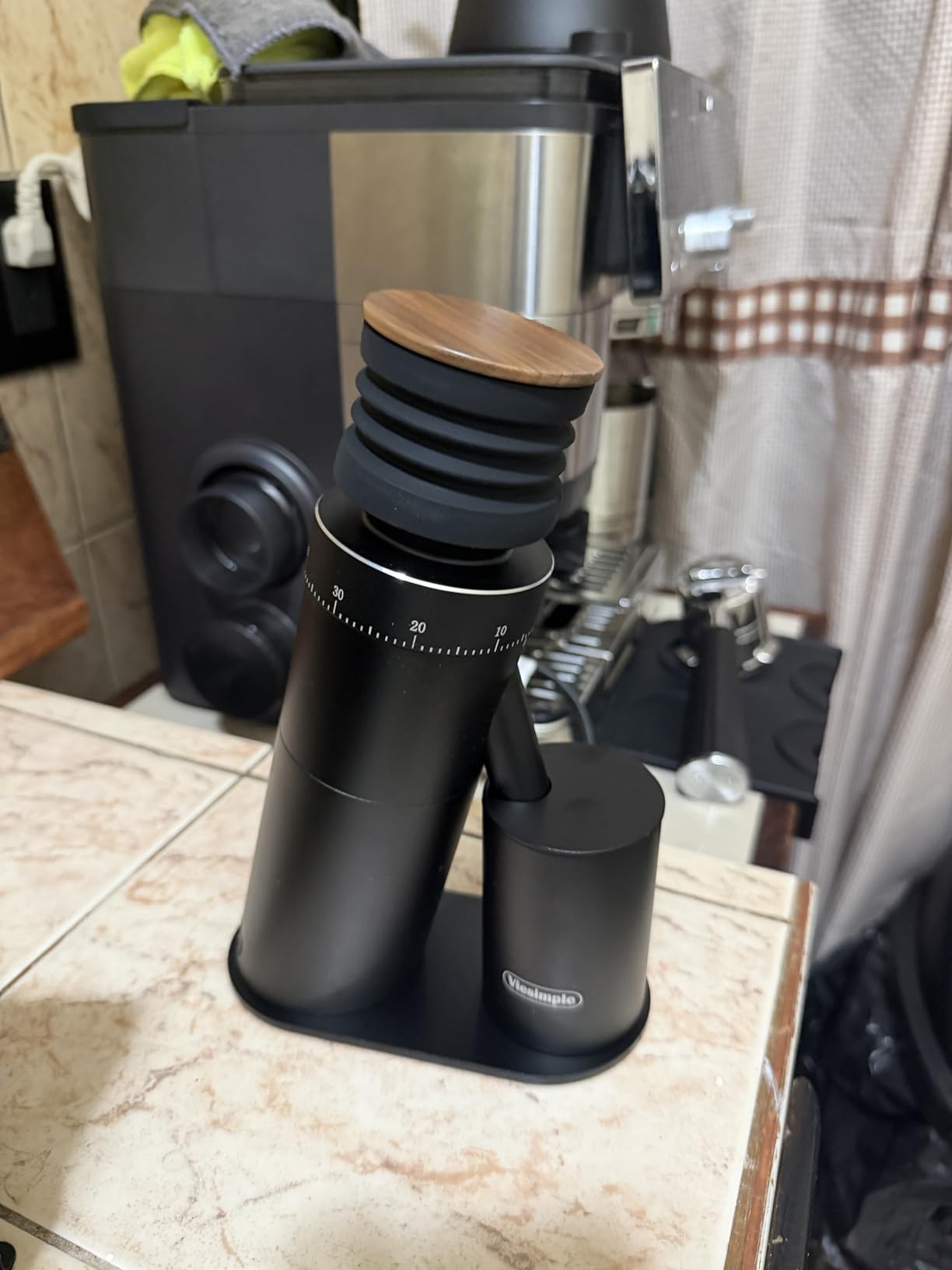
This is the grinder to shortlist if noise decides the outcome. A DC motor rated under 50 decibels changes what an early morning sounds like in a shared home, and the community noise complaints that appear against louder grinders simply do not apply here.
At 6 by 3 by 9 inches and 3.4 pounds it is also the smallest body in this roundup by a wide margin, which matters in a kitchen where counter space is measured in inches rather than feet.
Quiet by design: low RPM and slow grinding
Noise level follows motor speed. A low-RPM DC motor paired with a 48mm five-blade conical burr trades throughput for silence, and the low-temperature slow grind is what preserves bean aroma compared with a faster spin.
Owners who upgraded from flat burr grinders report more consistent shots, quiet operation and a smaller footprint, which is a useful combination when the machine is a few feet from a bedroom wall.
Single dose workflow and the 35g limit
The sealed magnetic dosing cup and blow-out funnel keep grounds contained with minimal residue, and the anti-clogging powder channel carries a food-grade anti-static coating. Single dose capacity is about 35g, which is enough for a double with headroom and nothing more.
That is the tradeoff for the quiet motor and the small body. There is no bulk hopper, so filter coffee in volume means another tool.
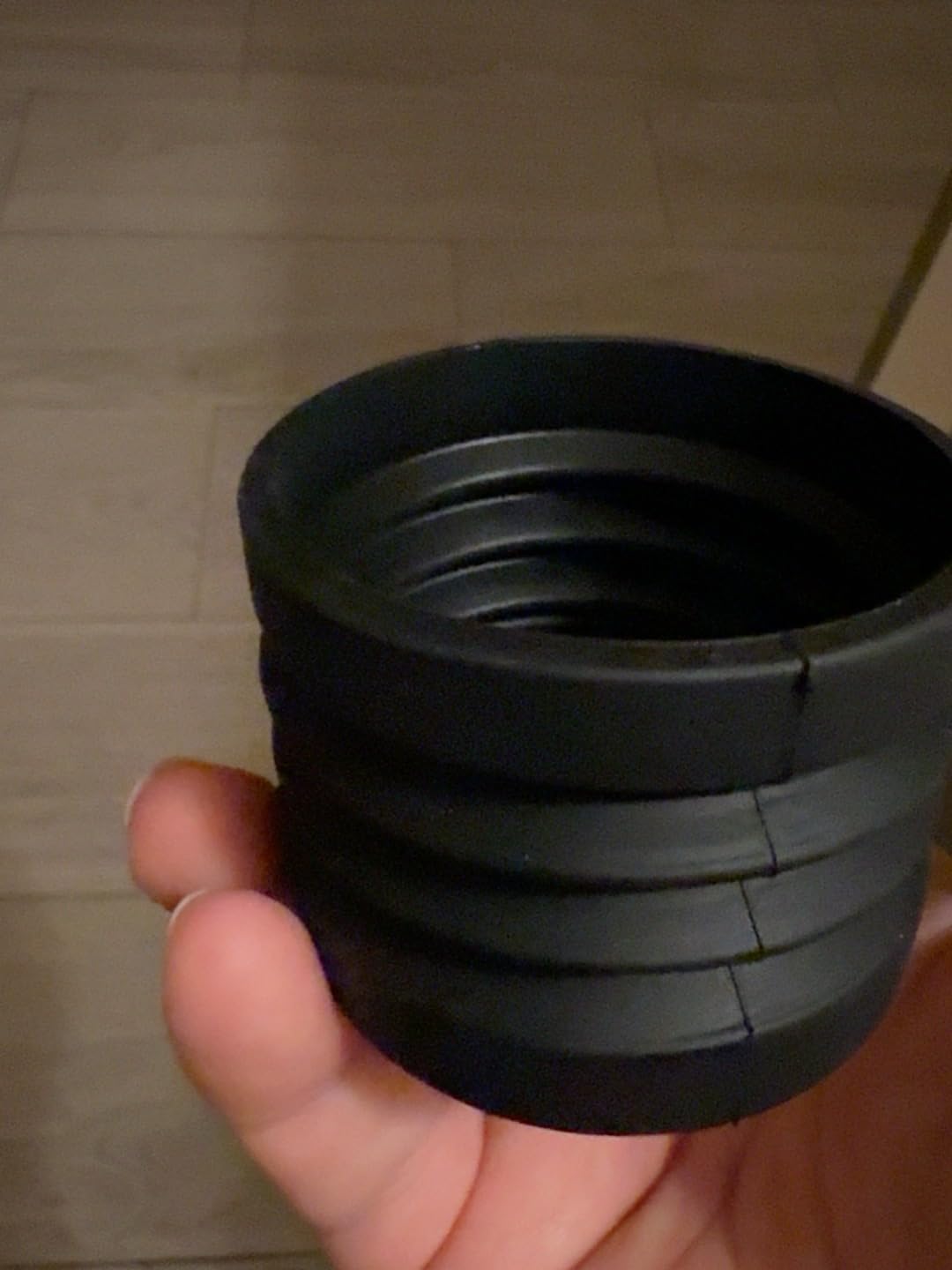
Fines at coarse settings and very fine espresso
The 48mm conical burr produces more fines at coarser settings than the flat burr alternatives in this list, which is the normal conical tradeoff. At espresso fineness that matters less, since fine particles are what you are aiming for.
A minority of owners report clogging when dialing very fine espresso grinds. If that happens, the dosing cup needs a proper knock-down routine rather than a light tap, and a visual check before you dose is worth the habit.
Control style and universal voltage
The control is an on and off toggle rather than a timed auto shutoff, so dose weight is dose weight by scale. For espresso that is arguably the better method anyway, since you are weighing the puck regardless.
The 100 to 240V universal voltage and two year warranty are both good, and the external power brick is the one bit of counter clutter to plan around.
Who it suits and who should skip it
Buy it if you grind early, if counter space is tight, or if noise has been the reason you kept an old grinder. The sealed dosing cup and contained grounds make it tidy in a small kitchen.
Skip it if you need to grind filter coffee in batches, if you want timed auto shutoff, or if you pull very fine espresso and expect clumping to be fully solved.
10. AMZCHEF 64mm Flat Burr Grinder – Click-Stop Flat Burrs Built Around a 58mm Basket
AMZCHEF 64mm Flat Burr Coffee Grinder, Espresso Grinder, 90 Grind Settings
64mm stainless steel flat burrs
90 grind settings with a click at each step
58mm portafilter holder
12 pounds
Pros
- 64mm stainless steel flat burrs for consistent extraction
- 90 settings with a tactile click at every step
- Triple anti static system with a negative ion generator
- One hand grinding through the push to start switch
Cons
- Portafilter is not included and only 58mm baskets fit
- Large and heavy at 12 pounds and 16.27 inches tall
- Many scale settings are not useful for a single brew method
The AMZCHEF is the 58mm specialist here. Everything about the dosing workflow is built around a 58mm portafilter, from the integrated holder to the magnetic dosing cup, which makes it a natural match for a wide-basket machine.
Flat burrs at 64mm with a tactile click at every one of the 90 settings is an unusual combination. The burrs give the consistency, and the click gives you a physical reference point so you always know which setting you are on.
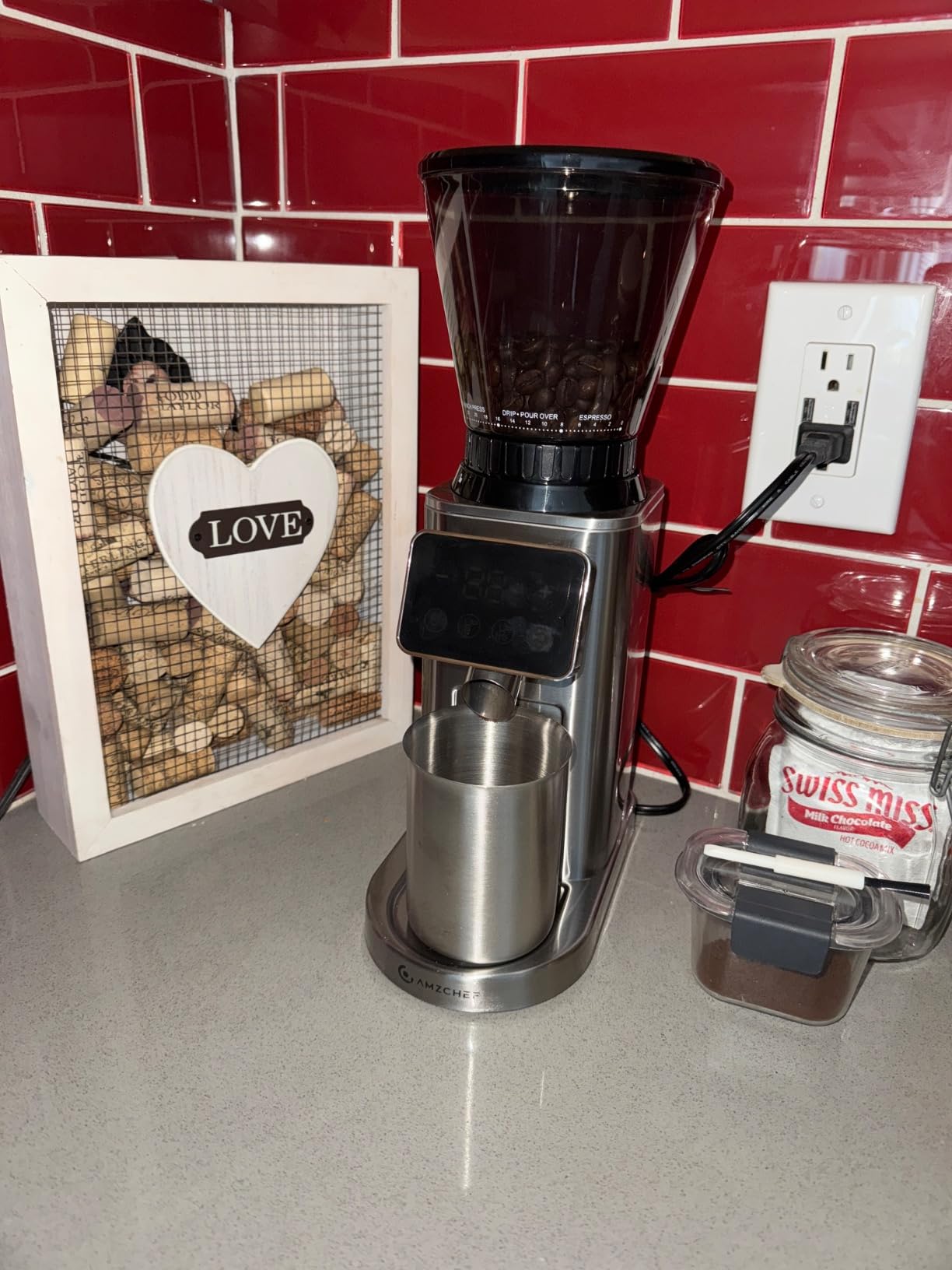
Flat burr uniformity with a tactile reference
The 64mm flat burrs produce consistent, even grounds, and the full-metal stainless body and all-metal grinding chamber reduce vibration compared with plastic housings. Mass and rigidity both help keep particle size steady shot to shot.
The click at each step is the underrated feature. On a smooth ring you have to remember where you were; here you can feel the position in the dark, which speeds up iteration during a dial-in.
The triple anti-static system and one-hand grinding
Static is the enemy of fine espresso grounds, and this machine attacks it three ways: a built-in negative ion generator, an angled stainless chute, and a magnetic dosing cup. Owners specifically credit the anti-static system for keeping the counter clean.
The push-to-start switch on the built-in 58mm holder allows one-hand grinding, so you start, swap the basket, and the dose is already waiting.
The 58mm restriction and the physical size
Only 58mm portafilters fit the holder and dosing cup, and no portafilter is included. If your machine takes a 54mm basket, this is the wrong machine and the MOKKOM or the Breville covers you.
At 12 pounds and 16.27 inches tall it is the second largest unit here, and the 200 watt motor plus full metal build explains the mass. Plan the vertical clearance before ordering.
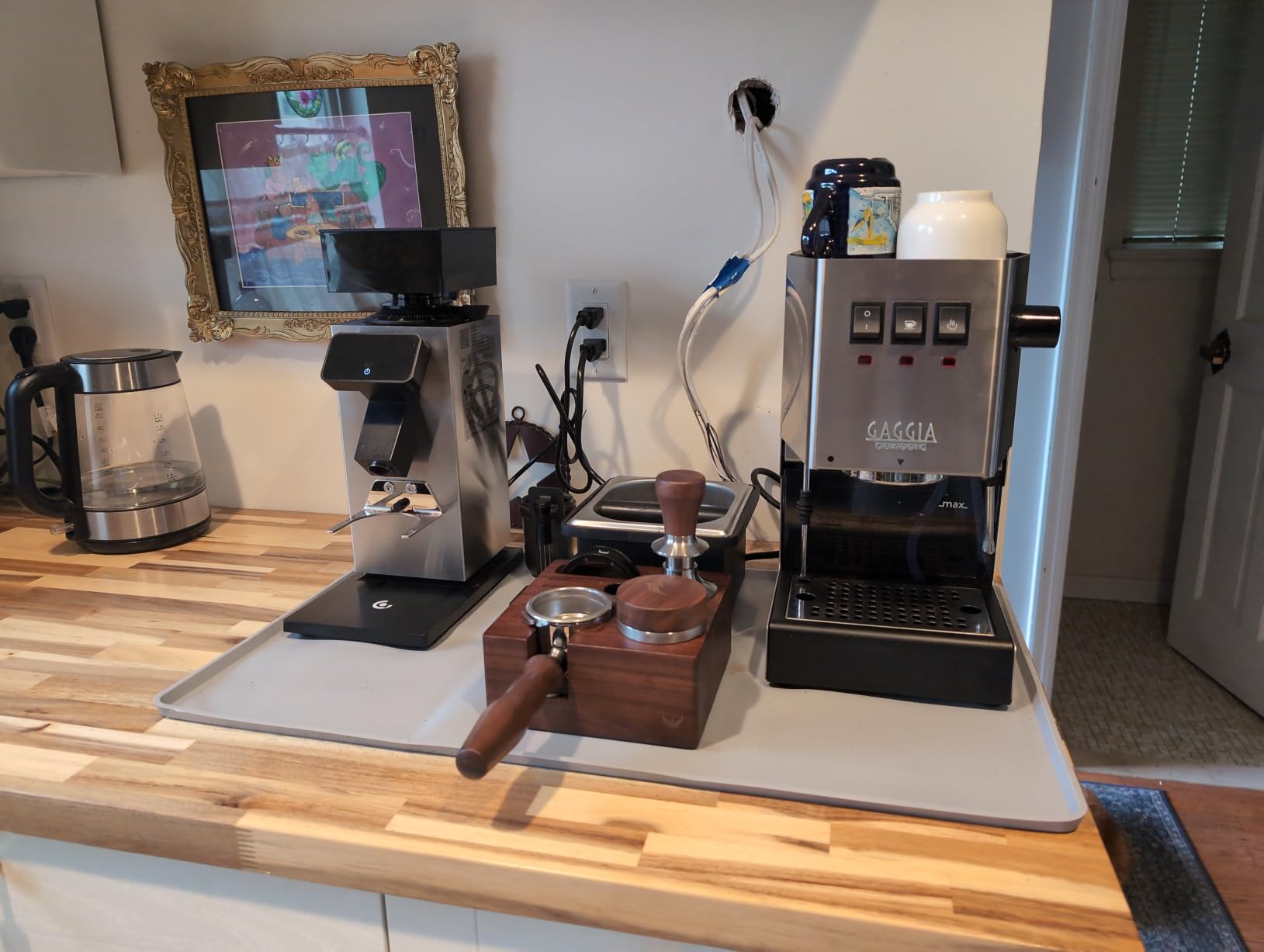
Who it suits and who should skip it
Buy it if your machine uses a 58mm portafilter, you want flat burr uniformity in a metal body, and you prefer a click you can feel over a smooth adjustment ring. The anti-static system is genuinely effective for messy fine grounds.
Skip it if you have a 54mm machine, if counter height is limited, or if you want the included portafilter rather than buying one separately.
How to Choose an Electric Burr Grinder for Espresso
The list above is filtered for espresso capability, which already removes most of what a general coffee-grinder roundup would include. Within that filtered set, these are the decisions that actually change how your shots taste.
Conical vs flat burrs for espresso, in plain English
Conical burrs have one outer ring and a cone inside it. Beans enter at the top, are pulled inward and down, and are ground progressively as they pass the narrowing gap. Flat burrs have two parallel rings, and particles are ground across the full face of the set at once.
- Conical burrs: usually 40mm to 48mm, tolerant, forgiving of small setting changes, produce more fines at coarse settings, and are cheaper.
- Flat burrs: usually 64mm, produce the narrowest particle size distribution, run cooler, are quieter, and are the traditional cafe shape.
- For espresso specifically: flat burrs give a more forgiving puck, but a good conical machine with dedicated micro steps will pull excellent espresso too.
- Burr diameter: larger means slower tip speed at the same motor RPM, which means less heat and less static.
Once you are dialing in on a micro-step conical machine, the difference narrows. Move up to flat burrs when you want shot-to-shot repeatability more than you want a low entry point.
Stepped, micro-step or stepless: what the adjustment actually means
Stepped adjustment moves the burrs in fixed increments, so a setting number always means the same gap. That is repeatable but coarse. Micro-step systems add finer divisions inside the espresso band, which is the single most useful upgrade for dial-in speed.
Stepless adjustment moves continuously, so there are no numbers to memorize. It is the smoothest experience, and it costs more. The tradeoff is that you must always be looking at a reference, usually a marked dial or a grind-time reading, to know where you are.
Many experienced users finish with a manual dial. Once you understand the shape of the adjustment, taking the dial off and turning the burrs by hand is faster than clicking through options.
How fine should an espresso grind be?
Espresso sits roughly in the 500 to 700 micron range as a practical target, which feels like slightly finer than table salt. The measurable version is time: a double shot in a 58mm basket should run in about 25 to 30 seconds at 9 bars.
The texture test works without a refractometer. Espresso grounds should feel dry and powdery rather than sandy, and they should clump very slightly when pressed between finger and thumb. If the puck stays loose and gritty, grind finer.
Grind retention and single dosing
Retention is the coffee left inside the grinder after a dose. It matters most when you single dose, because the residue is a measurable share of an expensive 18 gram charge, and it goes stale inside the machine.
The community thresholds are roughly 0.2 grams on a good single-dose machine and roughly 0.5 grams on an entry conical machine, and both are considered acceptable. Only the DF64 II in this list publishes a figure under 0.1 grams. If retention is your priority, that is the differentiator.
Portafilter size: match it before you buy
A 54mm basket and a 58mm basket are not interchangeable with dosing hardware. Check which size your machine uses, then confirm the grinder ships a holder or dosing cup for it.
The Breville ships 50mm and 58mm cradles, which covers most 54mm setups through the 50mm cradle. The MiiCoffee DF64 II and the AMZCHEF are built specifically for 58mm. The SHARDOR, the Neretva and the Homtone include cradles that accept a wider range of basket sizes.
RPM, heat and why your grinder should be slow
Motor speed drives heat, noise and static. Heat scorches the grounds before they reach the cup, and fast spinning is the source of the loud complaints against the Sette 270. A slower grinder that takes two seconds longer per dose produces a better and quieter shot.
Most home espresso work happens in ten to fifteen second bursts, so peak motor speed matters far less than the shape of the burr set and the motor cooling between shots.
Static, clumping and single-origin beans
Static cling is what makes fine grounds stick to the chute and clump in the catch cup, and it gets worse with lighter roasts and flat burrs. Plasma generators and ionizers appear on four of the grinders here and are the most direct hardware answer.
Before buying for a solution, try the free one: tap the dosing cup on the counter so the grounds drop rather than cling, and wipe the chute with a dry hand. For light roasts on a machine with no ionizer, the Ross Droplet Technique, which is a few drops of water in the dose, measurably reduces clumping.
Noise and counter space in a small kitchen
Noise is a purchase filter, not a preference. A high-RPM grinder with a 409 watt motor is audible through a wall in an apartment, while a low-RPM DC motor rated under 50 decibels is conversation-friendly. If your first shot is before 7am, the Viesimple Gen 4 is built for that.
Counter space works the same way. The Viesimple at 6 by 3 by 9 inches and the Neretva at roughly 5 by 8 by 13 inches are the compact options, while the AMZCHEF at 16.27 inches tall and the Breville at 15.33 inches need vertical clearance you should measure before ordering.
Repairability and total cost over five years
Every grinder on this list has a consumable burr set, and the cost of replacing it is the number that decides whether a machine is cheap to own. Repairability is the better question, because a grinder with a serviceable design and available parts is a ten-year purchase rather than a five-year one.
The Baratza models are the clearest examples, with tool-free burr removal on the Encore ESP and a fully modular, replaceable-part design on the Sette 270. Long-term owners of Baratza gear consistently cite parts availability as the reason the grinder lasted. Warranty length is the secondary signal, and the mix here runs from one year to two years, so parts access matters more than the warranty card.
When to upgrade past an entry grinder
Stay on an entry model if you drink one or two espresso drinks a day, your machine is a basic pressurized basket, and you are still learning the workflow. Any of the budget grinders here will move you from a blade grinder to visibly better coffee, which is the largest single quality jump in this category.
Upgrade when a specific problem appears rather than on a schedule. Move up when shot-to-shot repeatability frustrates you, when you start buying expensive single-origin beans and retention bothers you, or when you buy a prosumer machine and cannot grind fine enough. Buying a step-up grinder before a step-up machine is the most common regret reported in espresso communities.
How we tested and what we checked
Each grinder was assessed on published burr diameter and material, the espresso range of its adjustment system, dosing workflow and portafilter fit, verified purchaser review volume and rating distribution, and long-term ownership patterns. We weighted grind consistency first, retention second, noise third, and design preference last.
Where a retention figure appears, it comes from a manufacturer claim or a reported owner measurement. Where no figure exists, we have not invented one, and we have not repeated a low-retention claim without a number behind it.
Dialing In Espresso on Your New Burr Grinder
Whichever grinder you choose, the sequence below gets you to a repeatable shot. It takes three or four shots and works the same way on a stepped micro-step dial and a stepless dial.
- Start coarser than feels right. Set the grinder two to three steps coarser than you think you need. A fast shot under 20 seconds at coarse settings tells you which direction to move.
- Fix the dose weight first. Aim for 18 grams in a 58mm double basket, weighing on a scale. Dose weight changes make shot time changes impossible to interpret, so this comes before any grind adjustment.
- Move one step at a time. Adjust a single step, re-dose, and time the shot. Faster than 25 seconds means grind finer, slower than 30 means grind coarser, and the tasting notes confirm what the stopwatch suggests.
- Taste before you accept the number. A shot running in time can still be sour and bitter together, which is a distribution and puck-prep problem rather than a grind problem. Fix distribution first, then reassess the grind.
Change one variable at a time. Grinder setting, dose weight and tamping all move the shot, and changing two at once tells you nothing about which one mattered.
Frequently Asked Questions
What type of grinder is best for grinding espresso?
An electric steel burr grinder with micro-adjustment or stepless settings is best for grinding espresso at home. Burrs crush beans between two hardened surfaces at a fixed distance, so particle size is repeatable, while blades chop unevenly and produce boulders and dust in the same dose. Within burr grinders, flat burrs such as the 64mm sets produce the narrowest particle size distribution, while 40mm conical burrs with 20 dedicated micro steps are more forgiving and cheaper.
What is the best burr coffee grinder for espresso?
The Breville Smart Grinder Pro is the best burr coffee grinder for espresso for most home setups, with 60 programmable settings and a dose timer adjustable in 0.2 second increments. The Baratza Encore ESP is the best value option for a first machine, using 20 espresso micro steps and mechanical adjustment. The Baratza Sette 270 offers the widest range with 270 macro and micro settings, and the MiiCoffee DF64 II leads on retention at under 0.1 gram.
What is the best espresso grinder for beginners?
The Baratza Encore ESP is the best espresso grinder for beginners because 20 dedicated espresso micro steps make small changes easy to taste, the 40mm steel burrs remove tools for cleaning, and there is no electronics to fail. Weigh every dose rather than trusting the timer, and stay on an entry model until a specific limit pushes you to upgrade. Buying a prosumer grinder before a prosumer machine is the most common regret in espresso communities.
What is the recommended grind size for espresso?
Espresso usually falls between 500 and 700 microns, which feels slightly finer than table salt. The practical test is time rather than microns: a double shot in a 58mm basket should run in about 25 to 30 seconds at 9 bars. The grounds should look powdery and clump very slightly when pressed between finger and thumb. If the puck feels loose and gritty, grind finer.
What grinder does Starbucks use?
Starbucks locations and most commercial cafes use large flat burr or disc grinders sized for a full hopper and continuous duty cycles, often dosed by weight with a commercial portafilter cradle. Home users do not need that throughput or that body. The relevant takeaway is the burr shape: large flat burrs produce the tightest particle size distribution, which is why flat burr sets such as the 64mm MOKKOM and AMZCHEF are the closest home equivalents.
Which Electric Burr Grinder Should You Buy in 2026?
Whichever way you lean, the grinder decides your espresso more than the machine does. Every pick above clears the bar of producing a grind fine and consistent enough to pull a shot with, and none of them are the filter-only machines that clutter general grinder roundups.
If you want the widest espresso range and button-driven dosing, take the Breville Smart Grinder Pro, our editor’s choice and the most-reviewed machine here at 7003 ratings. If you are building a first setup and value mechanical adjustment and serviceability, the Baratza Encore ESP is the answer, and its dedicated espresso micro steps make it the easiest to dial in. If noise and counter space decide your morning, the Viesimple Gen 4 is built for it.
For flat burr fans working on a budget, the MOKKOM gives you 64mm uniformity and an anti-static system without stepping up. If retention on expensive single-origin beans is what you care about, the MiiCoffee DF64 II is the only machine here publishing a figure under 0.1 gram. If you want maximum adjustability and are not sensitive to volume, the Baratza Sette 270 has 270 settings and a fully serviceable design. Pairing with a 58mm machine, the AMZCHEF is the natural fit, while 54mm owners should confirm basket size before choosing.
Whichever grinder you pick, weigh your dose, change one variable at a time, and give it a few weeks before judging it. If you are still comparing machines as well, our beginner espresso machine guide pairs well with any of these, and our French press grinder picks cover the other end of the grind range.