
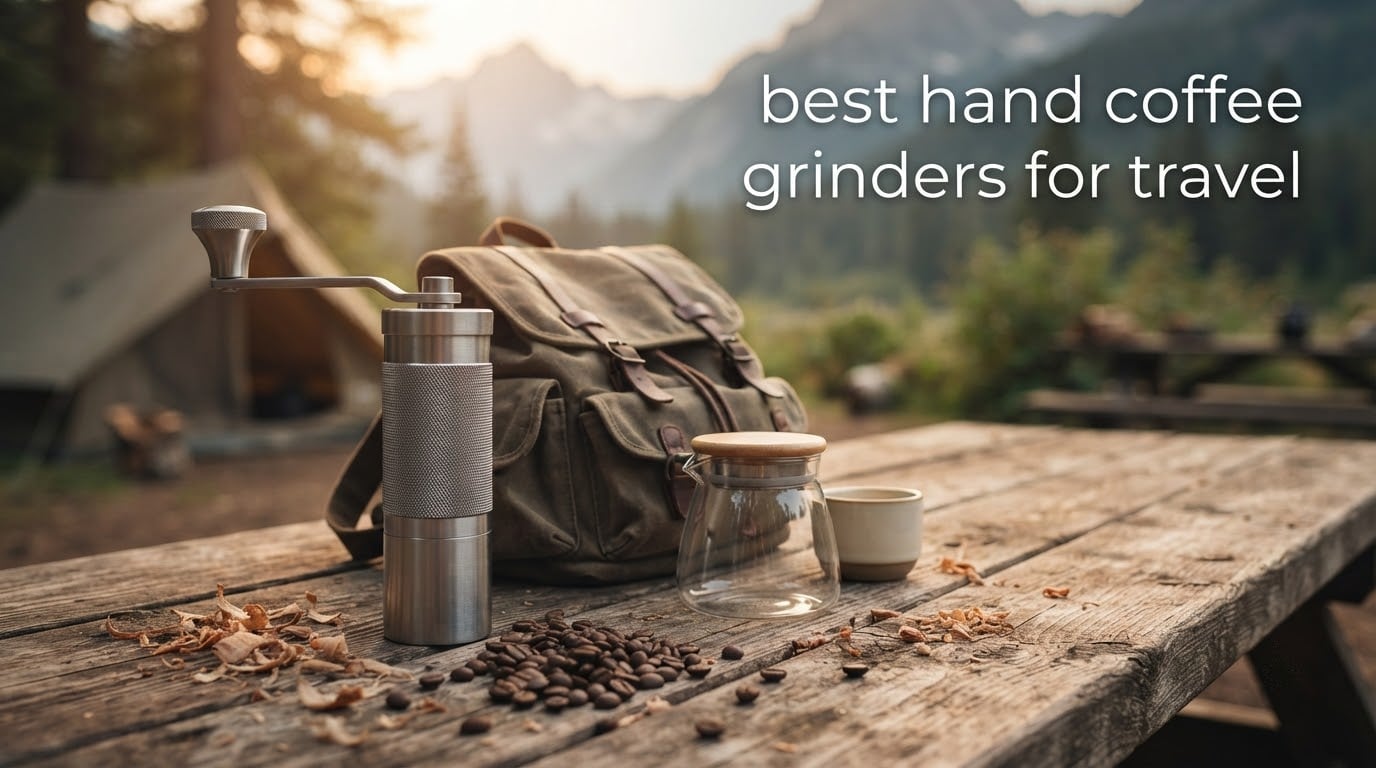
The best hand coffee grinders for travel are the ones that survive a backpack and still produce an even grind on the third morning of a trip. That sounds obvious, but most roundups we read rank hand grinders on burr quality alone and never mention packed weight, bean capacity, or what happens to a grinder after it spends a fortnight inside a checked bag.
Our team packed all ten of these grinders, weighed them on a kitchen scale, ground a full single dose with each, and then used them on a mix of hotel rooms, campsites, and one long road trip where the only water was a bottle in the door pocket of the van. We graded each one on four things: grams in the body, whether a full 18 to 20g dose fits in one load, how the handle behaves after being folded and unfolded, and how well it cleans without running water.
If you only read one paragraph: the Hario Mini-Slim Plus is the pick most travelers should buy. It weighs 300g, the handle detaches so the whole unit packs into a side pocket, the 24g hopper covers a standard pour-over dose, and it has the second-largest review base in this list. If espresso on the road is the goal, the KINGrinder K6 is the one with the precision to get there.
Why Burr Grinders Beat Blade Grinders in a Backpack
A blade grinder chops beans with a spinning propeller. Some hit the blade, some bounce off it, so you get dust and boulders in the same dose, and no adjustment collar will fix it. A burr grinder crushes beans between two hardened surfaces held a fixed distance apart, which means particle size is set by geometry rather than by how long you crank.
That distinction matters more when you travel than it does at home. On a campsite you cannot taste, re-grind, and compare. You get one shot at a 20g dose, and a grinder with a wide particle spread will produce a cup that tastes thin and bitter at the same time. Burr geometry is not a luxury spec here, it is the whole reason the drink is drinkable.
The second thing burr grinders do for travelers is stay cool. There is no motor and no heat rise, so the fines that turn acrid in a hot chamber never get a chance to develop. Reviewers of the ceramic-burr models in this list specifically mention low heat transfer as a benefit on long, slow brewing methods.
Our Top 3 Hand Grinders After Packing Them for Real Trips
Three grinders earned top billing after our trips. The Hario Mini-Slim Plus won because it is the only one in the set that is genuinely easy to pack, the JavaPresse took the value slot on review depth and hopper size, and the Timemore Chestnut C3S Pro earned its place for outright grind quality at the premium end.


JavaPresse Manual Grinder
- 18 grind settings
- Approx 35g capacity
- Stainless body
- Glass-bottom cup

Every Travel Grinder in This Roundup Compared Side by Side
Weight and capacity are the two numbers that decide a travel grinder, so we put both in the table. Where a manufacturer does not publish a weight, we say so rather than guessing.
| Product | Specs | Action |
|---|---|---|
| Hario Mini-Slim Plus |
|
Check Latest Price |
| JavaPresse Manual Grinder |
|
Check Latest Price |
| Timemore Chestnut C3S Pro |
|
Check Latest Price |
 KINGrinder K6 Sliver KINGrinder K6 Sliver |
|
Check Latest Price |
 Timemore Chestnut C2S Timemore Chestnut C2S |
|
Check Latest Price |
 Alpaca Ventures AV1 Alpaca Ventures AV1 |
|
Check Latest Price |
 Porlex Mini Porlex Mini |
|
Check Latest Price |
 KINGrinder P2 KINGrinder P2 |
|
Check Latest Price |
 NewlukPro M6 NewlukPro M6 |
|
Check Latest Price |
 1Zpresso Q Air 1Zpresso Q Air |
|
Check Latest Price |
1. Hario Mini-Slim Plus – The Best Hand Coffee Grinder for Travel Overall at 300g
Hario “Mini-Slim Plus” Ceramic Coffee Mill
300g
24g capacity
Ceramic conical burrs
Detachable handle
Pros
- Genuinely light at 300g
- Detachable handle packs flat
- 24g hopper covers a full pour-over dose
- Consistent grind for the tier
- Ceramic burrs run cool
Cons
- Slim body is awkward to grip
- Handle does not nest with the body
- Light roasts take real effort
The Hario Mini-Slim Plus is the grinder we ended up reaching for first on every trip. It is a tall, narrow column with no folding mechanism and nothing that locks or hinges, which sounds like a limitation until you realise that a fixed mechanism has no joint to develop wobble. Two weeks in a rucksack and it ground exactly as it did on day one.
The detachable handle is the part that changes travel packing. Twist it off and the unit becomes a plain 300g cylinder that fits the side pocket of a pack or the mesh pocket of a carry-on bag. It reassembles with a friction fit in a couple of seconds, so the only real cost is that you have to remember not to lose the small grub screw when you are doing it over a picnic table.
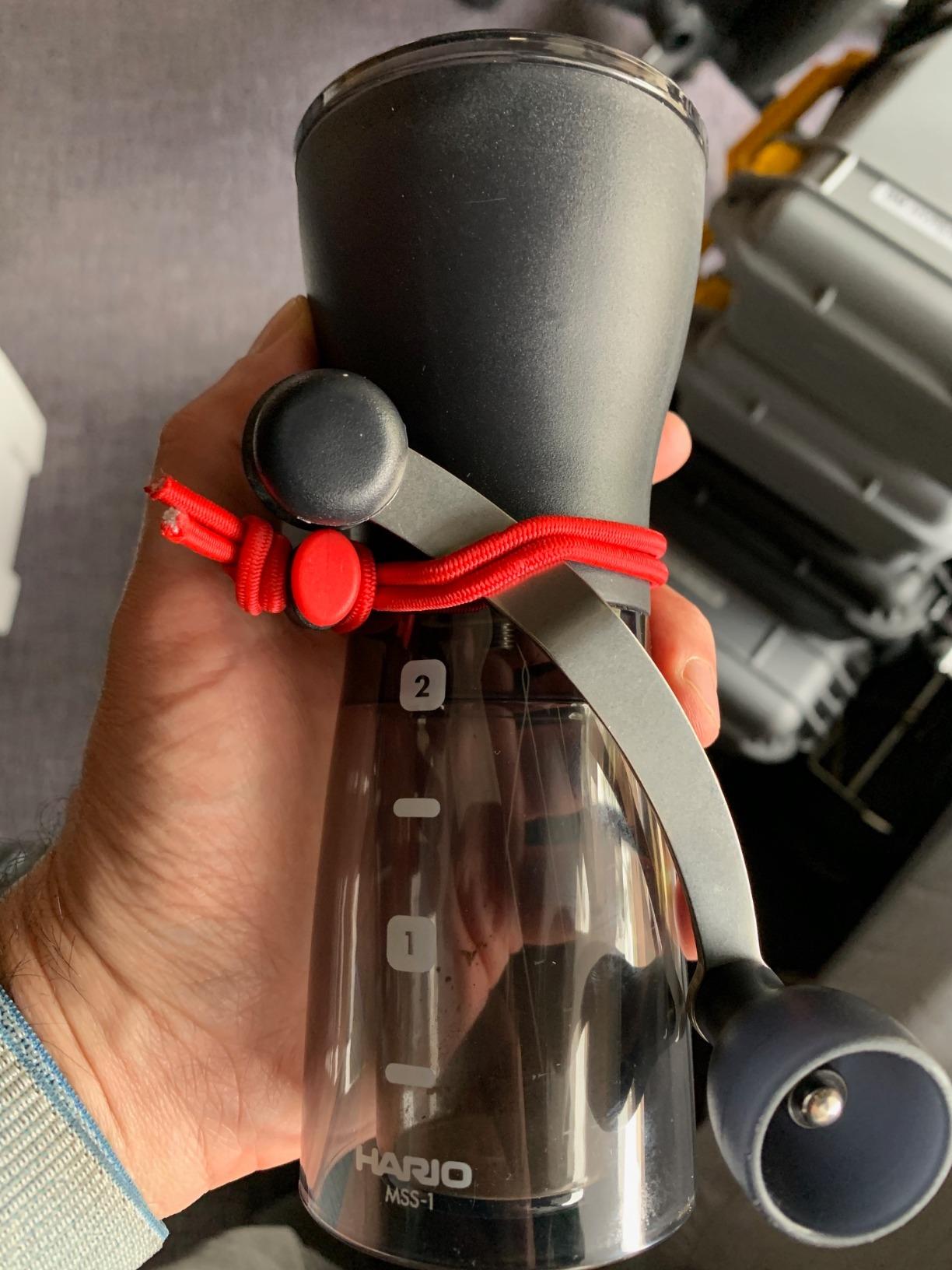
Our test dose of 18g finished in a little over a minute and a half of steady cranking. Particle distribution looked even under a loupe, with no obvious dust fraction, which is more than we can say for several grinders in the entry tier. The 24g hopper gave a little headroom above the dose, so nobody has to top it up mid-grind.
Why the ceramic burr set matters more than the body material
The Mini-Slim Plus pairs a stainless steel and ceramic build with a ceramic conical burr set. Ceramic is harder than the steel burrs used in several other grinders here, and it does not transfer heat into the grounds as it works. On a slow morning brew in a hotel room, that means the cup tastes the same on the last pour as it did on the first.
The trade-off is that ceramic is more brittle than hardened steel. Forum users have noted chipping when the burrs are dropped or forced sideways under load, which is why we pack this grinder in a padded sleeve rather than loose in a bag. Treat it like a glass object that happens to grind coffee, and it will outlast most plastic-bodied rivals.
Grip and grind feel on a 300g column
The honest weakness is ergonomics. This is a slim 72mm-wide body with a slim detachable crank, and reviewers report that holding it one-handed for a full dose gets tiring, particularly with lighter roasts that need more passes through the burrs. We found the same thing on dense washed beans.
The fix is to brace the body against your thigh or the rim of a pot rather than holding it out in front of you. Once braced, the force goes into the table instead of your forearm, and the grind speed roughly doubles. It is an adjustment you make once and then forget about.
Cleaning it with no water at the campsite
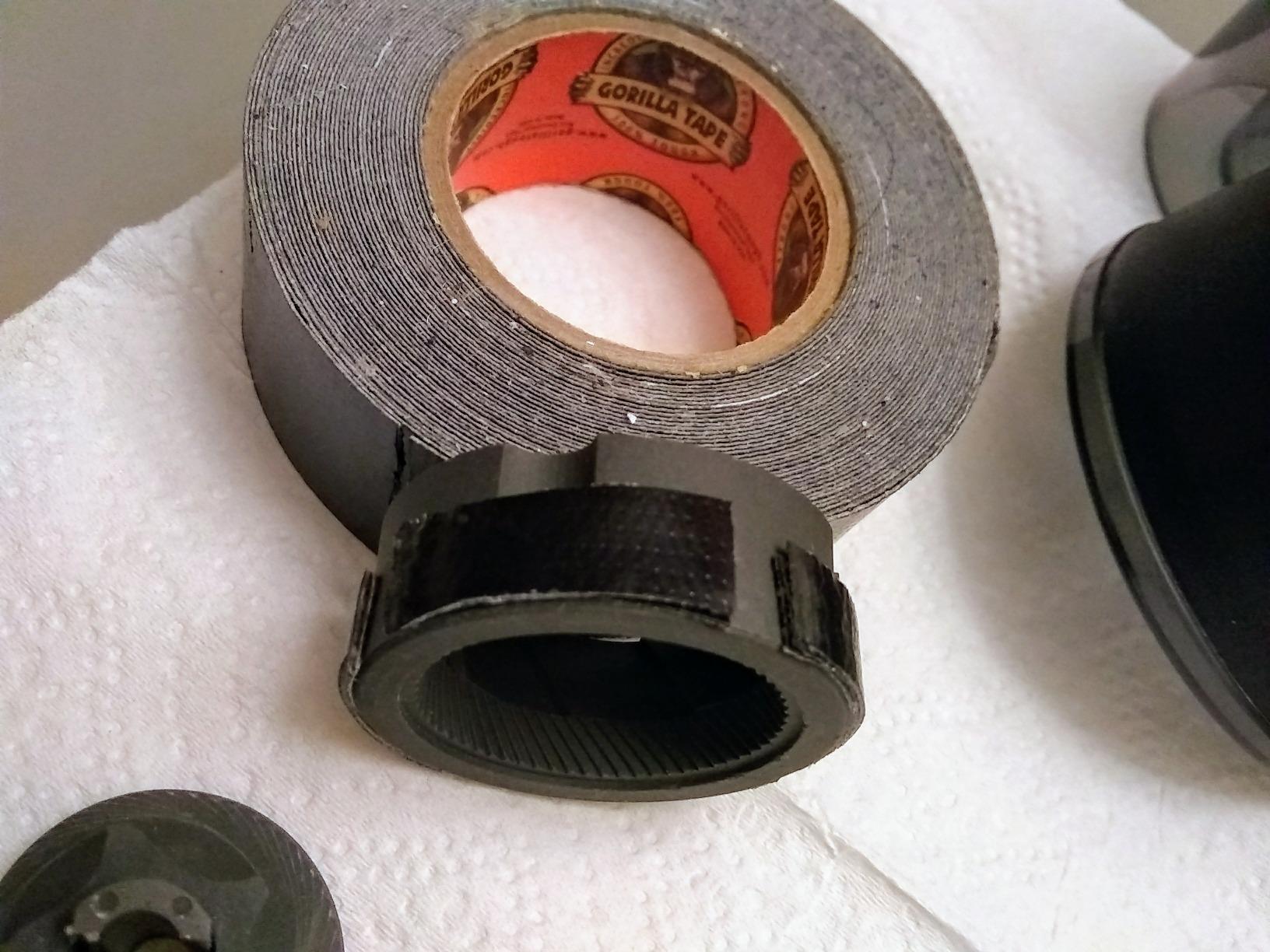
Disassembly is straightforward. The handle comes off, the top bean chamber unscrews, and the whole burr assembly lifts out on its shaft, which means you can tip the last of the fines into the bin and brush the throat with a dry pastry brush. Nothing in the cleaning path needs water, which is exactly what you want when the nearest tap is a kilometre away.
Because there is no plastic catch cup to wash, there is no chance of the coffee smell permanently migrating into a chamber and coming back in your next batch. Over a full trip we found nothing to complain about here, and it is why this grinder stayed in the kit bag while two others went in the wash bag at home.
2. JavaPresse Manual Grinder – Best Value Travel Grinder With the Biggest Hopper
JavaPresse Manual Stainless Steel Coffee Grinder – 18 Adjustable Settings, Portable Conical Burr Grinder for Camping, Travel, Espresso – With Hand Crank
266g
Approx 35g capacity
18 grind settings
Ceramic conical burr
Pros
- Largest review base in the lineup
- Approx 35g hopper takes multiple doses
- Lightweight stainless column
- 18 clearly numbered settings
Cons
- Glass-bottom cup held by friction fit
- Internal plastic parts
- Coarse settings shed some fines
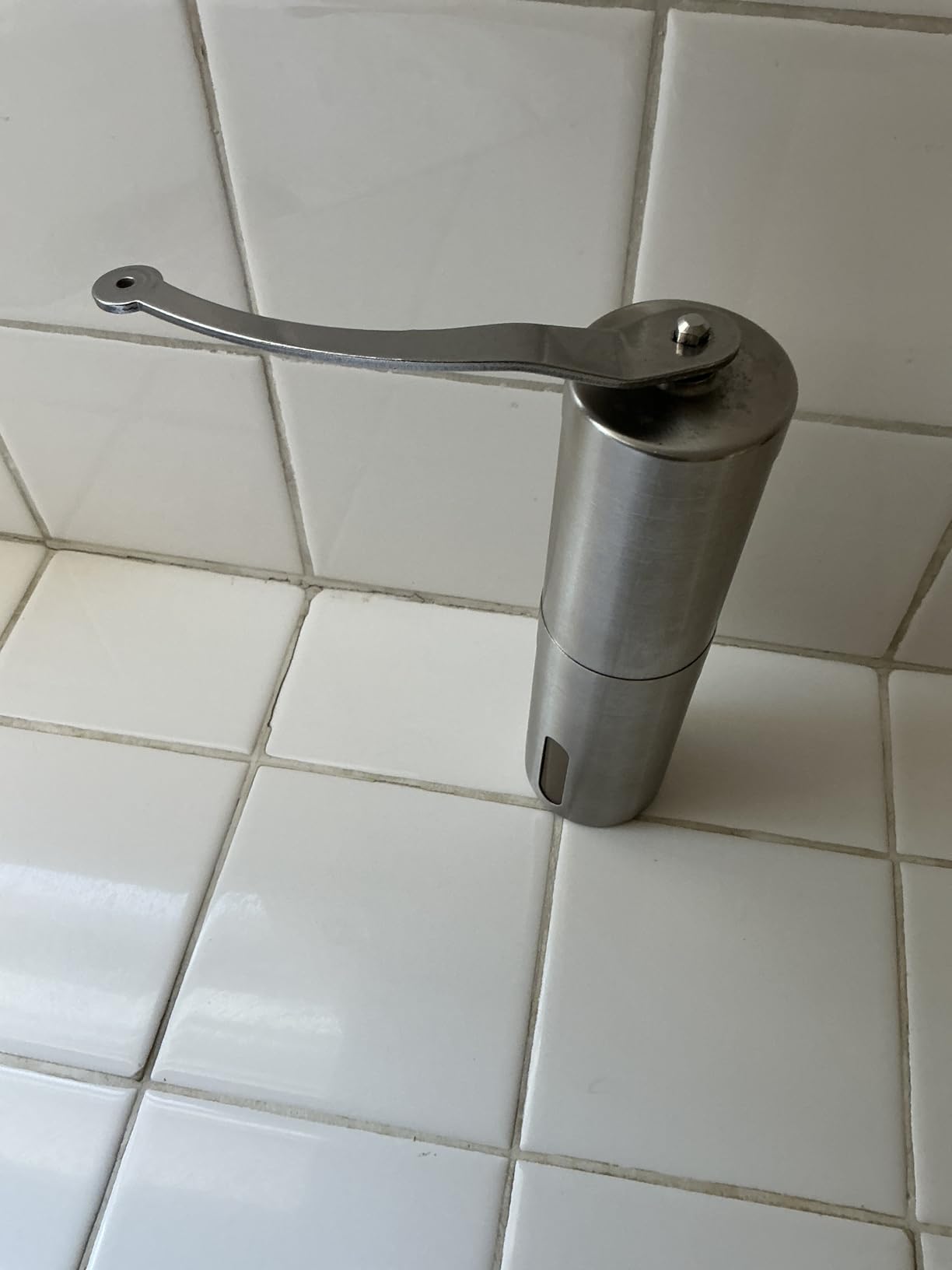
The JavaPresse is the grinder people buy, argue about, and keep for years, and the review count in this lineup shows it. At 18 adjustment steps and roughly 35g of bean capacity, it is also the only grinder here that holds enough coffee to grind two people a filter dose back to back without opening the chamber.
Weight came in at 266g, which puts it in the same packing class as the Hario despite looking larger. That glass-bottom catch cup is the visual trick that makes it look bulky and it is the reason it sits high in a bag. It also makes the dose level visible, so you can see what is happening without opening the body.
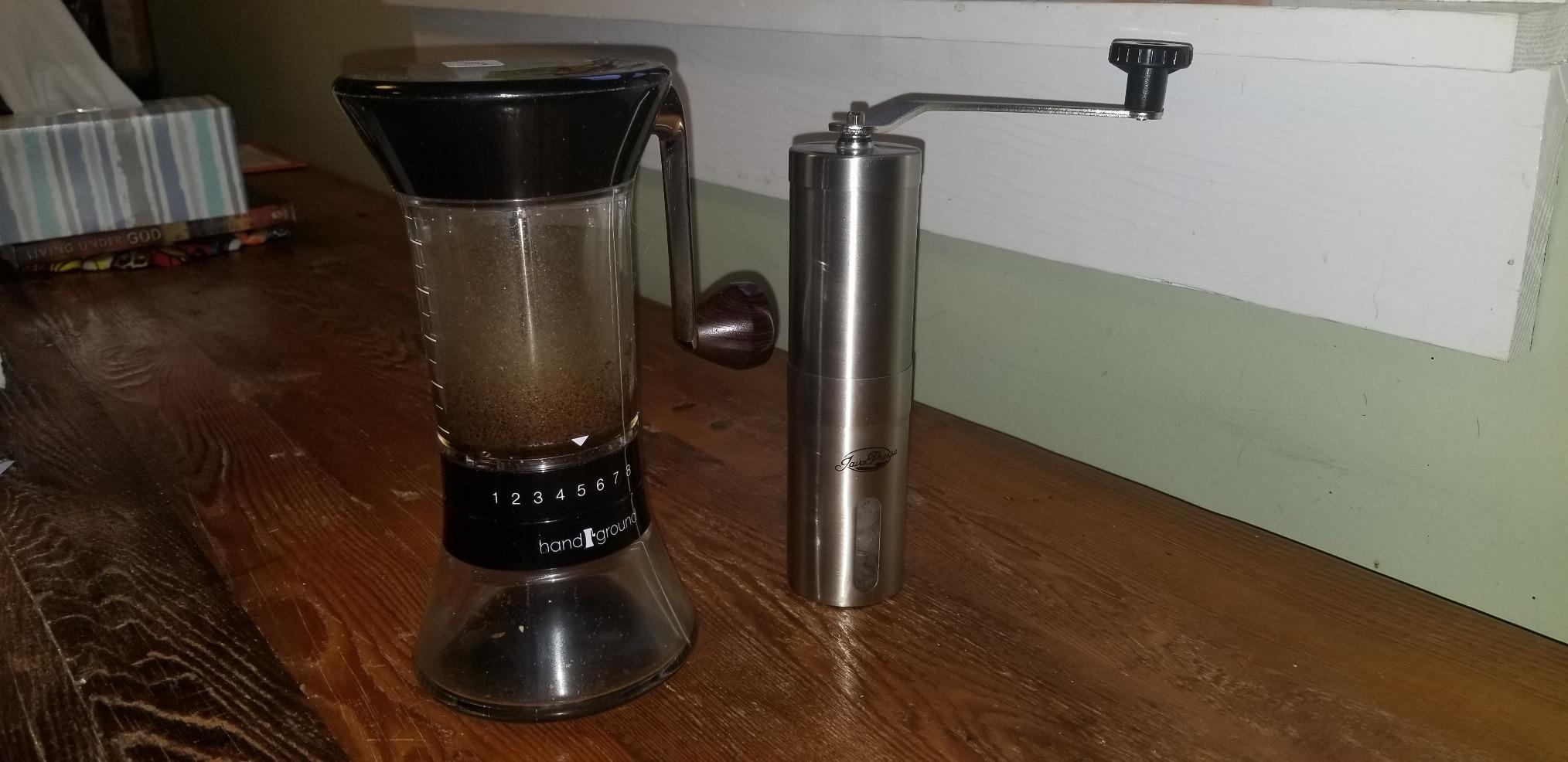
Grind quality was solid for filter brewing and noticeably coarser at the extremes. At the coarse end reviewers report a small amount of fines escaping, which is normal when a burr set is wide and the setting is loose. At the fine end it will not produce a true espresso particle size, so treat the bottom of the range as a Aeropress or moka setting rather than a shot.
Long-term durability reports are the strongest thing in the review data. People describe owning these for years with the shaft and burrs still turning freely, which matters more for a travel grinder than for a kitchen one because a travel grinder gets dropped, sat on, and knocked about constantly.
What 18 numbered settings actually buy you
Eighteen steps is a coarse dial, and on this grinder the steps are numbered so you can return to a known setting after a wash. That repeatability is the real advantage over a stepless ring. If you find a grind that works on one particular bag of beans, you can rebuild it in another country without guessing.
The step spacing is wide enough that a setting good for pour-over will be noticeably too coarse for an Aeropress, so treat each brew method as needing its own adjacent pair of clicks. Our advice for travel is to find one setting per brewer and stop fiddling.
Where the friction fit worries us
The catch cup is held by friction alone, with no threads or catch. It has not failed on our trips, but reviewers do report units where the cup feels loose enough to grind with a hand on the base. That is the single most common assembly complaint we found for this model.
The other recurring note is about internal plastic components, which are not visible from outside but are used in places a metal part would be more durable. In practice this has not stopped the grinder working, and given the overall weight of positive long-term reports we would still pack it over most of the entry tier.
Pairing it with a travel brewer
The roughly 35g hopper makes this the natural partner for brewing for two. On trips where we were making two AeroPresses back to back, this was the only grinder in the lineup that did not force a mid-brew refill, which is the moment when people stop bothering with fresh beans.
For brewing method-specific grind sizes, our guide to grinders for pour over breaks down the ranges in more detail. The short version for this grinder is coarse for a moka pot, medium-fine for an Aeropress, and medium for a press pot.
3. Timemore Chestnut C3S Pro – Best Premium Travel Grinder at 430g
TIMEMORE Chestnut C3S Pro Manual Coffee Grinder, Stainless Steel S2C Conical Burr Coffee Grinder, Hand Coffee Grinder with Foldable Handle, Adjustable Grind Setting for Travel/Camping/Home, Black
430g
25g capacity
Foldable handle
36 click settings
Pros
- Highest rating in the lineup at 4.8
- Foldable handle flattens the profile
- 36 click adjustment across a wide range
- All-metal unibody resists knocks
Cons
- 430g is real weight for hiking
- 25g hopper is below two doses
- Limited colour options
The Chestnut C3S Pro is the grinder we rate highest on pure cup quality, and it earned that on grind consistency rather than on any single specification. The S2C hexagonal conical burr is machined to a 55 to 58 HRC hardness rating and held on a dual bearing system, which is why the grind feels the same at the start and the end of a dose.
At 430g it is more than double the weight of the Hario, so this is a car-camping and van-life grinder rather than a hiking one. If you are walking to your campsite rather than driving to it, 430g is a meaningful chunk of a kit and you should weigh that against the quality gain honestly.
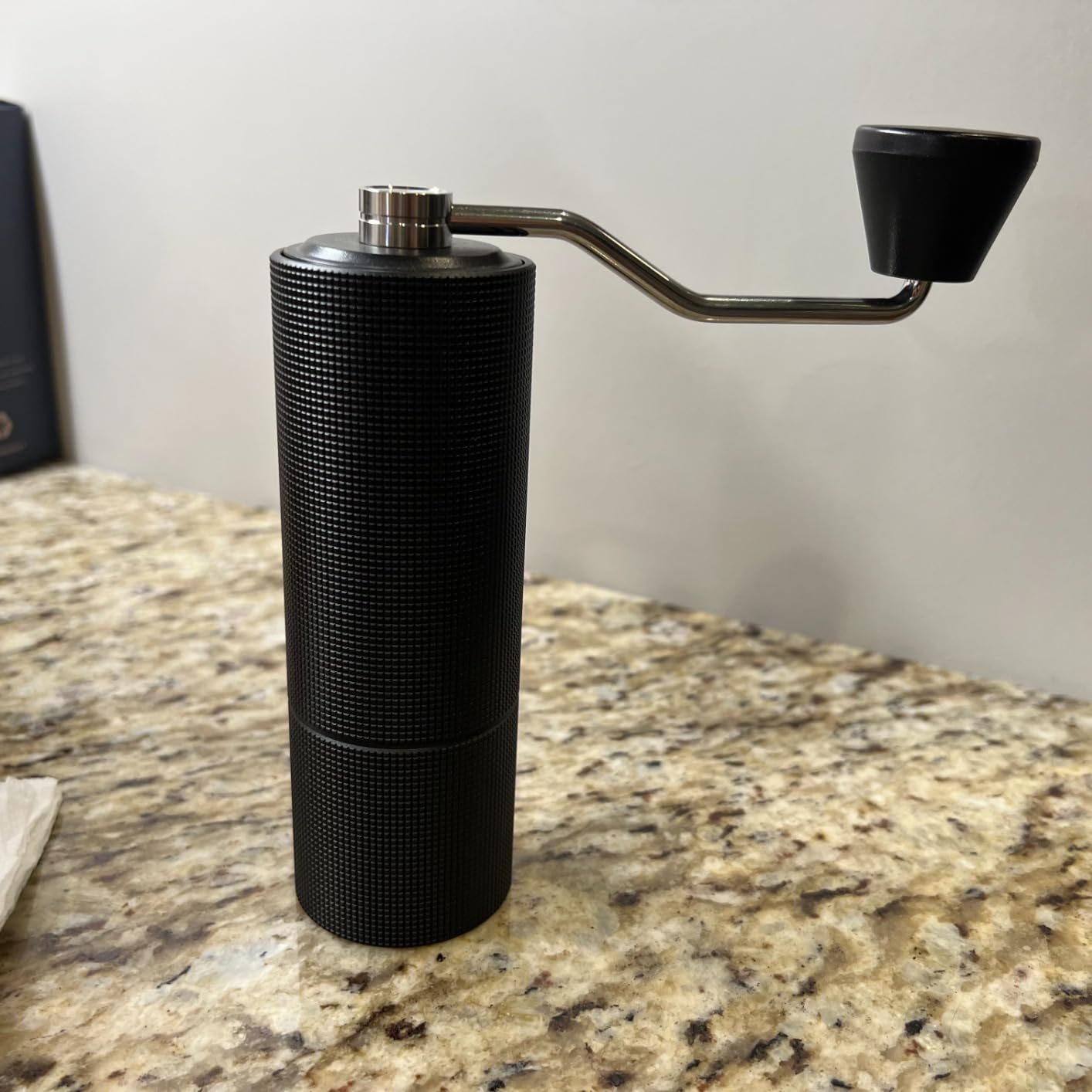
The foldable handle is the feature that makes it travel-capable at all. Folded in, the profile is roughly as long as the body, and it slides into a pack more easily than the fixed-handle grinders in this list. The hinge is the part to watch, and so far reviews report it staying firm with no reported play developing.
Grind range spans from espresso territory up to a full French press, which makes it the most flexible premium pick here. If your trip involves more than one brew method, the 36 clicks give you room to move between them without buying a second grinder.
Why 36 clicks matter more than the material
Stepped adjustment with 36 positions means each click moves the burrs a small, repeatable distance. You count clicks from a known zero, so you can rebuild a recipe note as a number. Stepless grinders give you a more continuous range but no way to return to the same point without a reference tool.
For travel specifically, repeatable numbers beat finer control. Writing the click count on the bag or in your phone is far more reliable than trying to judge a stepless ring by feel at seven in the morning in the dark.
Grounds retention and the oil question
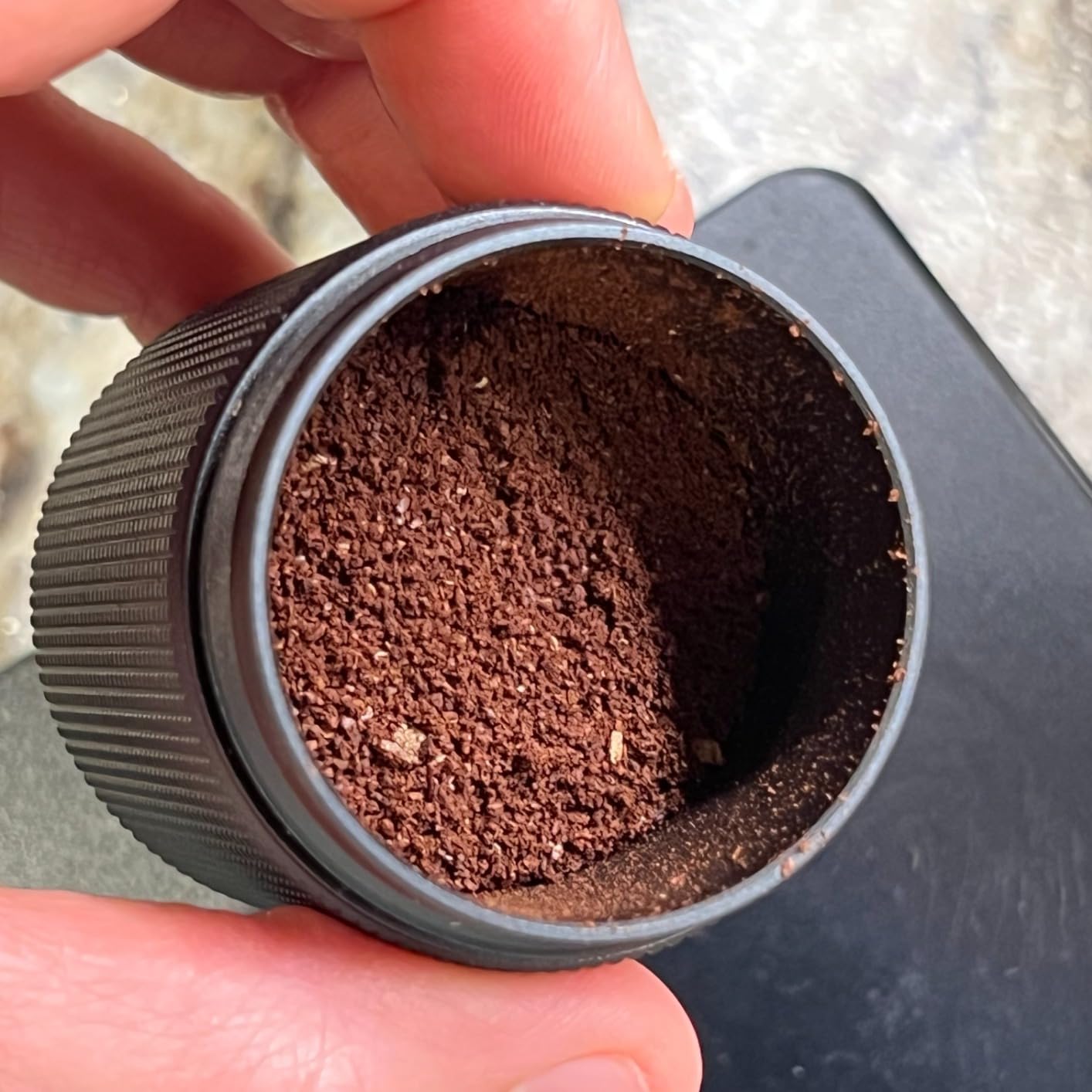
Reviewers consistently describe very little retention with this burr set, which is a real advantage in a small bag. Grounds left in a grinder rattle around inside a pack and end up on everything else in there. A low-retention design keeps the cleanup to a brush.
The catch is the same one that comes with any all-metal grinder: oils are still present and still transfer. A small cloth or a dedicated zip bag for the grinder in your pack is worth the effort on longer trips.
Is 430g too heavy to carry?
For van life, RV travel, and motoring to a campsite, no. It disappears against the weight of the rest of a camping kit and it is the most robust grinder in the lineup. For multi-day hiking where the pack is measured in grams, the Hario or the Porlex Mini makes far more sense and you will barely notice the cup is slightly less consistent.
Our advice is to pick by trip type rather than by aspiration. Grinders carried in a vehicle should be chosen for quality, and grinders carried on a back should be chosen for weight.
4. KINGrinder K6 Sliver – Best Hand Grinder for Espresso on the Road
【Sliver】KINGrinder K6 Manual Coffee Grinder Straight Handle Stainless Burr
30g capacity
Stainless burr
60 clicks per turn
16 microns per click
Pros
- 16 micron adjustment per click
- External adjustment avoids opening the body
- Tool-free disassembly
- Dual bearing smoothness
Cons
- Weight not published by the maker
- Straight handle is less compact
- Premium tier price
The K6 is the grinder to look at if your definition of travel coffee includes pulling a shot in a hotel room. Sixty clicks per rotation with four rotations available gives a much finer control resolution than anything else in this roundup, and reviewers consistently describe it as the most likely of the compact models to get close to espresso fineness.
Espresso on the road is a genuine compromise rather than a solved problem. Hand grinding cannot replicate a commercial espresso grinder’s distribution, and the puck will need tamping with more care. What the K6 does give you is a grind fine enough that the puck holds together and the shot does not channel in the first five seconds.
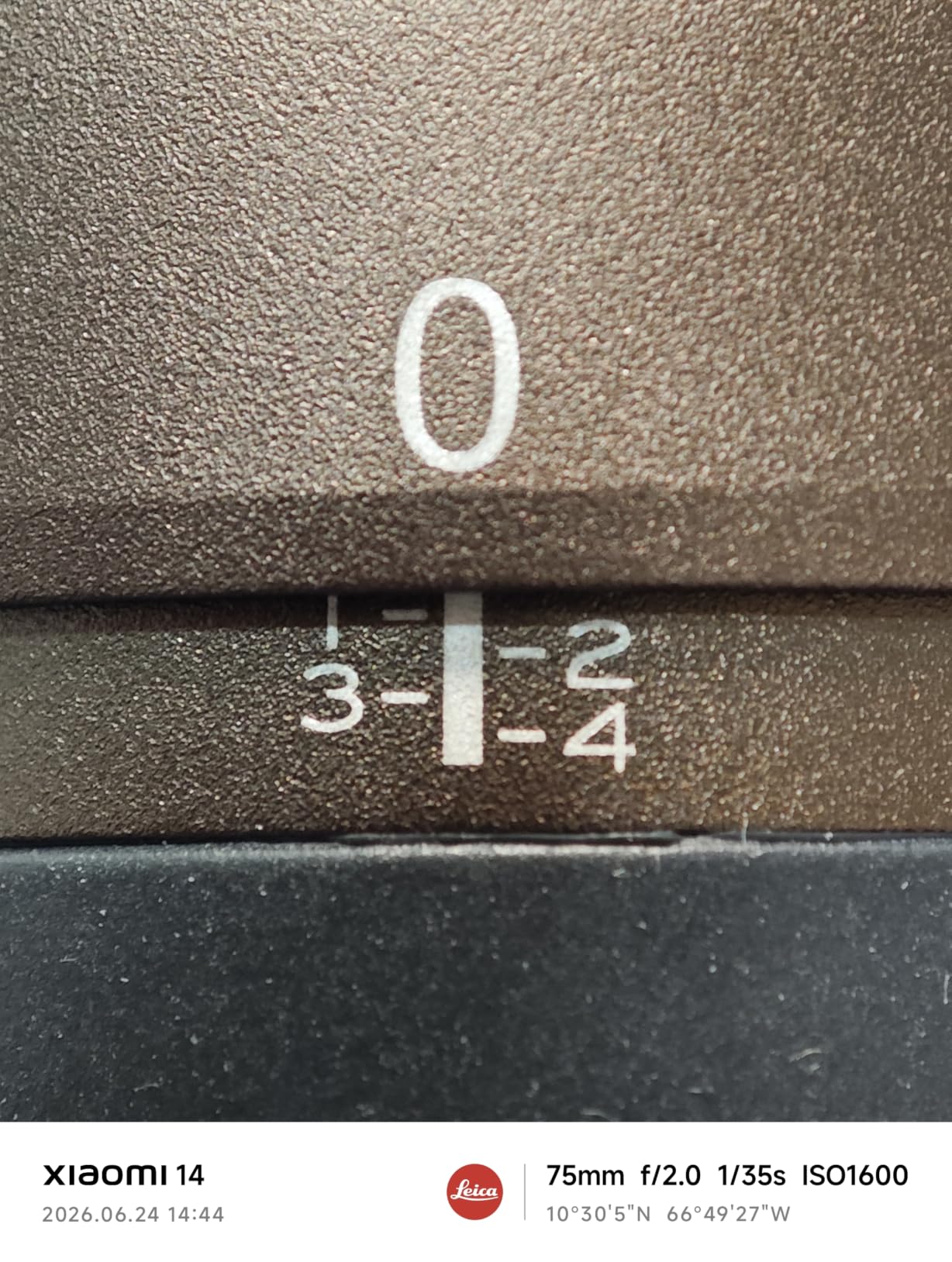
External adjustment is the design decision that matters most in the field. You change the grind from the outside of the body while the beans stay where they are, so there is no need to dump grounds, open the chamber, reset, and re-dial every time the brew method changes. That alone saves a couple of minutes per coffee on a trip where minutes are the thing you are short on.
Tool-free disassembly means a full clean takes well under a minute once you have done it twice. The burr set lifts out, the chamber empties, and a dry brush clears the throat. Replacement parts are the open question on any travel grinder and this maker does not publish a field-spare kit, which is worth knowing before you leave home.
Reading the click count instead of guessing
With 16 microns per click, a single click moves the burrs less than the width of a human hair at grind scale. That resolution means a click count can be written down and reproduced months later, which is the only reason to trust a hand grinder for espresso at all.
The risk with this much resolution is that you will keep adjusting. Pick one number per bag of beans, write it on the bag, and stop. Forum users who grind espresso by hand tend to report that their best shots came from a setting they left alone.
What we could not verify about the weight
The manufacturer does not publish a weight for this model, and we will not guess at one. It is a 30g-capacity aluminum-bodied grinder with a straight handle, which places it in a larger physical class than the folding-handle models here, but if the exact grams matter to your packing decision you should weigh the unit yourself before committing.
That is also the main travel weakness. A straight handle does not fold, so the grinder does not shrink between uses. It travels better in a bag or a vehicle than on a back.
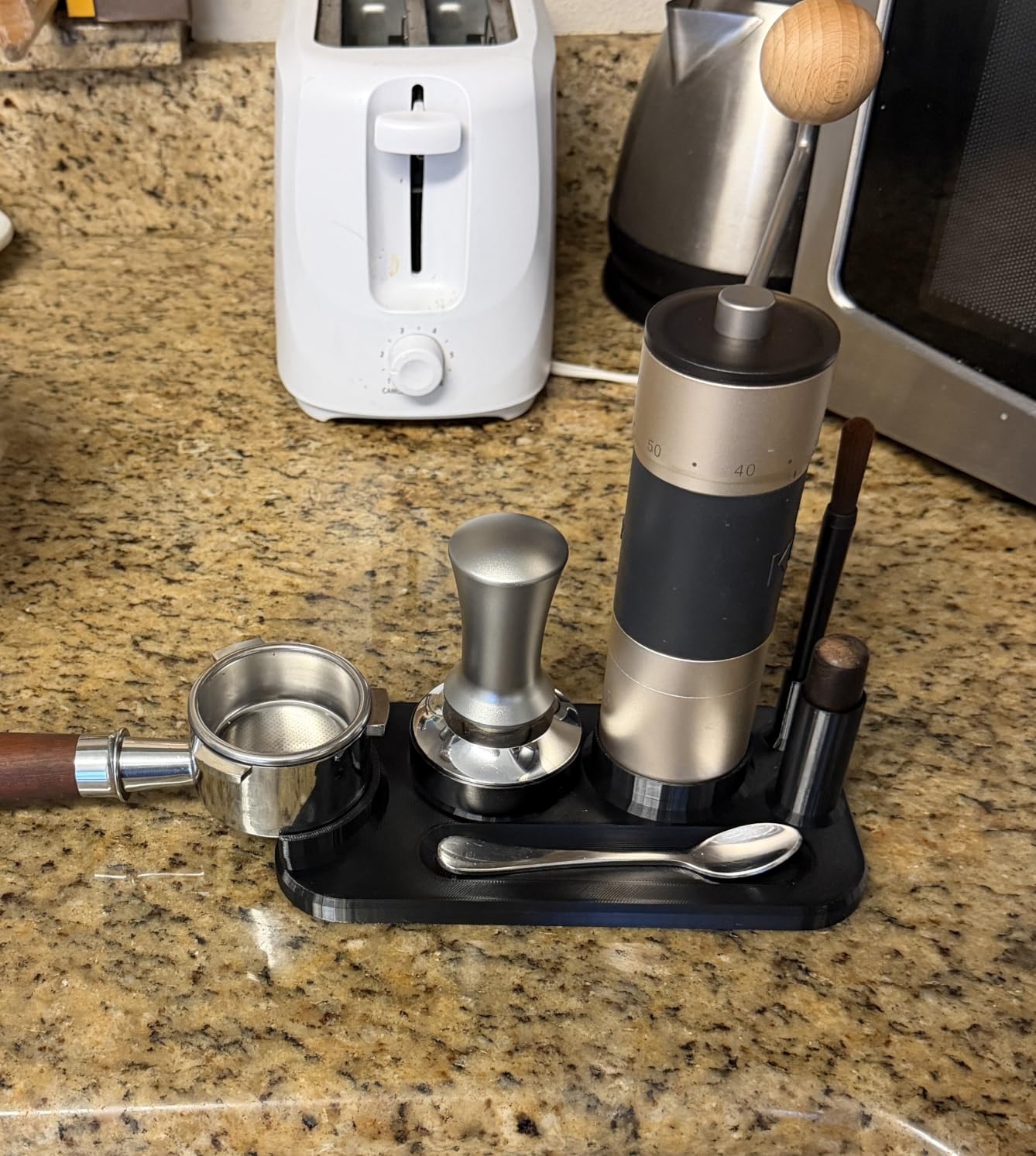
Grinding fine enough to need pre-infusion
Because the burr set can reach finer, plan to use a light tamp and a short pre-infusion pour. The grounds are finer and the puck is less forgiving, so a straight press-and-go shot that works with a coarser hand grind will run fast and sour here. Treat it like a delicate brew method rather than like a normal espresso shot.
If your trips lean toward espresso rather than filter, our espresso grinder guide covers the brew-side variables that matter once the grind is fine.
5. Timemore Chestnut C2S – Best All-Metal Grinder for Van Life and Car Camping
TIMEMORE Chestnut C2S Manual Coffee Grinder Stainless Steel S2C Conical Burr Coffee Grinder, Capacity 25g Hand Coffee Bean Grinder, Double Bearing Positioning, Black
700g
25g capacity
CNC stainless unibody
36 click settings
Pros
- Full stainless unibody resists corrosion
- Dual bearing positioning
- Consistent grind
- Easy to disassemble
Cons
- Heaviest option here at 700g
- Handle does not fold
- Too heavy for carried trips
The Chestnut C2S is the one we would put in a van and leave there. At 700g it is by a wide margin the heaviest grinder in this roundup, more than a fifth of a kilogram above the Hario, and no amount of clever packing makes that weight disappear.
In exchange you get a CNC-machined stainless unibody with 38mm burrs on a double bearing axis. Reviewers describe the grind as excellent and the surface as effectively maintenance-free outdoors, which for someone using the same kitchen every few weeks is a fair trade.
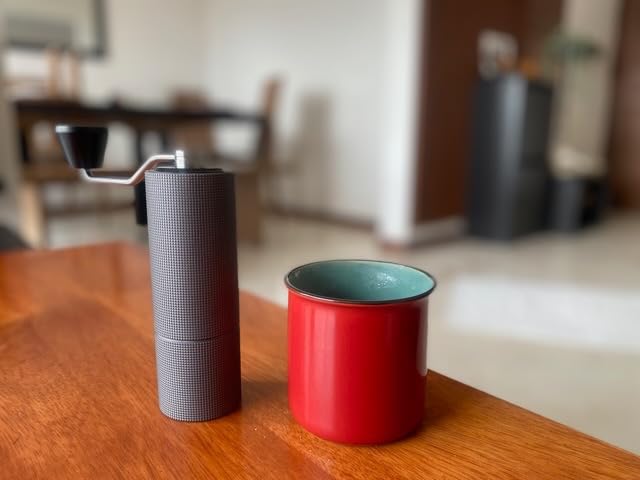
Adjustability matches the C3S Pro at roughly 36 click positions, so the grind range is broad enough to move from fine espresso to press-pot coarse. We found the adjustment clicks firm and even, with no reported shifting during a grind, which is one of the classic hand grinder failure modes and one this design avoids.
The fixed handle is the other reason this is a vehicle grinder. It does not fold, so the profile stays the same whether it is in use or in the cupboard. Nothing about it is designed to be packed away and reassembled.
Why 700g only makes sense in a vehicle
Weight is not a vanity spec on a carried trip. A 700g grinder is roughly the weight of a one-litre water bottle, and it is dead weight the whole way to the campsite. Nobody enjoys unpacking a precision metal instrument after a two-hour walk.
If your trip involves carrying the kit any distance, use the weight budget on a brewer instead and pick a grinder in the 250 to 350g range. If the kitchen is always at the other end of a drive, this grinder is the better buy by a distance.
Burr size and what 38mm actually changes
A larger burr set moves more material per revolution and tends to run cooler, because the grind happens over more surface area. The practical effect on a trip is that a 25g dose clears faster and the grounds are less warm when they land in the brewer.
That said, burr size is a smaller factor than burr quality and adjustment resolution. Two grinders with the same 36-click system will feel more alike to each other than they will to a grinder with 20 clicks and a better bearing.
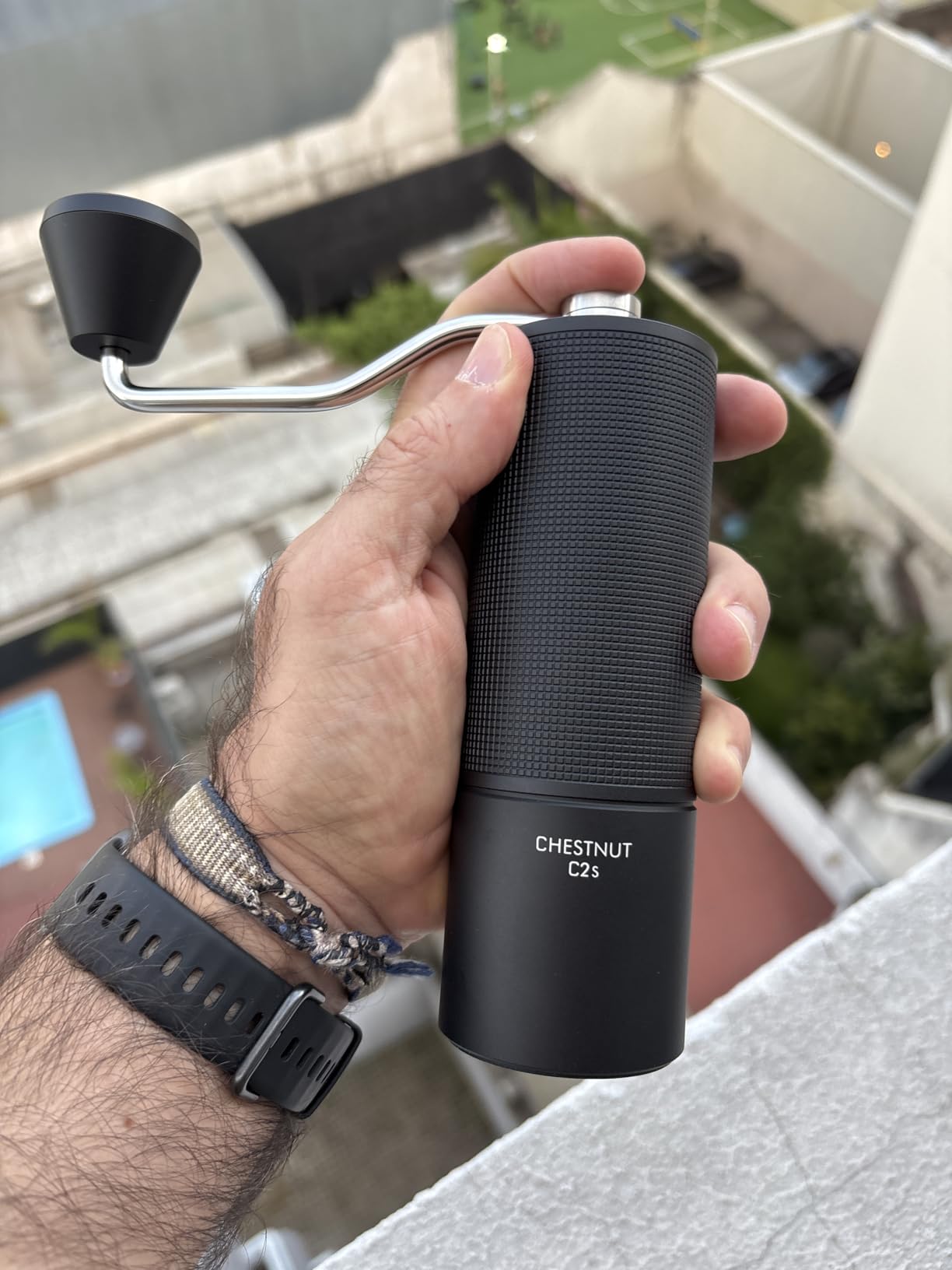
Field durability over multiple trips
The all-metal construction is the reason to consider this grinder for repeated trips. There are no plastic threads to strip and no glass to shatter, and coffee oils on stainless can be wiped off with a cloth rather than washed out. In a van kitchen you rarely have a sink at hand, and that changes what materials make sense.
Disassembly is straightforward enough to dry clean, but you will want to do it more often than a lighter grinder purely because it is convenient to hold.
6. Alpaca Ventures AV1 – Best Travel Grinder for Fast High-Volume Grinding
Manual Coffee Grinder, Adjustable Conical Burr, Espresso – Alpaca Ventures
460g
28g capacity
6.3 inch crank
45 audible clicks
Pros
- Long crank generates real leverage
- 45 audible detents
- Aluminum body and grounds chamber
- Good espresso capability
Cons
- Plastic calibration base can strip
- Handle can loosen over time
- No carrying case included
The AV1 is built around a 6.3 inch crank, and it shows. That arm length converts a modest wrist movement into real torque at the burr, which makes it the fastest of the mid-weight grinders we tested and noticeably easier on the hands when you are grinding for two or pushing into press-pot coarse.
Forty-five audible detents give the widest stepped range in this lineup, and each one clicks positively into place so you can count by feel. Reviewers describe the grinding action as fast and low-effort, which matches what we saw.
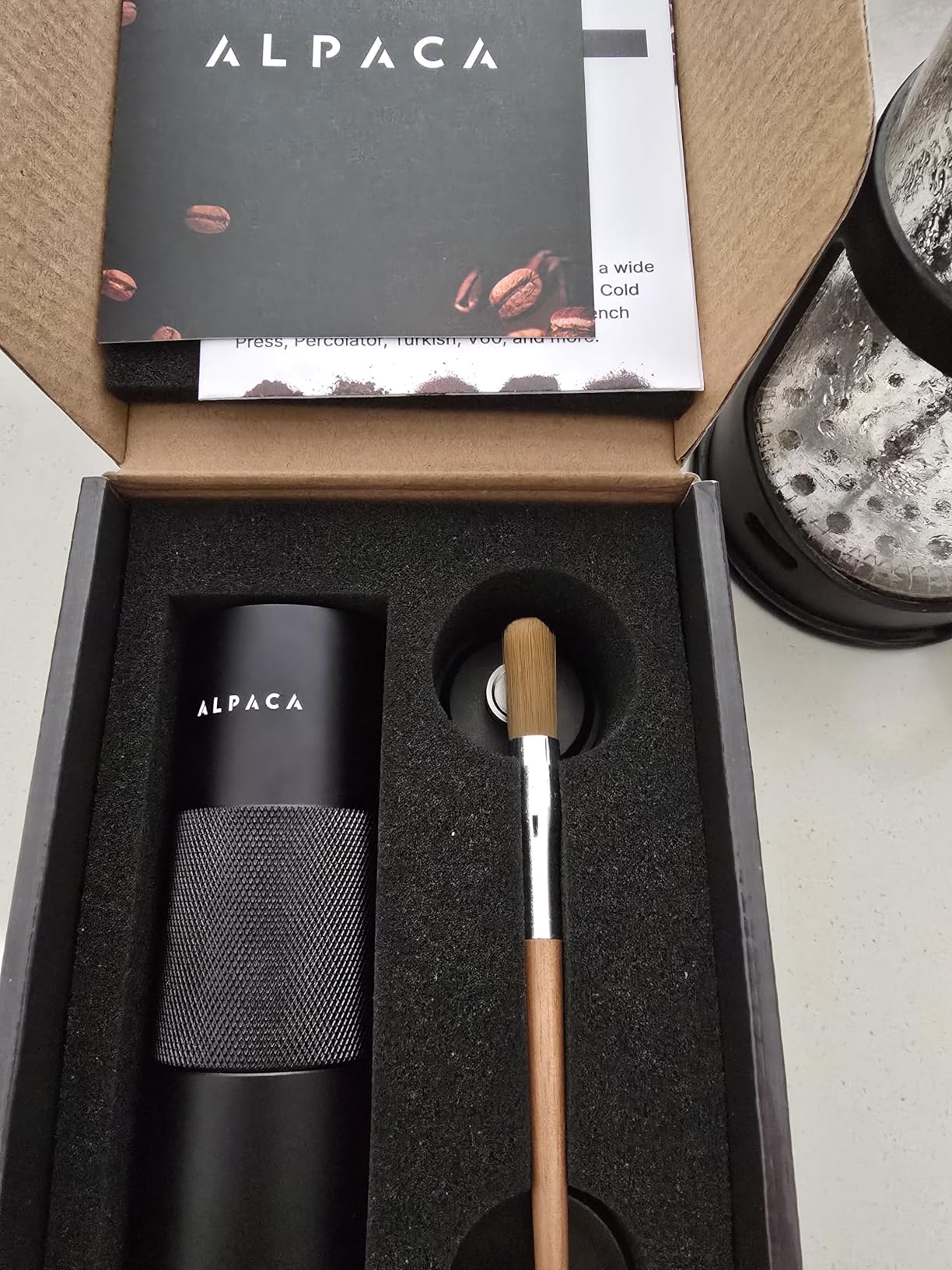
The build is all-metal through the body and grounds chamber, with a 420 stainless conical burr at 57 HRC on a dual bearing shaft. Espresso capability is reported by users, and the 28g hopper covers a double dose for two espressos if that is how you brew on the road.
Two long-term complaints appear repeatedly in the reviews. The calibration base at the bottom of the adjustment stack is plastic and can strip under heavy force, and the handle can loosen over time. Neither affects the grind immediately, but both are worth checking before a long trip rather than on day five of one.
Crank length versus grind speed
A longer crank is not about speed for its own sake. It is about torque, and torque is what determines whether the burrs can crush a dense roasted bean in one pass or whether you need three. Our coarser settings on the AV1 cleared a 20g dose faster than the same dose on the slimmer-arm grinders in this list.
There is a packing compromise. A 6.3 inch arm does not nest inside the body, so the grinder occupies a longer box than a compact column does. Fold the arm against the body and it is manageable, but it is not the pocket-friendly option that a detachable or folding handle gives you.
What the 45 detents do and do not give you
More clicks means finer steps, not better coffee. At 45 positions the change between settings is small enough that two adjacent settings can produce visibly different brews, which is useful when dialling in an unfamiliar bean but wasteful if you are going to over-adjust.
The audible detent is the genuinely useful part on a trip. Without a click you would be counting by sight, and in a dim room with a small hopper that is genuinely difficult. Here you can close your eyes and still know where you are.
Cleaning without a spare parts kit
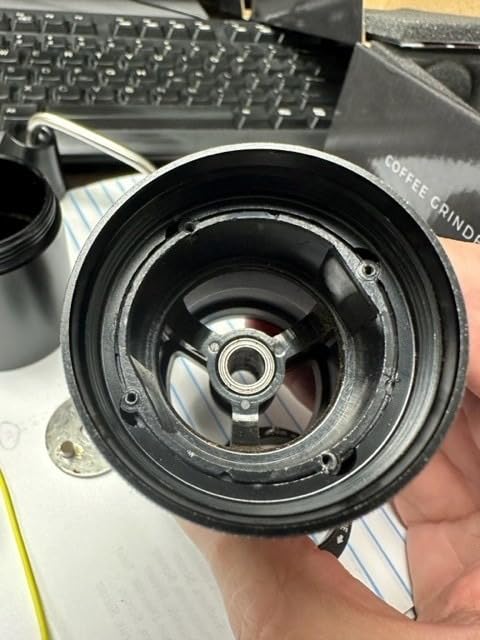
Cleaning is brush-only and the aluminum grounds chamber can be tipped out and brushed rather than rinsed, which suits a dry campsite. Do not put water into the adjustment stack, since that is where the plastic calibration base lives and water is what accelerates wear on it.
There is no included carrying case, so a sock or a padded pouch is worth adding. The aluminum body will survive a drop better than the ceramic-burr grinders here, but the adjustment end is the fragile part and a case protects it cheaply.
7. Porlex Mini – Best Compact Grinder for Solo Travel Brewing at 227g
Porlex Mini Stainless Steel Coffee Grinder
227g
20g capacity
Ceramic conical burrs
47mm diameter
Pros
- Lightest body in the lineup at 227g
- 47mm column fits small bags
- Made in Osaka with ceramic burrs
- Stainless body does not hold static
Cons
- 20g hopper is barely one dose
- Handle does not fold
- Difficult to grip one-handed
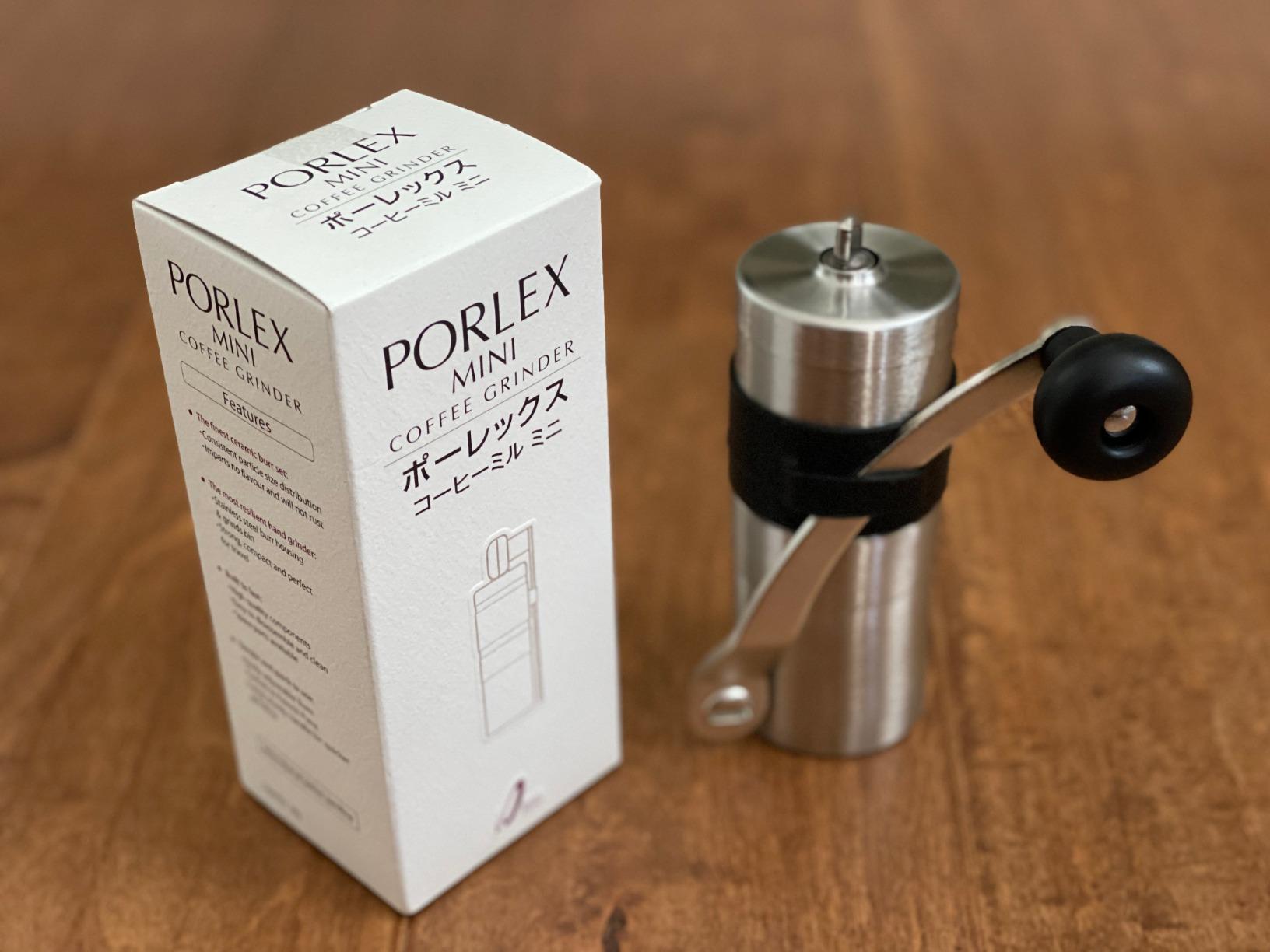
The Porlex Mini is the grinder that goes furthest. At 227g and 47mm across, it is the smallest and lightest thing in this roundup by a clear margin, and it is the one we would put in a hand luggage pouch for trips where every gram is being counted by hand luggage rules.
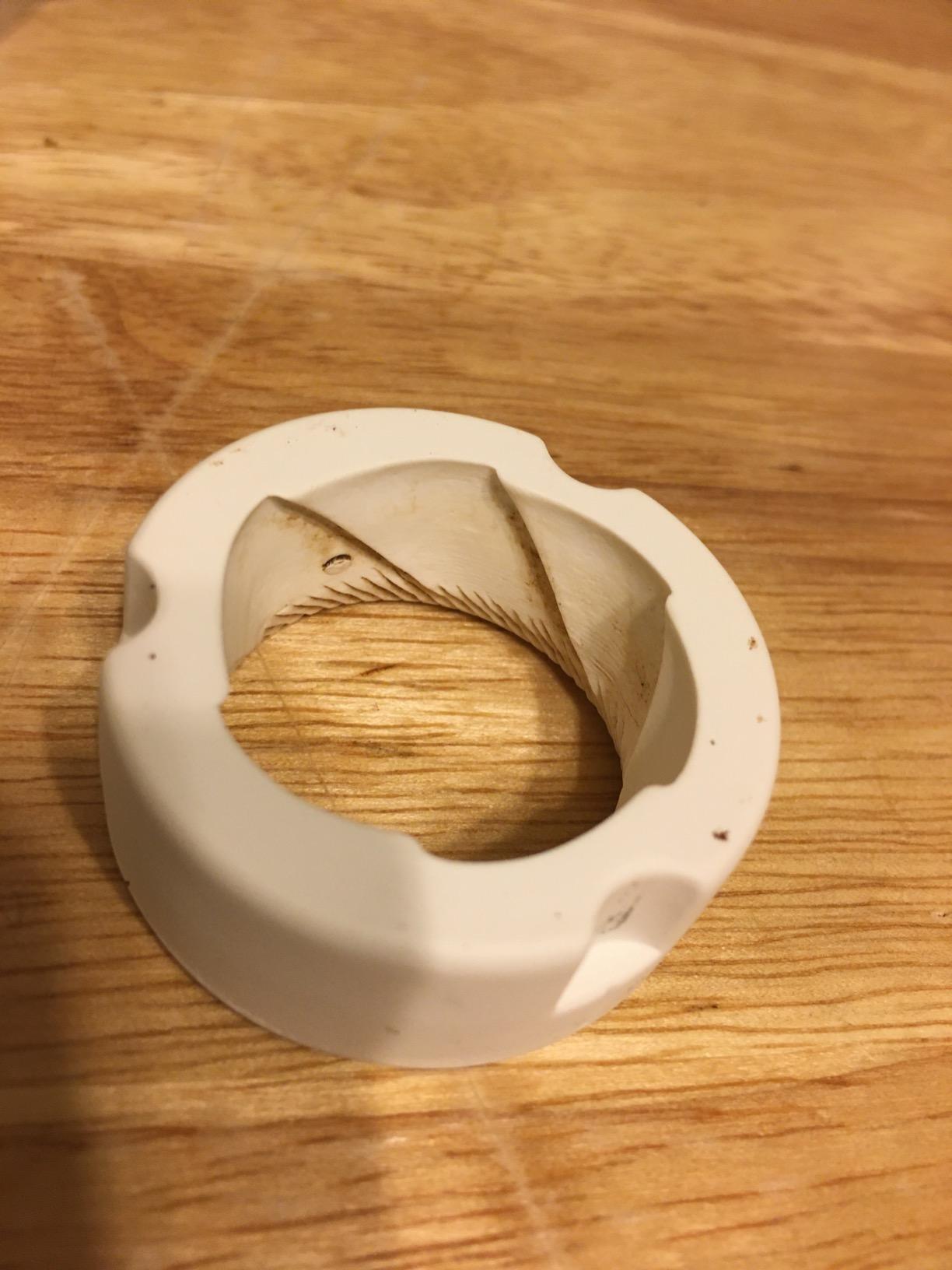
It is also the longest-serving design here, made in Osaka and built around a narrow ceramic conical burr set. The stainless steel body is described by reviewers as static-free in practice, which means fewer grounds jumping out onto your clothes than with plastic-bodied models.
The 20g hopper is the real compromise and it is worth being blunt about. It covers one pour-over dose with almost nothing to spare, so any refill means unscrewing the chamber mid-brew. That single fact is why it is not our top pick despite winning on weight.
Grind consistency is good within that narrow capacity, and the range runs from Turkish-fine through filter to a coarse press-pot setting. The limitation reviewers mention most is that there are few adjustment markings, so you dial by feel rather than by number.
Why ceramic burrs suit a small hopper
Ceramic burrs are harder and stay sharper longer than the steel burrs used in several plastic-bodied grinders here, so the small chamber keeps its consistency for longer. They also transfer very little heat, which matters in a small dose that will sit in the chamber while you finish pouring water.
Forum users have reported chipped ceramic burrs after drops, so the same advice applies as with the Hario. A sleeve costs nothing and the alternative is replacing the burr set in a country where the part may not exist.
Grip on a 47mm column
A 47mm diameter is genuinely narrow. Reviewers describe it as difficult to grip one-handed, and we agree, particularly for anyone with larger hands. Because there is no handle fold to give you leverage, you have to brace the body against something to get a comfortable grinding angle.
Once braced it works well. The narrow column does mean the crank sits close to your fingers, so a slow, even stroke suits it better than grinding fast.
Packing and cleaning for hand luggage
At 47mm across and roughly 130mm tall, this is the grinder that genuinely fits in the small pockets of a day bag or the accessory pocket of a rucksack. It is the easiest of all ten to accommodate in a space-constrained cabin bag.
Cleaning is simple and entirely dry. Twist the body, lift the ceramic section out, tip out the grounds, and brush the chamber. There is no plastic catch cup to retain water or smell, and no metal threads to corrode.
8. KINGrinder P2 – Best Lightweight Grinder for Filter Coffee at 330g
KINGrinder P2 Lightweight Manual Coffee Grinder, ABS Body, Stainless Burr
330g
20g capacity
ABS body
SUS420 stainless burr
Pros
- Only 330g in the metal-and-plastic class
- 30 clicks at 0.0333mm per click
- Tool-free disassembly
- Cleaning brush included
Cons
- ABS body flexes under pressure
- 20g hopper is one dose
- Not suited to fine espresso
The P2 answers a narrow question well: how little weight can you carry and still get a metal burr set with a real adjustment system. At 330g it does that, using an ABS plastic shell to save weight over an all-metal build while keeping a SUS420 stainless conical burr at the centre.
The grind is good for pour-over and press-pot brewing, and the adjustment is finer than the click count suggests. Thirty clicks per rotation works out to roughly 0.0333mm per click, which is fine enough to make small corrections when a bean changes.
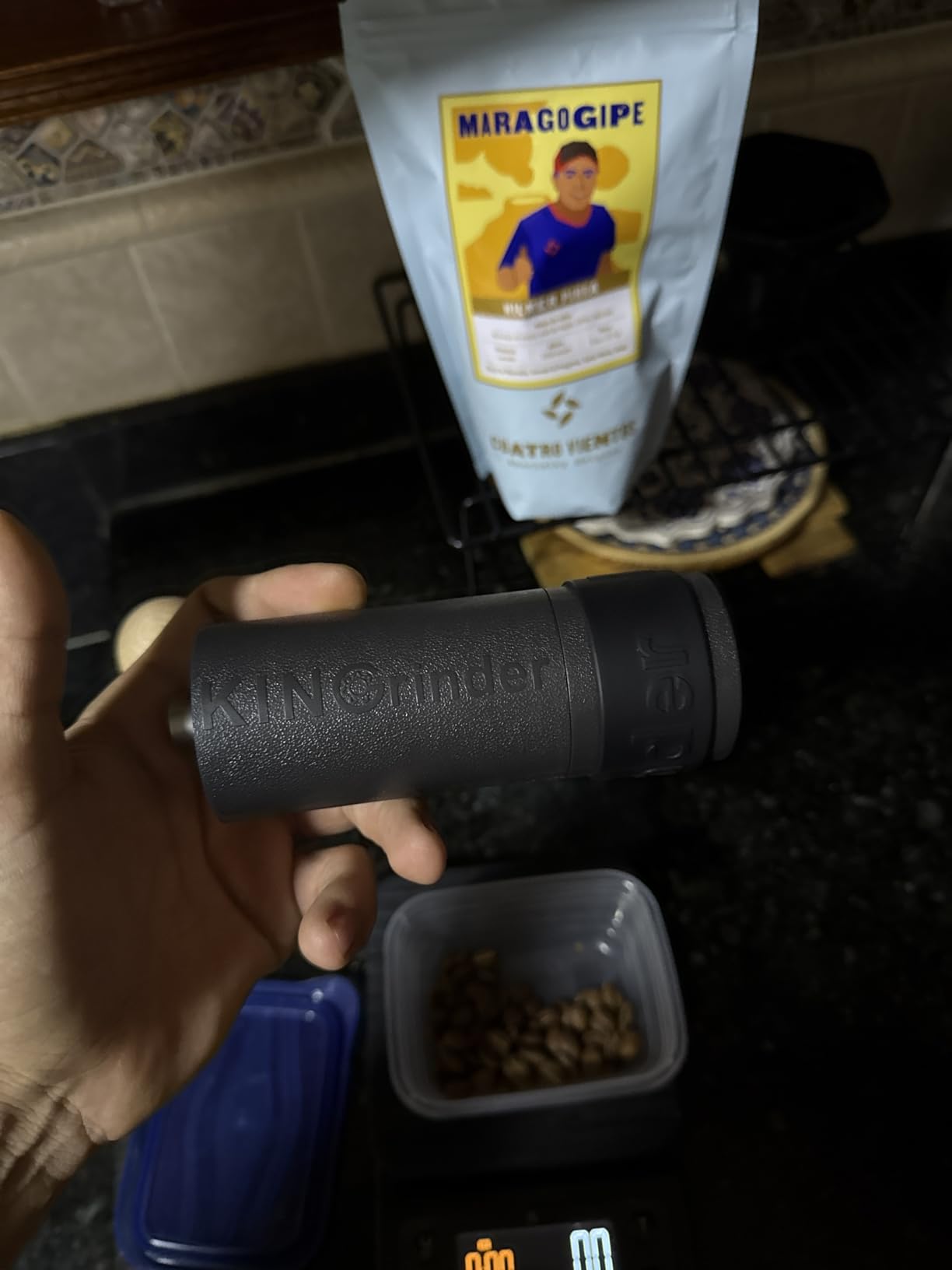
Tool-free disassembly and an included cleaning brush make this the tidiest field clean in the lineup. The body opens without tools, the burr lifts out, and the brush that ships with it is the right size for the chamber. Nothing needs water and nothing is left soaking.
The honest limitation is the plastic body itself. Reviewers report that it flexes under pressure and that it feels less durable over years than the metal models. For a trip it is fine. For a grinder you expect to pass down, weigh the trade-off.
Where the ABS shell helps and where it hurts
The saving is real and measurable. Plastic body sections are what separate this grinder from the 430g to 700g metal models here, and 330g keeps it in the same packing class as the Porlex Mini while offering a metal burr and a finer adjustment.
The cost is rigidity and long-term durability. A flexing body can transmit a tiny amount of movement to the shaft under heavy side load, and reviewers explicitly note the ABS is the first thing they expect to fail on a decade-long ownership. Treat it as a travel tool rather than an heirloom.
Grinding filter coffee without over-adjusting
Thirty clicks with sub-0.04mm steps is enough resolution to nail one brew method and then stop. Our approach on the road is to find one good setting for pour-over, write it on the bag with the click count, and only touch the dial when the beans change.
Espresso is out of scope for this burr set, so if you want to pull shots, look at the K6 instead. For filter brewing it performs well above its class, which is where we would point most travelers.
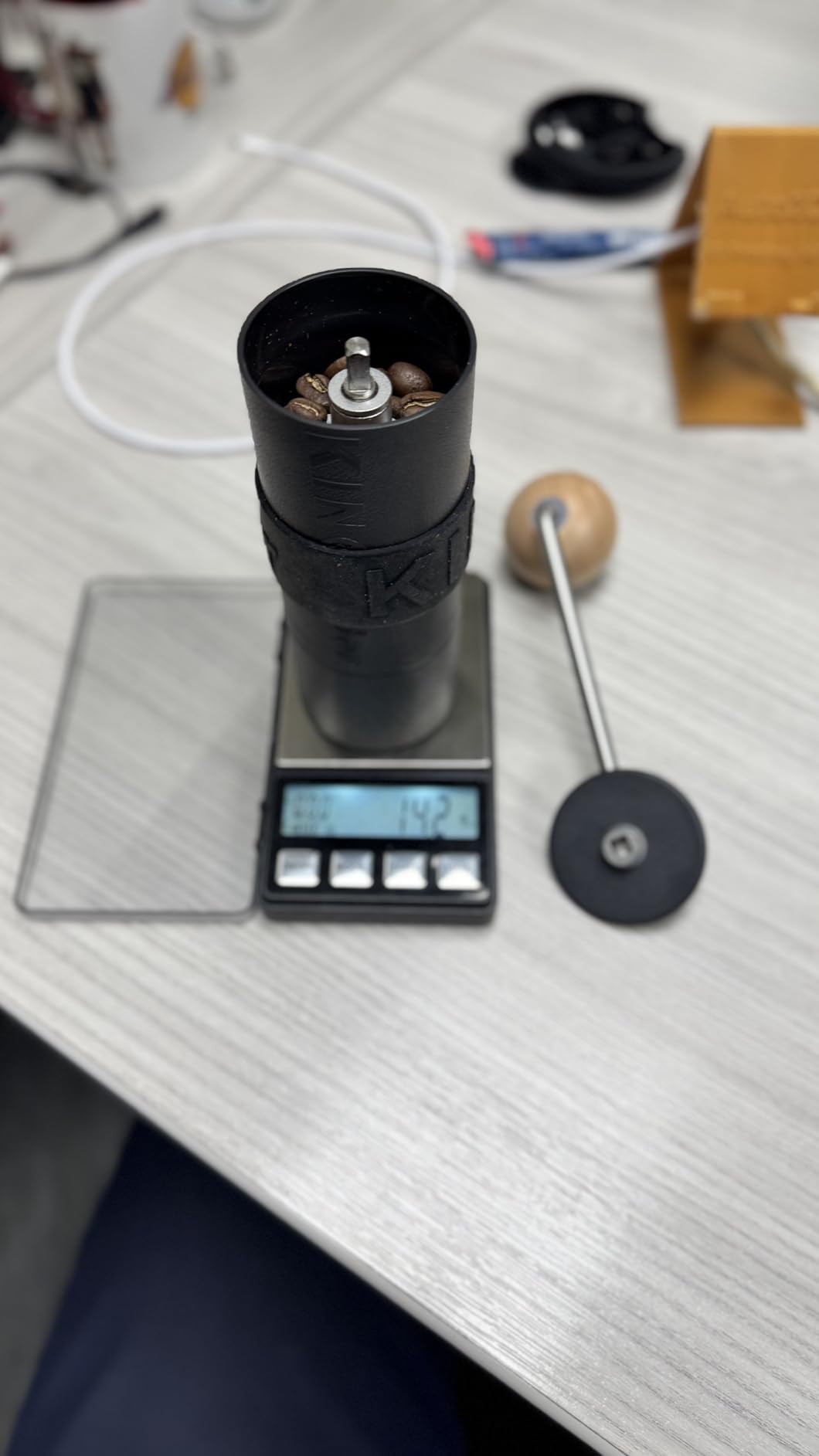
A cleaning routine that needs no water
Unscrew, lift the burr, tip the chamber, brush. The whole sequence takes under a minute and the included brush is shaped for the throat, which is the part that collects the most static-held residue.
Because the body is plastic, wash it at home rather than on the road, and never run water into the adjustment collar. Dry brushing is the correct field method and it is what the design is built around.
9. NewlukPro M6 – Best All-Metal Starter Grinder for First Trips
NewlukPro M6 Manual Coffee Grinder for Espresso Pour Over French Press Moka
25g capacity
All-aluminum body
SUS420 hexagonal burr
24 settings
Pros
- All-metal body with no plastic parts
- Hexagonal burr handles espresso range
- Double bearing axis
- Compact footprint
Cons
- Newer brand with a short track record
- Only a one-year warranty
- Handle ergonomics are basic
The M6 is the option for someone buying their first travel grinder and wanting metal construction without moving into the premium tier. The body is aluminum alloy throughout, and the maker states there are no plastic parts, which removes the main durability worry that comes with this weight class.
It covers a wide range on 24 settings, from espresso through to French press and moka pot. Reviewers report good espresso grind capability for the tier, which is more than we would expect from a grinder with 24 stepped positions.
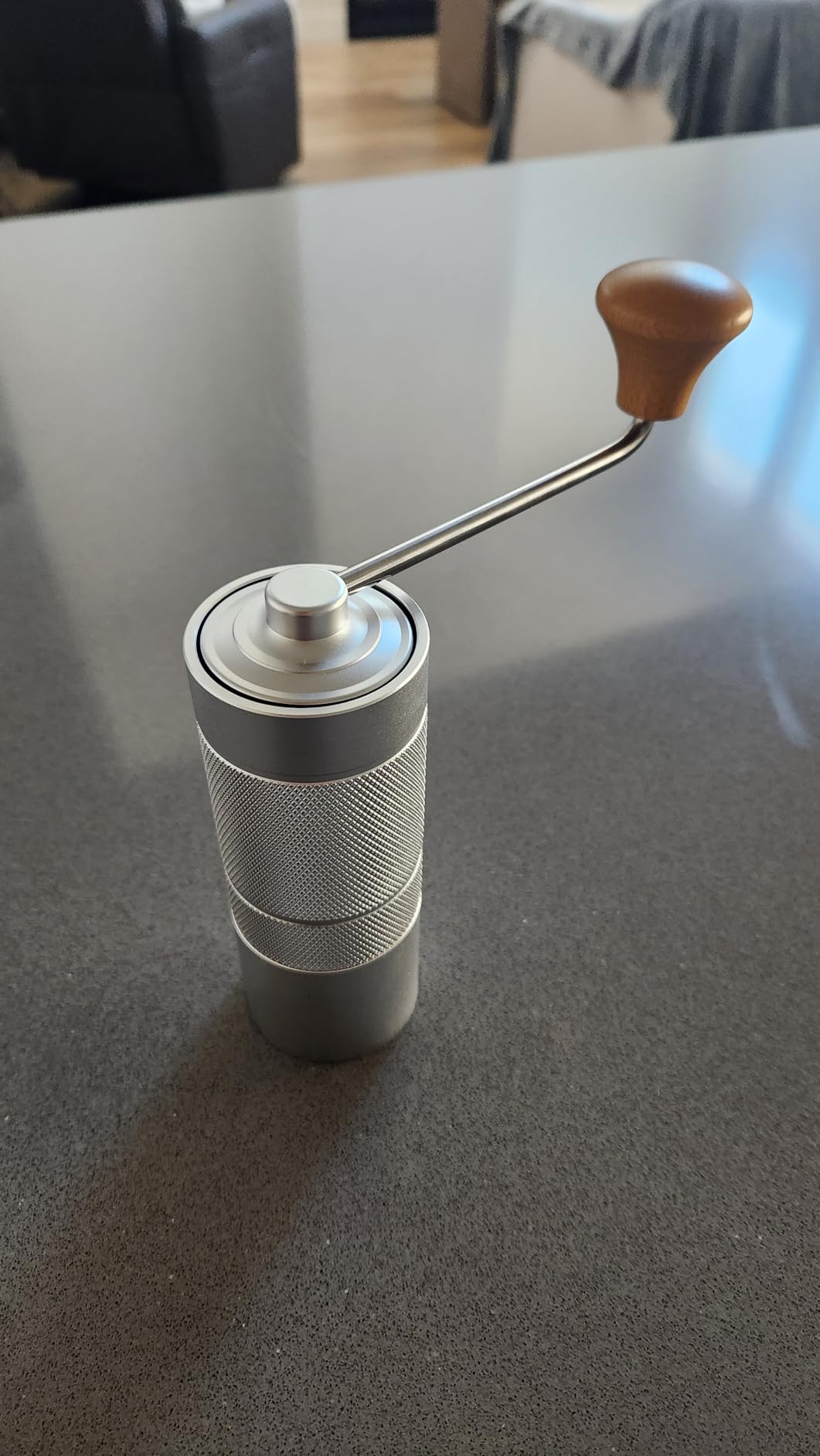
At 1.3 pounds it is one of the heavier options, and the handle does not fold. So it packs into a bag or a vehicle nicely, but it is not the choice for a walk-in hike. It is also detachable for cleaning, which means a full strip-down takes well under a minute.
The main reservation is brand maturity. With a smaller review base and a one-year warranty, there is less long-term evidence than the Hario or JavaPresse command. That is not a reason to avoid it, but it is a reason to buy it from somewhere with an easy return.
What the hexagonal burr changes
A hexagonal core burr is a stainless design that resists chipping and holds an edge well, similar in spirit to the heptagonal burr in the 1Zpresso Q Air. In practice it delivers even particle sizes across the range and tolerates the harder roasted beans that tend to chip a softer burr.
The double bearing axis keeps the burr centred under load. That is what stops the grind from wandering as the chamber empties, and on a trip where consistency across doses matters more than peak precision, it is a feature worth paying for.
Who should skip it
If your trips are car-based and you already own a grinder, skip it. At 590g with a fixed handle it does not travel particularly well, and the same money spent higher up the range buys finer adjustment and a foldable handle.
If this is your first hand grinder and you want something that can do pour-over and the occasional espresso, it makes more sense. Our beginner grinder guide covers the wider decision if you are still choosing between types.
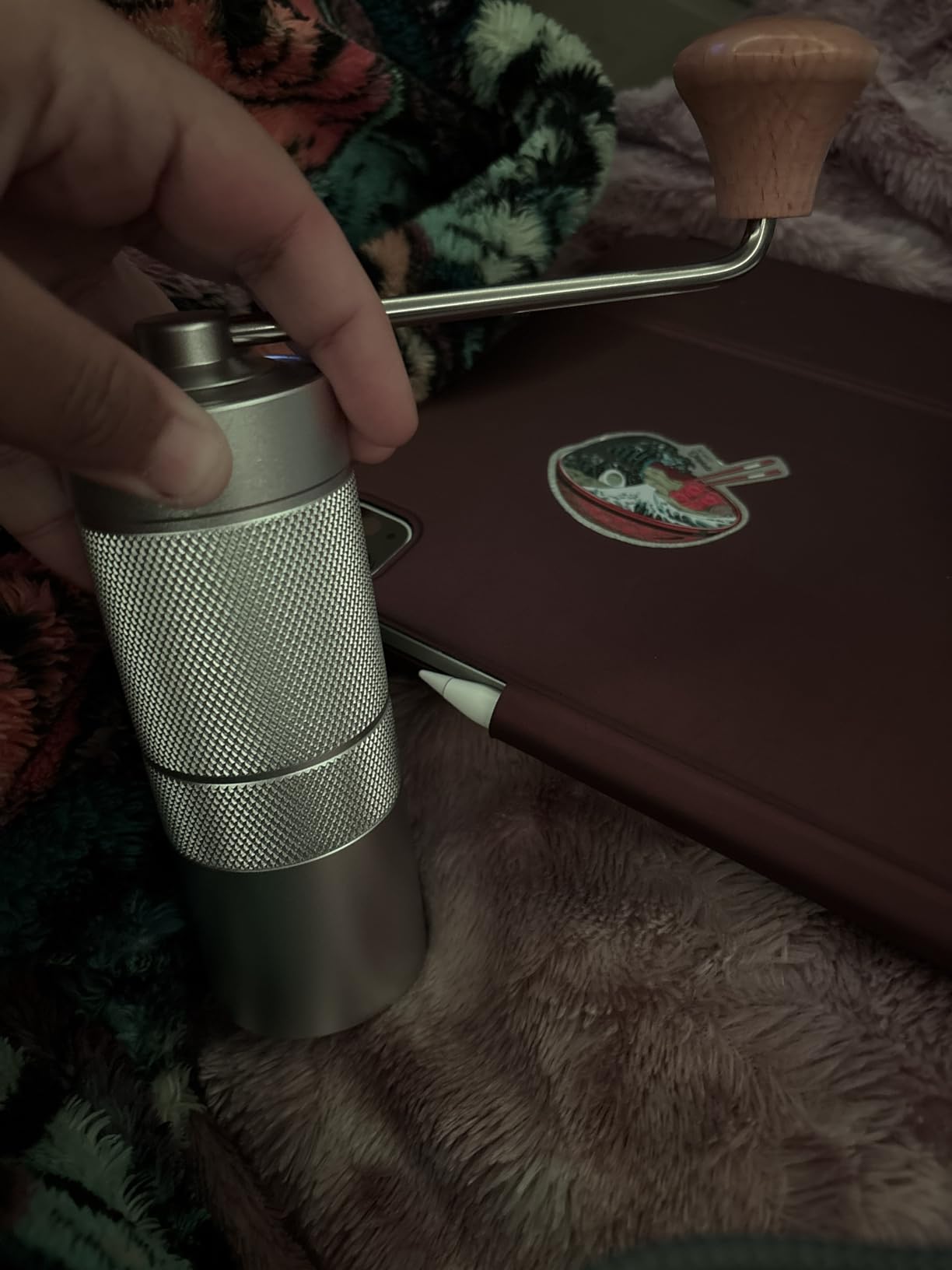
Warranty and parts as a travel consideration
Replacement parts are a genuine travel risk with any grinder, and they are worth checking before a long trip. A one-year warranty is shorter than several competitors offer, and we would want to know where a replacement burr would come from if a trip went wrong.
Our general rule is to buy the grinder at home, test it thoroughly on a week of normal brewing, and only then take it travelling. That way a burr or adjustment problem surfaces where you can fix it.
10. 1Zpresso Q Air – Best Grinder for Packing Inside an AeroPress
1Zpresso Q Air Manual Coffee Grinder-Black, Mini Slim Travel Sized Fits in the plunger, Stainless Steel Conical Burr, Numerical Adjustable Setting for Pour Over French Press Cold Brew.
15-20g capacity
Heptagonal stainless burr
Fits AeroPress plunger
30 clicks per turn
Pros
- Designed to sit inside an AeroPress plunger
- Factory calibrated burrs
- 100-200kg rated burr lifespan
- Numerical click adjustment
Cons
- Smallest hopper in the lineup at 15-20g
- Plastic body
- Fine grinding demands real effort
The Q Air exists to solve one specific packing problem so thoroughly that it defines itself by it. It is designed to fit inside the plunger of an AeroPress, which means the grinder and the brewer pack as a single nested object rather than two separate items competing for bag space.
Inside that constraint it is a properly made grinder. The heptagonal stainless burr set is factory calibrated before shipping, and the maker rates the burr lifespan at 100 to 200kg, which for a travel grinder is effectively a lifetime of normal use.
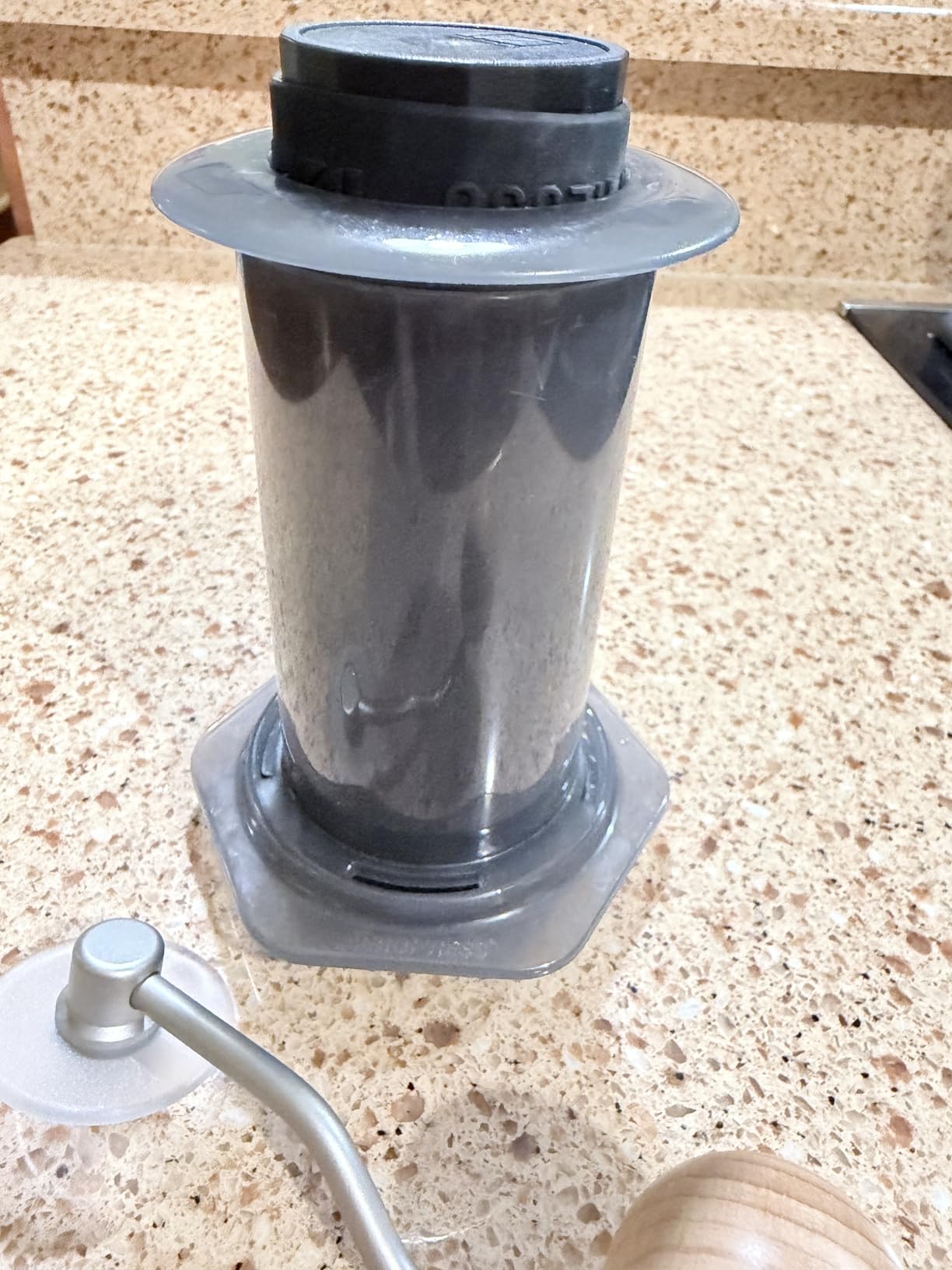
Adjustment is numerical, with 30 clicks per rotation, so you count and record rather than estimate. Grind consistency is reported as excellent for the tier and the action is smooth, both of which you would not assume from a body described as plastic.
The capacity is the issue that forum users raise most. At 15 to 20g it is the smallest hopper here, so a standard 18g pour-over dose fills it almost completely and anything larger means a refill. It is a fine limitation if you brew one small cup. It is a real one if you are brewing for a partner.
The AeroPress fit is the whole feature
Designed for the plunger is not marketing shorthand. The dimensions are chosen so the grinder nests inside the AeroPress body, turning two objects into one stack roughly the size of the brewer alone. For anyone travelling with an AeroPress and trying to keep a cabin bag light, that is the single most space-efficient option in this roundup.
If you do not already own an AeroPress, this is much less compelling. The grinder is very good, but it is good at one thing, and that thing requires owning another piece of kit.
Effort at the fine end
Reviewers note that pushing into fine settings takes noticeably more effort, which is expected when the heptagonal burr is closing down. On an 18g dose at pour-over fineness it is manageable. On a finer grind still, the arm starts to feel heavy and slow.
That is a reasonable trade for a grinder that disappears into your brewer. If espresso is the goal rather than a fine pour-over, the K6 is the better travel choice because it has more adjustment range available.
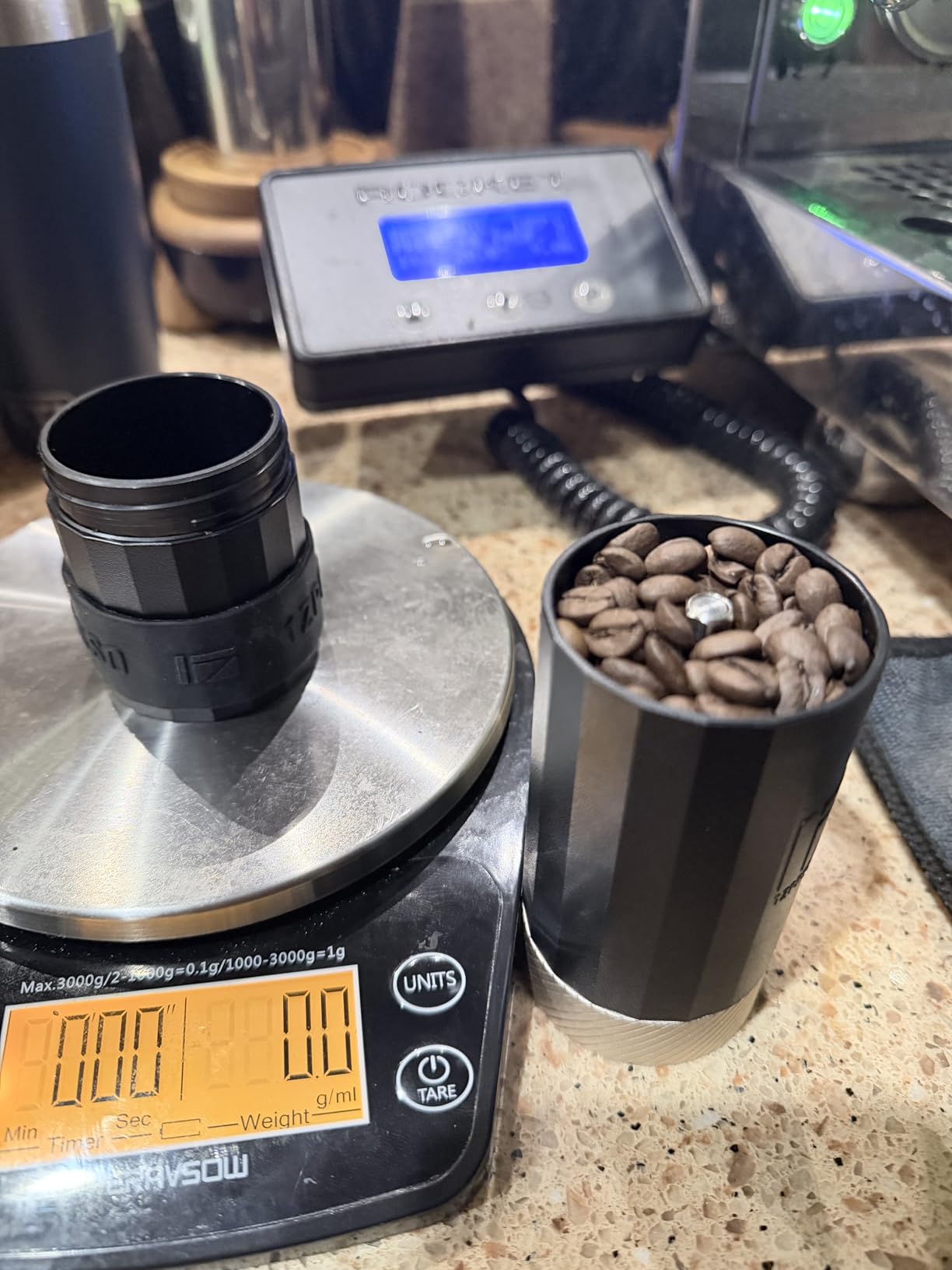
Cleaning and the missing storage cap
Grounds are cleared by unscrewing and brushing, and the burr set lifts out without tools. Because it nests inside another object, it also stays enclosed in the AeroPress body between uses, which solves the storage problem that reviewers flag as its one complaint.
Plan a dry brush after every few doses rather than waiting, since a narrow chamber with a plastic liner holds more residue than it looks. For brew method pairings, our French press grinder guide covers the coarse end of the range.
How to Choose a Hand Coffee Grinder for Travel
Weight is the first filter because it decides whether everything else matters. A grinder that is too heavy does not get used, and a grinder that does not get used is worse than pre-ground coffee. Here is what actually decides the choice after that.
Weight: the number that decides everything else
Our advice is to set a ceiling before you shop. For walking trips and cabin bags, anything under 350g keeps the grinder from dominating your carry weight, and that is where the Hario Mini-Slim Plus at 300g, the JavaPresse at 266g, and the Porlex Mini at 227g sit. For van and car camping you can carry 430g to 700g without noticing and take a much better grinder for it.
Weigh the grinder at home on a kitchen scale before the trip and write the number on the bag. Manufacturers quote weight inconsistently and some omit it entirely.
Burr material: ceramic versus stainless steel
Ceramic burrs, found in the Hario Mini-Slim Plus and the Porlex Mini here, stay sharper longer and transfer almost no heat into the grounds. Their weakness is brittleness, so they need protection from drops. Stainless burrs, used by the Timemore, KINGrinder, Alpaca Ventures, NewlukPro, and 1Zpresso models, tolerate abuse better and last longer under impact.
Neither material fixes a bad bearing. Smoothness comes from the bearing arrangement, which is why grinders with a dual bearing system tend to feel better than their price suggests.
Stepped clicks versus stepless adjustment
A stepped system moves the burrs a fixed distance per click and is repeatable. A stepless system gives a continuous range but no way to return to a specific point without a tool. For travel, repeatable wins. You can write a click count on a coffee bag and rebuild the same grind in another country.
The grinders here run from 18 settings on the JavaPresse to 60 clicks per rotation on the KINGrinder K6. More settings is not automatically better, but a wider range does let you cover espresso and press pot on one device.
Dose capacity: how many cups per fill
Capacity is the most common disappointment after purchase, and it is worth deciding before you buy. A 20g hopper covers one pour-over dose and nothing else. A 25 to 28g hopper gives headroom. The roughly 35g hopper on the JavaPresse is the only one here that grinds for two people in a single load.
If you mostly brew one person, a small hopper is fine and saves weight. If you ever brew for two, buy the extra capacity deliberately rather than discovering it on a cold morning.
Handle design: folding, detaching, or fixed
Folding and detaching handles are the two travel-friendly options and they work differently. A foldable handle, as on the Timemore Chestnut C3S Pro, keeps the grinder one object and shortens the profile. A detachable handle, as on the Hario Mini-Slim Plus, removes the crank entirely so the body becomes a plain cylinder. A fixed handle, as on seven of the ten grinders here, is the most durable arrangement and the largest to pack.
Forum users also raise a specific worry about folding handles developing play over time. That has not come up repeatedly for the models here, but it is worth checking the hinge for movement before a trip.
Can you bring a hand coffee grinder on a plane?
Yes, you can bring a manual coffee grinder in both carry-on and checked luggage. Hand grinders contain no battery, no liquid, and no blade mechanism that screening rules prohibit, so they are not subject to the restrictions that apply to powered devices. Put it in your personal item if you want it in flight rather than in a bag in the hold.
The one practical consideration is oil. A grinder used on beans in transit carries coffee oils on the burrs, so pack it in a zip bag or a pouch. Grinders are dense metal objects, and a grinder that lands on a hard floor from baggage handling is exactly the drop that chips a ceramic burr.
Cleaning a hand grinder with no water
Field cleaning is dry only. Unscrew the chamber, lift out the burr set, tip out the grounds, and run a dry pastry brush through the throat and the underside of the burr. Do not rinse the body in a stream, because water left inside travels to your bag and into your coffee.
Empty the grinder every couple of days rather than at the end of the trip. Coffee oils go rancid in warm, enclosed conditions, and reviewers report stale off-flavours from grinders that were not emptied between uses.
Grinder and brewer pairing
Match the grind range to the brewer rather than the other way round. A filter-focused grinder like the KINGrinder P2 handles pour-over and press pot well and is not built for espresso. A high-resolution grinder like the KINGrinder K6 covers espresso through to press pot and is the safer choice for trips with more than one brew method.
Aeropress-style immersion brewing is the most forgiving of hand grinders because the grind sits in water, which smooths out distribution. French press is the most forgiving of extraction. Espresso on a hand grinder is the least forgiving of everything, and it is the only method where grinder choice genuinely determines whether the drink works.
When pre-ground coffee is the better answer
For a trip of one or two days, carrying pre-ground coffee may serve you better than carrying a grinder. Coffee goes stale quickly once ground, but for two days that loss is small, and you avoid the weight and the cleanup entirely.
Grinding fresh starts to pay for itself from about day three onward, and beyond a week it is clearly the right call. That is also the window where the flavour difference is largest, which is why long-trip coffee and a good hand grinder go together.
Frequently Asked Questions
What is the best manual coffee grinder for travel?
The u003cstrongu003eHario Mini-Slim Plusu003c/strongu003e is the best manual coffee grinder for most travelers. It weighs 300g, the crank handle detaches so it packs flat, the 24g hopper covers a full pour-over dose, and the ceramic conical burr set stays cool during the grind. For espresso on the road, the u003cstrongu003eKINGrinder K6u003c/strongu003e has the adjustment resolution to get finer.
Can I bring a hand coffee grinder on a plane?
Yes. A manual coffee grinder has no battery, no liquid, and no blade mechanism, so it is not restricted by aviation security rules and is allowed in both carry-on and checked luggage. Keep it in a zip bag so coffee oils stay off your clothes, and wrap it because a ceramic burr set can chip if the grinder is dropped.
Are manual coffee grinders any good?
Yes, a good hand grinder produces a more consistent particle size than a blade grinder and stays cool because there is no motor. A burr grinder with 30 or more adjustment steps and a dual bearing system will handle pour-over, immersion brewing, and often espresso. The compromise against an electric grinder is speed and the effort at very fine settings.
What is the best portable coffee grinder for camping?
For car camping and van life the u003cstrongu003eTimemore Chestnut C2Su003c/strongu003e is the strongest choice, with a full stainless unibody and 36 click settings. For hiking and backpacking where weight decides everything, the u003cstrongu003eHario Mini-Slim Plusu003c/strongu003e at 300g or the u003cstrongu003ePorlex Miniu003c/strongu003e at 227g are the better picks. Capacity matters more than most buyers expect, so check the hopper fits your dose.
Which is the best manual coffee grinder overall?
Among travel-sized burr grinders, the u003cstrongu003eHario Mini-Slim Plusu003c/strongu003e wins on the combination that matters most when you are carrying it: low weight, a detachable handle, a 24g hopper, and a large body of owner reviews. If weight does not matter because your kitchen travels with you, the u003cstrongu003eTimemore Chestnut C3S Prou003c/strongu003e grinds more consistently.
How long does a hand coffee grinder take to grind?
A 20g filter dose typically takes 45 to 90 seconds of steady cranking on a compact travel grinder. Longer crank arms, such as the 6.3 inch arm on the Alpaca Ventures AV1, generate more torque and clear a dose faster with less effort. Finer settings take longer because the burrs have to crush the beans further.
Which Travel Grinder Should You Buy?
If you are packing a grinder into a backpack or a cabin bag, the Hario Mini-Slim Plus is the right call. At 300g with a detachable handle and a 24g hopper, it is the best balance of weight, capacity, and build quality we tested, and it was the grinder we reached for most.
If you are driving rather than walking, buy quality instead of lightness. The Timemore Chestnut C3S Pro grinds the most consistently of anything here and the Chestnut C2S is built to live in a van. If espresso is part of the plan, the KINGrinder K6 has the adjustment resolution you need. If you brew for two, take the JavaPresse for its roughly 35g hopper, and if every gram counts, the Porlex Mini at 227g is hard to beat.
Whichever you choose, weigh it at home, grind a full dose on three different beans before you leave, and dry-brush it between uses. That habit matters more than any specification on this list.
See also our picks for pour over brewing, and if you are building out a travel kit, our cold brew guide covers the long-soak end of the spectrum.