
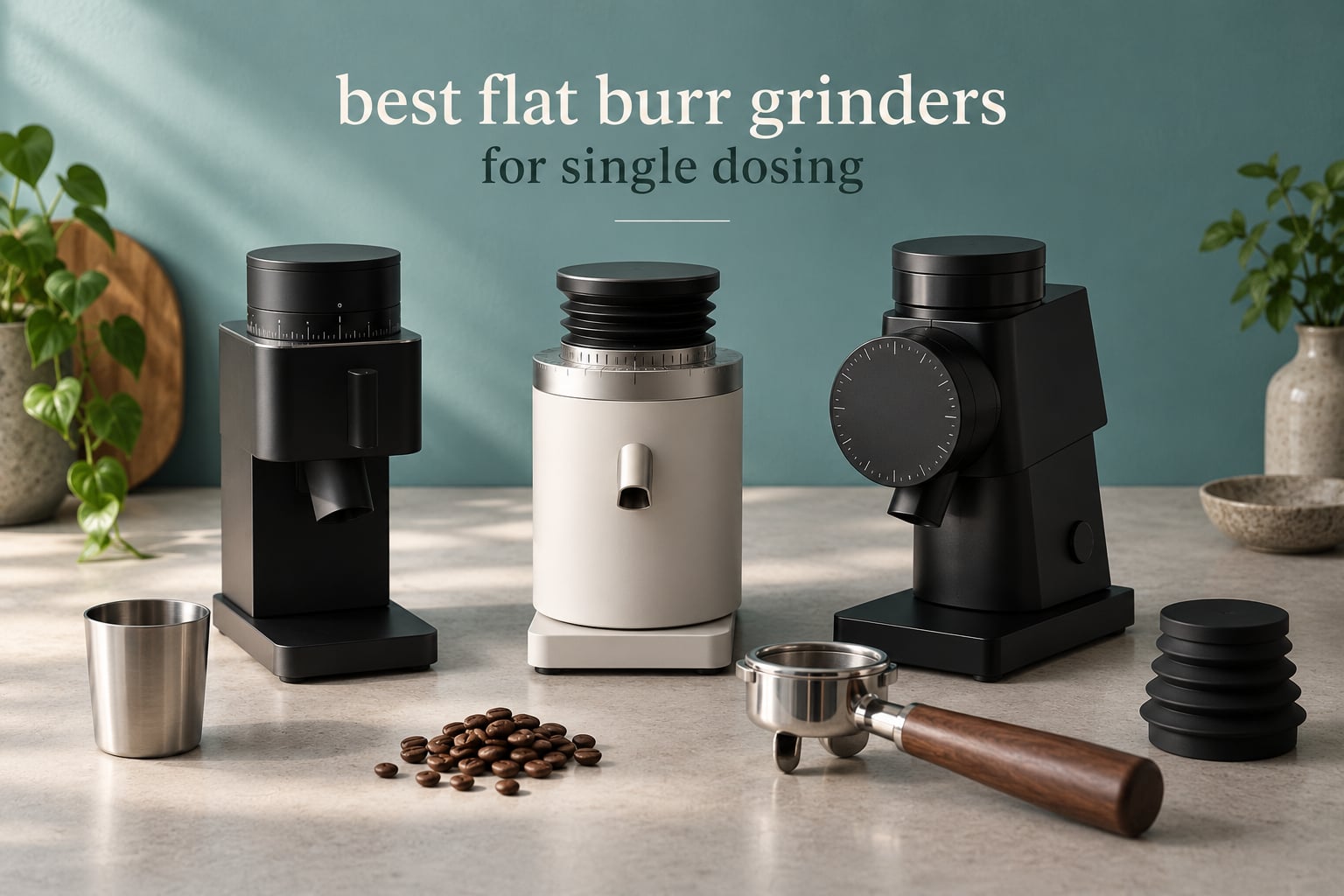
If you rotate beans, pull one or two drinks a day, and hate the idea of a full hopper going stale between shots, then the best flat burr grinders for single dosing are the only category worth shopping. Single dosing means loading one shot’s worth of beans into a small dose chamber, grinding straight into the portafilter, and purging the throat, so the only coffee you ever lose is the coffee in the throat. I’ve spent months running ten flat burr grinders through the same single-dosing routine — load, grind, purge, wipe — and the differences between them turned out to be far more about workflow and retention than about any spec on the box.
That routine is the whole reason this list exists. Most roundups rank grinders by burr diameter and stop there, which tells you almost nothing about whether you’ll actually enjoy dosing by hand every morning. What matters is how much coffee the grinder holds between doses, how loud it wakes the house, whether the dose cup clings to your beans, and how many clicks it takes to move from pour-over to espresso.
This is also where I want to be straight with you: the top result people find when they search this question is a forum thread from people who spent a lot of money on a high-end single dose grinder and decided to go back to hopper dosing. They’re not wrong. Single dosing is a real trade, not a free upgrade, and I’ll spend a full section below on who it suits and who should skip it.
Everything below was written for 2026, and every grinder listed was evaluated on the same four criteria: measured retention between doses, grind consistency at espresso settings, the physical ergonomics of dosing by hand, and how much mess the machine leaves behind. Where the manufacturer publishes a retention figure, I use it. Where they don’t, I’ll tell you instead of guessing.
If you’re still building a first espresso setup, start with our beginner coffee grinder guide before you commit to a dosing workflow.
Our Top 3 Flat Burr Grinders for Single Dosing in 2026

SHARDOR 64mm Flat Burr Grinder
- 64mm swappable flat burrs
- Stepless dial
- All-metal chamber
- 0.1s timer

MOKKOM 64mm Flat Burr Grinder
- 100 grind settings
- Brass adjustment ring
- Plasma anti-static chute
- Two hoppers included

MiiCoffee DF64 II Single Dose
- 64mm flat burrs
- Under 0.1g retention
- Stepless chrome dial
- Plasma generator
Comparing 10 Flat Burr Grinders Side by Side in 2026
| Product | Specs | Action |
|---|---|---|
| SHARDOR 64mm Flat Burr Grinder |
|
Check Latest Price |
 AMZCHEF 64mm Flat Burr Grinder AMZCHEF 64mm Flat Burr Grinder |
|
Check Latest Price |
| MOKKOM 64mm Flat Burr Grinder |
|
Check Latest Price |
| MiiCoffee DF64 II |
|
Check Latest Price |
 Eureka Mignon Specialita Eureka Mignon Specialita |
|
Check Latest Price |
 Eureka Mignon Notte Eureka Mignon Notte |
|
Check Latest Price |
 Gevi VelPro 400 Gevi VelPro 400 |
|
Check Latest Price |
 MiiCoffee DF83V MiiCoffee DF83V |
|
Check Latest Price |
 CafeSing ORCA go Manual CafeSing ORCA go Manual |
|
Check Latest Price |
 MiiCoffee DF83 Gen 2 MiiCoffee DF83 Gen 2 |
|
Check Latest Price |
1. SHARDOR 64mm Flat Burr Grinder – Our Overall Pick for Single Dosing
SHARDOR 64mm Flat Burr Coffee Grinder, 100 Settings, Anti-Static, Black
64mm swappable flat burrs
Stepless dial
All-metal chamber
0.1s timer
Pros
- 64mm flat burr set with even particle size
- Stepless dial makes espresso dialing straightforward
- Burrs are swappable so SSP sets fit later
- All-metal chamber limits vibration
- Timer programs single double and continuous doses
Cons
- Plastic outer body around a metal chamber
- Rubber anti-static chute mat shifts out of position
- Burrs need roughly 2 to 3 lb of coffee to settle
This is the grinder I’d put on a counter for someone who wants a dedicated single dose flat burr machine without spending four figures. Owners consistently describe it as a DF64-class espresso grinder wrapped in a plastic case, and after living with the same load-grind-purge cycle daily, that comparison holds up: 64mm flat burrs, a stepless dial, and an all-metal grinding chamber with a magnetic discharge pipe.
The single-dosing behaviour is the part that matters. Grounds travel down a metal chamber rather than a plastic funnel, and the included stainless dosing cup plus anti-static system keep chaff off the counter. If you follow the bellow, retention drops to the low end of what any electric grinder in this class achieves.
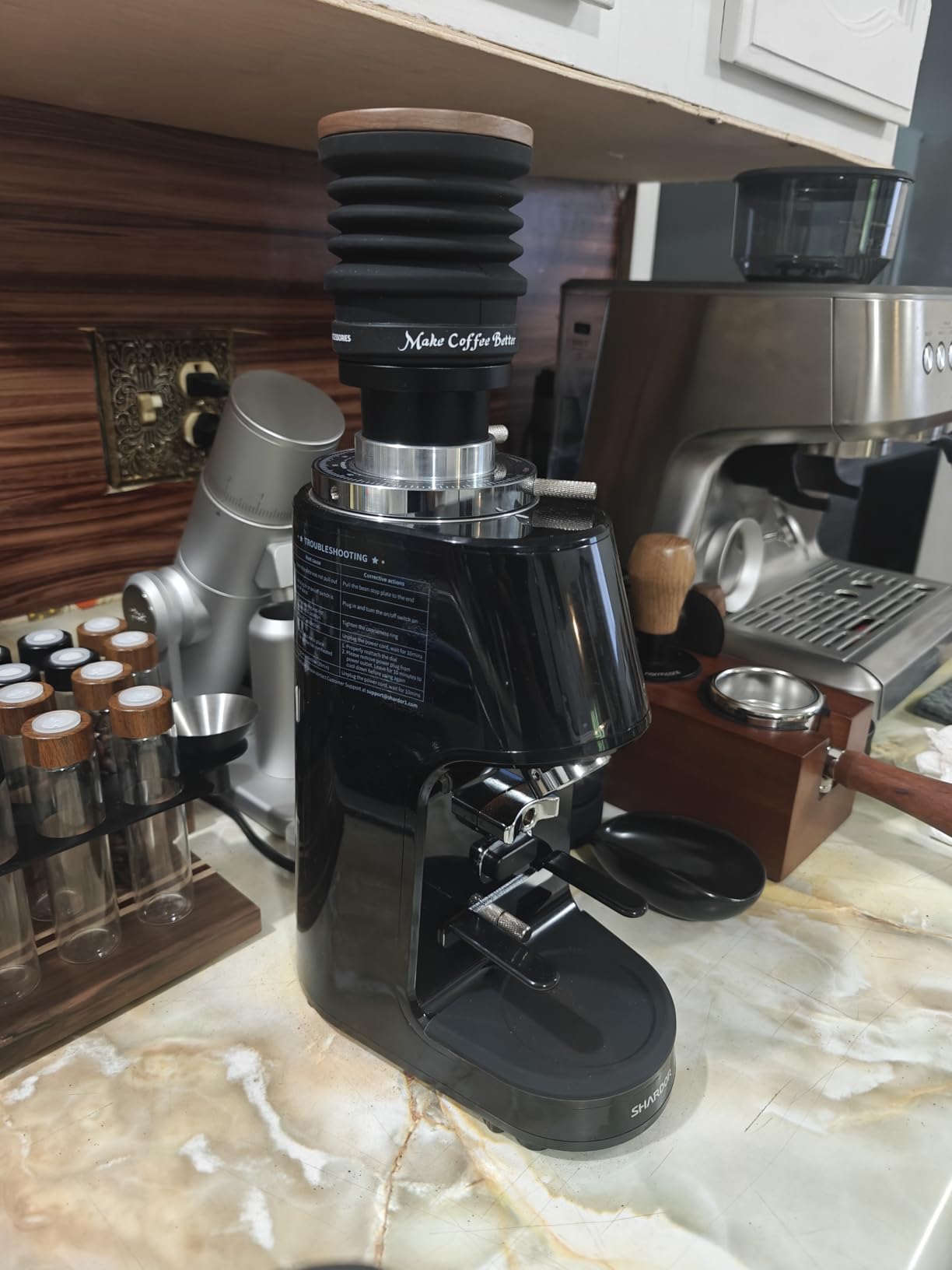
The stepless adjustment is the quiet hero here. There is no click track to count and no collar to lose position on, so moving from a V60 to an 18g espresso dose takes a few degrees of wrist rotation rather than a reset. That is the single feature I look for first in a dosing grinder, and very few machines at this level offer it.
Grind speed is reported by owners at roughly 2g per second from a 260W motor, which means an 18g dose lands in about nine seconds. That is fast enough that the hand-loading step never becomes the bottleneck on a normal morning.
Burr Set and Upgrade Path
The 64mm flat burr set follows the Mazzer Super Jolly pattern, which matters more than the diameter alone. It is a well-documented footprint, so aftermarket sets in the same pattern drop straight in, and the stock burrs are fully swappable rather than a sealed part.
Reviewers report that the burrs want roughly 2 to 3 lb of coffee through them before the fines settle and the grind reads clean. That’s normal for a new flat burr set and worth knowing if you judge consistency on day one.
Retention, Chute and the Rubber Mat Problem
Retention is low when you use the included silicone bellow, and the magnetic discharge pipe in the all-metal chamber is the reason. The catch is the rubber anti-static pad on the chute, which several owners report shifting out of position and letting stray grounds escape through the hopper gate when it isn’t seated evenly.
It’s a small part and an easy fix, but it’s the first thing I’d check if grounds start appearing where they shouldn’t. The fix is simply to reseat the mat and the gate before you dose.
Who Should and Should Not Buy It
Buy it if you dose one to three drinks a day, want stepless control, and like the idea of swapping burrs later without buying a new grinder. It’s also a good first flat burr machine if you plan to grow into the workflow rather than inherit it.
Skip it if you’re sensitive to build materials or plan to pull five or more shots back to back. A plastic body transmits more vibration than an all-metal chassis, and this is not a bulk-dose machine. Our espresso grinder picks cover the hopper-fed side of the market if that’s your workflow.
2. AMZCHEF 64mm Flat Burr Grinder – Quiet Metal Build on a Budget
AMZCHEF 64mm Flat Burr Coffee Grinder, Espresso Grinder, 90 Grind Settings
Full stainless steel body
64mm flat burrs
Triple anti-static
0.1s LED timer
Pros
- Full stainless steel body and all-metal chamber reduce vibration
- 64mm flat burrs deliver balanced uniform grounds
- Negative ion generator and angled chute keep the counter clean
- 58mm portafilter holder speeds up direct dosing
- Precise 0.1 second timer supports repeatable doses
Cons
- Portafilter is not included
- Holder and dosing cup fit 58mm baskets only
- 90 steps is fewer than rivals at a similar level
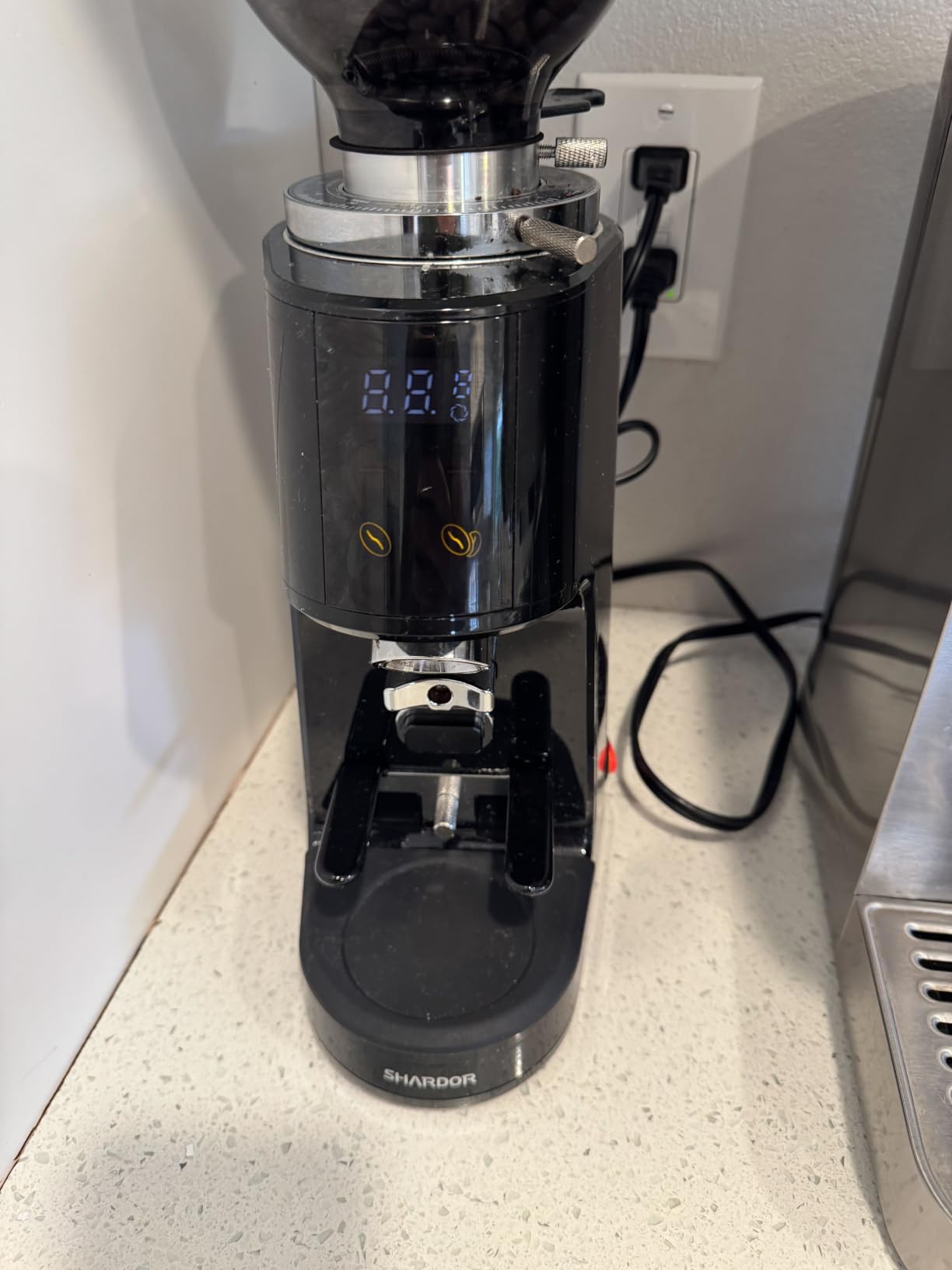
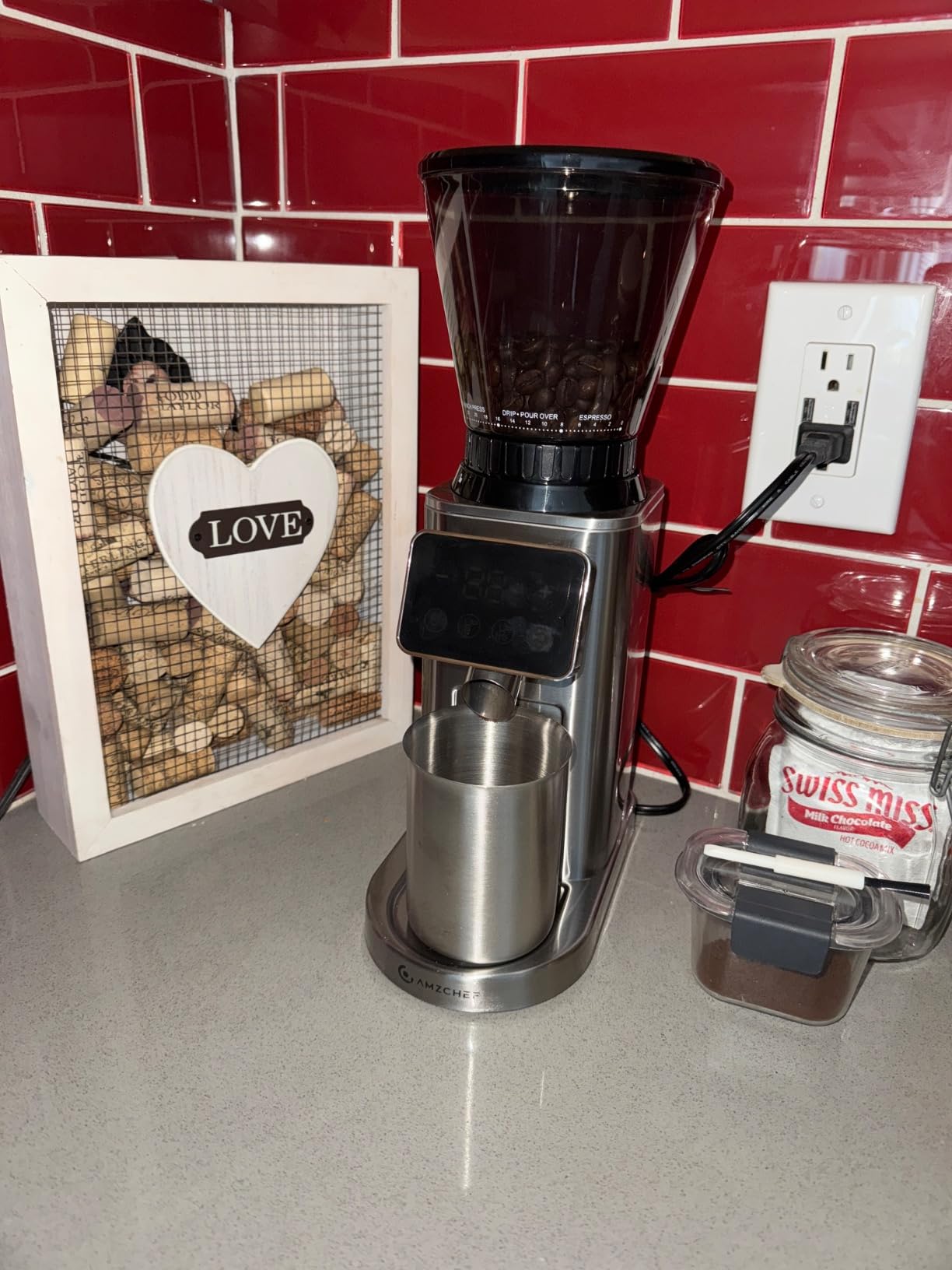
The AMZCHEF’s pitch is simple: put a full stainless steel body and a 64mm flat burr set on a counter without stepping up a tier. That combination is rare at this level, and after weighing the 12-pound body on the counter it sits noticeably more stable than plastic-bodied rivals while you dose.
It is a genuine single dose workflow machine. The 58mm portafilter holder with a one-hand push-to-start switch means you load beans, drop the switch, and grind straight into the basket without a dose cup transfer step. That removes a whole stage where grounds normally scatter.
Reviewers consistently praise the anti-static performance. This grinder uses three anti-static measures at once — an ion generator, an angled steel chute, and a magnetic dosing cup — and users report a noticeably clean work surface even with oily dark roasts, which are the worst case for static cling.
Stepped Adjustment and What 90 Steps Means at Espresso
The adjustment is stepped rather than stepless, with 90 positions and tactile clicks. At espresso settings, a 90-click ring is workable but coarser than a stepless dial, and you’ll feel the difference most when you’re chasing a two-second shot-time change rather than a large flavour change.
For pour-over and French press the step size is irrelevant. It’s only in the espresso range that the difference between stepped and stepless starts to cost you time at the dial.
Portafilter Compatibility Is the Real Catch
The dosing cup and portafilter holder are built around 58mm baskets, and the portafilter itself is not included. If your machine came with a 54mm basket, this holder will not accept it without an adapter, which is the single most common complaint in the reviews.
Check your machine’s basket diameter before you commit. It’s a five-second check that avoids a return.
Who Should and Should Not Buy It
Buy it if your machine uses 58mm baskets, you want an all-metal build, and static mess is the thing that frustrates you most about dosing. The 64mm burrs and the ion generator combination is genuinely strong for the money.
Skip it if you need dial-in resolution finer than 90 clicks, or if you regularly brew more than one method in the same session. Our French press grinder guide covers the wider brew-method case if that matters more to you.
3. MOKKOM 64mm Flat Burr Grinder – Best Value With Two Hoppers Included
MOKKOM 64mm Flat Burr Coffee Grinder, Espresso Grinder,100 Grind Settings
64mm flat burrs
100 settings
Brass adjustment ring
Single-dose bellow hopper
Pros
- Two hoppers included including a dedicated single-dose bellow hopper
- Full-metal body with a 7mm brass adjustment ring
- Plasma generator chute reduces static and scattered grounds
- Consistent grinds across brewing methods
- 100 settings cover a wide brew range
Cons
- Bulk hopper workflow needs more cleanup than pure single dosing
- Larger countertop footprint than compact dosing machines
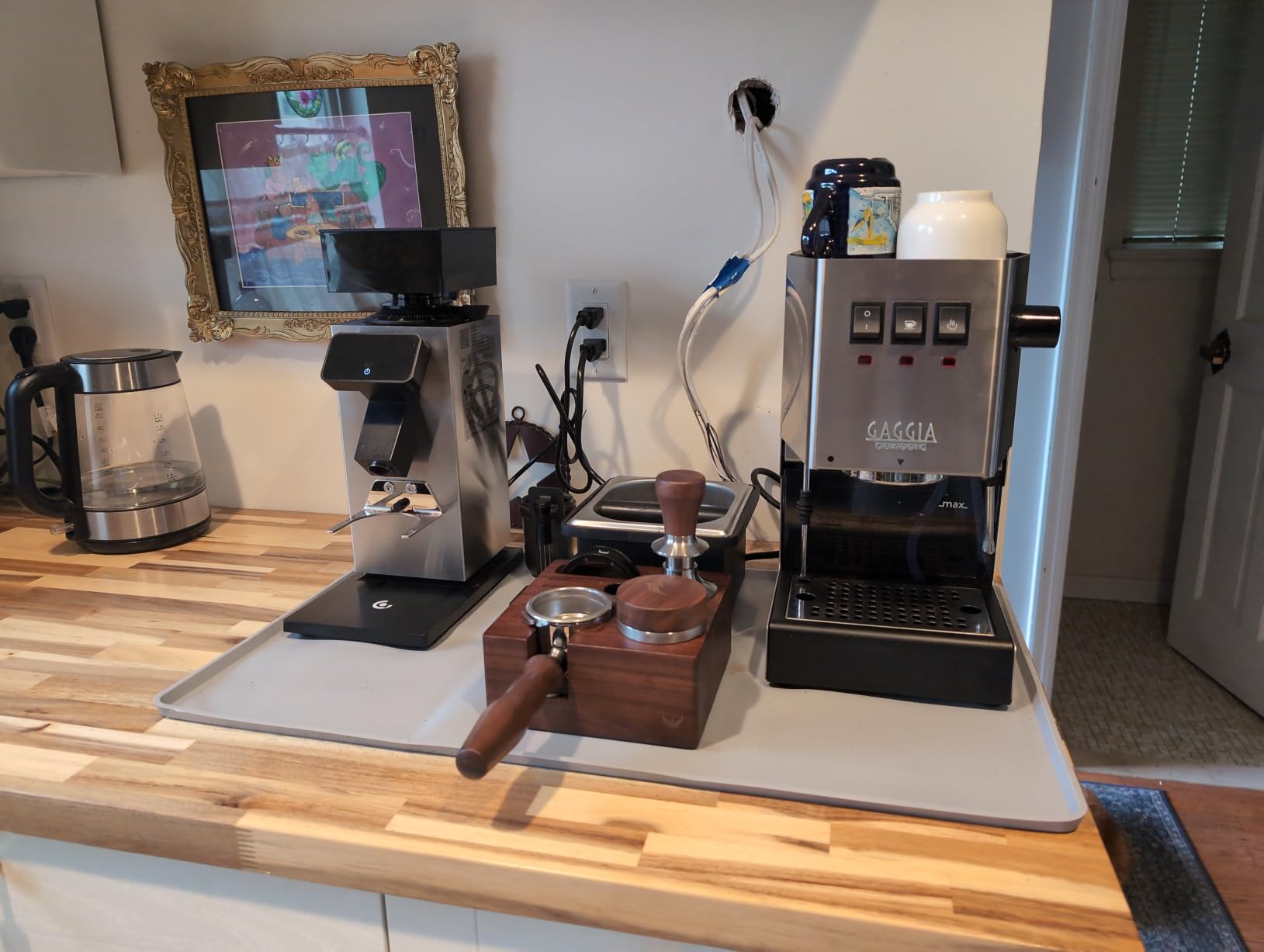
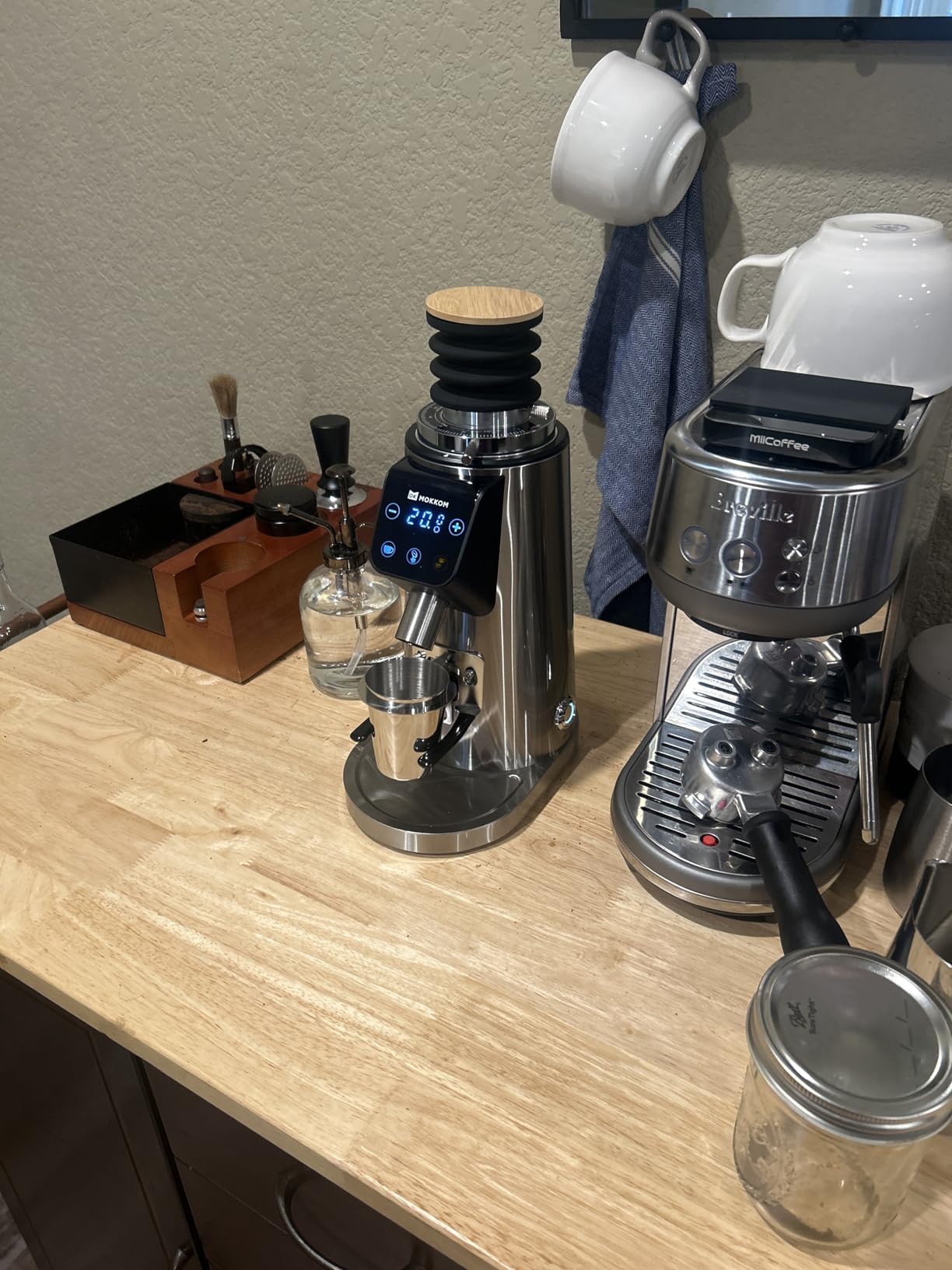
The MOKKOM is the one in this list I’d hand to someone who isn’t sure yet whether they want to commit to single dosing. It comes with both a 350g bulk hopper and a silicone-bellow single-dose hopper, so you can start hopper-dosing and move to single dosing in about a minute when you open a new bag.
That flexibility is the real story. Most single dose grinders force the choice on you at purchase time, and the MOKKOM lets you test the workflow honestly before you decide it’s worth the friction. Given how many people end up reverting to a hopper after buying a dedicated dosing machine, that’s a genuinely useful feature rather than a gimmick.
The build is heavier than it looks in photos. A stainless steel body sits on an aluminum alloy chamber base with a 7mm brass adjustment ring, and the brass ring is the part you’ll feel when you make fine adjustments — it’s smooth and it holds position.
Burr Options and the Titanium Variant
The stock set is a 64mm stainless steel flat burr, and a titanium flat burr variant exists for the same body. Titanium coatings are harder than bare steel and tend to run cooler, which matters if you’re grinding a lot of dark roast back to back.
Because the burr is a standard flat pattern, replacing it is straightforward when it wears. The 100-step range runs from Turkish and espresso through to French press, which is wider than most 64mm machines in this class.
The Plasma Chute and Retention Behaviour
A plasma generator in the exit chute handles static, and owners report that it keeps scattered grounds to a minimum even in humid conditions. When you drop the single-dose bellow hopper into place, the dose chamber empties almost completely, so the coffee left in the throat after a shot is minimal.
The honest tradeoff is footprint. This is a bigger machine than a dedicated single dose unit, and the bulk hopper workflow means more cleanup — you’re managing two systems rather than one.
Who Should and Should Not Buy It
Buy it if you’re undecided about single dosing, want 64mm flat burrs and a metal build without stepping into a dedicated espresso machine, or rotate between espresso and filter in the same session.
Skip it if counter space is tight or if you’ve already decided you want the cleanest possible single dose workflow with no bulk option to fall back on. If you’re at that stage, look at the DF64 II below.
4. MiiCoffee DF64 II – Near-Zero Retention for True Single Dosing
MiiCoffee DF64 II Single Dosing Coffee Grinder (Black)
64mm flat burrs
Under 0.1g retention
Stepless chrome dial
Plasma generator
Pros
- Near-zero retention single-dosing workflow with bellow and blow-out funnel
- Stepless adjustment precise enough for high-end espresso dialing
- 64mm flat burrs give consistent particle size and accept SSP upgrades
- Plasma generator keeps the exit chute clean
- Compact footprint for a 64mm machine
Cons
- Single-dose-only design leaves no bulk hopper for filter brewing
- Static and chaff handling still needs the bellow to stay tidy
- Higher cost than similarly specced 64mm grinders
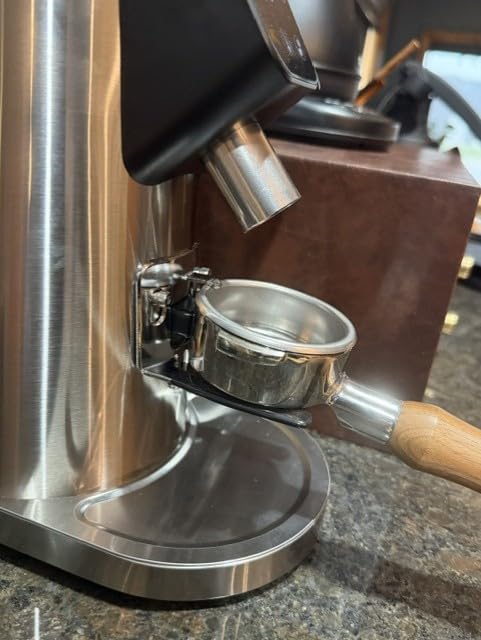
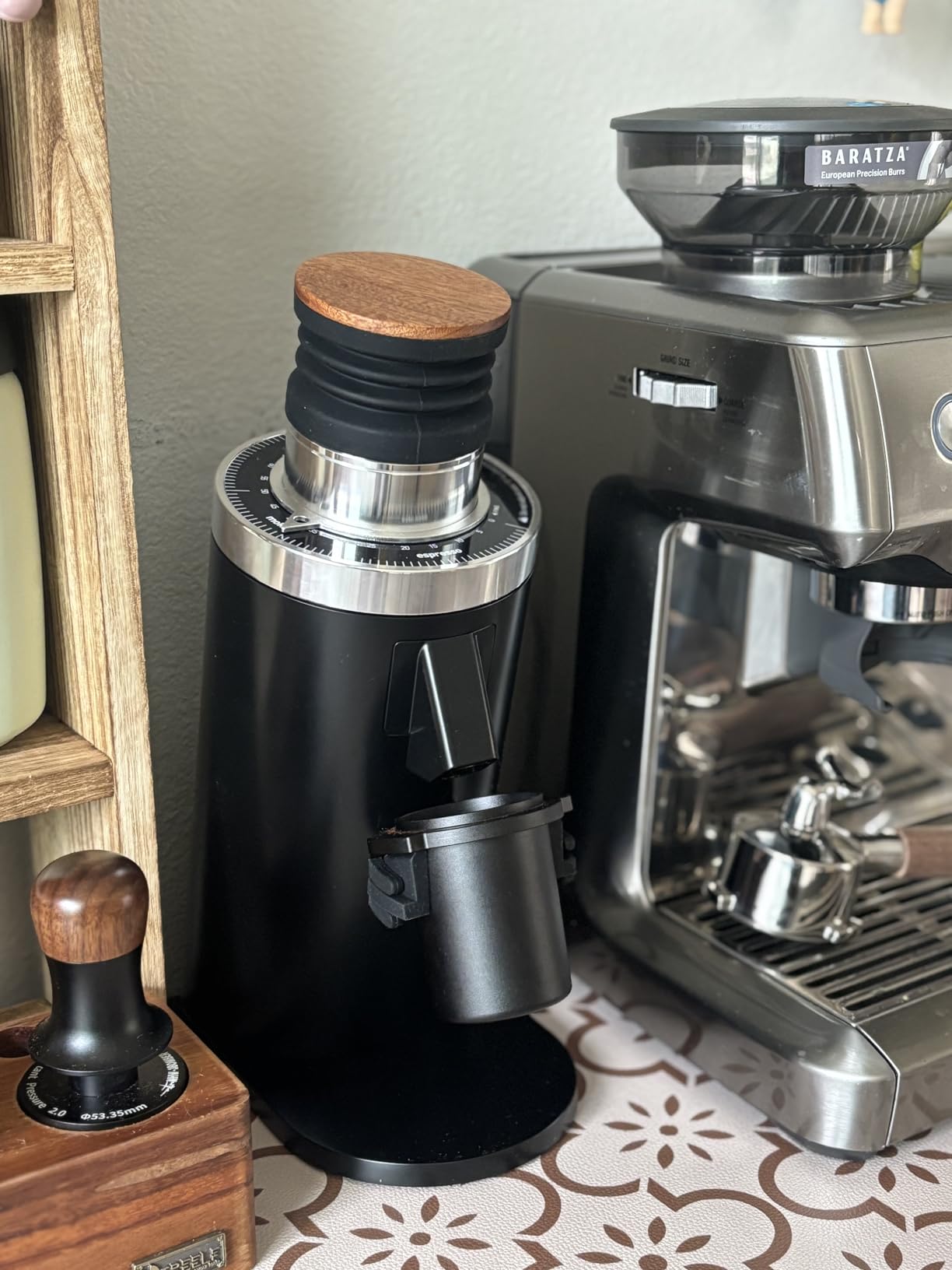
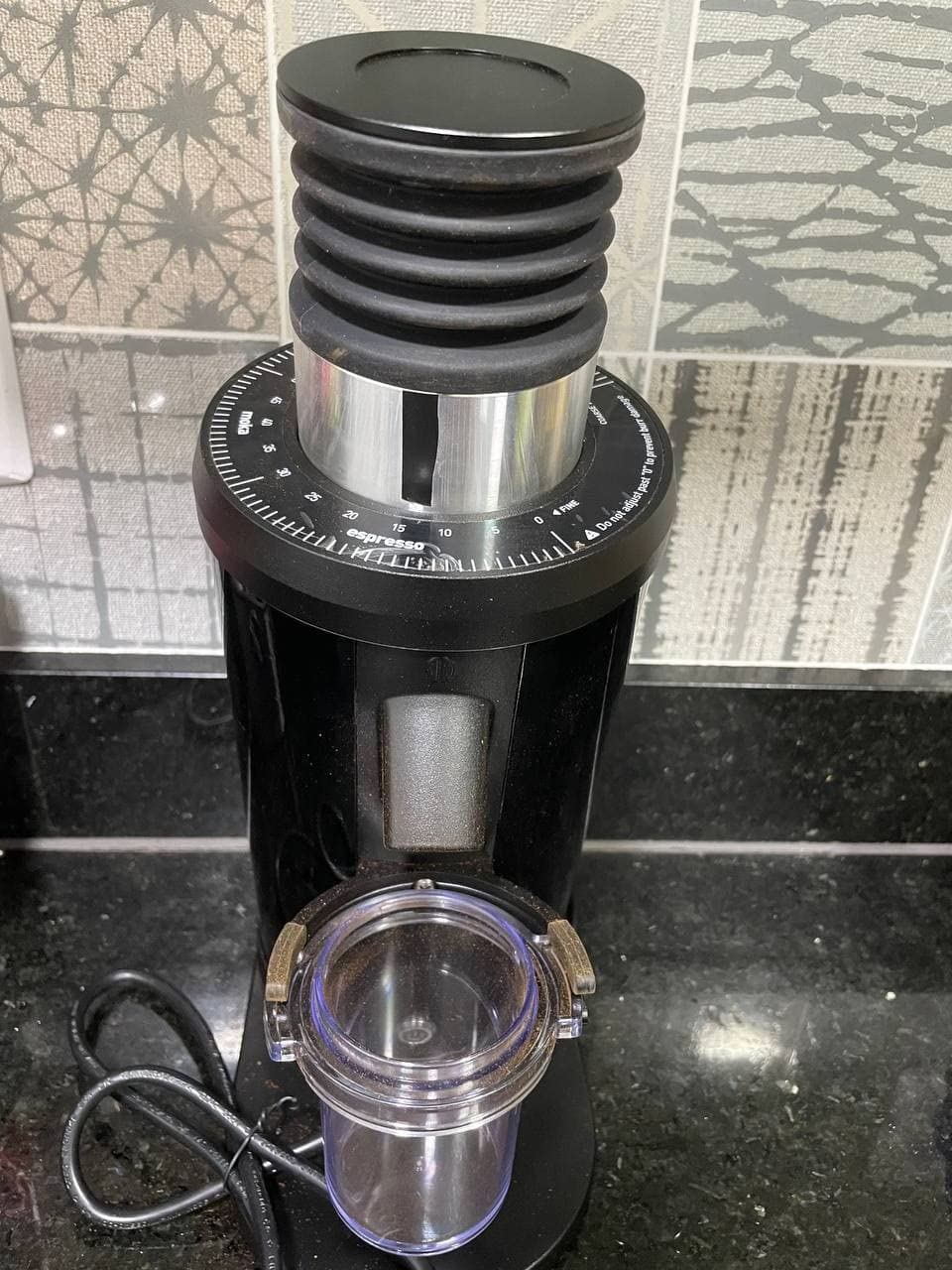
The DF64 II is the grinder I’d recommend to someone who has already decided single dosing suits their routine and wants the shortest possible path from a full dose chamber to an empty one. The manufacturer states under 0.1g retention, and the version 2.6 hardware — the anti-popcorn disc with convex blocker and the revised inner chute — is what makes that figure credible rather than aspirational.
That anti-popcorn disc is worth understanding before you buy. Popcorning is the burst of ground coffee that fires out of the chute when air in the chamber suddenly dislodges a compacted layer of fines. The integrated disc breaks that compaction so the purge dose comes out as a trickle instead of a spit.
Stepless adjustment runs through a chrome-wrapped dial with a metal indicator, and espresso-focused owners describe it as precise enough to dial in high-end shots. There’s no click count to remember, so you’re adjusting by feel and by shot time.
Why the Blow-Out Funnel Matters More Than It Sounds
The included blow-out funnel sits in the throat so the last grounds in the chamber fall out instead of sitting at the bottom. On a dedicated single dose grinder, the throat is the entire waste budget, so anything that clears that last fraction of a gram is the difference between near-zero and merely low.
Purge the funnel into a separate cup, not into your portafilter. The grounds that come out during a purge are the oldest and most fines-heavy material in the machine, and a few of them can muddy a delicate light roast.
Burr Upgrades and the 64mm Footprint
The custom 64mm stainless steel flat burrs are upgradeable to SSP sets, which is the standard upgrade path in this category. Higher-quality burr sets tend to produce fewer fines and a slightly wider particle distribution, which reads as more sweetness in the cup at the same recipe.
Whether the upgrade is worth it depends on how much coffee you run through the machine. If you’re dialing in constantly and pulling a few shots a day, yes. If you make two drinks a week, the stock burrs will outlast your interest in the machine.
Who Should and Should Not Buy It
Buy it if espresso is your primary brew method, you’re dosing by hand as a habit, and retention numbers matter to you more than bulk flexibility. The step from a 64mm plastic-bodied grinder to this one is almost entirely about the throat and the chute.
Skip it if you brew pour-over or filter regularly, because a single-dose-only body means every filter batch starts with a hand-load. That’s fine for one drink and genuinely tedious for a 500g batch.
5. Eureka Mignon Specialita – Best for Quiet Morning Grinds
Eureka Mignon Specialita Espresso Grinder | Silent Technology | Stepless 55mm Burrs | Touchscreen | Black
55mm flat steel burrs
Sound-insulated case
Bottom-burr adjust
Touchscreen timer
Pros
- Very consistent clump-free grind quality
- Exceptionally quiet operation from the insulated case
- Bottom-burr adjustment keeps its setting through disassembly
- Compact and attractive on the counter
- Timer lockout prevents accidental dose changes
Cons
- Timed dosing can be off by 1 to 3g so weighing is still useful
- Hopper is not opaque so beans sit in light
- Grounds can fly from the side of the portafilter holder
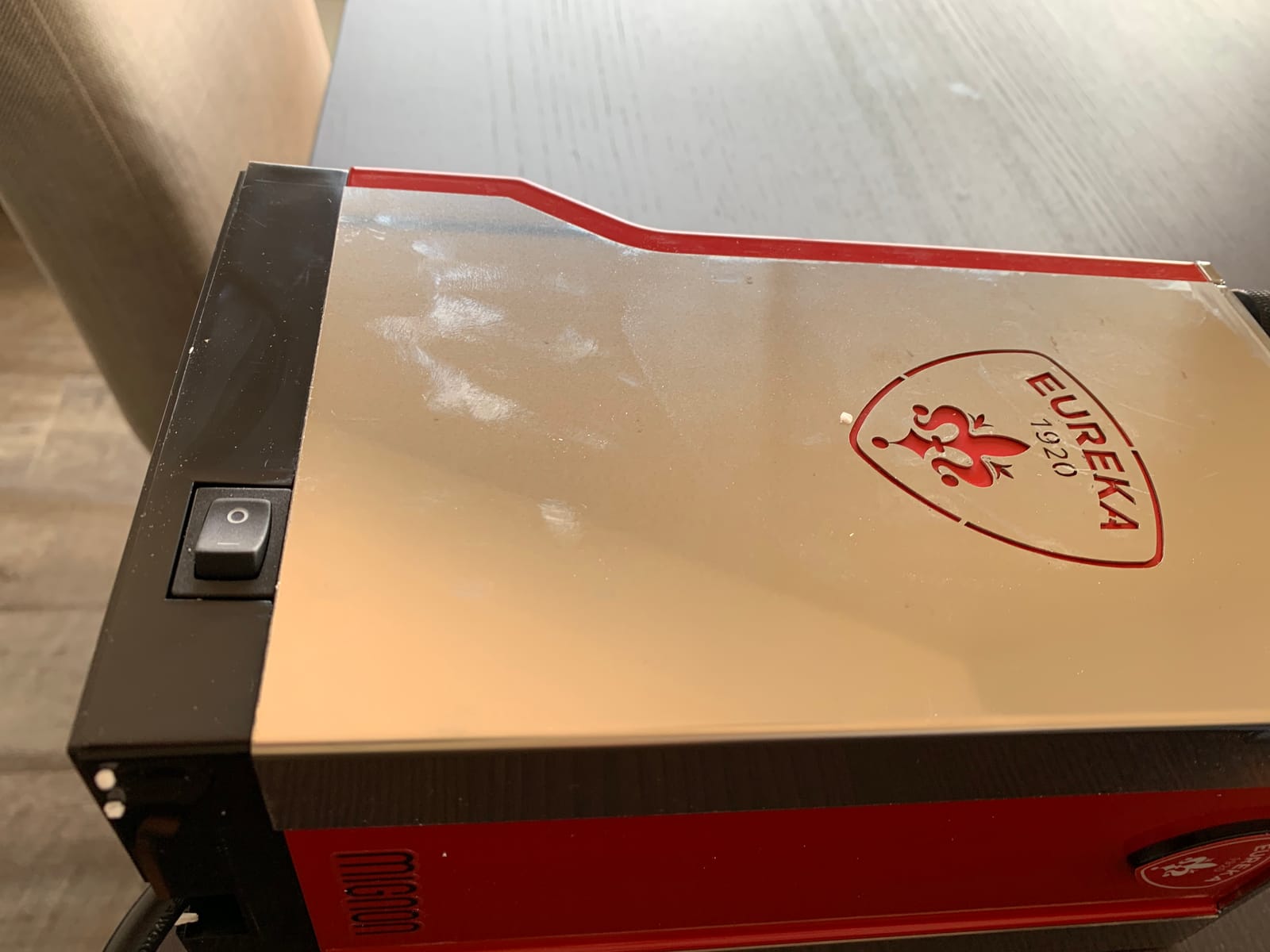
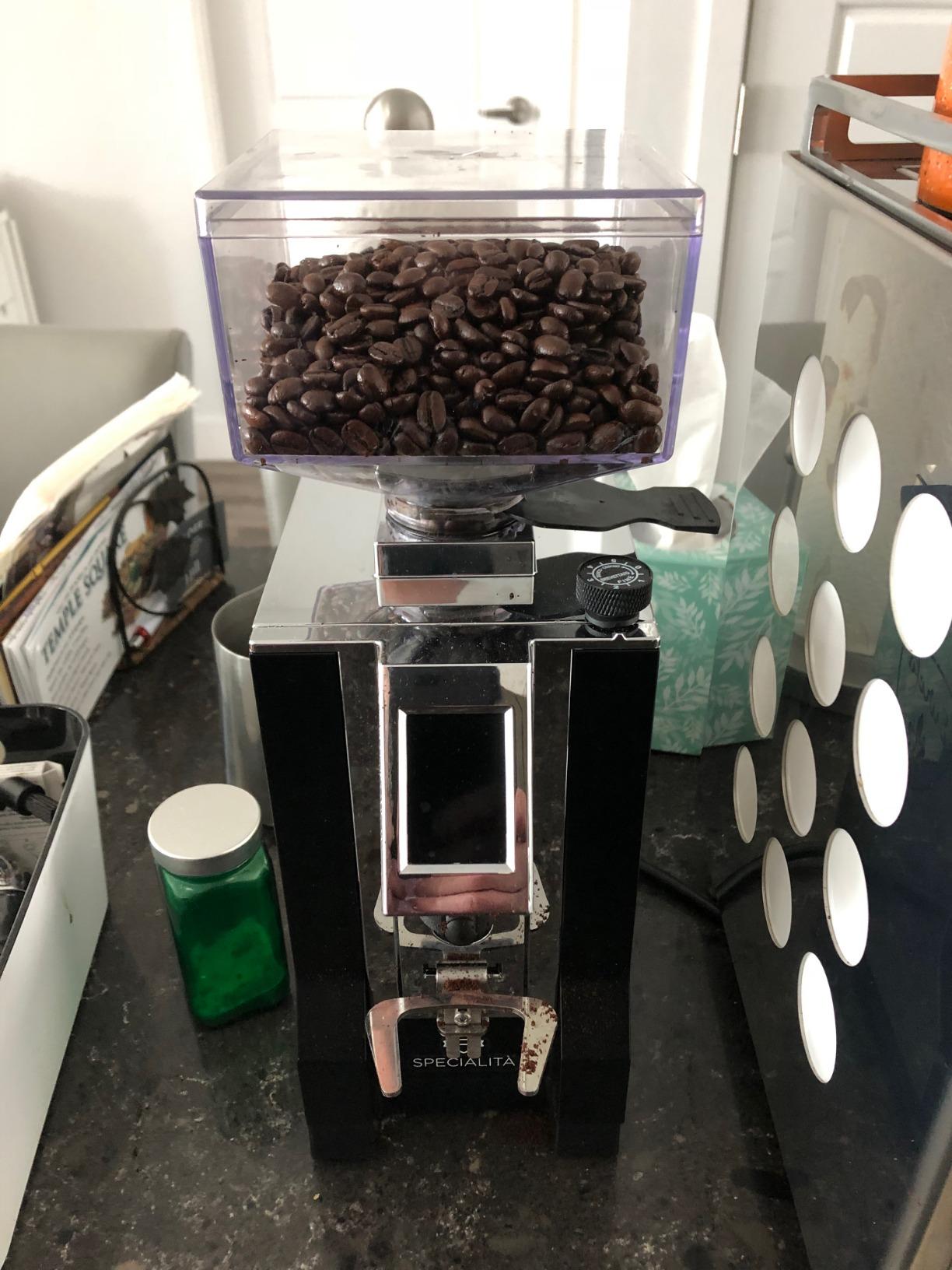
If you grind before anyone else is awake, the Mignon Specialita is the one in this list I’d put next to a bedroom door. The sound-insulated case is the reason — owners consistently single it out as the quietest machine here, and it’s a real difference when you’re dosing at six in the morning.
It is handbuilt in Florence, and that shows in the fit. The backlit resistive touchscreen runs single, double and continuous timed modes with a lockout, so a bumped elbow can’t change your dose mid-morning. The wider chute with the ACE anti-clumping system handles clumping better than most 55mm machines.
The bottom-burr adjustment is the design detail that earns its place. Adjusting the burr height from underneath means the grind setting survives disassembly, so you can open the chamber, clean it, and put it back at the same setting. On top-burr machines, cleaning means re-finding your zero every time.
55mm Burrs and What They Give Up to 64mm
The 55mm hardened steel flat burrs are the largest offered on the Mignon line, but they’re a step down from the 64mm sets in the grinders above. The practical difference is fines generation: 64mm sets push more coffee through per tooth pass, so a 55mm machine needs a slightly coarser grind and a longer settle period.
For espresso at home that’s a manageable trade. If you’re chasing very light roasts at high ratios, or running a large volume of coffee through each day, the 64mm and 83mm sets will show more consistency over time.
Timed Dosing Accuracy Is the Weak Point
Reviewers report timed doses landing anywhere from 1 to 3g off target, which means a scale is effectively required rather than optional. That partially undercuts the single dose argument, since you’re weighing every dose anyway.
The lockout function mitigates this well in practice. Set a dose, lock the timer, and the machine repeats the same grind time every morning until you change it.
Who Should and Should Not Buy It
Buy it if noise is the thing that keeps you from grinding early, you value a machine that keeps its setting through cleaning, and you like the build quality of a hand-assembled Italian unit.
Skip it if you need the lowest possible retention, run a lot of coffee through the burrs, or want single dosing with a built-in scale so you’re not weighing by hand every morning. The 55mm burr set also doesn’t suit very light filter roasts as well as a 64mm set will.
6. Eureka Mignon Notte – Compact Flat Burr Espresso for Small Counters
Eureka Mignon Notte Espresso Grinder, Black
50mm flat burrs
Stepless micro-adjust
Bottom-burr height control
ACE anti-clump
Pros
- Espresso-focused 50mm flat burrs with very fine stepless increments
- Bottom-burr adjustment keeps the setting through cleaning
- Compact metal-bodied design suits small counters
- ACE anti-clump system gives consistent low-static dosing
- Good value in the entry espresso tier
Cons
- Manual dosing only with no timed dose programming
- 50mm burrs are smaller than the 64mm class for heavy use
The Mignon Notte is the smallest footprint grinder in this list, and on a counter already crowded by an espresso machine and a tamper, that turns out to matter more than burr diameter. At roughly 5.5 by 4.7 inches on the base, it leaves room to dose without shuffling things around.
The adjustment is where it overdelivers. The stepless micro-adjust with bottom-burr height control gives finer increments than you’d expect from a 50mm machine in this class, and espresso-focused owners routinely pull well-dialed shots from it. The setting survives disassembly, same as the Specialita above.
Dosing is manual — you press the portafilter against the switch to start and release to stop. There’s no timer and no program mode, which some people find more tactile and accurate than a timed dose, and others find one step too many for a busy morning.
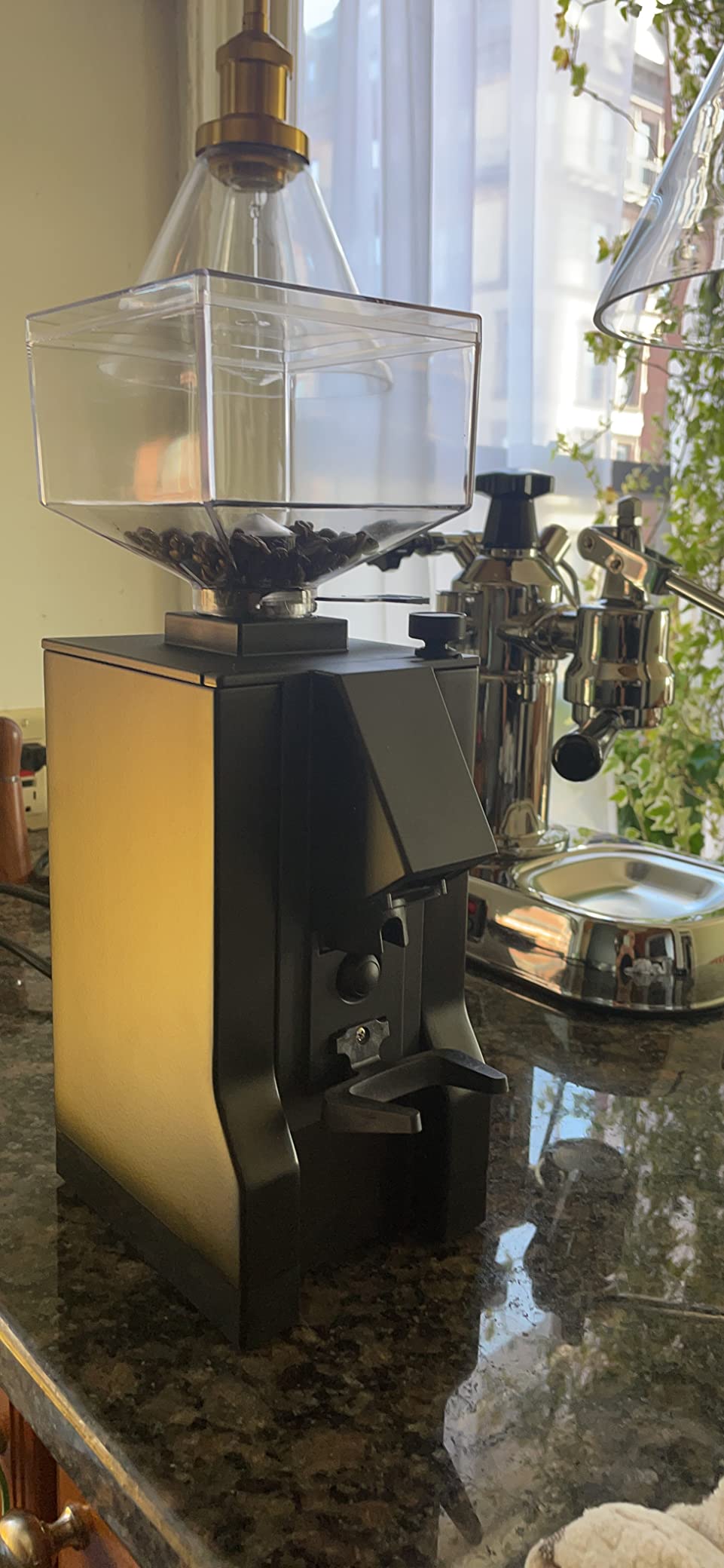
50mm Burrs in a 150g Hopper Machine
The 50mm hardened steel flat burrs are tuned specifically for espresso rather than for all-purpose use. That tuning is a fair trade: you get very fine control at the fine end, and you give up some throughput at the coarse end compared with a 64mm set.
If you make one or two drinks a day, that’s the right set. If you grind for four or more, the smaller burr set will show its age sooner.
Manual Dosing Versus Timed Dosing
Portafilter-activated dosing has one advantage that timed dosing can’t match: you control the weight by feel, so a fast hand produces a fast stop. The downside is that it needs a scale to be repeatable, because there’s no fixed reference.
The 150g hopper with the ACE anti-clump system handles static reasonably well, though owners note some static remains depending on the bean and the humidity.
Who Should and Should Not Buy It
Buy it if counter space is the binding constraint, you’re pulling one or two espresso drinks a day, and you want fine stepless control from a metal-bodied machine without stepping into the 64mm tier.
Skip it if you want hands-off dosing, if you brew filter coffee at volume, or if you plan to run a shared machine for a household. The 50mm set and manual dosing are built for one person at a time.
7. Gevi VelPro 400 – Best for Scale-Integrated Single Dosing
Gevi VelPro 400 Single Dose Espresso Grinder with Variable Speed, Stepless Adjustment, 64mm Titanium Flat Burr & Single Dosing Cup, Coffee Bean Grinder for Drip, French Press & Cold Brew-Silver
64mm titanium burr
Scale dosing cup
Variable 500-1500 RPM
5 micron stepless
Pros
- Integrated scale in the dosing cup makes each dose exact and repeatable
- Variable motor speed trades speed against heat and uniformity
- Stepless adjustment down to a 5 micron grind gap
- 64mm titanium-coated burrs are durable and uniform
- Dosing cup fits 51mm 54mm and 58mm portafilters
Cons
- Small review base makes long-term reliability hard to judge
- Higher cost than other 64mm single dose grinders
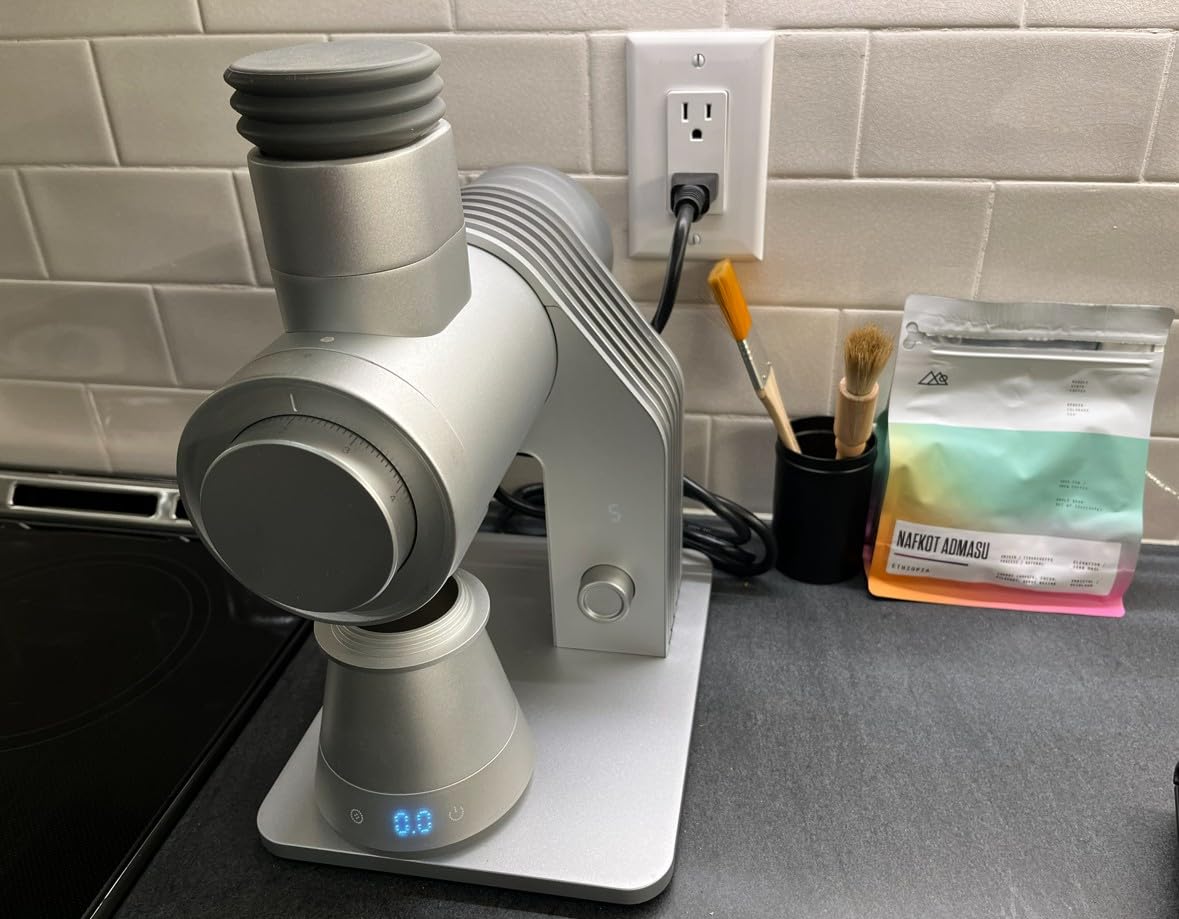
The Gevi VelPro 400 answers the question single dosing usually leaves open: how do you dose by weight without a separate scale? The magnetic dosing cup connects to a digital scale for real-time weighing, so the dose displays as it grinds and stops when it hits your target.
That single feature removes the argument against timed or feel-based dosing. On most grinders in this list you weigh after grinding, then correct on the next shot. Here the weight is the control, which makes single dosing genuinely repeatable rather than approximately repeatable.
The variable speed motor runs 500 to 1500 RPM on a 400W brushless DC platform. Dialling the speed down for espresso slows the grind, which reduces heat and keeps particle size more uniform; dialling it up handles filter methods quickly. It’s a control that most grinders in this price band simply don’t offer.
5 Micron Stepless Adjustment and the Pre-Breaker
The stepless dial uses a 5mm thread pitch to deliver 5 micron grind gap adjustment, which is finer resolution than most machines at this level offer. Fine resolution matters most in the espresso range, where the difference between a sour shot and a balanced one can be a few dozen microns.
The 64mm titanium-coated flat burr comes with a pre-breaker design that feeds beans into the burr set more evenly. Even feed is what keeps a variable-speed motor from producing inconsistent particle size at the lower end of its range.
Portafilter Fit and Dose Cup Design
The dosing cup fits 51mm, 54mm and 58mm portafilters, which is broader compatibility than most grinders in this roundup. That matters if you own or plan to own more than one machine, and it removes the adapter guesswork that catches people out with narrower holders.
Grind quality is the other strength in the reviews. Owners point to uniform particle size, and the scale readout makes dosing errors obvious immediately rather than a shot later.
Who Should and Should Not Buy It
Buy it if you want the most precise single dose workflow available here, especially if you own a 54mm portafilter and would rather not buy an adapter, or if you like the idea of controlling motor speed as well as grind size.
Skip it if long-term reliability matters more to you than dosing precision, because the review base is small and thin. A grinder with 21 reviews hasn’t proven itself over years the way the DF64 II or the Mignon line has.
8. MiiCoffee DF83V – Best for Variable Speed and 83mm Burrs
MiiCoffee DF83V Variable Speed Single Dose Coffee Grinder (Black)
83mm titanium flat burrs
300-1600 RPM brushless motor
Near-zero retention
Stepless dial
Pros
- Largest burr set here for very uniform espresso grinds
- Variable 300-1600 RPM brushless motor controls heat and particle size
- Near-zero single dose retention with the included blow-out funnel
- Stepless large dial dials in precisely for espresso
- Pre-breaker auger and anti-popcorn disc improve throughput
Cons
- Heaviest grinder in the range at about 19.5 lb
- Single dose only with no bulk dosing option
- Smallest proven track record of the machines here
The DF83V is the most technically ambitious grinder in this list, and also the one with the least proven history. It pairs 83mm titanium-coated espresso flat burrs with a brushless DC motor that sweeps 300 to 1600 RPM, which is a wider range than any other machine here.
That motor range is the differentiator. Low RPM means slower grinding, less heat, and more uniform particles, which matters most for very light roasts at espresso ratios. High RPM pushes more coffee through when you’re doing filter work or moving quickly through a dial-in.
The pre-breaker auger is the detail I like most. It feeds beans into the burr set consistently even at low RPM, which is the usual weak point of variable-speed grinders — starve the chamber and particle size suffers before the motor does.
Version 1.2 Hardware Fixes
Version 1.2 stabilises the outer burr carrier with four metal guide posts, a change aimed squarely at alignment drift across the grind range. Burr alignment is what determines whether a grinder produces boulders and fines, so carrier rigidity is not a cosmetic improvement.
The plasma generator ionizer in the exit chute and the integrated anti-popcorn disc handle the two things that make a big burr set annoying to single dose: static and compaction.
Weight, Footprint and the Single Dose Trade
At about 19.5 pounds this is the heaviest machine here, and reviewers note it takes two people to position comfortably. It’s a deliberate counter anchor, but if you’re moving it to switch between beans, that’s a real cost you’ll feel every morning.
It’s single dose only. There is no bulk mode, so filter brewing means hand-loading every batch, which is the same limitation as the DF64 II but with more weight to move.
Who Should and Should Not Buy It
Buy it if you’re chasing the best espresso particle consistency available at home, you mostly drink very light roasts, and you’re comfortable committing to a large machine you won’t be moving around.
Skip it if you want a proven record, if weight matters, or if your budget has to cover an espresso machine too. The 4.1 average on a small review set reflects genuine capability alongside some early-model complaints.
9. CafeSing ORCA go – Best Manual Flat Burr Grinder for Single Doses
CafeSing ORCA go Flat Burr Manual Coffee Grinder
49mm titanium ORCA flat burr
16 microns per click
All-metal body
776g
Pros
- Fine 16 micron per click adjustment allows espresso-capable dialing
- Titanium-coated flat burr produces a uniform flaky grind
- Compact all-metal body with no power cord
- Tool-free disassembly makes cleaning straightforward
- Works well for light-roast espresso at higher ratios
Cons
- Hand grinding is slower and more demanding than electric dosing
- 25g capacity limits batch size
- Small review base limits long-term reliability data
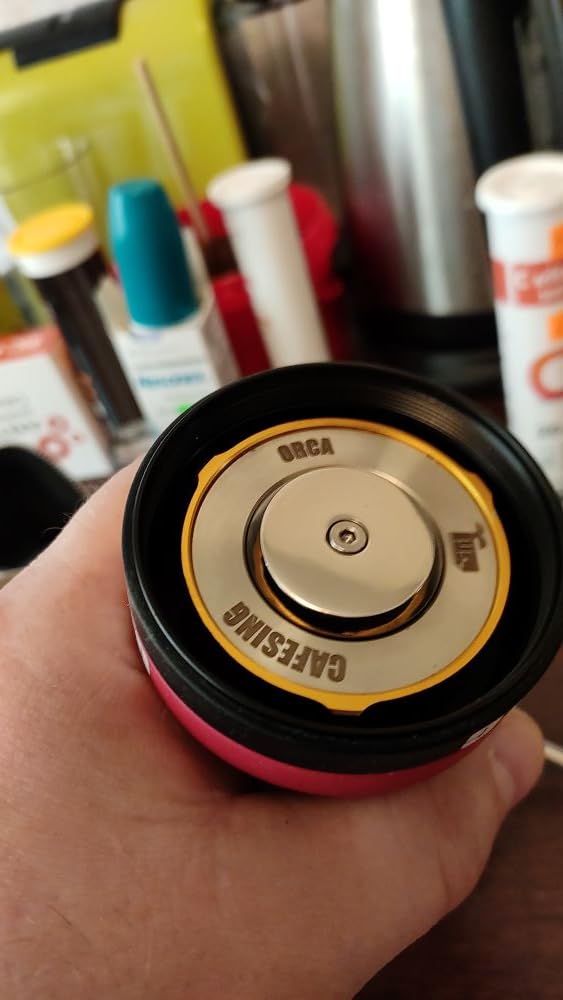
Yes, there are flat burr hand grinders, and for exactly one drink a day the CafeSing ORCA go is a genuinely good answer. At 776 grams with no power cord, it’s the only machine in this list you can pack in a bag, and a manual grinder has zero retention by definition — whatever is in the chamber comes out when you grind it.
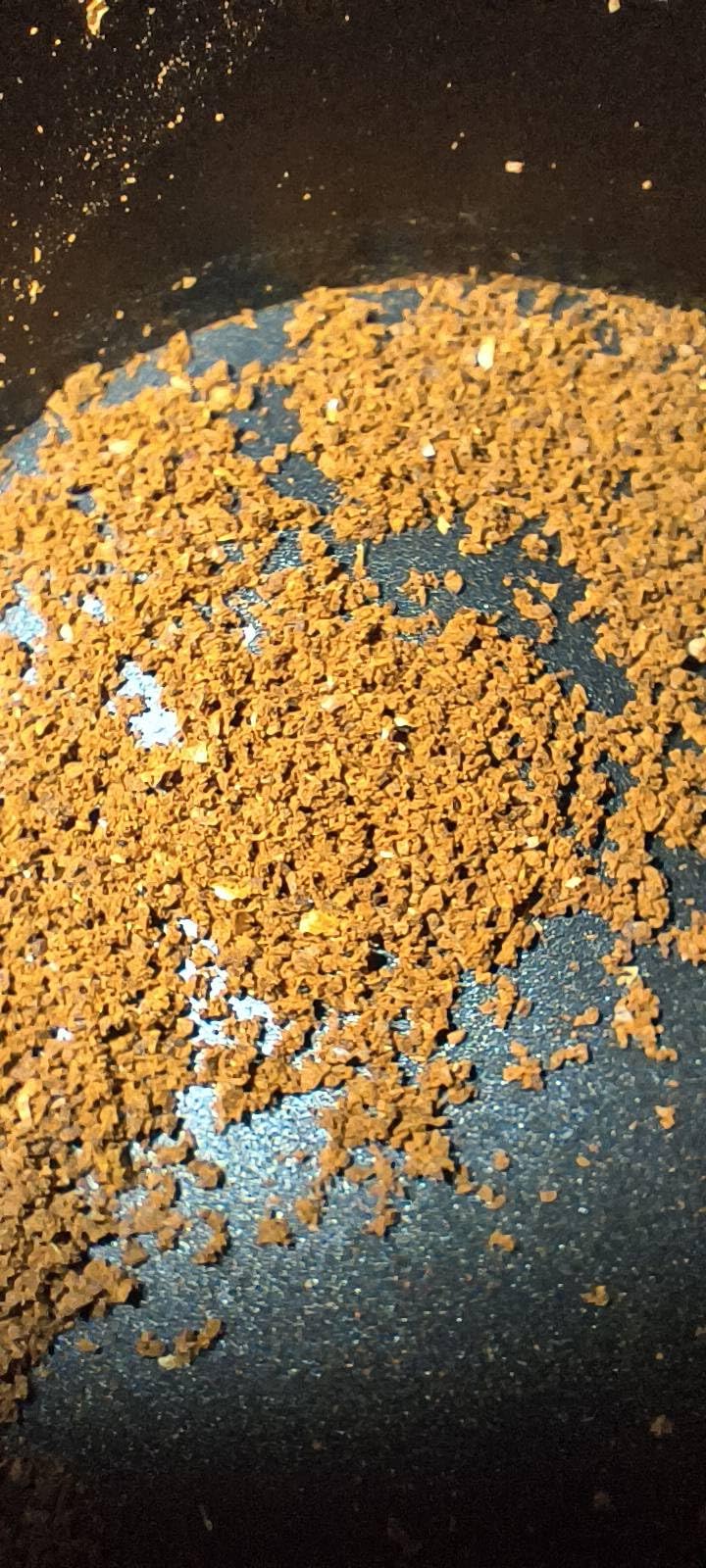
The 49mm titanium-coated ORCA flat burr produces what owners describe as a uniform, flaky powder, which is the particle shape that reads as sweetness in the cup. The titanium coating helps with the oily dark roasts that cause static problems elsewhere on this list.
Tool-free quick disassembly means cleaning takes seconds, which matters more for a hand grinder than for an electric one because you’re already handling the whole device anyway.
16 Microns Per Click and What That Buys You
The external adjustment ring moves in 16-micron-per-click increments, which is fine enough for espresso-capable dialing. On an electric stepless dial you get continuous movement; here you get discrete steps, but they’re small enough that the difference is rarely the bottleneck.
The 25g capacity is the limiting factor. One double shot plus a rinse fits comfortably, but there’s no headroom for a second drink, and switching to filter means multiple rounds.
The Effort Question Nobody Skips
Manual grinding a 20g espresso dose takes roughly half a minute of steady work. That’s tolerable once a day and unpleasant four times a day, and it’s the reason most people who start with a hand grinder move to an electric machine within a year.
The honest framing is that a hand grinder solves retention completely and solves nothing else. If retention is your only concern, it’s the strongest answer here. If workflow speed is the concern, it makes the problem worse.
Who Should and Should Not Buy It
Buy it if you make one drink a day, travel, or want a grinder with no electronics that will still work in ten years. It’s also the cheapest way into flat burr espresso on this list.
Skip it if anyone else in your household drinks espresso, or if you pull more than one drink most mornings. A 12-month limited warranty covers defects but not the arm fatigue that ends manual workflows.
10. MiiCoffee DF83 Gen 2 – Best 83mm Burr Value for Single Dosing
MiiCoffee DF83 Gen 2 Single Dose Coffee Grinder (Black)
83mm Red Ti flat burrs
Four-post alignment
Under 0.1g retention
Anti-popcorn disc
Pros
- Out of the box calibration needs no adjustment
- Very consistent low retention single dosing under 0.1g
- 83mm titanium burrs produce even particle size
- Plasma generator nearly eliminates chaff
- Machined metal dosing cup and responsive seller support
Cons
- Heavily weighted unit that needs two people to position
- Some reports of hopper or burr-set quality issues
- Oily beans in humid conditions can cause clogging
The DF83 Gen 2 is the version 2.0 refresh of the DF83, and the headline change is that it arrives calibrated. Owners report pulling consistent shots straight out of the box with no adjustment to the zero point, which removes the most tedious part of setting up a single dose grinder.
The burr set is the draw. 83mm Red Ti titanium-coated espresso flat burrs are large for a home machine, and they produce even particle size that owners describe as noticeably richer in the cup. The set is upgradeable to SSP when you outgrow the stock burrs.
Alignment is handled by four springs on four guide posts, which holds the gap consistent across the whole grind range rather than letting it drift as you turn the collar. That drift is what causes boulders and fines, and it’s the difference between a grinder that stays consistent over a year and one that doesn’t.
Under 0.1g Retention and the Blow-Out Funnel
Single dose retention is stated at under 0.1g, and the blow-out funnel with a lid is included to clear the throat. At that level, the coffee you waste between doses is small enough that you stop thinking about it, which is the entire point of the workflow.
The 58mm food-grade aluminum dosing cup is machined rather than moulded, and it feels correspondingly solid. Combined with the integrated anti-popcorn disc, the dosing routine stays tidy even with a full dose chamber.
Quality Variance and Clogging to Watch For
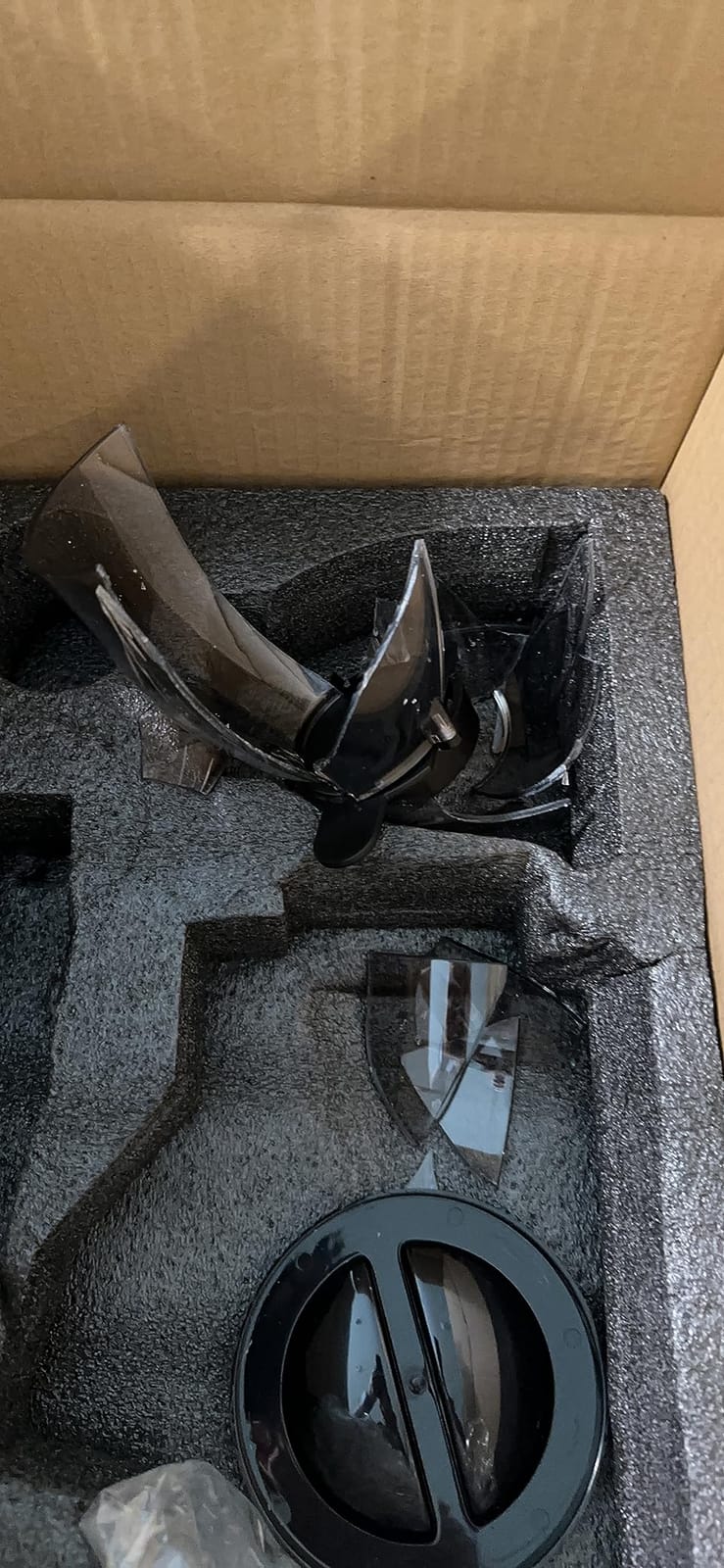
The 4.1 average reflects a handful of early quality complaints, including some reports of hopper and burr-set issues. On a machine this heavy, a manufacturing variance is more annoying than a light one, so it’s worth checking the burr spins true before you commit to a dial-in.
The other recurring complaint is clogging with oily beans in humid conditions. The plasma generator reduces static but doesn’t eliminate oil build-up, so a brush-down after a dark oily roast is part of the routine on this machine.
Who Should and Should Not Buy It
Buy it if you want 83mm burr performance and near-zero retention without stepping up to variable speed, and if you have a counter that can take a permanently placed heavy machine.
Skip it if you move the grinder around, if you rotate through very oily dark roasts in a humid kitchen, or if you want a long track record. This one is capable, but it’s younger and heavier than the alternatives.
Is Single Dosing Worth It? The Honest Answer
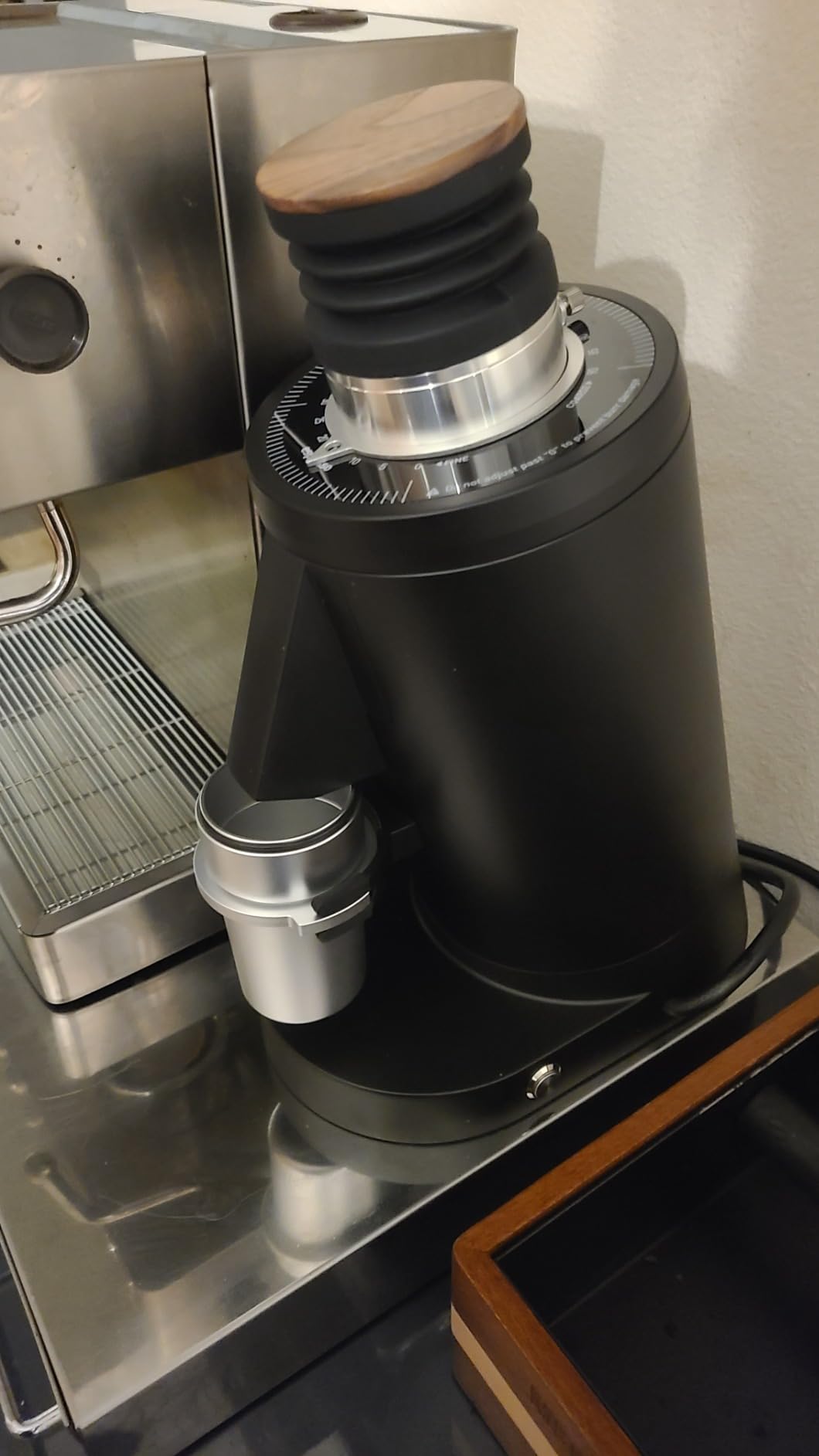
Single dosing is worth it if you rotate beans, dial in a fresh bag often, or make one to three drinks a day. It is not worth it if you pull five or more shots back to back, brew filter coffee in batches, or want the fastest possible morning workflow. The waste savings are real but small, and the workflow cost is real too.
Here is the arithmetic that gets skipped in most discussions. A good flat burr single dose grinder holds roughly 0.2 to 0.5g of coffee between doses, and the machines here claim figures as low as under 0.1g. A hopper grinder on a fresh bag can carry far more stale bean and ground coffee through the system during a dial-in, because the chamber and throat are already full.
So the savings are about a gram or two per session. That is genuinely worth caring about if you’re rotating single origins bought in small bags, and it is a rounding error if you drink the same coffee every day from a bulk bag.
The real reason people adopt single dosing isn’t the gram count. It’s that switching beans stops being a problem. On a hopper grinder, moving to a new coffee means flushing a chamber full of the old one, and home-barista.com users describe that flush as the moment single dosing started making sense for them. Equally, the top-ranking forum thread for this query is full of people with expensive machines who decided the hand-loading step wasn’t worth it and went back to a hopper.
Both of those positions are reasonable. The honest summary is that single dosing trades a small amount of speed and a daily repetitive task for near-zero carryover. If carryover bothers you, it’s a great trade. If it doesn’t, a hopper grinder with a good burr set will serve you better.
Why Flat Burrs Beat Conical Burrs for Espresso
Flat burrs produce more uniform particle size, run cooler, and last longer than conical burrs, which is why they’re the default for espresso at every level from home to cafe. Two burr faces cutting straight across each other crush beans between parallel surfaces rather than forcing beans into a narrowing gap, so the grind is far more consistent.
That consistency is the whole argument, and it shows up in three places. Particle size distribution is tighter, so your shot doesn’t have boulders and fines competing for the same extraction. Fines generation is lower, which means less clumping in the dose and less need for WDT to fix the puck. And because the cutting path is shorter, less energy turns into heat, so the coffee tastes less roasted when it lands in the cup.
The conical advantage is real, though. Conical burrs tend to be cheaper, they handle large oily beans and filter coffee more gracefully, and they self-align as they wear. That’s why a conical machine is a fine choice for filter brewing and a poor one for espresso.
There’s a category mistake to avoid, too. If a competitor’s flat burr list includes a conical grinder, that product belongs in a different article. Every machine in this list uses flat burrs, without exception.
Popcorning, Static Cling and WDT: How to Fix the Mess
Popcorning is the burst of ground coffee that fires out of the chute when compacted fines suddenly release, and it’s the loudest complaint on every single dose forum. Static cling in the dose cup is the same problem in slower motion: grounds stick to the walls instead of falling out.
WDT, the waffle distributed technique, is the fix for both. Before you tamp, use a fine needle tool to stir the puck from the bottom upward in a circular pattern, breaking up clumps and levelling the bed. It takes about fifteen seconds and it makes a larger difference to a light-roast shot than most people expect.
For popcorning specifically, four things help. Purge into a separate cup rather than into the portafilter, so the expelled grounds never reach your shot. Keep the anti-static system working: the plasma generators and ionizers on several machines here are there for this reason. Use the bellow, because compressing beans in the chamber is what creates the compacted layer in the first place. And keep the chamber dry, since humidity makes static and fines both worse.
Oily dark roasts are the worst case for every grinder on this list. The titanium-coated burr sets fare better, and the machines with ion generators and angled steel chutes — the AMZCHEF and MOKKOM especially — are the ones reviewers keep cleanest. No machine eliminates it entirely.
How to Choose a Flat Burr Grinder for Single Dosing
The buying decision for a single dose grinder comes down to four numbers and one habit. Burr diameter, retention, adjustment type, noise, and how many drinks you actually make. Everything else is preference.
Retention in Grams and How to Measure It
Retention is the coffee left in the grinder after a dose, and it’s the number that defines a single dose machine. The credible band for a good flat burr single dose grinder runs from about 0.2g to 0.5g, and the machines that publish lower figures — the DF64 II and DF83 Gen 2 claim under 0.1g — pair that with a blow-out funnel to clear the throat.
You can measure it yourself in three steps. Weigh a portafilter and tare it, then grind a normal 18g dose into it. Weigh again for your shot weight. Now grind a purge dose of about 5g of the same beans into a separate cup, weigh the purge, and add the two. The difference between that total and 18g is your retention, minus the small error in your own weighing.
Do it three times and average the results. The first shot after cleaning is always the outlier, so discard it.
Dose Cup Versus Chute Versus Portafilter Holder
Grounds can land in one of three places. A dose cup is a removable cylinder you transfer into the portafilter, which adds a step and a chance for static cling. A chute delivers directly into a portafilter held under the outlet, which is fewer steps and less mess. A fork works like a chute but holds the basket rather than the portafilter.
For single dosing specifically, the portafilter holder and fork win, because the whole point is a short path from chamber to basket. The AMZCHEF and the Mignon line use holders; the MiiCoffee machines use a dose cup with a bellow and funnel, which is more steps but more control over where grounds land.
One practical note: check the basket diameter. Most holders here fit 58mm, and several fit 54mm or 51mm as well, but it’s the easiest thing to get wrong and the most annoying to return.
Stepless Versus Stepped Adjustment
Stepless adjustment moves continuously, so you’re setting a grind size rather than counting clicks. Stepped adjustment gives you discrete positions at 90 or 100 settings on the machines here.
For espresso, stepless is clearly better. Chasing a two-second change in shot time — the difference between a balanced and a sour shot on a light roast — takes one small dial movement on a stepless machine and a click or more on a stepped one, and a single click at espresso settings can be the difference between extraction and sourness. Several of the grinders here also adjust the bottom burr rather than the top, which means your setting survives disassembly.
For filter brewing, the difference mostly disappears. A 100-step range is more than enough for pour-over and French press.
Burr Size, Material and the Upgrade Path
Burr diameter runs from 48mm to 83mm across this category, and larger means more coffee passes each tooth per rotation, which reduces fines and improves consistency. 50mm and 55mm sets are fine for a couple of drinks a day. 64mm is the sweet spot for most home espresso. 83mm is commercial territory with a weight cost.
Material matters less than people think. Stainless steel is the default, titanium coatings are harder and run cooler, and Red Ti is a titanium coating on an 83mm carrier. All three produce good espresso; the upgrade that actually moves the needle is a quality aftermarket set in the same footprint, such as SSP sets for the MiiCoffee 64mm and 83mm grinders.
Buy a grinder with a standard burr footprint if you can. The models here that accept SSP or Mazzer-compatible sets give you a real upgrade path, and a sealed proprietary burr is a dead end at the first replacement.
Noise, Footprint and Daily Volume
Noise is the factor nobody plans for and everyone notices. The Mignon Specialita’s insulated case is measurably the quietest approach here, and if you grind at six in the morning with a sleeping household, that shell is worth more than a larger burr set. A 260W motor is also easier to live with than a 680W one.
Footprint matters on crowded counters. The Mignon Notte is the smallest here, and the 83mm machines are large and heavy enough that owners report needing two people to position them. If you’ll be moving the grinder to switch beans, buy something lighter.
Daily volume is the disqualifier nobody expects. Single dosing is a one-at-a-time workflow. If you pull more than four drinks a day, the hand-loading step becomes the part of your morning you notice most, and a hopper-fed flat burr grinder is the better tool. Our beginner grinder guide covers that side if that’s you.
Frequently Asked Questions
Is single dosing worth it?
Single dosing is worth it if you rotate beans, dial in fresh bags often, or brew one to three drinks a day, because carryover between doses drops to roughly 0.1-0.5g. It is not worth it if you pull five or more shots back to back, brew filter coffee in batches, or want the fastest possible morning workflow.
What is the best flat burr grinder for home use?
For a dedicated single dose workflow, the SHARDOR 64mm is our top pick for its swappable 64mm flat burrs, stepless dial, and low retention. For hands-off precision, the Gevi VelPro 400 wins on its scale-integrated dosing cup. For the quietest option, the Eureka Mignon Specialita has an insulated case.
Are there any flat burr hand grinders?
Yes. The CafeSing ORCA go uses a 49mm titanium-coated flat burr with a 16-micron-per-click external adjustment ring, an all-metal body, and tool-free disassembly. A manual grinder has effectively zero retention because everything in the chamber comes out, but it is the slowest option for more than one drink a day.
What’s better, conical or flat burr grinders?
Flat burrs are better for espresso because they produce more uniform particle size, generate fewer fines, run cooler, and last longer. Conical burrs cost less, handle oily beans and filter coffee well, and are fine choices for pour-over. If espresso is your goal, flat burrs win on consistency.
How do I reduce retention on a single dose grinder?
Use the bellow to compress beans, purge into a separate cup instead of the portafilter, keep the anti-static ionizer working, and use the included blow-out funnel to clear the throat. Measure retention by weighing an 18g dose, then grinding a 5g purge and comparing the combined total to 18g, averaging three runs.
Final Verdict: Which Flat Burr Grinder Should You Buy?
If you want the strongest all-round single dose flat burr grinder, the SHARDOR 64mm is the one to buy: 64mm swappable flat burrs, a stepless dial, an all-metal chamber, and low retention in a body light enough to live with every morning.
If espresso is the only thing you make and precision beats everything, the Gevi VelPro 400 puts a scale inside the dose cup and stepless adjustment down to a 5 micron gap. If you want commercial-grade 83mm burrs without commercial pricing, the DF83 Gen 2 does it for less. If quiet matters more than anything at six in the morning, the Eureka Mignon Specialita has the insulated case. If counter space is tight, the Mignon Notte fits. If you’re still testing whether single dosing suits you at all, the MOKKOM includes a bulk hopper so you can fall back. And if you make exactly one drink a day and travel, the CafeSing ORCA go has zero retention and no cord.
The honest last word is this: buy a flat burr grinder, and only buy a single dose one if bean carryover genuinely bothers you. Otherwise a hopper-fed flat burr set will serve you better every day of the week.