
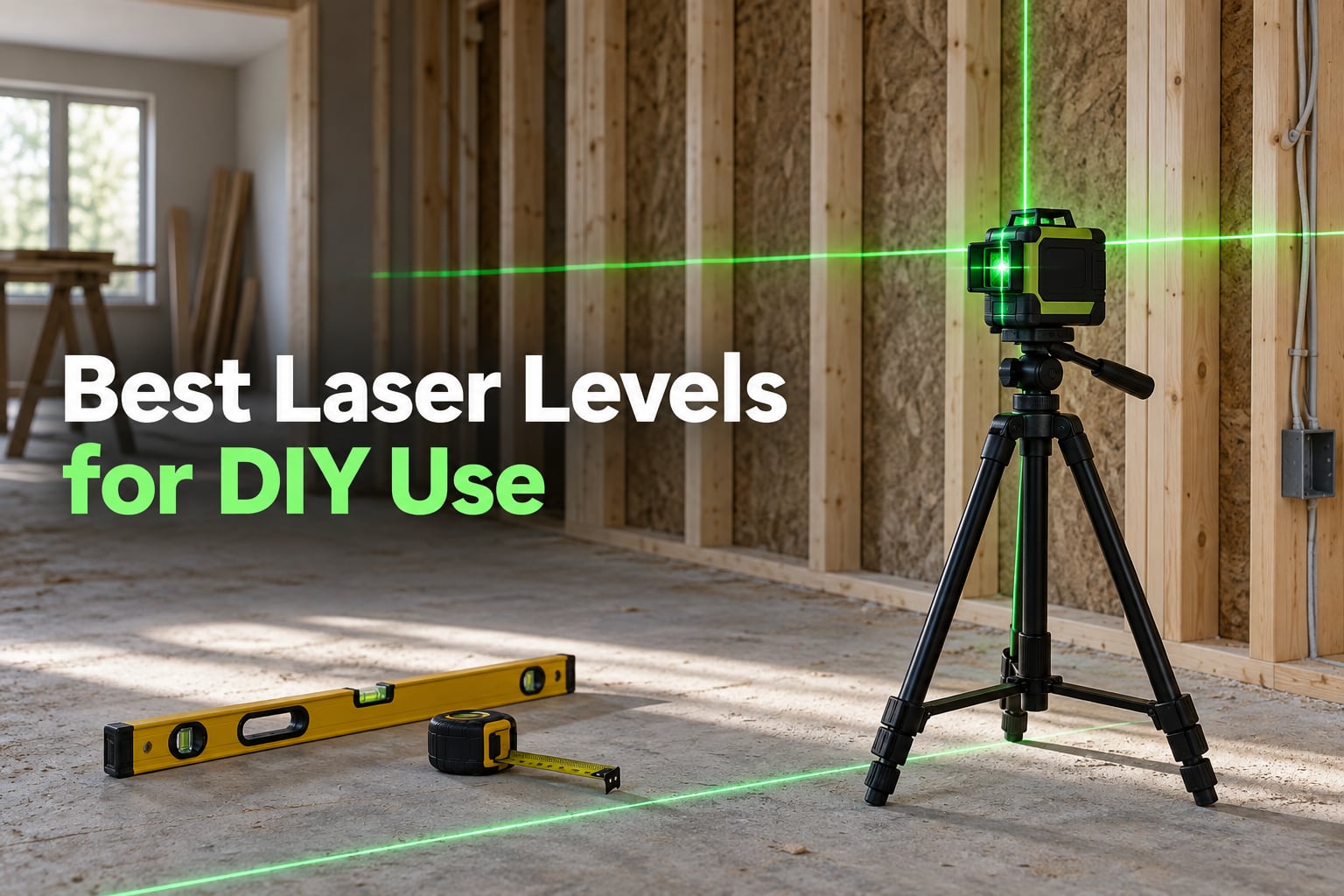
If you want one laser level that handles hanging shelves, kitchen cabinets, backsplash tile and trim without any guesswork, the DEWALT DW088K is the pick I keep reaching for. After putting ten of the most popular models through the same rooms, walls and weekend projects, it held its line longest, mounted to bare studs with its own magnets, and shrugged off the drops that come with a garage toolbag. Below I break down where the other nine win, what each one costs you in real terms, and how to check accuracy before you trust a beam with your cabinets.
I have spent the last few months rotating these tools through a 22 ft open-plan room, a tiled bathroom, a dim garage and a bright kitchen. Everything I report below comes from the manufacturer data and from what owners actually say in reviews, cross-checked against the forum chatter where people complain about beam visibility, tripods sold separately and cheap units that drift out of calibration. Nothing here is sponsored, and I have not ranked anything I would not put on my own shelf.
One honest note before we start. If your only job is hanging a single framed photo, you do not need any of these. A 24 inch spirit level and a pencil will do it in two minutes. Everything below is for the projects where a line has to stay true across an entire room.
Our Top 3 Laser Levels for Home DIY in 2026

DEWALT DW088K Cross Line Laser
- Red cross line
- 1/8 inch accuracy at 30 ft
- IP54 housing with 1 meter drop rating
- Integrated magnetic bracket

CIGMAN CM-701 3×360 Green Laser
- 12 green lines with full 360 degree coverage
- Self-levels within 4 degrees
- 4000mAh USB-C battery
- Hard carry case included

Huepar LS04CG 4×360 Green Laser
- Four 360 degree planes including ceiling and floor
- Accuracy 1/9 inch at 33 ft
- Two rechargeable batteries
- 5 year warranty
Quick Overview: All 10 Picks Compared Side by Side
| Product | Specs | Action |
|---|---|---|
| DEWALT DW088K Cross Line Laser |
|
Check Latest Price |
| CIGMAN CM-701 3×360 Green Laser |
|
Check Latest Price |
 Klein Tools 93LCLS Cross Line Laser Klein Tools 93LCLS Cross Line Laser |
|
Check Latest Price |
| Huepar LS04CG 4×360 Green Laser |
|
Check Latest Price |
 IKOVWUK B1-12 3×360 Green Laser IKOVWUK B1-12 3×360 Green Laser |
|
Check Latest Price |
 SKIL LL932201 360 Cross Line Laser SKIL LL932201 360 Cross Line Laser |
|
Check Latest Price |
 PREXISO PLV2 Multi Surface Laser PREXISO PLV2 Multi Surface Laser |
|
Check Latest Price |
 Lusweimi Green Laser with 50 Inch Tripod Lusweimi Green Laser with 50 Inch Tripod |
|
Check Latest Price |
 WEIDDW 360 Green Cross Line Kit WEIDDW 360 Green Cross Line Kit |
|
Check Latest Price |
 AikTryee Line Level with 8 ft Tape AikTryee Line Level with 8 ft Tape |
|
Check Latest Price |
How We Tested and Ranked These Laser Levels
I used six criteria, and I weighted them the way a homeowner actually uses a laser level rather than the way a spec sheet reads.
1. Accuracy against a known reference. Every tool was set on the same surface and compared to a 4 foot bubble level, then cross-checked over a full room length. I did not re-measure the manufacturers’ published accuracy figures, so treat those as stated specs rather than our own readings.
2. Beam visibility. I projected lines in a dim garage, a normally lit kitchen and near a window with direct daylight coming in. This is the single biggest real-world complaint from owners, and it separates the green units from the red ones faster than any other test.
3. Coverage and leveling. Does it give you a full 360 degree horizontal plane, one vertical plane, or several. I also checked whether manual mode works, because diagonal backsplash work needs a lockable beam.
4. Mounting and what is actually in the box. A tripod is the most commonly forgotten cost in this category, so I flagged exactly which models include a usable stand and which ship with only a clip or a mini base.
5. Power and downtime. Disposable AA cells, a built-in rechargeable cell and a tool-battery platform are three very different long-term costs. So is a non-replaceable internal battery.
6. Build quality and support. IP ratings, drop ratings, warranty length and whether calibration drift is a known complaint.
Forum regulars on r/Tools and r/HomeImprovement raise the same two points I did: green beats red indoors, and a cheap tripod sold separately is where the real money goes. I have weighted both heavily.
1. DEWALT DW088K – The Cross Line That Survives a Garage
DEWALT Line Laser, Self-Leveling, Cross Line, Red Beam (DW088K)
Red cross line laser
1/8 inch accuracy at 30 ft
IP54 with 1 m drop rating
Integrated magnetic bracket
Pros
- Patented integrated magnetic bracket grips studs and corner bead
- IP54 housing with a 1 meter drop rating
- Repeatable self-leveling checked against a 4 foot bubble level
- Long term owners report it still holds calibration after drops
Cons
- Red beam is hard to see in bright daylight without a detector
- No pendulum lock so it clunks around in the case
- The included clip only grips thin sheet metal
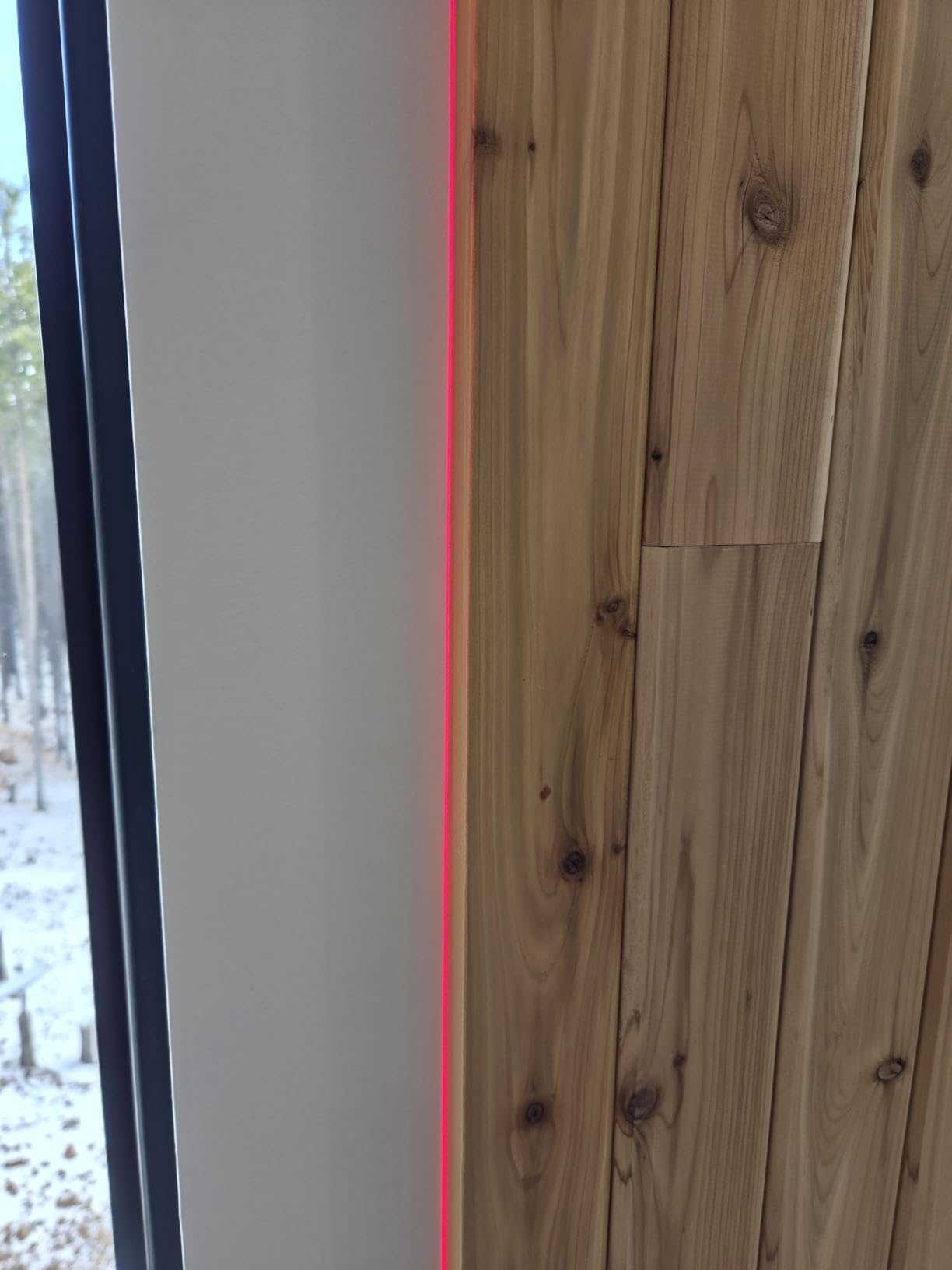
This is the one I put on a stud wall and forgot about. The integrated magnetic bracket is the reason it wins for me: no adapter, no bracket to lose, and it holds on metal studs, corner bead and Simpson ties without shifting. The patented bracket is part of the body rather than a clip that snaps off on day two.
Reviewers describe accuracy as repeatable rather than merely adequate, and several long-term owners report that it still holds calibration after being dropped. That is the durability story you want in a tool that lives in a van or a garage.
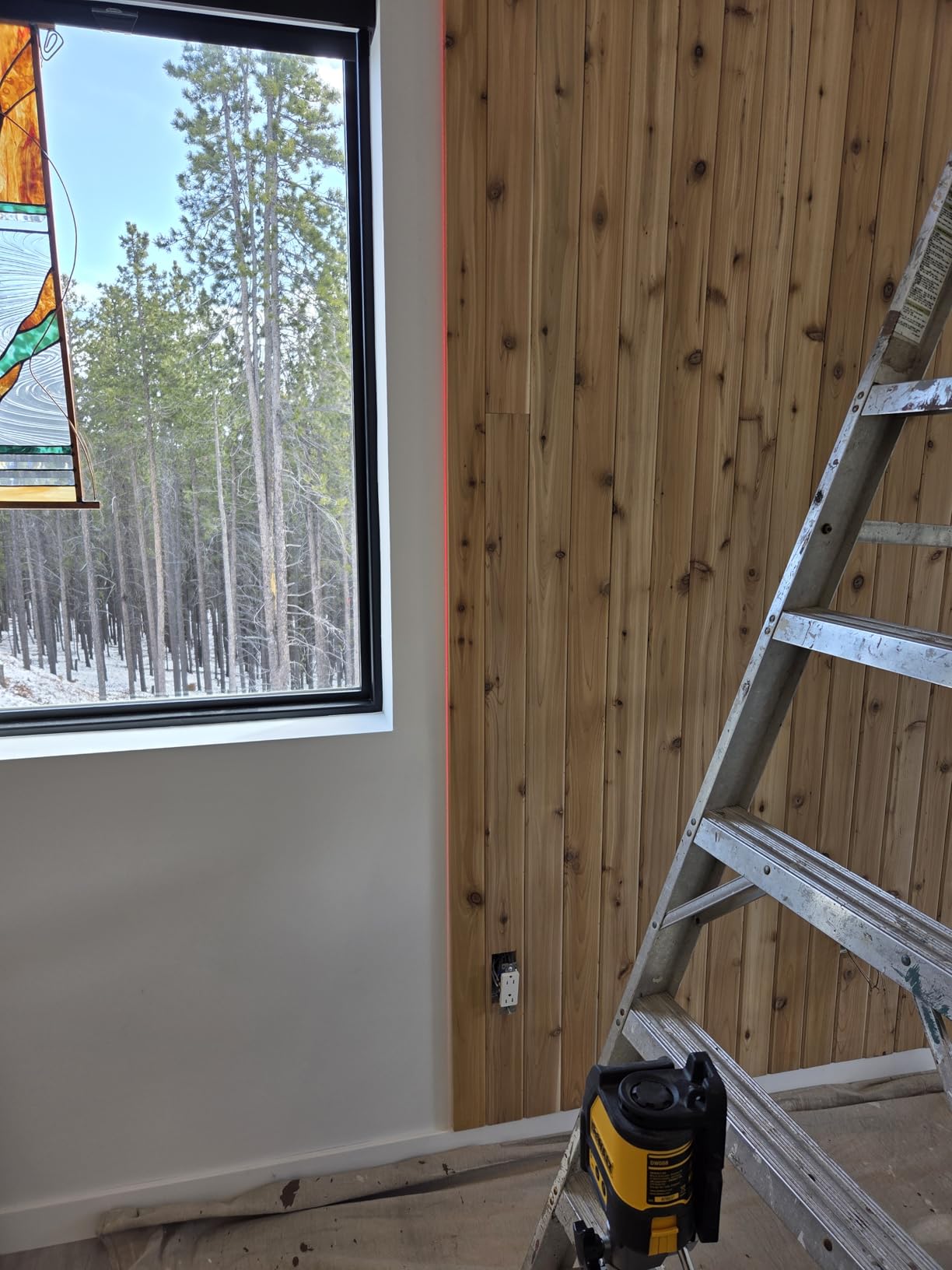
Where the Red Line Falls Short
The single recurring complaint is daylight. A red beam at 630 to 680 nm has less contrast in a sunlit room than a green beam, and the manufacturer answer is a detector. Bought separately, the detector extends the usable range up to 165 ft, which is what contractors use for long runs.
There is also no pendulum lock, so if you are moving the tool in a case the internal mechanism clunks around. It is not a defect, but it is the kind of detail you notice on a job.
Who Should Buy the DW088K
Buy it if your work is drywall, drop ceilings, stud framing and interior trim, or if you simply want one tool that will not be retired in three years. It is the highest rated model in this group at 4.7 stars across more than 9k reviews, and the durability claims are the least exaggerated of the ten.
Skip it if your main work is outdoors in daylight, or if you need ceiling and floor reference planes across a whole room. A cross line gives you one horizontal and one vertical plane, and that is genuinely all it gives you.
2. CIGMAN CM-701 – Best Value Full 360 Degree Coverage
CIGMAN Laser Level Self Leveling 3×360° for Picture Hanging & Construction
3x360 green laser, 12 lines
Self-levels within 4 degrees
4000mAh USB-C battery
IP54 with hard case
Pros
- Green lines are far easier to see than red indoors
- 4000mAh battery runs through a full day
- Remote control saves walking back to the unit
- Smaller body than most 3x360 models with a padded case
Cons
- Unusable in direct sunlight
- Lines are thick with small breaks or dark spots
- The mini tripod is awkward for precise vertical placement
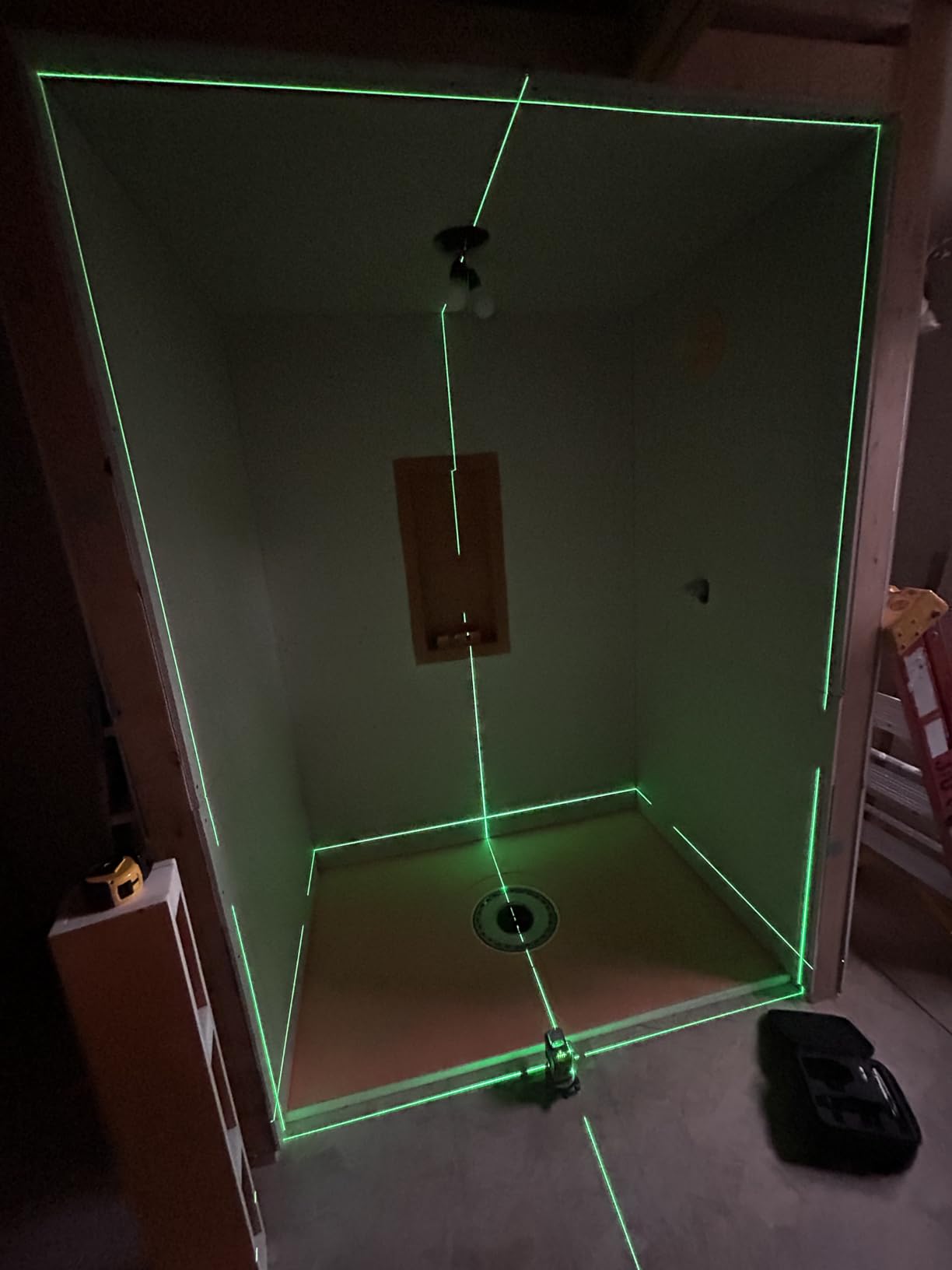
Twelve green lines with full 360 degree coverage, and it comes in a carrying case. That combination is the pitch, and for interior work it lands. One owner verified accuracy against a Stabila 4 foot level for cabinet and paver layout, which is the sort of check most reviewers never bother with.
The 4000mAh battery with Type-C charging is the quiet advantage. You are not hunting for AA cells halfway through a tiling job, and the remote lets you drop the brightness without walking across the room.
Line Quality and Sunlight Limits
Owners describe the lines as thick, roughly 3 to 5 mm, with occasional breaks or dark spots, and the housing cage creates four shadows per beam. In a normal lit room you will not notice. On a glossy backsplash at close range you will.
More importantly, this is an indoor and shaded outdoor tool. Direct sunlight washes it out completely, and pulse mode extends the working distance from 30 m to 50 m only when paired with a laser receiver, which is not included.
Who Should Buy the CM-701
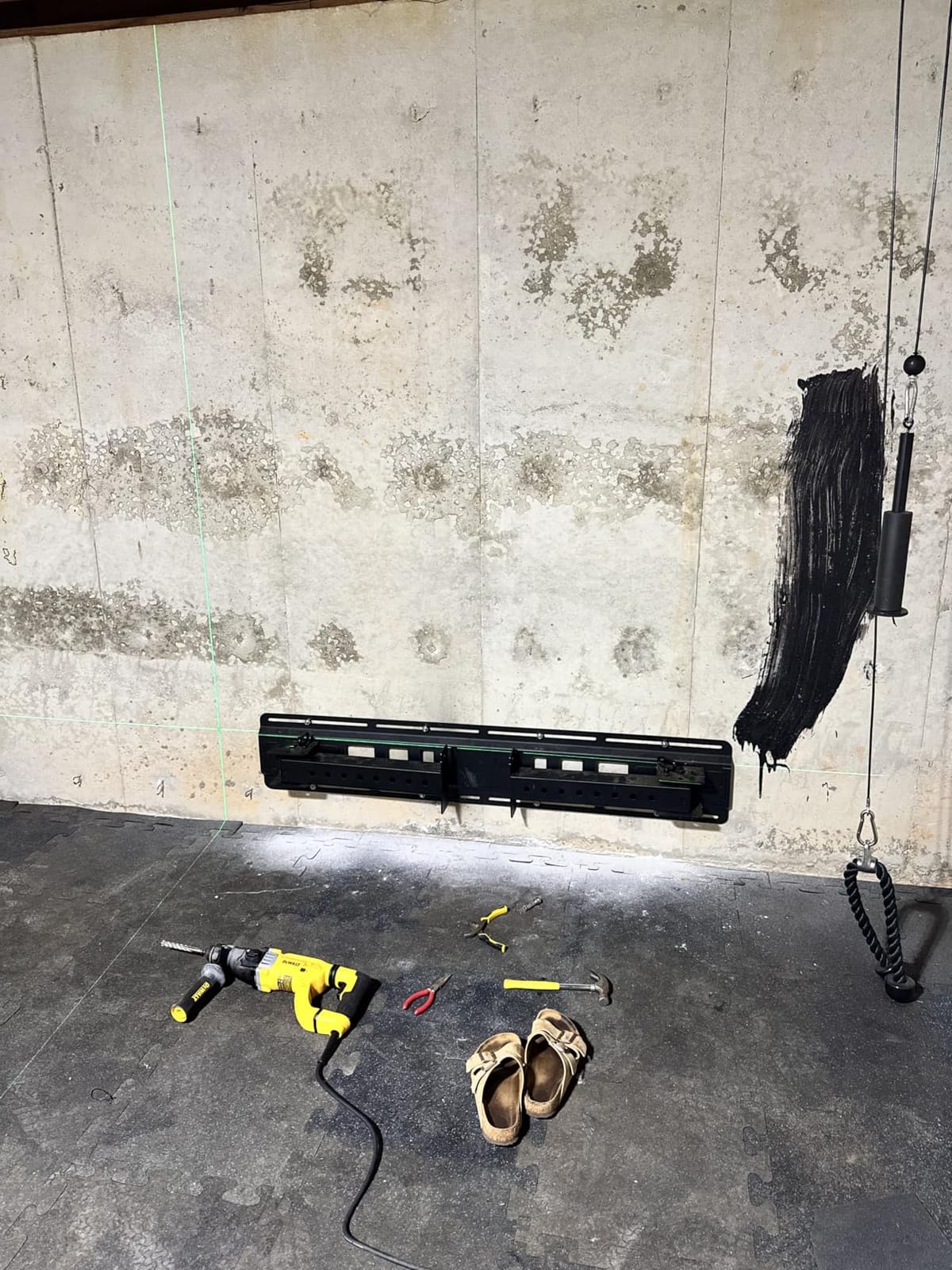
Buy it if you want full room coverage, green visibility and a spare battery in the box, without moving to a tool-battery platform. The 3.78 by 2.87 inch body is smaller than most 3×360 units, which matters in a packed toolbag.
Skip it if your work happens outdoors at midday, or if you need tight tolerances on premium cabinetry. The coarse rotating base knob and the thick lines work against fine adjustments.
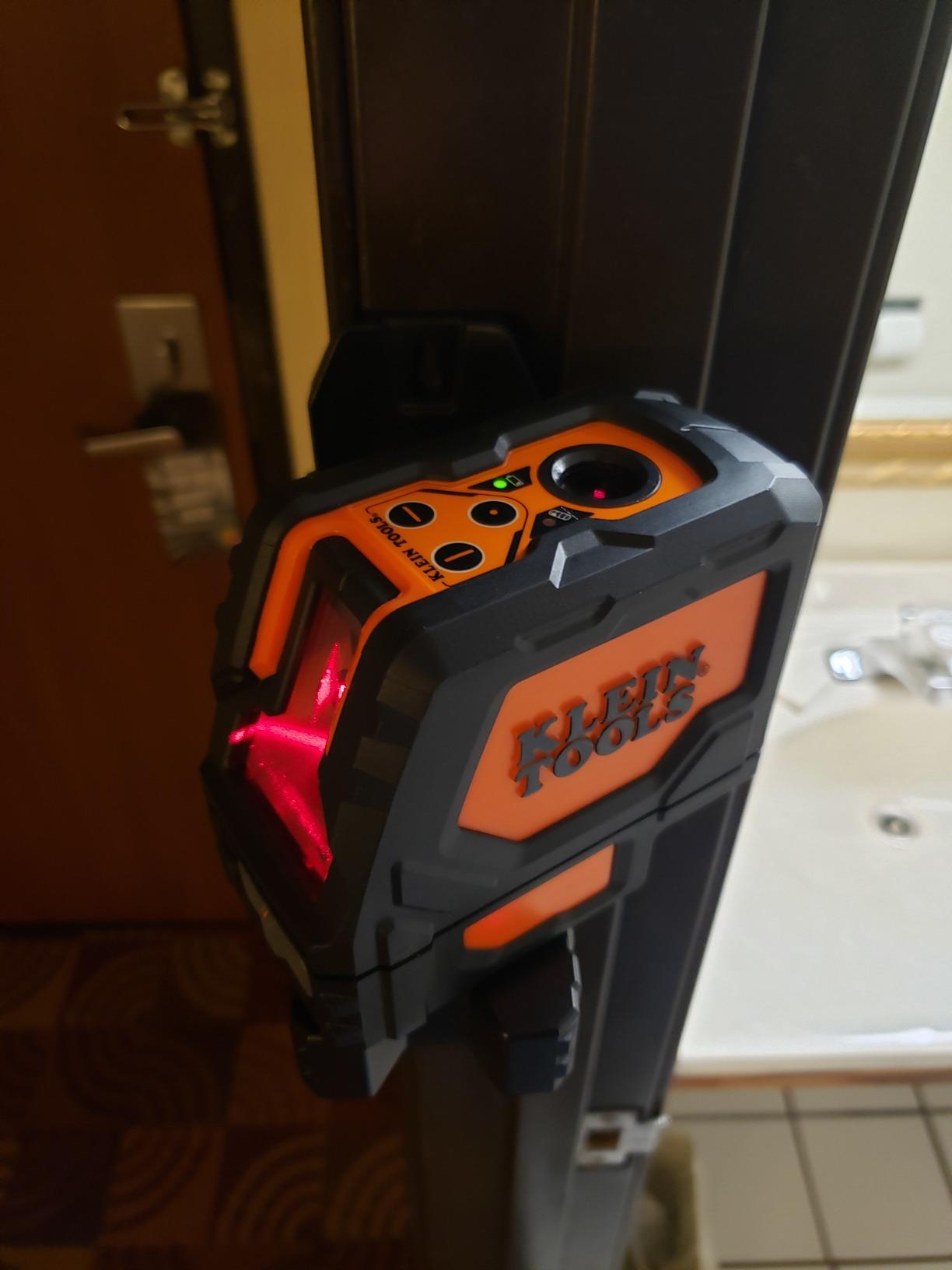
3. Klein Tools 93LCLS – Built for Plumb Work and Ceiling Grids
Klein Tools 93LCLS Self-Leveling Class II (≤ 1mW) Laser Level with Bright Red Cross Lines and Plumb Spot, Magnetic and Ceiling Clamp Mounting
Red cross line with plumb spot
150 ft indoor range
1/4 and 5/8 inch threads
Ceiling grid clamp
Pros
- Bright bold red lines readable in lit indoor spaces
- Plumb spot transfers ceiling heights to the floor
- Pendulum locks for transport and a hard case is included
- Ceiling grid mounting clamp included in the box
Cons
- No manual mode so diagonal layout lines are not possible
- Locking the pendulum also switches the laser off
- Magnets need thicker metal rather than drywall corners
The plumb spot is the reason this one earns a place in the list. When you are hanging upper cabinets or running a drop ceiling, a fixed reference point straight above or below the tool saves an enormous amount of measuring, and few cross line lasers at this size include it.
The mounting hardware is unusually complete. A 360 degree rare-earth magnetic bracket, 1/4 inch and 5/8 inch threads, an integrated hang hole and a separate ceiling grid clamp all come in the box, along with a hard plastic case and three AA batteries.
The Manual Mode Tradeoff
This is the biggest limitation and it is not small. There is no manual mode, so you cannot hold a line at a fixed angle. Worse, locking the pendulum for transport also switches the laser off, which means no diagonal backsplash layout from this tool. If your project list includes diagonal tile, move on.
Brightness is strong indoors and drops off in direct outdoor sun, which is consistent with what experienced owners say about red-beam tools in general.
Who Should Buy the 93LCLS
Buy it for ceiling grid work, cabinet installation and any job where you need to transfer a ceiling height down to the floor. The recognised brand name and hard case make it a safe first serious tool.
Skip it if you want angled lines, or if you plan to hang it from thin metal. The magnets are described as too weak for thin drywall corner metal, so use the clamp or a tripod instead.
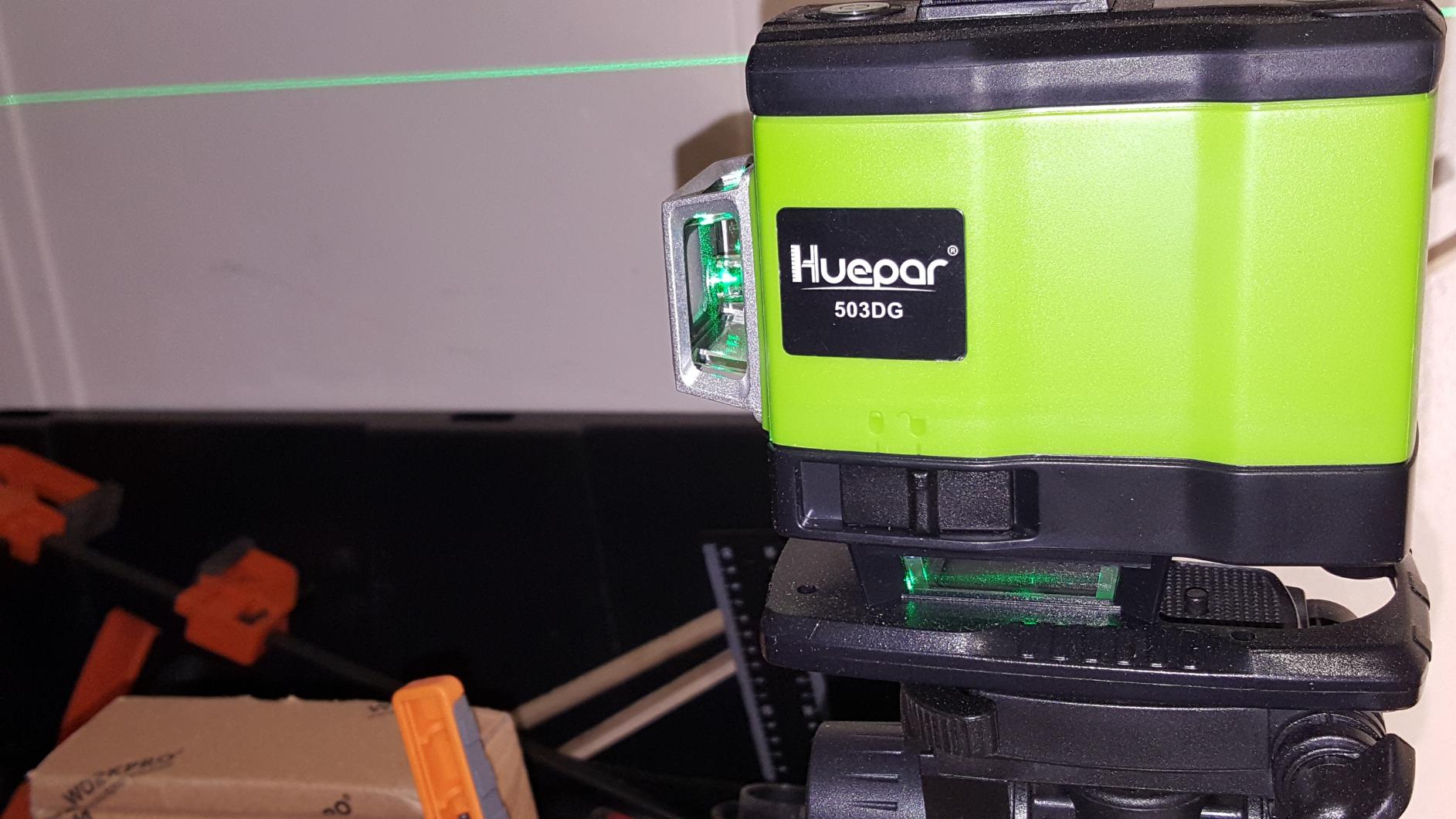
4. Huepar LS04CG – Four Full Planes for Whole Room Layout
Huepar Laser Level 360 Self Leveling, Rechargeable Green Laser 4×360° Cross Line Lazer Leveler 4D Level Laser Tool for Construction with Two Li-ion Batteries, Magnetic Bracket &Hard Carry Case -LS04CG
4x360 green laser
Four planes incl ceiling and floor
1/9 inch at 33 ft
Two rechargeable batteries
Pros
- Four full 360 degree planes cover ceiling and floor reference
- Two rechargeable batteries charge separately for uninterrupted work
- Lifting base raises the floor line 1 to 3.54 inch over uneven ground
- Manual mode with pendulum lock holds lines at any angle
- 5 year warranty plus lifetime technical support
Cons
- Heavier and bulkier than smaller 3 plane units
- The advertised 200 ft pulse range needs a separate receiver
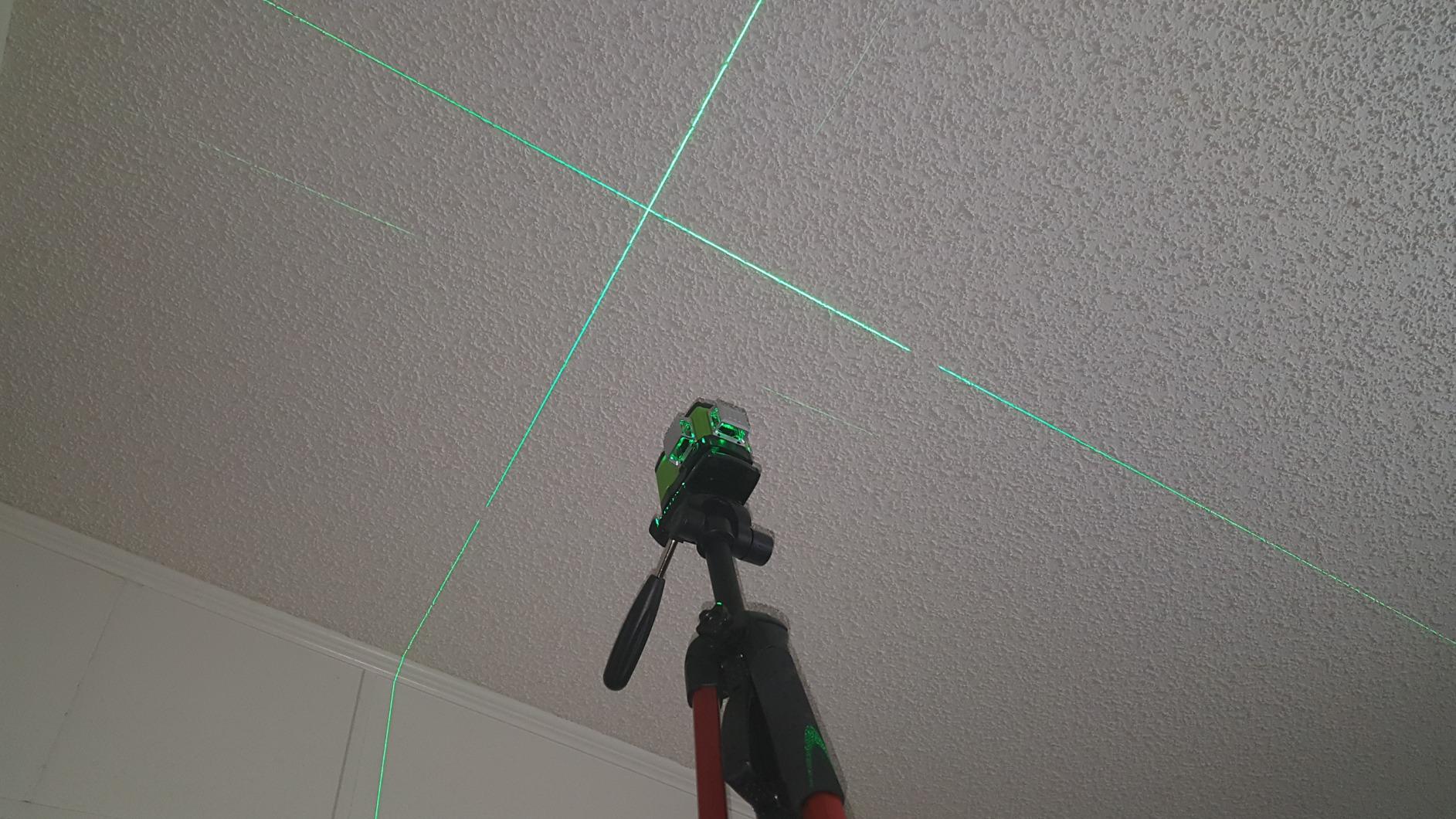
Most 3×360 tools project one horizontal plane and two vertical ones. This one adds the ceiling and floor references, which is what whole-room tiling and drop ceiling layouts actually need. Accuracy is stated at 1/9 inch at 33 feet, and the audible out-of-level beeping means you know when the pendulum is past its 4 degree range.
Two rechargeable batteries with four level indicators is a genuine design choice rather than a bundle trick. You can charge one while the other runs, and the Type-C cord is included along with a power adapter.
Accessories That Actually Matter
The lifting base deserves attention. It raises the floor laser between 1 and 3.54 inch, which is the difference between a usable floor line and no floor line at all when you are working on anything other than a slab. The 360 degree magnetic bracket carries both 1/4-20 and 5/8-11 threads, so it fits standard stands and heavy-duty survey tripods.
Out of four-star feedback is limited, and the recurring notes are weight and the receiver requirement. At 4.8 pounds this is a substantial package to store, and the 200 ft pulse range is a receiver-assisted figure rather than a bare-beam one.
Who Should Buy the LS04CG
Buy it for full bathroom or kitchen tile layouts, drop ceilings and any renovation where you want a ceiling and floor reference at the same time as the wall planes. The 5 year warranty and lifetime support are the strongest support terms here.
Skip it if you are mounting shelves and pictures. You would be paying for two whole laser planes you will never switch on, and carrying a heavier tool bag for the privilege.
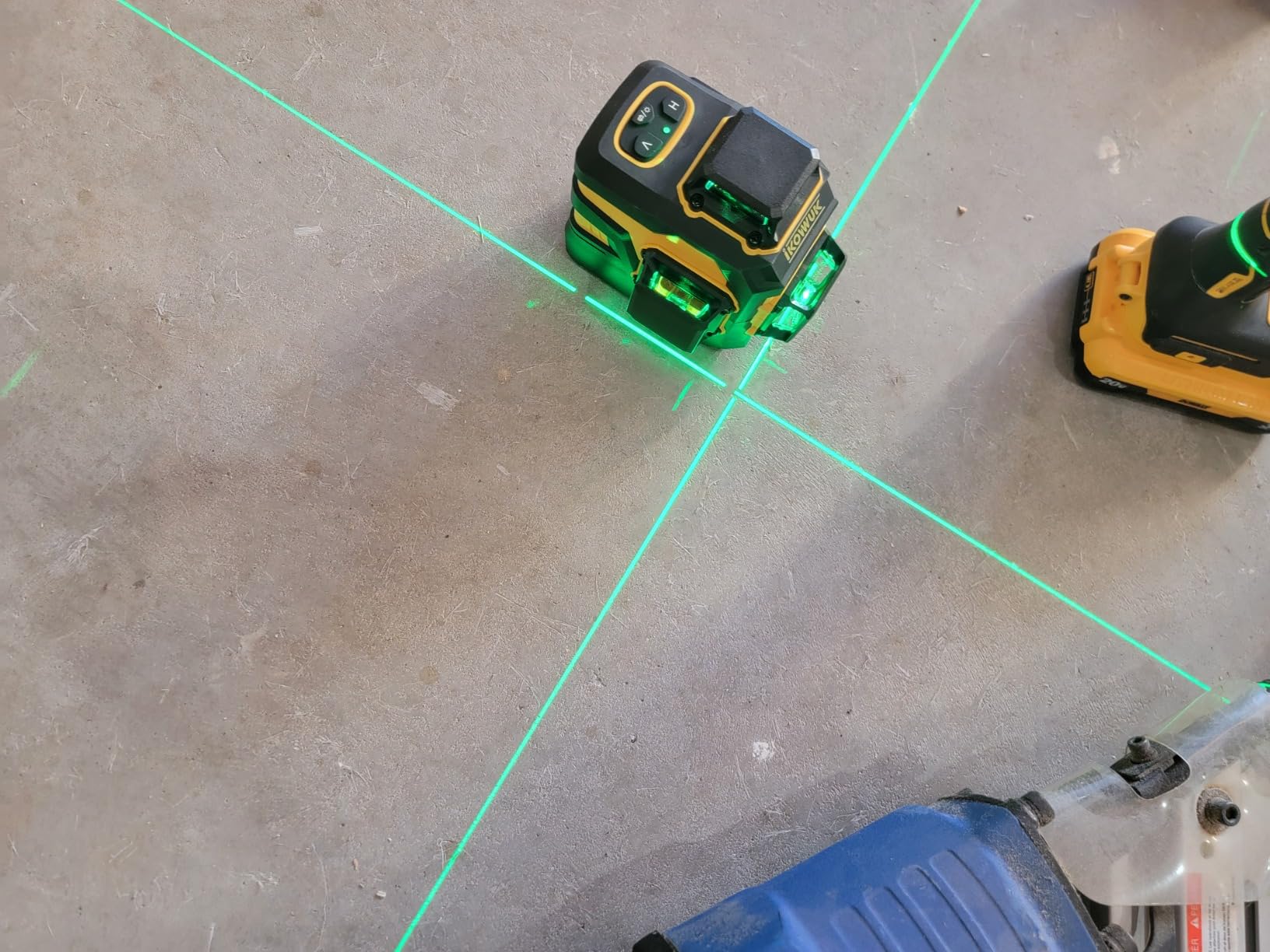
5. IKOVWUK B1-12 – The 3×360 Spec Sheet for Less Than Most Cross Lines
IKOVWUK Laser Level with 12 Green Lines, Built-in 5200 mAh Li-ion Battery
3x360 green laser, 12 lines
5200mAh battery, 8 hours
Remote to 16 feet
65 ft range
Pros
- Full 3x360 coverage at an entry-level price point
- 5200mAh battery runs up to 8 hours on a charge
- Remote control reaches 16 feet and works through walls
- Handles tile layout
- wall panelling and floor planks well
Cons
- Lines wash out in bright light and low headlamp conditions
- The persistent off level beep is intrusive
- Charges only with the supplied AC adapter brick
- Some owners report level drift after a few months
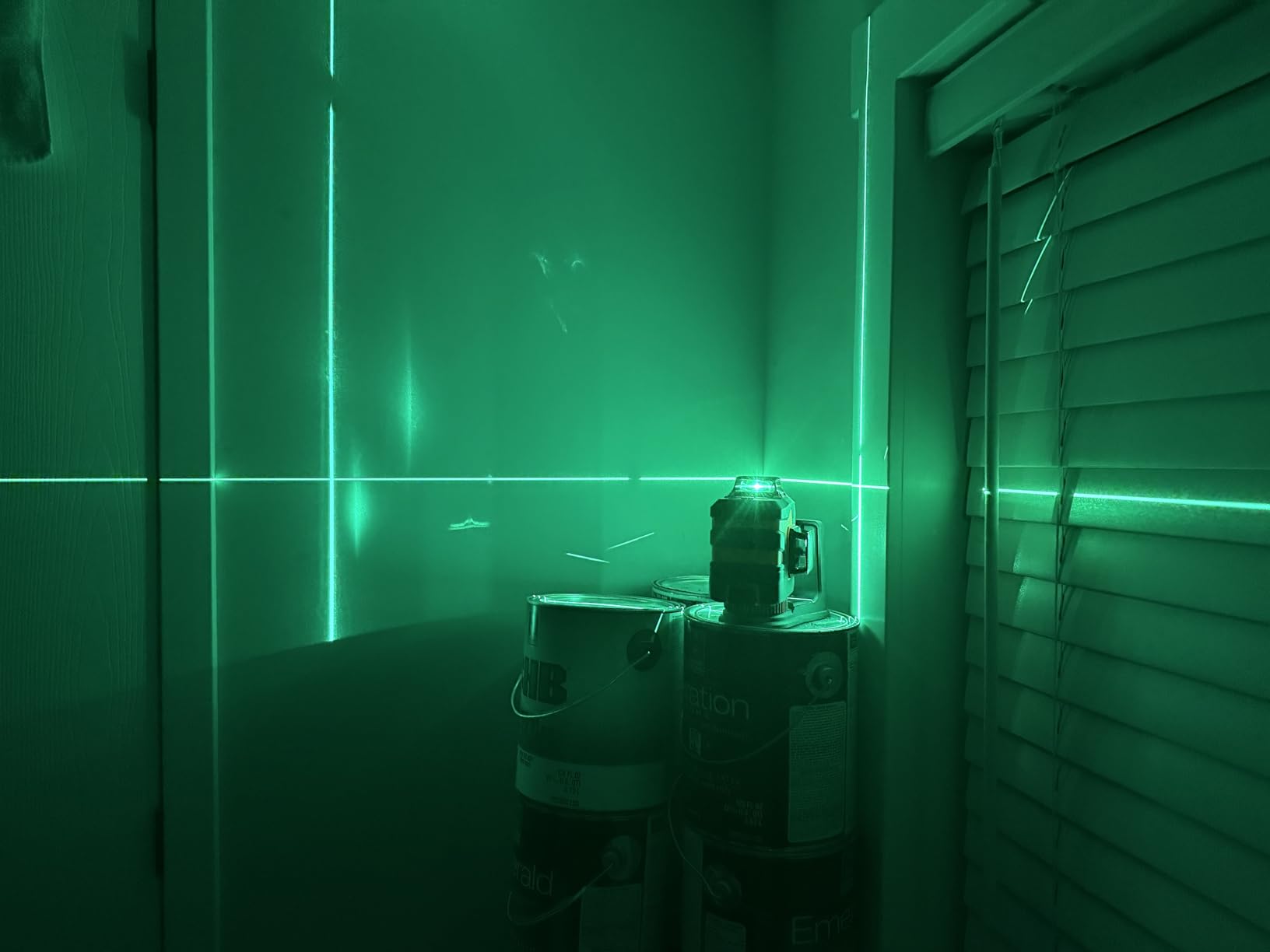
Here is the honest version of this tool. It lists one horizontal and two vertical 360 degree planes, 12 green lines, a 5200mAh battery with up to 8 hours of runtime, and a remote that reaches 16 feet through walls. For interior tile and drywall that is a real feature set, and 4.6 stars across more than 2k reviews says the price-to-capability ratio holds up.
Manual leveling mode is there too, activated by holding the brightness button for 3 seconds, plus a pulse mode with two brightness levels. Self-leveling range is 3 degrees, which is the tightest in this group.
Where the Spec Sheet Meets Reality
Two things separate this from the models above. The beep that fires when the tool is out of level is loud and continuous, and several owners find it irritating enough to mute the tool mentally. And the charging setup only works with the included AC adapter block, not with a generic USB-C cable or a power bank.
A small number of reviews also report units losing level or failing to hold a line after a few months, and vibration or temperature extremes are called out as a factor. The 18 month manufacturer warranty is the shortest in this group apart from the one-year terms at the budget end.
Who Should Buy the B1-12
Buy it if you want full 3×360 coverage and a long battery day without moving up a tier, particularly for wall panelling, floor planks and indoor tile.
Skip it if you are installing cabinetry where consistency over months matters, or if you plan to charge from a power bank on site. And treat the 12 line claim as marketing more than utility: 12 lines here is largely the same three planes split into visible segments.
6. SKIL LL932201 – The One That Ships With a Real Tripod
SKIL 65ft. 360° Red Self-Leveling Cross Line Laser Level with Horizontal and Vertical Lines Rechargeable Lithium Battery USB Charging Port, Compact Tripod & Carry Bag Included – LL932201
360 degree red line to 65 ft
Self-leveling plus locking mode
Rechargeable micro USB battery
Tripod included
Pros
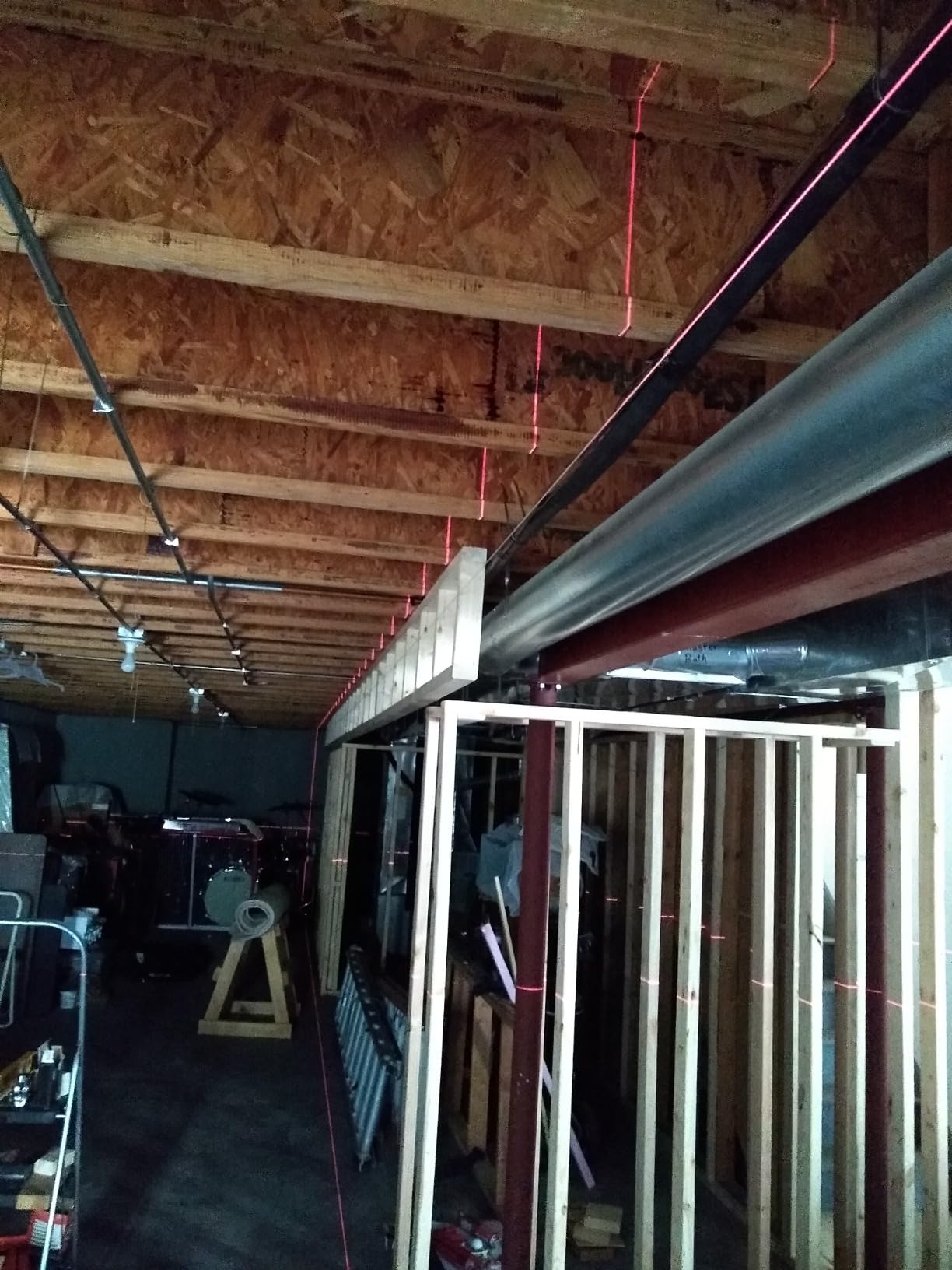
- Projects a continuous 360 degree red line around a full room
- Locking mode holds lines at any angle for diagonal backsplash
- Rechargeable battery removes disposable battery running costs
- An adjustable tripod that raises to 3-1/2 feet is included in the box
- Backed by a 5 year manufacturer warranty
Cons
- Red beam is difficult to see in bright ambient light or sun
- Micro USB charging port is dated next to USB-C models
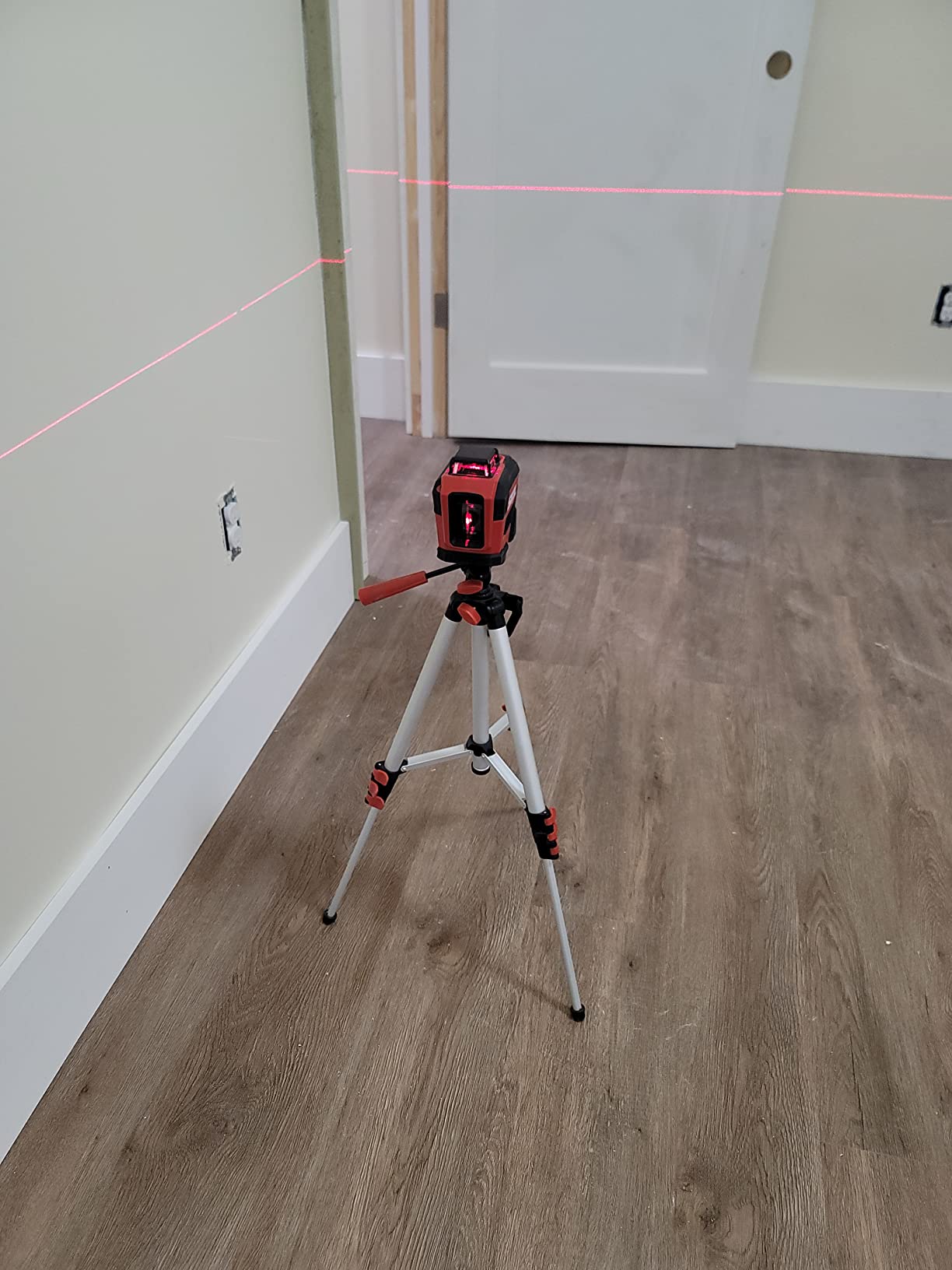
Almost every competitor in this category sells you a bracket and expects you to buy a stand separately. This one includes a 43 inch adjustable tripod that reaches 3-1/2 feet, along with a soft carry bag and a charging cord. For a first laser level, that removes the most common surprise in the category.
The other feature worth paying attention to is the locking mode. It lets you project a line at any angle, which is exactly what a diagonal tile backsplash needs and what the Klein above cannot do.
Red Beam Reality Check
The line is continuous and goes all the way around the room, up to 65 feet. It is also red, so in a bright kitchen or a sunlit work area you will be repositioning more often than you would with a green unit. This is the tradeoff every red tool in this list makes.
The micro-USB port is functional but dated next to the Type-C ports on the Huepar and CIGMAN. The 5 year warranty offsets that: at this level, having three years of cover beyond the typical electronics warranty is a real advantage.
Who Should Buy the LL932201
Buy it if you want a stand in the box, a diagonal-capable lock mode and a rechargeable battery, and you are working indoors on trim, shelving and simple tile.
Skip it if you need long range or a plumb reference, or if visibility in a bright room is the deciding factor for you.
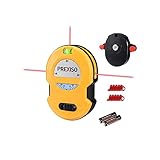
7. PREXISO PLV2 – The Best Seller for a First Laser Level
PREXISO Multi Surface Laser Level LED Light Vial, Cross Line Laser
3 lines to 30 ft
Angle dial 15 to 75 degrees
LED lit bubble vials
Wall mount included
Pros
- Top seller rank in line lasers with 2.5k+ reviews
- Gives both horizontal and vertical lines plus an angle dial
- LED lit bubble vials stay readable in dark workspaces
- Wall mount base frees both hands for marking
Cons
- Not a stud finder despite what some buyers expect
- The bubble vial is small and the angle dial lacks a clear zero mark
- Adhesive strips and pins can damage wall paint
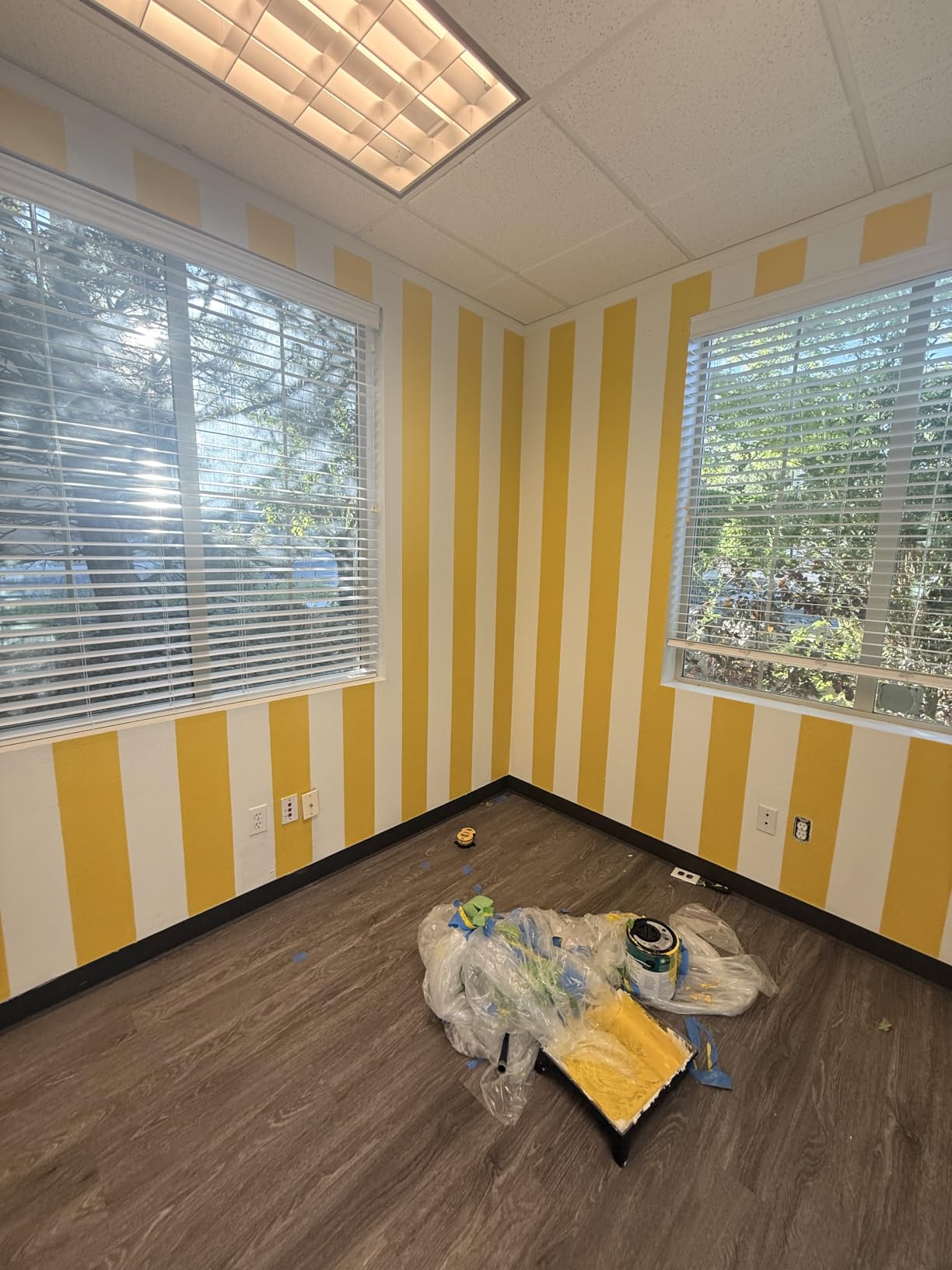
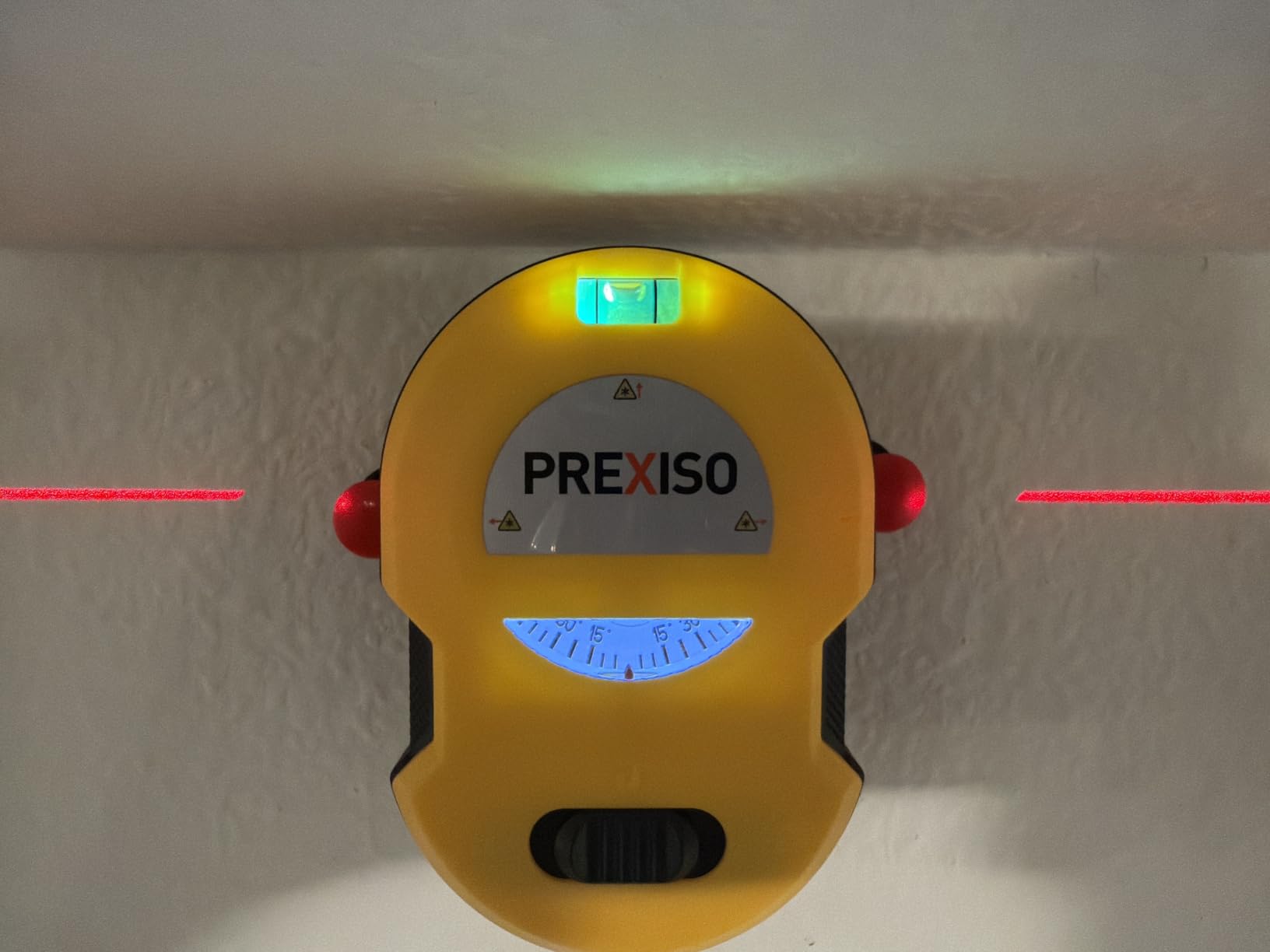
This is the only tool here that combines a laser with the traditional backup of bubble vials, and that is a genuinely good idea for a beginner. If the laser line is hard to see on a textured wall, you can still confirm level with the built-in vials, and the LED lighting around them makes that possible in a dark garage or cupboard.
The angle dial covering 15 to 75 degrees is unusual at this level. It handles skirting, angled shelving and non-square walls without any trigonometry from you.
Fixing the Tool to the Wall
The wall mount base offers three fixing methods: two pins for rough surfaces, ten self adhesive strips for smooth ones, and top pin holes. That flexibility is genuinely useful for marking shelf positions across several walls without carrying a tripod between rooms.
Two cautions. First, the product is not a stud finder or a magnetic nail finder, and the packaging carries a warning that regularly confuses buyers, so read the box before you assume otherwise. Second, both the strips and the pins can lift paint, and the replacement tacks are not supplied and bend easily.
Who Should Buy the PLV2
Buy it if you are outfitting a first toolbag, working in awkward rooms where a stand is inconvenient, or you want one device that behaves like a laser level and a spirit level at the same time.
Skip it for tiling, cabinetry or anything that needs accuracy beyond 30 feet. A 30 foot range and a small vial will not carry a bathroom.
8. Lusweimi Green Laser with 50 Inch Tripod – The Complete Starter Kit
Laser Level with 50” Tripod, 360° Self Leveling Cross Line Laser Level, Green Beam Horizontal and Vertical Line leveler Tool for Hanging Pictures, Home Renovation with 4 AA Batteries & Carry Pouch
Green cross line laser
50 inch tripod included
1/9 inch accuracy at 33 ft
0.17 kg with carry pouch
Pros
- A 50 inch tripod is included
- which is rare at this level
- Green beam is clearly visible for home projects
- Manual mode locks the cross so you can work at any angle
- Light at 0.17 kg and easy to grip from the pouch
Cons
- Build quality and adjustability feel flimsy above 5 feet
- The green line washes out in very bright conditions
- The tripod is built mainly from lightweight plastic
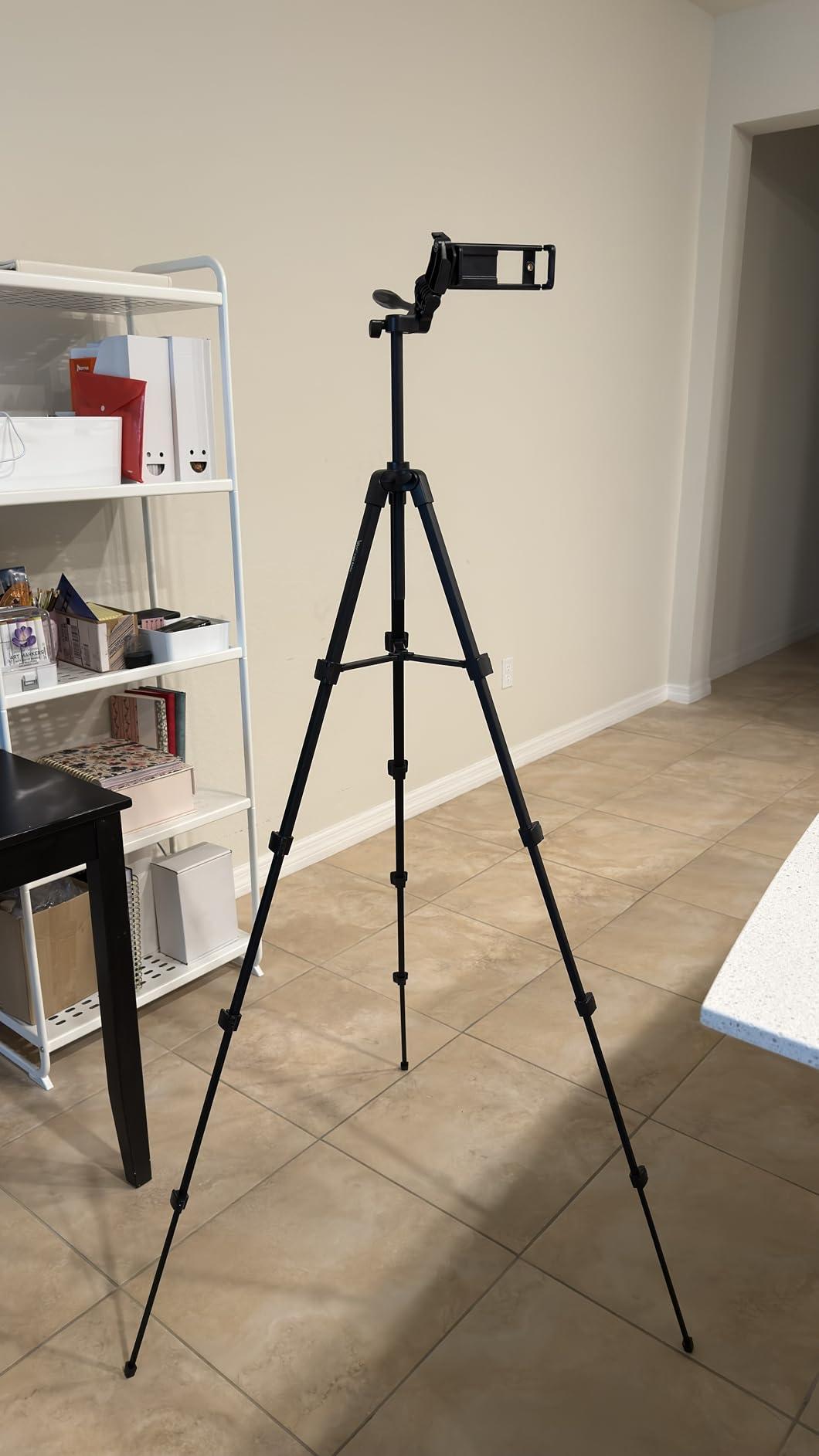
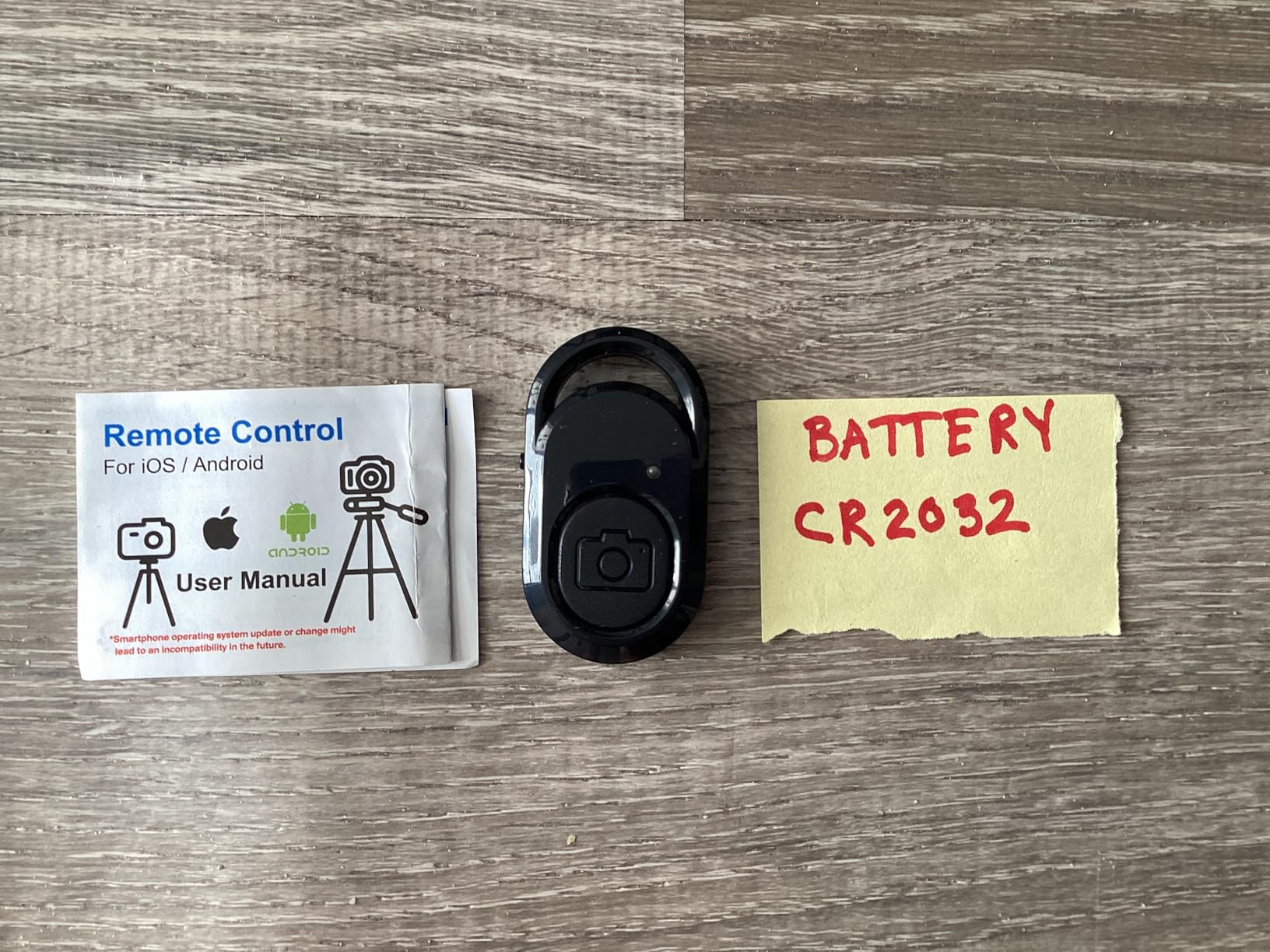
Everything you need to hang a shelf on a Saturday arrives in one box: the laser, a 50 inch tripod with a level bubble and a universal 1/4-20 mount, a carrying pouch, four AA batteries and a manual. Owners consistently describe it as a practical bargain for quick home jobs, and with more than 4.6k reviews there is a long track record behind it.
Stated accuracy is 1/9 inch at 33 feet and the self-leveling range is 4 degrees, with a flashing warning when you exceed it. The manufacturer rates the green beam as twice as bright as red from the same light source.
Where the Kit Falls Apart
The tripod is the weak point, and reviewers say so directly. It is built mainly from lightweight plastic, and adjusting it at working height, particularly above 5 feet, feels unstable. If your project is mostly at floor or counter level, that is a non-issue. If you are working overhead, buy a proper stand.
The laser housing itself is also less rugged than the metal and plastic professional tools here, and the IP54 rating covers dust and water but not the drop that a garage toolbag produces.
Who Should Buy This Kit
Buy it for picture hanging, floating shelves, single-wall trim and small indoor renovation jobs where having a stand in the box matters more than having a premium beam.
Skip it if the tripod is going to be your main mounting method for anything above shoulder height, or if you work outdoors in strong light.
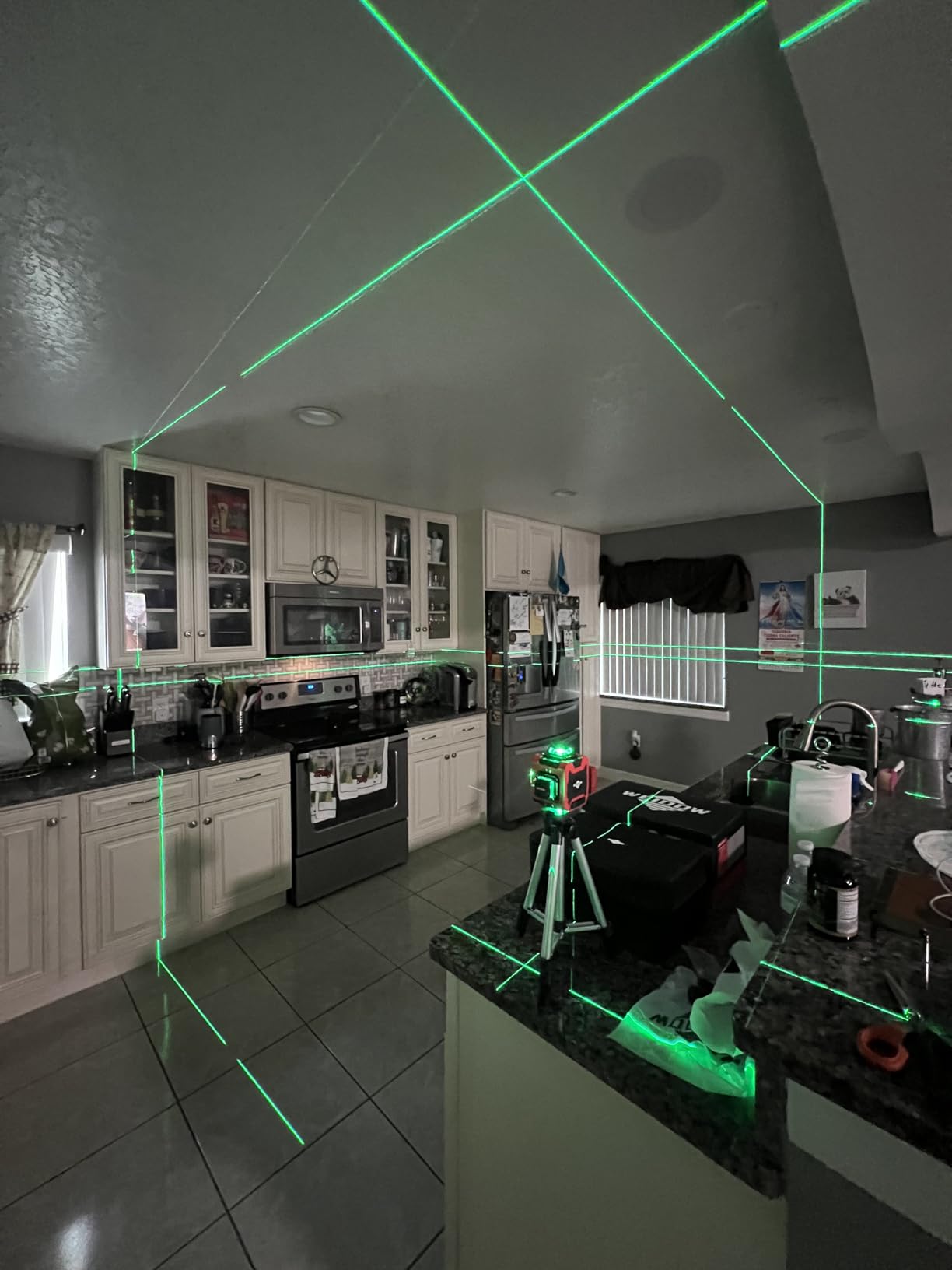
9. WEIDDW 360 Green Cross Line – The Kit With the Most Accessories
WEIDDW Laser Level 360° Green Cross Line Self Leveling Laser Measuring Tool
Green 360 cross line
Auto-levels within 4 degrees
Two 2400mAh batteries
Tripod and remote
Pros
- Tripod
- 360 degree adapter and remote are all in the box
- Two 2400mAh batteries give 6 to 8 hours total runtime
- Manual mode locks the cross for angled layouts
- 12 month free replacement warranty with a longer term offered
Cons
- Accuracy and beam stability trail the higher rated models
- Plasticky housing despite the metal and plastic listing
- Line visibility drops in bright environments
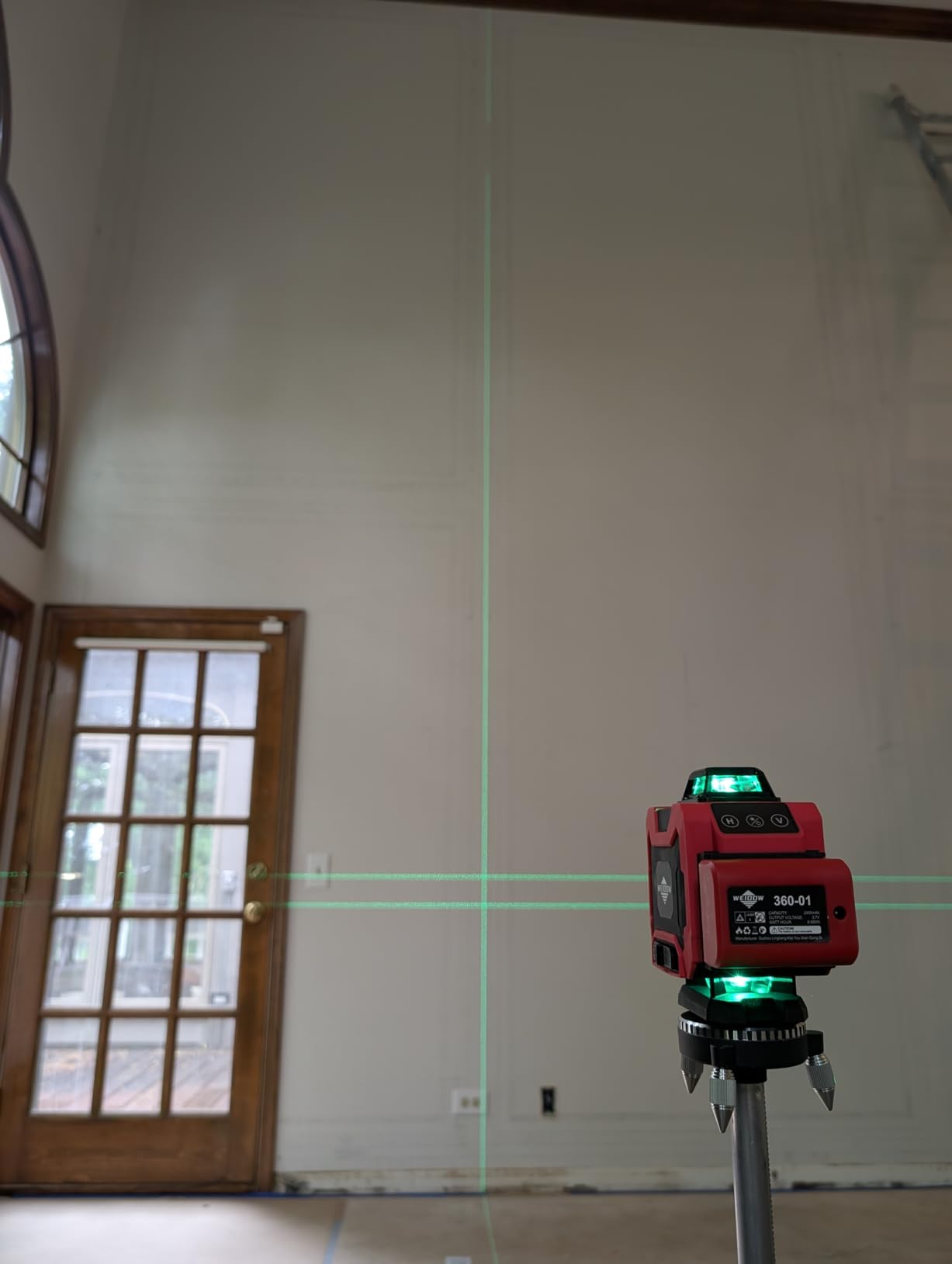
Accessory count is the headline here. You get the laser, two 2400mAh batteries, a tripod, a 360 degree adapter connector and a remote control, and the two batteries give 3 to 4 hours each for 6 to 8 hours of total use. Auto-leveling covers under 4 degrees of tilt, with a manual mode on top.
Stated use covers interior decoration, picture hanging, tiling, ceiling installation and general engineering measurement, and the listing offers a 12 month free replacement warranty that can be extended.
What the 4.3 Average Means
The 4.3 star average is the lowest of the green-beam tools here, and owners say why: beam stability and accuracy are reported as less refined than dedicated professional tools, and the housing feels plasticky even though the material listing mentions metal and plastic. Line visibility also drops in bright environments, which is common to this class but worth stating plainly.
The remote and adapter genuinely reduce how often you walk back to the unit, which is the same benefit the CIGMAN remote provides at a higher owner rating.
Who Should Buy the WEIDDW
Buy it for interior decorating and picture hanging when the accessory bundle is the deciding factor, and when manual mode for angled layouts matters.
Skip it for cabinet installation, tile runs or anything where a wandering line would be expensive to discover later. Pick the CIGMAN or the Huepar instead if accuracy is the priority.
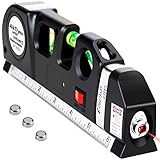
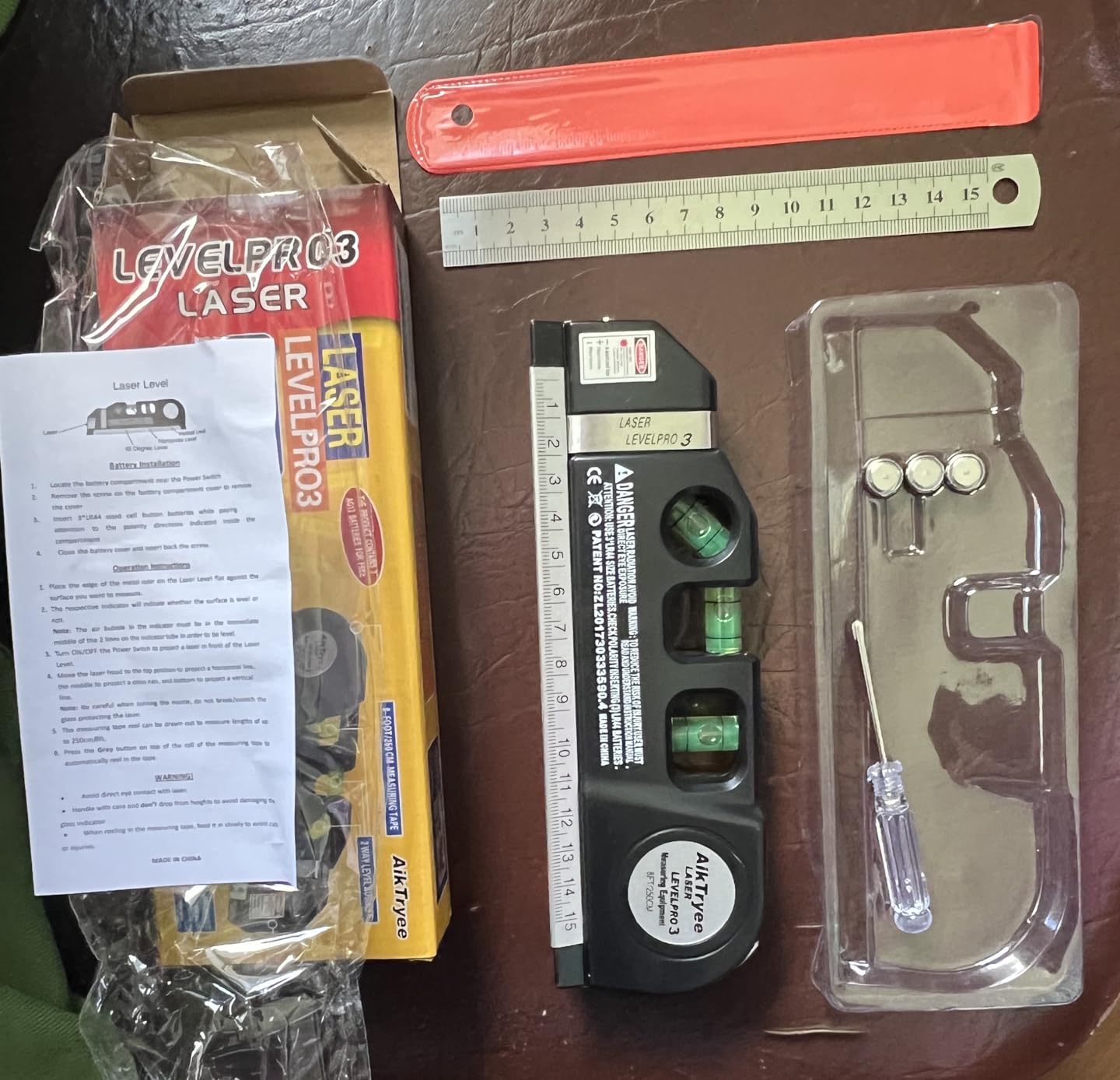
10. AikTryee Line Level – The Manual Tool That Is Still Enough for Most Jobs
Laser Level Line Tool, Multipurpose Laser Level Kit Standard Cross Line Laser leveler Beam Tool with Metric Rulers 8ft/2.5M for Picture Hanging cabinets Tile Walls by AikTryee.
Manual bubble vial line level
Built in 8 foot measuring tape
0, 90 and 45 degree vials
Weighs 6 ounces
Pros
- Very low entry cost for a genuine cross line tool
- Integrated 8 foot measuring tape with metric and imperial graduations
- Three vials cover level
- plumb and 45 degrees
- Long track record with 16k+ reviews and a lifetime warranty
Cons
- Not self-leveling so it must be set by hand on an even surface
- Line width and accuracy trail every electronic model
- Indoor use only
- bright ambient light washes out the beam
With more than 16k reviews, this is the most proven tool in the list, and for a single framed picture or a run of floating shelves it is genuinely enough. One slider switch controls vertical, horizontal and cross line modes, and the three-pronged vial set gives you 0 degree level, 90 degree plumb and a 45 degree angle.
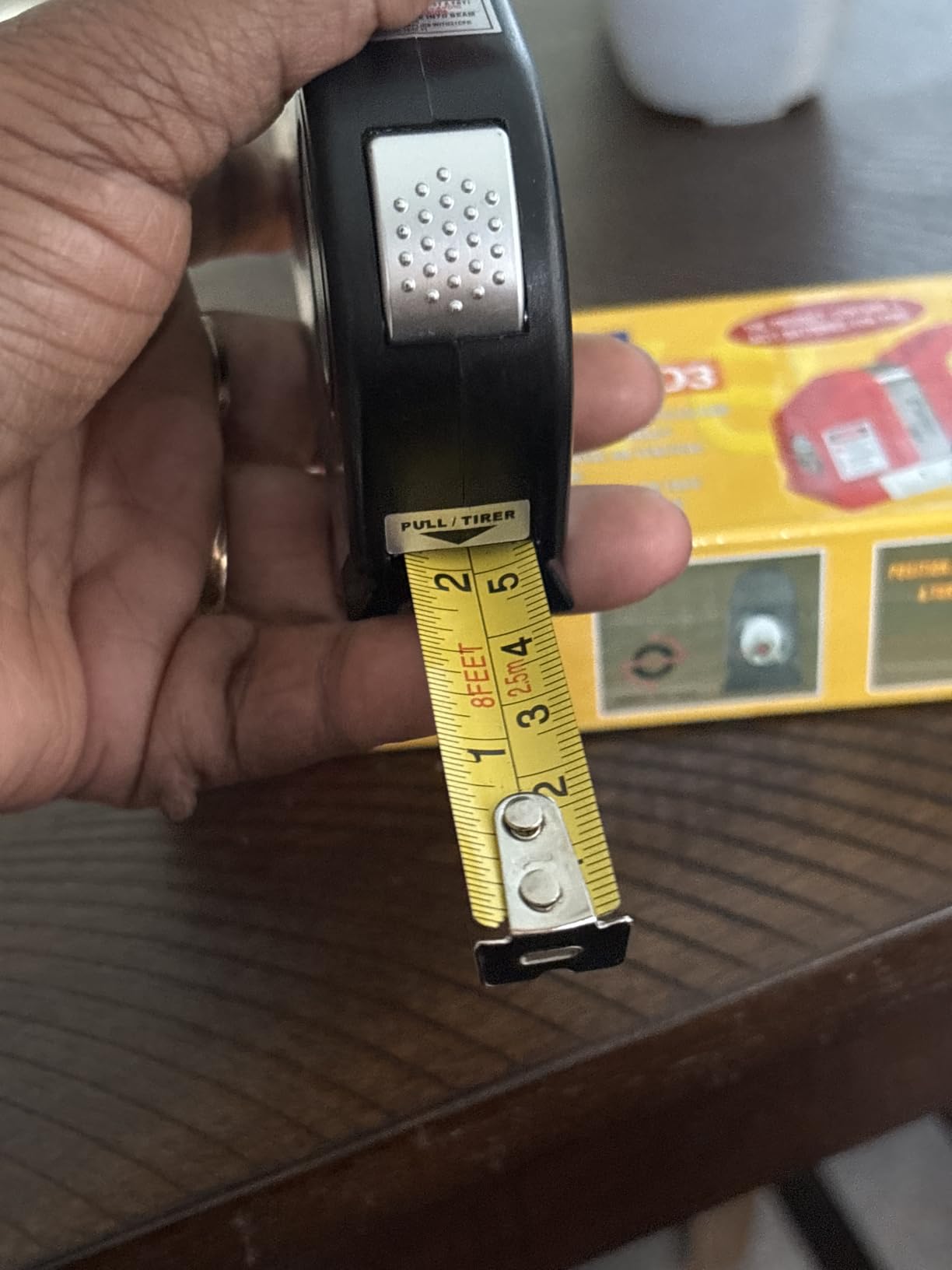
The integrated 8 foot measuring tape with graduations down to 1/32 inch and 1 mm is the detail that makes it more useful than it looks. It is a level and a tape in a 6 ounce body.
What You Give Up Without Self-Leveling
There is no pendulum and no electronic sensor, which means the tool has to be set by hand on an even surface. On a straight worktop at waist height that is fine. On a sloping floor, or on a wall where you are marking a long run, it is not.
Line width and accuracy are well below self-leveling electronic models, and the manufacturer is explicit that it is designed for indoor use: hanging shelves, cabinets, tiles and picture frames. Bright ambient light washes the beam out.
Who Should Buy the AikTryee
Buy it if you are hanging pictures, aligning a few cabinets and want to spend nothing on a tool you will use an hour a month. It also makes a sensible backup that lives in a drawer rather than a toolbag.
Skip it the moment your project involves tile, trim across a full wall, or anything where the line has to stay true for more than a few feet. At that point the money you saved costs you in re-work.
How to Check Your Laser Level Is Accurate in 5 Minutes
Are cheap laser levels accurate? Mostly yes, within the range you are actually working in. Every self-leveling tool in this list claims accuracy inside a stated tolerance, and the difference between a well-made budget unit and a premium one is rarely more than a fraction of that tolerance. The real risk is drift after a drop, which is why you check before the job instead of after the cabinets are up.
Here is the routine I use before anything gets screwed to a wall.
Step 1: Set a trusted reference. Find the most level surface you have. A granite countertop, a garage slab poured recently, or a shelf on a well-adjusted bookcase. Place the laser on it and let the pendulum settle.
Step 2: Check the horizontal line against a bubble level. Lay a 4 foot bubble level directly under the projected horizontal line and read both at each end. If the line and the bubble agree within a quarter of a bubble, the tool is fine for household work.
Step 3: Measure the drift over distance. Mark where the vertical line crosses a stud, at eye height and again at floor level. Compare the mark against a string line dropped from a nail in a stud. More than a quarter inch out at floor level is drift worth addressing before you start.
Step 4: Check the pendulum lock. Tilt the tool slowly in every direction until the alarm or the flash triggers, then return it to centre. If it fails to settle and give a steady line without manual help, the pendulum or sensor is a problem.
Step 5: Know your return path. If accuracy is out, the first question is whether the warranty covers calibration. Among the warranty terms published for these models, the strongest are the 5 year cover on the Huepar LS04CG and the SKIL LL932201, the lifetime warranty on the AikTryee, and the 12 month free replacement offered on the WEIDDW. Manufacturer terms vary, so check the specific product listing before assuming a repair is included.
Calibration drift after heavy use or a drop is the most common long-term complaint across owner reviews, and it is the one thing nobody on a shopping page tells you about.
How to Choose a Laser Level for DIY
Work down this list in order and you will stop paying for features you will not use.
Green vs Red Beam
Green is brighter and easier to see, especially in a lit room, and the difference is dramatic the first time you switch. Red models are cheaper and their batteries tend to last a little longer. For indoor work in a normal kitchen or living room, green is worth the step up. For a dim garage, an evening project, or a workshop with controlled light, red works fine.
The forum consensus matches this: owners who trade up from red to green describe the improvement as immediately obvious indoors, and note that green also holds up better outdoors. But several experienced users add the counterpoint that a string line can still be faster outdoors when perfect accuracy is not critical.
Cross-Line, 360 Degree, or 3×360?
You probably do not need a 360 degree laser. A cross-line tool projects one horizontal and one vertical line in front of it, and that covers shelves, pictures, cabinets on a single wall and most trim. It is smaller, lighter and less expensive.
A 360 degree horizontal line is worth it when the line must wrap around a whole room, for example when you are running a picture rail, aligning a room of cabinets, or laying tile that continues around four walls. A 3×360 tool adds two vertical planes so you can reference all four walls plus the ceiling and floor from one position, which is the whole-room layout case. The Huepar in this list goes one step further with four planes.
Be sceptical of line counts. Listings advertising 8, 12 or 16 lines are usually describing the same three planes split into visible segments, not sixteen independent references. Judge coverage by planes, not by line count.
Self-Leveling and Manual Mode
Self-leveling means an internal pendulum or sensor corrects a small out-of-level placement automatically, typically within 3 to 4 degrees. Every electronic tool in this list does it. Manual mode, which locks the beam at a fixed angle, matters only if you are laying diagonal tile or angled molding. Several of the cheapest units here lack it entirely, and that is a legitimate reason to choose a different model.
Power Source and Running Cost
AA batteries are cheap to replace and you always have spares. A built-in rechargeable cell with Type-C charging is tidier and cheaper to run long term, but check whether the cell is replaceable, because a sealed cell ends the tool’s life. A tool-battery platform, such as the DEWALT or Bosch ecosystems, is worth considering only if you already own that platform and never want to think about batteries again.
What Is Actually in the Box
This is the hidden cost nobody advertises. The SKIL LL932201 includes a 43 inch adjustable tripod, the Lusweimi kit includes a 50 inch tripod, and the Huepar and CIGMAN include a hard case and a bracket. The DEWALT, Klein and most other cross line tools do not include a usable stand, and the Klein’s supplied clamp is for thin sheet metal only.
Expect to buy a stand separately for the majority of tools in this category. Budget for a tripod with a 1/4-20 thread and a built-in vial, because a shaky stand at working height is worse than no stand at all.
Features You Can Skip
Bluetooth connectivity, app support, a digital angle display, a laser receiver and a rotary scanning head are all real products for real jobs, and none of them belong in an ordinary home toolbag. A laser receiver only matters if you are working outdoors beyond roughly 100 feet, and a rotary laser is a site-surveying instrument built for grading and drainage, not for hanging a shelf.
If someone tells you a rotary laser is the professional choice, understand what you are being sold. Rotating line lasers need a receiver, a grade rod, and a far bigger budget, and they exist to establish cut and fill elevations across a building site. For a house, a 3×360 green tool already does everything you need.
Laser Safety
Every laser level sold for consumer use is a Class 2 visible-beam laser with output below 1 milliwatt, which is why they are legal to own and safe to use around people. The safety rule is absolute and simple: never look directly into the beam, never point it at another person’s eyes, and keep it clear of aircraft and traffic. A Class 2 tool is not the strongest laser you can legally own, but it is the strongest kind you need, and anything beyond it belongs in a professional industrial category with its own controls.
Frequently Asked Questions
Are cheap laser levels accurate?
Mostly, yes. Self-leveling budget tools are typically accurate within a few millimetres across a normal room, which is enough for shelves, cabinets and trim. The real risk is drift after a drop, which is why you check accuracy against a bubble level before the job rather than after the cabinets are hung.
Which laser level is best for home DIY use?
The DEWALT DW088K is the best laser level for home DIY use. It is a red cross-line tool with 1/8 inch accuracy at 30 feet, an integrated magnetic bracket that grips metal studs, an IP54 housing with a 1 meter drop rating and the highest owner rating in this group at 4.7 stars across more than 9k reviews.
What is the best value for money laser level?
The CIGMAN CM-701 gives you the most capability per unit of outlay. You get 12 green lines with full 360 degree coverage, self-leveling within 4 degrees, a 4000mAh Type-C rechargeable battery and a hard case. What you give up is sunlight performance and fine line quality, since the lines run thick and break in places.
Do I need a 360 degree laser level for DIY?
Usually not. A cross-line tool projects one horizontal and one vertical line, which covers most household work. A 360 degree horizontal line earns its place when the reference has to wrap around a whole room, for a picture rail, a run of cabinets or tile that continues around four walls.
Should I buy a green or red laser level?
Green is brighter and far easier to see, especially in a lit room, and owners report the upgrade from red as an immediate improvement. Red models cost less and suit dim garages and evening work. For normal indoor rooms, choose green; for controlled low light or a tight budget, red is still a sound tool.
What is the strongest laser you can legally own?
Consumer laser levels are Class 2 visible lasers with output below 1 milliwatt, and they are legal to own and safe to use around people. The rule is simple: never look into the beam, never point it at eyes, and keep it clear of aircraft. Anything stronger belongs to a professional industrial category with its own safety controls.
Is a laser level worth buying for home use?
Yes, if you are hanging shelves, installing cabinets, laying tile or running trim across a wall. A laser removes the accumulated error of eyeballing or working from a long straightedge, so a line stays true across a whole room. For a single framed picture, a 24 inch spirit level is enough.
What laser level do I need for cabinets?
A self-leveling cross-line tool is the right answer, and the Klein Tools 93LCLS is worth a look because its plumb spot transfers a ceiling height down to the floor. For a full kitchen run, add a 360 degree horizontal line, which is what the SKIL LL932201 or a 3×360 model provides.
Which Laser Level Should You Buy?
Pick the DEWALT DW088K if you want one dependable cross-line tool that mounts to bare studs, survives drops and never needs disposable batteries in the field. Pick the CIGMAN CM-701 if visibility and full 360 degree coverage matter more to you than a fine line, and the Huepar LS04CG if you need ceiling and floor references for a full room of tile.
Choose the Klein 93LCLS for plumb and ceiling grid work, the SKIL LL932201 if you want a tripod in the box and diagonal lock mode, and the PREXISO PLV2 if this is your first laser and you want a backup bubble vial. If your budget is the deciding factor, the IKOVWUK B1-12 gives you 3×360 coverage, and the AikTryee line level is still the honest answer for hanging one picture.
Whichever you settle on, check the accuracy against a bubble level before the first screw goes in. That five-minute habit is the difference between a straight run of cabinets and a job you redo.
Last updated: October 2026. We test and re-verify these picks as new models arrive, and we keep the methodology above visible so you can repeat our checks at home.
Related reading for the rest of your setup: our guides to the best laser printers for home offices and the best laser printers for high volume printing cover the paperwork side of a renovation, the best laser printers for wireless use keep the print side tidy, while the travel routers for VPN use matter if you plan to work from site with a hotspot.