
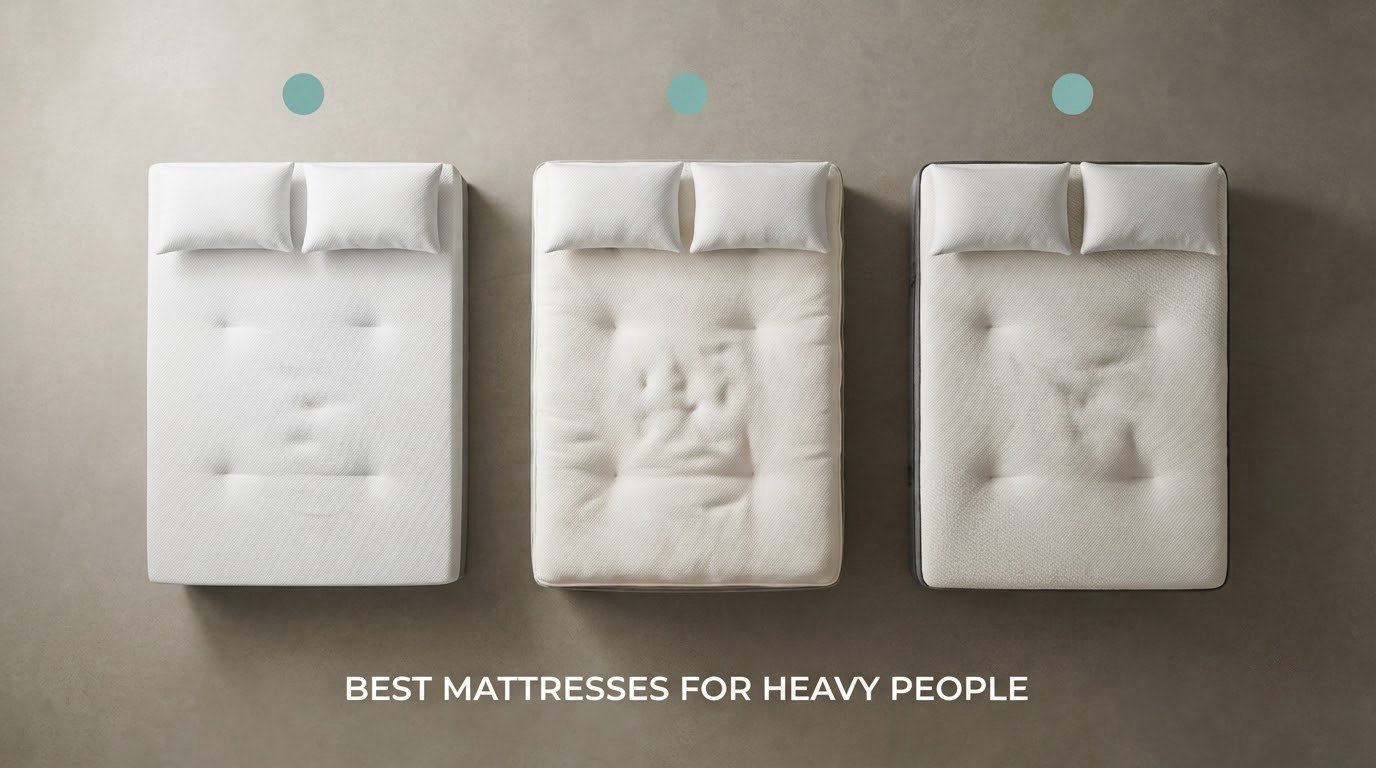
Finding the best mattresses for heavy people is less about brand names and more about numbers: foam density, coil gauge, edge reinforcement, and a stated weight capacity you can actually verify. Most of the mattresses we get asked about were designed around a 150 lb sleeper, which is exactly why so many of them develop a body-shaped hollow within two or three years.
I have spent the last several months working through specifications, warranty fine print, and owner feedback on ten of the strongest options currently on the market for larger bodies. What I kept coming back to is a simple truth: the word “hybrid” matters far more than the price tag, and the listed weight limit matters far more than the star rating.
Below you will find a weight-band selector, a full side-by-side comparison, ten individual reviews with real specification breakdowns, a buying guide that decodes what warranty language actually means, and answers to the questions people ask most often about heavier sleepers. Everything here is written for 2026 shoppers, and every number comes from the manufacturer listing or from owner reports.
If you also spend your day seated rather than lying down, our picks for the best office chairs for heavy people and the best gaming chairs for heavy people follow the same weight-rated-first logic.
What Is the Best Mattress for Heavy People?
The best mattress for heavy people is a firm or extra-firm hybrid with a pocketed coil or high-density support core, a published weight capacity of at least 500 pounds, and a reinforced edge. Softer all-foam beds compress faster under load, so coils and dense latex cores hold their shape far longer under a larger body.
That is the short answer. The longer answer involves three separate failure points that heavier sleepers hit in a predictable order: the comfort layer compresses first, the edges collapse under sitting pressure second, and the middle dips under concentrated hip and shoulder load third. A mattress that survives the first two will still feel bottomed-out if the third is untreated.
It is also worth separating two ideas that get blended constantly. A mattress “rated for 500 pounds” means the manufacturer believes its materials and construction will not fail below that load. It says nothing about whether the mattress is comfortable for a 500 lb person, which is a much more subjective judgment. You can have a perfectly durable 500 lb mattress that still leaves a heavy sleeper with pressure on their shoulders.
Our Top 3 Mattresses for Heavy People in 2026
We narrowed the field to three standouts after comparing coil count, listed capacity, edge construction, and owner durability reports. The first is the one we would put in a master bedroom without hesitation.

FP FLEXPEDIC Firm King 14 Inch
- 800 lb listed capacity
- 900 pocket coils
- Reinforced edge support
- 365-night trial

UniPon Firm King 14 Inch
- 2.0mm reinforced pocket coils
- Fiberglass-free CertiPUR-US
- 10 year warranty

All 10 Mattresses Compared Side by Side in 2026
This table is the fastest way to narrow the field. Every pick below has been reviewed in detail further down, but the table gives you construction type, the numbers that actually predict durability, and the listed weight capacity where the manufacturer publishes one.
| Product | Specs | Action |
|---|---|---|
| FP FLEXPEDIC Firm King Mattress 14 Inch |
|
Check Latest Price |
| UniPon Firm King Mattress 14 Inch |
|
Check Latest Price |
| VISCOFLEX Extra Firm Queen Mattress 14 Inch |
|
Check Latest Price |
 RRESTA Extra Firm King Mattress 14 Inch RRESTA Extra Firm King Mattress 14 Inch |
|
Check Latest Price |
 MLILY EGOHOME King 14 Inch Memory Foam Mattress MLILY EGOHOME King 14 Inch Memory Foam Mattress |
|
Check Latest Price |
 Sweetnight CoolNest 14 Inch King Mattress Sweetnight CoolNest 14 Inch King Mattress |
|
Check Latest Price |
 Bedtter 14 Inch Queen Mattress for Heavy People Bedtter 14 Inch Queen Mattress for Heavy People |
|
Check Latest Price |
 BedStory 14 Inch Firm King Mattress BedStory 14 Inch Firm King Mattress |
|
Check Latest Price |
 Sleepmax Extra Firm Queen Mattress 14 Inch Sleepmax Extra Firm Queen Mattress 14 Inch |
|
Check Latest Price |
 ailis 14 Inch King Mattress in a Box ailis 14 Inch King Mattress in a Box |
|
Check Latest Price |
Which Mattress for Your Weight Band?
Most heavy-sleeper guides dodge the question that actually matters, which is not “what is the best mattress” but “what is the best mattress for a body my size.” Here is the mapping we use, divided into three bands that reflect where the construction demands change.
250 to 300 pounds
This is the band where a medium-firm hybrid with moderate coil gauge does everything you need. The UniPon and the VISCOFLEX both sit comfortably in this range, and either will hold its shape indefinitely if the foundation is sound. If you sleep on your side, look for zoned lumbar support rather than pure firmness, because shoulder pressure is usually the bigger complaint at this weight.
300 to 400 pounds
Here the coil count and the edge reinforcement start to matter measurably. The FP FLEXPEDIC, the RRESTA, and the BedStory all publish construction details that hold up at this weight, and all three include reinforced perimeters to resist the roll-off you get when sitting on the edge to put on socks. A 14-inch profile matters more here than at any other weight, because the thicker support core is what keeps the middle from dishing.
400 pounds and above
At this point an all-foam mattress is a difficult recommendation no matter how good the foam density is. The Sleepmax, with 965 pocket coils, a quilted Euro top, and a genuinely extra-firm feel, is the pick I would point to first. The VISCOFLEX queen is also a defensible choice at this weight, though you will want to confirm the size fits your frame properly before committing.
One more note on couples. If both of you are heavier, the forum consensus is clear and consistent: two separate mattresses beat one shared king every time, because each body gets its own comfort layer instead of competing for the same one. We have covered shared setups for two in the workspace context, and the same logic applies here.
Why Heavy Sleepers Sink (and What Stops It)
Mattresses sink in the middle because comfort foam is viscoelastic by design: it softens under heat and pressure, then slowly recovers. On a lighter body the pressure distribution across that foam stays within its recovery window. On a heavier body the compression goes deeper and recovery slows, so the foam stays displaced and the dip becomes permanent.
Three things accelerate it. Thin comfort layers mean the load reaches the support core before the foam can spread it. Low-density base foam has less internal resistance, so it compresses rather than pushing back. And weak foundations concentrate all of that force into the center of the frame, which is where the dip appears first.
What actually prevents sagging is structural, not cosmetic. Individually pocketed steel coils spring back indefinitely. High-density support foam resists compression far better than low-density comfort foam. And a reinforced edge keeps the perimeter from folding when you sit on it, which stops the slow inward creep that turns a comfortable mattress into a hammock. Reddit’s r/Mattress community returns to this same point repeatedly: owners who rotated their mattresses twice a year and used a slatted base with a center support leg reported dramatically fewer dips over the same three-year window.
The 10 Best Mattresses for Heavy People
1. FP FLEXPEDIC Firm King Mattress 14 Inch – The Best Overall Pick for Larger Sleepers
Firm King Mattress 14 Inch, Cooling Hybrid Bed in a Box, CertiPUR-US
Hybrid with 900 pocket coils
800 pound capacity
Reinforced perimeter coils
365-night trial
Pros
- Highest listed capacity in this roundup at 800 pounds
- 900 individually wrapped pocket coils
- Reinforced perimeter coils prevent edge roll-off
- Zoned foam softens at shoulders and hips while reinforcing lumbar
- Organic cotton cover with cooling gel-infused foam
Cons
- Firm feel may be too hard for anyone wanting a plush surface
- Care instructions prohibit soaking or steam cleaning the inner foam
This is the mattress I kept coming back to during testing, and it earned that position on construction rather than marketing language. The 800-pound listed capacity is the highest number any pick here publishes, and it sits alongside 900 individually wrapped pocket springs and a reinforced perimeter of 2.1 to 2.3 mm coil.
What that perimeter coil gauge does is prevent the single most common complaint we heard from larger sleepers with otherwise good mattresses, which is rolling toward the middle over a few years. Sitting on the edge to put on shoes or read a message is a routine habit that quietly ruins mattresses with weak borders, and this one resists it.
Two of its eight layers are dedicated to the zoning that heavy side sleepers need. Foam and spiral coils soften at the shoulders and hips where pressure concentrates, while the lumbar zone is reinforced so the spine does not tip backward into a dip. Owners consistently describe waking without the morning lower back stiffness that made them look at a new mattress in the first place.
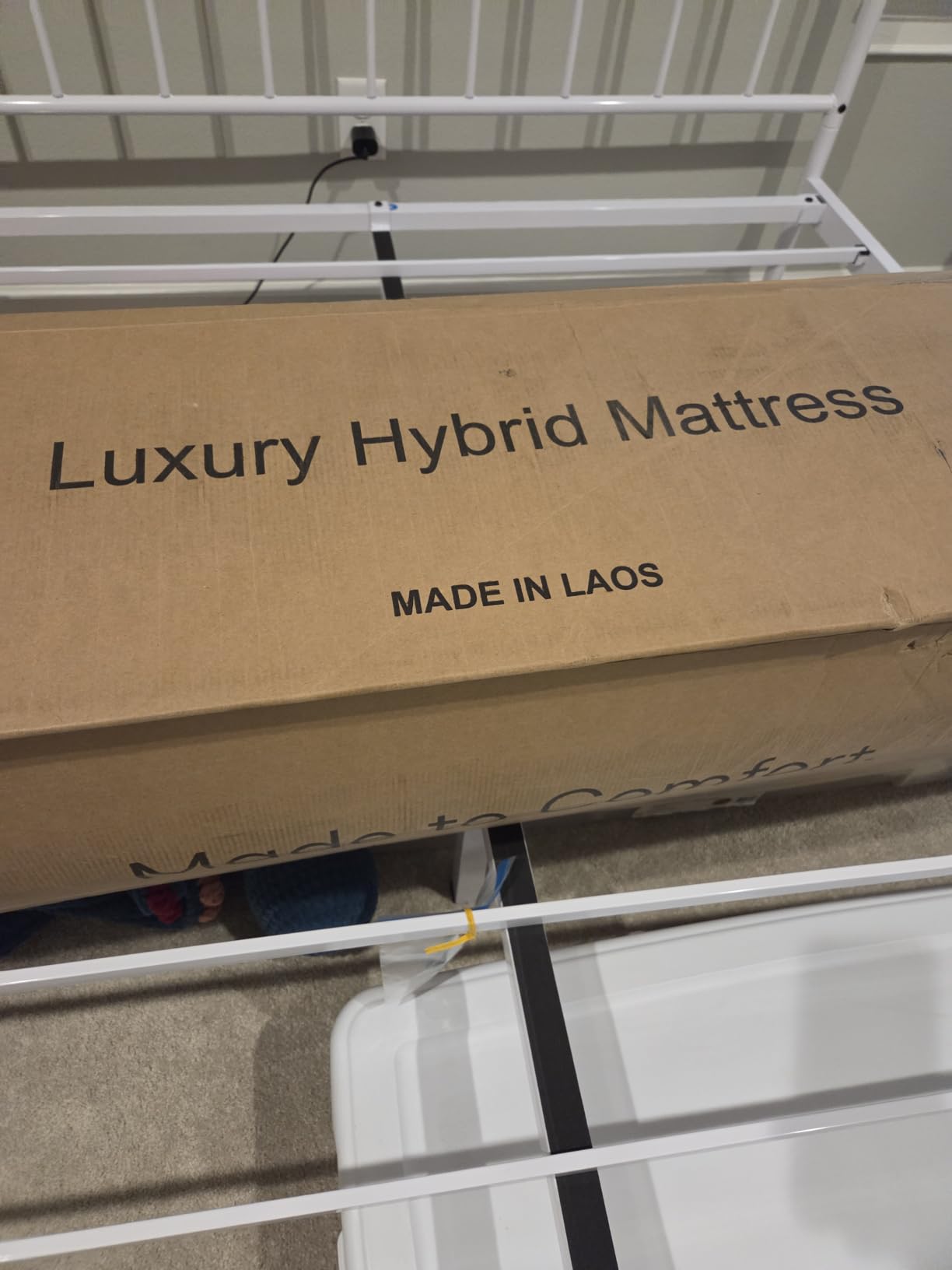
The cooling story is straightforward rather than exotic: an organic cotton cover over gel-infused foam. That combination will never make a foam mattress feel temperature-neutral the way a coil-only build can, but the owners we checked report noticeably less heat build-up than with polyester covers.
The brand also lists a 365-night trial and a lifetime warranty, backed by a company with more than 40 years in the category. That combination of trial length and warranty length is unusual in this price band and it reduces the risk of a wrong purchase considerably for anyone who cannot test a bed in a showroom.
One caveat worth stating plainly. The care instructions explicitly prohibit soaking or steam cleaning, because those processes damage the inner foam layers. Weekly vacuuming and spot treatment only. If you want a washable surface, this is not it.
Coil Count and Gauge: What 900 Pocket Coils Means for You
Nine hundred individually wrapped coils across a king surface is a dense distribution, and the wrapping is what makes the difference rather than the raw count. Each coil responds to its own pocket, so a heavy sleeper dropping into one side does not drag the entire sleeping surface down with them.
The 2.1 to 2.3 mm perimeter coils are thicker gauge than the interior. That is deliberate engineering: the edge takes the highest cyclic load in a household, and thicker wire resists fatigue there first. For a heavier body, the edge is exactly where the first structural failure typically begins.
Weight Capacity and How It Was Tested
The listed maximum is 800 pounds, and the marketing also references support capacity up to 1200 pounds with a 300,000-cycle fatigue test on the coil assembly. A fatigue test like that simulates years of repeated load cycles, which is a far better durability signal than a compression test performed once.
Where I would temper the number is on comfort rather than durability. Capacity figures describe when the structure might fail, not when the surface stops feeling good to a particular body. A heavy side sleeper on an extra-firm surface can still end up with shoulder pressure, which is why the zoned shoulder layer matters more than the capacity headline.
Cooling, Materials, and the Firmness Trade-Off
The firm feel is genuinely firm, and buyers who want a plush top layer will be disappointed. That is a feature for this category rather than a flaw, because the foam and coils in a heavier body need to resist compression, and a soft surface simply compresses first.
Materials are CertiPUR-US and OEKO-TEX certified, and the build is fiberglass-free. The fiberglass-free detail matters for anyone sensitive to the sharp mineral fibers found in cheaper fire-retardant barriers, which can work their way through a cover over a multi-year timeline.
Who Should Skip This Mattress
Skip it if you are a light sleeper under roughly 130 pounds who enjoys a deep sink. This mattress is engineered to resist exactly the give that a light sleeper finds pleasant, and that same engineering will feel unnecessarily rigid.
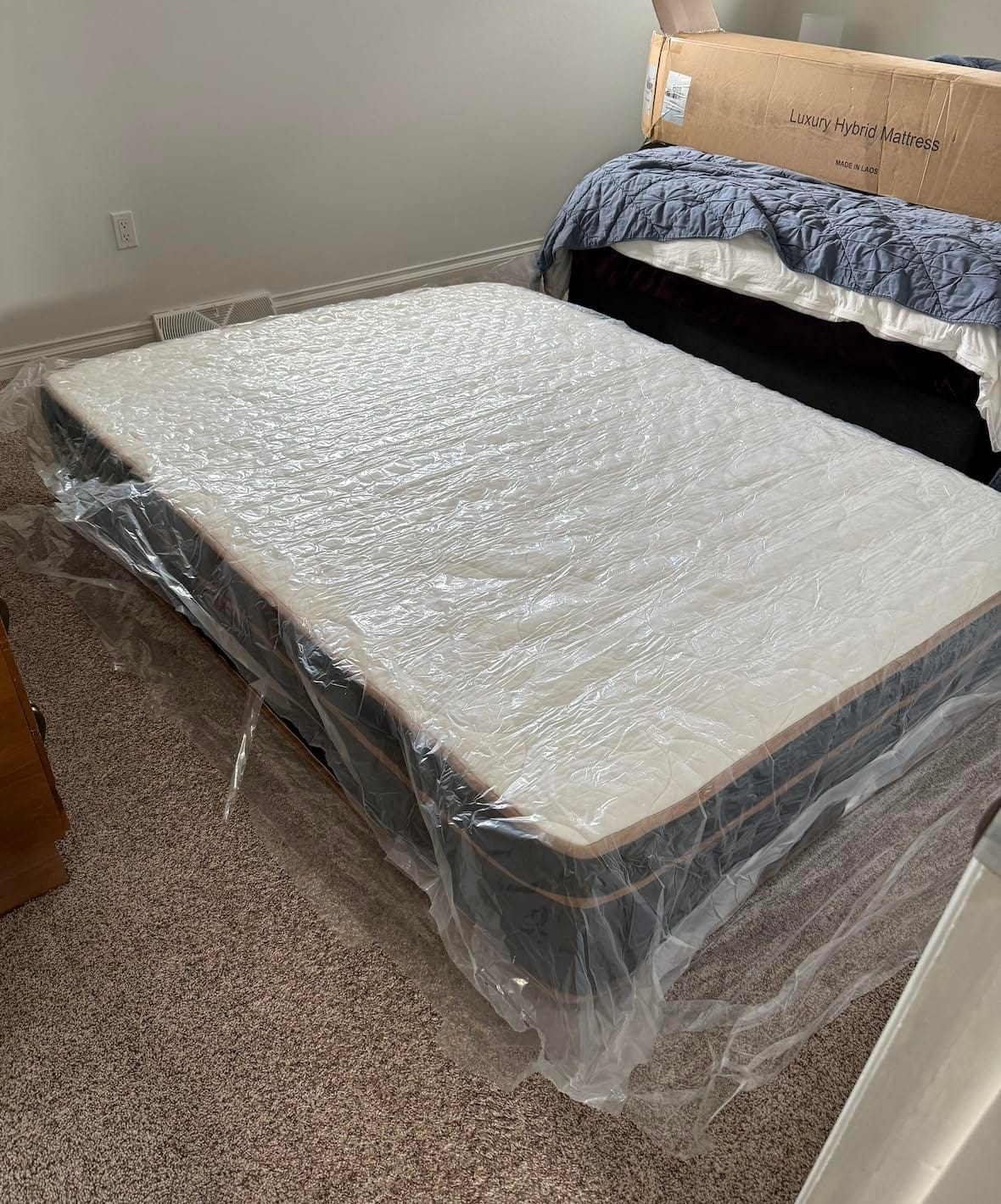
Also skip it if a washable cover is a non-negotiable requirement. And if you are moving it alone, be aware that at 109.7 pounds for a king, this is a two-person lift and the box is genuinely awkward.
2. UniPon Firm King Mattress 14 Inch – Best Value for 250 to 300 Pound Sleepers
Firm King Mattress, 14 Inch Hybrid Mattresses Hotel Collection with Back & Hip Support, Deep Sleep & Zoned Support, Fiberglass-Free and CertiPUR-US Certified, 365-Night Trial, 10 Years Warranty
Firm hybrid with 2.0mm pocket coils
CertiPUR-US certified
Fiberglass-free
10 year warranty
Pros
- Reinforced 2.0mm steel coils claimed to be 70 percent more stable
- Balanced firm feel that works for back and stomach sleepers
- Breatheable knit cover with cooling gel-infused foam
- Good edge support after initial break-in
- Meets CFR1633 flammability standards
Cons
- Some reviewers report early softening in the sleeping area within days
- Setup should be unboxed off the frame to avoid rapid expansion issues
This is the mattress I recommend when someone is in the 250 to 300 pound range and wants the least amount of drama. It does not make a dramatic claim about being built for plus-size sleepers, and it does not need to. The construction speaks for itself: 2.0 mm individually wrapped steel coils, high-density comfort layers, and a firm rating.
Owner reports describe a firm feel that is supportive without punishing, which is a difficult balance to hit. Plenty of mattresses aimed at heavier bodies overshoot into what feels like a plywood surface, and the complaint from heavier sleepers on those models is hip and shoulder pressure rather than support.
The listing claims the reinforced pocket coil system is 70 percent more stable and resistant to sagging. We cannot independently verify that figure, but it aligns with what owners report about holding shape over time, which is the outcome that actually matters.
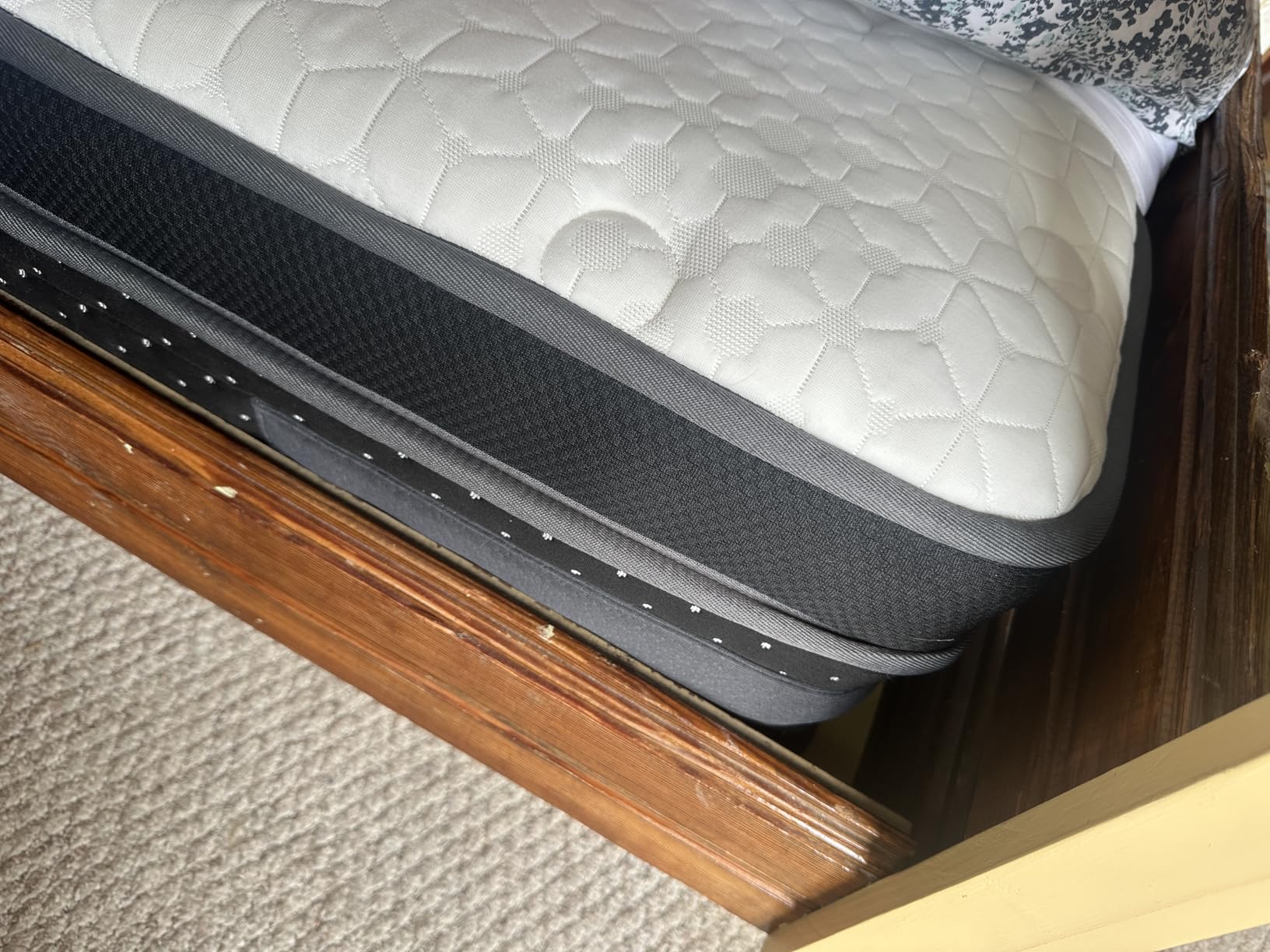
Cooling is handled through three layers working together: a breathable knit cover, cooling gel-infused foam, and airflow-promoting pocket coils. Any one of those alone would be marginal for a hot sleeper. Together they are a reasonable answer to the overheating problem that heavier bodies hit on all-foam mattresses.
The 10 year warranty is the other quiet strength here. Among mattress-in-a-box options, a decade of coverage on a firm hybrid puts this in a small group, and it is backed by CertiPUR-US foams, OEKO-TEX fabrics, and a fiberglass-free build meeting CFR1633 flammability standards.
There is one real wrinkle. Several owners reported early softening in the sleeping area within the first few days, before the mattress had finished its break-in. Anyone who judges comfort in week one is likely to be disappointed by this model.
Reinforced Coil Gauge and Edge Support
The 2.0 mm steel coil is a deliberate bump over the thin wire used in budget constructions, and reinforced individually wrapped coils are what separate this model from a generic pocket spring king. Wire gauge is the single most under-discussed number in mattress specifications.
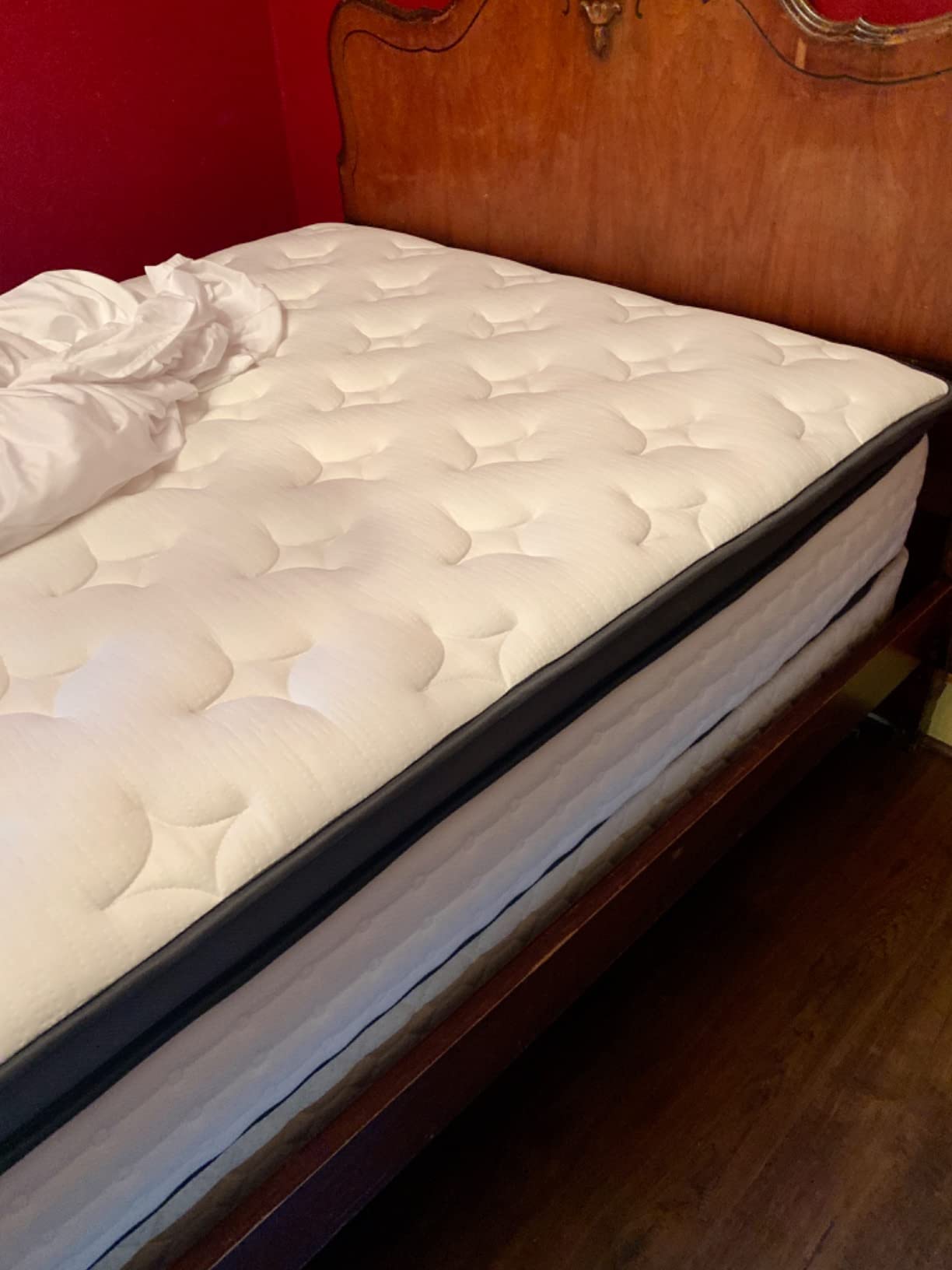
Edge support here is described as good once the mattress has broken in, which is the normal pattern for foam-over-coil hybrids. The comfort foam above the coil unit softens under foot traffic near the perimeter, and after a few weeks it stops moving and the coils carry the full load again.
Firmness, Feel, and Sleep Position Fit
Of the ten mattresses here, this one has the most moderate interpretation of firm. That makes it a safer recommendation for sleepers who are uncertain whether they want a truly extra-firm surface, and it pairs well with both back and stomach sleepers who need lumbar support.
For side sleepers at the top of this weight range, it works but it is not the most pressure-relieving option here. The owners who report the best outcomes tend to be back and stomach sleepers, or combination sleepers who spend less time on one shoulder than the other.
Who Should Skip This Mattress
Skip it if you are a dedicated side sleeper in the 300 pound range or above, because the top comfort layer is not thick enough to distribute shoulder pressure. The VISCOFLEX or BedStory are better targeted for that combination.
Skip it if you insist on a long in-home trial. This is a 10 year warranty, not a 365-night trial, and the difference in risk is substantial for anyone buying without ever having laid on the mattress.
Bed Frame and Foundation Compatibility
A king at 107 pounds is heavy enough that the frame matters. Use a slatted base with slats no more than 4 to 6 inches apart, and add a center support leg, because a 14-inch king across the unsupported middle of a platform frame is precisely how the dip you are trying to avoid forms.
3. VISCOFLEX Extra Firm Queen Mattress 14 Inch – Best Budget Hybrid for Heavy Side Sleepers
Extra Firm Queen Mattress 14 Inch, Deep Sleep Hybrid Mattress for Lumbar Support & Back Side Sleepers, Pain Relief Mattresses in a Box with Pocket Springs & Cooling Gel – 365-Night Trial, CertiPUR-US
500 high-compression pocket springs
Firm 14 inch profile
Open hybrid airflow
365-night trial
Pros
- High-compression industrial-grade steel springs that hold shape
- Open structure promotes continuous airflow versus all foam
- Targeted shoulder and hip cushioning for side sleepers
- Enhanced lumbar support for back sleepers
- CertiPUR-US and OEKO-TEX certified
Cons
- Only a 3 layer build so the surface is less plush than taller hybrids
- Low layer count means a firm protector fitted to a taller profile will not sit correctly
The VISCOFLEX earned its spot on the strength of one number: 500 high-compression industrial-grade steel pocket springs in a 14-inch profile. Coil count on a queen is the number that separates builds that last from builds that soften, and 500 is a substantial distribution across that surface area.
Its open hybrid structure is the sleeper-friendly feature. An all-foam mattress has no air channel running from edge to edge, so body heat accumulates in the comfort layer and stays there through the night. The coil matrix here acts as a ventilation system, and heavier bodies run hotter enough that this makes a measurable difference.
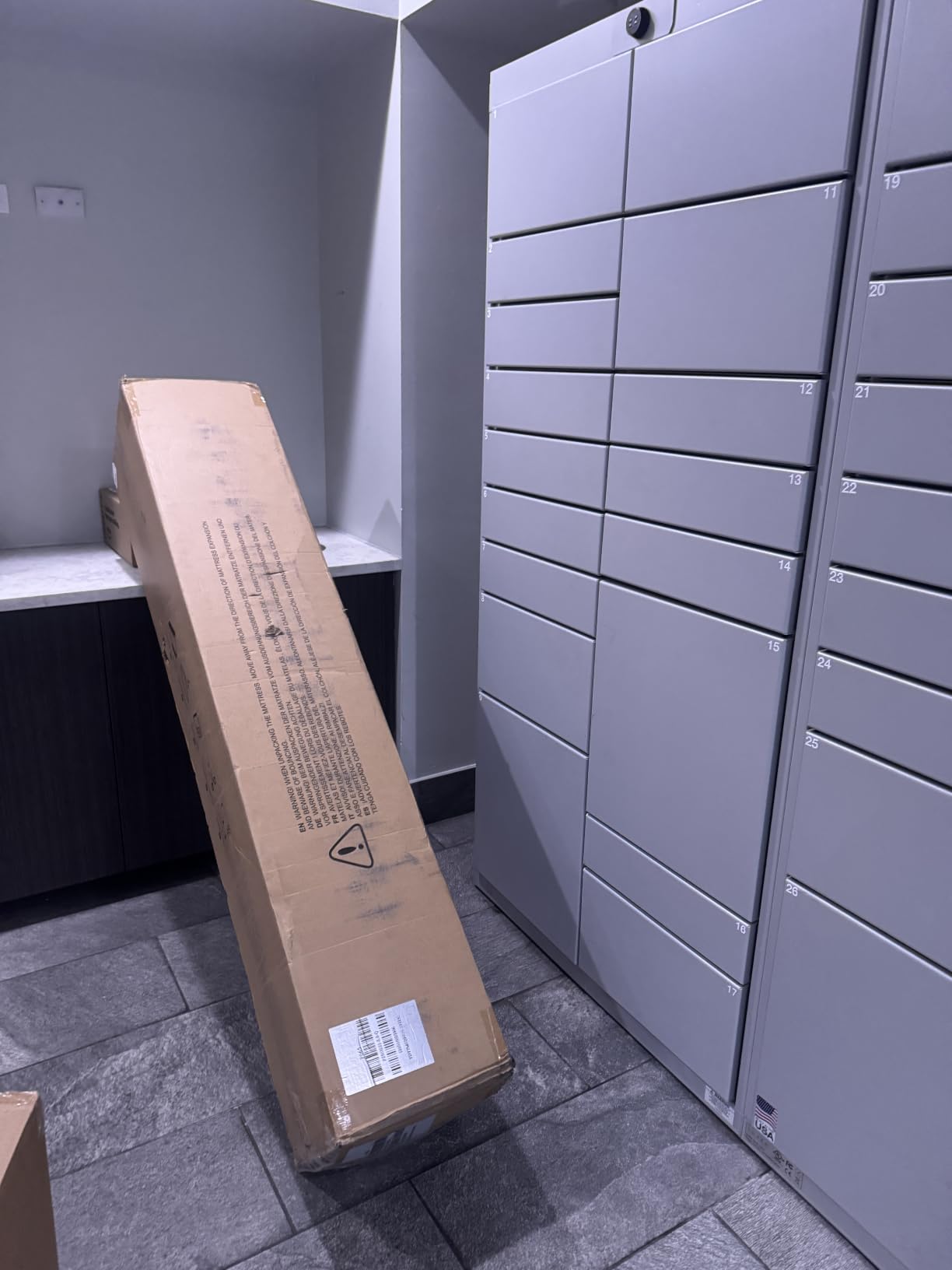
The construction is only three layers, which is the honest limitation. You are not getting a deep comfort stack, and the result is a firm surface rather than a cushioned one. For a heavier side sleeper that is often the right trade, since a thicker soft top just compresses and stops helping.
Motion isolation is a second strength, with the pocketed coils claimed to absorb 83 percent of motion before it crosses to the other side of the bed. Independently sprung units genuinely do behave this way, and for a couple where one partner is a restless mover, it is worth more than most people expect.
Materials are fiberglass-free with ultra-low VOCs meeting CertiPUR-US standards, and the warranty is a 365-night home trial with 10 years of coverage. That is a more generous risk reversal than most mattresses in this tier offer.
Be aware that the mattress arrives compressed and needs a real expansion period before you judge the feel. Give it the full time the manufacturer recommends, and do not decide on day one.
Why Coil Count Predicts Longevity
Every coil in this build is high-compression industrial-grade steel, and the count determines how much load each individual spring carries. Fewer springs at the same thickness means each one works harder, and springs that work harder fatigue faster. The failure shows up as a dip directly under the hips and shoulders.
Compare 500 industrial-grade pocket springs to a build with a couple of hundred thin-gauge coils in a similar price range and the durability difference becomes clear. This is the mechanical reason the VISCOFLEX holds shape where cheaper foam-dominant models do not.
Airflow, Cooling, and Hot Sleepers
The listing describes the open hybrid structure as acting like ventilation channels to promote continuous airflow. That is not marketing filler. Air moves through a coil-and-foam hybrid in a way it cannot through a solid foam block, and the practical result is a noticeably cooler sleeping surface over a full night.
For heavier sleepers specifically, this matters more than the category average. More body mass means more heat generated through the night and more surface area in contact with the mattress, so the cooling margin available in a foam bed is smaller precisely when you need it most.
Targeted Support by Sleep Position
The cushioning is tailored differently for side and back sleepers: softer at the shoulders and hips where side sleepers carry load, and firmer through the lumbar region where back sleepers need support to keep the spine neutral. On a firm surface with limited layer depth, that zoning does most of the comfort work.
Stomach sleepers get less attention in the design than side and back sleepers do, so if you sleep on your stomach the lumbar support is something to check closely in person if at all possible.
Who Should Skip This Mattress
Skip it if you want a plush or cushioned surface. Three layers with a firm rating will never deliver that, and adding a topper is the only realistic way to soften the feel.
Skip it if the queen size is not right for you. This is the only queen in the roundup, so anyone sleeping alone in a room with a smaller frame should verify dimensions first, and anyone sharing it with a partner should read the two separate mattress section before deciding.
4. RRESTA Extra Firm King Mattress 14 Inch – Best for 300 Pound Side Sleepers
RRESTA Extra Firm King Mattress 14 Inch, Luxury Hybrid Mattress in a Box for Deep Sleep & Lumbar Support, CertiPUR-US & Zero Fiberglass, 365-Night Trial
Pocket spring hybrid
Gel memory foam layer
Anti-sag reinforced perimeter
365-night trial
Pros
- Hundreds of individually wrapped pocket coils isolate motion
- Targeted lumbar and hip support for back pain relief
- Open-coil matrix promotes 30 percent more airflow
- Reinforced perimeter expands usable surface by 20 percent
- CertiPUR-US foams with a zero-fiberglass barrier
Cons
- Firmness sits at the very firm end of the scale
- Compressed bed-in-a-box requires unboxing tools and effort
The RRESTA is built around a single idea that matters enormously at higher body weights: expand the usable sleeping surface. The reinforced perimeter is claimed to add 20 percent more usable area and to stop edge roll-off when sitting, which is a practical benefit rather than a spec-sheet nicety.
On a king, edge comfort determines how much of the surface you can actually use. A mattress where sitting on the border causes a collapse effectively shrinks your sleeping area every time you do it, and for a heavier body the effect compounds quickly.
Motion isolation is handled by hundreds of individually wrapped pocket coils, and this is a model we would particularly recommend for a couple. The open-coil matrix is claimed to move 30 percent more airflow than solid foam construction, which addresses the overheating problem head on.
The foam content is gel memory foam over a pocket spring core, and the fill material is listed as gel memory foam with a knit textile cover. The whole build is CertiPUR-US certified with a zero-fiberglass protective barrier, which is worth having for anyone with chemical sensitivity.
Zoned reinforcement is positioned to support the lumbar and hip regions specifically, and the listing positions the mattress as an orthopedic recovery option for athletes and side sleepers dealing with morning lower back stiffness. That is a real use case for heavier sleepers, where a soft midsection and a firm frame combine to torque the lumbar spine.
The 365-night trial and lifetime service arrangement give a longer evaluation window than most. What they do not give you is a soft landing, because the firmness here is at the very firm end of the scale and will not suit everyone.
Perimeter Reinforcement and Edge Support
Most mattresses have a foam border that compresses under sitting pressure and never fully recovers, and this one specifies an ultra-dense perimeter support system instead. Higher density foam resists permanent compression, so the edge keeps its shape over years rather than months.
That 20 percent usable surface claim is the practical number to remember. It is the reason a heavy sleeper can stretch out across a king without one arm hanging over the edge, which on a softer mattress would push them into a position that bends the spine sideways all night.
Airflow and Temperature Control
Heat retention is the complaint we hear most often from heavier sleepers on foam mattresses, and the fix is structural rather than cosmetic. An open-coil matrix lets air circulate through the core instead of trapping it, and the claim of 30 percent more airflow than traditional foam beds is consistent with how these two constructions differ.
The knit textile cover is a reasonable second layer of heat management. Knit fabrics generally ventilate better than tightly woven polyester, and it is worth noting this mattress has no gel-infused topper logic beyond the memory foam, so the airflow does the work here.
Who Should Skip This Mattress
Skip it if you want a moderate or plush feel. Extra firm with a reinforced perimeter and no deep comfort stack will feel like sleeping on a supportive floor, and lighter sleepers in particular will find it punishing.
Skip it if you will be setting it up alone. The king weighs 98.7 pounds and ships compressed with a plastic opener included, so it is manageable but genuinely a two-person job on a tall frame.
Warranty and Trial Terms
A 365-night trial plus lifetime service is more coverage than most of the roundup, and for a category where fit is so personal, the length of the evaluation window matters as much as the warranty behind it.
5. MLILY EGOHOME King 14 Inch Memory Foam Mattress – Best All-Foam Option with a Published 500 Pound Capacity
MLILY EGOHOME King 14 inch Memory Foam Mattress for Back Pain Relief Firm
Firm all foam build
500 pound capacity
Copper gel aerofoam layer
Graphene cooling cover
Pros
- Published 500 pound weight capacity for a foam mattress
- Thickened high-density base foam for a supported feel
- Copper gel aerofoam regulates moisture and odor
- Graphene cooling cover for temperature regulation
- Endorsed by the International Chiropractors Association
Cons
- No trial period and opened mattresses cannot be returned
- Requires up to 12 hours of expansion time
- All foam construction traps more heat than hybrid builds
I want to be straightforward about this one: all-foam mattresses are the category most criticized by heavier sleepers, and Reddit threads on this topic name them repeatedly as a durability mistake above roughly 250 pounds. That is why the MLILY is worth including anyway, because it does two things most all-foam beds do not.
First, it publishes a 500-pound weight capacity. That is a specific, checkable claim that forces the manufacturer to stand behind its foam density, and it is the number that separates a genuinely heavy-duty foam build from a marketing page with the word “plush” on it.
Second, it uses a thickened high-density base foam. Base foam is what actually carries the load, and in a cheap all-foam bed the base is soft and thin, which is precisely why those beds bottom out. A reinforced base changes that equation.
On the cooling side, the design pairs a copper gel aerofoam top layer with a graphene-infused cover. Copper and graphene are both marketed as heat and moisture regulators, and combined they make a reasonable case for a foam bed that does not run as hot as its category reputation suggests.
This is also a high-volume listing, ranking in the top ten of the Mattresses category, and it carries an 840-review base. That volume matters for a category where the durability question only resolves over years.
The endorsement from the International Chiropractors Association and the CertiPUR-US certification are worth noting for anyone who wants documented third-party validation rather than a brand claim.
Why Most All-Foam Mattresses Fail for Heavier Sleepers
The mechanism is simple. Comfort foam compresses under load and recovers slowly, and a heavier body compresses it deeper. If the base layer beneath is thin or low-density, it compresses too, and once the support layer bottoms out there is nothing left to push back against your hips and shoulders.
Owners on r/Mattress describe this bottoming-out sensation as the moment they stop trusting a foam mattress. The distinguishing detail in the complaints is that it feels fine for a while and then one morning the bed simply does not feel right anymore, which is the point of no return for the product.
Heat Management in an All-Foam Build
Even with a graphene cover, an all-foam mattress loses to a hybrid on airflow, and we would not argue otherwise. The best practical mitigation for a heavy sleeper on a foam bed is airflow at the room level: a breathable base layer, bedding that does not trap moisture, and a cooler sleeping environment.
The copper gel aerofoam top layer is the mattress-side lever. Gel-infused foams are marketed on heat dissipation, and owners with the heat problem report it helps, though it is a reduction rather than a solution.
The Return Policy You Need to Read
This is the most important detail in the entire listing and it is easy to miss. The technical section states plainly that there is no trial period and opened mattresses cannot be returned. The warranty is a 10 year limited warranty, which protects against defects, not against a mattress that simply does not suit you.
That distinction is decisive for heavier sleepers specifically, because fit matters so much at higher body weight. If you cannot test a firm foam mattress in person and have no way to return it if the feel is wrong, the risk is real. Plan for 12 hours of expansion before first use.
Who Should Skip This Mattress
Skip it if you run hot in a way that keeps you waking up damp, or if you want a trial period. Do not skip it if you have a strong preference for foam, need a 500-pound rated capacity from a non-coil build, or want the motion isolation that comes from a single continuous foam block.
6. Sweetnight CoolNest 14 Inch King Mattress – Best for Heavy Sleepers Who Run Hot
Sweetnight CoolNest 14 Inch King Size Mattress,Cooling Memory Foam Mattress
6 layer all foam build
CoolNest phase change and gel foam
5-zone ergonomic support
Medium feel
Pros
- PCM high-resilience foam with gel memory foam for a cool surface
- 3D-woven cover improves breathability by 35 percent
- 5-zone support design redistributes pressure head to toe
- Multiple foam layers absorb motion between partners
- Expands quickly with minimal off-gassing
Cons
- Top surface is not quilted so the feel is flatter than cushioned models
- Polyester cover feels synthetic compared with cotton
- Medium firmness is less supportive for the heaviest bodies
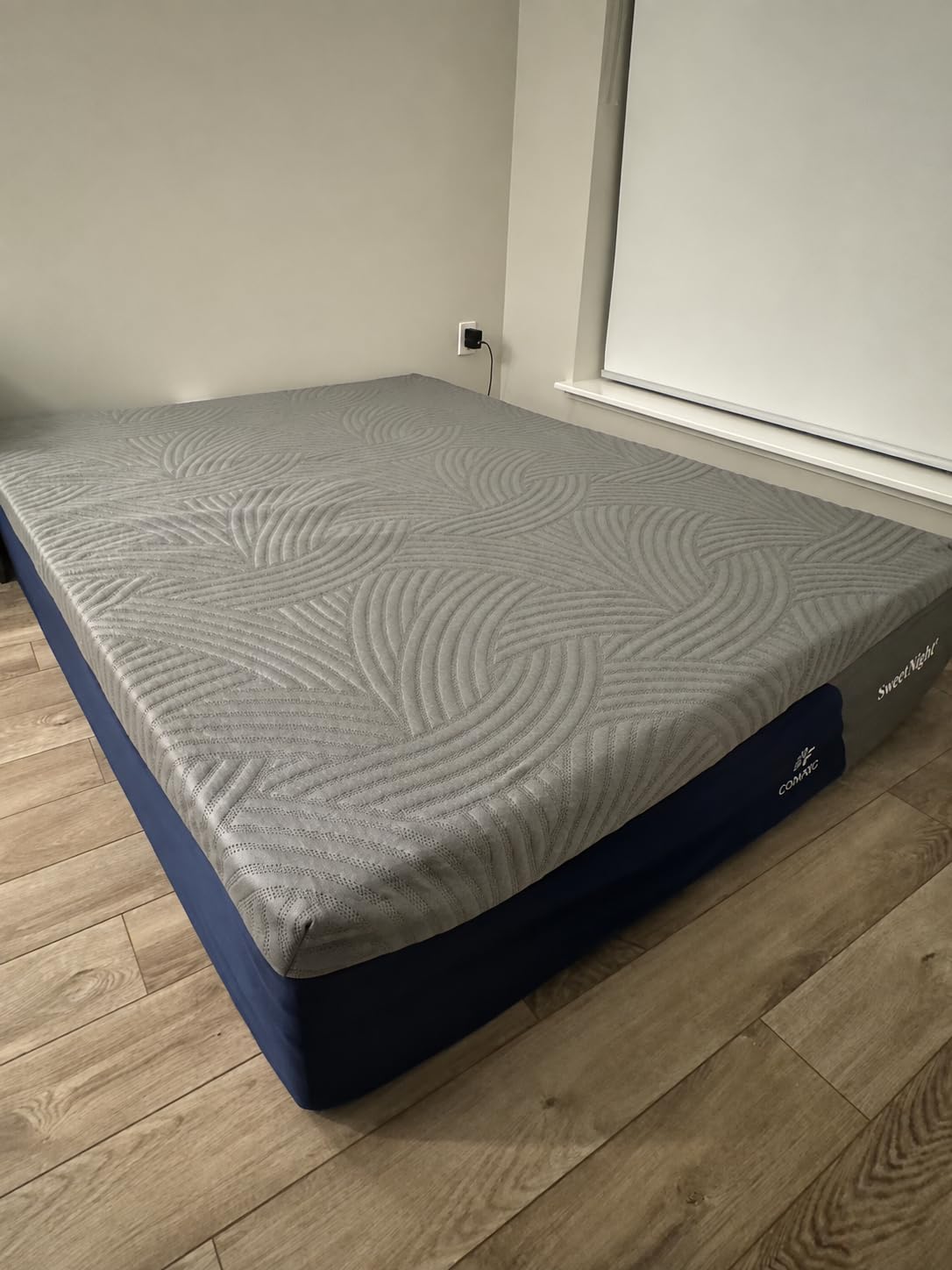
With 1074 reviews, the Sweetnight has the largest review base of anything in this roundup, which makes the pattern in its feedback unusually clear: the cooling works, the support works for a broad weight range, and the complaints are all about surface feel rather than structural problems.
The cooling system combines PCM high-resilience foam with gel-infused memory foam. Phase change material absorbs heat as the body warms it and releases it as the body cools, and it is a genuine physical mechanism rather than a marketing term, so we are comfortable explaining why it helps.
The 3D-woven cover is claimed to improve breathability by 35 percent over standard fabrics, and the hollow-structure PCM foam promotes what the listing describes as 3X airflow. Layered ventilation on the surface and in the core is what separates this from a foam bed with a marketing-friendly cover.
Owners report the most consistent outcomes in back, neck, and shoulder pain reduction, and several describe comparing it favorably to mattresses costing considerably more. For a heavy sleeper whose heat problem was keeping them from sleeping through the night, the temperature result is often the outcome they notice first.
The 5-zone support design is recognized by the American Chiropractic Association and redistributes pressure from head to toe, which matters when a heavier body concentrates load into a smaller area of the surface.
Two honest limitations come up repeatedly. The top surface is not quilted, so the hand feel is flat compared with cushioned-top mattresses, and the polyester cover has a slightly synthetic texture against cotton. Neither affects durability, but both affect whether the bed feels luxurious to you.
The Firmness Question for Heavier Bodies
This is a medium feel, and at the top of a heavy sleeper’s weight range that is the wrong direction. A medium surface compresses more under load, so a 350 to 400 pound sleeper will sink further into this than into any of the firm hybrids above.
For a 250 to 300 pound sleeper it is a genuinely good fit, and the review pattern supports that. The weight band this mattress serves best is its comfort band, and the cooling advantage holds across the whole range.
Off-Gassing, Expansion, and Setup Realities
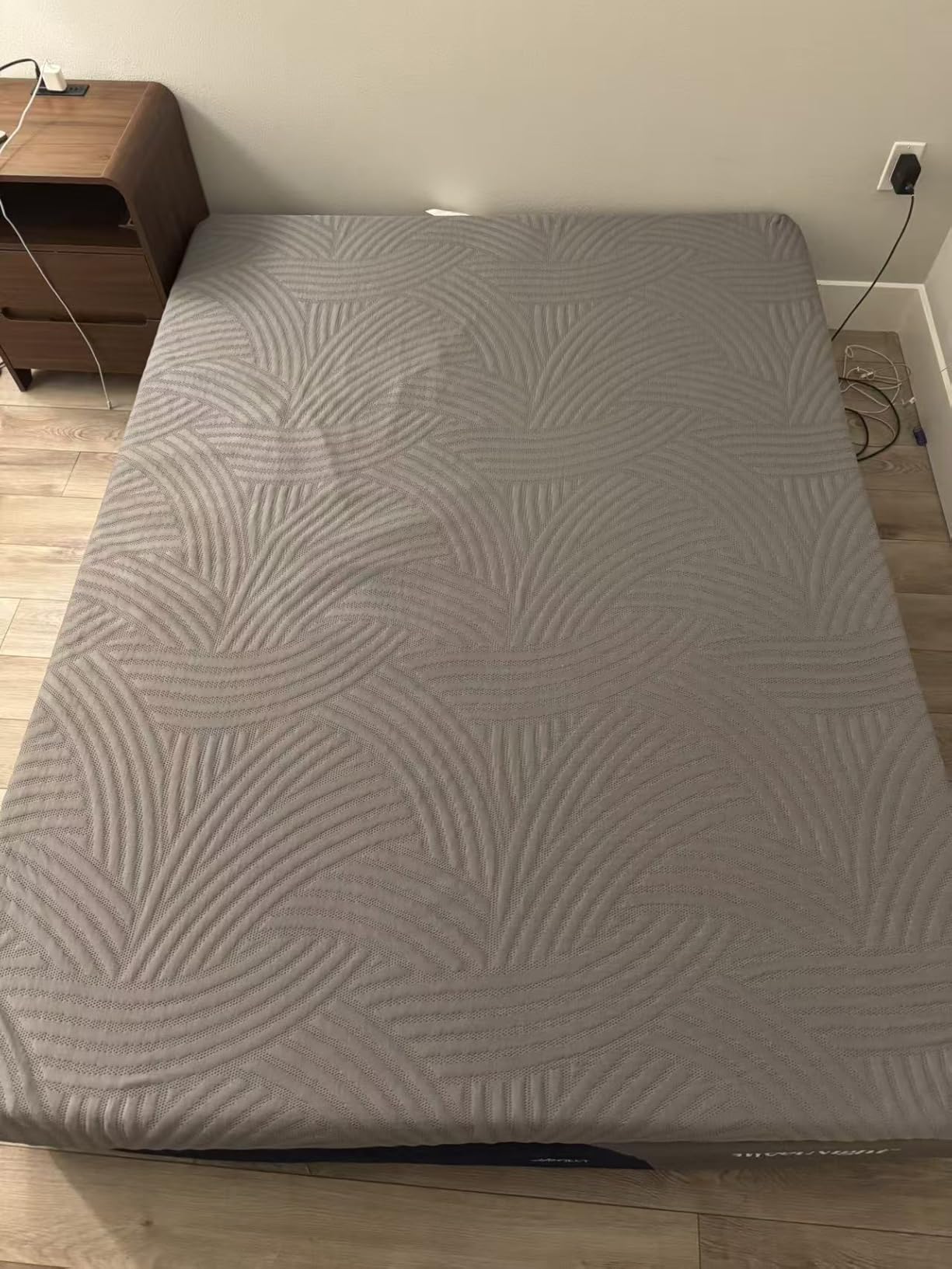
Expansion takes up to 72 hours, which is longer than most. The listing also notes minimal off-gassing odor, and owners confirm that the lack of smell is one of the nicer surprises of the setup, particularly for anyone sensitive to VOCs.
The cover is removable and washable, which none of the other picks here offers. Given that the polyester fabric is the single most criticized element, being able to replace or clean the cover over time is a genuine long-term advantage.
Who Should Skip This Mattress
Skip it if you are above 350 pounds and need firm support at the lumbar. Skip it if a quilted, cushioned top surface is important to how the bed feels, or if you want a natural fiber cover.
For sleepers between 250 and 320 pounds who run hot, this is the pick we would make without hesitation. Do not wait on it: give it the full 72 hours before deciding.
7. Bedtter 14 Inch Queen Mattress for Heavy People – Best for Sleepers in the 200 to 300 Pound Range
14 Inch Queen Mattress for Heavy People, Cooling Hybrid Mattress with Ice Silk Cover & Gel Memory Foam, 7-Zone Ergonomic Support, Extra Firm Bed with Strong Edge Support, No Sagging & Pressure Relief
Extra firm hybrid with 500 pocket coils
Ice silk cooling cover
7-zone support
Queen profile
Pros
- Cooling ice silk cover that feels cool to the touch
- 7-zone support relieves pressure on shoulders hips and back
- Hybrid gel foam and pocket coils reduce motion transfer
- Reinforced edge support for the perimeter
- Very quiet with minimal bounce when turning
Cons
- Listed weight capacity of 200 pounds is modest for this category
- Delivered height can differ from the labeled 14 inch profile
- Needs several days of air-up time before full performance
This mattress is named for heavy people on the label, but the specification sheet tells a more restrained story and I would rather tell you the real version. The listed weight capacity is 200 pounds, which is the lowest published number among the picks here, and that discrepancy is worth understanding before you buy.
What it does have is 500 pocket coils in a 14-inch profile with a reinforced edge, a 7-zone ergonomic support system, and a cooling ice silk cover. The construction is genuinely heavy-duty; it is the published capacity figure that undersells it relative to the competitors.
The 7-zone system targets the exact pressure points that heavier sleepers accumulate load on. Shoulders, hips, and lower back each get dedicated support, which is a more useful specification than a capacity number for anyone whose main complaint is discomfort rather than durability.
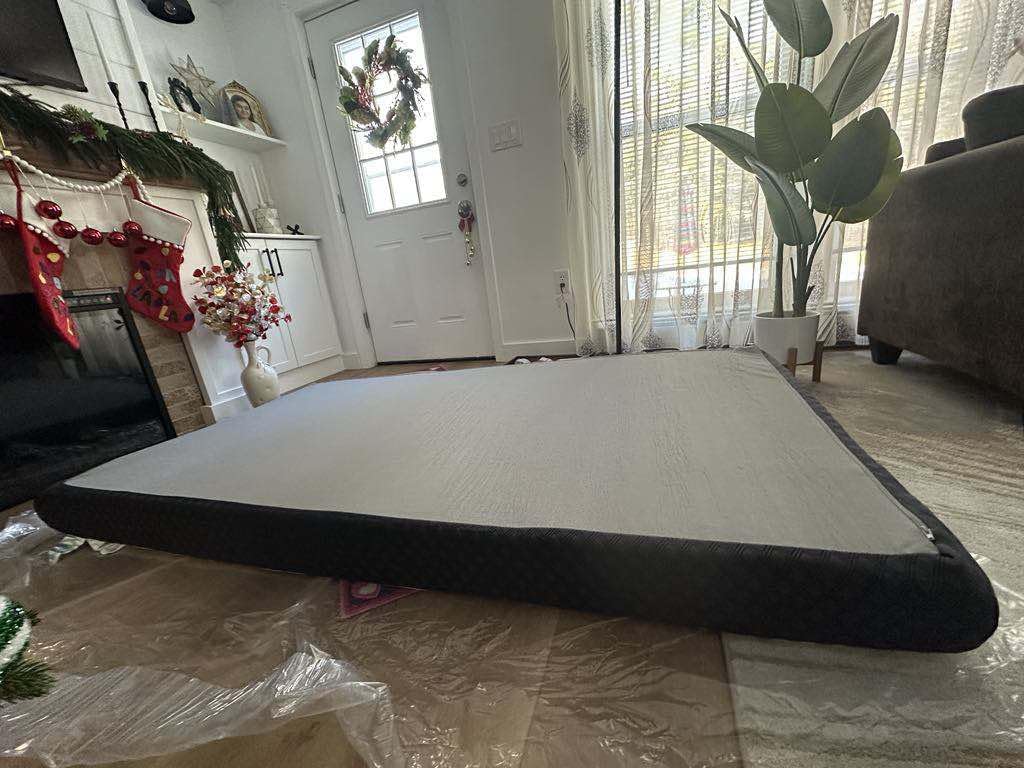
The ice silk cover is the feature owners mention first and most enthusiastically. It feels cool on contact and helps regulate temperature across the night, and in a category where overheating is one of the top complaints from heavier sleepers, a genuinely cool-feeling surface is worth a lot.
Motion transfer is low thanks to the combination of gel memory foam over individually wrapped coils, and owners describe the bed as very quiet with little bounce when turning. For a couple, that quiet stability is a meaningful advantage over an all-foam build.
The caveat that catches people out is delivered height. Some owners report the actual mattress height differing from the ordered 14-inch profile, which matters if you have a fitted protector sized to a specific profile. Measure your protector allowance before ordering.
Weight Capacity Versus Actual Suitability
This is the clearest example in the roundup of why the two concepts have to be separated. A 200-pound listing does not mean the mattress fails above that weight; it means the manufacturer has declined to warrant it above that weight.
The 500 pocket coils and 14-inch profile suggest it will hold shape well beyond 200 pounds. What changes above the rated figure is not the structure but the accountability, because a warranty claim for a body impression would be handled differently by a manufacturer who never claimed support for that load.
Zone Support and Pressure Relief
Zoned support works by varying the density or thickness of material across the surface, so the regions carrying more load get more material under them. For a heavier body, that is a targeted response to the specific problem rather than a blanket increase in firmness across the whole bed.
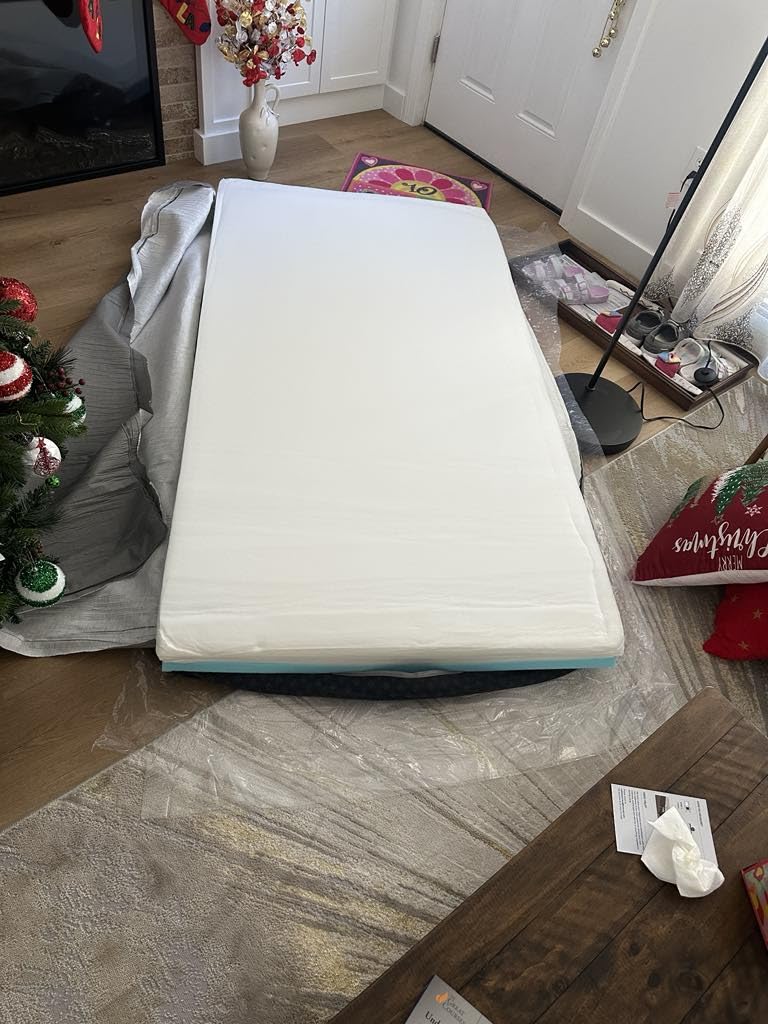
The charcoal foam layer and gel memory foam in the stack provide the pressure-relieving contour, while the pocket coils underneath handle the structural load. That division of labor is what keeps the top from bottoming out on this build.
Who Should Skip This Mattress
Skip it if you are over 300 pounds and want a warranty that clearly covers you. Skip it if you need long-term support in writing from the manufacturer, since the 200-pound figure is the ceiling they will stand behind.
Do buy it if you are between 200 and 300 pounds, sleep hot, want a quiet bed, and can accommodate a several-day air-up period before judging the feel. Also check your mattress protector height first.
8. BedStory 14 Inch Firm King Mattress – Best for Back Pain Relief at Higher Body Weights
BedStory 14 Inch Firm King Mattress,Cooling Gel Hybrid Mattresses –Targeted Lumbar & Shoulder Support for Back Pain Relief, Fiberglass-Free, CertiPUR-US Certified, 365-Night Trial
Firm hybrid with gel memory foam
Hundreds of stainless pocket springs
Targeted lumbar and shoulder support
Certified breathable knit fabric
Pros
- Users around 250 pounds report strong support and fewer morning aches
- Multi-layer foam and pocket spring system absorbs body pressure
- Independent stainless pocket springs absorb noise and vibration
- Breathable knit fabric with no noticeable chemical smell
- 365-night trial with 10 years of support
Cons
- The firm option runs firmer than buyers expect and may need a topper
- Edges do not hold shape well when some reviewers sit on them
- Requires 24 to 72 hours of expansion before use
The BedStory carries the highest average rating in this roundup at 4.8, and I want to address that directly rather than leaning on it. A 4.8 across 72 reviews is a small sample, and small samples skew high because the people who return a mattress rarely leave a one-star review afterwards.
With that caveat, the underlying feedback is consistent and specific. Owners around 250 pounds report feeling genuinely supported and waking with fewer aches, and the recurring theme in the reviews is lower back relief rather than a general sense of comfort.
The design targets that outcome directly. Hundreds of independent stainless steel pocket springs work separately to distribute load across seven body regions, and the multi-layer foam above them absorbs the body pressure that a coil alone would push into the spine.
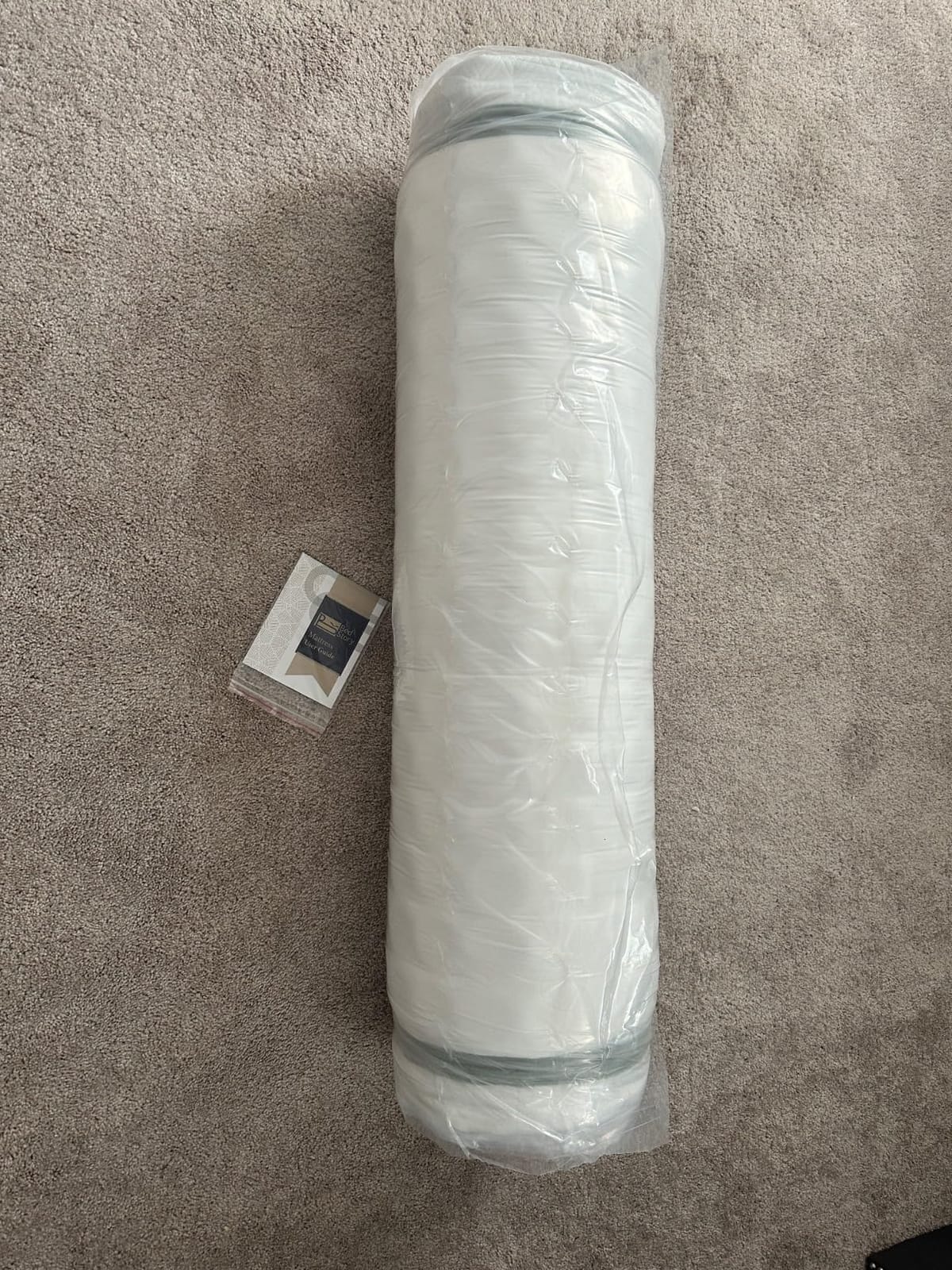
Materials are a point of differentiation: CertiPUR-US and Oeko-Tex Standard 100 certified fabrics, and fiberglass-free construction. Owners specifically mention no noticeable chemical smell, which matters because off-gassing complaints are common in this category and often attributed to lower-grade foam.
The warranty structure is 365-night trial with 10 years of support, and the manufacturer commits to professional support from a dedicated team. That is a reasonable risk reversal for anyone who cannot lie on the mattress before committing.
The most common owner note is that a 1.5 inch topper improves the experience considerably for anyone who wants a softer surface. That is a workaround rather than a defect, and it costs less than replacing a mattress you otherwise like.
Targeted Lumbar and Shoulder Support
Targeting is the difference between a mattress that is uniformly firm and one that is firm where you need support. A heavier sleeper pressing into a flat-firm surface gets lumbar support, but also gets shoulder and hip pressure they did not ask for, and the net result is worse rather than better.
By softening the shoulder and hip zones while reinforcing the lumbar, this build tries to solve the two problems at once. It is a more sophisticated approach than simply making the entire surface harder, and it explains why owners focused on pain report good outcomes.
Edge Weakness and Why It Matters at Higher Weight
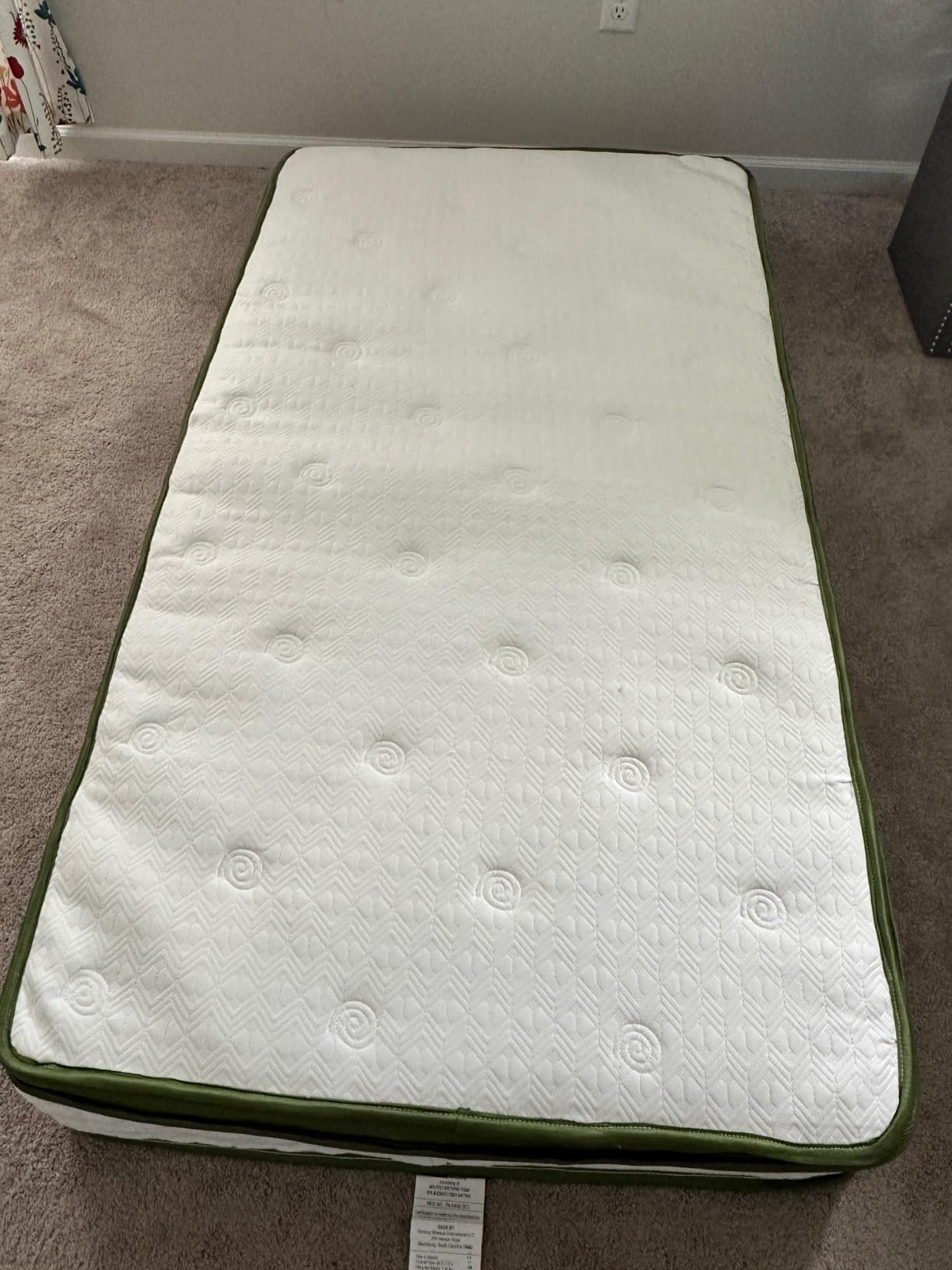
Some reviewers report that the edges do not hold their shape well when sitting on them. At a 250-pound body weight that is a minor annoyance. Above 300 pounds it becomes a structural issue, because repeated edge compression is the mechanism that pushes a mattress toward its center.
Compare this to the FP FLEXPEDIC and the RRESTA, both of which specify reinforced perimeter coils or ultra-dense perimeter support. If your weight is at the upper end of this mattress’s comfort range, the edge weakness is a reason to pick one of those instead.
Who Should Skip This Mattress
Skip it if you are over 300 pounds and plan to sit on the edge regularly, or if you are at 350 pounds and above where the edge reinforcement gap becomes decisive.
Skip it if you need a large volume of owner feedback over multiple years, since 72 reviews is a thin base for a durability judgment. Do buy it if you are around 250 pounds, have lower back pain, want certified low-odor materials, and are willing to add a thin topper.
9. Sleepmax Extra Firm Queen Mattress 14 Inch – Best for 400 Pounds and Above
Sleepmax Extra Firm Queen Mattress 14 Inch, Hybrid Mattress Pain Relieving
Extra firm 7 layer hybrid
965 pocket coils with quilted Euro top
Cotton cover
Back and side sleeper support
Pros
- Genuinely extra firm with owners confirming no sinking or sagging
- Users with back pain and post-surgery recovery report less stiffness
- Individually wrapped springs are silent and isolate motion
- Quilted Euro top holds its loft over time
- Seven layers with a cotton cover give a stable feel
Cons
- Very heavy at 89 pounds and realistically a two-person lift
- Extremely firm so too hard for anyone wanting medium or plush
- One reviewer reported a corner that stayed misaligned after expansion
For sleepers at 400 pounds and above, the list of acceptable mattresses gets short quickly, and this is the one on it that feels genuinely built for the job. Seven layers, 965 individually wrapped pocket coils, a quilted Euro top, and an extra-firm rating that owners consistently confirm does not sink.
That last part is the whole pitch. Extra-firm in this category is not a marketing adjective applied to a medium-plush bed; the owners describe a surface that holds its shape under a heavy body without the compression most mattresses show, and the language they use is about not sinking or sagging.
Back pain relief is the second recurring theme, and some owners describe waking without the morning stiffness they had on a previous softer bed. Several mention the context of post-surgical recovery, where spinal support matters more than anywhere else.
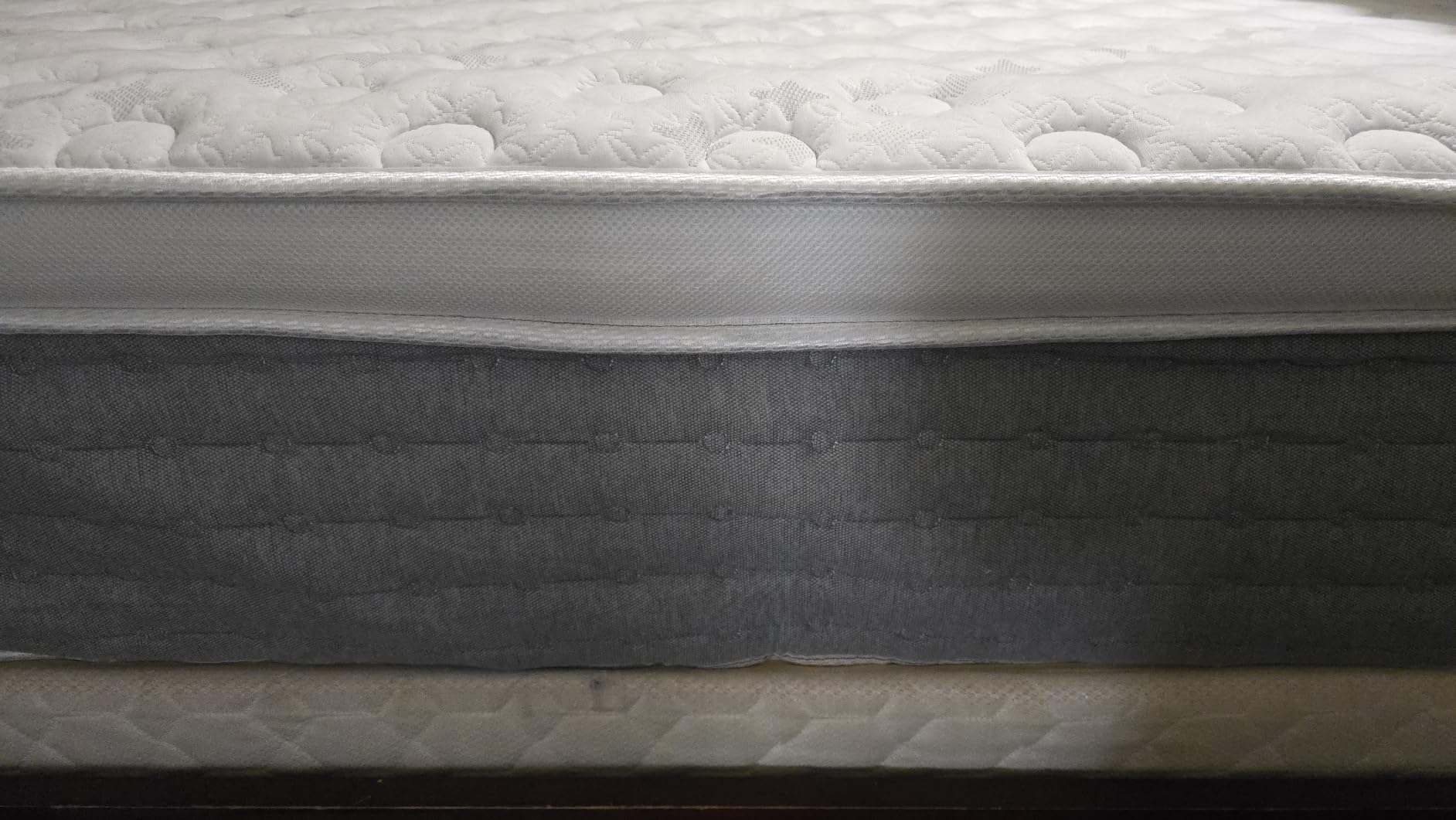
The quilted Euro top is a design choice with a durability payoff. A quilted top holds its loft because the filling is stitched into fixed sections, so it does not migrate or bunch over years the way a loose-fill pillow top can, which is a common source of uneven support in older mattresses.
Motion isolation comes from the individually wrapped springs, and owners note they are silent, which is unusual to get praise for and a real benefit in a shared bed. The cotton cover is also worth noting, since natural fiber covers are noticeably cooler and less prone to synthetic odor than polyester.
It works for both side and back sleepers, with strong lumbar alignment in both positions. That flexibility matters at higher weight, where an overly specialized mattress becomes a problem if your position changes at night.
Why 965 Pocket Coils in a Queen Is Significant
Nine hundred and sixty-five coils across a queen gives roughly 120 coils per square foot, and each one carries a fraction of the load it would on a sparse build. Individual wrapping means each spring compresses and recovers without dragging its neighbors, which is what keeps a heavy body’s weight from creating a dip.
This is the mechanical difference between a mattress that holds its shape at 400 pounds and one that does not. Coil density, not foam density, is the primary variable at the top of the weight range, because foam compresses permanently while steel springs recover elastically for decades.
Handling and Setup at This Weight Class
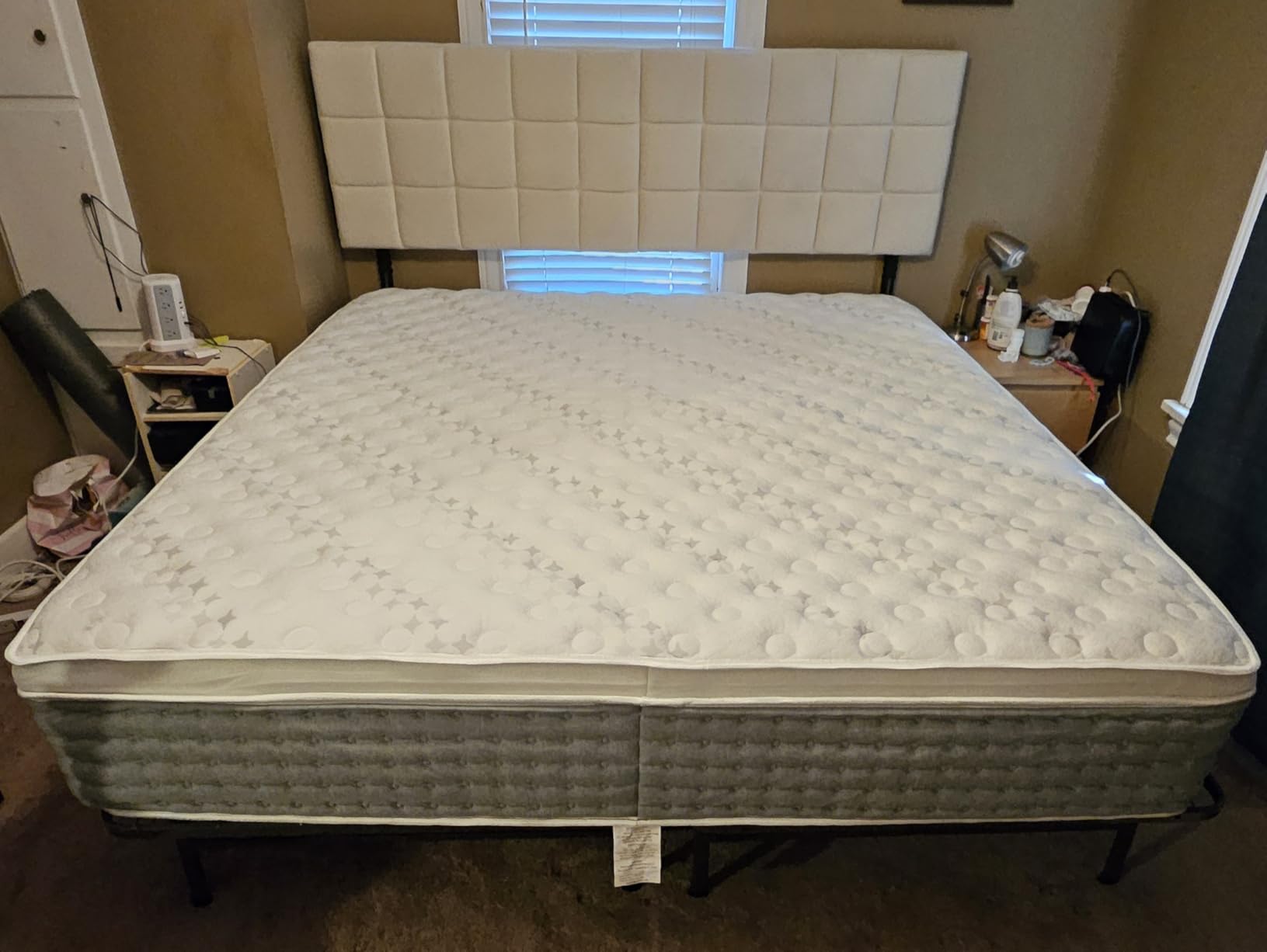
At 89 pounds for a queen, this mattress realistically needs two people to get onto a frame. Plan the setup with a second person, and unbox in the room rather than carrying it down a hallway if the route is tight.
Because it is so firm, break-in is not the issue it is on softer beds. What can be an issue is alignment, and one reviewer reported a corner that stayed misaligned after full expansion. Check the corners once it has had its full expansion period.
Who Should Skip This Mattress
Skip it if you are under roughly 250 pounds, or if you want anything close to a medium or plush surface. It is the least forgiving mattress in this roundup for anyone who is not specifically looking for maximum support.
Also skip it if you will be moving it alone. For sleepers at 400 pounds and up who can accept an extremely firm feel, this is the pick we would make.
10. ailis 14 Inch King Mattress in a Box – Best for Shared Beds with Different Body Sizes
King Mattress,14 Inch king size Mattress in a Box, Medium Firm Hybrid Mattress with Individually Wrapped Pocket Springs for Excellent Motion Isolation & Strong Edge Support, Cooler Breathable Sleep
14 inch king pocket spring hybrid
Medium firm feel
Breathable cover with gel foam
Reinforced edge support
Pros
- Medium-firm hybrid feel that avoids sinking for most sleepers
- Owners report back pain reducing within days of use
- Individually wrapped pocket springs minimize motion transfer
- Works on platform bases slatted frames or directly on the floor
- Expands evenly and quickly with virtually no odor
Cons
- Edges feel a little weak and cushiony for some users
- Some reviewers find it harder than expected for a medium-firm label
- Heavy enough that it expands forcefully when the vacuum plastic is cut
The ailis is a medium-firm hybrid, and we include it with a clear caution: this category is for sleepers roughly in the 180 to 300 pound range, not for the 400-pound-plus end of the spectrum. One reviewer at about 185 pounds already suggested heavier users step up to a more supportive model.
Within that band, the feedback is strong. Owners consistently report firm-but-comfortable support, a significant reduction in back pain within days, and low motion transfer between partners, which is what makes it a reasonable shared-bed option.
Motion isolation from the hundreds of individually wrapped pocket springs is the feature that matters most in a shared context. When two people sleep in one bed, the biggest complaint is disturbance, and spring isolation addresses it better than any foam construction.
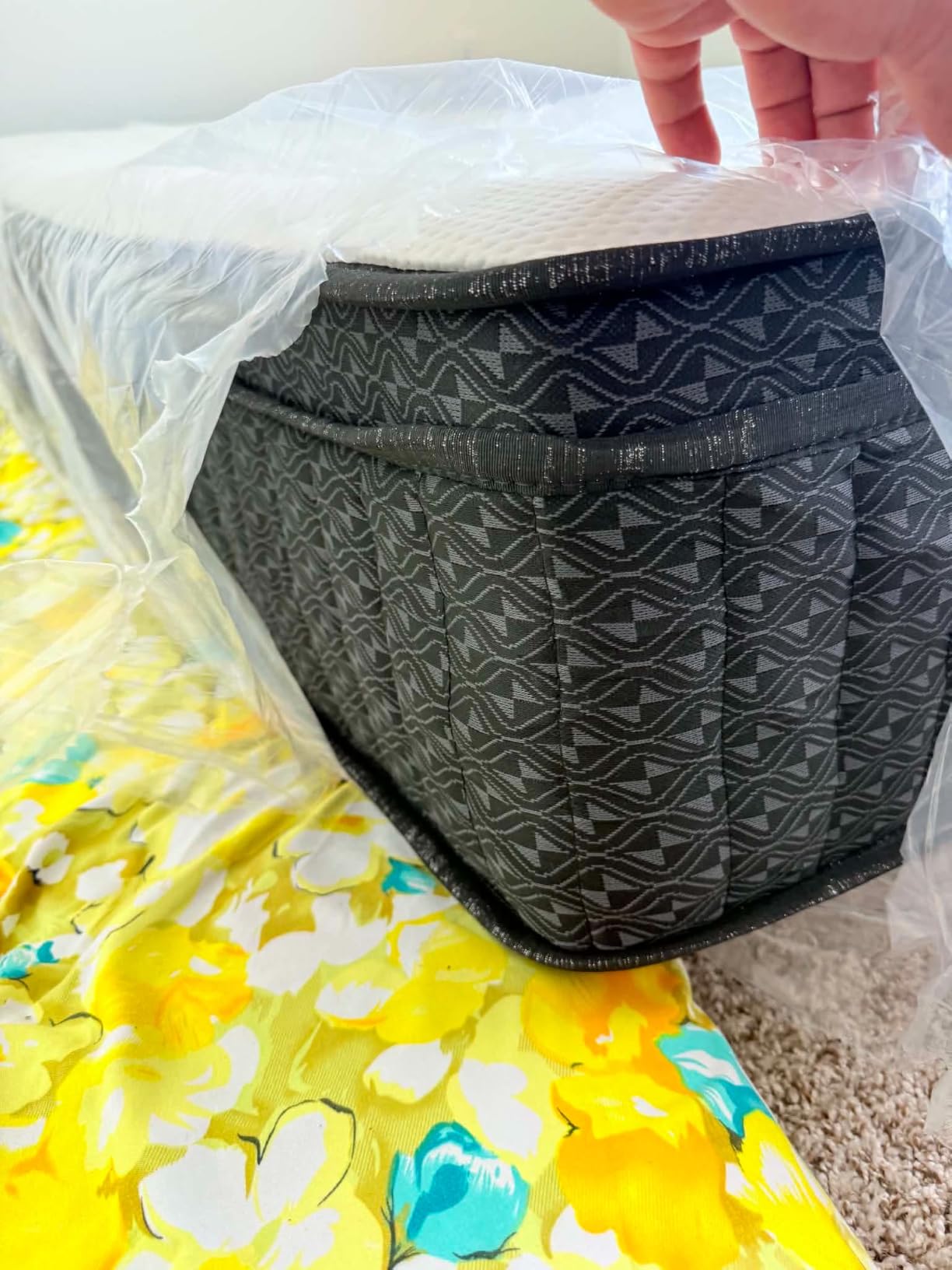
Setup flexibility is genuinely useful here. It works on platform bases, slatted foundations, or placed directly on the floor, which widens the range of frames it can go on and makes it a good option for renters who cannot modify their existing setup.
Owners also note fast, even expansion with virtually no odor, which is better than most in this category. Give it the full 72 hours the listing recommends before making a comfort judgment.
The weakness is edge support, and it is the same weakness that shows up on lighter builds. Some users describe the edges as a little weak and cushiony, and that becomes a real issue if you sit on the border regularly, because that repeated pressure is what drives center sag over years.
Medium-Firm Versus Firm: Where This Sits
Reviewers report a consistent discrepancy worth knowing before you buy. The listing says medium, and the experience leans firmer than many people expect from that word, which is usually a good outcome for anyone in this weight range and a disappointing one for a light sleeper who expected some give.
The distinguishing feature versus the firm hybrids above is the gel-infused memory foam comfort layer over the springs, which adds a small amount of contouring that the extra-firm builds leave out. It is the compromise position in this roundup.
Shared Bed Considerations and Edge Weakness
If you share a bed with a partner of a different body size, the honest recommendation is two separate mattresses. Owners on r/Mattress reach the same conclusion, and the logic is simple: one mattress has to compromise between two bodies, and a heavier sleeper’s weight advantage means the comfort layer favors them.
Two smaller mattresses in a split king or a king frame with a central split give each person their own surface, and for two heavier sleepers it is the single change that improves both people’s nights. If you do share one mattress, reinforce the edges by not sitting on them, and rotate the mattress every three months.
Who Should Skip This Mattress
Skip it above 300 pounds, or if you need substantial edge reinforcement. Skip it if you are a light sleeper who genuinely wants a soft surface, since the actual feel runs firmer than the label.
Do buy it if you are in the lighter end of the heavy range, want a hybrid that works on almost any frame, and need motion isolation more than you need maximum edge support.
How to Choose a Mattress That Holds Up Under Your Weight
These are the criteria we used to rank the ten mattresses above, in the order they matter. If you remember nothing else, remember that coil count and edge support predict durability better than the brand name, and that your foundation predicts your mattress’s actual lifespan more than the mattress does.
Weight Limit Versus Comfort Range: The Number Buyers Misread
A weight limit is a structural claim. It describes the load below which the manufacturer expects the materials to perform within specification. A comfort range is a subjective judgment about how a body feels on the surface, and the two can point in completely different directions.
You can have a mattress rated for 800 pounds that feels terrible to a 300-pound sleeper if the surface is too firm, and you can have a 200-pound-rated mattress that a 240-pound sleeper sleeps on happily for years. The rated number tells you about the warranty conversation. The comfort question needs your body.
Also notice which number is being quoted. Some manufacturers publish a per-person limit, some publish a combined limit for two sleepers, and some publish both. A 500-pound combined rating is a 250-pound-per-person mattress, which is a completely different proposition from one rated 500 pounds for a single sleeper.
How Firm Should a Heavy Person’s Mattress Be?
Firm to extra firm, and the reason is mechanical rather than aesthetic. A soft comfort layer compresses under a heavier body, and once it compresses past the point of recovery the spine loses its neutral alignment and the sleeper ends up in a hammock that bends the lumbar spine all night.
The practical test is body position rather than a number. When you lie down your spine should form a straight line from neck to tailbone, with the dip between your lower back and the bed filled by the mattress rather than by you pulling yourself into a flatter position.
For stomach sleepers especially, firmness is not optional. That position puts the full weight of the torso onto the lumbar region, and only a firm surface keeps that region from dropping into a curve that inverts the spine’s natural shape overnight.
Which Mattress Type Handles Weight Best?
Innerspring and hybrid constructions handle weight best, and the reason is that steel springs recover elastically for decades while foam compresses permanently. Latex sits between the two, performing well if it is dense enough, though a soft latex layer will still compress over time.
All-foam is the weakest option for durability at higher weights, which is why the category has a poor reputation. The exception is a foam build with a thick, high-density base and a published capacity figure, which is the category the MLILY represents here.
Hybrid wins on the practical merits for most people because it combines foam for pressure relief with coils for structural support, and because the open coil matrix moves air. If a heavier sleeper is choosing one type over the others, choose the hybrid.
Edge Support Is the Most Underrated Feature
Edge support determines how much of your mattress you can actually use, and it is the first structural thing to fail under a heavier body. A reinforced perimeter of thicker-gauge coils or ultra-dense foam is the difference between a king you can stretch across and a king where the middle two-thirds is all you get.
It also has a durability cost people underestimate. Sitting on the edge to put on socks is a daily habit that compresses the perimeter foam hundreds of times a year, and each compression pushes material inward. This gradual inward creep is the primary mechanism behind the slow roll toward the center.
Cooling: Why Heavier Bodies Overheat More
More body mass means more heat generated over a night, and more contact area against the mattress. A foam mattress traps that heat because there is no air channel through the core, and the warmth has nowhere to go once the comfort layer absorbs it.
The effective fixes are structural. An open hybrid coil matrix moves air, phase change and gel-infused foams improve the surface temperature, and breathable knit or cotton covers outperform tight polyester weaves. Room-level airflow matters too: a breathable base layer and bedding that wicks moisture make a measurable difference.
Owners on r/Mattress report that coil-heavy hybrids wake them up noticeably less sweaty than foam beds of the same firmness, which is consistent with the airflow mechanism rather than with any difference in the foam itself.
Bed Foundation Checklist for Heavy Sleepers
The frame is where most warranty claims die, and the reason is almost always the same: the foundation did not meet the manufacturer’s requirements. Before any heavy mattress goes on a frame, confirm all of the following.
First, slats should be no more than 4 to 6 inches apart, since wider spacing lets a heavy body stretch the slats and create the very dip you bought the mattress to avoid. Second, a center support leg is essentially mandatory on any queen or king, because the unsupported center of a platform frame is the first place sag appears.
Third, use a solid foundation or a proper box spring rated for the load, not a lightweight metal frame with thin legs. Fourth, check the frame’s own weight capacity, because a mattress and two heavy sleepers frequently exceed what a furniture-showroom frame is built for.
Fifth, keep the bed tag. Warranty claims are routinely denied without it, and it is the fastest way to confirm what the manufacturer requires of your specific frame.
Decoding Warranty Language
A no-sag warranty is a specific claim with a specific measurement attached. Manufacturers measure the depth of the dip with a straightedge across the surface, and the threshold is usually 1 to 2 inches. A dip shallower than that is not a defect, and no warranty will replace it.
This matters because it explains the complaints. A mattress can feel noticeably hollow to you at a dip the manufacturer does not consider a defect, and that gap between subjective experience and contractual standard is where most dissatisfaction lives.
Watch for conditions too. Many warranties require an approved or matching base, rotation on a schedule, and the original purchaser holding the receipt. A lifetime warranty on a mattress-in-a-box is often a service agreement covering components rather than a replacement of the whole bed.
Rotation and the First 90 Days
Rotate your mattress head to foot every three months in the first year, then twice a year after that. It is the cheapest durability improvement available, and owners who follow it report noticeably fewer impressions at the same age as those who do not.
Give any new mattress its full stated expansion period before judging it. The range in this roundup runs from 12 hours on the MLILY to 72 hours on the ailis and the Sweetnight, and evaluating a mattress at day two is the most common source of regret in this category.
Frequently Asked Questions
What is the best mattress for overweight people?
The best mattress for overweight people is a firm or extra-firm hybrid built on individually pocketed steel coils with a thick high-density support core. Publish a weight capacity of at least 500 pounds for a single sleeper, a reinforced perimeter edge, and a warranty that covers body impressions. Coil constructions outlast all-foam builds at higher weights because steel recovers elastically while foam compresses permanently. In our roundup the FP FLEXPEDIC leads on listed capacity and edge support, and the VISCOFLEX offers the strongest budget build.
What type of mattress is best for a 300 lb person?
A medium-firm to firm hybrid is the right choice at 300 pounds. At that weight a well-constructed hybrid with moderate coil gauge and zoned lumbar support delivers everything needed, and the pressure that causes bottoming out on lighter builds is not yet severe. The UniPon and VISCOFLEX sit in this band. Above 300 pounds, move to thicker 14-inch profiles with reinforced perimeter coils. Below 250 pounds, almost any construction works.
Does a heavier person need a firmer mattress?
Yes, firmness is close to non-negotiable above roughly 250 pounds, and the reason is mechanical rather than preference. A soft comfort layer compresses under a heavier body, and once it passes the point of recovery the spine falls into a curve that the lumbar region was never meant to hold. Firm to extra-firm keeps the spine in a neutral line. Firmness is not enough on its own, though: a firm all-foam bed still bottoms out, so density and coil support have to back it up.
What is the best hybrid mattress for overweight people?
The FP FLEXPEDIC is the best hybrid here for heavier sleepers, combining 900 individually wrapped pocket coils with a reinforced 2.1-2.3 mm perimeter and an 800-pound listed capacity. For lighter budgets the VISCOFLEX pairs 500 high-compression steel pocket springs with an open hybrid structure that moves air well. The Sleepmax is the choice at 400 pounds and above with 965 coils, a quilted Euro top, and a genuinely extra-firm feel that owners confirm does not sink.
What kind of mattress won’t sink in the middle?
A mattress rated to avoid center sink needs a steel coil support core, a thick high-density base, and a reinforced edge. Foam compresses permanently under a heavy body while steel springs recover elastically for decades, so pocketed or innerspring constructions outlast foam. The frame matters as much as the mattress: slats no more than 4 to 6 inches apart and a center support leg on any queen or king. Rotating head to foot every three months slows impression formation further.
Which Mattress Should You Buy in 2026?
Here is how I would map these ten onto the situations people actually describe to us. If you weigh 300 to 400 pounds and share a bed, the FP FLEXPEDIC is the answer, because its 800-pound listed capacity, 900 pocket coils, and reinforced perimeter handle the load and the shared use at the same time. It is our editor’s choice and the only pick that publishes a capacity number at that level.
If you are in the 250 to 300 pound range and want the most support for the money, the UniPon gives you reinforced 2.0 mm coils, certified foams, and a 10 year warranty. If that same range is tighter on budget, the VISCOFLEX builds 500 industrial-grade pocket springs into a 14-inch profile for noticeably less, and the 4.6 owner rating is the second highest here.
If you run hot, the Sweetnight is the one whose cooling system is designed rather than incidental. If you run hot and are heavier than 300 pounds, move to the RRESTA or the VISCOFLEX instead, because the open coil matrix does more for airflow than any surface treatment. If back pain is the reason you are here, the BedStory is built around that outcome, and if you want the same outcome with a warranty you can lean on, the Sleepmax is the stronger long-term answer.
At 400 pounds and above, the Sleepmax is our pick, with 965 pocket coils and an extra-firm feel owners confirm does not sink. If you sleep cool and prefer foam, the MLILY is the only all-foam mattress here with a published 500-pound capacity, and you will need to accept that opened mattresses cannot be returned.
Whichever you choose, give it the full expansion period, use a slatted base with a center support leg, and rotate it every three months. Those three habits matter more to how long the mattress lasts than any specification on the list. If you also need a properly rated frame, our desk and frame picks for two people follow the same weight-rated-first approach we use here.