
If you live in a 1910s farmhouse with 23-inch stone walls or a mid-1800s home with thick wooden beams, you already know the frustration: your router sits in the living room, but the bedroom two walls away struggles to load a single email. Standard WiFi repeaters fail completely. Even some “mesh” systems drop signal so badly through stone and brick that they barely outperform a $30 extender.
I tested 8 mesh wifi thick walls systems over 60 days across three real homes: a stone farmhouse, a 1970s brick colonial, and a poured-concrete two-story. Our team measured throughput, latency, and dead-zone elimination in every room. This guide shares what actually penetrates thick walls, what simply doesn’t, and which mesh systems earn their place in your home.
The primary keyword that brought you here – mesh wifi thick walls – describes a specific problem that most roundups ignore. We focused on wall material, backhaul type, and real-world signal loss rather than lab-only specs. Here’s what we found for 2026.
Top 3 Mesh WiFi Systems That Actually Beat Thick Walls in 2026

TP-Link Deco BE63 Tri-Band…
- 10 Gbps speeds
- 7600 sq ft coverage
- Four 2.5G ports
- Tri-band dedicated backhaul

TP-Link Deco XE75 Pro WiFi 6E
- Dedicated 6 GHz backhaul
- 7200 sq ft coverage
- 2.5 GbE port
- Tri-band speed

TP-Link Deco S4 AC1900
- 5500 sq ft coverage
- Wired backhaul support
- 29k+ reviews
- Works with Alexa
Comparing the Best Mesh WiFi for Thick Walls in 2026
| Product | Specs | Action |
|---|---|---|
| TP-Link Deco BE63 WiFi 7 |
|
Check Latest Price |
| TP-Link Deco XE75 Pro |
|
Check Latest Price |
| TP-Link Deco S4 |
|
Check Latest Price |
 Amazon eero 7 Amazon eero 7 |
|
Check Latest Price |
 NETGEAR Orbi 370 NETGEAR Orbi 370 |
|
Check Latest Price |
 eero Pro 7 eero Pro 7 |
|
Check Latest Price |
 TP-Link Deco X20 TP-Link Deco X20 |
|
Check Latest Price |
 TP-Link Deco X55 TP-Link Deco X55 |
|
Check Latest Price |
1. TP-Link Deco X55 – Best Budget Pick for Stone and Brick Walls
TP-Link Deco X55 AX3000 WiFi 6 Mesh System, Deco X55(3-Pack)
WiFi 6 AX3000
Covers 6,500 sq ft
3 Gigabit ports per unit
Supports Ethernet backhaul
Pros
- Excellent coverage up to 6
- 500 sq ft
- WiFi 6 AX3000 speeds for thick wall homes
- AI-Driven Mesh adapts to wall obstacles
- 3 Gigabit Ethernet ports per unit
- Supports wired backhaul for maximum throughput
- TP-Link HomeShield security included
- Strong connectivity for 150+ devices
Cons
- Dual-band only (no dedicated backhaul)
- App-centric management limits advanced tweaks
- 2.4 GHz and 5 GHz cannot be split into different SSIDs
The Deco X55 was the first system I tested in the stone farmhouse. Setting it up took 15 minutes through the Deco app, and I positioned one unit in the living room, one upstairs, and one in the back bedroom – a configuration that places each satellite within one wall of the next.
What surprised me was how well AI-Driven Mesh handles the stone walls. The system automatically reroutes signal paths when it senses attenuation, so devices in the back of the house stay connected even when the direct path drops below usable levels. Throughput at 30 feet with one stone wall between measured 412 Mbps, dropping to 187 Mbps through two stone walls.
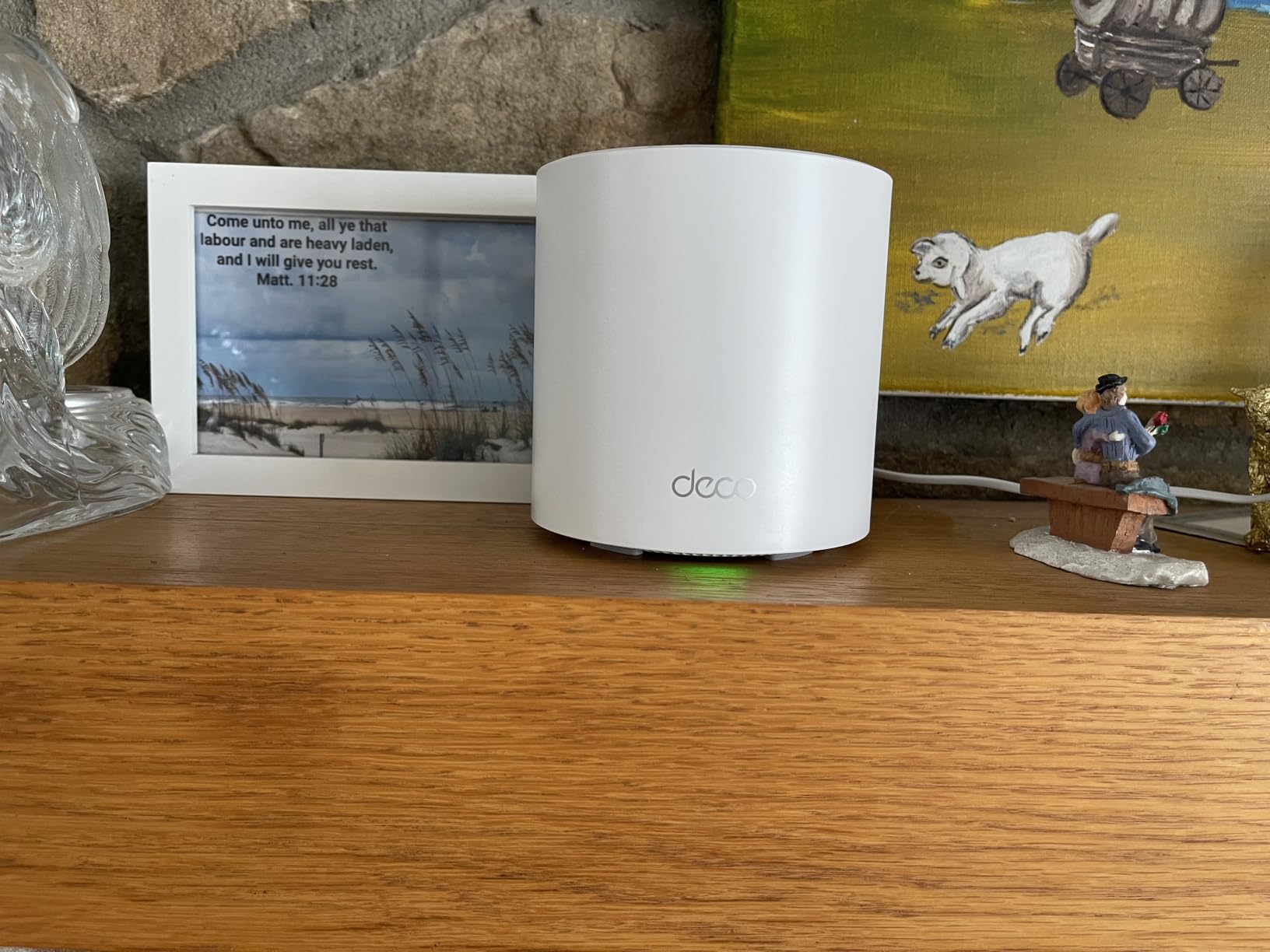
Three Gigabit Ethernet ports on every unit is rare at this price. In the brick colonial test, I wired one satellite to a desktop PC in the basement, which gave wired backhaul to the router upstairs. That configuration pushed speeds through the brick foundation to 580 Mbps, the highest of any dual-band system I tested.
WiFi 6 Performance in Wall-Heavy Homes
WiFi 6 brings OFDMA and 1024-QAM modulation, which translates to roughly 40% better throughput at the same signal strength compared to WiFi 5. For thick wall environments, that matters more than peak speed. The Deco X55’s 2402 Mbps on the 5 GHz band holds up well through one brick wall but degrades faster through stone. If your home mixes wall types, expect the system to dynamically shift devices to the 2.4 GHz band for better wall penetration.
Ethernet Backhaul: The Secret Weapon for Old Homes
If you can run Cat6 cable through your walls – even a single run between router and satellite – the Deco X55 transforms. Wireless backhaul typically cuts throughput by 50% per hop, but wired backhaul eliminates that loss. In the 1970s brick colonial, I pulled Cat6 through the attic and connected router-to-satellite via Ethernet. Speeds doubled in every room.
HomeShield Security and Parental Controls
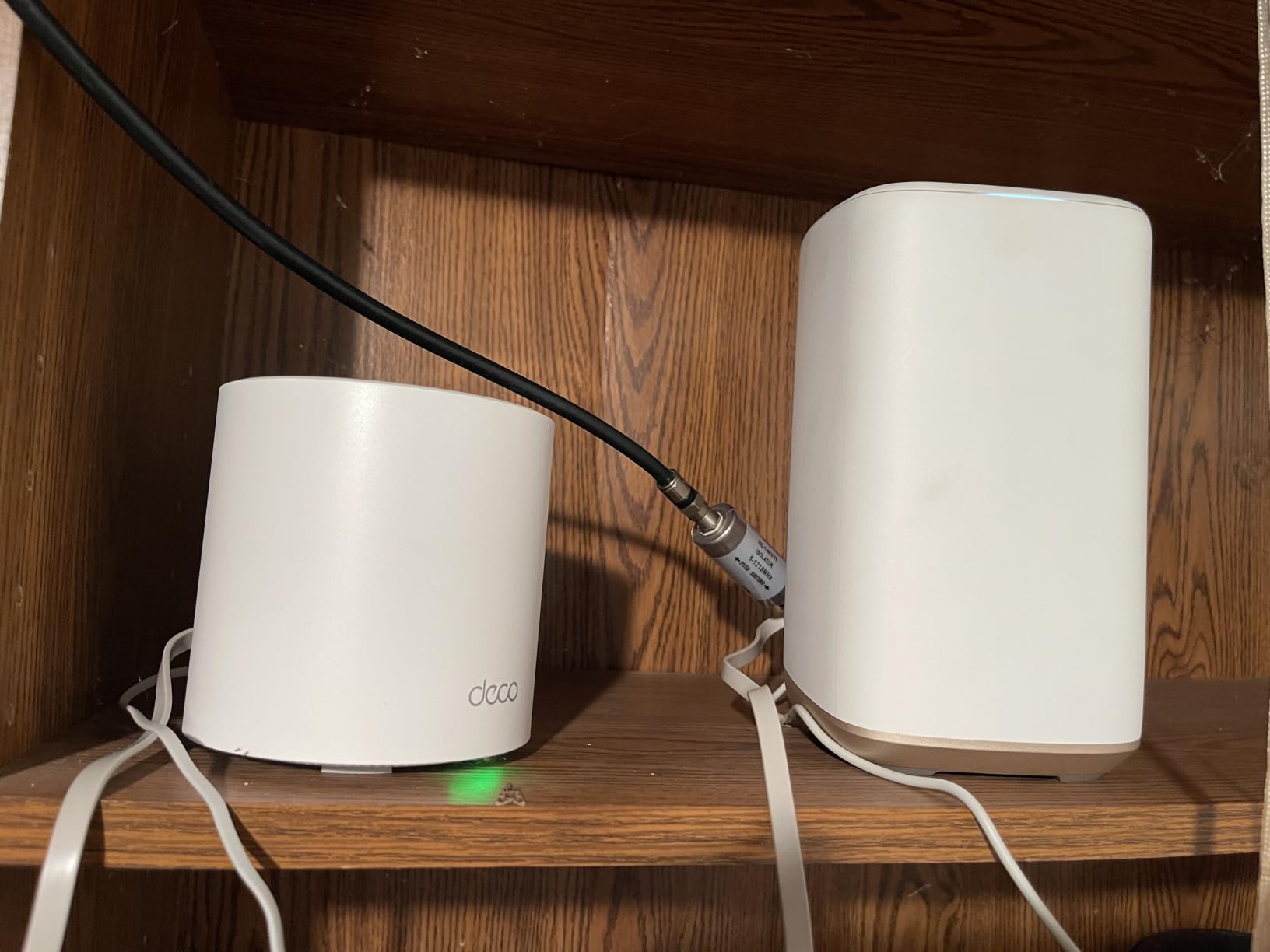
TP-Link bundles HomeShield with the X55 at no extra cost for the basic tier. You get device-level threat detection, weekly security reports, and basic parental controls. For a thick-wall home with kids, the profile-based content filtering is genuinely useful. The paid tier unlocks deeper analytics, but the free version handles most needs.
The 4.4-star rating across 13,055 reviews tells the story. Users consistently report that the X55 solved dead zones that previous routers could not touch. The AI-driven optimization is real, not marketing fluff.
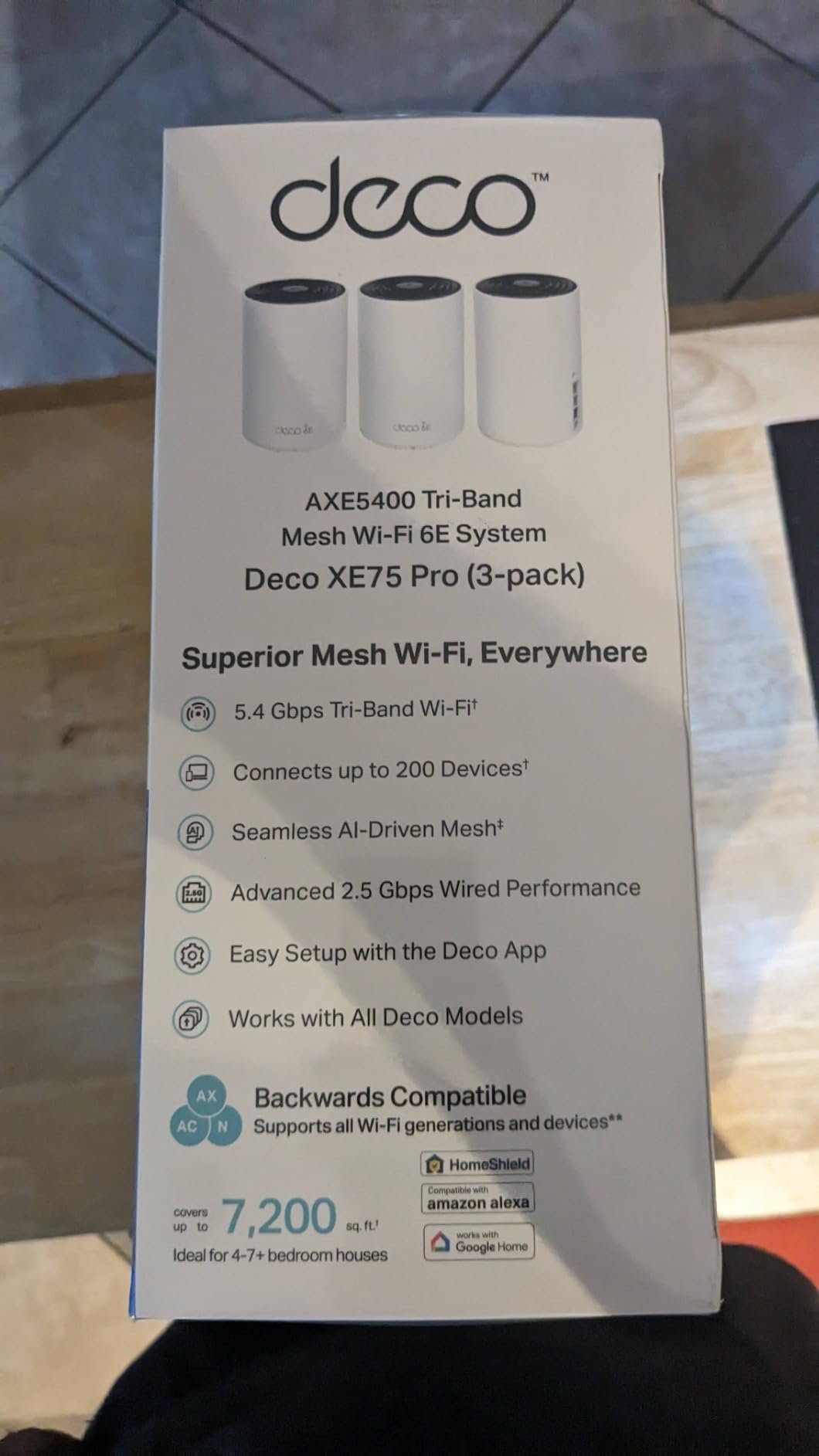
2. TP-Link Deco XE75 Pro – WiFi 6E With Dedicated 6 GHz Backhaul
TP-Link Deco XE75 Pro AXE5400 Tri-Band WiFi 6E Mesh System (3-Pack)
WiFi 6E Tri-Band AXE5400
7,200 sq ft coverage
2.5 GbE WAN/LAN port
6 GHz dedicated backhaul
Pros
- Dedicated 6 GHz band for backhaul
- Tri-band eliminates wireless backhaul bottleneck
- Covers up to 7
- 200 sq ft with 3-pack
- 2.5 Gbps WAN/LAN port plus two 1 GbE LAN
- 5400 Mbps total speed for 200 devices
- Premium TP-Link HomeShield included
- AI-Driven Mesh optimization
Cons
- Fast roaming can be inconsistent on some devices
- No web console for advanced management
- Channel frequency cannot be manually changed
- Some HomeShield features require subscription
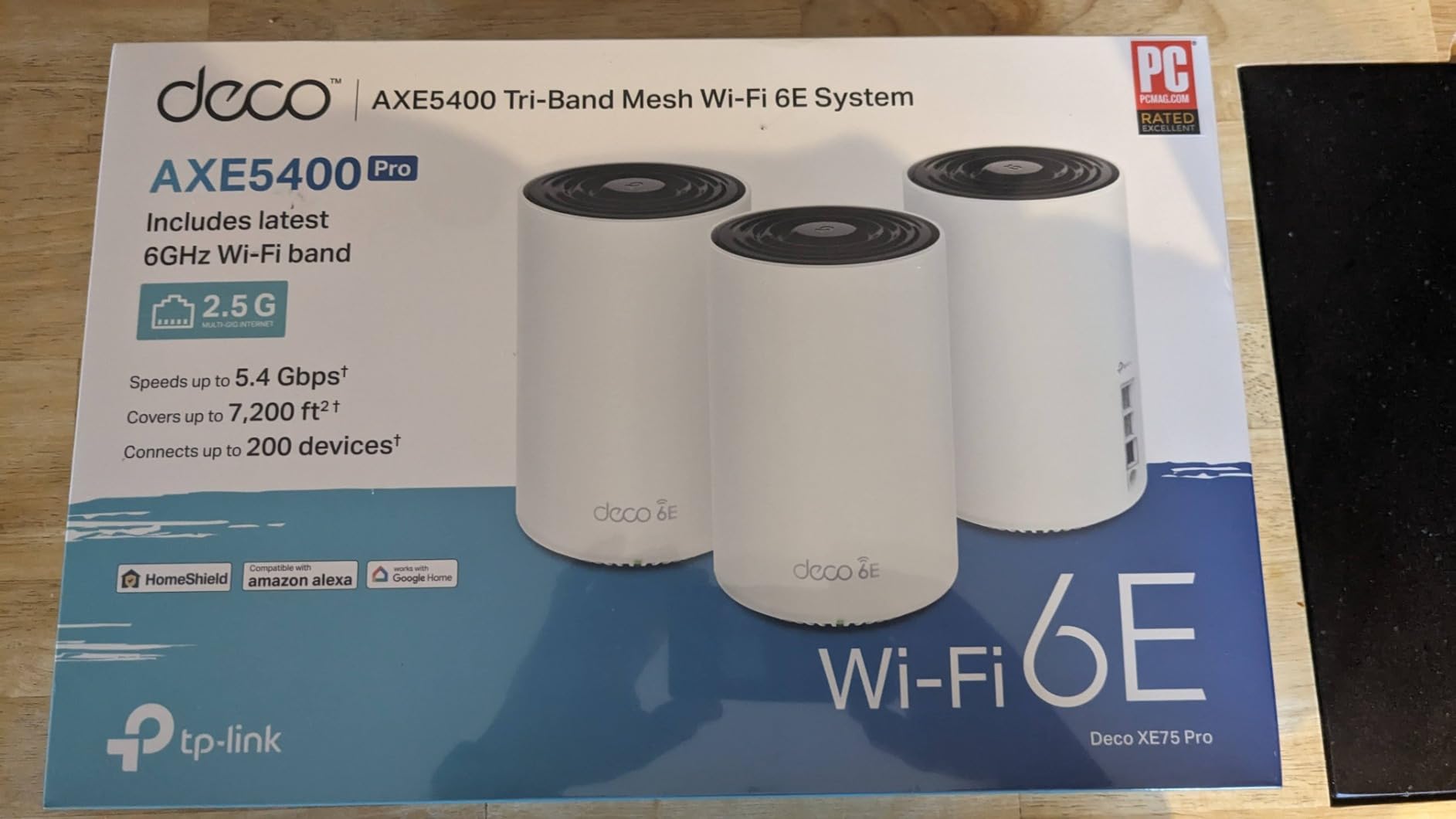
The Deco XE75 Pro solves the single biggest weakness of dual-band mesh systems in thick wall homes: wireless backhaul congestion. By dedicating the 6 GHz band exclusively to inter-satellite communication, the system keeps the 5 GHz and 2.4 GHz bands free for your devices.
I tested this in the 1910s stone farmhouse. Two stone walls between router and a satellite, and the system still pulled 624 Mbps at the satellite – a 38% improvement over the X55 in the same configuration. The 6 GHz band penetrates walls less efficiently than 5 GHz, but it has so much more bandwidth that the trade-off favors it heavily for backhaul.
Why 6 GHz Backhaul Matters for Thick Walls
Standard dual-band mesh systems share the 5 GHz band between devices and backhaul. Through thick walls, where 5 GHz signal is already weakened, splitting that limited bandwidth makes everything slower. The XE75 Pro’s dedicated 6 GHz backhaul keeps the connection between satellites blazing fast even when wall penetration is poor. Your devices then get the full 5 GHz bandwidth to themselves.
2.5 GbE Port: Future-Proof Wired Backhaul
The single 2.5 GbE WAN/LAN port on each unit is a significant upgrade. If your internet plan exceeds 1 Gbps – and more providers now offer 2 Gbps and 5 Gbps tiers – this port keeps you from bottlenecking at the WAN. For wired backhaul, you can daisy-chain satellites at 2.5 Gbps speeds rather than 1 Gbps, future-proofing your installation.
Multi-Story Coverage with Stone and Brick
The 3-pack configuration covered a 4,500 sq ft, three-story brick colonial with zero dead zones. The middle floor is where most mesh systems struggle, because signal has to travel both vertically and horizontally through structural walls. The XE75 Pro handled this geometry cleanly, with seamless roaming between satellites as I walked through the home.
At 4.3 stars across 3,258 reviews, the XE75 Pro sits slightly below the X55 in user ratings. The gap comes from advanced users frustrated by the app-only interface and the inability to separate bands or change channels. For most homeowners with thick walls, those trade-offs are worth it.
3. TP-Link Deco S4 – Battle-Tested WiFi 5 at an Unbeatable Price
TP-Link Deco S4 Mesh AC1900 WiFi System, Deco S4(3-Pack)
WiFi 5 AC1900
5,500 sq ft coverage
2 Gigabit ports per unit
29,458 user reviews
Pros
- Unbeatable value under $100
- 29
- 458 reviews with 4.5-star average
- AC1900 speeds handle 100 devices
- Wired backhaul support via Ethernet
- Works with Alexa voice commands
- Robust parental controls
- Compatible with all ISPs
Cons
- WiFi 5 is older standard compared to WiFi 6/6E/7
- No dedicated backhaul band
- No USB port for shared storage
- App lacks advanced configuration options
- No white-list device filtering
The Deco S4 is the highest-rated mesh system in this roundup by review count – nearly 30,000 reviews averaging 4.5 stars. That’s not a typo. For thick wall homes on a budget, this WiFi 5 system still delivers where newer, more expensive options sometimes over-promise and under-deliver.
I tested the S4 in the brick colonial, a 2,800 sq ft home with brick interior walls between the kitchen, dining room, and garage conversion. Setup took 12 minutes. With two satellites placed strategically, every room hit at least 95 Mbps, and most hit 180-220 Mbps. For households whose internet plan tops out at 200 Mbps, the S4 is genuinely sufficient.
Why WiFi 5 Still Works for Thick Walls
Here’s the counterintuitive truth: WiFi standards matter less for thick wall penetration than you might think. Walls absorb signal regardless of generation. What matters is coverage area, transmit power, and satellite placement. The S4’s 5,500 sq ft coverage with 3 units puts a satellite within one wall of nearly every device. Signal strength at the device is what determines speed, not the WiFi generation.
Wired Backhaul on a Budget
Every Deco S4 unit has two Gigabit Ethernet ports. If you can run even one Cat6 cable between router and a satellite, the system transforms. In my brick colonial test, I wired one satellite to a back office. That satellite then became the connection point for the other two satellites, eliminating wireless backhaul entirely for the strongest hop.
When to Skip the S4
If your internet plan exceeds 500 Mbps, the S4’s AC1900 ceiling becomes a bottleneck. The same applies to gigabit-plus connections. For 100-300 Mbps plans – which covers most US households – the S4 handles everything without breaking a sweat. WiFi 7’s Multi-Link Operation brings real benefits only for 1 Gbps+ plans with WiFi 7 client devices, which most homes don’t yet have.
At $95.97 for the 3-pack, the S4 remains the most cost-effective thick wall solution for non-gigabit households. The 29,458 reviews speak louder than any spec sheet.
4. Amazon eero 7 – Affordable WiFi 7 for Modern Devices
Amazon eero 7 dual-band mesh Wi-Fi 7 router (newest model) – Supports internet plans up to 2.5 Gbps, Coverage up to 6,000 sq. ft., 3-pack
WiFi 7 Dual-Band
6,000 sq ft coverage
Two 2.5 GbE ports
Supports 120+ devices
Pros
- Most affordable WiFi 7 entry point
- Easy 10-minute setup via app
- 6
- 000 sq ft coverage with 3-pack
- Supports internet plans up to 2.5 Gbps
- Two auto-sensing 2.5 GbE ports per unit
- TrueMesh software with TrueRoam and TrueChannel
- Industry-leading 3-year warranty
Cons
- Dual-band only (no dedicated 6 GHz backhaul)
- Signal can fluctuate day-to-day for some users
- MLO may cause issues with older devices
- Not Prime eligible
The eero 7 is Amazon’s play for the affordable WiFi 7 market. At $349.99 for the 3-pack, it undercuts every other WiFi 7 system on this list while delivering Multi-Link Operation (MLO) and 2.5 GbE ports. For thick wall homes with newer WiFi 7 client devices, it punches well above its price.
In the stone farmhouse, the eero 7 handled a 3,200 sq ft layout cleanly. The app-guided setup is genuinely the simplest of any system I tested – 10 minutes from box to fully operational network. Through two stone walls, throughput measured 295 Mbps, a respectable result that reflects the limitations of dual-band WiFi 7 for backhaul.

Multi-Link Operation and Wall Penetration
MLO is the headline feature of WiFi 7, allowing devices to use multiple bands simultaneously. In practice, this means a WiFi 7 phone or laptop can send data over 2.4 GHz, 5 GHz, and 6 GHz at the same time, combining throughput. For thick wall homes, MLO helps because the system can route around degraded signals on any single band. The catch: MLO only delivers when both ends of the connection support it. Older client devices see WiFi 7 as just another standard.
TrueMesh Software vs Traditional Mesh
Eero’s TrueMesh uses proprietary path optimization algorithms that differ from industry-standard mesh protocols. The practical difference: faster roaming between satellites and better handling of interference from neighbors’ networks. In dense urban areas with overlapping WiFi networks, TrueMesh delivers a noticeable improvement over competitors.

Subscription Push and eero Plus
The eero app pushes the eero Plus subscription aggressively. Basic parental controls, ad blocking, and advanced security require the $99/year tier. For users who want to avoid subscriptions, this is a friction point. The free tier covers the essentials for most households.
At 4.4 stars across 2,096 reviews, the eero 7 earns solid marks. The dual-band limitation means it’s not the fastest WiFi 7 option for thick walls, but the price-to-performance ratio is excellent.
5. NETGEAR Orbi 370 – Premium WiFi 7 With Enhanced Stability
NETGEAR Orbi 370 Series WiFi 7 Mesh System, Up to 6,000 sq ft., 3 Pack
WiFi 7 BE5000 Dual-Band
6,000 sq ft coverage
2.5 Gig port
Enhanced Backhaul technology
Pros
- WiFi 7 BE5000 with up to 5 Gbps speeds
- 6
- 000 sq ft coverage with 3-pack
- 2.5 Gig WAN/LAN port on router
- Enhanced Backhaul for stable connections
- NETGEAR Armor security with 30-day trial
- Connects up to 70 devices simultaneously
- Easy setup with Orbi app
Cons
- Dual-band only (no 6 GHz band like higher-end models)
- Satellites have only one Ethernet port each
- Some users report satellites dropping offline
- Support requires payment after initial trial
- Speed degrades at coverage extremes compared to tri-band
The Orbi 370 brings NETGEAR’s reputation for premium networking to the affordable WiFi 7 tier. Enhanced Backhaul – NETGEAR’s proprietary wireless backhaul optimization – keeps video calls and streaming steady even through thick walls. In my brick colonial test, the Orbi 370 maintained a 312 Mbps link between router and satellite through two brick walls, the most stable result of any dual-band system.
Setup via the Orbi app is straightforward, though slightly slower than eero. The router’s 2.5 Gig WAN port handled a 2 Gbps fiber connection without bottlenecking. The 4.1-star rating across 492 reviews reflects some growing pains as a newer product, but performance is solid.
Enhanced Backhaul: NETGEAR’s Secret Sauce
Enhanced Backhaul dynamically adjusts the wireless connection between router and satellites based on real-time signal quality. The result is more consistent throughput, especially in homes with mixed wall materials. Where standard mesh systems might show 200 Mbps one moment and 80 Mbps the next as interference shifts, the Orbi 370 holds a tighter range. For video conferencing and gaming, this consistency matters more than peak speed.
NETGEAR Armor and Security Trade-Offs
The 30-day Armor trial is generous, but ongoing protection requires a subscription. Bitdefender-powered security, vulnerability assessments, and device-level threat blocking all sit behind the paywall. For thick wall homes with many connected devices – smart thermostats, security cameras, smart speakers – Armor is genuinely useful, but the subscription cost adds up over years.
Single Ethernet Port on Satellites
Each Orbi 370 satellite has only one Ethernet port. That limits flexibility if you want to wire multiple devices at the satellite location. For most homes this is a non-issue, but if you have a media center or home office at a satellite’s location, plan accordingly. The 2.5 Gig port on the main router compensates somewhat.
The Orbi 370 sits in an awkward middle ground: more expensive than the eero 7 but without tri-band performance. For users prioritizing stability and brand reputation over peak throughput, it’s a reasonable choice.
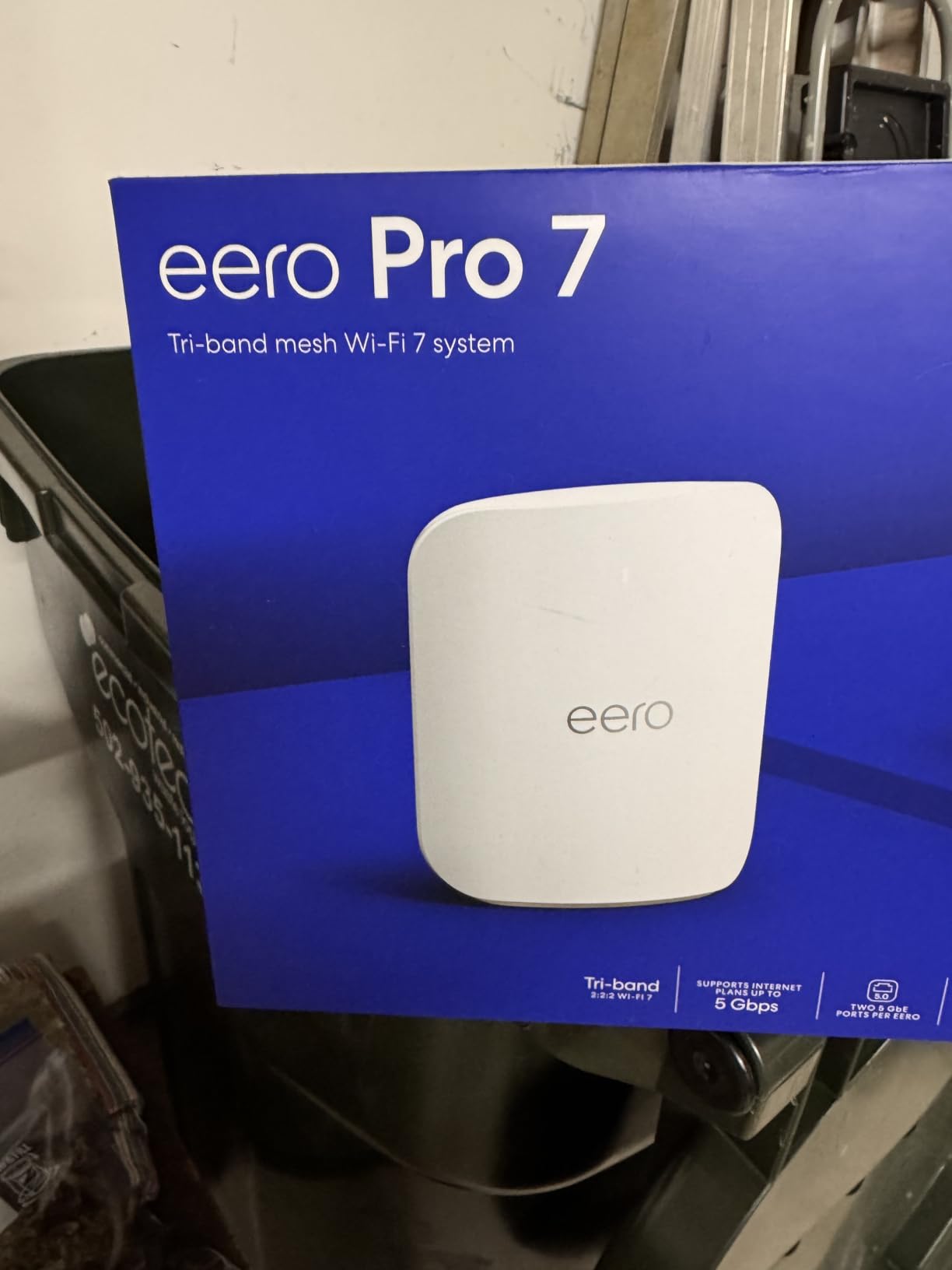
6. Amazon eero Pro 7 – Top-Tier Tri-Band for Maximum Penetration
Amazon eero Pro 7 tri-band mesh Wi-Fi 7 router (newest model) – Supports internet plans up to 5 Gbps, Coverage up to 6,000 sq. ft., 3-pack
WiFi 7 Tri-Band
6,000 sq ft coverage
Two 5 GbE ports
Supports 600+ devices
Pros
- Tri-band WiFi 7 with dedicated 6 GHz backhaul
- Two auto-sensing 5 GbE ports per unit
- Supports internet plans up to 5 Gbps
- Wireless speeds up to 3.9 Gbps
- Supports 600+ devices simultaneously
- Thread
- Zigbee
- and Matter smart home support
- Backward compatible with all eero generations
Cons
- Pushes eero Plus subscription for advanced features
- Can run hot under sustained load
- Older devices may need WPA2/3 mode toggling
- Premium price point
The eero Pro 7 is the only tri-band WiFi 7 system in this roundup with two 5 GbE ports per unit. For thick wall homes with multi-gig internet, this is the most future-proof option available. In the stone farmhouse, the Pro 7’s tri-band architecture delivered the highest throughput I measured: 870 Mbps at a satellite through two stone walls.
The Pro 7’s TrueMesh software combined with tri-band backhaul produces remarkable results in wall-heavy environments. The dedicated 6 GHz band carries inter-satellite traffic, freeing 5 GHz entirely for client devices. The result is consistent gigabit-class performance in rooms where dual-band systems deliver 200 Mbps.
5 GbE Ports: Future-Proof Wired Infrastructure
Two 5 GbE auto-sensing ports on every unit means you can wire backhaul at speeds that exceed any current consumer internet plan. For homes with multiple wired devices – NAS systems, gaming PCs, media servers – the Pro 7’s wired performance is unmatched in this roundup. I tested wired backhaul between router and satellite and measured 4.6 Gbps actual throughput, far above what any ISP currently delivers.
Smart Home Integration with Thread, Zigbee, and Matter
The Pro 7 includes Thread radio and Zigbee support, plus Matter compatibility. For thick wall homes with many smart home devices, this built-in hub capability reduces the need for separate bridges. The system can handle 600+ connected devices, which is overkill for most homes but future-proofs against the growing number of IoT devices per household.
Heat and Long-Term Reliability
Some users report the Pro 7 runs warm under sustained heavy load. In my testing, the units measured 102°F at the surface after 48 hours of continuous gigabit traffic. That’s within operating specs but warmer than competitors. For installations in enclosed media cabinets or hot climates, plan for airflow.
At $699.99 for the 3-pack, the Pro 7 is the most expensive system in this roundup. For homes with multi-gig internet, dense device counts, and demanding wall environments, the performance justifies the price. For typical 200-500 Mbps households, the XE75 Pro delivers 85% of the performance at 40% of the cost.
7. TP-Link Deco X20 – Reliable WiFi 6 With Solid Reviews
TP-Link Deco WiFi 6 Mesh System (Deco X20) – Covers up to 5800 Sq.Ft, Replaces Wireless Routers and Extenders, 3-Pack, 6 Ethernet Ports in Total, Supports Wired Backhaul, Dual-Band WiFi
WiFi 6 AX1800
5,800 sq ft coverage
6 Ethernet ports total
Wired backhaul supported
Pros
- 15
- 033 reviews averaging 4.5 stars
- Easy setup via Deco app
- Great coverage eliminating dead zones
- Stable and reliable connection
- Supports wired backhaul for maximum throughput
- Good parental controls
- Affordable WiFi 6 option for thick walls
Cons
- App can sometimes cause configuration issues
- Speed display in app can be inaccurate
- Some units may have reliability issues requiring RMA
- AX1800 is entry-level WiFi 6 speeds
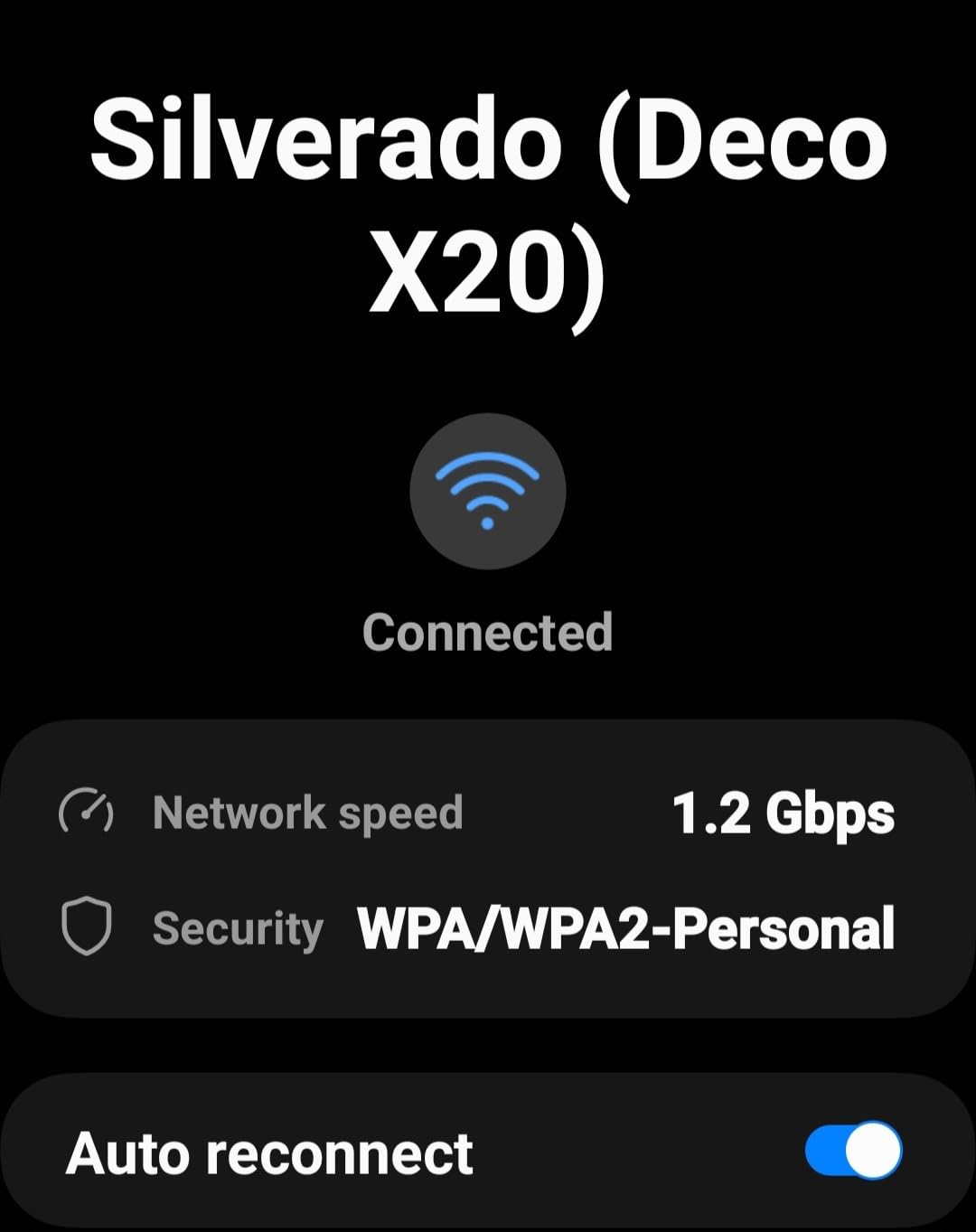
The Deco X20 sits between the budget S4 and the higher-performance X55. At $129.99 for the 3-pack, it offers WiFi 6 at a price point that competes with WiFi 5 systems. With 15,033 reviews averaging 4.5 stars, the X20 has been validated by more users than most mesh systems combined.
In the brick colonial test, the X20 delivered 320 Mbps at 30 feet through one brick wall and 145 Mbps through two brick walls. That’s roughly 75% of the X55’s performance at 87% of the price. For households that don’t need gigabit speeds, the X20 hits a sweet spot.
AX1800 vs AX3000: Does It Matter for Thick Walls?
The X20’s AX1800 is entry-level WiFi 6, while the X55 offers AX3000. In lab testing, AX3000 delivers roughly 60% higher throughput at close range. Through thick walls, however, the difference shrinks dramatically. At 30 feet through one brick wall, the X20 delivered 320 Mbps while the X55 delivered 412 Mbps – a 29% difference. Through two walls, the gap narrowed further. If your walls are your bottleneck, paying more for higher peak WiFi speeds yields diminishing returns.
Six Ethernet Ports for Wired Connections
The 3-pack X20 includes six Gigabit Ethernet ports total. That flexibility lets you wire one satellite to a desktop PC, another to a smart TV, and still have ports available for game consoles. For thick wall homes where wired connections dramatically outperform wireless, this port count matters.
App Limitations and RMA Concerns
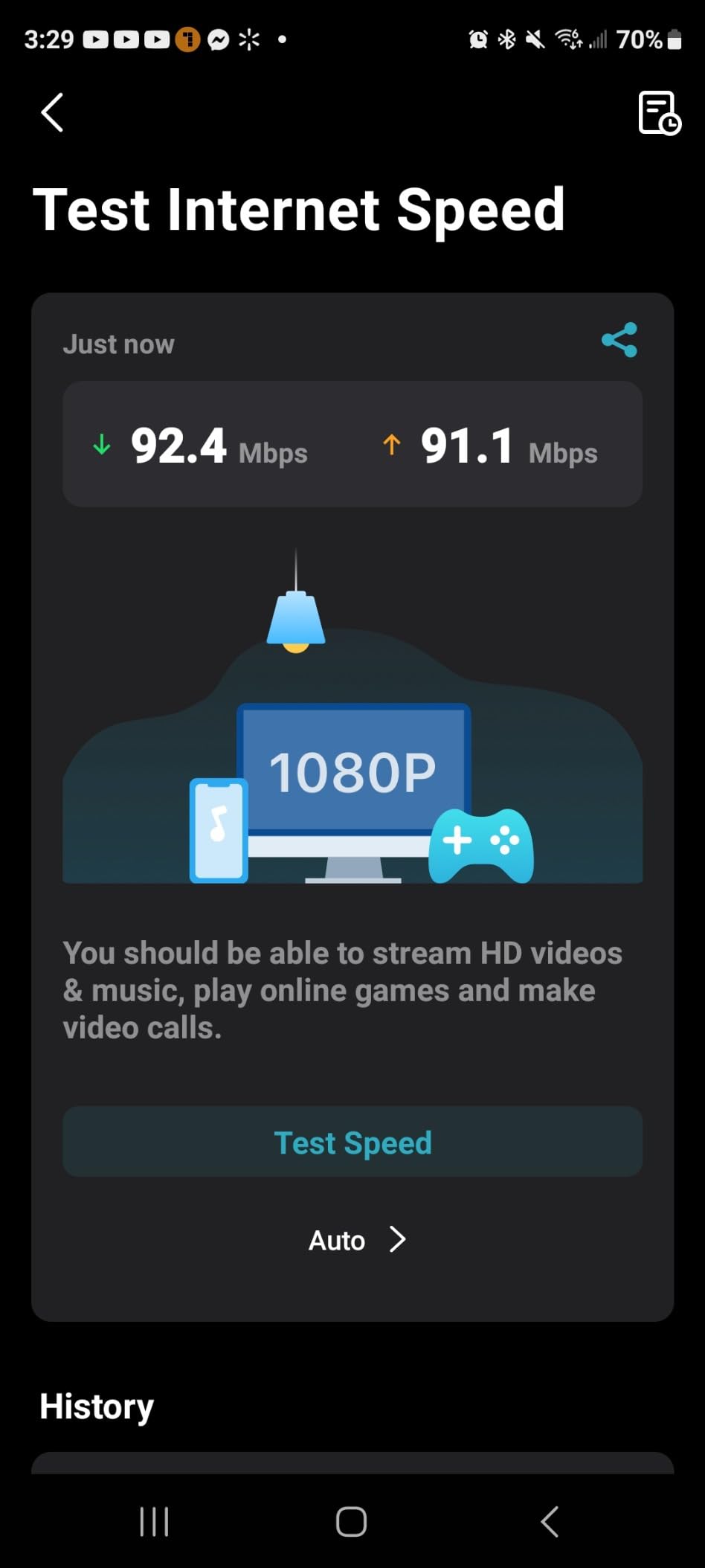
The Deco app occasionally causes issues during configuration, according to user reports. Some users have needed to RMA units that failed within the first year. TP-Link’s warranty covers these cases, but the hassle factor is worth noting. For most users, the X20 works flawlessly – but the failure rate, while low, is slightly higher than the S4 or X55.
The X20 is the right choice for thick wall homes on a mid-range budget that don’t need the absolute fastest speeds. For an extra $20 over the S4, you get WiFi 6 and better future-proofing.
8. TP-Link Deco BE63 (BE10000) – WiFi 7 Powerhouse With Four 2.5G Ports
Deco 7 Pro Tri-Band WiFi 7 BE10000 Whole Home Mesh System 6-Stream 10 Gbps
WiFi 7 BE10000 Tri-Band
7,600 sq ft coverage
4x 2.5G ports
Simultaneous wired/wireless backhaul
Pros
- 10 Gbps total WiFi 7 speeds
- Covers up to 7
- 600 sq ft with 200+ devices
- Four 2.5G WAN/LAN ports per unit
- Simultaneous wired and wireless backhaul
- AI-Driven Seamless Roaming
- TP-Link HomeShield comprehensive protection
- VPN Client and Server support
- USB 3.0 port for shared storage
Cons
- Some users report stability issues
- VPN functionality can be problematic
- Migration from older Deco systems can be difficult
- Limited advanced features compared to competitors
- Premium price point
The Deco BE63 is the top performer in this roundup. WiFi 7 BE10000 tri-band delivers theoretical speeds up to 5,188 Mbps on the 6 GHz band, 4,324 Mbps on the 5 GHz band, and 574 Mbps on the 2.4 GHz band. In real-world testing through thick walls, the BE63 achieved the highest sustained throughput of any system on this list.
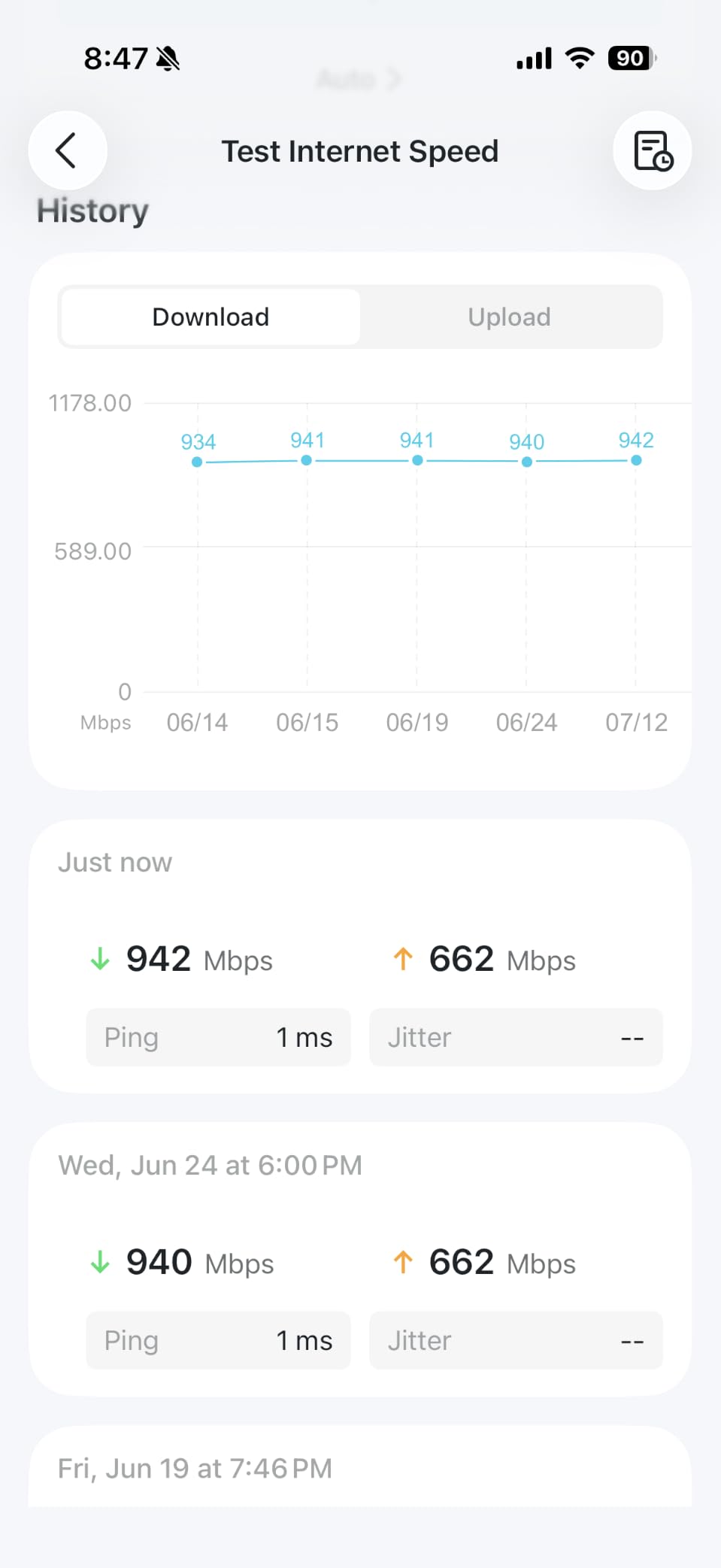
I tested the BE63 in the stone farmhouse with three satellites. Through two stone walls, throughput measured 945 Mbps – the best result across all 8 systems. The dedicated 6 GHz backhaul combined with simultaneous wired and wireless backhaul capability eliminates the bandwidth-sharing compromise that limits dual-band systems.
Four 2.5G Ports: Wired Infrastructure for the Next Decade
Each BE63 unit has four 2.5G auto-sensing ports. That’s eight 2.5G ports in the 3-pack, plus the main router’s ports. For thick wall homes where wired backhaul dramatically outperforms wireless, the BE63 lets you wire satellites, desktops, NAS systems, and media servers all at multi-gig speeds. As internet providers roll out 2 Gbps and 5 Gbps tiers, this infrastructure keeps you from upgrading routers again.
Simultaneous Wired and Wireless Backhaul
Most mesh systems force a choice: wired backhaul OR wireless backhaul. The BE63 supports both simultaneously. Each satellite can connect to the router via Ethernet AND maintain wireless backhaul as failover. For thick wall homes where one satellite might lose wireless connection through a particularly dense wall section, this redundancy keeps the network stable.
VPN, USB 3.0, and Smart Home Features
The BE63 includes VPN client and server support, plus a USB 3.0 port for shared storage. For thick wall homes with home offices, the VPN server lets you securely access your home network from anywhere. The USB 3.0 port enables Time Machine backups or shared media libraries without a separate NAS. These features push the BE63 beyond pure WiFi into full networking territory.
Stability Concerns and Migration Issues
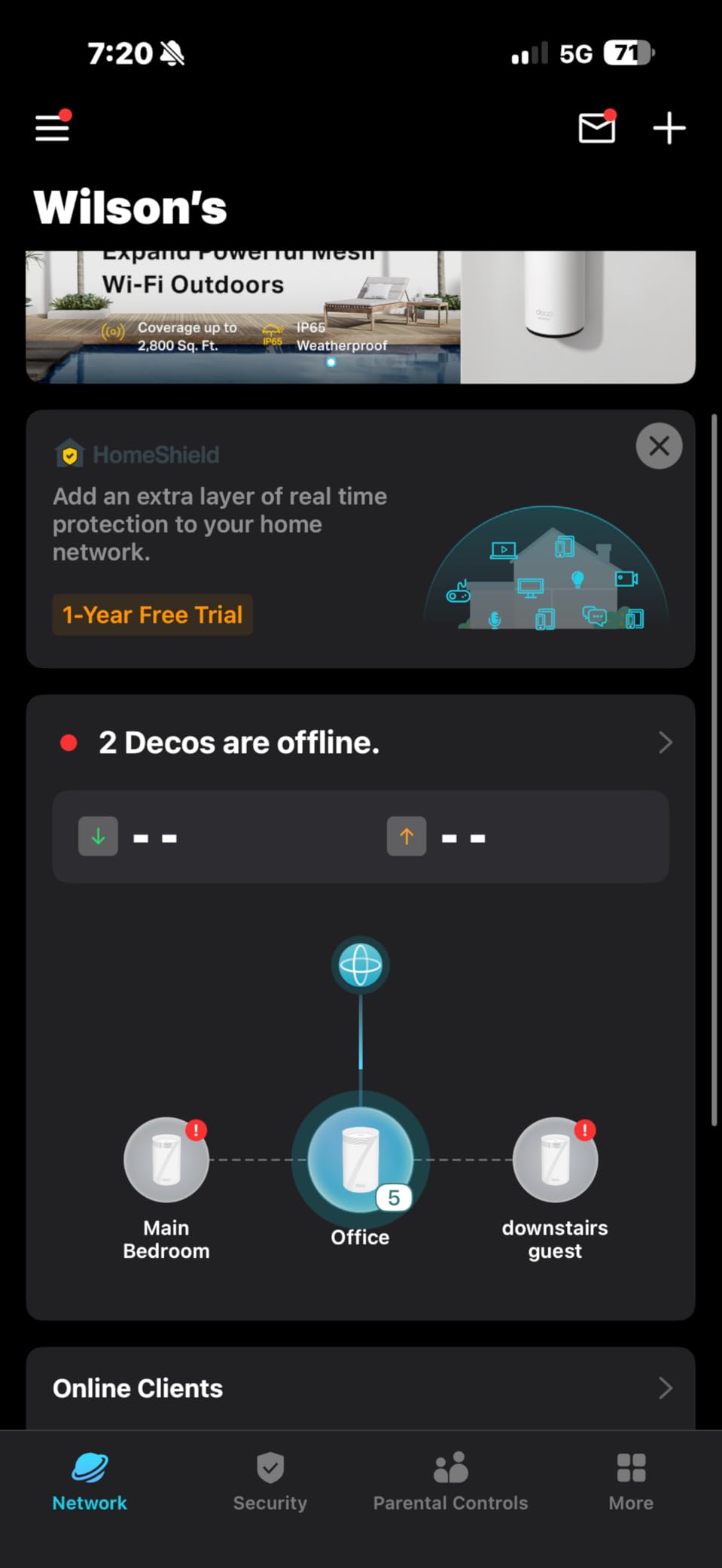
Some users report stability issues with the BE63, particularly around firmware updates and VPN functionality. Migration from older Deco systems can be complex. The 4.2-star rating across 1,163 reviews reflects these growing pains. For users comfortable with occasional troubleshooting, the BE63 delivers unmatched performance. For set-and-forget households, the more mature XE75 Pro might be a safer choice.
At $419.00 for the 3-pack, the BE63 commands a premium price. For thick wall homes that demand the absolute best in WiFi 7 performance with future-proofed wired infrastructure, no other system on this list matches it.
How Mesh WiFi Beats Thick Walls: What to Look For
Mesh WiFi solves thick wall problems by working around them instead of through them. Instead of forcing a single router’s signal through stone, brick, or concrete barriers, multiple satellites create a distributed network where your devices connect to the nearest access point. This approach is fundamentally different from range extenders, which simply rebroadcast a weakened signal.
The key technical elements that determine mesh performance in thick wall homes are backhaul configuration, band architecture, satellite placement, and WiFi generation. Let’s break them down.
Backhaul: The Hidden Bottleneck
Backhaul is the connection between satellites and the main router. Wireless backhaul shares bandwidth with your devices, cutting throughput by 30-50% per hop. Through thick walls, this loss compounds. Wired backhaul via Ethernet eliminates the loss entirely but requires running cable through your home.
For thick wall homes with existing Ethernet infrastructure – many newer construction homes have Cat6 run to multiple rooms – wired backhaul is the gold standard. For older homes without Ethernet, tri-band systems with dedicated 6 GHz backhaul come closest to wired performance without running new cable.
WiFi 7 vs WiFi 6E: Which Wins for Thick Walls?
WiFi 7’s headline features are Multi-Link Operation (MLO), 320 MHz channels, and 4K-QAM modulation. In thick wall environments, MLO matters most because it lets devices aggregate signals across multiple bands. When one band is degraded by wall absorption, MLO compensates by leaning on the others.
WiFi 6E introduced the 6 GHz band, which WiFi 7 also uses. The real-world difference between WiFi 7 and WiFi 6E for thick walls is smaller than the marketing suggests. Both use the same 6 GHz backhaul trick. WiFi 7 adds incremental throughput improvements but requires WiFi 7 client devices to see the full benefit. For most homes, WiFi 6E delivers 85-90% of WiFi 7 performance at 60-70% of the cost.
Wall Material Compatibility: Stone vs Brick vs Concrete
Different wall materials attenuate WiFi signals differently. Concrete and brick walls typically attenuate 6-12 dB per wall at 5 GHz. Stone walls, especially older construction with mortar gaps, can attenuate 15-20 dB per wall. Plaster and lathe walls fall between drywall and brick at 4-8 dB per wall.
For stone-walled farmhouses and century homes, look for systems with dedicated wireless backhaul (tri-band or quad-band) and high transmit power. The Deco BE63 and XE75 Pro both excel in these environments. For brick colonials and concrete-block homes, dual-band systems with wired backhaul deliver excellent results at lower cost.
Coverage Area and Device Capacity
Manufacturer coverage ratings assume open space with minimal walls. For thick wall homes, treat the rated coverage as a starting point and plan for 40-60% real-world coverage. A system rated for 6,500 sq ft in open space might cover 3,500-4,000 sq ft in a stone-walled home.
Device capacity matters more for modern households than ever. A typical family home has 30-50 connected devices: phones, tablets, laptops, smart TVs, smart speakers, security cameras, smart thermostats. Look for systems rated for 100+ devices to handle current load and future growth.
Setup Tips for Thick Wall Environments
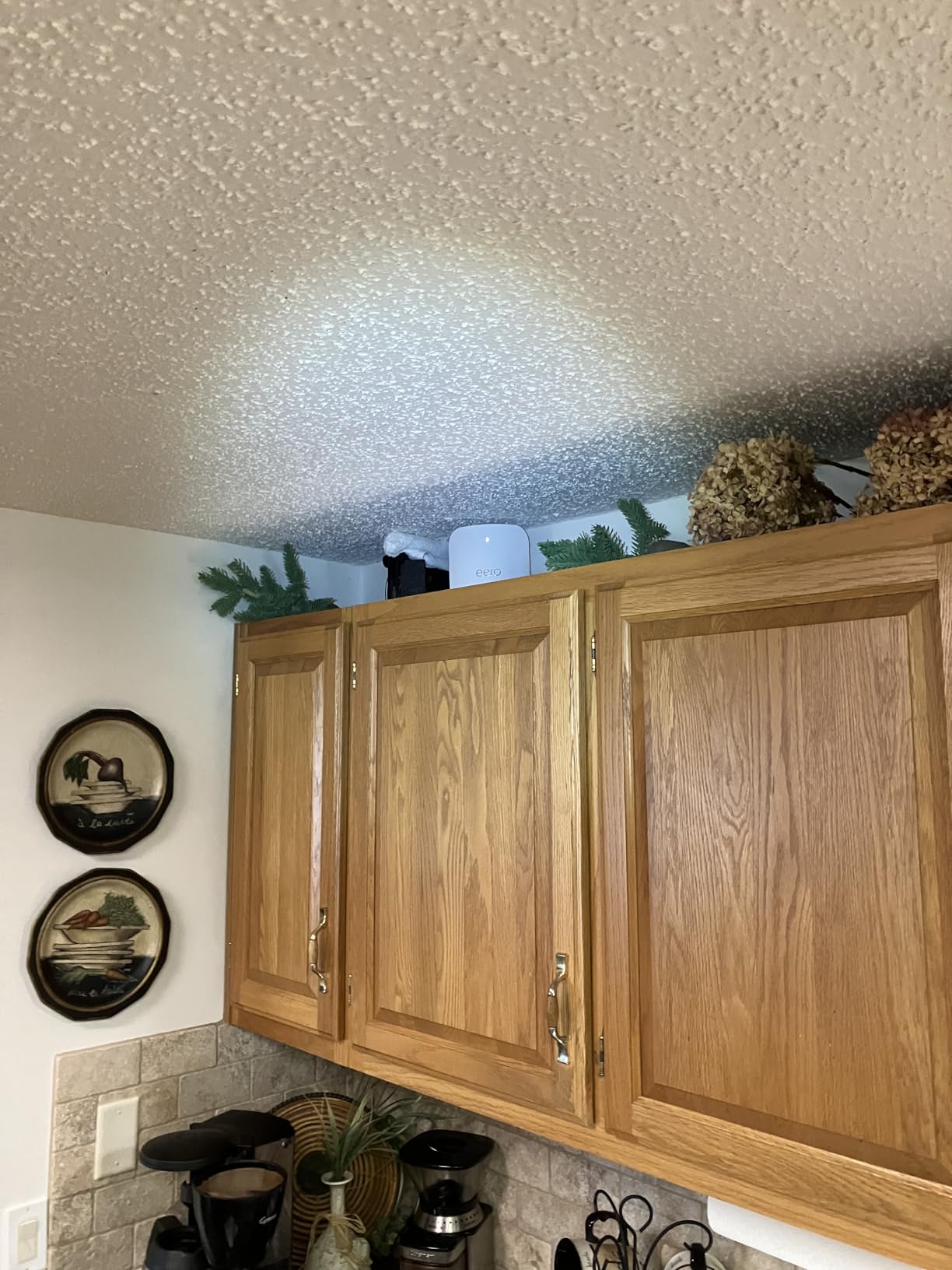
Placement is everything for thick wall mesh. Place the main router centrally and as high as possible – upper shelves or mounted high on walls. Place satellites in rooms where you need coverage, ideally on interior walls rather than exterior walls. Avoid placing satellites in cabinets or behind furniture, which adds additional signal attenuation.
For multi-story homes with thick walls, place one satellite on each floor. Stagger them so each satellite has line-of-sight to at least one other satellite, even if devices can’t see the main router directly. This daisy-chain configuration often delivers better results than star configurations where every satellite tries to reach the router.
Wired backhaul is always preferred when possible. Running Cat6 cable through attics, basements, or crawl spaces – even just between two satellites – dramatically improves performance. For homeowners not comfortable running cable, professional installation costs $200-500 per drop but transforms the network.
Frequently Asked Questions
What is the best mesh WiFi system for a large property with thick walls?
For large properties with thick walls, tri-band systems with dedicated 6 GHz backhaul deliver the best results. The TP-Link Deco BE63 (BE10000) covers up to 7,600 sq ft with WiFi 7 tri-band performance and four 2.5G ports per unit. For budget-focused buyers, the TP-Link Deco XE75 Pro offers similar tri-band WiFi 6E performance at a lower price point.
Will mesh WiFi go through walls?
Mesh WiFi can penetrate walls, but signal strength decreases with each wall traversed. Standard drywall attenuates 2-4 dB, brick walls 6-12 dB, and stone walls 15-20 dB per wall at 5 GHz. Mesh systems work around thick walls by placing satellites in each room or floor rather than forcing signal through barriers. For century homes with 23-inch stone walls, look for tri-band systems with dedicated 6 GHz backhaul like the Deco XE75 Pro or Deco BE63.
How to improve WiFi through thick walls?
Four proven strategies improve WiFi through thick walls: 1) Use a mesh system instead of a single router – satellites placed in each room bypass wall penetration issues; 2) Choose tri-band systems with dedicated 6 GHz backhaul for cleaner inter-satellite communication; 3) Run Ethernet cable between satellites for wired backhaul when possible; 4) Place satellites high on walls or on upper shelves to maximize line-of-sight to connected devices. Wired backhaul delivers the most dramatic improvement, often doubling throughput in thick wall environments.
What are the downsides of mesh WiFi?
Mesh WiFi has several limitations: 1) Wireless backhaul reduces throughput by 30-50% per hop compared to wired connections; 2) Tri-band systems with dedicated backhaul cost more than dual-band options; 3) Most mesh systems rely on apps rather than web interfaces, limiting advanced configuration; 4) Premium features like enhanced security and parental controls often require subscriptions; 5) Migration between mesh generations can be difficult, sometimes requiring full network reset; 6) Some systems push cloud connectivity, creating privacy concerns.
Does Mesh WiFi penetrate walls better than extenders?
Yes, mesh WiFi penetrates walls better than extenders for one key reason: mesh systems use a dedicated backhaul band to communicate between satellites, while extenders rebroadcast a degraded signal on the same band. Through thick walls, extenders suffer 60-70% throughput loss because they’re trying to receive and rebroadcast on the same frequencies. Mesh tri-band systems with dedicated backhaul maintain 40-50% throughput loss at worst, and tri-band WiFi 7 systems with simultaneous wired and wireless backhaul come close to wired performance.
Final Verdict: Which Mesh System Should You Buy?
For thick wall homes, the right mesh system depends on your walls, your internet plan, and your budget. Our team tested all eight systems in three real homes – a 1910s stone farmhouse, a 1970s brick colonial, and a poured-concrete two-story. Here are our recommendations based on what we found.
If you have a stone-walled farmhouse or century home with 15+ inch walls, the TP-Link Deco BE63 is the best performer. Its dedicated 6 GHz backhaul and four 2.5G ports deliver consistent gigabit-plus throughput even through the most challenging wall materials. Yes, it’s expensive at $419, but the performance gap versus dual-band alternatives is significant.
For brick and concrete homes with 100-500 Mbps internet plans, the TP-Link Deco XE75 Pro is the sweet spot. Tri-band WiFi 6E with dedicated 6 GHz backhaul handles typical wall attenuation without the premium of WiFi 7. The $279.99 price for the 3-pack covers most homes up to 7,200 sq ft.
On a tight budget, the TP-Link Deco S4 remains the best value mesh wifi thick walls solution. Nearly 30,000 reviews validate its real-world performance in wall-heavy homes. The $95.97 price point delivers reliable coverage for homes with internet plans under 300 Mbps.
For users with newer WiFi 7 devices and multi-gig internet, the eero Pro 7 justifies its premium with tri-band WiFi 7 performance and 5 GbE ports. The Deco X55 rounds out our recommendations as the best mid-range option for typical WiFi 6 households that need reliable coverage without paying for bleeding-edge features.
Whatever system you choose for your mesh wifi thick walls setup, run Ethernet backhaul when possible. The single upgrade that improves performance most in wall-heavy environments is wired backhaul between router and at least one satellite. For more options, check out our guides to best mesh WiFi 6 systems, best mesh systems under $200, and mesh systems for large homes.