
If you want one answer right now: the ComfortBilt HP22 is the best pellet stove for most homes, with a 55 lb. hopper, up to 41,000 BTU per hour and a stated coverage of up to 2,800 sq. ft. for a freestanding unit that sits against an exterior wall and vents straight through it.
That is the answer we give when a friend asks us to pick one pellet stove out of the eight we compared for home heating. It is not the flashiest design on the market, but it has the highest average rating of the eight at 4.4 stars across 291 ratings, a 55 lb. hopper at the top of the group, and the feature set most buyers actually ask for: a large hopper, a programmable thermostat, a remote and automatic ignition.
We spent weeks reading owner threads, comparing manufacturer specs, and sorting the noise out of listings that quote inflated burn times and optimistic heating coverage. Our team has run pellet stoves through a cold-start cycle, weighed every spec against a real floor plan, and cross-checked what owners report back after a full season.
This guide covers the eight best pellet stoves for home heating we compared, what each one does well, where it falls short, and how to size a stove for your specific house. Updated for 2026.
How to Choose a Pellet Stove: The Three Specs That Matter Most
Almost every buying decision on this page comes down to three numbers, so it is worth setting them out before the picks.
BTU output vs. square footage: A rough rule of thumb used across the industry is that 5,000 BTUs comfortably heats about 200 sq. ft., which works out to roughly 20 BTUs per square foot. A stove rated at 30,000 BTU is therefore a reasonable match for a 1,500 sq. ft. space, and one rated near 40,000 BTU lines up with a 2,000 sq. ft. home.
Hopper capacity: Hopper capacity is the weight of pellets the stove holds in one load, and it sets how long you go between refills. Anything at or above 50 lb. gives you overnight and full-day burn times, while a 25 lb. hopper is a daily refill no matter how good the burn rate is.
Electricity dependency: With the exception of gravity-fed models, the auger and blowers on a pellet stove need power. That means during a winter storm outage, an electric-fed stove simply stops feeding fuel. If your area loses power often, a non-electric gravity-fed model or one with battery backup is the safer choice.
Two other filters shape almost every pick below: form factor (freestanding, fireplace insert, or wall-mounted) and efficiency rating, because the federal biomass stove tax credit requires a stove rated at 75% efficient or higher.
Our Top 3 Pellet Stove Picks for 2026

ComfortBilt HP22
- 55 lb. hopper
- 20 hr burn time
- Heats up to 2
- 800 sq. ft.
- Up to 41
- 000 BTU per hour
- Remote
- thermostat and auto ignition

Pellethead PS21
- Up to 34
- 700 BTUs
- 800-1
- 800 sq. ft.
- Battery backup runs 40+ hours
- Wi-Fi
- touchscreen and remote
- 5-year warranty

US Stove Wiseway
- Non-electric gravity feed
- 40
- 000 BTU
- 2
- 000 sq. ft.
- 60 lb. hopper
- 30 hr burn time
- 3 inch venting
Those three cover the widest spread of real situations: a proven all-rounder, a unit that survives outages and comes with the longest warranty in the group, and the only stove here that needs no electricity at all.
Comparing All 8 Pellet Stoves Side by Side
Every model below appears in this table with the specs that actually separate them. Hopper capacity, burn time and heat output explain most of the price spread; form factor and venting decide whether a stove fits your house at all.
| Product | Specs | Action |
|---|---|---|
| ComfortBilt HP22 |
|
Check Latest Price |
| US Stove Wiseway Non-Electric |
|
Check Latest Price |
 Cleveland Iron Works Bayfront Cleveland Iron Works Bayfront |
|
Check Latest Price |
 Cleveland Iron Works Large 130 lb Cleveland Iron Works Large 130 lb |
|
Check Latest Price |
| Pellethead PS21 |
|
Check Latest Price |
 ComfortBilt HP22i Insert ComfortBilt HP22i Insert |
|
Check Latest Price |
 Castle 41278 Serenity Castle 41278 Serenity |
|
Check Latest Price |
 ComfortBilt HP40 Alpine ComfortBilt HP40 Alpine |
|
Check Latest Price |
1. ComfortBilt HP22 – The Best Overall Pellet Stove for a Mid-Size Home
ComfortBilt HP22 Pellet Stove, 2,800 sq. ft., 55 lb. Hopper, Black
55 lb. hopper, 20 hr burn
Up to 41,000 BTU, 2,800 sq. ft.
Direct vent, freestanding, 273 lb.
Pros
- 55 lb. hopper gives genuinely long intervals between refills
- Covers up to 2800 sq. ft. for whole-home heating
- Remote
- auto ignition
- five power settings and programmable thermostat
- Removable ash pan and bay-view window simplify upkeep
- Highest average rating in our group at 4.4 stars
Cons
- Heavy at 273 lb.
- so plan the move carefully
- Direct vent setup needs an exterior vent installed correctly
- Coverage figure assumes mild temperature conditions
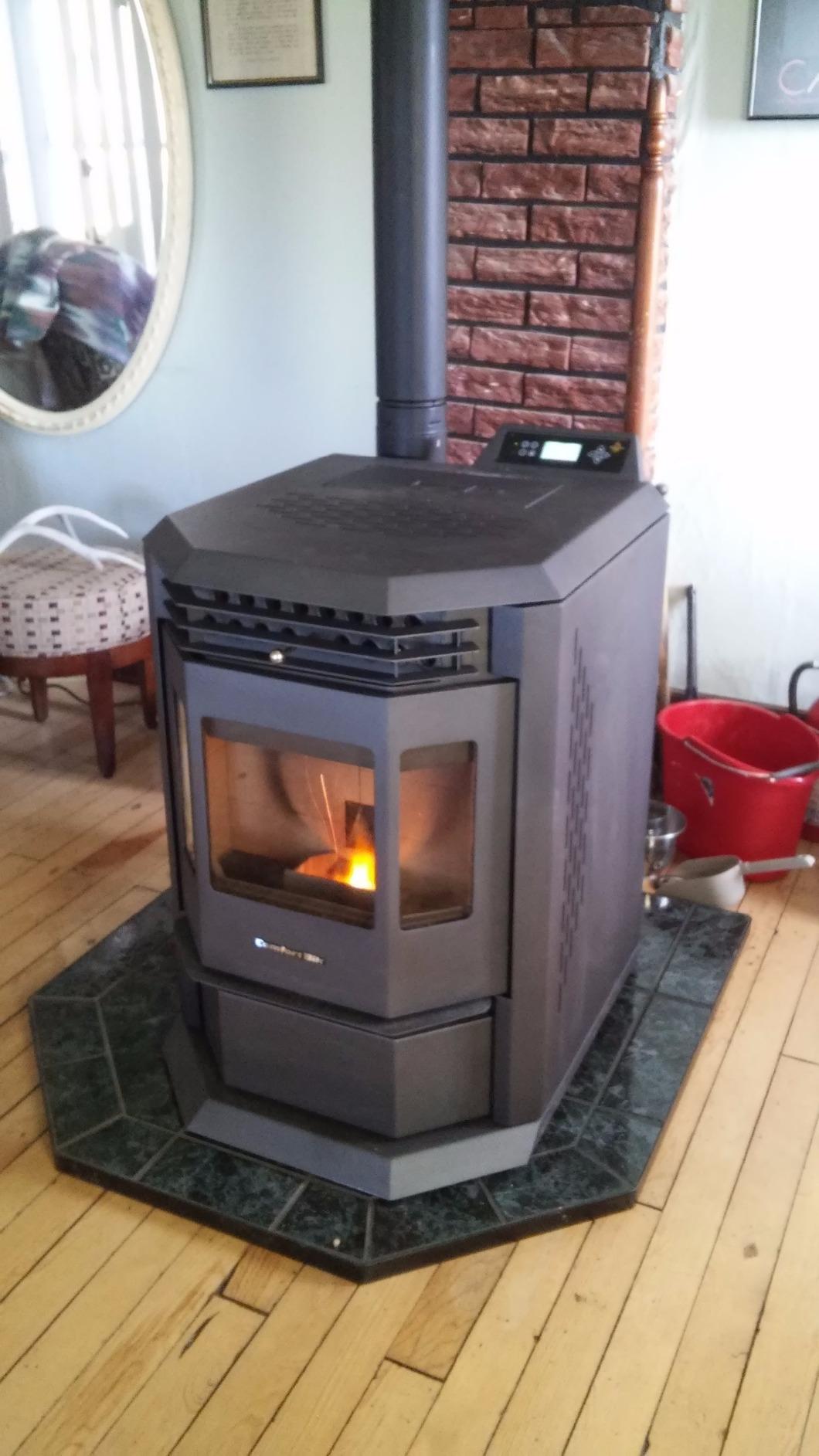
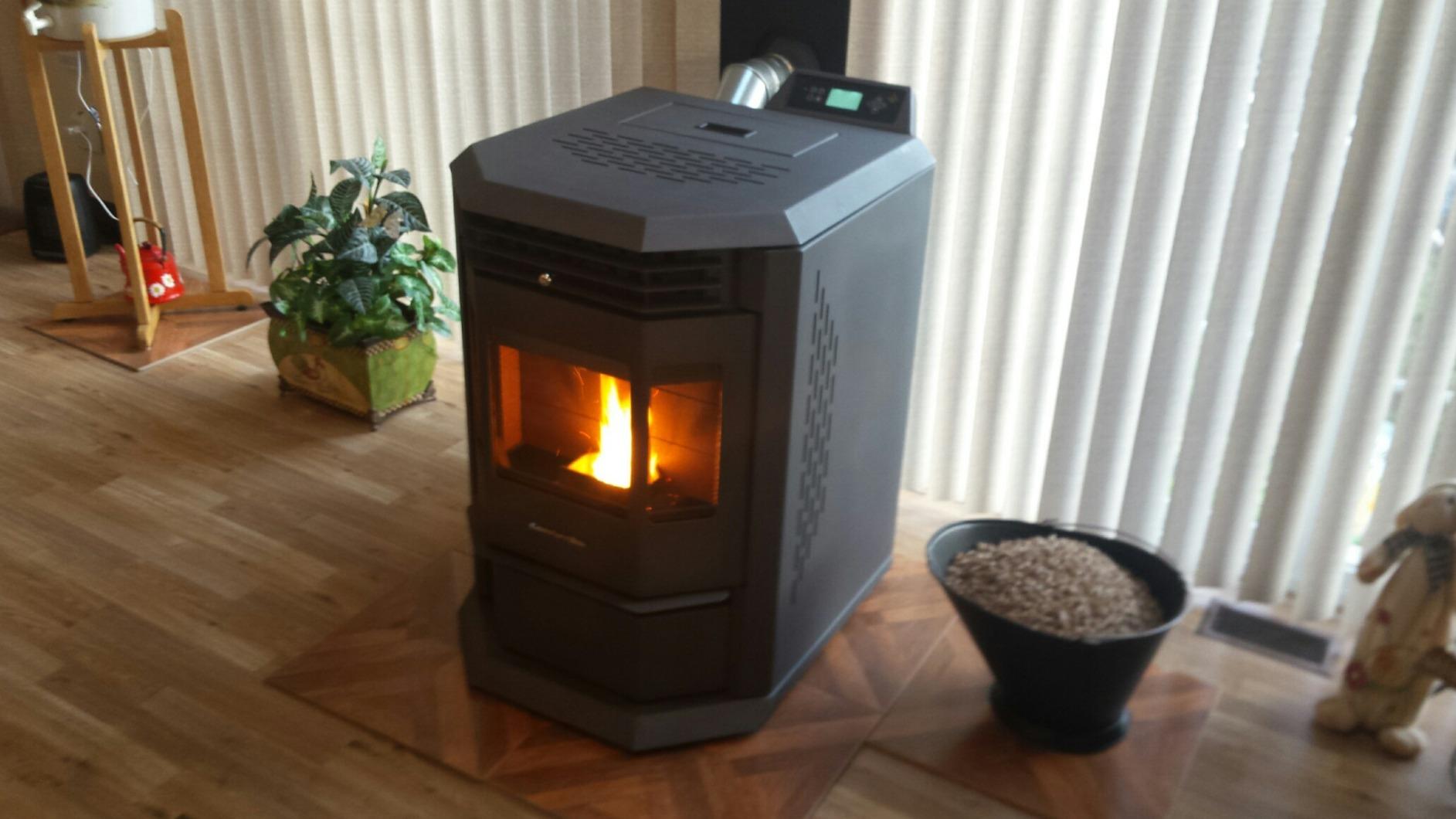
The HP22 is the stove we keep coming back to. It carries a 55 lb. hopper, delivers up to 41,000 BTU per hour, and the manufacturer rates it for up to 2,800 sq. ft. under mild temperature conditions. It weighs 273 lb. and measures 25 inches deep by 24 inches wide by 32.5 inches high, so plan your floor space and your moving help before you buy.
What separates it from the competition is not a single spec but the combination. The remote, the programmable thermostat, five power settings and automatic ignition mean it runs unattended, and the removable ash pan and the bay-view window are the two features that actually get used every week. It ranks #6 in the Amazon Pellet Stoves category, which tells you something about how many people have put it in the same spot you are.
Burn Time and What the 55 lb. Hopper Really Delivers
The listed burn time is up to 20 hours on a full hopper. Treat that as a best-case figure, because the same burn time is only true when the stove is on its lowest setting and the room is already warm. Once you run it at a setting that actually keeps a cold house comfortable, expect noticeably fewer hours per load.
That 55 lb. hopper is among the larger ones on this page. A 25 lb. hopper is a daily chore in deep winter; a 55 lb. hopper means most weeks you fill it twice and forget about it.
Heat Output and Sizing for Mild vs. Hard Winters
Up to 41,000 BTU per hour is enough heat for a mid-size home on one main level, and the stated 2,800 sq. ft. figure is explicitly conditioned on mild temperatures. In a region with long, hard winters, size closer to the lower end of that range or plan to use the stove as a zone heat source with the rest of the home handled another way.
This is the oversizing trap that catches new buyers. A stove that is too big for the climate runs constantly at low output, which wastes pellets and ages the components faster than running it at a moderate setting in a properly sized space.
Controls, Venting and Ongoing Maintenance
Five power settings, a programmable thermostat, automatic ignition and a handheld remote cover everything most owners want, including scheduling heat around your day. The stove is EPA and CSA certified, which matters both for air quality and for qualifying for the federal biomass stove credit if the model clears the 75% efficiency threshold.
Because it is a direct vent model, it exhausts through a pipe straight to the outside wall rather than up a masonry chimney. That is a simpler install than an insert but it does mean your exterior wall has to be in the right place. A removable ash pan is the single best thing here for maintenance, and it pairs well with a simple weekly burn-pot brush.
2. US Stove GW1949 Wiseway – The Best Non-Electric Pellet Stove for Outages
US Stove GW1949 Wiseway Non-Electric Pellet Stove
Non-electric gravity feed, 40,000 BTU
60 lb. hopper, up to 30 hours burn time
Heats up to 2,000 sq. ft., vented, 131 lb.
Pros
- Genuinely non-electric
- so it keeps burning through a power outage
- Natural gravity feed system means fewer moving parts to fail
- 60 lb. hopper delivers up to 30 hours per load
- Silent operation
- and light at 131 lb. for a stove this size
- Uses standard 3 inch pellet venting
Cons
- Lowest average rating of the eight at 3.5 stars
- 19 percent of ratings are 1-star
- Narrow 15 inch width and tall 52 inch height limit placement
- Cabinet carries only a 1 year warranty
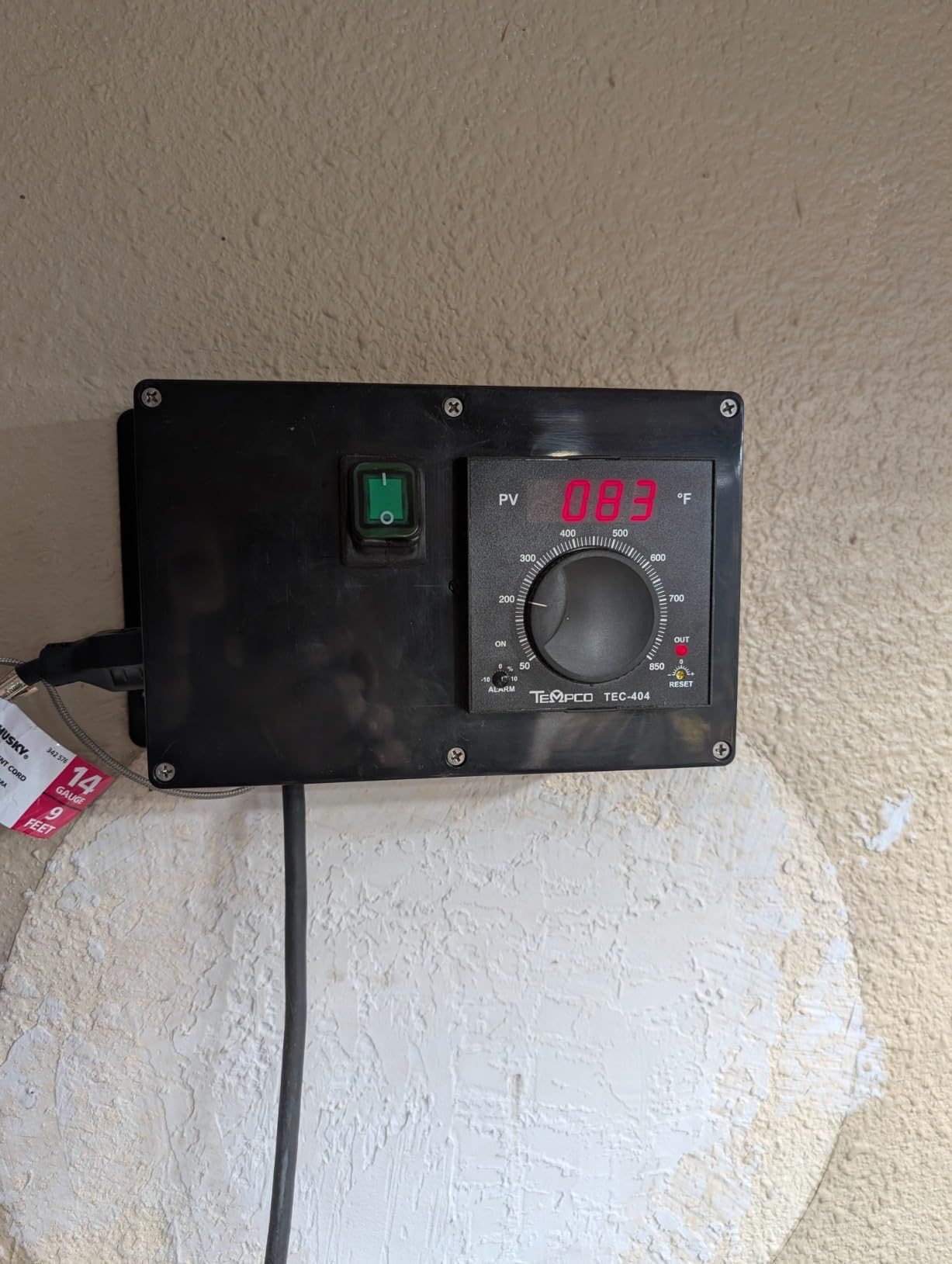
The Wiseway is the clearest example of a gravity-fed design. It has no auger motor, no blower circuit and no thermostat board, so a dead outlet does not end your heat. At 40,000 BTU it heats up to 2,000 sq. ft., and its 60 lb. hopper is rated for up to 30 hours of burn time, a longer rated runtime than any other model in this group.
We include it with a caveat. The 3.5-star average and the 137 ratings behind it describe a polarizing unit: 46% of ratings are 5-star, but 19% are 1-star, the largest single block of 1-star ratings among the eight with a 40 lb. or larger hopper. Owners who get one often love it, and detractors tend to cite reliability and heat-output shortfalls rather than a single fixable fault.
How the Gravity Feed System Works
Pellets sit in the hopper and drop into the firebox under their own weight, with the heat of the fire creating the suction that keeps them moving. There is no motor to jam and no auger gear to strip, which removes the single most cited mechanical failure in owner threads.
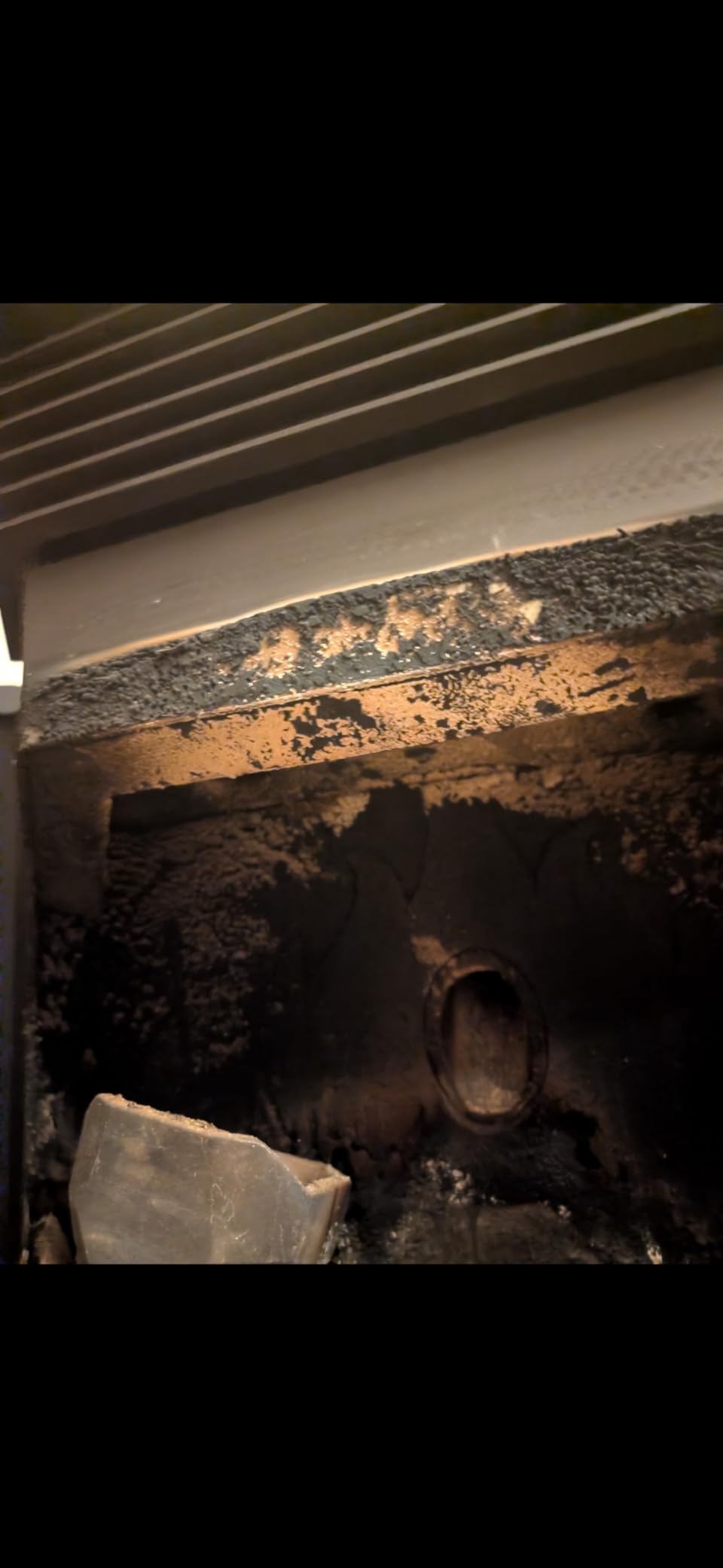
The tradeoff is that carbon builds up above the burn chamber faster than on an auger-fed unit. Owners of non-electric stoves typically scrape that area weekly, and skipping it slows pellet flow over time.
Burn Time, Hopper Size and Placement
Up to 30 hours from a 60 lb. hopper is the longest rated runtime of the eight, and 60 lb. is tied for the second-largest hopper here. It uses standard 3 inch pellet venting, which is a common size and makes finding compatible pipe and fittings straightforward.
Placement is the real constraint. At 24 inches deep by 15 inches wide by 52 inches tall, this is a narrow, tall stove, and the footprint is awkward in a small room or beside a wall you want to use. The 131 lb. weight is genuinely light for a pellet stove, though, so moving it into position is a one-person job in most cases.
Warranty, Certification and What to Watch
It is EPA-certified non-electric pellet equipment with high-efficiency construction in alloy steel, and the warranty is split: 3 years on the firebox and 1 year on the cabinet. That asymmetry is worth understanding before you buy, since the firebox is where the heat lives and the cabinet is the finish.
Watch for the two things this design needs. Budget time for weekly scraping of the carbon above the burn chamber, and keep an eye on the cabinet warranty rather than assuming the firebox coverage carries the whole unit.
3. Cleveland Iron Works Bayfront – Best Built-In Wi-Fi Pellet Stove With a 66 lb. Hopper
Cleveland Iron Works Bayfront Pellet Stove – 66lb Hopper
66 lb. hopper, 1,800-2,500 sq. ft.
30,173 BTU rated output
Cast iron, 231.5 lb., direct vent
Pros
- 66 lb. hopper is one of the largest capacities in this group
- Cast iron construction backed by an 8 year steel parts warranty
- Built-in WiFi for remote heat control
- Covers a wide 1800-2500 sq. ft. range
Cons
- 30173 BTU listed output is low for a hopper this size
- 21 percent of ratings are 1-star
- Cast iron body makes it heavy at 231.5 lb.
- Direct vent installation required
The Bayfront pairs two things that usually appear on different stoves: a 66 lb. hopper and built-in Wi-Fi smart home control. It heats a stated 1,800 to 2,500 sq. ft. and carries an 8-year steel parts warranty, which is the longest steel-parts coverage term of the eight.
It is a 3.8-star unit across 97 ratings, and that split rating is the honest headline. Owners who appreciate the hopper size, the cast iron weight and the app control rate it well, and a meaningful share report reliability or heat-output problems that keep it from 4.0.
Wi-Fi Control and What It Actually Adds
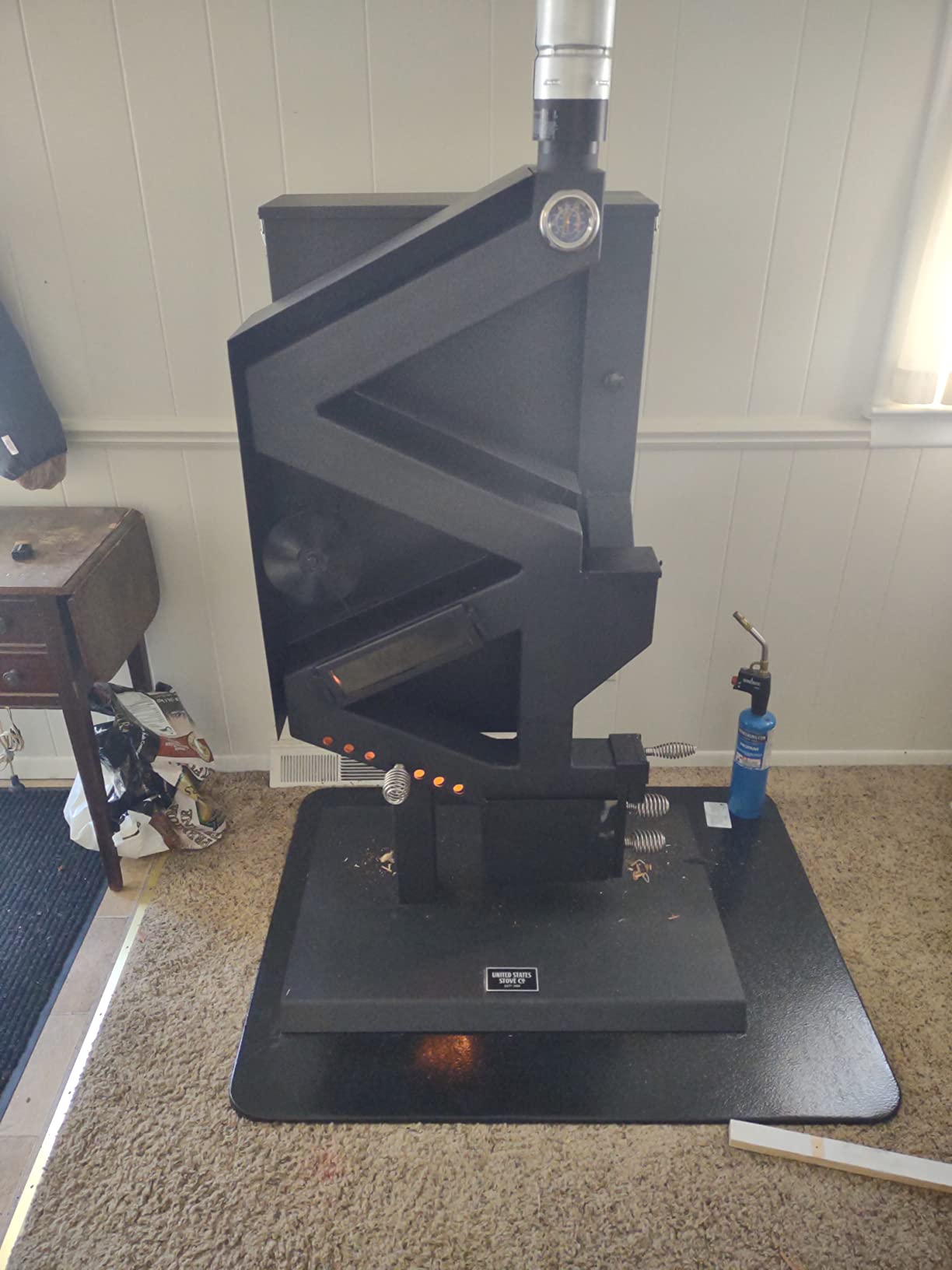
Built-in Wi-Fi puts the stove in your home automation routine, so you can check heat remotely and schedule it around the day. If you already run smart home hubs in your house, that integration is the main reason to choose this over a similar stove with a handheld remote only.
It is worth pairing that convenience with a thermostat. App control tells you what the stove is doing; it does not necessarily hold a room temperature as precisely as a dedicated thermostat, and most owners still set the stove and walk away.
Output and the 66 lb. Hopper Mismatch
Here is the spec to think hard about: 30,173 BTU rated output with a 66 lb. hopper. The hopper stores fuel for a long time, but the burner only converts fuel to heat at a modest rate, so a large hopper on a lower-output stove is exactly the configuration that produces the common complaint about a unit that runs out of usable heat long before the hopper is empty.
It is a good fit for a 1,800 to 2,500 sq. ft. space, especially in a milder climate or for zone heating. It is a poor match for someone who wants one stove to carry a large, drafty house through a severe winter.
Cast Iron Build, Warranty and Venting
Cast iron is heavier than steel but holds heat and radiates it longer after the burner shuts down, which is a real advantage in a room you use in the evening. At 231.5 lb. you will want a dolly and a second person for the move.
The warranty is the strongest on this page: 1 year on electrical and 8 years on steel parts, with the fire pot excluded, so check what a burn pot replacement costs before you assume a repair is covered. Venting is direct, so the exhaust pipe runs to an exterior wall.
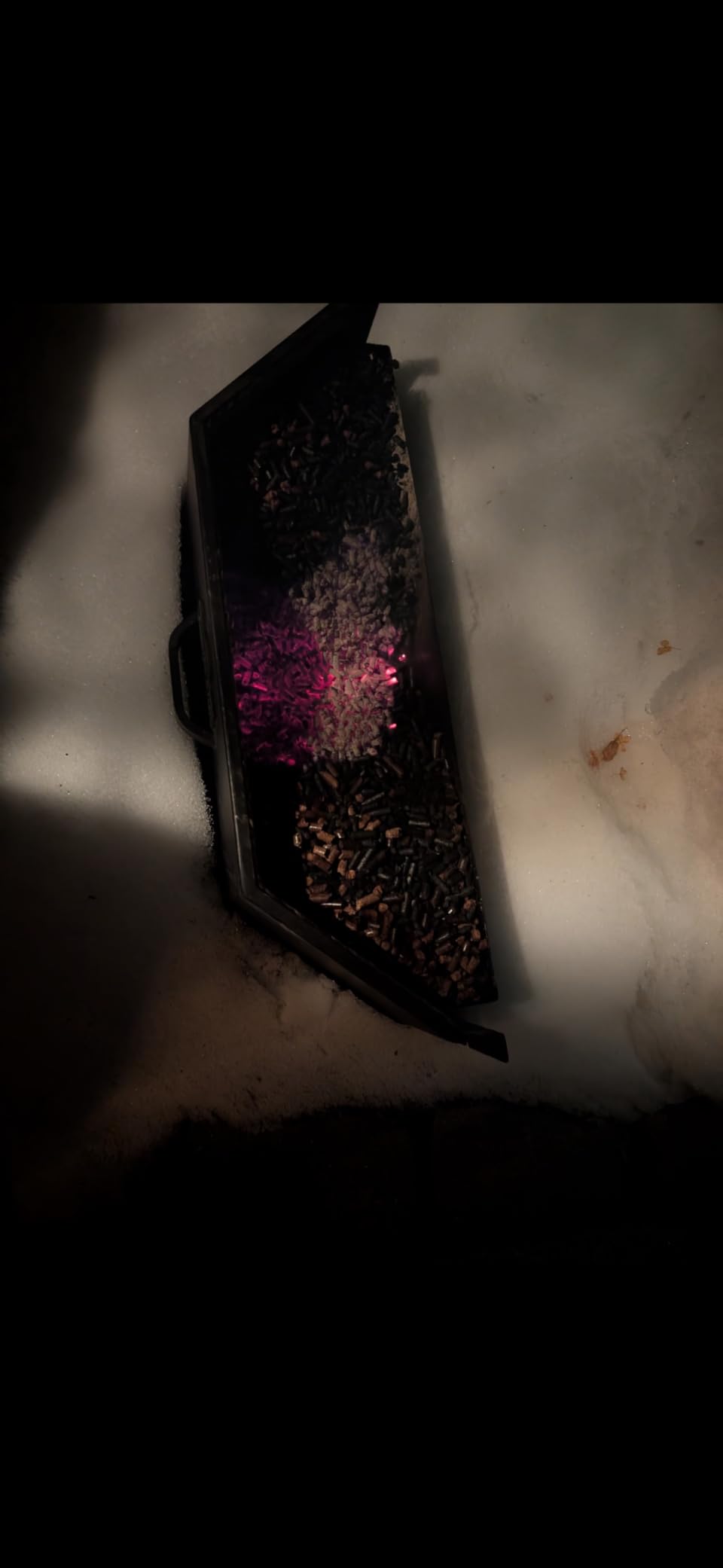
4. Cleveland Iron Works Large 130 lb. – The Biggest Hopper in This Group
Cleveland Iron Works Large Pellet Stove – 130lb Hopper
130 lb. hopper, 2,000-3,000 sq. ft.
29,501 BTU rated output
Wi-Fi, app, remote and touchscreen, 209.4 lb.
Pros
- Largest hopper here
- with owners reporting about 115 lb. usable
- Widest coverage range at 2000-3000 sq. ft.
- Built-in Wi-Fi with touchscreen
- remote and app scheduling
- Cast iron construction
- steady reported heat output
Cons
- 29501 BTU is the lowest output among the large-hopper models
- Factory paint is not cured
- so the first high burn can set off smoke alarms
- Control panel and programming are confusing with a poorly written manual
- Thinnest structural coverage here at a 1 year limited warranty
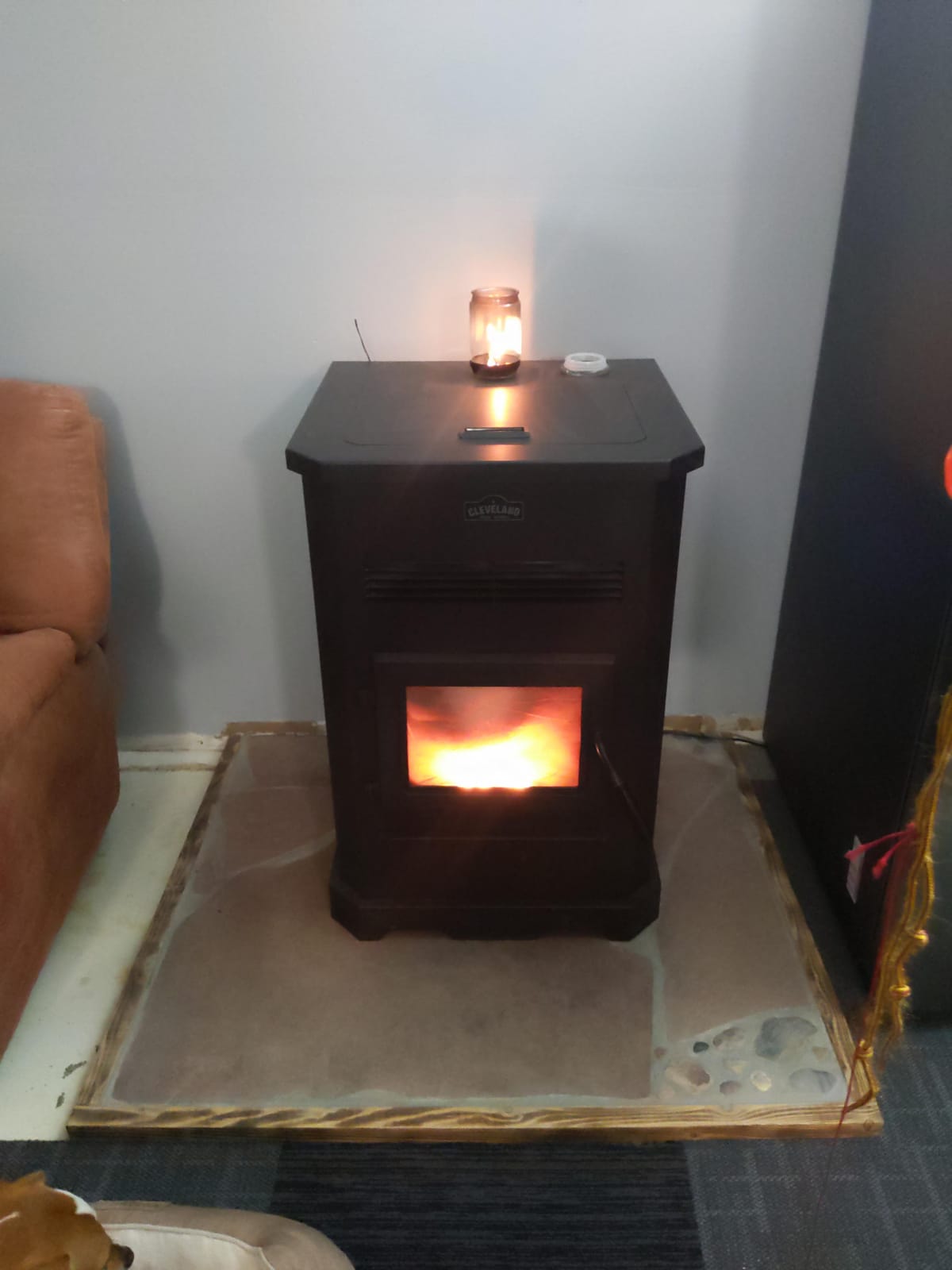
Nothing else in this group holds this much fuel. The 130 lb. hopper is rated for 2,000 to 3,000 sq. ft. of coverage, which is the widest range of any stove here, and owners report around 115 lb. of usable capacity once you account for the hopper geometry.
It earns a 4.2-star average across 55 ratings, with 66% of those ratings at 5 stars, and it ranks #2 in the Amazon Pellet Stoves category. It also has built-in Wi-Fi, a touchscreen, a remote and app scheduling, which is the most complete control package in the group alongside the Pellethead PS21.
What a 130 lb. Hopper Changes Day to Day
For most owners the difference is that refills stop being a daily task. A mid-size hopper runs dry well before a cold day is over; a 130 lb. hopper turns that into a single evening top-up. That is a meaningful quality-of-life difference in a cold house, and it is the reason this stove exists.
Be realistic about the usable figure. Owners report roughly 115 lb. of pellets rather than a full 130 lb., because the hopper does not empty flat to the auger. And the fill door size matters more here than anywhere else on this page: a big hopper is only useful if you can get pellets into it comfortably in winter.
Low Output on a Big Hopper
Rated output is 29,501 BTU, the lowest figure listed among the models here with a 55 lb. or larger hopper. The 2,000 to 3,000 sq. ft. coverage claim is a range rather than a single number, and a house at the top of that range in a severe climate will be pushing the stove’s limits.
Owners generally report steady heat output rather than surges and drops, and the cast iron body holds heat well after a burn cycle ends. The practical fit is a home where the pellet stove is the primary heat source in the main living area, not the only heat source for a very large, very cold house.
First Fire, Controls and Long-Term Components
Two practical notes before you own this one. The factory paint is not cured, so run the stove on high for roughly 30 minutes on the first burn and expect that to be smoky enough to set off a smoke alarm. And the control panel and its programming are the most commonly criticized part of the unit, with a manual that owners describe as poorly written.
The warranty is 1 year limited, which is the thinnest structural coverage here. Owner-reported room blower failures fall outside that year and land on the owner, so treat the warranty length as a real budgeting input rather than a footnote.
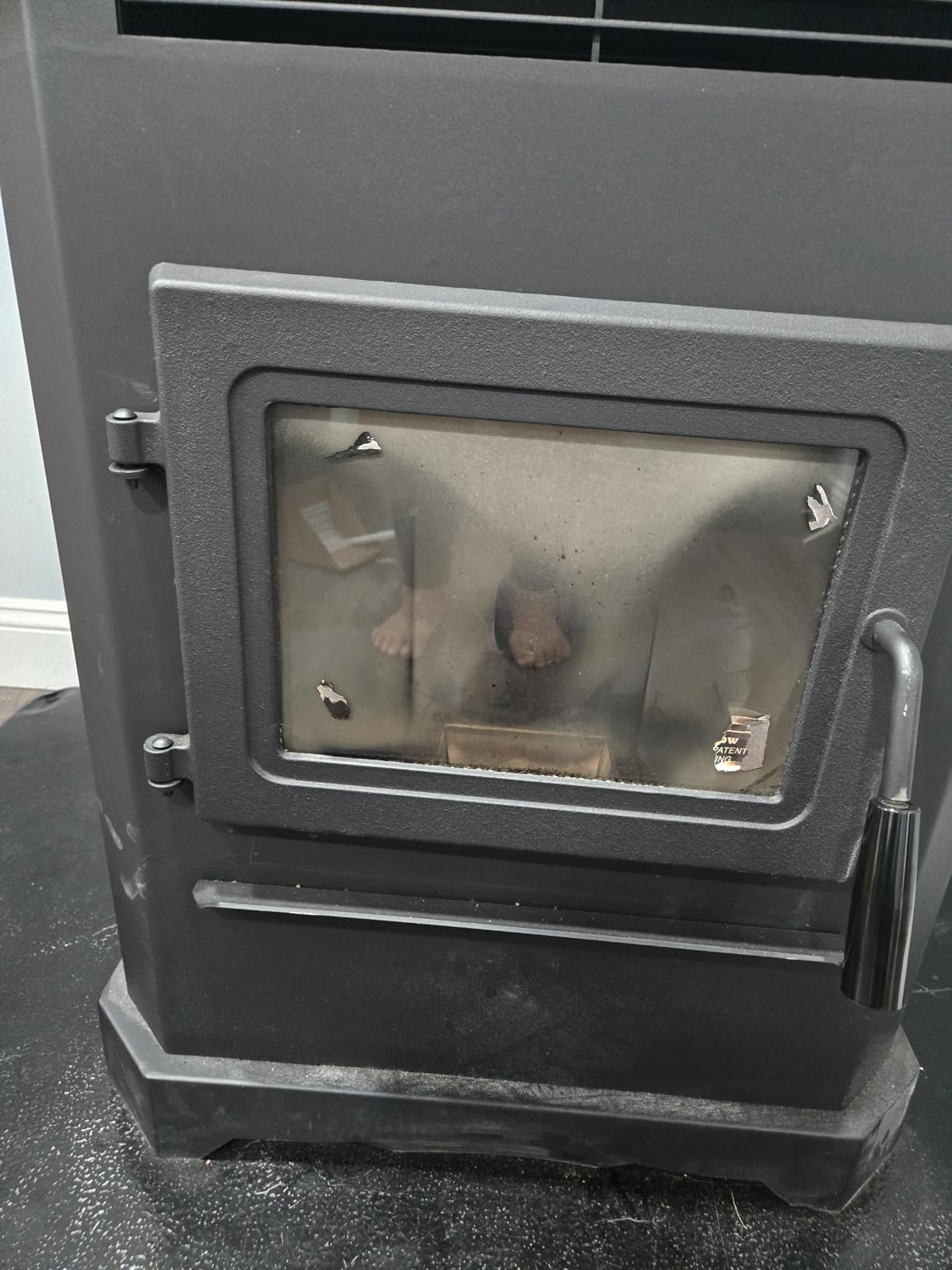
5. Pellethead PS21 – The Best Pellet Stove With Battery Backup and the Longest Warranty
Freedom Stoves Freestanding Independence PS21 Pellet Stove with Battery Backup, Wi-Fi Capability, and Removable Legs – Heats up to 1800 sq ft. (Sandstone Grey)
Up to 34,700 BTUs, heats 800-1,800 sq. ft.
Battery backup runs 40+ hours
Wi-Fi, touchscreen and remote, 5 year warranty
Pros
- Battery backup delivers over 40 hours of runtime during outages
- Longest limited warranty in the group at 5 years with US-based support
- Three control paths: touchscreen
- mobile app and remote with scheduling
- Swappable side panels accept standard 12x12 tile
- Vent-free installation simplifies setup
Cons
- Heating capacity tops out at 1800 sq. ft.
- 34700 BTU is below the 41000 BTU ComfortBilt models
- Battery backup batteries are not included
- Manufacturer does not publish weight or dimensions
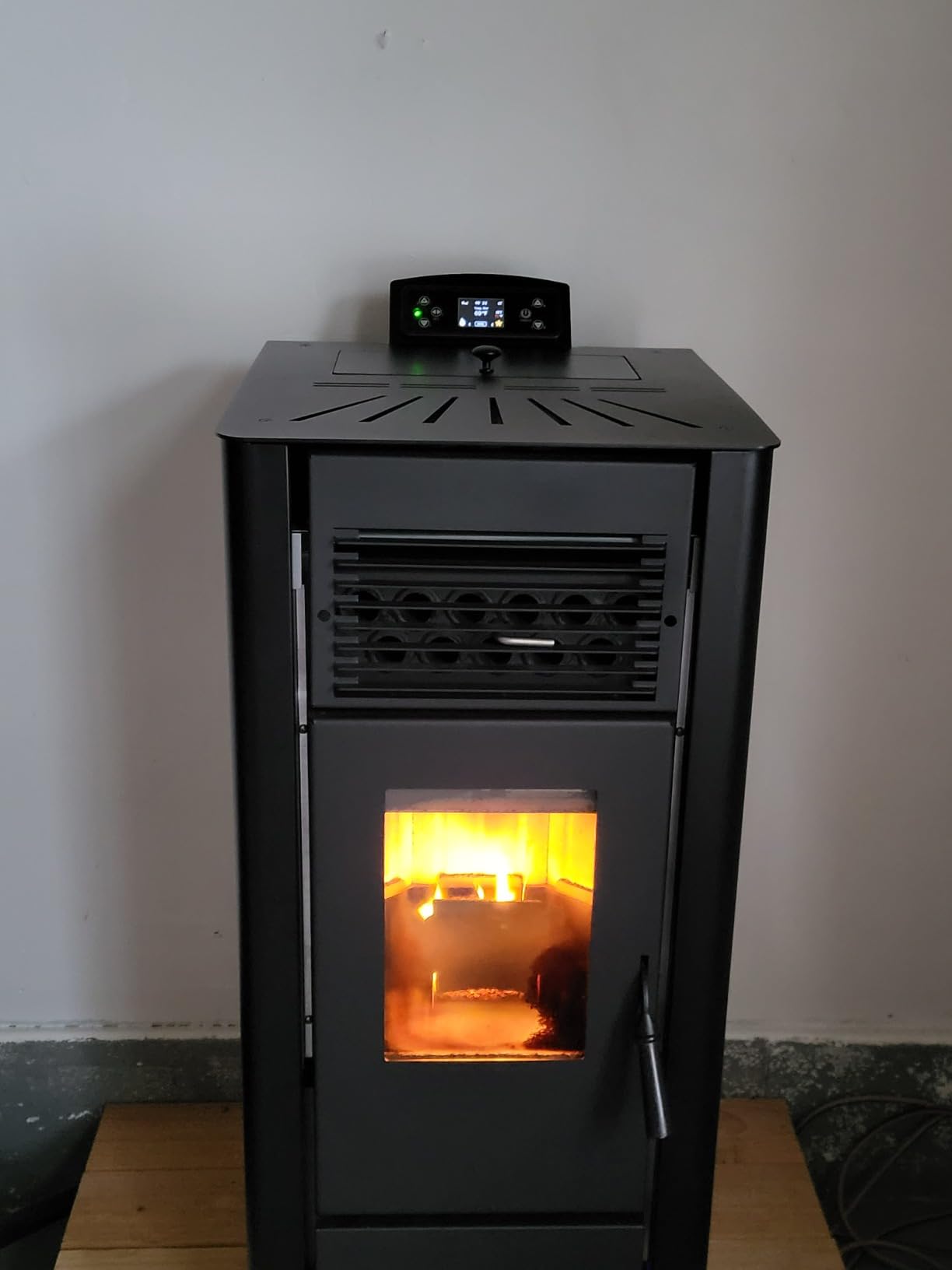
The PS21 is the most thoughtfully packaged stove here for a specific situation: a home that loses power in winter. It runs on two 12V batteries as a 24V DC backup system and delivers over 40 hours of runtime, so an outage no longer means the auger and blowers stop feeding heat.
A 5-year limited warranty, the longest limited warranty term in this group, and a stacked tube heat exchanger that produces up to 34,700 BTUs across an 800 to 1,800 sq. ft. range. It earns a 4.3-star average with 74% of ratings at 5 stars.
Battery Backup, Venting and Installation Simplicity
The battery system is the reason to buy this stove. Two 12V batteries, sold separately, feed a 24V DC system that keeps the stove running for over 40 hours when mains power drops. For anyone in a storm-prone area, that converts a pellet stove from a nice-to-have into usable emergency heat.
It is also vent-free, which is the simplest installation on this page. No exterior vent pipe to run, no chimney to liner. The cost of that simplicity is a ceiling on heating capacity, and it is why this model belongs in a smaller space rather than a large main level.
Heating Capacity and Where It Fits
Up to 34,700 BTUs across 800 to 1,800 sq. ft. makes this the smallest-coverage unit of the eight. In a living room, den, main-floor open plan or a well-insulated home, that is more than enough, and the stacked tube heat exchanger holds heat consistently as the fire burns down.
It is a poor choice as the sole heat source for a 2,500 sq. ft. house in a hard-winter climate. Paired with the battery backup, though, it is a very natural fit for a home that wants a reliable, remotely controlled heat source it can also run when the grid does not.
Controls, Design and the Warranty That Stands Behind It
You get a touchscreen, a mobile app and a remote, all with scheduling, which is a complete control set. The design side is unusually flexible: the side panels are swappable and accept standard 12×12 tile, so the stove can be made to blend with a specific room rather than dictate the room’s look. Removable legs add a little placement flexibility too.
The 5-year limited warranty with responsive US-based support is the strongest after-sales story of the eight, and the manufacturer explicitly positions the unit for DIY cleaning, maintenance and repair. Note that the backup batteries are purchased separately, and that the manufacturer does not publish a weight or dimension figure, so measure your clearance yourself.
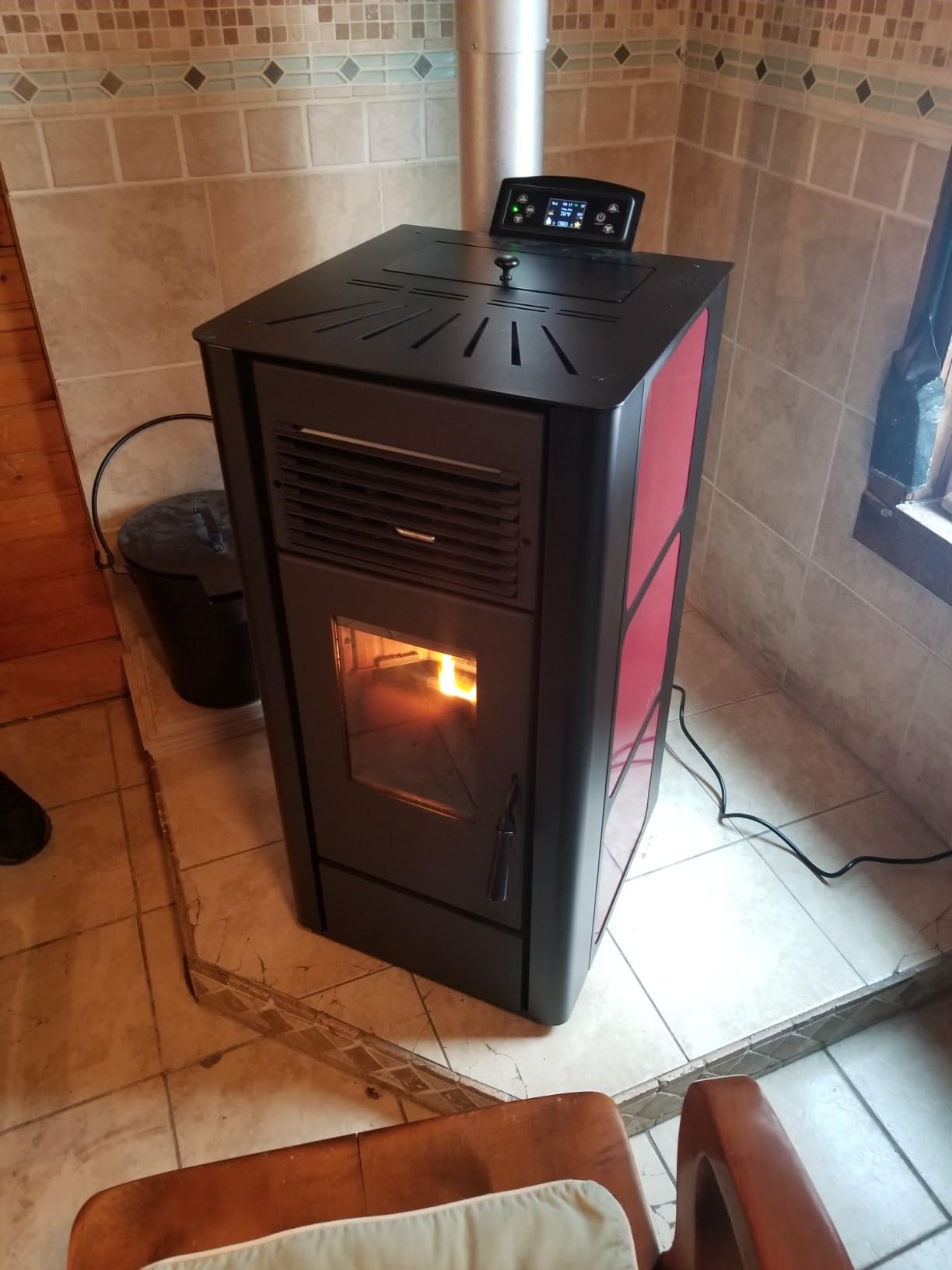
6. ComfortBilt HP22i – Best Fireplace Insert for an Existing Masonry Opening
ComfortBilt HP22i Pellet Stove Fireplace Insert, 2,800 sq. ft., 47 lb. Hopper, Black
Zero-clearance insert, up to 41,000 BTU
47 lb. hopper, 18 hr burn time
Heats up to 2,800 sq. ft., shroud and remote included
Pros
- Tied for the highest stated output in this group at 41000 BTU per hour
- Zero-clearance insert design allows close placement
- Shroud
- ash vacuum and remote all included
- 77 percent of its ratings at 5 stars
Cons
- 47 lb. hopper gives about 18 hours
- less than larger-hopper rivals
- Heavy at 273 lb.
- Direct vent configuration requires exterior venting
- Zero-clearance still means following manufacturer clearances carefully
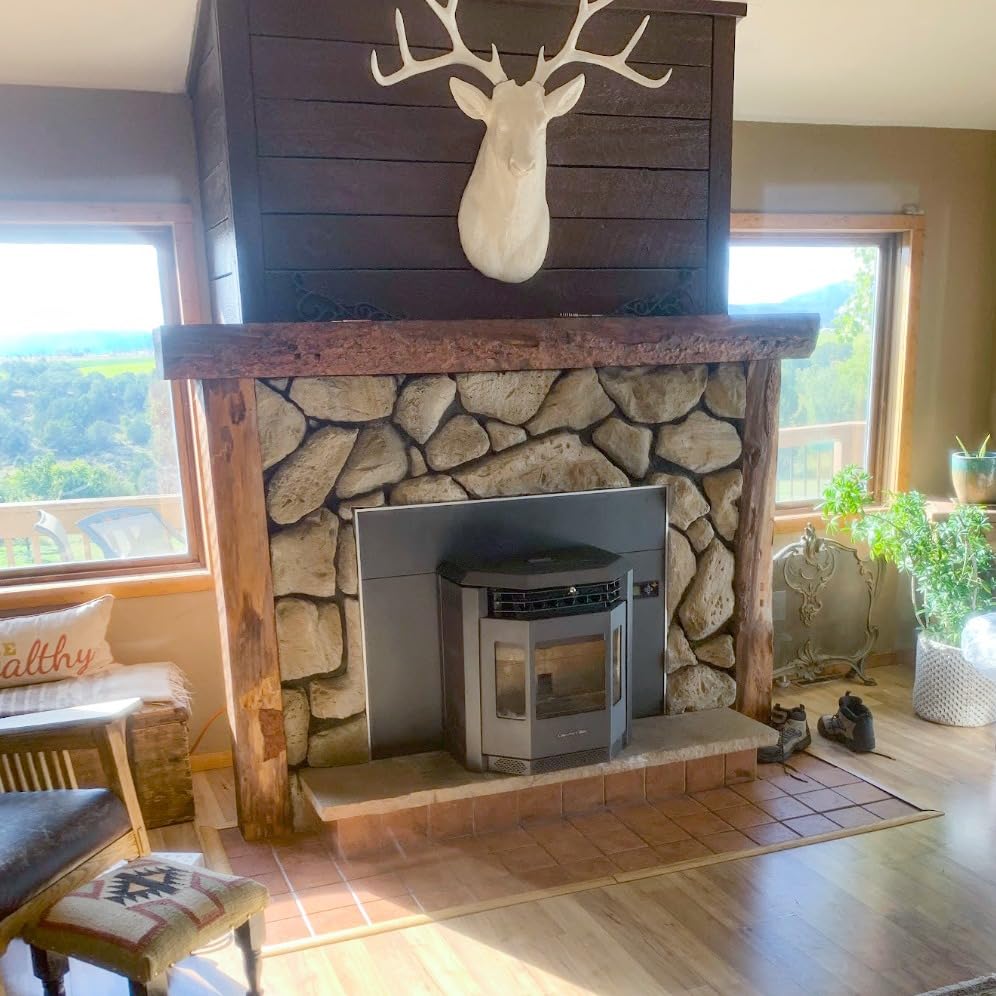
If you already have a masonry fireplace you never liked, the HP22i is the way to use it. It is a zero-clearance insert with the same 41,000 BTU output as the freestanding HP22, rated for up to 2,800 sq. ft. of coverage, and it drops into an existing opening instead of taking up floor space.
It holds a 4.3-star average across 52 ratings, with 77% of those at 5 stars. The bundled finishing shroud, ash vacuum and remote mean the install is a one-project job rather than three, and the bay-view window keeps the flame visible from the room the way a freestanding unit would not.
Insert Fit, Clearances and the Existing Fireplace
Zero-clearance is the term that matters here. It means the insert is designed to be installed closer to surrounding surfaces than a freestanding stove, which is what allows it to occupy an existing fireplace opening. It does not mean ignore the manual: manufacturer clearances still have to be followed exactly, and the surrounding trim and mantel materials affect what is safe.
Because it is a direct vent model, it still exhausts through a pipe to the outside rather than up the chimney. Confirm the firebox dimensions and the wall or exterior clearance before you order, since insert sizing errors are the most common expensive mistake in this whole category.
Output Versus Hopper Size
Output of 41,000 BTU per hour is tied with the freestanding HP22 for the highest stated output figure in this group, and it is what makes this insert viable as more than a decorative second heat source. Coverage is rated at up to 2,800 sq. ft. under mild temperature conditions, so it does the work of a serious primary heater.
The 47 lb. hopper gives roughly 18 hours of burn time, the shortest runtime figure among the eight. That is the tradeoff of an insert: you gain the fireplace location and lose hopper capacity. For most households the location matters more, but if you run it overnight in a cold house, plan on a refill during long cold runs.
What Comes in the Box and What to Do After
The finishing shroud, an ash vacuum and the remote control are all included, which is unusually complete for an insert. Five power settings, a programmable thermostat and automatic ignition cover daily operation, and EPA and CSA certification is stated on the listing.
At 273 lb. it is tied for the heaviest thing in this group, and inserts are not moved once they are in place, so get a second person for the final positioning. The one thing to plan ahead is the vent: a direct vent insert needs a clean exterior run, and that is the part of the project most likely to need a professional.
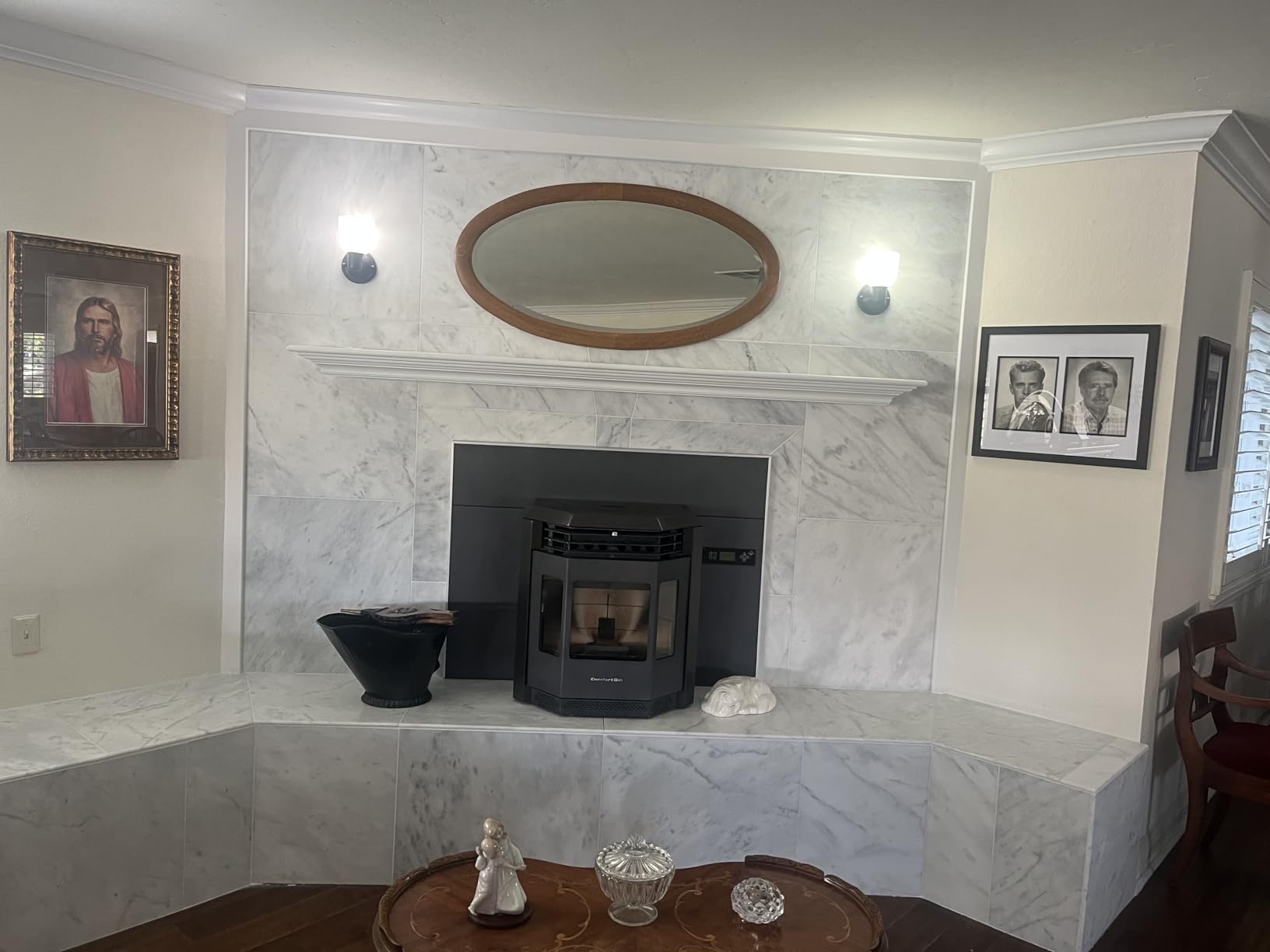
7. Castle 41278 Serenity – Easiest Pellet Stove to Maintain
Castle 41278 Serenity Pellet Stove, 1,500 square ft. Heating Capability, Smart Controller Features Manual, Weekly, Thermostat and Eco Operating Modes, 40lb Hopper Capacity, Easy Clean Design, Black
1,500 sq. ft., 32,000 BTU, 40 lb. hopper
Tube-free design, vent free, 186 lb.
Remote programmable, 77 W draw
Pros
- No tubes
- corrugations or hidden chambers
- so cleaning takes minutes
- Owners report noticeably lower heating bills compared to propane
- Full remote programming across manual
- weekly
- thermostat and eco modes
- Self-diagnostic control panel helps troubleshooting
- Large glass viewing area
Cons
- Heating capacity of 1500 sq. ft. at 32000 BTU is the most modest here
- 17 percent of ratings are 1-star
- Auger can fail to cycle reliably
- requiring control board troubleshooting
- 186 lb. means a dolly or extra hands
- Vent hardware needed on site: a 2 inch clean-air intake and a 4 inch exhaust vent
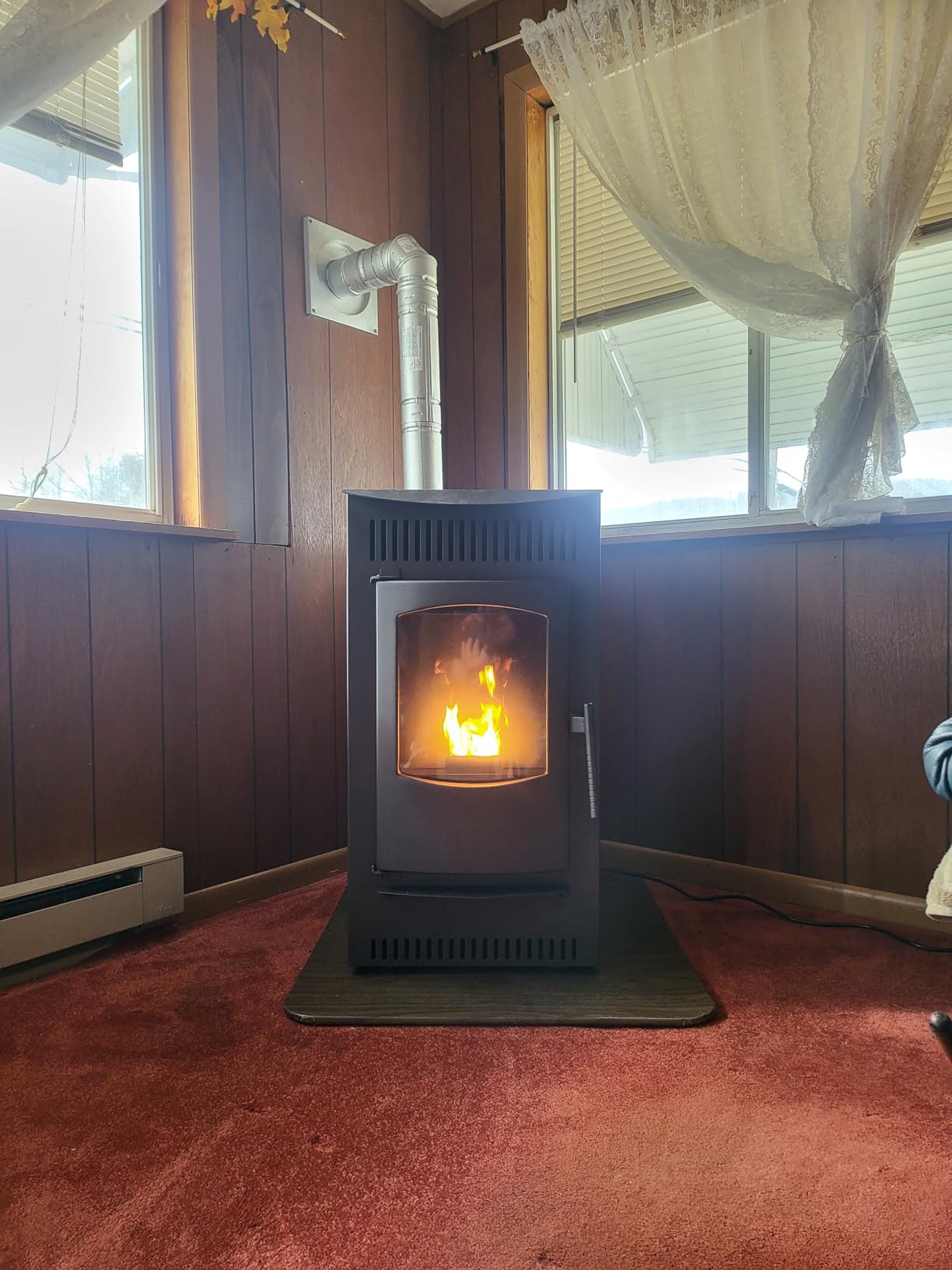
The Serenity is built around a simple idea: if there are no tubes and no hidden chambers, cleaning cannot be complicated. The manufacturer designs it that way on purpose, and owners confirm that ash vacuuming every other day is enough to keep it running well.
It heats 1,500 sq. ft. at 32,000 BTU from a 40 lb. hopper, and it draws only 77 watts, which makes it one of the least demanding units on the electrical side of the ledger. The 3.9-star average across 46 ratings reflects a unit people are happy with and also not thrilled by in equal measure.
Why the Tube-Free Design Matters
Most pellet stoves route combustion gases through a bank of small steel tubes, and those tubes collect creosote and carbon until they need a brush and eventually a replacement. The Serenity has none, so the ash vacuum goes straight into the firebox and the job takes minutes rather than a half hour of detail work.
That simplicity is why it earns our easiest-to-maintain badge, and it is reinforced by a self-diagnostic mode on the control panel that flags faults before you start guessing. If you dislike weekly maintenance more than you dislike a small heating capacity, this is the one.
Control Modes, Eco Operation and the Remote
Manual, weekly, thermostat and eco operating modes are all programmable from the included remote. Eco mode toggles the stove on and off to hold the desired room temperature, which saves fuel overnight without letting the house go cold.
Owners report roughly 16 to 24 hours of burn time from a 40 lb. bag depending on the fan setting, which is a realistic range rather than a headline number. The large glass viewing area is a genuine design feature, since a pellet stove is also a fireplace in the way a person uses a room.
Reliability Complaints and Setup Hurdles
The honest weakness is the auger and control board. Owners report an auger that does not always cycle reliably, a squeal during break-in that needs repeated oiling, and a clogged pressure-switch hose that can trigger shutdowns. A clogged pressure-switch hose is a five-minute fix once someone tells you what it is, but it is alarming the first time.
Two setup realities to plan around: the unit weighs 186 lb., so you need a dolly or extra hands to get it indoors, and the vent install needs a separate 2 inch clean-air intake plus a 4 inch exhaust vent. That vent hardware is a real install step, not a plug-in accessory.
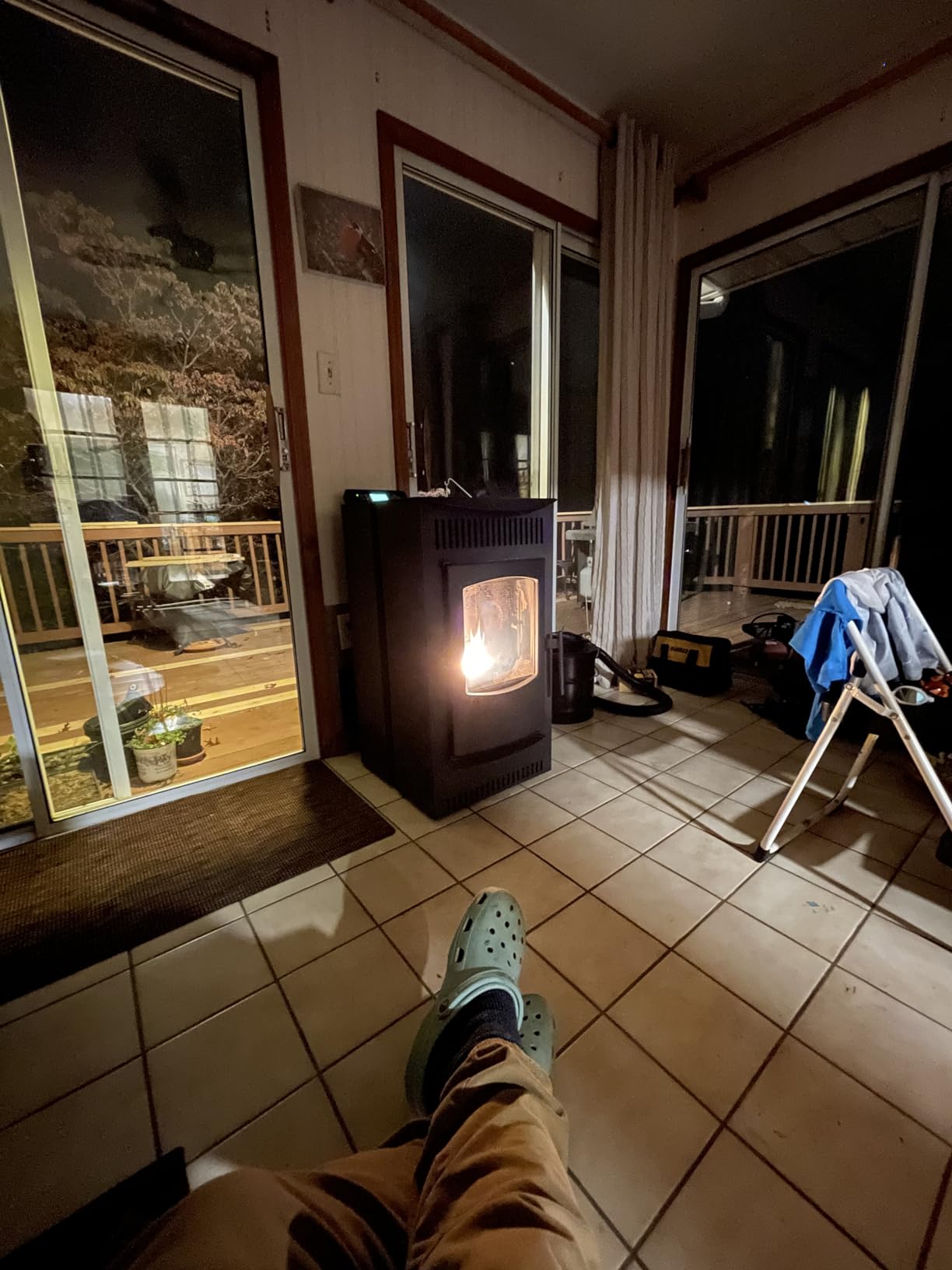
8. ComfortBilt HP40 Alpine – Best Compact Pellet Stove for Cabins and Small Spaces
ComfortBilt HP40 Alpine Pellet Stove, 1,500 sq. ft., 25 lb. Hopper, Black
1,500 sq. ft., 26,224 BTU, 25 lb. hopper
81 percent efficiency, 167 lb.
Direct vent, 21 x 17 x 30 in.
Pros
- Smallest footprint in the group at 21 by 17 by 30 inches
- Compact body suits cabins
- sunrooms
- basements and workshops
- 81 percent listed efficiency
- with owners reporting about 1 lb. per hour on level 1
- Daily cleaning takes only a few minutes
- Strong customer service reported
Cons
- No adjustable feeder screw or blower speed
- so pellets can be blown out of the burn cup
- Eco mode cycles the igniter and shortens its life
- 25 lb. hopper runs about 8 hours on level 5
- Reported noise level is unpleasant in the same room
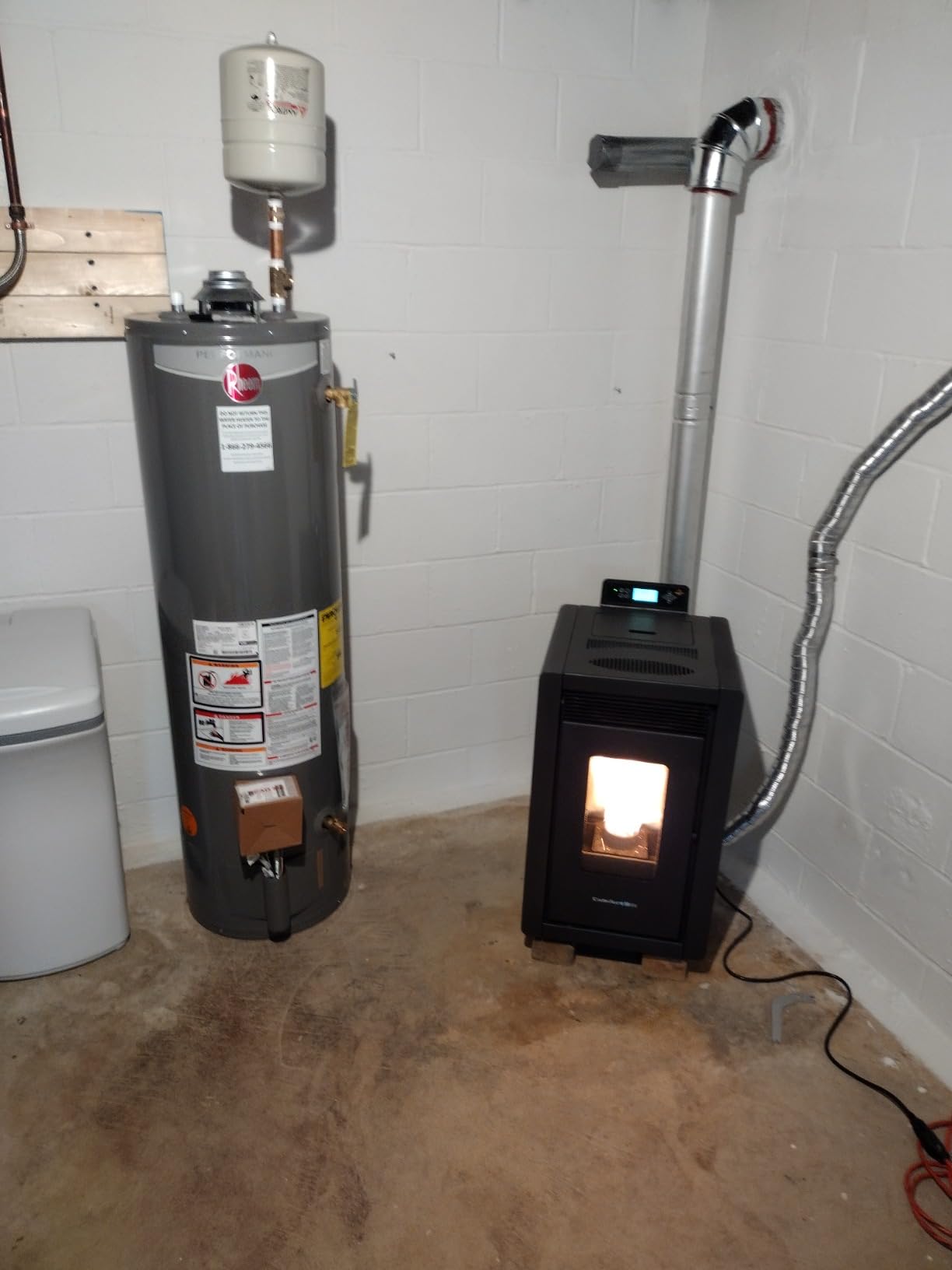
The HP40 Alpine is among the two smallest stoves here, and the one built for spaces the others would overwhelm. At 21 inches deep by 17 inches wide by 30 inches high and 167 lb., it fits a cabin, a sunroom, a basement, a garage or a workshop without taking the room over.
It heats up to 1,500 sq. ft. at up to 26,224 BTU per hour from a 25 lb. hopper and carries a listed efficiency of 81%, the only published efficiency figure among the eight. It holds a 3.9-star average across 24 ratings, the smallest rating count of the eight, so treat the number as directional.
Efficiency and Real Pellet Consumption
At 81% listed efficiency, this is the stove most likely to help with the federal biomass stove tax credit, which requires a 75% or higher rating to qualify. Owners who have measured it report burning about 1 lb. of pellets per hour on the lowest setting, which is a useful real-world number for planning a season’s fuel.
The catch is the 25 lb. hopper. Owners report about 8 hours of runtime on level 5 and closer to 24 hours on level 1, so a cold-weather day on medium heat means refilling once, sometimes twice. That is the real cost of a small hopper, and it is worth weighing against the space the larger hoppers take up.
Hopper Hang-Ups and the Missing Feeder Adjustment
Two design limits show up repeatedly in owner feedback. There is no user-adjustable feeder screw or blower speed, so on higher settings pellets can get blown out of the burn cup. Pellets can also hang up in the hopper rather than feeding consistently, and the auger may squeal if it is not oiled during break-in.
Related: eco mode cycles the igniter, and owners report this shortening its life. Running in manual mode instead of eco mode is the advice that comes up most often, and it is worth knowing before you program the stove to run unattended all night.
Noise, Controls and Where It Earns Its Place
Owners report a loud fan and feed noise that is unpleasant in the same room, so it is a better fit for a basement, garage, workshop or a room you heat while you are elsewhere than for a bedroom or a quiet living space.
Controls are otherwise complete: five power settings, a programmable thermostat, an included remote and automatic ignition, with EPA and CSA certification and a removable ash pan. Daily cleaning takes only a few minutes because of the small firebox, and owner-reported customer service has been good.
How to Size a Pellet Stove for Your Home and Layout
Sizing is where most pellet stove returns start, and it is a math problem more than a preference. Start with the 20 BTUs per square foot rule, then subtract for the things that make a house easy or hard to heat.
Square footage and layout: A 1,500 sq. ft. home is served well by a 26,000 to 32,000 BTU stove. A 2,000 sq. ft. home wants 35,000 to 40,000 BTU, and a 2,500 sq. ft. home is in the range where one unit stops being enough.
Tri-levels and open floor plans: Warmth concentrates around the stove, and a second story or a closed-off wing gets noticeably cooler. On a tri-level, owners commonly run the pellet stove on the main level as a primary source and add small electric heaters in the remote rooms rather than trying to push one stove through the whole house. It is a hybrid pattern that works better than most roundups admit.
Ceiling height, insulation and glass: High ceilings, poor insulation, lots of windows and a drafty envelope all raise the effective square footage. A 2,000 sq. ft. old farmhouse in a cold region can need the same stove as a 3,000 sq. ft. modern insulated home.
Hopper target: Decide how often you want to refill before you pick a stove. Below 30 lb. is a daily task in winter. At or above 50 lb. you fill it once or twice a week. Above 100 lb. you are buying convenience, and you should check the fill door size so you can actually use it in gloves.
Climate reality check: Manufacturer coverage figures are almost always conditioned on mild temperatures. If you are in a region with long, hard winters, size toward the low end of a unit’s range or plan to run it as a zone heat source. Buyers in mild climates who oversize their stove end up shutting it off above 30F, which wastes pellets and wears components out faster than steady moderate use.
Why Owners Give Up on Pellet Stoves (and What to Do About It)
Plenty of people sell a pellet stove, and it is rarely because the concept does not work. It is almost always one of a short list of mechanical and fuel problems, and most of them are fixable or avoidable.
Ash clumping is usually the pellets, not the stove. Dense clinker-like ash is the loudest complaint in owner threads, and pellet ash content and supplier are the usual cause. New owners are routinely advised to burn through 200 lb. or more of a fresh delivery before judging a stove, because fresh pellets behave differently from aged ones. Low-ash pellets such as Northern Warmth Supreme and La Crete Softwood are described in owner discussions as producing noticeably less ash than alternatives.
Advertised burn time assumes the lowest setting. Nearly every runtime figure on a spec sheet is calculated at minimum heat output. Run the stove at a temperature that actually keeps the house comfortable and you will get noticeably fewer hours per load. Treat the printed figure as a ceiling, not a promise.
Stranded fuel in the hopper. Some units report running out of pellets and shutting down with fuel still sitting in the hopper, because the hopper does not funnel pellets down to the auger properly. This is the most-cited deal breaker in owner threads and it is worth testing early in the season rather than discovering it in January.
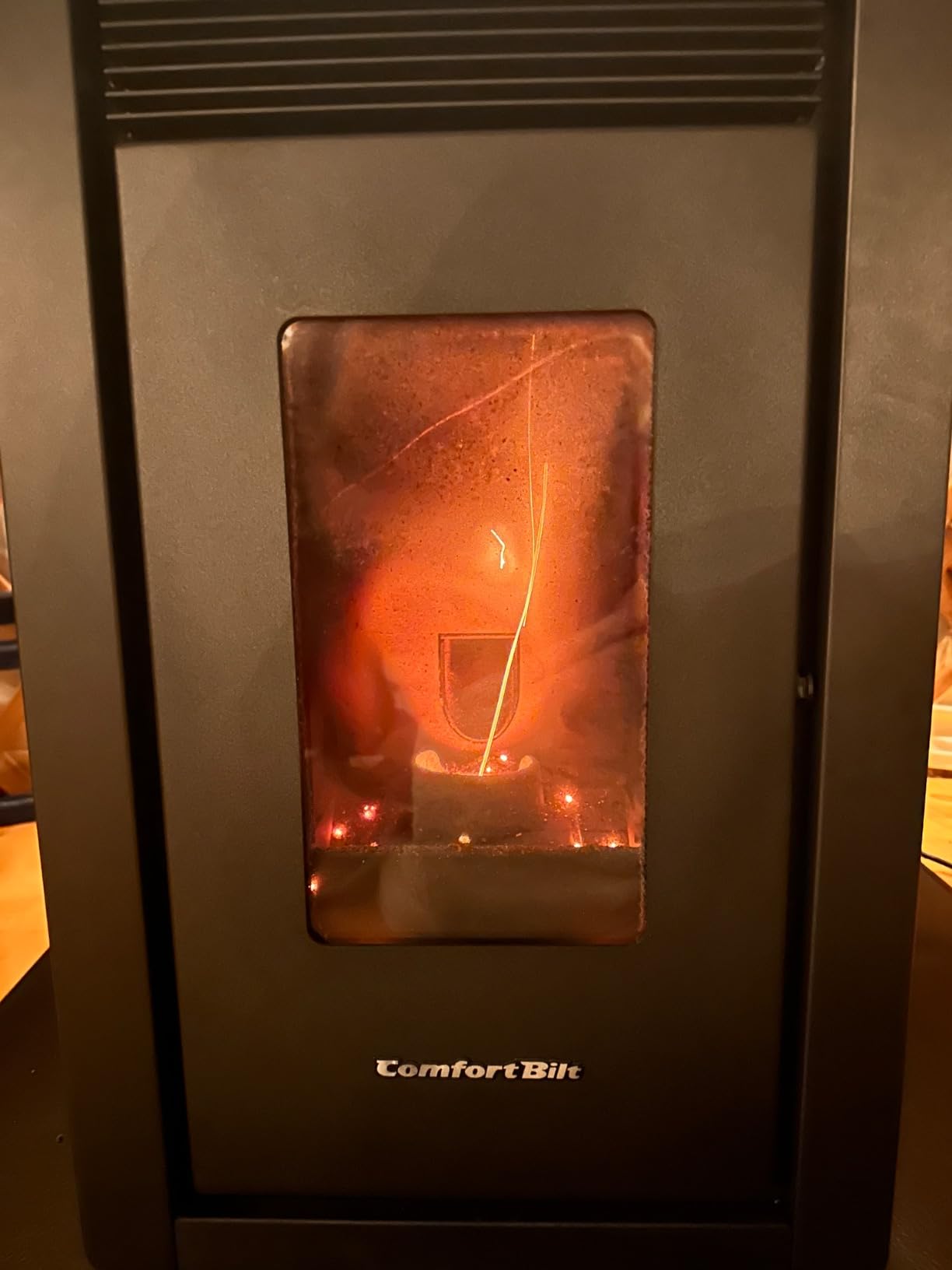
Black window glass. Owners report glass going black within a few hours even on stoves with an air wash system. Treat glass cleaning as a weekly task tied to the size of the viewing window, not as a sign the stove is broken.
Electricity dependence during outages. Augers and blowers stop when the power goes out, so the stove loses heat in exactly the conditions where you needed it most. This is a design fact, not a defect, and the fix is either a non-electric gravity-fed model or one with battery backup.
Confusing controls. Programming that nobody can figure out leads to a stove that runs inefficiently or sits idle. A model with a clear thermostat, a working remote and readable documentation is worth real money over a decade of use.
What a Pellet Stove Costs to Run Each Season
Running cost is where the “pellets are cheap” claim gets tested, and the honest answer depends on your region and your season rather than on the stove.
A 1,800 sq. ft. home commonly burns around 2 tons of pellets per season, per owner reports in pellet stove forums. That is the number to plan around, and it is why a bigger hopper pays off if you are in a region where pellet deliveries are frequent rather than annual.
Pellet prices vary sharply by region and by season, and spikes in local prices can erase the savings you were counting on. Multiply your seasonal tonnage by your delivered price per ton, then add electricity. The stove itself is a small electrical load, on the order of 100 kWh per month, and several of the stoves here draw less than 80 watts.
Owners report meaningful savings against propane, and the Serenity’s buyers in particular describe lower bills than propane. The realistic pattern most people settle into is a pellet stove as the primary heat source in the main living area, with small electric heaters carrying the far rooms.
One more financial input: the federal biomass stove tax credit returns 30% of cost up to a program maximum, installation included, but only for a stove rated at 75% efficiency or higher. Verify the current status and any completion deadline with the IRS before you purchase, because the eligibility window and the completion requirement have both changed in recent years.
Electric vs. Non-Electric Pellet Stoves and How Venting Works
Nearly every pellet stove needs electricity, which makes two decisions less obvious than they look.
Electric or non-electric. If your power goes out in winter, a non-electric gravity-fed model such as the US Stove Wiseway keeps burning with no moving parts in the fuel path. If you want app control and scheduled heating but still want outage coverage, a battery backup system like the Pellethead PS21 is the compromise. Otherwise, any standard electric-fed stove works fine in a home with reliable grid power.
Venting options. A direct vent stove exhausts through a pipe straight through an exterior wall, which is the simplest install and the most common. A vent-free model needs no exhaust pipe at all, which is why the Serenity and the PS21 install easily, and requires a clean-air intake instead. An insert such as the HP22i uses an existing fireplace opening and still needs its own exterior vent run. Whichever you choose, respect the manufacturer clearance requirements, and use a three-inch pellet vent pipe for gravity-fed models since that is the standard size.
Form factor. Freestanding units give you placement freedom and the largest hoppers. Inserts buy you a fireplace you already have and save floor space, at the cost of a smaller hopper. Wall-mounted and mobile-home-rated units exist for specific layouts, and anything installed in a manufactured home needs mobile home approval.
Since you are planning installation, it may help to think about the rest of your home’s tech the same way. Our guide to the best smart home hubs for Google Home covers the controllers that pair well with a Wi-Fi-enabled stove for voice and app control, and our roundup on the best task lighting for home offices covers the lighting setups people pair with a dedicated heating zone. If the stove is going into a basement, workshop or garage rather than a main living space, lighting and heat planning tend to be decided together.
Frequently Asked Questions
What is the best pellet stove for home heating?
For most homes the ComfortBilt HP22 is the strongest all-rounder, with a 55 lb. hopper, up to 41,000 BTU per hour and coverage rated up to 2,800 sq. ft. Homes that lose power in winter should look at a non-electric gravity-fed model such as the US Stove Wiseway or a battery backup unit such as the Pellethead PS21, which runs over 40 hours on two 12V batteries.
Can a pellet stove heat an entire house?
Yes, for homes up to roughly 2,500 sq. ft. on a single main level. A useful rule is 20 BTUs per square foot, so a 2,000 sq. ft. home wants 35,000-40,000 BTU. On a tri-level or open plan with a far wing, one unit often cannot cover everything, and owners commonly pair a pellet stove with small electric heaters in distant rooms.
What pellet stove has the biggest hopper?
The Cleveland Iron Works Large in this group holds 130 lb., with owners reporting roughly 115 lb. of usable capacity, and covers 2,000-3,000 sq. ft. Two others come close: the Cleveland Iron Works Bayfront at 66 lb. and the US Stove Wiseway at 60 lb. A large hopper only helps if the fill door is wide enough to load in cold weather.
Is it cheaper to heat your home with a pellet stove?
Often, yes, but it depends on regional pellet prices and how many tons you burn. A 1,800 sq. ft. home commonly uses around 2 tons of pellets per season, and owners report noticeable savings against propane. Electricity adds only about 100 kWh per month, though pellet price spikes in some regions can erode the advantage.
Why are people getting rid of their pellet stoves?
The most common reasons are heavy ash clumping, which is usually caused by pellet ash content rather than the stove, and fuel stranded in the hopper because the auger does not funnel properly. Owners also cite window glass blacking out within hours, pellet consumption exceeding advertised burn time, and auger and blower failures after the warranty ends.
Do pellet stoves use a lot of electricity?
No. The auger and blowers together draw roughly 100 kWh per month, which is a very small cost. Individual models vary: the Castle Serenity is rated at 77 watts, and some units allow the blower to be switched off in manual mode. Only non-electric gravity-fed models work at all without power.
How do you vent a pellet stove?
A direct vent model exhausts through a pipe straight to an exterior wall, which is the simplest option. A vent-free model needs no exhaust pipe but requires a clean-air intake instead. A fireplace insert uses an existing opening and still needs an exterior vent run. Gravity-fed models use standard 3 inch pellet venting, and all models must follow manufacturer clearances.
How We Picked These 8 Pellet Stoves
We compared eight freestanding, insert and non-electric pellet stoves that cover the full range of real household situations, and we scored them on the criteria buyers actually live with rather than on the ones that photograph well.
Heating capability: rated BTU output and stated square-footage coverage, cross-checked against the 20 BTUs per square foot rule rather than taken at face value.
Hopper capacity and burn time: how long between refills, and whether that figure is measured at a usable heat output or only at the lowest setting.
Efficiency and certification: EPA certification and efficiency rating, including whether the stove clears the 75% threshold for the federal biomass credit.
Controls: thermostat, remote, app and Wi-Fi support, and how clearly the programming works.
Reliability signals in real owner feedback: the specific failure modes owners describe, not just star ratings. A 3.5-star unit with one recurring fixable fault is a different proposition from a 3.5-star unit with scattered complaints.
Maintenance reality: how much ash handling, burn-pot cleaning and glass cleaning the design creates, and how long the warranty lasts.
We deliberately included a mix of ratings rather than only the highest-rated models, because a category where the best-selling models here sit between 3.5 and 4.4 stars needs explaining, not hiding. Every pick on this page lists real cons, and the two we rated most cautiously are the two owners complain about most often.
The Bottom Line
Buy the ComfortBilt HP22 if you want one stove to run a mid-size home and you can vent through an exterior wall. Its 55 lb. hopper, 41,000 BTU output and 4.4-star average across 291 ratings make it the most complete all-rounder we tested, and it is our pick for the best pellet stoves for home heating in 2026.
Choose the Pellethead PS21 if your power goes out in winter, or if you want app control and a 5-year warranty in a space under 1,800 sq. ft. Choose the US Stove Wiseway if outages are a certainty and you want zero electricity dependency and up to 30 hours per load, accepting the most polarized owner reviews of the group.
Go with the Cleveland Iron Works Large if refilling more than once a day is unacceptable to you, the Cleveland Iron Works Bayfront if you want Wi-Fi with an 8-year steel parts warranty, the ComfortBilt HP22i if you have an existing masonry fireplace to reuse, the Castle 41278 Serenity if you refuse to scrub tubes, and the ComfortBilt HP40 Alpine if you are heating a cabin, garage or basement under 1,500 sq. ft.
Check the latest listing for the model you have narrowed down, and confirm your vent path and clearances before you order.