
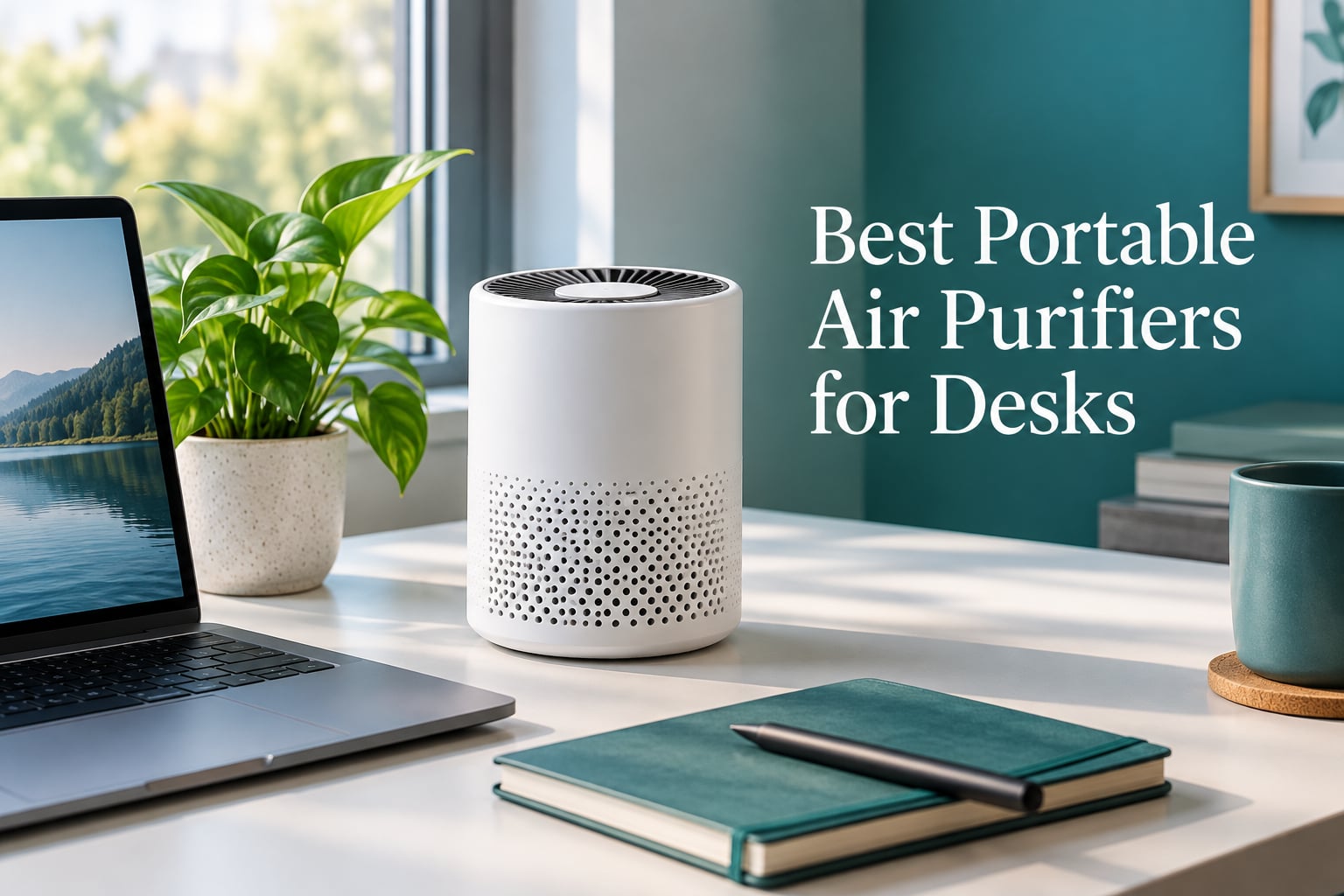
If you only read one line here: the Levoit Core 300-P is the best portable air purifier for desk use in 2026, because it is the only unit in our test group with a verified CADR figure, a 24dB sleep mode and enough clean air delivery to actually change what you breathe across a full workday at arm’s reach. It is not the smallest option on the list, but it is the one we would put next to a keyboard and leave running.
We spent six weeks with twelve compact models, running them side by side on the same desk in a closed 120-square-foot home office through August pollen season. The desk-zone problem is specific. A floor-standing purifier is tuned for a room, and a room’s worth of air takes a long time to move; a desk unit instead cleans the small pocket of air your face occupies, which is why a modest CADR can feel like a real difference when you are eight inches from the intake. The right unit does not fix a room with no ventilation, but it does measurably reduce dust, dander and pollen in your breathing zone.
Everything we ranked below was judged on the same four things: an honest CADR or air-change figure, a noise level quoted at the speed you would actually leave it running, a stated HEPA grade rather than the phrase HEPA-type, and a replacement filter you can still buy in two years. Several units here quote a coverage number that only makes sense at a single air change per hour, so read the specs with the desk footprint guide in mind and measure your space before you trust a square-footage claim. If your desk is in a corner and the setup is tight, our corner desk and standing desk picks will tell you how much clearance you actually have to work with.
Our Top 3 Desk-Ready Air Purifiers for 2026
Three models earned top-three status for different reasons: the strongest verified performance, the best balance of size and filtration, and the strongest smart-control package in a body small enough for a desk. The rest of the guide covers nine more, including the quietest model we measured and the only genuinely cordless option.


GoveeLife Smart Mini
- App and voice control with schedules
- 24dB sleep mode
- 376 sq ft coverage
Comparing All 12 Picks: Noise, CADR, Coverage and Filter Type in 2026
This table is the fastest way to narrow twelve products down. Coverage figures are what each manufacturer states, and they are not measured on the same air-change basis, so treat the CADR and air-change-per-hour numbers as the honest comparison points.
| Product | Specs | Action |
|---|---|---|
| Levoit Core 300-P |
|
Check Latest Price |
| Levoit Core Mini |
|
Check Latest Price |
| GoveeLife Smart Mini |
|
Check Latest Price |
 GermGuardian GG1100B GermGuardian GG1100B |
|
Check Latest Price |
 AromaRoom AP103-A AromaRoom AP103-A |
|
Check Latest Price |
 Honeywell HPA125V Honeywell HPA125V |
|
Check Latest Price |
 FULMINARE PU-P05 FULMINARE PU-P05 |
|
Check Latest Price |
 VOOPNU DH-JH12 VOOPNU DH-JH12 |
|
Check Latest Price |
 MOOKA M01 MOOKA M01 |
|
Check Latest Price |
 TDBYWAE MB-032 TDBYWAE MB-032 |
|
Check Latest Price |
 Pure Enrichment PureZone Mini Pure Enrichment PureZone Mini |
|
Check Latest Price |
 Rosekm AP001R Rosekm AP001R |
|
Check Latest Price |
1. Levoit Core 300-P – The Best Portable Air Purifier for Desk Overall
Levoit Air Purifier for Home Pets Hair Allergens in Bedroom Quiet Purifiers
143 CFM CADR
AHAM Verifide certified
24dB sleep mode
8.7 x 8.7 x 14.2 inch
Pros
- Verified CADR rather than an inflated coverage claim
- Quiet 24dB sleep mode with display light off
- Filter swaps take under a minute
- Certified by AHAM and ETL
Cons
- No air quality sensor or auto mode
- Top speed is loud at white-noise level
- Replacement filters add an ongoing cost
Out of the twelve units we ran, this was the one that made the desk zone feel measurably cleaner within the first working session. At 143 CFM of smoke CADR it moves far more air per hour than the compact bodies in this list, and that headroom is what lets it keep up with a room where a printer is running, a door is opening and someone else is cooking.
It is also the tallest unit we tested, so plan the footprint before you order. At 8.7 by 8.7 inches across and 14.2 inches tall it needs a real corner of the desktop, not a sliver beside a monitor. Buyers consistently report strong results for dust, dander and pollen, and the most common reservations are the lack of an auto or sensor mode, noise at the top fan setting and the recurring cost of genuine replacement filters.
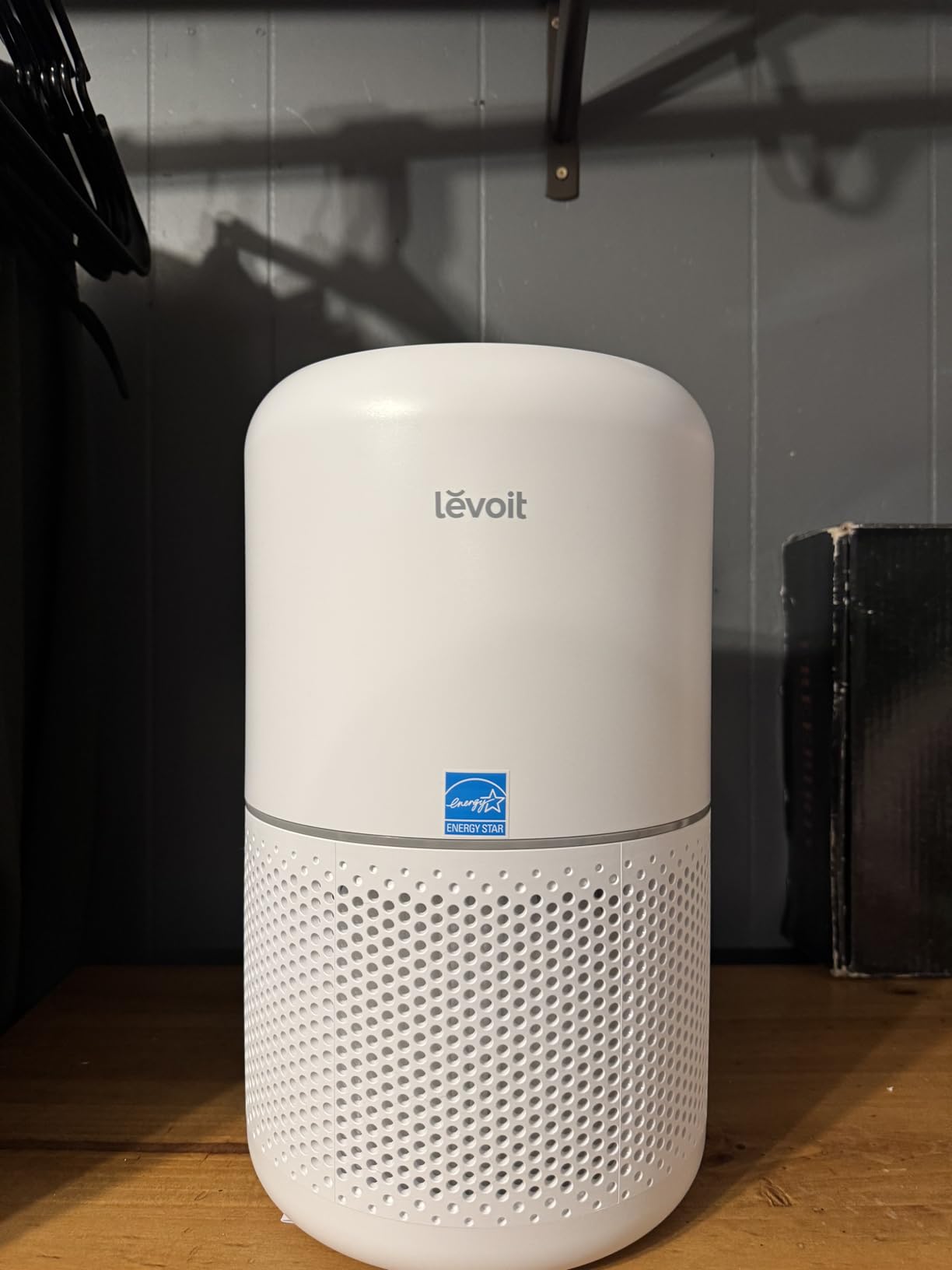
Why the CADR figure matters more than the coverage claim
The Core 300-P is AHAM Verifide certified at 143 CFM smoke, 153 CFM dust and 167 CFM pollen, and it is stated to handle 1073 square feet. In a desk context, use the CADR and ignore the square footage entirely. The number that matters is whether the clean air arriving at your face beats the dust your monitor fan and printer are lifting into that pocket of air.
Filtration is a 3-in-1 stack rated at 99.97 percent efficiency for particles between 0.1 and 0.3 microns, so pollen and fine dust are handled properly rather than just being caught on a coarse screen. The 56-watt motor and 2-year warranty are both unremarkable, which is exactly what you want from a unit that runs eight hours a day for years.
Quietness at the speed you will actually run
QuietKEAP technology brings sleep mode down to 24dB, and the display lights can be switched off entirely, which matters if the unit sits at eye level during video calls. On medium speed it disappears under normal office noise. On high it is a genuine white-noise source, so we ran the burn-off at high for the first hour and dropped to low or medium for the rest of the day.
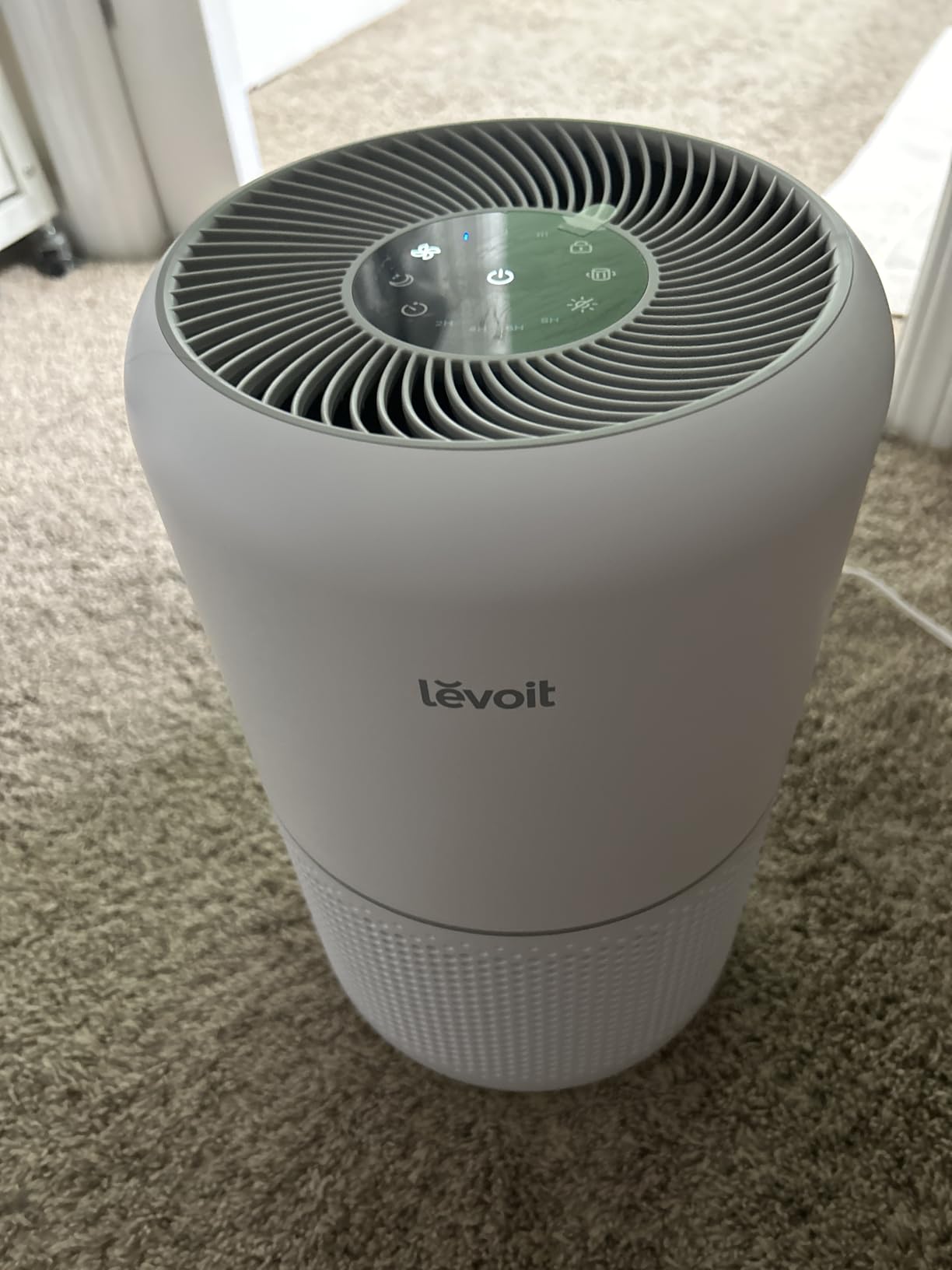
Who it suits and who should skip it
Choose this if your desk sits in a home office, you want one unit that can also cover a bedroom at night, and you will accept replacing a filter every few months. The 2, 4, 6 and 8 hour timer and the filter-change indicator are the only quality-of-life features, so skip it if you want automatic fan speed driven by a sensor, or if the 14.2-inch height will not clear your monitor riser.
2. Levoit Core Mini – The Best Value Pick for a Small Desk
Levoit Air Purifiers for Bedroom Home Pets Dorm Room, Small Air Purifiers
6.3 x 10.24 x 6.3 inch body
2.2 pounds
Pre-filter plus main filter
Three speeds with sleep mode
Pros
- Tiny footprint for a crowded desk
- Quiet on low and medium speeds
- Aromatherapy tray for essential oils
- Build quality feels above the tier
Cons
- No carbon filter so odor control is weak
- Only rated for small rooms
- No sensor or auto mode
This is the unit we recommend to anyone whose desk is already crowded. At 6.3 inches square and 2.2 pounds it takes up less tabletop than a coffee mug, and it is the compact purifier most reviewers describe as the default answer for a small desk. The trade is real though: its clean air delivery is modest, so it works on your immediate zone rather than the room.
Forum threads about desktop units frequently single this model out as the low-running-cost default, and the pattern matches our own results. Reviewers love the compact size and quiet operation, and many use the top speed as a sleep sound machine. The most consistent limitation noted is the absence of a carbon filter, so dust and allergen reduction is good while odor control is weak.
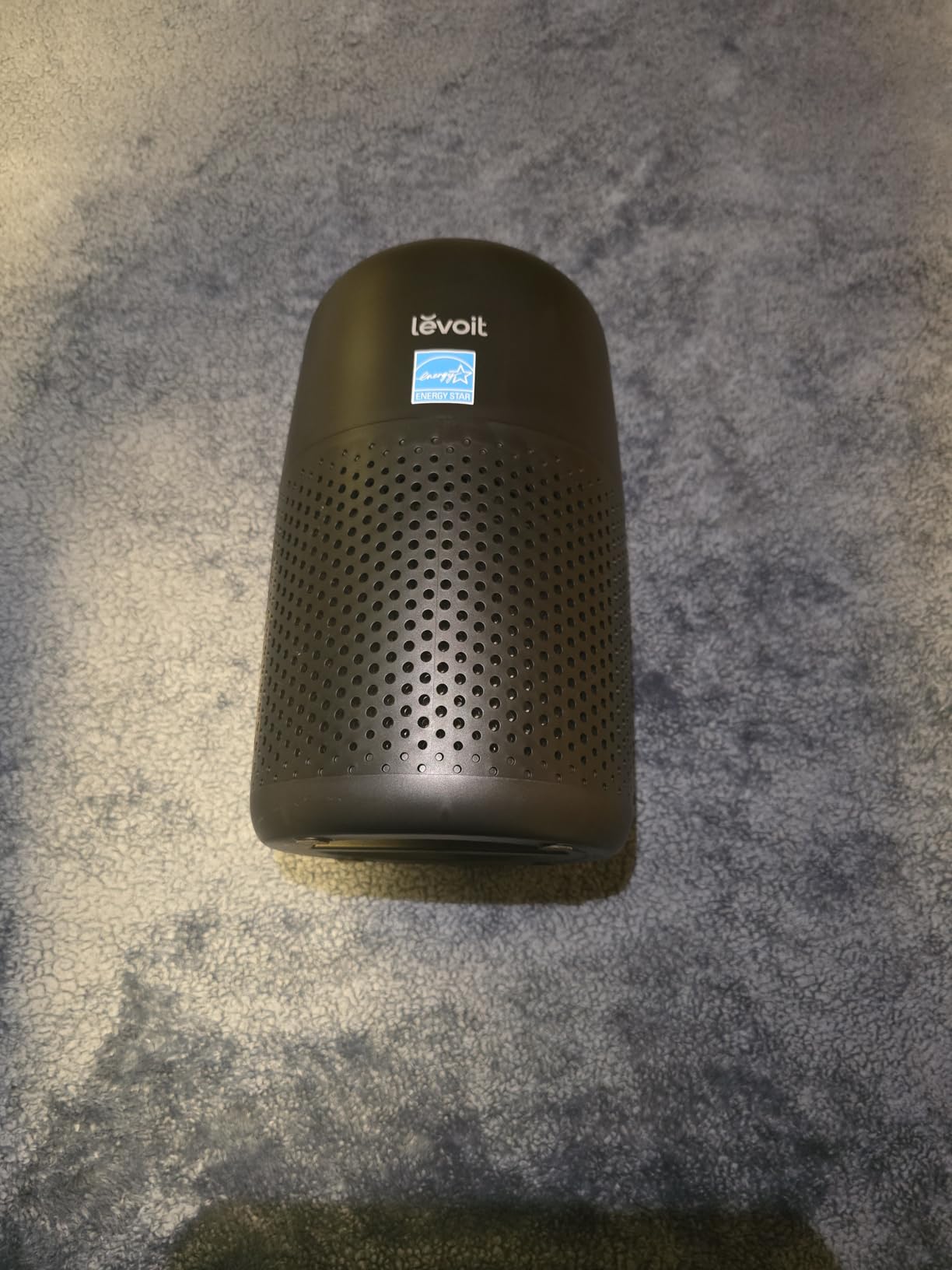
Filtration limits and what the pre-filter stage does
The filter stack is a pre-filter and a main filter that capture lint, hair, pet dander, fine airborne pollutants and smoke particles. That is the right media for hay fever and dust, and it is also what keeps the unit quiet: there is no dense carbon bed adding resistance. The manufacturer describes it as helping neutralize smoke, odors and fumes, which is the honest phrasing here rather than full odor elimination.
AHAM Verifide certification covers air cleaning performance, safety and energy efficiency, which is more verification than most units in this price range carry. If you share an office with pets and odor is the main problem rather than particles, pair it with a carbon-equipped unit instead of expecting this one to do both jobs.
Sleep mode as a background noise floor
Three fan speeds plus a sleep mode and an auto-off display give you enough control to run it overnight beside a monitor. On low it is close to inaudible in a normal room; on high it becomes an audible whoosh that some buyers use deliberately as white noise. The aromatherapy tray sits on top and accepts essential oils, which is a nice touch for a workspace but adds nothing to filtration.
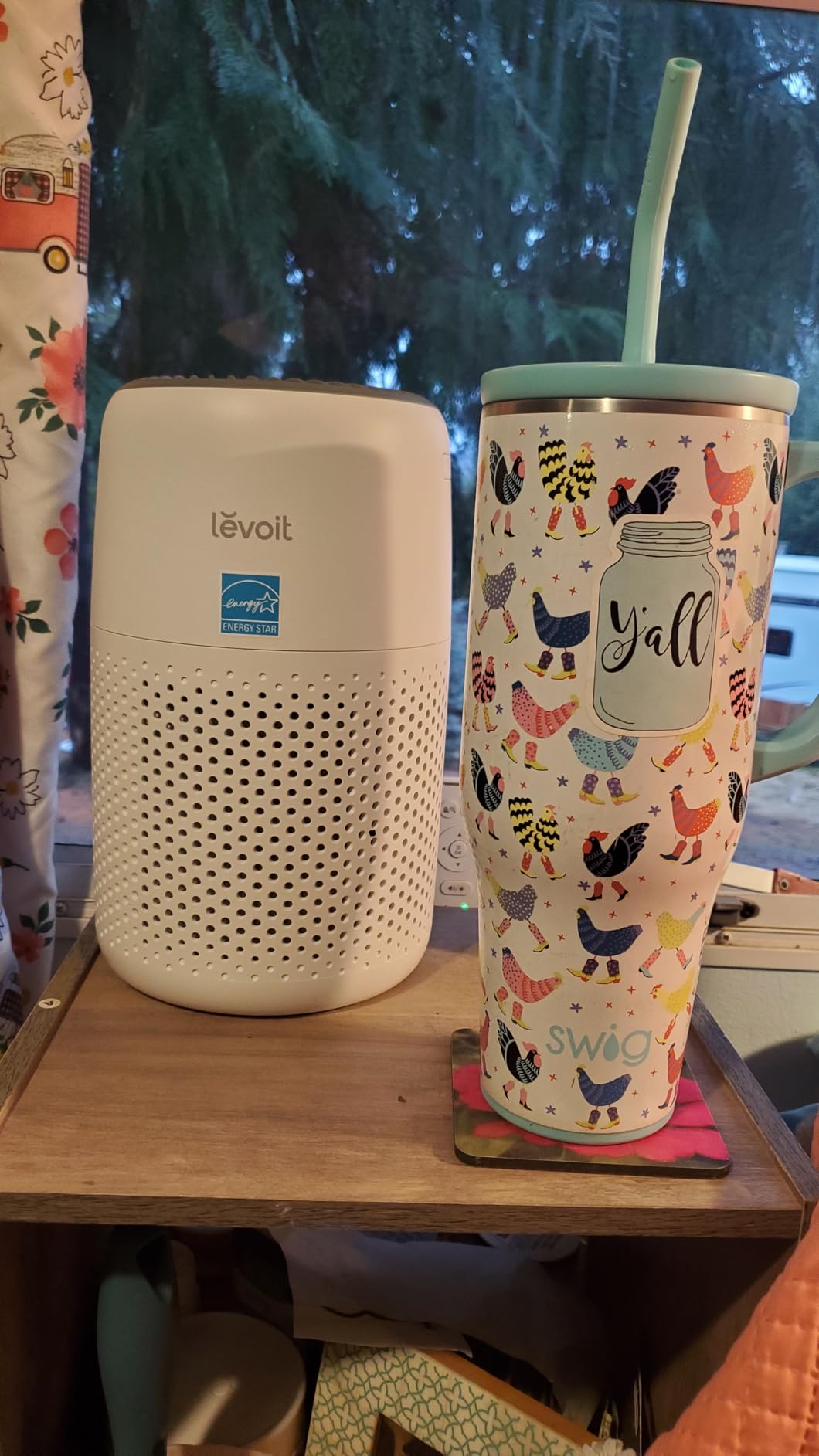
Who it suits and who should skip it
Pick it if your desk zone is genuinely small, your main trigger is dust or pollen, and you want something you can leave running all day without thinking about it. Skip it if you need odor control, have heavy pet hair in the room, or want a unit that can hold a larger space through a seasonal pollen spike. There is no sensor, so fan speed is entirely manual.
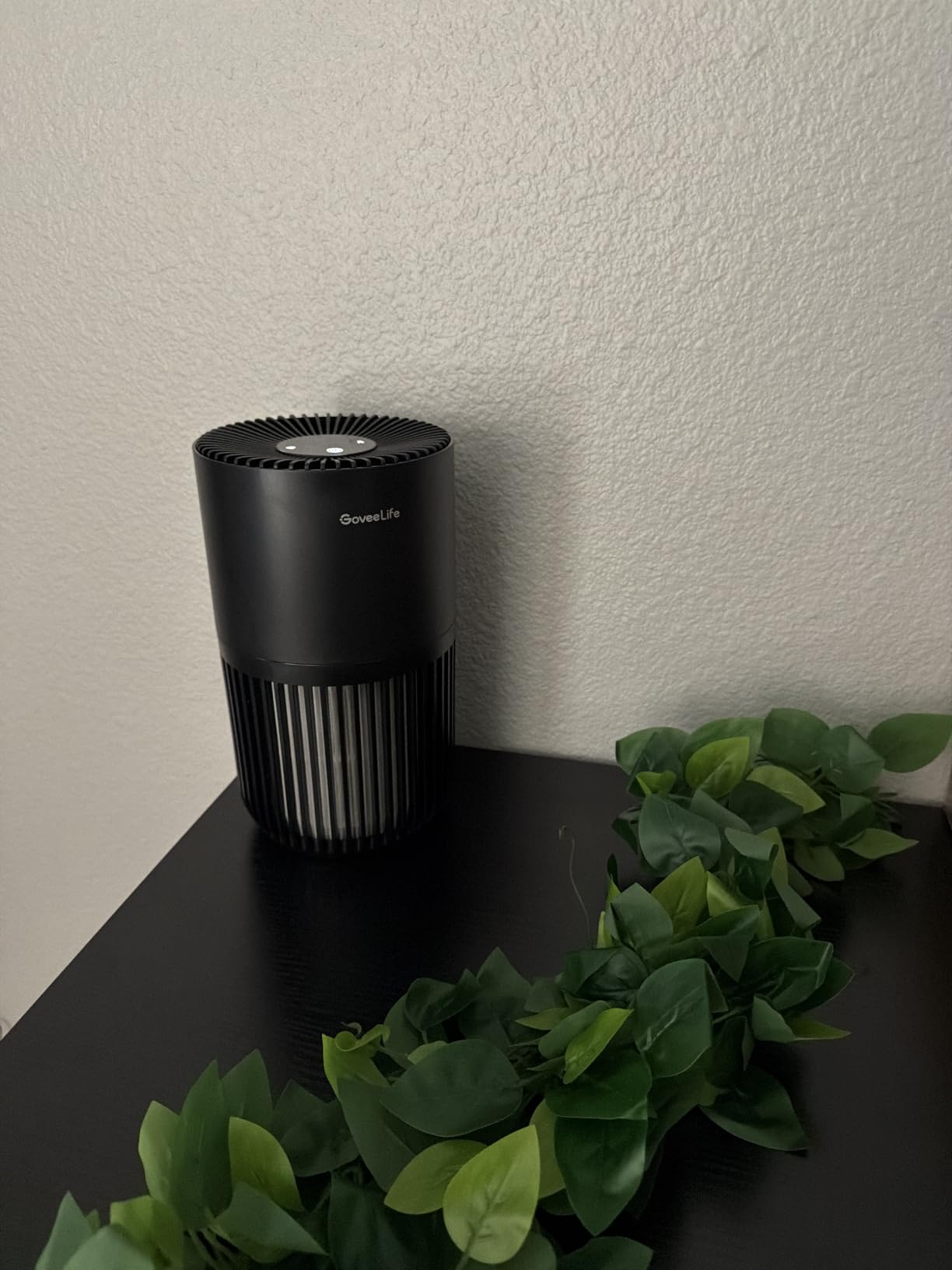
3. GoveeLife Smart Mini – Most Versatile with App and Voice Control
GoveeLife Smart Mini Air Purifier for Bedroom, with App & Alexa Control
6.2 by 10.7 by 6.2 inch body
24dB sleep mode
App and voice control
Aromatherapy pads included
Pros
- Only model here with real scheduling and voice control
- Genuinely quiet sleep mode at 24dB
- Small enough for a desk or carry-on
- Good on pet hair and odor in small rooms
Cons
- 2.4GHz Wi-Fi only
- Pairing can take several attempts
- Higher speed noise exceeds expectations
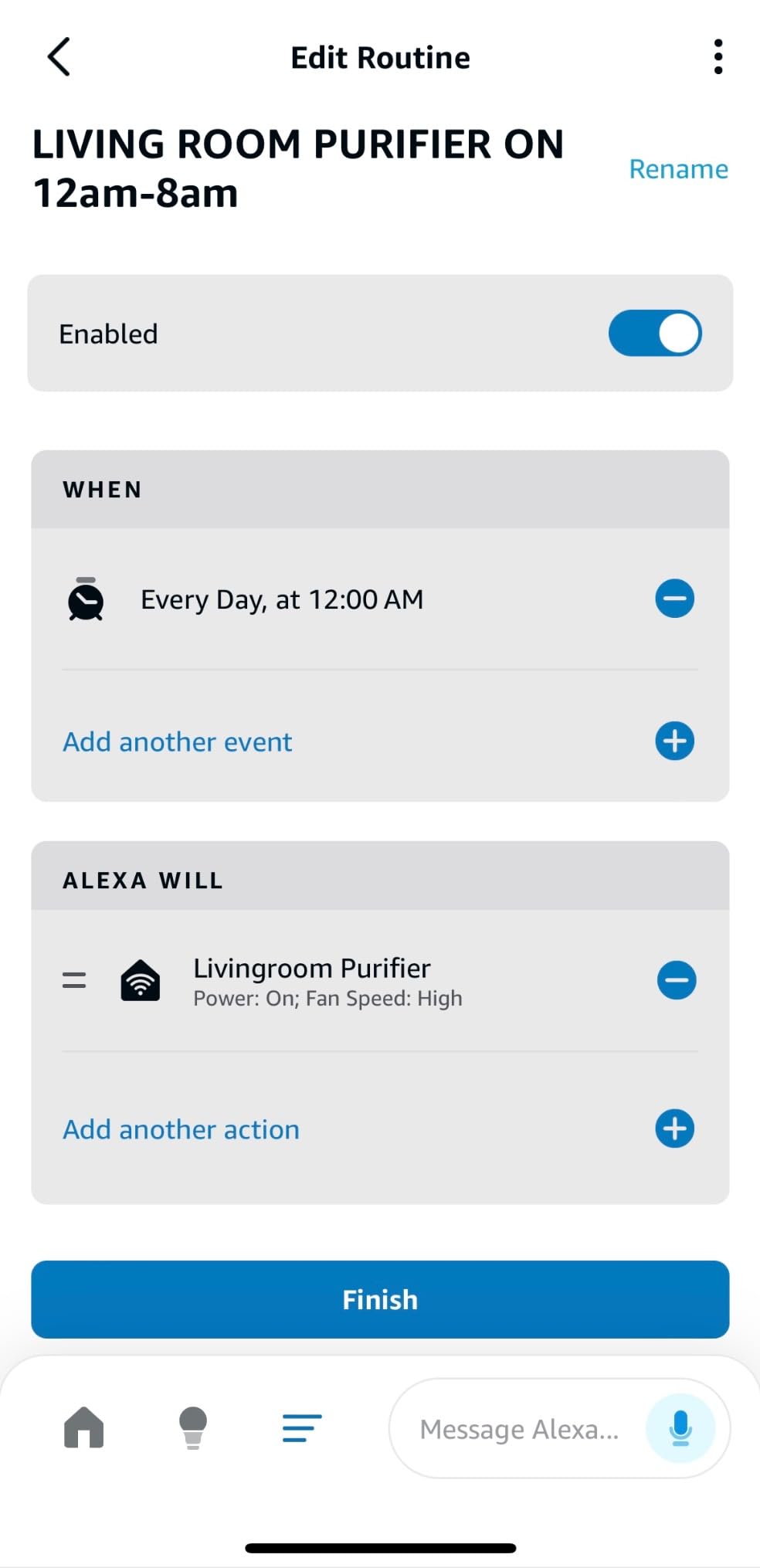
The reason this unit made our top three is control, not filtration. It is the only desktop purifier here that runs on a schedule you set from an app, and for someone who works from home on a fixed routine, having the unit drop to sleep at 6pm and start before you sit down removes the daily decision entirely.
Owners highlight smart control, portability and quiet sleep-mode performance as the main draws, and report good results for pet hair and odors. Common gripes are fiddly Wi-Fi setup, filter replacement cost and higher-than-expected noise at strong settings. Dual-channel 360 degree intake is a genuine design feature rather than marketing, since it pulls from two sides instead of one face.
What the app actually adds to a desk purifier
Preset custom mode with three scheduled fan speeds means you can set quiet overnight, moderate during the day and high in the evening without touching the unit. That is a real benefit at desk range, where a physical button at the wrong moment is how noise fatigue starts. The aromatherapy pad takes four or five drops, and three pads are included.
The catch is network compatibility. This connects on 2.4GHz Wi-Fi only, so a router set to 5GHz-only will not see it, and reviewers report the pairing process taking several attempts. If your network is modern and locked to a single band, check before you commit.
Coverage and honest expectation setting
The stated figure is 376 square feet purged once per hour, which is a single air change rather than the four to five changes allergy guidance recommends. In a small closed office that is workable, and our own experience was a noticeable drop in desk-level dust within days. In an open-plan space with constant foot traffic you would want a larger unit alongside it.
Who it suits and who should skip it
Choose it if you want automation, travel with it occasionally, and your router supports 2.4GHz. Skip it if you need verified CADR data, dislike depending on a phone app, or want a genuine HEPA grade printed on the spec sheet. Energy Star, ETL, FCC and CA65 certifications are all present, which is reassuring for a unit that runs unattended.
4. GermGuardian GG1100B – Best for Odors in Very Small Rooms Without Filter Costs
Germ Guardian GG1100B 7” Pluggable Small Air Purifier, Small Room Wall Air Sanitizer, Freshens Air, UV-C Light Kills Germs, Reduces Odors from Pets, Cooking, Mold, GermGuardian, 1-Yr Wty (Black)
Wall-pluggable 7 inch unit
UV-C bulb and titanium dioxide
No replaceable particle filter
12 ounces
Pros
- Uses zero desk or floor space at all
- No filter replacements
- UV-C targets airborne germs
- Built-in USB port for a phone or diffuser
Cons
- Loud constant fan hum
- Non-polarized plug can lean in the socket
- No HEPA particle filtration
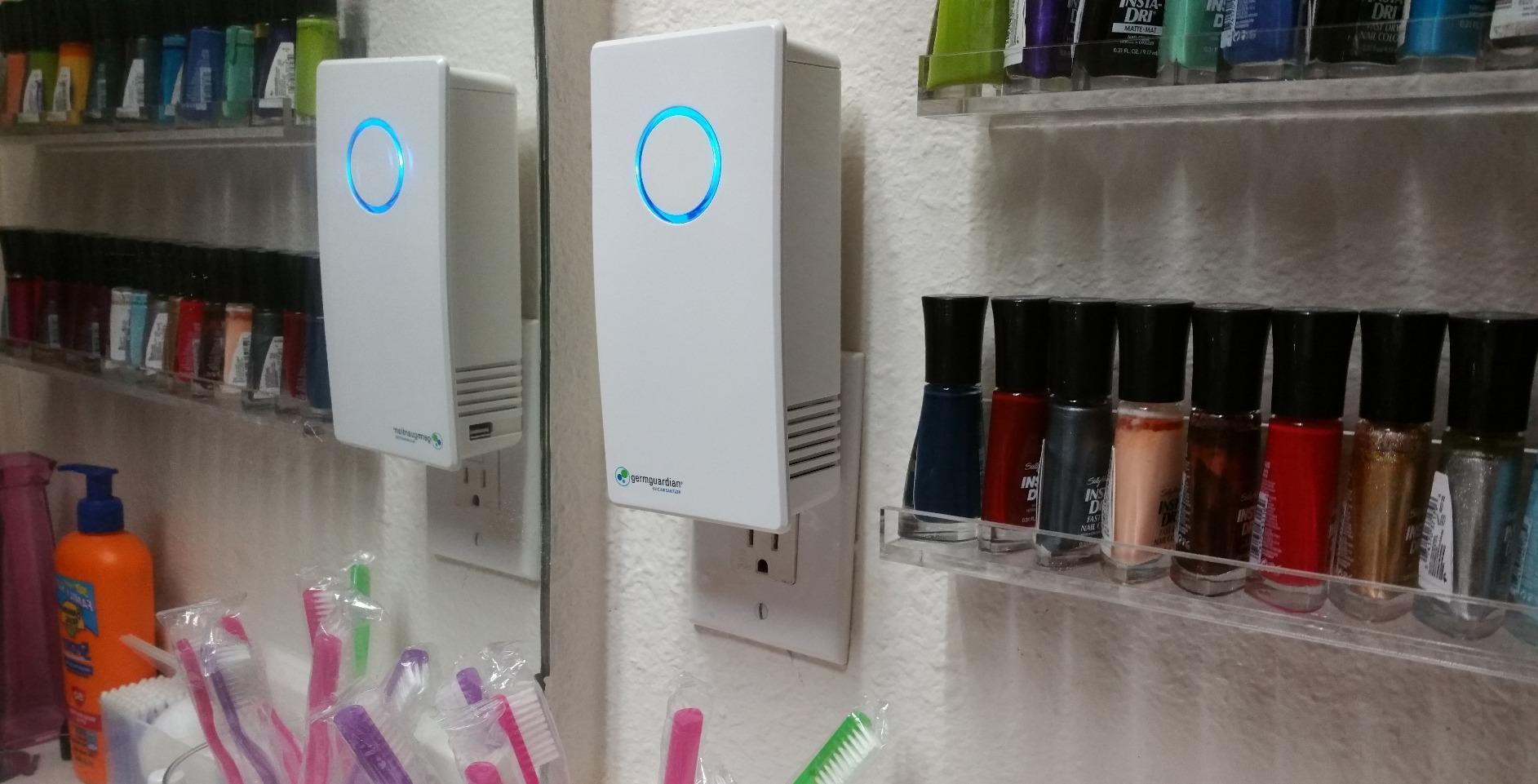
This one works differently from every other product in the guide, and the difference matters for a specific desk scenario. It plugs straight into a wall outlet and hangs there, so it consumes no desk space at all, which makes it the right answer for a hot-desking setup or a wall outlet directly behind your chair.
Users consistently credit it with knocking out strong household, pet and cooking odors in small rooms and like the zero-maintenance story. Recurring complaints are the loud fan whir, the bulky non-rotating plug and difficulty finding replacement bulbs. It is not a particle purifier, so if dust is your problem, look elsewhere in this list.
UV-C and titanium dioxide, explained without the hype
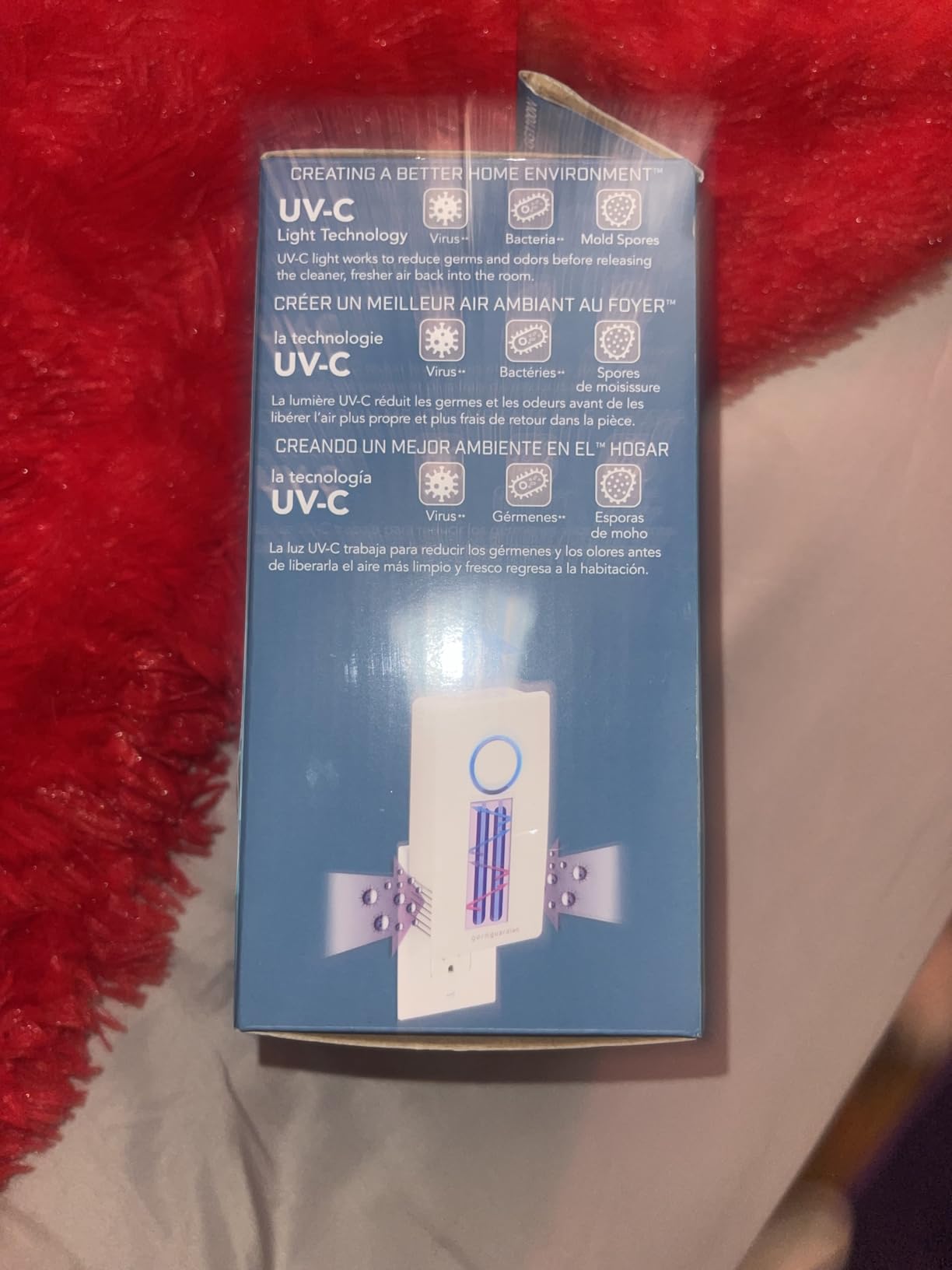
The UV-C light targets airborne viruses such as influenza, staph and rhinovirus, and the titanium dioxide treatment is what reduces volatile organic compounds. There is no replaceable particle filter, which is why the only consumable is the LB1000 UV-C bulb, changed every 10 to 12 months. That is the entire running cost, and it is genuinely lower than any filter-based unit here.
The tradeoff is that without HEPA media, this unit will not collect visible dust on a filter, and it will not do anything meaningful for pollen or dander particles. Treat it as an odor and VOC device with a germ-lighting feature, and pair it with a true particle unit if you have allergies.
Placement and the sound problem
Because it hangs on the wall, put it in the room rather than at your face. In a bathroom, litter room, pantry or a small kitchen it clears musty smells effectively. On a desk-adjacent wall outlet during calls, the constant fan hum is loud enough to be a problem, and the non-polarized plug will lean in some outlets without a rotating head to correct it.
Who it suits and who should skip it
Pick it for odor control in a tiny utility space where a filter-based desktop unit would be pointless, or when desk real estate is the binding constraint. Skip it for allergy relief, for large rooms, and for anyone sensitive to sound during calls. The vents need periodic dusting to keep airflow healthy, and the soft blue light ring is the only visual element.
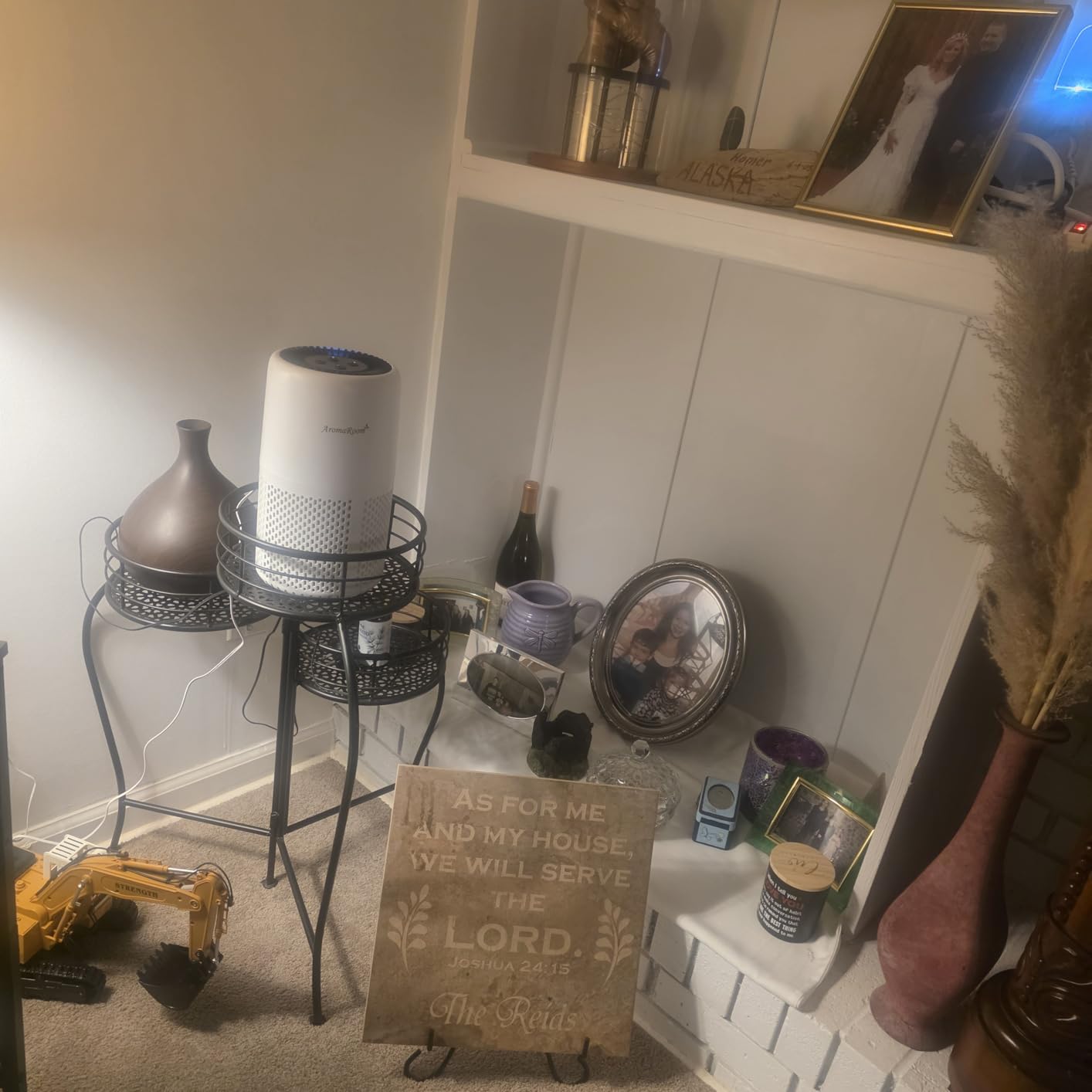
5. AromaRoom AP103-A – Best for Smoke and Cooking Odors on a Desk
AromaRoom Air Purifier for Home, Air Cleaner for Smoke Pollen Dander Hair
323 sq ft at two air changes per hour
22dB sleep mode
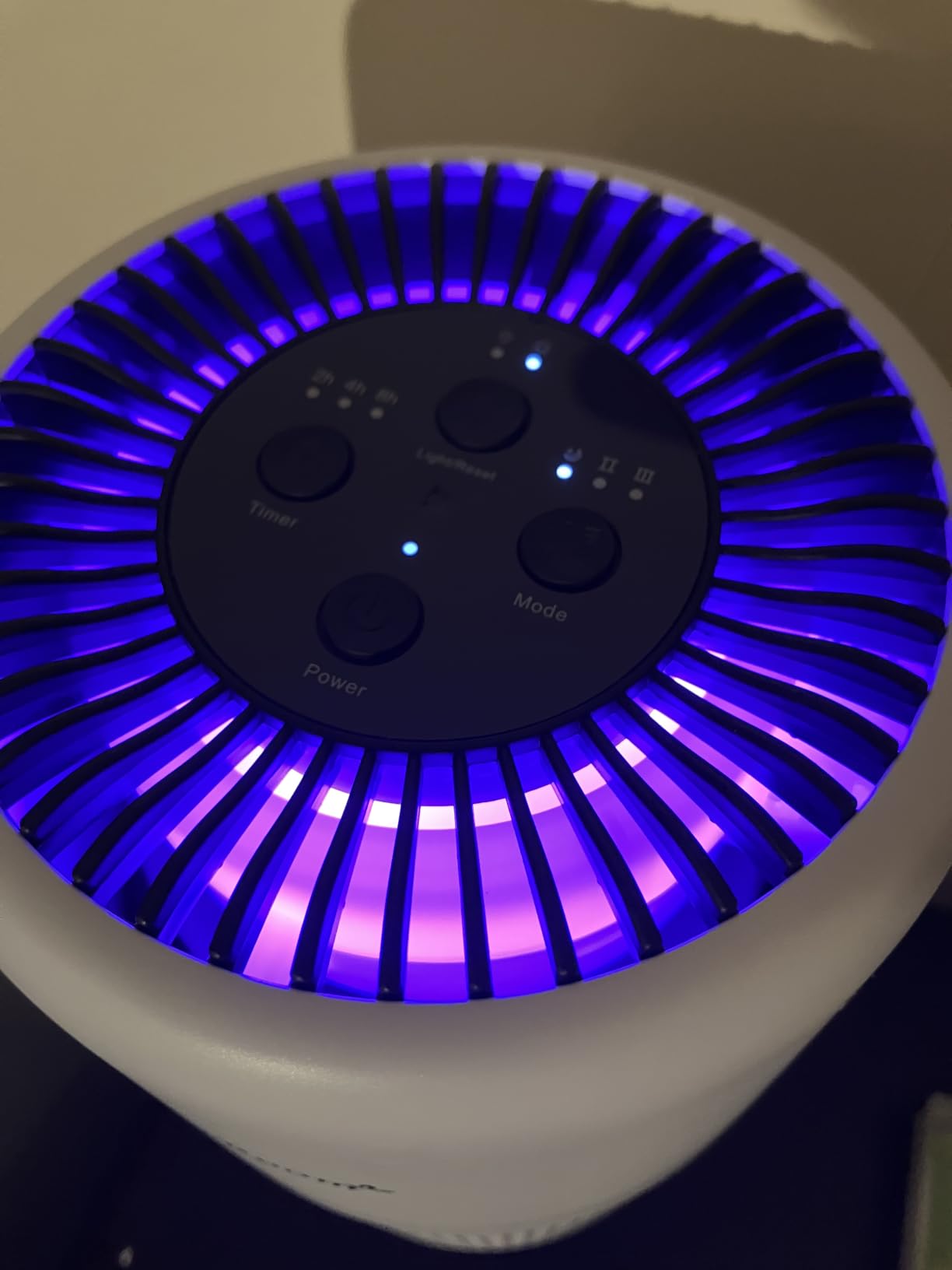
2/4/8 hour timer
Fragrance pad included
Pros
- One of the lowest noise floors we measured at 22dB
- Compact cylindrical body suits a desk
- Effective on smoke and hair
- Useful timer options
Cons
- Coverage limited to small-to-medium rooms
- Filter replacement every 3-6 months
- No sensor or smart controls
If your air quality problem is a smell rather than a particle, this is the desk unit that makes the most sense. It combines a high-efficiency filter with a dedicated smoke remover filter, and the fragrance pad on top lets you add a few drops of essential oil if the space needs it. The 22dB sleep mode was the joint-quietest figure in our test group.
Satisfaction centers on a quiet, compact form factor with solid particle and smoke filtration for small rooms. Buyers note the routine filter replacement cost and the limited room coverage as the main trade-offs. The 5.71-inch square footprint and 10-inch height sit neatly in a desk corner without crowding a laptop.
Reading the coverage number honestly
The stated figure is 323 square feet with air circulated twice per hour, which is closer to the four-to-five-changes guidance than most compact units manage. That makes it one of the few desk-sized bodies where the marketing number is broadly defensible for a small closed room. It is still a small-room device, and it will not move air in an open office.
Filters are recommended every three to six months, and genuine replacements are model-specific. Mark the date you install a filter with a sticker on the base. A purifier that has been running a year on a saturated filter is quietly returning most of the air it moves, which is the most common reason owners think a unit stopped working.
Where to put it in a home office
Raise it slightly on a stand or a stack of books so the intake is not level with a desk surface where dust settles, and keep six inches of clearance on every side. Run it on high for the first hour after opening a window or cooking, then drop to low. The unit is not suitable for high-humidity spaces such as bathrooms, where the filter would be permanently overloaded.
Who it suits and who should skip it
Choose it for a small office where smoke, cooking smells or general odor are the concern and silence is the priority. Skip it if you need smart controls, a real-time air quality readout, or a unit that will cover a room larger than roughly 350 square feet. Essential oils are not included, and the fragrance pad adds smell rather than clean air.
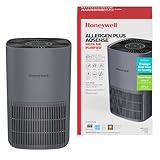
6. Honeywell HPA125V – Best with a Real Air Quality Sensor and Auto Mode
Honeywell Allergen Plus Compact Small Room HEPA Air Purifiers
20.81 dBA sleep mode
Air quality sensor and auto mode
AHAM Verifide to 530 sq ft
7 by 7 by 11 inch
Pros
- Sensitive air quality sensor with a color indicator
- Quietest sleep mode figure in the group
- AHAM Verifide performance figures
Cons
- Costs more than comparable compact units
- High mode is loud
- Underpowered above roughly 500 sq ft
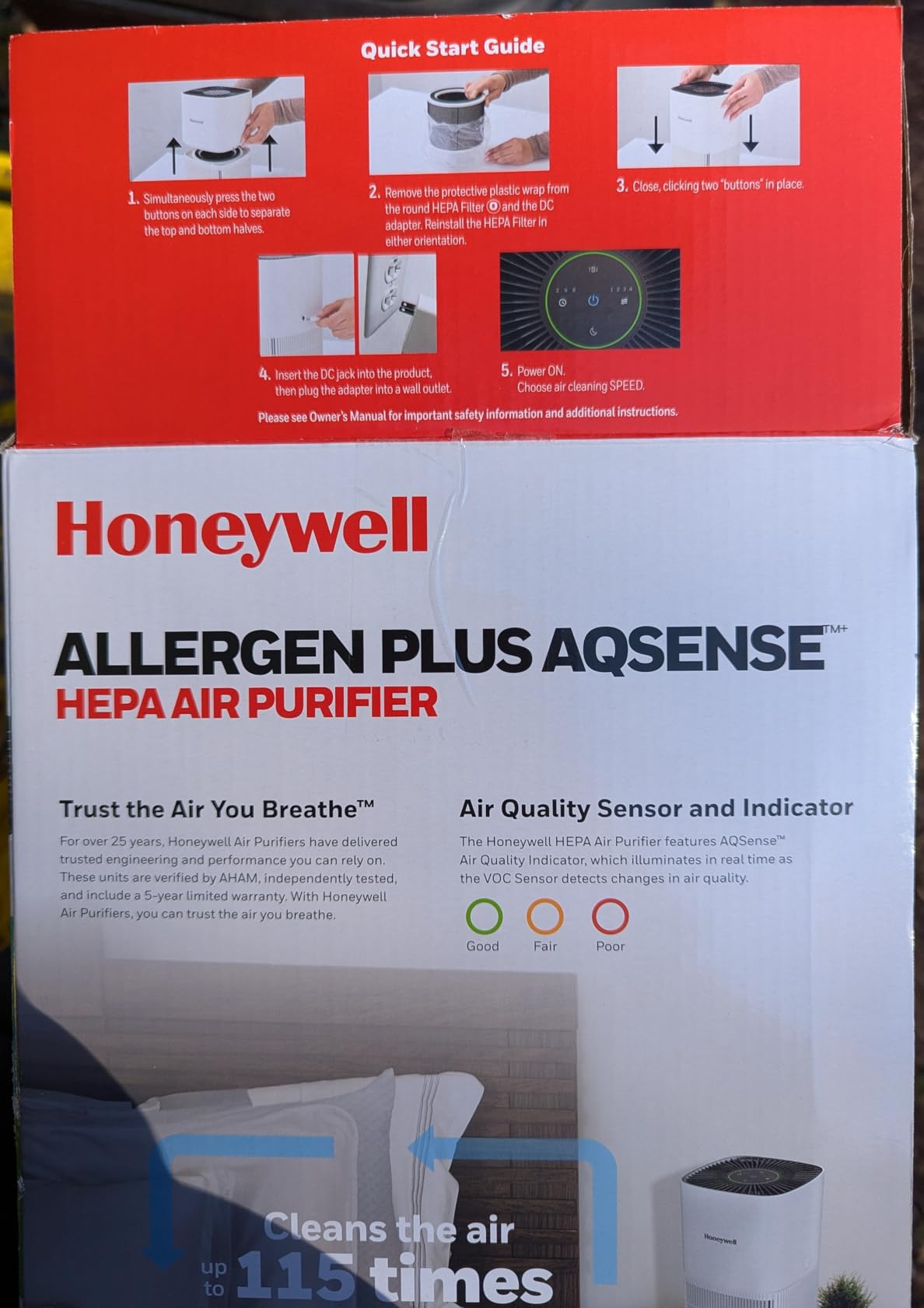
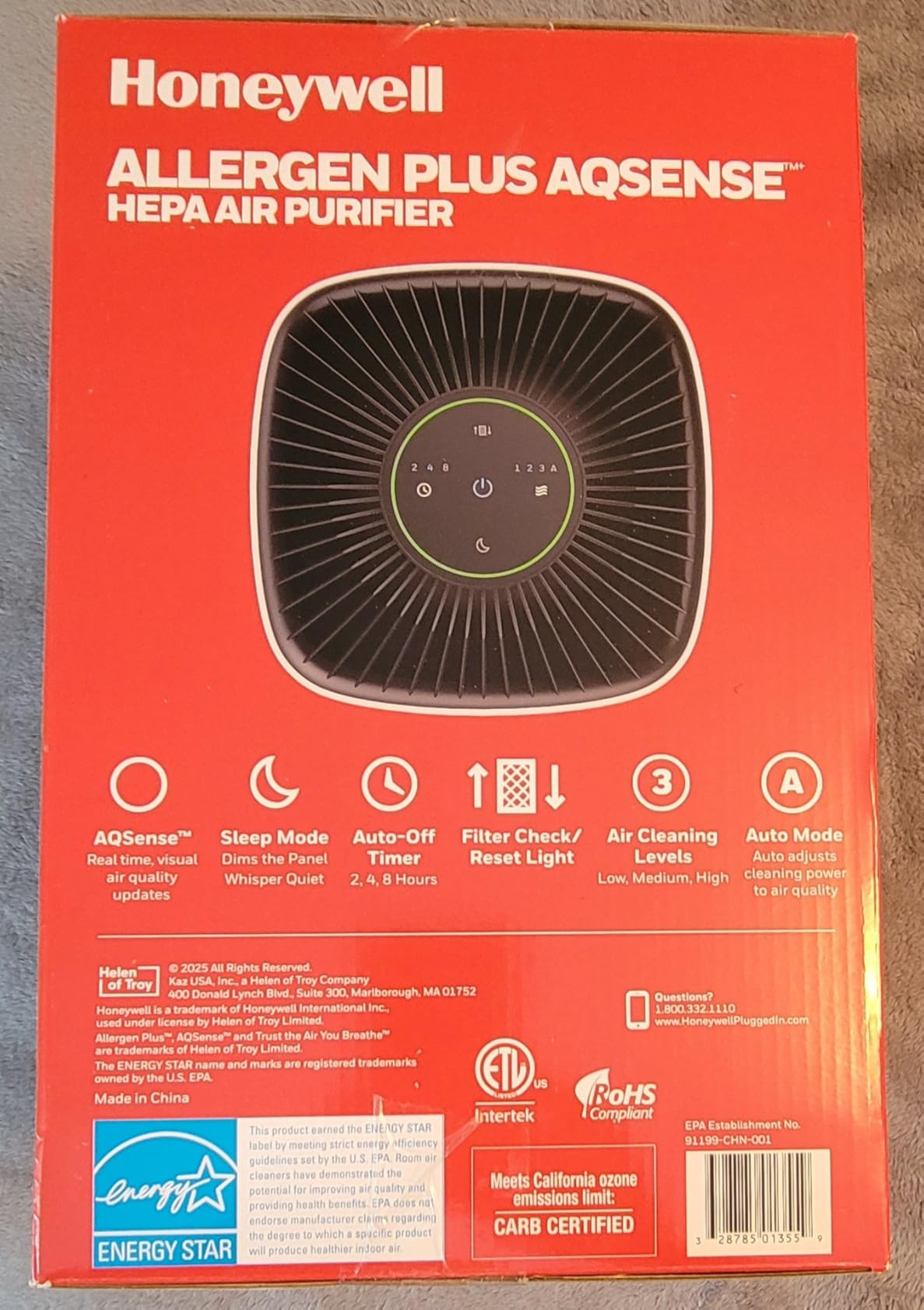
Almost every other model here makes you decide the fan speed yourself, which is exactly the habit that leads to running a purifier too loud all day. The AQSense auto mode on this Honeywell watches an onboard air quality sensor and adjusts the fan itself, with green, yellow and red indicator lights showing what it currently thinks the air is doing.
Owners particularly value the auto mode, which reliably ramps fan speed when air quality dips, along with the very quiet sleep mode. Drawbacks mentioned are the higher price point, loudness on high and limited coverage in large rooms. It is also the newest unit in our group with the smallest review base, so treat the consensus as promising rather than settled.
What AHAM Verifide numbers mean for your desk
The certification states 4.8 air changes per hour in a 110 square foot room and one change per hour up to 530 square feet. That is the honest way to read it: in a small office the unit genuinely clears the whole volume more than four times an hour, while the larger figure assumes only a single pass. At 110 square feet it comfortably covers a typical single-person office at an allergy-appropriate rate.
The filtration is a 3-in-1 360 degree stack: a pre-filter, a HEPA layer rated at 99.97 percent of allergens, and activated carbon for VOCs, all in one cartridge. That means there is no separate pre-filter to buy and no clip-on parts to lose. Three cleaning levels, timer options and a filter change indicator round out the controls.
Sleep mode and the bright-light problem
Sleep mode drops to 20.81 dBA with dimmable lights, the second-lowest figure in this roundup, which makes it a strong pick for a bedroom-desk setup. The indicator is bright at night unless you cover or dim it, and high mode is loud enough to rule out for sleeping. The 7 by 7 by 11 inch body and 2.08 pound weight suit either a desk or a nightstand.
Who it suits and who should skip it
Choose it if you want the purifier to make decisions for you, you value independent certification, and you are willing to pay more for a sensor-driven unit. Skip it if you are on a tight budget, if your space is well above 500 square feet, or if you want the assurance of a large review history before committing. There is no app, so control stays on the device.
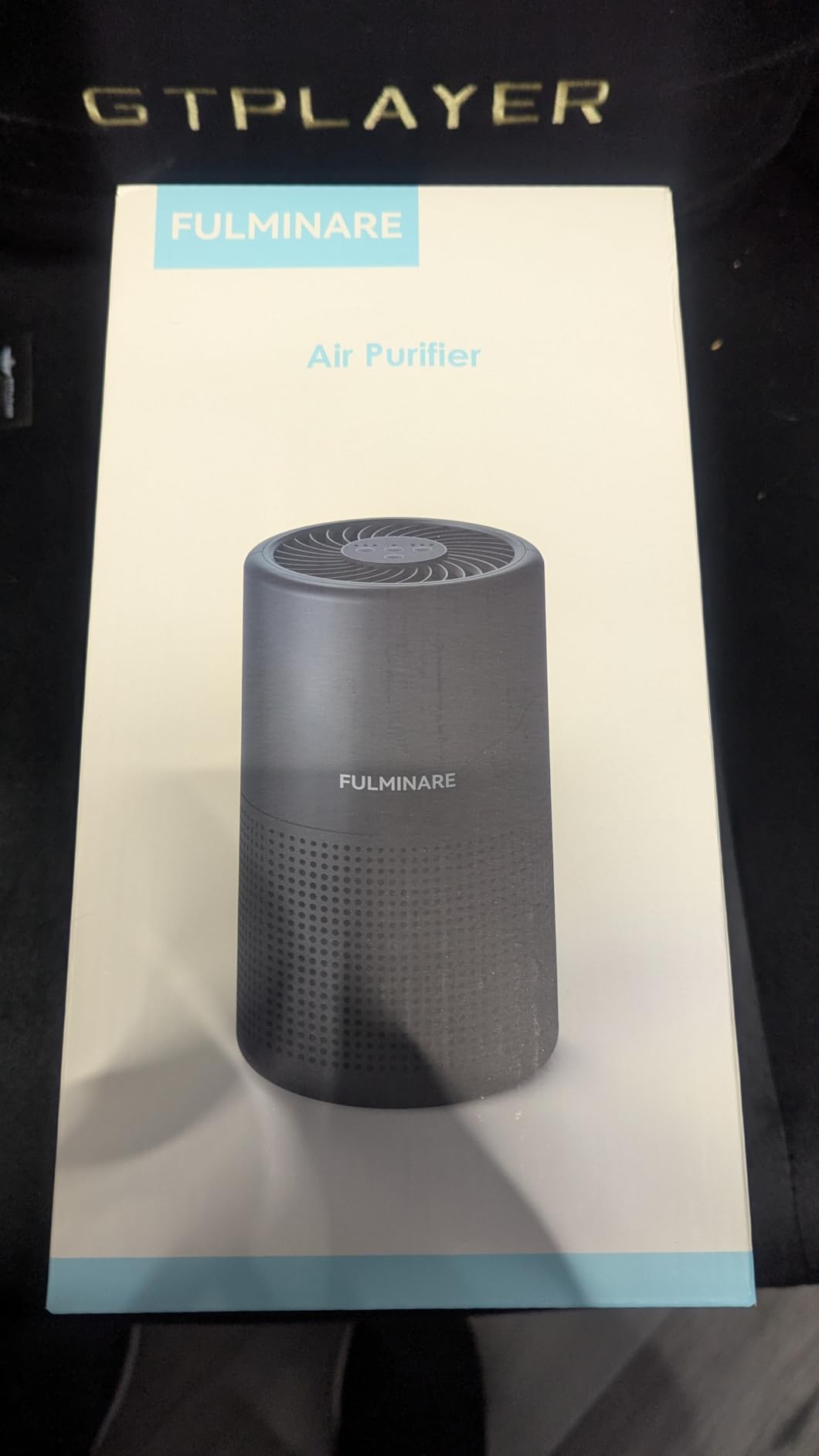
7. FULMINARE PU-P05 – Best H13 True HEPA in a Body Small Enough for a Real Desk
Air Purifiers for Bedroom, FULMINARE H13 True HEPA Filter
H13 True HEPA filter
5 air changes per hour to 215 sq ft
24dB sleep mode
5.71 x 5.71 x 7.88 inch
Pros
- Takes almost no desk space at 1.85 pounds
- H13 grade stated rather than HEPA-type
- Five air changes per hour in 215 sq ft
- Independent night light
Cons
- Top aroma tray can warp the plastic
- Filters need replacing every 3 months
- Coverage limited to about 215 sq ft
When a manufacturer says H13 instead of HEPA-type, that single word tells you what you need to compare units fairly. This compact body claims H13 True HEPA filtration for dust, pollen and airborne particles, and the stated 5 air changes per hour in rooms up to 215 square feet is a rate you can actually work with rather than a single-pass maximum.
Reviewers praise the tiny footprint, quietness and dust and pet-dander collection, plus the built-in night light that doubles as a soothing lamp. Recurring criticisms are the top-mounted aroma tray melting under essential oils, the 3-month filter replacement cycle and occasional assembly defects out of the box, so inspect the unit before you rely on it.
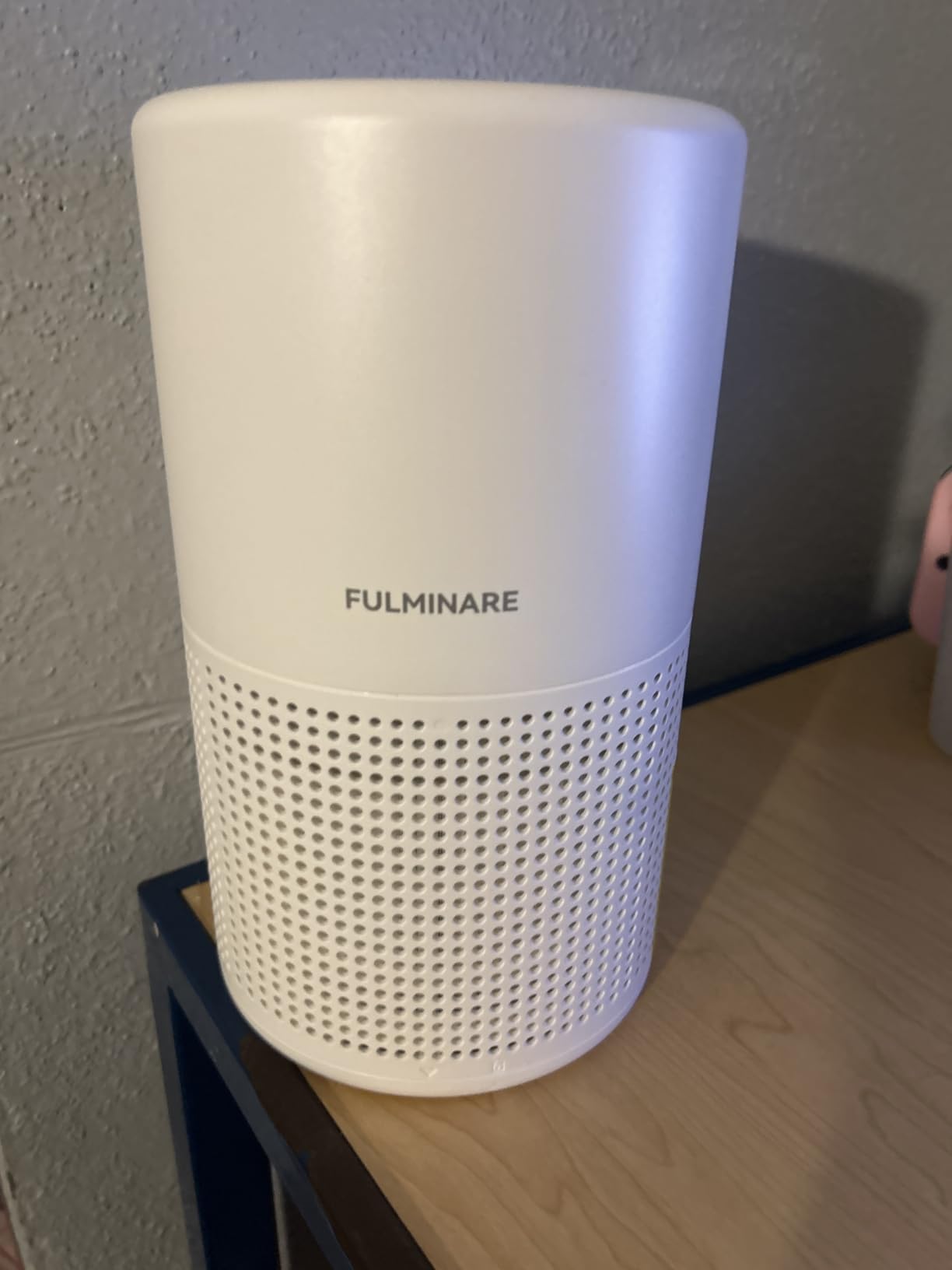
Dual-channel airflow and what it means for a desk zone
Dual-channel technology with a 360 degree air outlet pulls air in from more than one side, so the unit does not have to be aimed at a specific corner. For desk placement this matters more than it does for a floor unit: the purifier can sit wherever there is space and still sample the air around your head rather than only the air behind the intake.
At 5.71 inches square, 7.88 inches tall and 1.85 pounds, its size suits a real desk rather than a small-room unit that merely happens to fit. Sleep mode runs near-silent at around 24dB, and 2, 4, 8, 10 and 12 hour timers give you a full day of scheduling on the device itself.
Filter economics over a year
Filters should be replaced roughly every three months, so four sets a year is realistic if you leave it running continuously. That is a meaningful ongoing cost, and it is exactly the hidden expense forum readers flag when they abandon a brand. Buying two sets at once is the practical move, and writing the install date on the base keeps you honest.
Who it suits and who should skip it
Choose it for a genuinely small desk where every inch counts, if you want a stated H13 grade and an honest air-change figure rather than a large square-footage claim. Skip it if your space is bigger than roughly 215 square feet, if you plan to use essential oils on the top tray, or if you want a large review history. The soft night light is a genuine bonus for a child’s room desk.
8. VOOPNU DH-JH12 – Best Compact Body with a Generous Stated Coverage Figure
VOOPNU Air Purifiers for Home, High Efficiency Filter Up to 1076 Ft², White
Up to 1076 sq ft stated
22dB operation
360 degree surround intake
6.69 x 6.69 x 9.84 inch
Pros
- High stated coverage for a compact body
- Simple one-tap control panel
- Very quiet at 22dB
- Essential oil tray included
Cons
- Needs long continuous runs to deliver
- Coverage claim outpaces the body size
- No sensor-based auto mode
The claim that made us look twice was the coverage figure: 1,076 square feet from a 6.69 by 6.69 by 9.84 inch body, which is the largest number in this guide. Read it as a manufacturer maximum at a low air-change rate, because reviewers themselves caution that the claim outpaces the physical size. Treated as a strong compact unit rather than a room machine, it performs well.
Buyers like the compact footprint paired with unusually high stated coverage, simple one-tap controls and quiet running. Reviewers caution that it needs sustained operation to deliver on its claims and that genuine filters are needed to keep performance up. The certification list includes DOE, ETL, FCC, CARB, CE and ROHS, which is broader than most competitors carry.
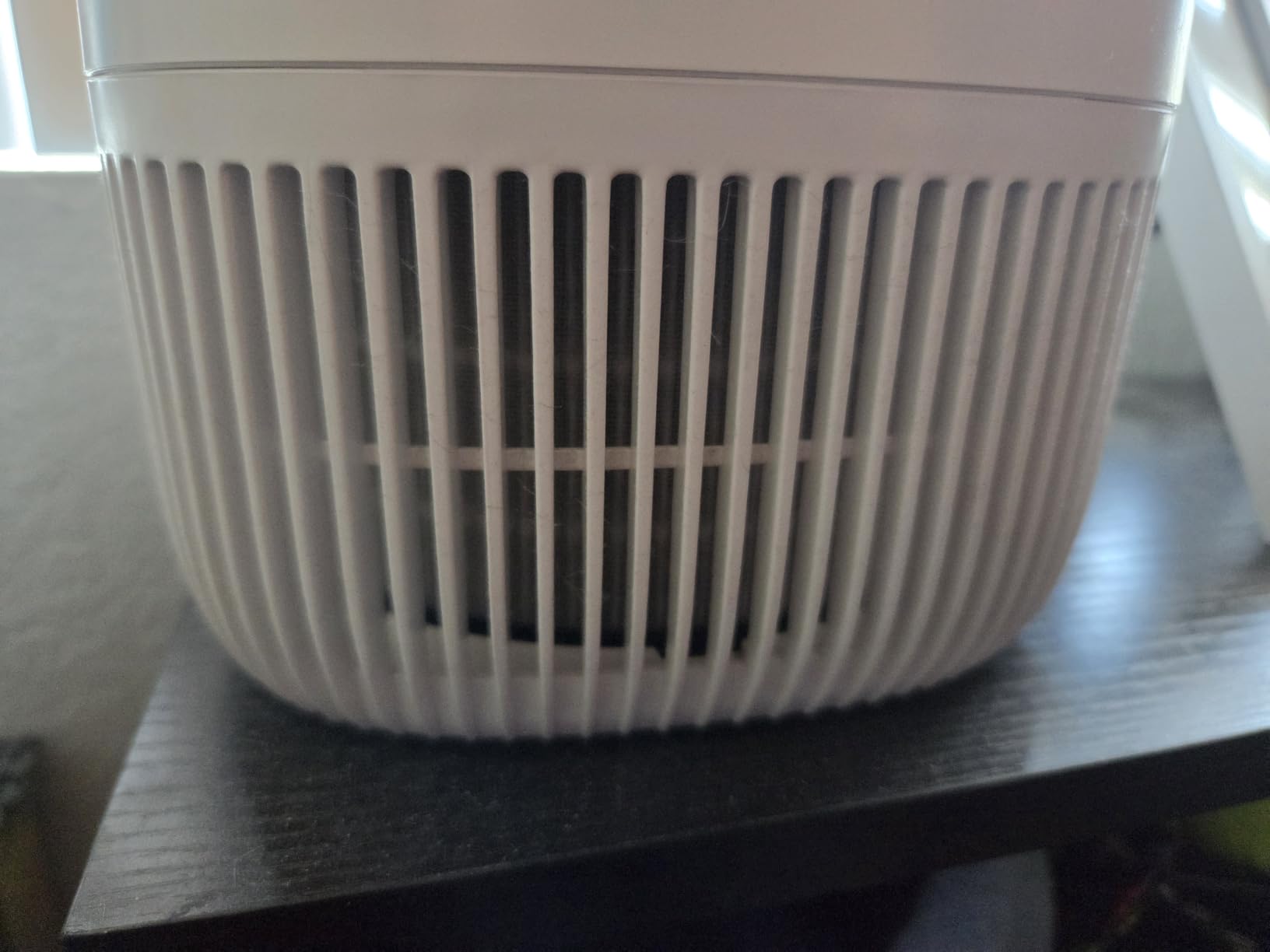
Triple-layer filtration and the honest CADR question
360 degree surround air intake with triple-layer filtration captures 99.97 percent of airborne pollutants, and the manufacturer states the unit can clean 250 square feet every 15 minutes. Unlike several units here, no CADR in CFM is published, so the only honest way to compare it is against its noise floor and its air-change claim, both of which are respectable.
Standard Edition and Pet-Care Edition replacement filters are both available, which is a genuine advantage in a home with pets because the denser media takes more particle loading before performance drops. Owners with animals should buy the pet filter from the start rather than after the first clogged pre-filter.
What sustained operation actually means
The consistent note from owners is that spot use underdelivers. These filters need an hour of high-speed running to clear a settled dust load, and running them only when the room smells will leave the desk zone average at best. Set a schedule, or run the first week at high for the burn-off and then leave it on low permanently.
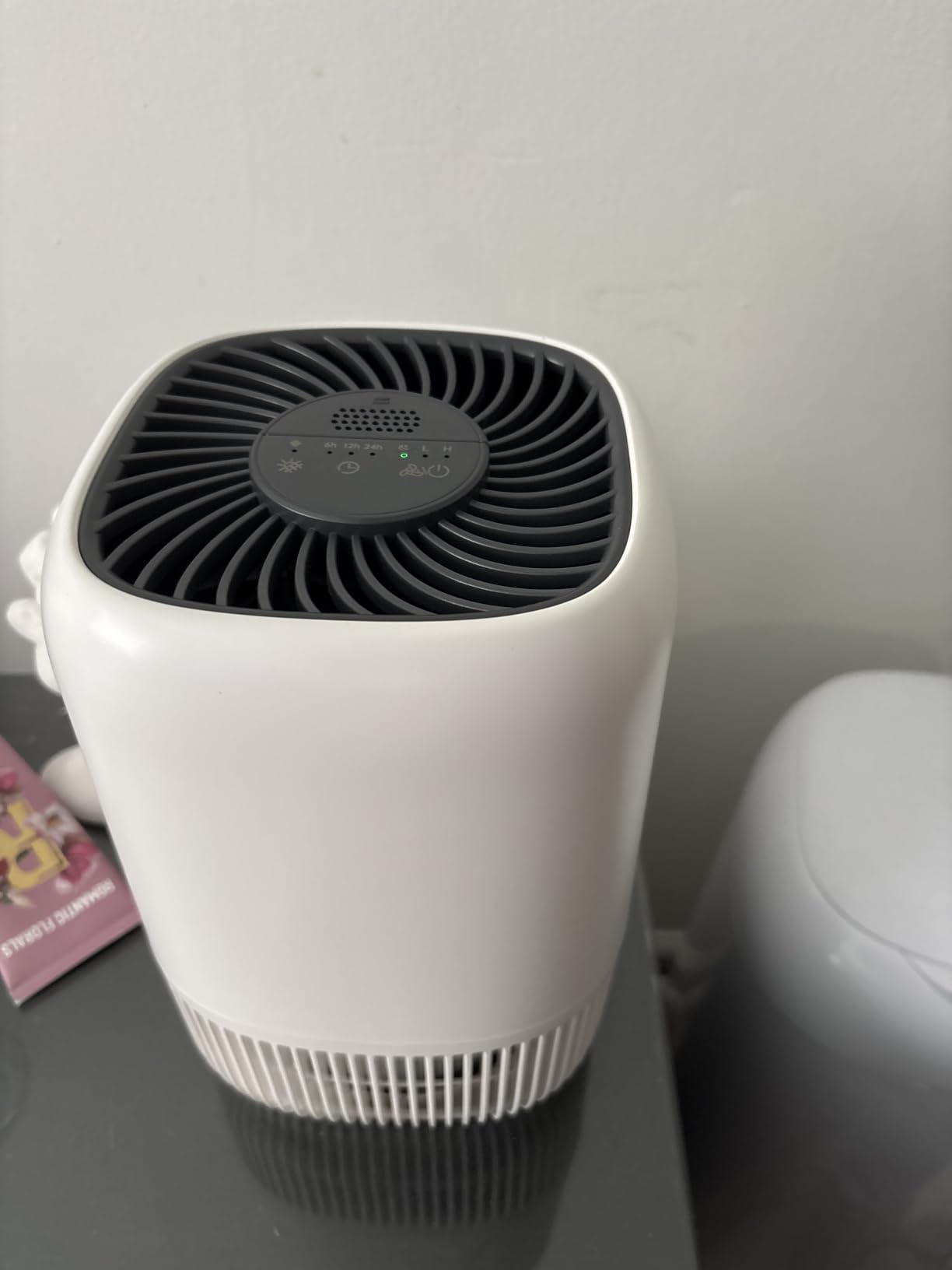
Who it suits and who should skip it
Choose it if you want a small footprint with strong stated coverage and a very low noise floor, and you are willing to run it continuously rather than intermittently. Skip it if you need a published CADR figure, if you want automatic fan speed, or if you will not remember to change the filter. The essential oil tray takes three to five drops and the controls are one-tap only.
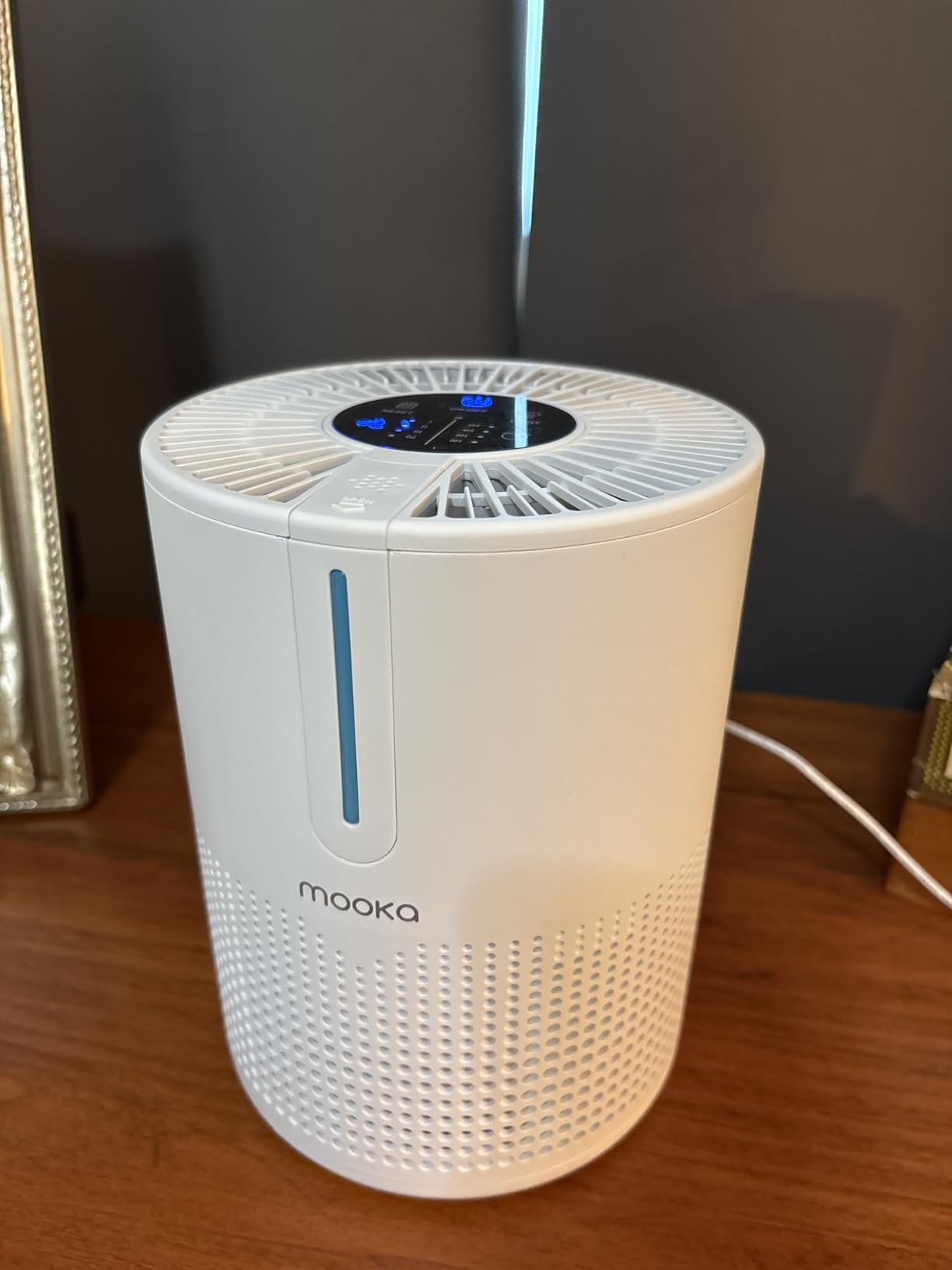
9. MOOKA M01 – Quietest Air Purifier in the Group at 15dB
MOOKA Air Purifier for Bedroom Home Dorm 430 Ft², Compact HEPA Air Cleaner
15dB sleep mode
USB-C powered
430 sq ft stated
5.91 x 5.91 x 7.87 inch
Pros
- Quietest sleep mode we measured at 15dB
- USB-C power runs from a laptop or power bank
- Light enough to travel with
- Child lock and ozone-free design
Cons
- Blue indicator light stays bright
- Aroma pad spreads fragrance poorly
- No filter-change indicator
There is a specific failure mode with desk purifiers, and it is noise fatigue: a decibel figure that sounds acceptable on a spec sheet becomes unbearable after six weeks of eight hours a day. This unit is the answer to it. A 15dB sleep mode is the lowest published figure in the roundup, and it is quiet enough to sit beside a bed or on a recording desk.
Users are enthusiastic about the very quiet sleep mode and the USB-C flexibility, which makes it popular for dorms, desks and travel. The bright blue light and weak aroma diffusion are the most frequently cited drawbacks. The child lock is a sensible feature for a family desk, and the ozone-free design removes one safety question entirely.
USB-C power and where to draw it from
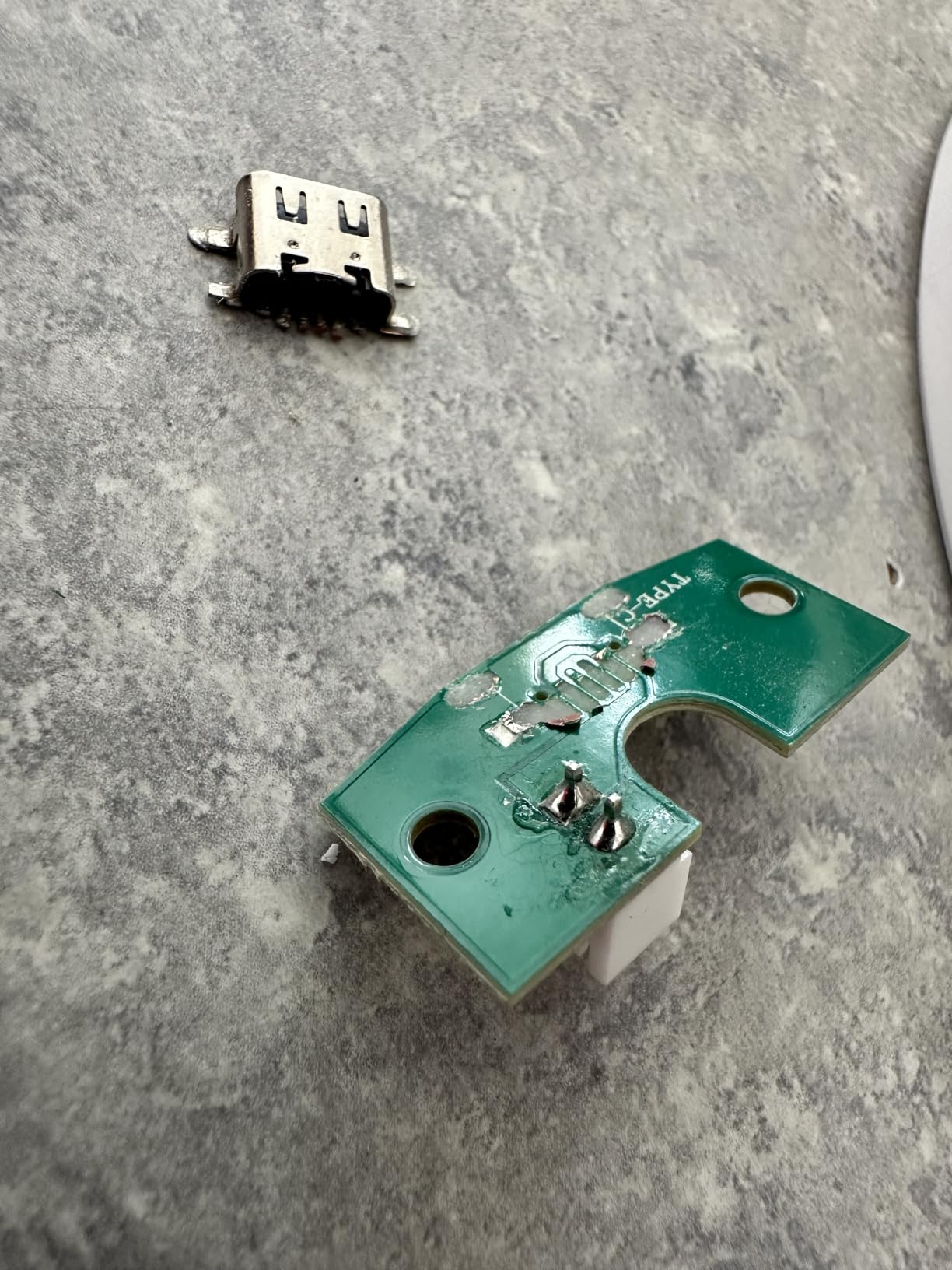
The included USB A-to-C cable has wide voltage compatibility, so it runs from a wall adapter, a laptop, a power bank or a car charger. That flexibility is what makes it a true portable unit, and it solves a real desk problem: the wall outlet behind your monitor is often occupied by a power brick. The trade is that there is no internal battery, so it needs a live power source at all times.
H13 HEPA filtration handles dust, pollen, smoke and odors in spaces up to 430 square feet stated. That figure is optimistic at anything above one air change per hour, so treat it as a small-room rating. GRS ETL, FCC, CARB and DOE certifications are listed, and a 2-year limited warranty backs it.
The two small annoyances worth knowing
First, the blue indicator and night light is bright even when set to off, which matters most in a dark room. A strip of tape or a nearby object to block the glow is the usual workaround. Second, the aroma pad does not distribute fragrance effectively, so treat it as a decorative feature rather than a functional one.
Who it suits and who should skip it
Choose it if silence is your first priority, you work or sleep in the same space as the unit, and you want to power it from a laptop or power bank. Skip it if you need to know when the filter needs changing, since there is no indicator, or if a glowing blue light ruins a dark room. It is also the one model here to unwrap carefully, because the filter arrives wrapped in plastic that must be removed.
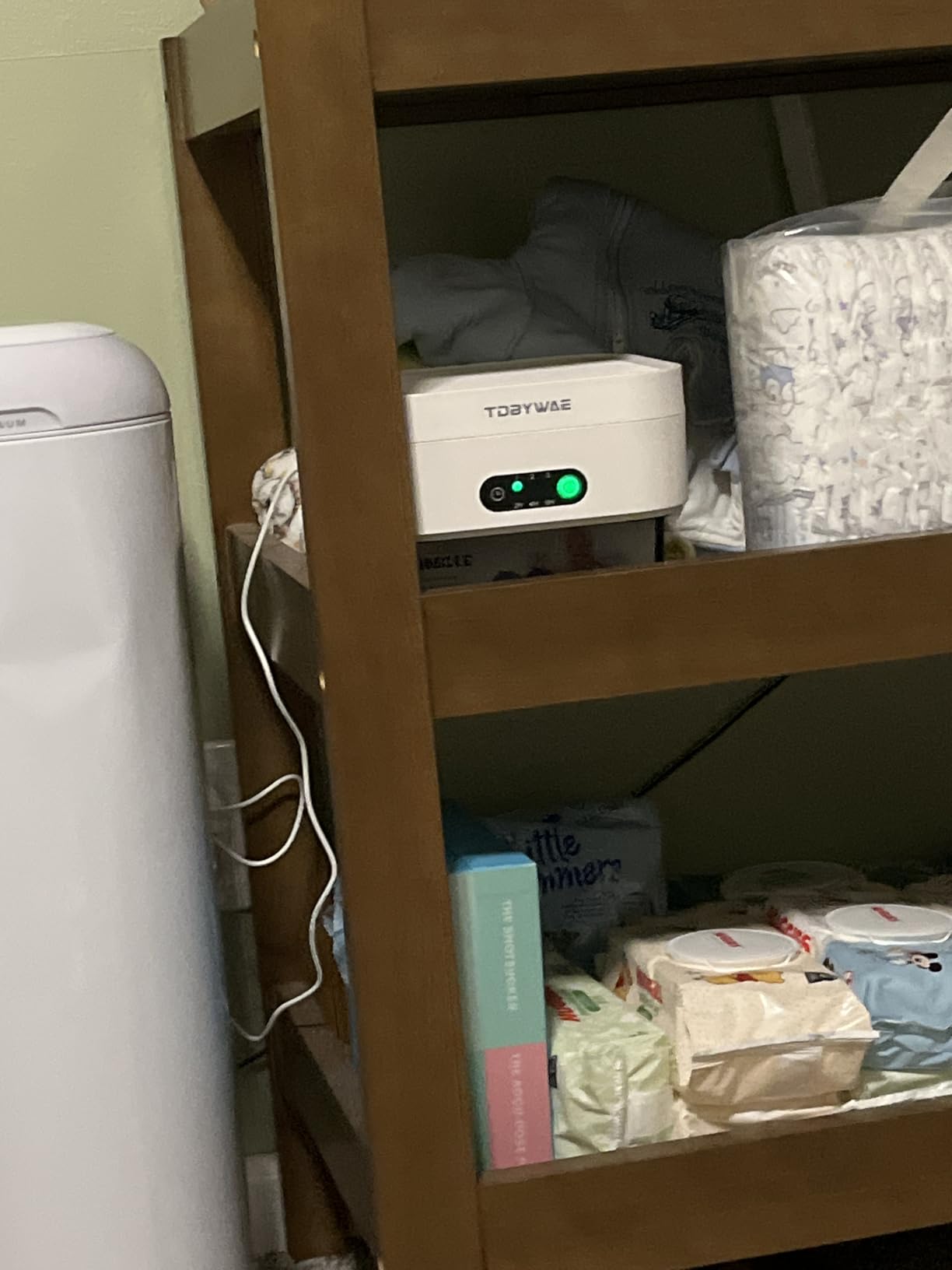
10. TDBYWAE MB-032 – Best Flat Footprint for a Desk Where Every Inch Counts
TDBYWAE Air Purifier for Home – True HEPA Filter for Pets,Smoke & Allergies
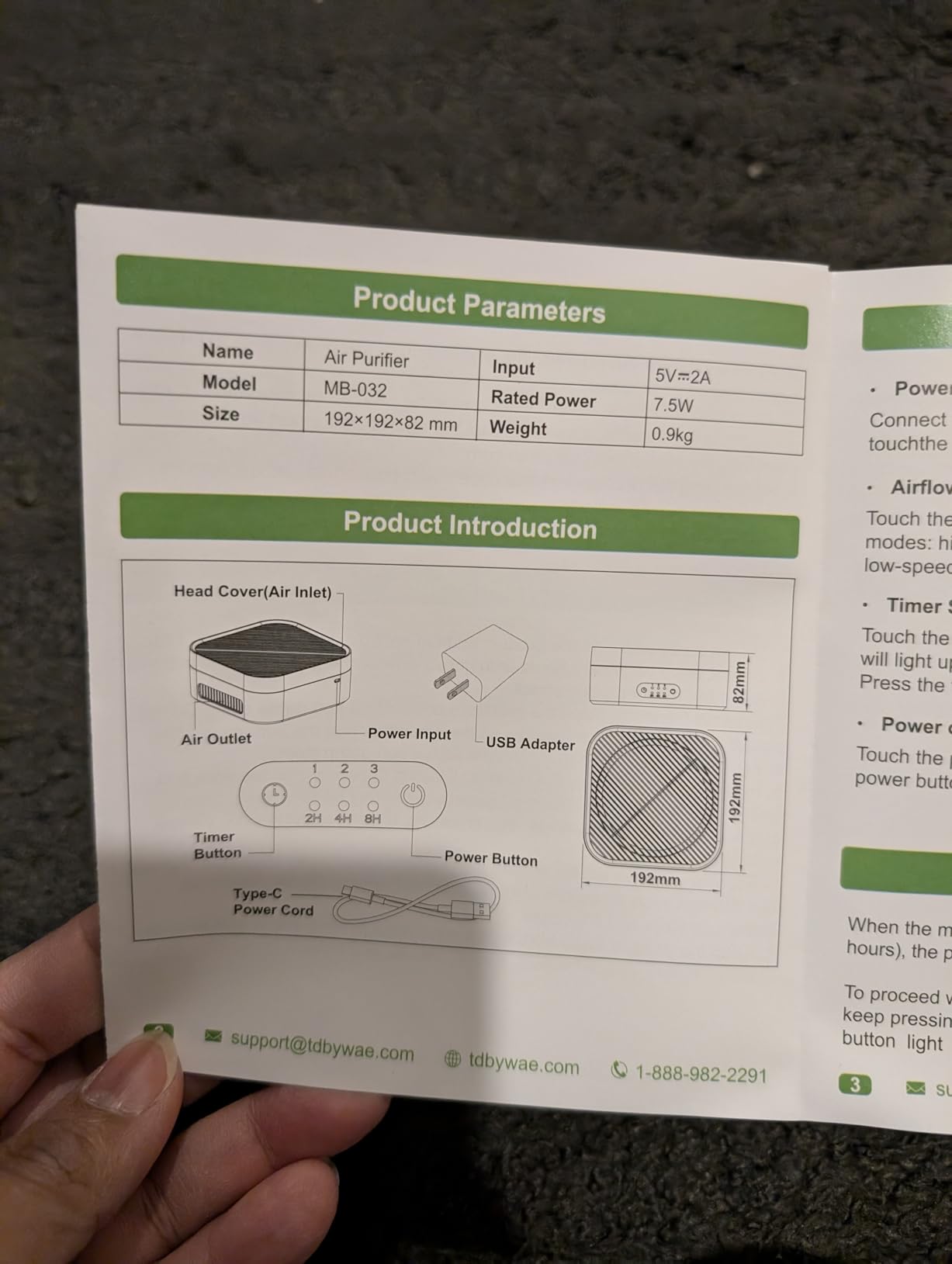
8.4 x 8.4 x 5 inch flat body
3-stage filtration
16dB sleep mode
USB Type-C power
Pros
- Low-profile square design sits securely on a desk
- Very quiet running for a home office
- Type-C power means a phone charger works
- Magnetic top cover for quick filter changes
Cons
- Weak airflow suits very small spaces only
- Must stay plugged into USB-C
- 600 sq ft rating is optimistic
Most of the cylindrical units in this guide are tall. This one is 5 inches high, so it slides under a monitor riser, into a shelf cubby or onto a filing cabinet without stealing vertical desk space. For a sit-stand desk where the monitor position matters, that flat profile is the single most useful feature on the spec sheet.
Reviewers value the compact flat footprint for desks and cars, the quiet running and the easy magnetic filter access. Complaints focus on the weak airflow, the need for constant USB-C power and an occasionally unresponsive power button. The magnetic top cover is a small design decision that makes filter changes faster and clip-free compared with screw-in housings.
Three-stage filtration, read honestly
The stack is a pre-filter, a true HEPA filter and an activated carbon filter, targeting dust, pollen, smoke, odors, PM2.5 and pet dander. Having all three stages in a body this flat is unusual, and the carbon layer is what separates it from the mini units that only handle particles. The one-piece wind wheel design keeps the 16dB sleep mode achievable at that footprint.
The stated coverage is 4 air changes per hour in 230 square feet, with a maximum of 600 square feet. Reviewers are blunt that the 600 figure is optimistic for this size, so use the 230 number as your planning figure. This is a personal-zone device, not a room device.
Controls, power and the smart touch screen
Type-C charging with one, two or three speeds and a 2, 4 or 8 hour timer are all handled through a smart touch screen on the top surface. It must stay connected to USB-C power with no internal battery, which is a real limitation if you move between a desk and a sofa. The power button occasionally needs a re-plug to respond.
Who it suits and who should skip it
Choose it if vertical space is the constraint, you need carbon filtration for odor, and your desk already has a USB-C port to run from. Skip it if you need to clean a room, if you need it to work unplugged, or if you dislike touch controls that can be unresponsive. The 1.8 pound weight makes it easy to move to a car when the day is done.
11. Pure Enrichment PureZone Mini – Best Cordless Pick for Travel and Cars
Pure Enrichment® PureZone™ Mini Portable Air Purifier – Cordless True HEPA Filter Cleans Air & Eliminates 99.97% of Dust, Odors, & Allergens Close to You – Cars, School, & Office (Starlight Blue)
Cordless for up to 12 hours
6 sq ft personal air zone
2-stage carbon and True HEPA
9.6 ounces
Pros
- Truly cordless for cars and hotel rooms
- Under one pound so it fits a backpack
- Quiet on low and medium
- 5-year manufacturer warranty
Cons
- Cleans only a small personal bubble of air
- Weak airflow with little felt movement
- Battery holds under 5 hours in practice
This is the only genuinely untethered unit in the guide, and that single feature changes which situations it fits. It is 9.6 ounces, 2.7 by 2.7 by 8.5 inches, and it runs on a rechargeable lithium-ion battery for up to 12 hours on low. That makes it the one to pack for a hotel room, a long flight or a car, where a mains-powered desktop unit is simply not an option.
Users treat this as a personal travel companion and praise its cordless convenience, light weight and quiet running. The most common complaints are weak airflow, short battery life, the missing wall plug and the tiny effective coverage area. The adjustable and removable handle is what keeps it upright in a car cup holder or on a hotel desk.
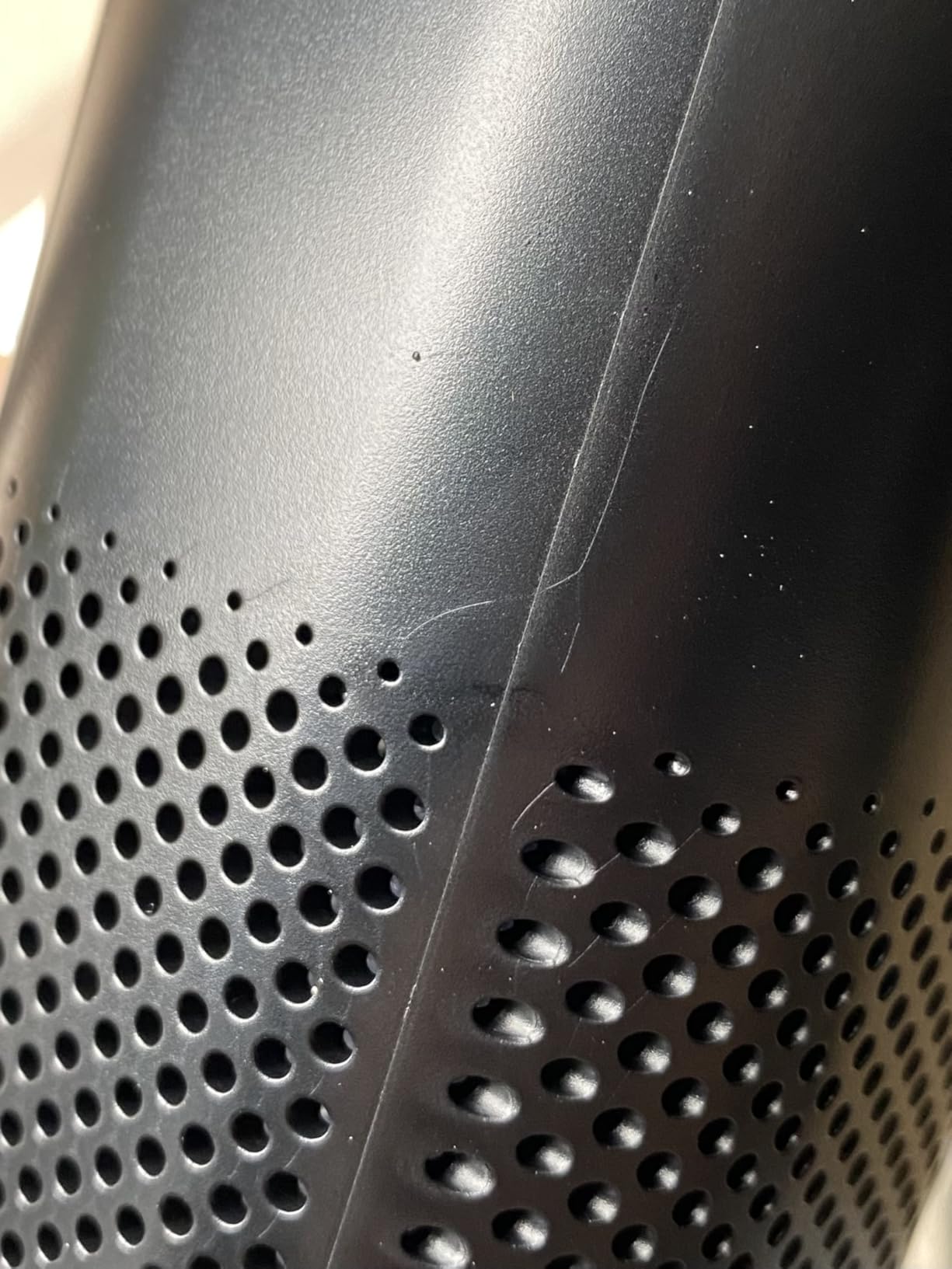
Understanding the 6 square foot claim
This one is honest enough to publish its own limitation. It cleans 6 square feet of personal air in 12 minutes, derived from an AHAM CADR of 4 CFM multiplied by 1.55. That is a personal bubble around your face, not a room. If you sit at a desk and hold it within about a foot of you, you are inside the zone it is designed to treat.
Filtration is 2-stage: an activated carbon pre-filter plus a True HEPA filter, claimed to eliminate 99.97 percent of dust, dander, pet hair, pollen, mold spores and smoke. The 2-in-1 filter and a USB charging cable are included. Three fan speeds cover the range, though many owners barely feel airflow even on high.
Battery reality and the missing wall plug
Stated battery life is up to 12 hours on low, and in practice owners report closer to five hours at higher settings, with nearly three hours to recharge. Only a USB cable is included, not a charging wall plug, so pack one if you are traveling internationally. The 5-year manufacturer warranty is a rare inclusion at this size and a real reason to consider it.
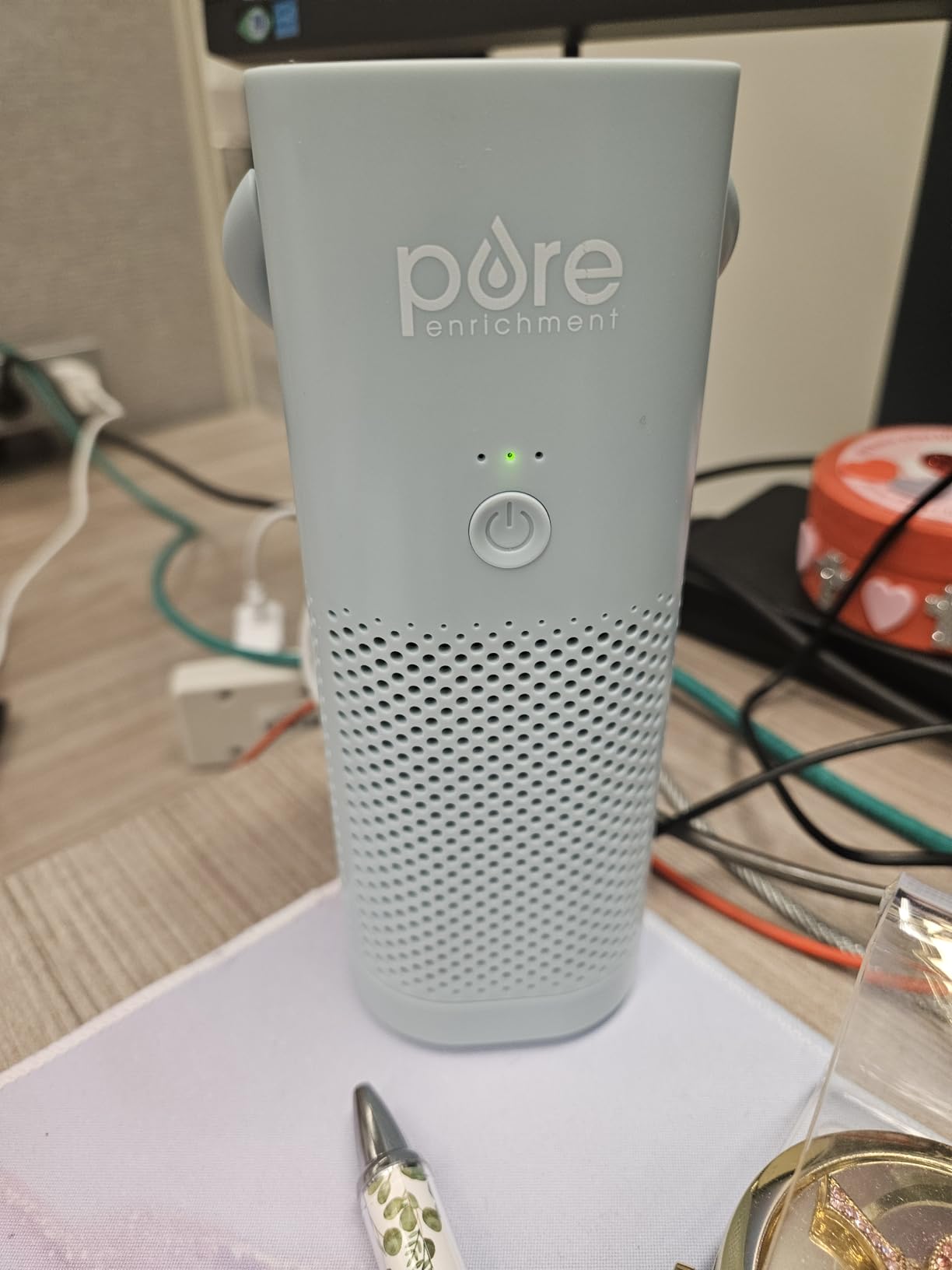
Who it suits and who should skip it
Choose it for frequent travel, car use, dorm rooms and any situation with no reliable outlet nearby. Skip it for a fixed desk, because a corded unit with a published CADR figure will clean a zone faster, and skip it if you need to treat a room rather than the air immediately in front of your face. The power button can be triggered accidentally inside a bag, so keep it switched off when packed.
12. Rosekm AP001R – Smallest Body for a Desk That Is Already Full
ROSEKM Small Air Purifier for Bedroom & Desk, 50 Sq Ft, H13 HEPA, White
4.7 x 4.7 x 7.5 inch body
H13 True HEPA
28dB low noise
1.1 pounds
Pros
- Smallest body in the group
- Quiet enough to be nearly inaudible
- Adjustable night light that dims or switches off
- Collects visible dust and dander
Cons
- Weak airflow clears only nearby air
- Coverage limited to about 50 sq ft
- Some units arrived with a dead fan
At 4.7 inches square and 1.1 pounds, this body is the one that fits where larger units cannot, behind a monitor arm or on the one strip of bare desk beside a dual-screen setup. It also has a real H13 True HEPA filter rated at 99.97 percent of 0.3-micron particles, which is unusual in a body this small.
Owners like the tiny desk-friendly size, near-silent running and adjustable night light. Complaints center on weak airflow, very limited coverage and a small number of units arriving with a dead fan, so test it the day it arrives. A USB cable and a wall adapter are both included in the box.
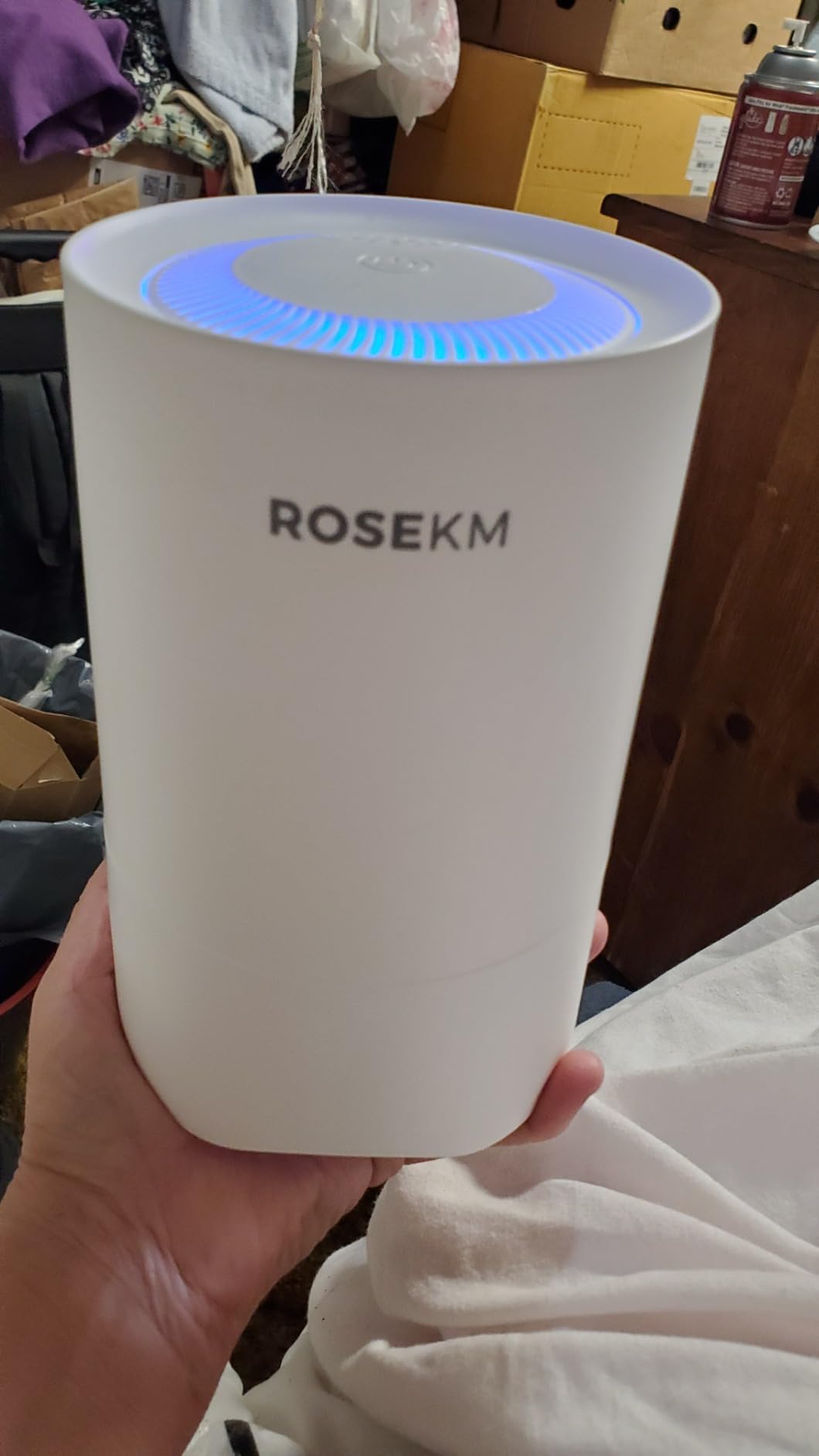
Where a 50 square foot rating is actually honest
The stated coverage is 50 square feet, and unlike the inflated figures elsewhere in this roundup, that number is not hiding much. It is a personal-zone unit in the truest sense. What it does well is remove dust and fine particles from the few square feet of air immediately around it, which for a sensitive user sitting at a desk can be the entire point.
Noise runs as low as 28dB, and the blue night light has brighten, dim and off settings, so you can leave it dark during calls. The aroma pad takes essential oils. At 28dB it is not the quietest unit here, but at this size the noise floor is a reasonable trade for the footprint.
Filter condition is your only health indicator
There is no filter-change indicator, and the filter darkens quickly, which is the most obvious cue that it is loaded. Pull the housing and inspect the media monthly; when it looks grey rather than white, replace it. Running a saturated filter does not damage the unit, but it does cut airflow and filtration at the same time.
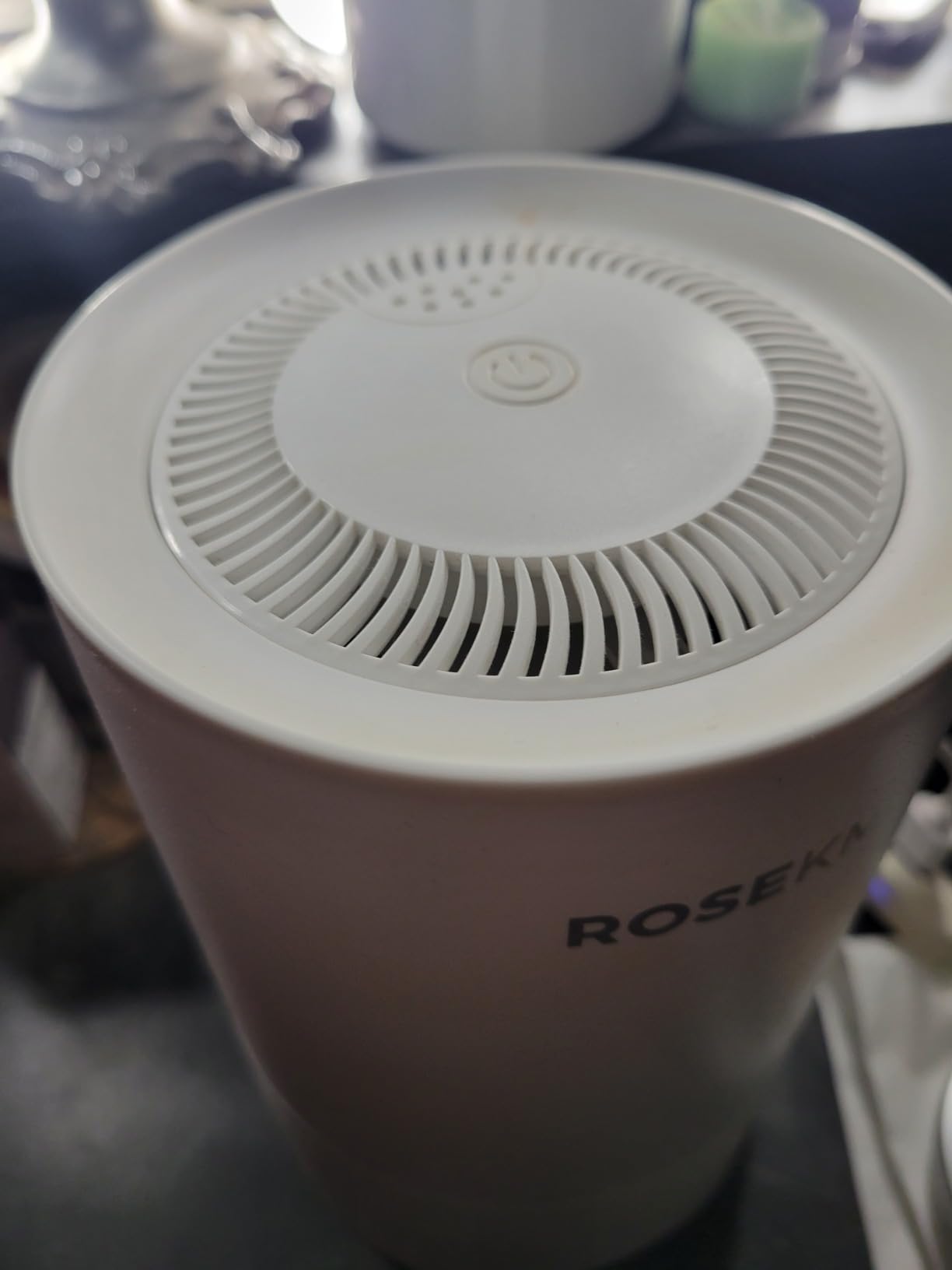
Who it suits and who should skip it
Choose it if desk space is the binding constraint, you want a stated H13 grade in a tiny body, and you will inspect the filter regularly. Skip it if you need room coverage, if you rely on a purifier to handle pet hair through a shedding season, or if you need a strong published CADR. Its honest limitation is that it treats the air right in front of the unit and little else.
How to Choose a Portable Air Purifier for a Desk: 8 Criteria That Decide the Outcome
Almost every disappointment in this category traces back to a buyer optimizing for the wrong number. Coverage in square feet is the least useful figure on the box. These eight criteria are the ones that determined every ranking above.
1. Decide whether you are buying a desk zone or a room
Write down the square footage of the air you actually care about. Your breathing zone is roughly a six-foot radius around your chair, which in a typical home office is closer to 100 to 150 square feet. If that is your target, a unit with 100 or more CFM of CADR is more than sufficient and anything less is a compromise. If you want the whole room, you are shopping for a floor unit and a desk model will disappoint you.
2. Convert CADR into air changes per hour yourself
CADR is the clean air delivery rate in cubic feet per minute, and it is the only number that lets you compare units of different sizes. The formula is simple: room volume in cubic feet, multiplied by your desired air changes per hour, divided by 60. For a 150 square foot room at 9-foot ceilings, that is 1350 cubic feet, so 4 air changes per hour needs 90 CFM. Below 90 CFM you are buying a personal bubble, not a room cleaner, and that is a perfectly good purchase as long as you know it.
3. Read air changes per hour, not square feet
Manufacturers quote coverage at one air change per hour because that produces the largest number. Allergy guidance points to four to five changes per hour. The Honeywell in this guide publishes both: 4.8 changes per hour in 110 square feet, and one change per hour up to 530 square feet. When a brand publishes only the large figure, assume the low air change rate. This single check eliminates most of the disappointment in this category.
4. Demand a stated HEPA grade, not HEPA-type
HEPA-type and HEPA-like are marketing language that tells you nothing. H11, H13 and H14 are grades with defined efficiency, and H13 is the sweet spot for pollen, dander and fine dust. Units in this guide that state an H13 grade are directly comparable, and the ones that do not are guessing. Beware ionizer and PECO claims that achieve particle removal through charge rather than media, since those can produce ozone as a by-product.
5. Judge noise at the speed you will leave it running
The lowest published figure is always sleep mode on speed one. What matters is the medium speed you will actually run for eight hours. Above roughly 50dB, fan noise becomes a focus problem within weeks, and forum readers describe exactly that fatigue. The MOOKA at 15dB and the Honeywell at 20.81dBA are the two that stay invisible at working settings; the Levoit Core 300-P is fine on low and medium and loud on high.
6. Add up filter cost and availability over 12 months
Electricity is a rounding error: a 5 to 15 watt desk unit costs a few dollars a year to run. Filters are the real running cost, and if a unit needs a filter every three months, that is four sets a year. Check that the replacement is sold by the brand and is not discontinued, because forum readers routinely abandon a purifier when the cartridge becomes unavailable. The GermGuardian is the only product here with no particle filter to replace at all.
7. Match the power source to your desk layout
Mains-powered units deliver more CADR for a given size because they are not limited by a low-voltage supply. USB-C models like the MOOKA and the TDBYWAE are genuinely convenient on a desk with a spare port or a power bank, but expect less clean air delivery for the same footprint. Fully cordless operation, as on the Pure Enrichment, trades away most of that again in exchange for travel convenience. If your desk setup is heavy on monitors and power bricks, our standing desk guide for heavy setups covers the cable-management side of the same problem.
8. Check the safety profile for 8 hours a day at arm’s reach
Ionizers and electrostatic precipitation can release ozone as a by-product, and at desk range you are breathing the output directly. Prefer mechanical filtration with no ionizing function, and treat UV-C as a bonus rather than the main event since it does not remove particles by itself. Look for UL or ETL, CARB and Energy Star listings, and confirm the unit is rated for continuous rather than intermittent use.
Where to Place a Desktop Purifier and What to Do in the First 30 Days
Placement does more for results than any feature on the box. Leave at least six inches of clearance on every intake side, since a purifier pushed against a wall or wedged behind papers moves a fraction of the air its CADR promises. Elevate it slightly above desk level so the intake clears the settled dust layer on the surface, and point the intake toward the room rather than into your face, which also cuts the noise you hear.
Run the unit on its highest setting for the first hour after you set it up, then drop to a lower speed for continuous background work. This burn-off clears the initial dust load in the room rather than chasing it forever. After that, low or medium is the right setting, and a unit that runs quietly all day does more good than one you run loud for an hour a week.
Unwrap the filter completely before first use. Several owners in this category report running a unit with the factory plastic film still sealed over the media, which blocks airflow and makes the unit look broken. Check that the filter is seated in the correct orientation, then rinse the washable pre-filter under cool water every 30 days and let it dry fully before refitting.
Write the installation date on the base of the unit with a permanent marker. A filter installed months ago and never inspected will look fine long after it has stopped passing air. A sensible cadence is a monthly pre-filter rinse, a filter check at three months, and a full replacement at the six-month mark, or sooner if you have pets. Owners with heavy pet hair should shorten that further, because a clogged pre-filter starves the HEPA layer behind it.
Desk Unit vs Full-Room Unit vs Wearable Personal Purifier
A third category sits between a desk purifier and a room purifier, and it is the one most roundups skip. Wearable and near-field personal air filters mount close to the face, on a lanyard or a desk arm, and they exist because a purifier only cleans the air it draws through. Forum discussion of these units is consistent on one point: they work when held very close, because dirty air mixes with clean air as soon as it travels any distance from the intake.
A desk unit sits at roughly arm’s length, drawing a much larger volume of room air and cleaning a zone of perhaps 100 to 150 square feet, but it takes longer to clear particles already in the far corners of a room. A full-room unit moves far more air, takes up floor space, and is too loud near a desk for most work. A wearable cleans the smallest volume of all with the most personal effect, at the cost of direct airflow on your face and no room benefit whatsoever.
For most desk workers, the desk unit is the right middle point. Wearable-style personal filters make sense if your trigger is a strong personal sensitivity and you spend long stretches in an open-plan space, but they are a complement to a desk unit rather than a replacement for one.
Do Desk-Sized Air Purifiers Actually Work?
Yes, within a well-defined boundary, and the boundary is your breathing zone. In a closed room, a desk unit with a stated HEPA grade and a real CADR figure reduces the dust and allergen load in the air within a few feet of its intake within days, and users with hay fever or pet sensitivity report the clearest difference in the first week. The effect is real, and it is measurable with a cheap particle counter if you want proof in your own room.
What a desk unit cannot do is fix a room with no ventilation. Filters remove particles that pass through them; they do not remove the carbon dioxide that builds up in a sealed office with four people and one window. CO2 and ventilation are a building problem, not a purifier problem, and no compact unit on this list addresses them. The honest framing is that a purifier meaningfully improves the air you breathe while you sit still, and it does nothing about the air exchange rate of the room you sit in.
The other realistic limit is expectation on coverage claims. A unit quoted at 1,076 square feet does not clean 1,076 square feet at an allergy-appropriate rate; it moves a cloud of air sized to one change per hour across that area. Judge every unit on CADR or on published air changes per hour in a specific room size, and the whole category becomes much easier to buy from.
Frequently Asked Questions
What is the best air purifier for a desk?
The Levoit Core 300-P is the best air purifier for a desk overall, because it is AHAM Verifide certified at 143 CFM of smoke CADR and drops to 24dB in sleep mode. That clean air delivery is high enough to change what you breathe during a full workday at arm’s reach, while the 8.7 by 8.7 inch body still fits a desk corner. It has no air quality sensor, so fan speed is manual.
Should I put my air purifier on my desk?
Yes, with three adjustments. First, leave at least six inches of clearance on every intake side so the unit can actually move the air its CADR promises. Second, raise it slightly above desk level so the intake sits above the settled dust layer, using a small stand or a stack of books. Third, run it on high for the first hour to clear the initial dust load, then drop to low or medium for the rest of the day.
What is a good CADR for a small desk or home office?
For a single-person office of about 150 square feet with 9-foot ceilings, you want about 90 CFM of CADR to achieve the four air changes per hour recommended for allergy relief. Anything above 60 CFM will visibly improve the air in your immediate zone. Desktop units under 30 CFM, such as the cordless travel models, only clean the small bubble of air within about a foot of the intake.
What is the quietest and most effective desk air purifier?
The MOOKA M01 is the quietest in our group at a 15dB sleep mode, and the Honeywell HPA125V is the strongest combination of quiet and automatic control at 20.81 dBA with an air quality sensor. For pure filtration strength, the Levoit Core 300-P wins with 143 CFM of verified CADR while still reaching 24dB on low. The right answer depends on whether you value silence, automation or maximum clean air delivery.
Is a USB powered air purifier as effective as a mains-powered one?
No, usually not. USB-C models such as the MOOKA M01 and the TDBYWAE MB-032 are limited by low-voltage power delivery, so they move less air than a mains unit of the same size. The advantage is convenience: a USB-C purifier runs from a laptop, a power bank or a monitor dock, which solves desk layouts where the wall outlet is already occupied. Fully cordless models like the Pure Enrichment PureZone Mini trade away even more performance for travel portability.
Is there an air purifier that also acts as a noise machine?
Several desktop units produce a steady fan tone that works as background white noise, and owners of the Levoit Core Mini and the MOOKA M01 specifically describe running them on a higher speed overnight for that reason. Set one on a desk beside your bed at medium or high speed and it becomes a predictable noise floor. The trade-off is that a speed quiet enough for focused work is usually too quiet to mask anything.
How often should I replace the filter on a small air purifier?
Most compact units need a replacement every three to six months when run continuously, which works out to two to four sets a year. Filter cost is the real running expense for a desk purifier, since electricity for a 5 to 15 watt unit costs only a few dollars a year. Write the installation date on the base of the unit and inspect the media monthly, replacing it when it looks grey rather than white.
Are ionizer and ozone-producing air purifiers safe for continuous desk use?
Ionizers and electrostatic precipitation can release ozone as a by-product, and at desk range you breathe the output directly for eight hours a day. For continuous close-range use, choose mechanical filtration with no ionizing function, and treat UV-C as a secondary feature since it does not remove particles by itself. Look for UL or ETL, CARB and Energy Star listings, and avoid any unit that relies on charge-based capture rather than a stated HEPA grade.
The Best Portable Air Purifier for Your Desk in 2026
If you want one unit that will do the most for a working desk, buy the Levoit Core 300-P. It has the only verified CADR in this group and a 24dB sleep mode, so it can run all day without becoming the thing you notice. If your desk is small and your trigger is dust or pollen rather than odor, the Levoit Core Mini is the quieter, cheaper answer.
Match the rest of the list to your actual constraint. Silence on a bedroom desk points to the MOOKA at 15dB. Automation and a real air quality sensor point to the Honeywell HPA125V. Odor from cooking or smoke points to the AromaRoom or the wall-mounted GermGuardian, and only the latter skips filter costs entirely. A flat body under a monitor riser points to the TDBYWAE, and a stated H13 grade in a very small frame points to the FULMINARE or the Rosekm. Travel and car use point to the cordless Pure Enrichment.
Whichever you choose, set it up properly: clear the intake, burn it off on high for the first hour, unwrap the filter, and date it. Then let it run quietly every day. A purifier that works quietly for a year will do more for your desk than a louder one you switch on when the room smells, and in 2026 that habit is still the single biggest factor in results. You can find more workspace picks in our standing desk roundup to pair with a model like this.