
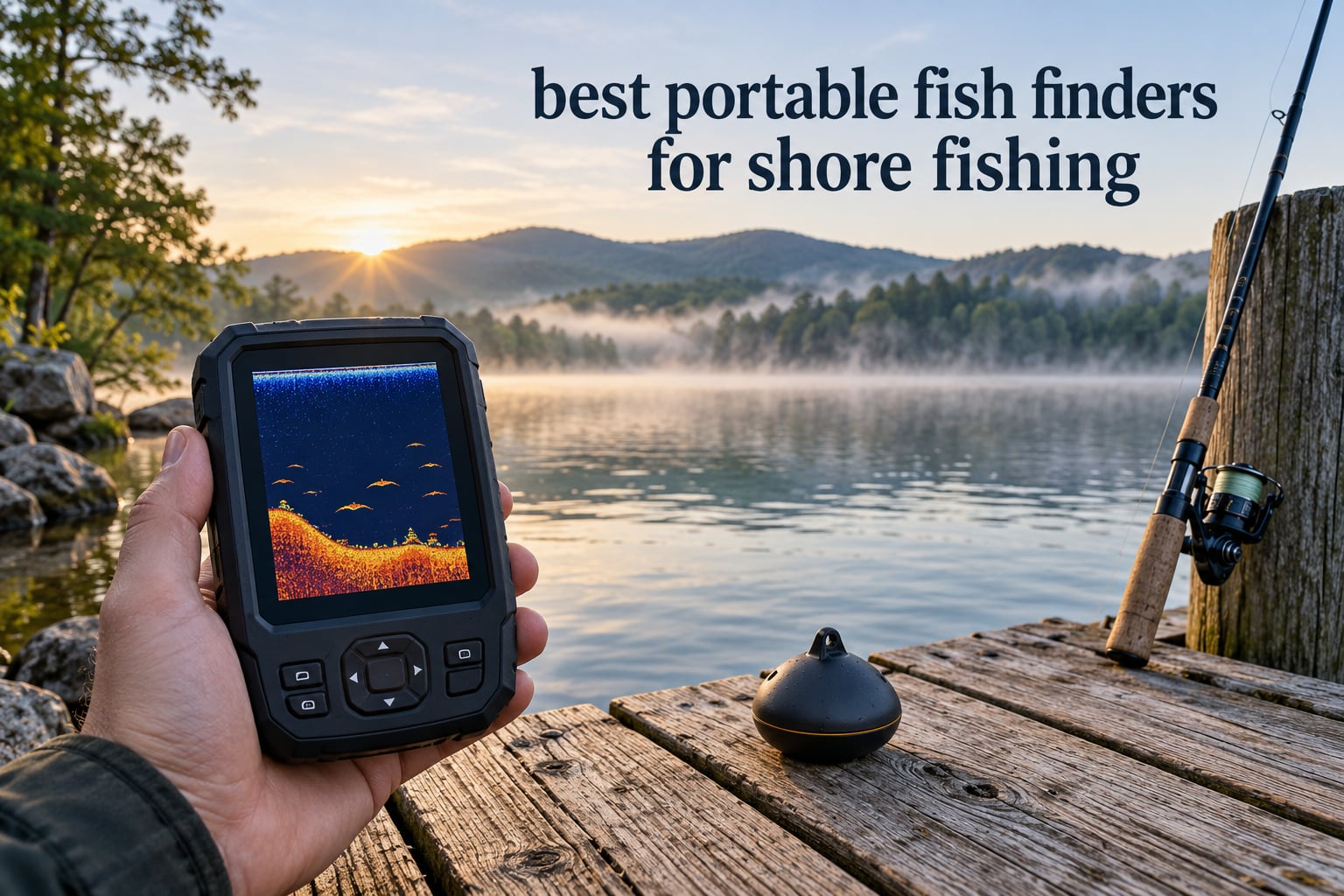
If you have ever stood on a bank staring at featureless water and wondered whether you are even in the right spot, you are not the only one. I have spent the last few seasons working through portable sonar from shore, comparing eight castable pods and portable bundles on the same lake, the same dock and the same mud-bottomed pond edge. The short version: yes, portable fish finders work from shore, and the reason they work is not fish detection.
It is structure reading. Fish move, but a submerged shelf, an old river channel, a rock ledge or the edge of a weed bed does not move. Once you can see that, a session of blind casting turns into a session of fishing a feature you found and marked. This guide covers the best portable fish finders for shore fishing, how to rig them, and how to read what lands on the screen.
Everything here was tested in freshwater and saltwater, from a kayak, a dock, a high bank and a river wade. Where I could, I used the same spots so the comparison means something. Updated for 2026.
Do Portable Fish Finders Actually Work From Shore?
They do, and there are three practical ways to deploy them. You can cast a sonar pod on your line and retrieve it, clamp or suction-cup a transducer onto a dock piling or jetty and read the water below you, or pole-deploy a transducer straight down in front of you while wading. The one real limitation: a wired portable bundle cannot reach offshore structure at all, because its cable only reaches as far as the cable does.
- Castable pod. Ties to your line, transmits to a phone app or a handheld screen, and gives you sonar wherever you can put a cast. This is the only portable method that reaches across open water.
- Clamp or suction cup on a piling. A wired transducer stuck to a dock post, bridge piling or boat transom with a clamp or suction cup, feeding a display on the bank. It costs you range but it never falls in the water.
- Pole-deployed scanning. A transducer lowered on a handle in front of you for vertical scans, which is the standard way anglers fish deep water in current where casting accuracy is hopeless.
The castable pod is what most shore anglers actually want, and that is where the trade-offs get interesting. A pod weighs roughly 2.3 to 3.5 ounces, which is heavier than an ultralight rod is built to throw.
Our Top 3 Tested Picks for 2026

Garmin Striker 4 Portable Kit
- CHIRP sonar with a built-in flasher
- 3.5 inch keyed-button display
- Waypoint map and rechargeable battery
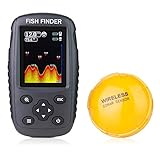
Venterior Wireless Sonar
- No phone needed
- 262 ft sensor-to-unit range
- Color LCD with two backgrounds

Comparing All 8 Portable Fish Finders Side by Side
The best portable fish finder for shore fishing depends on whether you need to reach water you cannot reach with a cable. Wired portable bundles give you a real screen and CHIRP detail close to the bank. Castable pods give you range and a phone dependency. The table below sorts the eight models by what each one is actually good at.
| Product | Specs | Action |
|---|---|---|
| Garmin Striker 4 with Portable Kit |
|
Check Latest Price |
 ReelSonar iBobber Bluetooth Fish Finder ReelSonar iBobber Bluetooth Fish Finder |
|
Check Latest Price |
| Deeper START Smart Sonar |
|
Check Latest Price |
| Venterior Wireless Sonar with Color LCD |
|
Check Latest Price |
 Deeper PRO+ 2 Sonar with GPS Deeper PRO+ 2 Sonar with GPS |
|
Check Latest Price |
 Garmin Striker Cast with GPS Garmin Striker Cast with GPS |
|
Check Latest Price |
 HawkEye FishPod 5X HawkEye FishPod 5X |
|
Check Latest Price |
 DANOPLUS Wireless Sonar with HD Display DANOPLUS Wireless Sonar with HD Display |
|
Check Latest Price |
Which Portable Fish Finder Form Factor Do You Actually Need?
Almost every confusion in this category comes from mixing up three different devices that all get called a portable fish finder. They are not interchangeable, and the wrong one leaves you frustrated on a windy bank.
Castable pod, phone display
This is the pod on your line. Garmin Striker Cast, Deeper START, Deeper PRO+ 2, HawkEye FishPod 5X and ReelSonar iBobber all sit here. They reach the furthest from shore and they record a real scan with time and location, which is what makes repeat sessions worth it. The cost is that your phone is the display, which means glare, battery drain and a small screen in bright sun.
That glare problem is the single most common complaint about phone-based pods, and there is a cheap stopgap if a dedicated display is off the table right now. We put a handful of best portable monitors through their paces, and a bright secondary panel propped beside the phone makes a small sonar screen far easier to read at midday. It is not a substitute for a waterproof head unit, but it turns an unreadable morning into a workable one.
Dedicated-display portable bundle
This is a wired transducer with a real screen and a rechargeable battery in a bag. The Garmin Striker 4 with Portable Kit is the clearest example. Nothing to cast, nothing to lose, a bright readable display that works in sunlight, and CHIRP detail that a phone cannot show. What you give up is reach: the transducer sits at the end of a cable, so you are reading the water beside or below you, not out at the drop-off.
True handheld with its own screen
Venterior and DANOPLUS both ship a display unit that receives from a wireless sensor, so no phone is involved at all. This is the only route to a real screen without a cable running back to a boat. The tradeoff is that most of these handhelds are simple depth, temperature and bottom-contour devices, and several of them struggle in very deep water.
One more piece of kit deserves its own mention here. If you want a record of the same water on the same day, our guide to the best action cameras for fishing covers the units that survive being dunked, and a compact body camera is how most shore anglers log a spot before they cast it.
How to Rig a Castable Sonar Pod on a Medium Rod
Castable sonar gets a bad reputation for lost gear, and almost all of it is a rigging problem rather than a product problem. Published pod weights explain why. The Garmin Striker Cast is 75 g, the Deeper START weighs 0.08 kg, and the Deeper PRO+ 2 is listed at 3.2 ounces. An ultralight rod is rated for 1/32 to 1/8 ounce lures, so it is being asked to throw something eight to twenty-five times heavier than its rating.
- Use a medium-action rod or heavier. This is the single change that eliminates most snapped lines and lost pods.
- Run 16 to 25 lb braid. Braid has low stretch, so it transmits the bite straight to the rod tip and survives being dragged over structure. Garmin rates the Striker Cast for 20 lb test or heavier.
- Tie a palomar or uni knot. Either holds a heavy pod where a basic overhand knot will not. Re-tie before every session.
- Add a #3 barrel swivel with a snap. The swivel stops line twist, which is what kills the retrieve speed and turns your scan into spaghetti.
- Set the drag above the pod weight and below the line rating. The drag should be the weak point, not the pod.
- Cut the line after every session. A pod retrieved on a tired, frayed line is a pod you will not see again.
Retrieve at roughly one foot per second. Faster than that and the returns smear beyond recognition.
1. Garmin Striker 4 with Portable Kit – The Best Overall Portable Fish Finder for Shore Fishing
Garmin 010-01550-10 Striker 4 Fish-Finder with Portable kit, 3.5″
3.5 inch LCD
CHIRP sonar and flasher mode
Waypoint map
Rechargeable battery and carry bag
Pros
- Keyed interface with dedicated buttons
- CHIRP arches with better target separation
- Built-in flasher for ice and vertical jigging
- Screen readable in direct sunlight
- Rechargeable battery holds multi-day trips
Cons
- Poorly written instructions
- Needs a wired transducer and power cable run
- Power cable has no Y-connector for charging
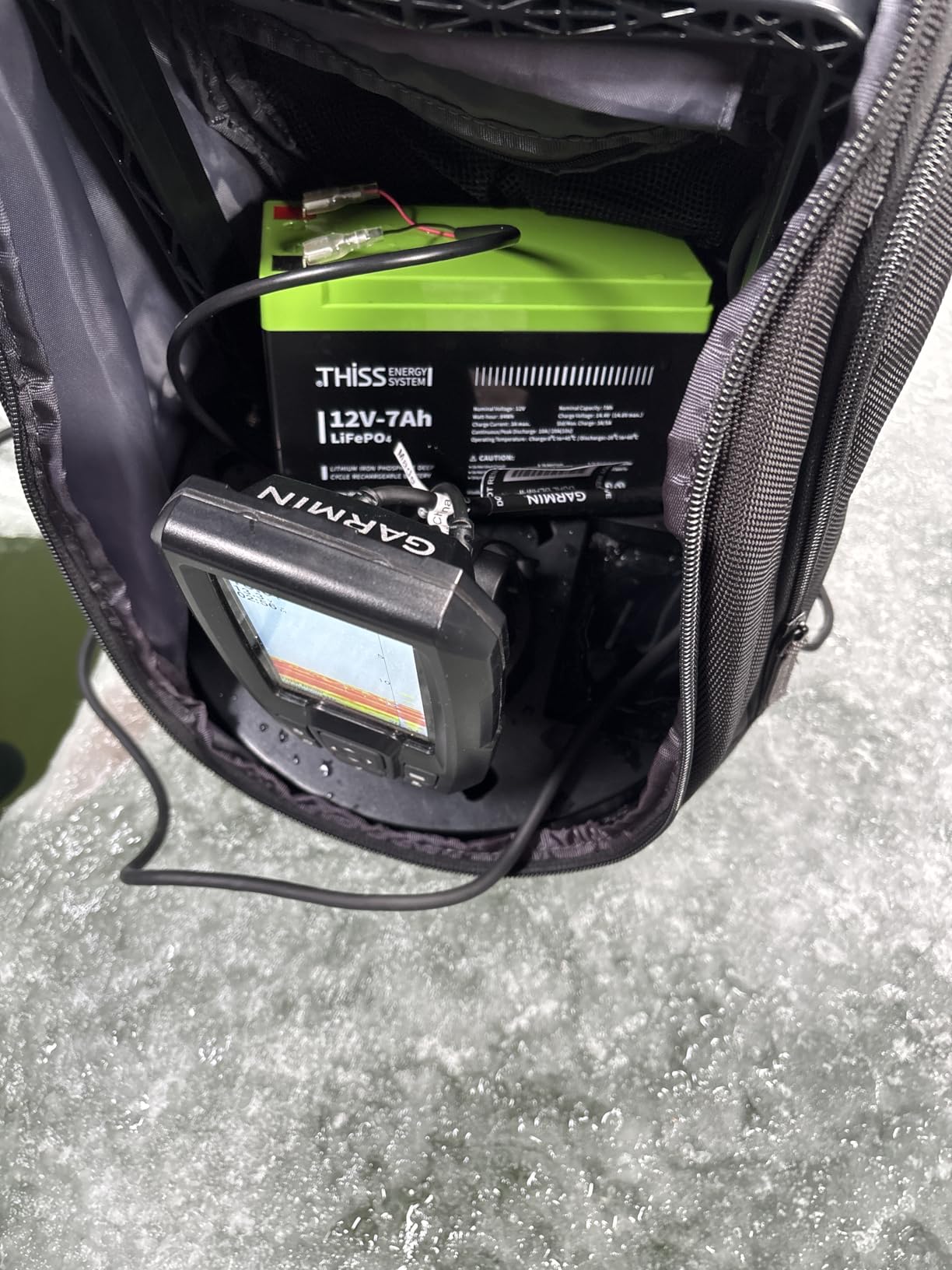
This is the unit I keep reaching for when I want to see what is under a dock without owning a boat. The 3.5 inch LCD is small by boat-finder standards and perfectly sized for a bank bag, and the keyed interface with dedicated buttons means you can find the gain and sensitivity dial with cold hands and no reference to a manual.
CHIRP sends a continuous sweep of frequencies rather than a single pulse, and the difference shows up as crisper arches and better target separation. When you are looking at a school 30 feet out and trying to pick one fish out of it, that separation is the whole game. Transmit power is 200 W RMS and rated depth runs to 1,600 ft in freshwater and 750 ft in saltwater, which is far beyond anything a shore session will need.
Screen brightness and sunlight readability
The standout in owner reports is how well the display holds up in direct sun. On a clear July morning I could read arches and bottom contour with the screen at partial brightness, which is exactly what a castable pod on a phone cannot do. That single advantage is why this model wins the roundup for shore anglers who fish in daylight rather than at night.
Flasher mode and year-round use
The built-in flasher shows your data in the classic ice-fishing format, which makes this kit the only one here that genuinely works across four seasons. Ice anglers do need to supply their own ice-fishing transducer, but the head unit, battery and flasher are already in the bag.
On the kayak in-hull transducer mount that now ships in the box, this becomes a three-season device rather than a shore-only one. Owners report running it from a rental canoe without drilling anything.
Battery, bag and the honest flaw
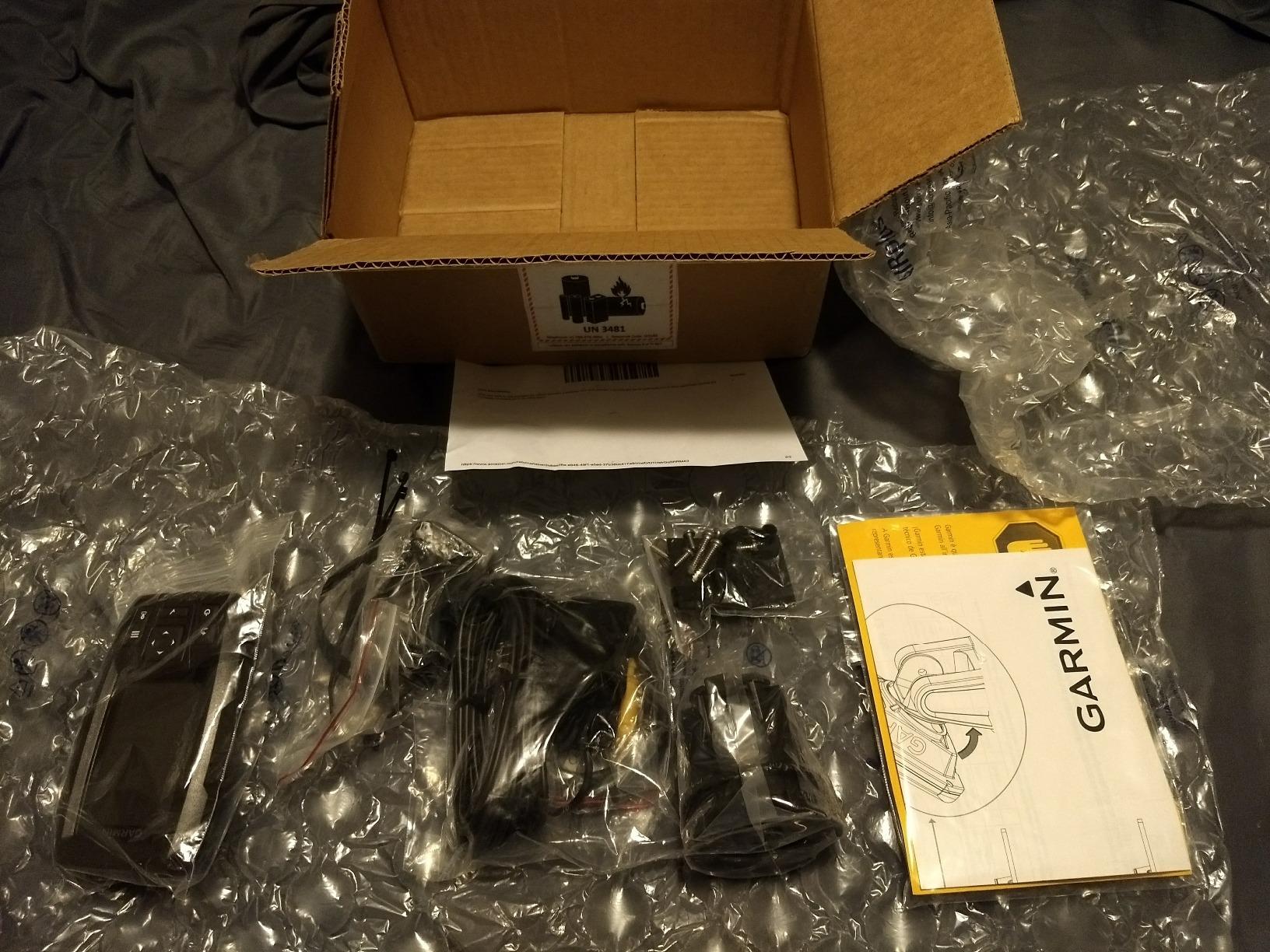
The rechargeable battery and carry bag are the reason this is a kit rather than a bare head unit, and reviewers consistently report the battery lasting through multi-day trips on a single charge.
The honest flaw is documentation. Multiple owners say the written instructions are poorly written and that YouTube tutorials are needed to get the most out of it. Two smaller irritations: the power cable lacks a Y-connector, so battery terminals must be disconnected to charge, and the waypoint map is not a chart, so you get your own marks but no basemap. If you buy this, budget twenty minutes of setup and a spare evening with community videos.
2. ReelSonar iBobber – Best for Fish Alarms Under Docks and Piers
Reelsonar Portable Fish Finder Accurate Fish Depth Finder with Depth Range of 135 feet 10+ Hours Battery Life with iOS & Android App Wireless
135 ft depth range
10+ hour rechargeable battery
Fish alarm and strike alert
LED ring for night finding
Pros
- Pocket sized and casts far
- Free iOS and Android apps
- 10+ hour rechargeable battery
- LED ring makes it easy to find at night
Cons
- Roughly 40-70 ft of reliable Bluetooth
- Needs about 5 ft of water to read
- Strike alarm triggers on any movement
With over six thousand reviews on record, the iBobber is the most battle-tested pod in this category, and the reason is simple: it was built as a dock and piling fish alarm, not as a structure mapper. Set the alarm and it tells you when fish gather underneath, which is a genuinely different job from the other seven models here.
At 2 inches by 2 inches it disappears into a pocket, and owners report it casting well beyond normal bait-cast range for something that size. The rechargeable battery is reported at 10 hours or more by multiple owners, and the glowing LED ring means you will find it in the dark without a headlamp.
Where the alarm earns its keep
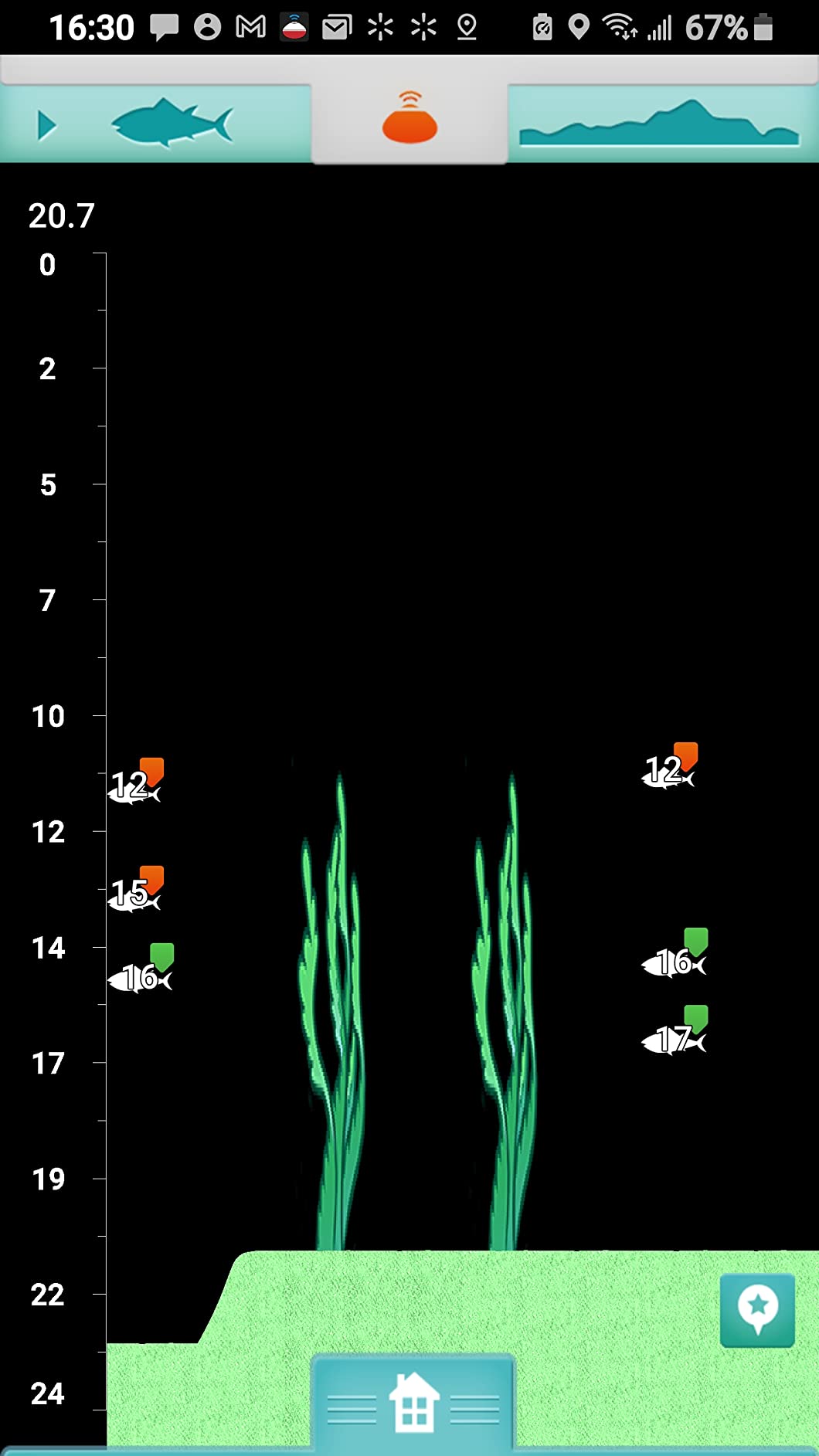
The depth-tagged, color-coded fish icons give you an idea of size and depth, and the alarm triggers when fish congregate under a dock. For catfish, carp and panfish working a structure from directly below, that is a real advantage. Reviewers also like that it works in saltwater, which the forums confirm is a genuine use case.
The five-foot minimum depth problem
Here is the flaw that matters most from shore. The sonar needs roughly 5 feet of water to read properly, and reliable Bluetooth runs about 40 to 70 feet from the bank. If you fish a shallow creek, a marsh edge or the last two feet of a lake right at your boots, this is the wrong tool, and the shallow-water reading is the single specification to check before buying any pod.
Other reported gripes
The app is a meaningful phone battery drain, some units lose charge sitting out of the water, and the graph scale can display the farthest point as zero, which is genuinely confusing the first time. Reviewers also point out the strike alarm fires on any small movement, so it is not a workable substitute for a real float.
3. Deeper START – The Best Budget Castable Pod for Beginners
Deeper Start Fish Finder – Portable and Depth Finder for Recreational Fishing from Dock, Shore, Bank or Kayak | Castable Deeper Smart Sonar with Free User Friendly App
165 ft casting and depth range
40 degree sonar beam
Own Wi-Fi, no mobile data
About 6 hours of battery
Pros
- Cable-free casting
- Creates its own Wi-Fi
- Scans auto-save with time and location
- 40 degree beam out to 165 ft
Cons
- About 6 hours of battery life
- Needs a phone or tablet
- Phone glare in direct sun
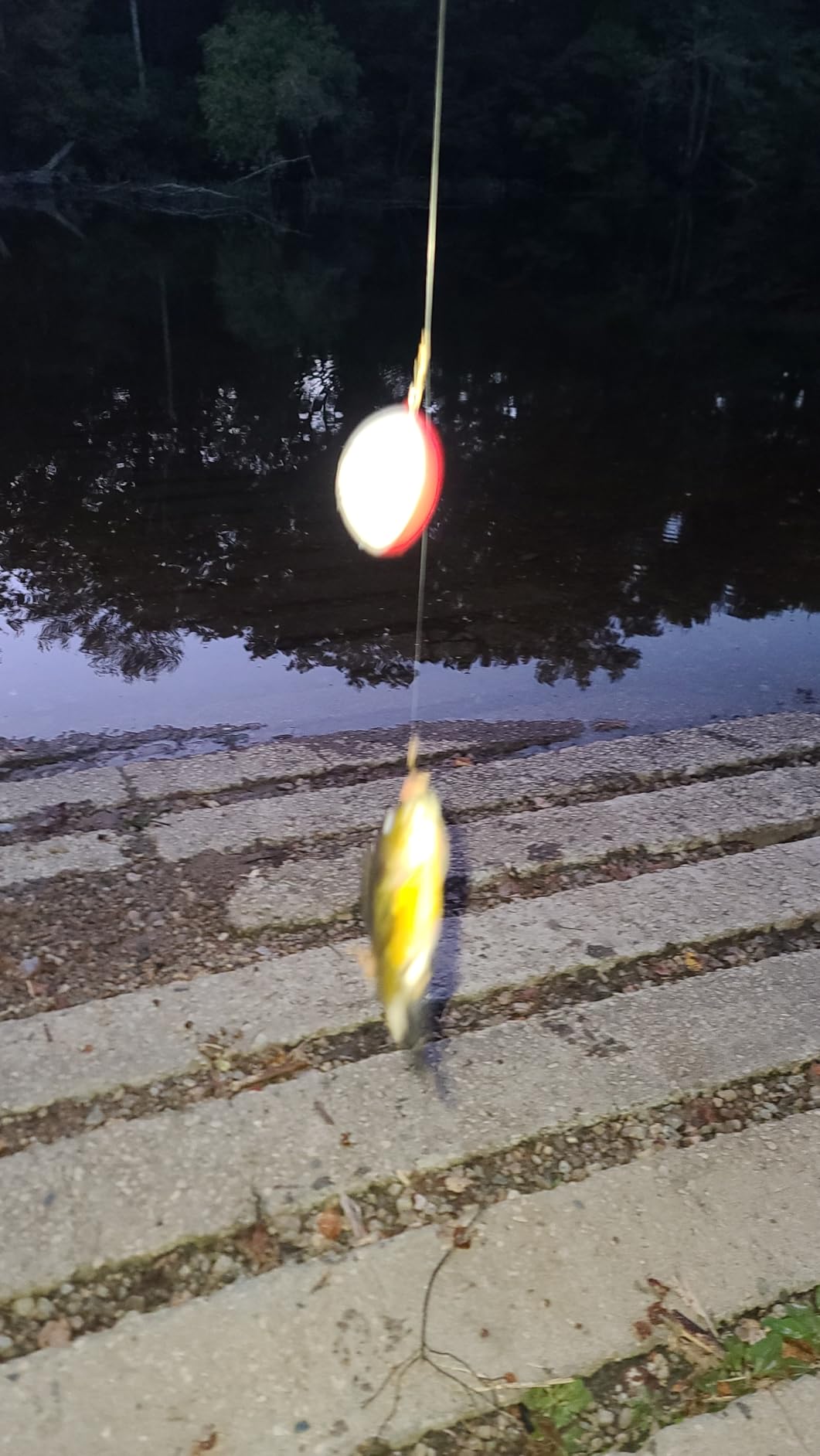
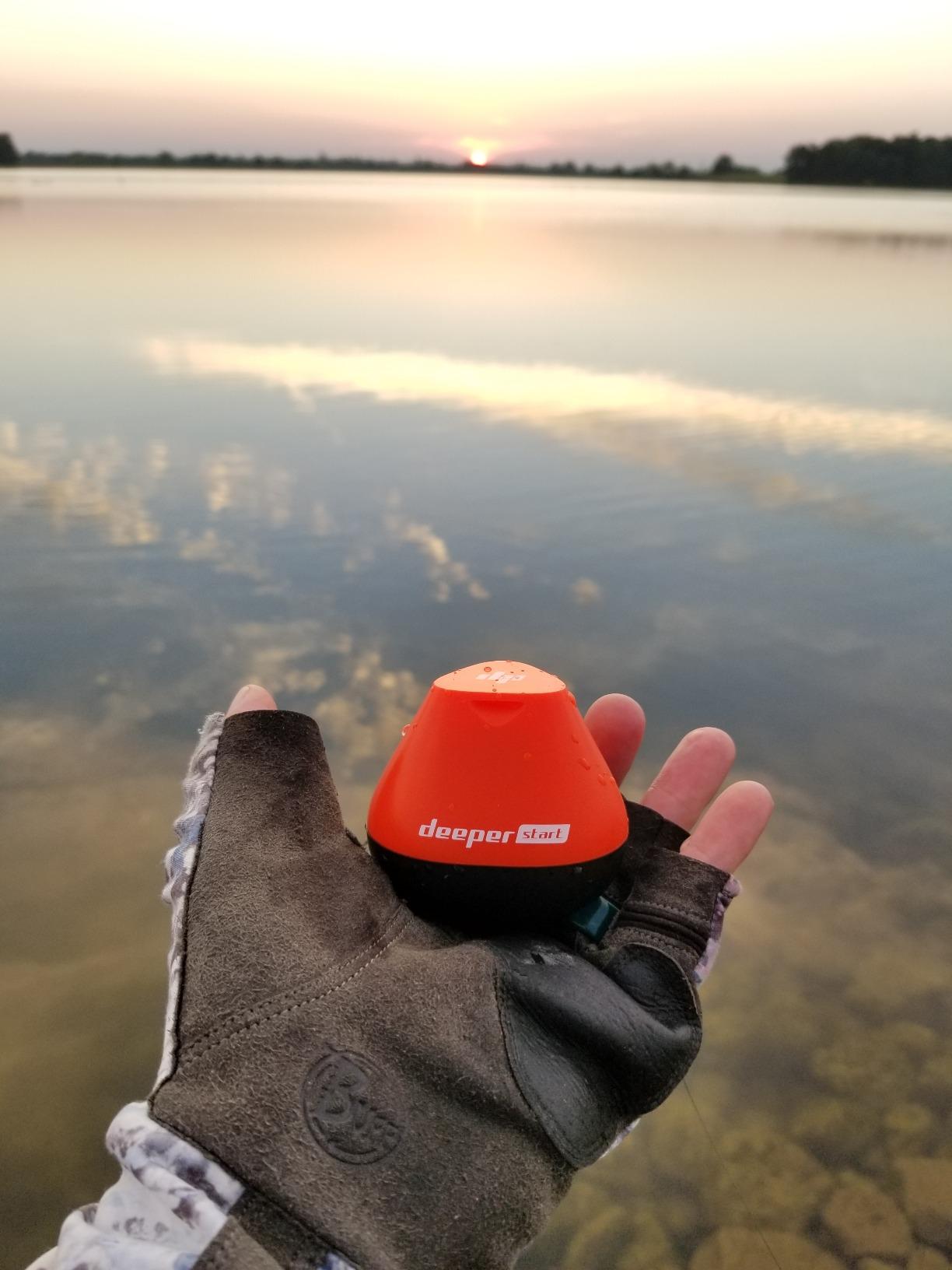
If you have never fished with sonar before, start here. There is no wiring, no external battery, no transducer to mount, and the free Fish Deeper app pairs in under a minute. The whole kit fits in a jacket pocket and the learning curve to a first useful scan is about five minutes.
The feature reviewers single out most is auto-saved scans. Every cast is stored with time and location, so when you find a spot at 6 pm you can walk back to it next week instead of guessing. That is the habit that makes sonar worth the money, and the START does it without a separate GPS accessory.
Casting range and the 40 degree beam
Casting and depth detection both run to 165 feet, with a 40 degree sonar beam. Reviewers treat that as solid coverage for shore and dock work. A 40 degree beam is on the narrow side, so you cover a defined cone rather than a broad swath, and you get better detail inside it for your effort.
Wi-Fi and battery life
The unit creates its own Wi-Fi hotspot, so it does not burn through mobile data on a long session away from signal. That matters more than it sounds, because most shore fishing happens exactly where bars do not reach. Full charge takes 2.5 hours and gives about 6 hours of use, which covers a normal day but not a full weekend of dawn-to-dusk fishing without a top-up.
There is a night fishing mode, which owners appreciate for the same reason they like the iBobber’s LED ring.
Where the phone becomes the limitation
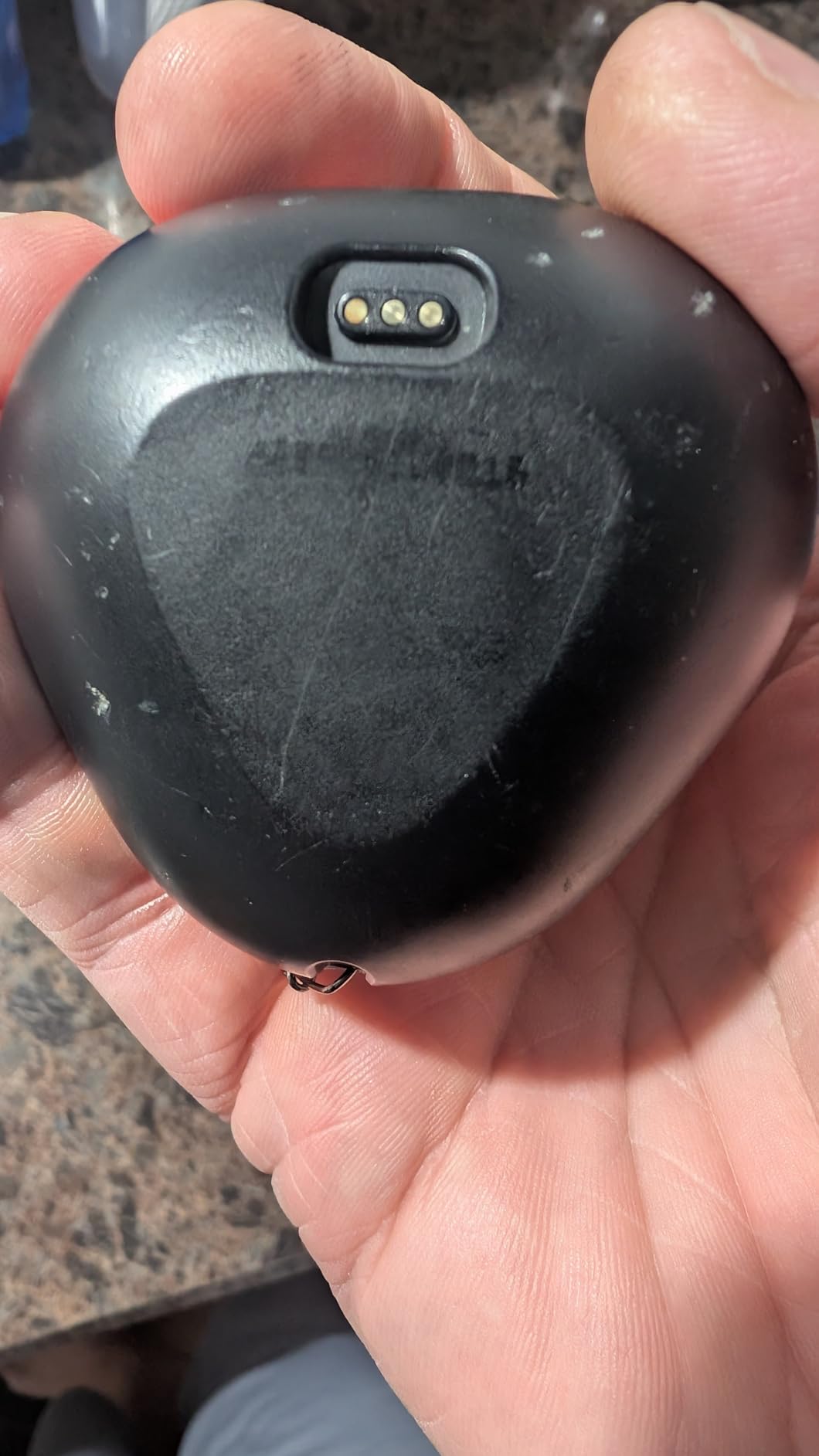
Six hours of battery and a phone for a display are the honest costs. Reviewers note that screen brightness matters when reading sonar in direct sun, and the screen real estate is limited by whatever phone you own. If you fish in full daylight, a phone-based pod is a real downgrade against the Garmin Striker 4’s dedicated screen.
4. Venterior Wireless Sonar – Best Value True Handheld With No Phone Required
Venterior Portable Rechargeable Fish Finder Wireless Sonar Sensor Fishfinder Depth Locator with Fish Size, Temperature, Bottom Contour, Color Display
262 ft sensor-to-unit range
105 degree beam angle
Color LCD, two backgrounds
2.6 to 164 ft depth range
Pros
- No phone required
- 262 ft sensor-to-unit range
- Color LCD with two backgrounds
- Reads depth
- temperature and bottom contour
Cons
- Receiver drains battery fairly quickly
- Accuracy drops past roughly 120 ft
- Unreliable readings behind a moving boat
This is the answer for anyone who wants a real screen and refuses to fish while staring at a phone. The sensor casts on a tether and the handheld unit displays depth, water temperature, fish size category, fish depth and bottom contour on a 2.6 inch color TFT. No app, no pairing ritual, no battery anxiety about your phone.
Owner reports single this out as one of the best value portable sonar devices available, particularly for bank and remote-lake anglers who need something that packs small and needs no installation. The sensor powers on by itself when it hits the water, so there is no fumbling with a button while standing knee-deep in a current.
The 105 degree beam and where it helps
A 105 degree beam angle is by far the widest in this roundup, and that means broad coverage per cast. Reviewers say depth, temperature and bottom structure readings are accurate, with fish size shown as small, medium or big. The honest caveat is that those size categories are subjective, and a 105 degree beam is why this model gives reduced accuracy in an ice hole, where the signal bounces off the walls.
Two screen backgrounds and real sunlight performance
You can switch the background from black to white, and the white background in bright sun is a small trick that makes a big difference on a small screen. It is the same category of advantage that makes the Garmin Striker 4 the daylight winner, and reviewers mention screen readability in sunlight as a repeated positive.
Range, depth and the honest flaw
The 262 ft sensor-to-unit distance is a generous number, and the depth range runs 2.6 to 164 feet. Two limits show up repeatedly in reviews. The receiver drains batteries fairly quickly, so intermittent use is typical, and accuracy drops off in very deep water beyond roughly 120 feet. Reviewers also report unreliable readings when the sensor is dragged behind a moving boat, because waves throw false signals. From shore, casting and holding still, that is not a problem. It comes with a 2-year warranty, which is longer than most rivals here.
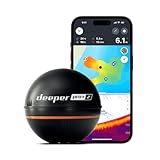
5. Deeper PRO+ 2 – Best for GPS Bathymetric Mapping From the Bank
Deeper PRO+ 2 Sonar Fish Finder – Portable Fish Finder and Depth Finder For Kayaks, Boats and Ice Fishing with GPS Enabled | Castable Deeper Fish Finder with FREE User Friendly App
Wide, mid and narrow beams
Built-in GPS bathymetric maps
330 ft range
0.4 in target separation
Pros
- Wide
- mid and narrow beams
- Built-in GPS for bathymetric maps
- 0.4 in narrow-beam target separation
- 330 ft range
Cons
- Phone screen is the display
- Phone battery drain on long sessions
- Steep learning curve on beam settings
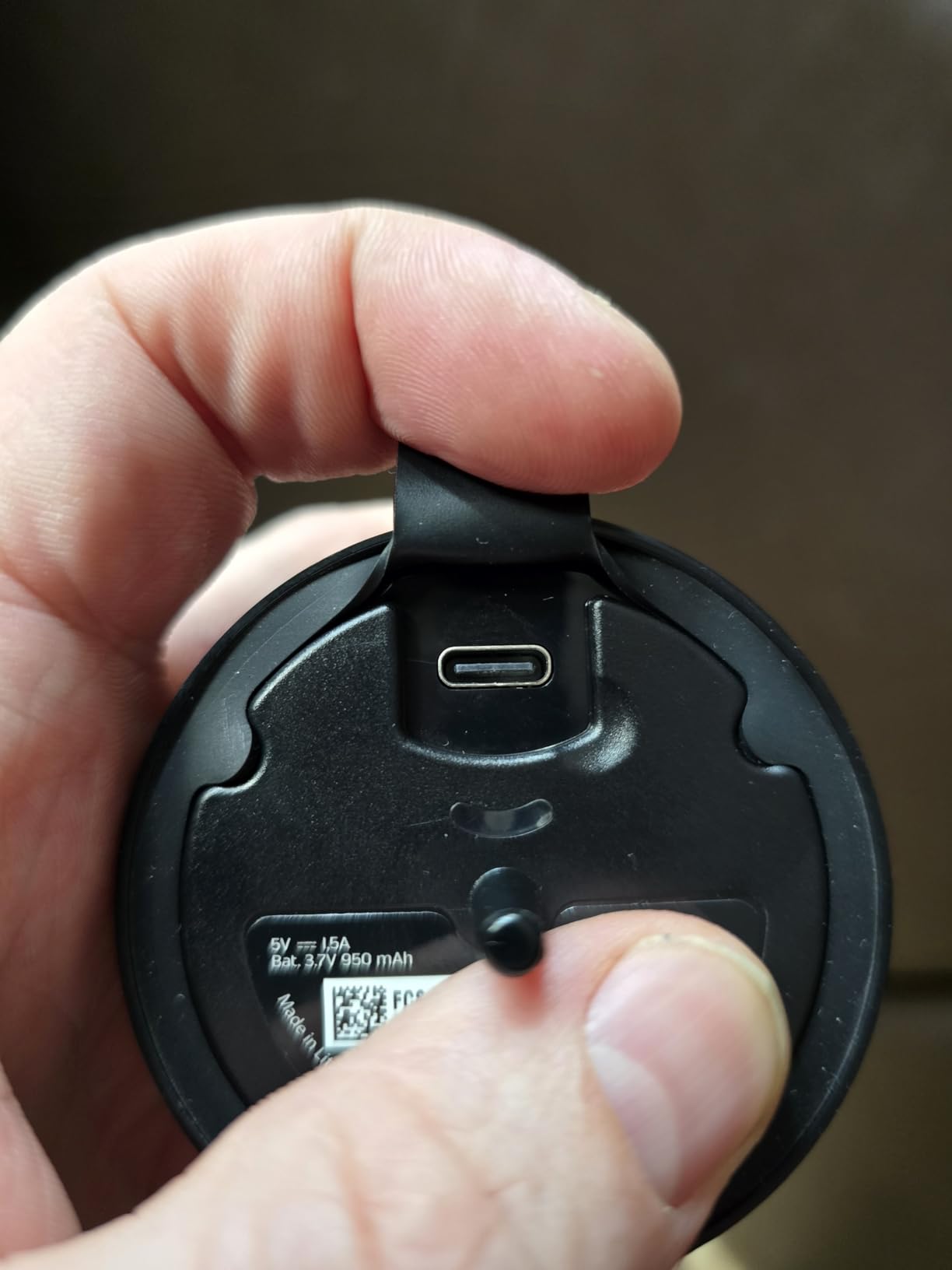
The PRO+ 2 is the step up from the START, and the step is GPS. Built-in GPS lets you create bathymetric maps from the shore, dock or bank and save them to the Fish Deeper app, which means a year of mapping turns a lake you know into a lake you have a chart for. For the angler who keeps returning to the same water, that is the feature that pays for itself.
It is also the only pod here with three selectable beams. Wide, mid and narrow gives you a coverage-to-detail dial: sweep the wide beam across a flat area, then switch to narrow and work a specific spot. Target separation is 0.4 inch on the narrow beam and 1 inch on the wide and mid beams, so you can pick a single small target out of clutter.
Range, depth and what the beams actually buy you
Wireless accuracy runs to 330 feet and depth to 100 meters, the longest of any pod here. The narrow beam is the one to use when you are vertical-jigging or trying to confirm whether something at depth is a fish, a rock or a snag. The wide beam is for finding the edge of a channel in the first place.
Owners describe the 330 ft range as dependable, backed by its own Wi-Fi with rock-solid connectivity. Reviewers also like the 2-year manufacturer warranty and the fact that it stays light and cable-free enough to live in a tackle box.
Model generation and the honest flaw
Two of the three roundup guides still ranking in search results lead with an older Deeper model rather than the current generation, so check the app support situation before buying any secondhand or dated recommendation. The PRO+ 2 remains a solid step-up, but it is not the newest pod Deeper makes.
The flaw is the experience rather than the hardware. Everything is viewed on a phone or tablet, which is harder to read in direct sun, and long sessions depend on a charged phone battery. There is also a genuine learning curve on the beam and frequency settings. Owners accept both because the mapping capability has no equivalent in a cheaper pod.
6. Garmin Striker Cast with GPS – Best Castable Range With a Tough Water Rating
Garmin Striker Cast, Castable Sonar with GPS, Pair with Mobile Device and Cast from Anywhere, Reel in to Locate and Display Fish on Smartphone or Tablet (010-02246-02)
75 g castable sonar
Built-in GPS with Quickdraw Contours
200 ft streaming range
10+ hour rechargeable battery
Pros
- Built-in GPS with Quickdraw Contours
- 10+ hour USB-rechargeable battery
- IPX6 and IPX7 rated
- Powers on when it hits the water
Cons
- Needs a phone or tablet
- 20 ft tether is short
- Streamed detail is thin on a small screen
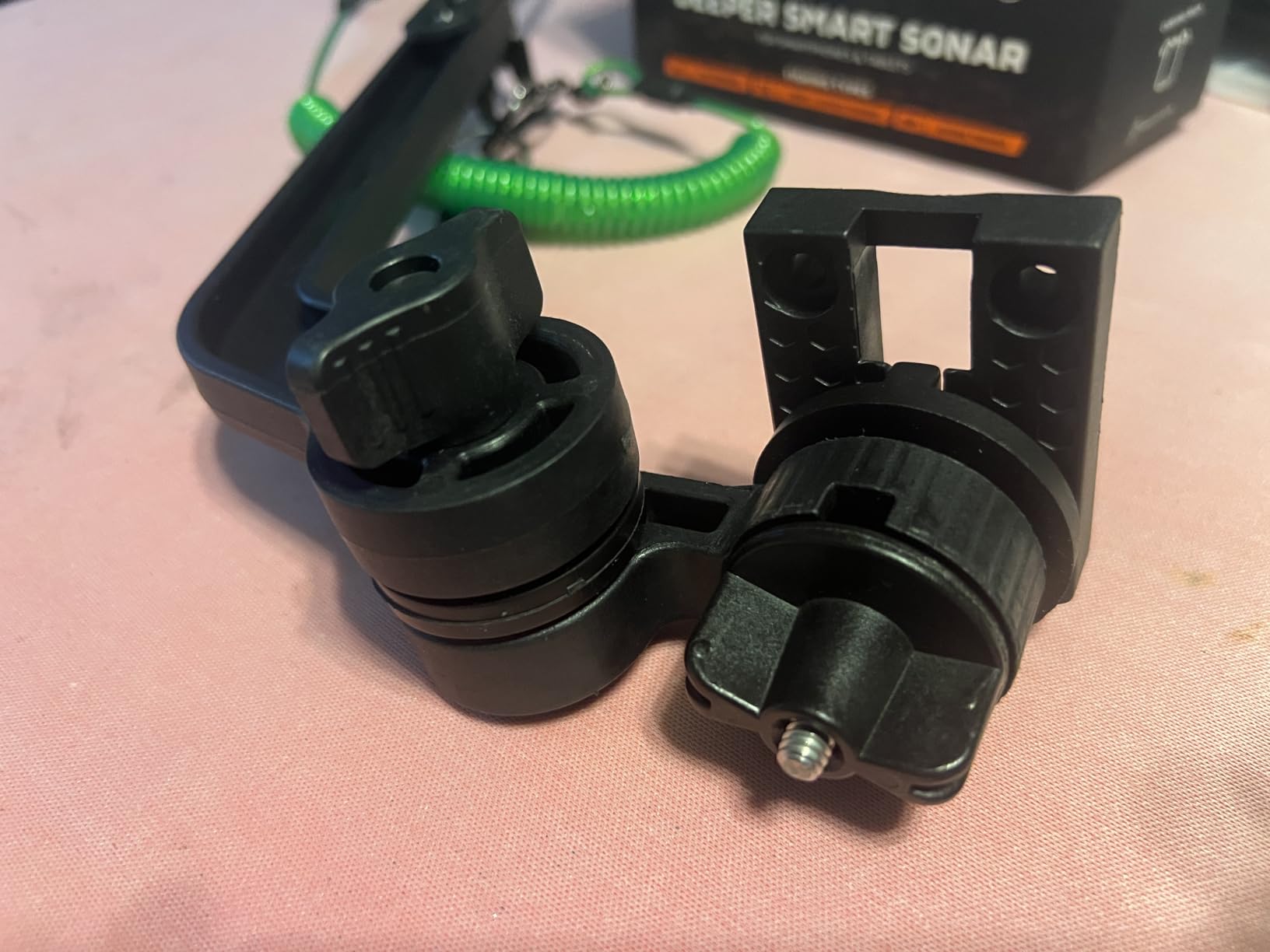
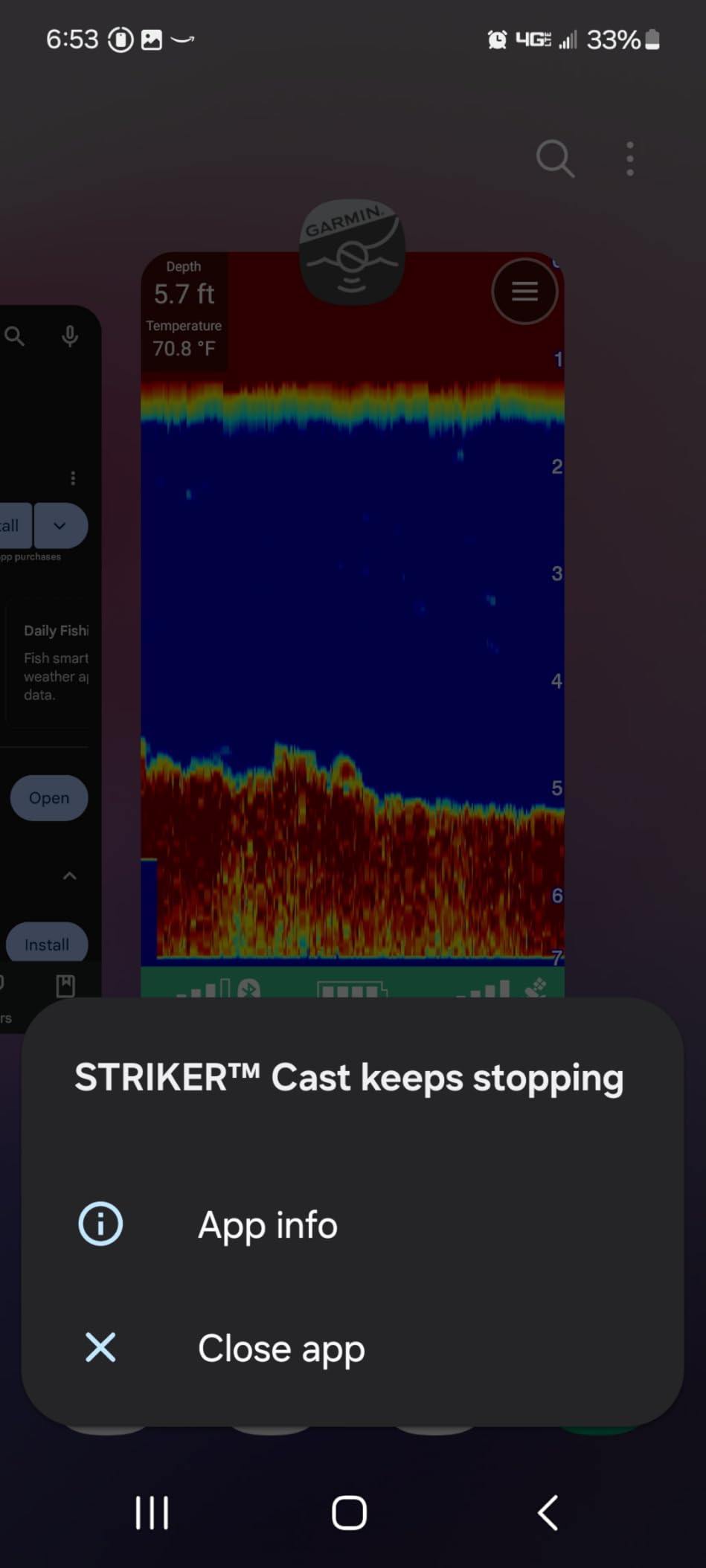
This is the one I recommend to saltwater shore anglers, and the recommendation is well earned. The IPX6 and IPX7 rating means full submersion to 1 meter for up to 30 minutes, so a rogue wave or an unexpected dunk does not end the trip. In freshwater forums the STRIKER Cast also draws repeat saltwater endorsement, which most portable guides never address at all.
It is genuinely cable-free, pairs quickly with the free Striker Cast app, and streams traditional 2-D plus ice-fishing flasher modes from up to 200 feet away. The internal USB-rechargeable battery runs 10 hours or more and the sensor powers on when it floats and off when you pull it out, so there is no on-off ritual at the water.
Quickdraw Contours and building your own map
Built-in GPS plus Quickdraw Contours lets you record custom fishing maps with 1 foot contours while you retrieve. Garmin has a community layer on top of that for downloadable maps. Reviewers consistently name this as the key differentiator over a sonar-only pod, and it is the reason to step up rather than sideways.
One thing worth knowing before you buy: contour recording depends on the GPS model, so a sonar-only variant will not map for you.
Rigging rating and the honest flaw
Garmin rates it for 20 lb test weight or higher line, and the published body weight is 75 g. That is a real number to build a rig around rather than a guess.
The flaw is the phone. Everything is viewed on a smartphone or tablet, so screen size and sunlight reduce detail against a dedicated display, and the included 20 ft tether is short if you are casting toward distant structure. The box also includes no transducer of any kind, because this is a cast sensor only. Buy it for the GPS and the water rating, not for the screen.
7. HawkEye FishPod 5X – Best for Clamping to a Piling or Paddleboard
FishPod 5x Bluetooth Fish Finder With AI Technology
Four preset operating modes
FishEcho and BottomScan processing
TraxNut mounting system
Reliable Bluetooth out to 50-70 feet
Pros
- FishEcho and BottomScan processing
- Reliable Bluetooth out to 50-70 feet
- Threaded insert accepts a clamp
- Free and simple app
Cons
- No tablet support
- Flimsy plastic line ear
- Battery charges only to about 80 to 85 percent
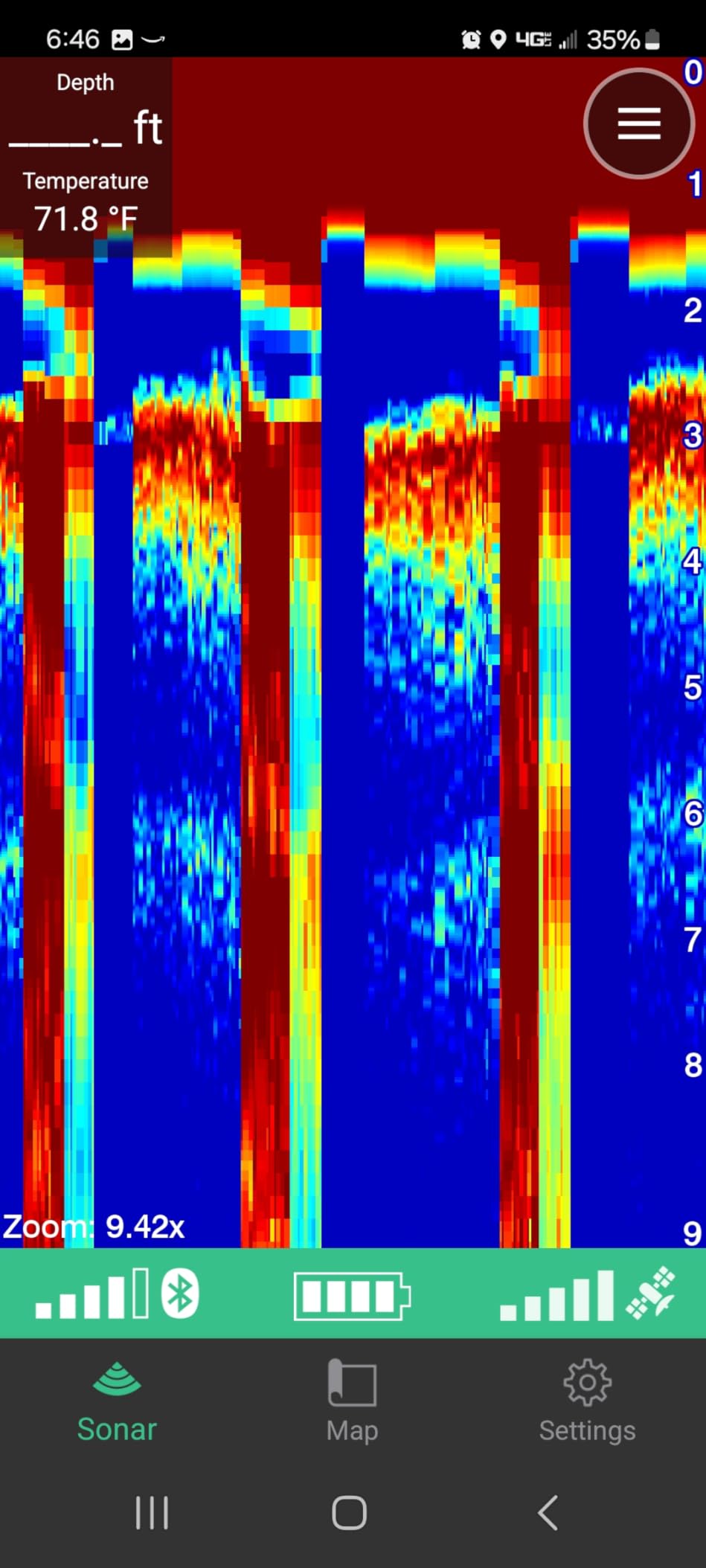
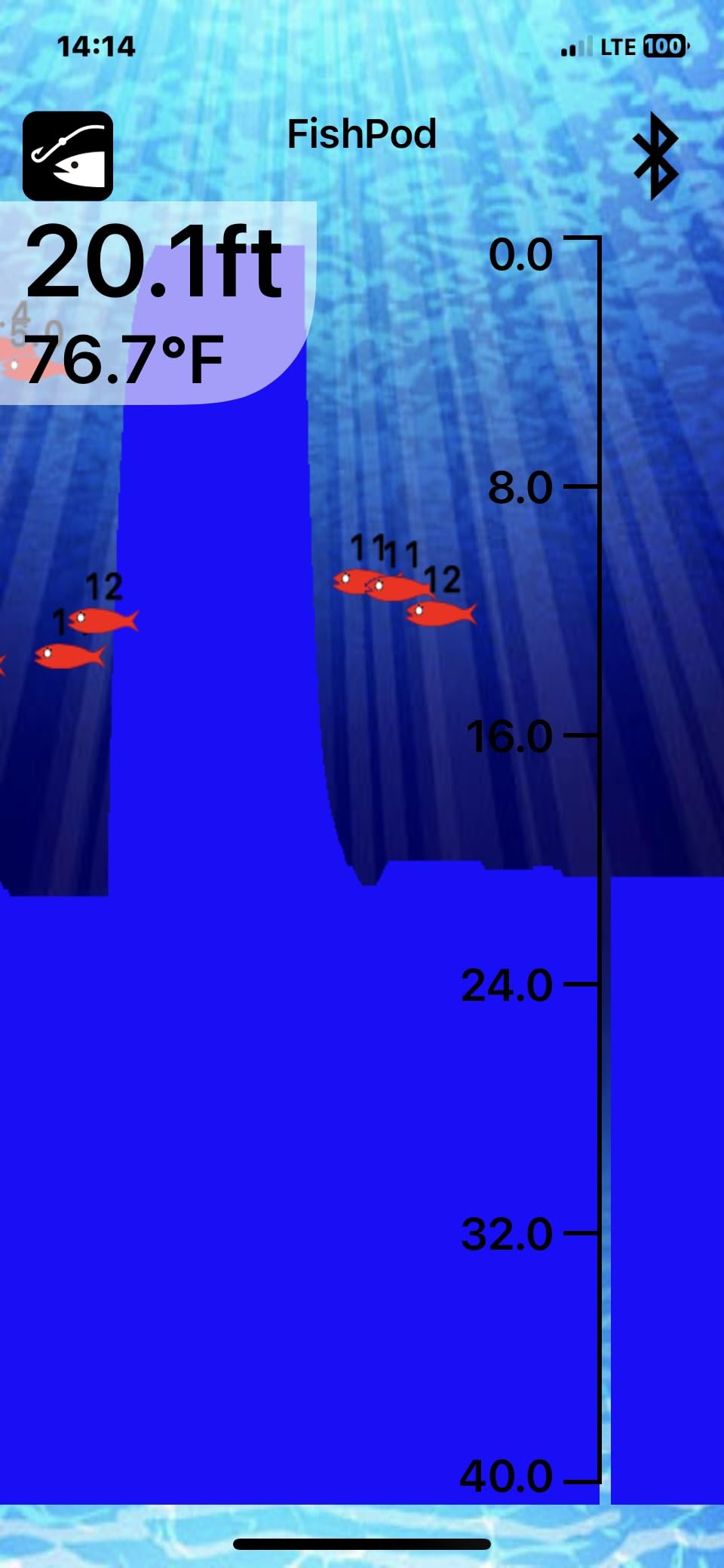
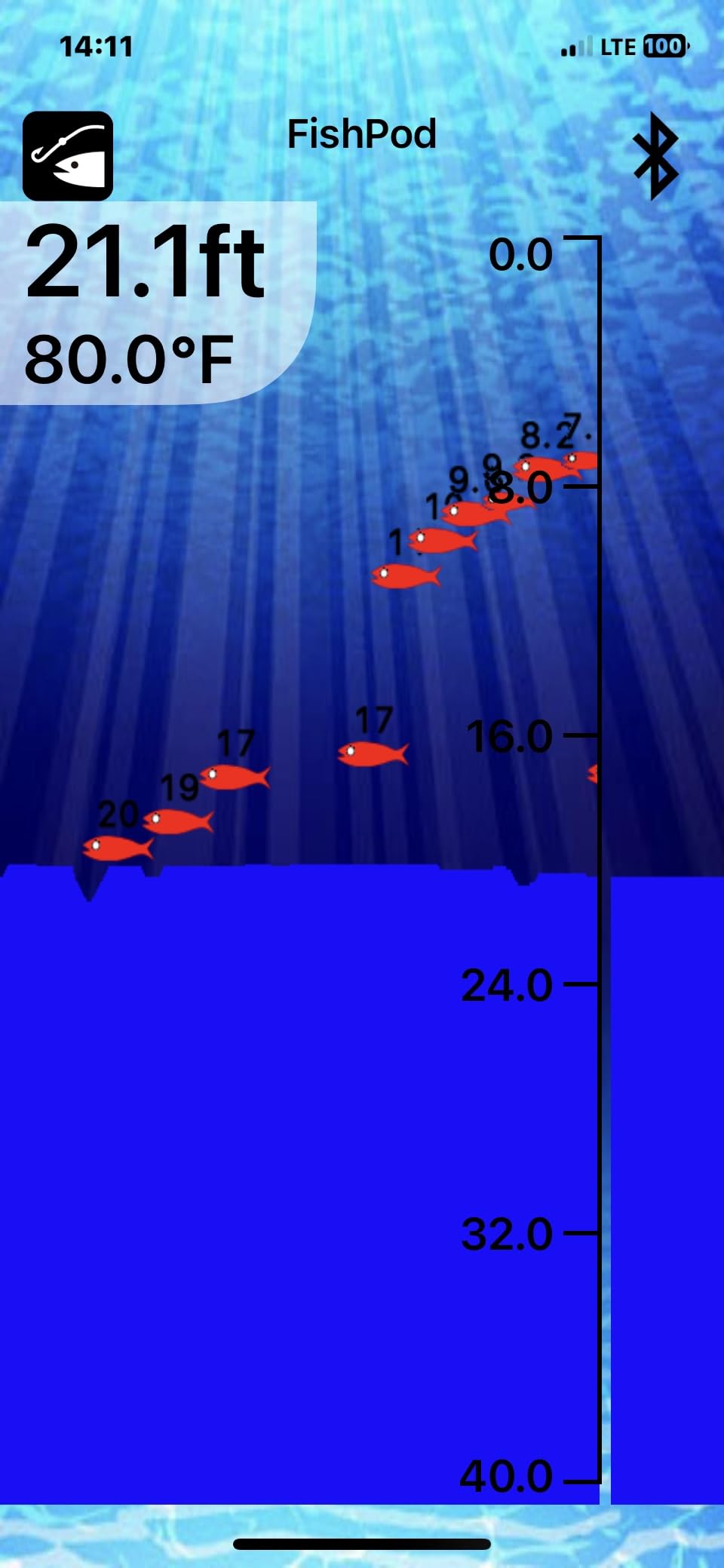
The FishPod 5X is the most flexible pod here for non-casting deployment. The TraxNut mounting system accepts any 1/4 x 20 bracket, and a threaded insert lets you rig a clamp or bracket to a boat, a dock or a paddleboard. That turns a castable sonar into a piling-mounted unit, which is the middle ground between a phone pod and a wired portable bundle.
The four preset operating modes auto-adjust the screen to target fish by size, depth or schooling. FishEcho tunes the sonar in the water column to separate fish from clutter and debris, and BottomScan adjusts bottom readings to distinguish vegetation from soft or hard bottom. Owners report accurate depth, temperature and current-speed readings and essentially no learning curve.
Processing that reduces clutter
BottomScan and FishEcho are the reason this unit holds up in weedy water where budget pods return spaghetti. Reviewers specifically call out the HD setting helping to separate grass and weed returns from actual fish, and owners say it performs above what the price suggests.
Bluetooth is reported as solid out to roughly 50 to 70 feet from the bank, which is reliable for ordinary shore casting. It does degrade if the transducer is submerged too deep, and connection drops while trolling.
How to read it and the honest flaw
There is one interpretive point that catches people out. The display is a straight-down representation of the sensor’s position, not forward-looking sonar, so you must reel in slowly to survey an area. Treat a fast retrieve as a wasted cast.
The flaws are specific. It cannot be used with a tablet, only a phone, and the plastic line-attachment ear feels flimsy to reviewers. The battery reportedly charges only to about 80 to 85 percent and drains relatively fast, and the app has no ground-mapping feature yet. If you fish heavy weed on the basic setting, expect many false fish returns.
8. DANOPLUS Wireless Sonar with HD Display – Best for Lightweight Packing and Multilingual Menus
Portable Fish Finder Large HD Display Wireless Depth Finders for Boats with 147 feet Depth Detection Sensor, Rechargeable Castable Fish Finder Display Fish, Temp
2.4 inch color LCD
147 ft depth range, 90 degree angle
Sensor lights on water contact
Fish alarm with sound and screen alert
Pros
- Color LCD at a low entry point
- 147 ft range with 90 degree angle
- Light sensor switches on at water contact
- Rechargeable with USB and AC adapter
Cons
- 2.4 inch screen is small
- 90 degree beam is narrow
- One-year warranty
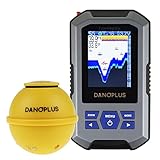
The DANOPLUS is the most compact dedicated-screen option in this roundup, and the reason to consider it is weight. At 5.28 ounces for the whole set and 4.92 inches long, it is the one you will actually bring on a hike to a remote shoreline when the others feel like too much to carry.
You still get a color LCD, a rechargeable wireless sensor reading to 147 feet at a 90 degree detection angle, and water temperature and bottom contour alongside depth. The 21 operating languages are unusual at this tier and reviewers mention them as a genuine positive.
The lamp sensor and the fish alarm
The sensor has an attractive lamp that switches on automatically the moment it touches the water. Beyond the novelty of finding it after dark, reviewers treat it as potentially drawing fish to the spot. The fish alarm gives both a visual and an audible alert showing fish size and depth as they pass through the coverage area, which is useful when you cannot watch the screen.
The honest flaw
Two things limit it. The 2.4 inch screen is small for reading fine detail, and the 90 degree beam is narrower than the wide-beam alternatives, so you cover less water per cast. Reviewers also place overall accuracy below the name-brand models and note the one-year warranty is shorter than the two-year coverage on several rivals. It lists kayak, ice, river, lake and sea fishing as applications, and it covers the first three credibly.
How to Read a Portable Fish Finder Screen Without Chasing Fish Icons
Most beginners read a sonar screen the wrong way. They watch for arches, decide fish are not there, and cast somewhere else. Structure reading is more useful, because structure is where fish reliably are and structure does not move. Five questions cover almost every session.
Where does the water deepen?
Look for the first break in a flat bottom. From shore, the interesting fish water is almost always at a transition, not in the middle of a featureless flat. A slope rising toward you or a channel dropping away is a shelf, a hump or a creek channel, and all three hold fish.
Is there a drop-off in casting range?
A sudden transition from light bottom shading to dark is a drop-off. Those steep faces concentrate bait and ambush fish. On a castable pod, a narrow beam finds them faster than a wide beam because you are sampling a narrow column on a steep face.
Where does the weed end?
Solid vegetation returns look like a thick, even band. BottomScan on the FishPod 5X is built specifically to separate vegetation from soft or hard bottom. The productive water is the edge, and the edge is where the reading changes.
Is the bottom flat or irregular?
Hard bottom returns a brighter, higher-intensity signal than soft mud. An irregular return with high contrast is usually rock, gravel or old structure. On a mud-bottomed pond, finding the one hard patch is often the entire session.
Are fish holding at a depth?
Only now do arches matter. A fish suspended at a consistent depth over a feature is a different target from a fish tight to the bottom. Sensitivity and clutter settings are how you separate the two, and too much sensitivity turns a clean scan into noise.
What to Check Before You Buy a Portable Fish Finder
Minimum depth matters more than maximum depth from shore
Shore water is shallow. Every unit here reads to well over 100 feet, which is information you will never use, while the shallowest readable depth is what decides whether the device works at all. The iBobber needs roughly 5 feet of water to read properly, which rules it out for shallow creek and marsh edges. A 2.6 foot minimum floor is the practical target for general shore use. Check the minimum before the maximum, every time.
Castable range is not the same as wireless range
Wireless range is the radio link between sensor and display. Casting range is how far you can physically throw it, bounded by your rod, your line and your skill. The two are independent, and a pod with a 330 ft link that you can only cast 60 ft is a 60 ft device. Most radio failures blamed on the unit are actually overcasting.
GPS and contour mapping are only worth it if you revisit the water
Mapping costs battery, app complexity and phone screen space. If you fish the same lake, the same dock or the same pond edge more than twice a season, it pays back immediately. If you fish new water every trip, a depth and bottom reading is enough. Note that contour recording on the Garmin line requires the GPS model, not the sonar-only one.
Target separation and beam angle decide what the screen looks like
Target separation is the ability to show one fish as one mark rather than merging it into cover. CHIRP improves it, as the Garmin technical description puts it, by sweeping frequencies continuously instead of sending one pulse. Beam angle is the other dial: 105 degrees covers a lot and resolves less, 40 degrees covers less and resolves more. Pick based on whether you are surveying or inspecting.
Power management away from a boat
Stated battery figures across this roundup run from about 6 hours on the Deeper START to 10 hours or more on the Garmin Striker Cast and the iBobber. A dedicated-display bundle with a spare rechargeable battery beats a phone-based pod, because the phone is your display and your navigation and your camera. Below freezing, lithium capacity drops noticeably, so carry a power bank rather than trusting a marginal reading.
Water rating and pod care after every retrieve
IPX7 means the unit survives submersion to 1 meter for up to 30 minutes, and the Garmin Striker Cast carries it. Budget units are often splash-rated only, which is fine for a shower and fatal for a rogue wave. Rinse the sensor in fresh water, dry it fully and store it dry, because corrosion in the plug is what ends most sonar pods. Saltwater anglers should rinse every single session.
Frequently Asked Questions
Which castable sonar fish finder is the best?
For most shore anglers the Garmin Striker Cast with GPS is the best castable sonar, because the built-in GPS and Quickdraw Contours let you record 1 ft contour maps from the bank, the battery runs 10 hours or more, and it carries an IPX6 and IPX7 water rating. If you want a wider reach and finer target separation, the Deeper PRO+ 2 reads to 330 ft and separates targets down to 0.4 inch on its narrow beam. If you are starting out and want the simplest setup, the Deeper START costs less and auto-saves every scan with time and location.
Can I cast a fish finder on an ultralight rod?
Not reliably, and you should not try. Published pod weights run from about 75 g for the Garmin Striker Cast to 3.2 ounces for the Deeper PRO+ 2, while an ultralight rod is rated for 1/32 to 1/8 ounce lures. That mismatch is why line snaps and pods get lost. Use a medium-action rod or heavier, 16 to 25 lb braid, a palomar or uni knot and a #3 barrel swivel with a snap. Garmin rates the Striker Cast for 20 lb test or heavier.
Are castable fish finders any good?
Yes, with one condition: the value is in reading structure, not in counting fish icons. A pod sends a ping and shows you the shape of the bottom, the weed edge, the drop-off and the hardness of the bottom. Fish move and underwater features do not, so a mapped feature pays off on every return trip. The real limits are the phone dependency, the roughly one foot per second retrieve speed and the radio link, which degrades in rough water.
Which fish finder is better, Humminbird or Garmin?
Garmin dominates the portable category, taking most of the shopping results for shore fishing, and its portable units pair a bright readable screen with CHIRP sonar and, on the castable model, Quickdraw Contours. Humminbird’s strength is the mapping ecosystem, so anglers who care most about chart detail and personal bathymetric maps are more likely to care about that than about the size of the head unit. Whichever you pick, decide first between a wired portable bundle and a castable pod, because that choice matters far more than the badge.
How long does a portable fish finder battery last?
Expect roughly 6 hours from the Deeper START, which takes 2.5 hours to fully charge, and 10 hours or more from the Garmin Striker Cast and the ReelSonar iBobber, which use internal USB-rechargeable batteries. The Garmin Striker 4 portable kit ships with a rechargeable battery that owners report lasting through multi-day trips. Phone-based pods drain your phone as well as their own battery, so budget for a power bank on any session longer than half a day.
Which Portable Fish Finder Fits the Water You Fish
If you fish one lake and you want a screen you can read in full sun with no phone in your hand, the Garmin Striker 4 with Portable Kit is the pick, and it is our overall best portable fish finder for shore fishing in 2026. If you fish water you cannot reach with a cable, the Garmin Striker Cast with GPS is the answer for saltwater and for mapping water you keep revisiting, while the Deeper PRO+ 2 gives you the longest castable reach and the finest target separation. If you want a real screen and no phone at all, the Venterior is hard to beat, with the DANOPLUS as the lighter option for hiking in.
Start with one honest question: do you need to reach water, or do you need to read water? Reach means a castable pod, and the Garmin Striker Cast is the version worth owning. Reading water from a dock or a piling means a wired bundle, and the Striker 4 handles that better than anything else here. The Deeper START is the sensible first purchase if you are not sure yet, because it is cheap in lost-gear terms and it saves every scan with time and location.
Whichever you choose, rig it properly before the first cast, check the minimum depth against the water you actually fish, and read the bottom instead of the fish icons. The structure will still be there next time you come back.