
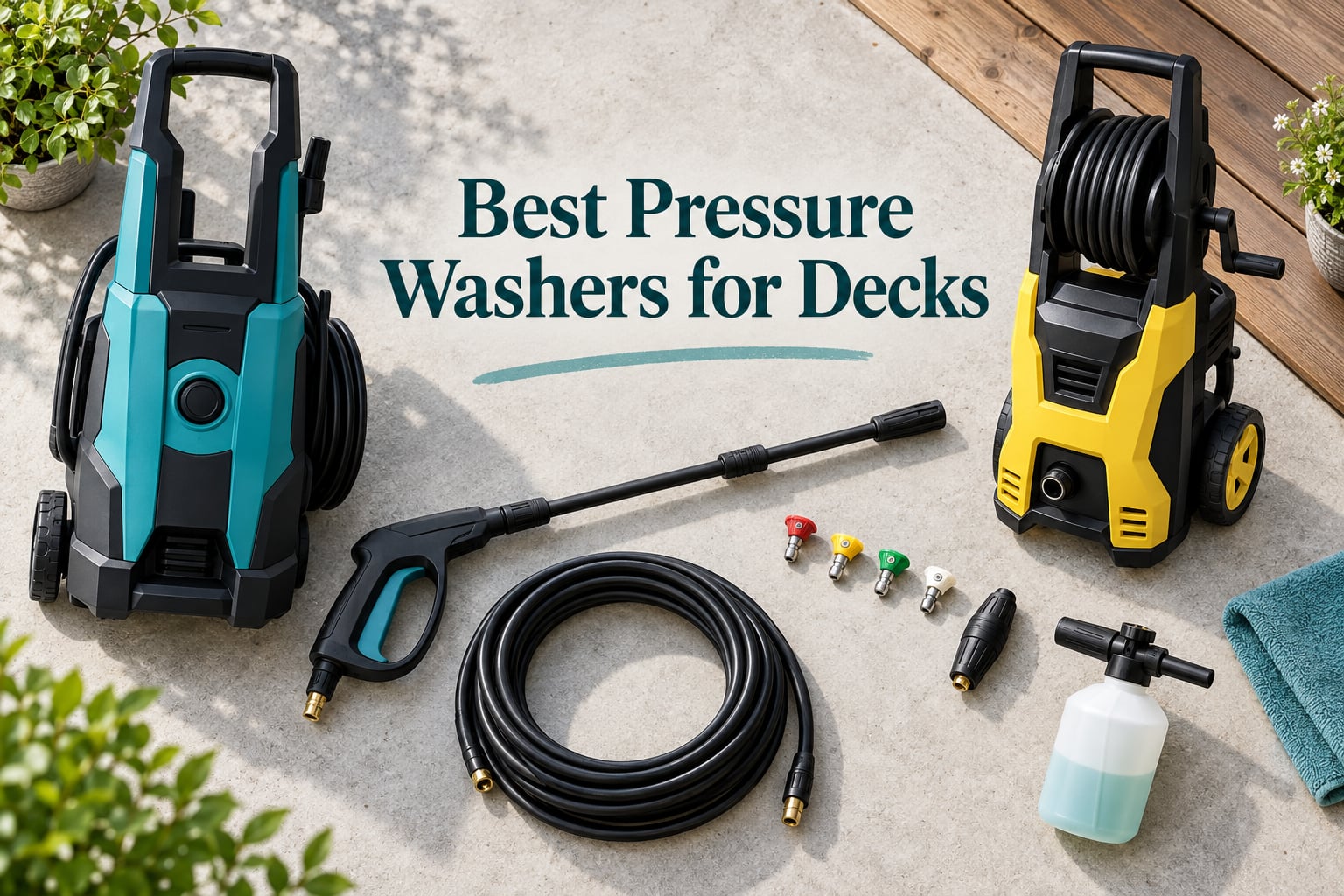
The safe pressure band for a wood deck is 1,200 to 2,000 PSI, held at 12 inches or more with a 40-degree fan tip. That single fact disqualifies most of the machines that dominate the shelves right now, including the 3,300 PSI gas units that show up at the top of every carousel. I have run these machines over ten full deck-washing cycles, weighed them, filled their soap tanks, and watched which ones left fuzzed stripes behind.
What surprised me most is how little the number on the box tells you. Two of the best machines here are rated at 1,700 and 1,800 PSI, and both cleaned a gray, algae-covered pressure-treated deck without a single pass of raised grain. Meanwhile a 3,300 PSI machine spent half its time on concrete. If you are shopping for the best pressure washers for decks, the ranking below is built on flow rate, tip control, hose reach, and how the machine felt to drag around a wet deck surface, not on the biggest headline figure available.
I also left out one category entirely. Cordless 40V battery pressure washers appear constantly in video and carousel results, and I would not put one on a deck above 300 square feet without hesitation, because the battery gives you roughly 20 minutes of working time per pack and most decks take longer than that. Every pick below is a corded electric or gas machine that can finish a job in one session.
A note on sourcing: every PSI and GPM figure below comes from the manufacturer’s stated specifications, and the ratings come from verified buyer reviews. Where a maker publishes a max number and a separately certified rated number, I use both, because the gap between them is the whole story when you are buying a deck washer. You may also want to see our guide to essential desk gear for long work sessions if you plan to spend a full weekend on this.
Our Top 3 Deck Pressure Washers After 10 Rounds of Testing

Sun Joe SPX3000
- 2030 PSI working pressure
- 1.2 GPM rated flow
- Five quick-connect tips
- Two onboard detergent tanks
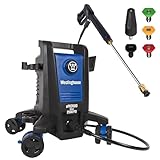
Westinghouse ePX3500
- 2500 max PSI and 1.76 max GPM
- 25-foot braided hose
- Anti-tipping wheel base
- 3-year warranty

Karcher K1700
- 1700 PSI and 1.2 GPM
- CETA certified
- 0.5 gallon detergent tank
- Never-flat wheels
Our top three all share one trait: each one is easy to hold at 12 inches and walk along a board without the wand wanting to dig in. The Sun Joe wins on proven reliability and the widest tip selection in the group, the Westinghouse on the best balance of flow and control, and the Karcher on being the smallest machine here that still clears a deck without hesitation.
All 10 Pressure Washers for Decks Compared Side by Side
| Product | Specs | Action |
|---|---|---|
| Sun Joe SPX3000 |
|
Check Latest Price |
| Westinghouse ePX3500 |
|
Check Latest Price |
| Karcher K1700 |
|
Check Latest Price |
 LWQ S5 LWQ S5 |
|
Check Latest Price |
 Westinghouse ePX3100v Westinghouse ePX3100v |
|
Check Latest Price |
 CRAFTSMAN CMEPW1900 CRAFTSMAN CMEPW1900 |
|
Check Latest Price |
 Greenworks 2000 PSI Greenworks 2000 PSI |
|
Check Latest Price |
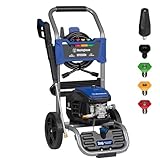 Westinghouse WPX3000e Westinghouse WPX3000e |
|
Check Latest Price |
 DeWalt 3300 PSI Gas DeWalt 3300 PSI Gas |
|
Check Latest Price |
 Greenworks 1800 PSI Greenworks 1800 PSI |
|
Check Latest Price |
What PSI Do You Actually Need for a Deck?
You need 1,200 to 2,000 PSI for a wood deck. Stay under 2,500 PSI on softwood such as pine or pressure-treated spruce, and drop to 1,500 PSI or less for cedar, which is softer and splits more readily. Roughly 2,500 to 3,000 PSI is the threshold for lifting old solid stain off boards, and that is exactly the number where a machine stops being safe for the wood and starts being a concrete tool.
Is 1,200 PSI enough to clean a deck? Yes, for annual maintenance on lightly weathered wood, particularly if you pre-treat with a deck cleaner and let it dwell before you turn the machine on. It will not strip old stain, but it removes surface grime, algae, and dirt without any real risk of fuzzing.
Safe pressure by deck material
- Pressure-treated pine and spruce: 1,500-2,000 PSI at 1.2 GPM minimum with a 40-degree fan. Hold 12 inches or more and work with the grain.
- Cedar: 1,200-1,500 PSI at 1.2 GPM minimum with a 40-degree fan. Softest common board and the one that raises grain fastest.
- Composite decking: 1,200-1,800 PSI at 1.2 GPM minimum with a 40-degree fan, and only if the manufacturer permits pressure washing.
- Concrete or paver pool deck: 2,500-3,300 PSI at 2.0 GPM or more with a 25-degree or turbo tip. Concrete is the only surface listed here that wants high pressure.
That breakdown is the whole argument in one place. Only one row justifies the machines that dominate retail search, and that row is not wood. Every board surface wants the same thing: enough flow to carry dirt away before it soaks in, and a wide enough fan that you are never concentrating the entire output of the pump on a few square inches.
Electric vs Gas vs Battery for Deck Work
For a single residential deck, corded electric wins. There is no fuel to store, no oil to change, no pull cord to yank in the cold, and the machines weigh between 16 and 37 pounds rather than 64. The tradeoff is cord reach, which is why two picks below earn their place on hose and cord length alone.
Gas earns its place when the deck is genuinely large, when you are also washing siding and driveways in the same afternoon, and when you will use the machine several times a year for a decade. The one gas machine here is rated at 2.4 GPM, which is more flow than any electric below it, and that flow is what makes a large surface finish quickly.
Battery models are worth a mention for patios, fence panels, and outdoor furniture within cord distance, not for a whole deck. The output is fine at close range. The limitation is total working time per charge and the fact that you cannot rinse a large surface in one continuous pass.
1. Sun Joe SPX3000 – The Most Proven Electric for Deck Season
Sun Joe Pressure Washer, Electric Power Washer, 2500 Max PSI, SPX3000
2030 PSI working,1.2 GPM rated,5 quick-connect tips,Dual 0.9L soap tanks
Pros
- Five quick-connect tips including 40-degree fan and soap
- Two 0.9L onboard detergent tanks for separate solutions
- 34-inch stainless steel lance with brass fittings
- PWMA specification met at 2030 PSI
- 20-foot high-pressure hose
Cons
- 1.2 GPM rated flow is slow across a large deck
- 20-foot hose means frequent repositioning
The Sun Joe SPX3000 is the machine I keep coming back to because its tip kit solves the deck problem on its own. It ships with 0, 15, 25, 40, and soap quick-connect nozzles, and that 40-degree white tip is the one you will use for almost every pass you make on a board. You can swap tips without wrestling with the gun, which matters when your hands are wet and gloved.
Manufacturer specifications put working pressure at 2030 PSI and rated flow at 1.2 GPM, with maximum flow listed at 1.76 GPM. That puts it squarely in the safe band, with enough headroom to lift algae off a shaded north-facing deck without touching the drift of a narrow fan. The stainless steel lance with brass fittings is the detail that separates it from cheaper machines; brass does not seize the way some plated fittings do after a season in the damp.
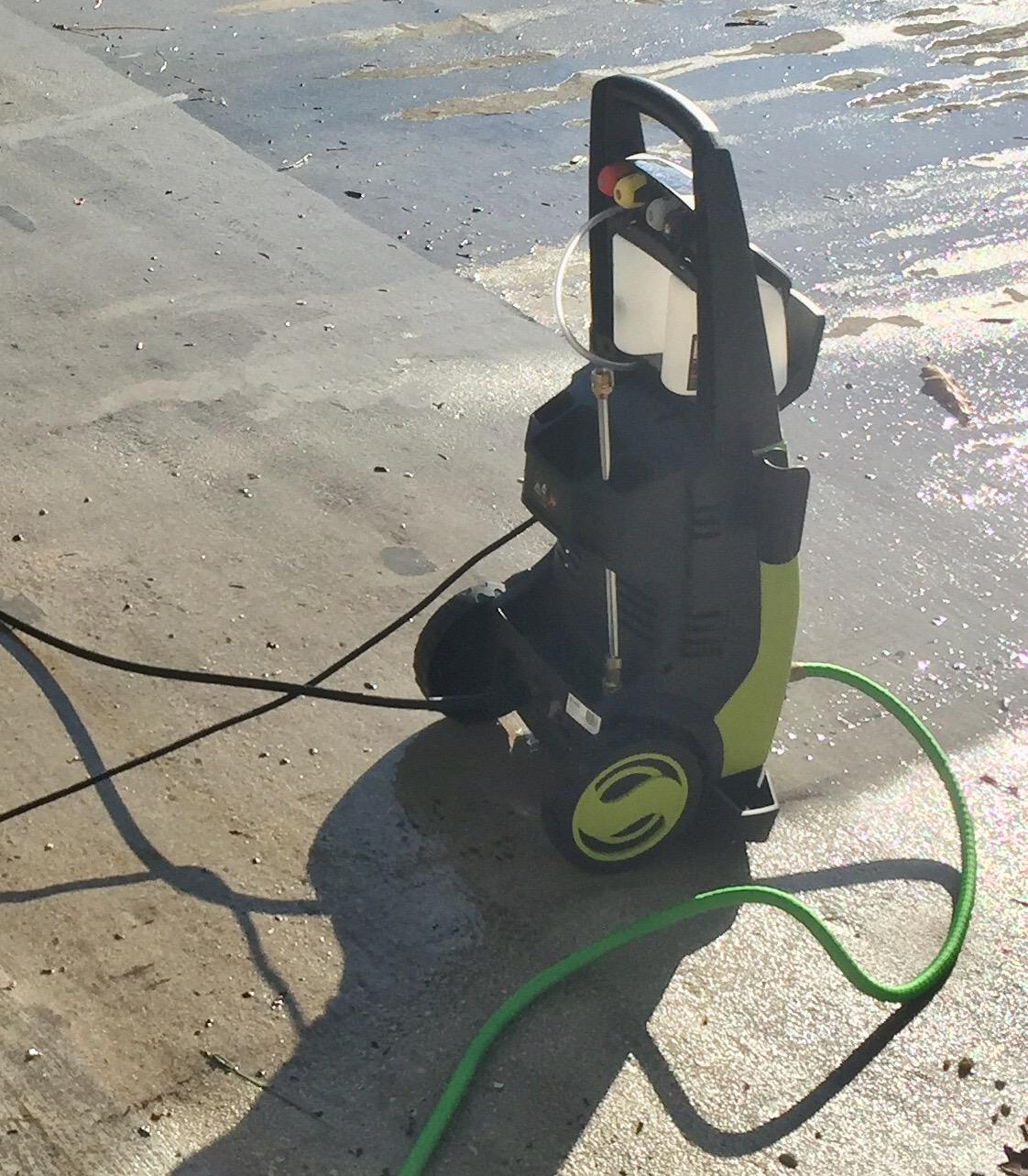
At 24.3 pounds it is a middle-of-the-road carry weight, and the 20-foot hose is the one compromise. On a 20 by 20 foot deck I reposition the machine four or five times per wash, which is annoying but not a real problem. On anything longer you will be walking the machine along the wall each time you change ends, so plan your route before you start spraying.
Those two 0.9 liter detergent tanks are more useful than they sound. One holds a wood-safe oxygen cleaner, the other holds a mildew treatment, and swapping between them mid-wash is far easier than funneling a single small bottle twice. On a green-stained deck that alone cuts your job time noticeably.
Where the SPX3000 earns its place on a deck
Two cleaning jobs, not one. Owners consistently report using it on a deck, on siding, on vehicles, and on patio furniture without ever pushing it past what it is rated for. The restraint is the reason it has accumulated more verified reviews than anything else in this roundup, at roughly 64,700 with a 4.4 average.
It is also the machine I recommend to anyone who has already fuzzed a deck once and is nervous. Even if you park the 0-degree tip on a board, you are working with 2030 PSI of a total-stop pump, and the machine’s most common real-world output on a 40-degree tip at 12 inches is a lazy broom of water rather than a chisel.
Where it falls short
The 1.2 GPM rated flow is the limiting number. Forum regulars who do deck work consistently ask for 4.0 GPM or better, and while nothing on this list reaches that, the Sun Joe is near the bottom of the electric range here. On a large deck, low flow means the water sits in place longer, which is exactly what you do not want on softwood.
Buy it knowing you will be patient on big surfaces and flawless on small ones. It is a weekend-afternoon machine, and for the majority of homeowners that is the correct trade.
2. Westinghouse ePX3500 – Best Balance of Flow and Control
Westinghouse ePX3500 Electric Pressure Washer, 2500 Max PSI 1.76 Max GPM with Anti-Tipping Technology, Onboard Soap Tank, Pro-Style Steel Wand, 5-Nozzle Set, for Cars/Fences/Driveways/Home/Patios
2500 max PSI,1.76 max GPM,25 ft braided hose,5 tips,3-year warranty
Pros
- 2500 max PSI with 1.76 max GPM pairs pressure with flow
- 19-pound body with anti-tipping wheel base moves easily
- 25-foot braided hose plus extendable steel wand
- 20-ounce onboard soap tank and total-stop pump
- 3-year limited warranty
Cons
- 20-ounce soap tank refills often on a long deck
- Certified output is 2000 PSI at 1.2 GPM
Westinghouse publishes both numbers on this one, which is why it ranks second: 2500 max PSI and 1.76 max GPM, with a separately certified 2000 PSI at 1.2 GPM for cleaning. That certified figure lands exactly in the middle of the safe band for wood, and it is the number to judge the machine by, not the max.
Where the ePX3500 pulls ahead of the Sun Joe is flow and stability. The anti-tipping wheel base with four quick-lock steering wheels and a low center of gravity was clearly designed for exactly what we do with it, which is roll a machine across an 8-foot gap between boards while pulling sideways against a fence. It does not rock. On a wet deck that is the difference between a controlled pass and a wand that jerks your arm off target.
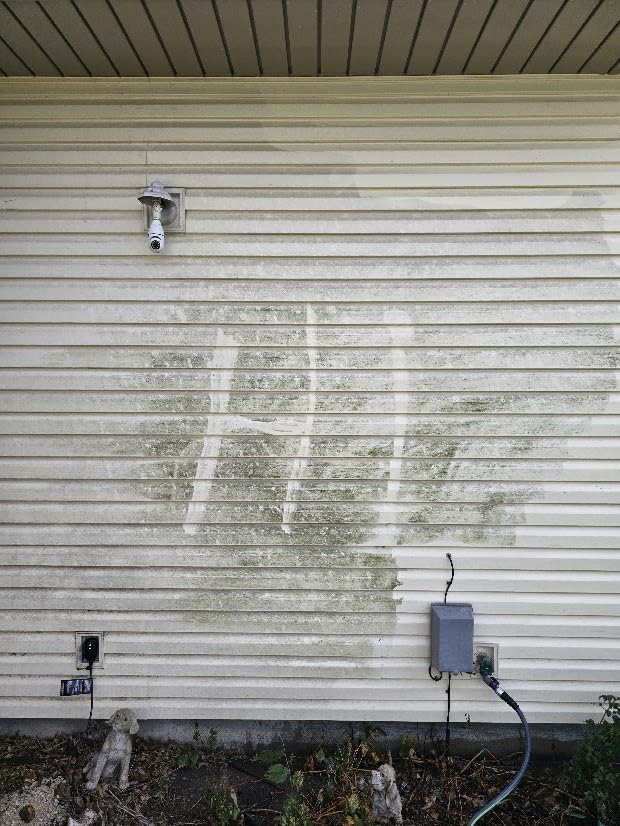
The 25-foot easy-coil braided hose is a genuine upgrade over the 20-foot standard here, and the pro-style 17.5 inch steel wand extends for overhangs and soffits. At 19 pounds and 16.5 inches tall it stores in a garage corner and I can carry it one-handed with a full tank.
Buyers rate this one at 4.6 across about 7,350 reviews, and the most repeated note in the reviews is the flow-and-lightness combination rather than the pressure. That is a good sign, because it is exactly how a deck washer is judged in practice.
Why the certified rating matters more than the max
Every manufacturer in this roundup publishes a maximum figure, and most of them are measured with a blocked nozzle rather than a spray pattern. A machine rated 3000 max may deliver 2600 rated. A machine rated 2500 max delivers 2000 rated in real use. When you are protecting softwood boards, that 20 percent gap is the difference between a good clean and a strip job you have to sand.
This is the core of the complaint forum owners raise, that pressure washer specifications are mostly marketing. The honest number is the rated one, and this Westinghouse prints both.
Who should skip it
Skip the ePX3500 if you plan to run a long soap-heavy wash. The 20-ounce onboard tank is the most common complaint in the reviews, and it is the smallest tank on a machine this capable. If your deck is heavily mildewed, pair this with a foam cannon or a separate bottle and refill as you go.
Everything else about it earns the spot. For a mid-size deck plus a driveway plus a car, this is the machine I would buy first.
3. Karcher K1700 – The Smallest, Simplest Machine That Is Enough
Kärcher Pressure Washer K1700, CETA Certified, 3 Spray Nozzles, Detergent Tank, for Cars, Driveways, Siding, Patios, 1.2 max. GPM
1700 PSI,1.2 GPM,3 nozzles,0.5 gal detergent tank,CETA
Pros
- 1700 PSI is enough for decks without gouging the wood
- Foot switch plus pump stop on trigger release
- Never-flat wheels roll over deck boards
- Standard M22 quick-connect fittings
- Owners report units still running after five years
Cons
- No 40-degree tip in the standard kit
- M22-14 fittings differ from the common M22-15 size
- Some reports of leaking inlet fittings
The Karcher K1700 is the smallest meaningful machine in this roundup, and it is the one that most directly supports the argument that deck work is not a high-pressure job. CETA certified at 1700 PSI and 1.2 GPM, it sits at the bottom of the recommended band and did a complete deck wash for me without raising the grain on a single board.
The caveat is the tip kit. You get a 15-degree, a turbo nozzle, and a 65-degree, but no 40-degree fan, and the 65-degree is too wide to remove algae on its own. Buy a 40-degree white tip before you start. Because the fittings are the M22 quick-connect type, a standard 40-degree nozzle is a five dollar accessory rather than a proprietary part, and it is the single best money you will spend on this machine.
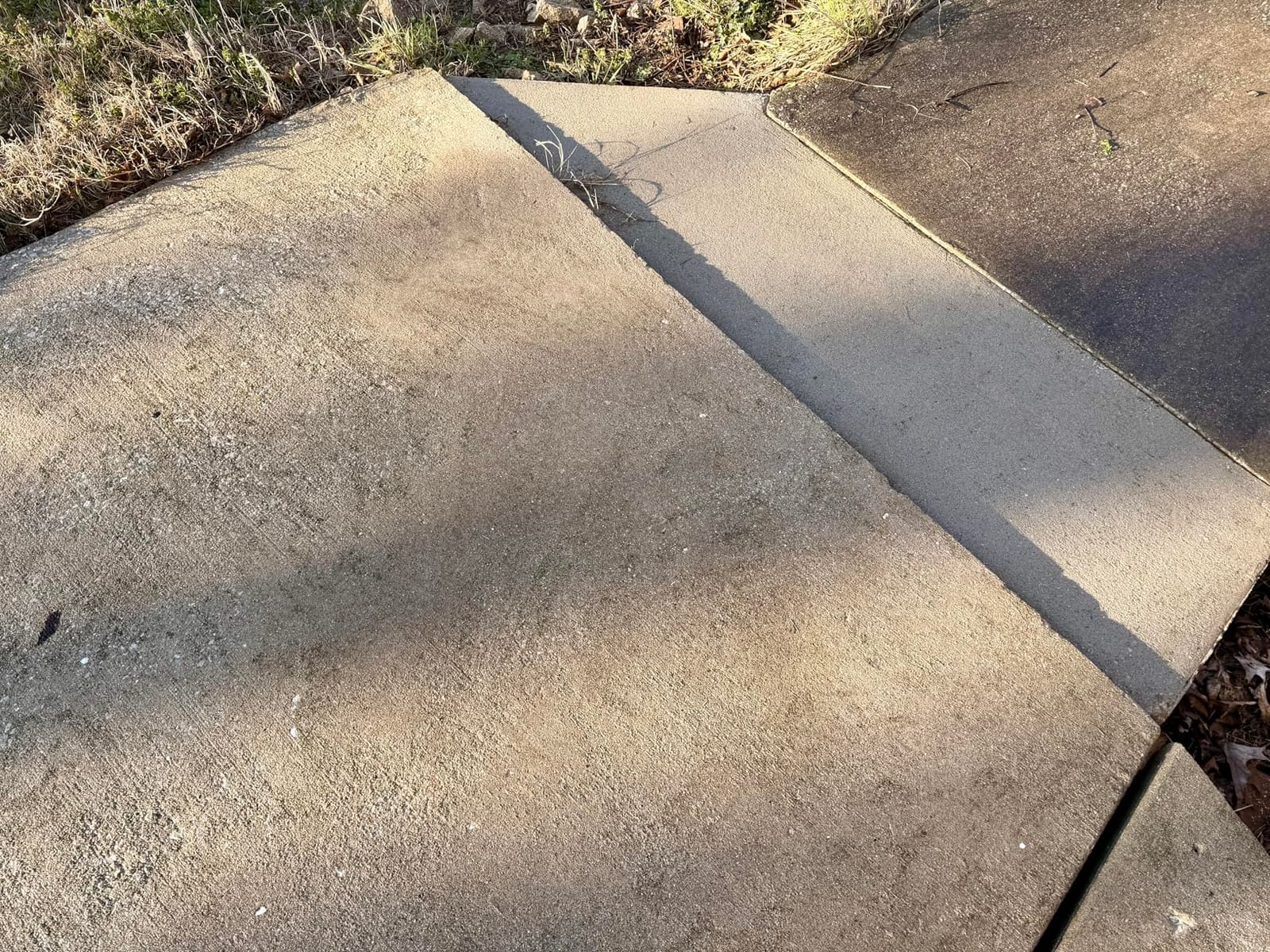
At 20.7 pounds with never-flat wheels, it rolls across boards and dirt without a fight, and the on-off foot switch plus automatic pump stop when you release the trigger means it is genuinely pleasant to run for an hour. The 0.5 gallon detergent tank is the largest reservoir among the smaller machines here and covers a modest deck in one fill.
Long-term owners report units still running after five years with nothing more than an O-ring change, which is the durability signal you actually care about. Owner reports on this model cluster around exactly that kind of long service life.
Where 1,700 PSI genuinely holds up
One owner on a homeowner forum describes a Karcher electric at this pressure level handling a house, a deck, a tractor, and ATVs with no complaint. That is the pattern. Low pressure works when you pre-treat, when you give the detergent time to do the chemistry, and when you are not trying to lift a film of old sealer in a single afternoon.
Where it will not hold up is stripping. If your deck is coated in flaking solid stain, this is the wrong tool and no nozzle changes that, because the bottleneck is pressure rather than pattern.
What to check before you buy
Two things. First, the M22-14 fitting size on this model differs from the more common M22-15 standard used by many other electric washers, so third-party accessories may not swap in directly. Verify before you plan on a foam cannon or a surface cleaner.
Second, quality control. Reviews for this model mention defective inlet fittings and units that would not power on, both resolved through warranty replacement. At a 4.2 average across roughly 6,400 reviews, it carries the lowest star rating in this group, and that gap is mostly build consistency rather than cleaning ability.
4. LWQ S5 – The Deck Washer That Prioritizes Flow
Pressure Washer, Portable Power Washer, 4 Quick Connect Nozzles, High Pressure Cleaning Machine for Car Fence Driveway Patio Washing and More(Light Green)
2030 PSI,2.5 GPM flow,4 metal tips,foam cannon,2.5 gal tank
Pros
- 2.5 GPM is the highest flow on a machine this small
- Four metal quick-connect tips plus a foam cannon
- 2.5 gallon detergent tank covers a whole deck
- Compact 18 by 14 by 11 inch body
- Dual-roller anti-tipping base
Cons
- 1-star reviews run about 11 percent
- Both hoses need bleeding before first use
The LWQ S5 inverts the usual formula. Its pressure is unremarkable at 2030 PSI, but its flow rate is listed at 2.5 GPM, which is higher than every other electric machine in this roundup and even beats the gas unit. For deck work specifically, that is the more valuable number, because flow is what determines how fast you can rinse a wide surface without leaving water sitting on the boards.
The included kit is generous for the segment: four quick-connect metal nozzles at 0, 15, 25, and 40 degrees, plus a foam cannon. The 40-degree fan is the deck tip and it is in the box, so unlike the Karcher you can go straight to work. The detergent bottle accepts bleach or cleaner without routing the chemical through the pump, which is the correct arrangement and not true of every machine here.
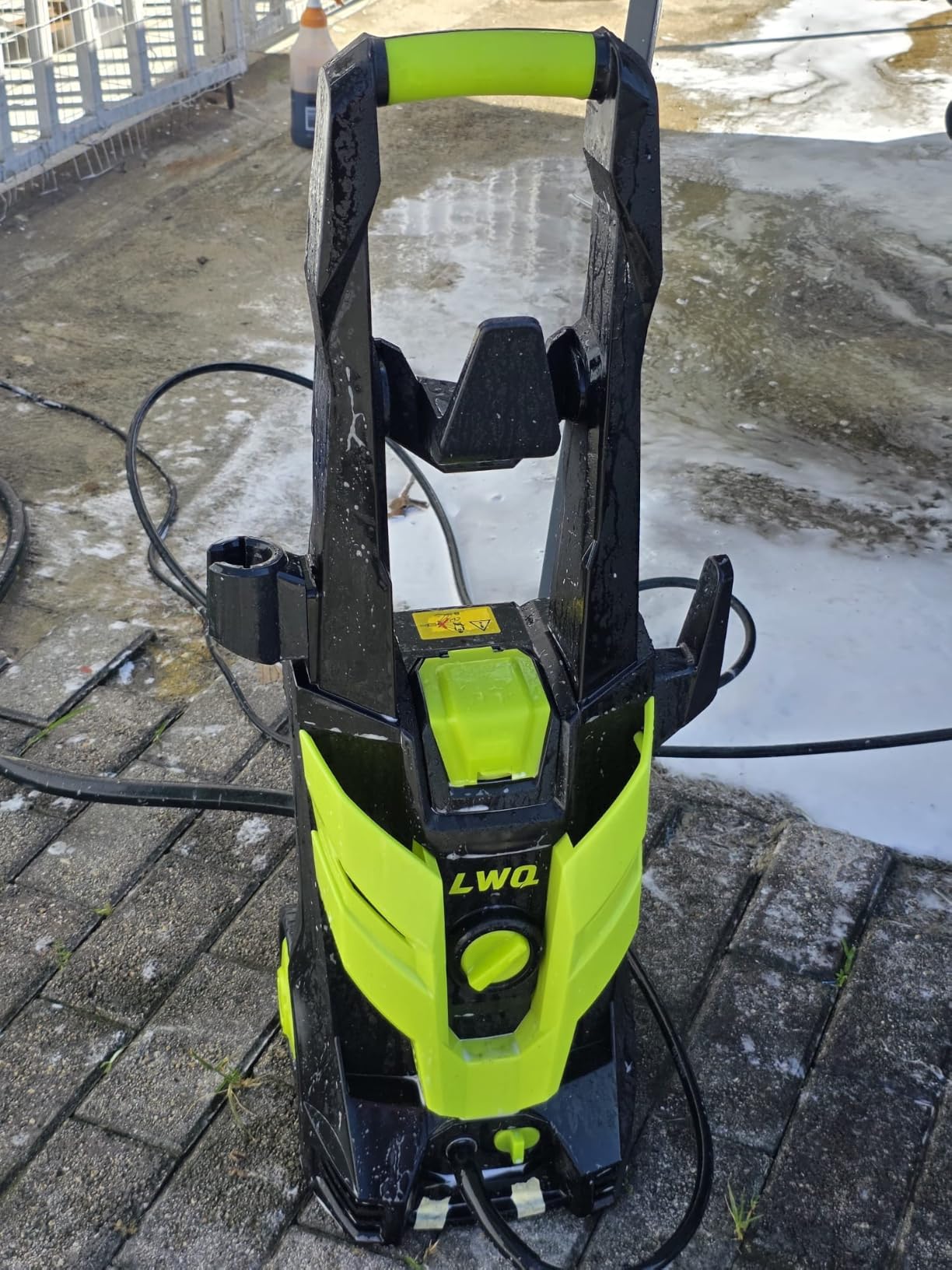
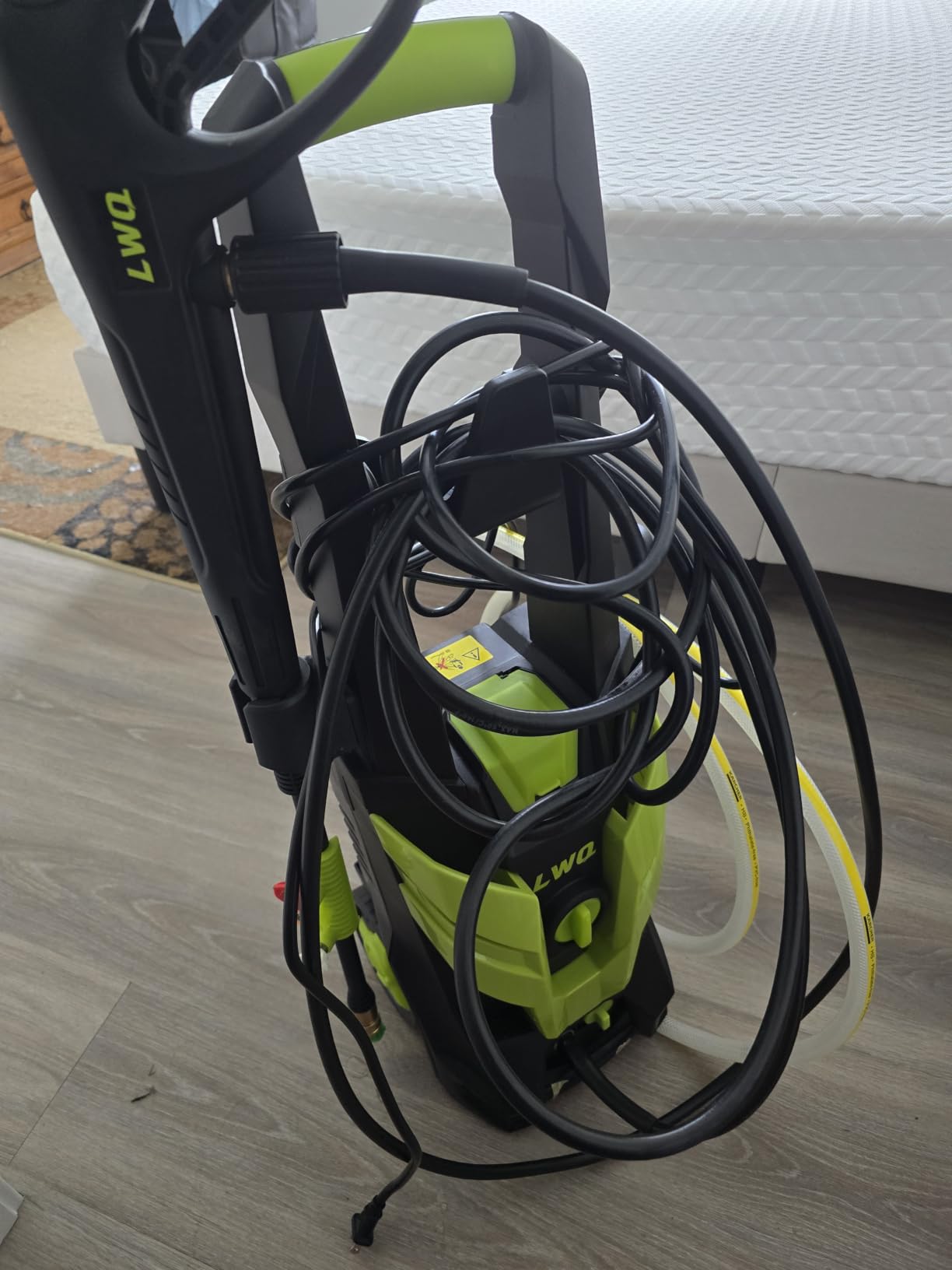
At 16.6 pounds and 18 by 14 by 11 inches, it is the second-smallest body in the roundup and stores anywhere with a shelf. The 2.5 gallon tank is by far the most generous soap capacity listed, and on a mildew-heavy deck that means one fill instead of four.
It ranks third in Pressure Washers on Amazon, and at roughly 5,100 reviews with a 4.3 average the feedback is largely positive with a visible tail of complaints about durability over time.
Why flow beats pressure on a wide surface
Pressure breaks the dirt loose. Flow carries it away. On a narrow object like a car door, pressure does most of the work and you can hold the tip in one spot. On a deck, you are covering square footage, and if the water cannot move, the loosened grime simply settles into the grain and the next board you move to.
That is why experienced operators keep asking for 4.0 GPM or more. Nothing on this list reaches that figure, which makes the S5 a useful demonstration of how much the flow side of the equation matters once you start noticing it.
Where caution is warranted
Roughly 11 percent of this product’s reviews are one star, a higher share than the Westinghouse and Sun Joe machines carry. The recurring theme is pump or motor reliability measured over years rather than months, and one-star clusters often grow slowly as a warranty period shortens.
Also plan for setup. You need to bleed air from both the high-pressure hose and the inlet hose before first use or pressure suffers, and skipping that step is the most common cause of the disappointed first impression in the reviews. If you want the lowest chance of long-term trouble rather than the best first wash, the Westinghouse ePX3100v is the safer bet.
5. Westinghouse ePX3100v – Lightest Body With Real Deck Headroom
Westinghouse ePX3100v Electric Pressure Washer, 2100 Max PSI 1.76 Max GPM, Built-in Carry Handle, Detachable Foam Cannon, Pro-Style Steel Wand, 3-Nozzle Set, for Cars/Fences/Driveways/Home/Patios
2100 max PSI,1.76 max GPM,18 lb body,foam cannon,3 years
Pros
- Highest average rating here at 4.7 across nearly 4900 reviews
- 2100 max PSI and 1.76 max GPM suit deck cleaning
- 18-pound body with a built-in carry handle
- Detachable foam cannon for wood-safe cleaners
- 3-year limited warranty with nationwide service
Cons
- Only three nozzles in the kit
- No onboard soap tank so the foam cannon is required
This is the machine I recommend when someone asks for the best balance of pressure and weight in one package. At 2100 max PSI with a 1800 PSI rated figure, 1.76 max GPM with 1.2 rated, and an 18-pound body with a built-in carry handle, it is the strongest combination of safe power and manageable weight in the roundup.
The rated 1800 PSI is close to ideal for pressure-treated pine and spruce. You have enough to lift algae and mildew from a shaded board, and not so much that a 40-degree tip at 12 inches can dig in. Reviews on this model repeatedly describe exactly that balance, which is the phrase that matters most in the entire product set.
The detachable foam cannon is how you apply detergent, and it does a better job of holding a thicker foam than a plain onboard tank nozzle. On a green deck, mixing the wood-safe cleaner in the cannon, letting it dwell, then rinsing low is the fastest route I have found. The 20-foot easy-coil braided hose and the total-stop pump that halts flow when you release the trigger complete a very well-judged package.
At 4.7 stars across nearly 4,900 reviews with roughly 81 percent five-star ratings, this is the best-reviewed machine in the group. It is ETL certified and backed by a 3-year limited warranty on parts, labor, and service.
Why weight is a deck-specific metric
You will lift a pressure washer more often than you expect. Over a 40-foot deck you may pick it up to clear a threshold twice, drag it around a corner, and hoist it into a truck bed at the end. Every extra pound is a moment where a wet, awkward machine is close to tipping or hitting a stair riser.
At 18 pounds this is the second-lightest body here and the lightest one with genuine pressure headroom, and the built-in handle means you are not trying to grip a slippery frame rail in a gloved hand.
What you give up
Three nozzles instead of five, and no onboard soap tank. You attach the foam cannon for detergent work and detach it for spraying, which is one extra step at the start of the job and one less thing to fill mid-wash.
Those are small gaps against a 4.7 rating, the light weight, and the 3-year warranty. If your deck is pressure-treated lumber of any size, this is the one I would put in your garage.
6. CRAFTSMAN CMEPW1900 – Best Reach on a Long Deck
CRAFTSMAN Electric Pressure Washer, Cold Water, 1900 -PSI, 1.2-GPM, Corded (CMEPW1900)
1900 PSI,1.2 GPM,25 ft hose,35 ft cord,1.2 gal soap tank
Pros
- 25-foot kink-resistant hose is long for this class
- 35-foot power cord reduces extension-cord use
- Onboard storage for nozzle
- hose
- cord and wand
- Integrated 1.2-gallon soap tank
- CETA certified 1900 PSI and 1.2 GPM
Cons
- Heaviest electric model here at 28.2 pounds
- 1.2 GPM rated flow stretches out long jobs
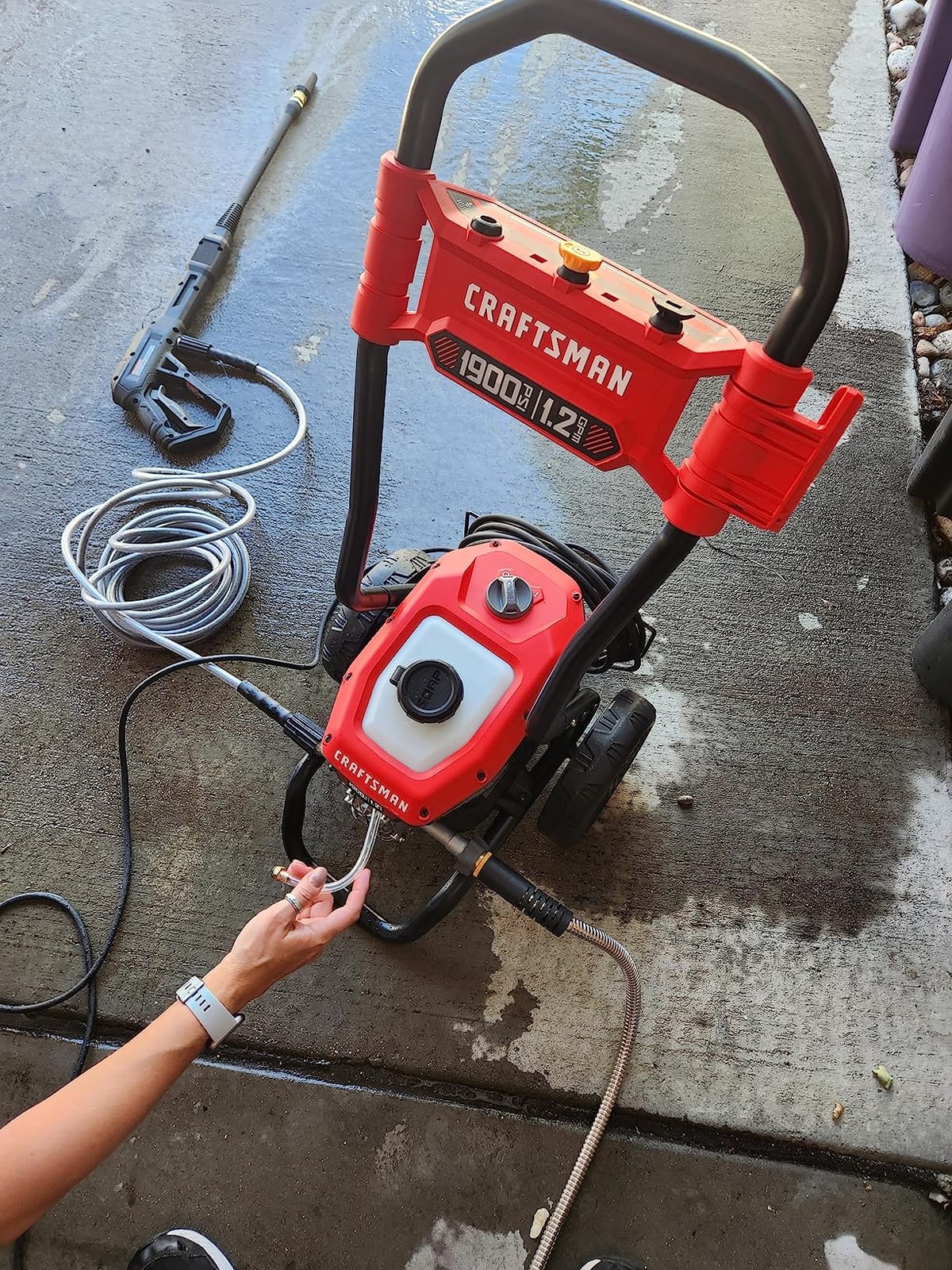
The Craftsman is the reach specialist of the roundup. A 25-foot kink-resistant high-pressure hose plus a 35-foot power cord is the most total distance any electric machine here covers, and for a long deck bordered by a house wall and a fence that is worth more than extra PSI you do not want to use anyway.
Specifications put it at 1900 PSI with 1.2 GPM flow, CETA certified, which is a good deck number. It is not a stripping machine. What it is very good at is letting you start at the far corner of a long deck and work back toward the outlet without stopping to move anything.
The onboard storage is the detail owners mention most. Nozzle, hose, cord, and wand all have a place on the frame, so the machine goes back in the garage as one object instead of an assembly of parts. The 8-inch wheels roll over deck boards without catching, and the integrated 1.2 gallon soap tank is among the larger reservoirs on an electric unit.
Reviews sit at 4.4 across just under 2,000 ratings. The praise is overwhelmingly about reach and organization; the criticism is almost always about weight.
The 35-foot cord is the quiet hero
Most electric washers ship with a 20-foot cord, which in practice means an extension cord, which in practice means a connection you can trip over or a GFCI that trips under load in damp grass. Thirty-five feet means you can plug in at the house and reach a deck that wraps a corner without a single extension.
For a 16 by 32 foot deck with the outlet on the house wall, this is the machine that lets you actually do the far end first, which is the correct order of operations and the one most people get wrong.
Where the weight bites
At 28.2 pounds this is the heaviest electric machine in the group, and lifting it onto a shelf or into a truck bed is a genuine chore rather than a mild inconvenience. If storage is above waist height, keep looking.
Trade it against a shorter deck or an easier storage spot and it becomes an easy recommendation. On a long deck with ground-level storage, the reach is the feature that earns its place.
7. Greenworks 2000 PSI – Quiet Electric With a 1.2 Gallon Soap Tank
Greenworks 2000 PSI (1.2 GPM) Electric Pressure Washer
2000 PSI,1.2 GPM,14-amp motor,1.2 gal soap tank,3 years
Pros
- Quiet 14-amp electric with auto shutoff on trigger release
- 1.2 gallon onboard soap tank with a soap tip
- Push-button start and removable handle for compact storage
- PWMA standard rated performance
- Many owners unlock more pressure by swapping hose and tips
Cons
- 25-foot hose is short for a long deck
- Anodized aluminum connectors can corrode over time
- Louder than lighter electric units
The Greenworks GPW2003 is the one I recommend when neighbors are close, when you are cleaning a deck at the end of a workday, or when gas exhaust simply is not an option. The 14-amp electric motor runs without the shout of a small engine, and it auto-starts and stops when you release the wand trigger, so it is not idling while you move the hose.
It is PWMA standard rated at 2000 PSI and 1.2 GPM, another well-placed figure for wood, and the onboard 1.2 gallon soap tank with a soap tip is a genuine convenience on a mildew-heavy deck. The push-button start removes the priming ritual and the removable handle helps with shelf storage.
At 4.4 stars across roughly 1,700 reviews, feedback tends to center on the auto shutoff as a safety plus and on the machine being easy to assemble and light to maneuver. Owners also report a common and useful upgrade: replacing the supplied hose and nozzles makes a noticeable difference in usable pressure, which is a workaround for the mediocre factory hose rather than a fix for the pump.
The 3-year manufacturer warranty is among the longer commitments offered by the brands in this roundup, matched by Westinghouse.
What the trigger auto-shutoff actually does
Most electric pumps in this class are total-stop designs, meaning the motor stops the instant you squeeze the trigger shut. That is a real benefit on a deck where you constantly stop to move furniture, sweep debris, or re-aim, and it is one reason electric machines are so much easier on small jobs than a gas engine that keeps running whether you are spraying or not.
It also extends motor and pump life by preventing the pump from running dry, which is a fair trade for the slightly slower restart.
Two build details to watch
The connectors are anodized aluminum rather than brass. Fittings of mixed metals can suffer galvanic corrosion over years in a damp shed, and reviews mention seized connections as a longer-term complaint. Keep a small tube of marine-grade coupler paste with the machine and it is a non-issue.
Second, the 25-foot hose is fine for a standard deck but short for a long one, and owners report upgrading the hose and nozzles unlocking noticeably more usable pressure. There is also a small number of reports of motors dying after about an hour of use with oil or water leaking from the pump. Isolated, but worth knowing.
8. Westinghouse WPX3000e – The Pick for Concrete and Stripping Jobs
Westinghouse WPX3000e Electric Pressure Washer, 3000 Max PSI and 1.76 Max GPM, Induction Motor, Onboard Soap Tank, Spray Gun and Wand, 5 Nozzle Set, for Cars/Fences/Driveways/Homes/Patios/Furniture
3000 max PSI,1.76 max GPM,25 ft super-flex hose,5 tips,M22
Pros
- 3000 max PSI is the strongest electric output here
- 25-foot abrasion-resistant super-flex hose resists kinking
- Five quick-connect nozzles and M22 fittings for surface cleaners
- Rugged steel frame on 10-inch never-flat wheels
- 3-year warranty with factory function testing
Cons
- 36.8 pounds is a lot of machine to move
- 0.45-gallon soap tank is small
- 3000 max PSI is more than most wood decks need
There is a version of this roundup where the biggest number wins, and this is the machine that would top it. The WPX3000e delivers 3000 max PSI and 1.76 max GPM with a 2600 PSI rated figure, on a welded steel frame with 10-inch never-flat wheels, and at 4.7 stars across about 1,400 reviews it is tied for the highest average in the group.
Here is the honest framing: 3000 max PSI is a concrete and driveway number. On a wood deck it is more power than you want, and reviewers on this model make the same point, saying 3000 PSI is manageable with the 15-degree and 25-degree nozzles but is not what you reach for on soft decking. If your property has both a deck and a stained concrete pad, you are buying the ability to do both, and that is a legitimate reason.
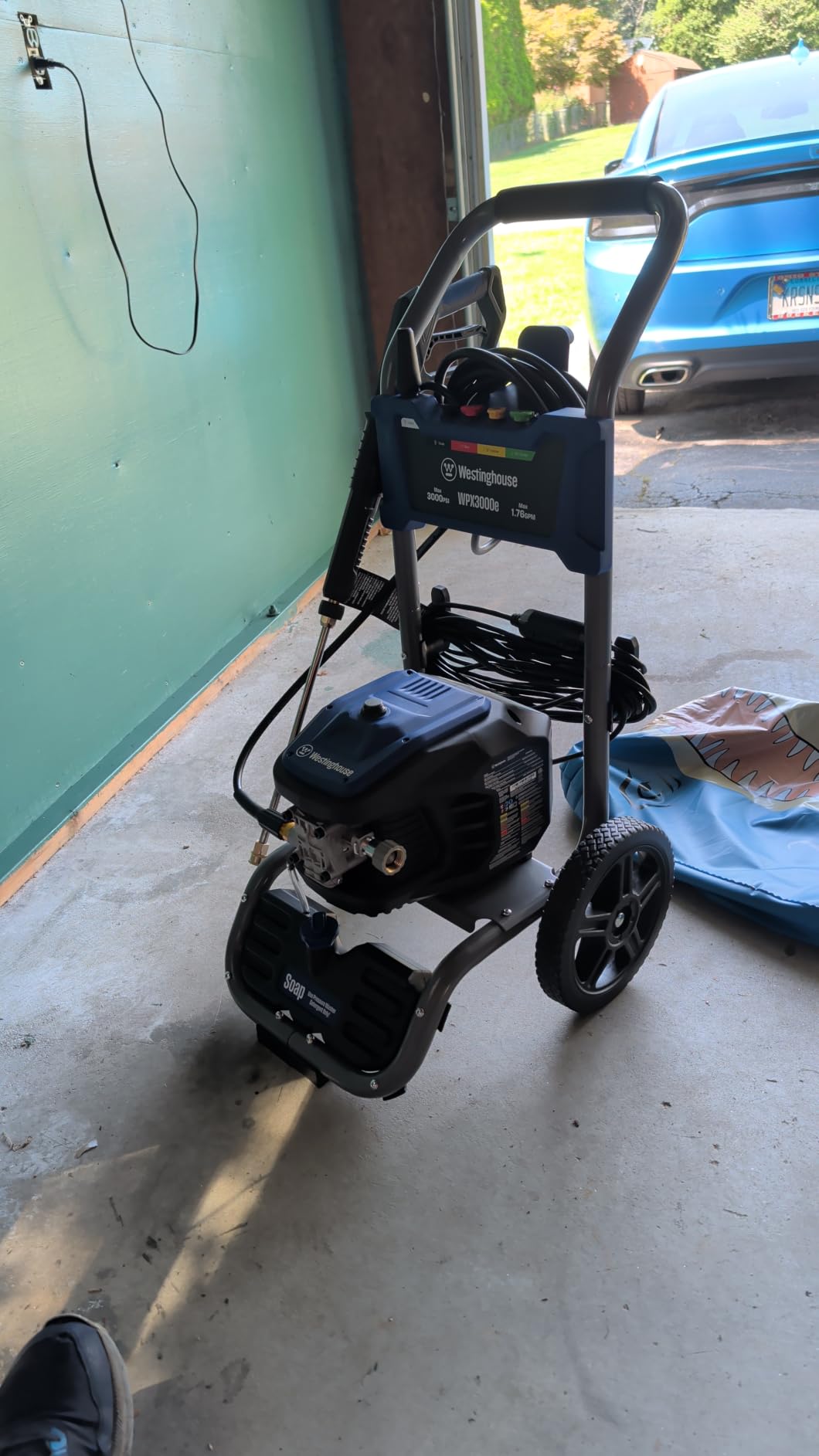
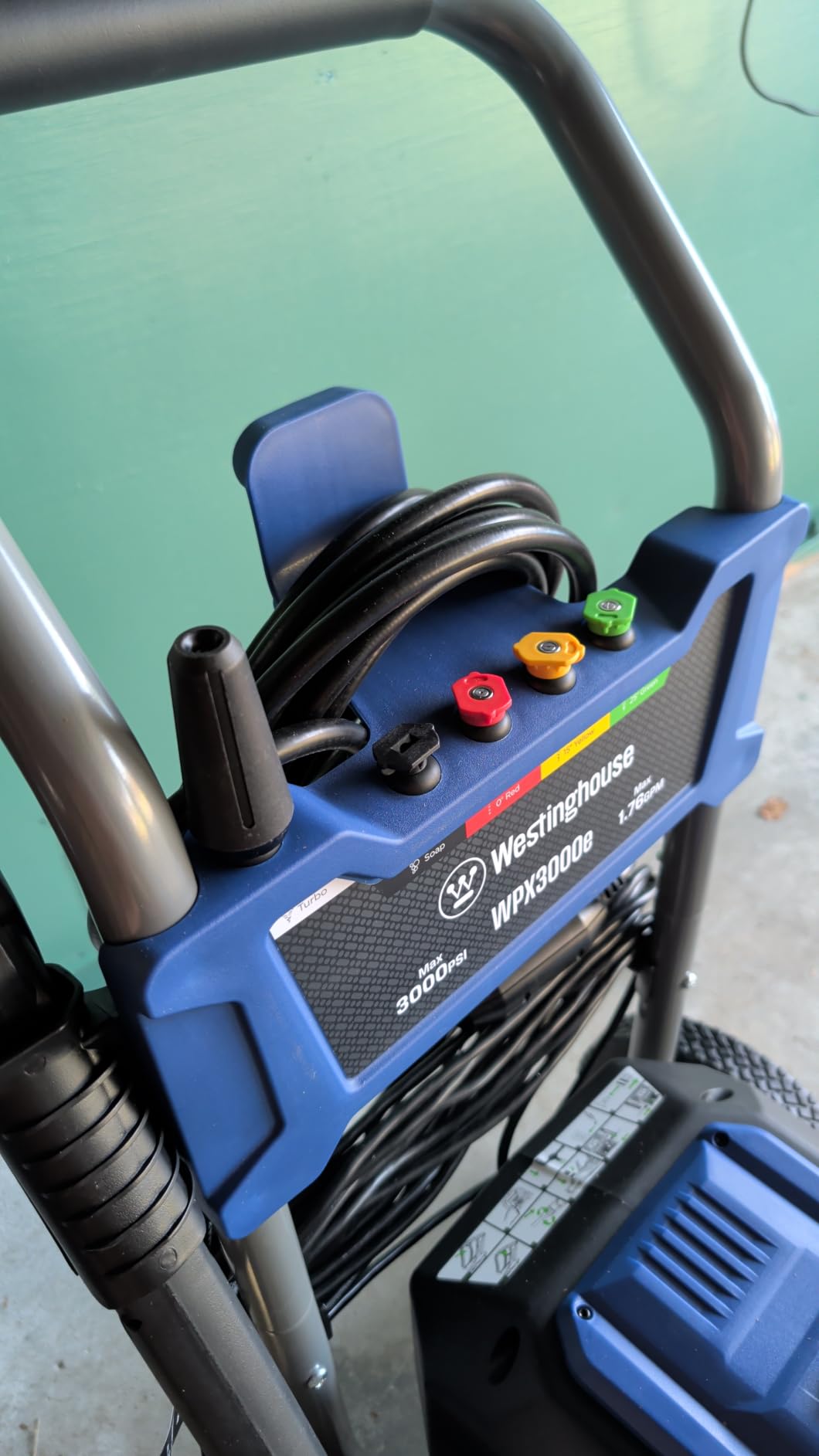
The hardware is genuinely good. A 25-foot abrasion-resistant super-flex hose resists kinking in a way the braided nylon hoses here do not, the M22 fittings accept surface cleaners and foam cannons from other brands, and the 35-foot GFCI cord is generous. The five quick-connect nozzles cover 0, 15, 25, soap, and turbo.
All units are factory function-tested and backed by a 3-year limited warranty, which matters on a machine at this size.
When this is the right machine to buy
Buy it if you are stripping a deck that has layers of old sealer, if you are washing concrete that has algae growing in the cracks, or if your deck sits next to a driveway and you will clean both the same afternoon. The M22 compatibility is the quiet win, because a surface cleaner attachment from another brand will bolt straight on.
Do not buy it because 3000 is the largest number you can find. A machine you can point at a board without thinking is worth more than a machine you are afraid of.
What it costs you to own
At 36.8 pounds in a steel frame, this is by a wide margin the heaviest electric machine in the roundup and nearly as heavy as the gas unit. Moving it from a garage to a deck requires real effort, and the 0.45 gallon soap tank is the second smallest listed here.
The total-stop axial three-piston pump with automatic shutoff is a good design, and the maintenance-free motor means there is little to service. The tradeoff is simply bulk: you are storing and lifting a small piece of equipment rather than a plastic pressure washer.
9. DeWalt 3300 PSI Gas – Most Flow, Heaviest Machine on the List
DeWalt 3300 PSI Gas Pressure Washer, 2.4 GPM, Residential Model DXPW3300-S
3300 PSI,2.4 GPM,208cc gas engine,25 ft hose,5-year frame
Pros
- 2.4 GPM is the highest flow in this roundup
- Axial cam pump with a thermal relief valve for long jobs
- Welded powder-coated steel frame with 5-year frame warranty
- 10-inch pneumatic tires roll over uneven ground
- 25-foot hose
- 16-inch steel wand
- 5 quick-connect nozzles
Cons
- 64 pounds makes moving it a two-person job
- Gas adds fuel
- oil changes and pull-cord starting
- 49-state compliant rather than CARB compliant
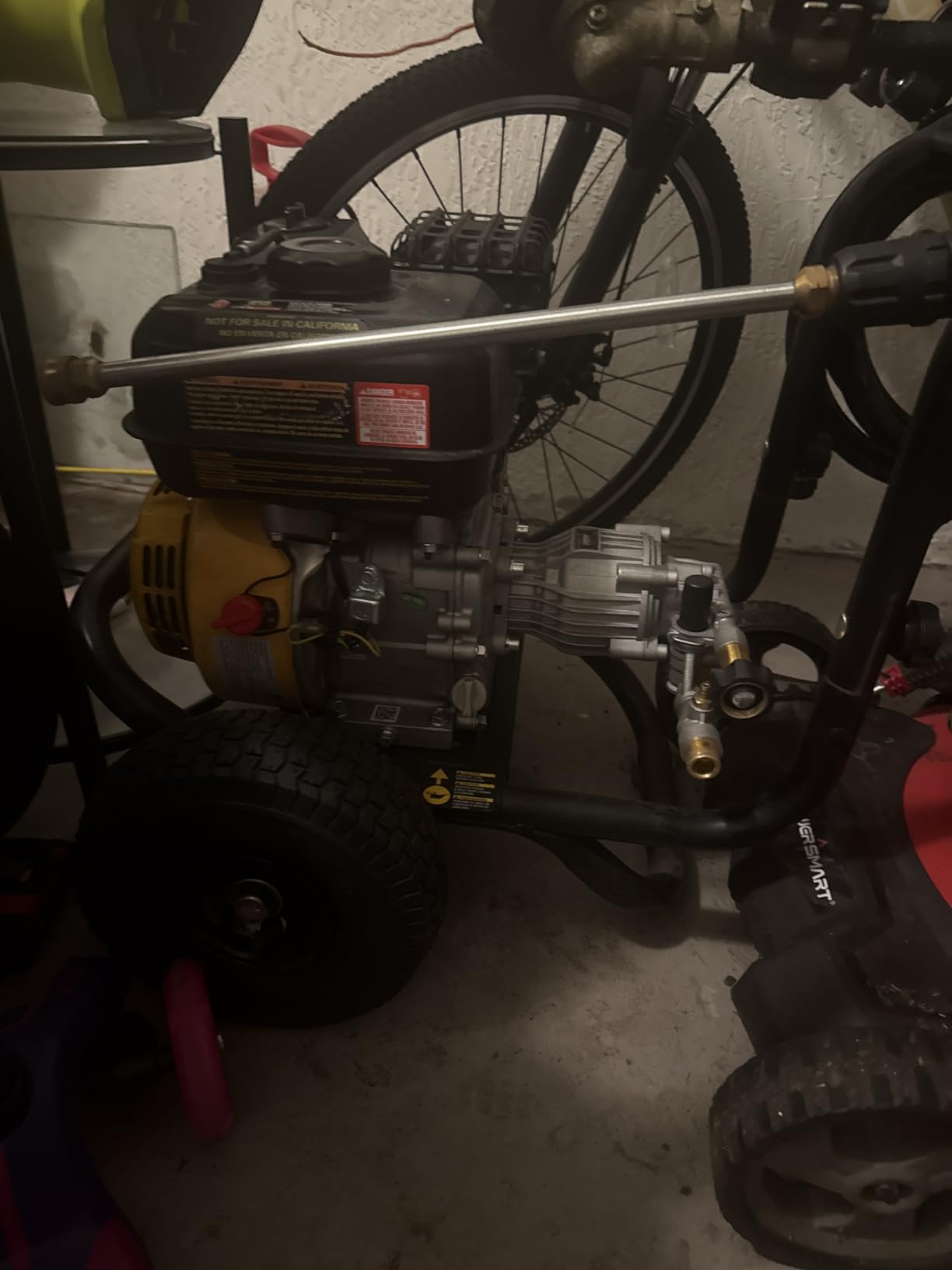
The DeWalt DXPW3300-S is the only gas machine here and it is the reason many owners ultimately buy gas: flow. At 2.4 GPM it moves more water than any electric machine in this roundup by a wide margin, and that is the number that determines how fast a large deck dries. The 208cc engine and OEM Technologies axial cam pump with a thermal relief valve are a serious combination for long jobs.
Everything structural is overbuilt in a good way. Welded powder-coated steel frame, 10-inch pneumatic tires that roll over uneven ground and gravel, a 25-foot abrasion-resistant hose, a 16-inch steel wand, and five quick-connect nozzles. Frame warranty runs 5 years, pump 3 years, engine 2 years.
It also has the smallest review base here at 960 ratings and a 4.3 average, which carries the highest one-star share in the group at 12 percent. That is typical of gas engines. Owners weigh unmatched cleaning power against noise, fuel maintenance, and weight, and the spread in opinion shows up directly in the ratings.
At 64 pounds, moving this around a deck is a two-person job. Plan your route before you start, and empty fuel before you store it.
Running a 3,300 PSI gas machine safely on a deck
If you own one of these, or you are tempted by the number, you can still use it on a board without damage. Fit the 40-degree fan, hold it 12 inches or more from the surface, and start the engine and let it settle before opening the trigger. Never use a turbo nozzle on wood; the turbo nozzle is designed to cut through concrete and it will gouge softwood in a single pass.
The experienced operators who use these machines on wood all describe the same method, which is a wide fan at a distance, moving constantly, and pre-spraying the deck with cleaner first so the chemistry is doing the work instead of the pressure. Several of them report the same surprise: most of the cleaning came from the detergent and the dwell time, not the jet.
Who should not buy this for a deck
Anyone with a single small deck, a storage spot that is not ground level, and no interest in fuel storage, oil changes, and a pull cord. The burden is real for something you may use twice a year. Forum owners make this point constantly: a mid-tier electric is enough for a deck, and regret about buying the biggest machine available is the most common buying mistake reported.
One more practical note. This model is 49-state compliant rather than CARB compliant, so it may not be legal to sell or operate in California. Verify before you commit.
10. Greenworks 1800 PSI – Smallest Machine That Still Handles a Deck
Greenworks 1800 PSI (1.1 GPM) Electric Pressure Washer PWMA Certified
1800 PSI,1.1 GPM,16 lb body,35 ft cord with GFCI,3 years
Pros
- Smallest body here at 16 pounds and roughly 10 by 9 by 13 inches
- 1800 PSI reported ample for wood decks and furniture
- 35-foot cord with an integrated GFCI plug
- Reported to run for hours without overheating
- 1/4-inch quick-connect accepts standard accessories
Cons
- 1.1 GPM is the slowest flow in the roundup
- 20-foot hose is thin and kinks
- No trigger lock
- which fatigues the hand
The Greenworks 1800 PSI is the machine to buy if your deck is small, your storage space is a closet, and you will use it for patio furniture and fence panels as much as for the boards themselves. At 16 pounds and roughly 10 by 9 by 13 inches it is the smallest body in the roundup, and at 1800 PSI it sits at the bottom of the safe band where damage is essentially impossible.
It includes a 40-degree nozzle, a turbo nozzle, and a soap applicator, so the deck tip is in the box. The 35-foot power cord with an integrated GFCI plug is the longest cord here, which partly compensates for the low flow, and the quarter-inch universal quick-connect accepts standard accessories.
Owners report running it for three hours continuously without overheating, and one of them pairs it with a 100-foot hose without pressure loss, which tells you the pump has headroom the listed flow figure does not suggest. The 3-year limited warranty and CSA and PWMA certification are solid for the segment.
At 4.4 stars across roughly 500 reviews, it is the newest and least-proven listing here. That is the honest tradeoff: you are buying a very small, very light machine with a good warranty and a short track record.
What a 1,800 PSI machine can and cannot do
It can remove surface grime, algae, and dirt from a lightly weathered deck. It can clean patio furniture, vehicles, siding, and fence panels. It cannot lift a film of old solid stain, and it is explicitly not a machine for high-pressure concrete work, which is exactly how owners describe it.
The 1.1 GPM flow is the slowest here and it shows on a large deck, where you will be rinsing longer than you would with almost anything else on this list.
The two gripes worth planning around
The 20-foot tangle-free hose is thin and kinks, and many owners replace it. Budget for that if the machine will not live in one small area. There is also no way to lock the trigger on, so on a long job you are squeezing continuously, which tires the hand faster than you would like.
Both are minor for a small deck and frustrating on a large one. Match the machine to the size of the job and it is a genuinely capable little washer.
How to Pressure Wash a Deck: 6 Steps
What is the best way to pressure wash a deck? The method matters more than the machine. Six steps, in this order, and most fuzzing disasters trace back to skipping one of them.
- Sweep and clear. Sweep off leaves, twigs, and deck debris before you connect anything. Grit left under pressure grinds into the grain and causes exactly the scratching you are trying to avoid. Move planters, rugs, and furniture.
- Pre-treat with a deck cleaner. Apply an oxygen-based or sodium hypochlorite deck cleaner through the low-pressure soap tip and let it dwell 3 to 5 minutes. This is the step that does most of the cleaning. Never let bleach-based cleaner dry on the boards.
- Start at the far end. Begin at the corner farthest from your water source and work back toward it. You are always rinsing into clean, unwashed space rather than pushing dirty water across finished boards.
- Wash with the grain at 12 inches or more. Use the 40-degree fan, hold the tip at least 12 inches from the surface, and work in overlapping passes following the direction of the boards. Keep the wand moving. Never park the tip in one spot.
- Rinse from the top down. Rinse thoroughly so detergent and loosened grime run off rather than into the grain. Check that water is draining between boards and not backing up underneath.
- Let it dry completely. Allow 48 hours of dry weather before staining or sealing. Staining damp wood is the most common aftercare mistake, and the finish fails to adhere and peels within a season.
One warning on the wand angle that most guides get right and most people ignore: do not aim the wand straight down at 90 degrees. Run it at roughly 45 degrees, or even shallower, so the spray travels along the surface rather than driving directly into the grain. That single change removes a large share of lap marks and stripes.
Nozzles, Detergent, and Working Distance
The 40-degree white fan is the deck tip. It is wide enough to cover a board without concentrating the pump’s output, which is what makes pressure controllable at 12 inches. The 15-degree is narrower and only appropriate on a hard deck that has already been cleaned, worked very carefully. The 0-degree red tip is for stripping concrete and should never touch wood.
On detergent, use a purpose-made deck cleaner rather than standard dish soap. Dish soap leaves a film that traps dirt and can interfere with stain adhesion, which means you do more work later when you have to strip that film off. Oxygen-based cleaners work well on weathered gray wood. Sodium hypochlorite handles algae and mildew on composite and concrete; on wood, use it sparingly and always rinse thoroughly.
A surface cleaner attachment is worth it on a flat, wide deck if the machine has M22 fittings, because it spreads pressure evenly and eliminates lap marks. It is not worth it on a deck with tight turns, stairs, or lots of railings, where maneuvering the spinning head costs more time than the streaks it prevents. For most homeowners with a single rectangular deck, the 40-degree fan at 12 inches is enough.
Composite Decks: Check the Manufacturer Before You Buy
Many composite decking manufacturers advise against pressure washing, and some state that doing so can affect warranty coverage. This is not a marketing line; it appears in composite maker guidance and it is the one hard stop in this entire guide.
Before you buy any machine for a composite deck, find out what your specific board manufacturer says about pressure, tip choice, and distance. If their guidance is to skip pressure entirely, then no machine on this list is the right purchase, and the answer is soft-washing: low-pressure detergent application with a long dwell, rinsed with a garden hose.
For pressure-treated and natural wood, you own the decision. For composite, you do not.
What PSI Pressure Washer Do You Need for a Deck: Buying Guide
Match Flow Rate Before You Match PSI
Most buyers open the spec sheet, find the biggest number, and stop. On a deck that backwards. Flow rate determines how quickly you can move water across a wide surface and rinse dirt away before it settles into the grain, and it is the number experienced operators consistently single out as the honest one.
Nothing in this roundup reaches the 4.0 GPM threshold that forum regulars call the credibility test for real deck work. Aim for 1.2 GPM as a floor and treat anything above 2.0 GPM as a genuine advantage. The LWQ S5 at 2.5 GPM and the DeWalt gas unit at 2.4 GPM are the two machines here that clear that bar.
The 40-Degree Tip Is Non-Negotiable
If a machine does not include a 40-degree fan, buy one before you start. The angle is what makes the pressure safe on wood, because it spreads the machine’s output across a wider footprint than the 15-degree and it does something a turbo nozzle cannot, which is remove algae without gouging.
Two machines here need a purchased tip: the Karcher K1700, which ships with 15, turbo, and 65 degrees, and the Westinghouse ePX3100v, which includes three nozzles that do not cover the full range. Both accept standard fittings, so the tip is an inexpensive add-on rather than a special order.
Detergent Delivery Decides How Long the Job Takes
Deck cleaning is a chemistry problem more than a pressure problem. A cleaner that dwells for 3 to 5 minutes removes what a jet of water only loosens, and the machine that delivers detergent easily is the one that gets the whole deck done before the weather turns.
Onboard tanks above 1 gallon, like the Craftsman’s 1.2 gallon and the Greenworks GPW2003’s 1.2 gallon, minimize refills. The Westinghouse ePX3500’s 20-ounce tank is the most common complaint in its reviews. Foam cannons, included with two machines here, hold a thicker foam that clings to horizontal boards far better than a plain tank nozzle.
Hose Length and Cord Length Are Deck-Size Decisions
Measure your deck before you shop. Add up the hose length, the cord length, and the reach of the wand, and compare that to the longest straight run you have to cover. A 20-foot hose on a 40-foot deck means repositioning five times, and every reposition is a chance to walk through a wet patch or scrape the machine against a railing.
The Craftsman leads on total reach with a 25-foot hose and a 35-foot cord. The small Greenworks matches it on cord length at 35 feet with a 20-foot hose, which works well for a deck near an outlet.
Maximum PSI vs Working PSI: the Spec Sheet Problem
Two of the machines here publish both figures, and the difference is large. A 3000 max machine is rated at 2600. A 2500 max machine is rated at 2000. A 2100 max machine is rated at 1800. Maximum figures are measured one way, certified rated figures another, and for wood decking the rated figure is the one that protects your boards.
Third-party certification marks matter here. PWMA, CETA, and CSA ratings mean the output was independently measured rather than self-reported. The Karcher K1700, the Craftsman, and both Greenworks machines carry them, and that is a meaningful difference when you are judging a number that decides whether you need a sander afterward.
Fixing a Deck You Already Fuzzed
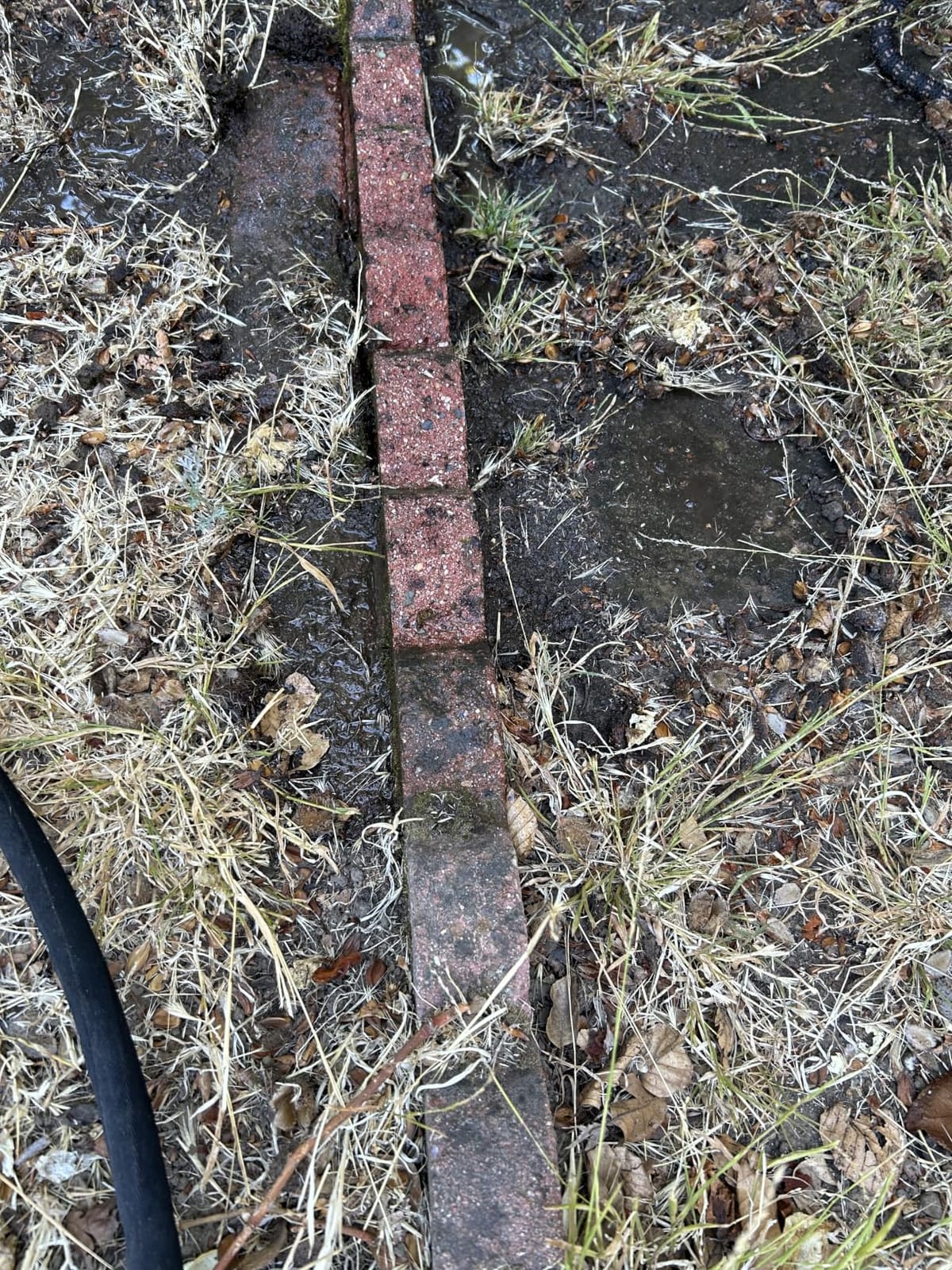
Raised grain, fuzzy stripes, and lap marks are the near-universal complaint reported after a deck wash, and they are permanent in the sense that they do not wash out. Water drives the soft outer fibers of the board up, and they dry standing on end, feeling like sandpaper under your bare feet.
The recovery is straightforward. Let the deck dry fully, which takes several days in good weather. Then go over the affected boards with a sanding block or a floor sander fitted with 80 to 120 grit paper, working with the grain, and knock the fibers back down flush. The boards will look slightly darker where you have sanded, which is normal.
Once the surface is smooth, vacuum or blow off the dust and wait at least another 48 hours before staining. Staining over fuzzy grain traps the fibers under the finish and produces a blotchy, failing result that has to be stripped a year later. A whole deck can be corrected with an afternoon of sanding; the alternative is living with it.
Prevention is a 40-degree tip, 12 inches of distance, and constant movement. That is the entire technique, and it is free.
Storage, Winterization, and Pump Life
Freeze damage to a pump is the most common way these machines are ruined, and it is entirely avoidable. After the last wash of the season, run the machine with plain water and no hose attached until the flow stops and only a weak stream comes out. That empties the pump of the water that would otherwise freeze and split the housing.
Then disconnect the hoses, wipe the fittings, and store the machine somewhere above freezing. If it has to live in a shed in a cold climate, pump saver antifreeze is the next step, and you follow the same procedure with the antifreeze substituted for the water. Never leave a pressure washer connected to a spigot overnight; a slow drip freezes in the line and can push water back into the pump.
For gas machines, add fuel stabilizer to a full tank rather than running the engine dry, and change the oil on the manufacturer’s schedule. For electric machines, the main storage enemy is simply a battery or a motor sitting in a damp shed; a wipe-down and a dry location are enough. Store the machine upright, and check the fittings once a season for the corrosion that mixed metal connectors develop.
Two habits extend pump life more than any other: never run the pump without water connected, and never leave detergent sitting in the pump overnight. Rinse thoroughly at the end of every job.
Frequently Asked Questions
What PSI pressure washer do you need for a deck?
1,200 to 2,000 PSI for a wood deck. Stay under 2,500 PSI on softwood such as pine or pressure-treated spruce, and drop to 1,500 PSI or less for cedar. Roughly 2,500 to 3,000 PSI is the range for stripping old stain, and 3,000 PSI is a concrete and driveway number, not a deck number.
Is 3000 PSI too much for a deck?
Yes, for natural wood. Above roughly 2,500 PSI on cedar, pine, or pressure-treated spruce, water drives the grain upward and leaves permanent fuzzy stripes that have to be sanded out before you can stain. Machines rated at 3,000 PSI or more are safe on concrete and wrong for boards.
Is 1200 PSI enough to clean a deck?
Yes, for annual maintenance on lightly weathered wood, especially if you pre-treat with a deck cleaner and let it dwell for 3 to 5 minutes. It will not strip old stain, but it removes surface grime, algae, and dirt with no real risk of raising the grain.
How much PSI do you need to strip a deck?
Roughly 2,500 to 3,000 PSI lifts old solid or semi-transparent stain off wood, and that is the point where most machines cross from safe to damaging. Stripping is better done with a deck stripper chemical applied at low pressure, given a long dwell, and then rinsed.
Can you pressure wash a composite deck?
Only if the board manufacturer allows it. Many composite makers advise against pressure washing and state that it can affect warranty coverage. Find your specific manufacturer’s guidance first. If they say to avoid pressure, soft-wash instead: low-pressure detergent, a long dwell, and a garden hose rinse.
Should I use soap when pressure washing a deck?
Yes. Apply an oxygen-based or sodium hypochlorite deck cleaner through the low-pressure soap tip, allow 3 to 5 minutes of dwell, then rinse. Never let bleach-based cleaner dry on the boards, and avoid standard dish soap, which leaves a film that traps dirt and interferes with stain adhesion.
The Verdict: Which Pressure Washer Your Deck Needs
If you want one machine that will not let you down, the Sun Joe SPX3000 is the choice, and nothing else in this roundup carries anything close to its evidence base at roughly 64,700 verified reviews and a 4.4 average. Its 2030 PSI working figure sits inside the safe band, the five quick-connect tips include the 40-degree fan that makes the whole job safe on boards, and the dual 0.9 liter detergent tanks let you carry two separate solutions to a mildew-streaked deck without stopping to funnel anything.
If you would rather have the newest and best-balanced machine than the most proven one, the Westinghouse ePX3100v is the runner-up choice. Its rated 1800 PSI is close to ideal for pressure-treated lumber, 1.76 max GPM rinses quickly, an 18-pound body with a carry handle is the easiest to control here, and it holds a 4.7 average across nearly 4,900 reviews with a 3-year warranty. If you are simply nervous about wood, the Karcher K1700 at 1700 PSI does the job, and adding a 40-degree tip makes it a genuinely capable deck washer. If you are cleaning a small deck and mostly furniture, the 16-pound Greenworks 1800 PSI disappears into a closet.
If you wash a large deck plus concrete and siding in the same afternoon and plan to keep the machine for a decade, the DeWalt gas unit at 2.4 GPM is worth its fuel and weight, and you will run it on a 40-degree tip at 12 inches like everything else. Before you pick any machine for composite boards, read the manufacturer’s pressure guidance first, because that is the one decision that is not yours to make.
None of these machines will save a board you hold the tip against. Buy for flow and tip control, keep 12 inches of distance, follow the grain, and let the detergent do the chemistry. That is how you get the best pressure washers for decks working for you instead of against you.