
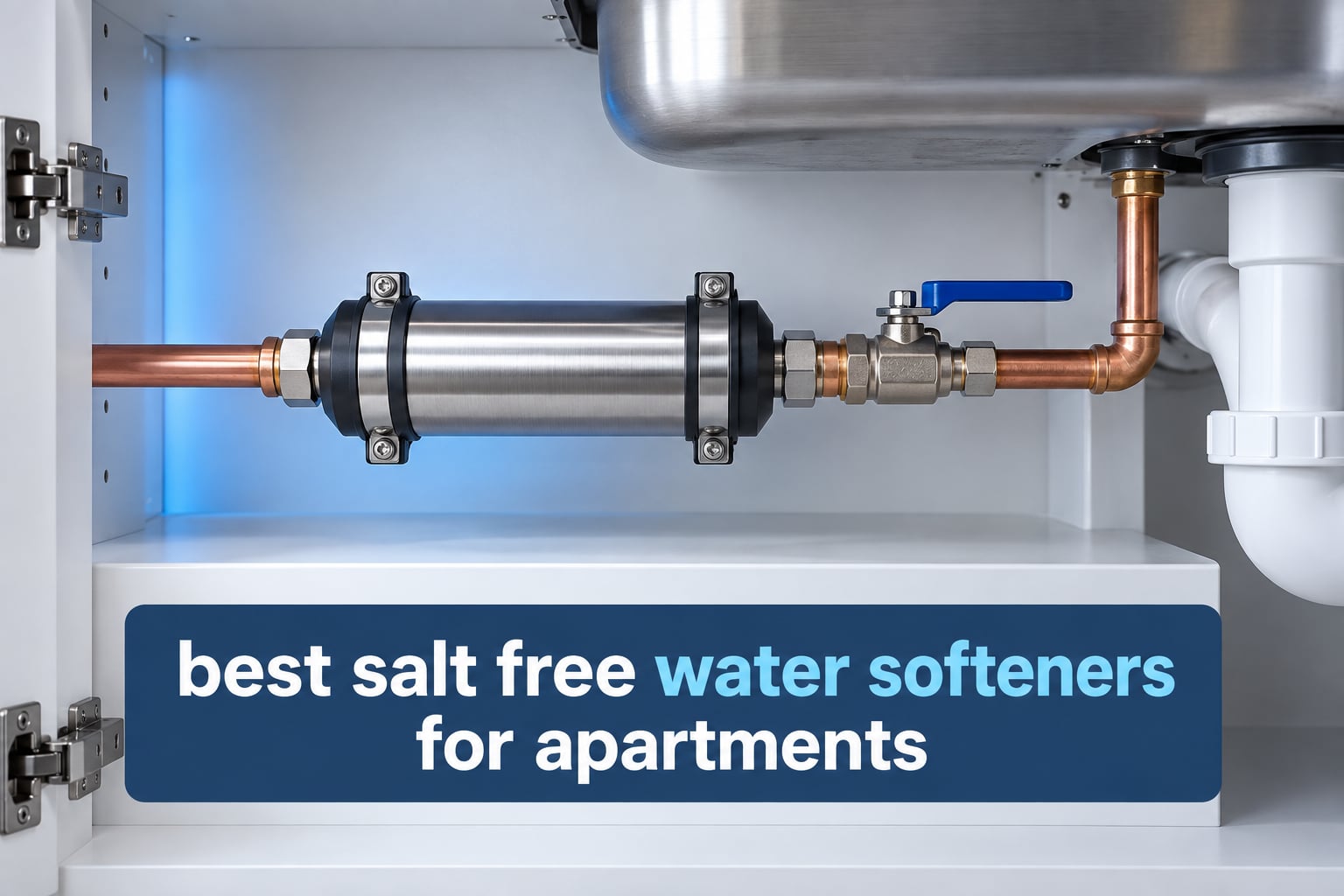
Here is the honest answer, because almost nobody in this category will give it to you: a salt-free water softener does not soften your water. What it does is stop new limescale from forming inside your pipes, kettle, dishwasher and showerhead. That distinction matters enormously when you are shopping for the best salt free water softeners for apartments, where a bulky ion-exchange system usually is not an option anyway.
I spent several weeks sorting through the salt-free category specifically for renters, condo owners and people in walk-up buildings. I read the technical specs, the warranty terms, the hardness limits and thousands of buyer reviews, then filtered everything against the constraints that actually decide whether a product works in an apartment: footprint, pipe access, power access, drain-line availability, and whether you are allowed to touch the plumbing at all.
What came out of that is the list below, and I have kept the failures in. Two of these products have reviews calling them a placebo. One needs a power outlet your bathroom may not have. Several only make sense below a certain hardness number, and that number is not printed on the box.
First, the terminology. Salt-based systems use ion exchange resin to swap hardness minerals for sodium, which is why they genuinely soften water and why you end up hauling salt bags up three flights of stairs. Salt-free systems use media, magnetic fields or electronic pulses to keep scale from adhering. No salt, no brine tank, no regeneration cycle, no drain line, no electricity on some models. In exchange you give up true softening, soap savings and any reduction in sodium.
That is the whole trade. If your problem is white crust on glassware and a kettle that furs up every few weeks, a salt-free conditioner can genuinely solve it. If your problem is water that will not lather and hair that feels like straw, only ion exchange fixes that, and a few jurisdictions restrict or ban salt-based softeners outright. Apartment dwellers in those areas often have no real choice but a conditioner.
If you are still furnishing the space, our picks for cordless vacuums for apartments and standing desks for small apartments cover the same footprint-conscious logic from a different angle.
Our Top 3 Salt-Free Picks for Apartment Living in 2026
The three below are the ones I would actually put in a small apartment. Each one solves a different constraint, so read the badge before the name.

YARNA CWD24 Electronic…
- No salt or wastewater
- DIY clamp-on install
- Fits pipes up to 1 inch
- Corded electric

iSpring ED2000 Descaler
- Rated for 10-19 GPG water
- Clamps on with no pipe cutting
- PEX PVC and copper compatible
- 7 by 3.5 by 2 inches
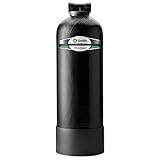
A. O. Smith Scale Control Tank
- Top-rated media tank here
- Works without electricity
- 6-year and 600000 gallon media life
- Low-profile tank with bypass
Comparing All 10 Salt-Free Water Softeners Side by Side
Every product in this roundup appears in the table below with the specs that actually decide whether it fits an apartment. Price is deliberately left out because it changes constantly; use the buttons to check the current figure.
| Product | Specs | Action |
|---|---|---|
| YARNA Electronic Water Descaler CWD24 |
|
Check Latest Price |
| iSpring ED2000 Whole House Descaler |
|
Check Latest Price |
| A. O. Smith Whole House Scale Control |
|
Check Latest Price |
 Mineral Magnet II Magnetic Conditioner Mineral Magnet II Magnetic Conditioner |
|
Check Latest Price |
 Water Boss Whole House Scale Control Water Boss Whole House Scale Control |
|
Check Latest Price |
 Timilge Electromagnetic Descaler Timilge Electromagnetic Descaler |
|
Check Latest Price |
 briskspring J-600-BS Physical Descaler briskspring J-600-BS Physical Descaler |
|
Check Latest Price |
 Holdly Magnetic Conditioner Holdly Magnetic Conditioner |
|
Check Latest Price |
 ROBOA Whole House Electronic Descaler ROBOA Whole House Electronic Descaler |
|
Check Latest Price |
 Dicsley ED2021 Electromagnetic Descaler Dicsley ED2021 Electromagnetic Descaler |
|
Check Latest Price |
1. YARNA Electronic Water Descaler CWD24 – Best Overall for Apartment Constraints
YARNA Electronic Water Descaler – No-Salt Softener, Pipes to 1″ CWD24
Electronic pulse descaler
Fits pipes up to 1 inch
Needs a power outlet
Inline install
Pros
- Most reviews of any pick here at 2633 ratings
- No salt and no wastewater
- Tool-free install on any pipe type
- Keeps minerals and does not shift pH
Cons
- About 14 percent of ratings are 1 star
- Effects can take months on already-scaled plumbing
- Needs a corded power outlet nearby
The YARNA CWD24 is the product I recommend to most apartment dwellers, and the reason is the review volume. 2633 ratings gives you a far clearer picture of how it behaves, including where it falls down: 14 percent of buyers gave it one star, a meaningfully high share that you can plan around.
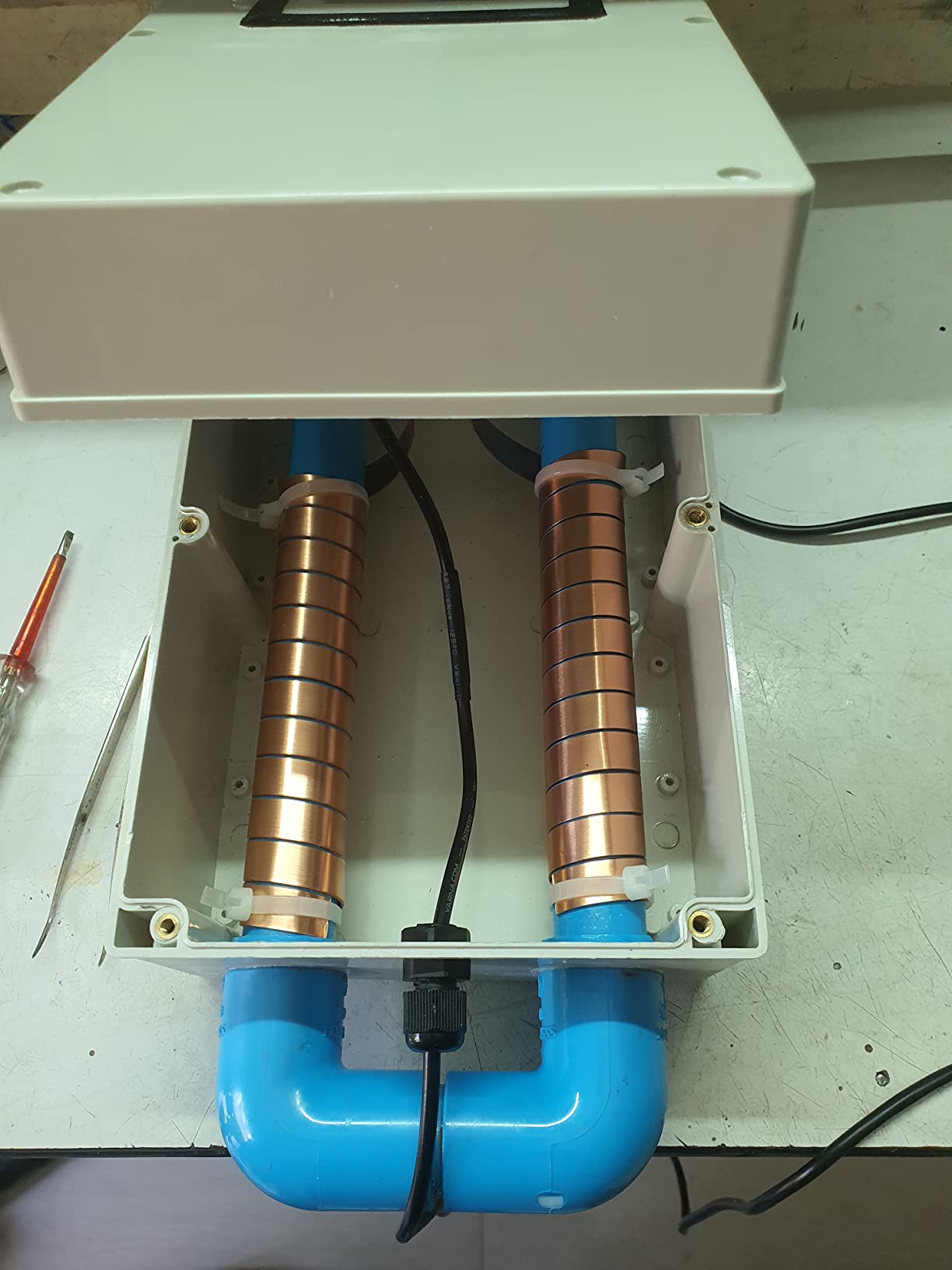
Mechanically it is simple. A copper-bodied unit with ultra-flat impulse bands clamps around a pipe up to 1 inch in diameter and sends micro-chip-controlled electrical pulses through it. There is no tank, no media to replace and no water to waste, which makes it the least maintenance-intensive product in a category where everything else asks something of you.
Pipe Fit and Clearance Requirements
The unit needs a minimum of 10 inches of straight free pipe, and it will not fit on a 1.25 inch or larger line. In a studio that is usually fine, since most apartment supply lines are 1/2 inch copper or PEX with a straight run near the water heater. In older buildings with galvanized risers you may need to find a narrower section of pipe instead.
Installation is genuinely non-invasive. It clamps on rather than cutting, so there is no plumber, no soldering and nothing for a landlord to object to. The one real requirement is a nearby 110-120V outlet, because this is a corded electric device and it stops working when the power stops.
How the Electronic Pulse Works
The pulses are designed to break down scale-forming crystals in transit so they stay suspended and pass through rather than sticking to the inside of your kettle and heating element. Water chemistry and taste are untouched, which is the single most-cited reason renters choose salt-free over ion exchange in the first place.
What it does not do is reduce hardness. Reviewers on r/WaterTreatment are blunt about this in general: if you want hardness actually removed, that takes a salt or potassium system. The CWD24 stops new deposits. It will not clear out the crust already inside your showerhead.
Where It Falls Short
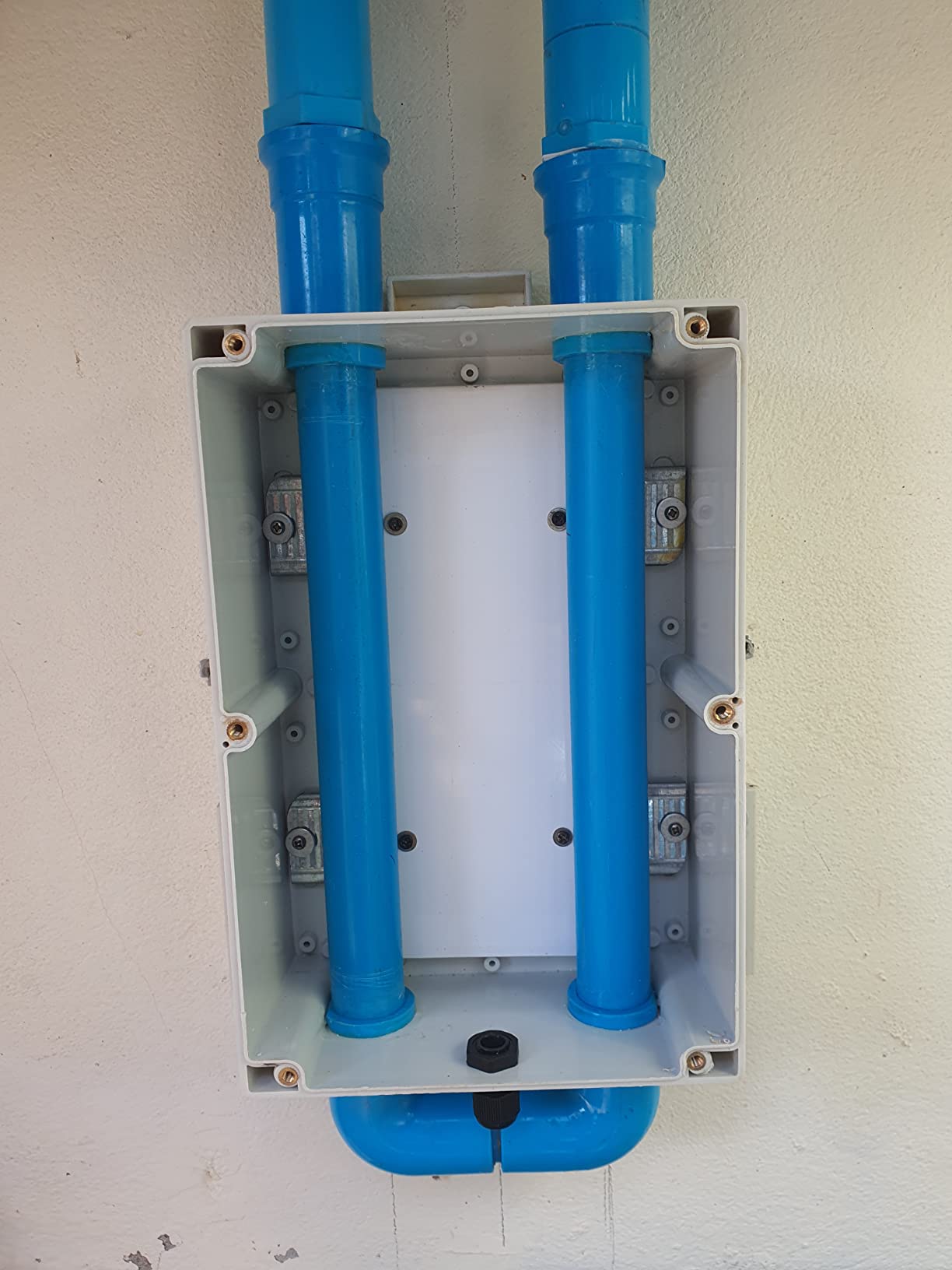
Patience is the main issue. Several long-term owners report noticing cleaner faucets, while a steady group says the difference was hard to detect or took far longer than expected. On already-scaled plumbing, expect months rather than weeks before you see anything.
It also needs a plug. In a bathroom with no outlet near the supply line, that is a real blocker, and a power strip behind a closed vanity is a workaround some buyers use. If you need to cover a large apartment, you may find yourself looking at a tank unit instead.
2. iSpring ED2000 – Best Value for Renters Who Cannot Cut the Main Line
iSpring ED2000 Whole House Water Descaler, Alternative Electronic Salt-Free Hard Water Conditioner, Reduces Limescale Prevent Deposits Build-up, Different from a Water Softener
Electronic descaler
Rated 10-19 gpg
7 by 3.5 by 2 inches
Self-installation
Pros
- Clamps onto existing pipe with no cutting
- Strong sales rank in the softener category
- Works on PEX PVC and other materials
- Suitable for salt-restricted diets
Cons
- Needs a nearby power outlet
- Partial reduction reported after weeks
- Not designed above 19 gpg
The iSpring ED2000 is the pick I send people who are nervous about touching anything. It clamps onto the supply line, works on PEX, PVC, copper and other materials, and the whole body is 7 by 3.5 by 2 inches and weighs 2 pounds. It fits in a cabinet or utility closet without you rearranging anything.
What sets it apart in this list is the stated hardness window: it is designed for water between 10 and 19 grains per gallon. That is an unusually specific number, and it tells you something important before you buy. This is a unit for genuinely hard water, which is exactly the situation where scale problems appear in the first place.
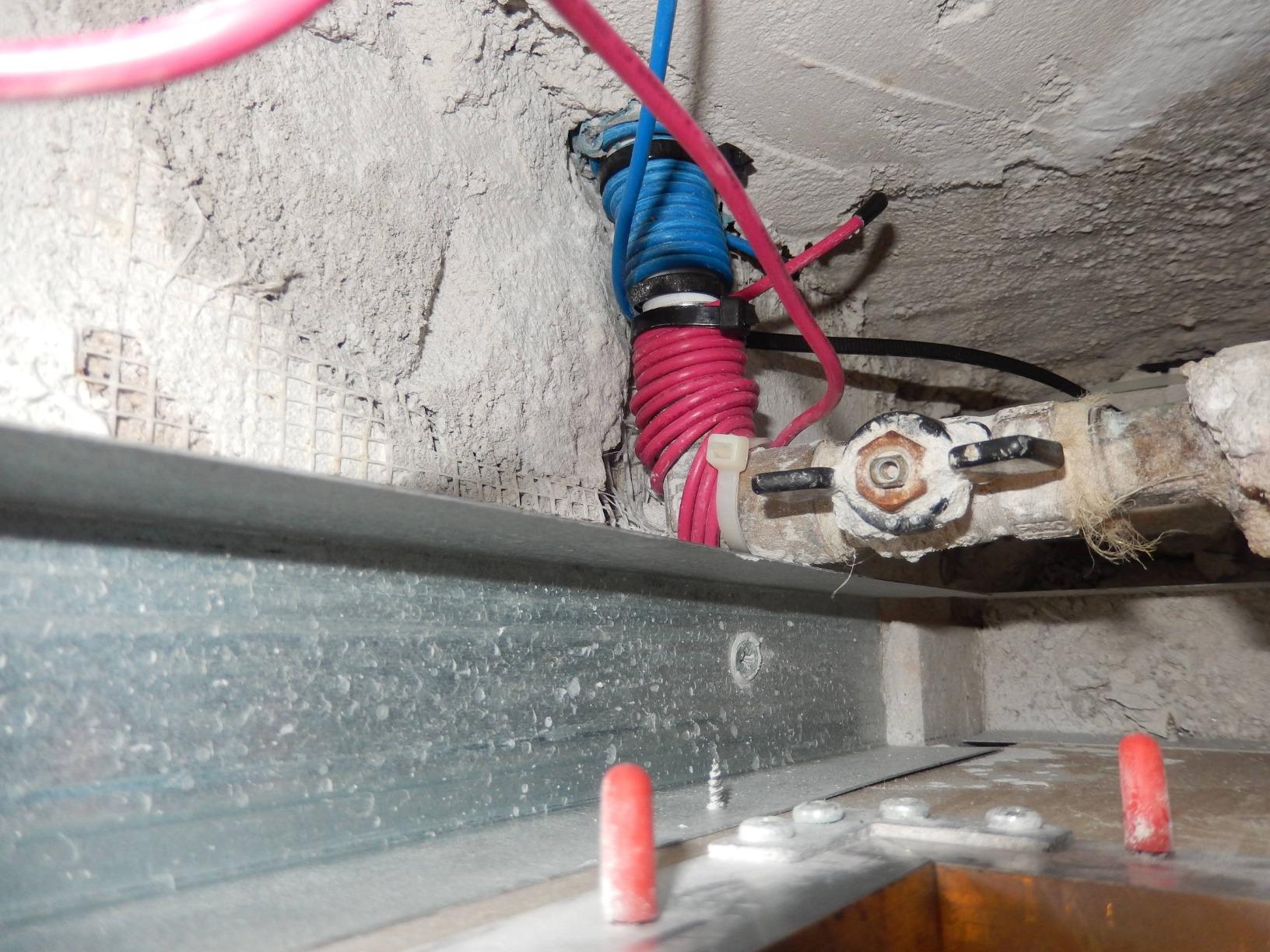
The 10-19 GPG Design Window
Most competitors in the electronic category do not publish a hardness range at all. Publishing one is a good sign that someone actually tested the thing rather than just marketing it. If your water tests above 19 gpg, the ED2000 is working outside its design envelope and you should look at a larger tank unit or accept modest results.
The manufacturer also claims an average one-year energy payback, which is a scale-efficiency argument rather than a softening argument. The point is that a less-scaled heating element costs less to heat the same water, and that compounds over a lease.
Power and Placement Constraints
This is a corded electric unit, so the outlet problem applies here as well. There is no battery option. Owners commonly place it near the water heater or in a utility closet where a receptacle already exists, which in most apartments is the realistic spot.
It ships with a one-year money-back guarantee and lifetime technical support, which matters more than usual in this category given how long the visible results take to appear.
Where It Falls Short
A meaningful share of buyers report only partial reduction in spotting, and several say it took longer than advertised before anything changed. That is the honest expectation: this stops new scale, it does not scrub the deposits you already have on your glassware.
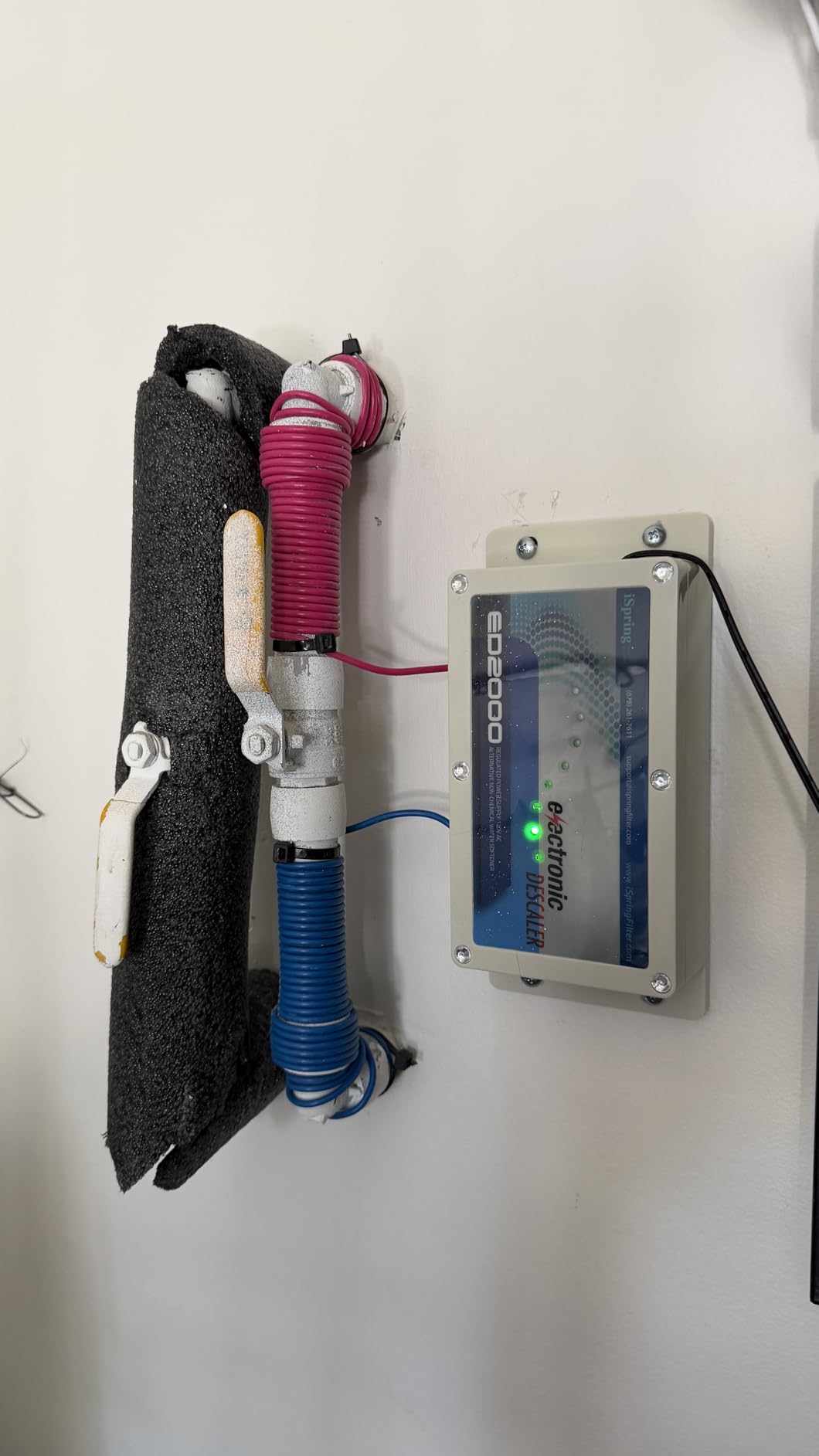
It also does nothing for taste, iron or sulfur, and a pre-filter is still worth adding in older buildings where sediment is present. If your building has visible rust staining rather than white scale, you are solving the wrong problem.
3. A. O. Smith Whole House Scale Control – Top-Rated Media Tank for Two- and Three-Bedroom Apartments
A. O. Smith Whole House Salt-Free Scale Control | 600K Gal | AO-WH-DSCLR
Media tank descaler
No electricity needed
7 gpm flow
3/4 inch connections
Pros
- Top-rated media tank in the roundup
- Keeps working during power outages
- Metal threaded connectors
- Handles well and city water
Cons
- 30 inch tall tank needs real plumbing space
- Rated only for hardness under 15 gpg
- Does not reduce TDS iron or sulfur
The A. O. Smith AO-WH-DSCLR is the media tank I came away most impressed by, with 4.4 stars across 1963 ratings and 73 percent of those at five stars. For a two- or three-bedroom apartment where the water heater sits in a closet or utility area with actual room around it, this is the most dependable media-based option available.
It is also the only product here that needs no electricity at all. That matters more in an apartment than it does in a house, because it keeps working during an outage and it never trips a breaker in a building with older wiring.
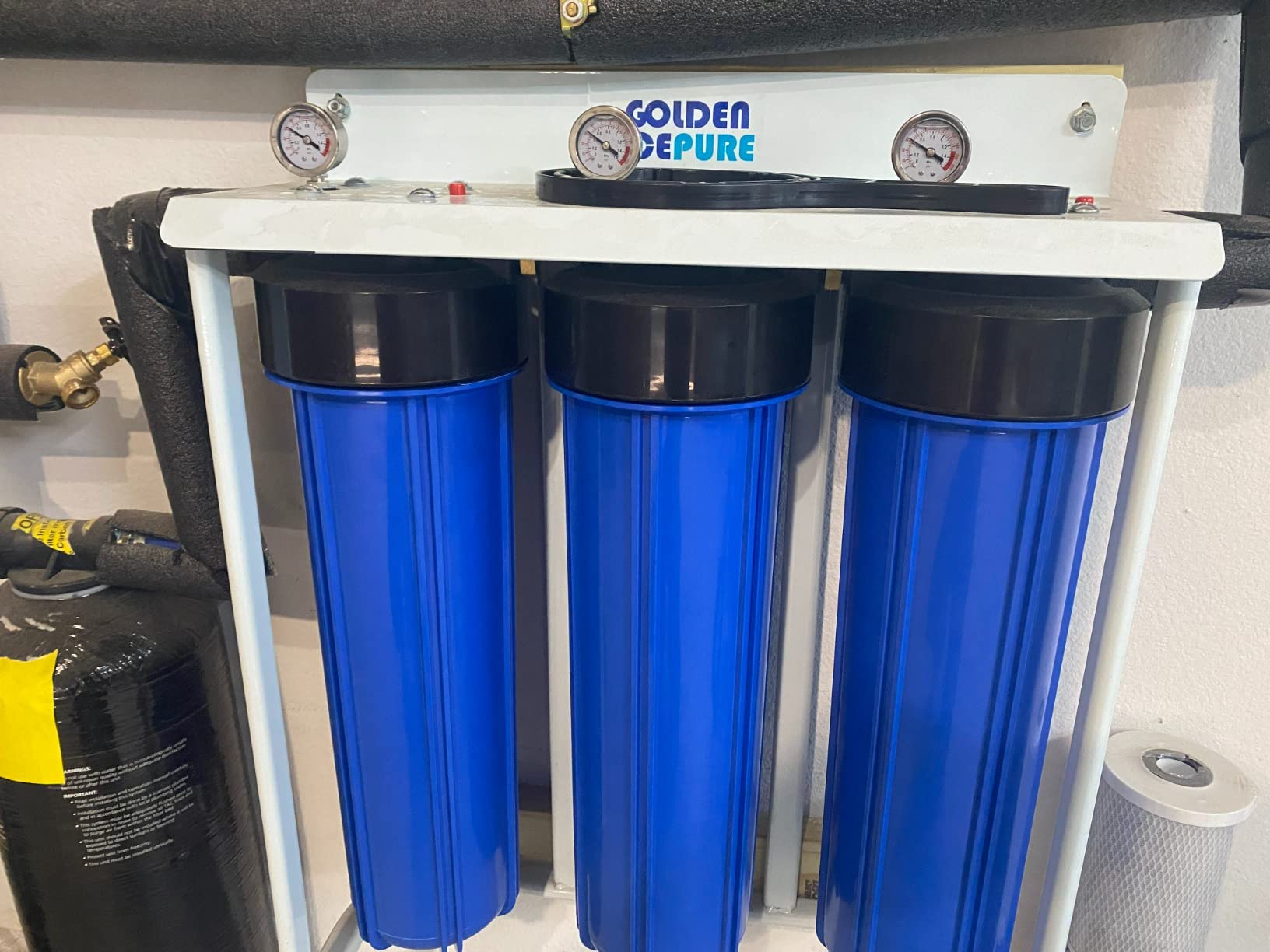
Media Life and the Six-Year Service Interval
The media is rated for up to 600,000 gallons or six years, with a six-year limited warranty covering both. Compare that to cartridge-based filters that need replacing every few months and the ongoing cost difference becomes obvious. Several owners report having replaced the media once across a multi-year ownership and nothing more.
The kit includes the tank, a shut-off valve, a nipple and a hose adapter, so you are not hunting for fittings on install day. It uses 3/4 inch inlet and outlet connections and operates between 20 and 100 psi, with a temperature range of 40 to 90 degrees Fahrenheit.
Space and Connection Requirements
Here is the honest problem: this is a 30 inch tall tank weighing 12 pounds. That is the largest footprint in the roundup, and in a small apartment it is frequently the reason a person gives up on a tank unit entirely. Measure the vertical clearance before you commit.
What you get for the space is a proper low-profile design with a bypass handle that isolates the unit for servicing without shutting off your whole apartment. Several buyers specifically call out the metal female-thread connectors rather than all-plastic fittings, which is a reasonable detail in a space where you may need to work in a tight space with a wrench.
Where It Falls Short
The stated operating envelope is water under 15 gpg hardness, alkalinity under 250 mg per liter, pH under 8.3 and iron under 0.3 ppm. Go past any of those and the media is not designed for it. If your water is severely hard, this tank is not the answer.
It also does not reduce TDS, sulfur or iron, and some owners report slow flange or fitting drips after months of use, along with warranty service that was difficult to get resolved. And despite the bypass handle, most renters will still need a plumber for the initial install.
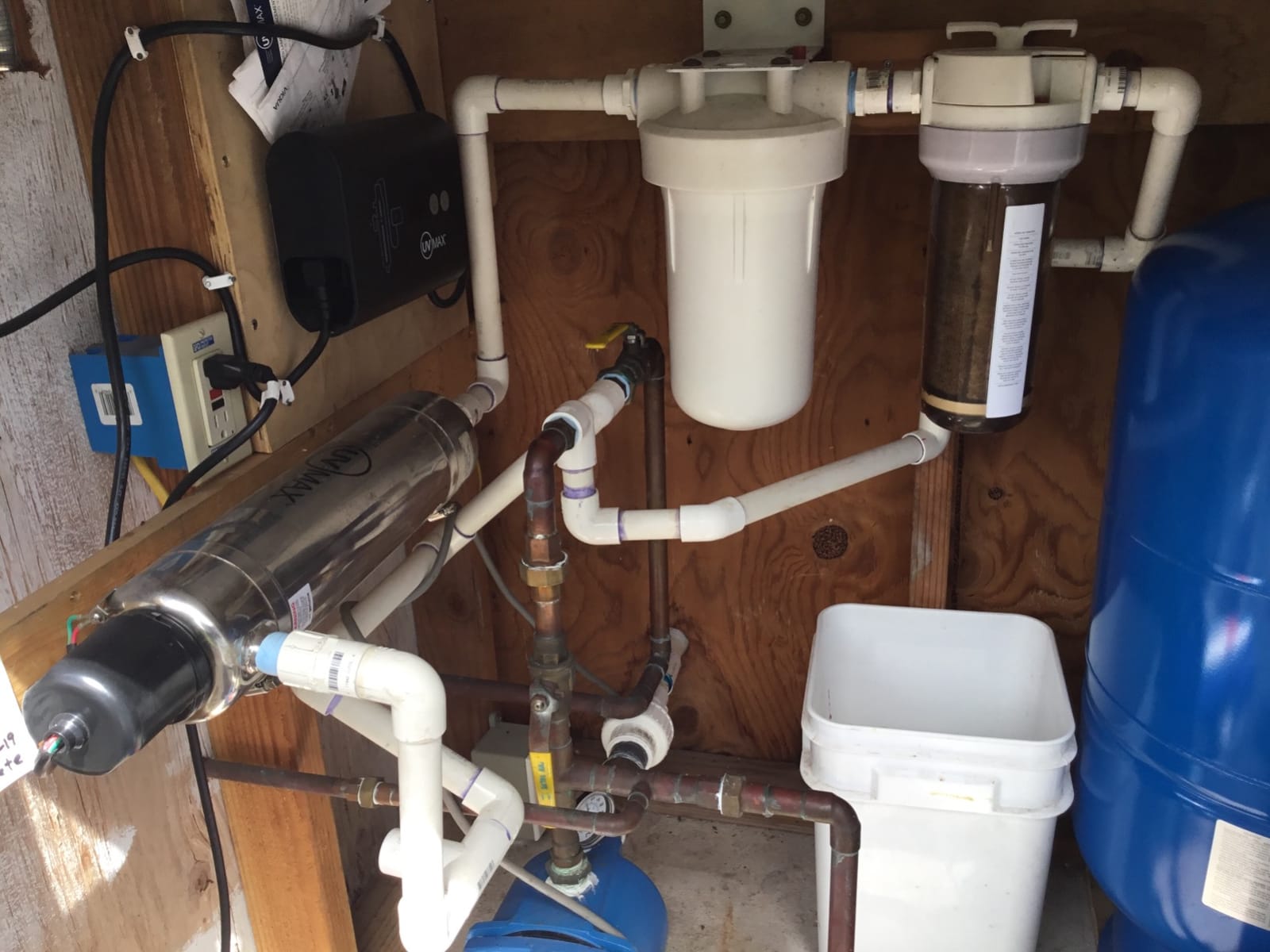
4. Mineral Magnet II – Best for Fixture-Level Treatment Without Main-Line Access
Mineral Magnet II Magnetic Water Softener/Conditioner for Hard Water. Installs easily, no maintenance. USA owned.
Magnetic clamp-on
Fits 1.25 inch pipe
4.3 by 3.3 by 1.5 inches
5-year warranty
Pros
- Fastest and simplest install in the roundup
- Can mount on a single fixture line
- Waterproof housing for shower hoses
- No electricity chemicals or upkeep
Cons
- Partial results reported around 50-60 percent reduction
- Several units often needed for whole-home coverage
- Needs clearance for both hands to tighten
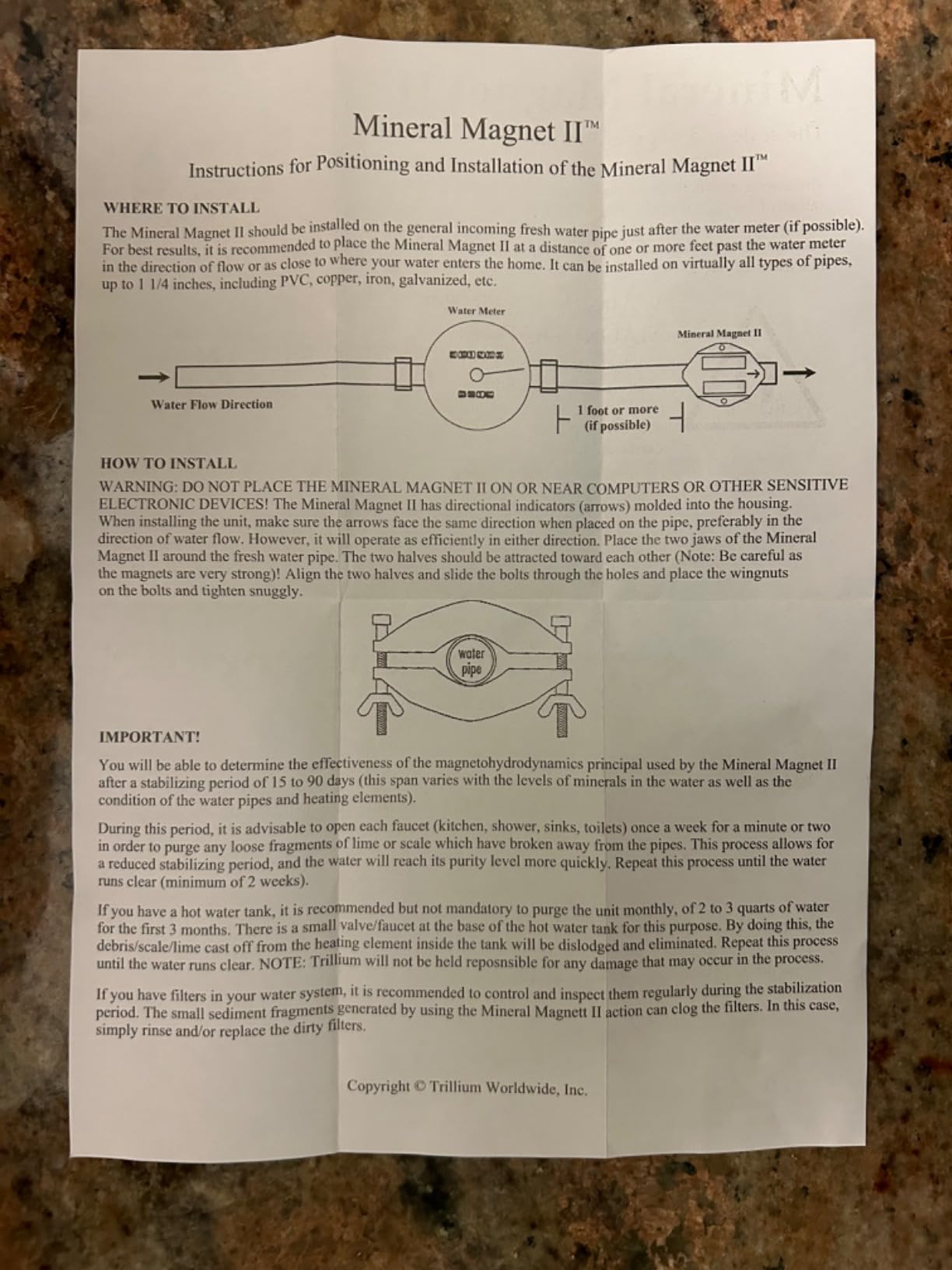
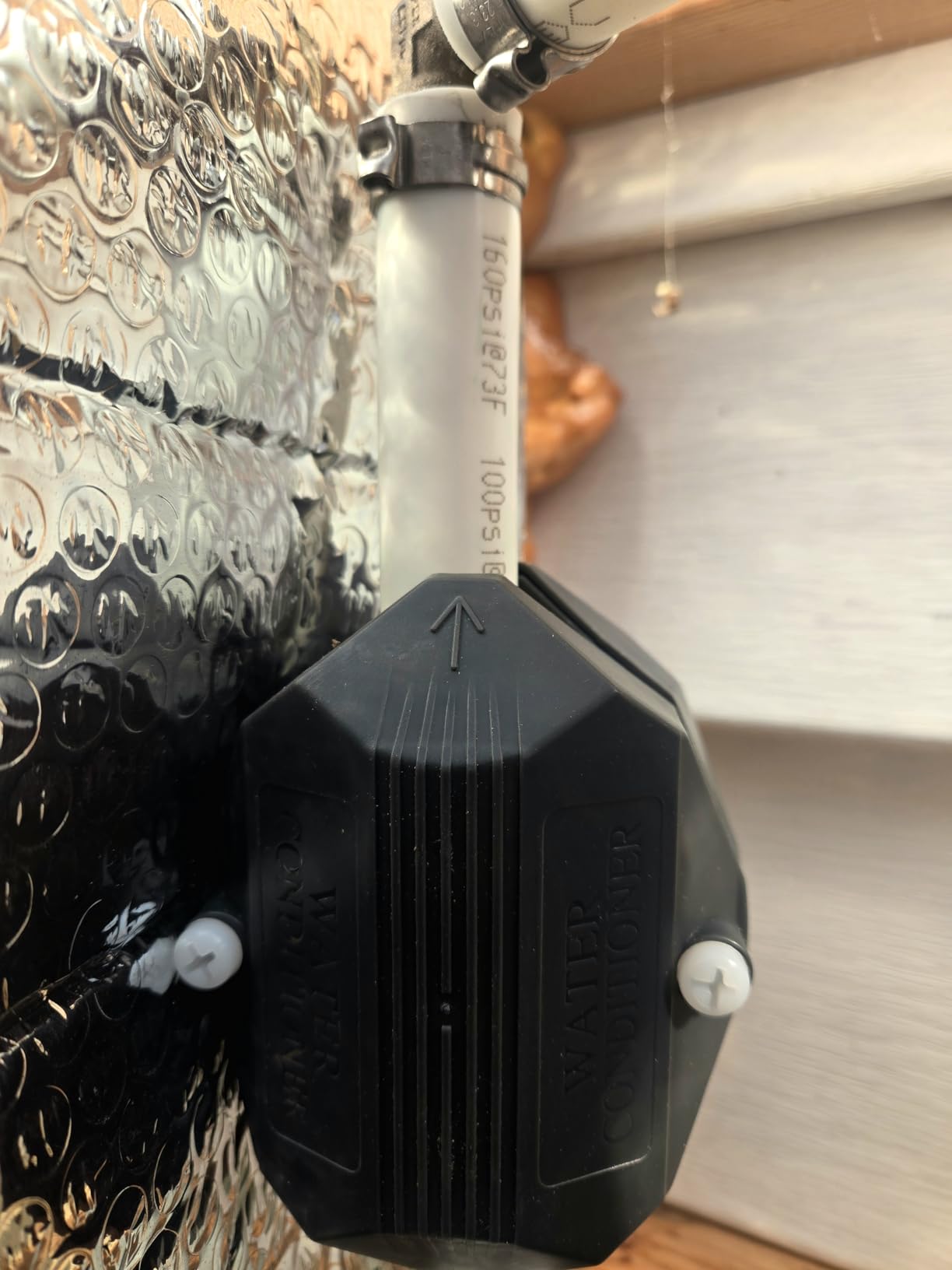
If the main line is genuinely off limits, you can treat individual fixtures instead, and the Mineral Magnet II is built for exactly that. The box contains two polypropylene housings with four strontium ferrite magnets, two nylon bolts and two nylon wingnuts, and the whole assembly is 4.3 by 3.3 by 1.5 inches.
You clamp it around a pipe up to 1.25 inches, which covers copper, galvanized, PVC, PEX and iron. Installation takes under a minute with no tools and no maintenance, and it comes with a 5-year limited warranty.

Mounting on a Single Fixture Line
Multiple reviewers describe using these in an apartment where they have no access to the main line or the water heater, placing them on shower hoses, sink lines and the dishwasher line instead. The waterproof housing is what makes the shower-hose placement viable, since that line gets wet every day.
This is the closest thing in the roundup to a zero-permission install. A clamp on a fixture supply line usually does not trigger a lease clause, and it can be removed in a minute at move-out.
What Partial Scale Reduction Means
Be clear about the ceiling here. Buyers who install on the main line report roughly half the scale reduction of a real softener, and a few find no measurable effect at all. Several owners end up buying multiple units to cover the whole home, which changes the cost calculus fast.
Expect results in 15 to 90 days, and expect them to be hard to notice. You need enough clearance to get both hands around the housing to tighten the bolts, which is a small thing that matters in a tight vanity.
Where It Falls Short
This is a preventive device, not a softener, and in very hard water it will not keep up. If your shower glass is already heavily scaled, no magnetic clamp is going to remove that crust. You will need descaling acid or a glass treatment product alongside it.
5. Water Boss Whole House Scale Control – Best Tank Value for Larger Apartments
WaterBoss Whole House Salt-Free Scale Control | 600K Gal | WB-WH-DSCLR
Media tank descaler
7 gpm flow
27 inch tall tank
6-year warranty
Pros
- Same scale-control platform as the A. O. Smith tank
- No salt chemicals electricity or backwashing
- Shut-off valve nipple and adapter included
- 6-year service life and warranty
Cons
- 27 inch tank needs real installation space
- Under 15 gpg hardness only
- Only about 200 ratings for long-term data
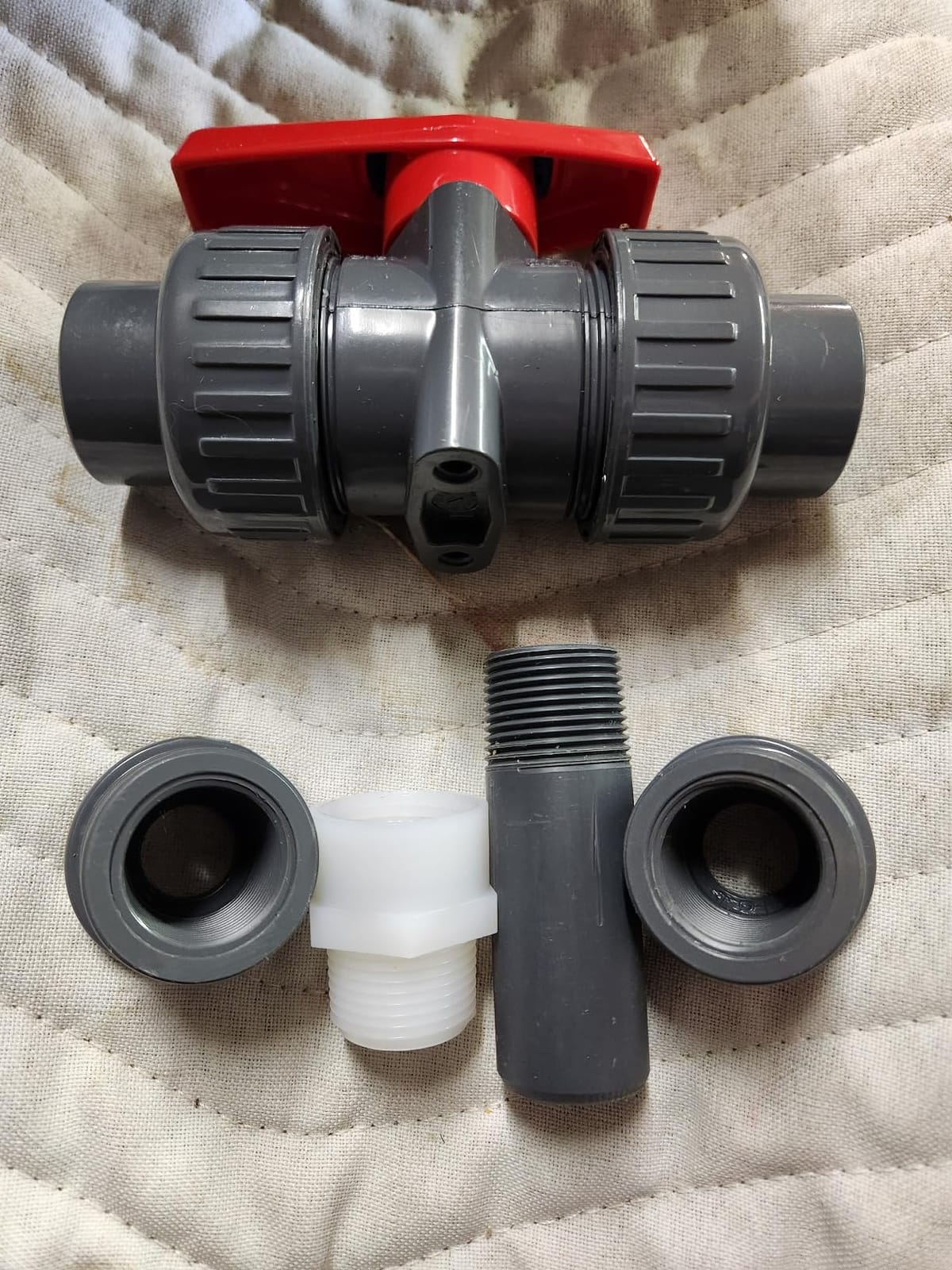
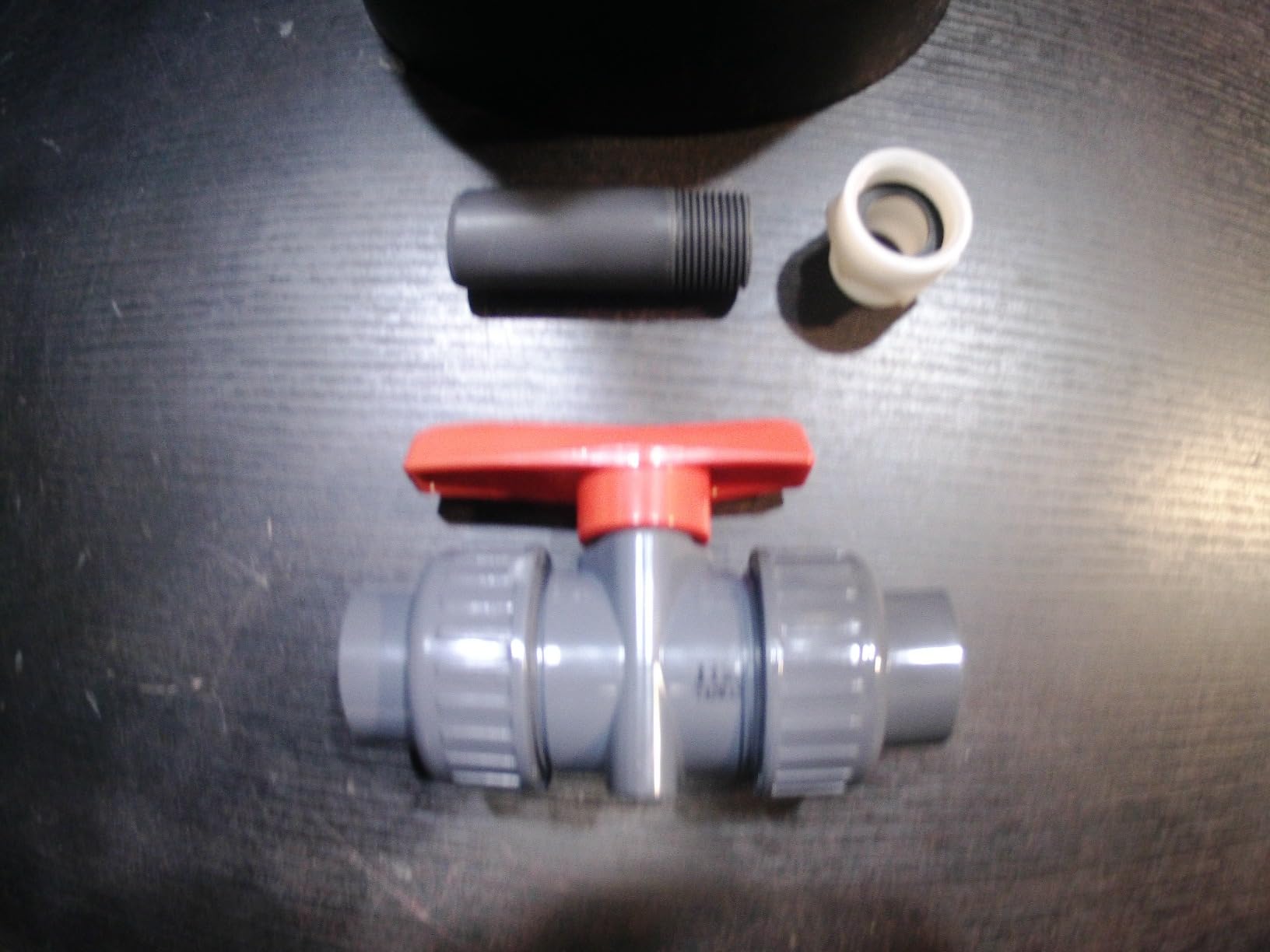
The Water Boss WB-WH-DSCLR runs the same scale-control media platform as the A. O. Smith tank for less money, and the 7 gpm flow rate is more than enough for a single apartment. If you have measured clearance for a floor-standing tank and want the longest service interval in this category, it is a reasonable pick.
Like the A. O. Smith unit, it needs no salt, no chemicals, no electricity and no backwashing. The media is rated for up to 600,000 gallons or six years, backed by a six-year limited warranty.
Same Platform as the A. O. Smith Tank
The practical difference is height. At 27 inches the Water Boss tank is 3 inches shorter than the 30-inch A. O. Smith unit, which in a low-ceilinged utility closet is the difference between it fitting and not. The footprint is 8.75 by 8.75 inches at the base with 3/4 inch inlet and outlet connections.
It operates in the same 20 to 100 psi range and the same 40 to 90 degree Fahrenheit temperature window. The kit includes the descaler tank, a shut-off valve, a nipple and a hose adapter.
Hardness and Water Chemistry Limits
The design envelope matches: hardness under 15 gpg, alkalinity under 250 mg per liter, pH under 8.3 and iron under 0.3 ppm. It will not reduce TDS, sulfur or iron. If your water has iron staining rather than white scale, you need a different product entirely.
The stated maximum supported TDS level is 500 ppm, which is worth checking against your building’s water if you are near a coastal or brackish source.
Where It Falls Short
The honest weakness is evidence, not design. With roughly 200 ratings there is far less long-term feedback on fitting drips and media life than the A. O. Smith has accumulated, and 14 percent of its ratings are one star. For a six-year media claim, that is a thin data set to lean on.
6. Timilge Electromagnetic Descaler – Best for a Truly Zero-Change Install
Timilge Electronic Water Descaler System, Reduces Limescale, Rust, and Minerals, No Chemicals, Easy Installation
Electromagnetic coil
No pipe cutting
7.83 by 3.62 by 1.81 inches
110-120V power
Pros
- Coil wraps outside the pipe with no fittings
- Slim 1.4 pound body fits tight spaces
- No salt chemicals or pH change
- Can supplement a softener rather than replace one
Cons
- Effect drops beyond about 30 feet of pipe run
- Not recommended above 0.3 ppm iron
- Some units arrived dead on arrival
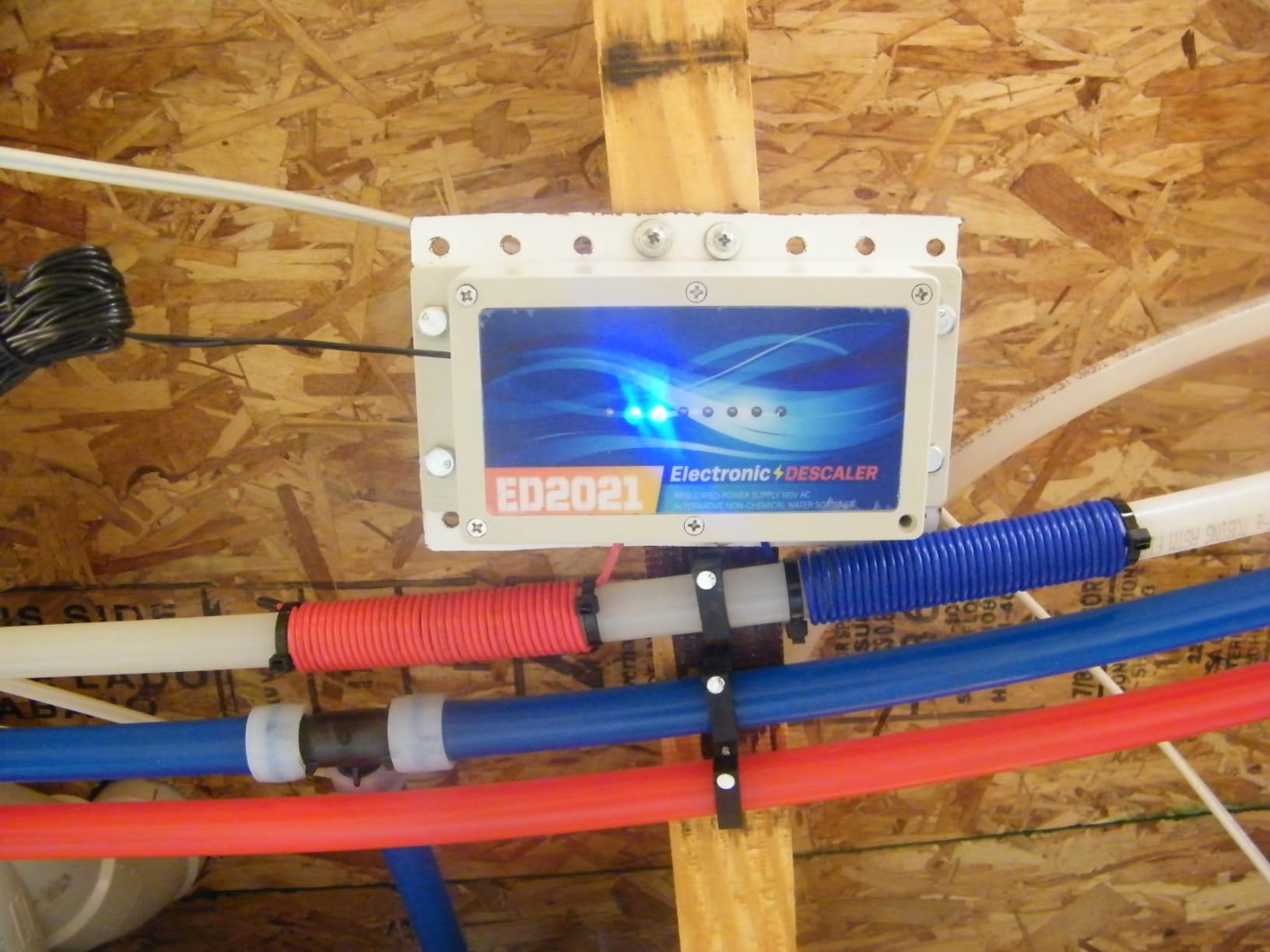
The Timilge uses a frequency-modulated electromagnetic coil that wraps around the outside of the pipe, so there is literally nothing to cut, solder or thread. At 7.83 by 3.62 by 1.81 inches and 1.4 pounds, it is one of the easier units here to hide in a utility space or under a sink.
Owners describe installing the coil in about half an hour using a clip or tape to keep the wire tight, then noticing thinner faucet scale and fewer toilet rings within two to six weeks. Several use it downstream of a softener as a supplement rather than a replacement.
Coil Placement and the 30-Foot Caveat
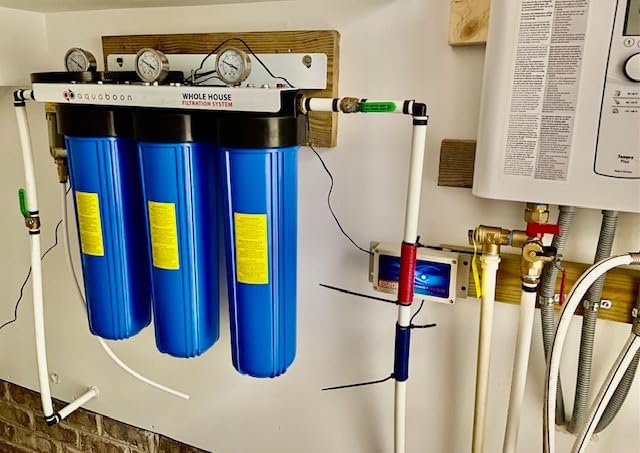
Placement decides whether this works. Best results come from wrapping the coil on the main supply where water enters the home, and the treated effect weakens beyond roughly 30 feet of pipe run. In a sprawling apartment layout that distance can cover a lot of ground, so measure it.
The manufacturer’s guidance is explicit: not recommended above 0.3 ppm iron without an iron removal filter. On iron-heavy water, the performance drops off sharply, and the manufacturer itself suggests pairing it with a softener or iron filter.
Power and Quality Control
It runs on 110-120V and needs to stay on continuously. A wall switch or breaker on the same circuit will switch it off, which is a real problem in a building with older shared wiring. Mount it on a circuit nobody else touches.
Two reviewers received units dead on arrival or with unconnected internal power leads, and one international buyer returned the unit over the US-style plug. Check the unit the moment it arrives.
Where It Falls Short
It is not a softener and the manufacturer does not claim to be. If you are on very hard water, expect partial results and consider pairing it with a media tank. The stated maximum supported TDS level is 1000 ppm, which is generous, but hardness and TDS are not the same measurement.
7. briskspring J-600-BS – Best for High Flow in a Tight Cabinet
Briskspring Salt Free Water Descaler Whole House, Scale Water Softener System, ¾-Inch NPT Water Heater Descaler, Prevent Scale Built Up On Water Heaters, Smart Toilet & Boilers, 10-Year Durability
Physical alloy descaler
17.6 gpm flow
9.84 inch stainless body
3/4 inch NPT
Pros
- Highest flow rate in the roundup at 17.6 gpm
- 1.97 inch diameter body fits where tanks cannot
- No power supply and no chemicals
- Claimed 10-year alloy service life
Cons
- Requires cutting into the supply line
- Recommended only below 300 ppm hardness
- Only about 60 ratings
The briskspring J-600-BS is a stainless steel inline body with no external power and no chemicals, rated by the manufacturer at 17.6 gpm. That flow figure is far beyond what any single apartment needs, which means you will never be the reason your neighbors have low water pressure.
At 9.84 inches long and only 1.97 inches in diameter, it slides into a cabinet or utility space where a tank unit simply cannot go.
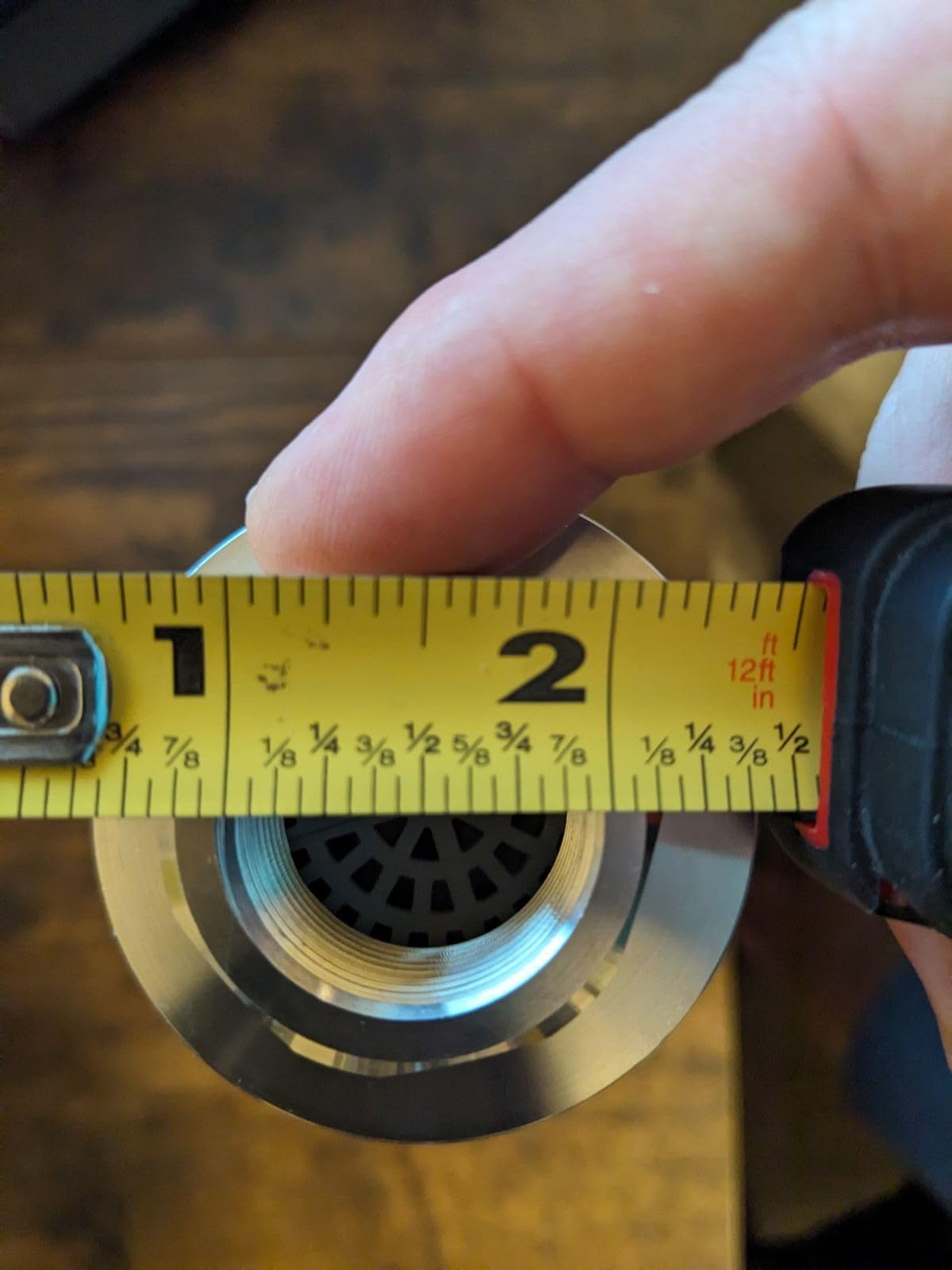
17.6 GPM Through a 1.97 Inch Body
High flow is the practical advantage here. If you have a large apartment, a laundry unit, or a building where several fixtures could run at once, a restrictive body becomes an annoying pressure drop. This one is designed not to be that.
The manufacturer claims an 86 percent scale inhibition rate and a 10-year alloy service life with no disassembly or maintenance. The connection is 3/4 inch NPT inline.
The 300 ppm Ceiling
Here is the catch, and it is a real one: it is recommended only for water below 300 ppm hardness. That is a moderate ceiling. If your water is genuinely hard in the 250 to 400 ppm range, this is the wrong device and a media tank or electronic descaler is a better fit.
Where It Falls Short
Unlike the clamp-on units here, this one requires cutting into the supply line and soldering or threading 3/4 inch NPT connections. That is plumber work, and in a rental it is a conversation with your landlord. With roughly 60 ratings, there is also very little long-term durability feedback to weigh.
8. Holdly Magnetic Conditioner – Best for 1.5 Inch Pipes
Magnetic Water Softener & Conditioner – Salt-Free Water Descaler for Hard Water Treatment | Easy Install, Eco-Friendly Water Softener System for Home & Apartment Plumbing
Magnetic clamp-on
Fits 1.5 inch pipes
Included bolts and wingnuts
No power needed
Pros
- Widest pipe compatibility in the roundup
- Tool-free clamp install with included hardware
- No salt electricity chemicals or refills
- Marketed for apartment plumbing
Cons
- Flattest rating spread of the picks
- Single device often not enough coverage
- About 60 ratings only
The Holdly fits incoming freshwater pipes up to 1.5 inches across PVC, PEX, copper, iron and galvanized. That is the widest pipe coverage of anything in this roundup, and it is the reason to choose it if your building has a larger supply line than the 1 inch limit that knocks out several competitors.
Installation uses the included nylon bolts and wingnuts, so no tools and no plumber. There is no power source requirement, no chemicals and no refills of any kind.
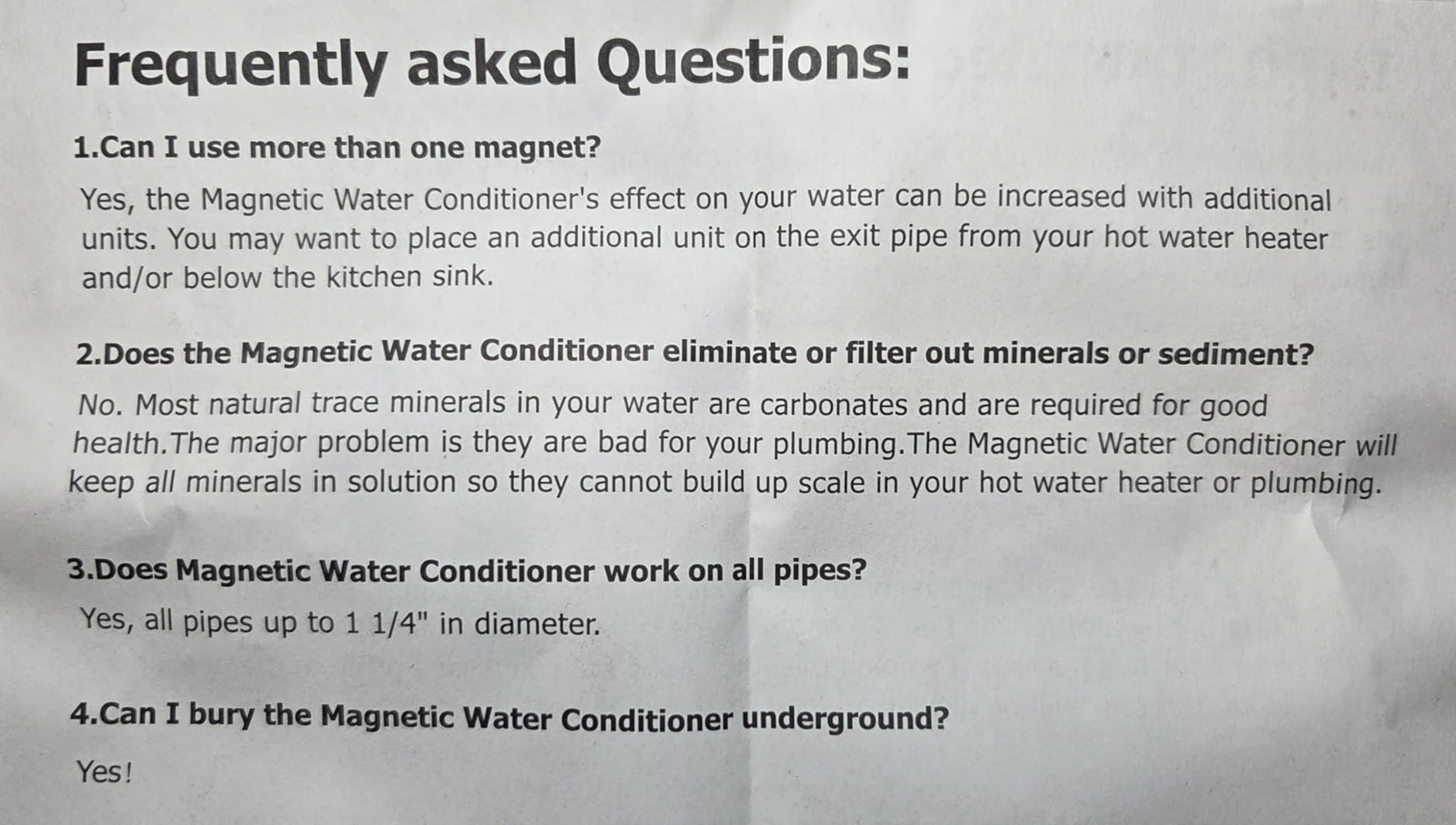
Pipe Diameter Coverage and Hardware
Pipe diameter is the deciding factor and almost nothing else about this product. Most magnetic conditioners in this price range stop at 1.25 inches. If your riser or main is 1.5 inches, this is one of the few clamp-on options that will physically go on it.
As with any magnetic device, coverage per unit is limited. Several buyers end up fitting more than one to cover different runs, so factor that into your planning rather than assuming one unit handles everything.
The Split Rating Distribution
The feedback is honest but flat: 47 percent five star, 28 percent four star and 12 percent three star across about 60 ratings. Customers point to easy installation and low cost rather than dramatic results, and the sizable three- and four-star share suggests many see partial improvement only.
Where It Falls Short
Magnetic treatment is preventive. It will not soften water, and spot removal is partial at best. With roughly 60 reviews there is limited long-term reliability evidence, and the flattest distribution here means fewer strong endorsements than the electronic units earn.
9. ROBOA Whole House Electronic Descaler – Best Budget Electronic Option
Whole House Electronic Water Descaler, Salt-Free Water Softener Alternative
Electronic pulse unit
Flat copper coil
No pipe cutting
Wall mount
Pros
- Designed explicitly for apartments and renters
- Flat copper coil gives a more stable signal
- Lowest cost for an electronic descaler
- Long-term owner reported 50-75 percent less glassware spotting
Cons
- Several reviewers call the effect a placebo
- Power brick needs more clearance than a standard plug
- Only 37 ratings with 15 percent at two stars
The ROBOA is marketed squarely at apartments, RVs and renter-friendly installs, and mechanically it is the least invasive electronic option here. A wide flat copper coil wraps around the main water pipe with no cutting, and it is compatible with copper, PVC, PEX and most common pipe materials.
At 1.5 pounds with a wall-mount configuration, it is easy to place out of sight near the water heater or in a utility closet.
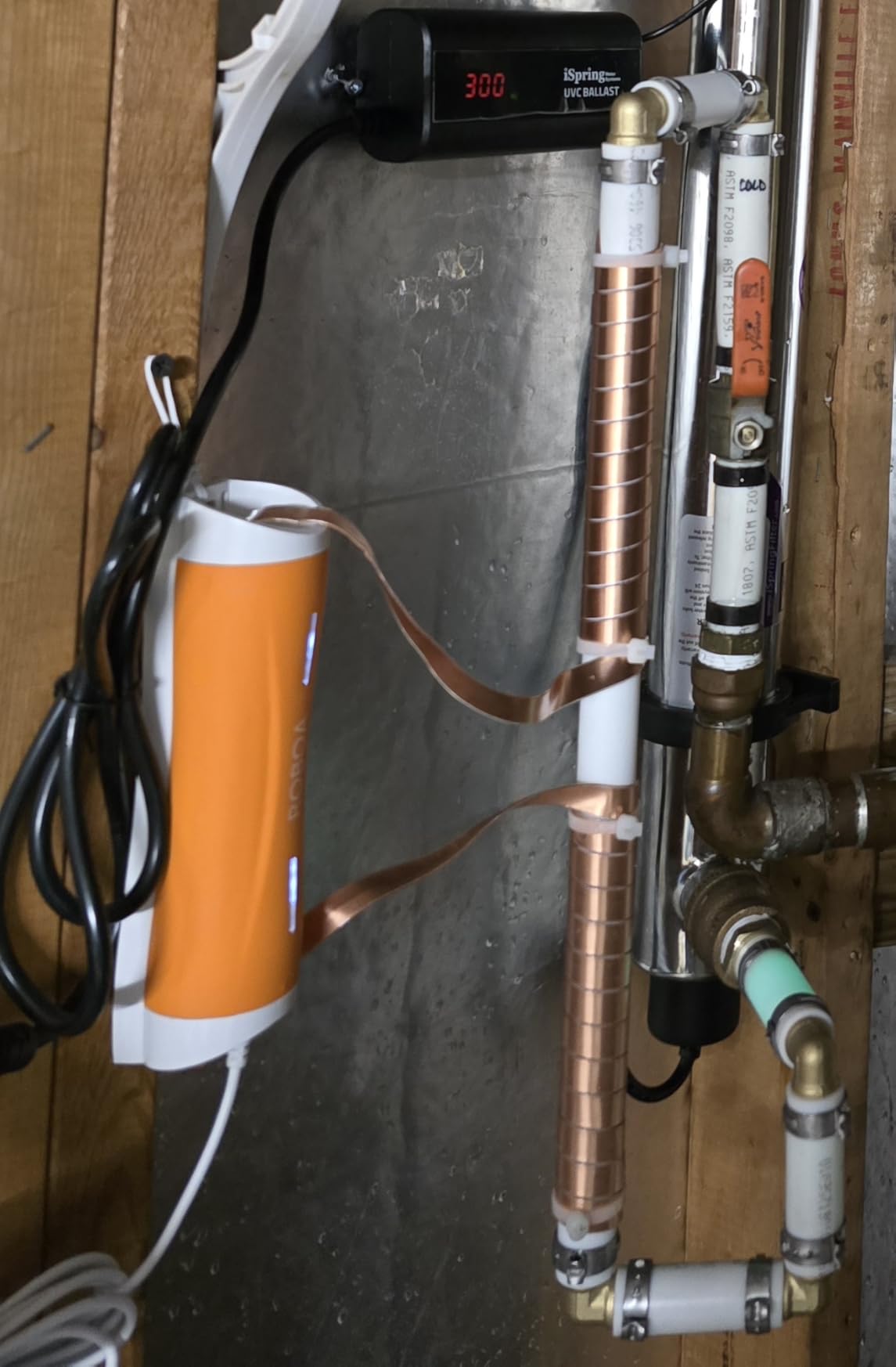
Flat Copper Coil Design
The flat coil is the reason this unit is worth considering over a simple two-magnet housing. Owners report a stronger and more stable signal, and one long-term owner documented a 50 to 75 percent reduction in spotting on air-dried glassware, which is the most concrete result claimed by any product in this roundup.
Everyone agrees installation is quick and non-intrusive. That is the part that works reliably, and it is the part that matters most in a rental.
The Placebo Reports
This is the most polarizing product in the set despite its 4.0 average. Around 30 percent of ratings sit at two or three stars with comments calling the effect a placebo, and at least one reviewer installed a second unit from a different maker and saw the same result. With 37 ratings and 15 percent at two stars, this is the weakest consistency signal in the roundup.
It also needs a power outlet plus a power brick that needs more clearance than a standard two-prong plug, which is a genuine problem in a crowded utility closet.
Where It Falls Short
There is no cartridge, no media and no filter to replace, which sounds like a benefit until you realize you have no consumables and no serviceable parts. If the unit stops working, the answer is a new unit, not a replacement element.
10. Dicsley ED2021 – Best for the Tightest Cabinet Space
Whole House Water Descaler, Salt Free Hard Water Conditioner,Scale Reducer
Electromagnetic descaler
1.18 inch flat body
7.8 by 3.6 by 1.18 inches
1.46 pounds
Pros
- Thinnest body in the roundup at 1.18 inches
- Non-invasive wrap-around install
- Owners report less showerhead and faucet scale
- Toilet mineral rings stopped forming
Cons
- Manufacturer advises pairing with an iron filter
- Needs correct lead orientation and tight winding
- Smallest review base at 34 ratings
The Dicsley ED2021 measures 7.8 by 3.6 by 1.18 inches, which makes it the thinnest unit in this roundup. If your cabinet has a shallow shelf and an awkward clearance, this is the one that physically fits where the rest do not.
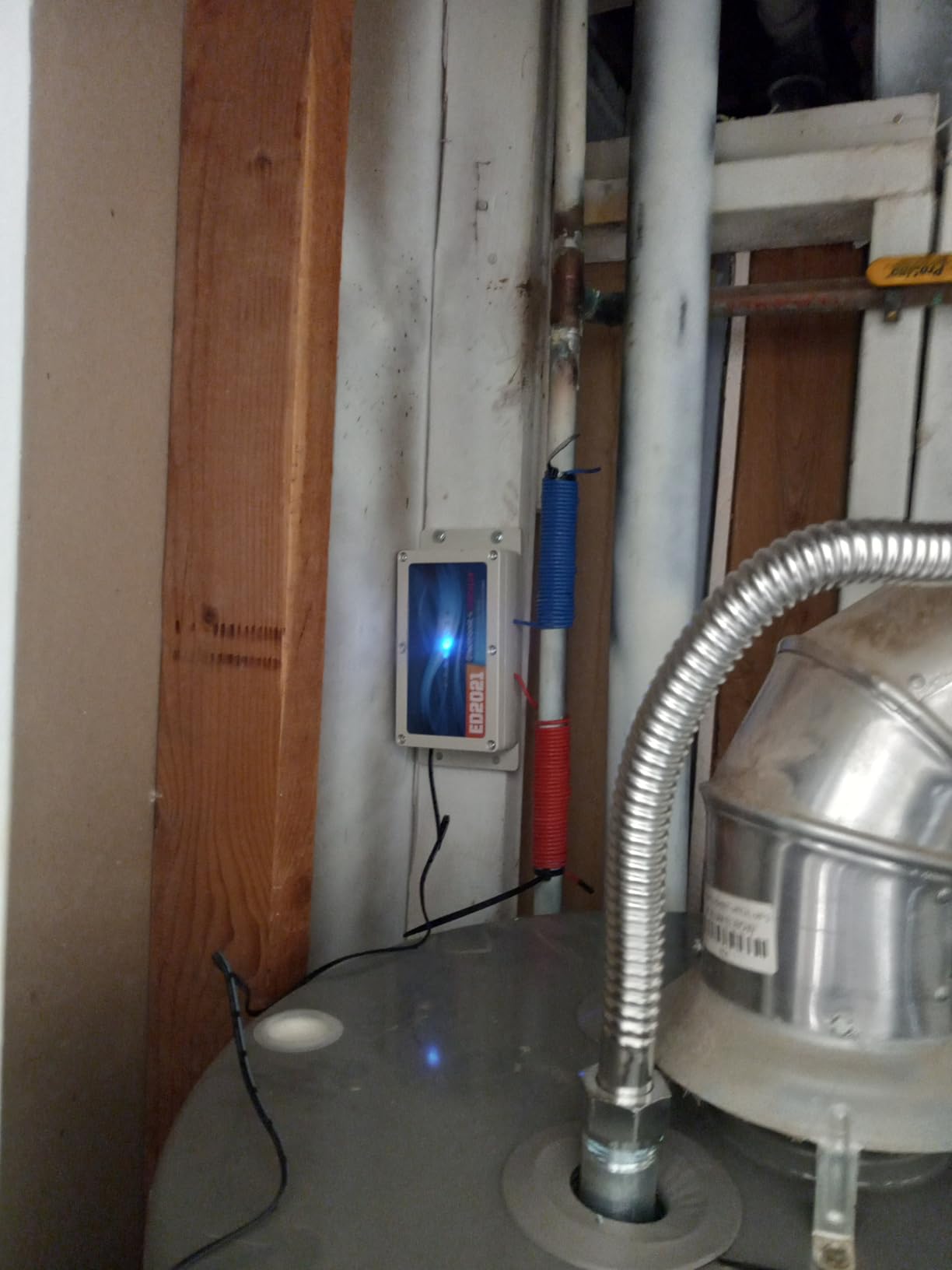
The coil wraps around the pipe with no plumbing modifications, and it is compatible with PVC, copper, PEX and stainless steel. It weighs 1.46 pounds.
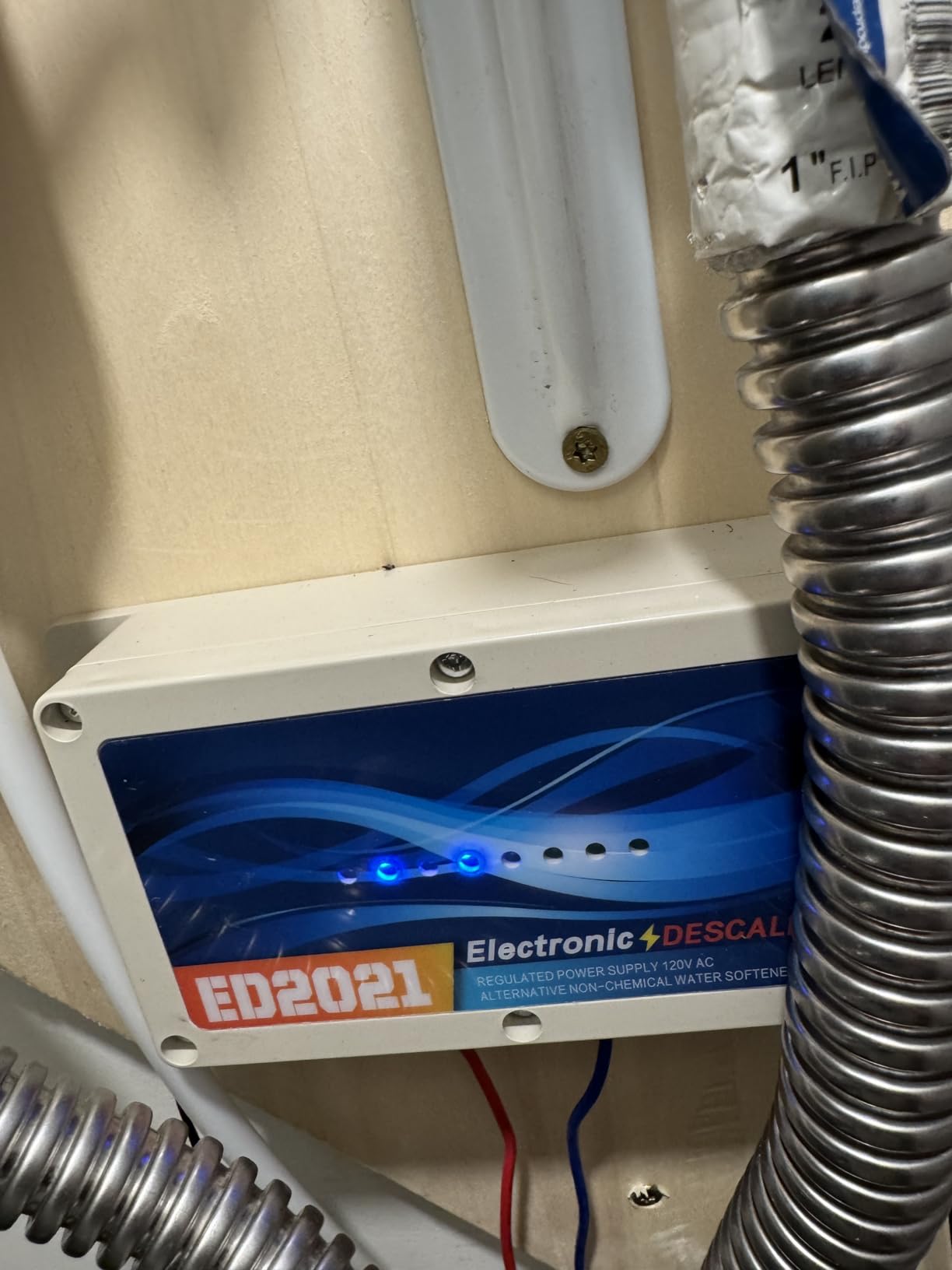
A 1.18 Inch Flat Body
Owners in genuinely hard water report measurable reductions in showerhead and spigot scale and no more toilet rings after about six weeks of use. That is a real-world result from people whose water is hard enough to be a problem, which is more useful than a laboratory claim.
The trade for that thin profile is that the coil has to sit flat against the pipe, and the instructions are specific about lead orientation relative to flow direction. Wind the coil tightly or the signal weakens.
Winding Direction and Iron Water
The manufacturer recommends pairing it with an iron filter or a softener on hard or iron-heavy water. That is a frank admission that on its own it is a partial solution in high-mineral supplies, and it is the more honest guidance than most competitors give.
It needs constant power. A switched circuit will disable it, and several reviewers have had to troubleshoot that before the unit appeared to be failing.
Where It Falls Short
With 34 ratings, this has the smallest evidence base in the roundup, and 12 percent of those are one star. Detractors either saw no change at all or found the effect insufficient even after adding a second unit from another maker. The results also vary sharply between installations for reasons the manufacturer does not fully explain.
Can You Even Install a Water Softener in an Apartment?
For most renters, this question comes before which model to buy. Several people discover mid-purchase that they cannot plumb a main-line unit or add a floor drain, and that is the single most wasted trip through this category. Work through these four steps in order.
The Four-Step Apartment Fit Check
One. Measure before you choose. Tank units need roughly 27 to 30 inches of vertical clearance plus working room for a wrench. Clamp-on and electronic units need 10 to 12 inches of straight pipe. Get a tape measure, not an estimate.
Two. Identify your pipe. Check the diameter and the material. Copper and PEX are easy. Galvanized and older iron lines limit your options, and anything above 1 inch rules out several products in this roundup.
Three. Find a power source. Five of the ten products here are corded electric. Note the nearest outlet and whether it is on a switched circuit, because a wall switch will disable the unit.
Four. Confirm permissions. This is the step people skip, and it is the one that ends arguments with a landlord.
The Landlord and Lease Permission Checklist
Ask these four questions in writing before you buy anything that touches a supply line: whether a clamp-on device is permitted without notice, whether any supply line modification is allowed, who pays if something leaks, and what happens to the installation at move-out. A written answer protects you at lease renewal.
Clamp-on electronic and magnetic devices are the safest to propose because they require no cutting, no new fittings and no drain line. A tank unit with a bypass valve is a harder sell in a rental, particularly in a walk-up where the tenant would have to carry it up stairs at move-out.
Whole-building softening is a property manager decision, not yours. If scale is a problem in the entire building, ask your landlord whether the system upstream is being maintained before you spend anything on your own unit.
Two other installs in a rental run into the same lease clauses. Our guides to video doorbells for apartments and security cameras for apartments spell out the wiring and permission wording that landlords usually accept.
Under-Sink, Inline, Fixture-Level or Tank: Which Path Fits
Fixture-level magnets suit renters with no main-line access and a single problem fixture, and they are removable in a minute at move-out. In-line electronic units like the YARNA and iSpring cover the whole apartment with no floor space at the cost of a power outlet. Media tanks give the longest service interval and handle harder water, but they need real space and usually a plumber for the first install.
For most studio and one-bedroom apartments, an in-line electronic unit is the right default. For two- and three-bedroom units with a utility closet, a media tank is the better long-term answer.
Testing Hardness Before You Spend Anything
Buy a hardness test strip or a drop-count kit before you order. Grains per gallon is the number that decides whether these products work, and it takes five minutes to get. Under 8 gpg you likely have a mild problem a kettle descaler solves. Between 10 and 19 gpg is where the electronic and media units here earn their place. Above roughly 25 gpg, salt-free conditioners struggle, and a salt or potassium system is the only real fix.
If your building already runs a shared softener upstream and your problem is limited to one faucet, start with the aerator and a showerhead filter instead. A blocked aerator produces spotting that feels like hardness but is not hardness. It is also the cheapest mistake to fix.
What Salt-Free Systems Will NOT Fix For You
Five things, stated plainly so you are not disappointed in month three. Salt-free systems do not reduce hardness, so a hardness test before and after will show no meaningful change. They do not increase soap lather or reduce soap use, which is the most common false expectation in this category.
They do not remove limescale already deposited on shower glass, faucets or kettle elements, so descale once by hand before you install anything. They do not reduce sodium, so if sodium content is your reason for going salt-free, that reasoning is backwards. And they do not fix iron staining, sulfur odor or sediment, which need their own pre-filters.
The consensus on r/WaterTreatment is consistent and worth repeating: salt-free units will prevent limescale buildup in appliances, but you will not get the other advantages like more bubbles and easier lathering. If that trade is unacceptable, the answer is a potassium-based or salt-based system, not a better conditioner.
One more regional note. Some jurisdictions restrict or prohibit salt-based softeners, and apartment dwellers there have no ion-exchange option available. For those renters a conditioner is not a compromise, it is the only category left, and the picks above are chosen with that constraint in mind.
Frequently Asked Questions
Do saltless water softeners actually work?
They work for one job: preventing new limescale from forming inside pipes, kettles, dishwashers and heating elements. They do not remove hardness minerals, they do not increase soap lather, and they do not clear scale already stuck on existing fixtures. Call them conditioners rather than softeners and expectations match reality.
What is the best water softener for an apartment?
For most studio and one-bedroom units, an in-line electronic descaler such as the YARNA CWD24 or iSpring ED2000 is the best fit, because it needs no floor space, no salt and no drain line. Larger two- and three-bedroom apartments with utility closet space are better served by a media tank such as the A. O. Smith scale control unit.
Can I install a water softener in a rented apartment?
Often yes, if you choose a clamp-on unit. Electronic and magnetic devices that attach to an existing pipe require no cutting and no new fittings, which many leases permit. Any supply line modification, tank installation or drain line work needs written landlord permission first. Ask in writing before you buy and keep the answer for move-out.
Which water softener is best for an apartment building?
Apartment-wide treatment is a property manager decision rather than a tenant one, because the main line and water heater are usually shared. If scale affects only your unit, install a clamp-on device on your own supply line or treat individual fixtures. If scale appears throughout the building, ask the landlord whether the shared system upstream is being serviced.
Are salt-free water softeners worth it?
They are worth it when the pain is scale on glassware, faucets, kettles and appliances, because they stop new deposits with no salt to store and no plumbing modification. They are not worth it if you want genuinely soft water, more soap lather, or lower sodium, because none of those benefits come from a salt-free conditioner.
Which Salt-Free Water Softener Should You Buy in 2026?
Match the device to your actual constraint rather than to the highest rating. If you have a studio or one-bedroom and want whole-unit coverage without touching a single fitting, the YARNA CWD24 is the pick I keep coming back to, with 2633 ratings giving you the clearest view of how it behaves over time. If your building’s supply line is 1.25 inches or larger, the Holdly or Mineral Magnet II is the one that physically goes on.
If you have no main-line access at all, a fixture-level magnet on the shower hose or sink line costs little and can be removed in a minute when you leave. If you have utility closet space and a two- or three-bedroom layout, the A. O. Smith media tank gives you the longest service interval and keeps working during a power outage. Test your hardness first, get your landlord’s answer in writing, and use the button on your pick to check the current figure.