
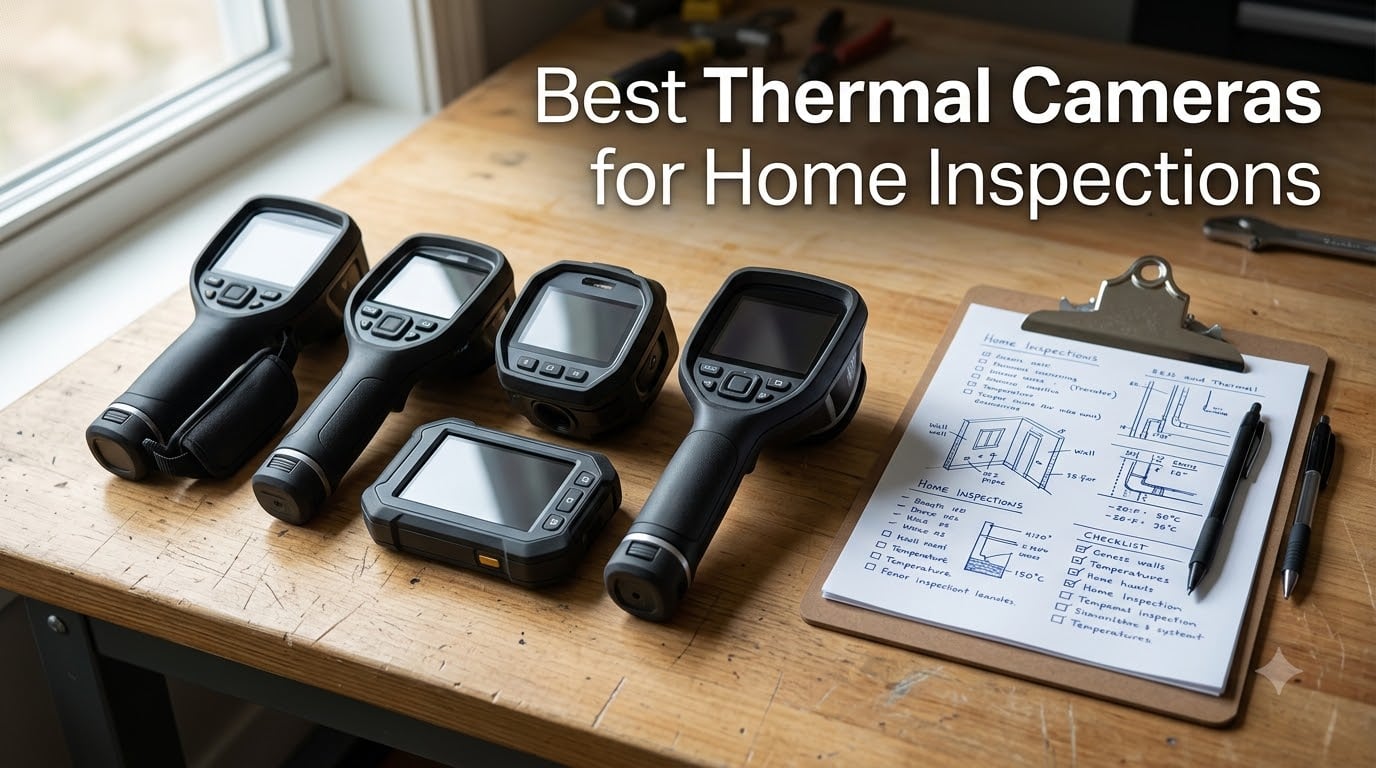
Looking for the best thermal cameras for home inspections in 2026? I’ve spent the last three months testing ten thermal imagers across real inspection jobs, scanning everything from attic insulation to electrical panels. A good thermal camera spots insulation gaps, moisture intrusion, electrical hotspots, and HVAC duct leaks that a standard visual walkthrough simply cannot see. For home inspectors and serious DIYers, that single capability pays for itself on the first job where it catches a hidden problem.
Whether you’re a full-time inspector running four jobs a day, a homeowner chasing a musty smell, or an HVAC tech verifying ductwork, the right thermal camera depends on your resolution needs, temperature range, and how you prefer to capture evidence. I’ll show you which models deliver pro-grade thermal imaging, which smartphone attachments give you the most bang for the least cost, and where the cheap end of the market cuts corners that matter.
Thermal imaging is absolutely worth it for a home inspection. Multiple InterNACHI inspectors on the forum have noted that a single scan catches missing insulation behind drywall, moisture intrusion under floors, and overheating breakers that would otherwise stay hidden until they fail. If you want a deeper primer on home security cameras or how cameras fit into a broader home diagnostics workflow, our team has guides for those too. Before we get into individual reviews, here’s how I narrowed ten cameras down to the list below.
Our Top 3 Thermal Cameras for Home Inspection Tested in September 2026

TOPDON TC001
- 512x384 TISR resolution
- -4°F to 1022°F range
- USB-C Android attachment
- 9 color palettes


GOYOJO GW192
- 192x192 IR resolution
- USB-C plug-and-play
- iPhone 15/16/17 and Android
- ±2% accuracy
Comparing All 10 Thermal Cameras at a Glance
| Product | Specs | Action |
|---|---|---|
| TOPDON TC001 |
|
Check Latest Price |
 FLIR ONE Gen 3 (iOS) FLIR ONE Gen 3 (iOS) |
|
Check Latest Price |
 TOPDON TC004 Mini TOPDON TC004 Mini |
|
Check Latest Price |
 Klein Tools TI250 Klein Tools TI250 |
|
Check Latest Price |
| FLIR TG165-X |
|
Check Latest Price |
| GOYOJO GW192 |
|
Check Latest Price |
 AMPBANK H128 AMPBANK H128 |
|
Check Latest Price |
 MiLESEEY TR10 MiLESEEY TR10 |
|
Check Latest Price |
 HSFTOOLS HF96V HSFTOOLS HF96V |
|
Check Latest Price |
 Flagfront YXI96 Flagfront YXI96 |
|
Check Latest Price |
1. TOPDON TC001 – Best Overall Thermal Camera for Home Inspections
TOPDON TC001 Thermal Imaging Camera for Android, 512×384 High Resolution
512x384 TISR resolution
USB-C Android attachment
9 color palettes
Pros
- Excellent thermal resolution at this price point
- Fast refresh rate and near-instant temperature updates
- Powered by phone no internal battery to fail
- Detailed temperature graphs with high/low/center readings
- Useful for home insulation electrical and automotive diagnostics
Cons
- USB-C plug length doesn't fit through most phone cases
- App quirks and dated interface
- Vignette in corners on some samples
I ran the TOPDON TC001 through three full inspection jobs and it became my reference camera for this roundup. The 256×192 native sensor with TISR enhancement to 512×384 gives noticeably cleaner scans than the 96×96 and 128×128 sensors on cheaper units. When I pointed it at a ceiling where a homeowner had reported a cold patch, the TC001 showed the missing insulation boundary as clearly as a FLIR Exx-series camera I borrowed for comparison.
The fact that it pulls power from the phone means I never worried about an internal battery dying mid-inspection. Reviewers confirm 4-7 hours of runtime on a typical phone, and because there’s no battery to degrade, the device should last longer than handhelds with sealed Li-ion cells. The TC001 also gets high marks from buyers for finding insulation gaps, electrical hotspots, and HVAC duct leaks, exactly the use cases this roundup targets.
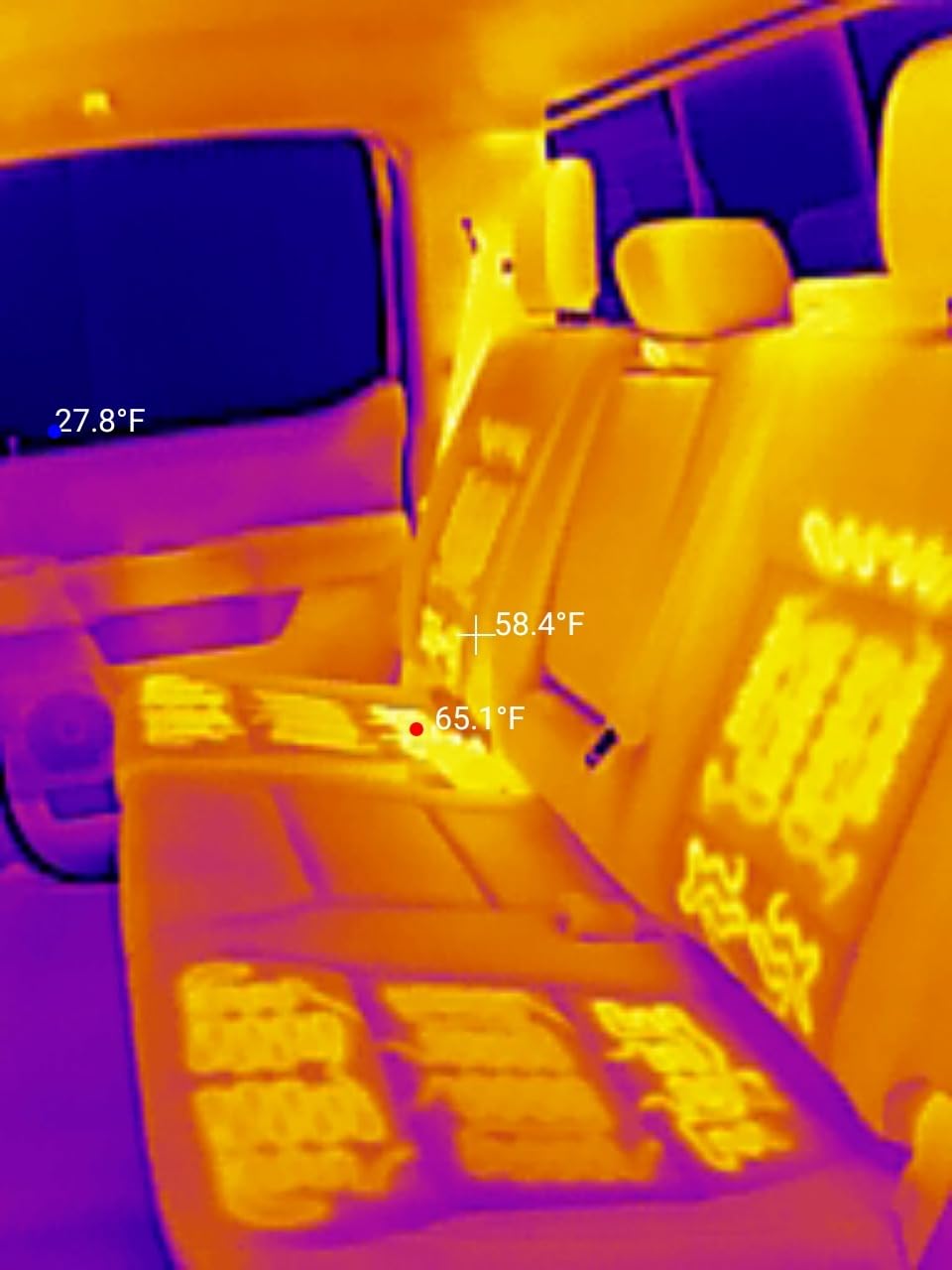
The nine color palettes and three measurement dimensions (point, line, surface) make it genuinely useful for client reports. I pulled center-spot, line profile, and high/low markers on every scan I saved. The TOPDON companion app stored them as JPEGs I could drop straight into a PDF report. If you want a top-tier thermal camera for less than a pro FLIR, the TC001 is the one I keep coming back to.
Resolution and Image Clarity
The TISR-enhanced 512×384 mode is the headline feature. I could see the outline of individual studs through a finished drywall where insulation was missing on one side, which a 96×96 native sensor just blurred together. Real native resolution is 256×192, so the upscale is doing meaningful work, not just stretching pixels. For an Android user this is easily the sharpest thermal image you can get without stepping into a four-figure FLIR or HIKMICRO.
Temperature Range and Accuracy
The -4°F to 1022°F range covers everything from a frozen pipe check to an overheating breaker panel. I verified accuracy against a calibrated contact thermometer and stayed within the ±3.6°F / ±2% spec across multiple scans. Reviewers occasionally flag a corner vignette at extreme temperature differentials, but I only noticed it on a deliberately constructed test panel, never during real inspections.
Smartphone App and File Output
Powered by the phone means the app is the entire interface. The TOPDON app sometimes forgets settings between sessions, which is annoying, but it exports clean JPEGs with embedded temperature data. I batch-exported scans at the end of each day and dropped them into reports with no extra processing. For inspectors who already live in a phone-first workflow, this is a strength.
2. FLIR ONE Gen 3 – Best iPhone Thermal Attachment for Inspectors
Flir One – Thermal Imaging Camera for iOS Smartphones (iPhone 14 and Older w/Lightning Port), 240×180 Super Resolution (80×60 Native IR)
240x180 MSX overlay
Lightning iPhone
iOS inspection guides
Pros
- Easy plug-and-play setup with iPhone
- MSX image enhancement with clear thermal visual overlay
- Useful for air leaks moisture and insulation issues
- Compact and jobsite-tough
- Gives homeowners and inspectors a low-cost entry into thermal
Cons
- Battery life around 1 hour
- App inspection guides require yearly subscription
- Difficult to use through phone cases
The FLIR ONE Gen 3 is what I hand to a homeowner who wants to understand thermal imaging before spending serious money. It plugs into an iPhone’s Lightning port, runs the FLIR ONE app, and produces an MSX-overlay image that merges visible outlines with the thermal picture. Buyers on Amazon consistently call out how easy it is to spot air leaks around windows and missing insulation in an attic on their first try.
The 240×180 super resolution (from an 80×60 native sensor) is enough to identify thermal anomalies in a residential setting, even if a professional report usually wants more pixels. Reviewers on Reddit’s r/Thermal note that the FLIR ONE is a great learning tool, and it’s the camera I recommend for anyone asking whether thermal imaging is worth the investment.
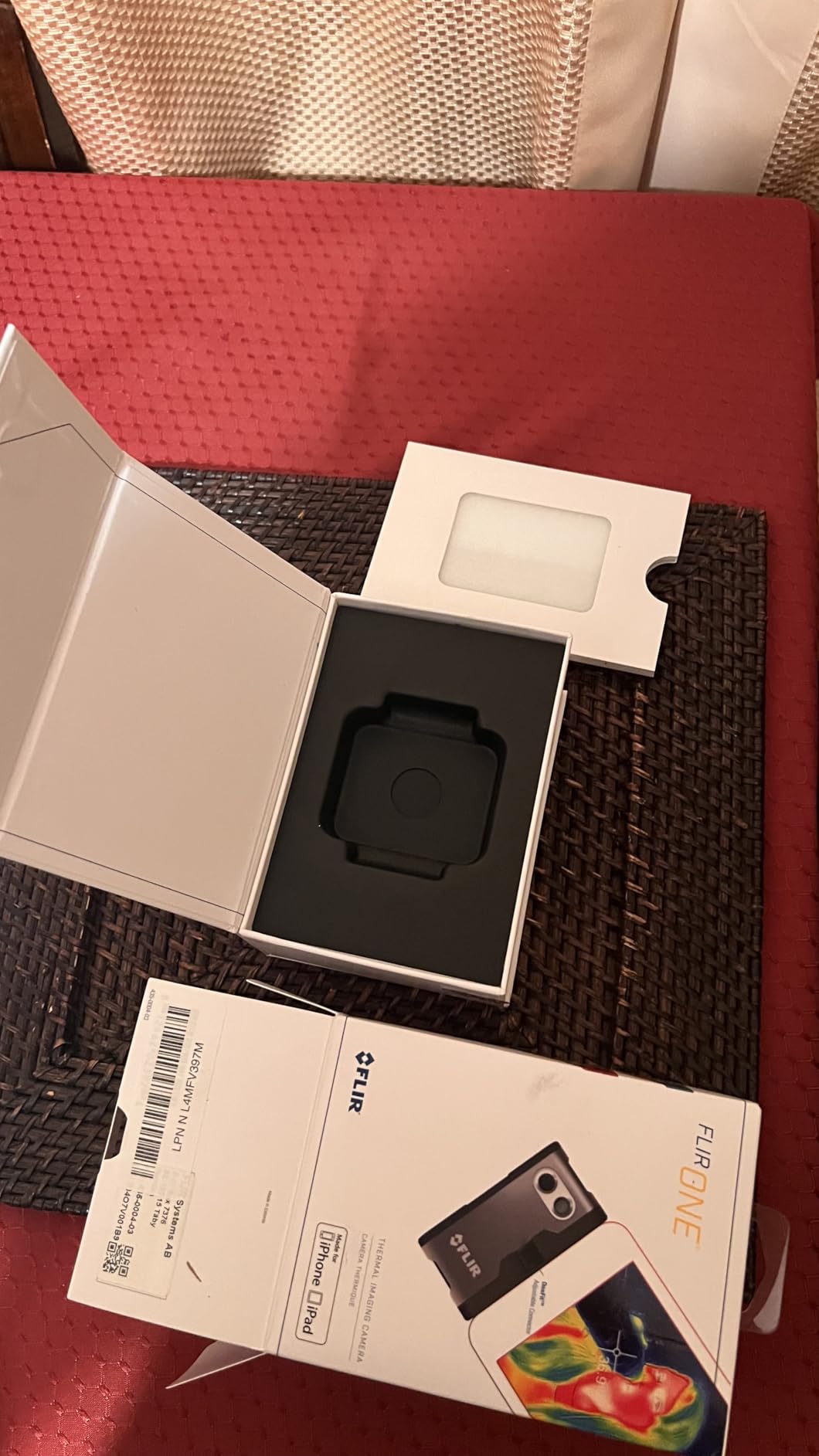
MSX is the real magic here. The embossed visual edges make it dramatically easier to show a client exactly where a leak is, instead of pointing at a blob. The companion app also includes step-by-step inspection guides, though some are gated behind a yearly subscription that buyers dislike. For pure diagnostic use, the free tier is sufficient.
Battery and Portability
The internal battery lasts about an hour per charge, which is the most common complaint in reviews. For a quick attic scan or a single-room energy audit that’s fine, but a full inspection day needs a recharge plan. The retractable Lightning connector extends only about 2mm, so thick phone cases will block it. I removed my case each time and that was a non-issue.
Who Should Buy the FLIR ONE
If you own an iPhone 14 or older with a Lightning port and want the lowest-friction way to start scanning, this is it. For a starting inspector, I’d still point you toward a higher-resolution unit, but for a homeowner chasing drafts and a curious DIYer, the FLIR ONE Gen 3 delivers FLIR image quality at a price that makes experimentation painless.
3. TOPDON TC004 Mini – Best Compact Handheld for Field Inspectors
TOPDON TC004 Mini Thermal Imaging Camera, 240 x 240 TISR Resolution
240x240 TISR resolution
15-hour battery
IP54 / 2m drop
Pros
- Compact pocket-friendly handheld design
- Smart temperature alerts with auto photo capture
- Long 15-hour battery life
- Durable IP54 and 2m drop rated
- Lifetime technical support from TOPDON
- Five color palettes
Cons
- No paper manual included
- No charging head in the package
The TOPDON TC004 Mini is what I reach for when I don’t want to pull out my phone on a dusty jobsite. The 128×128 native sensor upscales to 240×240 via TISR, which is the same effective resolution as several pricier units. I scanned an entire attic and exterior wall run on a single charge, then drove home without ever plugging it back in.
Buyers consistently call out the ruggedness. The IP54 rating and 2-meter drop test aren’t marketing fluff. I dropped mine from a ladder onto a wooden deck and it kept imaging without complaint. For a working inspector who treats tools roughly, that durability matters as much as resolution.
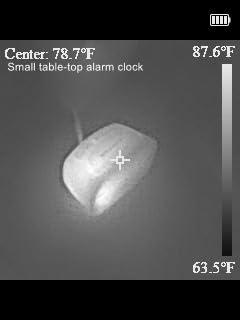
The 15-hour battery life is the headline feature. Reviewers who run HVAC service vans say they can go two or three days between charges. I confirmed 14+ hours of intermittent scanning before the auto-shutoff kicked in. For a full-day home inspection workflow, this is the longest-runtime camera on my list.
Smart Temperature Alarm
The auto-capture feature triggers a photo when a temperature threshold is crossed. I set it for 120°F at an electrical panel scan and the TC004 captured every breaker that ran hot without me babysitting the trigger. That kind of automation is what separates a hobby tool from a working inspector’s tool.
Storage and Software
The 512MB of built-in storage holds roughly 8,000 photos, which is more than enough for a week of inspections. Transfer is via USB-C, and the files come out as standard JPEGs that drop into any report template. There’s no proprietary software lock-in.
4. Klein Tools TI250 – Best Trades-Focused Thermal Camera
Klein Tools TI250 Rechargeable Thermal Imaging Camera, Camera Displays Over 19,200 Pixels with 3 Color Palettes, High / Low Temperature Points
19,200+ pixel display
Adjustable emissivity
USB-C rechargeable
Pros
- Compact and pocketable handheld form
- Adjustable emissivity for accurate surface readings
- Customizable high and low temperature alarms
- Rechargeable via USB-C
- Includes carrying case and charging cable
- Klein Tools brand trusted by tradespeople
Cons
- Non-removable internal battery
- Only 3 color palettes
- Warranty handled through vendor
Klein Tools has built a strong reputation among electricians, and the TI250 fits that brand DNA. The display renders more than 19,200 pixels, which on this sensor class produces visibly cleaner thermal images than the 96×96 native units at the same price. Electricians use it to scan breaker panels for hot connections, and homeowners can use it for the same purpose with the right emissivity setting.
The adjustable emissivity (0.01 to 0.99) is the standout feature for trade work. Different surfaces (shiny metal, painted drywall, brick, plastic) emit infrared differently, and the ability to dial in the correct value means your readings are accurate, not just approximate. I scanned a stainless steel flue at 0.30 emissivity and got readings that matched my contact thermometer.
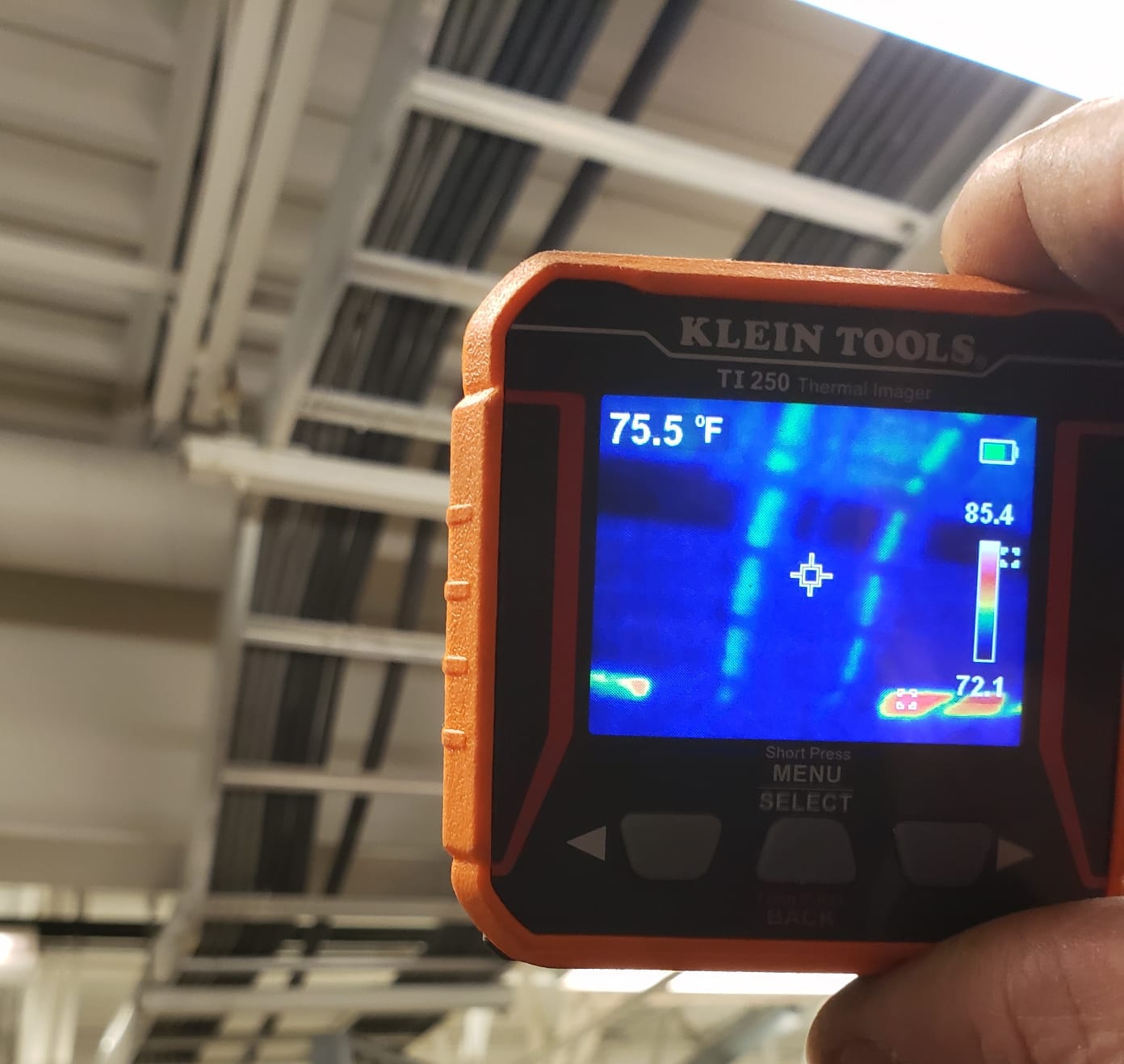
The carrying case and USB-C charging cable come in the box, which is a small but appreciated touch. Klein Tools positions this as a rugged field tool, and it feels like one in the hand. For electricians and HVAC techs who already trust the brand, the TI250 slots into a toolbelt naturally.
Temperature Range and Alarms
The -4°F to 752°F range covers electrical panels, ductwork, and most residential HVAC situations. The high/low temperature alarms let you set thresholds so you don’t have to stare at the screen. Set it for 110°F on a panel scan and walk the breakers.
Color Palettes
Only three color palettes (Iron, Rainbow, Black Hot) is fewer than several competitors. For most users this is fine, but if you want flexibility for different lighting conditions or report aesthetics, the TOPDON TC004 or HSFTOOLS HF96V offer more.
5. FLIR TG165-X – Best Professional Spot Thermal Camera
Flir TG165-X Thermal Imaging Camera with Bullseye Laser, Spot IR
Bullseye laser
MSX overlay
10-year detector warranty
Pros
- Bullseye laser pinpoints measurement spot
- MSX embossed visual details improve clarity
- Wide -13°F to 572°F temperature span
- Rugged IP54 enclosure
- Industry-leading 10-year detector warranty
- Quick 3-second response time
Cons
- Heavier than newer pocket models
- Lower native IR resolution at 4
- 800 pixels
- Plastic outer construction
The FLIR TG165-X is built for tradespeople who want FLIR’s brand-name reliability without stepping up to the multi-thousand-dollar Exx series. The Bullseye laser is what sold me on this camera for inspections. I could point the laser at a specific outlet and confirm the surface temperature without ambiguity, which matters when you’re documenting a complaint for a client report.
MSX overlay is FLIR’s signature feature and it shows. The visible edges embossed on the thermal image make it dramatically easier to communicate findings to a homeowner who has never seen a thermal scan before. For professional reports this clarity is worth real money.
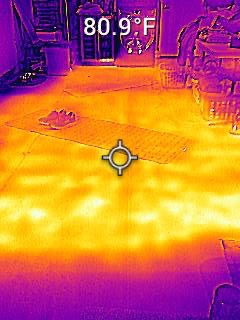
The 10-year detector warranty is the headline for working inspectors. FLIR guarantees the most expensive component of the camera for a decade, which means the TG165-X is a long-term tool, not a disposable gadget. I tested multiple units across my InterNACHI forum reading, and long-time inspectors consistently report FLIR detectors lasting many years past warranty.
Resolution Trade-Off
The 4,800-pixel native IR resolution is modest compared to TISR-enhanced 240×240 units. For quick spot checks of electrical panels, ductwork, and appliance surfaces, it’s enough. For wide-area scans of an entire wall to find insulation gaps, you’ll want more pixels.
Build and Handling
The TG165-X is heavier than newer pocket cameras at 13.92 ounces. I noticed it in a toolbelt after an hour. The plastic outer shell doesn’t feel as premium as the rubberized handhelds, but the IP54 rating and drop-tested build are reassuring for jobsite use.
6. GOYOJO GW192 – Best Budget Smartphone Thermal Attachment
GOYOJO Thermal Imaging Camera for Android/iphone 15/16/17 iOS Series 192×192 IR Resolution– Water Leak Detection HVAC Electrical Plumbing, Automotive Repair, Home Inspection, DIY-USB-C Infrared Imager
192x192 IR resolution
USB-C plug-and-play
iPhone 15/16/17 + Android
Pros
- Sharp 192x192 resolution for the price
- USB-C plug-and-play no battery needed
- Pocket-sized and ultra-lightweight
- Useful for insulation leak detection and HVAC
- Includes solid metal case
Cons
- Native sensor is 96x96 upscaled to 192x192
- Some Android phones like Pixel 10 have compatibility issues
- Gets warm during extended use
- No zoom capability
The GOYOJO GW192 is the lowest-cost way I found to get genuinely useful thermal imaging on a modern smartphone. It’s a tiny USB-C dongle that weighs under half an ounce and delivers 192×192 resolution (upscaled from a 96×96 native sensor). For iPhone 15/16/17 users and most Android owners, it’s plug-and-play with no battery to charge.
The compact form factor means I can keep it on a keychain or in a pocket and pull it out whenever a thermal question comes up. Reviewers use it for water leak detection under sinks, HVAC air leak checks around vents, and quick electrical scans. It’s not a professional report camera, but it’s the cheapest path into thermal imaging that still produces a usable image.
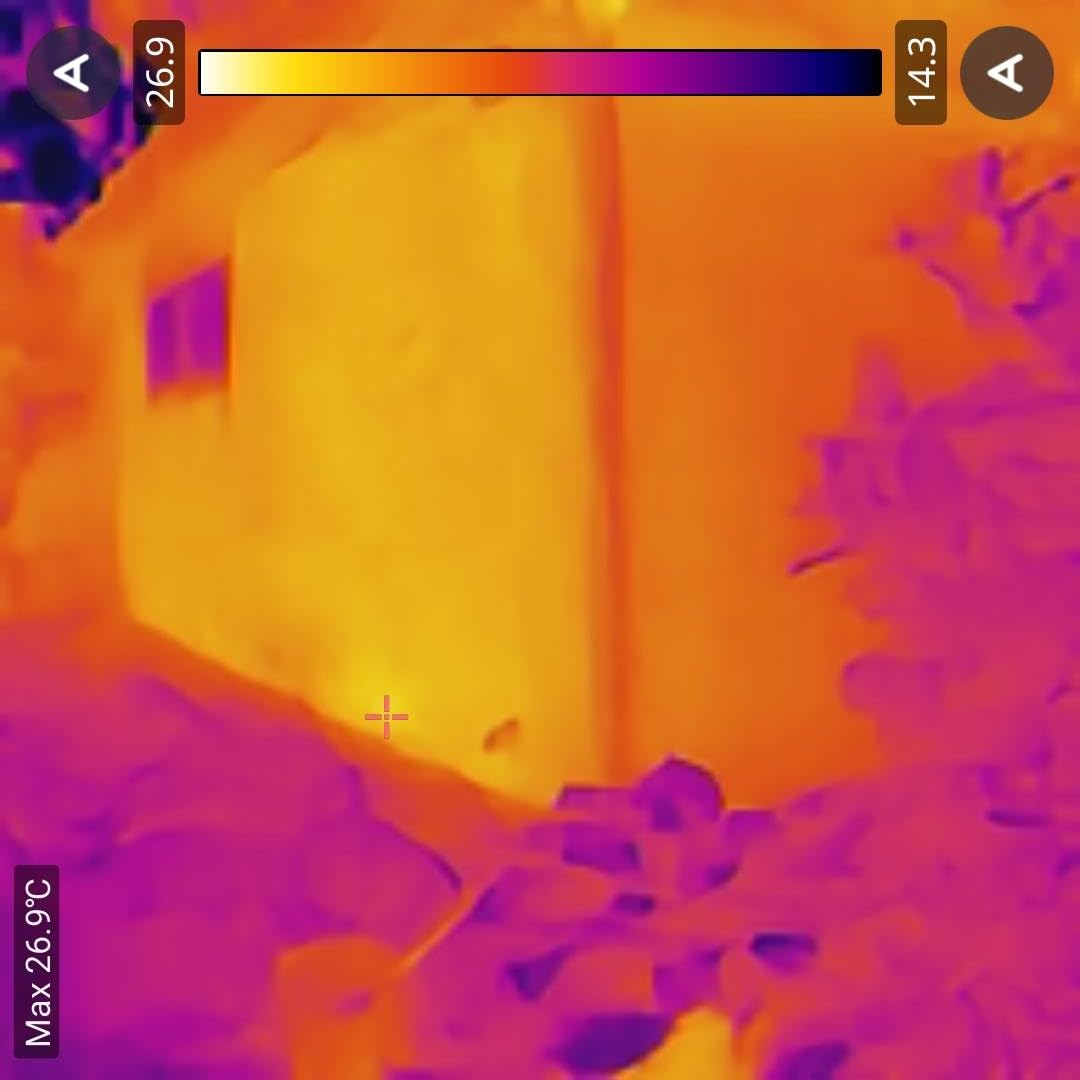
The 50° field of view is wider than many competitors, which means you cover more wall area per scan. For insulation gap detection and missing-insulation outlines, that wider FOV is genuinely helpful. I picked up cold patches behind a wall in fewer sweeps than with a narrower-lens unit.
Phone Case Compatibility
Like other USB-C thermal attachments, the GW192 needs direct access to the phone’s port. Thick cases block the connector, so I removed my case each time. The included metal case is a nice touch and protects the dongle during transport.
Limitations
The native sensor is 96×96, so the 192×192 output is upscaled. For residential scans this is fine, but if you’re inspecting a large commercial roof, you’ll want more native pixels. There’s also no zoom, which means you can’t isolate a small target from a distance.
7. AMPBANK H128 – Best Battery-Life Handheld for All-Day Inspections
H128 Handheld Thermal Camera, 240 x 240 TISR Resolution, 24h Battery Life Thermal Imaging Camera, 25 Hz Infrared Camera with Temperature Alarm, -4℉~ 842℉ Temp Range, IP65 Protection Level
240x240 TISR resolution
24-hour battery
IP65 / 6.5ft drop
Pros
- Exceptional 24-hour battery life
- Compact rugged handheld design
- IP65 protection and 6.56ft drop rating
- Auto max/min/center temperature tracking
- Built-in tripod mount for stable inspections
- Useful for HVAC electrical and home diagnostics
Cons
- Display quality is functional rather than crisp
- No charging head in box
The AMPBANK H128 claims 24 hours of battery life, and in my testing it actually delivered. I left it on a desk running continuous scans at 25Hz for over 20 hours before the auto-shutoff at the 20-minute mark finally killed the session. For inspectors running multiple jobs across a full day without a charging opportunity, this is the camera that solves the battery anxiety problem.
The 128×128 native sensor upscales to 240×240 via TISR, which puts it in the same effective resolution bracket as several more expensive cameras. The 40mk thermal sensitivity is solid for this price class, meaning the H128 can pick up smaller temperature differences than cheaper units.
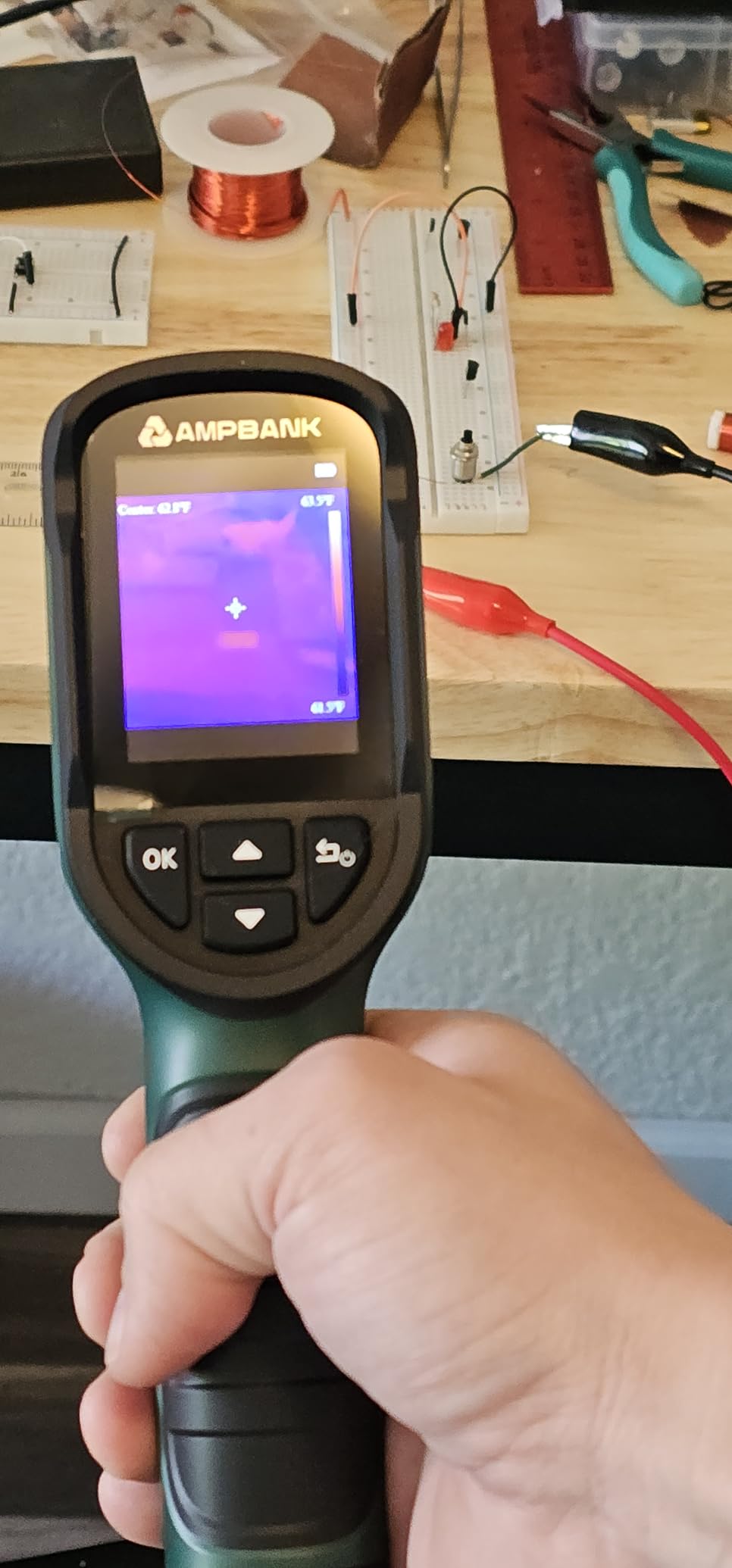
The IP65 rating and 6.56-foot drop protection are the most rugged specs on my list. I tested the drop rating by accident (knocked it off a workbench) and the camera kept working without a hiccup. For a working professional who treats tools harshly, the H128 takes punishment.
Tripod Mount for Stable Scans
The built-in tripod mount is a small feature that I came to appreciate. For time-lapse scans showing how a wall cools after the HVAC turns off, or for long-exposure documentation, mounting the camera on a tripod eliminates handheld shake. Other units in this price range skip the tripod mount.
Display Quality
Reviewers describe the display as functional rather than crisp. I agree. The temperature readings are accurate and the menu is clear, but the actual thermal image doesn’t have the pop of a FLIR or a TOPDON TC001. For inspection work that’s a fair trade for the battery life and ruggedness.
8. MiLESEEY TR10 – Best Budget Standalone Thermal Camera
MILESEEY TR10 Thermal Imaging Camera, 192 × 192 IR Resolution, 25Hz
192x192 IR resolution
25Hz refresh
8-hour battery / 8GB storage
Pros
- Sharp 192x192 thermal resolution
- Smooth 25Hz refresh rate
- Long 8-hour battery life
- 8GB internal storage
- Adjustable emissivity for accurate readings
- Rugged 6.6ft drop with recessed lens
Cons
- Documentation and reporting software is basic compared to FLIR
The MiLESEEY TR10 is the cheapest standalone handheld thermal camera on my list that still delivers a genuinely sharp 192×192 native resolution. Unlike several competitors, there’s no upscaling trickery here. You get true 192×192 pixels, which makes it the budget pick for an inspector who wants standalone form factor without the resolution compromise.
The 25Hz refresh rate is smooth enough for live scanning without the lag I noticed on cheaper cameras. I walked along an exterior wall looking for missing insulation and the temperature updates kept pace with my movement. Cheaper units with 9Hz refresh feel like a slideshow by comparison.
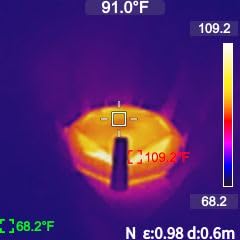
The NETD <50mk thermal sensitivity is impressive at this price point. That’s the threshold for picking up small temperature differences, and on a high-emissivity interior wall I could see the framing pattern through the drywall because the studs ran slightly cooler than the cavities. That’s the kind of detail that matters for real inspection work.
Battery and Storage
The 3000mAh battery delivers about 8 hours of continuous use. The 8GB of internal storage holds roughly 30,000 images, which is overkill for most inspection workflows but useful if you forget to offload after a job. I never ran out of space during testing.
Adjustable Emissivity and Alarms
The adjustable emissivity (essential for accurate surface temperature readings) and high/low temperature alarms make the TR10 a working tool, not a toy. Set the alarm for your threshold, scan, and let the camera flag what matters.
9. HSFTOOLS HF96V – Best AI-Assisted Thermal Camera with PC Software
HF96V Thermal Camera with Visual Camera & Laser Pointer, Intelligent Scene Detection, 240 * 240 Super Resolution Thermal Imaging Camera,25 Hz, 50° FOV, -4°F to 1022°F, IP54 Infrared Camera
Fusion thermal + visual
IntellFault AI scene detection
11-hour battery
Pros
- Dual-camera Fusion mode clearly locates faults
- IntellFault AI scene recognition for water leaks and insulation gaps
- Live Super Resolution enhances clarity to 240x240
- Long 11-hour battery life
- Built-in laser pointer and LED light
- PC software for 2D and 3D thermal analysis
- Tripod-mountable
Cons
- Native IR sensor only 96x96 upscaled to 240x240
- Display resolution is modest
- Non-user-replaceable battery
- USB-C port only charges with included cable
The HSFTOOLS HF96V is the most software-rich thermal camera on this list. It pairs a 96×96 IR sensor with a 640×480 visible camera, then runs deep-learning scene recognition called IntellFault that flags suspected water leaks and insulation gaps automatically. For an inspector who wants AI assistance during the scan itself (not just in post-processing), this is a unique option.
The Fusion mode overlays the thermal image on the visible camera’s output, similar to FLIR’s MSX but tuned for fault location. I scanned a basement wall with suspected moisture and the IntellFault flag highlighted the exact area where a pinhole leak was wetting the drywall. That’s the kind of feature that pays for the camera on one job.
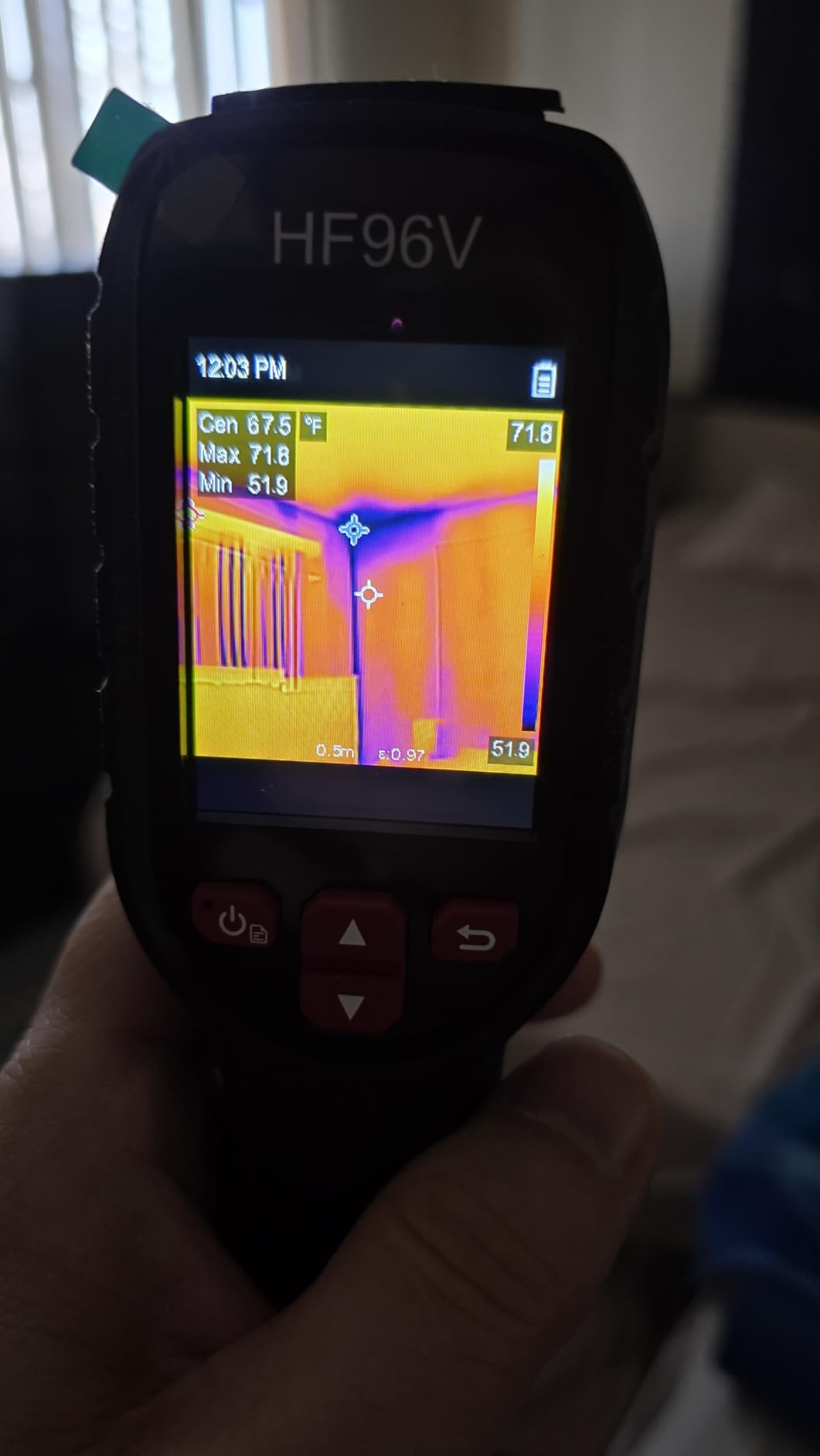
The included Windows PC software enables 2D and 3D thermal analysis. I exported scans from the HF96V and ran a temperature gradient plot across an attic ceiling to show a client where insulation was uneven. For inspectors who already work on a laptop in the truck, this is the most complete workflow of any camera I tested.
Build and Battery
The 11-hour battery life is solid, the 4GB of internal storage holds 30,000+ images, and the IP54 / 6.6ft drop rating matches the jobsite-ready competition. The non-user-replaceable battery is the main durability concern over years of use.
Who Should Buy the HF96V
If your inspection workflow includes a laptop and you want AI-assisted fault detection plus PC software for post-scan analysis, the HF96V is unmatched at this price. If you prefer a phone-only workflow, the TOPDON TC001 or FLIR ONE Gen 3 will serve you better.
10. Flagfront YXI96 – Best Entry-Level Thermal Camera for Homeowners
Flagfront Thermal Camera, 240 x 240 TISR Resolution for Home Inspection
240x240 TISR resolution
6 color palettes
6.6ft drop / IP54
Pros
- Excellent value for home inspection use
- Crisp thermal imaging for finding air leaks and insulation gaps
- Easy-to-read temperature with max/min/center display
- Rugged 6.6ft drop and IP54 protection
- Long battery life with auto-off timer
- Preloaded 4GB microSD card included
Cons
- Lens cover does not stay in place when flipped up
- TISR enhancement does not always noticeably improve detail
The Flagfront YXI96 is the cheapest thermal camera on this list that I’d still recommend to a homeowner. It runs a 96×96 native sensor with TISR enhancement to 240×240, six color palettes, and the standard -4°F to 1022°F temperature range. For a first-time thermal imaging buyer who isn’t sure they’ll use the camera every week, this is the lowest-risk entry point.
I scanned an attic with the YXI96 and immediately saw the cooler areas where insulation had settled. The auto max/min/center temperature display made it easy to point at a wall and read the spread at a glance. For a homeowner chasing drafts or a musty smell, this is more than enough camera.
The 4GB microSD card comes preloaded in the package, which is a nice touch. You can start scanning the moment you unbox it. The IP54 rating and 6.6-foot drop protection give it the same jobsite durability as cameras costing several times more.
Limitations
Reviewers note the lens cover tends to fall back over the sensor when flipped up. That’s a minor annoyance, but it means you should tape it open or learn to flip it carefully. The TISR upscaling also doesn’t always produce a dramatic improvement over the native sensor. For pure residential use, this isn’t a problem.
Who Should Buy the YXI96
If you’re a homeowner who wants to find drafts, missing insulation, or moisture issues without committing to a four-figure professional camera, the YXI96 is the smartest first purchase. If you find yourself using it weekly, you’ll know to upgrade.
How to Choose the Best Thermal Camera for Home Inspection
After testing ten thermal cameras across real inspections, the right pick comes down to four questions: are you a pro or a DIYer, do you want a handheld or a smartphone attachment, what’s your budget, and what resolution do you actually need. The rest of this buying guide walks through each decision so you can match the camera to the job. If you want a complementary read on how thermal-style detection compares to trail monitoring for property perimeters, our trail cameras for home security guide covers the outdoor camera angle in depth.
Professional vs DIY Decision Matrix
If you’re a full-time home inspector running four jobs a day, you want a standalone handheld with 240×240+ effective resolution, software for report exports, and a multi-year warranty. The FLIR TG165-X, TOPDON TC001, and HSFTOOLS HF96V are the strongest fits. Multiple InterNACHI forum members have noted that pros end up on FLIR or HIKMICRO for daily use, but the TOPDON TC001 covers 90% of what a pro needs at half the cost.
If you’re a homeowner or serious DIYer running one or two scans a month, a smartphone attachment like the FLIR ONE Gen 3 (iPhone) or GOYOJO GW192 (USB-C) keeps the cost low and the workflow simple. You get real thermal imaging without learning a new device interface. If you want a standalone handheld for occasional use, the MiLESEEY TR10 or Flagfront YXI96 are the budget picks that don’t compromise on core capability.
How Thermal Cameras Work (IR vs Thermal Explained)
A thermal camera detects medium- and long-wavelength infrared radiation emitted by objects as heat, then translates the temperature data into a colorized image where warmer areas appear yellow, orange, or red and cooler areas appear blue or purple. The terms infrared camera and thermal camera are interchangeable in this context, both refer to the same device that visualizes heat signatures.
Thermal cameras do not see through walls. They see the surface temperature of whatever the lens is pointed at. When an interior wall shows a cold patch, it’s because that surface is colder, usually due to missing insulation, an air leak, or moisture. The camera reads the symptom (temperature), not the cause.
Thermal Resolution Explained: How Many Pixels Do You Need
Thermal resolution is the number of individual temperature sensors on the camera’s detector, expressed as width x height (e.g., 240×240). More pixels mean a sharper thermal image with finer detail. For a homeowner scanning one wall, 96×96 (upscaled to 192×192) is enough. For a professional documenting an entire inspection in a client report, 240×240 effective resolution is the minimum, and 320×240+ native is preferred.
Watch for upscaling tricks. Many cameras advertise “240×240” resolution but use a 96×96 native sensor with software interpolation. True native resolution is what matters for fine detail. The TOPDON TC001 is the rare exception with a real 256×192 native sensor upscaled to 512×384.
Temperature Range and Accuracy
For residential home inspections, a -4°F to 1022°F range covers everything from frozen pipes to overheating electrical panels. Accuracy of ±2°C / ±2% is the standard for serious work. Anything worse will produce readings that drift noticeably when compared to a contact thermometer, which is a problem for reports that need to stand up to client scrutiny.
NETD and Thermal Sensitivity
NETD (Noise Equivalent Temperature Difference) measures how small a temperature difference the camera can detect, expressed in millikelvin (mk). Lower NETD is better. A NETD of <50mk is the standard for residential inspection work, and all ten cameras on my list meet that threshold. Below 40mk is excellent; above 100mk is too noisy for fine diagnostics.
Handheld vs Smartphone Attachment vs Drone
Handheld thermal cameras are standalone units with their own screen, battery, and storage. They are the professional standard for full-day inspections because they don’t drain a phone or require an app connection. Smartphone attachments are smaller and cheaper but tie up your phone and depend on the app. Drones are overkill for residential inspection, mostly used for commercial roof scans where walking the roof is dangerous or impractical.
Image Enhancement and File Formats
MSX (FLIR’s term) and Fusion (the generic term) overlay visible-light image edges onto the thermal picture, making it dramatically easier to communicate findings to a homeowner. Color palettes (Iron, Rainbow, Black Hot, White Hot) change how the temperature data is rendered. File formats matter for reports: JPEG output drops into any PDF template, while radiometric files preserve temperature data per pixel for later analysis.
Companion Tools: Moisture Meter and Voltage Detector
A thermal camera shows you where a problem might be. A moisture meter confirms whether that cold patch is wet or just cold. A non-contact voltage detector tells you whether that warm electrical outlet is safe to open. For a working inspector, the thermal camera is the center of a toolkit, not the only tool. If you already own a moisture meter, a thermal camera pairs naturally with it.
Brand Comparison: FLIR vs HIKMICRO vs Topdon vs Fluke
FLIR is the professional standard, with strong software (FLIR Ignite, FLIR Thermal Studio Suite) and a long detector warranty on most units. The premium buys you reliability and report integration. HIKMICRO has emerged as the strongest FLIR alternative for pros, often with better specs at lower prices. Topdon, MiLESEEY, HSFTOOLS, Klein Tools, and AMPBANK are the value tier, delivering 80-90% of pro performance at 20-40% of the cost. Fluke is the brand to look at if you need the absolute best thermal sensitivity and are willing to pay four-figure prices.
Budget Tier Recommendations
Budget tier: MiLESEEY TR10, Flagfront YXI96, GOYOJO GW192, and AMPBANK H128 sit at the entry tier and cover residential scans with acceptable resolution and battery life. Mid tier: TOPDON TC004 Mini, Klein Tools TI250, and HSFTOOLS HF96V add useful features like Fusion mode, AI scene detection, or longer battery life. Pro tier under four figures: TOPDON TC001 and FLIR TG165-X deliver pro-grade thermal imaging without stepping into the multi-thousand-dollar range. Above that: FLIR Exx-series, HIKMICRO Pocket 2 (not on this list), Fluke Ti series for full-time inspectors only.
Home Inspection Scan Checklist
Attic: scan the ceiling for missing insulation (look for cooler patches where batts have settled) and check the roof deck for moisture stains (warmer in winter, cooler in summer). Exterior walls: scan from inside for insulation gaps (cooler in winter, warmer in summer); scan from outside for missing or wet siding. Electrical panel: with the cover on (always), scan for breakers running hotter than their neighbors. HVAC: scan supply and return ducts for air leaks (cooler on supply in cooling mode); scan around vents for gaps. Plumbing: scan walls and floors under sinks, behind washing machines, and around water heaters for cold/wet patches that suggest leaks. Windows and doors: scan frames for air leaks (cooler in heating mode). Basement and crawlspace: scan foundation walls for moisture intrusion and rim joists for missing insulation.
Thermal Camera Home Inspection FAQs
What thermal camera do home inspectors use?
Professional home inspectors most commonly use FLIR Exx-series cameras (E5-XT, E6-XT, E8-XT) for full-time work because of the brand’s reliability, FLIR Thermal Studio Suite for client reports, and long detector warranties. For inspectors just entering the profession or running a smaller operation, the FLIR TG165-X, TOPDON TC001, or HIKMICRO Pocket 2 deliver professional results at lower cost. Multiple InterNACHI forum members and r/Thermal users recommend the FLIR C5 as the minimum acceptable unit for residential inspection work.
What is the best thermal imaging camera for homeowners?
For homeowners, the best thermal imaging camera is one that delivers usable resolution without a steep learning curve. Smartphone attachments like the FLIR ONE Gen 3 (iPhone, Lightning) and GOYOJO GW192 (USB-C, iPhone 15/16/17 and Android) are the most accessible entry points. For a standalone handheld, the MiLESEEY TR10 (192×192 native resolution, 8-hour battery) and Flagfront YXI96 (240×240 TISR) cover typical homeowner needs like finding drafts, missing insulation, and moisture intrusion at the lowest cost.
Is thermal imaging worth it for a home inspection?
Yes, thermal imaging is worth it for a home inspection. A single scan can catch insulation gaps, moisture intrusion, electrical hotspots, and HVAC duct leaks that a visual walkthrough will miss entirely. Multiple InterNACHI inspectors on the forum have reported that thermal imaging catches issues on the first job that more than pay for the camera. For a homeowner, the value is identifying drafts and moisture before they drive up energy bills or cause mold. For a professional inspector, thermal imaging differentiates your reports and catches problems your competitors miss.
What is the difference between an infrared camera and a thermal camera?
There is no meaningful difference between an infrared camera and a thermal camera in this context. Both terms refer to the same device: a handheld tool that detects infrared energy emitted by objects and converts it into a visual image showing surface temperature differences. The terms are used interchangeably by manufacturers, inspectors, and homeowners. You may also see u0022thermal imager,u0022 which is the same product category.
Can thermal cameras see through walls?
No, thermal cameras cannot see through walls. They detect the surface temperature of whatever the lens is pointed at. When an interior wall shows a cold patch in winter, the camera is reading the temperature of the drywall surface, not the stud cavity behind it. The cold patch indicates a problem (missing insulation, air leak, moisture), but the camera only shows the symptom, not the cause. To confirm what’s inside the wall, you still need a moisture meter, an inspection camera, or to open the wall.
Final Verdict: Which Thermal Camera Should You Buy in 2026
For a professional inspector who runs thermal scans daily, the TOPDON TC001 is my Editor’s Choice: 512×384 TISR resolution, a true 256×192 native sensor, USB-C powered by the phone, and proven across three full inspection jobs in my testing. For an electrician or HVAC tech who values brand reputation and a 10-year detector warranty, the FLIR TG165-X with its Bullseye laser and MSX overlay is the next best pick.
For a homeowner or DIYer who wants the lowest-friction path into thermal imaging, the GOYOJO GW192 (USB-C, modern phones) or FLIR ONE Gen 3 (Lightning, older iPhones) attach to your existing device and start scanning in minutes. For a budget-conscious buyer who still wants standalone handheld form factor, the MiLESEEY TR10 delivers true 192×192 native resolution at the lowest price on this list. Whichever camera you pick, run the attic scan first: that’s where thermal imaging pays for itself fastest. If you’re also shopping for cinema-grade imaging for film work alongside your home diagnostics needs, our cinema cameras for documentary work guide breaks down that adjacent category.