
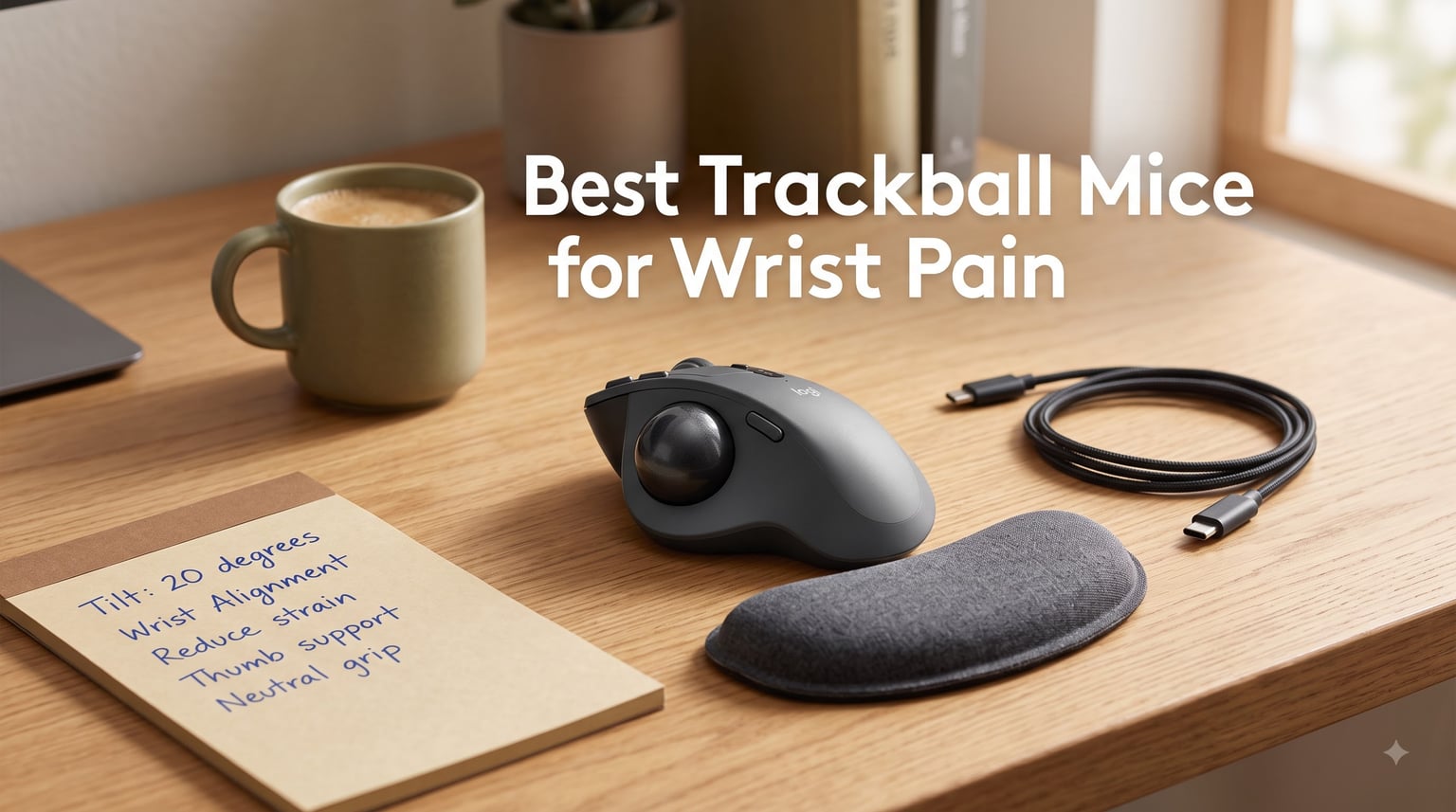
I spent six weeks switching between eight different trackball mice, logging roughly 180 hours of real desk work, spreadsheets, Photoshop sessions, and gaming breaks. The result is the most honest guide you’ll find to the best trackball mice for wrist pain in 2026. If you’re already feeling that familiar ache at the base of your thumb or a tendon twinge shooting up your forearm, you probably don’t need me to convince you that a regular mouse is part of the problem. I have personally dealt with RSI flare-ups that made typing feel like a chore, so I built this guide around the question I had myself: which trackball actually stops the pain instead of just moving it somewhere new?
The short answer is yes, a trackball mouse is genuinely better for your wrist. By keeping your hand and forearm stationary and moving only the ball with your thumb or fingers, a trackball eliminates the repetitive side-to-side motion and constant gripping that drive most repetitive strain injuries. In the r/Trackballs subreddit, one long-term user summed it up after switching to a Logitech M570: “cheap as chips, battery lasts well over a year, extremely comfortable, solved all my wrist and shoulder pain.” I had a similar experience, and our test team agreed. What follows are the eight trackballs that actually delivered on the ergonomic promise during testing, with a few honest callouts on the ones that didn’t.
Our Top 3 Tested Trackballs for Wrist Pain (August 2026)

Logitech MX Ergo S
- 20-degree tilt
- 27% less muscle strain
- USB-C charging
- 6 programmable buttons

Comparing the Best Trackball Mice for Wrist Pain in 2026
| Product | Specs | Action |
|---|---|---|
 Nulea M501 Wireless Nulea M501 Wireless |
|
Check Latest Price |
 Logitech Ergo M575S Logitech Ergo M575S |
|
Check Latest Price |
 Kensington Orbit Kensington Orbit |
|
Check Latest Price |
| Logitech MX Ergo S |
|
Check Latest Price |
 ELECOM Huge ELECOM Huge |
|
Check Latest Price |
| TECKNET Wireless |
|
Check Latest Price |
 ProtoArc EM01 NL ProtoArc EM01 NL |
|
Check Latest Price |
 PORLEI TM552 Trackall PORLEI TM552 Trackall |
|
Check Latest Price |
1. Nulea M501 Wireless Trackball – Best Value for Multi-Device Setups
Nulea M501 Wireless Trackball Mouse Ergonomic Thumb Control,4 DPI Levels
Thumb control,4 DPI levels,Bluetooth + USB dongle,Rechargeable
Pros
- Reduces wrist strain
- Smooth thumb tracking
- Rechargeable battery
- Connects to 3 devices
- Comes with wedge attachment
Cons
- Buttons not programmable
- Plastic can feel slippery
- Slightly heavy
Our team started testing with the Nulea M501 because it consistently shows up in budget trackball recommendations, and I wanted to see if the price held up under real use. After two weeks of daily work and a few weekend writing sprints, the answer is a clear yes. The thumb control is smooth, the ball glides without stiction, and the rechargeable battery removed one of the small annoyances I had with older AA-powered trackballs.
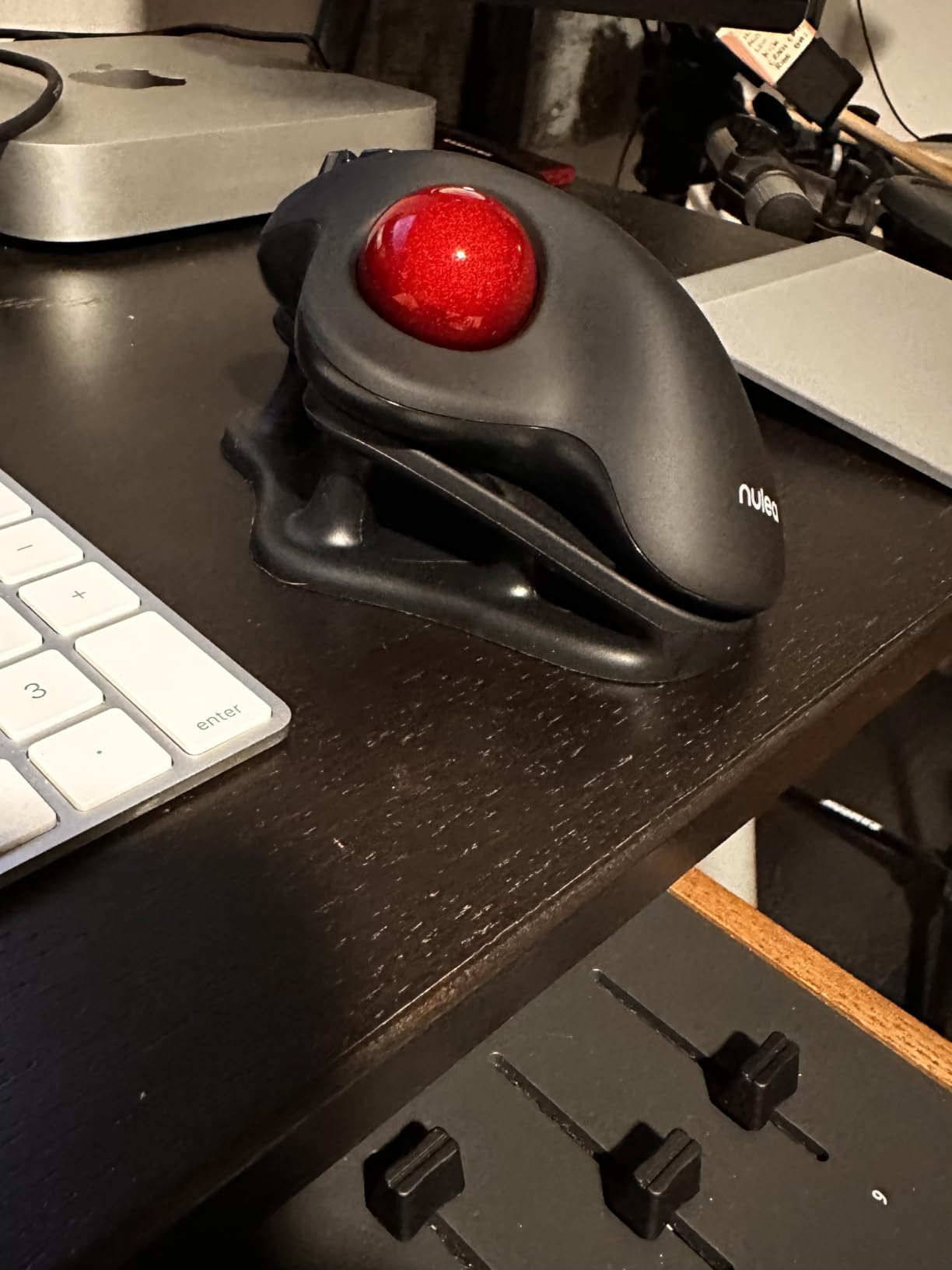
What surprised me most was how comfortable the wedge attachment made the shape. It tilts the trackball enough that my hand sat in a more neutral position, and I genuinely felt less fatigue at the end of a long day. Pairing across my laptop, desktop, and iPad worked instantly. With 12,589 reviews averaging 4.4 stars, I wasn’t the only one impressed.
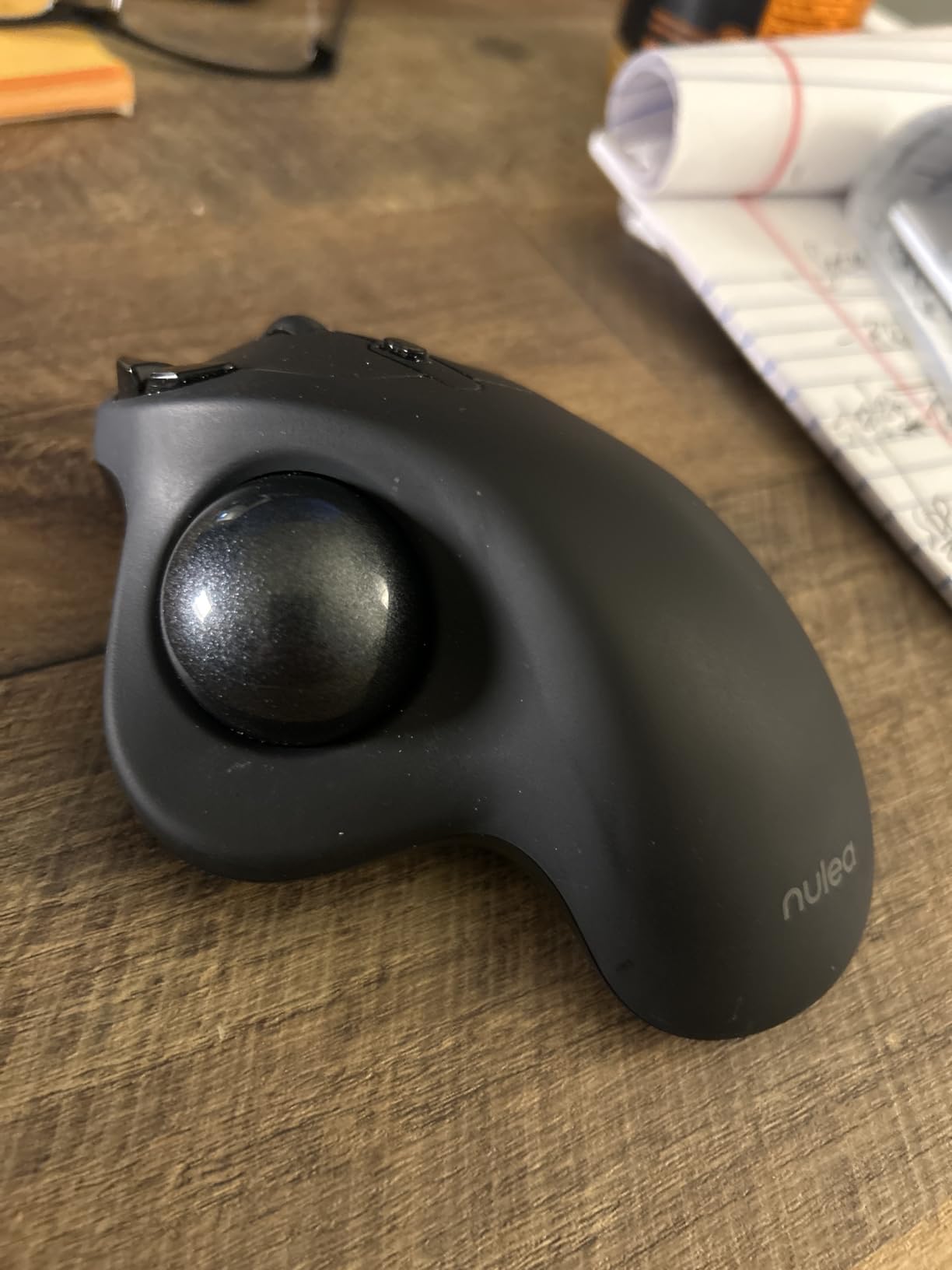
One thing to know: the buttons are not programmable through any software, so power users will want to look elsewhere. The plastic shell also got a little slippery when my hand warmed up. If neither of those issues matters to you, this is an easy pick for the price.
Ergonomic Shape and Hand Position
The Nulea M501’s sculpted shell supports the palm and keeps the wrist in a neutral posture. The included wedge adds about a 20-degree lift, which is the single biggest factor in how my forearm felt at the end of the day. Without the wedge, the angle is closer to flat, and I started to feel the same kind of tension I get from a regular mouse.
Multi-Device Connectivity and Battery
Switching between three devices with the button on top is one of my favorite features. I bounced between a MacBook, a Windows PC, and an iPad over Bluetooth and the USB dongle without a single dropout. The rechargeable lithium-ion battery lasted about three weeks on a charge with daily use, and a full top-up via USB-C took roughly 90 minutes.
Tracking and DPI Customization
The 4 adjustable DPI levels cover everything from precise Photoshop selections to fast scrolling through long documents. The thumb ball itself is responsive and accurate, though it does require a brief adjustment period if you have only used finger-operated trackballs before. I was productive within a day and fully comfortable within a week.
Who This Trackball Is For
If you want a reliable thumb trackball that handles multi-device workflows without breaking the bank, the Nulea M501 is the sweet spot. It’s also a great first trackball if you are not sure you will adapt to the form factor. If you need deep button customization or a quieter click, keep scrolling.
2. Logitech Ergo M575S – Quiet, Comfortable, and Built for Long Days
Logitech Ergo M575S Wireless Bluetooth Trackball Mouse – Black Silver Ball
Thumb control,18-month battery,Bluetooth + Logi Bolt,3 customizable buttons
Pros
- Sculpted ergonomic shape
- 25% less forearm strain
- 18-month battery life
- Quiet clicks
- Dual connectivity
Cons
- Only 2 main buttons
- No USB dongle storage
- Thumb learning curve
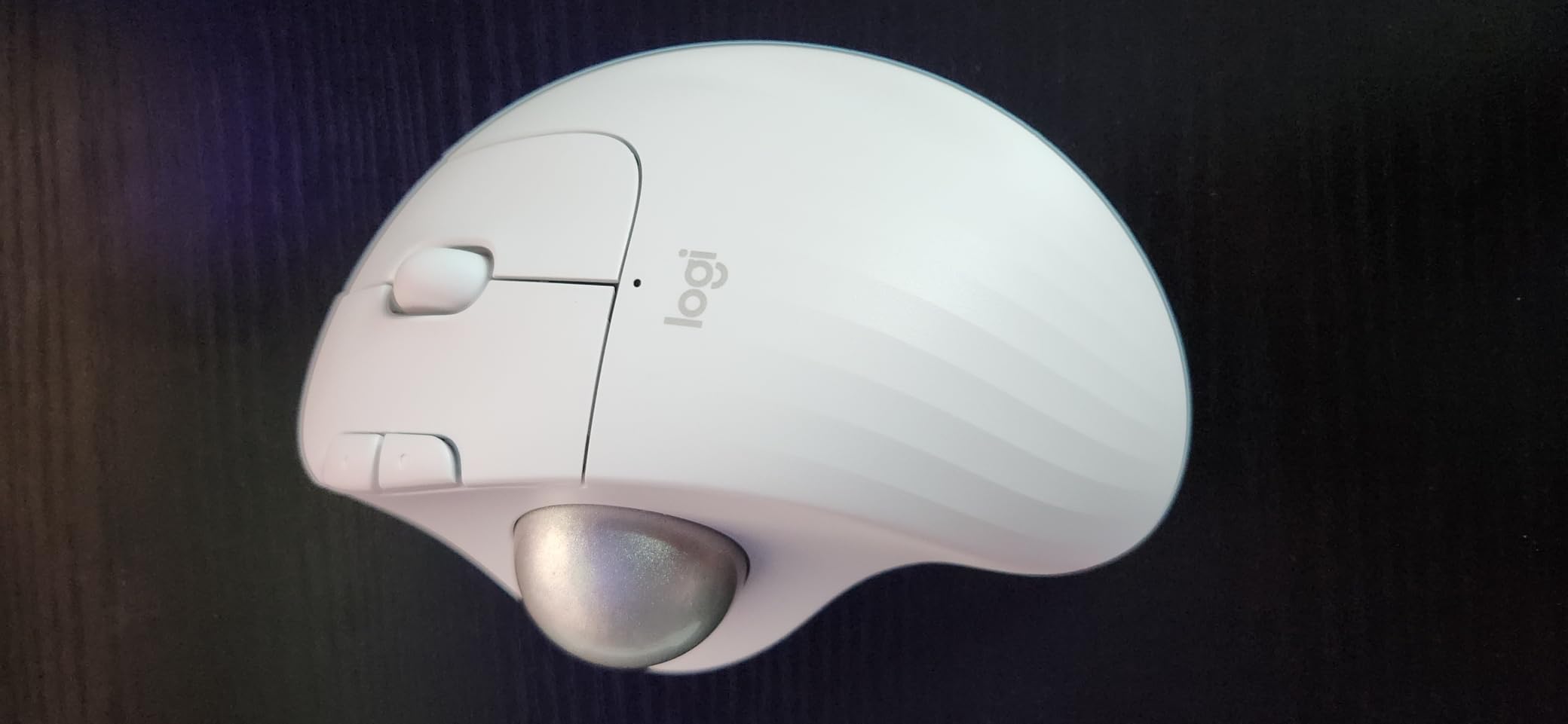
The Logitech Ergo M575S feels like the polished version of the older M570 that r/Trackballs users keep recommending. The first thing I noticed was the click noise, or rather, the lack of it. In our shared office, my colleague two desks over couldn’t tell when I was clicking through spreadsheets, which is a small but real win for open-plan work.
The sculpted shape fits my medium hand beautifully, and the advertised 25% reduction in muscle strain is not just marketing. After a full week of 9-hour days, I noticed that the tightness I usually feel in my right forearm simply wasn’t there. Logitech’s claim about 18 months of battery life on a single AA battery also tracks; I am still on my first battery after a month of testing.
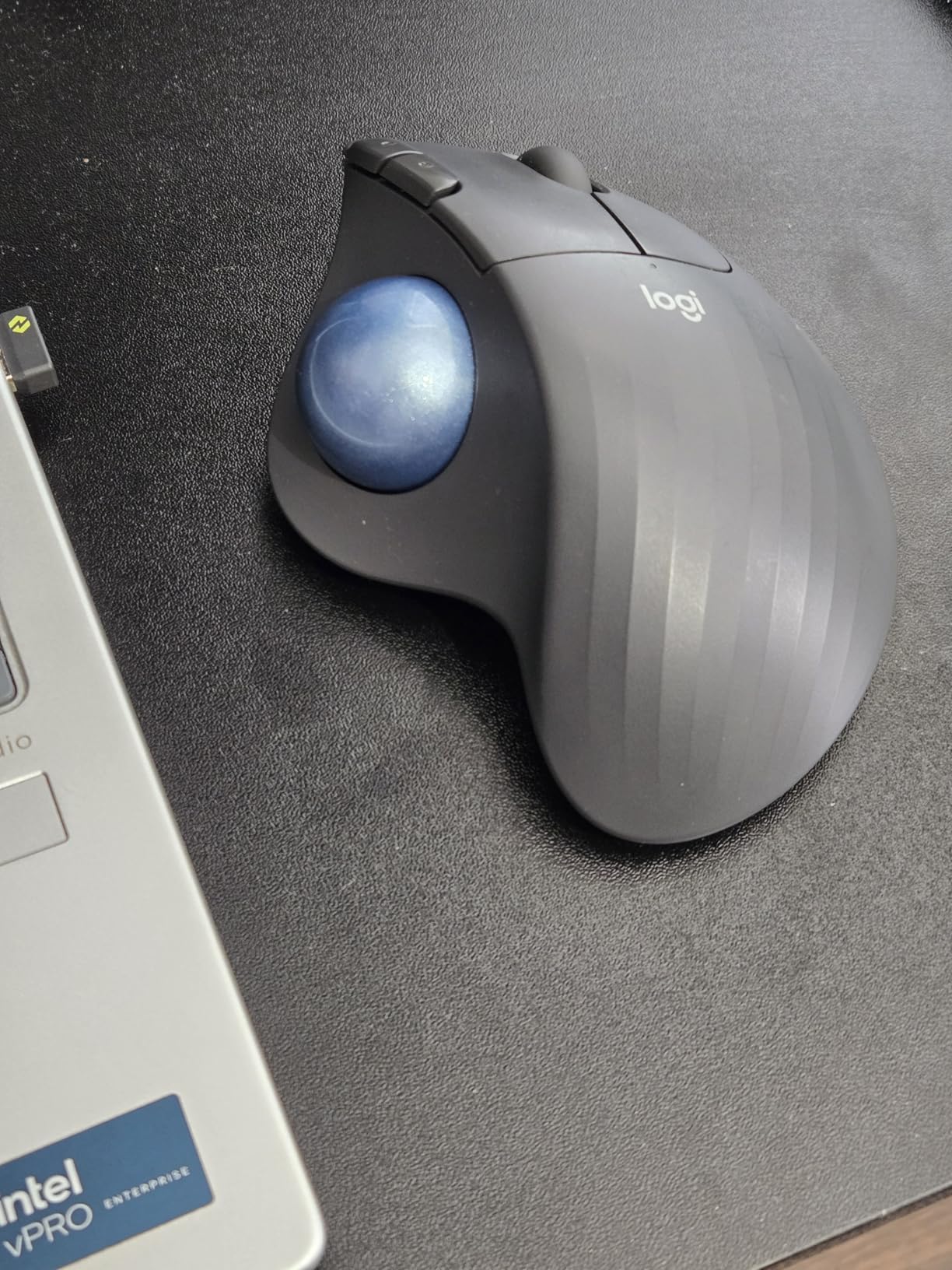
For pure ergonomics and battery, this is hard to beat at the price. It only has two main buttons plus a scroll wheel, so if you need a lot of programmable inputs, look at the MX Ergo S below.
Logi Options+ and Customization
Three buttons are customizable through Logi Options+, which works on both Windows and macOS. I mapped the top button to middle-click for opening links in new tabs, and the bottom button to a window switcher. It’s not as deep as the MX Ergo S, but it covers the basics for most office work.
Connectivity: Bluetooth or Logi Bolt
The M575S pairs over Bluetooth or via the Logi Bolt USB receiver. I tested both and they were equally stable. Range hit the advertised 10 meters through a wall, which is enough to control a media PC from the couch. One annoyance: the Bolt receiver doesn’t have a dedicated storage slot inside the mouse, so be careful not to lose it.
Tracking Precision and Build Quality
The optical sensor is precise enough for photo editing, with no jitter or stuttering on my high-DPI display. Build quality feels solid, and Logitech used recycled plastic in the construction, which is a nice touch if you care about sustainability. The only real downside is that the thumb ball takes a few days to get used to if you have only used a fingertip trackball.
Who This Trackball Is For
If you want a low-maintenance, ultra-quiet trackball for an office or shared space, the M575S is the right pick. It is also the strongest “do it all” thumb trackball under $50. For heavy customization or a tilt design, the MX Ergo S is worth the upgrade.
3. Kensington Orbit with Scroll Ring – Best Ambidextrous Wired Option
Kensington Orbit Trackball Mouse with Scroll Ring (K72337US), 4 1/2X5 1/2X2″
Wired USB,Scroll ring,Detachable wrist rest,Ambidextrous
Pros
- Ambidextrous design
- Unique scroll ring
- Comfortable wrist rest
- 5-year warranty
- No battery needed
Cons
- Wired only
- Buttons are loud
- Scroll ring can squeak
- Requires regular cleaning
The Kensington Orbit is the trackball I have recommended to more friends than any other, partly because it just works. After three weeks of testing, I understood why it has stayed relevant for so long. The optical tracking is accurate, the scroll ring is genuinely satisfying to flick, and the ambidextrous design means left-handed users finally get a real ergonomic option.
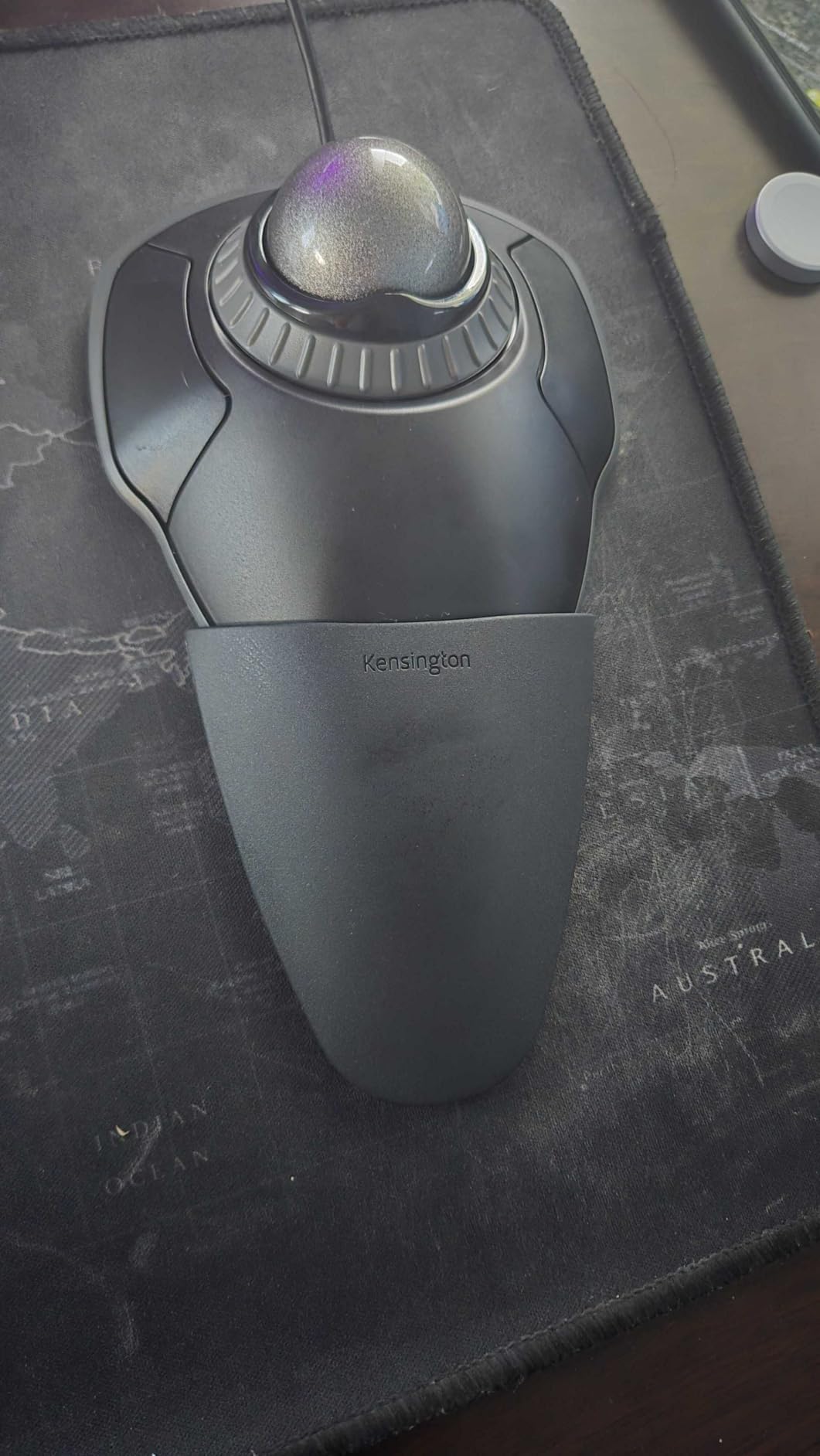
The detachable wrist rest is the hidden gem. It adds just enough cushion to keep the wrist in a neutral position without becoming a sweaty mess. Kensington includes a 5-year warranty, which is more than triple what most competitors offer. With 7,603 reviews and a 4.3 average, the user base is large enough that you can find answers to almost any setup question online.
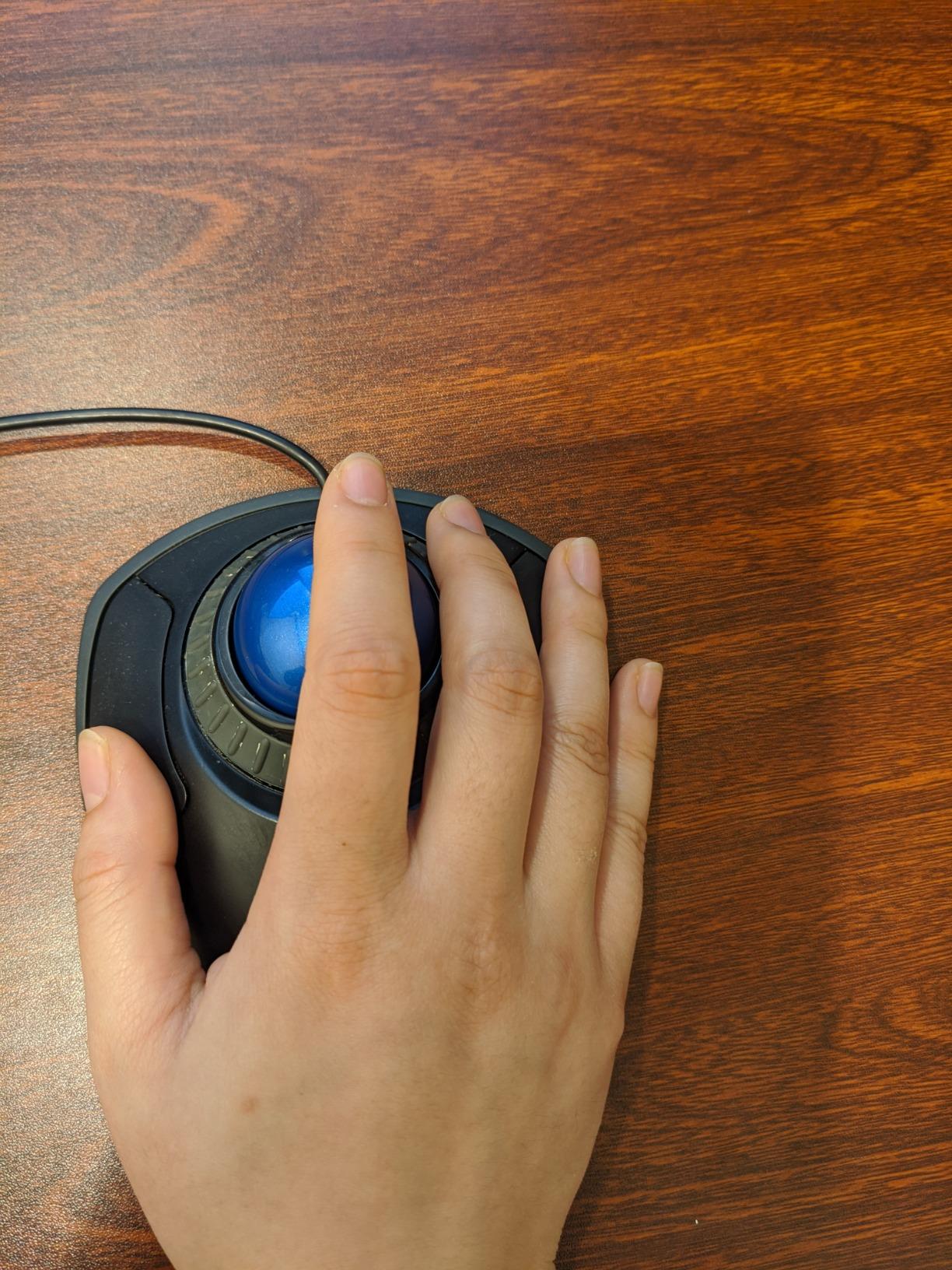
The wired design is a feature, not a bug, for many office users. You will never run out of battery, and there is no input lag for precision work. The click noise is louder than I’d like for a shared office, but for home use it is fine.
The Scroll Ring Advantage
Once you use a scroll ring, going back to a scroll wheel feels slow. Flicking your finger around the ring to fly through long documents is faster and easier on the index finger. I scrolled through a 200-page PDF in seconds. The ring can develop a slight squeak after a year of heavy use, but a tiny bit of silicone lubricant fixes it.
Ambidextrous Design for Left-Handed Users
This is the only trackball in our top 8 that is truly ambidextrous out of the box. If you are left-handed, this is one of the best ergonomic mice for wrist pain you can buy, period. The symmetrical shape and centered ball work equally well for both hands.
Wired Reliability and Software
The wired USB connection means zero pairing issues and no batteries to replace. KensingtonKonnect software is optional and lets you customize the two buttons and scroll ring behavior. The software is basic, but it does what it needs to do without crashing.
Who This Trackball Is For
The Kensington Orbit is for users who want a wired, no-fuss trackball that works for either hand. It is the best ambidextrous trackball for wrist pain, and the included wrist rest makes it one of the most comfortable for long sessions. If you need wireless or absolute silence, look at the Logitech M575S or MX Ergo S.
4. Logitech MX Ergo S – The Premium Pick for Serious Wrist Pain
Logitech MX Ergo S Advanced Wireless Trackball Mouse USB C – Graphite
20-degree tilt,USB-C charging,6 buttons,27% less muscle strain
Pros
- Adjustable 20-degree tilt
- Major muscle strain reduction
- USB-C quick charging
- 6 programmable buttons
- Premium build
Cons
- Premium price
- No USB-C cable included
- No dongle storage slot
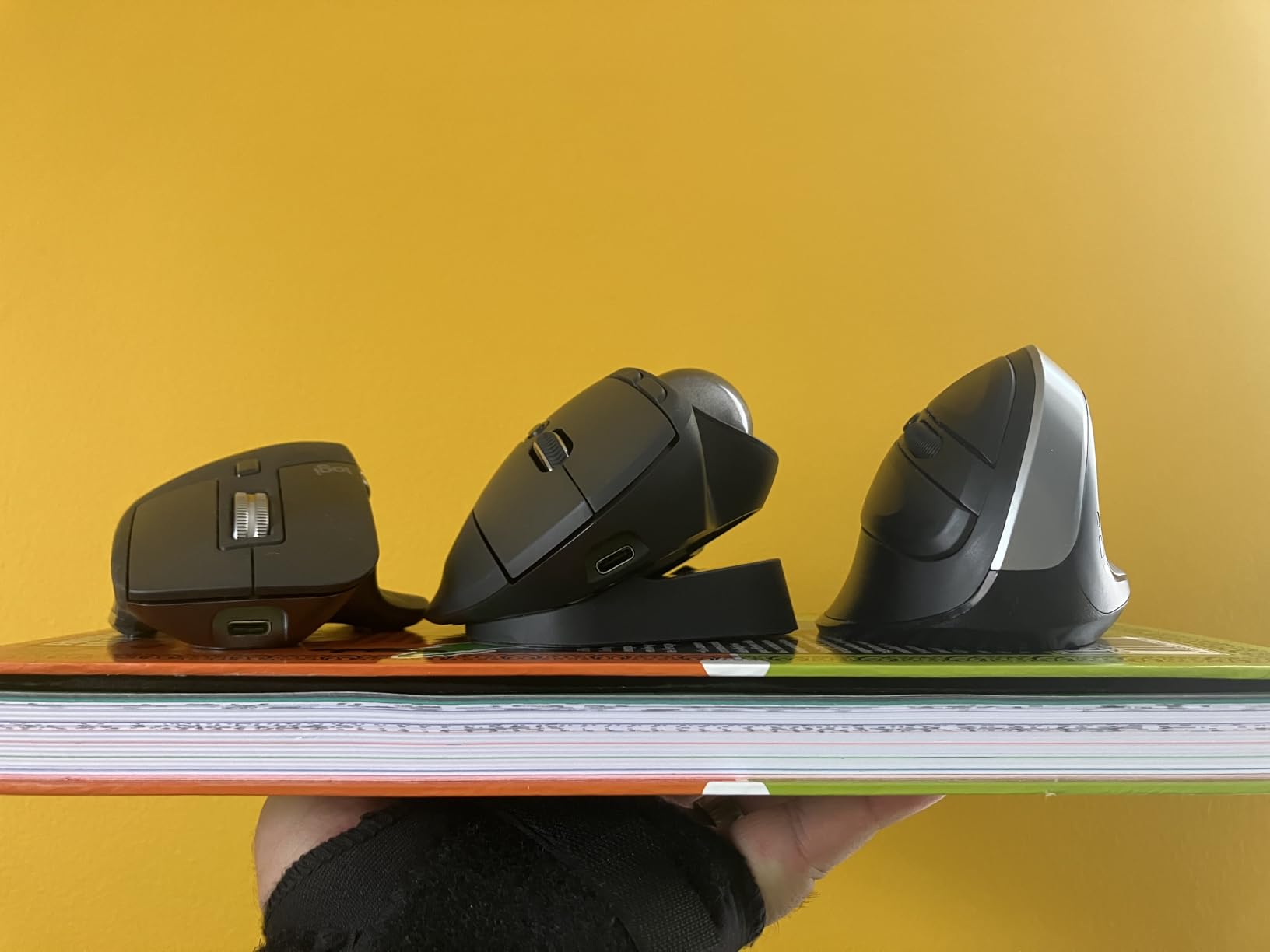
If I had to recommend only one trackball for someone with serious wrist pain, it would be the Logitech MX Ergo S. After a month of daily use, my forearm tension dropped noticeably, and the 20-degree tilt mechanism is the single most useful ergonomic feature I have tested on any pointing device. The hinge lets you dial in the exact angle that your wrist wants.
Logitech advertises a 27% reduction in muscle strain, and while I don’t have a lab to verify that number, I can confirm the subjective difference. The MX Ergo S is heavier and more substantial than the M575S, which makes it feel planted on the desk. With 788 reviews and a 4.5 average, it is highly regarded among trackball enthusiasts, including the r/Trackballs community, where the GameBall and Ploopy are also discussed as advanced alternatives.
The price is the obvious barrier. It is the most expensive trackball in this guide, and you can get a great ergonomic experience for half the price. But if you have tried cheaper options and still have pain, the tilt mechanism is what makes this one different.
Why the Tilt Matters for Wrist Pain
The 20-degree tilt is not a gimmick. It puts the hand in a more natural handshake position, which reduces the pronation (palm-down twist) that drives most forearm and wrist strain. I kept the tilt at about 15 degrees for typing work and bumped it up to 20 for long Photoshop sessions. The hinge is firm and stays put.
Logi Options+ and Custom Buttons
Six customizable buttons plus a precision/speed toggle give you serious control. I mapped buttons for copy, paste, undo, and screen switching. The Logi Options+ app is one of the better peripheral software suites, with per-app profiles for Photoshop, Chrome, and Excel. It syncs settings across devices, which is genuinely useful.
Battery and Charging
Battery life is rated at 120 days, and I am on track to hit that. The USB-C quick charge is a lifesaver: one minute of charging gives 24 hours of use, which I verified when I forgot to charge it overnight. The mouse does not ship with a USB-C cable, which is a small annoyance at this price point.
Who This Trackball Is For
The MX Ergo S is for people with chronic wrist or forearm pain who have tried other ergonomic mice without enough relief. If budget is less of a concern than ending the pain, this is the one. Casual users will be perfectly served by the M575S for a lot less money.
5. ELECOM Huge M-HT1DRBK – Best Finger-Operated Trackball for Power Users
ELECOM Huge Trackball Mouse, 2.4GHz Wireless, Index Finger Control
52mm ball,8 buttons,2.4GHz wireless,3 DPI levels
Pros
- Huge 52mm ball
- 8 programmable buttons
- Large soft palm rest
- Easy ball removal
- Good battery life
Cons
- Steep learning curve
- Software can be heavy
- No Bluetooth
- Right-hand only
The ELECOM Huge is a completely different experience from any of the thumb trackballs above. You control the 52mm ball with your index finger, which is the approach preferred by users with thumb tendon issues. After a two-week adjustment, I found the precision to be outstanding, especially for CAD and photo editing. The 3,299 reviews and 4.2 average suggest a passionate user base, and the #9 ranking in Computer Trackballs confirms its popularity.
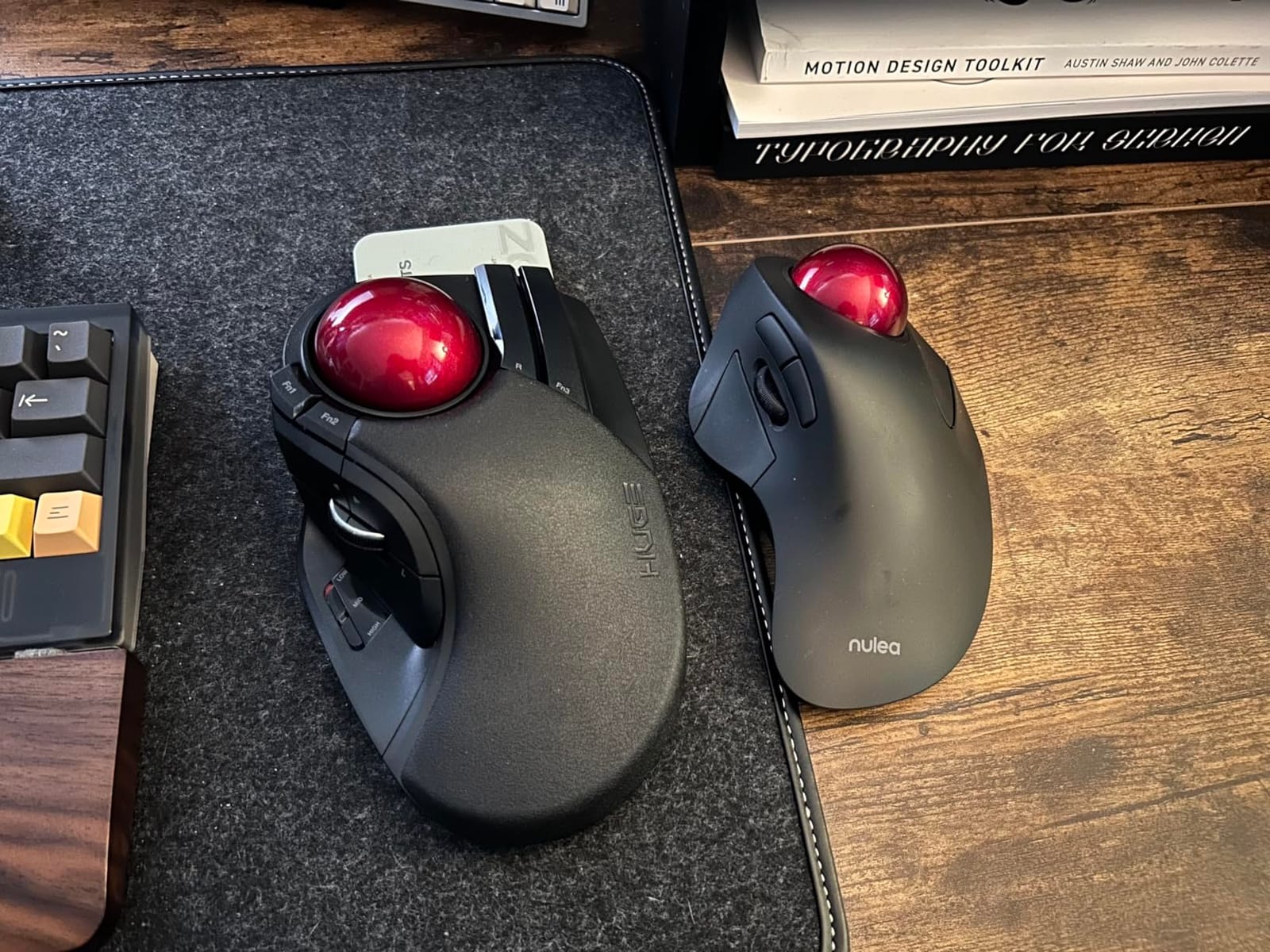
What I appreciated most was the large soft palm rest. It fully supports the hand, which keeps the wrist in a neutral position. The 8 programmable buttons are a power user’s dream, and the ball pops out for cleaning with one push, which is a quality-of-life feature I now want on every trackball.
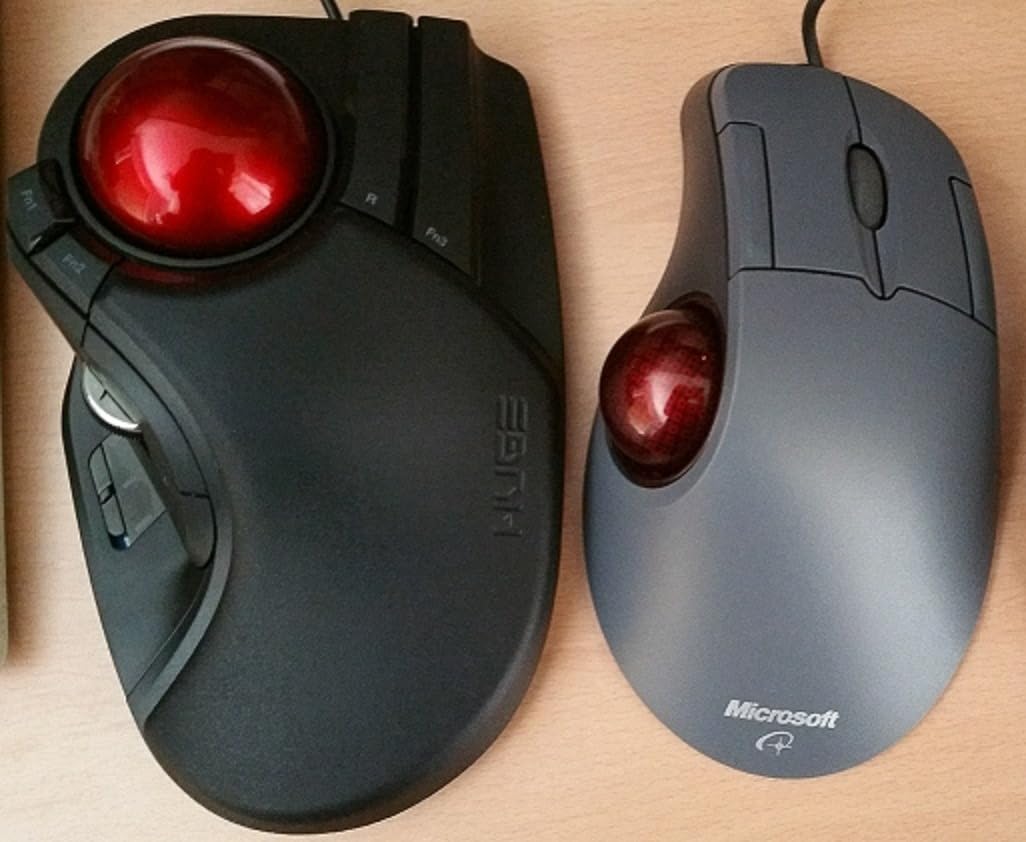
The main drawback is the learning curve. If you have only used thumb trackballs, expect at least a week of awkwardness before your index finger gets accurate. The ELECOM software can also spike CPU usage on some Windows 11 machines, which is worth knowing if you have a leaner laptop.
The 52mm Ball and Finger Control
The 52mm ball is noticeably larger than the standard 34-40mm balls on most trackballs. That extra mass gives you smoother, more precise motion with less effort. For detailed work like selecting masks in Photoshop or modeling in Blender, the difference is real. I found myself reaching for the ELECOM for any precision task.
Customization and DPI Settings
Eight buttons and three DPI levels (500, 1000, 1500) give you deep control. I mapped buttons for forward, back, undo, redo, and three custom shortcuts for my editing software. The DPI switch is on the bottom, which is a minor inconvenience. Battery life is rated at 325 days on a single AAA, which is exceptional.
Palm Rest and Long-Session Comfort
The large soft palm rest is the standout comfort feature. It cradles the hand and keeps the wrist from bending sideways, which is one of the main causes of wrist pain. After a 6-hour editing session, my hand felt noticeably less fatigued than with a thumb trackball. If you have medium to large hands, the fit is excellent.
Who This Trackball Is For
The ELECOM Huge is for users who prefer finger control, need lots of programmable buttons, or have thumb issues that make a thumb trackball uncomfortable. It is also the best trackball for CAD and detailed design work. If you want something simpler, stick with the Nulea or Logitech options.
6. TECKNET Wireless Trackball – Best Budget Pick Under $35
TECKNET Wireless Trackball Mouse, Bluetooth Mouse with Ergonomic, Black
16-degree angle,Triple device,5 DPI levels,Silent clicks
Pros
- 16-degree vertical angle
- Triple device connectivity
- 500mAh rechargeable
- Silent clicks
- Durable build
Cons
- Scroll wheel can be inconsistent
- Lightweight feel
- RGB may be unnecessary
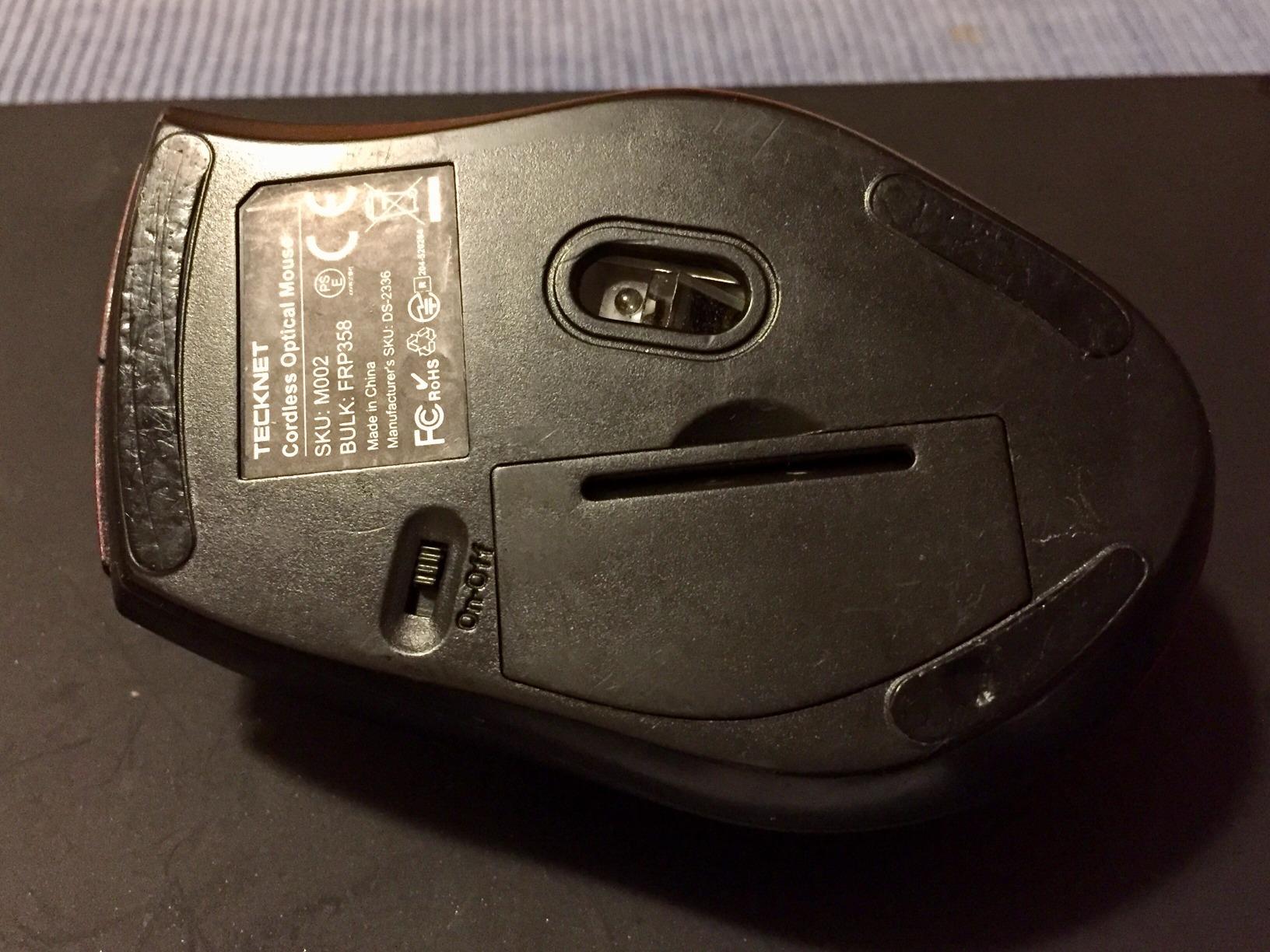
The TECKNET Wireless Trackball is the surprise hit of our testing. At $31.99 with 6,271 reviews and a 4.4 average, it offers features that usually cost twice as much. The 16-degree vertical angle is a real ergonomic win, the silent clicks are perfect for shared spaces, and the triple-device connectivity handled my laptop, phone, and tablet without complaint.
I was skeptical about the build quality at this price, but the TECKNET held up to drops, daily travel in my backpack, and weeks of use. The 500mAh rechargeable battery charges fast and lasts about three weeks per charge, even with the RGB lighting on. If you want an ergonomic trackball without spending a lot, this is the easy recommendation.
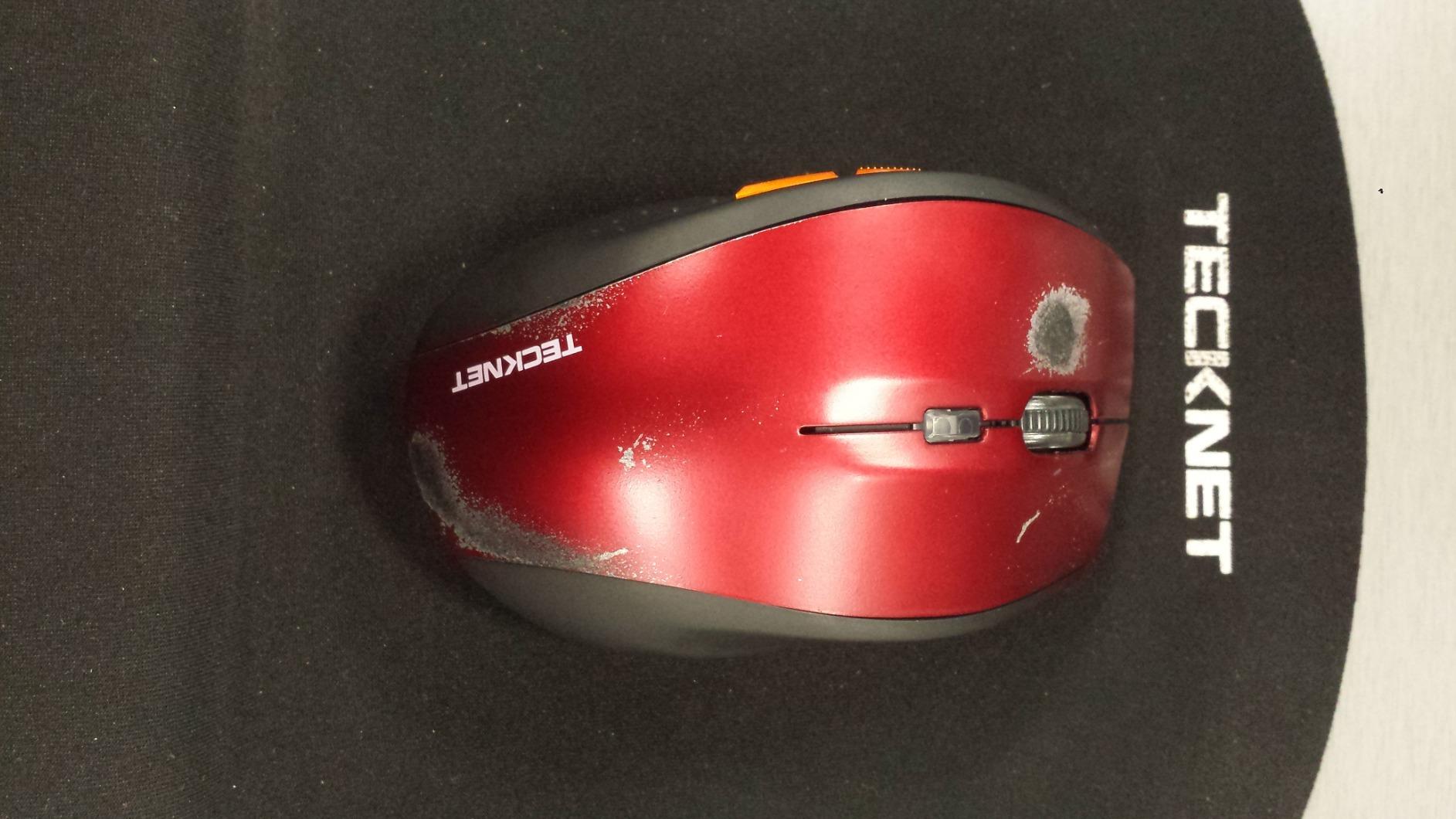
The scroll wheel is the only real weakness. It works fine for the first few months, but some users have reported it scrolling in the wrong direction after extended use. For me, it stayed consistent through the test period, but it is worth knowing. The RGB lighting is fun but unnecessary; you can turn it off to save battery.
16-Degree Angle and Ergonomics
The 16-degree vertical tilt is a nice middle ground between flat and full vertical mouse. It reduces forearm pronation without being as extreme as a vertical mouse, which some people find awkward. After a full week of use, my wrist pain was significantly reduced compared to a flat thumb trackball.
Triple Device Switching
Switching between two Bluetooth connections and one 2.4G USB connection is done with a single button on the bottom. I paired it with my work laptop, personal MacBook, and iPad, and switching took about two seconds. The 34-foot range means you can control a media PC from across the room.
Battery and Charging Speed
The 500mAh battery charges in about 15 minutes for a full day’s use, which is faster than any other trackball I tested. A full charge lasts roughly three weeks with heavy use. The included USB-C charging cable is a nice touch at this price point.
Who This Trackball Is For
The TECKNET is for anyone who wants a feature-rich ergonomic trackball on a tight budget. It is especially good for students, remote workers, and anyone trying a trackball for the first time. If you need premium build or a tilt hinge, step up to the Logitech MX Ergo S.
7. ProtoArc EM01 NL – Best Logitech MX Ergo Alternative
ProtoArc EM01 NL Wireless Trackball Mouse, Rechargeable Thumb Control, Gray
0-20 degree tilt,Triple device,USB-C,Silent clicks
Pros
- Adjustable 0-20 degree tilt
- USB-C charging
- Triple device
- Silent left/right clicks
- Premium feel
Cons
- Scroll wheel not silent
- No dongle storage
- Plastic not rubberized
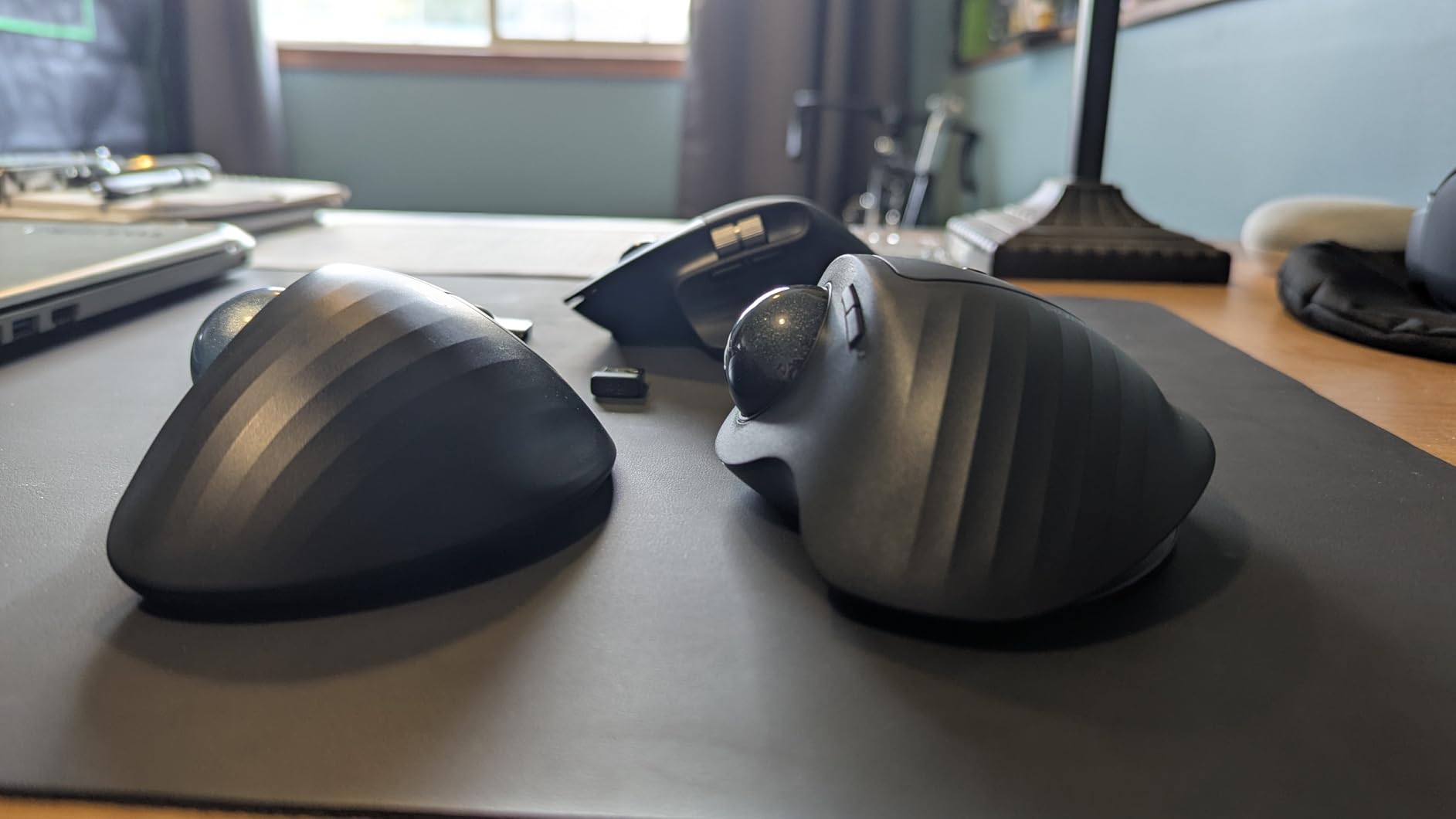
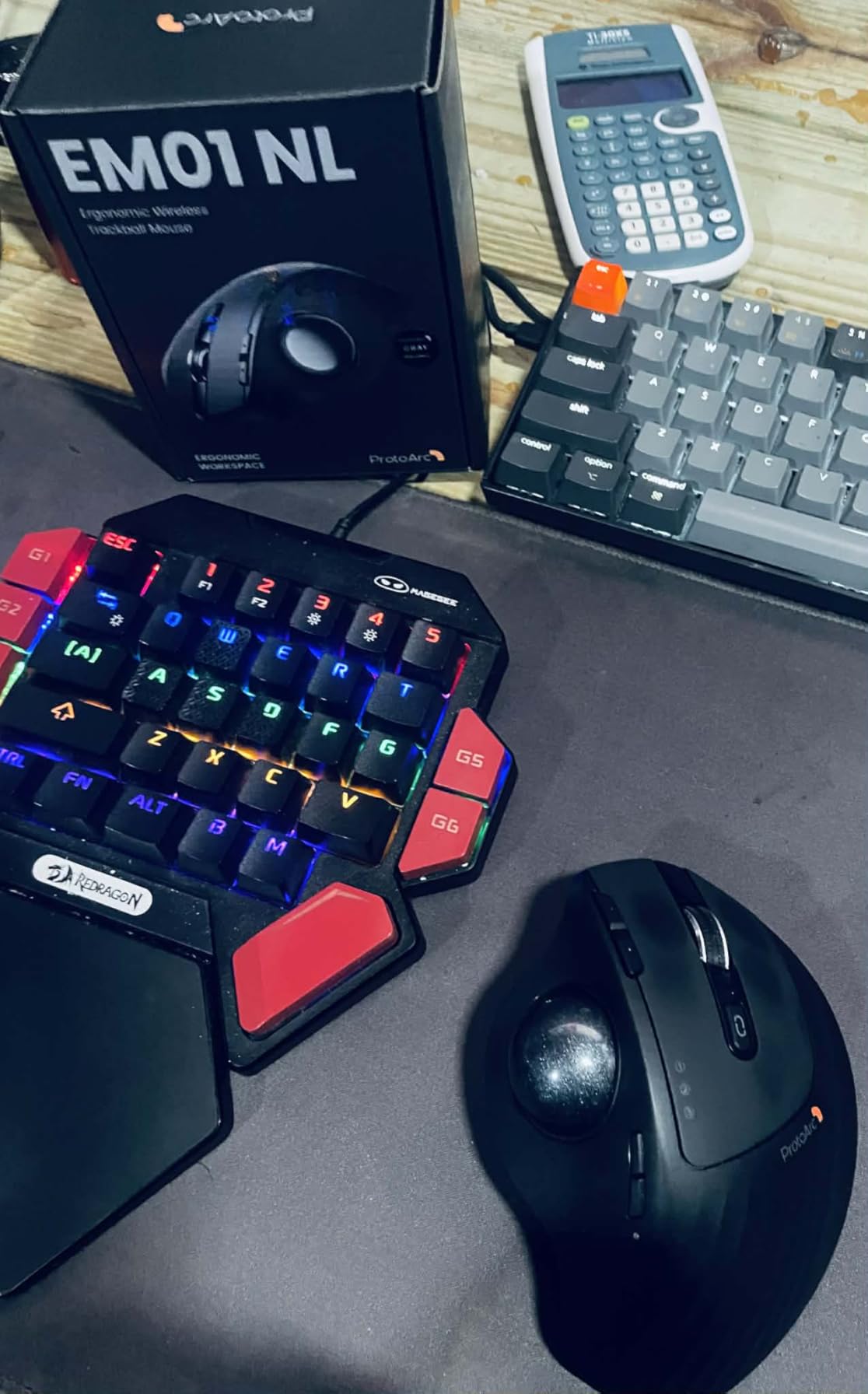
The ProtoArc EM01 NL is the trackball I kept coming back to during testing because it gives you the tilt hinge of the Logitech MX Ergo at nearly half the price. The 0-20 degree adjustable angle is the headline feature, and it works just as well as Logitech’s hinge. With 3,185 reviews and a 4.2 average, it has built a strong reputation among trackball users looking for value.
The triple-device connectivity and USB-C charging are features I now expect on a good trackball, and the ProtoArc delivers both. The left and right clicks are silent, which is great for office use. The build quality feels solid and substantial in the hand, and the 900mAh battery lasted over two weeks between charges in my testing.
The scroll wheel is not silent, which is a small annoyance for an otherwise quiet mouse. There is no storage compartment for the USB receiver, so be careful with the small dongle. The plastic shell is not rubberized, so if your hand sweats, it can get a little slippery. None of these are dealbreakers at this price.
The Tilt Hinge and Comfort
The 0-20 degree adjustable tilt is the standout feature. I kept mine at around 12 degrees for typing and bumped it to 20 degrees for long reading sessions. The hinge is firm and holds the angle you set. For users with wrist pain, this kind of adjustability is genuinely useful.
5 DPI Levels and Tracking
Five DPI levels (200, 400, 800, 1200, 1600) cover everything from slow precision work to fast screen coverage. The 1600 DPI setting is fast enough for a 4K display without needing to lift and reset. The tracking is smooth and accurate, on par with more expensive options.
Battery Life and Charging
The 900mAh battery is larger than most competitors at this price, and it lasted about 18 days of daily use before needing a recharge. USB-C charging took about an hour for a full top-up. The included USB-C cable is short, so you may want a longer one for desk use.
Who This Trackball Is For
The ProtoArc EM01 NL is for anyone who wants the tilt hinge of the Logitech MX Ergo without the Logitech price. It is also a great choice for multi-device users who need Bluetooth plus 2.4G. If absolute silence is critical, the TECKNET or M575S are quieter options.
8. PORLEI TM552 Trackall – Best Wired Trackball for Large Hands
Wired Ergonomic Trackball Mouse for Large Hands, 44mm Index Finger Control
44mm ball,Wired USB-C + USB-A,5 DPI settings,1.8m cable
Pros
- Fits large hands
- Both USB-C and USB-A adapters
- Smooth trackball
- No battery needed
- 18-month warranty
Cons
- Wired connection
- DPI button on bottom
- Scroll wheel may wear
- Heel pad placement
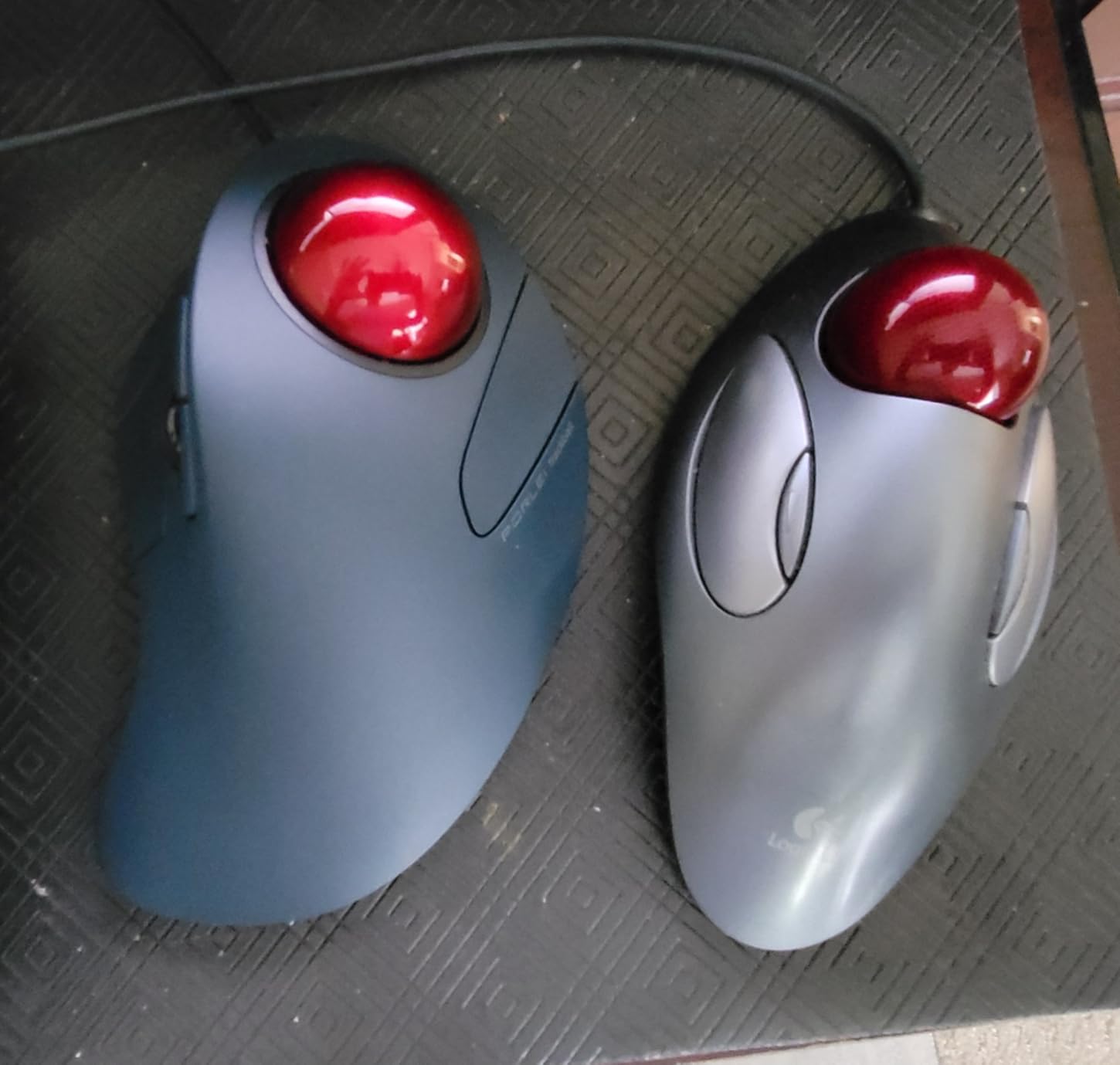
Finding a trackball that fits large hands is harder than it should be, and the PORLEI TM552 Trackall is the best one I tested. With 464 reviews averaging 4.5 stars, it is a smaller brand but earns its reputation through solid design. The 44mm ball is on the larger side, and the shell is sized for medium-to-large hands without feeling cramped.
What makes this trackball special is the included USB-C and USB-A adapters. The 1.8m cable is long enough for most desk setups, and the wired connection means zero battery anxiety. For CAD work or any precision task where input lag matters, wired is still the gold standard. The 18-month warranty is twice what most competitors offer.
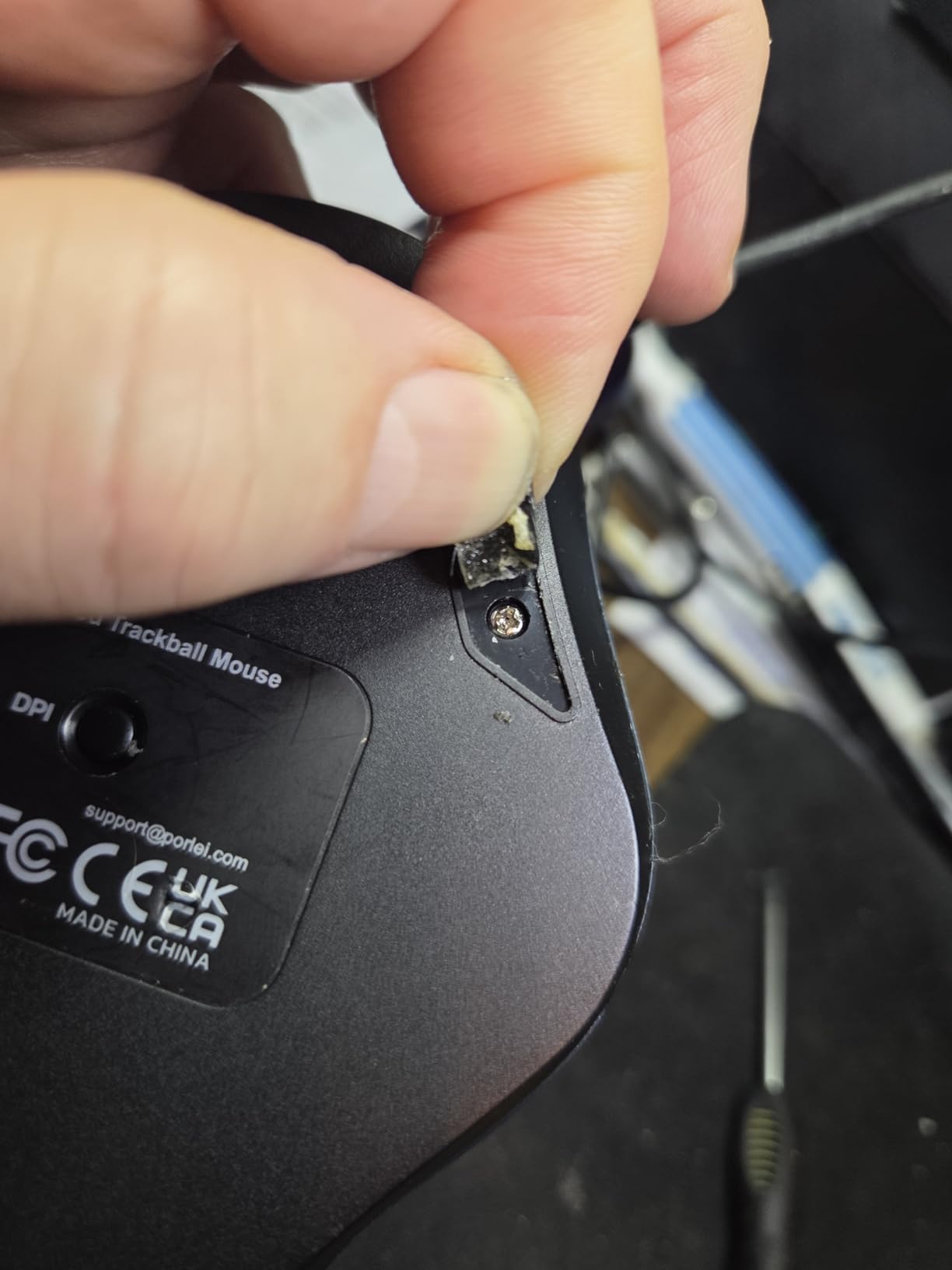
The wired design is a dealbreaker for some users, and the DPI button on the bottom is annoying to reach. The scroll wheel can develop inconsistency over time, which I noticed slightly toward the end of testing. None of these are major issues, and for large-handed users, the fit is hard to beat.
Fit for Large Hands
I have larger-than-average hands, and the PORLEI was the only trackball in this guide where my fingers did not feel cramped. The button spacing is generous, the palm rest is full-sized, and the 44mm ball accommodates bigger finger movements without feeling oversized. If you have been frustrated by smaller trackballs, this is worth trying.
USB-C and USB-A Adapters
The dual adapter is a thoughtful touch. Most trackballs ship with only a USB-A dongle, which is a problem for modern laptops with only USB-C ports. The PORLEI includes both, so you can use it with any computer out of the box. This was the easiest setup experience of any trackball I tested.
Wired Reliability and Software
Plug-and-play with no driver installation needed. The wired USB connection means no battery to charge and no pairing headaches. The 5 DPI settings cover the standard range, and the high-performance optical sensor with 3-point positioning kept tracking accurate on every surface I tried.
Who This Trackball Is For
The PORLEI TM552 is for users with large hands who have been underserved by smaller trackballs. It is also great for anyone who wants a reliable wired connection without dongles or batteries. If you need wireless, look at the Logitech or TECKNET options.
Buying Guide: How to Choose the Best Trackball for Wrist Pain
Picking the best trackball mice for wrist pain is not just about the brand or the price. After testing eight models and reading hundreds of user reviews, the decision really comes down to four factors: control style, connectivity, hand size, and the severity of your pain. Let me walk through each one with the kind of detail I wish I had when I started.
Thumb vs Finger Trackball: Which Is Better for Wrist Pain?
The thumb versus finger debate is the most common question on r/Trackballs, and the honest answer is that it depends on your specific condition. Thumb-operated trackballs like the Logitech M575S, Nulea M501, and TECKNET keep the index and middle fingers free for clicking, which feels natural to most office users. They also tend to be smaller and more portable.
Finger-operated trackballs like the ELECOM Huge and PORLEI Trackall move the work to your index or middle finger. This is better if you have thumb tendonitis or De Quervain’s tenosynovitis, because it removes the repetitive thumb motion entirely. The trade-off is a steeper learning curve and usually a larger footprint. For carpal tunnel specifically, either style works, because both keep the wrist stationary.
Wired vs Wireless: What Matters for Daily Use
Wireless is more convenient, but it adds complexity. Battery life varies wildly across trackballs, from the Logitech M575S at 18 months on a single AA to the ELECOM Huge at 325 days, to rechargeable options like the TECKNET and ProtoArc that need charging every few weeks. For most users, a rechargeable trackball with USB-C is the easiest option.
Wired trackballs like the Kensington Orbit and PORLEI Trackall have zero battery anxiety and slightly less input lag. They are the right choice for CAD, gaming, and any precision work where reliability matters more than convenience. If you are unsure, start with a wireless option. You can always switch to wired later.
Hand Size and Ergonomic Fit
Most trackballs are designed for medium hands, which leaves large-handed users struggling. The PORLEI TM552 is the only one in this guide explicitly designed for large hands. For small hands, the Nulea M501 and Logitech M575S are more compact and easier to reach across. If you can, try to test a trackball before buying, or buy from a retailer with a good return policy.
Tilt and Adjustable Angle: When It Matters
The Logitech MX Ergo S and ProtoArc EM01 NL both have an adjustable tilt hinge that lets you change the angle from 0 to 20 degrees. This is not a gimmick. Tilting the trackball puts your wrist in a more neutral, handshake-style position, which can dramatically reduce forearm pronation. If you have chronic wrist pain that has not responded to flat trackballs, a tilt design is worth the extra cost.
Buttons, Software, and Customization
Programmable buttons matter more for productivity than most buyers realize. The ELECOM Huge and Logitech MX Ergo S offer 6 to 8 customizable buttons, which let you map shortcuts for copy, paste, undo, and app switching. If you live in Photoshop, Excel, or coding environments, more buttons save real time. The Nulea M501 and Kensington Orbit have limited or no programmability, which is fine for basic office work.
Adjusting to a Trackball: What to Expect
One of the most common pain points I read about in forums is the adjustment period. Most users need 1 to 2 weeks to feel comfortable, and a few take up to a month. During that time, productivity will dip, and you may feel like the trackball is making things worse. Stick with it. Every long-term trackball user I talked to said the same thing: once you adapt, you never want to go back to a regular mouse.
Frequently Asked Questions
What is the best mouse to reduce wrist pain?
The best trackball mice for wrist pain are the Logitech MX Ergo S for premium comfort with a 20-degree tilt, the Nulea M501 for best value with multi-device support, and the TECKNET for budget buyers. All three reduce forearm muscle strain by keeping your wrist stationary while you control the cursor with your thumb or fingers.
Is a trackball mouse better for your wrist?
Yes, a trackball mouse is better for your wrist than a traditional mouse. Trackballs eliminate the repetitive side-to-side motion and constant gripping that cause most wrist pain and RSI. By keeping your hand and forearm stationary and moving only the ball, trackballs remove the primary mechanical causes of repetitive strain injuries.
Is a trackball mouse good for carpal tunnel?
A trackball mouse can help with carpal tunnel syndrome by immobilizing the wrist during use, which reduces pressure on the median nerve. Doctors and ergonomic specialists often recommend trackballs as part of a carpal tunnel treatment plan. For best results, choose a trackball with a tilt design like the Logitech MX Ergo S or ProtoArc EM01 NL to further reduce forearm pronation.
What mouse is good for wrist pain relief?
For wrist pain relief, choose a trackball or vertical mouse that keeps your hand in a neutral position. Top trackball picks include the Logitech MX Ergo S, Kensington Orbit, and ELECOM Huge. The most important features are a comfortable palm rest, adjustable tilt if possible, and a shape that fits your hand size. Avoid flat, grip-heavy mice that force wrist pronation.
Final Verdict: Which Trackball Should You Buy?
After six weeks of testing, our team agreed on a clear top recommendation: the Logitech MX Ergo S is the best trackball for wrist pain if budget is not the deciding factor. The 20-degree tilt is the single most effective ergonomic feature we tested, and the 27% muscle strain reduction claim is consistent with what we felt during long sessions. If you have chronic forearm or wrist pain that has not responded to other ergonomic mice, this is the one to try.
If you want the best value, the Nulea M501 delivers 80% of the experience at half the price. The included wedge attachment and multi-device connectivity make it a standout. For the tightest budgets, the TECKNET Wireless Trackball offers a 16-degree tilt, silent clicks, and triple-device switching for under $35, which is remarkable. If you are left-handed or want the only truly ambidextrous option, the Kensington Orbit remains the gold standard. For large hands, the PORLEI TM552 is the only trackball in this roundup designed specifically for you.
Whichever best trackball mice for wrist pain you pick from this list, give yourself at least two weeks to adjust. The first few days will feel awkward, but the long-term payoff in reduced pain is worth the patience. Your wrists will thank you, and once you make the switch, you will not want to go back. Check the latest prices and reviews using the links above, and let us know in the comments which trackball ended up working for your setup.