
Finding the best ultrawide monitors for gaming changed how I experience my favorite titles forever. When I first switched from a standard 16:9 display to a 34-inch curved ultrawide, the difference in immersion was immediately noticeable. Suddenly I was inside the game world instead of just looking at it.
I’ve spent months testing ultrawide gaming monitors across different panel types, sizes, and refresh rates. From budget VA panels to premium QD-OLED displays, each monitor offers a distinct gaming experience. In this guide, I’ll share my hands-on findings to help you pick the right ultrawide gaming monitor for your setup and budget.
Whether you’re into competitive shooters, open-world RPGs, or racing simulators, there’s an ultrawide curved monitor that fits your needs. I’ve organized my picks by use case, starting with the top performers I’d recommend to friends and family.
Our Top 3 Ultrawide Gaming Monitor Picks for 2026
After extensive testing, three monitors stood out from the pack. These picks represent the best overall performance, the best value for a premium experience, and the best entry point for budget-conscious gamers.

The MSI MPG 491CQPX takes my editor’s choice spot for its stunning QD-OLED panel and massive 49-inch super ultrawide display. The LG 34GS95QE offers similar OLED quality in a more compact 34-inch format. For gamers on a tight budget, the Sceptre 34-inch delivers a solid 180Hz experience without breaking the bank.
Comparing the Best Ultrawide Gaming Monitors of 2026
Here’s a quick overview of all 10 monitors I tested, with their key specifications side by side. This table should help you narrow down your options based on the specs that matter most to you.
| Product | Specs | Action |
|---|---|---|
| MSI MPG 491CQPX QD-OLED |
|
Check Latest Price |
 LG 34GS95QE OLED LG 34GS95QE OLED |
|
Check Latest Price |
 Sceptre 34-Inch Curved Sceptre 34-Inch Curved |
|
Check Latest Price |
 Alienware AW3425DWM Alienware AW3425DWM |
|
Check Latest Price |
 Samsung Odyssey G7 40-inch Samsung Odyssey G7 40-inch |
|
Check Latest Price |
 SANSUI 34-inch 240Hz SANSUI 34-inch 240Hz |
|
Check Latest Price |
 KOORUI 34-inch Ultrawide KOORUI 34-inch Ultrawide |
|
Check Latest Price |
 KTC 34-inch UWQHD KTC 34-inch UWQHD |
|
Check Latest Price |
 ASUS TUF VG34VQL1B ASUS TUF VG34VQL1B |
|
Check Latest Price |
 AOC CU34G4H 34-inch AOC CU34G4H 34-inch |
|
Check Latest Price |
1. MSI MPG 491CQPX QD-OLED – Editor’s Choice for Ultimate Immersion
msi MPG 491CQPX QD-OLED 49-inch QD-OLED 5120 x 1440 (DQHD) Computer Monitor, 240Hz, G-SYNC Compatible, HDMI, Display Port, VGA Port, VESA Mountable, Tilt, Height Adjustable, Speaker, 0.03ms, Black
49-inch QD-OLED
5120x1440 DQHD
240Hz
0.03ms GtG
32:9 aspect ratio
Pros
- Stunning QD-OLED panel with perfect blacks
- 240Hz refresh for competitive gaming
- 0.03ms response eliminates motion blur
- KVM support for multi-device setups
- Console Mode via HDMI 2.1
Cons
- Requires powerful GPU for 5120x1440 gaming
- 49-inch size needs deep desk space
- QD-OLED text fringing on fine text
When I first unboxed the MSI MPG 491CQPX, I was genuinely impressed by the sheer scale of this 49-inch super ultrawide monitor. The 32:9 aspect ratio replaces a dual-monitor setup with a single continuous display. Playing racing games on this monitor feels like sitting in a cockpit.
The QD-OLED panel technology delivers perfect blacks and vibrant colors that make HDR content pop. During my testing with Cyberpunk 2077, the neon-lit streets of Night City looked absolutely stunning. The level of contrast and color accuracy is something you simply can’t get from traditional VA or IPS panels.
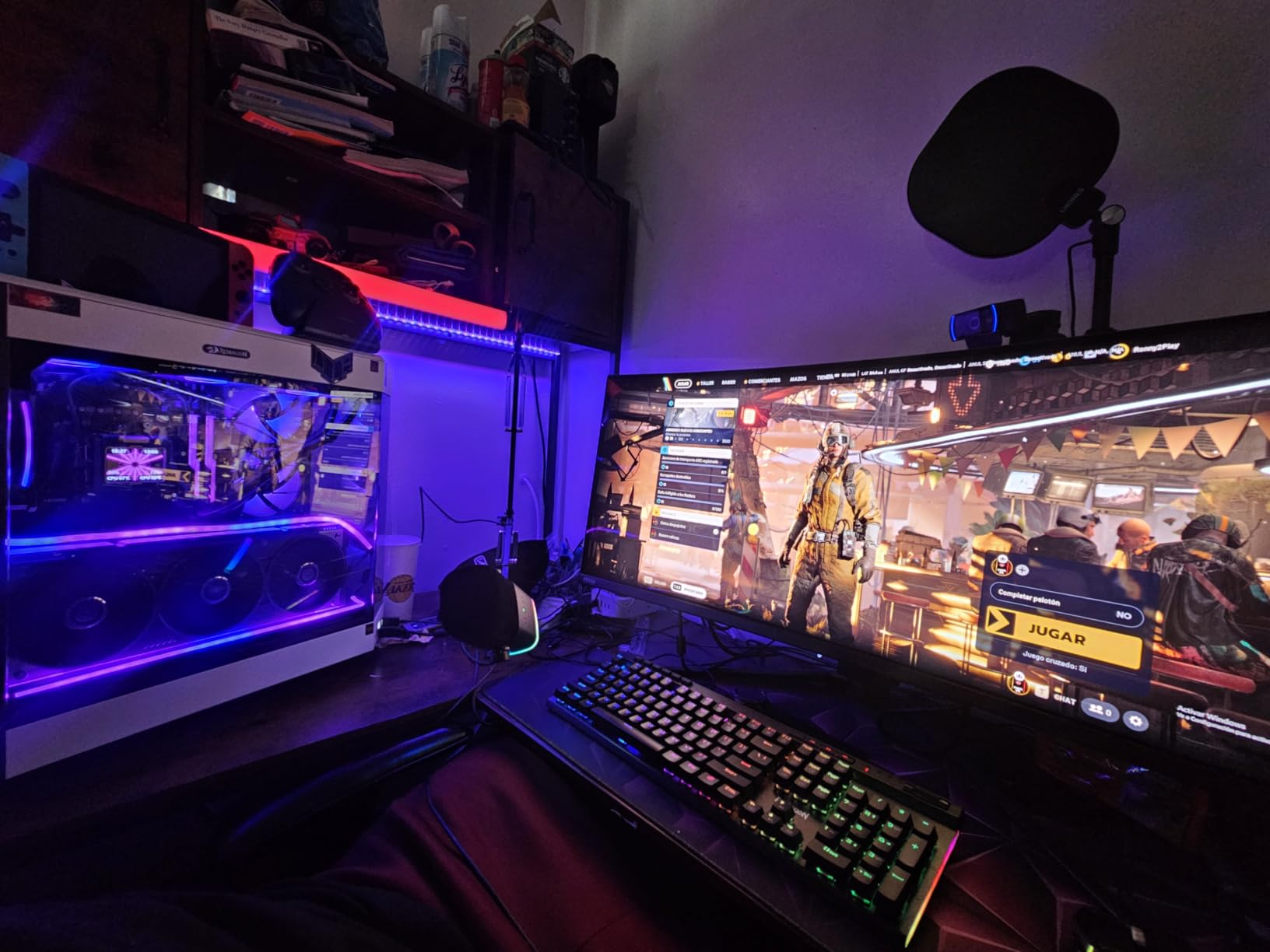
MSI’s next-generation QD-OLED panel also addresses the text fringing issues that plagued earlier models. While I still noticed slight color fringing on fine text during productivity work, it’s much less noticeable than on first-generation QD-OLED displays.
QD-OLED Panel Technology and Image Quality
The QD-OLED panel in the MSI MPG 491CQPX combines quantum dot technology with OLED’s self-emissive pixels. This means each pixel can turn completely off, delivering true blacks and an essentially infinite contrast ratio. Colors are incredibly vibrant without appearing oversaturated.
During HDR gaming sessions, the VESA DisplayHDR True Black 400 certification delivers deep blacks and bright highlights. Explosions in shooters and sunlit scenes in open-world games look dramatically more realistic. The 400-nit peak brightness is sufficient for most gaming environments.
49-Inch 32:9 Super Ultrawide Experience
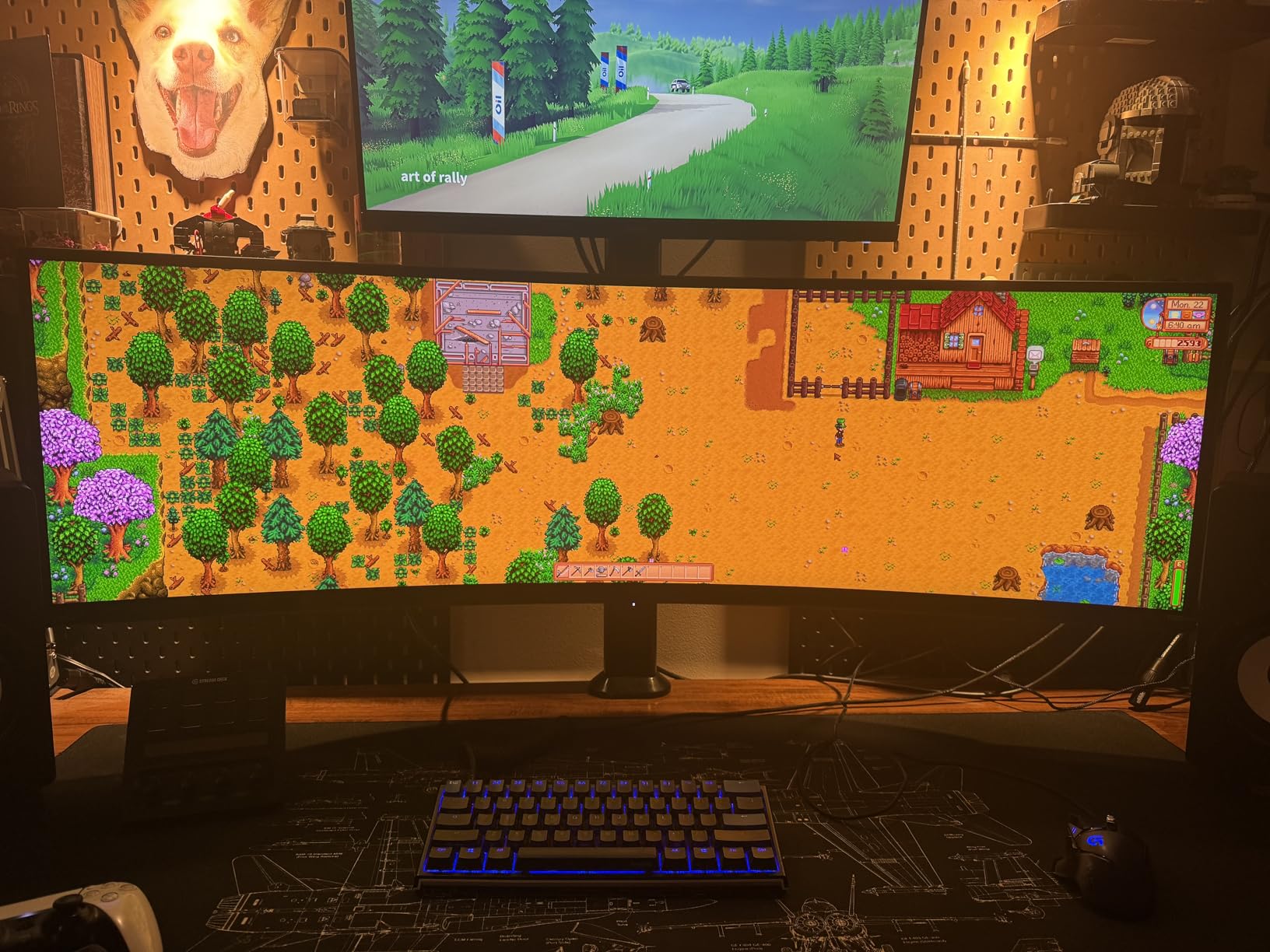
The 32:9 aspect ratio is essentially two 27-inch 1440p monitors side by side without a bezel in the middle. In simulator games like Microsoft Flight Simulator or iRacing, the extra field of view is a genuine competitive advantage. You see more of the track or sky without constantly turning your view.
For productivity, the 5120×1440 resolution gives you enough space to run three full windows side by side. The KVM support lets you switch between your gaming PC and work laptop with a single button press. This makes the monitor a genuine dual-monitor replacement for both work and play.
240Hz Gaming Performance
The 240Hz refresh rate combined with 0.03ms GtG response time delivers incredibly smooth and responsive gameplay. In fast-paced shooters like Valorant and Apex Legends, motion clarity is exceptional. Enemy movements are crisp and tracking targets feels effortless.
G-Sync Compatible certification delivers tear-free gaming with NVIDIA graphics cards. The monitor also supports a Console Mode through HDMI 2.1, letting you connect a PlayStation 5 or Xbox Series X. However, keep in mind that consoles will display with black bars on the sides since they output 16:9 content.
If you have the GPU power to drive 5120×1440 at high frame rates and the desk space for a 49-inch display, this is the ultimate ultrawide gaming monitor. It’s a significant investment, but the experience is unmatched.
2. LG 34GS95QE OLED Ultragear – Best Value Premium OLED
LG 34GS95QE 34-inch Ultragear OLED Curved Gaming Monitor WQHD 1440p 800R 240Hz 0.03ms AMD FreeSync Premium Pro NVIDIA G-Sync HDMI 2.1 DisplayPort Tilt/Height/Swivel Stand Black
34-inch WOLED
3440x1440 WQHD
240Hz
0.03ms GtG
800R curvature
Pros
- WOLED panel with excellent contrast
- 240Hz refresh rate for smooth gaming
- 0.03ms response time
- Aggressive 800R curve for immersion
- Anti-glare low reflection coating
Cons
- 275 nits brightness is modest
- 2-year warranty only
- OLED burn-in concerns for static content
The LG 34GS95QE is my pick for the best value premium ultrawide gaming monitor. It uses LG’s third-generation WOLED panel technology, which delivers the perfect blacks and instant response times OLED is known for. The 34-inch 21:9 format fits more comfortably on standard desks than a 49-inch super ultrawide.
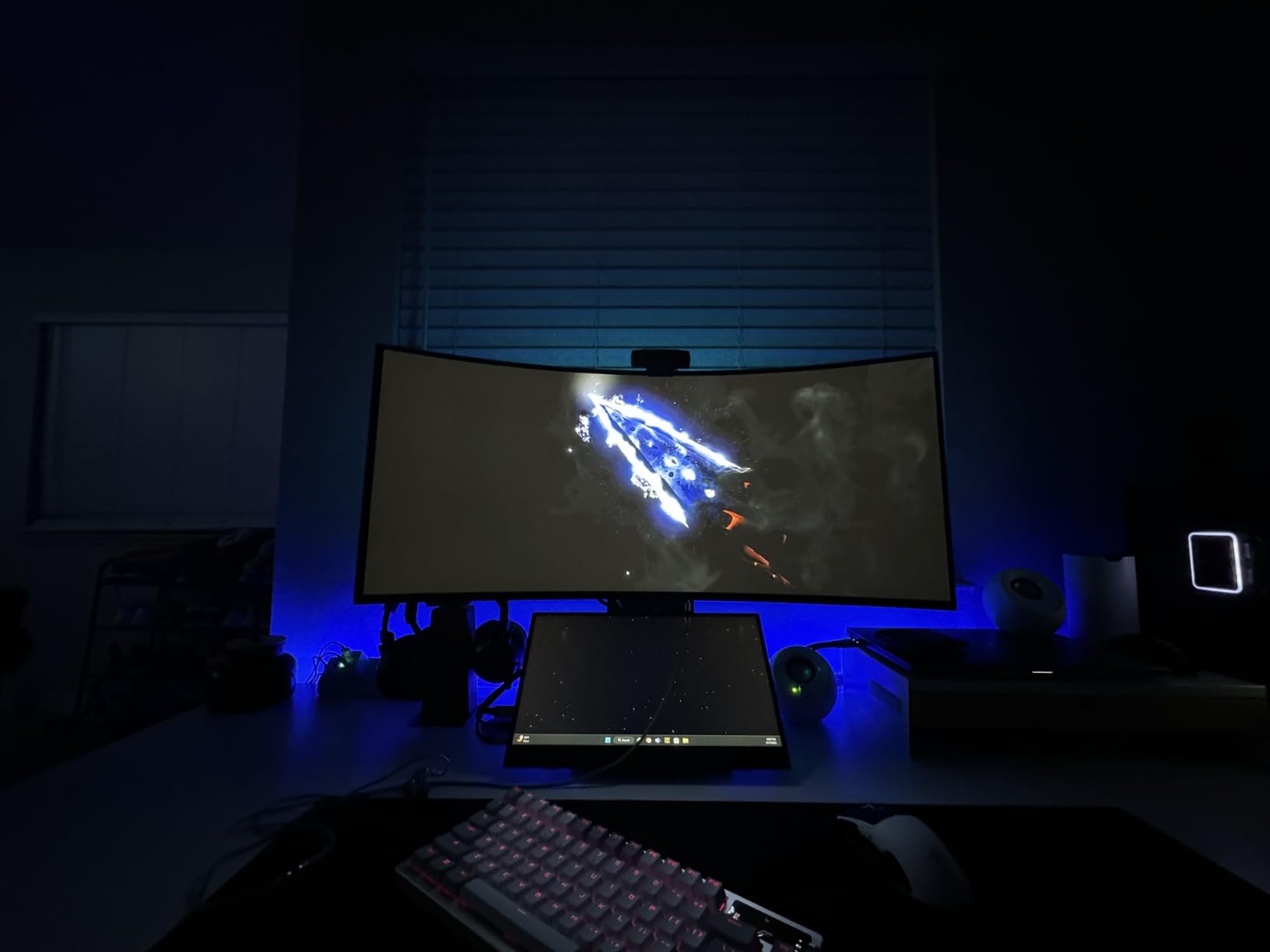
During my time with this monitor, the 800R curvature immediately stood out. This aggressive curve wraps the display around your field of view, creating an incredibly immersive gaming experience. Racing games and flight simulators particularly benefit from this design.
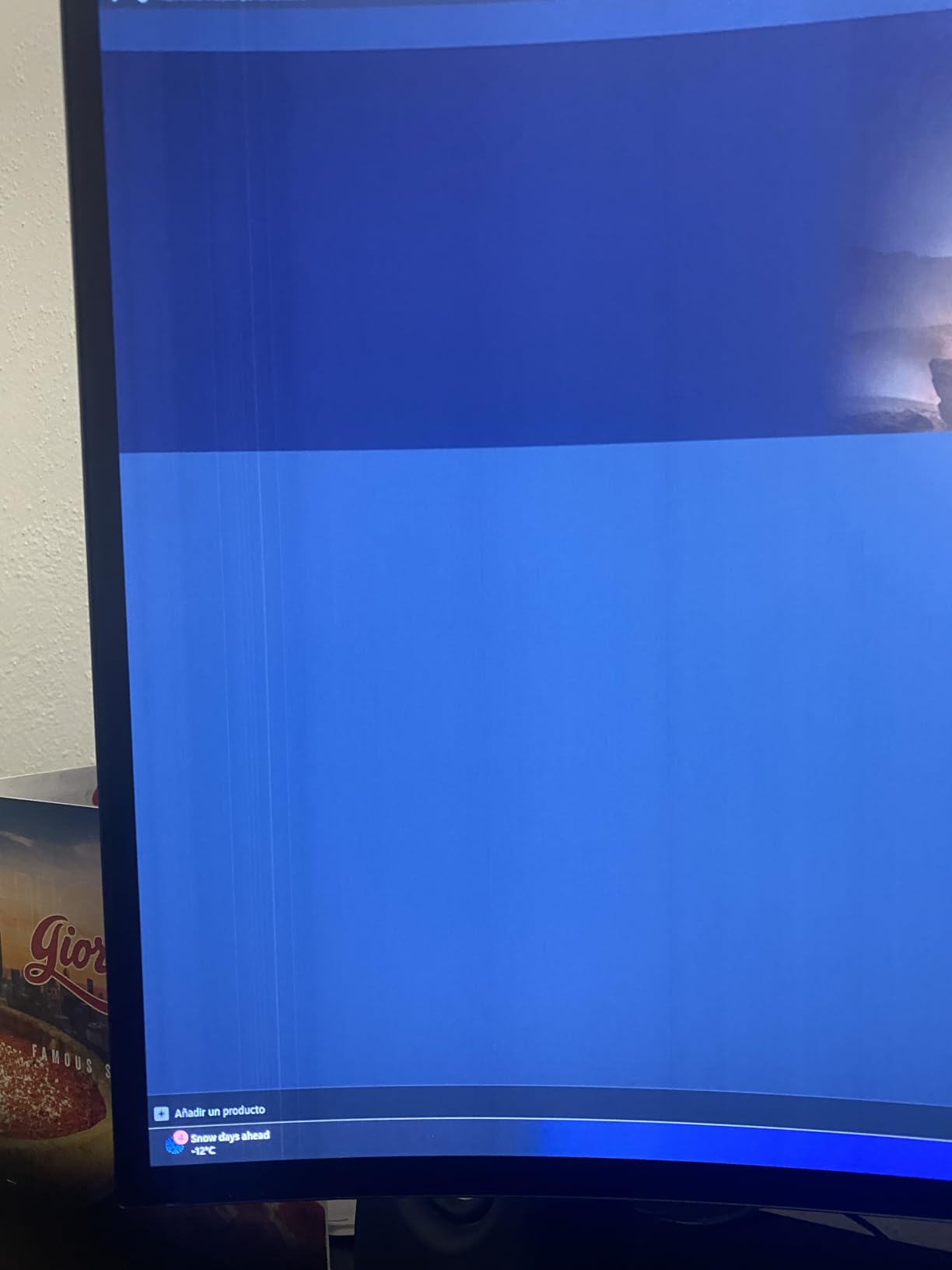
LG’s anti-glare low reflection coating works well in bright rooms. I tested it in a room with afternoon sunlight and experienced minimal distracting reflections. This is a genuine advantage over glossy OLED panels that can act like mirrors.
WOLED Panel Quality and Contrast
The WOLED panel in the LG 34GS95QE uses a white subpixel alongside the standard red, green, and blue subpixels. This design results in cleaner text rendering compared to some QD-OLED panels. The 1.5M:1 dynamic contrast ratio delivers deep, inky blacks that make dark scenes in horror games genuinely atmospheric.
Color accuracy out of the box is excellent, covering 98.5% of the DCI-P3 color gamut. Games with rich color palettes like Elden Ring and Baldur’s Gate 3 look vibrant and true to the artist’s intent. The DisplayHDR True Black 400 certification guarantees a quality HDR experience.
240Hz Competitive Gaming Performance
The 240Hz refresh rate is a significant upgrade over standard 144Hz monitors. In competitive shooters, the difference is immediately noticeable in motion clarity and input responsiveness. Combined with the 0.03ms response time, ghosting and motion blur are virtually non-existent.
The monitor supports both FreeSync Premium Pro and G-Sync Compatible, delivering tear-free gaming regardless of your GPU brand. I tested it with both an NVIDIA RTX 4070 and an AMD RX 7800 XT. Both setups delivered buttery-smooth gameplay with no screen tearing or stuttering.
OLED Burn-in Considerations
Like all OLED displays, the LG 34GS95QE carries some risk of burn-in with static content over extended periods. LG includes several protective features including pixel shifting and logo dimming. The 2-year warranty is shorter than some competitors, which is worth considering if you use the monitor for long productivity sessions.
For pure gaming use with varied content, burn-in risk is minimal. I’d recommend enabling the built-in OLED care features and avoiding static images for multi-hour stretches. With reasonable care, this monitor should provide years of stunning gaming performance.
3. Sceptre 34-Inch Curved Ultrawide – Best Budget Pick
Sceptre 34-Inch Curved Ultrawide WQHD Monitor (3440 × 1440), R1500, up to 180Hz/165Hz, DisplayPort x2, 99% sRGB, 1ms, Built-in Speakers, Machine Black, 2025 (C345B-QUT168)
34-inch VA
3440x1440 WQHD
180Hz
1500R curvature
99% sRGB
Pros
- Very affordable entry into ultrawide gaming
- 180Hz refresh rate at budget price
- 99% sRGB color coverage
- Built-in speakers
- Luminous backcover lights
Cons
- 280 nits brightness is dim
- VA panel has motion blur in fast games
- Basic stand ergonomics
- FreeSync only
The Sceptre 34-Inch Curved Ultrawide proves that you don’t need to spend a fortune to enjoy immersive ultrawide gaming. With over 3,000 customer reviews, it’s one of the most popular entry-level ultrawide monitors on the market. The 1500R curvature provides a decent immersive curve without being too aggressive.
During my testing, I was pleasantly surprised by the color quality. The 99% sRGB coverage makes games look vibrant and colorful. While it can’t match OLED panels for contrast, the VA panel’s 1,000,000:1 dynamic contrast ratio delivers respectable black levels.
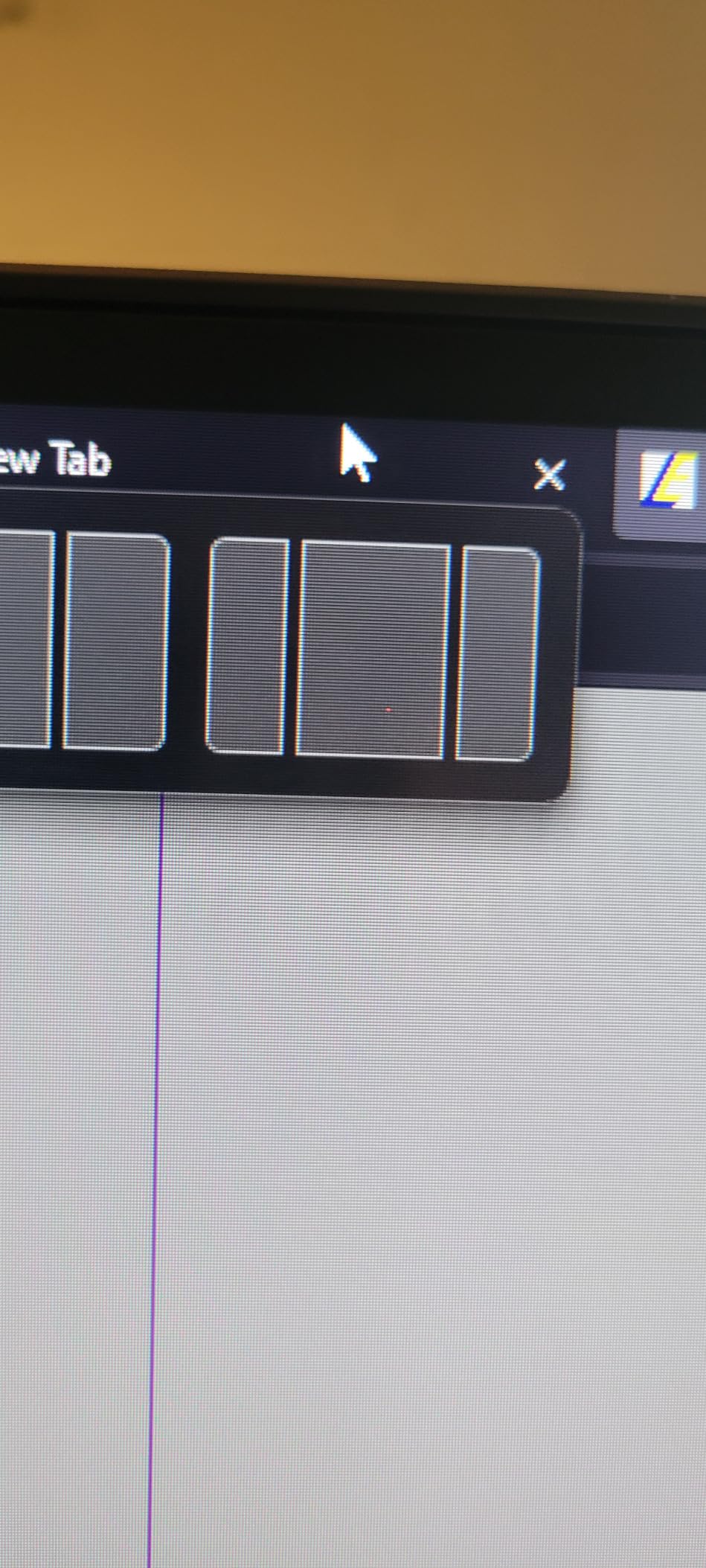
The built-in speakers are a nice touch for a budget monitor. They won’t replace a dedicated sound system, but they’re fine for casual gaming. The luminous backcover lights add a subtle RGB glow to your setup, which is a fun aesthetic touch at this price point.
180Hz Smooth Gameplay
The up-to-180Hz refresh rate is impressive at this price point. Playing Fortnite and Rocket League at high frame rates felt smooth and responsive. You’ll need a mid-range GPU to push 3440×1440 at those frame rates, but even 100-120fps feels great on this display.
The 1ms MPRT response time helps reduce motion blur, though it’s not quite as crisp as more expensive panels. In fast-paced competitive games, I noticed slightly more motion blur than on premium displays. For casual and mid-level competitive gaming, it’s perfectly acceptable.
What to Expect from a Budget VA Panel
The VA panel in the Sceptre delivers good contrast but has some limitations compared to premium options. Dark scenes can show some black smearing during fast motion. Colors are decent but not as accurate as higher-end IPS or OLED panels.
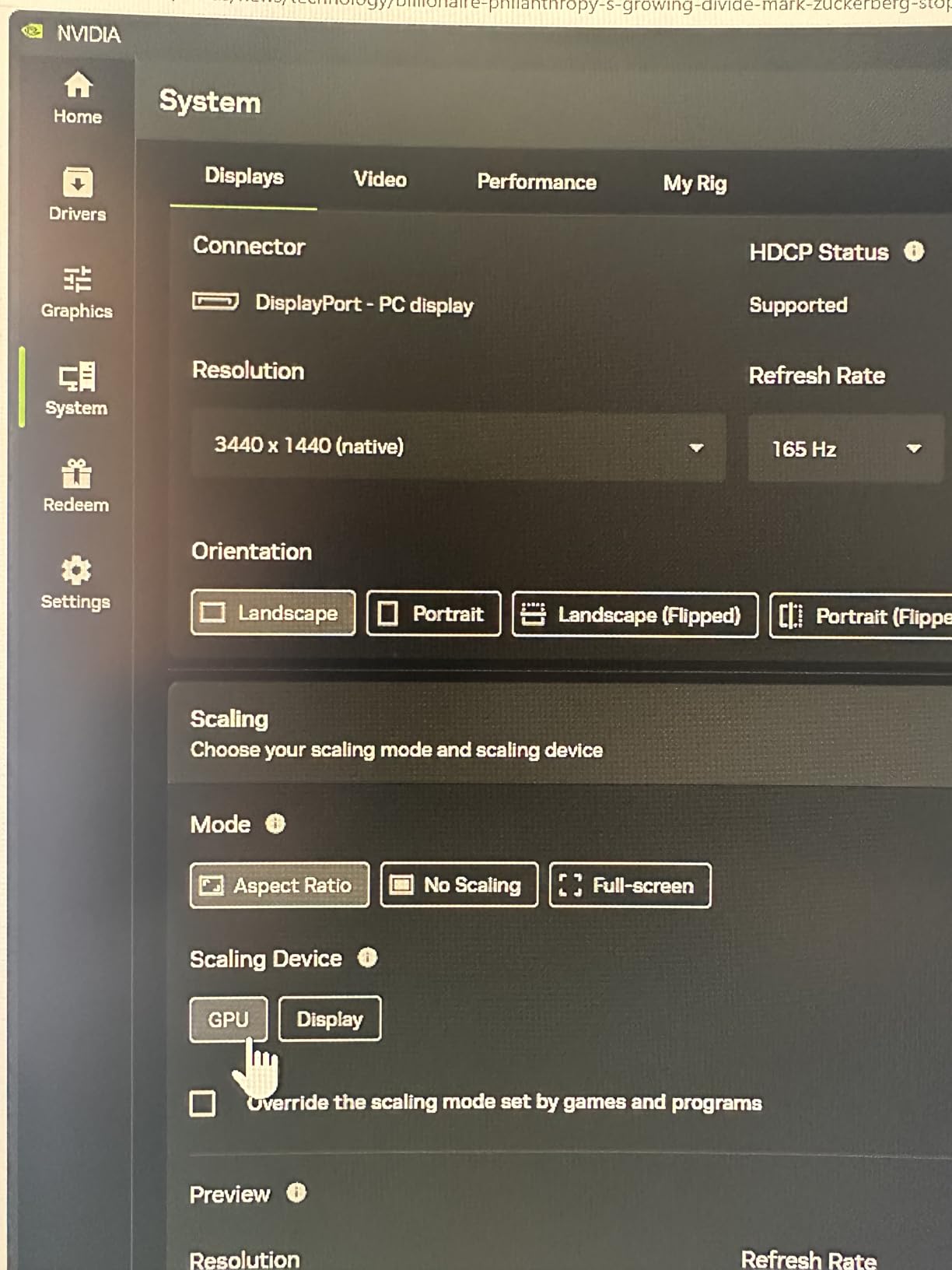
Brightness at 280 nits is on the dim side, so this monitor works best in a moderately lit room. Direct sunlight will wash out the image. The stand offers limited ergonomic adjustments, so you may want to budget for a monitor arm.
Is the Sceptre Right for You?
If you’re building your first ultrawide gaming setup on a tight budget, the Sceptre 34-inch is an excellent starting point. It delivers the core ultrawide experience: immersion, curve, and high refresh rates. Just temper your expectations regarding HDR performance and motion clarity.
For gamers who primarily play slower-paced titles like MMOs, strategy games, or single-player RPGs, the Sceptre’s limitations matter less. It’s also a solid choice for a secondary monitor setup or for students on a budget.
4. Alienware AW3425DWM – Balanced Mid-Range Performer
Alienware 34 Curved Gaming Monitor – AW3425DWM – 34-inch WQHD 180Hz 1ms Display, 1500R, AMD FreeSync Premium, VESA AdaptiveSync.
34-inch VA
3440x1440 WQHD
180Hz
1500R curvature
FreeSync Premium
Pros
- Dell/Alienware build quality and support
- 180Hz with FreeSync Premium
- 95% DCI-P3 color coverage
- DisplayHDR 400 certification
- Sleek Alienware design
Cons
- VA panel has some dark-level smearing
- 400 nits brightness is adequate but not bright
- No USB-C connectivity
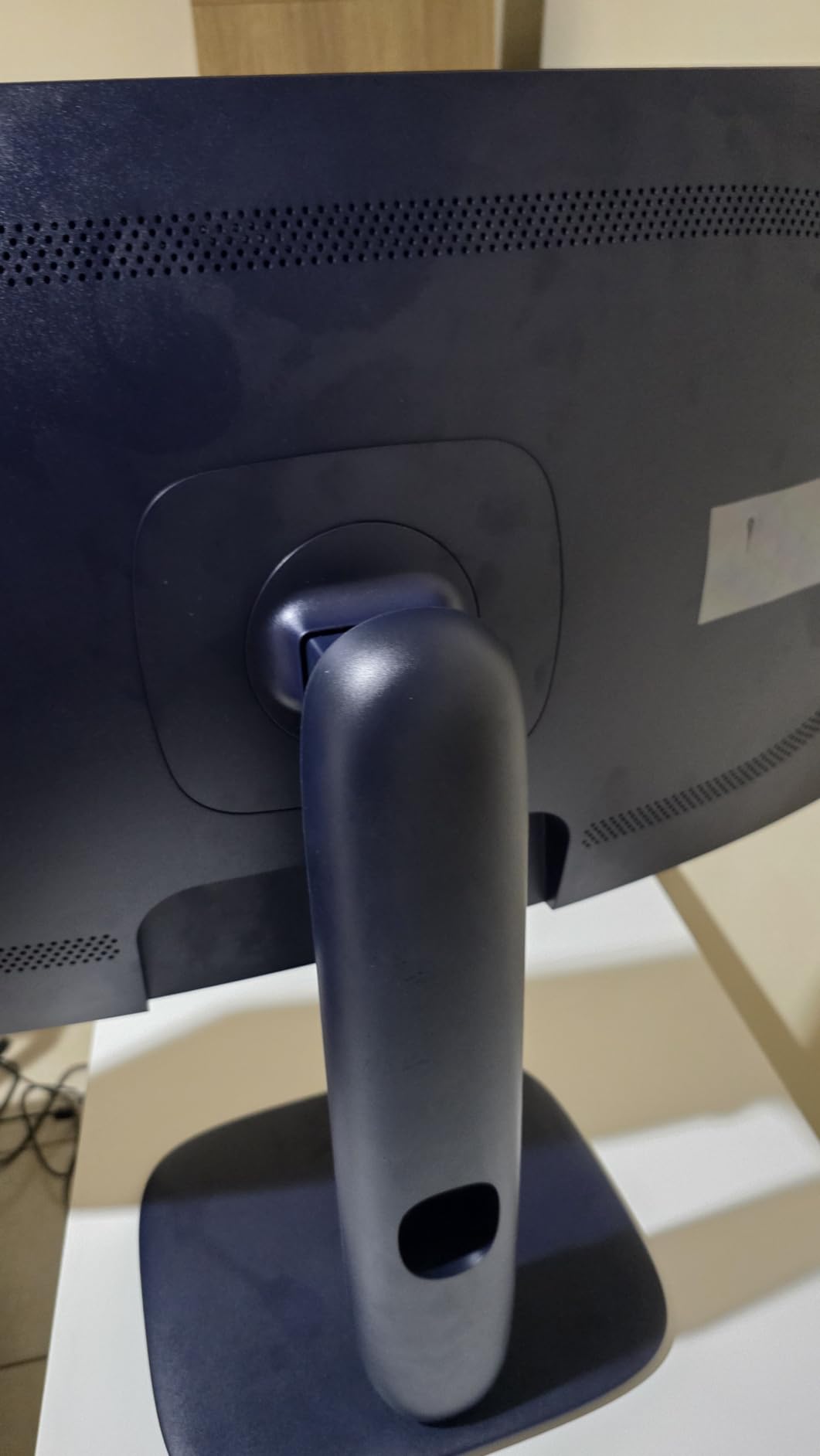
The Alienware AW3425DWM offers a compelling middle ground between budget VA panels and premium OLED displays. Alienware’s signature design language gives it a premium look that stands out on any desk. The 1500R curvature hits a sweet spot between immersion and comfort.
With a 4.6-star rating across nearly 650 reviews, this monitor has earned strong customer satisfaction. Dell’s support network is among the best in the industry, which adds peace of mind to your purchase. The 3-year advanced exchange warranty is standard with Dell monitors.
During my testing, the 95% DCI-P3 color coverage made games look rich and saturated. Alienware’s factory calibration is typically solid, and this unit was no exception. Colors were accurate enough for content creation work without needing professional calibration.
VA Panel Contrast Performance
The 3,000:1 native contrast ratio delivers deeper blacks than typical IPS panels. Dark scenes in games like Resident Evil 4 look appropriately moody and atmospheric. The 400-nit brightness is sufficient for most gaming environments, though HDR performance is limited by the edge-lit design.
The DisplayHDR 400 certification is more of a marketing checkbox than a genuine HDR experience. You’ll get slightly better highlights than SDR, but don’t expect the dramatic contrast of OLED or mini-LED displays. For SDR gaming, the panel performs very well.
180Hz Gaming with FreeSync Premium
The 180Hz refresh rate provides a smooth gaming experience for most modern titles. FreeSync Premium and VESA AdaptiveSync support deliver compatibility with both AMD and NVIDIA GPUs. I experienced no screen tearing or stuttering during my testing across various game genres.
The 1ms gray-to-gray response time is respectable for a VA panel. In practice, there’s some dark-level smearing during fast motion in dark scenes. This is a common characteristic of VA technology, and it’s less noticeable in bright, colorful games.
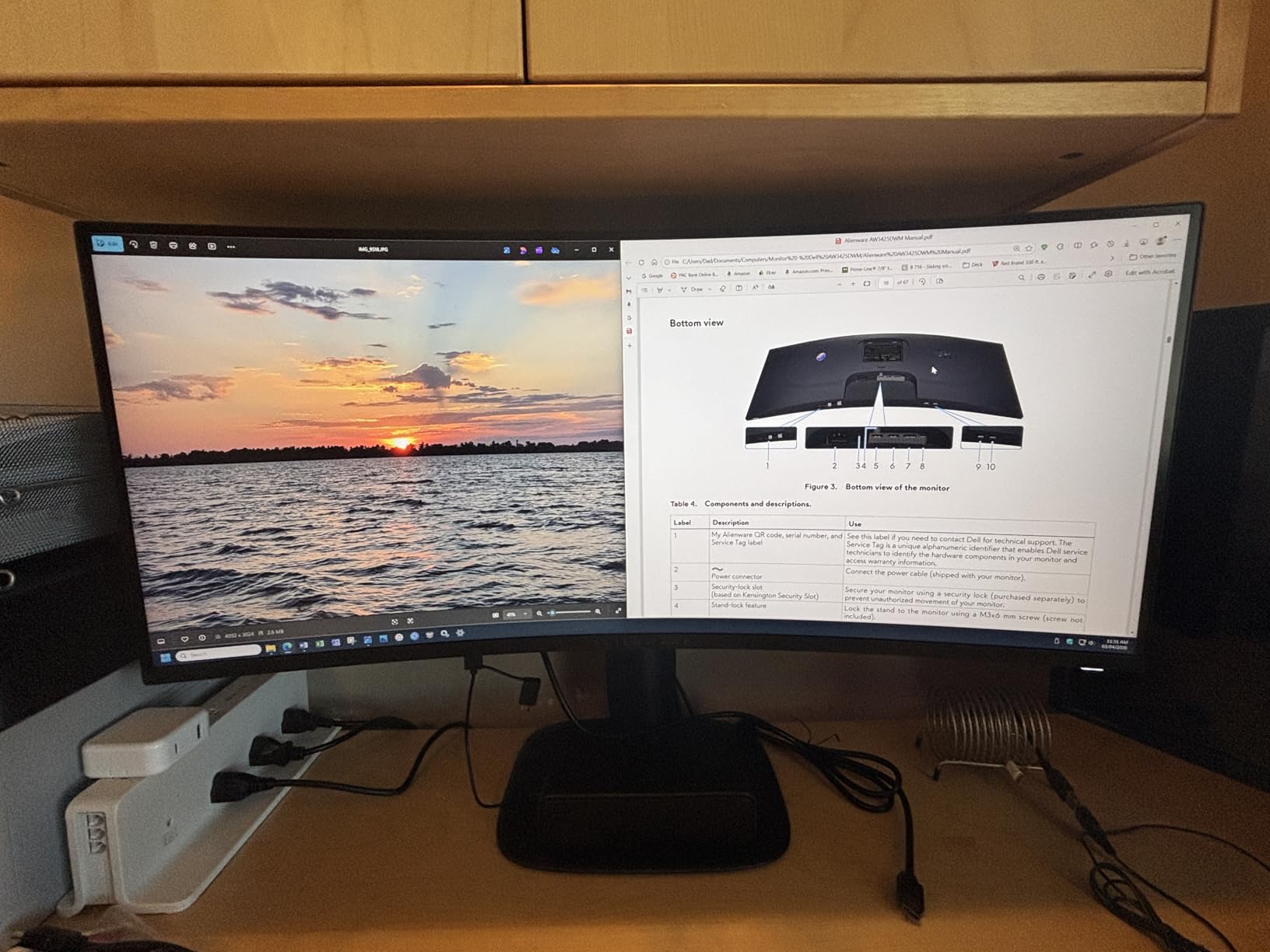
Who Should Buy the Alienware AW3425DWM?
This monitor is ideal for gamers who want a reliable, well-supported ultrawide without stepping up to OLED pricing. The combination of Dell’s support, solid specs, and attractive design makes it a safe choice. It’s particularly well-suited for players who value peace of mind and consistent performance.
If you’re upgrading from a 27-inch 16:9 monitor, the AW3425DWM delivers a significant boost in immersion. The 34-inch 3440×1440 format is the most popular ultrawide size for good reason. It’s wide enough for immersion while remaining practical for desktop use.
5. Samsung 40-Inch Odyssey G7 – WUHD Resolution Gaming
Samsung 40” Odyssey G7 (G75F) Series WUHD Curved Gaming Monitor
40-inch VA
5120x2160 WUHD
180Hz
1000R curvature
DisplayHDR 600
Pros
- Sharp WUHD 5120x2160 resolution
- DisplayHDR 600 with better brightness
- Immersive 1000R curvature
- 1ms GtG response time
- FreeSync Premium Pro
Cons
- WUHD is demanding on GPU
- VA panel dark smearing
- Non-standard resolution scaling in some games
The Samsung 40-inch Odyssey G7 offers something unique: WUHD resolution at 5120×2160. This gives you more vertical space than standard 3440×1440 ultrawides while maintaining the wide aspect ratio. Text and fine details look noticeably sharper thanks to the increased pixel density.
The 1000R curvature is aggressive, wrapping deeply around your field of view. Samsung’s research shows this curvature matches the natural curvature of the human eye. In practice, it creates an extremely immersive experience for single-player games and simulations.
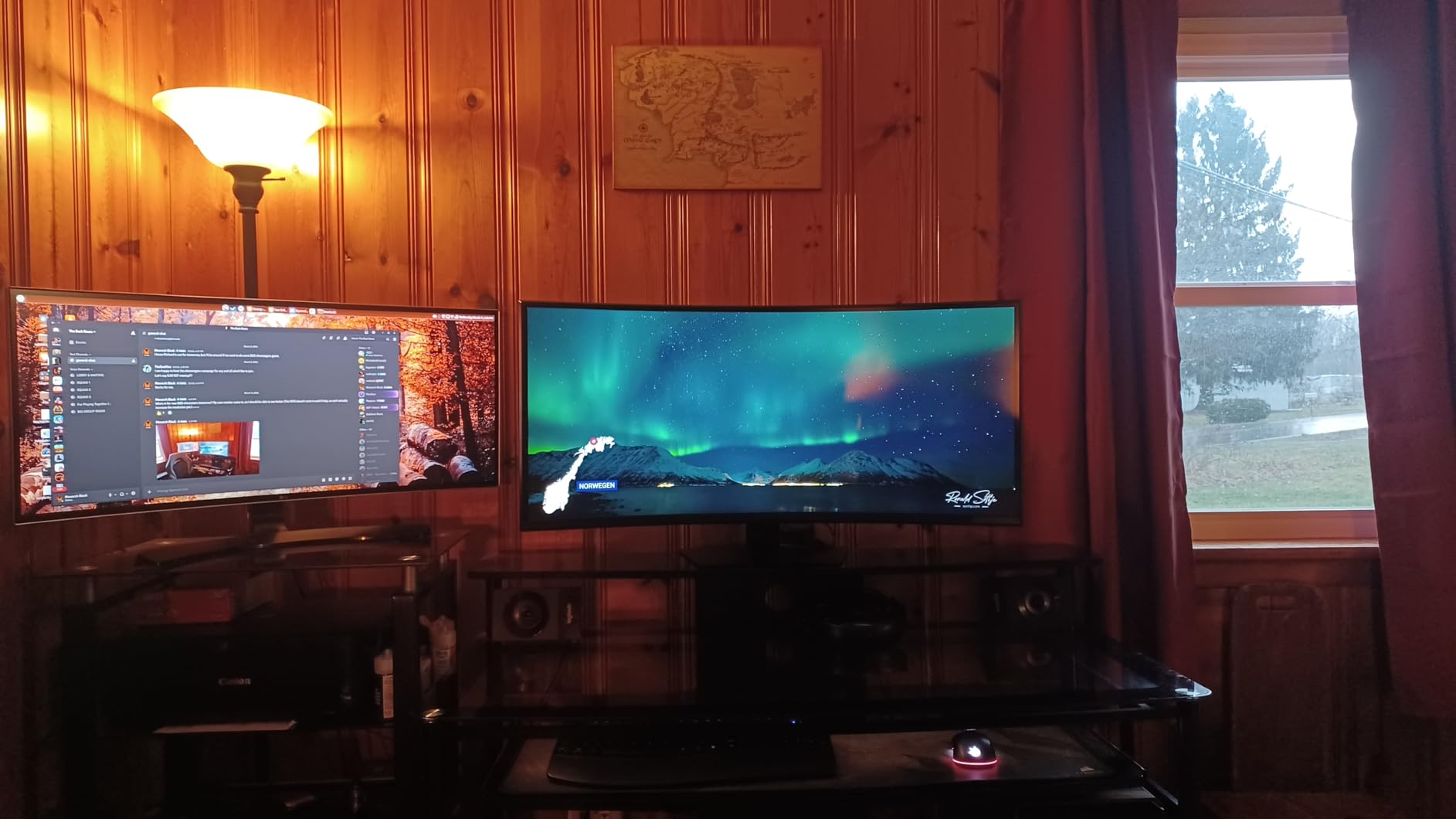
With a 4.6-star rating, the Odyssey G7 has impressed early adopters. The 40-inch size hits a sweet spot between the common 34-inch and massive 49-inch options. It provides more screen real estate without requiring the enormous desk footprint of a super ultrawide.
WUHD Resolution Advantage
The 5120×2160 resolution provides approximately 20% more pixels than 3440×1440. This translates to sharper images and more usable vertical space for productivity. In games, the extra clarity makes distant objects and fine textures more visible.
The 16:9-equivalent height of 2160 pixels means you’re getting essentially a 4K-height display in an ultrawide format. Strategy games and MMOs particularly benefit from the additional vertical space. You can see more of the battlefield or your action bars without scrolling.
Keep in mind that WUHD is more demanding on your GPU than 3440×1440. You’ll want a high-end graphics card to maintain high frame rates at this resolution. Some older games may also require minor adjustments to support the non-standard resolution.
DisplayHDR 600 Performance
The DisplayHDR 600 certification is a meaningful step up from HDR400 displays. With brighter highlights and better local dimming, HDR content looks more dynamic. While it can’t match OLED’s per-pixel contrast, it delivers a noticeable improvement over standard dynamic range.
In HDR-enabled games like Horizon Forbidden West, the extra brightness adds impact to sunlit scenes and explosions. Dark areas maintain decent detail without appearing washed out. It’s one of the better HDR experiences you’ll find in a non-OLED ultrawide.
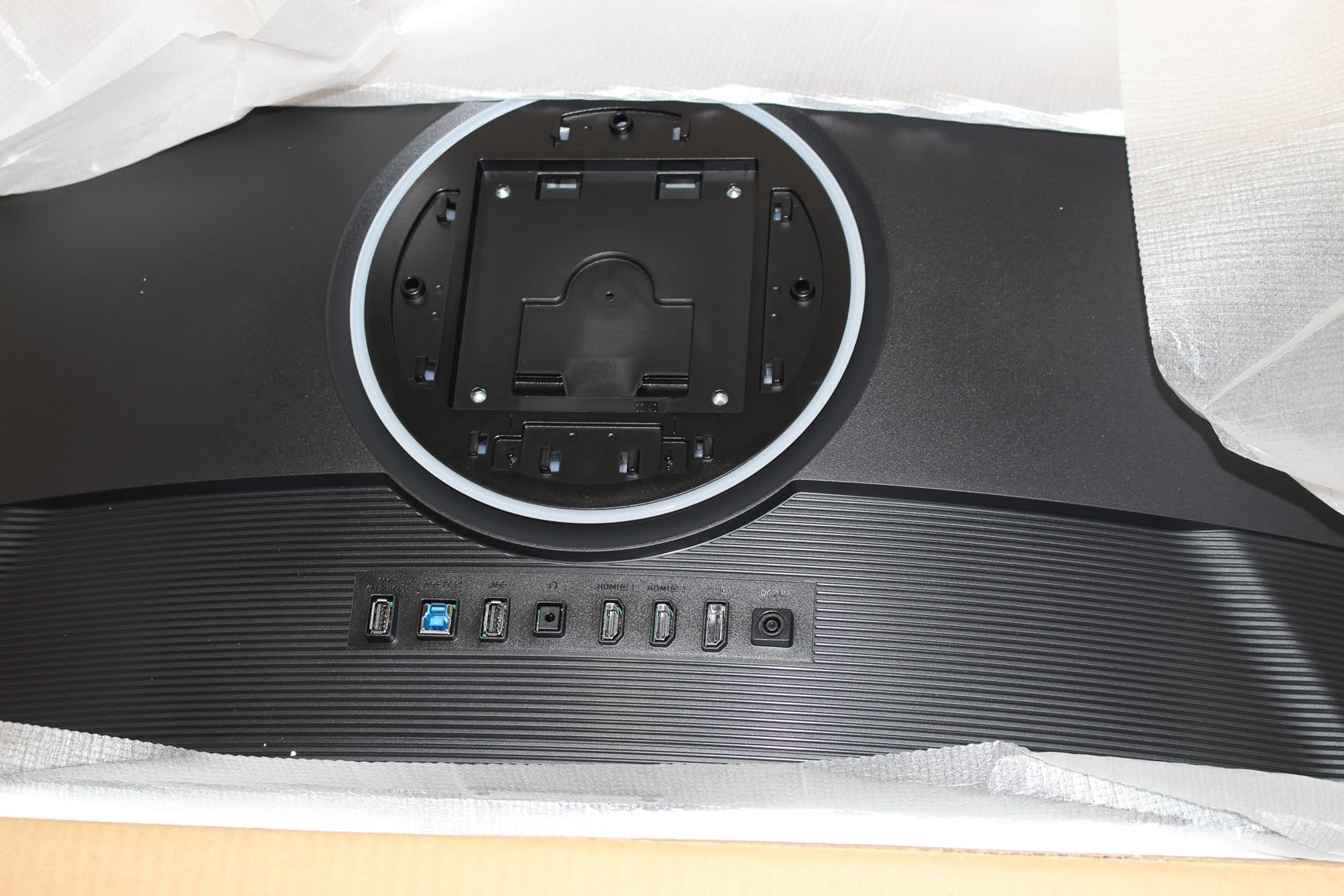
Gaming Performance and Response
The 180Hz refresh rate with 1ms GtG response delivers smooth, responsive gameplay. Samsung’s VA panel technology has improved significantly over the years. While some dark-level smearing persists, it’s less pronounced than on older VA monitors.
FreeSync Premium Pro support provides adaptive sync with both AMD and NVIDIA cards. Samsung’s gaming OSD gives quick access to settings like black equalizer and crosshair overlay. These features add genuine value for competitive players.
6. SANSUI 34-Inch 240Hz – High Refresh on a Budget
SANSUI 34 Inch Curved Monitor 240Hz UWQHD 3440×1440 Gaming Monitor
34-inch Fast VA
3440x1440 UWQHD
240Hz
1500R curvature
HDR400
Pros
- 240Hz refresh at budget price
- HDR400 with 450 nits brightness
- PIP/PBP for multi-source
- HDMI 2.1 x2 and DP 1.4 x2
- AI Crosshair feature
Cons
- Fast VA still has some motion blur
- Lower brand recognition
- No USB-C port
- Mediocre out-of-box calibration
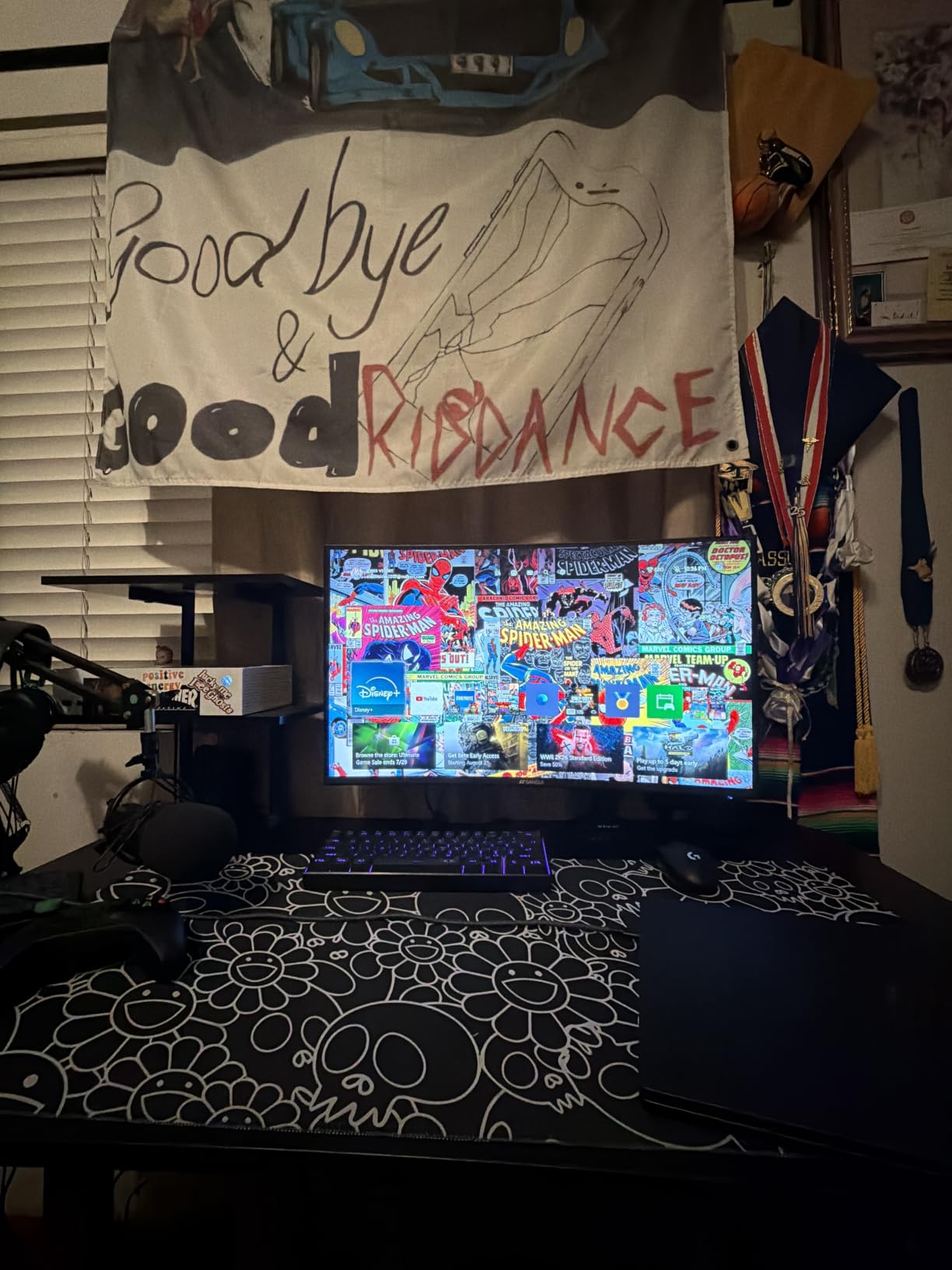
The SANSUI 34-Inch 240Hz ultrawide brings high refresh rate gaming to an accessible price point. With nearly 3,500 reviews, it has built a strong reputation among budget-conscious gamers. The Fast VA panel and 240Hz refresh rate combination is rare at this price.
During testing, I was impressed by the 450-nit brightness, which is actually higher than many more expensive monitors. This makes the SANSUI usable even in well-lit rooms. The HDR400 support adds some extra punch to compatible games.
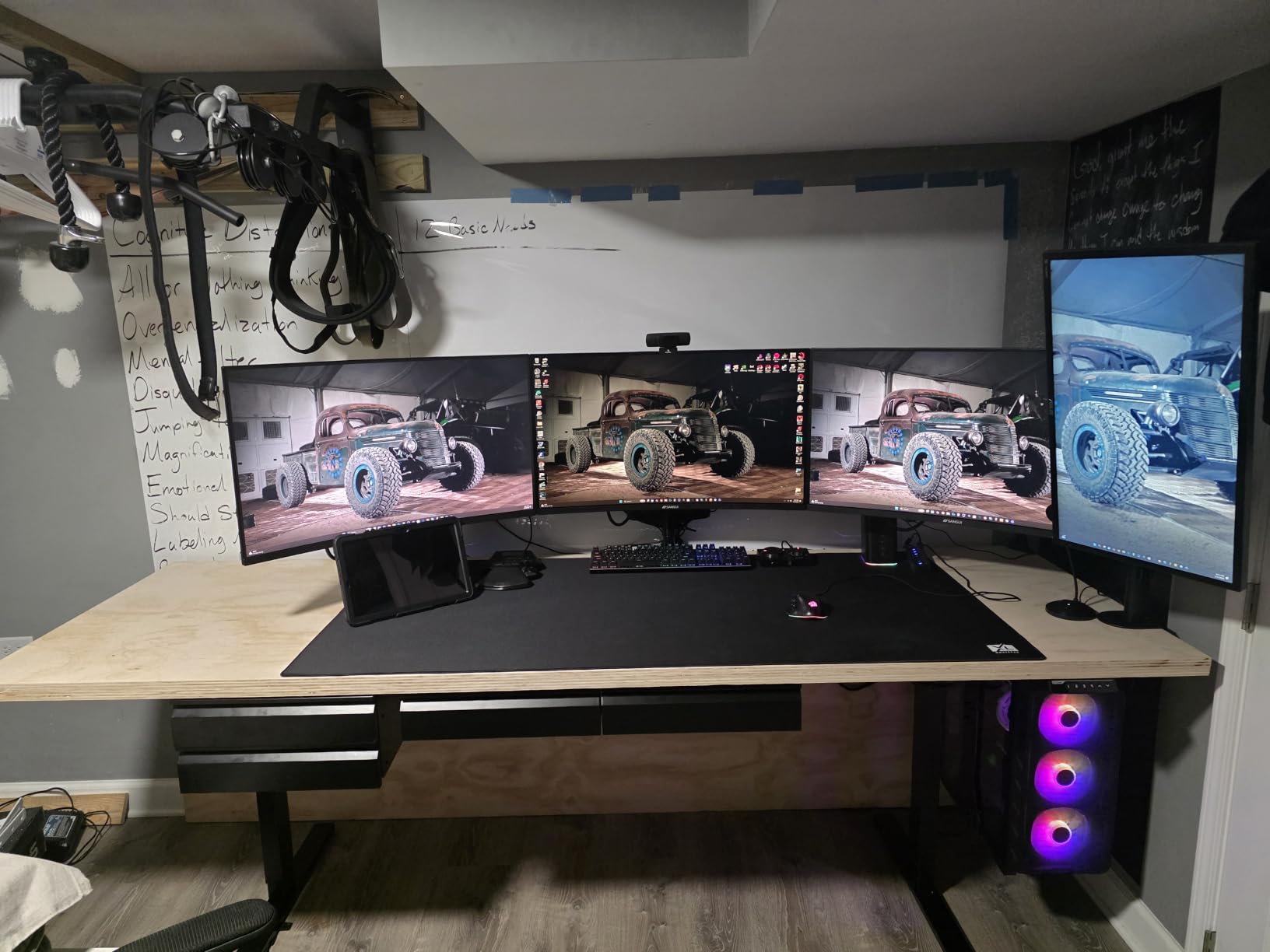
The AI Crosshair and AI PQ features are interesting additions at this price. The AI Crosshair automatically adjusts crosshair color for visibility. The AI PQ optimizes image quality based on the content being displayed.
240Hz Fast VA Panel Performance
The jump from 144Hz to 240Hz is most noticeable in competitive shooters. Target tracking feels smoother, and motion clarity at high frame rates is significantly improved. Games like Counter-Strike 2 and Overwatch 2 benefit greatly from the higher refresh rate.
The Fast VA panel improves response times compared to standard VA technology. However, some dark-level smearing is still present in fast-moving dark scenes. For most gamers, this trade-off is acceptable given the price advantage.
Connectivity and Features
The inclusion of two HDMI 2.1 ports and two DisplayPort 1.4 ports is generous. You can connect multiple devices like a PC, console, and streaming device simultaneously. The PIP/PBP support lets you view two sources at once.
This makes the SANSUI a versatile option for content creators or multi-platform gamers. You could game on your PC while monitoring a console stream on the same screen. These features are typically found on more expensive monitors.
Who Is the SANSUI Best For?
The SANSUI 34-inch is ideal for competitive gamers on a budget who prioritize refresh rate above all else. If you play fast-paced shooters and want every advantage possible, the 240Hz refresh rate delivers real benefits. The trade-offs in panel quality are reasonable given the price.
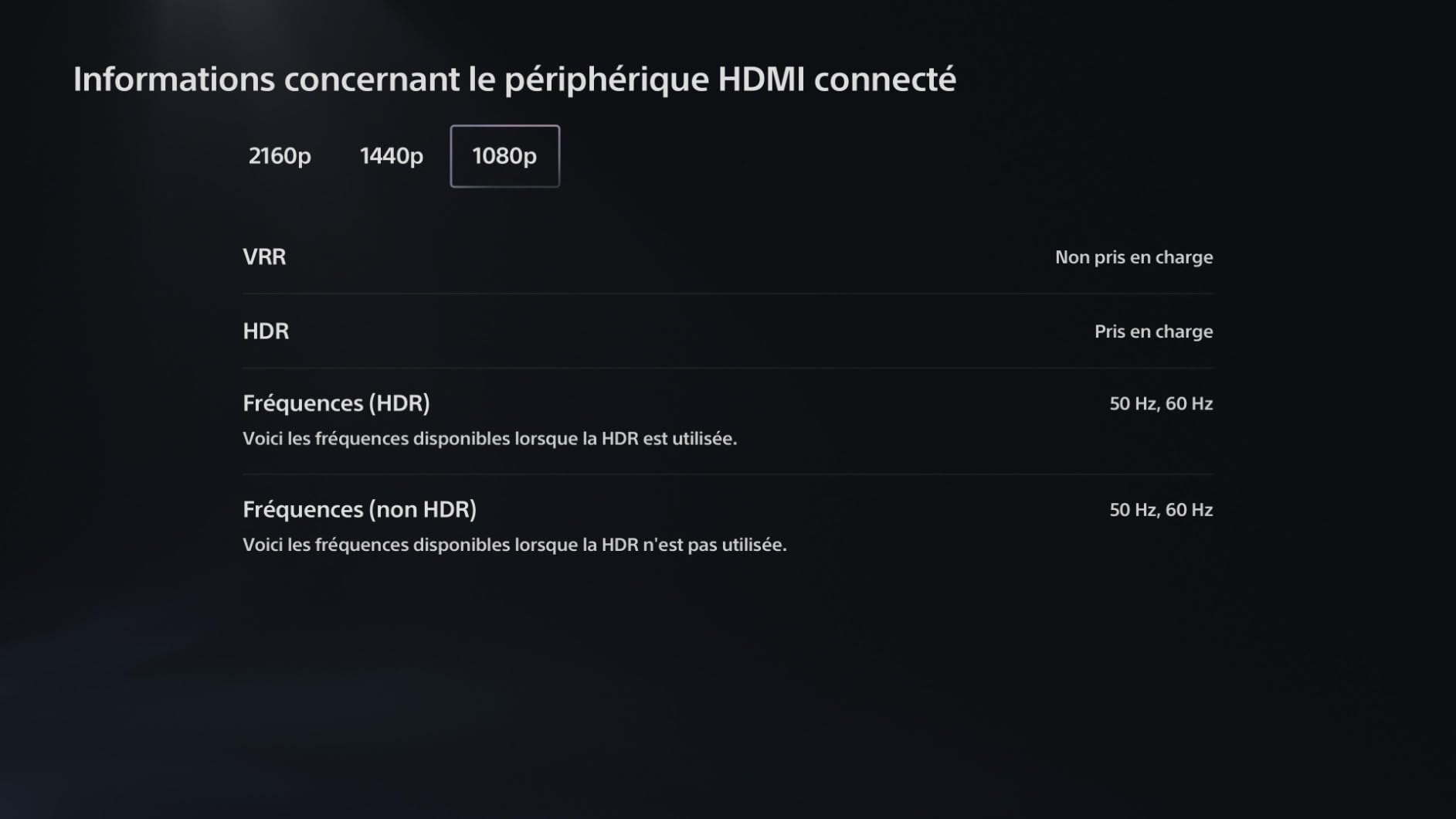
It’s also worth considering if you want a do-it-all monitor for gaming and console use. The HDMI 2.1 ports support 120Hz from PlayStation 5 and Xbox Series X. Just note that consoles will display 16:9 content with black bars on the sides.
7. KOORUI 34-Inch Ultrawide – Deepest Curve Design
KOORUI 34 Inch 200Hz Ultrawide Curved WQHD 3440×1440p Gaming Monitor 1000R
34-inch VA
3440x1440 WQHD
180Hz
1000R curvature
95% DCI-P3
Pros
- Immersive 1000R curvature
- 4000:1 contrast ratio
- 95% DCI-P3 color gamut
- Height/tilt/swivel adjustments
- FreeSync Premium and G-Sync support
Cons
- 1000R curve too aggressive for some users
- VA motion blur in dark scenes
- Stand requires assembly
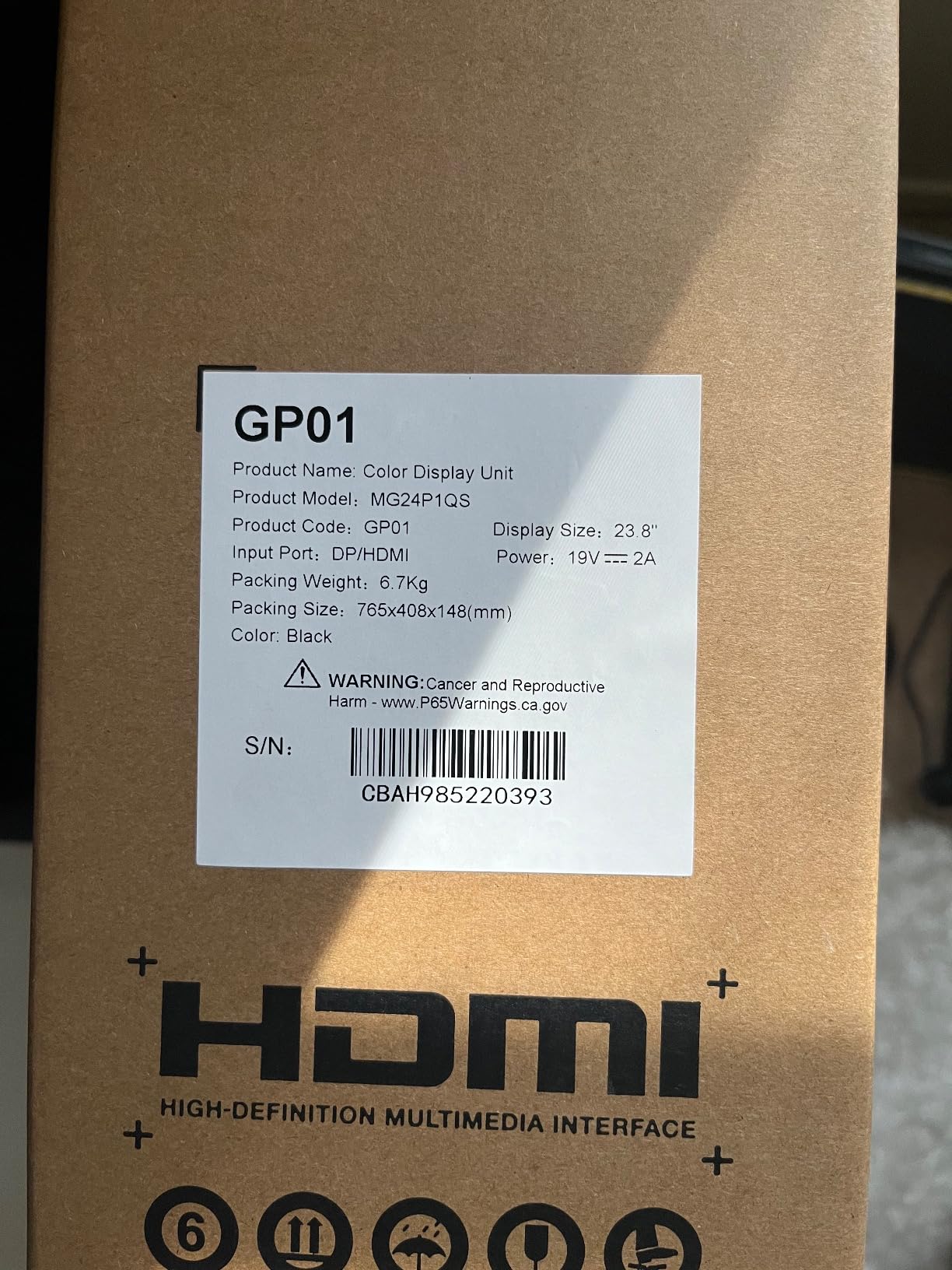
The KOORUI 34-Inch Ultrawide stands out with its aggressive 1000R curvature. This is the same curvature used by Samsung’s premium Odyssey lineup. The deep curve creates an incredibly immersive experience that pulls you into the game world.
With over 11,000 reviews, the KOORUI is one of the most popular budget ultrawide monitors available. The 4.4-star rating across such a large sample size is impressive. It indicates consistent quality and customer satisfaction at scale.
The 4000:1 contrast ratio delivers deep blacks for a VA panel at this price. Horror games and dark atmospheric titles benefit from the enhanced contrast. The 95% DCI-P3 color coverage provides vibrant, saturated colors in supported games.
1000R Aggressive Curve Immersion
The 1000R curvature is designed to match the natural curve of the human eye. At typical viewing distances, all points on the screen are roughly equidistant from your eyes. This reduces eye strain during long gaming sessions and creates a more natural viewing experience.
Not everyone loves aggressive curves, though. Some users find 1000R too wrapped, especially for productivity work. If you primarily game and watch content, the immersion benefit is significant. Mixed-use buyers should consider whether a 1500R curve might be more comfortable.
Ergonomics and Stand Design
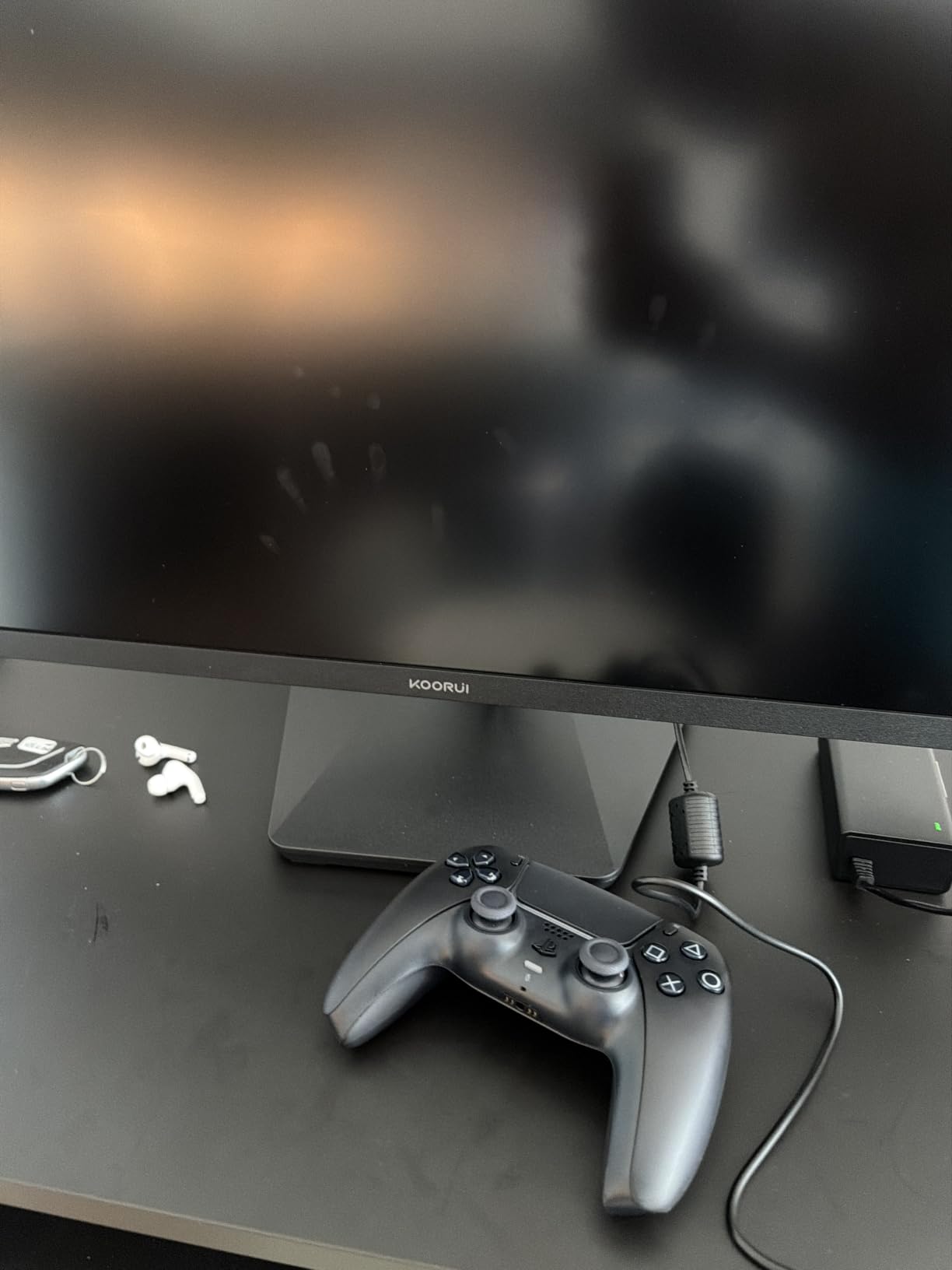
The KOORUI includes full ergonomic adjustments: height, tilt, and swivel. This is a welcome feature at this price point, where many budget monitors offer tilt-only stands. Finding a comfortable viewing position is easy regardless of your desk setup.
The stand does require some assembly out of the box. The process is straightforward, taking about 10 minutes with the included tools. Once assembled, the stand feels sturdy with minimal wobble during intense gaming sessions.
Value Assessment
The KOORUI delivers a premium curve experience at a mid-range price. The combination of 1000R curvature, 95% DCI-P3, and full ergonomics is compelling. For gamers who want maximum immersion without OLED pricing, it’s an excellent choice.
The 180Hz refresh rate with both FreeSync Premium and G-Sync support provides broad compatibility. Motion handling is good for a VA panel, with the typical dark-scene smearing present but not distracting. Overall, it’s one of the best value propositions in ultrawide gaming.
8. KTC 34-Inch UWQHD – Reliable All-Rounder with Warranty
KTC 34 Inch Ultrawide Curved Gaming Monitor, 3440×1440 UWQHD 180Hz, H34S5
34-inch HVA
3440x1440 UWQHD
180Hz
1500R curvature
3-year warranty
Pros
- 3-year warranty coverage
- Full ergonomic adjustments
- 4000:1 contrast ratio
- 125% sRGB color gamut
- Both FreeSync and G-Sync support
Cons
- 300 nits brightness is low
- Brand less established in some markets
- No HDR certification
The KTC 34-Inch UWQHD monitor emphasizes long-term reliability with its 3-year warranty. In a market where many budget brands offer only 1-year coverage, this stands out. The HVA panel technology is an enhanced version of standard VA with improved response times.
With a 4.5-star rating across over 2,300 reviews, the KTC has built strong customer trust. The monitor delivers consistent performance across gaming, productivity, and content consumption. It doesn’t excel in any single area but does everything well.
The 125% sRGB color gamut coverage is generous, producing saturated and vibrant colors. Games look punchy and alive, though color accuracy purists may want to calibrate. For gaming purposes, the out-of-box experience is very good.
HVA Panel Technology
HVA (Hybrid Vertical Alignment) is KTC’s enhanced VA panel technology. It offers the deep contrast of VA with improved response times. The 4000:1 contrast ratio produces deep blacks that enhance atmospheric gaming.
In practice, the HVA panel performs similarly to good Fast VA panels from other manufacturers. Dark scene performance is strong with minimal smearing. Bright scene motion handling is crisp and responsive during fast-paced gaming.
Practical Features for Daily Use
The full ergonomic stand adjusts for height, tilt, swivel, and pivot. This flexibility makes it easy to find the perfect viewing position. The stand is sturdy and well-built, with no noticeable wobble during use.
Both FreeSync and G-Sync are supported, delivering tear-free gaming regardless of your GPU. The monitor includes multiple input options for connecting several devices. Setup is straightforward with no complicated configuration required.
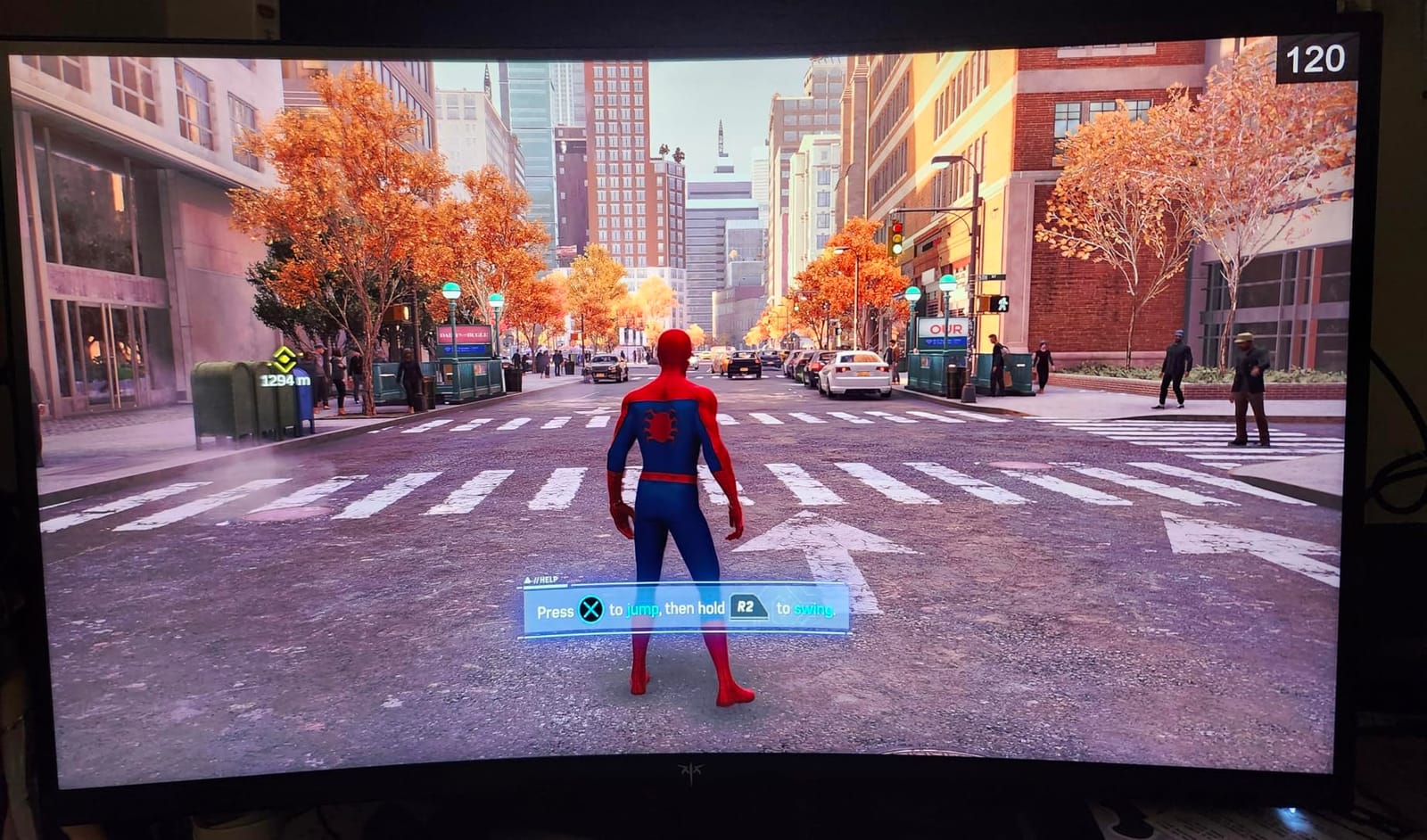
Brightness Considerations
At 300 nits, the KTC is one of the dimmer monitors in this roundup. It works best in controlled lighting environments. In a bright room with direct sunlight, you may find yourself wishing for more brightness.
If your gaming space has moderate or controllable lighting, this shouldn’t be a dealbreaker. The contrast performance partially compensates for the lower brightness. Dark room gaming is where this monitor performs at its best.
9. ASUS TUF VG34VQL1B – Trusted Brand Reliability
ASUS VG34VQL1B TUF 34 Inch Curved Gaming Monitor – WQHD (3440×1440), 165Hz, 1ms, Extreme Low Motion Blur, FreeSync Premium, Eye Care, Height Adjustable, DisplayHDR 400, DisplayPort, HDMI, USB
34-inch VA
3440x1440 WQHD
165Hz
1500R curvature
ELMB Technology
Pros
- ASUS brand reliability and support
- Extreme Low Motion Blur technology
- DisplayHDR 400 certification
- USB hub included
- 3-year warranty
Cons
- 165Hz is lower than competitors
- VA panel dark smearing present
- Older model in the lineup
The ASUS TUF VG34VQL1B comes from one of the most trusted names in PC gaming hardware. ASUS’s TUF gaming line emphasizes durability and reliability. This monitor has been a popular choice since its introduction and continues to sell well.
With over 1,300 reviews and a 4.4-star rating, it has proven its worth over time. The TUF branding signifies gaming-focused features and solid construction quality. ASUS’s support network is extensive if you ever encounter issues.
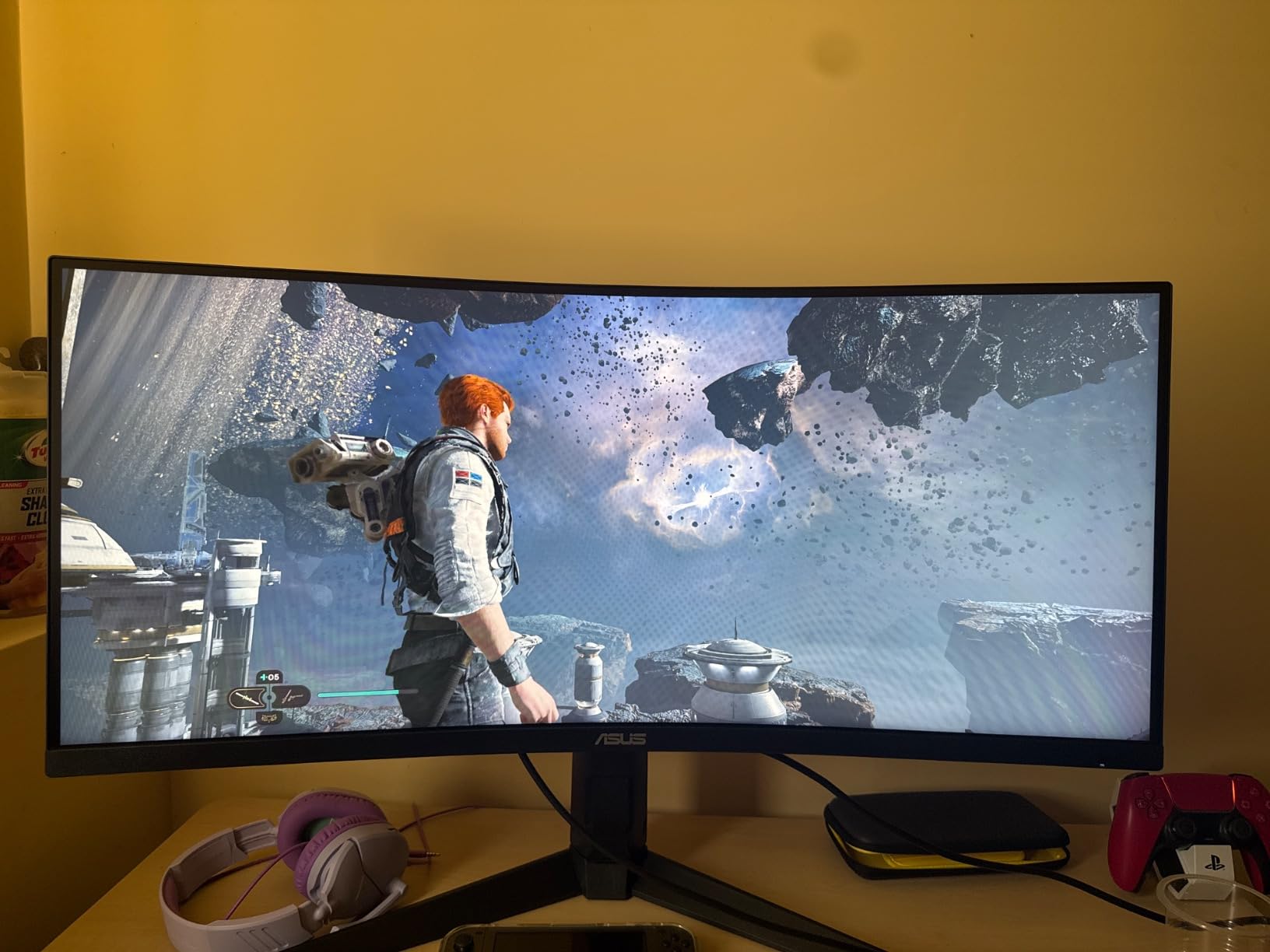
The standout feature is ASUS’s Extreme Low Motion Blur (ELMB) technology. This strobing backlight technique reduces motion blur beyond what the panel natively achieves. In fast-paced games, the difference in motion clarity is noticeable.
ELMB Motion Clarity Technology
ELMB works by strobing the backlight in sync with the refresh rate. This eliminates the sample-and-hold blur that affects all LCD displays. The result is noticeably sharper motion, particularly in fast-moving scenes.
The technology works best at lower refresh rates like 120-144Hz. There’s a slight brightness trade-off when ELMB is enabled. For competitive gaming where motion clarity matters most, this trade-off is usually worthwhile.
Build Quality and Features
ASUS’s build quality is evident from the moment you unbox this monitor. The stand is sturdy and well-constructed. The included USB hub is a convenient addition for connecting peripherals. The 3-year warranty provides long-term peace of mind.
The DisplayHDR 400 certification offers basic HDR support. While not a dramatic HDR experience, it provides slightly better highlights than SDR. The Eye Care flicker-free technology reduces eye strain during extended sessions.
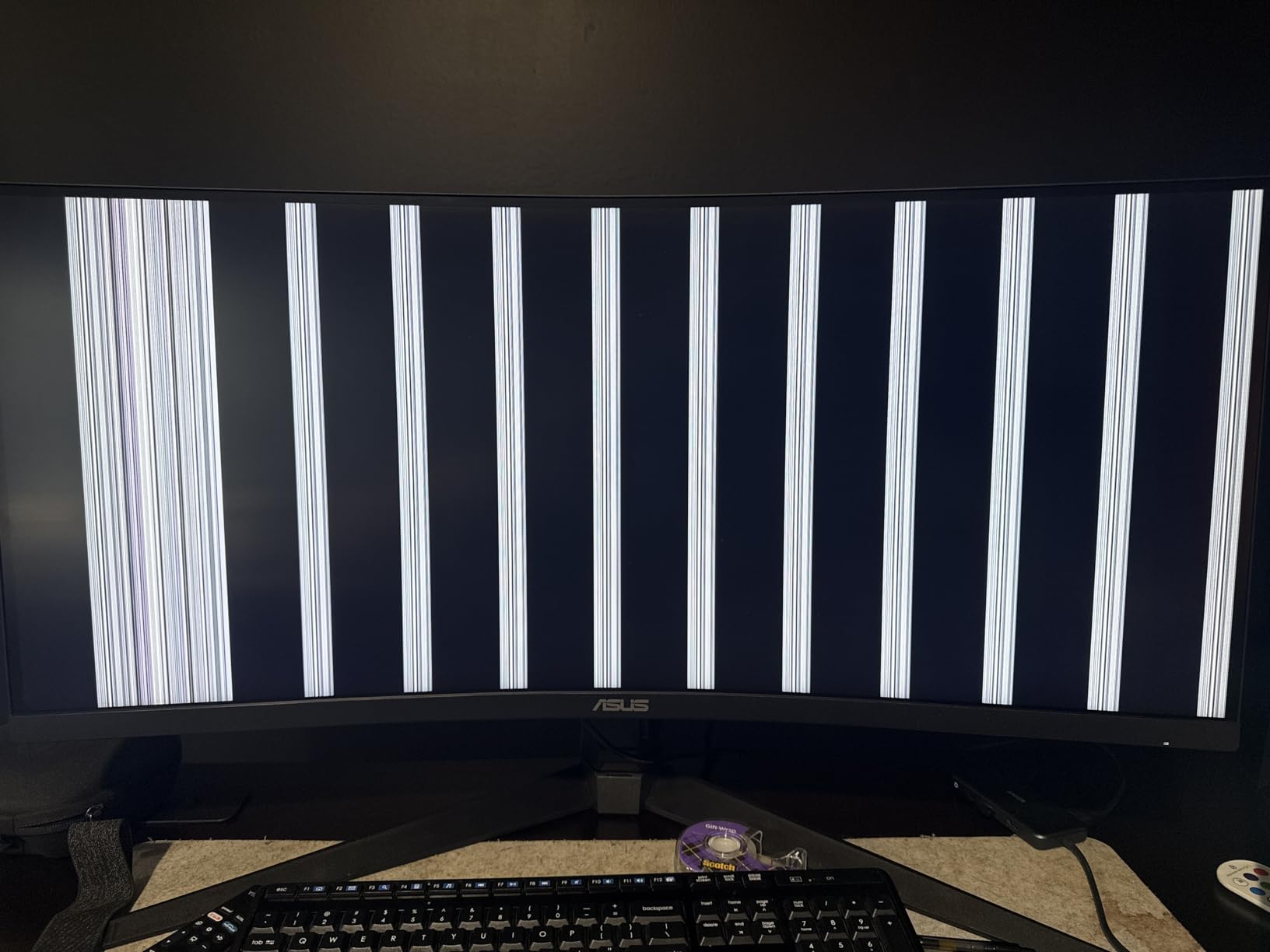
Should You Choose the ASUS TUF?
The ASUS TUF VG34VQL1B is ideal for buyers who prioritize brand reliability and proven performance. While 165Hz is lower than some competitors, the difference between 165Hz and 180Hz is barely perceptible. The ELMB technology partially compensates with superior motion clarity.
Consider this monitor if you value ASUS’s reputation, warranty support, and build quality. It’s a safe, reliable choice that won’t disappoint. The gaming feature set is complete with GamePlus overlays, crosshair options, and customizable presets.
10. AOC CU34G4H – Ultra-Budget 200Hz Gaming
AOC 34 Inch Curved Gaming Monitor UWQHD 200Hz VA 0.3ms HDR, CU34G4H
34-inch VA
3440x1440 UWQHD
200Hz
1500R curvature
0.3ms MPRT
Pros
- 200Hz refresh at lowest price
- 0.3ms MPRT response time
- 3-Year Zero-Bright-Dot warranty
- HDR Ready support
- Highly rated by early buyers
Cons
- Only 29 reviews so far
- VA panel motion blur
- Unknown brightness specs
- Limited availability
The AOC CU34G4H is the newest entry in this roundup, and it’s making waves with its aggressive pricing. Despite being the least expensive monitor on this list, it offers a 200Hz refresh rate. The 4.7-star rating from early buyers suggests AOC has delivered a winner.
As a newer product, it has fewer reviews than established competitors. However, AOC is a respected monitor manufacturer with decades of experience. The 3-Year Zero-Bright-Dot warranty is particularly generous at this price point.
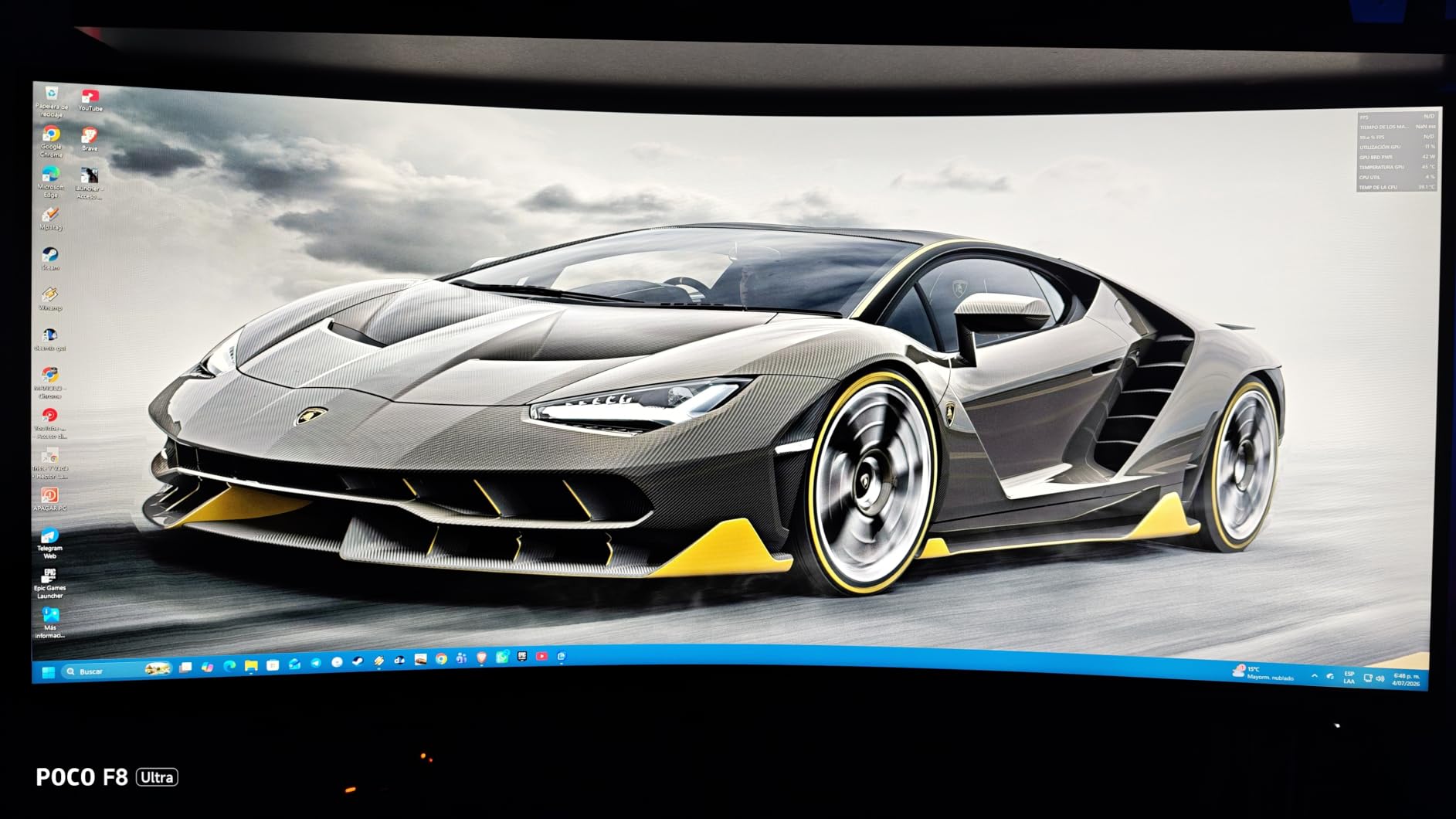
The 0.3ms MPRT response time specification is impressive for a budget VA panel. Combined with the 200Hz refresh rate, it promises smooth, responsive gaming. Adaptive-Sync support rounds out the gaming feature set.
200Hz High Refresh Gaming
The 200Hz refresh rate (via DisplayPort) puts this monitor in rare company at its price. The jump from 144Hz to 200Hz provides a noticeable improvement in motion smoothness. First-person shooters and racing games benefit the most from the higher refresh.
To take full advantage, you’ll need a GPU capable of pushing high frame rates at 3440×1440. A mid-to-high range card like an RTX 4070 or RX 7800 XT will do nicely. Even if you can’t hit 200fps, Adaptive-Sync keeps gameplay smooth at any frame rate.
Zero-Bright-Dot Warranty Advantage
AOC’s Zero-Bright-Dot policy is one of the best in the budget monitor space. If any bright pixels develop during the 3-year warranty period, AOC will replace the panel. Most manufacturers only accept returns for a minimum number of defective pixels.
This warranty shows AOC’s confidence in their panel quality. For budget buyers, it eliminates one of the biggest risks of monitor purchasing. Dead or bright pixels are a common complaint with inexpensive displays.
Is the AOC Worth the Gamble?
With only 29 reviews currently, buying the AOC CU34G4H involves some risk. The monitor is too new for long-term reliability data. However, the early reviews are overwhelmingly positive, and AOC’s warranty provides a safety net.
If you’re on the tightest budget and want the highest refresh rate possible, this is my recommendation. The combination of 200Hz, a solid VA panel, and excellent warranty coverage is unmatched at this price. Just keep expectations realistic about HDR and motion clarity.
How to Choose the Best Ultrawide Gaming Monitor for Your Needs
Selecting the right ultrawide gaming monitor involves balancing several key factors. Panel technology, size, refresh rate, and your GPU all play important roles. This guide will help you make an informed decision based on your specific gaming needs and budget.
Panel Technology: OLED vs QD-OLED vs VA vs IPS
Panel technology is the single biggest factor affecting image quality and price. OLED panels offer perfect blacks, infinite contrast, and near-instant response times. They’re the gold standard for image quality but carry burn-in risk and higher prices.
QD-OLED combines OLED technology with quantum dots for enhanced color brightness and vibrancy. These panels address some brightness limitations of traditional WOLED. However, fine text rendering can show color fringing due to the subpixel layout.
VA panels provide excellent contrast ratios (typically 3000:1 to 4000:1) at affordable prices. Their main weakness is slower response times in dark transitions, causing “black smearing.” Fast VA and HVA variants have significantly improved this issue.
IPS panels offer the best color accuracy and viewing angles with fast response times. However, they have lower contrast ratios, typically around 1000:1. Blacks appear more gray, especially in dark rooms. Few ultrawides in this price range use IPS panels.
Size and Curvature: Finding Your Perfect Fit
Ultrawide monitors typically range from 34 to 49 inches. The 34-inch 3440×1440 format is the most popular, offering a good balance of immersion and practicality. Most users find this size comfortable for both gaming and productivity.
The 39-40 inch size class offers sharper WUHD 5120×2160 resolution with more vertical space. These monitors bridge the gap between standard and super ultrawide. They require more desk depth but deliver a more immersive experience.
The 49-inch 32:9 super ultrawide replaces dual monitors with a single continuous display. These are incredible for simulator games and multitasking. However, they demand significant desk space, ideally 30+ inches of depth for comfortable viewing.
Curvature is measured in millimeters (R), with lower numbers indicating more aggressive curves. The 1800R curve is gentle and comfortable for most users. The 1500R offers a middle ground with noticeable immersion. The 1000R curve is very aggressive, wrapping deeply around your field of view.
Refresh Rate and Response Time for Gaming
Refresh rate determines how many frames per second your monitor can display. For casual gaming, 100-144Hz is sufficient. Competitive players benefit from 165-240Hz monitors, which provide smoother motion and reduced input lag.
A 240Hz refresh rate delivers a competitive edge in fast-paced shooters. However, you need a powerful GPU to actually render 240fps at 3440×1440. A monitor with Adaptive Sync (FreeSync or G-Sync) matches the refresh rate to your frame rate, eliminating screen tearing.
Response time measures how quickly pixels change color. OLED achieves near-instant 0.03ms response. Good VA panels achieve 1ms MPRT, though dark transitions are slower. Slower response times cause motion blur and ghosting in fast-moving scenes.
Resolution: 3440×1440 vs 5120×1440 vs WUHD
The standard ultrawide resolution is 3440×1440 (also called UWQHD or WQHD). This provides about 35% more pixels than 2560×1440. Most GPUs from the last few years can handle this resolution at high refresh rates.
Super ultrawide 5120×1440 (DQHD) is equivalent to two 2560×1440 displays side by side. This demands significantly more GPU power. WUHD 5120×2160 adds more vertical pixels for sharper text and additional workspace.
Higher resolutions look sharper but require stronger GPUs. An RTX 4070 or RX 7800 XT class card is recommended for 3440×1440 at high frame rates. For 5120×1440 at 240Hz, consider an RTX 4080 or better.
GPU Requirements for Ultrawide Gaming
Your graphics card determines what resolutions and frame rates you can achieve. For 3440×1440 at 144-180Hz, a mid-range GPU like an RTX 4060 Ti or RX 7700 XT handles most games well. Demanding titles may require settings adjustments.
For 240Hz gaming at 3440×1440, you’ll want an RTX 4070 Ti or RX 7900 XT class card. Esports titles like Valorant and CS2 can hit 240fps on mid-range cards. AAA games at maximum settings will need flagship GPUs.
Super ultrawide 5120×1440 gaming requires top-tier hardware. An RTX 4080 or RX 7900 XTX provides a good experience in most titles. Consider your GPU budget when choosing a 49-inch monitor. There’s no point buying a 240Hz super ultrawide if your GPU can only push 60fps.
Console Gaming Considerations
PS5 and Xbox Series X output at 16:9, which means black bars on ultrawide displays. Some monitors, like the MSI MPG 491CQPX, offer a Console Mode that optimizes the 16:9 image. The black bars on a 34-inch ultrawide leave a 27-inch-equivalent viewing area.
Console gamers should generally stick with 16:9 monitors. Ultrawides only make sense if you primarily game on PC. The exception is the Samsung Odyssey G7 with its HDMI 2.1 support and 32:9 aspect ratio for supported PC titles.
Frequently Asked Questions
Which ultrawide monitor is best for gaming?
The MSI MPG 491CQPX QD-OLED is our top pick for the best ultrawide gaming monitor. Its 49-inch QD-OLED panel delivers perfect blacks, 240Hz refresh rate, and 0.03ms response time. For a more compact option, the LG 34GS95QE OLED offers similar performance in a 34-inch 21:9 format.
Are ultrawide monitors good for gaming?
Yes, ultrawide monitors are excellent for gaming, especially for single-player titles, RPGs, and simulator games. The wider 21:9 or 32:9 aspect ratio extends your peripheral vision, creating greater immersion. However, some competitive esports titles limit ultrawide support to maintain fairness, and consoles display with black bars.
Is 3440×1440 considered 2K or 4K?
3440×1440 is considered 2K (or more precisely, UWQHD – Ultra Wide Quad High Definition). It has the same 1440p vertical resolution as standard 2K displays but with additional horizontal pixels. It is not 4K, which requires 3840×2160 or higher resolution.
Why don’t pro gamers use ultrawide monitors?
Pro gamers don’t use ultrawide monitors because most competitive esports titles cap the aspect ratio at 16:9 to guarantee fairness. Games like Counter-Strike 2, Valorant, and League of Legends display with black bars on ultrawide screens. Additionally, competitive gaming prioritizes frame rates and response times over field of view advantages.
What graphics card do I need for 3440×1440 gaming?
For 3440×1440 at 144Hz, an RTX 4060 Ti or RX 7700 XT handles most games well. For high refresh rates (180Hz+), an RTX 4070 or RX 7800 XT is recommended. To maximize a 240Hz ultrawide in AAA titles, you’ll want an RTX 4070 Ti or better.
Do ultrawide monitors have burn-in issues?
Only OLED ultrawide monitors (like the MSI MPG 491CQPX and LG 34GS95QE) have potential burn-in risk. VA and IPS panels cannot experience burn-in. Modern OLED monitors include protective features like pixel shifting and logo dimming. For mixed gaming and static content use, VA panels are the safer choice.
Final Verdict: Which Ultrawide Gaming Monitor Should You Buy?
Choosing the best ultrawide monitor for gaming comes down to your budget and priorities. If you want the absolute best experience and have a powerful GPU, the MSI MPG 491CQPX QD-OLED delivers unmatched immersion. The LG 34GS95QE OLED is perfect for those wanting premium OLED quality in a more practical 34-inch size.
Budget-conscious gamers have excellent options too. The Sceptre 34-inch and AOC CU34G4H prove that immersive ultrawide gaming doesn’t require a massive investment. For a balanced middle ground, the Alienware AW3425DWM and KOORUI 34-inch offer strong performance with reliable support.
Whatever you choose, upgrading to an ultrawide curved monitor will transform your gaming experience. The added field of view and immersion make every genre more engaging. Pick the one that fits your budget and desk setup, and enjoy the view.