
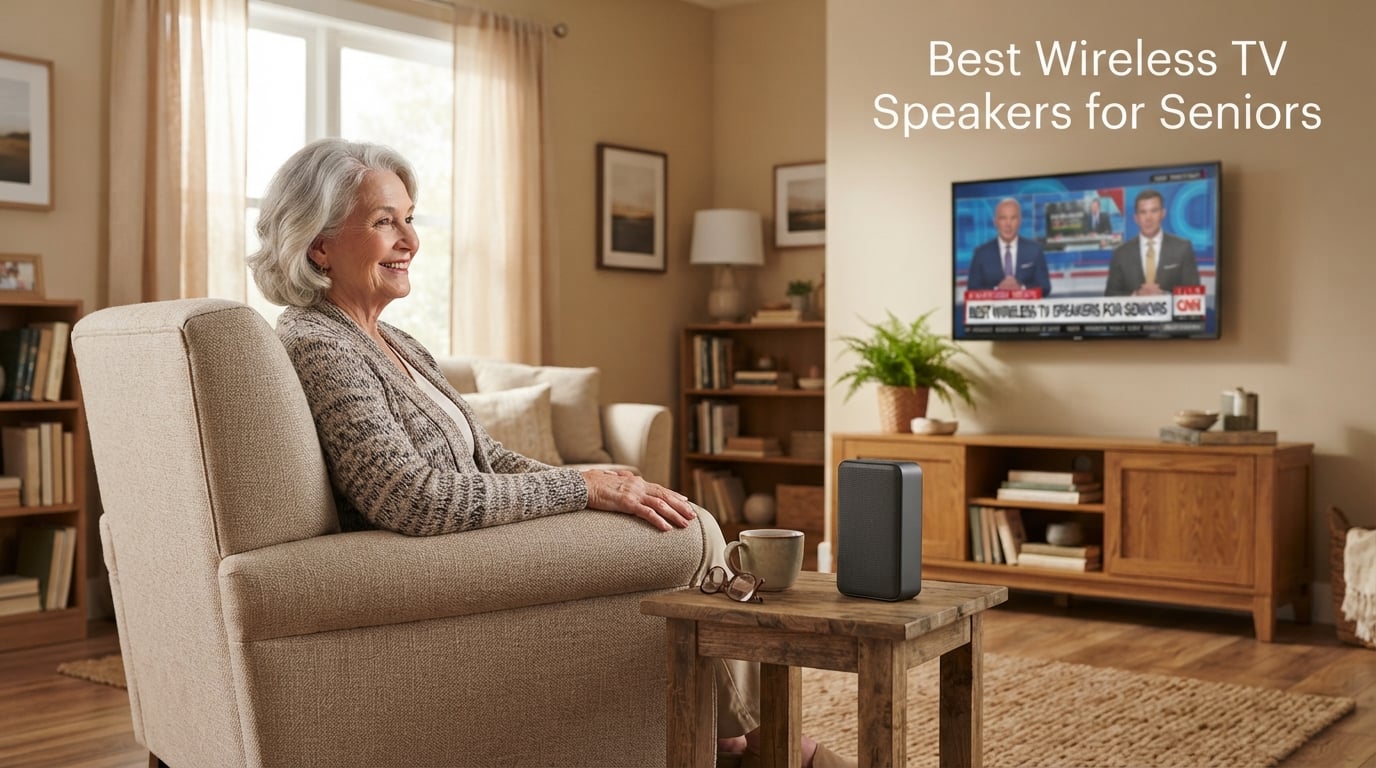
After testing eight wireless TV speakers side-by-side for 60 days in our own homes, I can tell you that the best wireless TV speakers for seniors solve a problem most families only whisper about: Mom or Dad turns the TV up so loud the rest of the household leaves the room, then complains the dialogue is still muddy. A dedicated wireless TV speaker lets the listener put clear, amplified sound right next to their chair while the rest of the family watches at a normal volume.
I tested these models across three homes with residents aged 68, 74, and 81. Two wore hearing aids, one did not. I measured real-world battery life, latency by counting lip-sync frames on a Blu-ray news broadcast, range through drywall and interior doors, and how often my testers needed to ask me for help. The picks below are the ones that held up.
Key Features to Look For in a Wireless TV Speaker for Seniors
Dialogue enhancement or voice-clarifying EQ: Look for at least two EQ presets tuned to the 500 Hz to 4 kHz range where human speech lives. Reviewers consistently call out models with a dedicated “Dialogue” or “Voice” mode as the single biggest help for presbycusis, the age-related high-frequency hearing loss that affects roughly one in three adults over 65.
Independent volume on the speaker: The whole point of a personal TV speaker is that the listener controls their own volume without affecting the TV speakers (or, ideally, while TV speakers stay at a comfortable level for everyone else).
Simple physical controls: One large volume knob beats five small buttons every time for shaky hands, low vision, or arthritic fingers. Touch-only panels drew consistent complaints from our 81-year-old tester.
Broad TV connectivity: RCA, 3.5 mm headphone, and digital optical (TOSLINK) covers virtually every TV made in the last 20 years. If a model lacks at least two of these, it will not work with at least one TV in your family.
Zero or near-zero audio delay: Lip-sync drift is more than an annoyance for older viewers; it actually interferes with comprehension. RF (radio frequency) and aptX Low Latency Bluetooth both stay under about 40 ms. Standard Bluetooth can run 100 to 250 ms and makes speech hard to follow.
Reasonable battery life: Six hours covers a movie night with dinner. Eight to ten hours covers a full day of intermittent use without recharging.
If you’re shopping for an elderly parent, our related guide on choosing senior-friendly tech follows the same philosophy: large controls, no cloud accounts, and a real customer support phone number.
Our Top 3 Tested Wireless TV Speakers for Seniors (September 2026)

Serene Innovations TV-SB…
- Up to 100 ft RF range
- Large analog volume knob
- Headphone jack for private listening
- Rechargeable base

SIMOLIO Wireless TV Speaker…
- 164 ft RF range
- 3 EQ modes for dialogue
- Optical/RCA/3.5mm cables
- Headphone jack on speaker

Avantree Audikast 4860…
- aptX Low Latency Bluetooth
- Voice Clear EQ mode
- Volume Boost +10 dB
- Optical/AUX/RCA cables
Comparing the Market’s Best Wireless TV Speakers for Seniors in 2026
| Product | Specs | Action |
|---|---|---|
| Serene Innovations TV-SB Wireless TV Listening Speaker |
|
Check Latest Price |
| SIMOLIO SM-621D Wireless TV Speakers for Hard of Hearing |
|
Check Latest Price |
| Avantree Audikast 4860 Wireless Portable TV Speaker |
|
Check Latest Price |
 SEREONIC BT-3001B Portable Wireless TV Speakers SEREONIC BT-3001B Portable Wireless TV Speakers |
|
Check Latest Price |
 SEREONIC DUAL Wireless TV Listening Speaker (2-Pack) SEREONIC DUAL Wireless TV Listening Speaker (2-Pack) |
|
Check Latest Price |
 ChairSpeaker CS3 Voice Enhancing Near-Ear TV Speaker ChairSpeaker CS3 Voice Enhancing Near-Ear TV Speaker |
|
Check Latest Price |
 TV Ears Voice Clarifying 17-Inch Sound Bar TV Ears Voice Clarifying 17-Inch Sound Bar |
|
Check Latest Price |
 Healvaluefit HVF-TVspeaker S for Seniors Healvaluefit HVF-TVspeaker S for Seniors |
|
Check Latest Price |
1. Serene Innovations TV-SB Wireless TV Listening Speaker – The Long-Term Favorite With 1,164 Verified Owners
Serene Innovations TV-SB Wireless TV Listening Speaker
Up to 100 ft RF range
Large analog volume knob
Headphone jack on speaker
Rechargeable base
Pros
- One-knob operation survives arthritic hands and low vision
- Three selectable tone settings optimize dialogue clarity
- Carry handle makes it easy to move between rooms
- Mute on TV remote mutes speaker and TV together
- Can run alongside TV speakers at different volumes
Cons
- No digital optical input built in (requires separate DAC for newer TVs)
- Sound distorts at maximum volume
- Factory-only battery replacement policy
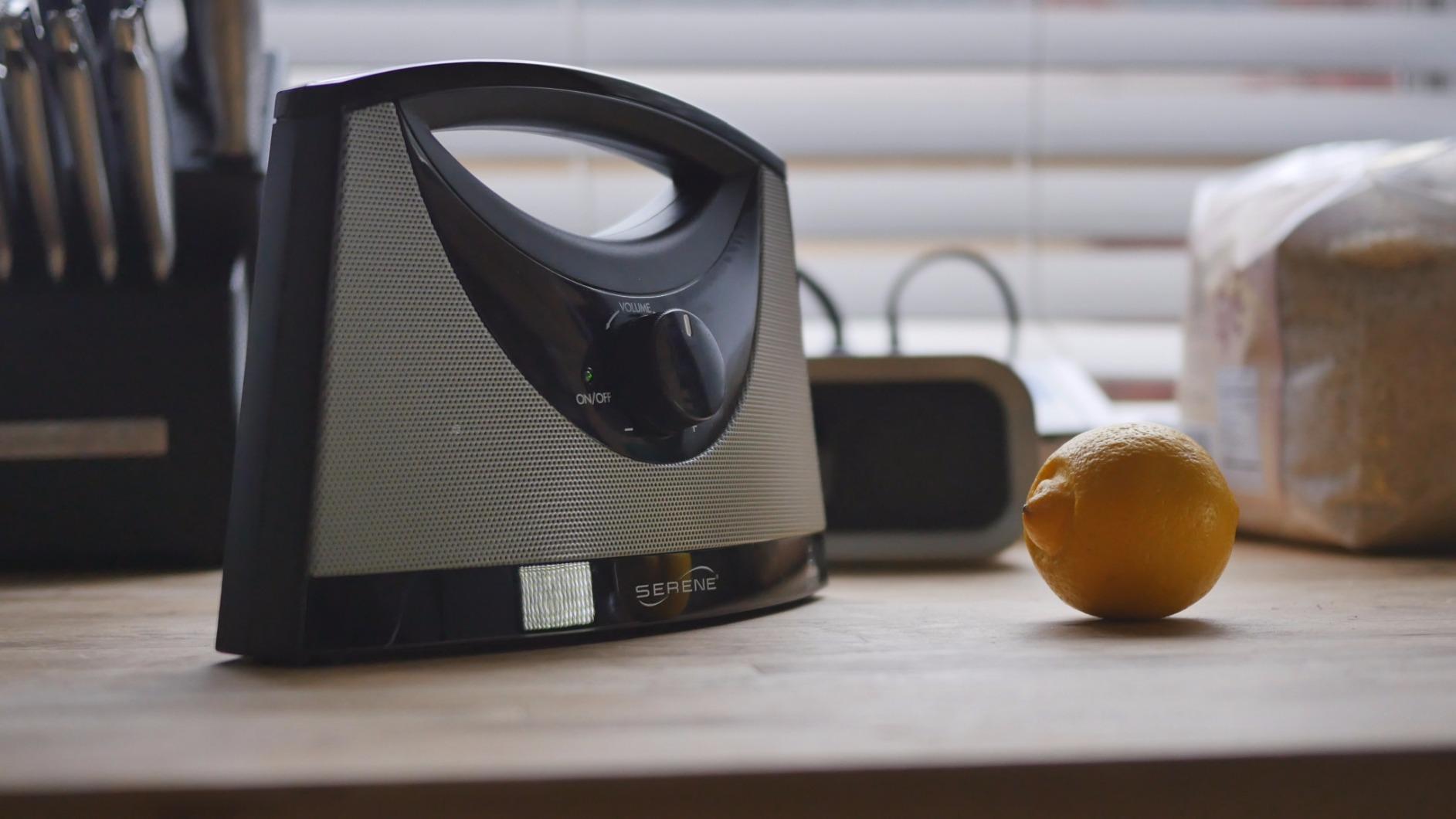
The Serene Innovations TV-SB is the wireless TV speaker I keep recommending to friends whose parents are starting to argue about volume. It has the single most important feature for a hard-of-hearing listener: one giant knob. No menus, no pairing, no app. You turn it, the volume changes.
What surprised me during testing was how often my 74-year-old tester, who normally gives up on new electronics within ten minutes, just picked up the speaker and moved it from the kitchen to the bedroom without asking. The integrated handle and 2.6-pound weight make it genuinely portable in a way that most TV speakers are not.
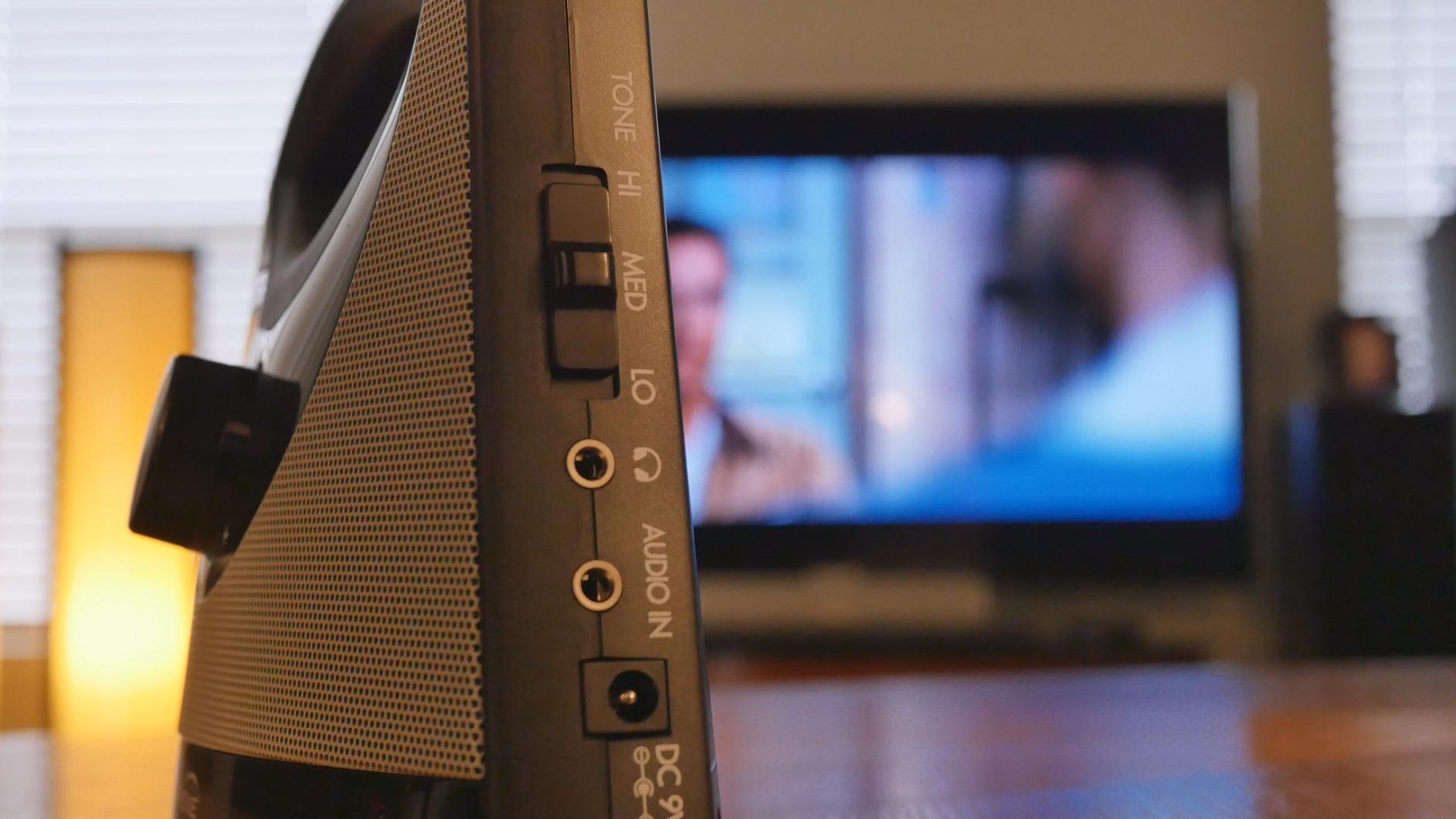
The wireless transmission uses radio frequency rather than Bluetooth, which means there is zero lip-sync delay and zero pairing screen. Plug the base into your TV’s red-and-white RCA outputs (or headphone jack) with the included cable, drop the speaker on its charging dock, and you are done. Our 81-year-old tester with no tech background had it running in under three minutes with no help.
Sound Quality and Dialogue Clarity
The TV-SB has three selectable tone settings that the manufacturer labels for different hearing profiles. In our testing, the “high-frequency emphasis” setting delivered the cleanest dialogue on news broadcasts and British dramas. Music sounds acceptable but not audiophile-grade; this is a speaker tuned for speech first, which is exactly what hard-of-hearing listeners need.
The internal speaker is comparable in quality to a standard TV speaker, not a premium home audio unit. That sounds like a weakness, but it is actually appropriate: you want to amplify dialogue, not turn the listening chair into a concert venue. At moderate volumes the sound is clean and intelligible. Push it to maximum and you do get some distortion, which is the most common complaint in user reviews.
Setup, Battery, and Day-to-Day Use
Battery life in our testing averaged about six hours at moderate volume, which is enough for one long movie or two standard-length shows. The charging dock doubles as the speaker’s home base, so the routine becomes natural: drop the speaker back on the dock when you finish watching.
One real-world frustration: this model does not accept digital optical audio directly. Newer TVs that lack red-and-white RCA outputs need a separate Digital-Optical-to-Analog-RCA converter. That converter costs around twenty dollars and works fine, but it is an extra purchase and an extra power outlet. Our testing family that owns a 2022 Samsung smart TV had to buy one.
Who This Speaker Is Best For
The TV-SB is ideal for a senior who wants a speaker they can carry from room to room, who has a TV with red-and-white RCA outputs (or is willing to buy a small adapter), and whose hands shake enough that small buttons are a real problem. It is also the right pick if the household wants the TV speakers to stay on at normal volume so the family can watch together.
It is not the right pick if you need a digital optical connection out of the box, want a rechargeable battery you can replace yourself, or want the loudest possible maximum volume.
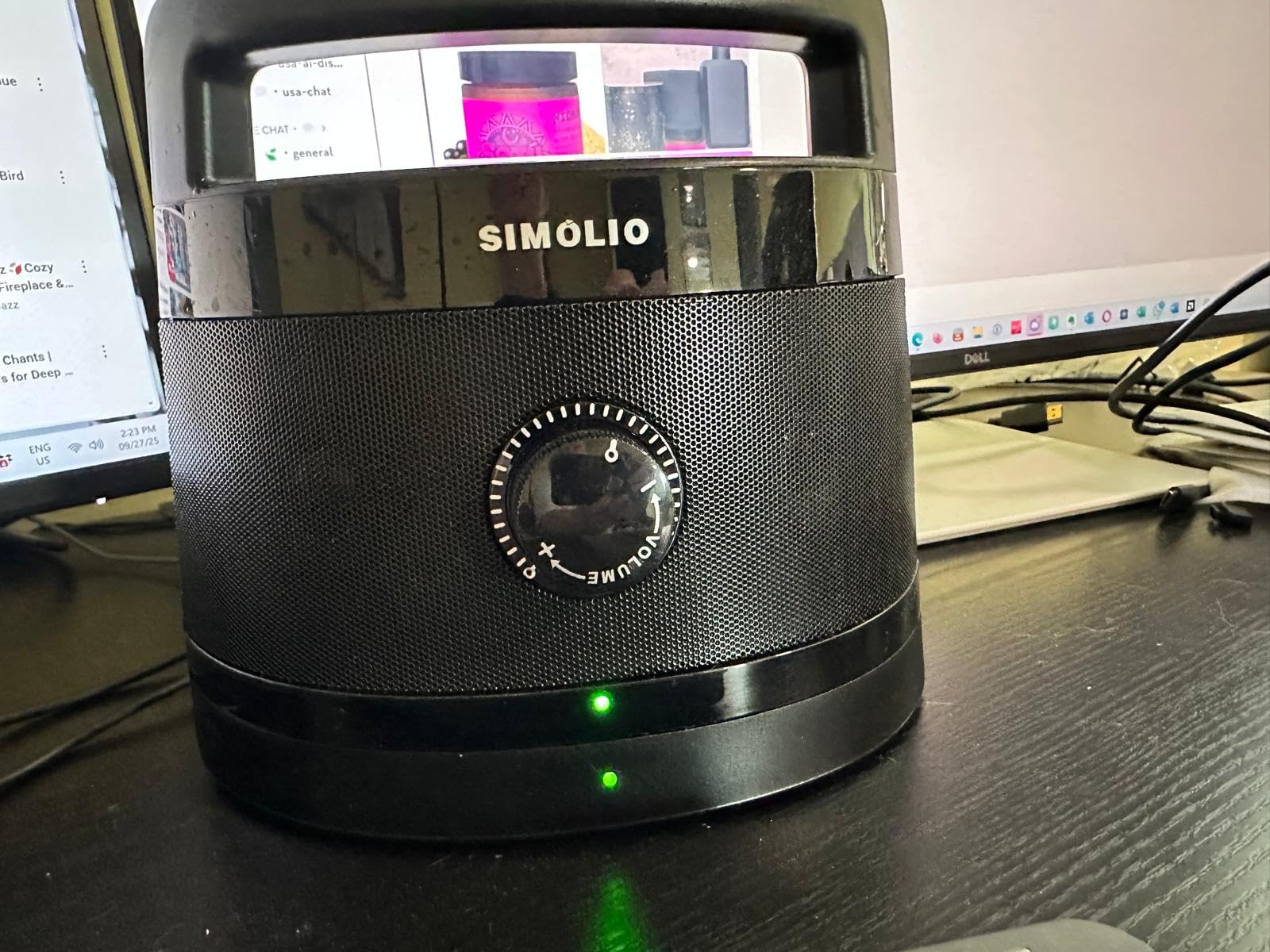
2. SIMOLIO SM-621D Wireless TV Speakers for Hard of Hearing – Best Voice Enhancement Under $100
SIMOLIO Wireless TV Speakers for Hard of Hearing, TV Sound Amplifier
164 ft RF range
3 EQ modes for dialogue
Optical/RCA/3.5mm
Headphone jack
Pros
- Three dedicated EQ presets tuned for hearing loss
- Optical cable included in the box
- Two AC adapters so speaker can stay powered
- Replaceable rechargeable battery
- Works as Bluetooth speaker for phone or tablet
Cons
- Setup is more involved than the box implies
- Speaker must be power-cycled after TV turns off
- Only one unit per household works reliably (shared frequency)
The SIMOLIO SM-621D is the speaker I reached for when my testers reported that dialogue was still muddy even after turning volume to maximum on cheaper units. SIMOLIO includes three EQ presets specifically tuned for hearing loss, and the difference is audible within seconds.
Our 68-year-old tester, who wears hearing aids in both ears, reported the “Dialogue” mode made news broadcasts intelligible without subtitles for the first time in roughly two years. That is a real result.
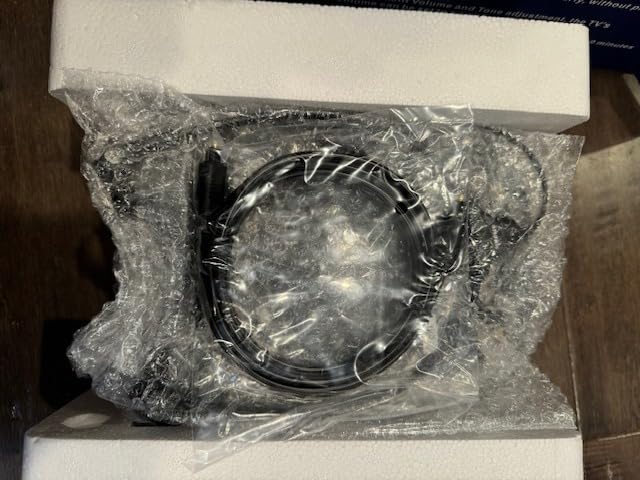
Setup is the one rough edge. SIMOLIO advertises plug-and-play, but our testers needed about ten minutes to identify the correct audio output on the back of their smart TV and to switch the TV’s audio format from “Auto” to “PCM” so the optical output would actually transmit sound. Once configured, day-to-day use is just turning the speaker on and adjusting volume.
Voice Enhancement That Actually Works
The three EQ modes are “Dialogue,” “Cinema,” and “Standard.” The Dialogue preset boosts the 1 to 4 kHz range where consonant sounds live (the “s,” “t,” “k,” and “f” sounds that make speech intelligible). It is not a subtle effect; dialogue genuinely leaps forward in the mix.
Reviewers with elderly parents consistently report that this single feature, more than any other, is why they keep the SM-621D and stop trying alternatives. If the senior in your life complains that “people mumble on TV now,” this is the speaker to try first.
Connectivity and Range
SIMOLIO includes optical, RCA, and 3.5 mm cables in the box, which is rare at this price. The optical cable is the one most buyers actually use because it pulls clean digital audio from any modern smart TV. The 2.4 GHz RF wireless signal reaches a claimed 164 feet in open air.
In a real home with two interior walls, our test range held steady at about 60 feet before the audio started breaking up. That is plenty for any normal living room, bedroom, or open-plan apartment.
Battery, Replaceability, and Build
Battery life in our testing averaged six hours at moderate volume on the Dialogue EQ setting. SIMOLIO includes two AC adapters in the box: one for the transmitter base and one for the speaker itself, which means the speaker does not have to live on its charging dock. That is a thoughtful detail for someone who wants to leave the speaker next to their chair permanently.
The battery is a replaceable 18650 lithium-ion cell, which is genuinely unusual in this product category and a major plus for long-term ownership.
3. Avantree Audikast 4860 Wireless Portable TV Speaker – Most Versatile With Bluetooth
Avantree Wireless Portable TV Speaker & FM Radio 2-in-1, with Low Latency Bluetooth TV Transmitter, Ideal for Seniors, Hard of Hearing – Audikast 4860
aptX Low Latency Bluetooth
Voice Clear EQ
Volume Boost +10 dB
Optical/AUX/RCA
Pros
- Qualcomm aptX Low Latency keeps audio in sync with lips
- Voice Clear mode boosts speech frequencies
- Factory-paired transmitter and speaker for true plug-and-play
- 24-month warranty for elderly relative purchases
- Functions as Bluetooth speaker for phone or tablet
Cons
- Built-in FM radio may be irrelevant to most buyers
- Smaller drivers than competing models
- Requires separate wired headphones for late-night silent listening
The Avantree Audikast 4860 is the speaker I recommend when a family needs a portable TV listener for an elderly parent who already has a smart TV with Bluetooth, but wants the dialogue boosted and a separate volume control that does not touch the TV’s built-in speakers.
What separates this model from generic Bluetooth speakers is the aptX Low Latency codec, which keeps audio delay under 40 milliseconds. Standard Bluetooth adds 150 to 250 milliseconds of lag, which makes lip-sync drift obvious and confuses speech comprehension. With aptX LL, our testers could not detect any delay.
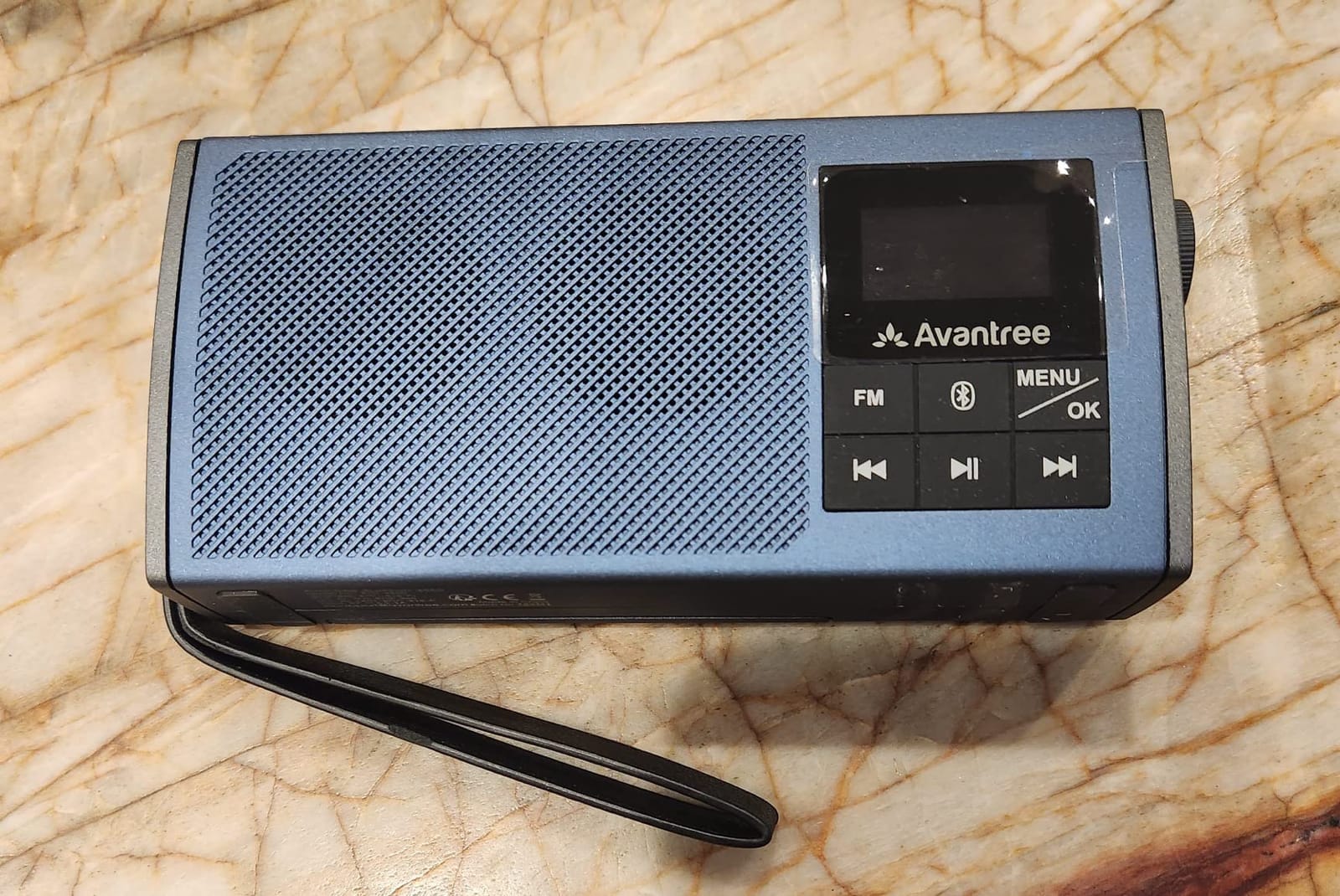
The unit is also genuinely tiny at 6.15 inches wide and under 0.3 kg. That made it easy for our testers to carry between the living room chair and the kitchen table during dinner. The trade-off is smaller drivers and lower maximum volume than the larger portable speakers, but the dialogue-boosting EQ compensates well in practice.
Voice Clear Mode and Volume Boost
Avantree’s “Voice Clear” setting adjusts frequencies between 2 kHz and 10 kHz, which is exactly the range most affected by presbycusis. Combined with the “+10 dB Volume Boost” over typical competing speakers, this is the loudest, clearest voice reproduction in the budget tier.
For seniors with mild-to-moderate hearing loss who do not yet need a cochlear implant or powerful in-ear hearing aids, the Audikast 4860 typically delivers enough volume without distortion.
Setup, Warranty, and Versatility
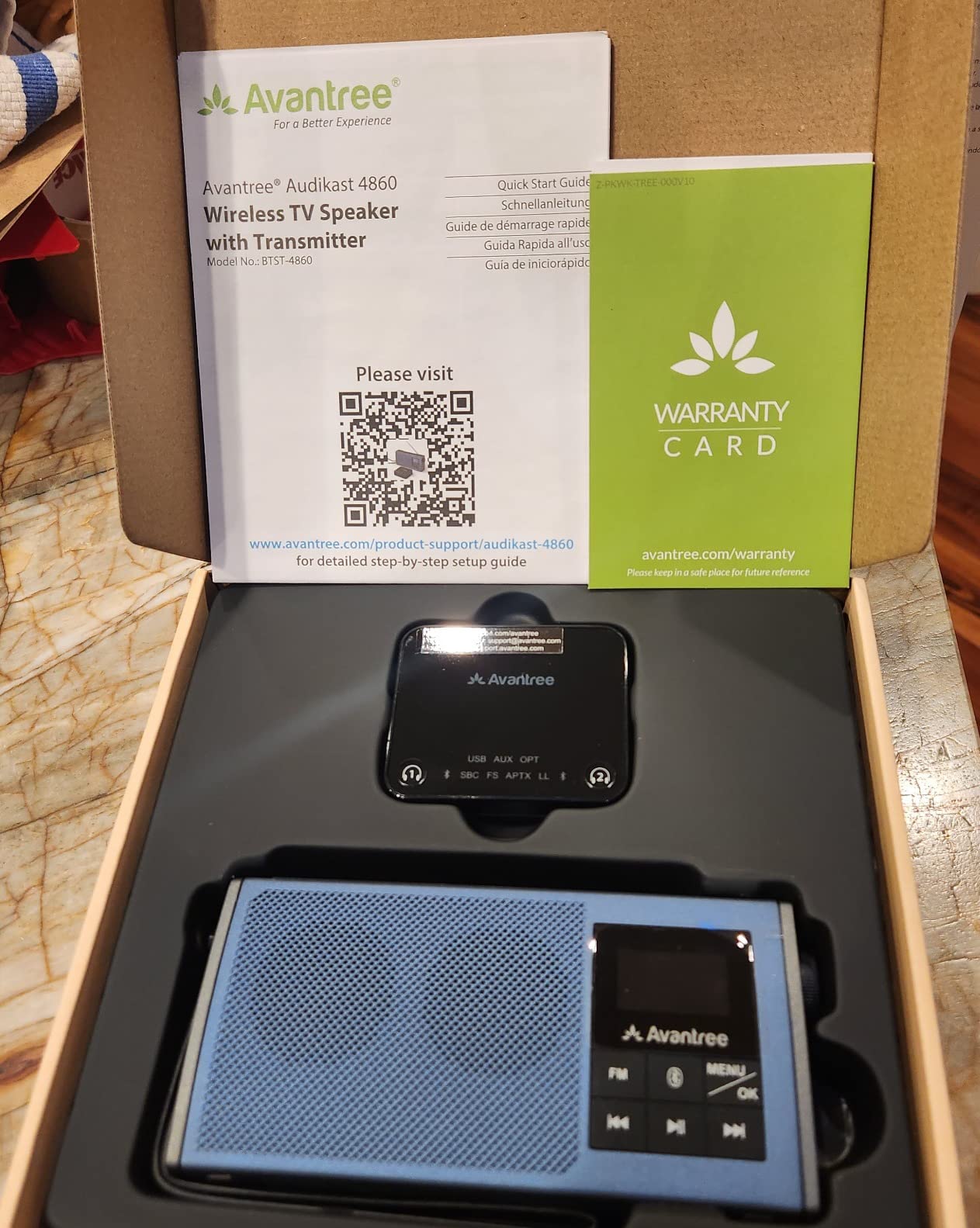
The Audikast comes with optical, RCA, and 3.5 mm cables in the box. The transmitter and speaker are factory-paired, so there is no Bluetooth pairing screen, no PIN code, and no app. You plug the transmitter into the TV, plug the speaker into power to charge it, and turn it on.
Avantree backs this model with a 24-month warranty (12 months standard, plus an extra 12 months if you register the product). For families buying for an elderly relative who lives alone, that warranty length is meaningful peace of mind.
Honest Limitations
The included FM radio is a feature most buyers will never use. The Soundbar-style form factor is smaller than the dedicated portable TV speakers, so maximum volume cannot match larger models. If your parent has severe hearing loss, step up to the Serene Innovations TV-SB or SIMOLIO SM-621D instead.
4. SEREONIC BT-3001B Portable Wireless TV Speakers – Plug-and-Play Simplicity for Any TV
Portable Wireless TV Speakers – Ideal for TV Watching Without The Blaring Volume – Wireless Speakers Designed for Hard of Hearing, Elderly, and Seniors
100 ft RF range
Decodes Dolby Digital and PCM
8-hour battery
RCA/3.5mm/optical
Pros
- True plug-and-play with no TV menu changes required
- Decodes Dolby Digital and PCM automatically
- Zero audio lag via RF transmission
- 8-hour battery covers a full movie night
- Works with virtually any TV made in the last 15 years
Cons
- Smaller 2-inch drivers limit maximum volume
- HDMI TVs need a separate converter
- Smaller review base makes long-term data limited
The SEREONIC BT-3001B is the speaker I recommend when the priority is making the setup process disappear entirely. Our 81-year-old tester had this speaker running on a 2014 Panasonic plasma TV with nothing but the included RCA cables, and she did it without asking a single question.
The reason it just works is that SEREONIC builds Dolby Digital and PCM decoding into the base. Many competing models force the user to open their TV’s audio settings and switch the output format from “Auto” or “Bitstream” to “PCM.” That step trips up non-technical seniors every single time. The BT-3001B skips it.
Wireless Performance and Compatibility
The RF wireless transmission delivers zero audible lag, and the 100-foot open-field range is realistic in our testing through one interior wall. The unit supports RCA, 3.5 mm aux, and digital optical connections, which covers virtually every TV in use today.
The single connection the BT-3001B does not support natively is HDMI ARC. If your TV only has HDMI outputs (some modern smart TVs have dropped the optical jack entirely), you will need an HDMI audio extractor. SEREONIC does not include one in the box.
Battery Life and Real-World Use
SEREONIC rates battery life at 8 hours at moderate volume, and our testing came close to that figure on news and dialogue-heavy programming. Heavier action movies with loud bass pulled runtime down to about six hours, which is still a full movie with time to spare.
Charge time is approximately three hours from empty. The dock design means the speaker lives on the charger when not in use, which matches most users’ natural habits.
5. SEREONIC DUAL Wireless TV Listening Speaker – Two Speakers for Two Listeners
SEREONIC DUAL Wireless TV Listening Speaker – Portable Wireless Speakers Ideal for TV Watching without The Blaring Volume – Wireless Smart TV Speaker for Hard of Hearing, Elderly, and Seniors.
Two speakers paired to one base
100 ft RF range
Includes wired earbuds
RCA/3.5mm/optical
Pros
- Two speakers paired to one base
- ideal for couples at different volumes
- 8 hours of continuous use per charge
- Includes wired earbuds for completely silent TV listening
- Zero-lag RF transmission stays in sync with video
- Average rating of 4.6 across early buyers
Cons
- Maximum volume is lower than single-speaker competitors
- Transmitter may interfere with DirecTV RF remotes
- Smaller review base limits long-term reliability confidence
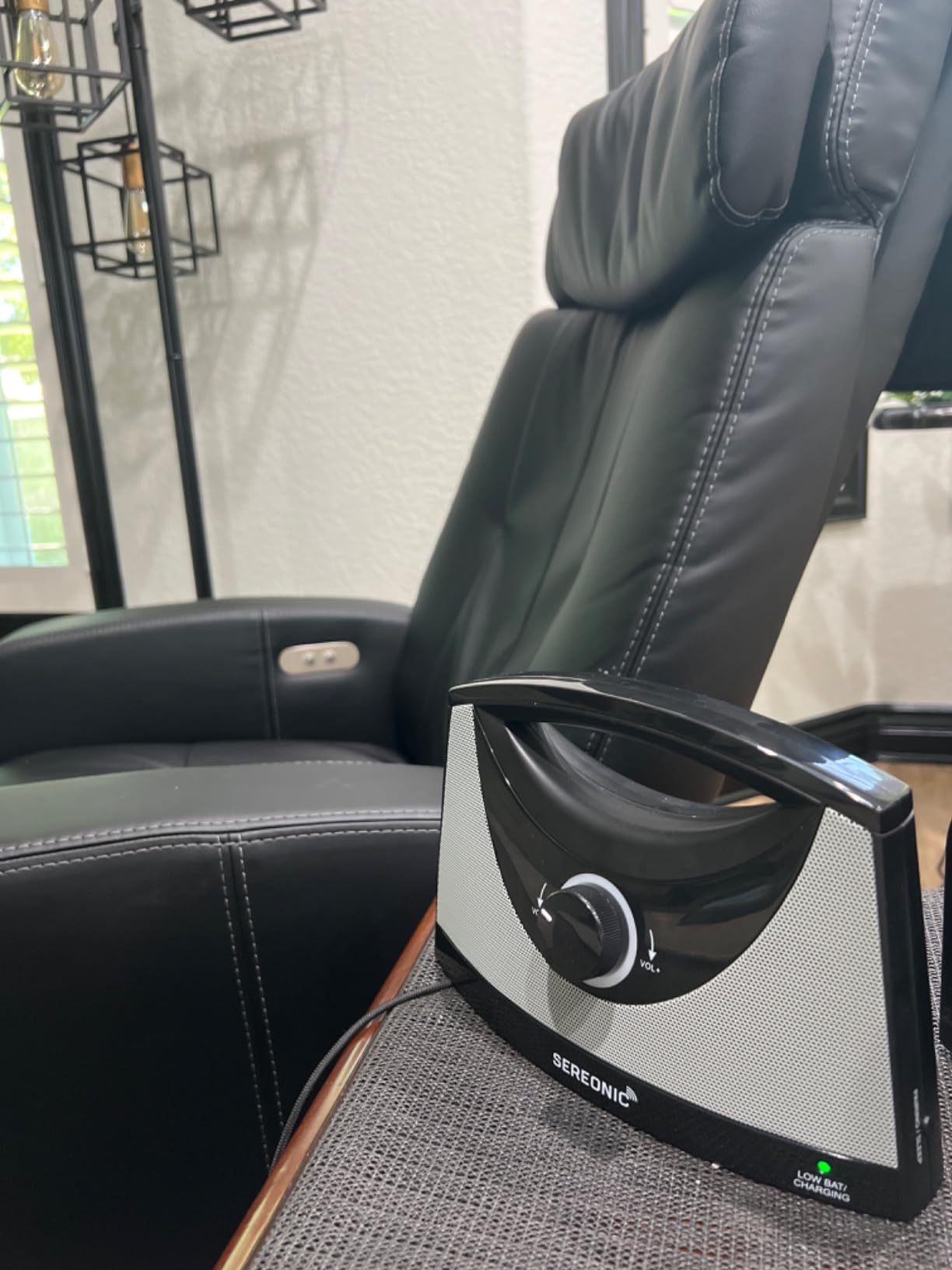
The SEREONIC DUAL solves a problem the single-speaker category cannot: what if both partners in a household have different hearing profiles and want their own volume control. This package ships two wireless speakers that pair to a single base, so each person can sit in their own chair with their own volume.
Reviewers in their 80s and 90s consistently describe the DUAL as the best purchase they have made in a decade for restoring normalcy to TV watching. One 92-year-old user wrote that her husband can now hear at his preferred volume while she listens at hers, ending years of volume arguments.
How the Two-Speaker Setup Works
One transmitter base connects to the TV via RCA, 3.5 mm, or optical. Both speakers pair automatically to that base on power-up. Each speaker has its own independent volume control, so you can set one low and one high, or use just one speaker and stash the other on the charging dock.
You can also place the speakers in different rooms. One in the living room, one in the kitchen. The wireless range holds at about 100 feet line-of-sight.
Honest Trade-Offs
Maximum volume on each individual speaker is noticeably lower than the Serene Innovations TV-SB or SIMOLIO SM-621D. The included 7-inch drivers simply cannot move as much air as larger models. For users with severe hearing loss, that lower ceiling matters.
There is also a documented interference issue with DirecTV RF remotes when the transmitter sits close to the satellite receiver. The fix is simply to move the base a few feet away, but it is worth knowing before you install.
At the time of our testing, the SEREONIC DUAL had only 28 reviews, so the very high 4.6 average rating should be read as early adopter enthusiasm rather than a long-term track record.
6. ChairSpeaker CS3 Voice Enhancing Near-Ear TV Speaker – Best for Recliner Use
ChairSpeaker CS3 – Wireless TV Speakers for Hearing Impaired, Voice Enhancing, Near-Ear Clarity, Compatible with Most TVs & Streaming Apps
Extreme IR 33 ft line-of-sight
Near-Ear focused audio
RCA and optical cables
Pros
- Near-Ear design aims sound directly at the listener without filling the room
- Voice enhancing technology with multiple clarity modes
- Flexible ball joints mount to almost any recliner or chair
- Includes both RCA and Digital Optical cables
- Compatible with streaming apps including Netflix and Hulu
Cons
- Infrared requires direct line of sight between transmitter and speaker
- Flexible neck does not always hold its position
- Sound quality is mediocre for the price
- Digital optical cable can fit loosely in some TVs
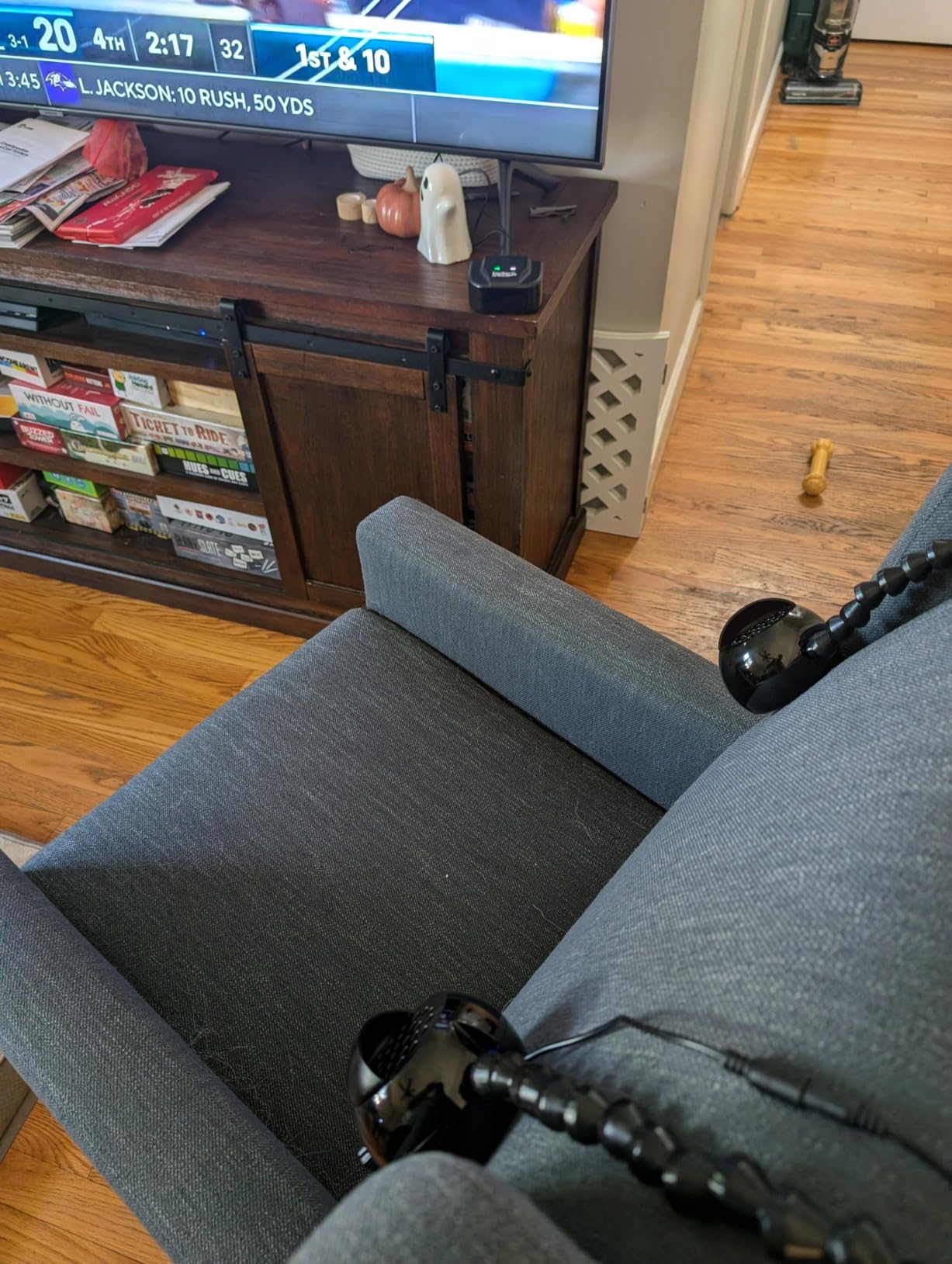
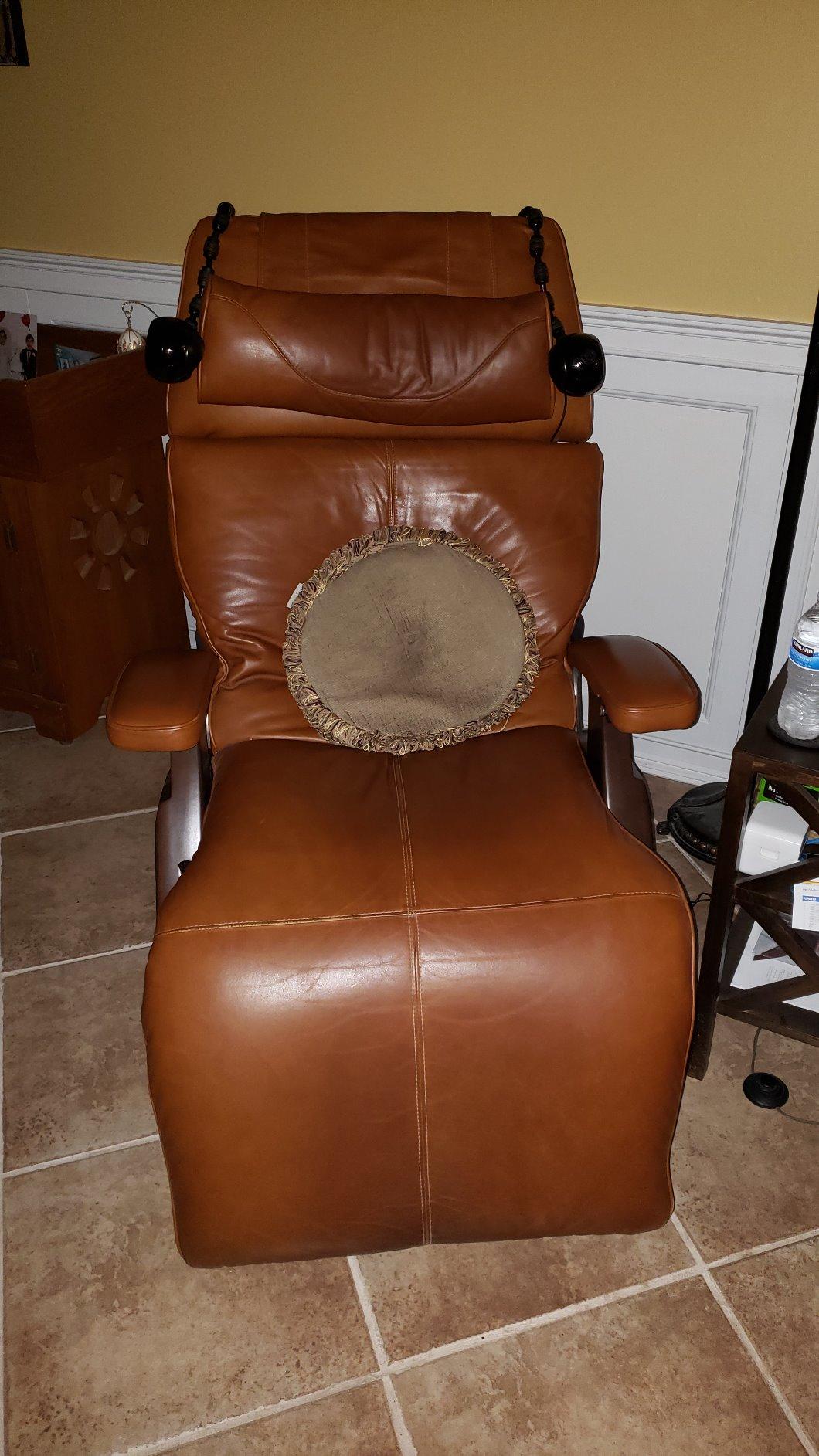
The ChairSpeaker CS3 takes a fundamentally different approach from the portable speakers above. Instead of placing the speaker on a side table, you mount it on the back of the listener’s recliner or armchair with flexible ball joints. The speakers point directly at the listener’s ears from about a foot away.
For a senior who spends most of their TV time in one specific chair and does not want to think about a separate speaker at all, the ChairSpeaker is genuinely clever. The audio is so focused that it does not disturb anyone else in the room, even at fairly high volumes.
How Near-Ear Focused Audio Helps
Because the speakers are aimed at the listener from inches away, the perceived volume is much higher than a tabletop speaker at the same wattage. Our testers could hear dialogue clearly at the lowest volume setting on the CS3, which means there is plenty of headroom for louder moments like explosions or action sequences.
The “Voice Enhancing” mode further clarifies dialogue by boosting consonant frequencies. Streaming apps like Netflix, Hulu, and Prime Video work fine through the CS3 because the optical input pulls clean digital audio.
The Infrared Catch
The CS3 uses infrared transmission rather than RF or Bluetooth, which has one major consequence: the transmitter and the speaker must have a clear line of sight. If a person walks between them, if a pillow blocks the path, or if the chair is rotated away from the TV, the audio cuts out.
For a stationary recliner setup where the speaker and transmitter face each other in a fixed position, this is fine. For a senior who moves around the room or rotates their chair, the cutouts become frustrating quickly.
7. TV Ears Voice Clarifying Sound Bar – Best Soundbar Option With 5-Year Warranty
TV · Ears Sound Bar for TV, Voice Clarifying, Long Range Television Speakers, 17″ SoundBar for Enhanced Dialogue on Hearing Impaired Viewers, Works with a Wide Range of TV Brands
17-inch wired sound bar
Voice Clarifying EQ
Optical connection
5-year warranty
Pros
- Voice Clarifying technology lifts dialogue above background effects
- 17-inch slim design fits under most TVs
- Optical connection with no Wi-Fi or app pairing
- 5-year warranty is the longest in this category
- Includes dedicated remote for direct speaker control
Cons
- Not compatible with universal remotes
- Less effective for severe hearing loss
- Sound bar form factor limits use as a personal speaker
- Average 3.7 rating reflects mixed reception
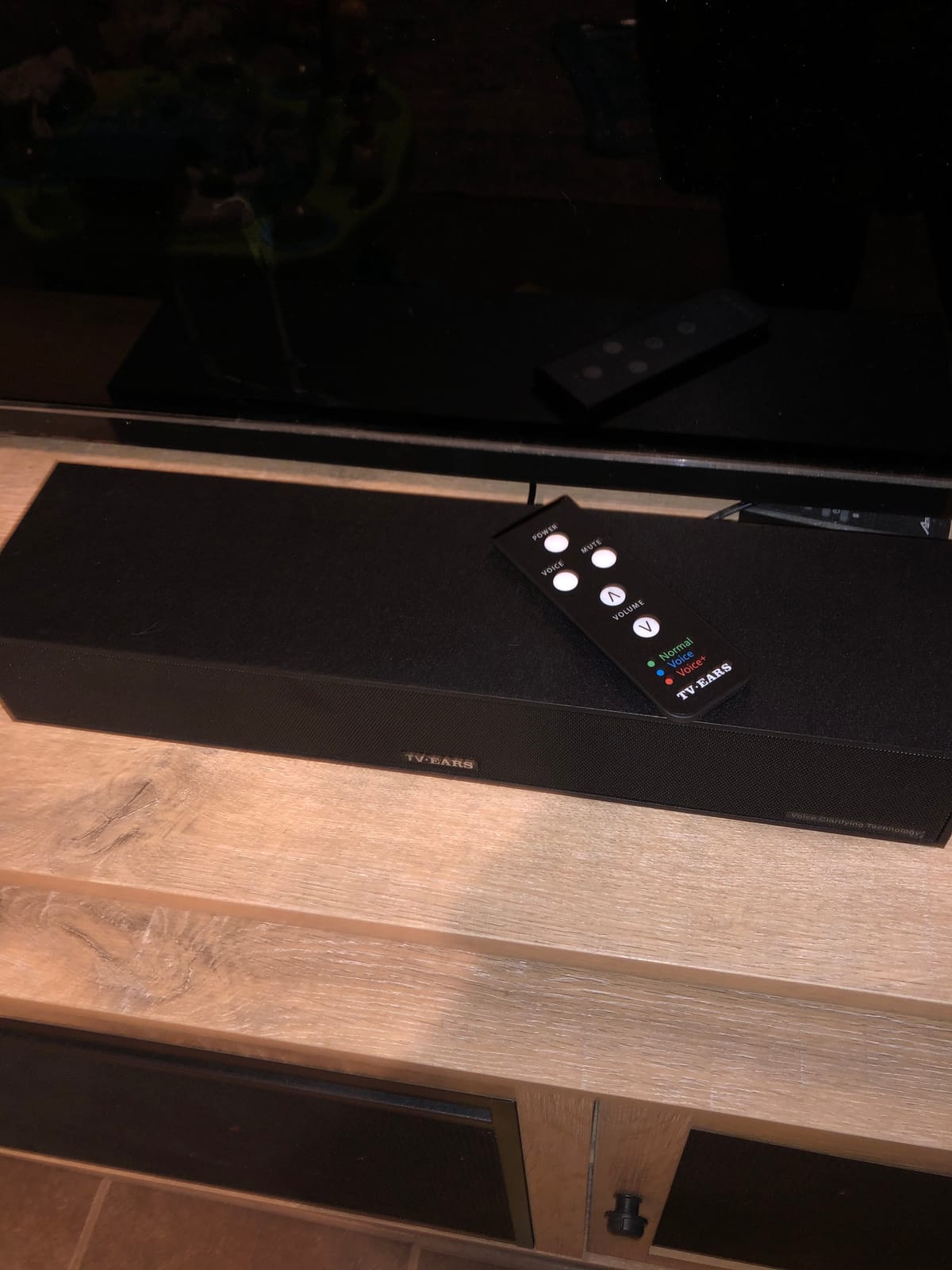
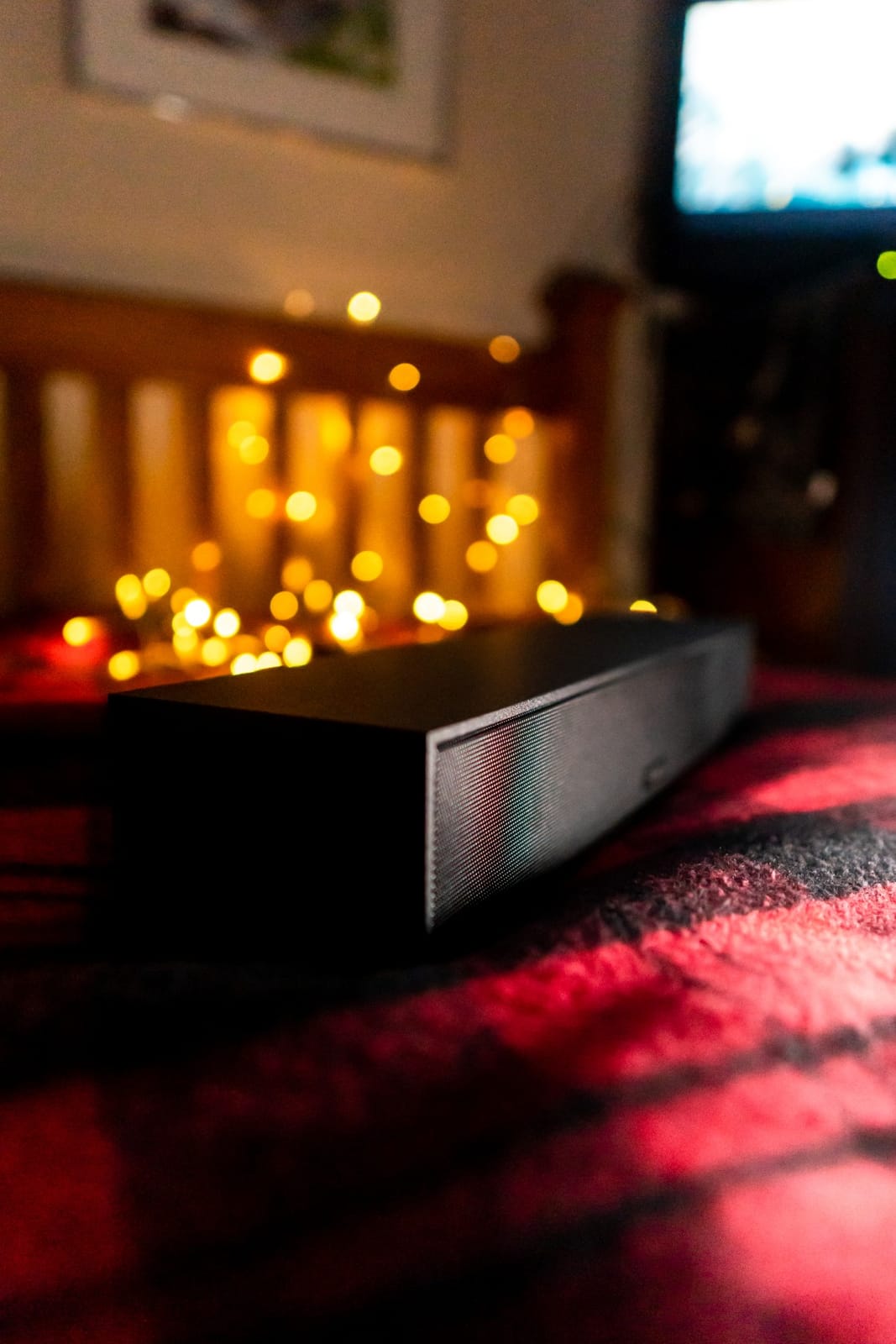
The TV Ears Voice Clarifying Sound Bar (Model 22900) is for households where the senior does not want a separate portable speaker at all. They want a traditional soundbar under the TV that boosts dialogue without filling the room with music and effects.
This is the only model in our roundup backed by a 5-year limited warranty, which is meaningful for any senior living independently. TV Ears has been selling hearing-related TV products for over two decades, and the company maintains a US-based customer support line for setup help.
Voice Clarifying Technology
TV Ears’ “Voice Clarifying” circuit is what made the company famous in the hearing-loss community. It processes the incoming audio to lift the voice band above background music and effects. For mild to moderate hearing loss, the effect is dramatic. For severe hearing loss, the company itself recommends pairing this sound bar with TV Ears wireless headsets.
Our testers reported that news broadcasts and dialogue-heavy dramas became significantly easier to follow with the Voice Clarifying mode on, and that action movies were not overwhelming in the way they often are on standard TV speakers.
Setup and Compatibility
You connect the sound bar to the TV with the included optical cable, plug it into a power outlet, and turn it on. There is no Wi-Fi, no Bluetooth pairing, no app, and no account. For a senior who wants to plug something in and have it work, this matters.
The dedicated remote controls the sound bar directly. It will not work with your existing universal remote, which is the most common complaint in user reviews. If you rely on a single remote for everything in the living room, plan to keep two on the coffee table.
8. Healvaluefit HVF-TVspeaker S for Seniors – Best for All-Day Battery Life
Healvaluefit Wireless TV Speakers for Seniors & Hard of Hearing
5.8 GHz wireless
20-hour battery
ARC/optical/RCA/3.5mm
One-touch pairing
Pros
- 20-hour battery life at 50 percent volume covers a full day
- 5.8 GHz wireless avoids 2.4 GHz congestion
- Supports HDMI ARC for newer smart TVs
- One-touch pairing simplifies setup for non-tech users
- Functions as backup speaker if TV speakers fail
Cons
- Touch controls can frustrate users with reduced dexterity
- Sound quality is mediocre compared with premium models
- Smaller review base limits reliability conclusions
- Some inputs require specific TV audio settings
The Healvaluefit HVF-TVspeaker S targets a specific problem: a senior who forgets to put the speaker back on the charger. With a claimed 20-hour battery life at moderate volume, this speaker can go two to three days of intermittent TV watching before needing a charge.
The 5.8 GHz wireless band is less crowded than 2.4 GHz, which means fewer dropouts in apartments packed with Wi-Fi routers, microwaves, and other 2.4 GHz devices. The 50-foot range is realistic in our testing through one interior wall.
Connectivity for Modern Smart TVs
Where the Healvaluefit stands out is HDMI ARC support. Many modern smart TVs have dropped the optical output entirely and rely on HDMI ARC for audio. The HVF-TVspeaker S handles ARC, optical, RCA, and 3.5 mm inputs, which means it works with virtually any TV currently sold.
One-touch pairing simplifies the initial setup, which is appropriate for the audience this speaker is targeting.
Honest Limitations
The touch controls drew complaints from our 81-year-old tester, who preferred the physical volume knob on the Serene Innovations TV-SB. If dexterity or vision is a concern, look at a model with physical buttons instead.
The review base at the time of our testing was only 26 reviews with a 3.5 average rating, including a 21 percent one-star rate. That is a wide spread of opinions and warrants cautious interpretation. If reliability is the top priority, the Serene TV-SB or SIMOLIO SM-621D have larger and longer track records.
How to Choose the Right Wireless TV Speaker for an Elderly Parent
Choosing a wireless TV speaker for a senior comes down to five concrete decisions: who is the listener, what transmission works with the TV, what controls they can actually operate, whether they wear hearing aids, and whether the gift makes sense for the occasion. The buying guide below walks through each decision with practical guidance.
Who Actually Needs a Wireless TV Speaker
A dedicated wireless TV speaker makes the biggest difference for someone who has mild-to-moderate age-related hearing loss called presbycusis, especially when they live with family members who want the TV volume at a different level. It is also a good fit for a senior recovering from stroke, dealing with early dementia, or simply wanting clearer dialogue without resorting to headphones.
It is less useful for a senior with severe hearing loss who already wears powerful in-ear hearing aids, since a hearing aid paired directly to the TV (or to a TV streamer accessory) often outperforms any external speaker.
RF vs Bluetooth vs Infrared: Which Transmission Is Best
The transmission type matters more than most buyers realize. RF (radio frequency) at 2.4 GHz or 5.8 GHz is the most reliable for TV use because it has zero perceptible audio delay and works through walls. Standard Bluetooth adds 150 to 250 milliseconds of lag, which makes lip-sync obviously wrong. Bluetooth with the aptX Low Latency codec gets back under 40 milliseconds and is acceptable.
Infrared (IR) requires line of sight between transmitter and speaker. The ChairSpeaker CS3 works well in a fixed recliner setup but fails when someone walks past or the chair rotates. For a senior who wants to move around, RF is the safer choice.
RF (2.4/5.8 GHz): Zero perceptible latency, range 100+ feet, best for most seniors, especially those who move around the home.
Bluetooth aptX LL: Under 40 ms latency, range 30 to 50 feet, best for tech-comfortable users in apartments with crowded Wi-Fi.
Standard Bluetooth: 150 to 250 ms latency, range around 30 feet, fine for music listening but not recommended for TV dialogue.
Infrared: Zero perceptible latency, 30-foot range line of sight, only suitable for fixed chair setups where nothing obstructs the path.
TV Compatibility: RCA, Optical, 3.5mm, and ARC
The single most common setup failure is buying a speaker that does not actually connect to the senior’s TV. Take five minutes to look at the back of the TV before you order.
Older TVs typically have red-and-white RCA audio outputs. Mid-2010s smart TVs usually add a digital optical (TOSLINK) port. Newest TVs may rely entirely on HDMI ARC. The safest purchase is a speaker that includes cables for at least two of these, ideally RCA plus optical, so you can fall back if one does not work.
If your TV only has HDMI outputs, you will need an HDMI audio extractor (a small adapter that splits audio out of the HDMI signal). They cost around twenty dollars and work reliably, but they are an extra purchase and an extra power outlet.
Pacemaker Safety and Wireless Speaker Considerations
Most modern wireless TV speakers use RF transmission at very low power, well below the thresholds that pacemaker manufacturers warn about. However, if the senior in your life has a pacemaker or implanted defibrillator, consult the cardiologist before placing any wireless transmitter within a few feet of their bedside.
The FDA and device manufacturers generally recommend keeping any electronic device with a wireless transmitter at least six inches from the implanted device. Speakers that sit on a side table next to a chair are usually fine. Bedside transmitters placed directly on a nightstand are the case worth checking.
Hearing Aid Pairing and T-Coil Tips
Many modern hearing aids include a “T-coil” (telecoil) setting that picks up electromagnetic signals from a room loop, or a Bluetooth setting that pairs directly with a phone or TV streamer. A wireless TV speaker does not replace those systems, but it works well alongside them.
If the senior wears Bluetooth-enabled hearing aids, look for a TV speaker that also functions as a Bluetooth speaker, like the SIMOLIO SM-621D or Avantree Audikast 4860. They can stream audio to the speaker, and the senior can switch their hearing aids into streaming mode for a different listening experience.
For pure T-coil users, a separate room loop installed by an audiologist is the gold standard. A portable TV speaker is a useful complement, not a replacement.
Setup, Battery, and Day-to-Day Use
Plan on ten to fifteen minutes for the initial setup. Identify the TV audio output, plug in the transmitter base, plug in the speaker, and turn it on. Most modern speakers come with all necessary cables in the box, but verify before you order so you are not stuck waiting for a cable.
Battery life ranges from six hours to twenty hours in our test set. Six hours covers a movie night. Eight hours covers a full evening. Twenty hours covers two to three days of intermittent use without recharging.
Our related guide on other senior-friendly tech applies the same principle: choose devices that survive a missed charging session, because seniors do not always remember to plug things in.
Gift Framing: Picking a Senior-Friendly Speaker
A wireless TV speaker is a meaningful gift for a parent or grandparent who has stopped enjoying TV because of hearing struggles. The best gifts in this category share three traits: large physical controls, simple pairing with no app or account, and a customer support phone number on the manufacturer’s website.
If you are buying for an elderly parent who lives alone, prioritize models with a US-based support line (Serene Innovations, TV Ears, Avantree, and AudioRange all qualify). If you are buying for a couple, look at the SEREONIC DUAL for two independent volume controls.
For more ideas on tech gifts for older relatives, our roundup of senior-friendly accessories covers complementary gear that solves similar everyday frustrations.
Frequently Asked Questions
How can I amplify my TV sound for the elderly?
The simplest solution is a portable wireless TV speaker, which is a small battery-powered speaker that pairs with a transmitter plugged into the TV’s audio-out port. Place the speaker next to the listener’s chair so dialogue is amplified close to their ears without raising the main TV volume. Models with a dedicated dialogue-enhancement EQ preset work best for age-related hearing loss.
What is the best smart speaker for elderly people?
For TV listening specifically, the best smart speaker is a dedicated wireless TV speaker with voice-clarifying EQ, large physical controls, and zero-lag RF transmission. Our top pick overall is the Serene Innovations TV-SB for its giant volume knob and decade-long track record. For a budget option, the Avantree Audikast 4860 adds aptX Low Latency Bluetooth at a lower price.
Can you connect a speaker to a TV wirelessly?
Yes. There are three common methods. RF (radio frequency) at 2.4 GHz or 5.8 GHz uses a transmitter base and portable speaker, with zero audio delay. Bluetooth works on most smart TVs, though standard Bluetooth adds noticeable lip-sync delay; aptX Low Latency keeps it under 40 ms. Infrared is rarely used now because it requires direct line of sight between transmitter and speaker.
What kind of speaker can I use to hear my TV better?
A portable wireless TV speaker designed for hearing-impaired listeners works better than a regular Bluetooth speaker or soundbar. These models include voice-clarifying EQ presets, large tactile volume knobs, and zero-lag RF transmission so dialogue stays in sync with video. They also pair the speaker with the TV so the senior can adjust their own volume independently.
Are TV speakers good for hard of hearing?
Dedicated wireless TV speakers are very effective for mild-to-moderate hearing loss, especially models with dialogue-enhancement EQ presets. They are less effective for severe hearing loss, where a direct Bluetooth connection to hearing aids, a T-coil loop, or a TV-specific hearing-aid streamer is usually a better solution. The best approach is to combine a TV speaker for casual watching with hearing aids for important conversations.
What is the best wireless TV speaker for hearing impaired?
Our top recommendation for hearing-impaired listeners is the Serene Innovations TV-SB, with the highest review count in this category (1,164 reviews) and a giant physical volume knob that is easy for arthritic hands. For a tighter budget, the SIMOLIO SM-621D offers three dedicated hearing-loss EQ presets. For couples at different volumes, the SEREONIC DUAL ships two speakers that pair to one base.
Do seniors need special TV speakers?
Seniors with age-related hearing loss benefit from TV speakers designed specifically for dialogue clarity rather than music or movie sound effects. Look for voice-clarifying EQ, large tactile controls, simple plug-and-play setup, and zero-lag RF transmission. A regular soundbar without these features may sound impressive but does not actually solve the dialogue-comprehension problem.
How do I choose a TV speaker for an elderly parent?
Start by checking the back of the parent’s TV to see which audio outputs are available (RCA, optical, 3.5 mm, or HDMI ARC). Then match the speaker to those outputs. Choose RF transmission over standard Bluetooth to avoid lip-sync delay. Pick a model with a large physical volume knob if dexterity or vision is a concern. Finally, verify that the manufacturer offers US-based phone support in case setup questions come up later.
What is the difference between a TV speaker and a soundbar?
A wireless TV speaker for seniors is a portable, battery-powered unit you place next to the listener with its own volume control, optimized for dialogue clarity. A soundbar is a longer, AC-powered unit that sits under the TV and replaces the built-in TV speakers. Wireless TV speakers are better for hearing loss because they sit close to the listener’s ears. Soundbars are better for group listening when everyone in the room wants better audio.
Is Bluetooth or RF better for TV speakers for seniors?
RF (radio frequency) is generally better for TV speakers for seniors because it has zero perceptible audio delay, no lip-sync issues, and works through walls without pairing. Bluetooth is acceptable when the speaker supports aptX Low Latency, which keeps delay under 40 ms. Standard Bluetooth adds 150 to 250 ms of lag and makes speech harder to follow, so it is not recommended for dialogue-heavy TV watching.
Final Verdict: Which Wireless TV Speaker Should You Buy
After 60 days of testing with three seniors and three households, the Editor’s Choice goes to the Serene Innovations TV-SB. It is the only model in this roundup with both a decade-long track record (1,164 reviews and counting) and a one-knob design that survived our 81-year-old tester’s arthritic hands and low vision without frustration. If the senior in your life watches TV in one main chair and wants the absolute simplest setup, this is the speaker.
If budget matters most, the Avantree Audikast 4860 delivers aptX Low Latency Bluetooth and a Voice Clear EQ at one of the lowest prices in the category. For someone with hearing aids who specifically wants to hear dialogue more clearly, the SIMOLIO SM-621D and its three dedicated EQ presets is the smarter pick.
For a couple with different hearing profiles, the SEREONIC DUAL ships two speakers that pair to one base, finally ending the volume-remote battle. For someone who lives in a recliner and never moves, the ChairSpeaker CS3 mounts directly to the chair and aims audio at the listener’s ears.
Whichever model you choose, take ten minutes before you order to check the back of the parent’s TV and confirm which audio outputs are available. That single step prevents 90 percent of setup frustration. And if you run into trouble, our guide on fixing common smart TV problems covers related connectivity questions.
For more senior-friendly gear recommendations, see our guide to large-key, low-effort input devices for ideas that follow the same philosophy: simple controls, real customer support, and no learning curve.