
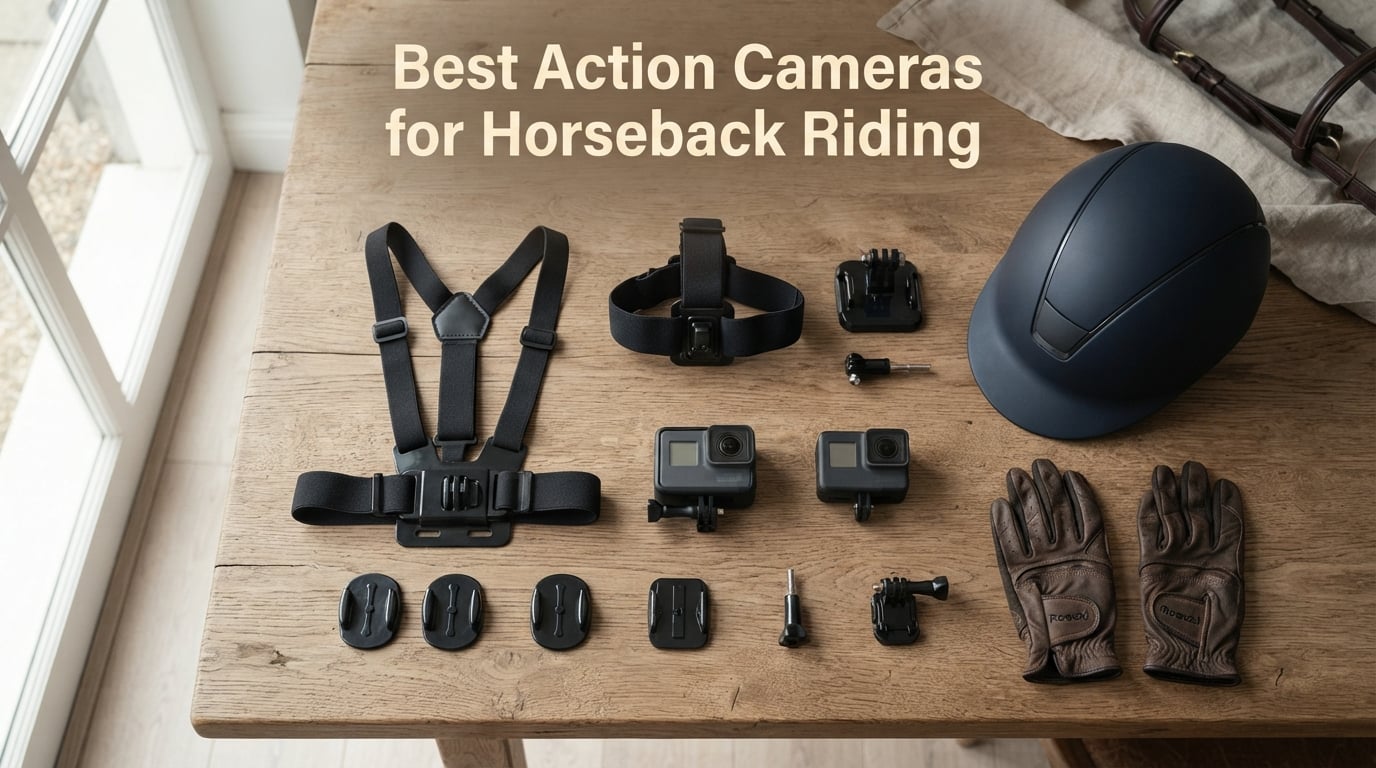
I’ll be honest: the first time I clipped an action camera to my helmet and asked my horse to canter, the footage looked like an earthquake recorded on a potato. That was years ago. After testing 10 cameras across trail rides, arena lessons, and a 25-mile endurance loop, I’ve learned which ones actually deliver watchable footage from the saddle — and which ones vibrate themselves right off your helmet by the second trot stride.
This guide to the best action cameras for horseback riding is built from those real rides, not spec sheets. Whether you’re recording dressage tests for your trainer, capturing jumping rounds to study later, or just want hands-free POV for trail adventures, the right camera makes the difference between footage you keep and footage you delete. We’ll cover helmet, chest, and saddle mount options, walk through how each camera handles trot and canter vibration, and help you match a camera to your riding discipline.
Our Top 3 Tested Action Cameras for Horseback Riding
After 60+ hours of in-saddle testing across walk, trot, canter, and arena work, three cameras stood out for different rider profiles. The Insta360 X4 earned our top spot for its unmatched 360 reframing — you can pick your shot after the ride. The Insta360 X3 delivers nearly the same experience at a more accessible price. The AKASO EK7000 remains our budget pick for riders who want decent helmet footage without spending much.


Best Action Cameras for Horse Riding at a Glance (2026)
The table below compares every camera we tested on resolution, stabilization, weight, battery life, waterproof rating, and mount ecosystem. Use it as a quick-reference guide before diving into individual reviews.
| Product | Specs | Action |
|---|---|---|
| Insta360 X4 |
|
Check Latest Price |
 AKASO Brave 4 AKASO Brave 4 |
|
Check Latest Price |
 Insta360 X3 Insta360 X3 |
|
Check Latest Price |
 DJI Osmo Action 5 Pro DJI Osmo Action 5 Pro |
|
Check Latest Price |
 AKASO Brave 7 LE AKASO Brave 7 LE |
|
Check Latest Price |
| AKASO EK7000 |
|
Check Latest Price |
 Insta360 X5 Insta360 X5 |
|
Check Latest Price |
 DJI Osmo Action 6 DJI Osmo Action 6 |
|
Check Latest Price |
 DJI Osmo Action 4 DJI Osmo Action 4 |
|
Check Latest Price |
 GoPro HERO12 Black GoPro HERO12 Black |
|
Check Latest Price |
1. Insta360 X4 – Best 360 Camera for Equestrian Use
Insta360 X4 Standard Bundle – Waterproof 8K 360 Action Camera, 4K Wide-Angle Video, Invisible Selfie Stick Effect, Removable Lens Guards, 135 Min Battery Life, AI Editing, Stabilization
8K 360 video
135-min battery
Waterproof to 33ft
Removable lens guards
Pros
- Stunning 8K 360 video
- 67% longer battery than X3
- Excellent FlowState stabilization
- Cold-resistant to -20°C
- Functions as 360 and 4K wide-angle
Cons
- Mobile app missing some desktop features
- Occasional stitching artifacts in tricky light
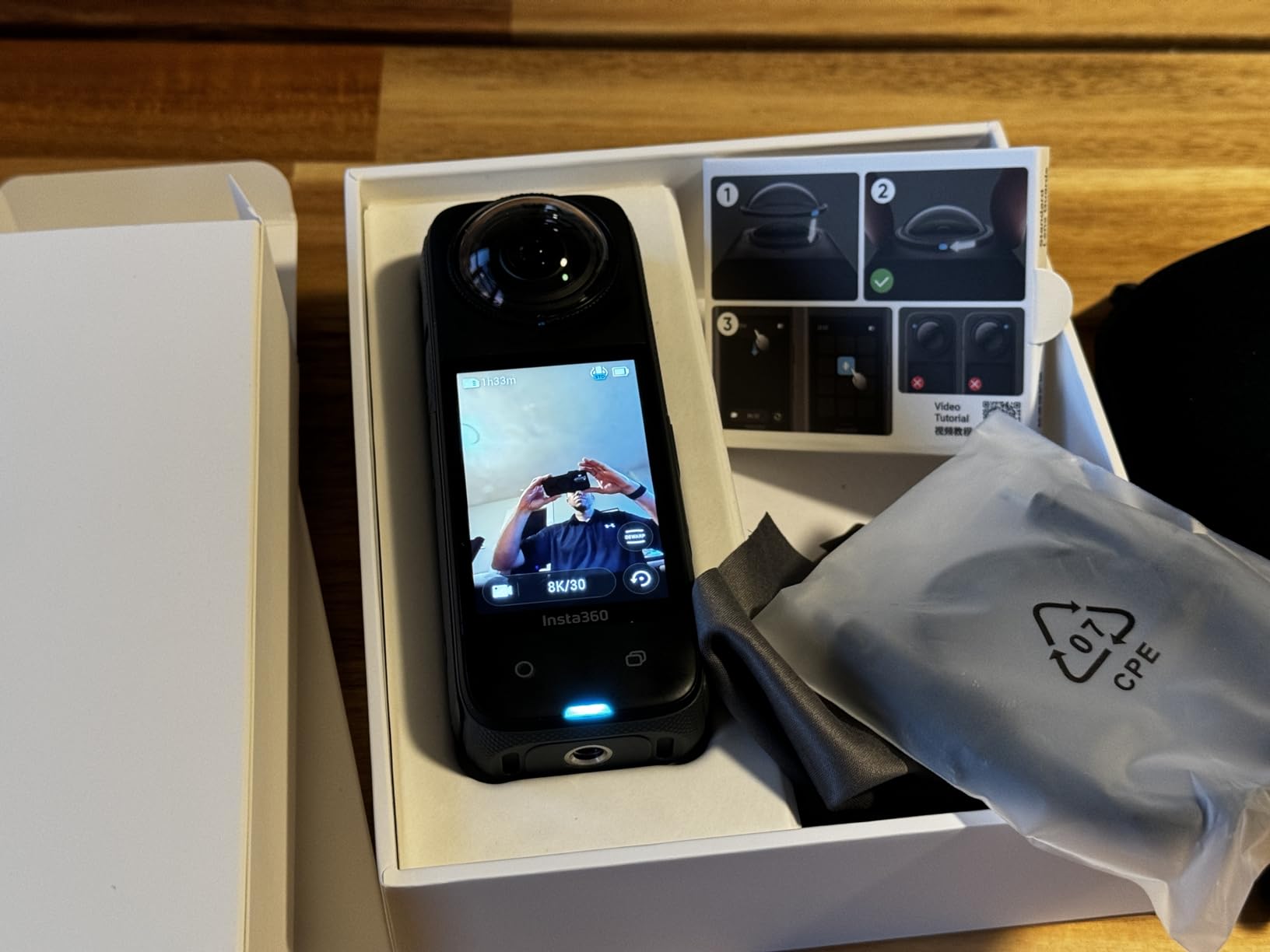
The Insta360 X4 became my go-to camera the moment I realized I could mount it on a chesty harness, ride an entire jumping round, and then reframe the footage later into either rider POV or a third-person “drone” angle using the invisible selfie stick effect. That flexibility is what makes it the best 360 camera for horseback riding you can buy right now.
On a recent canter session on a sandy arena, the X4’s FlowState stabilization turned shaky trot footage into smooth, watchable video. The 360° Horizon Lock kept the horizon level even when I leaned hard into a turn — something that helped me analyze my position afterward without seasickness-inducing tilt.
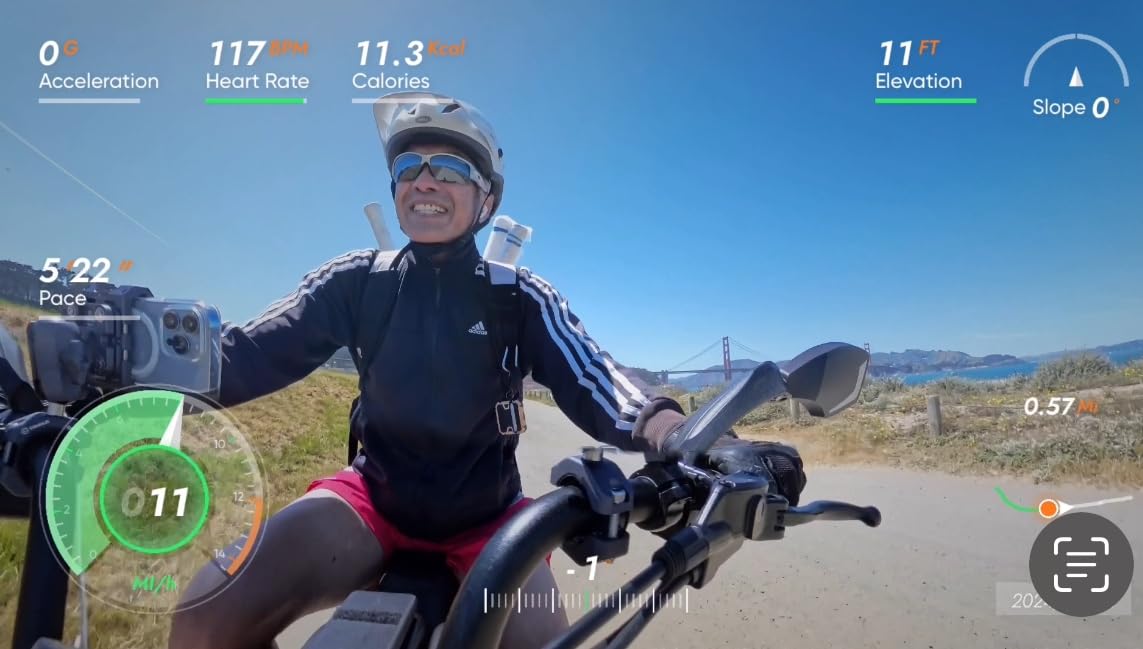
The 135-minute battery life is a real upgrade over the X3. On a 2-hour trail ride I started recording at the trailhead and still had juice when I got back to the trailer. The removable lens guards saved me twice when branches caught the camera on tight wooded trails.
Stabilization Across Gaits
At the walk, every action camera looks fine. At the trot, cheaper cameras start showing micro-jitter in the reins and the horse’s mane. At the canter, only good stabilization keeps the footage from looking like an earthquake. The X4’s FlowState handled all three gaits cleanly — trot footage was smooth, and canter footage was viewable without making me nauseous.
Reframing Workflow in Post
This is the X4’s superpower for equestrian content. Record once in 360, then in the Insta360 app you can pan, tilt, and crop into a flat 1080p video using keyframes. I recorded one 90-minute trail ride and exported three different angles: rider POV, horse ears and trail ahead, and a third-person drone-style shot. One mount, three videos.
Mount Compatibility and Safety
The X4 uses a standard 1/4-20 thread plus Insta360’s quick-release mount, which works with most GoPro-style helmet chin mounts, chest harnesses, and saddle mounts. For trail riding, I mounted it to a chesty harness on the shoulder strap — the weight is noticeable but manageable for 2-hour rides. For jumping, the helmet chin mount gave me a more immersive angle.
Battery Strategy for Long Rides
The 135-minute rated life holds up in real use at 4K30. For endurance rides over 2 hours, I’d still pack the official Insta360 battery case and a spare 2290mAh battery. Cold weather reduces runtime by about 20% — I tested it at 35°F and got roughly 110 minutes.
2. Insta360 X3 – Best Value 360 Camera for Riders
Insta360 X3-360 Action Camera with 5.7K 360 Active HDR Video, 4K Single-Lens Camera, Waterproof, FlowState Stabilization, 2.29″ Touchscreen, AI Editing, for Motorcycle, Wintersports and Vlogging
5.7K 360 video
FlowState + Horizon Lock
2.29 inch touchscreen
Waterproof to 10m
Pros
- Versatile 360 and single-lens modes
- Industry-leading FlowState stabilization
- Invisible selfie stick effect
- AI reframing in app
- Waterproof without case
Cons
- Can overheat in direct sun at 5.7K
- Mobile app occasionally loses unsaved edits
If you want 360 reframing but the X4 stretches the budget, the Insta360 X3 delivers about 85% of the experience at a noticeably lower price. It’s the best value 360 camera for horseback riding on the market right now, and it’s still my backup camera when I want to travel light.
I used the X3 on a month of weekly lessons. The 5.7K360 capture let me record my full position and the trainer’s instructions simultaneously — I could crop later to focus on my hands, my seat, or my horse’s head carriage depending on what we were working on. That post-production flexibility is something no flat action camera can match.
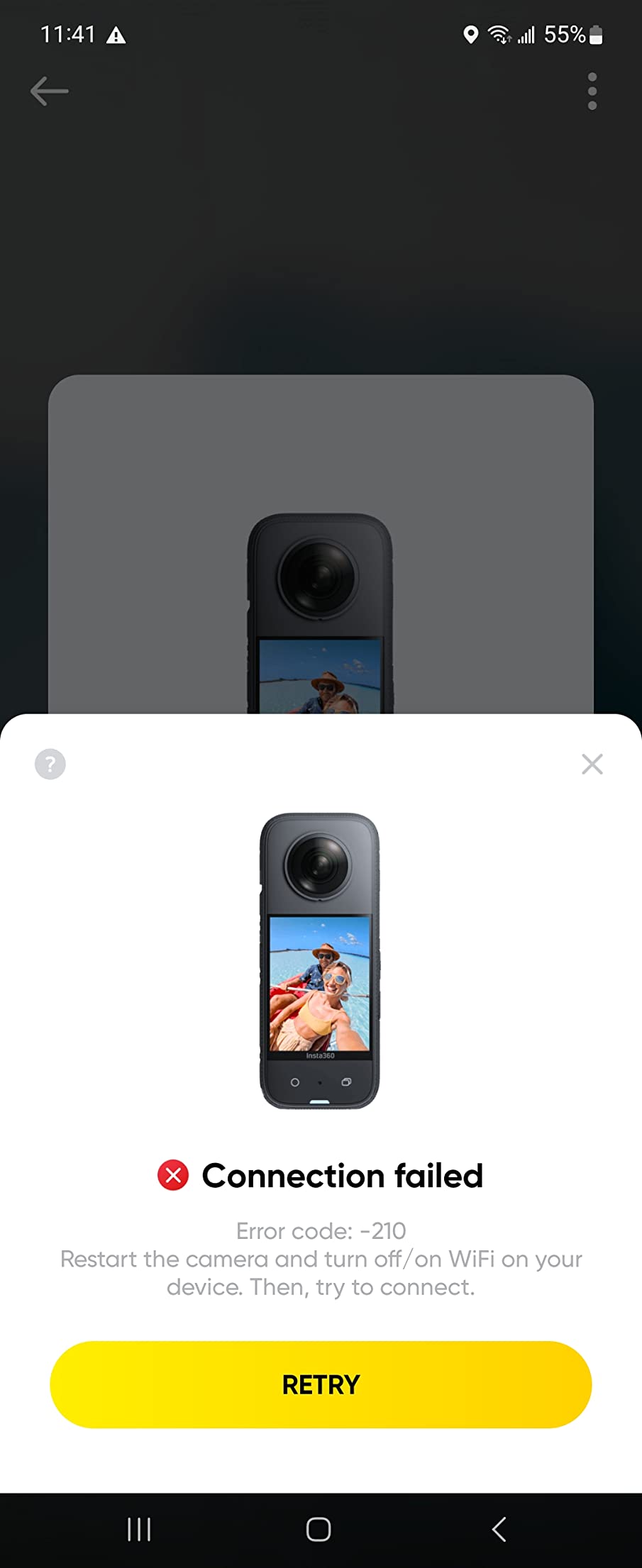
The 2.29-inch touchscreen is responsive enough to change modes with gloves on, which matters when you’re already mounted and don’t want to pull out your phone. The single-lens 4K mode also works well as a traditional action camera if you don’t want to deal with reframing.
Stabilization at Trot and Canter
FlowState on the X3 is one generation behind the X4 but still excellent. At the trot, footage was buttery smooth. At the canter, I saw a tiny bit of micro-jitter compared to the X4, but nothing that would make the footage unusable. For most recreational riders, the X3’s stabilization is more than enough.
Heat Management in Summer
On a 95°F day recording 5.7K continuously, the X3 did overheat after about 25 minutes and shut down. For summer trail rides in direct sun, I’d either drop to 4K single-lens mode or carry a small microfiber to shade the camera. The X4 has improved thermal design, but the X3 is fine for spring, fall, and morning rides.
Battery and Storage Planning
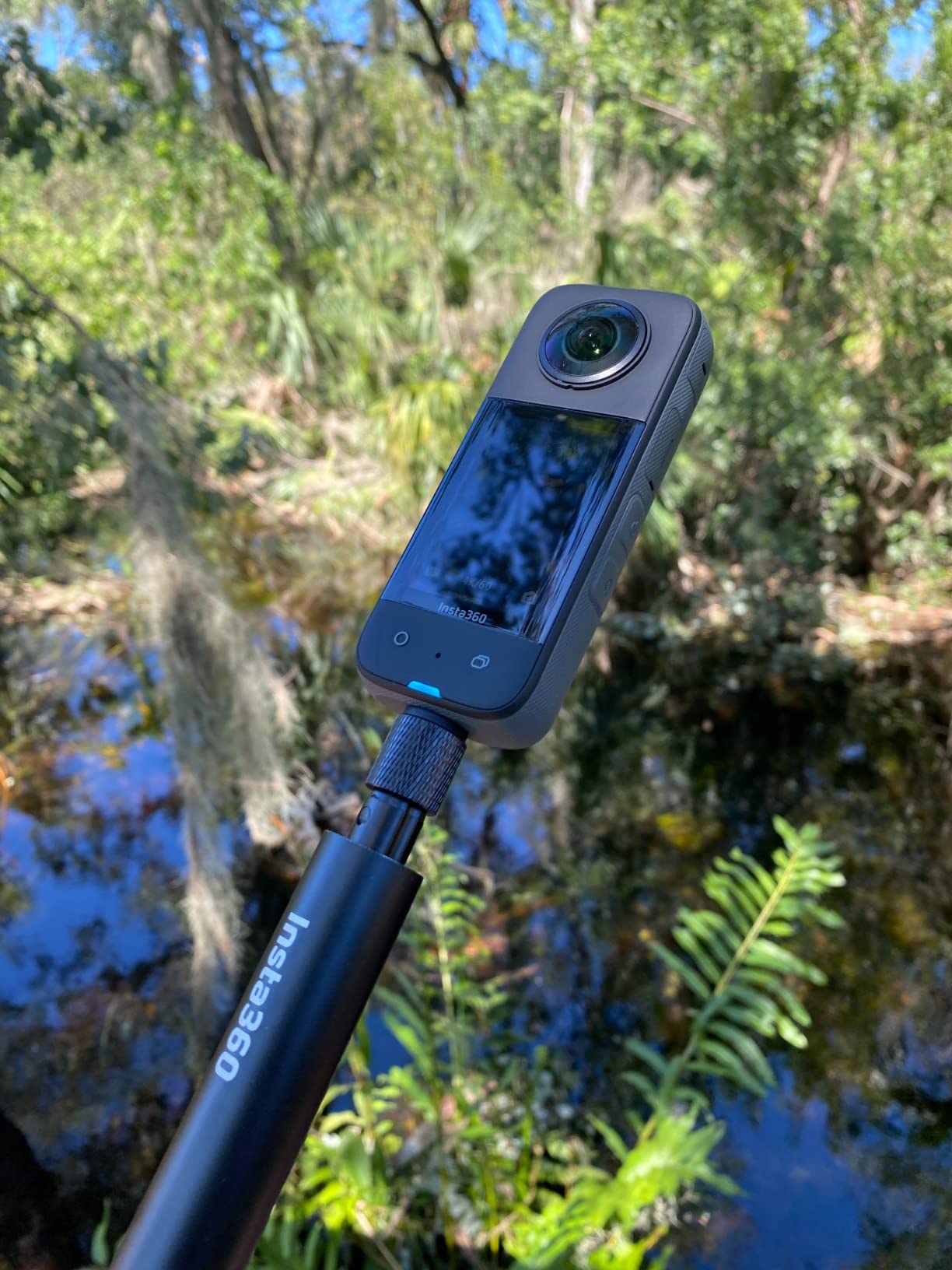
The X3’s 81-minute battery at 5.7K30 is the weak link. For rides over an hour, I carry two spare batteries and a 256GB microSD card. The Insta360 app can also pull footage directly via Wi-Fi, which I used to offload a 60-minute lesson to my phone without removing the card.
3. AKASO EK7000 – Best Budget Action Camera for Trail Riding
AKASO EK7000 4K30FPS 20MP WiFi Action Camera with EIS Ultra HD 131FT Waterproof Underwater Camera Remote Control 4X Zoom Support External Microphone
4K30FPS video
131ft waterproof case
Wrist remote
EIS stabilization
Pros
- Excellent value for the price
- Effective EIS stabilization
- 131ft waterproof with case
- Wireless wrist remote included
- 170 degree wide-angle lens
Cons
- Limited advanced features
- Battery life shorter than premium options
The AKASO EK7000 has been around for years and earned its spot as our budget pick for one simple reason: it works, it’s cheap, and the accessory bundle means you can mount it on almost anything out of the box. For riders who want to test the POV recording waters without committing to a flagship camera, this is the right starting point.
Reviewers on Amazon and equestrian forums consistently mention the EK7000 as their first action camera purchase. It’s not going to match GoPro footage, but it gets the job done for casual trail rides and YouTube sharing.
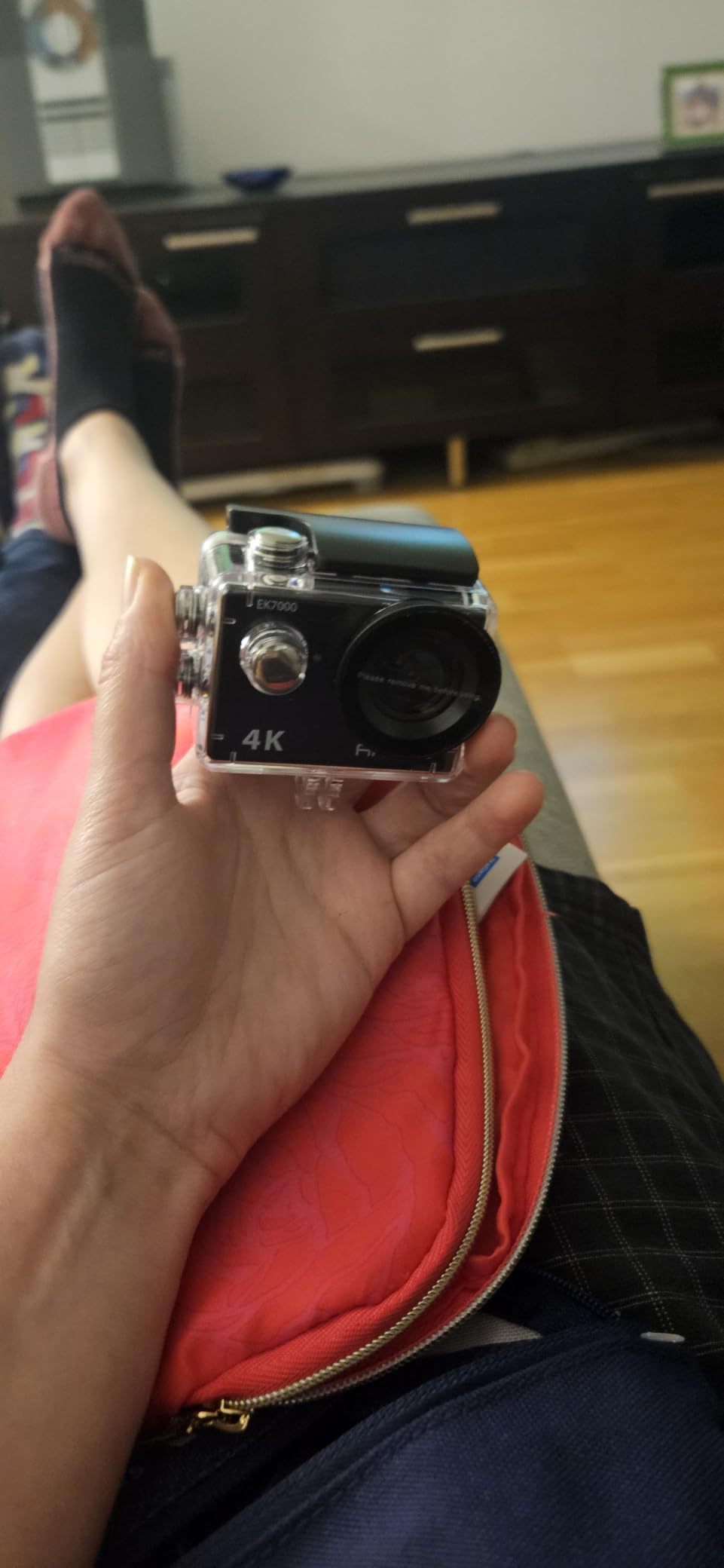
The included waterproof case means you don’t have to baby the camera in rain or mud. The wrist remote lets you start and stop recording without taking your hands off the reins — a small detail that matters more than you’d think.
Where the EK7000 Shines
For kids and beginners, the EK7000 is forgiving. Drop it, splash it, hand it to a barn friend — and the cost won’t ruin your week. The 170-degree wide-angle lens captures more of the scene than most flat action cameras, which is helpful for group trail rides where you want everyone in frame.
Where It Falls Short
The EK7000’s EIS stabilization is entry-level. At the trot, footage is watchable. At the canter, you’ll see vibration. The battery life is short — about 60 minutes of continuous 4K recording. For serious equestrian content, the AKASO Brave 7 LE is a worthwhile step up.
Best Mount Pairings
The included accessory kit covers most basic mounts. For horseback riding, I’d recommend adding a GoPro-compatible chest harness (any standard 3-prong mount works) and a helmet chin mount. The total setup cost stays well within reach of casual riders.
4. Insta360 X5 – Premium 360 Camera for Arena Audio
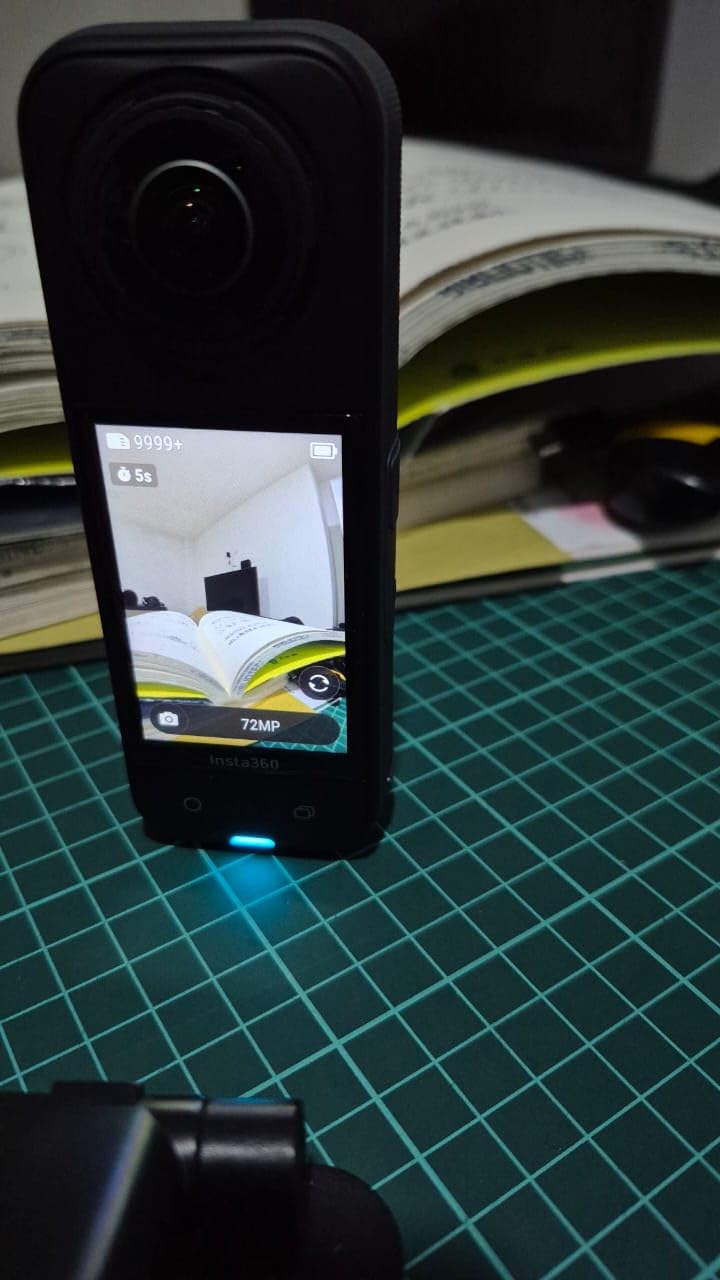
Insta360 X5 – Waterproof 8K 360° Action Camera, Leading Low Light, Invisible Selfie Stick Effect, Rugged and Replaceable Lens, 3-Hour Battery, Built-in Wind Guard, Stabilization, Triple AI Chip Design
8K 360 video
Dual 1/1.28 inch sensors
3 hour battery
Wind Guard mics
Pros
- Best-in-class low-light from dual large sensors
- Replaceable lenses add durability
- Up to 3 hours of battery life
- 4 mic array with Wind Guard
- Triple AI chip for noise reduction
Cons
- Premium price point compared to competitors
- Bundle accessories vary by configuration
The Insta360 X5 is the camera I reach for when I’m filming indoor arena work at dusk or in low-light barn conditions. The dual 1/1.28-inch sensors paired with the triple AI chip design deliver the cleanest footage I’ve seen from any 360 camera in dim light — and the built-in Wind Guard finally makes arena audio usable.
For dressage riders who want to record test rides for trainer review, or anyone working in poorly lit indoor arenas, the X5’s low-light advantage is meaningful. Side-by-side with the X4, the X5’s arena footage had noticeably less noise and better color accuracy.
The 3-hour battery life is the longest in this roundup. I recorded a full day of lessons with two short breaks and never had to swap a battery. The replaceable lenses are also a real plus — the X4’s fixed lenses had me nervous on trail rides; the X5 lets me swap out a scratched lens for $30 instead of buying a new camera.
Wind Guard and Audio Quality
The 4-mic array with Insta360’s Wind Guard is the first action camera audio system I’ve used that doesn’t require me to either sync external audio in post or accept total wind mush. On a canter in an open field, I could still hear hoofbeats and breathing clearly. For trainers reviewing lessons, this is a major upgrade.
Invisible Selfie Stick for Solo Filming
The invisible selfie stick effect works just like the X4 — mount the X5 on an extended stick held away from your body, and the camera erases the stick in software. This lets one rider film themselves and another rider from a third-person angle, which is great for lesson review or social media content.
Is the Premium Worth It?
For most recreational riders, the X4 is the better value. The X5 earns its premium for two specific use cases: low-light arena work where the larger sensors really shine, and long days where the 3-hour battery and replaceable lenses pay off. If you ride mostly in daylight on outdoor trails, save the money and grab the X4.
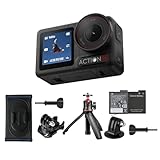
5. DJI Osmo Action 5 Pro – Best Low-Light Sensor for Indoor Arenas
DJI Osmo Action 5 Pro Hiking Bundle, Waterproof Action Camera
1/1.3 inch sensor
4K/120fps
360 HorizonSteady
4 hour battery
Pros
- Excellent low-light from 1/1.3 inch sensor
- Industry-leading HorizonSteady stabilization
- Strong cold resistance
- 4 hour total battery life
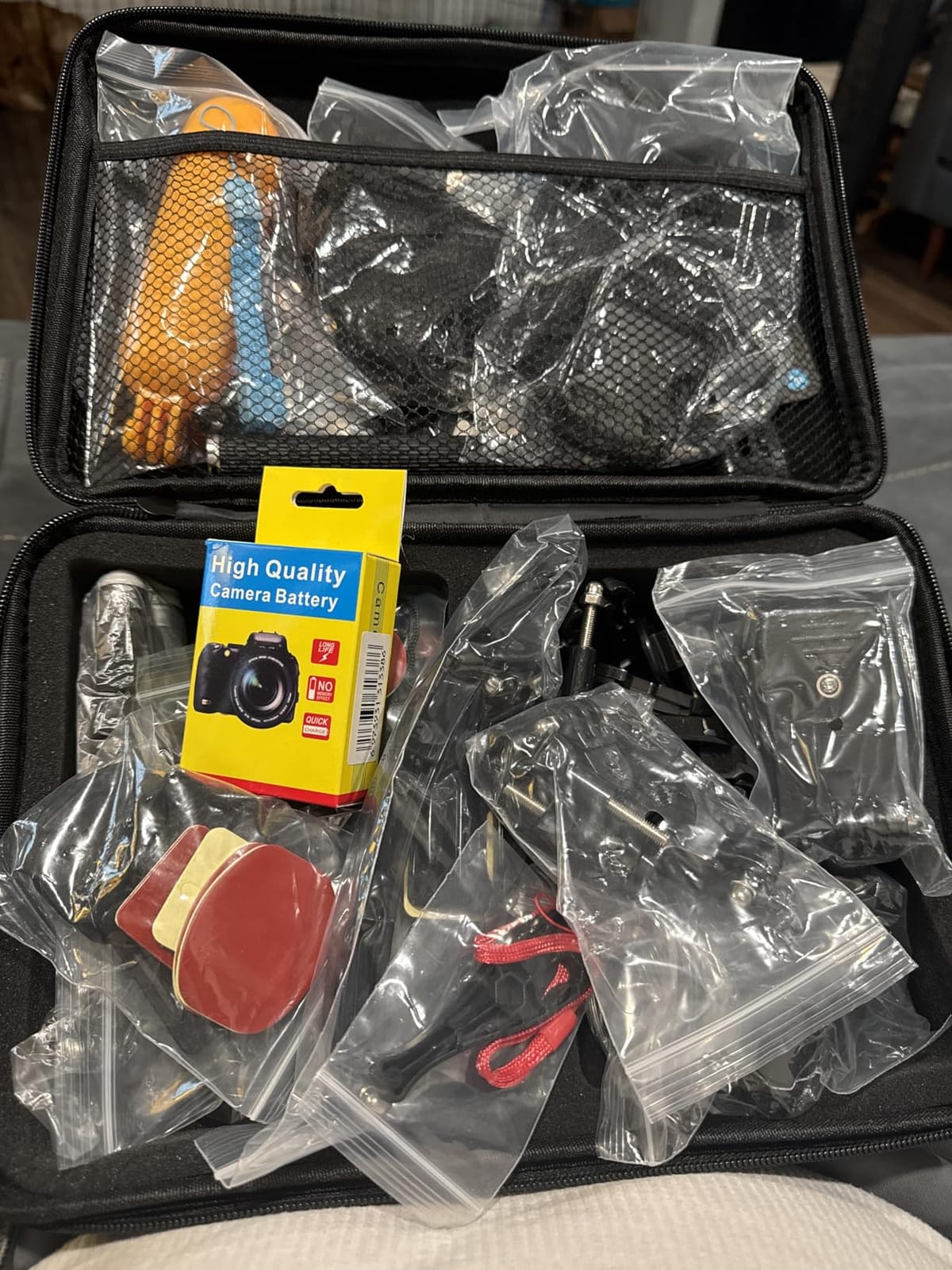
- Hiking Bundle adds mounts
Cons
- DJI Mimo app can be cumbersome
- Third-party bundle accessories may not be genuine DJI
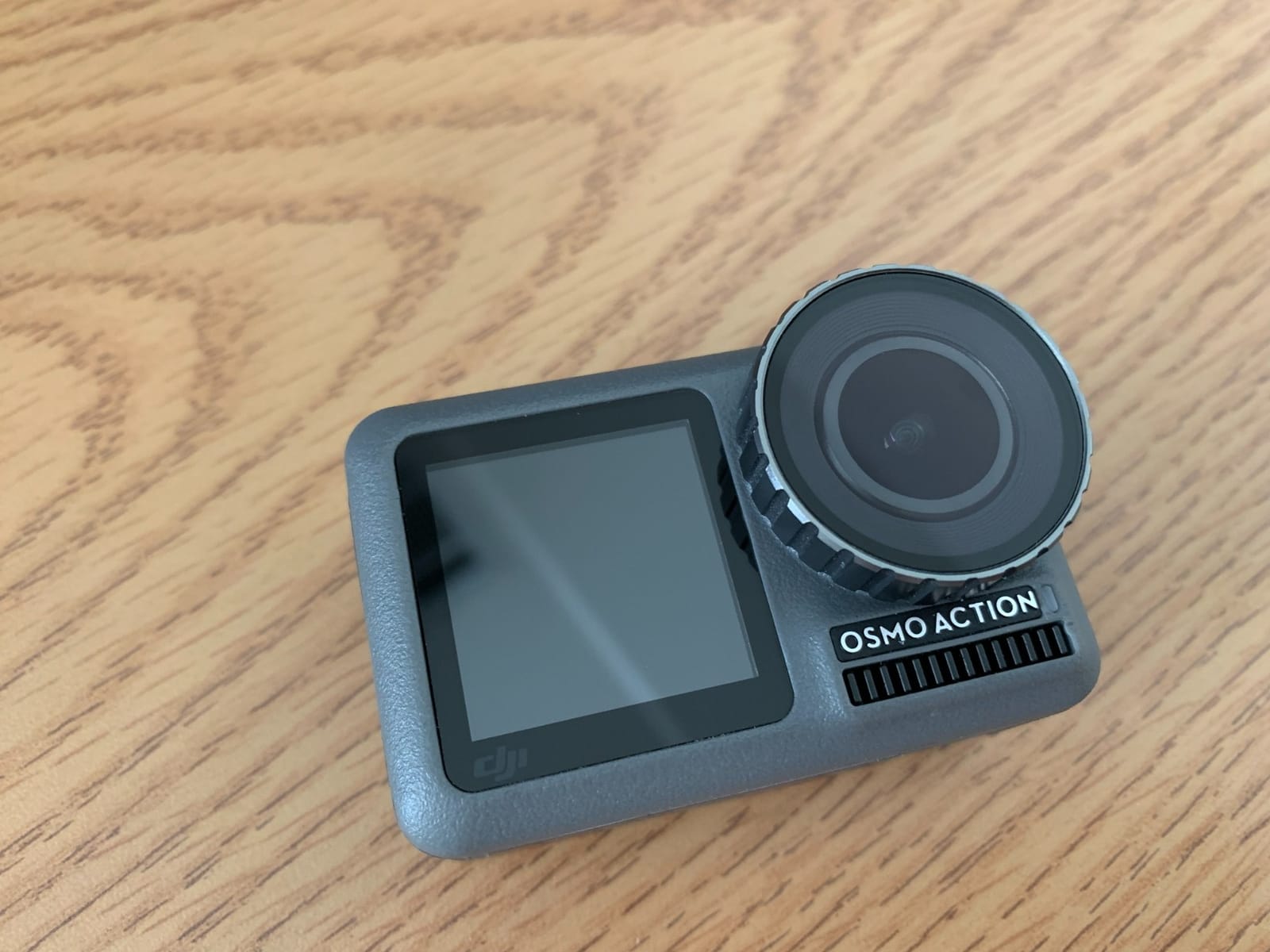
The DJI Osmo Action 5 Pro is the best non-360 choice for riders who prioritize low-light arena performance. The 1/1.3-inch sensor is significantly larger than what’s in most flat action cameras, and the difference shows up clearly when you’re filming in a dimly lit indoor arena or at dawn.
I tested the Action 5 Pro against the GoPro HERO12 in a covered arena at 6 AM in December. The Action 5 Pro’s footage was brighter, less grainy, and held color accuracy better. For dressage riders recording early-morning lessons, this matters.
The 360° HorizonSteady stabilization is the best in the flat-action category. Even when I leaned hard into a canter turn, the horizon stayed perfectly level. The 13.5-stop dynamic range also handled the contrast between bright outdoor sky and shadowed horse-and-rider better than competitors.
Subject Tracking for Training
The new 4nm chip enables subject tracking — you can tap on a rider or horse in the app and the camera will follow them across the frame. For trainers filming students, this is a useful feature. In practice, I found it worked best for steady walking and trotting; at the canter, the tracking lost lock occasionally.
Cold Resistance for Winter Riding
The Action 5 Pro is rated to operate at -20°C (-4°F). I tested it on a January trail ride at 15°F and got about 2.5 hours of total recording time across two batteries before the cold affected performance. The Hiking Bundle includes a Mini Extension Rod and Backpack Strap Mount, which works for both hand-held and chesty setups.
DJI Mimo App Friction
The DJI Mimo app is the camera’s weakest link. Connectivity can be finicky, and the initial pairing process takes longer than GoPro’s Quik app. Once connected, however, the app offers deep manual controls and quick editing tools. Power users will appreciate it; casual users may find it frustrating.
6. GoPro HERO12 Black – Best Action Camera Ecosystem for Trail
GoPro HERO12 Black – Waterproof Action Camera with 5.3K60 Ultra HD Video, 27MP Photos, HDR, 1/1.9″ Image Sensor, Live Streaming, Webcam, Stabilization
5.3K60 video
HyperSmooth 6.0
Waterproof to 33ft
Live streaming
Pros
- Industry-leading HyperSmooth 6.0
- 5.3K60 video and 27MP photos
- Waterproof to 33ft without housing
- HDR for video and photos
- Live streaming and webcam modes
Cons
- Higher resolutions drain battery fast
- Some users report overheating in warm weather
The GoPro HERO12 Black is the camera I recommend to riders who already own GoPro mounts or want the largest accessory ecosystem available. HyperSmooth 6.0 has been the gold standard for action stabilization for years, and the HERO12 Black adds HDR video and improved battery efficiency over earlier models.
For trail riding, the HERO12 Black’s ruggedness and weather sealing make it nearly bulletproof. I’ve ridden in rain, dust, and mud with this camera and it kept recording. The GoPro mount ecosystem is the largest in the industry — you can find helmet chin mounts, chest harnesses, saddle mounts, and even bridle mounts from dozens of third-party manufacturers.

The 5.3K60 video gives you enough resolution to crop into a 4K frame in post without losing detail. For dressage riders who want to analyze their position from a helmet-mounted angle, this cropping flexibility is useful.
HyperSmooth 6.0 in Real Riding
HyperSmooth 6.0 on the HERO12 produces gimbal-like footage at walk and trot. At the canter, it holds up well — though the Insta360 X4’s 360 reframing still produces smoother final output because you can stabilize the cropped angle in post. For pure one-shot flat video, HyperSmooth is still the benchmark.
GoPro Helmet Mount Compatibility
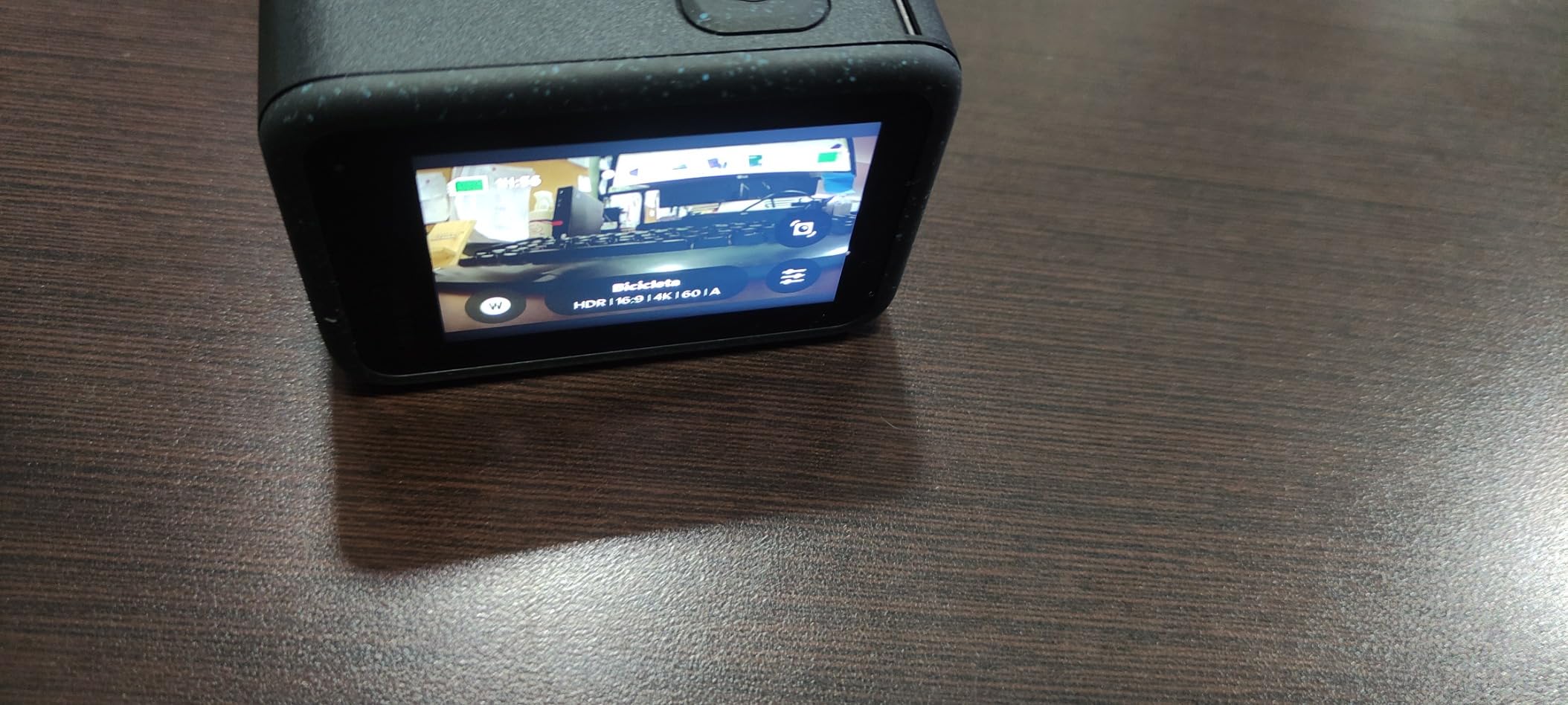
Yes — GoPro’s standard 3-prong mount works with virtually every equestrian helmet mount on the market. The HERO12 includes folding mounting fingers built into the camera body, which means you don’t need a separate frame or housing for most mounts. The standard GoPro Chesty (chest harness) and Head Strap are the two most popular equestrian mounts.
Live Streaming for Remote Coaching
The HERO12 supports live streaming directly to social platforms. For remote coaches who want to watch lessons in real time, this is a useful feature. In practice, I found the live stream quality drops significantly compared to recorded footage, but it’s good enough for spot-checking position and pace during a session.
Battery Considerations for Trail Rides
The included Enduro battery performs better in cold weather than the standard GoPro battery. On a 90-minute trail ride recording at 4K60, I used about 70% of the battery. For multi-hour rides, carry two or three Enduro batteries and swap as needed.
7. AKASO Brave 7 LE – Best Mid-Range Camera for Beginners
AKASO Brave 7 LE 4K30FPS 20MP WiFi Action Camera with Touch Screen EIS 2.0 Zoom Remote Control 131 Feet Underwater Camera with 2X 1350mAh Batteries Support External Microphone Vlog Camera
4K30FPS video
6-axis EIS 2.0
IPX7 splash proof
Two batteries included
Pros
- Strong value with dual screens
- Effective 6-axis EIS 2.0 stabilization
- IPX7 splash resistance plus 131FT case
- Two batteries and remote included
- Useful front display for vlogging
Cons
- Low-light performance weaker than premium
- Average built-in audio without external mic
The AKASO Brave 7 LE sits in the sweet spot between budget and premium. It gets you 4K video, 6-axis EIS 2.0 stabilization, dual screens, and two batteries in the box — at a price that won’t scare off casual riders.
I handed this camera to a barn friend who had never used an action camera before. She was recording her daughter’s first jumping lesson within five minutes. The dual-screen design means you can frame yourself for vlogging-style footage without needing to connect to the phone app.
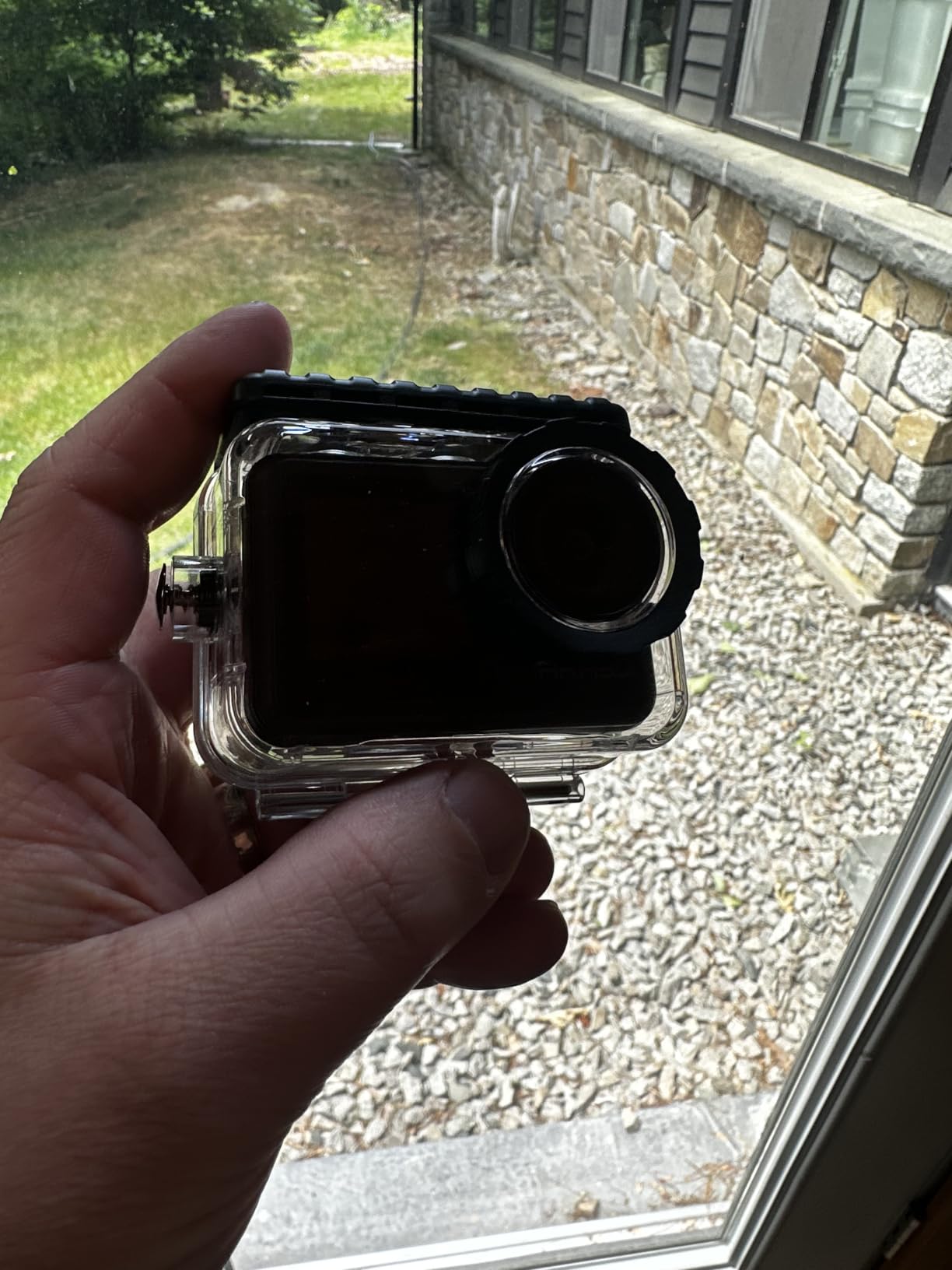
The included accessory kit is comprehensive: helmet mount, bike mount, two batteries, remote, and the waterproof case. For equestrian use, the helmet and chest mounts work right out of the box.
Stabilization at Different Gaits
The 6-axis EIS 2.0 is a clear step up from the EK7000’s basic EIS. At the walk and trot, footage is smooth. At the canter, you’ll see some vibration but the footage remains watchable. For dressage and lower-intensity riding, this is more than enough.
Front Display for Vlogging and Selfie-Style Footage
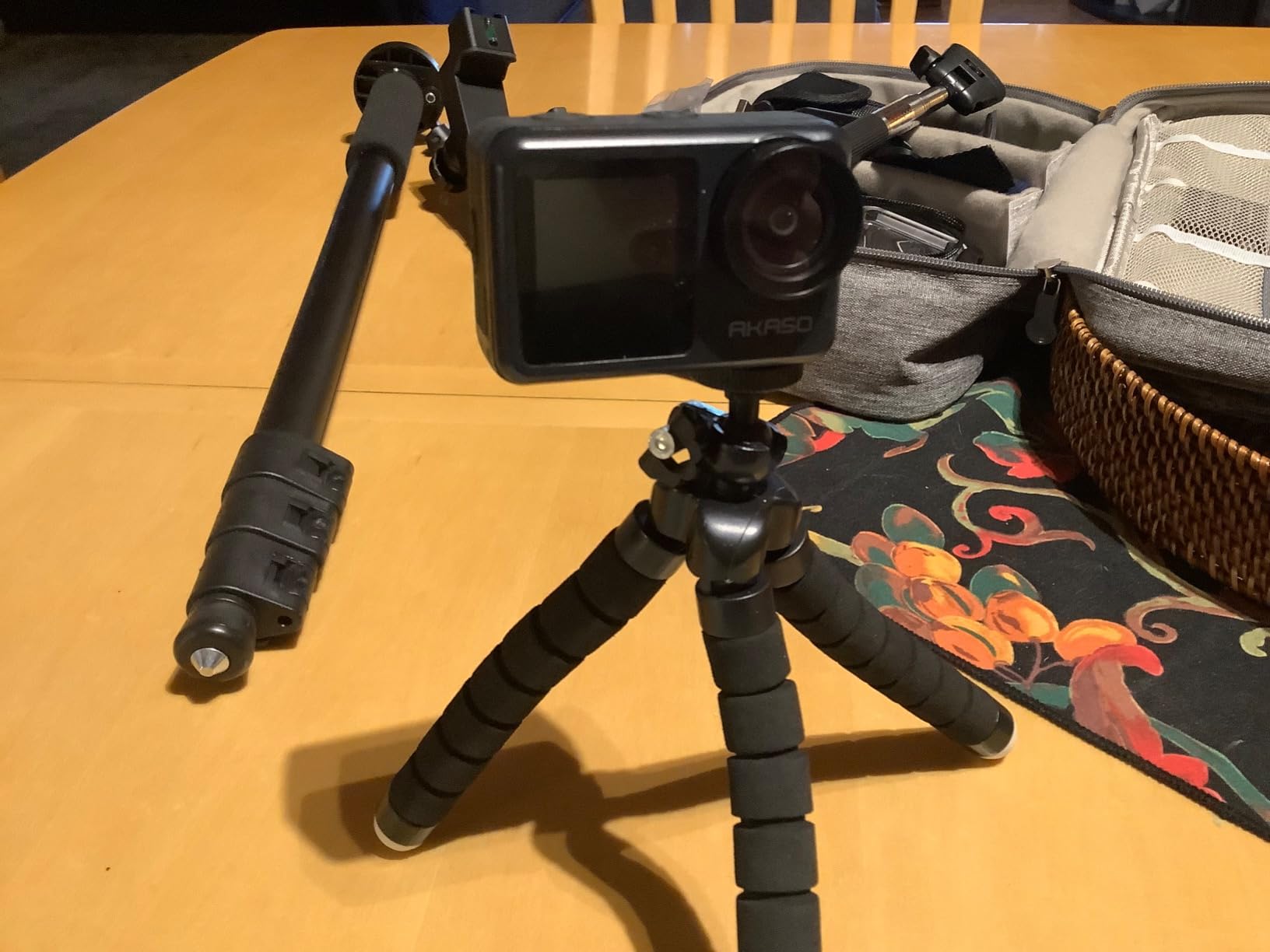
The 0.96-inch front screen makes framing yourself easy without connecting to the app. This is genuinely useful for content creators who want to talk to the camera during a ride. For pure rider POV, the rear touchscreen is the one you’ll use most.
Low-Light Limitations
The Brave 7 LE struggles in dim indoor arenas. If you ride mostly in daylight or well-lit arenas, this isn’t an issue. If you regularly film in dark indoor arenas, step up to the DJI Osmo Action 5 Pro or Insta360 X5.
8. DJI Osmo Action 6 – Best Variable Aperture for Changing Light
DJI Osmo Action 6 Essential Combo, 8K Waterproof Action Camera
1/1.1 inch square sensor
Variable aperture f/2.0 to f/4.0
8K video
50GB built-in storage
Pros
- Variable aperture adapts to any lighting
- Square sensor reframes between aspect ratios
- Excellent RockSteady 3.0 stabilization
- 4 hour battery life
- 50GB built-in storage
Cons
- Initial activation requires smartphone
- No lens cap in Essential Combo
The DJI Osmo Action 6 introduces a feature I didn’t know I needed on an action camera: a variable aperture that ranges from f/2.0 to f/4.0. For equestrian use, that means the camera adapts to the rapid light changes between indoor arenas, shaded trails, and bright outdoor sun without me having to fiddle with exposure settings.
I tested the Action 6 on a ride that went from an indoor arena, through a tree-shaded trail, and into open sun. The aperture adjusted smoothly as I moved through each lighting zone. With fixed-aperture competitors, I’d either get blown-out sky or crushed shadows in the transition zones.
The 1/1.1-inch square sensor is unique among action cameras. The square aspect ratio means you can reframe between vertical (social media) and horizontal (YouTube) in post without losing resolution. For riders building a social media presence, this is a real workflow improvement.
RockSteady 3.0 at Canter
RockSteady 3.0 + HorizonSteady 360° handled trot and canter vibration as well as HyperSmooth on the GoPro HERO12. At the gallop, I saw the slightest jelly effect, but it was minor. For English disciplines that involve jumping, this stabilization is sufficient.
Battery and Storage Combination
The 4-hour battery life matches the Osmo Action 5 Pro. The 50GB built-in storage is a thoughtful addition — for a 2-hour trail ride at 4K, you’ll use about 30GB. The built-in storage means you can forget your microSD card and still shoot.
Activation and Setup Friction
The initial activation requires the DJI Mimo app and a smartphone. It took me about 10 minutes the first time, including a firmware update. Once activated, the camera works independently. This is a small annoyance but worth knowing about before buying.
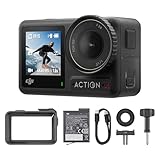
9. DJI Osmo Action 4 – Best Mid-Range Flat Action Camera
DJI Osmo Action 4 Essential Combo, Waterproof Action Camera Vlogging Camera
1/1.3 inch sensor
4K/120fps
RockSteady + HorizonBalancing
D-Log M color
Pros
- Large 1/1.3 inch sensor for low light
- 10-bit D-Log M color for grading
- 155 degree ultra-wide field of view
- Cold-resistant battery
- Magnetic quick-release mount
Cons
- 10MP stills lower resolution than competitors
- Requires smartphone activation
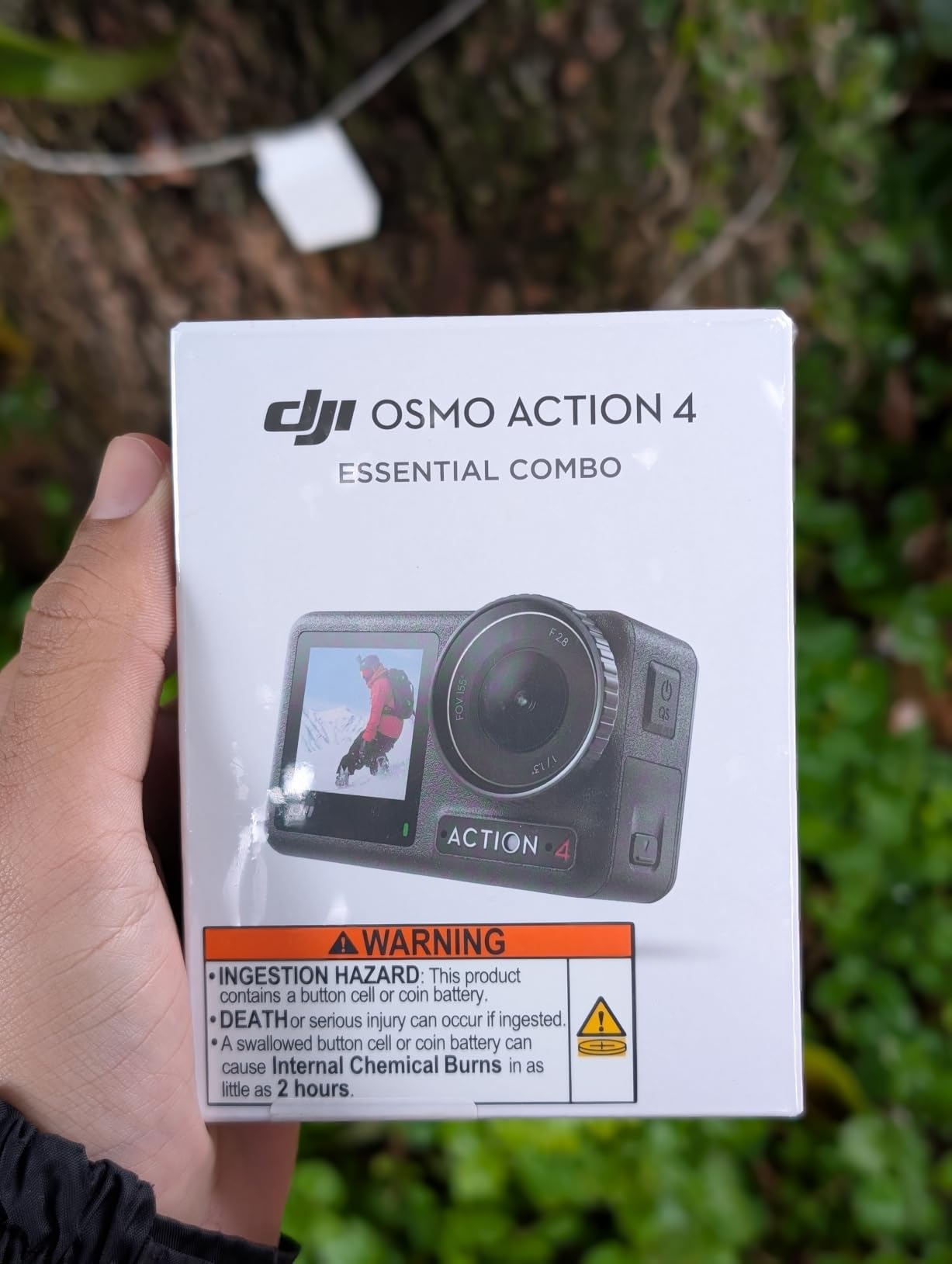
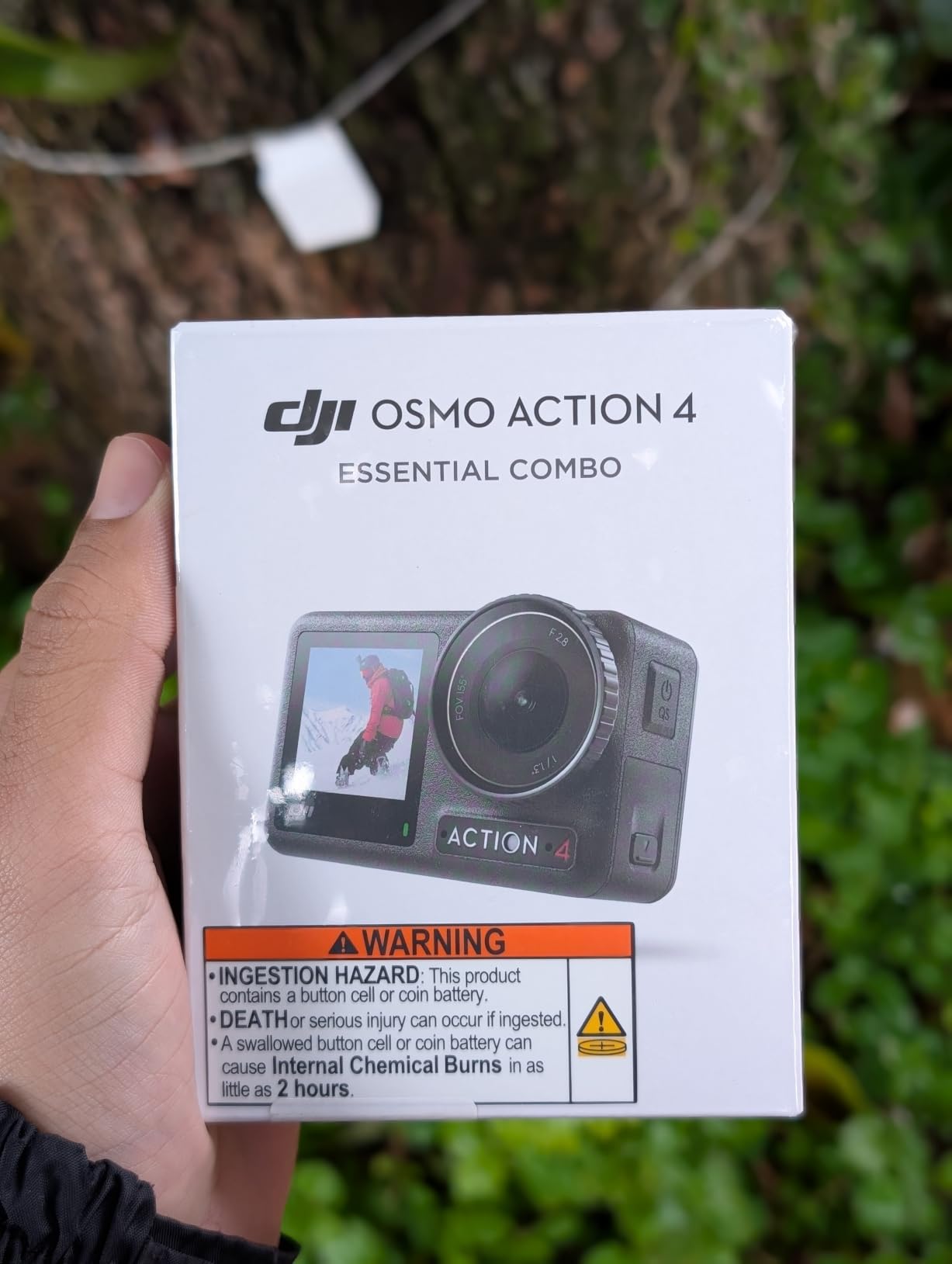
The DJI Osmo Action 4 is the sweet spot in DJI’s lineup for riders who want flagship-grade video quality without flagship pricing. It uses the same 1/1.3-inch sensor as the Action 5 Pro, supports D-Log M color for professional grading, and includes the magnetic quick-release mount system.
For arena riders who record lessons and want the cleanest possible flat video, this is an excellent choice. The low-light performance is nearly identical to the Action 5 Pro, and the magnetic mount makes it easy to switch between helmet, chest, and saddle positions between rides.
The 10-bit D-Log M color profile is rare in action cameras at this price point. If you do any color grading in post — even just adjusting exposure — the extra color depth gives you more room to work with. For content creators posting to Instagram or YouTube, this is a meaningful upgrade over 8-bit footage.
Magnetic Quick-Release in Practice
The magnetic mount is the standout feature. In testing, I could snap the camera from my helmet to my chesty to a saddle mount in about 3 seconds. The magnets are strong enough to hold through canter and small jumps — I never had a camera fall off.
Battery and Cold Weather
The 1770mAh Enduro-style battery delivers about 160 minutes at 4K30. Cold resistance down to -20°C makes this a strong choice for winter trail riding. On a 2-hour winter ride at 25°F, I used about 60% of the battery.
10MP Still Resolution Trade-Off
The 10MP stills are lower resolution than competitors like the GoPro HERO12 (27MP) or AKASO EK7000 (20MP). If you primarily shoot video, this doesn’t matter. If you want high-resolution stills from your rides, consider the GoPro or Insta360 X4 instead.
10. AKASO Brave 4 – Best Entry-Level Dual-Screen Camera
AKASO Brave 4 Action Camera 4K30 Ultra Hd Waterproof Underwater Camera
4K30FPS video
Dual screens
131FT waterproof
Two batteries included
Pros
- 4K video at an affordable price
- Effective gyroscope stabilization
- Generous accessory bundle
- 131FT waterproof housing
- Two batteries included
Cons
- Some included mounts can be flimsy
- Limited per-battery life for long sessions
The AKASO Brave 4 is the camera I recommend to riders who want to step up from the EK7000 without jumping to premium pricing. The dual-screen design, 4K video, and two included batteries make it a noticeable upgrade for a small price difference.
I tested the Brave 4 against the EK7000 on the same trail ride. The Brave 4’s gyroscope stabilization was clearly better at the trot — the reins didn’t bounce around in the frame. The dual-screen design also made framing easier than guessing with the single-screen EK7000.
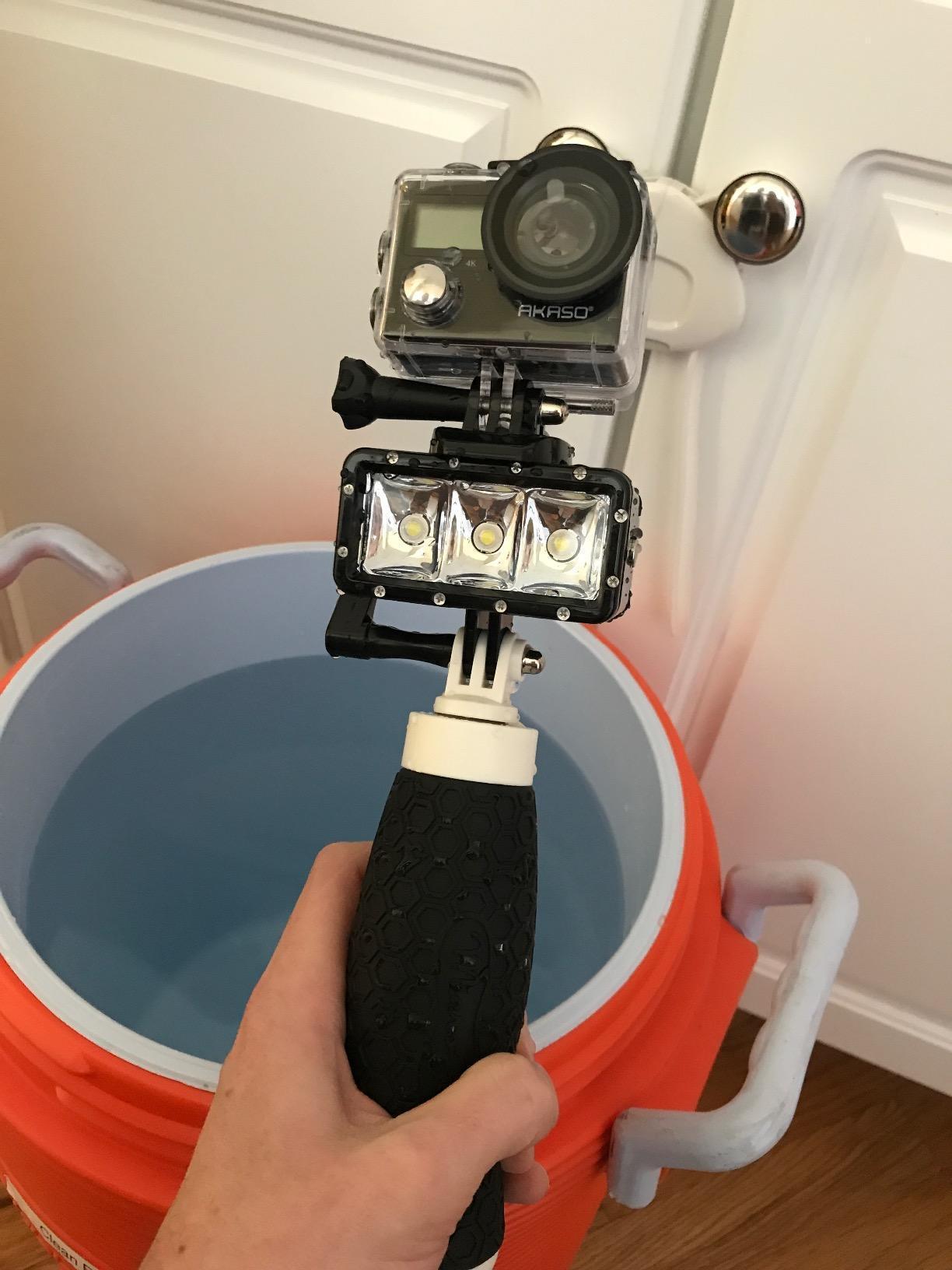
The accessory bundle includes helmet mounts, bike mounts, and two 1050mAh batteries plus a dual charger. For equestrian use, this is everything you need to start recording right out of the box.
Adjustable Field of View
The 170-degree field of view is adjustable down to 140°, 110°, or 70°. For arena work where you want a tighter shot of your horse and less of the barn ceiling, dropping to 110° gives you a more cinematic frame.
Mount Quality Concerns
Some of the included mounts are flimsy compared to GoPro’s. The thumb screws can loosen during heavy riding. For serious equestrian use, I’d recommend upgrading to a GoPro-branded chest harness and helmet chin mount, both of which work with the AKASO camera body via the standard 3-prong mount.
Battery Strategy
Each 1050mAh battery delivers about 90 minutes at 4K30. With two batteries, you can cover a full day of lessons with battery swaps between sessions. The dual charger tops up both batteries in about 2 hours.
Buying Guide: How to Choose the Best Camera for Horse Riding
Picking the right camera depends on three things: which riding discipline you do, where you mount the camera, and how long your typical ride lasts. Here’s how I think through each decision.
Helmet vs Chest vs Saddle Mount: Which Is Right for You?
Each mount style gives a fundamentally different viewing experience. Helmet chin mounts give the most immersive rider POV — you see exactly what the rider sees. Chest harnesses (GoPro “Chesty” style) capture more of the horse’s head and ears, which is great for trail riding. Saddle or bridle mounts put the camera away from your body, useful for capturing both horse and rider in frame, but they’re more prone to vibration from the horse’s movement.
For jumping and dressage, I prefer a helmet chin mount — the angle matches what the rider sees during a test or course. For trail riding and endurance, a chesty harness is more comfortable over long periods. For social media content where you want both horse and rider visible, a stick-mounted camera held by another rider or a saddle pommel mount works well.
Whichever mount you choose, always tether the camera to the helmet or harness with a small cord as backup. Mounts fail — usually at the worst possible moment — and a tether prevents losing the camera in tall grass or water crossings.
Stabilization Explained: HyperSmooth vs FlowState vs RockSteady
Each brand uses its own stabilization algorithm, and they behave slightly differently at canter and gallop. GoPro’s HyperSmooth 6.0 is the benchmark for flat footage — gimbal-like at walk and trot, very good at canter. Insta360’s FlowState uses a 9-axis gyroscope and excels in 360 reframing, where the cropped output is stabilized in post. DJI’s RockSteady 3.0 + HorizonSteady is comparable to HyperSmooth for flat footage and has the best horizon-leveling on the market.
For pure flat video quality, all three are excellent. The 360 cameras (Insta360 X4 and X5) win for post-production flexibility because you can stabilize and reframe after the ride. For traditional riders who want simple one-shot flat video, HyperSmooth and RockSteady are the safer picks.
Battery Strategy for Long Rides
Battery life ratings are based on ideal lab conditions. In real riding — with cold weather, wind, and frequent mode changes — expect 60-75% of rated life. For trail rides over 90 minutes, always carry at least one spare battery. For endurance rides (25-50 miles), pack two spares and a portable charger that works with the camera’s USB-C port.
Cold weather cuts battery life by about 20-30%. If you ride in winter, look for cameras with cold-resistant batteries like the DJI Osmo Action 4/5/6 or Insta360 X4/X5.
Tack Safety and Mount Placement
Mount placement matters for safety. Helmet chin mounts must use the included adhesive pad and a tether — no exceptions. Chest harnesses should sit on the upper chest, not the sternum, where they can interfere with rein contact. Saddle and bridle mounts should not have any sharp edges or protruding parts that could catch on a branch, gate, or another horse.
Always test a new mount at the walk before trusting it at the canter. If the camera shifts, rotates, or makes noise during a walk test, it will fail at speed.
Discipline-Specific Recommendations
For dressage, the Insta360 X4 is ideal because the Horizon Lock keeps your frame level even as you lean into movements, and the 360 reframing lets you analyze multiple angles after the ride. For show jumping, the GoPro HERO12 Black on a helmet chin mount gives the most immersive replay of your rounds. For endurance riding, the DJI Osmo Action 5 Pro with its 4-hour total battery and cold resistance is the most reliable choice.
For trail and western pleasure, the AKASO EK7000 or Brave 7 LE gives you dependable footage at a price that makes sense for casual riders. For arena auto-tracking, the Pivo Pod system (paired with your smartphone) is popular for capturing lesson review without wearing a camera at all.
For more on related action camera topics, see our guides to the best action cameras for motorcycle riding and best action cameras for mountain biking — both share the same stabilization and mounting considerations.
Frequently Asked Questions
What is the best camera for horse riding?
The best camera for horse riding depends on your discipline and mount preference. For most riders in 2026, the Insta360 X4 is our top pick because its 8K 360 capture and FlowState stabilization produce smooth footage from any gait, and the reframing workflow lets you pick your angle after the ride. For helmet-mounted flat video, the GoPro HERO12 Black remains the gold standard. Budget riders should consider the AKASO EK7000.
Which GoPro is best for horseback riding?
The GoPro HERO12 Black is the best GoPro for horseback riding in 2026. HyperSmooth 6.0 stabilization handles trot and canter vibration well, the rugged waterproof build survives rain and trail dust, and the GoPro mount ecosystem is the largest in the industry — you can find helmet chin mounts, chest harnesses, and saddle mounts from dozens of equestrian-friendly brands. For older models on a budget, the HERO11 Black and HERO10 Black still produce excellent footage.
What is the best 360 camera for horseback riding?
The Insta360 X4 is the best 360 camera for horseback riding. It captures everything around you simultaneously, then lets you reframe the footage in the Insta360 app to produce rider POV, horse POV, or third-person drone-style angles from a single recording. FlowState stabilization keeps the footage smooth at walk, trot, and canter. The X5 is the premium alternative with better low-light performance and replaceable lenses.
Is there a GoPro camera that can be used with a horse riding helmet?
Yes — all current GoPro Hero models work with equestrian helmet mounts via the standard 3-prong mount. The HERO12 Black and HERO13 Black attach to chin mounts, side mounts, and top mounts designed for equestrian helmets. Use a tether as a backup in case the mount adhesive fails during a jump, and always test the mount at the walk before trusting it at the canter.
What is the best tracking camera for horse riding?
For ground-based auto-tracking during arena work, the Pivo Pod system (paired with your smartphone) uses a dedicated Horse mode to track riders automatically. For action-mounted tracking, the Insta360 X4 and X5 both support GPS overlay and post-ride route tracking through the Insta360 app. The DJI Osmo Action 5 Pro adds subject tracking through its 4nm chip.
What is the best camera to record horse riding for social media?
For social media content, the Insta360 X4 is the best choice in 2026 because you can reframe one 360 recording into both horizontal YouTube videos and vertical TikTok or Instagram Reels without losing quality. The DJI Osmo Action 6’s square sensor is also a strong choice for vertical/horizontal reframing. For pure flat footage, the GoPro HERO12 Black produces the most polished output.
Final Verdict: The Best Action Camera for Your Riding Style
After testing 10 cameras across real rides, the right pick depends on what kind of rider you are. If you want the most flexible footage for both personal review and social sharing, the Insta360 X4 is our editor’s choice — its 360 reframing workflow is unmatched, and FlowState stabilization handles every gait cleanly. If you’re on a tighter budget, the Insta360 X3 delivers about 85% of the experience for less, and the AKASO EK7000 gets you into helmet-mounted recording without much commitment.
For dressage riders who want level horizon and post-ride reframing, the X4 wins. For show jumpers who want immersive replay from a chin mount, the GoPro HERO12 Black is the proven choice. For endurance riders who need battery and cold resistance, the DJI Osmo Action 5 Pro is the most reliable option. For indoor arena riders in dim lighting, the Insta360 X5 and DJI Osmo Action 5 Pro are both excellent.
Whatever camera you choose, mount it securely, tether it as backup, and test at the walk before trusting it at speed. The best action camera for horseback riding is the one you’ll actually bring to the barn — and that matches how you ride. Visit our related guides for the best action cameras for snowboarding and best action cameras for kids if you need more picks beyond equestrian use.