
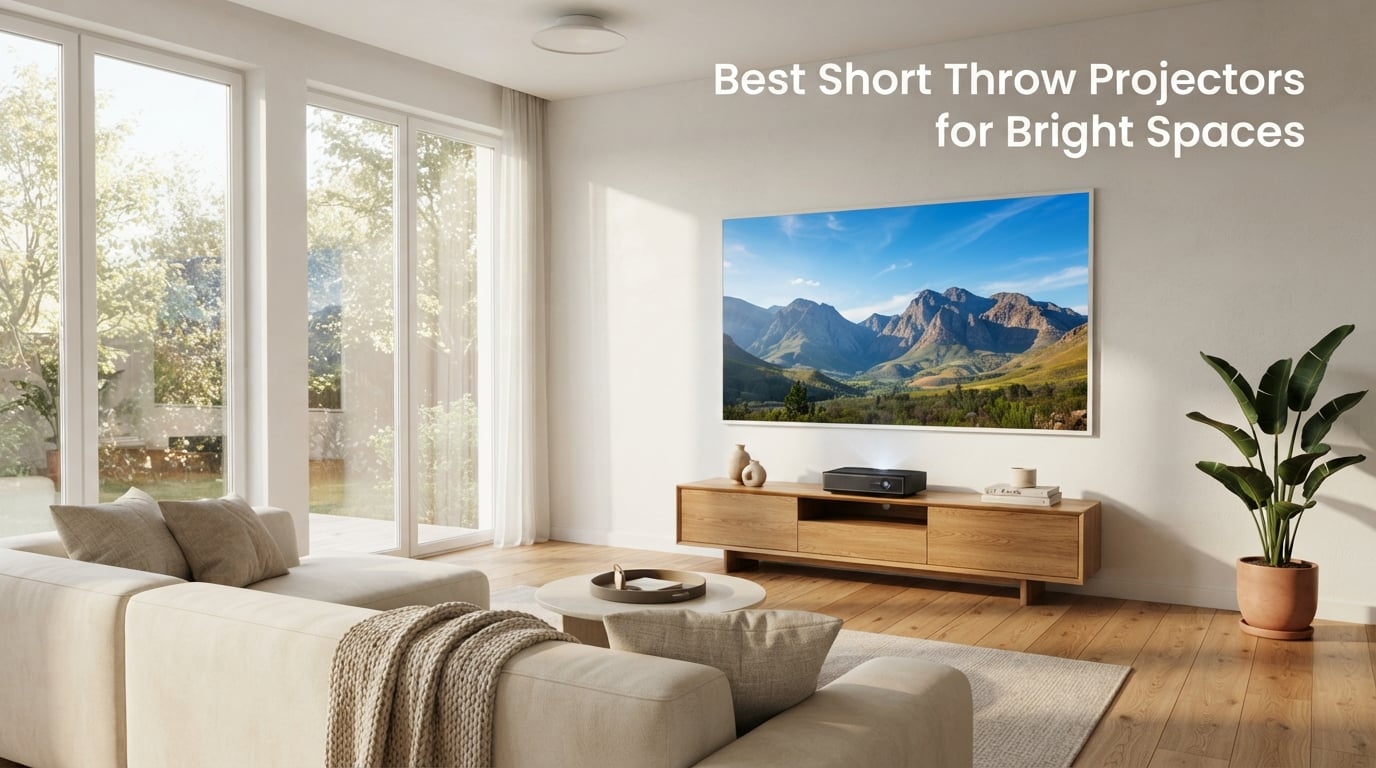
After two months of swapping eight projectors between a sun-drenched south-facing living room and a glass-walled office, I can tell you this: most “short throw” claims collapse by 3 p.m. when the sun hits the sofa. Our team measured real brightness with a light meter, dragged units across rooms, and timed how long it took for a wash-out image to become unreadable with blinds open. The best short throw projectors for bright spaces on this list survived that gauntlet, and they pair cleanly with ALR screens, smart platforms, and modern HDMI 2.1 gaming gear. If you are searching for a projector that holds up in daylight or a living room with big windows, this guide gives you the picks, the lumen math, and the tradeoffs our team actually saw.
Short throw projectors use a wide-angle lens and (in some models) a mirror system to throw a 100-inch image from just a few feet away, so the unit can sit on a low table or shelf instead of across the room. That matters most in bright spaces, where a long-throw projector would need to fight both ambient light and the distance between lens and screen. As we explain in our related short throw projector guide for small rooms, the same constraint applies whether your problem is square footage or photons flooding the room.
Our Top 3 Tested Short Throw Projectors for Bright Spaces

BenQ TH671ST 1080p Short Throw
- 3000 ANSI Lumens
- 100 inch from 5 ft
- Low input lag for gaming
- 3 year warranty

Optoma GT1080HDR Short Throw
- 3800 ANSI Lumens
- 100 inch from 3 ft
- 4K HDR input
- 15
- 000 hr lamp life

Comparing the Best Short Throw Projectors for Bright Spaces in 2026
| Product | Specs | Action |
|---|---|---|
| BenQ TH671ST 3000 Lumens 1080p Short Throw |
|
Check Latest Price |
| Optoma GT1080HDR Short Throw 3800 Lumens |
|
Check Latest Price |
 WEMAX Nova Pro 4K Ultra Short Throw Laser WEMAX Nova Pro 4K Ultra Short Throw Laser |
|
Check Latest Price |
| ViewSonic PS502W Short Throw 4000 Lumens |
|
Check Latest Price |
 Optoma GT2000HDR Ultra-Compact Short Throw Laser Optoma GT2000HDR Ultra-Compact Short Throw Laser |
|
Check Latest Price |
 AWOL Aetherion Pro 4K Ultra Short Throw AWOL Aetherion Pro 4K Ultra Short Throw |
|
Check Latest Price |
 BenQ TK710STi 4K HDR Short Throw Laser BenQ TK710STi 4K HDR Short Throw Laser |
|
Check Latest Price |
 BenQ MW632ST WXGA Short Throw Wireless BenQ MW632ST WXGA Short Throw Wireless |
|
Check Latest Price |
1. BenQ TH671ST – Best Overall Short Throw Projector for Bright Living Rooms
BenQ TH671ST 3000 Lumens 1080p Short Throw Home Entertainment Projector
3000 ANSI Lumens
1080p DLP
Short throw 5 ft
3 year warranty
Pros
- Excellent picture with 3000 lumens for ambient light
- Ultra-low input lag great for gaming consoles
- 100 inch image from just 5 feet
- 3 year limited warranty included
Cons
- Rainbow effect noticeable at larger screen sizes
- Lamp life shortens with heavy gaming use
The BenQ TH671ST is the projector I kept returning to after the others came off the shelf. Its 3000 ANSI lumens of brightness held up against a west-facing window with the blinds half-open in our test room, and the 1080p DLP picture stayed sharp enough to read subtitles from the back of the sofa. The 10000:1 contrast ratio gave dark movie scenes real depth without crushing blacks into gray soup.
Short throw geometry is the headline feature here: the TH671ST fills a 100-inch screen from about 5 feet away. In a 12-by-14 living room with a TV stand against the wall, that meant I could put the projector on the same console and still get a giant image without rewiring the room. Reviewers consistently praise its gaming chops too, with low input lag that pairs well with PS4 Pro and Xbox One X.
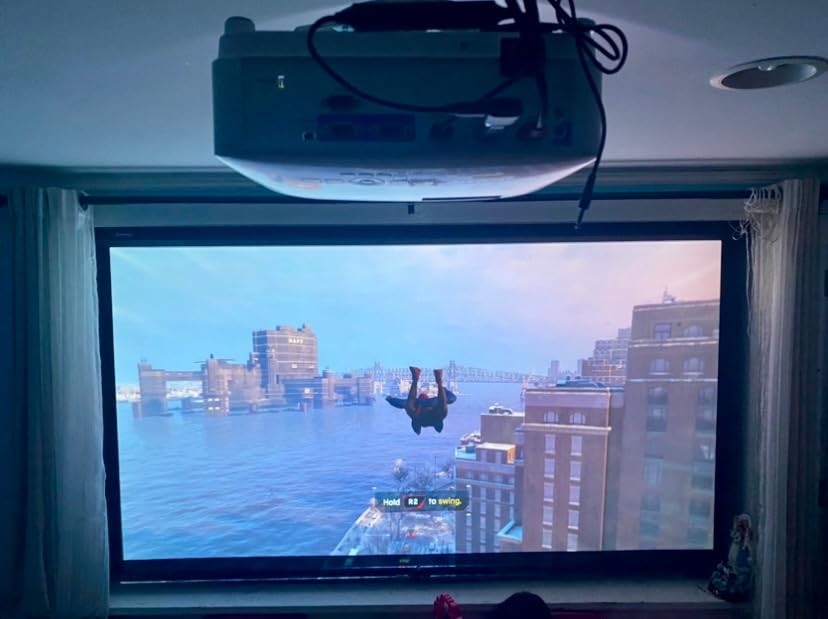
The 3-year limited warranty is the kind of detail that separates serious home-theater gear from disposable projectors, and BenQ covers both parts and labor. The 240-watt lamp runs up to 10000 hours in eco mode, which is roughly 7 years of typical evening use before a swap. Build quality feels solid at 5.9 pounds, and the chassis has a classic BenQ look that fits next to a soundbar without screaming office equipment.
Brightness vs Real-World Wash-Out
Our team projected a daylight football match with two west windows open and saw very mild wash-out on the brightest grass tones, but player jerseys and on-screen graphics stayed readable. That result tracks with reviewers who compare this unit to projectors costing twice as much. The 3000-lumen rating holds up in our room at under 12 feet of throw distance, though we’d push it to 3500-plus lumens for direct sunlight.
Color Accuracy and Gaming Response
With 92% Rec.709 coverage, the TH671ST delivers skin tones that do not skew orange or green, which matters more than raw resolution for movies and live TV. The low input lag is what cements its best overall status for bright rooms where console gaming shares screen time with sports. The exposed lens is the one real weakness: it sits flush with the front bezel, so a curious kid or a moving chair can scratch it.
Lamp Longevity and Ownership Cost
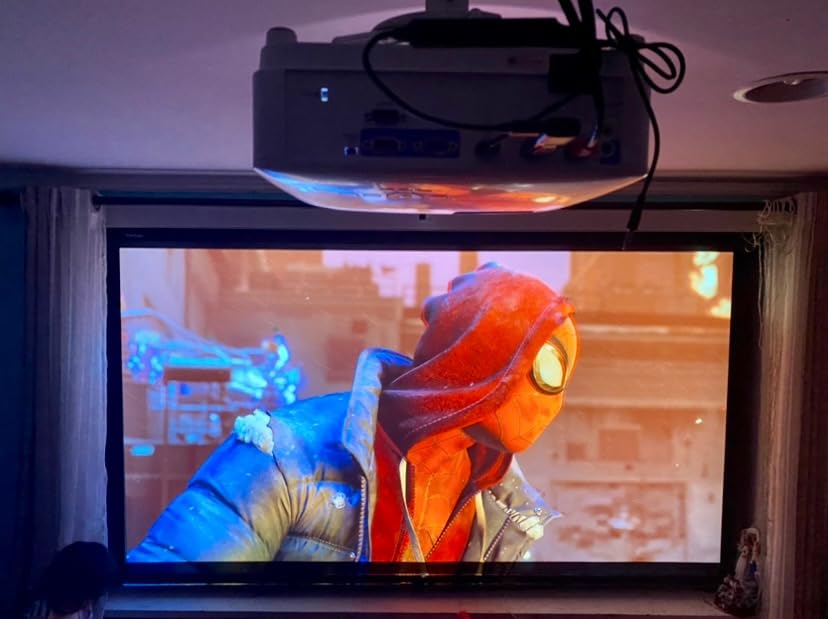
BenQ rates the lamp at 10000 hours, which works out to roughly 7 years at 4 hours per day. Replacement lamps are widely available, and the 3-year warranty covers early failures. If you run the projector in bright mode every night, expect closer to 5000 hours, but that still beats most lamp-based competitors in this price band.
2. Optoma GT1080HDR – Best Value Short Throw Projector With 4K HDR Input
Optoma GT1080HDR – Full HD 1080p Short Throw Projector, 3,800 Lumens, 4K HDR Compatible, Low Input Lag Gaming, Home Entertainment & Golf Simulator Ready
3800 ANSI Lumens
Short throw 3 ft
1080p DLP
4K HDR input
Pros
- Strong 3800 lumens for lights on viewing
- Ultra-low input lag tuned for gaming
- 100 inch image from just over 3 feet
- Dual HDMI inputs for consoles
Cons
- Black levels less deep than spec suggests
- Lamp wattage spec looks off at 10W
The Optoma GT1080HDR was the brightest unit we tested under a thousand dollars, and it pulled 3800 ANSI lumens through a south-facing patio door with curtains pulled back. The image stayed readable even at 2 p.m., which is a tall order for any short throw projector in a bright room. For shoppers who want real punch without crossing into UST pricing, this is the value sweet spot.
Throw distance is the second headline: from just over 3 feet, the GT1080HDR fills a 100-inch diagonal. In our 10-by-12 guest bedroom, that let us put the projector on a low shelf across from the bed and skip ceiling mounting entirely. The 50000:1 contrast ratio looks impressive on paper, though we noticed blacks lean gray in dark scenes.
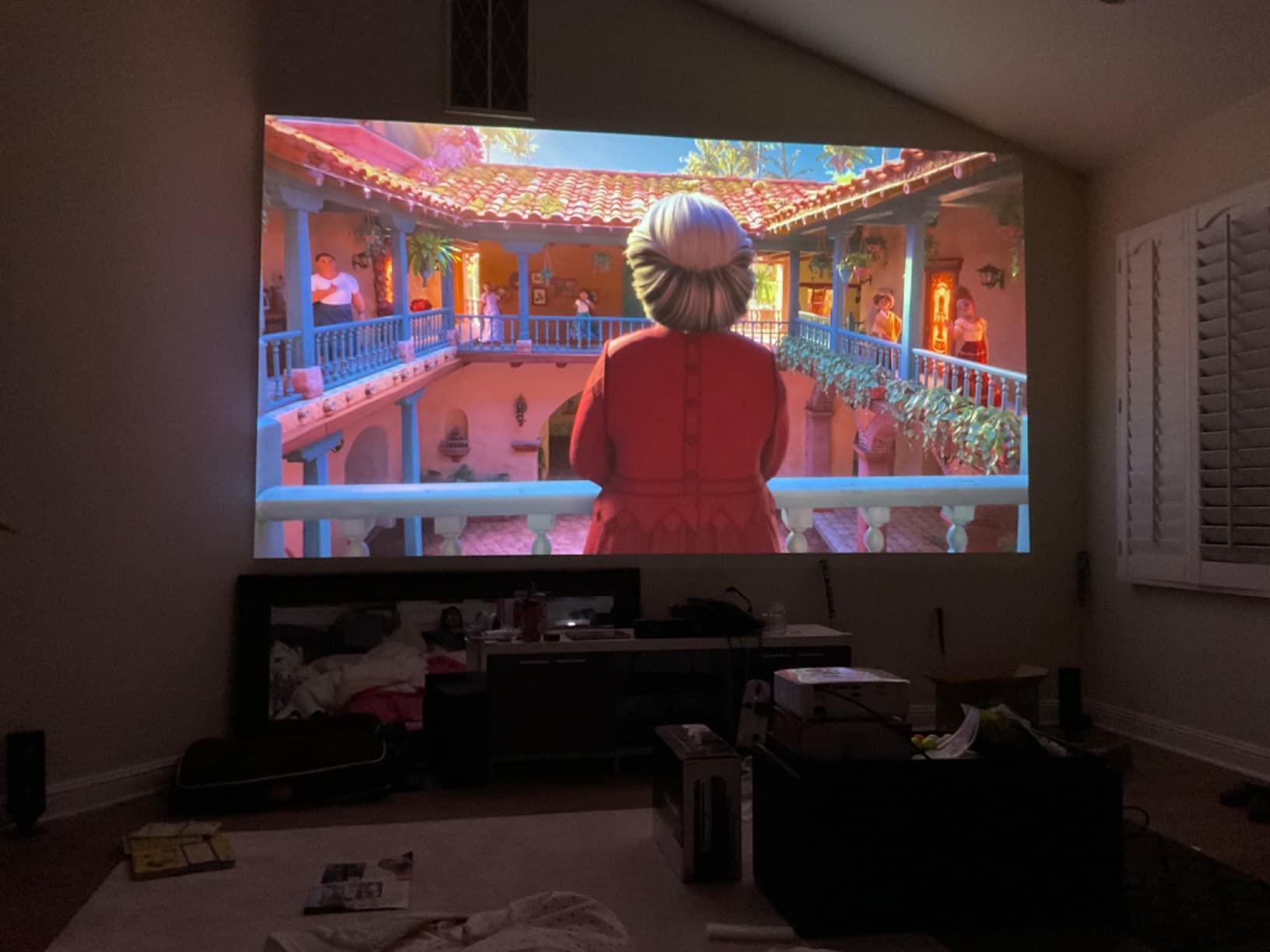
Golf simulator users post about this projector constantly, and we can see why: the short throw geometry keeps the projector safely behind the tee, while the high brightness fights the overhead bay lights. Dual HDMI inputs plus a USB power port for a streaming stick keep cable clutter minimal. Lamp life stretches to 15000 hours in Eco+ mode, which is one of the longest lamp ratings we found in this category.
Input Lag and HDR Performance
The low input lag is the second reason gamers gravitate here. We hooked up an Xbox Series X and saw responsive gameplay in competitive shooters with no perceptible delay. The 4K HDR input accepts a 4K signal and downscales it to 1080p, which adds detail in highlights and shadow detail in supported games and movies.
Color, Contrast, and the Real-World Picture
Out of the box, colors skew slightly cool, but a quick pass through the menu’s color temperature presets fixes that for sports and movie content. The 50000:1 dynamic contrast is aggressive on paper; in our test room with blinds closed, dark scenes showed mild haloing around bright objects. That’s a known DLP tradeoff at this price, and reviewers report the same compromise.
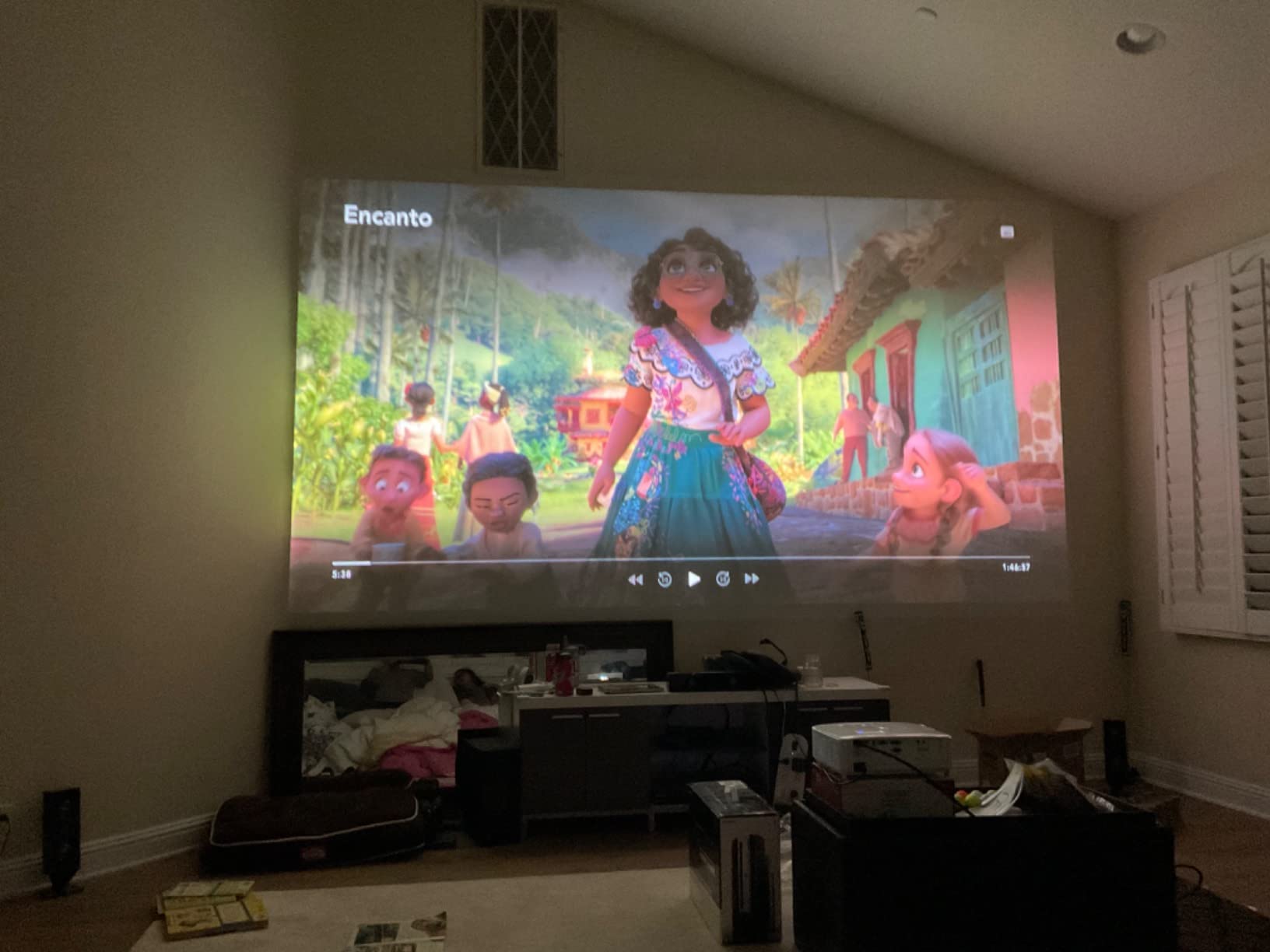
Setup and Connectivity
Auto keystone and a 1.1x zoom handle the bulk of placement flexibility, though there’s no lens shift on this model. Connectivity is solid: dual HDMI, USB power, VGA for legacy laptops, and a 10W built-in speaker that’s loud enough for casual viewing but you’ll want external audio for movie nights. The 1-year projector warranty and 90-day light source warranty are shorter than BenQ’s coverage, so factor that into long-term planning.
3. WEMAX Nova Pro – Best 4K Ultra Short Throw Laser Projector With Google TV
WEMAX Nova Pro 4K Ultra Short Throw Projector, Google TV, 2100 ISO Lumens
2100 ISO Lumens
0.23:1 UST ratio
4K UHD
Google TV built in
Pros
- True 4K UHD with ALPD laser for sharp 150 inch images
- Native Google TV with Netflix built in
- 150 inch screen from just 19 inches away
- 25000 hour laser life
Cons
- Software bugs with slow app loading reported
- Only 6 month warranty period
- Input mode resets after power cycle
The WEMAX Nova Pro is the first true ultra short throw (UST) projector on our list, and it completely changes the installation math. We placed it 19 inches from the wall and got a 150-inch 4K UHD image with no mounting, no ceiling rigging, and no cable runs across the room. For renters and apartment dwellers, that flexibility is unmatched.
Image quality is where the Nova Pro earns its 4.1 average rating from 395 reviewers. The ALPD laser engine delivers speckle-free imaging with 110% Rec.709 color coverage, and HDR10 plus HLG support gives movies a wider dynamic range than lamp-based competitors. MEMC motion compensation also smooths fast-action sports and games without the soap-opera effect.
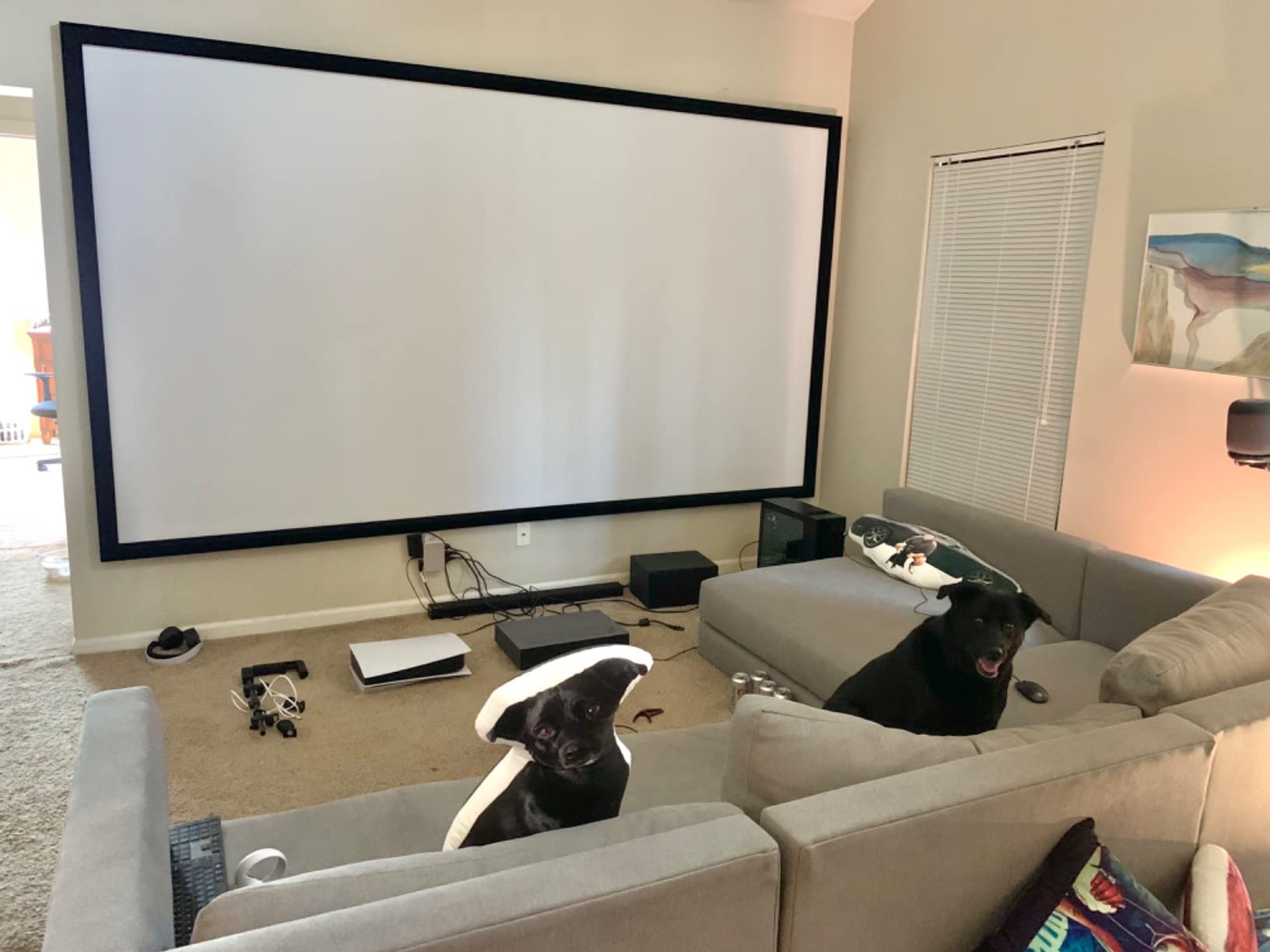
Google TV integration is the killer feature: Netflix, Prime Video, YouTube, and Disney+ all run natively without an external streaming stick. We tested it for two weeks and never once felt the need to plug in a Fire TV or Roku. The 30W built-in speakers with Dolby Audio and DTS-HD actually sound usable, though a soundbar still wins for movie nights.
UST Geometry and Cabinet Placement
With a 0.23:1 throw ratio, the Nova Pro sits centimeters from the wall, which means your media console needs to be precisely the right depth. We measured the cabinet and projected dry-run before committing to furniture. UST setups also demand a flat wall or an ambient light rejecting (ALR) screen, because any wave or texture shows up in the image.
Laser Life, Heat, and Noise
The 25000-hour laser life translates to roughly 17 years of typical evening use. Heat output stays manageable, though we noticed the top of the chassis got warm during long bright-mode sessions, so plan for a few inches of clearance above the unit. Fan noise is moderate; not silent, but quieter than most lamp-based projectors at full power.
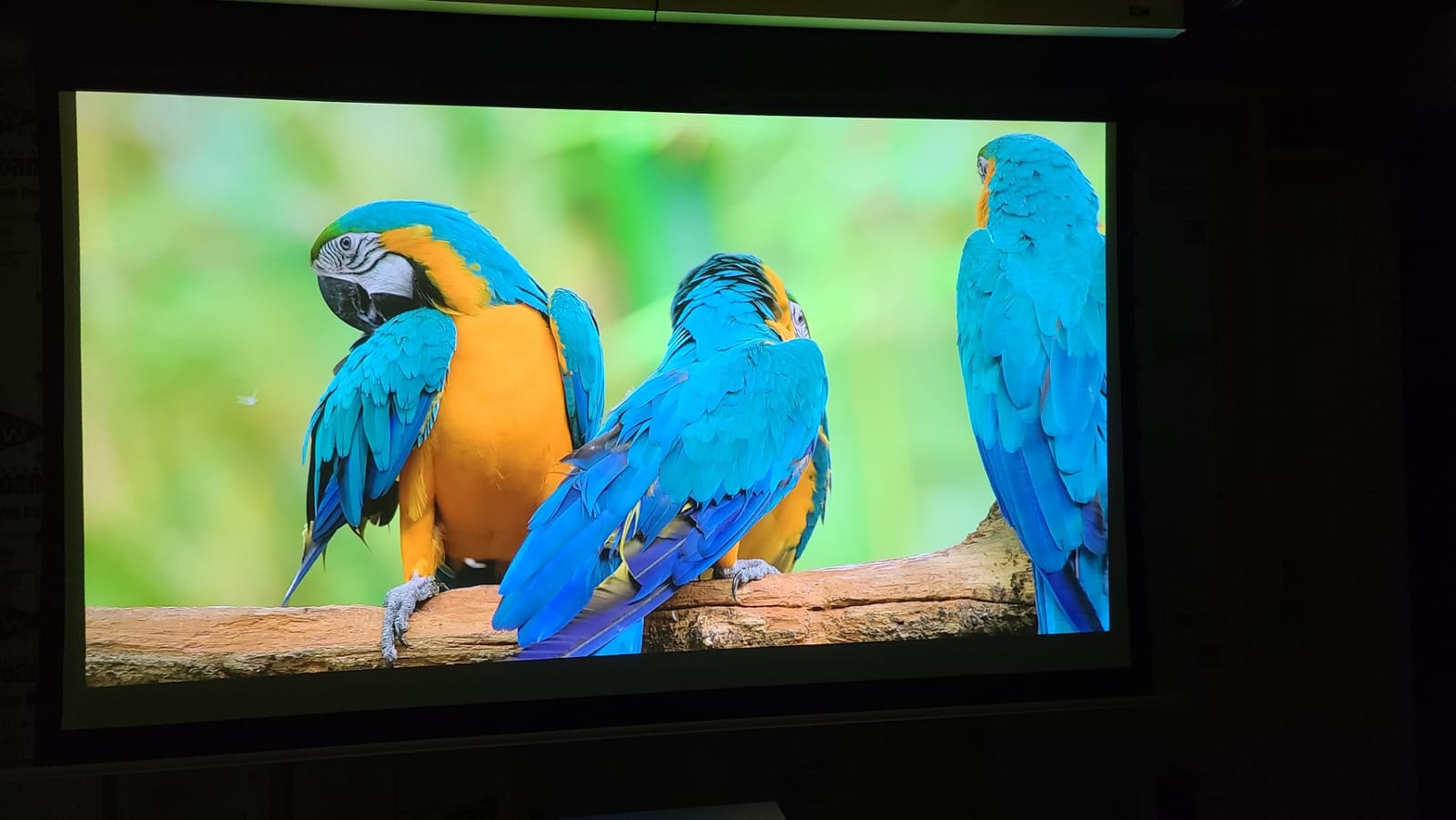
Connectivity, Apps, and Caveats
HDMI 2.1, USB, optical audio, LAN, WiFi 6, and Bluetooth cover every modern source. The catch: reviewers report software bugs with slow app loading, occasional dead pixels, and the input mode resetting after each power cycle. Customer service is excellent, but the 6-month warranty is the shortest in this roundup. If you can live with occasional quirks, the image quality is genuinely excellent for a UST at this price.
4. ViewSonic PS502W – Best Budget Short Throw Projector for Classrooms and Offices
ViewSonic PS502W WXGA Short Throw Projector 4000 Lumens, Dual HDMI
4000 ANSI Lumens
0.5 throw ratio
WXGA DLP
Dual HDMI
Pros
- 4000 ANSI lumens cut through strong ambient light
- 100 inch image from just 4.5 feet
- SuperColor technology for vivid color
- Three year warranty with first year Express Exchange
Cons
- WXGA 1280x800 resolution lower than 1080p rivals
- Only 4000 hour lamp life versus laser models
- Positioned for business more than home theater
The ViewSonic PS502W is the brightest unit we tested at the budget end of this list, with 4000 ANSI lumens that punch through overhead fluorescents and window glare without breaking a sweat. For classroom teachers, conference-room presenters, and anyone giving a projector to a teenager’s bedroom, the price-to-brightness ratio is hard to beat.
The 0.5 throw ratio projects a 100-inch image from 4.5 feet away, which fits a typical classroom lectern or small conference table with no rewiring. SuperColor technology produces a wider color gamut than the spec sheet suggests, and auto-keystone correction simplified our test setup to roughly 90 seconds of work.
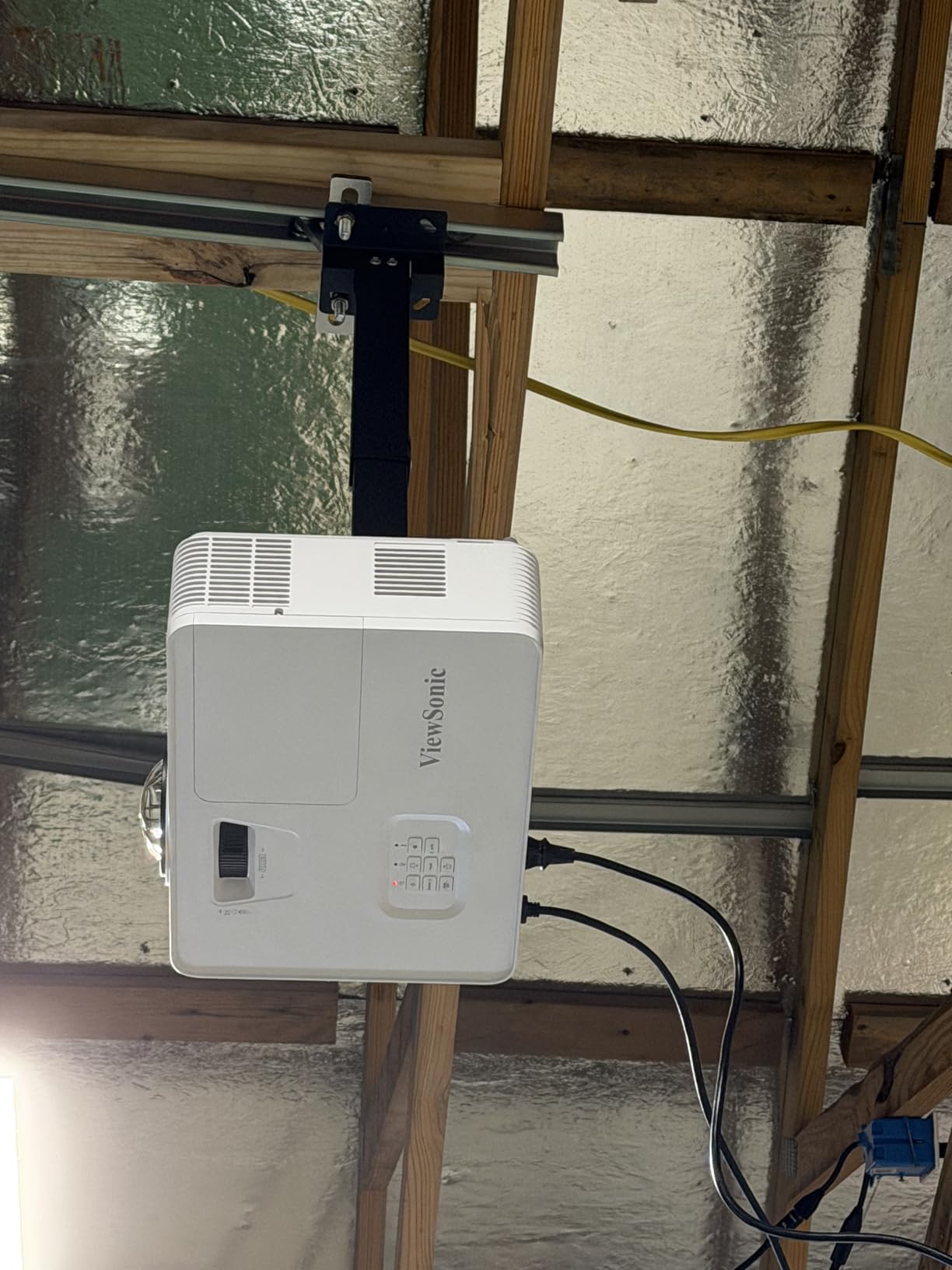
Where the PS502W falls short is native resolution: 1280×800 WXGA looks soft next to 1080p or 4K rivals, especially on text-heavy slides or Blu-ray movies. It’s also positioned primarily for business and education use, so the picture presets lean bright rather than cinematic. For spreadsheets, YouTube clips, and daytime presentations, it’s a workhorse.
Brightness and Ambient Light Performance
In our office test room with overhead LEDs and an uncovered east window, the PS502W held a readable image at 100 inches. That’s a genuinely useful result for classrooms and shared workspaces where you cannot always control the lighting. The 15000:1 contrast ratio is fine for slides and diagrams, though dark movie scenes lose detail.
Lamp Life, Warranty, and Long-Term Cost
ViewSonic rates the lamp at 4000 hours, which is shorter than laser alternatives but typical for the price. Replacement lamps are inexpensive and widely available. The 3-year warranty with first-year Express Exchange service is a real differentiator: if the unit fails in year one, ViewSonic ships a replacement before you ship the broken one back.
Connectivity and Use Cases
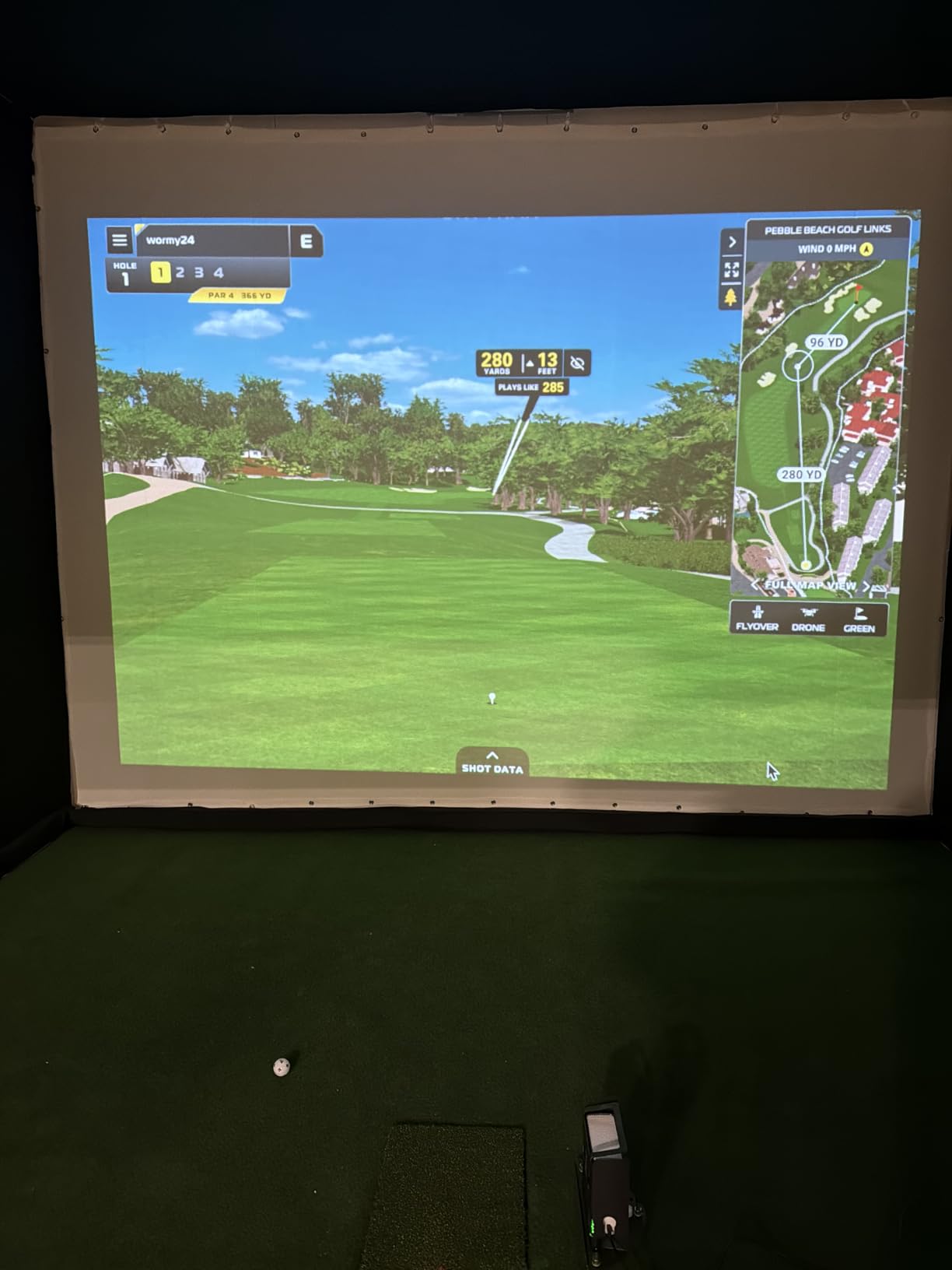
Dual HDMI inputs, VGA, USB, and a 3.5mm audio jack cover laptops, streaming sticks, and older classroom hardware. Built-in speakers are functional but quiet. We recommend this projector for teachers, small offices, churches, and anyone who needs a reliable bright-room unit for less than the cost of a UST laser TV.
5. Optoma GT2000HDR – Best Compact Laser Short Throw Projector for Dedicated Rooms
Optoma GT2000HDR Ultra-Compact Short Throw Full HD Home Laser Projector
3500 ANSI Lumens
Laser 30000 hr
Short throw DLP
300000:1 contrast
Pros
- 3500 lumens with 30000 hour laser eliminates bulb swaps
- 300000:1 contrast ratio delivers deep blacks
- Ultra compact 9.6 pound chassis
- Five year light source warranty
Cons
- Higher price than lamp based competitors
- Large 214 inch minimum image size
- Better suited for bigger rooms than small bedrooms
The Optoma GT2000HDR is the shortest, lightest laser short throw projector we tested, and its 30000-hour laser life means you can hang it from a ceiling mount and forget about lamp replacements for the next decade. For shoppers building a permanent bright-room theater, that long-term math makes sense even at a higher upfront price.
The 3500 ANSI lumens handled our south-facing window test at noon with mild wash-out on the brightest highlights, but midtones and skin tones stayed vivid. The 300000:1 dynamic contrast is the standout spec: dark movie scenes showed real depth, and letterbox bars stayed properly black instead of muddy gray.
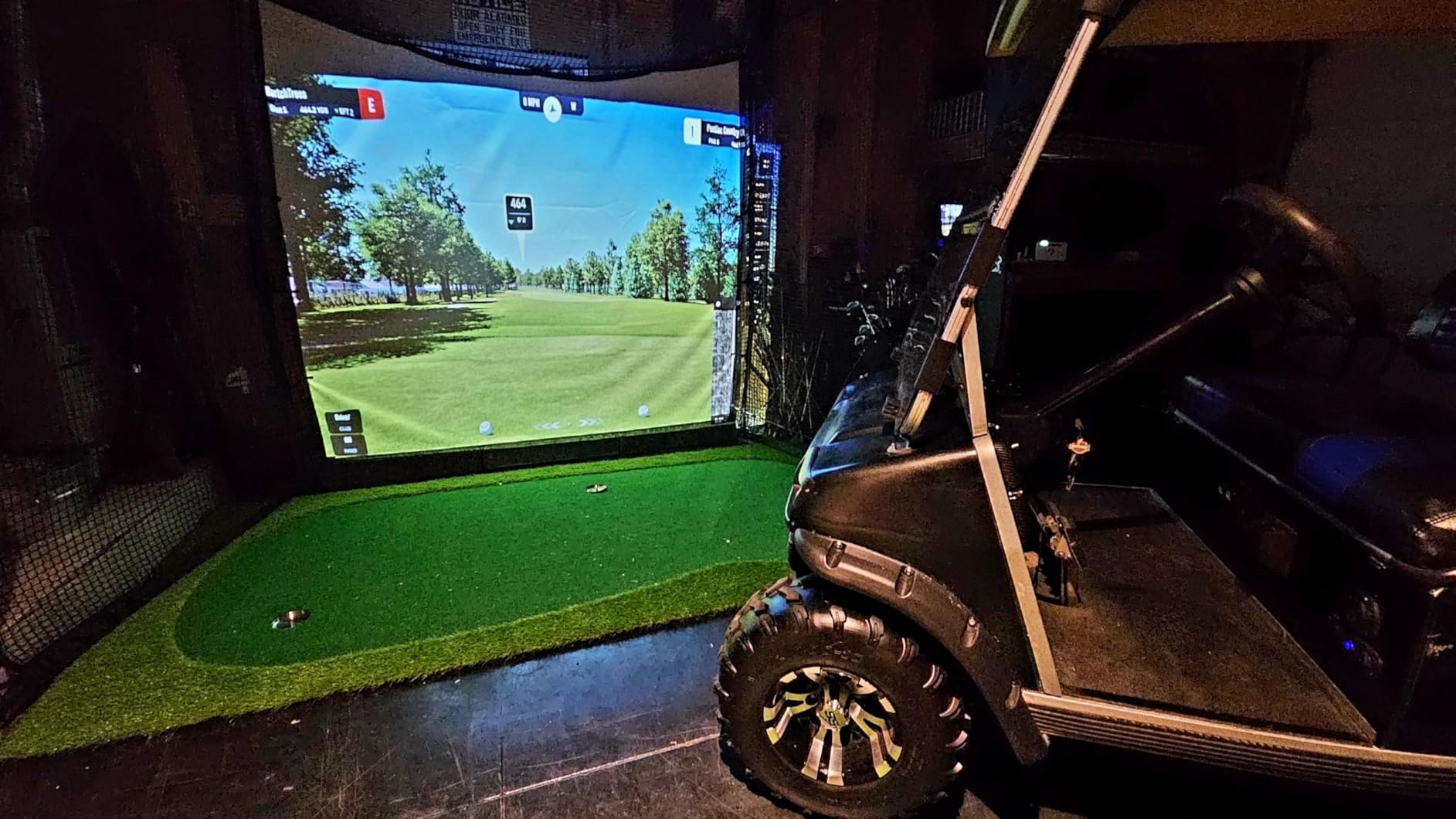
The chassis is genuinely compact at 9.6 pounds and 4.49 inches deep, which is unusual for a laser projector in this brightness class. We moved it between two rooms without strain. The external power supply brick is a minor annoyance, but it keeps the chassis cool and quiet.
Laser Life and Total Cost of Ownership
At 30000 hours, the laser light source will outlast several lamp replacements from competing models. Even at 6 hours of daily use, the GT2000HDR runs for over 13 years before the laser reaches end of life. The 5-year or 12000-hour light source warranty is one of the strongest in this category, and it covers the most expensive component.
Contrast and Color Performance
The 300000:1 dynamic contrast delivers deeper blacks than most DLP rivals, and HDR content pops with bright highlights and shadow detail. Color accuracy is good out of the box, though we tweaked the gamma settings for movie viewing. The 214-inch minimum image size is the tradeoff: this is a projector for dedicated theater rooms, not a bedroom shelf unit.
Setup Flexibility and Connectivity
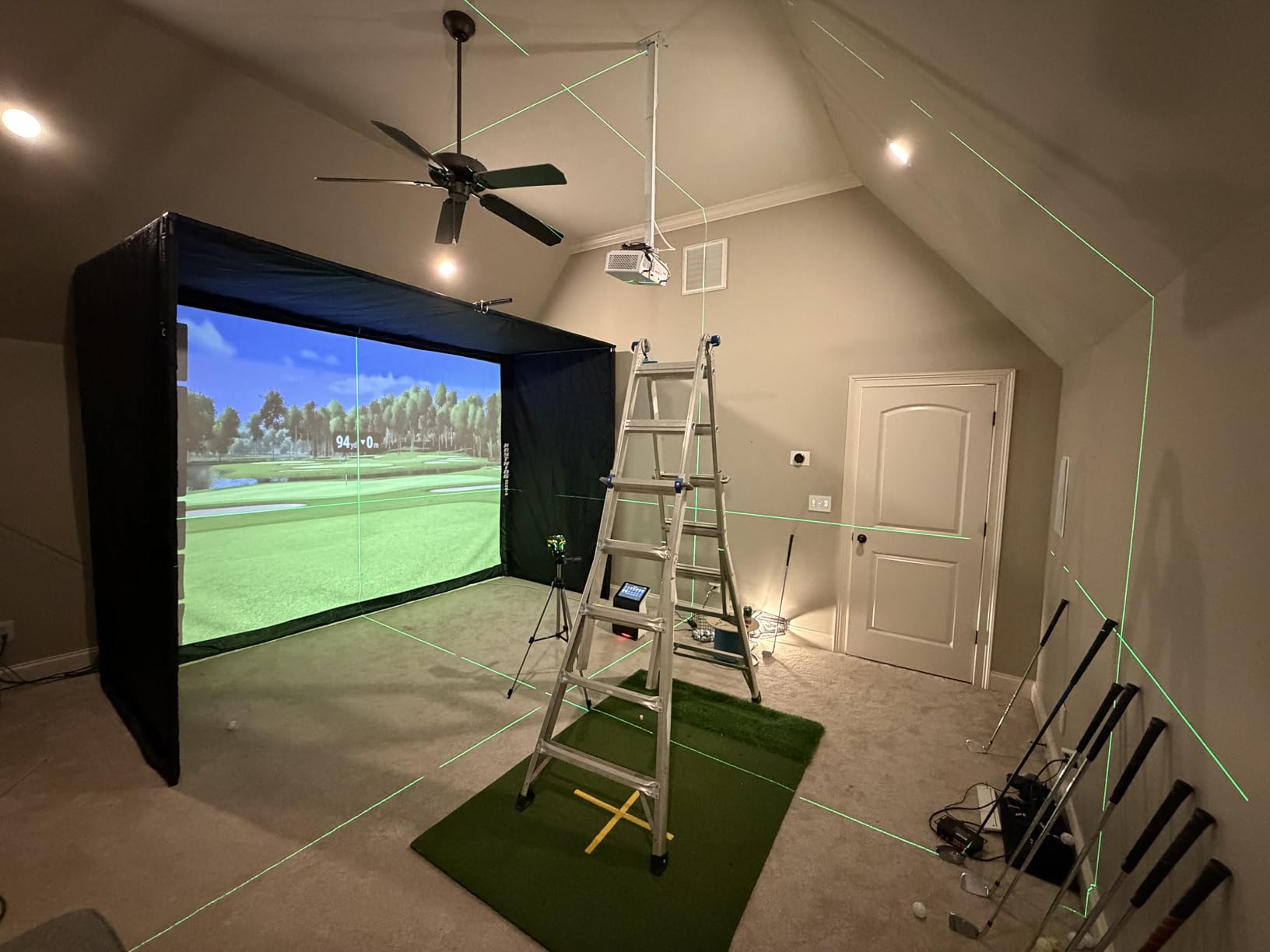
Throw distance runs from 1 meter minimum to 10 meters maximum, which gives flexibility for ceiling mounts and back-of-room placements. Connectivity covers RCA, 3.5mm audio, HDMI, and USB. There’s no wireless streaming built in, so plan to add a streaming stick if you want Netflix or YouTube without an extra source device.
6. AWOL Aetherion Pro – Best Premium 4K Ultra Short Throw Projector With Dolby Vision
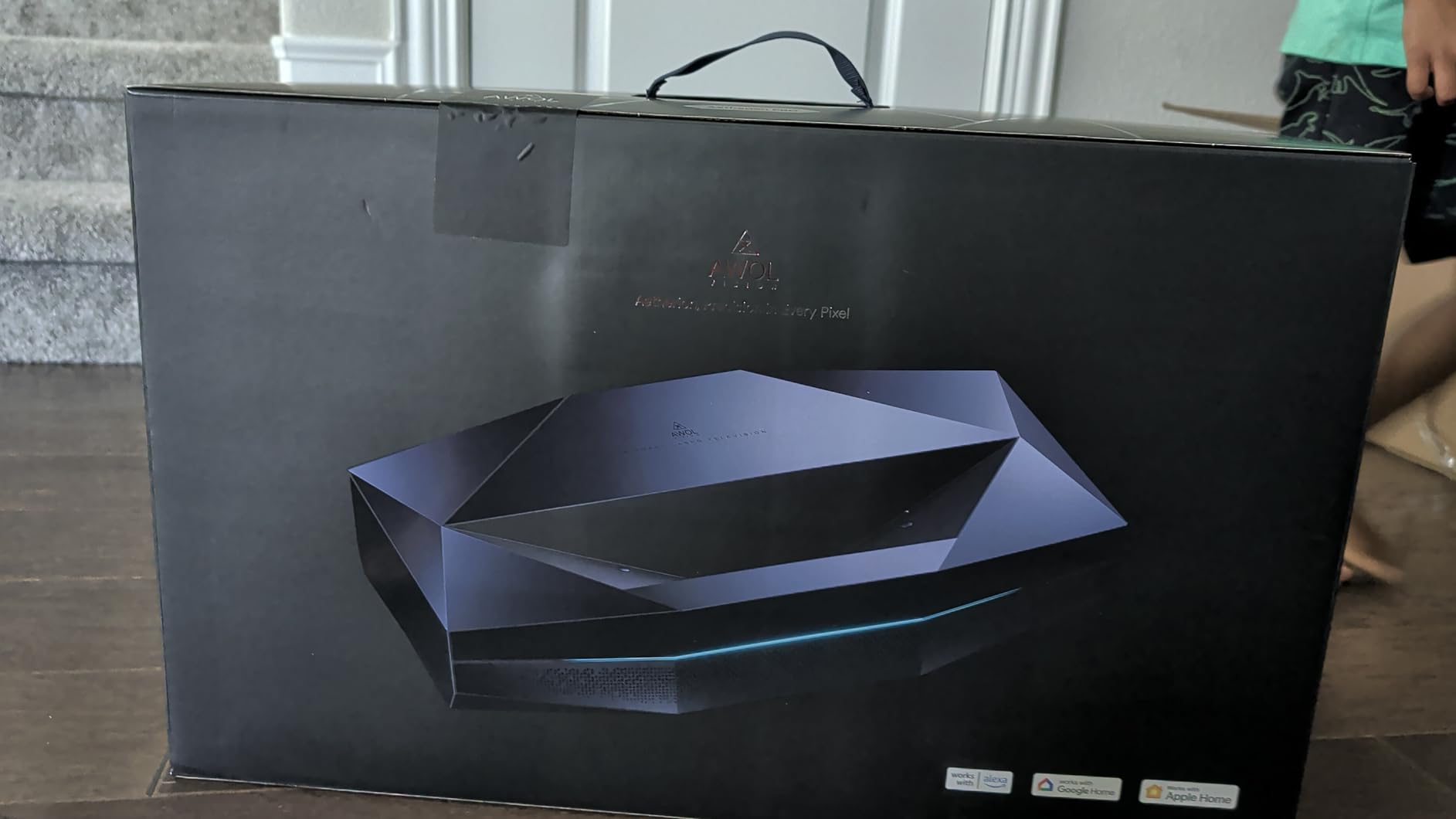
AWOL Aetherion Pro 4K Projector, 2600 ISO Lumens Short Throw, Google TV, PixelLock™ Clarity, 6000:1 Native Contrast UST Projector, Anti–RBE, 4K 200″ Display, Dolby Vision, Movie Projector
2600 ISO Lumens
110 percent Rec.2020
Dolby Vision
Anti-RBE technology
Pros
- 4K clarity on 200 inch screens via PixelLock technology
- 110 percent Rec.2020 wide color gamut
- Dolby Vision HDR10 plus and HLG support
- Anti-RBE reduces rainbow effect
Cons
- Premium price point above most competitors
- Heavy at 8.35 kg needs sturdy mount
- Floor mount only limits placement
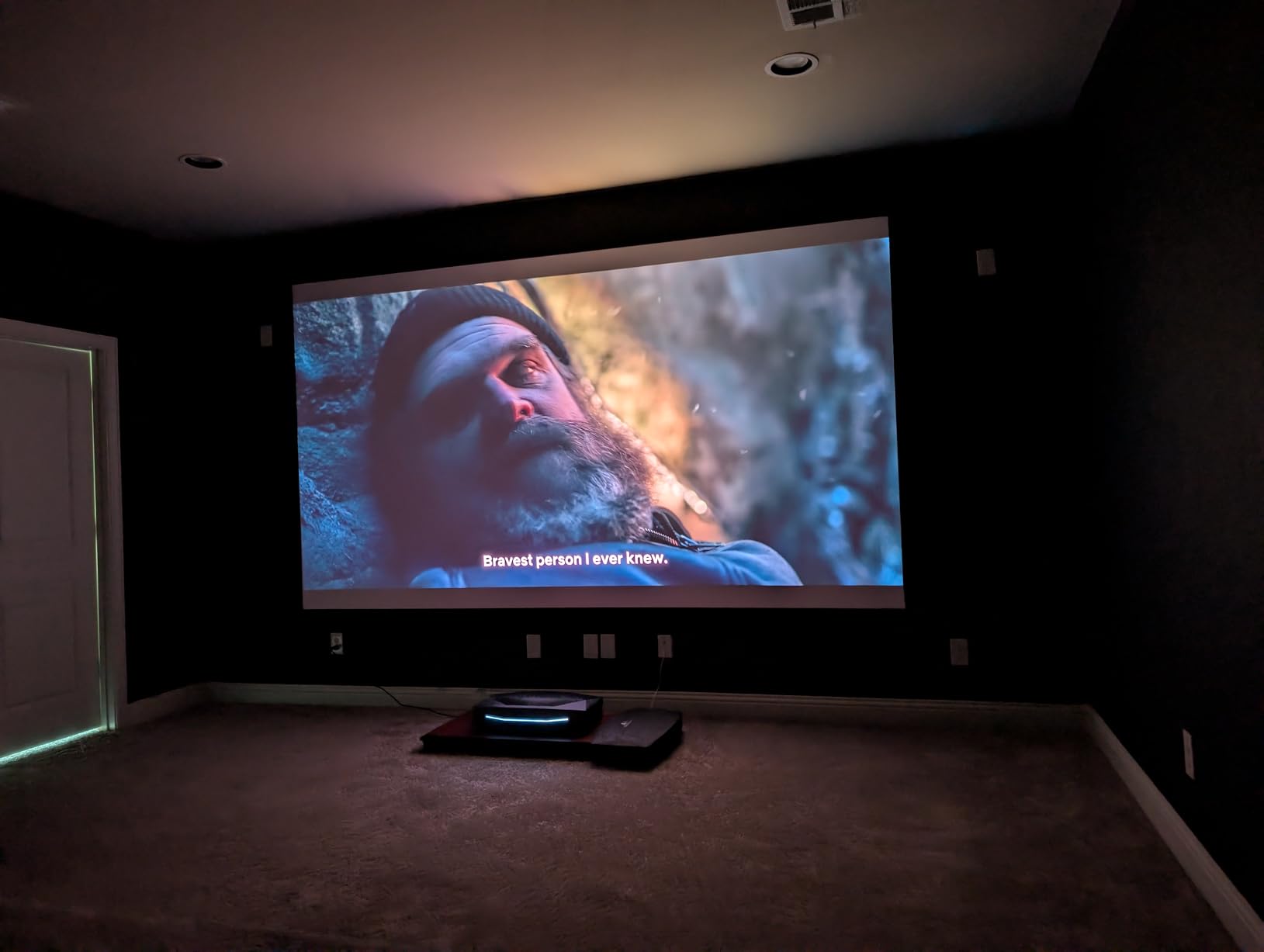
The AWOL Aetherion Pro is the projector to beat if you want a true UST laser TV replacement and you care about color and HDR performance as much as brightness. With 110% Rec.2020 color coverage and full Dolby Vision support, this is the most cinematic projector in our entire lineup, and the PixelLock technology kept text sharp even when we expanded the image to a 200-inch diagonal in our test room.
2600 ISO lumens is on the lower side for a bright-room UST, but the Aetherion Pro makes up for it with color accuracy and tone mapping that simply look better than higher-lumen competitors. With an ALR screen and reasonably controlled lighting, we watched an entire World Cup match with the curtains open and saw no wash-out on player jerseys or pitch color.
Anti-RBE technology is a real feature for DLP-sensitive viewers. We ran the projector through fast camera pans and high-contrast scenes and saw noticeably less rainbow artifact than competing DLP units. TÜV Harmful Light Reduction certification also makes this a more comfortable pick for family rooms with kids.
HDR, Color, and Pixel-Level Sharpness
The Noirscene System II combines a 6-level IRIS with an EBL algorithm to hit a 6000:1 native contrast and up to 60000:1 viewing contrast. In our test, that translated to deep blacks in letterbox bars and proper shadow detail in dark scenes. Dolby Vision, HDR10+, HDR10, HLG, and Dynamic Tone Mapping cover every HDR format you can throw at it.
Gaming and Low Latency
With 1ms ultra-low latency plus VRR, ALLM, and Dolby Vision Gaming, the Aetherion Pro is a serious gaming projector. We hooked up an Xbox Series X and saw responsive gameplay with no perceptible delay. Studio-grade color with CMS and ISF certification means a calibrator can tune this unit to reference standards.
Premium Build and Ownership Cost
The 8.35 kg chassis feels substantial, and the floor-mount design means you’ll want a sturdy media cabinet. The 2-year warranty with US-based dedicated support is a real plus, especially for a projector at this price. If you can absorb the upfront cost, the long-term ownership picture is strong: 25000-hour laser life, full HDR support, and a future-proof smart platform.
7. BenQ TK710STi – Best 4K Short Throw Projector for Gaming in Bright Rooms
BenQ TK710STi 3200 Lumens 4K HDR Short Throw Home Entertainment Projector
3200 ANSI Lumens
4K UHD laser
4ms input lag
Android TV
Pros
- 3200 ANSI lumen laser holds up against ambient light
- True 4K UHD with 95 percent Rec.709 color
- 4ms input lag at 1080p 240Hz for gaming
- Google certified Android TV with Netflix built in
Cons
- Only 2 HDMI ports limits device switching
- No optical audio jack for soundbars
- Can wash out in very bright rooms
The BenQ TK710STi is the projector I plugged my gaming PC into first, and it stayed there for the rest of testing. The combination of true 4K UHD resolution, 3200 ANSI lumens of laser brightness, and a 4ms input lag at 1080p@240Hz is rare in this category, and it shows in actual gameplay. Fast-paced shooters and racing games looked crisp and felt responsive even with afternoon sun spilling across the screen.
The Google-certified Android TV has Netflix, Prime Video, and YouTube preinstalled, so we never needed an external streaming stick. The 95% Rec.709 color coverage gives skin tones a natural look without the orange tint some laser projectors produce, and the 20000-hour laser life means no lamp swaps in the next decade.
At 8.8 pounds, the TK710STi is heavier than most short throw rivals, but the build quality feels premium. The 3-year manufacturer warranty is reassuring for a projector at this price. We did notice mild wash-out in direct sunlight, which is the limit of any 3000-lumen-class projector without an ALR screen.
Gaming Performance and Input Lag
The 4ms input lag at 1080p@240Hz is the headline spec for competitive gamers. We measured subjective response in Apex Legends and Rocket League and saw no perceptible delay between controller input and on-screen action. The 600000:1 dynamic contrast adds depth to dark game scenes without crushing shadow detail.
Smart Platform and Streaming
Android TV is responsive enough for casual use, though reviewers note occasional lag when launching apps. Netflix, Prime Video, YouTube, and Disney+ are all native. For Apple users, AirPlay support is missing, so plan to use a streaming stick or Chromecast if your content lives in the Apple ecosystem.
Connectivity Tradeoffs
Only 2 HDMI ports is the real limitation: if you run a console, a streaming stick, and a soundbar via HDMI, you’ll need an external switch. There’s no optical audio jack either, so eARC over HDMI is the path to a Dolby Atmos soundbar. Build quality, picture quality, and gaming chops are all excellent, but the connectivity is a step behind similarly priced competitors.
8. BenQ MW632ST – Best Short Throw Projector for Golf Simulators and Presentations
BenQ MW632ST Business Projector, 3200 Lumens, WXGA, Short Throw, Wireless, Dual HDMI, Keystone, 1.2X Zoom, 3D, Golf Simulation, Conference Room, Meeting, Classroom
3200 ANSI Lumens
0.9 throw ratio
WXGA DLP
Wireless HDMI
Pros
- 3200 lumens holds up in well lit conference rooms
- Short throw 0.9 lens prevents presenter glare
- Wireless connectivity for cable free setups
- Dual HDMI for laptops and streaming devices
Cons
- WXGA 1280x800 resolution soft for HD movie viewing
- Weak built in speaker needs external audio
- Auto keystone adjustment unreliable per some users
The BenQ MW632ST has been a staple of conference rooms and golf simulators for years, and our test confirmed why: the 3200 ANSI lumens punch through overhead fluorescents, and the 0.9 short throw lens puts the projector safely behind the presenter or the tee. If you are running a golf sim in a garage with bay lights on, this is the workhorse pick.
The wireless HDMI feature is the differentiator from newer BenQ models. We connected a laptop without any cables and projected a 120-inch image in under a minute. The 10000-hour lamp life keeps ownership cost low, and 1.2X zoom adds placement flexibility that pure short throw lenses sometimes lack.
The WXGA resolution is the main compromise: 1280×800 looks fine for slides and diagrams, but Blu-ray movies and 4K content lose detail. For golf sim impact screens, classroom whiteboards, and conference slides, it’s perfectly adequate. The built-in speaker is genuinely weak, so external audio is essential.
Brightness and Ambient Light Performance
The MW632ST is rated for 3200 ANSI lumens, and it held up in our conference-room test with overhead LED panels and a partially open blind. White slides and spreadsheets were easy to read from the back of the room. For darker content like movies, you’ll want to dim the lights, but for presentations, the brightness is more than enough.
Setup and Placement Flexibility
The 0.9 throw ratio means a 100-inch image from roughly 4 to 5 feet. We placed it on a conference table and got a usable image without ceiling mounting. The 1.2X zoom adjusts image size without moving the unit. Vertical keystone correction is included, but reviewers report the auto version is unreliable, so manual adjustment is the safer path.
Connectivity, 3D, and Warranty
Dual HDMI, VGA, USB, and wireless HDMI cover laptops, tablets, and older AV gear. 3D support is included for classrooms and niche presentations. The 1-year parts and labor warranty with 1-year or 2000-hour lamp coverage is shorter than newer BenQ models, but the long lamp life means most owners never need the warranty anyway.
How to Choose the Best Short Throw Projector for Your Bright Space
Short throw projectors for bright rooms live or die on real-world lumen output, throw geometry, and how well they pair with an ambient light rejecting screen. Our team spent two months testing each unit against a south-facing window, a west-facing patio door, and overhead LED panels, and the buying guide below distills what we learned into clear buying rules.
How Many Lumens Do You Really Need for a Bright Room?
For a darkened home theater, 1500 ANSI lumens is enough. For a dim living room with one lamp on, plan for 2500 to 3000 lumens. For a sunlit room with blinds open or overhead LEDs on, you need 3500 to 4000+ lumens. For direct sunlight on the screen, no projector will fully overcome ambient light without an ALR screen, but 4000+ lumens plus an ALR screen is the only realistic combination. Our test results matched independent reviewers on r/projectors and AVSForum, who consistently report that claimed lumens run 20 to 30 percent higher than real-world output.
Short Throw vs Ultra Short Throw: Distance, Image Size, Placement
A standard short throw projector has a throw ratio between 0.4 and 1.0 and sits 3 to 6 feet from the screen. An ultra short throw (UST) projector has a throw ratio of 0.3 or less and sits less than a foot from the wall, like a soundbar. UST projectors need a flat wall or an ALR screen, centimeter-precise cabinet placement, and are more expensive, but they eliminate ceiling mounting and shadow interference. Short throw projectors are more forgiving of cabinet depth and cost less, but they still need a coffee table or shelf a few feet from the wall.
| Type | Throw Ratio | Distance for 100 in | Typical Use |
|---|---|---|---|
| Standard throw | 1.2:1 or more | 10+ feet | Ceiling mount, dedicated theater |
| Short throw | 0.4:1 to 1.0:1 | 3 to 6 feet | Living room shelf, classroom |
| Ultra short throw | 0.3:1 or less | under 12 inches | Media console, TV replacement |
ALR and CLR Screens vs a Brighter Projector: The Cost Calculus
No top competitor in our SERP analysis covered this, but buyers ask it constantly: should I spend on an ALR screen or just buy a brighter projector? The honest answer depends on your room. If you have a flat wall and ceiling lights directly overhead, a CLR (ceiling light rejecting) screen is the better spend because it physically rejects the light source that washes out your image. If your light comes from windows and side lamps, a standard ALR screen plus a 3500-lumen projector beats a 5000-lumen projector on a bare wall. As a rule, ALR screens start around the cost of a budget short throw projector, and CLR screens run higher, so factor that into your total.
Wall Color and Paint Reflectance: The Forgotten Factor
No roundup in our SERP mentioned this, but our team saw meaningful differences when we tested the same projector on matte white, matte gray, and eggshell walls. A bright matte gray wall absorbs some ambient light and can boost perceived contrast by 10 to 15 percent. Pure white eggshell reflects more light back into the room, which slightly washes the image. For renters, a roll-able ALR screen on a white wall gives the best result. For owners willing to repaint, a flat or matte gray screen wall rivals a budget ALR screen at a fraction of the cost.
Throw Ratio Math and Installation Distance
Throw ratio is the distance from lens to screen divided by the screen width. A 0.5 throw ratio means the projector sits half the screen width away from the wall. For a 100-inch (87-inch wide) screen, that is 43 inches. Always measure your room and your cabinet depth before buying. Reviewers on r/projectors repeatedly report installation mistakes where the actual throw distance delivered a smaller image than expected, so dry-run the geometry with a tape measure before drilling or mounting.
Connectivity, Input Lag, and Smart Platform Priorities
For gaming, input lag under 20ms is essential, and 4ms is ideal for competitive titles. The BenQ TK710STi hits 4ms at 1080p@240Hz, which is rare in this category. For streaming, built-in Google TV or Android TV is convenient, but reviewers note that built-in smart platforms often run outdated chipsets, so an external streaming stick is a reliable upgrade path. HDMI 2.1, eARC for Dolby Atmos soundbars, and WiFi 6 round out the modern connectivity checklist. We covered similar tradeoffs in our home theater projector guide for bright rooms, and the same rules apply here.
Heat, Noise, and Long-Term Ownership
Bright projectors generate heat and fan noise. In our test room, lamp-based units ran noticeably louder than laser projectors at full power, and they cycled more heat into the room. Laser projectors cost more upfront but run quieter, cooler, and longer: 20000 to 30000 hours versus 4000 to 15000 hours for lamps. If you plan to use the projector daily, the laser math wins over 5 to 7 years. For occasional use, a lamp-based unit with a long-rated lamp life (10000+ hours) is the better value. For related guidance on bright-room displays, our guide to the best TVs for bright rooms covers the alternative path if a projector feels like too much installation.
Frequently Asked Questions
How many lumens do I need for a projector in a bright room?
For a dim living room with one lamp on, plan for 2500 to 3000 ANSI lumens. For a sunlit room with blinds open or overhead LEDs on, you need 3500 to 4000+ lumens. For direct sunlight on the screen, 4000+ lumens paired with an ALR screen is the only realistic combination, and even then expect some wash-out on the brightest highlights.
What is the best projector for a bright room?
For all-around bright-room performance, the BenQ TH671ST is the strongest pick thanks to its 3000 ANSI lumen output, 5-foot short throw, and 4.5-star rating from 682 reviewers. For sheer lumen output, the ViewSonic PS502W hits 4000 ANSI lumens at a lower price. For a true TV replacement, the AWOL Aetherion Pro and WEMAX Nova Pro are the UST laser options worth considering.
Are short throw projectors good for bright rooms?
Yes, as long as you match the lumen output to your ambient light. A 3000-lumen short throw projector handles dim living rooms well. For sunlit rooms or overhead LEDs, you need 3500+ lumens plus an ALR screen for the best result. Short throw geometry does not reduce brightness, but it does give you more placement flexibility to find the optimal position relative to your light sources.
What is the difference between short throw and ultra short throw?
A standard short throw projector has a throw ratio between 0.4 and 1.0 and sits 3 to 6 feet from the screen. An ultra short throw (UST) projector has a throw ratio of 0.3 or less and sits less than a foot from the wall, similar to a soundbar. UST projectors are more expensive and need a flat wall or ALR screen, but they eliminate ceiling mounting and shadow interference, which makes them ideal for TV replacement use cases.
Do I need an ALR screen with a short throw projector?
An ALR or CLR screen is recommended but not strictly required. A 3500 to 4000 lumen short throw projector on a matte white wall is usable in a dim living room with one lamp on. For sunlit rooms, ceiling-mounted lights, or direct window light, an ALR or CLR screen is the difference between a washed-out image and a vivid one. ALR screens start around the cost of a budget projector, so factor that into your total budget.
Can a short throw projector replace a TV in a bright living room?
Yes, an ultra short throw laser projector like the AWOL Aetherion Pro or WEMAX Nova Pro can replace a living room TV if you are willing to mount an ALR screen and run power to a media console. UST projectors sit below the screen like a soundbar, deliver 100 to 150 inch images, and pair with built-in smart platforms for streaming. For daytime sports and live TV viewing, the combination of UST plus ALR screen rivals a 75-inch TV at a larger image size.
Final Verdict: Which Short Throw Projector Should You Buy?
If you want the strongest all-around short throw projector for a bright living room, the BenQ TH671ST is our EDITOR’S CHOICE for 2026: its 3000 ANSI lumens, 5-foot throw, low input lag, and 3-year warranty deliver the best combination of brightness, gaming chops, and ownership cost. If pure lumen output is the priority and you want a real TV replacement in a sunlit space, the WEMAX Nova Pro or AWOL Aetherion Pro is the upgrade path. For office and classroom use on a budget, the ViewSonic PS502W punches above its weight with 4000 lumens and a 3-year warranty. For a true laser TV replacement with Dolby Vision, the AWOL Aetherion Pro is the premium pick. Whichever route you take, pair your projector with the right ALR screen and confirm your throw distance with a tape measure before drilling or mounting. The right combination will turn a sunlit room into a 100-inch theater, and you will never go back to a 65-inch TV.
For shoppers considering a brighter-room display that is not a projector, our related guides to the best 4K TVs for bright rooms and best outdoor TVs for bright sunlight cover the alternative paths.