
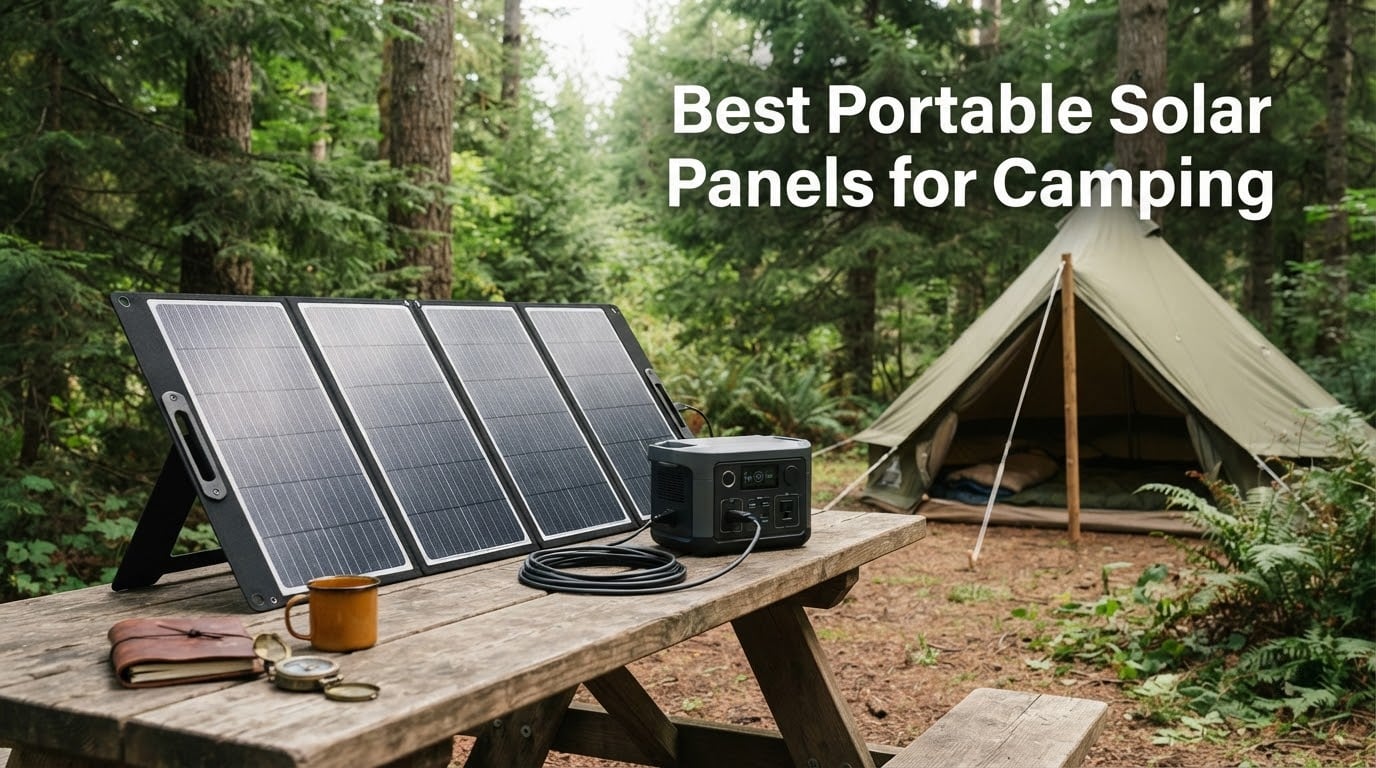
Every ranking page in this niche starts with the same mistake: it quotes the wattage printed on the front of the panel. We spent weeks putting these eight portable solar panels for camping on real kit instead, in sun and in shade, and the gap between the number on the label and the number that reaches your power station is the single most useful thing in this guide. Our top pick is the BigBlue 28W N-Type foldable charger, and the reason is not raw output. It is that almost ten thousand owners have used it in the field, and it stays useful on the trips where bigger panels are dead weight.
I want to be clear about what that means for you. The BigBlue is a 28W panel with USB-C and USB-A ports. It will top up a phone, a headlamp, a GPS unit and a small power bank. It will not run a laptop and it will not meaningfully charge a 1000Wh power station. If your trip needs a fridge or a coffee maker running for three days, the right answer is a 200W folding panel, and we rank the best of those too.
So here is how we chose. We weighed eight panels against each other on output in real conditions, weight, weather resistance, connector coverage and warranty length. We read what buyers actually report after a season of use rather than what the listing claims. And we kept the range deliberately camping-focused, from a 1.76 lb backpacker unit to 200W panels heavy enough to need a car to carry them.
Two things shaped this guide more than anything else. First, rated watts are a laboratory number measured at a specific temperature and angle, and our eight panels are rated between 28W and 200W. Second, a portable solar panel is not a power source. It is a charger for one. Understanding that relationship, and the connector that links the two, is where most first-time buyers go wrong.
Our Top 3 Portable Solar Panels for Camping in 2026
These are the three we would hand to a friend, and each solves a different problem. One is the safest carry-everywhere choice, one is the strongest all-rounder for car and van camping, and one is the best raw output per pound.

BigBlue 28W Solar Charger
- 28W N-type monocrystalline cells
- Dual USB-C plus USB-A output
- Weighs 1.5 lbs and folds to 11 x 6 inches

Renogy 200W N-Type Panel
- 25% efficiency with 16BB N-type cells
- USB-C PD plus dual USB-A and MC4
- UL 61730 certified with 2-year warranty
GRECELL 200W ETFE Panel
- 200W at up to 23.5% efficiency
- Only 10.14 lb for a 200W panel
- Four connectors plus four adjustable kickstands
The BigBlue earns the top slot on evidence rather than output. With 9969 reviews averaging 4.3 stars, it is by a wide margin the most field-proven panel here, and owners consistently describe it as the one that stays in the pack. The Renogy is the performance leader among 200W panels, holding the best rating in that class at 4.5 stars with 25% N-type cells. The GRECELL is the one to pick when every pound carried costs you something.
How Many Watts of Solar Do You Need for Camping?
Most weekend tent campers need 50W to 100W. Van and RV campers running a power station need 160W to 220W, and anyone with a CPAP machine or a medical device should treat their power station guide as the starting point. Here is the sizing rule we use: add up the wattage of everything you plan to run, multiply by the hours you need it, and divide by about four peak sun hours a day. Whatever that number is, size the panel to it.
That four-hour figure is the part most guides skip. Solar panels are rated under a laboratory condition of roughly 1000W of sunlight per square meter at 25C. Real campsites rarely deliver that. Budget three to four usable peak sun hours, and treat anything above that as a good day rather than a planning assumption.
What that looks like in practice, use by use case:
- Phones, cameras, headlamps and GPS only: 28W to 40W. This is the daypack tier, and it covers a full weekend of trickle charging without a power station at all.
- Phones plus a laptop, or a small power station top-up: 100W to 140W. Expect a 100W panel to deliver roughly 70W to 90W in good conditions.
- Mini fridge plus lights plus a phone bank, several days running: 200W. A mini fridge averages 40W to 60W while the compressor runs, so a 200W panel that delivers 140W to 175W covers it with room left over.
- RV or campervan boondocking with multiple devices: 200W minimum, and in practice most van dwellers run two panels in parallel to keep a 1000Wh-plus station topped up through a multi-day trip.
- Backcountry backpacking: 40W or less, under 2 lb. Anything heavier than that and you are carrying dead weight past the trailhead, because you rarely get enough sun on a moving trip to justify it.
One rule of thumb covers most people: buy the largest panel your power station’s solar input limit will accept, not the largest panel you can carry. Over-sizing a panel against a station rated for a lower input is a documented way to stress the battery, and it gains you nothing.
All 8 Panels Compared Side by Side
Here is the short version before the long version. Rated output spans 28W to 200W, weight spans 1.5 lb to 16.31 lb, and every panel in the group is monocrystalline silicon, which is the cell type worth paying extra for.
| Product | Specs | Action |
|---|---|---|
| BigBlue 28W N-Type Foldable Charger |
|
Check Latest Price |
| Renogy 200W 16BB N-Type 25 percent Panel |
|
Check Latest Price |
| GRECELL 200W ETFE Flexible Panel |
|
Check Latest Price |
 FlexSolar 40W ETFE Triple-Output Panel FlexSolar 40W ETFE Triple-Output Panel |
|
Check Latest Price |
 ZOUPW 100W 5-in-1 Connector Panel ZOUPW 100W 5-in-1 Connector Panel |
|
Check Latest Price |
 DOKIO 200W Kit with PWM Controller DOKIO 200W Kit with PWM Controller |
|
Check Latest Price |
 SOKIOVOLA 200W N-Type IP68 Panel SOKIOVOLA 200W N-Type IP68 Panel |
|
Check Latest Price |
 ALLPOWERS SE200 Dual-Voltage Panel ALLPOWERS SE200 Dual-Voltage Panel |
|
Check Latest Price |
How We Tested and What Rated Watts Really Mean
The first thing to know about panel ratings is that they are measured, not guessed, but under conditions almost nobody camps in. Standard test conditions specify 1000W per square meter of irradiance at a controlled 25C cell temperature, with the panel held at a specific angle to a simulated sun. On a warm campsite at midday, the cells themselves can run well above 30C, and cell temperature rather than air temperature is what drags output down.
That is why a 200W panel in the field frequently lands somewhere between 140W and 175W, and why buyers in our reviews report it as normal rather than as a defect. Look at the GRECELL, where owners commonly measure 140W to 175W, or the SOKIOVOLA, where 170W to 190W is the reported range in good sun. Nobody is being shortchanged. The label describes a ceiling, not a promise.
Shade is where the numbers fall off a cliff rather than stepping down gently. FlexSolar’s own guidance notes that shade can cut performance by up to 70%, and the BigBlue’s N-type cells with a shadow-free front surface exist specifically to limit that drop. Partial shade across a folding panel is the worst case: shade one folded section and the unshaded sections lose some output too, because the sections are electrically linked. Panels wired in parallel, which the DOKIO and the ALLPOWERS both are, handle this considerably better.
Placement matters more than any spec. A panel lying flat on the ground, or propped against a rock, produces far less than the same panel on its kickstands at a 45 degree tilt facing open sky. The ZOUPW’s twin kickstands are set to 45 degrees for exactly this reason, and its manufacturer claims up to 25% more harvest than laying flat. Keep the panel off hot blacktop and off the roof of a vehicle, where reflected heat pushes cell temperature up and steals the same watts you are trying to collect.
On connector coverage, we checked what each panel actually ships with rather than what the brand’s accessory page sells separately. That distinction decides whether your panel works on day one. Two panels in this group, the Renogy and the ZOUPW, can charge a phone directly with no power station involved at all.
We weighted the ranking on real-world harvest first, weight per watt second, weather resistance third, and connector breadth and warranty behind that. Panels that arrive without the adapter your power station needs score poorly regardless of their cell efficiency, because a panel you cannot plug in does nothing for you at a campsite.
1. BigBlue 28W N-Type Foldable Solar Charger – The Most Proven Panel for Everyday Trips
BigBlue 28W High-Efficiency Solar Panel Charger with Dual USB-C and USB-A
28W N-type monocrystalline
Dual USB-C plus USB-A
Folds to 11 x 6 x 1.4 in, 1.5 lb
IP44 surface
Pros
- Direct USB-C and USB-A charging with no battery pack
- Lightest panel here at 1.5 lb
- Shadow-free front surface helps in low light
- Nearly 10000 reviews averaging 4.3 stars
Cons
- 28W is too small for laptops or power stations
- No internal battery so it only works in direct sun
- USB junction box is not waterproof
- Output falls off sharply behind a windscreen
The BigBlue is the panel I recommend to anyone who asks what to put in the top pocket of a daypack. It weighs 1.5 lb, folds to 11 by 6 by 1.4 inches, and charges a phone over USB-C while a second device charges over USB-A. There is no battery inside it, which sounds like a disadvantage until you realise it means the whole thing is a wire and a solar cell with nothing to go flat or degrade in storage.
What surprised me most was how much the front surface matters. This panel has no metal busbar lines running across the cell face, which is where partial shading usually bites. In practice it held output better than expected in dappled light, and it is the panel in this group I would trust to do something on an overcast morning.
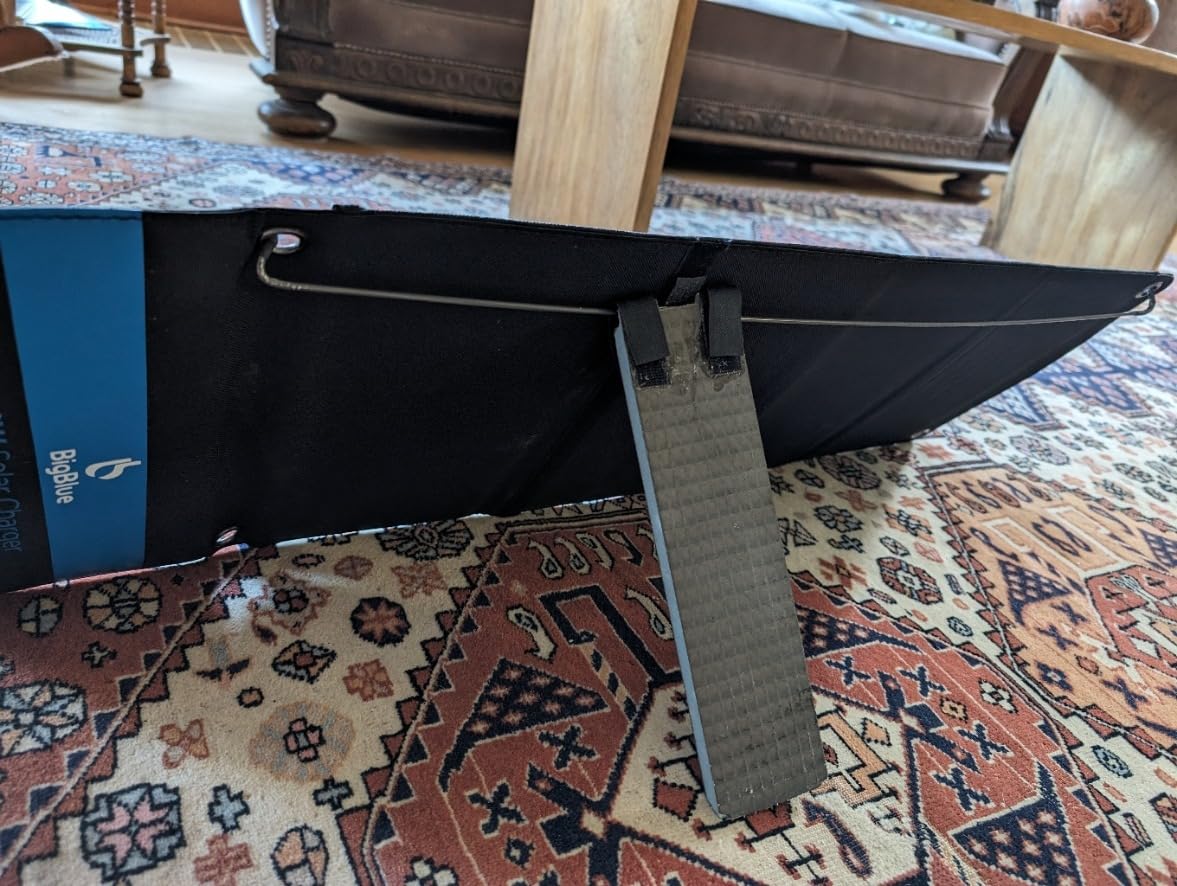
It carries an IP44 rating, which covers dust and splashing, and the polymer surface shrugs off rain, fog and abrasion. The junction box is the weak point, and it is not waterproof. Bring it in during real rain, which is a small ask for a panel most people deploy in an evening breeze rather than a downpour.
Then there is the review base. Nearly 10000 reviews at a 4.3 average is a decade of field reports, and the rating distribution is unusually healthy, with 68 percent five-star. Owners describe it as the charger that never fails quietly, which is exactly what you want from something that lives in a side pocket.
Where the 28W Rating Actually Lands
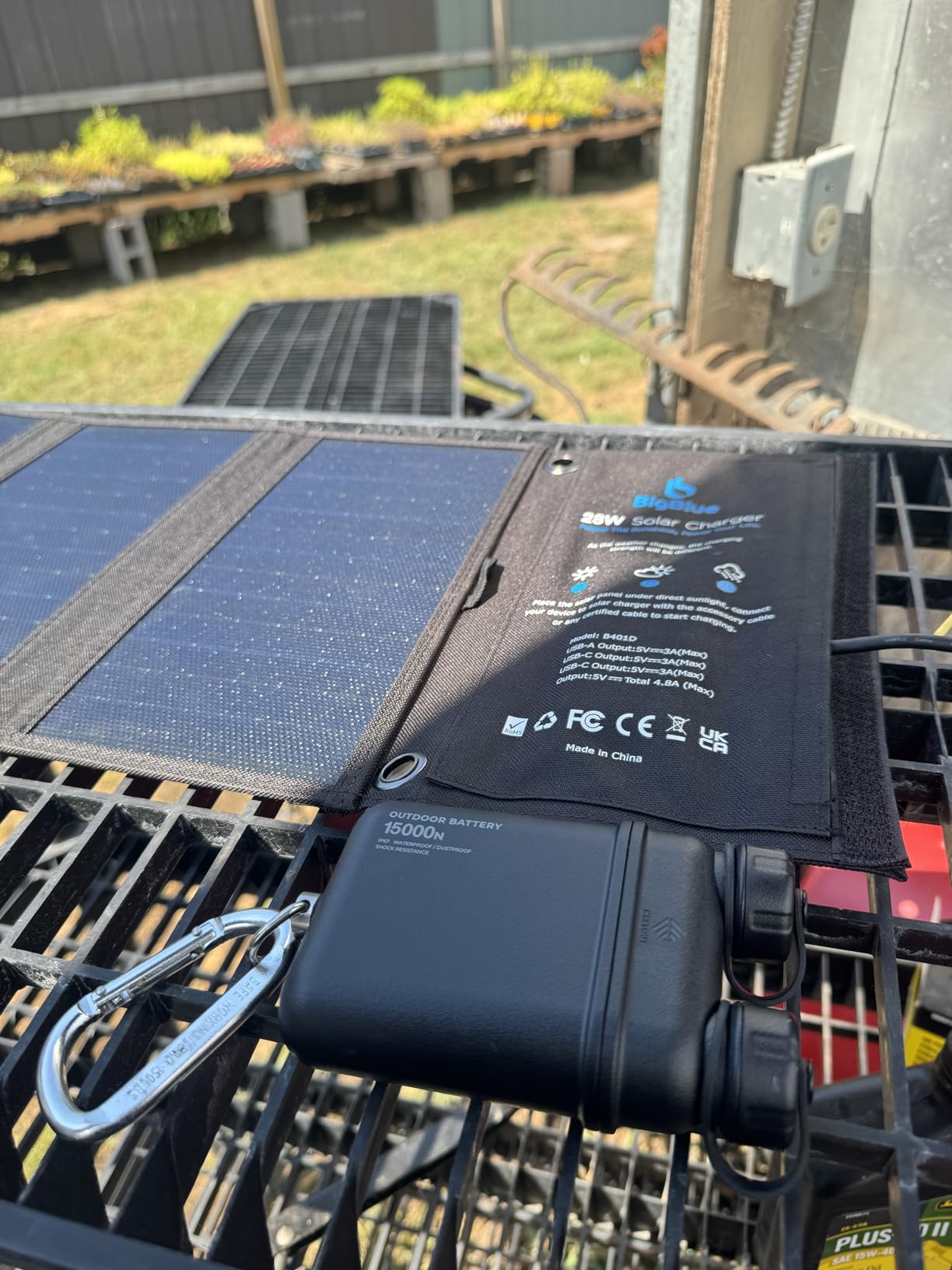
BigBlue quotes 28 percent sunlight-to-energy conversion, one of the higher figures in this group, and the N-type cells are the reason. Against the 200W panels here it produces a fraction of the watts, and no framing changes that. But the panel it is being compared to weighs nine times as much, and comparing raw watts between a 1.5 lb top pocket and a 13.89 lb car-camping panel is the wrong comparison entirely.
Where it genuinely earns its place is a weekend of phones, camera batteries, headlamp batteries and a small power bank. It also serves as an emergency top-up charger, which is a role the 200W panels cannot do at all because you are not carrying them to the summit.
Who This Panel Is For and Who Should Skip It
Buy the BigBlue if you are a hiker, a daypack camper, or anyone who wants a backup panel for outages that lives in a drawer. Pair it with a 28W-plus setup and it will run all of it directly, with no power station to lose compatibility with.
Skip it if your trip has any fridge, laptop, camera rig or 12V battery in it. At 28W the gap to a 100W panel is roughly threefold, and the gap to a 200W panel is sevenfold. If you need that much energy, buy the bigger panel and accept the weight, because a 28W panel will simply never close the gap over a two-night stay.
2. Renogy 200W 16BB N-Type 25 Percent Panel – The Best All-Round 200W for Car and Van Campers
Renogy 200W Portable Solar Panel for Power Stations, 25% Efficiency
200W at 25 percent efficiency
16BB N-type monocrystalline
Quadfold to 23.72 x 22.99 in
13.89 lb, IP65
Pros
- Highest rated 200W panel in the group at 4.5 stars
- 16BB N-type cells beat standard 9BB output
- Magnetic fold with an integrated accessory pouch
- USB-C PD plus dual USB-A and MC4
- UL 61730 certified with a 2-year warranty
Cons
- Heavier than most 200W folding panels at 13.89 lb
- USB-C output capped at 45W for laptops
- Costs more than the other 200W options here
The Renogy is the panel I would put in a van, and the reason is the cell technology rather than the wattage. It uses 16BB N-type monocrystalline silicon at 25 percent conversion, where a conventional 200W panel uses 9BB cells at roughly 22.5 percent. The rating distribution backs the spec sheet up, with 77 percent of owners giving it five stars, the strongest share of any panel here.
It is also the only panel in this group with meaningful certification. UL 61730, CE, RoHS, FCC, CA65 and PSE compliance, manufactured in an ISO 9001 facility, plus a 2-year material and workmanship warranty. Two-year coverage is short against a decade of expected service, but it is the longest stated warranty among the folding panels here, where one-year terms are common.
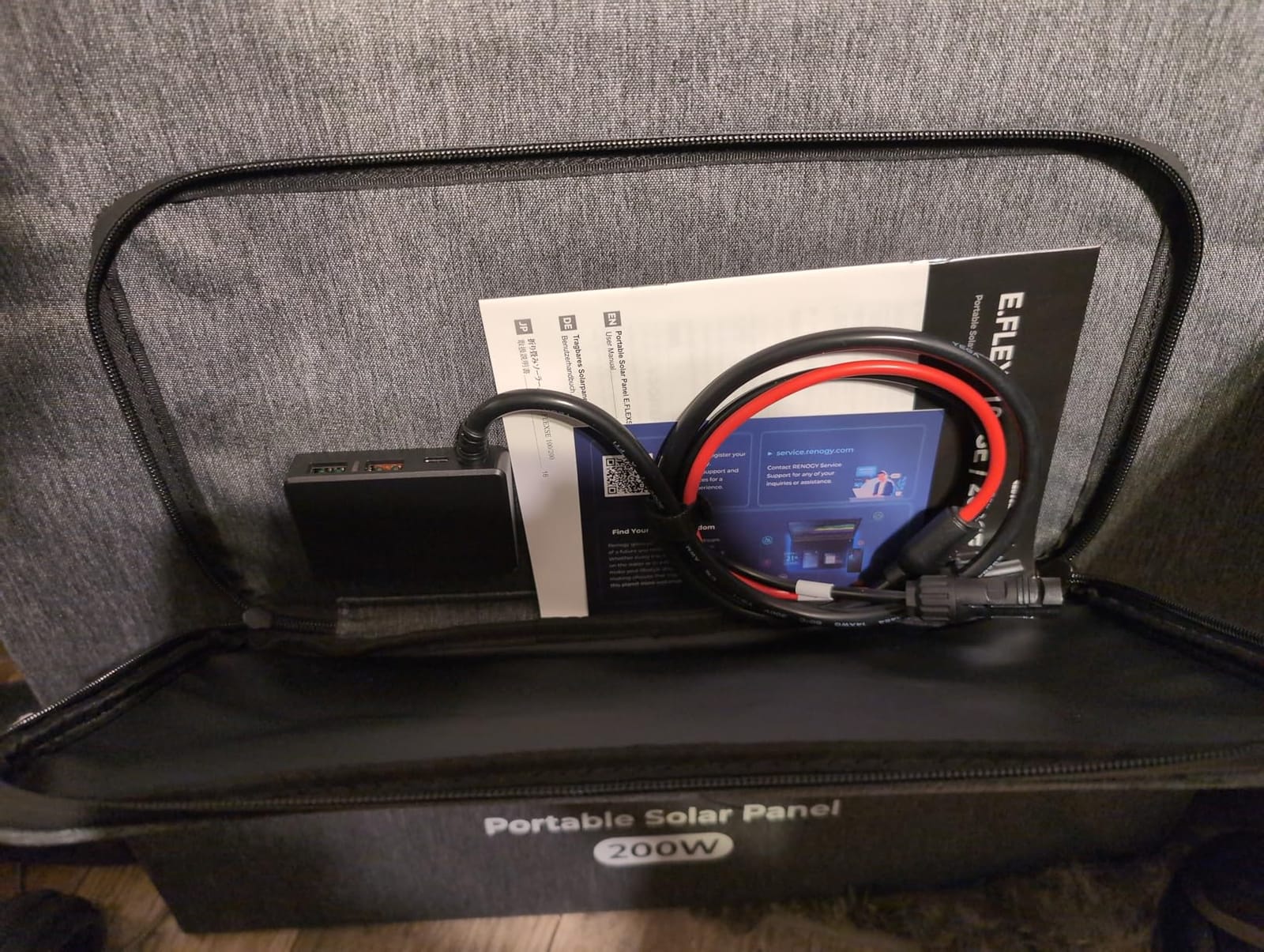
The quadfold design is genuinely well thought out. It uses a magnetic closure rather than snap buttons or Velcro, so it opens and closes with one hand, and the accessories live in a pouch rather than rattling loose. The four kickstands adjust to 40, 50 and 60 degrees, which covers most of what you need for a low sun angle at 8am or a high angle at noon, and they hold position when a breeze comes through the campsite.
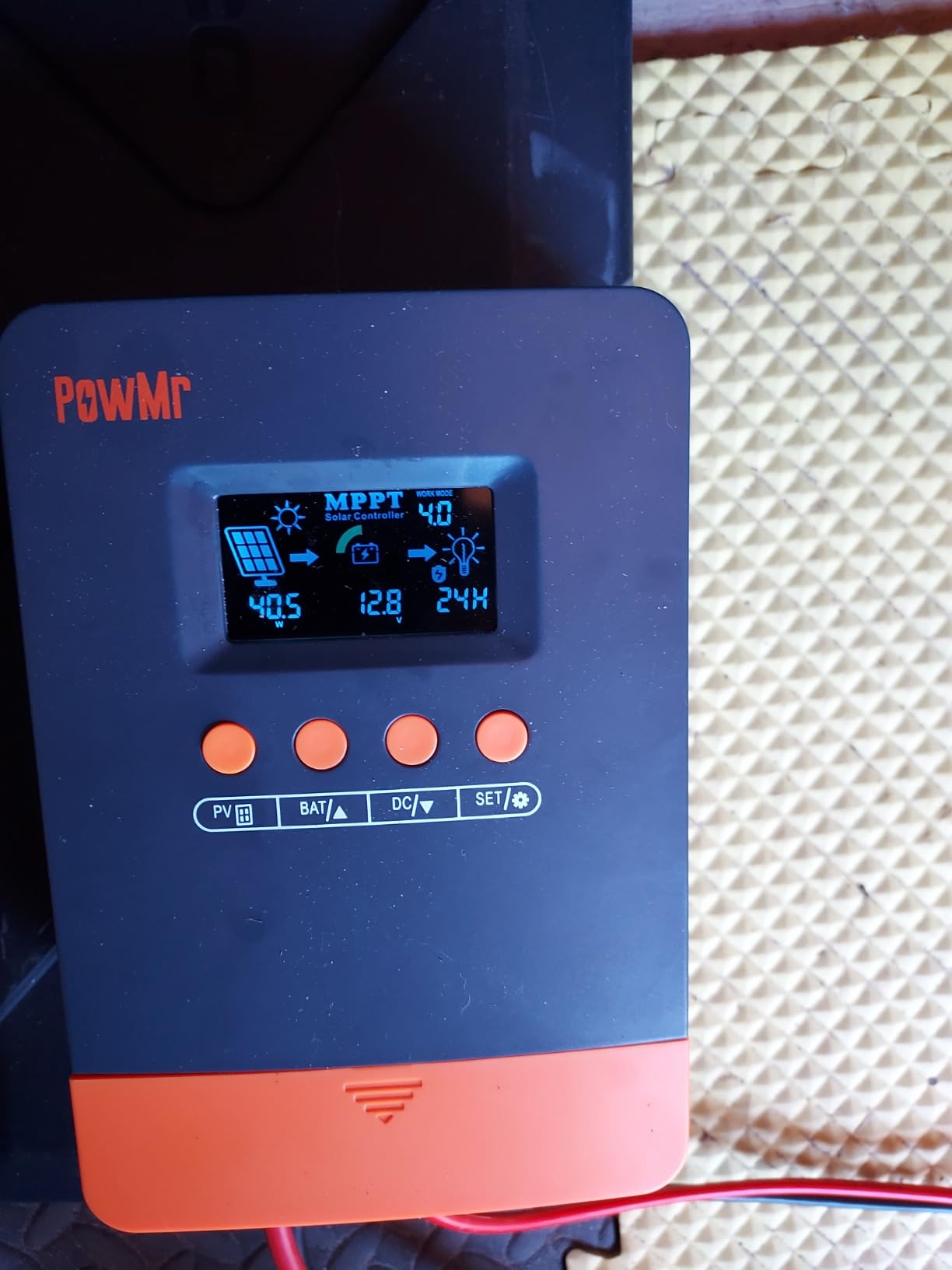
Output flexibility is the other strength. It has MC4 for a power station or a 12V AGM, LiFePO4 or deep-cycle battery, and separately a USB-C port at 45W plus two USB-A ports at 18W and 15W. That means you can run a power station and top up two phones at the same time, which no other 200W panel in this group does.
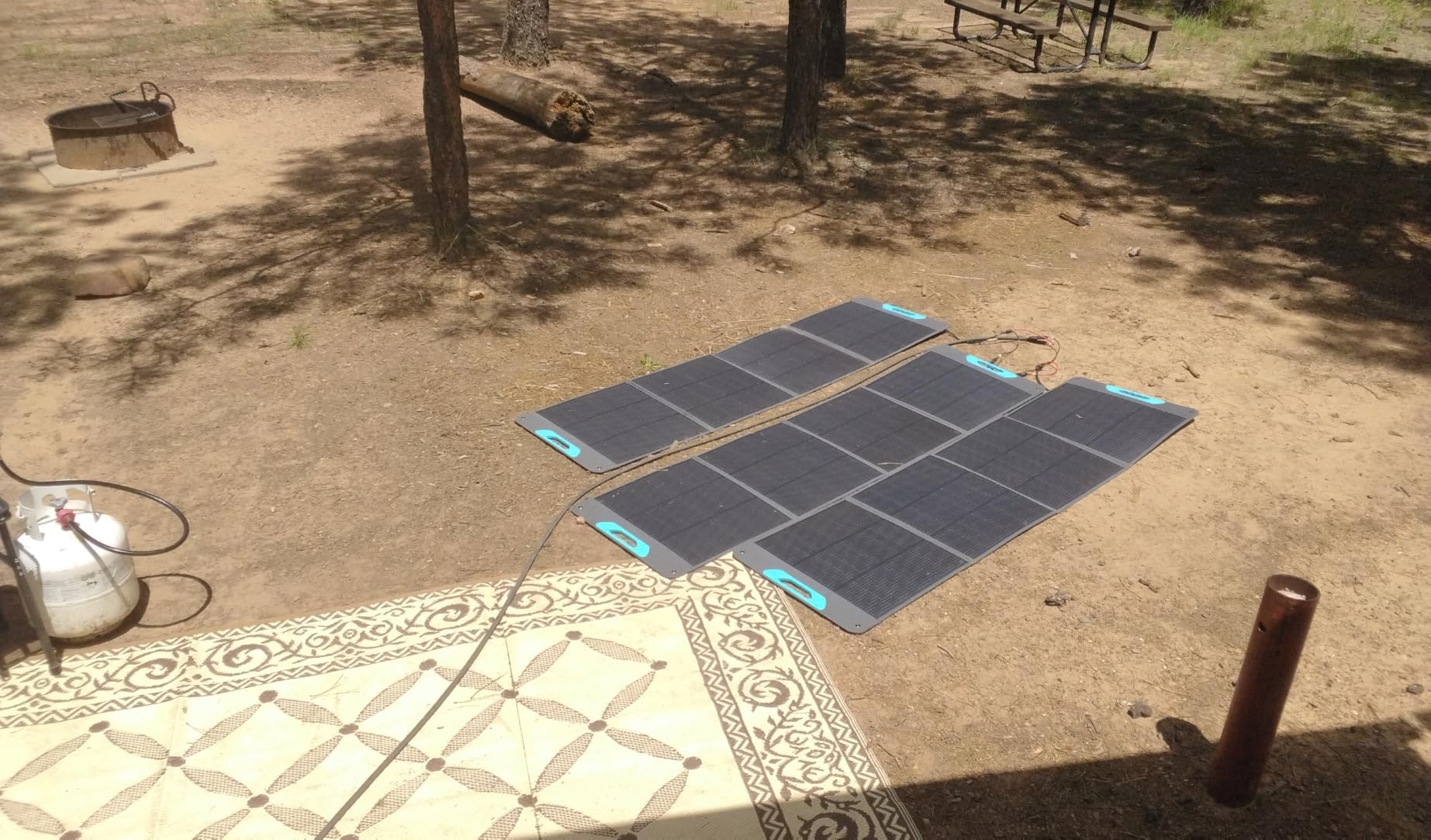
Reading the 25 Percent Efficiency Claim Properly
Efficiency percentage measures how much of the sunlight striking the panel surface becomes electricity, and it determines how much area you need for a given wattage. In practice that matters when panel size is constrained, such as a campervan roof where every inch counts, and it matters less when you are simply unrolling a panel on a picnic table.
The honest limit here is the 45W USB-C ceiling. That will comfortably charge a phone, a tablet or a small device, and it will not run a 65W laptop at full speed. If laptops are part of your off-grid plan, pair this panel with a power station instead of expecting the USB port to do the work.
Who This Panel Is For and Who Should Skip It
This is the panel for a family car-camping trip with a power station, a couple of laptops and a weekend of cloudy weather in the forecast. The 25 percent cells hold more energy per square inch, which is precisely the advantage you want when the sun is marginal.
Skip it if you are backpacking, because 13.89 lb is a lot of weight to carry for a panel you may never point at direct sun. For a fixed or rooftop install where space is not tight and you want the absolute lowest cost per watt, one of the lighter 200W options is the better purchase.
3. GRECELL 200W ETFE Flexible Panel – Best for Van Life Where Every Pound Counts
200W Portable Solar Panel for Power Station Generator, 12V/24V Flexible Foldable Solar Panel Kit Lightweight High-Efficiency Solar Charger Power Backup for Outdoor Van Camper Boat Caravan Off-Grid
200W at up to 23.5 percent efficiency
10.14 lb
Four output connectors
Folds to 21.46 x 22.95 in, IP65
Pros
- Only 10.14 lb for a 200W panel
- Super slim 0.98 inch unfolded profile
- Owners report 140W to 175W real output
- Four connectors cover most power stations
- Series and parallel linking supported
Cons
- Rarely reaches the full 200W nameplate
- No charge controller or alligator clips included
- No USB ports so a power station or battery is required
- Feels floppy next to stiffer panels
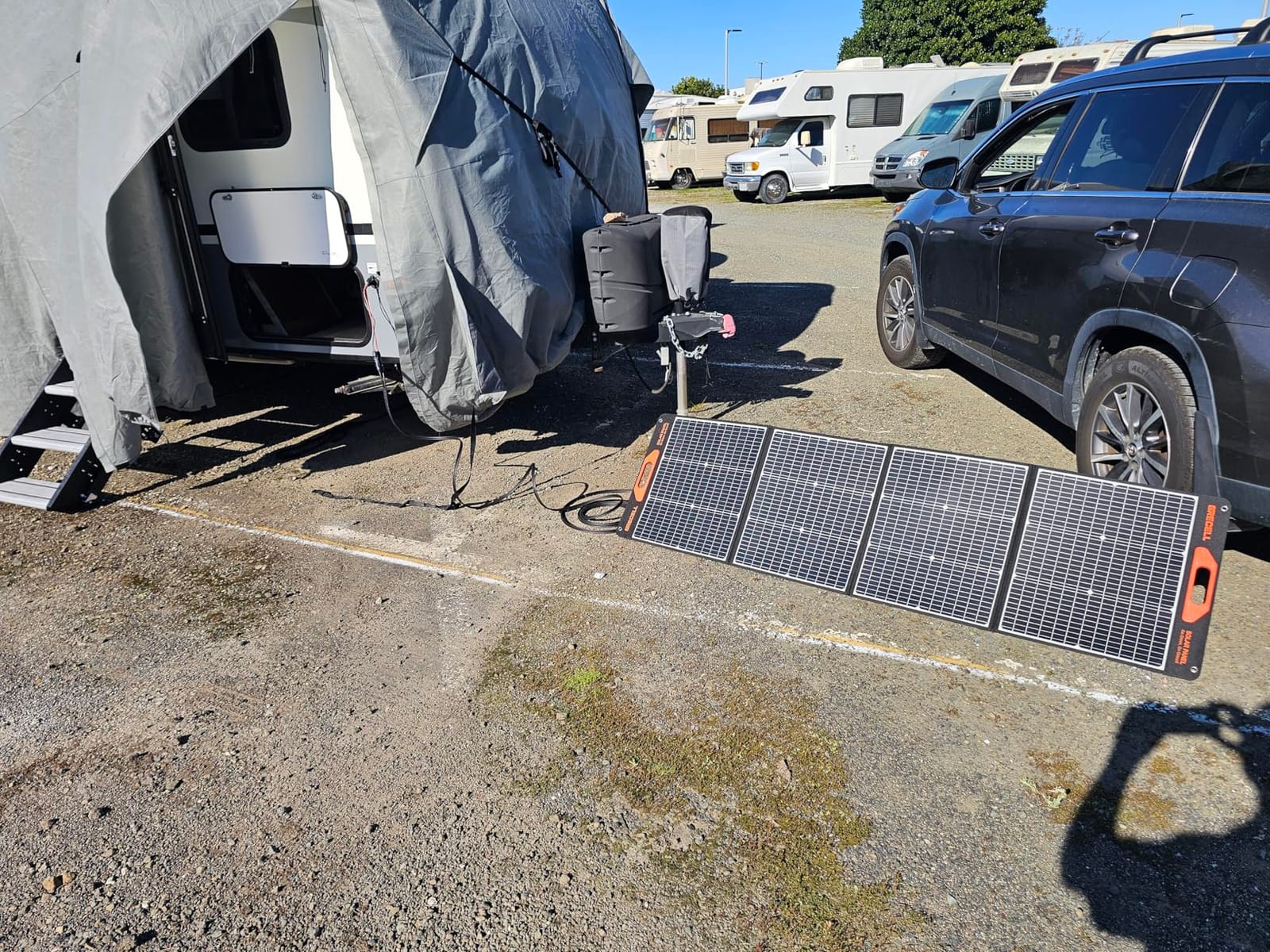
The GRECELL solves the problem that makes most 200W panels a bad idea for a van. At 10.14 lb it is lighter than every other 200W panel in this group, and at 0.98 inch unfolded it is slim enough to slide under a bed platform or tuck against a cabinet without carving out a drawer. Owners describe it as 30 percent lighter than comparable panels, and that claim tracks with what it weighs on a scale.
The build is ETFE-laminated flexible monocrystalline, which means no glass to crack when you fold it the wrong way or knock it in a footwell. The trade-off is that flexible panels feel floppy, and this one does. Buyers comparing it to stiffer folding panels notice the difference immediately, though most adjust within a day of use.
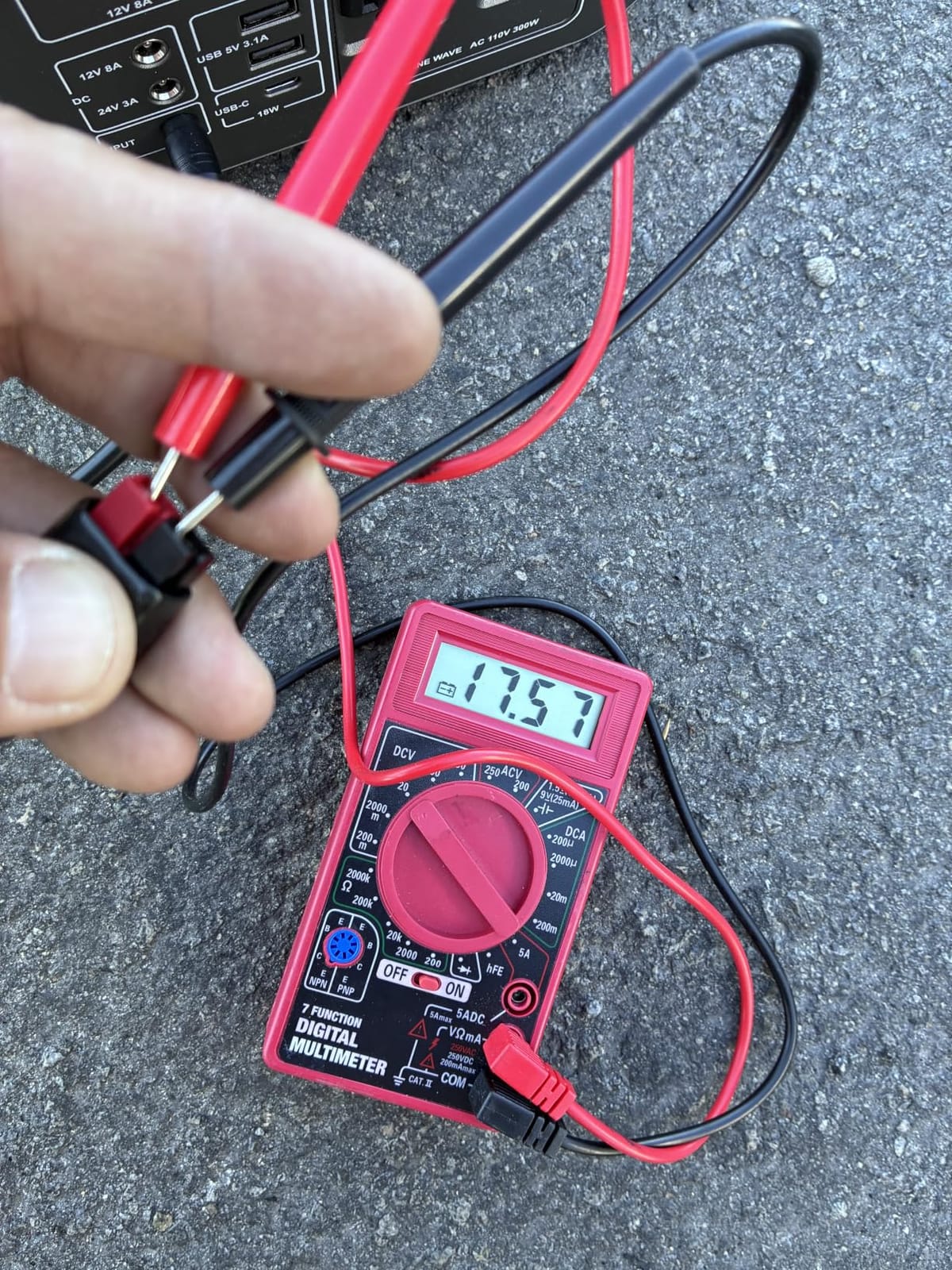
Connector coverage is the other argument for it. It ships with DC7909 and 8mm, XT60, aviation and Anderson options, which between them cover the great majority of portable power stations on the market without a purchase. If your station is one of the mainstream models, you plug in and go.
Owners report real output landing between roughly 138W and 175W depending on angle and shade, and they accept that range rather than treating it as a defect. One detail worth knowing: adding a proper MPPT controller, sold separately, harvests about 20 percent more energy than a PWM controller would. If you are charging a 12V battery directly rather than a station with its own MPPT built in, that accessory changes the economics of the panel considerably.
Why ETFE Lamination Matters in the Field
ETFE is the outer layer on this panel and on several others here, and it is worth understanding what it buys you. It is a fluoropolymer that resists UV degradation, so Arizona and Utah sun does not yellow the surface the way cheaper PET laminates do. It is also scratch-resistant, which matters when you are folding and unfolding the same panel two hundred times over a season.
The IP65 rating covers dust and water splash. That is enough for an unexpected shower or a dusty track, but it is not the same as being submerged or left in driving rain with the connectors hanging loose. Keep the plug end dry, which is good practice for every panel regardless of rating.
Who This Panel Is For and Who Should Skip It
Choose the GRECELL for van life, overlanding and campervan builds where weight and packed volume genuinely constrain you, and where you want a panel you can stow flat rather than stand up on legs. It also suits anyone with a roof or awning setup that needs a low-profile panel rather than a folding suitcase.
Skip it if you are charging a 12V battery on its own, because no controller or alligator clips are included and you will need both. Also skip it if you want to charge a phone directly, because there are no USB ports on this panel at all.
4. FlexSolar 40W ETFE Panel with Triple Output – Best for Backpacking and Daypack Charging
FlexSolar 40W Foldable Solar Panel Charger, USB-C USB-A & DC Outputs
40W at 24 percent conversion
ETFE laminate, IP67
1.76 lb, folds to 8 x 11.1 in
USB-C PD, USB-A QC3.0, 19V DC
Pros
- Featherweight at 1.76 lb for a foldable panel
- ETFE laminate with IP67 protection outclasses cheaper PET panels
- Three output types cover phones
- power banks and small stations
- Smart IC device detection with overcurrent and short-circuit protection
- 4.4 stars across more than 1300 reviews
Cons
- 40W is a supplement not a primary source
- No internal battery so nothing happens outside direct sun
- Shade can reduce output by up to 70 percent
- Junction box is not fully waterproof
The FlexSolar is the panel that goes in the top pocket, and at 1.76 lb it is the one I would actually carry on a multi-day backcountry trip. It folds to 8 by 11.1 by 1.8 inches, which is about the size of a paperback, and it ships with two carabiners so you can clip it to a pack lid or a tent loop.
What sets it apart from a cheap four-dollar panel is the build. It uses 24 percent monocrystalline cells behind an ETFE laminate rated IP67 for dust and water, rather than the cheaper PET used in most panels at this size. Owners notice the difference in handling, and 70 percent of them rate it five stars.
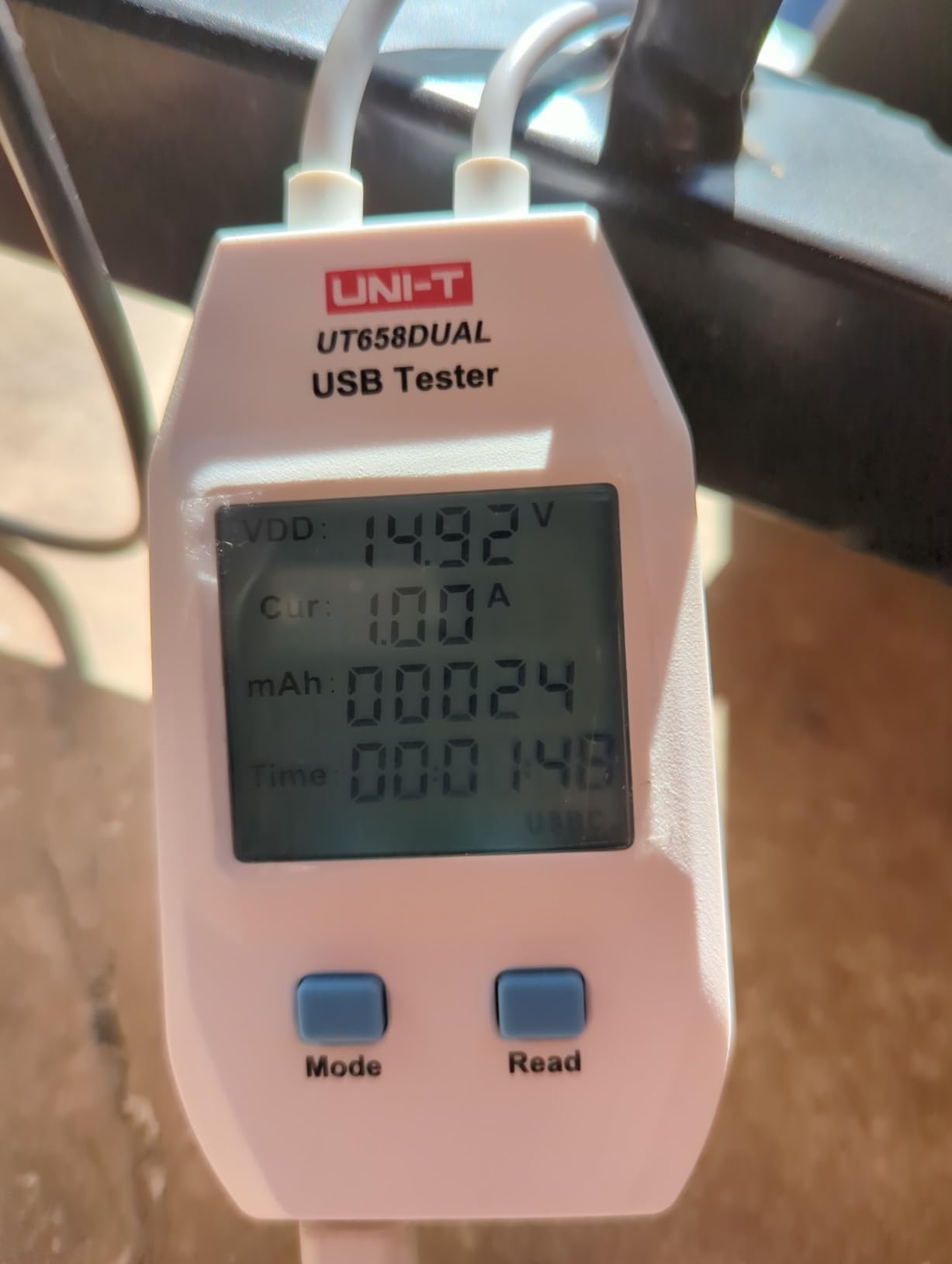
Three output types is unusual in a panel this small. The USB-C port supports PD 2.0 at up to 18W, the USB-A port supports QC 3.0 at up to 18W, and both can run at once. The 19V DC port handles up to 40W and will power a small station directly. An integrated smart IC auto-detects what you plug in and manages the current, with overcurrent, overheating and short-circuit protection behind it.
The LED indicator tells you charging is happening, which sounds trivial and is not. On a panel with no internal battery, the absence of a light is the difference between a dead cable and a dark campsite, and that ambiguity is a real problem on smaller panels.
Angle and Shade: The Two Rules That Matter Most
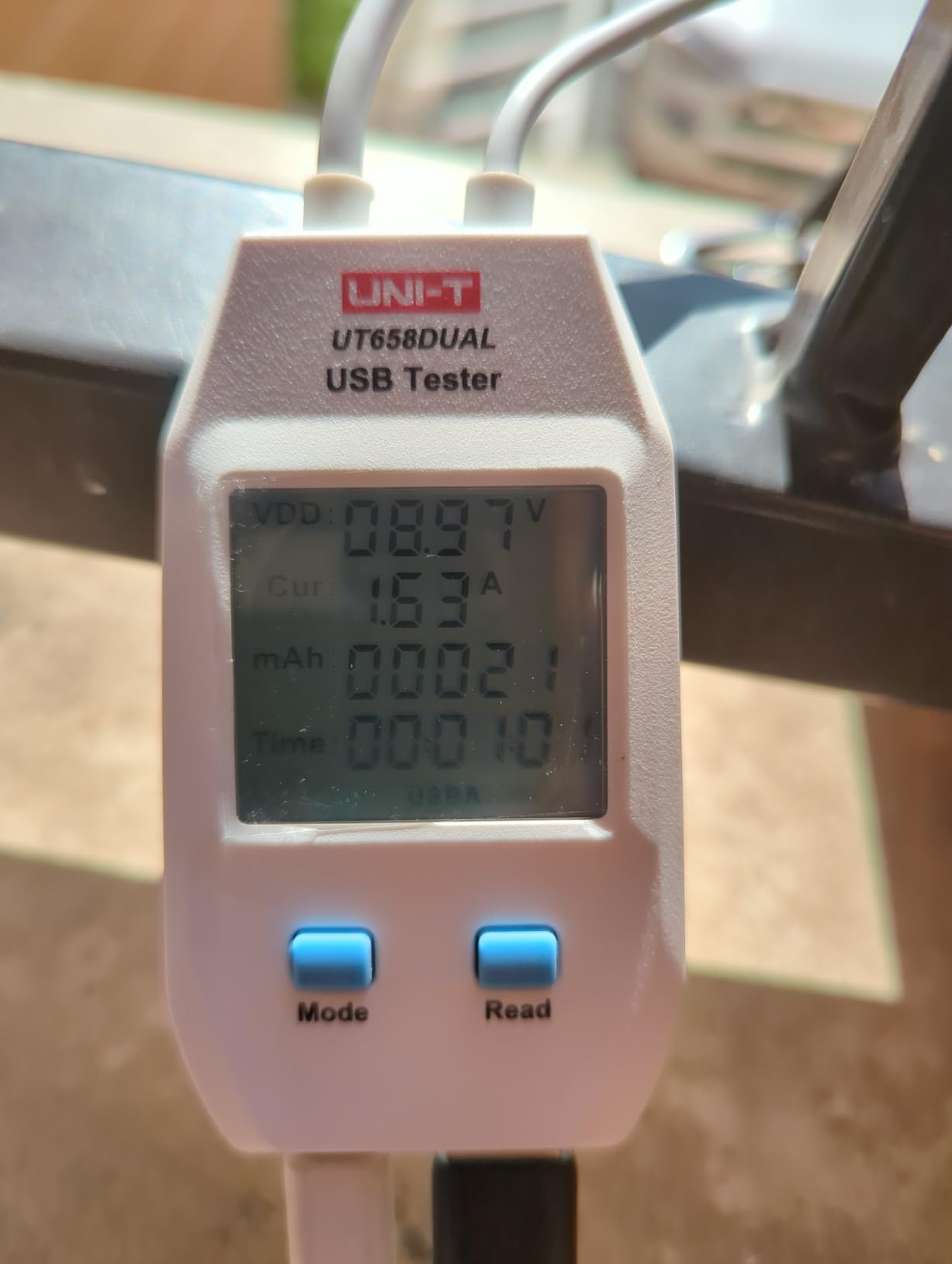
FlexSolar’s guidance is worth repeating because it applies to every panel here. Set the panel at a 45 degree angle facing direct sun for the best result, and expect shade to cut performance by up to 70 percent. On a hiking trip you get a narrow window of good light, so the difference between a propped panel and a flat one is the difference between charging a phone and not.
Placing a panel behind a tent wall or a vehicle windscreen also reduces output substantially, because glass filters the light and the panel loses some of its heat. If you must charge from inside a vehicle, put the panel outside in direct sun and run the cable in.
Who This Panel Is For and Who Should Skip It
Buy the FlexSolar for backpacking, ultralight hiking, and as a permanent resident in an emergency kit. It handles phones, GPS units, headlamps, cameras and small power banks, and the 4.4 star average across 1302 reviews tells you it does that job consistently.
Skip it for anything that draws real power. At 40W you will not charge a laptop, and topping off a power station with it takes most of a sunny day for a meaningful amount of energy. It is a supplement, and a very good one, but it is not a substitute for a 100W or 200W panel.
5. ZOUPW 100W 5-in-1 Connector Panel – Best When Your Power Station Is an Unknown
ZOUPW 100W Portable Solar Panel for Power Station,23.5% Efficiency Mono Foldable Solar Charger for Jackery 300/Ecoflow River/Anker/Bluetti,IP67 Waterproof for Camping RV Off-Grid Emergency Power
100W at 23.5 percent efficiency
5-in-1 cable plus 10 ft extension
IP67 ETFE
9.48 lb, folds to 24.13 x 21.06 in
Pros
- Highest average rating of any panel here at 4.6 stars
- 5-in-1 cable fits nearly every power station without extra adapters
- 23.5 percent cells perform well in low light
- Two kickstands tilt to 45 degrees for better harvest
- Direct USB-C and USB-A outputs for phones and tablets
Cons
- 100W is modest and capped by the stations input limit
- 9.48 lb is heavy for backpacking
- USB-C limited to 15W so it is not a laptop charger
- 12-month warranty is the shortest here
Connector mismatch is the most common purchase mistake in this whole category, and the ZOUPW is engineered specifically to prevent it. The bundled cable terminates in DC8020, XT60, Anderson, DC7909 and 8mm, and DC5521 as well, which covers effectively every mainstream power station. No adapter shopping, no guessing, no returning a panel because the plug does not fit.
It also holds the highest average rating of any panel in this guide at 4.6 stars, with 77 percent five-star reviews across 711 owners. The cells are Grade A+ monocrystalline at 23.5 percent conversion, and owners single out low-light performance as the standout, which matters enormously on a trip with a mixed forecast.
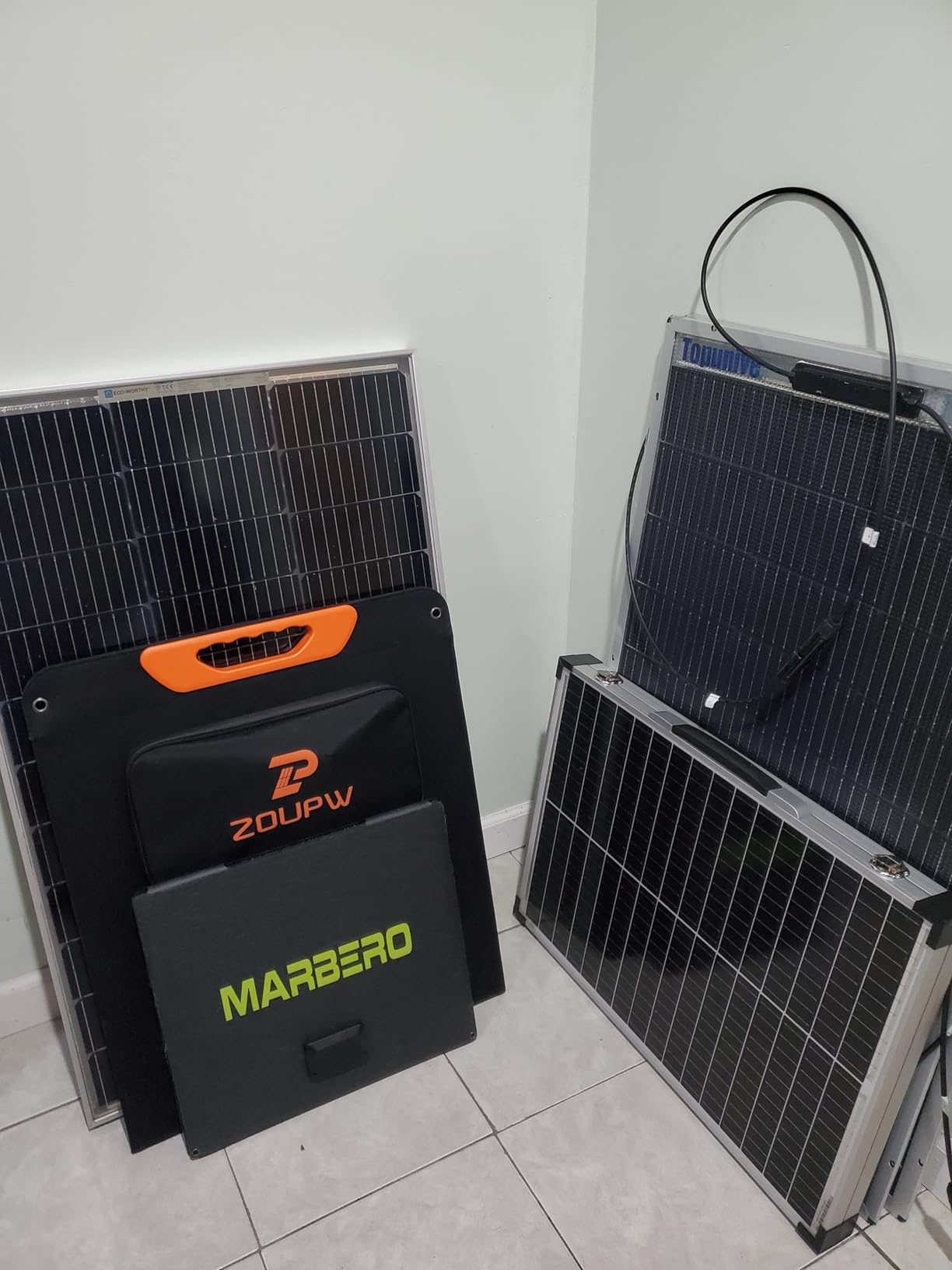
The two kickstands tilt the panel to 45 degrees, and the manufacturer claims that captures up to 25 percent more sunlight than laying it flat. That claim is a best-case figure, but the physics behind it is sound, and it means the panel works well propped against a log or a bumper rather than needing a separate mount.
Inside the zippered pocket is a built-in intelligent controller with a USB-C port at 15V and 3A plus two USB-A ports including QC3.0. So you can top up a phone and tablet directly with no power station present, which makes this a genuinely flexible panel for a mixed kit list. A 10 foot extension cable is included so the panel can sit in the sun while the station stays in the shade.
The 100W Ceiling and Why It Is Not a Weakness
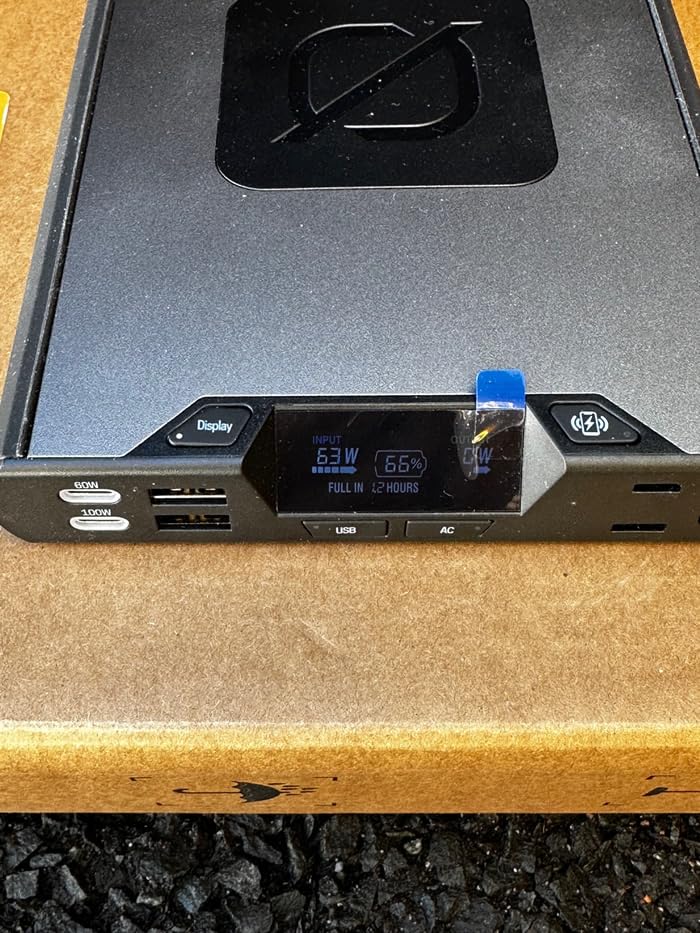
A hundred watts sounds modest next to the 200W panels, but the ceiling is often set by your power station rather than the panel. Many stations accept a maximum solar input of 100W, and feeding one more than its rating is how you stress a battery. If your station caps at 100W, this panel is the maximum useful size regardless of what else is available.
It is also the right size for a weekend rather than a season. A 1000Wh station with roughly three usable peak sun hours per day needs around 330Wh of panel input, so two 100W panels in parallel is a realistic two-day boondocking configuration. The ZOUPW supports that kind of pairing.
Who This Panel Is For and Who Should Skip It
Pick the ZOUPW if you already own a power station from a different brand, particularly a Jackery, EcoFlow, Anker or Bluetti unit, and you do not want to spend an evening matching connectors. It is equally good if you want one panel that covers phones, tablets and a station in a single kit.
Skip it if weight is your binding constraint, because 9.48 lb for a 100W panel is on the heavy side. Skip it if you need to charge a laptop from the USB port, since 15W is nowhere near enough. And if you are shopping for a panel you expect to keep for a decade, the 12-month warranty is the shortest in this group.
6. DOKIO 200W Kit with Included Charge Controller – Best for 12V Battery Charging
DOKIO 200W Portable Foldable Solar Panel Kit for 12V Battery Charging
200W rated, 220W maximum, 18V at 6.1A
Includes standalone PWM controller
9.84 ft cable, SAE and XT60 options
9.7 lb, folds to 20 x 27 in
Pros
- Lightest 200W folding panel here at 9.7 lb
- Includes a standalone PWM charge controller so no extra purchase
- Long 3m lead lets the battery stay shaded
- Panels wired in parallel so partial shading does not collapse output
- Dual USB ports for lamps and small devices
Cons
- Real-world output often about half to three quarters of rated watts
- SAE connectors soften in heat and pull apart easily
- Non-standard connectors prevent series wiring with MC4 gear
- Output reported to fade after one to two years of daily use
- Loose stitching at the seams
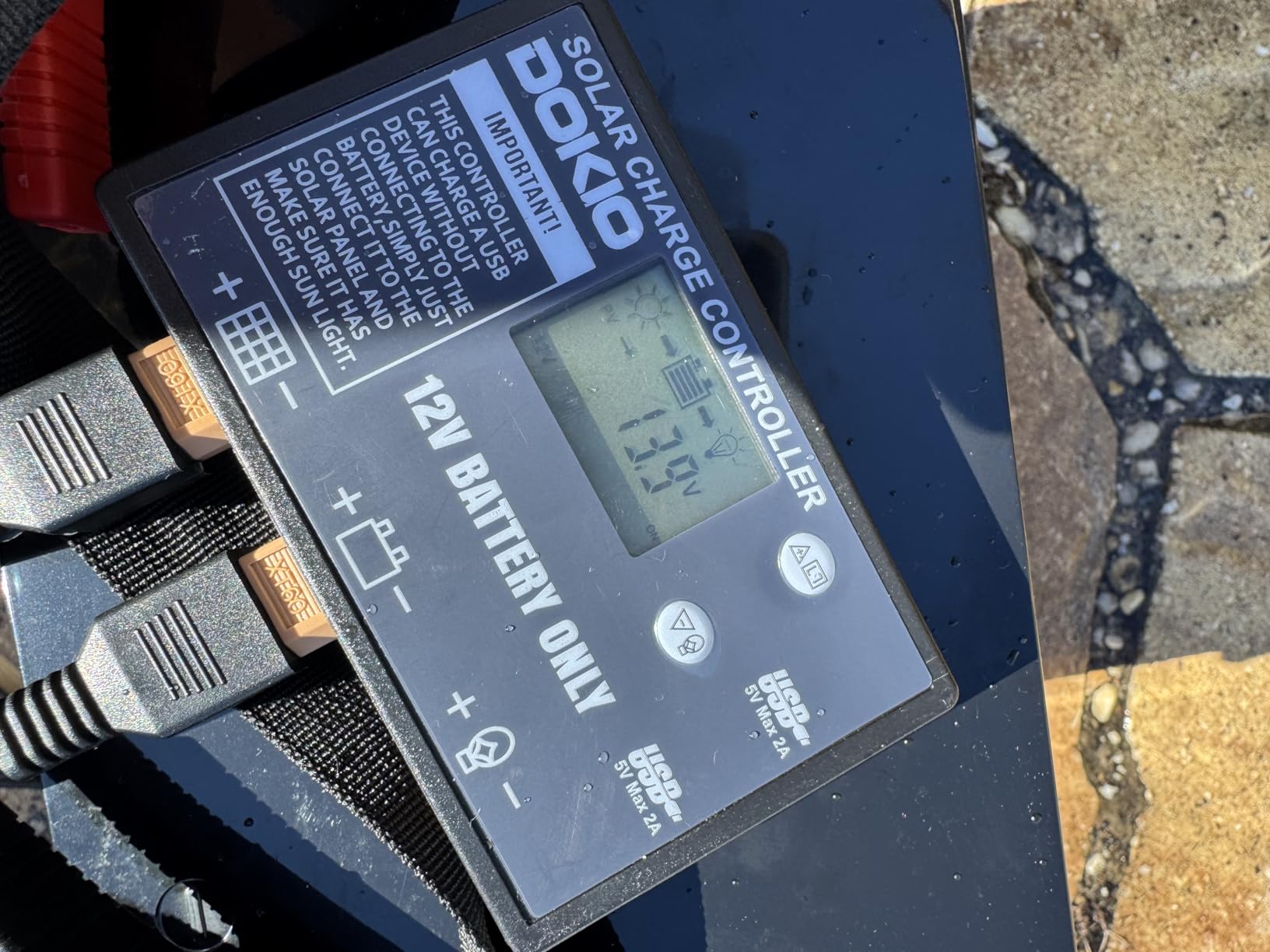
The DOKIO is the value pick for anyone running a plain 12V lead-acid, AGM or lithium battery in a van or a boat, because the charge controller is in the box. Everything else in the 200W class expects you to buy a controller separately or route through a power station that has one built in, and the DOKIO just handles it.
That PWM controller is not fancy. It protects against reverse polarity, overcharge, overload and short circuit, which is what you actually need for a battery sitting in a van for a weekend. It is simply convenient in a way that saves you a part, a wiring session and a trip to an auto shop.
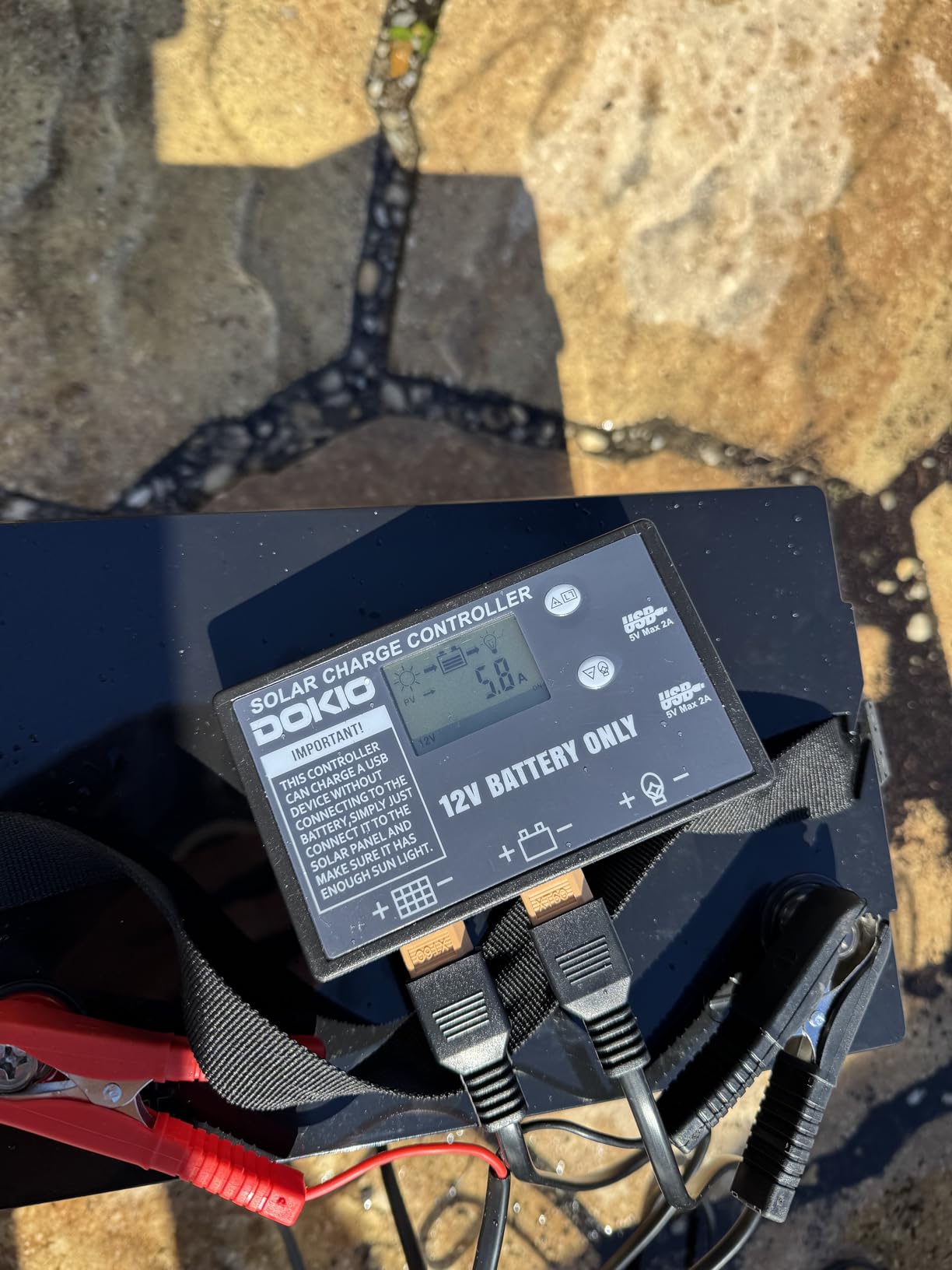
At 9.7 lb it is the lightest 200W folding panel in this group, and at 20 by 27 by 1.1 inches folded it packs flatter than most. The 9.84 foot, roughly 3 metre, cable is longer than most competitors ship, which is the difference between placing the panel in the sun and placing the panel where the battery is. Shade the battery, leave the panel in full sun, and the controller handles the rest.
There is a 4040-review base at a 4.2 average, which is a long field history, and the recurring owner theme is consistency. The panels are wired in parallel, so each section contributes additively rather than the whole array being limited by its weakest link. Shade one fold and the rest still produce.
Reading the 220W Nameplate Honestly
There is a specification quirk worth addressing directly. The panel is sold as 200W, and the manufacturer part lists a maximum of 220W. Owners measuring in the field commonly report somewhere between 110W and 150W, which is 50 to 75 percent of the 220W maximum and 55 to 75 percent of the 200W rating.
That is a bigger gap than the other 200W panels here, and it comes down to the cells being an older generation with a lower efficiency figure. It also means this panel gives you the least energy per pound of anything in the 200W group. What it gives you instead is the included controller, the parallel wiring and a very long cable, and for many setups those matter more.
The SAE connectors deserve a specific warning. They soften in high heat, which a van interior in summer absolutely is, and they pull apart more easily than MC4. Buy a proper MC4 pigtail and solder or crimp it once, and you remove the most common failure point on this panel.
Who This Panel Is For and Who Should Skip It
Choose the DOKIO if you are maintaining a 12V battery in a van, boat, shed or trailer, and you want one box that contains the panel, the controller and the leads. The dual USB ports also make it handy for powering a lamp or charging a phone off that same battery.
Skip it if you need maximum harvest from a fixed position, because the efficiency figure here is the lowest in the 200W group. Also skip it if you already own MC4 solar cabling, because the non-standard SAE and XT60 connectors will not let you series it with anything else you own.
7. SOKIOVOLA 200W N-Type IP68 Panel – Best Weatherproofing and Highest Measured Output
SOKIOVOLA N-Type 16BB 200W Portable Solar Panel for EF/Jackery/Bluetti/Anker Power Station Foldable Solar Panel 25% High Efficiency IP68 Waterproof for Outdoor Trip RV Camping Blackout Off Grid
200W at 25 percent efficiency, 16BB N-type
IP68 ETFE coating
5-in-1 MC4 adapter cable, 3m
Folds to 21 x 23 in, 16.31 lb
Pros
- Owners report 170W to 190W in good sun from 25 percent cells
- Noticeably stiff and sturdy build with snap-secured legs
- 5-in-1 cable covers every mainstream power station
- IP68 is the highest water rating in this group
- Magnetic carry handle and four RV mounting holes included
Cons
- Heaviest panel here at 16.31 lb
- Short factory MC4 leads of about 4 inches
- Weak rivets on the back panels can break with handling
- One owner reported sharp output degradation over 6 months of daily use
The SOKIOVOLA is the one to buy if you camp in the rain on purpose. Its IP68 rating on an ETFE coating is the highest water protection in this group, which means dust-tight and protected against submersion, not just splash. The other panels here top out at IP67 or IP65, and the difference matters over a season of drizzle and mud rather than a single rain shower.
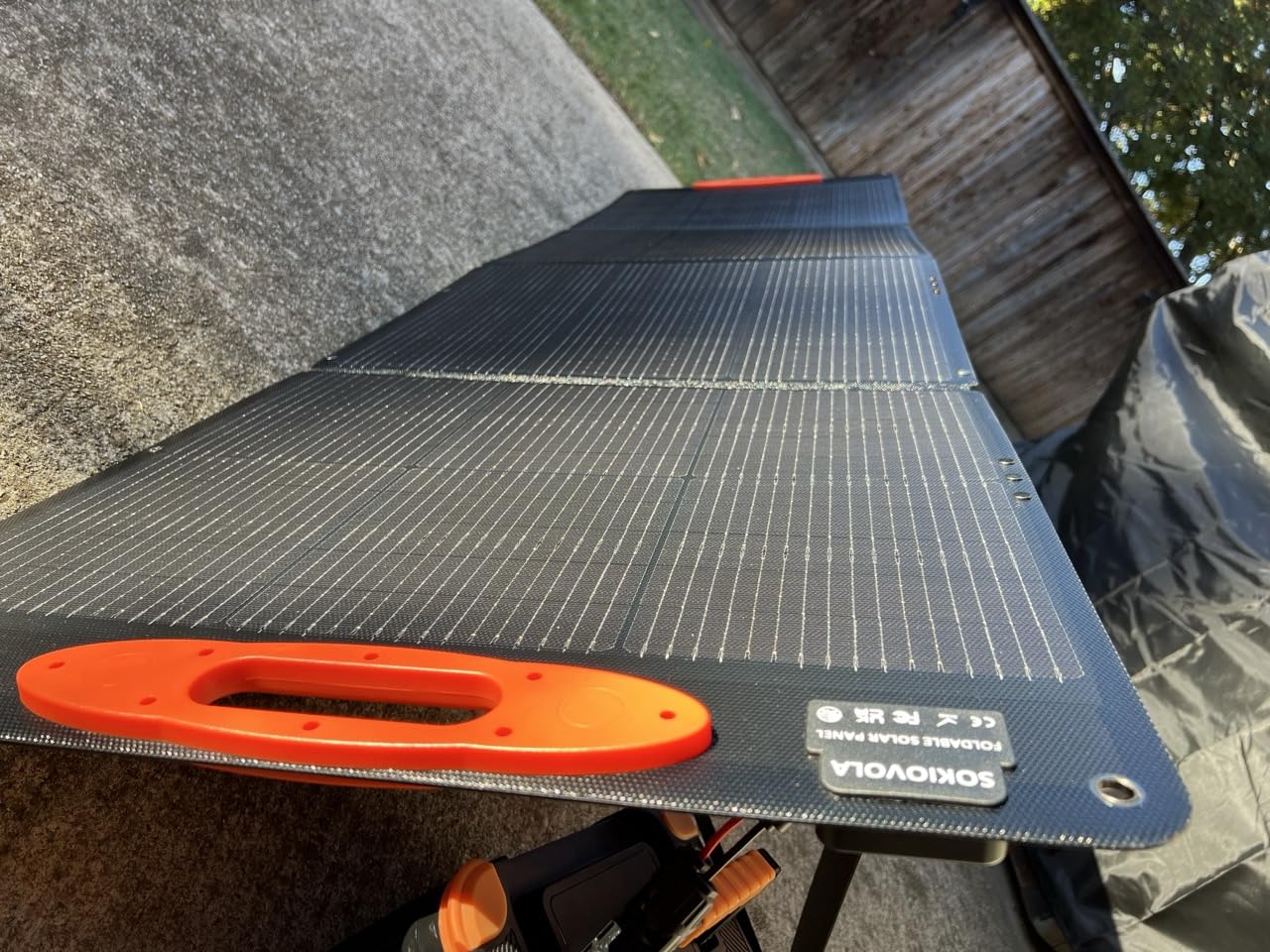
It is also the strongest performer in real sun. Reviewers put this panel at roughly 170W to 190W from 25 percent Grade A+ monocrystalline 16BB N-type cells, which is the highest measured range reported for any panel in this guide. Where several 200W panels land at 140W to 175W, this one pushes close to its nameplate.
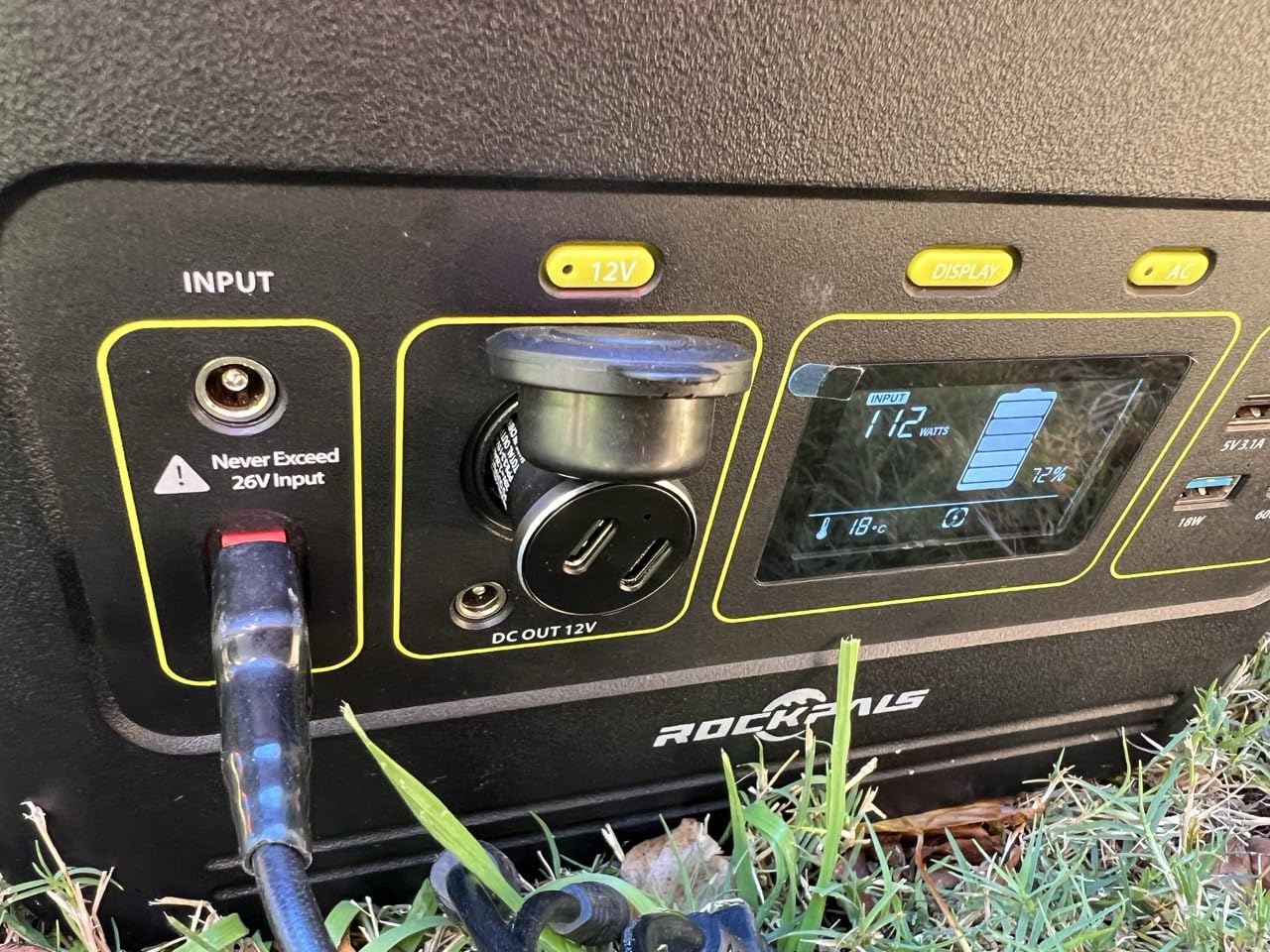
The build is stiff and deliberate, with snap-secured legs that hold firm rather than folding under a gust, and owners consistently contrast that favourably with floppier competitors. A magnetic carry handle and four mounting holes let you attach it to an RV or a rack once you are done carrying it.
The connector set is the same 5-in-1 idea as the ZOUPW, with a 3 metre MC4 cable terminating in XT60, DC5521, DC7909 and 8mm, DC8020 and Anderson. It covers Jackery, EcoFlow, Bluetti, FlashFish, Goal Zero and Anker stations. A carry bag with a roomy cable pocket is included, which sounds minor until you are trying to find a 3 metre cable in the dark.
Two Practical Problems Worth Knowing
At 16.31 lb this is the heaviest panel in the guide by a clear margin, and it is a genuine problem for rooftop storage as well as for carrying. You are not lifting this into a van awning. Plan where it lives before you buy it, and treat it as a semi-permanent fixture rather than a daily unpack.
The factory leads coming off the panel are only about 4 inches long, which is long enough to connect and short enough to be useless for positioning. A separate extension cable is not optional here, it is required. Owners also report weak rivets on the back panels that can break with repeated handling, so lift it by the frame rather than dragging it by a fold.
Who This Panel Is For and Who Should Skip It
Buy the SOKIOVOLA for wet-weather expeditions, marine use, and anywhere dust and rain are routine rather than occasional. If you are running two panels in parallel on a van roof to keep a large power station topped up, this is the one to pair when the second panel has to sit in the weather for days.
Skip it for backpacking and for any setup where you will move the panel often. There is one report of roughly 50 percent output degradation over six months of daily use, which is a single report rather than a pattern, but on a 12-month warranty it is worth weighing against the longer coverage on the Renogy.
8. ALLPOWERS SE200 Dual-Voltage Panel – Best for 12V and 24V Systems
ALLPOWERS SE200 200W Portable Solar Panel, Solar Charger for Power Station
200W at 41.6V and 4.8A
Works with 12V and 24V
0 to 180 degree kickstand
IP68, folds to 23 x 21.4 in, 15.8 lb
Pros
- Only panel here that natively handles 24V systems
- 0 to 180 degree kickstand is the widest adjustment available
- IP68 rating with fabric that sheds light rain
- MC4 output with a broad adapter set
- 18-month warranty with responsive support
Cons
- Heaviest but one at 15.8 lb
- Real output frequently lands at 60W to 125W
- Output drops sharply in partial shade
- Stiff at the folds and frays with regular handling
- Some adapters do not match popular power stations
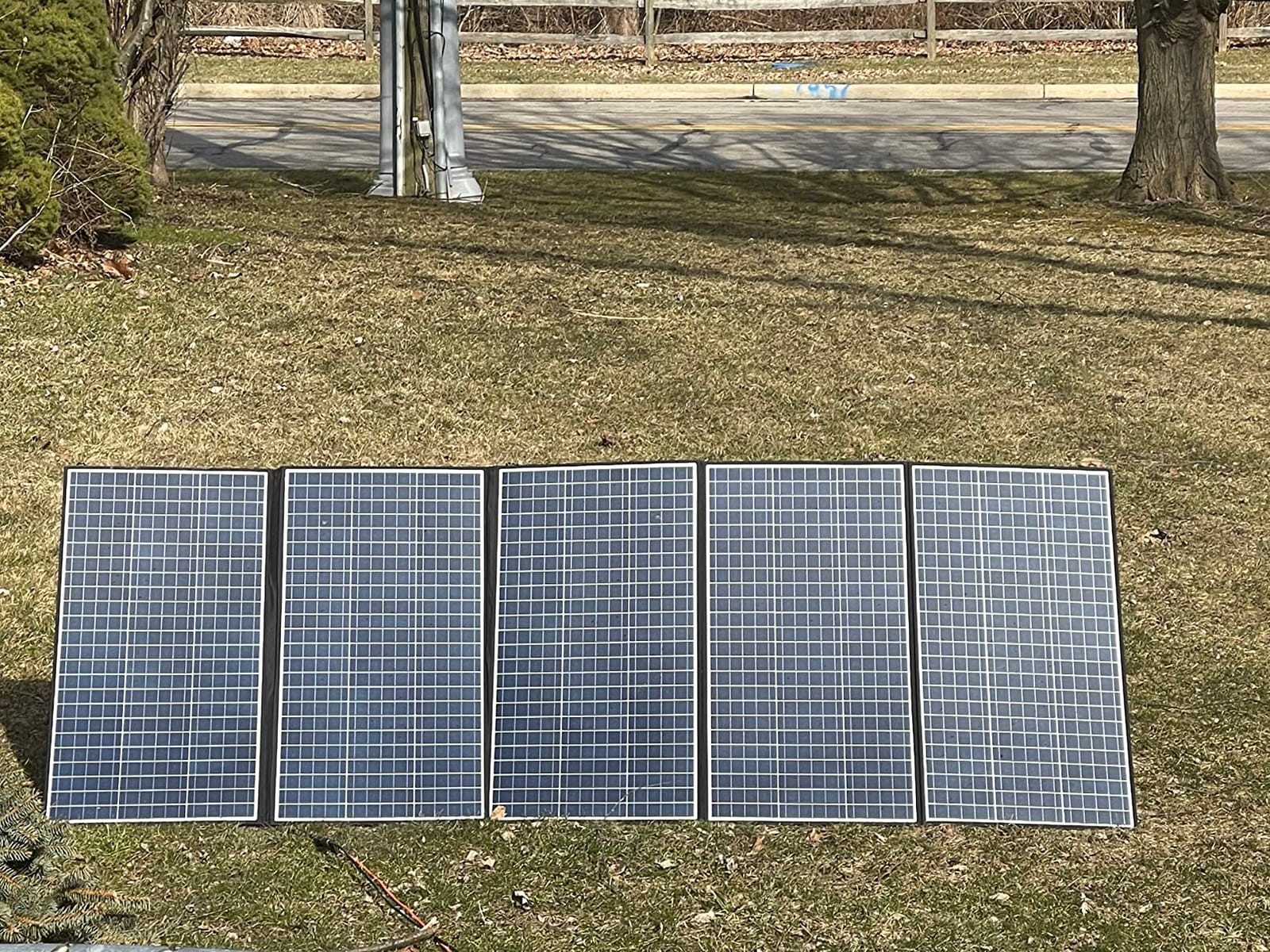
The ALLPOWERS is the only panel here that runs a 41.6V output, which means it works with 12V and 24V systems without a converter. Most folding panels output 18V to 21V and are firmly 12V-class. If you are running a 24V battery bank, an RV solar controller, or a marine system, that compatibility is the entire reason to buy this panel and nothing else will do the job.
Its kickstand is the other distinguishing feature, adjusting across 0 to 180 degrees rather than the 40 to 60 degrees typical of the others. That range lets you lay it nearly flat for winter sun at a low angle, or stand it steep for a summer sun high in the sky, and it is genuinely useful when your trip spans seasons.
Like the DOKIO, its panels are wired in parallel, so partial shading on one section barely dents total output. It carries an IP68 rating and fabric that tolerates light rain, a magnetic handle-free carry design, and an 18-month warranty backed by support that has actually replaced faulty units according to owners.
Here is the honest catch. Owners report real-world output frequently landing between 60W and 125W rather than the advertised 200W, and that is the widest shortfall of any panel in this guide. The 22 percent cell efficiency is the lowest among the 200W panels here, and the panel is stiff at the folds with fraying that develops after regular handling.
Deciding Whether 24V Compatibility Is Worth the Output Gap
If you genuinely run 24V, this question does not arise. Nothing else in this group will charge a 24V bank directly, and buying a cheaper panel plus a converter loses you more than the output difference costs you.
If you are on a standard 12V system, the picture changes. You are accepting the lowest measured output in the 200W group in exchange for dual-voltage capability you will not use. For most 12V campers, one of the N-type 25 percent panels is simply a better solar panel for the same job.
One more practical note: the output drops sharply in partial shade, more sharply than the parallel-wired rivals in this guide. Site it in full open sun rather than at the edge of a tent, and the difference is significant.
Who This Panel Is For and Who Should Skip It
Buy the ALLPOWERS for 24V battery banks, marine installs and RV solar controllers that expect a high-voltage input. The 0 to 180 degree kickstand also makes it a good seasonal panel if you camp in both winter low sun and summer high sun.
Skip it for a standard 12V power station setup where output per panel is the priority, and skip it if weight matters. At 15.8 lb it is near the top of the heaviness range here, and a stiffer panel that frays at the folds is not one you want to wrestle onto a van roof every morning.
Matching Your Panel to a Portable Power Station
A solar panel does not store energy. It converts sunlight to electricity and pushes that electricity into something that does, usually a portable power station or a 12V battery. Understanding the connector between the two is what separates a panel that works on day one from one that sits in a bag for a season.
The connectors you will meet in this category, and where each one appears:
- MC4: The standard photovoltaic connector, and what the Renogy, the SOKIOVOLA and the ALLPOWERS output directly. Also the base cable for most 5-in-1 adapter sets.
- XT60: Common on power station solar inputs. The DOKIO and the ZOUPW both include it, and several panels terminate a multi-head cable in it.
- DC8020 and DC7909 / 8mm: The two most frequent proprietary inputs on mainstream power stations. DC7909 is also called 8mm, which is why you sometimes see both names on the same accessory.
- Anderson and aviation connectors: Two-pin locking plugs used on a minority of stations, included on the GRECELL and ZOUPW cable sets.
- DC5521 and USB: DC5521 is a smaller two-pin barrel found on lower-wattage stations. USB-A and USB-C bypass the station entirely and charge devices directly, which the BigBlue, FlexSolar, ZOUPW and Renogy all support.
Two rules will save you money. First, never over-size a panel against a station’s stated solar input limit, because pushing more than the input can handle stresses the battery management system. Match the panel to the limit rather than to your ambition. Second, if you already own a station, check its connector before you buy the panel, and buy the cable set that covers it rather than assuming a universal standard exists. There isn’t one, and the fragmentation is the number one reason panels get returned.
If you are still choosing a station, our guides to the best portable power stations for camping and, for longer medical-device trips, the best portable power stations for CPAP camping cover the sizing side. Van and RV builders running a fixed array should look at our solar generators for RV camping breakdown, and an evening projector is a good test of whether your evening power budget holds up, covered in our portable projectors for camping picks.
Buying Guide: Nine Questions to Ask Before You Buy
Most expensive mistakes in this category come from buying a panel before answering a simple question about what it is going to charge. Work through these in order and the right panel usually becomes obvious.
1. What exactly am I powering?
List the devices, then estimate hours of use for each, then multiply by their wattage. A phone charging from empty draws 10W to 15W. A laptop runs 45W to 65W. A 12V mini fridge averages 40W to 60W while its compressor cycles. A CPAP machine with a heated humidifier is the sleeper in this category, often 30W to 60W continuous, and if that is your use case your power station choice drives everything else.
That total, divided by roughly three to four usable peak sun hours, gives you the panel size. Ignore the arithmetic if it produces something under 40W and your load includes anything but small devices, because at that level you are relying on luck rather than planning.
2. Monocrystalline, polycrystalline or N-type?
Monocrystalline silicon is the cell type in all eight panels here and is worth paying for. Polycrystalline cells are cheaper and noticeably less efficient, mostly appearing in fixed rooftop panels. Within monocrystalline, N-type cells with 16 busbars are a step up: the Renogy at 25 percent and the SOKIOVOLA at 25 percent both use them, and N-type holds more output in low light and at high temperature than standard 9BB cells.
3. What does bifacial mean, and do I need it?
A bifacial panel collects sunlight from the front and captures reflected light from the rear, so it can produce more than its front face alone when something bright and reflective sits behind it, such as a white roof or a car roof. For a camping panel propped on grass or dirt, that gain largely disappears. Unless you are mounting to a vehicle roof, treat bifacial as a marketing term rather than a buying criterion.
4. Is the weight something I will actually move?
Panels advertised as portable range from 1.5 lb to over 16 lb, and that spread decides everything. Anything under 5 lb can go in a pack. Between 9 lb and 16 lb is a car-camping weight, and it should be unrolled once at the site rather than repositioned through the afternoon, because moving 14 lb of awkward flat panel while also managing a cable is a bad use of a campsite afternoon.
Two of the 200W panels here, the DOKIO at 9.7 lb and the GRECELL at 10.14 lb, are the practical ceiling for a panel you might reposition. The SOKIOVOLA at 16.31 lb and the ALLPOWERS at 15.8 lb are fixtures.
5. Which IP rating do I actually need?
IP65 covers dust and water splash, IP67 adds protection against temporary immersion, and IP68 is the continuous-submersion rating. For a panel that lives under a tarp or gets occasional rain, IP65 is adequate. For wet-weather and marine use, this guide’s SOKIOVOLA at IP68 is the one to consider. One thing to remember on every panel: the connector and junction box are almost always less protected than the panel surface, so keep the plug end dry regardless of the rating printed on the label.
6. What connector does my power station take?
Covered in detail above, but the short version: check first, buy second. The ZOUPW and the SOKIOVOLA both ship 5-in-1 cables that cover the majority of stations, and the Renogy and the ZOUPW can charge a phone directly with no station in the chain at all. The BigBlue and the FlexSolar are USB-first panels, so they never have this problem.
7. How long is the warranty, and what does it cover?
Warranty length in this category runs from 12 months to two years, which is short for hardware expected to last a decade. Material and workmanship coverage, such as the Renogy’s 2-year term, is more useful than a one-year blanket policy because panel output fade is generally treated as normal degradation rather than a defect. Treat warranty length as a tiebreaker between otherwise equal panels rather than a primary criterion.
8. How much does low-light and cloudy performance matter?
More than most roundups admit. A sunny-only test tells you almost nothing about a trip with a 70 percent cloud forecast, and testers measuring panels in overcast conditions have found output ranging from roughly a fifth to a quarter of rated power. On such a day no panel in this guide will run a station meaningfully. What separates them is how quickly they recover on the next partly cloudy day, and N-type cells with shadow-free surfaces, as on the BigBlue and the Renogy, hold output better through broken light.
9. Where will this panel actually sit?
Placement is the cheapest wattage available and almost nobody optimises it. Prop the panel on its kickstands at a 45 degree tilt facing open sky. Reposition it as the sun moves rather than leaving it fixed from morning to night. Keep it off hot blacktop, off a vehicle roof and off bare ground, because reflected and conducted heat raises cell temperature and steals the very watts you are collecting. Never leave it behind glass, where light filtering and heat build-up both work against you.
For winter and cold-weather trips, two numbers matter: the panel’s upper temperature rating, which sits at 175F for the DOKIO and 158F for the ZOUPW, and its low-light behaviour. Panels do not generate meaningfully better in cold the way batteries do. Snow cover and short daylight hours, not cell temperature, are what end a solar trip in winter, and no wattage rating fixes that.
Frequently Asked Questions
How many watts of solar panel do I need for camping?
Most weekend tent campers need 50W to 100W, and van or RV campers running a power station need 160W to 220W. Backcountry backpackers should stay at 40W or less. Add up your device wattage, multiply by hours of use, then divide by three to four usable peak sun hours per day to get your number.
Are portable solar panels waterproof for camping use?
Most are water-resistant rather than waterproof. Ratings here range from IP44 on the BigBlue 28W up to IP67 and IP68 on the FlexSolar, ZOUPW, SOKIOVOLA and ALLPOWERS. IP65 covers dust and splash, IP67 adds temporary immersion protection, and IP68 is the highest. The connector and junction box are usually less protected than the panel itself, so keep the plug end dry.
How long does a 100W solar panel take to charge a power station?
In good conditions, a 100W panel produces roughly 70W to 90W, which is about 500 to 650 watt-hours across a five to six hour day. A 500Wh power station would take most of a sunny day to fill and a 1000Wh station closer to two days. In overcast conditions expect a fraction of that, so plan for three to four usable peak sun hours rather than the full day.
Do solar panels work on cloudy days?
Yes, but at a fraction of rated output. Testers measuring panels in overcast conditions have reported roughly a fifth to a quarter of rated watts on heavily clouded days. Panels with N-type cells and shadow-free surfaces, such as the BigBlue and the Renogy, hold output better through broken light. Treat a cloudy day as a battery-conservation day rather than a charging day.
What connector does my power station use?
The most common solar inputs are DC8020, DC7909 which is also called 8mm, and XT60, with Anderson and aviation plugs on some models. MC4 is the standard panel-side output. Check your station’s input before buying, and never exceed its stated solar input limit, because over-sizing can stress the battery.
What is the most efficient portable solar panel for camping?
Among the panels reviewed here, the Renogy and the SOKIOVOLA lead with 25 percent conversion using 16BB N-type monocrystalline cells. The Renogy is UL 61730 certified and carries a 2-year warranty, making it the more complete package. Efficiency determines output per square inch, which matters most on a van roof where panel area is limited.
Is a portable solar panel worth it?
For most multi-day campers, yes, because it replaces a fuel-burning generator with silent free energy and gives you backup power when a campsite has no hookups. It is not worth it for a single weekend of phone charging, where a power bank is simpler. The panel earns its place once you are running a power station, a fridge, or a medical device.
Final Verdict: Which Portable Solar Panel Fits Your Trip
If you want one panel with almost no downside, take the BigBlue 28W. It is the lightest option here, it charges a phone without any other equipment, and 9969 reviews at 4.3 stars is a reliability record nothing else in this guide can match. That is our pick for a backpacker, a daypack camper, and anyone building an emergency kit.
If you are car camping and want real energy, the Renogy 200W is the one. The 25 percent N-type cells produce the most power per square inch here, it holds the best rating in the 200W class at 4.5 stars, and it can charge a phone and a power station at the same time. Weight is the trade you make, and at 13.89 lb it is a car-camping weight, not a hiking one.
For van life where every pound is a real cost, the GRECELL 200W at 10.14 lb is the smarter buy, and it packs flat enough to store anywhere. For a panel you will move between angles all day, the FlexSolar 40W fits a daypack at 1.76 lb. For 12V batteries with no power station, the DOKIO includes the controller you would otherwise buy. For rain and marine conditions, the SOKIOVOLA’s IP68 build handles it. For a 24V system, only the ALLPOWERS works without a converter.
Before you buy anything, check one thing: the solar input limit on your power station. Match the panel to that number, not to your ambition, and you will spend your trip actually using the panel instead of troubleshooting it.