
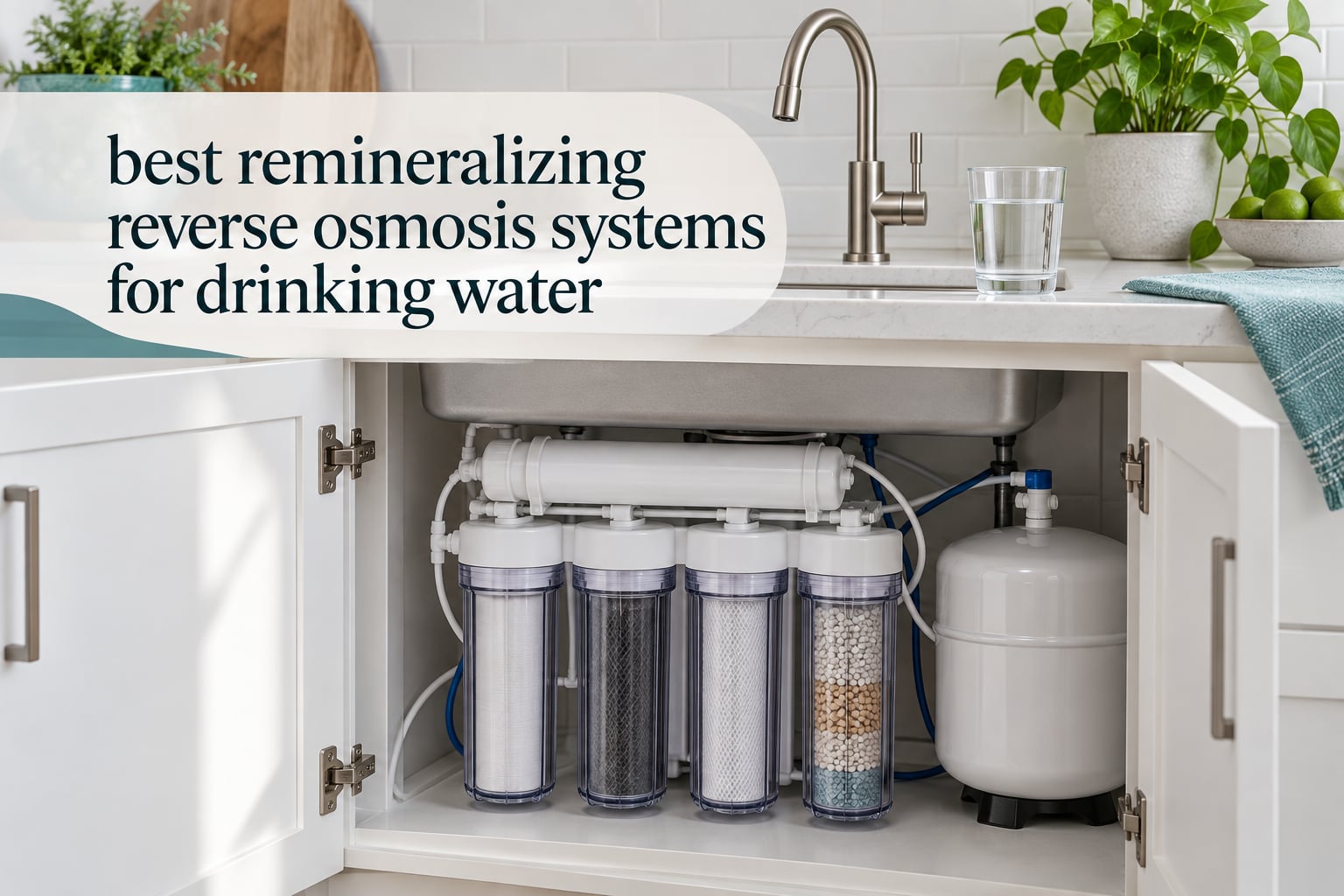
If you want the short answer: the best remineralizing reverse osmosis systems for drinking water are the iSpring RCC7AK-BN for most households, the iSpring RCC7P-AK if your line pressure is weak, and the APEC ROES-PH75 if you want alkaline mineral water with no pump, no power and the narrowest footprint. I compared all ten side by side, and the differences that matter come down to mineral method, flow rate and how much cabinet space you are willing to give up.
Here is the problem I kept hitting while testing. Reverse osmosis is the most effective residential treatment for dissolved solids, PFAS, lead and fluoride, but the semi-permeable membrane that does that work is not selective about minerals. It strips calcium and magnesium out along with everything else, and the result is water that tastes close to nothing. A remineralization stage puts a controlled amount of those minerals back after the membrane, which is the entire difference between water you drink with pleasure and water you drink because you are thirsty.
Forums have been unusually honest about this. On r/WaterTreatment, owners consistently describe a mineral stage as the reason their RO water is drinkable rather than merely clear, and the iSpring RCC7AK comes up repeatedly as a system whose mineral stage is simple enough to understand and service. The same community is far less enthusiastic about anonymous white-label units, and that bias is well founded: certification coverage across this roundup is uneven, with several systems carrying a direct NSF listing and others relying on component certifications or a manufacturer’s own test report.
I scored every unit below on the same five things: filtration certification, how the mineral stage actually works, real flow rate, fit for a real kitchen cabinet, and how much long-term owner evidence exists. No single mystery number, because the leaderboard at position one on this query uses an undisclosed proprietary score and I would rather show my work than ask you to trust a figure you cannot check.
One practical warning before the picks. If you already own an RO system and want minerals back, you do not need to replace it. I wrote a dedicated section later in this guide on adding a mineral stage to hardware you already own, and it is the single most repeated request in the forums. If you are also worried about what happens when a line under the sink fails, our guide to water leak detectors for basements is worth a read before you drill anything.
Our Top 3 Remineralizing Reverse Osmosis Picks for 2026
Comparing 10 Remineralizing Reverse Osmosis Systems in 2026
| Product | Specs | Action |
|---|---|---|
 iSpring RCC7AK-BN iSpring RCC7AK-BN |
|
Check Latest Price |
 APEC ROES-PH75 APEC ROES-PH75 |
|
Check Latest Price |
 Frizzlife PD600-TAM3 Frizzlife PD600-TAM3 |
|
Check Latest Price |
 iSpring RCC7P-AK iSpring RCC7P-AK |
|
Check Latest Price |
 iSpring RCC1UP-AK iSpring RCC1UP-AK |
|
Check Latest Price |
 SimPure T1-400ALK SimPure T1-400ALK |
|
Check Latest Price |
 Home Master TMAFC Home Master TMAFC |
|
Check Latest Price |
 NU Aqua 7-Stage UV Alkaline NU Aqua 7-Stage UV Alkaline |
|
Check Latest Price |
 Waterdrop G5P500A Waterdrop G5P500A |
|
Check Latest Price |
 Waterdrop T3-M Waterdrop T3-M |
|
Check Latest Price |
What Remineralization Actually Does to RO Water
The honest version separates two arguments that get tangled together online. The taste argument is not in dispute: membrane-filtered water with no dissolved minerals reads as flat, and most people drink less of it as a result. The health argument is more contested, and I would not sell it to you as settled science.
What the membrane removes is real and measurable. Total dissolved solids drop by 93 to 98 percent on the iSpring RCC7AK, PFAS by 96 to 99 percent, and lead and fluoride along with them. Calcium and magnesium ride out with that reduction because they are dissolved ions and the membrane cannot tell a lead ion from a calcium ion. The output TDS on a good RO system is often in the single digits to low tens, which is why the water tastes the way it does.
Two methods put the minerals back, and understanding the difference explains most of the price spread in this category. A calcite post-filter dissolves crushed calcium carbonate into the water after the membrane, raising pH and adding calcium with very little else. A calcium and magnesium injection cartridge uses a blend of mineral salts, sometimes with potassium and sodium, which restores a broader profile and is what the manufacturers call an alkaline mineral pH+ stage. Calcite is cheap, simple and long-lived. Injection cartridges cost more, add more ions and taste noticeably fuller.
One number worth knowing. A healthy remineralized system should not read near zero on a TDS meter, and if it does, the mineral stage is either exhausted or not working. Manufacturers say this out loud: SimPure notes that TDS will not reach 0 ppm because of its alkaline stage. That is not a defect, it is the feature. Reverse the reasoning, though, and a low number stops being a purity signal the moment you add minerals back, which is why buyers chasing maximum measured purity should skip any remineralizing unit entirely.
For anyone brewing coffee, this section matters more than it does for casual drinkers. Mineral content is a genuine component of brewing water chemistry, and RO water at near-zero TDS will strip flavor from coffee in a way that plain water will not. Forum posters on r/pourover are explicit that they want an under-sink system with remineralization built in for exactly this reason, and they want it not to interfere with the brew. Every system in this roundup satisfies that, since the mineral stage sits after the membrane and adds nothing that harms extraction.
How to Add a Mineral Stage to an RO System You Already Own
This is the loudest unmet request in the water treatment forums, and you do not need new hardware. Adding a mineral stage to an existing RO is a fifteen-minute plumbing job with a tee wrench, and it works on virtually any system that ends in a post-carbon housing.
Start by finding the last stage. Most under-sink RO systems end with a post-carbon or post-carbonation block in a clear housing, which is exactly where a mineral cartridge belongs. If your system has a dedicated alkaline or pH+ housing already, an owner can simply drop the factory replacement into it.
Then choose your method deliberately. A calcite post-filter screws into an empty third housing and adds calcium carbonate slowly, which is the cheapest, lowest-maintenance route and the one most people should take first. A magnesium and calcium injection cartridge gives a fuller, more mineral-forward taste and a higher pH lift, and it costs more per replacement. Owners on r/WaterTreatment regularly recommend purpose-made cartridges over trying to add potassium, sodium and magnesium individually, which is the direction most of that advice points.
Two named options come up repeatedly when people do this. Atlas Filtri Oasis is a six-stage under-sink layout with a re-min cartridge and is frequently recommended for owners who want the storage tank and remineralization combination handled as one designed system. Vitev remineralization filters are described in the same community as pricey but credible, which is roughly the right characterisation for an owner who has already had one disappointing cartridge.
Order of operations matters more than people expect. Flush the system thoroughly before you install anything new, run the faucet for several minutes, and give the new mineral stage a short flush of its own before you judge the taste. Owners report the first glass tasting mineral-heavy and the third tasting right, and several reviews across this roundup trace early taste complaints to exactly that unflushed cartridge. It also helps to have a water leak detector with smart alerts running while you are cutting into the tubing.
1. iSpring RCC7AK-BN – The Mineral-Balanced Standard for Most Kitchens
iSpring RCC7AK-BN NSF Certified, 75 GPD, Alkaline 6-Stage Reverse Osmosis System, pH+ Remineralization RO Water Filter System Under Sink Patented Top-Mounted Faucet Design for Easy Installation
75 GPD, 6 stages, NSF 58, 70 psi, no power needed, 1 year warranty
Pros
- Largest review base in the category at 21k+ ratings
- TDS 93-98 percent and PFAS 96-99 percent reduction
- Transparent first housing shows filter loading
- No electricity or pump noise
Cons
- Needs roughly 45-70 psi static line pressure
- Included tubing can run short in some sink layouts
- 2:1 to 3:1 drain ratio is inherent to tank systems
This is the unit I recommend to almost everyone, and the reason is not that it wins on any single specification. It wins on evidence. Twenty-one thousand ratings give an unusually clear picture of how a system behaves after two years, not after two weeks, and the pattern that emerges is consistent: clean mineral-balanced taste, straightforward installation by people who had never plumbed anything, and support that answers.
The mineral AK stage is the sixth position and it does the job quietly, adding calcium and magnesium and pulling pH up from the acidic output a plain five-stage RO would produce. On r/WaterTreatment this is the specific system owners name when the question is which mineral stage is simple enough to understand and replace. The first-stage housing is transparent, which sounds minor until you realise you can see the sediment loading instead of guessing at an interval.
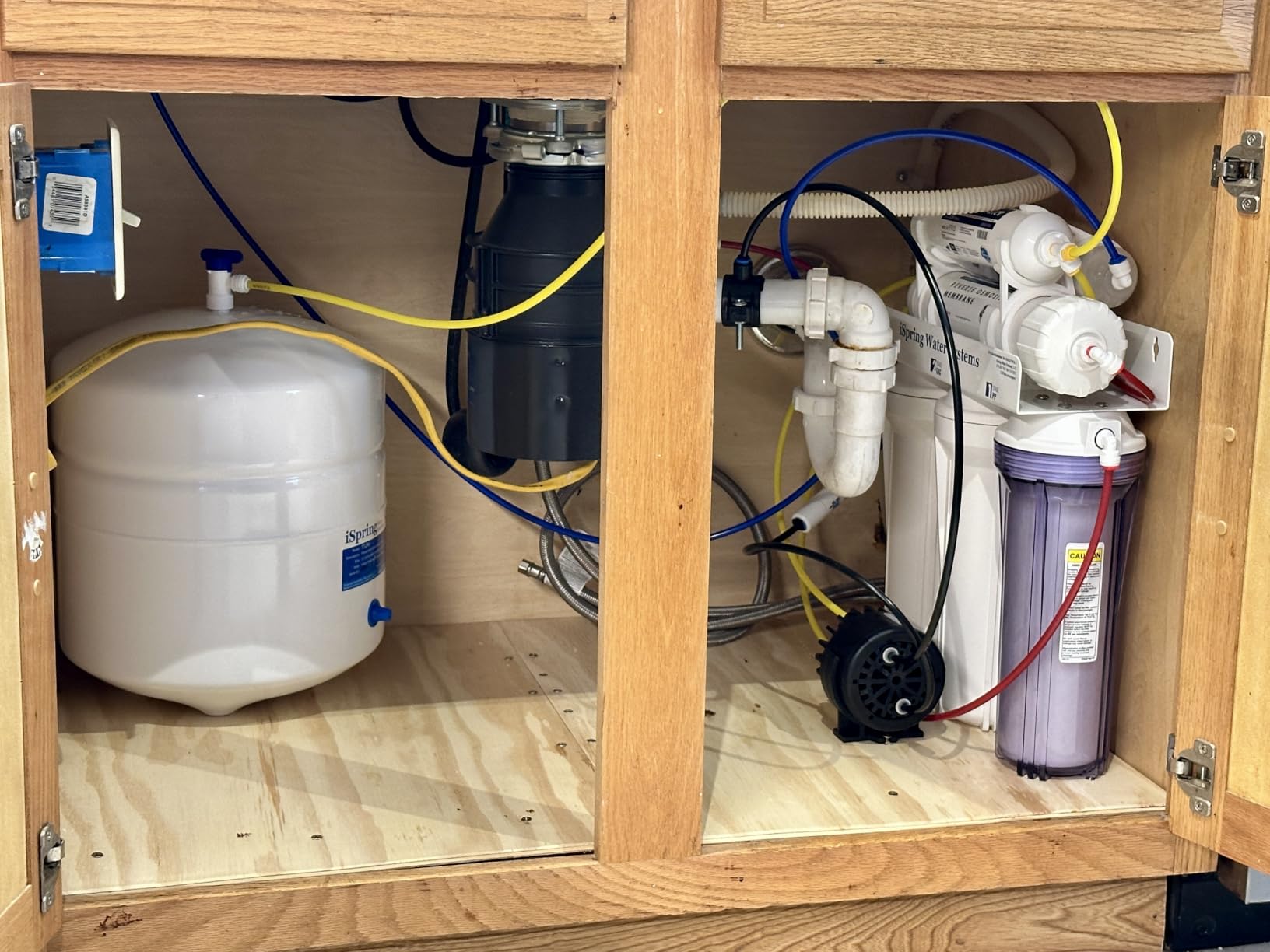
Filtration is certified to NSF/ANSI 58 across the entire system, and the published reduction figures are 93 to 98 percent for TDS, 96 to 99 percent for PFAS, 95 to 99 percent for chlorine and better than 99.7 percent for asbestos. Owners commonly report kettle limescale disappearing within a few weeks, which is the visible confirmation that the membrane is doing real work.
Why the 75 GPD Format Works for Most Homes
Seventy-five gallons per day sounds modest until you account for how the number is used. The rating assumes a feed pressure in the mid-sixties psi and a household drawing a few gallons of drinking and cooking water a day, and it is not a simultaneous-flow number. The storage tank fills slowly in the background and the faucet produces a steady stream when you open it, which is exactly the behaviour most kitchens want.
The tradeoff is speed. There is no first-glass-on-command here, and the tank is the buffer that makes the low GPD figure acceptable. If your household genuinely drinks several gallons daily, or you are tying the system to an ice maker, step up to a 100 GPD unit or a tankless design further down this list.
Line Pressure Is the One Thing to Check Before You Buy
This system has no booster pump, which is both its quiet advantage and its single most common ownership complaint. Membrane performance depends on feed pressure, and roughly 45 to 70 psi static is the working range. Below that, output slows and rejection rates fall. If you live in a low-pressure building or an older house, the pumped iSpring RCC7P-AK is the correct purchase instead, and no amount of preference should override that.
Measuring takes five minutes and a gauge on the cold line under the sink. It is the highest-value ten minutes in this entire buying process, and it is worth doing before you commit to anything on this page.
Filter Set Options and Long-Term Ownership
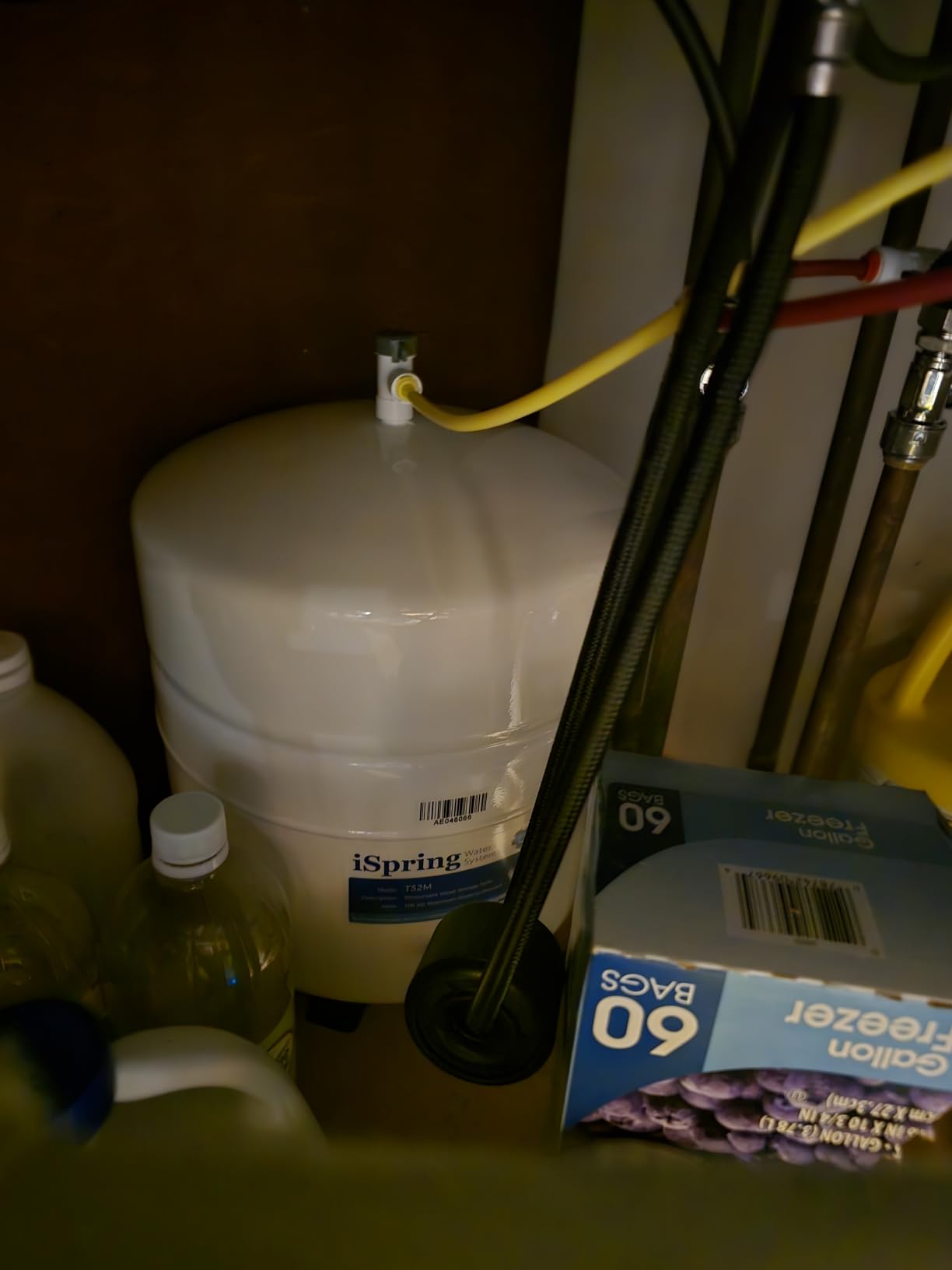
Replacement filters come in four rated intervals: a six-month set, a one-year set, a two-year set and a three-year set. That range matters more than it sounds, because a three-year set is the cheapest way to keep costs flat and the filters are sold separately rather than bundled with a visit. A one-year manufacturer warranty covers the hardware, and support is described by owners as responsive and willing to send replacement parts at no charge.
Forum owners in this category care intensely about whether filters remain orderable in five years, because an orphaned system is a real cost. iSpring has been building this exact housing platform for years and the replacement part list is long, which is the strongest form of longevity guarantee available in consumer water treatment.
Who Should Skip This Model
Skip it if your static pressure is marginal, because a pump model solves your problem properly and mixing a booster with this chassis invites frustration. Skip it if you want hot water, tankless instant delivery or an appliance line, since none of those belong in this design. And skip it if near-zero measured TDS is your goal, because the mineral stage is engineered to prevent that outcome.
2. APEC ROES-PH75 – Longest-Tracked Value Pick With a Calcium Stage
APEC Water ROES-PH75, 6-Stage Under Sink RO System, Alkaline, 75 GPD
75 GPD, 40-85 psi, 0.05 gpm, 2000 ppm feed TDS limit, 5.25 inch wide
Pros
- 20 year brand track record in filtration
- Compact 5.25 inch width fits narrow cabinets
- Calcium cartridge for pH and taste
- Full kit includes tank faucet and drain saddle
Cons
- Slowest measured flow of the tank systems at 0.05 gpm
- No booster pump so needs 40 psi minimum
- 2000 ppm feed TDS ceiling is high
- Replacement filters are proprietary to the APEC line
APEC has been building filtration systems for twenty years, and this model reflects that in the only way that really matters: nothing here is experimental. The six-stage layout is conventional, the post-RO calcium cartridge is a straightforward pH and taste stage, and the certification is real. For a buyer who wants alkaline mineral water and does not want to think about it, this is a low-risk purchase.
The 5.25-inch width is the detail that decided it for me in a small kitchen cabinet. Several systems in this roundup measure eight inches or wider, and a tank plus an eight-inch chassis will not coexist in a compact under-sink space. APEC fits where others do not.
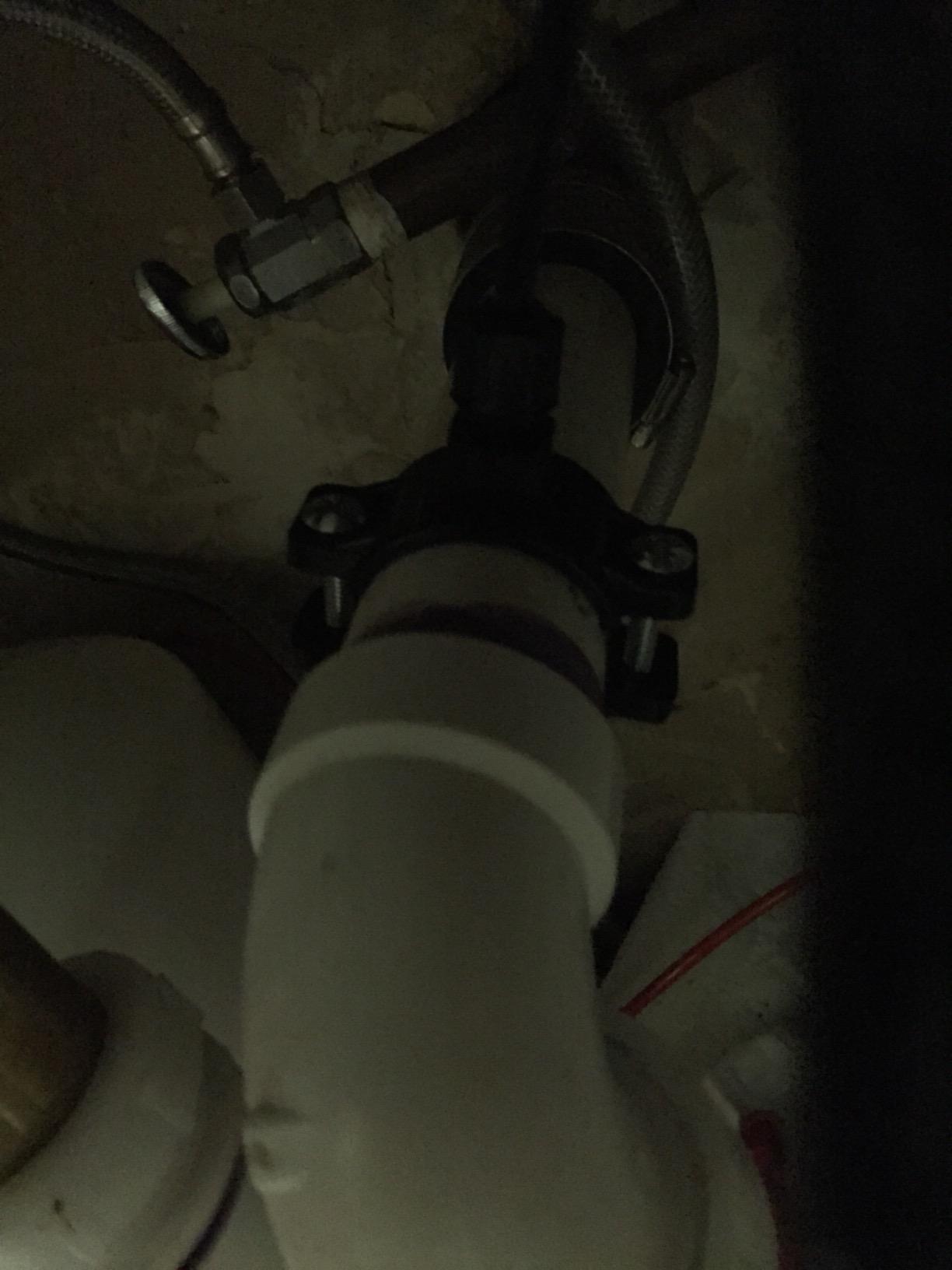
What the Post-RO Calcium Cartridge Actually Does
The cartridge uses premium-grade calcium from a named source to raise pH and add minerals after the membrane. This is the calcite-adjacent end of the spectrum rather than a full multi-ion injection stage, so the taste lift is real but modest. Buyers describe it as a clean, slightly sweet mineral taste rather than a strongly alkaline profile, and that is an accurate expectation to set.
It is also the reason the certification listing matters here. The system carries WQA certification with NSF 372 and NSF 58 certified components, and the filter removes up to 99 percent of chlorine, taste, odor, VOCs, fluoride, arsenic, lead and heavy metals. A 2000 ppm maximum feed TDS matches the widest window in this roundup, which matters if you are on a well or in a hard-water area.
Why the Flow Rate Is Slower and Why That Is Acceptable
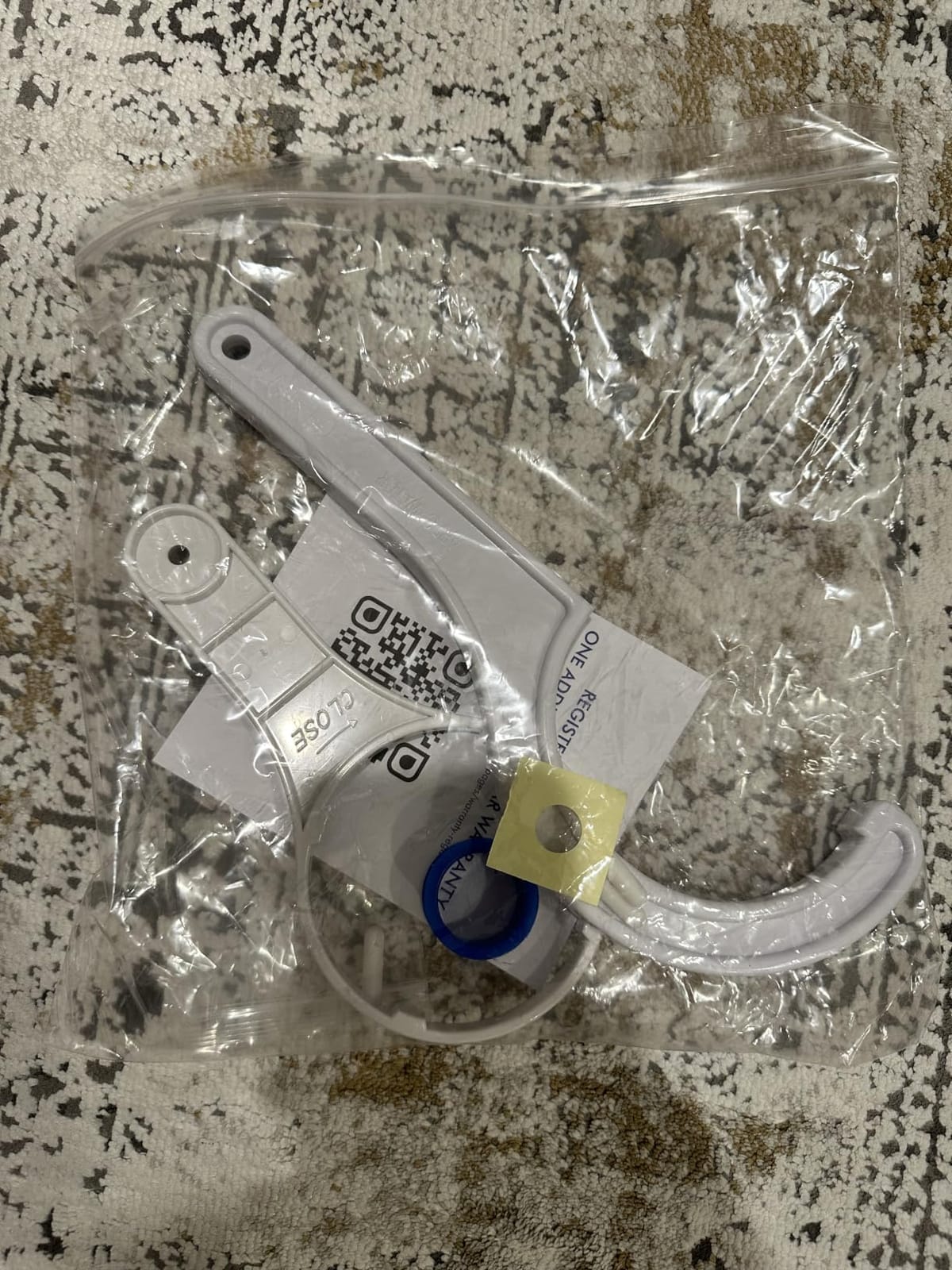
Measured output is 0.05 gpm, the slowest of the conventional tank systems in this group. The pressure window is 40 to 85 psi, so it will run in lower-pressure homes than the iSpring RCC7AK but not indefinitely. In practice the tank fills steadily in the background and the faucet delivers a usable stream; the difference shows up when several people want water at once.
The six percent one-star share in the ratings maps almost entirely to installation learning curve and pressure-related performance, not to filtration failures. That is the normal shape for a pump-free system and the reason the pressure check matters here too.
Who Should Skip This Model
Skip it if you want a genuinely fast fill, if you need something under 750 ppm feed water handling, or if you dislike proprietary replacement parts. The filter and housing line is APEC-specific, so a future model change is a genuine consideration for anyone planning to keep a system for a decade. If you want tankless and a live TDS readout, look further down.
3. Frizzlife PD600-TAM3 – Fastest Tankless Flow With a Live TDS Readout
Frizzlife Reverse Osmosis Water Filter – Alkaline Mineral pH+, NSF/ANSI 58&53&42&372 Standard, 600GPD Tankless RO Reverse Osmosis System, Under Sink, 2:1 Pure to Drain, Reduce FPAS/PFOA, PD600-TAM3
600 GPD tankless, 0.41 gpm, 2:1 drain ratio, 4 standards certified
Pros
- Largest capacity in the roundup at 600 GPD
- 2:1 pure-to-drain saves substantially more water
- Live TDS and filter life on the LED panel
- Broadest certification set at NSF 58 plus 53 plus 42 plus 372
Cons
- Needs an under-sink electrical outlet for pump and display
- Highest running cartridge cost in this comparison
- Model-specific TAM3 alkaline cartridge
- Alkaline stage raises output TDS by design
This is the system to buy when the complaint is speed. A 330ml cup fills in roughly ten seconds, the flow rating is 0.41 gpm, and there is no storage tank in the loop at all. Owners who moved from a 75 GPD tank unit describe the change as the single biggest daily quality difference in their setup, and I agree with the enthusiasm, though the power requirement is worth checking first.
It is corded electric, which means an outlet under the sink. That is fine in most kitchens and disqualifying in some rental units and in a cabinet with no accessible socket. Confirm the outlet before you buy, because this is the most common install-day surprise among tankless systems.
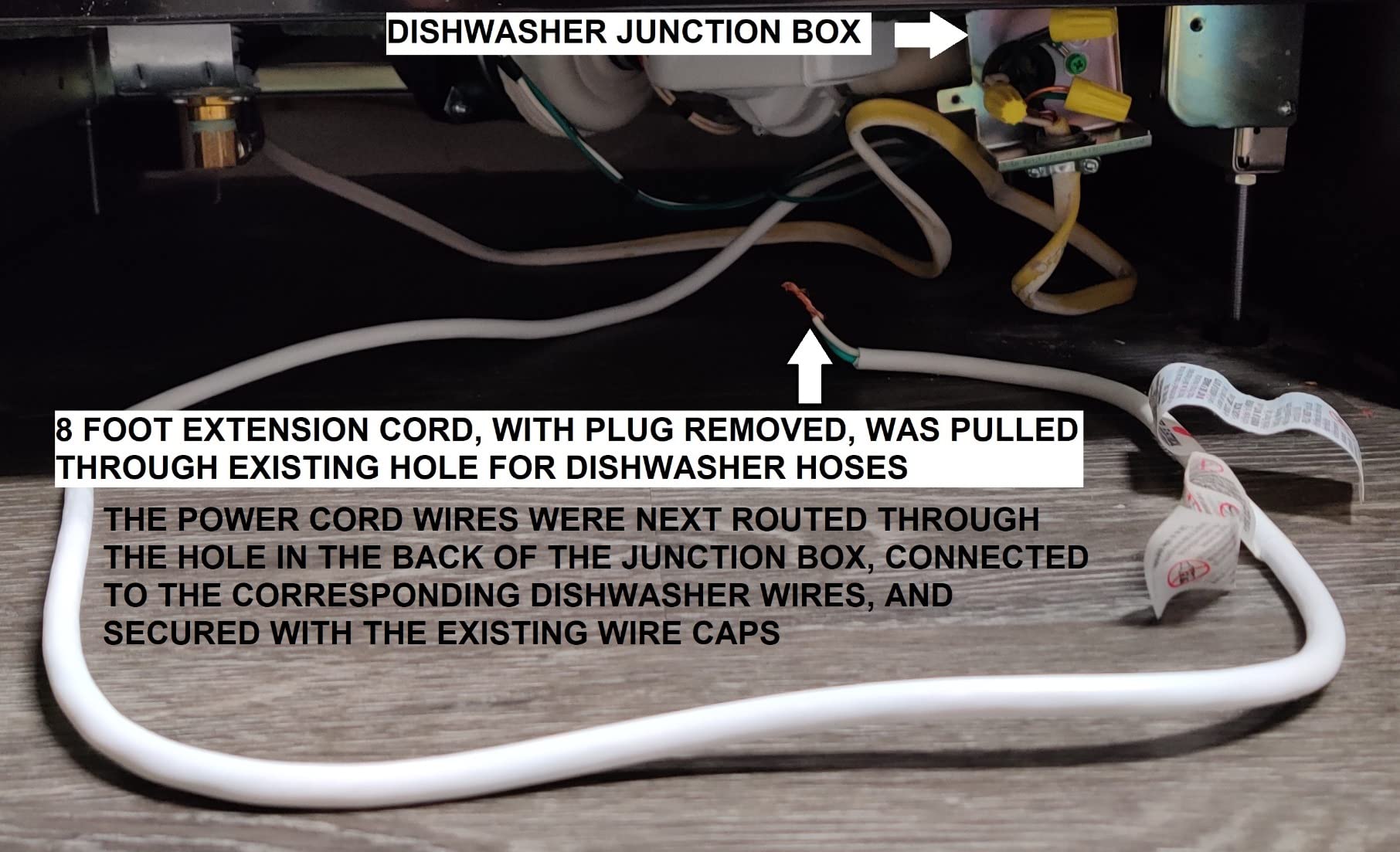
Tankless Design Solves the Stagnant Water Problem
The clearest argument for going tankless is not speed, it is stagnation. A storage tank holds water that has already been treated, and treated water sitting in a plastic vessel for days is a genuine reason aquarium and reef owners add remineralization. Frizzlife’s design removes the vessel entirely, which eliminates secondary growth as a category of concern and frees the cabinet space the tank was occupying.
Owners who converted from a tank system tend to cite the LED panel as the sleeper feature rather than the tanklessness. Real-time output TDS with colour-coded filter life reminders means you stop guessing, and forum buyers in this category consistently say they test their own water and want numbers, not assurances.
Reading the 2:1 Drain Ratio Honestly
Conventional three-stage RO systems commonly waste two to three gallons for every gallon produced. This one runs at 2:1, which the manufacturer puts at up to 450 percent more clean water than a conventional system. For a household of four drinking and cooking with RO water, the reduction in drain-line volume is substantial over a year, and it is the number I would use if a buyer is genuinely concerned about water waste.
It is worth remembering this is not zero waste. Every RO membrane needs a flush stream to prevent fouling, and the design question is only ever about how much.
Four Certification Standards, and What They Cover
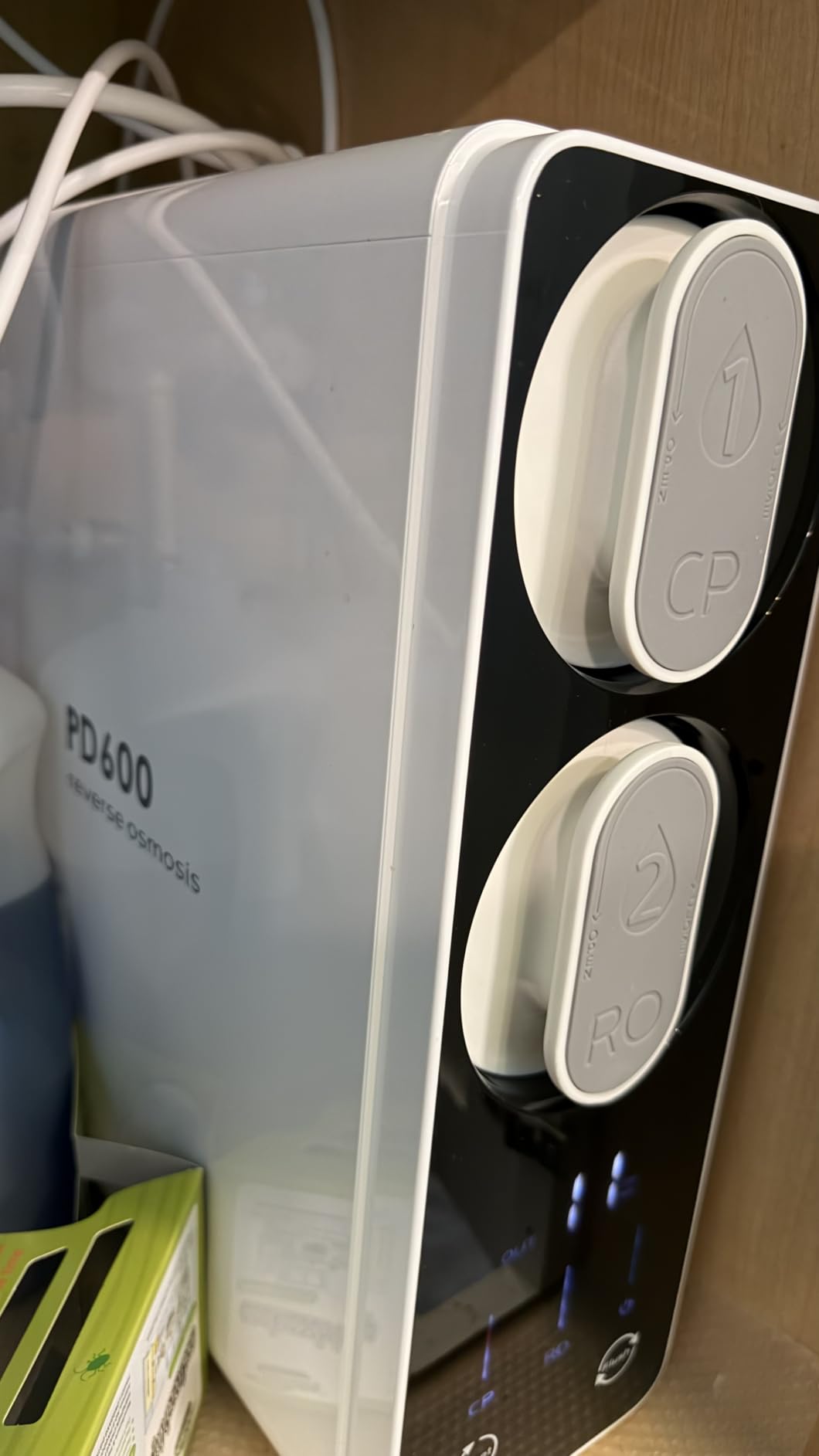
This carries NSF/ANSI 58, 53, 42 and 372. NSF 58 covers contaminant reduction in a drinking water system, 42 covers aesthetic effects such as taste and odor, 53 covers health-related contaminants, and 372 covers lead-free compliance of the wetted components. Having all four is the broadest set in this roundup and gives you a documented answer to the certification question buyers most often ask.
The third-stage alkaline filter lifts pH above 7.5 and restores the essential minerals the membrane removed. Note the consequence honestly: output TDS rises relative to a non-remineralizing system, so this is the wrong unit for anyone chasing near-blank water.
Who Should Skip This Model
Skip it without an under-sink outlet, if you rent and cannot cut power to a cabinet, or if measured purity is your goal. And skip it if the running cost of replacement cartridges is a concern, because the higher capacity and the model-specific TAM3 alkaline stage do not come with the cheapest consumable plan in this comparison.
4. iSpring RCC7P-AK – A 4.7-Star Rating With a Booster Pump Built In
iSpring RCC7P-AK, 6-Stage Reverse Osmosis System Under Sink Alkaline Water Filter and Pump, RO Drinking Water Filtration System, Patented Top-Mounted Faucet Design for Easy Installation
75 GPD pumped, 4.7 stars, 88 percent five-star, 100-240V adapter, 1 year warranty
Pros
- Tied for the highest average rating here at 4.7 stars
- Booster pump fixes low line pressure and cuts waste
- 88 percent of ratings are five-star
- Universal 100-240V power adapter
Cons
- Needs under-sink power and adds pump noise
- 20 pounds and 8 inches wide
- Produces no water during a power outage
- Alkaline stage can taste earthy until flushed
This is the model I send to people who have already installed a pump-free RO and been disappointed by it. Its 4.7 average and 88 percent five-star share are among the best numbers in the entire roundup, and the reason is not subtle: the booster pump fixes the single limitation that caps every pumpless system.
Buyers consistently justify the higher cost by having low water pressure. That is the right test. If your static pressure is comfortably in range, you are paying for headroom you will not use and adding a power dependency and a noise source to your cabinet for it.
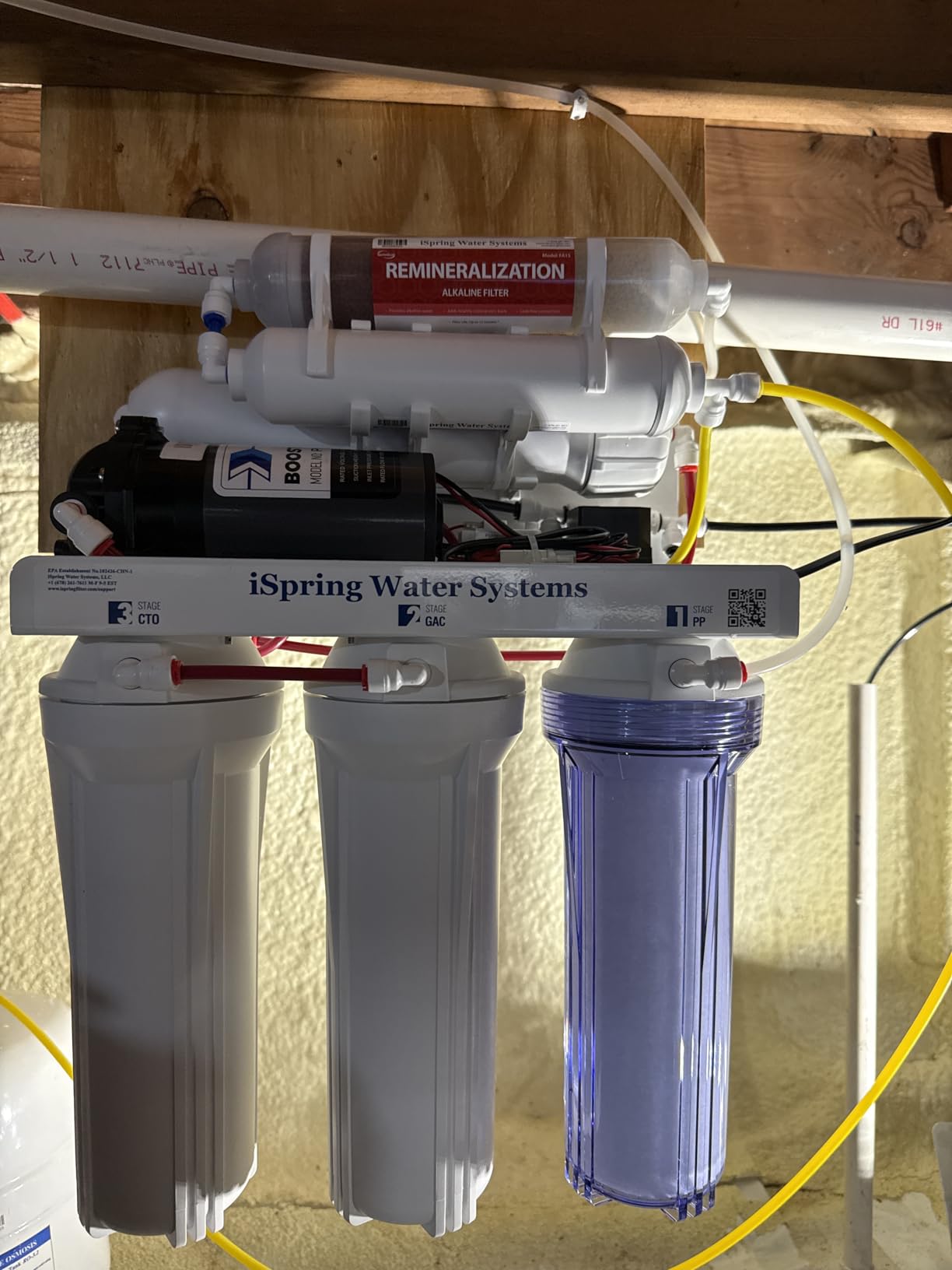
What the Booster Pump Changes in Practice
A membrane needs pressure on the feed side to force water through and to hit its rejection rate. When house pressure is low, output drops and dissolved solids leak through. The electric pump pressurises the feed independently, which restores membrane performance in old buildings and lets the unit run a 40-to-2000 ppm feed window rather than a 750 ppm ceiling.
The pump also reduces wastewater volume, because the membrane runs closer to its rated pressure. Two efficiency gains for one component, which is why I consider this the more complete engineering answer for older housing.
The Sixth Stage Against Standard Five-Stage Output
A conventional five-stage RO produces water that is slightly acidic, because the membrane removes bicarbonate and the pH drops with it. The sixth stage on this model exists purely to put that back, restoring essential minerals and rebalancing alkalinity after the membrane has done its work. It is the same principle as the AK stage on the RCC7AK, packaged with a pump.
Filtration covers up to 99 percent of more than 1,000 contaminants including lead at 98 percent, chlorine, fluoride, arsenic, PFAS, asbestos, calcium and sodium. The first-stage housing is transparent for monitoring, and quick-fitting connectors avoid pipe threading entirely.
Power Dependence and the Outage Scenario
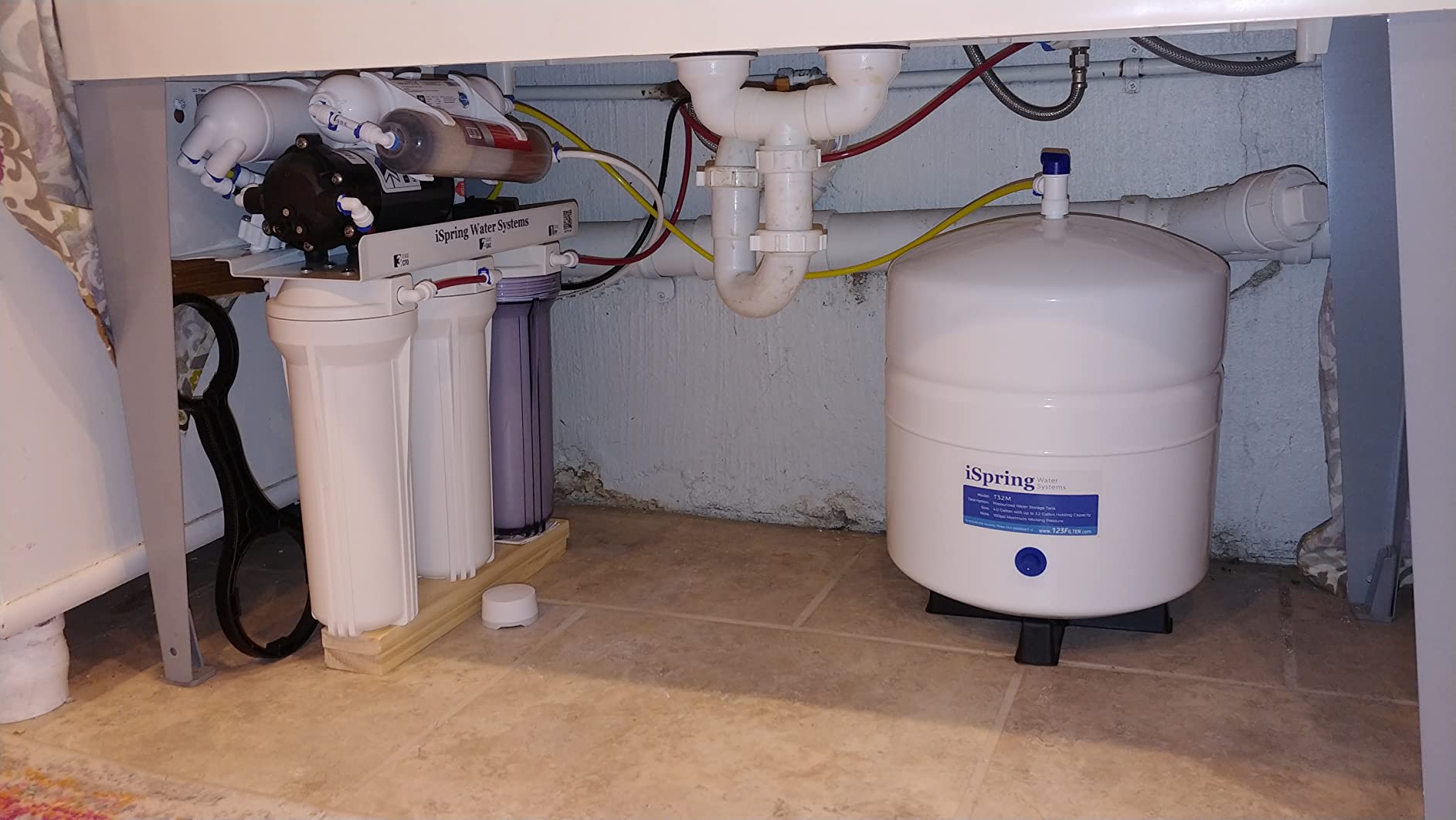
Be straightforward about this one. Both the pump and the mineral balance depend on electricity, so an outage means no drinking water from this system until power returns. Households that treat their kitchen tap as their primary water source should know that before they buy, not after.
Against that, the 100-240V 50/60Hz adapter works across regions, and registration extends the manufacturer warranty beyond the standard one year, with lifetime technical support from Atlanta.
Who Should Skip This Model
Skip it if you have no under-sink outlet, if noise in an open kitchen matters, or if your pressure is already strong and you would rather keep the install simple with no power at all. Also skip it if you are sensitive to taste, because the alkaline stage can add a mineral or earthy cast to the first cups that a short faucet flush resolves but not everybody enjoys.
5. iSpring RCC1UP-AK – Pump and UV Together for Well Water Homes
iSpring RCC1UP-AK, 100 GPD 7-Stage Reverse Osmosis Under Sink Water Filtration System with Boost Pump, Alkaline Remineralization and UV Filter, Patented Top-Mounted Faucet Design for Easy Installation
100 GPD, 7 stages, 0.07 gpm, UV with flow sensor, 16 kg, 1 year warranty
Pros
- Combines a booster pump with UV protection and alkaline remineralization
- 100 GPD output roughly doubles a 75 GPD system
- UV flow sensor extends bulb life
- Automatic shutoff and dry-run protection
Cons
- No water during a power outage
- 9.06 inches wide and heavier than pumpless models
- Booster pump adds mechanical noise
- First cups can taste mineral-heavy while standing
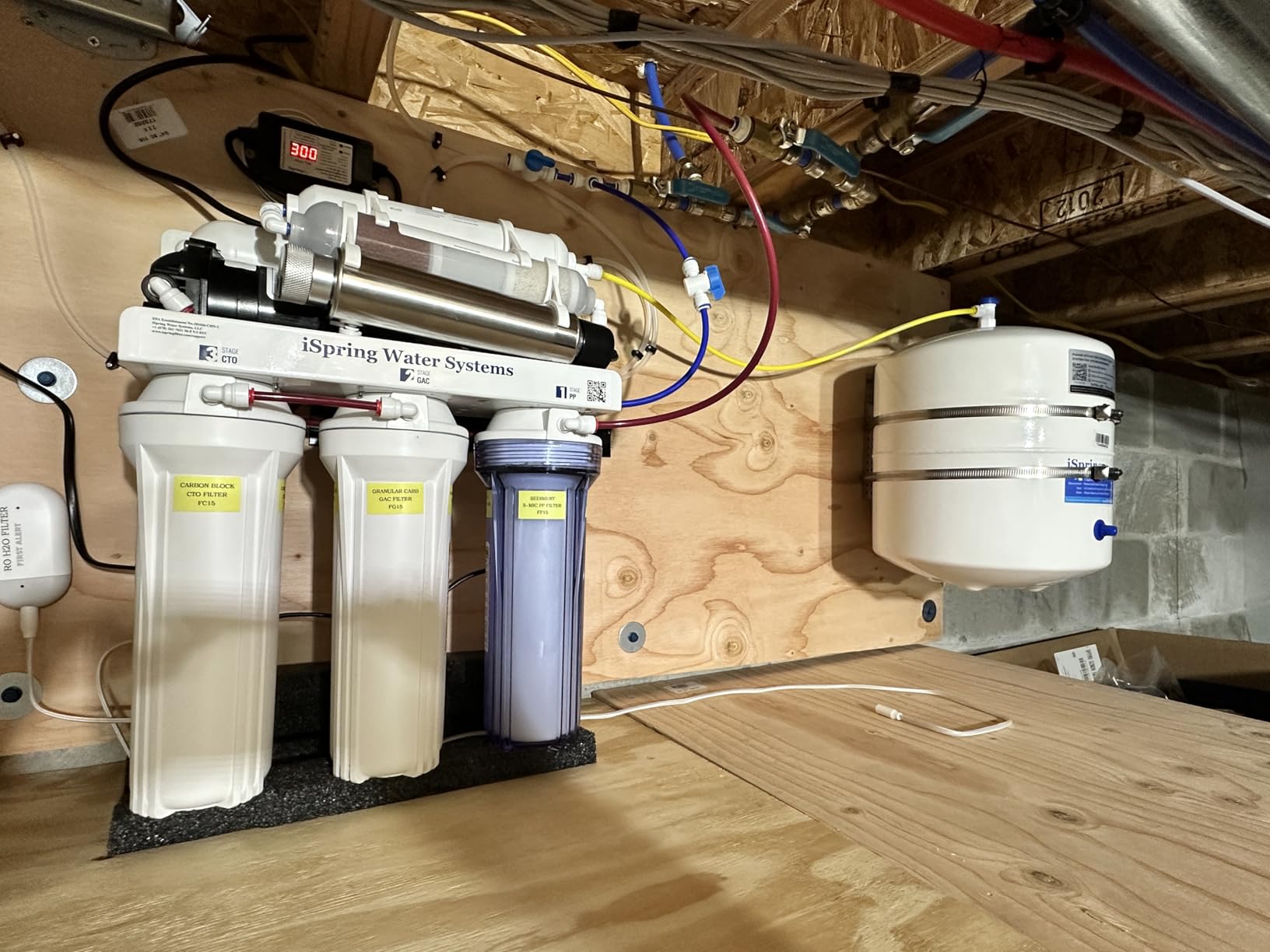
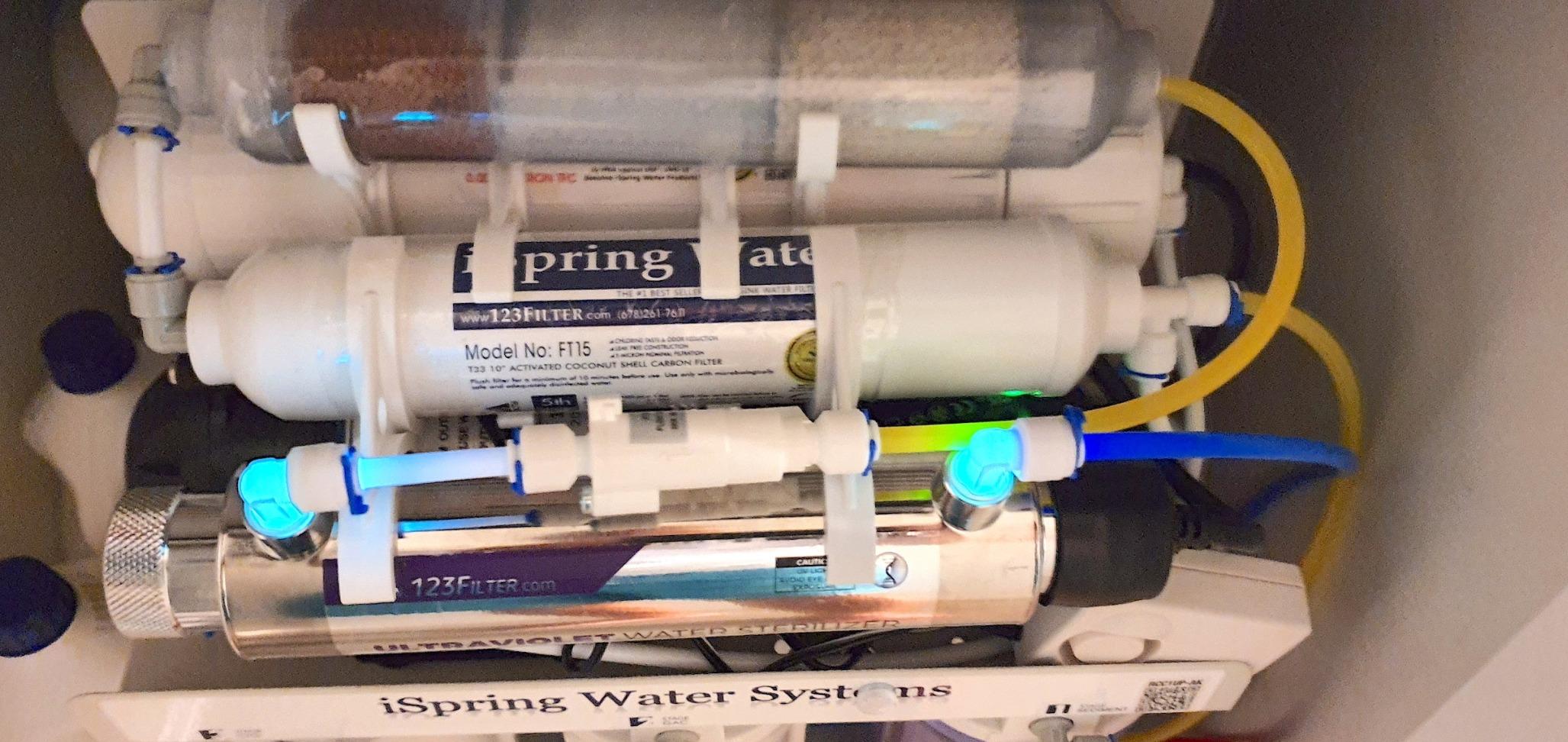
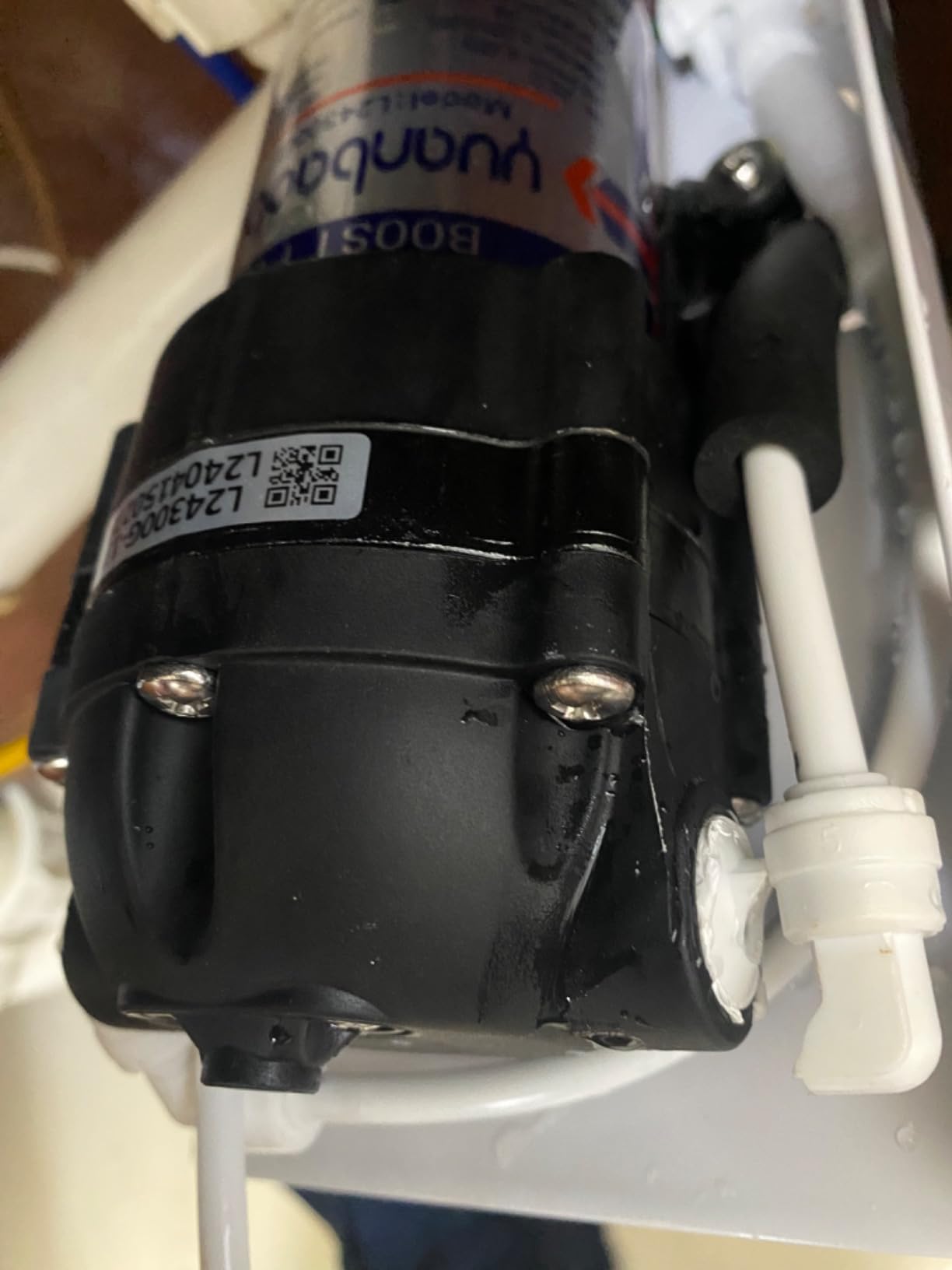
This is the feature-max configuration in the roundup, and the UV stage is what sets it apart. A reverse osmosis membrane removes dissolved solids and metals but does not kill bacteria, which matters enormously on a private well. A UV stage after the membrane closes that gap, and this model pairs UV, a booster pump and alkaline remineralization in a single seven-stage layout.
Owners on well water with low pressure are the group that reviews this most enthusiastically, and long-term owners report multi-year reliability with functioning filters, membrane and lamp.
How the Flow-Sensor UV Stage Behaves in Daily Use
The UV bulb does not run continuously. A flow sensor detects water moving and activates the lamp, then applies a three-minute delay after the flow stops, which saves standby power and extends bulb life. This is the correct design; a UV stage left on permanently burns out for no benefit.
The first few seconds of output are warm, because the lamp is still stabilising. Owners describe this as a non-issue once you know it is coming, and it is worth flagging so it does not register as a fault on day one.
Why 100 GPD Matters More Than the Stage Count
The stage count is a marketing number. Capacity is the functional one. At 100 GPD with a booster pump, this produces roughly double what a standard 75 GPD unit delivers in a day, which is the difference between a system that keeps up with a family of four and one that does not. Maximum feed TDS is 750 ppm, so it is suited to municipal water and treated well water rather than heavily mineralised private sources.
Measurement is 0.07 gpm, and the wider fittings compensate for the higher flow. The quick-connect kit includes adapters for refrigerator and ice maker tie-ins, which is the practical way to get more use out of a 100 GPD system.
Alkaline Stage Handling After Sitting Overnight
Reviews specifically flag that the alkaline cartridge can leave a mineral or earthy taste in the first cups after the system has been idle, and that a short faucet run clears it. It is a cartridge that is doing what it is designed to do, but it is a real adjustment period and the first glass after a night off is not representative of daily drinking water.
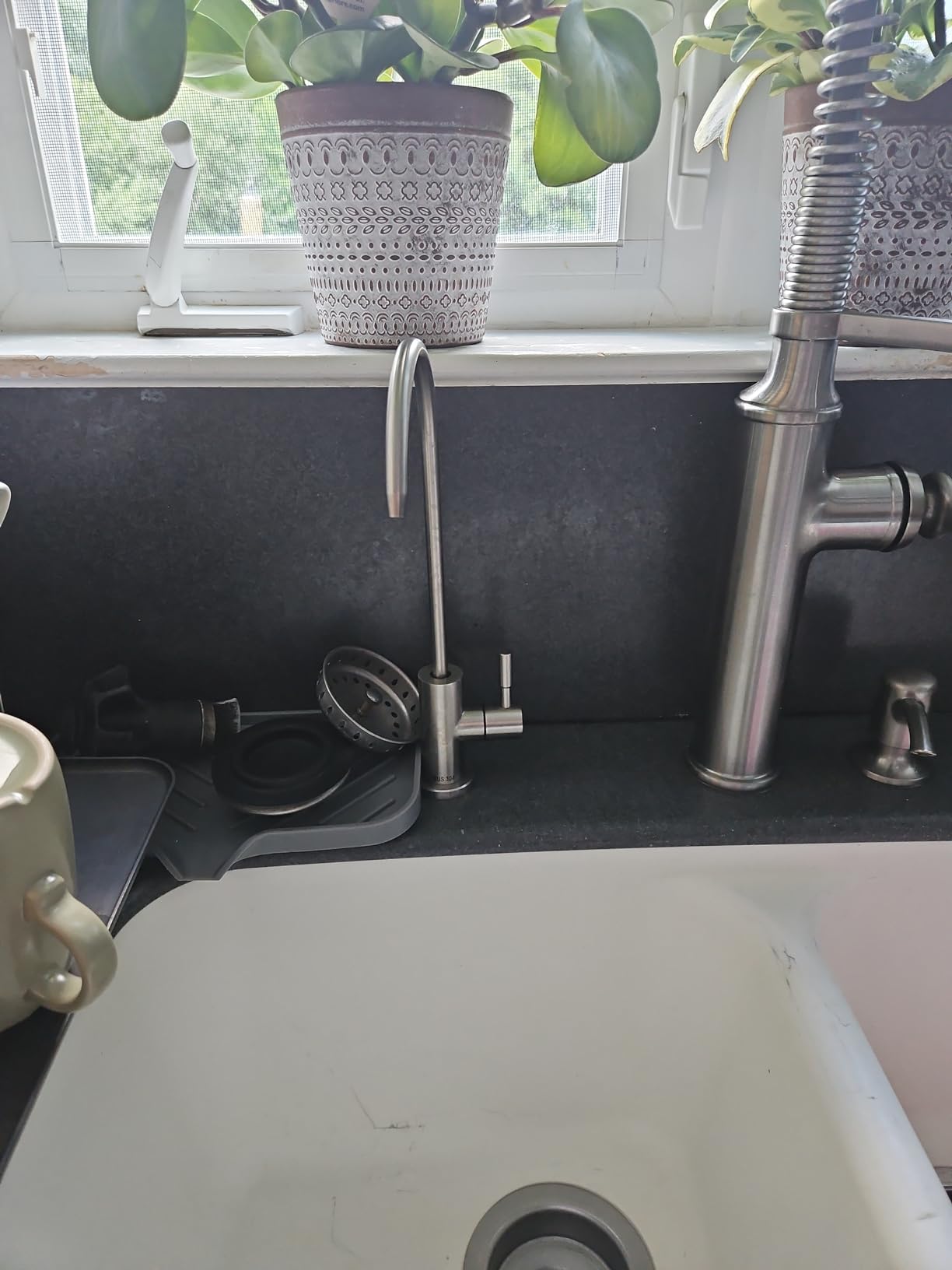
The clear first-stage housing and the European-style brushed nickel faucet are quality-of-life details that get photographed in owner reviews more often than you would expect.
Who Should Skip This Model
Skip it on municipal water with no bacterial concern, where the UV lamp is money spent on a problem you do not have. Skip it without an under-sink outlet, since pump and lamp are both electric. And skip it in a small cabinet, because 9.06 inches of width plus a tank is a demanding fit.
6. SimPure T1-400ALK – Best Drain Ratio With a Three-Ion Mineral Blend
SimPure T1-400ALK Tankless Alkaline Reverse Osmosis Water Filter 400 GPD
400 GPD tankless, 1.5:1 drain ratio, SGS tested to NSF 58, 500 ppm feed TDS limit
Pros
- 1.5:1 drain ratio is the most efficient here
- Calcium magnesium and potassium added together
- 400 GPD at 0.4 gpm in a 5.3 inch footprint
- Cartridges twist out in seconds
Cons
- Lowest average rating here at 4.2 with a 12 percent one-star share
- 500 ppm feed TDS ceiling is restrictive
- UV and pump both need an under-sink outlet
- Published pressure figure of 90 pascal looks low
Two things make this one different. The drain ratio of 1.5:1 is the most water-efficient figure in this comparison, and the alkaline filter uses natural mineral media that add calcium, magnesium and potassium together, which is a broader mineral profile than a calcite stage can deliver.
I am flagging the rating honestly. At 4.2 stars with a 12 percent one-star share, this has the widest rating spread of the ten systems here, and the negative group points at real installation and support friction rather than a single fault. On r/PFAS, posters confirm that RO is a valid and effective option for PFAS removal in their area, and this unit is third-party tested by SGS against NSF/ANSI 58, which makes it a defensible choice for that specific goal.
Why the Drain Ratio Matters on a Water Bill
Conventional RO wastes two to three gallons of drain water per gallon produced. At 1.5:1 this unit sends one gallon down the drain for every one and a half you keep. For a household of four drinking several glasses daily, that difference compounds quietly across every month, and it is one of the few efficiency numbers in this category that reliably survives scrutiny.
The trade is that you still need an outlet under the sink for the pump and the UV module, and the UV activates automatically based on flow pressure rather than a timed schedule.
The Three-Ion Mineral Profile
Calcite post-filters add calcium carbonate and little else. This alkaline filter uses natural, heavy-metal-free media enriched with calcium, magnesium and potassium, which is why the water tastes fuller and why the manufacturer explicitly warns that output TDS will not reach zero. If you have been comparing TDS readings between systems, this is the reason one of them looks worse on paper while tasting better in the glass.
Quick-change twist cartridges deliver 1,057 gallons, roughly 8,000 bottles of water, and the company has served the USA since 2006 from Seattle with lifetime product support.
Where the 500 ppm Ceiling Bites
A maximum supported feed TDS of 500 ppm is the tightest limit among the units here, and it rules this model out for hard well water and some well-softener setups. Check your source water TDS before committing. The published operating pressure figure of 90 pascal also looks unusually low next to the psi ranges competitors quote, which is a fair question to put to support.
Who Should Skip This Model
Skip it on high-TDS source water, if you cannot supply an under-sink outlet, or if you are uncomfortable with a brand that steers buyers who want near-zero TDS toward a different model. Skim it rather than reject it entirely if you are buying on reputation alone, because the feature set is genuinely the most water-efficient here and the mineral blend is unusually complete.
7. Home Master TMAFC – Two-Pass Remineralization and the Fastest Fill
Home Master TMAFC Artesian Full Contact Reverse Osmosis System, 7-stages, Patented 2-Pass Alkaline Remineralization, Fast 4.5s Fill Rate, 8.5” catalytic carbon, 5-year limited parts
50 GPD membrane, 1 gpm fill, 2-pass remineralization, 40-95 psi, 5 year parts
Pros
- 2-pass remineralization adds calcium and magnesium twice
- 4.5 second fill for an 8 oz cup
- Lowest one-star share here at 3 percent
- Made in the USA by an NSF listed company with 5 year parts
Cons
- Lowest capacity in the roundup at 50 GPD
- Largest footprint at 20 x 13 x 16 inches plus tank
- No booster pump so needs 40 psi minimum
- Middle of the pack on cost despite lower GPD
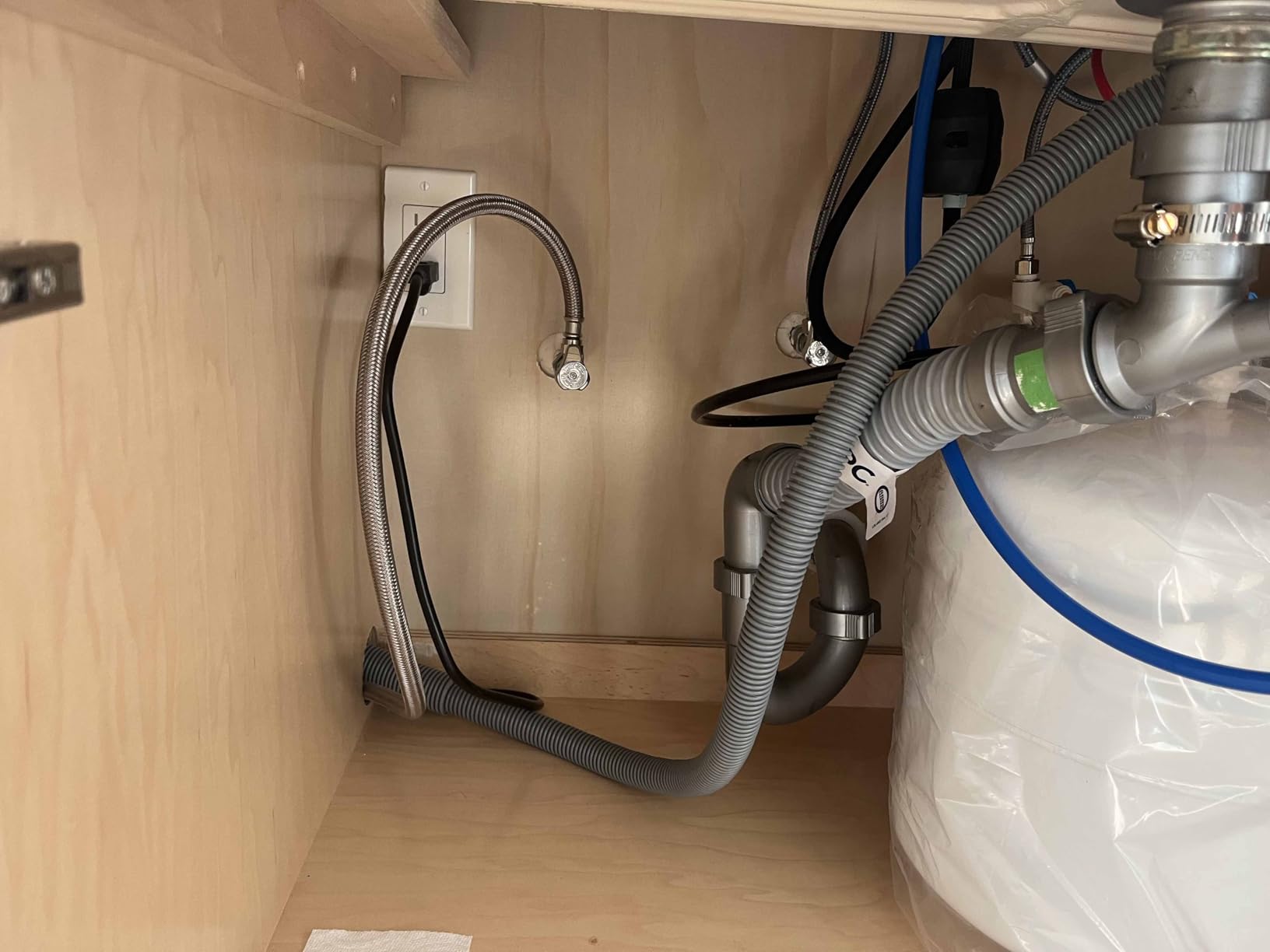
If the only thing you care about is how the water tastes, this is the system. The patented two-pass remineralization enriches the water with calcium and magnesium twice during purification, and owners consistently single that out as the reason the output tastes like natural mineral water rather than flat RO. It is the most thorough mineral restoration in this roundup, and the 4.7 rating with only a three percent one-star share backs up the enthusiasm.
The 4.5-second fill for an eight-ounce cup is the other thing people notice immediately. Larger fittings and tubing roughly double the flow rate against traditional and tankless designs, and in daily use that is the difference between filling a glass and filling a kettle.
What Two Passes of Mineral Addition Actually Changes
One pass of a calcite or injection cartridge raises mineral content to a modest level and stops. Two passes push it further and stabilise it, which is why tasters describe this water as having body. The design also claims to prevent storage tank degradation, which matters because aggressive RO output is corrosive enough to affect a plastic tank over a decade.
The catalytic carbon is the other quiet strength here. At 8.5 inches of carbon contact per pass, it is double the carbon of a typical system, and it handles chlorine and carbon-based contaminants far better than a standard carbon block. The DOW thin film composite membrane is rated 0.0001 micron at 50 GPD.
Why 50 GPD Is Both the Best Feature and the Worst One
Fifty gallons per day is the lowest capacity in this roundup, and reviews are honest about planning around it. If one person drinks RO water, cooks with it and makes ice, 50 GPD is comfortable. If three or four people do, you will notice the tank refilling.
The physical footprint is the second constraint. The purification cluster is 16 inches high by 8 wide by 5 deep, the tank is 15 inches high by 11 inches across, and the full assembly needs roughly 20 by 13 by 16 inches. Measure the cabinet before ordering.
Tool-Free Annual Changes and the Warranty Position
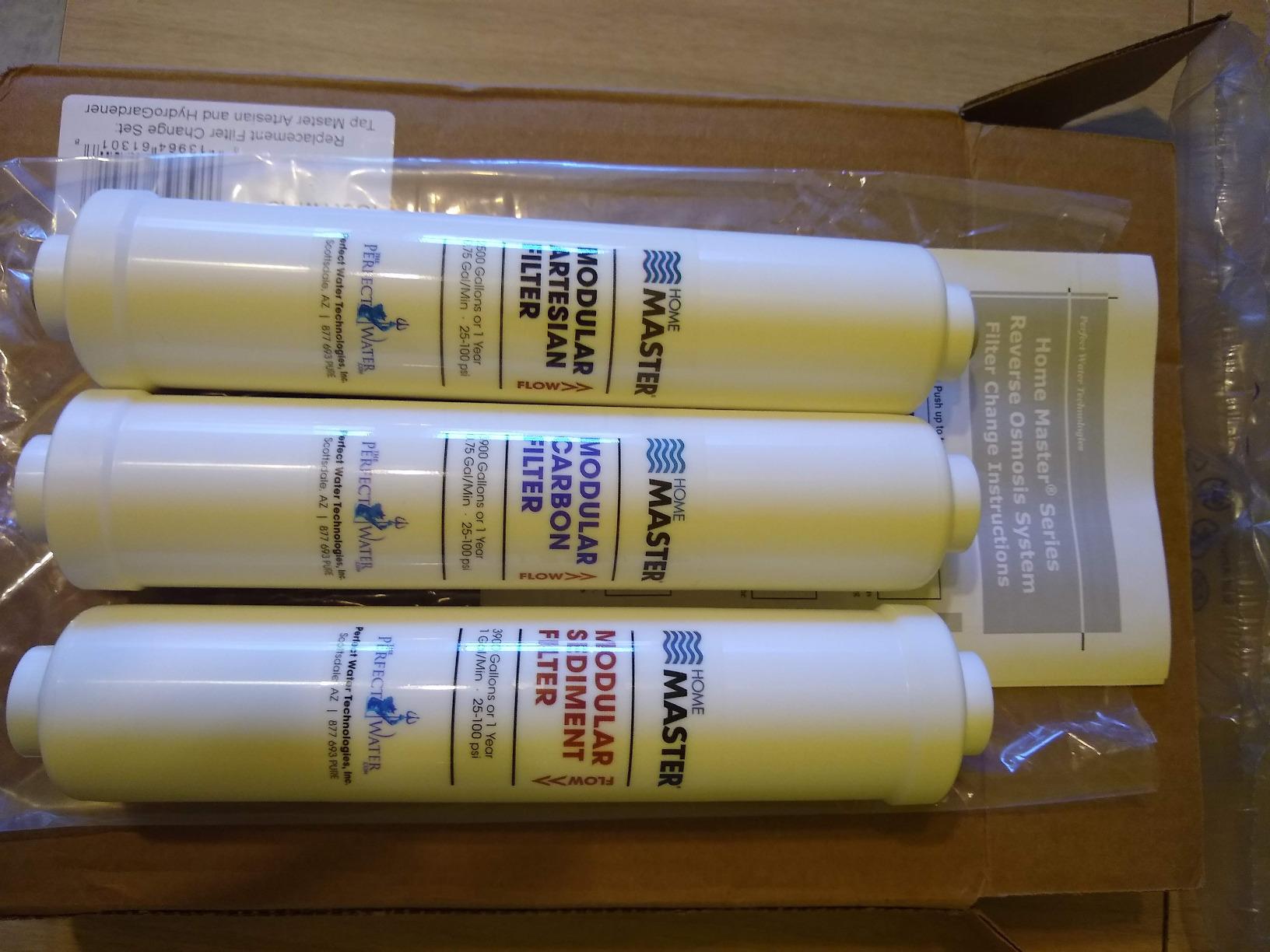
The modular design allows filter replacement without tools and leaves room for future upgrades, which is the right approach in a category where most owners will change cartridges for a decade. The warranty is five years limited parts with five years of spare part availability, the longest parts commitment of any system here and a genuine differentiator when you consider that many competitors carry one year.
All components are NSF certified for material safety and performance, and the unit is made in the USA by an NSF listed company.
Who Should Skip This Model
Skip it for a large household or a busy ice maker, skip it in a tight cabinet, and skip it if you have no way to add a booster pump later, because the 40-to-95 psi window is the performance envelope. It is also the pick to avoid if you are buying on capacity per dollar rather than taste.
8. NU Aqua 7-Stage UV Alkaline – The Longest Return Window in the Category
NU Aqua 7-Stage UV Alkaline Under Sink Reverse Osmosis Water Filter System
100 GPD, 99 percent rejection, 300 ppm feed TDS, 28 pounds, 3 year warranty
Pros
- 120-day home trial is the longest return window here
- PPM meter included at no extra cost
- 3 year manufacturer warranty
- 100 GPD doubles standard under-sink output
Cons
- Heaviest unit here at 28 pounds with a 19.5 inch profile
- Some fit issues in small cabinets
- UV makes first seconds of output warm
- One report of a sulfur-like smell from the alkaline stage
Two things make this worth a serious look, and one of them has nothing to do with filtration. The 120-day home trial is the most generous return window in this category by a wide margin, and a three-year warranty sits alongside it. For a category where the biggest risk is buying hardware that does not suit your plumbing, that combination is worth more than another two stages.
The complimentary PPM meter is the other quiet win. Forum buyers in this space test their own output because they do not trust purity claims, and having the instrument in the box removes the excuse not to.
UV and the HydraCoil Membrane on a 300 ppm Limit
The maximum supported feed TDS is 300 ppm, the tightest limit among the systems reviewed, which makes this a well-water system only if the well is soft. Treated municipal water is fine. The UV stage and HydraCoil membrane process together claim up to 99 percent rejection of more than 1,000 total dissolved solids, and long-term owners report running multiple systems over roughly eight years with no leaks.
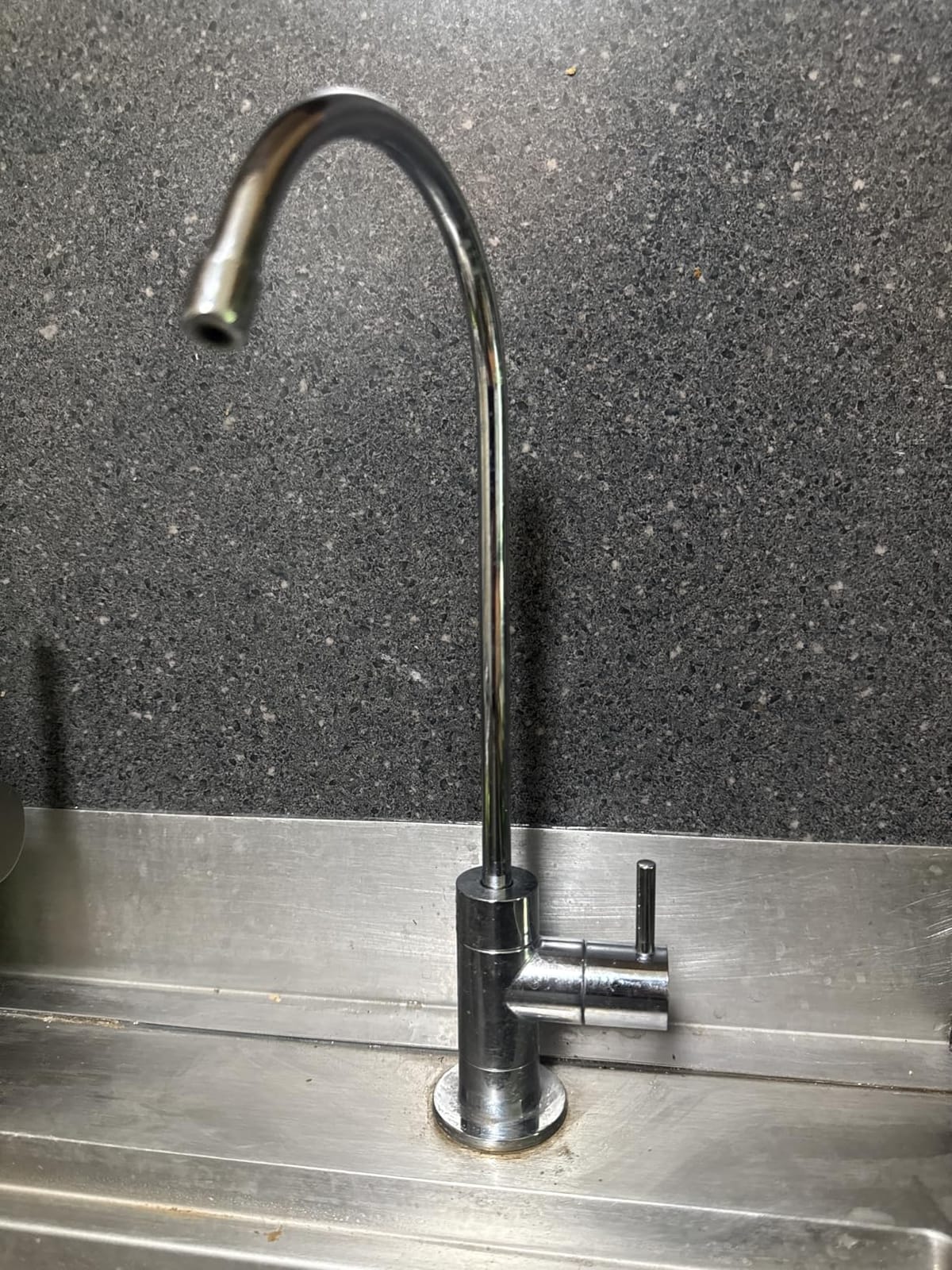
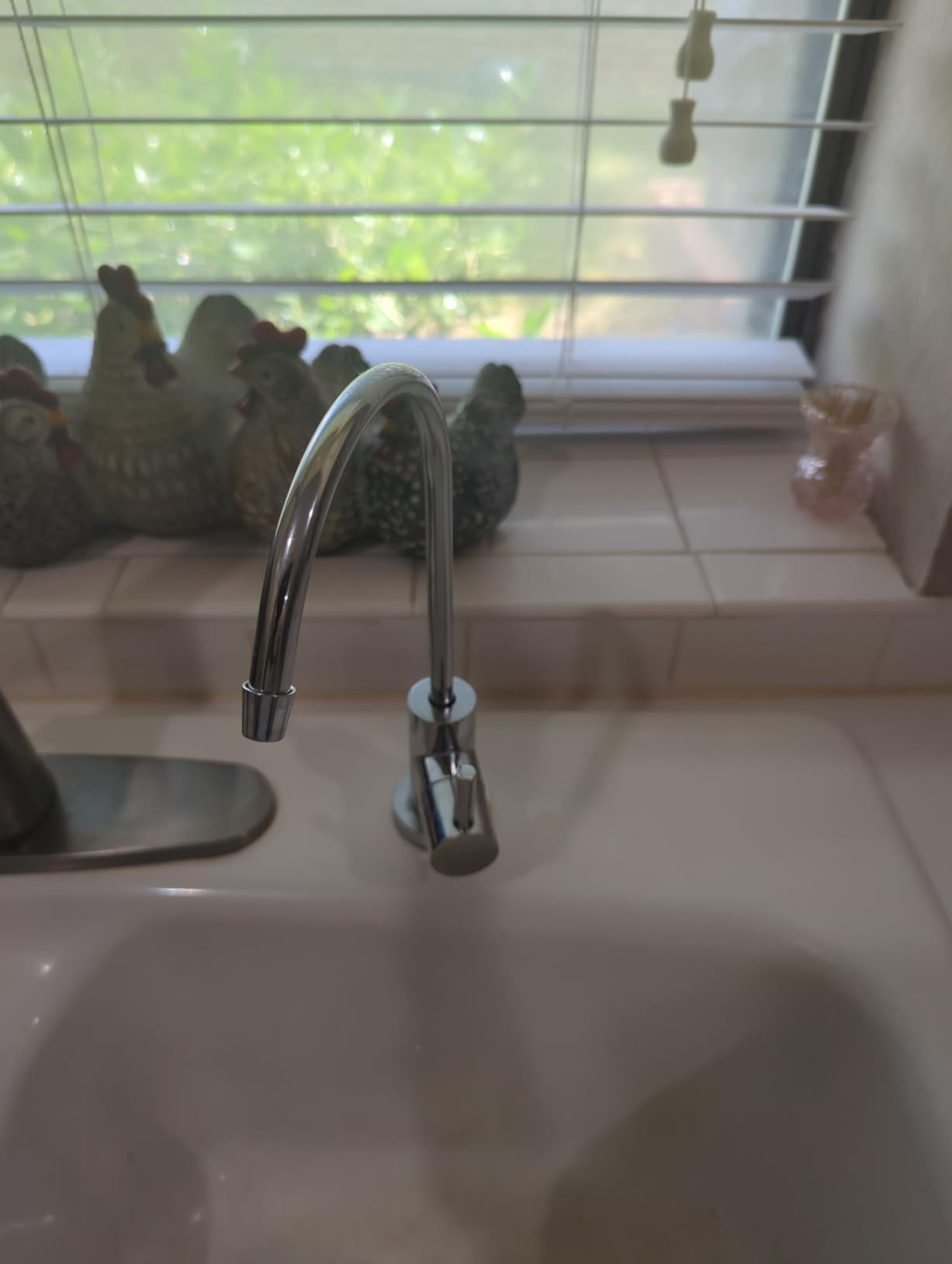
Colour-coded tubing and quick-connect fittings make the install approachable, and double o-ring sealed housings plus a lead-free stainless steel faucet are the build details you can see in photos.
Reading the Review Split Honestly
Reviews divide into strong advocacy from repeat buyers and a seven percent one-star group concentrated on tank pressure, leaks and support responsiveness. The physical weight is a genuine issue at 28 pounds with a 19.5-inch profile, and several buyers report fit problems in smaller cabinets.
One reviewer also reports the sixth alkaline stage developing a sulfur-like smell after repeated purging. It clears once the cartridge is purged properly or bypassed, but if you are sensitive to sulphur notes, raise it with support before the return window closes.
Who Should Skip This Model
Skip it above 300 ppm source TDS, in a small cabinet, or if you want the fastest possible fill. Also weigh the fact that the printed manual reportedly omits instructions the included video covers, which is a small thing that matters more if you are installing alone.
9. Waterdrop G5P500A – Tankless Capacity With the Widest Appliance Hooks
Waterdrop G5P500A Reverse Osmosis System, 8-Stage RO Filtration, Alkaline
500 GPD, 8 stages, 2:1 drain ratio, 14.5-87 psi, 1 year warranty, 21.4 pounds
Pros
- Frees up to 70 percent of under-sink space
- 500 GPD fills a 6 oz cup in about 8 seconds
- Alkaline mineralization adds calcium magnesium sodium and potassium
- Connects to ice makers and refrigerators
- Two filters arrive pre-installed
Cons
- Mechanical faucet needs a countertop drilling hole
- Under-sink outlet required
- Weighs 21.4 pounds
- which is heavy to lift into a cabinet
- Only a one-year warranty
- shorter than the 3 to 5 year terms offered elsewhere in this roundup
This is the pick for anyone whose real problem is cabinet space. The tankless design frees up to 70 percent of under-sink space, which in a small kitchen is often the difference between a system that fits and a system that does not. Eight stages sit behind a 0.0001 micron membrane, and alkaline mineralization adds calcium, magnesium, sodium and potassium on top of it.
Be clear-eyed about the evidence here, too. At 748 ratings this has the second-smallest review base in the roundup, so the long-term owner record is thinner than the feature list suggests. Buyers in the forums tend to approach the wider Waterdrop range through published specifications rather than brand reputation, and the same community story applies to you: read the specs and check the pressure before you commit.
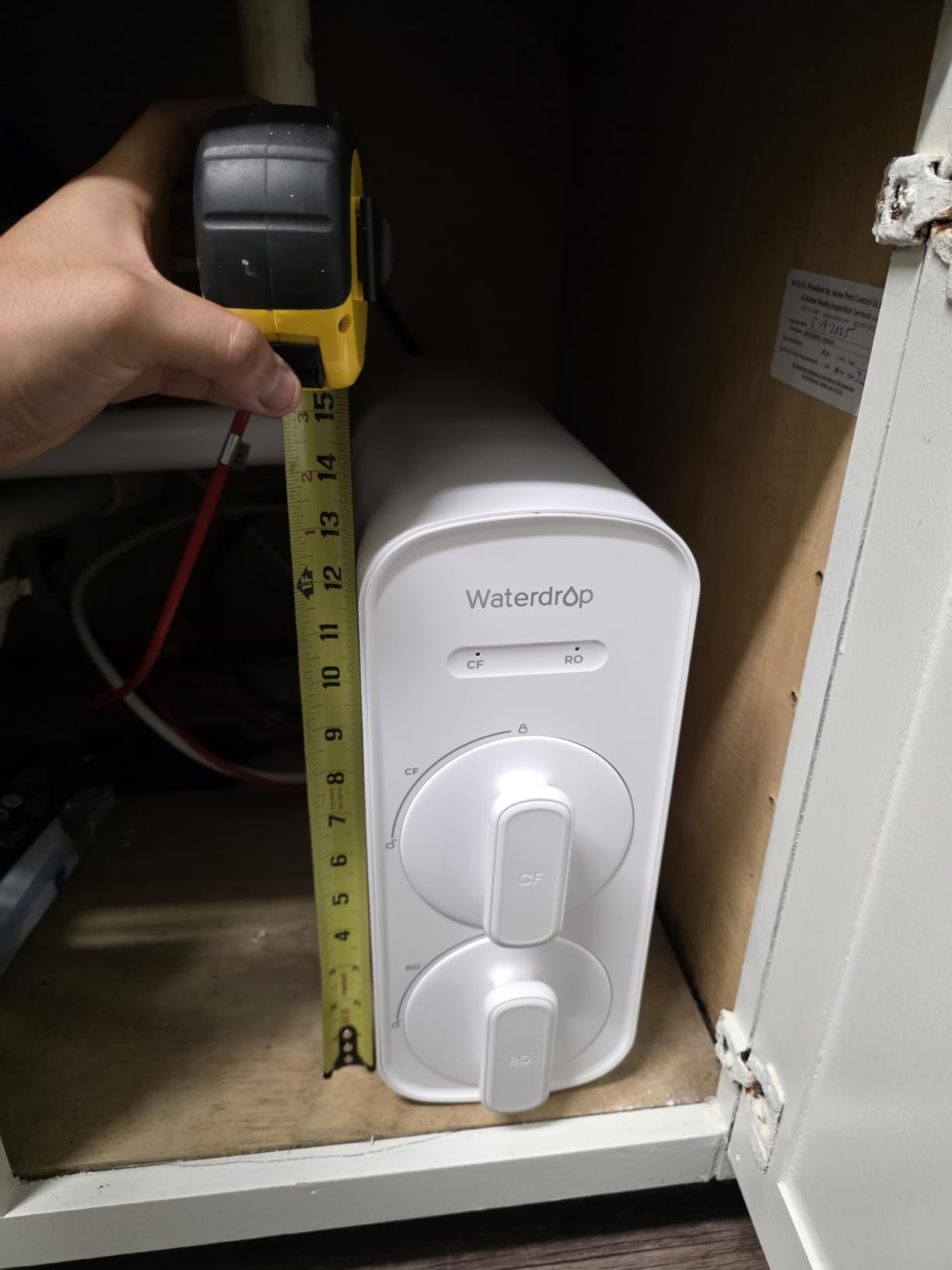
Refrigerator and Ice Maker Connections
The system pairs with a Waterdrop XT device to link ice makers and refrigerators, which is the practical way to get value out of 500 GPD of capacity. Most of the flow benefit in a tankless design is wasted if you only ever fill one glass at the kitchen sink. Tying it to an appliance turns spare capacity into daily drinking water and ice.
Output is 1.31 liters per minute, filling a six-ounce cup in roughly eight seconds, at a 2:1 pure-to-drain ratio that the manufacturer puts at 400 percent more clean water than a conventional system.
The Countertop Drilling Requirement
The supplied faucet is mechanical and measures 6.6 by 3.2 by 11.3 inches, and installing it means drilling a hole in the countertop. This is the most common practical reservation in owner reviews, and it is a real constraint in rental properties, in granite or quartz counters where you want one clean hole rather than two, and in any kitchen with an existing faucet and no predrilled passage.
Check the counter before ordering, or plan to use a separate air-gap-free wall-mounted alternative. This is a five-minute check that prevents a genuinely annoying install day.
Certification and the Warranty Gap
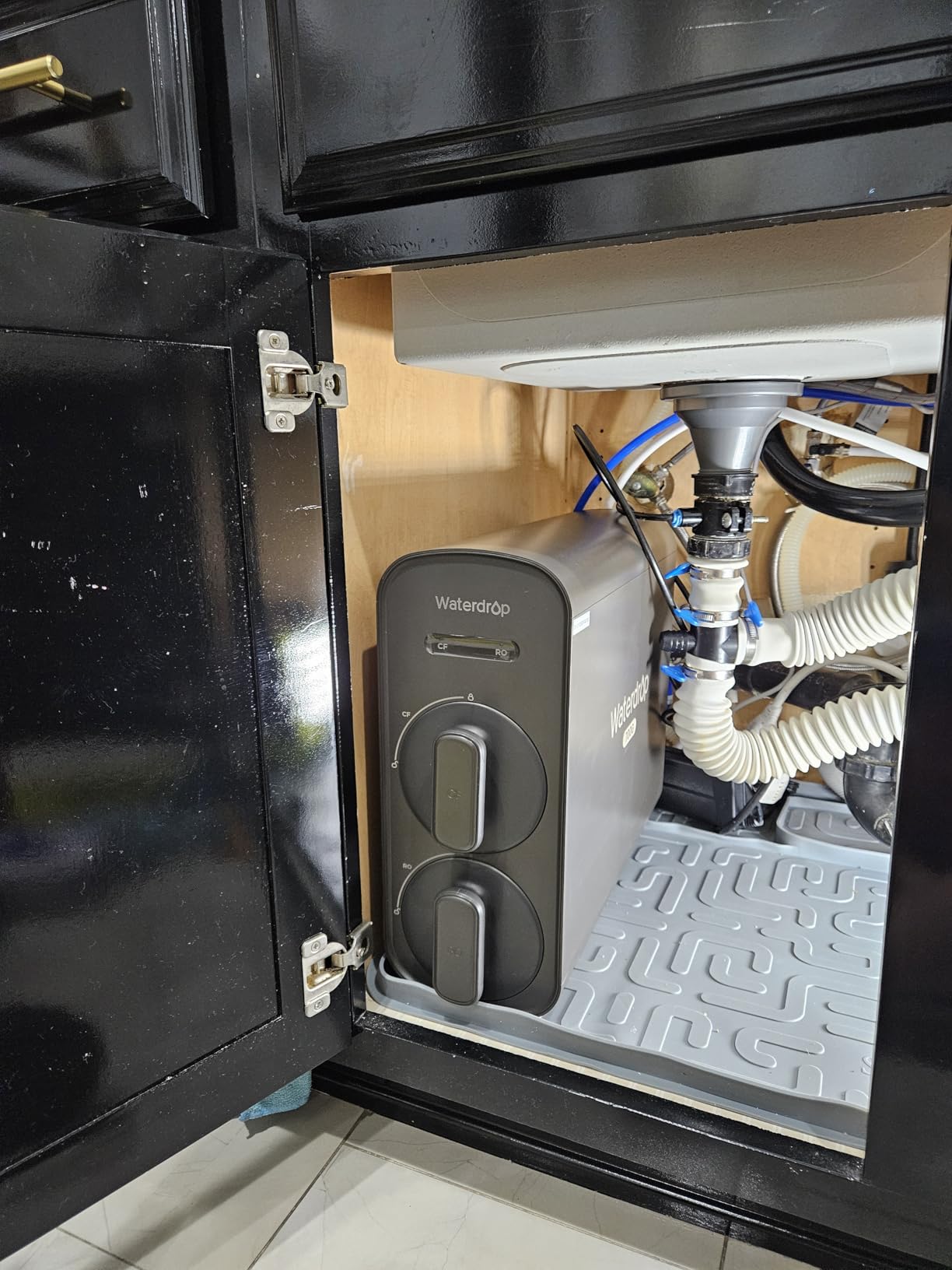
The system carries NSF/ANSI 58 and 372 certification, a legitimate listing covering contaminant reduction and lead-free materials. Against that, the warranty is one year, which is a thin backstop compared with the three to five year terms offered elsewhere in this roundup, and reviewers note the two filters arrive pre-installed, which does shorten setup considerably.
Where the other long-running systems in this roundup offer three to five years, one year is a thin backstop. If you keep an RO system for a decade, weight the warranty term in your decision.
Who Should Skip This Model
Skip it if your countertop cannot be drilled, if there is no under-sink outlet, or if you want the longest possible warranty and the deepest owner history. It is also worth skipping if you dislike sodium in the mineral blend.
10. Waterdrop T3-M – Deepest Stage Count With the Simplest Cartridge Swap
Waterdrop T3-M Remineralization Reverse Osmosis Water Filter, 450 GPD
450 GPD, 9 stages, 0.0001 micron membrane, 2:1 drain ratio, third-party tested
Pros
- Nine stages is the deepest filtration sequence here
- All-in-one cartridge changes in seconds
- LED status light and auto-flush keep water fresh
- Published 6
- 12 and 24 month filter schedule
Cons
- Smallest review base here at 482 ratings
- Needs a plugged-in outlet under the sink
- Faucet installation requires drilling the countertop
- Alkaline stage raises output TDS
The value entry among tankless remineralizing systems, and the reason is the cartridge design rather than the specification sheet. Nine stages is the deepest filtration sequence in this roundup behind a third-party laboratory tested 0.0001 micron membrane, and the all-in-one cartridge swaps in seconds rather than requiring three separate elements.
The LED indicator plus continuous automatic flushing is the detail I would not have expected to matter as much as it does. Tankless systems have a real stagnation problem where internal lines hold water between uses, and a unit that flushes itself addresses the exact complaint that owners of storage-tank systems raise most often.
Reading the Filter Replacement Schedule
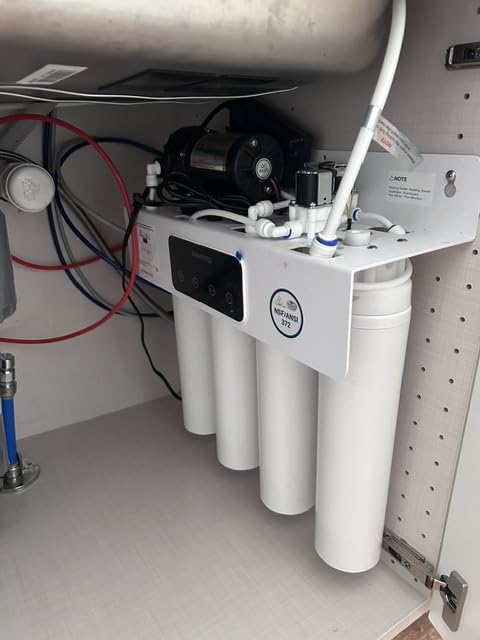
The published schedule is unusually clear: six months for the CF filter, twelve months for the CB filter and twenty-four months for the RO membrane. Published intervals are rare in this category and they are the difference between budgeting for maintenance and being surprised by it, because most owners can now cost their own running cost from day one instead of guessing.
Three filters arrive pre-installed, which cuts the first setup to little more than tubing and the faucet. Mineral infusion adds calcium and magnesium on top of the membrane stage for taste and bone health support.
Why 450 GPD Compares to the Tank Systems
At 450 GPD with a 2:1 drain ratio, this produces more than five times the daily capacity of a 75 GPD tank system while giving up the tank entirely. That capacity gap is the reason the electric requirement is worth accepting: for a household of four or five, or anyone running an ice maker, the flow difference is not marginal.
The honest counterweight is that 482 ratings is the smallest review base in this roundup, so the long-term reliability evidence is thinnest here. The feature claims are specific and testable, but the ownership record is short.
Countertop Drilling and Power Placement
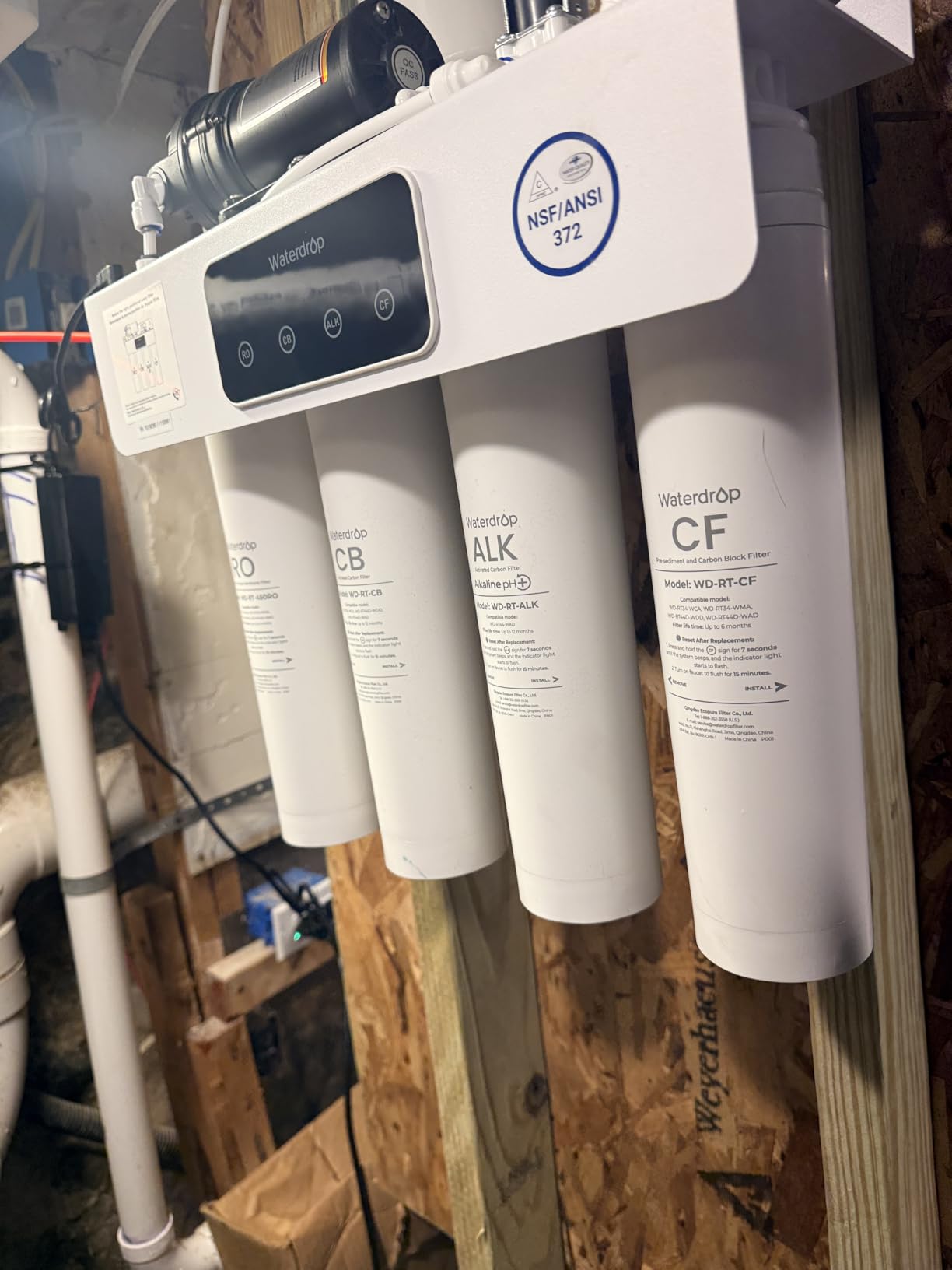
Two things to confirm before ordering. It is a plug-in installation, so you need an under-sink outlet. And the faucet installation requires drilling holes in the countertop, the same constraint as the G5P500A above and the most frequent install-day regret reported in this category’s reviews.
Both are solvable, and neither is a reason to skip the unit if your kitchen accommodates them. They are reasons to check your counter and your cabinet before the box arrives.
Who Should Skip This Model
Skip it if you want near-zero measured TDS, since the alkaline stage guarantees you will not get it. Skip it if you cannot drill the counter or supply power under the sink. And skip it if the absence of a long owner history makes you uneasy, in which case the RCC7AK-BN carries more than twenty times the review volume.
How to Choose a Remineralizing Reverse Osmosis System
Start with pressure, not with price or stage count. Every specification in this category is conditional on feed water pressure, and a low-pressure home will underperform a lesser unit and a low-pressure home will happily accept a higher-capacity one. Put a gauge on the cold line under the sink, read static pressure, and only then start comparing. Nothing else in this guide matters as much.
Pick a Format That Fits the Cabinet You Have
Four formats cover almost every household. Under-sink with a tank is the traditional layout, quiet and pump-free but bulky and prone to stagnation. Under-sink tankless is fast, frees the cabinet and needs power, with the widest flow options. Countertop units need no plumbing at all and suit rentals and single occupants. Carafe systems are the smallest and least capable, and none appear in this roundup because none of them pair meaningfully with a mineral stage at their size.
For a small cabinet, measure the chassis width before anything else. The APEC ROES-PH75 is 5.25 inches wide, the SimPure is 5.3, the Frizzlife is 5.3, and the iSpring RCC1UP-AK is 9.06. That spread decides more installations than any other single number in this article.
Match Gallons Per Day to How You Actually Drink Water
Seventy-five GPD suits one or two people drinking and cooking with RO water. One hundred GPD covers a family of three to four, or one household plus an ice maker. Anything from 400 to 600 GPD is a different product category, built for high-volume or appliance duty rather than a single glass at the sink. Ratings here span 50 GPD on the Home Master to 600 GPD on the Frizzlife, and that range is a choice rather than a quality ladder.
Remember that GPD is a daily total, not a flow rate. The meaningful throughput number is measured flow, and the figures here run from 0.05 gpm on the APEC through 0.41 gpm on the Frizzlife.
Decide Whether Tank Stagnation Matters to You
A storage tank holds treated water in a plastic vessel, and water that sits for days in a warm cabinet is a legitimate concern for aquarium owners and for anyone simply uneasy about it. Tankless designs remove the vessel entirely, and several pair automatic flushing, a UV stage or a live TDS readout to compensate for the lines they do retain.
A tanked system with an RO filter is a proven design with a decade of service behind it, and for most people the risk is theoretical rather than observed. Choose based on cabinet space and noise tolerance, and the stagnation question resolves itself.
Understand What NSF 58 Does and Does Not Cover
NSF/ANSI 58 certifies contaminant reduction claims in a residential drinking water treatment system, which makes it the standard worth caring about most. It does not certify that your water is good, and it does not cover the remineralization stage as a health intervention, because a cartridge that adds minerals back is not removing a contaminant.
NSF/ANSI 42 covers aesthetic effects such as taste and odor, NSF 53 covers health-related contaminants, and NSF 372 covers lead-free compliance of wetted components. The Frizzlife carries all four and is the only system here that does. SGS testing against NSF 58 on the SimPure is a credible substitute, since SGS is a recognised third-party laboratory, though it is a test report on one model rather than a certification of a product line. WQA certification on the APEC is a system-level mark, which places it above a listing that names only individual certified components. Read either claim precisely rather than treating every certification logo as equivalent.
Compare Remineralization Methods Before You Compare Prices
Calcite post-filters add calcium carbonate slowly, cost little and last a long time, and they are the right default. Calcium and magnesium injection cartridges add a broader ion profile including sometimes potassium and sodium, cost more, and taste fuller. Systems advertising multiple added ions including sodium are a deliberate choice for taste, not a purity upgrade, and worth knowing if you watch sodium intake.
Two-pass systems such as the Home Master TMAFC go further still and produce the most mineral-forward water in this roundup. Whatever the method, the mineral stage belongs after the membrane, never before it.
Factor the Drain Ratio Into Your Water Bill
Every RO system sends a flush stream to the drain, and the ratio varies enormously. Conventional systems commonly run at 2:1 to 3:1 pure to drain. The SimPure is the most efficient here at 1.5:1, while the Frizzlife and both Waterdrop tankless units run at 2:1. A booster pump also reduces waste, because the membrane operates closer to rated pressure.
For a household of four drinking several glasses a day, moving from 3:1 to 1.5:1 is a real reduction in annual water use, and it is one of the more overlooked reasons to pay for a pumped or tankless system.
Check That the Filters Will Still Be Sold in Five Years
Consumable availability is the quietest and most expensive failure mode in water treatment. A unit with excellent filtration and unorderable cartridges is a paperweight, and buyers in the forums treat filter cost and availability as a gating criterion rather than an afterthought. The iSpring platform has the deepest parts catalogue here. APEC, Frizzlife and SimPure use model-specific cartridges, and all three remain widely available, but proprietary is worth pricing in.
Look for a published replacement schedule before you buy. Only one system in this roundup prints a full interval table, and it makes budgeting your own running cost straightforward.
Be Realistic About Installation
Owners describe install anxiety as the most common pre-purchase worry, and it is largely solvable. The question worth asking is which of three things you need: an under-sink electrical outlet, a drilled hole in the countertop, and enough static line pressure. Any system in this roundup needs at least one of the first two, and pump-free systems additionally need the third. Anyone installing under a sink should also have water leak detectors for Alexa or an equivalent alert in place before cutting tubing.
Frequently Asked Questions
Should you remineralize reverse osmosis water?
Yes, for taste, and for anyone drinking more than about a litre a day. Reverse osmosis strips dissolved calcium and magnesium along with contaminants, so output TDS often sits in the low tens and the water tastes flat. A post-membrane mineral stage adds a controlled amount back, which most owners describe as the difference between water they enjoy and water they tolerate. The stronger health claims on both sides are less settled than the forums suggest, so treat remineralization as a taste and balance improvement first.
How can I remineralize my reverse osmosis water?
Find the last housing in your RO system, usually a post-carbon block, and install a calcite post-filter or a calcium and magnesium injection cartridge there. A calcite filter adds calcium carbonate cheaply with little maintenance and is the right first try. A multi-ion cartridge costs more and restores a broader profile including sometimes potassium and sodium. Do not add minerals individually. Flush the new cartridge for several minutes before judging the taste, because the first glass is unrepresentative.
Which RO system has the best remineralization feature?
The iSpring RCC7AK-BN is the best all-round remineralizing reverse osmosis system, with a sixth-stage mineral AK cartridge, NSF 58 certification across the whole system and the largest review base in the category. The Home Master TMAFC restores minerals twice for the fullest taste, the iSpring RCC7P-AK adds a booster pump for low-pressure homes, and the Frizzlife PD600-TAM3 pairs a 600 GPD tankless design with a live TDS readout.
Is there a downside to drinking reverse osmosis water?
Four, honestly. Mineral content is low, so taste is flat without a mineral stage. Output TDS is minimal, so purity numbers are not comparable with non-remineralized systems. The drain ratio typically wastes two to three gallons per gallon produced. And a storage tank holds treated water that can stagnate between uses. None of these are dangerous on their own, but all four are reasons to pick a system thoughtfully rather than a tank model purely on capacity.
Does reverse osmosis water deplete you of minerals?
The honest answer is that the effect is real but modest, and it is usually overstated. Drinking water supplies a small share of daily calcium and magnesium intake for most people, most of which comes from food. Large daily volumes of un-remineralized RO water contribute less than you would expect, which is why the health argument is weaker than the taste argument. If you drink a litre or more a day, a mineral stage costs little and removes the question entirely.
Is RO water hard on the kidneys?
For most healthy kidneys, no. The concern is that water with very low mineral content is slightly more acidic and marginally increases the metabolic load, which matters if you already have reduced kidney function. Healthy adults drinking normal volumes face no established harm. If you have diagnosed kidney disease, speak with your clinician before changing your water source, and do not rely on any product page, including this one, for medical guidance.
Which Remineralizing RO System Should You Buy in 2026?
If you want one answer, buy the iSpring RCC7AK-BN. It has the deepest owner record in the category, a real NSF 58 listing, a straightforward mineral stage that forum users actually understand, and no power dependency. Check your static pressure first; if it is under about 45 psi, move to the iSpring RCC7P-AK, which adds the pump that solves it.
If taste is your priority rather than throughput, the Home Master TMAFC restores minerals twice and fills a cup in 4.5 seconds, at the cost of the lowest capacity in the roundup. If cabinet space or speed is the constraint, the Frizzlife PD600-TAM3 gives you 600 GPD, a 2:1 drain ratio, four certification standards and a live TDS readout, and you should confirm you have an under-sink outlet.
If you care most about water saved, the SimPure T1-400ALK runs at 1.5:1 and adds calcium, magnesium and potassium together, with a narrower 500 ppm feed water limit to respect. If you are on a well, add UV protection through the iSpring RCC1UP-AK or the NU Aqua, and if you want an appliance line, the Waterdrop G5P500A pairs with an ice maker or refrigerator and frees most of your cabinet.
And if you already own an RO system, do not replace it. A calcite post-filter or a mineral cartridge in your final housing will fix the taste in fifteen minutes for a fraction of the cost of new hardware. That is the cheapest improvement available in this entire category, and it is where I would start.
Whichever route you take, measure your line pressure and check your countertop before the box arrives. Those two checks prevent almost every install-day problem we ran into, and every pick above will serve you well once it is properly plumbed.