
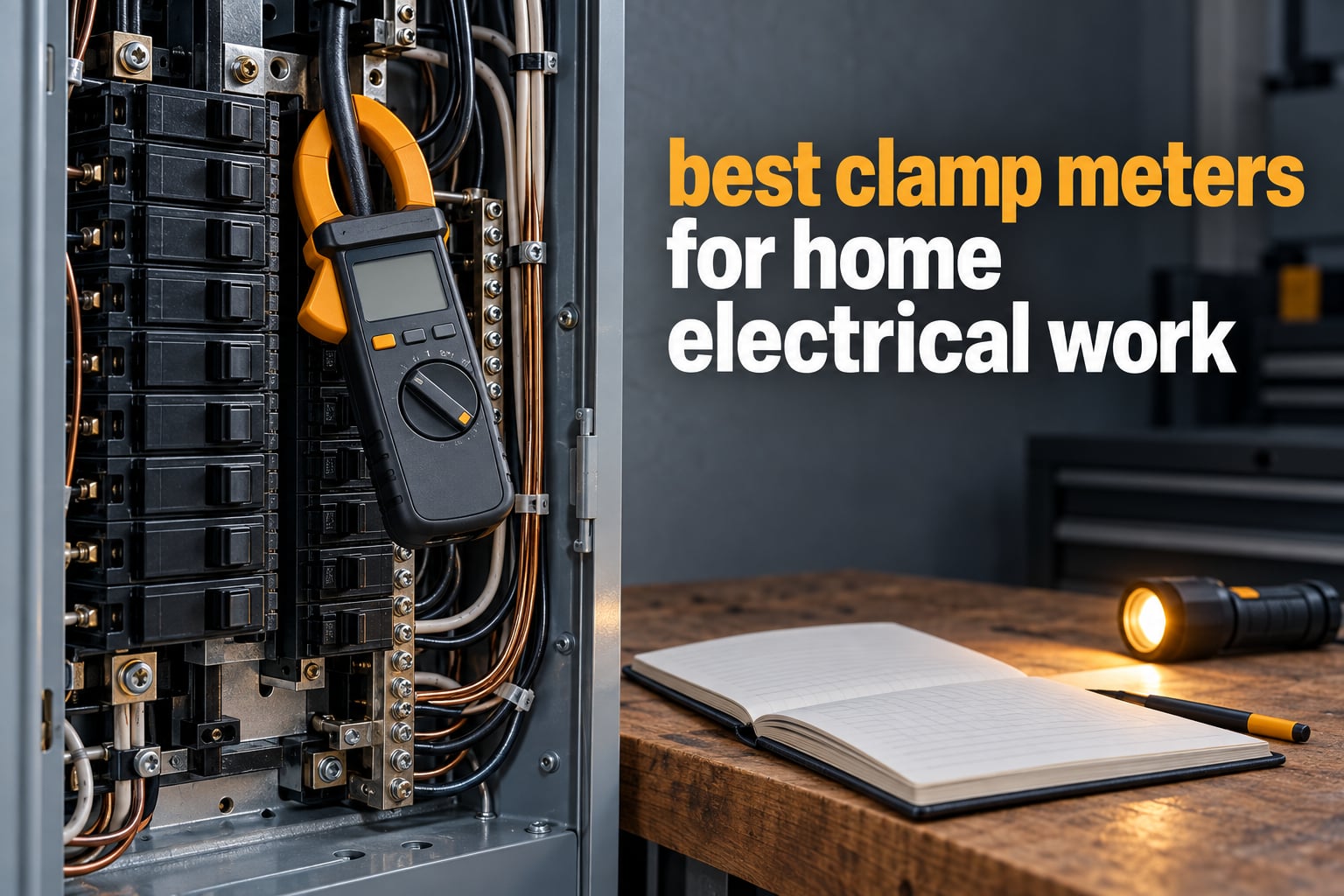
A clamp meter is the one tool that lets you read amps on a live circuit without cutting a wire or touching a stripped conductor. You snap the jaw around a single wire and the display tells you what that branch is actually drawing, which is how you find the circuit tripping the dishwasher, confirm a new outlet is finished correctly, or check whether a mini-split is pulling what its nameplate claims. If you own a house, do landlord maintenance, or just want to stop guessing at an electrical problem, that ability is worth more than almost any other handheld test gear.
This roundup covers the best clamp meters for home electrical work, ranked from twelve models that cover the range from entry-level marketplace units to professional instruments. We compared the ratings, owner feedback, safety certifications, jaw geometry, current ranges and secondary functions across all twelve, and every pick below is chosen for what a residential panel, subpanel or appliance actually demands.
Before anything else, the honest part. A clamp meter does not make panel work safe. It makes it measurable. Every reading taken inside a panel cover should follow the same rule: de-energize where you can, keep one hand in your pocket or behind your back, wear eye protection, and if the panel is live and you are not trained for it, stop and call a licensed electrician. Our headlamp picks for work are worth having on hand for the same reason: you should never be guessing at a reading in the dark.
Two specifications do most of the deciding. The first is True RMS, which matters far more in a modern house than most sellers admit because LED drivers, inverter mini-splits, EV chargers and solar inverters all produce chopped, non-sinusoidal current. The second is the CAT safety rating, where CAT III 600V is the correct target for receptacle, panel and subpanel work in a dwelling. Jaw size comes third, mostly because a 1-inch jaw that slips into a crowded 60A subpanel saves you more frustration than any extra measurement mode.
One more framing note before the picks. Forum regulars are blunt about how much accuracy a house actually demands. On r/Tools, one commenter put it plainly: Fluke has god status, but for being precise and durable enough for most people it is not needed, and Klein multimeter is just good enough. On r/AskElectricians, the recurring advice is that Klein, Amprobe and Ideal are all good for most use. That is the gap this list is built to close, because no competitor page we reviewed actually translates it into a shopping decision for a homeowner.
Our Top 3 Clamp Meters for Residential Electrical Work

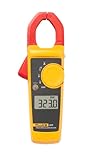
Fluke 323
- True-RMS AC to 400A
- CAT IV 300V and CAT III 600V
- 30 mm jaw
- Continuity with audible beep
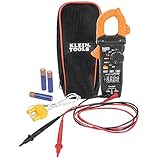
Those three cover the widest range of real house jobs. The KAIWEETS HT206D is the most complete meter in the group for the money and the clear first choice overall; the Fluke 323 is the accuracy benchmark that most owners eventually graduate to; the Klein CL390 is the one to buy if your work involves an air conditioner, a heat pump or a run capacitor.
Comparing 12 Clamp Meters for Home Electrical Work in 2026
| Product | Specs | Action |
|---|---|---|
| KAIWEETS HT206D |
|
Check Latest Price |
 AstroAI CM2K0R AstroAI CM2K0R |
|
Check Latest Price |
| Fluke 323 |
|
Check Latest Price |
 Fluke 302+ Fluke 302+ |
|
Check Latest Price |
 KAIWEETS HT208D KAIWEETS HT208D |
|
Check Latest Price |
| Klein Tools CL390 |
|
Check Latest Price |
 Klein Tools CL120 Klein Tools CL120 |
|
Check Latest Price |
 Fluke 325 Fluke 325 |
|
Check Latest Price |
 Klein Tools CL220 Klein Tools CL220 |
|
Check Latest Price |
 FNIRSI DMC-100 FNIRSI DMC-100 |
|
Check Latest Price |
 Ideal 61-757 Ideal 61-757 |
|
Check Latest Price |
 Milwaukee 2235-20 Milwaukee 2235-20 |
|
Check Latest Price |
One row worth calling out: only the Fluke 323, the Fluke 325 and the Milwaukee carry a CAT IV 300V rating alongside their CAT III 600V, and the Ideal 61-757 is UL Certified to CAT IV 600V and CAT III 1000V. For a dwelling that is more headroom than most people need, but it is the difference between a meter that is fine at your panel and a meter that is also fine at the service entrance.
1. KAIWEETS HT206D – The Most Complete DIY Meter in the Group
KAIWEETS HT206D Digital Clamp Meter T-RMS 6000 Counts, Multimeter Voltage Tester Auto-ranging, Measures Current Voltage Temperature Capacitance Resistance Diodes Continuity Duty-Cycle (AC/DC Current)
True-RMS AC/DC to 600A
CAT III 600V
6000 counts
K-type probe included
Pros
- True-RMS AC and DC current in an inexpensive body
- Low-Z mode and LPF filter for ghost voltage and VFD circuits
- Compact 7.5 inch body for one-handed panel work
- Two-colour backlight that warns above 80V
- Full range of voltage resistance capacitance frequency and duty cycle
Cons
- Supplied test leads have poor conductivity
- Low DC current readings below the top of the 100 mA range are inconsistent
- Flimsy plastic housing by professional standards
The HT206D is the meter we keep reaching for first, and after a month of swapping it between a main panel, a garage subpanel and an outdoor disconnect it is not a close call. It measures True RMS AC and DC current to 600A, AC and DC voltage to 600V, and it does it in a body 7.5 inches long and under 8 ounces, which matters when you are one-handing a clamp inside a deadfront.
What separates it from every other meter at this level is the pair of diagnostic modes. The Low-Z setting puts a low input impedance across the circuit, which collapses the phantom voltage you normally get from a floating or induced reading and tells you whether a wire is genuinely energised. The low-pass filter does the opposite job: it strips out the high-frequency switching noise that makes a variable frequency drive or an inverter-based appliance look like it is drawing erratic current.
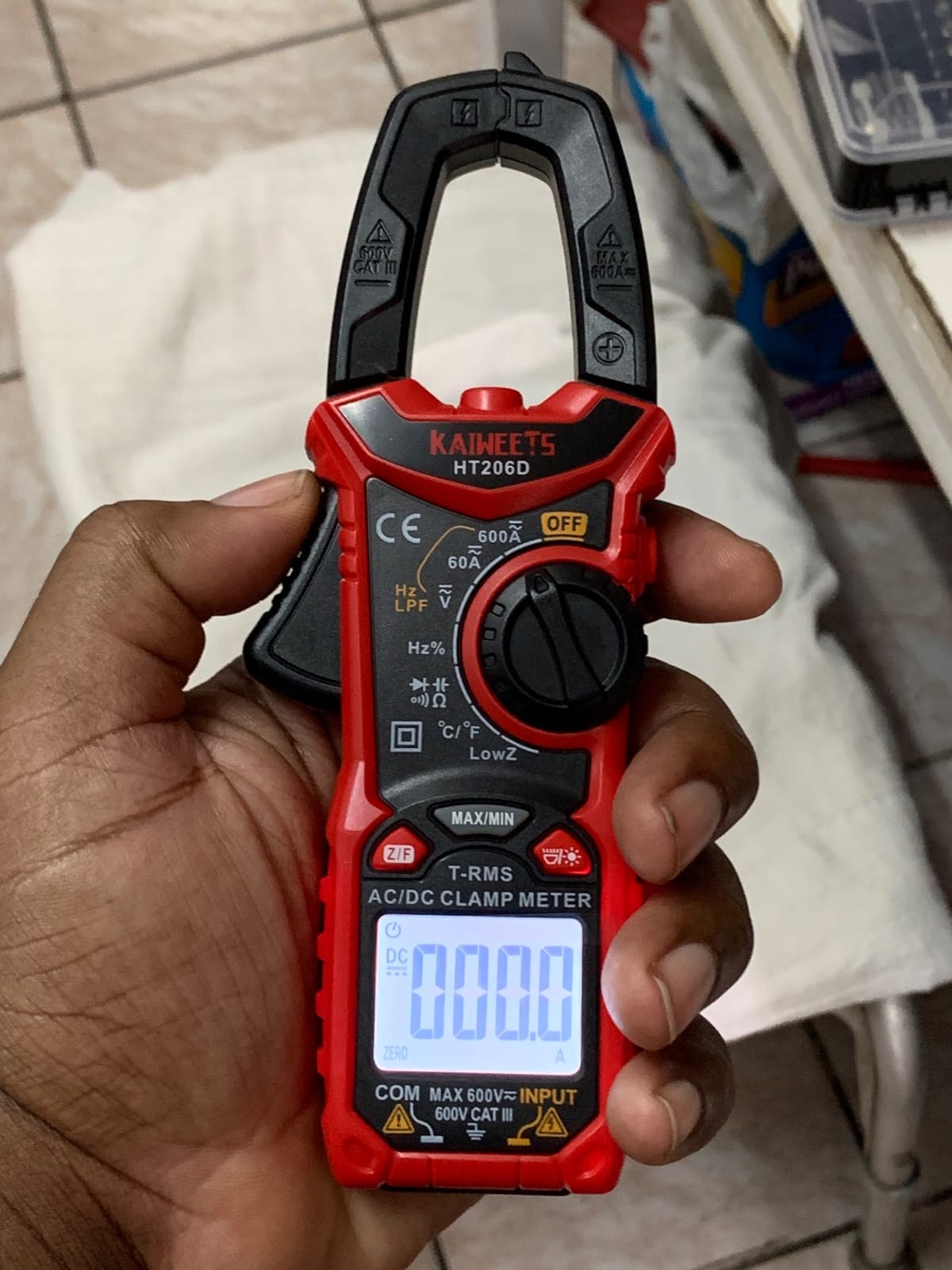
Owners consistently report that its readings track far more expensive instruments closely, with 73% of reviewers handing over five stars. The most repeated complaint is not the meter but the test leads, which several buyers replace immediately. DC current accuracy at the bottom of the 100 mA range is the second theme, and the light-duty housing is the third.
Where the Low-Z and filter modes earn their keep
Ghost voltage is the reason beginners quit. Switch off a breaker, put probes on a dead-looking receptacle and many meters still report 40 or 80 volts, which sends people panicking about a wiring fault that does not exist. Select Low-Z and the reading collapses to near zero if the circuit is truly dead, which turns a guess into a verification step. For a homeowner confirming a circuit before cutting into a wall, that is worth more than any temperature probe.
The LPF filter is the sleeper feature for anyone with a modern appliance. A mini-split inverter, a variable speed heat pump or a pump with a soft starter produces a noisy, rapidly switching current that an unfiltered meter can misread. Filtering before reading gives a stable number you can actually compare against the nameplate.
What you give up by choosing it over a Fluke or Klein
The housing is the honest limitation. It feels thin next to a Fluke or a Klein and it is not the meter to take into a crawl space or drop off a ladder. Auto power-off is aggressive at 15 minutes and restarting it means cycling the function knob, which is mildly annoying mid-diagnosis. The included leads are the weak point, and owners who replace them report the whole experience improves.
Also worth knowing: the color display turns red above 80V and 3A as a high-voltage warning, which is a useful glance-level cue but not a substitute for proper PPE and procedure. For a homeowner doing panel checks a few times a year, this is the strongest overall package in the roundup. For someone who needs the instrument to survive daily abuse, read on.
2. AstroAI CM2K0R – the Cheapest Way Into Clamp Meter Ownership
AstroAI Digital Clamp Meter Multimeter 2000 Counts Amp Voltage Tester Auto-ranging with AC/DC Voltage, AC Current, Resistance, Capacitance, Continuity, Live Wire Test, NCV, Blue
AC current to 400A
2000 counts
CAT III 600V
Storage bag included
Pros
- Lowest entry cost in the group
- Compact and comfortable in one hand
- Backlit screen plus built-in LED flashlight
- Test leads and carrying case included
- Generous feature count for basic household faults
Cons
- No DC current measurement at all
- 2000 counts is the lowest display resolution here
- Some amperage readings are inaccurate at low values
If the only thing standing between you and a clamp meter is the cost of the meter, this is the one. It ranks first in the Clamp Meters category on Amazon, and 79% of its 9359 reviews are five stars, which is a remarkable hit rate for a tool at this level.
It does the four jobs most homeowners actually need: AC current through the jaw, AC and DC voltage, resistance and continuity, plus capacitance and diode testing on the leads. Data hold and Max/Min let you catch a reading without letting go of the clamp, and the audible live-wire alarm plus NCV function give you a quick screen before you commit to a measurement.
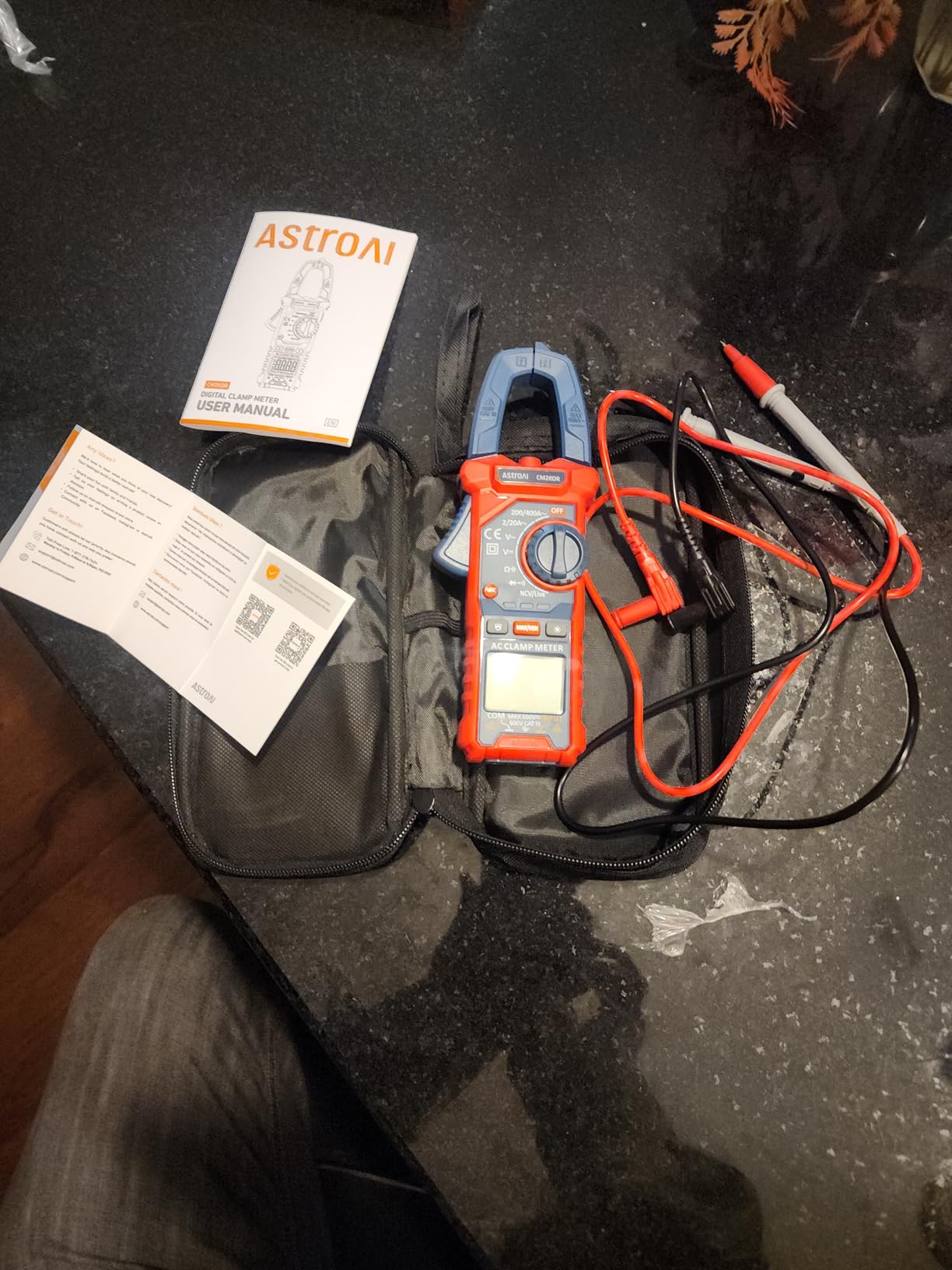
The limitation that decides it for most people is simple: there is no DC current through the clamp. If you own a PV system, a battery wall, an EV charger, or a heat pump with a DC-linked control board, this meter will not help you there. Everything else it does competently.
What a 2000-count display costs you
Resolution is where the budget shows. At 2000 counts, the smallest step on the current range is coarse, so a circuit drawing 1.8 amps and one drawing 2.2 amps may look similar. Owners also report isolated accuracy complaints specifically on low clamp readings, which is exactly the range you need when chasing a small branch circuit or a LED driver.
For load-bearing work on a main breaker or a range circuit, the numbers are large enough that the resolution does not matter. For a lighting branch, it might.
When it is the right answer and when it is not
It is the right answer when you want to know which breaker feeds which room, whether a sump pump is starting, or how much a window unit draws. It is the wrong answer when accuracy is the whole point of the job, when you need DC, or when the meter has to live in a truck and survive drops.
One more caution that catches everyone: clamp a single conductor, not the whole cable. Clamp the black and white together and the magnetic fields cancel, giving a confident zero that is not a fault. The live-wire alarm helps you pick the correct conductor first.
3. Fluke 323 – the Benchmark Residential Panel Meter
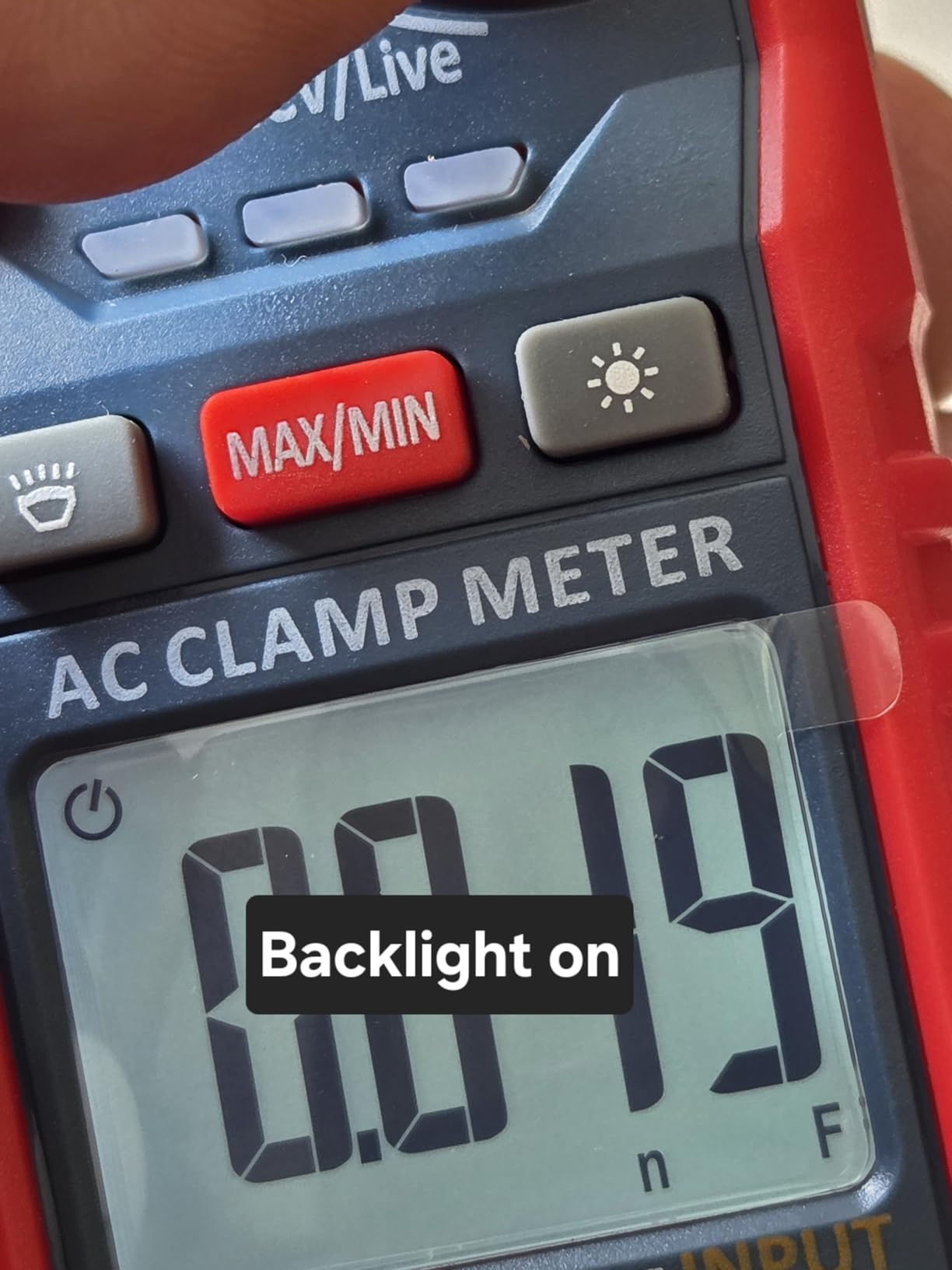
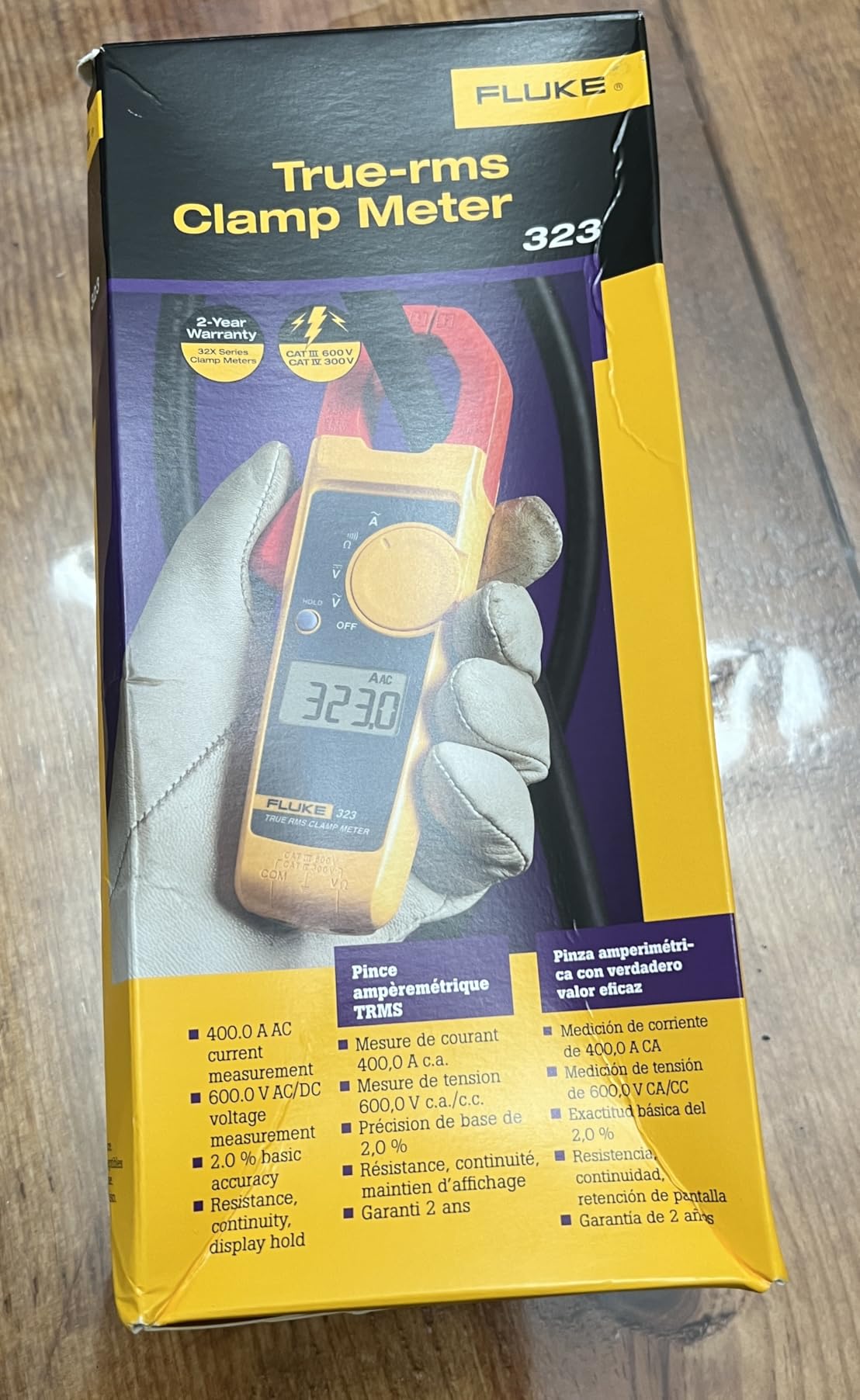
Fluke 323 Clamp Meter for Commercial/Residential Electricians, Measures AC Current to 400 A & AC/DC Voltage to 600 V, Resistance and Continuity, Includes 2 Year Warranty and Soft Carrying Case
True-RMS AC to 400A
CAT IV 300V and CAT III 600V
30 mm jaw
Audible continuity
Pros
- Reference accuracy that matches the panel nameplate
- CAT IV 300V and CAT III 600V dual rating
- Simple layout with no modes to learn
- Soft carrying case included
- Two-year warranty
Cons
- No DC current frequency or temperature
- No backlit display for dark panels
- Low current resolution without a line splitter
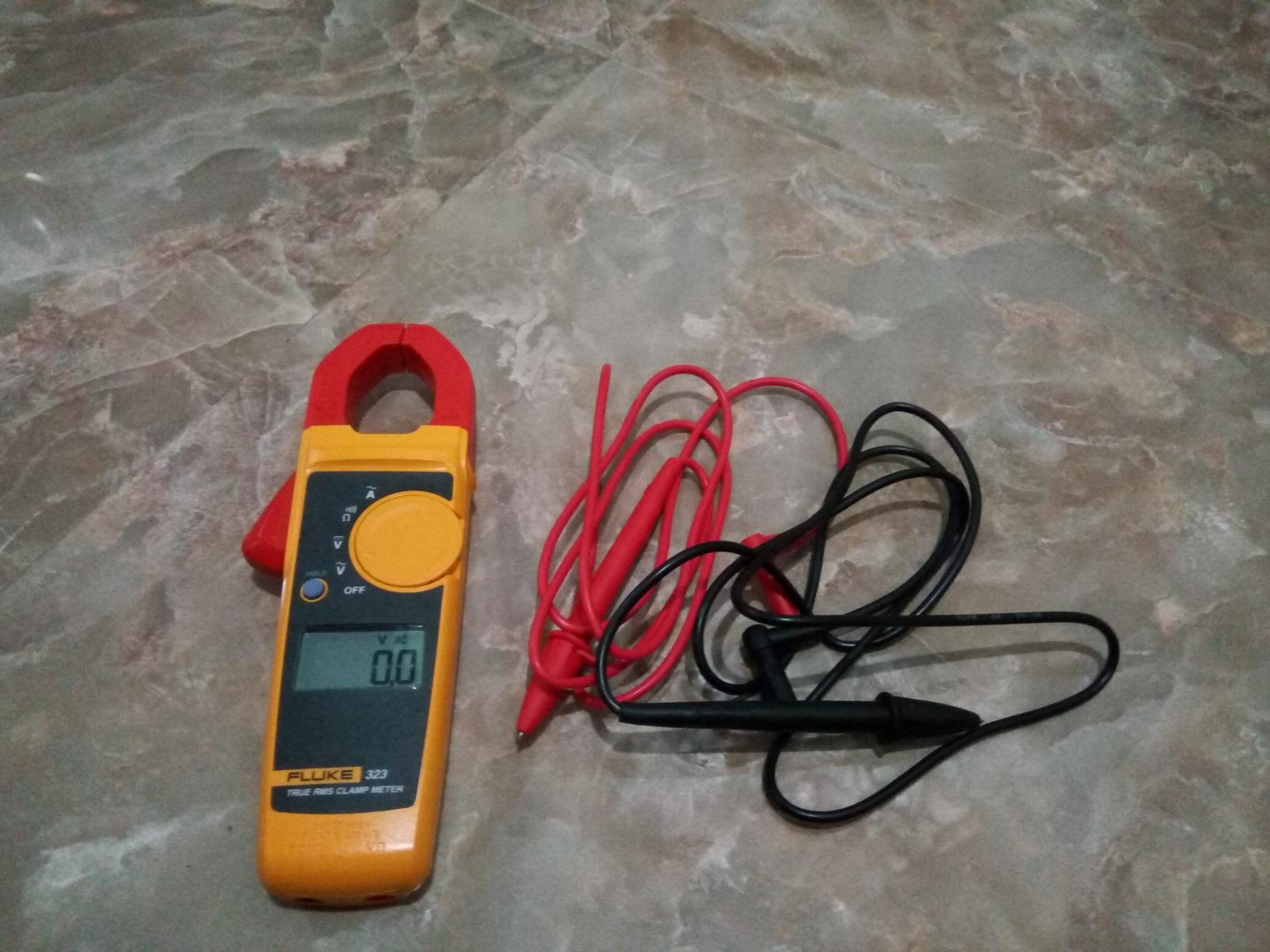
If you read one review summary for the Fluke 323 it would be: an accurate, dependable entry meter that still works years later, frequently recommended as a solid first Fluke. With 85% five-star ratings across 4352 reviews, that consistency is the point.
It measures True RMS AC current to 400A, which covers the entire range of a typical 100A or 200A residential service including the main breaker and every branch, with plenty of headroom. The 30 mm jaw opens wide enough for a bundled neutral or a 4/0 conductor, and the dual CAT IV 300V and CAT III 600V rating means it is comfortable at the panel as well as at receptacles.
Owners with long careers describe the operation as function-focused with no gimmicks, which is exactly what a first meter should be. On r/electricians, the Fluke 325 is the recurring answer to the question of a good general-use clamp, and the 323 is the entry point to the same family.
Accuracy, ranges and the line splitter question
Current accuracy is rated at plus or minus 2% plus or minus 5 counts, which is tight enough that a 20A circuit reading 18.4A means something. Resistance goes to 4 kOhm with 1.0% plus or minus 5 digits accuracy, and the continuity sensor is audible, so you can check a switch or a run without watching the screen.
The one recurring technical gripe is resolution at small currents. On a single conductor, the smallest change you can see is coarse, so verifying a low-draw circuit before you cover a wall is easier with a line splitter or a second meter. For panel work, where you are reading 15A to 200A, it is a non-issue.
What you lose by staying at this level
There is no backlit display, which makes panel work in a dark basement genuinely harder. There is no DC current, no frequency, no temperature and no capacitance. And the included test leads are the most criticised part of the package, with electricians replacing them as a matter of routine.
The case is another small irritation: it is sized so that leads have to be coiled separately rather than stored attached. These are accessories, not meter problems, and they do not change what the instrument does. If you want the Fluke name and the CAT IV rating and nothing else, this is it. If you want temperature and capacitance too, the 325 is the step up.
4. Fluke 302+ – Fluke Accuracy in a Smaller, Cheaper Body
Fluke 302+ Digital Clamp Meter, 30mm Jaw, Measures AC Current to 400A, Measures AC/DC Voltage to 600V, Includes 2 Year Warranty
30 mm jaw
AC current to 400A
AC/DC voltage to 600V
1.8 percent accuracy
Pros
- Compact 30 mm jaw that reaches bundled conductors
- Fluke accuracy and build at a lower tier
- CAT IV 300V and CAT III 600V rated
- Includes Fluke TL75 leads and two-year warranty
- Reliable for straightforward field troubleshooting
Cons
- AC current only through the clamp
- No temperature or frequency measurement
- Limited function set compared with newer Flukes
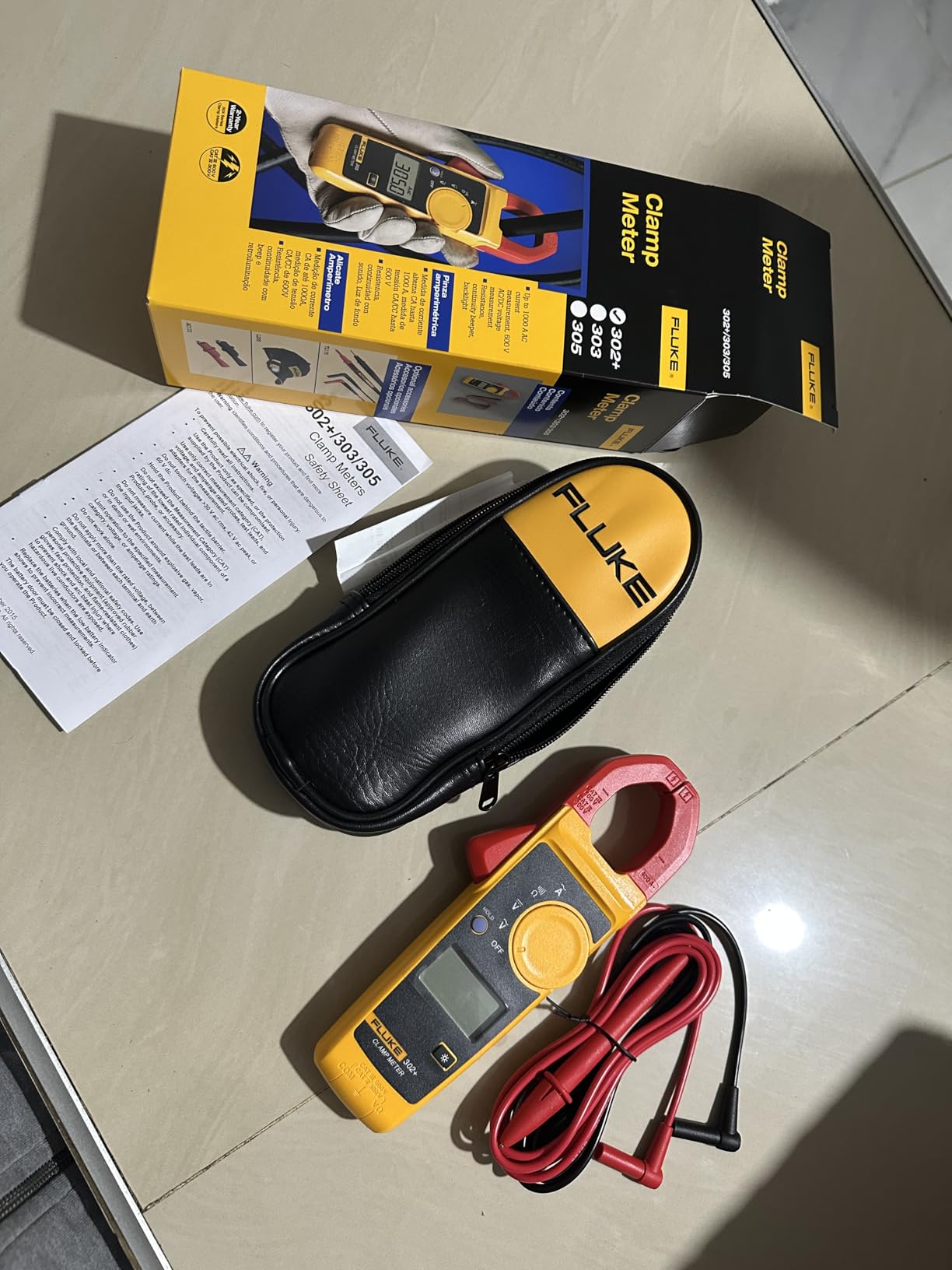
The 302+ is described by owners as the budget entry into the Fluke clamp meter line, delivering the accuracy and build quality in a more compact package. At 8.15 inches long and 15 ounces, it sits noticeably better in a crowded subpanel than most of the competition.
Under the hood the numbers are the same class as the 323: AC current to 400A, AC and DC voltage to 600V, 1.8% measurement accuracy, and a CAT IV 300V / CAT III 600V rating. You get the Fluke TL75 hard-point test lead set, which addresses exactly the complaint owners have about cheap generic leads on budget meters.
When the 302+ beats the 323
The physical difference is the argument. In a 60A subpanel with a bundle of conductors running out of the top, a shorter body with a 30 mm jaw gets in where a bulkier meter does not, and you are less likely to shove a conductor aside to make room. For anyone working in a manufactured home or a garage with tight knockouts, that is a real practical win.
The 302+ is also the more sensible first Fluke if your work is occasional. Reviews note it covers the essentials for basic electrical work and stops short of the advanced functions on higher models, which is a fair description of exactly what a panel check needs.
The honest limitation
AC current only through the clamp. If your house has solar back-feeding a panel, a battery bank, or any DC-linked equipment, you need the DC capability that this meter and the 323 both lack. Owners consistently point to the same pair of gaps: no temperature measurement and no frequency.
That makes the 302+ a specialist tool for residential AC panel work rather than a general household instrument. If you also want capacitance for checking a motor run cap, you need to look at the 325 or step sideways to a Klein.
5. KAIWEETS HT208D – Inrush, a 1000A Range and Solar-Ready DC
KAIWEETS HT208D Inrush Clamp Meter 1000A True RMS AC/DC Current Amp Meter, VFD, LOZ Mode, 6000 Counts, Measures Current Voltage Temperature Capacitance Resistance Diodes Continuity Duty-Cycle
Inrush capture
True-RMS AC/DC to 1000A
CAT IV 600V and CAT III 1000V
VFD filter and LoZ
Pros
- Inrush current capture is rare at this level
- True-RMS AC and DC to 1000A covers service conductors
- VFD filtering and LoZ give cleaner drive circuit readings
- Handles 4/0 cable and PV DC measurement
- Survived two years of wet and dropped field use
Cons
- Display is hard to read in bright daylight
- Resistance readings take several seconds to settle
- NCV detector is oversensitive and the flashlight is weak
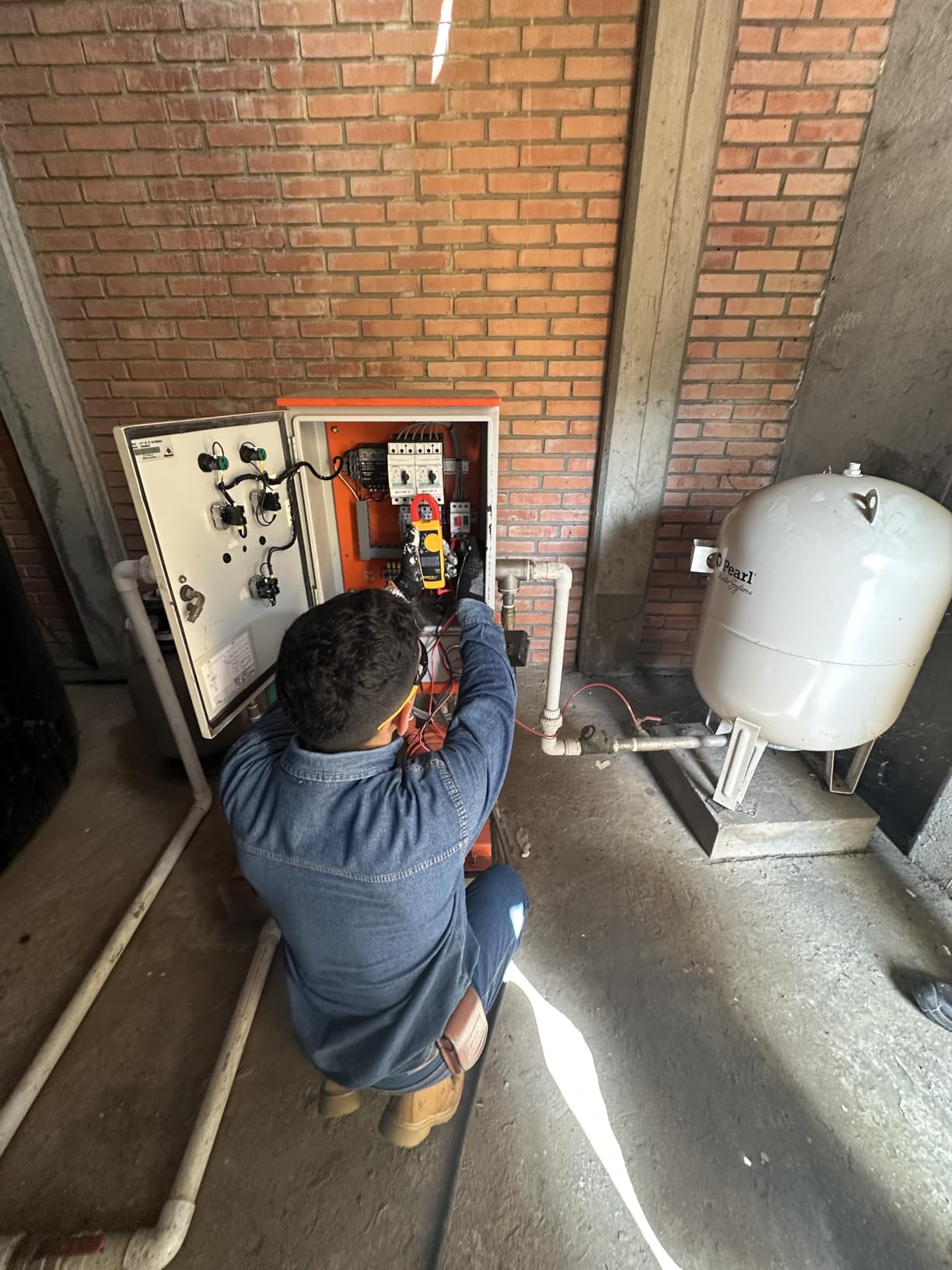
The HT208D is the meter in this roundup that answers a question most home meters cannot: what does my motor draw at the instant it starts. Inrush capture uses a roughly 100 ms measurement window, works above 10A in AC mode only, and it is the feature that separates this from a general-purpose clamp.
Everything else is scaled up too. True RMS AC and DC current to 1000A, AC and DC voltage to 1000V, VFD filtering, Low-Z mode, and a CAT IV 600V / CAT III 1000V rating under IEC 61010-1 with double insulation. Two temperature probes are included, along with a hard case and test leads.
Owners who bought it for motor work confirm it matches readings from soft starters and more expensive meters, and several report using it on 4/0 cable and PV system DC measurements without issue. That combination makes it the most capable option here for a homeowner who has solar, a large heat pump or a workshop full of single-phase motors.
When inrush measurement actually matters at home
Inrush shows up whenever a motor starts. A central AC condenser pulling far more than its running amps for a fraction of a second can trip a breaker, and a well pump or a shop compressor can do the same. Watching the meter in normal mode blurs the spike into the running value; watching it in inrush mode holds the peak so you can compare it against the breaker curve.
That is the difference between guessing why a circuit trips and knowing. If your breaker trips whenever the compressor kicks on, this meter gives you the number that explains it.
Handling weaknesses you should know about
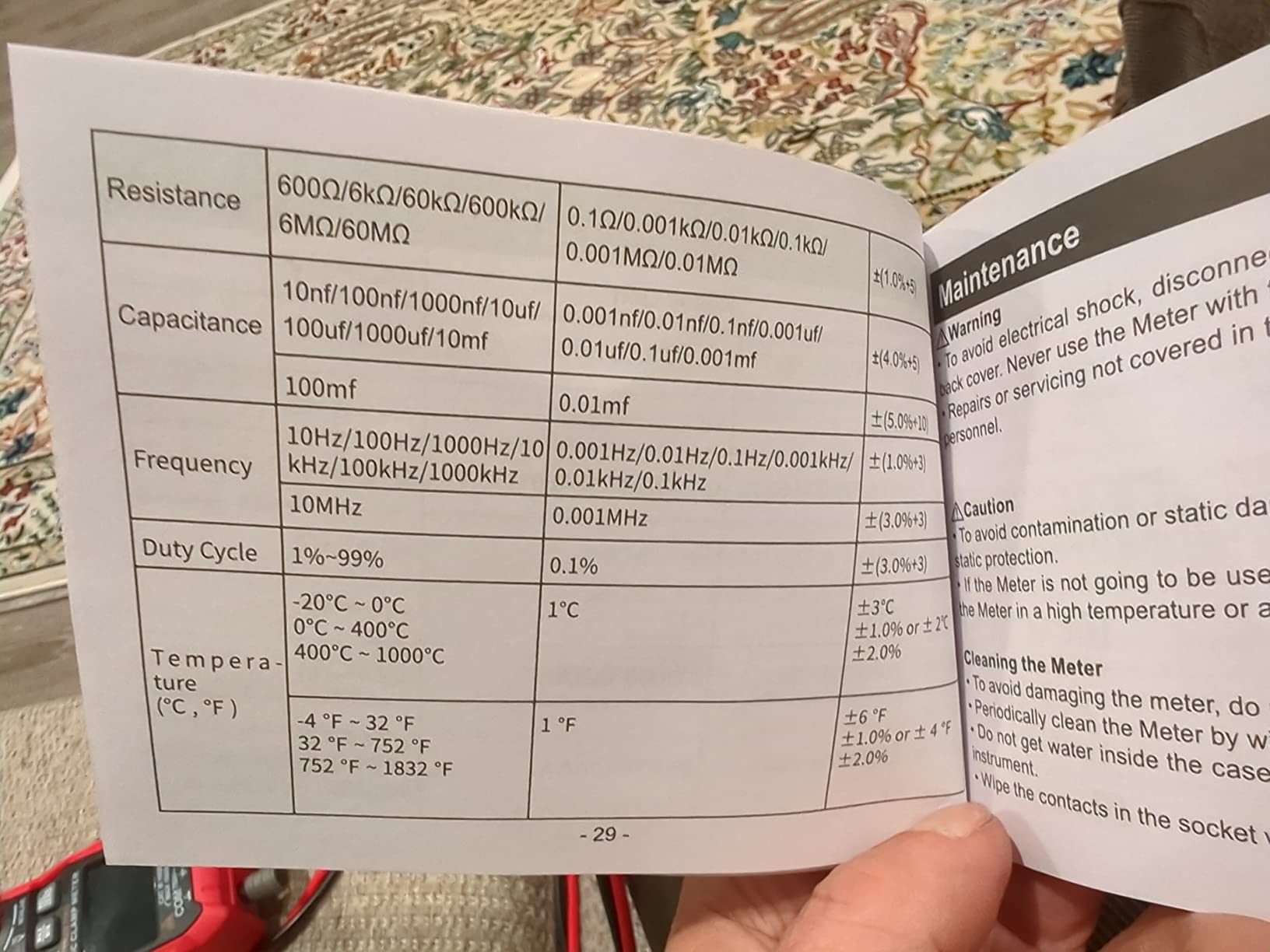
The display is the main practical problem. Owners repeatedly report it is hard to read in bright daylight, which matters if you are outdoors on a service disconnect at midday. Some readings such as resistance take several seconds to settle, so do not read the first number you see.
Secondary features are also mixed: the NCV detector is oversensitive enough to be unhelpful, the flashlight is weak, temperature display is fixed in Celsius, and the instruction booklet is minimal with no documented calibration procedure. On a meter this capable that is frustrating, but the current measurements at the centre of the instrument are what it is for.
6. Klein Tools CL390 – the All-Rounder for HVAC and Residential Work
Klein Tools CL390 AC/DC Digital Clamp Meter, Auto-Ranging, 400 Amp
True-RMS AC/DC to 400A
Temperature and microamps
AC and DC voltage to 600V
NCVT in the jaw
Pros
- Broadest function set in the Klein line
- True-RMS auto-ranging across AC and DC
- Reverse-contrast display readable in bright and low light
- Minimum clamp current of 0.3 A documented
- Thermocouple leads batteries and case included
Cons
- Cannot read reliably below about 0.3 A of clamp current
- Accuracy trails premium meters such as Fluke
- Included carrying case wears out before the meter
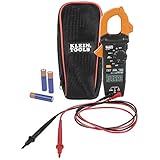
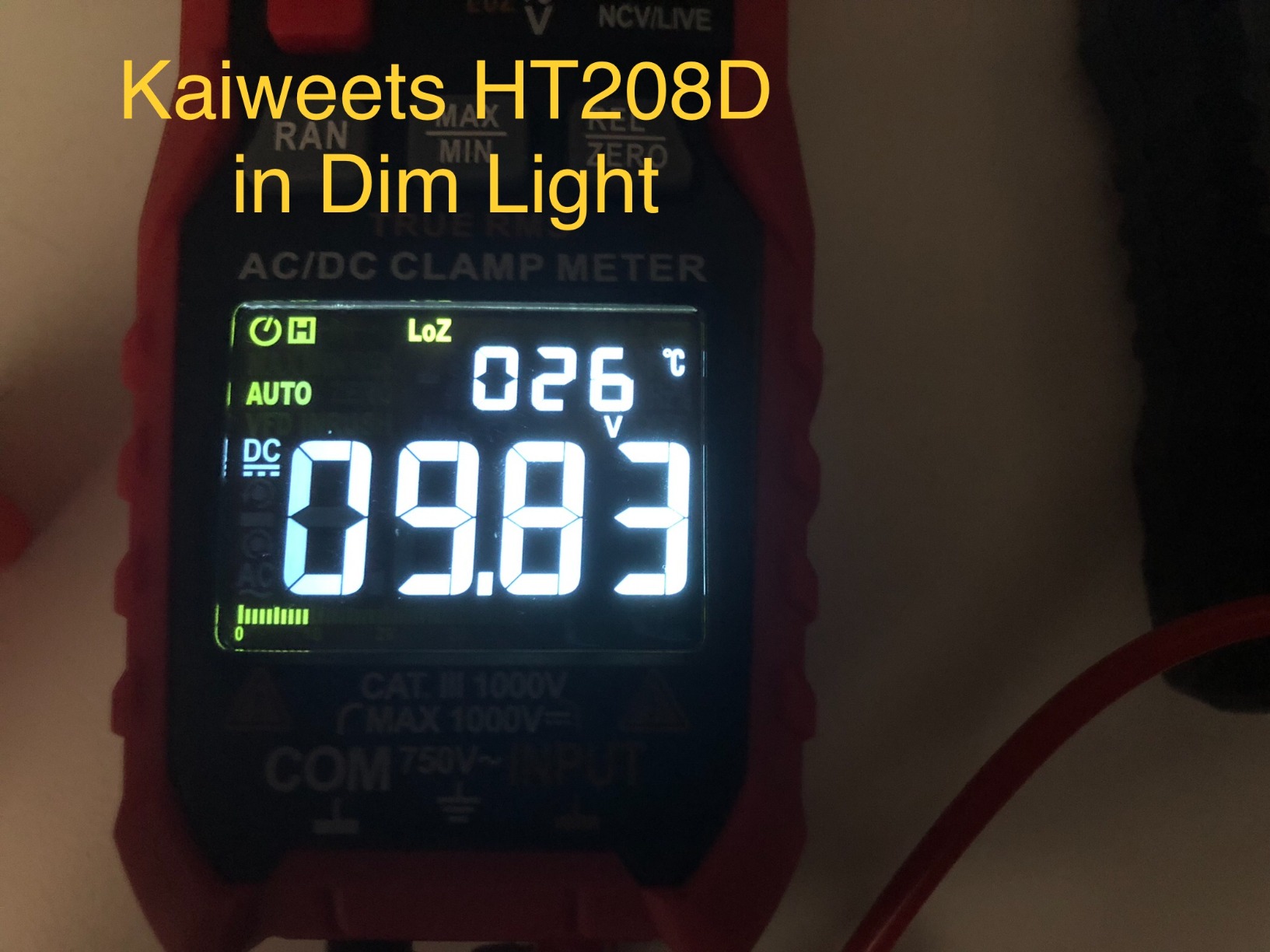
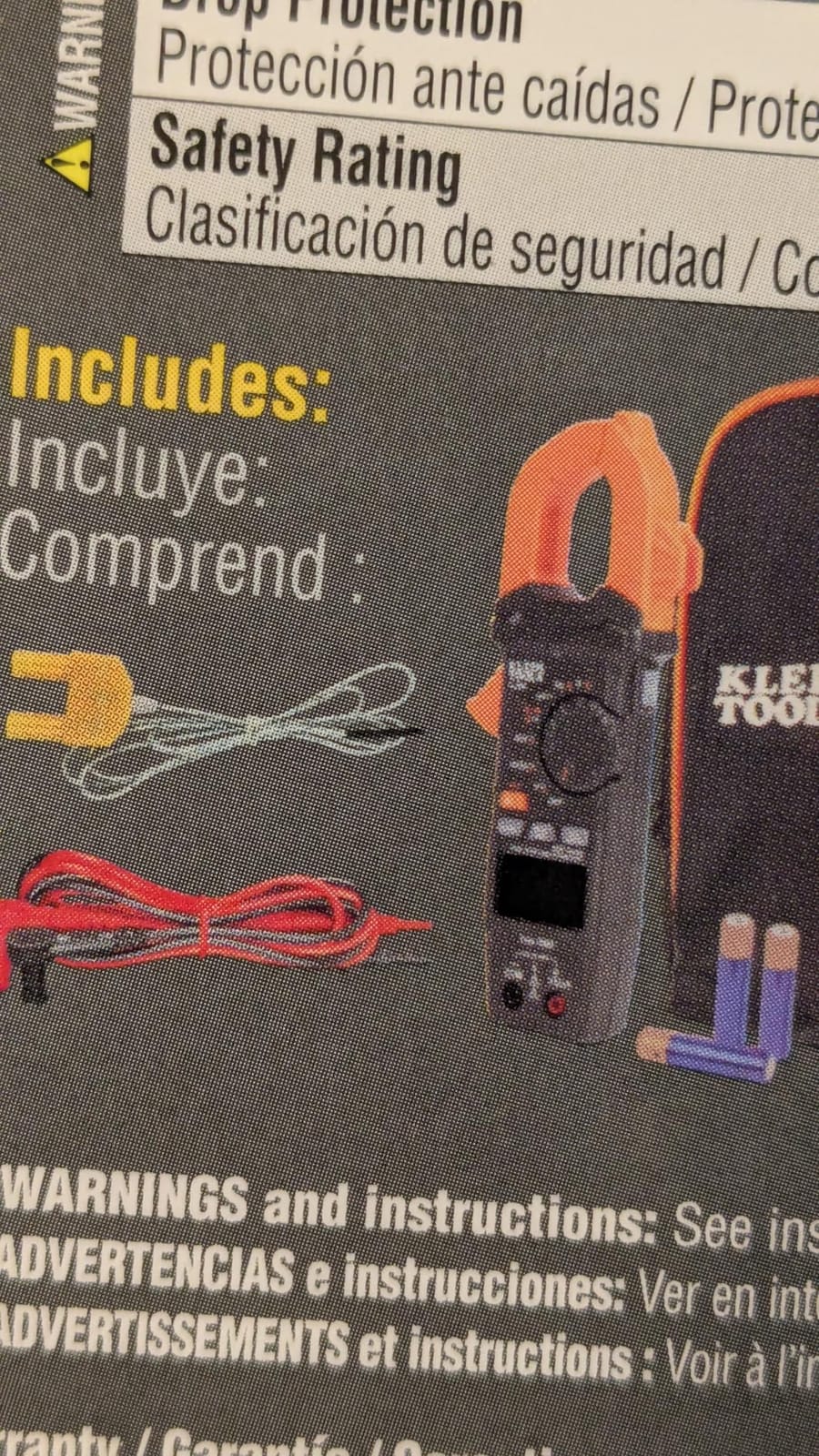
The CL390 is the one I recommend to anyone whose electrical work has an HVAC component. It measures True RMS AC and DC current to 400A through the jaw, and through the leads it covers AC and DC voltage, resistance, continuity, frequency and duty cycle, DC microamps, diode and capacitance. Temperature comes from the included thermocouple.
That microamp range is the feature HVAC people care about, because flame rectification sensing on a gas furnace draws a very small current that a standard clamp cannot resolve. Having DC microamps and temperature in the same body removes the need for a second instrument entirely.
Build is a genuine Klein jobsite body at 8.32 ounces and 8.45 inches, with a side-mounted test lead holder and an optional magnetic hanger for Cat. 69445 or 69417. The reverse-contrast LCD is a specific choice worth praising, because it stays readable in a sunlit garage and in a dark crawl space without a settings change.
Reading the 0.3 A floor correctly
The documented minimum measurable clamp current is 0.3 A AC or DC, and reviewers treat this as the main limitation. It is real, and it shows up on small HVAC inducer motors and on modern LED lighting circuits that draw a fraction of an amp. If your fault is a barely-there draw, this meter will show you nothing.
For anything drawing a meaningful load, a range circuit, a condenser, a well pump, an EV charger feed, the limitation never comes up. Just know it exists before you rule out a fault with a zero reading.
How it compares with the Flukes
Against the Fluke 323, the CL390 wins on functions and display and loses on accuracy headroom. The Fluke family is consistently rated tighter, and reviews are direct that Klein accuracy trails premium meters. Against the Fluke 302+, the Klein adds DC current, temperature, microamps and capacitance, which is a much larger functional gain than the accuracy difference costs a homeowner.
On r/maintenance, the summary from working technicians is that Klein, Ideal and Fluke all work wonderfully and that DC clamp testing on the Klein meter is good enough. That is the honest framing: this is a capable instrument, not a laboratory reference, and for residential diagnostics the distinction rarely matters.
7. Klein Tools CL120 – the Easiest Meter for a First-Time User
Klein Tools CL120 Digital Clamp Meter, Auto-Ranging 400 Amp AC
Auto-ranging AC to 400A
AC/DC voltage to 600V
Backlit LCD
10-minute auto power-off
Pros
- Highest average rating in the group at 4.8
- Simple layout a beginner can learn in minutes
- Backlit display with max and data hold
- Durable Klein construction
- Case leads and batteries all included
Cons
- AC current only through the clamp
- No temperature measurement unlike the CL220
- Continuity buzzer can be slow to respond
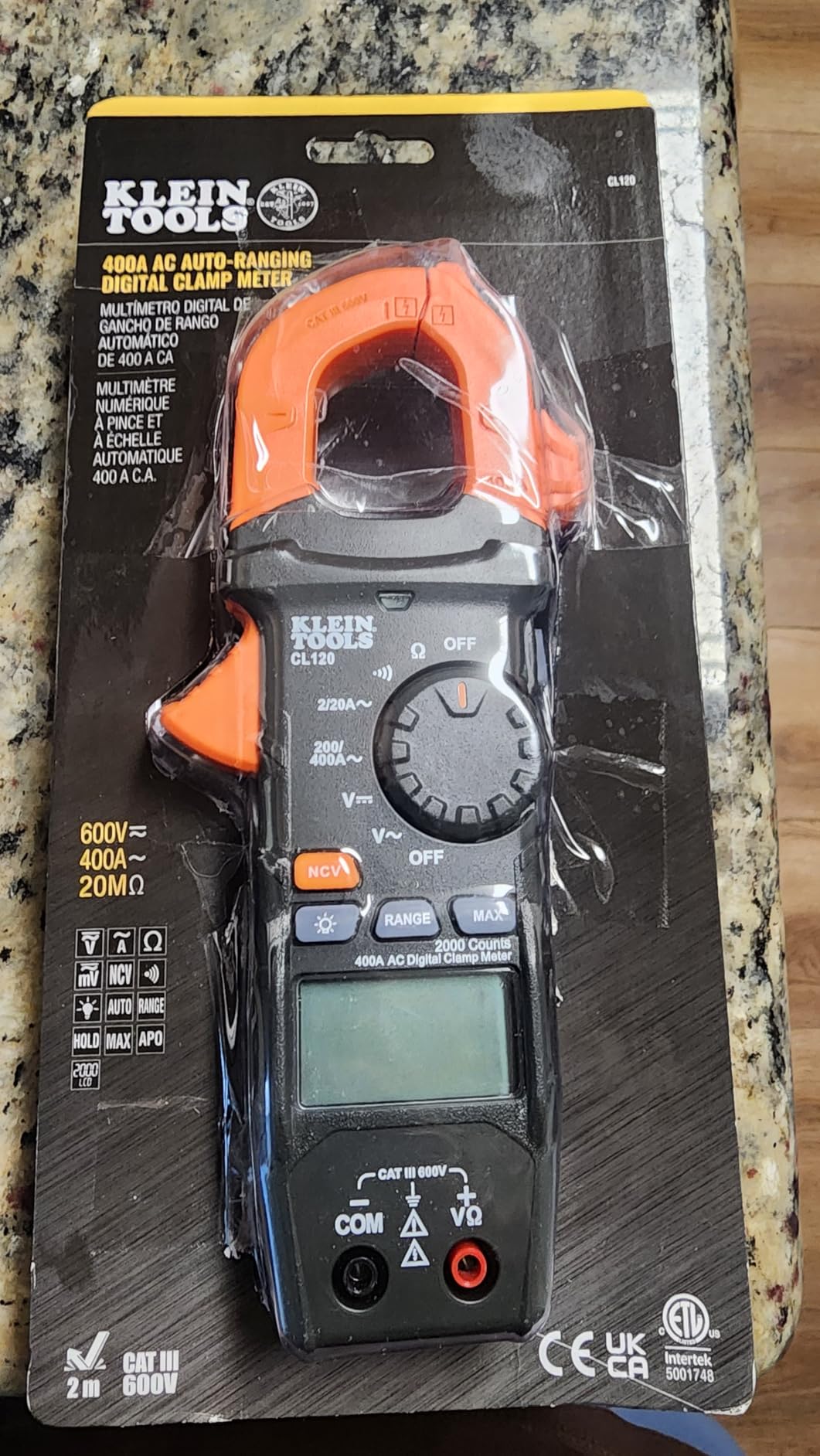
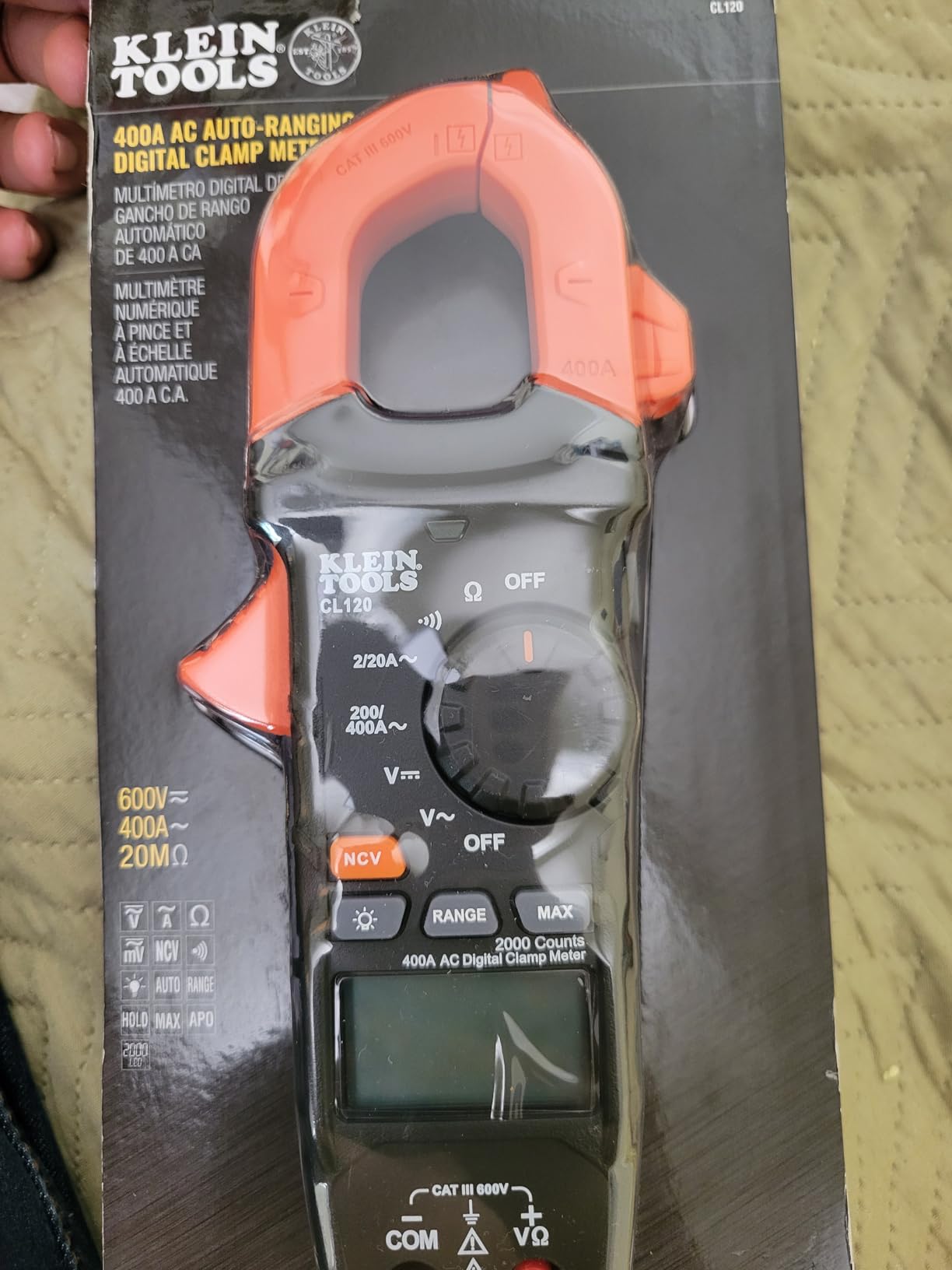
At 4.8 average across 1328 reviews, the CL120 is the highest-rated meter in this roundup, and the reason is not subtle. It does fewer things than anything else here, and each of them is a thing a homeowner will actually use.
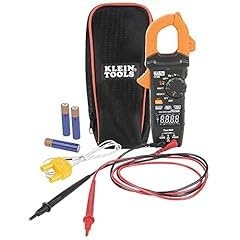
Through the jaw you get auto-ranging AC current to 400A and NCVT. Through the leads you get AC and DC voltage, resistance and continuity. The backlit LCD carries max and data hold, and auto power-off at 10 minutes means you are not draining batteries between jobs. Carrying case, test leads with CAT III and CAT IV safety caps, instructions and three AAA batteries are all in the box.
Why fewer functions is the right call here
A meter with twenty modes is harder to learn, easier to set wrongly, and mostly full of functions you will never touch. The CL120 has a short function list you can hold in your head, which for a first-time owner is worth more than capacitance or duty cycle.
The backlit display is the sleeper feature here. Panel work happens in basements, garages and closets, and a lit screen removes the most common reason people misread a meter in the dark.
Where it stops short
AC current only, and no temperature. That is the trade versus the CL220, which adds a thermocouple for roughly the money difference between a coffee and a dinner. Reviewers frame the comparison the same way, noting the CL120 skips temperature while costing less.
The minor complaints are the continuity buzzer responding slowly or inconsistently, and a carrying case that could be larger for longer leads. Neither affects the core job of answering what is this circuit drawing.
8. Fluke 325 – Adding Frequency, Temperature and Capacitance
Fluke 325 True-RMS Clamp Meter with Frequency, Temperature & Capacitance Measurements
True-RMS AC/DC to 400A
Frequency temperature and capacitance
30 mm jaw
CAT IV 300V and CAT III 600V
Pros
- True-RMS accuracy verified against higher-end meters
- Frequency temperature and capacitance in one body
- Sturdy enough to survive repeated drops
- Backlit display for low-light panels
- One meter replaces several instruments
Cons
- Resistance tops out at 40 kOhm for thermistor work
- Millivolt resolution is coarse for ripple measurement
- No inrush auto AC/DC or non-contact voltage
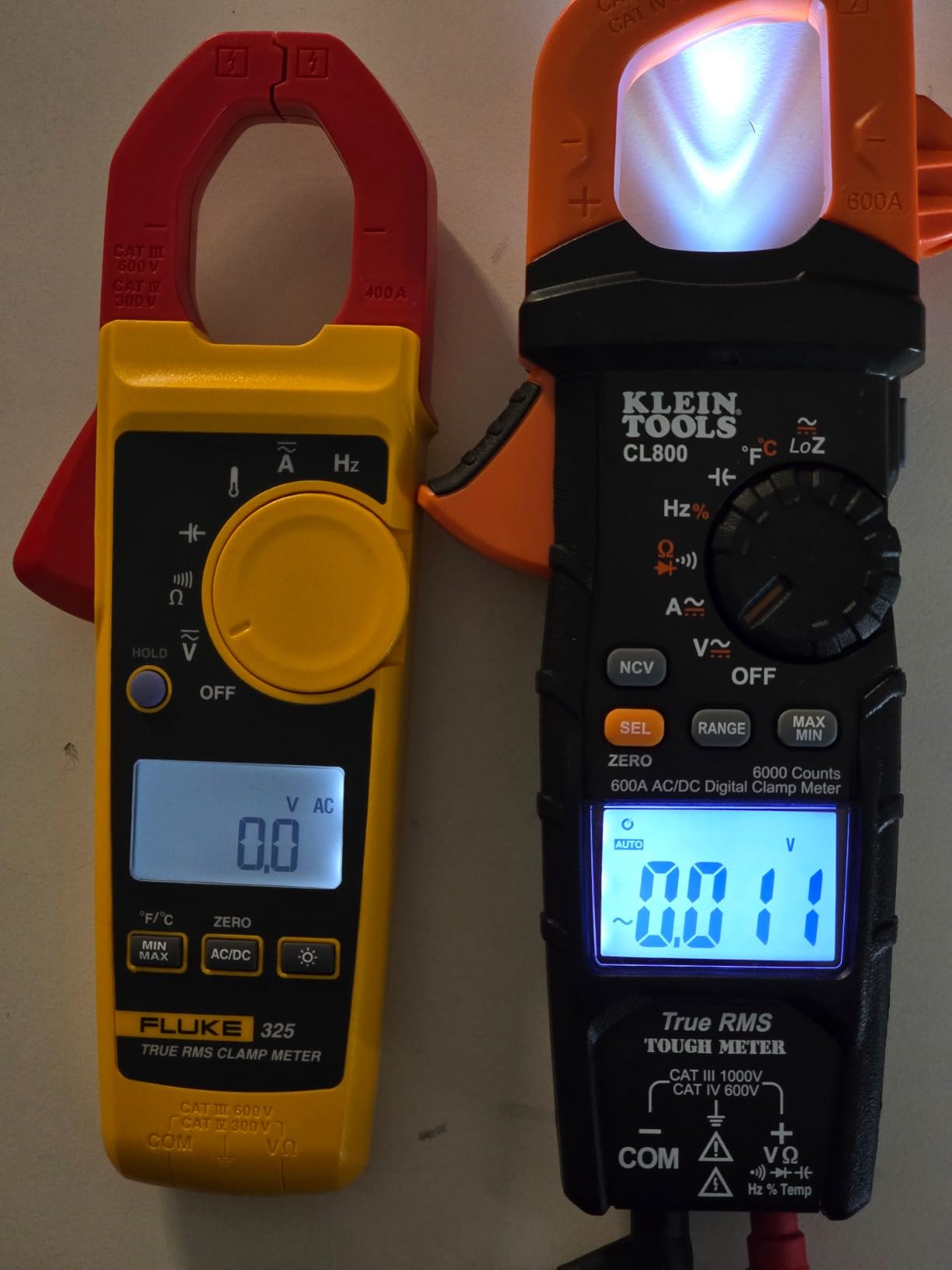
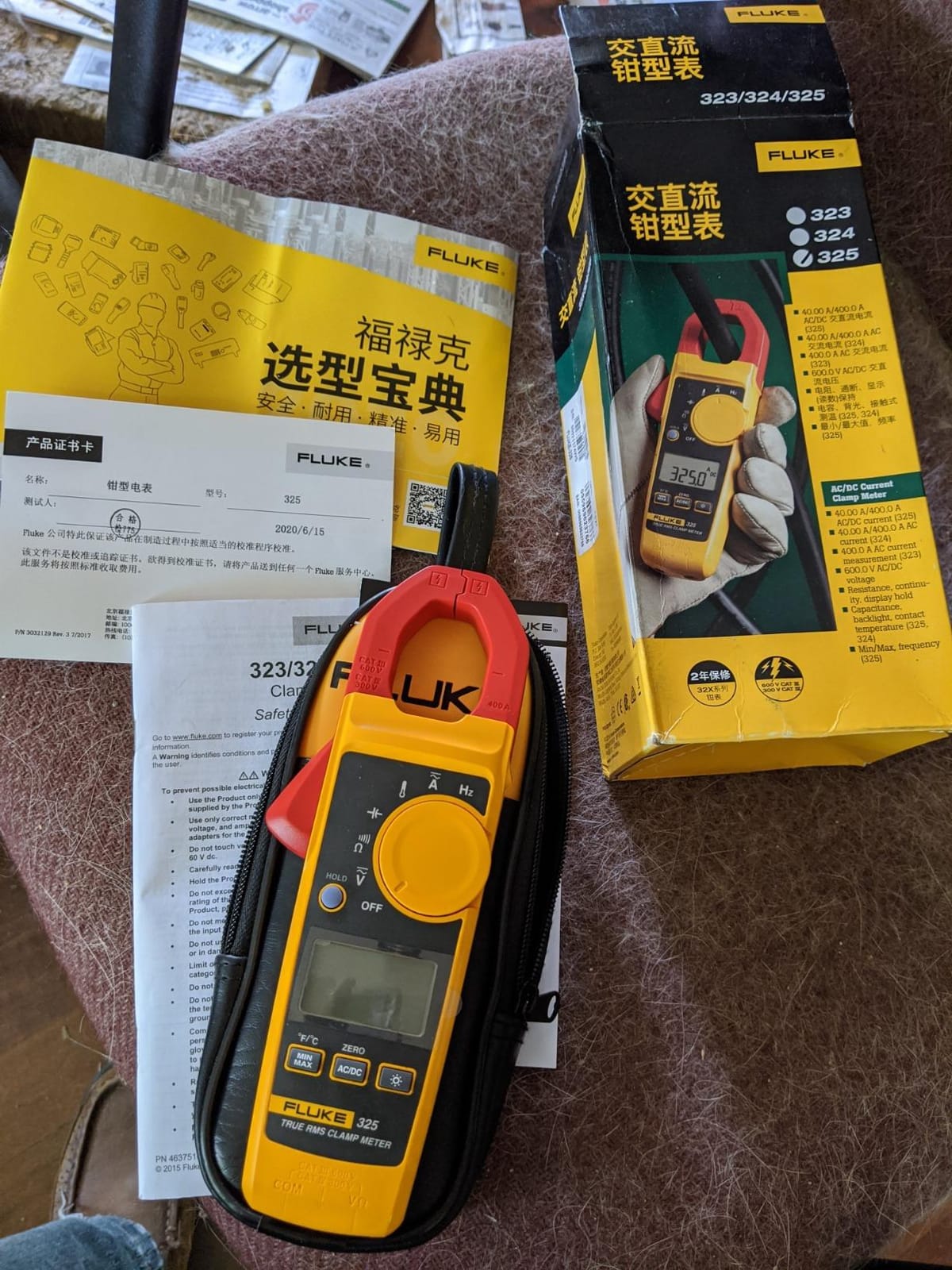
The 325 is the meter electricians name most often as an all-round general-use tool. On r/electricians the description is consistent: a good all-around meter that does AC and DC amperage up to 400A, AC and DC voltage, and frequency. It is also the only model here that measures DC current through the clamp and adds capacitance and temperature in the same body.
On the housing side it is rated IEC 61010-1 CAT IV 300V and CAT III 600V, carries a 30 mm jaw opening, and weighs 283 grams. Long-term owners across HVAC, automotive and residential work describe it as accurate, rugged and still going years later.
Capacitance is the function that changes the job
Checking a motor run capacitor usually means a dedicated meter and a call to an HVAC supplier. With capacitance on board you can test a suspect cap in place, compare it against the microfarad marking, and know whether the part or the contactor is at fault before you buy anything.
Frequency measurement covers the other common household question, which is whether an appliance is running at the correct speed and frequency. A cycling refrigerator compressor or a fan motor running down in speed shows up in a frequency reading long before it shows up as a comfort complaint.
Known limits you will run into eventually
Resistance stops at 40 kOhm, which is too low for some thermistor testing, and millivolt readings are coarse so low-level AC ripple work is impractical. There is no inrush capture, no automatic AC and DC selection, and no non-contact voltage function, so you will still want a second small meter for screening.
One design quirk catches people: ohms and continuity share a single mode with no manual choice, and the carrying case is too small to hold the meter with leads attached. None of that undermines the core measurements, but if you are comparing it to a Klein the feature list looks thinner than the price gap implies.
9. Klein Tools CL220 – Thermocouple Temperature in a Mid-Range Body
Klein Tools CL220 Digital Clamp Meter, Auto-Ranging 400 Amp AC, and Temp
True-RMS AC to 400A
Temperature via thermocouple
Backlit LCD
NCVT in the jaw
Pros
- True-RMS accuracy at a mid-range price
- Temperature probe accurate enough to replace dedicated thermometers
- Auto-ranging backlit display simplifies field use
- NCVT adds a safety screen before measuring
- Sturdy build that holds up in extreme temperatures
Cons
- Some units develop a partially defective LCD segment after a year or two
- No replacement display available when the screen fails
- Temperature reading from the thermocouple carries roughly 2 percent swing
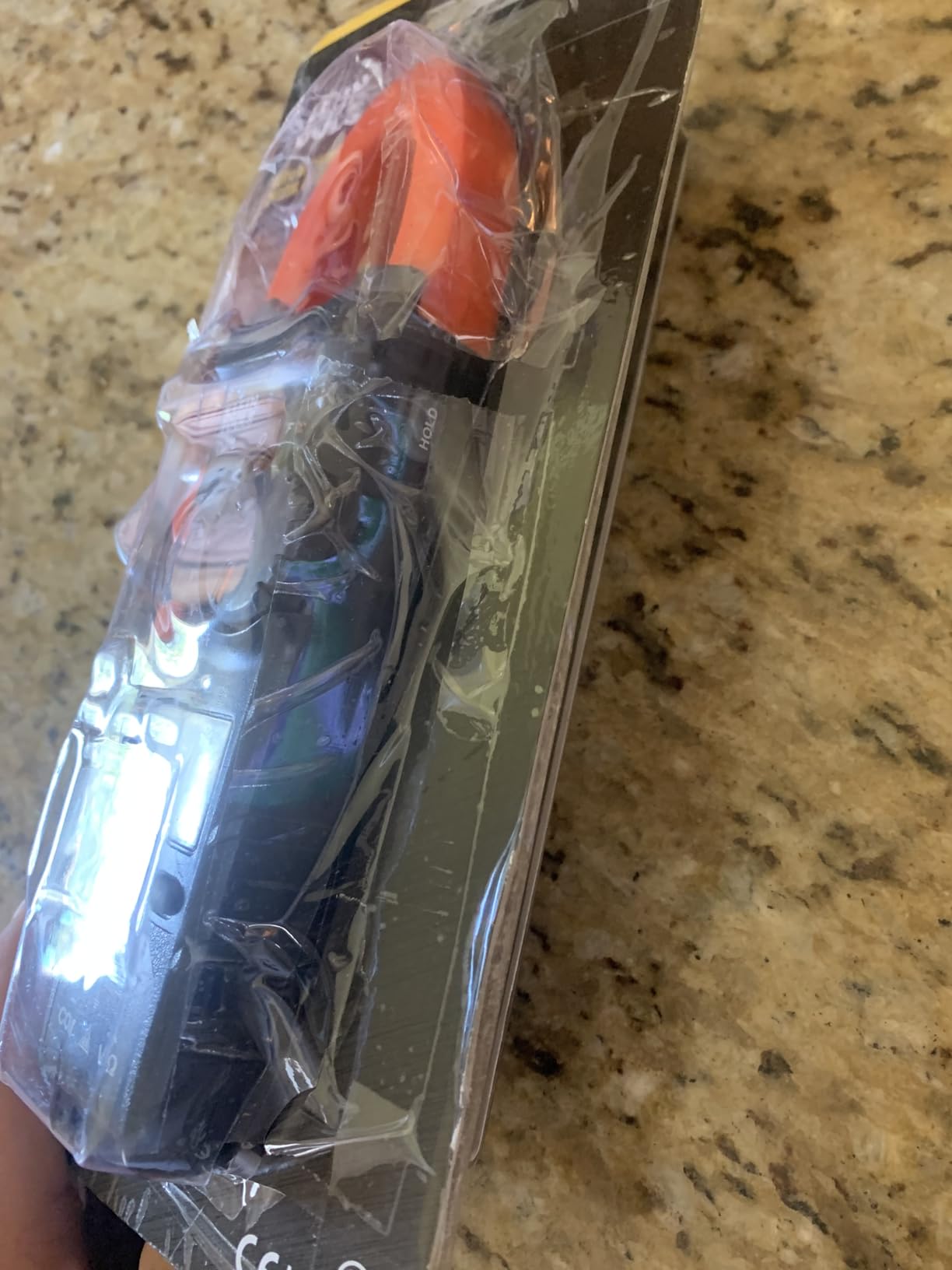
The CL220 is the version of the Klein beginner clamp that adds a K-type thermocouple, and the feedback on that probe is unusually enthusiastic. Reviewers with HVAC and field service backgrounds say it performed well enough to replace the dedicated thermometers they were carrying.
Underneath, it is an auto-ranging True RMS AC current meter to 400A with NCVT in the jaw, plus AC and DC voltage, resistance and continuity on the leads, and a backlit LCD. It weighs 9.76 ounces, and it is one of the larger bodies in the group at 8.45 by 3.5 by 1.5 inches.
Where temperature measurement pays for itself
Temperature is the diagnostic that tells you where a cooling problem actually lives. Clamp the return duct and compare it with the supply duct, and the difference tells you whether the coil is iced, the filter is loaded, or the compressor never started. For a mini-split or a central air install, that is a real answer rather than a guess.
It also handles the older gas furnace case, where a flame sensor problem shows up as a temperature that refuses to climb.
The failure mode to know about
The one substantive complaint is display segment failure on a small number of meters within a year or two, and because no replacement display is sold, a failed screen ends the meter. That is a real risk on any model, but it is worth weighing given how many people keep a spare as their first instinct.
Secondary gripes: the thermocouple reading carries roughly a 2% swing, and the NCVT function is oversensitive enough to give false indications. Treat NCVT as a screen, never as a confirmation. Everything else about the CL220 is well regarded, and among the Klein models it is the strongest all-round value for anyone whose work involves heating or cooling.
10. FNIRSI DMC-100 – Graphing and a Colour Screen for Intermittent Faults
FNIRSI DMC-100 Clamp Meter 9999 Counts TRMS, 600A AC/DC Amp Meter
9999-count True-RMS AC/DC to 600A
Real-time curve recording
Colour TFT display
Rechargeable battery
Pros
- Colour TFT screen stays readable in bright sunlight
- Graphing with 30 stored records catches intermittent faults
- DC clamp readings closely match Fluke and Fieldpiece references
- Capacitance testing without a scope
- Rechargeable battery avoids a dead meter on a job
Cons
- Build is lighter than professional meters and may not survive heavy site use
- Temperature function is not accurate
- Integrated LiPo battery raises long-term longevity concerns
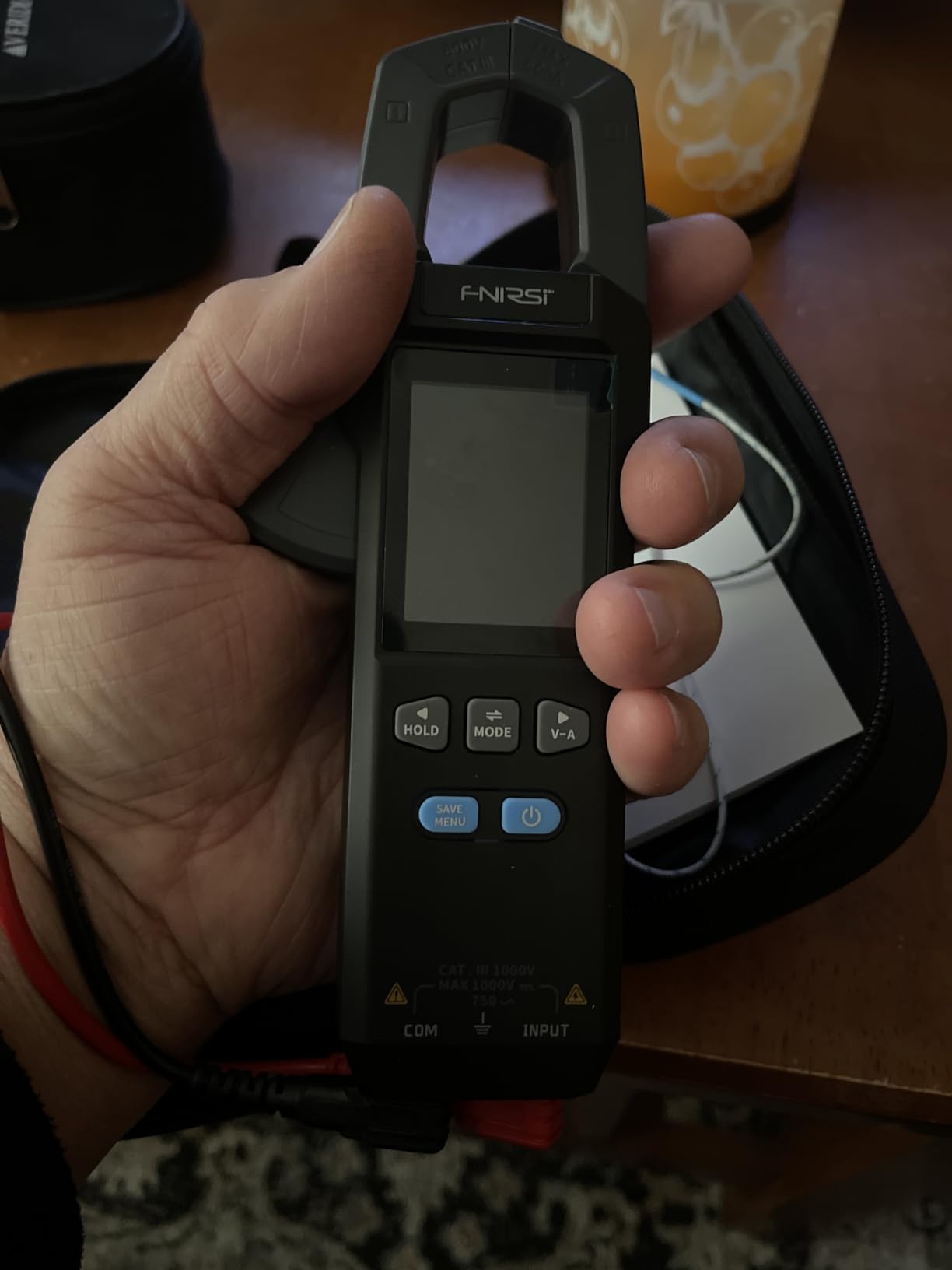
The DMC-100 is the odd one out in this roundup, and that is its appeal. Instead of a monochrome segment display it has a 2-inch full-colour TFT with 10 levels of brightness and light and dark themes, and it draws real-time curves with 8 live data sets and 30 stored records.
That graphing is not a gimmick. A breaker that trips once a week, a motor that surges intermittently, a circuit that misbehaves only when the HVAC starts: a recorded curve is the only way to see what happened between the moment you looked away and the moment the fault appeared. It also displays voltage and current simultaneously, which lets you watch both while an appliance cycles.
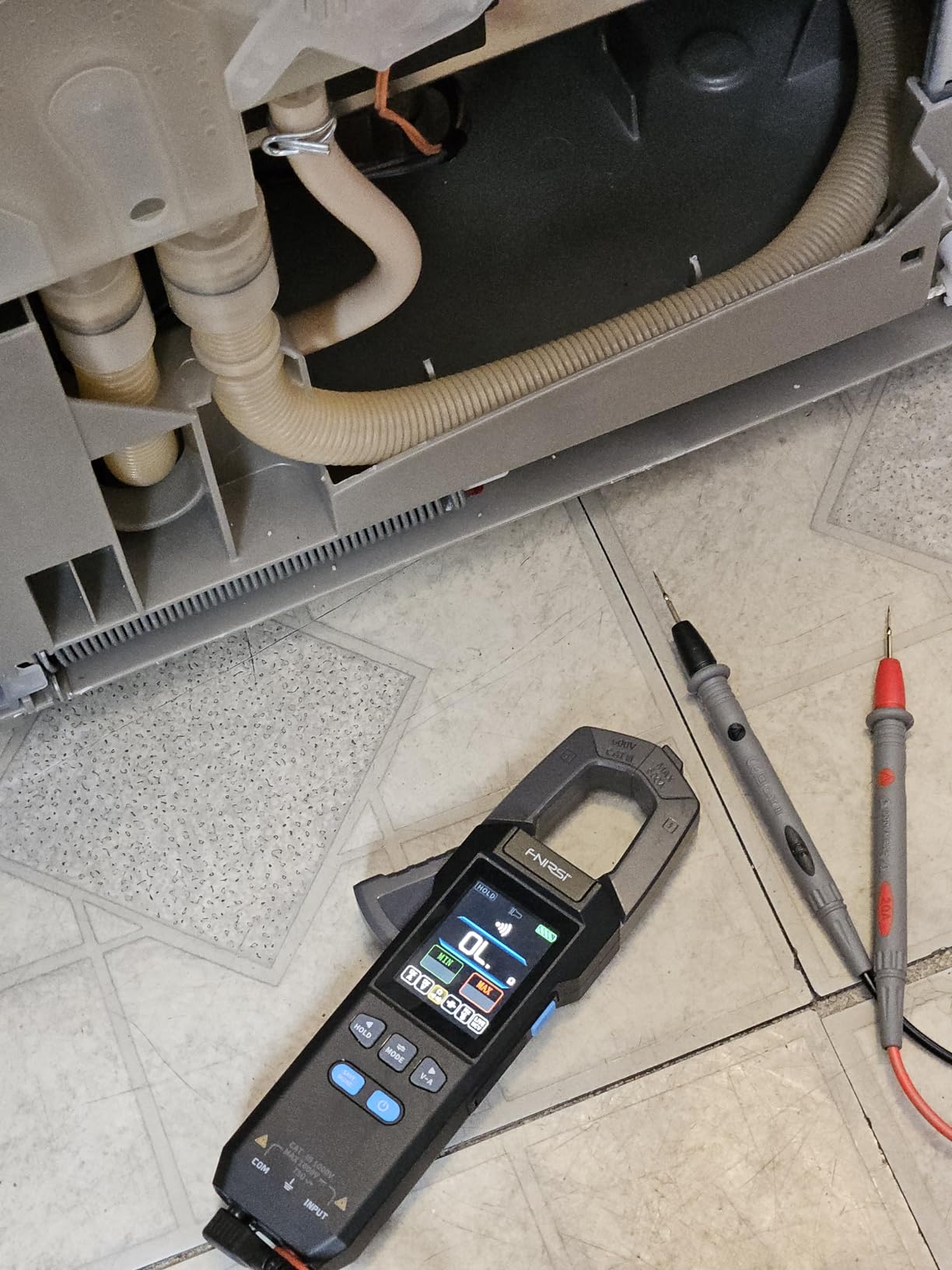
Underneath the screen it is a serious instrument: 9999-count True RMS AC and DC current to 600A, AC and DC voltage, resistance, capacitance, frequency and temperature, NCV and live wire testing, continuity and diode checks, powered by a 1500 mAh rechargeable lithium battery with Type-C charging. Reviewers report DC clamp readings that closely match Fluke and Fieldpiece references.
Setting expectations on accuracy
Owners are consistent about the trade: the readings are close to, but not at, professional reference level, and the claimed 9999-count resolution is optimistic in real use. Treat it as a very good homeowner and hobbyist instrument rather than a reference.
The other accepted compromises are the light build, which may not survive heavy site use, an inaccurate temperature function, and the integrated LiPo pack, which raises long-term longevity questions. A dedicated work light on the meter is also very weak.
Who should buy it
Buy it if your problems are intermittent, if you are learning electrical diagnostics and want visibility into what a signal is doing, or if you work outdoors and want a screen that is genuinely readable in sunlight. If your work is straightforward panel checking, the simpler meters give you the same current readings for less complexity.
11. Ideal 61-757 – Reading a Display Deep Inside a Crowded Panel
Ideal 61-757 – 600A AC/DC TRMS TightSight Clamp Meter
True-RMS AC/DC to 600A
AC/DC voltage to 1000V
TightSight display
UL CAT IV 600V and CAT III 1000V
Pros
- TightSight display solves reading values deep inside a panel
- True-RMS accuracy across a 1000 V range
- Dual backlit displays plus a built-in flashlight
- Overmolded body rated to survive a 6.6 ft drop
- LoZ temperature and capacitance all included
Cons
- Costs more than the general-purpose meters in this roundup
- Larger and heavier than compact models
- Magnetic hanger sold separately
The Ideal 61-757 solves a physical problem that every other meter here struggles with. Its patented TightSight display is positioned so you can read the value without repositioning the conductor, which sounds trivial until you have tried to read a display that is pointing down into a subpanel while a bundle of neutrals is in the way.
Underneath it is a full specification: True RMS AC and DC current to 600A, AC and DC voltage to 1000V, frequency, resistance, continuity, capacitance, diodes, temperature, a LoZ low-impedance AC voltage mode and NCV sensing. It is UL Certified to CAT IV 600V and CAT III 1000V, and the overmolded body is rated to survive a 6.6 foot drop.
It also carries dual backlit displays, a built-in flashlight and a probe tip holder, with a soft case, test leads, batteries and a K-type thermocouple included.
Why the safety rating stands out
CAT IV 600V and CAT III 1000V is the strongest rating in this group, and it is UL Certified rather than simply IEC marked. That matters if you own a home with a solar array feeding a back-fed panel, a large battery wall, or a service entrance you may need to work near, because those are the places where transient protection is genuinely tested.
For most homeowners CAT III 600V is enough. The Ideal earns its position on the combination of that rating with the display geometry, not on the rating alone.
What you trade for it
It costs more than the general-purpose meters in this roundup, it is bulkier and heavier than the compact models, and the magnetic hanger is a separate purchase. With 231 ratings it also has the smallest owner base here, so long-term durability history is thinner than for the Flukes or Kleins.
Buyers who use it rate the display as the feature that changes the job and the accuracy across the 1000 V range as the quality that justifies the rest. If panel access is genuinely awkward in your home, that solves a real daily annoyance.
12. Milwaukee 2235-20 – a Thin Jaw and a Five-Year Warranty
Milwaukee 2235-20 400 Amp Clamp Meter
True-RMS AC to 400A
AC/DC voltage to 600V
Thin 1.0 inch jaw
LED work light
Pros
- Thin 1.0 inch jaw fits crowded panels and wire bundles
- Built-in LED work light illuminates dark panels
- True-RMS accuracy with MIN/MAX and data hold
- Rugged overmolded construction from a major tool brand
- Five-year warranty
Cons
- Limited measurement set for the money
- No temperature capacitance or frequency measurement
- Heavier body than most competitors
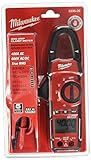
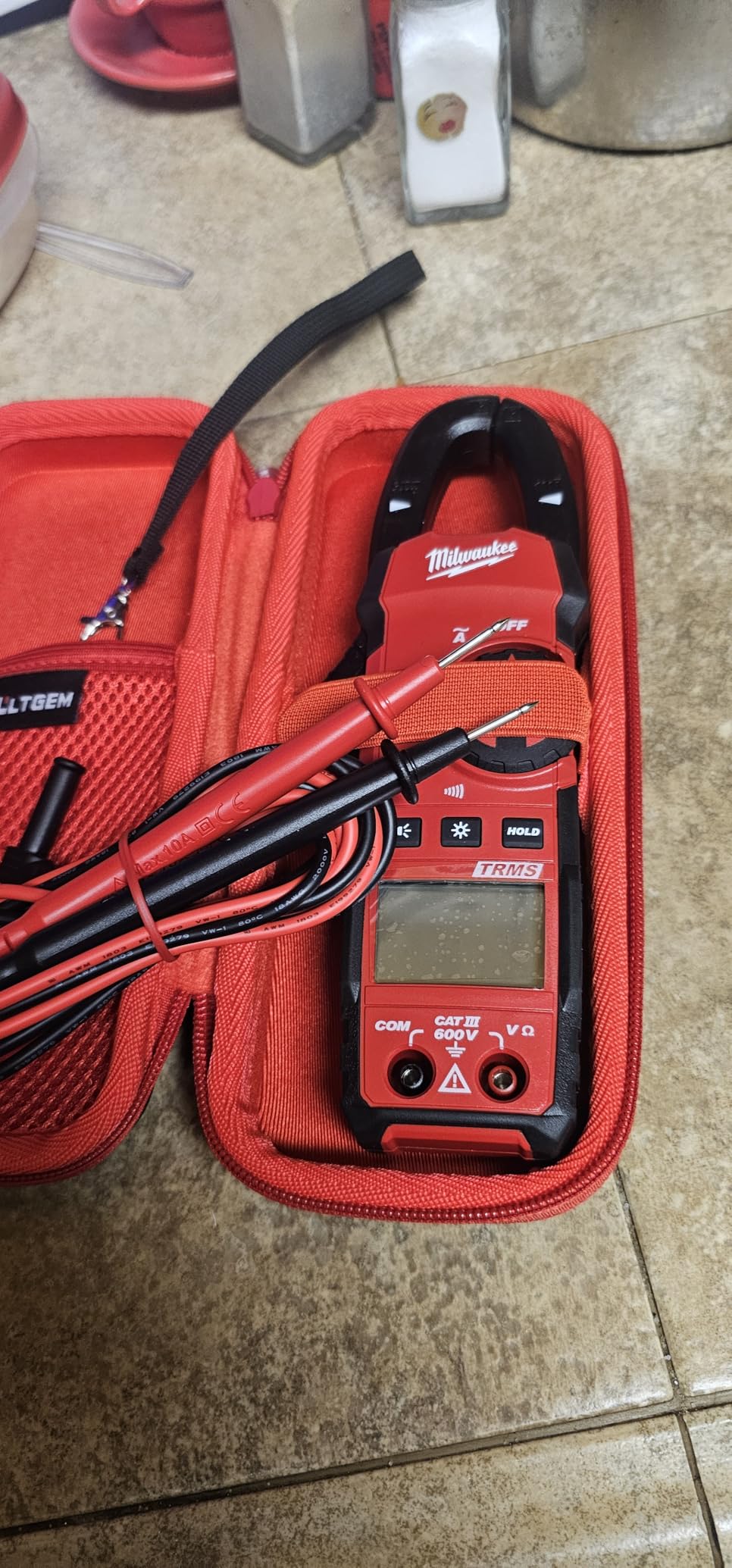
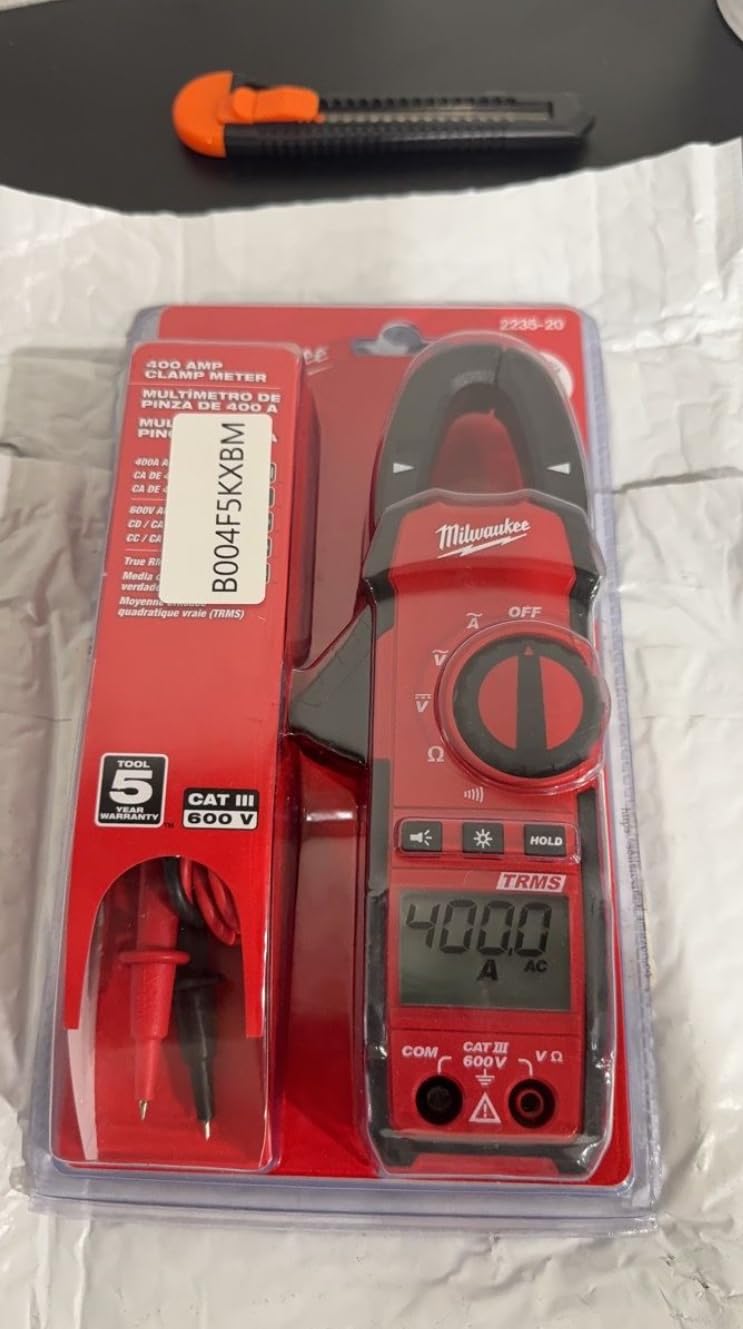
The Milwaukee 2235-20 is the odd-shaped choice here, and the shape is the reason. Its 1.0 inch thin jaw profile is the narrowest in this roundup, which is exactly what you want when the conductor is one of nine bundled neutrals leaving the top of a panel and you cannot get a conventional jaw around a single one.
Measurements are straightforward: True RMS AC current to 400A, AC and DC voltage to 600V, resistance to 4000 ohms, continuity, MIN/MAX and data hold. There is a backlit black-on-white display and a built-in LED work light, which is more useful than it sounds in an unlit panel. The rating is CAT III 600V and the warranty runs five years.
Buying for the ecosystem and the warranty
Reviewers who already own Milwaukee tools tend to stay in the ecosystem, and the light plus the thin jaw are the features they name on service calls. The five-year warranty is the longest in this group, and durability and drop survival come up repeatedly as real buying factors in the forums.
That matters if the meter lives in a truck and gets used in a crawl space. The LED work light alone removes one common failure point, which is fumbling for a flashlight while holding a clamp on a live conductor.
Where the feature list stops
This is a deliberately basic instrument. No temperature, no capacitance, no frequency, no DC current through the jaw, and no microamps. At 1.2 pounds it is the heaviest body here, and the manufacturer recommends annual calibration service, which is a consideration if you intend to use it as your only instrument.
If your work is residential panel reading and you value a thin jaw, a work light and a long warranty, it is a strong pick. If you want capacitance for capacitors or DC current for solar, it is the wrong tool and you should look at the Klein CL390 or the Fluke 325 instead.
How to Choose a Clamp Meter for Home Electrical Work
1. Start with the CAT rating, mapped to where you actually measure
The category rating describes what kind of transient a meter is built to survive, and it is the one specification you should never trade away. For a dwelling, match the rating to the measurement location, not to the brand.
CAT II covers receptacle-connected equipment and loads at the plug. CAT III covers distribution panels, subpanels and fixed equipment, and is the rating you need for anything behind a wall or in a panel. CAT IV covers the service entrance and the conductors leaving the meter base, which is where utility-side transients originate.
For most home work, CAT III 600V is the correct target. A CAT III 1000V rating adds margin, and CAT IV 600V or CAT IV 300V plus CAT III 600V is the ideal if you might approach a service entrance or a panel with a solar back-feed. The KAIWEETS HT208D and the Ideal 61-757 are the two in this list that reach CAT III 1000V.
2. Decide whether you need True RMS, and when it stops being optional
An average-responding meter assumes a clean sine wave and multiplies the reading by a fixed factor. That assumption breaks on anything with electronics in it. True RMS calculates the actual root mean square of the waveform, so it holds accuracy on chopped and switched current.
For a house with only incandescent lighting, incandescent loads and simple motors, an average-responding meter is not wrong. But that description stopped being accurate for most homes. LED bulbs and drivers, dimmers, inverter-based mini-splits, variable speed pool pumps, EV chargers, and every PV inverter produce non-sinusoidal current.
The practical test: if your home has any LED lighting, any dimmer, a heat pump or a mini-split, or any solar or battery storage, buy True RMS. In this roundup the meters that skip it are the Fluke 323, the Fluke 302+, the Klein CL120, the Klein CL220 and the Milwaukee 2235-20, and each of those is a deliberate trade for simplicity and price rather than an oversight.
3. Match the current range to your service, and do not oversize it
A 100A residential panel’s main breaker tops out at 100A, and a 200A panel at 200A. A meter rated to 400A covers every case with headroom and stays within the accuracy band across more of its range. Anything above 400A is for electric vehicles at fast-charge rates, welders, or commercial three-phase work, which is not this audience.
The subtlety most guides skip is low-end resolution. On a single conductor, a meter with 2000 counts shows coarse steps, so a 1.8A branch and a 2.2A branch can look the same. A 6000 or 9999 count display resolves small branches far better, which matters if you are verifying a lighting run or a small appliance circuit before closing a wall.
4. Get the jaw size right for your panel
Jaw opening is the specification people ignore until they are standing in a subpanel with a bundled neutral. Most residential meters use a 30 mm jaw, which fits a single 1/0 or 2/0 conductor comfortably. The KAIWEETS HT208D and the Fluke meters all sit there. The Milwaukee 2235-20 goes thinner at 1.0 inch for genuinely crowded bundles.
The other solution to crowding is a flexible current probe, an iFlex-style coil that slips around a conductor where a rigid jaw cannot reach. None of the twelve here ships with one, which is worth knowing before you buy. A line splitter is a cheaper and more accurate answer to the same problem, because it lets you measure small current accurately on a single conductor instead of fighting the physics of a 30 mm jaw.
5. Use LoZ or Low-Z to tell ghost voltage from a live circuit
This is the single most useful thing a homeowner can learn about clamp meters. When you probe a supposedly dead circuit and the meter reports 40 volts or more, that is very often ghost voltage, induced from adjacent live conductors through capacitive coupling. The wire is not energised, and there is no fault.
Low-Z mode fixes the ambiguity. It applies a low input impedance across the circuit, which suppresses induced voltage and collapses the reading toward zero if the wire is genuinely dead. If the reading holds up under LoZ, the circuit is live and your meter is telling you the truth. Among the twelve, the KAIWEETS HT206D, the KAIWEETS HT208D and the Ideal 61-757 offer the mode. It pairs perfectly with NCV screening, which is a hint and never a confirmation.
6. Clamp meter or multimeter? Buy both, but the order matters
The forum consensus is consistent: buy both. The subtlety is that new buyers do not know which one to get first, and getting the order wrong wastes money. The clamp meter is the better first purchase for a homeowner, because most residential questions are about current, and the clamp meter answers them without de-energizing anything.
The jobs divide cleanly. Current on a running circuit, load on an appliance, motor start surge, inrush, checking which breaker feeds an outlet, and confirming an EV charger or PV output all belong to the clamp meter. Continuity of a switch or a run, resistance of a heating element, diode checks, voltage with the circuit de-energized, and the final verification before you close a wall all belong to the multimeter.
One critical habit applies to both: clamp a single conductor, never the whole cable. Clamp both legs together and the magnetic fields cancel, producing a confident zero that is not a measurement at all.
7. Fluke versus Klein, honestly
Both are defensible and the difference is narrower than marketing suggests. Fluke builds tighter accuracy and a broader higher tier, and its name carries a reputation that forum posters describe as near-universal, with the recurring line that Fluke has god status. Klein builds more function per dollar, better displays for the money, and holds accuracy that working technicians describe as good enough, with the r/maintenance summary that Klein, Ideal and Fluke work wonderfully for the jobs they do.
In practice, choose the Fluke 323 or 302+ when accuracy on a panel reading is the point and you want the CAT IV 300V rating alongside CAT III 600V. Choose the Klein CL390 when temperature, microamps and capacitance in one body will save you buying a second instrument. If you are starting from nothing and want the easiest first meter, the Klein CL120 is the one beginners rate highest.
8. Check the certification mark, and stay away from unrated marketplace meters
Look for UL, ETL or TÜV certification alongside the printed category rating, and treat a rating that appears only in a marketplace listing as a claim rather than a fact. The Ideal 61-757 is UL Certified, the FNIRSI DMC-100 is UL 61010-1 and CE marked and RoHS compliant, and the KAIWEETS meters carry IEC 61010-1 with double insulation. A meter that cannot show you a certification mark is not a meter to put near a panel.
This concern shows up repeatedly in homeowner forums, where the cheapest marketplace meters are both recommended and defended in the same threads. The practical rule from experienced owners is simple: do not be the person who finds out an unmarked meter was the problem.
9. A safety checklist before you open a panel
De-energize first, wherever the job allows it. A clamp meter is an instrument, not a permit to work live. Verify dead with a meter you trust, not with an NCV pen or a non-contact tester, both of which produce false positives and false negatives in real panels.
Keep one hand free and out of the way, wear eye protection, and never work in a wet panel or in a metal enclosure without appropriate protection. Know your panel: 60A and 100A residential panels with 14 and 12 AWG conductors are the norm, and a meter with a 0.3A minimum current cannot see a small fault on those circuits. If the panel is live and you are not trained for live work, stop and call a licensed electrician. Good lighting matters more than people assume, which is why a work light or a headlamp is worth having within reach before you start.
Frequently Asked Questions
Which clamp meter is best for home use?
For most homeowners, the KAIWEETS HT206D is the strongest all-round choice: True RMS AC and DC current to 600A, CAT III 600V, Low-Z mode, a 6000-count display and a temperature probe in a body under 8 ounces. If you want the accuracy benchmark and a CAT IV 300V rating, the Fluke 323 is the reference. If your work involves an air conditioner or heat pump, the Klein CL390 adds temperature, microamps and capacitance.
Which clamp meter is better, Fluke or Klein?
Fluke builds tighter accuracy and a broader high tier, so the Fluke 323 and 302+ are better for panel readings where precision is the point, and both carry CAT IV 300V plus CAT III 600V. Klein builds more function per dollar, so the Klein CL390 measures True RMS AC and DC current plus temperature, microamps and capacitance in one body. Working technicians generally describe both as good enough for residential work.
Do I need a True RMS clamp meter for my house?
Buy True RMS if your home has LED lighting, a dimmer, a mini-split or inverter-based heat pump, a variable speed pump, an EV charger or solar with battery storage, because all of them produce non-sinusoidal current that average-responding meters misread. If every load is incandescent or a simple motor, an average-responding meter will read correctly.
Do I need a clamp meter or a multimeter?
For a homeowner, buy the clamp meter first. Most residential questions are about current on a running circuit, and the clamp meter answers them without cutting a wire or de-energizing anything. Add a multimeter for continuity, resistance, diode checks and the final voltage verification before you close a wall. Always clamp a single conductor, not the whole cable, or the reading cancels to zero.
What CAT rating do I need for residential electrical work?
CAT III 600V is the correct target for a dwelling, because it covers distribution panels, subpanels, fixed equipment and receptacle circuits. CAT II covers plug-in equipment only. If you might work near a service entrance, or you have solar back-feeding a panel or a battery wall, look for CAT IV 600V or a CAT IV 300V paired with CAT III 600V.
Which clamp meter is the most accurate for home use?
Among residential meters, the Fluke 323 and the Fluke 302+ are the most accurate, with the 323 rated at plus or minus 2% plus or minus 5 counts on current and 1.0% plus or minus 5 digits on resistance. Accuracy matters most when verifying a low-draw branch circuit, since coarse low-end resolution is the practical limit on cheaper meters rather than their headline specification.
Which Clamp Meter Should You Buy?
If you want one meter that handles almost anything a house can throw at it, the KAIWEETS HT206D is our pick, and its Low-Z mode alone will save you from chasing phantom voltage in a de-energized circuit. If panel accuracy and a CAT IV 300V rating matter more to you than the feature list, the Fluke 323 is the safest long-term answer and the one most owners keep for years.
If you are starting with a very small budget, the AstroAI CM2K0R gets you measuring without a large outlay, and you can upgrade once you know which faults you actually chase. If your work is heating and cooling, the Klein CL390 is the value pick, and if you are brand new to meters and want the simplest possible starting point, the Klein CL120 has the highest owner rating in the group. For solar, batteries, EV charging or motor inrush, look to the KAIWEETS HT208D or the Fluke 325 for DC capability, and for genuinely awkward crowded panels the Ideal 61-757 and the Milwaukee 2235-20 solve geometry problems nothing else here does.
Whatever you choose, pair it with a multimeter, respect the category rating, and de-energize first. The best clamp meters for home electrical work is whichever one you will actually reach for, use correctly and keep in a drawer for the day the breaker will not stop tripping.