
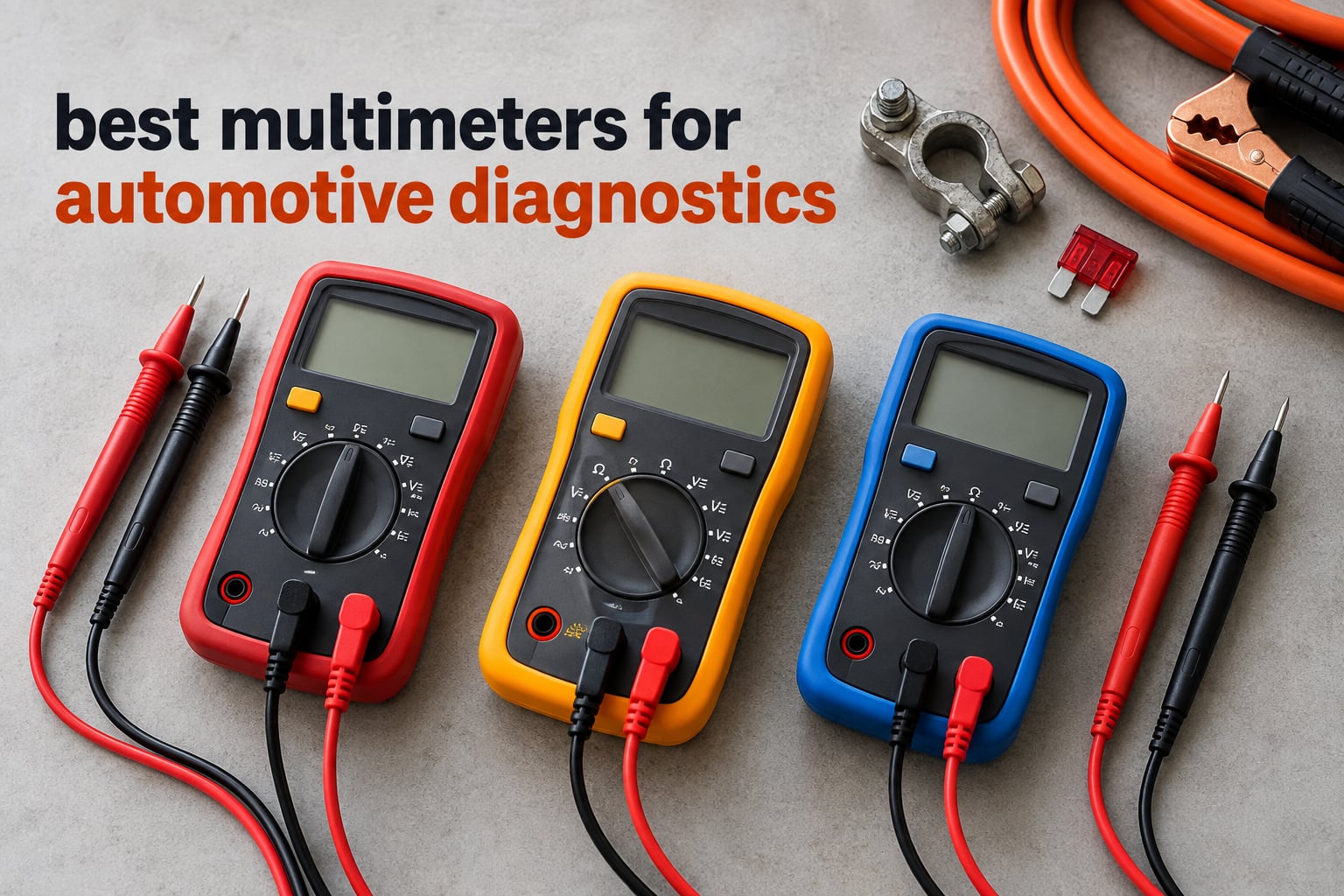
An OBD2 scanner tells you what the car’s computer thinks is wrong. A multimeter tells you what is actually happening in the wire, which is the only way to tell a failed sensor apart from a corroded connector, a broken conductor or a bad ground before you buy parts. That division of labour is the whole reason these tools exist separately, and it is where our search for the best multimeters for automotive diagnostics started.
Every meter below is a digital multimeter chosen specifically for 12-volt vehicle work, not a general-purpose meter that happens to end up in a garage. We weighted DC voltage accuracy, CAT safety rating, input impedance, ranging mode, the automotive measurements that actually help, build quality, and the size of the owner review base. Ratings and review counts are copied from the live listings so you can weigh owner experience yourself.
We should be straight about one thing first: our team did not bench-test ten new meters against a reference standard. What we did was read the specification sheets, cross-check the numbers against independent bench comparisons, and read a very large volume of owner reviews for recurring failure patterns. Where reviewers report a number, we pass it on. Where a spec sheet claims something the owner data contradicts, we say so.
One more distinction worth making early, because it confuses more beginners than anything else on this topic. A code reader pulls stored and live data from the powertrain module. A multimeter measures real electrical values at a point in a circuit. Neither replaces the other, and no meter in this roundup will read a check engine light for you.
How We Picked These Meters
Our criteria were weighted deliberately, because for car work almost everything comes back to one measurement.
DC voltage accuracy carried the most weight. A 12-volt system lives in the range where a sloppy meter lies to you about whether a battery is charged.
CAT safety rating mattered next, followed by input impedance, because measuring across a modern vehicle circuit means being a polite guest on someone else’s electronics.
Ranging mode decided usability: auto-ranging speeds up real diagnostic work, manual-ranging is slower but completely predictable.
We also scored the automotive-specific measurements a meter offers, such as duty cycle, pulse width, inductive RPM pickup, battery load test and low impedance mode, plus physical details like display readability in a dark engine bay, fuse accessibility, kickstand and lead storage.
Owner rating and review count broke ties. A meter with tens of thousands of ratings and a long, low complaint rate is a safer bet than a brand-new model with two hundred ratings, and forum consensus treats that distinction seriously. What we did not do was test lead integrity, calibration intervals, or long-term accuracy drift ourselves, and we have flagged every product limitation that reviewers consistently mention.
Our Top 3 Picks for 12 Volt Vehicle Diagnostics
Three meters earned the right to lead this roundup: the widest measurement coverage, the strongest owner feedback, and the one most likely to keep working a decade from now.
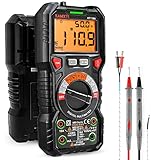
KAIWEETS HT118A
- 1000V DC voltage and 10A current
- 60 MOhms resistance range
- CAT III 1000V and CAT IV 600V rated
- Auto-ranging 6000 counts with backlit LCD

AstroAI AST-6000-D
- True RMS on AC and DC
- 6000 count auto-ranging
- Data hold with backlit LCD
- Magnetic hanger and kickstand
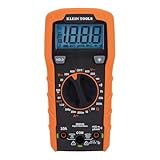
Klein Tools MM325
- Lead-alert LEDs at the input jacks
- Backlit LCD for dark engine bays
- Continuity and battery test functions
- Built-in kickstand and lead holders
Comparing Every Meter in This Roundup in 2026
All ten meters, in the order we review them, with the features that actually separate them on a vehicle.
| Product | Specs | Action |
|---|---|---|
| KAIWEETS HT118A 6000 Count TRMS |
|
Check Latest Price |
| AstroAI AST-6000-D True RMS |
|
Check Latest Price |
 INNOVA 3320 Auto-Ranging INNOVA 3320 Auto-Ranging |
|
Check Latest Price |
 AstroAI 4000 Count TRMS AstroAI 4000 Count TRMS |
|
Check Latest Price |
| Klein Tools MM325 |
|
Check Latest Price |
 FNIRSI DMT-99 9999 Count FNIRSI DMT-99 9999 Count |
|
Check Latest Price |
 Klein Tools MM420 TRMS Klein Tools MM420 TRMS |
|
Check Latest Price |
 Innova 3340 Automotive Innova 3340 Automotive |
|
Check Latest Price |
 Klein Tools MM720 LoZ Klein Tools MM720 LoZ |
|
Check Latest Price |
 Fluke 88V Deluxe Fluke 88V Deluxe |
|
Check Latest Price |
1. KAIWEETS HT118A – The Most Complete Meter for Everyday Car Work
KAIWEETS Digital Multimeter Automotive TRMS Tester 6000 Counts NCV for Car
1000V DC and 750V AC
10A AC/DC current
60 MOhms resistance
CAT III 1000V and CAT IV 600V
Pros
- Widest measurement coverage in this group including duty cycle and capacitance
- Auto-ranging with illuminated input jacks
- Non-contact voltage detection with audible and visual alarm
- 2.9-inch backlit display plus a built-in flashlight
- Silicone case and double ceramic fuse
Cons
- Entry-level 6000-count resolution caps precision on low-level signals
- Dial and lead interface feel less refined than professional meters
When I reach for a meter to check a charging system, trace a blown fuse or confirm a battery, this is the one I want in my hand. It measures 1000V DC, 750V AC, 10A of AC or DC current and up to 60 MOhms of resistance, and it also handles temperature, capacitance, frequency, duty cycle, continuity and diode tests. Almost nothing else at this level of meter gives you that full spread in one box.
The safety rating is what surprised me. CAT III 1000V and CAT IV 600V is the highest transient protection claim in this roundup, backed by a double ceramic fuse and thermistor protection, which matters more than most buyers realise. A loose battery clamp or a hot starter cable can throw a spike well beyond the 12-volt nominal.
Reviewers consistently point to the practical touches: a 2.9-inch backlit display, a rear flashlight, a kickstand and a pen slot, plus min/max/average recording and data retention for a fault that only appears when the road is bumpy. Owner feedback runs to more than 23,000 ratings, and the recurring note is that a large share of buyers eventually upgrade to a Fluke, which tells you this is a confidence-builder rather than a final tool.
Measurement Range and Where It Runs Out
The 6000-count display is the honest limitation here. On a 12-volt system that is almost always enough, because you are reading 12 to 14.8 volts at two or three decimal places. It is on low-level signals, such as millivolt sensor outputs or ripple measurements, that the resolution ceiling starts to show.
Owners also note that the dial and the lead interface feel less refined than a professional meter, which is fair. The feel is plasticky next to a shop-grade body, but nothing in the owner reports points to the meter body failing; the complaints cluster around the resolution ceiling and the general handling.
Safety Rating, Fuses and Drop Protection
CAT III 1000V and CAT IV 600V is the strongest rating here, and it comes with a double ceramic fuse. Ceramic fuses do not fail into a permanent short the way a cheap metal-link fuse can, which is a real advantage when you are testing a starter circuit.
The silicone protective case is not cosmetic on a meter that lives in a car. Reviewers describe it surviving drops and knuckle impacts, and 36 months of after-sale service with lifetime technical support is a reasonable backstop.

Who It Suits and Where It Falls Short
Choose this meter if you want one tool that covers battery, charging, fuse tracing, sensor circuits and household electrical work, and you do not need to log millivolt ripple. It is a strong first professional-grade-feeling tool and a very common first upgrade from a toy meter.
Skip it if you routinely chase intermittent electrical faults that need waveform capture, or if your work involves probing 5-volt reference signals where display resolution matters more than feature count.
2. AstroAI AST-6000-D – Best Value True RMS with a Magnetic Hanger
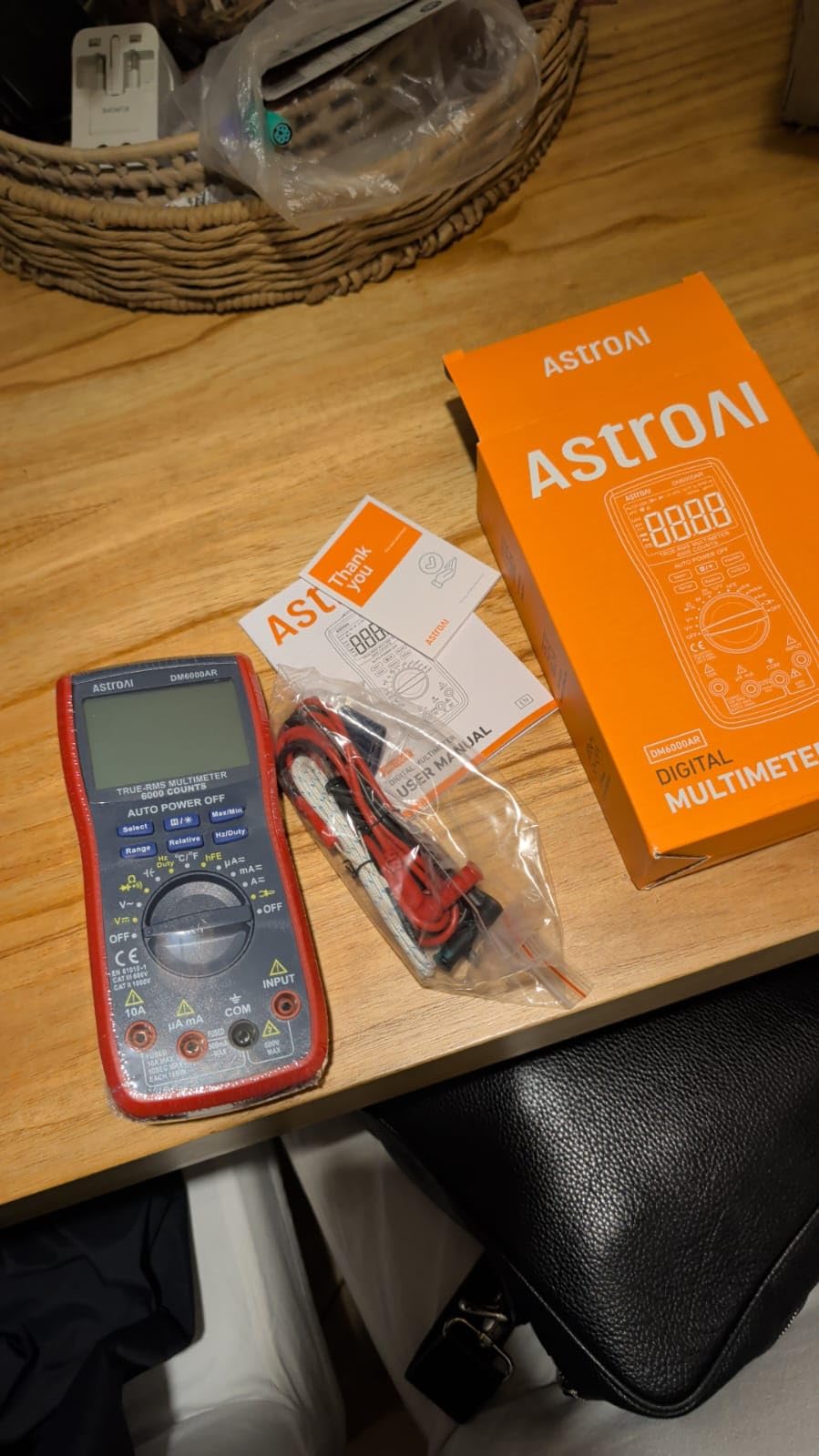
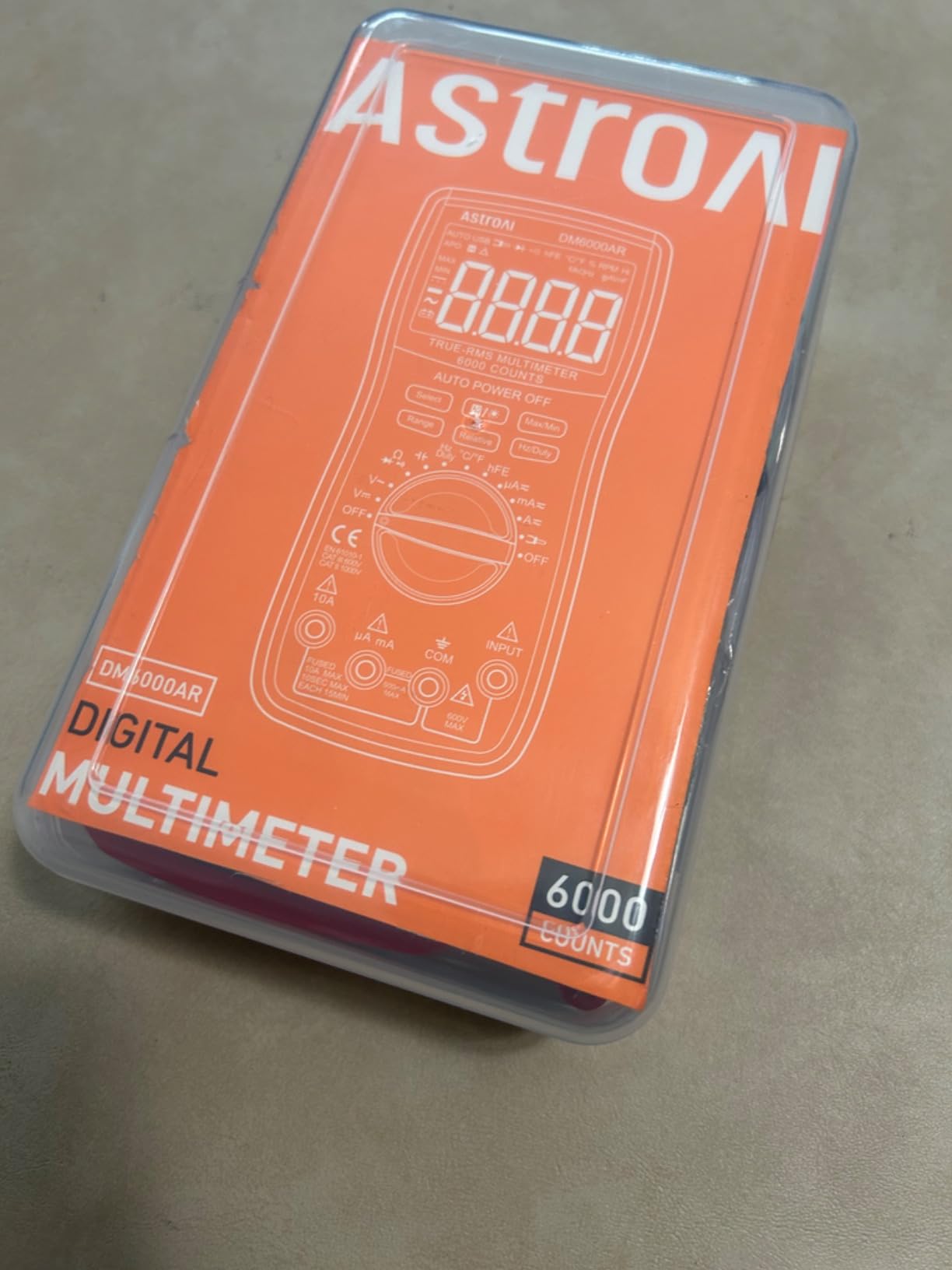
AstroAI Digital Multimeter, True RMS 6000 Counts Auto-Ranging Volt Meter for Automotive & Home Electrical Troubleshooting, AC/DC Voltage Current Resistance Continuity Capacitance Temperature Tester
True RMS AC and DC
6000 counts
7.48 by 3.54 inches
492 grams
Pros
- True RMS accuracy verified against reference meters
- Very fast auto-ranging acquisition for a budget meter
- Large backlit display with magnetic hanger for hands-free use
- Capacitance range exceeds the stated claim and stays accurate
- Double ceramic fuse plus two explosion-proof fuse tubes
Cons
- Frequency counter upper limit falls well short of the stated 60 MHz
- Supplied test leads are thin and many owners replace them
- No carrying case included
The magnetic hanger is the detail that changes how you work. Clip it under the hood or to a strut and both hands stay free while you probe, which turns a two-handed chore into a single-handed one. That, plus True RMS accuracy and a large backlit display, is why this meter carries more than 20,000 owner ratings.
Independent bench comparisons reported in the reviews found AC and DC voltage, current, resistance and diode readings matching far more expensive meters. For 12-volt diagnostic work, that is exactly the reassurance you want, and the battery load test gives a truer health picture than voltage alone.
The honest criticism is the two functions nobody needs on a car. The frequency counter’s upper limit falls well short of the stated 60 MHz, and the transistor hFE socket uses low bias current with C-B-E pin ordering, which makes it awkward for larger TO-220 parts. Supplied leads are thin, and many owners immediately replace them, which is a known pattern across this whole category.
True RMS Accuracy on AC and DC
True RMS matters for accuracy on distorted waveforms, and this meter delivers it at a level most people assume only premium brands offer. On a car, the DC side is what you use daily, and reviewers confirm the DC readings hold up under comparison.
Acquisition speed is the underrated part. The auto-ranging settles quickly, so when you step through a harness checking voltage at six points you are not waiting on the meter to catch up. That speed is why it feels far more expensive in the hand than on a spec sheet.
Display, Hanger and Everyday Handling
The backlit LCD, auto shut-off, data hold and kickstand form a sensible field kit. California-based technical support with a 24-hour response is unusual at this tier and cuts down the most common ownership problem, which is not knowing how to interpret a function.
Bench reviewers also found the capacitance range exceeds the manufacturer claim and stays accurate, which is a pleasant surprise for a meter at this level.
Who It Suits and Where It Falls Short
This is the meter for a weekend mechanic who wants True RMS, a backlit screen and hands-free mounting without moving up a tier. It is also a strong bench meter for the garage, and its review base makes it a low-risk purchase where a brand-new model would be a gamble.
It is not the right tool for frequency analysis, transistor identification, or shop work where you need documented calibration and a serviceable battery door. Many owners use it as a step-up and later graduate to a Fluke or Klein, and that is a perfectly reasonable path.
3. INNOVA 3320 – The Long-Held Classic with ECU-Safe Impedance
INNOVA 3320 Auto-Ranging Digital Multimeter, Red & Black
10 MOhm input impedance
Auto-ranging
Colour-coded battery charge LEDs
UL certified
Pros
- Six-plus years of reported reliable ownership
- Colour-coded LED battery charge status is rare at this level
- Readings match reference meters on 12V DC and resistance
- Fast auto-ranging for the price class
Cons
- No backlit display for dark engine bays
- AC current measurement is limited to roughly 200 mA
- Supplied probes give weak continuity contact
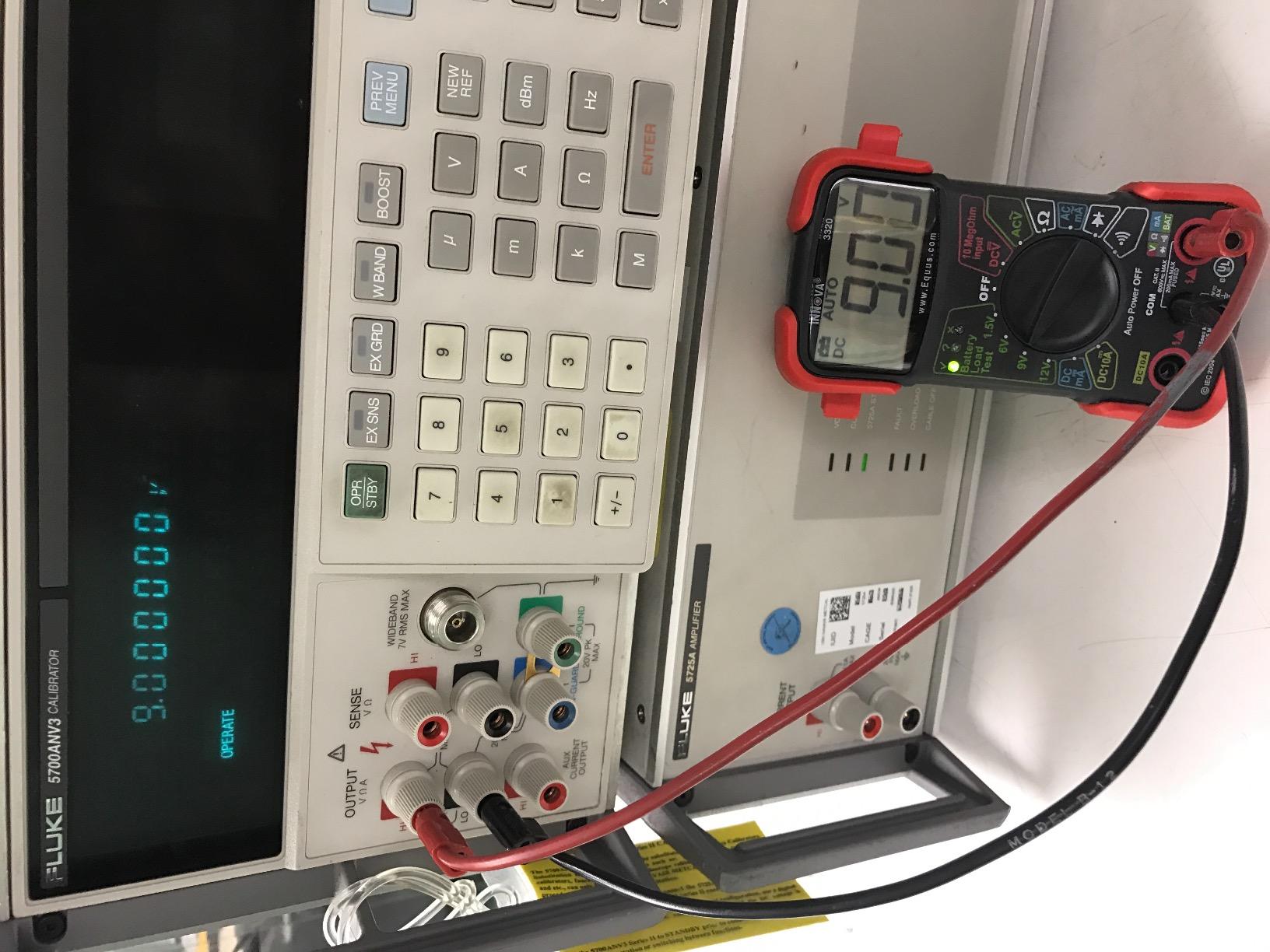
This meter has been in garage toolboxes for a long time, and the review history shows why: multiple buyers report six or more years of continuous service. Independent bench comparisons against a Fluke 179 and a Fluke 87-5 found near-identical readings on DC voltage, current, resistance and the battery test, with the notable exception of low AC voltage readings.
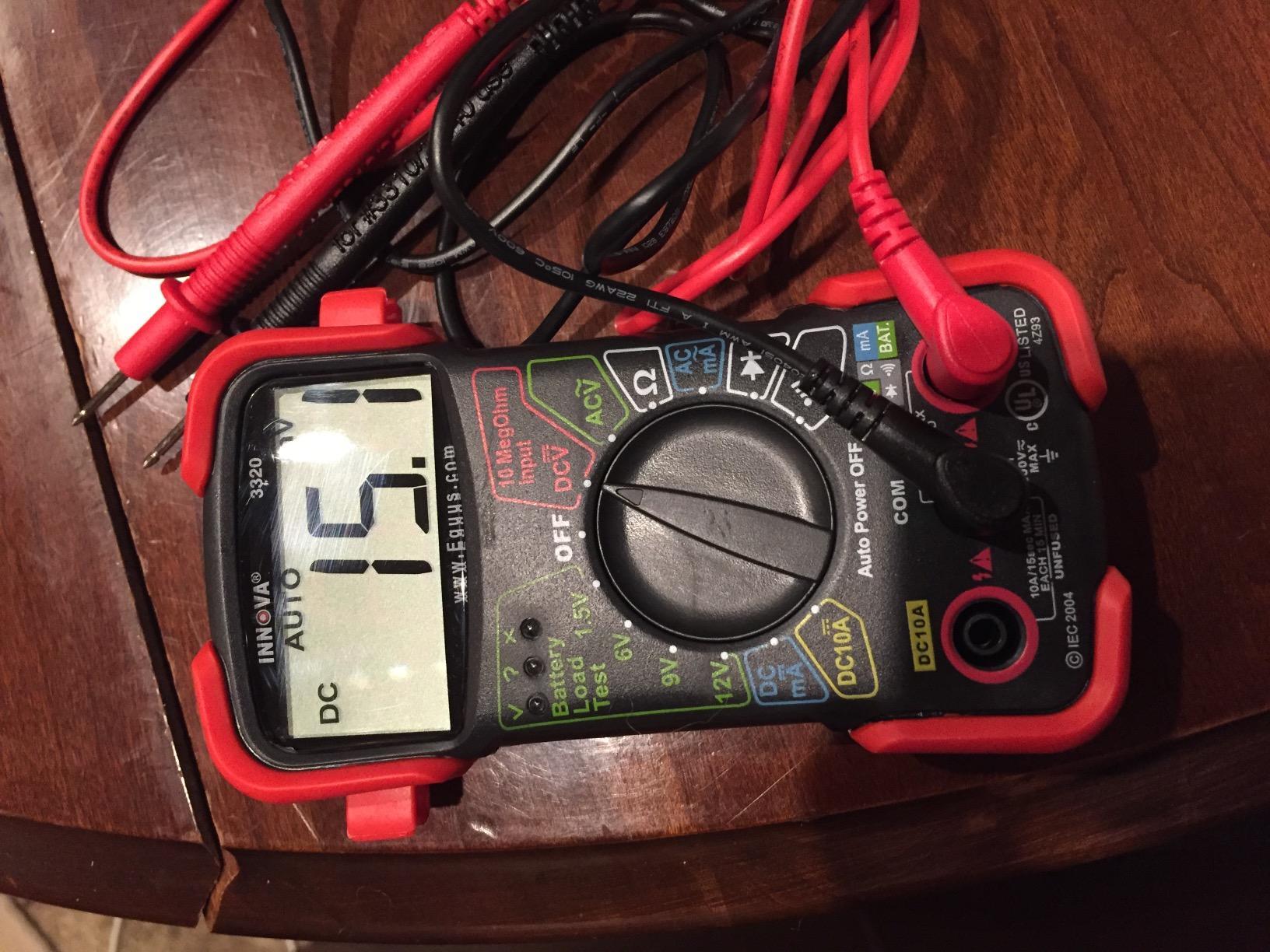
The 10 MOhm input impedance is the feature I would not compromise on. It is what makes the meter safe to connect across a modern ECU output without loading the circuit or, worse, damaging it. The colour-coded LED battery charge indicators give a quick green or red verdict at a glance, which is a genuinely useful feature in this price class.
Owner complaints are consistent and worth weighing. There is no backlit display, which is a real handicap working under a dashboard at night. AC current tops out around 200 mA. The range switch can loosen with heavy use and produce erratic readings until you cycle the dial, and the supplied probes make weak continuity contact.
Why Input Impedance Matters More Than Features
Modern vehicle electronics are sensitive. A meter with a low input impedance can pull a 5-volt reference signal down far enough to upset a control module, and in the worst case cause a fault code that was never really there. A 10 MOhm input keeps the meter passive.
That single specification separates this meter from cheaper budget options, and it is also why forum technicians argue it is sufficient for 12-volt diagnostic work despite lacking True RMS.
Battery Load Test and Indicator LEDs
The colour-coded battery charge status LEDs are the reason this meter still earns its place in a modern toolkit. Voltage alone tells you surface charge; a load test tells you whether the cells hold up under draw, which is the difference between a battery that starts a car in July and one that will not start it in January.
Reviewers confirm the readings line up with reference meters on this test, which is the part that matters when you are about to condemn a battery.
Who It Suits and Where It Falls Short
Pick this if you want a simple, proven, ECU-safe meter with a real battery test and you do not need to work in the dark. For a home mechanic doing battery, alternator and fuse checks, it does the core job extremely well for very little money.
Pass on it if you work at night regularly, if you need real AC current measurement, or if a loosening range switch would bother you. Its 4.5 average across 7584 ratings reflects solid competence rather than class-leading capability.
4. AstroAI 4000 Count TRMS – Smallest Useful Car Meter
AstroAI Digital Multimeter, TRMS 4000 Counts, Auto-Ranging, Battery Test
1.5V 9V and 12V battery test modes
CAT III 600V
5.87 by 2.8 inches
219 grams
Pros
- Dedicated 1.5V 9V and 12V battery test modes with red and green indication
- True RMS accuracy in a compact glovebox-sized body
- Non-contact voltage detection with audible and visual alarms
- Light and easy to carry in a tool bag
Cons
- 4000-count resolution is the lowest in this roundup
- 600V maximum voltage limits it for hybrid and high-voltage vehicle work
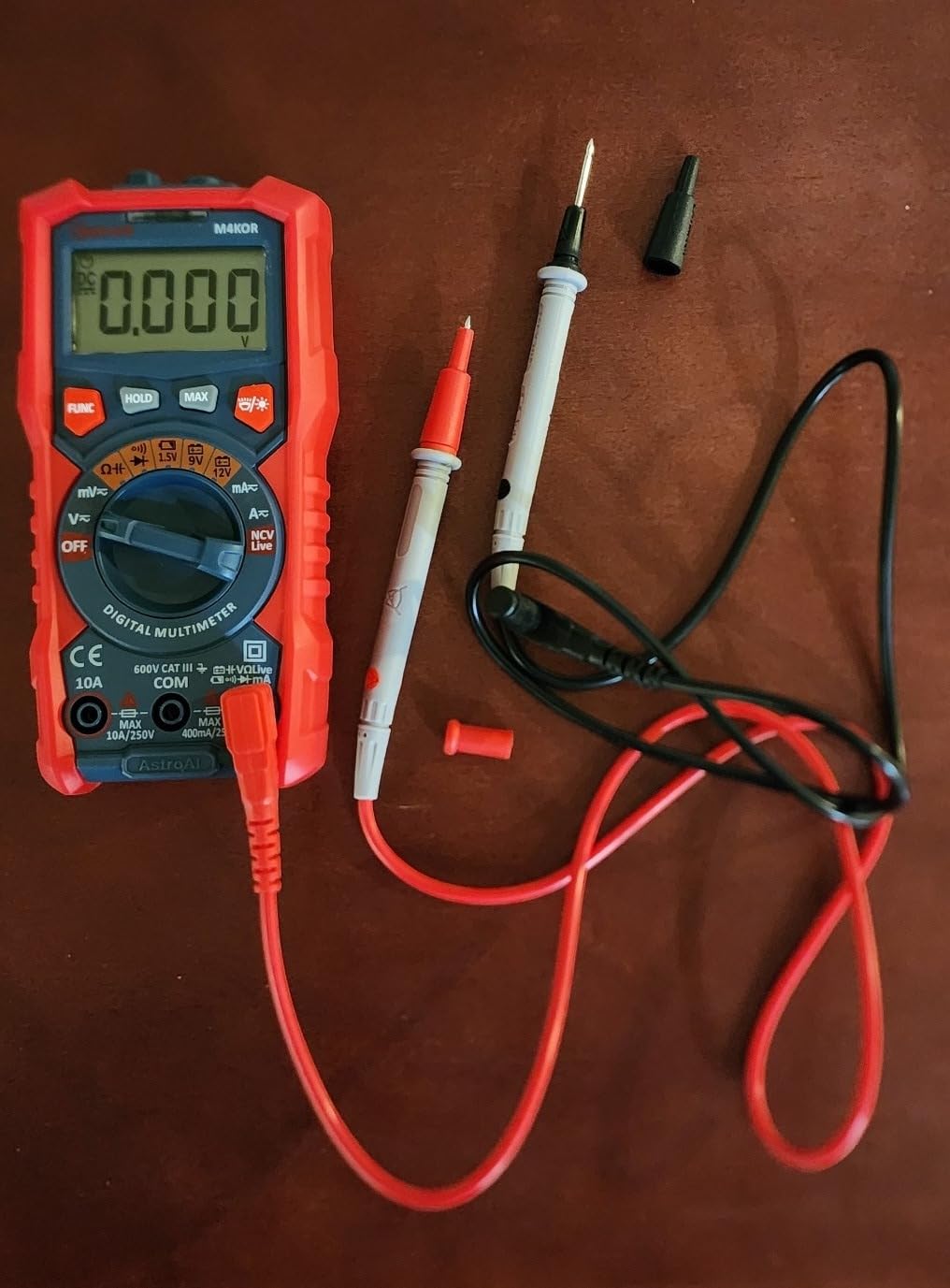
At 219 grams and under six inches long, this is the meter I would put in the door pocket of a project car. It is small enough that you actually bring it, which sounds trivial until you remember how many diagnostics get skipped because the tool is too bulky to grab.
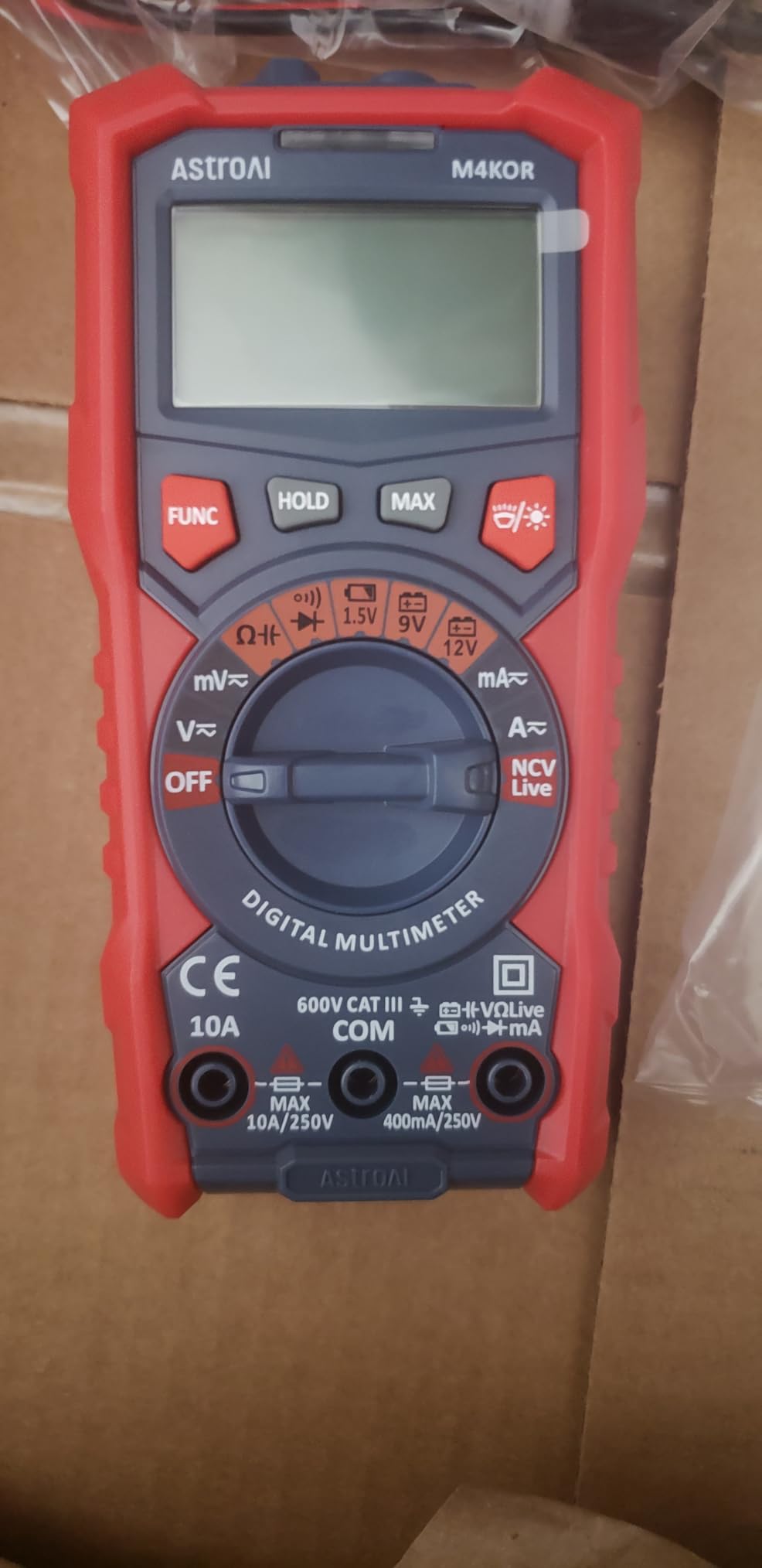
The dedicated battery test modes for 1.5V, 9V and 12V cells are the automotive touch. A red or green indicator gives you an instant verdict, and 79 percent five-star feedback across 6771 ratings suggests it lands well. Non-contact voltage detection with both audible and visual alarms helps you find a live conductor before you touch it.
The compromises are clear. Four thousand counts is the lowest resolution here, which is fine for 12-volt work and less fine for anything low-level, and the 600V ceiling rules it out for hybrid and high-voltage system work.
Battery Test Modes for the Under-Bonnet Check
Most budget meters measure battery voltage and leave you to interpret the number. This one has a dedicated mode per cell type with red and green indication, which shortens the decision at the roadside from a judgement call to a light.
It also runs the full routine set: continuity, diode test, live wire test and capacitance, so you can trace a blown fuse and check an alternator diode with the same tool you pulled from the door pocket.
Resolution and Where the 600V Ceiling Bites
Four thousand counts is the resolution floor in this group. On a 12-volt circuit that is rarely the deciding factor, but if you move to 5-volt sensor work or a signal below a volt, the last digit starts to matter and a higher-count meter is the better tool.
The 600V maximum is a genuine limit if you own a hybrid or electric vehicle. It is fine for the 12-volt subsystem, the DC-DC converter output and low-voltage auxiliary circuits, and wrong for anything near the traction side.
Who It Suits and Where It Falls Short
This is the right pick for a glovebox emergency kit, a first meter for a student apprentice, or anyone who wants a backup meter that costs little and always works. It has a 4.7 average, among the highest ratings in the roundup.
It is not right for professional low-voltage signal diagnosis or for any task near hybrid high-voltage systems. If that is your work, spend the extra and move up the list.
5. Klein Tools MM325 – The Most Owner-Loved Manual-Ranger
Klein Tools MM325 Multimeter, Digital Manual-Ranging 600V AC/DC Voltage Tester, Tests Batteries, Current, Resistance, Diodes, and Continuity
Manual ranging
600V AC and DC
2 MOhm resistance
CAT III 600V
Pros
- Lead-alert LEDs confirm correct test lead placement
- Backlit LCD stays readable in low light
- Manual ranging is simple and predictable
- Built-in kickstand and lead holders with optional magnetic hanger
Cons
- Manual ranging is slower than auto-ranging when switching tasks
- 2 MOhm resistance range is low against 40 to 60 MOhm rivals
- No temperature or capacitance measurement
Manual ranging gets treated as a weakness, and in this case it is the point. On a meter this simple, you pick the range, you know exactly what range you are on, and there is no auto-ranging algorithm to second-guess. For basic continuity and voltage work, that predictability is genuinely useful.
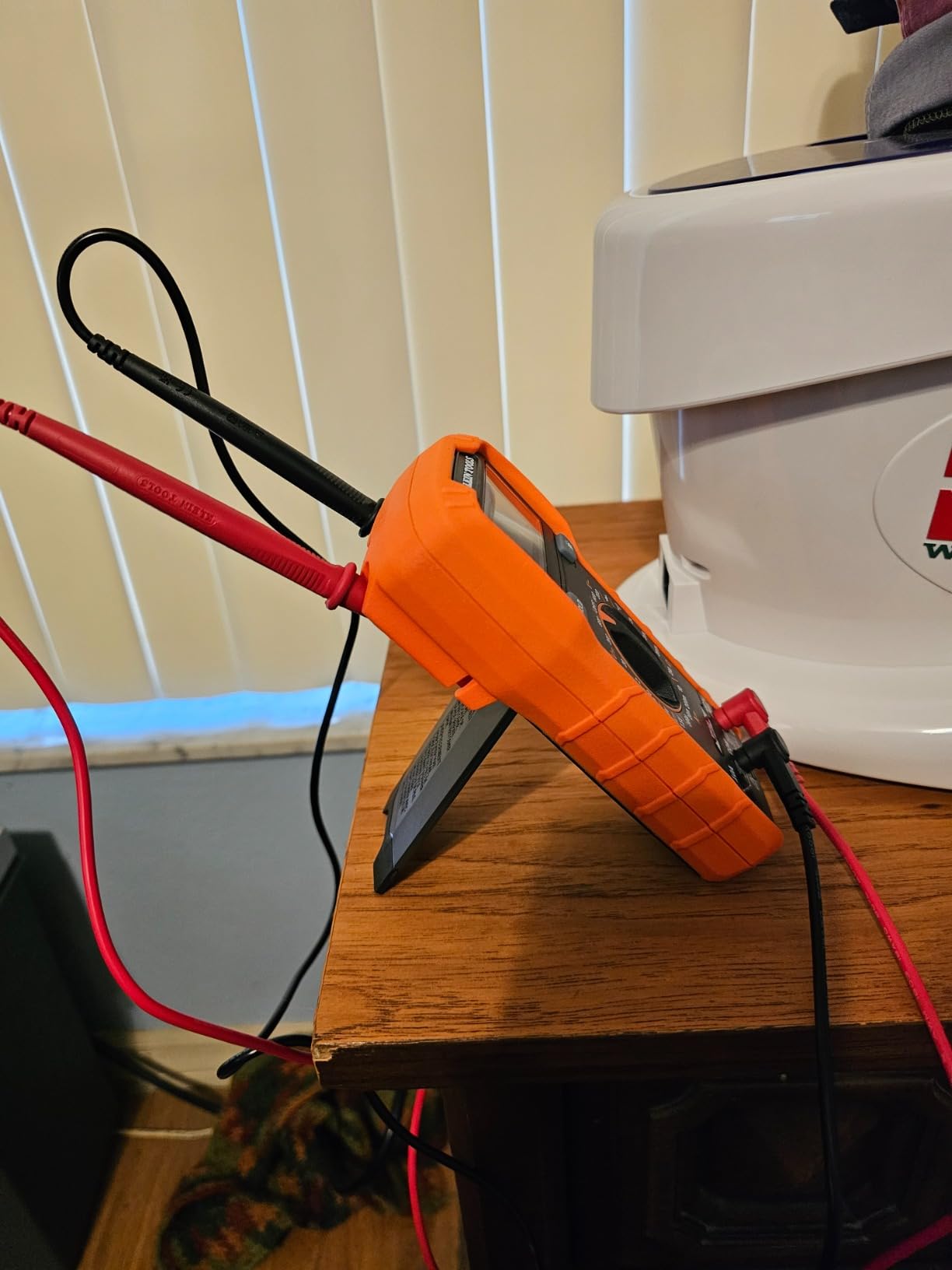
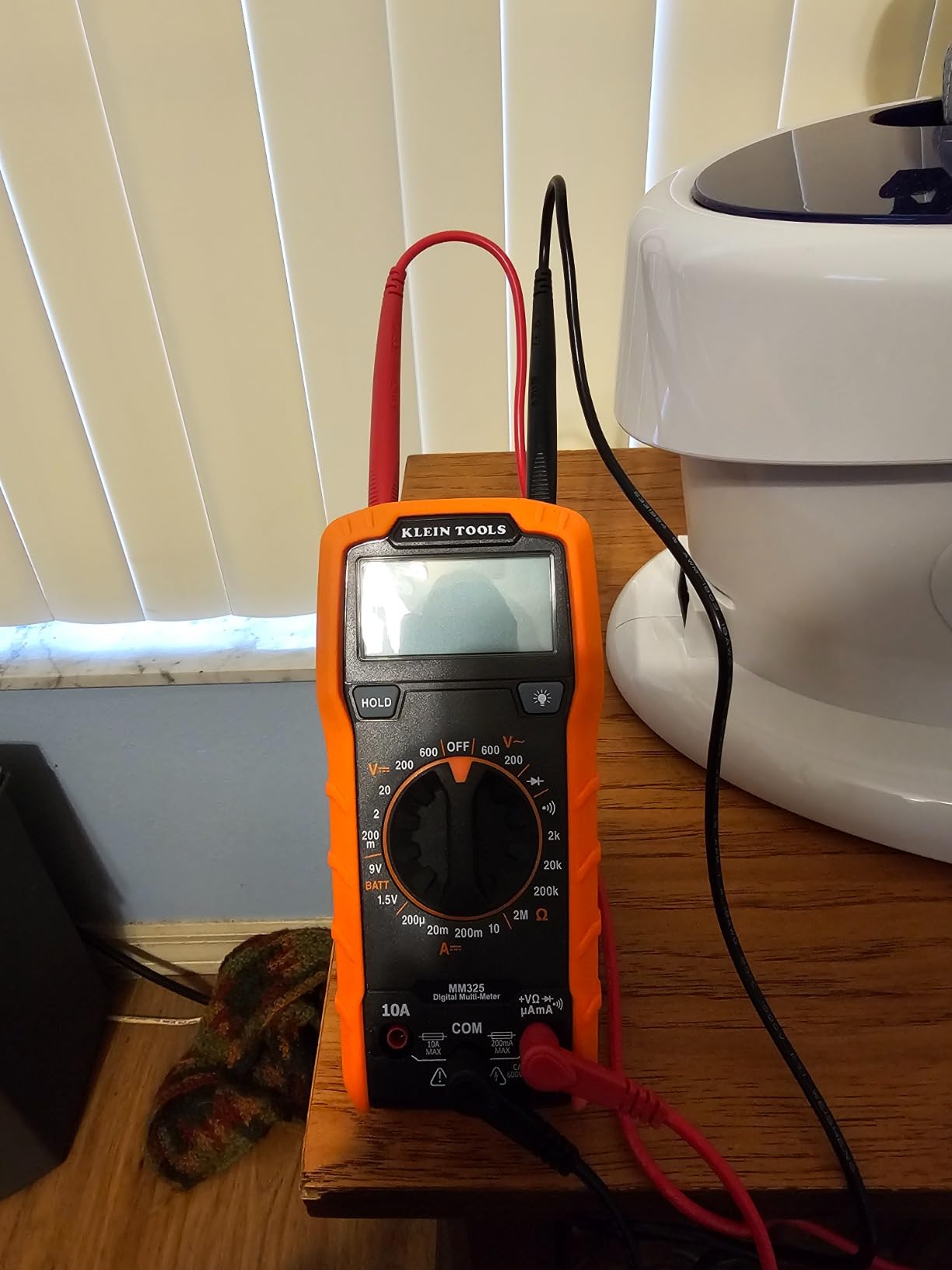
The lead-alert LEDs are the feature owners mention most. When you are probing in the dark with one hand, an input jack that lights up to confirm correct placement prevents the single most common meter mistake, plugging into the wrong terminal and blowing a fuse.
With 85 percent five-star feedback across 2970 ratings, this has the highest five-star share in the group. Reviewers credit the lead-alert system and the backlit display with fewer probe-placement mistakes, and they accept the manual range and 2 MOhm resistance ceiling as fair trade-offs for the design.
Manual Ranging and When It Is the Right Choice
Manual ranging makes sense when you are doing the same class of measurement repeatedly. Battery voltage at rest, charging voltage with the engine running, and a quick check of a suspect fuse are all simple, repeatable tasks where selecting the range takes less time than an auto-ranging meter would spend deciding.
It is slower when you are stepping through a harness comparing values at multiple points, and you will feel that if that is your normal workflow. The 2 MOhm resistance range is also the tightest here, which limits high-resistance circuit tracing.
Lead-Alert LEDs and Backlit Readability
Input jack indicators are rare at this level and genuinely useful. They light the correct jack for the function you have selected, which removes guesswork and reduces the chance of putting a lead across the wrong terminals.
The backlit LCD handles low-light work, and the built-in kickstand, rear lead holders and optional magnetic hanger let you set up a two-handed job on a fender rather than balancing the meter on a rocker panel.
Who It Suits and Where It Falls Short
Choose this if you are learning diagnostics, if you mostly test batteries, alternators and fuses, or if you want a Klein body in your toolbox for the build quality. It is also an easy recommendation for someone who cares more about a reading being right than about having twenty functions.
Pass if you need temperature, capacitance or frequency, if you need a high resistance range, or if you switch measurement types constantly and want auto-ranging.
6. FNIRSI DMT-99 – Best View for Intermittent Faults
FNIRSI DMT-99 Digital Multimeter 9999 Counts TRMS, Rechargeable Volt Meter
9999-count True RMS
2.4-inch colour TFT screen
1500mAh rechargeable battery
6.72 ounces
Pros
- Graph and waveform view makes transients and ripple visible on a handheld meter
- Rechargeable 1500mAh battery removes disposable battery changes in the field
- Smart auto mode identifies AC and DC voltage plus resistance and continuity
- 2.4-inch colour TFT screen with adjustable brightness
- Monitoring mode with custom threshold alarms
Cons
- Colour screen and rechargeable battery add weight and cost
- Menus and icons take more practice than a plain function dial
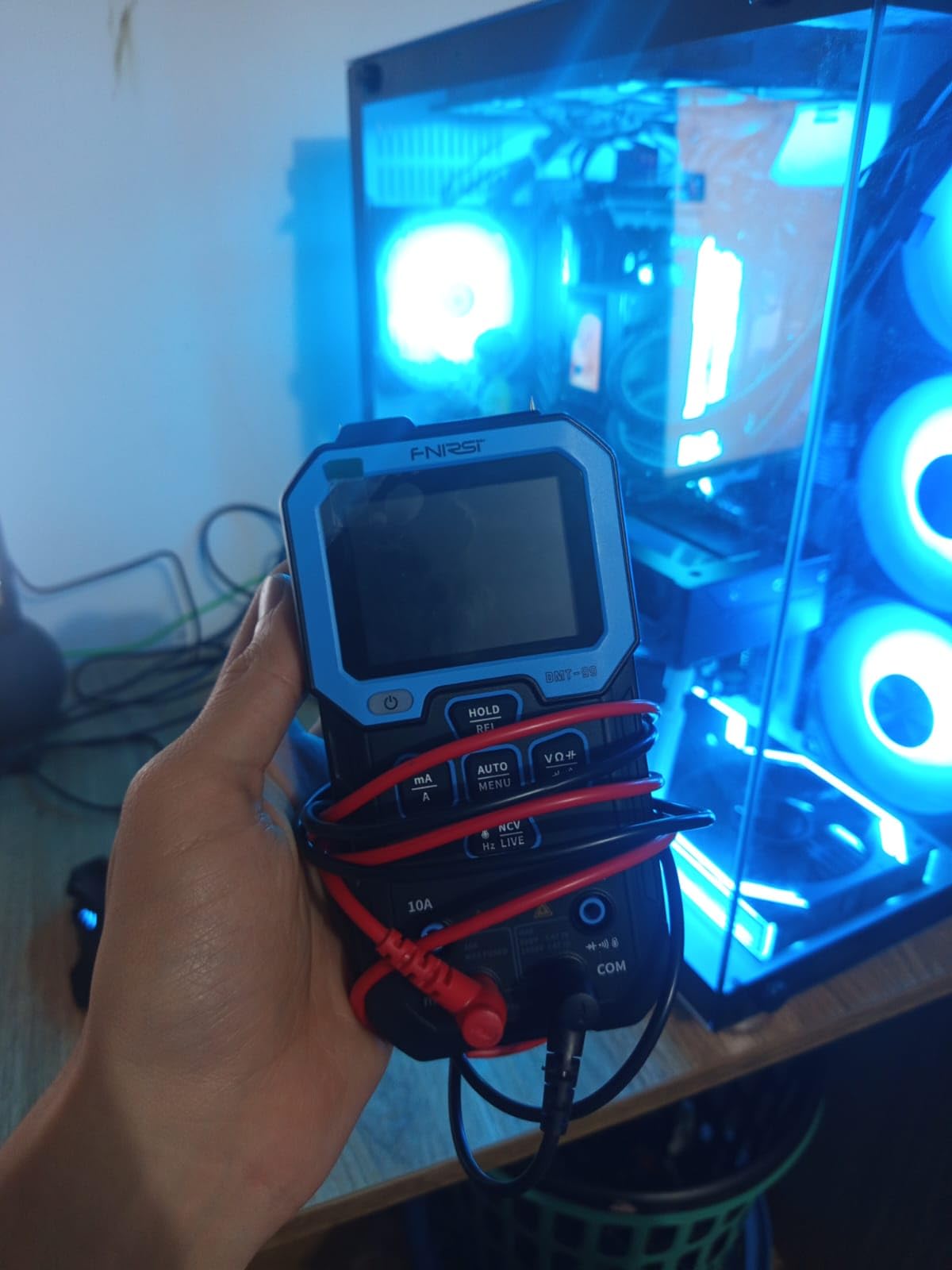
This is the only meter in the roundup with a colour display and a graph view, and for one class of fault that is decisive. Intermittent problems, ripple on an alternator output, a signal that drops out when you flex a harness: a waveform view shows you the event, while a numeric-only meter simply shows a number that flickers past.
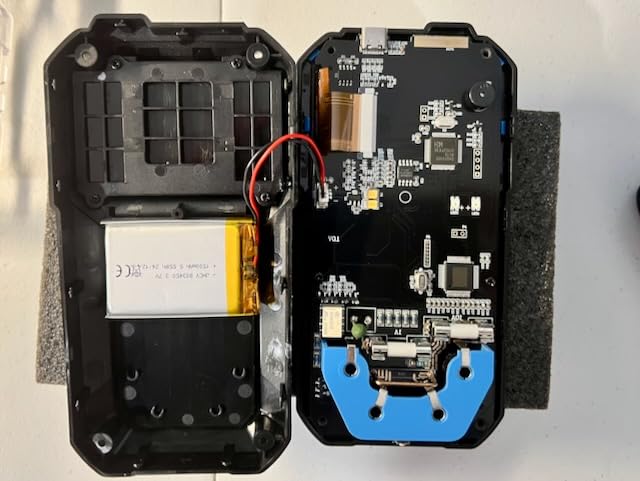
The rechargeable 1500mAh battery with Type-C charging removes disposable cells entirely, which matters for a technician who does not want a dead meter at the end of a long callout. Adjustable screen brightness handles both a sunlit engine bay and a dark footwell.
The trade-offs are honest. The screen and battery add weight and cost relative to a simple meter, and the menu-driven interface takes more practice than a rotating function dial. At 1356 ratings the owner base is smaller than the budget leaders, so long-term durability is less well documented.
9999 Counts and True RMS on a Handheld Meter
Nine thousand nine hundred and ninety-nine counts is the highest display resolution in this group, and it is paired with True RMS. That combination gives you finer resolution on low-voltage signals and accurate AC readings without the averaging tricks that cheaper meters use.
Dual ceramic fuses and anti-burn protection circuitry are the safety story here, and for automotive work on circuits with inductive loads, fuse robustness is not a detail to skip.
Waveform, Monitoring and the Rechargeable Battery
The graph and waveform view is the differentiator. Owners use the monitoring mode with custom threshold alarms to catch a fault that only appears under specific conditions, which is a genuinely shop-grade capability in a handheld format.
Fine test leads suited to SMD work and tight circuit boards come in the box, along with a rear kickstand and storage slots. That lead quality matters, because a surprising share of bad readings on cheap meters come from the leads rather than the meter.
Who It Suits and Where It Falls Short
This is the pick for a technician or serious enthusiast chasing intermittent electrical faults, chasing down a parasitic draw that only shows up when the car is warm, or verifying alternator ripple. The graphing turns guesswork into evidence.
It is not the right first meter for a beginner who wants a simple dial, and it is not the choice for a technician who values a mechanical rotary switch under gloved use. Budget aside, the smaller review base means you are buying on features more than on proven longevity.
7. Klein Tools MM420 – Best Build Quality with a 2 m Drop Rating
Klein Tools MM420 Digital Multimeter, Auto-Ranging TRMS Multimeter, 600V AC/DC Voltage, 10A AC/DC Current, 50 MOhms Resistance
Auto-ranging True RMS
600V AC and DC
50 MOhm resistance
Rated for a 2 m drop
Pros
- Auto-ranging combined with True RMS for fast readings without range hunting
- Lead-alert LEDs remove jack-placement guesswork
- High-contrast display stands out clearly when backlit
- Ceramic fuses are accessible in the battery compartment
- Built to survive a 6.6 foot drop
Cons
- Backlight times out automatically and cannot be set to stay on
- Battery compartment requires a screwdriver to open
- Function dial uses symbols rather than words
- Shared AC and DC voltage setting means tapping SEL every time
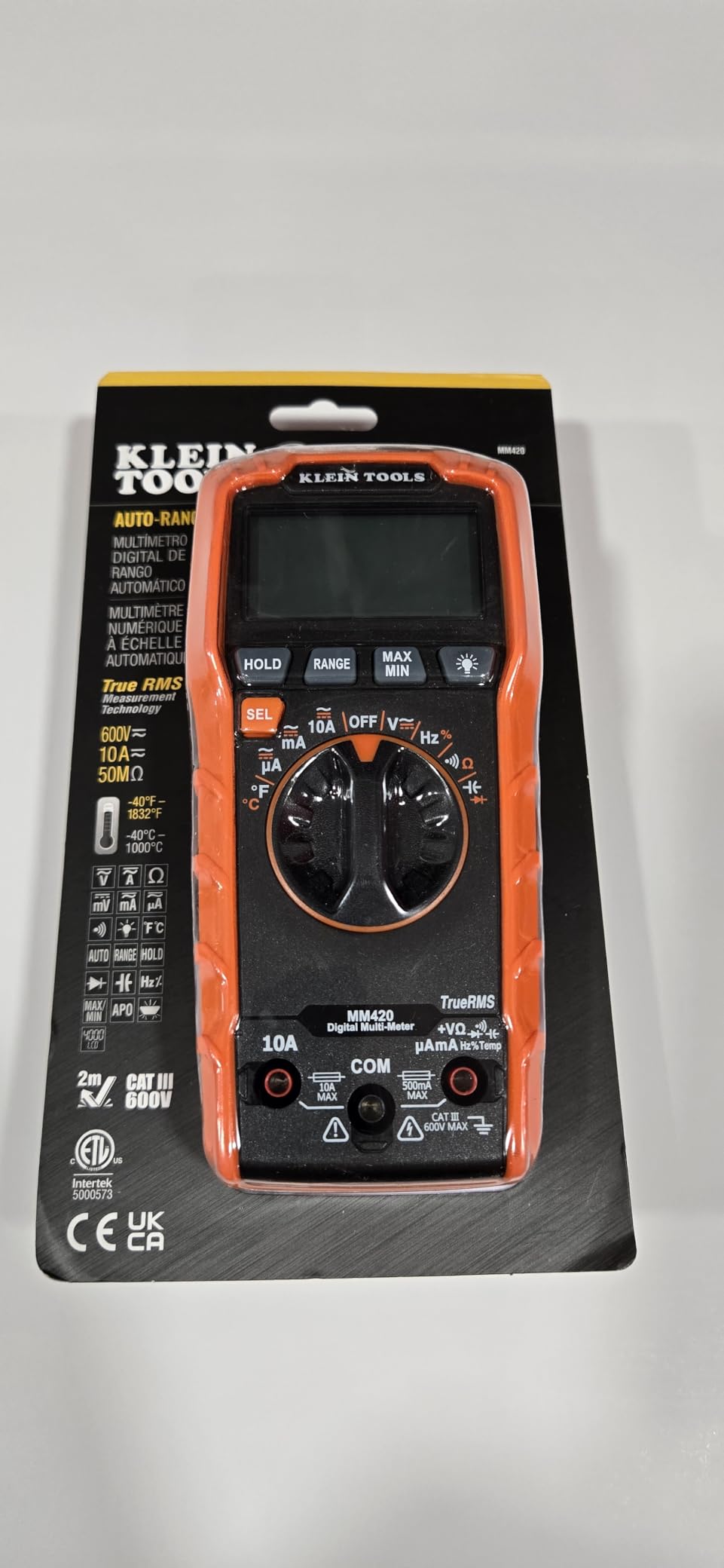
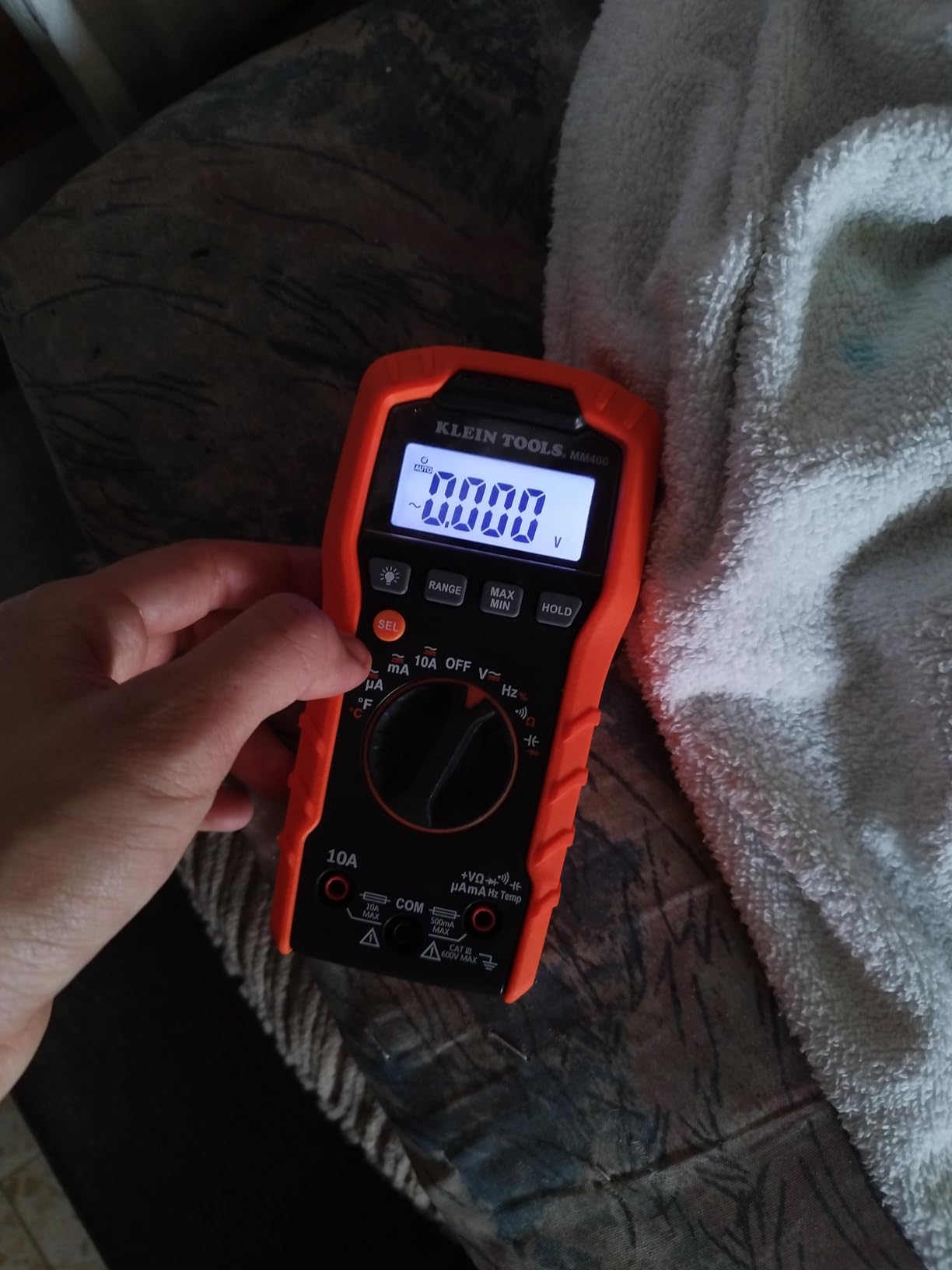
The MM420 is the successor to the manual-ranging Klein meters, and it keeps everything that made them good: the lead-alert LEDs, the backlit display, the kickstand and the lead holders. It adds auto-ranging with True RMS, so you stop choosing ranges and you get accurate AC readings as a side effect.
Build quality is the headline. It is rated to survive a 6.6 foot drop, the fuses are ceramic and reachable without disassembling anything, and the box includes CAT III and CAT IV safety-capped test leads plus a thermocouple. That lead inclusion is quietly one of the better provisions in this roundup, because leads are the first thing to fail.
Owners report 84 percent five-star feedback across 750 ratings. The gripes are consistent: the backlight auto-times-out and cannot be set to stay on, the battery door needs a screwdriver, and the shared AC and DC voltage setting means pressing SEL on nearly every measurement.
Auto-Ranging, True RMS and 50 MOhm
Auto-ranging means the meter picks the range, which speeds up exactly the workflow where manual-ranging slows you down: moving between a battery reading, a charging voltage and a resistance check on a suspect sensor circuit in a single pass.
Fifty MOhm of resistance range is a real improvement on the 2 MOhm ceiling of the manual Klein, and it lets you trace high-resistance leakage paths properly. Temperature, capacitance, frequency, duty cycle and diode tests are all present, so this is a genuine all-rounder rather than a battery tester.
Fuses, Leads and the Workbench Reality
Accessible ceramic fuses in the battery compartment save real time. When a current-range fuse blows mid-test, you can swap it with a screwdriver instead of finding a shop, and ceramic fuses behave predictably under fault conditions.
Safety-capped leads as a standard part of the package are the detail professionals notice, because a lead with an intact insulation rating is part of your CAT rating, not an accessory. The 2 m drop rating is a fair proxy for how it will be treated in a working garage.
Who It Suits and Where It Falls Short
Pick this if you want Klein build quality, auto-ranging convenience and a full function set in one meter, and you do not plan to work near hybrid high-voltage systems. It is also a strong gift for a family member who fixes things.
Pass if you need a low impedance mode to kill ghost voltage, if you need more than 600V, or if you work in very dark conditions and cannot live with a backlight that times out. The SEL button for AC and DC selection is a habit you will form quickly, but it is a habit.
8. Innova 3340 – Most Automotive-Specific Functions per Meter
Innova 3340 Professional Automotive Digital Multimeter, Black
Duty cycle and alternator diode test
Inductive RPM clamp
Measures to 15 amps
10 MOhm impedance
Pros
- Purpose-built engine diagnosis covering alternator diodes duty cycle solenoids and breaker points
- Temperature probe and inductive RPM clamp bundled in the box
- 10 MOhm input impedance is safe on modern vehicle electronics
- 15 amp range covers starter and charging circuit tests
Cons
- Lowest average rating in this roundup with 5 percent one-star reviews
- Auto-ranging can be slow to settle on a reading
- Range switch and dial controls feel dated
This is the only meter here whose accessory bundle is really part of the product. You get a temperature probe, an inductive RPM clamp and a carrying case in the box, and the clamp alone would cost you considerably more as a separate purchase. For engine work rather than general 12-volt electrical work, that bundle changes the value calculation.
The measurement list is purpose-built too: alternator diodes, duty cycle, solenoids, breaker points, wiring and switches. Measuring to 15 amps covers the starter and charging circuit tests, and the 10 MOhm input impedance protects the ECU while you do it.
Be aware of the score. A 4.4 average with 5 percent one-star feedback is the lowest in the roundup, and the recurring complaints are slow settling on auto-ranging and occasional units arriving with problems. Test it the day it arrives.
Automotive Measurements: RPM, Duty Cycle and Dielectric Tests
The inductive RPM clamp clamps over a spark plug lead and reads engine speed without touching the ignition. Duty cycle and pulse width give you injector-on-time and ignition dwell behaviour, which are the numbers that distinguish a healthy injector from a leaking one and a healthy coil from a weak one.
The alternator diode function is a genuinely under-used feature. A single shorted diode in the rectifier shows up as an AC ripple component on DC output that no voltage reading will reveal, and this meter can show you it directly.
The Accessory Bundle and 10 MOhm Impedance
Owners consistently praise the bundle. A temperature probe lets you check coolant and oil temperature properly, and the carrying case means the meter and its accessories survive a van boot, which a loose multimeter never does.
The 10 MOhm input impedance is the same ECU protection argument that applies to the INNOVA 3320, and it is the specification that justifies connecting this meter to modern vehicle electronics rather than only to 1980s harnesses.
Who It Suits and Where It Falls Short
Buy this if you work on engines specifically, if you want RPM, dwell and duty cycle without buying separate accessories, or if you are a shop that needs a meter in every bay. The bundle alone justifies it against a general-purpose meter plus add-ons.
Skip it if you want the highest owner rating, the fastest auto-ranging, or a battery you can change without tools. At 4.4 across 743 ratings it is the most divisive product here, and the slow settling time is the flaw that appears most often.
9. Klein Tools MM720 – The Only Meter Here With Low Impedance Mode
Klein Tools MM720 Digital Multimeter, Auto-Ranging TRMS, Low Impedance (LoZ), 1000V AC/DC Voltage, 10A AC/DC Current, 60 MOhms Resistance
Low impedance LoZ mode
1000V AC and DC
60 MOhm resistance
CAT IV 600V and CAT III 1000V
Pros
- Only meter in this roundup with a low impedance mode for hunting ghost voltage
- 1000V AC and DC range covers hybrid and high-voltage systems
- Large reverse-contrast LCD stays readable in bright and dim conditions
- Auto-ranging with True RMS plus lead-alert LEDs
Cons
- Thinner owner rating base so long-term durability is less documented
- LoZ mode requires familiarity to interpret readings correctly
Low impedance mode is the single most useful feature in this entire roundup for modern vehicles, and only this meter has it. In LoZ the meter drops its input resistance to a few hundred kilohms, which collapses the phantom voltage that appears when you probe a circuit through a modern wiring harness. The reading collapses to near zero if the circuit is genuinely dead, and holds up if there is real voltage there.
Everything else is high spec: 1000V AC and DC, 60 MOhm resistance, 10A AC and DC current, True RMS with auto-ranging, and CAT IV 600V and CAT III 1000V ratings. The large reverse-contrast LCD stays readable in bright sun and in a dark footwell, which is rarer than it should be.
The honest limitation is the review base. At 396 ratings this is one of the least-reviewed products here, so long-term durability is not yet documented by owners the way it is elsewhere. The second limitation is skill: LoZ readings need interpretation, and a beginner can misread a collapsing number as a fault.
Low Impedance Mode and the Ghost Voltage Problem
Here is the misdiagnosis LoZ prevents. You probe a fuel injector connector with a 10 MOhm meter, see 4.8 volts, and conclude the ECU is commanding the injector. In reality the 4.8 volts is a ghost voltage created by the meter’s own high input impedance coupling into a dense harness and a module protection diode. Switch the same meter to LoZ and the reading collapses, telling you the circuit is not actually live.
Without that, the classic false trail is condemning a module or a sensor when the real fault is a broken wire, a poor ground or a corroded pin. This is the one feature in the roundup that can change a diagnosis rather than just make one faster.
1000V Range, Safety Ratings and the Display
A 1000V AC and DC range means you can measure the output of a hybrid DC-DC converter and auxiliary circuits without wondering whether you are near the ceiling. That is still the 12-volt and low-voltage side, and it is where a multimeter belongs.
CAT IV 600V and CAT III 1000V ratings cover transient protection at the source, which is the correct category for measuring near a battery or a charging system. The reverse-contrast screen is a genuine readability upgrade in daylight, which is when most engine bay work happens.
Who It Suits and Where It Falls Short
Choose this if you work on late-model vehicles where ghost voltage sends people down the wrong path, if you own a hybrid or EV and want a meter with headroom, or if you want a step up from a basic Klein. For the money, the feature set is difficult to argue with.
Pass if you are a beginner who wants a simple manual dial, or if proven long-term ownership matters more to you than features. Even so, you are buying a strong specification on a thinner evidence base than most of the meters on this list.
10. Fluke 88V – The Benchmark for Professional Technicians
Fluke 88V Deluxe Automotive Multimeter, Troubleshoot Problems on Conventional and Hybrid Vehicles, Measures Pulse Width, and Duty Cycle
Pulse width and duty cycle
10 MOhm input impedance
Large backlit display
Limited lifetime warranty
Pros
- Highest average rating in the roundup at 4.8 with 90 percent five-star feedback
- Built specifically for conventional and hybrid vehicle troubleshooting
- Pulse width and duty cycle with Min/Max/Average recording capture transient conditions
- Large display with bright backlight for dark engine compartments
- Limited lifetime warranty for long-term ownership
Cons
- Far and away the most expensive meter in this roundup
- Weighs about 3 pounds which is noticeably heavier than every other pick
The 88V is the meter apprentice technicians are expected to know and shops hand out, and it holds a 4.8 average with 90 percent five-star feedback across 268 ratings. Technicians cite accuracy, transient capture and the confidence that a 10 MOhm input impedance will not damage sensitive vehicle electronics.
Pulse width, duty cycle and Min/Max/Average recording are the professional features. Min/Max is how you catch a transient that lasted 200 milliseconds while you were reaching for a wrench, and pulse width lets you read injector on-time directly instead of inferring it from a scope. The large display with a bright backlight is built for dark engine compartments.
Two drawbacks dominate. It is far and away the most expensive meter here, and at about 3 pounds it is noticeably heavier than anything else on this list, which matters over a full shift. There is a known limitation too: it cannot measure millivolt-range pulse signals the way a dedicated bench scope or a graphing meter can, so it is not a complete substitute for that kind of equipment.
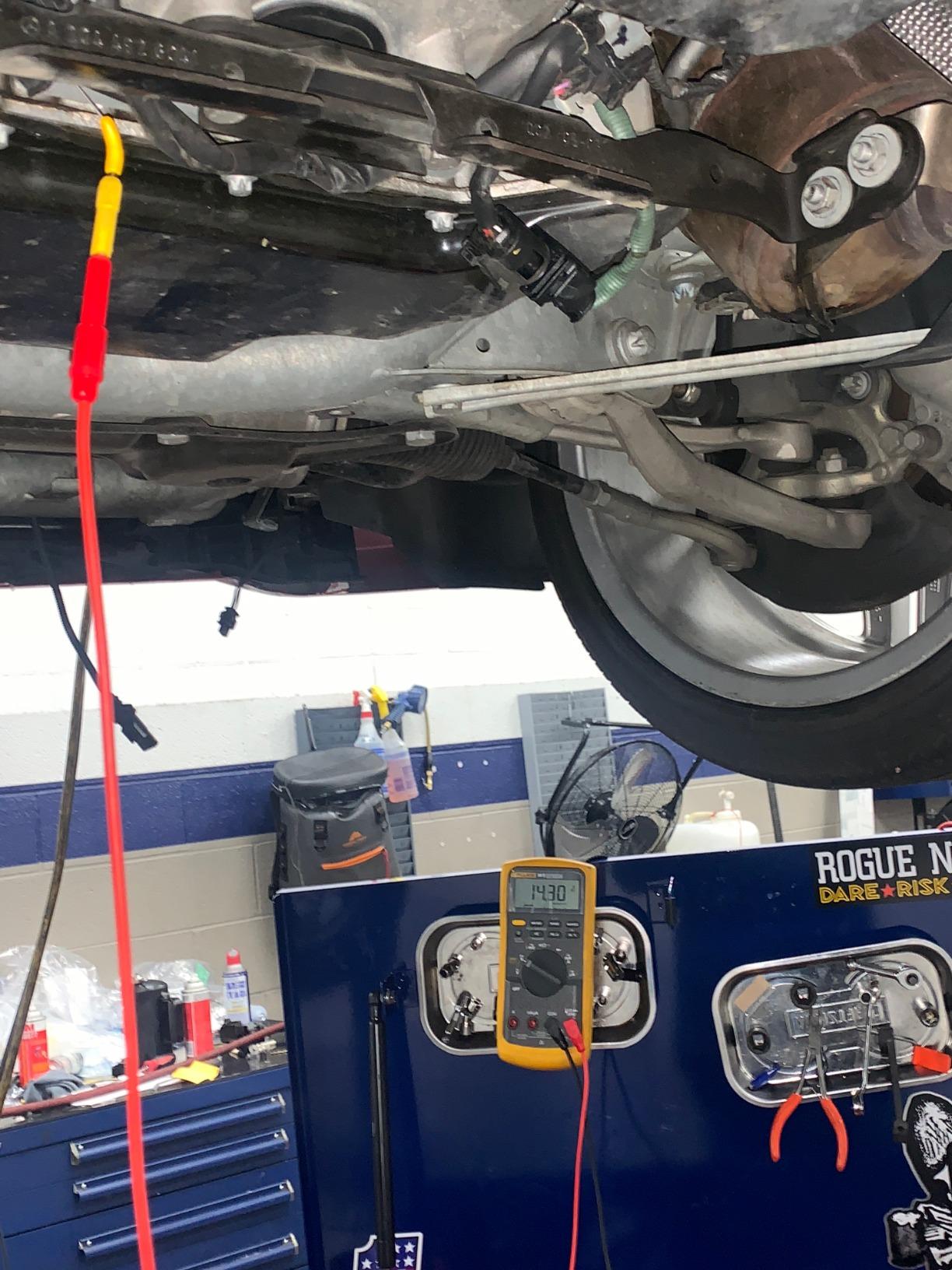
Pulse Width, Duty Cycle and Transient Capture
Pulse width tells you how long a solenoid or injector is being commanded to stay open. Too short and it may be starved of fuel; too long and it will eventually overfuel. Duty cycle expresses the same behaviour as a percentage, and on a modern engine that is one of the most informative numbers available without a scope.
Min, Max and Average recording runs the measurement continuously while you work and holds the extremes. That is how you find the brief voltage spike that kills a sensor at motorway speed, and it is why this meter remains a shop standard despite newer graphing alternatives.
10 MOhm Impedance, Warranty and the Ownership Math
The 10 MOhm input impedance guarantees the meter will not damage computer circuits, which is the same safety argument that applies across this list but is backed here by a limited lifetime warranty. Forum owners report Fluke 88 series meters from the 1990s still working correctly, and that durability history is the entire justification for the price.
The ownership math is straightforward. If you are a professional doing this daily, one meter that lasts a career is cheaper than replacing a budget meter every few years, and the lifetime warranty means the capital cost is effectively the only cost. For a weekend hobbyist, that math does not work the same way.
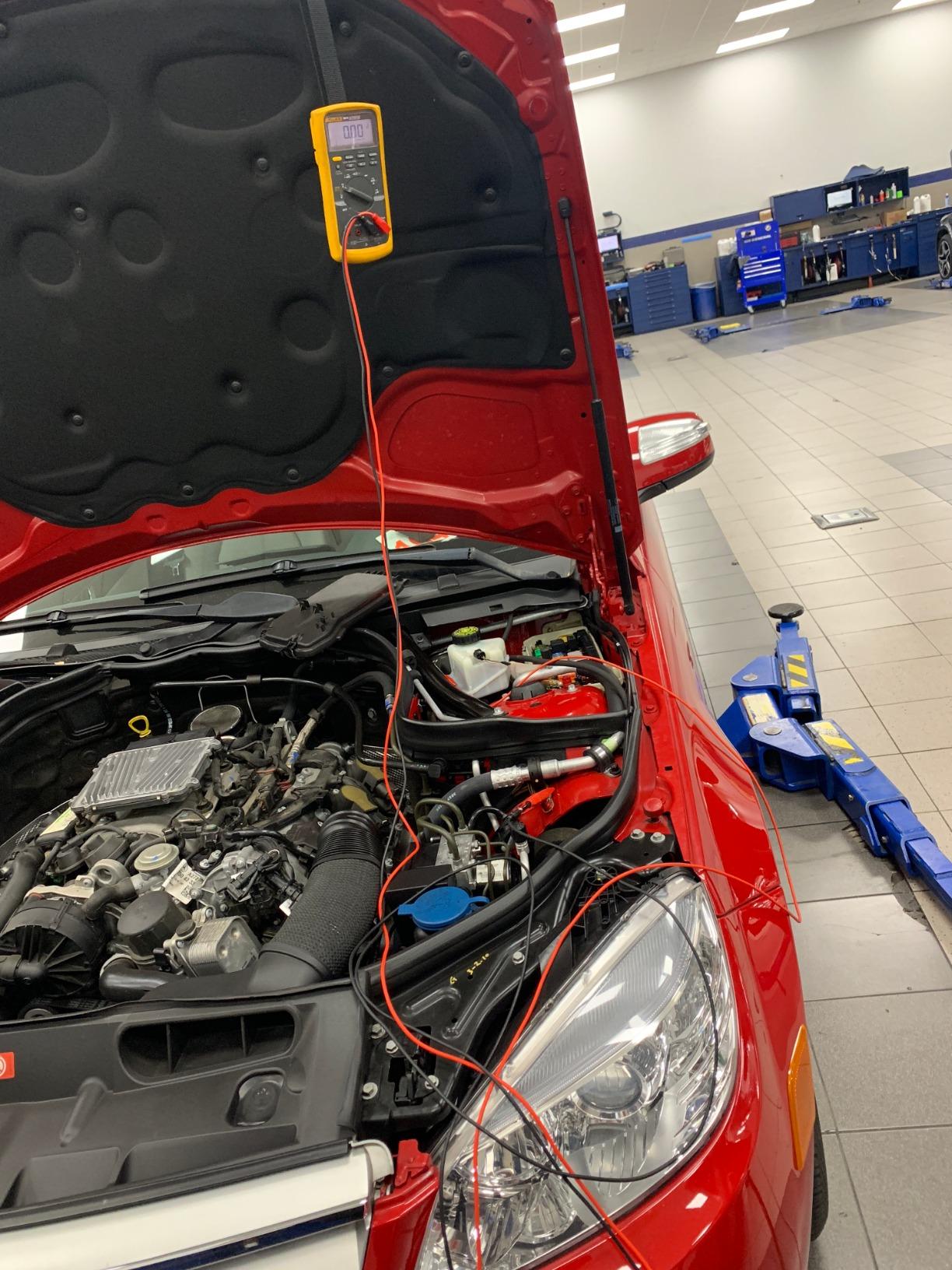
Who It Suits and Where It Falls Short
Buy the 88V if you are a working technician, if you diagnose for a living, or if you want the highest confidence rating in this roundup and a warranty that transfers with the meter. For professional daily use, the weight becomes normal within a week.
Pass if you fix cars on weekends, if you also want to do household electrical work where a lighter, cheaper meter is enough, or if your diagnostics involve millivolt signals that need a graphing display instead.
What Actually Matters in an Automotive Multimeter
Most spec sheets bury the details that decide whether a meter is any good on a car. These are the ones worth your attention.
DC Voltage Accuracy Is the Only Number That Matters on 12 Volts
Almost every measurement you will perform on a modern car is DC: battery voltage, charging voltage, sensor reference voltage, voltage drop across a connector. Buy on DC voltage accuracy and safety rating before anything else on the list.
That is also the honest answer to the most common question in forums, which is whether a cheap meter is better than an expensive one. For 12-volt DC work, a meter with stated DC accuracy and a real CAT rating can absolutely be the better purchase. What you give up is measurement breadth, build quality and warranty, not correctness.
CAT Safety Rating, and the Orange Cable Warning
CAT II, CAT III and CAT IV describe transient protection, not voltage handling alone. CAT III covers distribution panels and load circuits, CAT IV covers the source of a supply, which is where a vehicle battery sits. For car work, CAT III 600V is the sensible floor and CAT IV 600V is the better buy.
Then there is the warning that matters more than the rating. On a hybrid or electric vehicle, orange or yellow high-voltage cabling indicates circuits at several hundred volts, and probing them with a meter can be fatal. Owners in the forums warn each other about this constantly. A multimeter belongs on the 12-volt subsystem, the DC-DC converter output and low-voltage auxiliary circuits only. No rating on the meter makes it safe inside the orange boundary.
True RMS Is Mostly Optional for 12 Volt Work
True RMS measures the true root mean square of an AC waveform rather than estimating it from a calibrated average. On a car, almost nothing you test is AC, so True RMS is a nice-to-have rather than a dealbreaker.
Where it does earn its place: testing an alternator with ripple present, working on a vehicle with an inverter feeding AC loads, and household or shop electrical work. If you are choosing between two otherwise similar meters and one has True RMS, take it, but do not pay a large premium for it if everything else is equal.
Ghost Voltage and Why Low Impedance Changes the Diagnosis
Ghost voltage is the phantom reading you get when a high-impedance meter probes a circuit that is not actually energised. The meter’s own 10 MOhm input couples into the harness capacitance and protection diodes and shows you a few volts that are not really there.
It causes the most expensive misdiagnosis in DIY automotive work: a module declared dead, a battery replaced twice, a harness replaced, when the real fault was a broken conductor or a corroded ground. A meter with a low impedance mode collapses that phantom reading, so a collapsing number means the circuit is genuinely dead. Only the Klein MM720 in this roundup has that mode, and it is the single strongest reason to buy it.
Auto-Ranging Versus Manual-Ranging
Auto-ranging is faster and removes a whole class of user error. Manual-ranging is slower but tells you exactly what range you are on, which matters if you are measuring very small differences and want no algorithmic interference.
For most people doing battery, alternator and fuse work, auto-ranging wins. For a learner who wants to understand what a range is and why, manual-ranging on the Klein MM325 teaches the fundamentals without any clever behaviour to confuse the picture.
Test Leads Fail Before the Meter Does
In forum threads about cheap meters, the complaint is almost never the meter body. It is the leads fraying at the plug, the probe tips not making firm contact, or a cracked insulation jacket that nobody noticed.
Three signs mean replace them. Intermittent readings that change when you wiggle the lead, continuity beeping only when you press hard on a point, and visible damage, discolouration or flexibility in the cable near the strain relief. Any meter can give wrong answers through a bad lead, including an expensive one. Budget for a replacement set, and prefer meters that ship with safety-capped CAT-rated leads, which several picks here do.
Frequently Asked Questions
Which multimeter is best for automotive use?
For most 12-volt work the KAIWEETS HT118A is the strongest all-rounder, with duty cycle, temperature, capacitance and CAT III 1000V protection. Professional technicians usually want a Fluke 88V for pulse width, duty cycle and a limited lifetime warranty. Budget buyers are well served by the AstroAI AST-6000-D or the INNOVA 3320.
Is a cheap multimeter better than an expensive multimeter?
For 12-volt DC work, a cheap meter can absolutely be the better purchase. If it states a DC voltage accuracy figure and a real CAT safety rating, its readings on a car will match an expensive meter. What you give up with a budget model is feature breadth, build quality, warranty and sometimes input impedance protection, not basic correctness.
Do you need a true RMS multimeter for automotive work?
Usually no. Almost everything you test on a car is DC, so True RMS AC accuracy has little effect on battery, alternator, sensor or fuse diagnostics. It earns its place when you test alternator ripple, work on a vehicle with an inverter, or do household and shop electrical work. Choose it if it is otherwise equal, but do not pay a large premium for it alone.
What should a car battery read on a multimeter?
A fully charged 12-volt battery reads about 12.6 to 12.8 volts at rest with the engine off and the lights off. With the engine running, a healthy charging system should read between 13.7 and 14.7 volts at the battery terminals. A reading below about 12.2 volts at rest suggests a discharged battery, while under 13.5 volts with the engine running points at the alternator or its drive.
How do you test for a parasitic drain?
Set the meter to DC current or milliamps, connect it in series in the negative battery cable, and let the car sit until modules enter sleep mode, usually after 10 to 20 minutes. A normal draw should fall below about 50 milliamps. If it stays high, pull fuses one at a time and watch for the drop; the circuit that causes the reading to fall is the one holding the battery down.
Can you use a multimeter on a hybrid or electric car?
Yes, but only on the 12-volt subsystem, the DC-DC converter output and low-voltage auxiliary circuits. Never probe orange or yellow high-voltage cabling, which indicates circuits at several hundred volts and can be fatal. For measuring at the source of a vehicle supply, choose a meter rated CAT IV 600V and ideally CAT III 1000V, and treat the high-voltage boundary as a hard stop.
What is the difference between a multimeter and an OBD2 scanner?
An OBD2 scanner reads what the car’s computer recorded, including stored and pending trouble codes, freeze frame data and live sensor values. A multimeter measures real electrical values at a point in a circuit, such as voltage drop across a connector or current draw. Use the scanner to find the fault code, then the meter to find the actual broken wire, bad ground or failed component.
Which Automotive Multimeter Should You Buy?
If you want one meter that does everything a car asks of it, start with the KAIWEETS HT118A. It carries the widest measurement coverage in this roundup, the strongest safety rating, and the deepest owner feedback at more than 23,000 ratings, which makes it the safest choice for a weekend mechanic or a technician who wants one tool for everything.
If your budget is the deciding factor, the AstroAI AST-6000-D gives you True RMS, a magnetic hanger and a backlit screen with more than 20,000 ratings behind it. If you are learning and want a simple, predictable dial with the best five-star share in the group, take the Klein MM325. If you chase intermittent faults, the FNIRSI DMT-99 is the only one here that graphs them.
Working on late-model vehicles where ghost voltage misleads you? The Klein MM720 is the only meter in this roundup with a low impedance mode. Working on engines specifically, with RPM, dwell and an inductive clamp in the box? The Innova 3340 bundles it all. And if you diagnose for a living, the Fluke 88V with its limited lifetime warranty is the benchmark everything else is measured against.
These ten cover every realistic use case in 2026, and the gap between the cheapest and the most capable is smaller than the marketing suggests. Check your test leads before you start blaming a circuit, then pick the meter from this list that matches how often you will actually use it.