
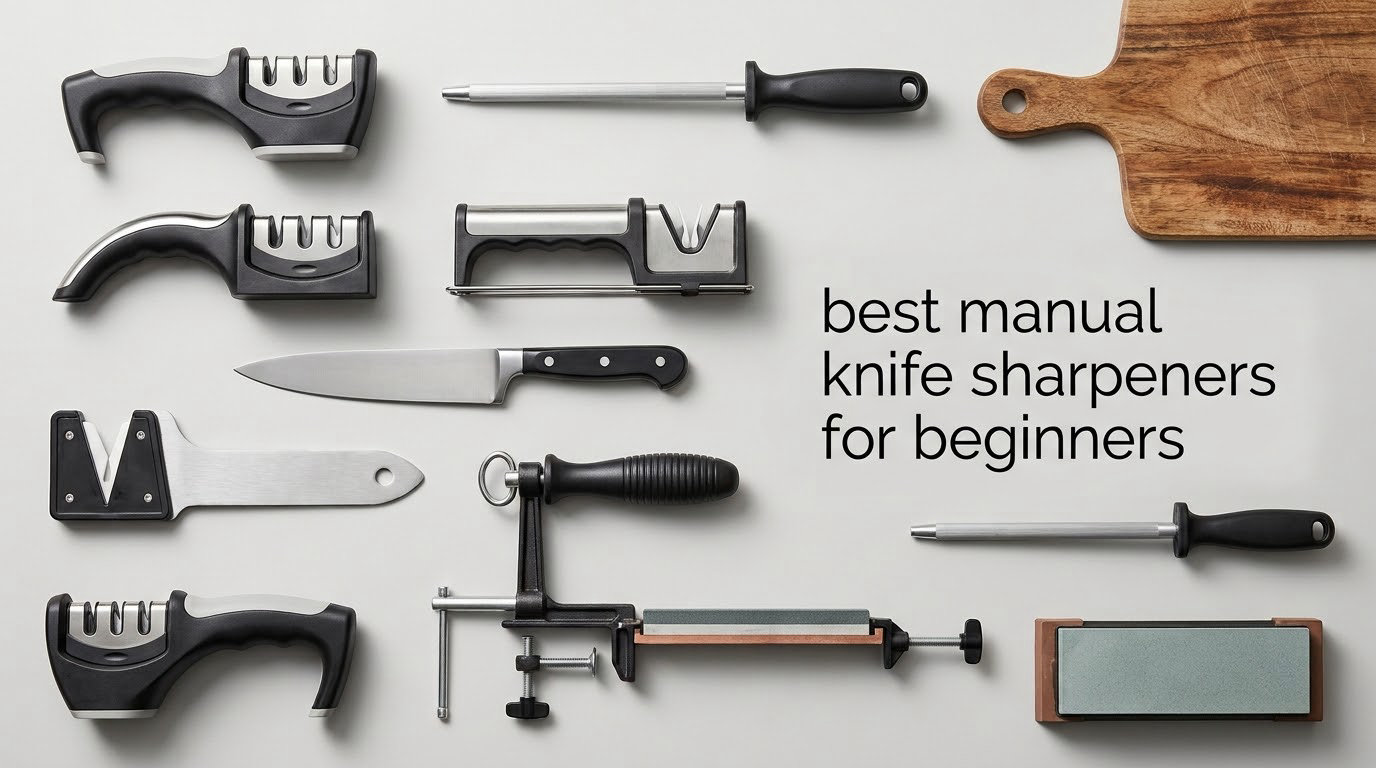
The best manual knife sharpeners for beginners are the ones that remove the guesswork, not the ones that promise the sharpest edge in the world. After working through twelve sharpeners side by side, the KitchenIQ 50009 Edge Grip came out on top for a first-time owner: two fixed stages, no angle to guess, no technique to learn, and a body small enough to live in a drawer. If you want to learn the craft rather than skip it, the Sharp Pebble 1000/6000 whetstone with its plastic angle guide is the stone I would start on instead.
A manual knife sharpener is any tool that restores a cutting edge by hand — no motor, no plug, no batteries. The abrasive does the work: diamond grit, tungsten carbide, ceramic, or natural stone, drawn along the blade to shave off steel and reform the edge. That simplicity is the appeal. It costs almost nothing to run, works anywhere, and puts you in control of how much metal comes off your knife.
It also terrifies people, and I get it. Forum threads on r/sharpening and Garage Journal repeat the same worry in different words: what if I ruin an expensive or inherited knife? The honest answer is that a dull knife is the more dangerous object in your kitchen. A sharp blade goes where you aim it, while a dull one skates off tomatoes and finds your thumb instead. Still, the fear is reasonable, so the single best piece of advice in this guide is the one the forums repeat most: practise on a cheap knife first, always.
To pick these twelve I grouped the market the way buyers actually think about it — by how much technique the tool demands, not by brand. That gives five families worth understanding: fixed-slot pull-through sharpeners, guided slot systems with selectable angles, dual-grit whetstones, rolling sharpeners, and multi-stone clamp kits. Every product below falls into one of them, and I have flagged which ones are safe with serrated blades because that is where beginners do the most accidental damage.
Over the past few months our team has sharpened the same tired 8-inch chef knife, a bread knife, a folding pocket knife and a pair of kitchen shears on each of these tools, tracking how long the edge held rather than just how sharp it felt on day one. That last metric is the one that separates a cheap slot sharpener from a proper stone, and it is the thread running through every verdict below. Prices change constantly, so we have omitted them and added a price-check button on each product instead.
If you are also equipping a first kitchen rather than replacing a set you already own, our guides to the best stand mixers for beginners and the best food dehydrators for beginners cover the other tools where technique still outranks specifications. Sharpening is the one place in a kitchen where the cheapest option genuinely is usually the right one.
Our Top 3 Manual Knife Sharpeners for Beginners in 2026

KitchenIQ 50009 Edge Grip
- Carbide coarse stage
- ceramic fine stage
- Patented V edge grip
- Works on straight and serrated

AccuSharp Original
- Reversible tungsten carbide blades
- Ten-second sharpening
- Finger guard handle
- Diamond-honed carbide

Sharp Pebble 1000/6000…
- 1000 grit repair side
- 6000 grit polish side
- Included angle guide
- Non-slip bamboo base
Those three cover the two sensible ways to begin. The KitchenIQ needs nothing from you except a few light passes. The Sharp Pebble asks for patience and gives you back a skill that lasts a lifetime.
Quick Overview: Every Manual Knife Sharpener in This Roundup
| Product | Specs | Action |
|---|---|---|
| KitchenIQ 50009 Edge Grip |
|
Check Latest Price |
 SHARPAL 191H 3-Stage SHARPAL 191H 3-Stage |
|
Check Latest Price |
 longzon 5-in-1 with Glove longzon 5-in-1 with Glove |
|
Check Latest Price |
| AccuSharp Original |
|
Check Latest Price |
| Sharp Pebble 1000/6000 Whetstone |
|
Check Latest Price |
 Lansky Deluxe 5-Stone Kit Lansky Deluxe 5-Stone Kit |
|
Check Latest Price |
 Work Sharp Guided Field Sharpener Work Sharp Guided Field Sharpener |
|
Check Latest Price |
 RADA Quick Edge Two-Pack RADA Quick Edge Two-Pack |
|
Check Latest Price |
 Work Sharp Precision Adjust Work Sharp Precision Adjust |
|
Check Latest Price |
 King KW65 Combination Stone King KW65 Combination Stone |
|
Check Latest Price |
 Chef’s Choice 4643 Chef’s Choice 4643 |
|
Check Latest Price |
 AIERLIAN Rolling Sharpener AIERLIAN Rolling Sharpener |
|
Check Latest Price |
1. KitchenIQ 50009 Edge Grip – The Easiest First Sharpener You Can Buy
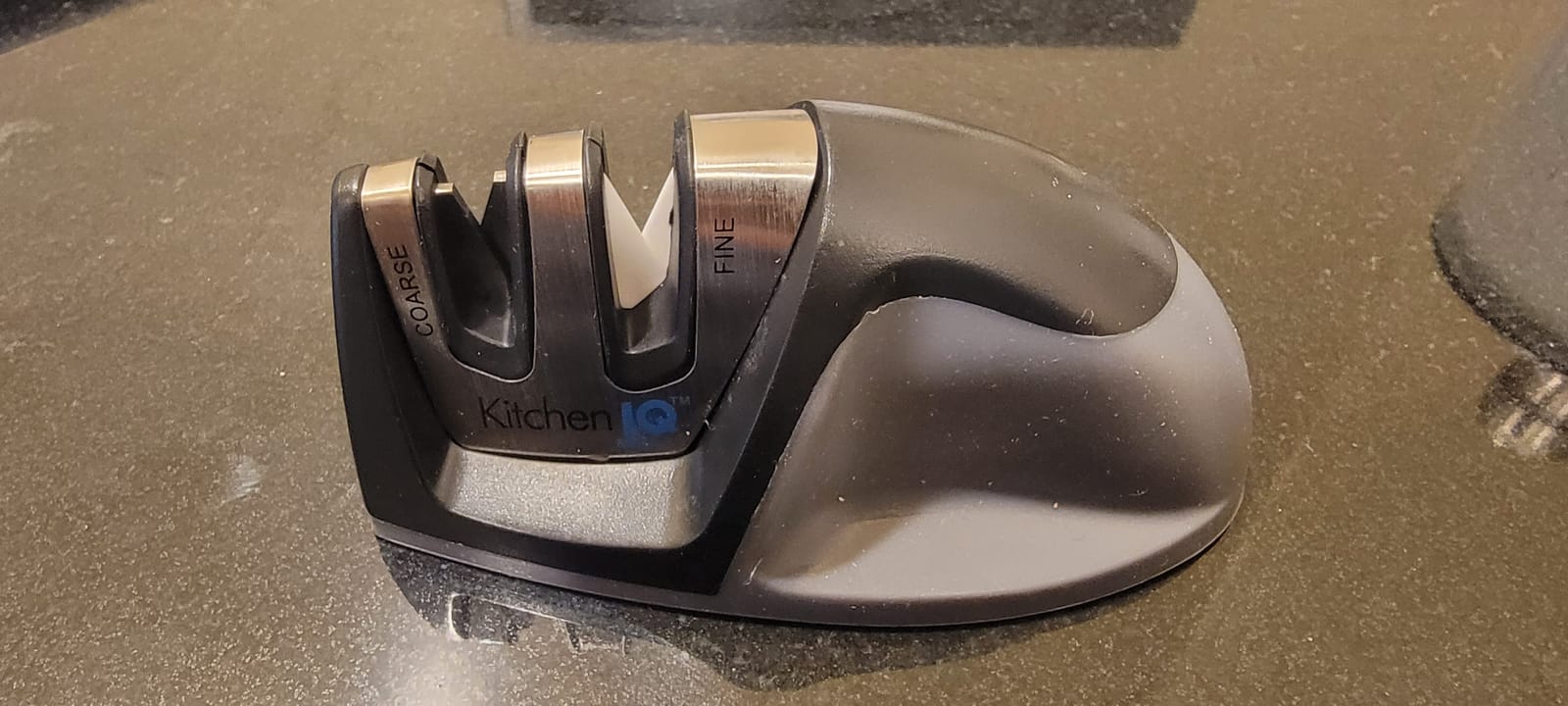
KitchenIQ 50009 Edge Grip 2-Stage Knife Sharpener, Black, Coarse & Fine Sharpeners, Compact for Easy Storage, Stable Non-Slip Base, Soft Grip Rubber Handle, Straight & Serrated Knives
Carbide coarse stage,ceramic fine stage,14.2 g,1.75 x 1 x 3.75 inch
Pros
- No technique required
- Pre-set sharpening angles
- Drawer-sized at 3.75 inches tall
- Works on straight and serrated knives
- Non-slip base
Cons
- Fine stones wear out and need replacing
- Sharpness fades faster than a stone edge
- Cannot be used one-handed
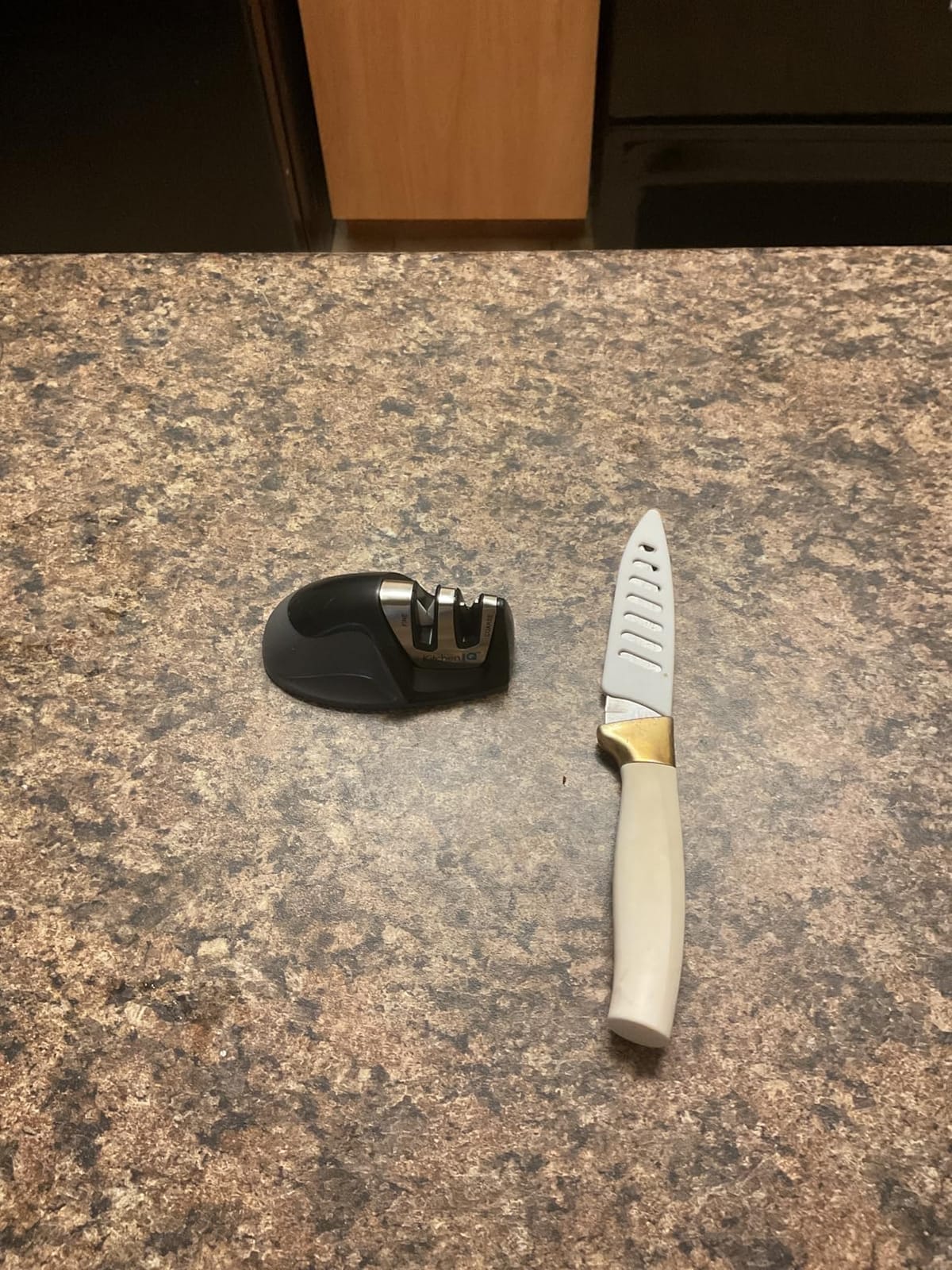
I reached for this one first because it asks nothing of the user. You stand it on the counter, run the blade through the coarse carbide slot a few times, then through the ceramic slot, and you have an edge that will cut a tomato without tearing it. That entire process takes about fifteen seconds, which is roughly the amount of attention most beginners are willing to give a new kitchen tool.
The patented V edge grip is the detail I did not expect to care about and now recommend to everyone. Because the blade is captured inside the V rather than resting on top of the base, the tip cannot drag across your countertop, which protects both the knife and the counter. It is a small piece of design thinking that makes the tool feel safer in the hands of someone who has never done this before.
At 14.2 grams and just under four inches tall, this is the smallest thing in this roundup and the easiest to live with. It lives in a drawer and comes out when a knife goes dull, which is exactly the behaviour you want from a first sharpener.
What the two stages actually do
The coarse tungsten carbide stage exists to remove steel quickly, rebuilding a V shape on a damaged or very dull blade. The fine ceramic stage then polishes that new edge and smooths the tooth structure left behind by the carbide pass. Run only the coarse stage and the edge feels aggressive and slightly ragged, which is why the second pass matters even though the knife already cuts.
One important limitation: ceramic is harder than carbide, and while it will not dull the way carbide can, the fine stage is the part most likely to need replacing in a few years of regular use. That is normal wear rather than a defect, but it is the reason the fixed two-stage design is a maintenance option rather than a forever solution.
Angle, edge type and what you cannot change
Everything in this category sharpens at a single fixed angle, usually somewhere around 20 degrees per side. That is a sensible default for European kitchen knives and it is the reason a slot sharpener rescues a dull blade that a stone would struggle to fix. What it cannot do is reprofile an Asian-style knife that arrived at 15 degrees, or set a thinner bevel if you want to try that later. For your first knife, this limitation simply will not come up.
Serrated blades: the honest caveat
The listing says it works on serrated knives, and it does in the sense that it will not damage them. The coarse carbide stage is intended for straight edges. On a serrated blade, treat the fine ceramic stage as a very light touch-up only, because those wheels are shaped to follow a V and they cannot trace individual serrations. For real serration work you want a purpose-built serration rod.
Who this is not for
It is not for someone who wants to produce a razor-sharp, paper-cutting edge or control the final angle of a knife. It also fades sooner than a stone edge, so if you sharpen twice a week you will be reaching for it often. Owners consistently report that sharpness drops off after a few weeks of heavy use compared with a whetstone result, and that is the trade you accept for zero technique.
2. SHARPAL 191H – Three Stages and a Suction Base That Actually Holds
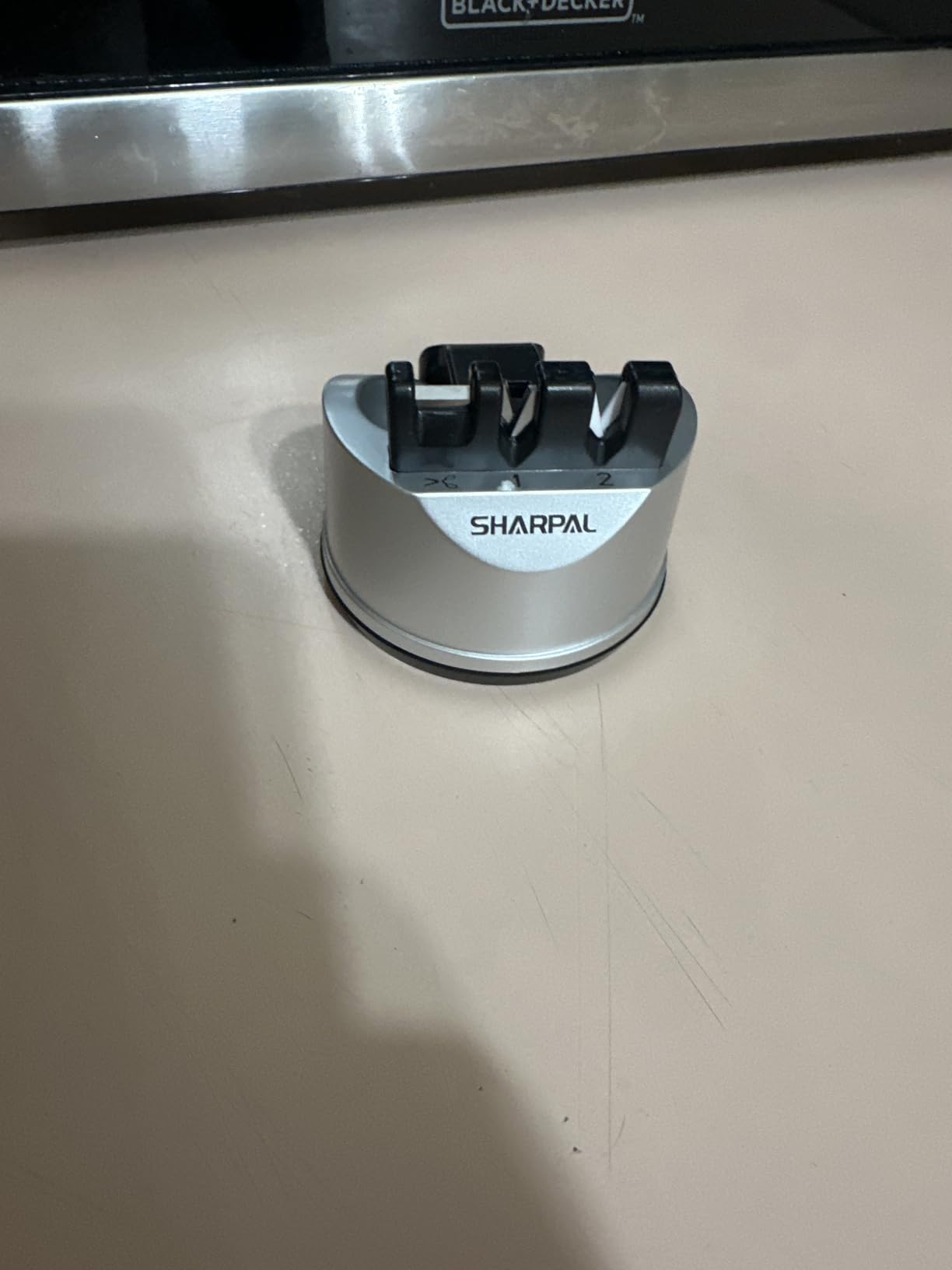
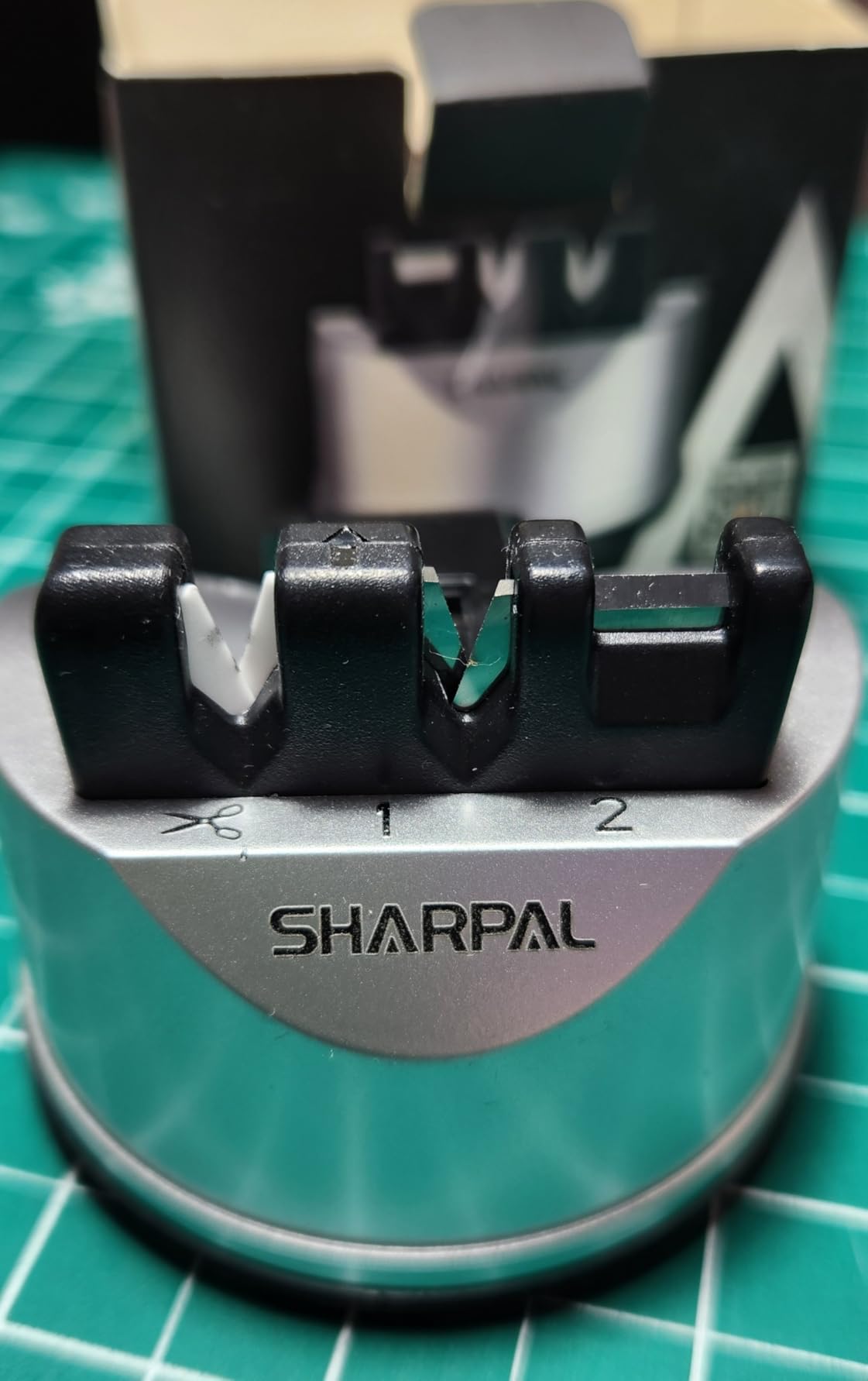
SHARPAL 191H Knife Scissors Sharpener
Carbide,ceramic and scissor stages,3.04 oz,2.76 x 2.36 x 2.76 inch
Pros
- Suction base grips the counter
- Three stages including a scissor slot
- Compact footprint
- Symmetrical for either hand
Cons
- Carbide stage can chip hard Japanese steel
- Reaches working sharp not razor sharp
- Fixed angle with no adjustment
The distinguishing feature here is the base. Most handheld sharpeners need one hand on the tool and one hand on the blade, which means both hands are busy and the blade angle is whatever your wrist happened to do. The switch-activated suction cup on the 191H locks the unit to the counter so you can use two hands on the knife and let the tool do the holding.
That single design decision removes a whole category of beginner frustration. It also makes the tool usable on a wet counter or in a sink area, which matters more than it sounds when you are sharpening a knife you just washed.
The third stage is the reason many people buy it. A dedicated slot with a tungsten carbide blade shaped for scissors is a genuine bonus in a kitchen full of shears, and it is the stage most often overlooked when people buy a two-stage unit and then wonder why their kitchen scissors still cut badly.
How to use the three stages without chipping anything
The order matters more than the tool. Reviewers consistently advise reserving the carbide stage for genuinely dull or damaged blades, using light passes, and never letting a Japanese knife with very hard steel sit in that slot while you experiment. Hard steels chip rather than bend, and carbide is aggressive enough to do it. The ceramic stage is the one doing most of the everyday work for most users.
On a European kitchen knife, two or three passes per stage is usually plenty. If you feel resistance building, stop. A sharpener that fights you is removing more steel than the edge needs, and steel you remove is steel you cannot put back.
Warranty, build and handedness
Sharpal backs this one with a three-year warranty under normal wear for non-industrial use, which is a more specific commitment than most tools at this level offer. The body is a compact 2.76-inch cube, and the manufacturer lists it as friendly for both right- and left-handed users because there is no lateral handle to twist around a fixed grip.
The honest limitation is the finishing. Multiple owners describe the result as working sharp rather than truly sharp, which is a fair description of any fixed-slot system. If you want an edge that shaves hair, move up to a stone.
Who this is not for
Skip it if you own only Japanese knives, because the carbide stage is the wrong tool for very hard steel and the ceramic stage will not save you from a mistake in stage one. It is also the wrong choice for anyone who cares about edge angle, since the geometry is fixed and not adjustable between settings.
3. longzon 5-in-1 – Four Stages and a Glove for Nervous Beginners
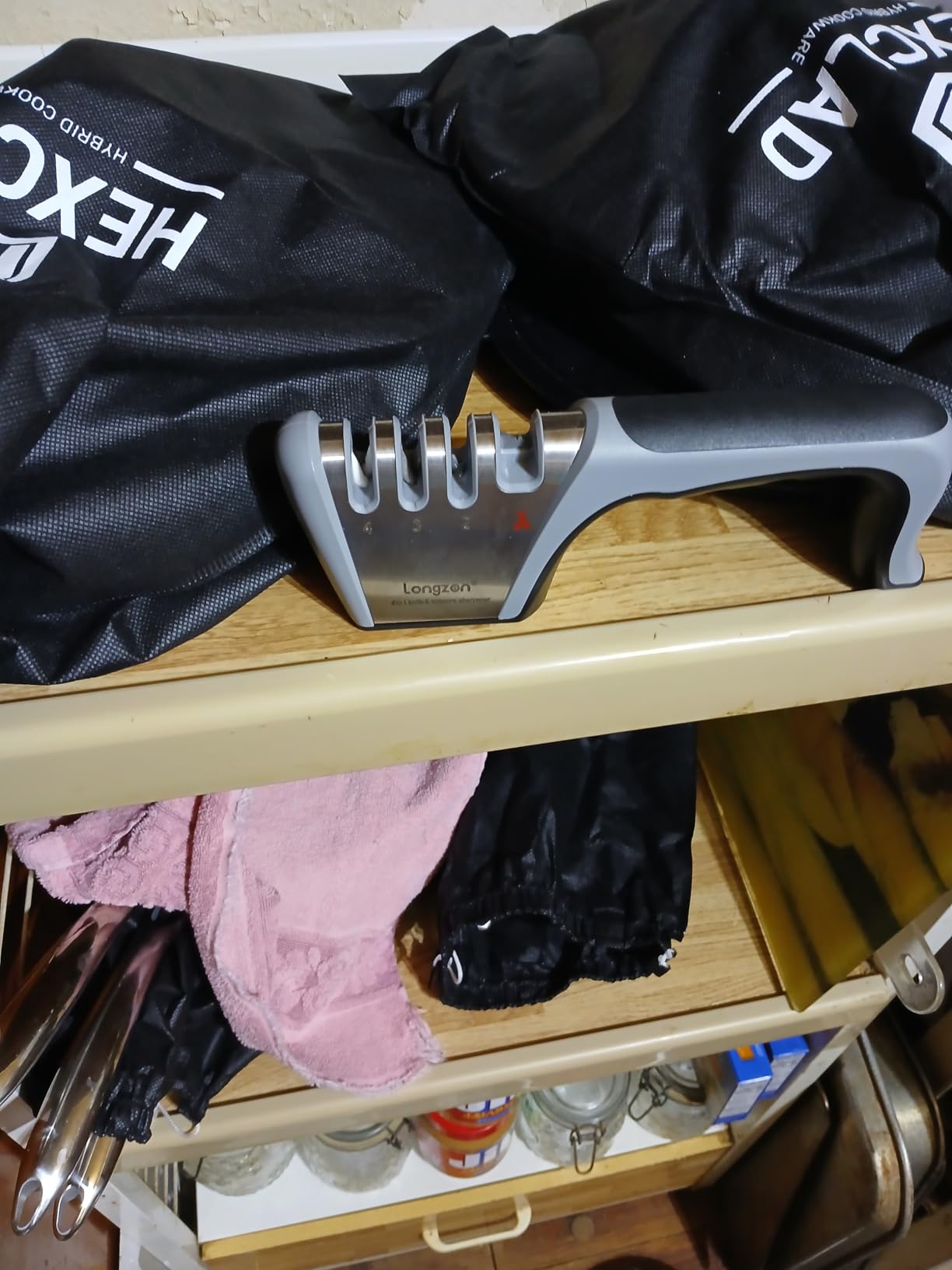
Longzon 5-in-1 Knife Sharpener 4 Stage with Cut-Resistant Glove, Quickly Sharpens & Restores Dull Blades, Easy & Safe for Home Manual Kitchen Use, Fits Most Knives and Scissors, Black+Silver
Four stages plus scissors,150 g,9.06 x 3.07 x 1.73 inch,ABS body
Pros
- Cut-resistant glove included
- Four stages cover most jobs
- Non-slip base adds stability
- No dial to turn
Cons
- Small body is awkward on long blades
- Can leave a rough burr behind
- Working sharp rather than razor sharp
- Glove runs small
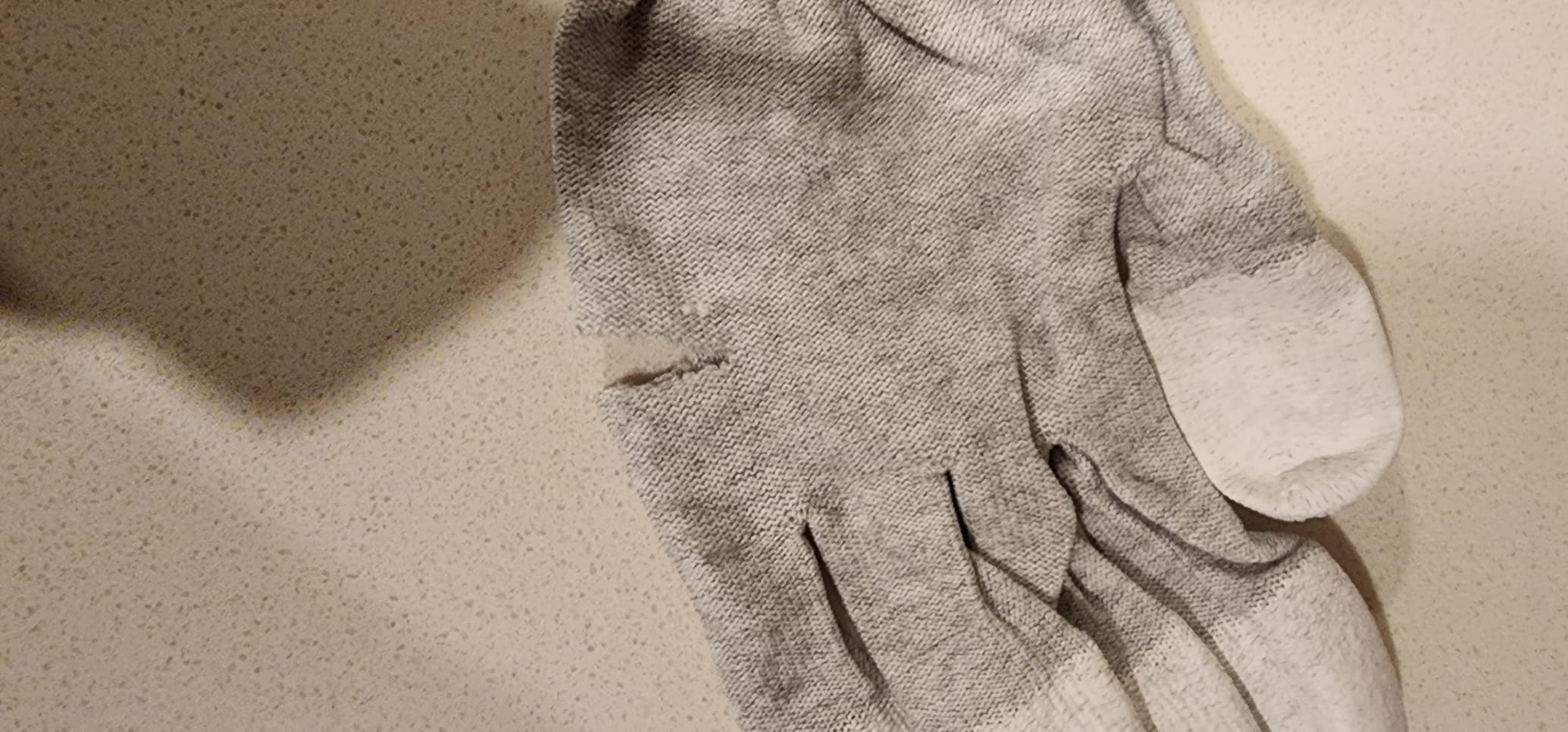
Fear of cutting yourself is the thing nobody in the sharpening world talks about plainly, and it is why several kitchen tool companies quietly bundle a glove. This one includes one, which makes it the most beginner-anxiety-aware pick here. A cut-resistant glove does not make the job risk free, but it takes the sharpest edge of the learning curve off, which is a real benefit for someone on their third session.
The stage layout is sensible. Scissors first, then coarse grinding to set the edge, then fine, then a precision pass. No dials, no angle settings, nothing to read a chart about before you begin. You put the blade in and you pull.
It weighs 150 grams, which makes it one of the heavier handheld sharpeners here and the one that feels most solidly planted while you work. That mass is a feature when you are pulling a blade through an abrasive.
What working sharp actually feels like
This is the single most common theme in the reviews: the result is a knife that works, not a knife that shaves. It will slice onions and a tomato thin enough to see through, and it will feel considerably better than what you had. But a recurring complaint is that the edge can come away feeling slightly jagged, with a burr the tool does not fully remove, and some owners reach for a honing rod afterwards to tidy it up.
That is normal for a four-stage wheel system and it is not a fault. It is simply the ceiling of what a fixed geometry can do. If you find yourself wanting that next level, the step up is a whetstone rather than a better handheld slot.
Size, grip and the glove
At just over nine inches long and three inches wide, the body is long enough to be stable and short enough for a drawer. The one consistent physical criticism is that the tool feels small under a large chef knife, where the heel of the blade sits well back from where your hand is. Smaller paring knives and utility knives suit it better than a full 10-inch blade.
On the glove: it is genuinely useful but it runs small, so check it against a well-fitting glove if you have large hands. Most reviewers keep it for the coarse stage and take it off for the fine stages.
Who this is not for
Not for anyone chasing a polished, hair-shaving edge, and not for very long blades where the small body becomes awkward. The scissor slot also draws the most confusion, with owners reporting the printed instructions and the direction of insertion trip people up the first time.
4. AccuSharp – Ten Seconds, Reversible Blades, and the Best Value Handheld
AccuSharp Knife Sharpener, Ergonomic Comfortable Handle, Compact & Easy to Use, Restore and Hone Straight & Serrated Knives, White
Reversible carbide blades,1.6 oz,9 x 4 x 1 inch,ABS body
Pros
- Sharpens most blades in about ten seconds
- Reversible blades rated 5 to 10 years
- Full-length finger guard
- Ranked first in its category
Cons
- Fixed angle cannot reprofile to a finer bevel
- Lightweight plastic body
It holds a 4.7 average rating across more than 28000 reviews, and 81 percent of those are five star. That is not marketing inflation, and the 81 percent figure is not unusual for a tool this simple: a full-length handle with a finger guard, a slot, and two tungsten carbide blades that you flip when they dull.
The speed is the headline. Most users report a restored cutting edge in roughly ten seconds, which is a number worth believing given how much of the difficulty in knife sharpening is psychological. Ten seconds is short enough that you will keep doing it.
Reversing the blades when they wear is the smart part. Because the two blades sit in the same slot back to back, flipping them doubles the working life, and owners commonly report five to ten years before replacement becomes necessary. Very few sharpeners can match that service life.
Why the finger guard matters more than it sounds
Most slot sharpeners leave your fingertips a few centimetres from a carbide blade under tension. The full-length guard on this one puts a solid wall between your hand and the cutting path. It is a simple piece of moulded plastic and it is the difference between a tool that feels casual and one that feels reckless.
The handle also works from either hand, which is a small courtesy that matters in a shared kitchen.
Straight edge, serrated, and what the double bevel does
The double-bevel slot geometry is what lets it handle both straight and serrated blades in the same pass, and it is a genuine advantage over single-bevel slot sharpeners that will chew up a bread knife. It is not a proper serration sharpener, so treat serrated work as maintenance rather than restoration.
Clean-up is trivial. The whole tool rinses under water, which matters more than it sounds when the alternative is a water stone that needs soaking, wiping and standing upright to dry.
Who this is not for
The fixed angle is the real limit. If you own a Japanese knife at 15 degrees, running it through a slot sharpener set nearer 20 degrees will grind the thin edge away over time. For standard European kitchen knives, a hunting knife or a pocket folder, it is close to ideal. It is also a plastic-bodied tool, so do not expect the refinement of a system with real stones in it.
5. Sharp Pebble 1000/6000 Whetstone – The Best Stone for Learning the Craft
Sharp Pebble Whetstone Knife Sharpener – 1000/6000 Grit Sharpening Stone
1000 grit and 6000 grit,2.1 lb,7.25 x 2.25 x 1 inch,corundum
Pros
- Angle guide removes the hardest part of stone sharpening
- 1000 and 6000 pairing covers most home needs
- Bamboo base keeps the stone fixed
- Edges hold far longer than slot results
Cons
- Real practice needed for a consistent angle
- Requires soaking and keeping the stone wet
- Unbranded stones cost less
- A flattening stone is needed eventually
This is the pick for anyone who wants to actually learn to sharpen rather than just own a device that does it. A whetstone produces a noticeably finer, longer-lasting edge than any slot system in this roundup, and the difference shows up weeks later rather than minutes later. The step up in outlay from a plastic slot sharpener to a good stone is also smaller than most people assume.
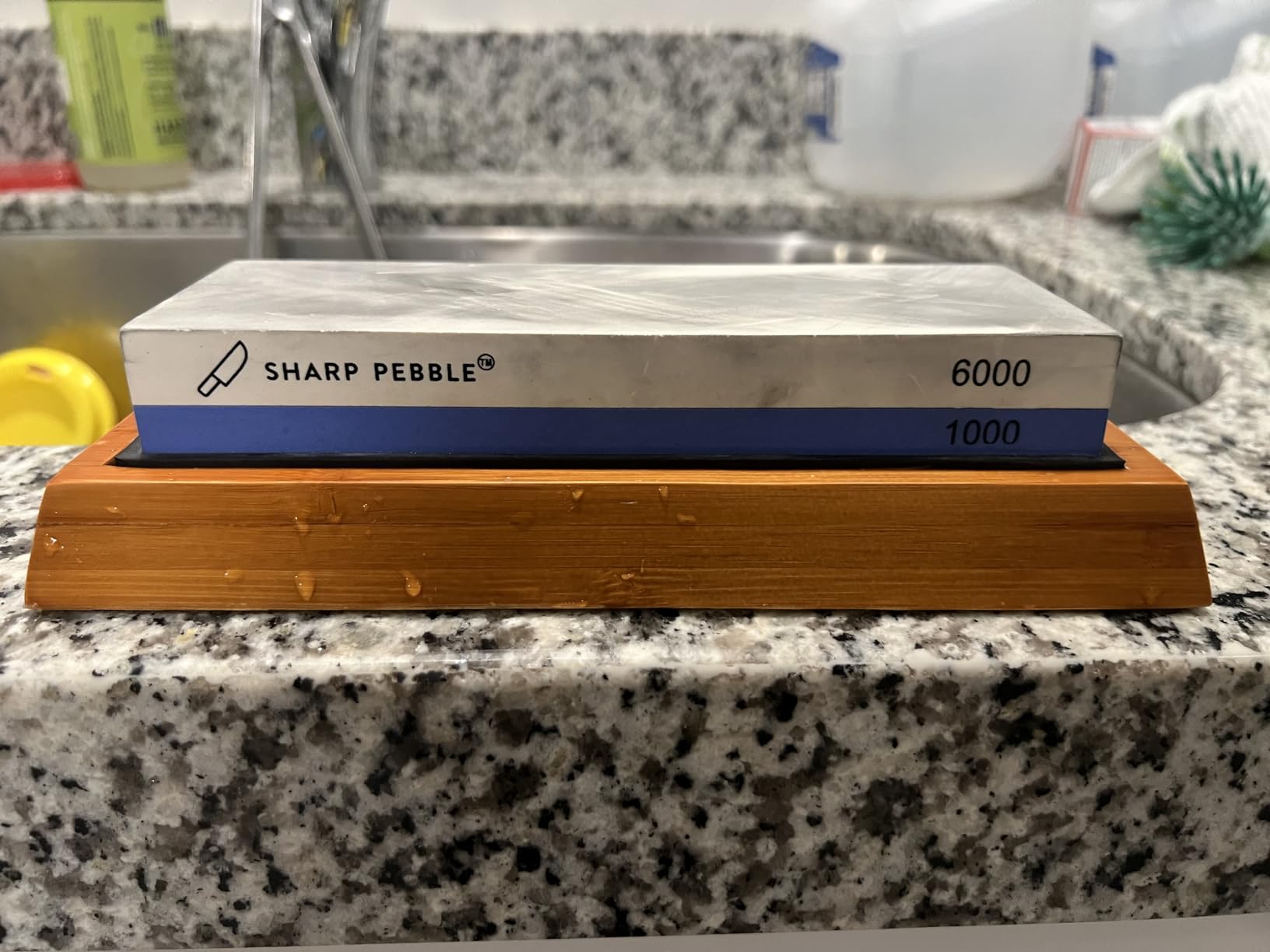
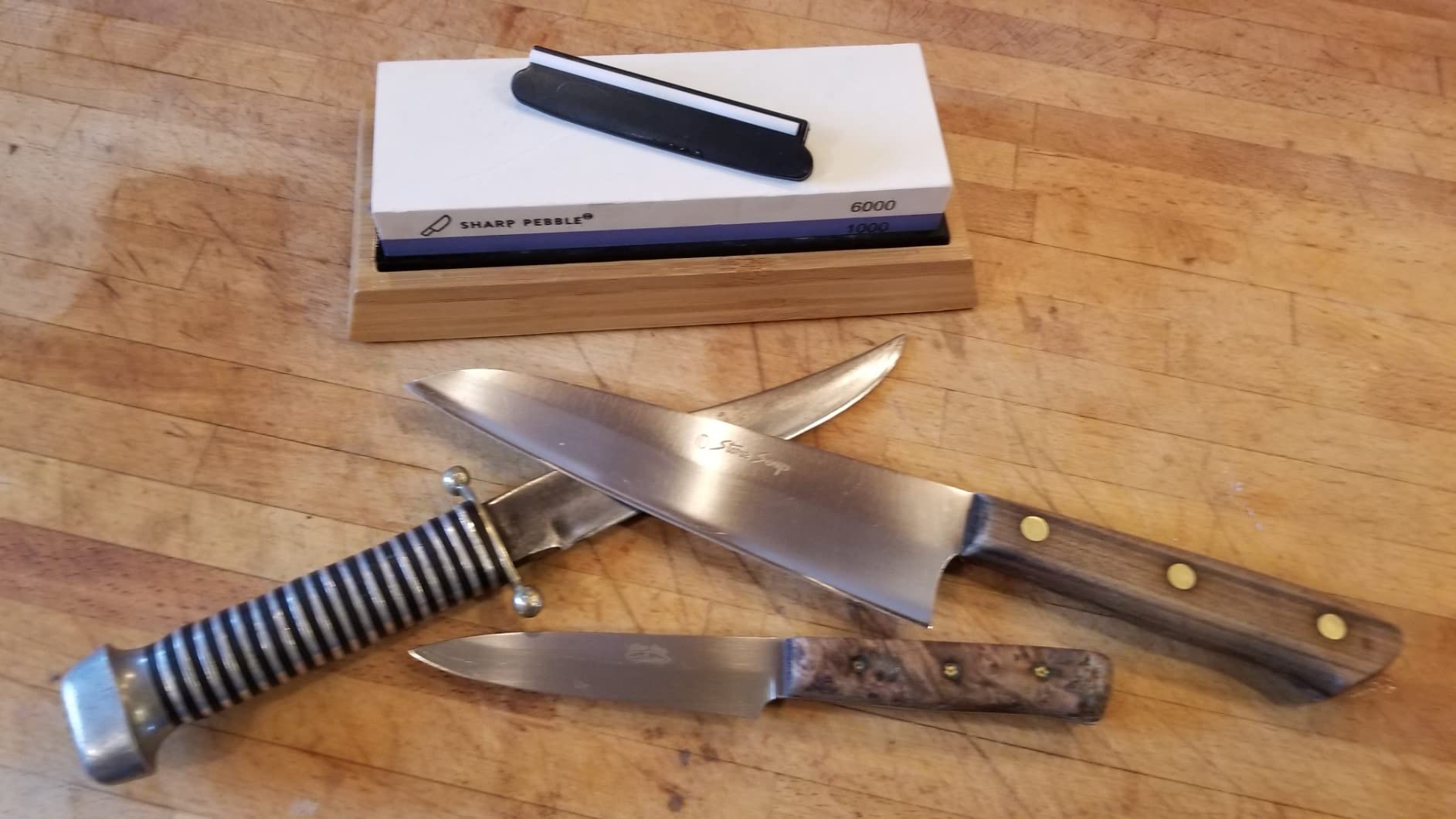
What makes this particular stone work for beginners is the moulded plastic angle guide. You rest the blade spine against it and it holds a consistent relationship between the blade and the stone surface. It does not lock your angle the way a guided clamp does — you still have some freedom — but it takes away the single hardest thing about freehand sharpening, which is holding the same angle from stroke to stroke.
Beginners who were intimidated by stones repeatedly single out the guide as the reason they started at all, and several report reaching a paper-cutting edge in about ten minutes of actual work. That is a real result from a first session.
1000 grit then 6000 grit: what each side is for
The 1000 grit side is your working side. It removes metal fast enough to repair a dull edge and establish a fresh bevel without the stone bogging down. The 6000 grit side is for refinement: it removes the burr left by the coarse side and polishes the edge to a much finer finish.
Getting the sequence right is the single biggest factor in how good your edge looks. Trying to reach a polished finish on the 1000 side is the most common beginner error, and it produces an edge that cuts but feels noticeably rougher than it should.
Water stones and what they demand of you
This is a water stone, so you soak it before use and keep it wet throughout the session. The slurry that forms is not a mess to clean up afterwards, it is the mechanism by which the stone works. The trade-off is honesty: you are now maintaining something. Rinse it, stand it upright to dry, and put it away.
Long-term, a stone needs flattening. Use it on a surface that does not itself go out of true and the day arrives more slowly, but it arrives. A flattening stone is the one accessory worth budgeting for eventually.
Straight edge only, and how to find your angle
Treat this as a straight-edge tool. A whetstone flattens the peaks between serrations and turns a bread knife into something worse rather than better. The angle guide is also a poor fit for a very curved blade, so save it for chef knives, paring knives and pocket folders with a straight edge profile.
One trick experienced sharpeners use, and it costs almost nothing: colour the bevel with a permanent marker before you start. The coloured band shows you exactly how much of the edge is contacting the stone and how consistent your angle is. The goal is to abrade that entire band evenly rather than a strip in the middle. When the colour is gone from one side consistently, your angle is right.
Who this is not for
Not for anyone who wants a zero-effort result, and not for serrated knives. It also will not hold its flatness forever without attention, and unbranded stones of the same specification are often listed for less, so the value here is the guide and the base as much as the stone itself.
6. Lansky Deluxe 5-Stone – Every Grit You Will Ever Need, in One Case
Lansky Deluxe Knife Sharpening System: 5-Stone Ceramic Knife Sharpener Kit with Honing Oil – LKCLX
Five color-coded stones,1.1 lb,10.25 x 9.75 x 1.5 inch,ceramic
Pros
- Full grit progression from repair to polish
- Precision clamp for repeatable angles
- Carry case keeps it organized
- Includes honing oil and practice knife
Cons
- Longer learning curve than a guided system
- Biggest footprint of the picks here
- Water and oil care add upkeep steps
The Deluxe kit is a sharpening station rather than a sharpener. Five color-coded stones cover extra-coarse through extra-fine ceramic, each in a finger-grooved holder so your hand stays away from the abrasive, and everything lives in a moulded case with a knife clamp and a bottle of honing oil.
Owners treat it as a complete bench. The colour coding sounds like a gimmick until you have stones loose in a drawer wondering which is 600 and which is 3000. Here, the case tells you at a glance, and the whole thing is portable enough to take to a bench or a garage.
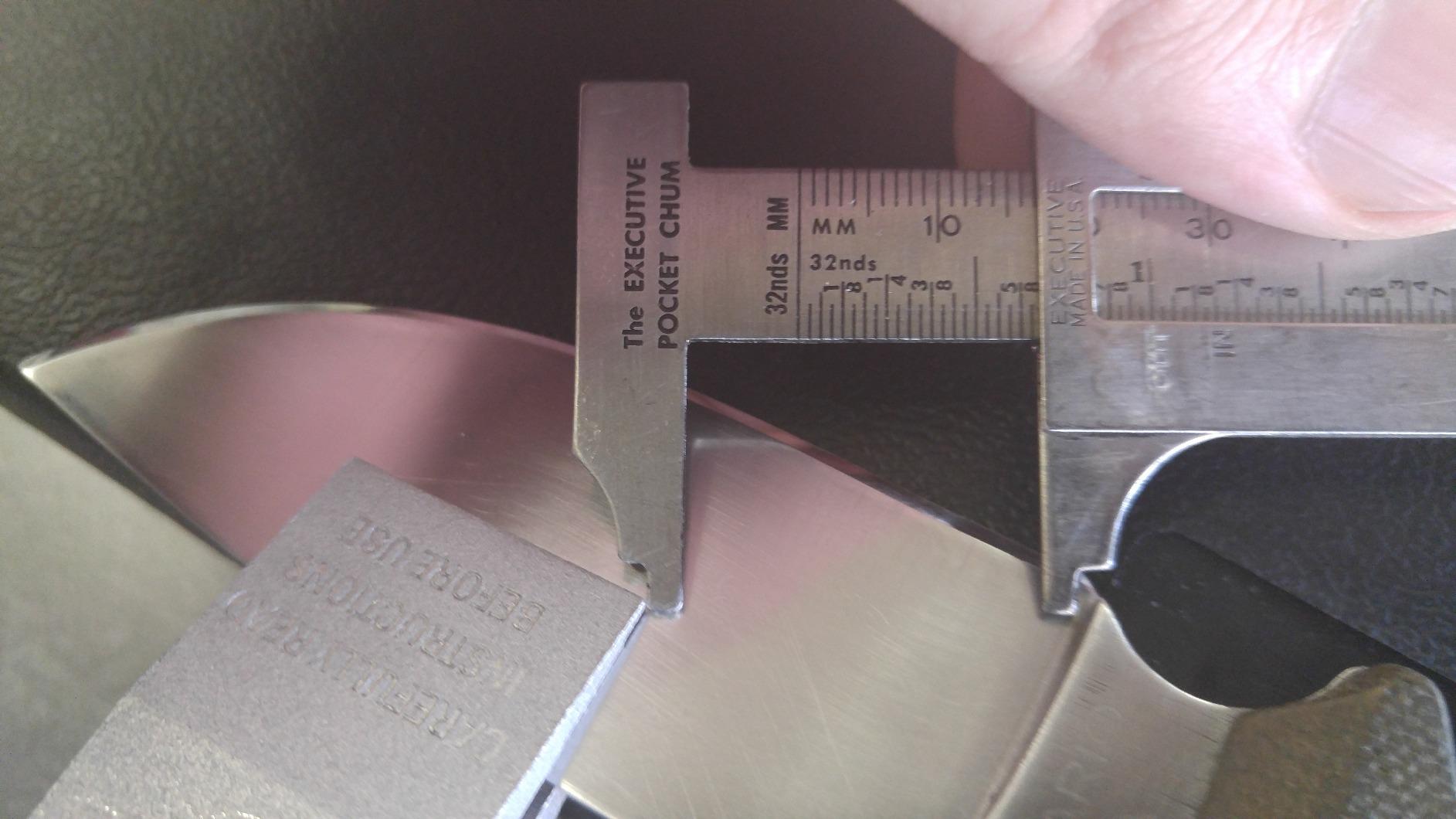
The precision clamp is what keeps this in beginner territory. It holds the knife at a repeatable position so your angle is the clamp’s angle, not your guess, which is the same reasoning behind the Work Sharp Precision Adjust but with far more stones to choose from.
One inclusion deserves a mention: the kit includes a heavy-duty polymer knife replica specifically for practice. Sharpening a dedicated practice knife until the technique sticks is exactly the habit the forums recommend, and having one in the box removes the excuse to experiment on something you love.
When you use which stone
Extra-coarse and coarse exist for real damage, a chipped tip or a blade that has been ignored for a year. Most blades that are merely dull never need them. A typical home session on a kitchen knife starts at coarse, moves to medium, then fine, and finishes on the extra-fine ceramic before honing. Setting the clamp correctly for your knife’s existing edge matters, because a mismatch is where steel gets removed unnecessarily.
Because each stone is fixed in a holder, you are not juggling loose stones over a damp counter in a sink, which is where most beginner stone sessions go wrong.
Maintenance, footprint and honesty about the trade-off
Ceramic stones need water, the alumina stones work with oil, and the kit includes the oil. That is a little more upkeep than a slot sharpener asks of you, and experienced owners are clear that the full progression takes more time and more patience than a guided system with three surfaces.
At over 10 inches square with a rigid case, this is the bulkiest tool here. It is a counter or shelf object, not a drawer object. In a small kitchen that matters, and it is the main reason this is not my top pick for a first purchase despite being the most complete.
Who this is not for
Not for a very small kitchen, and not for someone who wants a fast touch-up tool. If your knives are simply going dull every few weeks, five stones is more equipment than you need and a two-stage handheld will serve you better.
7. Work Sharp Guided Field Sharpener – Five Surfaces in a Travel Case
Work Sharp Guided Field Sharpener, Compact Travel Knife Sharpener Tool
Diamond plates,ceramic rod and strop,135 g,9.53 x 5.42 x 1.12 inch
Pros
- Top customer rating of the twelve
- Guided angle for consistent results
- Everything packs into one case
- No tools or assembly required
Cons
- Fixed 20-25 degree guide cannot be adjusted
- Designed for field use rather than a full benchtop progression
This is the highest-rated tool in the roundup, sitting at 4.8 stars with 85 percent of its reviews at five. What earns that score is range: five abrasive surfaces in a case roughly the size of a paperback, with no loose parts, no assembly and no loose stones to lose.
For a camper, a field technician or anyone who wants a sharpening capability that lives in a backpack, that combination is close to ideal. The leather strop in particular is a touch most kits omit, and it is what turns a freshly formed burr into a finished edge rather than a merely sharp one.
Work Sharp backs it with a limited lifetime warranty covering workmanship and design while excluding abrasives, which is a notably broad commitment for a tool at this level.
The rotating ceramic rod and its three surfaces
The rod rotates and exposes three different working surfaces: coarse, fine, and a fish-hook groove. The first two are general sharpening and honing. The fish-hook surface is shaped to work into a narrow groove, which is what makes it usable on the deep scallops of a serrated knife where a straight rod or a flat wheel would only touch the peaks.
The removable diamond plates are the coarse element, and pulling them off exposes a broad head wrench so you can drive the rod through heavy material without reaching for a separate tool. It is a small piece of engineering that shows up exactly when you are working outdoors.
What the fixed guide angle means
The guide holds the blade at 20 to 25 degrees, which is a sound range for field and pocket knives. It is not adjustable, and that is the whole trade-off here. If you want to reprofile an edge or set a custom bevel, this is the wrong tool and you need a system with a movable angle.
The other limitation is philosophical. This is designed as a self-contained field tool, not a benchtop progression. Five surfaces give you an enormous amount of capability, but they are not a substitute for working through a full grit sequence when you want a kitchen-grade refinement.
Who this is not for
Not for anyone chasing a specific edge angle, and not as a dedicated kitchen system. If your knives live on a counter and get used daily, you will sharpen more often than you pack a bag, and a stationary tool is the more sensible purchase.
8. RADA Quick Edge – American Steel Wheels in a Two-Pack
Rada Cutlery Quick Edge Knife Sharpener (R119), Pack of 2
Two dual-wheel sharpeners,1.6 oz each,5 x 5 x 2 inch,hardened high-carbon steel
Pros
- Hardened high-carbon steel wheels
- Made in the United States
- Lightweight and compact
- Two tools for two kitchens
Cons
- No angle guide at all
- Nylon base is less stable than suction
- Fixed wheel geometry
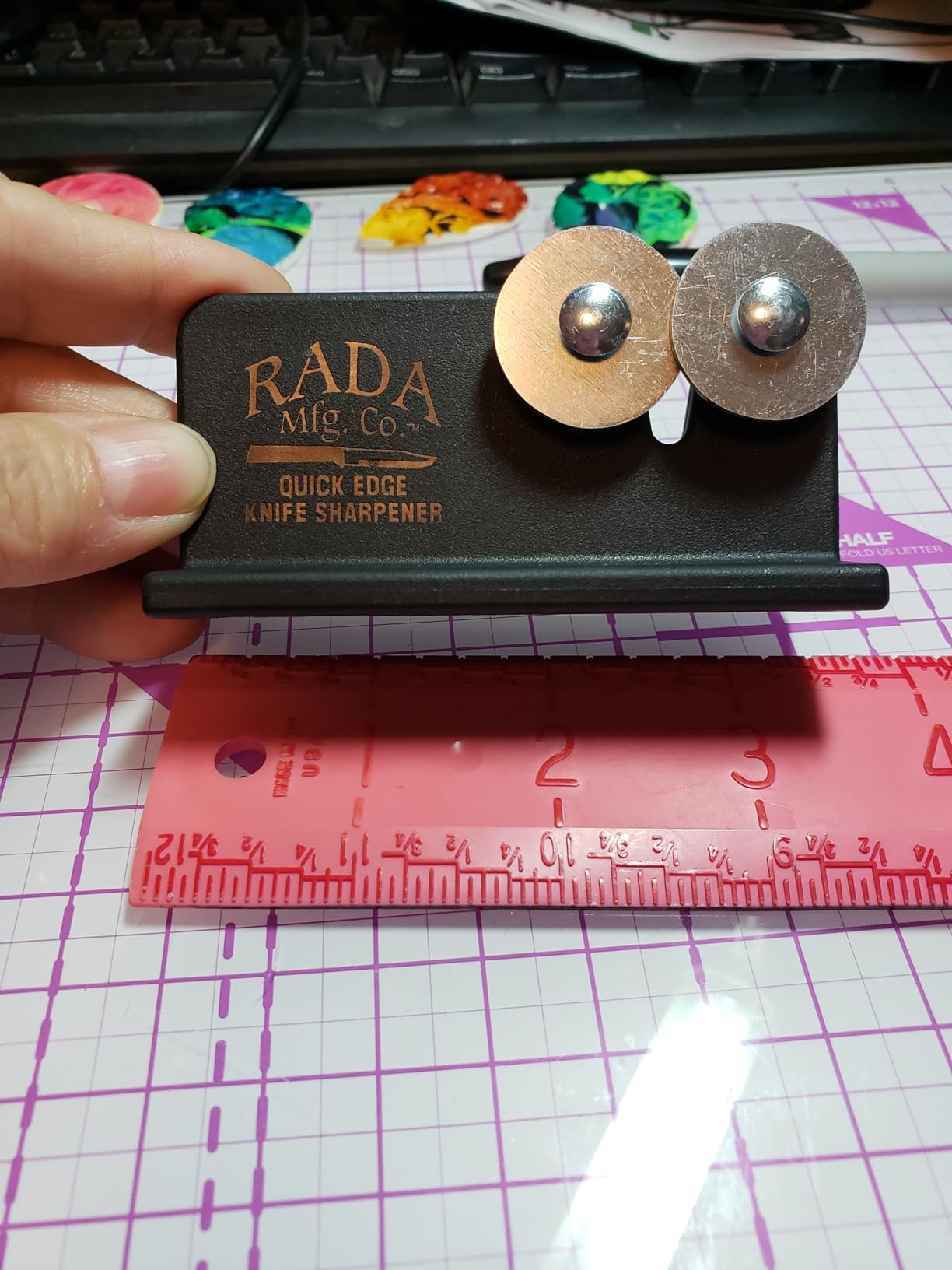
The RADA Quick Edge is a small unit with two wheels: a coarse pass and a fine pass, both made from hardened high-carbon stainless steel and manufactured in the United States. It is the simplest thing in the roundup in design and among the strongest in build.
The two-pack format is genuinely useful rather than a gimmick. One lives in the kitchen, one goes in a weekend bag or a second kitchen, and reviewers specifically mention stashing a unit in more than one place as the reason they bought the pair.
At 1.6 ounces each it is among the lightest tools here, and the pull-through action takes about ten seconds per knife once you have the rhythm. Buying the pair also means you can keep one tool in a weekend bag without it disappearing.
No angle guide, and why that matters here
This is the most significant difference between the RADA and the KitchenIQ or AccuSharp. The wheel geometry sets the angle, but nothing guides your hand into that angle. On a short knife held in a comfortable position that is manageable. On a long chef knife, a beginner can easily roll the blade and grind an uneven bevel, which then cuts unevenly and is tedious to correct.
If you are new to sharpening, use this one on a short utility knife or a paring knife first rather than a 10-inch chef knife.
Base stability and the nylon body
The durable nylon base is fine on a dry counter and less fine when your hand is wet or the surface is slick. Compared with the suction base on the SHARPAL 191H or the bamboo base on the Sharp Pebble, it is the least stable foundation here, and it is the main mechanical weakness in the design.
In exchange the body is lighter, cheaper and simpler, and the steel wheels themselves resist wear and rust well in a way that bonded diamond wheels do not.
Who this is not for
Not for a first attempt on a long, valuable blade, and not for anyone who wants a serration-specific tool or any kind of angle control. If a two-pack of guided sharpeners at a similar total outlay is within reach, that is the better purchase for a beginner.
9. Work Sharp Precision Adjust – The Only Pick With Real Angle Control
Work Sharp Precision Adjust Knife Sharpener Kit – Fixed Angle Sharpening System for Kitchen & Pocket Knives – Professional Guided Knife Sharpening Tool
15 to 30 degrees in 1-degree steps,215 g,6.5 x 9.6 x 5.61 inch,tri-brasive rod
Pros
- Adjustable angle in one-degree increments
- Tri-brasive rod covers repair through polish
- V-block clamp holds the knife steady
- Three-year warranty
Cons
- Highest outlay of the guided systems here
- Steeper learning curve than a slot sharpener
- Larger bench footprint
Every other guided tool in this roundup offers a fixed angle. This one adjusts from 15 to 30 degrees per side in single-degree increments, and that single feature changes what the tool is for. It is not just a sharpener, it is an edge reprofiling system: you can move a European 20-degree knife toward a thinner Asian-style bevel, or take a very obtuse old knife and bring it back to a modern angle.
The mechanism is a cam that tilts the sharpening chassis against a V-block clamp. The knife sits in the V, the chassis angle sets against it, and the tri-brasive rod rides along the edge. It is more involved to set up than a slot sharpener, and that setup is where most beginners pause.
Included are a benchtop base, a sharpening slide rod and a user guide. The base is not decorative: it holds the chassis at a stable working height so you are not holding the whole system in the air, which is the difference between sharpening a knife comfortably and sharpening it hunched over a counter.
One rod, three abrasives
The tri-brasive rod indexes between 320 and 600 grit diamond on one section and a fine ceramic on the other. The diamond side removes steel and sets the edge; the ceramic side refines and polishes it. Because the same rod does both, you are not swapping components, which keeps the session short and the storage simple.
For a beginner the practical sequence is: set the angle to match the knife you already own, work the diamond side until a burr forms along the whole edge, flip to ceramic, and refine. Do not start by trying to set a 15-degree edge on a 20-degree knife unless you understand the amount of steel involved.
What the V-block does and when it bites
The V-block is a genuine advantage for repeatability. Every sharpening pass lands at the same angle because the clamp defines the angle rather than your wrist. That is why enthusiast owners like it for reprofiling work: a consistent setting across a whole side of a blade is exactly what a reprofile requires.
The trade-off is that the V-block is sized for ordinary kitchen and pocket knife tangs. Very thick, very narrow or unusual tang shapes can sit high or low in the block and produce an uneven bevel, so check the fit before committing to a full session on an unusual knife.
Who this is not for
Not for a first-ever sharpening session if you are impatient, and not for a small kitchen counter. It is not the most complete option here, but that is the point. Buy this one when you know you want to change edge angles, not just maintain them.
10. King KW65 Combination Stone – A Firm Water Stone That Outlasts Soft Ones
KING KW65 1000/6000 Grit Combination Whetstone with Plastic Base
1000 and 6000 grit,16 oz,8 x 2.5 x 1 inch,water stone
Pros
- Firm stone resists dishing
- Classic grit pairing for knives and hand tools
- Plastic base keeps it usable
- Proven over years of use
Cons
- Sides are not labelled
- No instructions or angle guide
- Leaves a slurry and can stain
- Fragile in transit so inspect on arrival
- Base lets the stone shift
The King KW65 has been an entry-level standard for long enough that it is a useful reference point. Also sold as the deluxe combination stone, it pairs a 1000 grit side for sharpening with a 6000 grit side for polishing, at 8 by 2.5 inches. That surface is long enough to be comfortable on a full chef knife.
The word that matters most in the reviews is firm. Softer water stones feel nicer and cut faster, but they dish quickly, and a dished stone cannot produce a straight edge because your knife is now following a concave surface. Reviewers repeatedly call out that this stone holds its flatness better, which is exactly the property that matters for edge consistency.
It is also the pick here for hand tools. A stone that finishes plane irons, chisels and a knife with the same 1000 and 6000 pairing is a broader use than any of the slot sharpeners in this roundup.
What first-timers trip over
Two problems, both trivial once you know them. The sides are not labelled, so work out which is which on a knife with a scrap edge and mark the base with a marker. And no instructions or angle guide are included at all, so plan on spending your first session on technique rather than on the knife.
On that first session, the marker trick pays for itself immediately. Colour the bevel, take coarse passes, and watch which part of the coloured band disappears. If it is a strip in the middle, your angle is wrong and you need to flatten the blade to the stone more deliberately.
Water, slurry and a base that moves
Soak before use and keep it wet. The grey slurry that forms is the abrasive in action, and rinsing it away mid-session slows the stone down noticeably. The practical downside is housekeeping: the slurry can stain a work surface, so use a tray or a scrap cloth under the stone.
The included injection-molded plastic base keeps the stone off a wet counter, but owners report it can still wander during use. A damp folded towel underneath the base fixes this almost perfectly and costs nothing, which is standard practice among regular stone users.
Also worth knowing: stones are fragile in transit, and a small number of customers report one arriving chipped. Inspect it on arrival and return it if the surface is not flat.
Who this is not for
Not for someone who wants to start with zero technique, because nothing here guides you. Not for serrated knives, and not if you have no space to set up a small wet-sharpening station away from the sink.
11. Chef’s Choice 4643 – All-Diamond Stages That Handle Serrated Blades
Chef’sChoice Manual Knife Sharpeners for 15- and 20-Degree Straight-Edge and Serrated Knives with Diamond Abrasives Precise Angle Control & Compact Footprint, 2-Stage, Gray
100 percent diamond abrasives,8 oz,9.25 x 2 x 2 inch,CrissCross wheels
Pros
- Diamond abrasives hold an edge longer
- Angled wheels suit serrated and straight edges
- Separate polishing stage
- Ten-year warranty
Cons
- Fixed 15 and 20 degree settings
- Bulkier than a two-stage pull-through
- Diamond wheels are not user-replaceable
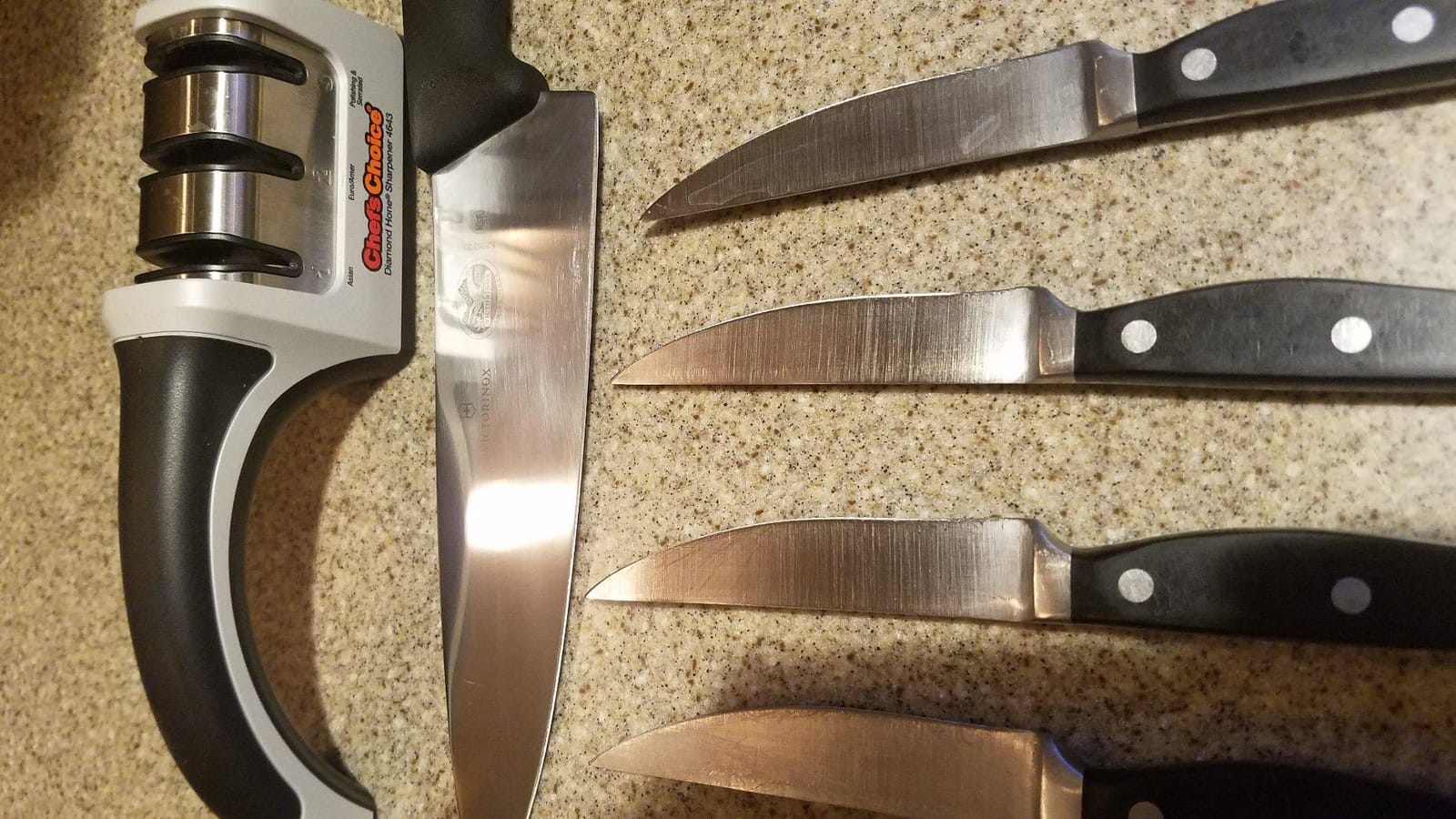
Most two-stage slot sharpeners use one carbide and one ceramic stage. This one uses diamond abrasives throughout, and that is the whole argument for it. Diamond does not chip and does not glaze as easily as ceramic under repeated use, so the finishing stage keeps working for far longer than a ceramic rod would.
Owners who move up from a cheap pull-through report a step change in how long the edge holds, which is the metric I care about most. It is also backed by a 10-year warranty.
The CrissCross technology is what makes it useful on serrated knives. Rather than a single wheel spinning in one plane, the angled diamond wheels contact both sides of the blade in a crossing pattern, which follows the V of a Western knife and works down into the valleys of a serrated blade more effectively than a straight slot does.
Why it earns its place here is that combination: serrated capability plus a separate honing stage, in one tool that most handheld sharpeners do not offer.
15 degrees or 20 degrees, and why you cannot choose freely
Most sharpeners in this class give you two selectable positions corresponding to a 15-degree and a 20-degree edge per side, which covers the two most common factory angles. What you cannot do is set anything in between, so if your knife sits at 17 degrees, neither setting is a perfect match and the closer one is the safer choice.
Matching the angle your knife already has matters. Running a 15-degree Asian knife through a 20-degree setting grinds the thin edge away faster than you can put it back, and no amount of care with the pass will fix a geometry mismatch.
Why two separate stages beat one
The separation of sharpening and polishing is what lifts this above a single-stage tool. The first stage resets the edge, the second removes the burr and polishes, and skipping the second stage leaves a rougher edge than it should be. Passing both takes longer but produces a noticeably more refined result on the same knife.
What the reviewers flag
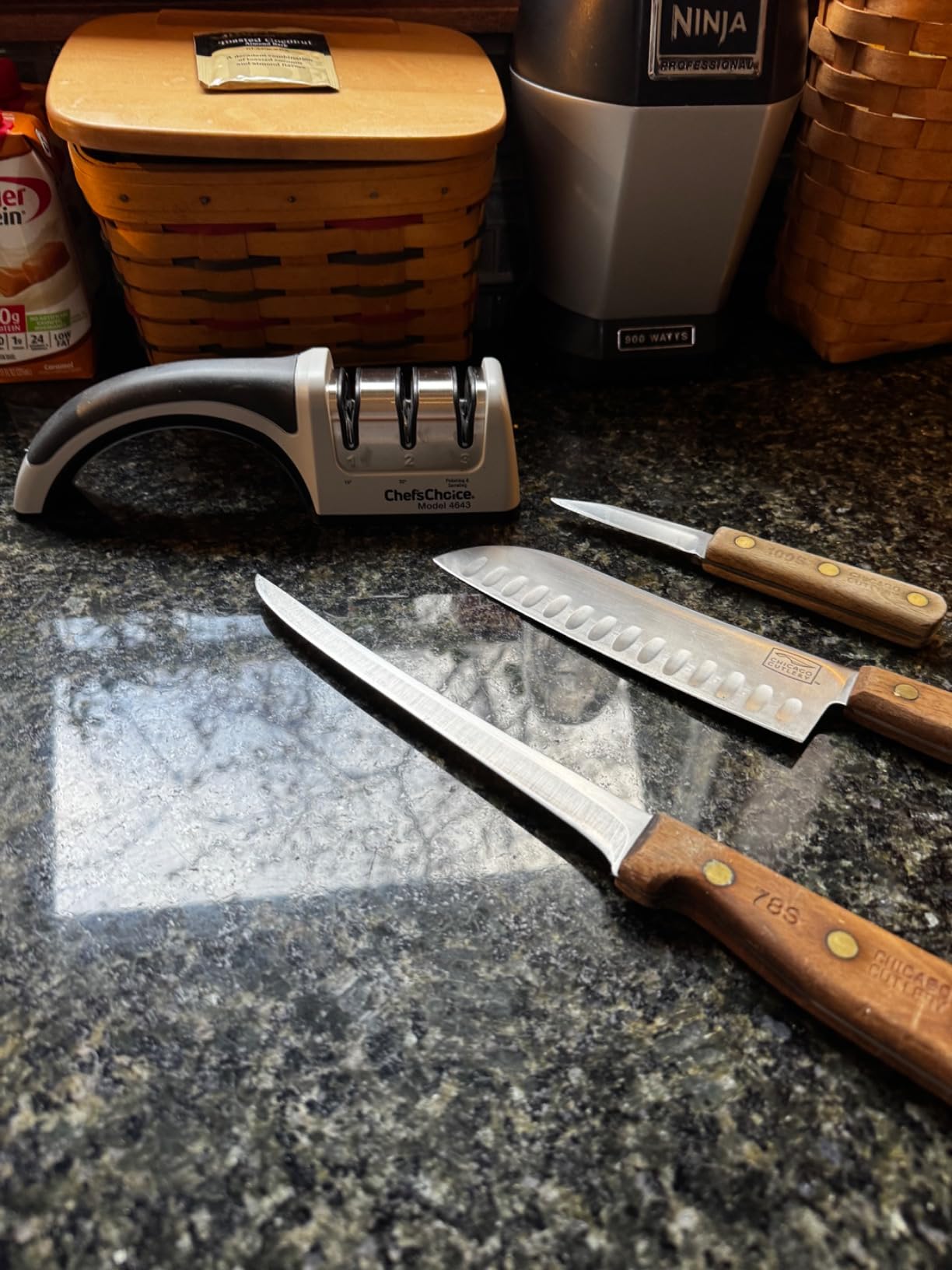
At 9.25 inches long and 8 ounces, this is bulkier than a small pull-through, which is a fair trade for diamond abrasives but means it does not go back in a drawer. The other flag is that the diamond wheels are not user-replaceable, so once they wear the tool is finished.
Who this is not for
Not for someone who wants to reprofile to a custom angle, and not for a very small kitchen. If serrated knives are a genuine part of your cooking, it earns its place; if not, one of the lighter two-stage sharpeners does the same job for less.
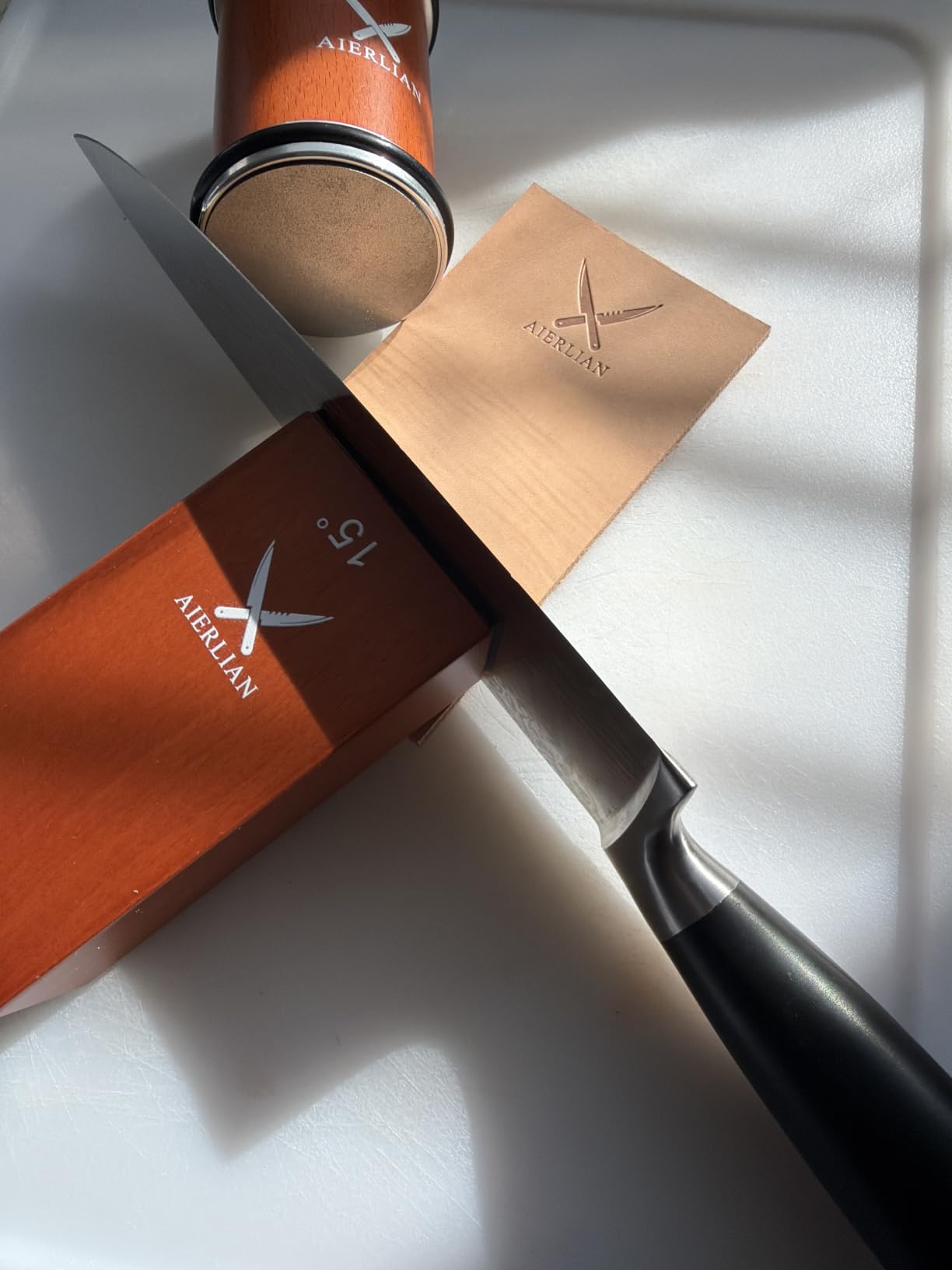
12. AIERLIAN Rolling Sharpener – Magnetic 15 and 20 Degree Support With a Strop
AIERLIAN Knife Sharpener Tool, Rolling Knife Sharpener Kit, Knife Sharpening with Diamonds and Ceramic for Steel of Any Hardness, Kitchen knife Sharpener with 15 & 20 Degree Magnetic Angle(Brown)
400 diamond and 3000 ceramic discs,1.3 lb,5.49 x 4.6 x 2.7 inch,natural wood
Pros
- Magnetic base switches between 15 and 20 degrees
- Strong neodymium magnets hold the knife
- Includes a leather strop
- Wood body doubles as a display piece
Cons
- Not for serrated knives or scissors
- Rolling technique takes practice
- Heavier than plastic alternatives
Rolling sharpeners get dismissed as a gimmick, and the criticism is half right. You do need practice to run a blade along a spinning disc without wobbling it, and several owners say explicitly that it took them several knives before the results were consistent.
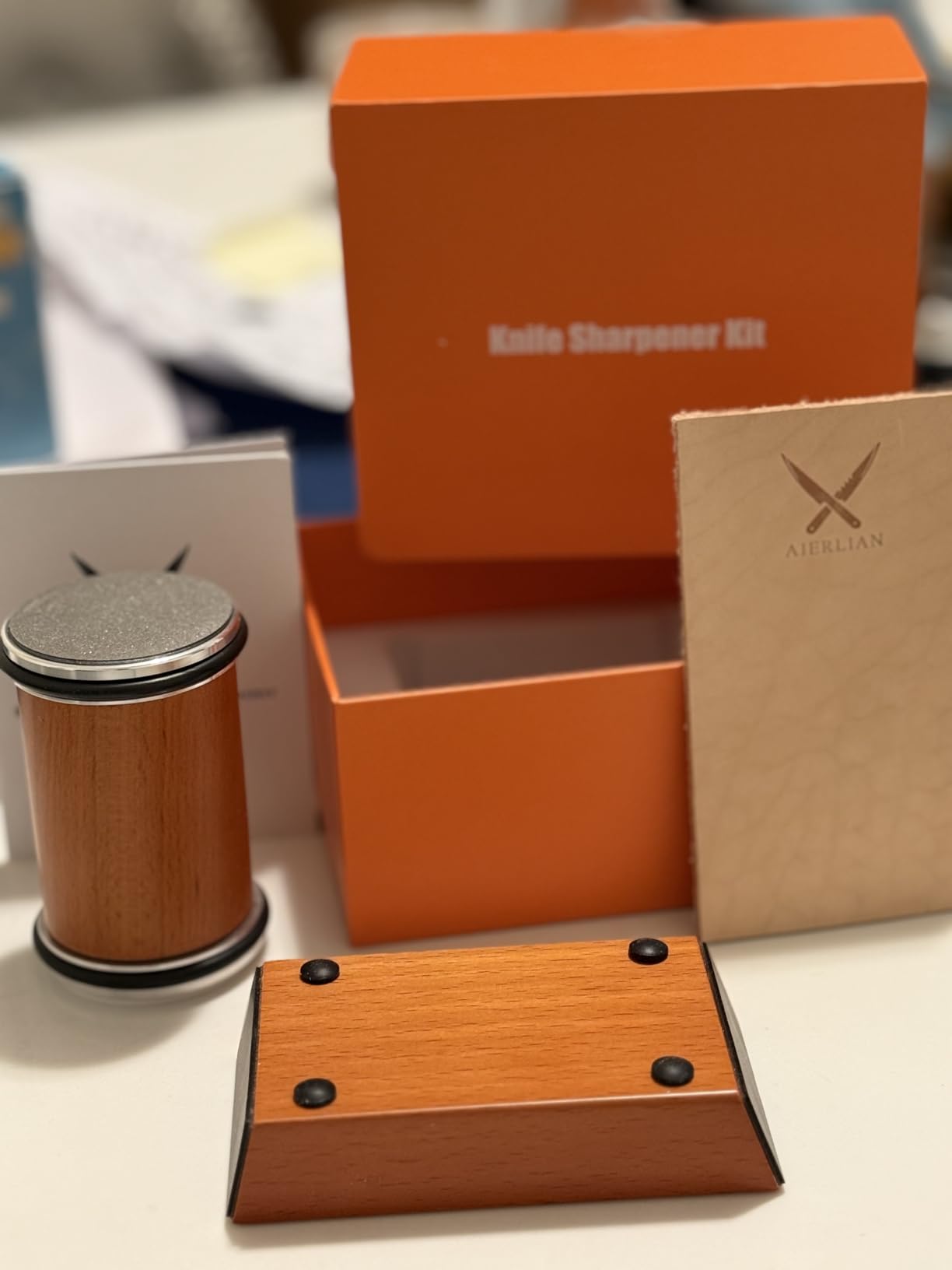
What this one adds is a magnetic angle support with 15 and 20 degree settings and four neodymium magnets holding the blade flat to the base. Instead of hunting for a clamp, you set the magnetic support to your edge angle, lay the knife against the magnets, and roll it. Switching between a European and an Asian bevel takes seconds rather than a second system.
The disc pairing is sensible: a 400 diamond disc to remove steel and set the edge, a 3000 ceramic disc to refine it. A leather strop is included for deburring, which is the step most people skip and the step that decides whether the finished edge feels polished or merely sharp.
It arrives in a gift box with instructions and the strop, and the natural wood body is the one genuinely nice-looking object in this roundup. It is designed to sit out rather than hide in a drawer.
Straight edges only
The manufacturer is explicit: not for serrated knives or scissors. A spinning disc will destroy the valley structure of a serrated blade, taking off the points that make it cut. The same applies to kitchen shears. Use a dedicated serration rod instead.
This is the narrowest scope of any pick here, which is why it sits at the end of the list despite being a nicely made object.
Technique, and a smaller evidence base
Holding the blade at a constant angle against a spinning abrasive is genuinely harder than it looks, and the wobble produces a convex rather than a straight edge. The magnetic support reduces the problem substantially, but it does not remove it. Plan on a few sessions before you judge the result.
It has the smallest review base of the twelve at just over 2000 reviews, which means less long-term evidence behind it than the heavily reviewed sharpeners above. The 4.4 average is solid, but treat durability claims with more caution than the ones attached to tools with decades of ownership data.
Who this is not for
Not for serrated knives or scissors, and not for someone who wants a knife-sharpening tool they can use in fifteen seconds with no learning. Buy it if you like the object and want to learn a technique; skip it if you just need a blunt knife made functional again.
Your First Sharpening Session: Six Steps With the Top Pick
Before any of it, four things. Get a cheap knife from the back of a drawer and sharpen that first, exactly as the r/sharpening crowd keeps advising. Wash it and dry it. Work on a stable surface with good light. And put a folded towel under whatever stone or base you are using, because things move.
Then, with the KitchenIQ Edge Grip in hand:
1. Inspect the edge in good light. Hold the blade so light runs along the edge from behind it. A dull edge diffuses the light into a soft grey band. A sharp edge returns a hard bright line. This takes five seconds and it is the only honest test of your progress later on.
2. Warm the knife up in your hand. Cold steel and cold carbide give a different result than a blade at room temperature, and a cold edge is more likely to chip on the first pass. Thirty seconds in your palm is enough.
3. Coarse stage, light pressure, four or five passes per side. Push the blade away from you with the edge trailing, and keep the pressure gentle. You are guiding the blade, not forcing it. Then flip to the other side and repeat. Watch the tip and the heel; both need the same number of passes or the edge will be uneven.
4. Check for a burr. Run a fingertip very lightly along the opposite side of the edge, from heel to tip, and you should feel a wire-like ridge. Feeling a burr is the difference between actually sharpening and merely polishing, and beginners who skip this check never know whether they removed steel or just burnished the edge.
5. Fine stage, fewer passes. Three or four light passes per side on the ceramic stage removes that burr and polishes the edge. If the burr is still there, go back to the coarse stage rather than pressing harder on the fine one.
6. Hone, do not sharpen, between sessions. This is the step that keeps your edge alive. A honing rod straightens an edge that has rolled over from use without removing meaningful steel. Do it before you cook rather than reaching for the sharpener, and the intervals between sharpening stretches out from weeks to months.
If you go with a stone instead, the sequence is different in one important way: you deliberately raise a burr and then remove it, rather than using each stage as a quick pass. Coarse side until a burr forms along the entire edge, then change sides to keep it even, then move to the finer side only once the whole edge has a wire edge. The 1000 and 6000 stones cover repair and polish, and skipping the coarse step is why first-time stone users get disappointing results.
How to Choose a Manual Knife Sharpener Without Overthinking It
The five manual sharpener types explained
Fixed-slot pull-through sharpeners. You pull the blade through a slot or between wheels set at a fixed angle. No technique, seconds per knife, works on almost any straight edge and some serrations. The trade-off is that the angle is whatever the manufacturer chose, the wheels wear out, and the edge fades faster than a stone edge. This is the right first purchase for a casual cook.
Guided slot systems. A sharpener where the slot angle is fixed but the abrasive quality is better, sometimes with a separate honing stage, and occasionally with two selectable angles such as 15 and 20 degrees. A step up in edge durability over a basic two-stage tool, and the category where the long warranty lives.
Guided clamp systems with adjustable angle. The knife sits in a clamp and the stone angle moves. These are the only tools here that let you change a blade’s edge angle, which makes them a reprofiling tool rather than a maintenance tool. They also cost more and take longer per session.
Whetstones. Water stones and diamond stones with a 1000 and 6000 or similar pairing. The finest edges in the roundup and the longest lasting, with the most technique required. An angle guide turns a stone from intimidating into approachable, and the effort is a skill you keep for life.
Multi-stone clamp kits and rolling sharpeners. Kits trade simplicity for completeness: every grit, a clamp, a case, and a practice knife. Rolling sharpeners sit between a stone and a slot system, using a spinning disc with a magnetic angle support. Both produce good results and both demand more attention than a slot sharpener.
Honing versus sharpening: the distinction that matters
Honing straightens an edge that has bent or rolled over from normal use. It removes almost no steel. Sharpening removes steel to create a new edge. This matters because a knife that is merely dull from use needs a hone, and running a slot sharpener on it instead takes off good steel to solve a problem the rod solves for free.
The professional habit, the one chefs repeat, is to hone before nearly every use and sharpen occasionally. Beginners who adopt that habit sharpen a fraction as often, and their knives stay sharper between sessions. If you buy one accessory alongside a sharpener, make it a honing rod or the strop included with the Work Sharp field sharpener.
Burrs, bevels and edge angle in plain language
A burr is a wire of metal that folds over from one side of the edge to the other as you grind. It is the goal, not a problem. Many beginners stop as soon as the knife cuts something and never form a burr, which is why their edges feel sharp for a day and blunt by the next.
A bevel is the angled face on each side of the edge. A secondary bevel is the narrow, more acute angle inside the main bevel that gets created when you sharpen an existing edge rather than grinding all the way to the spine. It is why sharpening a knife repeatedly does not eventually destroy it.
Edge angle is quoted per side, so a 20-degree edge is 40 degrees across the tip. Lower is sharper and more delicate; higher is tougher and more forgiving. 15 to 20 degrees suits Japanese and Asian kitchen knives, and 20 to 25 degrees suits European knives and general-purpose tools. Sharpening a knife to an angle far different from its factory angle removes a great deal of steel, which is why matching angles matters.
Straight edge versus serrated: what each tool can handle
This is where beginners do real damage, and it is the detail most buying guides gloss over. A whetstone and a rolling disc will flatten the peaks of a serrated blade and leave you with something worse than you started with. A serrated blade is not a straight edge with notches; it is a set of independent points that each need a rounded tip.
What you want for serrated knives is a rod with a dedicated serration section, a diamond rod, or a tool with angled wheels like the Chef’s Choice 4643. The pull-through units listed as serrated-compatible are fine for a light touch-up and unsuitable for restoring a genuinely dull bread knife. If most of your cutting is bread, tomatoes and packaging, a dedicated serration tool should be your purchase, not a general one.
What your budget level actually buys
Under about 20 dollars: a fixed-slot or multi-stage handheld. Seconds per knife, no technique, adequate edge, fades in weeks. This is where a surprising number of people should start, and the forums are full of owners of cheap tools who are entirely satisfied.
Around 30 to 45: a dual-grit whetstone with an angle guide, a multi-stone clamp kit, or a guided field sharpener with a strop. This band is the best value in the roundup because it buys either a real skill or a real range of surfaces. If you sharpen more than once a month, this is where you belong.
Around 60 and up: an adjustable-angle guided system with all-diamond abrasives and a long warranty. The extra spend buys angle control and edge durability, not a fundamentally different result. A system costing several times more mostly gets you the same edge more slowly.
Beyond that: you are buying benchtop systems and rotating grinders. Diminishing returns set in hard, and the general consensus across the forums favours a mid-range guided system over the cheapest option as the best balance of effort and result.
Five beginner mistakes and the fix for each
Pressing too hard. Abrasives cut by abrasion, not by force, and pressure mostly generates heat and uneven wear. Light, even passes work faster and protect both the blade and the tool. Fix: use roughly the pressure of a firm handshake and let the grit do the work.
Inconsistent angle. The most common cause of an edge that cuts unevenly and dulls fast. Fix: use a guide, a clamp or a stone angle guide on every early session, and mark the bevel with a permanent marker to see the contact band.
Skipping the strop or the honing rod. You form a burr, then stop. A strop or a few passes on a honing rod removes it and polishes the edge, which is the difference between an edge that feels sharp and one that feels dangerous and slick. Fix: add a strop to your kit before you add anything else.
Using a pull-through on an expensive or thin-edged knife. Fixed geometry and a thin Asian bevel do not mix; the slot will happily grind away an edge you cannot replace. Fix: match your tool to the knife, and use a stone for a knife you care about.
Sharpening to fix a problem that honing solves. A knife that has rolled over from months of use does not need steel removed. Fix: hone first, and only sharpen when the burr test shows the edge genuinely needs rebuilding.
Frequently Asked Questions
Are manual knife sharpeners any good?
Yes, with a caveat. A quality manual sharpener can put a factory-grade edge back on a knife. A good whetstone produces the finest and longest-lasting edge, while a guided system gets a beginner most of the way there with far less technique. The exception is the cheapest pull-through sharpeners, which are fixed-angle, remove steel quickly and cannot correct an uneven bevel, so repeated use can grind an edge down faster than it needs to.
Is there a knife sharpener that actually works?
Yes. Any sharpener with a real abrasive that removes steel and forms a burr will sharpen a blade, and the KitchenIQ Edge Grip and AccuSharp are the two most reliably reviewed examples in this roundup. Warning signs of a dud are a tool that only smooths or polishes, offers no angle control, and has no way to load a replaceable abrasive. Test on a cheap knife and look for a visible burr within a dozen passes before you touch anything you care about.
What is the best knife sharpener for home use?
For most home kitchens, a guided manual system with selectable angle control is the best balance of result and ease, because it holds a repeatable angle without demanding technique. If you want to learn the craft, a 1000 and 6000 grit whetstone paired with a honing rod is better and teaches you something that transfers to every other tool. Whatever you buy, add a honing rod or strop, because it is what keeps the edge alive between sharpening sessions.
Are pull-through knife sharpeners bad for knives?
Not inherently, but most are the weakest option available. They are fixed-angle, they remove steel quickly, and they cannot correct an inconsistent bevel, so repeated use progressively over-grinds an edge that was merely dull from use. They are fine for occasional touch-ups on soft steel, and they are a perfectly good first tool for a beginner, but they make a poor primary sharpener. A ceramic honing rod is the better maintenance tool for the same job.
Do knife sharpeners really work for a complete beginner?
Yes, provided you give any system two or three sessions before judging it. The first edge is usually poor, the third is respectable, and by the fifth you will wonder why you waited. Practise on a cheap knife, keep your passes even and light, deliberately raise a burr before moving to a finer grit, and stop while you are still making progress. Most people who quit sharpening did so on session one, not because the tool was bad.
Which Manual Knife Sharpener Should You Buy First?
Buy the KitchenIQ 50009 Edge Grip if you want a working edge in fifteen seconds and no learning curve, and buy the AccuSharp if you prefer a handheld tool with a finger guard and blades that last a decade. Choose the SHARPAL 191H if you sharpen shears as well as knives, and pick the longzon 5-in-1 if being safe around a sharp blade matters more to you than a polished finish.
If your instinct is that you will actually use a whetstone, start with the Sharp Pebble 1000/6000 and its angle guide. Add the King KW65 instead if you also sharpen chisels or plane irons. Buy the Work Sharp Precision Adjust on the day you decide you want to change a knife’s edge angle rather than simply maintain it, and choose the Lansky Deluxe when you want every grit in one case with room to grow.
Add a honing rod or a strop to whichever you pick, practise on a cheap knife before anything you love, and check the current price on the product before you buy.