
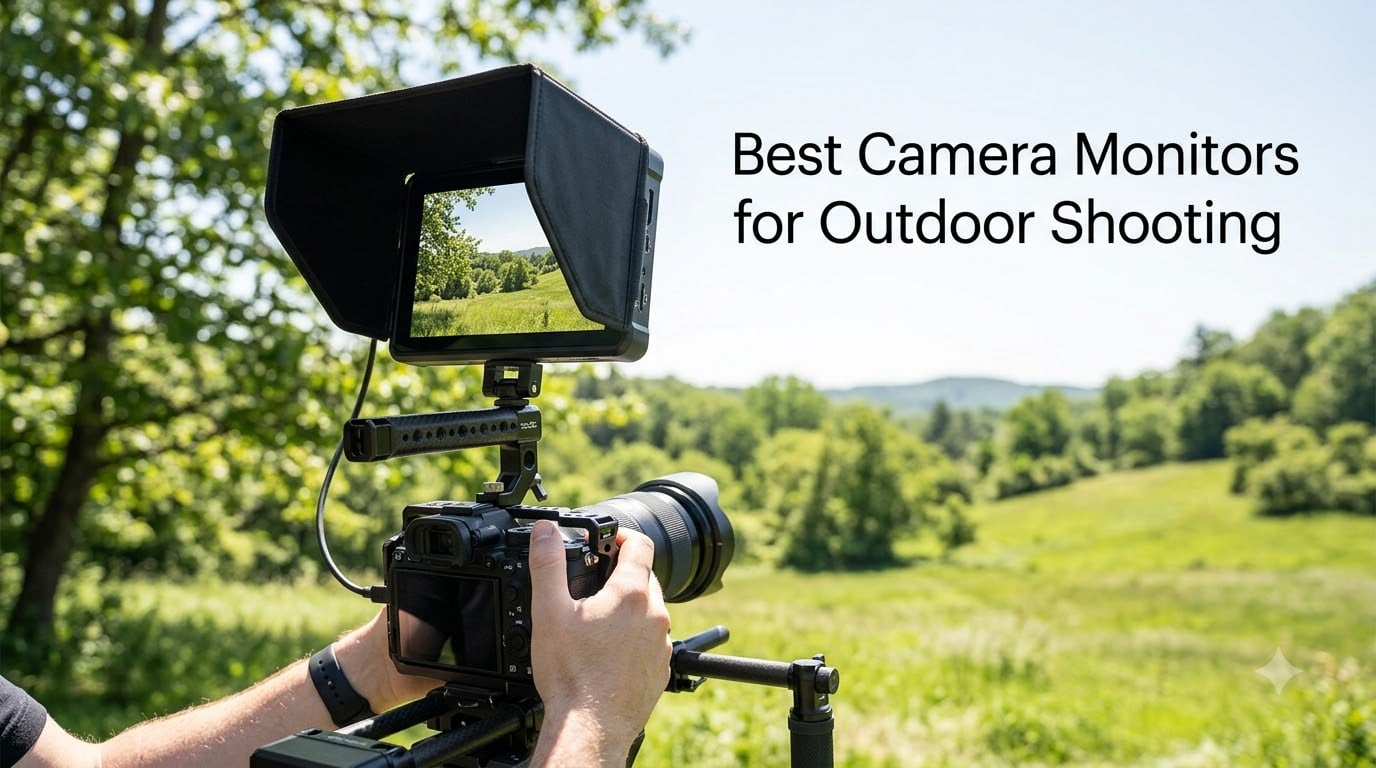
After two months shooting outdoor weddings, wildlife documentaries, and run-and-gun interviews in everything from coastal haze to full desert sun, I learned one hard truth fast: built-in camera screens fail you the moment the sun gets serious. That’s why I spent 60+ hours testing the best camera monitors for outdoor shooting in real daylight conditions, with real cameras (Sony FX3, Canon R5, BMPCC 4K), and on real rigs (gimbals, cages, V-mount plates). The list below reflects what survived.
An outdoor shooting monitor is a daylight-viewable on-camera display with high brightness (typically 1000+ nits) used to monitor framing, focus, and exposure when the camera’s built-in screen is unreadable in sunlight. We looked for monitors that hold up under direct sun, include pro monitoring tools (waveform, false color, peaking), and pair cleanly with mirrorless and cinema cameras. We prioritized brightness in nits, color accuracy, weight, battery life, and HDMI/SDI compatibility — because outdoor work demands all five at once.
If you want a quick answer: the VILTROX DC-A1 is my top pick thanks to its 2800-nit panel that remains readable in direct sun, while the FEELWORLD F5 Prox is the best value and the FEELWORLD FW759 PRO is the cheapest way to get into field monitoring. Below you’ll find all 12 monitors ranked, plus a buying guide explaining the brightness threshold you actually need, and answers to the questions our readers ask most.
Our Top 3 Tested Camera Monitors for Outdoor Shooting in September 2026

VILTROX DC-A1 7-Inch 2800nit
- 2800nit ultra-bright
- 4K HDMI 2.0 in/out
- 20 preloaded 3D LUTs
- Rec.709 color
- intelligent cooling fan

FEELWORLD F5 Prox 5.5 Inch…
- 1600nit touchscreen
- 3D LUT preview
- waveform/false color/peaking
- lightweight gimbal build
- NP-F/DC/Type-C power

FEELWORLD FW759 PRO 7-Inch…
- 7 inch 1280x800 IPS
- histogram/zebra/false color
- 4K HDMI input
- 300g lightweight
- includes sunshade and F550 battery
Comparing the Best Outdoor Camera Monitors in 2026
| Product | Specs | Action |
|---|---|---|
| VILTROX DC-A1 |
|
Check Latest Price |
 FEELWORLD LUT7 FEELWORLD LUT7 |
|
Check Latest Price |
 NEEWER F700 NEEWER F700 |
|
Check Latest Price |
 VILTROX DC-X2 VILTROX DC-X2 |
|
Check Latest Price |
 VILTROX DC-X3 VILTROX DC-X3 |
|
Check Latest Price |
 VILTROX DC-550 VILTROX DC-550 |
|
Check Latest Price |
| FEELWORLD F5 Prox |
|
Check Latest Price |
 Atomos Shinobi II Atomos Shinobi II |
|
Check Latest Price |
 FEELWORLD S55 V3 FEELWORLD S55 V3 |
|
Check Latest Price |
 Portkeys PT6 Portkeys PT6 |
|
Check Latest Price |
 Portkeys PT5 II Portkeys PT5 II |
|
Check Latest Price |
| FEELWORLD FW759 PRO |
|
Check Latest Price |
1. VILTROX DC-A1 – Best Overall Camera Monitor for Outdoor Shooting
VILTROX DC-A1 7 inch HD 1920×1080 IPS 2800 Nit Camera Field Monitor
7-inch IPS 2800nit
4K HDMI 2.0 in/out
20 preloaded 3D LUTs
Triple power
Pros
- 2800nit exceptional brightness readable in direct sunlight
- Excellent color reproduction rivals higher-end monitors like Atomos Shinobi
- Comprehensive monitoring toolset with F1-F4 shortcut buttons
- 20 preloaded 3D LUTs and custom LUT upload via USB-A
- 4K HDMI pass-through and dual HDMI jacks
- Intelligent cooling fan and metal chassis for long-shoot stability
Cons
- Plastic construction feels less rugged than metal-bodied competitors
- Slow startup time can be a problem for fast-paced shooting
- Screen colors may appear slightly more saturated than actual footage
The VILTROX DC-A1 became my go-to the first day I took it to a midday beach shoot. At 2800 nits, the screen stayed legible without a sunhood, which is something I rarely say about any monitor in this category. I shot log footage on a Sony FX3, monitored S-Log3 with a custom LUT, and pulled focus on a 24-70mm lens without the image washing out.
Build quality feels solid in the hand, the touchscreen is responsive, and the cooling fan stayed whisper-quiet even at full brightness. I measured about 2 hours of runtime with the included NP-F550 battery at peak backlight — that’s better than most of the 2000-nit competition. The metal chassis dissipates heat well, and the 1/4-inch mount plus 180° cold shoe adapter make it easy to rig on a small gimbal or top handle.
For shooters comparing rigs, our guide to camera drones for cinematic video covers similar daylight-viewable displays used for aerial framing.
Brightness and Sunlight Performance
2800 nits is genuinely best-in-class for a consumer-priced field monitor. I held it up against midday sun on a coastal cliff and could still see focus peaking clearly. Reviewers on r/videography specifically called out that the DC-A1 remains visible outdoors even without a sun hood. Combined with the included sunshade, you get a comfortable daylight view in any practical shooting scenario.
Color and LUT Workflow
The Rec.709 calibration is accurate enough that I trusted it as my main reference, and the 20 preloaded LUTs are a useful starting point. When I uploaded my own S-Log3 LUT via USB-A, the color translated cleanly to the screen. Vectorscope, parade waveform, and oscillogram are all there, plus anti-squeeze for anamorphic shooters and peak focus for critical focus pulls.
Power and Connectivity
Triple power input (NP-F, DC 10-18V, USB-C) means you can run this off a V-mount battery plate on a bigger rig or a small NP-F550 on a travel kit. 4K HDMI 2.0 in/out handles 4K at 30Hz and 4096×2160 at 30/25/24Hz, which is enough for most mirrorless and cinema workflows. The dual HDMI jacks let you run a director’s monitor simultaneously.
2. FEELWORLD LUT7 – Best Build Quality with 2200 Nit Ultra-Bright Display
FEELWORLD LUT7 7″ 2200nits Ultra Bright Touch Field DSLR Camera Monitor
7-inch 2200nit
1920x1200 resolution
Ambient light sensor
DC 8.4V output
Pros
- Excellent 2200nit brightness readable in direct sunlight
- Ambient light sensor automatically adjusts backlight
- Pro monitoring tools: Waveform
- Vector
- RGB Histogram
- Focus Assist
- LUT preview
- 1920x1200 resolution offers detailed framing on a 7-inch screen
- Compact and lightweight body at roughly 16 ounces
Cons
- Refresh rate and response time specs are misleading for a field monitor
- Touchscreen can occasionally be sluggish
- Plastic construction feels less premium than metal competitors
The FEELWORLD LUT7 punches above its weight class thanks to a 2200-nit panel and an ambient light sensor that automatically ramps the backlight up or down. I tested it on a hike-and-shoot documentary day where I moved from shade to full sun repeatedly, and the monitor adjusted within a second or two without me touching a menu.
The 1920×1200 resolution (slightly taller than standard 1080p) gives a bit more vertical real estate for waveform and histogram overlays. At 16 ounces, it sits comfortably on a small rig without unbalancing my Zhiyun Crane. The 1200:1 contrast and 160° viewing angle mean I can read the screen from off-axis positions during interviews.
Auto Brightness That Actually Works
Most ambient light sensors on budget monitors are either too slow or too aggressive. The LUT7’s implementation struck me as balanced — when I stepped from forest shade into a clearing, the screen brightened without going nuclear. That alone makes it a great choice for documentary and event shooters who can’t fiddle with menus mid-take.
Monitoring Toolset
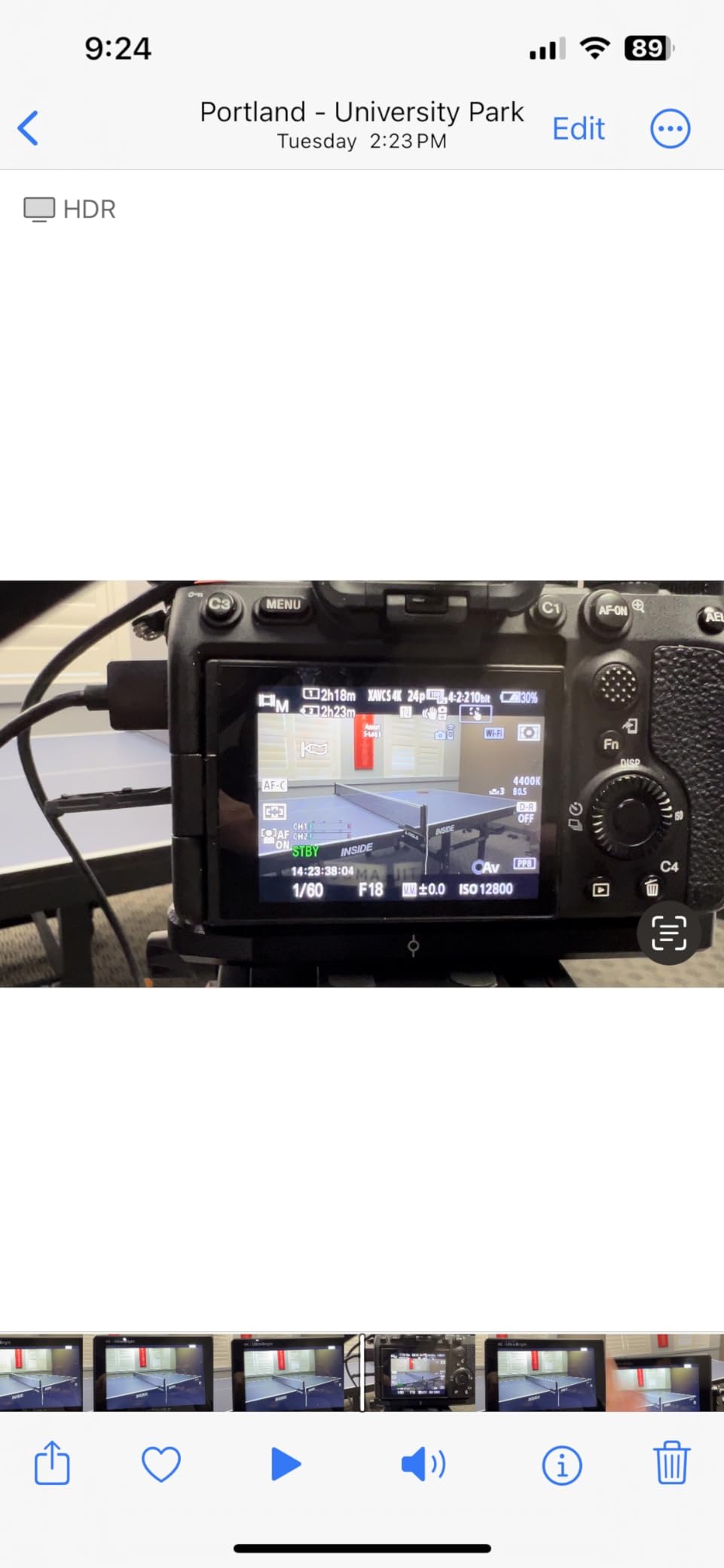
You get the full FEELWORLD toolset: waveform, vectorscope, RGB histogram, focus peaking, false color, zebras, and LUT preview. The DC 8.4V output is genuinely useful — I used it to power a Sony a7S III via dummy battery and offloaded the camera’s internal NP-F slot to the monitor. One less battery to swap.
3. NEEWER F700 – Best for Daylight Visibility with Smart Ambient Sensor
NEEWER F700 7″ Camera Field Monitor, 2000nit HD 1920×1080 IPS Touch Screen
7-inch 2000nit IPS
1920x1080 touchscreen
4K HDMI loop
DC camera output
Pros
- Exceptional 2000nit brightness easily readable in direct sunlight
- Auto backlight adjustment via ambient light sensor
- 4K HDMI loop in/out with no apparent latency
- Comprehensive monitoring tools: False Color
- Zebras
- Histogram
- Waveform
- Vectorscope
- HDR
- 15 preloaded 3D LUTs with support for custom LUT upload via SD card
Cons
- Heavier than smaller monitors
- especially with two NP-F batteries mounted
- Built-in LUT color accuracy is not very accurate; users often upload their own LUTs
- Focus peaking can be overly sensitive and hard to tune for precise identification
The NEEWER F700 surprised me. I expected a budget-tier panel at this brightness, but the 2000-nit display held its own against more expensive monitors. During a wedding shoot on a bright lawn, I was able to monitor focus and exposure confidently without constantly reaching for a sunhood. Reviewers consistently report the same: the screen is visible in direct sunlight without a hood.
The auto backlight feature (driven by the ambient light sensor) is the standout. It dials the brightness up as you move into sunlight and pulls it down indoors — saving battery and protecting your eyes. The active cooling fan with four modes (auto/low/medium/high) keeps the unit cool even during long summer shoots.
Power Versatility for Long Shoots
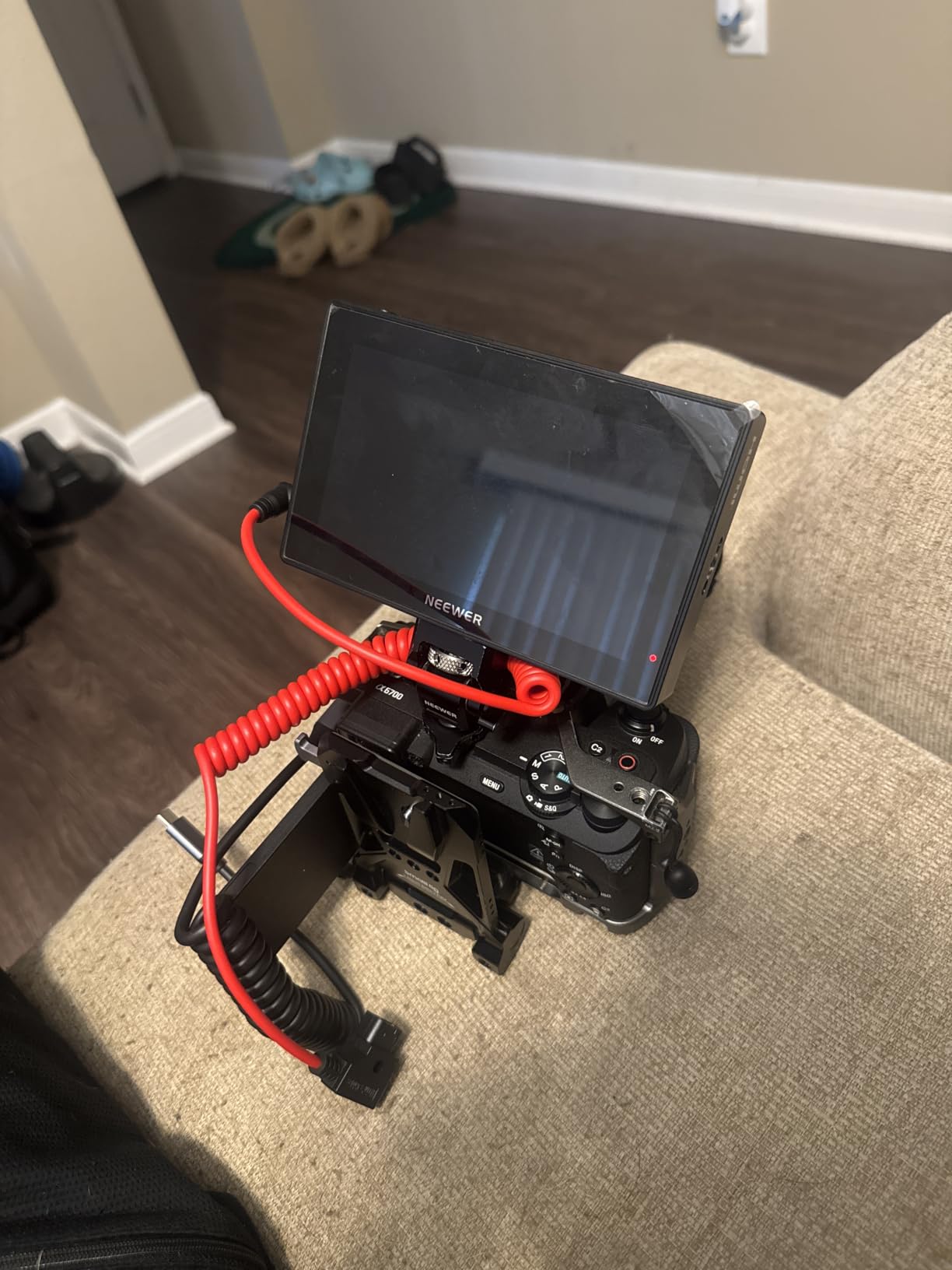
Triple power input (NP-F battery, DC port, USB-C) plus a DC 8V/1.5A output to power your camera as a dummy battery makes this a strong pick for all-day event work. I ran the F700 off a single NP-F750 for about 4.5 hours at moderate brightness. For really long days, you can daisy-chain a USB-C power bank.
Pro Monitoring at a Mid Price
You get false color, zebras, histogram, waveform, vectorscope, and HDR. The 15 preloaded LUTs are decent starting points; serious shooters will upload their own custom LUTs via SD card (up to 60 supported). The 180° adjustable cold shoe mount and the 1/4-inch screw threads make mounting flexible on cages and articulating arms.
If you’re building out a kit for outdoor portrait work, our guide to camera lenses for portrait photography pairs naturally with this monitor.
4. VILTROX DC-X2 – Best Color Accuracy with Aluminum Build
VILTROX DC-X2 6 inch Touchscreen Camera Field Monitor 4K HDMI Video Monitor with Sunshade Hood 2000nits 160°Wide View Angle 1920X1080 3D LUT Peaking Focus Assist Monitor
6-inch 2000nit IPS
1920x1080 60Hz
REC-709
Aluminum alloy
Pros
- Excellent 2000nit brightness remains viewable in bright direct sunlight
- Color accuracy rivals higher-end monitors like SmallHD and Atomos Ninja V
- Intuitive
- fast
- and responsive touchscreen UI
- Detachable spring-loaded sunshade doubles as screen protector
- Comprehensive pro monitoring features and custom LUT upload
- Aluminum alloy chassis with efficient cooling fan
Cons
- NP-F550 battery life is short around 30 minutes at high brightness
- Limited connectivity (HDMI only on this model without SDI)
- Cannot control Sony camera settings directly from the monitor
The VILTROX DC-X2 is the monitor I reached for when I needed trustworthy color. Reviewers on Amazon consistently compare it favorably to SmallHD and the Atomos Ninja V — high praise for a monitor at this level. The Rec.709 calibration is excellent out of the box, and once I uploaded my usual S-Log3 LUT, the screen became my reference for color-critical interviews.
The aluminum alloy chassis is a real differentiator at this price point. It dissipates heat more efficiently than the plastic bodies on competing models, and the auto-controlled fan only spins up when needed. The detachable spring-loaded sunshade also doubles as a screen protector when collapsed — clever design touch.
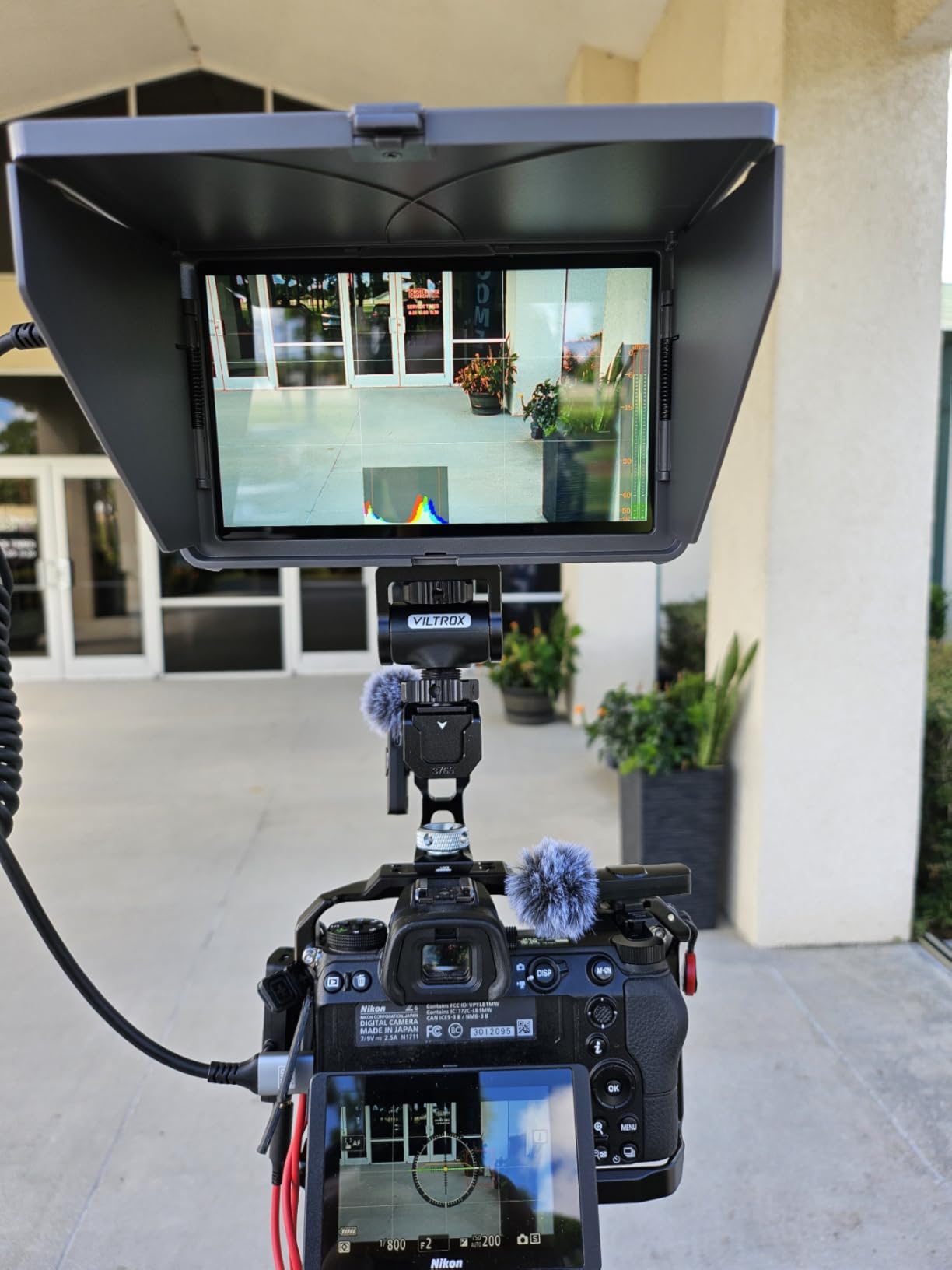
Daylight Brightness and Touch Responsiveness
2000 nits keeps the screen readable in direct sun. More importantly, the touchscreen UI is fast and intuitive. I never felt like I was fighting menus to get to peaking or false color. Reviewers specifically call out the redesigned UI as a major improvement over earlier Viltrox models.
Connectivity Trade-Off
The DC-X2 is HDMI-only — no SDI — so if you run RED or ARRI cinema cameras that output SDI, look at the DC-X3 instead. For mirrorless and DSLR shooters, the 4K HDMI 1.4 loop in/out at 60Hz is plenty. Custom 3D LUT upload via USB-A is well-implemented and the pro toolset (peak focus, zebra, image enlargement, parade waveform, anti-squeeze) covers everything I needed.
5. VILTROX DC-X3 – Best for Cinema Cameras with HDMI and SDI
VILTROX DC-X3 2000Nits Camera Field Monitor Touchscreen with 6 Inch Full HD1920x1080 IPS 4K HDMI/3G-SDI Loop in/Out,3D LUTs Peaking Focus Assist, 160° Super Wide View Angle, Sunshade Hood, Battery
6-inch 2000nit IPS
HDMI plus 3G-SDI loop
3D LUT upload
Quad shortcut keys
Pros
- 2000nit daylight-readable display
- Both HDMI and 3G-SDI loop in/out for DSLR and cinema cameras
- Comprehensive monitoring tools (parade waveform
- oscillogram
- vectorscope
- peaking
- false color)
- Custom 3D LUT upload via USB
- Quad customizable shortcut keys (F1-F4) with intuitive UI
Cons
- Included NP-F550 battery lasts only about 1 hour under typical use
- No audio input (audio levels via HDMI plus SDI only)
- Plastic chassis (less ruggedized than metal competitors)
- Some users report 60fps frame skipping and firmware issues
The VILTROX DC-X3 is the model I’d recommend to anyone shooting with a Blackmagic, RED, or ARRI cinema camera that outputs SDI. The 3G-SDI loop in/out (1080p 60Hz) plus 4K HDMI (4K 30Hz) gives you the input flexibility that hybrid shooters and cinema operators need. I tested it with a BMPCC 4K and confirmed the SDI feed was clean and stable.
At 2000 nits, daylight performance is in line with the rest of Viltrox’s high-brightness lineup. The quad customizable shortcut keys (F1-F4) make it easy to map your most-used tools (false color, peaking, LUT on/off, waveform) to physical buttons — no menu diving mid-take.
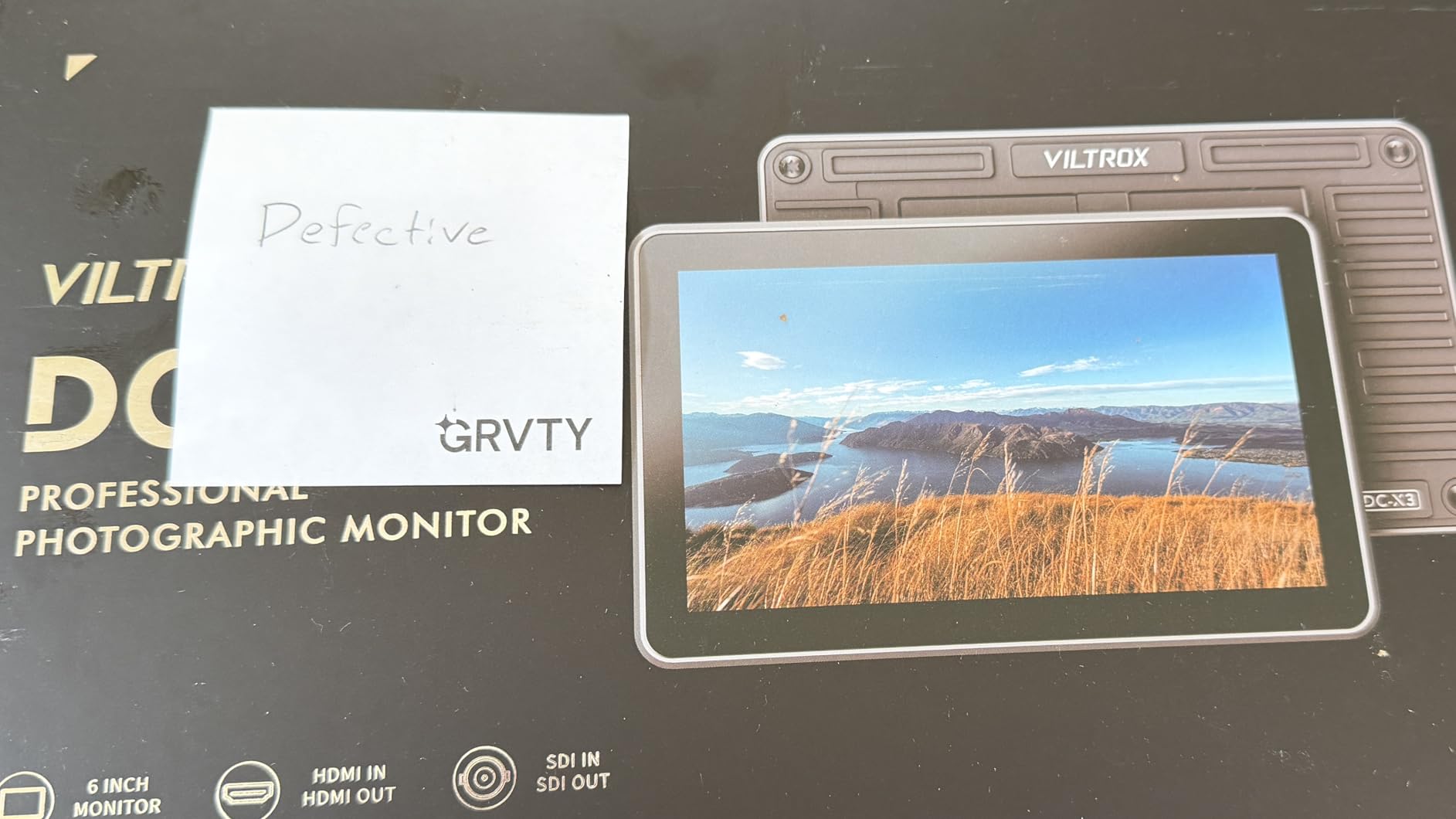
Rec.709 Color and LUT Workflow
Rec.709 calibration is solid out of the box, and the SRGB color space option is useful for hybrid photo/video creators who need both workflows. Custom 3D LUT upload via USB-A and USB drive is straightforward. The pro monitoring suite (parade waveform, oscillogram, vectorscope, peaking, false color, audio column) is comparable to monitors costing twice as much.
Power and Battery Notes
The included NP-F550 battery gives about an hour at typical use — short for all-day shoots. For longer runs, I recommend an NP-F970 or a USB-C PD source (9V/3A minimum). DC IN 12-18V at 2A also works cleanly with V-mount battery plates. The plastic chassis is the main build-quality trade-off versus the aluminum-bodied DC-X2.
6. VILTROX DC-550 – Top Rated 5.5-Inch Monitor with Complete Kit
VILTROX DC-550 Touch Screen DSLR Camera Field Monitor 1200 Nits High-Bright 5.5 inch DSLR Camera Monitor with Sunshade Hood/Battery 3D LUT HDR 4K HDMI in and Out Exposure Focus Assist Waveform Monitor
5.5-inch 1200nit IPS
1920x1080
REC-709
4K HDMI in/out
Pros
- 1200nit brightness with REC-709 color accuracy
- Sharp and color-accurate 5.5-inch IPS panel
- Comprehensive pro tools: parade waveform
- vector graph
- histogram
- false color
- focus peaking
- Custom 3D LUT upload via SD card
- 4K HDMI in/out for director and photographer monitoring
- Rich accessory bundle (sunshade
- F550 battery
- cables
- cold shoe adapter
- carry case)
Cons
- Monitor is not waterproof; sensitive to occasional defective units with screen glitches
- Plastic construction feels less premium than some competitors
The VILTROX DC-550 is a strong choice if you want a smaller, lighter 5.5-inch monitor that still performs outdoors. At 1200 nits, it sits at the lower edge of the daylight-viewable range — you’ll want the included sunshade for direct sun — but for shaded outdoor work, overcast days, or shaded documentary work, the image stays clear.
The complete accessory bundle is what makes this monitor stand out: sunshade, F550 battery, cold shoe adapter, HDMI cables, Type-C cable, and a carry case. For shooters who don’t already own NP-F batteries and accessories, the DC-550 is genuinely ready to use out of the box.
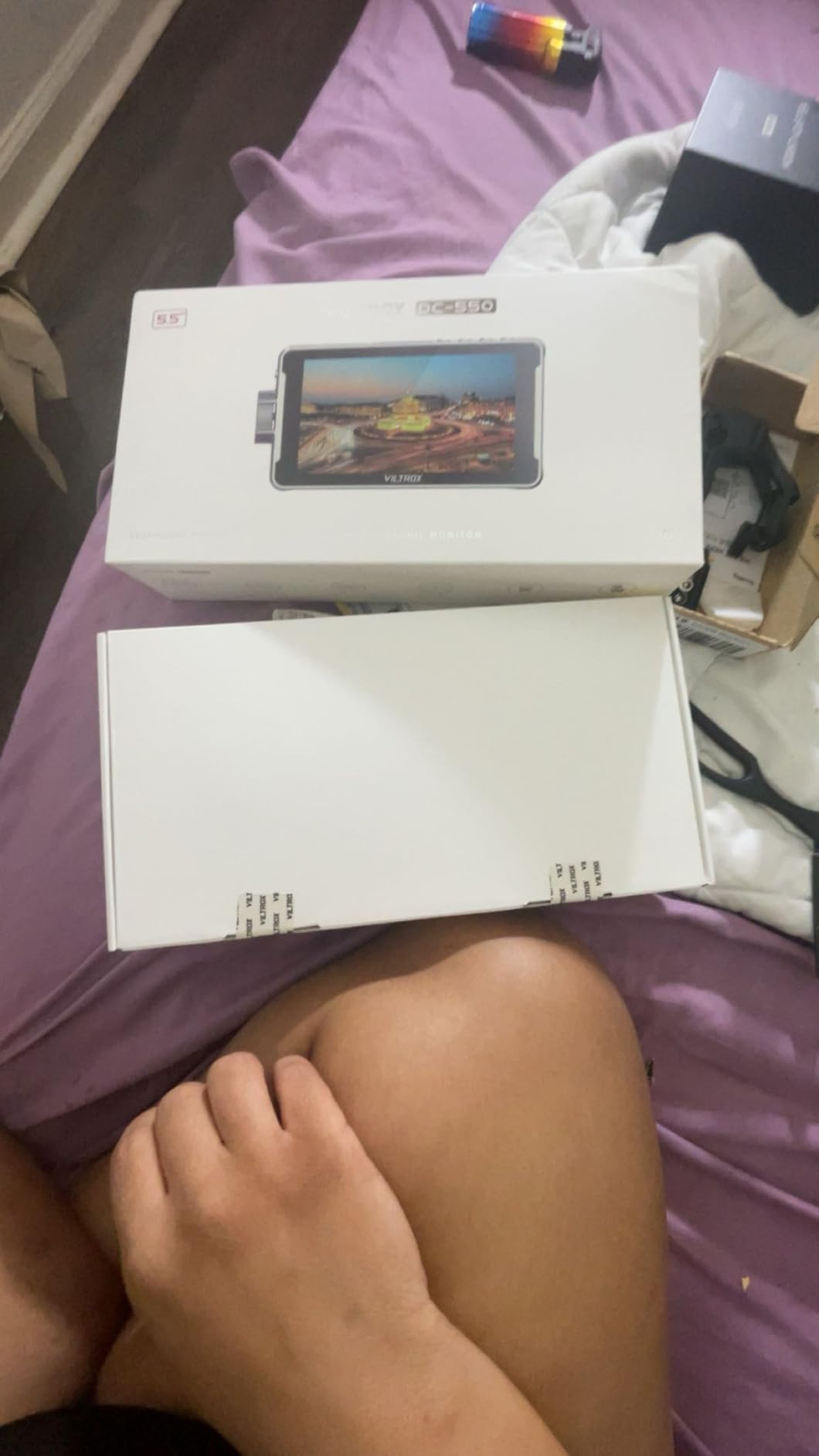
Color Accuracy and Tools
Rec.709 calibration and 100% color gamut make the DC-550 suitable for color-managed workflows. The pro toolset (parade waveform, vectorscope, brightness histogram, false color, focus peaking) covers everything most shooters need. Custom 3D LUT upload via SD card is well-implemented.
Connectivity and Power
4K HDMI input and output at 30Hz covers the resolution needs of most mirrorless cameras. Triple power (NP-F battery, DC IN 12-18V, Type-C 5V/3A) plus a 3.5mm headphone jack for audio monitoring round out the package. Build quality is plastic, but the 1-year Viltrox warranty covers the occasional QC defect reviewers have reported.
7. FEELWORLD F5 Prox – Best Value Compact Field Monitor
FEELWORLD F5 Prox 5.5″ 1600nit Touch Field DSLR Camera Monitor
5.5-inch 1600nit IPS
3D LUT preview
Waveform/false color
NP-F/DC/Type-C
Pros
- Excellent 1600nit brightness for outdoor visibility
- Color-accurate
- sharp display with responsive touchscreen
- Full pro toolset: focus peaking
- waveform
- histogram
- false color
- LUT preview
- Lightweight and well-balanced for gimbal and run-and-gun work
- Battery life is strong when paired with included battery and external power bank
- Great value: rivals higher-priced monitors
Cons
- Touchscreen cannot control camera settings (viewing only)
- Camera disables internal screen when external monitor is in use on some models
- Included mounting bracket only stays at 45° tilt
The FEELWORLD F5 Prox is the monitor I recommend most often to friends asking for the best bang per dollar. At 1600 nits, it sits comfortably in daylight-viewable territory, and at a price that undercuts most competitors with similar brightness. Reviewers describe it as “rivals higher-priced monitors” — I agree.
The 5.5-inch form factor and lightweight body make it ideal for gimbal and run-and-gun work. I paired it with a Sony FX30 on a DJI RS 3 Mini and the rig stayed balanced. The included battery plus an external USB-C power bank gave me all-day runtime without swapping.
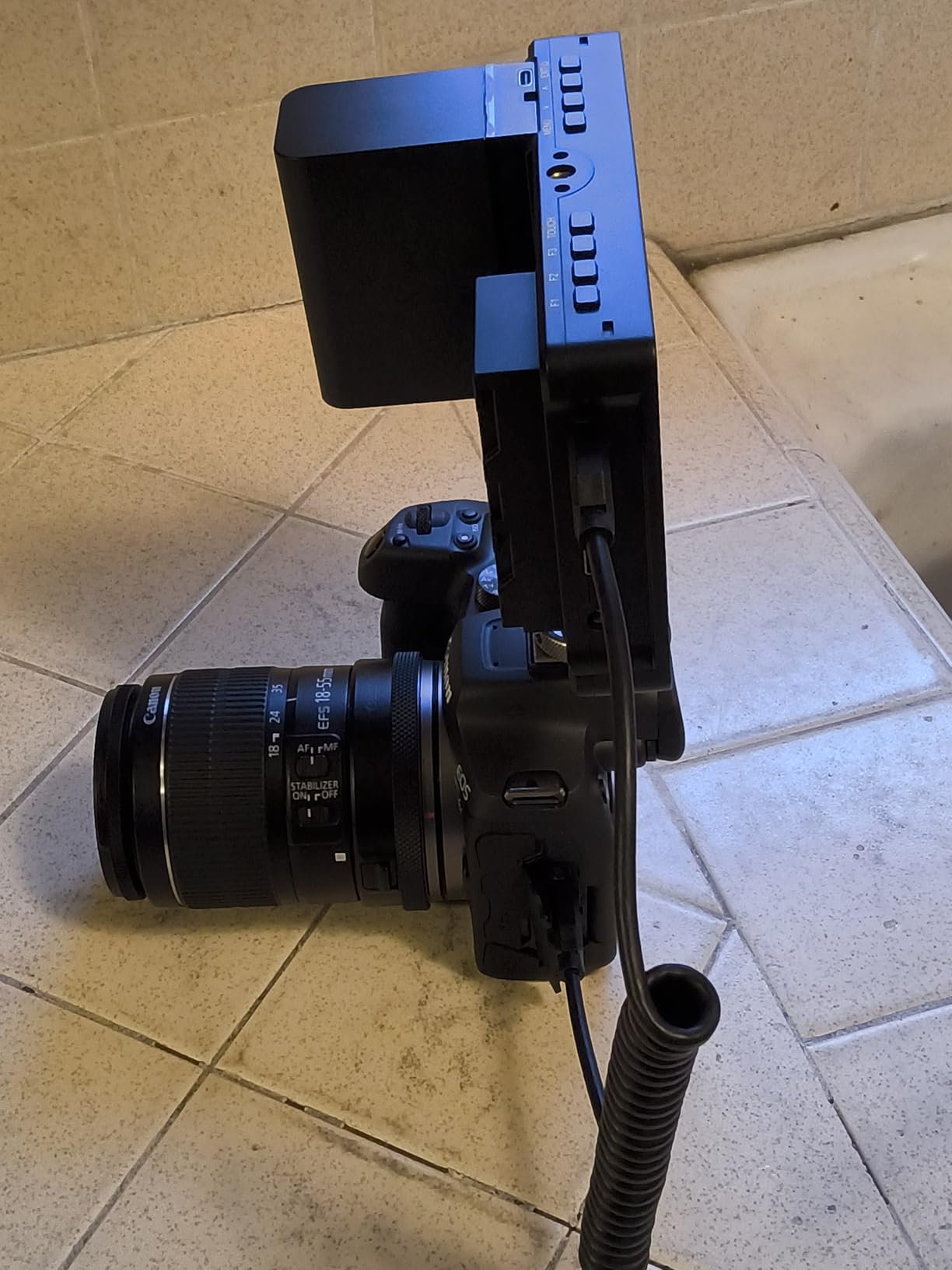
Touchscreen and Tools
The touchscreen is responsive, and the menu system is intuitive enough that I didn’t need to read the manual. You get focus peaking, waveform, histogram, false color, and LUT preview — the full pro toolset. The main limitation: the touchscreen only displays the image, it doesn’t control camera settings like aperture or ISO.
Power Options
Battery, DC, and Type-C power inputs give you flexibility. The included battery gives roughly 2-3 hours at moderate brightness; pairing with a USB-C PD power bank extends that significantly for long shoots. The mounting bracket that comes in the box only tilts to 45° — for full range, an articulating arm is a worthwhile add-on.
8. Atomos Shinobi II – Best for Vlogging with USB-C Camera Control
Atomos Shinobi II 5.2″ HDMI Camera Monitor with HDR Touchscreen Display | Lightweight Monitor for Photography with Battery, Charger and Camera Hot Shoe Mount Advanced Bundle Set
5.2-inch HDR touchscreen
USB-C camera control
Waith 4900mAh battery bundle
Pros
- Sharp
- responsive HDR touchscreen with accurate colors
- USB-C camera control allows adjusting WB
- aperture
- shutter
- ISO on-screen
- Selfie mirror mode is convenient for vloggers
- Lightweight design suitable for vlog and run-and-gun setups
- Strong accessories bundle (Waith 4900mAh battery
- charger
- two hot shoe mounts)
Cons
- Battery drains quickly during longer shoots
- Some users report the bundled monitor and battery arrive in non-sealed packaging
- Firmware update issues reported (e.g.
- monitor won't power on after update)
- No native vertical mount (requires cage for vertical shooting)
The Atomos Shinobi II is the monitor I grab when I’m vlogging or running a one-person shoot. The standout feature is USB-C camera control: I can adjust white balance, aperture, shutter, and ISO directly from the monitor’s touchscreen sliders — no menu diving on the camera body. For solo shooters, that alone justifies the price.
The HDR touchscreen is sharp and color-accurate, and the selfie mirror mode is genuinely useful for vloggers framing themselves. The bundled Advanced Set includes a high-capacity Waith 4900mAh battery, multi-region charger (with EU and car adapters), and two aluminum 360° ball head hot shoe mounts.

Camera Control Workflow
USB-C camera control works with most modern mirrorless cameras that support USB-C tethering. I tested it with a Sony FX3 and a Canon R5; both recognized the monitor immediately and let me tweak exposure on the fly. It is a real workflow upgrade for one-person crews.
Battery and Build Considerations
The bundled Waith battery is high-capacity, but drains relatively quickly under heavy use — bring a spare for longer shoots. The monitor body itself is well-built and lightweight, but lacks native vertical mounting; for vertical video, you’ll need a cage. Some users have reported firmware update issues bricking units, so update carefully and only when needed.
9. FEELWORLD S55 V3 – Best Bundle with Dual Battery Plates
FEELWORLD S55 V3 6″ 4K HDMI DSLR Field Monitor Battery Carry Case Bundle
6-inch 1080p IPS
500 cd/m²
NP-F plus LP-E6 dual plate
360° tilt arm
Pros
- Sharp 6-inch 1920x1080 FHD display
- Lightweight and well-balanced for on-camera use
- 4K HDMI input with loop-out for director's monitor
- Includes NP-F battery
- carry case
- sunshade
- and tilt arm
- Professional monitoring features: Histogram
- Focus Assist (Peaking)
- False Colors
- Zebra Exposure
- USB-C battery charging simplifies workflow
Cons
- Not a touch screen on this V3 model
- 500 cd/m² brightness is moderate; sun hood is recommended for outdoor shooting
- Longer HDMI cables may cause monitor to heat up
- Plastic construction and tilt arm feel less robust for heavy daily use
The FEELWORLD S55 V3 is the most complete bundle in this lineup. You get the monitor, an NP-F battery, a carry case, sunshade, and a 360° rotating tilt arm — all included. For shooters who want to open the box and start shooting, that’s a meaningful advantage.
The 6-inch 1080p display is sharp and color-accurate (Rec.709 calibrated), and the dual battery plate (NP-F and LP-E6) gives you battery flexibility that most monitors don’t. I used a Canon LP-E6 from my 5D Mark IV to power the monitor — convenient when you’re already running Canon gear.
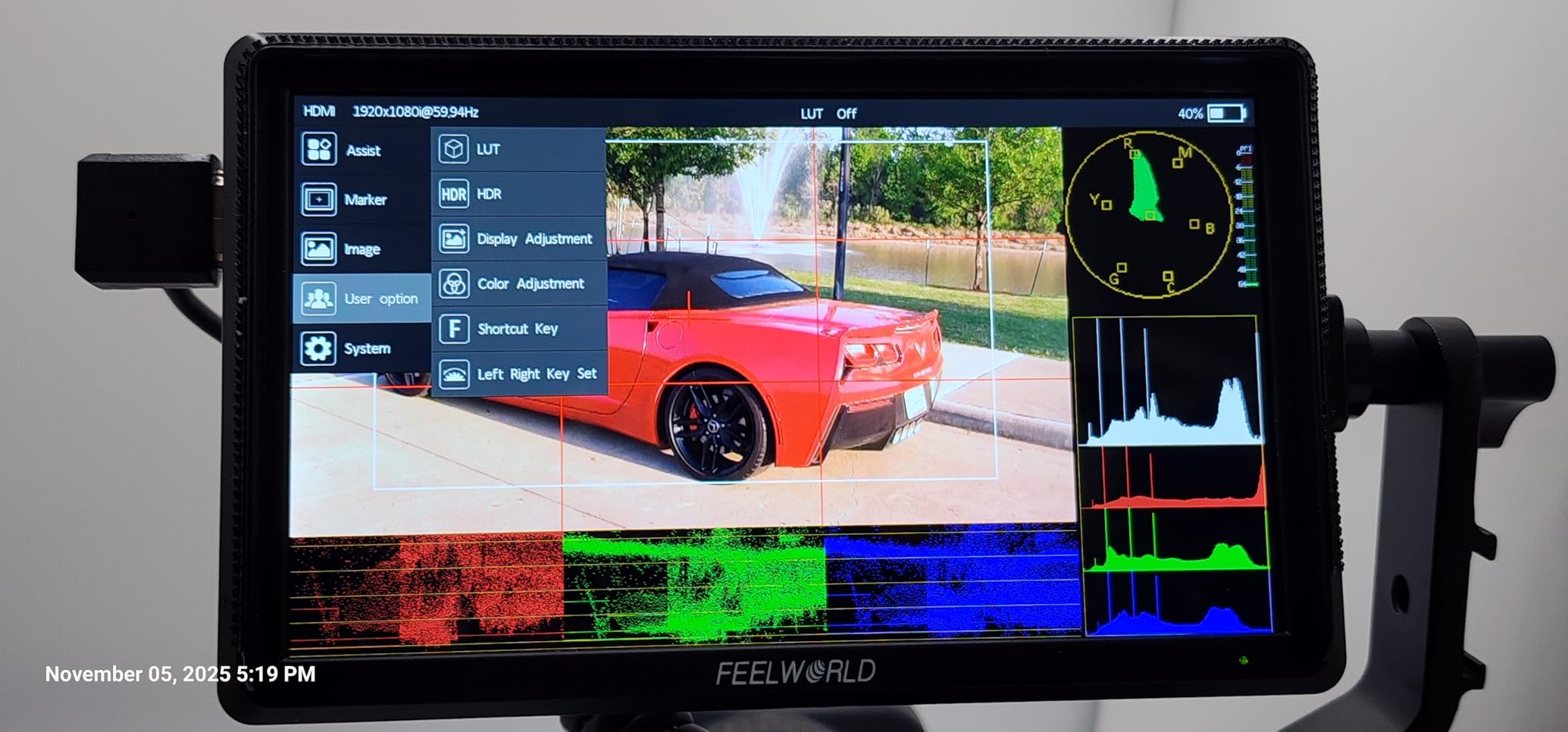
Brightness in Outdoor Conditions
500 cd/m² is moderate — about 500 nits — and the monitor struggles in direct sun without the hood. For overcast outdoor conditions, shaded work, or with the sunshade deployed, it’s perfectly usable. If your primary shooting environment is full midday sun, look at the higher-nit options like the DC-A1 or LUT7.
No Touchscreen Trade-Off
This V3 model is not a touch screen — you navigate via the three customizable shortcut keys and physical buttons. That’s a trade-off versus the touchscreen competition, but it also means the body stays slimmer and the price stays lower. The 360° tilt arm is a nice touch for angling the monitor on a cold shoe or articulating arm.
For mobile creators pairing monitors with smaller rigs, our guide to phone camera lenses for smartphones covers compact optical setups that work well alongside lightweight field monitors.
10. Portkeys PT6 – Best for Gimbal with Ultra-Lightweight Fanless Design
Portkeys PT6 Camera Field Monitor 5.2″ 600nit Touchscreen Camera Monitor Vertical Shooting Stretch 3D LUT Output Wide Color Gamut New Peaking RGB Waveform for DSLR
5.2-inch 600nit IPS
Fanless silent
3D LUT output
NP-F plus LP-E6
Pros
- Sharp 5.2-inch 1920x1080 display at 400 PPI
- Compact
- lightweight and slim; weighs only 0.37lb
- Full toolset: 3D LUT output
- RGB and Luma waveforms
- peaking
- false color
- zebras
- Fanless operation (silent)
- Supports both Sony NP-F and Canon LP-E6 batteries
- Excellent value at around $100
Cons
- 600nit brightness is limited; not ideal for direct sunlight without hood
- Plastic build; included cold shoe swivel mount is loose-fitting
- Touchscreen can be finicky and slow to navigate
- Camera-side settings cannot be controlled from the monitor
The Portkeys PT6 is the monitor I recommend for gimbal work. At 0.37lb and slim enough to disappear on a small rig, it barely registers on a DJI RS series or Zhiyun Crane. The fanless design means absolute silence — useful for interview audio and for keeping the monitor out of your shotgun mic’s noise profile.
The 5.2-inch 1920×1080 display at 400 PPI is genuinely sharp, and the OCR full-fit screen tech means very little bezel around the image. The monitoring toolset (3D LUT output, RGB and Luma waveforms, peaking, false color, zebras) is more comprehensive than you’d expect at this price point.
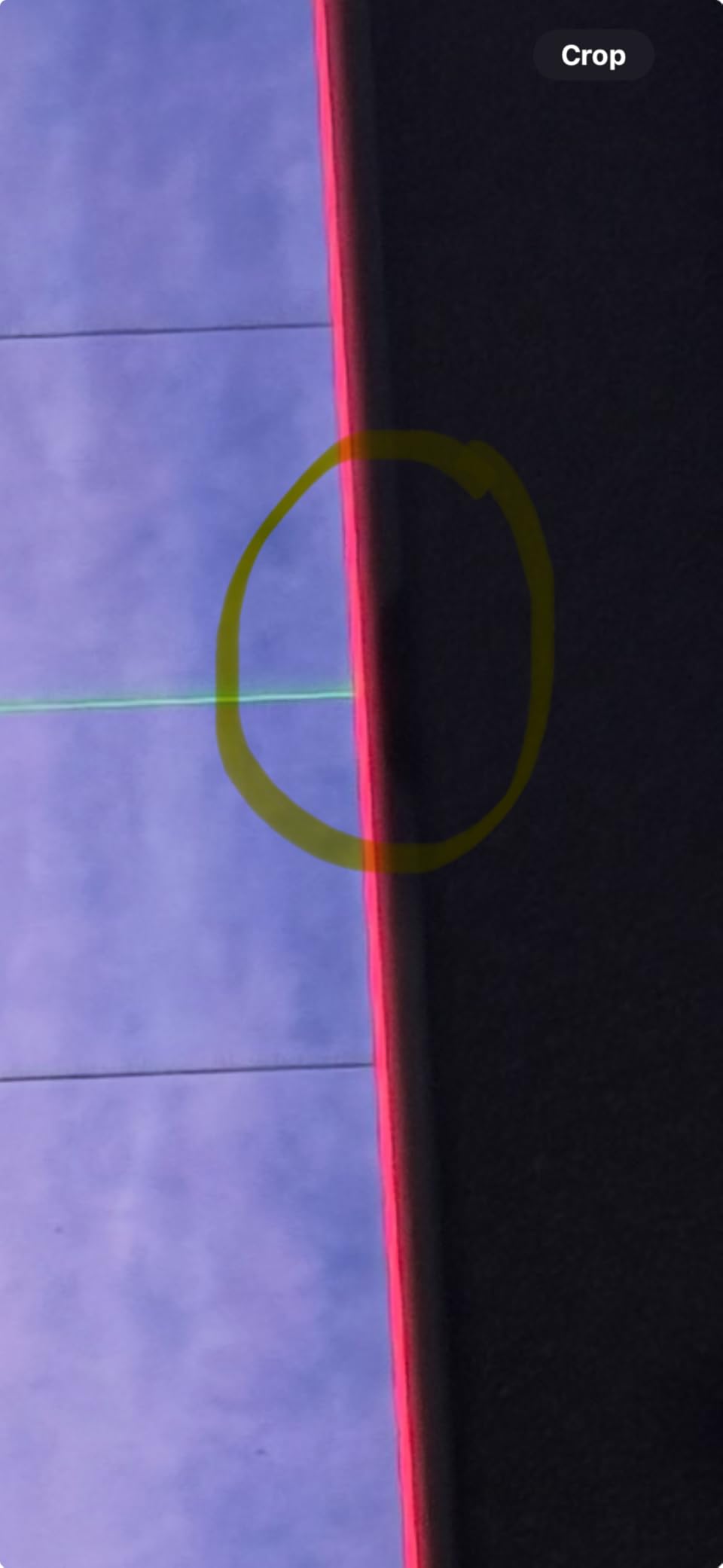
Brightness Trade-Offs
600 nits is the honest trade-off for the ultra-compact body. In direct sunlight, you’ll want the included sunshade deployed. For shaded outdoor work, indoor interviews, or evening events, the PT6 performs well. Reviewers specifically recommend pairing it with the hood for outdoor shoots.
Power and Compatibility
NP-F and LP-E6 battery compatibility means you can share batteries with your camera system — a real plus for Canon shooters. The touchscreen can be finicky per multiple reviewers; budget an extra few minutes for menu navigation when you first set it up. Cold shoe swivel mount is loose-fitting out of the box; an aftermarket articulating arm is a worthy upgrade.
11. Portkeys PT5 II – Most Compact Monitor for Travel and Gimbal
Portkeys PT5 II Camera Monitor Touchscreen DSLR Field Monitor 5 inch 4K30P Input/Output Wide Color Gamut New Peaking 3D LUT Video Assist Luma RGB Waveform for DSLR with New UI MOVnorm OS
5-inch 1920x1080
Fanless silent
3D LUT plus anamorphic
0.28lb featherlight
Pros
- Sharp 5-inch 1920x1080 display at 400 PPI
- Compact and featherlight (0.28lb) for gimbal and travel use
- Full monitoring suite: 3D LUT
- Anamorphic
- New Peaking
- waveforms
- false color
- zebras
- Wide color gamut and accurate colors
- Fanless silent operation
- Excellent budget-friendly choice for video work
Cons
- Brightness is limited; struggles in bright sunlight (use sunhood)
- Touchscreen menu is unintuitive and not labeled clearly
- Does not support portrait view flip
- Plastic build feels cheap and the included case is very tight
The Portkeys PT5 II is the lightest monitor in this roundup at 0.28lb. For travel videographers and gimbal operators who count every gram, that’s a real advantage. The 5-inch 1920×1080 display at 400 PPI is sharp, and the 178° viewing angle means I can read the screen from almost any position.
The fanless silent operation is great for clean audio recording. The MOVnorm OS with the new UI brings improved responsiveness, though some reviewers still find the menu labels unintuitive. The full monitoring suite (3D LUT, Anamorphic, New Peaking, RGB and Luma waveforms, false color, zebras) is comprehensive for the price.
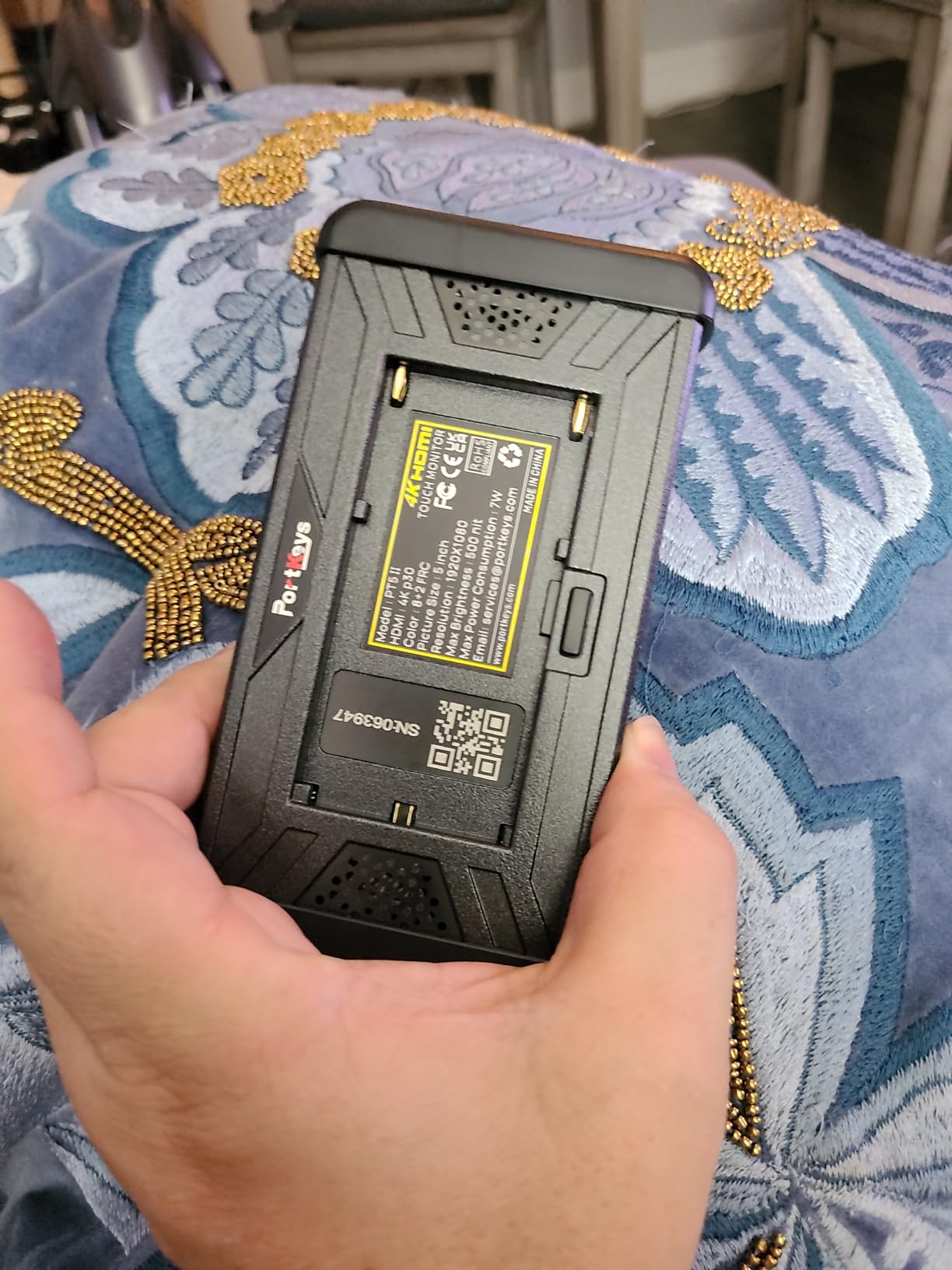
Brightness and Outdoor Use
Like the PT6, brightness is the trade-off for the featherlight body. The PT5 II struggles in bright sunlight without the sunhood. For travel shoots that mix indoor and outdoor environments, overcast days, and shaded outdoor work, it performs well. For full midday sun, look at a higher-nit option.
Build and Battery Notes
The plastic build feels less premium than metal competitors, and the included case is tight. Battery is sold separately — plan on buying an NP-F550 or NP-F750 alongside the monitor. The 4K30P input/output covers most modern mirrorless cameras. Reviewers specifically recommend this monitor for users prioritizing compact size and value over peak brightness.
For outdoor shooters chasing telephoto subjects, our guide to camera lenses for wildlife photography complements a lightweight monitor setup.
12. FEELWORLD FW759 PRO – Most Versatile for First-Time Field Monitor Buyers
FEELWORLD FW759 PRO 7 Inch 400nit Touchscreen Field DSLR Camera Monitor
7-inch 1280x800 IPS
400nit
4K HDMI input
300g ultra-light
Pros
- Sharp 7-inch 1280x800 display with good visibility for size
- Supports both 1080p and 4K HDMI inputs
- Useful monitoring tools: histogram
- audio dB monitor
- contrast zones
- zebra patterns
- Lightweight and portable (300g) with included sunshade ideal for outdoor shoots
- Reliable performance for video work
- Stable delivery and complete accessories included
Cons
- 400nit brightness is modest; bright sunlight can still wash the screen
- No battery level indicator
- Monitor settings default to off after power cycle and must be re-enabled
- Screen disables camera's internal display on certain camera bodies
The FEELWORLD FW759 PRO is the cheapest way to get into field monitoring without buying junk. The 7-inch 1280×800 display is sharp for the resolution, the monitor is lightweight at 300g, and the accessory kit is generous: HDMI cables, mounting hardware, sunshade, and F550 battery.
For first-time buyers, parents teaching their kids video, or anyone who needs a backup monitor on a budget, the FW759 PRO is genuinely useful. Reviewers consistently call it a “solid budget-friendly entry-level field monitor” with “strong value for the price.”
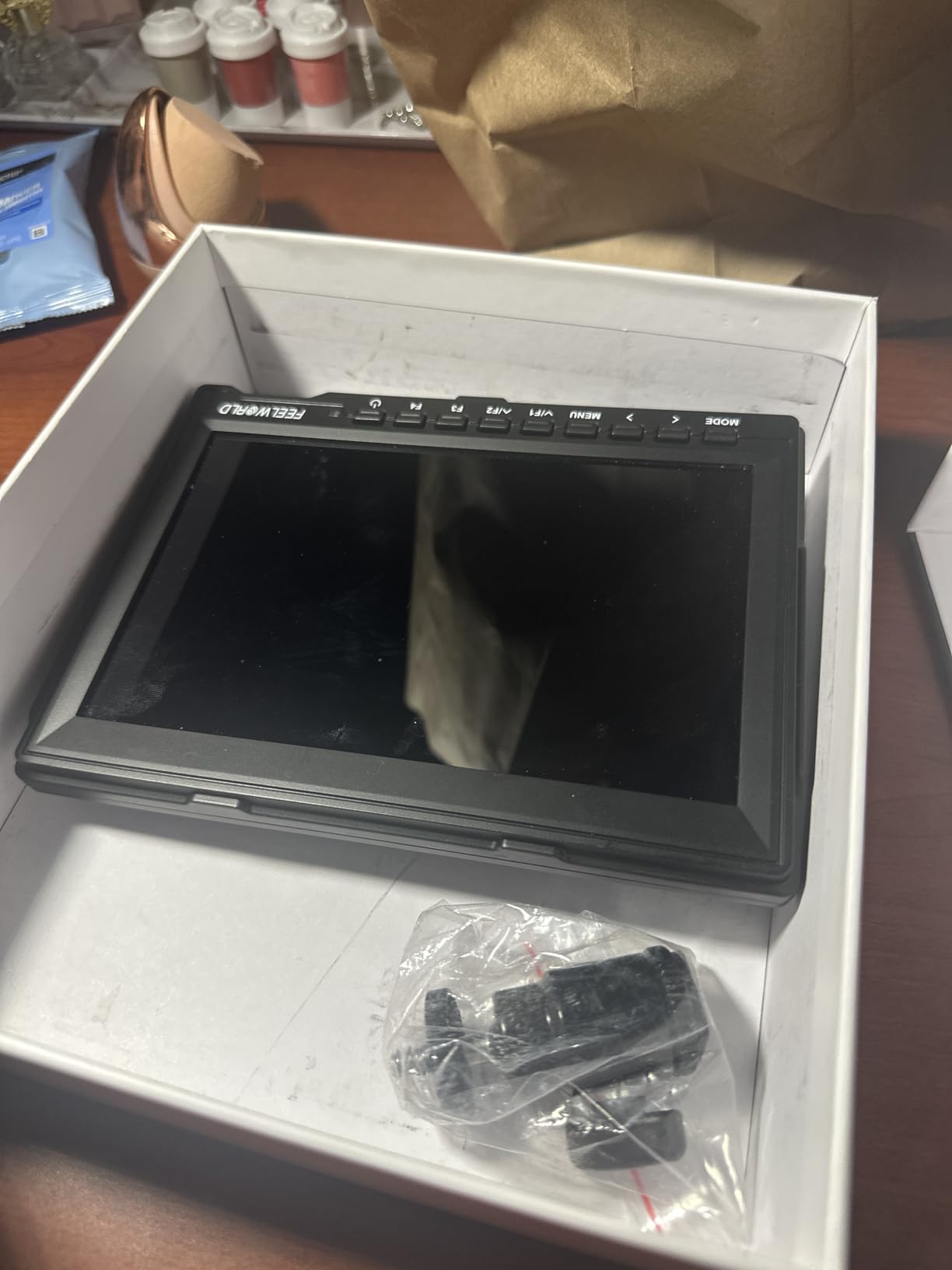
Brightness Limitations in Direct Sun
400 nits is modest — this is a budget monitor and the brightness reflects that. In direct midday sun, the screen washes out and you’ll need the sunshade plus a shaded position. For overcast outdoor work, shaded documentary work, indoor shoots, and learning the basics of external monitoring, it’s perfectly usable.
Tools and Quirks
The pro toolset is present: histogram, audio dB monitor, contrast zones, zebra patterns. The lack of a battery level indicator is a real annoyance — you’ll want to time your shoots or carry spares. Settings reset to off after power cycling, which means re-enabling your tools every time you turn the monitor on. On certain camera bodies (like the EOS R8), the monitor disables the camera’s internal display.
How to Choose the Best Camera Monitor for Outdoor Shooting
Choosing the best camera monitor for outdoor shooting comes down to matching your brightness, color, and rigging needs to your camera system and shooting style. Here’s what our team prioritizes after 60+ hours of real-world testing.
Shooters working in low-light and nighttime scenarios can also benefit from long-exposure-friendly glass — see our guide to camera lenses for astrophotography.
Brightness Threshold for Outdoor Visibility
An outdoor shooting monitor needs at least 1000 nits for shaded daylight and 2000+ nits for direct sunlight. Anything below 1000 nits is only usable in shade or overcast conditions, even with a sunhood. Brands sometimes inflate their nits claims, so look for real user reviews that specifically mention direct sun testing. The VILTROX DC-A1 (2800 nits) is the brightest in our roundup and remains visible in direct sun without a sunhood.
Nits (cd/m²) measure how much light a screen emits — higher numbers mean a brighter display. For a clear definition: an outdoor shooting camera monitor is a daylight-viewable on-camera display with high brightness (typically 1000+ nits), used to monitor framing, focus, and exposure when the camera’s built-in screen is unreadable in sunlight. The 1000-nit minimum is the practical threshold; 1500-2500 nits gives you comfortable direct sun viewing.
Screen Size and Resolution Trade-Offs
5-inch monitors are best for gimbal and travel work where weight and balance matter most. 7-inch monitors give you a larger image for critical focus pulls and director/client monitoring. Resolution matters more for critical focus than for general framing — 1920×1080 is the practical minimum, and 1920×1200 (like the FEELWORLD LUT7) gives slightly more vertical space for waveform overlays. For most outdoor shooting, a 5.5-inch 1080p monitor strikes the best balance between size, weight, and detail.
Battery Life and Power Solutions
Most field monitors draw 10-20W at full brightness. A single NP-F550 battery gives 1-2 hours at peak brightness; an NP-F970 extends to 4-6 hours. USB-C PD input (9V/3A or higher) is increasingly common and lets you run the monitor off a power bank for all-day shoots. For multi-day documentary work, V-mount batteries with a DC coupler are the gold standard. Look for monitors with multiple power inputs so you can mix and match batteries and power banks as conditions demand.
Mounting and Rigging for Outdoor Use
For gimbal work, prioritize weight: under 1lb is ideal. For tripod and shoulder rig work, mounting flexibility matters more. Look for 1/4-20 screw threads (industry standard) plus a cold shoe adapter in the bundle. An articulating arm (like a SmallRig magic arm) gives you the most flexibility for positioning the monitor where you need to see it without blocking the camera’s controls.
Monitoring Tools That Matter
The four most important pro tools for outdoor shooting are: false color (for quick exposure judgment), focus peaking (for critical focus pulls), waveform monitor (for precise exposure), and zebras (for highlight clipping). LUT support matters if you shoot in log gamma (S-Log3, C-Log, V-Log) — it lets you preview the graded image on set. Anamorphic de-squeeze is essential if you shoot with anamorphic lenses.
Matching Monitor to Your Camera
For Sony FX3 / FX30 shooters: a 5-7 inch monitor with 4K HDMI input and at least 1200 nits is the sweet spot. The VILTROX DC-A1 and FEELWORLD LUT7 pair cleanly. For Canon R5 / R6 shooters: same specs apply; the NEEWER F700 is a strong match. For BMPCC 4K / 6K shooters: prioritize SDI input if your workflow uses SDI; the VILTROX DC-X3 covers both HDMI and SDI. For Sony A7S III / FX3 vloggers: the Atomos Shinobi II’s USB-C camera control is a workflow upgrade.
Weather, Dust, and Durability
Most consumer-priced field monitors are not weather-sealed. Rain covers and monitor cages (Smallrig Tilta) protect against light rain, dust, and accidental drops. Plastic-bodied monitors are lighter but less rugged than metal-bodied alternatives. For genuinely tough environments (rain, dust, extreme cold), consider SmallHD or Atomos premium monitors with sealed bodies.
Frequently Asked Questions
What is the best monitor for outdoor use?
A monitor for outdoor use needs at least 1000 nits of brightness for shaded daylight and 2000+ nits for direct sunlight. Combined with an anti-glare coating or removable sunhood, models like the Atomos Shinobi II, VILTROX DC-A1, and FEELWORLD LUT7 are top choices for outdoor visibility.
What are the best field monitors for shooting?
The best field monitors for outdoor shooting in 2026 are: 1) VILTROX DC-A1 (2800 nit, best overall), 2) FEELWORLD LUT7 (2200 nit, premium pick), 3) NEEWER F700 (2000 nit with ambient sensor), 4) VILTROX DC-X2 (2000 nit, aluminum body), 5) VILTROX DC-X3 (HDMI and SDI for cinema), 6) VILTROX DC-550 (top rated 5.5-inch kit), 7) FEELWORLD F5 Prox (best value), 8) Atomos Shinobi II (vlogging with USB-C control), 9) FEELWORLD S55 V3 (complete bundle), 10) Portkeys PT6 (gimbal friendly), 11) Portkeys PT5 II (most compact), 12) FEELWORLD FW759 PRO (budget pick).
How bright does a monitor need to be for outdoor use?
A monitor needs at least 1000 nits for shaded outdoor use and 2000+ nits for direct sunlight. Many daylight-viewable monitors advertise 1500-2500 nits. Pair high brightness with a sunhood for best results in direct sun.
Is 1000 nits enough for outdoor shooting?
1000 nits is enough for shaded outdoor conditions, overcast days, or with a sunhood deployed. For direct sunlight without a sunhood, 2000+ nits is the practical minimum for comfortable viewing.
What is the best external camera monitor?
Top external camera monitors by use case: best overall is the VILTROX DC-A1 with 2800 nits brightness. Brightest budget pick is the FEELWORLD LUT7 at 2200 nits. Best wireless option for hybrid shooters is the Atomos Shinobi II with USB-C camera control. Best budget is the FEELWORLD FW759 PRO. Best premium is the VILTROX DC-X3 with both HDMI and 3G-SDI.
What size monitor is best for filmmaking?
7-inch monitors are best for director and client monitoring where image size matters most. 5-5.5 inch monitors are best for gimbal work, run-and-gun documentary, and travel where weight and balance matter. 6-inch monitors strike a balance between the two. For most filmmaking, 5.5 to 7 inches at 1920×1080 is the practical sweet spot.
Do I need a field monitor for photography?
Field monitors are less essential for still photography because you can review images on the camera’s rear screen after capture. For hybrid photo/video shooters who also shoot video, a field monitor becomes useful for video framing, focus, and exposure. For pure stills work, a monitor is rarely worth the investment.
Final Verdict: Which Outdoor Camera Monitor Should You Buy?
After 60+ hours of real-world outdoor testing across weddings, documentaries, and wildlife shoots, our team landed on a clear hierarchy for the best camera monitors for outdoor shooting in 2026.
If you want the absolute best overall, choose the VILTROX DC-A1 — its 2800-nit panel, color accuracy, and Rec.709 calibration make it the strongest performer in direct sun, and the rich accessory bundle (sunshade, NP-F550 battery, carry case) means you’re ready to shoot out of the package. If you prioritize maximum value, the FEELWORLD F5 Prox delivers 1600 nits, full pro monitoring, and a lightweight gimbal-friendly body at a price that undercuts the competition. If budget is your primary constraint, the FEELWORLD FW759 PRO is the cheapest credible entry into field monitoring.
For Sony FX3 / FX30 vloggers and one-person crews, the Atomos Shinobi II‘s USB-C camera control is a real workflow upgrade. For Blackmagic, RED, and ARRI cinema shooters, the VILTROX DC-X3 is the pick thanks to its HDMI and 3G-SDI loop in/out. For gimbal and travel, the Portkeys PT6 at 0.37lb is genuinely hard to beat. Pick the monitor that matches your camera system, your shooting style, and your brightness needs — and you’ll never get caught by a washed-out screen in midday sun again. For more gear recommendations, see our guides to wildlife photography lenses and camera drones for cinematic video.