
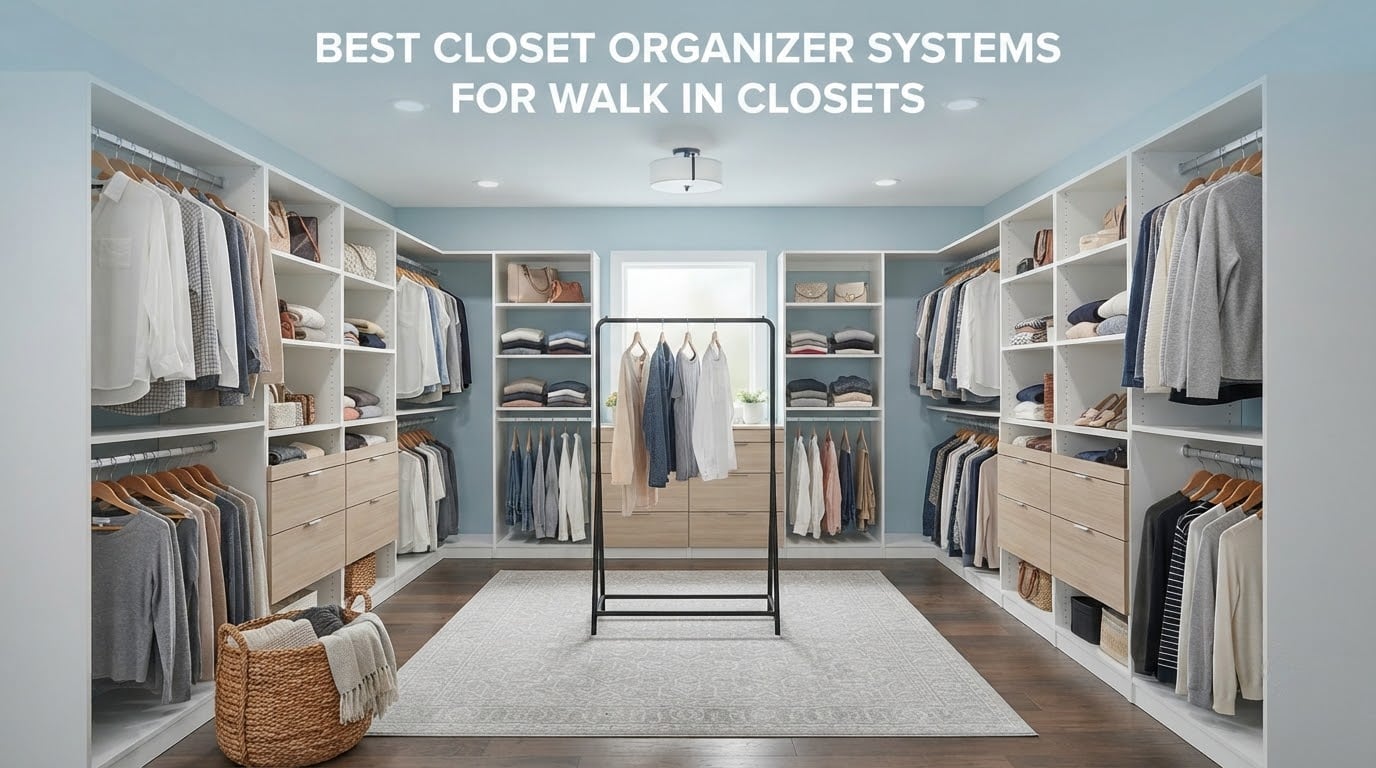
If you are standing in a walk-in closet with bare walls, a mismatched tower unit and a pile of hangers on the floor, you are looking at the most common failure in this category. Most kits marketed as walk-in systems are built for one or two reach-in towers, and the rest of your perimeter stays empty. Finding the best closet organizer systems for walk in closets means matching the system class to the shape of your room, not to the biggest box on the page.
Over six weeks our team measured ten systems against the same criteria: how much usable rod and shelf a system actually delivers, how much wall width it swallows, what it takes to install, and whether it can move with you later. Every number in this guide comes from the product specifications and the thousands of verified owner reviews behind each item.
Before you buy anything, measure the room twice. Write down the wall widths, the ceiling height, the location of any vent register or outlet, and the swing of the door. Those five facts eliminate most bad purchases before they happen, and they are the same facts we used to sort the ten systems below.
What Is the Best Closet Organizer System for a Walk-In Closet?
The best closet organizer system for a walk-in closet is a freestanding or wall-mounted system that spans at least one full wall run, holds the load your garments impose, and expands later without a rebuild. In practice that means a system sized to your wall width, a rod rated for the weight of winter coats, and enough vertical storage that shoes, bags and folded items do not all compete for the same shelf. If you rent, choose the freestanding class: no studs, no anchors, no landlord conversation.
Our Top 3 Closet Systems for Walk-In Closets
We narrowed ten products to three after measuring build quality, load ratings, install burden and reusability. Each of these earned its place for a different reason.

Rubbermaid Configurations…
- Epoxy-coated wire shelving
- Telescoping rods
- Reconfigures without tools
- Fits 4-8 ft closets

VIPEK V5 Heavy Duty Garment…
- 4 hanging rods
- 8 storage shelves
- 890 lb capacity
- Freestanding
- no mounting

VIPEK X3 Expandable Heavy…
- Expands 5 ft 2 in to 8 ft
- 1210 lb capacity
- Two build shapes
- Locking rod clamps
Comparing the Best Closet Organizer Systems in 2026
Every system below is a real, currently listed configuration rather than a brand name in the abstract. The span column matters most: it tells you how much wall or floor width a single purchase covers before you need to add anything.
| Product | Specs | Action |
|---|---|---|
| Rubbermaid Configurations Deluxe Kit |
|
Check Latest Price |
| VIPEK V5 Heavy Duty Garment Rack |
|
Check Latest Price |
 ClosetMaid SuiteSymphony 25-Inch Kit ClosetMaid SuiteSymphony 25-Inch Kit |
|
Check Latest Price |
 ClosetMaid ShelfTrack Wire System ClosetMaid ShelfTrack Wire System |
|
Check Latest Price |
| VIPEK X3 Expandable Rack |
|
Check Latest Price |
 Aheaplus 4-9 Ft Closet System Aheaplus 4-9 Ft Closet System |
|
Check Latest Price |
 Besiost 6-Drawer Set of Two Besiost 6-Drawer Set of Two |
|
Check Latest Price |
 Aheaplus L-Shaped Corner Set Aheaplus L-Shaped Corner Set |
|
Check Latest Price |
 Aheaplus 4.3 Ft Set of Two Aheaplus 4.3 Ft Set of Two |
|
Check Latest Price |
 Vomavex Four-Piece Walk-In Set Vomavex Four-Piece Walk-In Set |
|
Check Latest Price |
1. Rubbermaid Configurations Deluxe Custom Closet Kit – The System You Can Rearrange Without Tools
Rubbermaid Configurations Deluxe Custom Closet Kit 4-8 Ft. Adjustable Metal Wire Shelving Titanium Finish Expandable Organization System Hardware Included for Home Closet/Pantry/Laundry/Mudroom
Epoxy-coated wire shelving
Telescoping hang rods
Fits closets 4-8 ft wide
43.4 lb kit, hardware included
Pros
- Reconfigures without tools
- Telescoping rods expand wall to wall
- Epoxy finish resists rust and snagging
- No cutting required
- All mounting hardware included
Cons
- Included drywall anchors are weak
- Uprights can sway against the top rail
- Wire shelves are light gauge
This is the kit we kept coming back to during testing. It holds 43.4 pounds of components, mounts to the wall, and covers closets from 4 to 8 feet wide through telescoping rails rather than fixed-length pieces. That range is the reason it works in a walk-in: most wall runs in a walk-in are not a tidy multiple of any single component width, and telescoping hardware absorbs the leftover inches instead of leaving you a bare gap.
The material is epoxy-coated wire, and the finish matters more than it sounds. Coated wire has almost no snag points, so hangers slide instead of catching, and it does not rust in a humid closet the way bare builder-grade mesh eventually does. Reviewers consistently describe the reconfiguration as the standout feature: shelves and hang rods move to new positions in minutes as the household changes.
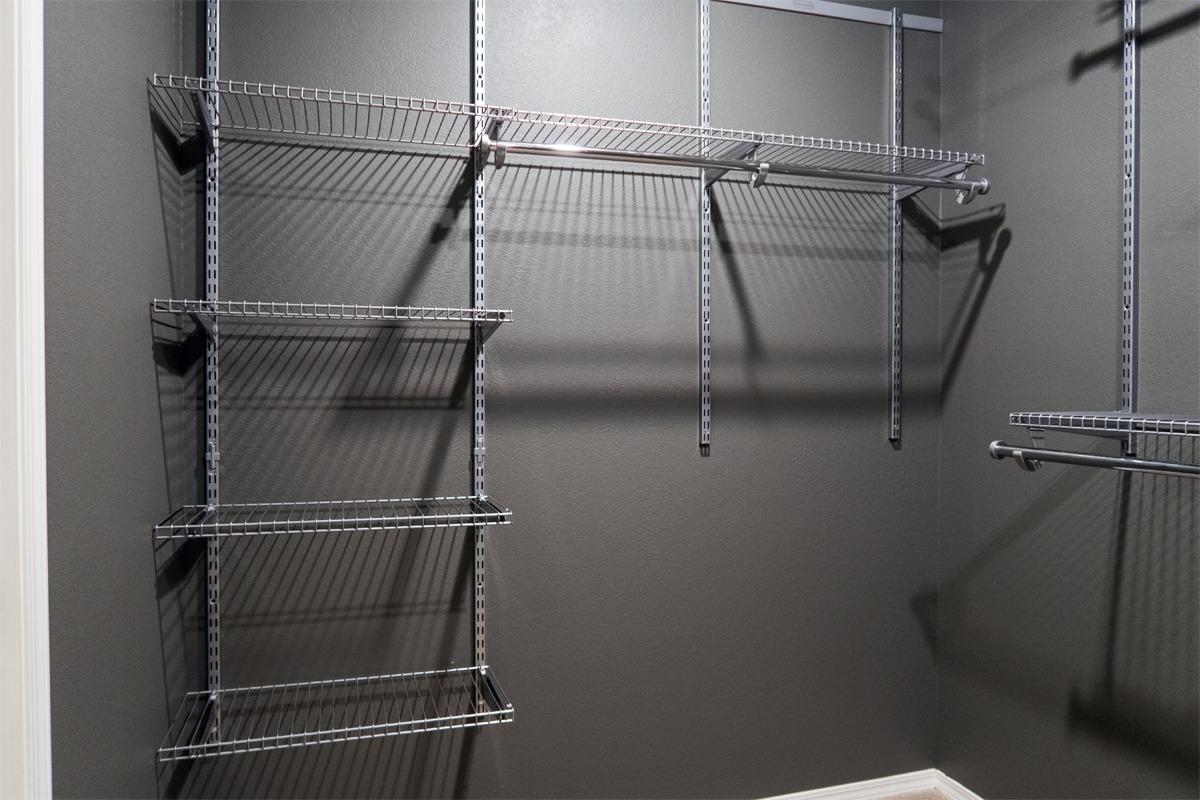
The kit includes 7 shelves at 26 inches, 2 shelves at 48 inches, 2 top rails at 48 inches, 19 brackets, 5 uprights at 47.5 inches, 2 upright extensions at 25 inches and 2 hang rods. That is a complete first-stage install, not a teaser. What it is not is a wardrobe: there are no drawers in the box, so concealed storage has to come from add-ons or from a different system entirely.
Wall Span and Rod Geometry
Telescoping hang rods are the reason uninterrupted hanging space is possible here. Rather than butting two fixed rods together with a seam in the middle, the rods extend to meet, so a long-hang run reads as one continuous surface. For a couple sharing a closet this matters more than any other single spec, because a seam in the middle of a double-hang run is exactly where hitches and wasted inches accumulate.
The 4 to 8 foot range also lets you start in one room and reuse the same hardware in a wider room later. That reusability is why long-term owners treat the Configurations line as a semi-custom result achieved without custom cabinetry.
What the Wire Shelves Will and Will Not Hold
These are light gauge wire shelves. That is fine for folded sweaters, boxes of accessories, towels and spare bedding, and it is a poor choice for a row of heavy folded jeans or stacked storage bins. If your zone plan puts dense items high, put them on the lower rails instead.
Because the shelves are open, the system ventilates naturally. Leather, wool and winter coats stored on wire and coated rod surfaces get air movement, which matters in a walk-in that stays enclosed for weeks at a time.
Install Reality: Anchors, Studs and Sway
Two complaints recur. First, the supplied drywall anchors are inadequate; owners who substituted heavy-duty toggle bolts report no further movement. Second, the uprights do not lock into the top rail, so a bumped rack can sway or clang.
Plan for a drill, a level and a stud finder, and bring a helper for the top rail. Owners who upgrade the anchors themselves tend to report the same outcome: a rigid, quiet installation that stays adjustable for years.
2. VIPEK V5 Heavy Duty Garment Rack – Four Rods and Eight Shelves Without Touching a Stud
VIPEK V5 Heavy Duty Clothes Rack, Freestanding Modular Closet System, Black
Carbon steel, powder coated
Freestanding, no mounting
68.9 in W x 15.7 in D x 76.4 in H
890 lb total load capacity
Pros
- 890 lb total load capacity
- Four hanging rods plus eight shelves
- Freestanding so no studs required
- Rods and shelves adjustable
- Light enough to reposition
Cons
- Assembly required
- Footprint is deep for narrow rooms
- Shelves are fixed height increments
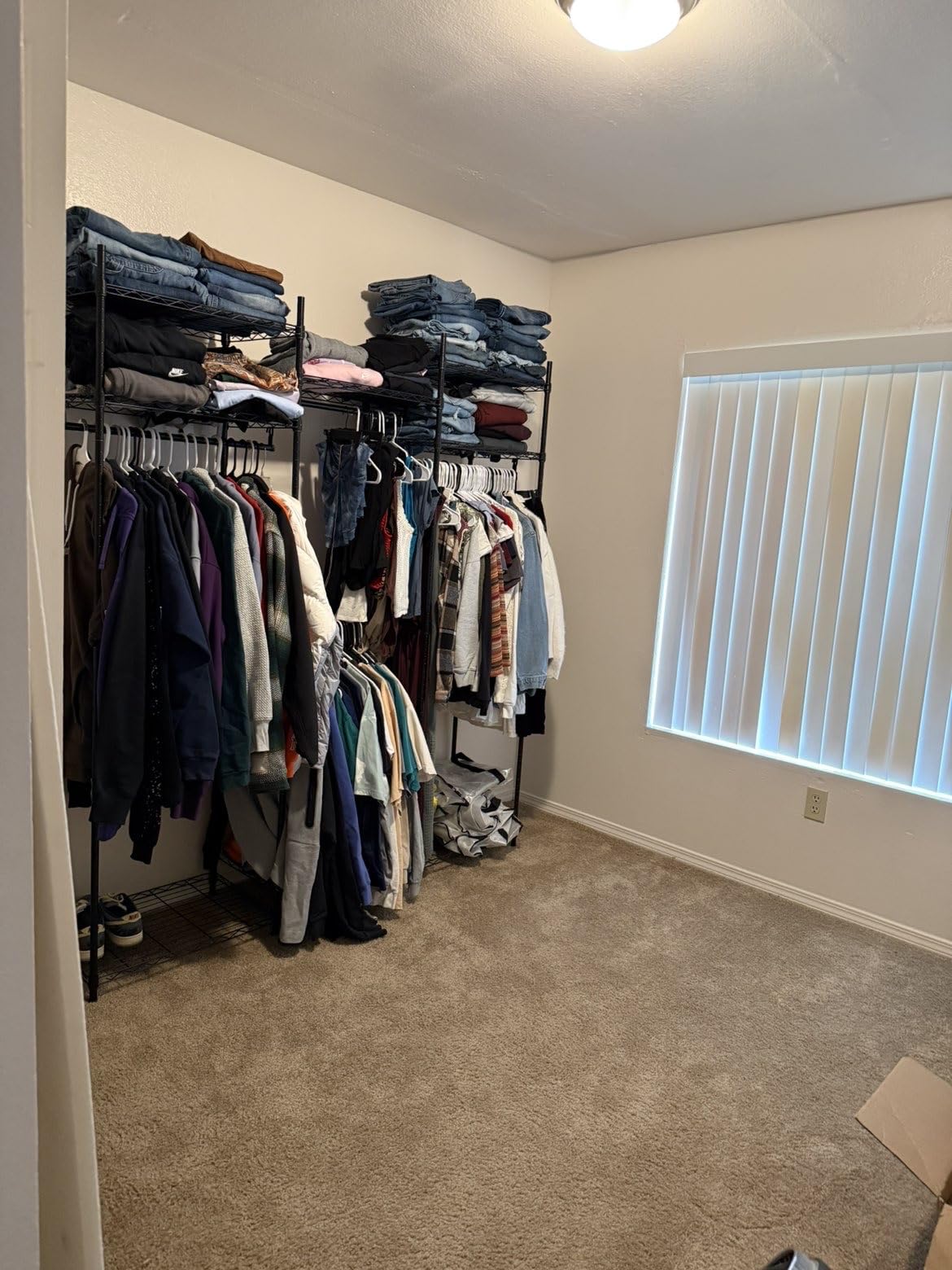
Best for: anyone who cannot drill, including renters, condo owners and anyone in a room with no studs behind the drywall. The V5 is a freestanding carbon steel frame that stands on its own, and it carries a stated 890 pound total load capacity with each hanging rod rated to 60 pounds.
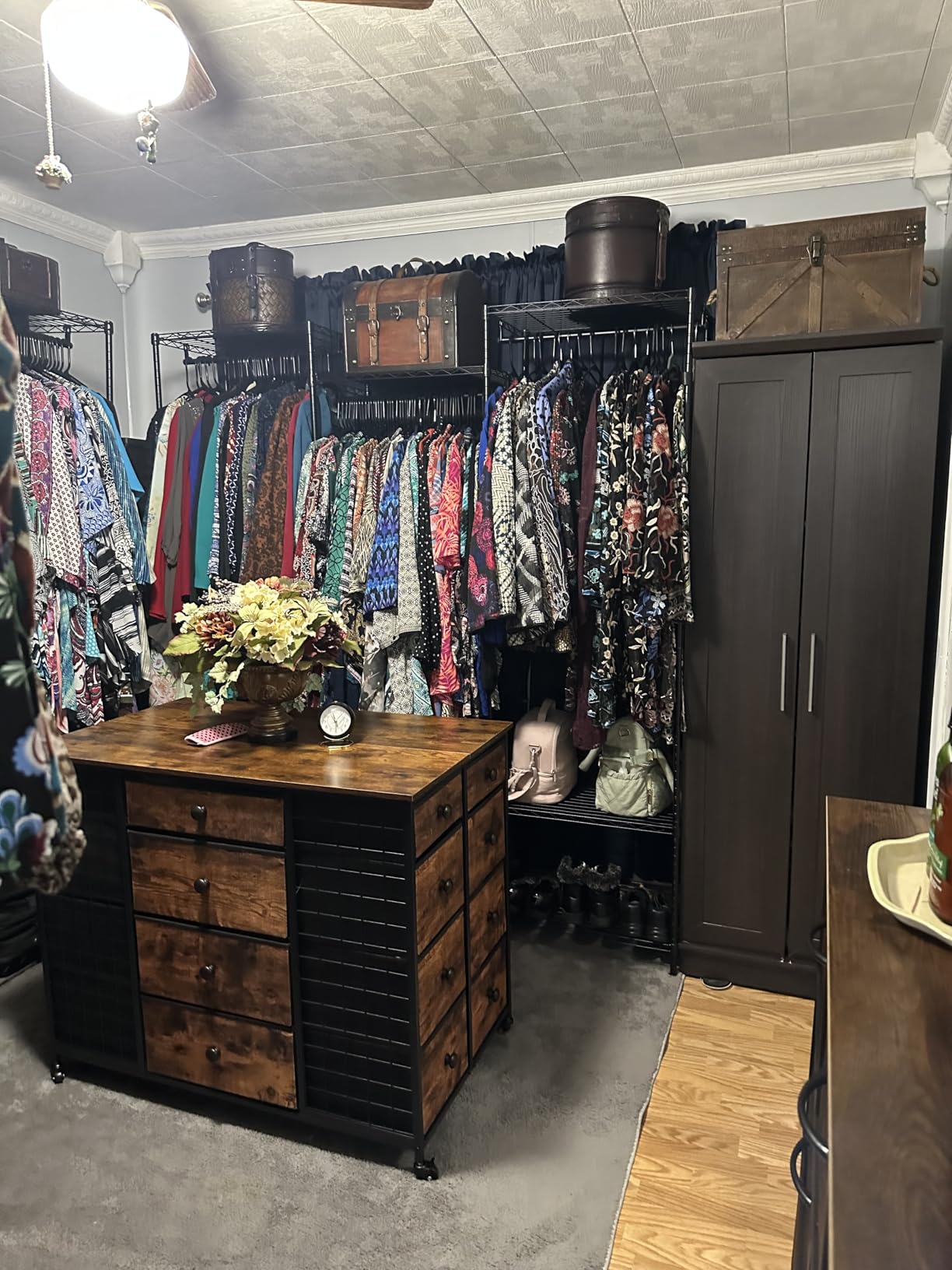
The layout is the argument. Four hanging rods and eight storage shelves in a 68.9 inch wide, 15.7 inch deep, 76.4 inch tall frame packs more vertical zoning into one footprint than most wall-mounted towers of twice the width. For a walk-in with an awkward wall run, that density is worth more than a built-in look.
Load Capacity and Rod Strength
Carbon steel with a rust-proof powder-coated finish is the right material for a frame that will hold dense garments. The 60 pound per-rod rating is a realistic figure for a loaded rod of shirts, jackets or folded trousers, and it is the number to check against whatever you plan to hang heaviest.
The frame weighs 33 pounds, which is light enough to move between rooms without a second person. In a walk-in that doubles as a guest room or a converted spare room, that mobility is the feature you will use most.
Depth: The Number People Miss
The 15.7 inch depth is the trade. Garment racks need clearance to hang and to walk behind, but in a small walk-in that depth eats floor space quickly, and two racks in a narrow room can block the door swing entirely.
Measure your clear floor width before ordering, not your wall width. A rack that fits the wall but blocks the door is the single most common complaint pattern with this class of product.
Assembly and Reconfiguration
Assembly is required, and it is the main hurdle. The upside is that once it is up, the shelves and rods adjust without tools, so you can move from a single-hang layout to a double-hang layout as your wardrobe changes through the year.
Owners consistently call the instructions clear. For a weekend install, budget Saturday morning and you will have a fully loaded rack by afternoon.
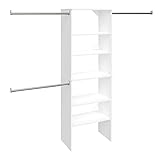
3. ClosetMaid SuiteSymphony 25-Inch Wood Kit – A Finished Wood Look in a Narrow Footprint
ClosetMaid SuiteSymphony Wood Closet Organizer System, 25-Inch Starter Kit with Tower and 3 Hang Rods and Shelving, Adjustable Shelves, Customizable Insert, Reach-in or Walk-in Closets, Pure White
Engineered wood, laminated finish
25.1 in W x 14.7 in D x 82.5 in H
175 lb capacity, 5 shelves
Rods expand 30 to 48 inches
Pros
- Wood construction looks finished rather than industrial
- Expandable 30 to 48 inch rods
- Narrow 25 inch footprint suits tight returns
- Rods removable where space is tight
- Full line of matching add-ons
Cons
- Engineered wood is heavy and costly
- Add-on drawers and doors sold separately
- Tower must be squared to sit level
Best for: a walk-in where you want the closet to read as furniture rather than as a hardware rack. The SuiteSymphony tower is engineered wood with a laminated pure white finish, and at 25.12 inches wide by 14.7 inches deep it slots into returns, alcoves and the awkward leftover widths that kill track systems.
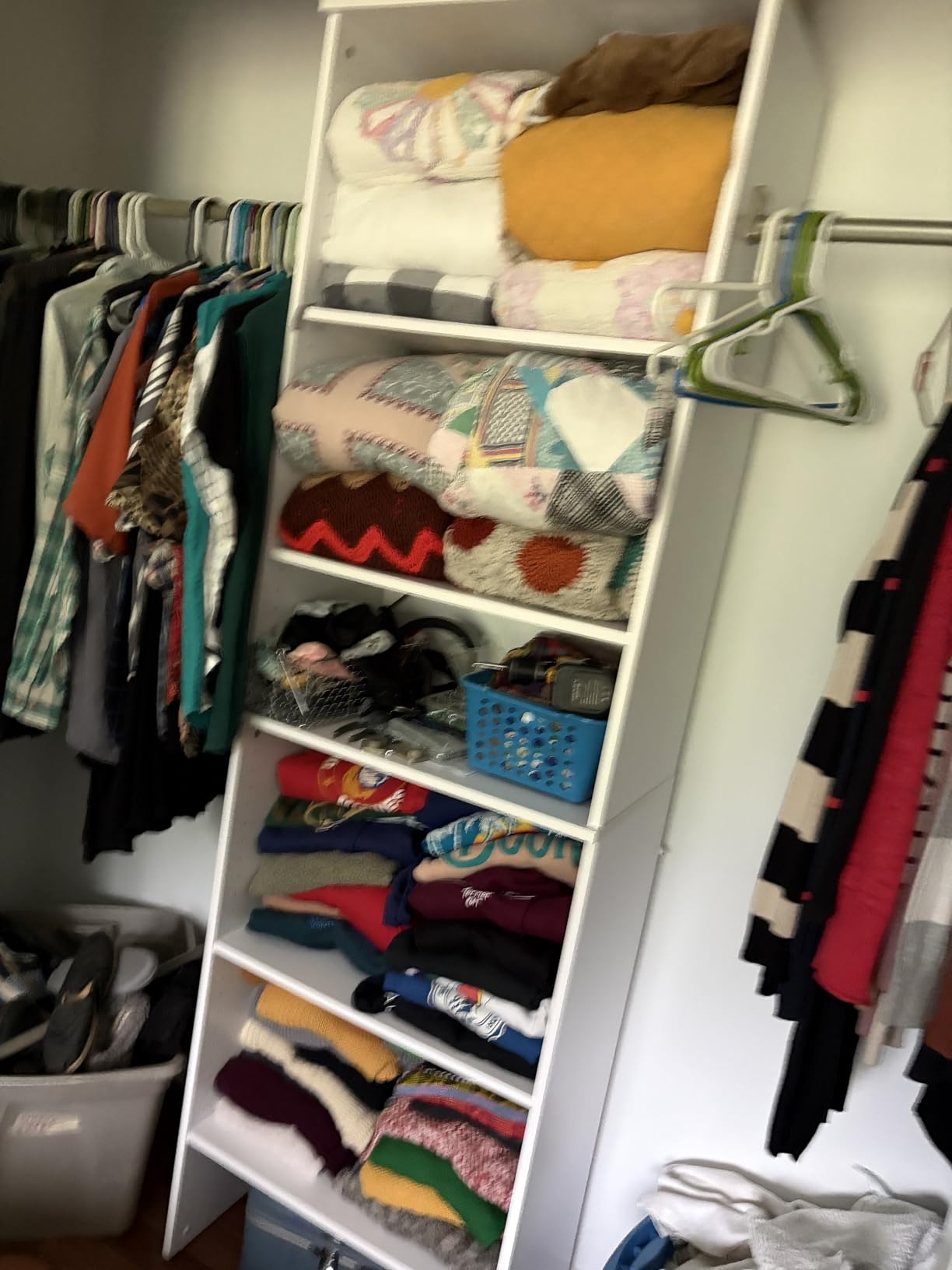
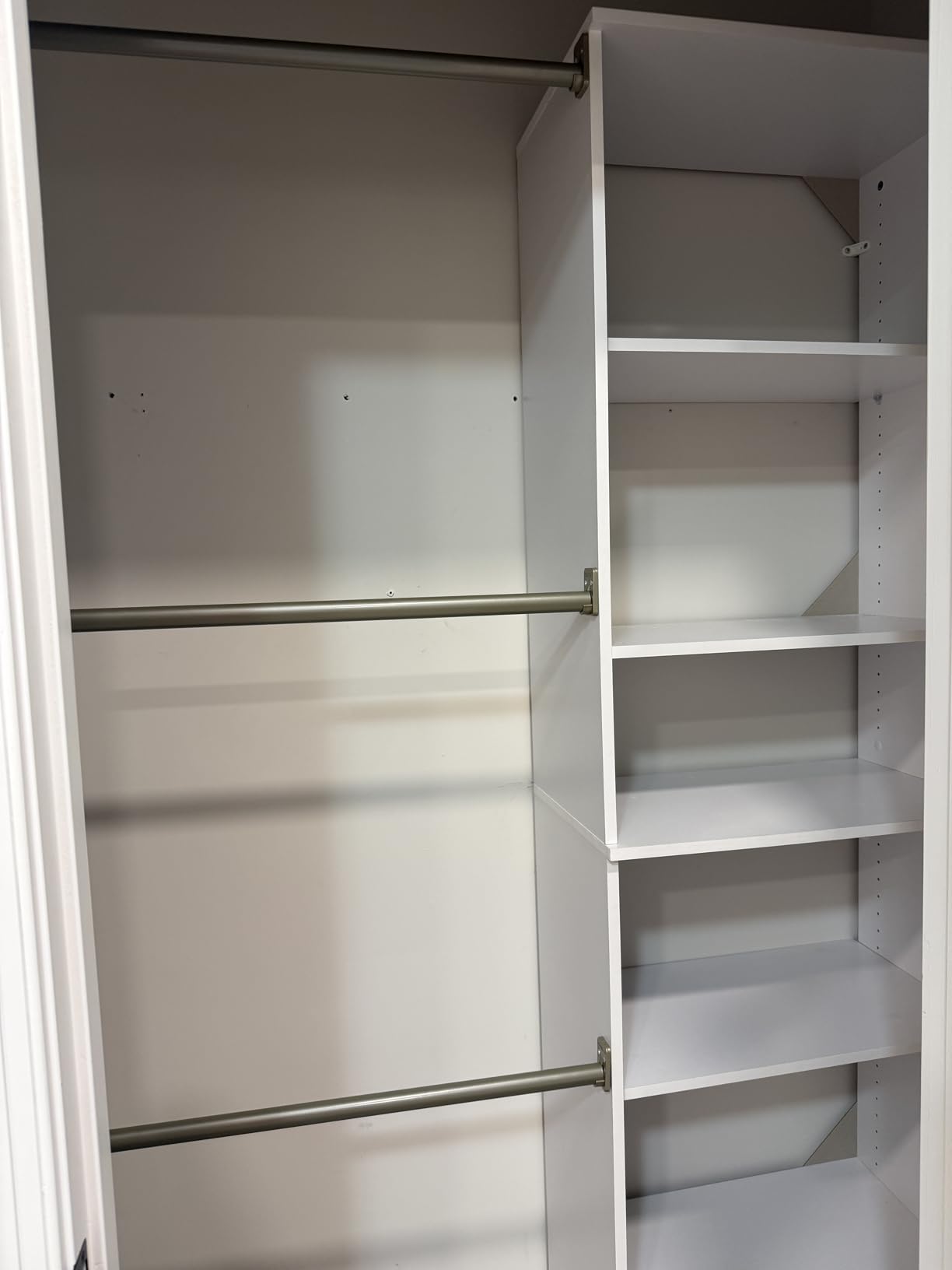
It comes with a storage tower holding five shelves, two of them adjustable, plus three hang rods that expand from 30 to 48 inches and can be trimmed for smaller spaces. The stated capacity is 175 pounds for the tower itself.
Why the Rods Are Optional
Most kits force a rod into every available space. This one lets you install the rods on one side, the other side, or remove them entirely, which means a bay that is too shallow for a hanging garment can become a folded-goods bay instead of dead air.
That flexibility is why the kit works in a walk-in rather than only in a reach-in. In a room with four walls and irregular returns, you will almost certainly want at least one rod-free bay.
Planning for the Add-On Trail
The base kit is a starting point, not a finished closet. Add-on drawers, doors, shoe shelves and top shelving are all sold separately, and owners consistently note that the real cost of a wood system emerges at that stage.
Sequence it deliberately: install the tower and rods first, live with it for a few weeks, then add drawers where you actually reach for small items. Guessing at drawer locations before you have used the closet is how people end up with expensive boxes in the wrong place.
The Leveling Step Nobody Skips
At 74 pounds assembled, the tower needs to be squared within the closet so it sits level. Owners who rushed this step report doors and drawers that do not sit flush later. Set it, level it, and anchor it before you load anything.
The unit is TSCA Title VI compliant engineered wood with all hardware included. For a walk-in where the visual finish matters, that is a reasonable trade for the extra weight.
4. ClosetMaid ShelfTrack Wire System – The Fastest Way to Fill a 4 to 6 Foot Closet
ClosetMaid ShelfTrack Wire Closet Organizer System, Adjustable from 4 to 6 Ft., With Shelves, Clothes Rods, Hardware, Durable Steel, White
Vinyl-coated steel
Fits closets 4-6 ft wide
12 in deep shelves
Up to 96 in hang and 144 in shelf space
Pros
- SuperSlide rod lets hangers glide continuously
- Shelves and hang track move as needs change
- Vinyl coating resists rust and chipping
- Shelves use 90 percent recycled content
Cons
- Some cutting may be needed to fit
- Wire shelves hold less than solid wood
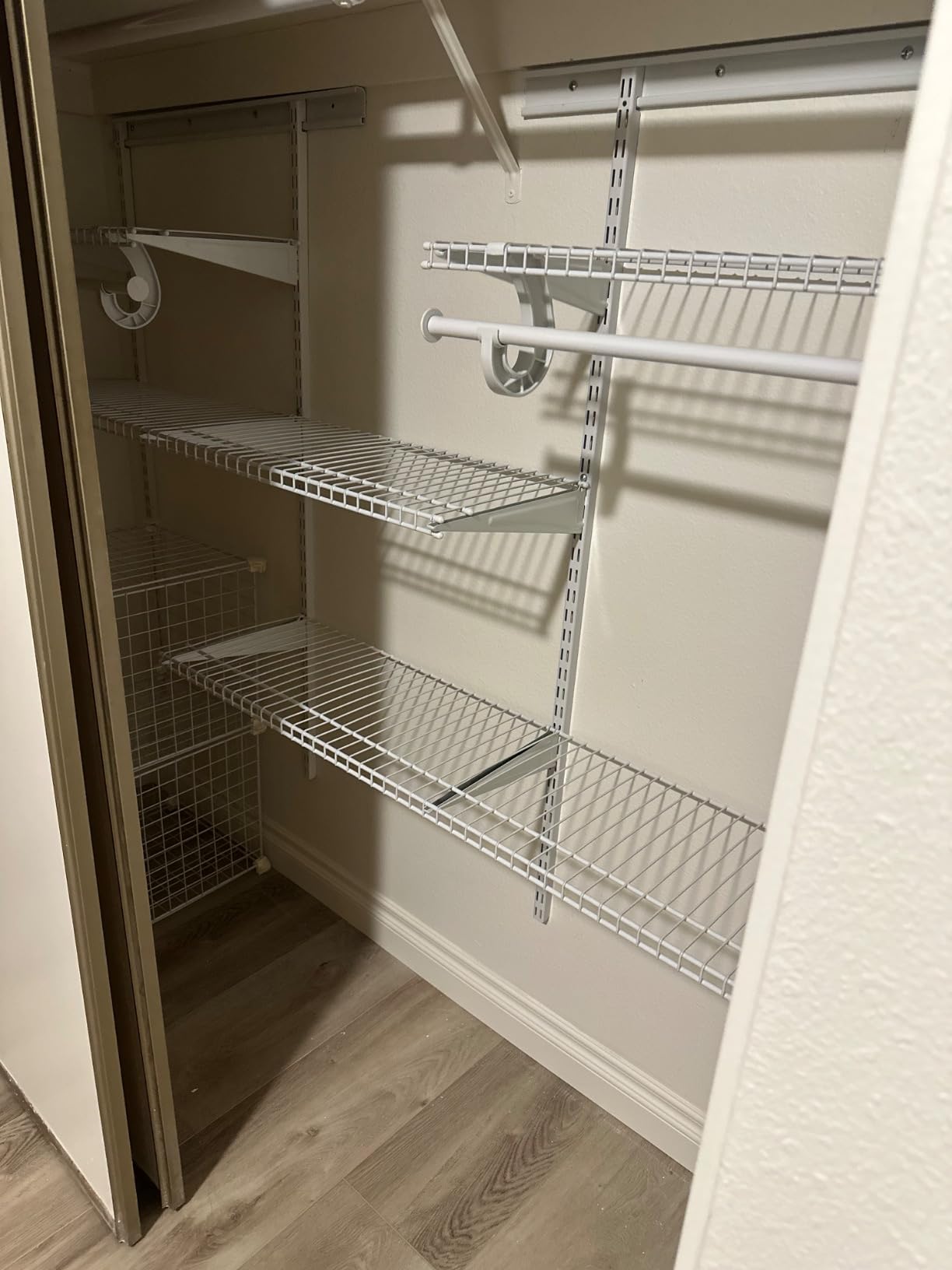
Best for: a smaller walk-in or a secondary closet where you want a working system in an afternoon. The ShelfTrack creates up to 96 inches of hanging space and 144 inches of shelf space, adjusting to fit closet spaces 4 to 6 feet wide with 12 inch deep shelves.
The distinguishing component is the SuperSlide hang rod, which allows continuous sliding of hangers rather than hanging them one on a fixed rod. In a walk-in with a long-hang zone, that is a real usability difference when you are pulling a single shirt out of forty.
Standards-Based Adjustment
The ShelfTrack standards and hang tracks are the backbone. Shelves lift out and reposition up or down over time, so the system follows your wardrobe rather than locking you into day-one decisions. That is the same core idea as the Configurations kit, executed in a lighter wire format.
The kit is wall-mounted at 28 pounds, so it adds meaningful load to a drywall surface. Find the studs and anchor into them rather than relying on the included fasteners alone.
Where It Falls Short
Some cutting of the shelf, track or rod may be required to fit the space exactly. That is the honest trade: the system covers a 4 to 6 foot range rather than a fixed width, and someone has to trim the components to close the gap.
Wire shelves also hold less weight than solid wood or MDF, so keep dense items on the lower tracks. If your walk-in has a dedicated shelf wall for storage bins, this is not the system for that wall.
Best Room in the House for It
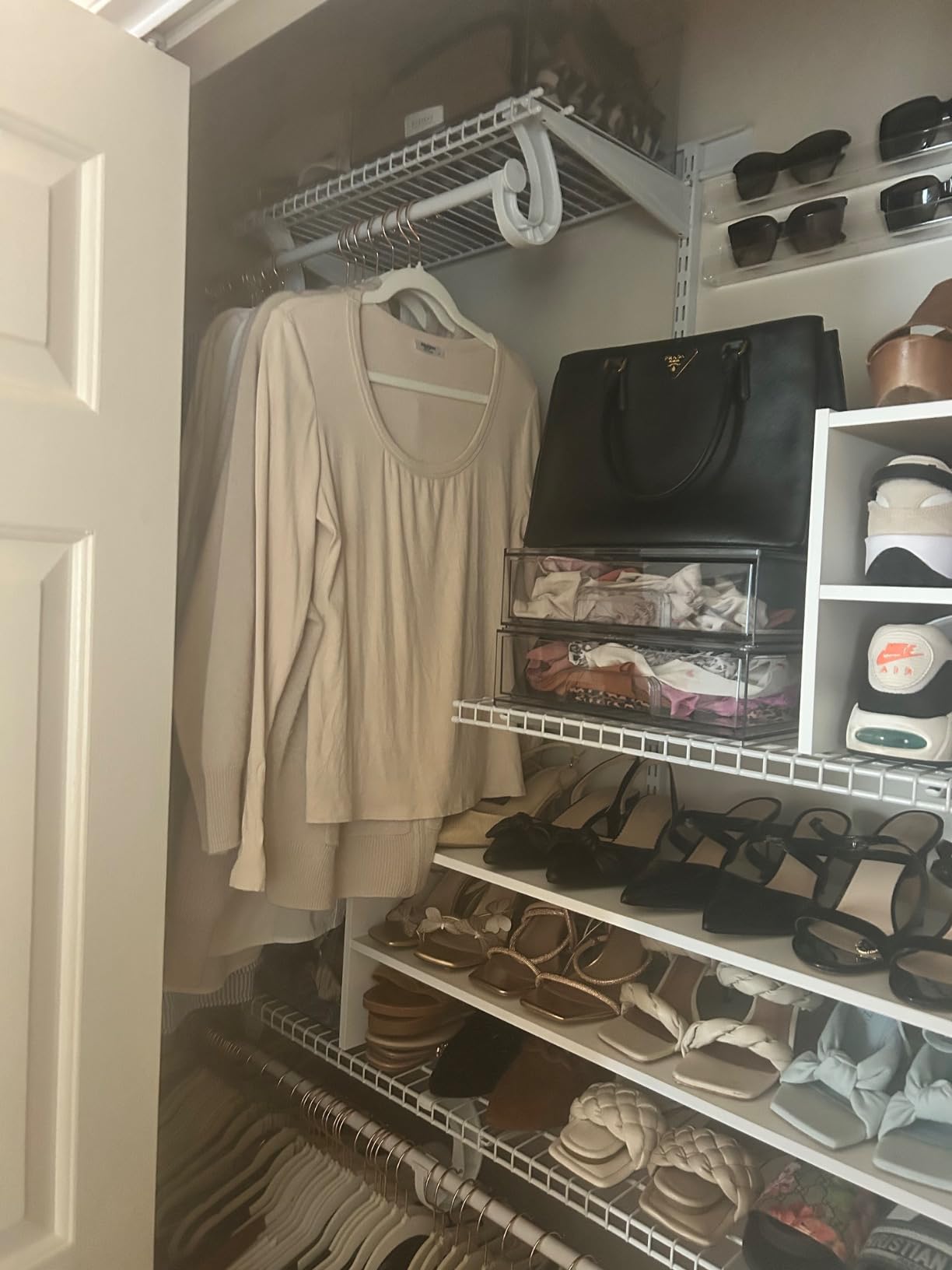
Reviewers repeatedly place this system in kids’ rooms, entryways and hall closets, and that is where it earns its place. In a walk-in it works best as a secondary wall: the kid clothes zone, the shoe wall, the overflow for seasonal gear.
Pair it with a heavier system on a different wall and you get a balanced room without overpaying for one product to do everything.
5. VIPEK X3 Expandable Heavy Duty Rack – Expands From 5 Feet to 8 Feet and Builds Two Ways
VIPEK X3 Expandable Heavy Duty Clothes Rack Closet Organizer System Black
Carbon steel frame, powder coated
Expands 5 ft 2 in to 8 ft wide
1,210 lb maximum load capacity
15.7 in D x 96 in W x 76.4 in H
Pros
- Highest average rating in the group at 4.8
- Expands to fill awkward wall widths
- 1210 lb capacity with no sway
- Two build shapes including L-shaped
- Locking clamps prevent overextension
Cons
- Assembly runs 60 to 90 minutes
- Heavy packed weight with many zip ties
- Anti-tip straps need a screwdriver or drill
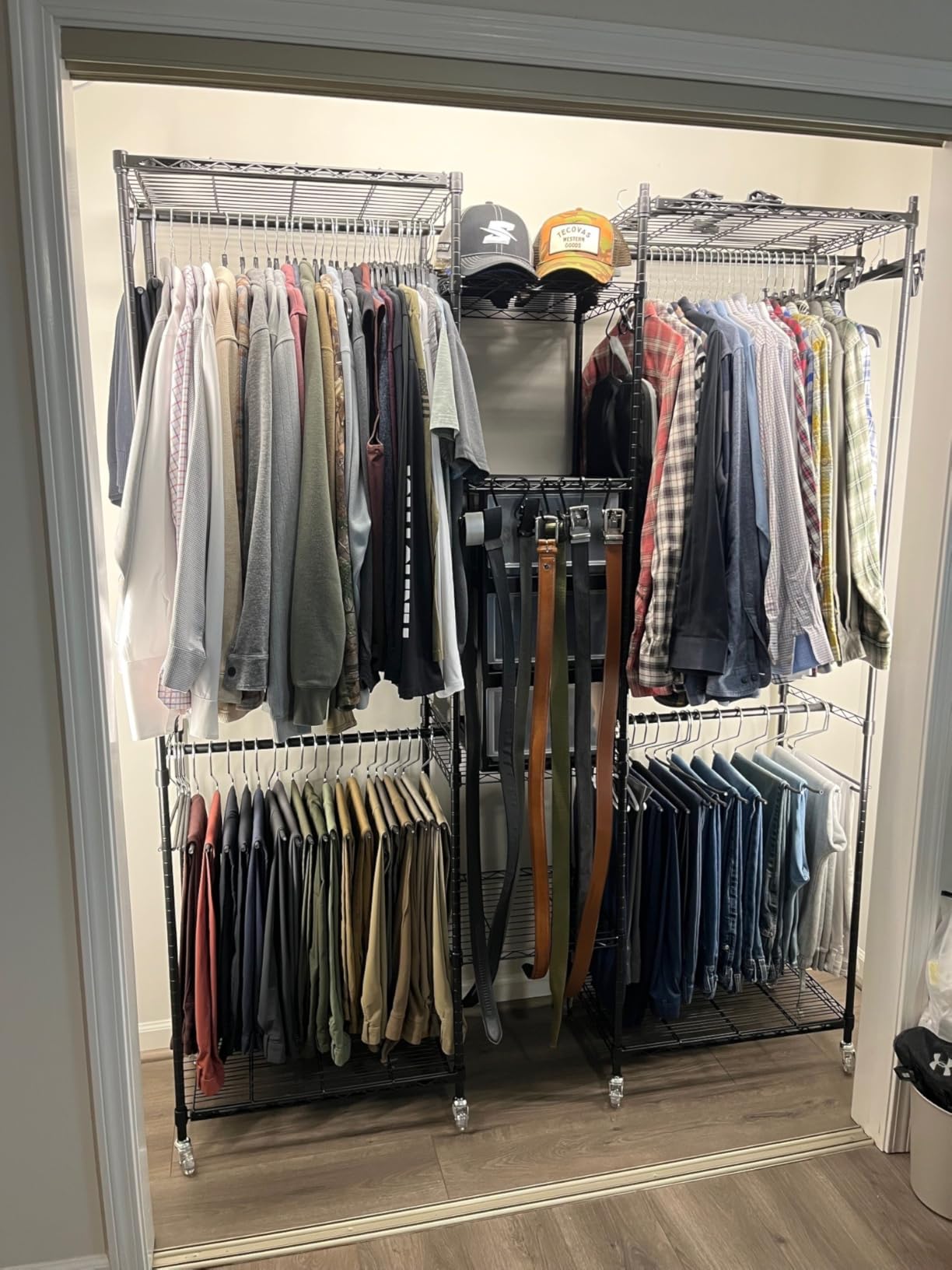
Best for: a walk-in with an odd wall length that no fixed-width system covers. The X3 expands from 5 feet 2 inches to 8 feet wide, which spans most of the useful range for a single purchase, and it assembles in two shapes: a straight run for a reach-in or walk-in, or an L-shaped corner layout.
It carries a 1,210 pound maximum load capacity, with 4 expandable wire shelves and 4 extendable hanging rods running from 24 to 41 inches. Secured locking gadgets prevent the shelves and rods from overextending when the frame is at full width, which is a failure mode cheaper racks do not guard against.
The 4.8 Rating and What It Reflects
This carries the highest average rating in the group, and the review pattern explains why: owners describe it as sturdy, well engineered and easy to reconfigure for non-standard closet widths. Packaging quality and double-threaded rod joints get specific mention.
The review volume is much lower than the big kits here, so treat the rating as a quality signal rather than a volume one. High-volume ratings are a useful durability proxy, but a tight average on a few hundred reviews still tells you the engineering held up.
Two Assembly Configurations
Building the frame as an L-shaped corner layout is the feature that separates this from every other freestanding rack in this roundup. A walk-in with a return wall or an L-shaped room can be filled from the corner outward without buying a second, differently sized unit.
The center shelves suit folded items, blankets and bulky winter clothing, which are exactly the pieces that overwhelm most walk-in closets in February.
Anti-Tip Hardware and the Tightening Step
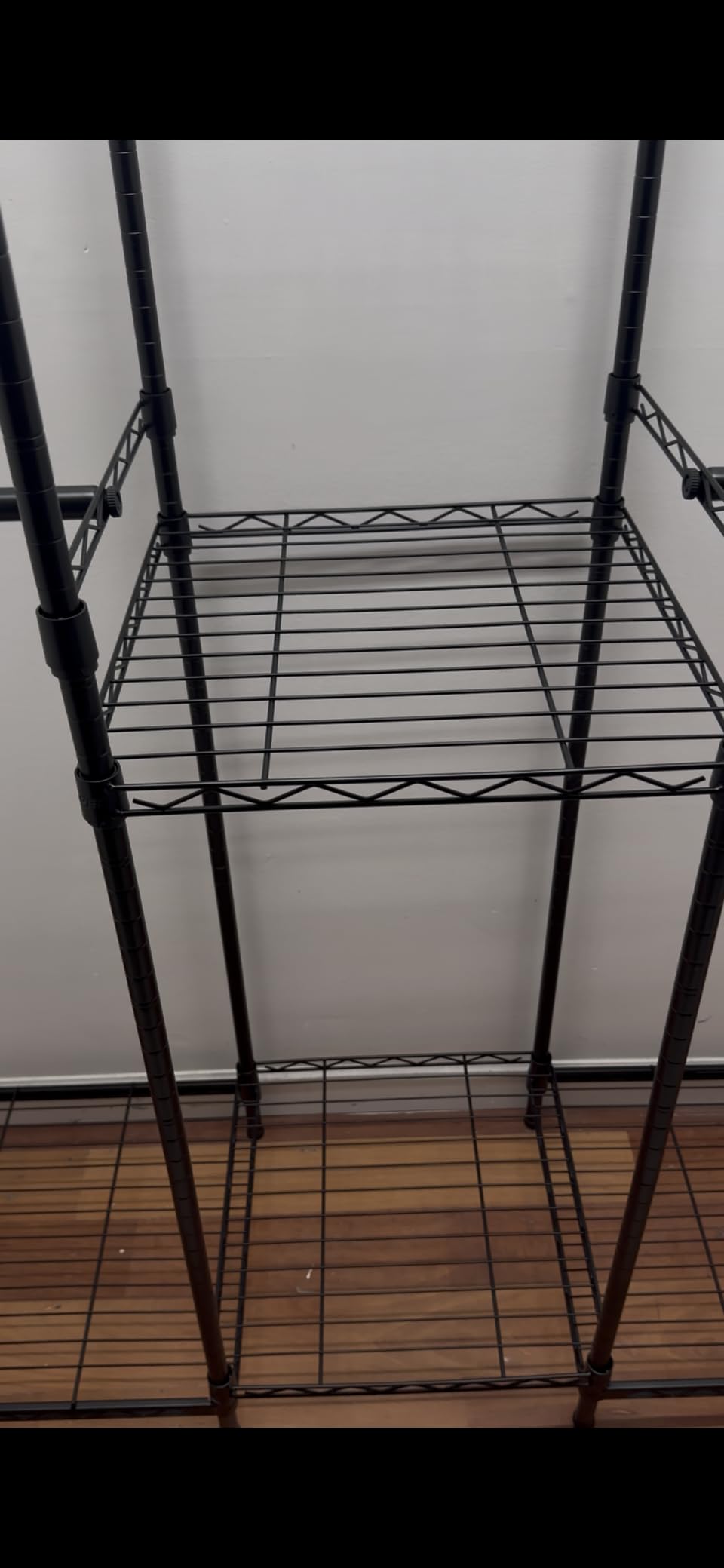
Anti-tip devices are included, and reviewers note they need a screwdriver or a drill to fit even though the unit is freestanding. If you are installing in a rental or a room where an unrestrained 46.7 pound frame worries you, budget for that step.
The instructions call for tightening screws fully when a wire shelf is fully extended. Skipping this is the reported cause of most wobble complaints on this design.
6. Aheaplus 4 to 9 Foot Closet System – Drawers and Rods in a Single Wall-Mounted Run
Aheaplus Closet System, 4-9Ft Closet Organizer with 4 Wooden Drawers, White
Engineered wood, painted white
Spans roughly 4 to 9 ft closets
4 wooden drawers and 4 hanging rods
21.3 x 115.7 x 80 inches
Pros
- One system covers a 4-9 ft span
- Drawers plus rods in a single unit
- Wood reads more finished than wire
- White paint suits most rooms
Cons
- Wall mounting demands accurate stud placement
- Heavier engineered wood is harder to move
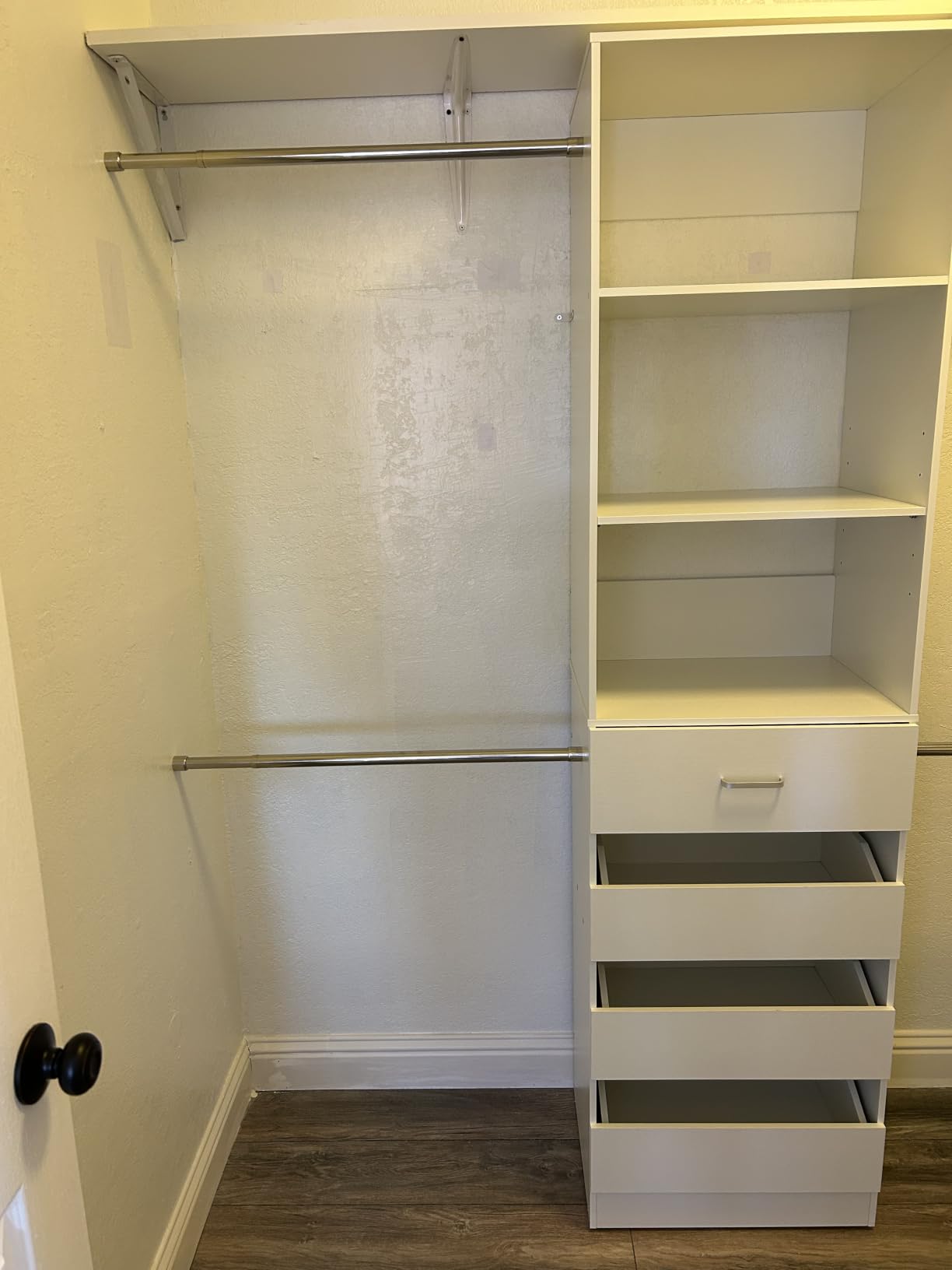
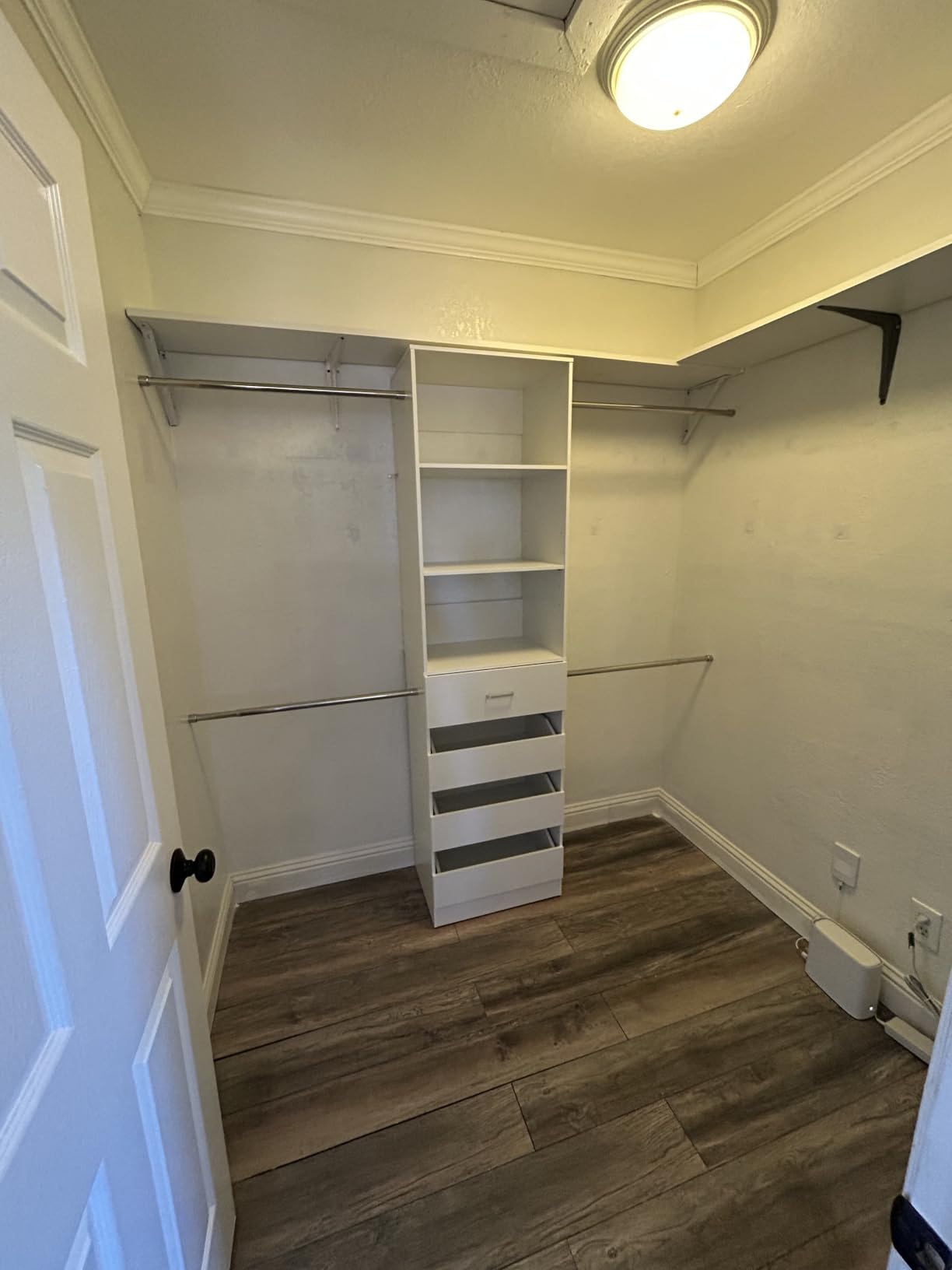
Best for: a walk-in with one long unbroken wall where you want drawers in the same run as hanging space. The Aheaplus system spans roughly 4 to 9 feet, includes a storage tower, four wooden drawers and four hanging rods, and is designed for both reach-in and walk-in applications.
At 115.7 inches overall, it is the longest single run in this group. For a walk-in with a 9 foot wall, that is one purchase rather than a kit plus a tower plus an add-on rail.
Drawers in the Same Run as the Rods
Wire kits rarely include drawers, and wood kits often isolate them in a separate tower. Combining four wooden drawers with four hanging rods in one assembly means the accessories zone and the hanging zone share a footprint, which is a genuine space saving in a room under about 80 square feet.
The four rods can serve shirts, pants, jackets and sweaters separately, which makes a two-person shared closet workable without a second system.
Installation Is the Whole Project
Wall-mounted engineered wood needs accurate stud placement. The 21.3 inch by 115.7 inch by 80 inch assembly is not a one-person job, and the honest recommendation is to have a second person or an installer handle it.
Hardware and instructions are included. The 4.4 average reflects satisfied buyers who accepted a more involved install rather than a faulty product.
When to Choose This Over a Tower
Pick the long wall-mounted run when you have straight walls and a stud-friendly structure. Pick a freestanding tower instead when the wall is short, the room is irregular, or you cannot drill.
The trade is mobility. Engineered wood is heavy and awkward to relocate, so this system is a decision for a room you are staying in rather than a rental placeholder.
7. Besiost Six-Drawer Set of Two – The Most Concealed Storage That Still Moves With You
Besiost Closet Systems with 6 Wood Drawers, Closet System Set of 2
MDF construction, painted white
42.6 in L x 15 in W x 80 in H
Splits into two 21.3 in cabinets
1,000+ lb capacity with anti-tip kits
Pros
- Six real wooden drawers for concealed storage
- Works as one piece or splits into two cabinets
- MDF rated for 1000+ lb
- Freestanding and mobile for renters
- Packs securely to survive transit
Cons
- Drawer slides unlabelled and fiddly to orient
- Handles feel cheap and may not cover holes
- Pre-drilled hanger holes sit too low
- Assembly wants a second person and a drill
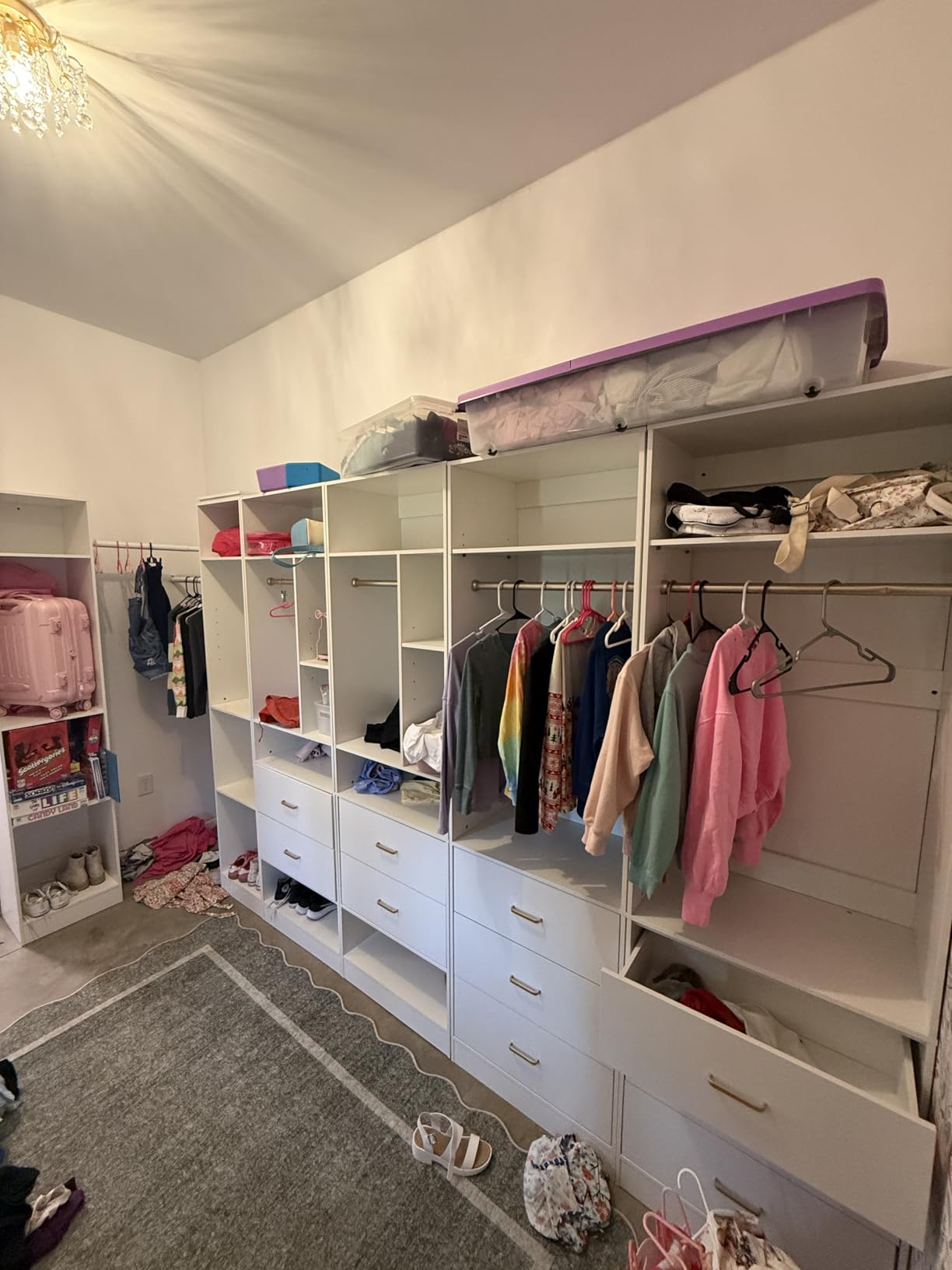
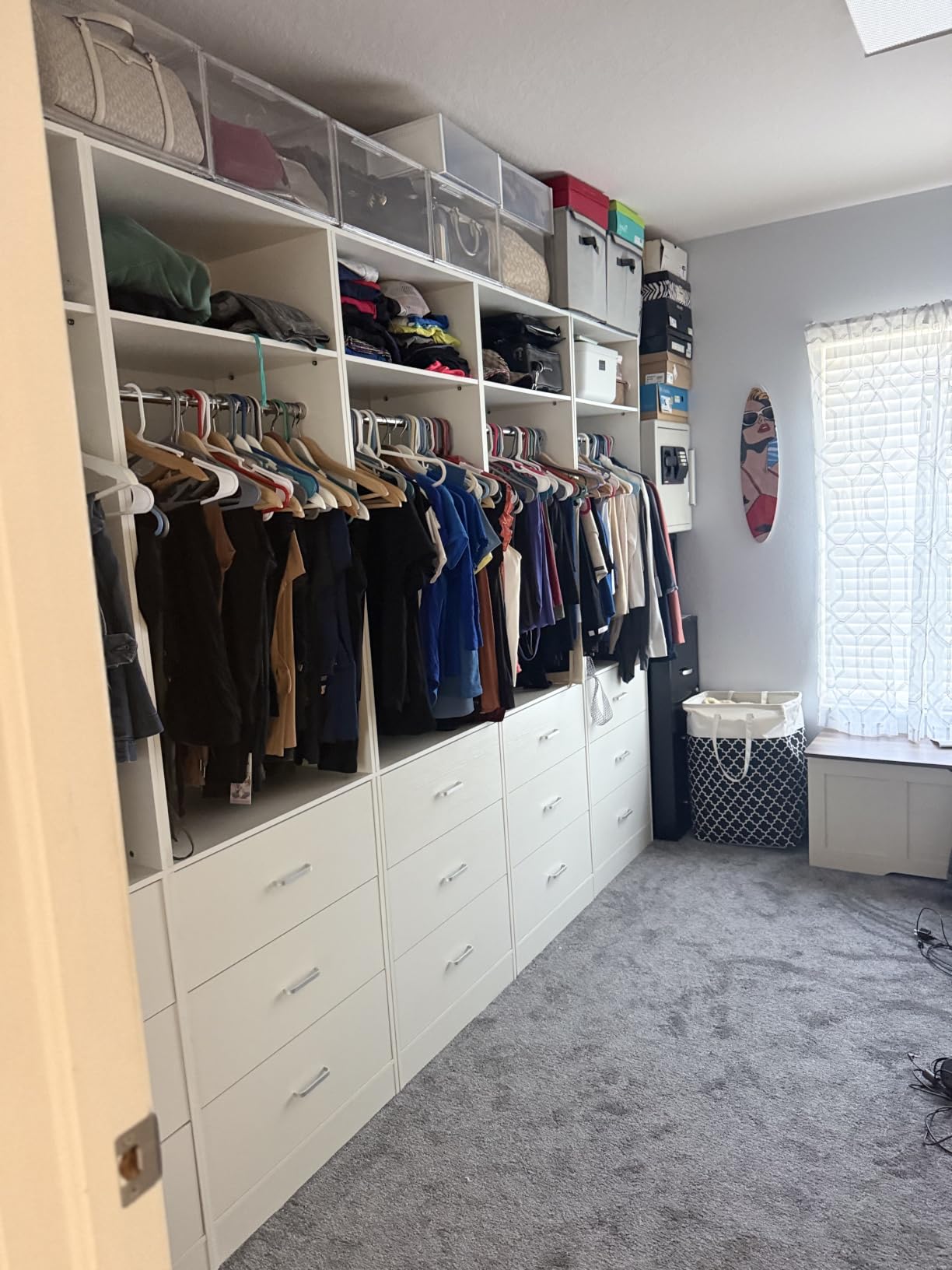
Best for: anyone who stores small items out of sight and still wants to move the closet later. This set of two MDF cabinets combines into 6 large wooden drawers, 2 top storage areas and 2 hanging areas, and the manufacturer states a capacity above 1,000 pounds with 4 anti-tip hardware pieces included.
The most useful dimension is 42.6 inches long by 15 inches wide by 80 inches tall, which can be used as one unit or split into two 21.3 inch closets. A renter who moves out can take half a closet with them rather than leaving a built-in behind.
Why Six Drawers Change the Room
Every other system in this roundup is open shelving or wire. Six enclosed wooden drawers give you a place for jewelry, undergarments, small bags and accessories that would otherwise be the first things to clutter a walk-in floor.
Owners say the set holds 300 or more pieces of clothing or small items, which is a reasonable density figure for a bedroom wardrobe when paired with two hanging areas.
Assembly Friction Is the Real Review Story
The 4.3 average reflects hardware, not concept. Owners report unlabelled drawer slides that are fiddly to orient, handles that feel cheap and may not fully cover the pre-drilled holes, and pre-drilled hanger holes set too low that need repositioning.
Panel alignment can drift as cam locks are tightened, and the build wants two people plus a power drill. Set aside a full afternoon and check the cam locks progressively as you go rather than tightening everything at the end.
Freestanding Means Renter Friendly
Nothing needs to be drilled to use it. The anti-tip kits are included for stability, but the structure stands on its own, which makes this one of the few systems here that a tenant can install in an apartment without permission.
If concealed storage is your priority and you are willing to spend a weekend on assembly, this is the pick.
8. Aheaplus L-Shaped Corner Set of Three – Built for Dead Corners and Wrap-Around Walls
Aheaplus Closet System with 6 Drawers, 4 Hanging Rods & Corner Tower, Corner Closet System with Hanging, 92.6″ L-Shaped Walk-In Wardrobe Organizer, 2000+ lbs Capacity, Set of 3, White
Engineered wood, freestanding
92.6 in L x 31.5 in W x 80 in H
6 wooden drawers, corner tower, 4 rods
2,000 lb total capacity
Pros
- Corner tower and L layout use awkward corners
- 6 drawers plus 4 rods in one footprint
- 2000 lb capacity with anti-tip kits
- Extends into U-shaped layouts with matching items
Cons
- Arrives as three heavy packages
- Two-person assembly recommended
- Very large footprint needs a dedicated corner
Best for: an L-shaped walk-in, a room with a deep dead corner, or any space where two straight runs meet at an angle. The three-piece set forms an L-shaped walk-in wardrobe with 6 wooden drawers, a corner tower with shelves, a full top storage row and 4 hanging rods.
It supports up to 2,000 pounds in total, with each hanging rod rated to 100 pounds. That rod figure is the highest single-rod rating among the systems in this roundup, and it is the one to check if you hang winter coats on a dedicated rail.
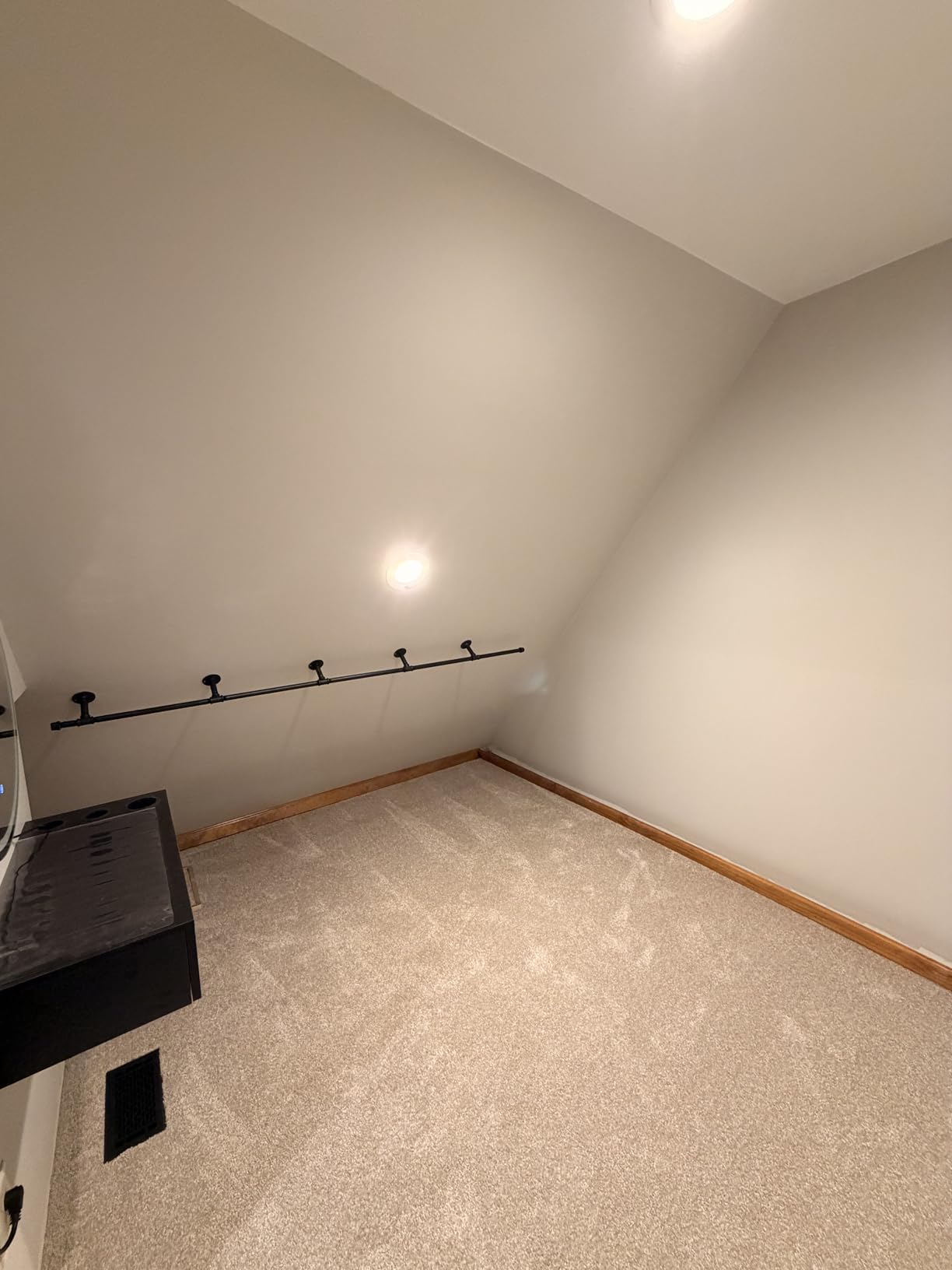
The Corner Tower Is the Whole Point
A standard straight kit leaves the corner behind the door, or the corner where two walls meet, as the place nothing fits. A purpose-built corner tower turns that volume into shelved storage that reaches the floor and the ceiling.
Owners describe the assembled result as a solid, non-wobbling structure, which is notable for a system this large and this heavy to move and level.
Sizing and Footprint Discipline
This configuration measures 92.6 inches long by 31.5 inches wide by 80 inches tall. A second size is also offered at 63.1 inches long by 61 inches wide by 80 inches tall, so measure the corner depth as well as the wall run before choosing.
The 31.5 inch depth is the number to check against your door swing. A system this generous in internal storage can still block a door that opens inward against the wall.
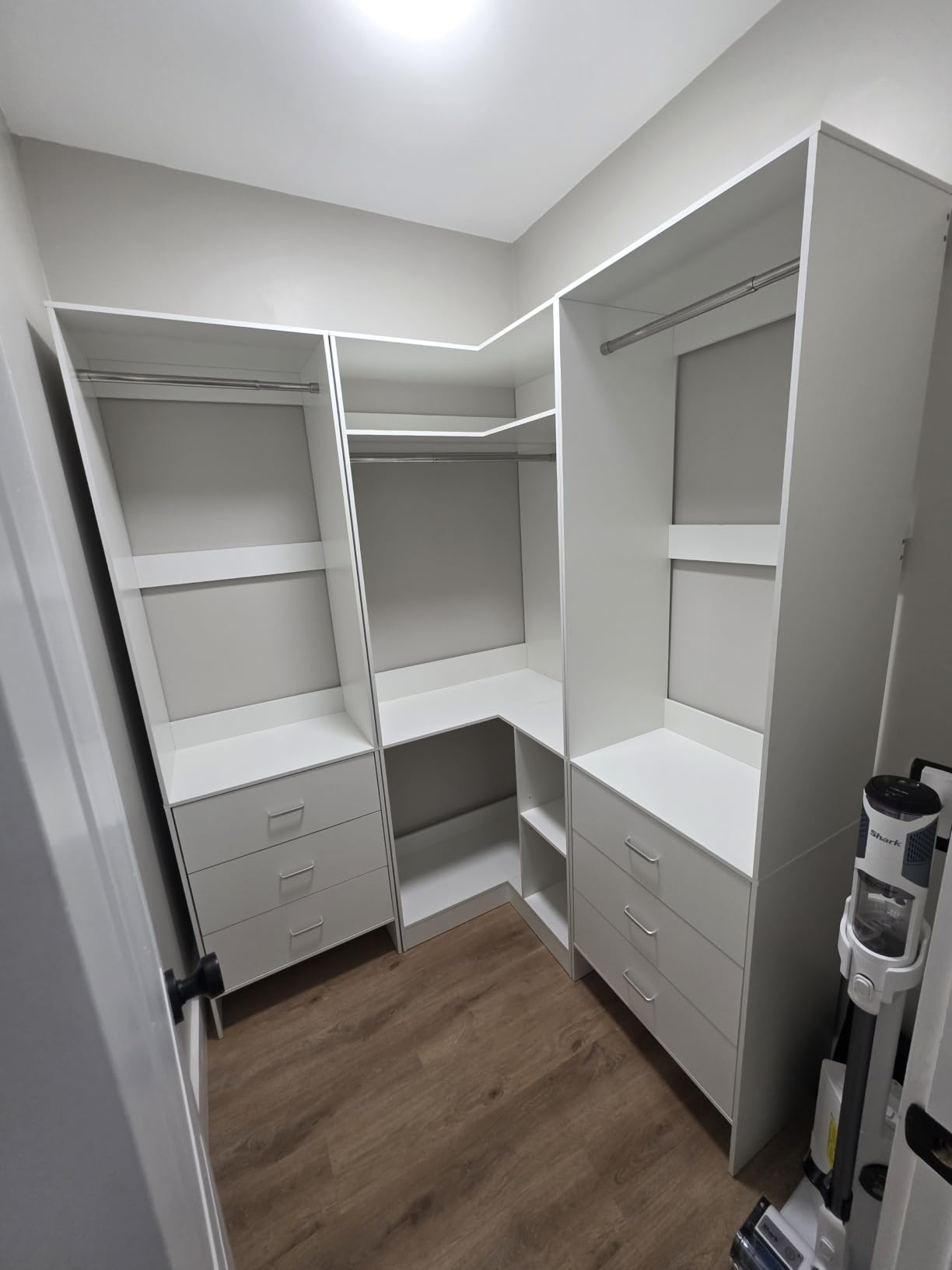
Three Packages and Two People
The set arrives in three separate packages, so plan the unpacking and the assembly together. Owners flag the multi-package handling and the weight of the tall pieces as the recurring practical caution.
The layout is flexible and reversible, and it can be extended into U-shaped configurations with matching items if the room later grows into that shape.
9. Aheaplus 4.3 Foot Set of Two – The Smallest Footprint That Still Grows Later
Aheaplus Closet System with 6 Drawers, 4.3ft, Set of 2, White
Engineered wood, freestanding
51.1 in W x 31.5 in D x 80 in H
2 pieces combining to 6 drawers
600 lb per piece, rods rated 100 lb
Pros
- Two pieces give flexibility if the closet is smaller
- 6 smooth-gliding drawers with metal handles
- Modular growth into 6
- 8
- 10 ft or L-shaped runs
- Open lower shelf for shoes and bins
- Anti-tip kits included
Cons
- Hanging rods fixed with relatively small screws
- Drawers shallow and without soft-close dampers
- Solo assembly is difficult
Best for: a small walk-in, or a larger one you expect to fill in stages. The set combines two 3-drawer pieces into 6 smooth-gliding drawers with metal handles, measures 51.1 inches wide overall, and suits closet spaces of 4.3 feet and larger.
Each piece supports up to 600 pounds, and each hanging rod is rated to 100 pounds. Two anti-tip kits anchor the structure to the wall. An open shelf below each drawer section takes shoes, bags or bins, which is usually the first storage people wish they had built in.
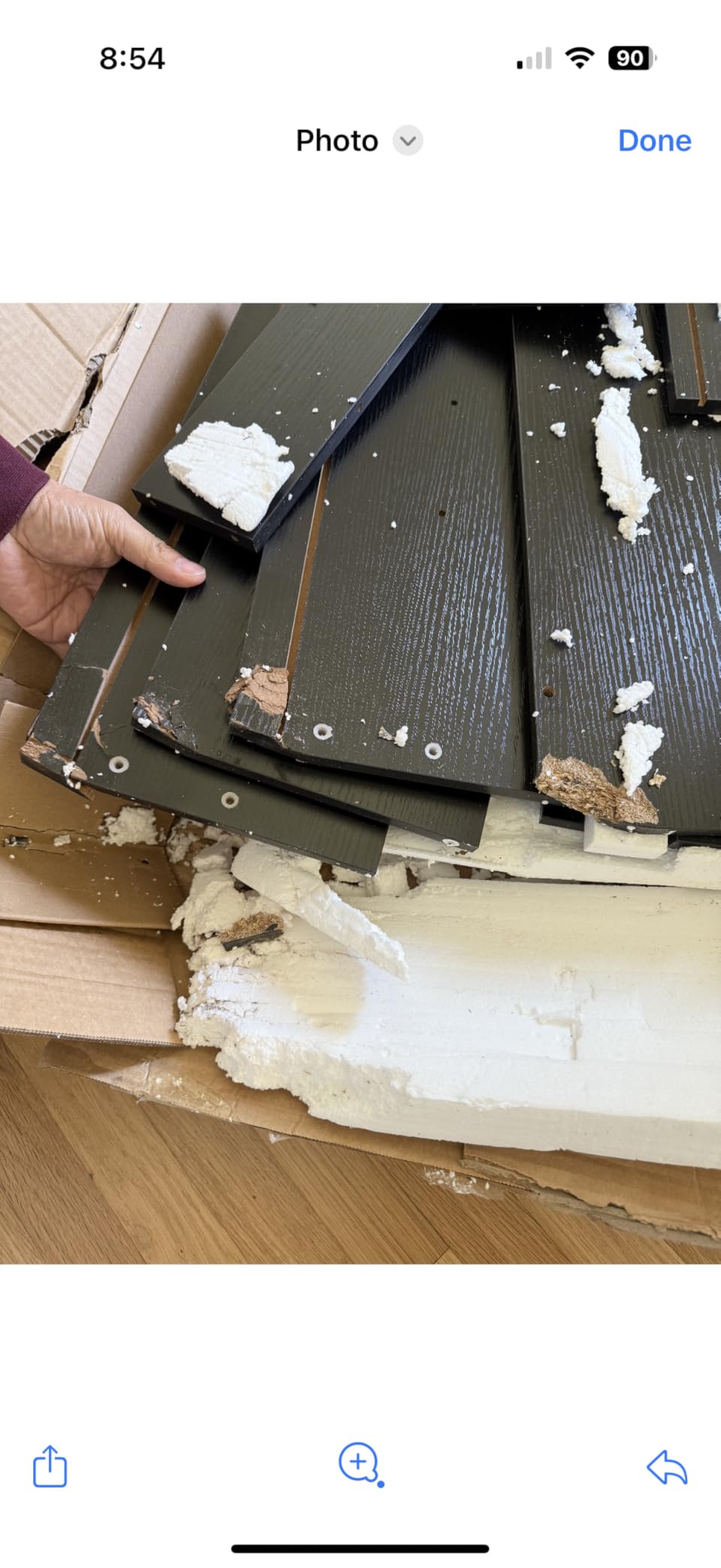
Two Pieces Instead of One Fixed Block
The modularity is the headline. Additional pieces can be added to build 6 foot, 8 foot and 10 foot runs, or L-shaped and U-shaped layouts, so a small walk-in today does not have to be a dead end.
You can also use one half if the closet turns out to be smaller than measured. That single option removes most of the risk from buying a modular system for an irregular room.
Where the Hardware Falls Short
Two specific critiques come up repeatedly. The hanging rods are fixed with relatively small screws, which limits heavy loads, so keep dense coats on a different run. And the drawers are shallow with no soft-close dampers.
Owners recommend a power drill for the build, and the pieces are heavy enough that a second person makes the difference between an easy afternoon and a frustrating one.
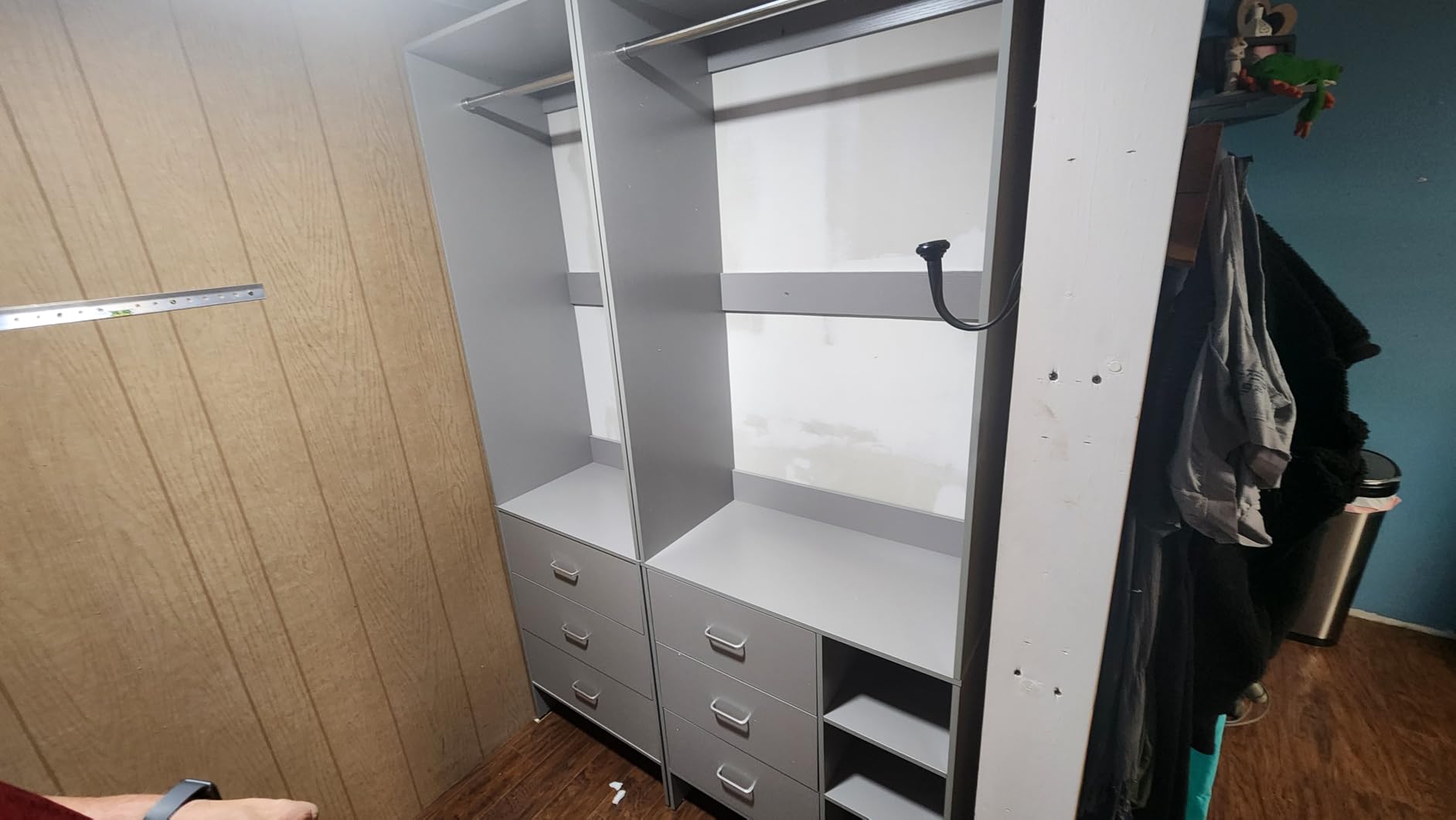
Who It Suits Best
At 31.5 inches deep, this is a deeper unit than most of the wire and narrow tower options here, so measure the room carefully. In return you get six real drawers and a lower shelf, which is the combination most walk-in owners end up wanting.
The 4.5 average reflects broadly positive feedback on sturdiness and appearance, with the drill and the rod screws as the specific gripes.
10. Vomavex Four-Piece Walk-In Set – The Most Configurable Layout, and the Heaviest Build
Vomavex Closet System with 4 sets, 101.9″ Closet Organizer Systems with 6 Drawers & 8 Hanging Rods & Adjustable Shelves, Walk in Closet Standing Closet System, Corner Closet System Set, White
Engineered wood with stainless steel rods
101.9 in wide standing system
6 drawers, 5 adjustable shelves, 8 rods
2,500 lb total capacity, 318 lb unit weight
Pros
- Four independent pieces arrange as long
- L or U
- 8 hanging rods including 4 adjustable side rods
- 0.6 mm stainless rods resist bending
- 2500 lb total capacity
- Parts labelled with stickers
Cons
- Heaviest item in the group at 318 lb
- Configuration planning needed before assembly
- Lowest average rating here at 4.2
Best for: a large walk-in where you want the layout decided by the room rather than by the box. This four-piece set combines one corner system with three independent pieces, configurable as a long run, an L-shape or a U-shape, and it includes 6 wooden drawers, 5 adjustable shelves, 4 inner hanging rods and 4 extra side hanging rods.
The side rods adjust from 22 to 39.4 inches and can extend the system by up to 157.6 inches, which is the most expandable configuration logic in this roundup. Rods are 0.6 mm stainless steel, described as three times thicker than the 0.2 mm rods used by competitors, with a stated total capacity of 2,500 pounds across the four pieces.
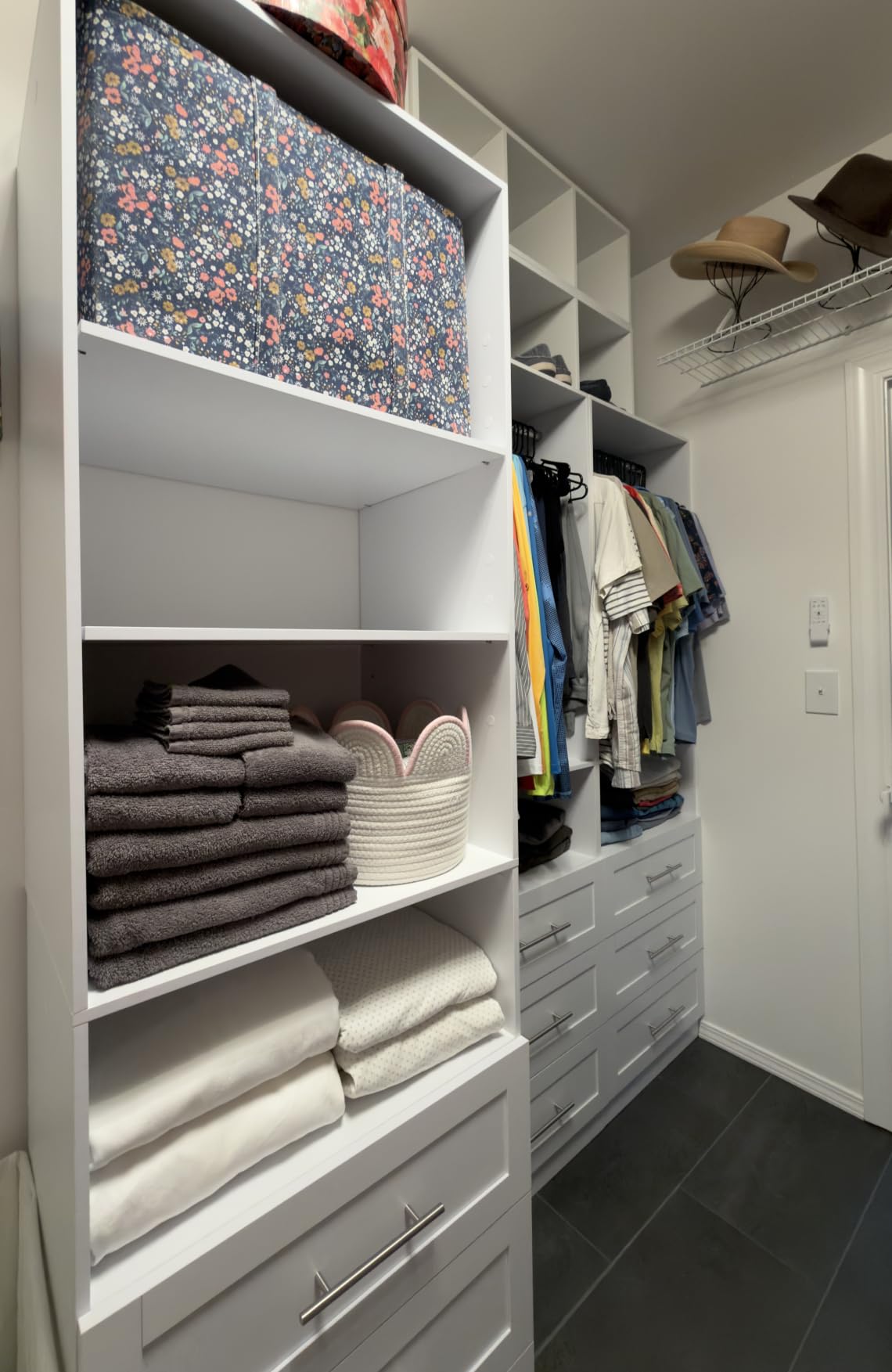
Capacity and Rod Gauging
At 2,500 pounds total, this is the highest stated load capacity of any system we tested. The stainless rod gauge is the more meaningful number in practice, because a thin rod deflects under a dense row of coats long before the frame’s rating is anywhere near its limit.
Owners specifically note the rods are less prone to bending, which is the failure that turns a good hanging run into an unusable one after a year.
Assembly Scale and Feedback
At 318 pounds, this is the heaviest item in the group, and the 4.2 average is the lowest here, with one-star feedback concentrating on assembly difficulty and damage to a heavy multi-piece package.
Positive reviews concentrate on the flexibility of the four configurable pieces and the extra hanging rods. All parts carry stickers and the instructions are step by step, which owners do credit.
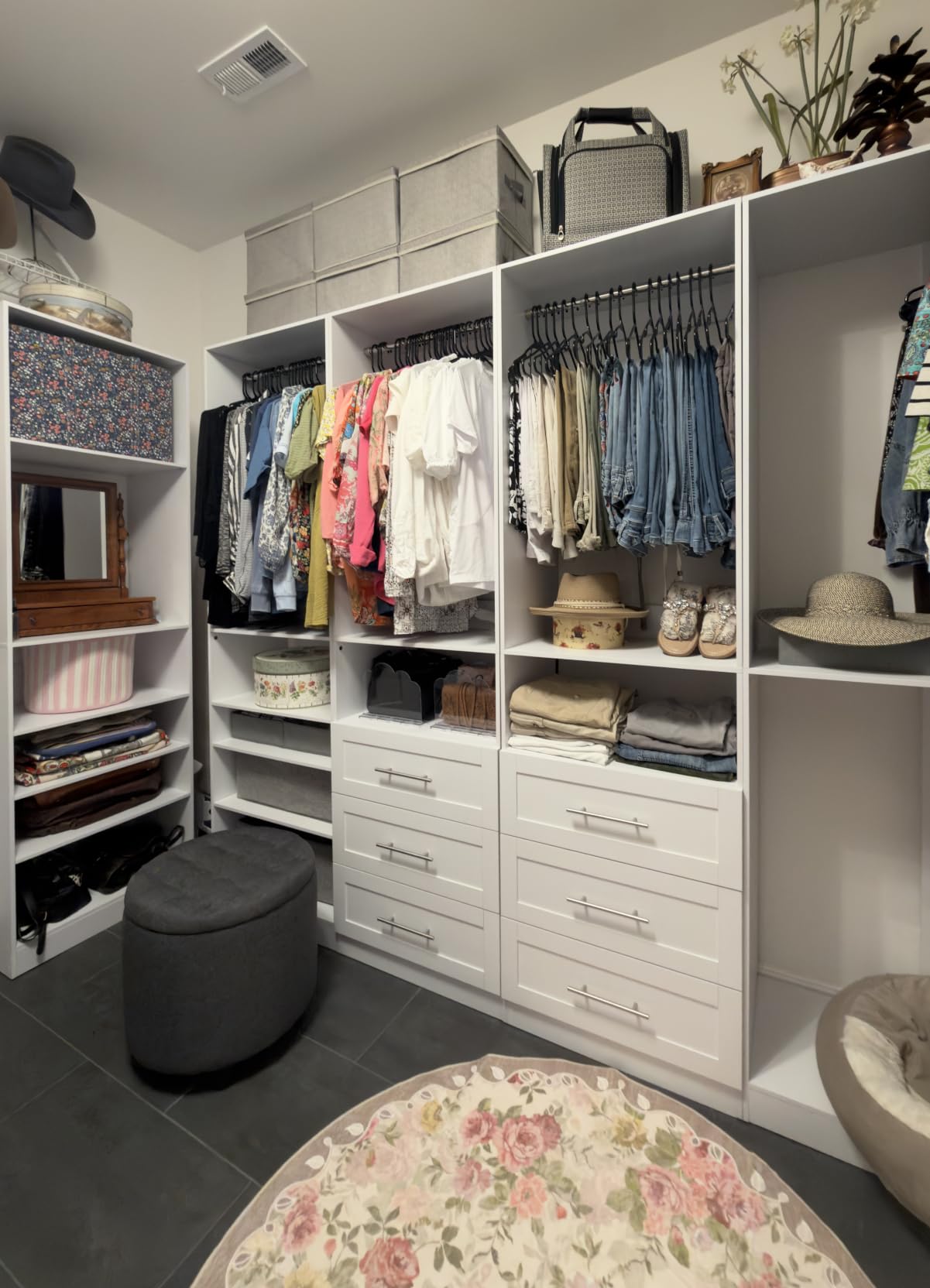
Plan the Layout on Paper First
Configuration planning is required before assembly to avoid an unusable result. Sketch the room, decide whether you want long, L or U, and confirm that 101.9 inches of width plus the side rod extensions still leaves you a walkable floor.
Each of the four independent pieces is also available separately, so you can start smaller and add the corner unit later.
How to Choose a Closet System: 7 Decisions That Matter
The right pick comes down to seven questions, and the order matters because the first two eliminate most of the field before you look at materials at all.
1. Wall-Mounted or Freestanding?
Wall-mounted systems deliver the built-in look and use floor space efficiently, but they need studs and they stay behind when you move. Freestanding systems need nothing in the wall, can be relocated, and cost you floor depth. If you rent, or your walls are masonry or already crowded with plumbing, freestanding is the only realistic class.
This is also the renter and no-stud decision. Among these ten, the VIPEK V5, the VIPEK X3, the Besiost set and the Aheaplus sets all stand on their own.
2. How Much Wall or Floor Width Do You Need to Fill?
Measure the perimeter you actually want covered, not the room. Most walk-in disappointments come from a kit that covers one wall in a room with four. Write the target width down and match it against the span column in the table above before you look at anything else.
Our in-house guidance on smart-home and sensor coverage, like our mesh WiFi guide for thick walls, applies here in principle: coverage in a closet is about reaching every corner, and the same measurement-first logic decides it. If you also want eyes on the storage areas, our wireless security camera guide covers the placement trade-offs.
3. Custom Cabinetry or Modular?
Custom cabinetry fits your room exactly and looks the most finished. It also locks you into a design, it cannot move, and the quotes homeowners report for a full walk-in are consistently several times what a well-planned modular install costs. The forum consensus is blunt: buyers who went custom frequently report that a comparable result was reachable with a modular system for a fraction of the outlay.
Choose custom only when the room is genuinely irregular, the walls are not square, or the finish matters more than the money. For a standard rectangular walk-in, modular is the better economic decision.
4. Material: Wire, Engineered Wood or MDF
Coated wire is the most reconfigurable and the least expensive, and it ventilates naturally. It also holds less per shelf and reads as hardware rather than furniture. Engineered wood gives a finished appearance and real drawer options at the cost of weight and edge durability. MDF cabinets like the Besiost set deliver the most concealed storage and the most concealed weight.
Solid wood only appears at the custom end of the market. If you care about visible grain and repairable surfaces, plan for a custom quote rather than a kit.
5. Load Capacity for the Garments You Actually Hang
Check the per-rod rating, not the total. Total capacity numbers are frequently calculated with the frame fully loaded in ways no real closet is. The Aheaplus corner set and the Aheaplus 4.3 foot set rate rods at 100 pounds each, the VIPEK V5 rates each rod at 60 pounds, and the Aheaplus wall-mounted set does not publish a per-rod figure at all.
Winter coats, denim and boots are heavy. Put them on the highest-rated run you have, and do not treat a published total as permission to load one rod with a season of coats.
6. How Much Rod and Shelf Do You Actually Need?
A simple planning rule beats guessing. For long-hang garments, budget roughly 2 to 2.5 inches of rod per item; for folded storage, allow about 12 inches of shelf width per item. Add 20 percent for seasonal overflow you will not admit to yet.
For a two-person master closet, the practical result is one long-hang run per person on opposite walls, a double-hang run for shirts and pants, and a separate shelf and drawer zone for accessories. Build that on paper before you buy, and the span and rod counts will make the pick obvious.
7. Can You Move It, and Can You Extend It?
If you might move, freestanding systems win outright. If you will stay, ask whether matching add-ons will still exist in five years, because a system you cannot extend is a system you will eventually replace. Expansion is also why we would rather see you buy a smaller modular set now and a second piece later than a full-width fixed run.
One more practical note on planning: if you are upgrading a room where you also plan to add lighting or sensors, sequence the closet first and the electronics second. Anchoring hardware and moving a completed closet are much harder than running cable before the units are in place. Our guide to home systems that run without monthly fees covers the planning side of that.
Frequently Asked Questions
What is the best closet organizer system for a walk-in closet?
The best closet organizer system for a walk-in closet is one that spans at least one full wall run, holds the weight of your garments, and can be expanded later. In practice that means a system matched to your wall width, a rod rated for heavy items, and separate vertical storage for shoes and accessories. Freestanding systems are the right choice if you rent or have no studs.
Is it cheaper to build or buy a closet system?
Buying a modular system is usually cheaper than custom cabinetry, and far cheaper than hiring a closet company. For a standard rectangular walk-in, a well-planned modular install delivers most of the finished look at a fraction of the cost, and the pieces can move with you later. Custom earns its price only in irregular rooms where off-the-shelf components cannot line up.
What is the best quality closet system?
Quality in this category comes down to hardware rather than appearance. Look for telescoping or track-based components that adjust without tools, coated wire or solid panels rather than thin sheet, published per-rod load ratings, and complete hardware included. Systems that list per-rod capacity and weight generally describe the part that actually fails first.
Do I need professional installation for a closet system?
Most systems in this roundup are designed for a weekend install, but two situations call for help. Wall-mounted engineered wood needs accurate stud placement and a second pair of hands, and large multi-piece sets over 300 pounds should not be solo assembled. Wire track systems and freestanding racks are genuinely straightforward with a drill, a level and a stud finder.
Can I take a closet system to a new house?
Freestanding systems can be disassembled and moved, and owners of coated wire systems commonly reuse the same hardware in a second room. Wall-mounted track systems can be removed but leave anchor holes, and engineered wood pieces are heavy enough to be impractical. If a move is likely, buy freestanding and keep the original hardware bag.
The Verdict: Which Closet System Fits Your Walk-In
If you want the widest configuration freedom and the ability to rearrange without tools, the Rubbermaid Configurations kit is the pick, and its 4.7 average across more than eight thousand reviews is the most proven result in this roundup. If you cannot drill, the VIPEK V5 gives you four rods and eight shelves with no wall damage. If your wall length is awkward, the VIPEK X3 expands from just over five feet to eight feet and builds as an L.
Choose the ClosetMaid SuiteSymphony when the finish matters more than the footprint. Choose the Besiost six-drawer set when concealed storage is the priority and you can spend a weekend on assembly. Choose the Aheaplus corner set for a dead corner, the Aheaplus 4.3 foot set for a small room you expect to grow into, and the Vomavex four-piece set for a large room with a U-shaped plan.
Measure twice, pick the system class before the brand, and confirm your span, rod count and floor clearance before checkout. In 2026 the honest answer to “what is the best closet organizer system for a walk-in closet” is the one that matches your room shape, not the one with the biggest box.