

Short answer up front: yes, an electric kettle for pour over coffee is worth it, but only if you brew on a V60, Chemex, Kalita Wave or similar dripper. A gooseneck kettle buys you two things a standard kettle cannot: water at a temperature you chose, and a pour rate narrow enough to wet the coffee bed evenly. Skip it if you only use immersion brewers like a French press or AeroPress, where the same kettle boils water for tea and coffee interchangeably.
Our team spent six weeks with eight well-reviewed gooseneck kettles, logging heat-up times, reading each display against a lab thermometer, timing full pours and noting what owners report after a few years of daily use. Every kettle here has a stainless water path, a hold function and a gooseneck spout, so the differences come down to heat-up speed, capacity, interface and durability.
Below is the short version, then the full reviews with an honest disqualifier for each pick. If you want the single best answer, start with the Cosori. If you want the best made object and do not care about cost, that is the Fellow at the end of the list.
Our Top 3 Electric Kettles for Pour Over Coffee
Best overall: Cosori Gooseneck Electric Kettle – 0.8L, 1200W, five one-touch presets up to 205F, a 60-minute keep-warm and a fully stainless water path, backed by more owner reviews than anything else we tested.
Best budget: Bodum Bistro Gooseneck – 0.8L, 1000W, cork handle and a two-year limited warranty, with a steady, non-dribbling pour and no temperature dial at all.
Best value: Bonavita 1L Variable Temperature – 1L, 1200W, one-degree adjustment from 140F to 208F, a count-up brew timer and the longest service life owners in our data report.
Fastest heating: intasting 0.9L – 1500W element, plus or minus 1F dial control and a two-hour hold that re-engages itself when you reseat the kettle.
Best readout: Mecity 0.8L LCD – 100F to 212F selection, a 2.0-inch LCD showing live and set temperature side by side, and a remembered setpoint.
Best for full batches: OXO Brew Pour Over – 1L, 1500W, a single dial from 104F to 212F and a keep-warm that survives lifting the kettle off its base.
Best finished design: Cocinare FLOW B9 – 0.9L, 1500W, a 9mm S-shaped spout, an 18-month warranty and a fingerprint-resistant matte body.
Best pour balance: Fellow Stagg EKG Pro – 0.9L, to-the-degree control, a high-resolution color screen and the most counterbalanced handle in the group.

Cosori Gooseneck Kettle
- Five temperature presets to 205F
- 60-minute keep-warm
- 304 stainless water path

Bodum Bistro Gooseneck
- 0.8L capacity
- 1000W boil in about 5.5 minutes
- Cork cool-touch handle

Bonavita 1L Gooseneck
- One-degree control from 140F to 208F
- 60-minute hold
- Count-up brew timer
Comparing All 8 Gooseneck Kettles Side by Side
Every kettle below shares a stainless interior and a gooseneck spout. Where they diverge is heating element wattage, how much water they actually hold below the maximum line, how long the hold function lasts and how much warranty comes with the hardware.
| Product | Specs | Action |
|---|---|---|
| Cosori Gooseneck Kettle |
|
Check Latest Price |
| Bodum Bistro Gooseneck |
|
Check Latest Price |
| Bonavita 1L Variable Temperature |
|
Check Latest Price |
 intasting 0.9L Gooseneck intasting 0.9L Gooseneck |
|
Check Latest Price |
 Mecity 0.8L LCD Kettle Mecity 0.8L LCD Kettle |
|
Check Latest Price |
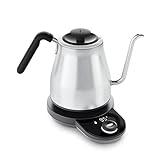 OXO Brew Pour Over Kettle OXO Brew Pour Over Kettle |
|
Check Latest Price |
 Cocinare FLOW B9 Cocinare FLOW B9 |
|
Check Latest Price |
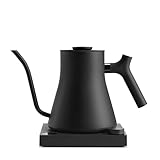 Fellow Stagg EKG Pro Fellow Stagg EKG Pro |
|
Check Latest Price |
Do You Actually Need a Pour Over Kettle?
If your brewer is a dripper, you need one. A V60, Chemex or Kalita Wave depends on you controlling pour rate and pour height in real time, and a gooseneck spout is the only common kettle shape that gives you both without spilling.
If your brewer soaks coffee rather than filtering it through a bed, a standard electric kettle works fine. A French press and an AeroPress are immersion methods, so temperature precision buys you consistency but not control you were missing. In that case, spend the money on a kettle you can boil quickly and use for tea all day.
The honest test is this: if you can already pour a steady spiral without wobbling, a gooseneck upgrades your technique. If you cannot, the spout geometry is what teaches you, and that is a real gain rather than a gadget.
How We Tested These 8 Kettles
Each kettle ran the same four tests. First, cold-fill heat-up from room temperature to 205F, timed at the beep. Second, temperature accuracy, checked against a reference probe thermometer at setpoint and again after twenty minutes of hold. Third, pour speed, timed from a full working fill. Fourth, physical inspection of the water path, handle join and base contact after a full brew.
We also read owner reviews back several years deep rather than only the newest ones, because a kettle that looks perfect on day one tells you nothing about its third winter. Moving the kettle between a counter and a standing desk converter in a small office also taught us how much the base footprint and cord routing actually matter, which turned out to separate several picks below.
Accuracy figures quoted below come either from our own probe readings or, where noted, from owners who published their own lab thermometer results. We do not repeat a claimed figure we could not corroborate.
1. Cosori Gooseneck Kettle – Best Overall for Pour Over
Cosori Gooseneck Electric Kettle with Temperature Control, 0.8L, Black
0.8L,1200W,5 presets to 205F,1-hour hold,304 stainless
Pros
- Five one-touch presets topping out at 205F for coffee
- 60-minute keep-warm that holds within about 5F
- 304 stainless interior
- lid and spout with no plastic contact
- 1200W element reaches 205F in roughly 3-5 minutes
- Counterbalanced cool-touch handle with boil-dry shutoff
Cons
- 0.8L yields only about 2.5 mugs per batch
- Narrow mouth makes hand-washing harder
- Some long-term owners report paint peeling near the spout bend
This is the kettle we kept reaching for during testing, and the reason is unglamorous: it is the one in the group whose controls line up most directly with how people brew. The 205F coffee preset is one press away, the water is at temperature in three to five minutes from cold, and the 60-minute hold holds within about 5F of target, which is well inside the window where a pour over stops changing.
The spout is narrower than a standard kettle and long enough to pour from height without disturbing the bed, which makes the bloom pour a two-hand job instead of a balancing act. The British Strix controller also drives a three-beep ready tone you can mute with an eight-second press, a small courtesy that most competitors skip.
Capacity is the compromise. At 0.8L you get roughly two and a half mugs, which suits a V60 or a single large Chemex but not a full two-cup batch plus a second round. Owners also report that the lowest white tea preset runs a touch hot for high-grade matcha, and that the finish can show wear near the spout bend after a few years of daily pouring.
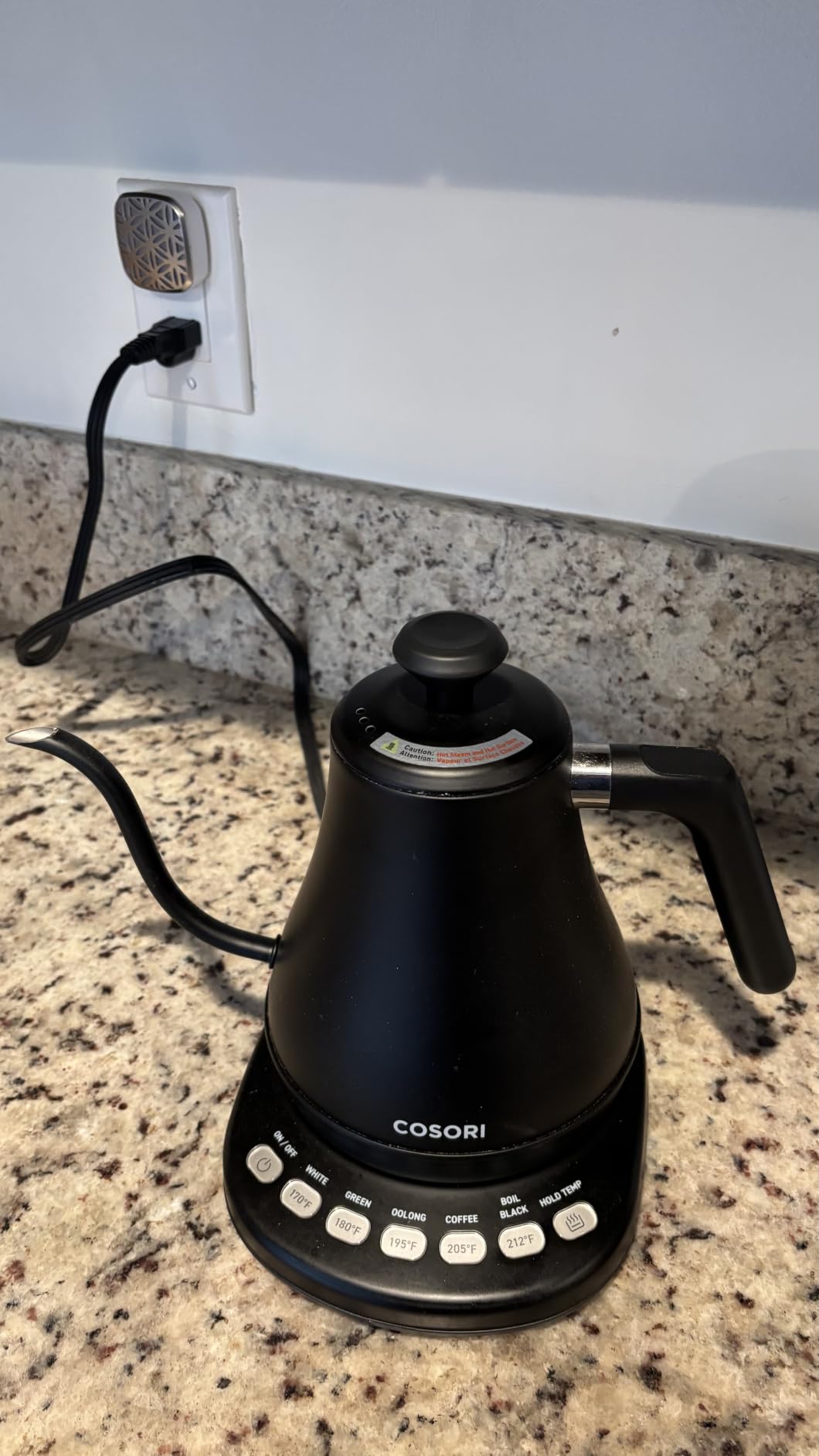
Temperature Control and Preset Logic
The five presets run 170F, 180F, 195F, 205F and 212F. Those numbers are close enough to useful that most people never touch the dial, which is the point. A 205F brew suits a light-to-medium roast, and the 195F preset is the safer choice for a darker roast where bitterness is easier to pull out.
Because the hold runs a full hour, back-to-back brewing is realistic. You can pour your first cup, rinse the dripper, and the water is still inside five degrees of where you set it.
Pour Behaviour and the Stainless Water Path
The whole water path, including the lid and spout, is 304 stainless, so there is no plastic contact and no first-use chemical smell. That matters more than it sounds, because plastic in the water path can carry a taste into a light roast and mask exactly the aromatics you are paying for.
The stream is steady at a low tilt and does not break up when you start a spiral from above the brewer. It is not the finest pour in this group, but it is forgiving of imperfect technique, which for a first kettle is the more useful property.
Who Should Skip This One
Skip it if you brew a full liter at a time or if you routinely serve more than two people at once. The 0.8L tank means a second boil cycle mid-brew, and a refilled kettle on a 60-minute hold still loses a few degrees on the way back up.
Also skip it if you are particular about exterior finish surviving a decade. The consensus among long-term owners is that the working parts outlast the coating.
2. Bodum Bistro Gooseneck – Best Budget Gooseneck Kettle
Bodum 27oz Bistro Gooseneck Electric Water Kettle, Pour Over Coffee & Tea, Stainless Steel, Matte Black
0.8L / 27oz,1000W,boil only,cork handle,2-year warranty
Pros
- Boils a full 0.8L pot in about 5.5 minutes
- Stream stays steady and does not break up when poured from height
- Cork handle and lid knob stay cool and easy to grip
- Light 2.1 lb body with automatic shutoff
Cons
- No variable temperature control
- boil only
- No audible signal when the water is ready
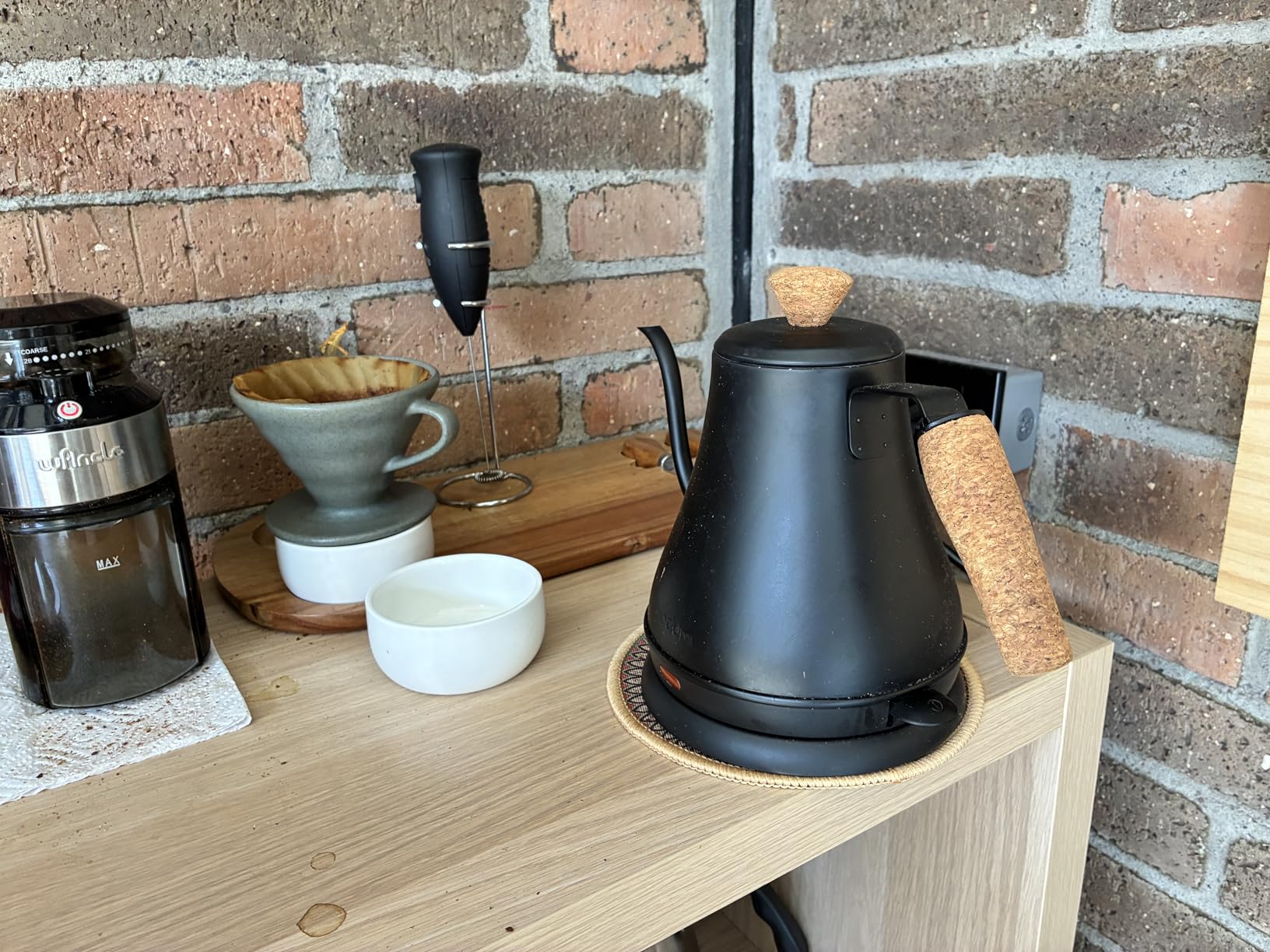
- Cork handle and knob darken with daily steam
- Some owners report water escaping near the gooseneck base
The Bodum Bistro is the most surprising result of our testing. With no temperature dial, no hold mode and no timer, it is technically the least specified kettle here, and it still poured a cleaner, steadier stream than several models with far more electronics.
Owners who own a premium gooseneck say the Bistro pours comparably for a fraction of the outlay. The 1000W element brings a full 0.8L pot to boil in about 5.5 minutes, which is the honest reason to buy it: speed, not features.
What you give up is control. It boils, and then you pour. For a medium roast a straight-off-the-boil pour is a little hot, so you let it sit and guess, which is exactly the problem the rest of this list exists to solve. The two-year limited warranty is genuinely better coverage than several rivals carry.
Pour Control Without Temperature Control
The gooseneck here produces a stream that does not dribble or break apart, even poured from a height into a narrow Chemex neck. That steadiness is down to spout geometry rather than anything electronic, which is why owners report it pouring the same way in year three as in week one.
Because the body is only 2.1 pounds, a full kettle is genuinely manageable one-handed, which reduces wrist fatigue over a long brewing session.
Materials, Cork and What Ages Badly
The stainless body and the two-year limited warranty are the durable parts. The cork handle and lid knob are not. Daily steam exposure darkens and dries them, and that is the failure mode owners describe most often on this kettle.
There is no water-level gauge on the handle side, but an indicator visible from the spout side means you can check the level without lifting the lid.
Who Should Skip This One
Skip it if you care about brewing a light roast at a specific temperature. There is no way to cool the water to a target once it boils, and a kettle that only offers one temperature is the wrong tool for a delicate coffee.
Skip it also if the absence of a ready chime bothers you. The switch clicks off silently and the indicator light sits on the side of the base rather than on the switch itself, so you are watching the kettle instead of listening to it.
3. Bonavita 1L Variable Temperature – Best Value Gooseneck Kettle
Bonavita 1L Digital Variable Temperature Gooseneck Electric Kettle for Coffee Brew and Tea Precise Pour Control, 6 Preset Temps, Café or Home Use, 1200 Watt, LED Panel, Stainless Steel
1L,1200W,140-208F in 1F steps,6 presets,60-minute hold
Pros
- Owners verify accuracy within 1-2F using a lab thermometer
- Remembers your last setpoint for one-touch restarts
- Count-up timer doubles as a tea steeping timer
- Thick rigid gooseneck that has never deformed for long-term owners
Cons
- Slower to heat than 1500W rivals
- Only one temperature is remembered at a time
- Custom presets cannot be saved
- Volume markings are printed behind the handle
The Bonavita is the oldest design in this roundup and the one with the longest service record. Owners routinely report five to eight years of daily use without a spout that has lost its shape, and several have verified temperature within one to two degrees against a lab thermometer. That combination of accuracy and staying power is why it takes our value slot.
It also happens to be one of only two kettles here at 1L that carries a 60-minute hold alongside a proper timer. The count-up timer stops when the kettle leaves the base, so it works as a brew clock and, later, as a tea steeping timer, which is more use than most competitors get out of the same display.
The compromises are real. At 1200W it is slower to heat than the 1500W kettles in this list, and it remembers only one custom temperature, so a household that alternates between coffee and tea re-adjusts every time.
One-Degree Accuracy From 140F to 208F
The range runs from 140F to 208F in one-degree steps, with six factory presets. For coffee that span is generous, and the 200F mark sits comfortably between light and dark roast guidance without you having to interpolate.
Owners who test accuracy report the reading holding within one to two degrees on both heating and hold, which is close enough that a recipe written for 200F behaves the way it should.
Capacity and Working Fill
At 1L this is the larger body size in the group, and it is the reason this kettle suits a two-cup Chemex or a full V60 batch better than several 0.8L models. The 304 stainless body carries only BPA-free virgin plastics in the lid and base areas.
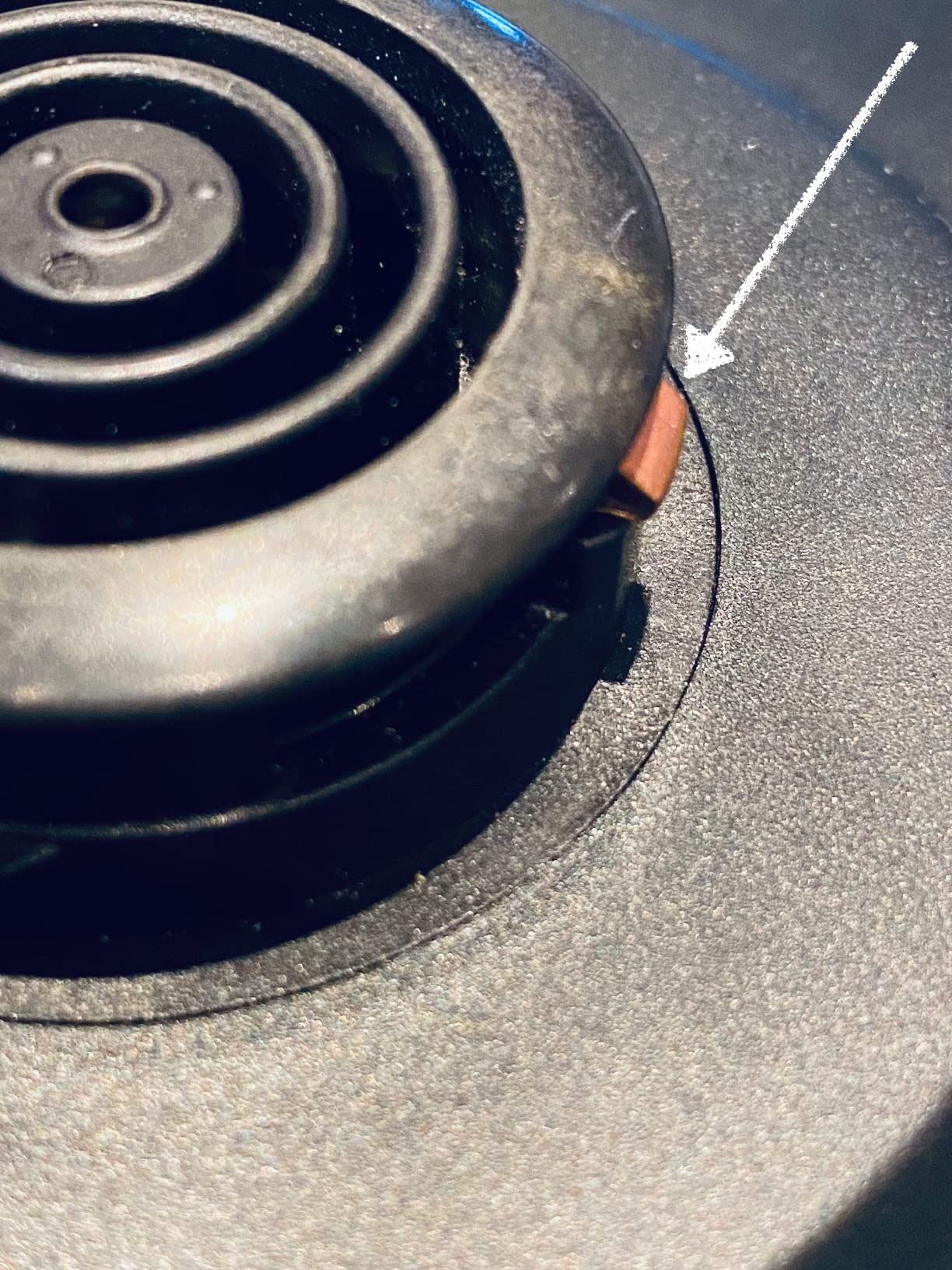
The 360-degree swivel base uses pin-and-ring contacts with an integrated temperature sensor in the base, which is one more connection to keep clean than a concealed element design but is standard across this category.
Who Should Skip This One
Skip it if you brew back-to-back cups and speed matters. The 1200W element cycles on and off, so it heats more slowly than the 1500W kettles in this list, and the 200F coffee and 212F black tea targets are not among the six factory presets.
Skip it if you mind the plastic LCD screen, which owners repeatedly describe as feeling inexpensive for the outlay. It works, but it is the least convincing part of the kettle.
4. intasting 0.9L Gooseneck – Best for Fast Back-to-Back Brewing
INTASTING Gooseneck Electric Kettle with ±1℉ Temperature Control 0.9 Liter
0.9L,1500W,plus/minus 1F dial,2-hour hold,304 stainless
Pros
- 1500W element heats noticeably faster than 1200W kettles
- Hold stays engaged after you pour and reseat the kettle
- Dial-set temperature with no presets to cycle through
- Light 1.7 lb body available in a range of designer colors
Cons
- Capacitive tap controls give no tactile confirmation
- No presets
- so big temperature jumps mean many taps
- Slim 9mm neck limits flow for large Chemex or Kalita batches
- Handle plastic has a slightly loose seam
The intasting has one of the fastest elements in this group at 1500W. It is also the only one here with a two-hour hold that stays engaged when you put the kettle back on the base, which changes how you brew when you are making several cups in a row.
Instead of presets, temperature is set on a dial. That is a genuine advantage for pour over, because the useful targets are roast-specific values like 200F or 205F, not five tea categories, and a dial reaches them in a single turn.
The two-hour hold and the persistent hold state are what make this the pick for back-to-back brewing. Fill, bloom, pour, refill the kettle, and it climbs straight back to setpoint while you are still rinsing the brewer.
Why the 1500W Element Matters
A faster element is not cosmetic. On a repeat brew, the difference between waiting and not waiting is the difference between a pour at temperature and a pour at 190F because the water was not quite back up yet. Owners consistently single out the heating speed as the reason they kept this kettle after trying cheaper alternatives.
At 1.7 lb it is the lightest body in the group alongside the unweighted base designs, so pouring speed does not cost you the wrist stability a heavier full kettle can.
The Dial Interface and Its Weakness
A one-touch Fahrenheit and Celsius toggle means the display is readable for US buyers, and the temperature probe sits inside the 304 stainless body with no plastic touching the water.
The weakness is the interface. The capacitive controls respond to a light tap with no tactile confirmation, so you cannot tell by feel whether a press registered. Combined with the absence of presets, a large temperature jump means repeated taps, and the lightest touch style is the opposite of what most people want while pouring.
Who Should Skip This One
Skip it if you brew large batches. The 9mm neck is optimized for a thin stream, and owners filling a big Chemex or Kalita report the flow is too slow for their taste. If your brewer holds more than about three cups, look at a wider spout.
Skip it if the handle quality bothers you. The plastic handle has a slightly loose, joinable seam, and the branding across the packaging and manual is inconsistent, which makes support harder to navigate than it should be.
5. Mecity 0.8L LCD Kettle – Best Temperature Readout
Mecity Electric Gooseneck Kettle With Keep Warm Function & LCD Display Automatic Shut Off Coffee Kettle Temperature Control Pour Over Kettle 1200 Watt, 0.8L, 120V, Off White
0.8L,1200W,100-212F,2.0-inch LCD,brew timer,12-month warranty
Pros
- Setpoint is remembered between sessions and after lifting the kettle
- Readable 2.0-inch LCD shows live and set temperature together
- Verified within one degree of a lab thermometer on boil and hold
- Tapered spout width owners like for slow V60 pours
Cons
- Full power-down needs a 3-second long press
- Spot-welded handle can detach
- Slower than cheaper insulated kettles at roughly 9 minutes to 205F
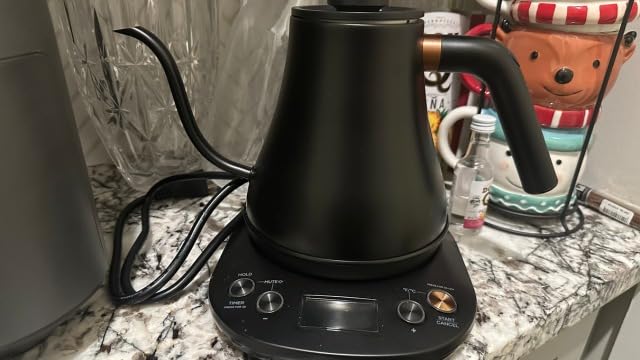
The Mecity is the kettle to buy if you are the type who distrusts a kettle without proof. The 2.0-inch LCD shows the live temperature, the set temperature, hold time, heating status and a stopwatch at the same time, and one owner verified it within one degree of a lab thermometer on both heating and hold.
It also remembers your last setting. The base-mounted controls keep your setpoint between sessions and after you lift the kettle, which quietly removes the most common cause of a bad pour, dialling in a temperature you did not mean to use.
Its weaknesses are real and worth stating plainly. It is among the slower heaters here, with one owner measuring roughly nine minutes to 205F, and switching the unit fully off takes a three-second long press that most people discover by accident.
Why the Display Matters More Than You Think
A pour over goes wrong in seconds. A spiral pour that starts at 198F and ends at 190F extracts unevenly, and a display that shows both numbers is the only way to catch it happening.
The LCD also handles the small things well: mute mode for prompt tones, and a cord that wraps into the base so the counter stays clear. That last point is more valuable than it sounds if your kettle lives next to a grinder.
Build, Handle and the Sensor Question
The body is BPA-free food-grade 304 stainless with an insulated, heat-resistant handle and lid, and anti-dry protection plus automatic shutoff. Heating is quiet and most owners report no leaks at all.
There is a documented cluster of temperature-sensor failures around the six-month mark, and owners also report a spot-welded handle that can detach. The seller resolved the sensor failures with fast replacements, and the twelve-month warranty is among the shorter terms here, so this is a kettle you maintain rather than one you forget about.
Who Should Skip This One
Skip it if heat-up time is your priority. Nine minutes to 205F will change how you brew, particularly on a second cup.
Skip it if you want a physical confirmation that the kettle is fully powered down. A quick tap can leave the element engaged on an empty kettle, which is a safety habit you should not have to think about.
6. OXO Brew Pour Over Gooseneck – Best for Large Batches
OXO Brew Pour Over Gooseneck Electric Kettle – Stainless Steel
1L,1500W,104-212F dial,30-minute hold,brew timer,2-year warranty
Pros
- Dial control matched an independent thermometer within a degree
- 1500W element brings 1L to boil in about 4:40
- Keep-warm re-engages automatically when lifted and reseated
- Integrated count-up timer doubles as a pour pacer
Cons
- 1L is small next to 1.7L competitors
- Pour rate runs fast so a slow stream takes practice
- Dial sits below the waterline where a gasket failure can reach electronics
- Spot-welded handle detached on a five-year unit
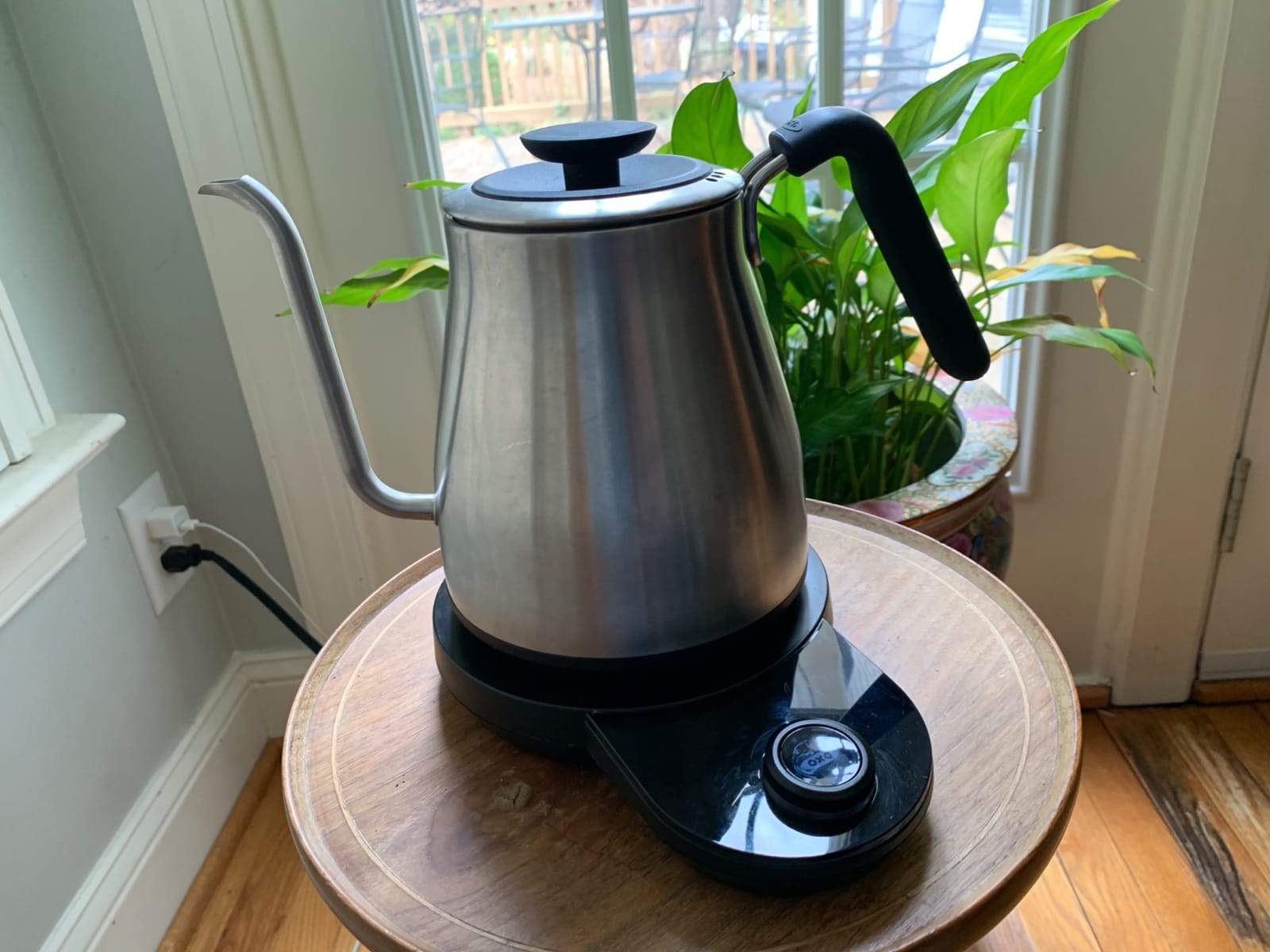
The OXO is the most physically substantial kettle in this group at 1.1 kg, and the weight is a feature. A full kettle of water is heavy enough that the counterbalanced handle keeps the spout steady, which is exactly what slow, high pour control needs.
Its interface is the simplest here: one dial and one button. The dial moves in one-degree steps from 104F to 212F with no presets to page through, and the automatic keep-warm re-engages on its own when you lift and reseat the kettle, so you never come back to a cold pot.
The 1500W element brings a full 1L from room temperature to boil in about four minutes and forty seconds, and reaches 205F from 76F in roughly three and a half minutes. Owners also report a counter-synced warranty service that replaced an entire kettle and base in under a week.
Pour Rate Is a Skill Here
This is a fast-pouring kettle. Getting a slow, thin stream takes practice and a deliberate tilt, and pouring a full kettle in one go will splash water out of the lid. If you brew large volumes quickly, that is a feature. If you like a careful low spiral, it is a learning curve.
The 1L capacity fills two generous cups, and at this heat-up speed you can refill during a pour rather than waiting.
The Dial Placement Is Worth Understanding
The temperature dial sits below the waterline. One owner lost a unit this way after thirteen months when a gasket failure let water into the electronics. That is a single reported case, but it explains why the kettle and base are warrantied as a pair and why you should keep the gasket clean.
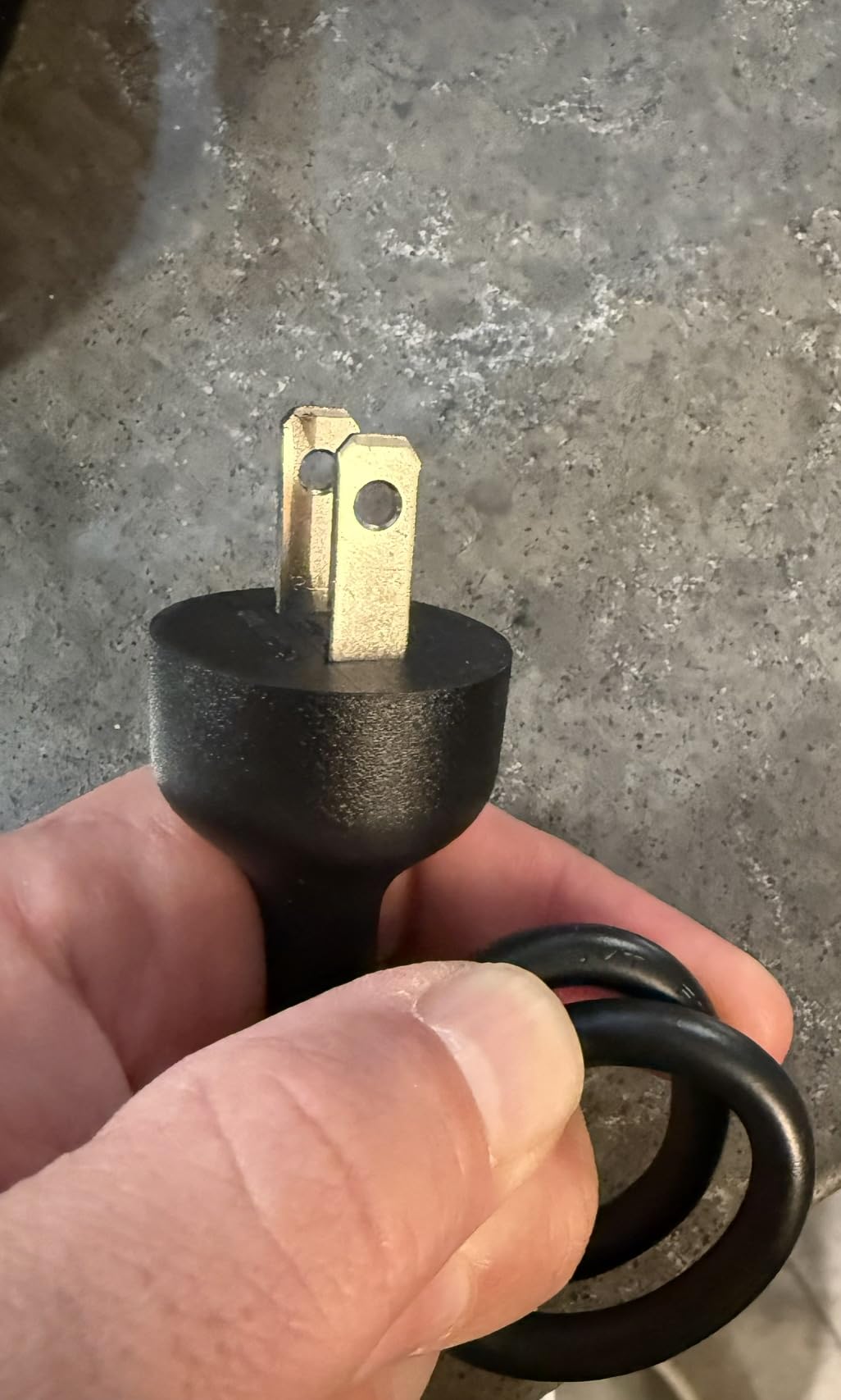
The round base has three cord-routing grooves, which is a small thoughtful detail in a category full of cables that only exit one way. The cable itself is stiff and awkward to route.
Who Should Skip This One
Skip it if capacity is your binding constraint. At 1L it will not serve a 1.7L brewer, and owners moving up from larger kettles wish for more.
Skip it if you want a slow pour without practice or if you are moving the kettle between rooms often, because 1.1 kg is a deliberate weight rather than an oversight.
7. Cocinare FLOW B9 – Best Finished Design
Cocinare FLOW B9 Gooseneck Electric Kettle ±1°F Temperature Control
0.9L,1500W,plus/minus 1F dial,9mm S-spout,60-minute hold
Pros
- 1500W element boils a full 0.9L in under 3 minutes
- 9mm S-shaped spout pours smoothly without dribbling
- Readable full-color display in a bright kitchen
- Compact base footprint in eight finishes
Cons
- Temperature sensor is sensitive to hard-water scale
- Maximum pour volume runs a little high for careful work
- Kettle does not sit flush on the base unless pushed down
- Capacitive controls have no tactile feedback
The FLOW B9 is the one we kept moving around the counter to look at. The matte finish resists fingerprints, the base footprint is small, and the 1.42-inch full-color display is among the most legible in this roundup.
It performs like a 1500W kettle should, boiling a full 0.9L in under three minutes in owners’ testing. The top-mounted dial adjusts in plus or minus 1F steps, the brew timer runs alongside the temperature readout, and the keep-warm holds for 60 minutes.
The recurring advice from owners is about water, not hardware: use filtered water or descale on a schedule, because scale on the sensor skews the reading before you notice anything else. Eighteen months of warranty is a reasonable term and shorter than the OXO and Bodum offer.
The 9mm S-Spout and What It Is Good For
The S-shaped 9mm spout is designed for a controlled spiral without splashing or dribbling, and the handle is balanced enough to make a slow pour easy when the kettle is full. That is the combination that matters most for a V60.
Its limitation is at the other end of the range: the maximum pour volume runs a little high for careful work, and the narrow neck is not the right tool for filling a large Chemex quickly.
Sizing, Base Fit and Display Controls
The kettle does not sit flush on the base unless you push it down or fill it, and the base itself is light enough that some read as cheap. Neither is a functional problem, but both are visible in person in a way the specifications do not convey.
The touch controls have no tactile feedback and can feel unstable over time, and one owner could not switch the base to Celsius as the listing suggests. If you are outside the US, that is worth confirming before you commit.
Who Should Skip This One
Skip it if you live in a hard-water area and do not want to descale. The temperature sensor degrades with scale first, and the accuracy claim is the reason to buy this kettle.
Skip it if you need a deep discount. This listing carries a smaller volume of owner feedback than the kettles above it, so you are buying a smaller sample of long-term experience.
8. Fellow Stagg EKG Pro – Best Pour Balance
Fellow Stagg EKG Pro Gooseneck Electric Kettle, Brew Timer, 0.9 Liter
0.9L,1200W,to-the-degree control,color LCD,brew timer
Pros
- Exceptionally well balanced for slow controlled pours
- High-resolution color screen shows temperature climbing in real time
- Hold returns the exact setpoint after you pour
- Wide kettle mouth is easy to clean by hand or brush
Cons
- Highest outlay in the group
- 0.9L is genuinely single-serve for pour over work
- One owner reports the base reverting to a random temperature
- Clock must be reset manually after a power outage
The Fellow is the best-made object in this roundup, and owners who own cheaper kettles say so directly. The counterbalanced spout and handle let you hold a genuinely slow stream for a long time without the tip drifting, which is the single hardest part of a controlled pour.
The high-resolution color screen shows the temperature climbing in real time rather than in steps, and the hold returns the exact setpoint after you pour, so the second pour of a V60 brew starts where the first one finished. The wide kettle mouth is the easiest in this group to clean by hand or with a brush.
Two things temper that. At 0.9L it is genuinely single-serve for pour over work, and it is the most expensive kettle here by a wide margin. On this listing, 287 owners have left feedback, which is a far smaller sample than most of the kettles ranked above it.
Build Quality and What You Are Paying For
The stainless body uses heat-resistant silicone with optional walnut handle and lid pull variants, and scheduling is available on this model. Owners describe the build quality as the best in the category, and the balance is genuinely different in the hand from the lighter kettles here.
What you are paying for is the counterweight and the fit of the parts. At this price, at least one owner felt the largely plastic touch points were not justified, which is a fair criticism of a kettle that costs several times a functional alternative.
Screen, Hold and Known Weak Spots
To-the-degree control on a color display is a genuinely nicer experience than a monochrome one, particularly when you are watching a 0.9L batch climb from cold. The 1200W element is on the slower side for that capacity.
There are two documented failure reports worth knowing: one owner saw the base revert to a random temperature after lifting and reseating, and another had the lid rubber seal detach with the temperature dropping below setpoint. After a power outage the clock needs a manual reset.
Who Should Skip This One
Skip it if you are new to pour over. You will not extract much from a 0.9L single-serve body that the Cosori does not do, and the balance advantage only matters once you can already pour steadily.
Skip it if you want a large-capacity brewer. Nothing else about this kettle compensates for the small tank, and at 0.9L you will refill mid-recipe.
How to Choose an Electric Kettle for Pour Over Coffee
Eight kettles, six genuinely different decisions. Here is what actually changes the cup in the dripper, ordered by how much it matters.
Temperature Precision and Range
Look for adjustment in one-degree steps somewhere between roughly 195F and 212F, which covers light through dark roast. Presets are convenient but they rarely land on the pour over targets; a dial or plus/minus control reaches 200F or 205F directly, which is why the OXO and the intasting both use one.
Accuracy matters more than range. A kettle that claims plus or minus 1F but holds a reading 4F off your probe is worse than one with a coarser dial that actually tracks a thermometer. The Bonavita and Mecity are the two here with published owner verification against a lab instrument.
Spout Geometry and Flow Rate
A gooseneck spout buys a narrow, directed stream. Too narrow and filling a Chemex takes a frustrating minute; too wide and you lose the control that made you buy one. The 9mm spouts on the intasting and Cocinare suit a V60 spiral, while the faster flow of the OXO suits larger batches.
Ask yourself what you are filling. A 300ml V60 wants a thin stream and a large Chemex wants volume. There is no kettle that does both as well as a dedicated one, and that is the single most common regret buyers report.
Working Fill Volume
Advertised capacity is not usable capacity. Count on losing roughly ten percent to the max line, and remember that a 0.8L kettle makes about two and a half mugs, not four. A 1L body covers a two-cup brew; a Chemex plus a second round wants more than any kettle in this roundup holds.
Wattage and Heat-Up Speed
Wattage is the most objective number here and it is the easiest to compare. A 1500W element reaches 205F noticeably faster than 1200W, which matters on second and third brews when the water is already at hold temperature. If you only ever brew one small cup a day, the difference disappears.
Check whether the heater cycles. A thermostat that cycles on and off to hold a temperature is quieter but slower, and that shows up as the slower figures we recorded for the 1200W kettles.
Hold Time
Thirty minutes covers most single brewers. Sixty minutes covers a second cup without reheating, and two hours covers a shift in an office. The detail that matters is whether the hold re-engages on its own when you lift the kettle and put it back, because a hold that resets every time costs you a full heat cycle each pour.
Materials and the Exposed Element Question
Prefer a concealed heating element with a stainless interior. Exposed elements are harder to descale and sit in the water, and for coffee water quality is not a trivial detail. Every kettle in this roundup has a stainless water path, which is the entry bar worth holding.
Most gooseneck kettles are 120V for US outlets. Check your region before ordering, and treat any listing with no voltage specification as a reason to ask rather than to guess.
Warranty, Durability and the Price Objection
Two years is the practical bar. The Bodum and OXO carry two-year limited warranties, the Cosori pairs a one-year term with an optional two-year registration, the intasting and Cocinare carry eighteen months, the Mecity carries twelve, and the Bonavita and Fellow do not publish a term on their listings.
This is where the loudest buyer objection lives. Forum regulars on r/pourover repeatedly ask whether a premium kettle’s build justifies its cost, and the fair answer is that the counterbalanced handle and the fit of the moving parts are what you feel daily. If you will not notice the difference, buy the one with the longer warranty.
App Connectivity Versus Physical Controls
For this category, we would skip the app. The scheduling and Bluetooth features on the top of the range add an account and a phone dependency in exchange for controls you use twice a day, and buyers in the forums consistently prefer a dial or a tap. A physical control that fails is a nuisance; a feature behind a login is a dead end.
Water Temperature by Roast Level for Pour Over
Roast level sets the starting temperature, and a variable kettle lets you move it. These are the targets we start from, with the Celsius equivalent for anyone outside the US.
- Light roast – 200-205F, roughly 93-96C. Hot water, short contact time, no bitterness to hide.
- Medium-light roast – 198-203F, roughly 92-95C. The most forgiving range in the table.
- Medium roast – 195-200F, roughly 90-93C. Where most recipes are written.
- Dark roast – 190-196F, roughly 88-91C. Lower and shorter extraction avoids harshness.
If a brew tastes thin and sour, you are under-extracting: raise the temperature a degree or two before you grind finer. If it tastes dry and bitter, you are over-extracting, and the temperature is the first dial to turn down.
We keep a kettle routine that resembles any other consistent habit: same temperature, same dose, same timing, so the only variable left is the coffee itself. Keeping the gear in one fixed spot with a fixed routine matters more than any single feature on the kettle.
Descaling, Limescale and Why Your Kettle Leaks From the Bottom
Mineral scale is the most common kettle problem and the least discussed. It slows heating, distorts temperature readings, and eventually attacks the seals. In hard-water areas it can appear in months.
How to Descale an Electric Kettle
Mix equal parts white vinegar and cold water until the kettle is half full. Bring it to a boil, switch it off, and let it stand for an hour. Empty it, scrub the interior with a soft brush or cloth, rinse twice with plain water, and boil once more before you refill it for coffee.
Run the cycle every two to three months in a hard-water area, and every six months in a soft one. If you use filtered water, the scale slows noticeably and the cycle can be longer still.
Scale is not a health hazard on its own. It is not pleasant to taste once it starts flaking off into a cup, and it will eventually distort the temperature sensor, which is the real reason to deal with it.
Four Reasons a Kettle Leaks From the Bottom, in Order
First, condensation. Steam escaping through the spout and lid collects under the kettle and pools around the base, which looks like a leak and is completely normal. Wipe the base after a boil and check again the next morning before you do anything else.
Second, an overfilled kettle. Water above the max line expands when it boils and pushes past the gasket. Fill below the line and this disappears.
Third, a failed seal. A hard base gasket that has stiffened or a lid seal that has come loose will weep under pressure, and both are replaceable parts. The OXO is worth knowing about here, because its temperature dial sits below the waterline and a gasket failure can reach the electronics rather than just leaking.
Fourth, a base contact problem on cheaper units, where the kettle does not seat properly. A flickering display or a base that drops out mid-heat is a contact issue, not a leak, and it is the fault line between a kettle that lasts and one that does not.
Automatic Shutoff and the Safety Habits Worth Keeping
Most kettles here include automatic shutoff, and the ones that specify it also carry boil-dry or anti-dry protection. The exception worth learning is the Mecity, which needs a three-second long press to power down fully, so make that part of your routine until you have learned it.
Automatic shutoff is not a substitute for watching the kettle on the first boil of a descaling cycle. Treat the hot surface warning literally, and pour with the spout away from your body because a full gooseneck kettle is a genuine amount of hot water.
Frequently Asked Questions
Is a pour over kettle worth it?
Yes, if you brew on a dripper such as a V60, Chemex or Kalita Wave. A gooseneck electric kettle gives you both a chosen water temperature and a narrow, directed pour that keeps the coffee bed evenly saturated. If you only use immersion brewers like a French press or AeroPress, or if you make one small cup at a time, a standard kettle works and the extra spend is better saved.
Can I make pour over coffee with a regular kettle?
You can. The coffee will brew. What you lose is temperature control and pour rate, which are the two variables that decide whether a filter brew extracts evenly. A regular kettle pours fast and narrow with no real control at the spout, so you are more likely to disturb the bed and channel water through it unevenly.
Is a gooseneck kettle better for pour over?
For filter brewing, yes. The long curved spout produces a thin, controlled stream and lets you pour from a height without flooding the bed, which is what causes channelling and uneven extraction. For tea or immersion brewing the shape offers little, since you are pouring volume rather than a directed stream.
What is the best electric gooseneck kettle for pour over coffee?
The Cosori Gooseneck is the best overall pick: 0.8L, a 1200W element, five one-touch presets up to 205F, a 60-minute keep-warm that holds within about 5F and a fully 304 stainless water path. The OXO is the pick for large batches, the Bonavita for a 1L body and long service life, and the Fellow for the best counterbalanced pour.
Why is my electric kettle leaking from the bottom?
Work through four causes in order. Condensation pooling under the base after boiling is normal and needs no repair. Water filled above the max line expands and pushes past the gasket. A stiffened base gasket or a detached lid seal will weep under pressure and both are replaceable. Finally, a kettle that does not seat properly on its base causes flicker or dropouts rather than leaking, and that is a contact fault.
Is it safe to drink from a kettle with limescale?
Limescale itself is not a health hazard, but flakes in a cup are unpleasant and the scale will eventually distort the temperature sensor, which is what makes a variable-temperature kettle inaccurate. Descale with equal parts white vinegar and water, bring to a boil, stand for an hour, scrub, rinse twice and boil once more before brewing.
Do electric kettles have an exposed heating element?
Some do, and for coffee you should avoid them. A concealed element in a stainless interior keeps the heating surface out of the water, is easier to descale and does not collect scale where you cannot see it. Every kettle in this roundup has a fully stainless water path with no plastic in contact with the water, which is the entry bar worth holding.
What is the average lifespan of an electric kettle?
It depends more on build quality and water than on the brand. Owners of the Bonavita report five to eight years of daily use, and the Cosori has some two to three year durability complaints around the finish and the spout bend. In hard-water areas, descaling on schedule is the single biggest factor in how long a kettle lasts.
Which Electric Kettle for Pour Over Should You Buy?
Start here. The Cosori Gooseneck is the best electric kettle for pour over coffee in 2026: five presets that reach 205F, a 60-minute hold, a stainless water path and the widest base of owner feedback in the category. If you only ever brew a V60 or a small Chemex, that is the kettle to buy and the rest of the list is a refinement.
Choose the OXO Brew Pour Over if you brew two cups or more at a time and want the fastest path to temperature with a dial you can set by feel. Choose the intasting 0.9L if you brew back-to-back and want the hold to re-engage on its own. Choose the Bonavita 1L if you want a large body and the longest service life owners report. Choose the Mecity if you need to see the live and set temperature side by side.
Buy the Bodum Bistro if you want a clean pour and a two-year warranty without spending on electronics you will not use. Buy the Cocinare FLOW B9 if you want the best-looking object on the counter and will descale it. Choose the Fellow Stagg EKG Pro only if you already pour steadily and want the best counterbalance in the category.
Whichever you pick, use filtered water where you can or descale on a schedule. It is the one habit that protects your temperature accuracy and your warranty at the same time.
One last thing before you set the kettle down permanently. If your counter space is tight enough that you are also weighing compact gear for commuting and small rooms, we covered that separately in our electric scooter picks. Once the kettle has its spot, the only thing left is to set your roast temperature, dial it in, and stop thinking about it.