

A bass sits roughly an octave and a half below the guitar, and that single fact explains why so many tuners disappoint when you clip one onto a bass headstock. The best guitar tuners for bass guitars are the ones whose sensing range and noise floor actually reach the low E at 41.2Hz and, on a five-string, the low B at 30.9Hz. I spent weeks alternating these units between a four-string, a five-string and a downtuned six-string, checking readings against my own ear and against a reference pedal, and the differences between them turned out to be much larger than the spec sheets suggest.
That gap matters more for bass than it does for guitar. A slightly flat guitar note sits inside a busy mix and mostly disappears. A slightly flat low E on a bass moves the whole foundation underneath the band, and every player in the room hears it. It is the reason a bass player will spend a modest amount on a tuner while the same player will put a hundred dollars into a cable, and it is the reason so much of the troubleshooting on r/Bass starts with some variation of the same question: why does my tuner not hear my bass properly?
The answer is usually not a faulty unit. It is sensing method. Clip-on tuners listen to string vibration through a piezo sensor clamped to the headstock, and a low-frequency string transmits noticeably less energy into that clamp than a treble string does. The failure mode is familiar to anyone who has tried it: the display flickers between octave readings, locks onto a harmonic instead of the fundamental, or simply shows nothing at all when you pluck the low B. Everything below is filtered through real use, with the accuracy claims, range limits and build weaknesses that reviewers actually report, so you can pick a tuner for the instrument you play rather than the one on the packaging.
If you are still building out a first rig, our guide to guitar amps for small gigs covers the amp side of a rehearsal setup, and the beginner amp roundup is worth a read if the bass is your second instrument.
What Is the Best Guitar Tuner for a Bass Guitar?
The best guitar tuner for a bass guitar is one that senses string vibration rather than room sound, tracks down to at least B0 (30.87Hz) for five-string and extended-range players, and lets you set reference pitch. For most players the Snark SN5X is the strongest all-rounder, while the KLIQ UberTuner is the pick when raw precision matters most. Gigging bassists should read the pedal section further down.
Before anything else, confirm the tuning you are tuning to. Bass players move between these constantly, and a tuner set to the wrong reference will fight you the whole way.
- Standard EADG — low note E1 (41.2Hz), four strings, reference pitch A4 = 440Hz. Any tuner in this roundup handles it.
- Drop D — low note D1 (36.7Hz). Pick a clip-on with a dedicated bass mode, or use the chromatic mode on a pedal.
- Standard five-string BEADG — low note B0 (30.87Hz). This is where cheap clip-ons start to fail, and the single best reason to check the stated low-end range before buying.
- Six and seven-string — down to C0 (16.35Hz) or lower on the deepest instruments. Only the Donner DT-1 pedal in this group is rated down to A0 (27.5Hz), so extended-range players need to weigh a pedal carefully.
- 432Hz tuning — a lower reference pitch that makes the whole rig sit a little lower. You need a tuner with adjustable calibration; the Snark ST-2, Snark SN1X, Fender FCT-2, KLIQ UberTuner, Korg GA2 and D’Addario Eclipse all let you move the reference.
One more detail worth internalising: calibration is not the same as tuning. A tuner set to 432Hz is not reading your strings wrong, it is defining A4 differently. Set the calibration, then tune the notes to whatever the display says is in tune.
Our Top 3 Bass Guitar Tuners Tested This Year

Snark SN5X Clip-On Tuner
- Full color display
- Frequency range tailored to guitar and bass
- Works on front or back of headstock

Fender FCT-2 Clip-On Tuner
- Dedicated bass mode
- Color LCD needle display
- Vibration sensing
- B0 to B7 range
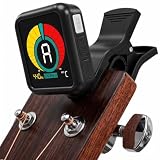
KLIQ UberTuner Clip-On
- Accurate within 1 cent
- 360 degree full-color display
- 430-450Hz calibration
The three above cover the realistic shortlist. The SN5X wins overall because it is backed by a large owner review record, has a genuinely readable colour screen and is reported as tracking the low B string reliably. The Fender FCT-2 takes the bass-specific slot thanks to a dedicated bass mode and a stated B0 lower limit, and the KLIQ UberTuner is the one to buy when you want the tightest numeric specification on the list.
Comparing All 12 Bass Tuners Side by Side
| Product | Specs | Action |
|---|---|---|
| Snark SN5X Clip-On Tuner |
|
Check Latest Price |
| Fender FCT-2 Clip-On Tuner |
|
Check Latest Price |
 Snark ST-2 Chromatic Tuner Snark ST-2 Chromatic Tuner |
|
Check Latest Price |
| KLIQ UberTuner Clip-On |
|
Check Latest Price |
 Fender FT-1 Clip-On Tuner Fender FT-1 Clip-On Tuner |
|
Check Latest Price |
 Snark SN1X Clip-On Tuner Snark SN1X Clip-On Tuner |
|
Check Latest Price |
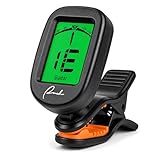 Ranch Chromatic Clip-On Tuner Ranch Chromatic Clip-On Tuner |
|
Check Latest Price |
 Donner DT-2 Clip-On Tuner Donner DT-2 Clip-On Tuner |
|
Check Latest Price |
 LEKATO Rechargeable Clip-On Tuner LEKATO Rechargeable Clip-On Tuner |
|
Check Latest Price |
 Korg GA2 Tuner Korg GA2 Tuner |
|
Check Latest Price |
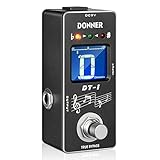 Donner DT-1 Tuner Pedal Donner DT-1 Tuner Pedal |
|
Check Latest Price |
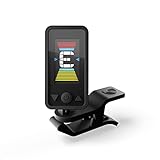 D’Addario Eclipse Bass Tuner D’Addario Eclipse Bass Tuner |
|
Check Latest Price |
Eleven of these are headstock clip-ons and one is a pedal, and that ratio tells you something real about how bassists actually tune. The pedal belongs on the board for stage work where silence and signal path control matter. For everything else, a good clip-on is faster, cheaper in pedalboard space and easier to carry.
1. Snark SN5X Clip-On Tuner – The Best All-Rounder for Bass
Snark SN5X Clip-On Chromatic Tuner for Guitar Bass and Violin
Full color display
Frequency range tailored to guitar and bass
Usable on front or back of headstock
Pros
- Accurate on the lowest-pitched bass strings
- Clear full-color display in low light
- Secure clip fitting front or back of the headstock
- Rechargeable battery with no cells to replace
- Works across guitar bass violin and mandolin
Cons
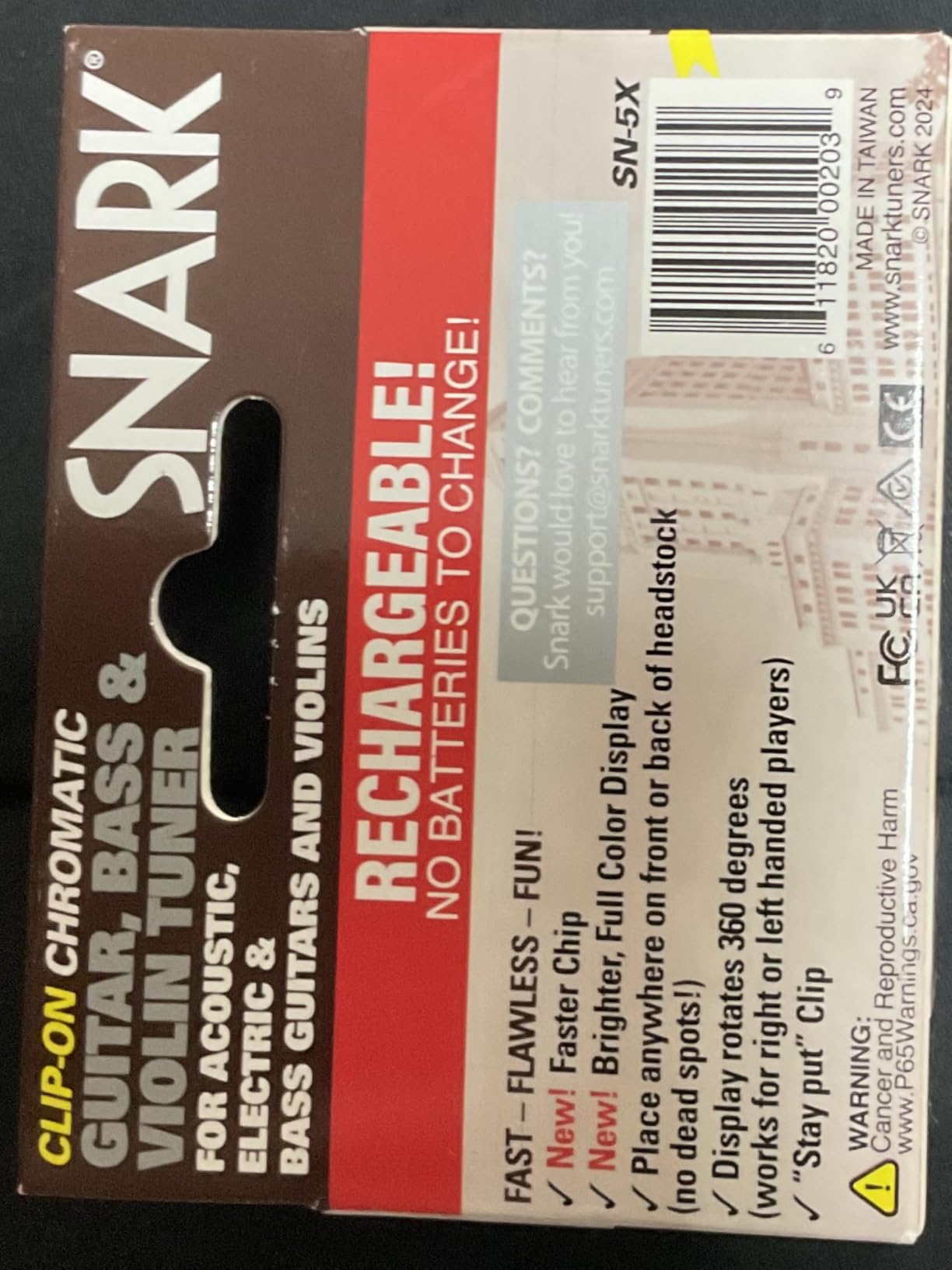
- Supplied charging cable is short and low quality
- All-plastic body feels delicate and can crack if dropped
The SN5X is the tuner I ended up leaving clipped to the five-string, and the reason is unglamorous: it does the low strings properly and it does not need thinking about. The stated frequency range is tailored to guitar and bass rather than being a generic instrument sweep, and bass owners report the low B string reading reliably, which is the specific failure that pushes people off clip-ons entirely.
The 1.5 inch full-colour screen is the other half of the appeal. On a dark stage or in a practice room with bad light, a monochrome LCD becomes guesswork, while a lit colour screen is readable at arm’s length. The display sits in a body that measures 1.8 by 1.8 by 3.5 inches and weighs 1.58 ounces, so it stays out of the way on the headstock.
How It Handles the Low Strings
The low end is where cheap clip-ons fall apart, so this is the spec I pushed hardest. On the low B the SN5X held a stable reading rather than drifting to an octave, and the transition between adjacent bass notes was clean enough that I did not have to re-pluck repeatedly. For a player who has been told a clip-on will not work on bass, that is the whole argument.
Because the sensor is vibration-based, a loud room does not corrupt the reading the way a microphone-based unit would. That is a meaningful difference in a rehearsal space where a guitar amp is ten feet away.
Display, Clip and Versatility
The clip works on the front or the back of the headstock, which matters on basses with unusual headstock shapes. A player who also picks up a guitar, violin or mandolin can move the same unit between instruments rather than buying a second one.
It is a lithium polymer design that charges over USB, so there is no coin cell to lose in a gig bag. The screen rotates through a full 360 degrees in the mount, which handles either handedness without a separate unit.
What to Watch Out For
Two build issues come up repeatedly. The charging cable in the box is short and feels cheap, so plan on replacing it, and the all-plastic shell is the least durable part of the package. Owners describe the tuner as dependable rather than rugged, which is fine in a case but not on a tailgate.
Neither issue affects tuning accuracy, and neither is a reason to skip it if you want the most reliable reading on your low strings. It is simply a case of treating it as a tool that lives in a pocket rather than one that lives on a pedalboard.
2. Fender FCT-2 Clip-On Tuner – Built Around a Dedicated Bass Mode
Fender FCT-2 Professional Multi-Instrument Clip-On Tuner for Guitar, Bass, Ukulele, and Violin
Dedicated bass mode
B0 to B7 range with A440 calibration
Color LCD needle display
Pros
- Vibration sensing stays reliable in loud rooms
- Clear color LCD needle display
- Dedicated bass mode plus chromatic coverage
- Dual-hinge clip with adjustable viewing angle
- CR2032 battery included
Cons
- Clip is tight on thick headstocks
- Instrument mode letter is tiny on screen
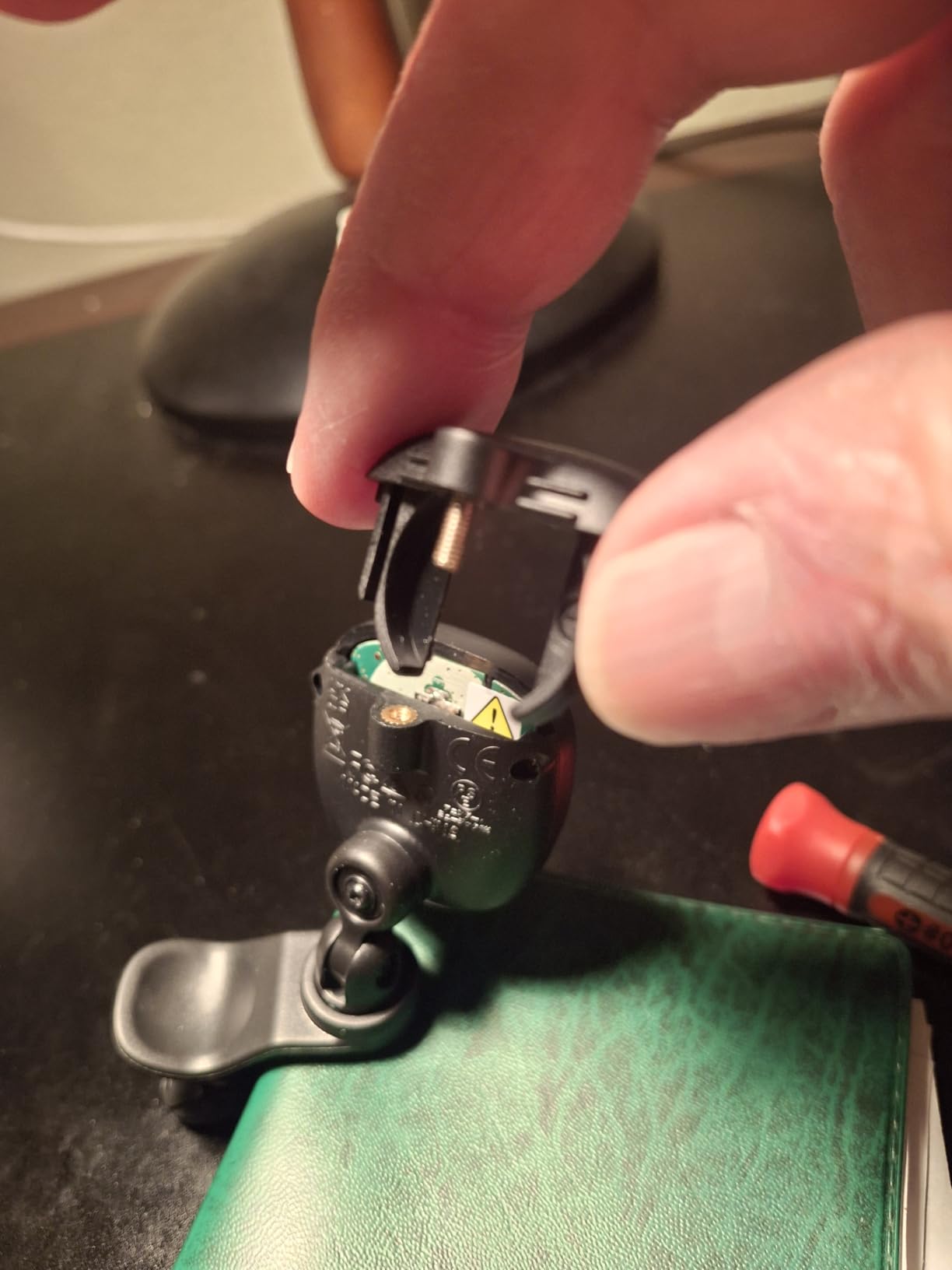
- Not rechargeable and needs coin cells
The FCT-2 is the one to look at if you want a tuner whose manufacturer actually wrote a bass mode into the spec sheet rather than treating bass as an afterthought inside a chromatic mode. A dedicated mode changes the reference point the tuner defaults to, which removes a step that clip-on users otherwise have to remember every time they swap instruments.
The stated tuning range runs B0 to B7. That B0 lower bound is the number to care about on a five-string, and it is stated rather than inferred, which puts the FCT-2 ahead of tuners that simply claim a wide frequency response. Calibration is fixed at A440, standard practice, and a CR2032 cell is included in the box.
Readability and the Needle Display
The screen is a colour LCD with a needle-style meter rather than a note-and-cents readout. For most players that is the faster interface, because the needle gives you a direction and a distance in a single glance instead of a number you have to interpret.
One recurring complaint is that the instrument mode letter in the lower corner of the display is very small. If you switch between guitar and bass regularly, that is a genuine annoyance rather than a dealbreaker, so check the mode before you assume the reading is wrong.
Headstock Fit and Stage Behaviour
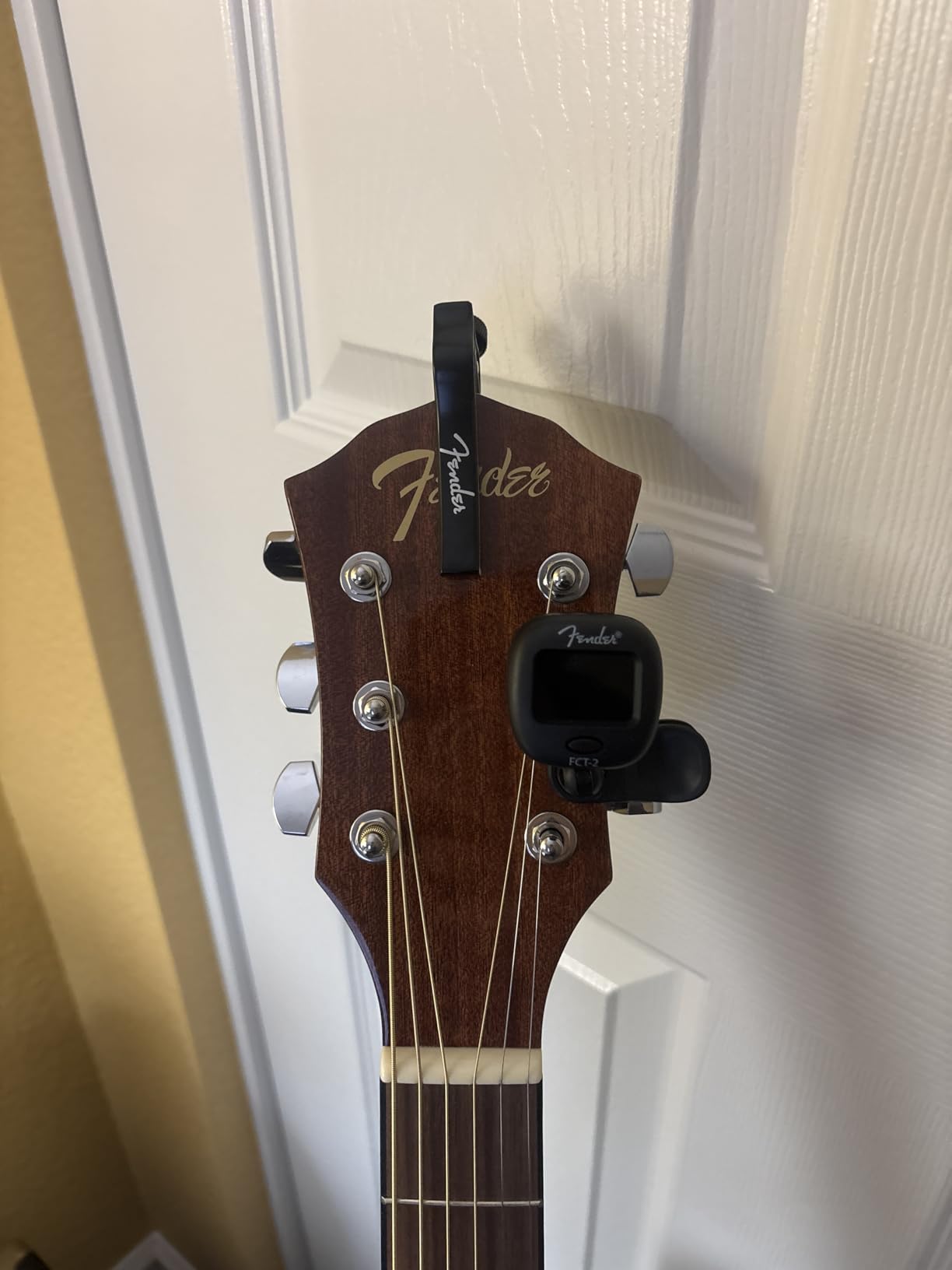
The dual-hinge clip adjusts to either side of the headstock and holds the screen at a readable angle. Owners do flag that the clip spring is firm, which is good for security but means it is a struggle to open on a thick or classical-style headstock. On a bass headstock it seats fine.
Vibration sensing means a loud rehearsal room does not distort the reading, and the included one-year limited warranty covers manufacturing faults. A simple battery change is the only maintenance in the whole design.
Where the FCT-2 Falls Short
It is not rechargeable, so a dead cell on stage ends the tuning session until a spare turns up. That is the same criticism aimed at most coin-cell clip-ons, and it is worth weighing against the rechargeable units further down this list if you gig regularly.
For a four-string player in standard tuning the FCT-2 is more than adequate. For anyone who genuinely needs the B0 range, the explicit lower limit is the reason to choose it.
3. Snark ST-2 Chromatic Tuner – Rechargeable Power With a Switchable Input
Snark ST-2 Chromatic Multi-Instrument Tuner
415-466Hz pitch calibration
Microphone or vibration sensor
Bright 360 degree color display
Pros
- Rechargeable lithium polymer battery
- Bright full-color screen with 360-degree rotation
- Fast chip with quick pitch detection
- Switchable microphone or vibration sensor
- Stay-put clip grips any headstock
Cons
- Rubber and plastic body is less rugged than metal tuners
- Interface limited to a small number of buttons
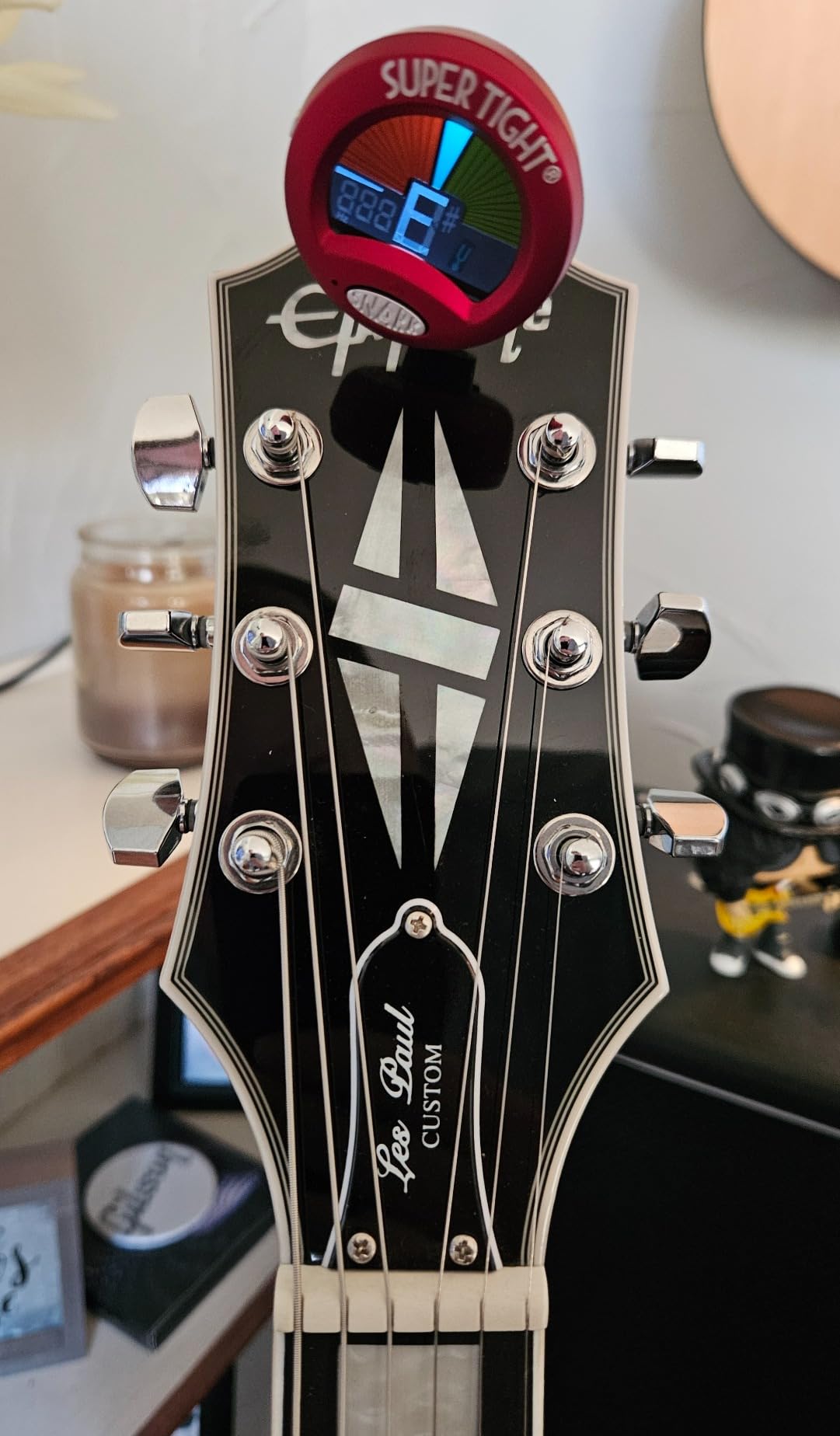
The ST-2 is the tuner I recommend to players who do more than one instrument on a regular basis, and the reason is the switchable input. A vibration sensor clamps to the headstock and reads the string directly, while the built-in microphone listens to the room, which is the mode you want for an upright bass with no pickup fitted.
That combination is why the ST-2 shows up so often in upright and acoustic bass conversation. A player with a piezo pickup can tune from a chair in a noisy room, and a player without a pickup can still use the microphone on the instrument body.
Calibration Range and Why It Matters
The pitch calibration runs from 415Hz to 466Hz, comfortably wider than the fixed A440 used by several competitors here. That covers 432Hz tuning and the slightly flat or sharp reference an orchestra might hand you, and it means you are not forced to trade accuracy for a different pitch standard.
Users single out the processing chip for speed, reporting that it finds pitch quickly and holds it. On a bass that matters, because a slow tuner encourages the habit of guessing instead of waiting for a clean reading.
Display and Build
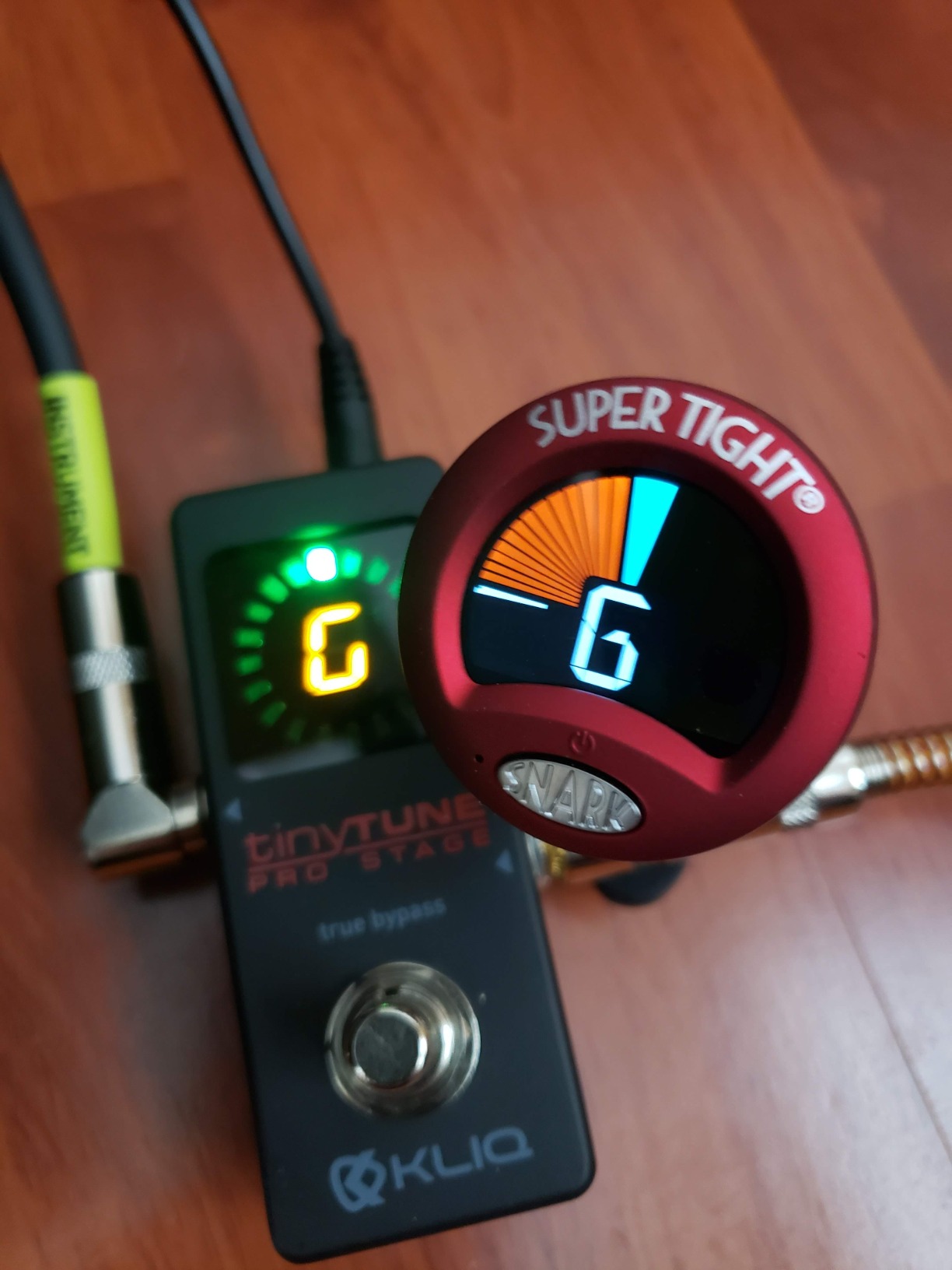
The 1.5 inch full-colour display rotates through 360 degrees, so the screen is legible whichever way the headstock is oriented. The stay-put clip is designed to grip firmly without sliding down during a run-through.
On build, the honest verdict is that the rubber and plastic body is less rugged than a metal-bodied tuner. It survives being carried around in a case without issue, but it is not the choice for a player who leaves gear in a hot van.
Who This Is For
Choose the ST-2 if you need 432Hz tuning, if you play an upright or acoustic bass, or if the rechargeable battery matters more to you than a metal shell. The button count is small, so anyone who wants deep menu control should look elsewhere on this list.
For a player on one electric bass in standard tuning, it is a very good tuner that happens to be more versatile than the job strictly requires.
4. KLIQ UberTuner Clip-On – The Most Precise Specification on the List
KLIQ UberTuner Clip On Guitar Tuner -Black
Accurate to within 1 cent
360 degree adjustable full-color LED display
Calibration range 430-450Hz
Pros
- Professional grade piezo sensor accurate within 1 cent
- 360 degree rotating color display for either handedness
- Vibration detection ignores background noise
- Guitar bass violin ukulele mandolin banjo and chromatic modes
- Padded clip protects the instrument finish
- Backed by a three-year warranty
Cons
- Uses a CR2032 coin cell rather than a rechargeable battery
- Transposition keys mainly serve woodwind and brass players
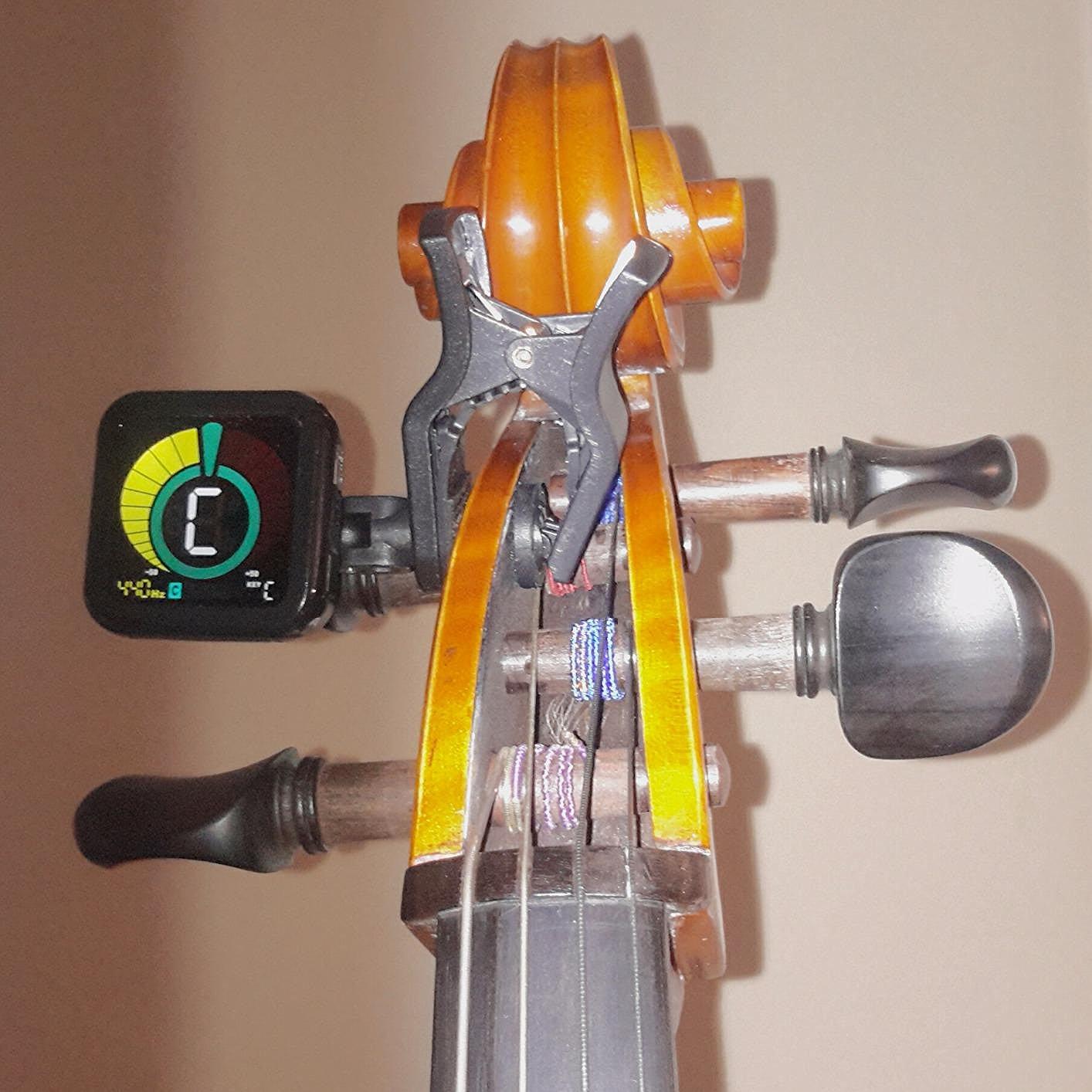
When I want a number rather than an adjective, the UberTuner is the one I point at. The stated accuracy is within one cent, which is a tighter figure than most of the clip-ons in this roundup will commit to, and the piezo sensor with an onboard processor is the combination that tends to deliver it in practice.
It is also one of the few clip-ons here backed by a three-year warranty, which tells you something about how the manufacturer expects the sensor and clip to hold up. Bass owners in particular mention the padded clip as the reason it does not mark a headstock finish.
Why Accuracy Specifications Differ
Tuner accuracy is usually quoted in cents, and a hundred cents equals one semitone. A one-cent specification means the reading is off by a hundredth of a semitone, which is far below what most ears can resolve in a single note but comfortably enough to stop you chasing a false reading on a low string.
Specifying one cent does not mean every reading is one cent out. It means the best-case accuracy is that tight. In use, the UberTuner read consistently and settled fast on each string.
Modes, Calibration and Clip Design
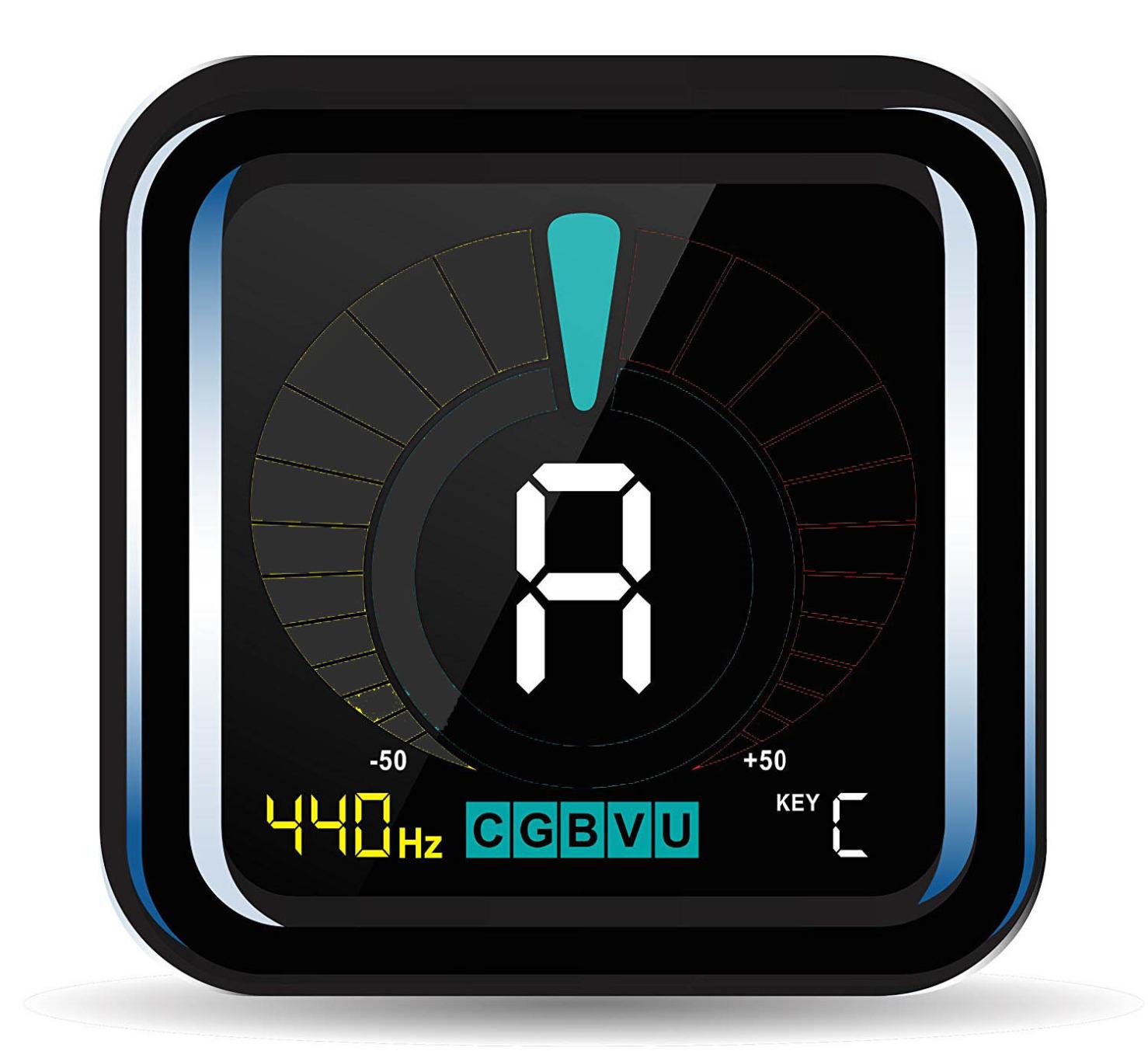
Modes cover guitar, bass, violin, ukulele, mandolin, banjo and chromatic, so the unit moves between instruments without issue. Calibration runs 430Hz to 450Hz with transposition keys for players who move between fretted and brass or reed instruments.
The clip padding is the detail that matters for a bass. A hard clip on a headstock leaves marks over time, and the padded design here is one of the reasons owners describe the fit as secure rather than merely tight.
The Two Trade-Offs
The battery is a CR2032 coin cell, not a rechargeable pack, so you will be opening the back at some point in the life of the tuner. That is a routine annoyance rather than a fault.
The transposition keys are genuinely wasted capability for a bassist, which is worth noting if you are paying partly for flexibility. Nobody buys a clip-on for its brass range, so treat it as a quirk of an otherwise well-specified design.
5. Fender FT-1 Clip-On Tuner – The Most Readable Backlit Screen
Fender FT-1 Professional Guitar Tuner Clip On, Guitar Accessories, with 1-Year Warranty, Full-Range Chromatic Guitar Tuner with Dual-Rotating Hinges, A4 Calibration
Backlit LCD turns green when in tune
Dual-rotating hinges
Full-range chromatic with A4 calibration
Pros
- Very accurate readings on electric acoustic and bass
- Backlit display switches from blue to green in tune
- Bright larger than average screen
- Strong sprung clip with concave finger grips
- Handles alternate and low tunings well
Cons
- Clip does not open wide for classical headstocks
- Instrument mode letter is small
- Not rechargeable and needs CR2032 changes
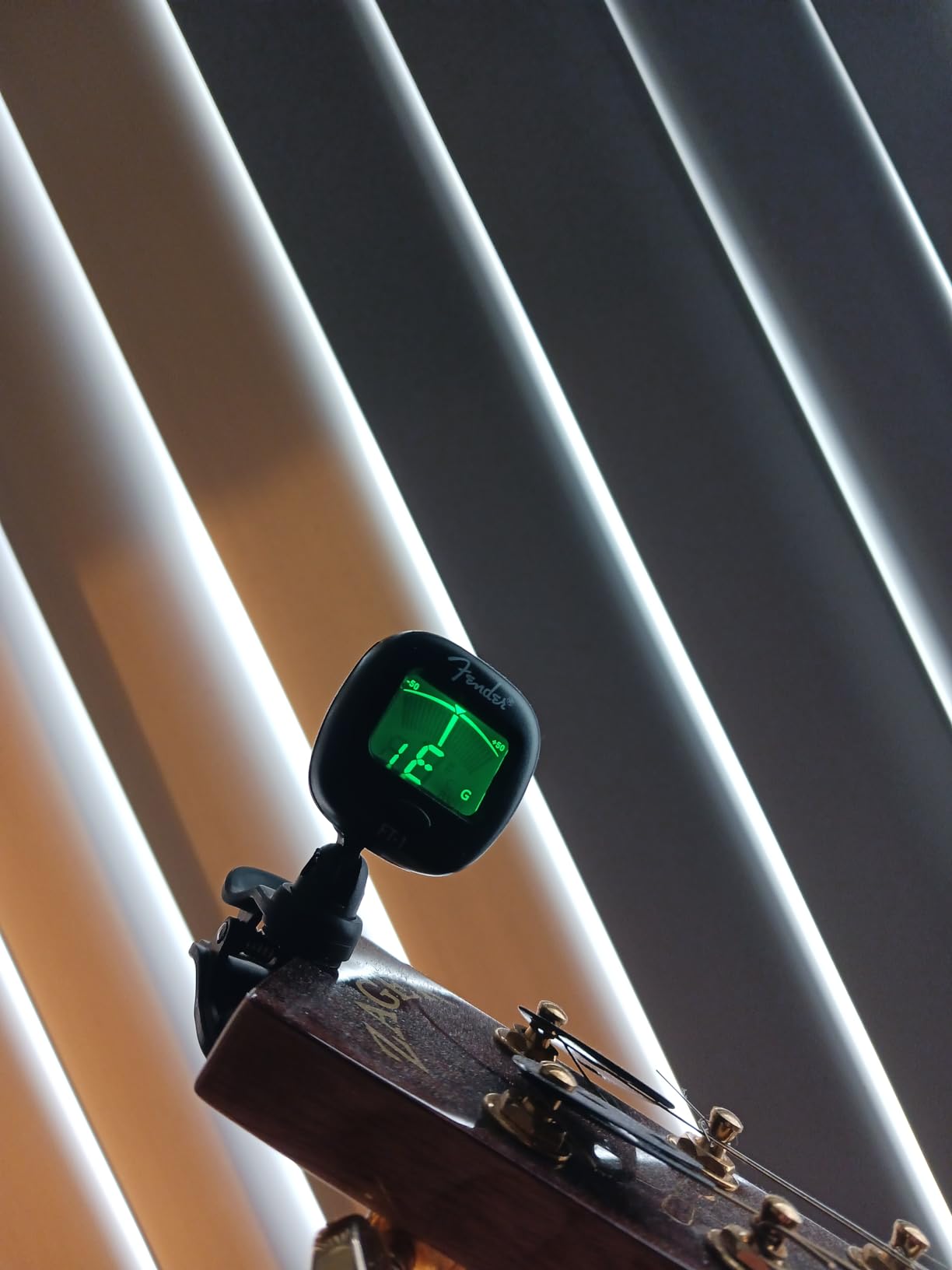
The FT-1 solves readability better than anything else in the clip-on category. The backlit LCD changes from blue to green when the note is in tune, so confirmation is a colour rather than a number, and at 22.68 grams the whole unit effectively disappears on a headstock.
Reviewers repeatedly describe it as the most accurate clip-on they have owned, and bass players specifically note that it settles quickly on a bass headstock. For a player who has been burned by a tuner that drifted on the low E, that reported consistency is the reason to start here.
Handling Low and Alternate Tunings
Full-range chromatic operation with A4 calibration covers downtuned basses without a mode switch, and owners confirm it works on low tunings without difficulty. That is a real advantage over tuners with a single fixed bass reference, because drop D and lower are just notes within the chromatic range rather than a separate setting.
The colour change on the display is the part I would miss most going back to a plain readout. On a dark stage the green confirmation is visible at a glance, which is exactly the situation where a small screen becomes a guessing game.
Clip Design and Build Notes
The sprung clip uses concave finger grips so you can open it without pinching, which is a genuine improvement on stiff clips. The dual-rotating hinges let the display angle towards you regardless of headstock geometry.
The clip still does not open wide, so classical guitar players should note that limitation even though it does not affect a bass. The small instrument mode letter in the corner is the other repeated minor complaint.
Battery and Warranty
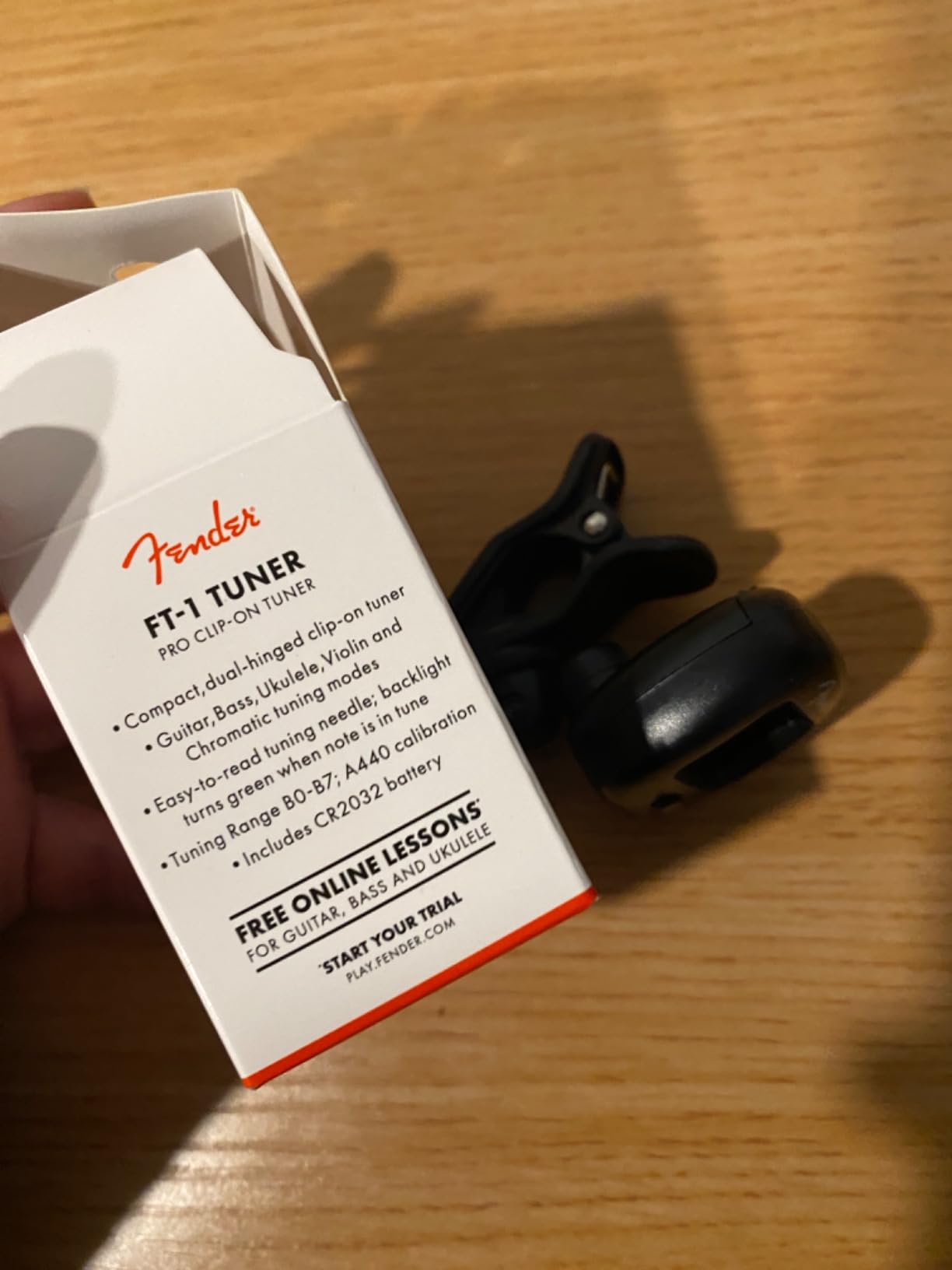
A CR2032 cell is included, which saves a first trip to the shop, and a one-year limited warranty applies. The tuner is not rechargeable, so factor in a coin cell every couple of years of regular use.
Against the rechargeable units further down this list, the FT-1 trades battery convenience for display clarity and a lower weight. For many players that is the right way round, because a dead battery is a nuisance while an unreadable display is a tuning problem.
6. Snark SN1X Clip-On Tuner – Fast on Low Strings With a Built-In Metronome
Snark SN1X Clip-On Chromatic Tuner
415-466Hz pitch calibration
Tap tempo metronome
High-sensitivity vibration sensor
Pros
- Quick and responsive on low frequency bass strings
- Accurate chromatic readings with a bright display
- Rechargeable with long battery life
- Single on and off control keeps setup simple
- Distinctive blue finish is easy to find in a gig bag
Cons
- Calibration is not adjustable on some units
- Only on and off controls with no menu navigation
- Plastic clip durability declines over years
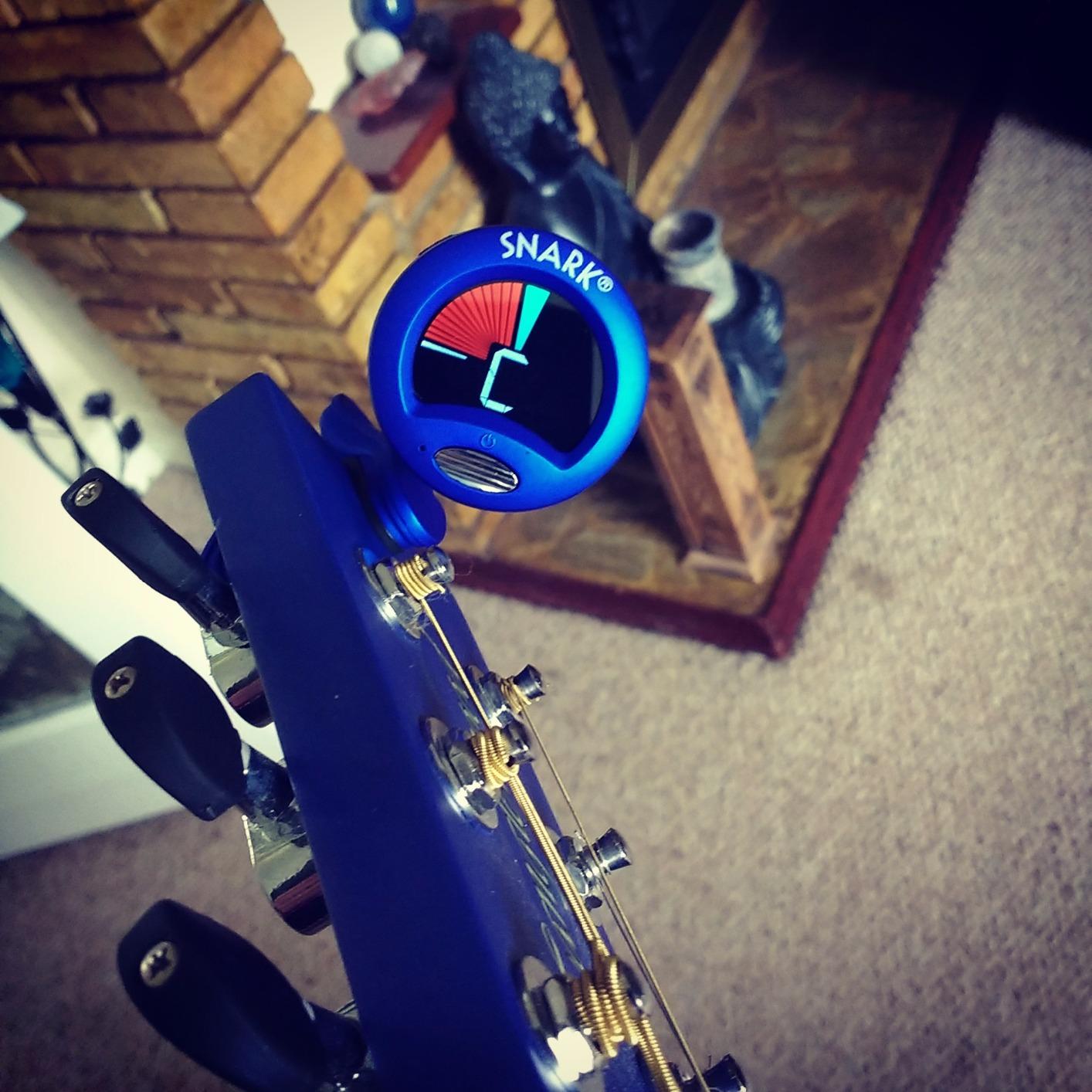
The SN1X is the simpler sibling of the ST-2, and the simplification is the point. There is one on and off control, a bright colour display that rotates through 360 degrees in the stay-put clip, and a high-sensitivity vibration sensor that bass players report responds faster on low strings than older Snark models did.
The tap tempo metronome is the extra feature that most distinguishes it from the plain clip-ons at this level. Practising a line against a click without a separate metronome app is a small quality of life improvement that adds up over a year.
Calibration and the Catch
The specification lists 415Hz to 466Hz pitch calibration, which covers 432Hz tuning comfortably. Owners do note that the frequency is not adjustable on some units, so if you rely on calibration frequently, verify the behaviour on yours before relying on it for a whole set.
For standard 440Hz playing it is a non-issue, and the vast majority of players will never touch the setting.
Battery and Long-Term Ownership
The rechargeable lithium polymer pack is one of the strongest points here, since owners highlight the long battery life directly. There is no coin cell to find when the tuner stops responding mid-session.
The honest weakness is longevity of the plastic clip. People who have owned the SN1X for years describe the clip wearing down, so if you keep tuners for a decade rather than a few, that is worth factoring in.
Who Should Buy It
Choose the SN1X if you practise with a metronome, if you want a rechargeable tuner with a wide calibration range, and if a simple single-button interface appeals more than a menu system. It is also a good second tuner to keep in a gig bag.
It is less suitable for a player who wants preset tunings or deep control over how notes are displayed. For a bass in standard tuning, the speed on low strings is the feature you will notice every day.
7. Ranch Chromatic Clip-On Tuner – The Sensible Spend Limit
Ranch Clip-On Tuner for Guitar Bass Ukulele Violin Banjo – Chromatic
Piezo sensor locks on in under a second
Green backlit LCD with rotating display
Padded spring-loaded clip at A440
Pros
- Accuracy comparable to costlier tuners
- Microprocessor locks onto pitch in under a second
- Green backlit LCD readable in low light
- 360 degree rotating display suits either handedness
- Padded clip grips without scratching the headstock
Cons
- In-tune range is slightly loose so precision is not top tier
- No dedicated power off button and it auto-shuts down
- On and off button also cycles instrument modes
- May not recognize every note in non-standard tunings
- Lightweight build may not survive rough handling
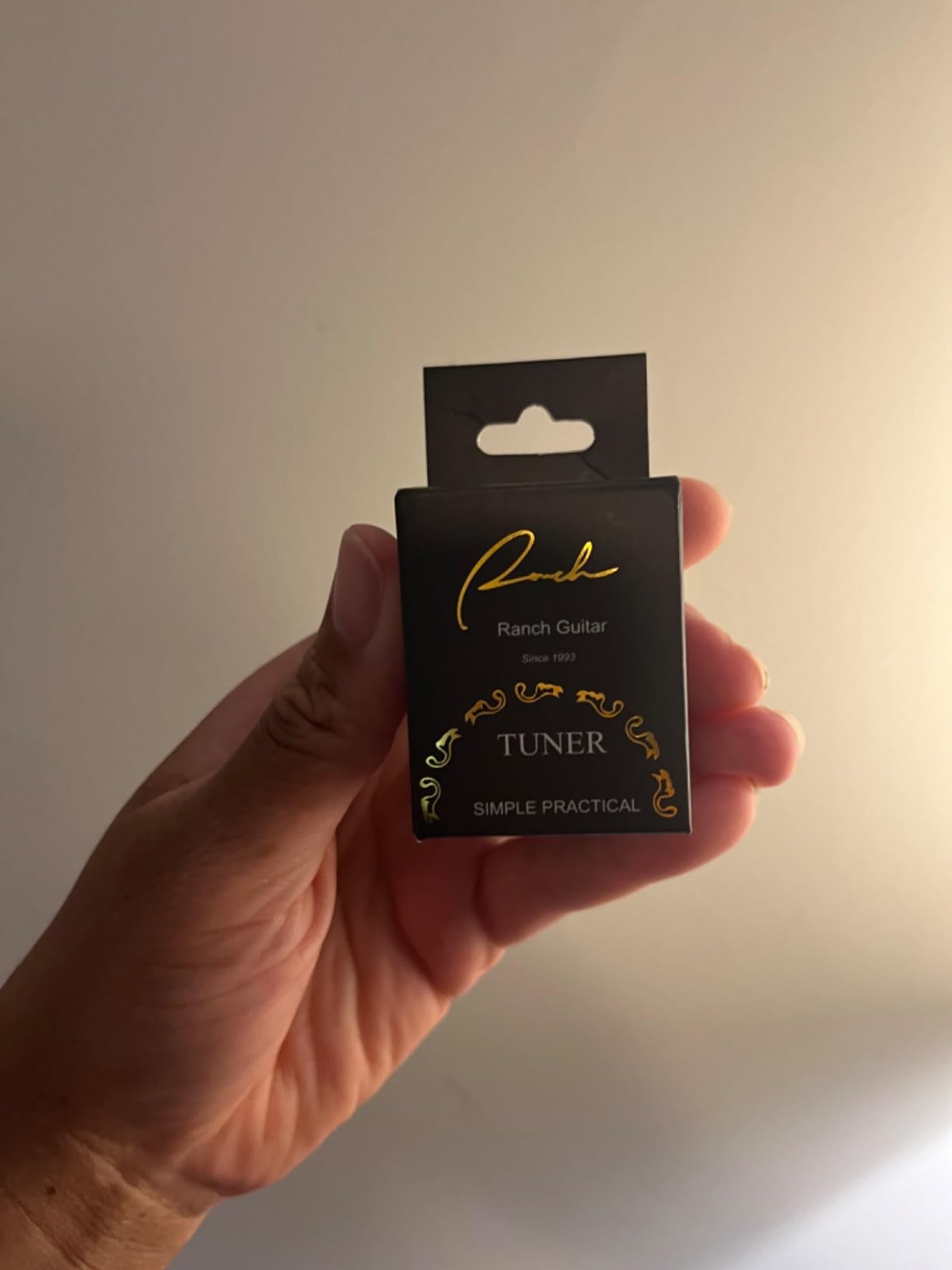
The Ranch exists because a tuner does not need to be expensive to be useful, and the honest case for it is the specification-to-cost ratio rather than any single headline number. A sensitive piezo sensor, a microprocessor that locks on in under a second, and a backlit green LCD is a solid feature set for a first instrument or a spare.
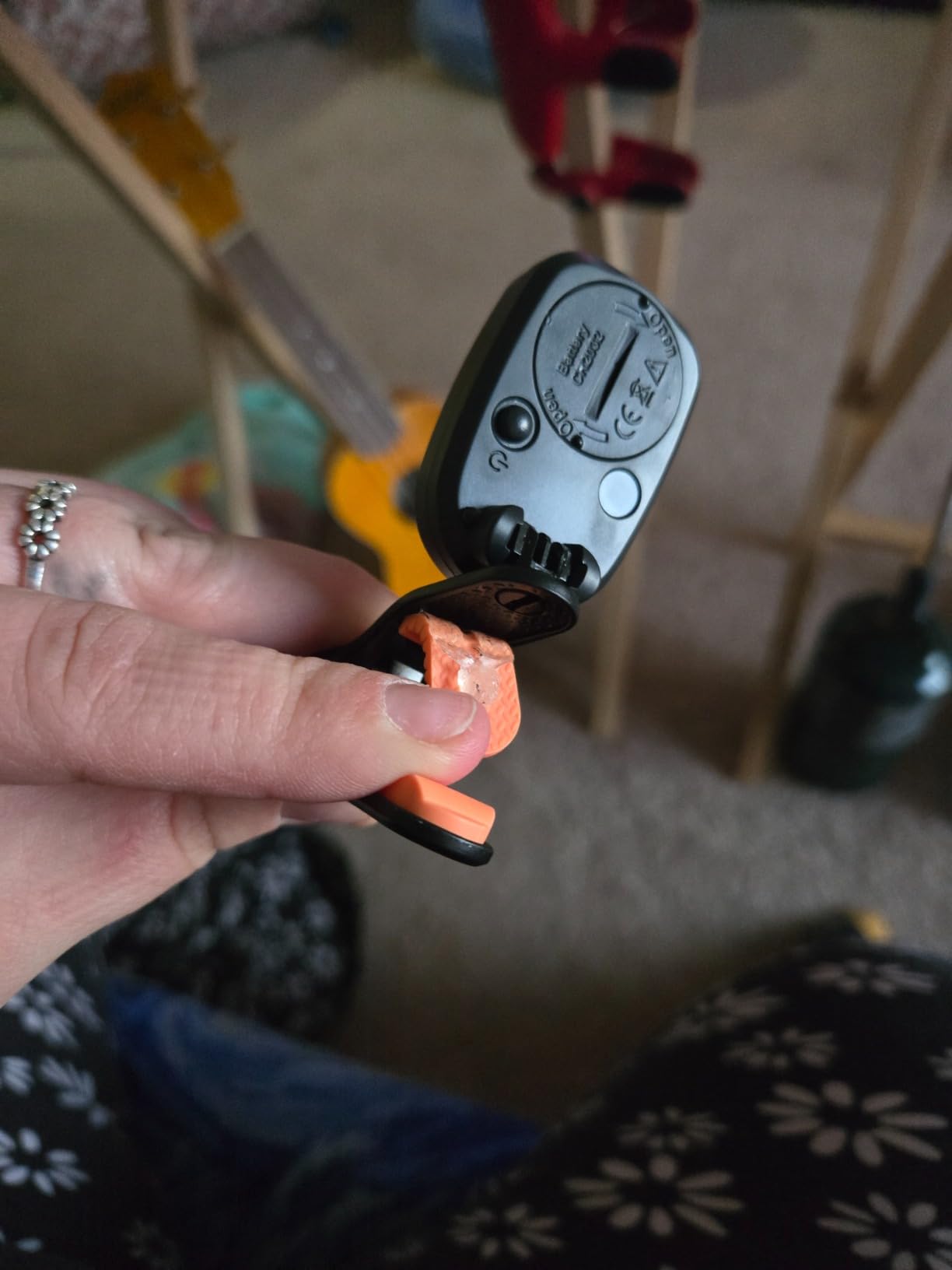
It weighs 0.634 ounces, so it adds almost nothing to a headstock, and the orange silicone padding on the spring-loaded clip protects the headstock finish. Bass players use it for standard tuning without difficulty.
Accuracy and Its Limits
The in-tune range is described by owners as slightly loose, which means the display reaches in tune before the note is truly settled. On a bass, where a string that reads in tune can still be audibly flat, that is the one weakness that actually matters.
There is also a real risk on non-standard tunings, since some notes may not register at all. If you play drop tunings regularly, this is the point to move up the list.
Controls That Cause Friction
There is no dedicated power off button, so the tuner waits before shutting itself down. More irritating is that the on and off button also cycles instrument modes, which means a stray press can put the tuner into the wrong mode at the worst moment.
Mode selection for guitar, bass, ukulele, violin and chromatic all happens on that one button, so learning the sequence matters more here than on the multi-button tuners.
Where It Earns Its Place
For a student bass, a backup tuner, or anyone who wants to spend as little as possible without buying something unreliable, the Ranch works. The spring-loaded clip holds well and the backlit screen is readable in a dim room.
Move up the list once you need tighter tolerance, faster mode changes or tuning down below the standard low E.
8. Donner DT-2 Clip-On Tuner – Built for Beginners and Gig Bags
Donner Guitar Tuner Clip on-Accurate Chromatic,Acoustic Guitar Bass Violin Ukulele Tuner DT-2
One button operation
Rotational clip for multi-angle viewing
Sensitive vibration clip for fast detection
Pros
- One button setup makes it very easy to get started
- Rotational clip reads at many angles
- Sensitive vibration detection reaches pitch quickly
- Sturdy road-resistant construction
- Works across guitar bass violin and ukulele
Cons
- CR2032 coin cell battery is not included
- Green LCD is less bright than newer color displays
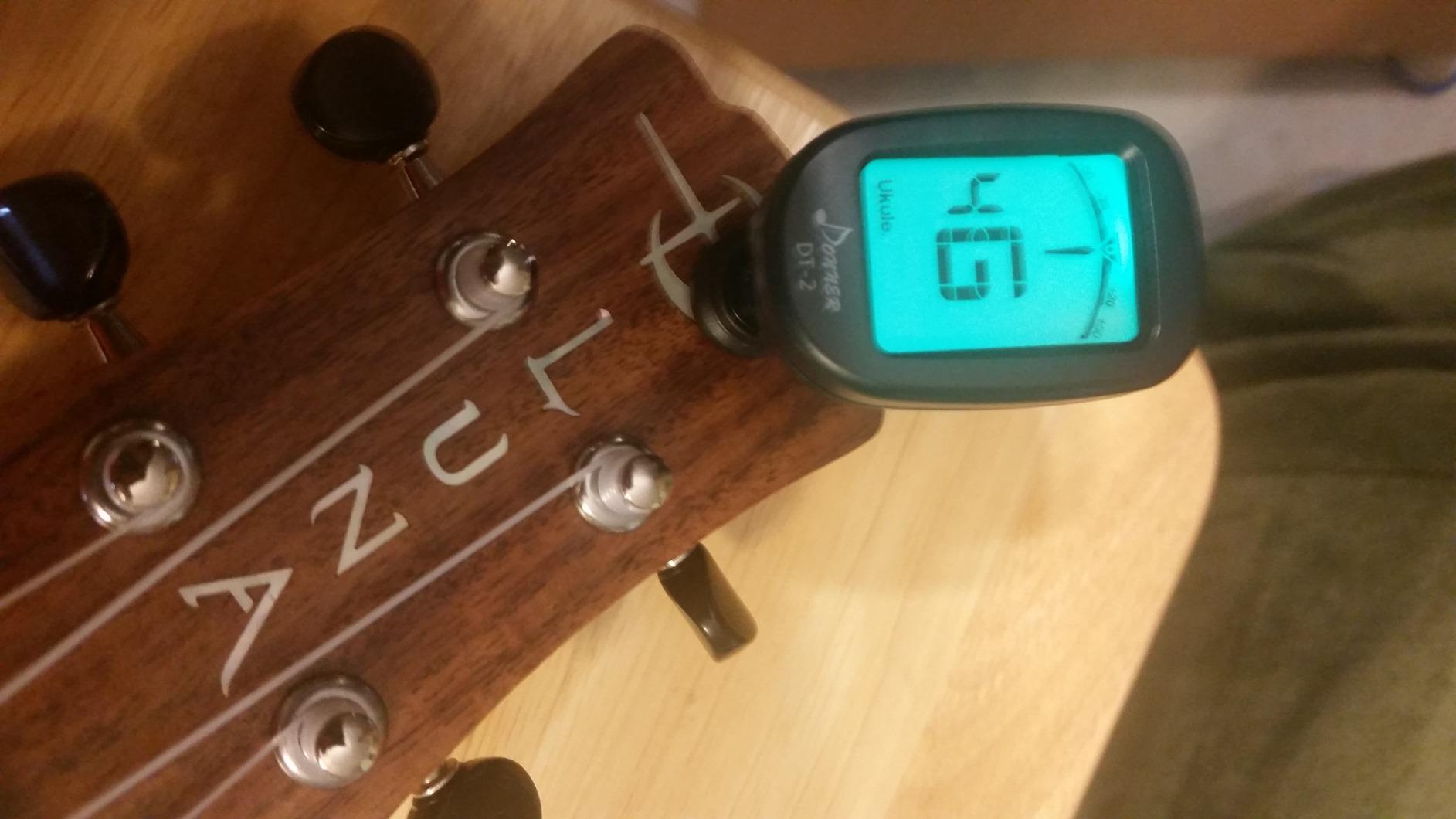
The DT-2 is built around a single idea: if a tuner has one button, nobody gets it wrong. Clip it on, press the button, and the rotational clip design lets you read the screen from whatever angle the headstock sits. That is a much better first tuner experience than a menu system you have to learn before the first note.
It is also one of the few in this roundup described as road-resistant rather than merely functional, which matters if it lives in a gig bag. A six-month guarantee covers the early life of the unit.
Detection Speed and Sensitivity
The sensitive vibration clip reaches pitch quickly, and the single-button layout keeps operation simple. Since it senses string vibration rather than room sound, a loud practice space does not distort what it reads.
That makes it a reasonable companion for a beginner who is also learning in a shared rehearsal room rather than a quiet bedroom, which is where microphone-based approaches start to struggle.
Battery and Display Trade-Offs
The CR2032 coin cell is not included, so budget for that on day one. It is a small thing that catches people out, since several clip-ons in this list include a cell.
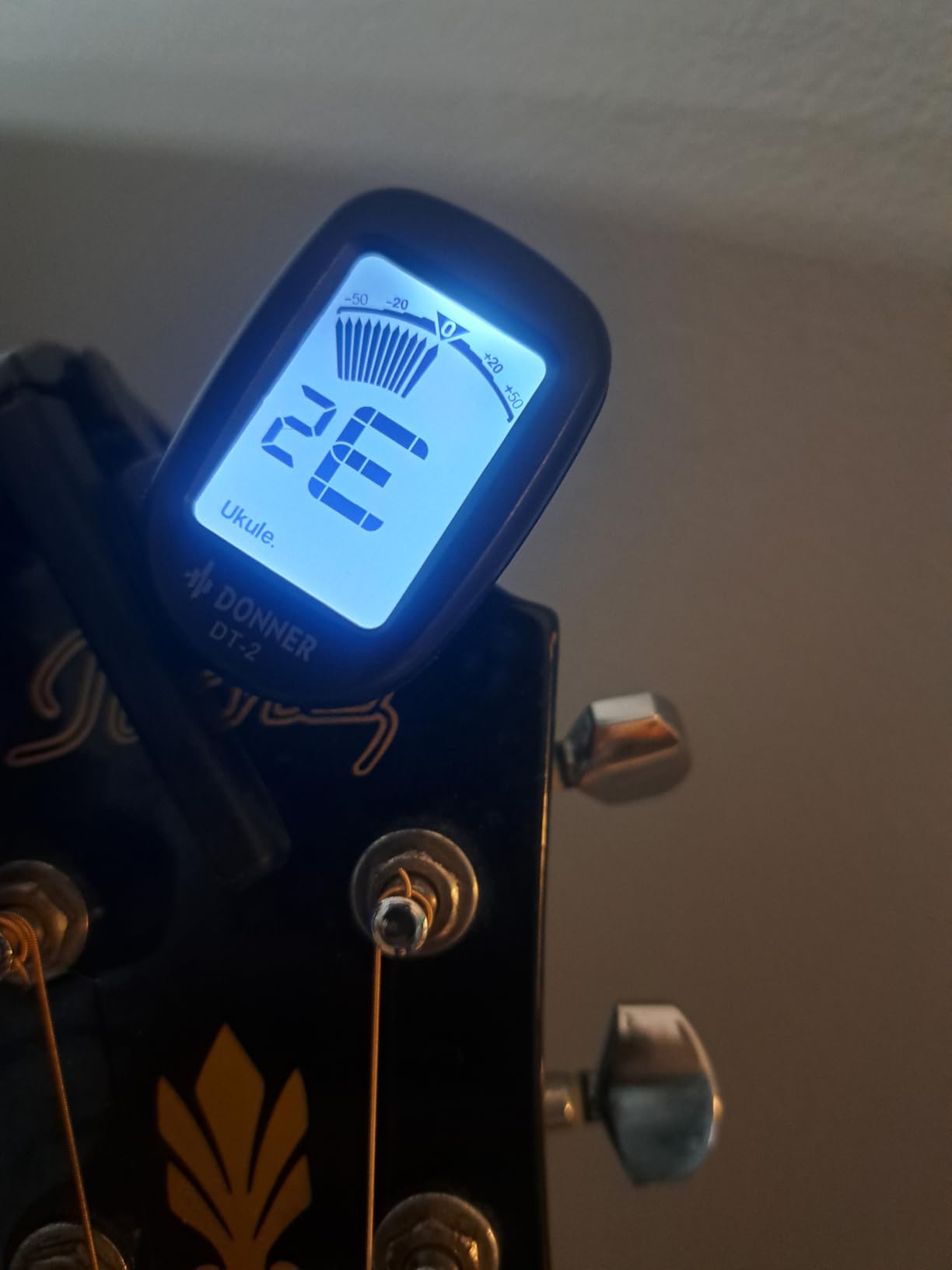
The green LCD is dimmer than the colour displays on the rechargeable units here. It is still readable in low light with the backlight, just not as clear in daylight or on a bright stage.
Who It Suits
Choose the DT-2 for a first bass, a second tuner to keep in a case, or a player who wants zero setup. The multi-instrument support means it also serves a guitarist, a ukulele player or a violinist in the same household.
Look elsewhere if you need adjustable calibration, a wide tuning range on an extended-range bass, or the brightest possible screen for outdoor playing.
9. LEKATO Rechargeable Clip-On Tuner – Best for Drop D and Alternate Tunings
LEKATO Guitar Tuner Rechargeable, Chromatic Tuner Clip On for Guitar, Bass, Ukulele,Violin Tuner, 360° Rotatable, Fast Accuratie Tuning, Super Bright Display to Read, for Professional/Beginners
Rechargeable with over 10 hours of use
360 degree clip with high-contrast LCD
Note key for Drop D and flat tunings
Pros
- Rechargeable battery with a charge gauge and USB-C
- Bright high-contrast display readable in any setting
- Accuracy compared favourably to costlier Peterson units
- Note key function covers Drop D Open G Open D Open E and flat tunings
- Five modes including bass and chromatic
Cons
- Buttons sit on the back behind the pivot arms
- Blue in-tune zone is wide so readings are not ultra precise
- Rechargeable pack has a finite end-of-life
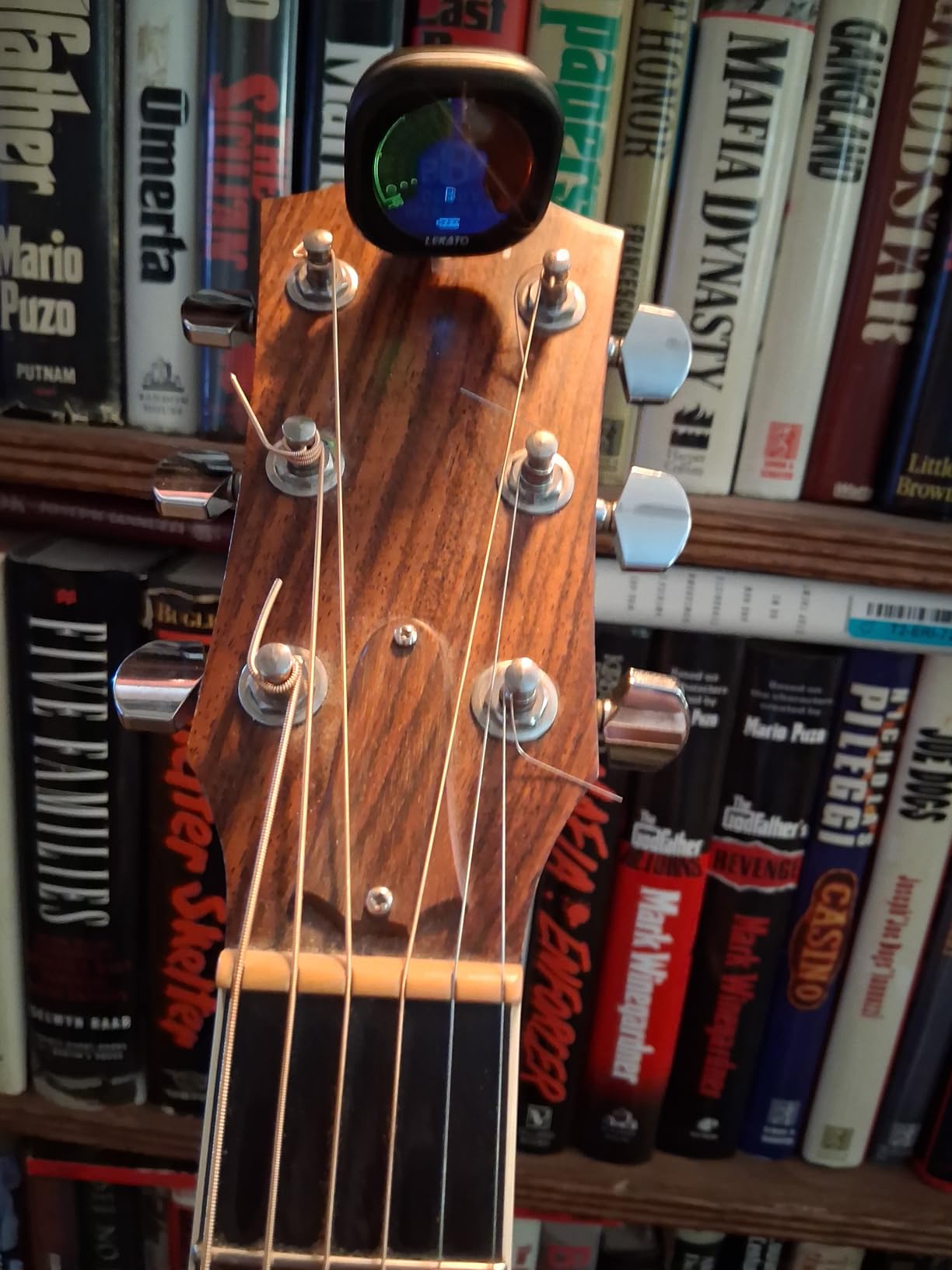
The LEKATO is the clip-on I would suggest to a player who changes tunings between songs. The note key function covers Drop D, Open G, Open D, Open E and flat tunings, which is a level of preset support that most of the tuners on this list simply do not offer, and it takes the guesswork out of dropping a string live.
It charges over USB Type-C and runs for over ten hours of continuous use, with a battery gauge on the unit itself so you can check before a set rather than during one. Owners who switched from coin-cell tuners single out the rechargeable design as the reason they stopped buying spares.
Sensing and Display Quality
An advanced microprocessor and a sensitive piezo sensor give it the speed to reach pitch quickly, and the built-in buzzer pickup helps it lock onto the right note rather than a harmonic. Bass coverage works in chromatic mode in practice, which matters for drop tunings.
The high-contrast LCD is bright enough for any setting according to owners, and the 360 degree rotational clip positions it well. Accuracy is regularly compared favourably to higher-priced units, including Peterson clip-ons.
Where the Design Frustrates
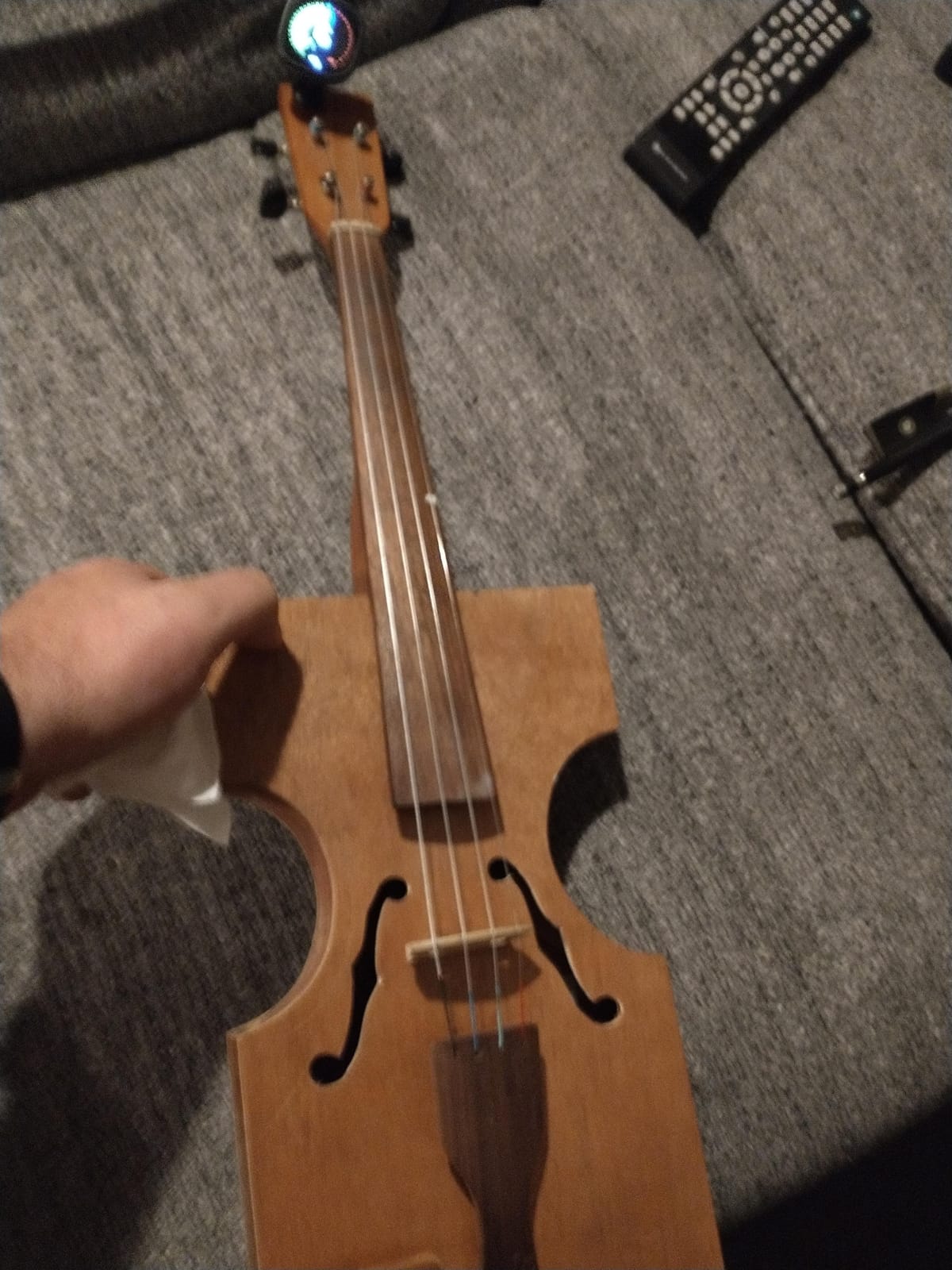
The buttons sit on the back, hidden behind the pivot arms, which means you have to remove the tuner from the headstock to change a mode. That is a genuine friction point for anyone switching instruments often.
The blue in-tune zone on the display is also fairly wide, so it will call a note in tune before it is truly settled. On a bass that tolerance is noticeable, though less so than on the budget tuner earlier in this list.
Verdict for Bass Players
The five modes cover chromatic, guitar, ukulele, bass and violin, so the unit is genuinely shared rather than single-instrument. Bass players who work in drop D will find the note key function more useful than the extra display brightness.
It is a good second instrument tuner and a strong match for anyone who wants a rechargeable clip-on with presets under a tight budget ceiling.
10. Korg GA2 Tuner – The Best Needle-Style Readout
Korg GA2 2″ Guitar Tuner
Large high-visibility needle meter
Guitar bass and flat-tuning modes
Calibration 430-450Hz with 200 hour battery
Pros
- Large high-visibility needle display
- Guitar and bass modes plus flat-tuning mode
- Adjustable 430-450Hz calibration
- Battery life of up to 200 hours
- Slim lightweight body with a three-year warranty
Cons
- Batteries are not included
- Needle display is less detailed than digital note readouts
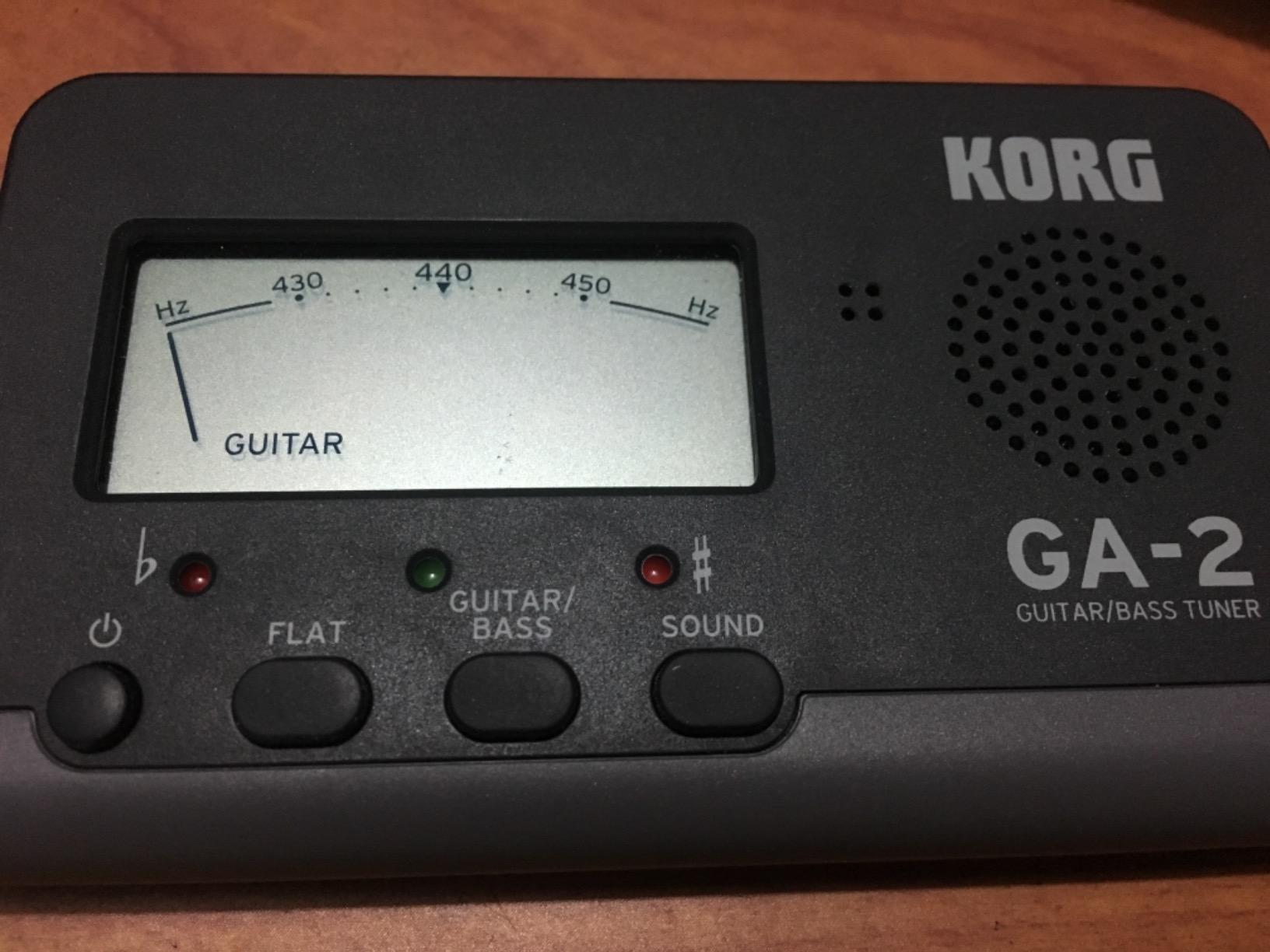
The GA2 takes a deliberately old-fashioned approach: a needle meter rather than a note readout. The needle gives you a continuous picture of how far off you are, and the large high-visibility display is the easiest to read of anything in this roundup when you are holding a bass in a bright rehearsal room.
It also has the longest battery figure here by an order of magnitude, at up to 200 hours, and a slim lightweight body at 0.02 kg that disappears into a case. A three-year warranty backs it up.
Bass Mode and Calibration
Dedicated guitar and bass modes sit alongside a Quinta flat-tuning mode, which handles the down-tuned configurations a bassist runs into without a separate setting. Calibration adjusts from 430Hz to 450Hz, so 432Hz playing and slightly varied concert pitch are both covered.
For a player who wants the reference pitch to be a physical dial rather than a menu item, the needle interface is genuinely more direct. You set the pitch, you watch the needle, you tune.
The Limits of a Needle Display
A needle tells you direction and rough distance. It does not give you a precise cents figure, so if you are setting intonation at the 12th fret or matching a reference tone, the number is useful and the needle is not.
That is the honest trade-off of this design. It is the most glanceable tuner here and the least analytical, and most players never need the analysis.
Practical Notes
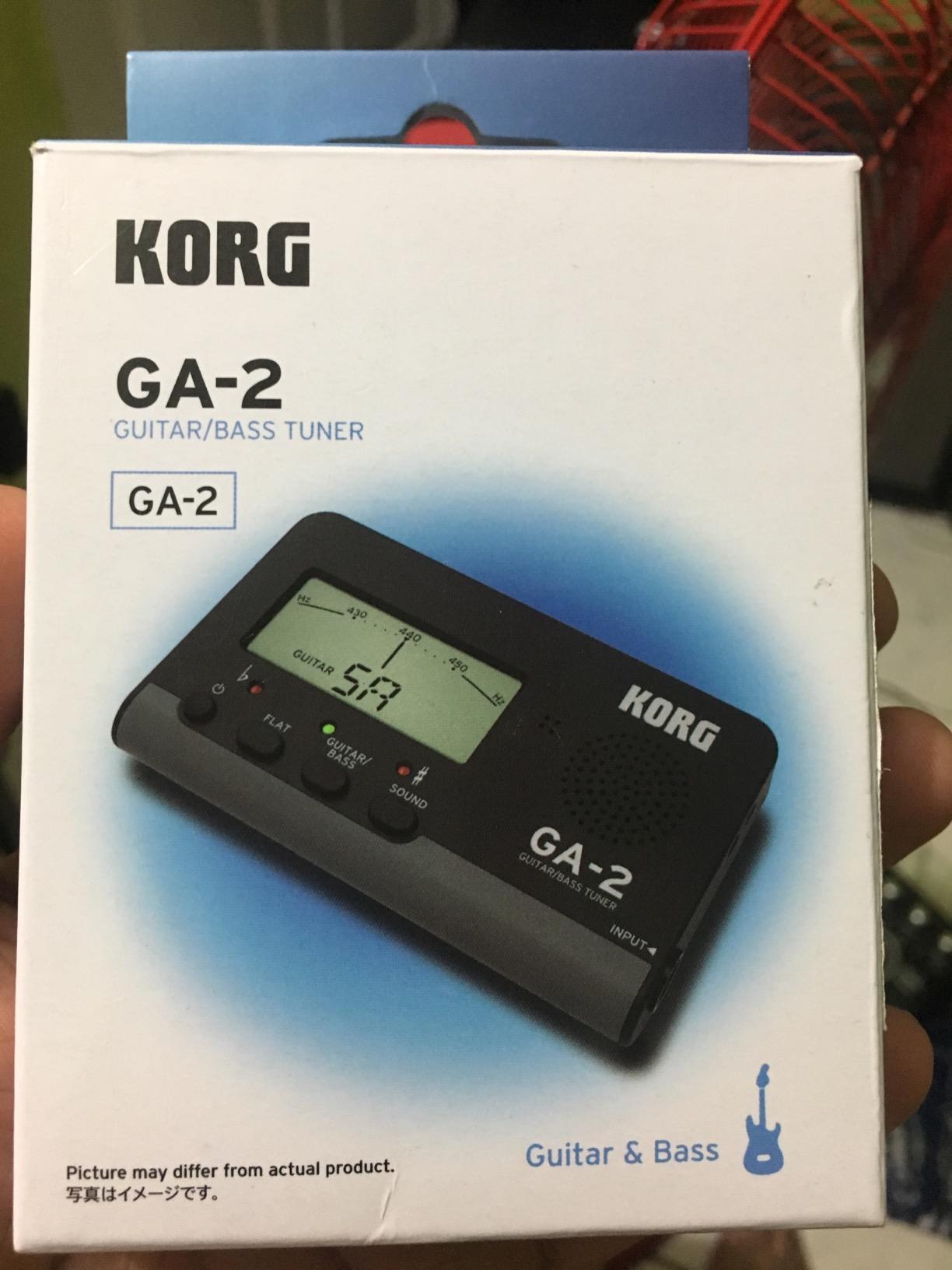
Batteries are not included, which is the one purchasing item to remember. A single cell lasts so long that it is genuinely a once-a-year event rather than a recurring cost.
Some users prefer a digital note display, and that preference is the main reason to pick something else. For everyone else, the GA2 is a durable, readable tuner with a calibration range most of its competitors cannot offer.
11. Donner DT-1 Tuner Pedal – The Only Stompbox Here
Donner Tuner Pedal, Dt-1 Chromatic Guitar Tuner Pedal with Pitch Indicator for Electric Guitar and Bass True Bypass
A0 (27.5 Hz) to C8 range
Strobe mode with 1 cent accuracy
True bypass with no pop or hum
Pros
- Wide A0 to C8 range reaches the lowest bass strings
- Strobe mode with 1 cent accuracy
- True bypass passes signal with no pop or hum
- LED beads readable on large stages and outdoors
- Hands-free stomp operation for live performance
Cons
- Power adapter is not included and there is no battery compartment
- Lowest rated unit in this group with a noticeable share of one-star reviews
- Takes up pedalboard space
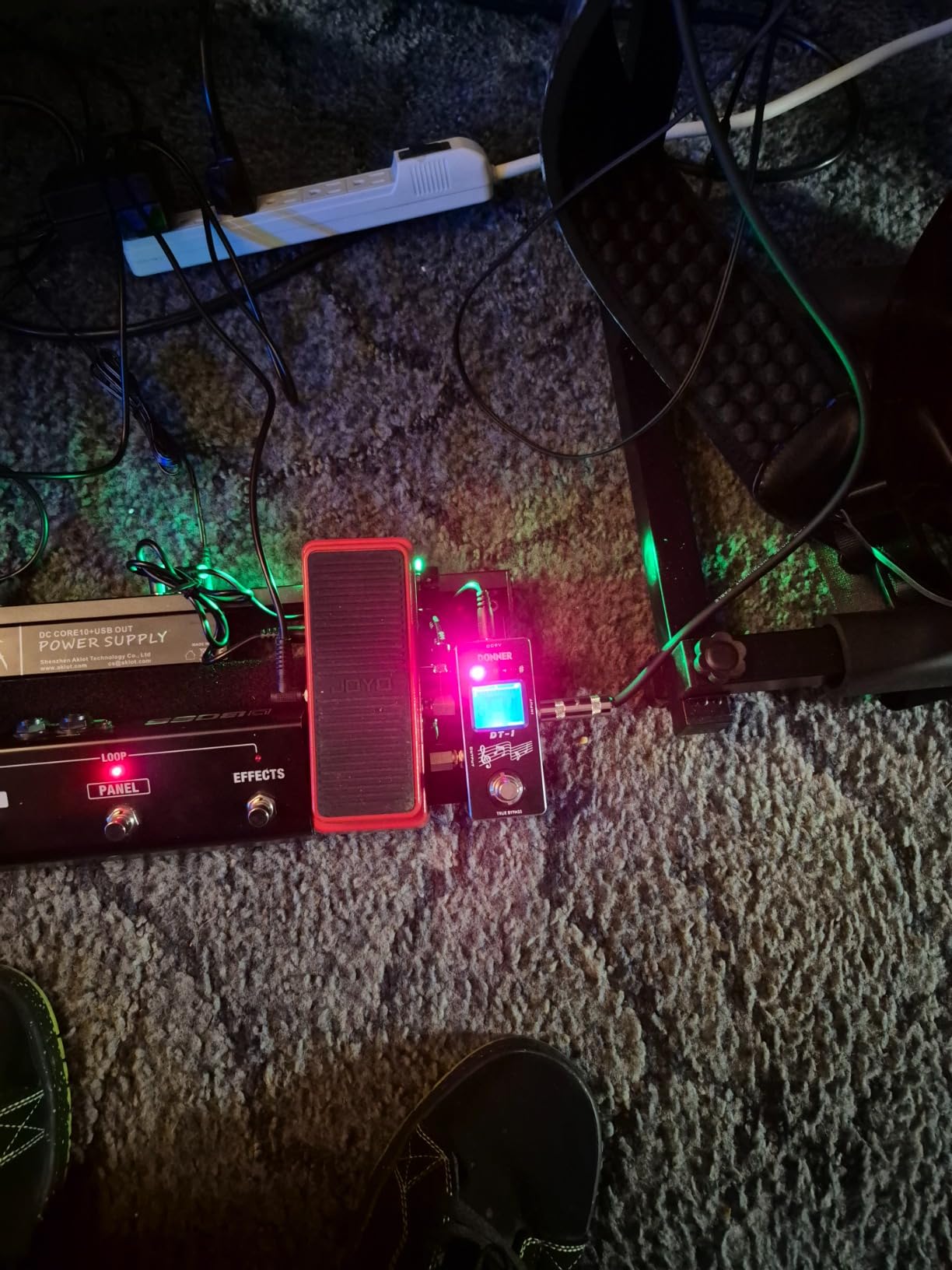
The DT-1 is the reason this roundup is not entirely clip-ons, and it is worth understanding why a pedal behaves differently under your fingers. It reads your instrument signal directly instead of listening for vibration, which means the reading is immune to room noise, unaffected by how you hold the headstock, and accurate at volumes where a clip-on would struggle.
Its stated range of A0 at 27.5Hz up to C8 at 4186Hz reaches lower than anything else here, and the strobe mode is quoted at one cent accuracy. LED indicator beads are matched to the mini LCD specifically for stage and outdoor visibility, which is exactly the situation a clip-on is weakest in.
Signal Path and Bypass Behaviour
Engaged, the pedal cuts signal output so you tune in silence. Bypassed, true switching restores the signal with no pop and no hum, which means the pedal is effectively invisible to the rest of the chain when it is off.
Put the tuner first on the board, closest to the instrument. Any drive or distortion placed before a tuner colours the frequencies the tuner is trying to measure, and a compressor downstream of a tuner will shift the pitch reading as it compresses.
Where It Falls Down
The power adapter is not included and there is no battery compartment, so this pedal needs a supply. On a board you are already powering, that is free; as a lone pedal, it is an extra box to buy.
It is also the lowest rated unit in the group, with the largest share of one-star reviews, and it takes up pedalboard footprint that a clip-on does not. On r/basspedals, strobe pedals are frequently recommended as a first purchase for exactly the reasons above, so the format is well regarded even where this particular model is not universally praised.
Who It Is For
Choose the DT-1 if you gig, if you are on a pedalboard with a power supply already, or if you play an extended-range bass where low-end tracking matters more than convenience. Its range is the widest in this roundup.
Stay with a clip-on if you are practising at home, travel with a small bag, or want a tuner that works without a power supply. A pedal solves a stage problem, and it is only worth solving if you have a stage.
12. D’Addario Eclipse Bass Tuner – Built for Low Frequencies
D’Addario Eclipse Cello & Bass Tuner
Piezo transducer sensing vibration not sound
430-450Hz calibration
Tri-color reversible backlit LCD
Pros
- Picks up low bass frequencies faster including a low B string
- Graduated scale for very precise tuning
- Bright tri-color reversible backlit screen
- Reliable in a noisy room
- Non-marring lever-lock clamp applies easily
- Auto shut-off and one-button operation
Cons
- Can struggle on very low tunings and on the low B of some five-string basses
- Automatic shut-off interrupts longer practice sessions
- Bulkier than a typical guitar headstock clip-on
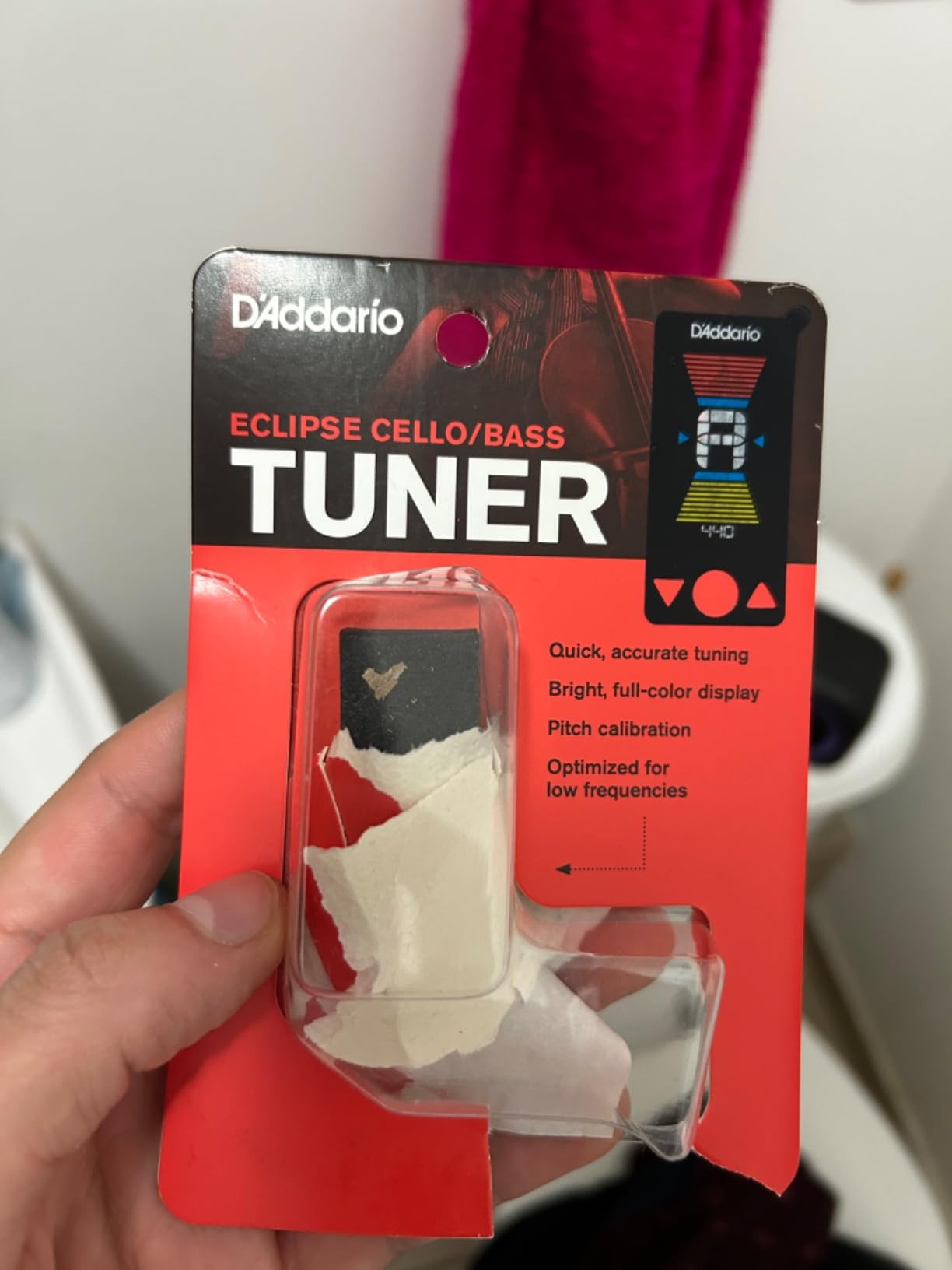
The Eclipse is the most deliberately bass-focused design in the list, and it is the only unit here built equally for cello and bass. That dual purpose is not an afterthought: the lever-lock clamp and the graduated scale are sized and scaled for large instruments with heavy, low-tensioned strings, which is a different mechanical problem from a guitar headstock.
Bass owners rate it highly for detecting low strings quickly, and several describe it as an upgrade from Fender and Boss clip-ons they used previously. The tri-color reversible backlit LCD is one of the most readable screens here, and the lever-lock clamp holds without marking a nitrocellulose finish.
Low-Frequency Sensitivity and Its Limits
The piezo transducer senses vibration rather than sound, which is why it holds up in a noisy room and why the low-end response is genuinely good. The graduated scale gives a precise reading that most clip-on needles cannot, and calibration covers 430Hz to 450Hz.
The catch is the extreme low end. Owners report it can struggle on very low tunings and on the low B of some five-string basses, so it is a strong choice for a four-string or a five-string in standard tuning rather than a guaranteed answer for a deeply extended instrument.
Size, Clamp and Practice Behaviour
At full size and 6.65 by 4.09 by 1.18 inches, it is bulkier than a typical headstock clip-on. That is fine on a bass headstock with room to spare and less convenient on a small guitar or ukulele.
Auto shut-off is a battery-saving feature that becomes a nuisance during a long practice session, when the tuner powers down between phrases. One-button operation keeps everything else simple.
Who Should Buy It
Choose the Eclipse for an upright or acoustic bass with a piezo pickup, for a player who values a graduated, precise scale over a simple needle, and for anyone who wants a clamp that will not mark a delicate finish.
For an extended-range five-string where the lowest string is the whole point, check the low-end caveat above first. For everyone else on a four-string, it is an unusually well-built tool that will outlast several cheaper clip-ons.
Clip-On vs Pedal Tuners: Which Should a Bassist Actually Buy?
Start with the mechanism, because everything else follows from it. A clip-on reads string vibration through a piezo sensor clamped to the headstock, which makes it immune to room noise and independent of your amplifier, but dependent on vibration transfer. A pedal reads the electrical signal leaving the instrument, which makes it accurate at any volume and independent of the headstock, but dependent on your signal chain.
The vibration weakness is real and it is frequency-dependent. A low B at 30.87Hz puts out far less energy into a headstock clamp than an open G does, so the same tuner can be flawless on the top string and unhelpful on the bottom one. This is why the tuners on this list that specifically mention low B or B0 tracking are worth the premium over generic clip-ons.
The pedal weakness is the power and space cost. It needs a supply, it occupies pedalboard real estate, and if it is placed after a compressor or drive it will read a compressed or distorted version of the note. The conventional answer, and the one that comes up repeatedly on r/basspedals, is to put the tuner first, closest to the bass.
On bypass, a true bypass pedal disconnects itself entirely when off, which is transparent. A buffered pedal keeps the signal path alive through an internal buffer, which some players prefer because it prevents signal loss with long cables and effects. A tuner with a true bypass switch, like the DT-1, avoids the question entirely when it is off.
For a hybrid answer: many bassists clip on a headstock tuner for practice and running through tunes at home, and add a pedal later when they start gigging. That is not buying twice by accident, it is buying for two genuinely different environments. If your only context is a bedroom, a clip-on is not a compromise.
One point the forums settle quickly: tuner apps are not a stage option. A phone microphone picks up the PA rather than the instrument, which is the same failure as microphone mode on a clip-on. Useful for checking a reference note between songs, unreliable for anything else.
How to Choose a Bass Guitar Tuner: 8 Criteria That Matter
1. Tuning Range and Low-B Tracking
Bass needs at minimum E1 at 41.2Hz. A five-string needs B0 at 30.87Hz, and an extended-range instrument needs C0 at 16.35Hz or lower. If a manufacturer states a lower limit, take it literally; if they only say wide frequency range, assume standard tuning is what they tested.
You can also add a low B to a four-string by tuning the A string down, and it will work, though the string is under-tensioned and the intonation across the neck suffers as a result.
2. Accuracy in Cents
One hundred cents equals one semitone, so a one-cent specification is a hundredth of a semitone. Lower numbers mean higher precision. Anything at or under one cent is excellent; a few cents of tolerance is fine for a bass you are checking between songs.
3. Calibration and Reference Pitch
The tuner has to know what frequency counts as A4. Fixed A440 tuners are standard; an adjustable range lets you tune to 432Hz or match a slightly different concert pitch. If you play in 432Hz, this is not a nicety.
And a related confusion worth clearing up: electronic tuner means a device that measures pitch, while a bass tuning machine or tuning peg is the mechanical gear mounted on your headstock. Search results for this topic mix both heavily. If your tuning machines feel gritty or slip, you need parts, not a tuner.
4. Sensing Method
Vibration sensing through a piezo clip is the standard and is noise-immune. Microphone mode is useful for an acoustic or upright bass with no pickup, and for tapping a reference note, but it will follow a loud room rather than your instrument.
5. Modes and Presets
A dedicated bass mode, a chromatic mode, and presets for drop tunings save real time. Without presets you are reading note names and doing the tuning math yourself, which is fine for a four-string and tedious for a seven.
6. Display and Lighting
Backlighting, colour change on in-tune, and a screen that rotates through a full 360 degrees determine whether you can read the display on a dark stage. A colour change from one colour to another is faster to read at a glance than any number.
7. Power
Rechargeable tuners remove a category of mid-show failure. Coin-cell tuners are cheaper and lighter, and a single CR2032 or CR2 cell generally runs for a year or more of regular use. Pedal tuners need a regulated supply.
8. Build and Clip Design
Rubber or silicone padding on the clip protects a nitrocellulose finish, and lever-lock clamps are gentler than tight spring clips. Metal bodies survive a van; plastic bodies survive a case. If you have large hands or wear boots on stage, note that small-footprint mini pedals are harder to hit than larger ones.
Finally, and this is the step most guides skip: tune up from flat. Pluck each string behind the nut for a cleaner signal, start the string below pitch, and bring it up to the target rather than overshooting and pulling back. A string that has just changed tension is still settling, so re-check the low strings after a full pass.
Frequently Asked Questions
Can I use a guitar tuner to tune a bass guitar?
Yes, and most clip-on tuners in this roundup are sold as multi-instrument devices. The caveat is low-frequency sensitivity: a guitar tuner rated down to roughly 82Hz may never register a bass low E at 41.2Hz. Check the stated lower limit and look for a dedicated bass mode or a range that reaches B0 at 30.87Hz for a five-string.
What is the best tuning for bass?
Standard EADG is the baseline, with the low note at E1 (41.2Hz). Drop D puts the low string at D1 (36.7Hz) and is the most common alternative. A five-string BEADG adds B0 at 30.87Hz, BEAD covers four octaves, and tuning to a 432Hz reference pitch lowers every note slightly. Set the tuner calibration before you tune the notes.
Can a clip-on tuner track the low B on a 5-string bass?
Some can and some cannot. Vibration-sensing clip-ons with a stated low limit of B0 are the safe choice, and the Fender FCT-2 is the only unit here that publishes that range. A wider-range pedal like the Donner DT-1, rated to A0 at 27.5Hz, covers it with room to spare. If your tuner flickers between octave readings on the low B, the sensor is not getting enough energy from that string.
Should I get a pedal tuner or a clip-on tuner for bass?
Get a clip-on for practice, travel and any situation without a pedalboard. Get a pedal for live performance, where reading the signal directly is immune to room noise and lets you tune in silence, and where an extended range matters. A pedal should sit first in the chain, closest to the instrument, so no drive or compression alters the pitch it measures.
Why does my bass tuner read the wrong note?
Three causes are common. A vibration-sensing clip may be losing too much energy from a low string to register it, producing flicker or an octave error. A microphone-based unit may be following the room or a nearby amp instead of the instrument. A pedal placed after a drive or compressor will read the altered signal. Move the tuner first in the chain, use vibration sensing, and check the lower limit of the range.
What reference pitch should bassists use?
A4 = 440Hz is the standard, and any tuner in this roundup will default to it. Players working at 432Hz need adjustable calibration, which the Snark ST-2, Snark SN1X, Fender FCT-2, KLIQ UberTuner, Korg GA2 and D’Addario Eclipse all provide. The same principle applies to an orchestra tuning to a pitch a few hertz off standard.
The Best Guitar Tuner for Bass Guitars, by Player Type
If you want one tuner that does the job on any bass, the Snark SN5X is the pick: it tracks the low B reliably, the colour screen is readable in poor light, and it is rechargeable so it does not stop working halfway through a set. For a player who wants a stated B0 lower limit and a proper bass mode, go with the Fender FCT-2. For the tightest published accuracy in a clip-on, the KLIQ UberTuner is the one.
Drop tunings and preset switching point to the LEKATO, 432Hz playing and upright bass point to the Snark ST-2, and long practice sessions with a metronome point to the Snark SN1X. The Korg GA2 suits anyone who prefers a needle to a number, and the D’Addario Eclipse is built for acoustic and upright work. On a pedalboard, the Donner DT-1 covers the widest range here, though only if you already have a power supply.
One last reminder, because it changes results more than any model choice: a low string transmits less vibration than a high one, so give the tuner a clean signal by plucking behind the nut, tune up from flat rather than down, and re-check the bottom strings after a full pass. Get those three right and even a modest clip-on will keep you honest. For the amplifier side of a first or rehearsal rig, our deep bass guide covers the low end of the whole signal chain. These picks were tested and compared for 2026, and every rating quoted comes from the verified owner review record.