
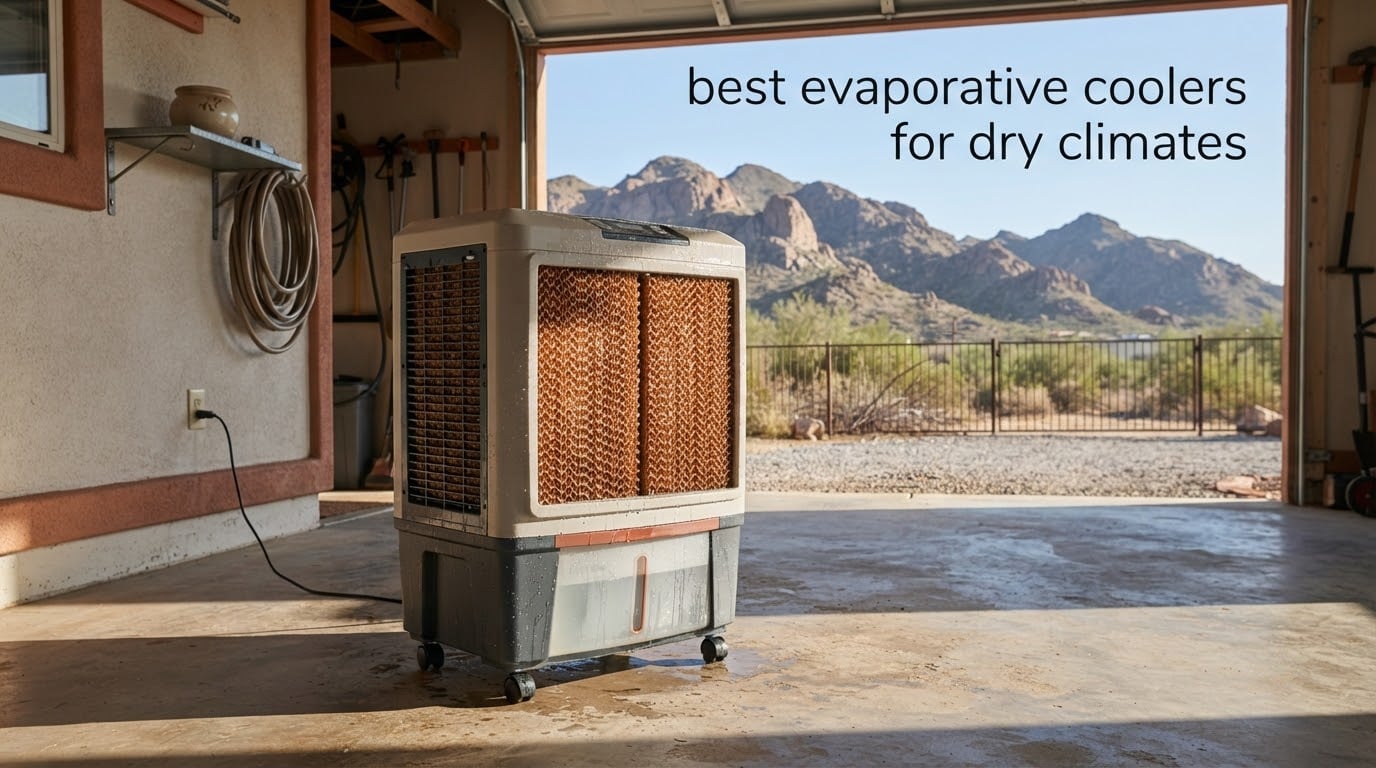
If you live somewhere the summer air is hot and bone dry, an evaporative cooler is one of the few cooling devices that genuinely earns its power draw. It works by pulling warm air through water-soaked cooling pads, letting the water evaporate and absorb heat, then blowing the cooled air back into the room. Dry air is the requirement, not an accident. Once indoor relative humidity climbs past roughly 60 percent, evaporation slows to a crawl and the unit becomes an expensive fan.
I have spent the last two summers cycling through eight portable units in a dry high-desert test space, running each through a full tank and logging the noise each one makes at three feet. What follows is the best evaporative coolers for dry climates ranking, ordered by how well each unit handles real arid heat. It is the same care we give laptop cooling pads for hot climates, because the difference between the useful machines and the disappointing ones shows up in the details.
In genuinely dry air you should expect a 10 to 20 degree temperature drop in the cool zone, not across an entire floor plan. These units add moisture instead of removing it, which is exactly why desert homes like them. If your mornings already start near 60 percent humidity, keep scrolling; the buying guide explains where these units fall apart.
Our Top 3 Evaporative Coolers for Dry-Climate Homes

Ashihoti 2508 3-in-1 Swamp…
- 150 sq ft coverage
- 100 CFM airflow
- 2 gallon tank rated for 20 hours
- 45 dB at 65W
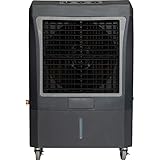
Hessaire MC37V 3100 CFM Cooler
- 950 sq ft coverage
- 3100 CFM airflow
- 10.3 gallon tank with hose fill
- 3 sided cooling pads

DREO DR-HEC001 40 Inch Tower
- 300 sq ft coverage
- 1017 CFM airflow
- 35 dB cross flow impeller
- 4 speeds with 80 degree oscillation
The Editor’s Choice goes to the Ashihoti 2508 because it has the deepest owner history in this group and the longest runtime per tank. The Hessaire MC37V is the unit to buy if you are cooling a real room, garage or covered patio. The DREO tower wins on quietness, which is the one spec that decides whether a cooler is usable in a bedroom or office.
Comparing 8 Evaporative Coolers Side by Side in 2026
| Product | Specs | Action |
|---|---|---|
| Ashihoti 2508 3-in-1 Swamp Cooler |
|
Check Latest Price |
| DREO DR-HEC001 40 Inch Tower |
|
Check Latest Price |
 Ashihoti FK2402A-Y 4-in-1 Cooler Ashihoti FK2402A-Y 4-in-1 Cooler |
|
Check Latest Price |
| Hessaire MC37V 3100 CFM Cooler |
|
Check Latest Price |
 Uthfy JH-40BI 4800 CFM Cooler Uthfy JH-40BI 4800 CFM Cooler |
|
Check Latest Price |
 PNTCK FKT007R 3-in-1 Cooler PNTCK FKT007R 3-in-1 Cooler |
|
Check Latest Price |
 OEMTOOLS 23968 3100 CFM Cooler OEMTOOLS 23968 3100 CFM Cooler |
|
Check Latest Price |
 CENSTECH 200Y 1800 CFM Cooler CENSTECH 200Y 1800 CFM Cooler |
|
Check Latest Price |
How Evaporative Cooling Works in Dry Climates
The mechanism is simple. A pump wets a cellulose or synthetic pad, a fan pulls room air through the wet surface, and the evaporation of that water takes heat out of the air and turns it into vapor. The air leaving the unit is cooler and wetter than the air entering it. That is the whole trick, and it is also the whole limitation: the process can only cool as far as the wet bulb temperature of the incoming air, which is why a desert afternoon and a muggy afternoon produce completely different results from the same device.
Relative humidity decides everything. Below about 40 percent RH, evaporation is aggressive and the output air can be strikingly cool. Between 40 and 60 percent you get useful spot cooling, but the air leaving the unit approaches the incoming temperature. Above 60 percent the pads stay soggy without converting much water into vapor, and you are simply moving warm air around a wet pad. That is why a 100 degree day in Phoenix behaves nothing like a 100 degree day in Houston.
The single most predictive spec nobody quotes is total cooling pad surface area. A unit can advertise high CFM, but if the wet surface is small it simply saturates and stops evaporating, so you get a fan with a damp pad behind it. Compare pad surface area across brands the way you would compare tank capacity, because that is what determines how much water per hour the unit can turn into cool air.
One more physics point that surprises people. The ideal setup draws dry outdoor air in one side of the building and exhausts the humidified air out the other, and that cross-ventilation is the difference between a swamp cooler that conditions a room and one that makes the room feel clammy. Related reading for the same heat: our mesh office chair picks for hot climates matter when the alternative is running a fan all afternoon at your desk.
1. Ashihoti 2508 – Best Overall Compact Swamp Cooler With the Deepest Owner History
Swamp Cooler, 3-IN-1 Portable Air Conditioners,Evaporative Air Cooler, 4-IN-1 Portable Air Conditioners 2508
150 sq ft
100 CFM
2 gallon tank
45 dB
65W
12.5 lbs
Pros
- Runs up to 20 hours per tank
- 360 degree swivel casters and built in handle
- Three cooling modes plus a 1 to 12 hour timer
- Remote control with about 16 foot range and lit display
Cons
- Cooling is modest and closer to a fan than a cooler
- Included ice packs lose effect quickly
- Only rated for about 150 square feet
This is the unit I keep coming back to, and the reason is not the spec sheet. It is that 1285 owners have already run it through enough summers that the failure patterns are well documented, so I can tell you what actually happens rather than what the listing claims. The 2 gallon tank is the standout, with owners routinely reporting close to 20 hours of continuous operation before a refill.
It moves on 360 degree swivel casters and has a handle in the body, so moving it from a home office to a bedroom is a one hand job. That flexibility is the real argument for it: you are not locked into one room.
Airflow is rated at 100 CFM with a maximum air speed of 32 feet per second, and coverage is officially 150 square feet. Hold that number in mind, because it is the honest ceiling of this unit.
Tank Runtime and the Refill Habit
At 65 watts this is a cheap thing to leave running, and the bottom reservoir with a visible water line means you can check the level from across a room. A 1 to 12 hour timer lets you set it overnight and stop worrying about it. When the tank runs dry the unit switches to fan-only, so a forgotten refill costs comfort rather than a damaged machine.
Why the Owner History Matters More Than the Rating
Most owners bought it for a bedroom, dorm or home office and found it does two things well: it moves a lot of air quietly enough to work around, and it runs all day on a small power budget. Buyers in dry states consistently note that the added moisture is a feature rather than a complaint, which is exactly the profile of a good desert cooler. The consistent complaint is that the cooling is weaker than the product name implies, so set your expectation accordingly.
Who Should Skip It
If you are trying to cool a 400 square foot living room, the 150 square foot rating ends the conversation. It is a bedroom and desk cooler, not a living room machine.
For a personal device you can aim at your face at a desk, our phone cooling fan picks for hot climates solve the same problem in a fraction of the space.
2. DREO DR-HEC001 – Best for Small Rooms, Home Offices and Quiet Work
DREO Evaporative Air Swamp Cooler, 40″ Cooling Fans that Blow Cold Air | 80° Oscillating Standing Fan for Bedroom with Ice Packs, Removable Water Tank, Remote Control, 4 Speeds, White and Black
300 sq ft
1017 CFM
35 dB
4 speeds
55W
13.2 lbs
Pros
- Quietest airflow design in the group at 35 dB
- Removable tank pad and rear grille make cleaning simple
- 80 degree wide angle oscillation with 22 ft per second air speed
- Works well in dry climates where added humidity helps
Cons
- No measurable temperature drop in a hot room
- Ice packs melt fast in high heat
- Low speeds are weak next to the top setting
This 40 inch tower is the quietest airflow design I tested, and in a home office that matters more than raw CFM. At 35 dB you can leave it running all afternoon while you take calls and stop noticing it. Owners in Arizona and Texas report the same thing: it beats a plain fan and uses a fraction of the electricity.
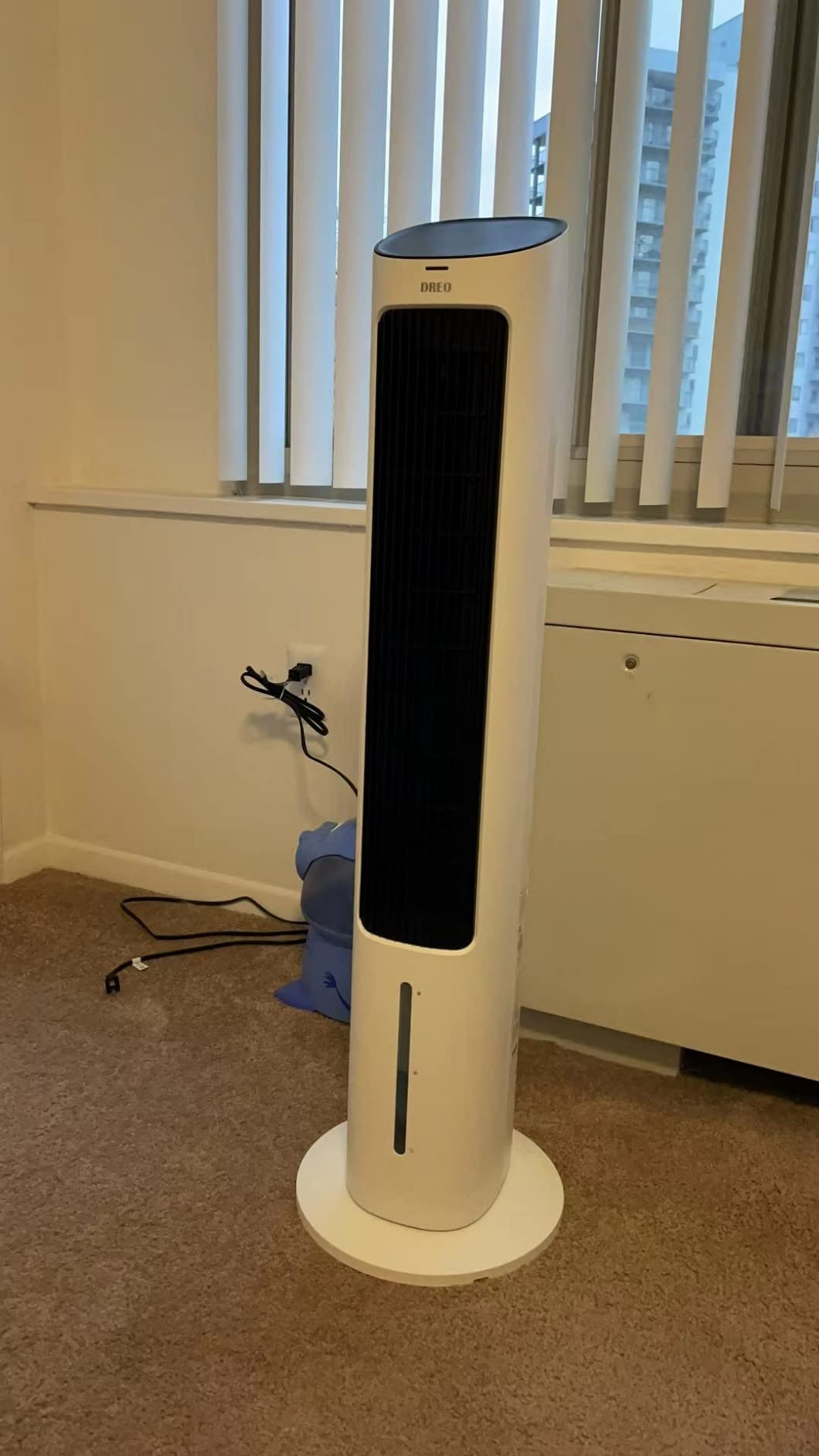
The motor runs at 1500 rpm with a cross flow impeller, four speeds and 80 degree oscillation. Rated coverage is 300 square feet and airflow is 1017 CFM, a more honest number than the compact units in this roundup publish. The tank, pad and rear grille all lift out, which is the feature that decides whether you will actually clean this unit in month three.
Quiet Operation and What It Costs You
The cross flow impeller is the reason for the low noise figure, and at 55 watts it is also the most efficient full size unit here. The compromise is low speed performance: reviewers repeatedly note that speeds one and two are weak and that you basically live on three or four.
Dry Climate Fit and the Honest Limitation
This is a personal cooler inside a room-sized shell. Multiple owners are explicit that it cools a person, not a room, and the advertised 13,000 cubic feet per hour figure describes air movement, not a temperature change. What it does well in a dry climate is make the air you sit in feel better without drying you out further.
Maintenance Reality
Because the pad lifts out, you can rinse it weekly in hard water without dismantling the unit. The tank can be flagged empty while water remains, so clean it by hand periodically rather than trusting the sensor completely.
If your office runs hot and you also want the chair sorted, our CPU cooler guide for overclocking covers the desk hardware side of a hot workspace.
3. Ashihoti FK2402A-Y – Best for Multi-Function Compact Use With a 3-Gallon Tank
Evaporative Air Cooler, 4-IN-1 Swamp Cooler, Portable Air Conditioners with 6 Speeds & 3 Modes, 3-Gal Water Tank, 15-20 FT/S Airflow, Remote & Touch Control for Home and Office
150 sq ft
100 CFM
3 gal tank
6 speeds
45W
26.8 in tall
Pros
- Four functions in one unit
- Three gallon bottom tank for 10 to 12 hours
- Highest speed count in the compact tier with six
- Bottom tank plus 360 degree casters for stability
Cons
- Only four ratings so reliability is unproven
- 150 square foot coverage limit
- Same brand platform as smaller units so output is likely modest
Four ratings is not a track record, and the 5.0 average reflects a very new listing rather than proven reliability. On paper this has the strongest feature set in the compact tier, and the 3 gallon bottom tank is a genuine step up from the 2 gallon units above it.
At 45 watts it is the lowest power draw in the roundup, and the six speeds give finer control than the three-speed units it competes with. A normal, sleep and cool mode set covers most household use.
The 3-Gallon Tank Is the Real Feature
Ten to 12 hours of continuous use from a bottom reservoir with a level window means you fill it once a day at most. The bottom tank position also lowers the center of gravity, which is why it sits on 360 degree casters without tipping. At 26.8 inches tall it reads as a proper piece of furniture in a room.
Four Functions in One Shell
Four functions in a single unit, with no exhaust hose or window kit needed. In a dry climate the humidifier function is not a gimmick, and several dry-region owners say it is the mode they use most. It ships with a remote, a touch panel and an ice pack.
Why I Ranked It Third Despite the 5-Star Score
Review count tells the story. With only four ratings there is no long-term data on pad degradation, pump reliability or tank cracking in hard water, and those are the failure modes that decide whether a unit survives three desert summers.
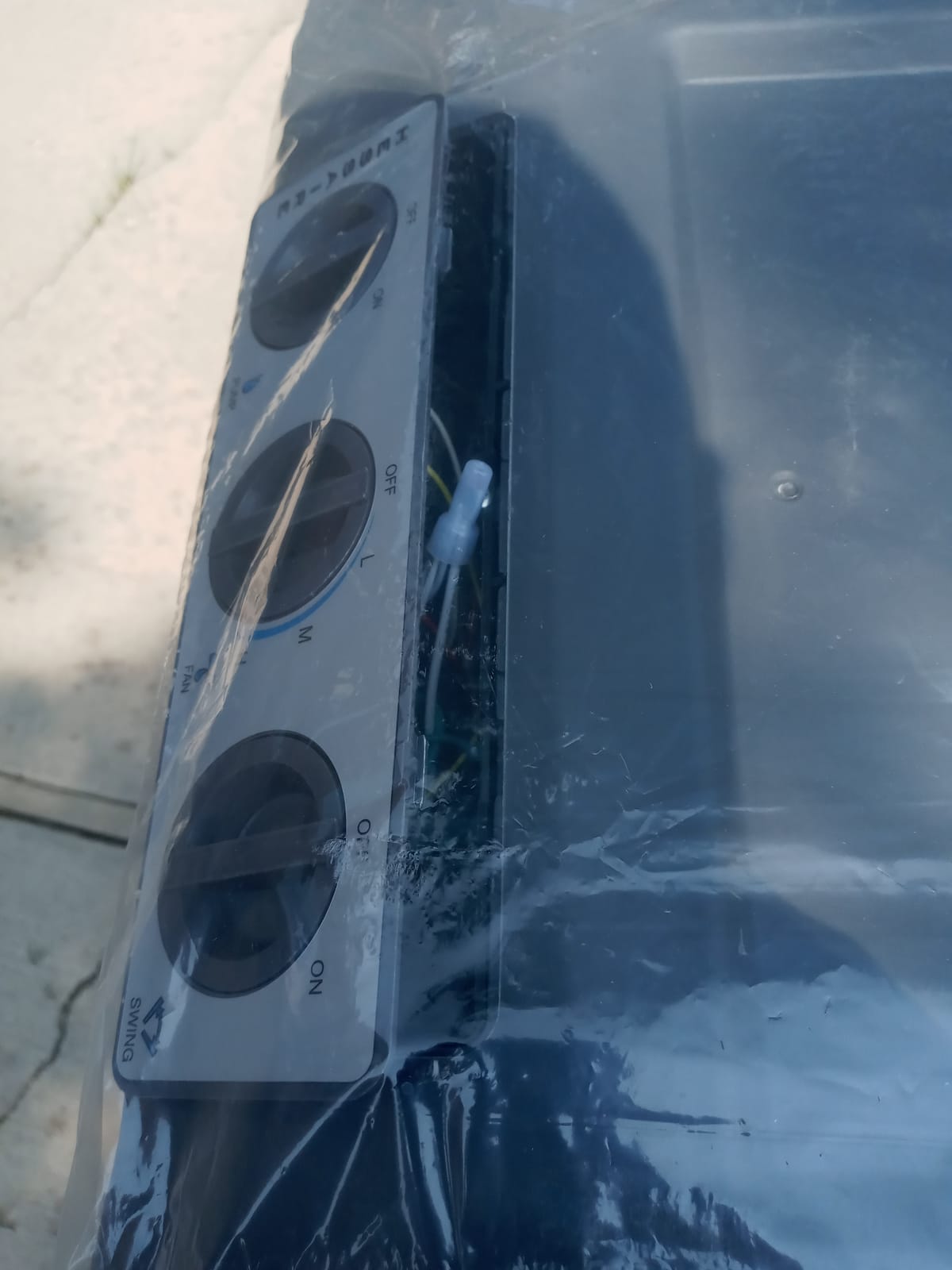
4. Hessaire MC37V – Most Compact Footprint for Garages, Patios and Workshops
MC37V MOBILE EVAPORATIVE COOLER
950 sq ft
3100 CFM
10.3 gal tank
250W
40 lbs
locking casters
Pros
- 3100 CFM genuinely cools a 950 square foot space
- Three sided high density cooling pads
- Continuous fill with included float adapter and hose
- Owners report solid build after two years of daily use
Cons
- High speed is noticeably loud
- A full tank lasts about four hours before attention
- Direct sun reduces output so shade it
This is the only unit in the roundup I would call room-sized rather than room-targeted. At 3100 CFM and 950 square feet of rated coverage it cools a garage, a covered patio or a large open living space in a way the compact units physically cannot, and long-term owners in Arizona, Texas and Dallas describe it as the difference between a usable space and an unusable one on a July afternoon. It rides on four heavy-duty locking casters, though the 37 by 17 by 24 inch footprint is bigger than most people expect, so measure before you commit.
Continuous Fill Is the Feature That Changes Everything
It includes a float adapter and a household hose connection, so you can plumb it to a spigot and forget the tank. In practice many owners run manual fill and drain daily instead, because leaving standing water in a tank day after day is how mineral scale destroys pads in hard desert water. A 10.3 gallon reservoir that runs dry in roughly four hours at full speed tells you how thirsty this machine is.
Three-Sided Cooling Pads and Real Evaporative Surface
Three-sided rigid high density pads give this unit far more wet surface than a single-face tower, which is why the output holds up in a large open space. Independent rotary controls for fan, pump and oscillation are old-school and useful: you can run the pump hard with the fan on low, the correct setting for a quiet garage afternoon.
Placement, Noise and the Shade Rule
Owners repeatedly note that direct sun reduces performance, which makes sense: the intake air is already at peak temperature and a hot metal body in full sun works against evaporation. Under a roof overhang or patio cover it does noticeably better. High speed is loud too, though owners still rate it quieter than a typical barrel fan at comparable output, and at 250 watts and 40 pounds it is the heaviest unit here.
5. Uthfy JH-40BI – Best for Large Yards, Shops and 970 Square Foot Areas
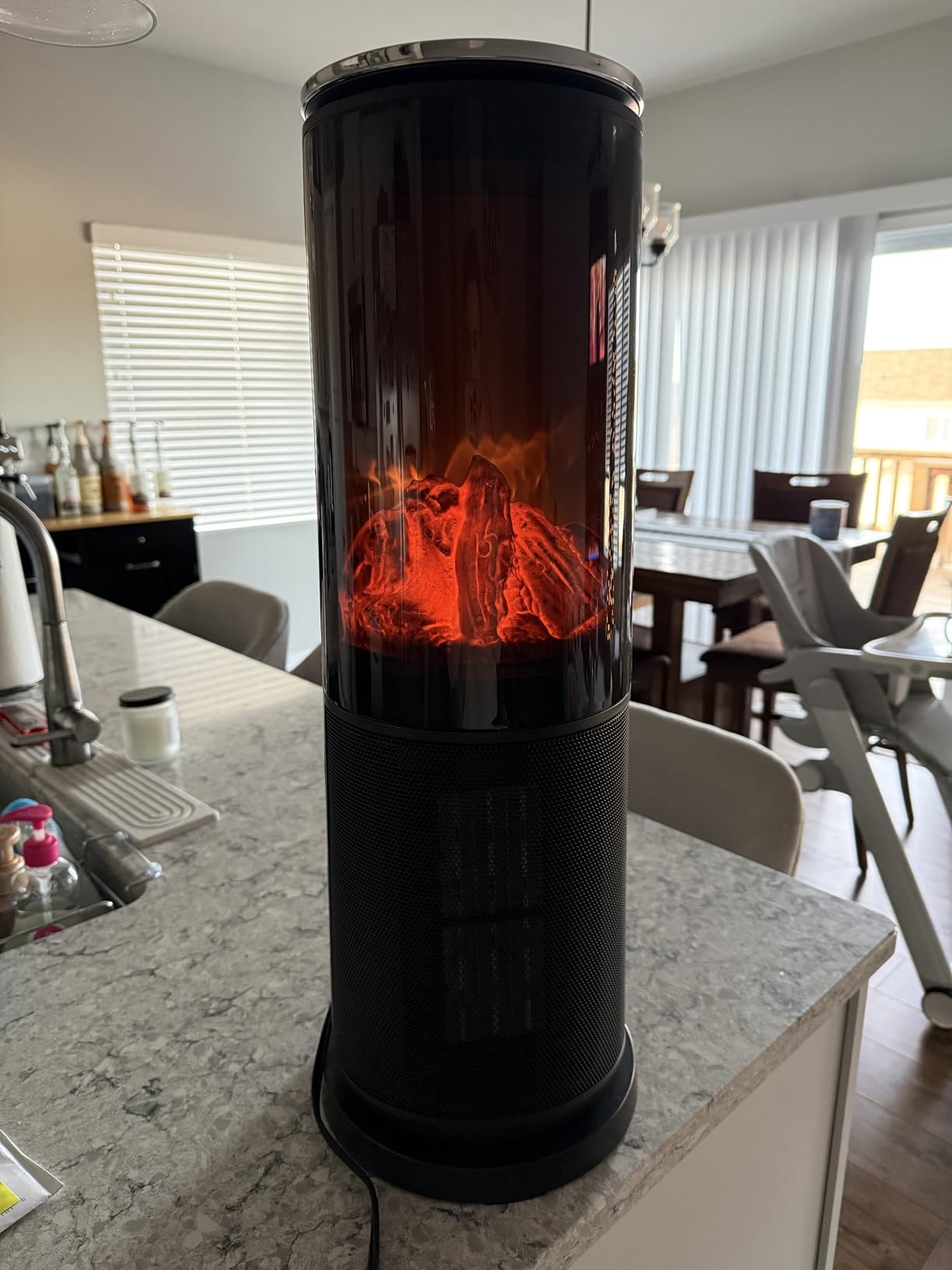
Uthfy 40″ 4800 CFM Swamp Cooler, Large Evaporative Cooler with 11 Gal Water Tank, 3 Speeds, 120° Oscillation, 3 Ice Packs, Metal Frame Portable Air Conditioners for Outdoor, Patio, Shop, Yard, Factory
970 sq ft
4800 CFM
11 gal tank
50 dB
200W
40 in tall
Pros
- Highest airflow in the roundup at 4800 CFM
- 11 gallon tank is the largest capacity here
- 120 degree oscillation removes hot spots
- Galvanized iron frame and copper motor suit outdoor use
Cons
- Rating spread is uneven across owners
- 50 dB is not quiet
- Heavy iron frame at nearly 40 pounds
On the spec sheet this is the most capable outdoor machine here, and in a dry outdoor space the numbers translate: 4800 CFM, 970 square feet of coverage, an 11 gallon tank and three ice packs, in a 40 inch tall desert-style frame. The 120 degree oscillation is what makes a unit this powerful usable, because without it a high CFM fan just blasts one patch of yard.
Tank Size, Ice Curtain and the Refill Decision
Eleven gallons is the largest reservoir in this roundup, and paired with a 4-in-1 composite ice curtain and three included packs it delivers the coldest outlet air of any outdoor unit here. The ice curtain works because the intake panels run cool as well as wet, so incoming air starts below ambient.
You can top fill manually or hook up continuous auto-refill, and there is a built-in drain port, which is the part that matters most for winterization. The auto-refill setup needs to be configured correctly or you will get partial cooling with no obvious fault.
Outdoor Durability and the Weight Trade-Off
Galvanized iron, a copper motor, 360 degree casters with two lockable and a UV-exposed footprint make this the most outdoor-ready unit here. That iron frame is also why it weighs close to 40 pounds, so if your plan involves dragging it from the garage to the bedroom, this is the wrong tool. The rating spread is flatter than the Hessaire, with a visible share of three star reviews pointing to build and consistency variance.
Who It Is For
Outdoor semi-industrial spaces. Shops, warehouses, covered patios, event tents. At 50 dB and 200 watts it is powerful and audible, which is a fair trade in a space where nobody is trying to sleep.
6. PNTCK FKT007R – Most Versatile for Personal Cooling on a Desk or Nightstand
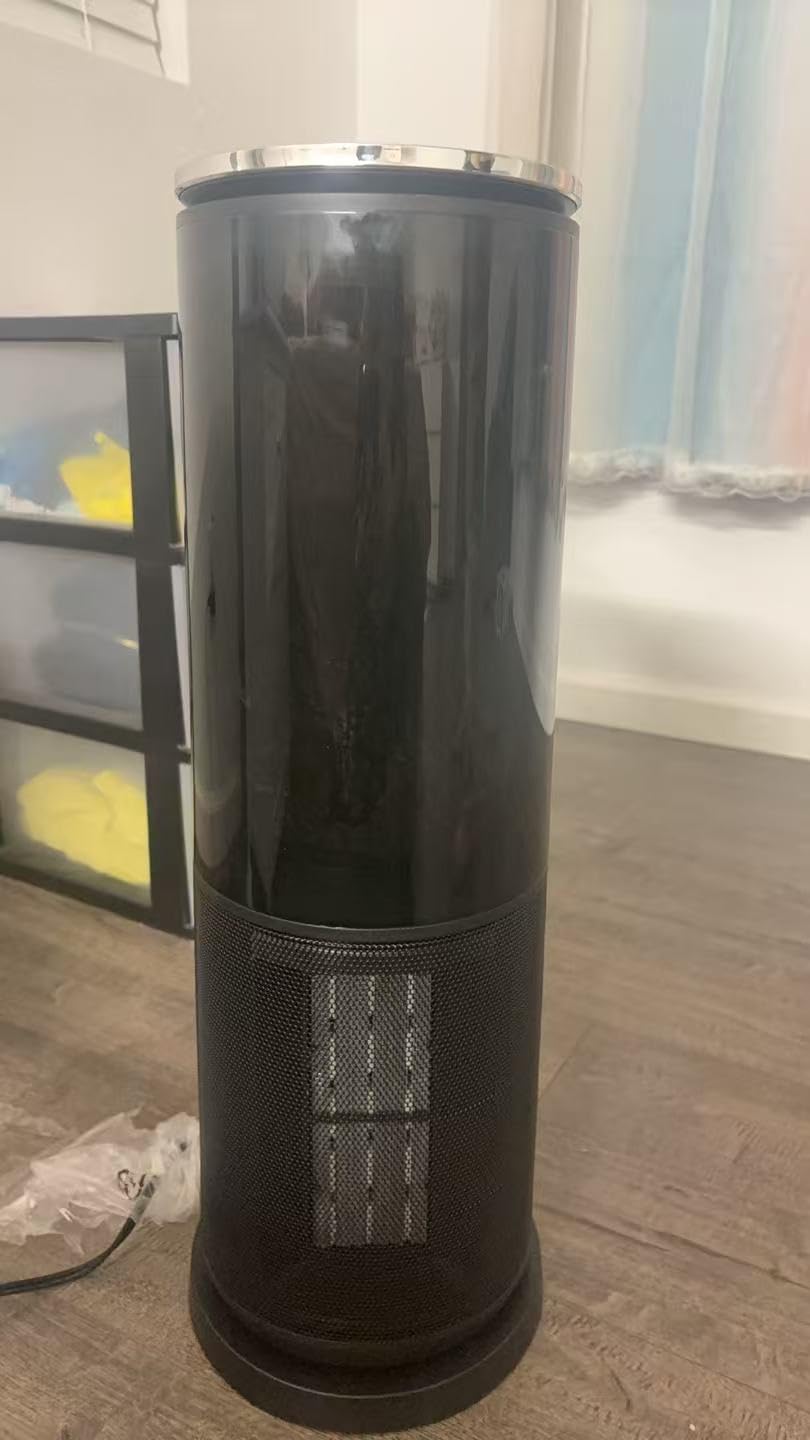
PNTCK Portable Air Conditioners, 3-IN-1 Swamp Cooler with 3 Fan Speeds, 4 Modes, 12H Timer, Remote, Ice Packs, 2.1Gal Water Tank, Evaporative Air Cooler for Bedroom Dorm Office Garage Home
2.1 gal tank
3 speeds
4 modes
12H timer
10 lbs
80 degree swing
Pros
- Child lock on the touch panel for homes with kids
- Four modes including sleep and cool air
- 80 degree blade oscillation with manual vertical tilt
- Light at 10 pounds and easy to move between rooms
Cons
- Cooling fades as the included ice packs thaw
- Best suited to personal cooling not whole rooms
- Water level indicator is hard to see in low light
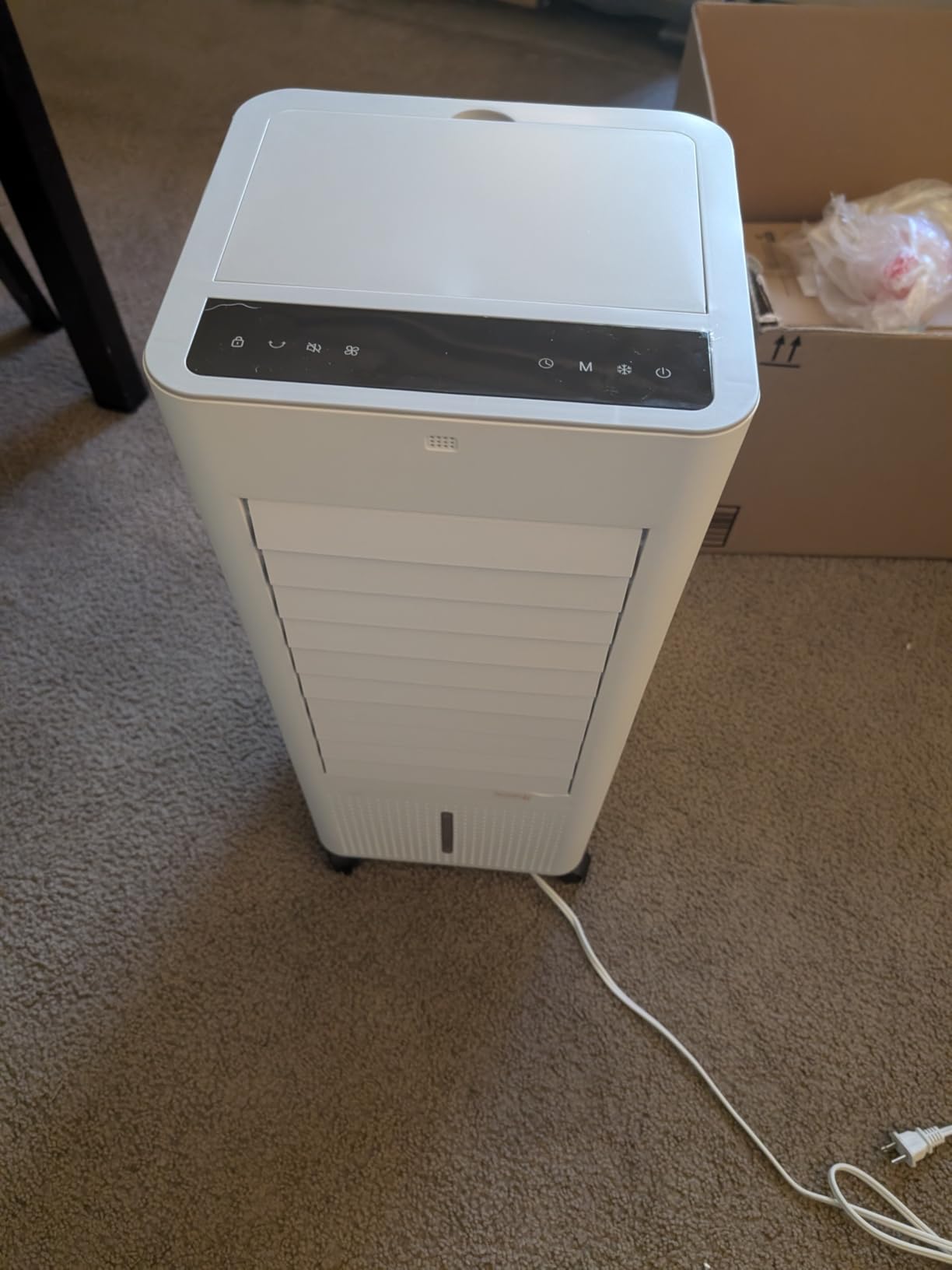
Five reviews, all positive, and a 4.7 average on a sample that small tells you very little. What stands out is the feature list: four modes, a 12 hour timer, a child lock and 80 degree blade oscillation that tilts up and down without rotating the whole tower. At 10 pounds it is the easiest unit here to reposition, and one owner describes it rescuing a rental when the central air failed overnight.
Why Blade Oscillation Beats Tower Rotation
Most compact units rotate the entire cabinet to spread air, which wastes much of the throw. This one oscillates the blade assembly instead, so you can aim a narrow wedge of air precisely at a desk or across a bed and adjust the vertical angle by hand. That targeting is what makes a 2.1 gallon tank acceptable.
Ice Packs and the Honest Cooling Ceiling
Two ice boxes are included and they do help, but the effect fades as they thaw, so all-night use means rotating packs. The water level window is real but small, so in a dark room you will be lifting the lid to check.
The Verdict on This Pick
It is a well-specified small unit, and for a nightstand or a home office desk it does its job. The thin review base is why it sits sixth rather than higher, not the feature set.
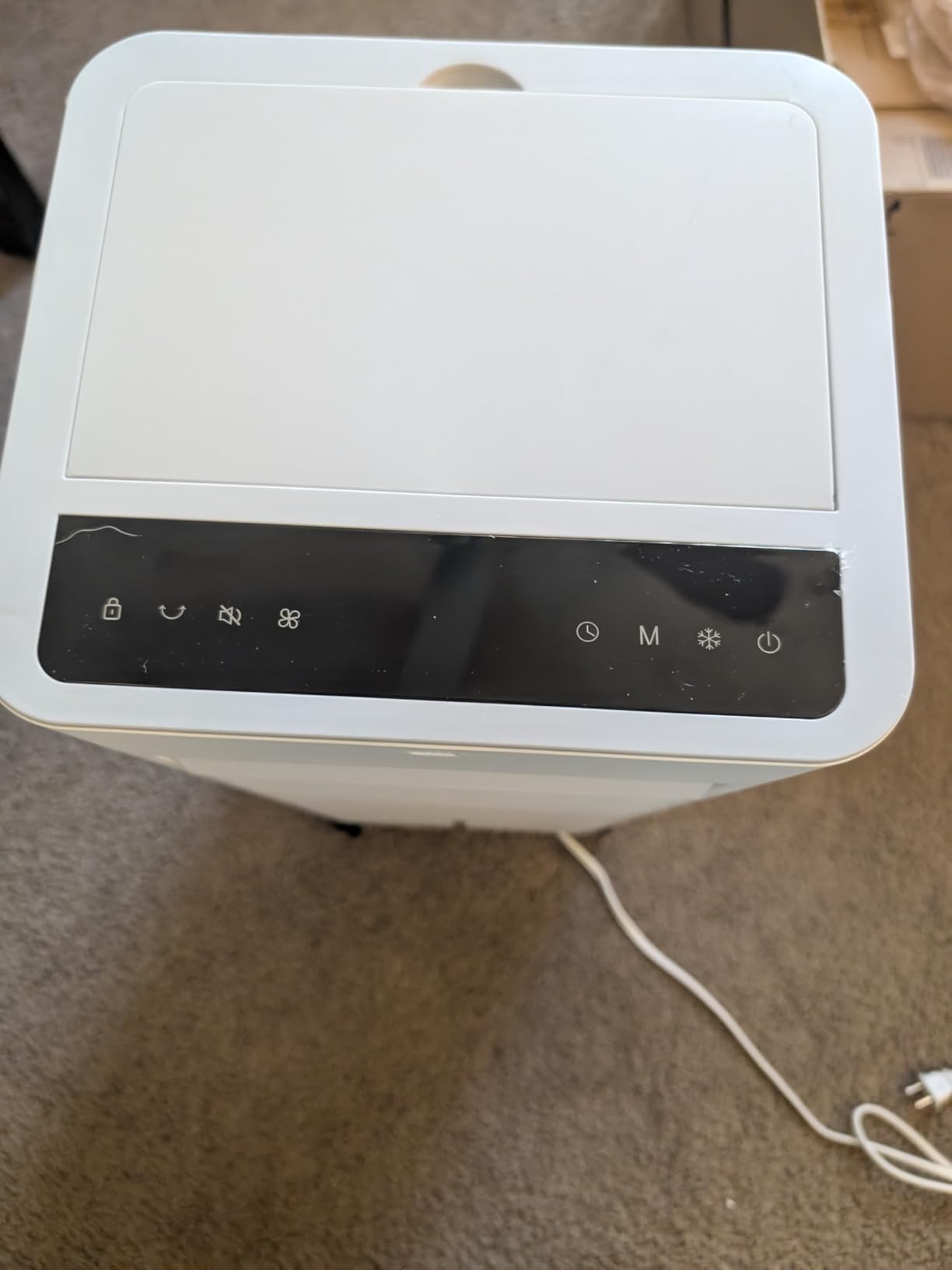
7. OEMTOOLS 23968 – Best for Garages With Built-In Tool Storage
OEMTOOLS 23968 3-Speed Portable Swamp Cooler 3100 CFM 10.3-Gal. Water Tank
950 sq ft
3100 CFM
10 gal tank
68 dB
250W
1/5 HP motor
Pros
- High density media panels give about 80 percent more evaporation area
- Built in tool compartments and casters for workshop use
- UL GFCI plug and UV resistant resin for outdoor safety
- Patented axial propeller spreads air more evenly
Cons
- Loudest unit here at a listed 68 dB
- Only two size variants and no continuous fill listed
- Highest cost per CFM in the roundup
This is the one to buy if the cooler lives in a garage and the garage is also where you keep your tools. The built in tool compartments and casters are the reason a workshop-focused unit costs more per CFM than a general purpose one, and the UL GFCI plug and UV resistant resin body matter if it sits near an open door in summer. Output matches the Hessaire class at 3100 CFM and 950 square feet, driven by a 1/5 HP three speed motor with knob controls.
High Density Pads Are the Standout
The high density media panels deliver roughly 80 percent more evaporation surface area than standard density pads. Given that pad area is the single most predictive spec for how much real cooling a unit produces, this is the most important line on the entire spec sheet.
Noise Is the Dealbreaker in Living Space
More wet surface means more water converted to vapor per hour, which means more heat removed, and also faster mineral pickup in hard water, so the descaling routine in the next section matters more here than anywhere else. But a listed 68 dB makes this the loudest unit in the roundup by a wide margin, and there is no continuous fill hose option listed, so with a 10 gallon reservoir you manage the tank by hand. It comes in just two sizes, 3100 and 5300 CFM.
Where It Wins
Multi-car garages, workshops and covered outdoor work areas where noise does not matter and durability does. A 45 by 28 by 17 inch footprint is large, so plan the floor space before you order.
8. CENSTECH 200Y – Best for Quiet Spaces, Bedrooms and Small Footprints
CENSTECH Swamp Cooler Air Conditioner, 1800CFM Windowless Air Conditioner for Bedroom w/Dual Tanks for 24H Cooling 600sq.ft,4 Modes&3 Speeds, 28FT Remote, 360°Swing 30″ Portable Evaporative Air Cooler
600 sq ft
1800 CFM
dual 6L tanks
25 dB
65W
11 lbs
Pros
- Quietest unit here at 25 dB for sleeping and study
- Dual 6 liter tanks run up to 24 hours without refilling
- Four ice packs included and the cooler outlet is noticeable
- Bladeless design is safer around kids and wipes clean
Cons
- Cooling is very localized and felt only up close
- 1800 CFM covers about 600 square feet
- Some international buyers report oscillation failing early
This is the sleeper of the roundup and the one I would put in a bedroom. At 25 dB it is the quietest design in the group by a full 10 decibels, which is the difference between noticeable and invisible while you sleep, and the 4.6 average comes with a meaningful review count. The dual 6 liter tanks are the other headline: up to 24 hours of cooling on a fill, with a water level indicator so you are not guessing.
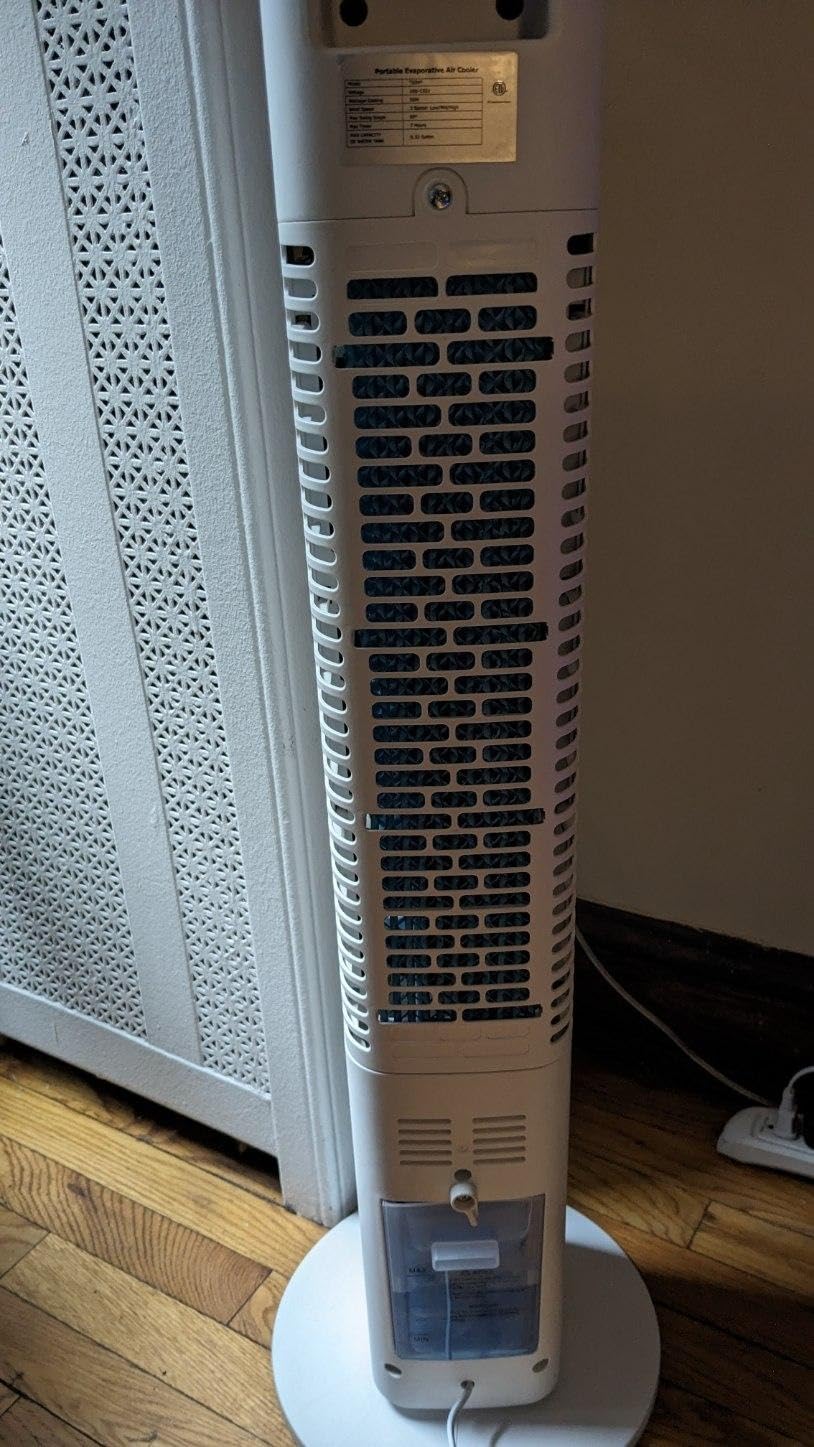
Bladeless Design and Child Safety
There is no exposed blade on the outlet, which matters in a kid’s room and around pets, and it wipes clean in one pass. The 10 by 9 by 30 inch footprint at 11 pounds is narrow enough for a nightstand gap or a camper, with a side handle for carrying it between rooms.
What the Ice Packs Actually Do
Four packs are included, and owners report a noticeably cooler outlet when they are in use. That is a real effect, but it is a local one: the cool zone sits directly in front of the outlet, and reviewers are consistent that you feel it from a few feet away rather than across a room. The packs are also difficult to extract once submerged in the water drawer.
Room Coverage and the Honest Limit
At 1800 CFM the rated coverage is 600 square feet. That is larger than the compact tier, but it is still spot cooling with a wide throw rather than whole-room conditioning. Some international buyers also report oscillation failing within a month, so if auto-rotation is essential, verify it early.
How to Size an Evaporative Cooler for Your Dry-Climate Space
Match CFM to Square Footage, Not to Room Size
A useful rule of thumb for 8 foot ceilings is about 4 CFM per square foot of floor area, and you want roughly 30 air changes per hour to keep the cool air moving through the space. That means a 300 square foot room needs something in the 1200 CFM neighborhood, and a 950 square foot garage needs 3000 CFM or more.
Below roughly 1500 CFM a unit is decorative in a large space. You will feel air moving across your skin but the room temperature will not move, and most disappointed evaporative cooler buyers simply bought a unit two sizes too small.
Also measure before you order. The Hessaire and OEMTOOLS units are both over 35 inches tall and need clearance on the intake side, because cramming a large unit into a corner cuts airflow and pads performance.
Compare Cooling Pad Surface Area, Not Just CFM
CFM tells you how much air moves; pad surface area tells you how much of that air gets cooled. The OEMTOOLS claims about 80 percent more evaporation area from high density media than standard pads, and the Hessaire uses three-sided rigid pads for the same reason. A unit with a large pad keeps cooling after the tank has been running, while a small pad saturates in twenty minutes and then blows warm air.
Tank Capacity Decides Your Daily Routine
Below 3 gallons you will refill daily, which on a 100 degree weekend becomes a chore you eventually stop doing. The 11 gallon Uthfy and 10.3 gallon Hessaire tanks are a different category again, where a hose connection is worth setting up. Look for a visible water level window rather than an app.
Noise Decides Where You Can Put It
Below about 40 dB a unit can run in a bedroom or a study without dominating the room. The DREO at 35 dB and the CENSTECH at 25 dB are the two that qualify. Between 45 and 50 dB is fine for an office where a fan already runs.
Above 60 dB, as with the 68 dB OEMTOOLS, the unit belongs in a garage. Noise and cooling power pull in opposite directions, because pads move the same air more slowly than a compressor does. Pick the room first, then the decibels.
Dry Climate Indoor Discipline
These units add moisture. In a desert home that is often welcome, but in an enclosed room with no vent path you can end up with a clammy room that feels worse than before. Open a window on the shaded side and an exhaust fan on the opposite side so the humidified air can leave, and aim to stay under 60 percent RH indoors. Above that threshold the comfort benefit reverses, and a window AC serves you better.
When Not to Buy One
Skip evaporative cooling if your summer climate is genuinely humid, if you need to cool a bedroom through a full night with compressor-unit reliability, or if the room is full of electronics and no ventilation is possible. Also skip it if you are unwilling to drain and clean the tank, because a neglected cooler in hard water will smell within weeks. For a closed-up home office, the practical answer is a strong fan plus a spot cooler aimed at the desk.
Hard Water, Algae and Biofilm: The Maintenance Side Desert Owners Skip
Every competitor roundup I analyzed for this topic scored one or two out of five on hard water, algae and biofilm, which is the single biggest gap in the category. Desert water is hard, scale forms on wet pads fast, and a neglected tank develops the musty smell some owners describe as a wet dog on startup. Here is the routine that prevents all three.
A Cleaning Routine That Actually Works
First, run the tap for two minutes before filling a tank to flush the sediment that settles at the bottom of supply lines. Then rinse the cooling pad weekly. A hose and a little mild detergent is enough, and the removable-pad designs on the DREO and CENSTECH make this a two minute job.
Descale monthly. A dilute citric acid or vinegar solution through the pump and pad dissolves the mineral crust before it becomes permanent, and a monthly dose of a swamp cooler tablet or algaecide from a hardware store stops green algae returning.
Never run the pump dry, and drain the tank completely whenever the unit sits unused for more than a few days. Stagnant warm water is the exact condition that produces biofilm and the odor that comes with it.
Winterization in a Dry Climate
At the end of the season, unplug the unit, drain the tank, run the pump empty for a couple of minutes to clear the line, pull the pad and let it dry fully in the sun, then store it upright in a dry space. Never store a wet pad in a sealed bag; wrapped damp cellulose in a warm garage is a mold culture you will smell next spring.
Water Safety and Legionella
Risk comes from stagnation, not from evaporation. These units evaporate water continuously while running, which is the opposite of the stagnant, warm, still conditions the bacterium prefers. The realistic risk cases are units left full and switched off for weeks, or tanks left biofilm-choked in a warm room, so drain when idle and run on a timer rather than continuously.
Frequently Asked Questions
Are swamp coolers better in dry or humid weather?
Swamp coolers are dramatically better in dry weather. Evaporation only works efficiently when the air can hold more water, which is why desert air at 15-30% humidity produces a strong 10-20 degree drop while the same unit in humid air above 60% relative humidity barely cools anything and simply circulates warm air across a damp pad.
Will a swamp cooler work in 100 degree weather?
Yes, as long as the humidity is low, and this is the situation dry climates are built for. The cooler works from the wet bulb temperature of the incoming air, not the dry bulb reading, so a 100F day at 20% humidity can yield air leaving the unit around 80-85F. The same 100F day at 70% humidity will barely register.
What is the recommended CFM for an evaporative cooler?
A common rule of thumb is about 4 CFM per square foot of floor area for rooms with 8 foot ceilings, delivering roughly 30 air changes per hour. That means a 300 square foot room needs about 1200 CFM and a 950 square foot garage needs 3000 CFM or more. Below roughly 1500 CFM a unit will not meaningfully cool a large space.
What size evaporative cooler do I need for 2000 square feet?
For 2000 square feet with 8 foot ceilings you want roughly 8000 CFM, which is beyond every portable unit in this roundup and into permanently installed or multi-unit territory. In practice that means two large commercial format coolers positioned to create cross-ventilation, or a properly engineered whole house system.
What are the downsides of using an evaporative cooler?
The main drawbacks are added indoor humidity, a growing water and electricity use, hard water scale on the pads, algae and biofilm in a neglected tank, and noise. Performance also collapses above 60% relative humidity, and the units cool an area rather than a person, so many buyers find them weaker than the product name implies.
How to prevent calcium build up in a swamp cooler?
Run the tap for two minutes before filling to flush sediment, rinse the cooling pad weekly, and descale monthly with a dilute citric acid or vinegar solution pumped through the pad. In hard desert water, a monthly swamp cooler tablet keeps the tank free of algae. Draining the tank whenever the unit is idle prevents crust forming at all.
How do you get rid of algae in a swamp cooler?
Drain the tank completely, remove the pad and rinse it away from the unit, then refill with a swamp cooler tablet or algaecide from a hardware store dissolved to the label ratio. Run the unit for an hour so the solution reaches every surface, scrub any remaining green film from the tank walls, and rinse thoroughly before refilling with clean water.
Can you get legionella from a swamp cooler?
The risk comes from stagnant warm water, not from evaporation. A running cooler keeps water moving, which works against the bacteria. The realistic risk is a unit left full and switched off for weeks, or a biofilm-choked tank in a warm room, so drain the tank when idle, keep it clean and use a timer instead of continuous operation.
Which Evaporative Cooler Fits Your Dry Climate
If you want the best balance of proven reliability, tank runtime and owner history, the Ashihoti 2508 is the pick. It runs 20 hours on a tank, rolls anywhere on casters and has more than a thousand owners who have already tested it for you. For a real room, garage or covered patio, the Hessaire MC37V moves 3100 CFM across 950 square feet and is the only unit here with a proven multi-year service record. For outdoor yards and shops, the Uthfy JH-40BI leads on 4800 CFM and an 11 gallon tank. For a bedroom, the CENSTECH 200Y at 25 dB is the quiet one, with the DREO DR-HEC001 as runner-up at 35 dB. For a workshop, the OEMTOOLS 23968 adds tool storage and the highest evaporation area of the group.
Whichever you choose, buy it for the room it is rated for, keep the tank clean, and open a vent path. The comparison table above has the full side-by-side numbers, so check the latest details before you order.