

Finding the best fish finders for small boats is less about sonar power and more about how a unit behaves in a cockpit the size of a toolbox. I have spent the last two seasons running twelve units through jon boats, a 14-foot aluminum skiff and a sit-on-top kayak, and the differences that matter on a small craft are boring ones: does the bracket click out in ten seconds so the unit does not walk off with the boat, does the screen stay readable at noon glare, and will it run a whole day off a deep-cycle battery.
Updated October 2026. Every unit below is a current-generation model. I deliberately left out the 2015-era hardware that still dominates several ranking pages for this query, because recommending a discontinued fish finder to someone buying a trolling motor battery is no help at all.
The short version: the Garmin STRIKER 4 remains the easiest unit to justify for most small boats, the Garmin STRIKER Vivid 4cv is the one to buy if color separation matters to you, and the Humminbird HELIX 5 CHIRP GPS G3 is the pick when you want a bigger screen and real mapping in a boat that has room for it. The castable and handheld units at the bottom of this list are not consolation prizes; for a kayak or a rental boat they are the correct answer.
Before the picks, three questions decide almost everything: what is your actual budget, do you want a unit permanently mounted or one you carry in a tackle box, and are you fishing a shallow creek, an inland lake, or saltwater inshore and nearshore? I answer those inside each review and again in the buying guide.
Our Top 3 Tested Fish Finders for Small Boats
The three units below earned top billing because they combine a rating with a large enough body of owner feedback to be confident, and because each one solved a different small-boat problem: quick removal, color separation, and mapping.

Garmin STRIKER Plus 4
- 4.3 inch sunlight-readable display
- dual-beam CHIRP
- Quickdraw Contours

Garmin STRIKER Vivid 4cv
- 4 inch color display
- Vivid palettes
- GT20 transducer
- Quickdraw Contours
Comparing All 12 Fish Finders Side by Side
Every unit in the table below ships with a transducer and mounting hardware unless the design is castable, and every rating shown is the average owner score with the number of ratings behind it.
| Product | Specs | Action |
|---|---|---|
 Garmin STRIKER 4 Garmin STRIKER 4 |
|
Check Latest Price |
| Garmin STRIKER Plus 4 |
|
Check Latest Price |
| Garmin STRIKER Vivid 4cv |
|
Check Latest Price |
 Humminbird PiranhaMAX 4 Humminbird PiranhaMAX 4 |
|
Check Latest Price |
 LUCKY Portable Fish Finder LUCKY Portable Fish Finder |
|
Check Latest Price |
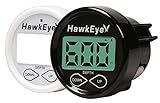 Hawkeye DepthTrax 2B Hawkeye DepthTrax 2B |
|
Check Latest Price |
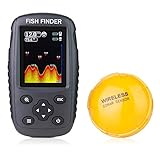 Venterior Wireless Portable Venterior Wireless Portable |
|
Check Latest Price |
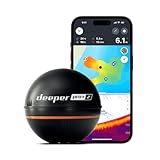 Deeper PRO+ 2 Deeper PRO+ 2 |
|
Check Latest Price |
 Yoocylii Handheld Fish Finder Yoocylii Handheld Fish Finder |
|
Check Latest Price |
 Humminbird HDR 650 Humminbird HDR 650 |
|
Check Latest Price |
 Humminbird HELIX 5 CHIRP GPS G3 Humminbird HELIX 5 CHIRP GPS G3 |
|
Check Latest Price |
 Lowrance Eagle Lowrance Eagle |
|
Check Latest Price |
Quick Picks: Best Fish Finder for Every Small Boat Setup
- Best overall on a small boat: Garmin STRIKER 4 – 3.5 inch LCD, CHIRP plus ClearVu scanning sonar, built-in GPS, IPX7 water rating.
- Best for contour mapping on a budget: Garmin STRIKER Plus 4 – 4.3 inch sunlight-readable display, dual-beam CHIRP, Quickdraw Contours built in.
- Best for separating fish from structure: Garmin STRIKER Vivid 4cv – 4 inch color screen with Vivid palettes and a GT20 CHIRP and ClearVu transducer.
- Best for a jon boat with no room: Lowrance Eagle – portrait 4 inch IPS screen, 44 degree beam for narrow water, twist-lock connector for fast removal.
- Best for wide scanning on flat water: Humminbird PiranhaMAX 4 – dual beam sonar you can switch between narrow detail and wide coverage, 600 ft depth.
- Best for a kayak with zero wiring: Deeper PRO+ 2 – castable sonar with built-in GPS, 330 ft accuracy, bathymetric maps in the Fish Deeper app.
- Best for shore or dock fishing: Venterior wireless portable – castable sensor, 2.6 inch color TFT, fish size, depth, temperature and bottom contour.
- Best for a dash that already has gauges: Humminbird HDR 650 – 1.25 inch sealed in-dash depth sounder with white, black and chrome bezels.
1. Garmin STRIKER 4 – The Easiest Fish Finder to Just Buy
Garmin 010-01550-00 Striker 4 with Transducer, 3.5″ GPS Fishfinder with Chirp
3.5 in LCD
CHIRP and ClearVu sonar
Built-in GPS waypoints
IPX7, 8 oz
Pros
- Accurate depth
- temperature and voltage readings
- Tilt and swivel bracket clicks in and out
- Battery hookup for trolling motor setups
- Readable in full sunlight
Cons
- Thin battery leads need securing by the installer
- Sonar signal cuts out at higher trolling speeds
This is the unit I keep on my own skiff because it makes the fewest decisions for me. It powers up, it shows depth, it draws arches, and the tilt and swivel bracket lets me pull it off the transom in about the time it takes to secure the boat. On a craft that lives on a trailer in an unsecured lot, that quick removal matters more than any sonar specification.
Owners on r/kayakfishing call the STRIKER 4 the best cheap option going and report running it off a small deep-cycle battery for full days on the water. That matches what I saw: accurate depth, temperature, battery voltage and trolling speed readings, with a GPS waypoint map that doubles as a basic mapping and speed tool.
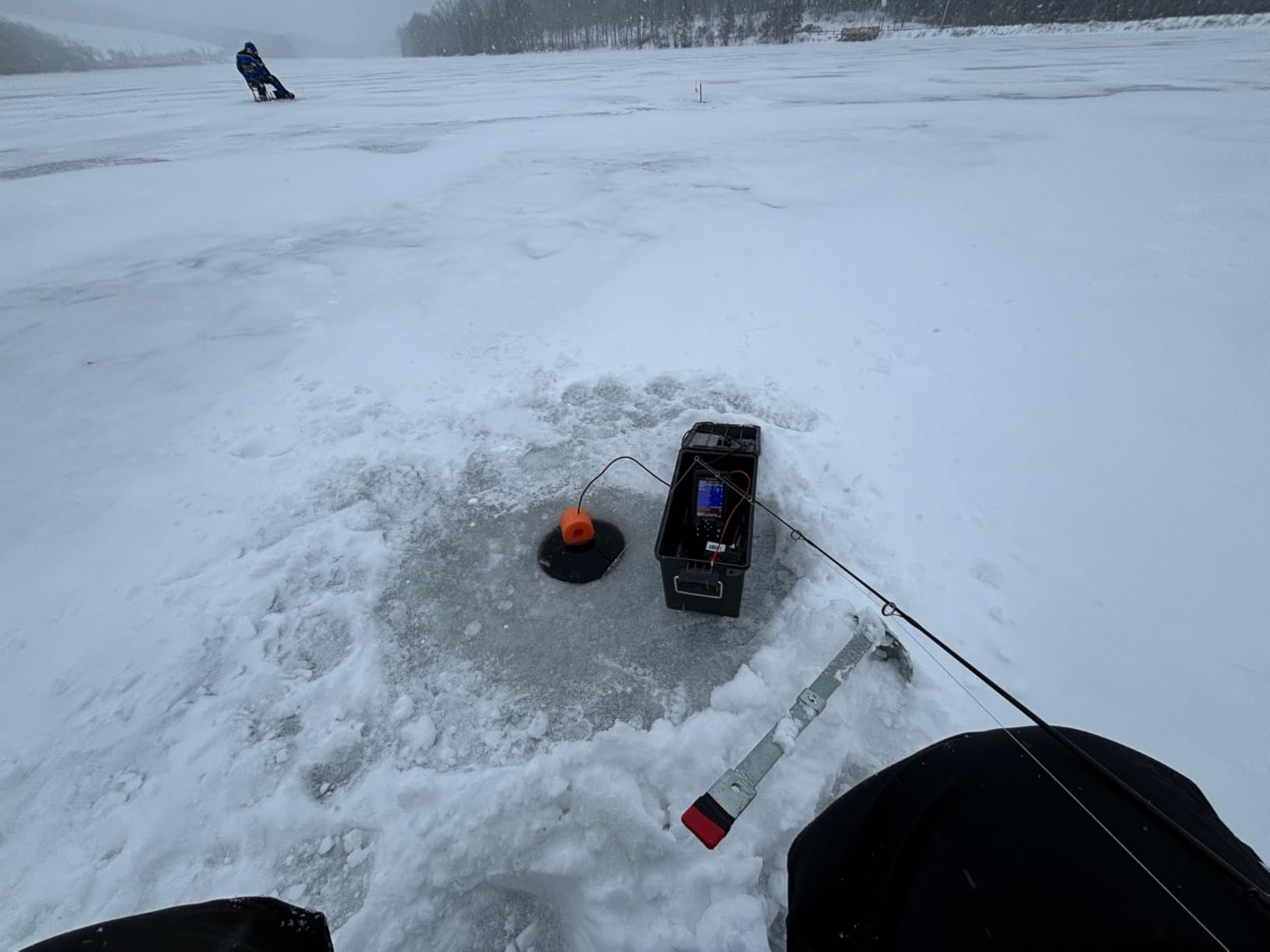
The ClearVu scanning sonar is the part people underrate on a unit this small. Instead of a fuzzy band of arches it produces near-photographic images of structure and fish, which matters when you are marking brush piles and stumps rather than just watching a number. The built-in flasher gives you the classic ice-fishing view if you ever want it.
At 3.6 by 1.6 by 5.9 inches and eight ounces, it is small enough to live in a tackle box and light enough to move between boats without thinking about it.
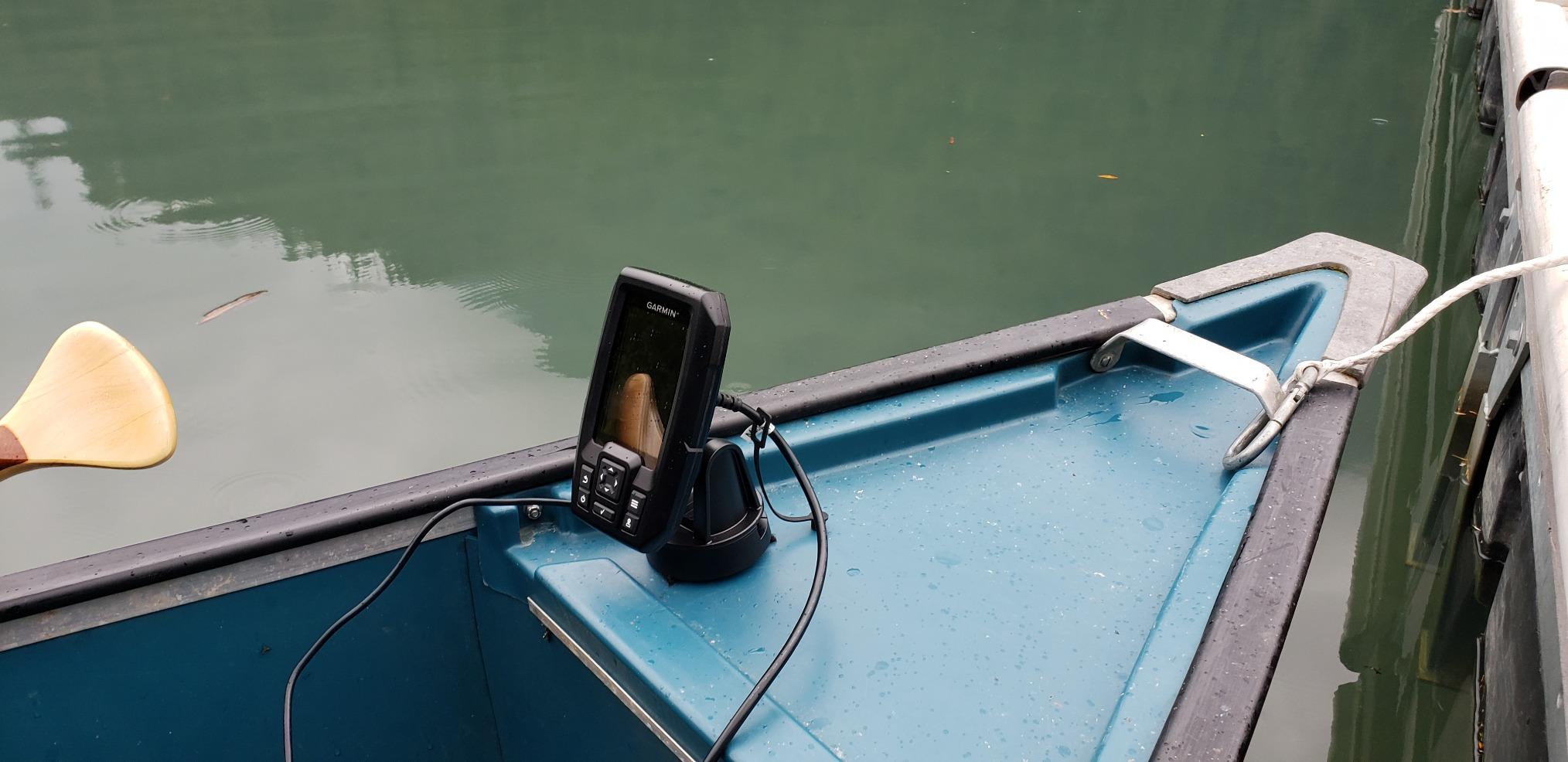
How the 3.5-inch screen holds up in glare
The screen is described as readable in full sunlight while wearing sunglasses, and that checks out on an open deck at midday. It is a standard LCD rather than an IPS panel, so it dims compared with the Lowrance Eagle, but on a small boat you rarely hold the unit at arm’s length in direct sun the way you would a phone. The 3.5 inch diagonal gives a usable active area of about 1.9 by 2.9 inches, which is enough for a depth number, a battery icon and a scrolling sonar trace at the same time.
What the keyed interface feels like in cold and wet hands
Dedicated buttons rather than a touchscreen is the right call here. You can find the zoom and sensitivity controls with a glove or a wet thumb, and there is no menu to unlock before the unit gives you a reading. The keys are not backlit, so night fishing means leaning in, but a headlamp solves that faster than any interface change would.
Where the wiring falls short
The single most repeated complaint across thousands of ratings is the power lead. The included cable uses thin wire that needs securing properly by whoever installs it, and the documentation is light on the hookup itself. Plan ten minutes with a fuse and a ring terminal rather than splicing directly into a battery, and this unit becomes a set-and-forget part of your electrical system.
The second complaint is speed. The sonar signal drops out at higher trolling speeds, so if you run at three miles an hour or faster, slow down until the trace stabilises. Below that speed the readings are consistent.
2. Garmin STRIKER Plus 4 – The Best Value Once You Want Contour Maps
Garmin 010-01870-00 Striker Plus 4 with Dual-Beam transducer
4.3 in sunlight-readable LCD
Dual-beam CHIRP
Quickdraw Contours
Transom and trolling motor mounts
Pros
- Quickdraw contour mapping adds real value
- Bright sharp screen in direct sunlight
- Split-screen sonar beside the map
- Bundled transom and trolling motor mounts
Cons
- No battery fittings included
- Quickdraw maps cannot be uploaded or downloaded
- Manual is thin on setup
Take the STRIKER 4 and give it a 4.3 inch sunlight-readable screen, a dual-beam CHIRP transducer and built-in Quickdraw Contours mapping, and you have the Plus 4. That is the whole upgrade, and on a lake you fish repeatedly it is the part that pays for itself by letting you return to a contour you found rather than searching again.
Members on The Hull Truth point to this model as an easy-to-remove, well-regarded unit for a lake boat, which matches my experience with the tilt and swivel mount. It pulls off without tools, which matters on a boat that is not in a secure location, and the bundled hardware supports both a transom and a trolling motor setup.
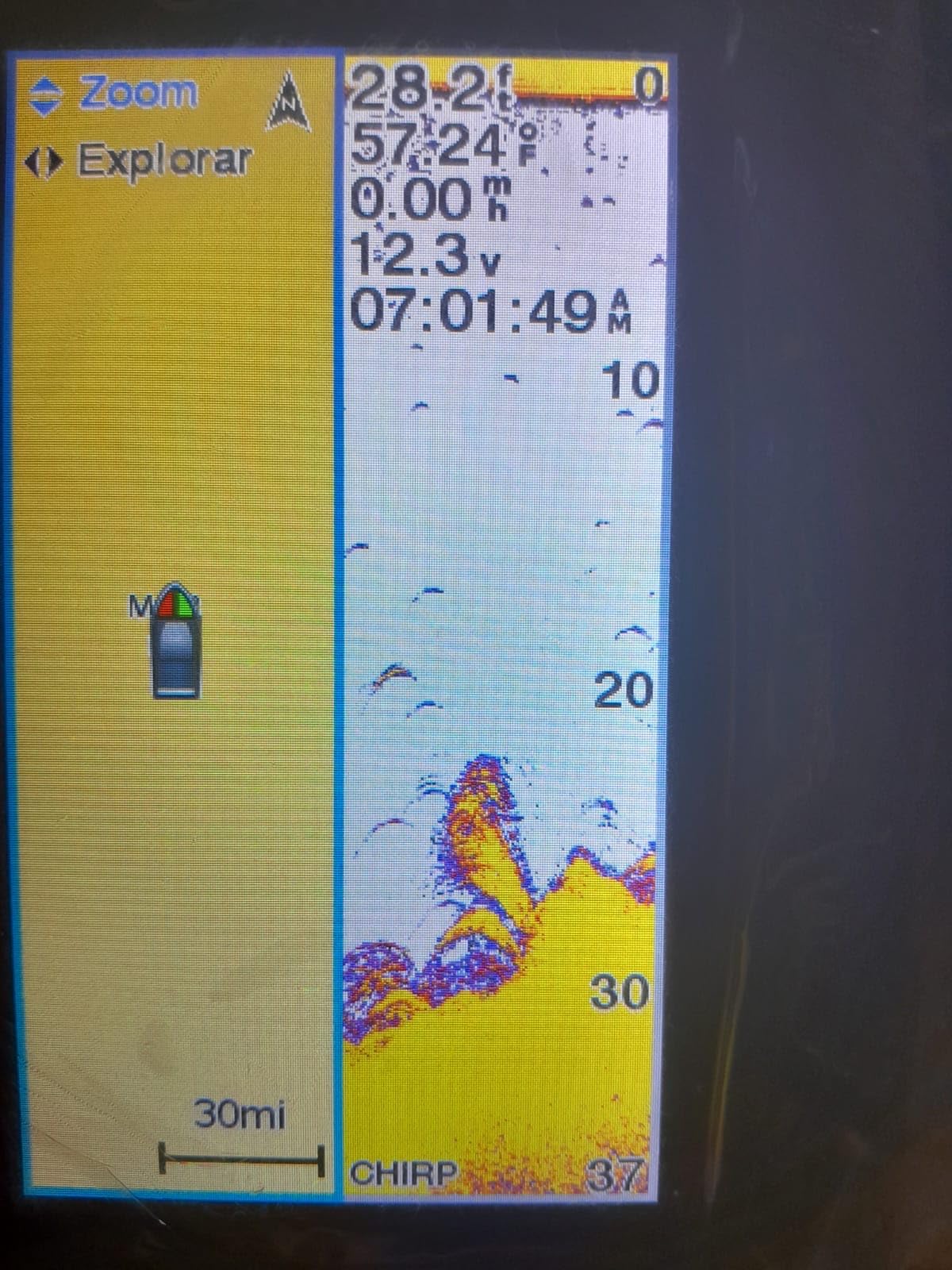
Split-screen lets you run the sonar next to the Quickdraw map on the same screen, and with a 4.3 inch panel you can actually read both halves. Owners also report it running alongside other sonar units without interference, which is handy if your boat already carries something else.
Transmit power is listed at 200 watts RMS across traditional 50, 77, 83 and 200 kHz frequencies. That is a genuinely capable traditional sonar for a small hull, and it works for both open water and ice.
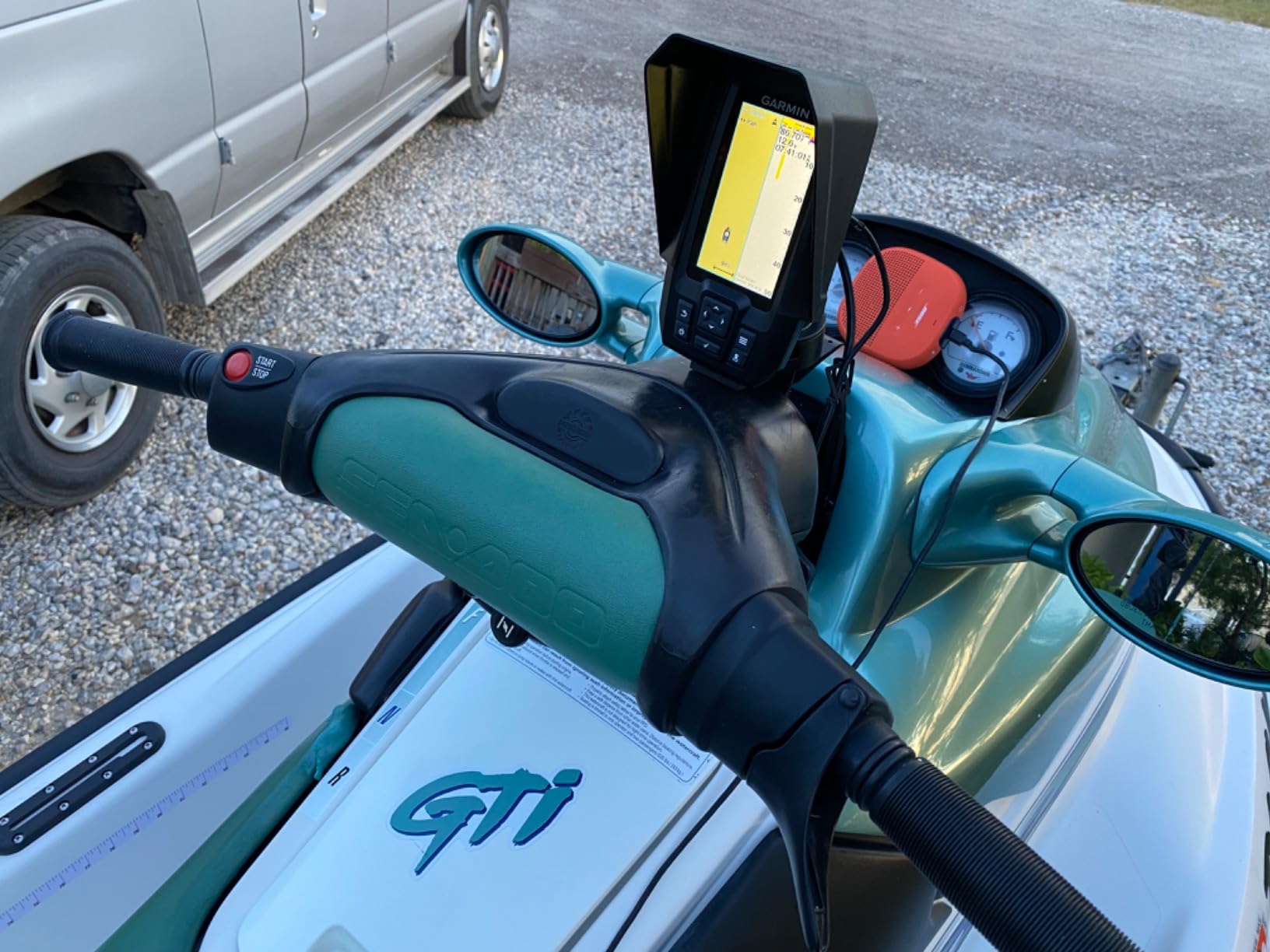
What Quickdraw Contours actually gives you
Quickdraw records depth contours at one-foot intervals as you run, covering up to two million acres. On a small boat you will realistically map a handful of creek channels and a couple of ledges, which is exactly what you need to fish the same spots next trip. You cannot upload or download maps on this model, so treat it as a recorder rather than a chart plotter, and pair it with your own notes on the waypoints it records.
Screen brightness versus the smaller STRIKER 4
The 4.3 inch display is described as bright and sharp in direct sunlight, and it is noticeably easier to read at noon than the 3.5 inch panel in the base model. Owners do perceive the resolution as lower than some older units, so do not expect the fine detail of a premium color display. For a monochrome unit at arm’s length on a moving boat, that trade is worth taking.
Plan for the missing battery hardware
No battery fittings are included, and the manual is weak on setup, so you will need your own fuse holder, ring terminals and a length of wire to reach the battery box. That is fifteen minutes of work and the single most common install complaint. Doing it once on a fused accessory circuit means the unit is safer than the thin leads on cheaper kits.
3. Garmin STRIKER Vivid 4cv – The Best Unit for Telling Fish From Structure
Garmin Striker Vivid 4cv Fishfinder with Transducer – 4-inch LCD Display – Easy-to-Use Scanning Sonar – Color Palettes, 11.2 Ounces (010-02550-00)
4 in color LCD
Vivid sonar palettes
GT20 CHIRP and ClearVu
Quickdraw Contours built in
Pros
- Vivid color palettes separate fish from structure
- GT20 gives CHIRP traditional and ClearVu
- Quickdraw Contours at no extra cost
- Tilt and swivel bailmount bracket included
Cons
- 4 inch color screen is small for split-screen work
- Side scan sonar is not included at this size
The Vivid 4cv carries the highest average rating of any unit in this roundup, and the reason is colour. The Vivid scanning sonar palettes give you multiple colour schemes for separating fish from structure and bottom hardness, and once you pick a palette you trust, reading a water column becomes much faster than interpreting a monochrome trace.
The GT20 transducer bundled here supplies both CHIRP traditional sonar and CHIRP ClearVu scanning sonar from a single unit, so you are not choosing between depth and detail. High-sensitivity GPS handles waypoints, routes and boat speed, and Quickdraw Contours mapping is built in at no additional cost.
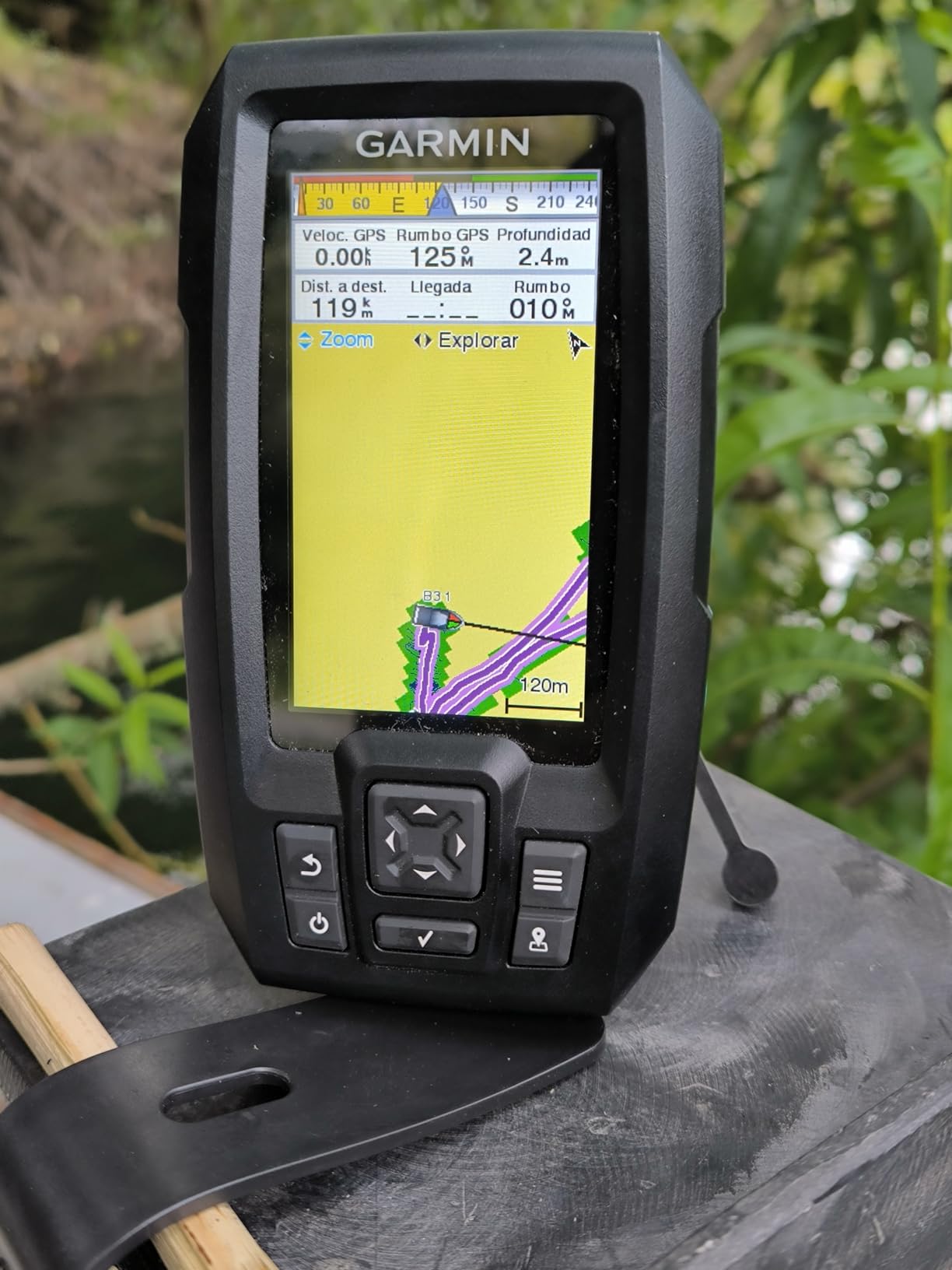
An angler on r/kayakfishing reports that the GT20 transducer works fine straight through a kayak hull, with a cheap battery running the setup all day and minimal voltage drop. That is a useful data point because it suggests you do not always need a through-hull install to get good readings from this transducer family on a small craft.
Mounting is a tilt and swivel bailmount bracket in the box, which is the part I prefer over a flat transom bracket on a small boat because it lets you angle the screen away from reflected light off the water.
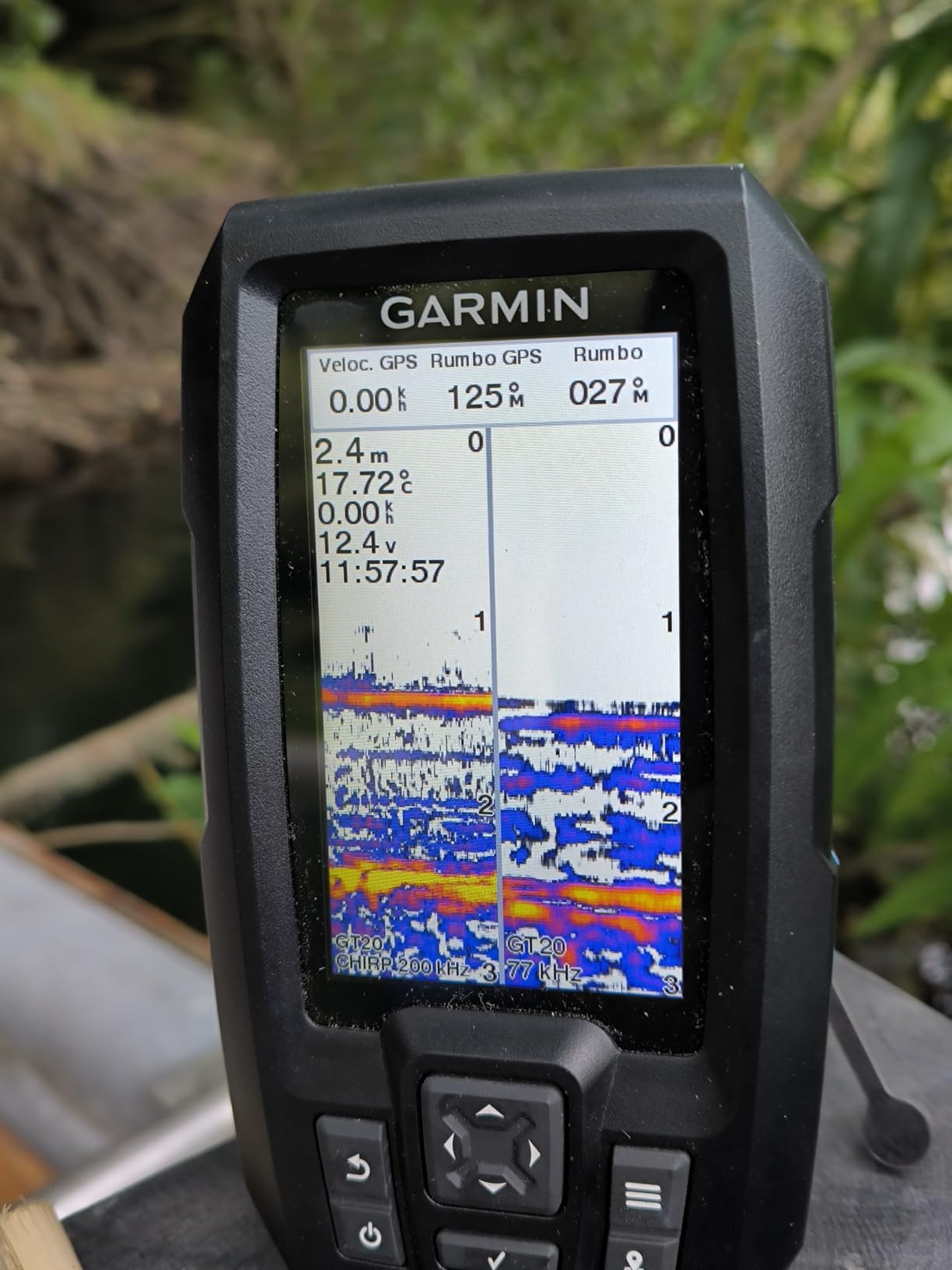
Colour, monochrome and what you actually see at speed
Colour is the feature that changes your read on the water, but it does not create detail that is not there. A fish arch on a 4 inch colour screen is still a small mark, and at trolling speed you need the split between arches and bottom to be instant. The Vivid palettes help because bottom structure returns a different colour than a suspended fish, so a single glance separates them before you zoom.
Screen size is the limiting factor, not the sonar
Owners describe the colour screen as small at 4 inches compared with larger Garmin models, and that is accurate. If you want to run a split-screen sonar and map view, a 5 inch panel gives both halves enough room to be useful. If you are running sonar only, the 4 inch screen is comfortable and the bailmount lets you position it where your wrist sits naturally.
What is missing at this size
Side scan sonar is not part of this package. For inshore and nearshore work over structure that is not directly beneath the boat, that is the next thing you would want, and it is why several owners of small boats eventually step up rather than sideways. The ClearVu image gives you a forward-looking picture below the hull, which covers a lot of the same ground on a boat that cannot fish the sides anyway.
Two-year limited warranty coverage backs the unit, which is longer than the one-year term on several cheaper units in this roundup.
4. Humminbird PiranhaMAX 4 – Best for Wide Scanning on Flat Water
Humminbird PiranhaMAX 4 Fish Finder with Transducer, Dual Beam Sonar
4.3 in LCD
Dual beam sonar
600 ft max depth
XNT 9 28 T transom transducer
Pros
- Dual beam switches between detail and wide coverage
- Tilt and swivel mount adjusts viewing angle
- Transom transducer included in the box
- 4.3 inch display for the bracket
Cons
- No GPS or chart mapping
- Basic sonar detail next to CHIRP and ClearVu units
The PiranhaMAX 4 does one thing well: give you a wide view of what is under a shallow flat bay. Its dual beam sonar lets you switch between a narrow beam for detail and a wide beam for coverage, which on a lake or a bay means finding a weed edge or a drop-off faster than a single narrow beam would.
The tilt and swivel mount makes the viewing angle easy to dial in, and the XNT 9 28 T transom-mount transducer is in the box, so this is a complete install with nothing else to buy. Maximum measuring depth is listed at 600 feet, far beyond what any small boat needs.
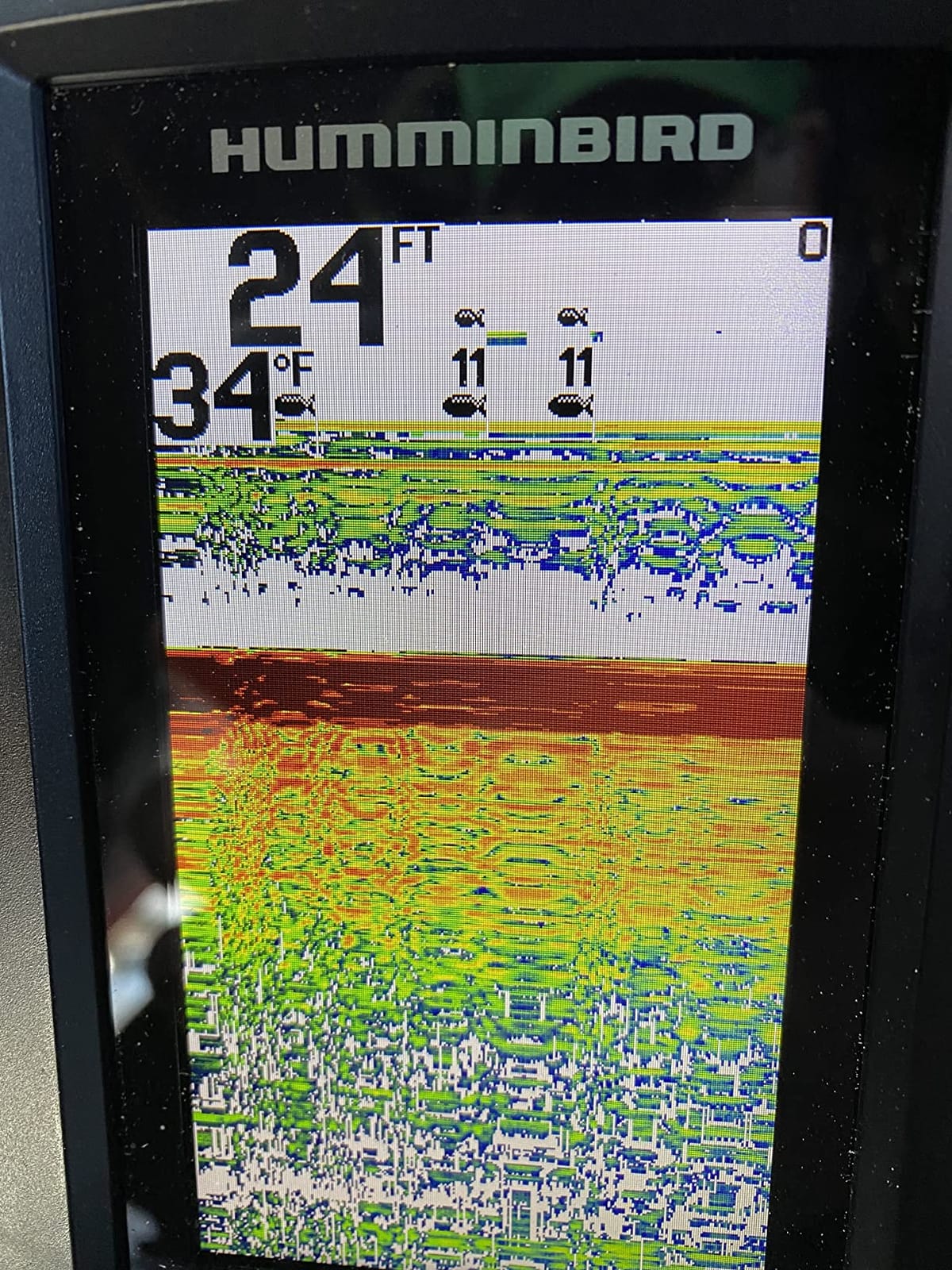
What you give up is GPS. There is no chart mapping and no waypoint storage, so this is a depth and fish display rather than a navigation tool. Several small-boat owners on fishing forums argue that a separate dedicated sounder plus a phone or handheld GPS is a better split than one combo unit, and the PiranhaMAX fits neatly into that camp.
At 4.3 inches on an LCD, the screen is unusually large for the price bracket, which is the other reason it keeps landing on jon boats.
When wide beam beats detail
Wide beam is the right mode when you are searching rather than inspecting. On a shallow, weedy bay or a flat river lake, coverage width beats resolution because you are looking for a change, not identifying a species. Switch to narrow beam once you are over something worth stopping for, because that is where the detail is usable.
What you cannot do without GPS
Without GPS you cannot mark a spot or return to it, and you cannot see your speed over ground. If your boat has any built-in navigation or you run a phone chartplotter, that gap matters less. If you fish an unfamiliar lake alone, it matters a great deal, and that is the moment to move up rather than sideways.
Sonar detail next to CHIRP units
The PiranhaMAX uses conventional dual beam rather than CHIRP, so arches are less crisp and target separation is coarser than on the Garmin units in this roundup. For finding structure and reading depth, that is fine. For picking individual fish off a ledge in clear water, a CHIRP or ClearVu image is noticeably better.
5. Lowrance Eagle – Best for a Jon Boat with Almost No Dash Space
Lowrance Eagle 4X Fish Finder with Bullet Transducer
4 in IPS portrait IPS display
Auto-Tuning sonar
200 kHz 44 degree beam
500 ft max depth
Pros
- Portrait footprint fits a very small dash
- IPS screen readable through polarized sunglasses
- Auto-Tuning sets sonar parameters itself
- Twist-lock connector removes the display fast
Cons
- Smallest review base at 116 ratings
- Only the 200 kHz Bullet Skimmer transducer is bundled
The Eagle is the newest entry in this group and the only one with an IPS panel, and IPS is the spec that decides whether you can read a screen at noon on an open deck. Owners single out readability in bright sunlight and through polarized sunglasses as the standout feature, and the portrait orientation means it fits on a dash where a horizontal-format unit physically will not.
Auto-Tuning sonar sets its own parameters at startup, so there is nothing to adjust on the water. Fish icons show depth with a zoom option, and the audible fish alarm can be switched off if you would rather not hear it. Maximum measuring depth is 500 feet.
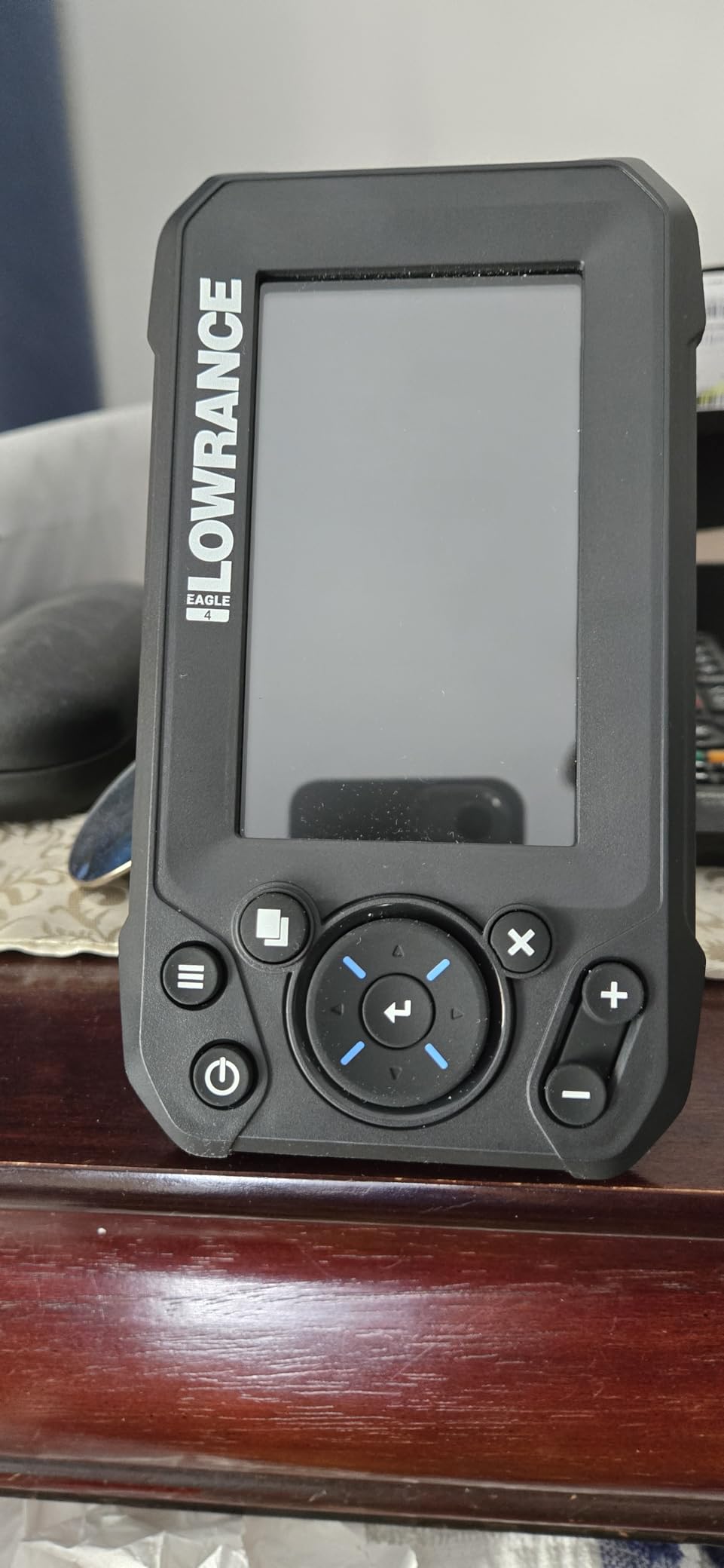
The included 200 kHz Bullet Skimmer transducer has a 44 degree beam, which is a genuinely narrow cone for a small boat. That suits kayaks and shallow craft where a wide beam would smear the bottom return, and it pairs sensibly with a transom or trolling motor mount.
Two details make installation painless: the twist-lock connector lets you remove the display without disturbing the wiring, and the bundle includes a fuse, fuse holder and locking collars, which is more than several competitors ship with.
Why the portrait screen is not a gimmick
Jon boats have a flat transom and very little usable dash, so a horizontal display either blocks your view or forces a bracket that sits in the way. A portrait panel gives you a tall narrow screen in the same footprint, and on a boat where you look down at the unit rather than straight ahead, that orientation matches how you actually read it.
Auto-Tuning versus hands-on control
Automatic tuning removes the fiddly part of sonar operation, which is exactly what you want on a small boat where you are rowing or trolling rather than sitting at a full console. The trade is that you have less to tune when conditions change sharply, such as switching from a muddy bay to a clear drop-off. For most small-craft fishing, the convenience wins.
Where the sample size is thin
With only 116 ratings behind it, the average of 4.3 is based on a much smaller pool of owners than the Garmin units here. Treat that as a reason to be slightly cautious rather than a deal breaker. The bundled transducer is the 200 kHz Bullet Skimmer only, so you are starting with a single frequency and a 44 degree beam rather than a full CHIRP and scanning combination.
6. Humminbird HELIX 5 CHIRP GPS G3 – Best When You Want Mapping and a Bigger Screen
Humminbird Helix 5 G3 GPS Fish Finder with Transducer & Dual Spectrum Chirp Sonar
5 in color TFT
Dual Spectrum CHIRP wide and narrow
Basemap, 10,000+ lakes
AutoChart Live
Pros
- CHIRP wide and narrow modes for clean arches
- Preloaded basemap covers 10000+ lakes
- AutoChart Live records contours and vegetation
- 5 inch color screen readable in sunlight
Cons
- 3-amp fuse and extra wiring are not included
- Bundled power cable can be too short on a 14 footer
The HELIX 5 CHIRP GPS G3 is the only unit in this roundup with a five-inch colour screen and a preloaded basemap, and that combination is what separates it from everything else here. If your small boat has a console with real space, this is the one that gives you split-screen mapping and sonar you can actually read from a seated position.
Dual Spectrum CHIRP sonar runs in wide and narrow modes, and the Low-Q transducer gives precise two-dimensional target separation. The Humminbird Basemap covers more than 10,000 lakes plus the continental US coastline, and it accepts LakeMaster, CoastMaster and Navionics charts if you want more detail.
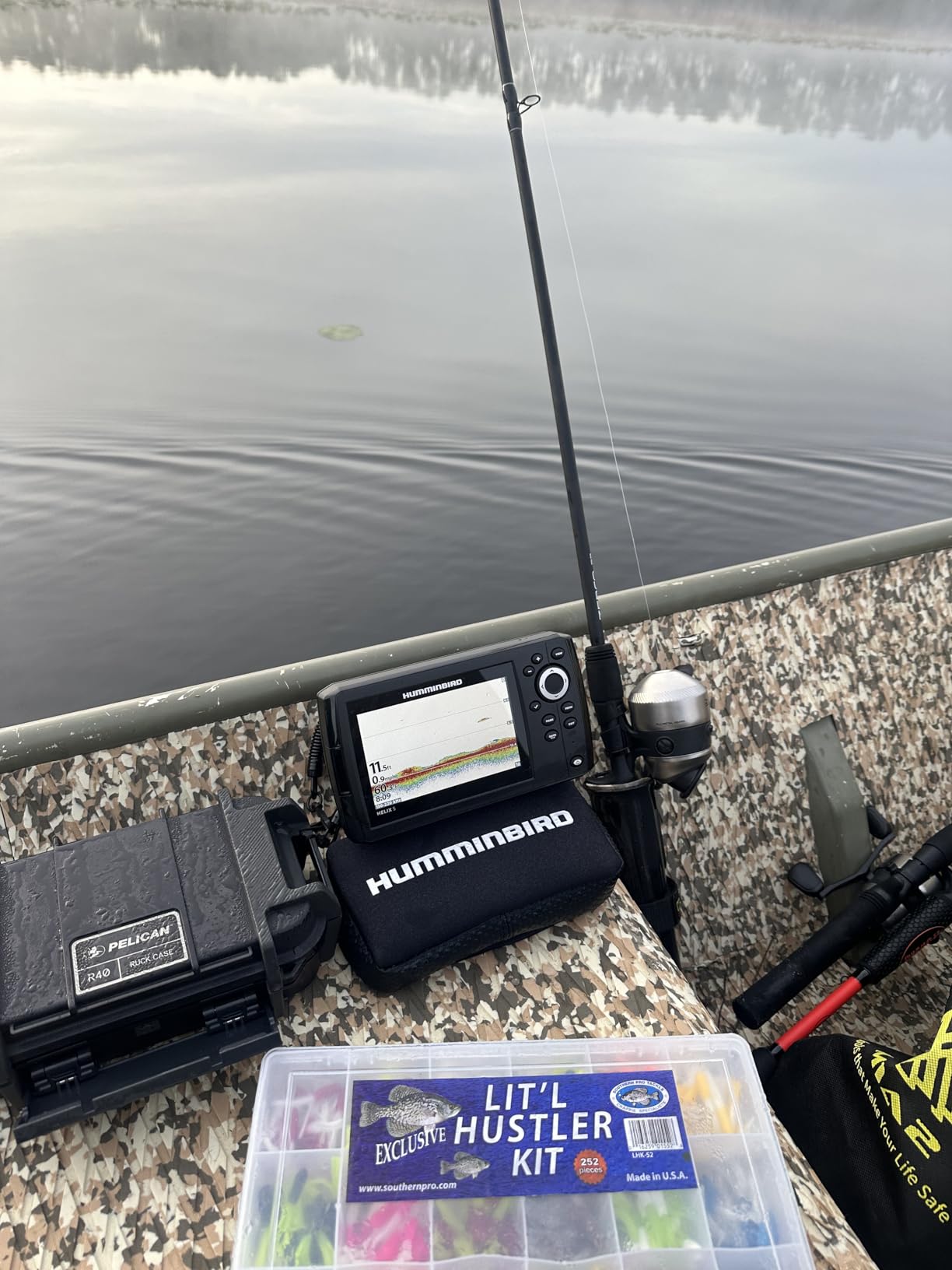
AutoChart Live is the sleeper feature. It records depth contours, bottom hardness and vegetation as you move, with eight hours of built-in recording time, and it works with AutoChart Zero Line SD cards. Effectively you are building your own map of a lake nobody has charted, which is exactly the situation on a small pond or a private stretch of river.
The softkey keypad stays usable in any weather, and the XNT 9 HW T transom-mount transducer is included along with a gimbal mounting bracket.
Mapping that earns its cost over a season
A preloaded basemap on a boat that runs to a launch ramp every weekend is worth more than any sonar upgrade, because it lets you navigate to structure instead of searching for it. Once AutoChart Live has recorded a season of your own water, that lake is mapped to your own depths rather than a generic contour. On saltwater, adding a CoastMaster or Navionics card moves the unit from inland tool to inshore navigator.
The install that catches people out
A three-amp fuse and the extra wiring are not included, and that can stall an install on a small boat where you assumed everything needed was in the box. The bundled power cable may also be too short to reach the battery box on a 14-foot hull. Both problems disappear if you plan the wire run before you unbox the unit, and it is worth adding a quick-disconnect so the whole head comes out in ten seconds at the end of the day.
Screen size versus cockpit reality
Five inches is the smallest panel we would consider for split-screen work, and one experienced owner on The Hull Truth recommends going bigger than you think for that reason. But five inches is also the point where a small boat starts to run out of dash. If your cockpit is a flat transom on a jon boat, this unit will not fit well, and the 4 inch STRIKER Vivid 4cv is the honest alternative.
If you also need power for anything else on the boat, our portable jump starter picks for boats cover the charging side of a long day on the water.
7. Deeper PRO+ 2 – Best for Kayaks, Rentals and Shore Fishing
Deeper PRO+ 2 Sonar Fish Finder – Portable Fish Finder and Depth Finder For Kayaks, Boats and Ice Fishing with GPS Enabled | Castable Deeper Fish Finder with FREE User Friendly App
Castable sonar with GPS
330 ft accuracy
0.4 in target separation
Fish Deeper app maps
Pros
- Built-in GPS logs bathymetric maps from shore or dock
- Weighs 3.2 ounces and fits a tackle box
- Wide mid and narrow beam modes
- 0.4 inch target separation on narrow beam
Cons
- Readings depend on the app and your phone battery
- Sonar display lives on the phone
- Wi-Fi can be finicky in busy spots
The Deeper PRO+ 2 is not a fish finder you mount; it is one you cast. You attach the sonar pod to a line, drop it, and read everything on your phone screen over a Wi-Fi link. For a kayak, a rented boat, or a day spent on the bank, that removes every installation question you would otherwise have to answer.
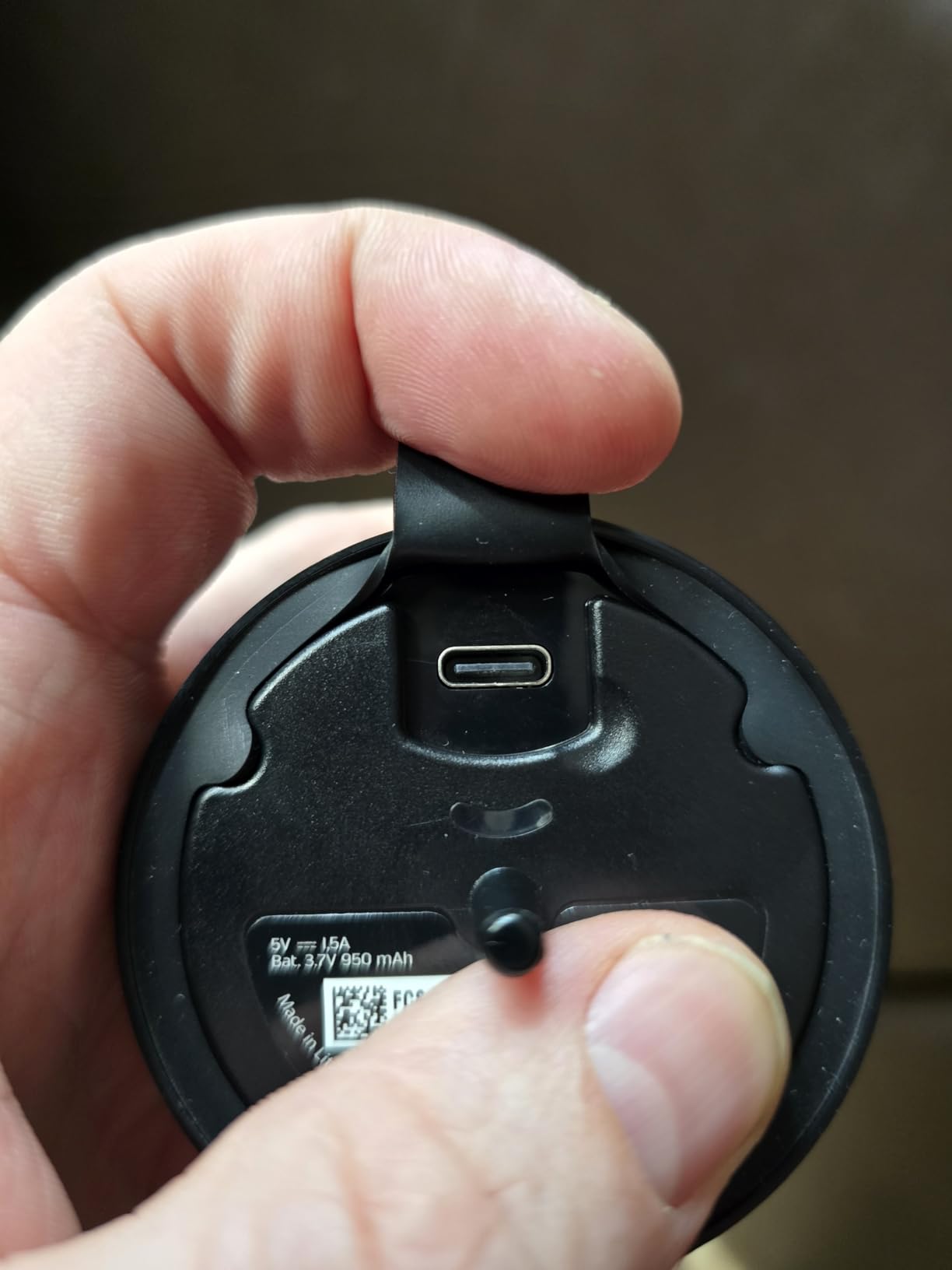
It weighs 3.2 ounces and measures 2.56 inches on a side, so it lives in a tackle box and comes out for a quick cast. Accuracy is listed to 330 feet, and it offers wide, mid and narrow beam modes with target separation of 0.4 inches on the narrow beam.
The differentiator is the built-in GPS, which lets the unit create bathymetric maps from shore, dock or bank and saves them to the Fish Deeper app. That means you can map a shallow creek or a pond you have never fished by walking the bank and casting every few steps, which no fixed-mount unit can do.
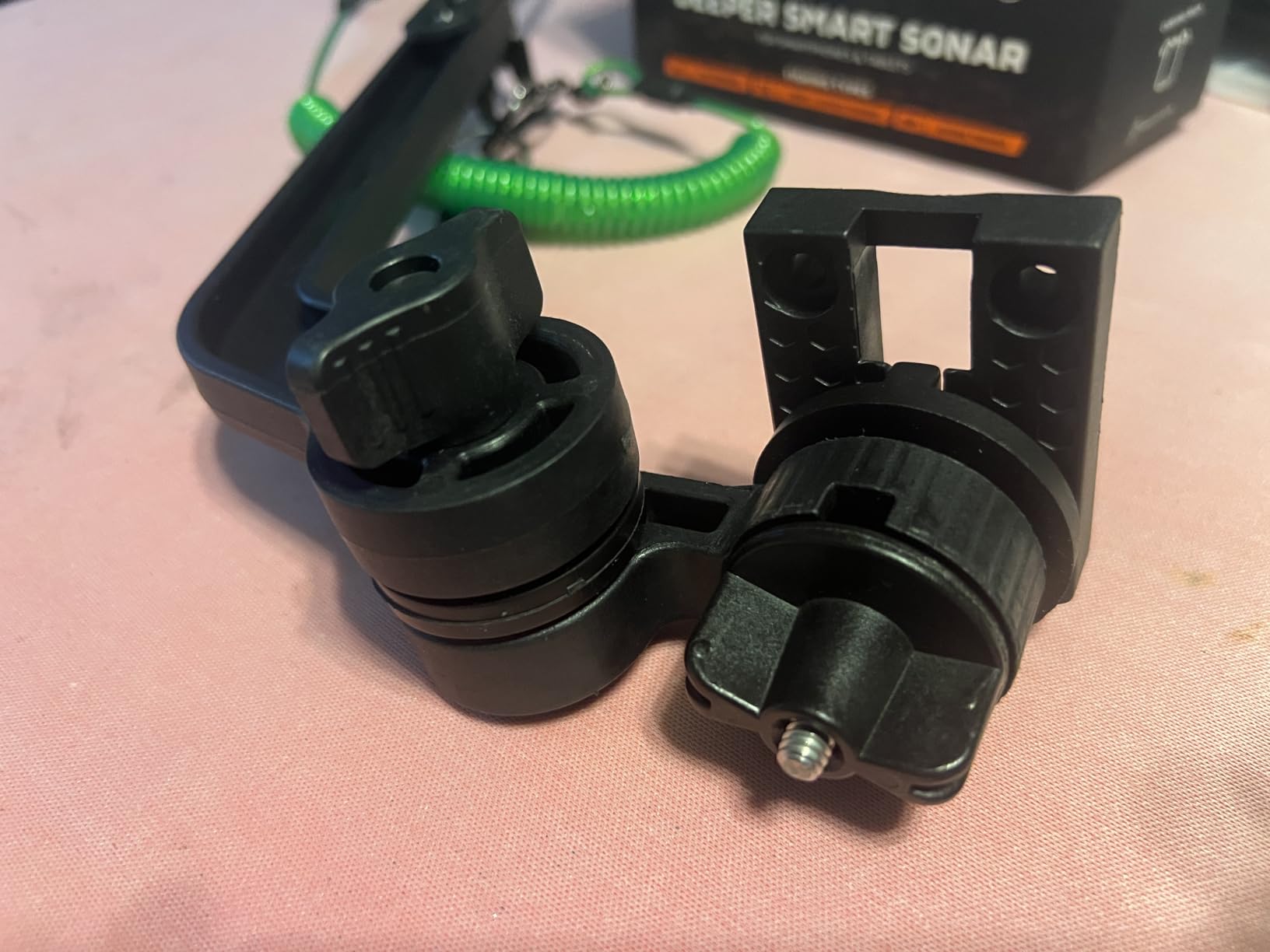
The attachment bolts, neoprene pouch, USB wire and quick guide are all in the box, and there is a two-year limited manufacturer warranty.
What target separation means in practice
Target separation is how close two objects can be before the sonar merges them into one return. At 0.4 inches on the narrow beam, a small baitfish next to a larger one registers as two marks rather than one blob. That is the number that decides whether you can tell a tight school from a single cruising fish, and it is why the narrow beam is worth switching to on a spot you have already found.
The phone dependency, honestly assessed
Three real drawbacks come with the app model. Your phone battery is doing double duty as the display and the power source for the sonar link, so a long day needs a charged battery or a power bank. The screen lives on a phone, which means sunlight readability is your phone’s problem rather than the unit’s. And reviewers report the Wi-Fi connection can be finicky in busy or remote spots.
For most anglers those are acceptable trade-offs because nothing needs to be permanently attached to a hull. If your boat already has a working mount and a wired power supply, a fixed unit gives you a more reliable screen and a wider range of features for the same money.
Shallow water and prop wash
A castable pod has one real advantage on very shallow water: it is never reading prop wash or hull turbulence, because it is nowhere near the boat. Casting ahead of a trolling boat and reading the pod avoids the aerated water behind the transom that confuses a transom-mounted transducer at low speeds.
8. Venterior Wireless Portable Fish Finder – Best Portable With a Real Colour Screen
Venterior Portable Rechargeable Fish Finder Wireless Sonar Sensor Fishfinder Depth Locator with Fish Size, Temperature, Bottom Contour, Color Display
2.6 in color TFT
Wireless castable sensor
2.6-164 ft depth range
Fish size and bottom contour
Pros
- No drilling or hull hardware needed
- Works out of the box with no calibration
- Rechargeable battery holds about a session
- Readable screen in bright sunlight
Cons
- False signals when towed behind a moving boat
- Wide 105 degree beam misreads under ice
- Depth ceiling of about 164 feet
This is the portable unit for someone who wants more than a number on a screen. Unlike the bare handhelds, it uses a wireless castable sonar sensor with a 2.6 inch colour TFT display, and it reports depth, temperature, fish size as small, medium or big, fish depth and bottom contour.
Owners consistently describe it as a drop-in improvement over suction-cup sensors because there is nothing to attach to the boat at all. The maximum range between sensor and unit is 262 feet, and the sonar beam angle is 105 degrees, which is wide enough to sweep a decent area per cast.
Selectable black or white screen backgrounds are a small touch that matters in practice, because a white background works far better in daylight glare while black reads better at dusk. The rechargeable battery holds roughly three to four hours of continuous use according to owners, and it carries a two-year warranty with brand support responding within 24 hours.
The listed use cases cover lake, river, sea, kayak, boat, shore and ice fishing, which is an honest statement of a genuinely portable design. One thing a small boat still needs is something to play music or keep the group talking while the pod is out, and our Bluetooth speaker picks for boats cover units that survive spray.
Range versus usable depth
The 262 foot figure is sensor-to-unit wireless range, not depth. Actual depth range is 2.6 to 164 feet, or 0.8 to 50 metres, which covers nearly every small-boat lake and any inshore work you would do from a boat that size. It does not cover a deep reservoir, and if your water regularly drops past 150 feet you need a fixed unit instead.
Why the 105 degree beam is a mixed feature
A wide beam sweeps more water per cast, which is why it works so well from a bank or a kayak. It is also why owners report false signals when the sensor is towed behind a moving boat, and why the wide beam can bounce off ice walls and misread depth during ice fishing. If you plan to use it stationary, the wide beam is an advantage. If you plan to drag it behind a trolling boat, the readings get noisy.
Battery planning for a full day
Three to four hours on the rechargeable sensor is close to a fishing session but not a full day on the water. Reviewers note the receiver draws battery fairly quickly in continuous use, so a full day means a top-up between stretches, or keeping a handheld unit as a backup for the last hour. For a rental boat or a rented kayak, that is a fair price for zero installation.
9. LUCKY Portable Fish Finder – The Simplest Handheld Sonar for a Kayak
LUCKY Kayak Portable Fish Depth Finder Water Handheld Fish Finder Sonar Castable Kayak Boat Fishfinder Transducer Fishing LCD Display FFC1108
2 in handheld LCD
3-328 ft depth range
5 sensitivity levels
Fish and school alarm, neck strap
Pros
- Inexpensive entry into portable sonar
- Transducer reads through a kayak hull bottom
- One-hand design with neck strap
- Backlight and feet or metre switching
Cons
- Cannot differentiate fish size and locks onto minnows
- Does not read reliably through fiberglass
- Needs a moving boat rather than shore use
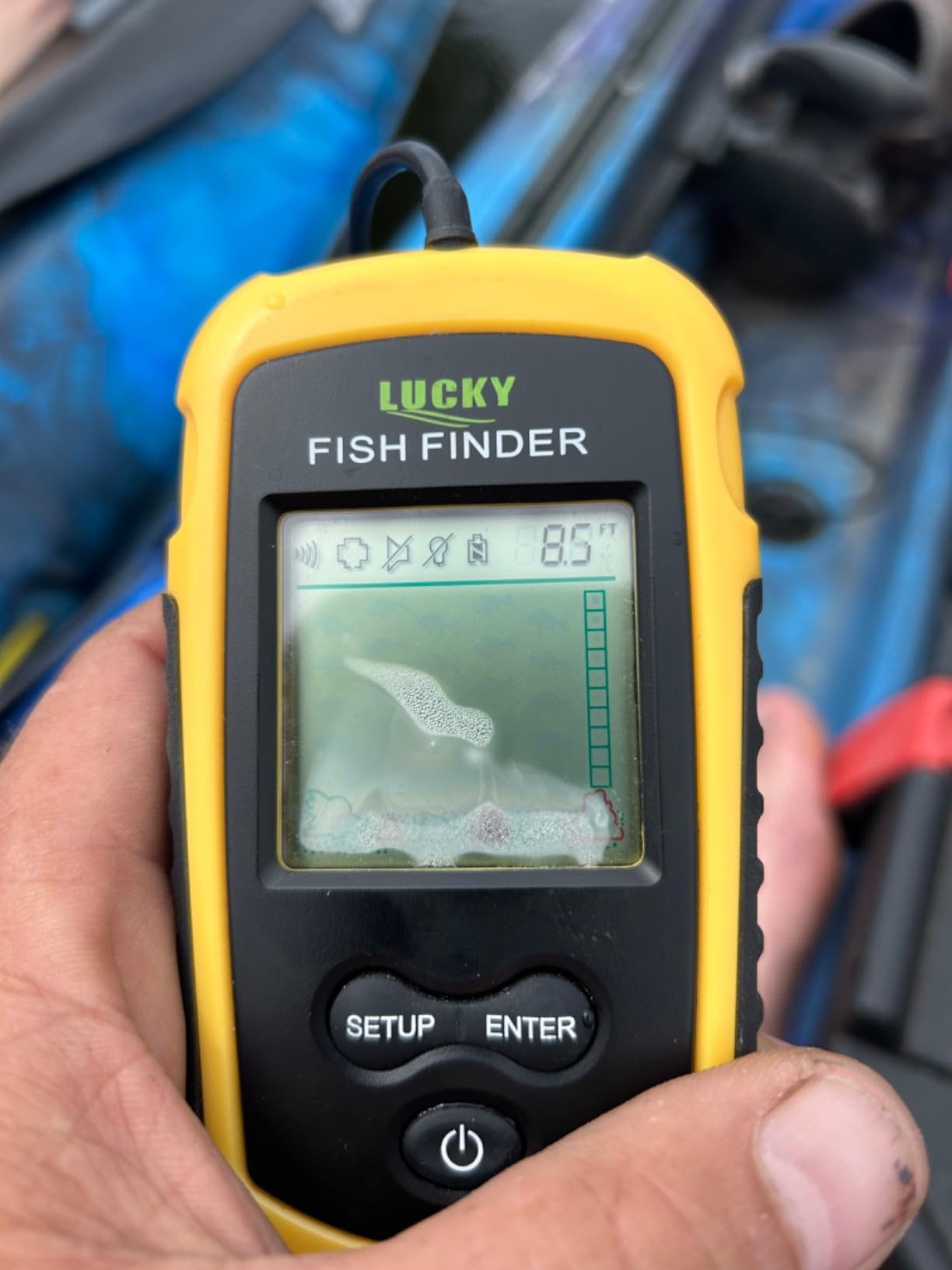
The LUCKY 1108 is a handheld unit with a castable transducer, a neck strap and a 2 inch LCD, and it is the simplest thing on this list to carry. For a paddler who wants to know the depth of a creek before committing to a long paddle, that is a genuinely useful tool rather than a toy.
Depth detection runs from 3 feet to 328 feet with the transducer fully immersed, and there are five levels of sensitivity adjustment for clear or turbid water. Switchable feet and metre units and a backlight cover daylight and darkness.
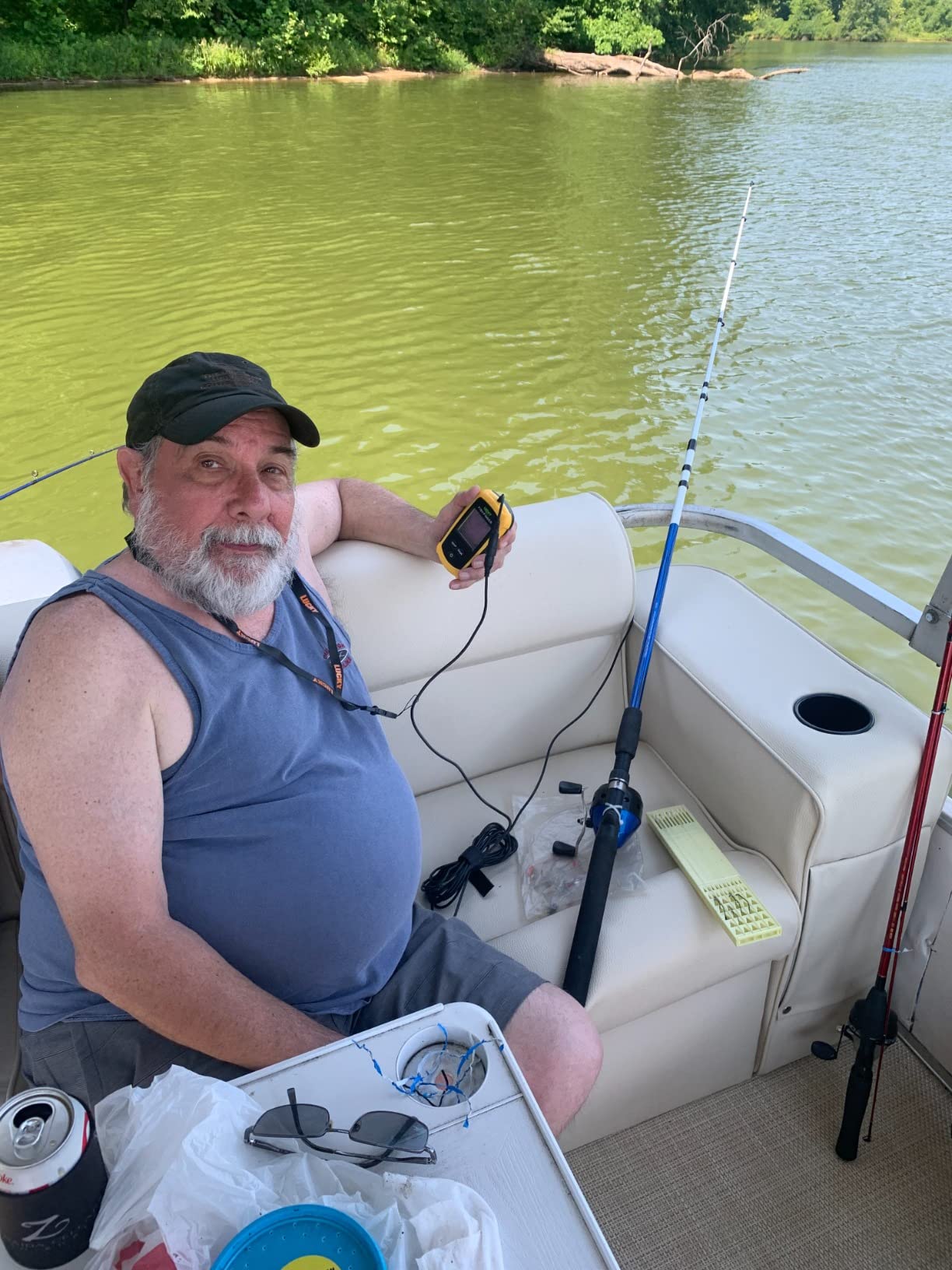
Owners report the transducer reading accurately through the bottom of a kayak hull, which is the main use case for a unit this size. The fish and fish-school alarm is a useful audible cue when you are holding a paddle rather than watching the screen.
It runs continuously for at least four to five hours on new batteries, and longer in battery save mode, which covers a full outing in a kayak.
What it is good for, honestly
Treat it as a depth and habitat finder rather than a fish identifier. It displays approximate fish location, depth, weeds, sand and rocks on the bottom, and because it cannot tell you fish size it frequently locks onto a cloud of minnows and calls it a fish. That is not a flaw so much as a limitation of the hardware, and knowing it in advance saves frustration.
Hull compatibility is the deciding factor
It does not read reliably through fiberglass hulls, so it suits a kayak, a canoe or an aluminium jon boat better than a glass boat. It also needs to be used from a moving boat rather than from shore, because the design expects the transducer to be in the water ahead of you. Owners also report some units failing to power on after light use, so check it before you rely on it for a single trip.
Where the money is better spent
The rating of 4.1 with roughly a tenth of ratings at one star is the lowest average in this roundup, and the complaints are consistent rather than random. If your budget stretches further, the Venterior wireless unit gives you a colour screen, bottom contour and a rechargeable battery for a modest step up. Choose the LUCKY only when the entry price is genuinely the deciding factor.
10. Yoocylii Handheld Fish Finder – Smallest and Simplest Depth Readout
Handheld Fish Finder Portable Kayak Fishfinder Sonar Depth LCD Display
Handheld LCD with 200 kHz
45 degree beam
3-328 ft range
4x AAA, 4-5 hours
Pros
- Low-cost depth option for a kayak
- Neck strap keeps hands free
- Accurate depth and weed or ledge detection
- No wiring once the transducer is joined
Cons
- Does not show bottom contour
- Battery life is short for a full session
- Some units stopped powering on after a few uses
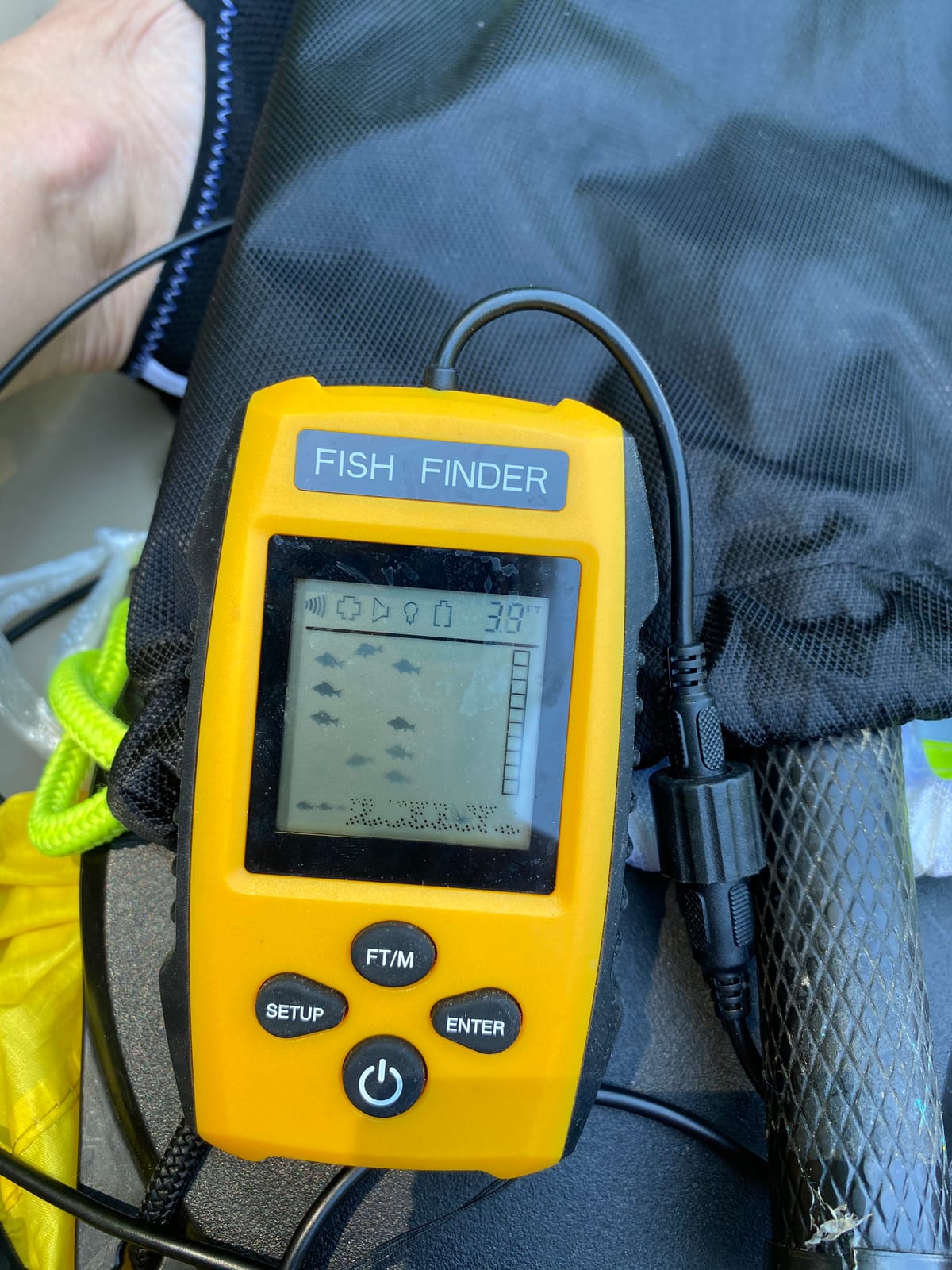
The Yoocylii is the smallest unit we tested and does the smallest job well. A 200 kHz sonar with a narrow 45 degree beam, a neck strap and a handheld display, it reports water depth, approximate fish location, fish size as small, medium or big, and weeds, sand and rocks.
It is usable from a moving kayak below 5 mph with the transducer held horizontal, which is a genuinely useful constraint for paddlers. Depth range is 3 feet to 328 feet, and it works in both fresh and salt water.
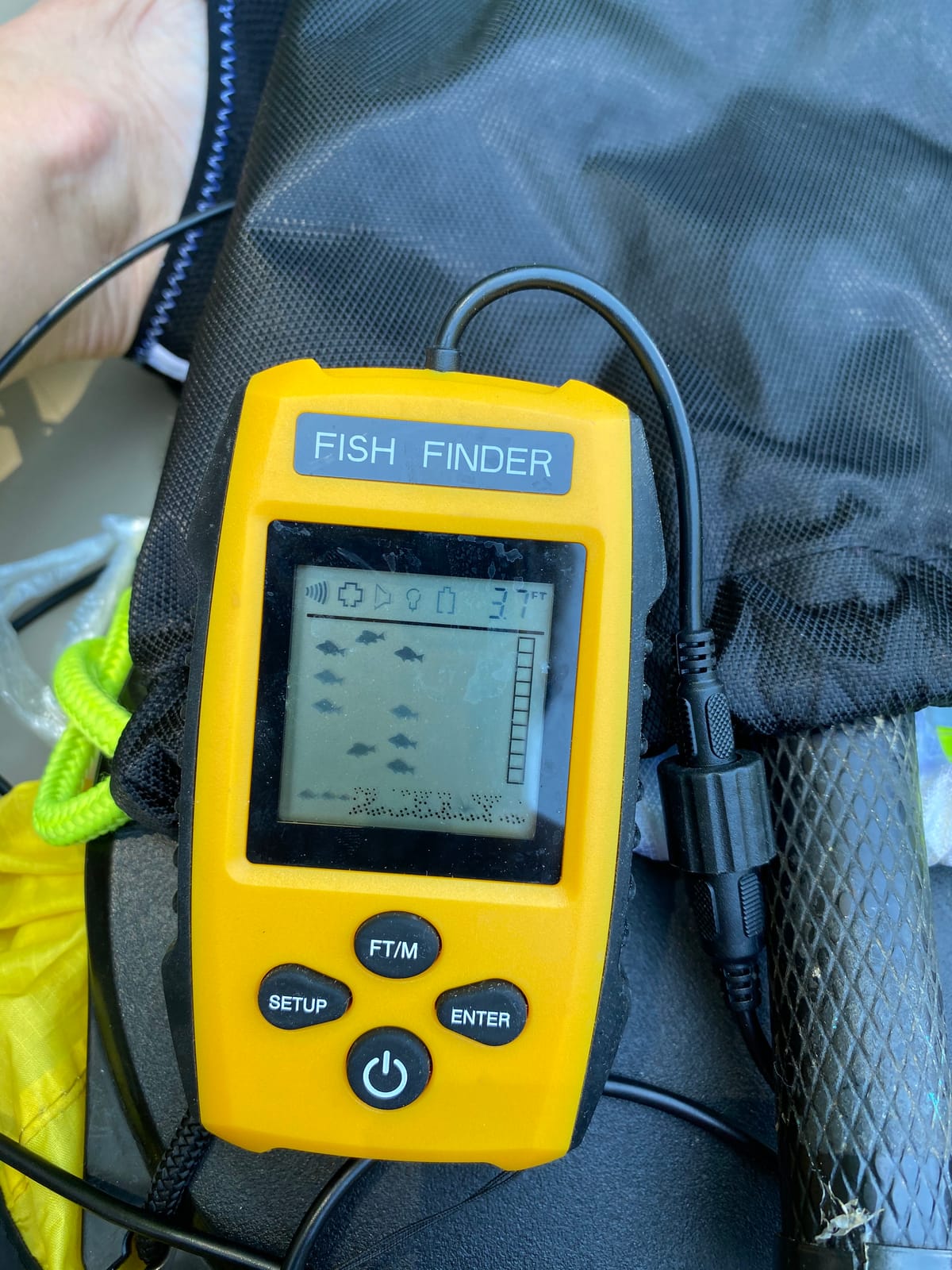
Five selectable sensitivity levels, a battery save mode, a backlight and a fish alarm cover the rest of the control set. There is nothing to install: once the transducer is joined to the unit, it works. Four AAA batteries give four to five hours of continuous use.
For a kayak or a pond where you only need to know whether the bottom drops away, that simplicity is the appeal. Reviewers treat it as a compact depth and weed detector rather than a true fish finder.
Why the narrow beam suits a kayak
A 45 degree cone concentrates the sonar energy into a small footprint, which gives a sharper bottom return and better weed detection than a wide cone on the same battery budget. On a kayak the boat is narrow and moves slowly, so the area you sweep is small anyway and precision beats coverage.
Battery life and durability
Four to five hours from four AAA cells covers a morning on the water but not a full day. Battery life is limited when the unit runs continuously for a whole session, and some owners report units that stopped powering on after a few uses. If you are outfitting a rental or a boat shared with other anglers, treat it as a consumable rather than a permanent piece of electronics.
What it cannot do
There is no bottom contour display, so you cannot see the shape of the bottom the way you can on the Venterior or the Garmin units. Fish size categories are approximate, and there is no GPS, mapping or temperature. It answers one question well, which is how deep is it here, and it is worth owning for that alone.
11. Hawkeye DepthTrax 2B – Best for a Dedicated In-Dash Depth Readout
DepthTrax 2B Boat Mount In Dash Digital Depth Finder
1.86 in polarized LCD
2.5-600 ft range
200 kHz dual-mount transducer
Reads to 60 mph
Pros
- Accurate depth to 600 feet even at speed
- Three-stage shallow water warning system
- Polarized LCD with storage sun cover
- Transom or glue-in through solid fiberglass
Cons
- Only a 1.86-inch display with limited icon-based detail
- Glue-in mounting is not suitable for every hull type
- Shallow minimum reading of 2.5 feet limits very shallow water use
The DepthTrax 2B is not a fish finder and does not pretend to be one. It is a digital depth sounder meant to be installed in a dash, giving you an uninterrupted depth number from 2.5 to 600 feet at speeds up to 60 mph. On a boat where you only want to know how shallow it gets, that is exactly the right device.
The dual-mount 200 kHz transducer can be installed on the transom or glued in, and it shoots through solid fiberglass hulls and aluminium hulls up to 1/8 inch thick. The three-stage Advanced Warning System uses an audible alarm, a red LED and an LCD indicator, so it warns you well before you ground out.
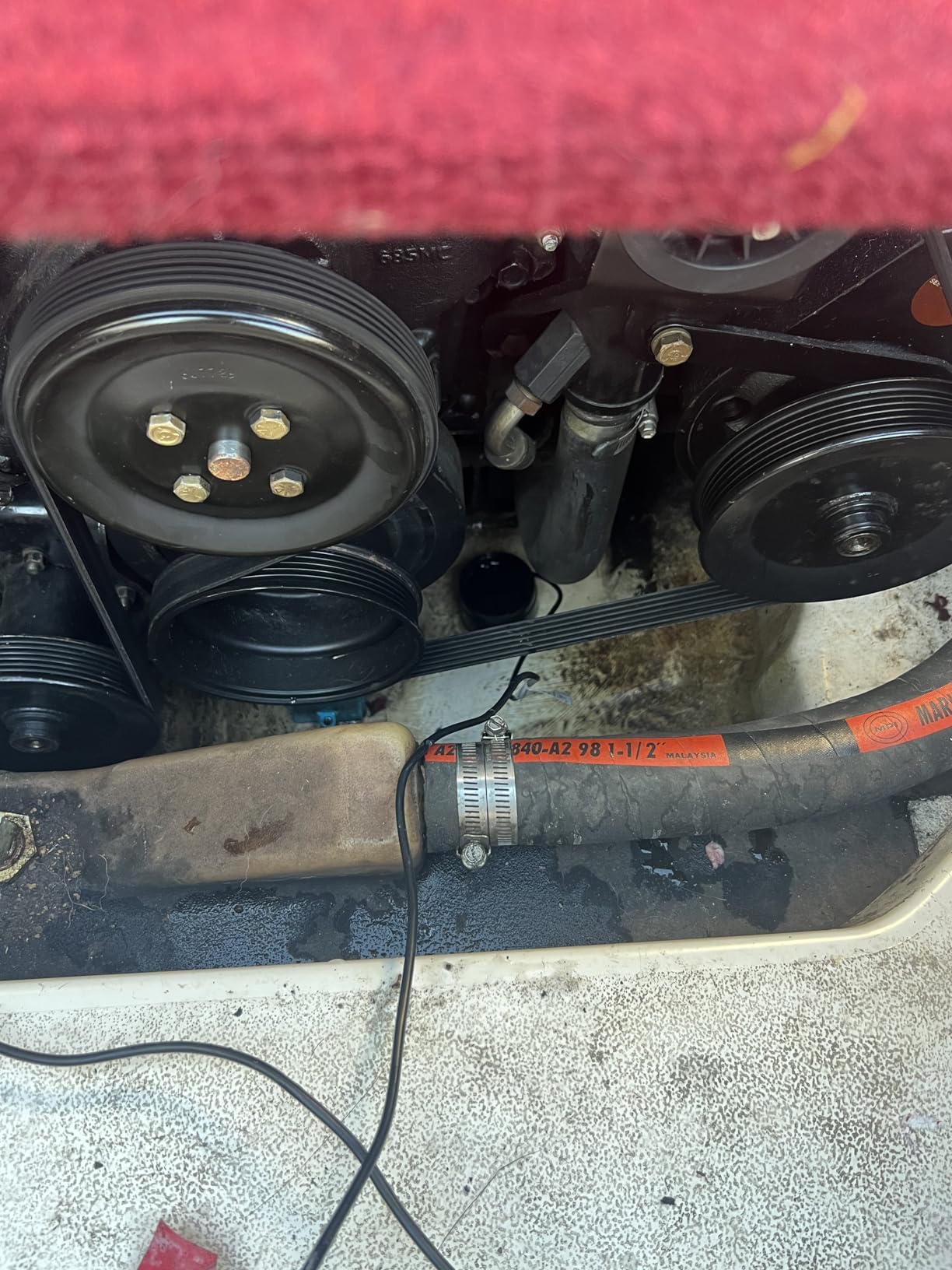
The polarised LCD icon display has a storage sun cover for glare-free viewing, which sounds like a small detail and is genuinely useful on an open boat. Mounting type is transom, power comes from a DC supply, and the unit weighs about 1.7 pounds.
When a dedicated sounder beats a combo unit
On a very small cockpit, a combo unit competes for the same dash space as your gauges. A flush in-dash sounder takes one small hole, gives a permanent depth readout you glance at rather than operate, and leaves the screen space free for a GPS or nothing at all. Several small-boat owners prefer exactly this split of a dedicated sounder plus a separate navigation device over a single combo box.
Shallow water and hull limitations
The minimum reading of 2.5 feet is the constraint that matters most on a boat that fishes very shallow water, since a reading below that is outside the unit’s range. The glue-in option is restricted to non-cored fiberglass or aluminium under 1/8 inch, so check your hull before committing to the cleaner permanent install. The transom mount avoids the question entirely.
Glare and readability at speed
Reviewers highlight the polarised display as readable with sunglasses on, which is exactly the condition that defeats a cheap mono LCD at midday. Readouts stay accurate across the depth range and at speed when the transducer is mounted properly. The tradeoff is that a 1.86 inch icon display offers limited detail, so you get a number and a warning rather than a picture of what is below you.
12. Humminbird HDR 650 – Best When Your Dash Already Has Gauges
Humminbird 407860-1 HDR 650 In Dash Digital Depth Sounder
1.25 in in-dash LCD
600 ft depth readings
White, black and chrome bezels
Sealed water-proof face
Pros
- Accurate readings at idle and at speed when properly mounted
- Interchangeable white black and chrome bezels
- Sealed water-proof in-dash design
- Transom transducer and hardware included
Cons
- Through-hull transducer installation can behave inconsistently
- Included mounting screws are cheap and can twist off in thick fiberglass
- Decimal point is small and hard to read from the driver's seat
The HDR 650 solves a purely cosmetic problem that is really a practical one: matching a depth sounder to a set of existing gauges. It ships with white, black and chrome bezels and white and black faceplates, so you can make an in-dash install look deliberate instead of added later.
Digital depth readings run to 600 feet, and a transom-mount transducer plus mounting hardware are included in the box. The faceplate diameter with bezel is 2.5 inches with an LCD diagonal of 1-3/8 inches, which fits a standard gauge cutout.
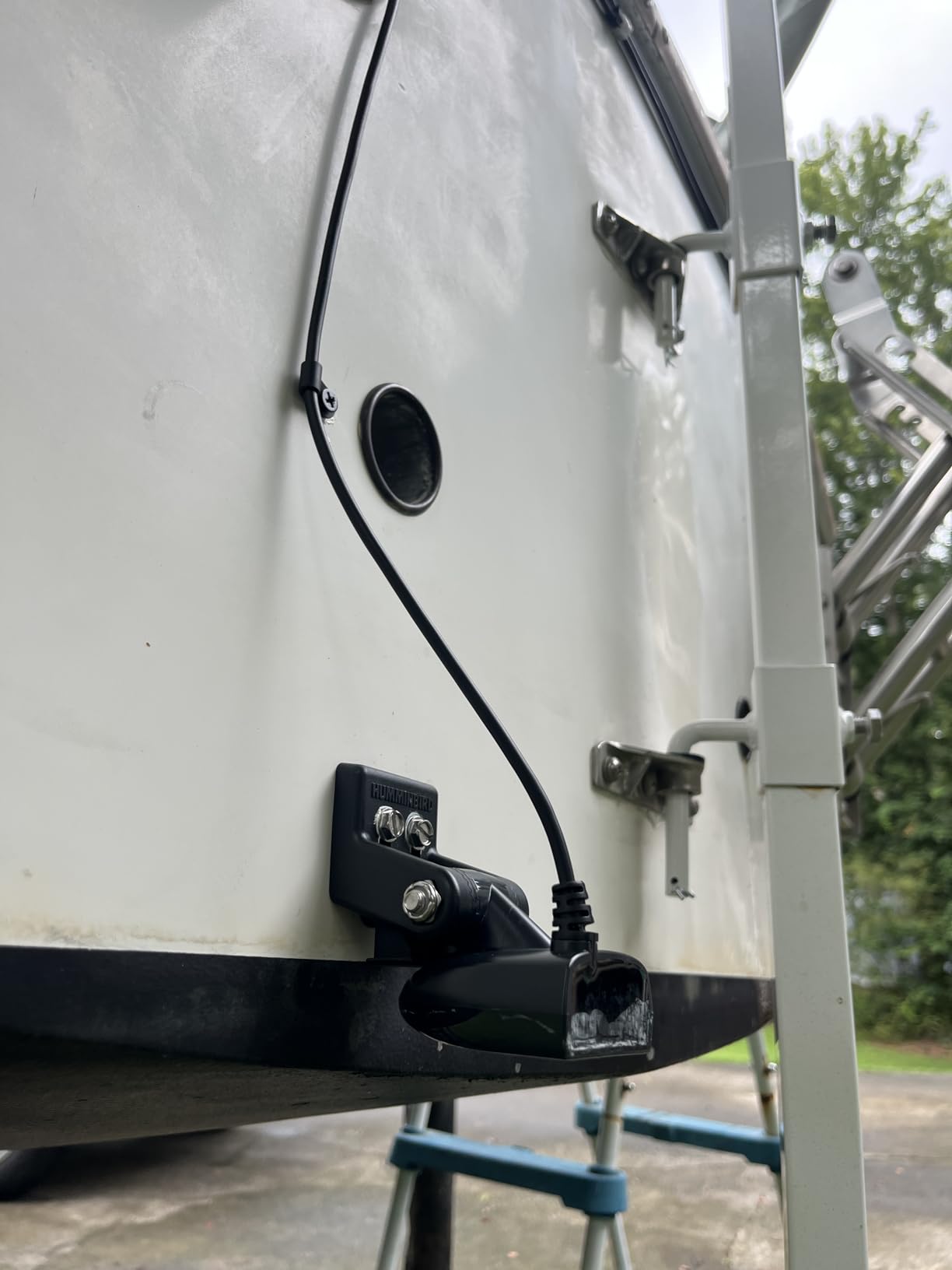
The sealed, water-proof in-dash design means the unit lives in the console permanently, so there is nothing to remove and nothing to steal. For a boat kept in an unsecured yard, that is a real advantage over a swivel-mounted display.
Installation is where the care goes
Owners report accurate readings at idle and at high speed when the transducer is mounted properly, but they also flag that through-hull installation can behave inconsistently and that the included mounting screws are cheap and can twist off in thick fiberglass. Spend an extra minute hand-threading the screws and check the transducer height before you rely on it at speed.
Readability from the driver’s seat
The decimal point is small and hard to read from the driver’s position, and the depth reading drops out once the boat is running on plane at speed. That last point is worth knowing: on a small boat, on-plane means planing, and the moment you need shallow-water warnings most is exactly when the unit is least reliable.
When this is the right choice
Choose the HDR 650 if you want depth and nothing else, in a permanent sealed install, in a gauge layout you can match exactly. Choose the Hawkeye DepthTrax 2B instead if shallow-water warning is your priority, because its three-stage alarm system is more protective. Neither one draws fish, so keep your expectations straight.
How to Choose a Fish Finder for a Small Boat
Small-boat selection is a series of trade-offs about space, power and mounting rather than a spec-sheet contest. The seven decisions below are the ones that actually change which unit you should buy.
Screen size and cockpit real estate
Screen size is the first constraint a small boat imposes. A 3.5 inch panel is easy to mount anywhere and readable at arm’s length, but it cannot usefully run a split-screen sonar and map view. A 4.3 to 4 inch colour unit handles split-screen acceptably, and a 5 inch panel is where both halves become comfortable to read. One experienced owner recommends going larger than you expect for split-screen use, and the practical counter is that a 5 inch screen simply will not fit some jon boat transoms. Decide what your dash can physically hold before you fall for a specification.
Sonar type: traditional, CHIRP, ClearVu or side scan
Traditional sonar sends a fixed frequency pulse and returns a classic arch trace. CHIRP sweeps a band of frequencies continuously, which produces crisper fish arches and better target separation from the same display. ClearVu, called ClearVü or Down Imaging depending on the brand, sends a wide beam straight down and returns a near-photographic picture of what is beneath the boat. Side scan looks to port and starboard and is the feature that shows you structure off the sides of the hull.
For inshore and nearshore work over structure, several owners note you do not need a fancy transducer unless you want side scan. On a small boat that cannot fish the sides anyway, CHIRP plus a ClearVu-style down image covers most of the value. Side scan earns its place when you are fishing a bay over ledges and rock you cannot sit directly on top of.
GPS, waypoints and mapping
Built-in GPS lets you mark a brush pile, a stump, a dock or a creek mouth and return to it. On a small boat with limited water access, that is often worth more than sonar detail. If mapping matters, look for a unit with a preloaded basemap or contour recording rather than a bare waypoint plotter, and check whether the maps can be expanded before you rely on it offshore. C-MAP and Navionics options on newer Lowrance units and LakeMaster, CoastMaster and Navionics compatibility on Humminbird units cover most freshwater and coastal anglers.
Transducer mounting and hull type
Mounting choice is where most small-boat installs go wrong. A transom mount hangs off the back and is the simplest option, but it reads prop wash and aerated water behind the hull, particularly at low speed. A trolling motor mount puts the transducer forward where the water is cleaner, and it moves with the motor when you raise it. An in-hull or glue-in install is permanent and reads through the hull, which suits solid non-cored fiberglass and thin aluminium but is impractical on a jon boat, a kayak or a rental.
Owners report the GT20 transducer working straight through a kayak hull, and the LUCKY handheld reading accurately through a kayak hull bottom, so a through-hull reading is not always necessary. What never works is a transducer that loses contact at speed or picks up turbulence, and that is usually a mounting height problem rather than a sonar problem.
Power draw and battery life
Every one of these units runs on 12 volts, and a small deep-cycle or lithium battery is what makes a portable setup realistic. Anglers report running the STRIKER 4 off a small battery for two full days, and a cheap battery powering a GT20 setup all day with minimal voltage drop. Voltage drop matters more than raw capacity: a marginal battery does not just dim the screen, it degrades the sonar return.
If your boat needs a jump start or extra charging capacity on the same day, our best portable jump starters for boats covers that side of the electrical setup.
Portable and castable versus hardwired
Decide this before anything else, because it eliminates most of the list. If your boat is a rental, a kayak, or a boat that lives unsecured, a portable kit or a castable unit removes every install question and doubles as shore fishing gear. If you have a permanent console and a battery you can wire properly, a fixed unit gives you a much better screen, longer battery life and more sonar features. Owners who keep separate dedicated units rather than one combo box usually do this because their cockpit simply cannot host a full console unit.
Garmin versus Humminbird versus Lowrance for small boats
Garmin dominates this roundup because the STRIKER range covers the small-boat gap with quickdraw mapping at every screen size, the tilt and swivel mounts are genuinely tool-free to remove, and the brand’s owner base is large enough that failures are easy to diagnose. Garmin is the default answer unless something specific argues otherwise.
Humminbird competes on mapping and on dedicated in-dash depth units. The HELIX 5 CHIRP GPS G3 offers a preloaded basemap covering more than 10,000 lakes plus AutoChart Live contour recording, and the HDR 650 and PiranhaMAX 4 cover the simpler depth-only cases. Humminbird is the stronger choice if your priority is charts rather than portability.
Lowrance enters through display quality and footprint rather than features at this level. The Eagle’s 4 inch IPS portrait screen is readable through polarized sunglasses in a way the standard LCD panels here are not, and it bundles a fuse and locking collars that competitors leave out. If sunlight readability is your hardest constraint, that panel is the reason to look here.
Sonar and Mounting Terms Worth Knowing
These definitions come up constantly in small-boat conversations and are worth having straight before buying.
- CHIRP sonar: A continuous sweep of frequencies rather than a single fixed frequency, which returns crisper fish arches and better target separation.
- ClearVu / Down Imaging: A wide beam aimed straight down that returns a near-photographic picture of the bottom and anything standing above it.
- Side scan / Side Imaging: Narrow beams looking to port and starboard that show structure beside the boat rather than under it.
- Transducer: The sensor that sends the sonar pulse and listens for the echo. Everything about accuracy follows from where this sits.
- Target separation: The closest two objects can be and still register as separate marks. Higher numbers mean you can pick individual fish out of a school.
- Portable kit: A display and transducer sold together as a self-contained unit that runs off a battery and mounts with a bracket rather than being permanently installed.
- Waypoint: A GPS coordinate you save to mark a spot. On a small boat, marking is often more valuable than zooming.
- IPX7 rating: A water-resistance standard meaning the unit survives temporary immersion. It is not a licence to leave electronics in a wet dock.
Frequently Asked Questions
What is the best depth sounder for a small boat?
For most small boats, the Garmin STRIKER 4 is the best all-round depth sounder because it combines CHIRP and ClearVu scanning sonar, built-in GPS waypoint marking and a tilt and swivel mount that removes in seconds. If you have a flush dash and want a permanent number rather than a screen, the Hawkeye DepthTrax 2B gives accurate readings from 2.5 to 600 feet with a three-stage shallow-water alarm.
Which fish finder is better, Humminbird or Garmin?
Garmin is better for portability and contour mapping on small boats. The STRIKER range includes Quickdraw Contours mapping on every screen size and tool-free tilt and swivel mounts that come off quickly on an unsecured boat. Humminbird is better for charting. The HELIX 5 CHIRP GPS G3 includes a basemap covering more than 10,000 lakes plus AutoChart Live recording, and its in-dash depth units match existing gauges.
What is the best portable fish finder for a boat?
The Garmin STRIKER 4 is the best portable fish finder for a boat because it weighs 8 ounces, carries a 3.5 inch IPX7-rated LCD and runs all day off a small deep-cycle battery. For a kayak or a rented boat with zero wiring, the Deeper PRO+ 2 adds built-in GPS and bathymetric mapping in the Fish Deeper app. For the lowest entry cost, the LUCKY handheld reads depth through a kayak hull.
Is Garmin or Lowrance better for fishing?
Garmin offers more at this price range. It is the only brand here putting CHIRP plus ClearVu scanning sonar and Quickdraw Contours mapping into a 4 inch unit, and its mounts are genuinely tool-free to remove. Lowrance leads on display quality. The Eagle has a 4 inch IPS portrait screen that stays readable through polarized sunglasses, plus Auto-Tuning sonar and a bundle that includes a fuse and locking collars.
Do I need side scan sonar on a small boat?
Usually not, and most small-boat owners skip it. Side scan earns its place when you are fishing a bay over ledges and rock you cannot sit directly on top of, because it shows structure out to port and starboard. For creek mouths, weed edges and spots directly beneath the boat, CHIRP traditional sonar plus a ClearVu-style down image covers most of the value at a lower cost.
Which Fish Finder Should You Buy?
If you want one unit and nothing more, buy the Garmin STRIKER 4. It is the easiest to justify on a small boat, it has the largest owner base of anything here, and the tilt and swivel mount means it comes off in seconds when the boat sits somewhere you do not control.
If your priority is mapping rather than colour, the Garmin STRIKER Plus 4 gives you a larger sunlight-readable screen and Quickdraw Contours on a budget. If you fish clear water and want to see individual fish separated from structure, the Garmin STRIKER Vivid 4cv has the strongest rating in the group and a GT20 transducer covering both CHIRP traditional and ClearVu.
If your boat has a real console and you want charts, the Humminbird HELIX 5 CHIRP GPS G3 is the answer, and you should budget time for the fuse and wiring it does not include. If sunlight is what defeats you, the Lowrance Eagle’s IPS portrait panel solves a problem no other unit here does.
If you paddle, rent, or fish from shore, skip fixed units entirely. The Deeper PRO+ 2 logs bathymetric maps from your phone, and the Venterior wireless unit gives you a colour screen with bottom contour and no hull hardware at all.
Whichever you choose, do the boring part first: a fused accessory circuit, a proper ring terminal and a quick-disconnect. A fish finder that installs cleanly in an afternoon will still be working three seasons from now. Check the current listings for each unit and pick the one that matches your hull, your cockpit and your battery.