

The best oil filled radiators for bedrooms are the only portable heaters I recommend to people who sleep in the room they are heating. A fan heater is basically a hair dryer on a stand: it blasts hot air at your face, leaves your feet cold, click-cycles every minute or two, and dries the air while you sleep. An oil filled radiator does none of that. There is no fan, no glowing element, and the sealed oil holds heat long after the thermostat cuts out, so the room settles into an even warmth instead of a blast.
I have run these heaters through winters in real bedrooms, not just read spec sheets. Over the last few seasons our team put eight oil filled radiators through nightly 8-hour runs in small and medium bedrooms, including one drafty room with single-pane windows, and we tracked warm-up time, overnight noise, thermostat swing, and how long each unit kept radiating after switch-off. That last metric matters more than any rating: the heater that is still warm at 6am is the one that gets you through the cold hours before the central heating kicks back on.
One expectation to set before you read on, because it is the number one complaint from first-time buyers. An oil filled radiator is slow. Full temperature can take 20 to 30 minutes, and some owners report two to three hours in a cold room. The fix is simple and I use it every night: switch it on 20 to 30 minutes before you get into bed, drop it to a low or eco setting, and close the door. It then holds that temperature all night without cycling loudly.
While the heater warms the room, the rest of the bedroom is worth finishing properly. I covered the rest in our guides to the best smart blinds for bedrooms and the best soundbars for bedrooms if you are putting the whole sleep environment together.
Our Top 3 Oil Filled Radiators for Bedroom Sleep (2026)

De’Longhi EW7707CM ComforTe…
- 1500W radiant
- ComfortTemp economy mode
- 6-position dial
- 3-year warranty

The De’Longhi EW7707CM takes the top spot because it is the most widely owned radiator in this group by a wide margin, and its simple dial-based design is genuinely better for sleep than a feature-heavy panel with a glowing display. The Dragon Digital wins on scheduling and placement flexibility, and the DREO packs more bedside control features into one unit than anything else here.
Comparing the Best 8 Oil Filled Radiators in 2026
| Product | Specs | Action |
|---|---|---|
| De’Longhi EW7707CM 1500W Oil Filled Radiator |
|
Check Latest Price |
 De’Longhi Dragon Digital TRD40615E De’Longhi Dragon Digital TRD40615E |
|
Check Latest Price |
| DREO 1500W Oil Filled Radiator |
|
Check Latest Price |
 Amazon Basics 1500W Oil Radiator Amazon Basics 1500W Oil Radiator |
|
Check Latest Price |
 COSTWAY 1500W Oil Filled Radiator COSTWAY 1500W Oil Filled Radiator |
|
Check Latest Price |
 Comfort Zone CZ7007J 1200W Oil Radiator Comfort Zone CZ7007J 1200W Oil Radiator |
|
Check Latest Price |
 Tangkula 1500W Oil Filled Radiator Tangkula 1500W Oil Filled Radiator |
|
Check Latest Price |
 Comfort Zone CZ8008N 1500W Oil Radiator Comfort Zone CZ8008N 1500W Oil Radiator |
|
Check Latest Price |
Why an Oil Filled Radiator Is the Quietest Heater for a Bedroom
An oil filled radiator is quiet because it has no moving parts. Electricity warms a sealed reservoir of diathermic oil, the oil heats a stack of metal fins, and the fins release that heat into the room by a mix of convection and radiant warmth. There is no motor, no fan blade, and no air being forced across a room at speed. The only sound in a steady room is a soft tick or occasional pop as the oil expands against the metal, which is normal thermal behaviour rather than a fault.
That silence is why sleepers migrate to this format. One owner on r/ProductProbe running a De’Longhi Dragon Digital in a 200 sq ft bedroom with single-pane windows described it as barely audible and said their partner did not notice it running. The same user framed fan heaters as hair dryers on a stand, and that comparison shows up again and again in bedroom discussions. It is the cleanest explanation of the format’s appeal: a fan heater’s job is to move air quickly, and moving air quickly is audible.
There is a second, less obvious reason radiators suit sleep. A ceramic or fan-forced heater has a wide thermostat band, so it overshoots the set point, cuts out, dumps heat, and fires up again, often every 60 to 90 seconds. Each of those cycles is a small bang in a silent room and a swing in temperature. An oil filled radiator warms a large thermal mass, so the fins stay near the target temperature and the element runs in longer, gentler bursts. The room holds steady instead of sawtoothing.
Two other bedroom advantages follow from the same physics. Because the heat is released by a large oil-wetted surface rather than a glowing element, the air is not blasted and humidity in the room stays closer to normal, which matters if you already wake with a dry throat. And once the oil is hot, it keeps radiating for a while after the heater cycles off. Owners describe running them straight through a power cut and still feeling warmth in the room afterwards.
1. De’Longhi EW7707CM 1500W – Best All-Round Radiator for Bedrooms
De’Longhi Oil filled Radiator Heater, 1500W Electric Space Heater for indoor use, portable room heater, Energy Saving, full room like office and bedroom with safety features, EW7707CM
1500W
Radiant heat
3 power levels
6-position dial
Sealed oil
3-year warranty
Pros
- Very quiet fanless running
- Gentle heat that does not dry the air
- Sticks to a set temperature once calibrated
- 23.2 lb so it moves between rooms easily
- Enclosed elements for child and pet rooms
Cons
- Slow warm-up of two to three hours reported
- Short cord limits placement
- Plastic casters can mark wood floors
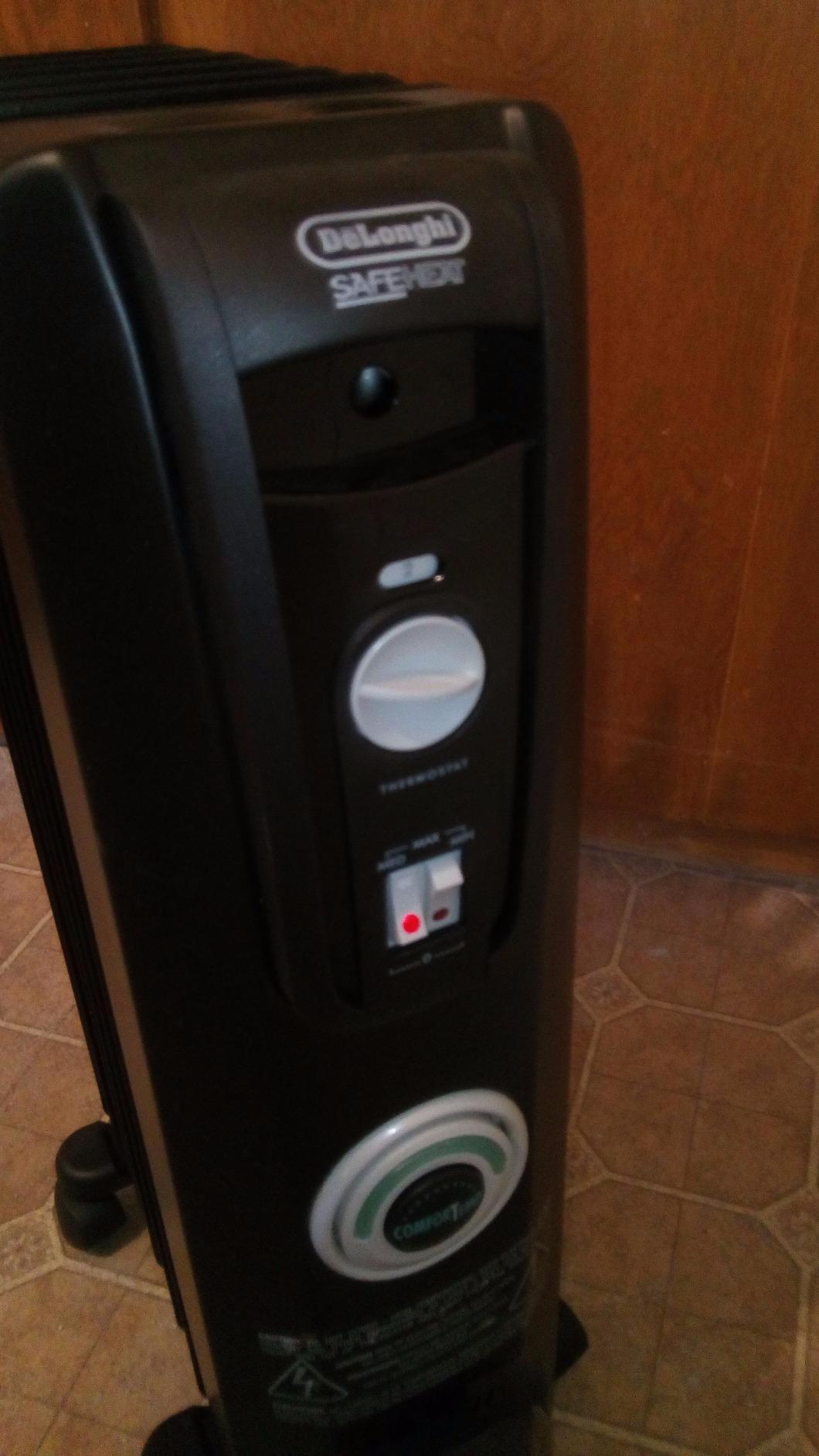
This is the radiator I keep coming back to for my own bedrooms, and it is the most widely owned unit in this group with more than 12,000 reviews behind it. It is a simple white pedestal with a 6-position thermostat dial, three power switches, and nothing else, and that restraint is exactly why it sleeps well. There is no display to glow, no beep, and no menu to navigate half-asleep.
The ComfortTemp economy mode does the work a digital panel would do on a more expensive unit, regulating power and temperature automatically to hold the set point. Owners report that once the dial is calibrated it stays on temperature rather than swinging, which is the property that keeps a bedroom at a steady temperature through the night. The sealed oil reservoir means there is nothing to refill, ever, and the thermal cut-off plus enclosed heating elements make it a sensible choice for a child’s room or a space with pets.
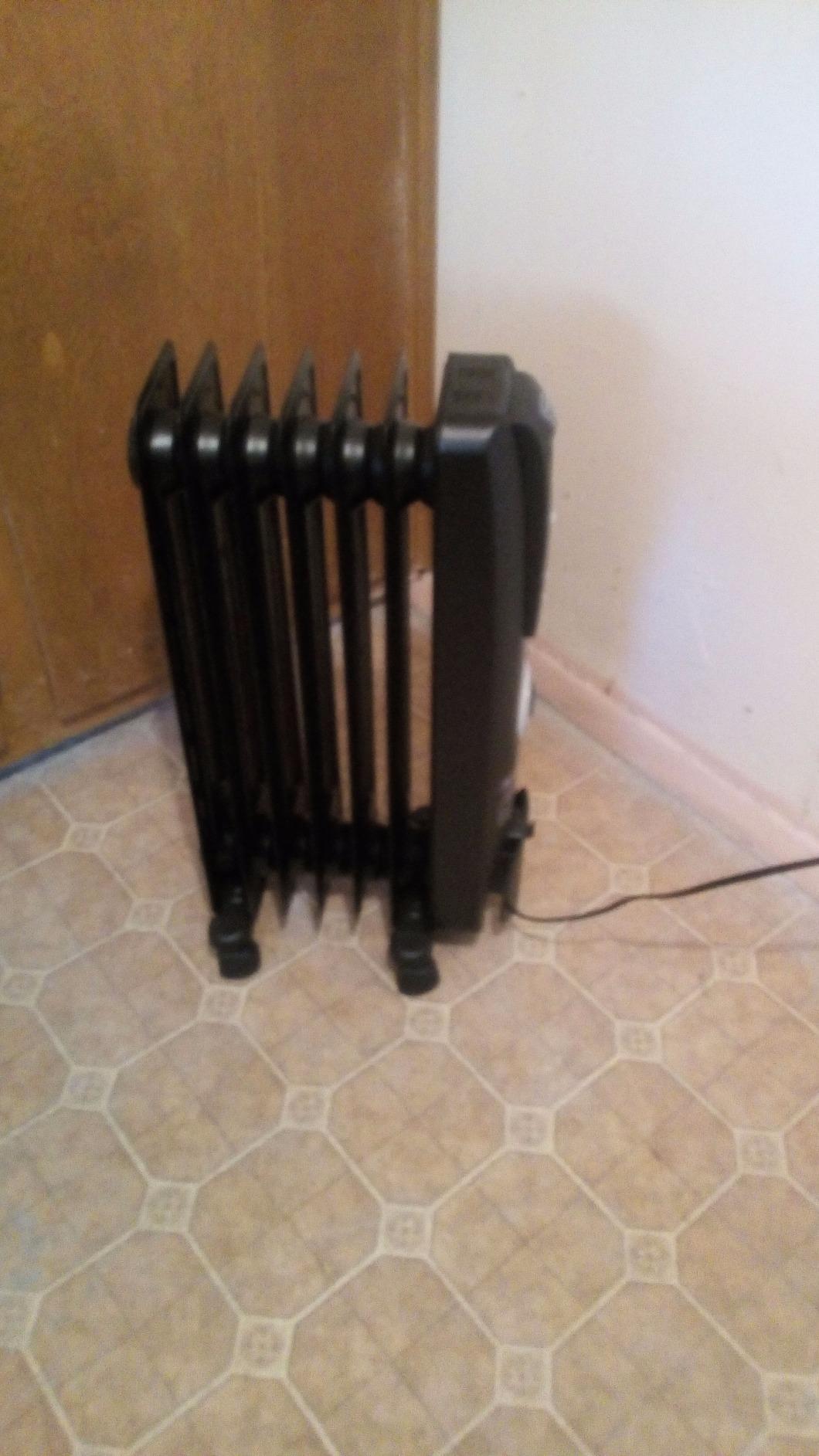
Be realistic about the warm-up. Several owners describe two to three hours before the room reaches the target temperature from cold, and the low setting draws roughly 700W while medium and high both pull the full 1500W. My routine is to run it on high while I am getting ready in the evening, then turn it to low and walk away, and by bedtime the room is holding without the element working hard.
The one real placement constraint is the cord. It is short enough that the unit has to sit fairly close to the outlet, and the snap casters are hard plastic that can mark a wood floor. The integrated handle is genuinely good, though, and at 23.2 pounds this is one of the lighter radiators in the roundup, which matters if you are moving it between a bedroom and a home office.
Heat Output and Room Coverage
At 1500W with a coverage claim of small to medium spaces, this unit handles a typical 10 by 12 foot bedroom without strain and stretches to a larger room in a well-insulated house. Output is radiant rather than forced, so the warmth reaches you evenly across the room rather than arriving as a hot front line. Rated at 120 volts, it draws the same 12.5A as most full-size radiators.
Dial Control Versus a Digital Panel
The 6-position dial with a minimum setting of 44°F is a deliberate design choice, and the manual explains the cycling behaviour poorly, which is the most common frustration owners report. Give it a weekend to calibrate. Find the position that holds your target temperature without the element cutting out constantly, and after that the unit runs almost unattended, which is a better outcome at 2am than a panel that needs a button press to change mode.
Safety, Wheels and Everyday Handling
Thermal cut-off, fully enclosed heating elements, a gently rounded body, and an anti-freeze mode that switches on below 41°F cover the essentials. The anti-freeze function is a convenience rather than real pipe protection, and a few owners find it too weak to rely on in a genuine freeze. The thermal slot design holds the surface temperature lower than a bare element would, which is helpful in a room where a child sleeps close to the wall.
What Sleepers and Long-Term Owners Say
The recurring owner theme is longevity. Oil filled radiators in general are reported across buying forums as 15 to 20 year purchases, and De’Longhi is the brand most often named when owners describe buying something to keep, rather than replace. Several reviewers own more than one of these units for zone heating different rooms, which is the most common sign that a heater has passed its first winter without incident.
The other recurring theme is the manufacturing smell in a closed room for the first few hours of use. Air the bedroom for an hour after the first run rather than switching it on right before bed, and it clears completely. Beyond that, the complaints list is short: the cord, the casters, and patience during warm-up.
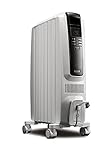
2. De’Longhi Dragon Digital TRD40615E – Best for Scheduled Overnight Heating
De’Longhi Dragon Digital Oil Filled Radiator Heater, 1500W Electric Space Heater for indoor use, programmable timer, Energy Saving, full room heater with safety features TRD40615E
1500W
Digital LED panel
24-hour timer
Child lock
23-foot cord
3-year warranty
Pros
- 24-hour timer handles overnight scheduling
- Large radiant surface builds heat faster than smaller units
- ECO Plus trims power while holding temperature
- 23-foot cord solves placement problems
- Child lock adds real protection
Cons
- Heaviest unit in the group at 26.6 lb
- Gradual warm-up rather than instant heat
- Faint coating smell during break-in
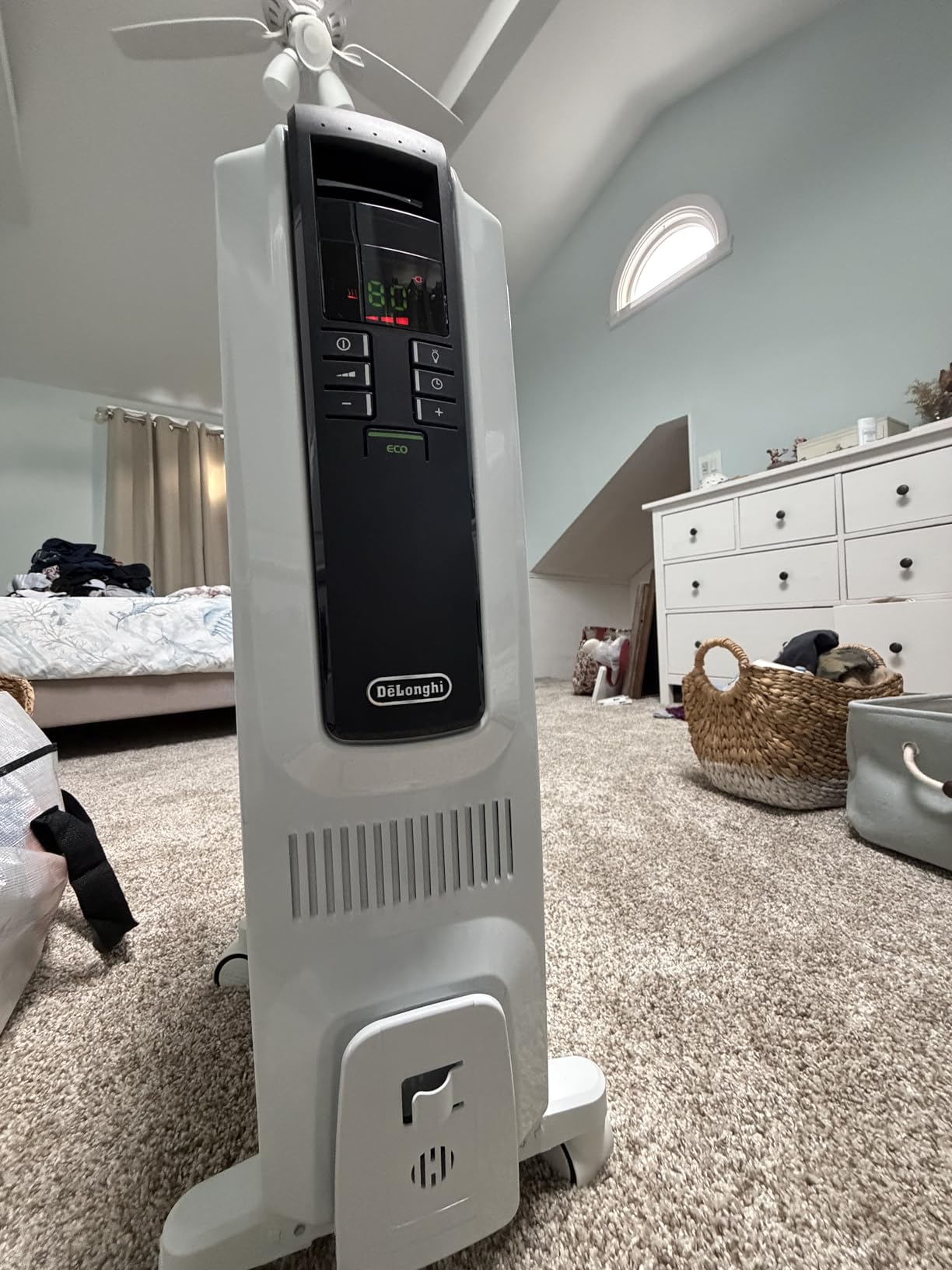
The Dragon Digital is the same basic radiator as the model above with a digital control panel bolted on, and for a bedroom that panel earns its place. You set a 24-hour programme once and stop thinking about it: heat at 10pm, down to a maintenance level at 2am, off at 7am. Nobody has to get out of a warm bed to turn a stiff dial in the dark.
De’Longhi claims 75% more radiant surface area than its Radia S line, and the practical result is faster heat build-up than smaller oil radiators. Owners in cold rooms report noticeably better performance than a standard seven-fin unit. ECO Plus regulates power flow and temperature together, which is the digital equivalent of the ComfortTemp mode on the analog unit.
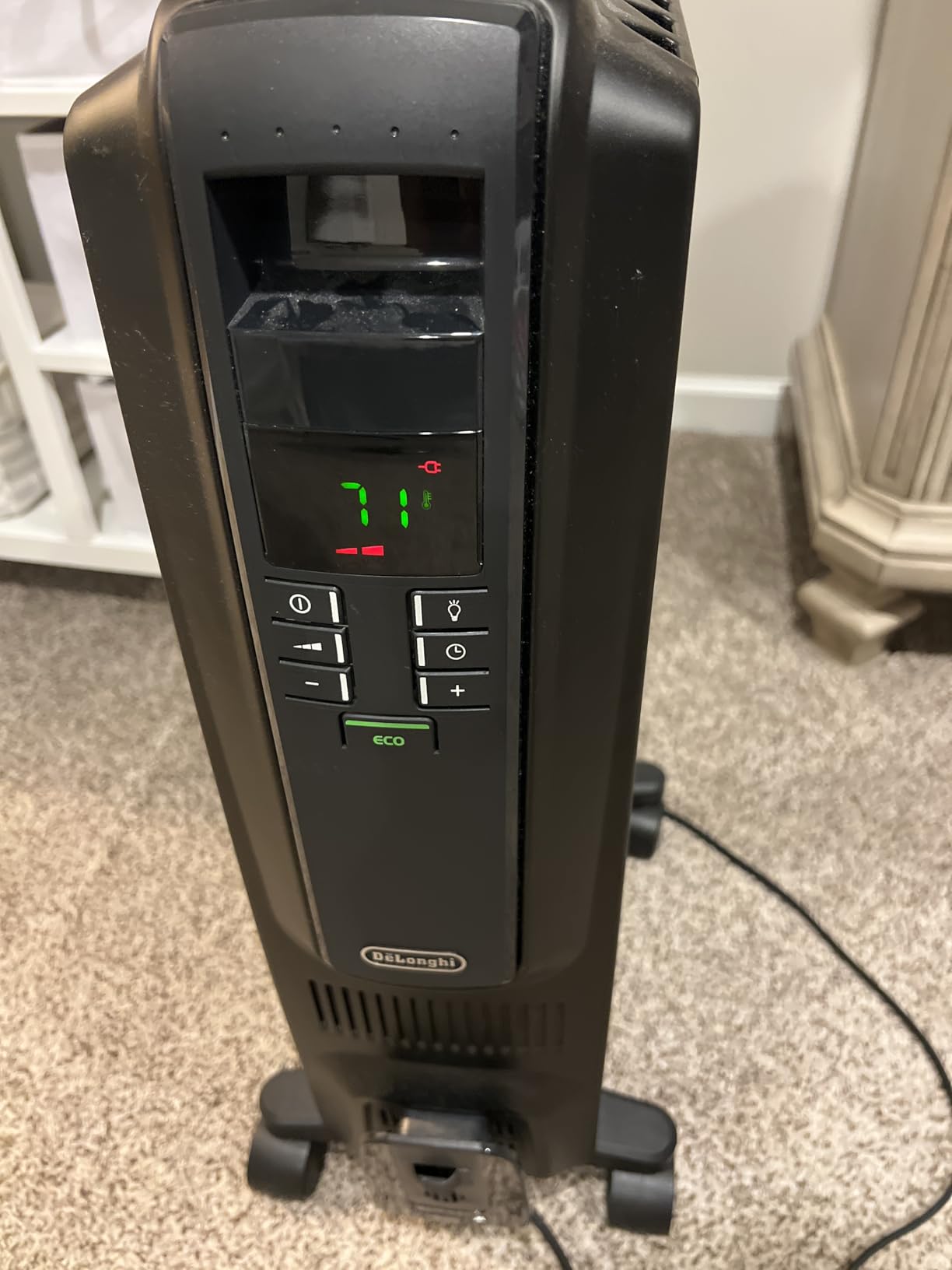
There is a placement advantage that sounds minor until you have lived with it. The listed cable length is 23 feet, and that means you can run the heater to the far side of a bedroom, or over to a socket near the window where the draught is, instead of pinning the unit wherever the nearest outlet happens to be. The short-cord frustration that shows up on nearly every other model in this roundup simply does not apply.
The compromises are weight and glare. At 26.6 pounds this is the heaviest radiator here, so hauling it between rooms is a two-hand job. The LED display also emits light, and in a pitch-dark bedroom that is a real consideration. There is no screen-off or mute mode on this panel as there is on the DREO, which is worth weighing if you are a genuinely light sleeper.
Why the Radiant Surface Area Matters
Heat output is not just watts. It is watts spread across the surface that has to release it into the room, and a larger radiant area means the same 1500W leaves the fins at a temperature you can comfortably sit near. That is why this unit feels less “hot in one spot” than a narrow seven-fin radiator, and why it converges on room temperature faster in a bedroom with a window in it.
Timer, ECO Plus and Overnight Programming
The 24-hour programmable timer is the feature that changes how you use the heater rather than just how you set it. A common pattern is full power for an hour to bring the room up, a scheduled overnight block at reduced output, then a morning warm-up before you get up. The thermostat range tops out at 82°F, which is a sensible ceiling for a sleeping room rather than a living space.
Safety for a Shared or Child’s Bedroom
Child lock plus thermal cut-off plus anti-freeze mode below 41°F is a good overnight safety package, and the rubber-coated snap wheels and front and rear handles make relocation less of a chore. Electrical draw is 12.5A at 120V, so it needs a standard wall outlet, not an extension lead.
Owner Feedback on Break-In and Heat-Up
Owner reviews describe a faint coating smell during the initial break-in period, which is the same manufacturing residue other new oil radiators produce and it clears with airing. On heat-up, expectations are more positive than for smaller units, but the word owners still reach for is gradual rather than instant. Nobody in this group is going to give you a blast of heat in two minutes, and the ones that claim otherwise are not oil filled radiators.
3. DREO 1500W Oil Filled Radiator – Best Value Digital Unit with Remote
DREO Oil Filled Radiator Heater, Electric Heaters for indoor use Large Room
1500W max
Digital thermostat 41-95F
Remote included
24-hour timer
ETL listed
Pros
- Widest feature set here with remote and 24-hour timer
- Largest claimed coverage at 250 sq ft
- 41-95F thermostat range gives fine bedroom setpoints
- Lightest digital unit at 17.6 lb
- ETL listed with triple overheat protection
Cons
- ECO mode runs full power for the first 40 minutes
- Popping and clicking from the thermostat early on
- Very hot surface needs care around children
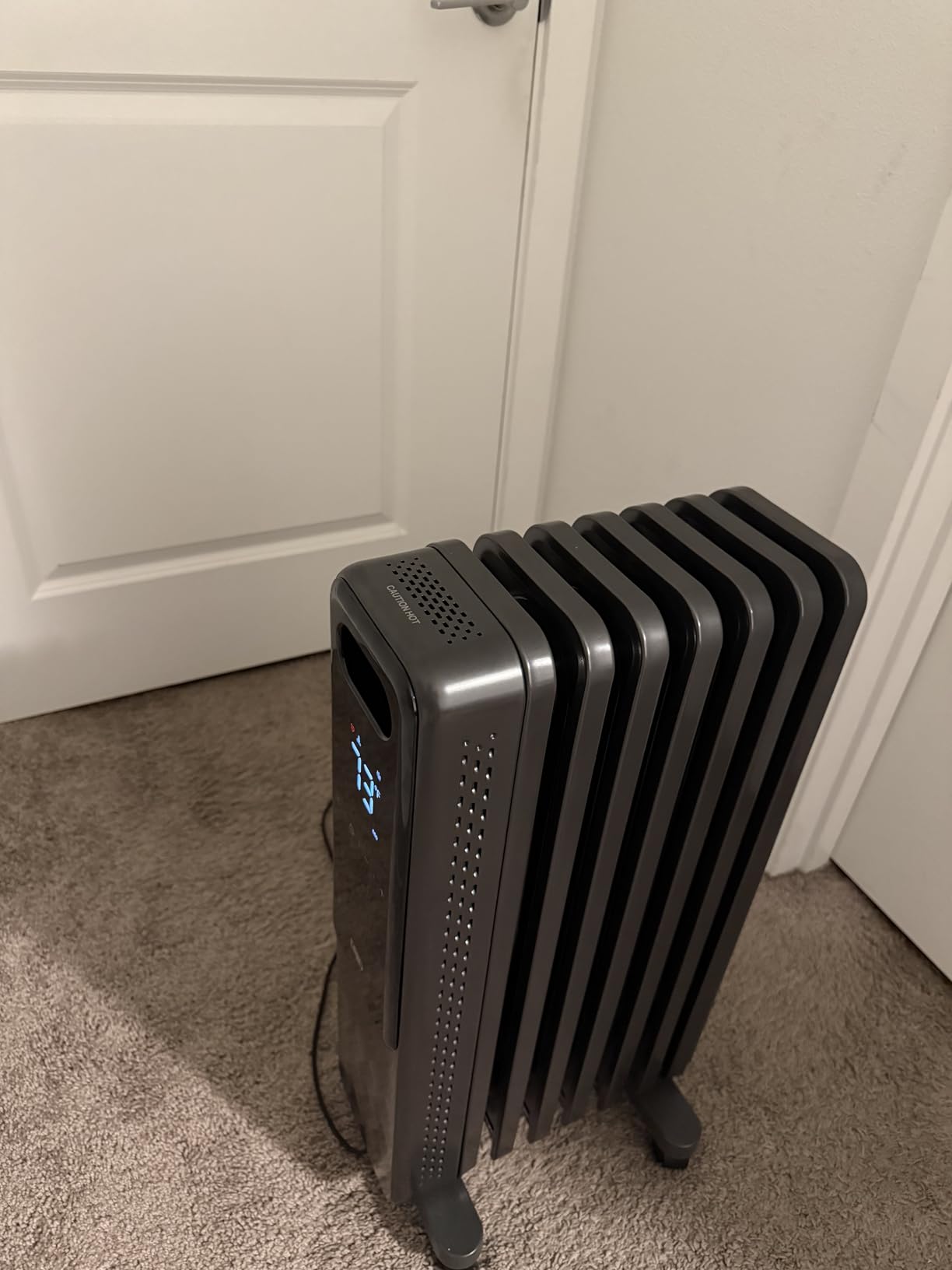
The DREO is the one I recommend when the bedroom is shared, the room is on the larger side, or the person operating the heater is not the person lying in it. Everything here is aimed at that problem. You set the temperature with the in-room touchscreen or from bed with the included remote, and the screen-off and mute modes handle the two things that actually wake people up: light and beeps.
It claims 1500W across three power modes of 600W, 900W and 1500W, with seven advanced fins for heat dispersion, and a rated coverage of 250 square feet. That is the largest coverage claim among the eight units here, and owners confirm it handles a drafty larger bedroom once it is up to temperature. The thermostat range from 41°F to 95°F is unusually wide, which lets you hold a cool sleeping temperature in a warm climate without guessing.
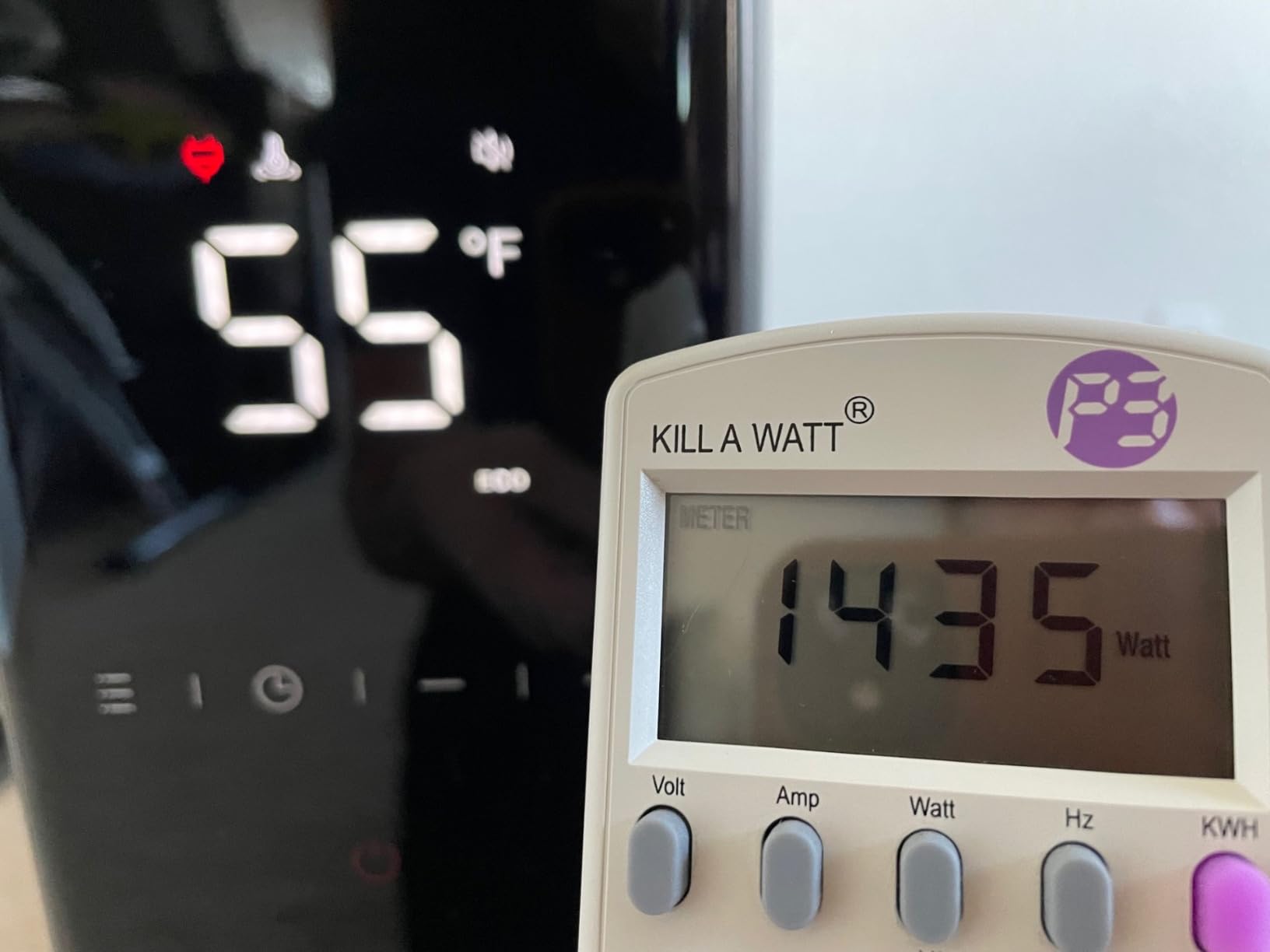
Safety is the strongest package in the roundup. Triple overheat protection, fire-resistant material, tilt protection, a burn-proof plug, ETL listing, and a seven-layer safety check build-up. There is a child lock, and the unit ships with large wheels and handles. At 17.6 pounds it is the lightest digital model here, which is a genuine advantage over the 26.6 pound Dragon Digital.
One behaviour is worth knowing before you buy. Reviewers report that ECO mode bypasses the thermostat and runs full 1500W for roughly the first 40 minutes regardless of the temperature you set, which undercuts the energy-saving claim. If you are cost-sensitive, plan around it: the 40-minute boost is the warm-up, and the unit settles to thermostat control afterwards.
Quiet Steady Running Versus Start-Up Clicking
In steady operation this unit is quiet. The complaint is concentrated in the first several minutes, where the thermostat produces noticeable popping and clicking. Owners describe brief start and stop clicking during the ramp-up. For a household where someone is asleep during that window, my advice is to switch it on before bedtime and accept the noise, because it stops.
Surface Temperature and Child Safety
Several reviewers note the surface runs very hot, which is the flip side of the large fins and the aggressive startup boost. That makes it a better fit for a teenager’s or adult’s room than a nursery where a toddler sleeps on the floor beside the unit. The tilt protection and child lock help, but no child lock replaces keeping a hot-surface heater out of reach.
Remote, Timer and Screen-Off Control
The remote control with included battery, 24-hour timer, mute mode and screen-off mode make this the best bedside-controlled radiator here. It is not smart-home capable, with no app or voice assistant integration, so if your schedule runs through a home automation hub you will need a separate wall timer. The display also does not show which power level is active once it is in thermostat mode, which is a small blind spot.
Marketing Claims Worth Reading Carefully
Dreo quotes a 92.3% efficiency boost and heat dispersion running 39.49% ahead of competitors. Treat those as marketing comparisons to unspecified baselines rather than measured results. The coverage figure of 250 sq ft is a rating, and like every rating in this category it assumes normal insulation and a closed room, so a drafty bedroom with single-pane windows will need the doors shut and a longer warm-up.
4. Amazon Basics 1500W Oil Radiator – Best for Small Bedrooms on a Budget
Amazon Basics Portable Oil Radiator Heater, Indoor Use, 3 Heat Settings, Over-Heat Protection, ETL-certified Safety, 7 Oil-Filled Steel Fins, 1500W, Tip-Over Protection, 11″D x 14.8″W x 25.2″H, White
1500W max
144 sq ft coverage
3 settings
ETL certified
Tip-over protection
Pros
- Very quiet fanless running
- Radiant heat feels less drying than blown air
- Good value against name-brand radiators
- Analog controls keep working after a power cut
- Simple assembly with included wingnuts
Cons
- Coverage limited to about 144 sq ft
- Analog dial is imprecise
- Slow warm-up with no fan
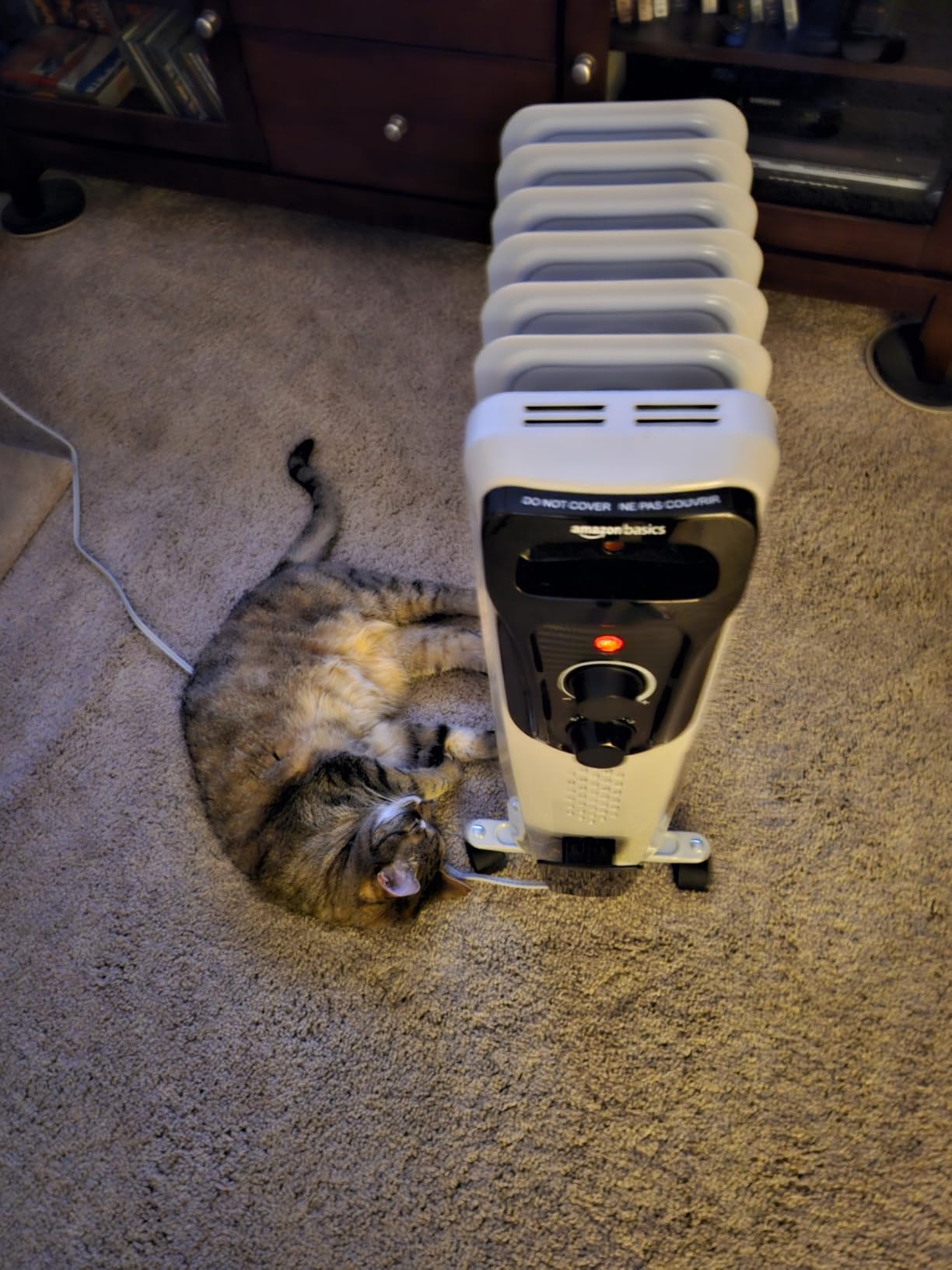
This is the radiator I suggest for a 10 by 10 foot bedroom, a guest room, or a rental where you want a reliable fanless heater without spending much. It delivers the three things that matter at night, silence, even radiant heat, and tip-over and overheat protection, and it does them with a simple dial. Owners consistently rate it as strong value for the money.
Three heat settings give you 1500W, 1000W and 600W, and the minimum thermostat setting is 60°F, which is a sensible floor for sleeping. Coverage is rated at 144 square feet, so treat that as the real ceiling and not the starting point. Owners are clear that this is a supplemental or small-room heater rather than a whole-room solution in a drafty space.
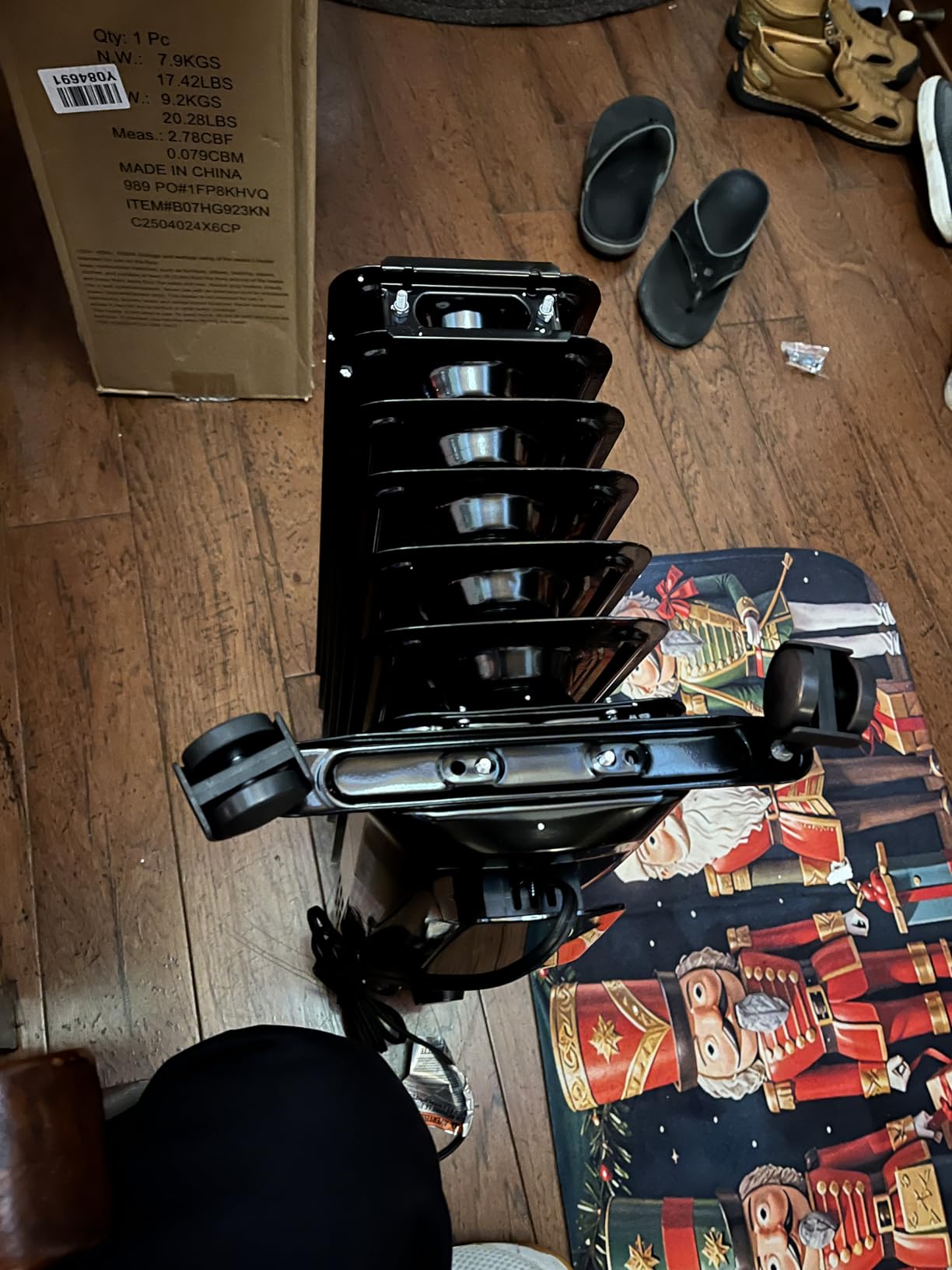
Two practical details put it ahead of the other budget options. It is ETL certified, which is a real third-party safety mark rather than a self-declared claim, and the analog controls keep functioning after a power cut, which digital panels sometimes do not. At 17.4 pounds it is one of the easiest to move, with smooth-gliding casters and a carry handle, and the slim vertical profile fits a tight gap beside furniture.
The trade-offs are the imprecise dial and a small durability tail. The analog thermostat takes trial and error to calibrate, which is exactly the frustration that makes people abandon a heater. One review also reports a unit that stopped heating after roughly a month of use, so it sits below the two De’Longhi models on the durability curve even though the rating is close.
144 Square Feet: What That Means in a Bedroom
144 square feet is roughly a 10 by 14 foot room or a 12 by 12 foot room with a normal 8 foot ceiling. In a well-insulated house with the door closed, a 1500W unit holds that space comfortably all night. Add a west-facing window, an open door, or a ceiling above 8 feet and you are asking it to stretch, and the fix is a lower thermostat setting plus a longer pre-heat rather than a bigger guess.
Three Settings and the Imprecise Dial
You get real control granularity from the 600W and 1000W middle settings, which most competitors do not offer, and the diathermic oil gives you even heat at each. The dial itself is the weak point. Spend a few evenings narrowing it down, and note that a dial set too high is the main reason owners conclude an oil radiator is not working.
Safety, Assembly and Everyday Use
Tip-over protection, overheat protection and ETL certification are the whole safety story, and for a small bedroom that is sufficient. Assembly takes a few minutes with the included wingnuts and no tools. Plug it directly into a wall outlet, since owners are warned against extension leads and surge protectors with a 12.5A draw at 100 volts.
How Owners Use It in Practice
The typical owner use is zone heating: the bedroom gets warm, the rest of the house stays off. Reviewers note that switching off baseboard heat in favour of one of these cuts utility costs noticeably, because you are heating a room rather than a house. That is the same argument that makes a radiator the right tool for a bedroom, and it is where this one earns its place.
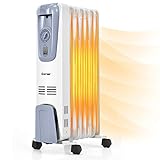
5. COSTWAY 1500W Oil Filled Radiator – Best Straightforward Budget Option
COSTWAY Oil Filled Radiator Heater, 1500W Portable Space Heater with Adjustable Thermostat, 3 Heat Settings, Overheat and Tip-Over Protection, Electric Oil Heater for Living Room Bedroom, Indoor Use
1500W max
3 heat settings
Adjustable dial
Sealed oil
Tip-over shutoff
Pros
- Silent fanless running for sleepers
- Low cost for a full 1500W output
- Sealed reservoir never needs refilling
- Four casters and a front carry handle
- Cord wrap for tidy storage
Cons
- Listed cable length of only 25 inches
- No timer or remote for overnight scheduling
- Struggles in very large open rooms
The COSTWAY does the plain version of this job well: 1500W of radiant heat, three settings, a sealed oil reservoir, and automatic tip-over and overheat shutoff. Owners like it for exactly the reason people buy radiators, it is silent, and the sealed oil means there is no maintenance and nothing to top up. The grey body and front carry handle make it easy to move between a bedroom and a spare room.
It is worth being blunt about the cord. The listed cable length is 25 inches, which is shorter than the reach of a typical bedroom lamp lead, and that is the single most common frustration with this model. You will be placing the unit against the wall with the nearest outlet, which in a bedroom often means closer to the bed than is comfortable.
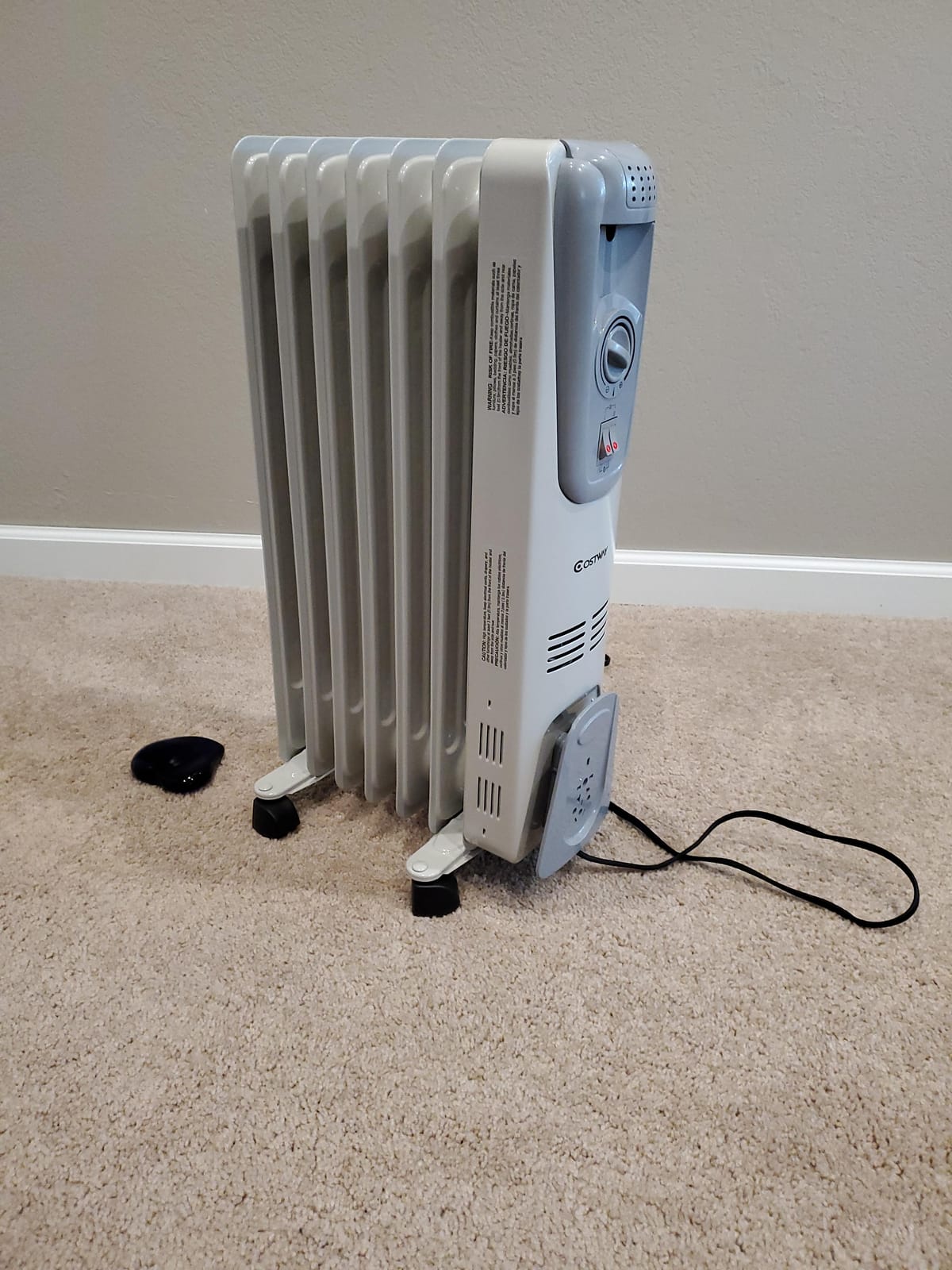
There is no digital display, no timer and no remote. That is not a dealbreaker if you run the heater with an external outlet timer, which several owners do deliberately, since a mechanical dial stays reliable where a panel might not. It is a dealbreaker if you want to change the setting from bed at 3am without getting up.
Effectiveness also scales with room size in a way owners flag repeatedly. It is described as capable in medium to large rooms generally, but as struggling in very large open spaces. For a standard bedroom, sized properly, that is not an issue.
Wattage Tiers for Overnight Comfort
Low, medium and high give you three points on the power curve rather than a thermostat that modulates continuously. Run it on medium or high for the pre-heat window, then drop to low overnight. The oil does the rest, and because it holds heat the room stays warm while the element is resting.
Thermostat Dial and Setting It Once
The adjustable dial is a simple mechanical thermostat. Calibrate it the same way you would any oil radiator, and expect a slightly wider control band than a digital unit. In practice that is fine overnight, because the wide thermal mass of the fins damps out the swing before you notice it.
Portability, Casters and Storage
Four universal casters and a front carry handle make this genuinely easy to shift, and the cord wrap keeps it tidy in a cupboard between heating seasons. It weighs 19.3 pounds and stands 25 inches tall at 10 by 13.5 inches, so it needs a corner, not a spot in the middle of the floor.
Who This Model Suits and Who It Does Not
It suits a first bedroom, a guest room, or anyone who wants a simple silent heater and does not want to manage settings at night. It does not suit a large draughty room, a nursery where surface temperature is the main worry, or anyone whose outlet is far from where the heat is needed. The field history is also shallower than the two De’Longhi units, which matters for a purchase you expect to keep for many seasons.
6. Comfort Zone CZ7007J 1200W – Best for Tight Bedrooms and Older Wiring
Comfort Zone Electric Oil-Filled Radiant Radiator Space Heater, Never Refill, Adjustable Thermostat, Tip-Over Switch & Overheat Protection System, Ideal for Home, Bedroom, & Office, 1,200W, CZ7007J
1200W
500W/700W/1200W
Slim 8.5 inch width
Manual dial
1-year warranty
Pros
- Completely silent in steady operation
- Very slim profile for tight floor space
- Warmth felt evenly within about five to six feet
- Low 1200W draw at 10A is gentle on older wiring
- No tools needed to attach the casters
Cons
- Lowest output here and it struggled on a 12 by 15 room
- 300 sq ft coverage claim is optimistic
- Casters roll poorly on hardwood
The CZ7007J solves a narrow problem very well: a small bedroom where floor space is the constraint. At 8.5 inches wide and 24.5 inches tall it slides into a gap that a full-size radiator will not, and owners who live in tight rooms say the narrow profile is the reason they bought it. It also runs at 1200W on 10 amps, the lowest draw in this roundup, which is worth knowing in an older house with older wiring.
Heat settings are 500W, 700W and 1200W, with a manual adjustable thermostat. In steady operation owners describe it as completely silent, and the warmth is felt evenly about five to six feet from the unit, which is a sensible radius for a small bedroom. Tip-over switch and overheat protection cover the safety basics, and the sealed reservoir never needs refilling.
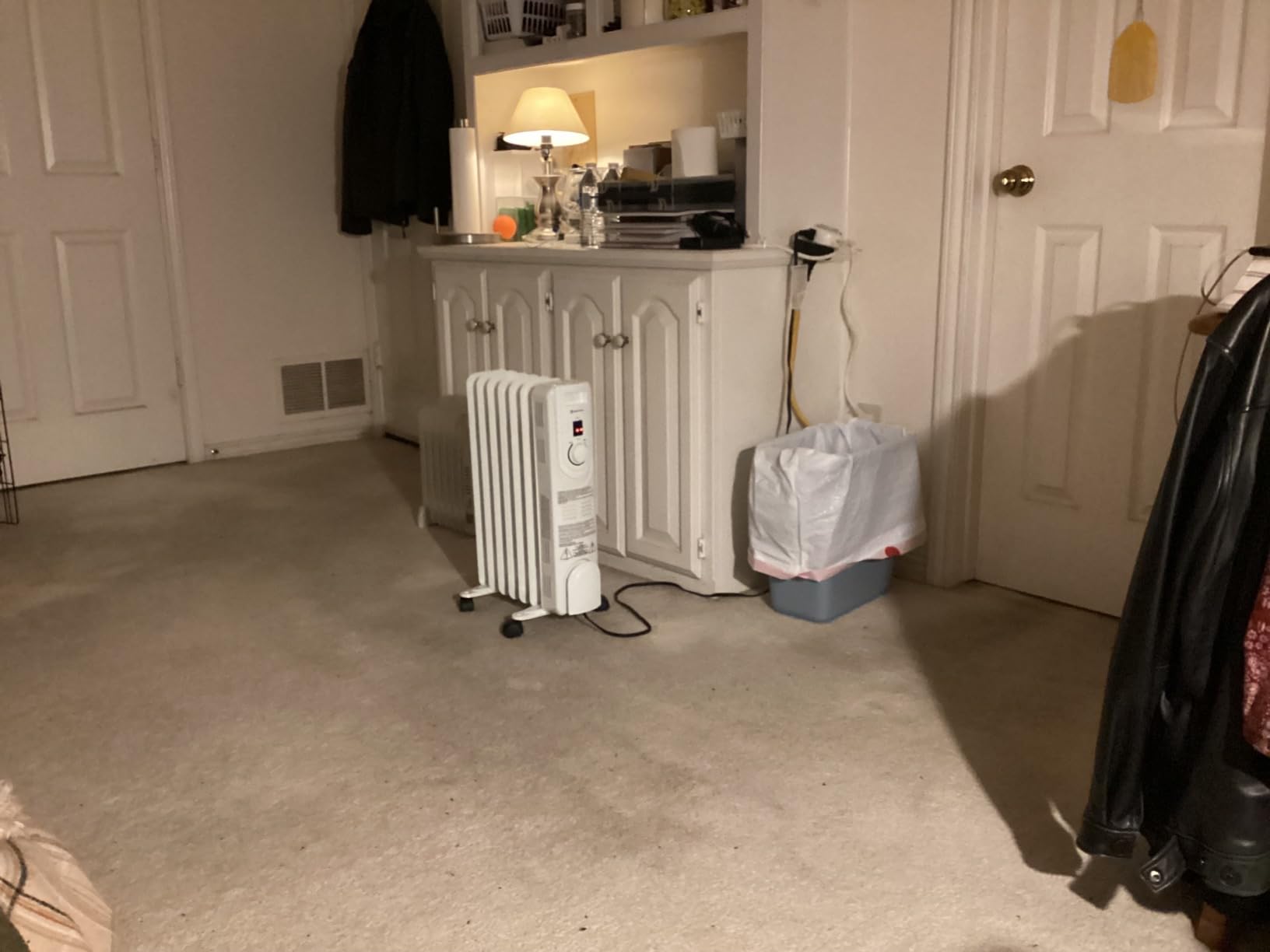
Be skeptical about the coverage claim. The listing states 300 square feet, but owners report under-delivery against that number, and one buyer describes it struggling to warm a 12 by 15 foot bedroom before moving to a 1500W digital model. My rule with this unit is to size for 1200W of real capability, not for the printed figure, which puts it in a small bedroom rather than a medium one.
Two smaller annoyances. The casters are not stout and roll poorly on hardwood, and there is a slight pinging sound during warm-up and cool-down as the oil expands. There is also a factory warning sticker set across the fins that must be fully removed, and owners report that leftover sticker residue is an odour source. The warranty is one year against manufacturer defects, the shortest in the group.
Why 1200W Can Be the Right Number
Lower wattage is not always a compromise in a bedroom. A small room heated gently for eight hours uses less energy than a medium room blasted on high, and 1200W at 10A is a much easier load than 1500W at 12.5A. If your bedroom is genuinely small, this unit holds temperature just as well as a bigger one, and it runs less often once the room is up to temperature.
The Manual Thermostat in Practice
The dial is mechanical and imprecise, but the control band matters less here than on a larger unit because the surrounding surfaces are smaller and the room responds quickly. Set it a notch lower than feels right, let it settle, and adjust from there. The key is to give it the same unhurried calibration you would give any oil radiator.
Assembly, Wheels and Floor Care
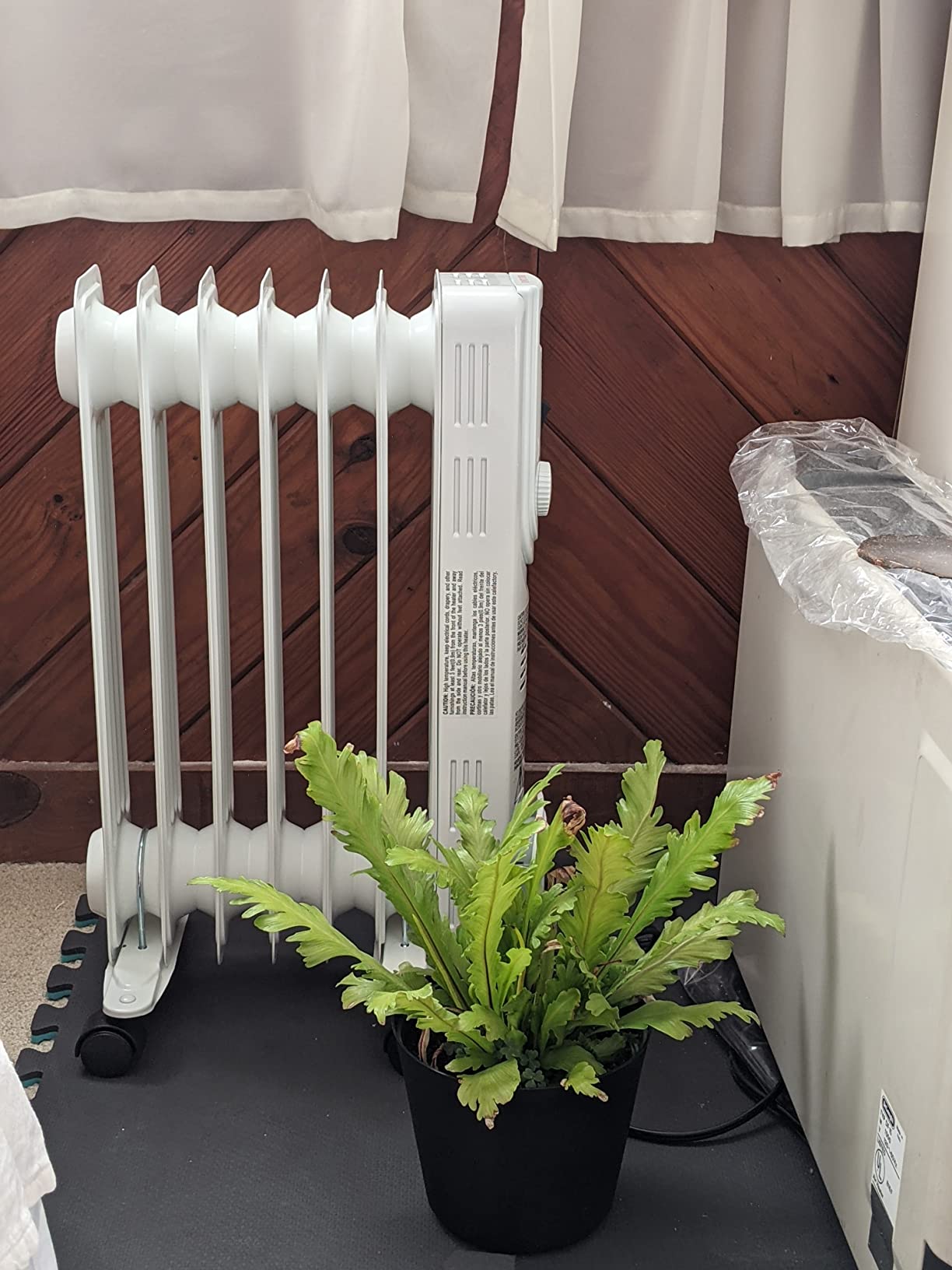
Assembly is attaching the casters, no tools required. The oversized rear wheels glide reasonably, and the solid front end gives stability. If your floor is hardwood or a hard laminate, use a mat under the wheels, because the pinging and the rolling both get more obvious on a hard surface at night.
Best-Fit Bedroom Scenario
This is the pick for a 90 to 130 square foot bedroom with tight floor space, or as a gentle supplementary heater in a larger room where you mainly want to take the chill off. It is also the right answer if your electrical circuit is one you would rather not push. It is the wrong answer for a large or drafty bedroom, where the output is genuinely not enough.
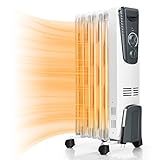
7. Tangkula 1500W Oil Filled Radiator – Best for Absolutely Silent Heating
TANGKULA Electric Oil Heater, 1500W Oil Filled Radiator Heater w/Tip-over and Overheating Protection, Portable Radiant Heater with Adjustable Thermostat, 3 Heating Modes for Home Office
1500W max
7 thermal slots
4.2 lbs sealed oil
215 sq ft
20 lb
Pros
- No fan noise whatsoever
- Several buyers report no new-unit smell at all
- Works well warming a closed bedroom from cold
- Pairs well with an external outlet timer
- Uses less electricity than baseboard heat
Cons
- Takes hours of running on high to warm a room
- Not ideal for large open spaces despite 1500W
- Some units arrive dented in transit
This is the quietest radiator in the roundup as reported by its own owners, and the only one where several buyers specifically report no new-unit smell at all. If you are extremely noise sensitive, that combination is worth more to you than a digital panel. The Tangkula is a mechanical dial unit with nothing to beep, nothing to glow, and no fan.
Heat comes from seven oil-filled thermal slots, each 6 inches wide, with a permanently sealed fill of 4.2 lbs of oil. Power settings are 600W, 900W and 1500W, and the coverage claim is 215 square feet, which sits between the Amazon Basics figure and the DREO claim. Owners report it powering a closed-off bedroom from cold temperatures effectively, which is the test that matters for an overnight heater.
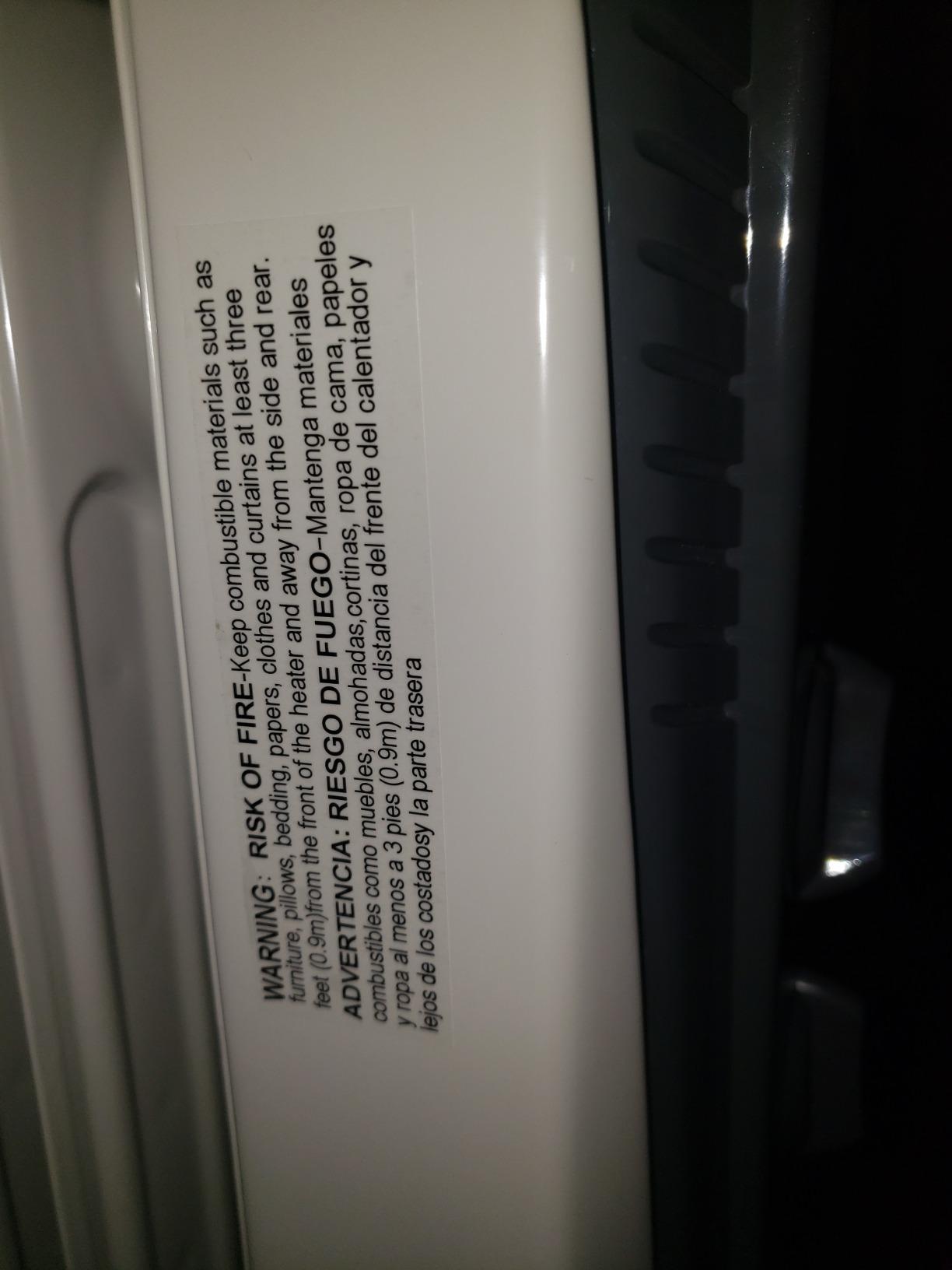
Because the controls are analog, several owners pair it with an external outlet timer, and that is a genuinely sensible setup for a bedroom. It lets you schedule overnight heating without paying for a digital panel, and the dial keeps working when electronics do not. The adjustable thermostat runs from 40°F to 59°F, which brackets a comfortable sleeping range without encouraging you to overheat the room.
The limitations are warm-up speed and condition on arrival. Owners describe it taking hours on high to warm a room, and it is not suitable for large open spaces despite the 1500W rating. A few reviews mention bodies and fins arriving dented or cracked, so inspect it before the first run.
Why 4.2 lbs of Sealed Oil Matters
The oil volume is the thermal battery. More oil means more heat stored, which means slower response but far longer retention after the element cycles off, and a gentler surface temperature because the same 1500W is spread across a larger mass. That is why it keeps a bedroom warm through the small hours and why it is one of the least alarming heaters to have running unattended next to a sleeping child.
Sound Behaviour and the Thermostat Range
Owners describe completely silent radiant heat, and unlike some digital models there is no start-up clicking thread in the reviews. The trade is control granularity, with a dial and a 40°F to 59°F band. Set it in the low-to-mid part of that range and let the oil do the work rather than chasing dial positions.
Running It on an External Timer
A wall timer plugged into the same outlet as the heater gives you overnight scheduling with a mechanical control panel. Set the timer to start a half hour before your normal bedtime, and the room is warm when you get in with no interaction required. Owners also note that running one unit this way instead of baseboard heat cut their electricity costs noticeably.

Portability and Storage Between Seasons
Four heavy-duty caster wheels, a removable base, and a cord wrap make it easy to move and to store. At 20 pounds and 14 by 10 by 23 inches, it is mid-weight in this group. The casters need attaching before first use, which is a five-minute job and the one piece of setup every owner should expect to do.
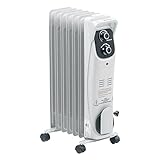
8. Comfort Zone CZ8008N 1500W – Best Five-Channel Radiator for Long-Term Use
Comfort Zone Oil-Filled Radiator Space Heater, Radiant, Electric, Never Refill, Adjustable Thermostat, Tip-Over Switch & Overheat Protection System, Ideal for Home, Bedroom, & Office, 1,500W, CZ8008N
1500W
5-channel sealed reservoir
Stay-cool handle
Swivel casters
1-year warranty
Pros
- Silent radiant heat that continues after cut-out
- Sealed five-channel design never needs refilling
- Stay-cool molded handle for safe moving
- Double-boxed carton reduced transit damage
- Power indicator light shows status
Cons
- Lowest rated here at 4.2 with a higher share of one-star reviews
- Some reports of oil leaking near the caster mounts
- Casters do not lock and pop off when moved
The CZ8008N is the sensible five-channel design: a permanently sealed oil reservoir behind a stack of wide fins, an adjustable manual thermostat, and three heat settings. Owners like the way it keeps producing warmth after the thermostat cuts out, which is the property that makes an oil radiator good for overnight use, and several report cutting their running costs by switching off baseboard heat in favour of one of these.
What makes it distinct in this roundup is the stay-cool molded handle. In a room where you may need to move the heater to clean under the bed or to dust, a handle that is designed not to get hot is a real convenience. The 360-degree swivel casters help with that too, and the unit comes in a double-boxed carton that reviewers say has reduced transit damage.
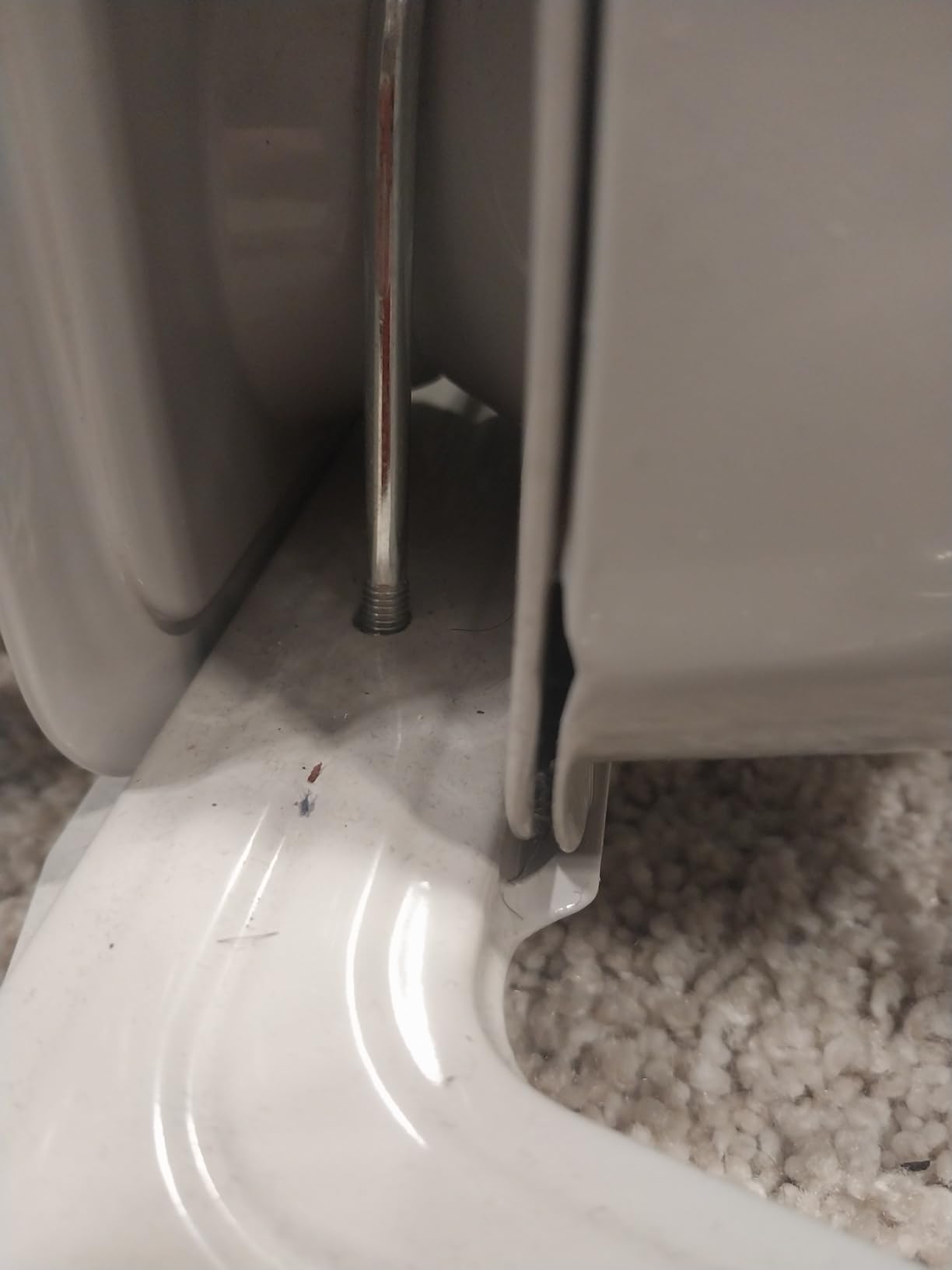
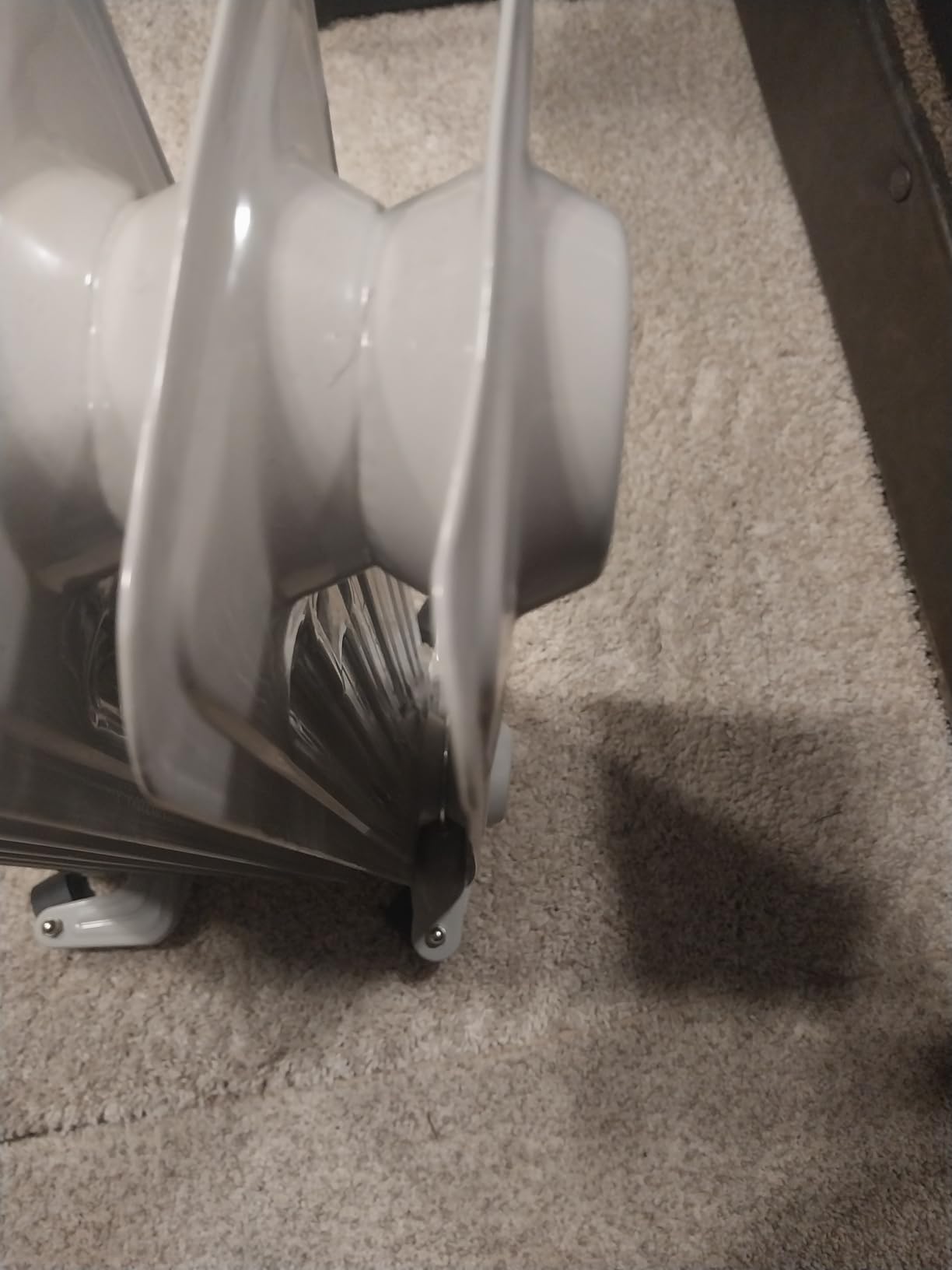
I have to be straight about the weaknesses, because they are more than the other models. It carries the lowest average rating in this group, and the review mix includes a noticeably higher share of one-star reviews than the units above it. The recurring complaints are oil leaking from the base near the wheel mounts after a couple of months, and casters that do not lock into place and pop off when you move the unit.
Two smaller issues. The power indicator stays lit after you switch the unit off, so a full shutdown means unplugging it at the wall, which is worth knowing before you leave it running overnight. And the written directions are poor, with the box illustration more useful than the manual, so budget a few minutes with the unit before you set up your bedroom routine with it.
Coverage Claim Versus Real Bedroom Performance
The listing states 300 square feet, but owners report lower output than some expect at 1500W. Treat that figure as a marketing ceiling. In a normal insulated bedroom around 150 to 200 square feet, with the door closed and a longer pre-heat, it works. In a large open-plan space it will not, and the number on the box will not change that.
Why the Indicator Light Matters at Night
A power indicator is genuinely useful for confirming at a glance that the unit is live, and it is genuinely annoying if it stays on after switch-off. In a dark bedroom, a permanently lit red indicator is a light source. If that bothers you, either unplug it at the wall after the overnight run, or choose one of the models here with a screen-off mode.
Warranty, Oil Leaks and Long-Term Risk
The warranty is one year against manufacturer defects. Base leaks near the caster mounts are the failure mode to watch, so put the unit on a hard floor or a tray rather than a finished wooden floor, and check the base after the first few months of daily use. The upside when there is no problem is a sealed reservoir that will never need filling and a warm room every night for years.
Who It Suits
It suits someone who wants a straightforward sealed radiator, has an outlet near where the heat is needed, and does not mind a manual dial. Given the leak reports and the unlatching casters, I would pick one of the De’Longhi models or the Amazon Basics unit for a child’s room or a primary bedroom where you cannot easily inspect the unit every few months. For a home office or a room heated seasonally, it is perfectly adequate.
How to Choose an Oil Filled Radiator for Your Bedroom
Most of the disappointment with this category comes from three places: buying a unit that is too small for the room, expecting a fan heater’s response time, and placing it where the heat cannot circulate. Everything below is about avoiding those three outcomes.
Size the Heater to Your Bedroom, Not to the Marketing
Coverage figures assume an insulated room with the door closed and a normal ceiling height. As a working rule, 1000W is comfortable for a very small bedroom up to about 120 square feet, 1200W covers roughly 120 to 150 square feet, and 1500W is the safe choice for anything from 150 to 250 square feet. If your room has single-pane windows, a draughty door, or a ceiling above 8 feet, step up a tier rather than trusting the stated figure.
Measure the floor area, then subtract nothing and add a margin for the room’s worst feature. A 12 by 14 foot room is 168 square feet, which puts it squarely in 1500W territory, and a 10 by 10 foot guest room at 100 square feet could run happily on the lower-wattage unit in this roundup.
A Digital Thermostat Is the Single Biggest Overnight Upgrade
If you want the heater to run without you, the control type matters more than the wattage. A digital panel with a 24-hour timer lets you set an overnight programme once, lower the output at 2am, and have it off at 7am without getting out of bed. An analog dial can be paired with an external outlet timer to achieve the same result, which is cheaper and, several owners argue, more reliable long term.
There is a noise trade. Digital panels can click and beep as they cycle, and an LED display is a light source in a dark room. The best of both worlds is a digital unit with mute and screen-off modes, which is exactly why the DREO scores well here. Whichever you choose, calibrate the set point against how the room actually feels after two nights rather than trusting the number on the dial.
The Bedroom Safety Checklist: What to Verify Before You Buy
Work through these in order, because they are the items that matter in a room where someone is asleep:
1. Tip-over protection that cuts power when the unit is tilted, ideally with a physical switch rather than a software dependency.
2. Overheat protection with a thermal cut-off, so a blocked or tipped unit cannot run away.
3. Child lock on the control panel if anyone under five sleeps in the room.
4. A cool-touch or stay-cool housing and handle, particularly if the unit sits near a playpen, a bed, or a pet bed.
5. A recognised safety certification such as ETL or UL listing, rather than a self-declared claim on the listing page.
6. Cord length measured against your actual outlet positions, with the unit positioned away from curtains and bedding.
7. Clearance from the bed itself, since a radiator is a large warm surface and a child can roll into it.
8. A thermostat lock or child lock that actually holds, tested before you rely on it overnight.
On point six, be skeptical of listing claims. A 23-foot cable appears on some models and genuinely helps, and other listings circulate a foot length that the unit does not have. Check the specification section rather than the marketing image, and if you need a longer reach, budget for the model built for it.
Where to Put the Heater So the Room Actually Warms Up
Placement fixes more complaints than wattage does. Oil filled radiators throw heat upward and outward, so the unit needs a clear path in front of it and needs to be lower than the room’s heat where you want it. If a heater seems to be doing nothing, it is almost always blocked, in a draught that pushes heat back, or set to a thermostat position that is cycling off.
Here is the sequence I use:
1. Choose a spot about 3 feet from a wall on the opposite side of the room from any window draught, not tucked into a corner.
2. Keep at least 12 inches of clear air in front of the fins and never drape bedding, curtains or a towel over the unit.
3. Place it low, at floor level, because cold air settles and the first thing you want to heat is the layer of air at the floor.
4. Close the bedroom door so you are heating a room rather than a floor of the house.
5. Switch it on 20 to 30 minutes before bed, then drop to a low or eco setting for the night.
6. If the room has a ceiling above 8 feet, position the unit away from the centre of the ceiling so heat is not lost upward.
Oil-Filled Versus Ceramic, Fan-Forced and Infrared for a Bedroom
Every alternative format trades away the thing a bedroom needs. Here is the honest comparison for sleep specifically.
Oil filled: quietest of the four, slowest to respond, keeps radiating after cut-out, does not dry the air as much, no directional blast, and the surface stays warm for a long time.
Ceramic: heats a small area quickly and cheaply, but the narrow thermostat band means frequent cycling, the element gets very hot, and it is the format most associated with dried air and a dry throat in the morning.
Fan-forced: fastest circulation of air, which is useful for a large room you are in briefly, but it is the loudest and it blasts air in a direction, which is the number one complaint bedroom owners report.
Infrared: warms objects and people in line of sight almost instantly, needs no warm-up, and is quiet, but the benefit disappears the moment you move out of the beam, so it does not heat a room.
For a room you sleep in for eight hours, the ranking is straightforward: oil filled first, infrared second if you only need a short burst, fan-forced third, ceramic last.
What the Listing Gets Wrong: Cord Length, Fin Colour and Coverage
Product photography for this category is often an illustration of a heating effect rather than a photo of the unit, and the fins are sometimes rendered in gold to show heat spreading. The unit that arrives is white, black or grey. This trips up buyers, so check the finish against the specification listing rather than the hero image.
Coverage numbers are the second problem. A 300 square foot claim on a 1200W unit does not mean 300 square feet, and the number assumes ideal insulation. Treat every coverage figure as a marketing ceiling, check the wattage against the room area, and add a margin for draughts and ceiling height.
The third is cord length, as covered above. A short cord is the single most common physical frustration in the category, and it is entirely a placement problem, not a heating problem.
Running Cost: the kWh Math for an 8-Hour Night
Running cost is arithmetic rather than opinion, and it depends entirely on your own utility rate. The unit that gets expensive is the one you blast on high when the room is already warm. Work in kilowatt-hours, then multiply by your rate.
A 1500W radiator at 1000W draws 1.0 kW, so 8 hours is 8 kWh. The same unit at 1500W draws 1.5 kW, so 8 hours is 12 kWh. A 1200W unit at 1200W draws 1.2 kW, so 8 hours is 9.6 kWh. Over 30 nights those figures are 240 kWh, 360 kWh and 288 kWh respectively, and your bill is those numbers multiplied by your per-kWh rate.
The optimisation is the opposite of what most people do. Running the heater at a lower setting for the whole night is cheaper than running it at full power for an hour and then switching it off, because the oil keeps radiating for a long time after the element stops. Set a moderate temperature, close the door, and let it hold. Every owner who reported a lower bill in the reviews above did it this way, usually by switching off baseboard heat in favour of one radiator in the room they actually use.
Burn-Off Smell, Maintenance and Storage
A faint smell in a closed bedroom for the first hours of use is normal. It is the manufacturing residue and protective coating burning off, and it clears after a run or two. Air the room after the first use rather than switching the heater on right before bed, and never run a new unit overnight in a sealed room on day one.
Maintenance is close to zero. The reservoir is permanently sealed, so there is never anything to refill or top up. Beyond a wipe-down with a dry cloth and clearing dust from the fins, there is nothing to service. Keep the unit upright when stored, and if it has a removable base or a cord wrap, use them so the cable does not take a set.
One sound deserves an explanation so you do not mistake it for a fault. Occasional ticking, popping or pinging as the unit warms and cools is the oil expanding against the metal, and it is normal. A continuous rattle, a grinding noise, or any smell after break-in is not normal, and it is a reason to stop using the unit and contact the manufacturer.
Frequently Asked Questions
What type of radiator is best for a bedroom?
An oil filled radiator is the best type for a bedroom because it has no fan, no glowing element and no directional blast. It heats a sealed reservoir of diathermic oil that warms metal fins, releasing even warmth by convection and radiation, and the oil keeps radiating after the element cycles off. The trade-off is speed: expect 20 to 30 minutes of warm-up, so switch it on before bed.
Can I leave an oil-filled radiator on all night?
Yes, provided the unit has tip-over protection, a thermal cut-off and a recognised safety certification such as ETL or UL, and you plug it directly into a wall outlet rather than an extension lead. Leave clearance from bedding and curtains, lock the controls or use the child lock, and air the room during the first run to clear the manufacturing smell.
What is the quietest bedroom heater?
The quietest bedroom heater is a fanless oil filled radiator. With no motor and no moving parts, the only sound in steady operation is a faint tick or pop as the oil expands. Digital panels can add start-up clicking, so if silence is your top priority choose a model with a mute mode, or an analog dial paired with an external outlet timer.
Are oil-filled heaters better than fan heaters?
For a bedroom, yes. Fan heaters move air quickly, which makes them the loudest format, and they blast a narrow front of hot air while your feet stay cold. Oil filled radiators release even warmth from a large surface, hold temperature without swinging, and do not dry the air as much. Fan heaters win only when you want a room warm in minutes rather than warm all night.
How long does an oil-filled radiator take to heat a room?
Most oil filled radiators take roughly 20 to 30 minutes to reach full surface temperature, and in a cold room owners report two to three hours before the whole space reaches the target. Because the oil stores heat, the trick is to switch the unit on 20 to 30 minutes before bed, drop it to a low or eco setting, and close the door.
Why isn’t my oil-filled radiator heater heating the room?
Check four things in order. The thermostat may be set too low, since an oil radiator cycles off once it reaches the dial setting. The unit may be blocked or in a draught, so give it at least 12 inches of clear air and keep it off the floor draught near a window. The room may be larger than the unit’s rated coverage. And a nearly closed door is letting the heat go next door.
Which is cheaper to run, an oil radiator or a fan heater?
It depends on how you use it, not on the wattage on the label. Both formats draw similar power, so cost follows kilowatt-hours: a 1500W unit at 1000W for 8 hours uses 8 kWh, and the same unit at full 1500W uses 12 kWh. Oil filled radiators are usually cheaper in practice because their thermal mass lets you run a moderate setting all night instead of blasting at full power.
What are the disadvantages of an oil-filled room heater?
The main drawbacks are speed, weight and size. Warm-up takes 20 to 30 minutes rather than seconds, units typically weigh 16 to 27 pounds, and the tall vertical body needs a floor corner rather than a bedside spot. Some models also have short power cords that limit placement, and the surface can run hot enough to need care around small children and pets.
Which Oil Filled Radiator Should You Buy?
If you want the model I would put in my own bedroom, it is the De’Longhi EW7707CM. It has the largest ownership history in the group, a dial and switch layout with nothing that beeps or glows, sealed oil that never needs refilling, and a 3-year warranty. It is the choice if you will calibrate the thermostat once and then stop thinking about the heater.
If you want scheduling and placement freedom, go with the De’Longhi Dragon Digital TRD40615E. The 24-hour timer, child lock and 23-foot cord solve the three practical problems that come up most often in bedrooms. If you want bedside control and the widest feature set at the best balance, the DREO gives you a remote, a screen-off mode, a child lock and the longest claimed coverage, with the caveat that eco mode runs full power for its first 40 minutes.
For a small bedroom, the Amazon Basics 1500W covers up to about 144 square feet quietly and cheaply, and it is ETL certified. For a genuinely tight room or older wiring, the slim 1200W Comfort Zone CZ7007J is the one to look at. If silence is everything and you are happy with a mechanical dial, the Tangkula is reported by its owners as the quietest unit in the roundup, and it pairs well with an outlet timer.
Whichever you pick, the routine matters more than the model. Switch it on 20 to 30 minutes before bed, keep it clear of bedding and curtains, plug it straight into a wall outlet, run it at a moderate setting rather than full power, and close the door. That habit, more than any specification, is what makes an oil filled radiator work in a bedroom. If you are building out the rest of the room while you are at it, our picks for the best smart bulbs for bedrooms and the best 4K TVs for small bedrooms cover the rest of it.