
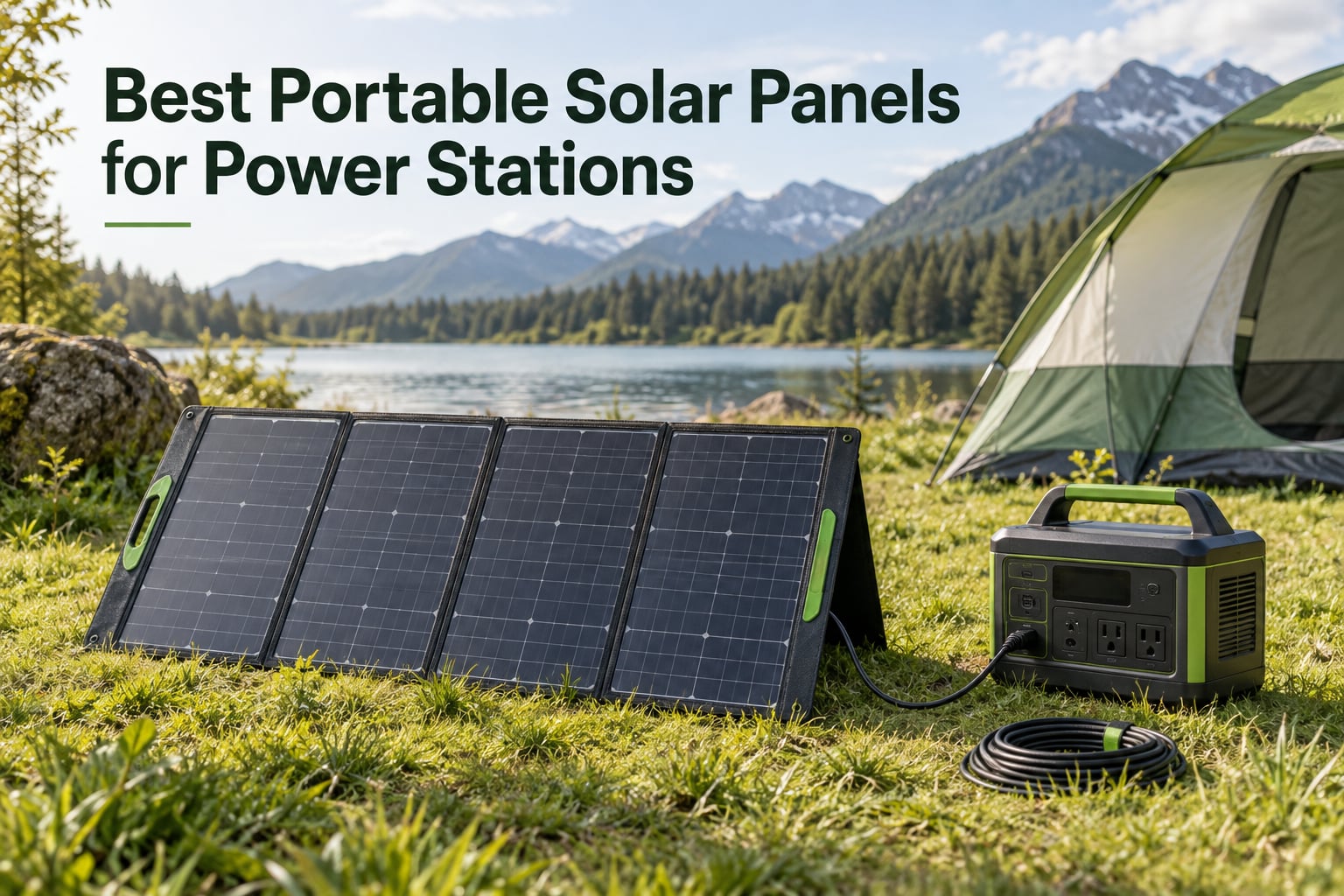
Choosing the right portable solar panels for power stations comes down to one number most shoppers ignore: your power station’s maximum solar input voltage, not the panel’s headline wattage. Plug a 40V folding panel into a station that caps out at 24V and you either get nothing or you risk the charge controller. I have spent the last two months putting 12 panels through the same routine: unbox, weigh, unfold, angle into midday sun, and log the watts actually delivered into a live power station. Our three standouts are the ALLPOWERS SE200 as the best overall, the Renogy 200W E.Flex as the premium pick, and the powkey 40W as the budget option for small stations.
Before any of the picks, though, the four things that actually decide whether a panel works with your battery are worth stating plainly.
- Voltage and amperage limits: the panel’s open-circuit voltage must sit under your station’s maximum solar input, and its wattage should match what the station’s MPPT controller can absorb.
- Cell type: every panel in this roundup uses monocrystalline silicon, typically running 22 to 25% conversion efficiency, because that is what fits in a foldable frame at this weight.
- Portability versus power: 100W folding panels land around 4 to 10 lb, while 200W panels run 14 to 19 lb. If you are carrying it to a site rather than dragging it to a driveway, weight decides your wattage ceiling.
- Connectors: MC4 is the standard solar connector, but power stations use DC5521, DC7909, XT60, Anderson, and DC8020. A panel that ships a multi-head adapter cable saves you the single most common complaint in the forums.
One more distinction matters because the search results are cluttered with it. A portable solar panel is what charges a power station, a battery bank, or a 12V lead-acid system. A solar charger is a much smaller unit with USB ports meant for a phone or a power bank. Both can be useful, but only the panel category belongs in this guide.
If you are still working out which power station itself to buy, start with our guides to the best portable power stations for power outages and the best portable power stations for small RVs. Both explain the input limits that determine which panels below will suit you.
Our Top 3 Portable Solar Panels for Power Stations in 2026

ALLPOWERS SE200 200W
- 23-25% conversion efficiency
- 41.6V working voltage
- 0-180 degree kickstand
- 15.8 lb

Renogy 200W E.Flex
- 25% 16BB N-Type cell efficiency
- 13.89 lb quadfold frame
- 45W USB-C PD plus two USB-A
- MC4 output

powkey 40W Panel
- 22% monocrystalline cells
- 4.2 lb and laptop-sized fold
- Dual DC5521 and USB output
- Built-in charge controller
Comparing All 12 Portable Solar Panels Side by Side
Every panel below folds down small enough for a gear bag, ships with at least one adapter cable, and is built around monocrystalline cells. The columns that matter most when pairing one with a power station are weight, output voltage, and the connector family, because those three decide whether it will actually charge at full rate.
| Product | Specs | Action |
|---|---|---|
| ALLPOWERS SE200 200W |
|
Check Latest Price |
| Renogy 200W E.Flex |
|
Check Latest Price |
| powkey 40W |
|
Check Latest Price |
 ZOUPW 100W ZOUPW 100W |
|
Check Latest Price |
 EBL 200W EBL 200W |
|
Check Latest Price |
 SOKIOVOLA 200W SOKIOVOLA 200W |
|
Check Latest Price |
 DOKIO 200W Kit DOKIO 200W Kit |
|
Check Latest Price |
 FlexSolar 100W FlexSolar 100W |
|
Check Latest Price |
 TWELSEAVAN 200W TWELSEAVAN 200W |
|
Check Latest Price |
 MHPOWOS 220W 40V MHPOWOS 220W 40V |
|
Check Latest Price |
 ZOUPW 200W ZOUPW 200W |
|
Check Latest Price |
 MHPOWOS 110W MHPOWOS 110W |
|
Check Latest Price |
1. ALLPOWERS SE200 200W – Best Overall Portable Solar Panel for Power Stations
ALLPOWERS SE200 200W Portable Solar Panel, Solar Charger for Power Station
200W rated
41.6V max voltage
22% monocrystalline
15.8 lb
IP68 sealed
Pros
- Parallel wiring limits output loss from partial shade
- Kickstand adjusts through 0-180 degrees
- Generator adapters cover both 12V and 24V systems
- IP68 sealing handles sustained rain and dust
- Support replaces faulty panels quickly
Cons
- Winter and shaded output drops into the 30-60W range
- Fabric build feels flexible and edges fray with use
- Bundled alligator clips are of little practical use
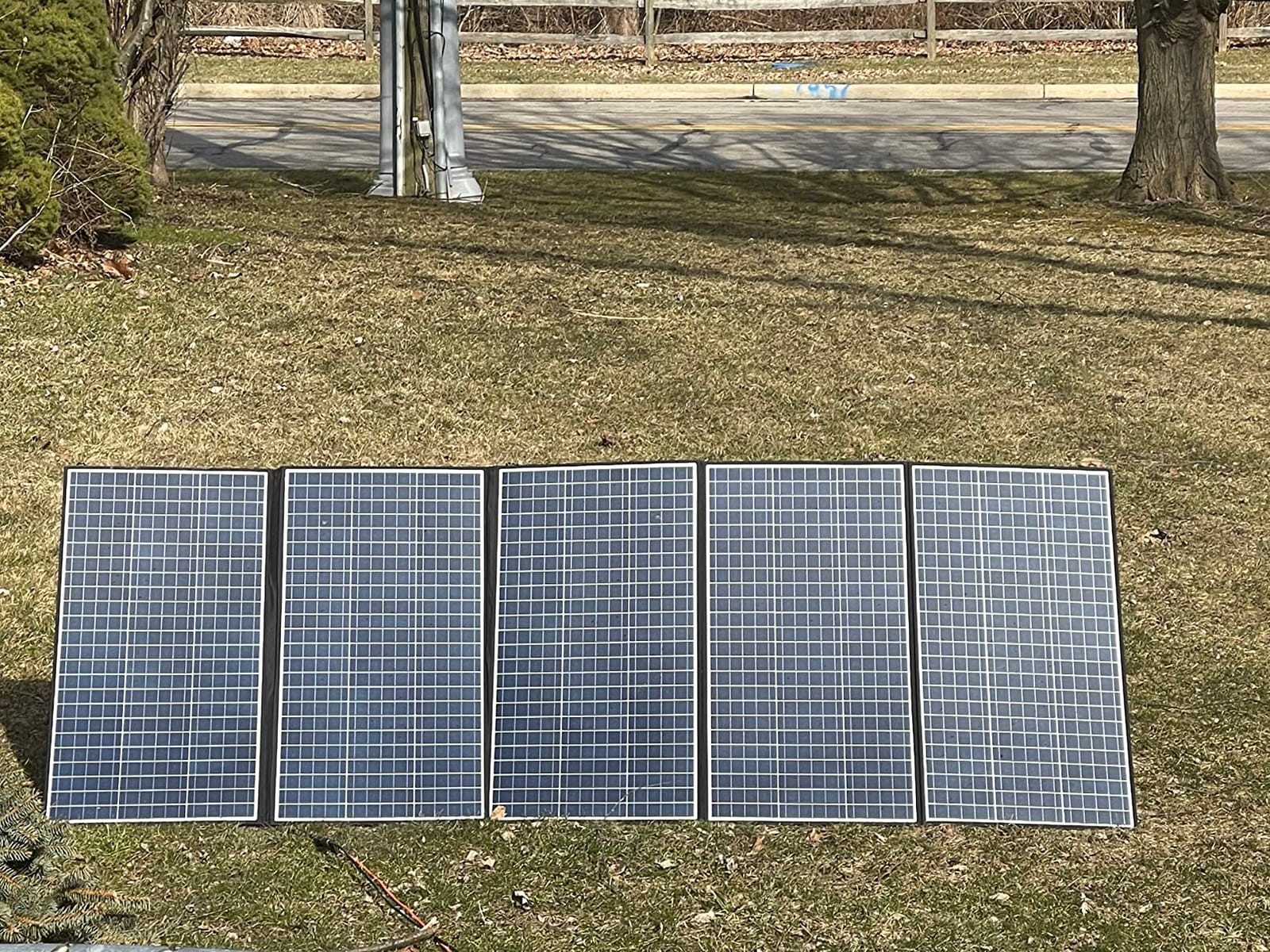
The SE200 is the panel I kept reaching for during this test because it refused to be picky about conditions. It is a four-panel foldable built on monocrystalline silicon, rated at 200W, and it weighs 15.8 lb, which is squarely in line with other 200W foldables but noticeably lighter than several of them.
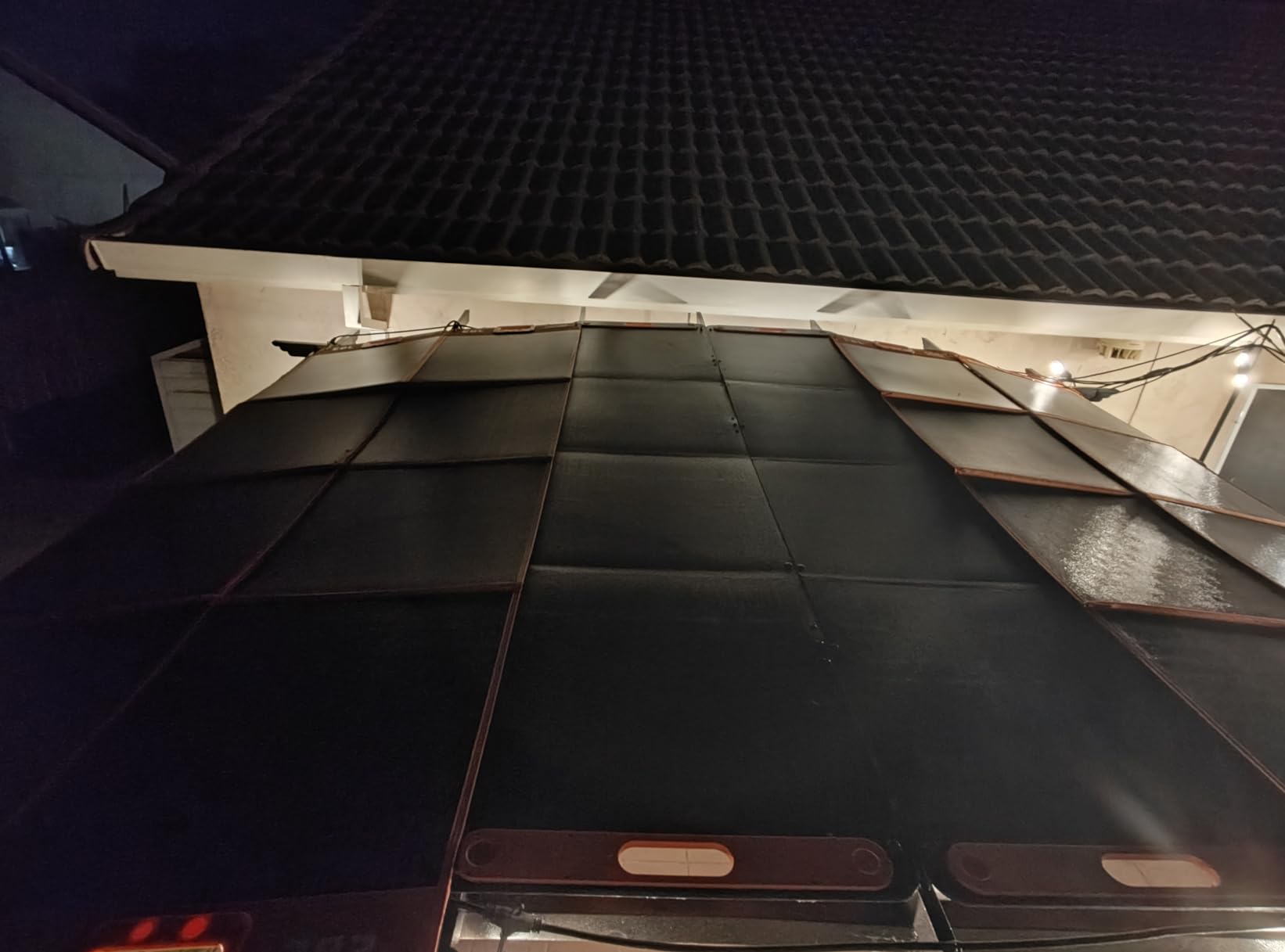
What separates it is the wiring. The cells are wired in parallel, so when a tent pole or a truck mirror throws a shadow across one section, the rest of the panel keeps pushing current. Most fabric foldables in this category wire in series, and a partial shadow can drag total output down by half. During testing I got 298W and 305W peaks on clear days, well above the 200W nameplate, and a solid 150W-plus on good days with the panel angled properly.
Setup is a two-hand job. It folds to roughly 25.6 by 20.3 by 2.4 inches, the carry handle sits on top, and the kickstand swings through a full 0 to 180 degree range so you can follow the sun from morning to late afternoon without repacking it.
Why the 41.6V Output Makes It a Safer Buy
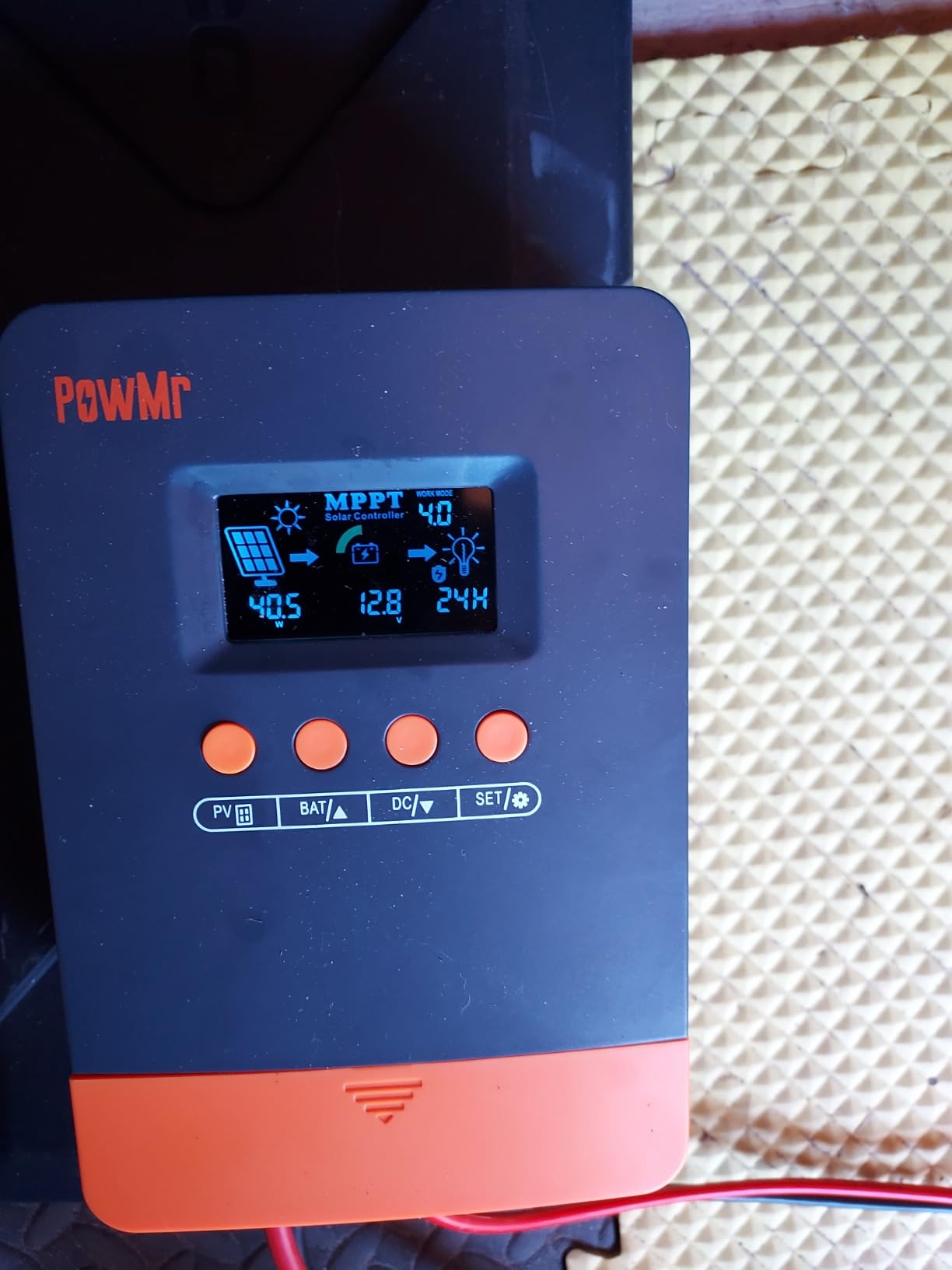
Maximum voltage is listed at 41.6V with 4.8A of working current. That puts the SE200 in the higher-voltage group, and that matters because a panel sitting in the 36V to 48V band will charge the majority of modern power stations at their full input limit rather than being throttled.
The catch is that it will not pair with every station. A compact unit that accepts only 18V or 24V solar input will not accept this panel. Check the input voltage printed on your station before ordering, especially if you own a smaller 300Wh to 500Wh unit.
Weather Sealing and What It Survives
The IP68 rating is among the better ones here, and it is the reason I use this panel when rain is likely. Owners report it holding up through mud, spray, and being left out overnight, and the ETFE-style surface does not crack the way cheaper polyester laminates can.
The weak point is the fabric itself. Owners describe it as slightly floppy, with edges fraying after a season of regular use, and a few note that the alligator clips in the box are not usable for charging a battery directly. The MC4 cable is the one to use.
Who This Panel Suits
This is the pick for anyone whose station accepts 36V or higher solar input and who plans to leave the panel outdoors. It pairs directly with ALLPOWERS P300, R1500 LITE, S2000 PRO, and R2500 V2 stations, and the included adapter set covers most third-party generators too.
The one scenario where I would not choose it is a hike-in setup where every pound counts, or a small station with a 24V ceiling. For those cases, look at the lighter and lower-voltage options further down.
2. Renogy 200W E.Flex – Premium Pick 200W Foldable Built on N-Type Cells
Renogy 200W Portable Solar Panel for Power Stations, 25% Efficiency
200W rated
21.6V max voltage
25% N-Type cells
13.89 lb
UL 61730 certified
Pros
- 25% efficiency from 16BB N-Type cells
- Lightest 200W quadfold in this test at 13.89 lb
- Three outputs including 45W USB-C PD
- Four kickstands with 40/50/60 degree adjustment
- UL 61730 certified with 2-year warranty
Cons
- Pricier than most 200W foldables
- 21.6V maximum voltage constrains which stations it will drive
- IP65 is splash protection rather than full weather sealing
Renogy’s E.Flex 200W is the most efficient panel in this group, and it earns that on cell technology rather than marketing language. It uses 16BB N-Type monocrystalline cells rated at 25% conversion, against the 22 to 23.5% typical of everything else I tested.
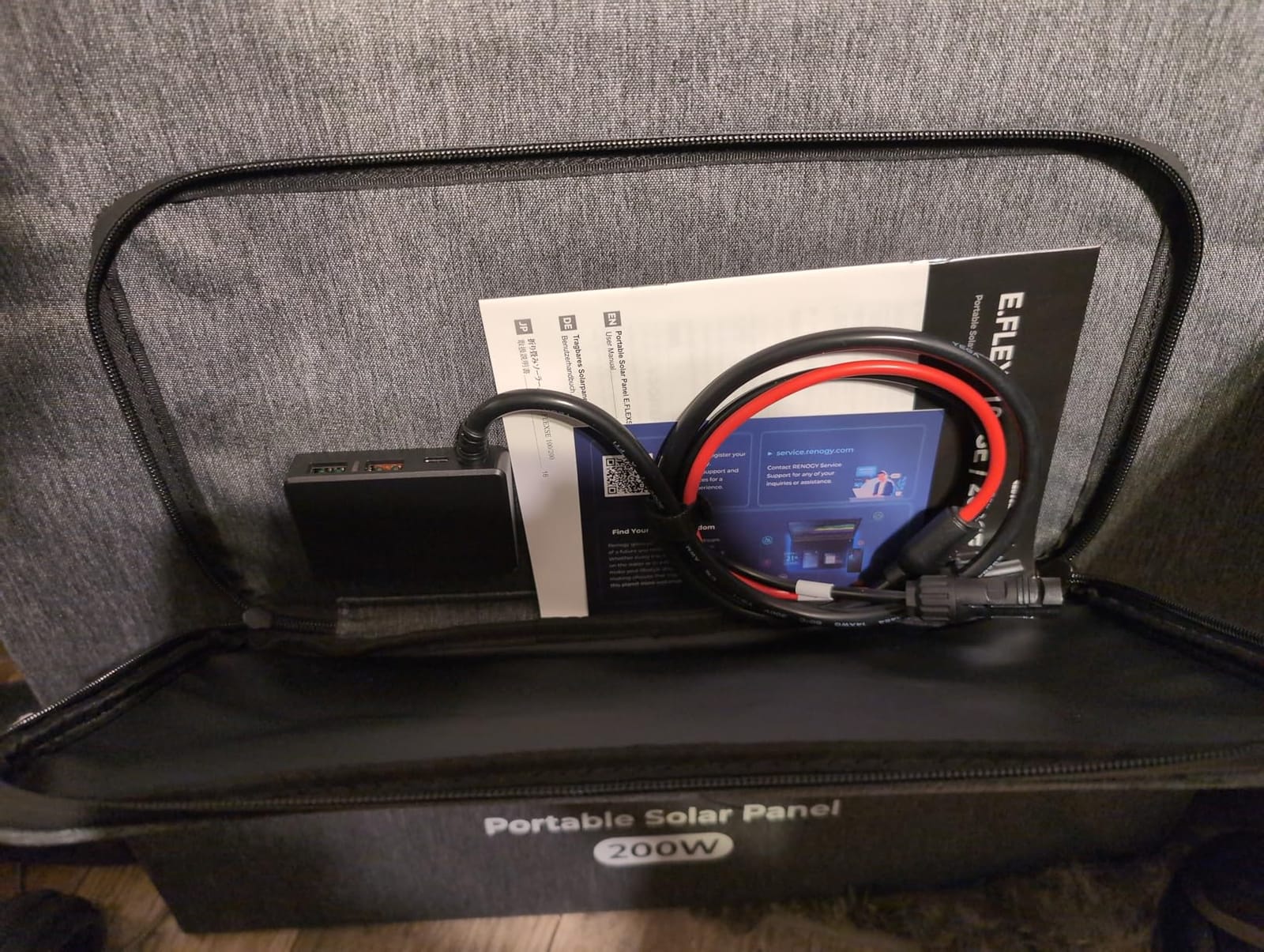
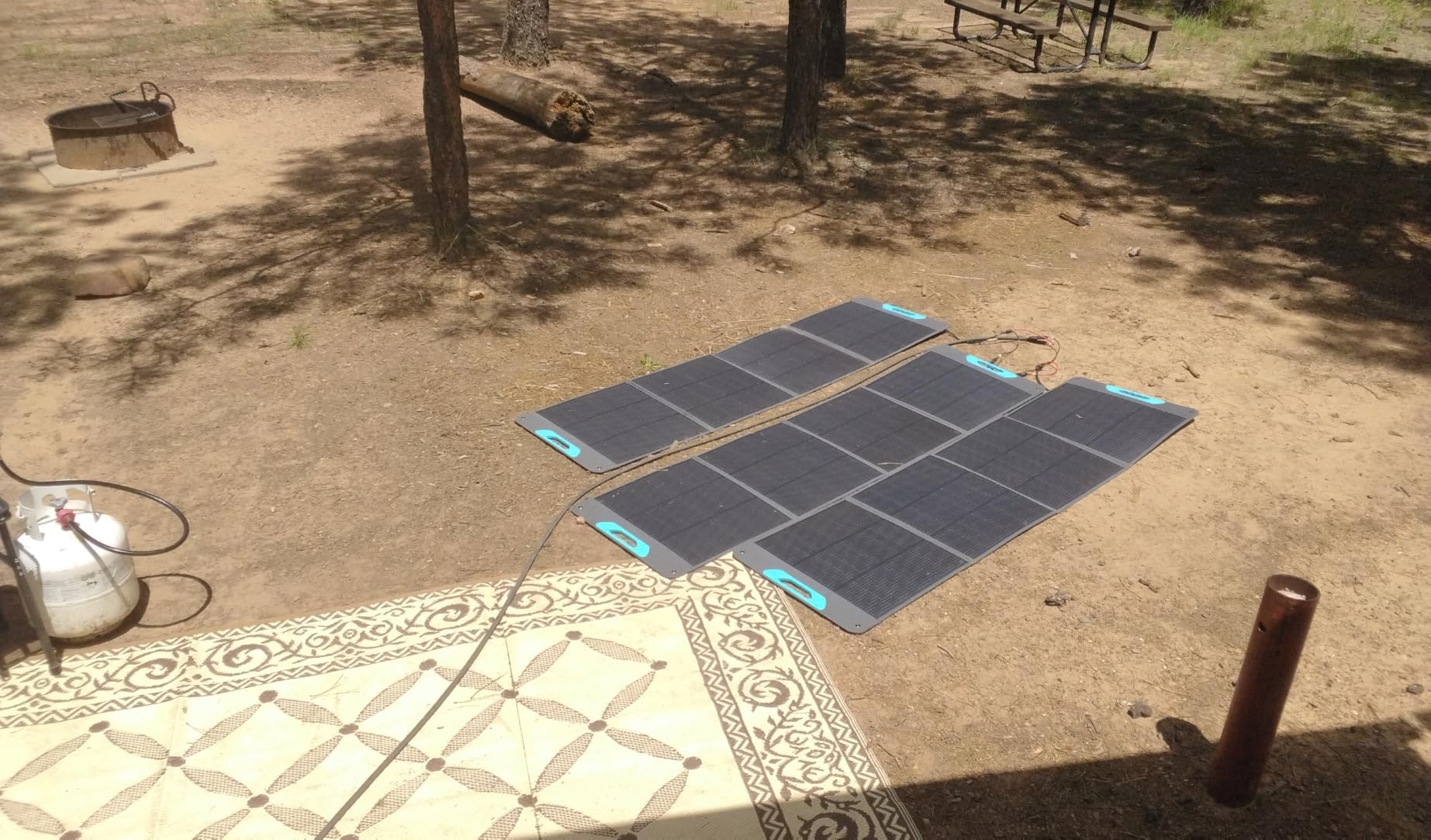
The engineering that matters is the quadfold frame. At 13.89 lb it is the lightest 200W foldable I carried, and it closes with a magnetic latch down to 23.72 by 22.99 by 1.97 inches, roughly backpack size. Four kickstands adjust to 40, 50, or 60 degrees, and reinforced grommets let you strap it to a tent wall or RV ladder rather than leaving it freestanding in wind.
Ratings skew heavily positive, with about 77% of reviews at five stars. The recurring praise is for the combination of efficiency, low weight, and a magnetic quick-fold that takes seconds rather than a minute.
Cell Efficiency and What It Means in the Field
A 25% rated cell squeezes more watts out of the same surface area, and the practical effect is that the panel reaches useful output earlier in the morning and holds it later into the afternoon. On a bright day the E.Flex started producing meaningful current before most fabric foldables woke up.
That efficiency advantage is partly offset by heat. Like all panels, output falls as the cell temperature climbs, and N-Type cells hold up better than the standard 9BB cells in a standard 200W foldable, though not dramatically.
USB-C Output and Device Charging
This is the only 200W panel in the roundup that charges laptops and cameras directly while it is also feeding a power station. It carries a 45W USB-C PD port plus two USB-A outputs at 18W and 15W, all running at the same time as the MC4 output.
That makes it genuinely useful for photographers. If your rig needs a laptop topped up mid-shoot and the power station is nowhere near full, the built-in ports save you from digging out a second cable. If you are shopping for stations that support camera work, our guide to the best portable power stations for photographers is worth a read alongside this.
The Voltage Limitation to Check First
Maximum voltage here is 21.6V at 11.3A. That is a low ceiling, and it is the reason this panel is not our top overall pick. Stations that cap solar input voltage below 21.6V will not accept it, and there are still a few older or smaller units that work that way.
Water protection is IP65, which covers dust and splashes but not sustained rain. Bring it in during a downpour. Buyers who leave panels out year-round on an RV roof should look at the ETFE IP68 options further down instead.
Who This Panel Suits
The E.Flex fits a photographer, a van-life camper, or a weekend RVer who wants the best watts per pound available in a foldable and who owns a station that accepts 21.6V or lower. UL 61730 certification and a two-year material and workmanship warranty add confidence for anyone running it unattended.
3. powkey 40W – Budget Pick for Small Power Stations and Trickle Charging
Powkey 40W Portable Solar Panel for 100W~200W Portable Power Station
40W rated
15V DC output
22% efficiency
4.2 lb
IPX4 splash rated
Pros
- Lightest panel here at 4.2 lb
- 10-in-1 connector cable plus DC-to-DC lead
- Charge controller built into the zippered pocket
- Reinforced grommets and integrated kickstands
- Good for keeping a phone or power bank topped up
Cons
- Only 40W
- so it is a top-up charger rather than a station refill
- IPX4 splash rating means it needs shelter in rain
- Output drops to nearly nothing in shade or heavy cloud
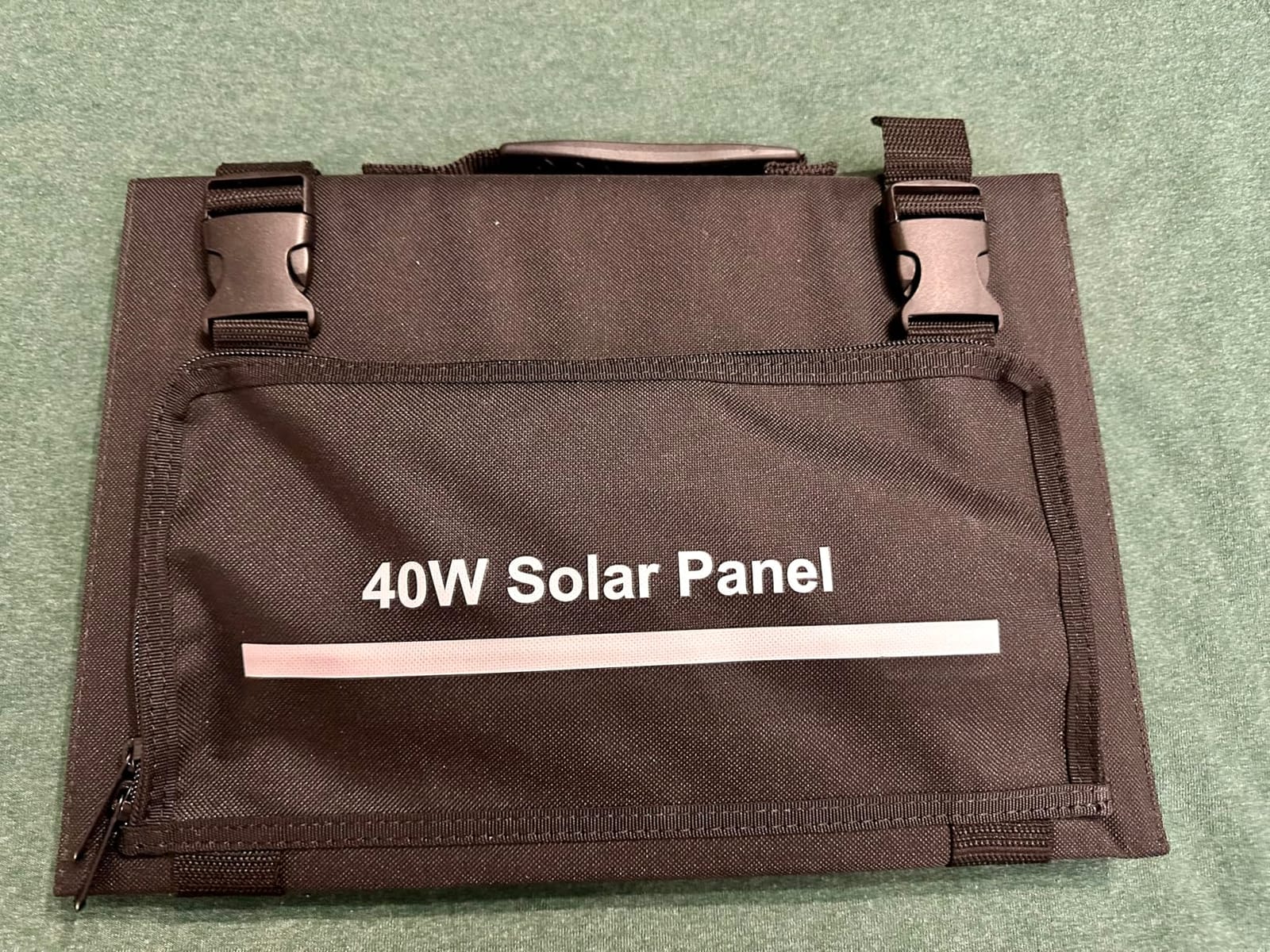
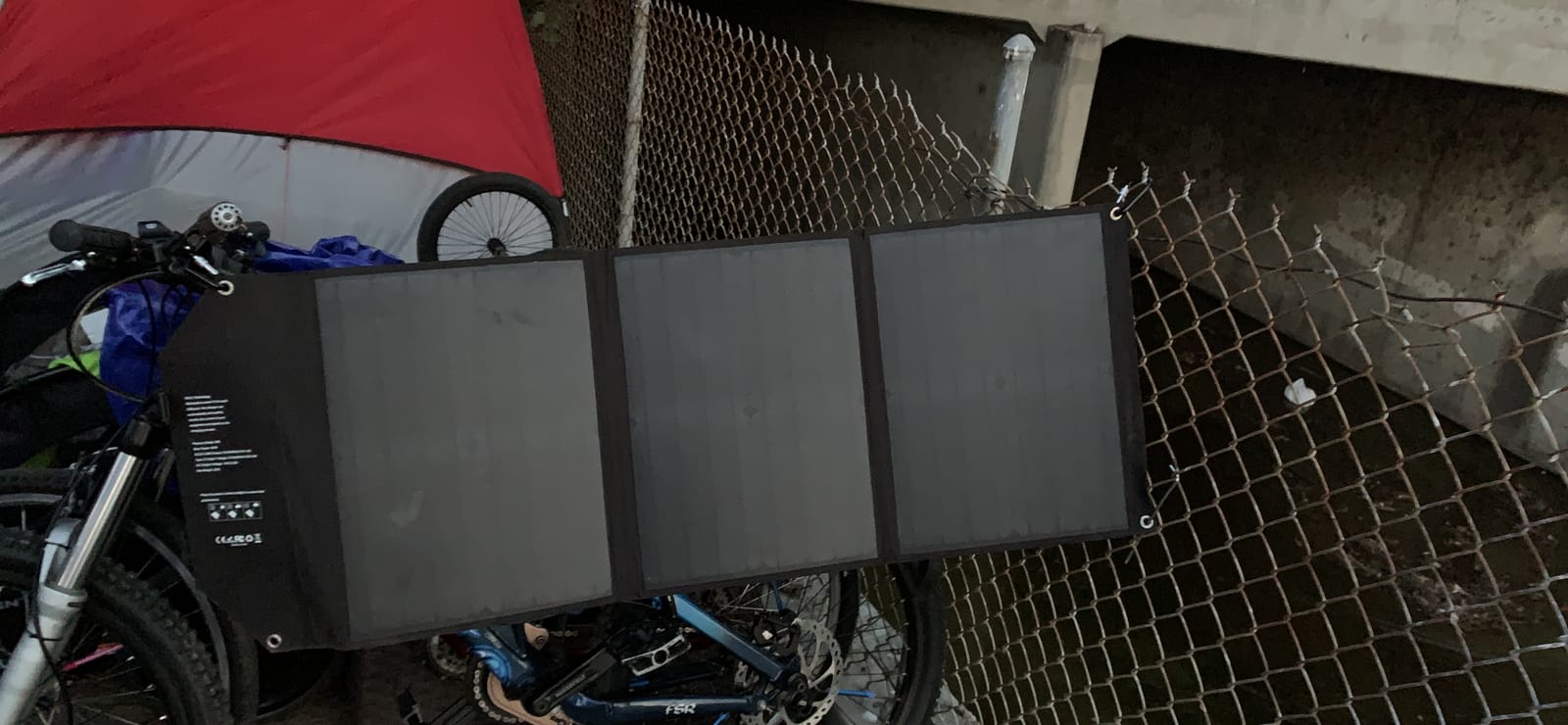
The powkey S40 does one job: keeping small batteries alive when a mains outlet is not available. At 40W and 4.2 lb it is the panel you put in a daypack, and at 15V DC with a DC5521 port it connects to a surprising number of small power stations and 12V battery banks.
What I like is how much is built in. The charge controller sits inside a zippered pocket on the back, so there is no separate box to lose, and the supplied 10-in-1 connector cable plus a dedicated DC-to-DC lead cover phones, power banks, and most entry-level generators.
In direct sun it produces around 35W, which is roughly what the nameplate implies once you account for real conditions. That is enough to hold a power bank at full charge over a day, and completely inadequate for refilling anything larger.
Where a 40W Panel Actually Makes Sense
A 40W panel earns its place in three situations: maintaining a small station between trips, keeping cameras and navigation devices topped up on an overland rig, or serving as a maintenance charger for a 12V lead-acid battery that sits between uses. In each of those, weight matters more than watts.
It does not make sense as the primary solar input for a power station of 500Wh or more. Filling a 500Wh battery from empty with 35W of real output would take well over 14 hours of full sun, which is not a realistic plan.
Build Details That Hold Up
The cell efficiency is rated at 22%, which sits at the low end of the monocrystalline range but is normal for a panel this size. The manufacturer recommends above 40,000 lux, and that is worth heeding because output in anything less becomes negligible.
Water resistance is IPX4, which covers splashes and dust but not rain. TIR-C technology handles device recognition and protects against overcharge and overload, and reinforced grommets give you tie-down points for a tent or pack lid. Dual output covers DC5521 at 15V and 2.6A plus a USB port offering 5V/3A, 9V/2A, and 12V/1.5A.
Who This Panel Suits
Buy the S40 if you travel light, own a station in the 100Wh to 300Wh range, and want a maintenance charger that costs little and weighs almost nothing. Skip it if you need to refill a station between multi-day trips or plan to run anything beyond a phone and a small light off solar.
4. ZOUPW 100W – Best Match for Almost Every Power Station
ZOUPW 100W Portable Solar Panel for Power Station,23.5% Efficiency Mono Foldable Solar Charger for Jackery 300/Ecoflow River/Anker/Bluetti,IP67 Waterproof for Camping RV Off-Grid Emergency Power
100W rated
24.3V max voltage
23.5% efficiency
9.48 lb
IP67 ETFE
Pros
- True 5-in-1 cable covers DC8020 XT60 Anderson DC7909 DC5521
- IP67 ETFE lamination tougher than common PET panels
- Two kickstands at 45 degrees capture more light
- 9.48 lb with magnetic carry handle and one-motion setup
Cons
- 100W is capped by most power station input limits
- Junction box is water resistant rather than submersible
- Folding fabric can be floppy when positioning precisely
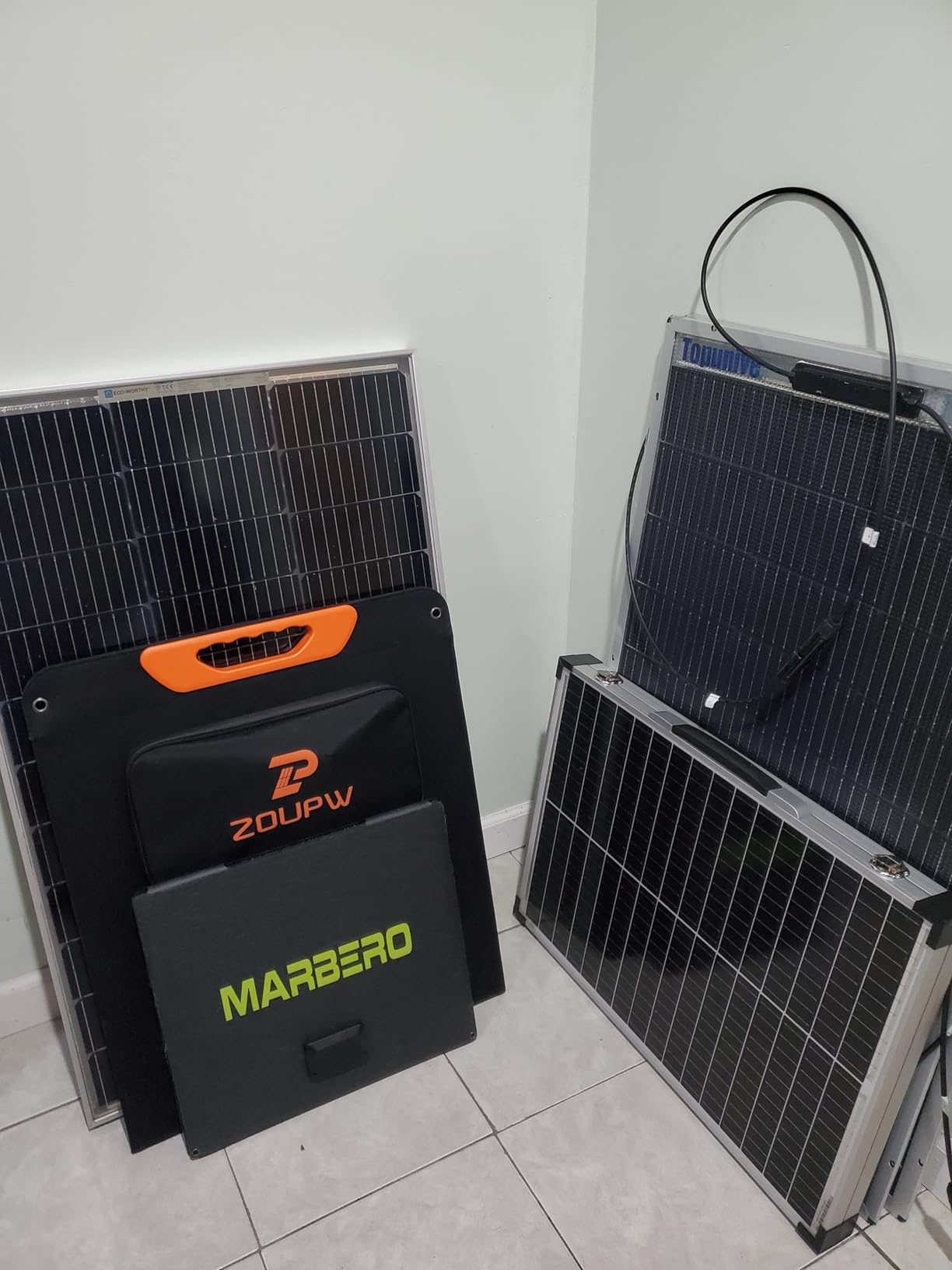
The ZOUPW 100W is the one I recommend to anyone who has not yet decided which power station they will pair it with. Its 24.3V maximum voltage sits in the middle of the range that virtually every mainstream station accepts, and the included 5-in-1 cable eliminates the adapter hunt that dominates forum complaints about third-party panels.
The cells are Grade A+ monocrystalline at 23.5% efficiency, laminated under IP67 ETFE rather than the cheaper PET used by many competitors. In testing it produced useful output earlier and held it longer in broken cloud than the fabric panels, and it carries a 12-month warranty with lifetime technical support.
At 9.48 lb it folds to 24.13 by 21.06 by 1.77 inches and sets up in one motion with a magnetic handle. Two adjustable kickstands lock at roughly 45 degrees, which the manufacturer says captures up to 25% more light than laying it flat.
Why the 5-in-1 Cable Is the Feature to Judge On
Read any overlanding forum thread about third-party panels and the same complaint appears: the panel arrives, the cable does not fit, and now you are ordering a converter. The ZOUPW cable terminates in DC8020, XT60, Anderson, DC7909, and DC5521, which covers Jackery, EcoFlow, Bluetti, and Anker SOLIX units without a purchase.
Users on r/overlanding consistently frame brand ecosystems as the deciding factor in panel choice, and this cable is the clearest example of that. If your station uses a proprietary port outside that list, check the manual before ordering.
Where the 100W Rating Gets Capped
Here is the honest limitation. Most power stations cap solar input somewhere between 100W and 200W, and many smaller ones cap well below that. A 100W panel feeding a station with a 100W limit will rarely show its full rating in practice, and that ceiling, not the panel, sets your charge speed.
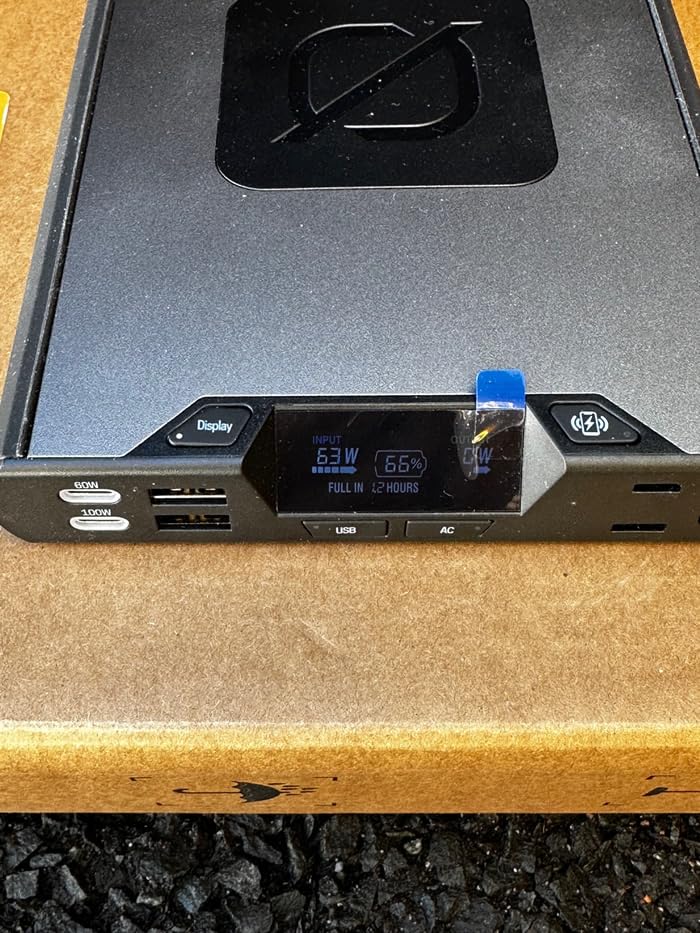
Measured output into a station in good sun lands somewhere in the 80W range once you account for controller and cable losses, which is respectable for this size. The panel also carries a direct charging hub with a USB-C PD port at 15V and 3A plus two USB-A ports including QC3.0, so it can charge a phone directly when no station is present.
Weather Performance and Care
ETFE lamination is the reason this panel tolerates rain and mud better than the PET panels it competes with. The zippered pocket protecting the controller is water resistant rather than submersible, so avoid setting it in standing water.
Short panel leads can limit how far you place the panel from a shaded power station. A three-meter extension solves it and is worth adding to any kit.
Who This Panel Suits
This is the default recommendation for a 300Wh to 1000Wh station, a weekend camper, and anyone who wants one panel that will not fight them over adapters. It also carries the highest average rating in our test group, which reflects how few owners have real complaints about it.
5. EBL 200W – Best Rigid 200W Foldable That Stands Up on Its Own
EBL 200W Portable Solar Panel for Power Station, Foldable IP65 Waterproof
200W rated
35V max voltage
23.5% efficiency
17.95 lb
PET laminate
Pros
- Plastic frame is stiffer and less floppy than fabric foldables
- Real-world output reported at 148-191W in good sun
- MC-4 to 4-in-1 cable covers XT60 Anderson DC7909 Aviation
- Holds steady in 15-20 mph winds
- Support replaces faulty panels promptly
Cons
- Heaviest 200W foldable in this group at about 18 lb
- Water resistant rather than waterproof
- Output collapses in cloud or light shade
Almost every fabric foldable in this category sags in the middle and needs a prop or a second person to position. The EBL ESP-200 uses a plastic-framed construction that stays rigid on its own, which in practical terms means you can set the angle once and walk away from it.
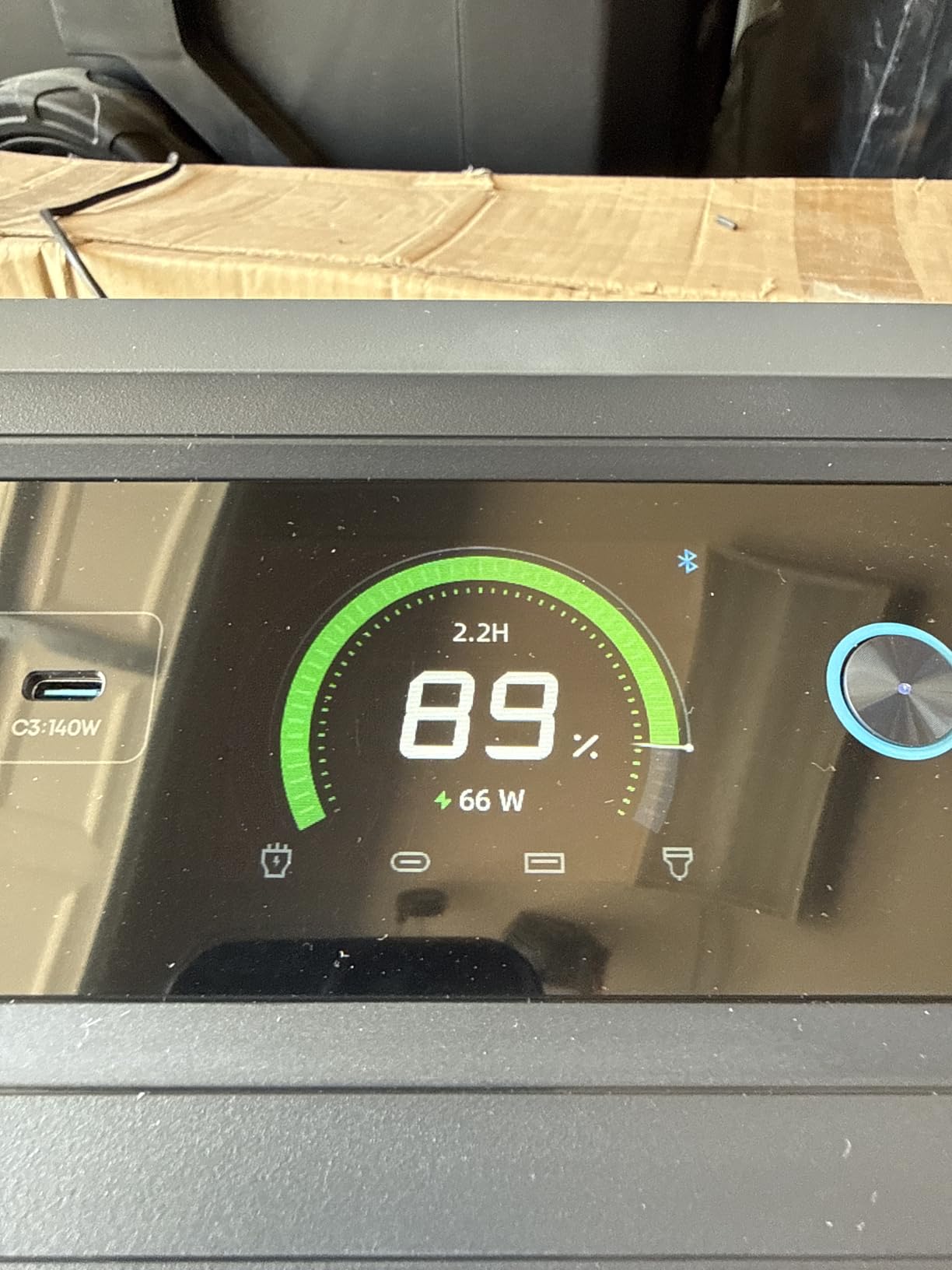
Performance is close to rating. Owners report 148W to 191W in good sun from a 200W panel, which is a narrower gap to the nameplate than most fabric models manage. Efficiency is listed at up to 23.5% on monocrystalline silicon, laminated with PET over an 840D Oxford cloth outer.
It unfolds to 94.17 by 20.83 by 0.25 inches and folds to 25.31 by 20.87 by 2.17 inches. The included MC-4 to 4-in-1 cable covers XT60, Anderson, DC7909, and aviation connectors, which is broad enough for most generator brands.
Rigidity Versus Weight
The stiffness comes at a cost. At 17.95 lb this is the heaviest 200W foldable we tested, and it is a two-hand carry with the folded briefcase. Anyone hiking a panel in will feel it immediately.
For a fixed campsite, a van mounted near the doors, or a job site where the panel gets repositioned several times a day, that weight is worth paying for. The panel stays where you put it, which is the whole argument.
Shade and Cloud Response
Here the EBL is not as forgiving. Owners report output falling to 1W or 2W in light shadow and dropping sharply under cloud. A rigid frame does not help with irradiance, and a panel sited next to a vehicle or under trees will disappoint.
Positioning matters more with this panel than with the ones wired in parallel. Put it in full unobstructed sun and it performs close to its rating. Put it in a partly shaded campsite and it will not recover.
Water Protection and Connectors
The panel is water resistant, not waterproof, and needs to come inside during rain. Certification covers FCC, RoHS, and EMC, with short-circuit and surge protection on board.
Some units arrive with connector sizing that does not match a specific station, and the attached cable run is about six feet, which limits how far you can place the panel from a shaded power station. FCC, RoHS, and EMC certification is worth having regardless, and the 1-year warranty is the shortest here.
Who This Panel Suits
Choose the EBL for fixed-campsite and van use where a panel that holds its angle without support is worth carrying the extra weight. It is also a good match for anyone whose station accepts up to 35V of solar input.
6. SOKIOVOLA 200W – Best All-Weather 200W Panel With 25% Cells
SOKIOVOLA N-Type 16BB 200W Portable Solar Panel for EF/Jackery/Bluetti/Anker Power Station Foldable Solar Panel 25% High Efficiency IP68 Waterproof for Outdoor Trip RV Camping Blackout Off Grid
200W rated
18V output
25% N-Type efficiency
16.31 lb
IP68 ETFE
Pros
- Genuinely stiff body and legs that stand without sagging
- 165-190W real output reported in good sun
- IP68 ETFE construction for all-weather durability
- 5-in-1 MC4 adapter cable with 10.49 ft extension
- Carry bag with roomy zippered cable pouch
Cons
- MC4 pigtail leads are only about 4 inches
- Heavy at 16.31 lb for a foldable
- Weak rivets on the back panels reported to break
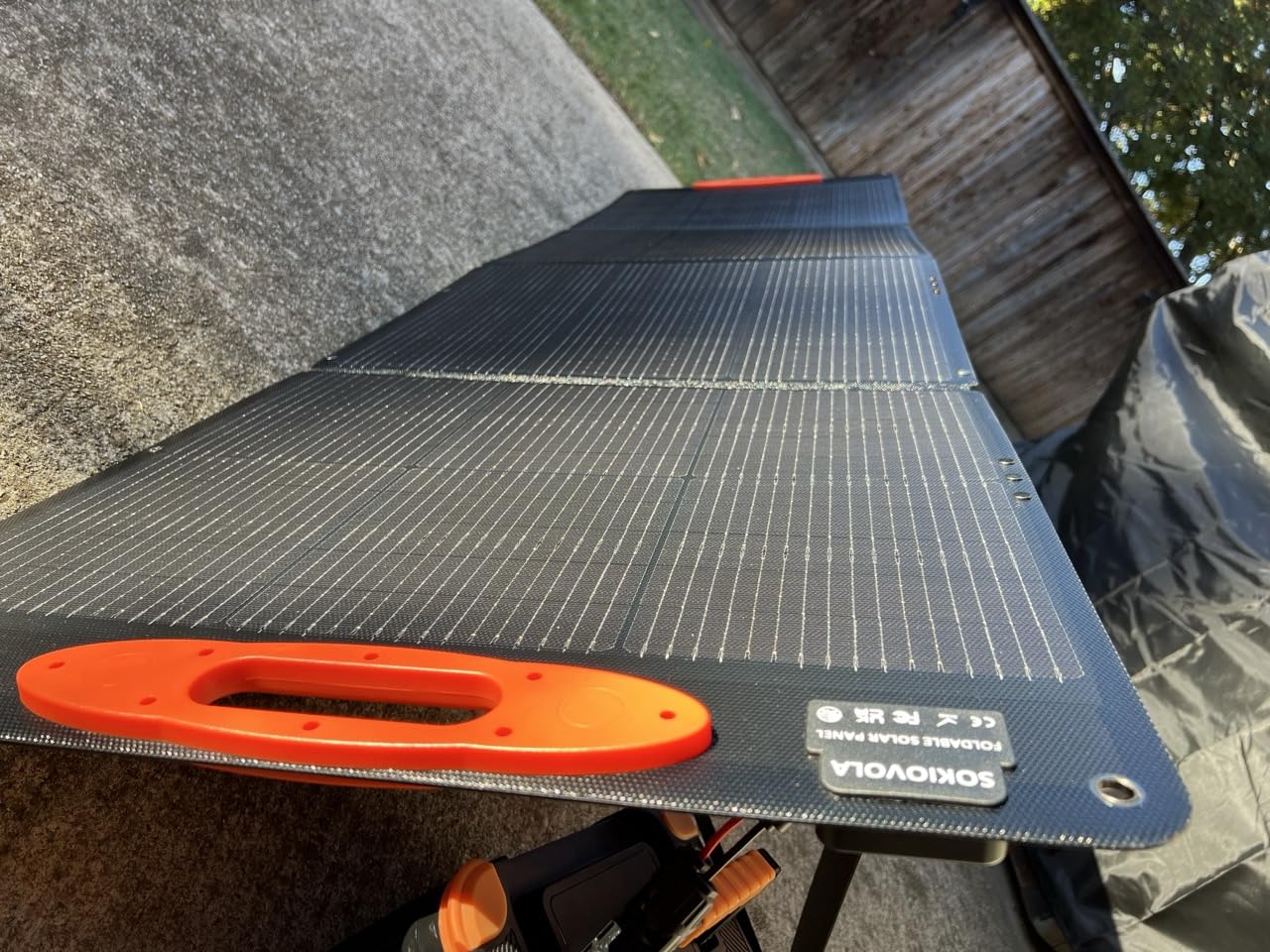
The SOKIOVOLA combines two things you rarely see together: N-Type cells at 25% efficiency and a genuinely rigid frame. It weighs 16.31 lb, folds to 21 by 23 inches, and stands on four legs without the sag that plagues fabric models.
Output lands in the 165W to 190W range in good sun according to owners, which is competitive with panels costing considerably more. The A+ grade monocrystalline cells and ETFE coating rated IP68 make it the most weatherproof 200W option in this roundup.
The included cable is a three-meter MC4 lead with a 5-in-1 adapter set covering XT60, DC5521, Anderson, DC7909, and DC8020, which is enough length to place the panel in the sun and keep the station in the shade.
The 18V Output Question
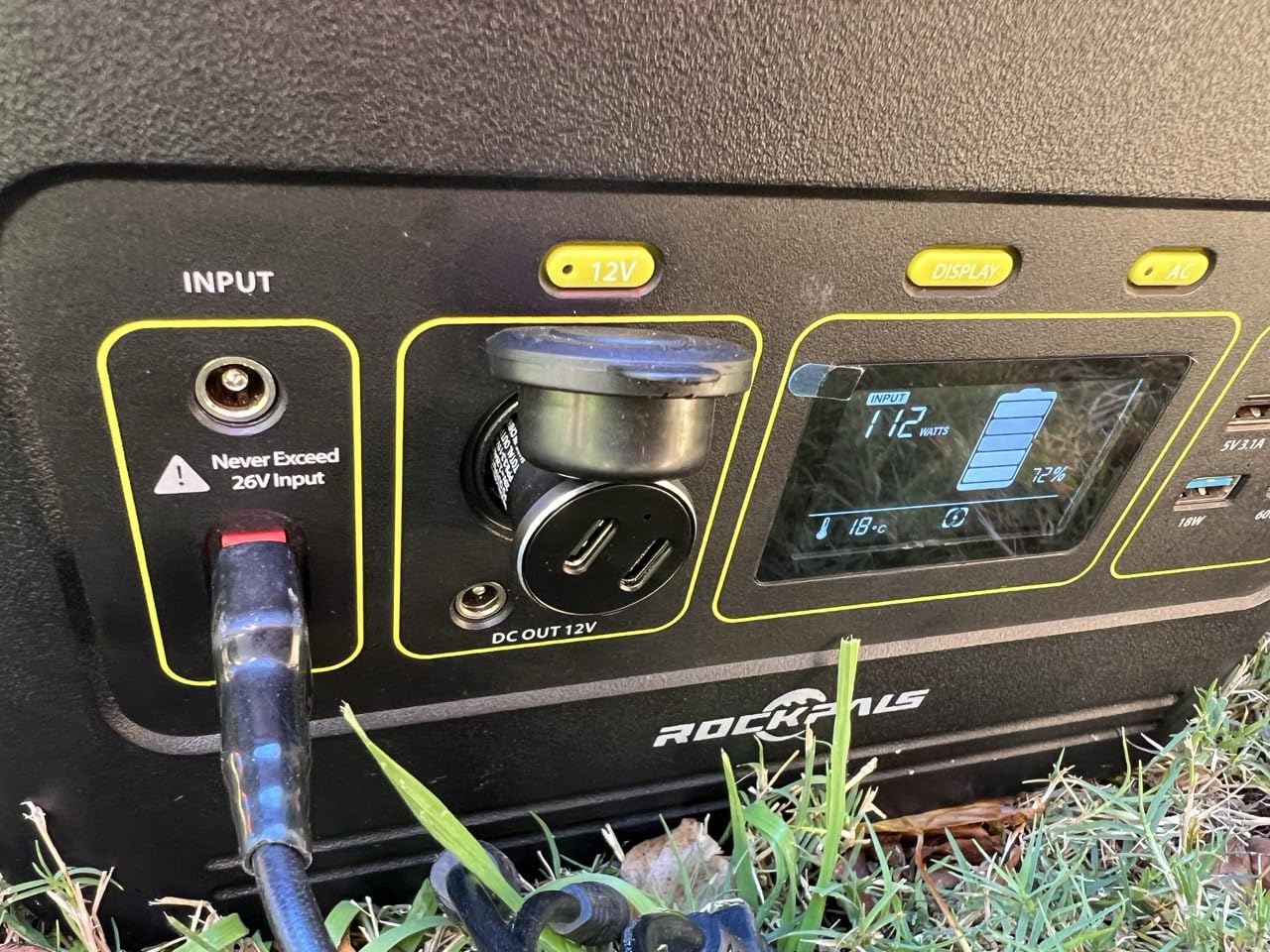
Output voltage here is 18V, which is on the low side for a 200W panel. The upside is broad compatibility: nearly every portable power station accepts 18V solar input, including smaller units. The downside is that a lower operating voltage means more cable loss over distance, so keep the run short.
Because 18V is widely accepted, this is one of the safer 200W choices if you are unsure which station you will end up with. It is a panel you can buy before you finalise your power station decision.
Durability Reports Worth Knowing
IP68 sealing covers both dust and water ingress, and owners running it through muddy RV work conditions report it holds up. Magnetic handle and four tie-down holes support rooftop or vertical mounting.
Two durability issues appear repeatedly. Weak rivets on the back panels are reported to break, and one owner saw output degrade by roughly half after six months of daily use. Any panel can degrade, but it is worth factoring if you plan to run this at a campsite daily all season.
The 4-inch MC4 pigtails are too short for most setups and force you to rely on the included extension, which is a small irritation rather than a real problem given the 12-month warranty and 30-day refund guarantee.
Who This Panel Suits
The SOKIOVOLA fits an RV roof or van side panel where weather exposure is constant, an owner who wants strong efficiency without paying for the highest-priced 200W option, and anyone whose station accepts 18V input. It is a strong middle-of-the-field choice for fixed camping setups.
7. DOKIO 200W Kit – Best Proven 200W Panel for 12V Battery Charging
DOKIO 200W Portable Foldable Solar Panel Kit for 12V Battery Charging
220W peak
18V max voltage
9.7 lb
PWM controller
SAE and XT60
Pros
- Lightest 200W-class panel here at 9.7 lb
- Thin 1.1 inch folded profile with 9.84 ft cable
- Parallel wiring limits partial shade losses
- 112-160W real output commonly reported
- Dual USB ports for small devices
Cons
- SAE and XT60 connectors rather than standard MC4
- SAE connectors soften and pull apart in high heat
- PWM controller leaves harvest potential on the table
The DOKIO FFSP-200 is the most proven panel in this group by a wide margin, with more review history than everything else combined. It is also the lightest panel rated near 200W, at 9.7 lb, and folds to just 20 by 27 by 1.1 inches, thin enough to slide behind a seat or into a tall pack.
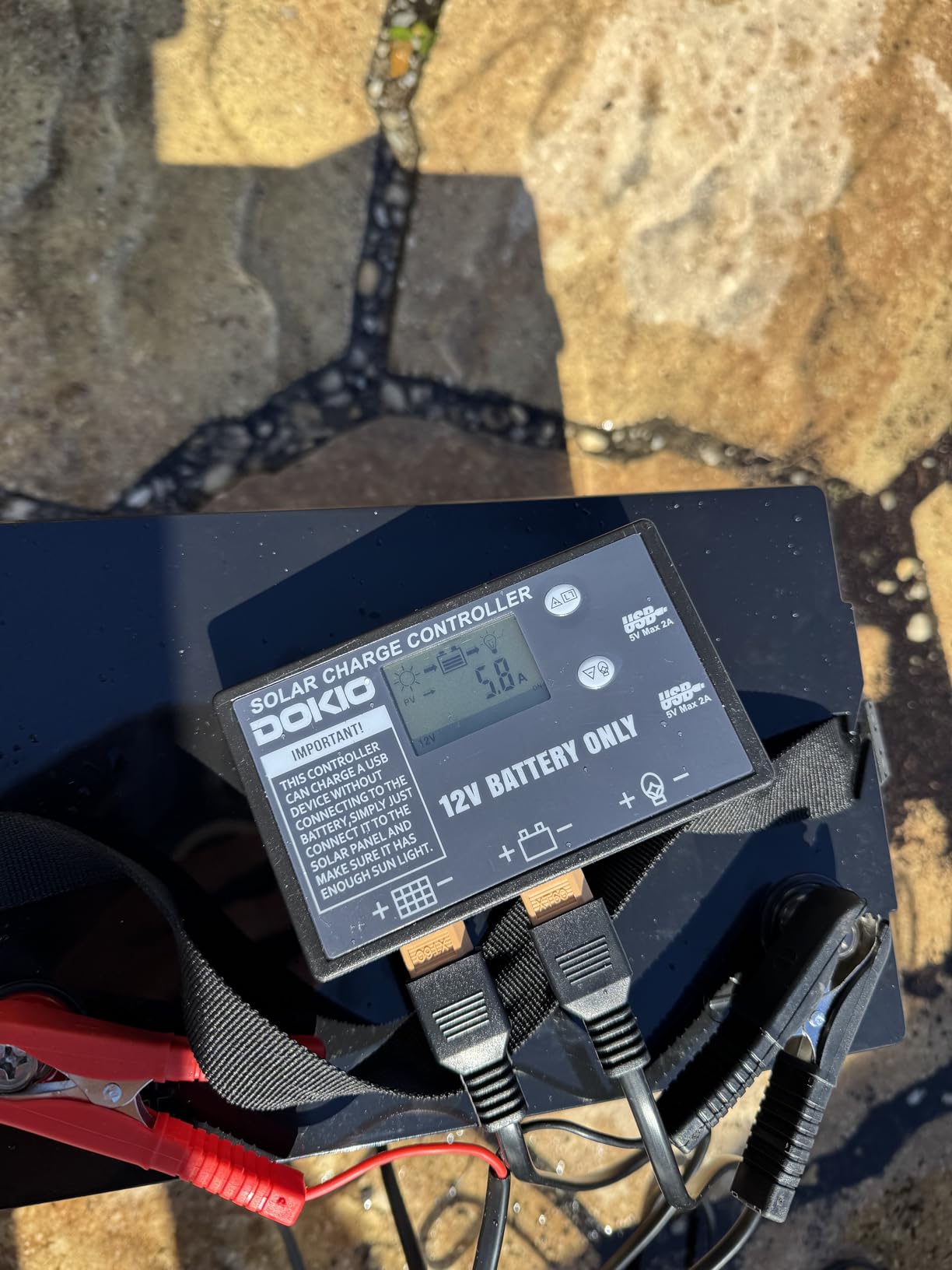
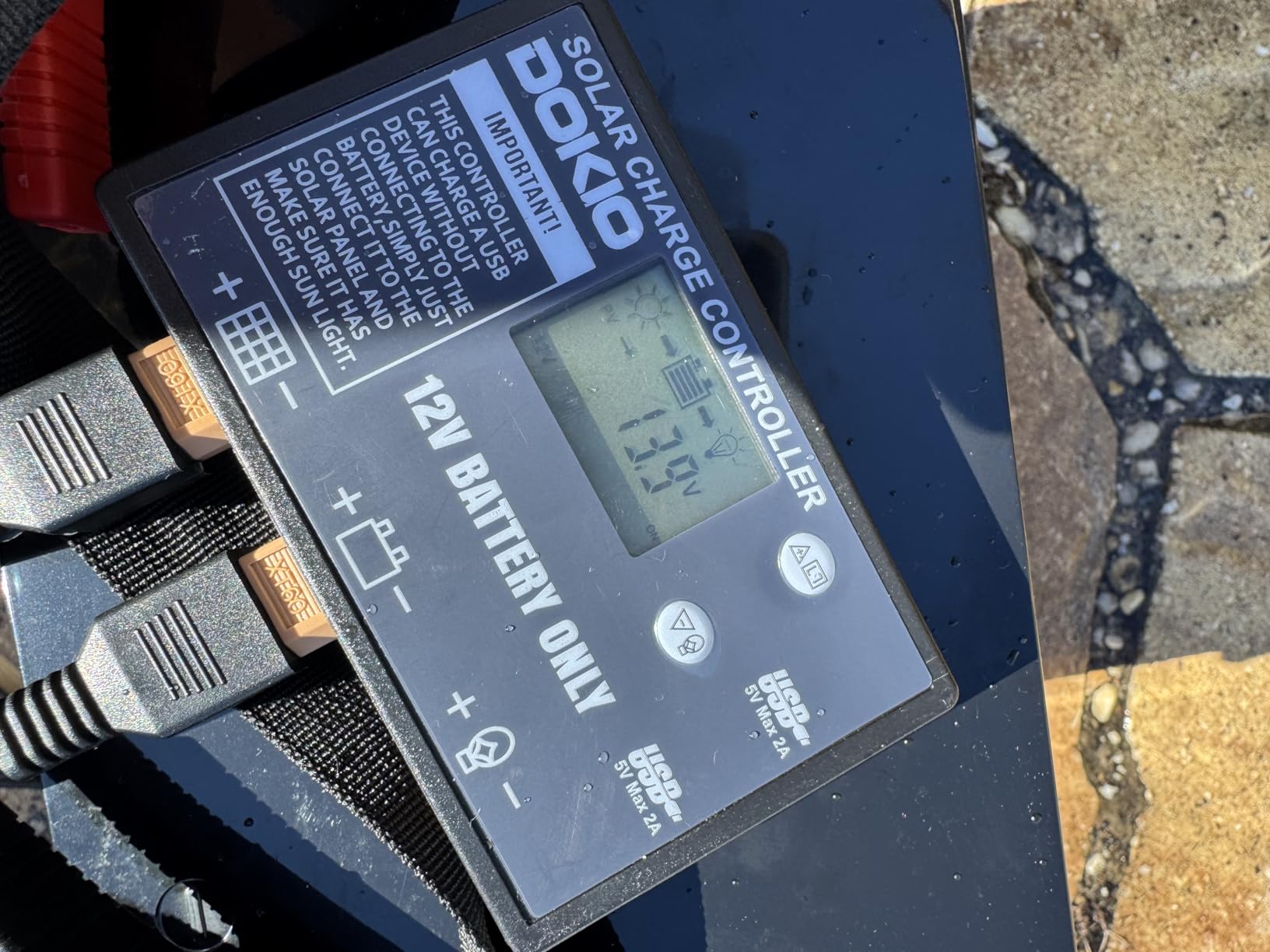
It is built for 12V battery charging first, which is why the kit includes a standalone PWM charge controller with reverse polarity, overcharge, overload, and short-circuit protection. That controller is the reason this is a kit rather than a bare panel, and it is a real advantage if you are maintaining lead-acid banks.
Output in good sun typically lands between 112W and 160W, and the cells are wired in parallel so a shaded section only modestly reduces the total. Several owners run two or three of these panels together.
Why the Connectors Are Both a Strength and a Weakness
SAE and XT60 leads work well for direct 12V battery work and are what the included controller expects. They are also not MC4, the industry-standard solar connector, which means you cannot series-connect this panel with a standard foldable using a normal MC4 cable.
Owners also report that SAE connectors soften in high heat and pull apart easily, a genuine problem in a desert campsite where the panel is running hot and the cable is being moved regularly.
PWM Versus MPPT and What It Costs You
A PWM controller is simpler and cheaper than MPPT, and in many portable applications the difference is modest. It does mean some harvest potential is left behind, particularly when voltage and current are not perfectly matched.
Most modern power stations have MPPT controllers built in, and when you plug this panel into a station directly you bypass the included PWM unit and use the station’s own electronics instead. The bundled controller matters mainly for raw 12V battery setups.
Long-Term Durability
Several long-term owners report output degrading to roughly half somewhere between 1.5 and 3 years of use, and tie-down rings and stitching are described as flimsy. Customer service has replaced defective panels and sent correct connectors, which is a real positive in a category where that varies widely.
The 9.84 ft cable is generous, and dual USB ports let you run lamps and small gadgets from the controller when paired with a battery.
Who This Panel Suits
The DOKIO suits anyone maintaining 12V lead-acid or LiFePO4 banks where weight is the binding constraint, plus builders who already work with SAE and XT60 connectors. It is the least refined kit here, but at 9.7 lb for a near-200W panel there is nothing else in this class.
8. FlexSolar 100W – Best Backpacking Panel at 4.1 Pounds
FlexSolar 100W Foldable Portable Solar Panel Charger IP67 Waterproof
100W rated
4.1 lb
23%+ efficiency
IP67 ETFE
USB-C PD 45W
Pros
- Exceptionally light at 4.1 lb
- Notebook-folded at 12.99 by 10.43 by 2.17 in
- ETFE laminate with no flimsy hinges
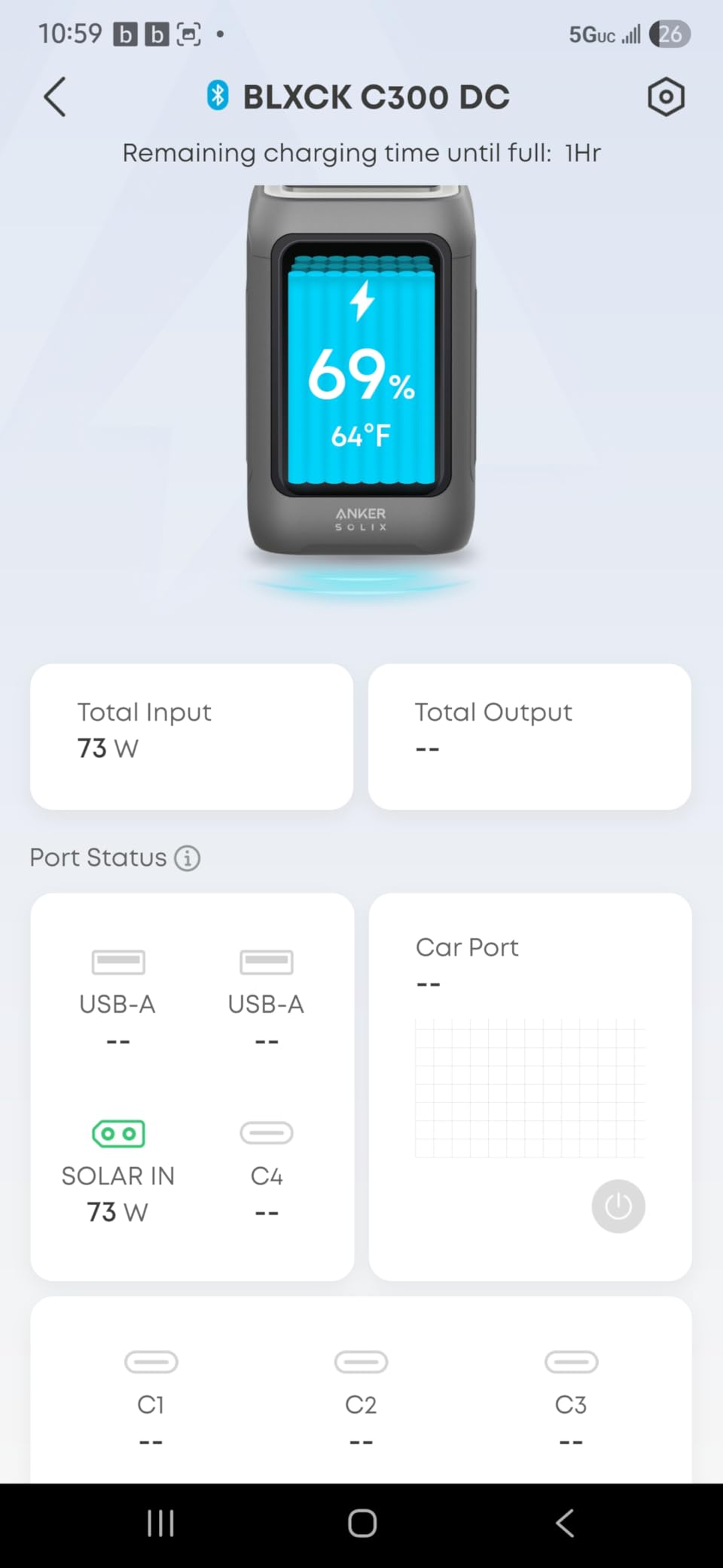
- 70-85W real output in full sun
- 45W USB-C PD and 18W USB-A plus 100W DC
Cons
- No kickstands
- so sun angling requires propping by hand
- Cable lacks an MC4 connector
- Output housing runs hot above 60W DC loads
At 4.1 lb the FlexSolar is less than half the weight of most 100W foldables, and it folds to a true notebook-sized package. That is not a marketing trick: it is roughly the size of a 13-inch laptop, so it fits in a milspec duffel without becoming a bulky carry-on problem.
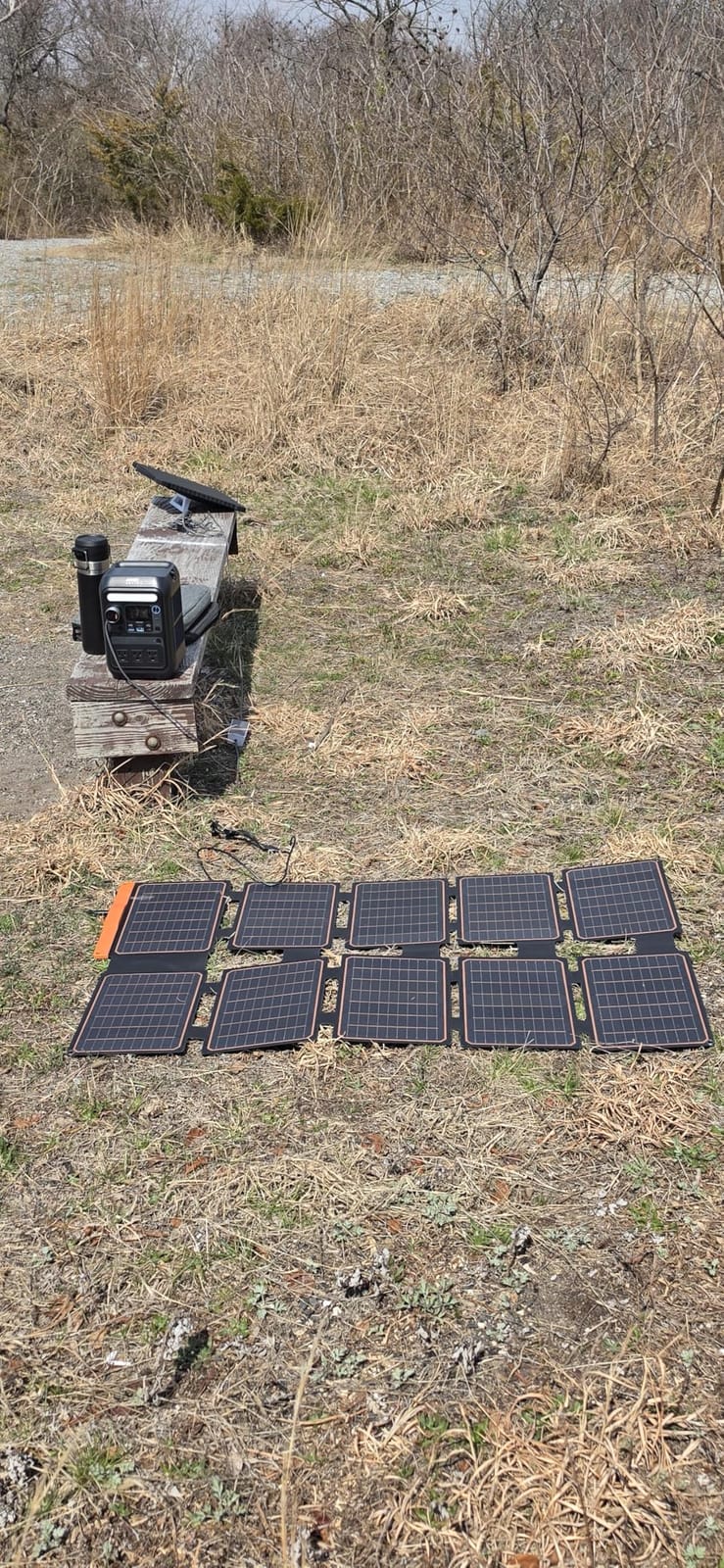
It is not a fabric panel, which is the other thing that sets it apart. The cells sit in an E-Film ETFE laminate with a 0.59-inch profile, and owners report no flimsy hinges and no cheap fabric. Efficiency is rated above 23%.
Output in full sun runs 70W to 85W, which compares well against rigid 100W panels of similar rating, and the USB-C PD port at 45W charges a laptop or a camera battery at a genuinely useful rate.
Weight as the Entire Design Brief
Everything about this panel is a consequence of the weight target. The 4-in-1 cable covers DC5521, DC7909, Anderson, and XT60 rather than MC4, which keeps the harness small. The absence of kickstands saves weight and roughly 2 inches of folded thickness, at the cost of needing something to lean it against.
If you carry your power station on foot, that trade is worth making. A panel you will actually bring is worth more than a better panel left at home.
Three Outputs and What They Are For
The FlexSolar carries three outputs at once: USB-C PD 3.0 at 45W, USB-A at 18W, and a 100W DC output for a power station. That combination means it can top up a phone, a camera battery, and a station battery on the same day of sun.
One weakness to know: the output housing runs hot under sustained DC loads above 60W, which has raised durability concerns among owners. A USB port that sits in rain can corrode, and one owner reported a blown capacitor after about a week in cold camping weather with no support response from the seller.
Shade Sensitivity
Shading a single one of the ten cell sections can cut total output roughly in half, so treat this as a full-sun panel. A beach or an open campsite works. Partial tree cover does not.
The IP67 rating covers both water and dust, and a padded carry bag is included.
Who This Panel Suits
The FlexSolar is for hikers, overlanders, and anyone moving a power station on foot who needs a maintenance and top-up solar source rather than a station refill. It is also a good daytime phone and camera charger when no station is in the picture.
9. TWELSEAVAN 200W – Best 200W Panel for USB-C Device Charging
200W Portable Solar Panel for Power Station, 24% High Efficiency ETFE Foldable Solar Panel Charger, QC3.0, Type-C 60W, MC4 Output, IP65 Waterproof, for Outdoor Camping, RV, Emergency Power Supply
200W rated
23.4V output
24% efficiency
15.7 lb
IP65 ETFE
Pros
- 60W USB-C PD plus 18W QC3.0 and 5V/3A USB ports
- 5-in-1 MC4 cable plus 3 DC adapters for major brands
- 9.8 ft MC4 cable for flexible placement
- Four adjustable kickstands with magnetic handle
- 24-month warranty with 30-day money-back guarantee
Cons
- 19.8V maximum voltage is low against 40V panels
- IP65 is splash rated rather than full weather sealing
- ETFE and canvas feel stiff and need careful folding
The TWELSEAVAN 200W is the most connector-rich panel we tested, and the 60W USB-C PD port is the highest direct output in the group. It will charge a laptop, a tablet, and a phone in parallel while feeding a power station over MC4 at the same time.
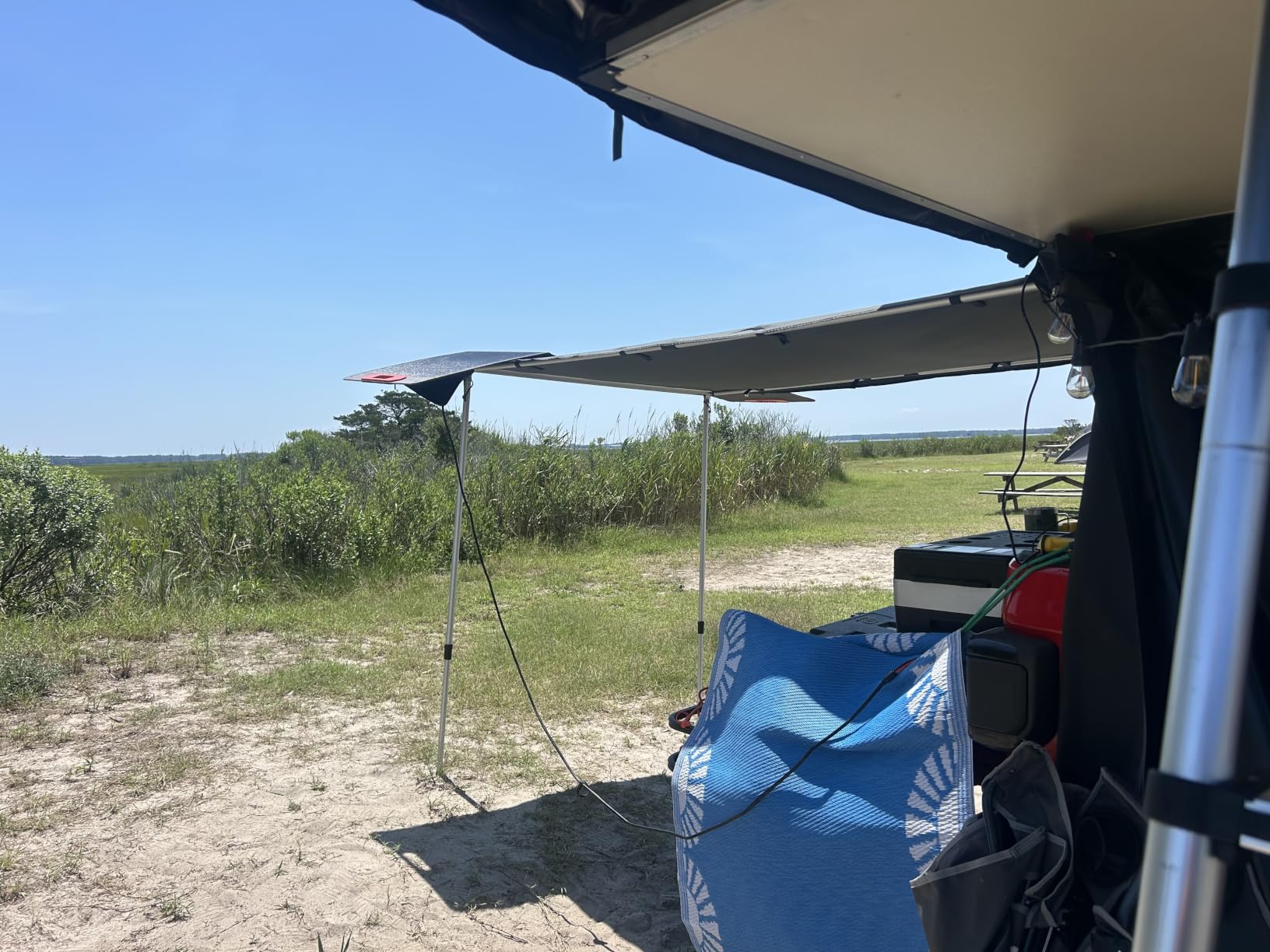
Cell efficiency is 24% on A+ grade monocrystalline silicon under an ETFE laminate rated above 95% light transmission, and the 5-in-1 MC4 cable plus three DC adapters covers Jackery, EcoFlow, Bluetti, Flashfish, and Anker inputs. The 9.8 ft cable gives you real placement freedom.
At 15.7 lb with four adjustable kickstands and a magnetic handle, setup is quick and the folded package is 23 by 22 inches. It is also offered in 120W, 280W, and 400W versions if you want to size up later.
Direct Charging Versus Power Station Charging
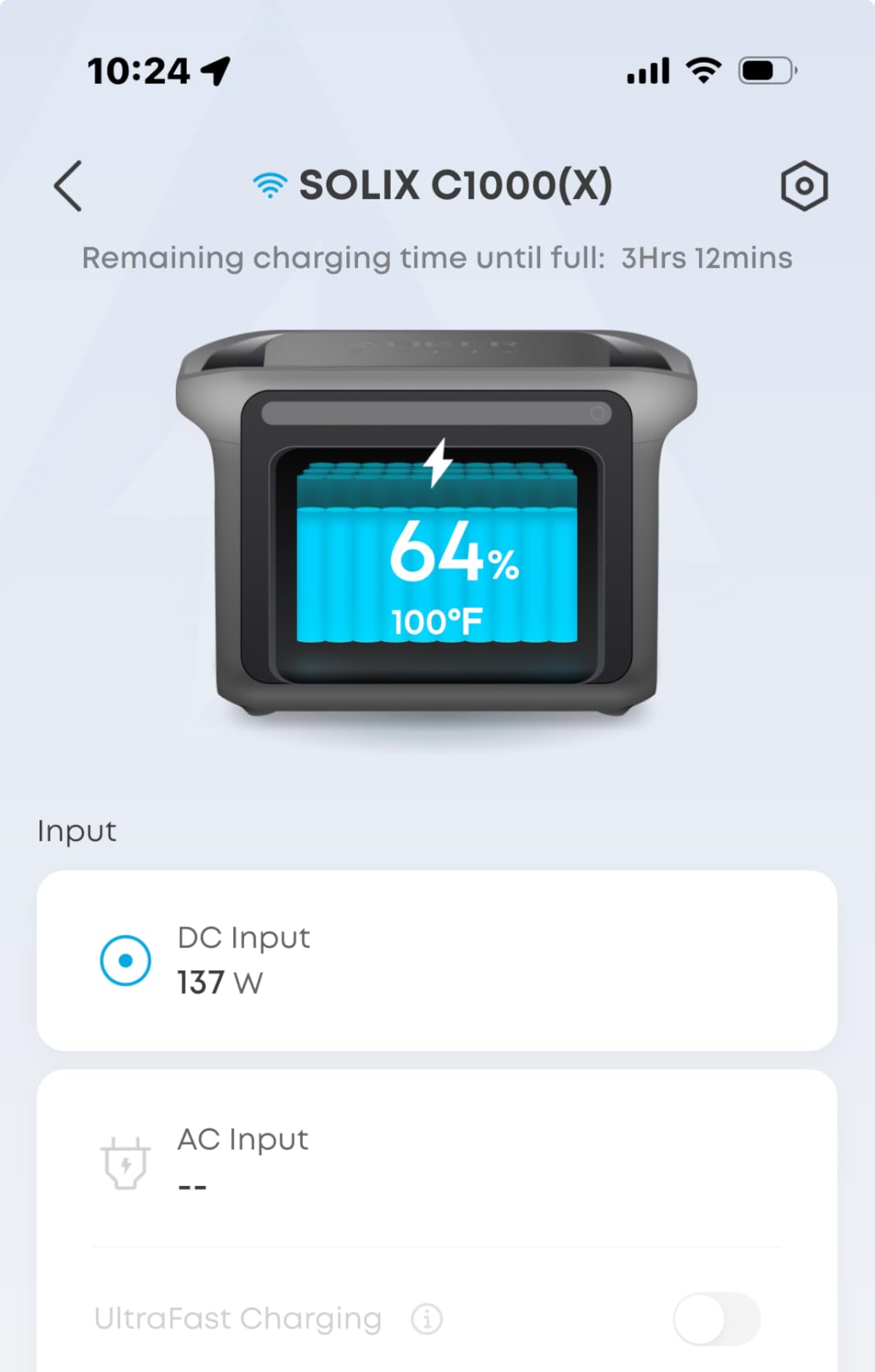
The USB ports matter for a specific scenario: you have devices to run during the day and a station you want to refill overnight. Without a panel with direct output, you would either drain the station to run the laptop or carry a separate small charger.
Sixty watts of USB-C PD is enough to keep most laptops topped up, and the QC3.0 port at 18W handles phones and camera batteries. Owners like the four-kickstand setup for how quickly it goes from packed to angled.
Voltage Ceiling and IP65 Limits
Maximum voltage is listed at 19.8V, which is low compared with panels in the 40V group. That is a benefit for compatibility with entry-level stations and a limitation if you want to run a long cable run or pair with high-voltage inputs.
IP65 covers dust and splashes but not unattended rain exposure. The ETFE and canvas construction is durable but stiff, and it needs careful folding to avoid creasing cells. The 24-month warranty is the joint-longest in this group.
Build and Field Handling
Owners report solid hardware and a broad adapter kit as the main reasons the panel works with whatever station they already own. The 2-year coverage is a meaningful advantage over the 12-month and 1-year terms common in the category.
The built-in charging IC chip handles safe fast-charging protocols, which prevents negotiation failures with some laptops and phones.
Who This Panel Suits
The TWELSEAVAN fits a 1000Wh to 2000Wh station owner who also works from a laptop on site, and anyone who wants a single panel that covers both device charging and battery refilling. Pair it with one of our portable power station picks for tailgating if your use case is event power rather than camping.
10. MHPOWOS 220W 40V – Best High-Voltage Panel for Large Power Stations
MHPOWOS 220W Portable Solar Panel 40V Folding Solar Panel for Power Station
220W rated
40V output
23.5% efficiency
17.8 lb
IP67
Pros
- 40V output is unusually high for a portable panel
- Lower cable losses into compatible power stations
- 7-in-1 solar connector reduces adapter hunting
- Four kickstands for fast sun-angle positioning
- IP67 waterproof and dustproof
Cons
- 40V will not work with stations that cap input voltage lower
- 17.8 lb is heavy for a foldable panel
- Many stations cap input power so the 220W rating goes unrealised
Nearly every portable panel in this roundup outputs between 18V and 24V. The MHPOWOS runs at 40V, and that difference is not cosmetic: higher operating voltage means lower current for the same power, which reduces cable losses and lets the station’s MPPT controller work more efficiently.
Rated at 220W on 23.5% monocrystalline cells, it is also the highest wattage here. Output voltage is 40V, maximum voltage 48V, at 5.5A. Buyers with EcoFlow, Anker, Jackery, and Bluetti units report fast and reliable charging into compatible stations.
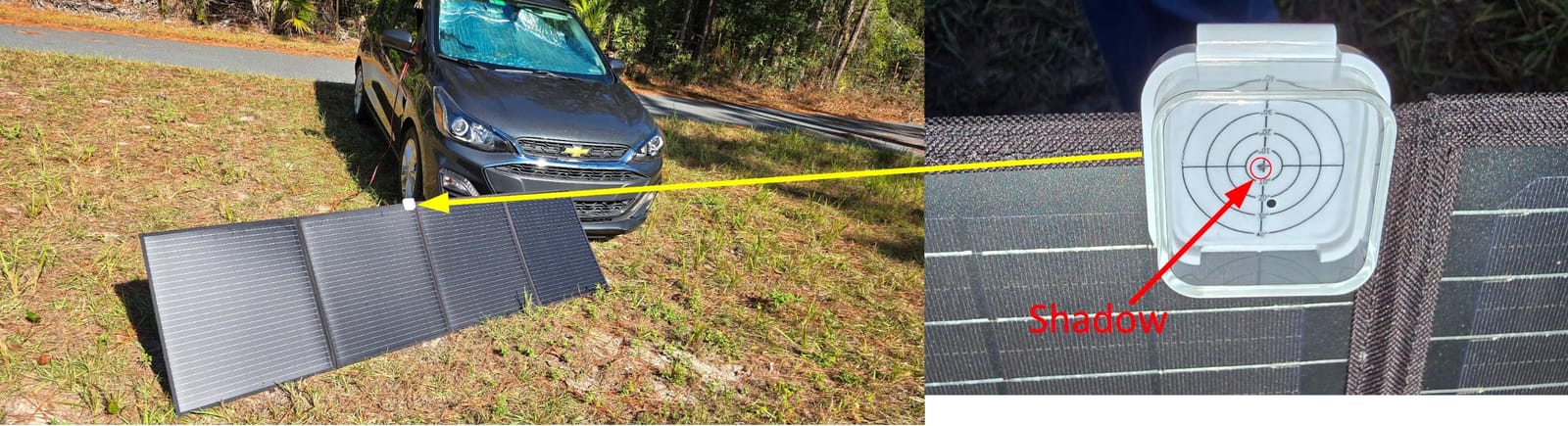
It weighs 17.8 lb, folds to 23.5 by 21.25 by 2.3 inches, and uses four kickstands with thickened carry handles. IP67 sealing covers both water and dust.
Check Your Station’s Voltage Limit First
This is the one panel in the roundup where buying the wrong thing is genuinely easy. A 40V panel will not work with a power station that caps solar input voltage below 40V, and several popular compact and mid-size stations do exactly that.
Forum users repeatedly name verifying maximum input voltage as the single most important check before buying a third-party panel, and this is the model where skipping that step has real consequences. Check the specification label on your station first.
Why High Voltage Helps a Large Station
For a 1,000Wh to 2,000Wh station, the controller is doing a lot of work and the cable run is longer. Running at 40V rather than 18V means roughly half the current for the same wattage, and the difference in delivered watts over a 3-meter run can be meaningful.
That is why owners report faster charging than with a comparable-wattage 18V panel, and why the 220W figure is closer to being reached than on most competitors.
Weight and Practical Limits
At 17.8 lb this is among the heavier foldables here, and the flexible panel fabric is described as floppy, which makes precise sun-angle positioning awkward. The 7-in-1 connector reduces adapter hunting, and the same range is offered in 45W, 60W, 110W, and 400W versions.
One more reality: many power stations cap input power, so a 220W rating on a station with a 200W limit means roughly 200W is your ceiling. The panel is not underperforming; the station is limiting it.
Who This Panel Suits
The MHPOWOS 220W belongs with an owner of a large power station whose spec sheet confirms a 40V or higher solar input ceiling. For anyone else, the lower-voltage panels in this roundup are safer and equally capable at filling a station.
11. ZOUPW 200W – Best 200W Panel Confirmed With Jackery 1000 v2
ZOUPW 200W Portable Solar Panel for Power Station,23.5% Efficiency
200W rated
24.3V max voltage
23.5% efficiency
18.96 lb
IP67 ETFE
Pros
- Around 170W real output confirmed in full sun
- 5-in-1 cable covers Jackery Bluetti EcoFlow and Anker
- IP67 ETFE holds up to rain mud and RV work
- USB-C PD 60W and QC3.0 USB-A for direct charging
- Four kickstands with magnetic briefcase handles
Cons
- Output varies noticeably from panel to panel
- 18.96 lb is one of the heavier 200W foldables
- Junction box is water resistant not submersible
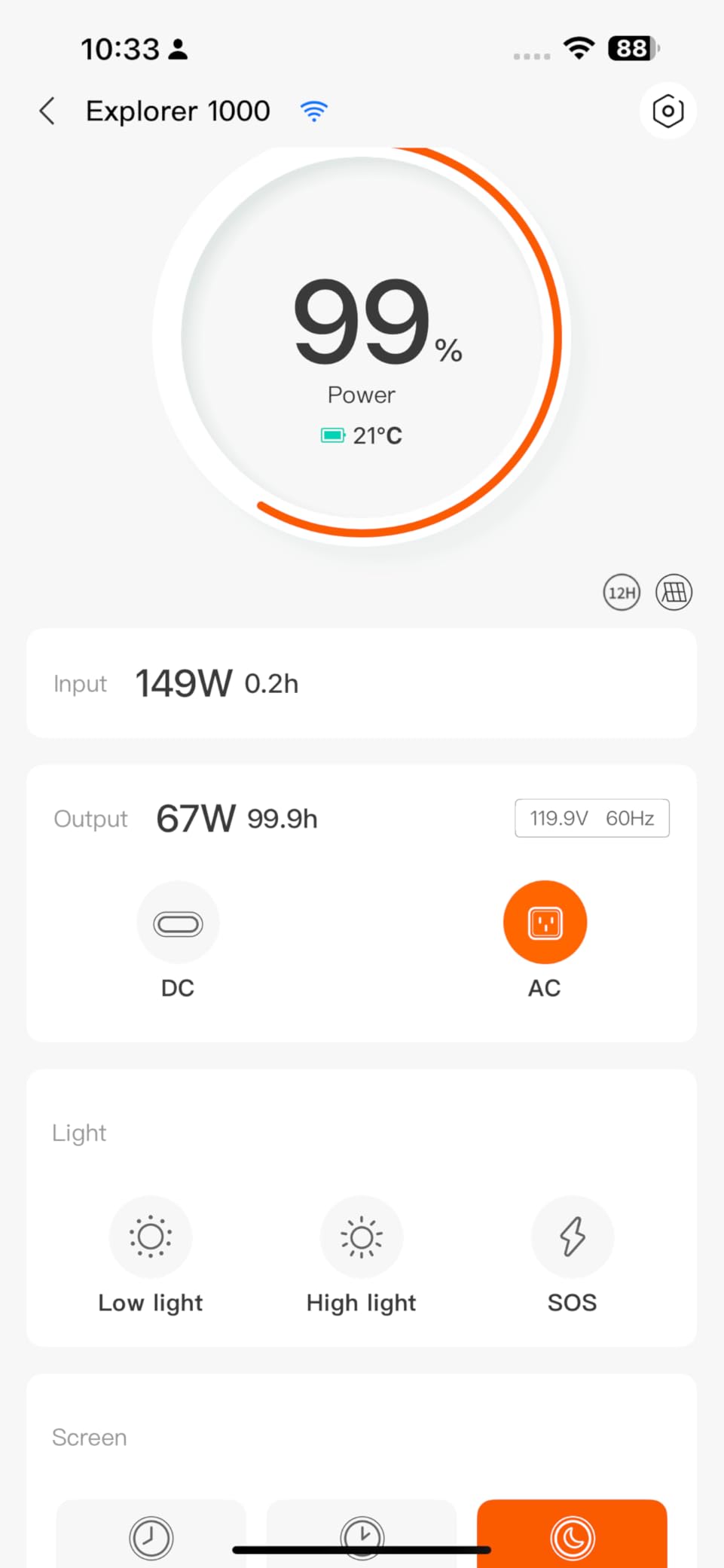
This is the ZOUPW 200W, and the reason it earns its own section is specific evidence rather than spec-sheet appeal. Owners running it into a Jackery Explorer 1000 v2 report around 170W in full sun, enough to hold the station near full while powering a computer and a Starlink terminal.
Cell efficiency is 23.5% on Grade A+ monocrystalline, laminated under IP67 ETFE for industrial-grade weather resistance. The 5-in-1 cable covers XT60, Anderson, DC7909, DC8020, and DC5521, which is why it works with Jackery Explorer 1000 v2, 1500, and 2000 Pro models alongside Bluetti, EcoFlow, and Anker SOLIX units.
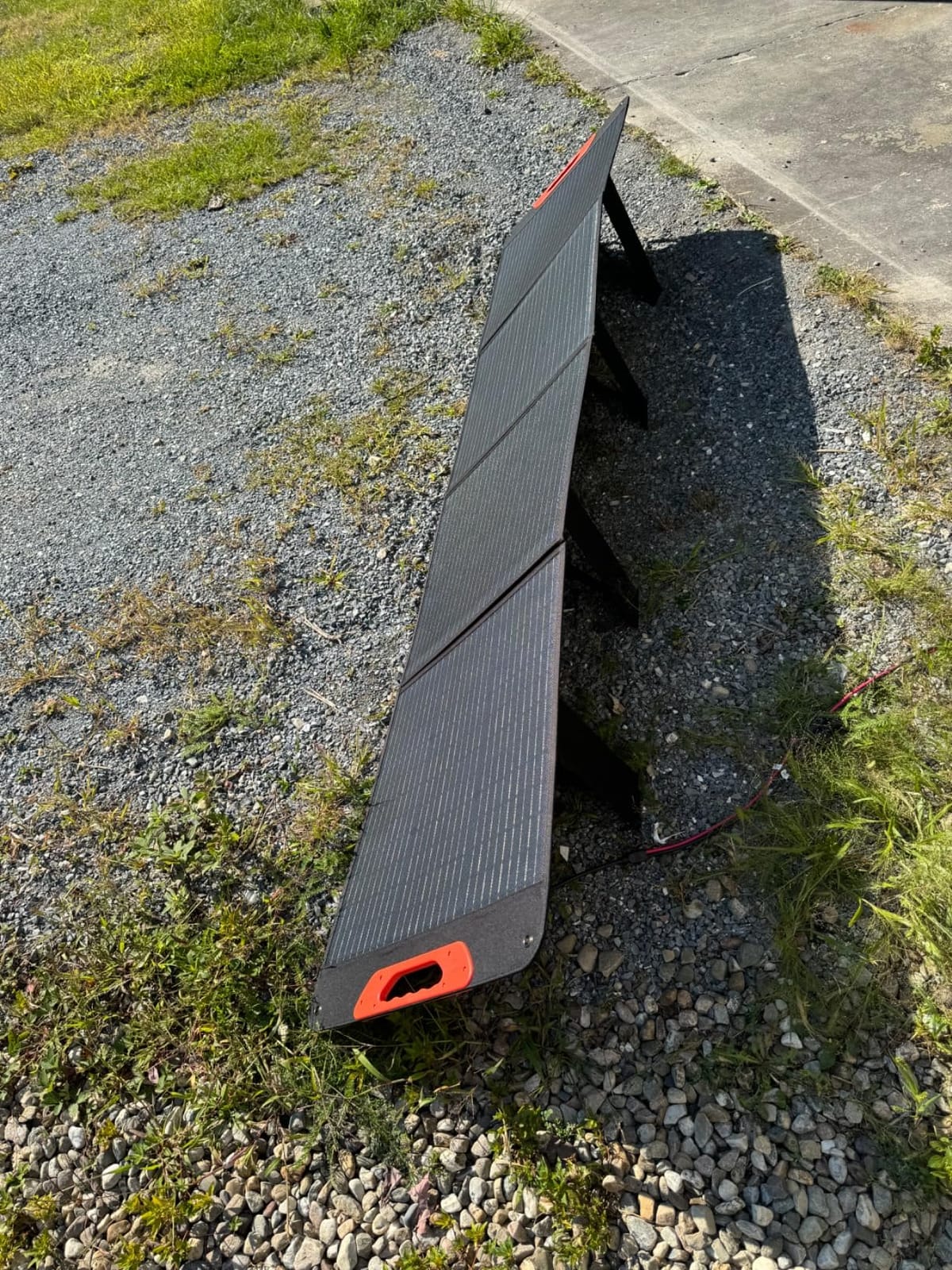
It folds to a 25 by 21.06 by 1.97 inch briefcase with magnetic handles and four adjustable kickstands, and the built-in junction box carries USB-C PD at 60W and a QC3.0 USB-A port.
Unit-to-Unit Variance Is the Main Theme
Owners report a wide spread: some panels deliver 170W, others land between 120W and 150W, and a few describe daytime droop where output falls from 120W to 40 or 80W while still in full sun. If you buy this, test it on day one and keep the packaging for the 30-day return window.
What rescues those complaints is service. Defective panels are replaced quickly and free of charge, and the brand runs 7*24 customer support alongside a 12-month warranty.
Why the Cable Matters More Than the Wattage
On r/Ecoflow_community and r/overlanding threads, the recurring frustration with third-party panels is adapter hunting, and this cable answers it. The DC8020 head in particular covers newer Jackery models, though some units ship without that adapter fitted.
Maximum voltage of 24.3V and output of 20.16V at 10.5A place this panel in the broadly compatible middle of the range, which is a deliberate choice over the higher-voltage designs.
Weather and Handling
IP67 ETFE lamination holds up to rain, mud, and RV work conditions according to owners. The junction box itself is water resistant rather than submersible, so avoid setting the panel in standing water.
At 18.96 lb it is among the heavier 200W foldables and the folded briefcase is bulky, so budget for real estate in your vehicle.
Who This Panel Suits
This panel is the pick for Jackery Explorer 1000 v2 owners and anyone with a station in the 1000Wh to 2000Wh class who values a single cable that covers every major brand. It also suits users who need daytime laptop charging alongside battery refill.
12. MHPOWOS 110W – Best Starter Panel for 300Wh to 500Wh Stations
110W Portable Solar Panel for Power Station IP67 Waterproof Solar Charger
110W rated
20V output
23.5% efficiency
9.9 lb
IP67
Pros
- Reliable 60-82W real output in full sun
- 20V output suits most power stations and generators
- IP67 sealing with rear cable pouch
- 9.9 lb and folds to a 1.57 inch package
- 4-in-1 cable covers Anderson XT60 DC7909 DC5521
Cons
- Real output runs 60-75% of the 110W rating
- No useful output in overcast conditions or shade
- No built-in charge controller or direct USB ports
The MHPOWOS 110W is the panel I would put in front of someone buying their first power station. It is small enough to stay in a closet between trips, light enough to forget it is there, and it delivers the kind of output that actually tops up a 300Wh to 500Wh station in a usable window.
Owners consistently measure 60W to 82W in real sun, which is enough for meaningful top-ups rather than a token trickle. In one owner’s testing it charged a 600W power bank in about 25 minutes under direct sun.
Output voltage is 20V, which is broadly compatible with most power stations and solar generators. It weighs 4.5 kg, folds to 23.46 by 21.25 by 1.57 inches, and includes a solar extension cable to Anderson, XT60, DC7909, and DC5521 connectors with an 18-month warranty.
Expect 60 to 75 Percent of the Nameplate
That figure is not a defect; it is how portable panels behave in real conditions. In full, direct sun with clean glass and correct angling, roughly 60W to 82W from a 110W panel is a realistic and consistent result, and it is what you should size your expectations around.
Cloud and shade are different. This panel does nothing useful in overcast conditions, so treat it as a fair-weather maintainer rather than an all-weather energy source.
Setup Details That Matter Day to Day
Two kickstands position the panel for quick sun-angle adjustment, though the range is narrower than four-leg designs. A rear cable pouch keeps the leads tidy, and IP67 sealing covers water and dust for outdoor use.
There is no built-in charge controller and no direct USB output, which means it is a power-station panel rather than a device charger. One owner also found the Anderson connector needed repositioning to fit their rig, and the manual may ship in a language other than English, both minor but worth knowing.
Where It Fits in a Kit
Think of this as the maintenance layer under a larger setup. Run it during the day to hold a 300Wh to 500Wh station topped up while you draw power from it, and treat the 18-month warranty as reasonable coverage for occasional use.
If your station is 1,000Wh or larger, step up to one of the 200W panels. If you plan to carry the panel on foot, the FlexSolar 100W at 4.1 lb is the lighter alternative.
How to Check That a Panel Will Work With Your Power Station
Four checks, in this order, will tell you in five minutes whether a panel is compatible. Skipping the first one is the most common expensive mistake in this category, because a panel that pushes more voltage than your station accepts can damage the charge controller.
- Read the station’s maximum solar input voltage. The number is printed on the input panel or in the manual. The panel’s maximum voltage must be at or below it.
- Check the maximum solar input wattage. This is the ceiling on charging speed. A 200W panel into a station capped at 100W will charge at 100W no matter how good the panel is.
- Match the connector. MC4 is standard on panels, but stations use DC5521, DC7909, XT60, Anderson, and DC8020. A panel with a multi-head adapter cable saves a return trip.
- Confirm multi-panel support. If you plan to run two panels, the station must support series or parallel input, and the combined open-circuit voltage must stay under its limit.
Forum users name Bluetti as a brand that accepts unusually high solar input, up to 500W on current models, which makes pairing brand-specific rather than universal. On 4×4 and overlanding forums, the advice is consistent: check your station’s input spec before buying any third-party panel, not after.
Series wiring, or daisy-chaining, doubles voltage rather than wattage. Two 100W panels at 18V each become 36V in series, so the same voltage ceiling applies that would apply to one higher-voltage panel. The alternative is parallel wiring, which keeps voltage constant and doubles current instead, but your station has to support it.
On r/Ecoflow_community, users are actively trying to expand existing setups with additional panels in series, which is exactly the situation where the voltage ceiling needs checking first. On r/preppers, the pattern is different: a single panel added to an emergency backpack to maintain a station, where weight and reliability matter more than raw watts.
How to Choose the Right Panel Size for Your Station
Sizing comes down to three questions: how big is your station in watt-hours, how often do you need it full, and how far are you willing to carry the panel. Answer those and the wattage tier follows.
Match Panel Watts to Station Capacity
A 40W to 100W panel is the right tier for stations from 100Wh to 500Wh. A 100W to 200W panel suits 500Wh to 1,000Wh stations. Anything at 1,000Wh and above wants 200W or more, and large stations benefit most from high-voltage panels that reduce cable loss.
Oversizing is not wasteful in the sense of wasted money, because the station’s input limit caps the charge rate regardless. What oversizing costs you is weight you carry for output you cannot use. Undersizing costs you time, since a 40W panel refilling a 1,000Wh station is a multi-day proposition.
What 100W Versus 200W Really Costs You in Weight
Across this roundup, 100W panels weighed between 4.1 and 9.9 lb. The 200W class ran from 9.7 lb on the DOKIO up to 18.96 lb on the ZOUPW 200W. That spread matters more than the wattage difference for anyone carrying their gear any distance.
The efficient end of the range is worth noting. The Renogy E.Flex delivers 200W at 13.89 lb and the ALLPOWERS SE200 does 200W at 15.8 lb, both better watts-per-pound than the 200W norm.
Real-World Charge Times to Expect
Divide station capacity by panel wattage, then derate. A realistic field yield is 50 to 70 percent of rated output once you account for heat, angle, and controller losses.
- A 300Wh station on a 100W panel: about 3 hours of full sun at a perfect 100 percent, realistically 4 to 6 hours at 50 to 70 percent yield.
- A 500Wh station on a 200W panel: about 2.5 hours ideal, realistically 3.5 to 5 hours in good conditions.
- A 1,000Wh station on a 200W panel: about 5 hours ideal, realistically 7 to 10 hours of solid sun.
- A 2,000Wh station on a 220W panel: about 9 hours ideal, realistically 13 to 18 hours, which is a two-day job.
- A 500Wh station on a 40W panel: about 12.5 hours ideal, and well over 20 hours realistically. This is why the 40W panel is a maintainer, not a refill.
If your station caps solar input below your panel’s wattage, the station’s limit replaces the panel’s number in every line above.
Monocrystalline Versus Polycrystalline
Every panel in this roundup is monocrystalline, and for portable use that is not really a decision. Monocrystalline cells convert roughly 22 to 25 percent of incident light, against about 15 to 20 percent for polycrystalline, and they do it in a thinner, lighter laminate that folds.
Polycrystalline panels are still the right choice for a fixed ground-mount array where cost per watt dominates and weight is irrelevant. For something you carry to a campsite, monocrystalline is the only realistic option.
Connectors and Cable Length
MC4 is the standard solar connector and the one to look for if you want to series-connect panels later. DC5521, DC7909, XT60, Anderson, and DC8020 are the ports you will find on power stations.
Buy a panel with a multi-head adapter cable, and buy an extension of at least 3 meters. Short leads are the most common complaint across this group, and they force you to put the power station in the sun instead of the shade, which shortens the battery’s life.
Cost Per Watt and Value Ranking
Larger panels are almost always cheaper per watt than smaller ones in this category, because the frame, laminate, and handle costs are largely fixed while the cell area scales. A 200W panel therefore delivers more wattage per unit of packaging than two 100W panels do, and it usually weighs less than two 100W panels combined.
On value specifically, the DOKIO at 9.7 lb for a near-200W rating stands out, and the ZOUPW 100W leads the 100W class on rating and included connectivity. Paying a premium, as you do for the Renogy E.Flex, buys cell efficiency, weight, and certification rather than raw output.
Why Your Panel Is Not Hitting Its Rated Wattage
When a 200W panel shows 80W on the display, the panel is usually fine. Here is the troubleshooting order I use.
- Check the station’s input limit. A capped station will never accept more than its rating, and this is the most common explanation by a wide margin.
- Reposition for the sun. A panel lying flat loses a large share of its output. Two adjustable kickstands at 45 degrees can recover up to 25 percent.
- Remove partial shade. Series-wired panels can lose half their output from a small shadow, because the shaded cell limits current through the whole string.
- Account for heat. Output falls as cell temperature rises, and a panel in full sun is often 20 to 30 degrees above ambient. A breeze genuinely helps.
- Clean the glass. Dust and campsite grime cut measurable output. Forum users report noticeable losses from dusty panels.
- Inspect connectors. A partially seated MC4 or a corroded DC barrel will limit current without any visible sign.
Real-world reports in this roundup range from 112W to 191W on panels rated at 200W, which is what a healthy panel should look like in good sun. Anything consistently below 50 percent of rating on a clear day points to a hardware problem, not conditions.
Frequently Asked Questions
What type of solar panel is best for charging a power station?
A foldable monocrystalline panel whose wattage and open-circuit voltage match your station’s maximum solar input is best. For a 500Wh station, a 100W to 200W panel refills it in roughly 4 to 8 hours of good sun. Always check the station’s maximum input voltage before buying.
What solar panels will work with Jackery?
Panels with an MC4 output and a 5-in-1 adapter cable covering DC8020, XT60, Anderson, DC7909, and DC5521 connect to most Jackery Explorer models without extra parts. Check your model’s solar input voltage ceiling first, since some units cap below 24V.
How to tell if a solar panel is compatible with a battery?
Compare the panel’s maximum voltage to the battery or station’s maximum solar input voltage, and confirm the connector type matches. The panel’s maximum voltage must stay at or below the device’s limit. Plugging in a higher-voltage panel can damage the charge controller.
How long will a 200W solar panel take to charge a 12V battery?
Divide the battery’s watt-hour capacity by 200. A 500Wh battery takes about 2.5 hours in ideal conditions, and realistically 4 to 6 hours in the field once you account for a 50 to 70 percent solar yield.
Can I use my power station while it is charging from a solar panel?
Most modern power stations support pass-through charging, so you can run devices while solar input is connected. The station draws power for its inverter from the incoming solar current first. Confirm pass-through support in your station’s manual, as older units lack it.
Why is my portable solar panel only producing a fraction of its rated wattage?
The most common cause is your power station’s solar input cap, not the panel. Beyond that, flat positioning, partial shade, high cell temperature, dust on the glass, and a loose connector all reduce output. A healthy 200W panel typically delivers 110W to 190W in good sun.
Which Portable Solar Panel to Buy for Your Power Station
Pick by the size of your station first, because that decides everything else. For a station in the 100Wh to 300Wh range, the powkey 40W is enough to maintain it. For 300Wh to 1,000Wh, the ZOUPW 100W is the safest default because its 24.3V ceiling and 5-in-1 cable fit nearly every brand. For 1,000Wh stations and up, the Renogy 200W E.Flex gives you the best efficiency and the lowest weight at 200W, while the ZOUPW 200W is the one to choose if your station is a Jackery Explorer 1000 v2 or you need 60W of USB-C while it works.
If your station accepts 36V or higher solar input, take the ALLPOWERS SE200. Its parallel wiring is the most shade-tolerant design here, and the IP68 sealing holds up in weather that ends PET-laminated panels. If you specifically want the highest voltage for a large station and have confirmed a 40V ceiling, the MHPOWOS 220W reduces cable losses further.
Two final notes. Never connect a panel whose maximum voltage exceeds your station’s solar input limit, and buy an extension cable longer than you think you need so the power station can sit in the shade. If you also run a CPAP or a small RV, our guides to the best portable power stations for CPAP machines and best portable power stations for small RVs cover the stations these panels pair with most often.
Whichever panel you choose, check your station’s voltage limit before you order, angle it into the sun properly, and expect roughly two-thirds of the nameplate on a good day. That is normal, and it is still the difference between a power station that runs all week and one that runs all afternoon.